IF WE DON’T SUPPORT THE RESISTANCE

Diarmuid Breatnach

(Reading time: 5 mins.)

In an anti-imperialist struggle, if we don’t support the Resistance, what are we doing?

Among the Left – and even among many liberals — the importance of internationalist solidarity is generally accepted as taken for granted. However, as with many principles, it is in its application that we find substantial disparity.

After the October 7th breakout from the Zionist siege of Gaza the leading elements of the western world rushed to condemn the Palestinian resistance led by the Hamas group. Atrocity propaganda created by the Zionists abounded.1

Hamas2 and Islamic Jihad3 had planned and carried out the breakout operation in which they knocked out the Zionist surveillance and automatic firing defences, damaged communications, went through and over the apartheid wall and overran the Golani Brigade4 forces.5

The Resistance killed many of the IOF6 and captured others. In addition, the Resistance captured a number of civilians in order to exchange them for the huge number of Palestinian political prisoners held by the Zionist authorities.

Some Left groups joined the anti-Resistance chorus immediately while others took a little longer but then did so too. In Ireland, for example, leading figures in People Before Profit and the Socialist Party condemned Hamas, seen as the leading Palestinian element in the operation.

So too did the leadership of the formerly revolutionary Irish Republican political party Sinn Féin.7

Of the Left Zionists in ‘Israel’ (in so far as they can be called ‘Left’), they too joined the chorus. The Israeli state’s presidency has had representation from the Labour Party without interruption from 1948 to 1977 and most of the settlement expansions took place under a Labour government.8

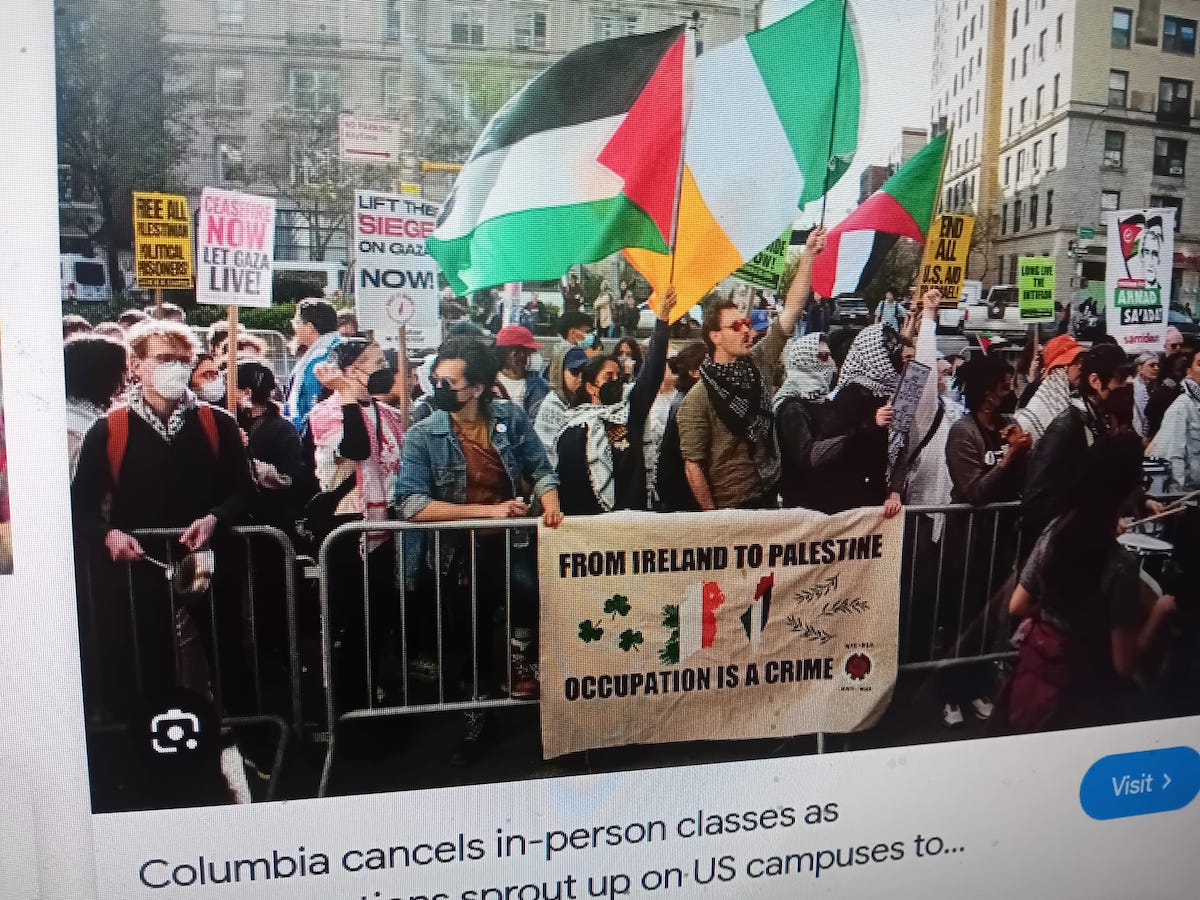
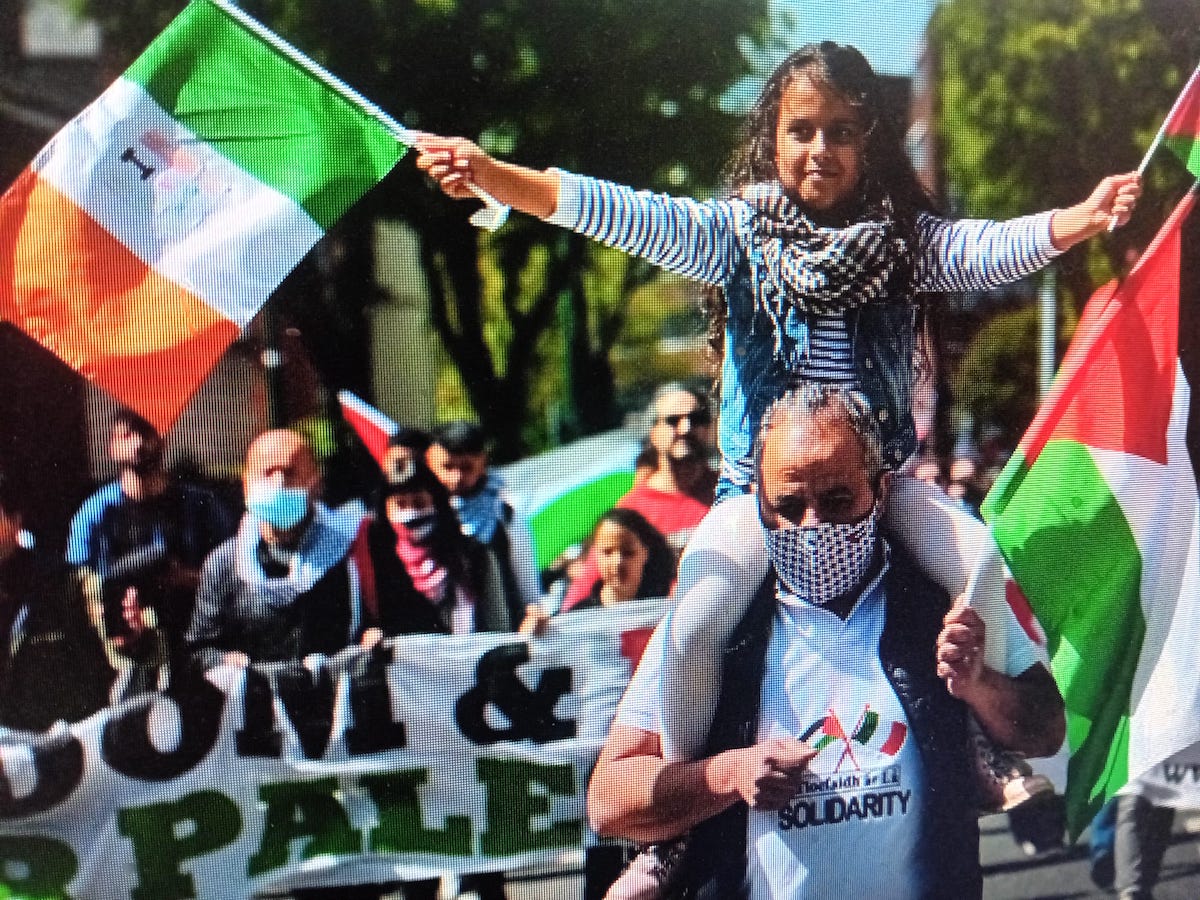
Saoirse Don Phalaistín solidarity group banner (bearing logo of the People’s Front for the Liberation of Palestine on right of photo) after Palestine solidarity march in Dublin 27 January 2024. Also visible in addition to the Palestinian national flag perhaps are two versions of the Starry Plough flag of the Irish Citizen Army, the Republican Congress version at extreme left and the original version above the banner. (Photo: D.Breatnach)

CIVILIANS

Some of the western ‘Left’ organisations stated that it was not the armed breakout of the Palestinians to which they objected but instead the killing of civilians. The liberals and media also made much of the issue of ‘civilians’ – to an extent never accorded to Palestinian civilians.

It is important to note that the adult civilians in the ‘Israeli’ state are, apart from tourists, settlers. They are colonising land from which the indigenous Palestinians have been ethnically cleansed. In addition military service is required of all ‘citizens’9 and a great many are armed anyway.

This is similar to what the Indigenous people of the Americas and Antipodes faced from European settlers from the 18th to the 20th Centuries or the Irish during the various plantations from the 17th Century onwards and the Land War during the 19th.

One baby was killed on October 7th quite likely by excessive heat in a burning building and another 13 children were killed, according to ‘Israeli’ social services. But by whom? By Palestinians or by indiscriminate Hellfire missiles from IOF helicopters and at least one tank firing into a building?10

Civilians may have been deliberately killed knowing they were civilians or by crossfire or by Israeli counterattack. Certainly there was at least one teenager taken captive, the daughter of the Irishman settler who infamously said he would rather his daughter were dead than captured by Hamas.

We’d like to know, of course, which case and how many. But in terms of solidarity principle, it’s beside the point: While we are not required by internationalist solidarity basic principles to approve of every one of its actions, we ARE required to be in solidarity with the Resistance.

A number of Palestinian armed resistance groups displaying unity in the struggle (Photo sourced: Iran News)

BUT, ISLAMIST…!

Many in western society are secular in their politics, many of agnostic or atheist position. So, that is our choice. Others belong quite strongly to one religious belief or another. What is different about Islamists (or fundamentalist Christians) is that they aspire to a society run in accordance with their religious beliefs.

We may not agree with that objective. We should not agree with the subordinate social and political status accorded to women in some religious cultures nor to the outlawing of LGBT sexuality. But even so, we should support the Resistance, Islamist or otherwise, in resisting repression.

Basque society was largely conservative Catholic while resisting Spanish State fascism up to the 1970s; Welsh mining society was often conservative Methodist in the struggles of the miners in the 1930s. The Irish Republican movement was permeated by Catholic symbolism and ideology.

We could have been, should have been capable of supporting the resistance in each of those cases while not supporting the religious conservative, reactionary or fundamentalist beliefs or conduct of participants or leaders in those struggles.

For revolutionaries, the general principles or internationalist solidarity are not of the kind from which one can pick and choose, while rejecting others. We are however entitled to accord ‘favoured status’ to an organisation the ideology and practice of which we most approve.

We may for example prefer a secular or even socialist resistance organisation (e.g the People’s Front for the Liberation of Palestine). We may carry its flags, promote its statements, share its social media postings. But we do so while also expressing solidarity with the Resistance as a whole.

That is reasonable and honourable. It is neither to participate in attempts to break up whatever unity exists among the organisations of the resistance.

During the 30 Years War in Ireland, there were those in Britain who participated in those activities – people who colluded for example with SF refusing to share a platform with the IRSP11 on Hunger Strike commemorations, threatening refusal to attend if their wishes were not acceded to.

No doubt that seemed justified to the Provisionals in their promotion of their organisation above any other choice but that activity split commemoration committees, disheartened activists and killed some solidarity events on the annual calendar.12

HOW BEST TO DO IT … AND IN PUBLIC

We often hear people ask a speaker from the resistance movement what we should do in solidarity. This is in general incorrect behaviour because we have our own revolutionary program and we best know our own circumstances and capabilities.

It is a different thing to ask what are the things that the resistance movement needs: medicines, weapons, representation, contacts, publicity etc. But we still have to decide how well to fit the effort of obtaining those within our capabilities or even whether the objective is worth the energy expanded.13

The Resistance can tell us what they need but the decision on which solidarity actions to take is ours. However whether to express solidarity is not a choice for revolutionaries – it is an obligation.

As revolutionaries we have a public position and part of that should be public solidarity with the Resistance. It is not unknown for some to claim to support a resistance organisation but to decline to do so publicly.

An African National Congress speaker in London years ago told me privately that they supported the Palestinian and Irish resistance but would not do so publicly as it might undermine support they were receiving from UK and other western bourgeois organisations.

I argued with him against this.14 Relating the discussion to a senior SF activist later I was astounded at the response that they would do the same if required.

Solidarity with the Resistance means also solidarity with those incarcerated during the struggle, the resistance in the jails. Again, though an organisation may think differently, we are not required to support the specific organisation to which the prisoners owe allegiance.

Nor does any Resistance organisation have the right to dictate to us whether we may or may not express solidarity with political prisoners who are aligned with that organisation. Over the years, the Ireland Anti-Internment Campaign has faced down attempted coercion along those lines.

So also did the Irish Political Status Committee in London. And both groups remained independent. Unfortunately the Troops Out Movement of the day was unable to do so and after a brief period of asserting independence, eventually succumbed to domination by Provisional Sinn Féin.15

Supporting political prisoners is an act of necessary solidarity with the resistance and also one of self-defence in the longer term but it does not necessarily mean expressing support with the actions or organisation of the prisoners before or indeed after they were jailed.

Banners and flags presumably at Celtic FC home stadium during the current episode of the Zionist genocidal war. (Photo sourced: Internet).

SUMMARY

We are entitled if we wish to prioritise support for a specific organisation or its program but not obliged to do so, nor to accept their advice on how to conduct our solidarity work. Nor is it required of us to condone every action of the Resistance in general.

But we are required to publicly support the Resistance in general and not to join in public condemnations. And that’s the minimum to do if we are going to claim being in solidarity with a struggle.

For any revolutionary struggle, internationalist solidarity is an important factor, in encouragement to the Resistance, in de-legitimising the repression and in practical terms of supplies to the resistance, also in hampering the repression through blockades, boycotts or industrial action.

If we don’t support the Resistance, how can we claim to be in solidarity with Palestinians? Charity is not the same as solidarity. Pity is not the same as support. Outrage at the crimes of the oppressor is not the same as solidarity with the Resistance.

Furthermore, why should we expect solidarity with our struggles, now and in the future, if we cannot express that solidarity with the struggles of others?

End.

POSTCRIPT

Some will have searched in vain for a reference from Lenin, Mao, Trotsky, Luxemburg – or Connolly or even a famous Irish Republican leader – to justify the principles I have discussed here. At the end of the day, people should stand by principles because they have been tried and tested and are aligned with revolutionary experience but should also test them on their own experience in struggle.

In presenting some credentials towards giving these principles some consideration I can only say that I have thought about them and sought to practise them over decades of activism in Britain and Ireland.

Among the areas of Resistance and of political prisoners which have claimed my activity have been Ireland, Palestine, S. and SW Africa, Vietnam, Housing struggle, US Indigenous and African American people, organised Workers, Anti-Fascism & Anti-Racism, Kurdistan, the Basque Country, Syria, Haiti, Western Sahara, Catalunya, the Donbas …

FOOTNOTES

1All since thoroughly debunked though still repeated on occasion: “‘Israeli’ babies beheaded, torn from a womb and stabbed, women raped, people and houses burned.” These fake atrocity stories were repeated in the western media and by some politicians, including Biden and helped create an atmosphere assisting genocide by the ‘Israeli’state.

2Hamas began as an Islamist community organisation which then became a political party and developed an armed wing (like most Palestinian political groups, in response to the armed Zionist State and its settlers). In 2006 the party won the Palestinian legislative elections but the defeated Fatah (widely acknowledged as corrupt) administration in Gaza refused to give way and, in a short conflict, the Fatah armed group was defeated by that of Hamas. They chose not to do the same in the West Bank, presumably to avoid civil war from which the ‘Israeli’ state would benefit but from that moment onwards the Zionist State blockaded Gaza and the organisation was labelled a “terrorist” group in the west and financial support went instead to the Fatah-run Palestinian Authority in the West Bank (which has refused to run new elections in two decades).

3Palestinian Islamic Jihad was formed in 1981. The armed wing of PIJ is Al-Quds Brigades (also known as “Saraya”), also formed in 1981, which is active in the West Bank and the Gaza Strip, with its main strongholds in the West Bank being the cities of Hebron and Jenin. In addition to this organisation and Hamas there exist a number of other resistance factions, some of which are secular, all working together as a broad armed resistance front with organisational autonomy but ofen in joint operations also.

4The Golani Brigade of the Gaza Division is the most highly decorated IOF Brigade, having taken part in all of the state’s major ethnic cleansing and genocidal operations. On October 7th hey were overrun in minutes and 72 killed with an unknown number captured (‘unknown’ because many, along with their Palestinian fighter captors were burned to death in their cars by ‘Israeli’ Apache helicopter Hellfire missiles).

5 The Palestinian operation went deep, passing Golani’s 3rd defensive line.

6‘Israeli’ Occupation Forces, aka the official but misnomer IDF (“Israeli Defence Forces”).

7The current iteration of Sinn Féin abandoned its revolutionary anti-colonial and anti-imperialist path in embracing the pacification process in1999. It stood down its armed wing, the IRA and largely dissolved it, also having their weapons decommissioned, since when it has participated in the administration of the colony and in recruitment of the colonial police force.

8Yet for years the Socialist Party have opposed boycotting the Zionist State, calling instead for unity with the “Israeli Left”.

9With the exception of most ‘Israeli’ Palestinians and all ultra-Orthodox ‘Israelis’ but for the latter is in the process of change https://www.aljazeera.com/news/2024/6/11/israels-knesset-advances-contentious-ultra-orthodox-conscription-law

10Documented by military and survivor sources on ‘Israeli’ media.

11The Irish Republican Socialist Party with an armed wing up to the 1990s, the Irish National Liberation Army, which contributed three Volunteers to the 10 martyrs who died on hunger strike in 1981.

12And what, in the end, did the Provisionals achieve with the supremacy gained?

13The Resistance organisation may ask us to arrange meeting for them to address our state’s parliament, or for interviews with the media … Or even to restrict our propaganda from solidarity to self-interest for people, as Sinn Féin did in England in the 1980s when they were promoting Time To Go: “Push the issue of the expenditure on troops, better spent on the health and social services.@

14If to do so incurred a legal penalty would have been a different situation, of course.

15And from that moment onwards became a less broad and less effective, eventually ceasing to exist as a solidarity organisation.

SOURCES

Including a discussion on the importance of solidarity with the Resistance: https://youtu.be/yj9hQaqeeio?si=z1oSOAYGX8z-Ney8

Ireland Anti-Internment Campaign: https://www.facebook.com/p/Ireland-Anti-Internment-Campaign-100063166633467/

BRITISH NAVY VESSEL PROTESTERS SENTENCED IN DUBLIN

Diarmuid Breatnach

(Reading time: 5 mins.)

Around 30 people demonstrated outside Dublin’s Criminal Court on Thursday, many of them displaying Irish flags (Tricolour and Starry Plough) along with those of Palestine in solidarity with three activists before the court.

The activists were charged under Public Order legislation arising out of protesting a British war ship at Dublin docks in November last year, in solidarity with Palestine and against NATO’s support for the Israeli state’s slaughter in Gaza.

It was alleged that the activists (variously from Saoirse Don Phalaistín and Anti-Imperialist Action organisations) had entered a restricted part of the Dublin Docks and, holding a Palestine flag, had approached a British warship docked there and then occupied the gangway.

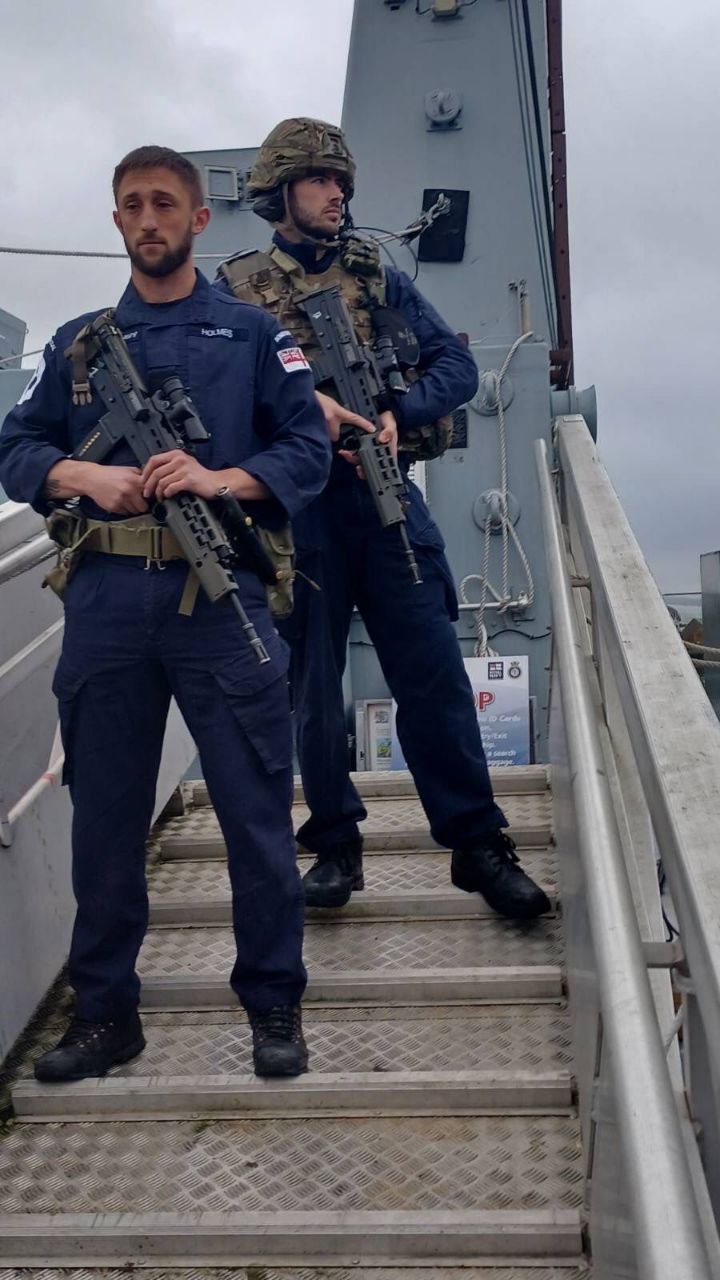
British military displaying firearms on Irish state soil in November last year. (Photo: Anti-Imperialist Action)

Gardaí had been called and the activists had refused their instruction to leave under the Public Order legislation and they had then been arrested. No act of violence, physical or verbal, took place on either side other than the refusal to leave and the arrests.

The activists appeared in the Parkgate Street building before Justice John Hughes and all three were defended by Damien Coffey of Sheehan Partners, a law firm which often handles political and human rights cases. Three Gardaí from Store Street acted in the role of the Prosecution.

The Garda in charge of the prosecution and his two colleagues gave evidence as to the arrests. Questioned by Coffey for the Defence, all confirmed that although the protesters had refused to leave, there had been no violence offered by them during their arrests.

Strangely, as shall become evident and relevant, one did not recall the British military presence on the gangway to be armed, whereas another did and confirmed that a photo of the armed men was of those who had been present.

One of the Garda offered his opinion that whereas the vessel was regarded in law as “British soil”, the gangplank was legally “Irish soil” and, if the protesters had actually set foot on the ship, they might have been charged with piracy. This piece of evidence also had unintended consequences.

One of the placards displayed by supporters outside the courthouse (Photo: Rebel Breeze)

According to this evidence, the British in a foreign military uniform had been present on Irish state soil and all replied to the defence lawyer that they were unaware of any Ministerial permission to do so — or that this could have constituted an offence under Section 317 of the Defence Act 1954.1

Furthermore, none were aware of any special permission granted to them to carry firearms on Irish state ground. The British military personnel themselves were not present as witnesses as their superiors had not replied to the Garda request to discuss giving evidence in the case.

Port security camera footage was shown as evidence by which protesters could be seen at the gates of a fenced-off section of the docks and some time later proceeding through a gate. A port security employee had been summoned by the Gardaí as a witness.

After he had been taken through his evidence (and failed to respond to what seemed an attempted prompt) by the Garda in charge the only relevance of his evidence was that a) the area was restricted and b) that he was worried for the safety of the protesters.

This (and the reason for the possible attempted prompt) was of importance when Coffey developed his defence summary on the legal grounds that Section 14 (1) of the Public Order Act required there to be an element of fear arising from the actions of those to be charged under the Act.

None of the evidence for the Prosecution had shown the presence of fear of anyone from the defendants and, furthermore, he submitted, any element of fear was much more likely to arise from the presence of two men holding firearms, to whit, the British military personnel.

The second part of the Defence summary dealt with right to protest, Coffey quoting a number of legal sources, also referencing the Irish Government’s recognition of a Palestinian state and statistics of people killed by the Israeli state against which the activists had been protesting.

Judge Hughes announced that a recess was due for lunch and that he wished to consult legal authority (case law etc) so they would recess and reconvene in an hours’ time.

A number of supporters who had taken time off from other commitments left at this point while a few arrived instead.

THE JUDGEMENT

After reconvening Judge Hughes began his long drawn out summing up and it gradually became clear that he intended to find the accused guilty. However people awaited with varying degrees of patience for the details of the sentence.

The Judge referred to the right to protest but also to the restrictions upon it (usually limiting its effectiveness) though he did not say that, nor that powers exist to abolish those rights when the State feels it necessary.

With regard to the ‘element of fear’ required for conviction under the Public Order Act Hughes quoted a judgement as a reference that seemed neither relevant nor reasonable, involving a woman experiencing fear of being broken into and even fear of children playing outside her home.

Despite repeating the standard claim of capitalist law that judges cannot adjudicate emotionally nor be swayed by what was occurring in Palestine, John Hughes revealed his own political bias when he bizarrely claimed that a British fleet had been welcomed into an Irish port in 1820.

He revealed his political naivety also when he expressed surprise that the British had not replied to the Garda communication regarding the incident.

On submission by Coffey regarding the lack of previous convictions and effect of criminal convictions on the lives of the three, Johnson, again drawing out the moment, gave them what amounts to a conditional discharge with a provisional forfeit of 500 euro.2

No doubt the desire not to create martyrs around whom solidarity campaigns might intensify played at least as much a part as any concern for the lives of the activists.

The defendants and their supporters left; outside the court they were embraced by a number of supporters before the gathering broke up, some attending to other solidarity activities elsewhere. The show of support was a good sign of solidarity against state repression.3

View of some of the people outside the courthouse on Thursday in solidarity with the three activists (Photo: Rebel Breeze)

SERIOUS ISSUES AMONG ELEMENTS OF COMEDY

The name of the British naval vessel being The Penzance and the mention of a possible piracy charge brings to mind of course the Gilbert & Sullivan opera The Pirates of Penzance (1879).

The focus of the Gardaí on arresting peaceful protesters in preference to unauthorised people in foreign military uniform carrying unlicensed firearms on Irish soil and also trying to suggest that not they but the protesters would give rise to fear is not without its comedic elements.

However overall the whole matter is extremely serious, with regard to the zionist genocide in Palestine, the active collusion of the UK/NATO, the active collusion of the Irish ruling class4despite its verbal positions – and the repression of its State on more active and directed solidarity actions.

End.

FOOTNOTES

1 317. — (1) No person shall, save with the consent in writing of a Minister of State, enter or land in the State while wearing any foreign uniform. (2) No person shall, save with the consent in writing of a Minister of State, go into any public place in the State while wearing any foreign uniform.

2 It will not appear as a criminal record but in the event of a subsequent conviction, the 500 euro can be levied as a fine in addition to any other punishment in court sentence.

3 Though the absence of a number of political organisations and trends was also marked.

4 “Dual-use”exports to the zionist state which can be adapted to military use; failure to press for any economic, academic or cultural sanctions against the zionist state; shelving of the Occupied Territories Bill; failure to impose diplomatic sanctions of any kind.

REFERENCES AND USEFUL LINKS

Anti-Imperialist Action

Defence Act, 1954, Section 317 – irishstatutebook.ie

A PEACE DEAL IN PALESTINE?

Diarmuid Breatnach

(Reading time: 8 mins.)

The fundamental thing to grasp here is that there can be no peace deal as such. Although there can – and needs to be – an end to Israeli massacres of Palestinians, no arrangement that leaves the zionist settler state in situ can possibly deliver peace.

Even if the zionists could go against their settler nature and therefore abandoned expansion, the Palestinians will never reconcile themselves to their dispossession of most of their country, including their best land and water.

TALK OF A CEASEFIRE DEAL

Very recently Biden put forward a ceasefire plan which he claimed to be an ‘Israeli’ one; Netanyahu seemed to reject it but one of his ministers accepted it was their position.

News footage of Biden’s announcement of the ceasefire proposal “by Israel”. The Palestinian resistance states that the offer received from ‘Israel’ does not at all match the content or process laid out by Biden. (Source video clip: Internet)

Since it contains the main items in the deal brokered by the Arab state intermediaries and approved by the CIA’s man some weeks ago, naturally the Palestinian Resistance1 has welcomed the proposals.

But with caution – they have seen Netanyahu torpedo ceasefire deals before, including the earlier one. And Netanyahu has said repeatedly that eliminating Hamas (by which he means Palestinian Resistance capability) and recovery of the detained Israelis2 is a necessity for any ceasefire.

Of course, the actions of the IOF under his orders don’t suggest that he is serious about recovering the detainees – not alive, anyway. On the other hand, he dearly would like to eliminate the Resistance capability and was happy to wipe out more than the 36,000+ civilians he has already.

But it may be that he has come to believe – or has been pressured into believing – that that project may have to be put off for awhile. The settler society is deeply divided over the question of the Israeli detainees and in a recent poll only 10% believed that the IOF was winning the war.3

Netanyahu’s position is rational from the settler perspective which is that the Indigenous have to be dispossessed and, because they naturally resist, have to be also heavily repressed. But he would like to keep the war going for another reason, which is that he is due to face trial for corruption.

However, he doesn’t get to be where he is or do what he does as an individual but rather with the backing of, in the first place the Israeli ruling class and secondly, of course, of the US Government, which really means by the rulers of the US financial-industrial-military complex.

Supporting ‘Israel’ has been basic US imperialist policy since 1948, when the zionist lobby in the US was not anywhere near as strong as it is today. Biden now, Trump before (and possibly again), Obama, Clinton, Bush, Bush, Reagan – all of them have supported the zionist colony.

Contrary to what many people think, the main reason for the US supporting ‘Israel’ is that it is the only state in the Middle East totally safe from national liberation revolution (because it’s a settler state fighting the Indigenous) or Islamic fundamentalist revolution (because it’s zionist).

In other words, it’s the only safe long-term USA foothold in the Middle East. Or at least it was.

Current map of the Middle East states. The US has overthrown the Iraq ruling regime and made clients of the regimes of all the others with the exception of Yemen and Iran, both of which overthrew their western-aligned ruling elites. (Source map: Internet)

So if Biden is really pressuring Netanyahu– which is not clear yet, given that money and weapons are still being supplied and massacres of Palestinians continue daily — that means that the US ruling class (or at least its dominant section) is pressuring the Israeli ruling class.

Perhaps that’s why John Kirby, Biden’s Middle East envoy is now heading back to the Middle East, in the first place to the zionist state then possibly to Egypt afterwards, where some Resistance leaders have gone already (at least of Islamic Jihad and of the PFLP, according to Arab media).

But every passing day, the IOF massacres between 50-100 Palestinians on average, the population of Gaza suffers from malnutrition, their housing and shelters are bombed, rescue workers are targeted and the only functioning hospital4 is low on fuel and out of many medicines and drugs.

Since the talk of a deal began, the known death toll in Gaza (not to mention the West Bank) passed 5,000 and is now half way through its sixth thousand.

The cold hard fact is that if the US shut off finance and munitions delivery to Israel, the massacres would stop within a day or two and, because the IOF can’t fight without air cover, it would have to withdraw from its blockade of the Rafah crossing, instantly allowing in food, fuel and medicine.

But also as the Medical Director of GLIA5 Tarek Loubani stated in a recent very informative interview,6 the Palestinian bordering states of Egypt and of Jordan, which also have gates, could break the siege tomorrow. Of course these are ruled by elites that are clients of the imperialists.

“THE TWO-STATE” OPTION

But what’s the long-term plan for Palestine?

For some Zionists, including a couple of members of Netanyahu’s war cabinet, it’s the expulsion (sorry, “voluntary resettlement”) of Palestinians from Gaza to be run by ‘Israel’ and resettled by zionists. Not many outside the state would openly espouse that objective.

Although liberal ‘Israeli’ journalist Gideon Lev, who no longer supports the “2-State solution” (sic) commented that Biden dropped that objective from his outline of the alleged deal,7 it has been for decades the only long-term plan of the US, UK and EU and of their main political parties.

This plan is to get some kind of collaborator management to run less than 20% of historic Palestine next to the robbers of most and the best of its land and most of its water, in a “state” dominated by the robbers and under their constant eyes, genocidal guns and air force.

Who gets the Quisling management job? The USA suggested months ago a “revamped Palestinian Authority” which is despised by most Palestinians, corrupt and authoritarian (hence to be “revamped”). Others have suggested some kind of Arab state partnership to manage at least Gaza.

The most recent map of the imagined two-state “solution”, drawn up during Trump’s earlier presidency – areas in green allocated to Palestine, beige to the zionist state. (Source: Wikipedia)

But Netanyahu says the PA will not run Gaza. Of course, if he’s on the way out, he may be ignored but the Resistance is on record saying that what they have, whether part of 2-State setup or not, must be run by Palestinians and that they will not accept any other states doing so.

And that for Palestinian unity, the PLO8 must be opened to Islamist organisations such as Hamas.9

If legislative elections (overdue by almost two decades) are run now, the likelihood is that Hamas will win again10as it did in Gaza and the West Bank in 2006.11

MEANWHILE, THE DEAL …

“The first stage proposes to involve a six-week ceasefire during which the Israeli army will withdraw from the populated areas of Gaza. Hostages, including the elderly and women, would be exchanged for hundreds of Palestinian prisoners.

“Civilians would also return to all of Gaza, with 600 trucks carrying humanitarian aid flooding the enclave daily, Biden said.

“The second phase would see Hamas and Israel negotiate terms for a permanent end to hostilities. “The ceasefire will still continue as long as negotiations continue,” the president said.

“In the third phase, a permanent ceasefire would follow, facilitating the reconstruction of the enclave, including 60 percent of clinics, schools, universities and religious buildings damaged or destroyed by Israeli forces.”12

The Resistance leadership, while welcoming what Biden said, declare they want to see all the provisions spelled out – and quite rightly so – before they commit to the pacification plan. They also want to see that Netanyahu himself commits to it, which is far from what he’s currently saying.

They want to stop the genocidal murder of their people through bombing, starvation and destruction of medical care facilities. No doubt they also welcome the opportunity for a respite for their surviving veterans and for training new recruits, perhaps also stocking up on war materiel.

But what game are the USA and the Zionists playing? Could this just be electioneering for Biden? Is there a serious split in the Zionist war-cabinet? Or could it be a playing for time and divide-and-rule game by the US, the Zionists and allies?

A statement given by “a senior leader in the Palestine resistance” to Al-Akhbar and published in Resistance News Network suggests that the latter might be the imperialist game.13

The latest attempts will occur in the coming days, following an invitation issued in the name of Egyptian President Abdel Fattah al-Sisi through his intelligence chief Major General Abbas Kamel to senior leaders of the Popular Front and Islamic Jihad

to visit Cairo for consultations on the situation and the possibility of “creating a breakthrough which would lead to a deal the United States wants to happen now.”

The factions will visit Egypt, and there will be separate or joint meetings.

It is expected that a Hamas leadership delegation will also arrive in Egypt, where representatives from the United States and Qatar will be present, while the “israelis” will be sitting in a private hotel waiting for the results of the meetings.

However, it is clear and decided by the resistance factions that the message that will be conveyed to the Egyptians or any other party present will be much higher than the position announced by Hamas.14

However all this pans out, despite the huge toll of its genocidal campaign, the Zionist state gained nothing militarily, while it has lost hugely on the international political stage. Which means its primary sponsor, the US has lost influence too.

The world is not the same place it was up to the first week in October last year. Nor is it likely to be ever so again. Not just in the Middle East but also in the global South and even in the global West, especially in the latter for thousands of young people.

End.

FOOTNOTES

1Spokesmen of a number of different Palestinian resistance organisations have made it clear that the negotiators of Hamas represent them in the talks and that they are kept informed.

2I use this term to describe what are normally called “hostages”, given that the hostages of the zionists are usually called “prisoners”.

3Quoted by Jon Elmer in last week’s Intifada Update. This is in a society with military censorship of the press and, as Jon Elmer remarked on an Electronic Intifada update, “10% is an error margin for zero.” Elmer also quoted the result of 40% who believed “Hamas” was winning.

4For a million people, according to a recent of the almost daily appeals from the Health Authority.

5https://glia.org/products/gaza-medical-support-initiative

6https://electronicintifada.net/blogs/nora-barrows-friedman/podcast-ep-16-gaza-physicians-brace-impact

7Interview today on line (can’t recall which agency).

8The Palestine Liberation Organisation, dominated by Fatah, which has largely been sidelined in the Resistance struggle, in particular since October last year.

9And Islamic Jihad – and there are others. Secular organisations like the PFLP are in the minority. The latter have been in the Fatah-dominated PLO, which excluded Islamist resistance organisations and which has been seen as betraying Palestinian objectives and colluding with the zionist occupation while indulging in substantial corruption until the Palestinian electorate voted them out and Hamas in in 2006.

10Probably with gains too for any Resistance group standing and even less votes than before for Fatah, from which the PA leadership comes.

11In Gaza Fatah refused to accept the electoral verdict and to give up their control; in a short battle they were removed by Hamas which chose not to do the same in the West Bank, where civil war would have been much more intense. From the moment Gaza came under Hamas management it was blockaded physically by the zionist state with Egyptian and Lebanese regimes collusion and politically and financially with full backing of the US and the imperialist states of the EU and the UK (and again, collusion of the Palestinian Authority). The intention was to make life in Gaza so unbearable that it would be abandoned or otherwise ripe for ‘Israeli’ control.

12https://www.aljazeera.com/news/2024/6/2/how-significant-is-bidens-gaza-peace-plan-will-hamas-and-israel-agre

13The context about attempts to split the Resistance: “They attempted to open communication channels with local leaders in Gaza but were met with the shocking response to go to Hamas. They then tried to open side channels with the Popular Front [for the Liberation of Palestine] and factions of the Palestine Liberation Organization that have military wings in the Strip, and they led an initiative they believed would be tempting to the leadership of [Palestinian] Islamic Jihad, only to hear the same response. Nevertheless, the enemy continues to try to break the unity behind Hamas.”

14I interpret that as meaning that the factions will exceed the demands of Hamas, forcing the negotiators to abandon their splitting plans and deal with the actual issue of a ceasefire deal and present the detailed written terms as presented by Biden (and previously agreed by the Resistance but refused by Netanyahu) with the ‘Israeli’ Government’s acceptance, which the Resistance will accept.

SOURCES

https://www.aljazeera.com/news/2024/6/2/how-significant-is-bidens-gaza-peace-plan-will-hamas-and-israel-agree

SOLIDARITY BRIDGES

Diarmuid Breatnach

(Reading time: 3 mins.)

In the western world we observe the manifestation of solidarity with Palestine in giant marches and in college solidarity encampments and building occupations. But there are many other manifestations to be seen every week and on specific occasions.

These other smaller actions take place of special occasions or on a regular weekly, monthly or even daily basis. The Bridges of Solidarity event was organised as a specific one-off but others are organised weekly, for example in Dublin where one of them, by coincidence is also on a bridge.

These solidarity events are seen by passing people away from the routes of the big marches and locations of encampments and allow those people at minimums to express their approval and, for a few seconds at least, to be part of that solidarity expression.

This contributes to the popular public opinion. Smaller or special events sometimes also pull in people who might not normally participate in marches for a variety of reasons.

The Solidarity Bridges protest day was set for Friday 31st May and Palestine solidarity flags were waved and banners hung from bridges over motorways and rivers across the nation, disregarding the foreign-imposed border.

In Dublin, motorway and main road bridges, over river and stream showed the Palestinian colours and were greeted every few seconds by motor horns sounding in support.

One of the Bridges of Solidarity with Palestine events that took place across different parts of Ireland on 31 May 2024, this one on the Dublin Fairview pedestrian bridge across the road.

On the “RTÉ Bridge”1 the numbers were small with Palestinian flags and a drop banner bearing the message “RTÉ LIES”. However the horns of passing traffic blowing in approval sounded every ten seconds or so, sometimes individually and sometimes in a chorus, accompanied by thumbs up.

Irish and Arabic recorded resistance music sounded out from an amplifier. On the UCD Bridge, chanted slogans replaced recorded music with a couple of songs too, sung accapella; the numbers here were boosted with students from the ongoing solidarity encampment there.

A huge “Ireland Stands With Palestine” banner figuring the watermelon slice2 hung off the southern side of the bridge with flags and a text banner facing north.

According to media reports and its FB on 28th June, the IPSC called for those bridge protests but none of the Dublin ones were listed and today there were no photos of any such events on its FB page; however its website lists nineteen such protests for next Friday 7th June.

Every Thursday evening in Dublin a solidarity picket takes place from six to seven o’clock in four areas in prominent locations passed by much motorised traffic: Annesley Bridge Fairview/ East Wall (alternating between them weekly); Ballymun; Cabra and Donnycarney.

One of weekly Palestine solidarity picket every Thursday in four Dublin city areas – this one on Annesley Bridge, Fairview, 30 May 2024.

The Ireland Palestine Solidarity Committee does not for some unexplained reason promote these events. In its weekly list of activities for participants around the country, it does not list the Thursday events.

The IPSC is long-established and the main organisation promoting Palestine solidarity across Ireland but this kind of censorship, for that is what it amounts to, is harmful to that solidarity. These initiatives are not even radical3 nor organised by people hostile to Palestinian solidarity in any way.

Bernadette McAlliskey joined the weekly protest on Annesley Bridge on 22nd May.

Of course in themselves these actions do not stop the genocide but nor do big marches, while the college encampments may force some limited divestments and academic boycotts. But all together form part of the political ambience of the country upon which yet other actions may be based.

End.

FOOTNOTES

1So called because of its proximity to the headquarters of Radio Teilifís Éireann, the national broadcasting service.

2The Palestinian Flag is forbidden in “Israel” and wherever else they exercise control in Palestine and, because the colours of the watermelon slice are those of their flag, the Palestinians have used it as a “legal” substitute (green and white in the rind, red in the flesh and black in the seeds). An interested 6th Year student cycling past asking the reason for the design had it explained to him and told participants, whom he thanked, that he’ll be taking Politics as a subject in university.

3 Not that there is anything wrong with radical protests and in fact they are needed but one might think that the IPSC was not supporting certain types of protest because it was concerned that they might be perceived as being too radical.

SOURCES

https://www.facebook.com/IrelandPSC/

ipsc.ie

https://www.irishnews.com/news/northern-ireland/bridgils-for-palestine-to-take-place-throughout-ireland-7EA3NUQXINAIFMZTXGQSY3TXLA/

SPEAK HER, CÚPLA FOCAL

Diarmuid BreatnachTalk given at 1916 Performing Arts Club, May 2024.

(Reading time: 6 mins.)

There was a time when from Dublin to Galway, from Kerry to Donegal, the dominant language was Irish. There was a time too when it was widespread in Scotland, in parts of Wales and the main language on the Isle of Man.

Now however one can travel through all of those places and not hear it.

Irish was the first vernacular language to be written down in Europe and though island people, its speakers were not “insular”. The educated spoke Greek and Latin too and when the Dark Ages fell upon Europe it was the Irish intellectuals, the monks who revived and spread literacy there.

Some Irish-established monasteries in Europe (https://www.daviddarling.info/encyclopedia_of_history/C/Celts_and_Christianity.html)

But here we are, you and I, speaking English – which did not even exist until at least the 12th Century.

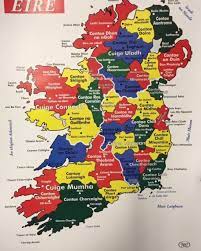
She (I say ‘she’ because language in Irish is a feminine noun and in many other languages too) – she is all around us in place names, though we may know them only through their corrupted forms into English.

Árd/ Ard, a height; Baile/ Bally, a town or village; Béal/ Bel, the mouth of; Bun, the bottom of; Carraig/ Carrig, a rock; Cnoc/ Knock, a hill; Cluain/ Clon, a meadow; Dún/ Dun, a fort or castle; Inis/ Inis or Ennis, an island or a raised mound surrounded by flat land; Loch/ a lake …

The English-language names of twenty-nine of our counties are corruptions of words in Irish: from Ciarraí to Dún na nGall, from Átha Cliath Duibhlinne to Gaillimh. This includes all six counties in the colony: Aontroim, Árd Mhacha, Doire Cholmcille, An Dún, Tír Eoghain, Fear Manach.

Just over half the States of Stáit Aontaithe Meiriceá on Turtle Island have names in the indigenous native languages, so we’re doing well with placenames and also of course have survived the colonial genocidal campaigns and wars much better.

By the way we also have Irish names for some places in Britain: Glaschú, Dún Éidin, Manchuin, Leabharpholl, Brom agus Lúndain. In fact probably none of the names of those cities are originally English anyway.

Irish has left only a small imprint on the general English language for example with “a pair of brogues, whiskey and slogan” (from slua-ghairm, a call to or by a multitude), banshee, carn and smithereeens. And shebeen, in parts of the USA, the Caribbean and in South Africa.

But its influence on the way we speak English in Ireland is clear.

We might say, instead of complaining that we are thirsty, that we have a thirst on us – a direct translation from Tá tart orainn. Or that the humour is on us – Tá fonn orainn. We might “have a head on us”, as in a headache. “The day that’s in it” – an lá atá ann.

We pronounce “film” with a vowel between the L and the M, as it would be in Irish – take the name for a dove and also a personal male name, Colm. We get that with R and M and R and N too, in some areas “a carun of stones” or “down at the farrum”.

We often indicate the absence of ‘Yes’ or ‘No’ in Irish by replying in English to the verb in the question: ‘Will you be there?’ ‘I will surely’ (Beidh, cinnte). ‘Will you do it?’ ‘I will not’ (Ní dhéanfad).

We have an extra tense in Irish, the very recent past tense, which we translate into English as spoken in Ireland: ‘I’m just after cleaning that floor!’ Táim díreach thréis an urlár sin a ghlanadh!

Renaissance of language and culture has often preceded periods of heightened national struggle: the Harp Festival of 1792 was followed soon by the uprising of the United Irish; the cultural work of The Nation newspaper was followed by the rising of the Young Irelanders.

The Nation newspaper of the Young Irelanders sought to create and encourage a nationalist republican culture and was followed by an unsuccessful rising in 1848, during the Great Hunger. (Source image: Internet)

LANGUAGE AND NATIONAL STRUGGLE

The Fenians too had their cultural precursors and the great revivals of the Irish language, Irish sport, speaking and writing in Irish and Irish theatre were not long in finding expression of another kind in the 1916 Rising and the War of Independence.

And campaigns of civil disobedience in the 1960s secured for us Irish-language broadcasting in Radió na Gaeltachta and TG4. Not to mention motor insurance documentation in Irish which Deasún Breatnach won only after going to jail for refusing to display the documentation in English.

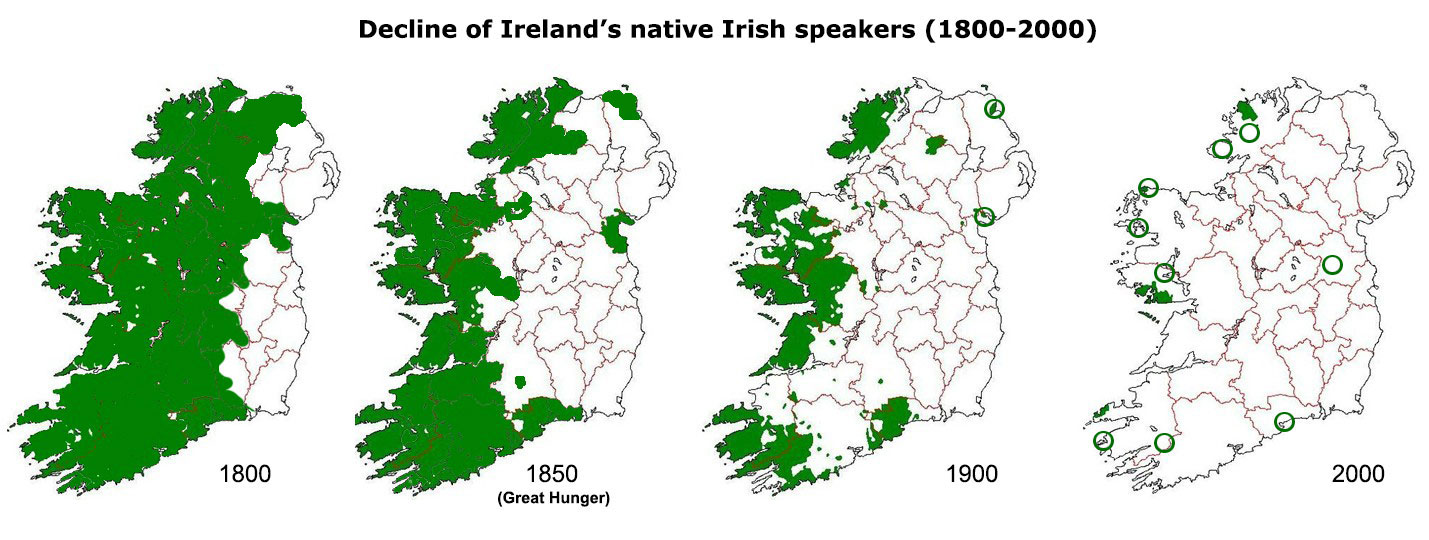
Though we can hear the influence of the indigenous language upon our speaking Sacs-Bhéarla, or English, the Irish language itself at this point is in retreat. In fact some might say that it’s in a rout.

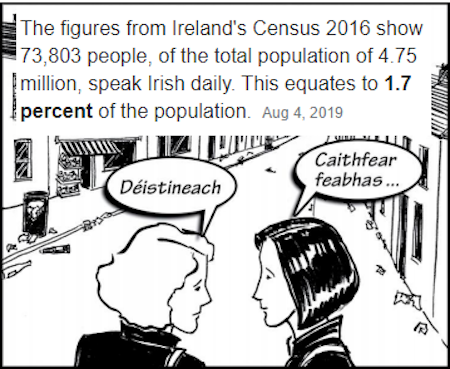
Yes, the Gaelscoil movement is broader and deeper than ever before but outside the schools? The Gaeltacht areas are receding, receding … and where can the language be heard outside of those?

Though the Great Hunger caused the most impressive loss of Irish-speaking modern Ireland on the map, the percentage lost during the period of the Irish State is greater.
(Image source: Internet)

I had an experience recently that illustrates the problem. In a pub with some friends, I observed a man wearing a silver fáinne, the ring that many people wore to show a proficiency in Irish. It identified the wearer to other Irish-language speakers (my father wore a gold one).

The man had overheard me bidding farewell to friends in Irish and asked me: “Are you an Irishman?” I thought the question strange and said so. Then he asked me was I an Irish speaker, to which I replied in Irish language.

Eventually he came over and said that he didn’t speak Irish himself.

The fáinne was a family heirloom and he had been wearing it, he said, for six months in Dublin, wanting to come across an Irish speaker to whom he would give the ring. Since I had been somewhat abrupt with him, he gave the ring to one in the company who can speak Irish.

Badge inviting people to speak Irish to the wearer (Image sourced: Internet)

LABHAIR Í

Six months in Dublin without hearing Irish spoken or recognition of the fáinne! That illustrates one aspect of the linguistic problem in Ireland. But it is one that we can resolve, fairly easily too. And that brings me to the kernel, the poinnte or point of this talk here today.

I am asking you to speak a cúpla focal, regularly, go rialta, so that she may be heard. Labhair í ionnas go gcloisfear í. Imagine if everywhere in Dublin, on every side, one heard just a few words in Irish – imagine the social and psychological effect over time!

Those who know some Irish would speak her more often. Many who don’t, would feel it worthwhile to learn at least some phrases and some responses. Some might take it further and learn Irish well. Public services might regularly facilitate services through Irish.

Dia dhuit. Dia’s Muire dhuit. Or the non-religious form: Sé do bheatha. Go mba hé duit.

Má sé do thoill é or le do thoill.

Go raibh maith agat in many situations, including to the driver of the bus.

Tá fáilte romhat.

Gabh mo leithscéil.

Would you like a bag? Ní bheidh, go raibh maith agat.

Cash or card? Íoch le cárta, le do thoill as you wave your bank card. Or Airgead thirm, as you take out your wallet or purse.

Go léir, as you indicate that you wish to pay the full amount.

Isteach, le do thoill, when returning a book to the library. Amach, le do thoill, when borrowing one.

Slán, as you leave.

Easy enough, yes? Yes? But though a part of the mind is willing, another part is afraid.

“What if I get a big load of Irish in response and not even understand it? Won’t I look like a right eejit!” Well, there are risks in anything worth doing as was demonstrated in a short play here some time back when two fellas were debating whether and when to chat up a certain woman.

She was not uninterested but they took so long about it she walked out and left them, like fish brought up by fishing line, gasping on the dry quay.

So you could prepare a small survival kit: “Gabh mo leithscéil. I only have a few words/ níl agam ach cúpla focal.”

Níl agam ach beagán ach tá mé ag iarraidh í a úsáid/ I only have a little but I want to use it. Is foghlaimeor mé/ I am a learner.”

I am not asking for any of us to campaign, to agitate for services to be provided through Irish though that is certainly a linguistic civil right and, as far as state or semi-state services go, a constitutional one.

I am only asking that you contribute to the audibility of the language, to use a few standard greetings and responses and to use them not only to people you know to be Irish speakers, not only to friends and relations … but everywhere in public.

Everywhere

in public.

Go ye out among the people and spread the word – or rather the few words. Scapaigí an cúpla focal.

End.

LONG LIVE THE RESISTANCE – IN ALL ITS FORMS!

Diarmuid Breatnach

(Reading time: 7 mins.)

WITHOUT RESISTANCE WE ARE NOTHING

Resistance to colonialism and imperialism takes many forms but there are those who try to downgrade, deny or even condemn its armed aspect and this has been happening recently in the case of the Palestinian struggle.

Historically, resistance has taken the form of strikes, sabotage, protest pickets, marches, rallies, placards, hunger strikes, songs, poetry, visual arts, arson, petitions, articles, books, leaflets, speeches, graffiti, clothing, language promotion, riots … and armed action up to and including revolution.

All have proved useful and the question of whether the prevailing circumstance favour some more than others is a tactical one, never one of principle. Those who seek to forbid some tactics to the movement in all circumstances are they who cannot be trusted in leadership of the struggle.

The facet of resistance that temporisers and outright opponents of the resistance movement most often seek to outlaw and remove from the struggle is the armed one, presumably because it is one of the least amenable to sidetracking into cosmetic reform.

Ruling classes of states regularly outlaw armed resistance activity including the organisations that espouse that, usually dubbing them “terrorists”, while of course ensuring they themselves have military forces which, even when aggressive invaders, they dub “defence forces”.

Indeed, those elites usually arm even their civil security forces, i.e their police. But arms and their use in the hands of working people or the invaded populations? No, that would be terrorism!

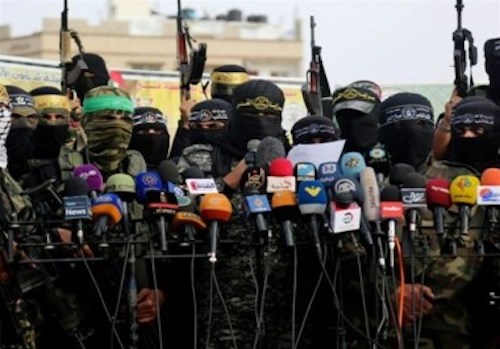
Joint press conference with representatives of different resistance organisations. (Photo sourced: Internet)

THREE-PRONGED ATTACK ON ARMED RESISTANCE

Recently a three-pronged ideological and propaganda attack was carried out on the Palestinian armed resistance from sources that are seen by some as friends of the Palestinian people: The Palestine BDS National Committee, the President of the Palestinian Authority and the Arab League.

The National Committee made their attack through a document advising on tactics and principles in presentation of BDS demands, in particular of the student campus encampments or occupations, advising activists that upholding the armed resistance was not advisable.1

Around the same time, the Arab League was having its summit meeting and, though not stupid enough to advocate giving up the armed struggle, long upheld by the Palestinian people, recommended the resistance to place themselves under the leadership of the PLO2 and the PA.

The PLO is controlled by the leadership of Fatah; their nominee, President of the PA Mahmoud Abbas, who was also at the Arab League summit, accused the October 7th attack by the Palestinian resistance of providing the Israelis the excuse for their genocidal war on Palestine.

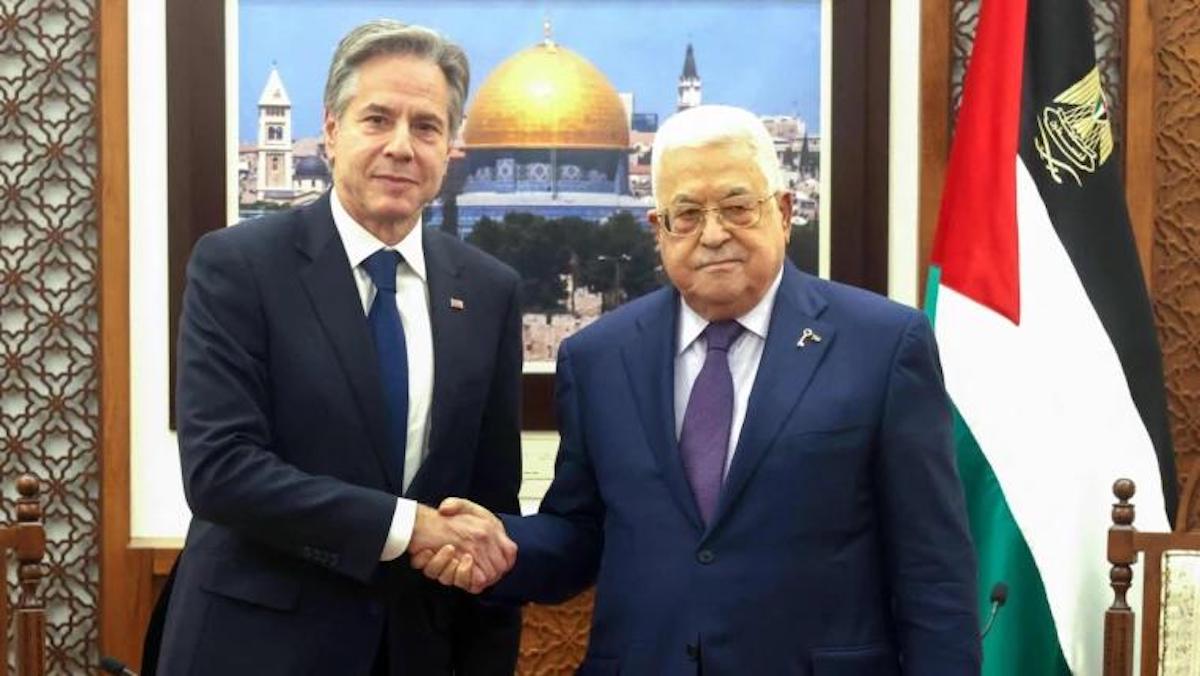
In October 2023, during the genocidal war by “Israel”, Anthony Blinken, US Secretary of State and envoy to the Middle East, shakes hands with Mahmoud Abbas, “President” of the Palestinian Authority, who remains in office despite his term having concluded in 2009. (Photo sourced: Internet)

The Arab League is composed of the current 22 Arab states, i.e those for which the dominant language is Arabic.3 But the elites of the majority of those states are clients of imperialism, chiefly of the United States. In the case of Yemen, it is the overthrown ‘government’ that is a member.4

Apart from their weakness against imperialism, one must wonder at their impertinence in telling the Palestinian armed resistance, which they do not at all assist, who should be their leadership5 and that the “two-state solution” (sic) is the only option available and recommended.6

The leadership of Fatah under Arafat betrayed the struggle for an independent Palestine and the right of return of the millions of Palestinian refugees when they agreed to the Oslo Accords in 1993/’95, for which they received limited autonomy through a “Palestine Authority”.

The corruption of Fatah in the PA and their betrayal of fundamental objectives of the Palestinian struggle led to their ousting in the elections of 2006, which were won instead by Hamas, who then had to fight Fatah who were refusing to hand over administration in Gaza.

Fatah refused to recognise the electorally-expressed wish of the people in the West Bank too but Hamas chose not to enter into a civil war with them there. From that point onwards, Gaza was besieged by the zionist authorities and periodically bombarded.

Meanwhile the PA continued in their corruption, Abbas continued to be unelected President, occupying the office and sharing the funds coming in among his clique but using their security force primarily to control and repress the Palestinians of the West Bank.

During this week alone, Resistance News Network reported that the PA’s forces dismantled explosives prepared by the resistance in the home of Tamer Fugaha which was planned for demolition by the Israeli occupation forces, where the explosives would target them.

The zionist forces regularly demolish the homes of Palestinian fighters and Tamer Fugaha was killed, along with another four Palestinian comrades, in an epic 15-hour battle with the IOF early this month in Tulkarem.

The PA has Palestinian political prisoners and also identifies these for the IOF to arrest later. Naturally (as even admitted by western mass media) the PA is hated by Palestinians, yet the Arab League wants the armed resistance to place themselves under its rule!

The armed resistance movement, which is composed of a number of distinct organisations7 fighting in unity, has of course rejected any such move and instead continued its calls for the support of the Arab people and to break the zionist blockade at the Rafah gate of desperately-needed aid convoys.

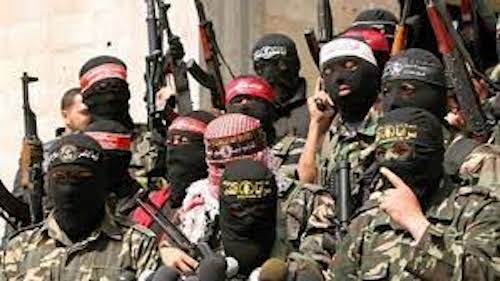
Palestinian fighters from different resistance organisations. (Photo sourced: Internet)

The Palestine BDS National Committee headquarters is also, like that of the PA, in Ramallah (West Bank). A recent statement of theirs also advised organisations working for Boycott, Divestment and Sanctions with regard to the Israeli State to drop mention of armed resistance.

Furthermore, they did so in the name of a host of organisations that sponsor Palestine BDS but the Boycott and Anti-Normalization Campaign, condemning the advice given,8 established that those organisations had not been consulted at all and if they had, would not have given approval.

The BANC criticised the offending committee not only for the original statement but also for acting as though they commanded the BDS movement.9 The statement in question was quickly withdrawn and replaced with another with the offending section on armed struggle removed.

Among the Palestinian groups that criticised the statement was the PFLP’s Haitham Abdo, head of the organisation in Lebanon, at the Popular Women’s Committees festival in Beirut on the occasion of Nakba Day, celebrating also the memory of a group of women fighters:

Holding the resistance responsible for what happened after October 7 serves the zionist narrative and harms our people’s struggle and national fight. This statement is rejected, regardless of who says it.”10

In Yemen, the weekly “million-men march”11 sent a solidarity message to the Palestinians12 but also rebuked the participants in the Arab League summit with a non-too subtle hint as to where lie their allegiances:

to the rulers of the Arab regimes meeting in Manama, near the embassy of the enemy entity: We regret to inform you that the enemy has committed more than 3,000 massacres to date, and even one massacre should have stirred your consciences.”13

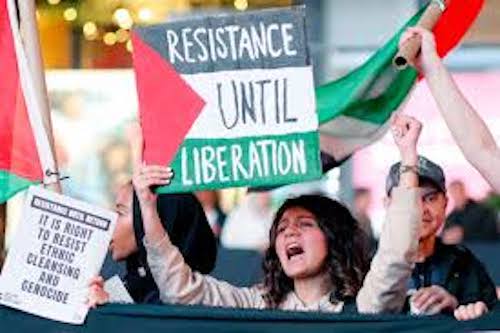
Scene from Palestine solidarity demonstration in Vancouver, Canada. (Photo sourced: Internet)

OPPOSITION TO ARMED RESISTANCE IN IRELAND

The dislike of or even hostility to promoting the armed Palestinian resistance can be seen in Ireland. A Garda confiscated a demonstrator’s a flag of one of the resistance groups, the secular Peoples Front for the Liberation of Palestine, while another was asked by IPSC stewards not to fly it.

In one of the student encampments, the PFLP flag was taken down too. The PFLP is a secular resistance organisation while others are Islamist but all are fighting in unity.

In some cases this opposition could be seen as a reluctance to have the solidarity movement associated with one specific liberation organisation which would be understandable but then a compromise would allow the flags of all groups — or one non-specific one of armed resistance.

To restrict the solidarity movement to the Palestinian national flag only is the imposition of an undemocratic “unity” and removes one of the most salient features of the Palestinian resistance – its armed aspect, fighting now amid the ruins and alleys of Gaza and in the West Bank.

Every week RNN posts photos of fighter martyrs of different resistance organisations, killed as they fought tanks, IOF bulldozers and, more rarely, IOF troops on the ground. The fighters too have been killed by aerial bombardment as of course there is no Palestinian air force or air defences.

Yet every week RNN also lists IOF tanks, bulldozers, troop carriers and IOF ground troops hit by the resistance at close quarters or at remove by mortars and rockets. The IOF dead and wounded are evacuated by helicopters which – unlike Palestinian ambulances – are never fired on.

The western mass media is not reporting these engagements and Al Jazeera reports only some of them.14

Our internationalist duty to support the Palestinians means also supporting their right to resist and that means in effect to support the armed resistance, whether we elevate one organisation or more, or just the broad principle of the right to armed resistance.

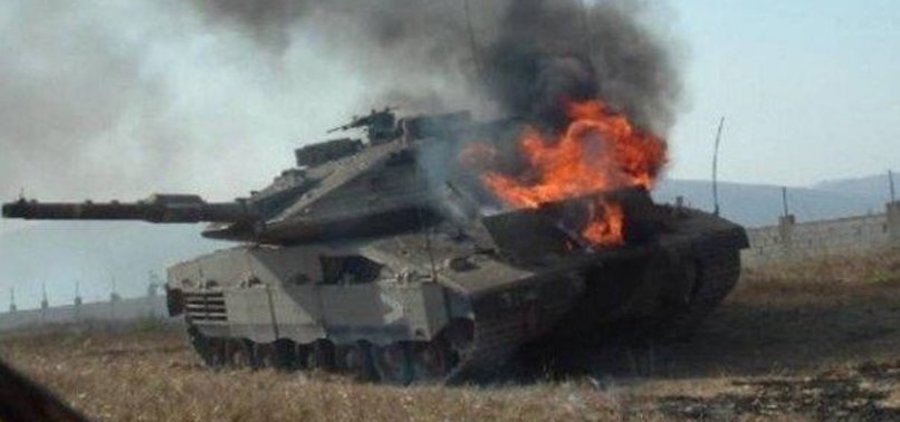
An Israeli tank hit by Palestinian fire. (Photo sourced: Internet)

THE IRISH EXPERIENCE

In the struggle for Irish liberation we have used – in different combinations – all the forms of resistance listed in the second paragraph at the beginning of this article ; indeed one of those forms during the Land War gave the word “boycott’ to the world!15

But the armed aspect has been a part of that struggle from the time of the clans right down through eight hundred centuries, against even internal opposition. In July 1846, John O’Connell’s proposal to have the Union Repeal Association renounce the use of armed force split the organisation.16

At the meeting, Thomas Meagher, said that “There are times when arms will alone suffice, and when political ameliorations call for a drop of blood, and many thousand drops of blood. Opinion, I admit, will operate against opinion. But … force must be used against force.

The soldier is proof against an argument, but he is not proof against a bullet. The man that will listen to reason, let him be reasoned with; but it is the weaponed arm of the patriot that can alone avail against battalioned despotism.”17

LONG LIVE THE RESISTANCE – IN ALL ITS FORMS!

End.

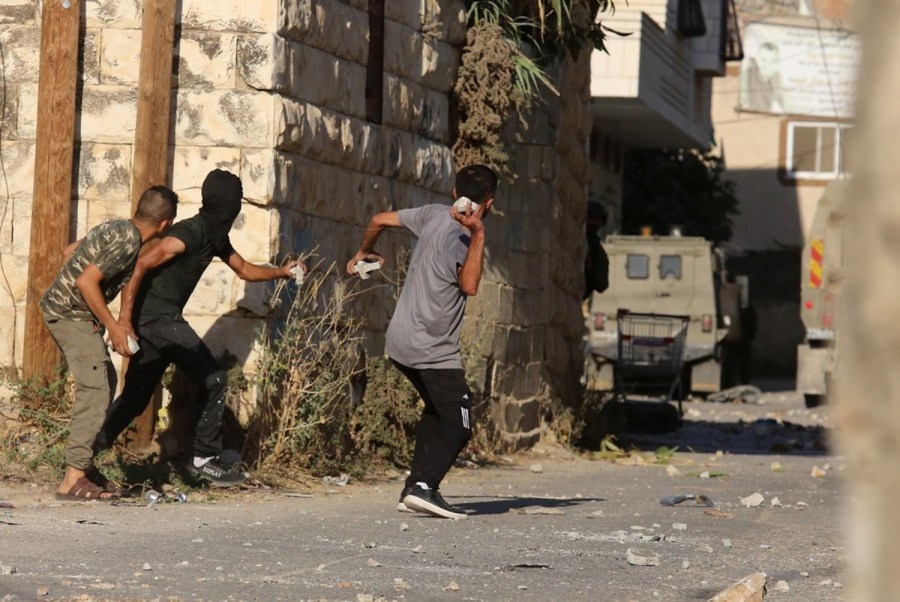
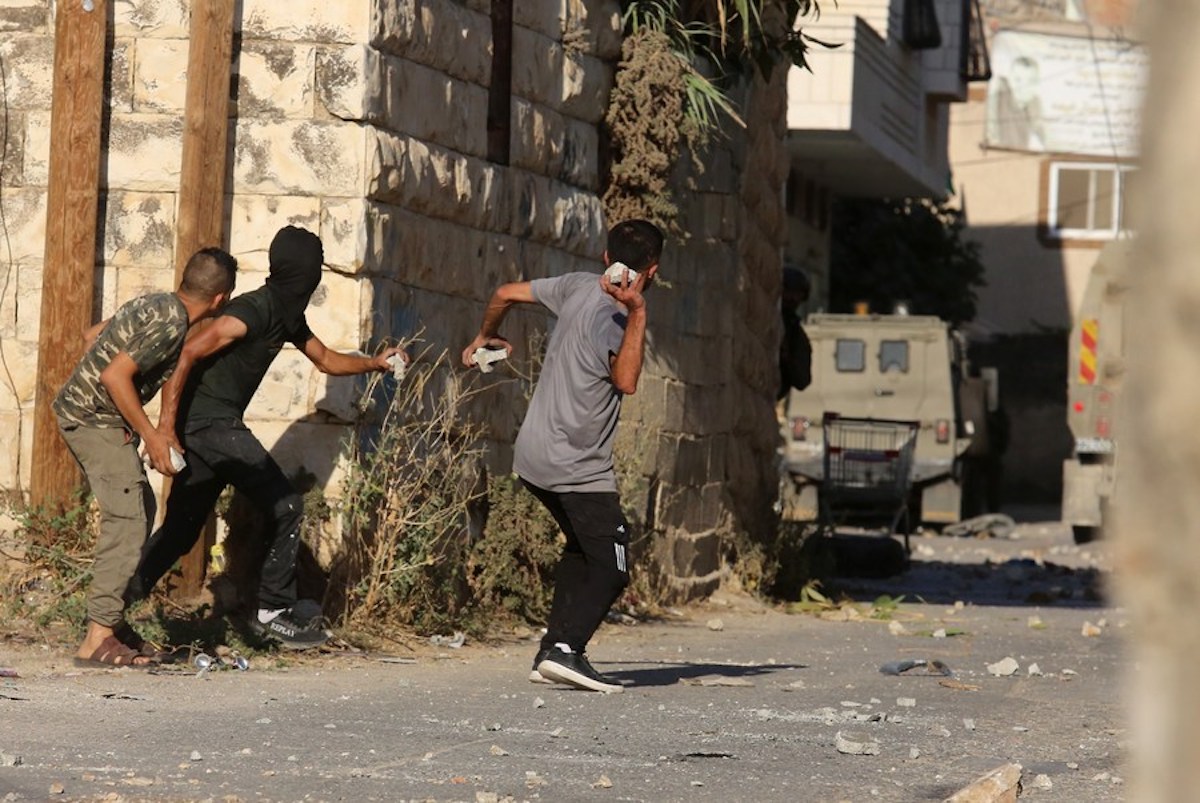
Palestinian youth respond to an Israeli raid on Beita in the West Bank Aug 2023 (Photo cred: Nidal Esthayeh/ Xinhua)

FOOTNOTES

1 We reiterate our firm position and call for a just and comprehensive peaceful settlement of the Palestinian issue, and we support the call of His Excellency President Mahmoud Abbas, President of the State of Palestine, to convene an international peace conference and to take irreversible steps to implement the two-state solution in accordance with the Arab Peace Initiative and resolutions of international legitimacy to establish an independent and sovereign Palestinian state on the lines of 4 June 1967 with East Jerusalem as its capital, and to accept its membership in the United Nations as an independent and fully sovereign state in common with other countries in the world, and to ensure the restoration of all legitimate rights of the Palestinian people, in particular, the right to return and self-determination, empowerment and support.

2At its first summit meeting in Cairo in 1964, the Arab League initiated the creation of an organization representing the Palestinian people. The Palestinian National Council convened in Jerusalem on 28 May 1964. After concluding the meeting, the PLO was founded on 2 June 1964. Its stated “complementary goals” were Arab unity and the liberation of Palestine. (Wikipedia) Under Fatah domination it banned Islamist groups from membership.

3 Algeria, Bahrain, Comoros, Djibouti, Egypt, Iraq, Jordon, Kuwait, Lebanon, Libya, Mauritania, Morocco, Oman, Palestinian Authority, Qatar, Saudi Arabia, Somalia, Sudan, Syria, Tunisia, United Arab Emirates and Yemen.

4 Rather than those in power, the Ansar Allah (“Houthis”) government, preferred by the vast majority of Yemenis to the western-recognised exiled government.

5 We call on all Palestinian factions to join together under the umbrella of the Palestine Liberation Organization (PLO), the sole legitimate representative of the Palestinian people, and to agree on a comprehensive national project and a unified strategic vision to focus efforts towards achieving the aspirations of the Palestinian people to achieve their legitimate rights and establish their independent national State on their national soil, on the basis of the two state solution, and in accordance with the resolutions of international legitimacy and established references.

6 The 2-state option, supported by the imperialist powers, is of a much smaller Palestine state alongside an Israeli state at least the size of its current dimensions. However even this has arguably been made impossible by the spread of Israeli settlements and is rejected by most Palestinians and many Israelis. The 1-state option envisages the whole of historic Palestine under a democratic regime.

7 Iz al-Din al-Qassam Brigades (QQB) – Hamas; Al-Quds Brigades (AQB) – Islamic Jihad; Abu Ali Mustafa Brigades (PFLP) – People’s Front for the Liberation of Palestine; National Resistance Brigades (DFLB) – Democratic Front for the Liberation of Palestine; Al Aqsa Martyrs Brigade – Fatah (not under Fatah political control); Al-Nasser Salah al-Deen Brigades (PRC) – Popular Resistance Committees; Lion’s Den; Mujahideen Brigades.

8 The Boycott Campaign – Palestine condemns the statement issued by the Boycott National Committee, in Ramallah, which asserts the danger of supporting the Palestinian resistance on their work and the necessity to distance themselves from any positions that support the resistance, especially armed resistance.

This disgraceful stance comes at a time when the zionist enemy is committing the crime of genocide against our people in the Gaza Strip for over seven months, resulting in the killing and injury of more than 120,000 innocent Palestinians and the destruction of 70% of Gaza’s buildings.

Such dangerous statements provide cover and legitimacy for the enemy to continue its aggression.

What is more dangerous is that the BNC claims it issued the statement in consultation with a large number of national entities and organizations.

However, through our communications with several entities mentioned in the statement, it is certain that they were not presented with this statement nor consulted about it, and they would certainly refuse to sign such statements that promote non-national positions.

All struggles for freedom around the world have seen various forms of struggle side by side, with armed resistance at their core. Therefore, our Palestinian struggle strategy should reinforce different forms towards the major goal of dismantling this zionist project on our land.

Accordingly, we call on the BNC to revise its position and align with the authentic national stance that glorifies resistance in all its forms.

We also urge it to stop this approach that attempts to monopolize the legitimacy of international work for Palestine and issue top-down orders to everyone. Palestine is greater than all, and the global revolution today to support our people is greater than something that can be monopolized by anyone.

Boycott Committee — Palestine / Boycott and Anti-Normalization Campaign

9 See above

10 From RNN

11 For the 31st week, the Yemeni people turned out in massive crowds across various cities in Yemen in support of Gaza under the slogan: “With Gaza: Holy Jihad and No Red Lines.” A million-man flood took place in the capital Sana’a, a massive rally occurred in the city of Ibb, and marches were reported across 23 locations in Rima, among other cities. (RNN)

12 “The statement at the weekly turn out reiterated the legendary steadfastness of the fighting Palestinian people and the perseverance of its fighters in this critical phase. The people assured the American and British enemies that they will not be deterred from maintaining a steadfast stance.” (RNN)

13 Source RNN.

14Electronic Intifada updates reports a number with analysis and RNN posts the reports of the groups themselves.

15 The word comes from the National Land League successful campaign of withdrawal of labour along with isolation of services (or even social contact) with Captain Charles Boycott, the agent of an absentee settler landlord who was planning to evict some tenants in 1886. https://en.wikipedia.org/wiki/Boycott Boycott is a non-violent tactic but the fact of the use of violence during the Land War by the Occupation and in response by the peasantry is often overlooked. The Fenians supported the campaign and landlord’s agents were shot at, police and bailiffs stoned and scab labour attacked.

16 The Repeal organisation’s leadership became dominated by the rising Catholic Irish bourgeoisie of which John and his father Daniel were leading members. The “split” became known as the Young Irelanders and contributed nationalist culture and journalism, in particular through The Nation newspaper and some long-lasting songs such as A Nation Once Again. The Irish Tricolour was first presented to Meagher by French women during the revolution in Paris in 1848; the Young Irelanders also staged an ill-fated uprising that same year.

17https://en.wikisource.org/wiki/The_Sword_Speech

SOURCES & USEFUL LINKS

https://www.aljazeera.com/news/2024/5/16/arab-league-calls-for-un-peacekeepers-in-occupied-palestinian-territory

https://www.thenationalnews.com/news/mena/2024/05/16/full-text-arab-league-summit-bahrain-declaration/

https://en.wikipedia.org/wiki/Arab_League

Resistance Network News: https://t.me/s/PalestineResist

Profile of Palestinian armed groups: https://www.jordannews.jo/Section-20/Middle-East/The-seven-military-wings-of-the-Palestinian-Resistance-32955

Comprensive and comprehensible analysis of the armed resistance and their weapons industry but including a political analysis also:

BOBBY SANDS – FREEDOM FIGHTER AND BEACON FOR THE DIASPORA

Diarmuid Breatnach

(Reading time: 6 mins.)

The anniversary on Sunday of the death on hunger strike of IRA Volunteer Bobby Sands was marked with a number of posts on social media. I would like to add an Irish migrant’s1 perspective and some analysis of his legacy.

The Irish diaspora was a powerful sector in solidarity for the Irish struggle not only because of their cultural background but also because of their numbers. Some British cities had an estimated diaspora population of 10% (Irish-born and 1st and 2nd generations).

Furthermore, the higher proportion of those in turn was of the working class, a section of society which, although they in no way had their hands on the standard levers of power, certainly had a strong potential of the kind the British ruling class had learned to fear.

Irish Republicans of course formed part of that sector and organised within it but on the other hand the IRA’s bombing campaign in Britain was of no help at all. The popular fear of being caught in an explosion greatly enabled the Government to tighten the screws under the guise of “security”.

Karl Marx, a strong supporter of Irish freedom had commented after the Clerkenwell prison bombing of 18672 that “One cannot expect the London proletarians to allow themselves to be blown up in honour of the Fenian emissaries” (i.e who they were trying to free from the jail).

In 1974 the Labour Government had repressive legislation ready and on 29 November, using hysteria arising from the Birmingham and Guildford pub-bombings they rushed through the Prevention of Terrorism Act (1974) which permitted the holding of suspects for two days without charge.

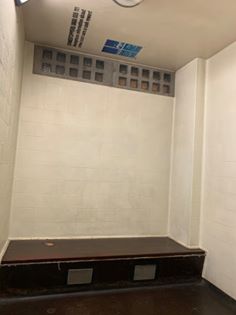
An underground cell in London’s Paddington Green police station – this is where Irish detainees under the Prevention of Terrorism Act might be kept and interrogated for seven days without visitors or access to solicitor. “The old cells were 12-foot square, contained no windows and were reportedly too hot in the summer and too cold in winter(Wikipedia).(Photo: Posted in 2020 on Internet by Green Anti-Capitalist Front who occupied the empty building intending to turn it into community centre.)

That could be extended for another five days – and often enough was — by application to the Home Secretary. Access to solicitor was usually denied and though not lawful, the fact of the detention itself was often denied to concerned people making enquiries of the police station.

The prospect of disappearing for seven days into police custody somewhere was naturally terrifying and a ‘suspect’ could also be deported without trial to Ireland – even to the British colony of the Six Counties, which amounted according to their law to “internal exile”.

Snapshot of London police harassment and intimidation of Irish solidarity activists in 1981. (Photo sourced: Internet)

The framing of a score of innocent Irish people3 in five different trials4 with very heavy sentences added to the intended terrorising of the Irish community in Britain, the “suspect community”5, many of whom believed the victims to be not only innocent but most not even politically active.6

Irish solidarity activity in Britain diminished greatly after 1974 as state repression impacted across the Irish community. But the hunger strikes and concerns to save the lives of the strikers in 1981 broke the hold of state terror as people took to the streets in their thousands once again.

They were unsuccessful but never returned to that state of immobilising fear that had settled over the community.

The Irish in Britain Representation Group got its initial start in 1981 which happened as follows: the bourgeois Federation of Irish Societies had its AGM in May 1981 and one of the members proposed that a motion of sympathy to the Sands family be recorded when he died.

IBRG and Irish Republican POW Support Committee banners on march Birmingham 1984 (Source: Mullarkey Archive)

The meeting’s Chairperson ruled the proposal out of order and ‘the Fed’ continued with their ordinary business. The then Editor of the Irish Post7, writing in his “Dolan” column, found this disturbing and suggested there might be a need for a new type of Irish community association.

A number of individuals wrote in and the ball got rolling, though it took until 1983 to set up the branch-based organisation with a constitution and democratic safeguards in operational rules. The IBRG soon had a number of branches in London and others in the North and Midlands.

For the next two decades the organisation campaigned for the release of the framed prisoners, against the Prevention of Terrorism Act, strip-searching, all racism but in particular the anti-Irish and anti-Traveller varieties, for Irish representation in education, services, Census category, etc.

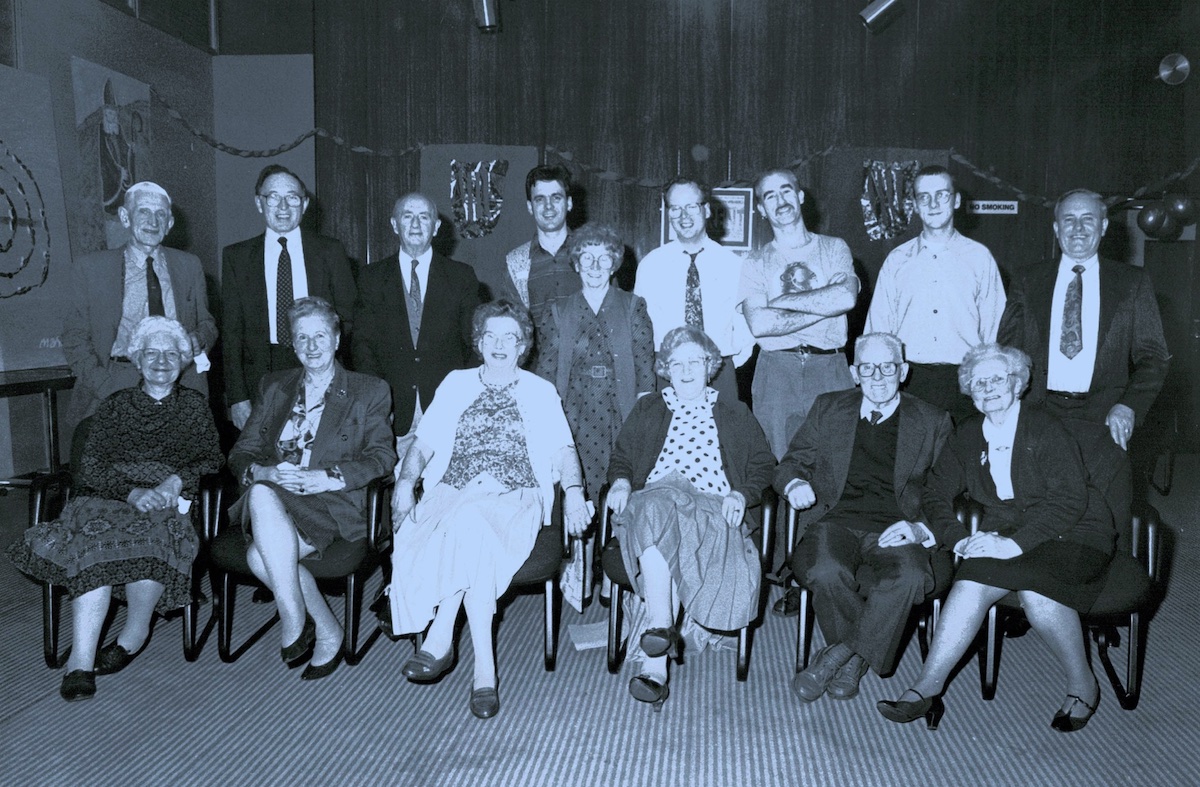
Lewisham Irish Centre Management Committee and Staff, possibly 1994. The Centre was campaigned for and won by the Lewisham Branch of the IRBG in conjunction with the Lewisham Irish Pensioners’ Association (which the IBRG had also founded).

The IBRG also called for British departure from Ireland and collaborated with other organisations in marches, demonstration, pickets, conferences, producing also a number of important report documents. The organisation’s officers were drawn from migrant Irish and those born in Britain.

THE LARK8 – a poem

Last night, from afar, I watched the Lark die

and inside me, began to cry,

and outside, a little too.

There’s nothing more that can now be done,

to save the life of this toilers’ son;

another martyr – Bobby, adieu.

Imperialism takes once more its toll,

another name joins the martyrs’ roll

and a knife of sadness runs us through.

But sorrow we must watch,

for it can still,

yes, it can kill

the song that Bobby listened to.

And if his death be not in vain,

let’s fuel our anger with the pain

and raise the fallen sword anew;

and this sword to us bequeathed:

let its blade be never sheathed

’till all our foes be ground to dust

and their machines naught but rust ….

Then will the servant be the master

and our widening horizons ever-vaster

and our debt

to Bobby

paid

as due.

(D.Breatnach, May 1981, London)

Bobby Sands Mural on gable end of a house in Belfast (Photo cred: Brooklyn Street Art)

REPRESENTATION OF BOBBY SANDS

Bobby Sands was a man of great courage whose leadership qualities were recognised by his fellow political prisoners when they elected him as their Officer Commanding in the H-Blocks. He was also an accomplished writer and poet.

When the British reneged on the agreement that ended the 1980 hunger strike and a new one was planned, Sands insisted on being first on the list, which also meant that in the event of resulting deaths, his would be the earliest.

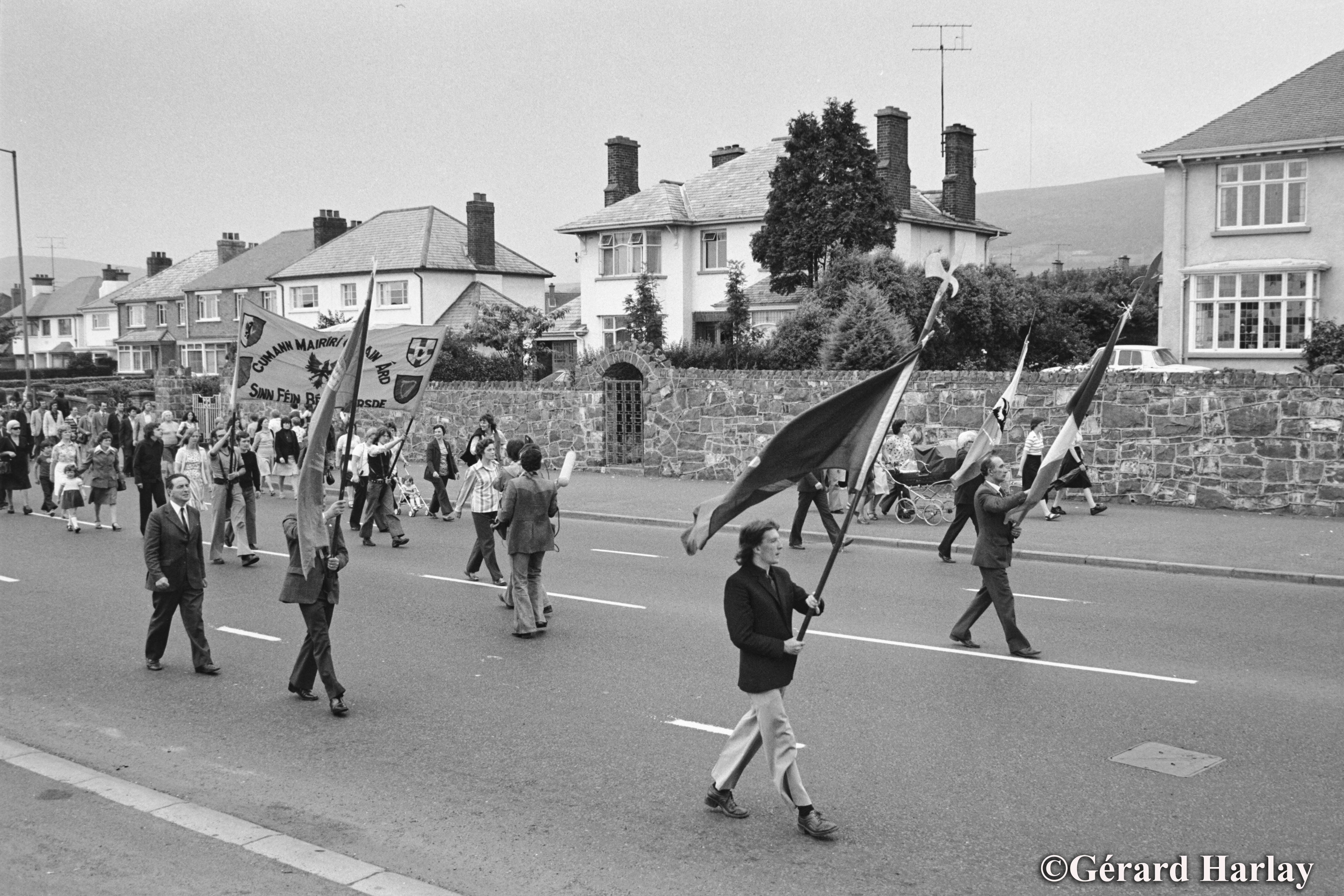
Bobby Sands (front left, colour party), Andersonstown Road,1976. (Photo: Gérard Harlay Archive)

Most people will agree easily with all the above evaluation of the man but from that point onwards, his representation is manipulated to suit different agendas, in particular those of pacifists, social democrats, liberals and a variety of opportunists.

Some of them love above all his quotation that “Our revenge shall be the laughter of our children”. They forget many other things he wrote and seek to turn him into an angel or saint of pacifism.

Since they embraced the pacification process, Sinn Féin try to represent Sands as an advocate for and proof of the effectiveness of participating in the parliamentary electoral system, based on his success in a 1981 Westminster by-election with 30,492 votes, 51.2% of the total of valid votes.

What both these groups fail to recognise is that Sands was an IRA volunteer and was sentenced for possession of handguns in 1972 and again in 1976. If he was an angel, it was of the Archangel type, fighting against what he considered evil.

He was proposed in the Fermanagh-South Tyrone by-election mainly in order to support the campaign of the prisoners against criminalisation and for the political status recognition that they had previously. Saving the lives of the hunger strikers was of course part of the plan too.

Nine protesting Republican prisoners contested the general election in the Irish State in June. Kieran Doherty and Paddy Agnew (who was not on hunger strike) were elected in Cavan-Monaghan and Louth respectively, and Joe McDonnell narrowly missed election in Sligo-Leitrim.

But that is a long way from proving that the electoral process is a viable way of dislodging the ruling class and their system and, in fact, history has proven the opposite.

Nobody knows what position Sands and the other nine would have taken on the electoral process had they lived. Possibly some would have gone along with the SF leadership on that and some others would now be reviled as “dissidents” (as are indeed some H-Block survivors).

All we can say for certain is that they were men of courage in that all of them had joined the armed struggle for Irish national liberation. They had even higher courage of a level hard to imagine, to risk and then experience slow physical disintegration and death by the day and by the hour.

Long after their erstwhile prominent enemies are forgotten, their names will shine in our history and Bobby Sands’s, the brightest of them all.

End.

FOOTNOTES

1At the time I was living and working in England.

2A bomb was planted against the prison wall to free a member of their group who was being held on remand awaiting trial at Clerkenwell Prison, London. The explosion damaged nearby houses, killed 12 civilians and wounded 120; no prisoners escaped and the attack was a failure. Michael Barrett was found guilty of the bombing despite his claim supported by witness testimony of having been in Glasgow during the bombing and was hanged on Tuesday 26 May 1868 outside Newgate Prison, the last man to be publicly hanged in England (the practice was ended from 29 May 1868 by the Capital Punishment Amendment Act 1868). https://en.wikipedia.org/wiki/Clerkenwell_explosion.

3Carole Richardson of the Guildford Four was not Irish but she was the girlfriend of one of three Irishmen.

4Birmingham Six, Guidford Four, Giuseppe Conlon, Maguire Seven and Judith Ward. They were not acquitted and released until decades later, by which time Giuseppe Conlon had died in jail.

5Suspect Community by Paddy Hillyard, Pluto Press (1993)

6Believing them innocent and not active worked even better to terrorise because if the likes of those could be framed and jailed, no-one was safe. But perhaps safest was to do absolutely nothing to draw the attention of the State.

7Brendán Mac Lua, co-founder of the Irish community newspaper in 1970 which is now a very different periodical.

8The lark is associated with Sands because he wrote a story about a man who had captured a skylark, a bird that unusually sings in flight. In the cage the bird would not sing so the man draped the cage with cloth and still the bird would not sing, nor would it do so when he refused it food and water until eventually, it died in the dark, silent to the last.

REFERENCES

Powers under the Prevention of Terrorism Act: https://cain.ulster.ac.uk/hmso/pta1974.htm

REPUBLIC DAY MARKED IN SEPARATE DUBLIN LOCATIONS

Clive Sulish

(Reading time: mins.)

Although the 1916 Rising had been planned to take place on Easter Sunday, April 23rd, it was publicly cancelled by the titular head of the Irish Volunteers, Eoin Mac Néill and it went ahead instead on the 24th, the following day.

The 1916 Rising was unsuccessful but is considered the birth event of the Irish Republic and for some therefore Republic Day is on April 24th, the first day of that Rising and when Patrick Pearse, with James Connolly by his side, read out that remarkable Proclamation of Independence.

Banner of the Republic Day event organisers in Arbour Hill (Photo: R.Breeze)

Tom Stokes, an independent Irish Republican campaigned for some years for April 24th to be recognised as Ireland’s national day, replacing St. Patrick’s Day which is religious festival and now an excuse for excessive drinking and pseudo-Irishness.

Replacing too Easter Sunday and Monday, these being religious dates that move around on the calendar, never being on the same dates in any consecutive year.

Tom Stokes died in December 2018 and a small group of disparate independent Republicans have striven to keep his campaign going.

Stokes always held his Republic Day event at noon on the 24th in front of the GPO, the location of the first public reading of the Proclamation (as did also the Save Moore Street From Demolition one year) but this group carrying on his campaign have been holding their event in Arbour Hill.

This is the location of an old British prison containing the location of a mass grave into which had been put the bodies of 14 of those executed by British firing squads after the surrender of the leadership and majority of the fighters, their bodies covered in quicklime and earth.

The mass grave of 14 of the sixteen executed in 1916, with their names in Irish one side and in English on the other. (Photo: R.Breeze)

CEREMONY IN ‘ARBOUR HILL’

The name Arbour Hill is a corruption of the original Irish name for the location which meant something distinct from “arbour”: Cnoc (hill) an (of the) Arbhair (cereal crop). Today it is a quiet spot tastefully laid out, the names of the dead etched around the mass grave-site in both languages.

A little distance away is a tall flagpole bearing the Irish Tricolour in front of a high wall on which are chiselled the words of the Proclamation in their original English and also in Irish translation.

Dramatist Frank Allen welcomed those present, in particular members of Limerick Men’s Shed who had travelled a distance to be present at the event. He also referred to descendants who were present of martyrs of the struggle Cathal Brugha, Thomas McDonagh and Harry Boland.

Frank Allen as MC for the event (Photo: R.Breeze)

Allen also reviewed the history of Tom Stokes’ campaign for the marking of the date as Republic Day and a national holiday, outlining also the man’s background and his family connections to the struggle for Irish independence, along with his support for Palestine..

First to be called to perform was Pat Waters, professional musician and a regular contributor to the 1916 Performing Arts Club who accompanied himself singing his own composition Where Is Our Republic Day? composed at request from Tom Stokes.

Pat Waters performing his composition Where Is Our Republic? (Photo: R.Breeze)

Allen called on Glen Gannon also of the 1916 PAC to read the Proclamation and then on Shane Stokes to read one of his father’s articles which clearly outlined the man’s socialist Republican principles and their distance from the reality of the current national society and polity.

In succession Fergus Russell of the Goleen Singers organising committee was called to sing The Foggy Dew, a song about the 1916 Rising which he performs every year and Shannon Pritzel to read Patrick Pearse’s famous oration on the grave of Ó Donnabháin Rosa.

Aidan recited the eulogy poem to the 1916 fighters composed by an ex-British Army officer living in Ireland. Anne Waters of the 1916 PAC was asked to present red roses to a number of those present to lay on the named dead on the stonework surrounding the mass gravesite.

Larry Yorell (best known as a long-time activist of the National Graves Association)1, made an appeal for support for an initiative to build a monument to Patrick Pearse.

Aidan reciting a eulogy poem for the 1916 Rising fighters (Photo: R.Breeze)

Frank Allen declared total opposition to a trend seeking to eliminate Amhrán na bhFiann as the “National Anthem” for being thought too war-like.

He called Diarmuid Breatnach (also a regular at the 1916 PAC) to conclude the event with the singing of the song https://rebelbreeze.com/2024/04/26/a-new-wave-of-censorship-and-repression/by Peadar Kearney, composed first in English2 and sung during the 1916 Rising, including in the GPO.

PICKET AT THE GPO

The Anti-Imperialist Action group called a picket against imperialism to take place in the evening of the 24th outside the General Post Office, which had been the HQ of the Rising forces in 1916.

(Photo: R.Breeze)

While a number distributed leaflets, others lined out carrying a number of national flags of Palestine and one of the PFLP, in addition to a large Irish Tricolour, smaller Starry Plough and flags of the New Philippines Army.

Along with some of the standard Palestine solidarity slogans heard everywhere in Ireland on demonstrations, they called out “From Ireland to Palestine – Occupation is a crime!”; “There is only one solution – Intifada revolution!” and “Saoirse – don Phalaistín!

Flag of the New People’s Army of the Phillippines displayed alongside other flags of anti-imperialist struggle. (Photo: R.Breeze)

A number of passers-by congratulated the picketers while some stopped to discuss. A representative of the organisers gave a short address regarding the background to Republic Day and the current situation in Ireland, commenting also on the zionist genocide in Palestine.

The event concluded with a youth reading the 1916 Proclamation out loud, followed by an acapella singer performing The Larkin Ballad which relates a compressed history of the 1913 Dublin Lockout but concludes with verses about the 1916 Rising.

A youth reads the text of the Proclamation of Independence near where Patrick Pearse read it out on 24th April 1916 (Photo: R.Breeze)

End.

Southward view of part of the group marking Republic Day with a statement against imperialism today. (Photo: R.Breeze)

FOOTNOTES

1The main organisation throughout Ireland maintaining and renovating and erecting monuments, graves, plaques in memory of Irish patriot men and women and battle sites; the NGA remains independent of political parties and declines to be in receipt of funding from government or political party.

2Kearney wrote the lyrics in 1907 in cooperation with musical composer Patrick Heeney. The music for the chorus was adopted by the Irish Free State as its national anthem. The lyrics were translated into Irish in the 1930s and unusually it is the Irish version that one most often hears, first verse and chorus. The opening sentence of the chorus “Sinne fianna fáil” (‘we are soldiers of destiny’) have been changed by some to “Sinne laochra fáil” (‘warriors of destiny) in order to avoid reference to a specific political party that called itself Fianna Fáil.

LINKS FOR INFORMATION/ FURTHER READING

https://theirishrepublic.wordpress.com

https://www.facebook.com/1916artsclub

https://anti-imperialist-action-ireland.com

Anti Imperialist Action Ireland (@AIAIreland) · X

AMAZING NEW PRINCIPLES DISCOVERED BY LIBERALS!

Liberals claim to have discovered amazing new principles of political change. Chief among these is that socialism and national liberation can – and usually will – come about without any violence in the struggle.

It is true that the liberals are currently having difficulties identifying any historical examples to validate their radical new theory but in a brilliant departure from traditional ways of thinking they say they don’t have to rely on history at all.

“Besides,” as Bel Eaver said in a discussion held to announce the new theoretical framework, “just because it didn’t happen before doesn’t mean it can’t ever.”

This is of course theoretically true and difficult to counter. One who attempted to do so during the discussion stated that just because no-one had (so far as is known) survived a direct hit by a high explosive tank shell, didn’t mean no-one ever would. He was clearly being sarcastic.

Bel Eaver didn’t deign to rise to the bait, just calling him a “hidebound doctrinaire” and walking away from the provocative individual.

“It’s so liberating not to have to read boring old history,” said Ivan Luzion. “This way is so much simpler. We simply desire what we want to be true about politics and economics and then assert it.”

“So, for example, we want change to be possible peacefully, so we insist that it is. Naturally, having asserted it, we won’t be using violence to achieve change.”

But what happens if violence is used against you when you’re advocating change? “Using violence in response just breeds more violence,” says Rosie Vue, “And it gives the authorities the excuse to use violence in return.”

“But have there not been many incidents of those in power using violence against peaceful protest?” asked another doubter. “Where did the violence being used against peaceful advocates of change come from in the first place?”

“And did the violence used against the Nazis breed more violence – or actually end it?” Asked another, adding: “If we don’t respond to violence and they kill our best activists and put the rest in jail – what then?”

Ivan Luzion maintains that these “what-ifs” are merely objections thrown in by people who oppose the newly-discovered principles and don’t want to give them a chance. “But neither they nor their pedantic historians will prevent us spreading these principles,” said Bel Eaver.

End.

MONSTER DUBLIN MARCH IN PALESTINE SOLIDARITY

Diarmuid Breatnach

(Reading time: 6 mins.)

A huge Palestine solidarity march proceeded from the north Dublin city centre on Saturday 20th, passing down O’Connell Street, over the Bridge, around by Trinity College and on towards Leinster House, the parliament of the Irish State.

Detained by an earlier activity I hurried to join it, catching up with it near the Larkin Monument. From there I could see sections of the march across the river and another section wending around Trinity College in the distance, its leaders out of sight.

(Photo: D.Breatnach)

“Over a thousand”, reported our “newspaper of record”, the Irish Times. In other words, less than 2,000. Really?!

The march was organised by the Ireland Palestine Solidarity organisation, the main Irish nationwide Palestine solidarity organisation, sponsored by a multitude of organisations and was supported in marching by many organisations and individuals, the latter being the capacity or most participants.

The usual slogans could be heard as I hurried past marchers, such as “Free, Free – Palestine” and including the one that Suella Braverman tried to ban when she was a Minister in the UK Government: “From the river to the sea – Palestine will be free!”

I paused by the Thomas Moore monument waiting to meet up with friends in order to march with them. One group passed calling out that what is occurring in Palestine is “Not a conflict, not a war”. I understand them to mean it is genocide instead but I can’t agree with them.

It IS a conflict, the old one of the European colonial settler against the indigenous people, fought for centuries on all the continents of the world except in Antartica. And the zionist State IS waging a war, a genocidal war against the Palestinian people.

(Photo: D.Breatnach)

Another group went by with a chant leader calling out a list of categories of victims of the zionist genocide such as medical workers, journalists, ambulance crews, refugees etc, to which the group replied “Not a target”. Perhaps they meant “not a legitimate target” but targets they certainly are.

I was flying the Palestinian flag but also the Starry Plough, flag of the risen Irish working class in 1913 and 1916, the only one I saw on the march and which was how my friends found me. A woman I mistook for a visitor asked to take my photo, to which I agreed.

Near the rear of the march one could hear the usual call-and-response slogans drifting back towards us but people in our section marched silently or chatted with one another. Then a voice called out: “From the river to the sea!” and the reply was instantaneous: “PALESTINE WILL BE FREE!”

Chanting takes energy but also seems to supply it and from then our section joined in with gusto: “In our thousands, in our millions – We are all Palestinians!” “In our millions and our billions – We are all Palestinians!” “In our TRILLIONS and our billions – We are all Palestinians!”

“Netanyahu, what do you say? How many kids have you killed today?” “Joe Biden, what do you say? How many kids have you killed today?” “EU, you can’t hide – You’re supporting genocide!” “Irish Government, you can’t hide – You’re supporting genocide!”

“Saoirse – Don Phalaistín!” was the only slogan1 in Irish. There was no doubt about what people wanted for the Israeli Ambassador or the zionist Embassy, which was “Out, out, out!”

(Photo: D.Breatnach)

As we turned from Dawson into Molesworth Street, the rest of the march was packed ahead of us all the way up to the presumed police barriers at Kildare Street, across from the main gate of Leinster House. Here the IPSC stewards were urging us to move in still closer ahead.

What was the reason? Apparently the Gardaí wanted us past the intersections with South Frederick Street and with Molesworth Place. But for what purpose? Those were southward traffic only streets which should have been blocked anyway and Dawson Street was open in both directions.

(Photo: D.Breatnach)
Molesworth Street from the Junction with Molesworth Place, already packed and with more arriving, yet we were expected to pack in closer and have barriers moved up against us! (Photo: D.Breatnach)

Then a private company began to erect barriers across the north-eastern section of Molesworth street which looked to me like kettling, a view which seemed born out as the barriers were moved once more further eastward with instructions to keep moving – with which I declined to cooperate.

This whole exercise seemed to me of dubious traffic easement validity and more about getting people used to obeying order and to being kettled by police if required by them. In the Irish state we do not have to gain police permission for a march or approval for its route.

There’s nothing fundamentally wrong with the IPSC leaders informing the police of their march routes for traffic easement. But our rights have to be protected and not easily surrendered, much less for no visible valid reason. It is not good for stewards to automatically comply with police wishes.

I have seen (and resisted) Garda attempts to push demonstrators from the front of the GPO into the pedestrian reservation in the middle of O’Connell Street, while they told people that “It’s what your organisers (IPSC) want.”

Declining to be kettled.

The police of a state are not neutral forces for the public good and have drawn and used their batons through the decades against people protesting partition of their nation, imperialist war, water privatisation, growth of fascist and racist attacks, against imperialism and colonialism …

Not to mention torturing and framing people to have them jailed.

CHRISTY MOORE AND REPRESSION

In the distance, we could hear that Ireland’s chief living balladeer, Christy Moore, had got on stage and was speaking, then singing, though I could make out only snatches of the lyrics. Moore gained fame both as a member of Moving Hearts band and Planxty but also as a solo performer.

Moore had been litigated against for his song about the young 48 Stardust Fire victims but was vindicated during the week by a long-delayed second inquest into the deaths.2 On the other hand he’s received no apology for the police raid on his H-Block album launch back in 1972.3

Pro-Palestinian demonstrators are facing repression throughout the western world, in some places much worse than others. The German State is behaving like Nazis in banning demonstrations and raiding a conference, apparently in twisted expiation of its sins under the Adolf Hitler regime.

This impacted also on an Irish language group in Berlin during the week while they attempted to have a small gathering speaking and singing in Irish in a park in front of the German Parliament. The police told them that only German and English languages were permitted in that area.4

The Irish Tricolour has been seen on many London demonstrations in solidarity with the Palestinians, on its own or flying below the Palestinian flag inscribed with “Saoirse don Phalaistín”. The Tricolour turned up too as university students and staff faced down the New York Police.

Columbia University, New York, Monday.
St. Patrick’s Day, New York, March 2024.
London, November 2023.
London, clearly.

In Palestine itself new horrors are being revealed with the recovery of bodies in mass graves in the areas of destroyed Gaza hospitals recently occupied by the Israeli military. Their remains testify to their being patients and medical staff in addition to refugees.5

A totally new horror are the Israeli killer drones emitting the wailing of a baby or a woman’s cry for help, waiting to gun down would-be rescuers. Palestinians in Gaza have been accustomed to responding to those cries in reality for months and often enough shot or bombed as they did so.6

This however is a new depth for the zionist military.

Under danger of Israeli bombardment, digging bodies out of a mass grave at the destroyed Nasser Hospital site April 2024. (Photo cred: Ramadan Abed/Reuters)

During the week also the independent investigation commissioned by the UN has found no basis to the Israeli claim that many staff of its aid agency for Palestinians, UNWRA, were members of Hamas or Islamic Jihad, much less involved in the October 7th Palestinian resistance operation.7

That investigation result has UNRWA vindicated of the false Israeli claims but also commended on its procedures to comply with the impartiality requirements of the UN and of its funders, many of which however now stand condemned for withdrawal of their funding from starving people.

But UNRWA chiefs should share the condemnation for appearing to give the accusations credibility in firing some of their Palestinian staff, not to mention sacking appallingly and reducing to poverty a number without hearing or appeal, on the basis of unsubstantiated accusations.

And from a source known for lying for decades and long hostile to the UNWRA organisation. True to type, the Israeli government has rejected the findings, despite having provided no verification of its accusations to date.

Few official actors of states or of the UN come out well in evaluation over the last six months of this daily broadcast genocide.

End.

FOOTNOTES

1Interestingly the word “slogan” is itself from the Irish language, or at least Scottish Gaedhlig, meaning a “call to/from the multitude/ troop”.

2https://dublinpeople.com/news/northsideeast/articles/2016/02/02/the-story-of-christy-moore-and-the-stardust-song/

3In the Brazen Head pub, Dublin, June 1972.

4https://www.independent.ie/irish-news/berlin-police-ban-irish-protesters-from-speaking-or-singing-in-irish-at-pro-palestine-ciorcal-comhra-near-reichstag/a234500393.html

5https://www.aljazeera.com/news/2024/4/23/as-more-bodies-found-un-human-rights-chief-horrified-by-gaza-mass-graves

6https://www.thenational.scot/news/24261522.israeli-drones-playing-sounds-babies-crying-opening-fire/

7https://www.thenational.scot/politics/24157684.owen-jones-scotlands-stance-unrwa-vindicated/

SOURCES

https://www.independent.ie/irish-news/berlin-police-ban-irish-protesters-from-speaking-or-singing-in-irish-at-pro-palestine-ciorcal-comhra-near-reichstag/a234500393.html

https://www.aljazeera.com/news/2024/4/23/as-more-bodies-found-un-human-rights-chief-horrified-by-gaza-mass-graves

https://www.thenational.scot/news/24261522.israeli-drones-playing-sounds-babies-crying-opening-fire

https://www.thenational.scot/politics/24157684.owen-jones-scotlands-stance-unrwa-vindicated