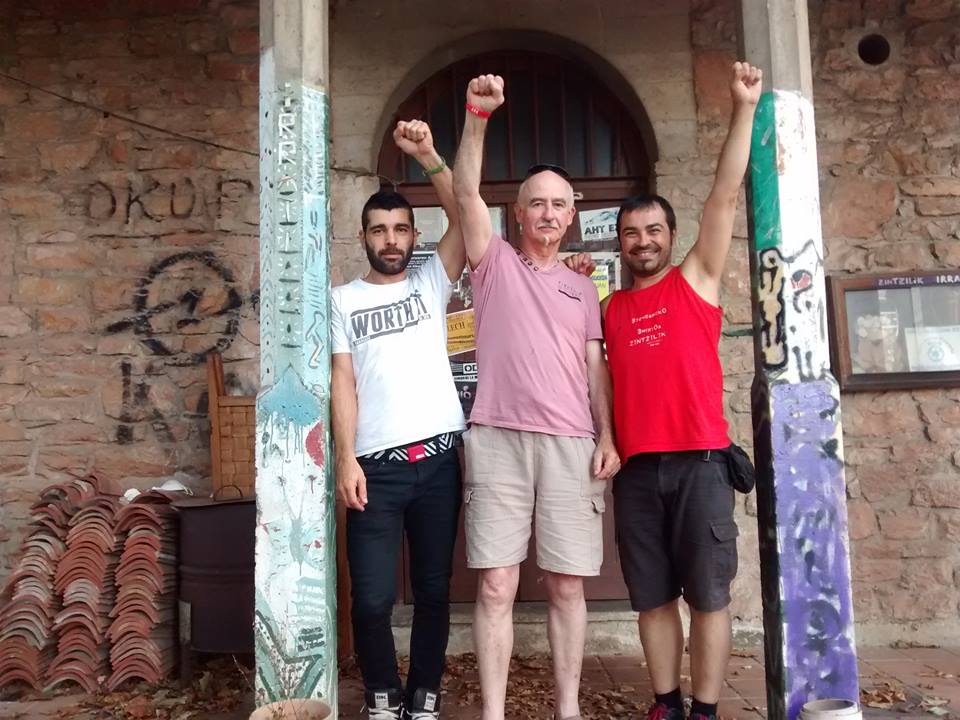
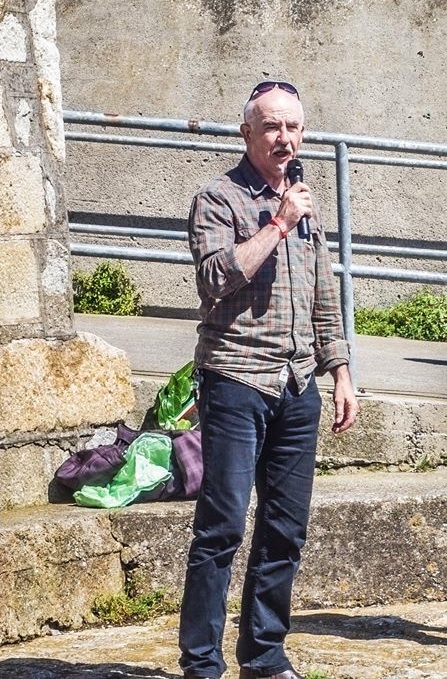
TALKS AND VISIT to the SOUTHERN BASQUE COUNTRY in OCTOBER 2017

Diarmuid Breatnach


This Autumn I made myself available to give talks in the southern Basque Country (i.e. in the Spanish state) on the situation of Irish political prisoners and a series was arranged for mid-October for nearly two weeks.

As well as having private conversations, I gave a total of five public talks to audiences ranging in size from ten to over forty. The composition of the audiences varied from youths to older middle-aged; in some places the latter predominated and in some, the former.

All the meetings I spoke at were arranged by an organisation called Amnistia Ta Askatasuna which calls for total amnesty for Basque political prisoners. This was also a demand of the whole movement and of the leadership of the Abertzale Left until fairly recently and the Gestoras pro-Amnistia organisation had been created under the Abertzale Left umbrella but then banned by the Spanish State. But the Abertzale Left’s leadership have now dropped this demand from public discourse, saying the conditions are not ripe for it and concentrating instead on the end of the dispersal. (More about this and the Basque prisoner situation later).
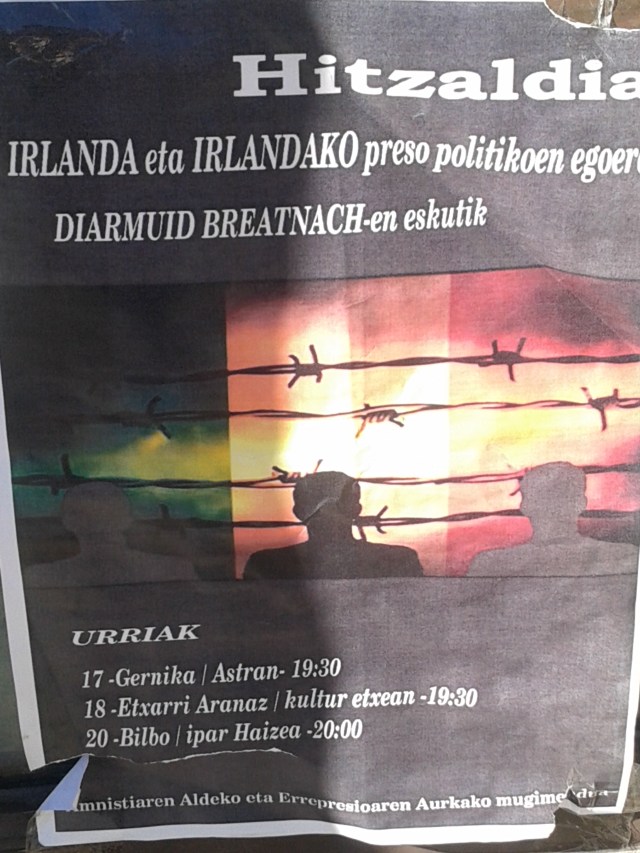
DB 3 Talks Poster Oct2017
Poster on a wall advertising three talks in the southern Basque Country before the remaining two were confirmed. October 2017. (Photo: D.Breatnach)

I had not intended to confine my talks to those organised by ATA but it was they who organised the talks on dates that were offered, with the exception of one from an independent source that unfortunately clashed with one I had already accepted elsewhere.
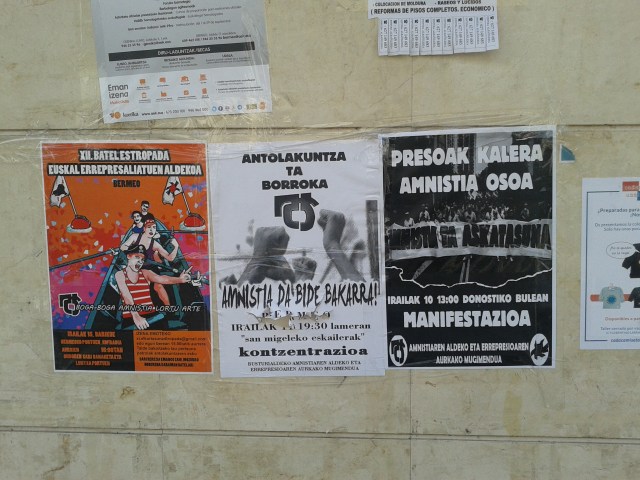
Amnistia Posters what wall
ATA posters share with other advertising on a wall in the southern Basque Country, October 2017 (Photo: D.Breatnach)

THE TALKS

The types of venues for the talks were community cultural centres (two), occupied buildings (two) and one local (a space for which the users’ association paid rent and used for their activities). Geographically, the talks were held in Gernika and two in Bilbao (Bizkaia province), Etxarri (Nafarroa) and Ibarra (Guipuzkoa province). There were none in Alava province (although earlier this year I gave interviews to Hala Bedi pirate radio there, in Gastheiz/ Vitoria). On this occasion also I gave a video interview to a rapper who also makes videos for Hala Bedi, though he is located in Bizkaia.

From conversations and discussion it became clear that all the older people in the audiences were veterans of the Basque struggle over decades and a number were ex-prisoners. Some had relatives in jail. The youths had come to political activity or thinking in recent years.

DB Charla Ibarra 24 Oct2017
Talk in cultural centre in Ibarra, Guipuzkoa, southern Basque Country, October 2017. (Photo: ATA)

For the content of the talks I briefly reviewed the more distant history of political prisoners in Ireland, moving on then to the Good Friday Agreement and the release of

Torn poster DB talk Ibarra 24 Oct2017.
Torn poster advertising the talk in Ibarra, Guipuzkoa province, southern Basque Country, October 2017. (Photo: D.Breatnach)

most Irish Republican prisoners in the Six Counties under its terms. The re-arrest and jailing without charge of a number of these ex-prisoners was part of the talk, in which the specific examples given were of Marian Price, Martin Corey and Tony Taylor. I also dealt with the procedure of arrest on ridiculous charges and refusal of bail, or granting it under undemocratic and restrictive conditions, for which I used Stephen Murney as an example.  These were all members of different organisations or none.  Conviction on charges which the evidence does not support is also a category I mentioned, giving the Craigavon Two as an example there. Arrest on possession of arms charges is also a feature on both sides of the Border.

With regard to the 26 Counties, i.e the Irish state, I discussed the Special Court, Membership-of-an-illegal-organisation charges and charges of obtaining arms or having assisted terrorism. I mentioned the planned second Special Court in particular in the context of the State’s failure to convict most of the Jobstown protesters on charges that included “false imprisonment” (i.e kidnapping).

While noting that splits had occurred before in the Republican movement – the Provisionals themselves having emerged from such a split in 1970 – I noted that since the GFA, splits had multiplied and listed a number of the resulting organisations, including those that had existed already at that time.

Listing the number of Irish political prisoners (at the latest count then 79) and reminding the audience that the Irish had extended solidarity to Basque political prisoners, I asked the Basques for solidarity towards our political prisoners too. And I did so not only as a moral issue of internationalist solidarity but also in recognition that internationalist solidarity is one of the first casualties (i.e aspects to drop or weaken) by those who are seeking to surrender the struggle or even to become collaborators.

Talk in cultural centre in Etxarri, Nafarroa province, southern Basque Country, October 2017.
(Photo: ATA)

QUESTIONS

I timed the talks to give sufficient space for – and encouraged — questions and comments, even critical ones.

It was interesting that the same questions tended to come up again and again:

  • Did the different Republican organisations cooperate with one another inside and outside the jails?

  • What were the conditions in the prisons like for the prisoners?

  • How are political prisoners in ill-health being treated?

  • Is there a dispersal issue with regard to political prisoners?

  • Did the population support the prisoners?

  • What were the conditions for their release under the Good Friday Agreement?

  • Did INLA prisoners sign the GFA release agreement?

  • Are there armed actions continuing in Ireland?

  • Are the youth involved in solidarity actions and campaigns?

  • What was the attitude of Sinn Féin towards the political prisoners?

  • Are prisoners “on the run” still in danger of arrest and imprisonment?

In one meeting, one of the smaller audiences and containing only youth, I was asked about the role of women in the national liberation struggle in Ireland today.

Talk in the occupied former Astra factory building, Gernika, Bizkaia province, southern Basque Country, October 2017.
(Photo: ATA)

Some of the questions asked reflect the situation of the Basque political prisoners and also of the censored and inaccurate information about Ireland that reaches them, including through the Abertzale Left‘s (the “official” umbrella organisation) daily newspaper, GARA. At a number of times in the past spokespersons of the Abertzale Left’s organisations had claimed that there were no longer Irish political prisoners, a claim repeated in GARA. More recently, the tendency is to ignore their existence or to represent them as very few, without a program other than return to armed struggle and without a support base (i.e Sinn Féin’s line).

The new direction of the Abertzale Left’s leadership, which included a “permanent truce” and disarmament of their armed organisation ETA (formally declared in January 2011) was said at the time to have been agreed by the Basque political prisoners in their organisation EPPK. There have been persistent claims by friends and relatives of some prisoners and by some prisoners released in the last couple of years that they had not even been consulted.

A number of people to whom I spoke claimed that the prisoners’ collective no longer really exists, with prisoners left to act individually; some others said this was true to an extent but not completely. Certainly one feels a general air of disillusionment and uncertainty – and also of anger. And it is true that a small number of prisoners have formally denounced the leadership and left the collective.

Grafitti in Ondarroa, Bizkaia province, southern Basque Country, October 2017.
(Photo: D.Breatnach)

From figures collected in 2003, up to 30,000 Basque activists out of a total population of less than three million) had been arrested, 8,170 were accused of being members of ETA and roughly half of those convicted and imprisoned. The prisoners’ relatives and friends’ organisation Etxerat (also under the Abertzale Left’s umbrella) in its July-September report of this year (2017) recognises 315 Basque political prisoners, of which 310 are dispersed through 61 prisons, with only two in 2 prisons in the Basque Country.

In 39 prisons in the Spanish state, 239 Basque political prisoners are being kept and 68 in twenty prisons of the French state. There are 212 (68.85%) Basque political prisoners in prisons at distances of between 600 and 1,100 km of the Basque Country; from a distance of 400 to 590 km from their country there are 67 (21.75 %) and between 100 and 390 km of home another 29 (9.40 %).

The strain on relatives and friends is considerable, road accidents are frequent on their journeys to visit prisoners and a number have been killed.

Twenty-one prisoners (21) are diagnosed as being seriously or terminally ill and according to the states’ own penal codes should have been released on parole to home or hospital but instead of reducing the number of sick prisoners the total is climbing (almost doubled in recent years).  I accompanied ATA comrades to the port town of Ondarroa to participate in a demonstration organised by a broad platform calling for the release of terminally-ill Basque political prisoner Ibon Iparragirre.

Section of rally after demonstration in Ondarroa, Bizkaia, in solidarity with local seriously-ill prisoner Ibon Iparragirre, October 2017.
(Photo: D.Breatnach)
Stage of the rally after demonstration in Ondarroa, Bizkaia, in solidarity with local seriously-ill prisoner Ibon Iparragirre, October 2017.
(Photo: D.Breatnach)

The Spanish state has rejected all the “peace process” (sic) overtures of the Abertzale Left leadership and says that ETA should just disappear and prisoners wishing to be pardoned and released must repent their previous actions, apologise to their “victims” and give information on their previous activities and comrades. It also says that all still at liberty and wanted for past illegal activities will continue to be pursued.

COMMENTS AND CONTRIBUTIONS

These too tended to be of a kind to come up again and again throughout the tour:

  • The situation in Ireland with regard to the liberation movement and prisoners is like that in the Basque Country or that which the latter will face as time goes on

  • The prisoners’ cause is being deserted by the Abertzale Left leadership

  • Their media and leadership had lied to the movement about the situation in Ireland

  • The leadership is only interested in penetrating the institutions and is neglecting the politics of the street

  • Otaegi and Adams are alike and McGuinness was a traitor when he asked people to inform on paramilitaries

The Abertzale Left did not of course comment on the talks – why would they? However, in Ibarra, I saw posters for the meeting torn down in areas where other political ones remained and according to my hosts, this was the work of the “oficialistas(i.e followers of the leadership’s line) in the town. It was notable too that with a few exceptions, a number of people within the Abertzale Left but whom I know to be very critical of the change of direction, did not attend the talks held in their areas. Since some had previously attended a meeting at which I spoke a year ago and engaged in discussion critical of the Abertzale leadership, I took it that these either disapproved of the ATA organisers or did not wish, for whatever reason, to be seen attending a meeting held by the organisation.

At all the talks I was received with friendliness and courtesy and after some I had a meal in company in a txoko (Basque building — or part of one — owned or rented by a gastronomic association) or the home of my hosts for the evening. Although I invited criticisms with genuine interest in hearing them, none were voiced publicly, whether of the content of my talk or of the Irish people generally — although there were some questions as to why the people “in the south” had not supported more widely the “struggle in the north”. I explained that what they call “the north” is one-fifth or the country and also divided in its population; in addition the Republican movement had left the social and economic concerns of the people in the other four-fifths largely unaddressed and in fact had opposed some social reforms in earlier times. People in the 26 Counties had given a lot of support but without mobilising them on their own concerns and specific conditions this was likely to be a minority activity and to decline over time.

CATALUNYA: SOUTHERN BASQUE ATTITUDE TO THE STRUGGLE THERE

Inevitably, the struggle in Catalunya came into the discourse at some point – after all, I had arrived in Euskal Herria just under two weeks after the Referendum.

The Catalan national flags, the esteladas (both versions) were in evidence across the Basque Country as were some solidarity banners and posters. The two solidarity demonstrations I witnessed (and in which I participated but for a while – each having been called for the same evening as my talk locally) in Nafarroa and in Bizkaia appeared to have been called by the “official” movement and were fairly small and quiet. The largest, of over fifty people, did not even have a flag, placard or banner, which was puzzling.

Large image on the wall of the youth local in Errekalde, Bilbao, where they hosted one of the talks, October 2017.
(Photo: D.Breatnach)

It was reported to me that some time back, the Abertzale Left had been close to the militant CUP (Catalan left-wing and independist popular movement) but now were moving closer to the Eskerra Republicana, often perceived as being less militant and closer to the Catalan bourgeoisie. Among the critics of the Abertzale Left leadership and others there seemed to be a doubt that the Catalan leadership was serious; however, both the “officials” and the “dissidents” had sent people to help the Catalans in their referendum.

After the Spanish police violence on October 1st there was a feeling that the Catalans were enduring what the Basques had endured for decades so why the great shock now? When two leaders of the Catalan movement were arrested and jailed without bail and called “political prisoners”, of course the Basques pointed to their own hundreds of political prisoners (and also to two Catalans who were ETA prisoners). The failure to declare a Republic on the promised day seemed to bear out those with a more cynical view but actions since then and the application of the repressive Article 155 of the Spanish Constitution are bound to raise feelings of respect and solidarity across the Basque national liberation movement, whether “official” or “dissident”.

IN CONCLUSION

It is clear that there is interest in the Irish situation and of that of the prisoners in at least some sections of the broad Basque national liberation movement. It is also clear that there is a substantial discomfort with the direction of the Abertzale Left’s leadership since 2011 (and for some since even earlier). Frustration is also evident as is a great concern for the political prisoners and a worry that they are being left without leadership, to come to their own arrangements with the Spanish state or to endure many more years in jail or die there (as Kepa De Hoyo did in August and as Ibon Iparragirre faces now).

This level of concern, disquiet and even distrust is not currently reflected in great numbers attending pickets or demonstrations organised by ATA, as numbers attending the talks showed in some areas but as the talks also showed, there is a network of support for ATA across the southern Basque Country. It was clear that a greater lead-up would have resulted in talks being hosted in further areas, including the province of Alava which was not included on this occasion. The general composition of the movement represented by ATA is healthy in its spread across generations, comprised of veterans (including ex-prisoners) and youth new to the struggle.

The pedestrian bridge at Ondarroa, scene of one of the “human walls” organised some years ago by Basque youth in resistance to the arrests of activists. Supporters placed the activist whom police were seeking in the middle and then packed the bridge with supporters, causing the police hours of work to carry out the arrest. I was told that the official leadership had ordered the cessation of these events. October 2017. (Photo: D.Breatnach)

From a personal point of view it was an interesting if somewhat hectic and stressful period but also one that increased my understanding of the reality.

From a political perspective I hope it helped build some links for solidarity between the struggles in each of the two nations and an awareness that pacification processes are not an alternative but only another face of repression. For the struggles in which so many have sacrificed so much to succeed, we need to raise our awareness of these processes. In these processes political prisoners, often seen by their populations as heroes and people to be cherished, are used by the repressive power as hostages and often too as bargaining counters, the temptation always there for some of those in struggle to use them in kind.

FREE ALL POLITICAL PRISONERS!

LINKS:

Amnistia FB page (Euskera and Castillian (Spanish)): https://www.facebook.com/amnistiataaskatasuna/

Amnistia Blogsite (Euskera and Castillian): http://www.etxerat.eus/index.php/eu/

Etxerat Website (Euskera, Castillian and French): http://www.etxerat.eus/index.php/eu/

From Axpe de Busturia train station, Bizkaia, October 2017.
(Photo: D.Breatnach)
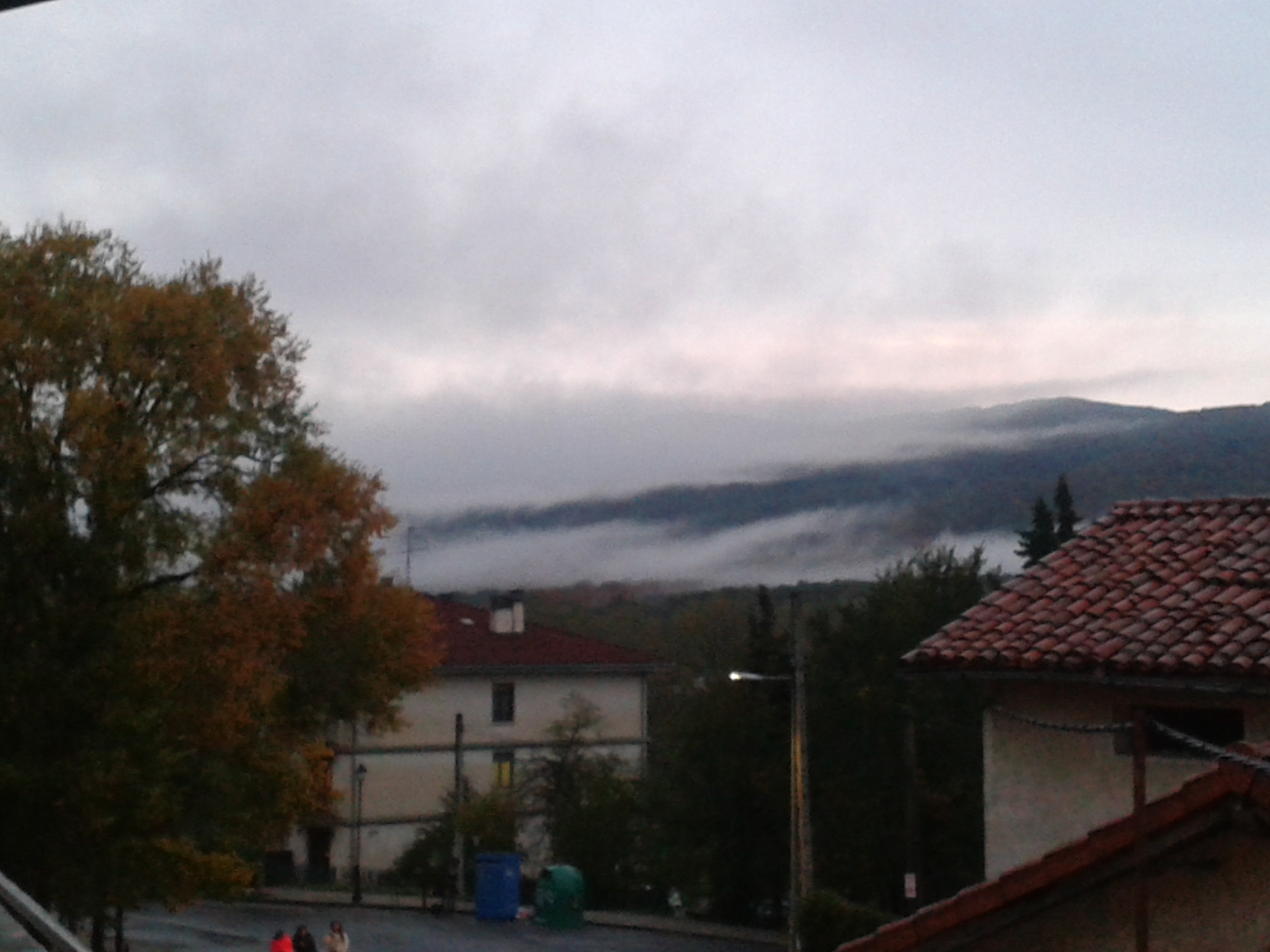
Morning view of misty mountains from a host’s house in Etxarri, Nafarroa province, October 2017.
(Photo: D.Breatnach)
Bermeo Harbour and some Town
Bermeo Harbour and some of the town from heights above, October 2017. Near the big building at 9 o’clock on the photo was the location of a Franco prison for Resistance women — I was told that Basque nuns locally brought food to the jail for them every day. (Photo: D.Breatnach)
Part of the Bay of Bizkaia (Biscay), October 2017, from the site of a Basque Gudari artillery battery during the Anti-Fascist War.
(Photo: D.Breatnach)


ARE THE LEFT IN IRELAND DIVORCED FROM REPUBLICANISM?

Clive Sulish

A DEBATE to discuss the above question at the Teachers’ Club, Dublin, was organised by the United Ireland Association with Tommy McKearney and Clare Daly being the debaters on June 16th.

Tommy McKearney
(Photo: Wikipedia)

Tommy McKearney is a long-time Republican, formerly of the Provisional IRA, 1980

Clare Daly
(Photo source: Internet)

Hunger-Striker and ex-Republican prisoner.  He was, along with Anthony McIntyre, a founder of the Republican Writers’ Group which, while not advocating armed struggle, was critical of the Good Friday Agreement, of Provisional IRA and in particular of Sinn Féin. He is currently an Organiser for the Independent Workers’ Union.

Clare Daly is a long-time Socialist, a former trade union shop stewart and has been a Teachta Dála (member of the Irish parliament) since 2011, formerly as a member of the Socialist Party and now a Left Alliance TD.  She has visited Republican prisoners and raised issues about their treatment in court and in jail. Daly was also arrested for trespass at Shannon Airport, along with fellow-TD and partner Mick Wallace, protesting against the use of the airport by US military flights and for transporting of political prisoners of the US military to jails in various parts of the world.

TOMMY MC KEARNEY

Tommy McKearney spoke first and stated that there was an issue of defining Republicanism and that sometimes what was meant was the anti-monarchic Republicanism of France or the United Stated but he was going to discuss it in terms of a specific Irish-based ideology, i.e Irish Republicanism.

Mentioning a number of Left-Irish Republicans such as Fintan Lawlor and Wolfe Tone’s famous quotation about relying on the “men of no property”, Tommy developed a line of reasoning that sought to say that there was not a huge difference between Irish Republicanism and socialism and drew attention to the fact that James Connolly had founded a party by the title of the Irish Socialist Republican Party.

Going on to talk about the objective of Irish Republicans, Tommy stated that not only is a republic desirable for Ireland – it is necessary. Only a Republic that is based upon socialist principles can resolve the economic and political problems facing Ireland today on both sides of the colonial Border.

Referring to the British election results in the Six Counties, Tommy commented on the 238,915 votes and seven seats for Sinn Féin – an increase of 14,670 votes – and the rise of almost 67,000 votes for the DUP with their ten seats. Sinn Féin had been pushing a peace process which was not about peace but about normalisation; their claim to intend to bridge the sectarian divide was empty and the voting lines were drawn up along sectarian lines at least as deeply as before.

Tommy also speculated that the amount of votes cast for Sinn Féin, on a platform of refusing to take their seats in Westminster showed, among other things, the amount of people in the Six Counties who did not care to be represented in a British Parliament and presumably would want representation in a united Irish Republic. He called for an alliance of Left Republicans and Irish socialists and recalled that James Connolly had founded, as well as the Labour Party, the Irish Socialist Republican Party.

CLARE DALY

Clare was next and she in turn highlighted the difficult issue of defining the Left – did it mean the parties that defined themselves as Left, did it include the Labour Party – some would say yes, others no. For Clare it is not issue of the names we give parties or activists but of what we stand for. Clare said she stands for a socialist country and in that sense for a Republic.

Addressing the question for debate, Clare owned that maybe socialists had neglected the national question — maybe they had been put off by images of balaclavas and guns — but it could equally be said that Republicans had for decades neglected social questions such as women’s reproductive rights, women’s rights in general, gay rights …. However, in more recent times, Republicans were seen actively supporting those rights.

Over recent years, Clare said, we had seen the gains our parents fought for in terms of trade union rights and local authority and state services lost or undermined.

Clare said she saw herself as a citizen of the world but as she lived in Ireland that she stood for a Republic that was organised along socialist lines and gave equal rights to all. The real question, Clare stated, is how we are to achieve that and pointed to the swing to the Left in Britain with Jeremy Corbyn’s party receiving a big increase in votes, despite media hostility and predictions of failure. The Conservative Party could only rule now with the support of the DUP’s 10 Mps. Clare said that opportunities of a Left Front existed in Ireland too as was seen by the Right to Water mass marches with broad political party and some major trade union support.


CONTRIBUTIONS FROM THE AUDIENCE, RESPONSES FROM THE PANEL

Included in contributions from the audience were the following:

  • Sinn Féin had seven MPs to the DUP’s 10 and should consider abandoning their abstentionism and go to Westminster to assist Corbyn in voting legislation

  • While the Labour Party in Britain had moved to the Left, Sinn Féin in Ireland had moved to the right

  • Good debate from two good speakers but also two who had put themselves out there for what they believed – Tommy McKearney in armed struggle in the past and hard prison struggle and Clare Daly in protesting US military use of Shannon Airport and also visiting Republican prisoners in jail, along with a few other Tds.

  • We need more debates like these and also to focus on Republicans with regard to where they stood with regard to socialism.

  • The Irish Left as a whole has divorced itself from Irish Republicanism, probably in fear of being associated with nationalism and/ or armed struggle. In doing so, it has walked away from continual violation of human rights, e.g of Republican prisoners in the jails and of civil rights, the right to political dissent of Republican activists on both sides of the Border.

  • The Irish Left has neglected to confront British Imperialism and left the Republicans to confront the various visits of the British Queen and the recent one of Prince Philip, when major roads were shut and even civilians impeded in going about their business or even going to their local shops or to visit their relatives’ graves in Glasnevin and a megaphone wrested by an undercover policeman backed up by a riot squad from the hands of a person about to speak to a protest demonstration.

  • Republicans are socialists and to pose the two as different categories was ridiculous.

  • There should be a broad Left front in Ireland including the trade unions and Sinn Féin.

Among the responses from the panel were that people were hung up on condemning Sinn Féin and should welcome them into a broad Left mass movement on the model of the Right to Water and Right to change campaigns (this from Tommy McKearney)

The socialists might not have done very well opposing British imperialism but had opposed US imperialism, which is one of the imperialist powers in operation in Ireland (this from Clare Daly) and a major one in the world.


COMMENT

The contributor who said that “Republicans are socialists” seemed unaware that historically at least this certainly was not so. Seán Mac Diarmada, the Irish Republican executed on the same day as the socialist James Connolly, had been on record as saying that no-one should support socialism. During the War of Independence, some IRA units took actions to support landless labourers and poor farmers but others took action to repress these in favour of big farmers.

The IRA had a ban on Communists through the 1930s probably up to the 1960s. Sean South, prominent Limerick IRA Volunteer killed in the Bessborough RUC Barracks attack in 1957, was a conservative Catholic, anti-Communist member of the Knights of Columbanus and of An Réalt (Irish-speaking section of the Legion of Mary).

The broad Left front being advocated by a number of people seems to be a reformist social-democratic one and, while there is nothing necessarily counter-revolutionary about fighting for reforms, clarity is needed about whether what they are advocating is a social-democratic program or fighting for some reforms while at the same time openly organising with a revolution in mind.

Clare Daly has certainly fought hard against US Imperialism but others on the Left much less so. The mobilisation against Hillary Clinton’s visit to Dublin was not great and gave up in the face of police opposition before they even reached City Hall and there was no mobilisation at all against Obama’s visit to Dublin in May 2011 and it remains to be seen how much there will be if he comes this year, as he has reportedly promised to do. But the question of oppposing British imperialism is a crucial one since a) it is the main imperialist-colonial power at work in Ireland and b) because it is the main prop of US Imperialism in Europe and in the UN.

There would seem to be fertile ground for debate on the historical and current differences between Irish Socialists and Irish Republicans, as well as for discussing possible joint action and one hopes for many more debates and discussions of this nature with a broad attendance.

End.

More Than Just a Museum

by Déaglan Ó Donnghaile

(previously published in the Irish Dissent blog https://irishdissent.wordpress.com.  Photos chosen and inserted by Rebel Breeze by agreement with author)


On Friday, 2nd June, a protest was held at the so-called “Museum of Free Derry” in opposition to the its memorialization of British forces killed in Derry during the early 1970s. I refer to this institution as the “so-called Museum of Free Derry” because, with its commemoration of the British state’s highly paid, heavily armed and judicially-protected professional murderers – agents of state violence whose brutality peaked (but did not end) with the massacre of 14 Civil Rights demonstrators on January 31st, 1972 – it has distanced itself irrevocably from the concept and philosophy of liberation that Free Derry stands for in the popular imagination. As one protestor suggested, we should rename it “The Museum of Unfree Derry”; I would add that the title, “The Crown Forces Museum of Unfree Derry”, will reflect even more accurately the ideology that this institution serves and promotes.

The iconic Free Derry gable monument, replacing the original gable of the house in the barricaded Bogside in 1969 which bore the same announcement. One of the Bogside’s impressive murals is visible on the right of photo. (Photo source: Internet)

Free Derry was the part of Derry City, comprising the Bogside, Brandywell and Creggan districts, that had been liberated from police control following the decisive defeat of heavily-armed RUC, B-Special and Orange Order attackers by an unarmed popular insurgency, known as the Battle of the Bogside, that took place in August, 1969. Notwithstanding the efforts of Paddy Doherty to have barricades dismantled and the RUC redeployed in the Bogside, Free Derry persisted until the entire city was overrun by British troops during Operation Motorman in July, 1972. During this three-year period, Free Derry became recognized globally as a site of intense resistance to British political, military and police control.

Protest at the Free Derry Museum recently.
(Photo source: Internet)

Last week’s protest was called because the museum, which many people regard as a Sinn Féin-controlled front organization, has installed an exhibit recording the names of British troops and police killed in Derry. This has outraged a broad spectrum of people who have confronted the issue because they recognize it as contributing to the wider, decades-long policy of “normalization”: the policy whereby the aberration that is the British presence in Ireland is represented as normal, even natural. A fundamental policy of modern imperialism, normalization (also referred to during the 1970s and 1980s as “Ulsterization”) was also the key strategy behind the 2003 Iraq invasion and occupation, where it became known as “Iraqi-isation”. (1)


POWER AND ITS DISCOURSES: FROM BURKE TO KITSON

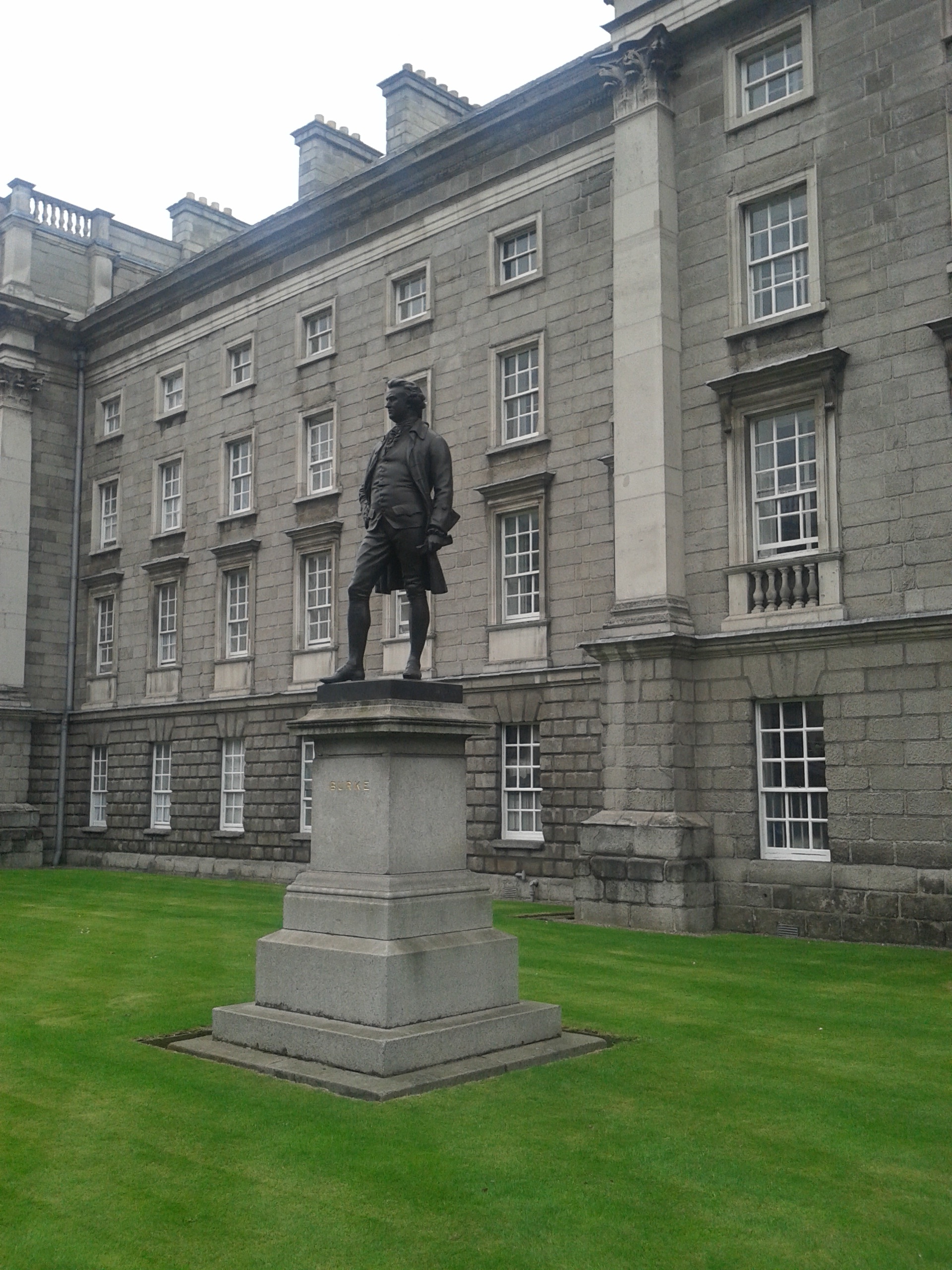
Burke monument in front of Trinity College, Dublin.
(Photo: D.Breatnach)
These ideas and policies can be traced back to Edmund Burke’s conservative political theories, as outlined in his 1790 book, Reflections on the Revolution in France. Here, Burke described the authority of kings as “the natural order of things”, and claimed that the subjugation of people by imperial and monarchical authority was an organic, and therefore just, phenomenon. (2)  In his earlier work, A Philosophical Enquiry into the Origin of Our Ideas of the Sublime and the Beautiful (1757), Burke also argued that the natural human response to displays of power should be one of surrender because power and terror, the basic currencies of political authority, were inseparable from one another.

While these ideas have influenced British imperialism and guided its coercionist policies since the late eighteenth century, they were very significantly modernized by the British army Brigadier, Frank Kitson. Having participated in and directed counter-insurgency efforts in Kenya, Malaya, Oman and Cyprus, Kitson updated the sublime object and function of imperial power by urging the state to facilitate its flow through every circuit of military, police and civilian organisation in a thoroughly integrated pattern of oppression and violence.  The key to controlling entire populations, Kitson urged in his 1971 book, Low Intensity Operations, was to ensure that the interests served by state violence should become so normalized as to be obscure, untraceable, unidentifiable, even invisible.

Frank Kitson (now Brigadier) in 1971 (Photo source: Internet)

In doing so, he brought Burke’s theory of the invisibility of power into the modern imperialist age: “To make anything very terrible,” Burke advised, “obscurity seems in general to be necessary”, (3) and state violence is no exception to this very basic rule. Whereas, for Burke, power was best administered from the Olympian position of the aristocracy, Kitson, by 1971, saw the need to co-opt local organizations directly into its grid and to create compliant front-groups (he called these “pseudo-groups”) that were loyal to the deep state. As we have seen since the ceasefire of 1994, these state-funded front organizations have spawned very rapidly, although study of their boards and memberships reveals very familiar patterns and networks of interest.

2017: A NEW START FOR COUNTER-INSURGENCY

Kitson’s policy eventually succeeded with the total integration of Sinn Féin and its party militia into the British establishment, and this is most apparent (for those who look beyond the obscuring veil of Stormont power) in the fusion of their pro-British terror tactics with official policing. However, while this objective has been achieved, total control remains the final objective and, as every reader of Orwell knows, controlling the present depends very heavily on exercising dominion over the past: this is what every colonial power pursues through means of coercion, violence, manipulation and co-option. Through various fronts disguised as “community groups” controlled by Sinn Féin, which is itself controlled by MI5, this policy has been intensively pursued since the mid-1990s on political, economic and cultural fronts. Those who remember the various “peace groups” that emerged to serve British interests during the 1970s and 1980s, many of which were directed by the Officials and their political front, the Workers’ Party, will recognize an emerging pattern here.

The Crown Forces Museum of Unfree Derry is the latest addition to this long line of front organizations working in the service of British state power. Its inclusion of British military and police personnel in its exhibitions is a significant move towards normalizing the brutality and violence unleashed on the people of Derry from the late 1960s (and, indeed, since the inception of the state in 1922), and their present activity should be considered against this longer history of normalization.

The Museum of Free Derry (sic`).
(Photo source: Internet)

Indeed, the museum’s spokesman, Robin Percival, has a long record of service to Sinn Féin front organizations since he first joined the party. Since then, he has been appointed to prominent roles within the Pat Finucane Centre, The Bogside Residents Group (from which he graduated onto the Parades Commission), the Bogside and Brandywell Health Forum, the Gasyard Centre, Cunamh and the Bloody Sunday Trust, as well as this museum. His close friend and colleague at the Pat Finucane Centre, Paul O’Connor, participates in Sinn Féin electoral videos, exposing that organization’s very close ties to the party. During last week’s protest, Percival took photographs of those who had come to voice their opposition to the memorial, and it can only be assumed that these images will be shared with his friends in Sinn Féin (these associations can be seen by checking the organizations’ boards and memberships on the Companies House website).

Robin Percival Poisonous Legacies
Robin Percival of the Museum speaking at an unintentionally somewhat ironically-named conference. (Source photo: Internet)

In a letter sent to the Pensive Quill website in 2014, Percival responded to criticism of the museum’s earlier but unsuccessful plan to build a garden that would commemorate crown forces personnel. He stated: “there never was a plan to construct a memorial garden to include British soldiers in the Bogside…. Nor are there any plans to construct a memorial to include British soldiers now or in the future. The focus of the Bloody Sunday Trust (which manages the museum) is about civilians killed by the state.” Percival publicly announced that he had “no plan to construct a memorial… to include British soldiers in the Bogside.” (4)  However, things can change very rapidly in the world of colonial doublethink, and now he is defending the projection of the names of British personnel on his museum’s walls.


THE LONG LINE OF COOPERATORS

Frank Kitson argued that co-option and cooperation are the basic requirements of colonial political control. Percival is among a long line of cooperators, ranging from Paddy Doherty and Brendan Duddy to the present class of professional, managerial “community representatives” and mysteriously-appointed “spokespeople”. While these figures have, largely, been involved in the political and economic management of the people of Derry on behalf of Sinn Féin, Stormont and the British establishment in London, what is novel about this museum it is dedicated to controlling the present through its representation of the past.

The normalization policy outlined by Kitson and the principles that he first proposed in 1971 are very relevant today. The museum operates entirely into line with British policy and represents a watermark of what he termed “civil-military relations” – the conscious fusion of military and civilian interests through long-term “popular projects” serving the occupier’s “single effective policy” : “the necessity for close co-ordination between the civil and the operational effort is apparent to everyone”, wrote Kitson in 1971. It remains so today because it is through this “unity of effect” that oppression becomes normalized and authority internalized by the target population, and how a people’s sense of their own selfhood is softened and eroded. It is the latest manifestation of psychological operations (still abbreviated by militaries, police forces and governments as “psy-ops”): the use of psychological means to distort and undermine a population’s sense of its own place in the world and in history, and to subvert its own understanding of itself. (5)


IDENTIFYING THE OPPRESSOR

The museum has a single purpose: encouraging people to identify psychologically with the British army and police, and with the colonial violence that has repressed them for centuries. The British army’s infamous Bloody Sunday Massacre of January 1972 was key to the wider counter-insurgency policy that began in August, 1969, and its impact can still be felt in Derry, over four decades later. The Crown Forces Museum of Unfree Derry is dedicated to convincing the people that they should see something of themselves in the very murderers who shot down children, women and men during this period of particularly brutal state violence. It symbolizes a false and misleading ideology of reconciliation based on the assumption that we have much in common with these professional agents of colonial violence and the structures that they serve.

Last week’s demonstration registered popular refusal to conform to this ongoing process of normalization. The philosophy and practice of liberation that was practiced and displayed four decades ago by the people of Free Derry showed the world that refusal is a very powerful weapon. This protest articulated and renewed that refusal by addressing the still current problem of state violence and the ideological coercion that accompanies it, exposing its acceptance by organizations such as this museum, all of which, ultimately, act in the interests of the state.

Michael Bridge, who was wounded in the Bloody Sunday Massacre 1972, arguing during the protest with Colm Barton of the Museum.
(Photo source: Internet)

The fundamental strategy of any empire is invasion, and this requires a considerable degree of integration on a number of levels, particularly within the cultural, political and psychological spheres. Imperialists occupy the physical territory of the countries that they invade with their military and police forces but they also work hard to colonize the minds of those whose lands they occupy with the relentless propaganda and distortions of the past that are circulated by their local agents. In Derry, however, this is being resisted because there are plenty of minds and imaginations that still remain free.


SOURCES:

1. See Paul Reynolds, “Rush to Iraqi-isation”, BBC News, 12th November, 2003 (http://news.bbc.co.uk/1/hi/world/middle_east/3263545.stm), accessed 8/6/1017. See also “Letter (declassified): Rycroft to Baker”, 3rd June, 2003, The Iraq Inquiry(http://www.iraqinquiry.org.uk/media/212061/2004-06-03-letter-rycroft-to-baker-iraq-prime-ministers-meeting-3-june.pdf), accessed 8/6/2017.
2. Edmund Burke, Reflections on the Revolution in FranceThe Works of Edmund Burke, Vol. 3 (London, John C. Nimmo: 1887), p.296.
3. Edmund Burke, A Philosophical Enquiry Into the Origin of Our Ideas of the Sublime and Beautiful, ibid, Vol. 1, pp.131-2.
4. Robin Percival, “No Plan to Construct a Memorial Garden to Include British Soldiers in the Bogside,” The Pensive Quill, Friday, 8th August, 2014 (http://thepensivequill.am/2014/08/no-plan-to-construct-memorial-garden-to.html, accessed 31st May, 2017).
5. Frank Kitson, Low Intensity Operations: Subversion, Insurgency and Peacekeeping (London: Faber and Faber, 1971, reprinted 1991), pp.51-3, 71.

BOMBING OF BASQUE TOWN OF GERNIKA COMMEMORATED IN DUBLIN

Clive Sulish

The bombing of Gernika during what is sometimes termed “The Spanish Anti-Fascist War” and more often “The Spanish Civil War”1 was commemorated in Dublin by a weekend of events organised by the Gernika 80 — then and now committee. The event featured a launch of a commemorative pamphlet, including talks by Spanish Civil War historian Enda McGarry and by Irish socialist, republican and civil rights activist Bernadette McAliskey; a ska music event; talks and a planting of a “Gernika Tree” at Glasnevin cemetery.2

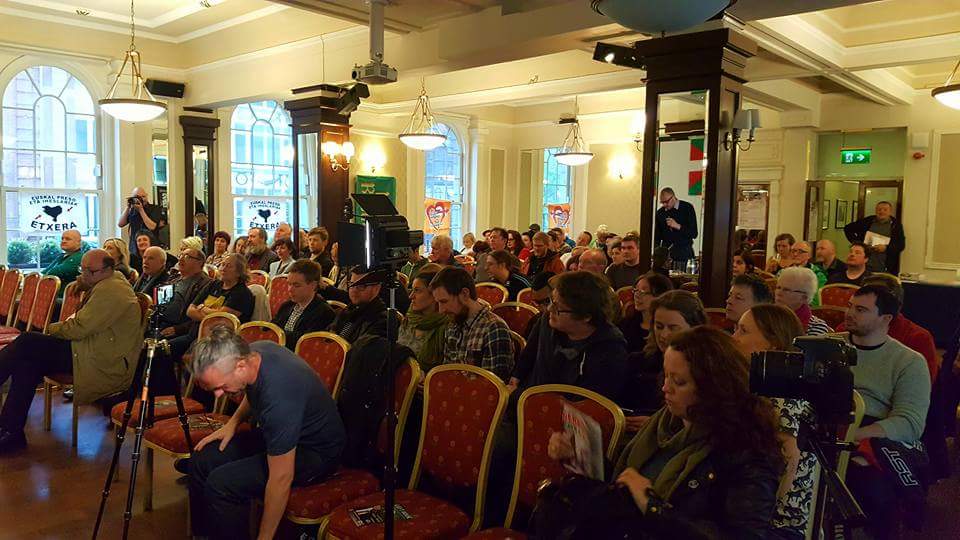
People in attendance at the talk in Wynne’s Hotel (chairperson’s reflection may be seen in the mirror).
(Photo source: Gernika 80 event page)

The pamphlet was on sale for €5 a copy in the large function room of the historic Wynne’s Hotel where the well-attended launch was held. The pamphlet has articles by Richard McAleavey, Enda McGarry, Stewart Reddin, Brian Hanley, Aoife Frances, Sam McGrath, Fin Dwyer, and Goiuri Alberdi.

Enda McGarry was first to speak and in a clear voice, with only an occasional glance at his notes, began by giving the background to the Gernika bombing – the military rebellion against the elected government of the Popular Front and the military campaigns that followed. General Mola was in charge of the fascist forces’ “Northern Front” while battles were taking place elsewhere, including in the suburbs of Madrid.

McGarry outlined the waves of air attack on 26th April 1937, the dropping of incendiary bombs and the strafing of running men, women and children by fighter planes and gave details of some of the horror experienced in the town. The bombing was one of the first aerial bombings of civilian population centres and Gernika, of particular historic-cultural importance to Basques, was hit on a market day. It had no anti-aircraft defences, not surprisingly, since it contained no features of significant military interest.

Going on to describe the lies told by the fascist leaders, McGarry related how in turn the communists, anarchists and Basque nationalists had been blamed for burning the town. Subsequently, apologists had tried to excuse the action by claiming that the Renteria bridge had been the target, in order to cut off the Basque nationalists’ retreat or lines of reinforcement from the northern Basque Country (i.e within the French state).

The speaker pointed out that this line of argument is still being peddled by some, including a fairly recent historian. Demolishing this falsehood by analysing the planes that were used, Heinkels, a Dornier, Junkers 52 bombers, Italian SM 79s and Messershmidt 109, along with the bombs and armament, McGarry showed how this could not be consistent with a bombing run to destroy a bridge. At Burgos airfield sat a number of planes that would have been ideal for destroying the bridge – Stukas, the most advanced dive bomber in general production of the time. They did not use them because neither was the Bridge the target nor pin-point bombing required – what those planning the attack wished to do was to carpet-bomb the area with high-explosive and incendiaries, then machine-gun civilians fleeing the bombing.

Ultimately, the historian continued, of course Generals Franco, Mola and other fascist military leaders were responsible. However McGarry believed that the Spanish fascist leaders, needing to crush Basque resistance but keep the conservative Catholic Carlist troops (from Navarra) and other right-wing Basques on board, would have been unlikely to agree to the destruction of Gernika (a holy historic place to the Carlists as well as to the Basque Nationalists). Oberstleutnant Wolfram Freiherr von Richthofen was the commanding officer of the Condor Legion, Nazi Germany’s “loan” of airforce to the Spanish fascist forces – he, along with others including commander-in-chief of the Luftwaffe, Herman Göring, wanted to use the Spanish conflict as a testing ground for warfare from the air and the tactic of terror-bombing a civilian population, which they later employed at Warsaw, Stalingrad and other cities.

The talk ended to strong applause and the chairperson of the meeting introduced Bernadette McAliskey, a long-time socialist and Irish Republican, campaigner for civil rights and in support of migrants.

The chairperson could also have alluded to her survival of an assassination attempt by Loyalist paramilitaries the “Ulster Freedom Fighters”, in which she was shot 14 times and her husband shot too, and that she had before that twice been elected a Member of the British Parliament. Of course McAliskey herself might have requested the omission of those details.

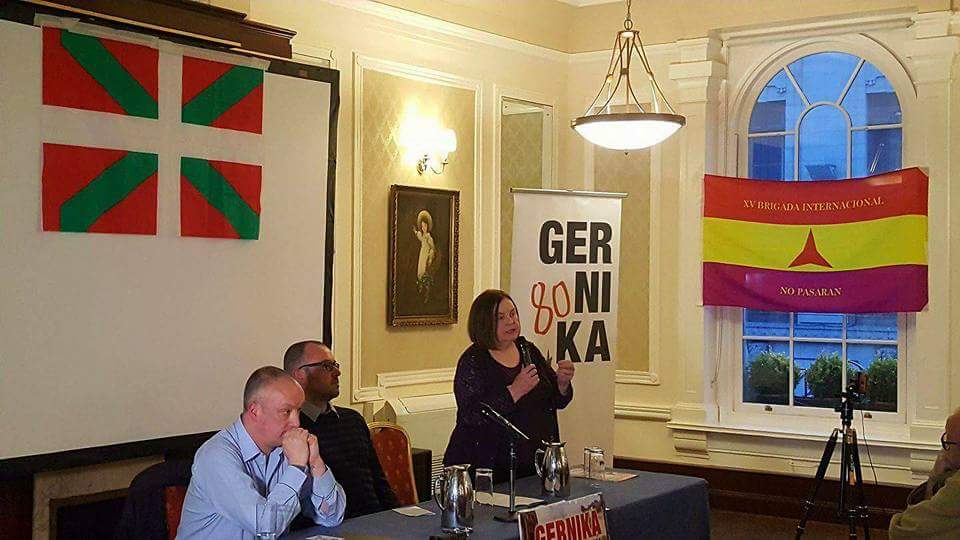
Bernadette McAliskey speaking; sitting R-L, Finn Dwyer, Enda McGarry. (Photo source: Gernika 80 event page)

McAliskey began by praising the inclusiveness of the pamphlet, which has contributions from many different writers. She then moved on to expounding what kind of people are fascists, a term she believed too widely applied, and what kind of people fascism serves. In a rather long discourse, entirely without notes, the speaker went on to analyse what Republicanism is, rejecting a definition which said the basic unit of a Republic is the State, insisting instead along with Thomas Paine that the basic unit is the individual. Believing otherwise, she declared, makes one a nationalist rather than a Republican, á la Gerry Adams.

At times one could be forgiven for assuming that McAliskey thought she was addressing liberals, saying for example that “we don’t think enough about what goes on in other countries”, or “we don’t think about what is happening to certain groups”, such as migrants, Travellers – those considered “non-people”; or when she declared that she had no understanding of what was going on in Syria because neither her background nor experience could help her to understand it. McAliskey seemed unconscious that this is a line which was also commonly disseminated in Britain about the war in the Six Counties.

But then, McAliskey would switch without warning, as in her mischievous assertion that one should deal with liberals by throwing them in at the deep end: “they either learn to swim or they no longer give you any trouble.” Or when later, she pointed out that those in power never give up their weapons, and that one day we might present ourselves to our exploiters and insist that they step aside, as “there are more of us than there are of you”, to which they will reply: “Maybe so, but we have the weapons.”

When Bernadette McAliskey finished her talk, to sustained applause and cheers, the chairperson invited questions, of which there were three and a comment. The first question was whether McAliskey thought Gerry Adams was a psychopath, to which she discoursed on the question of insanity and on the number of lies that were told by politicians such as Gerry Adams. One of the big lies was that the IRA had forced the British to the negotiating table, which McAliskey emphatically denied was true, insisting that the reality was that the IRA went to the negotiating table because they could fight no longer, the rate of attrition was too great.

The next question, by a woman who announced that she had a USA background, in the context of her declaring that racism is about white supremacy, was about how to make the Irish aware of their role in this supremacy. Bernadette said it was an important question and that the process by which the oppressed can become the oppressors was one observed on a number of occasions in history.

This reporter thought that the questioner’s statement about the nature of racism being white supremacy might also have been questioned, a proposition disproved for example by the experience of the Armenians under the Turks, Jews and Slavs under Nazism, the Irish in Britain or at home under British rule, Irish Travellers in Irish society, etc.

The last question enquired what Bernadette would say to Basques, as some had said to the questioner, that the Irish were “lucky to have a peace process”, given that we were now approaching the second decade after the Good Friday Agreement. McAliskey replied that Ireland did not have a peace process but rather a pacification process, and that the ‘new dispensation’ divided up the Six Counties between political parties along sectarian lines, with cuts to services being imposed by those in power and substantial unemployment and unfair treatment of the “other minorities”: migrants, Travellers …. And that jails in the Six Counties today contain “about as many political prisoners as they did when the Good Friday Agreement was signed but the prisoners with less politics than had their fathers.”

End.

FOOTNOTES

1Neither term sitting well with probably most Catalans and Basques, who do not consider themselves Spanish, having a different cultural identity, most aspects of which were suppressed by the victors of the War, the General Franco dictatorship regime but had been suppressed by others before them too.

2Gernika’s historic importance to the Basques before the bombing was based on the fact that Basque nobles met there to discuss their administration of Basque lands and it was there that a Spanish King had stood, under the ancient Basque oak tree, Gernikako Arbola, the “Gernika Tree”, promising to respect their rights to rule within their territory.

AN EASTER STORY


Diarmuid Breatnach

There are many different kinds of Easter stories – religious ones, or about Easter parades and processions, ones about family reunions, Easter egg hunts, even holidays …. this isn’t one of those.

The man, let’s call him Jeremiah or Jerry for short, stood outside the pub on a Sunday afternoon and struggled to quell the apprehension threatening to flood his mind and body. It had to be done. He turned to his companion, who seemed to view everything through laughing eyes and was no different now. Brian had three teenage kids with him, two of his own and a friend of one of them. Hardly ideal, but Brian had turned up with them a little while ago and there was no-one to leave them with. Well, they’d be all right – Jerry would be the target and, after him, Brian. They wouldn’t touch the kids.

Best give me the bag, Brian,” he said and, receiving it, checked inside. The stuff was there. Of course. Jerry folded the bag and stuck it under his jumper, under his coat.

He was focused on the tasks ahead but the trail that led them here had started days earlier. And, in some ways, years before that.

He squared his shoulders, turned and entered the pub. Brian and the kids followed.

**** **** ****

He had been at work on Friday afternoon when the call came from the Manager of the Irish Community Centre. Of course, he asked the staff to put it through to his office.

Do you know your event is in the newspapers?”

Something in the Manager’s voice alerts him that he is not being congratulated on the publicity.

The Easter Rising commemoration?”

Yes. It’s in the Evening Standard.”

Well, that answered the second question he had in mind.

No, I didn’t know. What are they saying?”

He knows what the British media are like and he’s got a sinking feeling.

It transpires that an Irish Republican organisation had put the event on their website, which had been noted by an Englishman who lost his son in the Omagh bombing of 1998. There are many questions to be answered about that bombing, both within the Republican and the State side, but for many years, not unnaturally, the father had been focused on the Republican group allegedly connected to the Real IRA, who had placed the bomb. In addition to his son, the bomb had killed 28 other people, the second-highest death toll for any day during the war in Ireland, the highest being the Dublin-Monaghan bombing of 1974, with a toll of 34. Jerry was aware that the 1974 bombings did not attract anything like the same media attention and understood the reason – they had been carried out by Loyalists under British Intelligence Service direction.

But what had all this to do with the Irish in Britain Representation Group in South London, and their Easter Rising Commemoration? Or with the Irish Community Centre? Well, the grieving father had noted the posting by the Irish organisation, noted the venue and rang, demanding that the event be cancelled.

I told him the commemoration is an annual event organised by an Irish community organisation and that there’s never been any trouble at it. I told him it has nothing to do with that Republican organisation …. it doesn’t, does it?”

No, it’s just us, the local Irish in Britain Representation Group branch. But surely any organisation is entitled to advertise the event?” replies Jerry.

Jerry is noting doubt in the Centre Manager’s voice responding to him. He is on the receiving end of huge pressure, working in his office, alone.

He wanted me to cancel the booking and I said I couldn’t do that,” said the Manager.

The grieving father had got on to the local authority, who replied that the event was the business of the Irish Centre. The father then contacted the media, who rang the local authority again and this time, instead of sticking to their original line and weathering what would be a short-lived storm, and without phoning the Centre Manger, their spokesperson condemned the event and stated they would be asking hard questions of the Centre, which they part-funded.

Jerry reads all this again when he slips out to get a newspaper. He feels for the beleaguered Centre Manager but can do nothing. It’s too late to contact the newspapers because the story is published. The event is to be held that evening. It has been advertised in the local area and in the Irish Post, the main newspaper at the time for the Irish diaspora in Britain. And in any case, one cannot – should not – give in to intimidation, coercion. The community had mostly caved under the Prevention of Terrorism Act in 1974 and had not really rallied again until the Hunger Strikes of 1981. The event must go on.

Jerry heads home, thinking about additional security needed on the door for the event, composing replies to the local authority, a letter in the newspaper ….

The IBRG Ard-Choiste, its governing body, had withdrawn its support of the Time To Go coalition in Britain some years earlier because of undemocratic maneuvering by some left Labour politicians, along with the sidelining of specific Irish community concerns. They had not been alone: Stop the Strip Searches Campaign and the Troops Out Movement had pulled out also, leaving the tiny Labour Committee on Ireland, the Socialist Workers Party and Communist Party of Great Britain to be supported by only the Wolfe Tone Association (SF support group in London) and the Connolly Association (linked to the CPGB) among the Irish campaigners .

Later, in 1998, the IBRG had been divided on the Good Friday Agreement. It was not the issue of continuing or ceasing the armed actions of the IRA that had been the source of the division, rather the acceptance of colonial rule, albeit claimed to be for tactical reasons only. A majority within the IBRG came out against the Agreement and that was in accordance with Jerry’s position too.

Although he supports none of the Republican groups opposing Sinn Féin, he has heard whispers in the Irish community at various times associating him with this or that group. This might well be feeding doubts in the Centre Manager’s mind.

Jerry is in a more difficult position than might seem. He is not only Secretary of the local IBRG branch that has organised the event and is affiliated to the Community Centre, but also the Chairperson of the Irish Centre’s Management Committee itself. The Management Committee is the Centre Manager’s employer and has a duty of care to him. And after nearly a decade of campaigning for the provision of the Centre and the meagre funding it receives, no-one on the Committee would want to antagonise the local authority.

But it was the IBRG branch itself and in particular the Irish Pensioners’ Association which was then a part of it, which had won the provision for the community in the end. And Jerry had been part of the campaign, elected as Chairperson of the Steering Group in the years while renovations of the building and available funding were discussed, elected Chairperson for the first six months after the Centre opened and at the Annual General Meeting for every year afterwards. In fact, recently Jerry had been trying unsuccessfully to step down, to ease a replacement into his position.

On the train from London Bridge on the last leg of his journey home, Jerry reflects ruefully that this controversy might cause his stepping down, which was hardly the way he had anticipated his leaving. No stepping back slowly, supporting someone new in position and easing himself out. No – thrown out instead! That would of course imply he had done something wrong, which he hadn’t and that the IBRG had been wrong to commemorate the Rising, which they hadn’t either. Ironically, if moves were made now to replace him, he’d have to fight them.

**** **** ****

Before he arrives at the Irish Community Centre, Jerry looks carefully around the mostly residential street. Nothing seems threatening but can one be sure? He is carrying the IBRG’s branch’s banner, wrapped up in black bin liners, which makes him a visible target if someone’s searching. On the other hand, one of the poles of the banner is loose within the bundle, in case of need ….

He drops the Centre’s keys in his nervousness and enters, disabling the alarm and turning quickly to retrieve the keys and lock the door. Then, into the hall, to begin arranging some of the material ….

He is anxious for some of the IBRG members to arrive but jumps when the doorbell rings. Checking through the fish-eye spyhole, he is surprised to see one of the Irish Pensioners, who lives locally.

Opening the door and ushering her in, he locks the door behind her, saying apologetically “There’s only myself here so far.”

Are others coming?” she asks – she has read the newspaper and unerringly touches Jerry’s main fear at the moment.

I’m sure they are, Ellie. What are you doing here so early?’

I thought you might need some help.”

Jerry is touched straight through to his heart but has to refuse. He can’t have her here if there’s an attack with no-one else but himself to defend her.

Oh no, Ellie that’s very kind of you. But I kind of know what I have to do and explaining it to others will just take longer and make me flustered. You know how it is. Thanks a lot. Besides the others will be here soon. Come back when we’re open …..” he trails off guiltilly.

Still, she goes and he heaves a sigh of relief, at the same time feeling shame.

But there’s work to be done.

A scattering of volunteers arrives over the next half hour. The reception table is set up in the lobby, to sell tickets and distribute leaflets. Hidden behind, are the lengths of wood in case of attack by one of the British fascist groups. Up goes the green-white-&-orange bunting, portraits of the executed 1916 leaders, enlarged copies of the 1916 Proclamation. At the back of the stage, facing the hall, the large artwork Jerry made a few years ago of green, white and orange flames bursting from the date 1916. And the IBRG branch banner.

The stage is ready for the band, a group called The Mc ____ Brothers, who play Irish ballads, including Republican material. Water jug and glasses for the speakers. Tables and chairs rearranged on the hall floor (the part-time Caretaker had laid them out but Jerry always prefers a more “club” arrangement, of smaller tables spaced apart surrounded by some chairs).

By the time the opening hour arrives, Jerry is sweating but it is the sweat of work, not of fear or apprehension. The hall looks good. People are starting to arrive. Maybe he can relax now. Maybe. Brian is on the door with others close by.

The event is a bring-your-own-alcohol one and Jerry and others in the lobby spend some time directing people to the nearest off-licence, so that people are coming in, going out, coming in, sitting in the hall …. Jerry is scanning their faces, looking for possible sources of trouble.

An hour later and the band has not arrived. Pol phones them but gets no reply. Phones their manager but no reply either. Another hour later, the reality dawns on the organisers. The band will not be coming. They have seen the newspaper and decided to look after their safety. But they haven’t even bothered to tell them.

The organisers confer, after which Jerry mounts the stage, calls for attention and begins to speak.

A Chairde Gael agus a chairde ó thíortha eile, go raibh míle maith agaibh for coming here tonight to commemorate the 1916 Easter Rising with us. This is a hugely important event in Irish history and indeed in the history of the world and the local branch of the IBRG has been not just commemorating but publicly celebrating this historic event every year for some time now.

But we are very sorry to say that we have some bad news for you now. Some of you will know that very recently pressure was put on us to cancel this event but that we refused to do so. Pressure was put on the Irish Centre to cancel the event which they also and rightly refused to do.

That the British media would attack us is no surprise, they have been doing that for years. But that the local authority’s spokesperson should bow down to them and, without consulting with us, imply that we are doing something wrong here, that the Centre should not have taken our booking, is something else.

And worst of all, that an Irish band, which makes a living playing Irish ballads, should allow themselves to be scared off and not even have the decency to ring us – well, I don’t really have the words to tell you what I think about that.

So, a chairde, we offer you your money back and no questions and our sincere apologies. However, those of you who wish to remain are welcome to do so and we’ll make our own entertainment with a few songs …. we have a guitar player here …. another man plays a whistle …. But please, you are entitled to your money back and those who wish to please go to the table in the lobby now.”

As though he had been primed to do so (but Jerry knew he had not), a middle-aged Irishman at a table nearer the stage jumps up and shouts: “NO! We will not ask for our money back! We’re not going to be chased out by no British newspapers!”

A round of applause from the audience and a few cheers greet his outburst. And just like that, the evening is saved.

The guitarist plays some numbers and sings. Jerry gives an abbreviated oration and sings a few ballads. The whistle player plays some tunes. People sing along to songs. They drink, chat and buy raffle tickets. One of the raffle prizes is auctioned by the winner, a local publican Jerry had been surprised to see in the audience. The money goes into the takings. At the end of the evening, as they finally cajole the last of the audience out of the Centre (still with a wary eye on the street) and finish cleaning and tidying up, they count the takings. Financially, it has been their most successful evening ever, especially since they didn’t have to pay a band.

But the band ….. their action and lack of notification have left a sour taste in the mouths of the organisers. And during the evening, they learned that the Mc___ Brothers are booked to play at an Irish pub, on Sunday afternoon, just two days away. And only a five minutes’ drive from the Irish Centre.

**** **** ****

A council of war decides that the bar will be visited, Jerry will mount the stage (“you’re our best speaker”) and present the band with white feathers, symbolising cowardice. Some can’t be there. One or two think it will be dangerous. Brian, Pol and Jerry think it’s a good plan — so then they just need some white feathers. How hard can it be to get some?

Visits to duck pond parks yield none. The quaysides along the Thames show no seagull feathers. Brian drives to the coast and walks some beaches – and finds a couple of wispy ones. In desperation on Sunday morning, they burst open a pillow and drag out a handful of feathers. They are small, not at all like the large ones they had envisaged presenting to the band but they are white and they are feathers. Into the plastic bag they go and then Brian is driving Jerry and the kids to the pub. Brian has remarkable personal resources and has been through some very serious situations so this might be small potatoes to him …. but Jerry’s guts are churning.

Some faces in the pub turn to look at them as they enter. Jerry has been here before only once but a number of the clientele are known to him from other pubs and events. And he is probably known to more of them, as Chairperson of the Irish Centre. A few catch his eye and he nods at them, keeping his face impassive.

Do they know that the band playing here let down the audience two days ago? Of course they do …. or at least many would. This is the Irish community in SE London. Besides, the Manager of this bar, Kate, until recently worked for the publican who auctioned the raffle prize at the event on Friday night. At least one of them was there that night too.  Are they wondering what Jerry intends to do?

The band, which Brian has taken to calling the “McChicken Brothers”, is already playing on stage. Jerry had meant to get here before they got on but the feather search had been a delay. To get in front of them now might be resented by the audience and anyway, the band’s control of the microphones could drown out what needs to be said. Jerry goes to the bar, orders pints for himself and Brian and soft drinks for the kids, stitches a smile on his face and chats to Brian. And they wait.

Eventually the band takes a break and Jerry waits tensely for the indication that they are returning for the second half of their gig. When he sees them coming he nods to Brian, whose job is to fend off anyone attacking him before he has finished.

Just as the band reach the low stage but have yet to mount it, Jerry jumps up on it and begins to speak in a loud voice.

Ladies and gentlemen, your attention for a moment please!” EVERYBODY turns to look.

These musicians here were booked to play at an Easter Rising commemoration at the Irish Community Centre on Friday. They didn’t turn up. They left the audience (ok, bump up the figures a little!, he thinks) — 200 people – and the organisers stranded. And they didn’t even have the decency to tell us they weren’t coming. They ran scared, my friends, from lies in the British press.”

Jerry has the plastic bag in his hand and now dips into it, withdrawing a handfull of fluffy little white feathers.

Shame on you!” he says, facing the band members. “And this is what we think of you!”

So saying, he tries to throw the bunch of feathers at them but they erupt in a cloud between them, some clinging to Jerry’s hands. No matter, it is done. He steps off the stage and heads for the door, hoping to make it before anyone tries to stop him, before Brian has to get into physical stuff.

Surprisingly, someone shouted “Hear, hear!” and there had been a scattered round of applause.

Outside, they head for Brian’s car. A man comes running out and Brian steps forward to confront him, Jerry getting ready too, the kids behind him. Kate, the Manager, comes running out too and grabs the man. She says some things to him and he goes back in reluctantly, Jerry thinking the man doesn’t know how lucky he is that he didn’t tangle with Brian. Then Kate comes up to Jerry, shaking with anger, her face white.

You had NO right, NO right to do that in my pub!” she says.

We couldn’t let them get away with that, Kate,” Jerry replies.

Anywhere else. Not in my pub,” she says again.

The adrenaline is now seeping away and Jerry knows that his leg will start to shake soon. He feels a little sorry for Kate but needs to get away.

Sorry, Kate, that’s where they were,” Jerry replies and turns to go.

Don’t ever come in my pub again,” she calls out at his back.

**** **** ****

Many things were probably said in the local Irish community about the IBRG branch before and after that incident but probably that action contributed to an estimation that whatever you might think of them, they stood up for themselves and didn’t back down. That and their annual Children’s Irish Hallowe’en Party, their weekly Children’s Irish Art and History Group, their participation in the South London St. Patrick’s Day Parade and their occasional dramatic productions earned the small group a kind of respect in the local Irish community, a community often quite conservative in social outlook, often insular, often riven by jealousies and back-biting.

One night two weeks after the 1916 commemoration, there was a crude arson attempt on the Centre – a bottle with accelerant leaned against the front door and set alight. It burned a hole in the door and set off the fire alarms. Jerry, as a keyholder, got a call to attend from Ellie. The police were already there and Jerry dealt with them politely. Any enemies? they asked. Jerry wondered whether he should give them a list.

My guess is some British far-right group”, he replied, very glad that back in the Steering Group days, he had insisted on all the windows being covered with wire mesh panels, thinking of possible rock or even petrol bomb attack.

The police suggested they look through a list of recent attendance at the Centre. Jerry politely refused. Security provisions were made at the Centre.  Nothing came of whatever investigations the police carried out and Jerry was not surprised.

Media attention went away and the local authority didn’t take the matter further. Jerry wrote a letter to the Irish Post, denouncing the pressure applied against the IBRG and the Irish Centre and which might even have encouraged the arson attack. He did so under an assumed name because, as Chairperson, he wished not to implicate the Centre in his denunciation of the craven action of the local authority spokesperson. The beleaguered Centre Manager did not see it that way, assuming that Jerry was trying to have his say while avoiding responsibility.

When, a number of years later, in a heavy round of cuts in expenditure, the Centre’s main funding, the Manager’s and caretakers’ salaries were targeted in the local authority’s budget, Jerry led the Management Committee in a campaign of resistance. They picketed Council meetings and drew up lists of elected Councillors to lobby. Irish musicians and children in Irish dancing school costumes were brought to perform in front of the Council offices, leading to photographs in the local press. The Pensioners’ Association, amicably separated some years earlier from the IBRG branch, played a prominent part once more. Some local English people came forward to support the Centre’s case. Jerry prepared a submission for the IBRG branch and spoke to it at a Council meeting. Eventually, their meagre funding, the removal of which would have meant the closing of the Centre except for sporadic events, was saved.

Jerry didn’t go back to that bar where he had confronted the “McChicken Brothers” for about a year after that incident. When he did, he wondered whether he’d be served. He was — but it was another two years before Kate spoke to him again.

End.

WAR, IMPERIALISM AND ‘PEACE PROCESSES’

Diarmuid Breatnach

As news reaches us of wars in various parts of the world it behoves us to try, not only to discern who did what when to whom but to see whether there is an overall pattern behind them. A religious explanation might be that there is much evil loose in the world but that analysis will advance us little.

The fact is that there are powerful imperialist powers ‘loose in the world’ and they are either directly causing these wars or exacerbating them, not because the men and women dominating these powers are evil as such but because they strive to control resources, markets and strategic areas. This striving brings these powers into conflict not only with the interests of millions of people in the respective areas but also into competition with other imperialist powers – and this competition has led to two World Wars and many smaller ones in the last century alone.

In the first of those on a World scale, 1914-1919, Britain (or the UK, if one prefers) went to war with Germany. The Austro-Hungarian Empire lined up with Germany as did the Ottoman Empire. Russia, France, the USA and other powers lined up with Britain. And many other states and colonies and territories got pulled into the conflict.

The British Empire in 1916 excluding territories of influence, for example Latin Amarica, where it was then dominant. Source internet

WHAT WAS THE WAR ABOUT?

It was about many things – and not exactly the same things for each participating state – but basically it was about who would have the lion’s share of the resources of the less-developed world, in particular Africa and who would control the markets for selling those resources and also the industrial goods produced in the “home countries”. And, in order to control those things, which power would control strategic areas in the world – which included ports for navies and forts along certain overland trade routes and coasts.

What brings other countries and territories in?

Smaller players join with great powers for a share of the spoils or have been bound to them by treaties – perhaps they were themselves brought to heel in earlier times by the power to which they are now joined. Colonies and “dependent” territories contributed huge numbers of people on both sides, either recruited in preference to poverty, by war-excitement or by misleading propaganda that their sacrifice would buy their freedom or greater autonomy after the war.

Germany was defeated eventually and the French and British imposed a punitive surrender condition on them, allowing them to plunder Germany’s industrial Ruhr Valley. This injured national pride so much that Hitler was able to use it to whip up an aggressive German nationalism which facilitated another war, 1939-1945.

THE SECOND WORLD WAR

This war also pulled in allies, colonies and other territories. But what was the war actually about? Essentially the same things: which power would control the markets for selling those resources and also the industrial goods produced in the “home countries”. And, in order to control those things, which power would control strategic areas in the world.

The German industrial and financial ruling class, which supported Hitler, was not going for war out of injured pride – they wanted to control the oilfields and land to the east and Middle East and to knock out their main competitors in world domination – once again, the British and French but also now the USA, which had been a much smaller player in WWI. By now Holland and Belgium were mostly small fry and Imperial Russia had, along with a number of other countries, become the USSR. Fascist Italy and Imperial Japan were prominent players with their own objectives but joined with Nazi Germany.

Map on which one can see the encirclement of Russia: Turkey in NATO, Ukraine is hostile to Russia, Georgia tried to break away, Afghanistan is occupied, Pakistan is hostile, Syria is embattled, Iran awaits.
(source Internet)

WAR IN THE MIDDLE EAST TODAY

Nowadays, the USA strides the world as almost unchallenged superpower, supported enthusiastically by a reduced UK and with varying degrees of enthusiasm by its other allies in the EU and elsewhere across the world. Only one challenger on the world power level exists, which is Russia, now a capitalist country, certainly with colonial and no doubt with imperialist ambitions.

The USA (with the assistance of its allies) seeks to surround Russia with regimes allied to itself. Not so long ago, this was impossible in the Middle East, where a number of strong regimes were opposed to US domination: Iraq, Libya, Syria and Iran. The US and allies have succeeded in knocking out the first two of these and the third is fighting to defend itself from multi-pronged attacks. If Syria falls, Iran will be next and then, from the Middle East, Russia will be totally blocked. So of course, Russia decides not to wait for that to happen and gives military aid to the Syrian regime.

THE FUTURE?

The struggle for world domination is being played out in other areas of the world too, of course but this is the most intense area at the moment and the Israeli Zionist v. Palestinian struggle also plays a part in it.

It is difficult to look too far ahead in order to predict the various local and overall world outcomes. However, from the history of empires in general it seems inevitable that at some point the power of the USA must wane.

There are a number of contradictions besetting the USA but one of its potentially most disastrous is its external debt. In the typical pattern of imperialist capitalism, the financial capital of the USA has merged inextricably with industrial and military capital, leading to the description of “the US military-financial-industrial complex”. That in itself does not perhaps make the USA too vulnerable but its borrowing abroad to sustain this complex does: according to a number of sources on the Internet the foreign debt of the USA is nearly 18 trillion dollars: $17,910,859,000,000.

Well, we may think, the USA is an enormous country with huge resources and controlling huge amounts of resources around the world. Yes, it is – but that debt keeps growing. And the interest payments on it are huge – so huge that each year they are not repaid in total and are added to the debt.

Of course, if creditors were to call in the debts and the US financial system collapsed, the creditors would end up with very little in terms of repayment. That leaves the USA safe for the moment but each year it becomes more vulnerable. 32.5% of the total foreign debt is held by China and that huge country may at some time in the future find it in its interest to bring the USA down or to use that finance to pressure greater penetration into US markets (above the current level which US manufacturers are already complaining about). At the moment, President Trump is talking about getting the USA’s foreign creditors to accept lower interest repayments. He may or may not get his way but for the US, it is a bad sign.

USA national debt 2016 (source Internet)

The domestic debt of the US is over $12 trillion and 47% of that is foreign-owned too.

The USA’s economy is in many ways a military one. It needs wars – not just to fight itself but by its proxies. Since WW2 alone, it has been involved in 24 offensive military conflicts, from Korea to Syria.  Without wars, how can the USA justify its military expenditure? And without that expenditure, what happens to the military-financial-industrial complex?

For the continuing extraction of resources, the USA needs compliant regimes – compliant with US needs, that is. Inevitably this results in support for dictators or regimes who are massively corrupt and who get armed to the teeth by the USA and repress their own populations, resulting in poverty, torture and violation of human rights. It also results in resistance, in popular movements which at times turn to armed struggle. Overall, the US, which seeks stability for its extraction of natural resources, creates massive INstability in the world.

THE MEANING FOR US

So what does all this mean to us? Firstly, that we should oppose imperialism. The question of “how” is a different one but the objective is unavoidable. Secondly, that to talk of achieving “peace” without eliminating imperialism is at best an indulgence in wishful thinking, at worst a cruel duping of people. Any kind of “peace” deal without the removal of imperialism is at best a temporary one only.

Peace with imperialism (sourced on Internet)

As for “peace processes” in areas of strong popular resistance, where ironically we often see major representative of imperialism enthusiastically engaged, since they never remove the central reasons behind the conflict, those processes merely buy a short-term stability for imperialism and capitalism to continue, more or less as before. For that reason, “pacification” is a much more correct term than “peace process”. The effect of pacification processes on the imperialist, colonialist and capitalist systems is often undramatic, not so the scale of their detrimental effect on the movements of popular resistance – but that’s another topic.

A chríoch

SPANISH STATE TO REIMPOSE NUCLEAR POWER PLANTS ON THE SOUTHERN BASQUE PEOPLE?


Diarmuid Breatnach


The Basque Country is one of the few places in the world where popular opposition successfully prevented the completion of a nuclear power plant; the opposition consisted of both popular mobilisations and armed action. But is the Spanish state now about to reimpose a nuclear program on the Basques?


In the 1960s, the Spanish state began a program of nuclear plant construction in the territory under its dominion. This was an era of great enthusiasm among states and industrialists for nuclear power and generally there was little popular opposition – most of the nuclear opposition at the time being focused on use of nuclear (and earlier, atomic) weapons and nuclear-powered military vessels.

Broad popular opposition to nuclear power itself began to build in particular after the accident at the nuclear reactor at Three-Mile Island (Pennsylvania, USA, 1979) and a catalogue of smaller nuclear reactor accidents (such as those at Sellafield, Wales, for example).

The lobby in favour of nuclear power tends to emphasize the ‘cleaness’ of the fuel (i.e. as opposed to ‘acid rain’ carbon dioxide and other pollution from coal-burning and oil-burning stations, and oil tanker disasters), relative ‘cheapness’ to produce (as opposed to oil, gas and coal) and possibly inexhaustible power (as opposed to fossil fuels). The lobby against nuclear power quotes environmental damage from accidents with potentially greater consequences and points out that the ‘cheapness’ is created by ignoring the costs of safe disposal of nuclear waste material which, if taken into account, would make it much more expensive.

Of course there are powerful interests in favour of nuclear power programs, including military, industrial energy production and construction industry. Employment opportunities in work-poor areas often build local support for construction of such plants also but in some areas it is precisely the local community that opposes the construction and that was the case in the southern Basque Country (the four provinces in Spanish-controlled territory).

Nuclear reactors tend to be built away from especially large population centres; if one accepts the necessity of such plants this policy makes sense but exposes people in areas far from the national decision-making centres to the pro-nuclear policy and its consequences, actual and potential. The later stages of the Spanish nuclear program included building three reactors in the Basque Country and one had already been built in the first phase at Garoňa, in the nearby Spanish province of Burgos.

LEMOIZ: A HISTORY OF STRUGGLE AGAINST NUCLEAR REACTORS IN THE BASQUE COUNTRY

The first site of the Basque-location phase of construction was at the small harbour of Lemoiz (Lemoniz in Spanish), situated in a picturesque part of Bizkaia (Biscay) province and attracted opposition from a coalition of interests: militant Basque left-nationalists, anti-nuclear and environmental campaigners.

lemoiz-from-distance
Lemoiz nuclear reactor site seen from a distance (photo source Internet)

Popular demonstrations began in the 1970s while the site was under construction with people traveling to the site to protest, also holding protests elsewhere and there were even some incidents of sabotage inside the facility, which was guarded by a Guardia Civil (Spanish Francoist paramilitary police force) post. This took place during the life of the Franco regime (he died in 1975) and also after his death during the repression of the “Transición” process which was not completed until 1982. Festivals and marches were also organised elsewhere in the Basque Country against the project.

The first armed attack by ETA was carried out 18 December 1977 with an attack on the Guardia Civil post at the site, during which David Álverez Peña, one of the ETA group’s members was injured, causing his death a month later. ETA later succeeded in planting a bomb in the reactor of the station which exploded on 17 March 1978, causing the death of two employees (Andrés Guerra and Alberto Negro), and wounding another two. Substantial damage was caused to the structure in the explosion, delaying construction.

Lemoiz nuclear reactor site seen from a distance (photo source Internet)
Scene one hour after killing of Gladys del Estal in Tudela, Nafarroa in 1983, her body still lying on the ground (photo source Internet)

On an International Day of Action Against Nuclear Power, 3rd June 1979, a police bullet resulted in the death of an anti-nuclear activist during a demonstration in Tudela, a town in the Basque province of Nafarroa; her name was Gladys del Estal and she was from Donostia/ San Sebastian in Gipuzkoa province. Demonstrations against the facility were now a weekly event.

Honor ceremony at a commemoration for Gladys Estal, shot by police at an anti-nuclear demonstration in Tudela, Nafarroa province.
Traditional honor dance being performed by two Basque women at a ceremony commemorating Gladys Estal, shot by police at an anti-nuclear demonstration in Tudela, Nafarroa province. (photo source Internet)

ETA struck again on 13 June of that year with another bomb placed inside the site, on this occasion in the turbine area which, when it detonated, caused the death of another employee, Ángel Baños.

The deaths of employees in explosions might not have been intentional but on 29th January 1981 ETA kidnapped the chief engineer of the power station, José María Ryan, from Bilbao. The armed organisation issued an ultimatum to demolish the facility or to face the death of their hostage. Despite a demonstration organised against this threat, ETA killed engineer when the company did not back down.

The company replaced Ryan with Ángel Pascual as chief project engineer and ETA assassinated him on the 5th May 1982. Work at the site ground to a halt and Iberduero, the company developing the site temporarily halted work, calling on the Basque Government to commit itself to supporting the project.

Mass demonstration at Lemoiz against the nuclear reactor (photo source Internet)
Mass demonstration 1979 at Lemoiz against the nuclear reactor (photo source Internet)

The Government of the Autonomous Basque region in which the site was located was in the hands of the Basque Nationalist Party (PNV) which, although completely opposed to ETA and by no means socialist, feared to go publicly against popular opinion opposed to the nuclear project. In 1983 the company officially stopped work, at which time both reactors were almost ready to go into production.

The deadlock was broken by the PSOE (Spanish unionist social-democratic party) winning the general election in 1984 on an anti-nuclear power policy and their government declared a moratorium on the building of all nuclear reactors throughout the state.

SPANISH STATE RETURNING TO A NUCLEAR -BUILDING PROGRAM?

The Spanish state currently has seven nuclear reactors generating a fifth of its electricity and its first commercial nuclear power reactor began operating in 1968.

After the horrific nuclear reactor disaster of Chernobyl (USSR 1986), people probably assumed that no further nuclear reactors would ever be built in the Spanish state. But the PSOE, the main establishment political party that formerly forced the nuclear moratorium shows signs of beginning to waver on the issue and even the nuclear reactor disaster at Fukishima (Japan 2011) does not appear to have deterred them. The PP, the right-wing Spanish unionist party, has always been in favour of nuclear reactors so that now a ruling class consensus favourable to more reactors seems to be forming (or formed).

lemoiz-skull-directions
(Source: Internet)

Last month, according to press reports in the Basque Country, José Ramón Torralbo, president of Nuclenor, the operator of the Garoña plant, stated that a “two-year-long” “comprehensive” evaluation of the nuclear power plant found no reason that the reactor could not be restarted “with some modifications”, although consideration of the request to reopen the plant is not complete and asked that deliberations of the CSN (Nuclear Safety Council) “should not be interfered with”.

Around the same time it was reported that the reopening of the Lemoiz plant was being considered also.

The decision on reopening is not to be based on questions of feasibility in the short term alone but on the decision of the Spanish Government with regard to its energy policy in general and with regard to nuclear power in particular. The President of Nuclenor indicated when speaking about the Garoña plant that a commitment to operate for 40 years only would rule out feasibility and that they would be looking for a 60-year minimum commitment and preferably for 90 years – presumably this would apply also to the Lemoiz plant.

Referring to environmental and other opposition to nuclear power generation, the president of the Forum of the Spanish Nuclear Industry, Antonio Cornadó, claimed it an “error” to “mix ideological with technological considerations”, stating that has “negative consequences” for the state energy model and for the economy, since the sector generates an important contribution to GDP and taxes.

Cornadó put this figure at €2,781 million contribution of the nuclear industry to Spanish GDP, the equivalent of 30% of the textile and footwear industry and said that “environmental taxes are becoming fashionable and seem set to increase”, stating that of every 100 euros of business, 25 go to the payment of taxes which contributes 781 million euros in taxes overall.

In addition Cornadó raised the fear of “irreversible risk …. of failing to meet climate change targets” and that “Spain is not ready to tackle the massive dismantling of all its nuclear power plants, which would be a very difficult and very expensive technological plan.”

A new uranium mining project is also commencing.

SPANISH STATE READY TO REOPEN LEMOIZ DESPITE ITS HISTORY?

With regard to Lemoiz and plans for any further nuclear reactors in the Basque Country, the factors to consider of course are much than financial viability, given the history of the plant. The Spanish state and indeed the ‘Autonomous’ Basque Government may feel that the current political situation favours a return to the nuclear program in the Basque Country or at least is less favourable to the forces that oppose it.  This is despite the leading PNV (Basque Nationalist Party) official in Araba province declaring his opposition to it.

Some Basque trade union sources have claimed that Iberduero, the company owning the Lemoiz plant, have communicated to them that it has no plans to reopen Lemoiz but it is not clear whether these statements are merely trying to calm fears or possibly even enlist trade union support for employment at the plant.

2016-06-11, Vitoria-Gasteiz. Garoñaren aurkako manifestazioa Araba Garoñarik Gabe plataformak zentral nuklearra berriz ireki ez dadin eskatzeko 11-06-2016, Vitoria-Gasteiz. Manifestación de Araba Sin Garoña para pedir que no se reabra la central.
Demonstration in Gastheiz/ Vitoria, Araba province last June calling for closure of Garona plant (photo source: Gara)

The leadership of the Abertzale (pro-Basque independence) Left has chosen to abandon the armed struggle (ETA has been on “permanent ceasefire” since 2011) and, under the leadership of Arnaldo Otegi, to pursue a national independence program electorally in alliance with social democratic parties, which has seen a fall in street opposition activities also. The opposition to the Abertzale Left’s approach within the broad movement is growing but currently weak and, to an extent, divided.  It is difficult to see how the movement’s current mainstream approach can hope to prevent a vigorous return to a Spanish State nuclear program throughout the territory it controls, including the southern four provinces of the Basque Country. 

On the other hand, the Spanish ruling class finds itself politically divided and with neither of its main political parties able to form a government, with increasing talk of both of them, the PP and the PSOE, coming to an agreement for a national coalition government. That may bring the Spanish ruling class further problems in the future as the possibility of democratic alternative choices become more remote and are seen to be so. The discontent of broad sections of society within the Spanish state in recent years has been expressed in monster demonstrations, strikes, some movements and in elections, in which oppositional but mainly radical social-democratic parties across the state have made gains, sometimes huge ones. At the moment, the revolutionary opposition movement(s) in all parts of the state is weak and divided but this may change as the situation develops.


End.


English-language video (but sketchy and difficult to understand at times): https://www.youtube.com/watch?v=g0oANKygvaA

https://www.youtube.com/watch?v=g0oANKygvaA

INTERNET SOURCES

http://www.world-nuclear.org/information-library/country-profiles/countries-o-s/spain.aspx

http://www.naiz.eus/hemeroteca/gara (various editions with reports concerning the Garoña plant)

ANTI-INTERNMENT CAMPAIGNERS AT FORMER JAIL

Diarmuid Breatnach

The Dublin Anti-Internment Committee organised an information table on Internment outside the Kilmainham Jail Museum on Sunday 11th September 2016.  The purpose of the exercise was to make tourists and other visitors aware of the ongoing repression and civil rights abuse that is going on in Ireland which is internment by another name.  As their leaflet points out, Republicans opposed to the British colonialism or to economic attacks on their communities and who organise against them are being targeted in a process that sees them arrested, charged with ‘terrorist’ offences, refused bail (or granted only attendant by ridiculous restrictions) and then, when the case against them collapses much later and they are freed, they will still have spent years in jail.

Anti-internment campaigners line up for a photo with clenched fists (Photo: Ian O'Kelly)
Anti-internment campaigners line up for a photo with clenched fists (Photo: Ian O’Kelly)

The Dublin Committee, affiliated to the Anti-Internment Group of Ireland, mobilised outside the former jail in the afternoon, displayed their banners and gave out leaflets to passers-by, tourists and visitors (not all who were from outside Ireland, by any means).

Kilmainham Jail is a Dublin prison with an important history.  It was built before the Great Hunger and housed female and male prisoners, including children.  Insurgents and political activists from the United Irishmen, they Young Irelanders, the Fenians, the 1916 Rising, the War of Independence and the Civil War had been kept here, including those being deported to Australia.  Robert Emmet and Anne Devlin were kept prisoner here, as were Charles Stewart Parnell and most of the Irish Parliamentary Party’s leadership.  All fourteen of the 1916 sixteen executed were judicially killed in this jail and women activists were jailed here after the 1916 Rising and during the Civil War.

Campaign information table (Photo: Ian O'Kelly)
Campaign information table (Photo: Ian O’Kelly)
Plaza in front of old Kilmainham courthouse, which is the new entrance to the Jail Museum. (Photo: Ian O'Kelly)
Plaza in front of old Kilmainham courthouse, which is the new entrance to the Jail Museum.
(Photo: Ian O’Kelly)

The Jail closed in 1924 and was falling into disrepair; the State invited tenders for its demolition but felt that those they received were too expensive and so just left the building abandoned to ruin.  However a local restoration committee got going, raised some money and began repair and restoration work with volunteer labour, skilled and unskilled.

In 1966, in time for the 50th anniversary of the Easter Rising, the restoration committee handed over the building to the State which, since then, has seen a huge attendance with nearly 330,000 visitors last year.  Recent works moved the front entrance of the museum to the former courthouse building next door and a reported €5 is being spent on revamping the facility.


end.

Some of the campaigners were younger than others (Photo: Ian O'Kelly)
Some of the campaigners were younger than others (Photo: Ian O’Kelly)
The emblem of the Unitied Kingdom on the courthouse roof -- this remains on a number of buildings in Dublin from the centuries of British occupation of the city. (Photo: D. Breatnach)
The emblem of the Unitied Kingdom on the courthouse roof — this remains on a number of buildings in Dublin from the centuries of British occupation of the city. (Photo: D. Breatnach)
(Photo: Ian O'Kelly)
(Photo: Ian O’Kelly)


Closer view of the emblem of the United Kingdom (Photo: Ian O'Kelly)
Closer view of the emblem of the United Kingdom on the courthouse roof
(Photo: Ian O’Kelly)
Side of the front of Kilmainham Jail (Photo: D.Breatnach)
Side view of the front of Kilmainham Jail and some of the campaigners
(Photo: D.Breatnach)
various-in-picket-line
Some of the campaigners with the Courthouse building stretching away from behind them.

BASQUE PIRATES ON THE WAVES

Diarmuid Breatnach

One of my appointments on a recent trip to Euskal Herria, the Basque Country, was with a “free radio station”, with a dual purpose: to learn about their operation and to give them an interview about my thinking on the political phenomena known to most people as “peace processes”. The radio station in question is Zintilik and located in the Orereta area of Errenteria town, not far north from Donosti/ San Sebastian, in the souther Basque province of Gipuzkoa and my hosts were Hektor Gartzia and Julen Etxegarai. 

View of side of building which houses Zintilik. Photo D.Breatnach
Julen and Hektor setting up for the interview Photo D.Breatnach
Julen and Hektor setting up for the interview
Photo D.Breatnach

Not long after I arrived, one of my hosts related his memory of events in the area after a local ETA fighter had been killed. The Guardia Civil had swamped the area to prevent an “homenaje” (an event honouring the dead) taking place, guns pointing at men and women; the children, of which he had been one, gathered into their grandparents’ house ….. He showed me where the police vehicle had parked at the end of the street, his sweeping hand indicating the places where the armed police had stood.

THE “FREE RADIO”

The “free radio station”, also known as “pirate radio” has been broadcasting for 32 years, which I find amazing. It began broadcasting from an “okupa”, an occupation of a private empty building, turning it into an alternative social and political centre. Under popular pressure, the local authority, under the control at the time of the PSE, i.e. (Spanish unionist social democratic party), granted them the building they currently use.

Front of Zintilik building. Photo D.Breatnach
Front of Zintilik building from the street.
Photo D.Breatnach

Originally built to house a smithy, for some reason the building never saw service in that capacity. It is in my estimation an attractive building in a traditional-enough local style, of thick stone, compact without being squat. It has an attractive back yard, no doubt intended at one time to receive the horses with hooves in need of iron shoes, fitted and nailed. The roof is tiled in what seems the usual way for the Basque Country.

Zintilik broadcasts 24 hours a day, which it is able to do using repeats.  The Zintilik collective owns its equipment and funds itself through fund-raising concerts, txosnak (stalls/ marquees) at festivals and occasional donations. They run advertisements for

Julen and Hektor again. Photo D.Breatnach
Julen and Hektor again.
Photo D.Breatnach

local community groups and announce events but accept no commercial sponsorship – nor does their wish for independence stop there. “We don’t receive any funding from the local authority or from the Basque Autonomous Government,” declares Julen, “nor do we wish to.”

Funding from such sources comes with strings attached”, adds Hektor.

Or one becomes dependent on it and unable to function without it”, further explains Julen.

Partial scenic view from the back of the building. A block of flats to right just out of shot does restrict it however. (Photo D.Breatnach}
Partial scenic view from the back of the building. A block of flats to right just out of shot does restrict it however.
(Photo D.Breatnach}

As a further illustration of self-reliance, they tell me how they climbed on to the roof of their building to repair a leak, rather than ask the municipal authorities to do it. And it was the same when branches of a nearby plane tree needed cutting to prevent them knocking against the radio aerial on windy days.

We know it’s work that the local authority owes us and that we and the rest of the community pay their salaries but we prefer not to depend on them,” they explain.

As an example of how dependency – although of a different sort – can undermine a community resource, they relate the story of building which was occupied in order to be used as a community resource. As time passed, many were using it as a social resource but less people were volunteering for the work involved in maintenance at any level. Appeals of the four or so committed people who ended up doing everything fell on the deaf ears of the clientele until one day the four locked the centre doors after the last user had left for the evening and, the next day, handed the keys over to the local authority.

The back yard to the building where we ate a meal after the interview. Photo D.Breatnach
The back yard to the building where we ate a meal after the interview.  The structure there is an outhouse.  (Photo D.Breatnach)

As you imagine, this was a great shock to the clientele,” they tell me, “but it was the result of their own lack of commitment to the project.”

I reflect that many activists will identify in one way or another with that sad experience.

RECORDING THE INTERVIEW

Julen and Hektor discuss the format and general content of the interview with me and map it out, do sound checks and then we go to it. Hektor, who knows quite a bit about the more recent Irish history and about the current situation in the Six Counties, is my interviewer, while Julen monitors from the control room and occasionally joins in with comment or question.

Interview room. Photo D.Breatnach
Interview room.
Photo D.Breatnach

For music in between sections of interview, Irish Ways and Irish Laws (John Gibbs) and Where Is Our James Connolly? (Patrick Galvin) have been chosen, both sung by Christy Moore and Joe McDonnell (Brian Warfield), by the Wolfe Tones.

They also invited me to sing Back Home in Derry, Christy Moore’s lyrics arrangement of Bobby Sands’ poem – but to the air I composed for it. I am happy to oblige – I enjoy singing but it is more than that: I want the air I composed to get a hearing. Christy Moore used Gordon Lightfoot’s air to The Wreck of the Edmund Fitzgerald for Sands’ poem and, excellent though that fit is, especially with Moore’s chorus, I think that the poem (and its author) deserves an air of its own.

Recording room. Photo D.Breatnach
Recording room.
Photo D.Breatnach

Although the main focus of the interview was the phenomenon of “peace (sic) processes”, we discussed aspects of Irish, Spanish, Palestinian and South African recent history, including the 1916 Rising in Ireland, along with the backgrounds to the songs chosen. For the most part, I left it to my interviewers to draw conclusions relating to their experience of political processes in their own country.

FESTIVALS AND STORMS

Upstairs in the broadcasting/ recording and interview rooms, all is in good order: equipment and facilities. After the interview, I note that downstairs, in the main space, things are a in a bit of a mess, for which Julen apologises (he has never seen the state of my flat).

Some of the community groups we support store their placards and banners here,” he says. “Besides, we’ve just finished our local festival and everyone relaxes, dumps their equipment and goes on holiday.” Throughout the Summer and early Autumn, each village, town, city and even area will have its own week-long festival for which the community groups and campaigns will organise and participate.

Down in Donostia (San Sebastian), to where Hektor and Julen accompanied me after we ate the food they had prepared, the city was in the midst of its own festival and was heaving with people – tourists from everywhere, it seemed, as well as Basques.

With that picturesque bay and its island in our background, they got a passing young woman to take our photo, the three of us – the conversation with her was in Euskara only. I held up the placards I had prepared for the photo in turn, one in Irish and another in English, supporting the Moore Street quarter in Dublin.

R-L: Julen, Diarmuid, Hektor. Donosti bay in the background with island partly visible. Storm building in the sky.

Save M St Quarter Donosti backgroundDark clouds were gathering overhead and on the horizon the sky was a baleful orange. A storm or at least a downpour was being promised and, as we turned back towards the bus station, the first drops began to fall. In the humid heat, the light rain was welcome for awhile but for part of my solitary journey back to Bilbo, it formed a silvery curtain in the coach’s headlights and streamed down the windows.

I remembered being told that one can frequently witness a violent storm in the Donosti bay while not so far away in Bilbao, as a result of local conditions, all is calm. As for winter storms in Donosti, the waves hitting and surging over the seafront and piers have to be seen to be believed; occasionally the sea reaches inland, floods cellars and converts parked cars into boats or semi-submarines.

The rain eased off and stopped about half-way through my journey and when I got into San Mames station in Bilbo, the streets were not even wet.

end

Clenched Fists 3 Tzintilik Irratia 2016

THREE EVENTS IN ONE ON HOWTH PIER

Clive Sulish

Foreign tourists and Irish-based visitors looked on with curious interest at a gathering at the foot of the East Pier, Howth on Sunday 24th – the group contained a number in military-type uniform, some were carrying flags, each one of a different design and a number of people in ordinary civilian clothes were carrying floral wreaths.

The Asgard, Molly Childers and Mary Spring-Rice on board at Howth
The Asgard, Molly Childers and Mary Spring-Rice on board at Howth (photos from Internet)

Participants, Tourists and Visitors
Participants, Tourists and Visitors (photo D.Breatnach)

Most onlookers at that point would not have known that those gathered there had a threefold purpose:

  • to commemorate the landing of Mauser rifles for the Irish Volunteers

  • to commemorate the massacre of civilians by enraged soldiers later that same day on Bachelors Walk and to

  • launch the Asgard 1916 Society.


The men and women in uniform formed up with the flags as a colour party and led the procession the full length of the pier to its end. There the procession came to a halt in front of a plaque on the wall commemorating the landing of 900 Mauser M1871 single-shot rifles and 29,000 rounds of ammunition in 1914 by a crew skippered by Erskine Childers with his wife Molly and friend Mary Spring Rice. The arms were taken ashore and whisked away in an operation planned by Bulmer Hobson of the IRB and carried out by the Irish Volunteers and Na Fianna Éireann.

Colour Party Marching
Colour Party marching along the pier towards the ceremony (photo D.Breatnach)

The Dublin Metropolitan Police and British Army were mobilised by Dublin Castle authorities to seize the guns (unlike at the previous much larger operation by the Loyalist UVF at Larne) but only managed to get a few. As the disgruntled Scottish Borderers marched back into town, they were jeered by Dublin crowds and some cabbage stalks were thrown at them. On Bachelors Walk, very near the Ha’penny Bridge, an officer brought them to a halt and they faced the crowd with guns pointed, then opened fire. Three men and a woman were killed and 38 wounded, including the father of singer Luke Kelly of the Dubliners ballad group (also called Luke). One of the victims died of bayonet wounds.

Margaret McKearney speaking and chairing the occasion on the pier
Margaret McKearney speaking and chairing the occasion on the pier (photo D.Breatnach)

Margaret McKearney, who has had three brothers killed in the Six Counties during the 30-years war, stepped forward to address the crowd as tourists and visitors took photos or watched and listened. After giving a brief account of the Howth landing and of the massacre on the Dublin quays, also of the smaller landing at Kilcoole, McKearney called forward Pól Ó Scanaill of the 1916 Societies to read the 1916 Proclamation of Independence. After he had finished, McKearney called for the young bearers of two floral wreaths to make their presentations:
Ellen O’Neill, with a wreath in memory of those killed and injured by the British soldiers at Bachelors’ Walk;

Roibeard Drummond, whose uncle Michael Moore was a crew member of the Nugget, landing rifles at Kilcoole, laying a wreath for the Asgard 1916 Society to commemorate the landing of the rifles and those who carried them in battle in 1916.

Last of the wreath-layers was Denise Ní Chanain on behalf of the Anti-Internment Group of Ireland.

Ellie after laying wreath in memory of the dead and injured in the Bachelors' Walk massacre
Ellie O’Neill after laying wreath in memory of the dead and injured in the Bachelors’ Walk massacre (photo D.Breatnach)
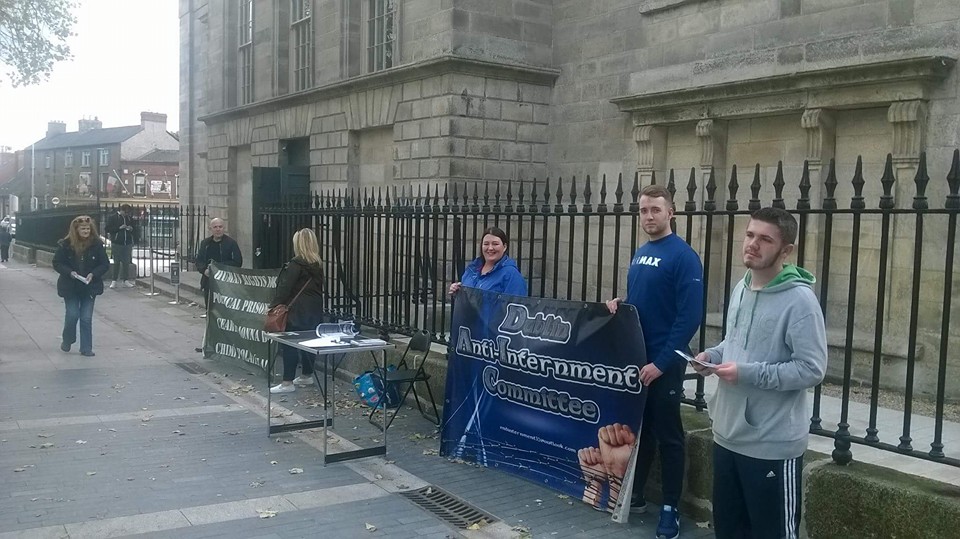


MOORE STREET SPEECH

Roibeard Drummond, after laying wreath on behalf of the Asgard 1916 Society
Roibeard Drummond, after laying wreath on behalf of the Asgard 1916 Society (photo D.Breatnach)

Niamh McDonald gave a short speech on the current situation in the struggle to save the revolutionary quarter of Moore Street. She informed her audience that NAMA had sold the debt of the Irish speculator company Chartered Land (Joe O’Reilly) to Hammerson, a British-based vulture capitalist company, who are continuing with the plan to build a huge shopping centre over the whole historic quarter. Meanwhile, the Minister for Heritage, Heather Humphreys, is appealing the High Court judgement that the whole quarter is a national monument. McDonald asked people to keep an eye on the campaign’s

Denise Ní Chatháin bringing forth the wreath from the Anti-Internment Group of Ireland
Denise Ní Chanain bringing forth the wreath from the Anti-Internment Group of Ireland (photo D.Breatnach)

Facebook page for updates and for calls to support actions.

McKearney then called on Diarmuid Breatnach to sing Me Old Howth Gun, pointing out that guns landed at Howth had been the first to fire on the Lancers in O’Connell Street on Easter Monday 1916. Breatnach introduced the song as having been written apparently in 1921, that is a year before the outbreak of the Civil War, by James Doherty, who also used the pseudonym Seamas Mac Gallogly.

Niamh McDonald speaking on behalf of the Moore Street 2016 campaign
Niamh McDonald speaking on behalf of the Moore Street 2016 campaign (photo D.Breatnach)

MAIN SPEAKER — JOHN CRAWLEY FROM THE MARITA ANN
The next speaker to be introduced by McKearney was John Crawley who was arrested on board the Marita Ann trawler, intercepted off the Kerry coast by the Irish Naval Service on September 29, 1984, when seven tonnes of arms were seized. The US heavy machine guns recovered on the Marita Ann had special mountings allowing them to be used as anti-aircraft weapons. Another of those detained on board – and later jailed for 10 years – was Martin Ferris who went on to become a Kerry TD for Sinn Fein, while John Crawley has taken a line of opposition to the Good Friday Agreement.

John Crawley giving his oration with the plaque commemorating the landing of the Howth guns behind him
John Crawley giving his oration with the plaque commemorating the landing of the Howth guns behind him (photo D.Breatnach)

John Crawley gave the main speech at Howth, in which he traced the history of the struggle for the Irish Republic from the Volunteers onwards, pointing out that many who fought the British in 1916 had different aspirations for the country, which explained why they parted ways in 1921. Crawley stated that the British have always been able to pick out those whose primary intention was to survive the struggle from those whose intention was if necessary to give their lives for the objective of the Irish Republic.

Pól Ó Scanaill reading the 1916 Proclamation
Pól Ó Scanaill reading the 1916 Proclamation at the head of the East Pier, Howth (photo D.Breatnach)

Crawley pointed out that some people had led a section of the Republican movement in accepting the right of a foreign country to decide the future of a part of our country; they had joined in the colonial administration and had accepted the colonial police force.

After the applause for the speech died down, McKearney thanked those who had participated and asked Diarmuid Breatnach again to step forward to sing the national anthem. Breatnach sang it in Irish, first verse and chorus (and noticeably sang “Sinne Laochra Fáil” instead of “Sinne Fianna Fáil”). Participants joined in with the chorus and then all made their way along the pier towards a local pub where refreshments had been made available by the new 1916 Society.

Diarmuid Breatnach singing Amhrán na bhFiann at end of the ceremony. Earlier he had sung "Me Old Howth Gun".
Diarmuid Breatnach singing Amhrán na bhFiann at end of the ceremony. Earlier he had sung “Me Old Howth Gun”. (Photo: Des Keane from Sean Heuston 1916 Society page)

end

Video of the event by John Rooney and put on Youtube by him, posted on FB by Mick O’Riordan (see below)
https://www.youtube.com/watch?v=RrG_7VLytfw

http://https://www.youtube.com/watch?v=RrG_7VLytfw