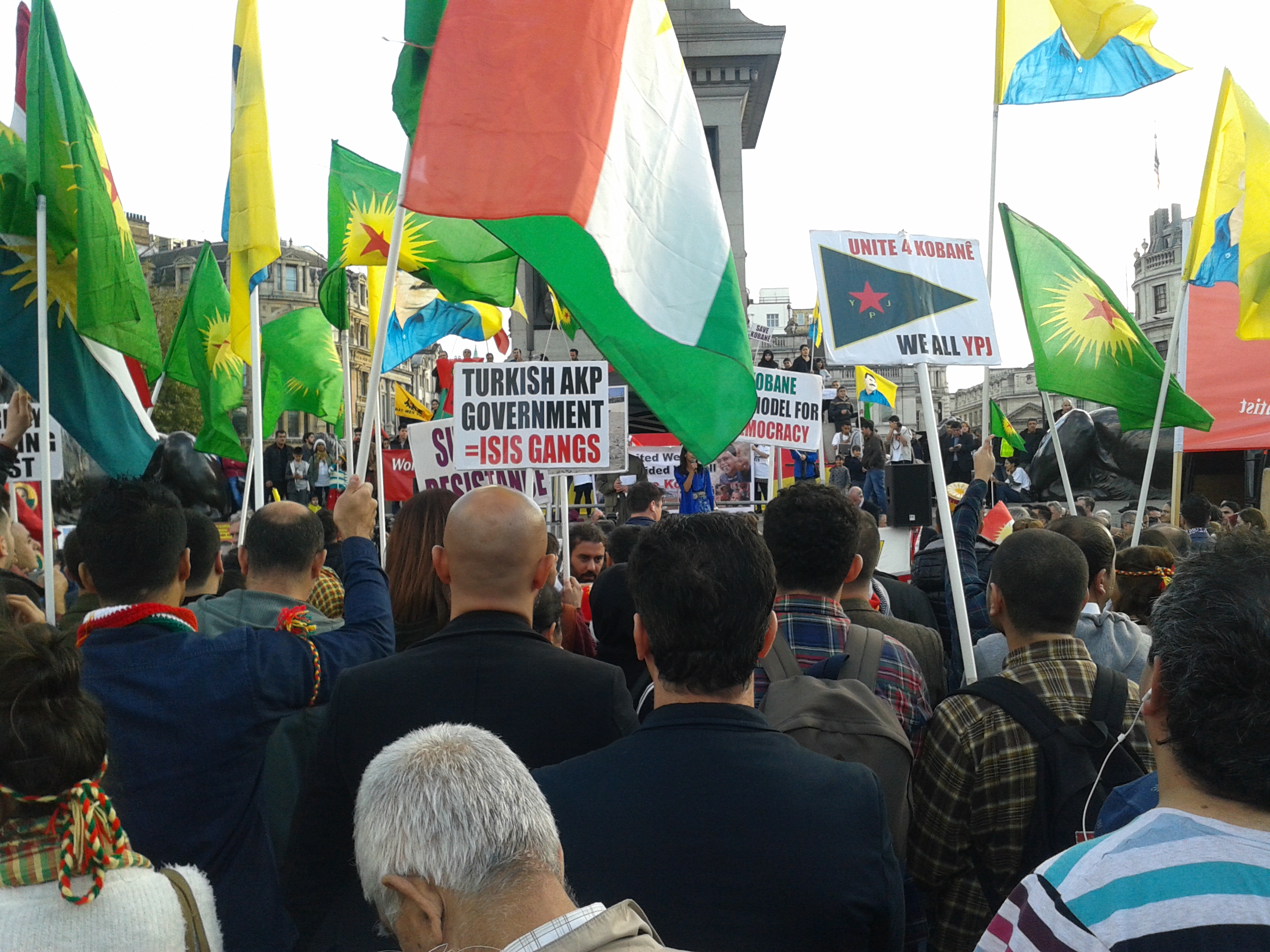
INTERNAL DISSENSION OVER PRISONERS COINCIDES WITH FURTHER DECLINE IN THE ABERTZALE LEFT’S VOTE

Diarmuid Breatnach

(For comment on the election results elsewhere in the Spanish state see  https://rebelbreeze.wordpress.com/2016/01/14/spanish-elections-result-in-most-fragmented-parliament-since-1936/  and https://rebelbreeze.wordpress.com/2016/01/14/the-disunited-and-fading-spanish-left-handing-on-the-baton/)

As the votes in the General Election in the Spanish state result in huge gains for the Podemos party and the most fragmented Parliament since before the Spanish Civil War, the Abertzale Left’s party in the elections also loses massively to the newcomer. This occurs in the context of wide discontent within the Abertzale Left, especially among the youth, with a potential split emerging around the issue of political prisoners.

The Spanish state includes within its borders most of the Basque Country and the Catalan Countries, which have their distinct cultures and languages. Also with a significantly different culture are Asturias and Galicia, both of them considering themselves Celtic rather than Latin-Hispanic and also having their own languages. There are in fact small movements seeking independence or greater autonomy in all other regions of the state, including in the political centre itself, Castille.

Four of the Basque Country’s seven provinces are currently inside the Spanish state and they were included in the Spanish state’s General Election on 20th December. A number of financial scandals affecting the ruling Spanish right-wing Partido Popular in recent years no doubt made their leaders reluctant to go to the polls but holding off longer might have resulted in even worse outcomes.

On the other hand, the PP’s main parliamentary opposition, the social-democratic Partido Socialista Obrero Espaňol (PSOE) were also embroiled in some financial scandals during the same period, though not as many.

In the event, both main parties achieved disastrous results and neither can form a majority government. The new party of the social-democratic Left, Podemos (“We Can”), which did not even exist two years ago, has leapt into third place and a new party of the Right, Ciudadanos (“Citizens”), is in a poor fourth place. No two of the aforementioned parties can form a coalition government except in the case of a PP-PSOE coalition; however that would cause massive problems for each party and also dispel the political myth of a democratic choice between “Left and Right” in the Spanish state.

The Spanish state has long been the most unstable in the core European Union. Collusion between fascists, alleged social democrats and alleged communists internally, along with the support of the USA and the tolerance of its European partners has kept it afloat. Nevertheless, it represents the part of the EU most vulnerable to revolution, with immediate impact should that happen on the French and Portuguese states and further ripples throughout the EU. However the revolutionary and potentially revolutionary forces are weak, divided and riddled with opportunism. (see separate article focussing on the elections and the Spanish state in )

Despite the weaknesses in the Spanish state, the Basque Abertzale Left has made little headway against it and has been slipping electorally badly this year.

Election Results in the Basque Country

EH Bildu Act in Nafarroa
EH Bildu, party of the Abertzale Left in coalition with social-democratic Basque parties, presenting their program in Nafarroa in 2012 and seeking broader alliances

EH Bildu (“Basque Country Unite”), the social-democratic coalition party under the direction of the Basque Abertzale (Patriotic) Left, came out of the Spanish state-wide elections badly (as it did in the regional elections earlier this year in the Basque Country also, with the exception of in Nafarroa). With a drop of nearly two-thirds of its previous percentage of the vote, it lost five seats and now has only two in the Spanish Parliament (the Cortes). The christian-democrat PNV (Basque Nationalist Party), traditionally the dominant in the three southern provinces of Euskadi (i.e. excluding Nafarroa, the fourth), also took a drop in its percentage but a much smaller one and despite that, increased its numbers of seats from five to six. The Basque nationalist coalition in Nafarroa, Geroa Bai (“Yes to the Future”), lost its only seat.

The winner that swept up the ‘missing’ votes in the Basque Country was Podemos, a party that did not even exist until last year. Although gaining one seat less than the PNV in the “Euskadi” or CAV (three provinces region), Podemos actually won more votes and its share was 25.97%, against the PNV’s 24.75%. Shockingly, at 15.72%, EH Bildu has now been reduced to fourth place after the other two and the PSOE, with only the PP worse off but with the same amount of seats. Even in Gipuzkoa, the province most loyal to the Abertzale Left, their share fell to 20.89% and their coalition party EH Bildu lost two seats. In the same province Podemos topped the poll in votes and gained two seats. In the fourth province, Nafarroa, EH Bildu lost their only seat and took a 9.90% share against UPN-PP’s 28.93%, Podemos’s 22.9%, and PSOE’s 15.53%.

(www.eitb.eus/es/elecciones/elecciones-generales/resultados and http://www.eitb.eus/eu/hauteskundeak/hauteskunde-orokorrak/emaitzak/kongresua/nafarroa/ hover cursor over the pie-chart sections for more info).

Podemos Pablo Iglesias Spanish Election Results Dec2015
Podemos leader Pablo Iglesias after results of Spanish Election results December 2015

It seems clear that in the Basque Country, Podemos took votes both from the PSOE and from the Abertzale Left’s coalition party, EH Bildu and even some from the PNV. For the PSOE, a party in Government in the past and implicated in the GAL murders, also involved in a number of recent financial scandals across the state, to lose votes in the Basque Country to a radical-left coalition, would have come as no surprise to most people. It is a different matter altogether for EH Bildu, with a strongly patriotic Left following, never tainted with a financial scandal and never yet in Government, to lose votes to a newcomer like Podemos — and that needs some explanation.

The fact is that the AL leadership flirted with Podemos – even proposing a joint electoral platform — and thereby sent the message that voting for them would not be such a bad thing. But there were sufficient reasons for the AL to have done otherwise, even without the objective of safeguarding their own vote. It has been clear for some time that the leadership of Podemos is hostile to aspirations towards independence of nations within the State. Their leader recently criticised the decision of a Catalan pro-independence coalition to use the regional elections as a quasi-referendum on Catalunya’s independence. Also one of their ideologues, in the midst of an intervention in discussions within Colombia, likened ETA to Columbia’s fascist assassination squads (who murder trade unionists, human rights workers, socialists, even street children). In addition, Podemos has never come out against the repression in the Basque Country.

There were enough reasons for the AL leadership to draw a deep line between themselves and Podemos. But they did the opposite. This contrasts with the left-republican Catalan nationalists (Esquerra Republicana de Catalunya-Catalunya Sí) who engaged in a public battle with Podemos’ leadership. Incidentally, they increased their share of the vote by 1.33% and their representation from three seats to nine.

Another vulnerability of the AL movement to a party like Podemos is precisely the road of conciliation with and concession to the Spanish state taken by the AL over the recent five years and longer. If that road is seen to be OK then, some might say, why not vote for a radical reformist left party and one which, crucially, has a large following throughout the State? Such thinking combines a perception that revolution is not possible, implicit in the approach of the AL leadership, with a view that a solution can only be found outside the Basque Country, which although contrary to most of AL’s propaganda, does seem in part to be the case, based on population statistics alone (see discussion on this further on).

This view was seemingly endorsed by the post-election statement of Barrena, spokesperson for the Abertzale Left’s party Sortu, who characterised the vote for Podemos as “the right to decide” and held out his hand for electoral coalitions with them in the future. The irony — that precisely Podemos does not support “the right to decide” of nations within the Spanish state – was apparently lost on Barrena.

Around September there were whispers of the intention to hold a review of their trajectory within the Abertzale Left. This seemed an acceptance that their chosen path had, if not failed completely, then certainly fallen far short of their own expectations. I wondered how they would contain severe criticisms within such a review, a much more difficult process now than some years ago, when confusion combined with illusions and the soothing words of long-standing leaders. 

Further confirmation of this review has since come out: called ABIAN (“Launch”), it’s a debate being organised by Sortu (“Create”), a social-democratic party of the AL. A recent article in a Gipuzkoa news media stated clearly that the review was a response to criticisms of Sortu, “for the first time within the Abertzale Left” (i.e. not only outside of it). The article went on to list a number of organisations within the AL who had published criticisms, including “Boltxe” and the revived “Eusko Ekintza” (http://m.noticiasdegipuzkoa.com/2015/09/01/politica/las-duras-criticas-internas-empujan-a-sortu-a-revisar-su-estrategia-politica-y-organizativa).  This contradicts Barrena’s public statement in September that those who criticise the current path of the Abertzale Left and their policy on the prisoners could no longer be counted as within the movement.

Given the electoral showing of the AL’s coalition party EH Bildu and other issues, such a review may be a way of “managing” the dissent but must also hold much danger for the leadership’s line, despite the party positions of the Otegi/ Permach/ Barrena leadership seeming reasonably secure at the moment (Otegi is due for release very soon).

Aside from all this and going back for a moment to Podemos, it does seem unlikely that this party has a long-term future but its development will be interesting to observe.

The political prisoners – a fracture point for the movement?
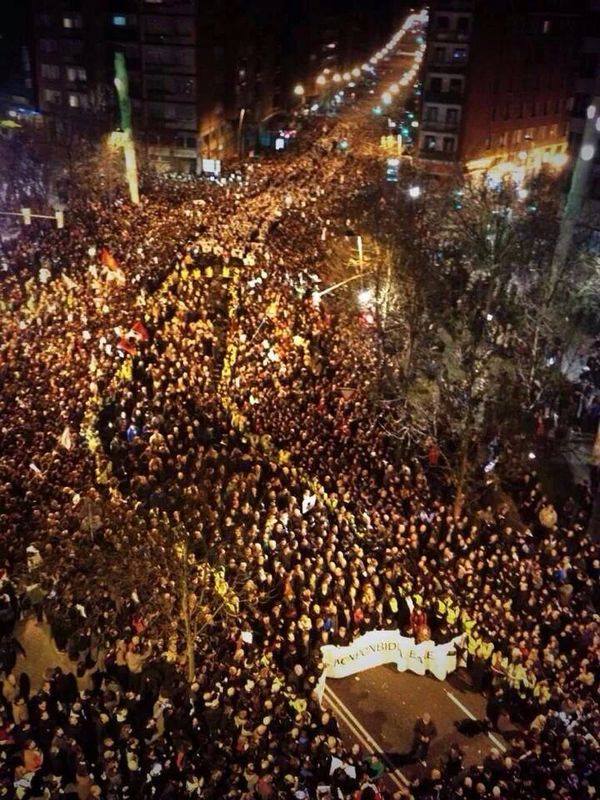
Bilbao 11 Eanair 2014
Annual Basque political prisoner demonstration January 2014 in Bilbao

Whereas the Provisional Republican movement suffered a number of small splits and some defections as a result of its embarkation on the pacification road, it is a fact that they had something pretty significant to deliver – the release of political prisoners affiliated to them. Nearly every single one walked out of jail and their release was not only a result to “sell” the GFA to the movement but some of the prisoners themselves were used as advocates of the process. Although it is true the prisoners were only released “on licence” and a that number were sent back to jail without a trial again later, including new prisoners, that only happened to “dissidents”. For the moment that could be seen as helping the continuation of the Good Friday Agreement and hampering the mobilisation of Republican opposition to Sinn Féin and their chosen path.

The Abertzale Left has had no such gain and a split in the movement seems to be forming precisely around that issue.

There are 410 Basque political prisoners officially recognised by the Abertzale Left (there are some dissidents too outside that, apparently) and they, like their counterparts in the Irish Republican movement, have always been an important element in the struggle. Political prisoners are dispersed all over the Spanish state and the Basques are by far the most numerous component of these. Some are also serving very long sentences, as are their comrades who are jailed by the French and also dispersed throughout their state.

Around a dozen are suffering with very serious illnesses and the Spanish prison administration has admitted that it does not have appropriate treatment facilities for a number of them. However, mostly there they remain and a number have died in captivity in recent years. Twelve people have also died in automobile crashes on the long journeys to visit prisoners dispersed to hundreds or even a thousand kilometres from their homes and an average of one serious traffic accident a month for visitors was recorded last year.

Dispersal is a serious issue and for many years has been one of those upon which the movement concentrated, in particular Etxerat, the prisoners’ relatives’ and friends’ group, and the short-lived Herrira, a prisoners’ political campaigning group banned by the Spanish state and their leading organisers arrested. But that demand also stood alongside the demand for amnesty, the freeing of the prisoners as part of a political settlement.
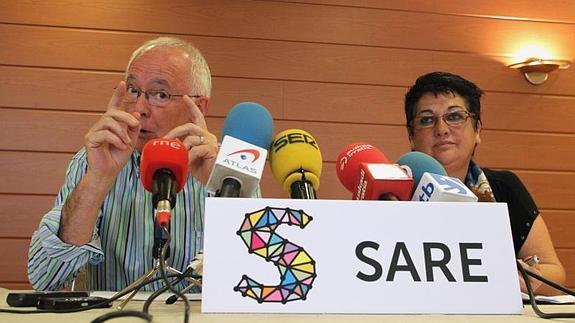
Sare Table Azkarraga & Asun Landa
Joseba Azkarraga, spokesperson for Sare and lawyer Asun Landa, at a press conference

More recently, however, the Abertzale Left’s leadership has been placing the emphasis on combating the dispersal and, according to some of their critics within the movement, abandoning the demand for amnesty. Perhaps the leadership felt that dispersal was an issue they had the capacity to change (though it is difficult to see how), whereas without an armed struggle to use as a bargaining chip, a prisoners’ amnesty may have seemed out of reach.

Meanwhile, last year, Sare (“Network”) was created by the AL leadership to pick up the threads dropped by Herrira but little has been heard or seen of it. The organisation’s spokesperson is Joseba Azkarraga, who has a somewhat radically fragmented track record. During the 1960s and 1970s a member of ETA (a fact missing from his Wikipedia entry in Spanish), he left them and joined the christian democrat PNV (Basque Nationalist Party). Azkarra was elected to be member of the Alava province local government for the PNV in 1979, a role he fulfilled later for Bizkaia province 1982-1986 and in the latter year also for the province of Guipuzkoa — representing the PNV throughout.

In 1987 he was part of a split from the PNV that led to the formation of Eusko Alkartasuna (EA), for which party he was elected a member of local government for Bizkaia in 1989. He was a member of EA’s National Executive 1987-1993 and 1999-March 2009, in between which periods he had withdrawn to concentrate on his business in the banking sector. From September 2001 to May 2009, he had the responsibility of Councillor for Justice, Employment and Social Security for the Basque Government. He has been quoted as saying that the more prosecutions of Abertzale Left activists the better – this from a man with a law degree in a State where prosecutions of Basques are more often than not ensured by “confessions” extracted by torture and where the standard of “evidence” required to convict is derisory.

Grumbling, particularly among younger activists about the emphasis on the institutions and the “abandonment of the street”, has been growing over the years. “Our movement’s spokespersons no longer speak of ‘freedom’ and ‘socialism’ but use more ambiguous words like ‘right to decide’ and social justice’ ” is a growing complaint.

Recently an organisation called Amnistia Ta Askatasuna (“Amnesty and Freedom”) was launched to campaign not only against dispersal but for amnesty for the prisoners too. The movement also goes by the name of Amnistiaren Aldeko Mugimendua (“Amnesty Movement”). In August of this year ATA/AAM held a small but significant demonstration in Bilbao associated with the annual alternative festival there which is strongly patronised by youth. At the end of November they held another in the same city, this time attended by an estimated 9,000.
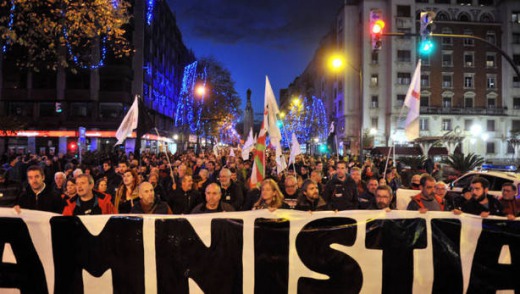
Amnistia demo Bilbo Nov2015jpeg
New solidarity campaign for for political prisoners raising demand of amnesty takes to the streets Bilbao 28 November 2015

In a Basque alternative radio station interview in August, some of ATA/AAM’s spokespersons complained of attempts to malign and isolate them but said they were overcoming these tactics and gaining support. The AL’s bilingual daily newspaper, GARA, did not publicise their demonstration in advance and their estimate of the attendance afterwards was about half of the real figure. The report also neglected to mention the messages of support from a number of political prisoners to the rally.

In December, the six alleged ETA prisoners awaiting trial in Paris on charges involving kidnapping, car and weapons theft and, for two of them, murder of a police officer, made a press statement denouncing the ATA/AAM group and claiming that they were using the prisoners as a Trojan horse in order to attack the whole recent direction of the Abertzale Left. They also accused them of trying to get Basque prisoners to leave the prisoners’ collective, the EEPK. No evidence was produced of this and the ATA/AAM were not asked to comment.  GARA published the Paris statement under a headline containing the allegations without even putting them in quotation marks. It is rumoured that GARA lost many subscribers after that reporting.

It seems likely that this controversy will sharpen over the coming months with people, including prisoners, being obliged to take sides and it may be that it will be characterised by a similar bitterness to that which exists in the Republican movement in Ireland. But unlike the case of Ireland, the numbers of Basque prisoners in the jails remains very high. In addition, the Spanish state continues to jail people who are clearly political activists which adds to the political prisoner population. Without a change in that situation, the likelihood of very serious contention within the movement is high and on a much larger scale than has been the case in Ireland.

The recent dismal electoral showing of EH Bildu can only increase unhappiness within the movement and lead to judgements critical of the AL leadership and, inevitably, to one degree or another, of the path they openly set out upon a little over five years ago.

Background – the origins and trajectory of the Abertzale Left

Born during the Franco dictatorship, the Abertzale Left (Basque: Ezker Abertzalea; Spanish: Izquierda Abertzale) is a broad alliance of patriotic and Left elements with many aspects situated on the social, cultural-linguistic, trade union, media and of course political fronts. The movement was subject to heavy repression from the outset and after nearly a decade a section responded by taking up arms. The Basque Nationalists had done that against Franco in the Civil War – however, the Abertzale Left was doing so in a country occupied by the victors of that war.ETA Symbol image

Not many outside the Basque Country realise that ETA (“Basque Country and Freedom”) is more than “the armed wing of the Basque patriotic movement” — it is the origin of the Abertzale Left, operating solely politically and culturally (albeit clandestinely) for nine years, its activists spied upon, arrested, tortured, jailed. Eventually ETA took up the gun.

It was one of the main ideologues and organisers of ETA, José Miguel Beñaran Ordeñana (alias “Argala”, 1949 – murdered by GAL 21st December 1978) who pushed for the legal and semi-legal aspects of the work to form themselves into separate organisations from ETA while the parent organisation kept a relationship with them.

Although the old Basque Nationalist Party was legalised under the new form of the state after the death of Franco, repression of the Abertzale Left continued. Nevertheless the movement continued to grow, in particular its many non-military aspects, although they too were and are subjected to heavy repression.

Despite the adaptability of the movement and its significantly wide base (between 12%-20% on past electoral showings, despite banning and disqualifications of electoral platforms), it was difficult to see the validity of its strategy of combining armed struggle and popular political movement within the Basque Country, with regard to its long-term objectives of national independence and socialism.

The ruling classes of both the Spanish and French states have a long imperial history along with a strong traditional insistence on the unity of their “home” states, on which they have never shown a willingness to compromise. That is reflected not only within their main right-wing parties but also within the main social-democratic parties and the remains of the old Moscow-orientated Communist parties. In the Spanish state the situation is even more problematic, since the Basque Country and Catalunya are two of the most economically successful within the state, outperforming nearly every other region by a significant margin. Why would the Spanish ruling class wish to give those regions up?

The total Basque population is only around 3.5 million, some of which is within the borders of the French state. The Spanish state has a population of around 45 million outside the Basque Country and even with the subtraction of that of Catalunya (7.5 + million) and the Balearic Islands (just over one million), that still leaves a population of 36.5 million from which to draw soldiers and police.

According to Wikipedia, “the Spanish armed forces are a professional force with a strength in 2012 of 123,300 active personnel and 16,400 reserve personnel. The country also has the 80,000 strong Guardia Civil which falls under the control of the Ministry of Defence in times of a national emergency. The Spanish defence budget is 5.71 billion euros (7.2 Billion USD) a 1% increase for 2015.” The Wikipedia paragraph ends with the ominous sentence that “The increase comes due to security concerns in the country.”

Those figures of course do not include the other police forces, such as the National (Cuerpo de Policía Nacional or “los Grises”)), with a strength of nearly 88,000. This armed force, along with the Guardia Civíl (“los Verdes”), has been traditionally repressive of the Abertzale Left, a task now mostly left to their respective forces in the Basque Country, the Ertzaintza and Policía Forál, forces which, like their counterparts in Catalunya, the Mossos d’Escuadra, have been viciously engaged in repression of the patriotic movements. Then of course there are the municipal police forces inside the Basque Country and elsewhere which can be mobilised as backups to military operations.

Add to that the fact that Nafarroa (the fourth southern Basque province) contains significant Spanish unionist and right-wing elements (it has voted a PP majority for decades) and that much of the Basque Nationalist Party’s following is hostile to the Abertzale Left and it is difficult to see how the AL ever expected to win a straight contest of strength with either state.

Perhaps, like the Irish Republican Movement, with which it has traditionally had fraternal relations, the Abertzale Left thought to make itself such a nuisance to the power occupying it that the latter would get fed up and leave them to it. In both cases but even more obviously so in the case of the Basques, that would have been a serious misreading of the situation and an underestimation of the importance to the power in question of remaining in possession.

It seems clear that the only scenario in which the Basque Country could set up a truly independent state would be one in which the Spanish state at the very least (and probably the French one too) would be unable to send repressive forces in to deal with such an attempt. And what would be the nature of such a scenario? Why, nothing less than that the ruling class of the Spanish state (probably of the French state also) were facing a revolutionary situation across the rest of its territory. Not only would such a situation tie down much of its armed forces but it would have the potential for soldiers refusing to fire on workers, mutinies and defections to revolutionary forces.

Working from such an analysis, activists of the Abertzale Left, as well as organising their movement within the Basque Country, would have been busily building relationships with the revolutionary movements and organisations across the Spanish state. But apart from the electoral alliance for the European Parliamentary elections of 2009 (the creation of the Iniciativa Internacionalista platform, which was the victim of massive electoral fraud by the State), the Abertzale Left has never seriously set about such a project. On the other hand, the formerly-Moscow orientated communist party and left-social democrats across the state, as noted earlier, have also kept at a distance from the Abertzale Left and from their aims. The left coalition of mostly Trotskists, Communists and radical social democrats of Izquierda Unida has done likewise.

There are however small formations of revolutionary communists, anarchists and left-independentists, along with anti-centralist movements with revolutionary potential, as well as a number of anti-unionist and independent trade unions throughout the state. To be sure, the immediate prospects are not glowing – but what other option is there? And how else can one be placed to take advantage of a revolutionary upsurge across the state should one occur?

A significant deviation from the original route

During the 1980s, during an ETA truce, there were peace talks held between ETA and the Spanish Government which came to nothing. Similar overtures during the early 1990s had similar results.

It appears that at some point in the late 1990s, perhaps attracted by the development and apparent gains of the Irish pacification process, the leadership of the Abertzale Left began to look for a different way out of their difficulty. Arnaldo Otegi is widely seen as the architect of this trajectory.

Part of this new approach involved seeking alliances with the PNV and with social-democratic parties within the Basque Country. The PNV is the party of the Basque nationalist bourgeoisie, no longer prepared to fight the Spanish ruling class as it was in 1936. It has its capitalist interests and has a record of jobbery and corruption including its involvement in the TAV, the High-Speed Rail project. It even asked the Spanish state to make militant opposition to this project a terrorist offence. The PNV manages its police allocation, the Ertzaintza, a vicious force active against the Abertzale Left and against striking workers and responsible for the serious injury and death of several. The PNV also manages the Basque TV station EITB and therefore controls both the arms of repression and of propaganda. Although the AL criticises the PNV from time to time this is mostly for the lack of support for a broad front against the Spanish state – AL spokespersons rarely attack it for its capitalist exploitation or jobbery.

Otegi was apparently active with ETA in the French state for around ten years and served three years in a Spanish jail for an ETA kidnapping in 1987, after which he involved himself in political activism. Ten years later the jailing for seven years of senior members of Herri Batasuna left a vacuum in the leadership of the organisation which Otegi filled along with Joseba Permach (sentenced to three years jail in August 2014 – but halved on appeal — in the “social centres trial” which confiscated the assets of the centres) and Pernando Barrena.

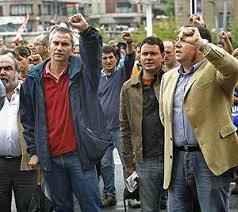
Otegi Speaking platform 2011
Arnaldo Otegi, leading figure in the Abertzale Left and seen as architect of recent path of the movement, addressing a rally some years ago.
Permach & Barrena clenched fist
Joseba Permach and Pernando Barrena giving the clenched fist salute at a political rally some years ago. Both have been close colleagues of Otegi’s in the Abertzale Left’s leadership and shift in strategy some years ago

Otegi led a number of initiatives for the Abertzale Left to embark on a different path, which combined ETA ceasefires, talks with other parties, and militant rhetoric. The latter landed him with a 15-month sentence of which he eventually served one year. Subsequently he has been arrested a number of times, convicted twice and exonerated twice. In 2011 he was charged with trying to rebuild Batasuna, the AL party banned by the Spanish state and was sentenced to ten years; this was reduced on appeal to 6.5 years so that he is due out soon. In 2013 he was elected General Secretary of the AL social-democratic political party Sortu.

Despite the relatively short prison sentence (compared to many other Basque prisoners) and the fact that he appears to be in good health, a campaign was started for Otegi’s release and a petition circulated around and outside the movement. This broke a long-standing rule in the movement that there would be no campaigning for individual Basque political prisoners, from which an exception was previously made only in the cases of seriously-ill prisoners. Nevertheless the campaign petition and Facebook page has been circulated through the movement without any official condemnation — or even distancing from — by the AL leadership. However the campaign has attracted some muted criticism across the movement.

The AL leadership proposed a “peace process” but the problem was that, unlike the case with the British, the Spanish ruling class had no interest in developing anything like that. Their aim was to crush the movement with an iron glove, not to “choke it with butter” as their British counterparts had done.

So the Abertzale Left took the road of unilateral ceasefire. This seemed to many of their friends a doomed tactic since it left the Basques with nothing to bargain. In September 2010, ETA announced a ceasefire, saying it wished to use “peaceful, democratic means” to realise the aspirations of the Basque people. The Spanish state’s reaction was not encouraging but nevertheless on 20th October the following year, the organisation announced a “cessation of armed activity”. This followed the conclusion of the “International Peace Conference” held in Donostia/San Sebastián.

The composition of the conference was clear indication of the AL leadership’s projected route and in particular the type of allies it sought internationally: former UN Secretary-General Kofi Annan, former Taoiseach of Ireland Bertie Ahern, former Prime Minister of Norway Gro Harlem Brundtland, former Interior Minister of France Pierre Joxe, President of Sinn Féin Gerry Adams and British diplomat Jonathan Powell, who had served as the first Downing Street Chief of Staff. To summarise, a collection of servants and executives of imperialism, colonialism, capitalism and even executives of repression and one exposed in a financial corruption scandal.

The declaration at the conclusion of the conference was also supported by former UK Prime Minister Tony Blair, former US President Jimmy Carter and the former US Senator and former US Special Envoy for Middle East Peace George J. Mitchell. In other words, former leaders of US and British Imperialism and one of their agents.

Despite the abandonment of armed struggle by the Abertzale Left leadership, the meeting did not include Spanish or French government representatives and the ruling classes of both states remained unreceptive to the overtures of the AL leadership. Not only that, but the Spanish state continues to arrest the movement’s activists, to torture and to jail them. No amount of criticism by committees for the prevention of torture working for the UN or for the EU, nor condemnation by Amnesty International and many human rights associations within the Spanish state, have had any visible impact on the operations of the Spanish state in recent years. And “confessions” obtained by torture continue to be used as admissible ‘evidence’ for the Prosecution even when withdrawn by the victim and the torturers denounced in court.

The ETA ceasefire continues to date and a number of other statements have been made by ETA including one in which they announced the destruction of a number of weapons, verified by a decommissioning expert. A number of “international conferences” have been held with further calls on the Spanish state to cooperate, also without significant result.

end

DUBLIN REPUBLICAN MEETING HEARS KURDISH REPRESENTATIVE, INDEPENDENT TD, GARVAGHY ROAD VETERAN AND REPUBLICAN PARTY LEADER

Diarmuid Breatnach

Breandán Mac Cionnaith, Erdelan Baran, Clare Daly and Brian Leeson took turns to address a meeting in Wynne’s hotel on Saturday. The speakers addressed a large audience in the open part of the conference following the internal Ard-Fheis (annual congress) of the Éirigí Irish Republican party and covered the Garvaghy Road campaign, the history of the Orange Order, the Kurdish struggle (in general and in Rojava/ Kobane in particular), Garda corruption, military use of Shannon airport by US imperialism, theft of Ireland’s natural resources, international imperialism and capitalism versus socialism. The meeting was chaired by Angie McFall.

Meirge mór AF eirigi
Main banner in the meeting room. located behind the panel during the meeting

Breandán Mac Cionnaith is General Secretary of the éirigí party and prominent as a residents’ activist and leader in resisting Loyalist parades through nationalist areas, in particular the Garvaghy and Ormeau Roads and with regard to the Drumcree siege. Until 2007 he was prominent in Sinn Féin but left the party that year after SF had agreed to support the colonial police force, the PSNI (formerly the RUC).

Preceded by the screening of a video of resistance to Loyalist marches in the Garvaghy Road, Mac Cionnaith gave an account of the formation of the Orange Order and its role from the inception of the Order and through its development. He also gave a detailed account of the long history of Orange marches through the Garvaghy Road and other areas, the siege of Drumcree and the people’s resistance, answered by sectarian murders of Catholics in the area.

Ardoyne protest 12th July 2000

The talk revealed that the Orange Order had been created at a time of revolutionary unity between sections of Protestants and of Catholics and that its purpose was to fracture that unity, which it carried out. It was from the beginning a sectarian, reactionary organisation serving the interests of the colonial ruling class in Ireland.

Along with its allied organisations such as the Apprentice Boys, the Order has a long history of provocation of Catholic areas through triumphalist marching, a practice defended by the colonial police force and in modern times until recently by the British Army. In one confrontation, Mac Cionnaith used available statistics to demonstrate that two British soldiers had been deployed for every resident of the area.

People protesting Loyalist marches on Garvaghy Road being attacked by the PSNI in 19977
People protesting Loyalist marches on Garvaghy Road being attacked by the RUC (forerunners of the PSNI) in 19977

After the break, the Cathaoirleach welcomed and introduced Erdelan Baran, a representative of the Kurdish National Congress. Erdelan’s command of English is excellent and he presented his talk well, using a few slides on an electronic display to emphasise his points, including a map showing the Kurdish population and its spread over the borders of the states of Turkey, Iraq, Syria and Iran.

The audience heard that the religion of most Kurds had been Zoroastrianism but that this had been reduced by Islamicisation. The Kurds had not been recognised as a separate nation or even really as a separate ethnic group by regimes ruling them and had suffered much repression in each of those states.

Erdelan Baran focused in particular on the development of the PKK, a party founded in 1978 by Kurdish students led by Abdullah Ocalan in a village not very far from the Kurdish city of Diyarbakir in the south-east of the Turkish state. The party named itself The Workers’ Party of Kurdistan and combined communist ideology with struggle for an independent state. It was subject to repression which increased dramatically after the 1980 right-wing military coup d’état, with imprisonment and executions of its activists and others fleeing to Syria.

Less Photogenic Kurd Women Fighters
Women unit fighters of the PKK during the 1980s

The PKK developed its armed struggle which included women’s units (Erdelan showed a slide of PKK women in uniform bearing arms).

Oҫalan was captured in 1999 and imprisoned on an island in the Turkish state. He since called for a change in objectives, i.e for the movement to seek confederalism instead of a state, a system of self-determination for each area and not based on any ethnic group or national territory. Erdelan pointed towards the administrations which had been set up in Rocajava as an example of this and also of equality towards women – 80% of representation was required to be in equal gender balance.

Since the emergence and attacks of ISIL in Syria, the YPG, a development of the PKK, has been fighting fierce battles against ISIL and established liberated areas in which other groups such as the Yazidis and Turkmen have taken part in defence and administration.

Erdelan mentioned very briefly the peace process espoused by the PKK and the refusal of the Turkish government to engage in it.

Female YPD fighters in Rojava
Female YPG fighters in the Rojava area

Erdelan finished his presentation to strong applause and the Cathaoirleach indicated that there was limited time for questions. Four people addressed comments and questions from the floor one of which criticised aspects of the PKKs policy and three of which were complimentary (see final part including Comment for further details), to all of which Erdelan responded,

A break was called again by the Cathaoirleach and when the conference reconvened, she announced that Clare Daly and Brian Leeson would speak one after the other, without time for questions from the floor.

THE BARREL OF ROTTEN APPLES

A short video about popular opposition to the water charges was played showing éirigí in action before the Cathaoirleach introduced Clare Daly as the next speaker, referring to her as an Independent socialist TD. Daly took the lectern, joking that she was obviously “a warm-up act for Brian Leeson”.

Clare Daly spoke with passion about a long history of cases of Garda corruption, saying that an earlier perception of there being perhaps “a few rotten apples in the Garda barrel” had changed over the years and that now perhaps instead people believed that there might be a few good apples in a rotten barrel. Daly pointed towards the forced resignations of Alan Shatter (as Minister for Justice) and of senior Garda officers and to the whistle-blowers within the force who had used the issue of exemptions on penalty points to highlight corruption within the Gardaí. She predicted that there would be further scandals.

Clare Daly (centre, in denims) and Mick Wallace (end right) on picket line recently outside Dept. of Justice, Dublin

Daly commented on how when in the Dáil she and Mick Wallace began to expose Garda corruption they were treated as some kind of shockingly disgusting people and that even those TDs concerned with civil liberties counseled them not to take on the Gardaí. But the perception of the Gardaí publicly has now changed and this has had its impact on the Dáil. It was the struggles of the people – in particular perhaps around the water charge – and the behaviour of the Gardaí against local communities resisting – which had led to the general change of public opinion. This had facilitated and been strengthened by the exposure of a number of scandals.

Turning to the use of Shannon Airport by the US Military on its way to invasions of Afghanistan and Iraq, in violation of Irish neutrality, Daly gave examples of some of the evidence available, not only from observers outside the airport but also from staff inside. One of these declared that he had stolen a gun from a plane in US military use at Shannon and of course, he could not be arrested for that since “How could he have stolen a gun from a plane the Irish Government claims is not carrying any weapons?” The planes in use are not only military planes but also chartered civilian ones and Daly gave statistics on the huge amount of US military traffic of weapons and soldiers through the airport, quoting also from a US document (part of the Wikileaks) confirming the importance of Shannon airport to their Middle Eastern military operations.

Daly accused the Irish Government of complicity with US imperialism and its war crimes. A lot of the evidence outlined and more was presented in the trial of Daly and Wallace following their arrest on 22nd July 2014 as they went on to restricted areas of the airport without permission from the authorities. They were there to carry out an inspection of US planes but were arrested and despite the evidence, in April were fined €1,000 each or 30 days in prison. Both declared then and Daly reaffirmed in her talk that they had no intention of paying the fine and await their arrest at any moment.

“There’s not much a small group of left-wing TDs can do in the Dáil to change what’s happening in the country”, said Daly, although she declared herself satisfied with the opportunity to use that forum to publicly expose a lot of what has been going on. Daly declared however that it was with the people that real impetus lay and hailed their resistance, including that of people in the room, in recent years.

THE NEED FOR SOCIALISM

Clare Daly finished her talk to a storm of applause as Brian Leeson, introduced by the Cathaoirleach as Chairperson of the éirigí party, rose to take her place at the lectern, joking that rather than being “a warm-up act” for him, Daly had “stolen his thunder”.

Leeson began his speech by outlining the need for a socialist society and suggested those who say that “Socialism doesn’t work” should be asked whether they think capitalism is working. He pointed to continual economic and financial crises, unemployment, housing crises in various forms, cuts in social welfare and health care …. and war. Wars, Leeson declared, were an inevitable part of imperialism, which is capitalism’s struggle to control natural resources and markets.

Brian Leeson speaking at an earlier meeting

“This hotel and these rooms have an important place in our history” said Leeson, relating that a decision to found the Irish Volunteers had been taken in Wynne’s hotel in 1913 and in 1914 Cumann na mBan had been founded there. Commenting on recent and forthcoming centenary commemorations, Leeson said that it was people like those in the room and outside in resistance who had made that history and that the state set up in on the back of those struggles did not represent either the ideals the people had fought for or the wishes of the majority of people in the country now.

Going on to attack the economic policies of the Northern Executive in the Six Counties, Leeson castigated Sinn Féin and the SDLP who he said had given up the only area of financial control that they had and passed the buck on to the British Government. They had the opportunity, he said, to stand resolutely for a budget against social welfare and health care cuts but they passed the buck to the British Government, which implemented those cuts instead. It was essential that the Northern Irish Executive should not collapse, apparently. Leeson questioned why this should be thought so – surely the only justifiable reason to be in any government or Executive was to represent the ordinary people and the disadvantaged!

Leeson also talked about the theft and giving away of our natural resources such as oil and the planned privatisation of water which he said belonged to the people and that no government had the right to give them away nor any company the right to own them.

Leeson paid tribute to Clare Daly who was prepared to advocate for Irish Republicans in prison and had given much support to Stephen Murney and Ursula Ní Shionnaigh. He also made a particular point of welcoming Erdelan Baran and of supporting the struggle of the Kurdish people.

Commenting on discussion around a forthcoming general election in the Irish state (the 26 Counties), Leeson criticised those who talked of campaigns to elect some kind of left-wing alliance. The conditions did not exist for that to be viable project, he said, and to raise people’s hopes only to dash them was cruel and would be demoralising. People should continue their resistance and éirigí would continue their part in that as they had done up until now.

The audience gave Brian Leeson strong applause as he concluded his speech.

There were no questions and answers called for afterwards and the meeting concluded, people standing around talking, purchasing from the merchandise stall, departing or retiring to the nearby bar which had just opened.

COMMENT

Attendance, Organisation, Speeches, Participation

The room was large and full, with accents to be heard from across the country and éirigí will probably be pleased with the level of attendance. The public meeting appeared to be well organised with door security (an invited/ registered list on which my name was not but thankfully I was recognised by several and that formality waived) just outside the meeting while inside, merchandise stall, chairperson, ushers, seating, projector and screen for videos and slides, sound amplification, and professional banners (one bilingual and one in Irish only).

I saw only one photographer whom I assumed to be éirigí’s and, thinking other photos of the attendance might not be permitted, restrained myself to photographing the banners only.

Mac Cionnaith’s talk was somewhat over-long in my opinion and he is also softly spoken, which makes parts difficult to hear – and I was in one of the front seats. He also speaks without a great deal of inflection or emphasis in his delivery which militates against giving him continuing close attention. This is a pity because the content was extremely interesting and contained a lot that was new to me. I was also impressed by the amount of information that he clearly had in his head, since he rarely had to consult his notes.

Such a long talk however is unlikely to be followed by questions and answers and this proved to be the case, with the Cathaoirleach calling a break at the conclusion of Mac Cionnaith’s talk, to be followed by the next speaker on resumption of the conference.

Mac Cionnaith told me later that he usually gives this talk in two parts and with a break between them. I urged him to write and publish it as a pamphlet and I sincerely hope he does so.

Clare Daly’s and Leeson’s talks were clearly audible and well-presented and the meeting was in general well-chaired. I would offer the criticism that the time-tabling did not permit sufficient audience participation in terms of questions and answers or contributions which only occurred, briefly, after the Kurdish speaker – i.e none after the other three speakers.

All the speeches had interesting content and were relevant to political life in Ireland today. Given the organisation’s policy on abortion I would not have expected a talk on that subject, albeit the issue is a very important ongoing one in Ireland. A stranger important omission I thought was the issue of repression of Irish Republican activists both outside and inside the prisons, including the practice of internment by false charge and remand. Stephen Murney, himself an éirigí activist in Newry, had been an important example of victims of this abuse of civil rights.

Another factor was the total absence of spoken Irish from the panel of speakers or the Cathaoirleach (even to the ritual “cúpla focal”) and I am aware that some éirigí activists did express their disappointment at that (both Leeson and McPhall are Irish speakers) after the meeting.

Ideology & Political Policy

The internal part of the meeting had taken place earlier and I was not present at that so these comments refer only to the open public part of the meeting.

It was understandable perhaps that, addressing a conference organised by a party known to have rejected that process in Ireland, the Kurdish speaker skated quickly over the question of Ocalan’s and the PKK’s espousal of a “peace” process. What is less understandable is that from éirigí, no-one rose to criticise it, that being done only by one contributor from the floor, who – after thanking Erdelan in Kurdish — pointed out that such processes do not bring peace and are instead pacification processes, traveling from people in struggle from one country to those in another, subverting their struggles as with South Africa, Palestine, Ireland and now being proposed for the Kurdish people, the Basques, the Colombians, Filipinos …1

The same contributor, while expressing his great admiration for the struggle of the Kurdish people over the years, in support of which he had travelled to Kurdistan in the early 1990s as part of a trade union delegation, raised another two issues of concern to him, which were what he perceived as the elevation of Abdullah Ocalan to iconic status within the main Kurdish movement and that the YPG had declared themselves in alliance with the western coalition in Syria.  Making it clear that he was not a supporter of Assad, the contributor asked the speaker whether he thought the imperialists would hand over control of the country when their current enemy had been defeated?

The contributor’s remarks and question were greeted with scattered applause from the audience.

,Erdelan made no reply at all on the issue of a peace process but replied at length to the issue of Ocalan’s leadership and the use of his image and to a lesser extent to question of alliance with the imperialist coalition.

“Ocalan does not seek to be a leader,” said Erdelan, “and has often said ‘If anyone else wants to take on this job let him have it.’” Aside from the fact that Ocalan’s leadership per se had not been criticised except in promotion of a peace process, this reply and subsequent arguments did not address the issue of the proliferation of Ocalan’s image within the movement, the issue that had been raised by the contributor from the floor. Furthermore, the Kurdish speaker must have been aware that Ocalan had publicly argued against his threatened execution by saying that a peace process was necessary with the Turkish state and that only he could lead the movement towards it. Going on to talk about Ocalan’s 15 political publications, as Erdelan did if anything served only to confirm the adulation in which his person is held by many in the movement. The policy of confederalism is also one developed by Ocalan while in captivity, after he renounced the policy of seeking a Kurdish marxist-leninist state and, subsequently, also renouncing the policy he developed of seeking Kurdish regional autonomy within the Turkish state.

In his reply on the issue of alliance with imperialists, Erdelan was likewise quite disingenuous. He emphasised the success of the fight against ISIL and the gender equality which their administration had brought to their liberated areas, which had been in part lauded already by the contributor from the floor but which did not directly address the issue in any case. Moving on, he referred to the need for survival of the Kurds and beleaguered people and their need for weapons.

After some more of this the contributor objected to the “arms for defence line”, saying that the overall military commander in the Rojava area had publicly stated that the YPG were not only joining the coalition for arms for survival but were going to join in an offensive to overthrow the Assad Government. At this point the Cathaoirleach silenced the contributor from the floor, pointing out not unreasonably that there were others waiting to speak.

The next contributor from the floor welcomed Erdelan to Ireland. He lauded the struggle of the Kurds and the leadership of Ocalan and stated that he and a few others had picketed the Turkish Embassy when the Kurdish leader was under sentence of death. He stated that in Ireland we also often display images of leaders and heroes such as James Connolly and that we do that in order to display our support for their ideals. He lauded the administration of the Rojava areas and stated that he wished to disassociate himself from the comments the previous contributor from the floor had made. He received strong applause.

A visual affirmation of the Irish language displayed at the Ard Fheis this year.

This contributor seemed unaware of the difference between the way and the degree to which images of James Connolly are displayed in Ireland and the way in which images of Ocalan are displayed among Kurdish supporters of the PKK. He also missed the most important difference – Connolly is dead and Ocalan is alive. Whatever errors a dead leader made he can make no further ones whereas a living leader can make many more (as history in general and ours in particular has shown) and the iconisation of a living leader makes challenging his/her mistakes within a movement extremely difficult and viewed as something in the order of sacrilege.

Another contributor from the floor asked for some more explanation of the policy of confederalism. In the course of his reply, Erdelan said that it was a democratic system that would preclude territorial expansion and that, for example, the issue of whether someone wanted a nuclear reactor in their area would be entirely a local decision. This reply in fact outlined one of the problems of confederalism in this stage of history since if local people voted in favour, for example with promises of safety and cheap power, the decision would nevertheless potentially affect everyone within a radius of thousands of kilometres – but no-one seemed to pick up on that.

The same member of the audience, responding, enthusiastically commended the Kurdish organisation on their confederalism policy and said that we should have the same here in Ireland. He (and certainly at least some in the audience) appeared unaware that a type of confederalism had been a central part of Sinn Féin’s and Provisional IRA’s progam for many years. The “Éire Nua” was such a program, originally proposed by then SF’s President Ruairí Ó Brádaigh and Dáithí Ó Conaill and strongly supported in practice by Des Fennel. This policy had encountered some opposition within the Provisional movement, particularly from supporters in the Six Counties who feared being left under regional domination of — or in constant contention with — Unionists.

The “Éire Nua” policy was overturned at the 1982 Ard-Fheis (annual conference) of Sinn Féin in what was seen by many as a victory of the Adams group within the leadership over the Ó Bradaigh one. Subsequently the policy of Sinn Féin has been for a united 32-County state and that is also part of éirigí’s policy today. Only Republican Sinn Féin and Cumann na mBan among Republican organisations in Ireland today retain a federal policy.

Overall, it seemed that the majority of the audience either did not feel equipped to engage with the issues in a critical fashion or felt that they would be going against their party (or hosts) to do so. It was highly unlikely that the majority supported the aspiration for a peace process and there must have been at least some disquiet on the issue of joining an imperialist coalition. But they remained silent. There was also of course the cultural issue of hospitality to an invited guest which may have played a part.

However, these are serious questions affecting the revolutionary movements around the world and need to be engaged with critically.

End.

FOOTNOTE

1    Is mise a rinneadh sin. I also took part in actions for the removal of the execution threat to Ocalan while having a number of discussions with Kurdish activists on the issue of iconisation. In general I worked for a number of years in London in Kurdish solidarity with people who supported the PKK and some who did not, including submitting motions to trade union branches and going on that delegation around much of northern Kurdistan in the early 1990s when it was still a war zone there. In Ireland I took part in a few pickets with Kurdish comrades and was discussing setting up a solidarity network here but some of the principal activists left the country.

While I was conscious that some others who I know would have had similar views to the concerns I expressed kept away from me, some activists did approach me during the break to express their approval of my comments, in particular on the issue of making an icon of a living leader. They had experienced a similar process with the promotion of Gerry Adams within Sinn Féin before leaving the organisation to join éirigí or to become independent activists. Nobody likes isolation and I was grateful not only for their comments but for visibly approaching me in the meeting area in view of anyone who cared to see.

PALESTINIAN TELLS DUBLIN MEETING ABOUT TEN YEARS OF BDS SUCCESS AGAINST ISRAEL

Diarmuid Breatnach

  A Palestinian speaker recounted ten years of success in the BDS campaign against the Israeli Zionist State and asked people to continue with it and, if possible, to step it up.

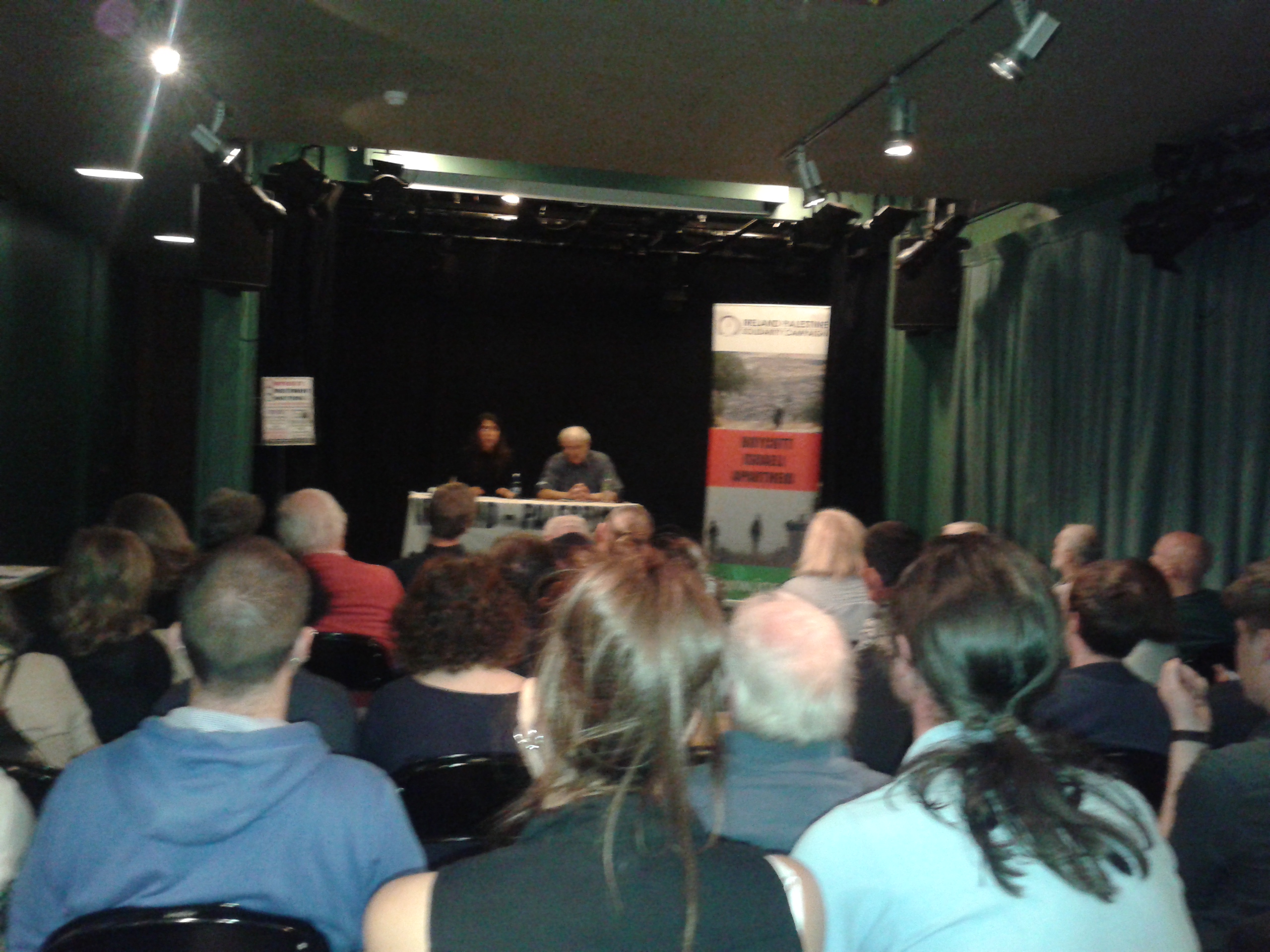
Riya Hassan addressed a crowd at the Pearse Centre in Dublin’s Pearse Street, just off Dublin City Centre, on Wednesday night. She spoke about the history of the oppression of Palestinians by the Israeli state and the ten-year history of the Boycott, Divestment and Sanctions (BDS) campaign, explaining its origins in Palestinian society and charting its growth and successes. The three basic aims of the BDS campaign are to pressure Israel to end the colonisation and occupation of Palestinian land, to give equal rights to Arab-Palestinians citizens in the Israeli state and to agree to the right of Palestinian refugees to return home.

Riya Hassan
Riya Hassan
Section of the crowd at the public mee

Riyah Hassan is European Coordinator of the BDS campaign, herself a Palestinian and, as she later explained when talking about the Israeli destruction of villages in the Negev, from near that area herself. Talking about the current refugee crisis in Europe, she pointed out that many of the refugees taking to sea in what she termed “death boats” (echoes of our own “coffin ships” during the Great Hunger) are in fact Palestinians. They are from refugee camps in Syria and are being made refugees for the second, third or even fourth time.

Speaking on the Palestinian refugee issue, a huge and outstanding one since 1948, Riya Hassan mentioned that their right to return home had been surrendered by the negotiators of the “peace process” at Oslo in the 1980s but that Palestinian society had not accepted this abandonment, whether in Israel, the occupied territory or in the refugee camps elsewhere.

Among a list of successes of the BDS campaign, Riya Hassan mentioned Veolia, a company which had been setting up the transport networks between settlements helping to carve up Palestine, had lost millions due to BDS – as a result, the company has pulled out of Israel (Veolia, by the way, runs the LUAS trams in Dublin). G4 Security, which runs surveillance on Israeli prisons, where there are currently well over 6,000 Palestinian prisoners, have said that they will pull out in 2017 but Riya said they should pull out now and called for pressure to be increased upon them. Another target should be our own Government, which has spent €14.7 million worth of arms and military components from Israel over the last decade (while Irish-based companies have exported €6.42m worth of military and ‘dual use’ hardware to Israel over the past five years). Riya reminded us of the complicity in murder entailed in buying equipment from the Israeli arms industry – an industry which boasts as a marketing point that its deadly equipment is “field tested”!

Among the measures of the impact of the BDS campaign on Israel and abroad, the audience were told that Netanyahu in addressing the recent AIPAC conference in the USA had given a quarter of his speech to attacking the BDS campaign and campaigners, in contrast to the early days when Zionists tended to dismiss the campaign as insignificant. More extraordinarily, perhaps, Hillary Clinton has given a promise, as part of her campaign for the Presidency of the USA, to do what she could against BDS.

Riya Hassan, BDS Europe Coordinator with Martin O'Quigley, Chairperson IPSC and who chaired the meeting
Riya Hassan, BDS Europe Coordinator with Martin O’Quigley, Chairperson IPSC and who chaired the meeting

Riya Hassan is eloquent, with excellent command of English and spoke clearly and confidently. If anything, she spoke for too long overall. It is hard for a visitor to judge what a typical Irish audience might know or what our cultural expectations are but the room was warm and after about 45 minutes one could hear some people shifting in their seats, a situation that did not improve as the talk extended well past the hour.

However, when the Chair of the meeting turned to the audience, it did not seem that anyone had missed an opportunity to ask questions or to comment and some even took several bites of the cherry.

As chair of the meeting (and of the IPSC) Martin Quigley drew the meeting to an end, he announced a boycott action of Tesco supermarkets for this Saturday and, for those in Dublin, asked them to meet at the IPSC office at 12 noon.

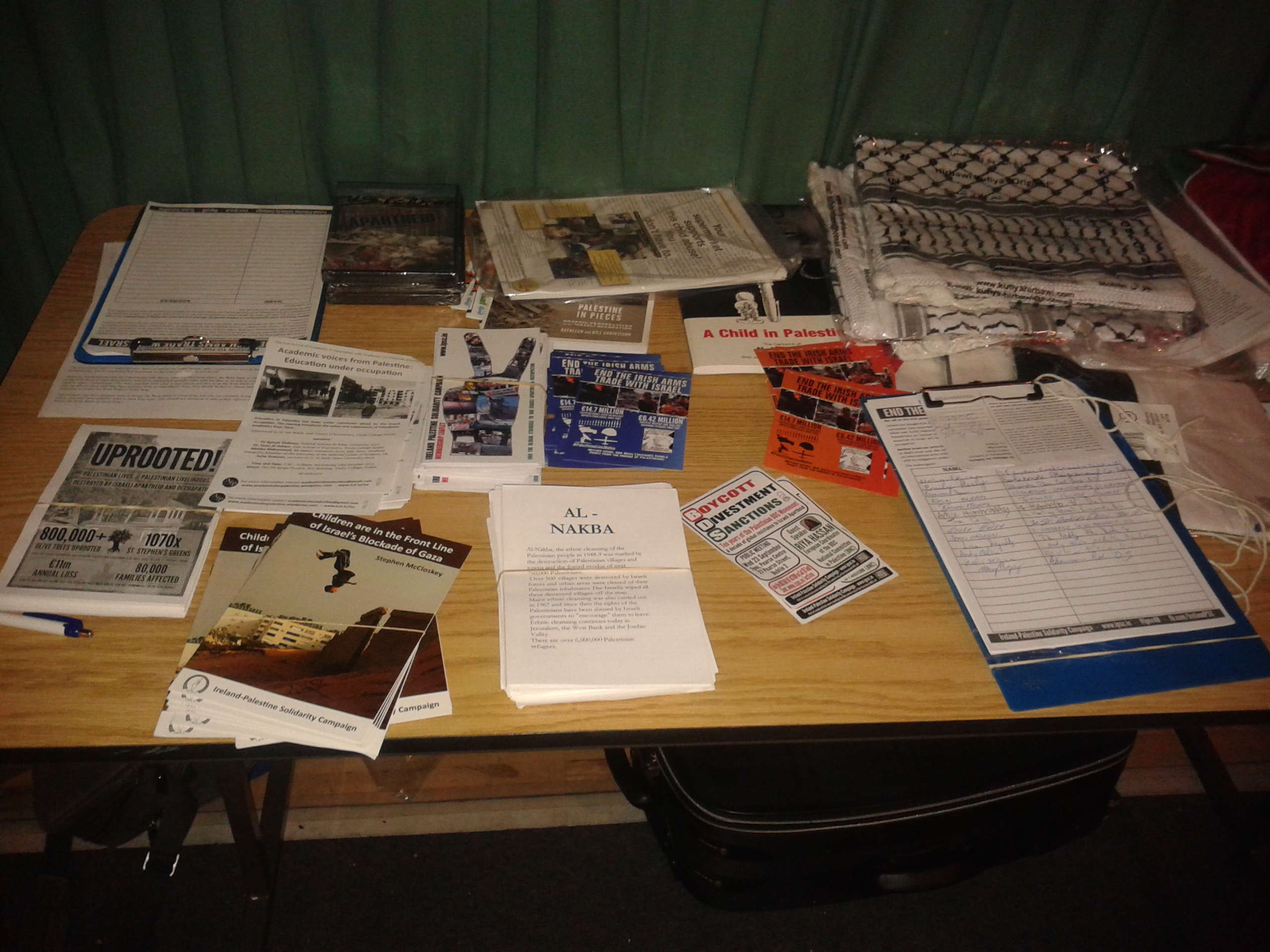
IPSC staff at the event
IPSC stall at the event

Riyah Hassan sets off over the next few days for Belfast and Cork before leaving our shores again and we wish go néirí an bóthair léithe!

end

ANTI-INTERNMENT MARCH BLOCKED BY MASSIVE POLICE PRESENCE IN BELFAST

Diarmuid Breatnach

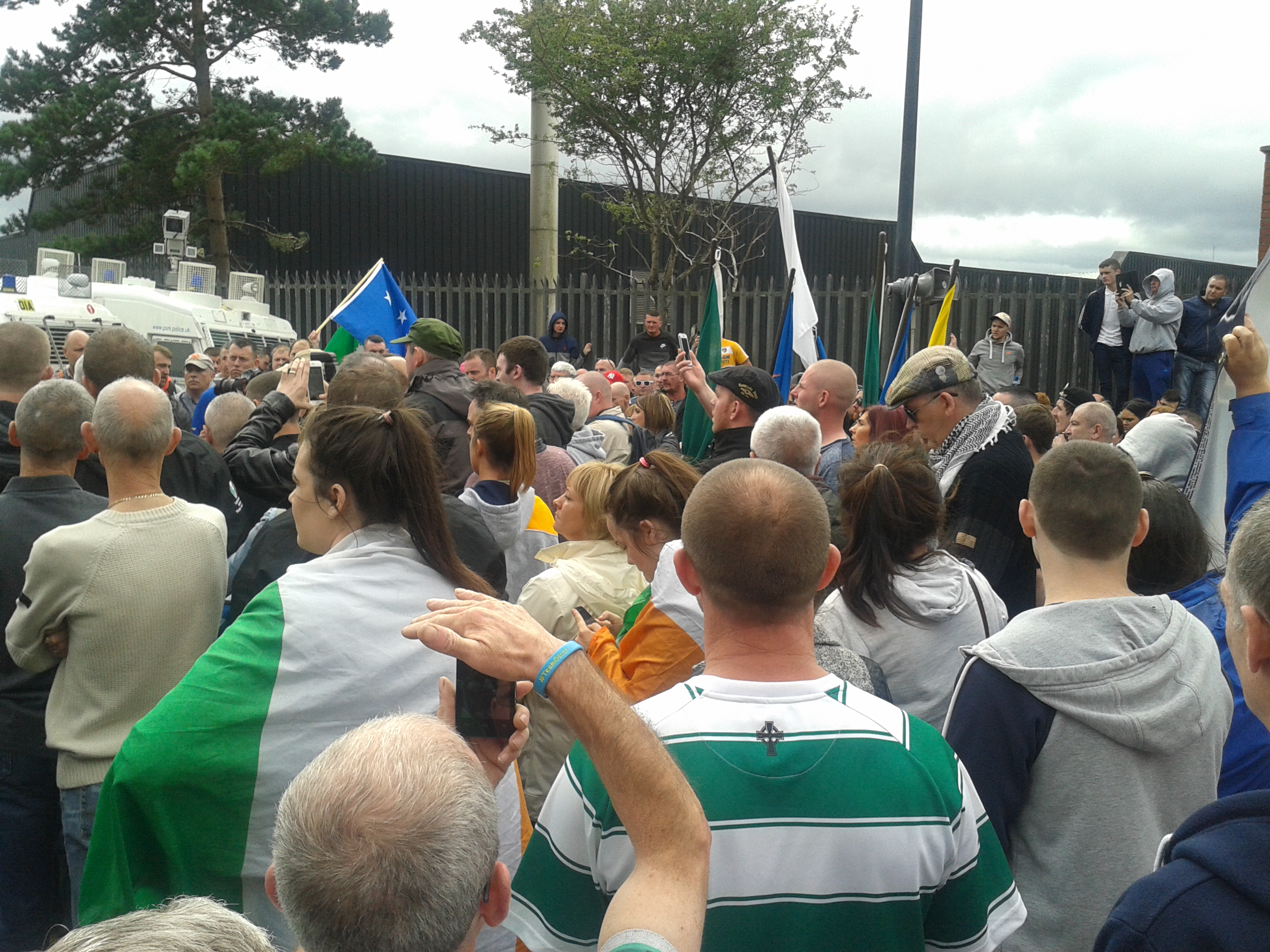
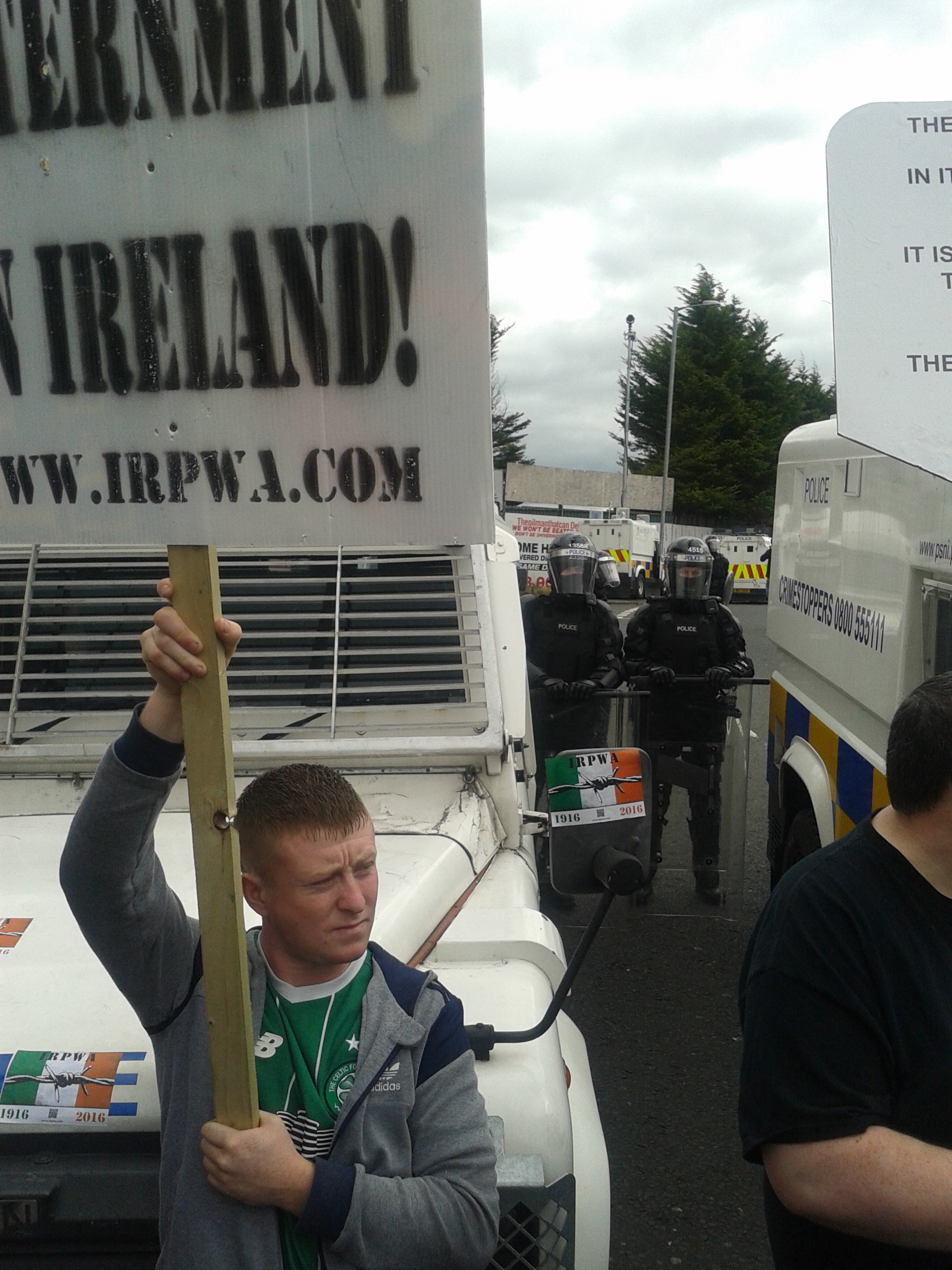
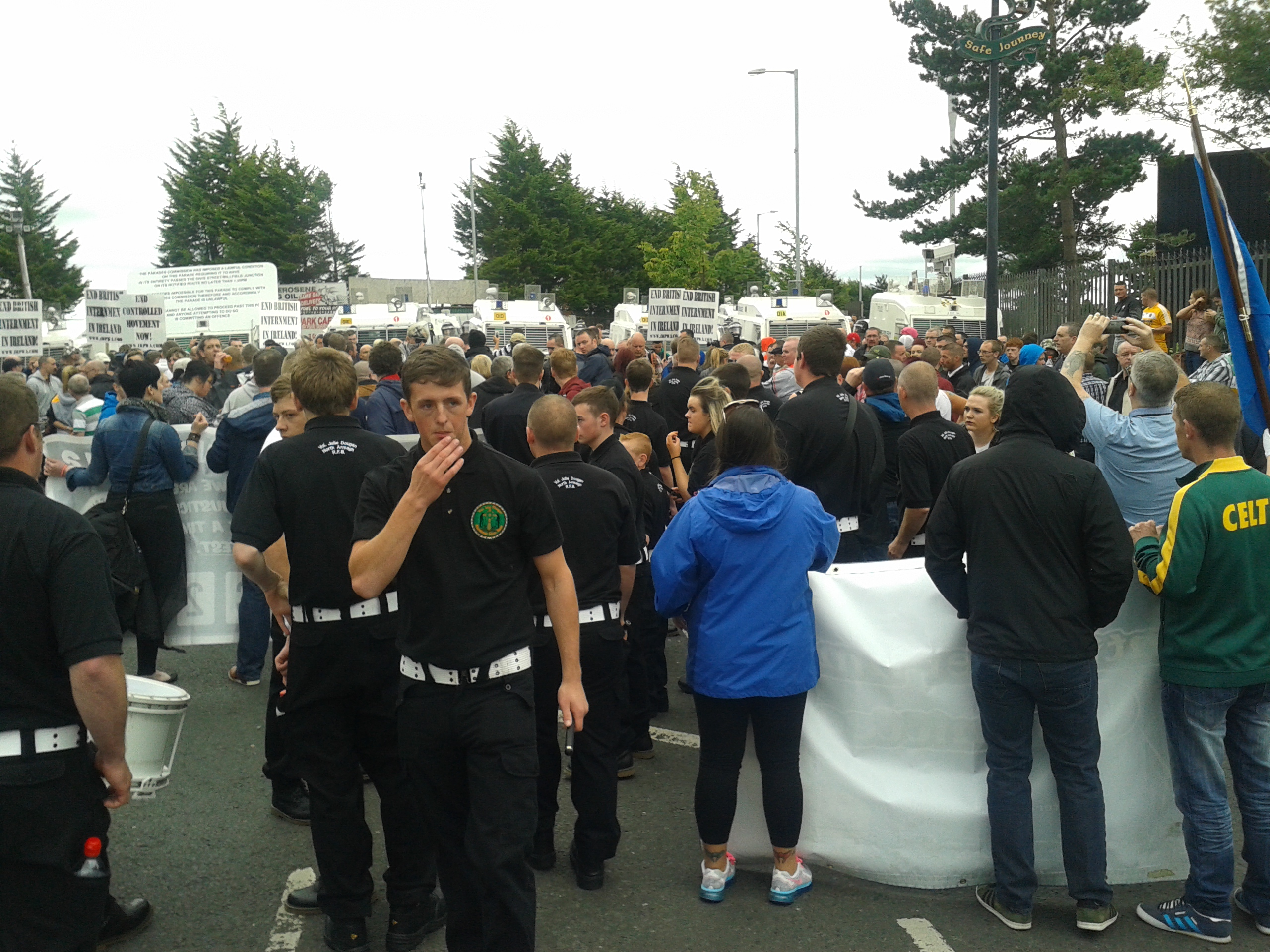
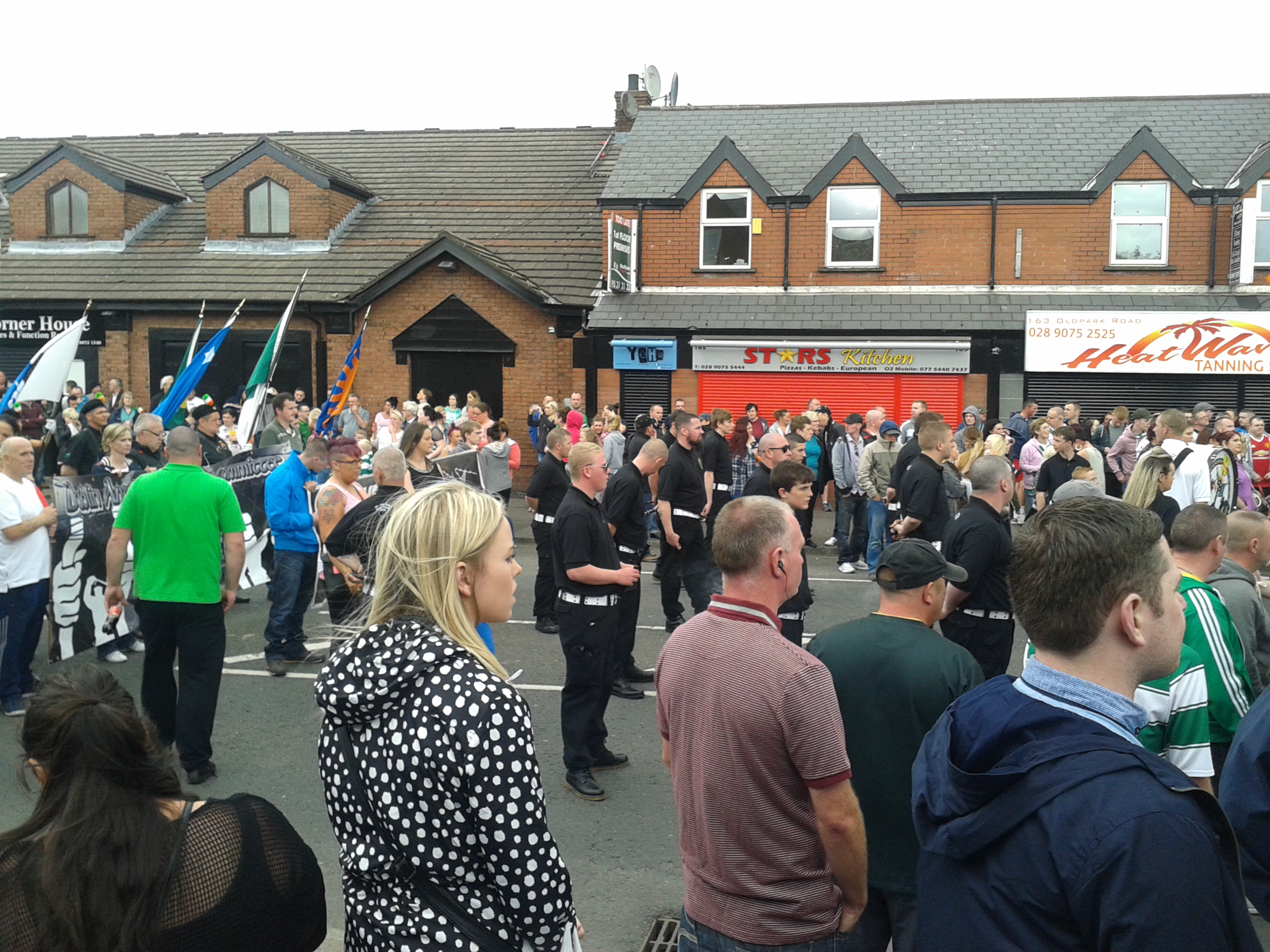
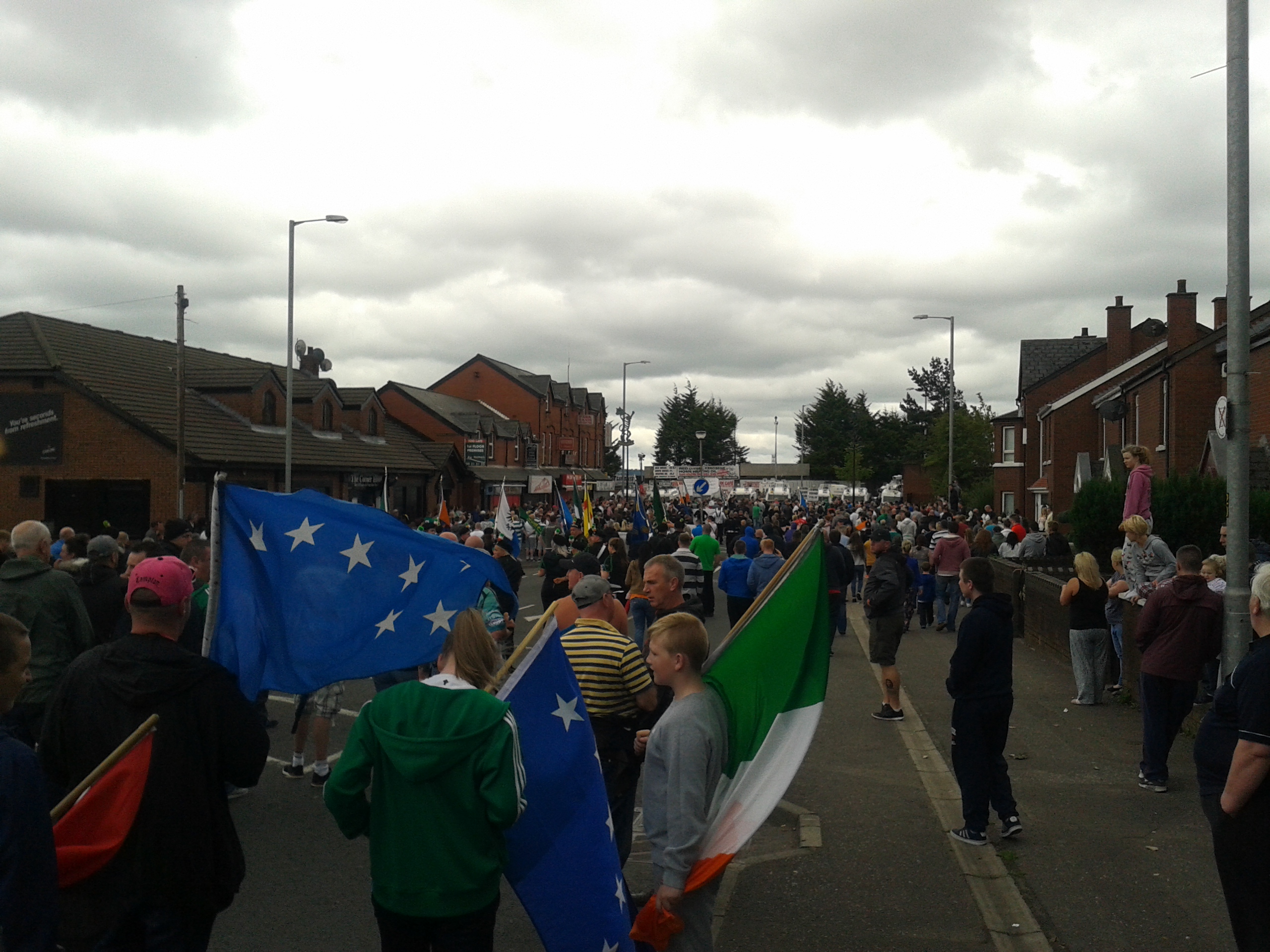
The annual anti-internment march in Belfast was blocked on Sunday 11th August by a very heavy police presence from proceeding beyond the Old Park Road. Road blocks had also been set up around the area and in the city centre. Although the march dispersed without incident, the continuing heavy police presence in the area provoked local people and altercations broke out between them and the police. In one incident, a reportedly pregnant woman was video-filmed being arrested and assaulted by male police, apparently for telling the police to get out of her garden.

Internment without trial was used by the British colonial regime in Ireland as one of its measures to repress resistance to its rule. After Partition, it was used by the regimes on both sides of the Border. Its most recent formal use was in the Six Counties from August 1971 until the last one was released in 1975, by which time almost 2,000 had been interned, initially only people from ‘nationalist community’ but later on some from the Unionist community had been added to the trawl. During immediate street protests against the introduction of internment, the Parachute Regiment shot dead 11 unarmed men over three days in the Ballymurphy area of Belfast. During a protest march in Derry against internment six months later, that same Regiment killed 14 unarmed civilians and injured many more. According to the authorities and to some others, including Sinn Féin, internment without trial no longer exist.

But since the Good Friday Agreement, Republican political activists who are not in agreement with its terms find themselves being locked up without trial through a number of other measures:

  • Some Ex-prisoners released under license have had that license revoked and are brought to prison without trial (e.g. cases in the recent pass have included those of Marian Price [2 years] and Martin Corey [4 years])

  • Activists are arrested on spurious charges and refused bail, to be found not guilty eventually but having spent years already in prison (Colin Duffy, among others)

  • Or the activists arrested on spurious charges are offered bail only on conditions that would immobilise them politically and kept in jail when they refuse (Stephen Murney who did 14 months remanded in custody before eventually being found “not guilty” and released)

For this reason many Republicans consider that internment still exists but in a more hidden form and this has led to the formation of the Anti-Internment Leagueand also to the Anti-Internment Group of Ireland, the Dublin branch of which has organised many events, from public meetings to pickets and information tables.  The main activity of the AIL is organising the annual march against Internment as near as possible to the anniversary of its introduction, August 9th.

It is worth mentioning that in addition to the covert internment methods, activists are also arrested and convicted and jailed on spurious evidence (examples include Brian Shivers – two years without bail awaiting trial and a third year convicted, before his conviction was quashed by the Supreme Court – and the Craigavon Two – still serving time although wrongly convicted).

The Parades Commission & Time Restrictions

Formerly in the Six Counties, Loyalist triumphalist parades were allowed wherever they wished to go in Belfast and in most other towns too. These marches did not so much celebrate their religious affiliation, Presbyterianism; rather, as demonstrated by their banners, colours and the airs played by their bands, they celebrated historic battle victories over Irish forces with Catholic affiliation. But their parades also celebrated in many ways the state’s institutional discrimination against communities raised in the Catholic faith. During these parades insults and threats against people in ‘nationalist communities’ were everyday occurrences. Any protests against them were repressed by the police.

On the other hand, civil rights and Republican parades were banned or subject to huge restrictions – for example many of the early civil rights demonstrations and all Easter Rising commemorations were banned and even the 1972 march in Derry, six months after internment was introduced was also banned. Most of those demonstrations went ahead and were attacked by police with batons, tear gas, water cannon, rubber and plastic bullets and on occasion live bullets; the one in Derry against internment became known as “Bloody Sunday”.

Some years ago people in nationalist areas began to resist the triumphalist and provocative sectarian Loyalist marches going through their areas and the Parades Commission was set up to regulate marches by Loyalists and by people from the ‘nationalist’ areas – all march organisers had to apply for permission and abide by the decisions of the Commissioners. However, the decisions of the Parades Commissioners have been widely regarded among the ‘nationalist’ areas as being biased in favour of the Loyalists. For example, every year the Commissioners approve a march by Loyalists through the Garvaghy Road, despite almost total opposition to it in that ‘nationalist’ area. They also approve many Loyalist marches through Belfast city centre without significant restrictions.

Republicans do not apply to march through unionist areas but there have been restrictions on parades planned to go through the city centre. Two years ago the police blocked the Anti-Internment march from going through the city centre and last year it was held up for quite a while by the police, the reason given being that they were trying to control Loyalists who had gathered in the city centre to oppose the marchers. When the marchers were eventually permitted to proceed, they found a few hundred Loyalists shouting abuse and hurling missiles at them, with hardly any police restraint, with a line of police in full riot gear facing the marchers.

This year, the Anti-Internment parade organisers were given permission to hold the march but on the condition that they were clear of the city centre by 1.30pm, apparently to ensure no disruption to shopping in the centre. The question needs to be asked: How would such a march prevent shopping and how long would it take them to pass? The only significant disruption would be from Loyalists wanting to attack the march and people wanting to avoid that trouble and, if the police were a neutral force, it would be their job to control the Loyalists and prevent them from breaching the peace. But the RUC (the PSNI after the force’s name change) have never been anything less than an extremely sectarian force and, during the 30 years’ war, were deeply implicated in collusion with Loyalist sectarian assassination squads.

The Anti-Internment Parade organisers objected to the times condition on the grounds that people would have to have to choose between attending their parade and the Ballymurphy Massacre March for Truth on the Springfield Road at 1pm on the same day.

But there are other reasons why such a time restriction is not reasonable, apart from clashing with another event and elevating freedom from a supposed impediment to shopping above exercise of democratic rights to protest. Apart also from the fact that Loyalists don’t have such restriction placed upon their parades, an 11.30 start means that people journeying from further away have to start even earlier – for example, even from Dublin, with a reasonably fast route, one would need to be getting on a coach in the city centre at 8a.m. All these problems and inconveniences resulting from a time restriction which, in turn, is to facilitate commercial interests by overcoming an alleged interruption to their making a profit.

The Anti-Internment League announced that they would begin the march at 2pm and the PSNI mobilised huge forces to prevent them, as they considered that “the march was illegal from the moment it started”, in the words of Deputy Chief Constable of the PSNI, Stephen Martin on a radio program the day after.

Police blockade

I arrived in Belfast too late to attend the Ballymurphy Massacre march but I learned that hundreds had participated to once again commemorate the massacre by the British Paratroopers of eleven unarmed people in the Ballymurphy area over two days in 1971 (which they had followed up six months later with their Bloody Sunday massacre of 14 in Derry).

Unaware of the police mobilisation to block the Anti-Internment march, I had arrived in what I imagined to be plenty of time to attend it. But the police were preventing a local taxi firm from stopping by the coach station in the city centre to pick up passengers – what reason could there be for that, since that was not on the route of the march? Could it be that the police were trying to make it difficult for supporters to reach the march?

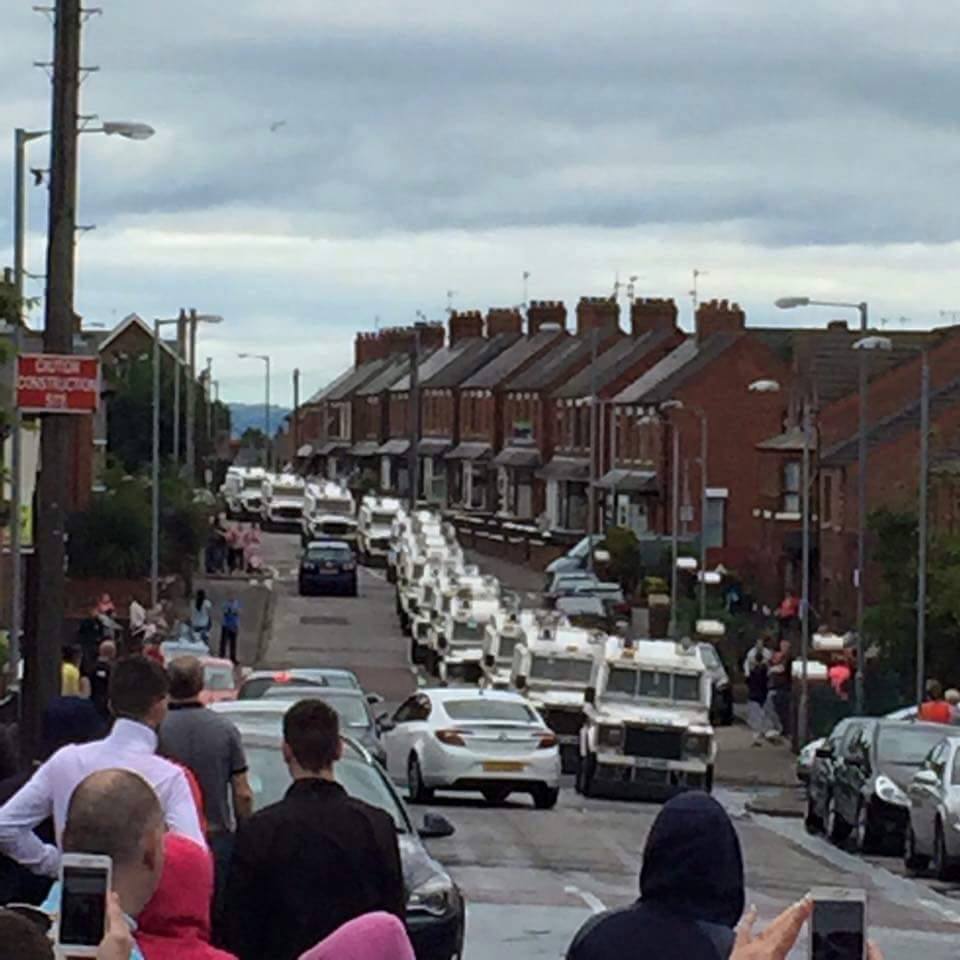
Part of the PSNI invasion of the area
Part of the PSNI invasion of the area (Photo from AIL FB page)

It certainly seemed like that when I walked in to the depot of the shared “people’s taxis”, i.e. the Falls Road Black Taxis about 1.45p.m. The word was that the RUC/ PSNI had cordoned off the southern approaches to Ardoyne, in North Belfast. I began to worry but was told that they would get me there. With a small group of Ardoyne residents, I waited in the depot, which resembles a coach waiting room and has a shop for sweets and soft drinks and another printing T-shirts and posters. Taxis pulled in and out, mostly heading for the Falls Road but eventually a taxi for Ardoyne (Ard Eoin = “Eoin’s Heights”) drew up and six of us got in – apart from myself, two youths, a middle-aged woman and an elderly couple, one of them with an English accent but clearly established in the area.

We had not gone far after dropping off one of the youths before we began to pass the PSNI vans, a kind of white boxed landrover, shields over windscreen, lights and siren and only slit windows in the back. From the taxi by now we had seen around 30 vans; we were all tutting at this massive police mobilisation. “Great day for a robbery,” I said. “Where’s the nearest bank?” quipped the elderly man. As we got nearer to Ardoyne we were suddenly confronted with a huge number of police vans and very soon afterwards, could go no further – PSNI vans, police on foot in black riot gear, shields and some with batons out already. Any belief I might have had that this was just an intimidation exercise by the police was dispelled. Our driver tried to negotiate with a female police officer who was dealing with traffic but all she could give were vague suggestions about which roads might yet be open. I heard our driver relaying information to his company’s control desk through his radio and I now realised that the police were determined to stop the march.

Our driver drove up and down other roads, gradually nearing Ardoyne and close to there apologised to us and pulled in outside a house in a residential street – it seemed that someone of some authority in Falls Road Black Taxis lived there. After conversing with our driver, this man got on our vehicle’s radio and spoke to someone at the depot, the terse conclusion of which was “Ardoyne is out”: Ardoyne was under police siege and the area was now out of bounds to their taxis.

The driver dropped us near to my destination, apologising again as he had done frequently. We assured him it was not his fault. As I walked down to approach the rallying point for the march, some of the local community were out in the street playing at an poc fada (“the long hit”), a one-shot competition with hurley to see who can hit the sliotar (the leather ball used in hurley games) the furthest. An poc fada is one of the features of the Féile Béal Feirste, an annual community festival which has been growing annually (and which some say has now largely become a commercial festival, far from its community roots, with dear admittance fees and drink prices, in an area with very high unemployment).

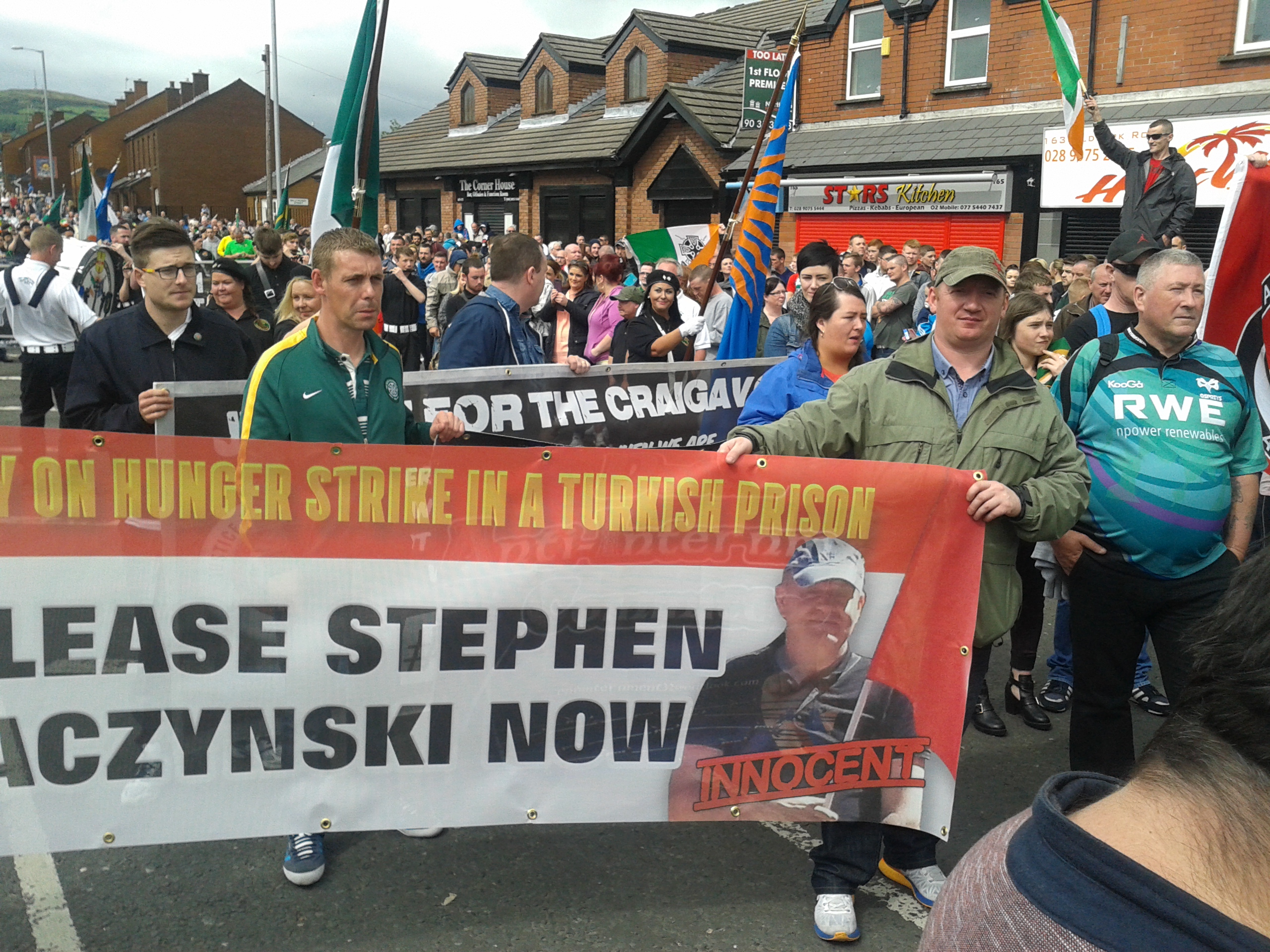
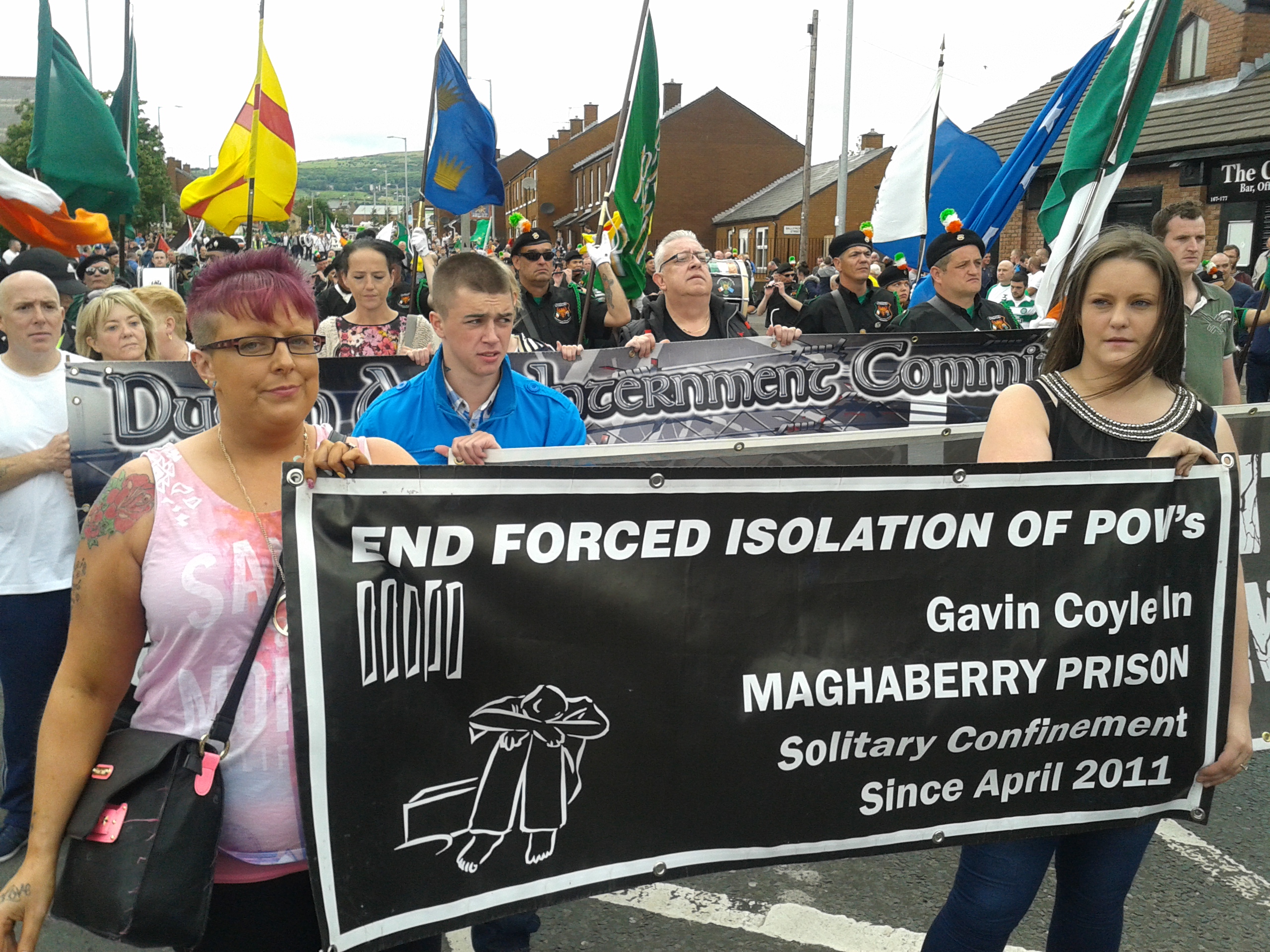
Rounding the corner to head up towards the Shamrock Bar, I was just in time to join the tail of the march as it set off. I sped up to try and catch up with the Dublin Anti-Internment Committee, passing some people I knew along the way, exchanging greetings. There were five Republican marching bands playing music: the Garngad, Brendan Hughes and Volunteers Black and Ryan bands were all from Glasgow, while the John Brady RFB was from Strabane and the Julie Dougan from Portadown.

One of the Dublin Anti-Internment Committee banners

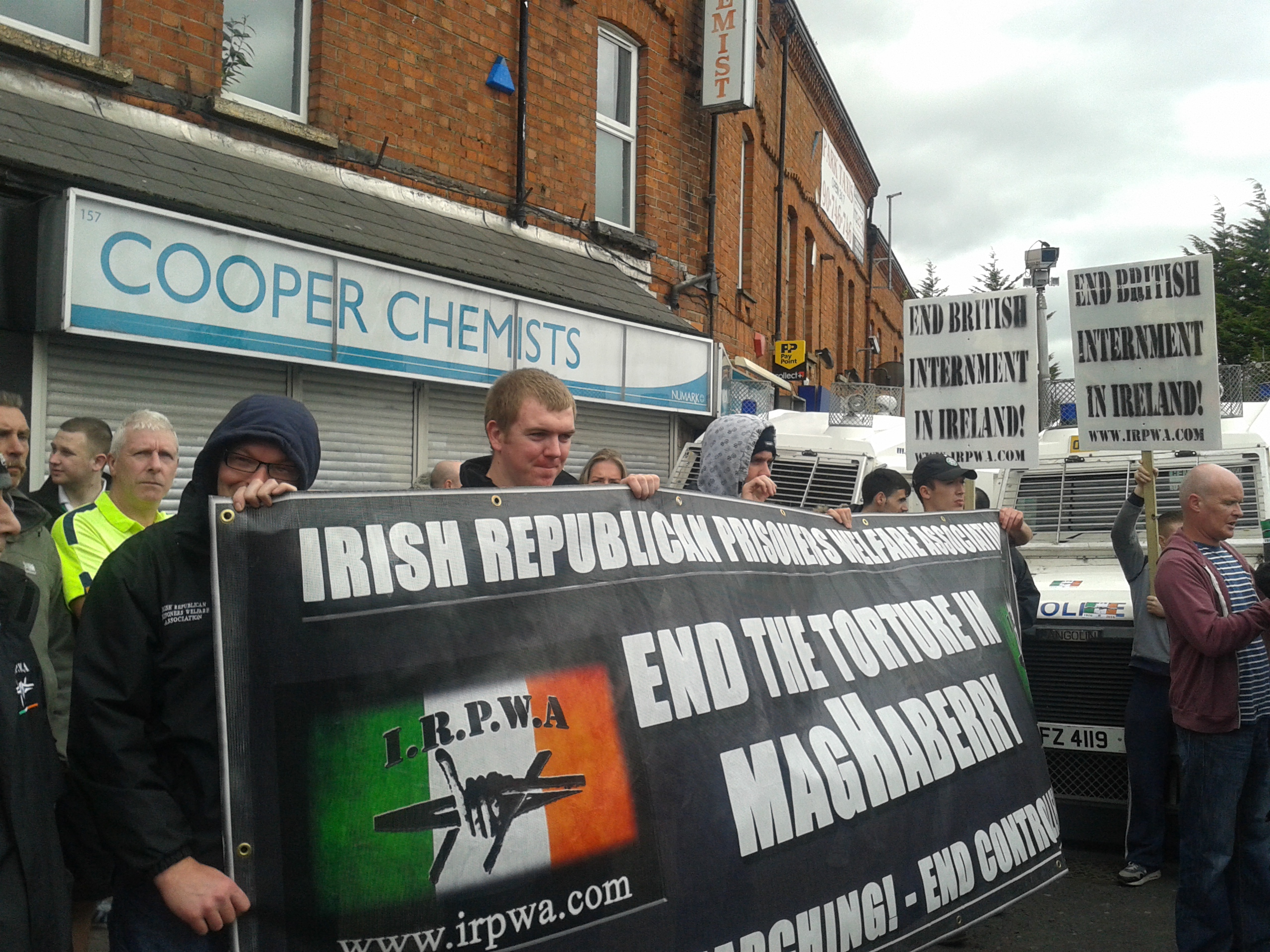
At the junction with Old Park Road I joined with the Dublin Committee comrades, apologising for my late arrival as we swung right to head towards the city centre. Further down the road, the police vans awaited us and as we got nearer we could see a blockade composed of police vans backed up by many police in full riot armour, holding shields and with batons drawn. We marched on and in minutes we were crowded against them. I feared for us if we tried to get through and I saw a drummer with one of the bands step out and retire to the sides with his drum. I didn’t blame him – drums are expensive pieces of equipment. The police had a big sign on one of their vans, saying that our march was illegal, a message they were reiterating from their p.a system, though difficult to decipher all the words.

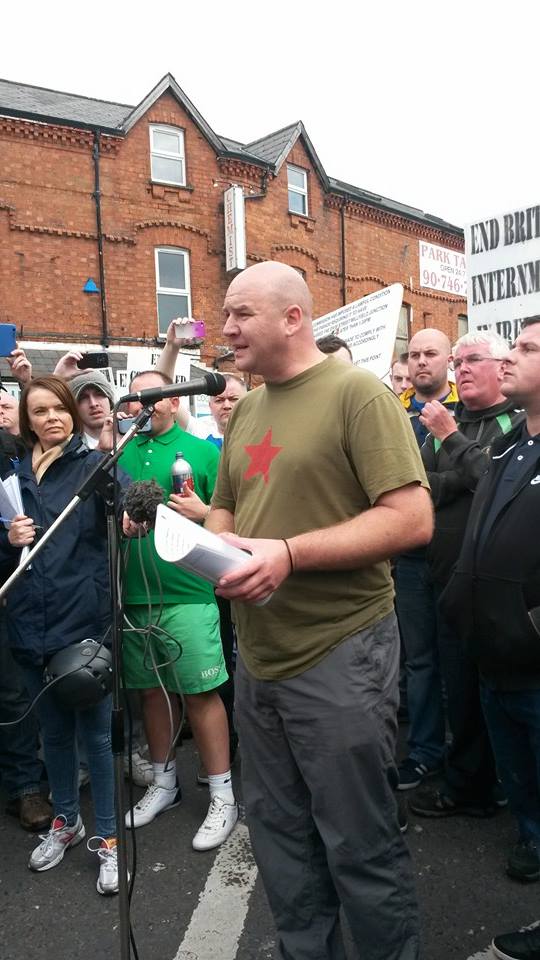
After a while in literal impasse, one of the organisers spoke briefly into the p.a system and introduced Mícheál Mac Giolla Easpuig, an Independent local authority representative in Donegal. Mac Giolla Easpuig spoke first for awhile in his native Irish and then changed to English. He summarised the history of English colonial repression in Ireland since 1970 and

Mícheál Mac Giolla Easbuig speaking at impromptu rally at PSNI Blockade
Mícheál Mac Giolla Easbuig speaking at impromptu rally at PSNI Blockade (Photo from AIL FB page)

made the point that the need of the authorities for that repression denied any legitimacy to their occupation of the Six Counties. He concluded with the words of Volunteer Tom Williams, who was hung by the colonial administration in the Six Counties in 1942: “Carry on no matter what odds are against you; carry on no matter what the enemy call you; carry on no matter what torments are inflicted on you. The road to freedom is paved with suffering, hardship and torture; carry on my gallant comrades until that certain day.

Impromptu short rally at PSNI Blockade in Old Park Road

As the applause and cheering died down, a spokesperson for the organisers spoke briefly about the suppression of our democratic rights to march, about the continuing use of internment by other means and announced the end of the march, asking people to disperse.

One of the Republican marching bands played the verse and chorus of the Irish national anthem, The Soldiers’ Song; I sang along to it in Irish as is our custom in Dublin (but seems not to be in Belfast) and the band began to march away from the police blockade. We marched away behind them with the banners of the Dublin Committee, as did others with different campaign banners: Craigavon Two, Ballymurphy Massacre, Stephen Kaczinsky, Gavin Coyle and various Republican prisoner support groups.

At some point the Dublin and Cork contingents pulled away and went back to near the original rallying point, where local people and visitors were meeting and chatting as the sliotair of the Poc Fada whizzed overhead. Rumours were now reaching us of the police attacking people on the other side of their barrier and also, from time to time, of Loyalists attacking people somewhere. It was hard for us to know exactly what was happening and where. Eventually we piled in to the back of a van to get out of the area. Our driver had to take a long circuitous route again and eventually we were back in West Belfast, from where we could make our separate ways back to Dublin and Cork.

The PSNI blockade of the march showing another line of police vans behind facing in the other direction -- only a fraction of the police vehicles in the area.
The PSNI blockade of the march showing another line of police vans behind facing in the other direction — only a fraction of the police vehicles in the area.

DB plus Dub AIC

Fighting in the area

Later I learned from a variety of sources that the local community in the Roseapenna Street area had reacted to a police, who were still there an hour after the march had left, in an occupation or siege of their area. This was an area through which the march had planned to pass and which was now blocked off by police vans and police on foot in full riot armour. A woman was shown on video being arrested by two police in riot armour – it was said that she was pregnant and was being mistreated in front of her three children. Apparently she had objected to the police being in her garden and had demanded they leave. The video showed her being pulled struggling to the back of a police van, being pushed inside and big policemen piling in on top of her, her head being apparently twisted as she disappeared from view. Another woman protesting this treatment was bashed by the shield of one of the police and the mobile phone filming the incident suddenly ended up on the ground, apparently having been knocked out of the hand of its owner by the police.

Later reports in the media spoke of stones being thrown and even petrol bombs. I could easily empathise with the throwers: confronted with that police blockade and our impotence in the face of it, I had found a part of me frustrated and itching to strike back at them. Had the area I lived in been blockaded by police and cut off for hours, then also occupied by police in a massive show of force, then seeing people abused and assaulted for objecting, I would have been sorely tempted to get a bit of rubber tubing and a bottle, go to a friend and ask to borrow some of the petrol from his car. Stones after all are not very effective against riot armour, shields and riot vans. True, the police riot armour is flame-retardant but …..

The Twadell Avenue Loyalist
The Twadell Avenue Loyalist “camp”, an illegal installation which receives no trouble from the PSNI.  According to reports, “nationalist’ people were bombarded by golf balls from here on Sunday. (Photo from Internet)

In addition, people living in the area and trying to leave it had been attacked by Loyalists hurling golfballs from the nearby Twaddel Road, which is a Loyalist area. In fact, they have had a Loyalist “camp” there for some time – illegally by Six County law but of course untroubled by the PSNI. Its purpose? To show those Fenians — those Taigues — up in the Old Park, Ardoyne and “The Bone” (Machaire Botháin) areas just who really runs the Six Counties!

Worse in a way was to come, as along with the ritual condemnations by Unionists and Loyalists, PSNI spokespersons and biased media reporting, Martin McGuinness of Sinn Féin blamed the violence entirely on the organisers of the march. As well as being a very senior figure in the Sinn Féin party, McGuinness is of course Deputy First Minister of the Northern Ireland colonial Government. Back in the day when he was the commanding officer of the IRA in Derry, he had condoned and defended participating in many marches that had not so much been restricted to particular times as completely banned by the Six County authorities. During one of those illegal marches in Derry, in 1972, the Parachute Regiment had opened fire on unarmed people and killed fourteen, injuring many. In those days the IRA and what was thought of as Provisional Sinn Féin placed their blame for all violence unreservedly upon the police and army (and occasionally the Loyalists), also on the 6-County Government and on the British colonialists, who should not be in Ireland at all, according to Sinn Féin. But that was then and their party now shares in the administration of that same British colony. Reading his reported words, I wondered whether if that Derry massacre of Bloody Sunday were to occur now, McGuinness would blame the marchers for going ahead with a banned march?

Mc Guinness posed shaking hands with the Chief Constable of the PSNI at a public meeting earlier in the week at a Falls Road venue
Mc Guinness posed shaking hands with the Chief Constable of the PSNI at a public meeting earlier in the week at a Falls Road venue (Photo from AIL FB page)

The Anti Internment League hit back with a statement of their own, condemning the comments made by Martin McGuinness. “The AIL responsibly took the decision to march away from a flashpoint that was of the PSNI’s own making”, the statement read. “No participants engaged in violence,” it continued, “which occurred over an hour after our dispersal and was caused by PSNI invasion of property and assaults on residents.” The statement went on to point out that Mc Guinness had praised the PSNI a few days earlier (a reference to his shared platform with PSNI’s Chief Constable on Thursday 6th in a venue on the Falls Road).

Uncannily (or perhaps not), the statement went on to mirror my own earlier speculation: “Using Martin McGuinness’s rationale, he would place responsibility for the murder of 14 civilians in his own city by the British Army on Bloody Sunday in 1972 on those who organised the Anti-Internment parade that day.”

“There is perhaps no greater indicator of how Mc Guinness now views Republicans as his opponents, while the forces of repressive state apparatus that he himself promotes and endorses are now his ‘comrades’ “, the statement concluded.

Follow-up meeting with area community


In a follow-up to the events of Saturday in the Lower Cliftonville area, on Tuesday night in Manor St Community Centre, the Anti Internment League hosted a meeting with Rosapenna residents affected by the PSNI lockdown on Sunday 9th August.

“Every house in the area received a leaflet making them aware of the meeting” according to a statement issued by the AIL. The panel was composed of representatives of the AIL, community workers from Lower Cliftonville and a local solicitor. A journalist from the Irish News was also in attendance to hear accounts and opinions from residents.

Because of Martin McGuinness’s “public criticism of both the AIL and local residents”, according to the AIL statement, Sinn Féin had been invited to send representation to the meeting “to challenge the AIL if they wished and to hear residents’ thoughts and opinions in a public forum”. According to the AIL statement, although SF had indicated that they would attend, they did not appear at the meeting.

The atmosphere in the meeting was angry, according to witnesses – all of it directed towards the PSNI with no-one criticising the march organisers, with the exception being those who chided the organisers for having turned the parade back “too soon”. The AIL represenatives’ explanation of the considerations and reasons for doing so seemed to satisfy the critics. One of the AIL representatives reportedly also asked whether residents would rather the parade did not pass through Rosapenna Street in future, which was “rejected unanimously by residents present, who all said they enjoy the music and atmosphere that the annual march brings to the area.”

A hitherto unreported aspect of the events on Sunday in the area was that local businesses reported having been forced to close down by the PSNI for no reason that they could determine. This was particularly interesting in view of the Parades Commission’s rationale for insisting that the march finish passing through the City Centre by 1.30 pm – to prevent any perceived disruption to big shopping commercial interests in that location.

The AIL statement went on to outline their plans to work with local community organisations to “jointly request and facilitate a “surgery” style event, inviting the Police Ombudsman to compile complaints against the PSNI from local residents.” Concluding their statement, the Anti-Internment League declared that they, working with “local community organisations and Republican activists will not allow the violent actions of the PSNI within the Lower Cliftonville community on 9th August to go unchallenged.”

End/ A Chríoch.

“Now where did our drummer go with his drum?”

Stephen Kazinski banner Stopped 20150809_144947IRPWA banner

Big Brother can fly Big Brother has an eye Big Brother can spy on us down below.
Big Brother can fly
Big Brother has an eye
Big Brother can spy
on us down below.


Craigavon Two banner

Gavin Coyle Isolation banner

BLACKMAILING AND BULLYING A CHILD FOR PEACE

Diarmuid Breatnach

A Derry schoolboy has been subjected to emotional blackmail and pressure by his school to sign a “peace scroll” and, arising out of an altercation over his refusal in which it was alleged he was being “sectarian”, was sentenced to two after-school detentions.  Why is he being treated in this way, what is this “peace scroll” about and who is promoting it?

According to Pauline Mellon, writing about it in her blog, a boy in her Derry community in September last year was pressured by a teacher in his school to sign a “Peace scroll” with which a Reverend David Latimer is trying to create a world record with the number of signatures. “The child was told by a teacher that he would be ‘the only child in the North not to have signed’ and was further questioned as to whether his refusal was sectarian in nature.” Not surprisingly, the child reacted to this suggestion and used a word for which the school seeks to discipline him.

The school has a policy (on “abusive language”) which makes no provision for contributing factors,” says Pauline Mellon. However, although the school Board is sticking to the letter of their policy in this regard, they seem not quite so rigorous in upholding their own procedures in other respects.

When the parents questioned the School Principal over his decision to impose two detentions and what circumstances if any he had taken into consideration, the Principal immediately cut off communication with them and escalated the issue to stage 4 of the school’s complaints procedure. Stage 4 of the school’s complaints procedure requires a written submission to the Chair of the school board from parents.”

Although the parents at this stage had made no such written submission, a sub-committee of the School Board declared that they had investigated the complaint (from whom?!) and upheld the Principal’s decision. The sub-committee had decided to use as “a written submission” some letters written by the parents to the Principal after he refused meet them, thereby violating the parents’ rights to prepare their own submission if they wished to go to Stage 4 of the Complaints Procedure and, indeed, violating the terms of the Procedure itself.

As if to underline their casual attitude to their own procedures, the School Board wrote to the parents to outline their “findings” without even using the school’s headed paper. When this was pointed out to them, the Board apologised for sending the decision on plain paper and said it would not happen again. However, there was a much more significant breach of their procedures, in that the sub-committee had kept no minutes of their meeting, about which the parents have learned only recently. Then when the parents did actually submit a level 4 submission, it was totally ignored.

As Pauline Mellon observed, the Chairman of the Board was in breach of his duties according to “Department of Education guidelines which state that the chairperson has responsibility for all meetings and must ensure that minutes of ALL meetings are retained.”

One can imagine the impact of a comparable chain of events on any individual, let alone a child studying for his GCEs. The parents took him to a counsellor, after which they wished to discuss the counsellors’ report with the boy’s form teacher. The Board prevented this meeting, confusing the counsellors’ report with the parents’ “ongoing issues with the Board”.

Nine months after the first incident in this chain of events, the Board invited the parents to meet with them. The parents brought along an observer and the Board refused to allow the meeting to go ahead with the observer present and when the parents protested, they were escorted off the premises, witnessed by an Independent local authority councillor. The Board in this case is the authority and has the power and the school is also their territory. There are a number of people on the Board. In summary, they held the advantages of power, territory and numbers – yet they refused to allow two parents to be accompanied by an observer to support them (and at a later date to bear witness to what went on, should that become necessary). One must wonder what they had to fear in allowing this one additional person …. and why.

The School Board has a Parent’s Representative on it – the parents of the child sought a meeting with this person, not once but a number of times, but the person concerned has so far failed to meet with them. This is indeed extraordinary – how can anybodfy discharge their duties as a Parents’ Representative to the Board if they refuse to meet with parents who are in dispute with the Board?

There is a body which governs Catholic schools, of which the school in question is one – the Catholic Council for Maintained Schools (CCMS). This is an organisation of the Catholic Church but receives public funding through the Northern Ireland Executive. The parents took the issue to that Council. The CCMS admitted that headed paper should have been used in writing to the parents and commented that the school’s Board had not fulfilled their role; they also noted the parents’ attempt to discuss their child’s counsellor’s report with his form teacher but would not comment on whether the refusal would be normal practice. All in all, the CCMS considered that the Board’s actions of using a letter to the Principal as a submission and refusing the parents the right to submit their own Level 4 submission were “reasonable” and “in accordance with School policy”.

Presumably in their deliberations, the CCMS had discovered that the Board’s sub-committee had failed to keep any minutes but left the parents to discover this through other means at a later date. At a later complaint to the CCMS, the Council refused to acknowledge the failure of the School Board’s Chairperson in ensuring minutes were kept, as laid out in the Department of Education’s guidelines. Finally, the CCMS denied that any breach of the child’s rights took place.

The Chairperson of the CCMS is Bishop John McAreavey, who according to Pauline Mellon, has not even had the decency to acknowledge or respond to two separate letters the parents of the child in question sent to him. This was in contrast to the Bishop of Derry, Rev. McKeown who replied to the parents after they wrote to him. “Bishop McKeown who has knowledge in these matters agreed with the parents that a common sense approach should have been taken and expressed concern that such a small matter had used up so much time and energy.”

Pauline Mellon takes a similar line in concluding her article: “… a matter that should have never made it outside of the school assembly hall from the outset has exposed the School Board in question as being ineffective, unprofessional, non-transparent and unaccountable. It has exposed CCMS, a group acting under the wing of the Catholic Church, as not having learned from previous incidents when the Church has closed ranks and has attempted to silence people.”

As to the Rev. Latimer himself, the promoter of the “Scroll” signatures, although he promised the parents to look into the matter, they have heard nothing from him since.

Who is the Rev. David Latimer?

According to the Department of Education of Northern Ireland, Rev. Latimer is “a visionary”, for which term they offer no explanation apart from his Guinness Book of Records bid for “most signatures on a scroll” and his promotion of it in the schools. http://www.welbni.org/index.cfm/go/news/date/0/key/922:1 Indeed, it is amazing that 84 schools have signed up to the project, as the article says on their website  – even more so if none of those saw any wording to endorse and to which to encourage their children to subscribe (see further below).

The Rev. David Latimer, photographed in church

David Latimer was a systems analyst with the Northern Ireland Electricity Board and married before he decided to become a cleric. He did so in 1988 and is now Minister of two churches, the First Presbyterian in Derry’s Magazine Street and the Monreagh Presbyterian, established in 1644 across what is now the British Border in Donegal.

In 2011, David Latimer was invited to address Sinn Féin’s Ard-Fheis and did so. On that occasion he said, referring to Martin McGuinness, that they had “… been journeying together for the last five years and during that time we have become very firm friends, able to easily relax in each other’s company.”

Rev. Latimer went on to say that “The seeds of division and enmity that have long characterised Catholic and Protestant relations were neither sown in 1968 or 1921 but during the 1609 Settlement of Ulster. Mistrust and bad feelings resulting from the colonisation of Ireland by Protestant settlers were followed by centuries of political and social segregation. Partitioning Ireland did little to ease sectarian mistrust and separateness between Protestants and Catholics left in the 6 counties as each community continued to be defined by its particular religious affiliation with little mixture between the two groups.”

The impression given there is of some peaceful colony of Protestants arriving in Ireland around 1609 which led to “bad feelings” and “mistrust”. No mention of the seizure of land from the Irish and their expulsion to the hills or abroad. No mention of the suppression of the religious faith of the majority and the imposition of that of the minority, centuries of discrimination, theft of land, genocide. One can see that this might quite rationally give rise to “bad feelings” and “mistrust”. No mention of the actual promotion by the British of sectarianism and the creation of the Orange order, with the intention of breaking up the unity between “Protestant, Catholic and Dissenter” of the United Irishmen at the end of the 18th Century.

It was again reasons of “little mixture between the two groups” which Rev. Latimer went on to blame for the recent 30 Years War:
“Little wonder this part of Ireland descended into a spiral of communal disorder and violence that was to last for decades. Victims of differences, extending back across trackless centuries that have isolated us from one another it is, with the benefit of historical hindsight, not surprising that our two communities should view each other with suspicion and regard one another as ‘the enemy.’”

Dr David Latimer, First Derry Presbyterian Church, conducts a redediication ceremony on Derry's Walls. Photo: Stephen Laitmer
Dr David Latimer, First Derry Presbyterian Church, conducts a redediication ceremony on the City’s fortifications, “Derry’s Walls”. Photo: Stephen Latimer

Did the Catholics and Protestants go to war with one another in the late 1960s or at any time during the 30 Years War? No, what happened was that Catholics demanded civil and human rights of which they had been denied in that British colony-statelet since 1921; the state forces tried to suppress their peaceful campaign with batons, tear gas and bullets; right wing and sectarian forces among the Loyalists were mobilised and burned Catholics out of their homes and murdered some. The British Army were sent in to support the “Northern Ireland” sectarian police and the IRA came into limited action to counter them, after which hundreds of “nationalists” were interned without trial, followed by escalation of IRA action, the Paratroopers’ massacres in Derry and in Ballymurphy, and so on.

In fact, Latimer’s false account of history has been the standard British ruling class’ version to justify their war in Ireland for foreign consumption and to the British population throughout those years: the reasonable British with the thankless task of keeping the two tribes apart.

I found the content of the Latimer’s speech on SF’s website without an account of the audience’s reaction but according to the Irish Echo, an Australian on-line newspaper, it “received a rapturous reception from the republican audience”.

Reverend David Latimer and the British Army

Pauline Mellon says that according to the parents, “the child based his decision not to sign the scroll on Rev Latimer’s service in the British Army and with him being stationed in Afghanistan. The child also raised concerns over what he views as Reverend Latimer’s “selective” approach to local human rights issues.”

Surely the boy is mistaken? At least about him having served with the British Army? Well, actually no. In June 2008 Rev. Latimer gave an interview to the Derry Journal to explain why he felt justified in going with the British Army to Afghanistan although he had to “wrestle with his conscience”. Presumably he is an accomplished conscience-wrestler by now since he also admitted to having participated in other British Army missions for more than 20 years.

“It would be against my nature to be part of something that is creating destruction or generating pain or grief within any community”, he was quoted as saying. “The only way I can reassure myself in being part of this is that I am involved with a unit that is going out to provide resources to people who have no choice but to be there because they are under orders.”

Who are they “who have no choice …. because they are under orders”? Ah, yes, the soldiers, pilots and drone technicians who have invaded another country, killing those who resist and generally intimidating the population. Leaving aside the spurious question of “choice”, does one help justice by administering spiritual comfort to an invading army? To whom does one have a greater moral duty? The answer is clear I think and if one lacks the courage to stand up for the population the least one could do is not to offer comfort to their invaders.

Put perhaps Rev. Latimer intends to be some kind of Camillo Torres, preaching for the poor and castigating the wrongdoer? No, of course not. Well then, perhaps subtly undermining Army propaganda? He invites us to think so: “In the quieter times, I will be around for people who will have questions about what they are doing there and about God. I might not have all the answers but I am there to give a view different to the Army view.”

In what way his view might be different to that of the Army he once again fails to explain, or to inform us whether his views were also different on the other more than twenty occasions in which he served with the British Army previously. Surely if he were intending to undermine Army propaganda, he’d hardly be telling us and the Army in a newspaper interview!

http://www.derryjournal.com/news/rev-david-latimer-explains-why-he-feels-duty-bound-to-head-to-afghanistan-1-2126853

He tells us the hospital he’ll be working in over there will be treating Afghanis as well as British servicemen. Hopefully, they will be treating Afghani victims of torture in British and US Army prisons as well as children given a beating in the barracks. He won’t be trying to convert the Muslims to Christianity, he tells us. And I think we can believe that, since abusing people’s religion, their culture, customs, raiding their houses and generally intimidating them is hardly likely to incline them towards one’s religion.Rev Latimer British Army Uniform

Going on to discuss the possible dangers he would face, Rev. Latimer informs the readers of the Derry Journal that “We know the (military) base is likely to be attacked and we will undergo training in how to deal with chemical, biological and nuclear attacks.” He need not worry, the Afghans don’t have any of those weapons. However, he should exercise caution should he ever have cause to pass through the special arms stores of the British or US military, who do indeed have precisely those weapons and, furthermore, have used most of them in warfare at some point.

I will receive some weapons training, although this will be limited on how to disable a gun and make it safe.” Useful, just in case any member of the Afghani resistance accidentally drops a gun …. perhaps when calling on the Reverend to make enquiries about the philosophy of the Christian religion.

Peace” and “Peace” Treaties and Agreements

The vast majority of people would say that Peace is a good thing; despite that, “peace” remains a problematic concept and not one upon everyone can agree. And “peace” is also frequently being promoted in some part of the world by some of the most warlike states with the most horrifying armaments. For those in power, the invoking of the word “Peace” can be a powerful way of invalidating resistance, silencing dissent and of justifying the status quo which has been achieved through vanquishing the enemy in battle or by the recruitment of collaborators in the enemy’s leadership.

During WWI, the British and the French concluded the secret Asia Minor Agreement (also known as the Sykes-Picot Agreement), with the endorsement of Imperial Russia; the Agreement divided the Arab world between the French and the British should they succeed in beating the Ottoman Empire. To the shock and embarrassment of the imperialists, the Bolsheviks published the terms when they took power in 1917. Although this Agreement was intended to bring “peace” between the competing British, French and Russians, it has been in part the source of many wars with others, as well as coups and uprisings in the Middle East since then.

“Peace” does not mean the same to all: many of the British and French public during WWI would have said that “peace” meant defeating the Germans and Turks, conversely many Germans and Turks would have thought the direct opposite. The Russians mostly wanted an end to the War so “Peace” was one of the most popular of the Bolsheviks’ slogans for their October Revolution, after which they pulled Russian troops out of the War; it was one of the reasons so many soldiers and sailors sided with them.

The end of the First World War brought “peace” and “peace treaties”; among these was the Treaty of Versailles between Britain and France on one side and Germany on the other. In effect, the principal victors screwed Germany for war reparations, occupying the industrial Ruhr Valley. Many historians agree that the Versailles Treaty was a contributory factor to the later rise of the National Socialist Party (the “Nazis”) in Germany and also to the Second World War.

After WWII, the “peace” treaties  divided the world largely between the USA, the British, the French and the USSR. Some aspects of that division led to two big wars — the Korean and Vietnam Wars – and a host of smaller ones. The USA has fought 20 military engagements since WWII; the British have fought 28 and the French have been directly involved in 15 military actions or wars (these figures do not of course include the wars and coups fought by the many proxies of these powers). Furthermore, not one of those wars was fought on the territories of those states and, in most cases, took place far from them.

To look for a moment further than the three world powers above, Sri Lanka had a war going on inside it since 1983 and had peace talks a number of times. The origin of the war was the communal differences and inequalities promoted by the British when they ruled Ceylon as a colony and continued by the Sinhalese majority Government afterwards. In 2008, the ruling Sinhalese Government decided on all-out war and, abandoning the mutually-agreed ceasefire, surrounded the Tamil Tigers’ “liberated areas” with a ring of steel through which no-one could pass. They then subjected the areas to indiscriminate continuous shelling and air bombardment before sending in their troops, wiping out most of the opposing guerrillas but also thousands of civilians. According to UN estimates, 6,500 civilians were killed and another 14,000 injured between mid-January 2009.  The Times, the British daily, estimates the death toll for the final four months of the war (from mid-January to mid-May) at 20,000.

There’s peace in Sri Lanka now, all right — the peace of the grave.

Sri Lanka’s “peace” is similar to the one that followed the 1798 Rebellion in Ireland – that was “peace” after a defeat of the Irish Republican forces by bloody suppression and rabid sectarianism. Of course that “peace” was temporary only (as Sri Lanka’s will no doubt prove to be too) and was followed by other brief uprisings in 1803, 1848, 1867, the Land War 1879-’82, 1916 Rising, the War of Independence 1919-1921, the Civil War 1922-’23, the IRA campaign during WWII …. The partition of Ireland as part of the 1921 Agreement was supposed to bring peace to both parts of the country but again it proved to be a temporary one.

Despite the sectarian riots burning Catholics out of their homes and the wave of terror and repression by the Six Counties statelet in the early 1920s, conflict broke out again with the IRA’s Border Campaign of 1956-’62. In 1967 the Civil Rights campaign in the Six Counties began; the repression with which it was met by State and Loyalists caused the uprising of the Catholic ghettoes of Derry and Belfast afterwards. Then more repression, more resistance, then troops, then 30 years of war with the British Army and colonial police against the Republican guerrilla forces. The Good Friday Agreement claims to be bringing peace but history – and the ongoing repression of dissent by the statelet’s forces — indicates otherwise.

One of the reasons that peace is not necessarily brought by treaties and agreements is that they are themselves intended as temporary measures: by both parties, as in agreements between competing imperialist and colonialist powers, or by one of the parties, for example by the US Government in the case of the Native American Indians. Or they are violated by succeeding governments, as in the case of William of Orange’s promises in the Treaty of Limerick. Or they don’t deal comprehensively with the underlying causes of conflict, as with treaties and agreements between Britain and Ireland in general.

In fact, when a colonial or imperialist power seeks an agreement or treaty with a people or a weaker nation, what it is seeking is not usually peace but pacification – it wants an absence of conflict, or of resistance, so that it can continue extracting the benefits which it was doing before the people began to resist.

Or sometimes, the stronger power wants merely to delay things, to “buy time” until it is expects to be in a better position (and its opponent perhaps in a weaker one) than that which it was at the time. In 1925 the British Government intervened in a conflict between the mine-owners and the miners in Britain, paying a subsidy for nine months to prevent the miners’ pay from dropping. During that period, the Government laid in stocks of coal and bought up newsprint to prepare for a big battle with the miners’ union in particular. In 1926 they took on the British trade union movement and succeeded in forcing the TUC to call it off the General Strike within nine days of its beginning, leaving the miners to fight on alone for eight months until they were defeated.

So what kind of “peace” is being promoted by the Reverend Latimer? Some detailed plan, or some wishy-washy generalisation? That is not an easy question to answer. It is known to be an attempt to get into the Guinness Book of Records by having the most schoolchildren sign it which many have done, including in Donegal and Derry. Is it just a publicity stunt, where people sign up to some vague notion of “peace” which can mean one thing to one person and something completely different to another? What is the context for this “scroll”? “Peace” between whom and on what terms? Or is there a political agenda, as there was in the campaign around the Good Friday Agreement?

The Scroll’s FB page does not explain and the parents have not managed to find out; in addition a number of Google searches of mine failed to turn it up either. What is known about its origins, perhaps the only thing apart from it aiming at a world record, is that it is being energetically promoted by Rev. David Latimer.  And as we have seen, he goes on British Army missions and his role in all this is far from clear.


Schools in our society

Coming back to where we began, the pressure and attempted intimidation of a schoolboy is wrong and should not have been inflicted on this boy (and on who knows on how many others). It should not have been but it was and, when the parents objected, the agents of that blackmail, intimidation and repression should have backed down. And if they refused to back down, the managing agents, the School Board should have upheld the parents’ objections. And if they did not, the Catholic Council for Maintained Schools should have done so. All of them failed to do what was right.

As adults, we tend to see schools as neutral institutions, some with good standards, some not so good, with a continuum of teachers ranging from great to abysmal. Schools however do play a role in socialising children to accept authority and discipline outside the home and also into accepting ideas dominant in the society in which the school is located. Seen in that light, we should perhaps be less shocked at this treatment of a boy and his parents.

However this Guinness Book of Records project is not even part of the school’s official program nor of the State’s curriculum and it was the boy’s resistance to the undue pressure brought to bear on him that sparked the verbal response for which he is now being ‘disciplined’ and which he and his parents are resisting.

If the school were an institution dedicated to real learning, it would encourage questioning, even though its teachers and managers might find that uncomfortable at times. It would value courage and principle and instead of persecuting this boy, would encourage him and value his principled stand, his courage and his persistence. But instead it does the opposite and because the boy’s parents do value their child’s principles and courage and want to support him, they also find themselves in conflict with the school.

Such small-scale battles go on constantly everywhere in our society, in institutes of education, in workplaces, in other organisations and associations, in communities. People fight those battles, often on their own or in little groups, or they fail to resist; whichever they do will affect their individual character and their social and political attitudes thereafter, one way or the other. Drawing on those lessons can lead to understanding more general truths about society and can also help to develop the strength of character to withstand psychological and other bullying and pressure at other times in life. Fair play to the boy for his principles and the courage to stand up for them against authority figures and fair play too to his parents who are supporting him.

End.


Pauline Mellon’s article in her blog http://thederrydiary.blogspot.co.uk/2015/07/judge-jury-and-educationers.html


“BELIEVE” — short poem by Donal O’Meadhra

From their homes stolen lives.
Injustice never new.
Not one crime done nor crime seen.
A sentence served undue.

Witness blind and judge astray.
Trial a kangaroo.
You want a reason to believe?
My friend, I’ll give you two.

Two sons of Craigavon Ireland,
Our voices now are due.
The cry should shout until it cracks
For justice to the two.

It happens time and time again,
Shadows of me and you.
Where once stood four and then the six,
The mirror shows the two.

Together we can make this right.
As one we’ll see it through.
You want a reason to believe?
My friend, I’ll give you two.

Believe poster J4C2


The poem is about the incarceration of the “Craigavon Two”, Brendan McConville and John Paul Wooton.  On the 30th of March 2012 both men were convicted and given life sentences.  They were accused of the fatal shooting of Constable Steven Carroll in Craigavon on the 9th of March 2010.  The evidence was a hotch-potch of questionable material including an “eyewitness” who only came forward a year later after both Republicans had been in jail for a considerable time, a man whose evidence was contested by that of his wife and of his own father.

The case against them was so riddled with inconsistencies and suspect material, alongside new evidence of police interference with witnesses for the Defence, that there were high hopes of both men being cleared and freed when the appeal concluded in October last year.  However, to the shock of many, including a number of Independent TDs (members of the Dáíl, the Irish parliament) and the late Gerry Conlon, their appeal was denied.

The campaign is on-going and supported by a number of organisations and individuals.  It was in support of the Two that Gerry Conlon, formerly of the Guildford Four (and a subject of the film In the Name of the Father), made his last public statement days before he died.

Their campaign website http://justiceforthecraigavontwo.com/we-are-innocent/

“Where once stood four and then the six” in the second-to-last stanza is a reference to the Guildford Four and to the Birmingham Six, ten people (all Irish save one) who in 1974 were wrongly convicted of bombings in Britain and were finally cleared only fifteen and sixteen years later.  Also wrongly convicted were the Maguire Seven (which included Giuseppe Conlon, Gerry’s father, and teenagers) and Judith Ward (a woman who was mentally ill at the time).

YOUNG WOMAN GOES TO TRIAL IN LONDON ACCUSED OF TRYING TO JOIN KURDISH WOMEN FIGHTING ISIS

C0mpiled with introduction by

Diarmuid Breatnach

An 18-year old woman of the Kurdish diaspora in London, Silhan Ozcelik, has been sent for trial at London’s Central Criminal Court (the “Old Bailey”) accused of trying to join the Kurdish-led resistance against ISIS (“Islamic State”).  A British journalist called the trial “disgusting” and said it left him “almost without words” to describe the travesty of justice.  (article below)

http://www.independent.co.uk/news/uk/crime/silhan-ozcelik-disgusting-trial-for-young-woman-who-tried-to-fight-against-isis-10105004.html

Face Paint Kurdish W Fighters
A different kind of face paint: female fighter of the Kurdish guerrilla YPG checks another female comrade as they prepare to go into action with their male comrades on the front line against ISIS in Syria.

This post contains:

  • An article about the trial by J0nathan Owen in yesterday’s British newsaper The Independent (see above)

  • A short article from pro-Kurdish PUK Media containing a discussion on the role of Kurdish women fighters in Syria, with quotes from a wide variety of sources (right at end of this post)

  • A video of an Australian documentary, “60 Minutes”, from the war zone, with war footage, interviews with women fighters and commanders, victims of ISIS (see further down)

  • Background comment or introduction from me (immediately below)

Background Comment:

The Kurds in the region, numbering around 28 million, have the right to self-determination.  They are divided by borders of states set up in the past by the colonial imperialists of Britain, France and the Ottoman Empire and also by ambitions of the states subsequently created: Turkey, Syria, Iraq, Iran and Azerbaijan (there is also a huge Kurdish diaspora in parts of Europe, the USA, Canada).  The Kurds in the region also face differences in political leadership, dialect and religious influence as well as containing among them other ethnic groups (many of these also oppressed): Arabs, Armenians, Azeris, Turkmen, Yazidis …. The whole Kurdish region extends across an area of great strategic importance (the gateway to Europe and to the East) and also of considerable natural resources, including water.  It is envisaged that an oil pipeline will cross this area and a number of dams have already been built there.

The Kurds in Turkey (the largest population of Kurds) has been mostly led by the PKK (and various political organisations friendly to it), a communist-type national liberation organisation, largely secular (though some of their areas can be religiously conservative) and with a very large guerrilla force which has included many women fighters.  They have fought the Turkish armed forces for decades and remain undefeated.  Turkey’s nationalism under Kemal Attaturk declared that Kurds did not exist — they were just “mountain Turks”.  Kurdish has been forbidden, the flying of Kurdish national colours a crime, and state repression has included bannings of parties and newspapers, jailings of political and human rights activists, kidnapping, torture, assassination squads, creation of strategic villages, aerial bombardment, etc.  The imprisoned leader of the PKK, Abdullah Ocalan, last week from prison called on his followers to lay down their arms and to engage in a “peace process” in which however the Turkish Government shows no interest.  Ocalan enjoys an adulation among the PKK and its supporters somewhat as Chairman Mao did among Chinese communists and his portrait can be seen on demonstrations, in pickets and in their secure areas.

The Kurds in Iraq have mostly come under the political dominance of two political leaders with tribal following, Barzani and Talibani.  Iraqi Kurds are mostly Sunni Muslim with a minority Shia population (Fayli) in central and and SE Iraq.  The Kurds were oppressed by the Iraq regime and rose up against them a number of times only to be massacred, including when the US called on them to rise during the Kuwait war but left them on their own.  Their fighters, “peshmergas” are mostly male and during the Iraq Invasion by the US-led coalition, they fought the Iraqi Armed forces but entered Baghdad like bandits and set up various areas of control under different war lords, occasionally fighting even one another.  In the past on one occasion the peshmergas were also deployed against the PKK in conjunction with a Turkish attack on them.

The Syrian Kurds have their own fighters but have not been as prominent in the past as those of the Kurds in Turkey and Iraq.  The Syrian regime does not favour declarations of different ethnicity coupled to aspirations of self-determination and has suppressed expressions of Kurdish nationalism, including jailing singers and musicians whose work includes those expressions. In recent months, the Syrian Kurds and their fighting organisation, the YPG, have had the most success in halting and in places forcing back ISIS — the “Islamic State”.  The YPG rescued a large population of mostly Yazidis (including also some other ethnic groups) after ISIS swept aside the army of the NATO-client Iraqi regime, massacred tens of hundreds of civilians and kidnapped tens of hundreds more, including women which they took or sold as concubines.

The Kurds in Iran have been in recent times the most suppressed perhaps of all the Kurdish populations.  Under the Islamic clerical regime a number of Kurdish political activists have been executed for “crimes against God” (i.e. being atheists and socialists and sharing their political beliefs).  Under the Shah the repression was also heavy and Savak, the secret police, along with their informers, were almost everywhere.  Torture was endemic under the Shah and almost certainly continues under the present regime.

Although the NATO powers fear ISIS, they have also had a hand in its creation in the drive to overthrow regimes resisting NATO’s penetration of the area (and encirclement of Russia) by direct assault or by proxy: Libya and Iraq (already overthrown), Syria (under attack), Iran (constantly being threatened).  They are trying to bring the YPG into the fold but Turkey, an important member of NATO, would rather see the Kurdish fighters wiped out and seals its border to prevent fighters and supplies reaching the YPG.  The USA therefore confined itself to some bombings of ISIS positions around Rojava and diplomatic overtures to the Kurds.  They have not committed ground troops (which the YPG have not asked for) or supplied arms (which the YPG have asked for — repeatedly) and continue to support forces attempting to overthrow the Syrian state.  The YPG rarely fight alongside the state’s Syrian Army but at times both forces are simultaneously in action against ISIS, though seemingly not in coordination

.

The Kurds, as the largest force in their region of Syria and one of the largest ethnic group in the whole region, form a focus of resistance to assimilation and to repressive regimes of states but may be seen by other ethnic groups as themselves posing a threat of assimilating them.

Video documentary “60 Minutes” by Australian television containing Syrian war area footage of Kurdish women fighters and commanders and interviews (and also occasionally irritating comment by the interviewer) https://www.youtube.com/watch?v=lro62AJ6e7M#t=461

Less Photogenic Kurd Women Fighters
Less photogenic perhaps than the images we are currently being shown of Kurdish female guerrilla fighters, this photo is probably of a female guerrilla unit of the PKK in Turkish Kurdistan taken perhaps a couple of decades ago. In order to counter accusations by the Turkish state of female guerrilla “immoral” behaviour, the PKK kept the genders in separate fighting units.
Two Kurdish Women Fighters kefiyah headscarf
Two female guerrillas of the YPG resting but ready to go into action. They are on the front line against ISIS in Syria.

A discussion on women in Kurdistan and Kurdish women fighters (note that there are two parts of Kurdistan under discussion here – Iraqi and Syrian; however there is also Turkey, where the majority of the Kurds live and Iran):

http://pukmedia.com/EN/EN_Direje.aspx?Jimare=22709

Kurdish Women Heavy Machine gun v ISIS N_Iraq
Female fighters of the guerrilla YPG with a heavy machine gun (light cannon?) in the front line against ISIS
Kurdish women guerrilas against FSA, Syria
Kurdish female guerrilla fighters opposing the Free Syrian Army, sponsored by NATO against the Syrian state, in 2011. The FSA has since been overcome or incorporated into ISIS.

INTERNMENT AND ANTI-DEMOCRATIC AND POLITICAL SENTENCING IN THE SIX COUNTIES TODAY

Diarmuid Breatnach

Sixteen years after the signing of the Good Friday Agreement, cases of Irish Republican political activists appearing before colonial judges are none too rare in what some call “Northern Ireland”. Of course, the Republicans are not from Provisional Sinn Féin, who have made their peace with Queen and Empire – but they are Irish Republicans none the less.

Despite their fairly common occurrence, one recent case seemed to symptomise the state of civil liberties in the colonial statelet so as to deserve some detailed analysis. On January 6th Gary Donnelly (43) and two other Derry Republicans, Terry Porter (56) and William Brogan (51), won their appeals against a sentence of six months imprisonment for painting slogans on the famous Derry Walls but money was paid on their behalves into the court.

End Internment Now Derry Walls

The judge, Philip Babbington, ordered the £2,600 (€3,300) compensation to be equally divided between the Northern Ireland Environment Agency, which has responsibility for the upkeep of the Derry Walls, and the charity Foyle Search and Rescue. No explanation seems to have been given as to why the total sum, which was supposed to have been necessary to remove the anti-internment slogans, was not to be paid in its entirety to the Environment Agency; nor am I aware of any detailed examination of the alleged cost of £2,600 (€3,300) to remove a few painted slogans.

Speaking outside the court Colr. Donnelly said he was ‘relieved’ that the case was finally settled. He said: “I am glad that I am now able to represent the voters of the Moor ward who elected me. There had been a lot of donations made towards this case by people in the city and I am glad that it is going to Foyle Search and Rescue.” He denied that there had been any brinkmanship in the case and said when first arrested they had been held for two days and police had tried to prevent them getting bail.

Cnclr. Donnelly went on: “Graffiti has long been a tool of the working class for years and there was even graffiti on the walls calling for Home Rule1. More damage was caused to the Walls by the installation of lights and the building of the Millennium Form than by anything we did. “I have no regrets for anything I have done.”2

A previous use of Derry's Walls to highlight a case of internment
A previous use of Derry’s Walls to highlight a case of internment

The appeal hearing was attended by four TDs3: Éamonn O’Cuív (Fianna Fáil), Clare Daly (United Left Alliance), Thomas Pringle and Maureen O’Sullivan (both Independents). Also in attendance were numerous councillors from local authorities on both sides of the Border. This attendance, at the court case of one with whose politics most of them would not be in agreement, indicated perhaps some sense of solidarity among public elected representatives but probably more a rising concern among some (albeit not nearly enough) at the state of civil liberties in the Six Counties.

When Donnelly and the other two republicans had last appeared before another judge to answer a charge of “malicious damage” to the Walls (by painting the slogans), no money had been made available to the court and they had been sentenced to six month’s imprisonment. The judge hearing the appeal, Babbington, replaced that sentence with a conditional discharge for 12 months. This means that they will serve no prison term on this charge but if, within 12 months they are again arrested and convicted, this conviction will be taken into account and could result in prison terms.

The original sentence of six months’ jail for painting slogans, even at such an alleged cost of their removal, was excessive. But the impact of this sentence in the case of Gary Donnelly went far beyond that on him, his family and friends. Gary Donnelly is a Councillor, elected to the Derry & Strabane Super-Council and, according to the rules of that body, a sentence in excess of three months would cause him to lose his seat. That in turn would have disenfranchised those who voted for him.

Donnelly was one of four new Independent councillors elected last year, the other three being Darren O’ Reilly, Dee Quigley and Paul Gallagher (Strabane). Gary Donnelly, standing as an Independent, topped the poll in the Moor ward (home of the Deputy First Minister Martin McGuinness), out-polling former Sinn Féin Mayor Kevin Campbell by 50 votes. The three Derry-based Independent councillors have taken two SDLP and one Sinn Féin seat.

These new Independent councillors have a background of years dealing with issues affecting their local communities, often on a daily basis, such as poverty, anti-social behaviour and the growing addiction crisis. Judge McElholm had been made aware that Donnelly would lose his seat if the judge went ahead with his sentence but he was not to be swayed from his course.

Naturally, it is not being suggested that elected Councillors (or any others, including appointed judges) should be permitted to act as they please without consequences, merely because of their office. However, a judge behaving in accord with the principles of a democratic system would take care that the sentence leaned away from disenfranchisement of voters if possible. And of course, it was possible, since a non-custodial sentence or one of anything up to three months’ jail would not have had Donnelly lose his seat or disenfranchised his voters.

For those who are aware of the history and current reality of the Six Counties, that colonial statelet often called “Northern Ireland”, associating it “with the principles of a democratic system” is bound to raise at least one eyebrow. The formation of the statelet was in itself a denial of democracy and self-determination to the Irish people in 1921 and its laws and practice were so undemocratic, so discriminatory against the large Catholic minority, as to give rise to the popular movement for civil rights that began in 1968. The infamous repression exercised by the statelet’s police and courts and its sectarian civilian allies on that movement led in turn to a war of 30 years. Not a single democratic reform was granted by the statelet until that war was well underway. Nevertheless, since its administrators claim it is democratic, it may be useful to subject it to the test of compliance with recognised democratic principles.

THE JUDGES AND THE SYSTEM

During all that history of lack of democracy, institutional discrimination and repression in the Six Counties, judges played their part, faithful to the system. Today, despite some hard-won reforms especially in housing allocation and in voting qualification, the statelet continues to be a colonial one, undemocratic still in many ways, with a sectarian and repressive police force. And the judges continue to play their part.

The original judge dealing with Donnelly’s case, McElholm, revealed his own political bias on a number of occasions during the conduct of the case, even without taking into account the six-month jail sentence. According to media reports, when the three appeared before him again for non-payment of the fines, he said that the painting of the walls was a “wholly uncalled-for exercise”.  He stated that “internment ended ‘a long time ago’, and that it was insulting to the entire legal system to say it continues.”4

Well, was the judge sentencing the three Republicans for “criminal damage”, the words appearing on their charge-sheet, or for carrying out what he considered politically or morally to be a “totally uncalled-for exercise” and for “insulting … the entire legal system”? I would have thought that his words are evidence of a clear political bias.

Nor was it the only occasion when the same judge expressed political bias in respect of Gary Donnelly. When the Irish Republican made his application for the abolition of his curfew (which he had accepted as a condition of being granted bail when first charged), he did so on the basis that having to be indoors by 8pm was a serious restriction on his campaigning work for election, an infringement on his democratic rights and on those who might vote for him. Again, Judge McElholm saw fit to express his political bias in heavy sarcasm. According to media reports, although he granted an exemption of two hours (i.e. until 10pm) on the curfew, Judge McElholm then asked: “Is he going to put up posters or paint his name on walls saying vote Donzo?” He went on to say: “It is clear the democratic process is very dear to Mr Donnelly’s heart”5 and The great working class people I’m sure will now come flooding to his door.”6

BAIL CONDITIONS AND CURFEW AS A POLITICAL WEAPON

The issue of Donnelly’s bail conditions and curfew have been alluded to earlier. People in the West outside of the Six Counties (with the exception of people in other European areas of repressive colonial occupation, such as the southern Basque Country) may be surprised to learn that the imposition of a curfew has become customary as a condition of granting bail to Republicans in the colony. This might have made some sense in the case of slogan-painting, with which Donnelly was accused, and which one would imagine would take place at night. But even so, did a curfew have to be imposed? Would it not be enough that if he were caught doing it again before trial, that his bail would be revoked?

In a democratic system, since the accused are to be “presumed innocent until proven guilty”, they should be at liberty until such time as are tried and receive a verdict. That is the purpose of releasing those charged “on bail” while awaiting trial. They may be found “not guilty” at the end of their trial and even if found “guilty”, the sentence may be a non-custodial one. So, if the accused is thought not to require a custodial sentence, why should he already have spent time in jail? However it is a fact that many Irish Republicans have spent time in jail while awaiting trial. In Donnelly’s case, after two days in custody and against police advice, he was given bail but on a number of conditions.

The purpose of conditions being set for bail is supposed to be related to the specific case and to be reasonable. A financial surety is set in order to deter the accused from absconding before trial. Other than that, what conditions are reasonable? Well, a man accused of assault on another may have a bail condition not to approach his alleged victim and to stay away from that person’s home or place of work. Or to stay away from people who are to be called as witnesses. But how is it to be considered reasonable to set a curfew as a bail condition? And of wearing an electronic tag to ensure compliance? Or of not going to political meetings or meeting with political activists? Or to not reside in a particular town?

These conditions and variations of them have been imposed on a number of Irish Republican activists in the Six Counties. In fact, that same Judge McElhome also imposed a nightly curfew on Gary Donnelly on a previous charge, in August 2010, when he released him on bail to face charges under “anti-terror” legislation, relating to pipe bombs incidents in September 2009. In December 2010, the charges were dropped.

Martin Corey, a Republican prisoner released under licence under the Good Friday Agreement, had his licence revoked and after four years in prison (without even a police interview or charge, never mind a court appearance) was released on a kind of bail or licence under conditions which he is not permitted to divulge but are rumoured to include wearing a tag and not associating with “known dissidents”.

Perhaps one of the most illustrative examples was that of Stephen Murney, an activist with the Éirigí group, who was arrested on spurious charges in November 2012 and refused bail. When his appeal against that refusal was heard after six months in jail, the judge granted bail but on conditions: Murney was to wear a tag, observe curfew, stay away from certain political activists and stay away from Newry — the town in which he lived and where his partner and child also lived. To his credit and taking an important stand for civil rights, Murney refused to accept the conditions and spent 14 months in custody awaiting trial. Eventually, some of the charges were dropped and he was found not guilty of all remaining charges.

CRIMINAL OR POLITICAL CONVICTIONS?

A member of the 32-County Sovereignty Movement, Gary Donnelly has been politically active for many years. Something has been made in reporting of the case that Gary Donnelly has previous criminal convictions – he has a police record and he has also had a number of charges eventually dropped. In March 2010, he was sentenced to seven months jail on a charge of assaulting a police officer. At one of his recent court appearances, a police officer said he he had criminal convictions also for public order offences and one for arson.

Garry Donnelly, Irish Republican and elected Councillor

In many societies outside the Six Counties this might seem extraordinary for an elected representative but I would submit that it is the system in the Six Counties that is extraordinary, at least with regard to what might be expected of a European democracy.

Donnelly’s “criminal convictions” would have been no secret and his voters put him in office despite those convictions and quite possibly even in part because of them. I do not have the details of the incidents that gave rise to them but any half-awake observer of life in the Six Counties knows that with a sectarian and repressive police force hostile to Republicans, acquiring convictions for “assault on police officers” may be the result of police concoction, self-defence by the charged or even actual assault but in all those cases, the likelihood is that the incidents are overtly political in nature.

Convictions for “public order offences” are probably the most easily-acquired by political activists and often mean merely that the person convicted refused to cease his or her protest when ordered to do so by a police officer. It is rarely possible, with any hope of success, to challenge the justification of the police officer in ordering the protest to finish.

“Arson” can also be a political offence and I once heard a Garda senior officer declare that burning a purchased US flag in a public protest was “arson”! And, as has been clearly demonstrated, the “criminal damage” which has now been added to Donnelly’s police record, both in its content and in its treatment, was political.

INTERNMENT – WHEN IS IT NOT?

Although no-one denies that the British implemented internment between August 1971 and December 1975, when 342 people were subjected to it7, there is far from universal agreement that the British are practicing internment in their colony today. One supposes that the socialists and social-democrats there at present don’t agree that it is being practiced — or surely they would be protesting against it! And, as we saw earlier, Judge McElhone declared that internment had ended back in the 1970s and that to state that it was still being practiced was “insulting …. to the entire legal system”. Sinn Féin don’t call it internment on the rare occasions upon which they refer to the victims but that may be more an issue of convenience than of terminology. Even a member of a Republican organisation which is opposed to the Good Friday Agreement recently argued with me that what is happening is repression but is not internment.

British soldiers detaining a man in the Six Counties during the internment operation in August 1971.

Well, I’m quite interested in correct use of terminology myself, so I thought I’d better look up the definition in a number of on-line dictionaries. It turns out that dictionary definitions of “internment” vary somewhat. Wikipedia has it asthe imprisonment or confinement of people, commonly in large groups, without trial, while for Dictionary.com it isthe act of interning or state of being interned, esp of enemy citizens in wartime or of terrorism suspects”. Dictionary.com goes on to elaborate that “Internment means putting a person in prison or other kind of detention, generally in wartime. ………….. Internment usually doesn’t involve a trial, so you’re being held because someone thinks you might be dangerous, but there’s no proof.”

Grammarist has it as “the act of detaining a person or a group of people, especially a group perceived to be a threat during wartime,” while for Cambridge Dictionaries on line it is the act of putting someone in prison for political or military reasons, especially during a war.” Macmillan Dictionary defines it as the act of putting someone in a prison without officially accusing them of a crime, especially when this is done for political reasons”.

Sifting through these definitions then, the most common aspect is that internment involves imprisonment without trial. It may be applied to many or a few (and let us remember that Oswald Mosley, of the British Union of Fascists, was interned by the British on his own during WW2 albeit in a house with grounds). Two definitions mention wartime, while some allude to “terrorism” and a few mention “political reasons”. On the basis of those definitions, internment is undoubtedly being practiced in the Six Counties.

Refusing Republicans bail (e.g. Stephen Murney, Colin Duffy and man others) and revoking licences (e.g. Marian Price, Martin Corey) have all resulted in imprisonment without trial – for periods varying from a year to four years. The individuals may be – and often are – eventually found “not guilty”, or their convictions overturned (as with Colin Duffy, Brian Shivers and, one hopes, the “Craigavon Two”) or released on “humanitarian grounds” but they will already have spent time in jail. This was the reasoning which no doubt lies behind a number of political activities against the current internment and certainly was expressed at the founding meeting of the Anti-Internment Group of Ireland (of which I am proud to be a member) which has organized public meetings, demonstrations and information pickets in various communities in Dublin and in other parts of Ireland.  The non-party Group was set up by some of the campaigners in the also non-party Dublin Free Marian Price Campaign after the partially-successful conclusion of that struggle (Marian Price was released on “humanitarian grounds” but already in broken health).  The AIGI can be found on https://www.facebook.com/pages/End-Internment/581232915354743?fref=ts

Information picket (with table across the road) organized by Anti-Internment Group of Ireland in September 2014 at Thomas St./ Meath St. junction, Dublin.  They returned there in December and in January supported a picket in Cork, handing out leaflets on the Craigavon Two injustice.
Information picket (with table across the road) organized by Anti-Internment Group of Ireland in September 2014 at Thomas St./ Meath St. junction, Dublin. They returned there in December and in January supported a picket in Cork, handing out leaflets on the Craigavon Two injustice.

Imprisonment puts a strain on the individual prisoner and also on friends and relations – and, indeed, on relationships. It disrupts the political work of the person jailed and of their organizations. And it serves as a threat to others considering becoming active in opposition to the State. Its purpose in these cases is primarily political. The deprivation of liberty without due cause is a violation of human rights and to do so for political reasons, which is clearly the case here, is a violation too of civil rights.

That the legal system in the Six Counties is being used in this way should come as no surprise to those familiar with the operation of colonial law or indeed to any readers of Brigadier Frank Kitson’s Low Intensity Operations (1971)8. Kitson completed the book while on military service in the Six Counties but mainly drawing on his experiences in repression of resistance in Kenya and in Malaya in the 1950s. In the Six Counties Kitson was commander of 39 Airportable Brigade from September 1970 to April 1972, with responsibility for one of the British Army’s three main regional sub-commands in the Six Counties, the greater Belfast and Eastern area.

One of the units under Kitson’s command, 1st Para, was the main actor in killing and wounding a large number of civilians in Ballymurphy in July 1971 and in Derry’s Bloody Sunday in January 1972.

The Military Reaction Force, a special covert operations unit, was based at Kitson’s headquarters in Palace Barracks outside Belfast. Last November (2013), a BBC ‘Panorama’ investigative program on British counterinsurgency in the Six Counties in the early 1970s featured members of the MRF admitting to the murder of suspects and unarmed Catholic civilians.

Back in April 1972, within a few weeks of Bloody Sunday and his receipt of a CBE for his service in the Six Counties, Brigadier Kitson was flown to England to head the Infantry School at Warminster and Low Intensity Operations would become a British Army manual on counterinsurgency and counter-subversion.

In that book, Kitson approvingly quoted another repression “expert”9:

the Law should be used as just another weapon in the government’s arsenal, and in this case it becomes little more than a propaganda cover for the disposal of unwanted members of the public. For this to happen efficiently, the activities of the legal services have to be tied into the war effort in as discreet a way as possible..”

And so it has been in the Six Counties (and long before Kitson described its operation): the legal system being “just another weapon in the government’s arsenal.” At the moment, the “unwanted members of the public” being “disposed” of are Irish Republicans who do not agree with the Good Friday agreement and who organise to oppose British colonialism, some with arms but most through political agitationn — “unwanted” by British imperialism and Six County capitalism, that is. Their treatment should be enough to bring democratic people out in oppositon to these state practices but should it not do so, those people may wish to consider that tomorrow those designated as “unwanted members of the public” may be people protesting cuts in services, fracking operations, privatisation, or militant trade unionists ….

end
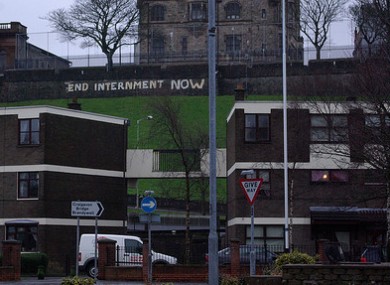
Footnotes:

1 A movement for Irish autonomy within the UK (or, later, Commonwealth) between 1870 and 1914.  Teachtaí Dála: Members of the Irish Parliament

3 Teachtaí Dála: Members of the Irish Parliament

6http://www.derrynow.com/article/2893 (accessed 20 January 2015)

7  Even now a case is being taken by the Irish state against the British state to the European Court of Human Rights, over the torture of 14 victims of that internment. The Irish Government took the case of the 14 “hooded men” to the ECHR in the 1970s and won a judgement that the men had been tortured; however the British state appealed the verdict and it was changed to “cruel and inhuman treatment” (!). The Irish Government left the case there but recently RTÉ, the Irish TV broadcasting service, screened their programme The Torture Files based on documentation uncovered by the Pat Finucane Centre, showing the British Government had lied to the ECHR. Amnesty International publicly called on the Irish Government to reopen the case with the ECHR.

8 Faber and Faber — reprint 1999

9  Sir Robert Thompson, Defeating Communist Insurgency; the lessons of Malaya and Vietnam (1966), F.A. Praeger, New York.

The London Visit — Family, Song, Kurdish Solidarity, the Red Poppy, Architecture, History.

Diarmuid Breatnach

I recently went to London in order to visit my daughter and son, their partners and their children. My son and his wife Natalie had recently had a baby girl; and my daughter and her husband Irwin have a boy and a girl. It turned out for a number of reasons that I had more spare time than I expected, so with the help of a friend I got in some sight-seeing and with the help of another, attendance at quite few singing sessions. I also attended one political rally. The following is an account of those events with the least said about my family and friends since their lives are private, with the exception of my host, Jim Radford, who has a very public side with regard to political and community activism and singing.

Archictecture and Transport System

Visiting London, where I spent 30 years of my life was strange, in particular staying about ten minutes’ walk from where I had lived for about half of my time in that city. I had a sense of being an observer at a familiar place but of which I was no longer part, something like a ghost, perhaps.

Not only Kings Cross Station but the whole area around it has been redeveloped and changed so much. In the early ’90s I worked shifts as a Project Worker in a ‘wet hostel’ (one where street drinkers are permitted to continue drinking), very near to St. Pancras Hospital and about fifteen minutes’ walk from the station (if one walks very fast, which I often did to get in for my early shift). On a late shift, walking down St. Pancras Road, on my way to the Underground to head back to SE London, I would often pass a solitary sex worker or two hoping for custom. Displaying the goods on sale is a trade requirement and I felt especially sorry for them in cold or wet weather.

The area was well-known for a high level of sex work and illegal drugs – selling and buying. Four years later, after two years as a Deputy Manager in a number of hostels in other parts of London, I was back in the area again, with a different NGO, as Manager of a hostel for active drug users (most of them injecting). The area had been very familiar to me then but visiting now I could hardly recognise it. The train and Underground stations have been remodeled and an international train station connecting with the Channel Tunnel has been built. In addition the areas in front of them and to the side are unrecogniseable. A big plaza fronts the station and around the side and back is another plaza with the de rigueur converted warehouses and similar-type buildings also around the back of the station now hosting eateries and fashionable offices.

No doubt the area is much more heavily policed now in order to present a clean image for tourists and the middle class young eating and drinking there but I am sure that sex work and drug commerce continues. Perhaps much more cocaine rather than heroin or crack is sold now for the new client group. But though I was there on a weekend night, I observed many of the restaurants and winebars only half-full.

I went out to Stratford too to see the Olympic Stadium and surrounding area. I had worked in that area as a community development worker for six months and taught an adult education beginners’ class in Irish for some years there too — but again, would not have recognised the area now. Like King’s Cross, it had changed completely but unlike the former, in almost unbelievable ugliness. The shopping centre wasn’t too bad but very much of the UStater “mall” type. Apparently many people in the US spend much of their free time in such places and, indeed, there seemed little other choice in Stratford now, especially for teenagers, unless they were of the outdoor type and accessed the Lee Valley, Wanstead Flats etc.

The observation tower/ sculpture by London Olympic Stadium, near Stratford, East London.
The observation tower/ sculpture by London Olympic Stadium, near Stratford, East London. (Photo DB)

An observation tower which is also a sculpture or “installation”, apparently, stands outside the the Olympic Stadium. It was chosen in competition but aesthetics can hardly have been one of the required features. I once saw metal girders and joists twisted in the aftermath of a very hot fire – the sculpture instantly brought back the memory.

 Unfortunately that was not the only ugly construction in the vecinity: almost in any direction one cared to look, other ugly and often grotesquely-shaped buildings came into view. It was in truth almost impossible to credit that not only was I in the same country but in the same city as the work that had been done around Kings Cross.

But sadly, it was not the only place for ugly buildings. Just by London Bridge I had seen a few others and indeed could see the same ones as part of the distant skyline from Stratford too. The “Shard” is one of them, looking like some kind of unsafe rocket about to take off. Another building reminds me of one of those free-standing electric fan heaters.

Some pieces of metal fell off the Shard recently – perhaps the beginning of a suicide attempt by the building, prompted by shame – and would have killed anyone they had struck. The various companies involved, both in its construction and in renting space in it, have said that there is no danger and everything is being checked again. I’m sure that is very reassuring to people working there and to passers-by.

Weird building near Stratford
A strange but not pleasing building near Stratford — in Dublin this would probably have earned a nickname like “The Handball Alley”. (Photo DB)
Long block Stratford
A barrack-looking building near Stratford. (Photo DB)
Another strange building near Stratford, East London
Another strange building near Stratford, East London. — Maybe it would have been called “The Cheesgrater” in Dubln? (Photo DB)
Various Tall Buildings Stratford
View from overpass, Stratford, looking south-westward (Photo DB)
London Olympic Stadium, Stratford, East London
London Olympic Stadium, Stratford, East London (Photo DB)

It occurred to me at some point that an Irishman taking photos of buildings around the Olympic arena could get into trouble, even these days — so took myself off inside the ‘mall’ to eat.

On a positive note about London other than the Kings Cross development, the new Overground system links up with much of the Underground and throws a public travel net around the city and outskirts, linking up a great many areas which were previously only accessible by using a combination of public transport systems often taking hours.

Irish tricolour in someone's yard right next to an Overground station in NW London
Irish tricolour in someone’s yard right next to an Overground station in NW London (Photo DB)

London Overground logo

I was told about the Overground and even used it but it was some time before I noticed that both that system and the Underground use exactly the same logo design, the difference being the word written across the bar and perhaps the colour. Once one becomes used to a symbol, one no longer reads the words on it or notices anything except very different colours. That didn’t matter until the day I had to catch an Overground train at a station not organically connected to the Underground, on which I was travelling. My ticket was good for both and the Overground station was less than a minute’s walk away down the street. Seeing what looked like the same design and taking it for another entrance to the Underground station I had left earlier, I walked past it three times and once almost got on to the nearby British Rail (intercity trains) platform and wondered why everyone was giving me wrong directions!

It was going down to an Overground station in NW London that I saw a big Irish tricolour in someone’s yard, flying right next to the station.

Family

Kian
Kian, absorbed in an electronic game (Photo DB)

Although I had prepared myself, I was a little shocked at how tall my grandson Kian had become. He is (of course) a very bright lad and was doing tests and making applications for different secondary schools.

Caitlin Rose, his little sister, seemed very excited to see me and I only had to look at her to make her break out in laughter. Grandad is very funny, apparently. Sadly, they have only two living grandparents now – me and my ex-wife. Their other grandfather died shortly before Kian was born and their other grandmother only recently.

  Caitlin Rose was born prematurely – I dashed to London at the time and remember holding her in the palm of my hand fpr a little while out of the incubator. She did well but was later diagnosed as suffering from cerebral palsy – the most obvious way it affected her was that her muscles spasmed and drew the tendons in her calves and feet tight, bending her legs and putting her on tiptoe so that she could hardly walk. The condition can be aleviated but so far is incurable. But she is very competitive and determined as well as being very bright (of course). In addition, she had the SDR operation in the USA, a relatively new surgical technique, after which she improved enormously.  (See this incredible footage taken about a year after the operation https://www.youtube.com/watch?v=Q6SGhuYzng8, from the blog recording her progress and others in the family and promoting the SDR operation http://caitlinroseford.com)

Caitlin dancing
Caitlin dancing (Photo DB)
Caitlin Rose on her daily exercise treadmill
Caitlin Rose on her daily exercise treadmill in her gym, paid for by fundraising (Photo DB)

I didn’t get to spend much time during the day with my son-in-law, Irwin, who was busy figuring out how to plumb their new washing machine in to the waste water disposal system.  I am not familiar with the closed system so didn’t offer too much advice.  But later we went out to eat so I could chat to him a bit more.

The "plumber", my handsome son-in-law
The “plumber”, my handsome son-in-law Irwin. (Photo DB)

Eating out

We went out to a tapas restaurant not too far from where they live and I ordered the fish skewers from the menu, imagining them to be the size of pintxos in the Basque Country or chicken satay skewers one sees over here. When the skewers arrived I was shocked to see each contained three large pieces, each one the size of an individual fish portion in many expensive and niggardly restaurants, with what looked like a dagger or bayonet pushed through them, mounted on a stand.

The most surprising thing for me however was that all the staff were actually from the Spanish state1 with the exception of one from Latin America. In Dublin, I had become used to these places being staffed by people from non-Castillian-speaking countries.

In a Latin American restaurant in Camden to which a friend took me, allegedly Patagonian and with some beautiful enlarged photographs of that area on the wall, I asked our table attendant whether he knew any Welsh. There had been a Welsh-speaking colony in Patagonia, founded in 1865 and there is still some Welsh spoken there today. “Que va, hombre!” he exclaimed. “De eso no sé nada. Yo soy de Andlalucia” he concluded, smiling. (“Not at all, man! I know nothing about that — I’m from Andalucia”).

I queried some of the wines I didn’t recognise, not sure whether I wanted a glass or not, so he brought some for us to try and …. left the bottle! Of course it would have been discourteous to refuse such good fortune and, the wine being fine, we had a few glasses before he remembered and returned for the bottle. We paid for some of it, of course. I had a feeling he might have left it that long deliberately.

In a Turkish restaurant in Dalston, I wondered whether I might have a taste of a Turkish lager, which I had never previously tasted, before deciding whether to have a pint. The attendant paused and then nodded, coming back with a half-pint. I looked at her perplexed — “It’s on the house,” she said with a little smile. She was half-Scottish and half Egyptian, it turned out. I did like it and ordered some more.  Turkish food is nice enough but not one of the world’s more impressive cuisines, in my experience (and I have eaten it there too, including in Turkish-occupied Kurdistan).

Food from Everywhere, apparently on sale in this shop in Dalston
Food from Everywhere, apparently on sale in this shop in Dalston.  The smaller lettering along the bottom of the awning, lists that the shop caters for “English, Turkish, Polish, Italian, Spanish, Greek, French” food. (Photo DB)

Stoke Newington and Dalston are multi-ethnic areas but especially prominent are Kurdish and Turkish businesses. Without a doubt however the most visible ethnic minority are the Hassidic Jews, the men with their long black coats and homburgs, boys with skull caps and side-locks. This sect is anti-Zionist and they are known, on occasion, to demonstrate against the state of Israel. However, I was shocked to learn that the women shave their heads upon marriage and wear wigs when they go out.

Family again

Elora Mae -- I forgot to take any other photos of her :-(
Elora Mae — I forgot to take any other photos of her 😦

At the other end of London from my daughter and her family and also far from where I was staying, it was great to see my son Kevin and his wife Nat and the baby – Elora Mae. London is huge and a return ticket covering the zones on Underground and train cost nearly £10 each time. The Oyster Card they are introducing, like the Leap Card in Dublin, in an attempt to eliminate cash exchanges, makes the journeys a little cheaper but I hadn’t known about that.
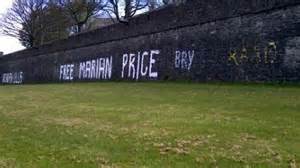
I’m usually OK with babies but Elora Mae wouldn’t let me hold her for long before she started to cry. On my last visit, however, she seemed ok with me (or probably my smell) and even gave me a few lovely smiles. Smiling, by the way, as well as focusing on the face, are responses genetically built in to us. Babies do not “learn” to smile, which is instinctive programming but may learn different types of smiles, as well as appropriate times for smiling.

Songs and Singing in London

I was staying with a long-time folk and shanty singer, Jim Radford and he took me along with him to his weekly singing events. In one, an “open mic” event, I was not a little disturbed at the amount of noise in the bar in which it was held. Noise is distracting and I tend to sing louder to get over it, straining my voice and maybe also singing at the wrong pitch and key and therefore not at my best.  I got more and more apprehensive as my turn to sing, indicated by the MC to me, approached and in trepidation when my turn came, went up to the microphone to sing two songs as expected. I sang Danny Farrell as an Irish (and Dublin) song unlikely to antagonise anyone there and to my relief the noise level dropped somewhat. My second song was the Pat O’Donnell Ballad, which although it involves the the “Invincibles” and the British administration in Ireland, was not too confrontational, I thought. Besides, it the story is interesting as it may be the first recorded “witness protection” operation in history, though one that went very badly wrong for the “witness” (or traitor) in question.
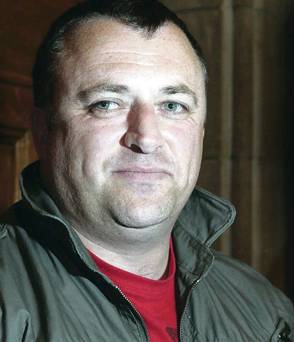
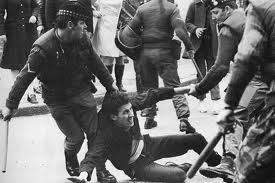
I was asked to sing a third song, as a courtesy to a visiting guest, I thought. Into the second line of Go and Leave Me, the silence around me became profound – so much that it scared me a bit. But I took confidence from it too. The lyrics are not bad and the air is lovely, especially in my opinion when it’s sung the US version way. It’s a reasonably well-known song about love and desertion in preference for someone richer and is one in my regular repertoire. “Regular”, by the way, might mean “sung two or three times a year”, since I don’t like to sing the same song too often and, like many other frequent singers, I have quite a few others. My host has about 250 …. I might have around a hundred, built up over years. And a few discarded along the way too.

The following week, back at the venue, I was asked to sing three songs and chose the Jim Larkin ballad by Donagh Mac Donagh (son of the executed 1916 Proclamation, Thomas Mac Donagh) and The Ludlow Massacre, by Woody Guthrie. A lot connects these two songs to one another and although in general I dislike song introductions (or “spoken sleeve notes”), I briefly explained a few of those connections before singing them.

Both the Southern Colorado Coal Strike and the Dublin Lockout/Strike began in the same year, only a month apart, although the Colorado strike didn’t end until December 1914. Both strikes involved attacks by state forces and scabs on the workers resisted, in Ireland forming the Irish Citizen Army, although many more were killed in Colorado (and in turn were killed by workers fighting back too). Evictions from company houses were a feature throughout both strikes as was general media and court hostility with open collusion between the forces of the ‘justice’ system and the employers. And, of course, both strikes essentially lost in the short term but, in the longer term, the trade unions involved, the ITGWU and the UMA, far from being broken, came out stronger.

For the third song my choice was Back Home in Derry, lyrics from a poem by Bobby Sands organised into a song by Christy Moore but to my own air. With this song I break my general rule about not singing the same song often, because I want to popularise my air with the lyrics. The lyrics are currently mostly sung to the tune of Gordon Lightfoot’s The Wreck of the Edmund Fitzgerald and I thought they deserved an air of their own.

At the various events, as one would in Dublin, I heard some good singers and some bad ones and some who were not particularly good but were interesting. However the general standard seemed noticeably lower than what I would encounter in the singing circles and sessions around Dublin – I have no idea why that should be but it can hardly be due to physiological differences. Also, many read from sheets while singing, a practice rarely seen in the Dublin singing circles (although prompts by mobile or IPad are not unknown).

On this trip I heard Jim sing a number of songs and a couple I remember in particular: The Shores of Normandy, Song for Stephen Lawrence and Home Boys Home. The last of those is about horses and English rural men in WWI and based on a poem, a lovely song which I have slowly started to learn. Jim wrote the other two himself.

Stephen Lawrence was a British Afro-Caribbean youth walking home in SE London with his friend in 1993 when they were both pursued by a gang of white racist young men. Stephen was mortally stabbed and left to bleed to death. Within a week the names of the murderers were on the lips of all the young people in the area. I can personally testify to that since the daughter of a friend was attending a school in that area at that time. First the police questioned Stephen’s surviving friend, treating him as a suspect. Then they couldn’t find the culprits, they said. But it turned out that the house in which some of the racists lived had been under police surveillance for some time and was actually being video-taped inside. It was a long time before that came to public knowledge.

Eventually five men were brought to trial but the incompetence (or sabotage) of police trial preparation allowed them to escape. In a long saga of the fight for justice by the Lawrence family and their supporters, two of the five racists were finally re-tried in 2012 and convicted, receiving long sentences. In the interim the McPherson Enquiry found the Metropolitan Police force to be “institutionally racist” (which Black, Asian and Irish people had been saying for decades) and later a former undercover police officer revealed that he had been tasked by his senior officers to find material with which to discredit the family and the campaign. The Lawrence family broke up under the strain and at least one of them left to go back to Jamaica. Jim’s song contains a powerful indictment of the racist murderers and of the police.

The Shores of Normandy was written by Jim when he visited the beach that he had last seen as a teenage seaman on D-Day on 6th June 1944. Jim was a merchant seaman on a tugboat, many of which were leased by the British Navy and their crews paid merchant seaman rates (which were higher than those of the Royal Navy). Over a few evenings sharing Jim’s whiskey and tea, he told me some things about the tugs’ role. They were of great importance to Britain in the War – they accompanied convoys and towed many torpedoed ships to safety, mainly merchant marine vessels (2. After some time the tugs themselves became targeted by submarines as they were saving so many tons of shipping to be repaired and re-outfitted to go to sea once more and 24 British naval rescue tugs were sunk.

Sherman tanks landing from transporting ship on to pier assembled at Normandy beach.  The sections were towed across the sea from Britain by tugboats then assembled under fire.
Sherman tanks landing from transporting ship on to pier assembled at Normandy beach during D-Day, WWII. The sections were towed from Britain by tugboats across the sea then assembled under fire at the beaches. (photo sourced on the Internet)

In some of the photographs of the Normandy landings one can clearly see piers being used to disembark vehicles, equipment and men. As Jim says: “Those piers didn’t drop from the sky”. (No, but death was dropping from the sky and scything across the beaches too. I thought). The piers were made of concrete caisons, hollow cubes that could float and were towed across the Channel by the tugs. When they reached Normandy they were maneuvered into position at the correct depth and the sea allowed to enter them until they sank in a line on the seabed, making a pier. All this was done under fire at least some of the time.   Over a year earlier, the battles of Stalingrad and Kursk had broken the Nazi advance and turned the war in East Europe, now the Sicily and Normandy Landings combined with the advances from the East towards the liberation of Western Europe and the final defeat of Nazi Germany. The air Jim chose for his lyrics is The Dawning of the Day.

Among the events at which Jim was to sing was the launch of Confronting a Culture of Militarism by David Gee, in Housmans Radical Bookshop.  The shop, a little like Connolly Books in Dublin, stores a wide variety of radical and socialist book, pamphlets and periodicals.  Looking at the many different British periodicals there, I reflected how much more impact they could have if many of them were to amalgamate.

The bookshop was soon crowded, with some late arrivals having to stand. First off was what I thought an impressive monologue performance by Steve Pratt, ex-SAS and now against war, also a painter. After that, David Gee, the author, spoke – a little too long but interestingly. Finally, Ben Griffin spoke, ex-Paratroopers and also SAS but now Secretary of Veterans for Peace. Ben referred to the vilification that soccer player James McClean had endured when playing for Sunderland and Wigan, for refusing to wear the Red Poppy. (3 He spoke about a visit Veterans for Peace had made to the Six Counties of Ireland in October and how people had spoken to them about harrassment, raids and shootings by the British Army during the recent 30 Years War; Ben asked how anyone could reasonably expect someone from one of those communities to wear the Poppy? (4

Jim was plugging the upcoming Cenotaph anti-war commemoration by Veterans for Peace and sang Where Have All the Flowers Gone?, inviting the audience to attend the ceremony and to sing the song with them. He also sang Eric Bogle’s famous anti-war song, No Man’s Land (better known to us as The Green Fields of France, thanks to the Fureys); he sang it in full to underline what a speaker had earlier said about the Joss Stone song promoted by the British Legion, a truncated version that sentimentalised the war and ripped the strong anti-war heart out of Bogle’s song.

Jim singing at the launch of David Gee's book at Housemans Radical Bookshop.
Jim singing at the launch of David Gee’s book at Housemans Radical Bookshop. (Photo DB)

Although a veteran libertarian socialist activist who considers the Royal Family to be “spongers”, Jim had accepted an invitation to sing The Shores of Normandy at the Albert Hall as part of the annual “Remembrance” concert, with members of the Royal Family present. He was wearing a Red Poppy too. I argued with him about the latter but his line is that the militarists and Royals have usurped Remembrance, which was intended to mark the terrible sense of loss after WWI with so many men dead in every town and village4.

The day after the concert, on “Remembrance” Sunday, when processions march in Whitehall and lay wreaths at the Cenotaph, Jim marched with comrades of Veterans for Peace there, with a banner declaring “Never Again!” They and their supporters sang Where Have All the Flowers Gone, an anti-war song, one recited a poem strongly attacking war and its financial foundations and they laid a wreath made entirely of White Poppies with two Red Poppies inside it. (5 Their bugler played The Last Post. I’d have been there to support them and to add my voice to the song but I was already several days back home in Dublin.

Jim brought me to a music session in The Jolly Farmer pub, right next to Lewisham Hospital. I had attended sessions there when I lived in Catford, 20 minutes’ walk away, and the pub now had another name. In those years there had been three, sometimes four weekly Irish traditional music sessions in the Borough of Lewisham, none very far from one another, in which I had played percussion and sung. There had been a few in the next borough, Greenwich, too. None of those seemed to be currently functioning.

The core of the Jolly Farmer session is formed by “Flaky” Jake on accordion, Guillermo on guitar and Jim on percussion (spoons and bodhrán), with other musicians and listeners in attendance. Jake has a huge repertoire of songs from rock to cajun, including songs in French and in Spanish. Guillermo knows some of the French ones and is from Mexico. During the course of the session we heard – and often sang – Rolling Stones, Irish ballads, Cajun songs, English shanties and music-hall, Woody Guthrie ….

Guillermo, Mexican musician at the Jolly Farmer session.
The core of the Jolly Farmer session: Flaky Jake on accordion, Jim Radford on bodhrán an spoons, both facing and Guillermo, guitar, seen from behind. Each also sings. (Photo DB)
Jim, Jake and violinist (whose name I can't remember)
Jim, Jake and violinist (whose name I can’t remember) at the weekly music session at the Jolly Farmer pub. (Photo DB)
Jolly Farmer session, looking down from higher up.
Jolly Farmer session, looking down. (Photo DB)

A few strange incidents occurred around that time in that pub. The first week, there was a man there with an undiscliplined German Shepherd dog on a leash which his owner kept yanking to get the dog to stay by him. A man entered in a wheelchair and the dog went up to him and stuck his nose in the man’s crotch, whereopon the offended man slapped the dog across the muzzle (but not too hard – the dog did not yelp but just went back to his master). The dog’s owner, who I think had not seen where the dog had put his nose, was livid and began to swear and act out how if the man were not in a wheelchair he would do this … and that …. The man in the wheelchair turned and wheeled himself out of the pub. The atmosphere continued somewhat tense for a while but eventually the man and dog left.

Later that evening, I went to the toilet and saw legs sticking out of the cubicle next to the urinal. I pushed open the door to see a man lying in there on the floor, apparently very drunk. I informed the landlady and left her to it, as she requested. Later, at a music party, we heard that after we had left the pub, there had been some kind of disturbance with a drunk breaking glasses and furniture and that the police had been called!

Jolly Farmers trio 2014
Another night at the music session at the Jolly Farmer. The guy on guitar there sang some interesting songs and was a good guitar player. Leaning back, black cap on head at extreme right of photo is Guillermo. (Photo DB)

The house party invitation came through afficionados of the session. Attendance at the house felt strange at first since I didn’t know the people but then I realised I did know one of them, although not well, a fiddle player. And later another person recalled that she remembered me from music sessions over a decade previously. When the music and singing got going it was great and again we covered a wide range. We went through a huge range of songs and tunes with accordion, guitar, fiddle, banjo, spoons and bodhrán. In honour of our hosts, one of whom was German, I sang Mus I’ Den and The Peat Bog Soldiers combined with Hans Beimler.

The first is a German folk song of departure by one promising to return and to be true to the other in the meantime. Such songs are fairly common and we have more than our fair share of them in Ireland. Elvis Presley’s songwriters used the tune for Wooden Heart in one of his many badly-acted and badly-scripted films GI Blues.   The first of the remaining two is a song that was sung by German political prisoners in Nazi concentration camps; somewhat allegorical, it was tolerated by the guards for awhile but eventually earned a death sentence for anyone heard to sing it. Hans Beimler was a German communist who was imprisoned by the Nazis but escaped and went to the Spanish state in 1936 to fight fascism there where, like many other International Brigaders, he was killed. Because of the history of each as well as because the Beimler song is a very short one, I like to precede it with two verses of the The Peat Bog Soldiers.

It happened that the “Return to Camden Festival” took place during my London visit, spread around a number of venues in the borough, including of course the Camden Irish Centre, which is where I went with a friend. I knew the Centre from a long time past, a social and welfare agency for Irish migrants run by the Catholic Church for many years and notable through much of my time in London for steering clear of politics. Of course one can never really do that and one ends up supporting one kind of politics or another. The Centre gradually secularised itself in a time of grants for ethnic minority support work but did not raise issues uncomfortable for the British state such as the unjust murder convictions of a score of Irish people in five different cases during the mid-1970s, the iniquities of the Prevention of Terrorism (sic) Act, nor the prevalence of anti-Irish racism in treatment by many state and local authority agencies and its wide acceptance in news and entertainment media.

Gradually during the late 1980s (or perhaps early 1990s) the Camden Irish Centre was pulled into some of those issues but in an NGO-type of way and within such parameters and re-branded itself as “The London Irish Centre” (there were by then another five Irish centres in different parts of London but none claiming to be The Irish Centre). By that time the Centre’s management was connecting itself to the Federation of Irish Societies, an organisation that infamously at its AGM in 1981, as news of the death of Bobby Sands reached delegates, failed to even table a vote of sympathy for the family of the deceased. (7

  The “Return to Camden Festival” at the Camden Irish Centre seemed to be owned by Comhaltas Ceoltóirí Éireann (often mistakenly called “Ceoltas”), a huge largely volunteer organisation promoting Irish traditional music, song and dance. The Centre was heaving and service at the bar was quite slow. The bar staff were all young and someone told me that they were on job schemes, all employed by a contractor who manages the catering for the Centre. It was hardly suprising therefore that they understood not one word in Irish, not even go raibh maith agat.

We sat and listened to a large number of musicians playing together, some as young as eight or nine, then peeked in at the céilí, after which we set off for the singing session. It is run by a Connemara man who sings sean-nós style, who was very welcoming and encouraging; we sat in a circle and sang (or declined) in turn. Again I met people who remembered me from music sessions or from other Irish community activity. The singing was interesting and some singers were exceptional, especially a couple of young female musicians who had to leave early to play their instruments and a few others. I heard a couple of songs I had not heard before, which is always welcome, as well as some I had not heard in a long time. But after about two hours the session came to an end; time then to get something to eat and start the journey back across the city by Underground, changing to Overground at Canada Water station. Reaching Honor Oak Park and walking up to Jim’s house, I passed by foxes twice; the London ones probably became urbanised long before their Irish cousins did.

Solidarity with Kobane’s resistance to ISIS

I knew from an email notification that there was to be a Kobane solidarity demonstration scheduled for a Saturday in central London while I was there and, since this was not one of the days I was visiting grandchildren, I headed out to Charing Cross station, next to Trafalgar Square. Kobane is defended by a Kurdish guerrilla resistance organisation composed of the PKK, some Kurds within the Syrian state’s borders and the few Peshmergas who didn’t flee ISIS. There are probably some Assyrians and Yezidi involved in the defence too.

The Kurds are a huge nation of around 30 million people, spread over territory currently within the borders of Iraq, Turkey, Syria, Iran and Azerbaijan, with a sizable diaspora also in parts of the US and in some parts of Europe, notably in Germany and France. The politics of the Kurds within Turkish and Syrian borders tend to be secular and the PKK has always espoused some kind of socialism. Kobane, a town in the northern part of the Syrian state, is run mostly by Kurds from there and from the Kurdish resistance movement inside Turkey’s borders. Despite the hype about the Peshmergas (Iraqi Kurdish guerrillas), it was the PKK and Syrian Kurds who rescued the Yezidi and some other religious and ethnic minorities from ISIS in Sirjan and opened up a 100-Km long corridor to bring them to safety in Rojava (Kurdish northern “Syria”). A large proportion of these Kurdish guerrila fighters are women, perhaps as much as 30%, fighting inside their own units under the overall leadership of the PKK-affiliated organisation the YPG.

Kobane is under attack and surrounded on three sides by ISIS (“Islamic State”). The fourth side is the heavily-guarded Turkish border and the Turkish state is hostile to the Kurds, both within their own borders and within Syria. Based on ISIS behaviour to date, should Kobane fall, massacre of civilians and defenders will follow, along with enslavement of women as prostitutes or concubines.

Nelson during Kobane rally
Nelson looks down from his pedestal at the Kurdish solidarity rally in Trafalgar Square. (Photo DB) (A similar column and statue in Dublin was blown up in 1966 and the “Spire” now stands on the spot.)
Wide view Koban Rally Trafalgar Square
Wide view of the Kobane solidarity rally in Trafalgar Square, London. (Photo DB)

While living in London I had been to Trafalgar Square many times for rallies on different causes that I supported (including of course Ireland, until that plaza was banned to Irish solidarity demonstrations). Nelson stands tall on a pillar there, reminiscent of the one we had in Dublin city centre until it was blown up in 1966, the 50th anniversary of the Rising. I wondered whether I would meet people I knew, either from the British Left or from Kurdish solidarity work, in which I had been pretty active during the early 1990s (8. The area was a-flutter with various Kurdish organisational flags and some from the Turkish left, also some banners and a number of placards were on display.

A speaker at the Kobane solidarity rally (
A speaker at the Kobane solidarity rally (identity unknown) (Photo DB)
Another speaker at Kobane solidarity rally, London (idenity
Another speaker at Kobane solidarity rally, London (identity unknown to me).  (Photo DB)

Most of the crowd looked like they came from the Kurdish part of the world. The stage seemed to be taking a long time to get set up but eventually the Kurdish MCs, a man and a woman, began to announce the reason for the rally and to introduce a list of speakers to the crowd. I was suprised to hear an Irish priest, an O’Brien, I think, introduced as having been a long time active in Kurdish solidarity, although in the 1990s I had never come across him nor heard his name mentioned. I had the same reaction to a few others introduced in similar terms.

A Kurdish traditional musician, seemingly well-known, played a short percussion piece on what looked like a slim but wide bodhrán. Looking for it on Google, I would say it was the Daf, which apparently is in wide use across a number of Near and Middle Eastern regions by a number of ethnic groups. There was no song sung throughout the rally before I left.

The Irish priest introduced as a good friend of the Kurds
The Irish priest introduced as a good friend of the Kurds (Photo DB)

The speakers were from a number of British Left and ethnic minority organisations, one MEP and a number of elected representatives. There was also a report from Kobane itself broadcast through speakers. Mark Thomas, a left-wing comedian, spoke emotionally on the issue. Peter Thatchell spoke strongly as well. One Left-wing woman with an English accent, in the course of her speech, attacked the SWP for supporting Islamicism in the past. The next person to speak, also a woman with an English accent, declared that she was in the SWP and that her organisation is strongly in solidarity with Kobane and with the Kurds.

Comedian and political activist Mark Thomas speaking at the rally
Comedian and political activist Mark Thomas speaking at the rally (Photo DB)
MEP maybe Kobane Rally London
Another speaker at the rally (identity forgotten) (Photo DB). Images of the imprisoned PKK leader, Abdullah Ocalan, can be seen.

Some of the speakers praised the Kobane ‘government’, saying it was secular, egalitarian, socialistic …. The speakers all attacked ISIS and called for solidarity with Kobane. Some called for British Government intervention (to drop weapons and supplies to Kobane) while others called for military intervention against ISIS. Some called for the unbanning of the PKK and some for the release of Ocalan. The PKK was declared a “terrorist” organisation by the EU years ago, a totally unjustified action by any means of definition, since the organisation was engaged in armed resistance against the attacks of the Turkish state, which is still not a part of the EU; furthermore it was not engaged in any armed action outside its part of the world and nearly all of that within Turkey’s borders. (9

DB Kobane Rally London 2014
Me, holding a placard I borrowed from a Kurdish couple I had been talking to. The YPG is the Syrian Kurdish resistance, organised and led by Kurds but attracting some Arabs and Assyrians also. It contains large numbers of women fighters, organised in their separate units.
Kobane Rally near stage
Another speaker whose identity I cannot confirm. (Photo DB)

Abdullah Ocalan (pronounced “otch-al-an”) was the leader of the PKK when he was kidnapped in Nairobi by the CIA in 1999, taken to Turkey, sentenced to death and, after Turkey abolished its death penalty to gain EU entry, sentenced to life in prison. He is kept on an island prison – the only prisoner there, at least for 10 years. Prior to his incarceration, Ocalan had a position within the PKK that arguably went considerably beyond recognised leadership. Nicknamed “Apo” (“uncle” in Kurdish), his image was carried on Kurdish solidarity demonstrations and pickets by many Kurds in London and in Dublin.

Ocalan
Abdullah Ocalan, imprisoned leader of the PKK (image sourced on Internet)

After Ocalan’s capture he declared that the Turkish government should engage in peace talks with the Kurds, that the PKK were not seeking immediate independence but some kind of regional autonomy. Furthermore, he declared that his own release was a necessary prerequisite to carry this process through. This is not too disimilar to the position of Arnaldo Otegi, of the Basque independence movement’s leadership, also of the Sortu party and of many of their new allies since they renounced armed struggle and ETA declared a “permanent and verifiable ceasefire”.

Ocalan’s change of tack surprised many on the Left; I don’t know how the PKK’s own followers reacted at first but soon they were issuing statements along the same lines, (although they have given no hint of intention to disarm). That position of the PKK and of Ocalan explains to me the relatively sudden interest in them within much of liberal and Left quarters. The other factor is the Left and liberal fear of ISIS and the fact that the only coherent and effective defence of Kobane and the rescue of the Yezidi in Sinjar is and was carried out by the PKK, not the “Peshmergas” loudly praised by the Western media (but only mentioned by one speaker at the rally) or by the US, imaginatively claimed by some media.

Another Anarchist banner at the Kobane solidarity rally in Lon
Another Anarchist banner at the Kobane solidarity rally in London, October 2014. (Photo DB)
Anarchist banner at Kobane so
Anarchist banner at Kobane solidarity rally, Trafalgar Square, October 2014 (Photo DB)

The “Peshmergas” are Kurds and guerrillas, but of the tribal factions of Bardani and Talibani within Iraq’s borders. On one occasion years ago, they cooperated with a huge Turkish military operation against the PKK by attacking them simultaneously from their side of the border. During the war of the Western states against Iraq around Kuwait, the Peshmergas followed the call of the West to rise against Sadam Hussein; the Western powers then left them to be slaughtered by the Iraq military. During the Western powers’ invasion of Iraq, the peshmergas formed war bands that as well as attacking the Iraq military, looted the Iraqi hospitals, museums, commercial enterprises and people’s homes. At times they even fought among themselves and there were many accusations of murder of military and civilian prisoners, kidnapping for ransom and even of rape. Among much hype, some moved to the rescue of the Yezidi in Sinjar but most quickly withdrew after armed contact with ISIS, totally abandoning the Yazidi, although Sinjar is within Iraq’s borders.

Turkish AKP=ISIS Kobane Rally
Placard accuses Turkey of directly assisting ISIS (Photo DB)

Many speakers at the London rally denounced Turkey for their indirect assistance to ISIS by harrasssing PKK guerilla reinforcements trying to get through to reinforce their Kurdish brothers and sisters in Kobane. Some alleged more direct assistance to ISIS and called for the NATO and the EU to pressure Turkey into ceasing their obstruction of reinforcements for Kobane. Some spoke against Assad and one for him but mostly neither he, his government nor the war there were discussed.

I recognised not one of those speakers present as having been active on the Kurdish issue in London back in the early 1990s. This would be understandable of younger people who had not yet become politically active then, perhaps – but the others? No, Thatchell and others like him had not been. Back then, the PKK had been in armed struggle against the Turkish regime and was being looked to by national liberation activists around the world. But Turkey was – as it is now – an ally of the West, a member of NATO, so the EU did not want to attack it for its widescale abuse of human right among the Kurds, although it considered Turkey too unstable to admit it to the EU. The Left organisations were campaigning on other issues and had no time – or perhaps tolerance – for Kurdish solidarity.

Sun effect Trafalgar Kobane rally
Not a nuclear explosion over London but an interesting effect of the declining sun. (Photo DB)
Contrasting flags seen from Trafalgar Square -- and a spying eye in the sky
Contrasting flags seen from Trafalgar Square — and a spying eye in the sky (Photo DB)

But now that that the PKK has indicated a willingness to enter a “peace” process, they seem to have many friends in left and liberal quarters than they had before. They may even end up, like the Abertzale Left of the Basque Country and like Gerry Adams and Co. of Sinn Féin, having lots of capitalist and imperialist friends too. Some may say that is one important reason for entering a “peace process” but the problem seems to be that in order to keep those new friends on board one has to abandon so much of the goals about which one’s movement was that it becomes something very different, the goals hugely reduced and arguably bringing not peace but co-opting of resistance and a deferment of struggle, probably to another generation (as happened in Palestine, after Arafat’s and Al Fateh’s agreement at Oslo).

One or two of the speakers called for Western armed intervention to assist Kobane, most notably Peter Thatchell, who called for NATO intervention. It was noticeable that this call garnered hardly any applause from the crowd, as distinct from calls to pressurise Turkey to stop trying to block the PKK sending reinforcements to the beleaguered Kobane and for the EU to drop arms to the Kurdish resistance. The London Kurds seem to be quite politically sophisticated and know that NATO is far from being a friend of the Kurdish people. I expressed some of my opinions to a Kurdish couple in their 30s or early 40s and they indicated agreement, particularly the man, who confided many of his own opinions. After hearing about a dozen speakers, I shook hands with the Kurdish couple and bade them farewell, taking a similar journey back to my friend’s house as had Jim Connell, while writing The Red Flag in 1889.

The Red Flag, written by an Irishman in London

Although he had lived in the area for decades, Jim was not aware that Jim Connell, the author of the communist anthem The Red Flag, had been living nearby for many years and had in fact been on his way to his earlier address, also in SE London, by train from a Trafalgar Square demonstration, via Charing Cross, when he began to compose the song. Jim Connell was from Kells in Co. Meath and a member of the Socialist Democratic Federation and later of the Independent Labour Party. He put the lyrics to the Jacobite air The White Cockade. For some reason it began to be sung to the air of Tanenbaum, a German Christmas hymn, which upset Jim Connel: “Ye ruined me poem!” he stormed.

The plaque commemorating Jim Connell who lived in this house for many years, including when he wrote "The Red Flag".
View of former address of Jim Connell, the house with the tall hedge, from across the road (Photo DB)
Jim Connell plaque London
The plaque commemorating Jim Connell who lived in this house for many years. (Photo DB)
The house upon which the plaque
No. 22 Stondon Park, the house upon which outer wall the plaque to Jim Connell is affixed. (Photo DB)
Jim Connell plaque large
Lewisham IBRG influenced the wording of the plaque but unknown to them the words “Labour Party” were inscribed on the plaque. (photo sourced on Internet)

I knew a good bit about this because the Lewisham branch of the IBRG, of which I was Secretary, had been in correspondence with a local history employee of the local authority about putting a plaque on the house. The plaque had been the council employee’s idea but we had influenced the wording (10) and in 1989, the centenary of the writing of the song, attended the small unveiling ceremony outside the house. A little-known MP called Gordon Brown had spoken and never once mentioned Jim’s wish for a free Ireland or the war then going on in the Six Counties, so I felt obliged to jump up on a garden wall and in a short speech, supply the missing information. There were no police present and I was not interfered with although the applause was scattered. The event and the fact of my speech was covered in the Irish Post soon afterwards. A half-hour before I was to catch the train to Gatwick Airport, Jim drove me to Stondon Park and I found the house and photographed it and the plaque (and also Jim in front of it, for his own album).

It would probably be another year before I would see my kids, their spouses and my grandchildren in the flesh.  Of course, there is always Skype ….

Back home

Waiting for either the number 16 or 41 bus home from Dublin Airport, I noted the inadequate shelters from weather, the general lack of Dublin information and the tatty state of the one map of Dublin that someone had thoughtfully sticky-taped to one of the shelters.  Even the Bus Átha Cliath timetable for the 16 route was tattered and flapping in the breeze.  Ireland, I do love you but sometime you disgust me too.

Torn Dublin Bus poster airport
Tattered Bus timetable in inadequate weather shelters at Dublin Airport, Nov. 3014. (Photo DB)
Tattered Dub tourist map bus shelter
A tattered Dublin tourism map which someone had thoughtfully sticky-taped to the inside of one of the inadequate weather shelters at the No.s 16 and 41 route stops at Dublin Airport, Nov. 2014. (Photo DB)

I arrived home to find that in delaying paying my Eircom bill, they had without notice cut my ability to reply to emails but strangely the Facebook connection continued. I got some money together and paid my bill.

A chríoch/ Ends

Footnotes

1 I don’t like to say “Spain” as the term is objected to by people in a number of nations within the borders of that state, some of which want total independence and to create their own states.

2  Despite this, 2,426 ships of the British Merchant Marine were sunk with 25,070 men killed, including of course many Irish but also others from the British Commonwealth and many Chinese. In 1942 a special camp for merchant marine seamen prisoners was built at Westerimke ten miles north of the German port city of Hamburg. Around 5,000 men, including 2,985 from 211 British ships, were interned at this camp commonly known as ‘Milag Nord’.

3  McLean, from Derry, said that if the Poppy were just to commemorate the dead British soldiers of WWI and WWII, he would wear it. But as it was not, and in memory of Bloody Sunday in 1972, he could not do so. http://www.dailymail.co.uk/news/article-2826306/I-m-not-anti-British-wearing-poppy-act-disrespect-people-Derry- born-footballer-James-McClean-says-anger-Bloody-Sunday-decision-shun-poppy-embroidered-shirt.html

4  One wonders whether the footballer is aware of John Maclean (24 August 1879 – 30 November 1923), Republican Communist from Glasgow who was jailed in 1918 for “sedition” due to his anti-war activities and force-fed while on hunger strike.

5  I have written my reasons of disagreement with this line in an article, published in the Rebel Breeze blog: https://rebelbreeze.wordpress.com/2014/11/12/the-blood-red-poppy-remembrance-or-war-propaganda/

6  Video: Veterans for Peace at the Cenotaph, Remembrance Sunday 2014 (Jim Radford, white-bearded, wearing mariner peaked cap): https://www.youtube.com/watch?v=t34dnIabsGw

7  There had been many pickets and demonstrations in Britain to try to save Sands’ life and those of the nine hunger-strikers to die subsequently. The 1981 Hunger Strikes had a huge effect on the Irish community in Britain, breaking the terror stranglehold of the Prevention of Terrorism Act and the neglect of the Federation of Irish Societies was answered by the formation of the Irish in Britain Representation Group.  See https://rebelbreeze.wordpress.com/2014/02/15/how-to-silence-an-ethnic-community/

8  Including a trip in a small delegation of trade unionists in the early 1990s across much of the Kurdistan lying within Turkey’s borders.

9 From Wikipedia: “…NATO has declared the PKK to be a terrorist group;[121] Turkey has been a member of NATO since 1952, and fields the group’s second-largest armed contingent. Closely tied to NATO,[122] the European Union—which Turkey aspires to join—officially lists the PKK as having “been involved in terrorist acts” and proscribes it as part of its Common Foreign and Security Policy.[123] First designated in 2002, the PKK was ordered to be removed from the EU terror list on 3 April 2008 by the European Court of First Instance on the grounds that the EU failed to give a proper justification for listing it in the first place.[124] However, EU officials dismissed the ruling, stating that the PKK would remain on the list regardless of the legal decision.[125] Most European Union member states have not individually listed the PKK as a terrorist group.” Three Permanent Members of the EU Security Council list it so but the remaining two, Russia and China, do not.

10  We had not been told that the words “Labour Party” would be affixed and only noticed it on the plaque much later.

WHAT TO WRITE FOR REBEL BREEZE?

Diarmuid Breatnach

Over the years I have written articles and published them, usually under my own name, in alternative publications.  Some of those having been written in Castellano (Spanish) has meant that, with the help of others to check or edit them, I have been able to publish in a number of on-line publications from the Spanish state, including a number in the Basque Country.  These articles have been political commentary, analyses and news reports.  They come from a revolutionary socialist perspective and from one who has been politically active for many years in London and in Ireland, which is where I grew up.

I do not find it easy to categorise my politics in a short phrase.  I have been an active anarchist, from which I learned much, later a supporter of a marxist-leninist party and that too has taught me a lot; I am not an anarchist now nor perhaps even a marxist-leninist (certainly not the type I was).  I am opposed to the presence of British Imperialism and colonialism on Irish soil but I am not an Irish Republican (though many in my family have been).  I have not found a revolutionary organisation in Britain or in Ireland that comes close to being what I want to belong to now: an organisation that is effective, learns by mistakes instead of covering them up, is honest with itself and with the class it purports to lead, is disciplined yet tolerant of internal criticism ….

As a revolutionary, I am interested in the experiences of people the world round but most of my experience has been with the Irish at home and abroad, with Afro-Caribbeans in London, with solidarity work with Irish prisoners, the Kurds, Palestinians and Basques.  Of course, I have also been active in community resistance to cuts in services and grants, to fascists and racists, as well as active in trade unionism.

We live in a time when many anti-imperialist movements and organisations have grasped or are reaching out for something they call a “peace process”.  But these processes are not about peace but instead are about pacification.  They cannot bring peace since they do not resolve the basic issues: imperialist and capitalist exploitation.  They bring instead fragmentation, betrayal, apathy and, from a small section, collaboration with oppression.  Ireland and South Africa, often quoted as good examples of “peace processes”, are actually excellent examples of the real nature of these processes.

It is common these days for someone who expresses opposition to pacification processes to be accused of militarism without a political agenda, of favouring immediate resumption of armed struggle, or of being undemocratic.  Often these criticisms are made by people from the very same organisations whose militarist acts and lack of political strategy I have criticised over the years.  But no matter.  It is easier to condemn the critic than to carry out a real analysis of what has been won and what lost through these processes.

Currently the working class (as well as other sections of society) in Europe and elsewhere are under attack by capitalist governments determined to make them pay for the losses incurred by their financial speculator friends and to ensure that the big capitalists not only lose no profits but actually increase them.  In the course of that process they are plundering the public purse and stripping the states of their public assets.  Energetic and determined resistance is called for but the organisations to which we might look for that have been either completely useless or ineffective.    Never before have so many institutions of the capitalist class been so exposed and so reviled by the ordinary people, yet none of the European states seems to be near to revolution.  The necessary preparations were not made and we are not in a position, it seems, to lead those disenchanted and angry masses to effective resistance and then to the overthrow of this exploitative system.  Not yet anyway.  We need to learn from this and build the bases and organs so necessary for effective resistance.

Cultural Interests

My main cultural activity is singing, mostly traditional/ folk and I attend regularly a number of singing circles of sessions around the Dublin Bay area (of which there are a surprising number).  I did sometimes play percussion by hand on a dholak (type of Indian drum) in Irish traditional sessions but not since I misplaced the drum and have been unable to find it.  I also sometimes compose songs (lyrics and music), write poetry and short stories, along with humorous pieces.  Among my many interests is history, both recent and more ancient and I have been known to conduct walking history tours around Dublin on occasion.  Another strong interest is natural history, the world of plants and animals.
I am likely to write about all those things at one time or another.

I am primarily trilingual in Irish, Castellano and English.


End