WHO IS RISKING A NUCLEAR CATASTROPHE FOR WAR GAINS?

Diarmuid Breatnach

(Reading time: 5 mins.)

According to the media, the nuclear power plant in Ukraine is controlled by the Russian military and being bombed by artillery.

The Ukrainian state spokespersons accuse the Russians of bombing it themselves while the Russian state spokespersons blame the Ukrainian military. Both warn of the danger of a nuclear disaster.

Amidst the trading accusations, about what can we all be sure?

Well, really only of a few things about which there is (or seems to be) agreement:

  • The Zaporizhzhia Nuclear Power Plant, although it is being maintained in operation by the Ukrainian State’s employees is within the area occupied by the Russian military very soon after the Russian invasion.
  • The plant is being bombed by someone.
  • Due to the bombing, there is a danger of nuclear disaster, initially in the Donbas region where the plant is located but quickly affecting large areas of at least the Ukrainian and of the Russian states and ultimately affecting other areas of Europe1.
  • The bombing of the plant should stop immediately and all possible efforts should be expended in that direction.

To go beyond that and arrive at a reasonably safe conclusion about who is doing the bombing, we need to employ critical deductive analysis and to set aside as far as we can our prejudices. We can’t help but have those but we can set them aside for a moment.

Using critical deductive analysis means looking at aspects like what is logical, who benefits from what, what other evidence is available ….

Russian or Donbas military Guard Outside Zaporizhzhia Nuclear Power Plant, Russian-controlled Enerhodar City Zaporizhzhia Region, Ukraine August 4, 2022. REUTERS/Alexander Ermochenko/File Photo

CRITICAL DEDUCTIVE ANALYSIS

Who could benefit from the bombing? In theory, either.

The Ukrainian authorities say the Russian do because they wish to blame their opponents.

Since the Ukrainians have demanded the Russians – apart from withdrawing their military entirely – remove themselves from the area of the nuclear plant, presumably the Ukrainians would benefit from blame attaching to the Russians.

Interestingly, “The US, United Nations and Ukraine have called for a withdrawal of military equipment and personnel from the nuclear complex, Europe’s largest, to ensure it is not a target.”2

The Ukrainian state already has US/NATO and the western mass media on its side but a threatened nuclear disaster would inject much greater urgency into the Ukrainian State’s regular calls for more and greater weapons.

Presumably the Russian state, if they were seen to be innocent of this bombing, could use the danger of nuclear disaster to rally greater support within its state and among its allies too.

Who faces the greatest risk in the continued bombing?

Both face a risk of a nuclear disaster, initially and later from fallout. However, initially at least, it is the Russian military in the immediate area, along with the Ukrainian staff of the plant at greatest risk.

But very close behind that in high risk come the civilian population of the Donbas, from which Luhansk militia are drawn – in other words, friends, families, relations, lovers of the Luhansk militia.

Who knows the truth?

Undoubtedly, in the immediate first instance, the Ukrainian military, the Russian military, the people of the locality including the Luhansk militia and, presumably, the staff of the nuclear plant. But also the intelligence services of US/NATO.

The mainstream western media is not publishing interviews with the people of the locality and have slanted their general reporting against Russia, which leaves the Ukrainian State side with the most impact3 in the controversy.

And the intelligence services of US/NATO, who have kept quiet on this issue.

Another accusation which the Ukrainian authorities have made against the Russian side is that they have installed artillery around the nuclear plant from which they have been firing at the Ukrainian military.

This would be against rules of conflict that military should avoid installing their personnel, weapons or material in or around civilian facilities.4

Accusing the Russian military of installing artillery around the site would also seem to provide the Ukrainian military with a reason for shelling the area themselves.

There is a strong inconsistency in the Ukrainian accusation, ignored by the media. We are asked to believe that the Russian military is shelling the facility but also firing from next to it?
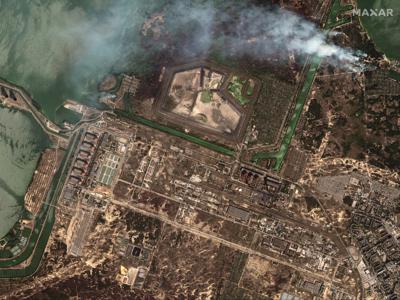
One of a number of aerial photos published after missile strike very near the nuclear power plant, the largest in Europe (Image sourced: Internet)

Is it possible? Fire from the position, move all the weapons and personnel out, then bomb it themselves, repeat the whole operation and repeat again? Hardly.

And such movements would surely show up in intelligence reports of US/NATO but they are not confirming it. In fact, the Russian side showed their satellite photos of the site in which no artillery could be seen and also pointed out that the US had their own satellite images but was saying nothing.

Satellite imagery was published recently showing smoke from artillery strikes on the site and would surely be available to show alleged Russian artillery installations there and, in fact, their firing from there5.

And very clear satellite imagery was readily available and published in the media to support the Ukrainian authorities’ claim that Russian planes in the Saky airbase in the Crimea had been destroyed on 9th August.6
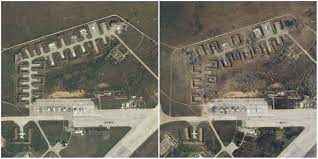
Aerial Photos Crimean Airbase Before & After Ukrainian Missile Strikes Ukraine War August 9 2022

Another inconsistency of the allegation that the Russians are risking a nuclear disaster is in reconciling it with Russian state war aims.

The Russians say they invaded to prevent the Ukrainian state from becoming an outpost of the US/NATO offensive military alliance along their border and b) to protect the largely Russian-speaking population of the Donbas area from attacks by the Ukrainian fascists and military.

The Ukrainian State, backed up by US/NATO and the media7 say that all of it is to do with Russian imperialism and land-grabbing.

In either case, is it likely that the Russians would risk nuclear contamination of the whole area they wish to occupy or to defend? And is it likely that the Luhansk militia, drawn from the people of the area, would permit their homes and family to be put in such a terrible risk?

CONCLUSION:

Having employed critical deductive analysis of the available evidence, the logical conclusion must be that

  • The nuclear facility is being bombed by the Ukrainian military
  • They are bombing it hoping to force the Russian military evacuation out of the area and/or to accuse the Russian military of doing the bombing and to employ it in propaganda against the invading Russian military
  • and to create a sense of environmental danger from the latter
  • in which they are accustomed to expect uncritical cooperation from the mainstream western media and from US/NATO
  • to assist in having states within NATO send them more and more weapons

WHAT SHOULD HAPPEN?

  • Clearly, the Ukrainian military should cease bombarding the nuclear installation immediately
  • and to assist in that, the western media should make clear who is responsible.
  • And the International Atomic Energy Agency should send as neutral a team as possible (including perhaps officials and experts from China, Iran and India) to inspect the site and publish their results8.
  • The USA/ NATO should break their silence on their satellite surveillance and photos of the site.

This process and conclusion will be difficult for a number of key players and for many commentators. The process will expose the Ukrainian military as having been engaged in activity with potential to cause an environmental disaster.

It will expose their political leadership as having lied while trying to blame their opponents. The US/NATO block and their allies will be put in an awkward position for having supported the Ukrainian authorities while they were engaged in that activity.

The whole affair may switch – or at least weaken — wide western public sympathy away from the Ukrainian state. Many people may have to reappraise their positions in part or even completely.

Difficult, yes – but is that any justification for collusion in the possibility of a nuclear disaster?

End.
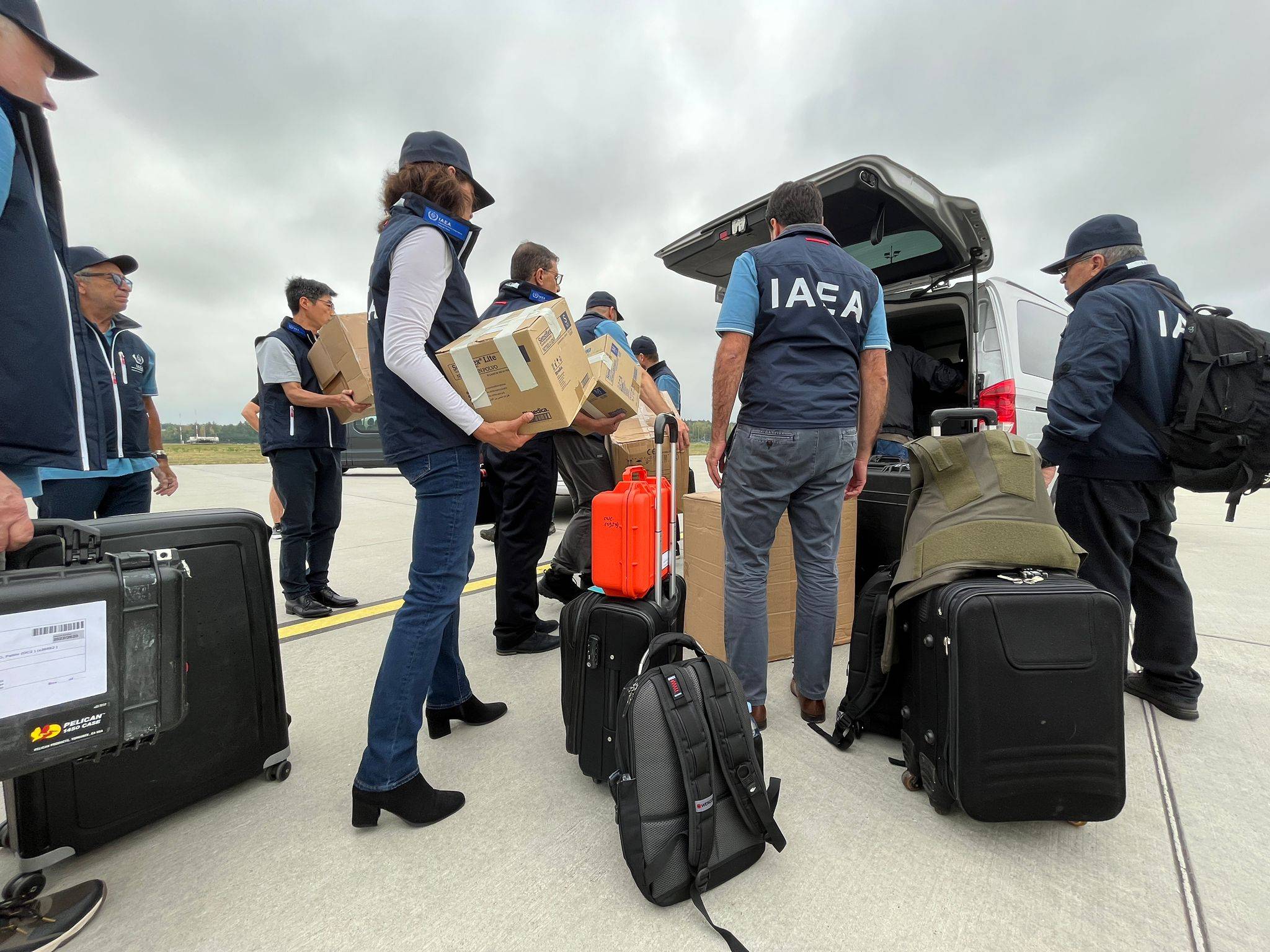
IAEA Mission Setting Out for Nuclear Power Plant Ukraine 29 August 2022 (Source image: IAEA’s website)

FOOTNOTES:

1Although assessments of the likely affected range of the disaster differ strongly (see Sources)

2https://www.rte.ie/news/ukraine/2022/0829/1319298-ukraine-russia/ (emphasis in bold is mine)

3At least in the Western world

4Both sides have been accused of violating those rules but in terms of hard evidence, mostly the Ukrainian military, as was revealed in the recent report of the more usually pro-western Amnesty International.

5See image with https://www.breakingnews.ie/world/russia-and-ukraine-trade-claims-of-nuclear-plant-attacks-1356286.html

6Not only that but before and after the explosion images https://www.theguardian.com/world/2022/aug/11/russian-warplanes-destroyed-in-crimea-saky-airbase-attack-satellite-images-show

7And large sections of Western liberal and Left opinion.

8As I write this I read that a IAEA team has begun their journey there but without information about its composition https://www.iaea.org/newscenter/news/iaea-support-and-assistance-mission-sets-out-to-zaporizhzhya-nuclear-power-plant-in-ukraine

SOURCES:

A recent media report which on this subject is unusually even-handed: https://www.breakingnews.ie/world/russia-and-ukraine-trade-claims-of-nuclear-plant-attacks-1356286.html

Satellite imagery of and report on strikes against Russian airbase in the Crimea: https://www.theguardian.com/world/2022/aug/11/russian-warplanes-destroyed-in-crimea-saky-airbase-attack-satellite-images-show

Extremely biased report on degree of danger of and from nuclear fallout, emphasing the danger to the local area: https://www.politico.eu/article/how-real-is-the-danger-from-ukraines-zaporizhzhia-nuclear-power-plant/

Also biased report but claiming much greater danger: https://www.greenpeace.org/international/press-release/52459/nuclear-hazards-zaporizhzhia-plant-ukraine-military-invasion/

IAIA team departs for inspection of the plant: https://www.iaea.org/newscenter/news/iaea-support-and-assistance-mission-sets-out-to-zaporizhzhya-nuclear-power-plant-in-ukraine
https://www.rte.ie/news/ukraine/2022/0829/1319298-ukraine-russia/

Wikipedia entry on the IAIA: https://en.wikipedia.org/wiki/International_Atomic_Energy_Agency#Criticism

Colombia: Paramilitaries, Businesses and the “Truth”

Text by Gearóid Ó Loingsigh (images and video chosen by Rebel Breeze)

29 July 2022 (first published in English in Socialist Democracy)

The Colombian Truth Commission’s (CEV) report Findings and Recommendations aims to be a text that reveals a truth, that up to now was hidden or partially hidden from Colombian society.

It is true that in Colombia, after decades of a conflict that began before many of those actually alive were born, along with propaganda from the media, the churches and political parties, there are many aspects that are not well known to everyone.

That is not to say that it is a document that reveals or uncovers these truths. If we look at the issue of paramilitaries and how the CEV treats it, various problems with this commission are evident.

It comes out with some truths about the paramilitaries that initially give one hope about the content of the Report.

Paramilitarism is not just an armed actor – understood as private armies with terror strategies aimed at the civilian population – but rather a network of interests and alliances also associated with economic, social and political projects that managed to impose an armed territorial control through terror and violence and also through mechanisms to legitimate it, the establishment of rules and norms.(1)

It is true that the paramilitaries are about more than just massacres, but the CEV not only fails to explain what the interests at stake are, but it gets it back to front about who is in charge and who serves.

It inverts the roles many times and though it acknowledges the role the State played, or still plays, the State is presented almost as just another victim of the paramilitaries.

The CEV accepts that the USA played a role in the 1960s.

The recommendations of US missions that visited the country during the administration of Alberto Lleras Camargo (1958-1962) led to Decree 1381 of 1963, Decree 3398 of 1965 and National Defence Law 48 of 1968, through which the involvement of civilians in the armed conflict was institutionalised.(2)

But it doesn’t explore this role that much further, it would seem as if various north American governments played no further role than that, that they have not been the one constant factor in the history of the conflict, as if their support to all the Colombian governments, the training of the Colombian military in the School of the Americas did not count for anything, and of course there is Plan Colombia which is dealt with by the report.

Neither do they explore the role of the state that passed those laws. It would seem as if the laws appeared through magic. They accept that paramilitaries enjoyed legal status for a long time, but they put no names to the matter, nor who benefitted from those laws or what were the interests of the presidents and congresspeople involved in passing those laws and decrees.

We are told of how Virgilio Barco suspended the legality of the paramilitaries in 1989, but according to the CEV it was revived in practice through the rural security cooperatives known as the Convivir.(3)

It is dubious to say that the Convivir were the paramilitaries in practice and not paramilitaries de jure, as it is not the case that these cooperatives were corrupted.

It was always the intention to legalise the paramilitaries through this figure and in that, President Cesar Gaviria and his Minister for Defence, Rafael Pardo both of whom signed the degree that brought them to life, played an important role as did President Samper who implemented the decree during his government.

These people are not spoken of as promotors of paramilitaries.

To the CEV the paramilitaries are a type of loose cannon, independent of the State, with a life of their own. The ills of the country are the result of the actions of this loose cannon and how it infiltrates the state, the institutions, including the military and how it co-opts spaces.(4)

Thus, the institutionalisation – through various governments – of armed groups legally at the service of private interests, as well as their legitimation from the 1960s show not only the tolerance but also the promotion by state of the outsourcing of public security (bold not in the original). The legal cover and political legitimation have allowed for the maintenance and expansion of the paramilitaries, structures that were co-opted by paramilitary bosses.(5)

To the CEV, the paramilitaries were an outsourcing of security to private bodies that went wrong. Dr. Frankenstein thought he was creating life and his creation turned into a monster despite his wishes.

Paramilitaries are referred to in this manner throughout the document, they exist and act with the approval of named sectors, but the responsibility does not lie with any known person. They are incapable of saying that Samper and Gaviria legalised the paramilitaries.

Samper was fully aware of what the Convivir were and defended them tooth and nail during his government, and lashed out at those who denounced the Convivir as paramilitary structures.

Ernesto Samper, President of Colombia from 1994 to 1998, representing the Liberal Party. Secretary General of the Union of South American Nations (UNASUR) 2014-2017. He defended the Convivir and later pretended the paramilitary terrorism had been done behind his back. (Photo sourced: Internet)

Samper never put an end to the Convivir, rather it was the Constitutional Court that declared that they couldn’t use arms reserved for the State’s military, so the paramilitaries had no need to use this cover any more if they couldn’t obtain arms legally.

The paramilitaries were a state policy as can be seen from the laws and decrees enacted, in the promotions of military officers involved in massacres and also in the persecution of social actors, human rights organisations and in a number of cases the systematic murder of witnesses.

The CEV talks about these things but does not connect them together as a state policy. It shamelessly accepts the excuses of Uribe that everyone lied to him, the face Santos put on of it wasn’t me, or the “it was all done behind my back” of Samper.

A real truth commission would try to tell us not only what happened but who did it (with full names) and also why.

The same complacent attitude it takes with the State is extended to the business people. It talks of interests but does not put a name to them. But thanks to the decades long work of social organisations we can put a name to many of the cases.

The CEV doesn’t do that and goes on with its tale of some sectors. But these same sectors have been more honest than the CEV. The CEV names the cattle rancher’s association in Puerto Boyacá, Acdegam, as a key player in the founding of the paramilitary groups.(6)

But it does not mention the role played by Texaco. Carlos Medina Gallego in his book Autodefensas, Paramilitares y Narcotráfico in Colombia describes the birth of this group.

The USA-based petroleum company was present in the meeting that set up the paramilitary murder group. (Image sourced: Internet)

The process in the region began with the creation of a private army or paramilitary group alongside the army to jointly combat the subversives.

This group was set up during the military mayorship of Captain Oscar Echandía, in a meeting which, in addition to the Mayor, was attended by representatives of the Texas Petroleum Company, members of the Cattle Ranchers Committee, political leaders, the Civil Defence, members of the armed forces and other special guests.(7)

Neither does it mention the National Federation of Cattle Ranchers, Fedegan. The president of Fedegan, however did acknowledge the role they played. In 2006, in an interview given to Cambio magazine, he said that they had paid paramilitaries, as had others such as flower and rice growers amongst others.(8)

National Federation of Cattle Ranchers in Colombia — part of the group that set up the paramilitary murder group — their president admitted in 2006 that they had paid paramilitaries, as had some large agricultural interests. (Image sourced: Internet)

Around the same time, 10,000 cattle ranchers, traders and industrialists signed a letter acknowledging and justifying their financing of the paramilitaries.(9)

The CEV describes paramilitarism as something unstable and changeable in nature and that “it has had diverse actors, motives and modus operandi, which leads to difficulties when it comes to trying to come up with a static definition.”(10)

Yes, it is true that the paramilitaries have changed over time, as has the army, the state, the political parties, the guerrillas and even society. Nothing stands still, but that doesn’t mean we can’t come up with an approximation of what it is, taking into account the variables.

That is what the study of history, politics and also any branch of knowledge is about. So, the CEV doesn’t describe the paramilitaries as a state policy, not because it is a changing phenomenon, but rather because it doesn’t want to.

It deals with various paramilitary forms and leaves out one very clear telling example: the AAA (American Anti-Communist Alliance).

One of the founders of the Triple A (American Anti-communist Alliance) paramilitary terrorists, at the time Lt-Col. Harold Bedoya of the Charry Solano Battalion, later Commander of the Colombian Armed Forces. (Photo sourced: Internet)

The AAA was a paramilitary structure founded by the commanders of the Charry Solano Battalion, amongst them Lieutenant Colonel Harold Bedoya, who would later become the Commander of the armed forces.

The existence of such a paramilitary structure operating within the battalion was public knowledge as five soldiers reported it to the presidency, the Procurator, the Organisation of American States and the news was even published in the Mexican press. This structure is not mentioned in the CEV report.

Another paramilitary structure that is dealt with partially in the Report is the 07 Naval Intelligence Network. However, it does not delve into the reality of the Network and the significance of its activity as a state policy.

2017 video

The case of the 07 Naval Intelligence Network based in Barrancabermeja that operated in part of Bolívar and Cesar stands out due to the seriousness of it. According to the ordinary criminal justice system, the network functioned as a powerful “death squad” with logistical means, personnel trained to kill and was responsible for dozens of murders, forced disappearances and massacres whose victims were mainly trade unionists, politicians, community leaders and activists.  The network financed paramilitaries using secret funds.(11)

But the network was the paramilitary structure par excellence. Despite the CEV’s quote, they do not go into great detail as the issue cannot be dealt with and conclude that it was just some functionaries and not the military unit as such.

The Network murdered at least 68 people, though some estimates put the figure of 430. The soldiers implicated were exonerated by the commander in chief of the official armed forces of the state, General Fernando Tapias. To the CEV this is just another case of rotten apples.

But, can 60 years of violence be explained as the result of the actions of some soldiers, some politicians, some business people? We are talking about tens of thousands of dead, tortured, disappeared and the outcome follows from the actions of some… and not from a state policy?

the paramilitary phenomenon has maintained a role in components of the state such as the armed forces, security and intelligence agencies, collegiate state bodies (Congress, assemblies and councils), judicial institutions and oversight bodies, as well as economic sectors such agri-industrial, extractive industries, public servants and candidates in elections. It has also permeated sectors of the church and the media. Without the close link between this body of sectors and the armed paramilitaries, this phenomenon would not have unleashed the deep wounds that it inflicted nor would it have lasted as long.(12)

Colombian paramilitaries working with the army and paid by big growers, these in “the Banana Bloc” in Colombia (Photo: Huffington Post)

There are no policies here, no state-backed dirty war but rather a compendium of massacres carried out by blood thirsty types that co-opted everyone else, i.e. Colombia is an open-air lunatic asylum.

Politicians and functionaries were another sector that was widely implicated in the paramilitary plan to “penetrate all political power: mayors, councillors, deputies, governors, congress people from the zones that we managed […] ultimately, regional powers that together guaranteed a national power for the self defence groups”. The relationship between politics and paramilitaries went in both directions as many politicians and functionaries in turn sought out the commanders of the paramilitary groups to benefit from their armed power.(13)

In this repugnant discourse, the paramilitaries are the ones who penetrate the state and some politicians seek them out, the paramilitaries are not a counter-insurgency strategy of the state nor a policy to implement “development” projects they want, but rather the excuse is “the paramilitaries made us do it”.

It comes across like crying children trying to blame the other for breaking the window, but they are not broken windows, rather tens of thousands of broken bodies. And the CEV does not want to blame who it should. It accepts that the State played a role, but limits it to individual behaviour and private interests but not part of a strategy.

Not even the genocide committed against the Patriotic Union (UP) is seen as a state policy, once again the State is a victim of the paramilitaries. The CEV describes it in the following terms.

It was during the attempts at a democratic aperture and the peace policies of the government of Belisario Betancur (1982-1986). It is in this context the paramilitary network from Puerto Boyacá sought to contain the democratic and peace initiatives through systematic violence (persecution, extermination and displacement) against members of left wing political groups such as the Patriotic Union and the Communist Party, trade unionists and social leaders.(14)

The reality is that no one expected the UP to be successful and the oligarchy took fright and responded as it always does: with violence. The extermination of the UP was not an attempt to contain supposed democratic measures from President Betancur, but rather an attempt to suppress a left-wing political group.

The CEV forgets that Betancur allowed the military to attack and burn the Palace of Justice in 1985, which was only a few metres from the Presidential Palace. He was not a just man whose peace initiatives were undermined by the unjust.

Lastly, we should look at how they describe the business people.

The economic agents were a key part of the paramilitary web. Some national and international business people, local and regional economic powers and productive sectors supported them in different ways because they had interests in the war.(15)

We shouldn’t be surprised that the CEV, led by the favourite child of the bourgeoisie reaches such conclusions. De Roux wrote an executive summary of the report before he even formally took up the job of President of the CEV.

In March 2017, shortly before he began working for the CEV he wrote a column in the El Tiempo newspaper with a simple headline I ask for forgiveness.(16) The column makes various assertions, amongst which the following stand out:

I incur in a generalisation when I write that the paramilitaries were financed by businesspeople. When, in truth, some paramilitary groups were financed by businesses, whilst the majority of women and men to whom we owe the production of goods and services in this country did not finance the paramilitaries.(17)

That is to say, as the CEV report does, that it was only some of them.  He continues with another assertion that some of them did it as a response to guerrilla violence, repeating one of the great lies of the business associations and the State about the nature of paramilitarism.

Gustavo Petro, newly-elected President of Colombia (R) shaking hands with Francisco de Roux (L), who outlined the executive summary of the Truth Commission’s Report in his column before the latter was even published. (Image sourced: Internet)

Others out of rage, following the kidnapping and payment of the ransom, supported the AUC to attack the kidnappers. Others did so because they didn’t trust the state’s security forces.(18)

And lastly, this little gem which reduces the dirty war to the behaviour of just some.

I must also acknowledge that I have been unfair when I have generalised about soldiers and police officers in Colombia. I admit that I have an intellectual and emotive abhorrence of weapons on all sides. I am a follower of Jesus who once and for all separated God from all wars and preached efficient non-violence. But I know there have been many and increasing numbers of men and women in the Armed Forces who see service to the homeland as a service to the dignity and rights of every human being and the collective good of peace.(19)

A question arises. Given that De Roux through his column outlined an executive summary of the future report of the CEV, why did he not save us time, money and the effort by writing, on his own, a report 100% to his liking? It would have had the advantage of not selling false hopes to the victims of the conflict.

End.

Notes

(1) CEV (2022) Hallazgos y Propuestas. CEV p.296

(2) Ibíd., p.303

(3) Ibíd., pp 304 y 305

(4) Ibíd., p.299

(5) Ibíd., p.305

(6) Ibíd., p.310

(7) Medina Gallego, C. (1990) Autodefensas, Paramilitares y Narcotráfico en Colombia. Editorial Documentos Periodisticos. Bogotá p.173

(8) El Cambio No 704 diciembre 2006/enero 2007 Diez Preguntas (Entrevista con José Félix Lafaurie) p.48

(9) El Espectador (17/12/2006) La hora de los ganaderos, p. 2A

(10) CEV (2022) Op. Cit. P.296

(11) Ibíd., p.502

(12) Ibíd., p.299

(13) Ibíd., pp. 345 & 346

(14) Ibíd., p.310

(15) Ibíd., p. 350

(16) Francisco de Roux (01/03/2017) Pido perdón https://www.eltiempo.com/archivo/documento/CMS-16832051

(17) Ibíd.,

(18) Ibíd.,

(19) Ibíd.,

THE COLONIES STRIKE BACK – IN FILM

Diarmuid Breatnach

(Reading time: 5 mins.)

The colonies have been striking back at the Empire in film for some time and why not? Sure the Empire’s been colonising them all over again for decades, also through film.

But for a long time the liberal anti-colonial script-writers couldn’t bring themselves to make the main heroes of the film the indigenous colonised in Africa, America, Asia or Oceania – or else the finance backers doubted they’d recover their investment.

So the situation of the colonised had to be seen through the eyes of a liberal hero of European background or ancestry1 — someone with which, as they thought the the white European audience could identify2.

Stories figuring the Europeans colonised by England, i.e the Irish and the Scots, many who were in turn used by the Empire to colonise the lands of others — gets the film-makers over that difficulty.

Script-writers and casting directors in that ex-colony-now-superpower have been getting back at the English for years, of course, in historical drama3 but also portraying their villains with English accents4. Posh accents at first and then regional and London-Cockney5.

But rarely against the Irish, being often heroes in US films, providing they are Irish-Americans, which is to say Irish UStaters.

Two productions I’ve watched recently had as heroes people exported by the Empire from their own conquered homelands to other conquered colonies, in each case forming alliances with indigenous people.

Billy (Baykali Ganambarr) and Clare (Aisling Franciosi) in a scene from the Nightingale film (Image sourced: Internet)

Both productions have also given coverage to native languages of the indigenous people and, in one of them, also to a fair bit of the Irish language, spoken and sung.

THE NIGHTINGALE IN TASMANIA

The Nightingale (2018) is set in the British colony of Tasmania in 1825. In that period, which is not the main story, the Black War took place, in which an estimated 600-900 indigenous Tasmanians were killed, nearly wiping out their entire population. The killers were British colonial armed forces and settlers.

Political or social prisoners in the UK6 of the period were often transported to serve their time in penal colonies where, if they survived, they could be freed upon completion of their sentences or even earlier by agreement but to return was impossible unless they could purchase passage home.

Clare — “The Nightingale”, so nicknamed for her singing voice — is one such social prisoner, an Irish woman convicted of stealing and transported to Van Diemen’s land to serve her time.

She is part of the household staff of a British officer stationed there but is permitted to marry a free Irishman, Aidan; they live together in a hut and have a child together. The officer desires Clare and acts violently upon that desire, giving rise to a chain of tragic events.

Clare sets out to track the officer down and wreak revenge upon him but, needing a tracker-guide, employs an indigenous Tasmanian for that purpose. The story then is not only about her journey but about the uneasy relationship between these two victims of colonialism and occasional glimpses of other aspects of colonial rule, particularly in Tasmania.

IRISH, SCOTS AND INDIGENOUS

Frontier (2016) was originally a series for Television and, like The Nightingale, found a home later on Netflix. It features Irish and Scots heroes against the British Authorities and military.

It is set in British Canada in a historical struggle for control of the fur trade between the Hudson Bay Trading Company, a monopoly jealously protected by the UK, and a consortium of trappers striving for independence in trade.

Tavern owner Kate Emberly (Zoe Boyle) being meneaced by Captain Chesterfield (Evan Jonikeit) in the Frontier series (Image sourced: Internet)

The indigenous people are represented too, with a female warrior and communities, speaking Cree and a number of other Indigenous languages, including Inuit, with subtitles providing a translation.

The main hero is Declan Harp (now there’s names with an Irish connection!) who is half-Cree and half-Irish; after his parents were killed, he is adopted by Benton, the British administrator of the area but Harp later grows to hate Benton, who had his wife and child murdered.

A lesser male hero and ally is Michael, totally Irish but with a shaky moral compass. The main female heroes are a Cree warrior/ hunter and a Scottish woman, owner-manager of a tavern.

A female sort of anti-hero is a wealthy English woman of aristocratic type and there’s an Irish woman of humble background, being schooled to be “a lady”. There are a number of male Scottish anti-heroes too and there’s a Metis (of mixed Indigenous and French [or Breton or Basque?] parentage) helper, trapper and guide.

The Frontier has a couple of villains of US-origin but that’s allowed, this is Canada after all, its domination taken over by the USA from England. Otherwise nearly all the bad characters, the “black hats”, are English and so too with The Nightingale.

The British soldiers in both stories have regional English accents but so do some of their lower-ranking officers. Most of them are brutal and drunkards, some also murderers and rapists. Anti-English propaganda? No doubt but from what we know of history and even of more contemporary colonialism, very likely true enough.

Reviews have praised Jason Momoa’s portrayal of Declan Harp in The Frontier and certainly his physical size and appearance (long tangled locks, one eye clouded, looking out under lowered eyebrows) does focus one’s attention.

Jason Momoa as Declan Harp and Jessica Matten as Sokanon in a scene from the Frontier series (Image sourced: Internet)

Personally I found the number of times he survives torture, serious beatings and wounds straining credulity and, in a way, tending towards boring, as though the Director or screenplay writer thought: Let’s get Declan to have another massive bloody fight here, we haven’t had one of those in a couple of episodes now.

However, even with at times difficult-to-believe plot turns, there are some excellent performances, chiefly perhaps and not surprisingly Alun Armstrong as Lord Benton and Shawn Doyle as the ruthless smoothly urbane but underneath volcanic Samuel Grant

Greg Bryk as Grant’s smooth and sinister manservant-lover Cobbs Pond puts in effective performances too. Evan Jonigkeit as Captain Chesterfield, is also good, particularly in his anguished frustrated desire for the tavern owner Grace Emberly (Zoe Boyle), and his burning desire to rise above his social station.

Jessica Matten is believable as the Cree warrior-hunter Sokanon, despite her gender being unlikely in that role, but her frowning expression grows repetitious after a while.

Katie McGrath played the plotting and provocative English aristocrat Mrs. Carruthers well in her unfortunately short run as a character (but Wardrobe and Sequence, would she wear the same lace-sleeved undergarment so many day in a row?).

Katie McGrath as Lady Carruthers in Frontier. (Image sourced: Internet)

The female who develops something of a penchant for killing violent dominating males and disposing of their bodies is an interesting character creation though her appearances in that role are few.

When Declan Harp commandeers a ship to take him and McTaggart (Jamie Sives) to Scotland to rescue Grace and avenge himself on Lord Benton, we are introduced to a Portuguese ship captain and a Polynesian mariner, the latter also singing and praying in his native language.

In Scotland, Harp recruits local toughs to attack the English Castle Benton where Lord Benton has taken residence and they kill many redcoats.

STEREO OR TRUE-TYPES

The main characters in The Nightingale are of course the vengeful woman Clare (Aisling Franciosi), her aboriginal guide and companion ‘Billy’ (Baykali Ganambarr), along with the British Lieutenant Hawkins (Sam Claffin) and Sergeant Ruse (Damon Herriman) she pursues.

All are believable characters with strong performances by the actors. England is an evil bastard in this story, represented by the officer Hawkins and sergeant Ruse but some decent English individuals make their appearance on occasion too.

The dialogue is mostly English but the Tasmanian language spoken and sung in the film is Palawa Kani. Some Irish is spoken between Aidan and Clare, the latter singing mainly English folk songs but to her child sings the Irish language lyrics of Cailín Álainn to the Scottish air of the Mingalay Boat Song7.

Speaking their own language makes the subjects their own people; speaking English, usually badly or with heavy un-English accents, though making them more intelligible to English fluents also presents them to the English-speaker as lesser-English, lesser-UStater, lesser-Canadian — in total: lesser human.

End.

FOOTNOTES

1 For example the plight of the Cheyenne in 1864 was represented in Soldier Blue through the eyes of the European woman Cresta Lee (Candice Bergin); it’s the liberal newspaper editor Donald Woods (Kevin Kline) who we accompany as we follow the story of the hero Biko in Cry Freedom, murdered by the South African white minority regime. Even in the British colony in Ireland, where the natives are white, the heroes may be English (Brian Cox playing an honest English cop in Hidden Agenda, Emma Thompson as the lawyer in Name of the Father).

2 When the promoters and financiers finally realised that a large part of their paying audiences were not in fact white European is when one started to see heroes of other backgrounds and ‘blacksploitation’ films.

3 Mel Gibson’s The Patriot and Bravehart, for example but going much further back, Disney’s The Fighting Prince of Donegal (1966).

4 For examples Grand Moff Tarkin in original Starwars trilogy (1977-1983), Steven Berkoff in Beverly Hills Cop (1994), Scar in The Lion King (1994), arguably Anthony Hopkins [though Welsh and playing a Lithuanian] in Silence of the Lambs (1991), Sher Khan in The Jungle Book (1996) and sequel.

5 Tim Roth in Pulp Fiction (1994).

6 Not just the British – the French had their penal colonies abroad, for example in Guyana and the Spanish state sent prisoners to Ceuta, in North Africa even in modern times.

7 An anachronism, since the composer of the Irish lyrics of An Cailín Álainn is Tomás ‘Jimmy’ Mac Eoin from An Bóthar Buí in An Cheathrú Rua, Conamara, Galway, Ireland – and he was only born in 1937. The lyrics of the Mingalay Boat Song are also apparently sung to a much older air and one supposes the original lyrics would have been in Gaedhlig.

SOURCES

https://en.wikipedia.org/wiki/The_Nightingale_(2018_film)

https://en.wikipedia.org/wiki/Frontier_(2016_TV_series)

TURKEY’S PAYOFF FROM NATO LOOKS BAD FOR ROJAVA

Diarmuid Breatnach

(Reading time: 8 mins.)

Against the bigger war going on in the Ukraine, a smaller one hotting up has been getting little attention. Turkey started shelling a region in Syria which the inhabitants call Rojava and killed some of those inhabitants, including military leaders, who have had mass funeral protests.

Salwa Yusuk, a deputy commander of the US-backed Syrian Democratic Forces, was killed in a Turkish drone attack in Syria on Friday. Also killed in the same vehicle were Joana Hisso, 30, also known as Roj Khabur, and Ruha Bashar, 19, also known as Barin Botan. (Image sourced: Internet)

The Kurds’ representatives were blaming the USA and Russia but most of all the former, saying it’s part of a deal for Turkey to lift its objections to Sweden and Finland for membership of Nato.

The official quid pro quo was for those countries to repress their Kurdish diaspora and to remain silent on repression in Turkey. But it seems an unofficial part of the deal was to let Turkey set its military loose on Rojava, the inhabitants of which are now living in fear of a full Turkish invasion.

Far indeed do the consequences of the war in the Ukraine reach around the world – Rojava is over 2,000 km from the Donbas region (and they will reach much further than this before it’s over)!

The Kurdish-led Rojava sector fought ISIS from 2014 to March 2019, at first without any external help and later assisted by NATO bombing runs.

The USA’s earlier policy had been to boost Islamic jihadism as a counter to left-wing nationalism and Russian influence (for example in Afghanistan) – until jihadism threatened western interests also. Then it waged war to eradicate it and, in the course of that, supported the Kurds in Rojava.

But US/NATO wants a solid block facing (not to say encircling) Russia – so now previous bets are off and the Rojava region can be thrown to the wolves – or to Turkey; first by Trump to screams of outrage from US Democrats but now by Biden, to probable silence.

BACKGROUND

But why does the Turkish military want to shell Syria? Why specifically shelling the Rojava region? If you know, you know but if you don’t, a little background might help.

The Kurds are the largest ethnic minority in Turkey, comprising around 18% of Turkey’s population; the largest concentration (2 million) of which lives in Istanbul. The majority of Kurds are Sunni Muslim, with Alevi Shi’a Muslim, Christian, Jewish, and Yezidi communities.

Together with Kurdish populations in Iraq, Syria, Iran and Armenia (all “Kurdistan”) the Kurds number between 25 and 35 million in the Middle East (with a very large diaspora in Europe, the USA and other areas).

The area occupied by Kurds in the Middle East is of huge strategic and resources importance and none of the major states in the area have agreed to their having a state.

After World War One and the defeat of the Ottoman Empire, the victorious Western allies made provision for a Kurdish state in the 1920 Treaty of Sevres.

However the new leader of Turkey, Kemal Attaturk, the “father of modern Turkey” rejected a reduction in the size of the state and the subsequent imperialist Treaty of Lausanne set the boundaries of modern Turkey without any reference to the Kurds (“mountain Turks”, according to Attaturk).

Also in 1920, the Royal Air Force of the UK bombed the Kurds with chemical weapons and machine-gunned them during the Iraqi (then Mesopotamia) uprising,

In 1946 the USSR supported a Kurdish state in a part of what is Iran today but in the face of the western powers’ opposition and support for the state of Persia’s (then a client state of the West) claim to the territory, the USSR withdrew its support and the Kurdish state was suppressed.

Every attempt to set up a Kurdish state since then has been violently suppressed and, in Turkey, even an autonomous Kurdish region was beyond contemplation by the authorities, who suppress even Kurdish language and music.

THE KURDS IN SYRIA

In 2013 an uprising began against the Assad regime which, though it had some popular elements quickly became dominated by Jihadists and NATO proxies. The Syrian part of the Kurdish liberation movement saw an advantage for itself here and set up its own liberated areas.

Also in 2013 the fundamentalist islamist group ISIS burst on to the scene and, taking advantage of the Assad regime’s beleaguered situation, attacked large areas of Syria, to overthrow the regime but also to subjugate all peoples in the region, including the Kurds and Arabs of any kind.

The Kurds of Rojava fought to protect their areas from ISIS but also carried out a heroic rescue action to save Yazidis, opening and defending a corridor for Yazidi refugees to reach safety in the Kurdish liberated area where they built a cross-community alliance with Yazidis, Turkmen and Arabs, in which they state that all its citizens have equal rights.

Whether this is as true as they (and as their supporters in parts of the European Left) say or not, certainly women have a formally equal status and women are elected – and also appointed — to positions of high administrative and military responsibility.

Demonstrators in Stockholm against the NATO deal with Turkey and in solidarity with the Kurds (whose flags are also visible (Image sourced: Internet)

The Turkish regime has been at war with the Kurds within the state’s territory led by the PKK since 1974 and viewed the setting up of an independent republic under Kurdish leadership across the border in Syria with great alarm.

In 2014 Turkey began attacking support and supply lines from Kurds in Turkey to Rojava, which caused outrage among the extended Kurdish diaspora and other opponents of ISIS in the West.

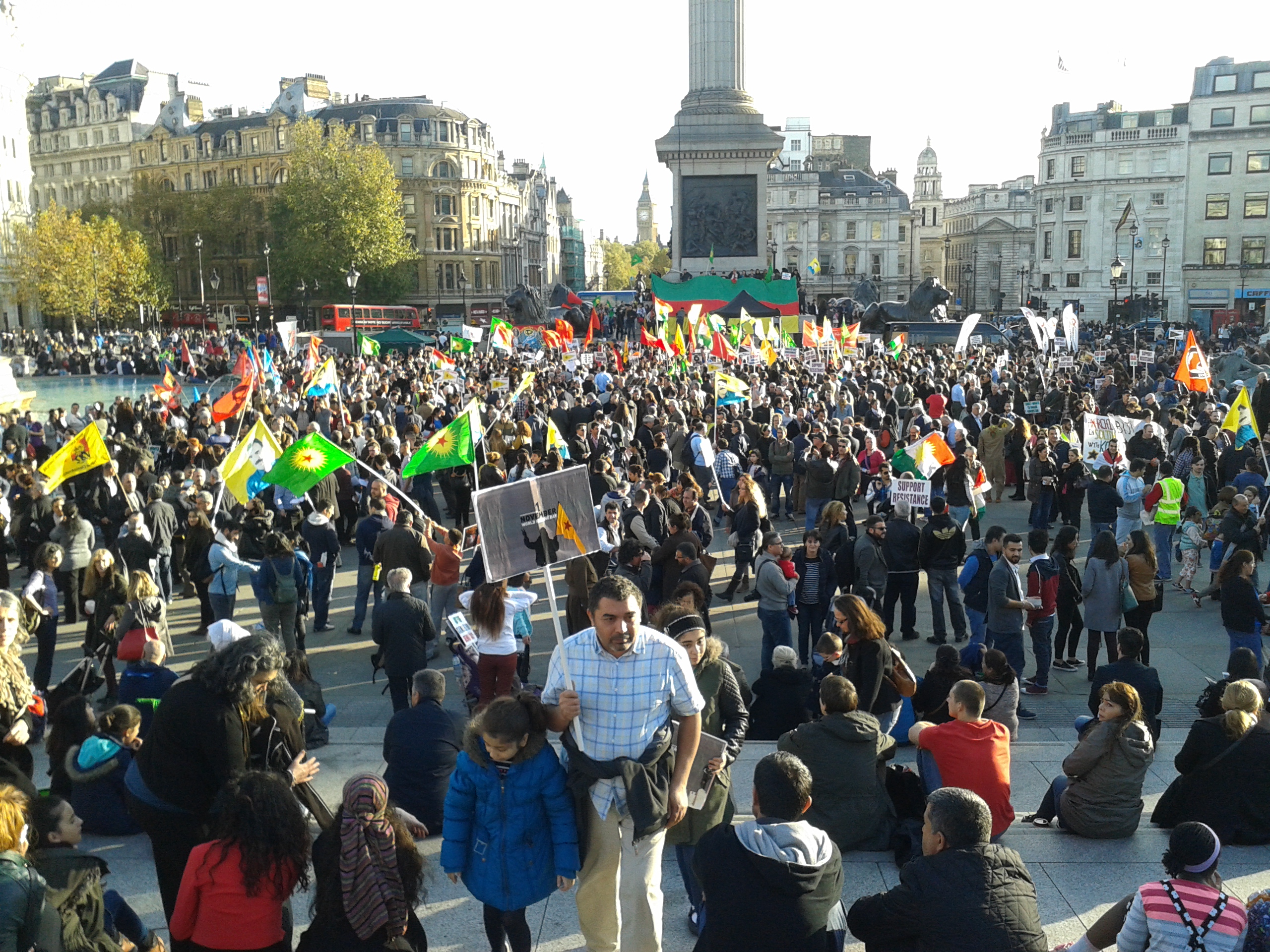
London rally November 2014 in solidarity with Kurds in Syria and condemning Turkish attacks. (Photo: D.Breatnach)

And in fact, although Turkey is an important member of NATO, Turkish military attacked the enclave a number of times, both directly and through the use of muslim fundamentalist jihadists.

Nevertheless, NATO’s concentration on wiping out the ISIS threat in the area had to have a restraining effect on Turkey. And then there was Russia too, also supplying air cover — but to the Syrian regime.

MY ENEMY’S ENEMY IS ….” — an understandable but dangerous philosophy

At first in 2013 it seemed that the Kurds around Rojava were merely taking advantage of the Syrian regime’s trouble to go for establishing their own republic, in addition to fighting the dire threat of ISIS.

In the latter struggle, they would of course gladly accept NATO bombing of ISIS and liaise with NATO commanders on where ISIS forces were gathering – for the Kurd’s own safety and for destruction of a dangerous enemy.

However some years ago an interview with the Kurdish commander of the Rojava military forces was published in which he said that the intentions of the Rojava military went further and involved overthrowing the Assad regime, an objective that they shared with NATO.

At a meeting organised by socialist Irish Republicans about five years ago, while expressing admiration for the Kurd’s struggle for self-determination in general and specifically against ISIS, I questioned from the audience a Kurdish speaker from London.

When I commented on what seemed a clear alliance with western imperialism and in particular the USA, the biggest imperialist power in the world, the speaker replied that they were merely accepting necessary aid for their defence against ISIS.

But when I pointed him towards the Kurdish military commander’s interview on the regime change objectives of his forces and of NATO, all he had to say was that I should visit Rojava.

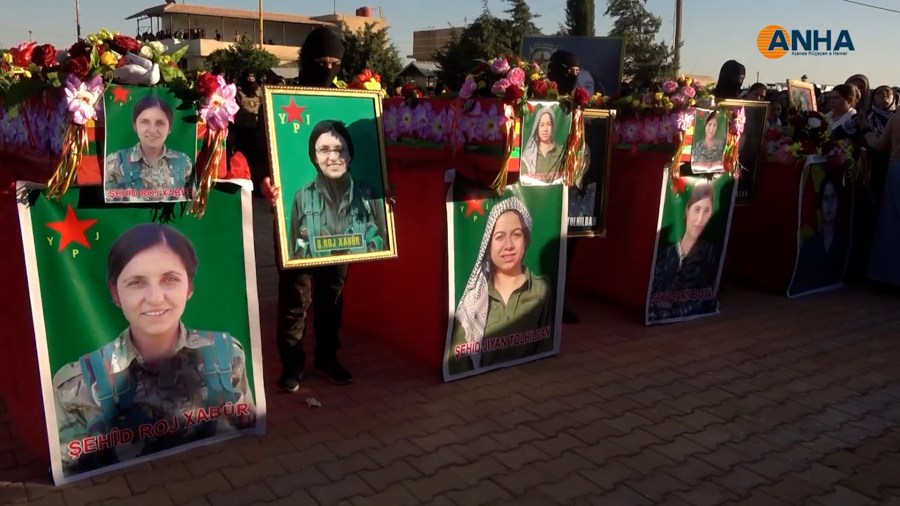
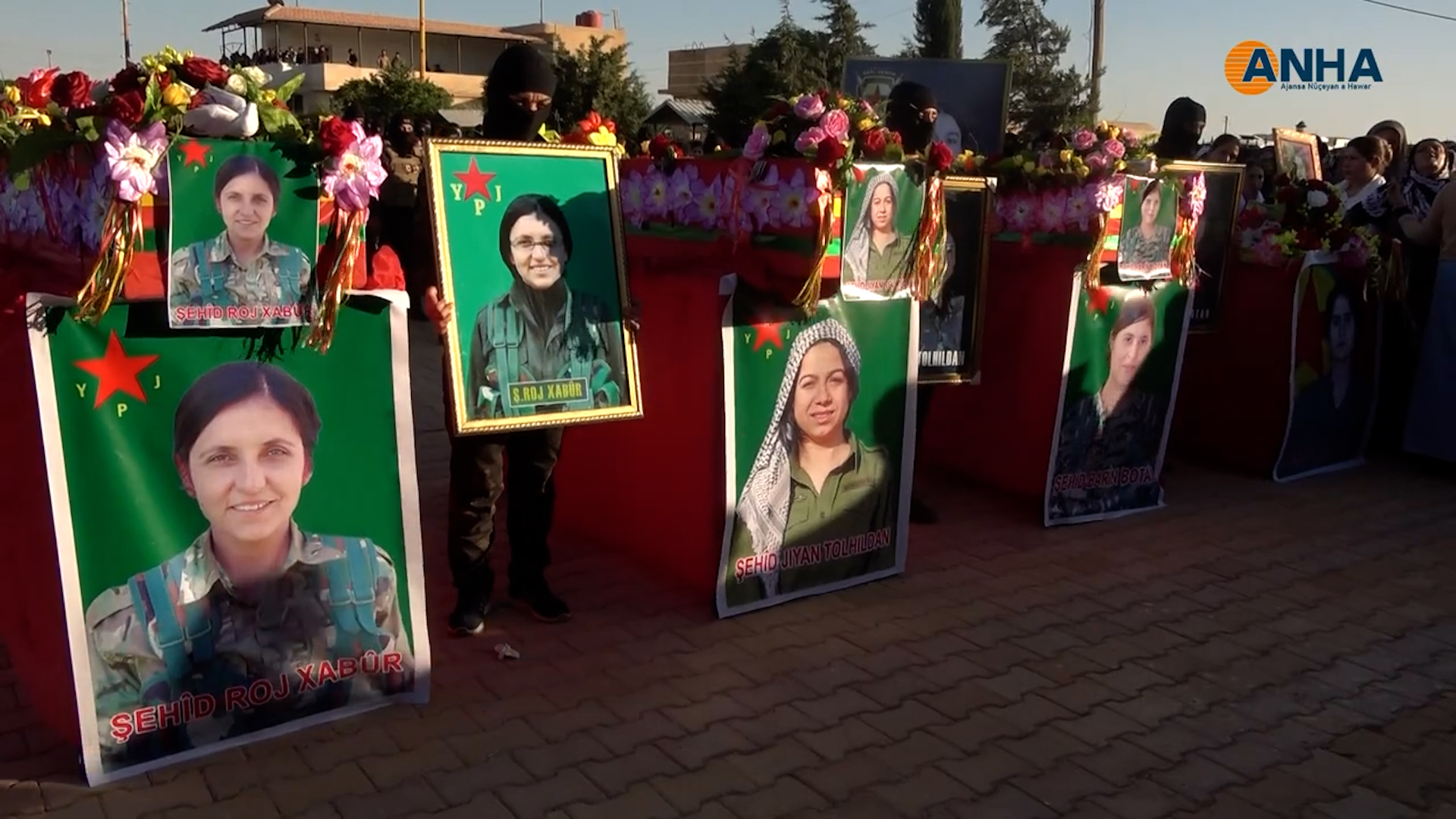
Mass funerals (despite fear of further Turkish drone strikes) of three fighters of the Women’s Protection Unit (YPJ) killed recently (Image sourced: ANHA)

CONCLUSION

This situation and its history once again highlights the dangers of revolutionaries doing any deal with imperialism, most of all one where the long-term survival of one’s people depends on the continued support of an imperialist power.

It also raises the question of whether it is justifiable or at least wise in the longer term to use a major world power’s assistance in order to remove a smaller power.

The main Kurdish liberation movement of the PKK fought a heroic struggle for decades, in particular against the ferocious Turkish regime, with many martyrs and political prisoners.

One of its weaknesses was the almost deification of their leader Oçalan and the way his attempted embracing of the proposed “peace process” undermined the movement, as similar processes have done wherever they have been introduced.

Of course, as with the Spanish state, another fascist but supposedly democratic regime, the Turkish regime is not interested in any “peace process”, a slow sapping of the resistance movement. For its ruling elite, crudely crushing the resistance with brute force is the only way .

The Kurdish movement in Syria was seen as a spinoff from the PKK which supported it in its struggle against the Syrian regime but in particular in its heroic struggle against the Islamic State/ ISIS/ Deish.

However the Turkish state would view any independent Kurdish area, let alone one in nearby Syria as encouragement to Kurds within its territory. The ISIS movement threatened some Western interests and so NATO went to war with it, the Syrian Kurds linked themselves with NATO not only to defeat ISIS but also to overthrow the Assad regime.

US-led NATO wanted to overthrow the Assad regime but as part of its Middle Eastern encirclement of Russia (which is why Russia came to the aid of Assad against ISIS). Iraq and Libya had fallen already and, after Syria, Iran would be next on the list.

Thousands of people joined a demonstration in Tel Rifaat town of the Shehba Canton on Sunday 10th Nov 2019 in protest at the Turkish state’s invasion and genocidal practices in northern Syria. 40% of the population of Efrin (Afrin) having to survive in a semi no-man’s land, defended by the multi-ethnic SDF of AANES, after expulsion by the Turkish invasion, plantation and Turkification of their homes and properties.

But as the ISIS threat and the likelihood of deposing Assad faded, NATO support for the Rojava fighters declined. In October 2019 the SDF had to conclude an agreement with the Syrian regime to have it move into their area to end five days of attacks by Turkey.

When their protection from Turkey could be dropped in exchange for a US/NATO advantage in Eastern Europe, nothing stood against a Turkish all-out attack on Rojava. Nothing, that is, except the Russian airforce.

If Turkey is to attack Rojava with ground troops it will need to use air cover both in manned and unmanned vehicles, which would require Russia not policing the no-fly zone in Syria near the Turkish border.

In February 2021, a Russia-brokered agreement between the SDF and the Syrian regime to lift the SDF’s siege of regime-held towns showed strains. But last month, at a summit in Tehran between leaders of Iran, Russia and Turkey, the other two warned the latter not to attack the Kurds in Syria.

However, despite Turkey’s NATO membership, Russia does get along with the state’s rulers from time to time and the recent discussions between the ruling elites of Russia and Ukraine on unblocking the flow of grain and fertiliser out of the war zone were held in Turkey.

The Syrian regime does not want an autonomous area within the territory of its state and Russia’s leaders will be anxious to keep on good terms with its ally – but it will also wish to wean Turkey away from NATO.

The Rojava enclave, though never as wonderful as it was proclaimed to be from a socialist point of view, is nevertheless an interesting experiment in federalism and multi-ethnic administration.

It will be sad if Rojava falls to Turkish aggression and a mean repayment for their heroic struggle to rescue the Yazidis and to hold off the advance of ISIS which cost them 10,000 dead fighters. It may also be yet another disastrous byproduct of the proxy war NATO is waging in the Ukraine.

End.

SOURCES & FURTHER READING:

Turkish military attacks on Rojava: https://thefreeonline.com/2022/07/12/mass-funerals-as-terrorist-turkey-shells-towns-and-refugees-before-new-rojava-invasion/
https://thefreeonline.com/2022/07/23/sdf-says-two-of-its-female-commanders-one-fighter-were-murdered-in-turkish-drone-strike-video/

NATO dumps the Kurds: https://www.lemonde.fr/en/international/article/2022/06/28/nato-says-turkey-has-agreed-to-support-finland-and-sweden-joining-alliance_5988282_4.html

Trump dumps the Syrian Kurds: https://progressive.org/latest/foreign-correspondent-trump-kurds-empire-crumbles-erlich-101918/

Russia blocks Turkey’s plans to attack Rojava: https://www.irishtimes.com/world/middle-east/2022/07/20/iran-and-russia-warn-turkey-against-military-offensive-against-syrian-kurdish-forces-in-syria/
https://thefreeonline.com/2022/07/26/turkish-invasion-cancelled-did-putin-just-save-rojava/

Syrian Democratic Forces, the Kurdish-led Rojava alliance: https://en.wikipedia.org/wiki/Syrian_Democratic_Forces

Long history Turkish State conflict with Kurds: https://www.cfr.org/global-conflict-tracker/conflict/conflict-between-turkey-and-armed-kurdish-groups

A modern history of the Kurds: https://www.bbc.com/news/world-middle-east-29702440

ÓRÁID — CATHAL BRUGHA — ORATION

Tá Rebel Breeze fíor-bhuíoch do Kerron Ó Luain as cead foillsithe a óráid ag comóradh scaoileadh marfach an tSaor Stát le Chathal Brugha a thabhairt dúinn. Rebel Breeze is most grateful to Kerron Ó Luain for permission to publish his oration on the occasion of the fatal shooting by the Free State of Cathal Brugha.

(Reading time: 11 mins.)

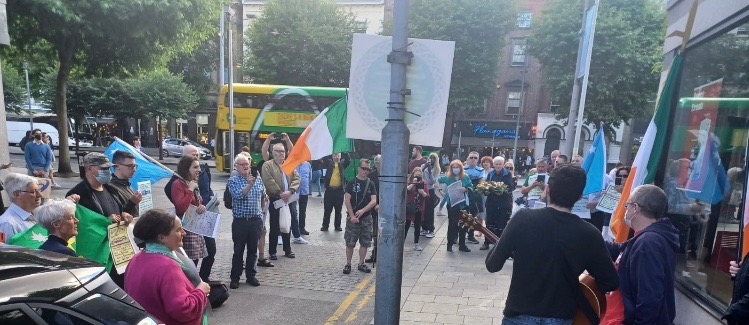
Óráid a tugadh ag Comóradh Chathail Uí Bhrugha, 7ú Iúil 2022, Baile Átha Cliath

Oration given at a Commemoration for Cathal Brugha, 7 July 2022, Dublin

Buíochas leis an gcoiste as an gcuireadh a thabhairt dom labhairt ag an ócáid stairiúil seo. Tá tábhacht ar leith go líonfar an bhearna maidir le stair an Chogaidh Chathartha, óir tá an stát tar éis na maidí a ligeadh le sruth.

Ba mhaith liom an chaint ghairid seo a thabhairt in ómós do Mhícheál Ó Doibhilin, an staraí a bhásaigh an tseachtain seo.

Rinne Mícheál neart oibre ar leithéidí Anne Devlin agus d’fhoilsigh sé neart saothair tríd Kilmainham Tales, a thug léargas ar ghnéithe den stair poblachtach a ligeadh i ndearmad.

Le linn 2016, agus comóradh céad bhliain ar Éirí Amach 1916 faoi lán seoil tháinig sé chuig mo bhaile dúchais, Ráth Cúil, áit ar thug sé caint ar Josie McGowan, a bhí mar bhall de Chumann na mBan, agus a mharaigh na póilíní in 1918.

Micheál Ó Doibhlin giving a talk on Irish women in the struggle, 1918 (Photo: D. Breatnach)

Thanks to the committee for the invitation to give this short talk. It’s important to mark events such as these to do with the Civil War since the State has not seen fit to do so.

I’d like to dedicate this talk to Mícheál Ó Doibhlin, the historian who died just this week.

Mícheál carried out a great deal of work on the likes of Anne Devlin and he published numerous works through Kilmainham Tales which provided an insight into lesser known aspects of republican history.

During 2016, with the hundredth anniversary of the 1916 Rising in full swing, he came to my hometown of Rathcoole, where he have a talk on Josie McGowan, who was the first member of Cumann na mBan to be martyred when she was killed by police in 1918.

I’d like to speak about Cathal Brugha first and then the impact of the Civil War/Counter-Revolution.

CATHAL BRUGHA – EARLY YEARS

In terms of the historical sources, it is not easy to find a wealth of material on Cathal Brugha online. Unlike Michael Collins, for example, there is not an abundance of accessible sources online pertaining to Brugha.

He is referred to in the Bureau of Military History sources such as the Witness Statements, and these have been digitised, but his private papers, held in UCD, await digitisation.

The recently published biography of Brugha by Daithí Ó Corráin and Gerard Hanley, entitled Cathal Brugha: “An Indomitable Spirit”, will hopefully go some way to popularising a fuller and more nuanced account of his life and politics.

Kerron Ó Luain ag caint ag an comóradh i Sr. an Ard-Eaglais, 7ú Iúil 2022 (Photo: D.Breatnach)

Cathal Brugha was born as Charles Burgess in Dublin in 1874. He was born into a middle-class family, his father a cabinet maker. Brugha was born into a large family, which was not unusual at the time. Perhaps less common, was that he came from a mixed Protestant and Catholic marriage.

There is a good chance his father was a Protestant Fenian during the 1860s and 70s.

The crucial politicising force of this mid-twenties was Conradh na Gaeilge. He joined Craobh an Chéitinnigh in Dublin in 1899. And it was through the Conradh he met his wife Kathleen Kingston whom he married in 1909.

It was in this Gaelic revivalist and republican milieu that he met the likes of Seán Mac Diarmada, Tom Clarke and Piaras Béaslaí, and this influenced his move towards militant republicanism.

It is worth noting, at this point, that six of the seven signatories of the 1916 Proclamation were members of Conradh na Gaeilge, as were fourteen of the sixteen men executed in the wake of the Rising.

Photo-portrait of Cathal Brugha in IRA uniform. (Photo sourced: Internet)

PREPARATION FOR RISING, PREPARATION FOR WAR — AND FURTHER

In 1908, Brugha joined the IRB. He was employed as a travelling salesman with a candlestick company during those years and so, like many within Fenianism before him, was able to disguise his organising and recruitment under the cloak of his business activities.

Brugha was later instrumental in the setting up of the Irish Volunteers and then the Howth Gun Running. He was second in command to Éamon Ceannt at the South Dublin Union (now James’s Street Hospital) during the 1916 Rising.

He held a detachment of the British Army at bay singlehandedly with his ‘Peter the Painter’ revolver and nearly died from the wounds, including a lacerated nerve, he sustained in the feat. For the remainder of his life he walked with a limp and had to have a special boot made so that he could walk.

In the wake of the 1916 Rising Brugha was central to the re-organisation of the Irish Volunteers, which during these years, along with the Irish Citizen Army, began to coalesce into the Irish Republican Army.

In terms of his rejection of the Treaty in 1921 and death during 1922, we get a snapshot of the trajectory of his politics in 1917.

He was central to the debates over the formation of the Sinn Féin constitution in 1917, and he clashed with the dual-monarchist Arthur Griffith over the insertion of the word “Republic” into the document, which Brugha ardently supported.

Later, at the outbreak of the Black and Tan War in 1918 another indication of his politics can be seen. Brugha, as President of the Dáil, and later as Minister of Defence, was anxious that the IRA would do nothing that might effect Ireland’s case at the Peace Conference underway in Paris.

These were not the actions of a militarist fanatic, as state and revisionist historians have often portrayed him, but the strategic calculations of a principled political republican.

His dedication to the cultural and linguistic revolution is a feature of his activities during 1919 — particularly during the reading of the 1919 Democratic Programme.

Rinneadh gach rud trí Ghaeilge an lá sin agus ba é Brugha a bhí chun cinn.

During that day all the business was conducted through Irish and Brugha was very forthright about that. He understood not only the political importance of announcing the advent of the Dáil at an international level, but in doing so through Irish.

Another indication of his desire to advance the Irish language was that his plan for Conradh na Gaeilge be given sanction by the newly emergent state. “It was essential”, he said “that the authority of Dáil Éireann should be placed behind the Gaelic League”.

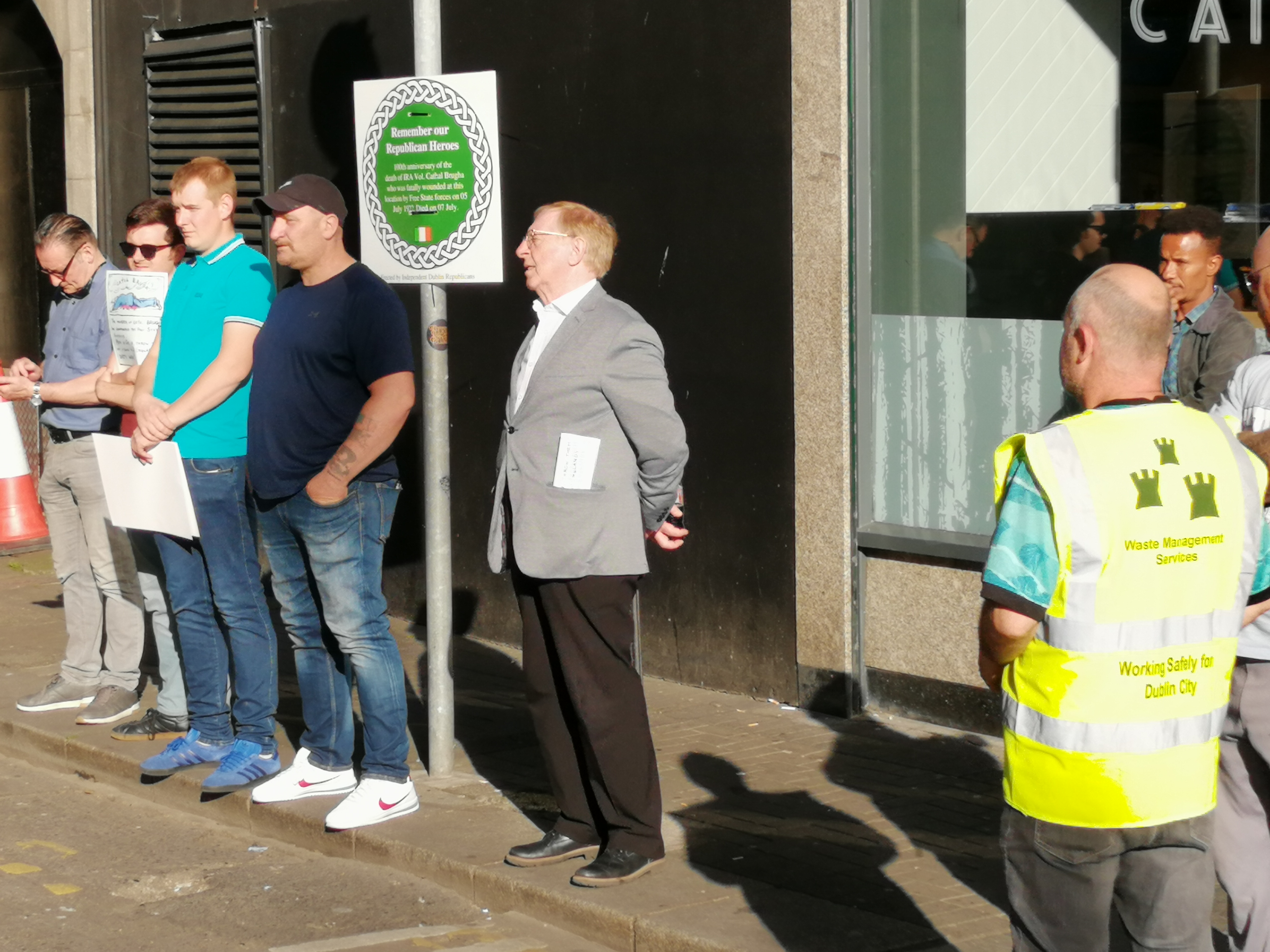
Plaque over the spot where Cathal Brugha was fatally shot at the junction of Cathedral and O’Connell Streets. (Photo: D.Breatnach)

LESSONS OF HISTORY

It is our duty as historians and as republicans who want to learn from the mistakes of the past to analyse things as they were and not gloss over them.

Brugha was less advanced when it came to other social questions, such as that of the land.

When a loan scheme was set up by the Dáil in 1919-1920 Brugha viewed it as “a scheme that would be a perfectly sound business proposition, and offer a good field to Irishmen who desire to invest their money”.

This speaks to the class composition of much of that era’s Irish Republicanism – with over-representation from the lower-middle and middle classes and under-representation from the urban and rural working-class.

There was a consequent lack of a radical social programme that might have attracted the masses, particularly during 1922.

Liam Mellows, according to a recent publication by Conor McNamara, only really came towards socialism late in the day whilst imprisoned in Mountjoy Jail.

In a similar vein, the great socialist-republican Peadar O’Donnell, remarked that during the occupation of the Four Courts in July 1922 there existed a gulf between the republicans inside and the workers outside.

Hammam Hotel after Free State attack. (Photo sourced: Internet)

We can also point to a lack of militancy within the leadership of the labour movement, as we can to a lack of socialism within the republican movement.

However, and despite a climate of soviets springing up, land agitation and general strikes over the course of several years, socialism and republicanism failed to fully synthesise into an organised and militant socialist and anti-imperialist movement.

Nevertheless, this is not to take away from Brugha, Mellows or any of his comrades. The picture that emerges of Brugha is one of a dedicated and political Irish Republican. A man of principle, honour and integrity.

It isn’t the picture of a mindless militarist, or “a fanatic”, as a recent review of the above-mentioned book Indomitable Spirit in the Irish Independent characterised Brugha. Likewise, some historians have derided Brugha essentially as a man of “no politics”.

However, as JJ O’Kelly, better known as Sceilg, said of Brugha, he was “showered with intellectual gifts of a high order, coupled with an exquisite literary taste; was a good linguist, a powerful writer, a fluent and convincing speaker, a pleasing singer and exquisitely fond of good music”.

Previously, during a potential split in Craobh an Chéitinnigh in 1908 Brugha was seen as a force for reconciliation, rather than as an apolitical “splitter”.

At its core, the realisation that the Treaty represented a half-way house between Empire and Republic that was doomed to failure informed Brugha’s actions during 1921 and 1922.

The mainstream historical narrative is that the “militarists” couldn’t see sense and get behind the so-called “empty formulas” of the oath. But, harking back to his dispute with Griffith in 1917, I think Brugha knew the importance of the term “Republic”.

Brugha understood that the wording and principles laid down in such documents would influence the character of any Irish state which might emerge. Thuig sé, creidim, go gcuireadh na prionsabail a leagfaí síos ag an bpointe criticiúil cruth ar an stát a bhí le tíocht.

Brugha had also pushed for an Oath to the Republic to be adopted by the IRA in 1919. The context for him doing so was the long tradition of oaths stretching back through Fenianism and other oathbound secret societies.

Oathbound secret societies were common throughout Europe in opposition to feudal and absolutist monarchies from the Enlightenment era onwards.

But in Ireland such secret societies, whether agrarian, nationalist or republican, or an admixture of each, represented an opposition to colonialism and their oaths were a necessary offering of allegiance to the community and the Irish body politic rather than to the invader.

Brugha’s dedication to the Republic and rejection of imperialism was shown again during the Treaty debates of 1921 when he spoke thusly:

“if …. instead of being so strong, our last cartridge had been fired our last thinking had been spent and our last man was lying on the ground and his enemies howling around him and their bayonets raised, ready to plunge them into his body, that man should say – true to the traditions handed down – if they said ‘will you come into the Empire?’ he should say and he would say : ‘No, I will not!’

That is the spirit which has lasted the centuries and you people in favour of the Treaty know that the British Government and the British Empire will have gone down before that spirit dies in Ireland”.

CIVIL WAR/ COUNTERREVOLUTION

Civil War eventually began in 1922 with the shelling of the Four Courts with British guns by Free State forces. Again, busting the myth that he was only out for war, Brugha had actually been reluctant to enter the Republican garrison with Mellows, Rory O’Connor, and Joe McKelvey.

Likewise, Oscar Traynor; he and Brugha occupied Hamman Hotel and Buildings on Upper O’Connell street as a secondary garrison. As the Battle of Dublin raged the buildings occupied by Brugha went ablaze.

Free State soldiers shouted at him to surrender, to which he replied “níl aon chuimhneamh agam ar a leithéid a dhéanamh” (I have no notion of doing so). After asking his own garrison to surrender Brugha approached the Free State soldiers and was shot dead.

The Civil War has often been over-simplified into a cartoonish clash of “brother against brother” and “the Big Fellow” (Collins) versus “the Long Fellow” (De Valera). This negates the aspects of it which were clearly counter-revolutionary in nature, and it can just as easily be labelled the Counter-Revolution of 1922-23.

The results of the Counter-Revolution in which Brugha died and which deepened in the years after, especially during the 1920s, speak for themselves.

Free State troops preparing artillery emplacement for British field-gun at Nelson’s Pillar (now location of the Spire) in the Battle of Dublin, Civil War/ Counterrevolution July 1922. (Photo sourced: Internet)

Republican men carry the coffin of Cathal Brugha with an honour guard of Cumann na mBan. (Photo sourced: Internet)

The Counter-Revolution:

Sided with Empire over Republic. The acceptance of the Treaty meant the acceptance of White Dominion status along with Canada, Australia and New Zealand.

In doing so the counter-revolutionaries severed the nascent anti-colonial links with the Third World which had existed throughout the nineteenth and early twentieth centuries.

This move, according to Bill Rollston and Robbie McVeigh in their recent publication Anois ar Theacht an tSamhraidh: Ireland, Colonialism and the Unfinished Revolution, informs the nature and perseverance of Irish racism today.

It sided with Rich over Poor. The infamous quote from the good Catholic and Christian W.T. Cosgrave about “people being reared in work houses taking it in their minds to emigrate”, resonates here.

This is the mentality which laid the blueprint for how the State facilitated and turned a blind eye to the horrors of the industrial schools and laundries – horrors which were inflicted against women and children mainly from the urban and rural working class.

It sided with Partition over Unity. The nationalists of the North were abandoned to the mercy of the Orange state, despite knowledge among the emergent conservative republican elite like Cosgrave and Kevin O’Higgins of the pogroms which had been going on in Belfast between 1920-22.

The lame duck Border Commission of 1925 was never going to challenge the economic or political viability of the Six Counties

It sided with Anglophone Ireland over what was left of Irish speaking Ireland. There was over half a million, or 543,511 to be precise, native Irish speakers in the state in 1926. Today there are less than 10% of that, roughly 20,000.

The Free State in the 1920s implemented a symbolic cultural programme – state departments used the cúpla focail, schools were superficially Gaelicized, post boxes were painted green.

This was also a means of shoring up support for the State against republicans and other “subversives” in the 1920s and 30s by capturing and channelling one ideological aspect of the revolutionary years. But no radical social programme was devised.

Rather than re-distribute wealth and local power to the West, a symbolic and centralised pseudo-revival was implemented, while Conradh na Gaeilge, which Brugha had been so loyal to, went into rapid decline naively thinking that the conservative state would somehow act as a genuine custodian of the language revival.

Tá go leor leor samplaí den leanúnachas seo leis an impiriúlachas le fáil.

Other examples of a continuity and no real break with imperialism abound. In law, the Free State remained wedded to British common law over a potential new system.

Brehon Law had been mooted as having communal benefits different from the individualist and property focussed British law by cultural nationalists and by Marxists such as James Connolly. But this mode of thought was not considered.

In administration, according to historian J.J. Lee, 98% of civil servants from the old British colonial administration were kept on during the years of the early Free State.

In finance, Ernest Blyth’s conservative fiscal policies were carbon copies of Westminster’s and the punt was shackled to the sterling.

Even down to seemingly innocuous cultural traits such as dress – W.T. Cosgrave and his ilk adopted the top hat and coat-tails of the British once in office – there were continuities.

While this last point may seem minor, it was a signifier of the whole ideology and culture of the state – Conservative, Catholic, Anglophone, with only a veneer of Gaelic symbology.

Little wonder then that the State lurched from dependence on one empire from the 1920s into dependence on others in the 1960s and 70s in the form of the US empire and the emergent EU empire — via the policies of Foreign Direct Investment and the Common Agricultural Policy.

The legacy then of the counter-revolution still weighs heavily on our people.

It is our duty to analyse the different forces – be they political, class or cultural – which defeated the Republic in 1922-23 and to work towards defeating them and breaking fully with Empire, as Cathal Brugha sought to do.

An Phoblacht Abú!

Kerron Ó Luain, staraí, Ráth Cúil, Co. Átha Cliath.

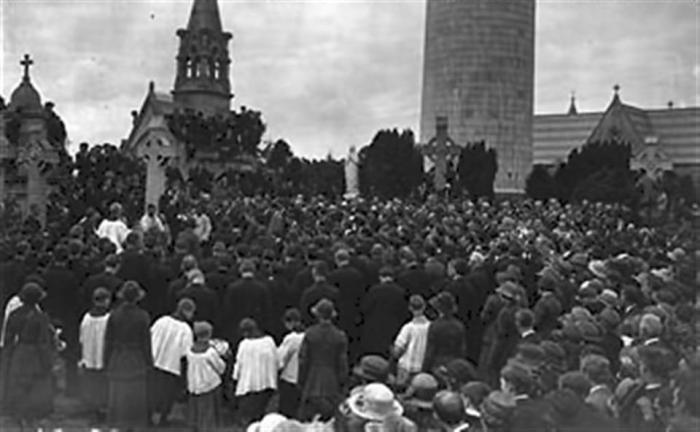
Section of the crowd at Cathal Brugha’s funeral in Glasnevin Cemetery. (Photo sourced: Internet)

A DIFFERENT PICTURE SLIPS THROUGH THE PROPAGANDA

Diarmuid Breatnach

(Reading time: 5 mins.)

We are being constantly reminded by the western press on a daily basis, quite rightly, of civilians being killed in the Ukraine conflict1. On the Ukrainian side. Somehow, the Ukrainian military never fire at the Russian side – or if they do, they somehow never manage to kill civilians.

Amazing, really, in a war which the media keeps telling us is ferocious.

The Russian side is rarely quoted but when it is, its statements are dismissed. They say that the Ukrainian military plant themselves among civilian housing and fire artillery from there. Well, they would say that, wouldn’t they and anyway, the Ukrainian State denies it.

The Russian military are, according to the Ukrainian State, not so much careless about the the targets of their bombardment but deliberately aiming at civilian structures.

Why they would do that when, according to the same sources, they want to extend the Russian empire there, is not explained. It’s all about terrorism, according to Zelensky, the Ukrainian premier and media figure.

The Russian State story, not so easy to come by, is that they never target civilian areas deliberately, unless the Ukrainian military are using them to fire from – which according to the Ukrainian State, quoted without question by the western media, the Ukrainian military never do.

BOMBARDMENT AND CIVILIANS

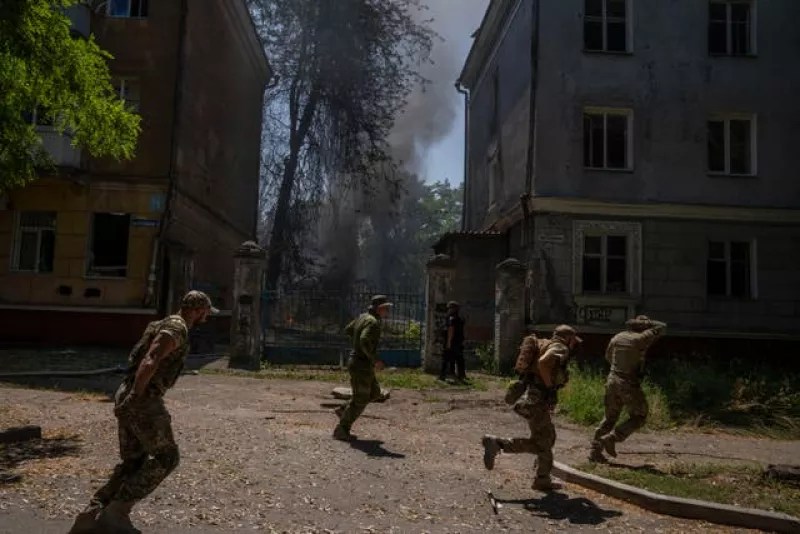
Yesterday’s issue of Breaking News Ireland carried a very unusual photo. It was unusual because it was taken during actual military action, whereas we normally only get photos of damaged buildings and occasionally Ukrainian military standing firm.

Ukrainian Soldiers run after missile strike in residential area of Kramatorsk, Donetsk Region, Eastern Ukraine (posted 13 July) (Cred: Nariman El-Mofty/AP)

But the photo was more unusual than that because it showed Ukrainian soldiers running for cover after a Russian artillery strike, naturally enough but a less-than heroic image for public consumption. The caption tells us it’s in a civilian area in the Donetsk region.

WAIT A MINUTE! In a civilian area? So the Ukrainian military were in a civilian area and got fired on by Russian artillery? Doesn’t that coincide with what the Russians have been saying? Were those Ukrainian military perhaps even firing from that area? We don’t know.

We don’t know because we get hardly any western media coverage from the actual battlefronts, just quotations from the Ukrainian State and, from time to time, commentary from US/ NATO sources. And never any detail from the Russian side.

If we want a more realistic picture, we have to go to sources banned or at least not promoted in the West.

One of those sources is Patrick Lancaster, reporting on the war. In a recent video, he interviewed wounded civilians in a hospital in Izium, Kharkiv region, an area the Ukrainian military left a couple of days earlier and which is now under Russian military occupation.

So refreshing to watch.

Some interviewees blame the Russian State, some blame the Ukrainian State, some seem impartial or keep their own counsel – as one might expect, really, if one thought about it past the propaganda line, which is that everyone there — except the “Russian separatists” — blames the Russians.

And actually, the Breaking News article reported the reluctance of many to leave Sloviansk and Kramatorsk as they are being publicly encouraged to do by the Ukrainian Donetsk Governor, presumably as those areas are going to be pounded by artillery (but by Ukrainian or by Russian?)

This too is interesting, because even anti-Ukrainian State or pro-Russia interviewees (not always the same thing) interviewed by Patrick Lancaster in the Izium town, said that the Russian artillery had hit their town “very hard”.

But then some also stated that Marchenko, the pro-Ukrainian Mayor of the city had announced publicly that the city had been evacuated. All lies, according to one, “only five buses here …. and 50 taxis (but) from Kramatorsk.”

So if the advancing Russian military believed that only Ukrainian military remained in the city …..?

This is a military conflict and of course both sides are firing and, as well as soldiers, civilians are being inevitably killed on both sides. When that happens, is it likely that either side is killing civilians deliberately?

Certainly less likely by the Russians in the Donetsk area, which is a largely Russian-speaking region that has been attacked by Ukrainian right-wing military since that state’s abrupt change of government in 20142.

By the Ukrainian military side, probably more likely on the basis of the previous eight years, or at least of being more careless.

The article I’ve quoted showed a range of attitudes to the call of Pavlo Kyrylenko, Ukrainian State’s Governor of the Donetsk region, for civilians to leave and to head into Ukrainian State-held territory — and also of different attitudes to the forthcoming Russian occupation.

Some are going, including a teacher of Russian, which is interesting, because another doesn’t want to go precisely because of the anti-Russian-speakers attitude of the State (and even more so of some of the Ukrainian military).

Some just don’t want to give up their homes and/ or be jobless (or elderly without support) in Ukrainian State territory. Some think they’ll be ok under the Russians while others think they’ll be no better off on the Ukrainian State side.

So, naturally enough a mixed picture but certainly very different to the one being projected day in, day out by the western media. How this article and photo slipped through that blockade is certainly curious.

DOES IT MATTER?

But at the end of the day, does it really matter much to us here in Ireland whether we are being subjected to inaccurate propaganda about the conflict in Ukraine?

Well, if that conflict was sparked by the expansion towards Russia’s borders of the NATO military alliance3, then it does.

If that conflict is part of the shaping up by US/NATO for a war against Russia and China (and possibly India), then it certainly does. Not just because all of those on both sides are nuclear powers and radiation can end up anywhere.

But also because the ruling elite of the British colony in Ireland is part of NATO and the ruling class of the Gombeen state is trying to push it into NATO — or at least into an EU military alliance, which would of course soon enough line up with NATO.

I don’t believe either side in this conflict without proof and analysis. But I do resent the completely one-sided propaganda coming from the western media. Maybe it’s the same in Russia with their own propaganda.

Maybe, but isn’t it the boast of the West that their democracies are superior, with free speech and press?

And if the western media is following the same propaganda line in its reporting out of common interest with US/NATO and EU, is the end result any different from the media in Russia saying what they are told to say?

End.

FOOTNOTES

1Would that they would equally well inform us of those beling killed by the Saudi proxy war in the Sudan or by the numbers of migrants being killed on a regular basis as they try to access safety or just a better life in western states – the same states that are usually responsible for their plight in the first place.

2Yes, eight years prior to the Russian invasion. On the rare occasions when the western media refers to this (they did in the Breaking News Ireland article) it is always portrayed as a problem caused by “pro-Russian separatists” without recording that those areas were attacked as Russian-speaking by Ukrainian fascist and far-Right military units, including the Azov Battalion and the people organised themselves in defence, then received Russian supplies and now, eight years later, a Russian invasion. The origin of the Crimea situation is a similar story.

3For those who think this is a ridiculous claim, type “NATO states in Europe map” into a search engine. Also look up “Minsk Agreement”.

SOURCES

Breaking News Ireland report: https://www.breakingnews.ie/ukraine/why-should-i-leave-some-ukrainians-refuse-to-flee-areas-caught-up-in-war-1334032.html

Patrick Lancaster reporting from Izum, Kharkiv region, 120 Km/ 75 miles southeast of Kharkiv city (random civilian interviews + civilians wounded in hospital): https://www.youtube.com/watch?v=3iFv5jxInOc

From Sirotino, Luhansk, now controlled by Russian an Luhansk People’s Militia (interviews with residents): https://www.youtube.com/watch?v=DRKNBYqb5DQ

Patrick Lancaster, December 2016 (yes, SIX YEARS AGO) in Luhansk People’s Militia trench, under Ukrainian shelling (breaking Minsk Agreement): https://youtu.be/DAo7go-4l0g

Senior Irish politicians thinking about joining a military alliance: https://www.irishtimes.com/world/europe/2022/06/08/ireland-would-not-need-referendum-to-join-nato-says-taoiseach/

CATHAL BRUGHA HONOURED AT SPOT WHERE FREE STATE SHOT HIM

Diarmuid Breatnach

(Reading time main text: 6 mins.)

On the evening of 7th July, people passing on O’Connell Street, Dublin’s main street in the north city centre either stopped a while or passed with a glance at the crowd gather at the intersection with Cathedral Street, a narrow lane leading eastward.

The Irish Tricolour and the Starry Plough flags (both versions1) held aloft gave a strong indication of the purpose of the gathering, which was to honour an Irish patriot shot down at that spot by Free State soldiers on 5th July 1922 and dying on the 7th.

A poster from the period with drawings thought to be by Constance Markievicz (Photo: D.Breatnach)

CATHAL BRUGHA RESUMÉ

Cathal Brugha was an Irish Republican, an Irish language activist, a soldier and politician. For a period in the Irish Republican Brotherhood, he joined the Irish Volunteers at the outset2 and was a lieutenant in charge of twenty Volunteers to receive with others the arms delivered to Howth Harbour in 1914.

In the 1916 Rising Brugha was second-in-command under Eamonn Ceannt at the South Dublin Union, now covered by James’ Hospital, where he received in excess of 25 wounds from bullets and grenade shrapnell and was not expected to live.

Surviving, Brugha was elected a Teachta Dála (member of parliament) for the abstentionist Sinn Féin coalition party in the UK General Election of 1918, serving until his death, first President of Dáil Éireann (the Irish Parliament) from January to April 1919, Minister of Defence from 1919 to 1922 and Chief of Staff of the IRA from 1917 to 1919.

Cathal Brugha, along with most Republican activists, was strongly opposed to the Anglo-Irish Agreement of 1921 which was supported by Michael Collins, Arthur Griffiths and others and joined the Republican opposition in the Dáil, resigning his government posts to do so.

A poster from the period with drawings thought to be by Constance Markievicz (Photo: D.Breatnach)

However, he and Oscar Traynor of the IRA both opposed the occupation of the Four Courts by IRA under Rory O’Connor but when it was bombarded by the Free State with British artillery on 28th June, Traynor ordered occupation of O’Connell Street buildings to divert some of the heat from the Four Courts.

The Free State Army bombarded the Republican positions in O’Connell Street with artillery and machine guns (as the British Army had done in 1916). Eventually the Republicans retreated apart from a small holding group which Brugha ordered to surrender but did not do so himself.

Approaching Free State soldiers with pistol in hand, he was shot by them in the leg, severing a femoral artery and died two days later in hospital. His widow Kathleen continued the Republican line as an activist and TD.

Mags Glennon, Chairing the event (Photo: D.Breatnach)

THE HONOUR CEREMONY

Mags Glennon, chairing the event, thanked people for coming, stressing the importance of remembering our history and listed briefly the important actions of and positions held by Cathal Brugha, before calling on Sean Óg to perform The Soldiers of ‘22,3 the five verses of which he sang, accompanying himself on guitar.

At intervals between speakers Sean Óg performed another two songs, Cathal Brugha and A Soldier’s Life4.

Joe Mooney brought a series of three posters for distribution, which were quickly taken up. These were copies from the period, condemning the Free State Army for the murder of Cathal Brugha, with drawings believed to be by Constance Markievicz.

A poster from the period with drawings thought to be by Constance Markievicz (Photo: D.Breatnach

MAIN ORATION

The main speaker was historian and author Kerron Ó Luain, who began speaking in Irish and returned to it on occasion, though the content of his talk was by far in English.

Ó Luain initially paid his respects to recently-deceased Mícheál Ó Doibhlin, a Dublin historian who had done much historical research to bring further into the light of today the contributions two Republican women in two different periods.

These were Anne Devlin of the United Irishmen (uprisings in 1798 and 1803) and Josephine McGowan, killed in 1918, the first Cumann na mBan martyr5. Ó Doibhlin had also assisted Ó Luain in the latter’s research into the insurrectionary history of his own area, Rath Cúil (Rathcoole)6.

Kerron Ó Luain speaking, Joe Mooney holding the microphone. (Photo: D.Breatnach)

Continuing to relate some brief facts about Brugha’s early life, born into a mixed-religion household, Ó Luain emphasised Brugha’s interest in the Irish language and his membership of the Gaelic League (Conradh na Gaeilge)7 in the same decade as its founding.

The speaker contrasted that aspect with the militarist image of Brugha often projected by hostile commentators. Brugha met his future wife at meetings of the Connradh and had been a strong advocate of the proceedings of the First Dáil being conducted mostly in Irish and of the Democratic Programme being first read and agreed in Irish.

The setting up of Sinn Féin to contest the 1918 UK General Elections had involved a coalition of many different elements Ó Luain said, including dual monarchism advocates such as the original founder Griffiths and even white Dominion aspirants, alongside Republicans such as Cathal Brugha.

Section of the crowd at the event. (Photo: D.Breatnach

These had been the lines along with the alliance had fractured when the British proposed the terms of the Anglo-Irish Treaty. British influence on the Free State was seen not only in its war on the Republicans but in the legal system adopted based on common law without any thought given to any of the principles of the native Brehon Law.
The British influence was evident also in the form of dress with some Free State politicians such as Cosgrave wearing a top hat and research has shown over 90% of the civil servants of the Free State had been employed by the previous British colonial administration.

The Free State adopted a formal position of support for An Ghaeilge, the Irish language, while doing nothing to support the struggling rural Irish-speaking areas, which were being drained by emigration, leading the inhabitants to want to acquire English for their future locations.

Some of the attendance. (Photo: D.Breatnach)
Another small section shot (Photo: D.Breatnach)

The number of Irish-speakers within the territory of the State has declined drastically since it was founded.

Unusually for an oration honouring an Irish martyr but very important historically, the speaker pointed out that Brugha was not a socialist Republican and had advocated land ownership whereas other Republicans such as Liam Mellows (executed by the Free State in 1922), Peadar O’Donnell and Frank Ryan in the 1930s had proclaimed the need for a socialist Republic.

In conclusion, the speaker said that Cathal Brugha was an honest courageous Republican with a genuine love of the Irish language and a staunch upholder of the truly independent Republic proclaimed in 1916 but yet to be achieved. He had been killed as part of the counterrevolution.

It is important for future efforts, Ó Luain stated, to be aware of the different strands in the Republican opposition to the status quo and to be clear on the desired future shape of society in the Republic.

View of many in the attendance at the event. (Photo: Cabra 1916-1921 Rising Committee)

OTHER REPUBLICAN MARTYRS OF THE BATTLE FOR DUBLIN 1922

Damien Farrell spoke on behalf of Dublin South Central Remembers and representing the McMenamy family from the area. Frank McMenamy had been asked to introduce the Roll of Honour on behalf of relative Ciaran McMenamy of F Coy, 1st Batt, anti-Treaty IRA (Ambulance Corp) but was unable to attend.

Ciaran was one of four brothers — Fergus, Manus and Francis — who fought in the revolutionary period 1916-23. Ciaran was part of the crew that tended Cathal Brugha and rushed him to hospital on the 5th July. When Brugha succumbed to his wounds, Ciaran was a pall bearer at his funeral.

Damien said that this most likely identified him for arrest which happened later and he was interned in the infamous Newbridge Camp and participated in the mass hunger strike of prisoners in 1923 against conditions.

Ciaran McMenamy contracted a cold that developed into consumption which secured his release to convalesce in the County Home in Kildare but this proved ineffective and Ciaran was eventually released from internment around Christmas 1923.

On the 26th of April 1924 Ciaran McMenamy died in 55 Pearse Square, a house connected to the family. For the past two years Dublin South Central Remembers have held remembrance events at the house, with the full permission and support of the current occupants (no relations) with the intention of having a plaque erected in time for his centenary in 2024.

Finnuala Halpin reading the Roll of Honour of the The Battle of Dublin 1922, in which her grandfather fought. (Photo: D.Breatnach)

Fionnuala Halpin read the roll of honour of those killed in The Battle of Dublin 1922, a battle in which her grandfather fought.

John Monks

William Clarke

Joe Considine

William Doyle

Francis Jackson

John Mahoney

Sean Cusack

Matthew Tompkins

Jack McGowan

Thomas Markey

Thomas Wall

Charles O’Malley

Cathal Brugha

Veteran Republican, hunger-striker and author Tommy McKearney placed a wreath in honour of the fallen on behalf of Independent Republicans and a minute’s silence was observed in their honour also.

COMMEMORATE THE CIVIL WAR MARTYRS OF YOUR AREA?

A number of different Republican organisations were represented at the event, along with many independent Republicans and historical memory activists, including walking history tour guides.

Poster and dedication floral wreath in honour of Cathal Brugha, Cathedral Street, Dublin city centre 7 July 2022 (Photo: Cabra 1916-1921 Rising Committee)

Mags Glennon asked people to keep in touch with the organisers and also to be aware of other commemorative events, offering to make available the commemorative posters with the local martyrs’ names incorporated into the design for display for others around the country.

End.

FOOTNOTES

1The original, with the design of plough in gold following the outline of the Ursa Mayor constellation in white stars, on a green background and the later Republican Congress version of the white stars alone on a light blue field.

2Formed in 1913.

3Composed by Brian Ó hUigínn, sung to the air of The Foggy Dew.

4A Soldier’s Life was originally composed by Young Irelander Thomas Davis (1814-1945) and recorded by The Wolfe Tones band; the composer of Cathal Brugha’s lyrics appears unknown and it was recorded by Declan Hunt.

5A rally held by women just off Dame Street in 1918 was batoned by members of the Dublin Metropolitan Police and she died of her injuries shortly afterwards. I have heard Ó Doibhlin relate her story and saw him becoming emotional as he did so. The DMP’s batons in September 1913 were also responsible for the deaths of at least three others, although one died in 1915.

6For a number of recent years Ó Doiblin has been noted, along with historian Liz Gillis and others, for research and exposition of information regarding the Burning of the Customs House on 25th May 1921, which corrected a number of common misapprehensions about that event.

7Founded by Protestant Douglas Hyde/ Dubhghlas de hÍde this month in 1893.

USEFUL LINKS

The Independent Republicans group do not appear to have a website or FB page but may be contacted through the Cabra 1916-1921 Rising Committee: https://www.facebook.com/cabra1916

The National Graves Association: https://www.facebook.com/NationalGravesAssociation

THE FIRST WORLD WAR DEAD SHOULD BE COMMEMORATED

Diarmuid Breatnach

(Reading time: 3 mins.)

Irish Republicans and revolutionary Socialists have traditionally been opposed to the commemoration of the dead in the “Great War”, WWI. Recently Michelle O’Neill, top Minister in the British colonial political regime in Ireland with the Lord Mayor of Belfast, both members of the Sinn Féin party, laid a wreath at the WWI memorial in Belfast, to the bewilderment of some and the disgust of others. But actually those emotions are misplaced, since the leadership of the Sinn Féin party were never Socialist and are no longer Republican.

The long-held position of Irish Republicans and Socialists that WWI should not be commemorated is however illogical and runs against history. The conflict was a hugely-important event in such areas as military, social conditions and mores, medicine, politics and economics.

The toll of WWI is around 40 million military and civilian casualties of which 20 million died. Of those, around 10 million were civilian dead. How can an event of such historical magnitude not deserve commemoration?

We should certainly commemorate the fact that a small group of monopoly capitalists, aristocracies and monarchies, in the course of an argument about how to divide up the world among themselves, sent millions of ordinary people, mostly workers, to kill one another to settle the argument. People who had no quarrel with one another and nothing to gain from killing one another; people whose real verifiable enemies were those very people who were mobilising and arming them before sending them forth to kill or be killed.

The conditions of the working classes at the time they were thrown into the killing arena should be commemorated. The lies that the war was fought for democracy and freedom of small nations should be exposed. The disciplinary court-martials and executions within the armies should be revealed, along with the treatment of conscientious objectors. The propaganda used for recruitment and to keep the home populations happy should be deconstructed and exposed. The fact that capitalism ends up as imperialism, which in turn causes war, should be made clear to all.

That wars are not alone fought for profits but that huge profits are made in the course of war is a grotesque fact that should become widely known.

A pile of used artillery shells used in WWI — all manufactured and paid for, exploded, more ordered, paid for, fired ….. Part of the huge profits made during imperialist wars. (Photo sourced: Internet)

All of this was true of WWI and is true (to one extent or another) of the wars caused by imperialism today, whether in Somalia, Western Sahara, Palestine or Ukraine. But now, in addition to the huge death toll of WWI, we have the possibility of the destruction of human cities around the world — and even of ecological disaster — in yet another war.

We should expose the fact that far from encouraging us away from war, WWI commemorations are for the most part about concealing those salient facts and encouraging us to be proud of how our forebears were conned into killing one another. By whipping up reactionary nationalism1, their commemorations make us vulnerable to being conned into fighting further wars, to agree to be sent to other countries to kill or maim people like us in other countries – or to be maimed or killed by them.

An innovative protest by the socialist Republican group Lasair Dhearg which however confines itself to pointing to the occupying British Army’s collusion with Loyalist murder gangs. (Photo sourced: Internet)

Commemorating the truth about imperialist wars past and present mean rejecting the wearing of the Poppy symbol. The Poppy is not about commemorating the dead in wars, as it is sold. This promotional emblem of the British Legion only commemorates the British soldiers who have been killed in wars – it does not commemorate all the soldiers of the colonies (for example Ireland) or the Commonwealth who died in the wars, not to mention all the civilian auxiliaries helping cook, clean, carry, dig, build etc for the British armed forces. The Poppy does not commemorate the dead soldiers of Britain’s allies, for example France, USA or Russia in the case of WWI. It does not commemorate the soldiers or auxiliaries of the hostile states who were killed, which might seem natural, until we ask ourselves why not, if the idea really is just to commemorate the dead soldiers in war. Most tellingly, the Poppy does not commemorate the millions of civilians who have been killed in wars – actually more than the total number of soldiers and a percentage of war deaths that is growing with every war.

The real role of the Poppy is to build social support for the imperialist British armed forces, including helping recruitment — so in other words, the emblem and its publicity is actually helping to build support for future armed conflicts.

The WWI soldier sculpture made from scrap metal, pictured in Stephens Green, Dublin. Republicans protested its siting in a 1916 battleground, (Photo sourced: Internet)

Not addressing the nature of imperialist war and just boycotting any idea of commemoration leads to missed opportunities. A few years ago a sculpture of a WW1 British soldier constructed out of scrap metal was installed in Stephen’s Green, a recreational park in Dublin’s city centre. Some Irish Republicans staged a protest around it in which they castigated it being located there in what had been a 1916 Rising battleground. They were correct in the historical reference but was that all that could be said about that war? Would most of the tourists passing by relate to that 1916 reference or would the whole international horror of imperialist war not have engaged them more?

A small protest emphasising the nature of WWI commemorations at one such attended by SF representatives (the commemoration) in the Irish National (sic) War Memorial Gardens 10th July 2021 (Photo: RTÉ)

We should indeed commemorate WWI but we should do it in the framework laid out, of exposing what the wars are about, who they benefit, what class contains the main victims – and not just the dead but also the injured, many of them crippled for life.

That is not how the ruling elites commemorate war and it is not how Michelle O’Neill and Tina Black did it. Michelle O’Neill said that she did this symbolic act in order to demonstrate that she is going to be “a First Minister for everyone” – clearly meaning Nationalist and Unionist. Liberals may laud O’Neill for that but one cannot represent national liberation simultaneously with colonialism, republicanism at the same time as loyalism, democracy at the same time as reactionary sectarianism. Making a war wreath green does not change its nature. Sinn Féin will often seem to try to present themselves as all things to different groups of people but essentially they are serving Irish Gombeenism2 in the 26 Counties and English colonialism in the Six.

Sinn Féin members Tina Black and First Minister-in-waiting Michelle O’Neill as they approach the WWI memorial in Belfast to lay a wreath. (Photo sourced: Internet)

In addition, workers and lower middle-class people from the Protestant or Unionist community were also killed and maimed in imperialist war. How does concealing the reality of war help those people?

End.

FOOTNOTES

1I use the term in the sense that not all nationalism is reactionary.

2Native Irish foreign-dependent capitalism

“WOLFE TONE IS COMING BACK!” — BODENSTOWN 2022

Clive Sulish

(Reading time: mins.)

The “father of Irish Republicanism”, Theobald Wolfe Tone was honoured on Sunday afternoon at the Irish patriot’s final resting place, in Bodenstown churchyard in Co. Kildare, a place of annual pilgrimage for Irish Republicans. Irish Socialist Republicans and Anti-Imperialist Action Ireland convened the event including speakers, musicians, singers and colour party, in which the speeches drew on the past to comment on the present and on the future.

Colour Party flags against those permanently maintained there at the monument by the NGA. (Photo: Rebel Breeze)

WOLFE TONE AND THE RISINGS OF 1798

Theobald Wolfe Tone and others sought the extension of political participation from the Anglicans in Ireland to the Dissenters, i.e non-Anglican Protestants in addition to the Catholics. When efforts in this direction failed1 towards the end of the 18th Century he and others formed the United Irishmen. This was a secret revolutionary organisation, with a democratic, non-sectarian ideology, seeking assistance from republican France to rise against English control of Ireland.

One of the banners carried on the march and at the rally (Photo: Rebel Breeze)

The English authorities occupying Ireland harried the Republican communities (including hanging some individuals), pushing them into uprising in 1798 when they were in some disarray, particularly after the arrest of most of the Leinster Directorate of the United Irishmen in Bridge Street, Dublin. The French ship in which Tone was being brought back to Ireland was captured by an English naval vessel and though Tone was in French Army uniform he was recognised, tried and sentenced to public hanging but apparently cheated the hangman by cutting his own throat, though he died slowly and painfully.

The initial engagements in Wexford and Antrim were successful for the insurgents but Wexford was soon left as the only area in which they had control of most of the county. A small French invasion force arrived too late in Mayo and though again initially successful, the combined French-Irish force was soon surrounded and defeated.

Tone’s body was brought to the small churchyard in Bodenstown and buried there; Young Irelanders leader Thomas Davis later wrote about his own pilgrimage there and composed the “In Bodenstown Churyard” song; since then the annual pilgrimage there has become an important point on the Irish Republican calendar and, at the high point of support for the Republican movement in the latter half of the last century, attended by thousands.

THE BODENSTOWN EVENT

Colour party leads off on the march to the Churchyard (Photo: Rebel Breeze)
One of the banners at the event (Photo: Rebel Breeze)

SPEAKERS

The rally was preceded by a small march led by a colour party to approach the cemetery, where it was joined by others to march into the cemetery. Opening the event, the MC welcomed everyone in Irish before continuing to speak in English, putting the event in its context of history since the late 18th Century onwards up to the present, referencing recent activity of supporters of the ISR, AIAI and the Revolutionary Housing League before going on to introduce the next speaker.

(Photo: Rebel Breeze)
Peter Rogers speaking seen from a distance (Photo: Rebel Breeze)

Irish historian Peter Rogers recounted briskly a list of prominent Republican speakers who had taken part in Wolfe Tone commemorations down through the decades (some later martyred). Rogers spoke about the importance of the tradition and its relevance today as in the past and also spoke of his own participation as a young man at such commemorations in the past. Among those who had spoken at the monument, Rogers mentioned James Connolly, Patrick Pearse and Liam Mellows.

Seán Doyle, member of the Irish Socialist Republicans/ AIAI and a housing activist spoke about what the capitalist system is doing to the people in Ireland, particularly in the housing crisis, with deaths on the streets while houses lie empty, along with long-time harm being suffered by the victims in physical and mental health, including suicides.

Sean Doyle speaking at the event (Photo: Rebel Breeze)

Doyle stated that any system of law or property that justifies that kind of situation must be done away with, that the health of society over-trumps the property rights of the few and encouraged those who agreed with that to join the Revolutionary Housing League.

The MC noted the importance of internationalism in Irish Republican history including that of the United Irishmen2 and noted the presence of Basque and Palestinian flags before calling forward a recent supporter of the ISR/ AIAI activities from Turkey.

The man was not easy to understand but the gist seemed to be the different ways in which resistance expressed itself apart from armed resistance. The Turkish speaker listed among those the celebration of historical memory, the retention of language, the combatting of fear.

The final speaker was a housing activist and urban geographer who has been doing some research into past housing struggles in Ireland, particularly alluding to past actions in Dublin which CATU (Community Action Tenants’ Union) is researching currently. Republicans had taken part in these and initiated many of them but he felt they did not get the credit they deserved. The speaker mentioned also the 1970s tenant rent strike movement in against Dublin City Council, which is hardly ever mentioned, in effect a mass movement. The speaker maintained that we need to understand the different categories of empty houses so that we can understand the causes and address them but ultimately the cause is the capitalist system. The speaker called for resistance and support for CATU and for such initiatives as James Connolly House.3

Urban geographer speaking on housing within the Irish capitalist system (Photo: Rebel Breeze)

CULTURAL PART OF THE PROGRAM

Music and lyrics are an important part of the Irish Republican tradition, the MC commented, before calling up singers to perform at intervals between speakers. Seán Óg accompanied himself on guitar singing the Irish Republican ballads Tone Is Coming Back Again and Soldiers of ‘22. The latter song was one of a number of references by speakers to the counterrevolution of 1922-1924, more usually referred to as the Civil War. The MC commented that the Tone Is Coming Back4 song is rarely heard these days and Soldiers of ‘225 not often enough.

Diarmuid Breatnach preceded his singing of The Plane Crash at Los Gatos (sometimes known as Deportees) by saying that the victims of imperialism are often civilian refugees fleeing repression, or migrants fleeing famine or simple poverty (as we Irish had done), these most vulnerable sections of society then being targeted by racists and fascists. Mexican seasonal labourers hired to bring in the fruit harvests are often hunted if they remain in the USA. In 1948 a USA plane delivering deported labourers to Mexico crashed with everyone on board killed. However the radio news only gave the names of the USA citizen crew and Woody Guthrie composed the song about the incident. Breatnach also mentioned the deaths of trafficked Latin American migrants more recently in the USA and those killed in Morocco while trying to get into the nearby Spanish colony, numbers similar to some recent deaths in the war in Ukraine which become front page news while the migrant deaths may not reach anywhere near there.

Coiste na mBan of the AIAI banner at the event (Photo: Rebel Breeze)

The MC, drawing the event to a close, commented that more people had attended the event this year than last but more were still needed to mobilise. He gave his thanks to the colour party, also larger this year and including people who were new to the role, commenting that five counties were represented there. Some of them are women and the MC mentioned as a progressive development the formation of Coiste na mBan (Women’s Committee) within the Anti-Imperialist Action Ireland organisation.

The event concluded with thanks to all present from the MC, also to the National Graves Association6 and the singing of Amhrán bhFiann.

Section of the rally in Bodenstown Churchyard seen from behind (Photo: Rebel Breeze)

End.

FOOTNOTES

1The English Crown was opposed and rallied opposition to the move among the MPs but self-interest also played a part, in that some landowners feared that power given to the pre-settler indigenous might result in their lands being repossessed.

2The United Irishman had strong links with Republicans in France and in the USA but also with the United Englishmen and United Scotsmen in which the Irish diaspora was active. Irish Republicans had also had links with the movement for liberation from Spanish rule in Latin America in the mid-19th Century and with the Basques and Catalans in the early 20th.

3James Connolly House was the revolutionary re-naming title of a building leased by the Salvation Army on Eden Quay, Dublin, left empty for nearly two years in the midst of a homelessness crisis. Earlier this year it was occupied by activists of the ISR-related Revolutionary Workers’ Union for some weeks before a court-authorised eviction of over 80 gardaí to remove two activists a couple of weeks earlier.

4A song which was part of the ’98 Cantata written in celebration of the hundredth anniversary of the Rising. The cycle contained ten songs and was revived again in 1948 on the 150th anniversary. Thomas Francis Mullan was born near Ardmore, Co. Derry in 1860. He taught in Derry and later became headmaster of Faughanvale PES. He collaborated with a Derry music teacher, Edward Conaghan, in the writing of a ’98 Cantata devised to commemorate the centenary of the Rising. He died in 1937.

5Some online sources claim the author is unknown while others give Brian Ó hUigínn as the author, which seems likely.

6The NGA is a voluntary organisation independent of any political party and of the State, from which it seeks no funding; it is the major organisation caring for graves and memorials of the struggle for Irish freedom and has the responsibility of caring for the Tone memorial, which it has renovated in the past to facilitate commemoration events.

USEFUL LINKS

Revolutionary Housing League: https://www.facebook.com/groups/1062927280980792

Rent strike Dublin Council tenants: https://dublininquirer.com/2022/06/22/fifty-years-on-a-tenants-union-is-putting-together-a-history-of-the-1972-rent-strike

BILBAO ACTIVISTS FORM BROAD COALITION AGAINST NATO & WAR

On 2nd June a number of Left anti-imperialist organisations and individuals held a public rally in Bilbo/ Bilbao. The municipal authority refused them use of a building and they held it in the open air in the Etxebarrieta Square. The organisers issued a statement in Euskera (Basque language) and Castillian (Spanish) calling for unity against the war plans of NATO and the EU and denounced the equivocating posture of the ‘official’ left Basque movement, denounced also the militarism of the Spanish coalition Government and advertised a joint demonstration for 18th June in Moyua, on the south side of the river in Bilbao1.

STATEMENT ISSUED BY COORDINATING GROUP (translated by D.Breatnach from Castilian Spanish version published in Ecuador Etxea)

For several weeks, various people and groups from Bilbao, Meatzaldea, Uribe-Kosta, Ezkerraldea and Busturialdea2 have been coming together in this broad initiative to respond to the escalation of war that we are seeing around us. An escalation of war promoted by NATO, with the aim of shielding the world hegemony of the United States against the rise of emerging powers such as China, India, Iran or Russia. A strategy that is doomed to failure, but that will cause, if we do not prevent it first, destruction, misery and death throughout the planet.

In Bilbo/ Bilbao 2nd June, reading the declaration and call to unite and for rally on 18 June in Basque and Castillian (Spanish). (Photo source: Ecuador Etxea)

In relation to the conflict in Ukraine, we believe that in no case can one speak of an inter-imperialist struggle between the NATO countries and Russia. Rather, it is an offensive planned for years to overthrow the legitimate government led by Vladimir Putin and gain control of Russian energy resources and markets. A policy of looting and plundering that the current Russian President put a stop to, no matter how hard it is for some to admit it. Ukraine is nothing more than the operations base and the cannon fodder of Atlanticist imperialism against its historical enemy, Russia.

Many on the Left say that the Russia of today is not the Soviet Union of yesterday. And they are completely correct. The problem is that even the slightest economic planning for social purposes by any State has become an obstacle to the viability of the parasitic capitalism that we live under. There we have the cases of Slovdan Milosevic, Saddam Hussein or Muammar Gaddafi, sadly imprisoned and/or executed in the face of complicit silence or the enthusiastic support of what they call the “international community.”

Those of us who are here today have already learned our lesson: first they demonize the currently out of favour ruler through the media, and then they justify military offensives and imperialist massacres. That is why at this time we cannot make the mistake of placing ourselves at equidistance. Both Russia and the Donetsk and Luhansk People’s Republics have every right in the world to defend themselves against the aggressions of NATO and the EU, which conspire and supply weapons to fascist governments like Zelensky’s to harass Russia and destabilize the region. Not to mention the openly Nazi battalions captured in Azovstal, whose release France and Germany now demand in order to advance in the negotiations. What do European governments owe the Nazis in Azov? What do they have to hide and why do they intend to buy their silence?

The truth is that we still do not know the exact reason why the States of the European Union have completely bowed to the interests of the United States. It is evident that the sanctions against Russia and the new oil and gas supply routes imposed by the US only benefit the Yankee tycoons, the Arab sheikhs and the absolutist monarchies of Saudi Arabia, Qatar or the United Arab Emirates. NATO vassals like Borrell have definitively cast the old European project into History’s dump. They prioritize profit and military spending to the detriment of the health and living conditions of the broad masses and announce a future of misery and sacrifice for a war in favor of a capitalism that is against us. The European Union is definitely a rotting political corpse, in case anyone ever thought that it could have been a progressive alternative or for oppressed nations like ours.

Arnaldo Otegi, leader of “the institutional Abertzale Left” (Basque left-nationalist movement). (Photo source: Internet)

Precisely here in the Basque Country, the official position of the institutional Abertzale Left3 regarding what is happening in the Ukraine is especially embarrassing. It seems unbelievable that those who proclaim themselves heirs to the historic struggles of the Basque Working People, a people of which the majority in 1986 opposed remaining in this criminal organization4, now wave the flag of “no to war” and of ambiguity. It seems immoral to us, both the pacifism that denies the just right to defense of those who are attacked by imperialism, as well as the lukewarm posture of those who do not take a stand, thus facilitating the advance of imperialism. Anti-imperialism and anti-capitalism must be cultivated day by day, if we do not want the ideological and cultural offensive of NATO and the EU to continue having effect, in particular among the sons and daughters of the working class. Thirty-six years later we unambiguously reaffirm ourselves in NO to NATO, no to FASCISM, no to GENOCIDAL IMPERIALISM.

As we said, we are witnessing an implacable propaganda to make us part of this imperialist strategy, so that we do not rebel against what is happening. While they continue to spread one-sided thinking through the big media, television channels that question the official story — such as Russia Today — are closed without the slightest shame, content on the Internet is censored by appealing to supposed “verified information”, journalists like Pablo González5 are imprisonedor political information is systematically eliminated from our streets. They not only want to indoctrinate us, they directly deny us the right to be informed. Where are the defenders of freedom of expression? Are we already living in a hidden state of emergency?

It is our obligation, therefore, to denounce, not only the rise of international fascism, but also the fertile ground that the fascists have in the Spanish State of the bannings, the GAL6, the closure of newspapers and the systematic torture of political dissidents7. Atlantic capitalism will never be able to find a better ally than the PSOE8, veritable experts in the art of manipulating and deceiving the working and broad masses. Sadly, there are times when collective memory seems too fragile. Of course, for this new phase they have found a faithful shield-bearer, the party of Yolanda Díaz9. Seconds were never good, we are already seeing where these wolves in sheep’s clothing are leading us…

We said at the beginning that different people have come together to counteract this hegemonic discourse that manipulates consciences and protects the sequestration of rights and freedoms. From Muskiz to Gernika we rebel today here against this ominous imperialist offensive. All this suffering is not necessary, there is no reason to accept the misery and the war to which NATO and the EU want to condemn us. It is also not the time to stay at home watching, or to follow the war as if it were a video game.

We therefore issue a call to all the towns and neighborhoods of Euskal Herria and other nations to continue organizing the fight against imperialism, capitalism and fascism. And we also invite all the people who are against the imperialist offensive of NATO and the EU to participate in the demonstration that we will carry out in Bilbao, on June 18 at 6:30 p.m. from the Plaza Elíptica.

NO TO NATO! NO TO THE EUROPEAN UNION! NO TO IMPERIALISM!

End statement.

TRANSLATOR FOOTNOTES

1Which is also the location of the representation of the Spanish State in Bizkaia and guarded by armed police.

2A number of towns and districts across the SW Basque province of Bizkaia.

3The ‘official’ leadership of the left-Basque independence movement, e.g the EH Bildu party under the leadership of Arnaldo Otegi and others.

4In the 1986 referendum on whether to remain in NATO, the Basque Country gave the highest majority for No, with the Canaries and Catalonia coming behind. For the whole Spanish state, nearly 57% voted Yes against 43.15%.

5Basque freelance journalist reporting for Publico (Spanish left online media) and La Sexta, threatened and advised to leave Ukraine by state intelligence services, which he did but arrested by Polish intelligence on 28 February as he was about to re-enter Ukraine with a group of journalists. Poland has charged him with spying for Russia but to date produced no evidence and even denied him access to his lawyer. The Spanish State sent intelligence service agents to question his wife, mother and friends.

6GAL: A Spanish state terror and assassination organisation of the 1980s operating against the Basque resistance which was exposed as led by the Prime Minister (though never even questioned) Felipe Gonzales and directed operationally by the Minister of the Interior and senior Army and Police officers, a number of which received prison sentences.

7The Spanish state has long been accused by human rights organisations of torturing political dissidents and convicted in the European Court of Human Rights a number of times of failure to investigate complaints of torture. The State has closed newspaper and social media sites, jailed rappers, banned political parties, banned demonstrations, closed political cultural centres, disqualified political activists from representation in elections and jailed political activists.

8The main Spanish social-democratic party, currently in coalition government with Podemos.

9Yolanda Díaz resigned from Izquierda Unida (United Left – a broad coalition) but remained a member of the Communist Party of Spain; she is currently Deputy Prime Minister in the Spanish coalition government.

SOURCE