Revolutionary socialist & anti-imperialist; Rebel Breeze publishes material within this spectrum and may or may not agree with all or part of any particular contribution. Writing English, Irish and Spanish, about politics, culture, nature.
A Palestinian speaker recounted ten years of success in the BDS campaign against the Israeli Zionist State and asked people to continue with it and, if possible, to step it up.
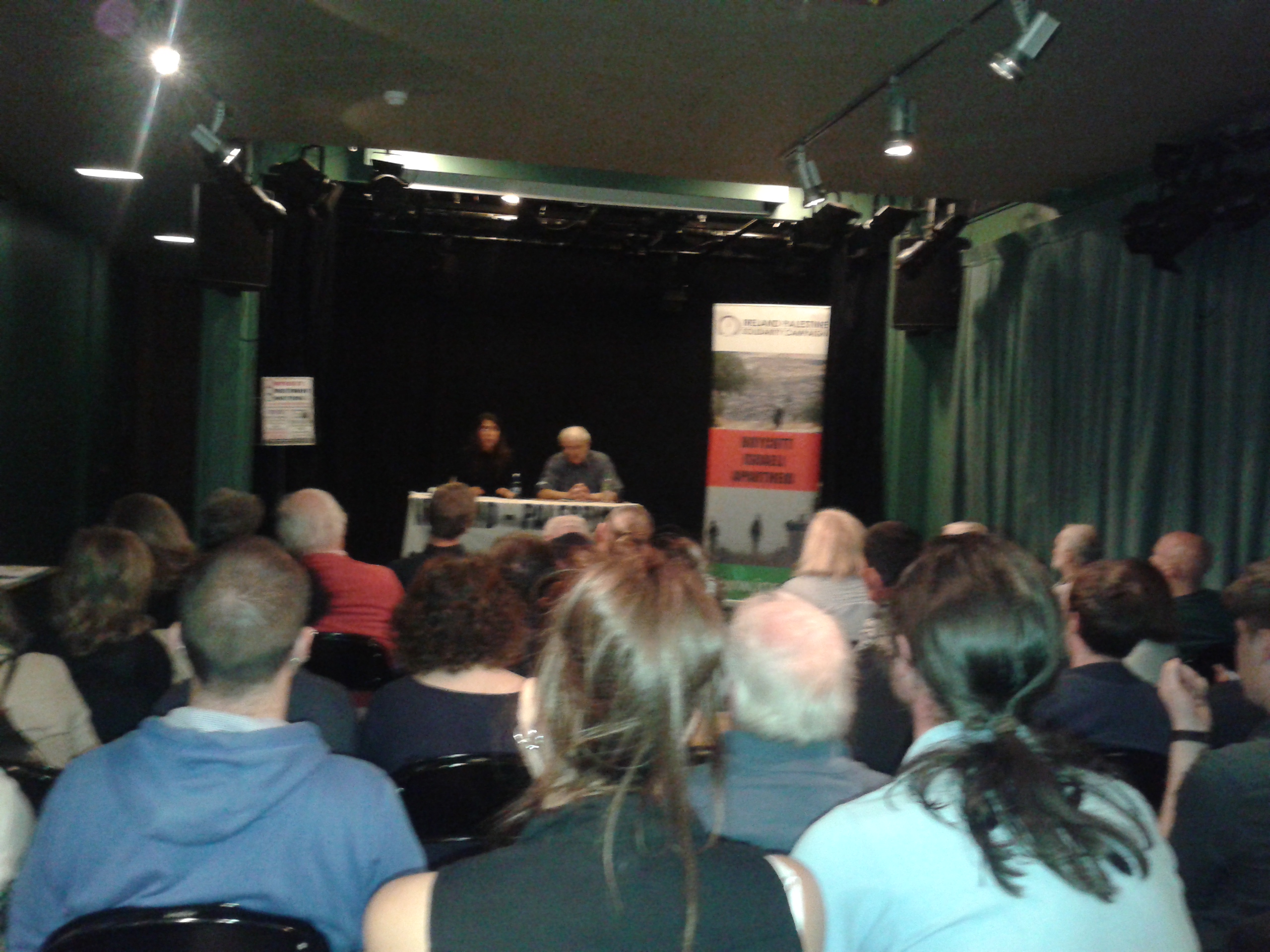
Riya Hassan addressed a crowd at the Pearse Centre in Dublin’s Pearse Street, just off Dublin City Centre, on Wednesday night. She spoke about the history of the oppression of Palestinians by the Israeli state and the ten-year history of the Boycott, Divestment and Sanctions (BDS) campaign, explaining its origins in Palestinian society and charting its growth and successes. The three basic aims of the BDS campaign are to pressure Israel to end the colonisation and occupation of Palestinian land, to give equal rights to Arab-Palestinians citizens in the Israeli state and to agree to the right of Palestinian refugees to return home.
Riya HassanSection of the crowd at the public mee
Riyah Hassan is European Coordinator of the BDS campaign, herself a Palestinian and, as she later explained when talking about the Israeli destruction of villages in the Negev, from near that area herself. Talking about the current refugee crisis in Europe, she pointed out that many of the refugees taking to sea in what she termed “death boats” (echoes of our own “coffin ships” during the Great Hunger) are in fact Palestinians. They are from refugee camps in Syria and are being made refugees for the second, third or even fourth time.
Speaking on the Palestinian refugee issue, a huge and outstanding one since 1948, Riya Hassan mentioned that their right to return home had been surrendered by the negotiators of the “peace process” at Oslo in the 1980s but that Palestinian society had not accepted this abandonment, whether in Israel, the occupied territory or in the refugee camps elsewhere.
Among a list of successes of the BDS campaign, Riya Hassan mentioned Veolia, a company which had been setting up the transport networks between settlements helping to carve up Palestine, had lost millions due to BDS – as a result, the company has pulled out of Israel (Veolia, by the way, runs the LUAS trams in Dublin). G4 Security, which runs surveillance on Israeli prisons, where there are currently well over 6,000 Palestinian prisoners, have said that they will pull out in 2017 but Riya said they should pull out now and called for pressure to be increased upon them. Another target should be our own Government, which has spent €14.7 million worth of arms and military components from Israel over the last decade (while Irish-based companies have exported €6.42m worth of military and ‘dual use’ hardware to Israel over the past five years). Riya reminded us of the complicity in murder entailed in buying equipment from the Israeli arms industry – an industry which boasts as a marketing point that its deadly equipment is “field tested”!
Among the measures of the impact of the BDS campaign on Israel and abroad, the audience were told that Netanyahu in addressing the recent AIPAC conference in the USA had given a quarter of his speech to attacking the BDS campaign and campaigners, in contrast to the early days when Zionists tended to dismiss the campaign as insignificant. More extraordinarily, perhaps, Hillary Clinton has given a promise, as part of her campaign for the Presidency of the USA, to do what she could against BDS.
Riya Hassan, BDS Europe Coordinator with Martin O’Quigley, Chairperson IPSC and who chaired the meeting
Riya Hassan is eloquent, with excellent command of English and spoke clearly and confidently. If anything, she spoke for too long overall. It is hard for a visitor to judge what a typical Irish audience might know or what our cultural expectations are but the room was warm and after about 45 minutes one could hear some people shifting in their seats, a situation that did not improve as the talk extended well past the hour.
However, when the Chair of the meeting turned to the audience, it did not seem that anyone had missed an opportunity to ask questions or to comment and some even took several bites of the cherry.
As chair of the meeting (and of the IPSC) Martin Quigley drew the meeting to an end, he announced a boycott action of Tesco supermarkets for this Saturday and, for those in Dublin, asked them to meet at the IPSC office at 12 noon.
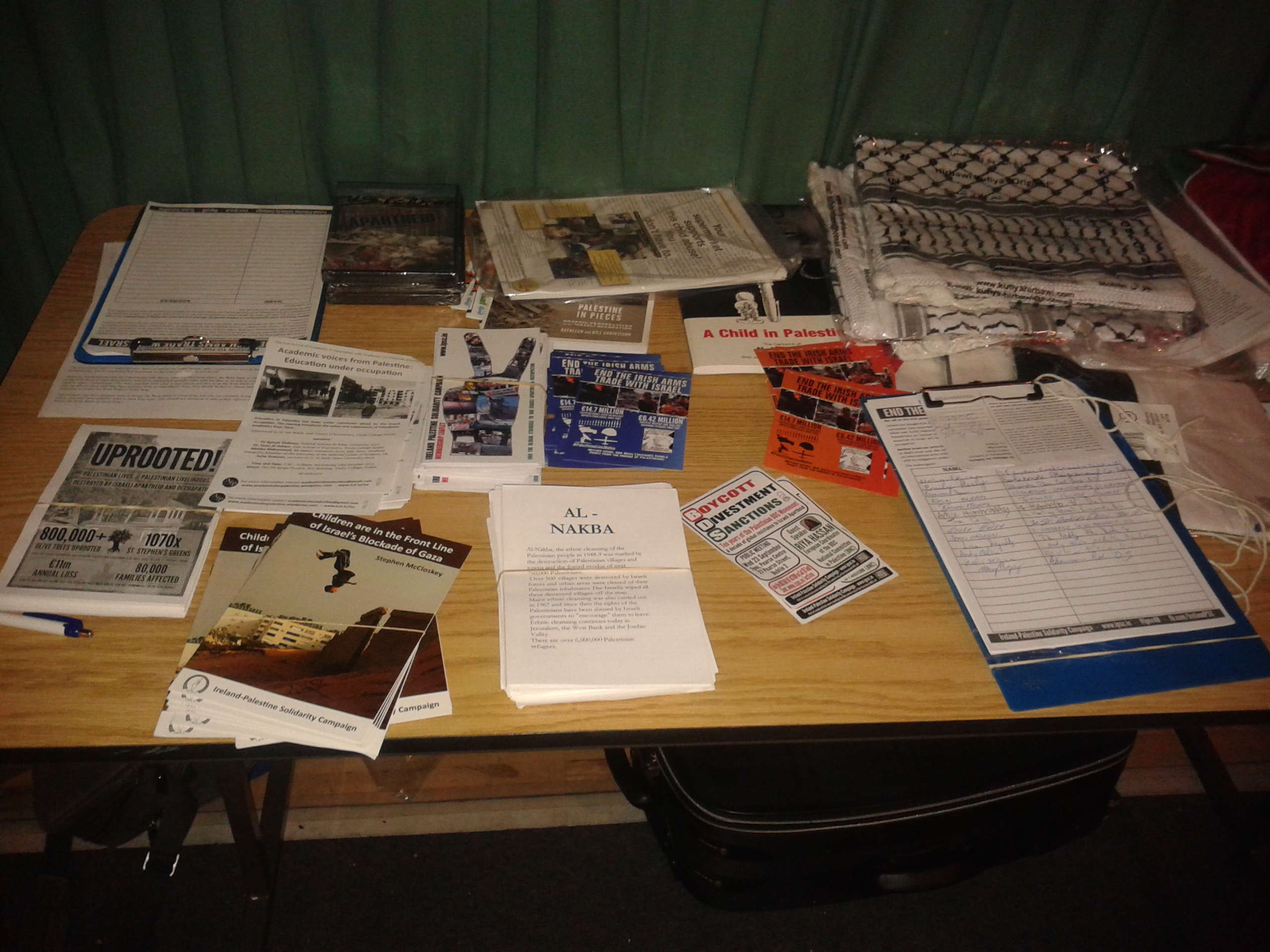
IPSC stall at the event
Riyah Hassan sets off over the next few days for Belfast and Cork before leaving our shores again and we wish go néirí an bóthair léithe!
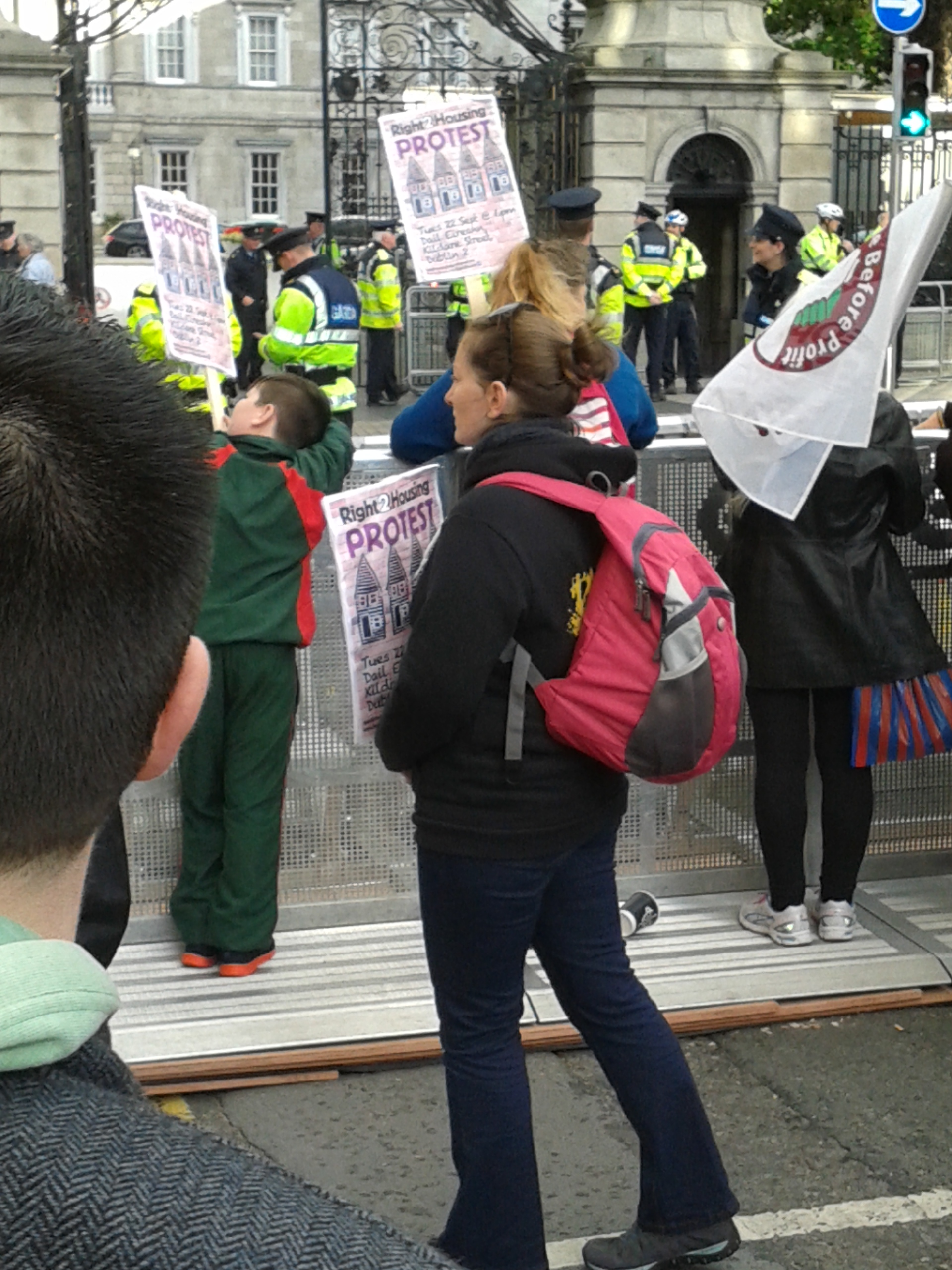
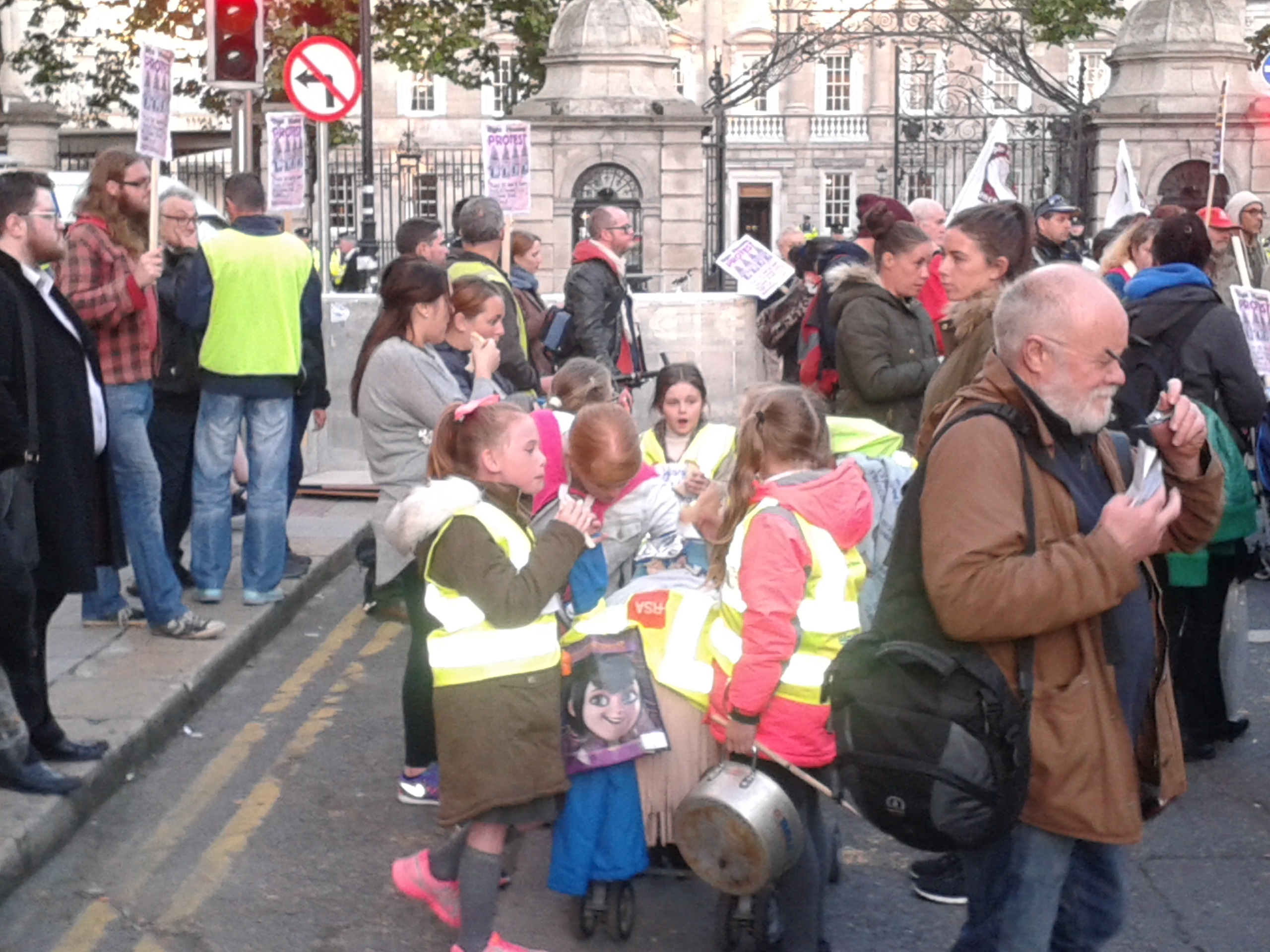
A few hundred people turned out to “welcome” the Irish Government Ministers and supporting TDs (elected members) back to the Dáil after the summer recess of the Irish parliament. The protesters were not allowed within fifty yards of the main gates, with lines of Gardaí, the Irish national police force, standing behind the special new double barriers which they now employ here. Kildare Street, the address of the Dáil, was closed by Gardaí to pedestrian and motor traffic and public transport buses using that street as part of their regular routes had to be re-routed.
There was a special focus among many of the protesters on the housing crisis in Dublin with a number of organisations working with or campaigning for the homeless present and a number of placards drawing attention to the issue.
Some protesters had met at 4pm at the GPO in Dublin’s O’Connell Street and had marched to the Dáil from there, while others had arrived at the Dáil itself from 5pm onwards. There were others demonstrating too in Merrion Street, on the other side of the Dáil complex.
Around the other side, in Merrion Street, I met some protesters coming away from the protest there and stopped to talk to them. They informed me that it was ending there and I returned along Nasseau Street to Molesworth Street.
Among others, schoolchildren lean on the barrier which facing the Dáil, the Irish Parlia
When I started up Dawson Street I saw a small march coming down towards me. These were clearly the remainder of those who had been in Merrion Street earlier. Among this section were young mothers and some of their children had notes attached to their chests, for example “I am five and I am homeless”. I joined this group for the short walk remaining in Dawson Street and into Molesworth Street.
Speeches were still going on there and it seemed a musician or singer would have made a nice change – or even a comedian, or a juggler. After a short while the speeches ended and the crowd began to disperse, at which point I approached the women I had been told were homeless and spoke to one. Shortly after, I left to buy a cup of coffee and start an article about that homeless woman and her children.
The French Government deny rumours of a relaxation in their policy of dispersal. The Spanish Government confirms it is business as before for Basque political prisoners.
On 3rd September French diplomatic sources refuted interpretations in some media that it had changed its position with regard to Basque political prisoners. The media interpretations had been built upon a statement by the Abertzale (Basque Patriotic) Left party Sortu, that it had met on July 8th with the French Minister of Justice. The diplomatic sources downplayed the significance of the meeting and denied bringing Basque political prisoners closer to the Basque Country. Etxerat, the organisation for relatives and friends of the prisoners, confirmed that there had been no move to moderate the dispersal.
The day previous to the release of information from French diplomatic sources, on Wednesday, French Justice Minister Christiane Taubira had met with her Spanish counterpart, Rafael Catala. The following day, Taubira said her Government’s approach is to analyse requests for transfer based on the length of the sentence and relocation near their family. Meanwhile, the Spanish Minister of Justice and the Interior reiterated his Government’s position that any individual prisoners’ transfer to a jail in the Basque Country required the prisoners to renounce their organisation and to accept responsibility for the damage caused by their action.
The French approach contrasts with the requirements of the Spanish Government, although Catalá reiterated yesterday that both states were acting in a “coordinated” manner and that the French Government “has not moved its policy by one iota .”
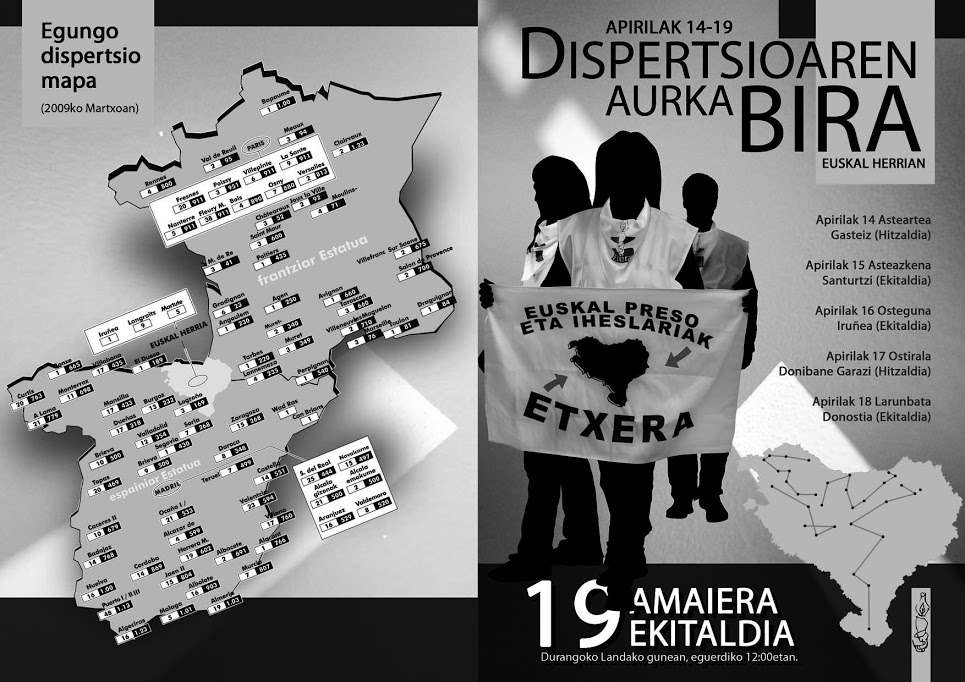
According to Etxerat on Thursday, of the nearly 100 Basque political prisoners in French prisons, only two are in Mont de Marsans prison (152 kilometers from the Basque city of Donosti), while six prisoners are in Lannemezen (231 kilometers). The rest are serving out their sentences at a greater distance from home, the vast majority at more than 600 kilometers. Although the support organisation viewed the French Minister’s statement positively, it was also at pains to disabuse people of any belief in a change in the French dispersal of prisoners and stated that any prisoners brought nearer were merely as a result of movement to which the relatives and friends have become accustomed, “bringing them close” before “bringing them far away again.”
Map of the dispersal of Basque political prisoners across both states and Etxerat flag in a poster calling for a protest and solidarity demonstration some years ago
The organisation of relatives and friends of Basque political prisoners stated that neither they nor any prisoners’ relatives participated in any meeting with the French Ministry of Justice – any meeting was with several members of Sortu only.
Spokespersons for the party of the Patriotic Left, Sortu, indicated that at their July meeting the French Ministry had been represented by Alain Christnach, Taubira’s Chief of Staff. Meanwhile the French, through diplomatic sources, asked observers not to “over-interpret” this meeting and indicated that participation in the meeting does not mean accepting Sortu’s proposals.
Another issue discussed by the Spanish and French Ministers was the possible transfer of prisoners under the law of mutual recognition of penal sentences in the EU, in force since January. This legislation provides the possibility for prisoners serving sentences in any EU Member state to be transferred to a Spanish prison; however, most Basque prisoners are unlikely to avail of this provision due to harder treatment in the Spanish prison system and the fact that dispersal throughout the state continues.
In a different aspect of the same legislation, the MEP of the Basque Nationalist Party (PNV), Izaskun Bilbao, asked the European Commission whether it will take Spain before the European Court of Justice for failure to take account of sentences served in French prisons by Basque political prisoners. This is because of the fact that the Spanish state often waits until a prisoner has served his sentence in France before extraditing him on a Spanish charge to face a further sentence in Spanish prisons.
Policy of dispersal of political prisoners — an abuse of human rights
There are many issues raised with regard to Basque political prisoners but the most universal one is the simple fact of dispersal. Relatives and friends face journeys of hundreds or even thousands of kilometers to visit their loved ones and the same distance back again. Many of these journeys are impossible without overnight stays. The expense drains financial resources while the long journeys themselves drain energy and, for elderly or unwell relatives, are an impossibility. An average of one serious accident a month occurs on these journeys for Basque political prisoners’ visitors and twelve have died in crashes over the years. Nor is it unknown for the relatives to be harassed by police on their journey or attacked by Spanish civilian fascists. As Etxerat has stated in its monthly reports and in a number of other statements: “The sentence was supposed to be on the prisoner but in actual fact was served on us as well, although we have been accused of nothing.”
It is a well-established principle of human rights that prisoners should, as far as possible, serve their sentences in a prison close to their families and relatives. This is in recognition of the rights of families as well as the desirability of easing the reintegration of prisoners as much as possible into society. The principle is covered in a number of United Nations policy paragraphs and also within the EU’s model rules for prisoners adopted in 2006 (https://wcd.coe.int/ViewDoc.jsp?id=955747).
Since both the French and Spanish states’ policy of dispersal appears to be in clear violation of the prisoners’ and relatives’ human rights and indeed of the EU’s own model rules for prisoners, some observers find it somewhat perplexing that the relatives’ organisation does not take a case against the states to the Court of Human Rights in Strasbourg. Granted, Strasbourg’s controversial decision on the Spanish State’s banning of the Herri Batasuna political party did not go in the Basques’ favour and the Court, albeit instructing the Spanish state to pay compensation to Basques for not investigating their claims of torture, continues to show a reluctance to find the Spanish State guilty of actual torture. But the dispersal of prisoners is an observable and undeniable fact and, furthermore, one which has been confirmed in public statements by Government ministers of both states.
End item
(Main source on the various statements: Deia, 4th September 2015)
Around 6am I awoke, still half in the script and trying to figure a way to win through. But not for long, as I was driven stumbling by the urea imperative – I had to go to the toilet. In the hallway I switched on the light, still thinking about the situation I had been in and, turning into what I thought was the open doorway, immediately stubbed my toe and nearly my nose on the door. After suitable curses, I stood in front of the enamel directing the hose while I thought about the damned situation.
I had debts. And there was a gang …. or gangs … and I was kind of in one of them and the big boss was putting the squeeze on me. Now, in my other life, the waking one, I’ve never really been in a gang, not even in my teens, although that’s not to say I didn’t have anything to do with them. I did – running from them, hiding from them, sometimes fighting and (of course) getting beaten up by them.
My social class set, the lower middle class, didn’t have gangs. The working class had them and curiously, the upper middle class had them too. The Geldoff types (he was from my home town). And since I didn’t usually have money to go to dances and discos, the dangerous times in my hometown were mostly daytime. The Geldoff types hung out in the Bamboo café across the road from Murray’s record shop, where us gangless lower middle class hung out. And the working class had no café or record shop, just their areas – the ‘Noggin, York Road ….
They weren’t anything like the legendary Ringsend or Dolphin’s Barn, but they were tough enough in my book. Ringsend lads came to the Top Hat Ballroom in my hometown once to settle a score and chased the locals all the way up to the ‘Noggin and the Farm, over a mile away. Local folklore had it that as they queued up in Ringsend earlier that evening to get into taxis for the foray, old dockers had handed each youth a docker’s hook.
There were times when walking down the main street in Dún Laoghaire had felt like something out of High Noon or some other western film, when the hero doesn’t want to go out in the street, he knows death is waiting there – but he has to. In his case, it was duty or some kind of fatalism sending him out there. In my case, it was fear of isolation. I didn’t want to end up cut off from my contemporaries – the boys and, yes, especially the girls. Where they hung out, I would have to go. Of course death wasn’t waiting for me, unless it were accidental …. only a beating.
Anyway, I deviate. Which doesn’t make me a deviant, by the way ….. Anyway, back to the script.
One of the things I was being pressured about had to do with promoting the gang leader’s mice. Yes, mice. Don’t ask me – I didn’t write the script.
For some reason the boss’ mice needed to be distributed, to take over everywhere. And one of the places Big Al wanted his mice installed was in a closed down fairground. It was in my area, so of course Big Al thought it was my responsibility to do it.
Big Al, photo taken during one of his philosophical debates
The thing is, that abandoned fairground already had mice, as I tried to tell Big Al. I’d hardly ever actually seen one but you could hear them, rustling, scratching and sometimes squeaking as they fought.
Big Al wasn’t interested. Were they HIS mice?
Well, no ….
Well, didn’t I see the problem?
I nodded. I could see I had a problem and I’d have a worse one if I didn’t do as he wanted.
Big Al’s mice arrived next day delivered by motorbike courier, in a plastic bag. Yeah, I know … but remember — I’m not the script writer.
I took some of the mice out. They were sleek, strong, well-fed, pinky-white mice. I carried the bag to the empty fair ground and let some of them out, to see how they got on. They scurried eagerly down lots of holes and there was suddenly a lot of squeaking underground. Then silence.
After a while, one came back, mauled and bloody. I waited but no others arrived. I put the rest of Al’s mice on the ground so they could avenge their mates. I had no choice, unless I wanted to tell Big Al I had disobeyed his instructions.
Those mice knew what was waiting for them and not a single one went down any hole. They milled around above ground. Then they found an unopened can of beer left by some inebriated street drinker, bit through into it …. and proceeded to get really, really drunk.
Some of Al’s mice before they discovered the beer can
They were still drunk when Big Al dropped by to see how his mouse colonising was progressing.
“What the fuck is going on?” Big Al and his bodyguard were looking in amazement at his carousing, stumbling mice.
I told him what had happened. He shook his head, muttered something, shook his head again, then went off grumbling to get some more mice – maybe Super-mice, or Ninja Mice, or something.
I knew the drunken mice would be history. If a cat or a kestrel didn’t get them …. well, Big Al had a low tolerance for failure. I should have felt sorry for them …. and I kind of did … but also a kind of contempt. The fairground mice had lived a hard life, braving flood and ice, finding what food they could, breeding, tunneling, avoiding alley cats, kestrels …
Big Al’s mice had been fed high-protein diets, reared in secure environments, built up muscle, each probably outweighed the biggest fairground mouse by a couple of ounces. But those scruffy, lean, dirty mice had finished off the advance guard of Al’s mice in minutes. And the rest? Didn’t even have the courage to make a fight of it but went and got drunk instead!
I left them to it. Al would be back and he’d probably want to supervise the operation against the Fairground Mice himself. That was fine with me. I didn’t like the job and I secretly wished the native mice well.
Anyway, I had other problems to deal with. I still had to organise my area for Big Al’s other operations – or else. I didn’t know exactly what the “else” might be and truth to tell, I didn’t even want to think about it.
In the end, I couldn’t do it. I could fool myself that I could manage the area for Al in a more decent way than somebody else working for him …. maybe. But I would still have to become too much like Al himself to do it. So, one alternative only – get out, go on the run and hope Big Al or his goons couldn’t find me. I didn’t even know where I was going to go – just out.
In my benighted life, I had one bit of success.
I ducked into a shop and got to use their phone. That’s right, no mobiles – maybe this script was set in the 1980s …. Not that I remember seeing big hair, shoulder pads or baggy trousers …
Anyway, I phoned up the electric phone company and got to speak to the Area Manager about my bill …. yes, the actual Area Manager! I told him I was going out of business and after a little haggling he agreed to accept 20% of the bill in payment and to wipe the slate clean.
Then I phoned my cousin, also my best friend and told him I was getting out. He was disappointed in me. Really, really disappointed. I could imagine him shaking his head.
“What about community organisation, man?” he asked.
“I can’t do it, Mort. Big Al is too much to go up against.”
“I can’t believe it – and you from a long line of trade union organisers.”
That got to me because, in the script, it was true. My Da had been a union organiser most of his life. My Ma too. And one of my Grandas as well. Strikes, union meetings, pickets, marches, police stations and courthouses had been a part of my childhood, almost as much as school throughout the year and the seaside in summer.
In real life, of course, my Da had been many things but never a trade union organiser. Active trade union member, yes – organiser, no. And my Ma – well, maybe if there had been a Housewife’s Union …. she would have probably been the General Secretary.
Anyway, in the script, Mort shamed me. And talked some more. And I argued. And he put forward a plan.
For some reason, this plan, which of course required community organising, needed a public appeal by television. Mort said I should do it. I told him I couldn’t – I’d freeze on camera and anyway I was too closely involved. I begged him to nominate someone else. He thought for a little while.
“Ok, but you have to go with whoever I choose – no backing out.”
“Sure! Thanks!” I gulped, relief flooding me.
His next words ejected that relief right out again.
“Ask your Ma.”
After I recovered from the shock and hung up, I went to see Ma. This was Ma in the script and nothing like the Ma I had in the real life, the one who was born in the Basque Country and spoke English with a German accent, because her Da had been a German.
And this script Ma was easy-going, unruffled …. Still, she took some persuading before she agreed. And while she was getting ready for her TV appearance – having her hair done, rehearsing her appeal, buying new shoes (who was going to see her shoes on TV?!!) — I was down on the street in my area, doing the rounds, talking to shopkeepers, community workers, youth, pensioners ….
Of course, Big Al was going to get to hear what I was doing. But the gamble was that my Ma’s appeal would be broadcast before he could make his move …. and after that, it would be much more difficult for Big Al to demonstrate the full meaning of that “else” with which he had threatened me. And hopefully the community would start to solidify and be able to resist. Doing nasty things to me wouldn’t be that productive any more. And whatever else Big Al was, he was a pragmatist.
Yes, of course, there’s always the unpredictable emotional element ….
I was pondering that when something pulled me half out of the script.
It was around 6am and I was still half in the script and trying to figure a way to win through. But not for long, as I was driven stumbling from my bed by the urea imperative – I had to go to the toilet.
In the hallway I switched on the light, still thinking about the script I had been in and, turning into what I thought was the open doorway, immediately stubbed my toe and nearly my nose on the door. After suitable curses, I did the business in the toilet and thought about the events in the script.
Then I wondered whether I could somehow get hold of the scriptwriter and how I could make him pay for what he put me through.
Had I met him? No, never. How did I know he was male? I don’t know, but for some reason I was sure he was. Which is strange, because nobody in my life had ever fucked with my head the way some women had. But yes, he is male – I’m sure of it. Now, where could he be hanging out ….?
Diarmuid Breatnach (published originally in Dublin Political History Tours)
(Miren de bajo para la versión en castellano).
The 31st of August 1913 was one of several ‘Bloody Sundays’ in Irish history and it took place in O’Connell Street (then Sackville Street).
A rally had been called to hear the leader of the IT&GWU) speak. The rally had been prohibited by a judge but the leader, Jim Larkin, burning the prohibition order in front of a big demonstration of workers on the evening of the 29th, promised to attend and address the public.
On the day in O’Connell Street, the Dublin police with their batons attacked the crowd, including many curious bystanders and passers by, wounding many by which at least one died later from his injuries.
One could say that on that street on the 31st, or in the nearby Eden Quay on the night of the 30th, when the police batoned to death two workers, was born the workers’ militia, the Irish Citizen Army, in a desire that very soon would be made flesh.
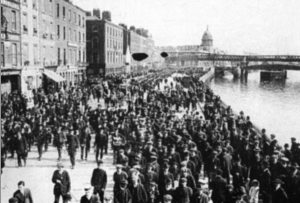
La carga policial contra los manifestantes y transeúntes en la Calle O’Connell en el 31 Agosto 1913/ DMP attack on demonstrators and passers-by on 31st August 1913 in Dublin’s O’Connell Street
THE EMPLOYERS’ LOCKOUT
Bloody Sunday Dublin occurred during the employers’ Lockout of 1913. Under Jim Larkin’s leadership, the Liverpudlian of the Irish diaspora, the young ITGWU was going from strength to strength and increasing in membership, with successful strikes and representation in Dublin firms. But in July 1913, one of Dublin’s foremost businessmen, William Martin Murphy, called 200 businessmen to a meeting, where they resolved to break the trade union.
Murphy was an Irish nationalist, of the political line that wished for autonomy within the British Empire; among his businesses were the Dublin tram company, the Imperial Hotel in O’Connell Street and the national daily newspaper “The Irish Independent”.
The employers decided to present all their workers with a declaration to sign that the workers would not be part of the ITGWU, nor would they support them in any action; in the case of refusal to sign, they would be sacked.
The members of the ITGWU would have to reject the document or leave the union, which nearly none of them were willing to do.
Nor could the other unions accept that condition, despite any differences they may have had with Larkin, with his ideology and his tactics, because at some point in the future the employers could use the same tactic against their own members.
The Dublin (and Wexford) workers rejected the ultimatum and on the 26th began a tram strike, which was followed by the Lockout and mixed with other strikes — a struggle that lasted for eight months.
Dublin had remarkable poverty, with infectious diseases such as tuberculosis and others, including the sexually-transmitted ones, the city being a merchant port and also having many British Army barracks. The percentage of infantile mortality was higher than that in Calcutta. Workers’ housing was in terrible condition, often with entire families living in one room, in houses sometimes of 12 rooms, each one full of people, with one or two toilets in the outside yard.
In those conditions, 2,000 Dublin workers confronted their employers, the latter aided by their Metropolitan Police, the Irish colonial police and the British Army. As well as the workers, many small traders suffered, those selling in the street or from little shops.
On that Monday, the 31st of September 1913, some trade unionists and curious people congregated in Dublin’s main street, then called Sackville Street, in front of and around the main door of the big Clery’s shop. In the floors above the shop, was the Imperial Hotel, with a restaurant.
The main part of the union went that day to their grounds in Fairview, to avoid presenting the opportunity for another confrontation with the Dublin Municipal Police. Others in the leadership had argued that the police should not be given the opportunity and that there would be many other confrontations during the Lockout. But Larkin swore that he would attend and that a judge should not be permitted to ban a workers’ rally. There were many police but nothing was happening and Larkin did not appear. After a while, a horse-drawn carriage drove up and an elderly church minister alighted, assisted by a woman, and entered the shop. They took the lift to the restaurant floor. A little later Larkin appeared at the restaurant open window, in church minister’s clothing, spoke a few words to the crowd and ran inside. Those in the street were very excited and when the police took Larkin out under arrest, they cheered him, urged on by Constance Markievicz. The police drew their batons and attacked the crowd — any man not wearing a police uniform.
THE UNION’S ARMY
The Irish Citizen Army was founded for the union on the 6th November 1913 by Larkin, Connolly and others with Seán Ó Cathasaigh/ O’Casey, playwright and author, including the first history of the organisation.
The Citizen Army at Croydon House, at the ITGWU’s grounds in Fairview/ El Ejercito Ciudadano en su parte del parque en Fairview.
As distinct from the Irish Volunteers, women could enter the ICA, within which they had equal rights.
Funeral of James Byrne, who died as a result of his imprisonment during the 1913 Lockout/ Procesión funébre de James Byrne, fallecido por razón de su encarcelamiento durante el Cierre de 1913, pasando por el muelle sur Eden’s Quay, partiendo de la Salla de la Libertad.
It was reorganised in 1914 as the union was recovering from its defeat during the Lockout, and 200 fought alongside the Volunteers in the 1916 Easter Rising, after which two of its leaders, Michael Mallin and James Connolly, were executed. Among the nearly 100 death sentences there were others of the ICA, including Markievicz, but their death sentences were commuted (14 were executed in Dublin, one in Cork and one was hanged in London).
The main fighting locations of the ICA in 1916 were in Stephen’s Green and in the Royal College of Surgeons, in City Hall and, with Volunteers in the GPO and in the terrace in Moore Street, the street market.
The Imperial Hotel on the other side of the street from the GPO was occupied too by the ICA and on top of it they attached their new flag, the “Starry Plough/ Plough and Stars”, the design in gold colour on a green background, the
The flag of the ICA, flown over Murphy’s Imperial Hotel in 1916
constellation of Ursa Mayor, which the Irish perceived in the form of a plough, an instrument of work. And there the flag still flew after the Rising, having survived the bombardment and the fire which together destroyed the building and all others up to the GPO, on both sides of the street. Then a British officer happened to notice the flag and ordered a soldier to climb up and take it down — we know not where it went.
TODAY
Today, after various amalgamations, the once-noble ITGWU has become SIPTU, the largest trade union in Ireland but one which does not fight. The skyscraper containing its offices, Liberty hall, occupies the spot of the original Liberty Hall, prior to its destruction by British bombardment in 1916.
The Irish newspaper the “Irish Independent” continues to exist, known as quite right-wing in its editorial line. Murphy’s trams came to an end during the 1950 decade and those in Dublin today have nothing to do with Murphy.
The Imperial Hotel no longer exists and, until very recently, Clery had taken over the whole building, but they sacked their workers and closed the building, saying that they were losing money.
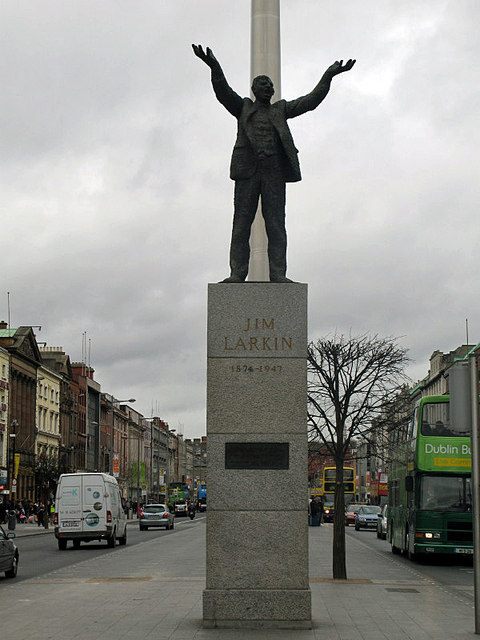
In front of the building, in the pedestrianised central reservation, stands the monument as a representation of Jim Larkin. The form of the statue, with its hands in the air, is from a photo taken of Larkin during the Lockout, as he addressed another rally in the same street. It is said that in those moments, he was finishing a quotation which he used during that struggle (but which had also been written previously by James Connolly in 1897, and which something similar had been written by the liberal monarchist Étienne de La Boétie [1530–1563] and later by the French republican revolutionary Camille Desmoulins [1760–1794]): “The great appear great because we are on our knees – LET US ARISE!”
The Jim Larkin monument in O’Connell Street today/ El monumento de Jim Larkin in la Calle O’Connell hoy en día
EL 31 DE AGOSTO EN El 1913 FUE UNO DE LOS DOMINGOS SANGRIENTOS DE IRLANDA Y OCURRIÓ EN LA CALLE PRINCIPAL DE DUBLÍN.
Hubo una concentración para escuchar al líder del sindicato de Trabajadores de Transporte y de General de Irlanda (IT&GWU) hablar. La manifestación fue prohibida por juez pero el líder, Jim Larkin, quemando el documento de prohibición en frente de manifestación grande la noche del 29, prometió que iba a asistir y hablar al publico.
El día 31 en la Calle O’Connell, la policía de Dublin con sus porras atacaron la concentración y a muchos otros curiosos o pasando por casualidad, hiriendo a muchos por lo cual murió uno por lo menos mas tarde de sus heridas.
Se puede decir que en esa calle en el 31, o en la cerca muelle, Eden Quay, la noche del 30, cuando mataron a porras dos trabajadores, se dio luz a la milicia sindical, el Ejercito Ciudadano de Irlanda, en deseo que poco mas tarde estaría fundado en actualidad.
EL CIERRE PATRONAL
El Domingo Sangriento ocurrió durante el Cierre Patronal de Dublín en el 1913. Bajo el liderazgo de Jim Larkin, el Liverpoolés de diáspora Irlandesa, el joven sindicato ITGWU fue yendo de fuerza a fuerza y aumentando en miembros, con éxitos en sus huelgas y reconocido en muchas de las empresas de Dublín. Pero en Julio del 1913, uno de los principales empresarios de Dublín, William Martin Murphy, llamó a 200 de los empresarios a mitin y resolvieron romper el sindicato.
Murphy era nacionalista Irlandés, de la linea de pedir autonomía pero adentro del Imperio británico; entre sus empresas le pertenecía la linea de tranvías de Dublín, el Hotel Imperial en la Calle O’Connell y el periódico diario nacional The Irish Independent.
Resolvieron los empresarios presentar a todos sus trabajadores una declaración para firmar que no serían parte del sindicato ITGWU ni les darían ningún apoyo en cualquiera acción; en caso de negar firmar, se les despedirían.
Los miembros del ITGWU tendrían que rechazar el documento o salir del sindicato, lo cual casi lo total no estuvieron dispuestos hacer.
Los otros sindicatos, pese a cualquiera diferencias tuvieron con Larkin, con sus pensamientos y sus tácticas, tampoco podían acceder a esa condición por que mas tarde se podría usar la misma táctica en contra de sus miembros también.
Los trabajadores de Dublín (y de Wexford) rechazaron el ultimátum y empezaron el 26 de Agosto una huelga de los tranvías, seguido por el Cierre Patronal, mixta con otras huelgas, una lucha que duró ocho meses en total.
Dublín tuvo una pobreza impresionante, con infecciones de tuberculosis y otras, incluido las transmitidas por el sexo, siendo puerto mercantil y teniendo muchos cuarteles del ejercito británico. El porcentaje de la mortalidad infantil era mas de la de la ciudad de Calcuta. Las viviendas de los trabajadores estaban en terribles condiciones, con a menudo familias grandes enteras viviendo en una habitación, en casas a veces de 12 habitaciones, cada uno llena de gente, con una o dos servicios en el patio exterior.
En esas condiciones 2,000 trabajadores de Dublín se enfrentaron al patronal de Dublín, con su policía metropolitana, la policía colonial de Irlanda y el ejercito británico. Además de los trabajadores, muchos pequeños empresarios, vendiendo en la calle o en tiendas pequeños, sufrieron.
Ese Domingo, del 31o de Setiembre 1913, algunos sindicalistas y gente curiosa se congregaron en la calle principal de Dublín, entonces nombrado Sackville Street, en frente y al rededor de la puerta principal de la gran tienda de Clery. En las plantas después de la primera, estaba el Hotel Imperial, con un restaurante.
La mayor parte del sindicato se fueron ese día a una parte de parque que les pertenecía por la costa, para evitar otra enfrentamiento con la Policía Metropolitana de Dublín. Habían argumentado otros de la dirección del sindicato que no se debe dar les la oportunidad a la policía y que habría muchos otros enfrentamientos durante el Cierre. Pero Larkin juró que lo iba a asistir y que no se podía permitir a un juez prohibir manifestaciones obreras.
Había mucha policía pero nada pasaba y Larkin no aparecía. Después de un rato, un coche de caballos llegó y un viejo sacerdote salió, apoyado por una mujer, y entraron en la tienda de Clery. Subieron en el ascensor hacía el restaurante. Poco después, Larkin apareció en la ventana abierta del restaurante, en el traje del cura y habló unas palabras, antes de correr adentro. Los de abajo en la calle muy entusiasmados y cuando la policía salieron agarrando le a Larkin, la multitud le dieron vítores, alentados por Constance Markievicz. La Policía Municipal sacaron sus porras y atacaron a la multitud – a cualquier hombre que no llevaba uniforme policial.
EL EJERCITO DEL SINDICATO
El Ejercito Ciudadano de Irlanda (Irish Citizen Army) fue fundado para el sindicato en el 6 de Noviembre del 1913 por Larkin, Connolly y otros con Seán Ó Cathasaigh/ O’Casey, escritor de obras para teatro y algunas otras, incluso la primera historia de la organización. A lo contrario de Los Voluntarios, el ICA permitía entrada a mujeres, donde tenían derechos iguales.
Fue reorganizada en 1914 cuando el sindicato se fue recobrando de la derrota del Cierre Patronal, y 200 lucharon con los Voluntarios en el Alzamiento de Pascuas de 1916, después de lo cual dos de sus líderes, Michael Mallin y James Connolly, fueron ejecutados. Entre los casi 100 condenas de muerte, habían otros del ICA, incluso Constance Markievicz, pero sus condenas de muerte fueron conmutadas (se les ejecutaron a 14 en Dublín y a uno en Cork, y a otro le ahorcaron en Londres).
Los lugares principales de lucha del ICA en 1916 fueron en el Stephen’s Green y en el Collegio Real de Cirujanos (Royal College of Surgeons), en el Ayuntamiento y, con Voluntarios, en la Principal Oficina de Correos (GPO) y en la manzana del Moore Street, el mercado callejero.
El Hotel Imperial al otro lado de la calle del GPO lo ocuparon también el ICA, y encima colocaron su nueva bandera, el Arado de Estrellas (“Starry Plough/ Plough and Stars”), el diseño en color oro sobre fondo verde, la formación celeste del Ursa Mayor, que lo veían los Irlandeses en forma del arado, una herramienta de trabajo. Y ahí ondeó la bandera después del Alzamiento, habiendo sobrevivido el bombardeo británico y el fuego que destruyeron el edificio y la calle entera hacía el GPO, en ambos lados. Entonces un oficial británico se dio cuenta de la bandera y le mandó a soldado hir a recoger la – no se sabe donde terminó.
HOY EN DÍA
Hoy en día, después de varias fusiones, el noble ITGWU se ha convertido en el SIPTU, el sindicato mas grande de Irlanda y parecido en su falta de lucha a Comisiones Obreras del Estado Español. El rasca cielos de sus oficinas, La Sala de la Liberta (Liberty Hall), ocupa el mismo lugar que ocupó la antigua Liberty Hall, antes de su destrucción por bombardeo británico en 1916.
El periódico Irish Independent sigue existiendo, conocido por ser bastante de derechas en su linea editorial. Los tranvías de Murphy terminaron en la década del 1950 y los de hoy en Dublín no tienen nada que ver con los de antes.
El Hotel Imperial ya no existe y, hasta hace muy poco, la empresa Clery lo tenía todo el edificio, pero despidieron a sus trabajadores y cerraron el edificio, diciendo que perdían dinero.
En frente del edificio, en la reserva peatonal del centro de la calle, está el monumento representando a Jim Larkin. La forma de la estatua, con las manos en el aire, lo tiene de foto que le hicieron durante el Cierre Patronal, cuando habló en otro manifestación en la misma calle. Dicen que en ese momento, estaba terminando una frase famosa que usó durante esa lucha (pero que también lo escribió Connolly antes en 1897, y que lo había escrito algo parecido primero el monárquico reformista Étienne de La Boétie [1530–1563] y luego el revolucionario republicano francés Camille Desmoulins [1760–1794]): “Los grandes aparecen grande por que estamos de rodillas – levantamanos!”
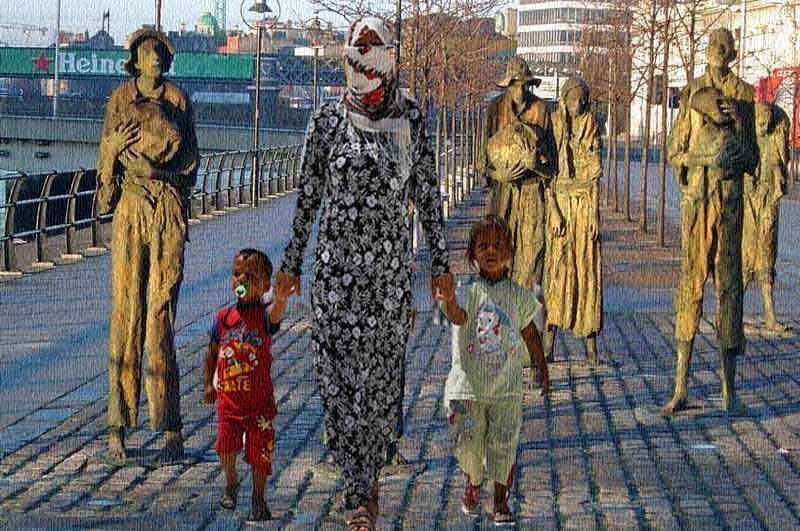
The Great Hunger (1845-1849) emigrants’ monument on the north quays of the river Liffey, Dublin, with superimposed image of African woman and children (image from Memet Uludag on Facebook).
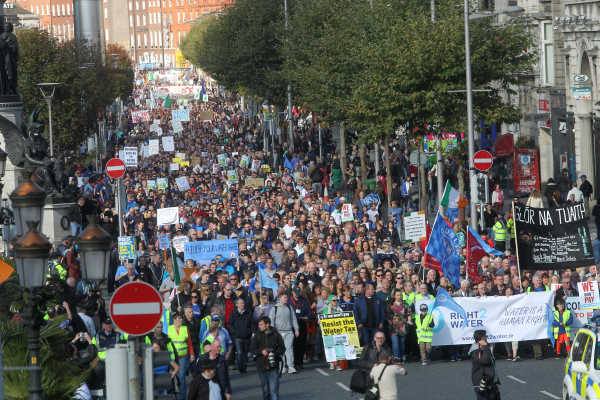
Any hope that the Irish capitalist ruling class and their current government had that people had given up — or even had just got tired of marching — were dashed on Sunday 29th August 2015.
Hundreds of thousands gathered again from far and near; banners were on display from the West, South, North-East and North-West, Midlands, and of course many parts of Dublin and the East coast.
The main march columns started off from two train stations: Connolly Station, to the east of the city and Heuston, to the west. The latter contingent crossed the river at the station then marched eastward towards the city centre along the southern quays while the other marched westward along the northern quays and then crossed the river to the north side further upriver (Essex Bridge) and turned towards the city centre. Both columns had contingents and individuals joining them en route while others went straight towards O’Connell Street, they were greeted by a musical performance from the main stage by Don Baker and other musicians, also a performance by a rapper.
Aerial shot of rally in O’Connell Street (photo: Communities Against the Water Charge)
STATE REPRESSION
State repression was focused on at times: the Jobstown 23 banner got strong applause from bystanders at various points along the route, another banner denounced Garda violence including pepper-spraying and a number of speakers spoke about Garda repression, including one who talked about the Special Branch opening files on anti-water tax resisters.
This banner got strong applause from bystanders at various points along the route
As usual on large demonstrations of this kind, the Gardai refrained from violence or bullying and in fact were in very low profile, in stark contrast to their behaviour and numbers when dealing with smaller numbers in local resistance to water tax and the installation of water meters.
ELECTIONS, TRADE UNIONS
Among the speakers there was of course much mention of elections and getting rid of the current capiltalist government and also statements about the fight for the Republic in history, compared bleakly to the situation in Ireland today with unemployement, emigration, cuts to services, homelessness, privatisation. John Douglas, Gen. Secretary of Mandate and President of Mandate covered many of those issues, including the Dunne’s Stores dispute and the sudden closure of Clery’s in a rousing speech. However, those two are cases in point illustrating the weakness of the Irish trade union movement today: Mandate had one day’s strike in Dunnes’ many weeks ago and have won no gains as yet, while Clery’s managed to sack their workers without the union leading even a sit-in to hold the building and stock as a bargaining chip
Belfast Trades Council banner on the demonstration — they also had a speaker on the platform
A new presence on this demonstration was Belfast Trade Council, who were made very welcome and who had a speaker on the platform. He said that there was no EU directive to tax the water and that in the Six Counties they had defeated the water tax. He was not long speaking when the heavens opened and rain poured down on demonstrators and bystanders alike.
SUMMARY
What today showed is a strong will to resist across the country and across a great age spread, but with noticeably lower numbers across the teenage and young adult band, as well as a relatively weak leadership of the movement.
It remains to be seen whether RTÉ and newspapers will give a reasonable estimate of the numbers and coverage or instead do the usual of quoting ridiculously low figures or remain vague about them while giving minimal space to what was a large event, with participation from around the nation, as part of the biggest civil disobedience campaign in the history of this State.
End
Video of unaccompanied rapper Stephen Murphy at rally
At the Mayo v. Dublin GAA football game in Croke Park the following day, on Hill 16 (Photo from Right to Water FB page)
(Postcript: In their on-line report, RTÉ showed a photo of a packed O’Connell St. and said the organisers were claiming around 80,000. Also, at the Dublin GAA football match of Mayo v. Dublin the following day in Croke Park, attended by Enda Kenny, whose seat is in that county, Dublin supporters unfurled a giant banner of Right to Water).
The historic ruins of Hasankeyf, which may have been settled more than two thousand years BCE, are threatened by a Turkish dam along with the homes of Kurdish, Armenian and Arab people. A number of archaeologists and historians believe that the fortified town was referred to in inscriptions on the Mari tablets (1,800-1,750 BCE). The rocky outcrop also contains many human-made caves.
Some of the caves at the Hasankeyf site
As well as being the site of an ancient town, it is also an urban and outer settled district located along the Tigris River in the Batman Province in southeastern Turkey, with a recent combined population approaching 70,000.
The project that threatens to submerge much of Hasankeyf is the Isilu Dam being built by Turkey. Despite the foundation stone being laid as late as 2006, in 1971it was already being actively considered as one of the sites for a number of dam projects for hydro-electric generation and number of other purposes. A study by an international team between 1980 and 1982 recommended the building of the Isilu dam despite the 1981 declaration by the Turkish Government itself of Hasankeyf as a natural conservation area.
Opposition to the dam
The project had run into funding difficulties over the years. Due to international protests on environmental, archaeological and human rights grounds, and also protests within Turkey and from inside Hasankeyf, a number of international funders backed off. The British Government refused $236 million in funding in 2000 and in 2009, a consortium of Austrian, Swiss and German credit agencies withdrew their offer of $610 million.
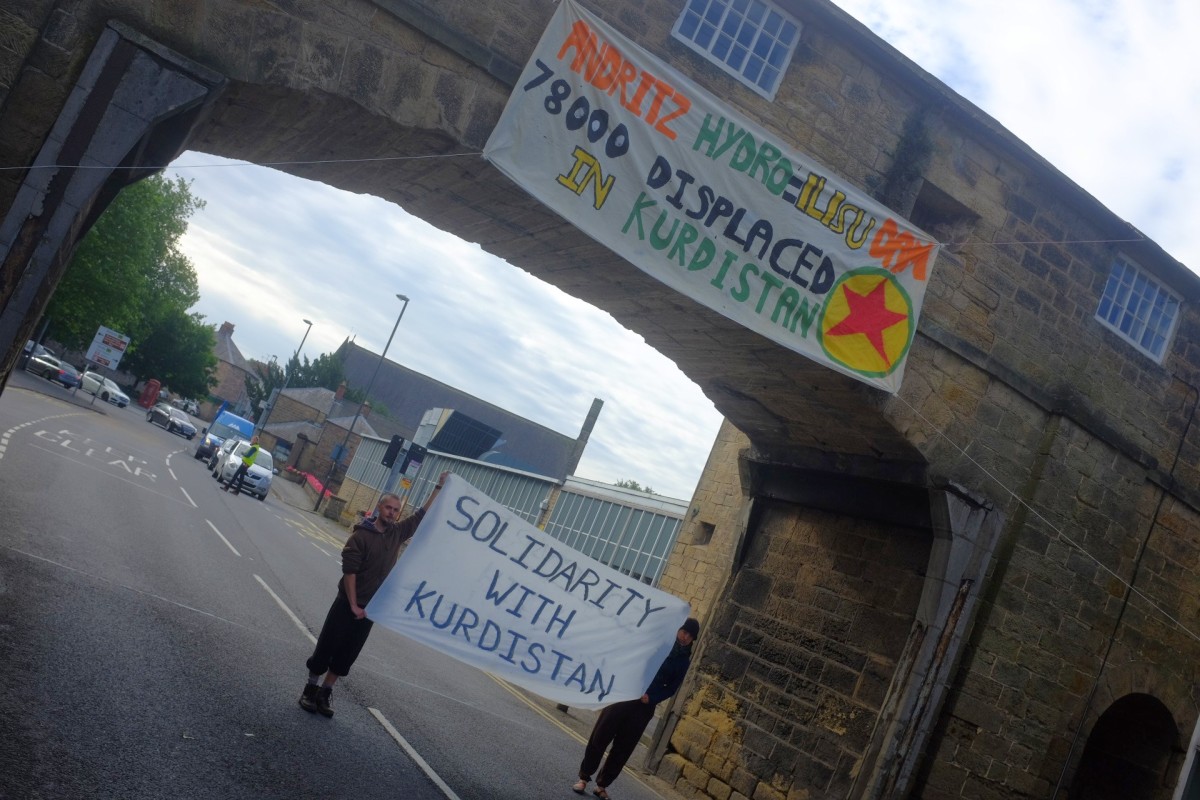
Solidarity picket outside the Andritz company plant in England
The consortium had suspended the loan in 2008 and had given the Turkish Government 6 months to comply with international standards, which they had failed to do. However in July 2010 the Austrian firm Andritz Hydro announced it was lifting its suspension and would provide the six huge turbines specified for the power plant.
Excavations for the main body of the dam began in May 2011 and the Turkish Government projected that all works would be completed this year. A 250m (820ft) permanent steel-girder bridge with concrete supports has been constructed just downstream of the dam andconstruction of new villages is currently underway. The diversion of the Tigris River began during August 2012. According to Government figures, by April 2014 the project was 60% completed while 73% of the Hasankeyf population had been resettled.
Protests continue within the area, peaceful and not. According to the Government, in January 2015 Kurdistan Workers’ Party (PKK) threatened the lives of workers and anti-Government sources confirmed that a number of workers left the site. On 3 February 2015 a convoy of supplies for the dam was attacked, injuring three persons and several days later a worker was killed in his home, according to the Government by suspected PKK militants. Peaceful protests have included pickets and demonstrations (see photos) and some of these have also taken place abroad, including recent ones in England (see photos).
Locals, probably mostly if not all Kurds, protest at the Hasankeyf site
The completion of the Ilısu Dam will cause the flooding of the ancient city of Hasankeyfand about 185 villages and hamlets will be fully or partially affected by flooding, according to the Kurdish Human Rights Project. From 55,000–65,000 people will be forcibly resettled, says the KHRP, while even the Turkish Government estimates 40,000. According to a statement released on the 24th August by a solidarity group protesting outside the Austrian Andritz company’s facility in England, the completed project will reduce water flow to Syria by 40% and Iraq by 80% and the dam also provides the facility for political control of those areas through further restriction of water supplies.
Turkey is a member ofNATO and extremely important strategically to the the military alliance, as well as having some significant natural resources. However its regularly-renewed applications to join the EU have always been turned down because of its human rights record, both in the course of recent wars with its ethnic Kurds as well as with regard to protest movements among ethnic Turks. Recently Turkey came in for adverse international publicity again as it was seen to be blocking Kurds trying to get through the Turkish border with Syria in order to defend areas under attack by ISIS (Islamic State), while Turkey has also been accused of more directly assisting ISIS in its attacks. Although the state has Moslem fundamentalist political parties which occasionally come into government, Turkey itself has been secular since it became a republic in 1922.
The Spanish state is set to close 107 Basque social centres, confiscate their funds and sell off their assets, including property. With allegiance to the Basque Patriotic Left, the “Izquierda Abertzale” as it terms itself in Spanish, the Herriko Tabernak (“Peoples’ Taverns”) function as centres for social, cultural and political activity. The sale of coffee, alcohol and pintxos (a variety of home-produced small items of food, mostly eaten cold) also generates income with which to employ some activists within the movement and also to fund some of its political activities.
Outside the Errondabide street Herriko Taberna in the Casco Viejo part of Bilbao
Those are the socially-useful functions of the Herriko Tabernak and precisely the reasons the Spanish state plans to close them down. Not that they say that openly, of course – the official line is that the taverns “fund terrorism”. Never mind that the police have never furnished any evidence of that, never mind too that the alleged recipient, the armed organisation ETA, has been in uninterrupted ceasefire since 5th September 2011, confirmed as “permanent” in a statement the following January and again as a “permanent cessation of armed activity” in October 2012.
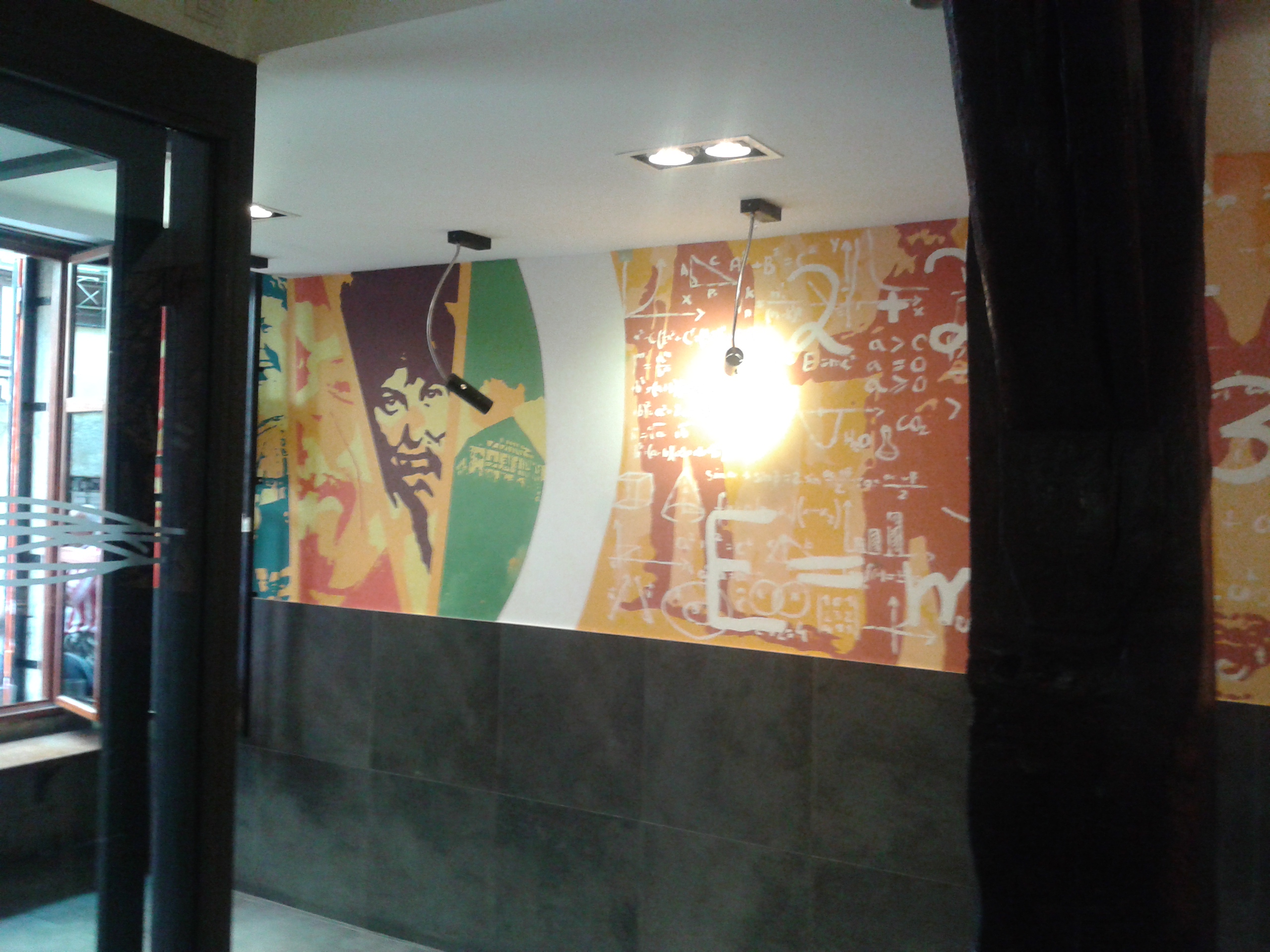
Entrance wall mural
There is an herriko taberna in many vilages and in every town throughout much of the southern Basque Country (i.e the part under Spanish state rule) and Bilbao, for example, has several. They vary from one another but typically have a front bar area and a rear or upstairs function room which may be used for political, cultural,
Section of the function room at the back of the Herriko.
educational or social event, or hired for personal social functions such as celebrating a birthday, successful conclusion of studies, an engagement or wedding, a return for a migrant. Social functions of a more political nature such as welcoming a recently-released political prisoner or a commemoration of some figure of the resistance are also held there.
Inside the Herriko, the bar area and some afternoon customers
Although people hostile to the ‘herrikos’ would not usually enter one, anyone can do so and order coffee, beer or soft drink, perhaps buy some pintxos – no-one will bother them. The language of conversation inside may be Euskera (Basque) or Castellano (Spanish) but all the staff have at least enough Euskera for the customers’ needs and many are fluent.
On the walls notices and posters carry political, cultural or social messages or advertise an event, either specific to the Basque Country or perhaps in solidarity with the Palestinians, the Saharaui (Western Sahara people), or to do with gender and sexuality-social issues, workers’ and migrants’ rights, animal rights ….
Some pintxos in the Herriko, home-made Basque ‘fast food’Banners and Basque flag propped against wall in the function area
Photo portraits of prisoners are “glorification of terrorism”
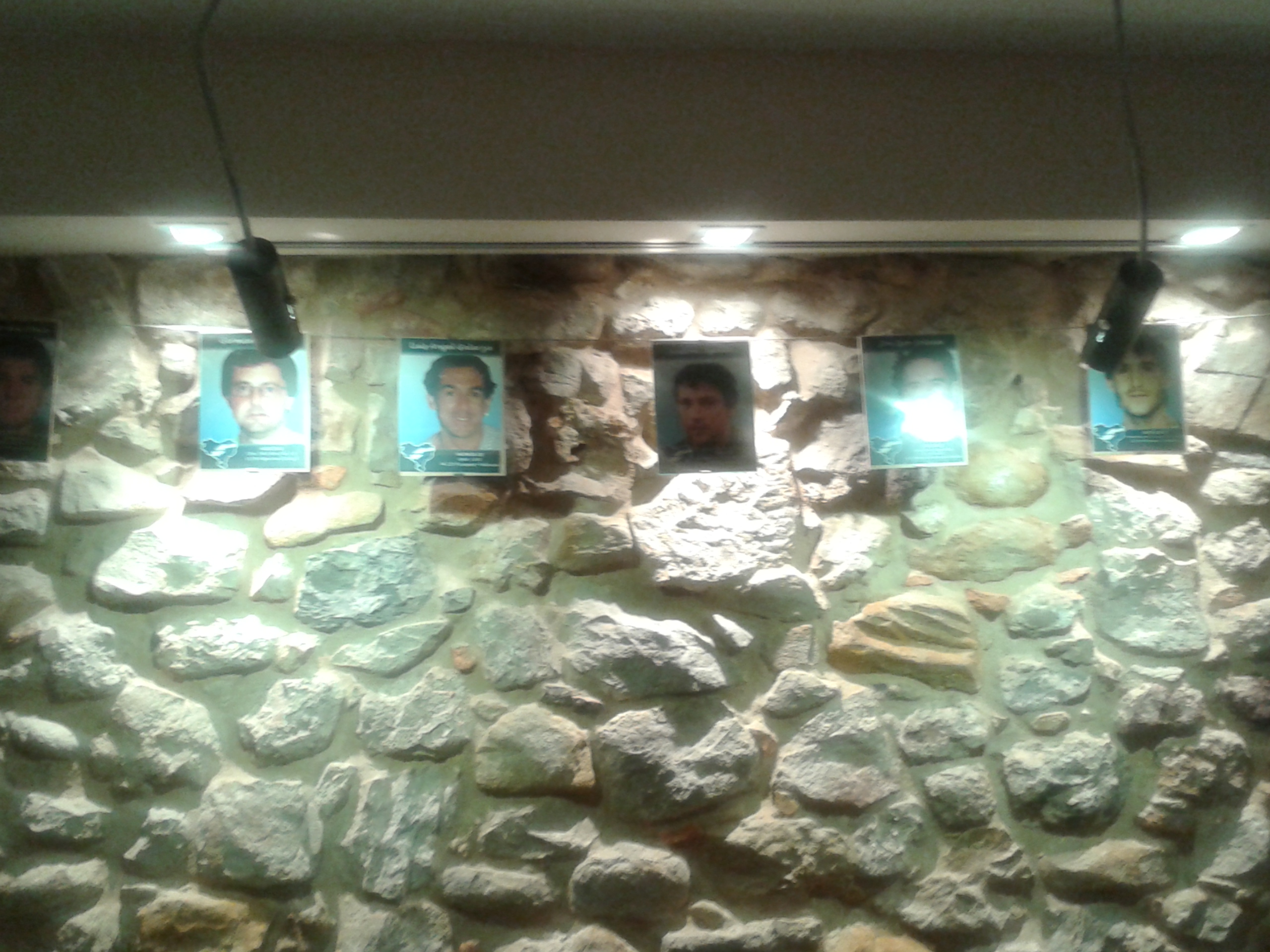
Recently, the walls carried photo portraits of political prisoners from the area. After the Spanish National Court decreed, a few years ago, that these were expressions of “glorification of terrorism”, the police raided many herriko tabernak (and also sympathetic bars) and arrested those who refused to take them down. The herrikos and bars affected then removed the portraits but replaced them with black silhouettes. Despite a widespread expectation that those arrested would face prison terms, nothing happened and the pictures are back up on the walls of the herrikos.
Portraits of local activists in jail prominently displayed on the wall in the bar area of the Herriko
The herriko closures are expected after the Spanish state’s General Elections, which must be held before December and are expected in October or November. According to opinion polls, both traditional governing parties, the PP and the PSOE, are ahead of all others and even Podemos, with its meteoric rise to December 2014, did not overtake them and continues to show a decline in the voting intentions of those polled. In the southern Basque Country itself, the christian democratic Basque Nationalist Party continues to dominate and, even if they wished to help the party to their left (and they don’t), could not stand up against the Spanish state. A political solution therefore is out of reach.
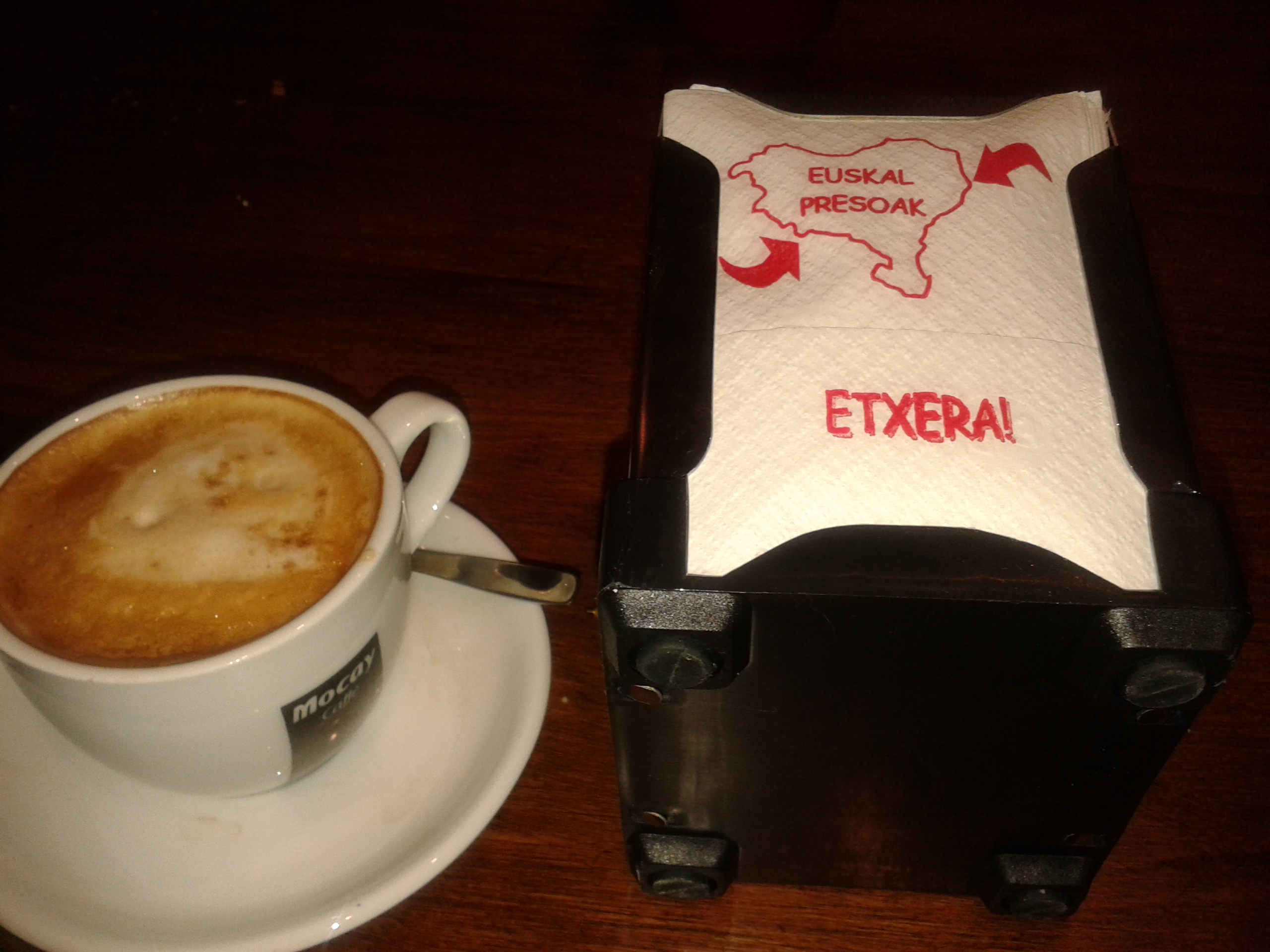
Cafesnea (coffee and milk) with the standard Herriko tissues, stamped with the slogan calling for the Basque prisoners to be sent home from dispersal (and also to be freed).
When the herrikos close, the loss will be enormous: the organised movement will suffer politically, culturally and financially and the social and cultural life of thousands will suffer. There seems little that the Abertzale Left movement can do within the Spanish state – its legal challenge in the Supreme Court has failed. It can apply to the Constitutional Court but decisions there usually concur with those of the Supreme. After the Constitutional, it can apply to Europe, to either the Court of Human Rights at Strasbourg or the Court of International Justice at the Hague but the delay in cases being heard there can take years and by the time they are heard, the herrikos will have been closed and properties auctioned off. Nor are the European Courts’ decisions necessarily to the benefit of the Basques – although a number of times Strasbourg has found against the Spanish state for failing to investigate a claim of torture by a political prisoner, it has never actually found the state guilty of the torture itself. And when the Abertzale Left’s political party, Herri Batasuna, was banned by the Spanish Supreme Court (and confirmed by the Constitutional) in 2003, the movement took the case to Strasbourg. Eventually, in 2009, the Court delivered its judgement – incredibly, it decided that banning a political party with electoral support varying from 15% to nearly 25% in the southern Basque Country was not an abuse of the human rights of the people concerned.
This Herriko is mainly patronised by youth but the age range is complete, from babies brought by their parents to the elderly
Considering the options and Spanish democracy
Now the people are considering their options in action outside the courts. Should they occupy the buildings and resist their takeover by the Spanish state? Maybe that would make sense where their location is a fairly high-profile one. But others are in back streets and laneways; the “Zipayos” (pejorative name for the Euskadi police, the Ertzaintza) can swarm those places, assault the occupants and evict them in a matter of hours. That they can do the same in the more high-profile locations is without doubt but at least the community and passers-by will see the resistance there. In the smaller villages, herrikos may change their name and perhaps replace the buildings’ renters or lessees. Whatever course they take, the disruption overall will be huge.
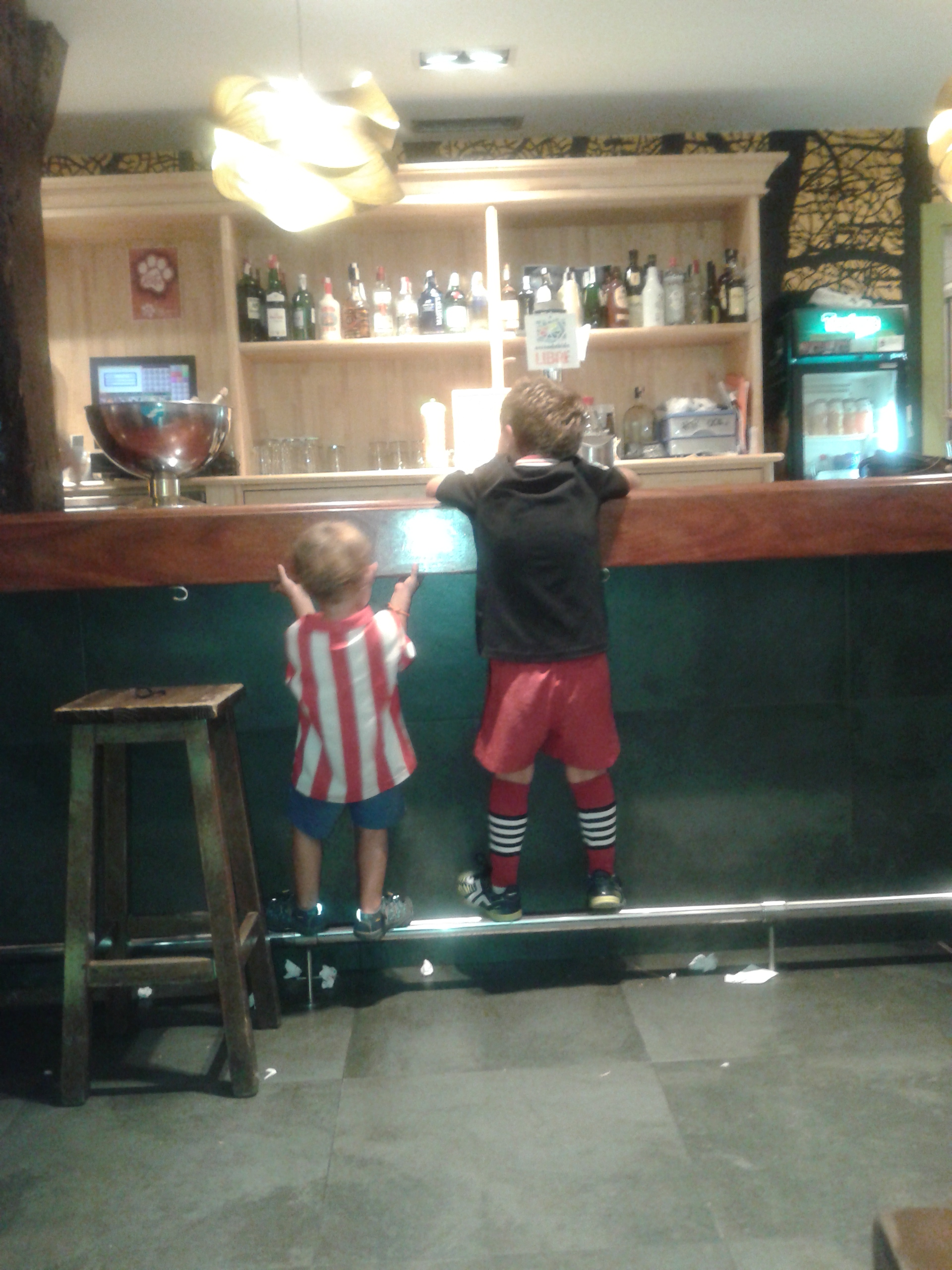
The upcoming generation, one wearing an Athletic Bilbao shirt
In 1998, the Spanish National Court judge Balthazar Garzon (beloved of many liberals around the world) closed down the Basque-language newspaper Egin, a bilingual daily in Euskera and Castellano first published 20 years earlier. Over a year later, a judge ruled that the newspaper could reopen but by then its machinery had been dismantled or left unusable and its owners left without funds as they were using them in court proceedings. In 2009, a Spanish court finally decided that there had been no grounds for closing it in the first place. A year later, there was a similar decision in the case of Egunkaria, the first-ever daily in the Basque language, closed down by the Spanish state in 2003. In 2010, the National Court decided that there had been no reason to close the newspaper and that the accused were innocent, hinting that the accusation of torture was true. But no formal apology followed, nor was there any compensation paid and Otamendi, the newspaper’s manager, had to take his torture case to Strasbourg, where in 2012 he was awarded compensation of €20,000 (and €4,000 legal costs) against the Spanish state because (as usual) they had not bothered to investigate his claims of torture. No compensation has yet been paid for Egunkaria‘s closure and its successor, Berria, reportedly struggles financially today.
Posters and information on the Herriko wall near the front of the bar area
Basques smile ruefully when students of recent Spanish history talk about the “democratisation” of the State through the “Transition” from General Franco’s dictatorship. Apart from the killing by Spanish police and state-supported fascist gangs during that Transition, the southern Basque Country has seen state-organised assassination squads, bannings of newspapers and radio stations, bannings of political parties, youth and cultural organisations and arrests, torture and jailing of political activists. This is the reality behind the words of “Spanish state democracy”.
NB: This article was written about the 11th October 2014 demonstration but arrived too late to use. Normally that would mean it just getting binned or at best getting mined for useful bits to put in a future article. However, the decision is to use this now in the run-up to the forthcoming demonstration at the end of this month against the water tax.
The size of the turnout for the anti-water charges demonstration in Dublin on Saturday 11th of October must have been something of a shock for the Irish ruling class and for their current government, the Fine Gael-Labour coalition. The implementation of water charges forms an important part of their programme to make the ordinary people pay for the crisis caused by financial and property speculators. Other parts of this programme that people have been experiencing to date over the last few years (and including the Fianna Fáil government preceding this one) have been bailing out the banks and their bondholders, financed first through the Household Charge and, after that was defeated by massive resistance, the Household Charge taxed through the Revenue Department; then the pension levy on public service workers; followed by the extensive cuts in social spending at the same time as implementing the “Social Charge”.
Marchers heading southward after leaving the Garden of Remembrance/ Parnell Square area (RTÉ tried to play down the figures to 30,000
The ruling class and their government are of course well aware that the water charge is unpopular among the vast majority of the population – supporters of the tax have failed to convince the people that it is anything but another way of “paying the bankers”. But the unpopularity of a measure is no guarantee whatsoever of wide-scale mobilisation against it and the Government was probably expecting the resistance to meter installation to remain local, marginal and uncoordinated. Clearly this was one case where “Ní mar a shíltear a bhítear”.
But the size of the demonstration surprised not only the ruling class and their government but also anti-water charge campaigners themselves. “I thought we’d be doing well to get 15,000” said one long-time community activist and “If we got 50,000, we thought it would be brilliant” according to an activist from one of the political groups active on this issue. A realistic estimate of the attendance at the demonstration on Saturday puts it at between 100,000 (as quoted by an unnamed Garda source to an Irish Times reporter) and 150,000. The march from the Garden of Remembrance heading across the river before turning again towards the GPO took over one-and-a-half hours to pass a fixed spot in O’Connell Street while another large number reportedly marched from another direction also toward the GPO.
So how was it that so many mobilised?
Any attempt to answer the first question must be speculative but there are a number of indications other than the widescale unpopularity of the water charge and any measure seen as “bailing out the bankers”. One of these is the highly-publicised police repression of local protests against meter installations in a number of Dublin areas, where the population is overwhelmingly working-class and lower-middle class. These protests and the police repression, completely ignored by the national mass media, however received widescale publicity through social media, with videos posted on Youtube, Facebook and Twitter. And the people sharing and sometimes posting these reports and images were for the most part not political or even community or trade union activists. Another source tapped was that of past mobilisations against the Household and Property Taxes. Much of the mobilisation took place in small to medium-sized communities where for the most part, unusually but according to my sources, the activists promoted the resistance and the demonstration rather than their own political party or organisation.
“Apart from a few political activists, only the middle-class mobilise through Facebook”, said long-time political activist to us about a year ago. “Who cares how many ‘Likes” on Facebook an event or campaign gets – it doesn’t mean anything!” said another. Rebel Breeze would have agreed with them too, knowing that the way to mobilise working class people was mostly through personal contact, door-to-door and workplace leafleting. But it seems that is no longer true and that working people, who previously used Facebook only socially, have now begun to use it politically too.
An aerial view down towards the rally after the march at GPO/ O’Connell St
Why did it surprise even the campaigners?
So much for how such a large number came to protest. But how is it that the campaigners themselves were taken by surprise? Of course there may have been unexpected mobilisations in some areas where campaigners had not been active but the main reason for their surprise is almost certainly their lack of coordination. Their are a number of Left organisation and “dissident” Republican organisations campaigning against the water charges, along with a large number of independent activists of a mainly political or community background. In some areas Sinn Féin activist have been out too, although the party does not advocate non-payment or prevention of meter installation.
In a united campaign where all the activists worked towards a united mass resistance, sharing information, the numbers would not have caught them so much by surprise. Of course, their expectations might have been exceeded but each group would have been aware of the actions in other groups’ areas along with the massive rise in Facebook hits, “Likes” and “Shares” to postings of resistance and police repression. Such a united campaign against the water charge does not yet exist. A previous attempt to float such a united campaign on the Household and Water Charges foundered on a number of rocks – political party opportunism, social democratic illusions and the failure of the traditional Left to engage with the independent activist constituency and the “dissident” Republican movement probably being the main ones.
There are a number of attempts to portray the active resistance to the Water Charge as spontaneous but it is likely that where there have been no campaigners active locally, the people have responded to what they have seen elsewhere, both through anger and encouragement. On the other hand, any attempt by any group or individual to take the credit for the growing resistance or for the mass attendance at the demonstration would have to be laughable.
The “passive Irish” jibe refuted once again
Rebel Breeze has long been tired of the wailing often heard to the effect that “the Irish are not like the Greeks”, or that the Irish are passive, accept all kinds of shit without resistance, etc. etc. With the history of class and national struggle of the people of this island it is extraordinary that such an notion ever gained wide acceptance among commentators – but it did. The Irish working class has generally responded militantly and enthusiastically when they have been called to battle by what they consider a credible leadership. In Ireland, that leadership was the trade union movement and no other. In 1913 a fighting trade union was forged in Ireland and, when the employers tried to break it, the workers of Dublin (mostly) fought that attempt for up to eight months, in a city of wide-spread poverty and with most charity services discriminating against strikers and their families. In that struggle, the workers faced also the hostility of the media and state (not much has changed there) and of the main churches. Although defeated in that struggle, the union did not break and came back years later stronger than ever.
Deprived of revolutionary and militant leadership, the movement nevertheless maintained a fighting front for workers through decades of high unemployment and emigration. But in the mid-1980s the trade union leadership opted for what they called “social partnership”, an arrangement in which employers, trade union leadership and the State (which is also a huge employer) sat down and agreed the salary levels for the next period. This had a disastrous impact on the trade union movement. “Use it or lose it” is a general physiological rule about muscle : the trade union leadership became unused to strike action and, when strikes did occur, to instructing members of unions not directly involved to pass the pickets. Recruitment fell dramatically and, when in 2010 the employers and State no longer saw any point in negotiating with the trade union leadership, as they believed the leadership to be no longer capable of resistance, the latter lacked the spirit and confidence to take them on. After a demonstration called by ICTU with a threat of a general strike days away, which received a massive response from trade union members, the leadership instead opted for more negotiations, in which they agree to the pension levy on public servant workers and industrial peace in the private sector: Croke Park I (June 2010). So the workers no longer have a leadership they consider credible and the revolutionary and radical socialist organisations are too small to be thought credible and also have not generally built bases within the trade union movement from which to offer a leadership for struggle.
Nevertheless, the working people of Ireland turned out in huge numbers once again on Saturday to protest an unjust tax which is being used for an unjustifiable purpose. The class is still there, it never lost its fighting spirit – what it needs is a viable leadership. It remains to be seen whether this will be built and whether it can lead a broad militant movement against this tax and other attacks on the working class, without repeating the errors of the recent ‘broad movements’.







 There were many police but nothing was happening and Larkin did not appear. After a while, a horse-drawn carriage drove up and an elderly church minister alighted, assisted by a woman, and entered the shop. They took the lift to the restaurant floor. A little later Larkin appeared at the restaurant open window, in church minister’s clothing, spoke a few words to the crowd and ran inside. Those in the street were very excited and when the police took Larkin out under arrest, they cheered him, urged on by Constance Markievicz. The police drew their batons and attacked the crowd — any man not wearing a police uniform.