BRITISH NAVY CONFRONTATION IN DUBLIN – GOMBEEN STATE RAIDS ON ACTIVISTS’ HOMES

The following is a compilation by Rebel Breeze of recent short communiqués from Anti-Imperialist Action on the confrontation with a British warship in Dublin and the raids on activists’ homes and arrests under the Gombeen State’s “terrorist” legislation (Offences Against the State Act).

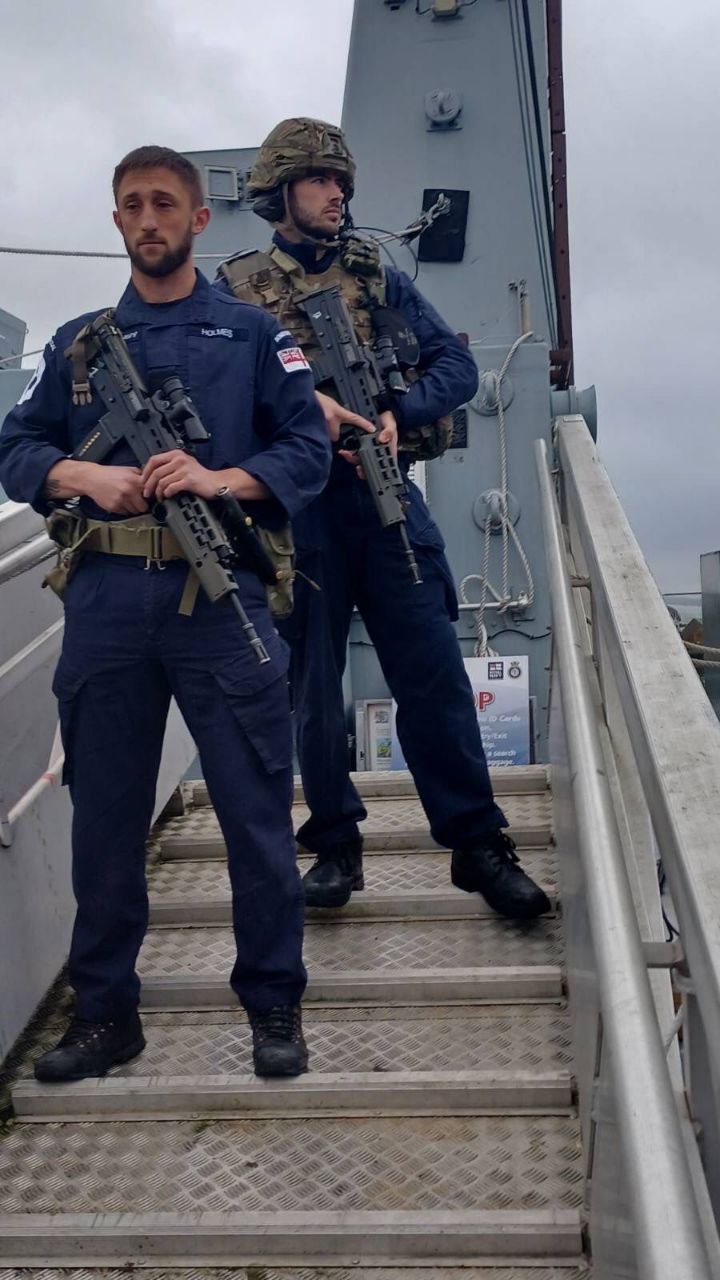
Armed British Terrorists Confronted in Dublin.

On Sunday afternoon, members of Anti-Imperialist Action Ireland along with members of Saoirse Don Phalaistín, carried out a direct action against a British warship in Dublin port.

The protest was called to highlight the ongoing British Occupation of Ireland and to make clear the complicity of British Imperialism in the ongoing Zionist Occupation and Genocide in Palestine. The protest made clear the links between the National Liberation Struggles in Ireland and Palestine.

British Military confronting protesters in Dublin (Image sourced: AIA)

In a militant protest, the activists, chanted ‘From Ireland to Palestine, occupation is crime’ and Britain Out of Ireland and Palestine.’

During the course of the protest, the Republican Activists present confronted Armed British soldiers who appeared on the deck of the ship and a stand off ensued on the gangway.

End the occupation! End the genocide!

Free Palestine!

Free Ireland!

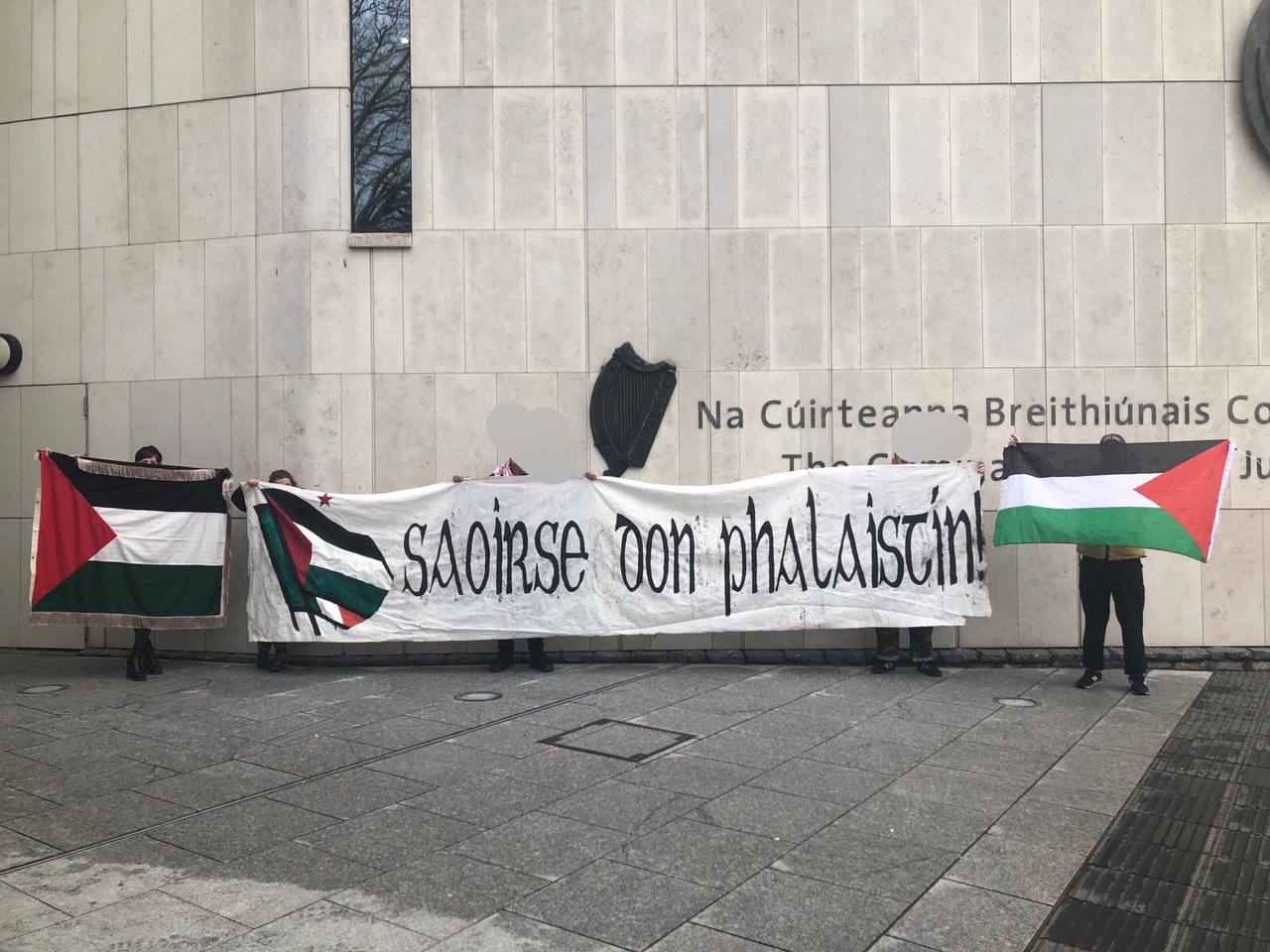
Solidarity picket outside the Dublin courts (Image sourced: AIA)

In a series of coordinated raids in Dublin this morning, a number of Republican Activists have been arrested and detained under section 30 of the Free States “Offenses against the state act”.

These arrests come as the state is increasingly fearful of the growth in Revolutionary Irish Socialist Republicanism and of Anti Imperialist Action Ireland in particular.

The arrests are timed to coincide with the leading role AIA has been playing in support of the Palestinian People and Resistance across the 32 counties and at a time when our members continue to confront and resist Imperialism across Ireland.

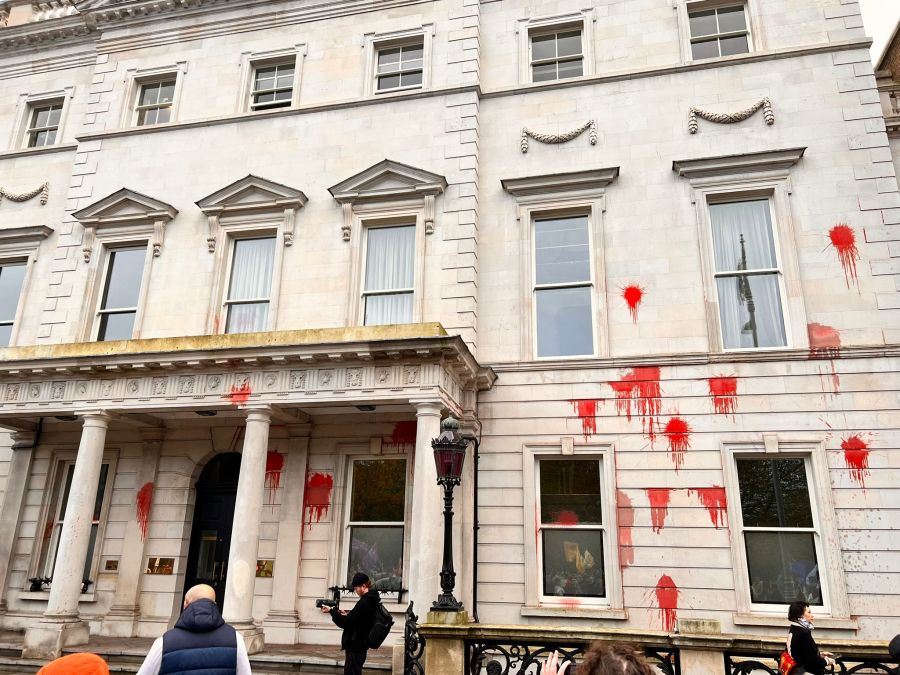
(Image sourced: AIA)

AIA condemn the raids and arrests by the Drew Harassers on Republican Community Activists and we call for these activists to be released back to their families and communities immediately.

Harassment, Raids, or Arrests will not stop AIA and Republican Activists from our work to rebuild the struggle for National Liberation and Socialist Revolution, resisting Imperialism or from taking a stand for Palestine.

The Republican Community Activists raided and arrested in Dublin yesterday have been released without charge.

The operation by the Drew Harassers, no doubt at significant cost, was designed to intimidate the growing membership and support base of AIA across Ireland, but it has failed, as all such operations will fail.

AIA welcome home these activists to their families and communities, where they belong. Republicans are not criminals. We will continue to promote the legitimate demand of rebuilding the Republic of 1916 at every opportunity. We will not be deterred and ultimately we will win.

Yesterday’s arrests are only further proof that the Free State fears the message of Revolutionary Socialist Republicanism, fears the growth and levels of support for AIA, fears our support for the Palestinian Resistance and fears our continued legitimate direct actions to confront and resist British, North American, European and Zionist Imperialism in Ireland.

We won’t be going away!

Free Ireland!

Free Palestine!

Also on Saturday, after the giant Palestine solidarity march in Dublin, according to another communiqué, members of AIA, Saoirse Don Phalaistín and Palestinian Solidarity Activists picketed the Leonardo Hotel on Parnell St.

The Leonardo Hotels are owned by Fatell Hotels the largest hotel group in ‘Israel’ and strong supporters of Zionist terrorism and genocide.

In response to the picket, the hotel has decided to enter lockdown, refusing to open the doors for guests.

End items.

ESTIMATED 20,000 IN PALESTINE SOLIDARITY MARCH IN DUBLIN

Diarmuid Breatnach

(Reading time: 4 mins.)

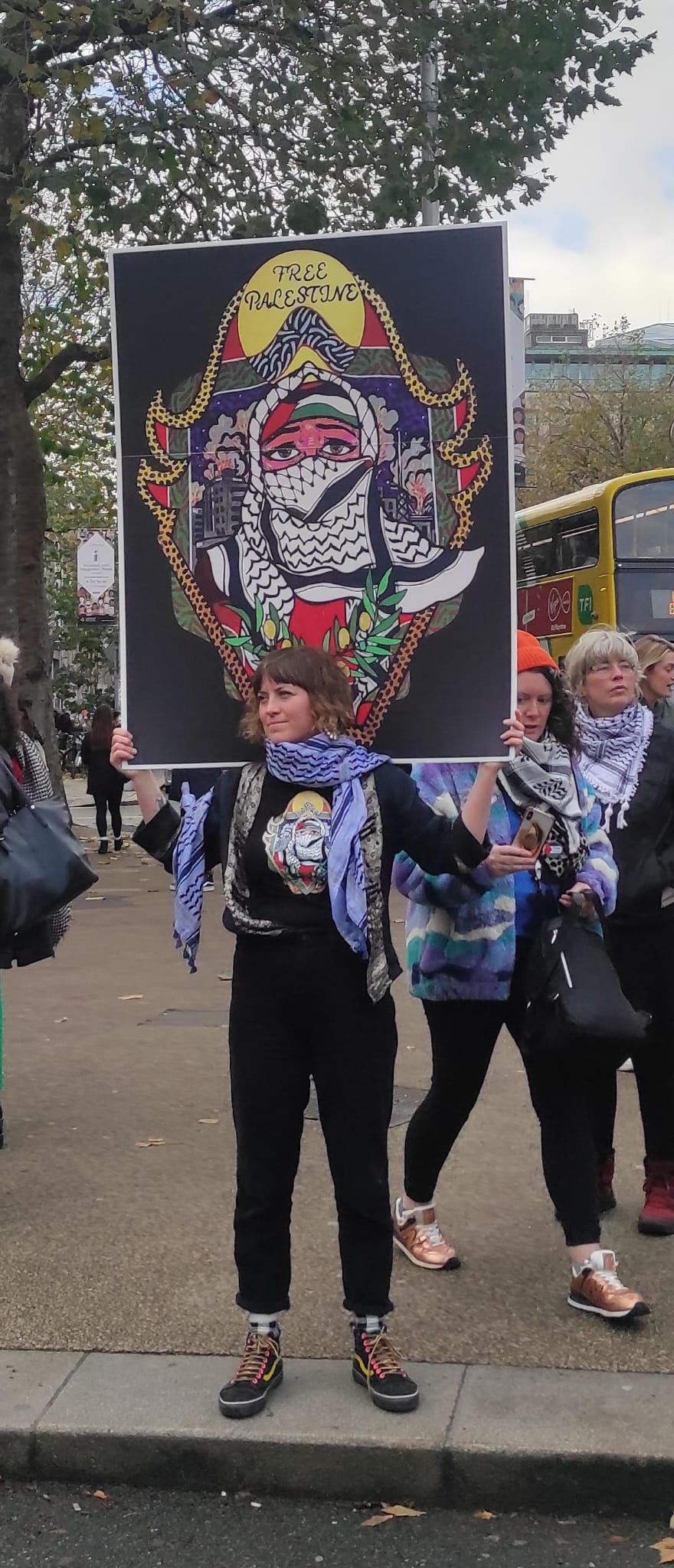
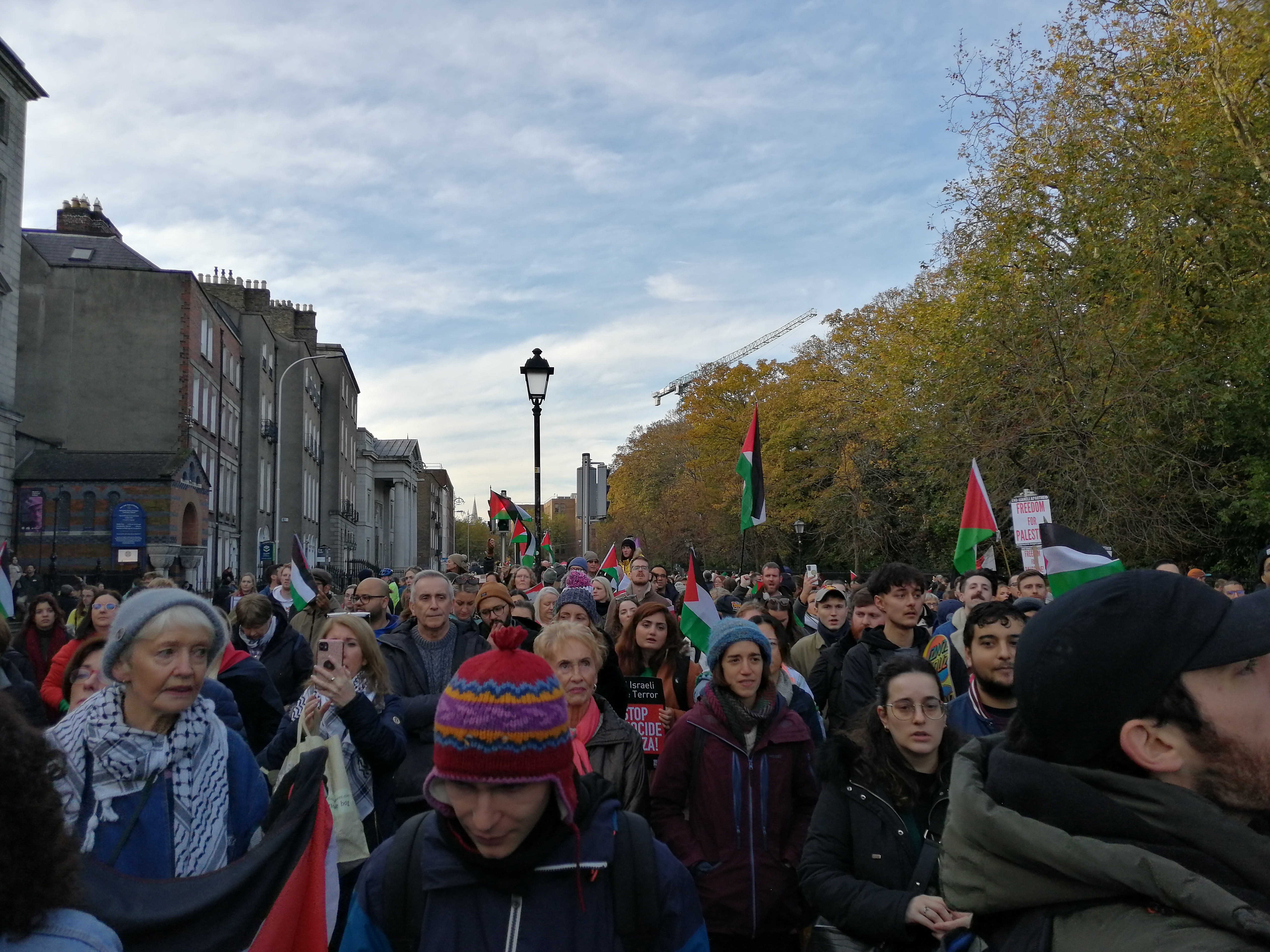
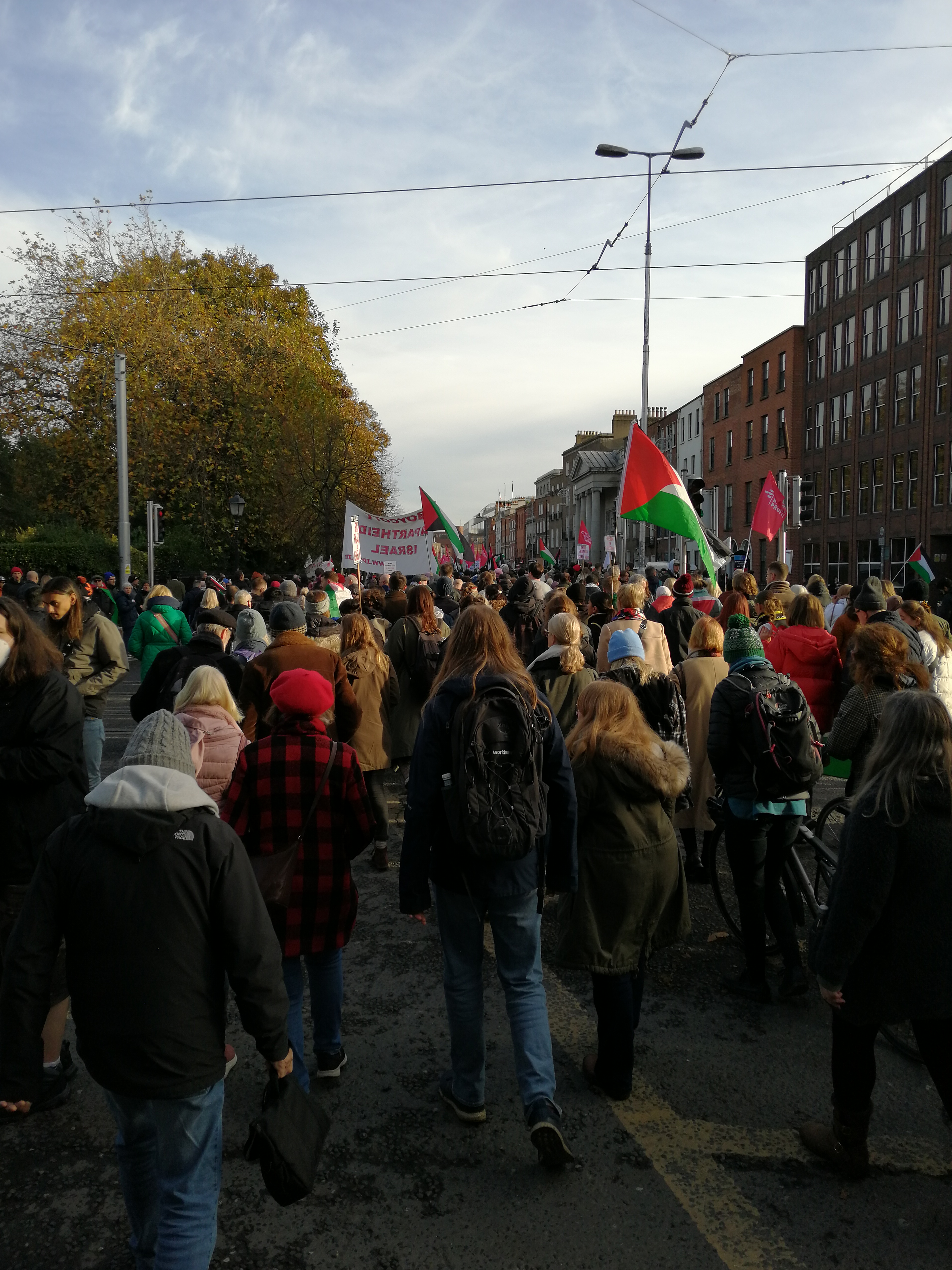
Many thousands wound their way in Palestine solidarity on Saturday through the streets of Dublin City centre, crossing from north to south of the river, filling the streets with solidarity slogans that have now become very familiar.

Section of the march in O’Connell Street crossing the river, the rest behind not having left Garden of Remembrance/ Hugh Lane Gallery area. (Photo: D.Breatnach)

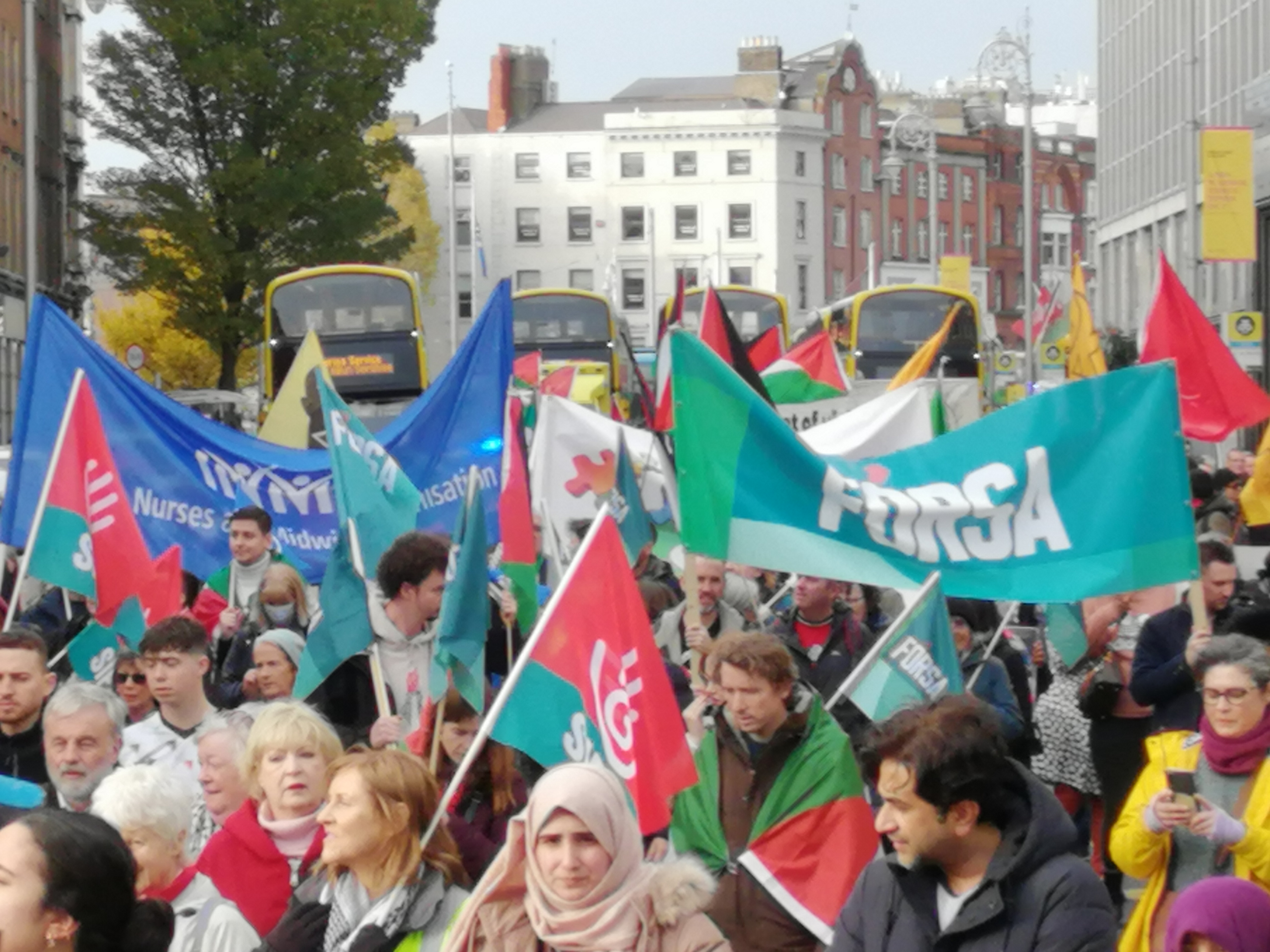
The national march called by the Ireland Palestine Solidarity campaign took nearly an hour to pass through Dublin’s O’Connell Street, Palestinian colours mixing with those of political party or group and some education trade union flags and banners – and the green and gold Starry Plough.1

And still they are coming (Photo: D.Breatnach)
Graffiti on the Spire in O’Connell Street (Photo: D.Breatnach)

The weather was a welcome change from the heavy rain of the night before and, in contrast to recent cold days, was mild and autumnal. The trees by roadside and in parks, except for the berry-laden hollies, were losing their leaves but those remaining shone russet and gold.

Those political parties whose TDs2 voted for sanctions against Israel on Wednesday3 were present: Social Democrats, that had sought the expulsion of the Israeli Embassy and Sinn Féin, who wanted the Government to refer the Israeli Government to the International Criminal Court.4

That included also the People Before Profit/ Solidarity, which for weeks had been calling for the Ambassador’s expulsion and the Labour Party.

Left-wing, feminist and animal liberation groups participated, along with local Palestine solidarity groups. In a change from recent marches, Irish Republican groups could be observed participating but were very few.5

(Photo: D.Breatnach)

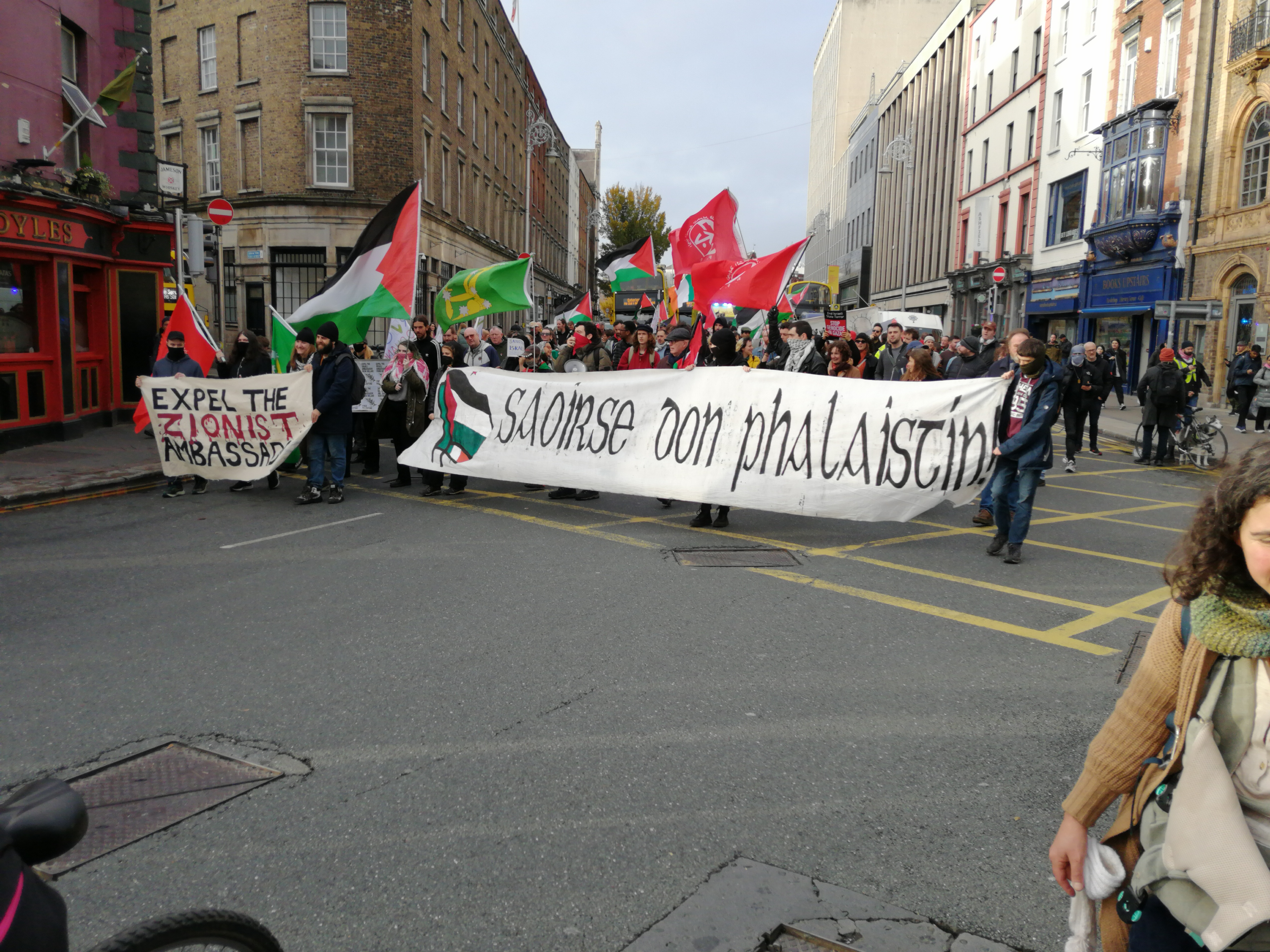
An Ghaeilge, the Irish language, had a presence on the march in a small number of placards and a big banner proclaiming Saoirse don Phalaistín,6 the latter also shouted as a call-and-answer slogan, to merge with the now-familiar ones of Palestine solidarity, along with denunciation of genocide.

Other slogans included: 1, 2, 3, 4 – Occupation no more! 5, 6, 7, 8 – Israel is a terrorist7 state! Netanyahu, you can’t hide – We can see your genocide! There is only one solution – Intifada revolution! In our thousands and our millions8 – We are all Palestinians!

(Photo: D.Breatnach)

The “Ceasefire Now!” demand could be seen on some placards and heard on occasion but not as much as before. This slogan has come under some criticism as theoretically binding the Palestinians to cease resistance and leaving the Israeli army in possession wherever they are.

Despite the necessary problems caused to vehicular traffic, a horn blowing from a passing car or van called out often in solidarity to a cheer from the marchers in reply. In contrast to the early decades of the Irish state, the population has become overwhelmingly pro-Palestinian.

Some appropriate decoration of the Irish Dept. of Foreign Affairs (Photo: D.Breatnach)

A LONG MARCH

The route of the march followed the same as the previous Saturday’s but instead of stopping at the Dept. of Foreign Affairs, continued on eastwards and then into Merrion Square south where the rally was to be held but significant numbers had left without waiting for the speeches.

Eastward of there, many Garda vehicles could be seen in Merrion Street lower, probably in case people decided to bring to the Fine Gael party HQ their disgust at State collusion with Zionist genocide. Of course nowadays, Fianna Fáil and the Green Party HQs might feel the need for the same protection.

(Photo: D.Breatnach)

As people turned towards various destinations in the City Centre, to pick up their vehicles or to connect with public transport, most entered to proceed through the Merrion Square Park and, finding gates locked on to Merrion Square West road, headed for the next exit – but in vain.

All gates were locked until one, several hundred metres along Merrion Square North, finally allowed weary marchers to exit the park and turn west again towards the city centre. There was much much muttering about this deliberate inconveniencing of people in a public park.

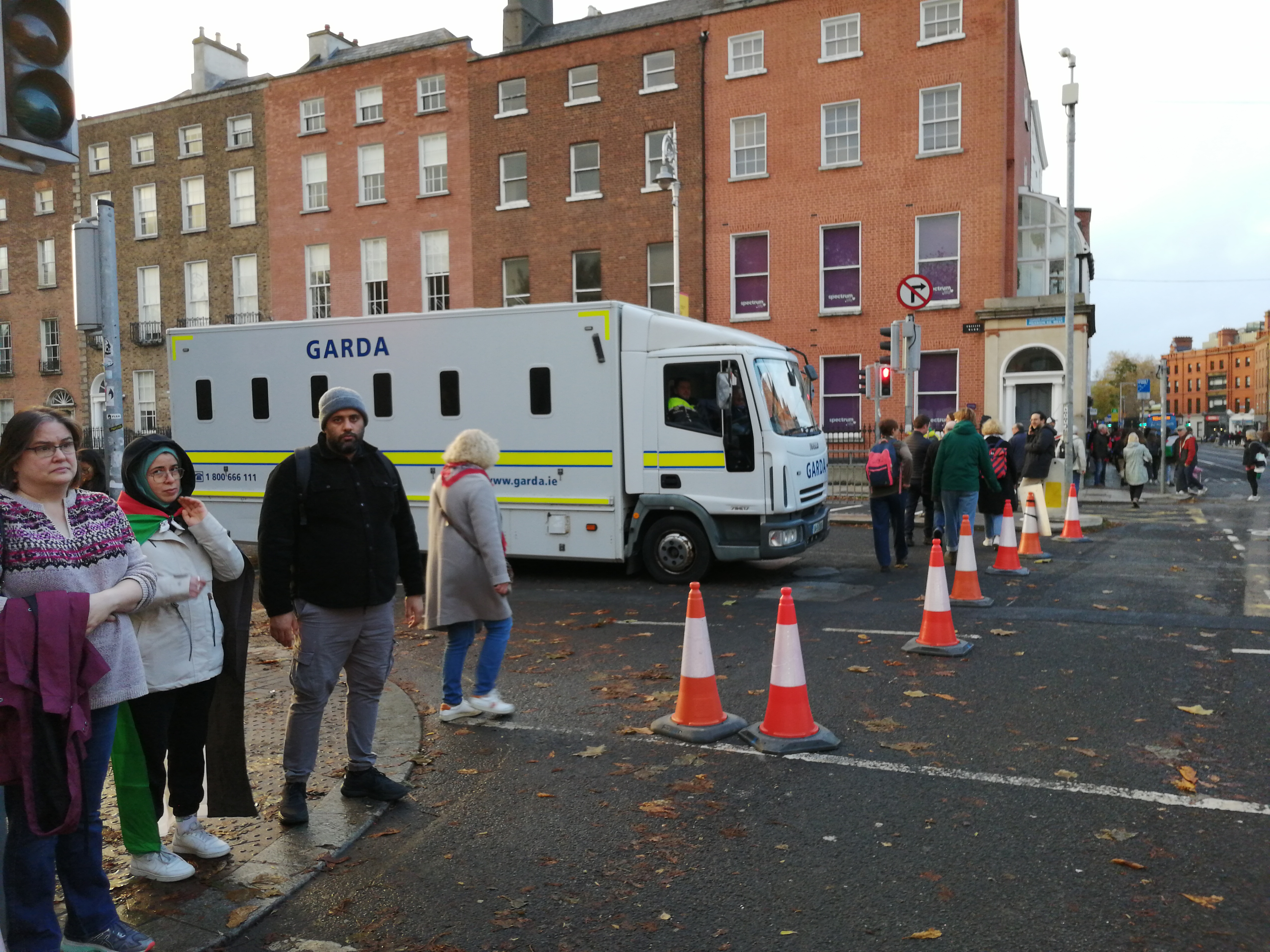
Passing the corner of Merrion Square West, with the former home of the Wilde family on the right, a large Garda prisoner transport was parked at the corner with other police vehicles around and some Public Order Unit police standing around.

(Photo: D.Breatnach)

This march had been the 5th weekend one in Dublin since the Israeli offensive, with a rally in the middle of each week also. And still the Israeli death-toll rises not just daily but by the hour. And still neither the UN Security Council nor EU will call for an end to the bombing.

And still the Israeli Embassy sits in Dublin with its staff free to spy and report on the population of the Irish State, even to insult the national feeling of solidarity and the President of the State for his comparatively mild demands that international law statutes be followed.

Indeed, those same rules, often violated by the western superpowers, lie now exposed in shreds and tatters in Palestine. If there ever was reason to believe in imperialist states ruling the world in common humanity, that belief too lies in tatters that cannot be stitched together again.

End.

Front of march in O’Connell Street (Photo: D.Breatnach)
Some trade union banners on the march (Photo: D.Breatnach)
(Photo: D.Breatnach)

FOOTNOTES

1 The flag of the Irish Citizen Army, the first workers’ army in the world, formed to defend the workers from the attacks of the Dublin Metropolitan Police during the 1913 Lockout, who later fought in the 1916 Rising too.

2 Teachta Dála, Irish State equivalent to MPs (plural Teachtaí Dála).

3 The motions in Leinster House (seat of the Irish parliament) were defeated through the Coalition Government’s TDs voting for an amendment that pulled all the teeth from the original motions.

4 The SF party flags were absent from earlier demonstrations after their leadership stated they would not be calling for the expulsion of the Israeli Ambassador but once the leadership, no doubt facing a revolt of their members changed that position, they were out in force, some of them even stewarding the march. One wonders whether those members understand that the ICC has in a decade only tried 30 cases and convicted only ten, not one a state or an individual close allied with the Western powers.

5 Undoubtedly, more Irish Republicans participated as individuals or as members of local solidarity groups.

6 “Freedom for Palestine.”

7 A version occasionally heard substituted “fascist state” for the words “terrorist state”.

8 A different version heard that day called In our millions and our billions

IRISH SAVED PUBLIC SPEAKING AREA FOR LONDONERS

Diarmuid Breatnach

(Reading time main text: 6 mins.)

November 17th is the anniversary of the date when a demonstration, mainly of Irish in solidarity with Fenian prisoners in British jails, saved the public Speakers’s Corner in Hyde Park from State control for everyone.

‘Frederick’ (Friedrich) Engels was there and reported on it (see below) with great admiration for the Irish diaspora. In his seminal The Condition of the Working Class in England (1845) he had not had that feeling for the Irish but had matured as a person and a revolutionary since.1

The Clerkenwell jail wall blown by Fenians (Photo sourced: Internet)

Frederick Engels and Karl Marx, both exiles from Germany, one by choice and the other as a refugee, came to form a strong corresponding, writing and organising partnership. Together they formed the International Working Men’s Association.

The First International, as it came to be called, took a position on many international questions but did not shirk the Irish one and indeed exposed and agitated about the terrible conditions under which Fenians were being held in British jails.

Jeremiah O’Donovan Rossa (1831-1915), a Fenian prisoner, wrote that he was for a period chained to the wall and had to eat his food from a bowl on the floor like a dog. It is also recorded that a third of the prisoners died in jail or went insane.

Frederick Engels as a young man (Photo sourced: Internet)

The Irish Republican Brotherhood had been founded in Dublin and in New York on St. Patrick’s Day, 1858 and in the USA quickly became better known as “the Fenian Brotherhood”. In Ireland they were frequently referred to as “the Fenians” or, by those on ‘the inside’ as ‘the IRB’.

Clearly from Engels’ description, “Fenians” was also the common description in Britain too. The Fenians took the war to Britain; the Crown responded by organising a specific police department, the Special Irish Branch of Scotland Yard, to spy on the Irish diaspora and to arrest suspects.

The “Special Branch” became known henceforth as the political department of the British police force but also of British colonial police forces in Ireland, Commonwealth countries such as Australia, and colonies such as Kenya, Uganda, Hong Kong …

We know that that the Fenian prisoners were not forgotten in Ireland, with campaigns for their freedom including articles, public events and even songs composed for them. But evidently they were not forgotten by the Irish diaspora in Britain nor by their socialist and democratic allies.

On November 17th 1872 the First International organised a march to Speakers’ Corner in London to protest the conditions under which those Fenian convicts were having to exist. Engels reported on the march and that he public speaking area was under threat of State control.

The Irish diaspora in Britain, the Irish-born migrants and descendants, contributed hugely to society and especially so to the working class in Britain, including presenting its anthem,2 its classic novel3 and two leaders4 of the Chartists, the working class’ first first genuinely mass movement.

In addition, members of the Irish diaspora helped build up the trade unions and were present in every movement against state repression, police violence, fascism, racism, colonialism and imperialism, fighting in organisations for housing, wages, free speech, political and civil rights.

Depiction of Speakers’ Corner meeting about the Fenian prisoners (Photo sourced: Internet)

Frederick Engels:

III
Meeting in Hyde Park

London, November 14, 1872

The Liberal5 English Government has at the moment no less than 42 Irish political prisoners in its prisons and treats them with quite exceptional cruelty, far worse than thieves and murderers.

In the good old days of King Bomba, the head of the present Liberal cabinet, Mr. Gladstone, travelled to Italy and visited political prisoners in Naples; on his return to England he published a pamphlet which disgraced the Neapolitan Government before Europe for its unworthy treatment of political prisoners.

This does not prevent this selfsame Mr. Gladstone from treating in the very same way the Irish political prisoners, whom he continues to keep under lock and key.

The Irish members of the International in London decided to organise a giant demonstration in Hyde Park (the largest public park in London, where all the big popular meetings take place during political campaigns) to demand a general amnesty.

They contacted all London’s democratic organisations and formed a committee which included MacDonnell (an Irishman), Murray (an Englishman) and Lessner (a German) — all members of the last General Council of the International.

A difficulty arose: at the last session of Parliament the government passed a law which gave it the right to regulate public meetings in London’s parks.

It made use of this and had the regulation posted up to warn those who wanted to hold such a public meeting that they must give a written notification to the police two days prior to calling it, indicating the names of the speakers.

This regulation carefully kept hidden from the London press destroyed with one stroke of the pen one of the most precious rights of London’s working people — the right to hold meetings in parks when and how they please.

To submit to this regulation would be to sacrifice one of the people’s rights.

The Irish, who represent the most revolutionary element of the population, were not men to display such weakness.

The committee unanimously decided to act as if it did not know of the existence of this regulation and to hold their meeting in defiance of the government’s decree.

Last Sunday at about three o’clock in the afternoon two enormous processions with bands and banners marched towards Hyde Park.

The bands played Irish songs and the Marseillaise6; almost all the banners were Irish (green with a gold harp in the middle) or red.

There were only a few police agents at the entrances to the park and the columns of demonstrators marched in without meeting with any resistance. They assembled at the appointed place and the speeches began.

The spectators numbered at least thirty thousand and at least half had a green ribbon or a green leaf in their buttonhole to show they were Irish; the rest were English, German and French.

The crowd was too large for all to be able to hear the speeches, and so a second meeting was organised nearby with other orators speaking on the same theme.

Forceful resolutions were adopted demanding a general amnesty and the repeal of the coercion laws which keep Ireland under a permanent state of siege.

At about five o’clock the demonstrators formed up into files again and left the park, thus having flouted the regulation of Gladstone’s Government.

This is the first time an Irish demonstration has been held in Hyde Park; it was very successful and even the London bourgeois press cannot deny this.

It is also the first time the English and Irish sections of our population have united in friendship.

These two elements of the working class, whose enmity towards each other was so much in the interests of the government and wealthy classes, are now offering one another the hand of friendship; this gratifying fact is due principally to the influence of the last General Council of the International,[307] which has always directed all its efforts to unite the workers of both peoples on a basis of complete equality.

This meeting, of the 3rd November, will usher in a new era in the history of London’s working-class movement.

You might ask: “What is the Government doing? Can it be that it is willing to reconcile itself to this slight? Will it allow its regulation to be flouted with impunity?”

Well, this is what it has done: it placed two police inspectors and two agents by the platforms in Hyde Park and they took down the names of the speakers.

On the following day, these two inspectors brought a suit against the speakers before the ustice of the Peace. The justice sent them a summons and they have to appear before him next Saturday.

This course of action makes it quite clear that they don’t intend to undertake extensive proceedings against them.

The government seems to have admitted that the Irish or, as they say here, the Fenians have beaten it and will be satisfied with a small fine. The debate in court will certainly be interesting and I shall inform you of it in my next letter.[308]

Of one thing there can be no doubt: the Irish, thanks to their energetic efforts, have saved the right of the people of London to hold meetings in parks when and how they please.

Notes


307 By the “last” General Council Engels means the London Council that existed before the Hague Congress of the International at which a decision was adopted to transfer the scat of the General Council to New York.

308 In the fourth article of the Letters from London series: “Meeting in Hyde Park. — The Position in Spain,” written on December 11, 1872, Engels reported that the Justice of the Peace could do no more than impose the smallest possible fine, and since his decision anyway ran contrary to the rules governing behaviour in Hyde Park the accused demanded that the case be brought before a court of appeal.

Engels’s Letters from London appeared in La Plebe, the newspaper of the International’s sections in Italy, early in April 1872, and continued throughout the year.

Early in 1873, Engels’s co-operation with La Plebe was temporarily interrupted due to government reprisals against the paper’s editors.

La Plebe was published under the editorship of E. Bignami in Lodi between 1868 and 1875, and in Milan between 1875 and 1883. Up to the early seventies the newspaper followed a bourgeois-democratic line, later it became socialist.

In 1872-73 La Plebe played an important role in the struggle against the anarchist influence in the Italian working-class movement. Engels’s contributions greatly promoted the paper’s success.

In 1882, the first independent party of the Italian proletariat the Workers’ Party — formed around La Plebe.


FOOTNOTES

SOURCES

https://www.marxists.org/archive/marx/works/1872/11/17.htm?fbclid=IwAR1BNFtIJtykuVT0fPrlhyQVOky5W8kUX7YDup55_aP0opQTI6QLF3ycyPc

Source: Marx and Engels on Ireland, Progress Publishers, Moscow 1971;
First Published: in Italian in La Plebe, November 17, 1872;
Transcribed: by Andy Blunden.

1Aided by the Burns sisters Lizzie and Mary when he lived in Manchester, one of whom was his partner until she died and the other, subsequently his wife.

2The Red Flag, by Jim Connell, from Co. Meath

3The Ragged-Trousered Philanthropists, by Robert Noonan aka Tressel, from Dublin.

4Fergus O’Connor and Bronterre O’Brien.

5The two main bourgeois political parties in Britain at the time were the Conservatives and Liberals; over time the latter declined and was replaced in its counterpoint to the Conservatives by the British Labour Party.

6French national anthem now but originally song of the French Republican uprising of 1789. In addition the air has been used for the lyrics other revolutionary songs.

GOMBEENS TEACH SOCIAL-DEMOCRATS AND LIBERALS A LESSON

Diarmuid Breatnach

(Reading time main text: 8 mins.)

In their shameful votes last night, the Irish Government Coalition parties nevertheless taught people of social-democratic or liberal persuasion a valuable lesson. They won’t learn it of course, since it violates their world-view – but we should.

Social democrats in general, beyond the Irish political party of that name, essentially believe, despite all lessons of history, that capitalist society can be reformed through pressure of the organised labour movement and by appealing to the capitalists’ “better sense”.

Liberals believe something similar, without the trade union movement being essential. Their mantras echo through our political and philosophical culture: “Everything can be resolved through talking”, “Force solves nothing” and “The rule of law is paramount’.1

Despite the genocidal attacks continuing and even intensifying, despite the Gombeen class’ view that the ferocious bombing would have long-term adverse effects on the Middle East and perhaps on the world, the Government parties declined to break with the imperialist bloc.

Section of crowd, perhaps half-way, facing westward, away from Leinster House (Photo: D.Breatnach)

And why should we have expected anything different from them and the class they represent? This is not even an independent class but rather a native capitalist class that grew up under foreign occupation and never resolved to overthrow its masters.2

Rendering each Caesar his due, in turn and all together, this class has kissed the feet of British colonialism and imperialism, then US imperialism and finally EU imperialism. Whatever their own view of what the wise moves might be, they always obey their masters’ wishes.

And any party that enters government here as currently constituted will act likewise to get there and even more so after arriving there.

ROAR OF SOLIDARITY OUTSIDE LEINSTER HOUSE

Knowing that a vote was imminent on motions critical of Israel, including one for the expulsion of the Israeli Ambassador, thousands gathered last night in Molesworth Street, opposite the metal-barricaded Leinster House, home of the parliament of the Irish State.

Packed tightly together outside Leinster House, the crowd replied with a roar to slogans led by callers: From the river to the sea – Palestine will be free! In our thousands and our millions – We are all Palestinians! Free, free – Palestine! And, yes, Israeli Ambassador – Out, out, out!

The rally had been organised by the Ireland Palestine Solidarity Campaign, the main organisation for decades engaged in Ireland in Palestine solidarity campaigning. Yet, calling for the expulsion of the Zionist State’s representative had, until now, been strangely absent from its discourse.

Not always in the past, true but so it had been until now during these five weeks of genocidal bombing by the Zionist state. In fact, it seems they had previously even asked speakers not to make that call from their platform. They were however clearly making it now and rightly so.3

And clearly, so were the speakers lined up on the IPSC platform.

Independent Sen. Frances Black whose motion on the bill to ban products from the Israeli later settlements4 has been held up for two years by the Government, spoke also and challenged the Government TDs to make the right choice between party and principle, to “have the balls” to vote for justice.

Matt Carthy TD, Shadow Foreign Affairs spokesperson for the Sinn Féin party, was introduced from the IPSC platform to muted applause (perhaps because of the party leaders’ earlier refusal to call for the expulsion of the Ambassador.

Carthy addressed the crowd in Molesworth Street and apart from denouncing the ongoing Israeli genocide in Gaza, concentrated on his party’s motion for Israel’s referral to the International Criminal Court and disputed the Government’s view that additional referrals5 were unnecessary.

While there may be some propaganda value in such a referral, a quick check will establish the following about this institution:

  1. The ICC has never tried a state, only individuals
  2. The ICC has never tried a main actor or close friend of western imperialism, regardless of obvious war crimes (e.g. the USA, UK in Iraq and Afghanistan)
  3. In its 11 years of existence, the ICC has had only 30 cases before it of which ten resulted in convictions and four in acquittals.6

However, the SF party spokesperson was now also calling for the expulsion of the Ambassador, since the recent turnaround of the party’s leaders on the question when Mary Lou MacDonald found her position untenable in the face of the party’s own voters and closer supporters.

Richard Boyd Barrett TD spoke as usual at such events for the People Before Profit party7 and excoriated the Government for their failure to apply sanctions against Israel, exclaiming: “My God, they were quick enough to do it against Russia, weren’t they?”8

Boyd Barrett said that if the Government won’t take the sanctions then the people must do so, the closest he came to listing how they might do so was in mentioning “occupations”, a number of which have taken place recently without any PBP involvement whatsoever.

The PBP speaker also denied that a state such as Israel, based on occupation, racism and genocide, has any right to self-defence but insisted that the targets of its attacks, the Palestinians, had every right to defence and resistance.

Holly Cairns TD, leader of the Social Democrats political party,9 proposer of the parliamentary motion to expel the Ambassador spoke clearly and convincingly, her speech more militant and direct than the that of the speaker from the former revolutionary Republican party.

I believe it was Cairns who asked the pointed questions with regard to taking strong sanctions against Israel with the current death toll and list of atrocities: If not now – when?

(Photo: D.Breatnach)

In reply to fears that the expulsion measure would make the Irish State an “outlier” in the EU, she commented to media that she would have no regrets at being “an outlier” of the current EU consensus.

Ruth Coppinger for the Socialist Party10 began by addressing the meaning of “the international community”, identifying not with the imperialist states but with solidarity demonstrations around the world including trade union blockades against shipments to Israel.

She called for such actions in Ireland today but also criticised the Palestinian assault through the apartheid Wall on October 7th. I think it was she who called for a national walkout on World Palestinian Solidarity Day, 29th of November.11

Given the supine state and collusion of the Irish trade union movement, which neither the SP nor the PBP party have made serious efforts to challenge, a union-led walkout is unlikely and, though people may do so anyway this is likely to be difficult without organisation and leadership.

All of the speakers congratulated those in attendance and asked them to continue their solidarity actions. Many (notably not the SF speaker) also criticised the USA in general and its President, Joe Biden, in particular. The USA is the chief and financial backer of the Israeli State.

One of the Irish language placards at the rally: “Joe of the Slaughter.” (Photo: D.Breatnach)

Although there were a number of Irish-language placards and one banner in evidence, I recall hearing not one word of Irish from the platform.

IN PALESTINE TODAY

The Israeli siege and genocidal bombing continues as the Zionist state tries to sap the resistance of the Palestinians people, destroying even their medical facilities and endeavouring to starve and terrorise them into submission.

By yesterday the death toll from Israeli airstrikes on the Gaza Strip since Oct. 7 had risen to 11,500, including 4,710 children and 3,160 women. Israel has also killed 22 civil defence and 200 medical personnel and 51 journalists.12

The number of injured people has reached 29,800, with about 70% of them children and women.13


Wednesday’s statement from the Gaza Health Ministry said that 95 government buildings and 255 schools have been destroyed. Some 74 mosques were completely destroyed and 162 were partially damaged, in addition to three churches.14

‘It said that the Israeli army targeted 52 health centers and 55 ambulances, while 25 hospitals have run out of service.15

‘ “Israeli soldiers attacked many patients, wounded individuals, and displaced people, as well as several medical and nursing staff inside Al-Shifa Medical Complex, forcing them to undress and subjecting them to insults,” the statement added.’16

The Palestinian guerrilla movement organisations have struck back in Gaza and the West Bank and Hizbollah has entered the struggle to an extent from Lebanon. The collaborationist Arab states have become worried about their own populations, a worry shared by their imperialist masters.

But the rabid dog is loose and refuses to be restrained. What to do? Call it to heel now, or let it have its head to glut itself on blood? Difficult for the imperialist classes of the world to be certain which way to go and the divisions among them are becoming clear.

Both France and Germany EU states have banned Palestinian solidarity marches but while Germany refuses to call for any end to the bombing, President of France Macron in exclusive interview this week has called on Israel to stop killing Palestinian women and children.17

View perhaps half-way in crowd facing Leinster House in the far distance. (Photo: D.Breatnach)

Across the world, the imperialist-aligned ruling classes are in disarray. Eight states in Latin America, Middle East and Africa have now fractured diplomatic ties with Israel.

The British Labour party saw four party shadow spokespersons resign and 56 of its MPs break party discipline to vote with the Scottish National Party motion calling for an immediate ceasefire.18

The other “international community”, the one to which Coppinger referred, has been on the streets in their millions in cities across the world, on every continent, including in those of the partner states of the genocidal Israeli state.

THE GOVERNMENT AND THE PEOPLE

Mícheál Martin had visited Palestine before in 201019 as Minister for Foreign Affairs in the then Fianna Fáil government and was visibly affected by what he had seen. But a Minister serves the Government which in turn serves the ruling class, which in the end calls the tune.

Today Mr. Martin, as Tánaiste20 of the gombeen Coalition Government, is in ‘Israel’ accompanied by the very Zionist Ambassador which last night his party and coalition party representatives had stoutly defended and who had attended by invitation his own party’s annual congress.21

Mícheál Martin in ‘Israel’ today with the zionist state’s Ambassador to Ireland (centre, partially obscured) (Photo sourced: Internet)

With no illusions in the parliamentary road or perhaps less of them now, we are thrown back on what was always our only realistic resources – our own mobilisations, our own actions.

Short of a revolution, to be effective we can only continue to make life as uncomfortable as possible for the Zionist state and for its collaborators, native and foreign.

Above all and indeed as some of the speakers last night emphasised, we must not be discouraged and have to continue; we owe it not only to the Palestinians but also to ourselves, to our history and our future. Beidh lá eile ag an bPaorach – there will be another day.

(Photo: D.Breatnach)

End.

FOOTNOTES

1Of course the fact that laws are written (and changed) to suit the ruling class (or at least not threaten it) and backed up by a whole violent repressive state structure of police, courts, jails and armed forces is conveniently ignored.

2Indeed, it waged war on those who were determined to fight for independence.

3Nor did its FB page share occupation protets such as those carried out by the Anti-Imperialist Action or Saoirse Don Phalaistín groups, though today they shared a post on the occupation of the Dept. of Foreign Affairs by the Ireland for Gaza group.

4https://en.wikipedia.org/wiki/Occupied_Territories_Bill

5https://apnews.com/article/south-africa-israel-palestinians-icc-referral-6f1dd2b3af534d4d42d56a156968eae4

6https://accessaccountability.org/index.php/2019/09/26/criticisms-and-shortcomings-of-the-icc/

7Formerly the Socialist Worker’s Movement, an Irish iteration of the (Trotskyist) Socialist Workers’ Party in Britain, much diminished from it days of greater glory but currently the largest Left party in Britain.

8Yes and Boyd Barrett was part of the condemnation of Russia and support of the Ukrainian state at the time.

9The party centre-left social democratic party was launched on 15 July 2015 by three independent TDs (members of parliament) and promotes the Nordic model and pro-European views.

10An Irish iteration of the Socialist Party in Britain, a Trotskyist party once very large there, with the Militant Tendency its entryist organisation in the UK’s Labour Party, from which it was expelled. The Irish party has had a number of members of the Irish parliament but all those still in such roles have either left to become Independents or joined the PBP-Solidarity coalition group.

11https://www.un.org/en/observances/international-day-of-solidarity-with-the-palestinian-people. Student walkouts seem more likely however.

12https://www.aa.com.tr/en/middle-east/gaza-death-toll-from-israeli-attacks-rises-to-11-500-gaza-based-government/3055026

13Ibid

14Ibid.

15Ibid.

16Ibid.

17https://www.bbc.com/news/world-europe-67356581

18https://www.breakingnews.ie/israel-hamas/starmer-suffers-major-frontbench-rebellion-in-gaza-ceasefire-vote-1552323.html

19https://www.irishtimes.com/news/martin-retains-view-of-israeli-offensive-after-visit-to-gaza-1.637021

20Equivalent to Deputy Prime Minister; he is also leader of the Fianna Fáil political party, the one with most elected members in the Coalition Government with Fine Gael and the Green Party.

21https://www.reddit.com/r/ireland/comments/17nt5a2/the_israeli_ambassador_at_the_ff_ard_fheis/?rdt=55045

SOURCES

UN International Day of Solidarity with Palestine: https://www.un.org/en/observances/international-day-of-solidarity-with-the-palestinian-people

“SAOIRSE DON PHALAISTÍN” ON GIANT SOLIDARITY MARCH IN DUBLIN

Clive Sulish

(Reading time: 4 mins.)

A Palestine solidarity demonstration of around 10,000 in Dublin on Saturday the 11th included a bloc marching behind a banner bearing the legend Saoirse Don Phalaistín and another demanding the expulsion of the Israeli Ambassador.

Since the beginning of Israel’s bombardment of Gaza, Dublin has seen at least two large solidarity events every week, one mid-week and another on Saturdays, marching to the Israeli and USA Embassies or, like this one, to the Irish State’s Department of Foreign Affairs.

(Photo: Rebel Breeze)

In addition, there have been smaller more radical events, such as the 2-hour occupation of the offices of Qanta Capital, the landlord of the Israeli Embassy, also another of the Clarence Hotel, recently bought by an Irish company with a loan from an Israeli bank.1

Also the occupations of offices of the Irish Dept. of Transport and of the European Commission2 and a weekday evening rush-hour protest on the forecourt of Dublin’s Connolly Train Station, which hosts major east coast commuting and northern city destination lines.

Section of the march in Cuffe Street, many still behind in Aungier Street (Photo: Rebel Breeze)

On Saturday the march began as usual with a 1.00pm gathering in the city centre, the rear of the densely-packed marchers still in O’Connell Street as the rest had crossed the river into Westmoreland Street, swung into College Green and Dame Street underway to George’s Street.

At one point the march called by the IPSC3 stretched from George’s Street all along Aungier Street, the front had turned into Cuffe Street and was already marching towards Stephen’s Green. The Department of Foreign Affairs is located on the east side of the famous inner-city park.4

The front of the march marching along Stephen’s Green East while the rest is still in Cuffe Street and Aungier Street (Photo: Rebel Breeze)

The bloc marched along gathering people behind as it did so, shouting among others the slogan “Saoirse – don Phalaistín!” and “Zionist Ambassador – Out, out, out!” which was taken up by many, including those who seemed to be Palestinian or at least from the Middle East.

At a separate point, a few professionally-printed placards in Irish could be seen too, e.g “Stad an Slad” and a flag in Palestinian colours with “Saoirse don Phalaistín” printed upon it.

(Photo: Rebel Breeze)

The other slogans that have become standard were shouted also, including the one claimed to be ‘anti-semitic’, ‘terrorist’ and ‘against the law’ by the recently sacked UK Minister of Home Affairs, claimed to be “anti-semitic” and ‘against the law’: “From the river to sea, Palestine will be free!”

Mobbing and threats by British fascists to Palestine supporters5 on the gigantic solidarity march in London on Saturday6 that ended in scuffles with the police were linked by a number of senior politicians to Braverman’s extraordinary claims of police partiality to the demonstrators.

Braverman alleged that London Met police went softly on Palestinian solidarity demonstrations in allowing them to take place while some extreme right-wing mobilisations in the past had been sternly treated – a fantastic claim as any antifascist activist in London knows well.

Section of the crowd standing behind the Saoirse don Phalaistín banner (Photo: Rebel Breeze)

In Dublin on Saturday, upon reaching Stephens Green, the bloc stopped short of the rally outside the Dept. of Foreign Affairs where in any case the crowd was so large that the PA system of the organisers was of insufficient strength to convey to all the words of the scheduled speakers.

A large section of the march stopped behind them and a space cleared in front, at the fringes of which the people turned and joined in the bloc’s almost incessant slogans, at times applauding them. To the solidarity slogans that have become universal, those in the bloc added another two.

Section of the crowd who have turned to face the Saoirse don Phalaistín banner, many joining in the slogans. The speakers’ platform is further beyond outside the Dept. of Foreign Affairs building. (Photo: Rebel Breeze)

These were “There is only one solution – Intifada revolution!” and “Zionist Ambassador – Out, out, out!” Those slogans draw a line away from the liberal demands of “peace” and “negotiations” since the only “peace” that can exist in Israel is a pause before the next bombings.

(Photo: Rebel Breeze)

Saoirse – Don Phalaistín” was repeated and “Stop the bombing – Now!” seemed at one point to be offered as an alternative to “Ceasefire Now!”7

They also called for serious political repercussions for Israel in the expulsion of its representative in the Irish state, its Ambassador. Currently seven states have expelled Israel’s ambassadors or recalled their own – but none of them are members of the European Union.

Section of the crowd outside the Department of Foreign Affairs (Photo: Rebel Breeze)

The Irish State IS a member of the EU and a symbolic act such as the expulsion of the representative of the Zionist state would have huge reverberations. On Wednesday motions on expulsion of the Ambassador will be debated in the parliament of the Irish State.8

Also, the Sinn Féin party, whose leadership recently reversed their opposition to the expulsion of the Zionist representative, will be calling on the Government to refer Israel to the International Criminal Court for investigation of war crimes.

While this might be of some use as a propaganda move, that Institution has never judged a state nor indeed anyone for war crimes who is part of the western imperialist coalition – which Israel most evidently is.9 The proceedings also tend to be very slow.

All in all, not only will such an action not be effective even if agreed, it will likely serve as a distraction from actions much more likely to be effective, such as expulsion of the Zionist Ambassador, along with arms and other trade sanctions.

(Photo: Rebel Breeze)

A rally has been called to take place outside the home of the Irish parliament, Leinster House, Kildare Street at 6pm on Wednesday10 and a national demonstration on Saturday, starting at 1pm from the Garden of Remembrance.

End.

Some demonstrators walk through Stephens Green after the march. (Photo: Rebel Breeze)

FOOTNOTES

1By activists of the Irish Anti-Imperialist Action group.

2https://www.independent.ie/irish-news/pro-palestine-activists-occupy-department-of-transport-in-dublin-demanding-no-weapons-for-israel-pass-through-shannon-airport/a497906746.html

3The Ireland Palestine Solidarity Campaign, for decades the main Palestine solidarity organisation in Ireland.

4Which is coincidentally, a 1916 Rising battleground.

5One of the irritants to British fascist mentality was that the Palestine solidarity march was taking place on Armistice Weekend, an annual event including ceremonies commemorating the dead in battles of the UK’s armed forces, one major period which was ironically as part of the Allied forces in the War Against Fascism 1939-’45.

6Those same police seriously under-estimated the numbers participating at around 300,000 https://www.aljazeera.com/news/2023/11/11/thousands-join-pro-palestine-march-in-london

7A ceasefire usually means everyone stops firing where they are, which could be interpreted as binding the Palestinian resistance to leave the Israeli military in occupation of Gaza without retaliation, which some have criticised as favouring the Israeli Zionists.

8The Social Democrats party have tabled the motion, which will be supported by the Sinn Féin party and by People Before Profit party, along with a number of Independents. The Coalition Government of Fianna Fáil, Fine Gael and the Green Party have stated they will oppose it. At this moment the leadership of the IPSC continues to abstain from making such a call

9See References

10https://www.facebook.com/photo/?

SOURCES

https://www.breakingnews.ie/world/suella-braverman-sacked-as-british-home-secretary-1551072.html

https://www.bbc.com/news/uk-politics-67364745

https://www.irishtimes.com/politics/2023/11/12/mcdonald-sf-call-forh the-israeli-ambassador-expulsion-not-due-to-fears-of-being-outflanked/

https://www.facebook.com/photo/?

Problems with the ICC:https://accessaccountability.org/index.php/2019/09/26/criticisms-and-shortcomings-of-the-icc/

Commemorating the Newport Rising of November 4, 1839

Today marks 184 years since the greatest armed rebellion in 19th-century Britain when Chartist workers fought bloody gun battles with the police and army in the heart of industrial Wales, writes STEPHEN ARNELL

A sketch of the huge crowd in Newport in 1839 as it surrounded the Westgate Hotel hoping to free captive Chartist comrades (via the People’s History Museum).

“Come hail brothers, hail the shrill sound of the horn
For ages deep wrongs have been hopelessly borne
Despair shall no longer our spirits dismay
Nor wither the arms when upraised for the fray;
The conflict for freedom is gathering nigh:
We live to secure it, or gloriously die.”
— Chartist song of the South Wales miners

UNLIKE our friends across the channel in France, the inhabitants of Britain appear a remarkably supine people in the main, usually preferring well-organised demonstrations to anything that whiffs of pre-planned armed revolt, no matter how righteous the cause.

Yes, there have been mass meetings, marches and spontaneous events that took a wrong turn and descended into riots, but we seem singularly ill-equipped by nature to contemplate anything more serious.

But this would be doing this island race a disservice; to paraphrase the emperor Tiberius, there was a time when the British were not a people “fit to be slaves.”

There’s a long and storied history of the working classes attempting to seek redress from a variety of wrongs, including poll taxes (the Peasants’ Revolt, 1381), government corruption (Jack Cade’s Rebellion, 1450), religion (the Pilgrimage of Grace, 1536) and the later Pentrich Rising in Derbyshire of 1817, a muddled affair which aimed to cancel the national debt and repeal the Corn Laws.

1839’s Newport Rising was a more coherent and dangerous challenge than Pentrich, in possessing both a specific democratic political manifesto and its unprecedented scale.

That’s not to say the revolt was a carefully co-ordinated business that worked to a timetable with a pre-planned outcome, but the numbers involved, the potential for encouraging similar risings and the essential justice of the Chartist cause gave Lord Melbourne’s Whig government a serious jolt.

Newport had its origins in both national and local events.

The House of Commons rejection of the People’s Charter of 1838 calling for universal male suffrage, secret ballots, salaries for MPs, equal constituencies, and the end of the property qualification for voting on July 12 1839, and the following conviction and imprisonment in Monmouth of the Chartist leader Henry Vincent for conspiracy and unlawful assembly, stoked the fires of rebellion in industrial southern Wales, a stronghold for the movement.

Combined with this were reasons that directly concerned the rising’s leader, John Frost (1784-1877), namely his six-month imprisonment resulting from a dispute regarding his uncle’s will with Newport town clerk Thomas Prothero, and the wealthy political enemies he made on the way to becoming mayor of the Monmouthshire burgh.

A sketch of Chartist leader John Frost on trial at Monmouth after the uprising.

Despite this, Frost was supposedly reluctant to lead a full-scale armed uprising, and doubtful of its prospects, but the zeal of his supporters forced his hand and preparations were made for the march on Newport.

On Monday November 4 1839, Frost led 4,000 followers to the town, his group including allied coalminers, who armed themselves with home-made pikes, bludgeons, and firearms.

The authorities in Newport got wind of the march and detained several known Chartists at the Westgate Hotel in the town centre. This added impetus to Frost’s mission which was presumably to take over the town in the hope of starting a nationwide insurgency.

At 9.30am, a crowd of anything from 8,000 to 20,000 Chartists (ironically including Allan Pinkerton, later founder of the infamous US strikebreaking detective agency known as “the Pinkertons”) filled the square in front of the hotel, demanding the release of their comrades.

The mayor had gathered a mixed force of around 60 soldiers of the 45th Regiment of Foot and 500 special constables to defend the Westgate, all equipped with weaponry superior to the relatively small number of Chartists possessing guns.

To this day no-one knows for sure who fired the first shot, but a heated exchange between the two sides began, with the engagement lasting approximately half an hour. The result was a total rout for the Chartists.

Up to 24 rebels were slain, with around 50 injured. Four of the defenders were wounded, as was the mayor of Newport Thomas Phillips (later knighted by Queen Victoria), when the attackers briefly succeeded in entering the building. So ended the greatest armed rebellion in 19th-century Britain.

In comparison, the better-known Peterloo Massacre of August 1819 saw 18 people killed and as many as 700 injured when army regulars, special constables and local yeomanry charged peaceful demonstrators calling for parliamentary reform.

Weapons from the Newport Rising are displayed in the local museum.

Unlike the French, with the storming of the Bastille, the March on Versailles and the Paris Commune, the Newport Chartists appeared to lack the killer instinct of their Gallic counterparts, which may say something of the passive British national character relating to the ruling class.

The leaders of the rising were convicted of treason and were sentenced to be hanged, drawn and quartered, the last in England and Wales to be condemned with this ghoulish form of execution.

Their sentences were commuted by Queen Victoria to transportation for life to Tasmania. Frost was given an unconditional pardon in 1856 and returned briefly to Newport, where he received a rapturous welcome.

His two co-conspirators were also pardoned, but both opted to stay in Australia. Watchmaker William Price continued to ply his trade, but without success and died in poverty; in contrast, collier Zephaniah Williams (who at one point had planned to escape) discovered coal in Tasmania and became one of the richest men in the colony.

Note: the last people to be hanged, drawn, and quartered for treason in Britain are said to be David Tyrie in 1782, and in 1798, Father James Coigly; both were convicted of spying for the French (the Bourbon and revolutionary regimes respectively).

In 1977, John Frost Square, in Newport city centre, was named in the Chartist’s honour. But in 2013, Kenneth Budd’s mosaic in the square commemorating the Chartists was demolished at the behest of the Labour-run Newport council, prompting widespread outrage (from the likes of actor Michael Sheen and former Archbishop of Canterbury Rowan Williams) and public demonstrations.

Kenneth Budd’s mosaic, sadly demolished in 2013.

In November 2019 a new mural by Budd’s son Oliver was unveiled, consisting of four panels on the site of the former public toilets on Cefn Road, Rogerstone.

Comedian Jack Whitehall is a descendant of Welsh lawyer Thomas Jones Phillips, one of the chief opponents of the Newport Rising. Taking no pride in this fact, in 2019 he commented on BBC1’s Who Do You Think You Are, “What’s next? I suppose probably go and visit a mine our ancestor shut down or maybe an orphanage he burned to the ground.”

The Newport Rising also features in a graphic novel published in 2019, Newport Rising, written and illustrated by local artist Josh Cranton; the book was launched at the Westgate Hotel, which unlike Budd’s original mural still stands, recently reincarnated as a “live music, performance, arts and heritage venue.”

https://morningstaronline.co.uk/article/commemorating-newport-rising-november-4-1839

Stephen Arnell is a writer and cultural commentator. His book The Great One: The Secret Memoirs of Pompey the Great is out now.

COMMENT (No Irish need apply for mention):

Rebel Breeze is grateful for this article about an instance in the long history of workers’ resistance to various features of capitalism.

The article would not have been diminished and might even be thought to be enhanced by mentioning the Irish diaspora’s contribution to the Chartists, both in rank-and-file membership and in leadership, with Bronterre O’Brien and Fergus O’Connor in the latter category.

Or to mention that despite the spying for the French charge against Fr. Ó Coigligh, the last man hanged, drawn and quartered by the civilised British Establishment, the real reason was his membership of and participation in the United Irishmen, an Irish revolutionary Republican organisation.

That organisation had also ‘infected’ the short-lived United Scotsmen and even shorter-lived United English, though in the latter case contributing to the leadership and organisation of the Spithead Naval Mutiny.

Revolt of the English sailors, On each ship they went to tackle, vintage engraved illustration. Journal des Voyage, Travel Journal, (1880-81).

Of course, such references might have tempted the writer to compare revolutionary uprisings in Britain with those in Ireland, rather than in France.

But then, the Communist Party of Great Britain, which owns The Morning Star where the article was published, has never been too fond of the Irish struggle for independence or the means we felt justified in employing.

end.

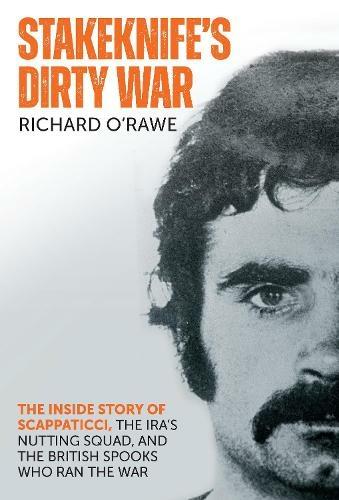
Book Review: Stakeknife’s Dirty War by Richard O’ Rawe, Merrion Press, 2023

Gearóid Ó Loingsigh 02 November 2023

Richard O’ Rawe’s Stakeknife’s Dirty War is a timely book, coming as it does after the death, or supposed death of Stakeknife in England and what looks like a thwarting of the intent and findings of Boutcher’s Kenova Inquiry into the affair.

It is now accepted by all that IRA Volunteer Scappaticci was also the British agent known as Stakeknife.

O’Rawe had access to IRA volunteers and former intelligence operatives and weaves together aspects of Scappaticci’s life and role into a narrative that is convincing and despite the nature of the subject matter, torture, murder and betrayal it is an easy read.

O’Rawe also introduces us to Scappaticci the person. The person however, isn’t any more likeable than the British agent, torturer and murderer. In fact, it would seem they are flip sides of the same coin. Scappaticci was an industrious character, always on the make, running private tax scams.

He was used to money long before he became a paid British agent. His fortune earned from murders on behalf of the British and the IRA, though the IRA weren’t giving him anything like the sum the British did, is estimated to be in the region of a million pounds in pay-outs.

He also had various properties. Scappaticci was also a lowlife thug long before the British and the IRA gave him carte blanche to murder and torture his way through republican ranks. Some of things he did, had he not been in the IRA would have led to him being kneecapped by the IRA.

A man called Collins made the mistake of publicly calling the area in Twinbrook in which Scappaticci lived ‘Provie Corner’. Scappaticci did not like that and decided that Collins had to pay for his transgression.

He knocked on Collins’ door and, when it was answered, the informer battered the older man multiple times over the head with a sock containing a brick. Only when Collins collapsed did Scappaticci walk away.

This is the type of low life thuggish behaviour that the IRA was willing to tolerate and perhaps even encourage from people like Scappaticci. In a genuinely political movement, a thug like Scappaticci would have been out on his ear. But not in the IRA nor in Sinn Féin.

He was, to paraphrase the Yanks when talking about the Nicaraguan dictator Somoza, “he may be a son of a bitch, but he is our son of a bitch”, though in this case it would seem that not only was he theirs he had just the qualities that both the IRA and the British valued, ruthless thuggish qualities.

Scappaticci the person and agent are intimately related it would seem though O’Rawe doesn’t explicitly say so. He does however, give us ample material with which to draw that conclusion.

One of the issues never dealt with it in the press and not really fully covered here is what type of organisation recruits, tolerates and promotes such people. He was a reprobate who should never have graced the ranks of the IRA. That he did so, is down to Adams and co.

That is also clear from the book. It is not an aspersion on Adams or on McGuinness either to question their role.

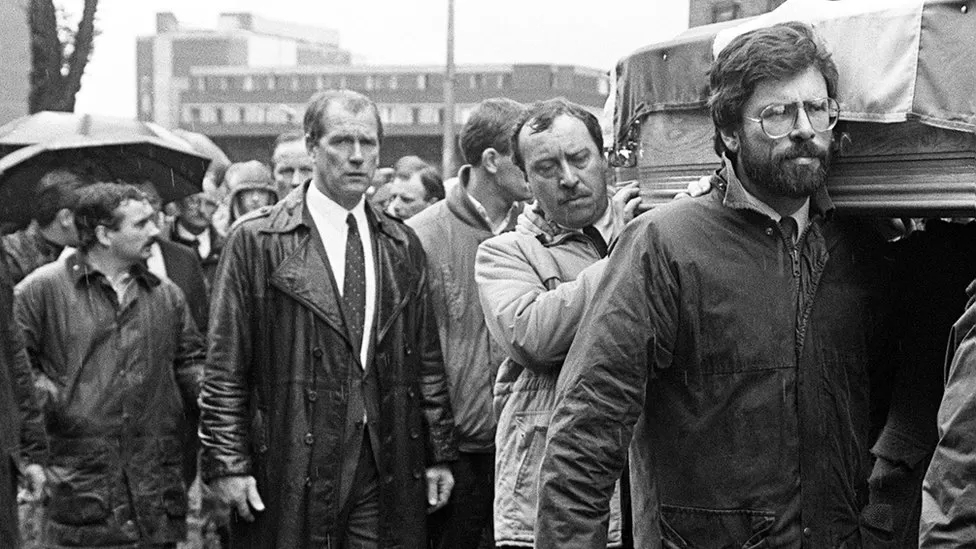
Republican funeral, Scappaticci on left photo, Adams on right (Photo cred: Pacemakers)

The latter of the two comes in for some questioning in the book regarding his role and O’Rawe goes into some detail and also explains in the epilogue that before beginning his research he was unaware of the level of unease amongst republicans about McGuinness’ trustworthiness.

Though he does point out earlier that if McGuinness was a tout, why was it necessary for the British to have a spy such as Willie Carlin get close to him. The same could also be said of Adams.

The British had an agent, Denis Donaldson, whispering sweet nothings in Adam’s ear over many years, shaping Adam’s view of the world and reporting back to the British how successful he had been in his endeavours.

The Peace Process, in that regard, was partially the result of what ideas the British planted in Adam’s and McGuinness’ minds through their various agents. However, it does seem unlikely either of them were touts in the classical sense of the word.

They didn’t need to be, they were at a different level. They were both on the same side as Scappaticci in winding down the war, they just had different methods of going about it.

It is possible that at some stage they had dealings with the British security services in pursuit of common aims. O’ Rawe is not the first to question McGuinness either.

Ed Moloney has put forward the idea that the reprehensible proxy bombs that provoked so much revulsion were signed off on, precisely because they would strengthen the hands of those who sought to wind up the war.

O’Rawe gives many examples of what Scappaticci and the other British agents in the Internal Security Unit did. It wasn’t limited to executing alleged informers or those the British thought should be removed for various reasons under the guise of them being informers.

They were also in a position to give information on operations which led to the British either arresting or killing the Volunteers involved.  The book opens with an account of one such operation, where fortunately they were able to pull back from it without the planned British ambush going ahead.

There were of course other incidents, one of them being Loughall where the British ambushed an entire unit of the IRA. Scappaticci and his ilk did great harm to the IRA, but they were not the reason the IRA lost the war, and O’Rawe doesn’t argue it was either.

However, others have made this point. But the IRA was never going to win the war, they weren’t going to outgun the Brits ever.

Another part of the problem of course, is related to Scappaticci. A movement so highly infiltrated would always have problems, but it is telling of the political weakness of the IRA and Sinn Féin that a thug like Scappaticci could rise through the ranks and remain at the top for so long.

That says more about their weaknesses, than anything else.

That Denis Donaldson, a British agent was the chief advisor to the IRA and Sinn Féin on strategy, for so long, shaping policy, whilst Scappaticci weeded out of the ranks anyone who would oppose it, says more about the weakness of republican politics than whether operations went ahead or not.

O’Rawe, however, is more interested in what happened and who bears responsibility for it.

He is quite clear that the IRA are to blame and is equally clear that those in the intelligence services who allowed Scappaticci and other British agents in the ISU to murder their way through republican ranks are also to blame.

He is not wrong in that, Danny Morrison described Scappaticci as Number 10’s murderer(1) and that he was, he was also the IRA and Sinn Féin’s murderer.

Adam’s infamously justified in a blasé fashion the IRA murder of alleged informer Charles McIlmurray in 1987 when he said that “like anyone else living in West Belfast [he] knows the consequence for informing is death.”(2)

Neither the British, the IRA, Sinn Féin and Gerry Adams in particular, get to wash their hands of the affair.

This book is an important contribution to uncovering the truth of Troubles, one which will neither please Sinn Féin nor the British and Irish governments written from the perspective of a former IRA volunteer.

It deserves to be read and kept on the book shelf as the issue is not going away any time soon.

end.

Notes

(1) Morrison, D. (30/01/2016) No 10’s Murderer – Scap https://www.dannymorrison.com/the-times-of-no-10s-main-murderer/

(2)  See https://www.youtube.com/watch?v=8Kwrj6Ku9ZU


THE NEW WAILING WALL

Diarmuid Breatnach

(Reading time: 3 mins.)

There’s a new Wailing Wall …
THERE’S A NEW WAILING WALL;
It’s in Gaza, and here mothers and fathers wail
at the bloody bodies of their children;
children wail at the bloody bodies of parents;
all wail over the bodies of friends and neighbours;
the wailing rises and the tears fall.

At this Wailing Wall …
AT THIS WAILING WALL,
we wail the mendacity of Israel and the West,
we wail the complicity of the media in the West;
while rockets, shells and bombs rained down upon us
the lies fell faster and thicker than rain,
a torrent of lies that never stopped.
To surge in flood over the bodies of our slain.

You come now with your flag of peace …
YOU COME NOW WITH YOUR FLAG OF PEACE
tramping along the bloodstained road
and up the mountain of our bones
and the rubble of our homes
and offer us business as before
or – bombardment once more.

Now that the bombs have stopped …
NOW THAT THE BOMBS HAVE STOPPED
we too stop and look around us:
our schools gutted and bloodstained,
mosques and hospitals in ruins,
so many of our buildings rubble,
or with gaping shell-holes,
in the hell-hole
you have made of Gaza.

We had so little and you destroyed so much.
WE HAD SO LITTLE AND YOU DESTROYED SO MUCH!

In the days to come, more will sicken and die,
of wounds on flesh and wounds on soul,
of lack of medicine, fuel or food
as even in pause you take your toll.

Many are numb, some try to forget …
MANY ARE NUMB, SOME TRY TO FORGET,
some try to live without forgetting,
but there is a begetting,
for in many hearts too,
your phosphorus flakes are snowing,
the embers of hate are glowing,
their machine guns and bombs are mowing
you and your children for generations to come.

Against your Goliath …
AGAINST YOUR GOLIATH,
our slingshots were of no use;
yes, God was with you –
he’s no longer Hebrew or English –
He’s American now;
you shot us down like fish
in the shooting barrel
you made of Gaza.

You wish us to recognise you?
YOU WISH US TO RECOGNISE YOU?
Of course we recognise you –
the imprint of your boots are upon our necks;
we carry them from cradle to the grave.

But we will never agree to accept
or agree that you should keep
what you have stolen and plundered
the land you have sundered
or that you can make us second-class
citizens in our own land.

While we struggle to endure …
WHILE WE STRUGGLE TO ENDURE
and to ensure
that you never defeat us
let it be that we do not learn to treat others
as you now treat us.

What did you learn from your oppressors?
WHAT DID YOU LEARN FROM YOUR OPPRESSORS?
If all you learned was how to also
do so much of what they did,
then truly have the six million died in vain
and you mock their memory by invoking them.

Diarmuid, Feabhra 2009

I began to write this just as the December 2008- January 2009 bombardment of Gaza by Israel was coming to an end and I rounded it off in February.  

That was the one they called “Operation Cast Lead”, which killed over 1,400 Palestinians, mostly non-combatants, including 400 children and injured over 5,300 — again, mostly non-combatants.  

I little thought that so few years later Israel would unleash an even worse bombardment upon the beleaguered Palestinians in Gaza, as it did in July 2014, during which it killed over 2,300, again mostly non-combatants and that time nearly 500 children.  

The damage to infrastructure is colossal and the Israeli-Egyptian blockade makes significant repair impossible.

The commentary above was written in 2014. Apart from killing in raids, there were more massacres to come: March 2018, more than 700 Palestinian refugees killed at the borders of the Israeli state and in 2021, over 260 Palestinians killed after Zionist provocation at the Al Aqsa Mosque, in Jerusalem.

In August 2022, over 30 Palestinians, including women and children, killed in Israeli missile attacks and this year, by August, Israel had killed 172 Palestinians. Now, over October-November 2023, they have killed 133 Palestinians in the West Bank and over 9,000 in Gaza, including 3,760 children.

There is no question that this is genocide: “the deliberate killing of a large number of people from a particular nation or ethnic group with the aim of destroying that nation or group.”

Any of the following acts committed with intent to destroy, in whole or in part, a national, ethnical, racial or religious group, as such:

  1. Killing members of the group;
  2. Causing serious bodily or mental harm to members of the group;
  3. Deliberately inflicting on the group conditions of life calculated to bring about its physical destruction in whole or in part;
  4. Imposing measures intended to prevent births within the group;
  5. Forcibly transferring children of the group to another group.”

(https://www.un.org/en/genocideprevention/genocide.shtml)

Nor did that genocide begin in October this year, nor last year, nor the year before. It began in 1948 with the creation of the state of Israel and has been continuing since.

end.

JOURNALISTIC & EDITORIAL GUIDANCE: REPORTING CONFLICT IN PALESTINE

Diarmuid Breatnach

(Reading time: 7 mins.)

We understand the pressure under which news media organisations are under and how easy it is to lapse into descriptions that have become common usage in the profession and so have issued this guide to greater accuracy.

TERM IN COMMON MEDIA USE

Israel-Hamas war

OUR CORRECTION

Israel-Palestinian war1

TERM IN COMMON MEDIA USE

Hamas-controlled/ Hamas takeover

OUR CORRECTION

Palestinian elected government2

Gaza Hell by Israeli bombing (Photo cred: Ahmed Zakot/SOPA Images/Sipa USA)

TERM IN COMMON MEDIA USE

Palestinian militant

OUR CORRECTION

Palestinian

TERM IN COMMON MEDIA USE

Hamas/ Palestinian terrorist

OUR CORRECTION

Hamas/ Palestinian freedom fighter

TERM IN COMMON MEDIA USE

Hamas rampage into Israel

OUR CORRECTION

Hamas breakthrough into Israeli-controlled territory

TERM IN COMMON MEDIA USE

Israel bombardment of Gaza in response to Hamas attack on October 7th

OUR CORRECTION

Israeli attack on Gaza in response to Palestinian response to 75 years of oppression, murders and massacres, including well over 200 Palestinians killed by August this year.3

TERM IN COMMON MEDIA USE

Palestinian attack on Israel

OUR CORRECTION

see above

TERM IN COMMON MEDIA USE

Israeli civilians

OUR CORRECTION

Israeli armed settlers, military reservists – and civilians

TERM IN COMMON MEDIA USE

Hamas hostages

OUR CORRECTION

prisoners of Hamas

TERM IN COMMON MEDIA USE

Palestinian prisoners

OUR CORRECTION

Hostages of Israel4

TERM IN COMMON MEDIA USE

two-state solution

OUR CORRECTION

ridiculous Palestinian ‘Bantustan’ proposal

TERM IN COMMON MEDIA USE

IDF (Israeli Defence Force)

OUR CORRECTION

IOF (Israeli Occupation Force)

TERM IN COMMON MEDIA USE

Israeli security forces

OUR CORRECTION

Israeli repression forces

TERM IN COMMON MEDIA USE

“International community”

OUR CORRECTION

Most capitalist imperialist states around the world

TERM IN COMMON MEDIA USE

Israel’s right to defence

OUR CORRECTION

Right of the Zionists to occupy land, massacre and terrorise the inhabitants, treat them as third-class citizens and massacre and terrorise again if they resist.

TERM IN COMMON MEDIA USE

Palestinians were killed/ Hamas killed Israelis

OUR CORRECTION

Israel killed Palestinians/ Hamas killed Israelis

TERM IN COMMON MEDIA USE

Jewish state

OUR CORRECTION

Zionist state

TERM IN COMMON MEDIA USE

Illegally-occupied lands outside Israel

OUR CORRECTION

Part of unjustly-occupied whole of Palestine

TERM IN COMMON MEDIA USE

Contested attribution of bombing of Al-Ahli Hospital in Gaza

OUR CORRECTION

Israeli bombing of Al-Ahli Hospital in Gaza5 after telling hospitals to evacuate

TERM IN COMMON MEDIA USE

Uncertainty around accuracy of Palestinian casualty figures

OUR CORRECTION

Absolute accuracy of Palestinian casualty figures, accepted by a wide section of international organisations including bodies of the United Nations.

FOOTNOTES

1We’re aware that the term “war” often brings to mind the air forces, armies and navies of two states in conflict and that the Palestinians have neither air force nor navy and that their army is collectively composed of guerrilla groups. Nevertheless, for convenience and in the tradition of naming armed long conflicts of liberation “wars” we consider the term useable in this context.

2Hamas won the 2006 Palestinian Legislative Elections throughout the territory – not just in Gaza but also in the West Bank. Al Fatah did not accept the results and tried to stage an armed coup in Gaza and in a short and brutal struggle were defeated by Hamas which, however left the West Bank in more-or-less Fatah hands. The then-Fatah choice for President of the Palestinian Authority, Mahmoud Abbas, remained in power and has not authorised elections since. The PA has a huge number of security personnel (over 80,000) widely regarded as brutal, repressive and colluding with the Israeli regime against Palestinians.

3The massacres by Zionist militias forced 700,000 Palestinians out of Palestine in 1948 as the State of Israel was being founded. Since then, in regular raids, massacres and bombardments, Israel had killed an estimated 65,000 Palestinians just up to 2021, after which there have been a number of bombardments of Gaza and raids into the West Bank at intervals with thousands more deaths in total. The vast majority of those `Palestinian deaths have been and continue to be those of civilians, over half of women and children, the latter over one-third.

4At the end of June 2023, the Israel Prison Service (IPS) was holding 4,499 Palestinians in detention or in prison on what it defined “security” grounds. According to recent reports, since the attack on Gaza, that number has doubled.

5For a detailed analysis both of type of Palestinian rockets and Israeli bombs re. explosion and past history https://youtu.be/7DhDKy7vARM?si=C6MWmywbFF-oNxaR

SOURCES

https://en.wikipedia.org/wiki/Palestinian_casualties_of_war

https://www.btselem.org/statistics/detainees_and_prisoners

https://www.aljazeera.com/features/2023/10/21/number-of-palestinian-prisoners-in-israel-doubles-to-10000-in-two-weeks

LOOKING BACK AT UKRAINE AND PALESTINE CONFLICTS 2014
Bill O’Brien, text of speech delivered at Athens conference in 2014; first published in The Pensive Quill blog and sent to Rebel Breeze.

(Reading time main text: 4 mins.)

In May 2014, the week following the Odessa massacre, a small group of mostly non-aligned antifascists in Ireland organized through word of mouth and through social media a successful demonstration in Dublin.

We rallied against the fascist atrocity and described it as part of an imperialist anti-Russian agenda in the EU and we called for support in Ireland for the struggle against the Ukrainian army in Donbas. 

There was very little reporting on the atrocity in the mainstream media.

Unfortunately, it was complemented by virtual silence from nominally anti-imperialist, socialist organizations in the country, despite the fact that a massacre had occurred the day after Mayday, the historical day of workers’ solidarity and that it was committed by openly fascist groups inside a trade union hall.

Fascists and far-right Ukrainian nationalists besieged anti-fascists in Odessa trade union building on May 2nd 2014 and set fire to the building. Nearly 40 were confirmed killed, often by the mob as they jumped to escape the flames and a great many were injured. (Photo cred: Reuters)

What seemed surprising to us at the time was the fact that the Irish trade unions had issued no statements at all on the tragic event of May 2nd.

There were no messages sympathising with the loss of life or condolences to grieving families sent by the union hierarchy, no expression of solidarity as one would have expected.

There was no condemnation, or even any acknowledgement from the trades union movement that a horrendous crime had been committed against young anti-fascists who had sought refuge from an armed fascist mob in the Odessa House of Trade Unions.

When we raised the question of this silence with members of groups associated with the Left in Ireland, we found that most were hardly interested in addressing a threat that even some right-wing commentators had been drawing attention to – i.e. the re-appearance of Nazism and the support fascism was receiving from the Ukraine government – in a part of Europe that was aspiring to join the EU.

To the extent that these leftists mentioned Odesa at all, they argued that the massacre took place in the context of a war in Ukraine between forces aligned with two equally regressive imperialist regimes.

That is between supporters of the EU / NATO on the one hand and supporters of a paramilitary Russian nationalism aligned to Russian “imperialism”, which was attempting to redraw the Ukrainian borders.

Those who died or suffered injury in the Odessa massacre were portrayed, when they were mentioned at all, as unfortunate victims of inter-imperialist rivalry.

The successful resistance and defeat of fascist brigades in Donbas earlier this year – by “tractor drivers and miners” as Putin put it – halted a march to the right that was taking place across the whole of Europe. That defence gave the world time to face reality.

Social media and non-Western media sources have allowed us the space to counter much of the propaganda. We have received support from trades unionists as well as from those political groups that are not tied to the pro-UK line followed by most of the official Irish media.

But we have found that attempts to oppose a pro-imperialist narrative are too often treated as affronts to the unity of the Left political project in Ireland. Political discourse of the sort that insists on a precise understanding of the meaning of words is too often dismissed as sectarian or divisive.

In the lexicon of much of the Left, the concretely understood word “imperialism” has been replaced by words taken from the language of “humanitarian” intervention that has been promoted by groups such as Amnesty.

When we say that Russia is not an imperialist country for instance we get accused of introducing what are termed “sectarian ideological squabblings.” Bono’s latest political musings seem to outdate Lenin’s formulation on any matter!

According to the humanitarian Left words like ” imperialism” get in the way of a united strategy that should be aimed at electing progressive left-wing representatives to the Irish parliament institution that is largely powerless in the face of austerity measures dictated by international finance.

Left unity that is based on the abandonment of principles can only weaken the fight against imperialism. This has been demonstrated in the Irish “humanitarian” Left’s responses to the present conflict in Syria and the current refugee crisis.

The influential Washington-based Foreign Policy magazine wrote correctly this month about how Russian involvement in Syria is inextricably linked to the ongoing conflict in Ukraine.

Such links have to be understood and taken fully into account in the building of a genuine internationalist movement against imperialism.

The Odessa massacre, as we know, occurred on May 2, 2014. Sightly over a month later, the Zionist onslaught against Gaza began – on 7 July 2014.

The responses in Ireland to the two events were totally different – almost as if two tragedies were simultaneously taking place on different stages on different planets.

In response to Gaza, a pro-Palestine demonstration was called in Ireland’s capital city, Dublin, for Gaza; it was attended by something in the order of 10,000 people. Those ordinary citizens at the march had undoubtedly been moved by an act of incredible brutality by a Western-backed regime on a defenceless Palestinian people.

Those speaking on the Save Gaza platform did not ever mention the Ukraine bombardment of civilian areas – supported by the US and its allies – that was taking place in Donbas at exactly the same time as the Israeli military strikes on Gaza were occurring.

The same people had supported the Maidan coup. The bombardment of Donbas was also supported by the US and its allies so wouldn’t it have been sensible for the Gaza rally organizers to mention Donbas?

At exactly the same time as Gaza and East Ukraine were under attack, the US and its allies were organizing proxy “rebel” forces in Syria aimed at the destruction of the nation’s secular state and its replacement by a pliant regime.

The Syrian crisis did not get mentioned at the Gaza rally either on account of the opportunist alliances between leftists who dominate the anti-war movement in Ireland and the Muslim Brotherhood.

We have been working since 2014 with members of the Ukraine and Russian communities in Ireland and called demos in support of Donbas.

We visited trades union headquarters in Ireland and helped Russian and Ukrainian leftists in Ireland bring the Odesa massacre photo exhibition to the country’s major cities – Dublin, Cork and Belfast.

We have held events to coincide with the showing of the photos, which have been attended by sympathetic trades union leaders, members of the Russian and Ukrainian communities and Irish republicans and socialists.

We were very pleased that our limited endeavours in Ireland have been well-matched across Europe and beyond and we draw strength from this international solidarity.

End.

Rebel Breeze COMMENT:

The events in Ukraine were well known at the time, following a US-instigated coup in 2014 (the true date of the start of the armed conflict, not February 2022).

The USA wanted Ukraine to join NATO, its bloc against Russia but the Ukraine government was more interested in staying connected to the East and in particular to Russia, having lots of linguistic and other cultural connections there.

The coup launched not only a change of government but a wide-scale attack on supporters of the previous government and on Russian-speaking communities across Ukraine, particularly in Eastern Ukraine (Donbas and Crimea).

Monuments of the War Against Fascism were torn down wherever the fascists got control.

Communities in most of the threatened areas mobilised to defend themselves against the armed attacks of the Right Sektor and the Azov Battalion (now incorporated into the Ukraine’s National Army), some with more success than others .

Mariupol fell to fascist forces but was retaken by Russian forces last year.

Anti-fascist mobilisation in Eastern Ukraine, 2014 (Image sourced: Internet)

Crimea defended itself successfully, called an early referendum and as a result joined Russia. Other areas that were not overrun remained in defensive fighting for the next eight years, mostly with no running water or electricity, under artillery bombardment until the Russian invasion.

The demonstrations, public meetings and exhibitions to raise awareness in Ireland of the Ukrainian fascist attacks in 2014 were successful to a degree but not enough to move the major part of the Irish Left, in particular the PBP and the SP – or the trade union leaderships.

Their inability to see the true nature of events there has intensified since the Russian invasion.

A national hero of the Ukrainian state now, which Right Sektor and Azov were promoting even before 2014 is not one of the Ukrainian partisans who fought the Nazi invasion and occupation.

No, it is Stepan Bandera, not only an anti-semitic anti-gypsy fascist but a Nazi collaborator during WW2, an allied organisation of his responsible for massacres which peaked in July and August 1943.

“The massacres were exceptionally brutal and affected primarily women and children.[7][2] The UPA’s actions resulted in up to 100,000 deaths.[8][9][1]

“Other victims of the massacres included several hundred Armenians, Jews, Russians, Czechs, Georgians, and Ukrainians who were part of Polish families or opposed the UPA and sabotaged the massacres by hiding Polish escapees.” (Wikipedia).

The following reference is posted to show that the attacks and their fascist connections were well known across the West but also to show how the report twists what happened to make the victims appear as the causes of the attacks.

https://www.theguardian.com/world/2014/may/02/ukraine-dead-odessa-building-fire