Revolutionary socialist & anti-imperialist; Rebel Breeze publishes material within this spectrum and may or may not agree with all or part of any particular contribution. Writing English, Irish and Spanish, about politics, culture, nature.
A deadly disease has struck some people in Ireland, affecting tendons in the legs, control of the tongue and causing partial amnesia. By a strange twist, some of those affected are attracted to the very site of the first outbreak of the disease.
The effect on the tendons in the legs of those affected is dramatic: they can no longer stand up straight and find themselves bending a knee or even collapsing on to both knees, the tongue protruding in bizarre licking motion.
Less visible but in many ways more striking is the amnesia effect. Those affected lose memories of parts of what they learned in school or what they themselves thought and said in the past – even in recent years.
According to Dr. P O’Neill of the Institute of Research and Adjustment, a new symptom was observed recently: “Affected people spent four hours staring vacantly at a film of some anachronistic ritual”.
Dr. T.W.Tone, who has been studying similar outbreaks in the past observed on the affinity of the disease for people of higher social classes: “No-one is guaranteed immunity but it does seem that the lower the social class, the less likely the person is to contract this disease.”
Commenting on the low recovery rate of those who contract the disease, Dr. J.Connolly pointed to the crucial importance of prevention, for which community programs of education can be very effective. “We rely especially on Volunteers,” he said, “men and women who are dedicated to preventing the spread of this disease.”
An organisation by the name of Anti-Imperialist Action yesterday held an anti-monarchist march and rally in Dublin, including a mock execution of royalty, where their speaker was arrested by Gardaí.
The protesters met first at the James Connolly monument in Beresford Place and after some words marched up Abbey Street to Dublin’s main street and to the General Post Office building to hold their anti-monarchy rally.
Royalty and guillotine beside James Connolly monument at start of event (Photo: AIA)
At the GPO the gathering of socialist republicans, socialists and anarchists had grown. As the mock-up guillotine carried out mock execution of the dummy representing royalty, a large force of Gardaí arrested the speaker. Participants then went to Store Street Garda station to demand his release.
At Store Street the protesters were met by a line of Gardaí1 drawn up in front of the entrance to the police station. In speeches and slogans, the protestors denounced the police for the arrest of the speaker at the GPO, also denouncing the monarchy and the State.
Line of Gardaí barring entrance to Store Street Garda Station (Photo:Rebel Breeze)View of protesters outside Store Street Garda Station (Photo: Rebel Breeze)
Some speakers criticised also the national broadcaster RTÉ which was devoting four hours to the coronation.
The most frequent chants were: When Republicans are under attack – stand up, fight back!2 One, Two, Three, Four – Occupation no more; Five, Six, Seven Eight – Smash the Free State!3 Brit King – Guillotine! No democracy – under a monarchy! No democracy – in the Free State4!
One of the protesters, accompanying himself on guitar, sang the Republican ballad popularly known as “Come Out Yez Black ‘n Tans”, the attendance joining in on the chorus. They displayed a banner with a slogan from Liberty Hall5 in WW1: We serve neither King nor Kaiser but Ireland.
Using a loudhailer, another protester read out James Connolly’s6 1911 denunciation of the monarchy. Yet another speaker quoted Garda Commissioner Drew Harris’ recent words saying the Gardaí were the “biggest gang”, the protester calling them “an MI5-directed gang”.
Eventually news of the release of the arrested man reached the protestors and they marched up Talbot Street with Starry Plough7 flags and a Basque Ikurrina flying, back to the GPO, outside of which they held an impromptu rally.
Along with portraits of Irish hunger-strike martyrs of 1981 there was a portrait of Palestinian martyr Khader Adnan carried also in recognition of the international role of British imperialism and its Head of State.
Many looked on in interest while some applauded them, both in Talbot Street, where a taxi driver enquired the reason for the protest and wished them well and also outside the GPO. Gardaí arrived and stood across from the building to watch the protesters but in smaller numbers than before.
The protestors return to the GPO for an impromptu rally in place of the planned one interrupted by the Garda attack and arrest of speaker (Photo: Rebel Breeze)
Another speaker said the protesters were “health workers, working to rid Ireland of a dangerous disease affecting politicians, media and State forces, a disease that makes them go to their knees in front of royalty and a foreign state, extending their tongues to lick a certain part of the anatomy.”
Interest from the pedestrian reservation in O’Connell Street across from the GPO, including much smaller number of uniformed Gardaí (Photo: Rebel Breeze)
The speaker said they were working “to rid Ireland of this dangerous disease, to enable the people to stand up straight once more, to claim their Republic, celebrate their history and speak out against foreign domination and monarchy”.
He drew attention also to arrest of a Republican speaker outside the iconic GPO, headquarters of the 1916 Rising8 and which still bears the scars of British bullets9.
Reference was also made a number of times by protesters to the arrests of English Republicans in London who were prevented by from holding a protest against the monarchy.
The victim of the police attack returned from police custody and briefly spoke thanking those who had demanded his release; people who had stopped to listen applauded and the group dispersed without further arrest.
End.
Photo taken at GPO before police attack (Photo: AIA)
2This seems adapted from a slogan often chanted by Irish socialist groups.
3This too seems an adaptation but from the Palestine solidarity movement.
4The new state of 26 Counties (missing six, which are in the British colony) and which fought a Civil War against the Republicans was called “the Free State” and though the name was changed (and to a ‘republic’) Irish Republicans and many nationalists in the British colony call it the “Free State” in irony and in negation of its legitimacy.
5Liberty Hall is a very tall building housing SIPTU but the trade union’s ancestor, the ITGWU had purchased the previous building on the same site which was destroyed by the British during the 1916 Rising. The slogan “We serve neither …” etc had been displayed across the front earlier during WWI.
6Revolutionary socialist leader, trade union organiser, writer and historian who brought the Irish Citizen Army to participate in the Rising, during which he was made Dublin Commandant, afterwards being shot by British firing squad.
7Originally flag of the Irish Citizen Army, the first workers’ Army in the world, formed to defend the workers in 1913 Lockout against police attacks and which also took part in the 1916 Rising.
8The rising 24-29 April 1916 was the first against world war and contained many other ‘firsts’ – six different organisations played a prominent part in it, including women. The Rising is regarded as leading to the War of Independence 1919-1922.
9One of many buildings in Dublin that bear the scars of conflict, this one is an imposing building in the city’s main thoroughfare, O’Connell Street. With the building in flames from British artillery on Easter Friday, the garrison, including five of the Seven Signatories of the Proclamation of Independence (which was read out at the start of the Rising) relocated to nearby Moore Street, where the decision was taken to surrender.
Useful link and Reference:
"We confess to having more respect and honour for the raggedest child of the poorest labourer in Ireland today than for any, even the most virtuous, descendant of the long array of murderers, adulterers and madmen who have sat upon the throne of England." – James Connolly pic.twitter.com/o8inKRr5Fi
— Anti Imperialist Action Ireland (@AIAIreland) May 6, 2023
Gearóid Ó Loingsigh 12 April 2023 (first published in Socialist Democracy)
(Reading time: 5 mins.)
The president of Colombia, Gustavo Petro, announced in a National Peace, Reconciliation and Harmony Council (CNPRC) meeting that the state didn’t have sufficient funds to fulfil the Havana Accord signed with the FARC.(1)
The situation seems to be so serious that according to the President it will take 125 years to fulfil it. There are some points in which he is right, but only if we ignore the most obvious things: the nature of the Accord itself.
He alludes to this and asks some rhetorical questions, ones which he should really ask as proper questions, not as some gesture in his oratory, but rather as questions to the FARC, Santos and all those who promoted the Accord nationally and internationally.
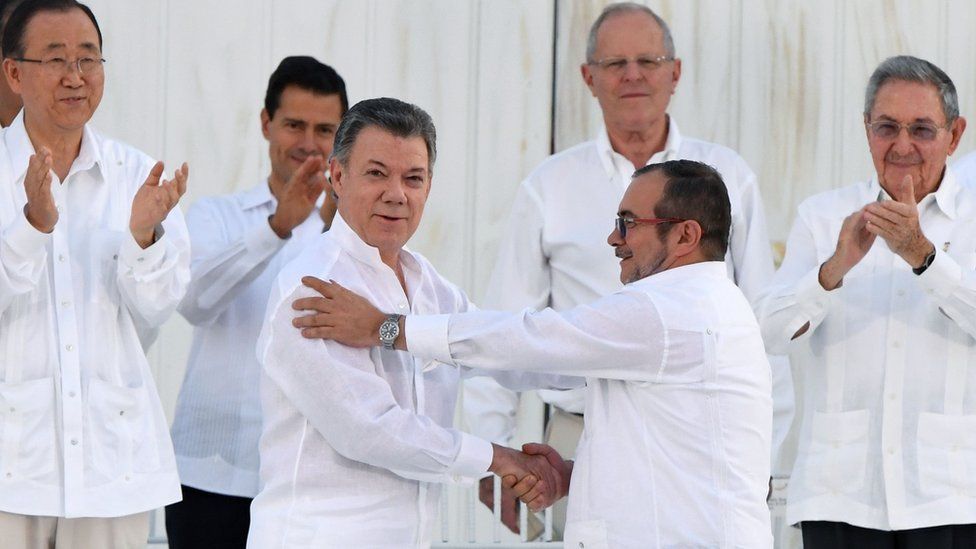
Among guarantors of the Colombian conflict pacification deal signed by, at the time, Colombian President Juan Manuel Santos, left, and leader of the Revolutionary Armed Forces of Colombia (FARC) Timoleón Jiménez, known as “Timochenko,” during a news conference announcing an agreement between the two parts in Havana on Sept. 23, 2015. Among those applauding, Cuban President Raul Castro at far right of picture. (Source photo: Internet)
Petro asks “was that Accord signed with the aim of applying it, or with the aim of disarming the FARC and later, Colombian style reworking everything?(2)
Well of course it was sonny boy. That much was clear. At the time you were told so and those of us who criticised the Accord were accused of wanting more war, ignoring that many of us had never participated in or supported the war. It was a debate they didn’t want to have.
During the not very open process negotiated behind closed doors, it was said, in the midst of the euphoria of the signing and the parties in public squares with huge screens in the streets so one would miss it, that criticisms were not welcome.
They were, as an old friend used to say, as welcome as a fart in a space suit.
Petro continued and stated something he certainly believes is very important.
I want to implement the Peace Accord, but it costs 30.5 billion Euros. If the Santos government signed this in the name of the state and society is represented in this, then, tell me where am I to get this 30.5 billion?(3)
There is an easy answer to that question. The money can be got from the same place that they, and in that I include Petro, thought it was when they signed the Accord in 2016. Don’t ask where they are going to get the money, but rather tell us where you expected to get it in 2016.
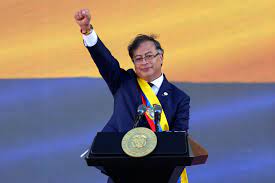
Petros giving a clenched fist salute after his inauguration as President of Colombia. (Source photo: Internet)
Senators such as Iván Cepeda who played an important role in the process can point to where. The cost of the Accord was obvious from day one, this problem is not new and it is just not credible thatPetro and his Congress benches have just realized how much money was needed.
But the truth is Petro, Cepeda wanted to bring the FARC to an end and rework things later. All of them without exceptions. Of if this is not the case, maybe they can tell us where they thought they would get the money.
The former FARC commander, Timochenko said that war against the FARC (he excludes all of the other guerrilla groups that have existed) cost 83.7 billion Euros and the 30.5 of Petro is a minimal cost for the chance of a country in peace.
He is partially right, except that the problem is not about money or amounts, but rather the Accord itself and their perspective that what is needed is money and not political changes. The Havana Accord reads like shopping list, like a list of demands and a not very precise list at that.
A Land Bank would be set up with three million hectares, but it doesn’t say where and left it to the whim of whichever government.
So Petro announced that he would fulfil that part by buying land off cattle ranchers. The same ranchers whose spokesperson José Felix Lafaurie accepted that Fedegan’s affiliates, rice growers and various multinationals financed the right-wing paramilitaries.(4)
Nothing happened to him, nor to the 10,000 cattle ranchers who had signed an open letter where they acknowledged their crime.(5) At the time it was argued that the Prosecutor was not in a position to process that many people.
It wasn’t true, the crime had been publicly vindicated and they also said that there was nowhere to put 10,000 criminals. This wasn’t true either.
According to the prison service’s own figures and the calculations of the Corporación Excelencia en Justicia, in 2006 the Colombian prison system had a capacity for 52,414 prisoners with 60,021 actually held in them.
In 2011, that figure had risen to a capacity of 75,260 with 100,451 people in them i.e. they managed to put 40,000 poor prisoners in overcrowded conditions, but they had no room for 10,000 paramilitaries and their lackies.
In 2006 there were 19,353 prisoners on remand.(6) A little bit of creativity with the judicial abuse of remand and they could have put the paramilitary funders in jail without any problems.
The prison population eventually reached the figure of 125,000 prisoners in overcrowded conditions whilst others rambled around their lands despite having acknowledged their crime.
What was missing was the will. But instead of spending money buying land from paramilitaries and their backers, Petro could confiscate the land of those 10,000, amongst others. It wouldn’t cost that much.
There are other measures he could take with a view to peace, justice and truth. Petro could ask for the extradition of the Board of Chiquita who paid a 25 million dollar fine in the US having accepted their responsibility in the crime of financing paramilitary groups.
It wouldn’t cost more than the price of posting the request. There are other measures that have some bureaucratic costs, like forcing public bodies to comply with land restitution findings, something which does not happen. It also only requires the will to do so.
Petro’s focus is the same one as the FARC and the Santos’ government and other peaceniks, who are now Congress reps: it is a question of money. But this is not the case. It is a question of returning stolen land, reviving organisations, guaranteeing the right to exercise one’s rights.
It is also the disbandment of the specialised riot squad, ESMAD. It is more expensive to change its name and give it a makeover, as Petro proposes, than abolishing it.
He wanted to buy fighter jets at a cost of 3,150 million dollars. Due to public reaction, he backtracked but he did buy the Barak MX air defence system from Israel at a cost of 131.2 million dollars.(7) He also bought 18 Howitzers from Israel at a cost of 101.7 million dollars.(8)
Such systems are for conventional wars between countries, they are of no use against insurgents, i.e. they are toys for the military. Maybe they will be used in the Coup that Petro’s followers announce all the time. It is what happened in Chile.
So, is there any money or not? And what will be done with the things that don’t cost much? Why don’t they reduce the extravagant salaries of the magistrates in the Special Jurisdiction for Peace who to date have produced little?
But then, at least he partly accepts what was always the case, that the peace process and the Havana Accord were a mockery of the victims of the Colombian conflict. Their only purpose was to remove the FARC from the field, particularly in areas with oil and other natural resources.
No one sought to solve any deep-seated problems in the country and here we are with the tale that there is a lack of money, when really what was lacking throughout the entire process were clear political positions.
(3) Ibíd., Euro figures were calculated at 4906 pesos to the Euro and the original figure of 150 billion in the article was taken using the Spanish definition of billion, which is a million, million.
(4) El Cambio No 704 diciembre 2006/enero 2007 Diez Preguntas (Entrevista con José Félix Lafaurie p. 48)
(5) El Espectador (17/12/2006) La hora de los ganaderos, p. 2A
Revolutionary greetings on the First of May! It is International Workers’ Day, for recalling of the struggles of working people down the centuries past and of resolution to carry the struggle forward until we succeed in building and defending a socialist society.
On that Mayday too we are aware that in some parts of the world, those wishing to mark the date in public will be subject to intimidation or worse: arrest, baton charge or being fired upon. Possibly even trial and death sentence.
HISTORY OF MAYDAY
The day dates from an incident in Chicago 1886, USA, when trade unions and socialist groups of various kinds organised a campaign in many cities of the USA to exchange the common 10-hour1 working day for the 8-hour day. May 1st was set for the start of the campaign
On May 3rd in Chicago, a city central to the campaign for an eight-hour working day, a demonstration as part of the campaign took place outside the McCormick Harvesting Machine company. The police opened fire on striking workers, killing one of them and injuring many.
The anarchists and anarcho-syndicalists organised a demonstration for May 4th to protest the killing of workers. When the police advanced on the peaceful crowd ordering dispersal, a bomb was thrown at them and police opened fire on the crowd, some of whom returned fire.
Some of the police are believed to have shot some of their colleagues by mistake.
Sixty police were injured and one killed; the police chief gave his opinion that more than that number of demonstrators were injured. The media was mostly hostile and many demonstrators wounded would have feared to attend hospital for fear of arrest or worse by police.
Contemporary engraving of the seven originally sentenced to death (Image: Wikipedia)
Subsequently, amidst a wave of police repression, including raids on union halls and people’s homes, eight Anarchists were framed, charged with conspiracy to murder and convicted. One of them was sentenced to 15 years in jail.
The sentences of Schwab and Fielden were commuted to life imprisonment. Linng took his own life in jail but August Spies, Albert R. Parsons, Adolph Fischer and George Engel were hanged by the Chicago State authorities.
Artist’s impression of the hanging of the four (Image: Wikipedia)
In 1889 the (Second) International Workingmen’s Association, a federation of trade unions and socialist organisations, agreed that in memory of that struggle and its martyrs, the First of May should be marked by all socialists around the world as International Workers’ Day.2
The site of the incident was designated a Chicago landmark in 1992 and a sculpture made in 1893 was dedicated there in 2004. In addition, the Haymarket Martyrs’ Monument was designated a National Historic Landmark in 1997 at the defendants’ burial site in Forest Park.
THE FIRST OF MAY BEFORE THAT
In European agricultural society the First of May was celebrated firstly as a pagan festival and later as an allegedly secular one or named for a Christian saint. It celebrated the coming of summer, of growing of crops and of livestock.
Industrial workers originated in agricultural societies or, in the case of early miners, were located near to such. It was natural that they should participate in such festivals and also even generations later create their own around a similar calendar.
European settlers in the USA, many of them from agricultural societies3, brought those traditions with them. That was probably one of the reasons for the date of the Chicago demonstration, although certainly there had been others on other dates.
MAYDAY IN IRELAND
My father took me as a child on my first Mayday march in Dublin. He was an active member of the NUJ and some members of his union and of others participated in a small march through the city centre led by a brass band.
Returning to Ireland in 2003 after decades working in England and marching there on May 1st, I was disappointed by the very small size of Mayday demonstrations in Dublin, though I participated in some and on at least one occasion as part of a Basque contingent.
The oppositional movement to the status quo in Ireland, because of our history of anti-colonial struggle, is dominated by Irish Republicanism. And though all of that movement’s parts would claim to be socialist too, the First of May is not of great importance in their annual calendar.
This is unfortunate because the mass of Irish workers who are not members of the Republican movement need leadership for their class and also, as it happens, most Irish Republicans are workers. And practically all immigrants are workers too.
While fighting for an independent Ireland, do we as workers want to exchange one group of exploiters for another? And is a struggle for an independent Ireland even remotely winnable without enlisting the working class fighting as a class in its own class interests?
James Connolly thought not and our history since his day has certainly attested to the correctness of his view.
NATIONAL HOLIDAY?
On 1st of May for years I took the day off work – unpaid, of course and went into the centre of London, the city in which I was living and working. My destination was usually Hyde Park Corner and if I was then in an organisation I met up others and if not, just joined in as an individual.
Thousands of people met there to rally and perhaps to march and I was aware that around the world not just thousands, or hundreds of thousands but millions were marking that day also. As a day to recall struggles in their own particular countries and in solidarity with others around the world.
Generally the various organisations and tendencies marched with those of their own affiliation but in the same demonstration, with the exception of the Workers’ Revolutionary Party, which on at least one occasion marched in as everyone was leaving.
The WRP was an extremely internally dictatorial and externally politically sectarian trotskyist organisation that at one time up to the mid 1980s was probably the largest socialist organisation,4 certainly outside the ranks of the Communist Party of Great Britain.
The latter organisation, with the support of some other socialists, many of them left social-democrats, began to push for Mayday to become a national holiday, an objective they achieved in 19785 (followed by the Irish State 15 years later)6.
So now I could go to the demonstrations and not lose pay. Great, right?
No, not really. For a start, the holiday was no longer on May 1st but instead on the nearest Monday to the date. More importantly, people tended to treat it as a holiday rather than a day of international workers’ solidarity. Of course people are entitled to holidays but the essence of the day was gone.
And rather than being larger, the demonstrations grew smaller.
Sculpture made in 1893 known as The Haymarket Martyrs’ Monument (Photo: Wikipedia)
A DAY TO RECALL AND AVOW WORKERS’ STRUGGLE
This is not a day for class collaborationists, politicians or union leaders who try to undermine the struggles, water down demands and act as the ruling class’ police on union activists. It is a date for those at minimum in support of militant resistance.
The essence of the day is what we need to keep. A day upholding our struggle, that of the working class against its exploiters, native and foreign. A day remembering our long history of struggle, of victories and defeats, of sacrifices and why the colour of the workers’ flag is red.
It is a day to remember our internationalist duty of solidarity, not as charity or altruism but as partners in struggle across the world, as on a picket line or demonstration we would shield the person beside us and strike out at the company goon, fascist or policeman attacking us.
And rightfully expect the same from those next to us as we ourselves are the subject of assault.
End.
Current mural in Portugal
Footnotes
1That was for a six-day week and 14-hour days were not unknown and in rural areas, even a seven-day week.
2Five years later, U.S. Pres. Grover Cleveland, uneasy with the socialist origins of Workers’ Day, signed legislation to make Labor Day—already held in some states on the first Monday of September—the official U.S. holiday in honour of workers. Canada followed suit not long afterward.
3That would certainly have included most Irish, Italians, Sicilians and East Europeans in the 19th and early 20th Centuries.
4The WRP was the result of a split in socialist organisations and by the mid-1980s was disintegrating in many smaller organisations. It exists still in name but as shade or sliver of its earlier form.
5May Day became an official public holiday all across the UK in 1978 with provisions for it being made in the Banking and Financial Dealings Act. Prior to that time it had been a holiday only in Scotland. The May Day Bank Holiday was instituted by Michael Foot, then the Labour Employment Secretary to coincide with International Labour Day.
6In the Irish State, the first Monday of May became a public holiday following the Public Holiday Regulations 1993 Act. The holiday was first observed in 1994.
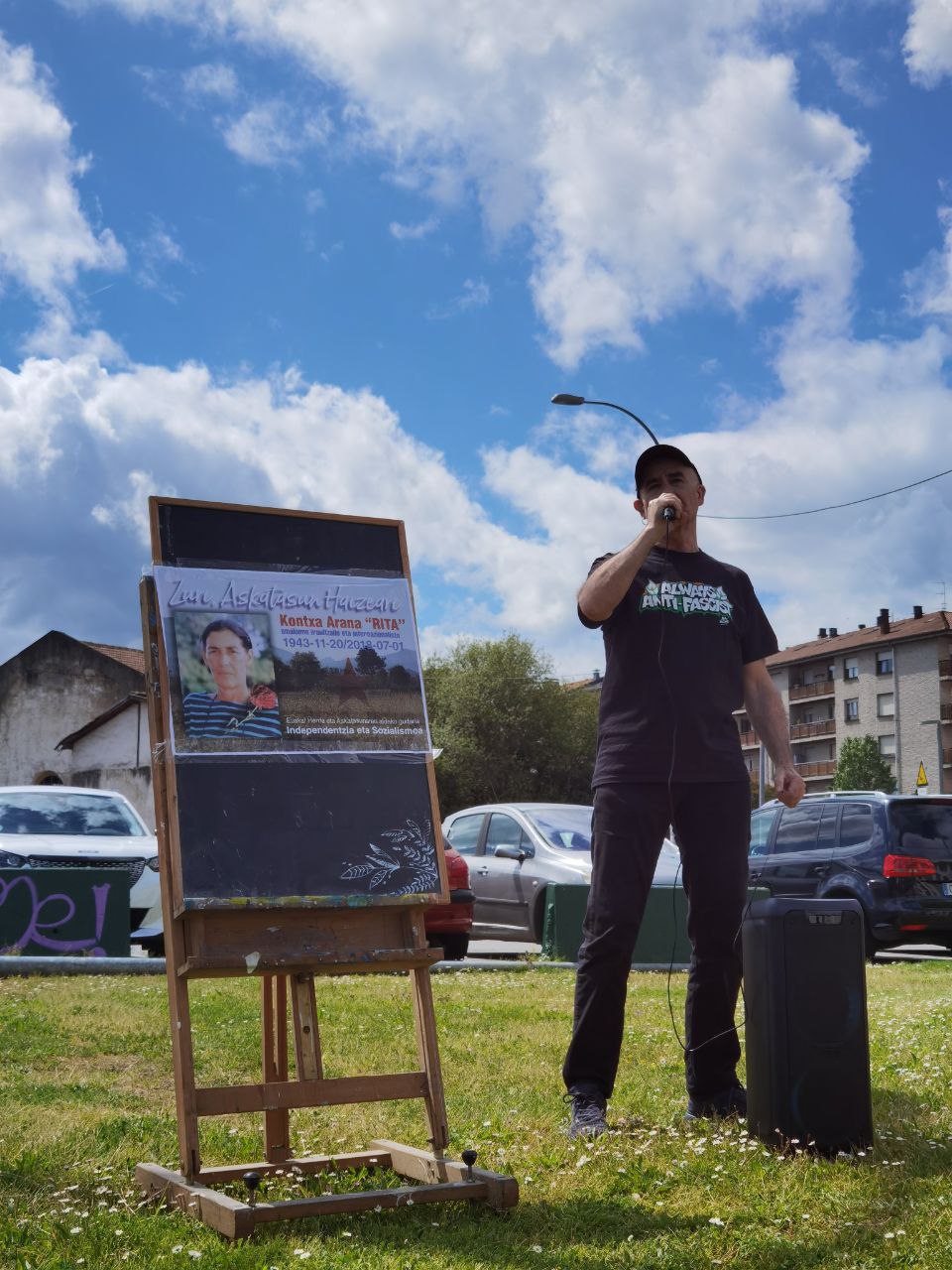
Kontxi Arana, code name “Rita”, was a fighter of the Basque armed organisation ETA and also of the Sandinista movement. A ceremony of homage to her memory on 22nd April was also the occasion of an antifascist conference with representatives from a number of European countries.
The event took place in Gernika, the SW Basque town infamously bombed by German and Italian Nazi and Fascist squadrons during the Spanish Civil/ Ant-Fascist War, the act which inspired the Catalan painter Picasso´s famous piece on the event (which he called by its Spanish name, “Guernica” (sic)). The venue was the disused Astra factory, formerly manufacturer of handguns.
The Origins and Nature of Fascism
The day-long anti-fascist conference began with a talk on the origins and basic nature of fascism by Iñaki Gil de San Vincente, Marxist theoretician and veteran of the Basque Left Patriotic Movement from which leadership of however he has broken for a number of years.
Speaking in Castillian, he declared the essential nature of fascism to be authoritarianism, deriving from the development of the bourgeois family. The central authority figure in that family, later reproduced in other social classes including the working class is the Father, represented in capitalist society by the employer and the Church.
It is an authority to which all are required to submit: patriarchical, homophobic and intolerant of criticism or deviation.
De San Vincente spoke at length about this development and about early descriptions of fascism, for example by Clara Zetkin and Lukacs and described it as a production of capitalism and imperialism and therefore represented today most clearly in the actions of US Imperialism and the NATO over which it exercises hegemony.
The speaker also highlighted the development of NATO and its recruitment of Nazis as well as the development of its Vatican route for Nazis to leave Europe and enter Latin American countries where they would form fascist centres.
This talk was followed by a representative of Ezkerraldea Antifaxistako (Antifascist Left) who, speaking mostly in Castilian, outlined the history of the development of fascism in the Spanish state following the military-fascist uprising and the four decades of dictatorship, and how the organisation he represented responded to that.
The final speaker of the morning session was from Mugimendu Socialistako (the Socialist Movement – organisation with a large membership, according to a participant) who spoke entirely in Euskera (Basque language). Although simultaneous translation was provided into Castilian (Spanish), the volume of such was too low to be understood by many.
Morning session of the anti-fascist conference in Gernika (Photo: DRAF)
According to a participant, the content of that speaker´s contribution was similar to that of the previous speaker, although he mentioned the existence of Frente Obrero (Workers´Front), a Basque organisation which, despite its name, is a fascist organisation. The existence of that latter group appeared to be news to many present.
These talks were followed by a break and, upon resumption, there were some contributions from the floor and some responses from the panel, after which all repaired to the green outside the Astra building to where the ceremony of respect to the memory of Kontxi “Rita” Arana was to take place.
Kontxi Arana: A leading Basque liberation fighter who also joined the Sandinistas in the liberation struggle of Nicaragua
A Basque woman of the independent Patriotic Left movement blew the traditional cow or bull horn to summon attention, while the speaker in the Basque language introduced the program and speakers along with a short history of this internationalist anti-imperialist and anti-fascist fighter.
Kontxi Arana was an active member of the Basque armed liberation organisation ETA who avoided capture while on operations in the Spanish State but was arrested in the French state and exiled to an island, from which she and others escaped. Sometime later she surfaced in Nicaragua, where she had joined the Sandinista armed liberation movement.
Around the end of the 1990s, the leadership of the Basque Patriotic Left asked some exiles to return to the Basque Country to help push the pacification process and release of prisoners but the Spanish State refused to play, though they did not arrest Kontxi (however according to reports arrangements were not well organised to support her).
Most of the crowd present at the Gernika commemoration and homage to Kontxi “Rita” Arana, with the Astra building in the background and the railway line fence just visible in the left background.
The homage to her memory
A man formerly of the official patriotic Left movement spoke in Spanish about the need for internationalist solidarity, through which however mistakes can be made (e.g. in supporting corrupt leadership) which however does not alter the importance of such solidarity, without which the revolution cannot advance.
This was followed by a man from Dublin Republicans Against Fascism who briefy explained in Castilian (Spanish) the history behind Christy Moore´s “Viva La Quince Brigada“, which the Dubliner then sang in its original English.
Dublin Republicans Against Fascism representative singing Christy Moore’s Viva La Quinze Brigada.
The homage event concluded with red carnations being laid by members of the audience in front of a portrait of Kontxi “Rita” Arana. Two ex-political prisoners played the ´txistu´ (Basque three-hole flute), one of them also beating a rhythm on a small drum (´tamborina´). A young woman stepped forward and danced the ´aurresku´, a traditional honour dance.
Crowd queuing to lay red carnations in front of a portrait of Kontxi Arana
This dance was traditionally danced by a male, then by male dancers, then by male and female dancers until today, when it may be performed by any of those combinations or by a lone female, as in this case, and often enough in ordinary clothing as was the case on this occasion, though she did wear dancing shoes laced to the ankles.
The young woman performing the honour Aurresku dance in one of the high kicks of the dance with, to the far right, the ex-political prisoner txistulari (players of the Basque flute). In the immediate background, participants and organisers. (Photo: DRAF)
The musicians then played the air of The Internationale, which most could be heard singing in Euskera, followed by Eusko Gudariak (“Basque Soldiers”), the Basque national resistance song, similar to the Soldiers’ Song/ Amhrán na bhFiann of Ireland in content. Many had raised clenched fists as the songs were sung.
Suddenly, a wild high-pitched yodelling cry rang out from a female throat, the Irrintzi, traditional Basque battle-cry which probably echoed around the mountains in olden days.
All the audience then repaired to the Astra building where a hot meal was served to all on long tables with a bottle of wine to share among each group of several people (those present had purchased tickets to the event either in advance or upon attendance).
Afternoon session: Presentations from Turkish, Irish and Catalan antifascists.
The afternoon session started a little late as people straggled in. The chairperson, speaking in Euskera, introduced the theme of the session which was for antifascists from Turkey, Ireland and Catalonia to describe the situation with regard to fascism in their countries and how it was being confronted.
Turkey
Two people from the Turkish-based revolutionary organisation Anti-Imperialist Front presented their contribution while using a video of images, some subtitled in Castilian but where not, spoken by the woman in English while her comrade translated simultaneously into Castilian.
Overall, the presentation was about the development of state fascism in Turkey and the failed military coup of 2016. The DHKP/C organisation had resisted this on the streets but a major struggle with the Erdogan government took place in trials and in the jails.
Through hunger strikes and physical resistance in the jails, hundreds of martyrs had lost their lives, said the speaker but had remained undefeated. Also martyred had been members of the Group Yorum music group which has played revolutionary songs heard by millions.
Another struggle was carried out through public hunger strikes by elderly relatives seeking the uncovering of mass graves in the bodies of fighters, their sons, had been thrown by the Turkish military.
As a result two mass graves had been eventually disinterred, permitting the remains of fighters of the DHKP/C and of the PKK (Kurdish patriotic socialist organisation) to be returned to their families for respectful re-burial.
The Turkish speakers concluded by stating the necessity for anti-fascism to be anti-imperialist and calling for internationalist solidarity and victory to peoples’ struggles.
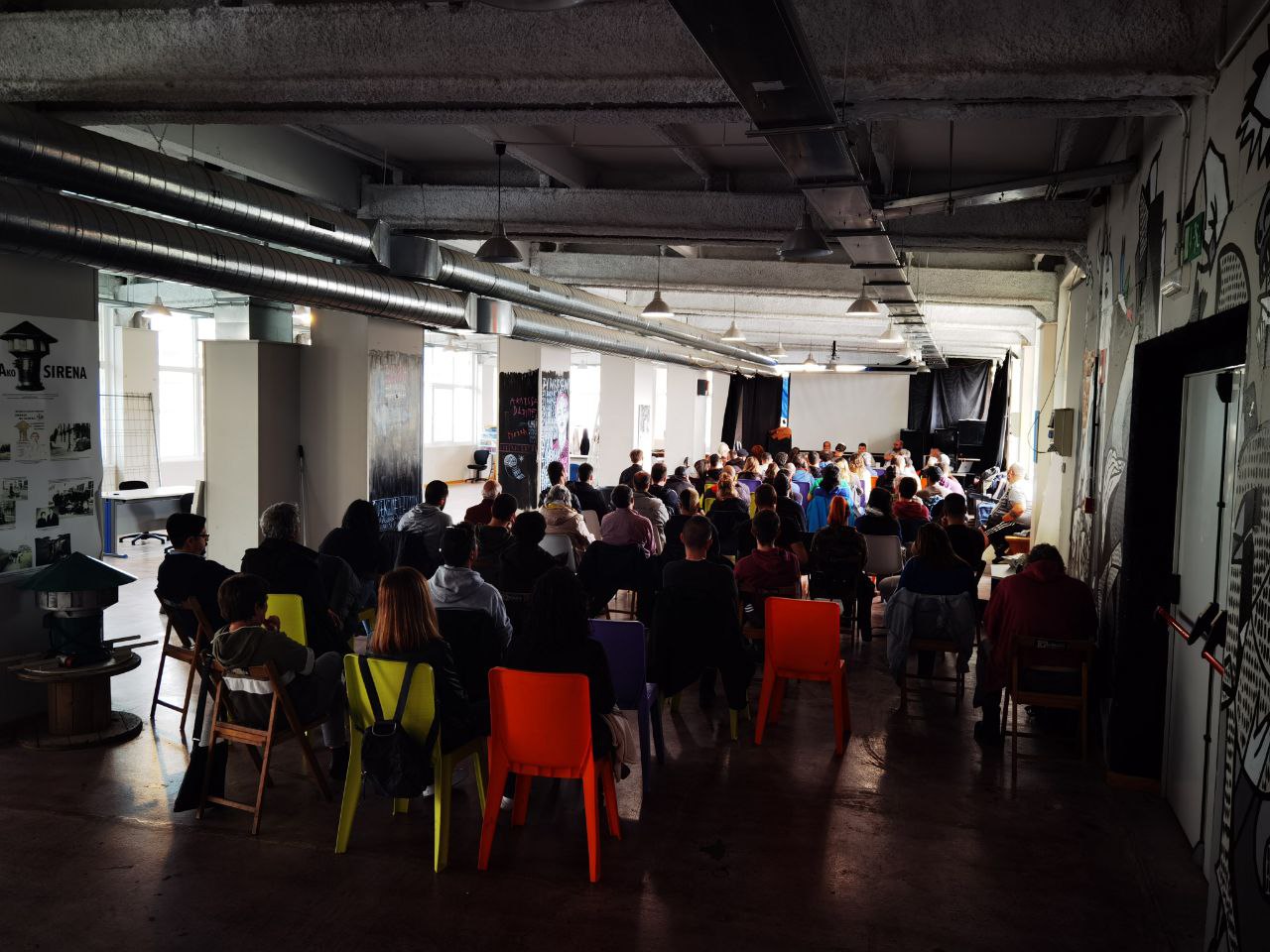
Section of audience at afternoon session of the anti-fascist conference in Gernika, Basque Country.
Ireland
The next speaker was from Dublin Republicans Against Fascism, explaining that eight centuries of occupation of his country by England has ensured that the dominant struggle had been one of national liberation and that all armed struggles since 1798 had been led by Republicans of various kinds: 1801, 1848, 1867, 1882 and 1916.
The Irish State that came into being after the War of Independence in 1921 had been a client of the UK, conceding over one-fifth of its national territory as a direct colony. The armed forces of the State had formally executed over 80 of the IRA and instituted a wave of repression including kidnappings, torture, murders including of prisoners.
In keeping with the rise of fascism across 1930s Europe, Ireland saw the Blueshirt movement, led by former police chief Eoin O’Duffy. The Republican movement and socialists fought these on the streets, the speaker said.
The Dubliner recounted briefly the history of Irish Republicans and socialists going to fight Franco in the Spanish state and the Irish diaspora fighting the British fascists, the Blackshirts, in British cities and in defence of Eastern European Jews in famous Battle of Capel Street in the East End of London against over 7,000 police.
He went on to recount some more recent successful physical attacks by joint Republican groups against fascist organisations, the Pegida group in 2016 and even more recently the National Party. Recently too, Republican ex-prisoners had released a video stating the opposition of Republicanism to fascism with a growing list of signatures.
In conclusion, the speaker said that Ireland’s history made it difficult for fascism to advance in Ireland (except in the Loyalist areas) but as long as capitalism exists so too does the danger of fascism, particularly if the progressive forces do not fight effectively against the attacks of Capital on working people.
Catalonia
The representative of the Anti-Repression Platform of Catalonia, speaking in Castilian (Spanish), explained their organisation had come into existence after the repression of the Independence Referendum in 2017 and the subsequent frame-ups and allegations of terrorism against the Committees for the Defence of the Republic.
The speaker alluded to the jailing of the revolutionary socialist rapper Pablo Hasel and comrades who were charged with terrorism merely for expressing and organising solidarity for those being repressed.
“Don’t try to frighten us with threats of a fascist party getting into government”, he said in a reference to the growth of the Spanish fascist party Vox, because we have had a fascist government in the Spanish state since 1939!” (The year that the military-fascist forces defeated the Second Republic and founded four decades of dictatorship).
The Catalan went on to denounce the social-democratic party PSOE (currently in coalition government with Podemos Unitas), pointing out that it has had more political prisoners in jail and fatal victims than any other party in Spanish government (he was probably including the sponsoring the GAL terrorists of the 1980s).
“There has not been a year in which there were no political prisoners in the Spanish state”, he went on to say but also denounced the current Catalan Government, led by the allegedly pro-independence and leftist ERC party and its repression of socialists and independence activists.
He pointed out that fascists would make no distinction between communists and anarchists and asked “so then why should we?” He declared that all who resist repression now, regardless of before, are welcome to take part in their organisation.
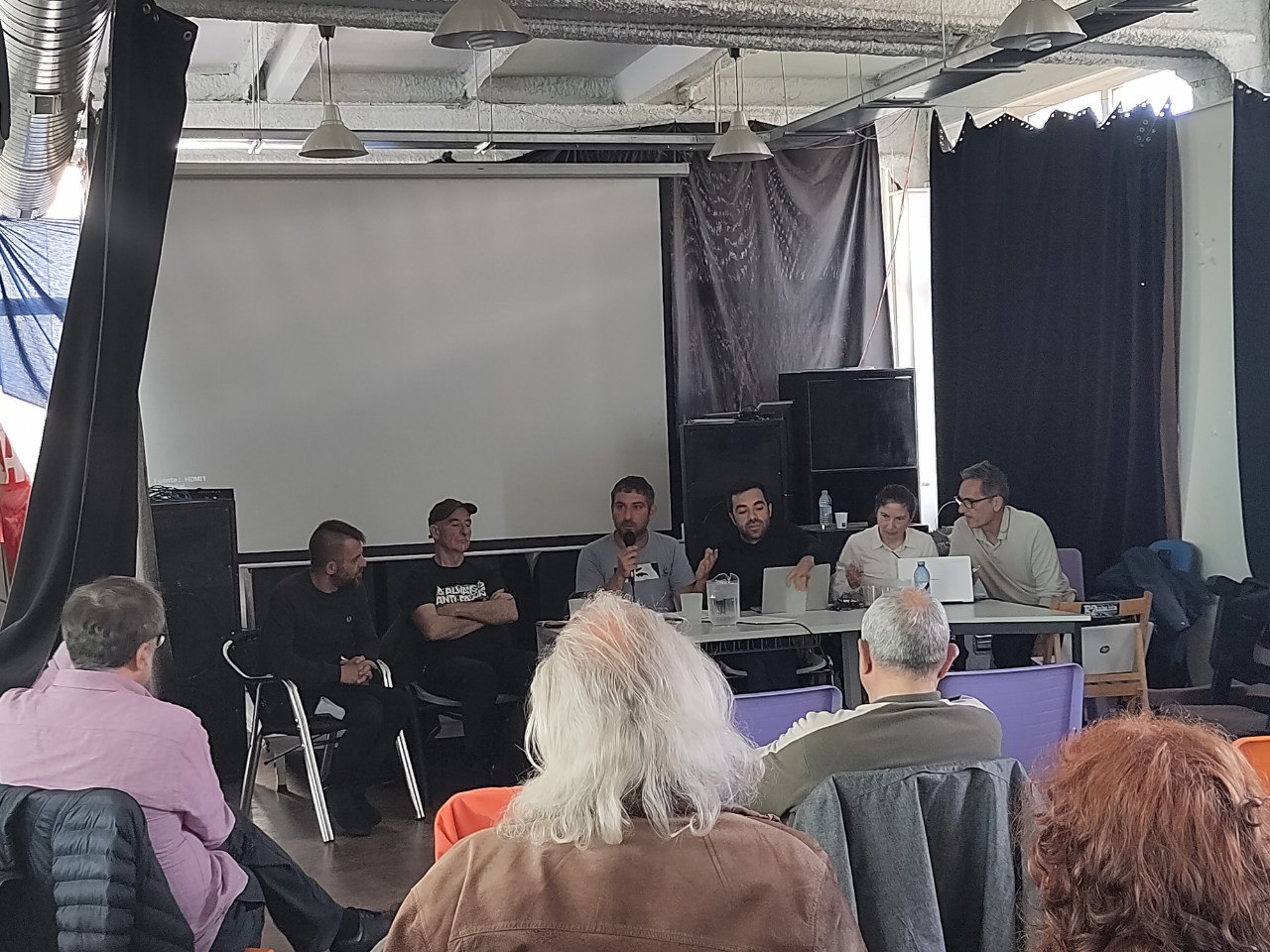
The panel at the afternoon session: from left to right: speakers from Catalonia and Ireland, Basque chairperson, Turkish speakers and translator.
Prisoners on hunger-strike
The chairperson of the panel thanked the speakers and drew together elements from each of their presentations.
He went on to announce the declared intention of a small group of Basque political prisoners to embark on a hunger strike and to outline solidarity events being organised. The prisoners concerned are in the non-compliance minority of Basque political prisoners with a regime that forbids them referring to themselves as political prisoners.
The prison authorities intended to make the prisoners share a cell with other political prisoners who are however in compliance, intending to undermine the resistance of the small group and also posing the danger of conflicts within the cell. (A few days later news came that the hunger-striking prisoners had won their demands).
Amnistia organisation solidarity poster announcing forthcoming hunger-strike of political prisoners, now over because they won their demand.
Summary
The conference in its organisation and content of contributions drew anti-fascism together with imperialism and internationalist solidarity, all from an anti-capitalist perspective. It also drew connections between solidarity with political prisoners and resistance to repression.
All of the Basque organisations represented are in opposition to the trajectory of the leadership of what had been the Basque Left Patriotic movement, now represented by the EH Bildu party led by Otegi (with daily newspaper GARA, its trade union organisation LAB) and many of the older people were ex-supporters of that leadership.
That included some prominent ones such as Inaki Gil de San Vincente and the speakers and organisers of the conference and of the homage to the memory of Kontxi “Rita” Arana. The younger participants might have included ex-members or had come into political consciousness in opposition to that leadership.
Taken together, they are what many call ‘dissidents’ though some reject that term, saying that they are in fact sticking to the original line of independence and socialism and that it is the official leadership and their followers who have deviated. Their numbers are comparatively small at the moment but they are growing.
Earlier this month I attended a group singing in Basque, a language of which I only know a few phrases, as we walked through streets of the town of Bermeo, in Bizkaia province of the Basque Country.
I was invited by one of the organisers to whom I had been introduced the previous evening by a Basque friend as we walked on an errand through the narrow streets. At the appointed time and place I met the walking singers and about four guitarists, male and female.
Around 40 mostly women, the majority ranging in age from middle-aged to elderly with a scattering of teenagers met in the Town Hall square. Unusually, the Basque ikurrina (national flag) hung from a flagpole there without the legally-required presence of the Spanish State’s flag.
Singing around the port area
Spanish State law decrees that its flag must accompany any others on or in front of municipal buildings throughout the state, be they Basque, Catalan, Galician or other. And that the State’s flag be elevated higher than the others.
However, the municipal building was damaged by fire, it is not open for ordinary business while being repaired, so …
The singing group, Kanta, Kanta Lorue (‘Sing, Sing, Parrot’) was addressed at some length by a woman, apparently their Secretary or Chairperson with I guessed, from the names of towns and dates, a schedule for the month or so ahead. At least one location named is across the border.1
Each of the participants had a songbook or the lyrics saved into their Iphones or tablets and I was loaned a songbook by my contact, who was one of the guitarists. A local man (who could have been Irish by his features) led the singing with great energy, throwing his whole body into the role.
Picking up the airs, I joined in singing the lyrics in Basque of which, as noted earlier, I speak only a few phrases2. This is quite easily done as, like much of Irish, knowing the sound of the vowels one can read the words without knowing what they mean.
The consonants too are simple (unlike in Irish) providing one remembers that TX is pronounced like the TCH in English and X as SH; the J as the English J (not usually as the Spanish J, pronounced like the Irish lenited C, i.e Ch) and that the H is silent (as in Spanish and French).
Pronunciation of individual words is not the problem but what can be difficult is that the Basques often cram a lot of syllables into one line. At times I laughed helplessly as I stumbled to a halt while the rest of the singers pronounced each word to the air, passing on to the next line without difficulty.
Photo of some of the singing group from their Facebook page which is however unused with part of the port harbour visible behind (and also some banners that seem to be the work of the Amnistia prisoners’ solidarity group).
The group proceeded down to the port where the singing continued outside one tavern, then outside another (some wine and beer glasses appearing in the crowd); from there on to the central park area, stopping outside two more pubs.
I am given to understand that the themes of the songs were a mixture, as on might expect, of love for the land, the people, romantic love, seafaring and a few of opposition to foreign occupation and fascism (without naming any names!).
Sometimes the singing included some doing harmonies and once of different sections of the group singing one line behind the others.
Recovering from being unwell and feeling tired, I enquired politely how many more stops we were due to make. “Only a few more” I was assured but it soon became clear that I was being teased, this was the last stop. And here one of the guitarists was urged to play and sing an Irish song in English.
After a little reluctance, he did so and it turned out to be The Wild Rover3ballad. I sang along and soon took over the verses as, to my surprise, I recalled lyrics I had not sung in probably over two decades, with some of the ensemble joining in on the chorus. Then it was agur, gabon and etxera.
There are around 140 such singing groups throughout the Basque Country, one of the participants told me, some meeting monthly, some more often and others still only on special occasions (such as local festivals). The accompanying instruments too may vary.4
The occasion was an enjoyable one for me and seemed so for the other participants, who take to the local streets one evening a month. This is an activity we in Ireland could easily emulate: we have probably many more songs (at least in English) and likely more musicians than do the Basques.
End.
Footnotes
1The Basque Country consists of seven (zazpi) provinces (zazpiak bat = ‘the seven [are] one’), three currently in the French state and four currently in the Spanish state.
2Although my mother was born and raised in the Basque Country, neither she nor her mother spoke the language and her father was German. The language was forbidden during the Franco dictatorship of four decades and her part of the family may not have had much Basque nationalist feeling. As a result, the language I learned from my mother is Castilian Spanish, with which I can converse with Basques from the Spanish state, though I try to use whatever Basque I have learned since. Hori da.
3In case there should be others, this is the one with the opening line of I’ve been a wild rover for many’s the year … Although it has been in the Irish repertoire for centuries, it’s actual national origin is unclear.
4For example, the Taberna Ibilitaria group in Bilbao includes acoustic and electric guitars, txistu (3-hole Basque flute), ordinary 6-hole flute or whistle (which they call “Irish”), piano accordion, trikitsa (small diatonic accordion) and pandera (small open one-sided drum like the tambourine but without the ringing pieces).
El domingo 9 Abril, gente asistiendo a la Conmemoración del Alzamiento de 1916 organizada por Acción Anti-Imperialista fueron acosados por la policía mientras encabezaban una marcha hacia el complot republicano del Ejército Ciudadano Irlandés en el cementerio dublinés de Glasnevin.
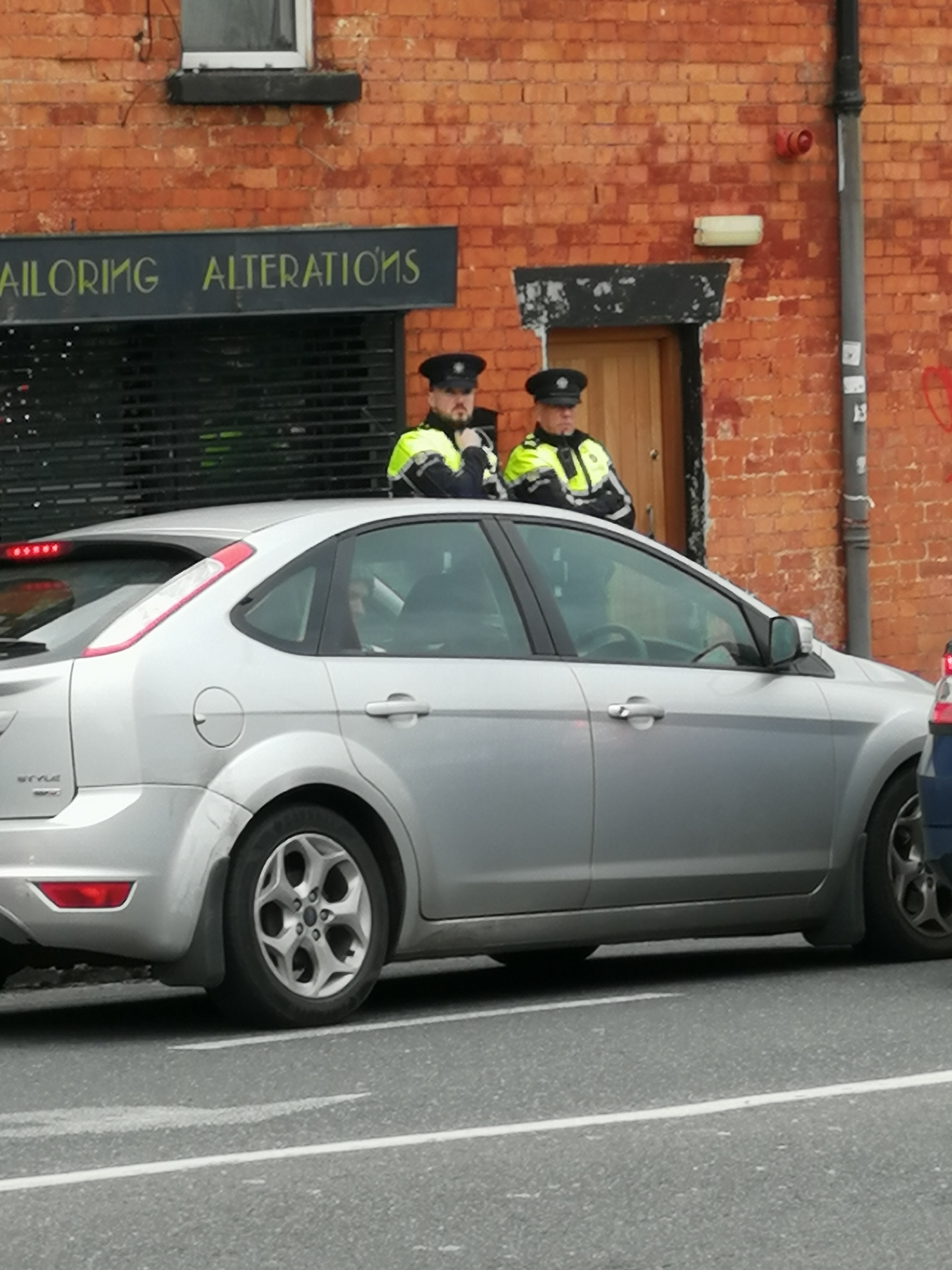
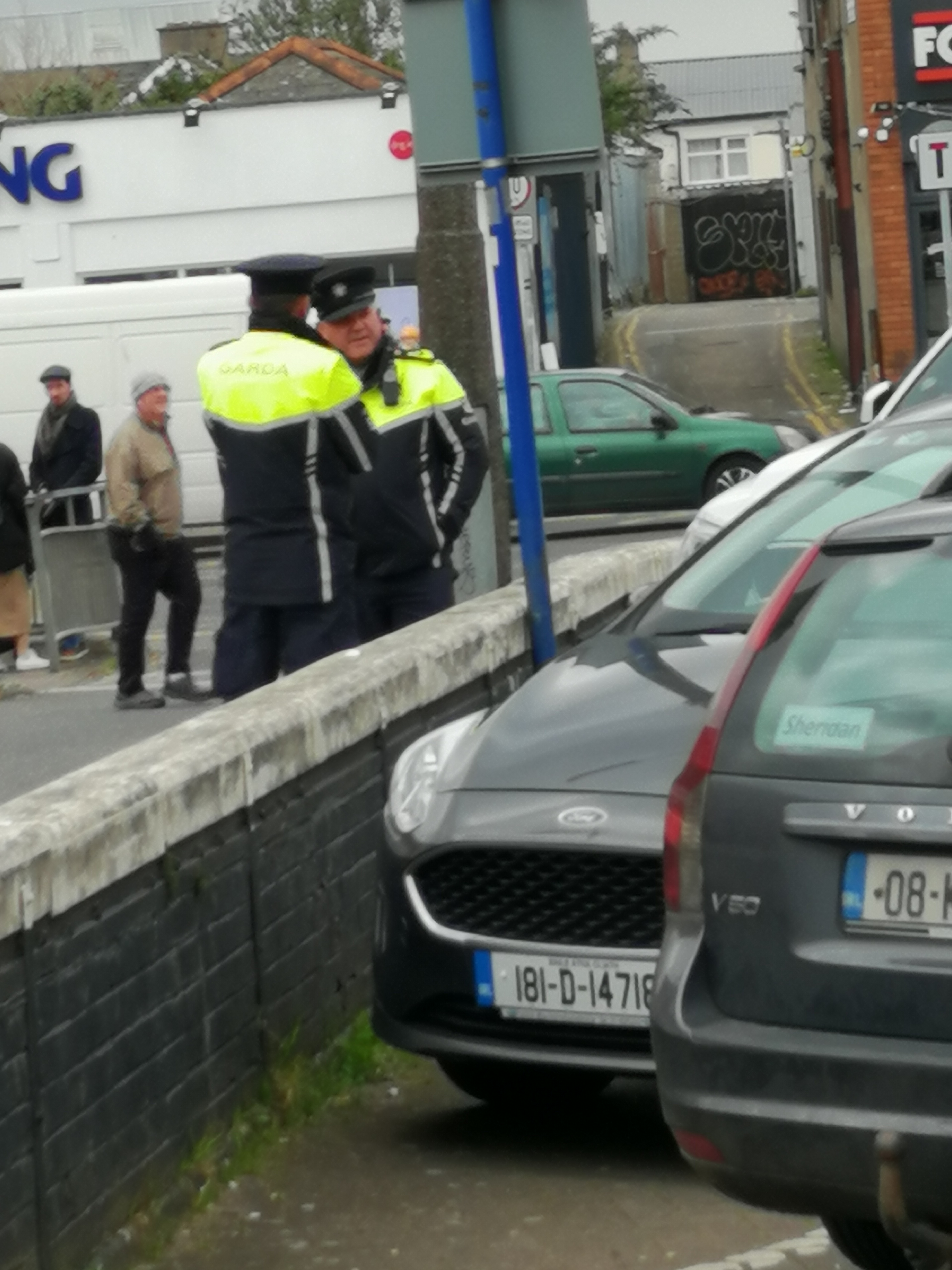
Seis policías políticos vestidos de paisano caminaron entre los asistentes junto a las tiendas de Phibsborough identificando los participantes, la mayoría de los cuales eran bastante jóvenes. Cerca también se encontraban cuatro uniformados de la Garda y una camioneta de la Unidad de Orden Público estacionada en la entrada del cementerio.
El desfile se prepara a partir. (Foto: D.Breatnach)Centro y a la derecha de la foto, cuatro de la policia politica preparando a hostigar a los asistentes. (Foto: D.Breatnach)Centro de la foto: dos de la policia politica de paisano — el calvo hacia chistes mientras hostigaba a los asistentes. (Foto: D.Breatnach)
Los participantes no se dejaron intimidar y emprendieron su marcha, encabezados por un gaitero solitario que tocaba aires de marcha irlandeses, seguido de un ‘colour party’ con diferentes pancartas intercaladas entre los manifestantes, entre las que ondeaban muchas banderas.
Los organizadores se enteraron de que la policía había impedido que el carruaje que transportaba a los miembros de una Banda de Flauta Republicana de escocés que encabezaría el desfile tomara el ferry a Irlanda.
(Foto: D.Breatnach)
(Foto: D.Breatnach)
(Foto: D.Breatnach)
Antecedentes históricos
En 1916, una amplia alianza de los Voluntarios Irlandeses, el Ejército de Ciudadanos Irlandeses, Cumann na mBan, na Fianna Éireann e Hibernian Rifles(1) participó en un Alzamiento organizado por la Hermandad Republicana Irlandesa contra el dominio británico en Irlanda y contra la guerra mundial.
Debido a una serie de circunstancias desafortunadas, el líder de los Voluntarios canceló el Levantamiento que, sin embargo, se llevó a cabo un día más tarde de lo planeado y se limitó en su mayor parte a Dublín, donde luchó una semana por un tercio de los números en el plan original.
El ejército británico de ocupación bombardeó el centro de la ciudad desde una cañonera en el río Liffey y también desde la artillería en tierra. Las explosiones y los incendios resultantes destruyeron gran parte del centro de la ciudad, incluida la Oficina General de Correos en la calle principal, que había sido el cuartel general de la insurrección.(2)
Después de una semana con el centro de la ciudad, incluido la OGC, en llamas, la guarnición rebelde evacuó hacia Moore Street, donde al día siguiente, rodeados y superados en número, se tomó la decisión de rendirse.(3)
Un tribunal militar británico condenó a muerte a casi un centenar de prisioneros. Todas menos quince de esas sentencias fueron conmutadas por largos períodos de cárcel.
Pero los siete firmantes de la Proclamación de 1916 (4) y otros siete fueron fusilados por un pelotón de fusilamiento británico en Dublín, un decimoquinto en Cork y, después del juicio, meses después, un decimosexto fue ahorcado en la cárcel de Pentonville, Londres.
En la Pascua de 1917, las mujeres socialistas y republicanas irlandesas conmemoraron el levantamiento de 1916.
Desde entonces, los republicanos irlandeses y a veces los socialistas en Irlanda y en muchas partes de la diáspora han conmemorado el levantamiento, ya sea legalmente5 o no, en la cárcel o en libertad.
La Guerra de la Independencia comenzó en 1919 con la participación de muchos de los sobrevivientes del Alzamiento6.
El desfile del domingo – memoria histórica local marcada
En Cross Guns Bridge sobre el Royal Canal, el desfile se detuvo y se encendieron bengalas en memoria de los eventos allí en 1916.
El lunes de Pascua de 1916, un pequeño grupo de voluntarios irlandeses había andado desde Maynooth a lo largo de la orilla del canal para unirse al levantamiento en Dublín encontró vigilando el puente a dos voluntarios irlandeses que les aconsejaron que esperaran hasta el día siguiente para ir al centro de la ciudad.
El grupo de Maynooth pasó la noche en Glasnevin y al día siguiente entró en la Ofecina General de Correos (que servia de cuartel general del Alzamiento), pasando por el puente Cross Guns vacío en el camino. De regreso a Phibsborough, la artillería británica voló una barricada y mató a Seán Healy, miembro del grupo juvenil na Fianna en el Cruce del North Circular Road.
Más tarde, la unidad Dublin Fusiliers del ejército británico bloqueó el puente, impidiendo que la gente lo cruzara en cualquier dirección. Mataron a tiros a un lugareño sordo que no respondió a su desafío porque no lo escuchó.
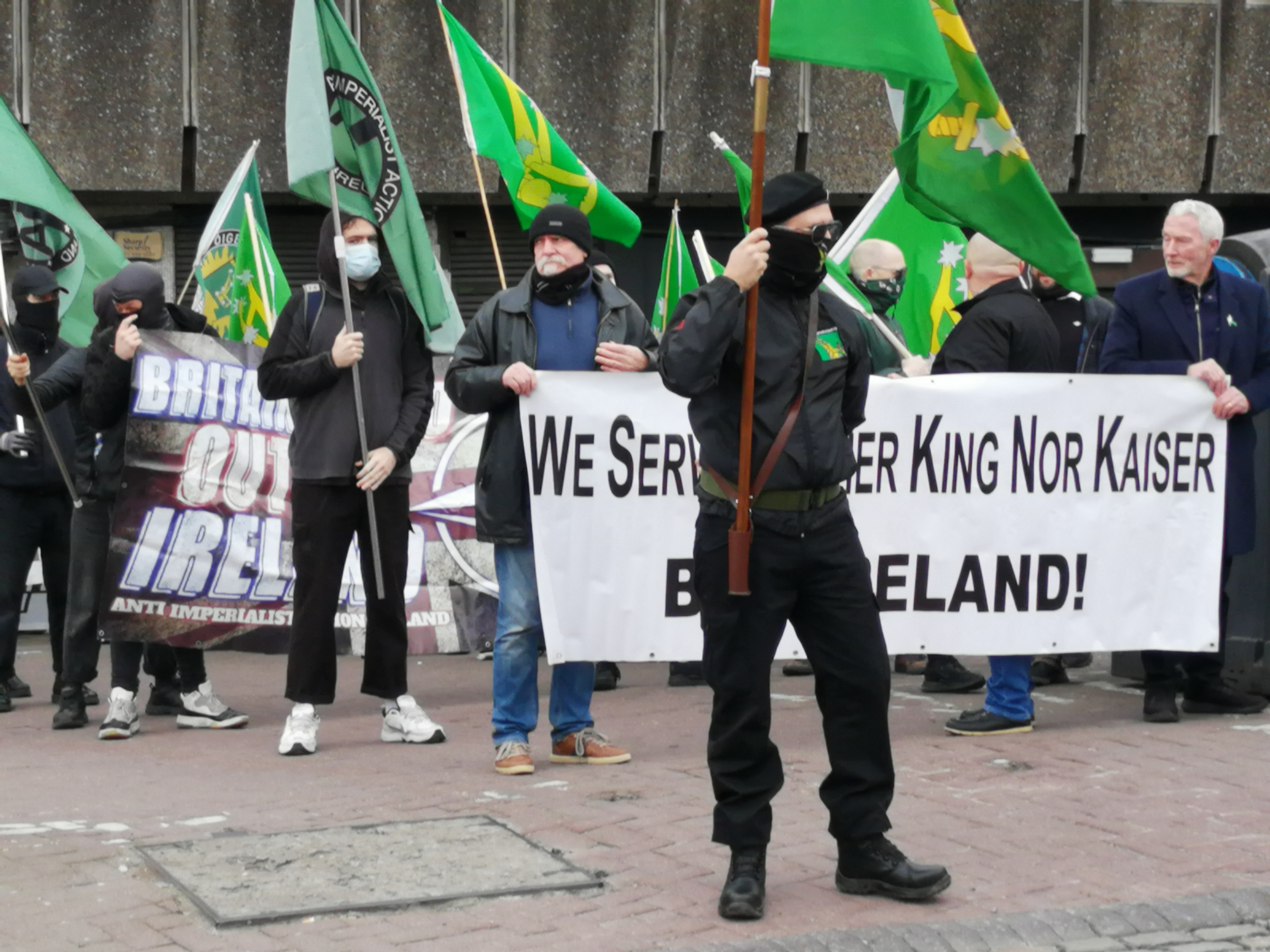
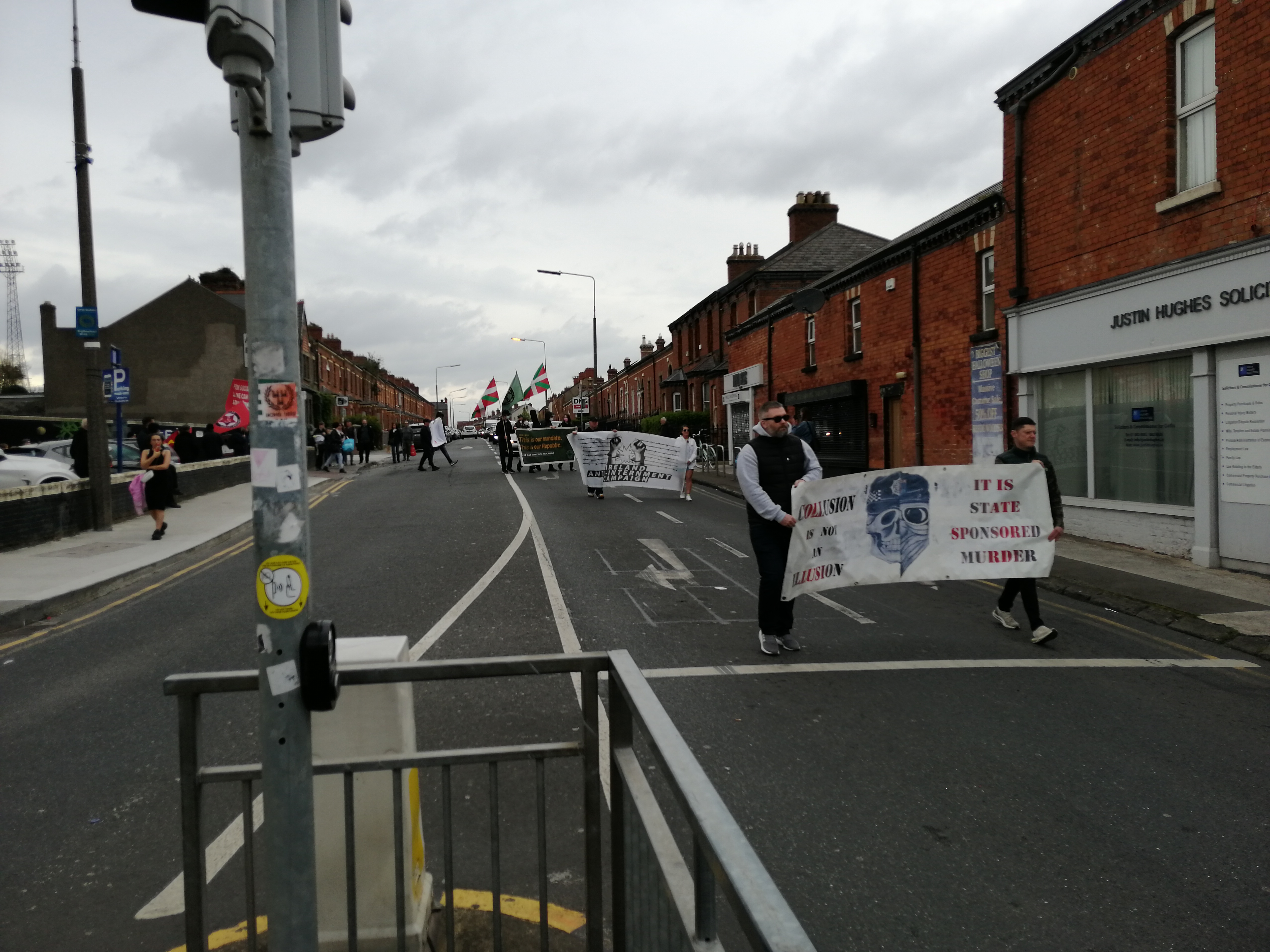
“No servimos ni al rey ni al káiser, pero a Irlanda” declaró una pancarta que se llevó el domingo pasado, “Gran Bretaña/OTAN fuera de Irlanda” otra, “Este Es Nuestro Mandato(7), Nuestra República” y “La colusión no es una ilusión, es un asesinato patrocinado por el estado” fueron otras dos.
Una gran pancarta también declaraba junto a la imagen de James Connolly que “solo el socialismo puede ser la solución para Irlanda”. Algunas organizaciones también llevaron sus propias pancartas, como las de los Republicanos Independientes de Dublín, la Campaña contra la Internación de Irlanda y los Republicanos Socialistas Irlandeses.
Las banderas que ondeaban incluían las que llevaban el logo del grupo organizador Acción Anti-imperialista y otras con el lema “Siempre Antifascistas”, Arados Estrellados verde y dorado, un par de Ikurrinak (banderas vascas) y otras dos de Roja con el Martillo & Hoz en amarillo.
(Foto: D.Breatnach)
Republicanos Socialistas de Irlanda (Foto: D.Breatnach)
(Foto: D.Breatnach)
Campana Anti-Internacion de Irlanda (Foto: D.Breatnach)
(Foto: D.Breatnach)
En el Monumento: discursos y cantos
El cementerio de Glasnevin (Reilig Ghlas Naíonn) cubre más de 120 acres en el norte de la ciudad de Dublín y está dividido en dos partes, cada una con parcelas republicanas separadas por Cabra Road y contiene las tumbas de personas entre famosas y comunes.
Por el lado norte también se encuentra el acceso a los Jardines Botánicos, ambos en la margen sur del río Tolka. El imponente Monumento a numerosos alzamientos republicanos y complot al Ejército Ciudadano Irlandés está en el lado sur, cruzando el puente peatonal sobre la vía del tren.
(Foto: D.Breatnach)
Un hombre presidió el evento de la Acción Anti-imperialista y habló brevemente, presentando a las personas para las lecturas (todas de James Connolly) y para los discursos. Las presentaciones de estos se dividieron equitativamente entre hombres y mujeres, siendo tres de ellos de jóvenes.
Se cantaron tres canciones: una mujer cantó The Foggy Dew (de Charles O’Neill) y Erin Go Bragh (de Peadar Kearney), mientras que un hombre cantó Where Is Our James Connolly? de Patrick Galvin. Dos mujeres leyeron piezas de James Connolly y otra leyó la Proclamación de 1916.
Un lector (Foto: D.Breatnach)
Una lectora (Foto: D.Breatnach)
Una cantante (Foto: D.Breatnach)
Uno de los cantantes.
Las palabras del presidente y de los oradores fueron diferentes pero hubo temas comunes: defender el espíritu histórico de resistencia irlandés, la importancia de la clase trabajadora en la historia y el objetivo de una República socialista que abarque a toda la nación irlandesa.
Estas palabras se equilibraron con la denuncia del imperialismo estadounidense y británico y la ocupación colonial/OTAN de los Seis Condados por parte de este último; el régimen cliente irlandés; los tribunales especiales sin jurado(8) de ambas administraciones en Irlanda y la represión por parte de las fuerzas policiales y el ejército de ocupación.
También se denunciaron aquellos partidos políticos que habían abandonado la lucha por la República y en su lugar habían pasado a formar parte de las administraciones coloniales y neo-coloniales o, en este último caso, que estaban en vías de serlo.(9)
Representantes de organizaciones nombradas colocaron tributos florales y luego otros se adelantaron para colocar tributos florales también.
El presidente agradeció la asistencia de todos, nombró a las organizaciones por nombre y advirtió a todos que se mantuvieran juntos mientras se marchaban, debido a la presencia amenazante de Gardaí y, en particular, de la Unidad de Orden Público. En el evento, los celebrantes salieron del cementerio y se dispersaron sin incidentes.
Pero esa noche los domicilios de algunos sufrieron redadas policiales y algunos detenidos bajo ley represiva del Estado para quedar dos dias en comisaria y liberados sin, por ahora, carga.
Fin.
Banderas de Euskal Herria cerca de las anti-fascistas de Irlanda (Foto: D.Breatnach)
El colour party baja las banderas en homenaje a los caidos en la lucha (Foto: D.Breatnach)
El colour party levanta las banderas de nuevo en simbolismo de que la lucha continua, el pueblo de pie. (Foto: D.Breatnach)
NOTAS AL PIE
1Una pequeña unidad, un brazo armado de una escisión de la versión estadounidense más socialmente conservadora de la Antigua Orden de los Hibernianos, su participación en el Alzamiento fue notable.
2Las fotos de gran parte de la destrucción están disponibles en Internet y se puede acceder a ellas mediante un navegador de búsqueda.
3La terraza que ocuparon sigue en pie y es objeto de una lucha de memoria histórica y conservación contra los planes especuladores inmobiliarios aprobados por oficiales del Municipio y los partidos políticos del Gobierno (ver smsfd.ie).
4Un documento notable, cuyo texto está disponible en muchas publicaciones en Internet.
5 Las mujeres irlandesas lo conmemoraron en público en contravención de la legislación marcial británica de la Primera Guerra Mundial en 1917 y 1918 y durante décadas la conmemoración pública del Levantamiento de 1916 (e incluso el vuelo del Tricolor Irlandés) estuvo prohibida en la colonia británica de los Seis Condados con ataques policiales colones ante cualquier intento de hacerlo.
6 A veces llamada incorrectamente “la Guerra Tan” (referencia a una fuerza auxiliar especial de la policía colonial que se conoció como “Black n’ Tans”), la guerra vio el nacimiento del IRA y duró desde 1919-1921. Una propuesta de “paz” británica abrió profundas divisiones en la coalición nacionalista y fue seguida por una Guerra Civil de 1922-1923, en la que el gobierno pro-Tratado y sus fuerzas armadas fueron armados y abastecidos por los británicos para derrotar a los republicanos en una campaña de represión. Y con encarcelamientos, acciones militares, secuestros y torturas, asesinatos de presos, asesinatos y más de 80 ejecuciones formales.
7 También se muestra texto referente al Programa Democrático del Primer Dáil de 1919.
8 El tribunal Diplock en la colonia y los Tribunales Penales Especiales en el Estado Irlandés, tribunales especiales políticos en todo menos en el nombre, con un nivel de prueba bajo y una tasa de condena anormalmente alta y denegación de fianza mientras se espera el juicio.
9 Referencias a 1) la década de 1930 se escindió del partido Sinn Féin, el partido político Fianna Fáil que se convirtió en el partido gubernamental preferido de la burguesía gobernante irlandesa dependiente del exterior y 2) al partido Sinn Féin Provisional que respaldó el plan de pacificación británico en 1998 y emprendió el camino de convertirse en un partido del nacionalismo reformista en la colonia y en este momento se encamina hacia un gobierno de coalición neocolonial (y neoliberal capitalista).
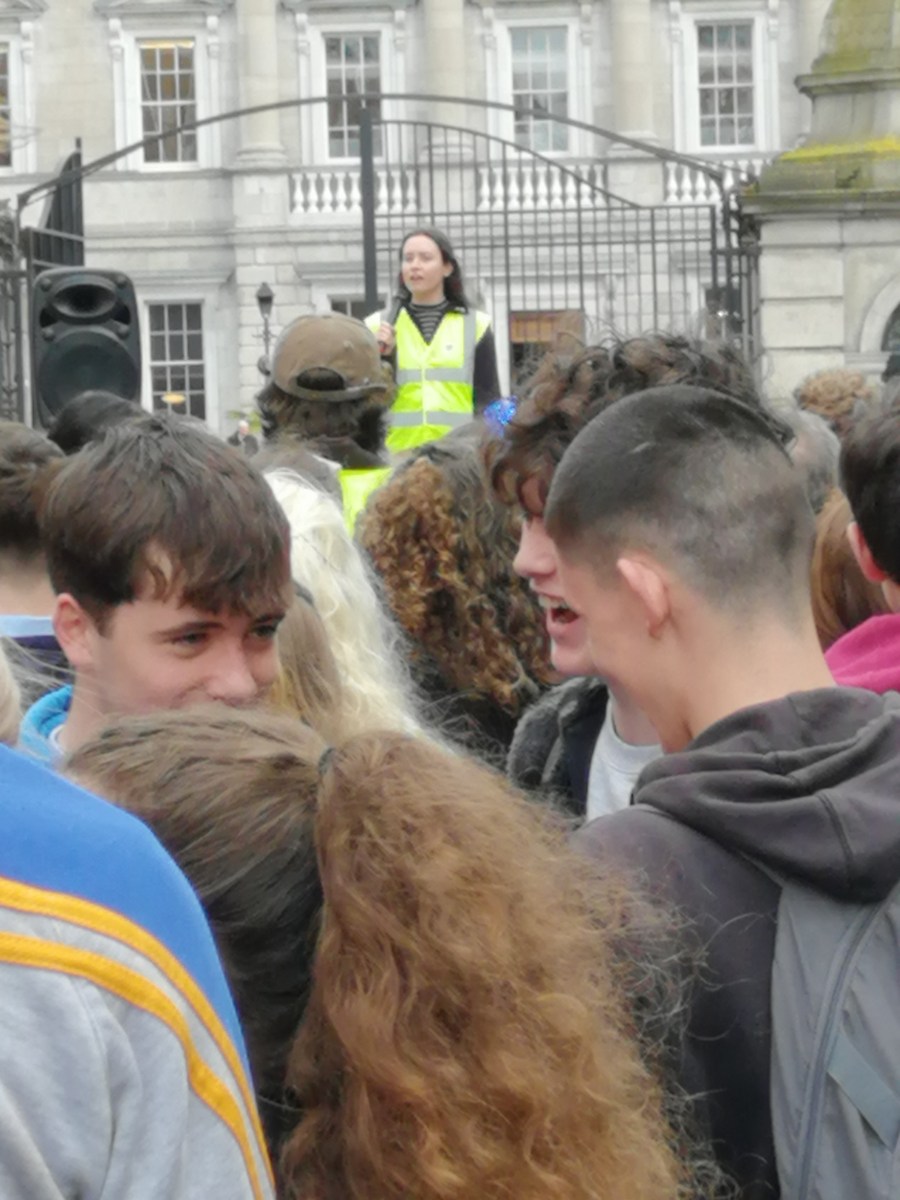
Hundreds of primary and secondary school students demonstrated on 29th April outside the Irish Parliament, to protest the decisions on the Irish language curriculum and lack of State support for education through the Irish language.
Teenagers and younger, many in their school uniforms, led by a few organisers, shouted slogans and some carried placards and banners. There was a sprinkling of a few older adults in their midst also, some long-time campaigners for the Irish language in society.
Primary and secondary school pupils attended from at least six colleges, all Gaelscoileanna, i.e those where instruction in all subjects (except English) is through Irish. Led in by an adult and spontaneously, they chanted slogans such as: Tír gan teanga, tír gan anam!
Confirmed in attendance were pupils from schools in three counties: Coláiste Íosagáin and Coláiste Eoin, from South Co. Dublin; Coláiste na Mara (Co. Wicklow); Coláiste Rachrann (North Dublin), Coláiste Chill Dara (Co. Kildare).
Julian de Spáinn, General Secretary of Conradh na Gaeilge (Gaelic League), a state-funded organisation for the promotion of the Irish language, speaking in Irish, said that the education system is “broken in relation to the Irish language.”
“A comprehensive policy needs to be developed for Irish within the education system from pre-school to third level”, De Spáinn stated. Irish within the education system has been surrounded by controversy in recent years from teachers, parents, students and language organisations.
Concretely, De Spáinn called for the immediate establishment of a working committee “composed of people who understand Irish within the education system and that have experience of it.” He said that the specifications and syllabus for the Junior and Senior Cycles are “nonsensical”.
He went on to claim that more than 90% of those teaching the Senior Cycle are unhappy with it and went on to criticise Minister Foley’s decision to move Paper 1 of the Irish exam for the Leaving Certificate to the fifth year (although its implementation has now been delayed).
In addition to criticising the lack of Gaelscoileanna throughout the state, De Spáinn stated that the exemptions from Irish language study are “out of control” and that pupils with special needs were not receiving the necessary service that they may be facilitated in studying Irish at school.
Shane Ó Coinn, Chairperson of An Gréasán do Mhúinteoirí Gaeilge, the website for teachers of Irish, stated that Irish in the education system was suffering, for which the main cause is that the Education Department had ignored the opinions of teachers and of pupils.
“It is clear from the results of SEALBHÚ”, he continued, “that an oral examination in the third year is urgently needed, the marks for which should account for 40% of the total.”
Gráinne Ní Ailín, officer of the Irish Union of Post-Primary Students, said that an integrated approach of the education authorities was missing and that a proposal from one agency was conflicting with another.
“On the one hand, the Education Minister is intent on moving Paper 1 of Irish to the fifth year, while the state agency, the National Council for Curriculum and Measurement is working on changing the entire curriculum specifications for the Leaving Certificate.”
“It is not possible to carry out both actions simultaneously,” Ní Ailín said and recommended taking a step back and putting together a comprehensive plan.
Pictiúr: Leon Farrell / Photocall Ireland
Status of the Language in the Irish State
Many may be surprised to know that Irish is not only an official language in the Irish state but, according to the Constitution, the language of first status. Nevertheless, Irish-speakers have become a minority in the state and the Irish-speaking areas are all shrinking.
Despite the official position of the State and which Governments and civil servants are obliged to support nominally, many people report a lack of services through Irish at all levels of State and in public services, with even official public notices in Irish often garbled or even incorrect1.
In the 1960s and ‘70s it was only through campaigns including civil disobedience and supporters being fined or even jailed that the State provided an Irish-language radio station and a TV channel and legislation obliged State departments to provide services through Irish on request.
When the Irish state joined the EU (formerly EEC) it did not request that Irish be an official language of the organisation but it became so on 31st December 2021 — and may well reveal a large gap in availability of translators.
The Gaelscoil (school teaching through Irish) movement may be said to be the only visible success for the language within the territory of the Irish state but, as the protests and many other factors reveal, it has struggled against the State system of which it is a part.
In 2020-’21 academic year, there were 152 Gaelscoileanna outside the Gaeltachtaí (Irish-speaking areas), with at least one or two in each county and catering for 7% of all children at that level outside the Gaeltachtaí in the Irish state.2
Out of 700 post-primary education facilities in the Irish state outside the Gaeltachtaí only 29 are Gaelcholáistí, or 2.8% of the total. Ten of those are in Co. Dublin, four in Co. Cork and some other counties have one or at most two.
But twelve counties out of the 26 in the Irish state do not have even one Gaelcholáiste (post-primary level), i.e. approaching half of the counties in the state.3 In a tragic irony, this includes Co. Clare, from which the Irish-speaking Aran Islands are believed to have been colonised4.
In addition there are some units and streams teaching through Irish in other schools and colleges but of course outside of the classroom, even within the school, the dominant environment is an English-language one.
Twenty-eight Gaelcholáistí, representing 18% of total Gaelscoileanna are DEIS, i.e addressing educational disadvantage integratedly. Although 31% of Gaelcholáistí are of Catholic ethos, 69% are multi-nominational or non-denominational.
However, outside the Gaeltachtaí, even with fully-immersive Gaelscoileanna, how is daily use of the language in society to be promoted when the pupils find themselves surrounded by exclusively English language in their lives outside the school gates?
The Irish Language in the Colony
The British colony in Ireland (incorrectly named “Northern Ireland”) from its creation in May 1921 was hostile to the Irish language, as indeed it was to all expressions of ethnic Irish culture. Unionist MPs openly mocked the Irish language even inside their parliament.
Nevertheless following substantial pressure, its parliament passed the Identity and Language (Northern Ireland) Act 2022, giving the language a legal status within the colonial statelet5.
However, as we have seen even in the Irish state, legal status is not necessarily followed by appropriate implementation and unionists have thrown up obstacles against even the erection of bilingual street names within the colony.
(Photo: Leon Farrell/ Photocall Ireland)
Comment
The Irish language has been a part of all movements for national independence of Ireland. The occupier sought to ban its use among its colonisers and degraded its importance and use in all legal, educational and religious spheres.
Though the Irish state formally defended and promoted Irish, it presided over huge emigration for most of its existence. This combined with lack of development of the rural Irish-speaking areas encouraged a drift away from Irish for those whose language it had been at home.
Despite the activity of earnest individuals no major political party in practice moves itself energetically to promote the language. It is not required of their members or even representatives and none run any major language acquisition program – even for their own members6.
The same is true of all Irish Left and Republican political parties and organisations at this time.
Most advances have been won by political activism and the work of volunteers, across a number of parties and none. The movement continues to call on the State to put its money where its mouth is, as the saying goes, or the equivalent in Irish, to commit “beart de réir a bhriathair.”7
Footnotes
1The State used incompetent translation for its Irish language version of its video on the 100th anniversary of the 1916 Rising. The whole video was withdrawn after wide-scale criticism of even the general content in English. Notices urging people to remain safe from Covid, when translated to Irish urged them instead to besaved!
4There are a number of indicators for this instead of from Conamara but one is the pronunciation of the lenited M followed by a broad vowel, which would sound like a W in Conamara but a V in the Aran Islands. This Clare dialect can be seen in place-names extending into Co. Galway, for example Cinn Mhara pronounced Kinvara (it would be pronounced Kinwara in Conamara).
5Even then, to placate Unionist opposition, it had to share equal space with the promotion of Ulster Scots dialect, widely known to be spoken in actuality by less than tens of people.
6This is true even of Sinn Féin, the political party most in support of the Irish language. Their activity in its support within the Irish state comes nowhere near matching the same within the Six County colony, suggesting that for them the Irish language is principally a useful stick with which to beat their Unionist opposition.
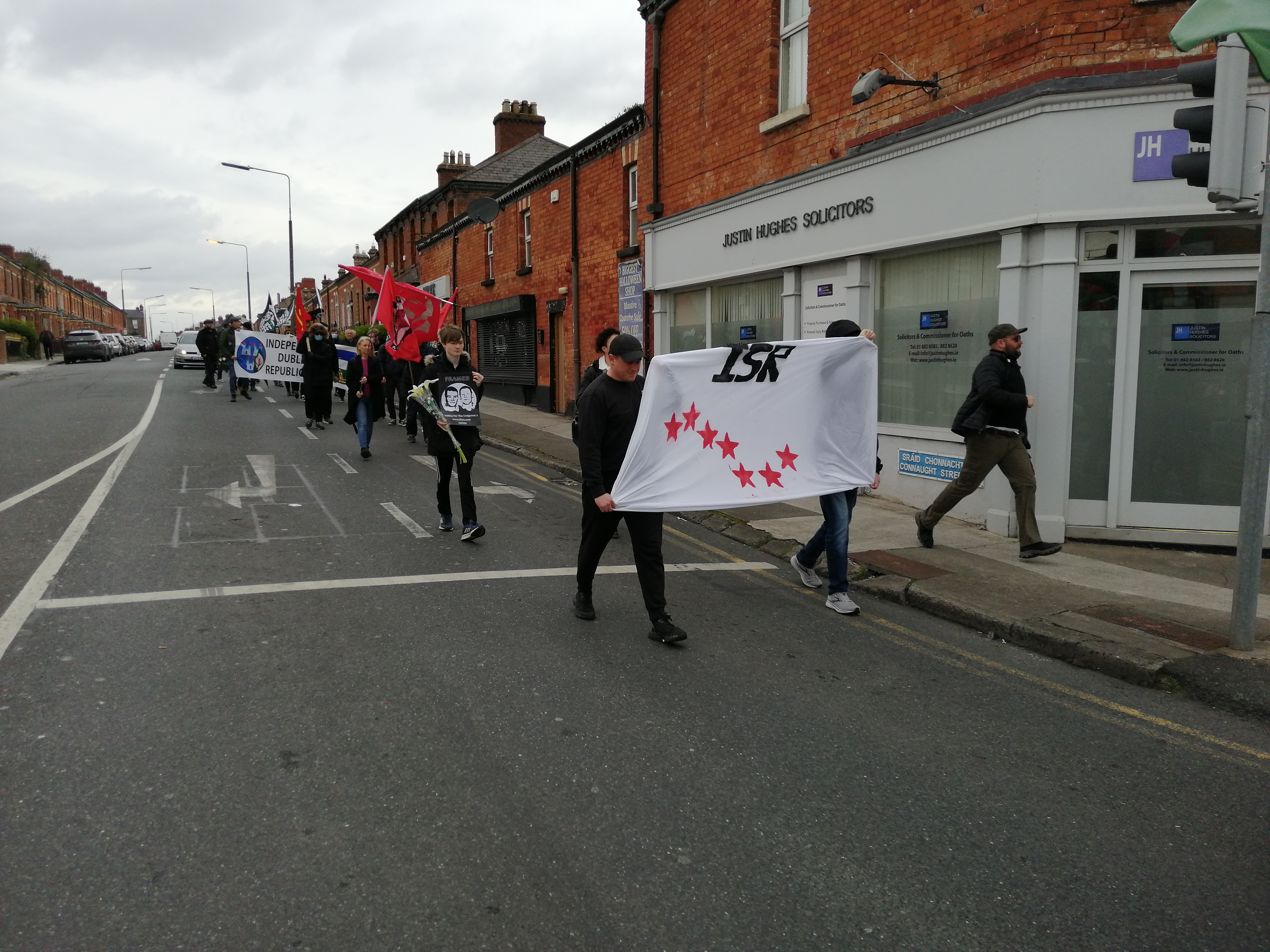
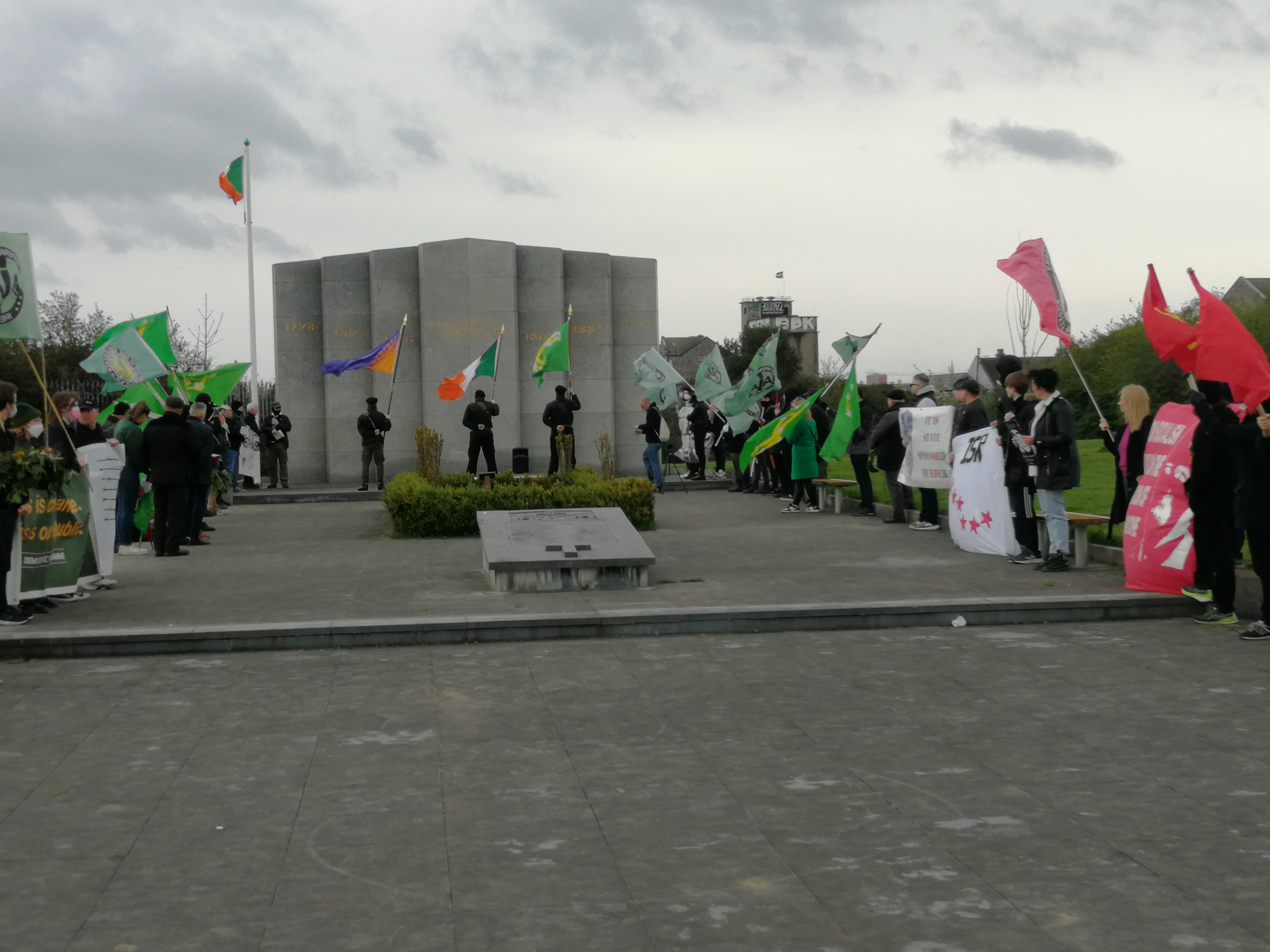
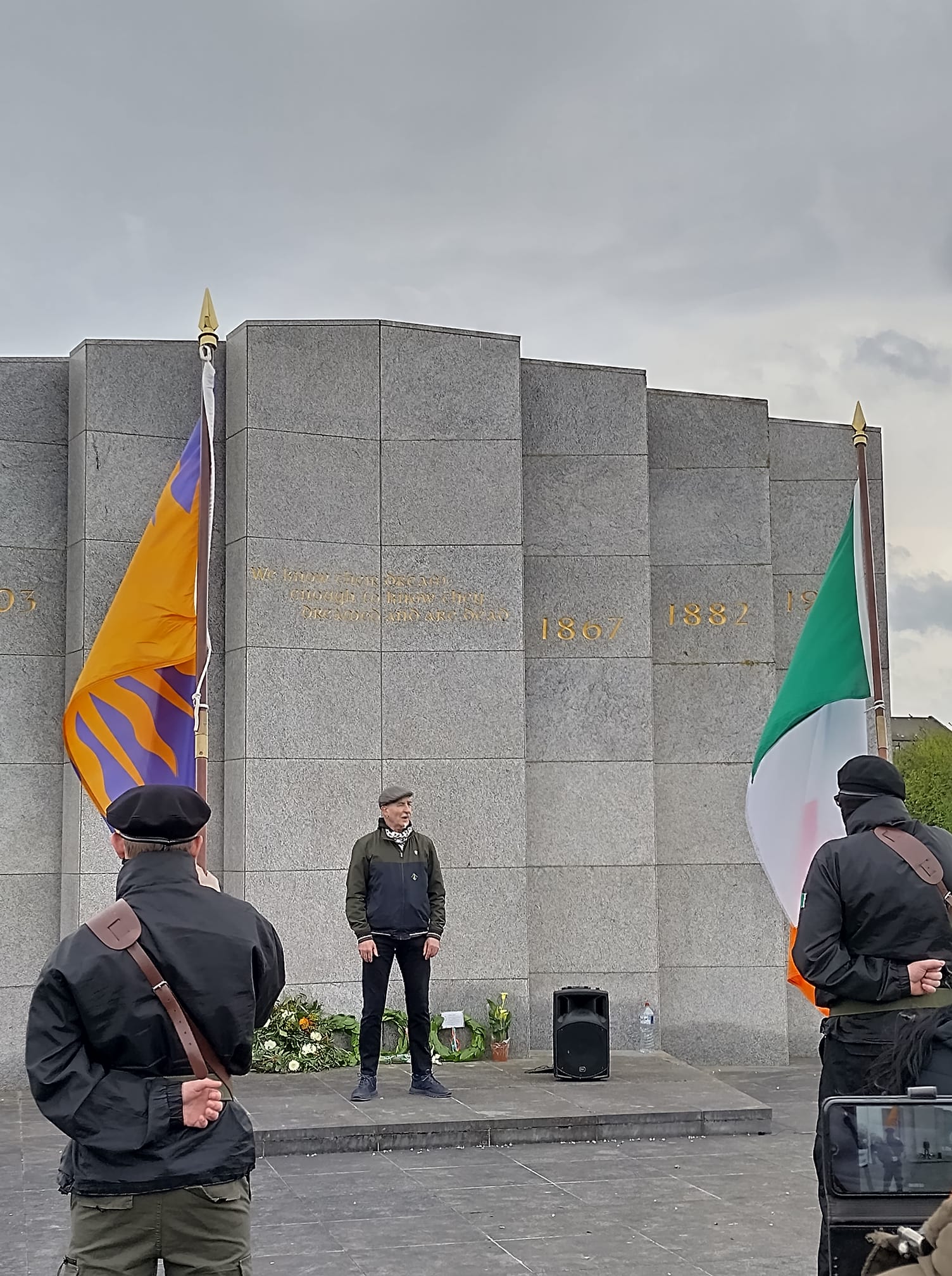
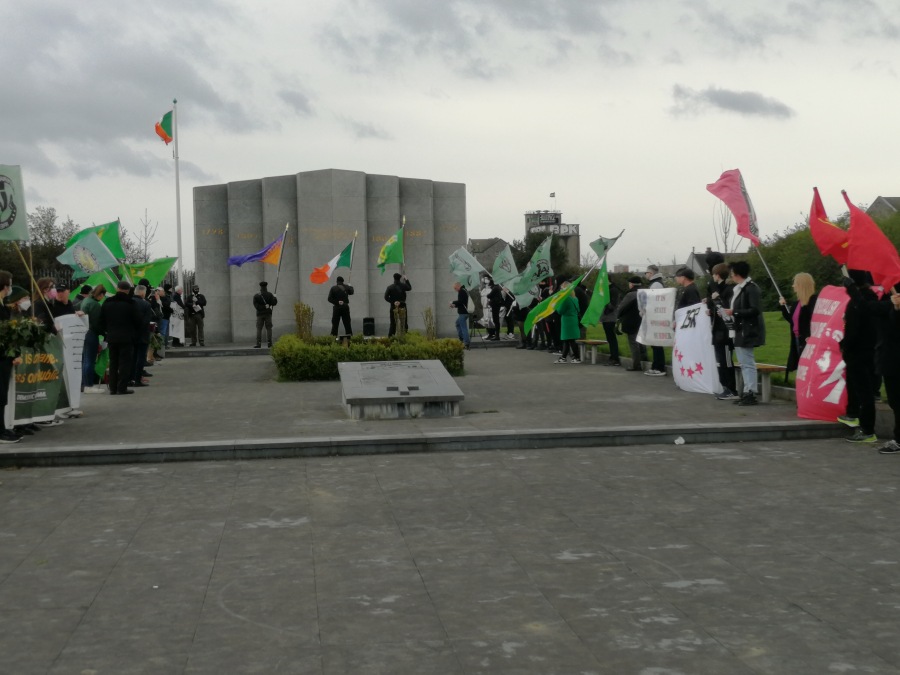
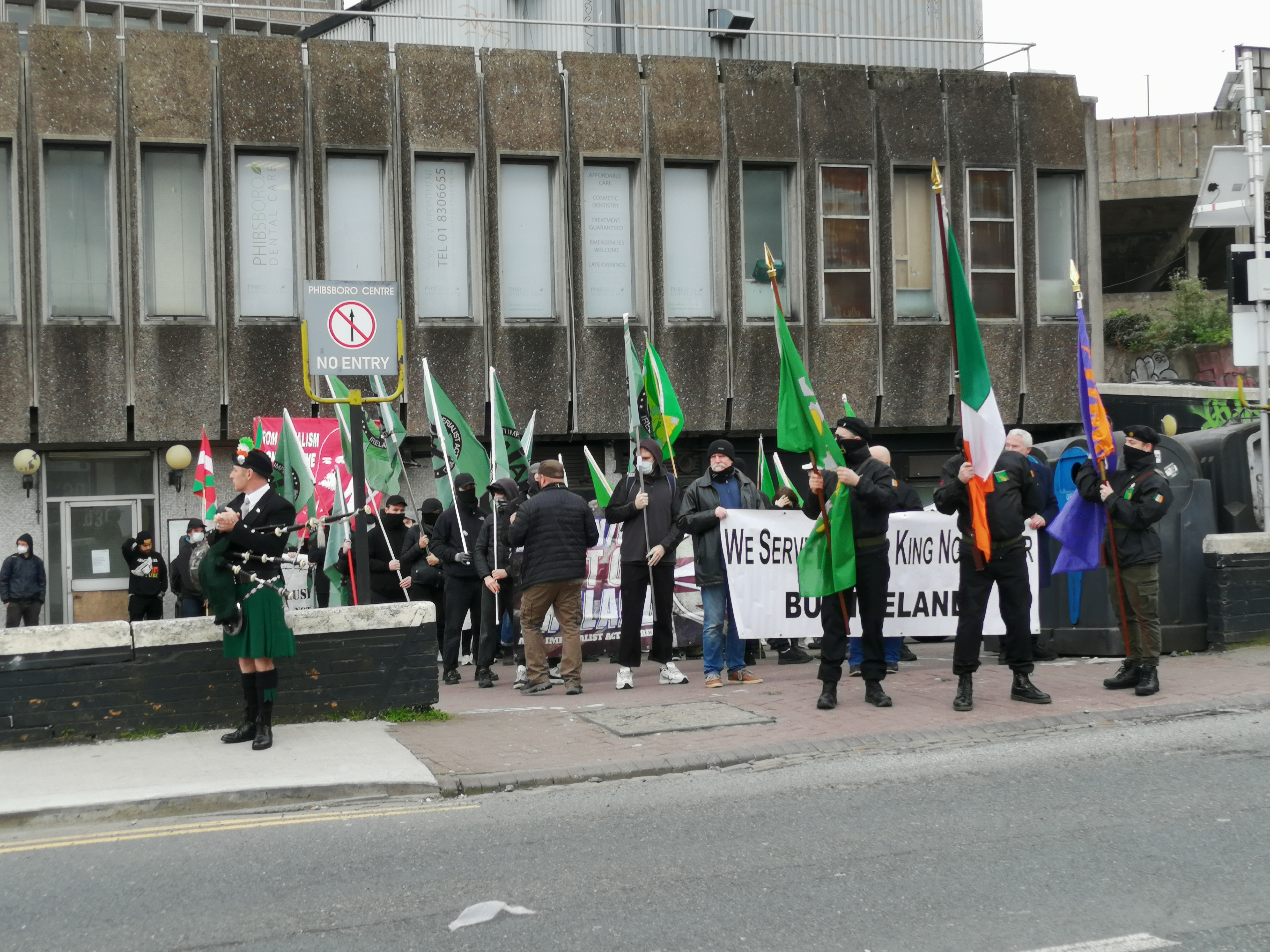
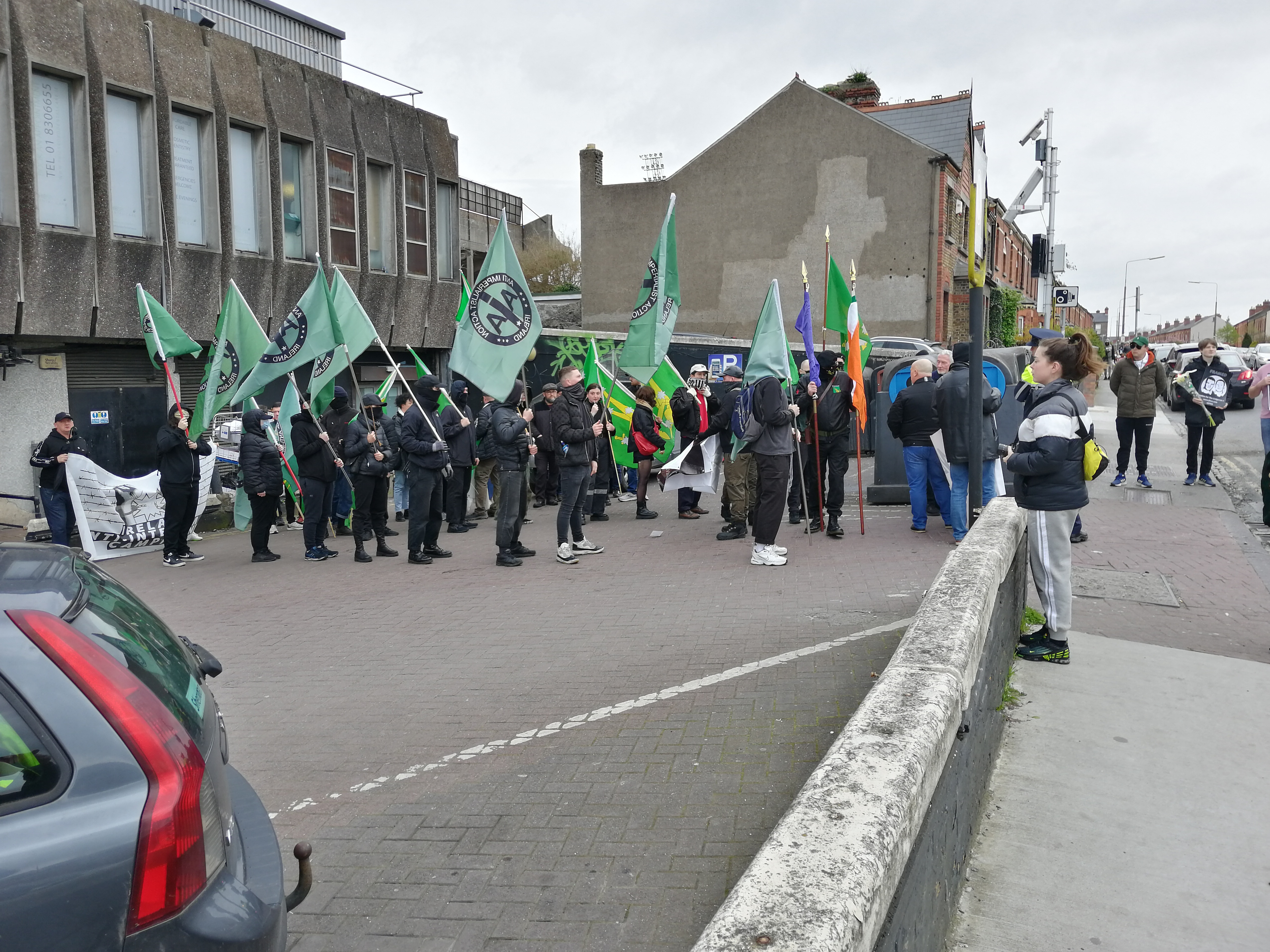
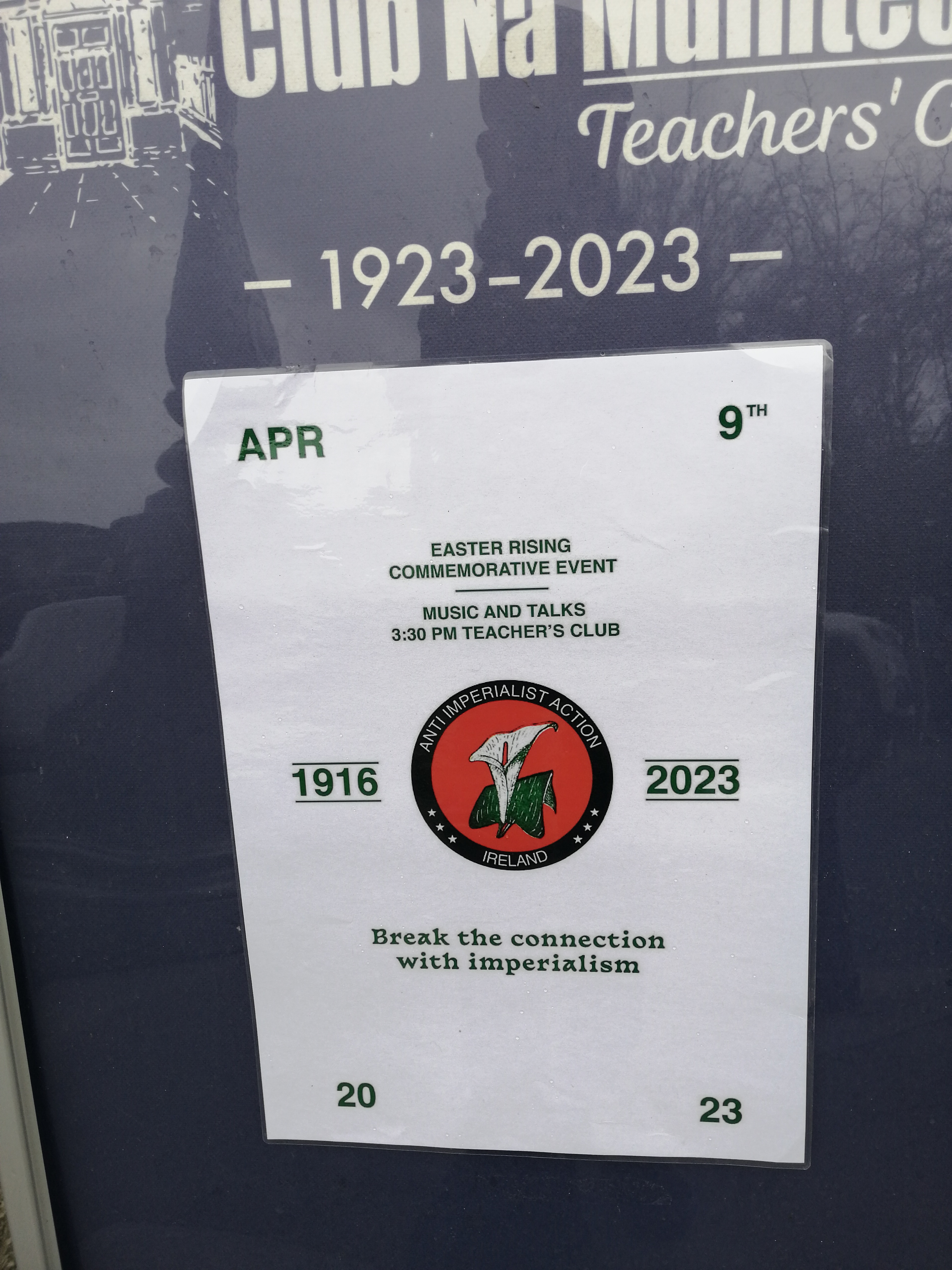
On Sunday participants in a 1916 Rising Commemoration organised by the Irish organisation Anti-Imperialist Action were harassed by police as they gathered to march to the Irish Citizen Army Republican plot in Glasnevin Cemetery.
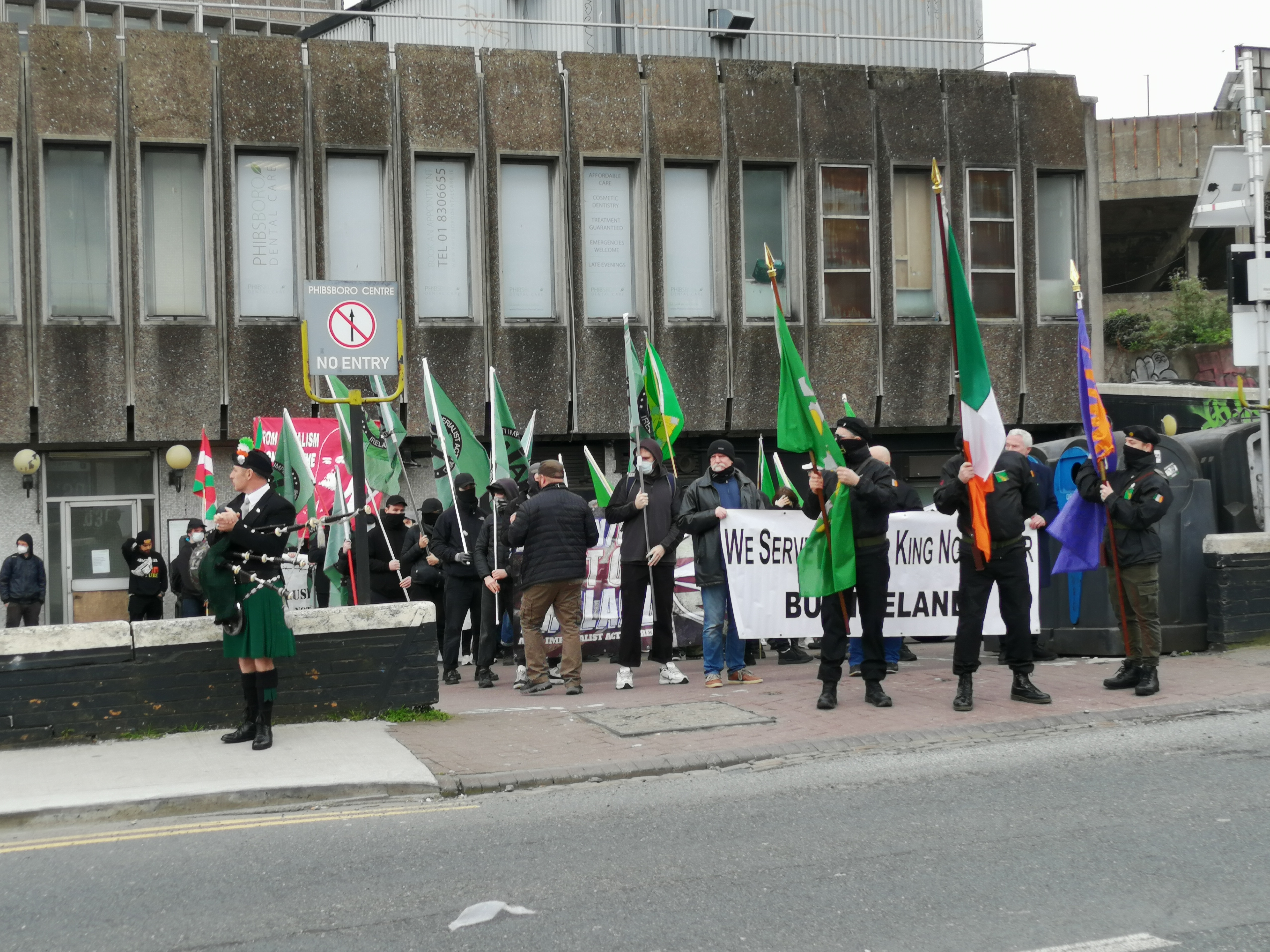
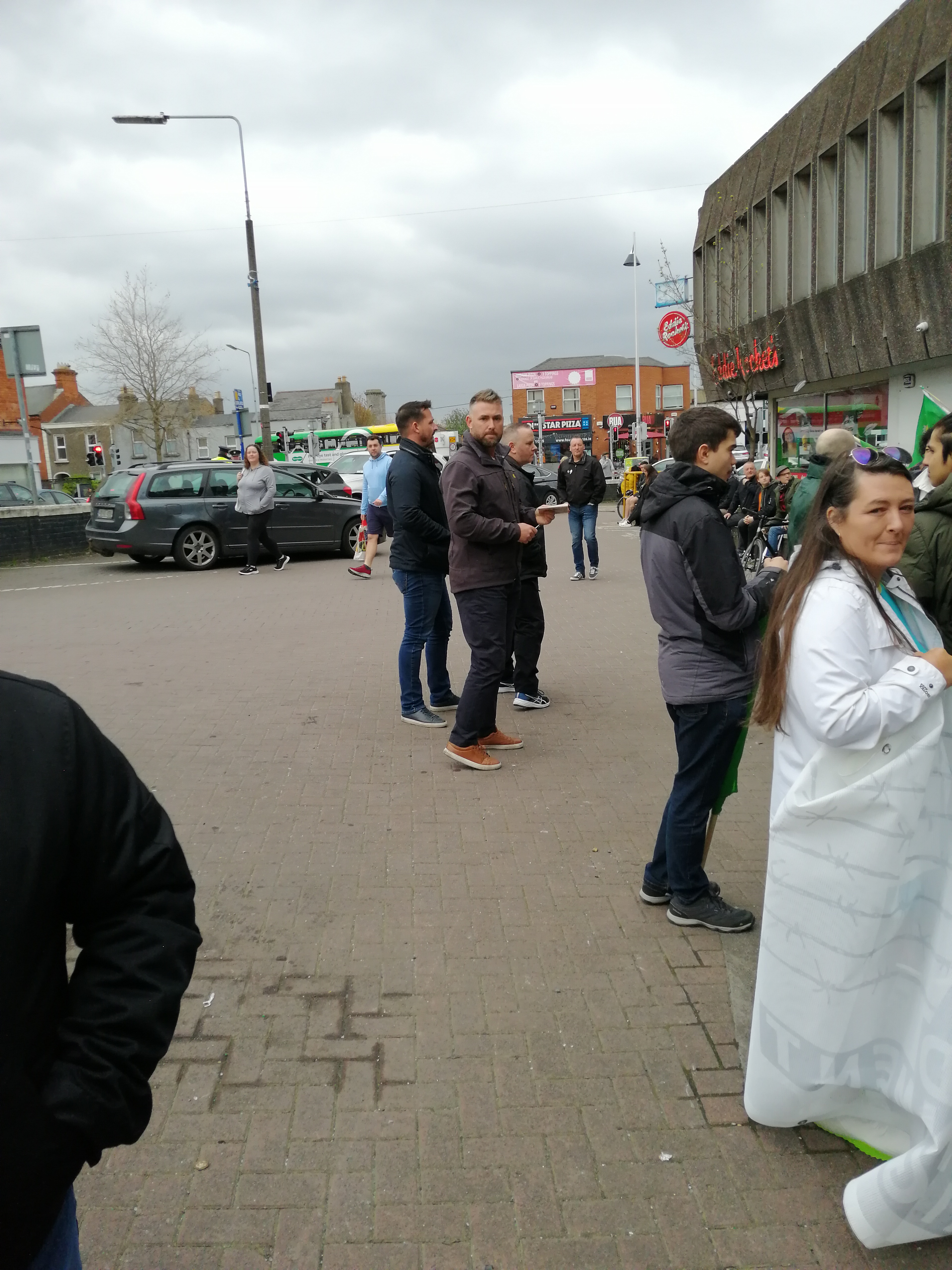
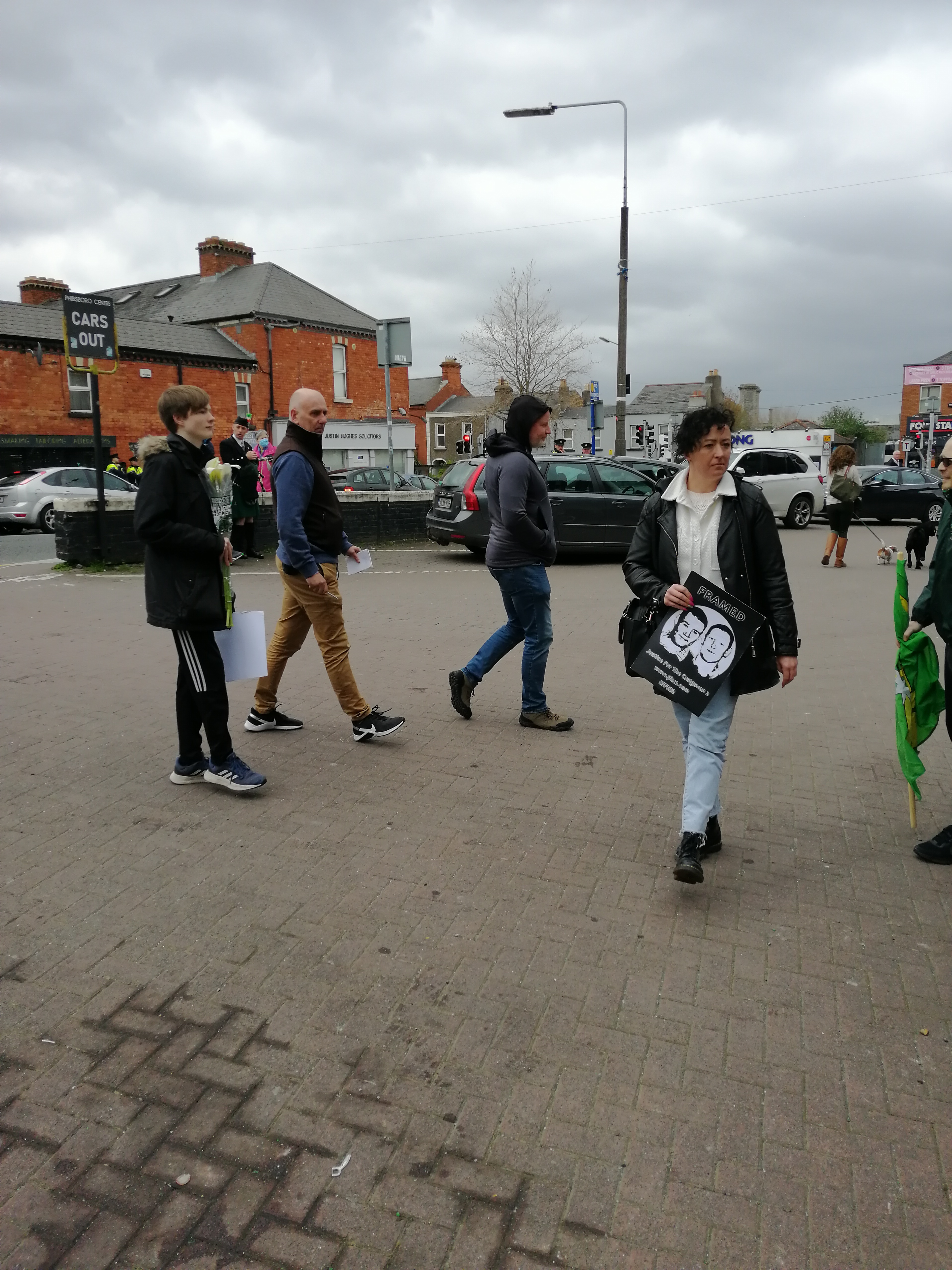
Six political police in plain clothes walked among those gathered beside Phibsborough shops demanding names and addresses of the participants, most of whom were fairly young. Four uniformed Gardaí also stood nearby and a Public Order Unit van parked at the cemetery entrance.
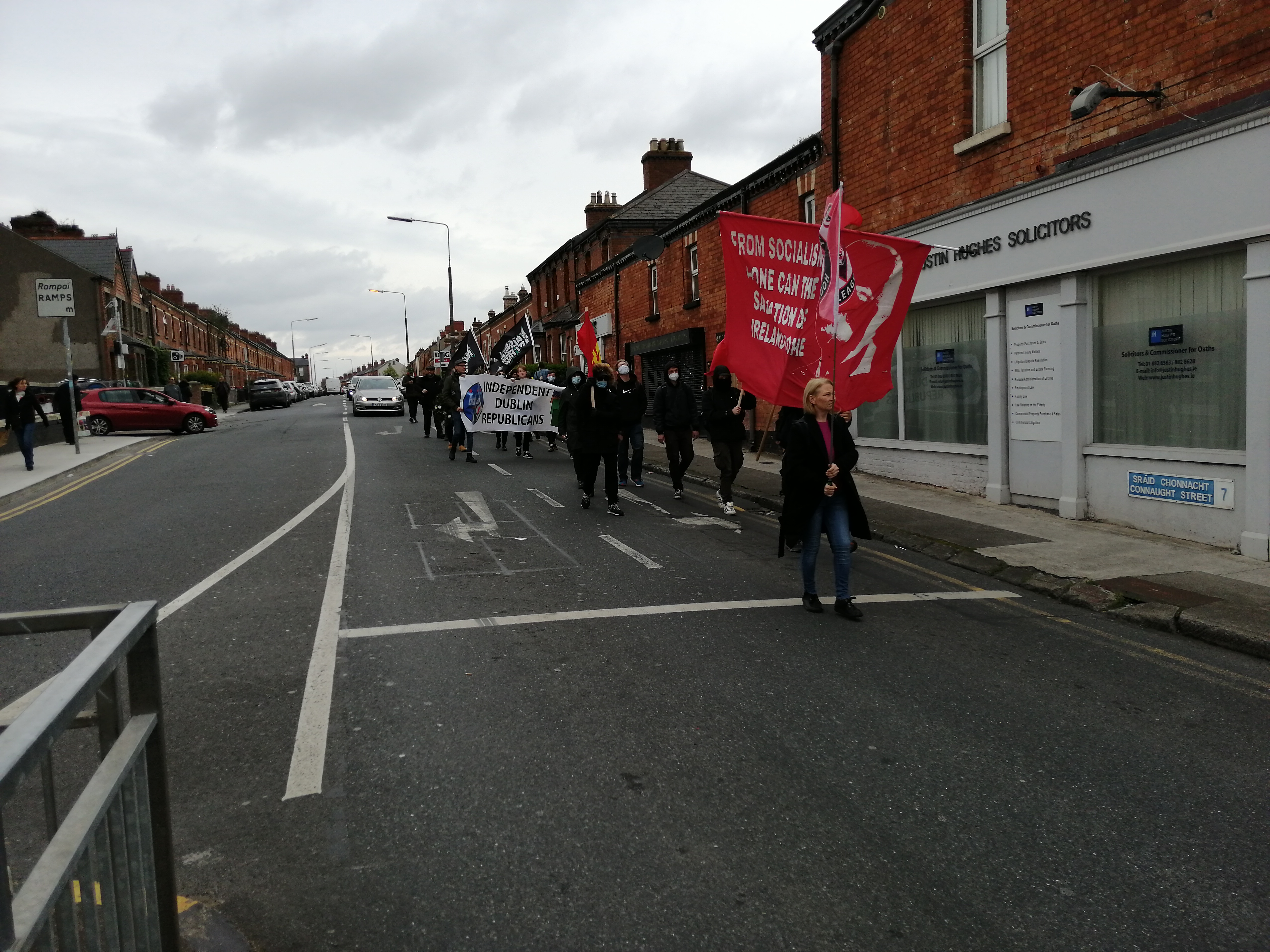
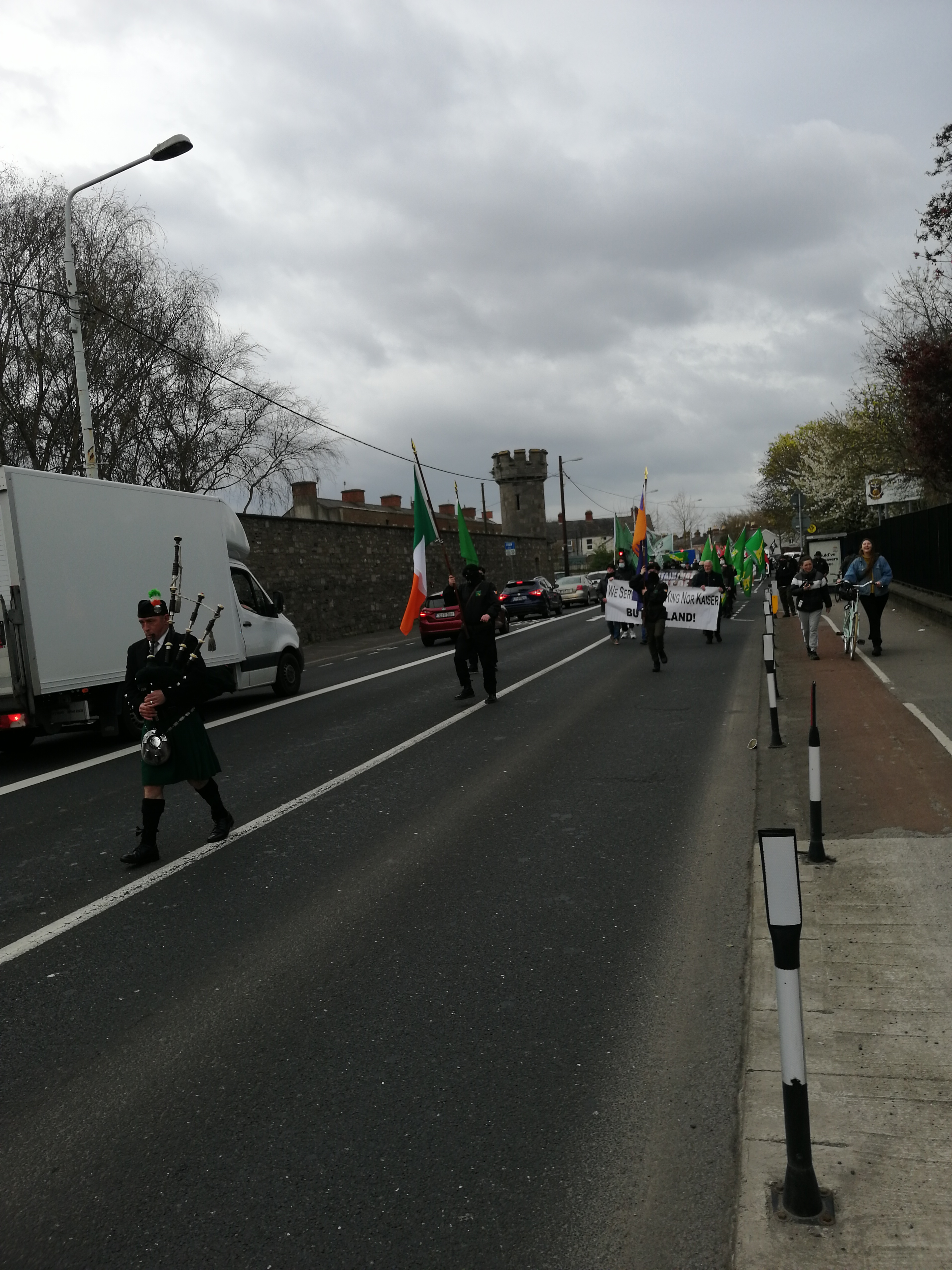
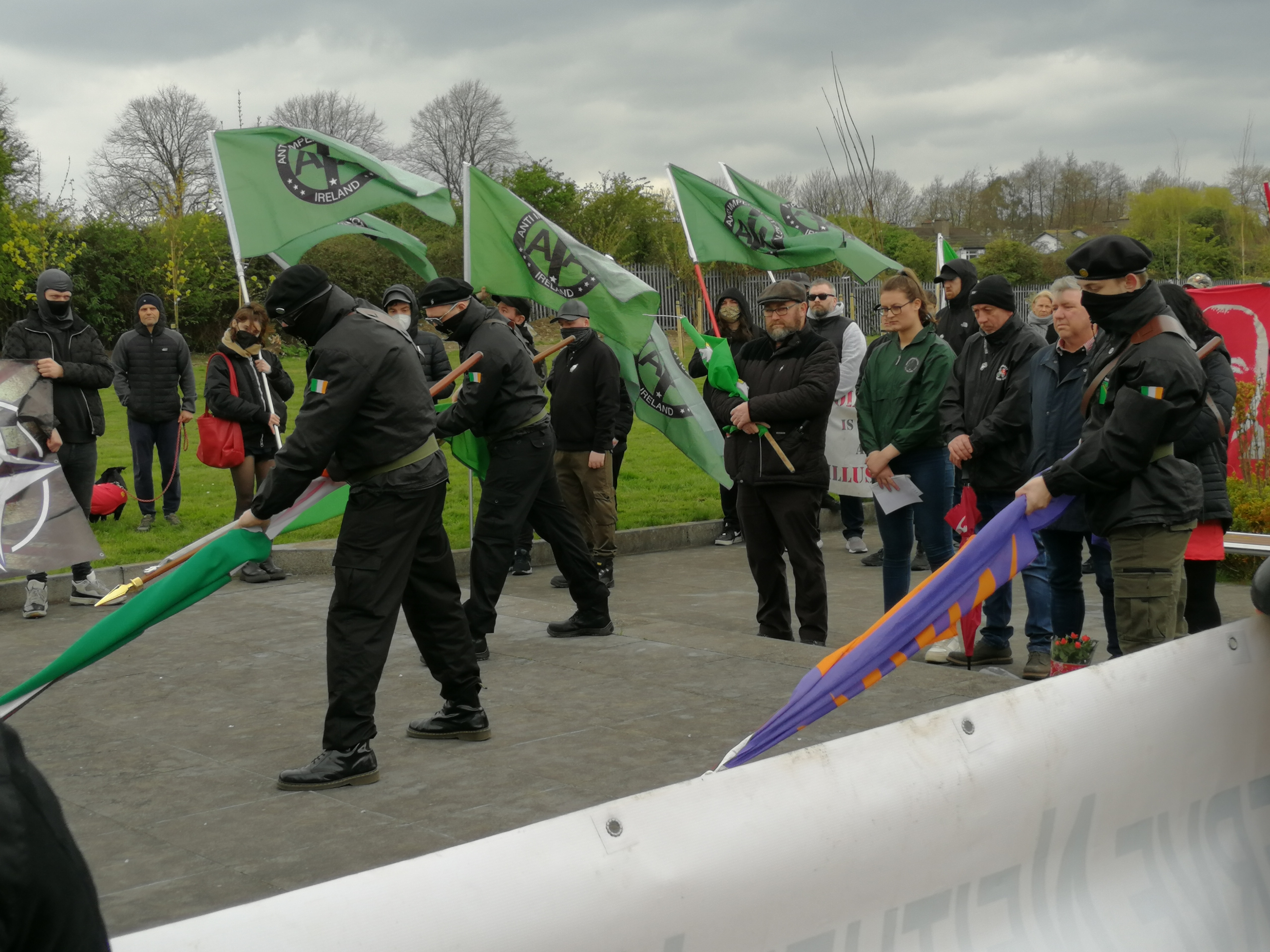
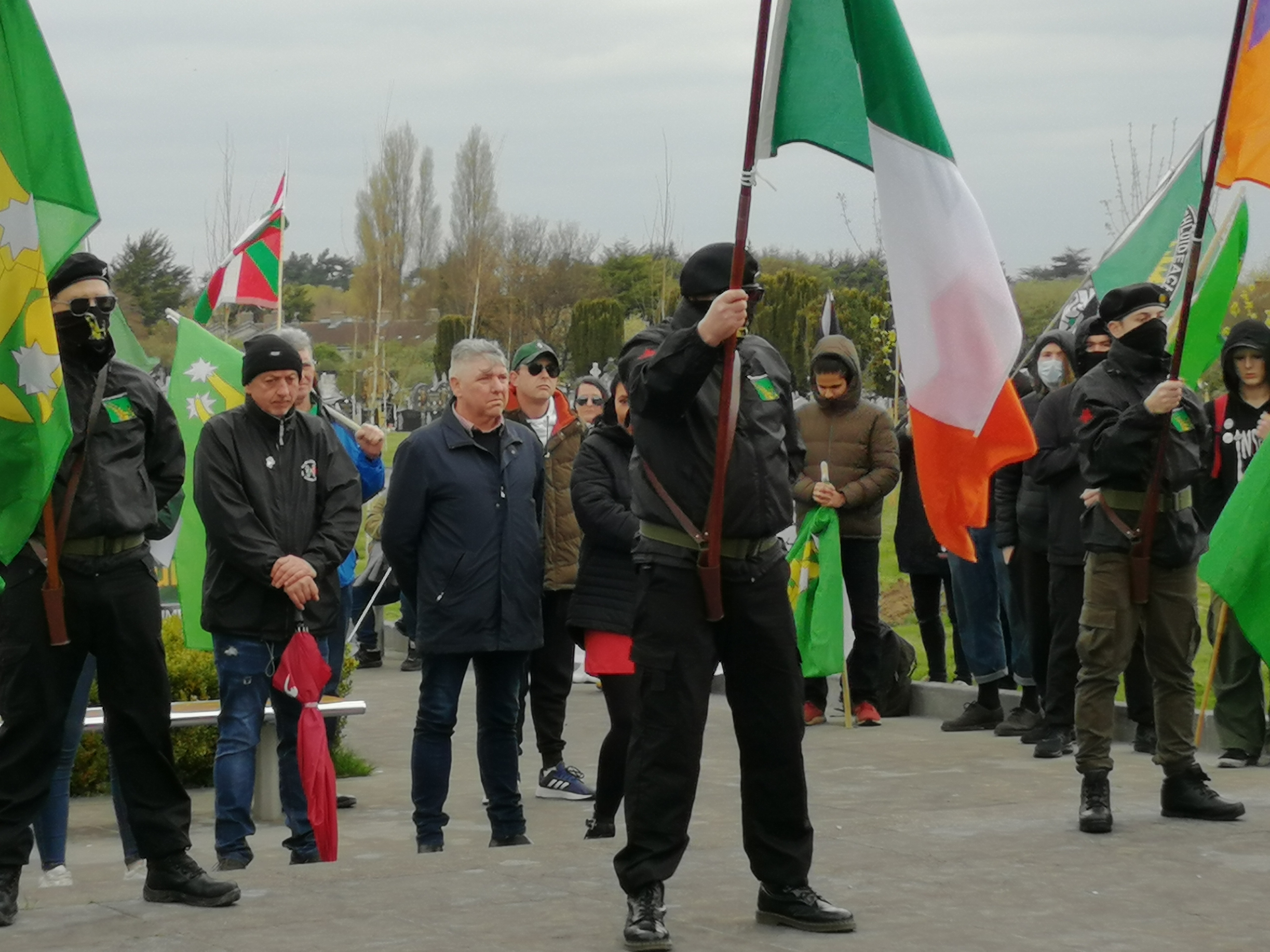
The participants declined to be intimidated and set off on their march, led by a lone piper playing Irish marching airs, followed by a colour party with different banners interspersed among the marchers, among which fluttered many flags.
Organisers had learned that the coach carrying members of the Republican Flute Band from Scotland that was to lead the parade had been prevented by police there from taking the ferry to Ireland.
Centre photo: Four of the six plainclothes political police violating the civil rights of the peaceful people commemorating the Easter Rising. (Photo: D.Breatnach)Centre photo, another two plainclothes political police. The bald man joked while he harassed people. (Photo: D.Breatnach) (Photo: D.Breatnach)
Historical background
In 1916 a broad alliance the Irish Volunteers, Irish Citizen Army, Cumann na mBan, na Fianna Éireann and Hibernian Rifles1 took part in a Rising organised by the Irish Republican Brotherhood against British rule in Ireland and against world war.
Due to a number of unfortunate circumstances, the leader of the Volunteers cancelled the Rising which however went ahead a day later than planned and was for the most part confined to Dublin, where a third of the numbers in the original plan took part and fought for a week.
The occupying British Army shelled the city centre from a gunship in the river Liffey and also from artillery on land. Explosions and resulting fires destroyed much of the city centre including the General Post Office in the main street, which had been the headquarters of the insurrection.2
After a week with the city centre including the GPO in flames, the rebel garrison evacuated to Moore Street where the following day, surrounded and vastly outnumbered, the decision was taken to surrender.3 A British military court passed death sentences on nearly a hundred prisoners.
All but fifteen of those sentences were commuted to long jail periods but the seven Signatories of the 1916 Proclamation4 and another seven were shot by British firing squad in Dublin, a fifteenth in Cork and after trial months later a sixteenth was hanged in Pentonville Jail, London.
At Easter 1917 Irish Republican and Socialist women commemorated the 1916 Rising; ever since then Irish Republicans and sometimes Socialists in Ireland and in many parts of the diaspora have commemorated the Rising, whether legally5 or otherwise, in jail or at liberty.
The War of Independence began in 1919 with many of the Rising’s survivors participating6.
(Photo: D.Breatnach)
(Photo: D.Breatnach)
(Photo: D.Breatnach)
The Parade on Sunday – local and national historical memory marked
At Cross Guns Bridge over the Royal Canal the parade halted and flares were lit in memory of events there in 1916.
Marching along the Cabra Road, the wall and a watchtower of the north side of Glasnevin Cemetery on the left of photo. (Photo: D.Breatnach)
On Easter Monday 1916 a small group of Irish Volunteers had marched from Maynooth along the canal bank to join the Rising in Dublin and found guarding the bridge two Irish Volunteers who advised them to wait until the following day to go into the city centre.
The Maynooth group spent the night in Glasnevin and the following day marched into the GPO, passing an empty Cross Guns Bridge on the way. Back towards Phibsborough, British artillery had blown a barricade and killed Seán Healy, a Fianna member at the Nth. Circular Road crossroads.
Later, the Dublin Fusiliers unit of the British Army blockaded the bridge, preventing people from crossing it in either direction. They shot dead a deaf local man who failed to heed their challenge because he did not hear it.
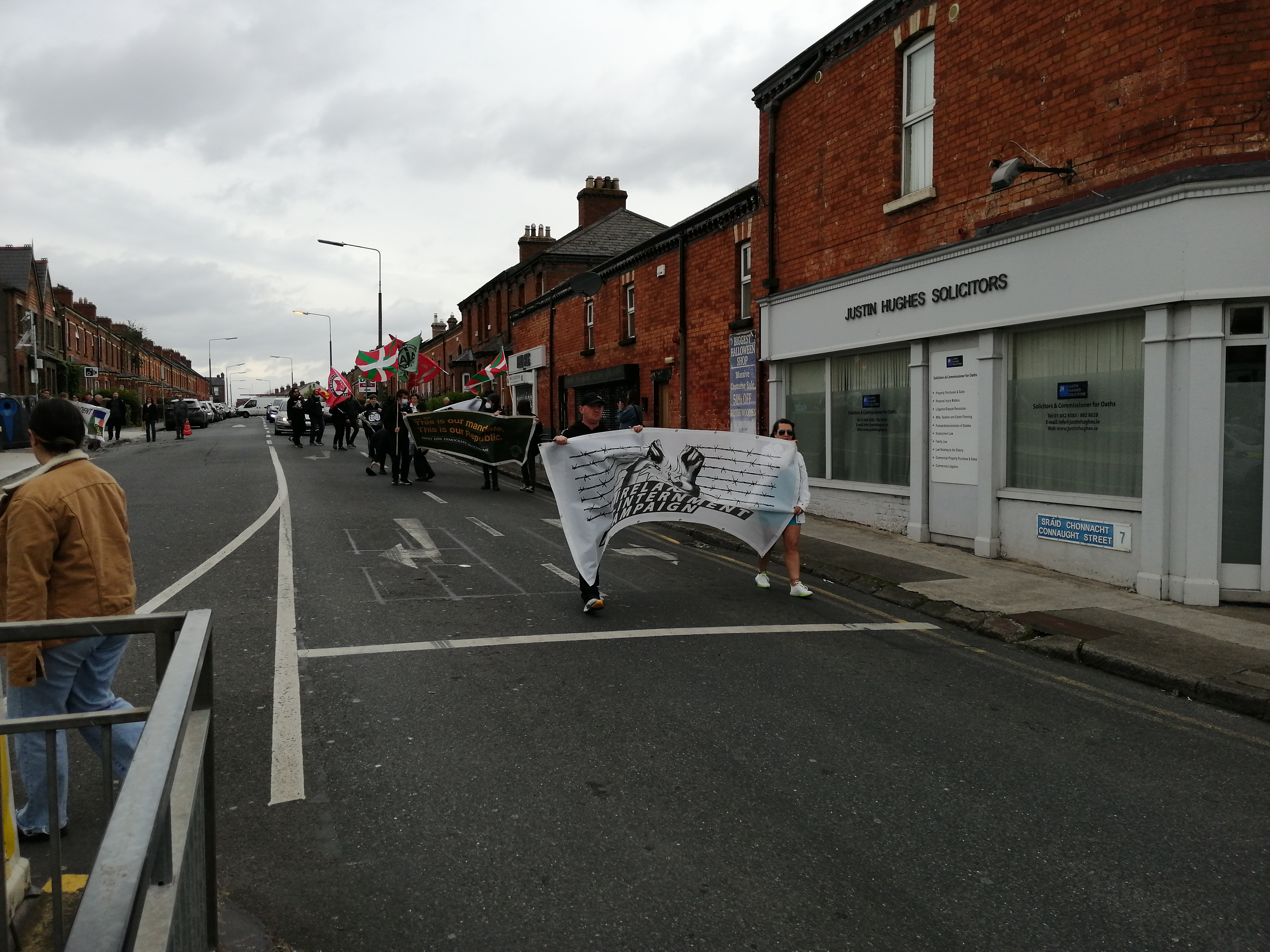
We Serve Neither King nor Kaiser but Ireland declared one banner carried last Sunday, Britain/NATO Out of Ireland another, This Is Our Mandate7, Our Republic and Collusion Is No Illusion, It Is State-Sponsored Murder were another two.
A large banner also declared alongside the image of James Connolly that Only Socialism Can Be the Solution for Ireland. Some organisations also carried their own banners, such as those of Dublin Independent Republicans, Ireland Anti-Internment Campaign and Irish Socialist Republicans.
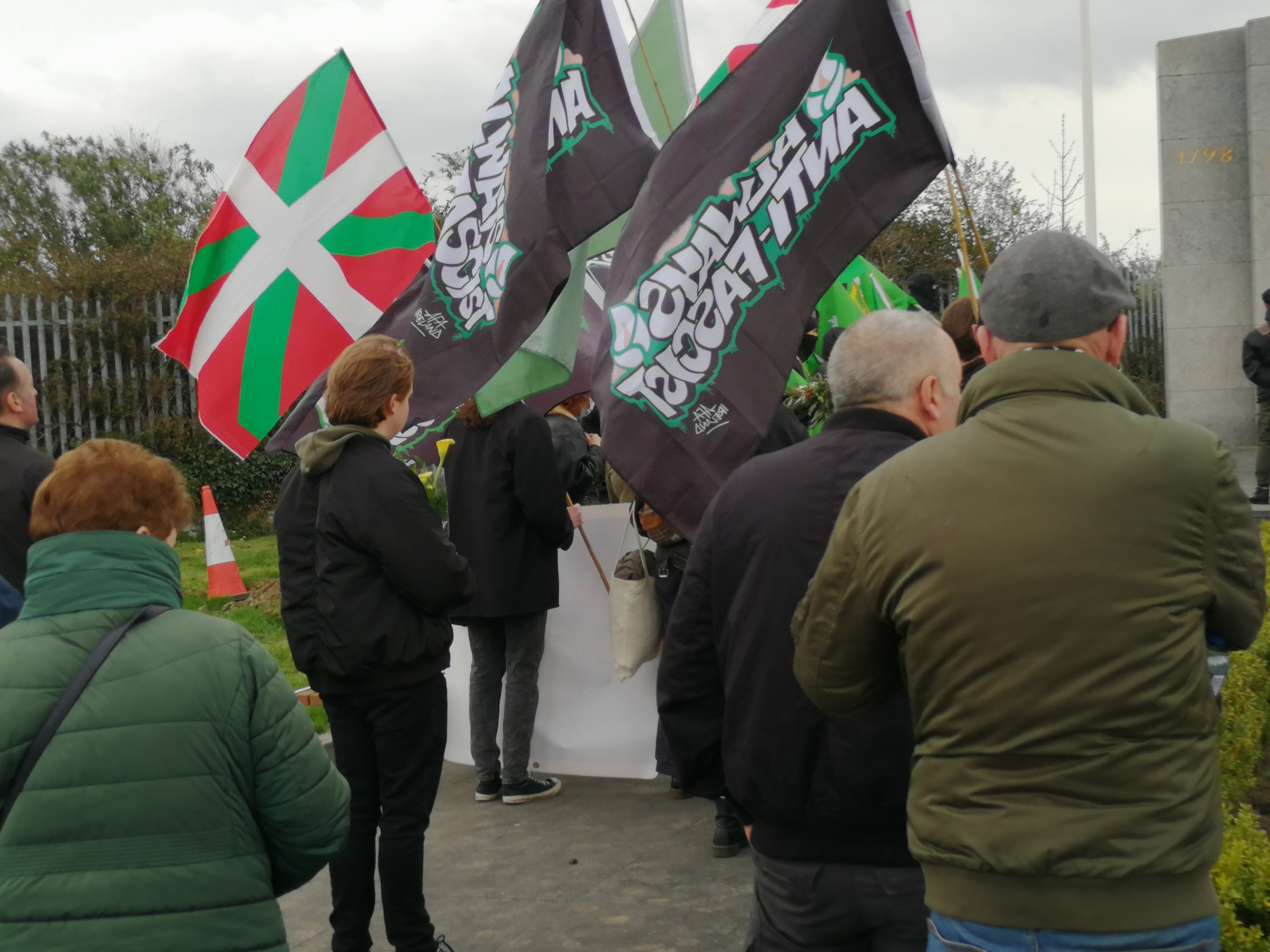
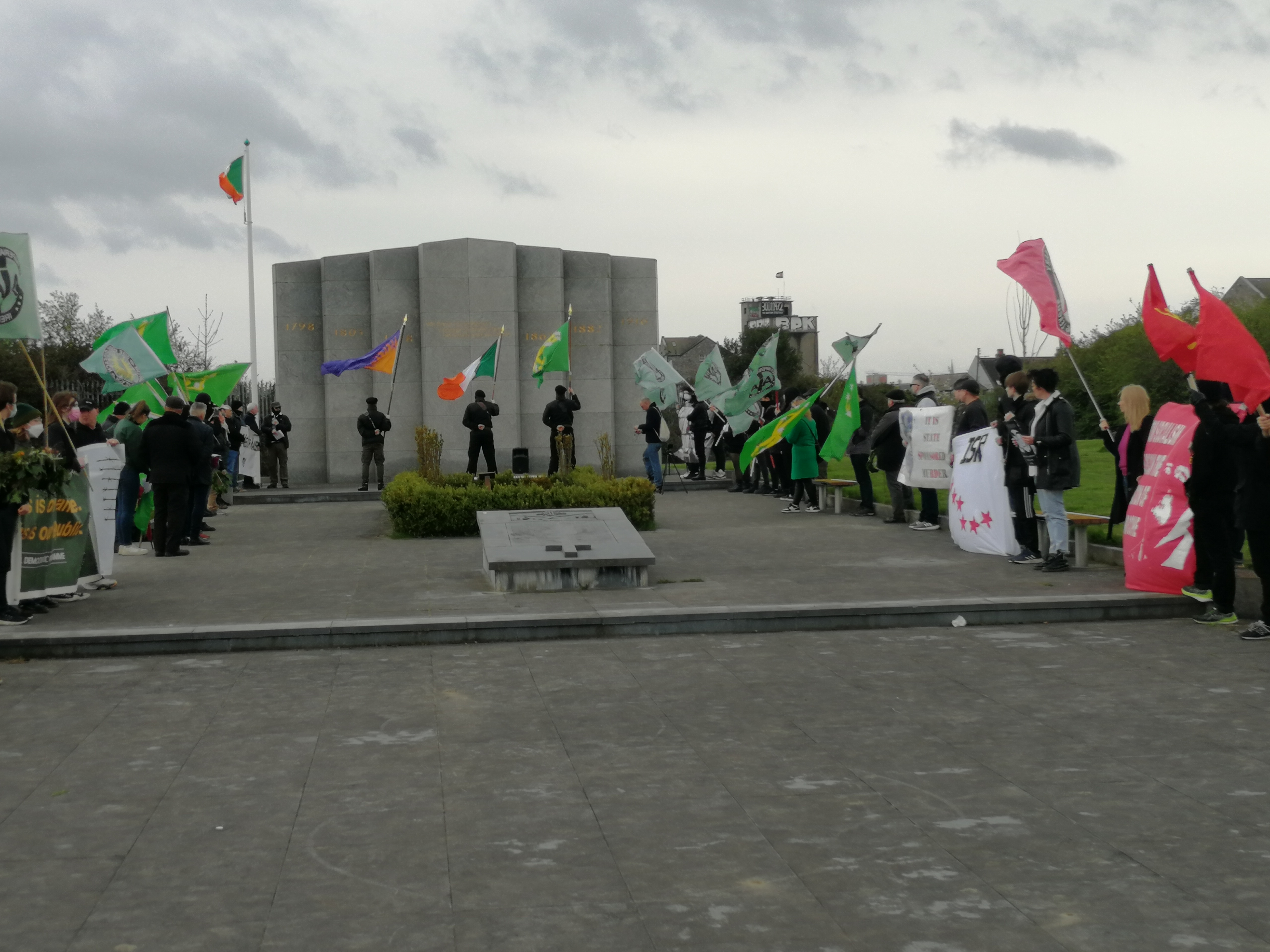
Flags fluttering included those bearing the logo of the organising group Anti-Imperialist Action and others bearing the slogan “Always Anti-Fascist”, green-and-gold Starry Ploughs, a couple of Ikurrinak (Basque flags) and another two of Red with Hammer & Sickle in yellow.
Basque and antifascist flags (Photo: D.Breatnach)
At the Monument: speeches and songs
At the monument (Photo: D.Breatnach)
Glasnevin Cemetery (ReiligGhlas Naíonn) covers over 120 acres in North Dublin city and is in two parts, each with Republican Plots separated by the Cabra Road and contains the graves of both famous and ordinary people.
On the north side there is also access to the Botanic Gardens, both on the south banks of the Tolka river. The imposing Monument to numerous Republican uprisings and the Irish Citizen Army Republican plot is on the south side, across the pedestrian bridge over the railway line.
(Photo: D.Breatnach)
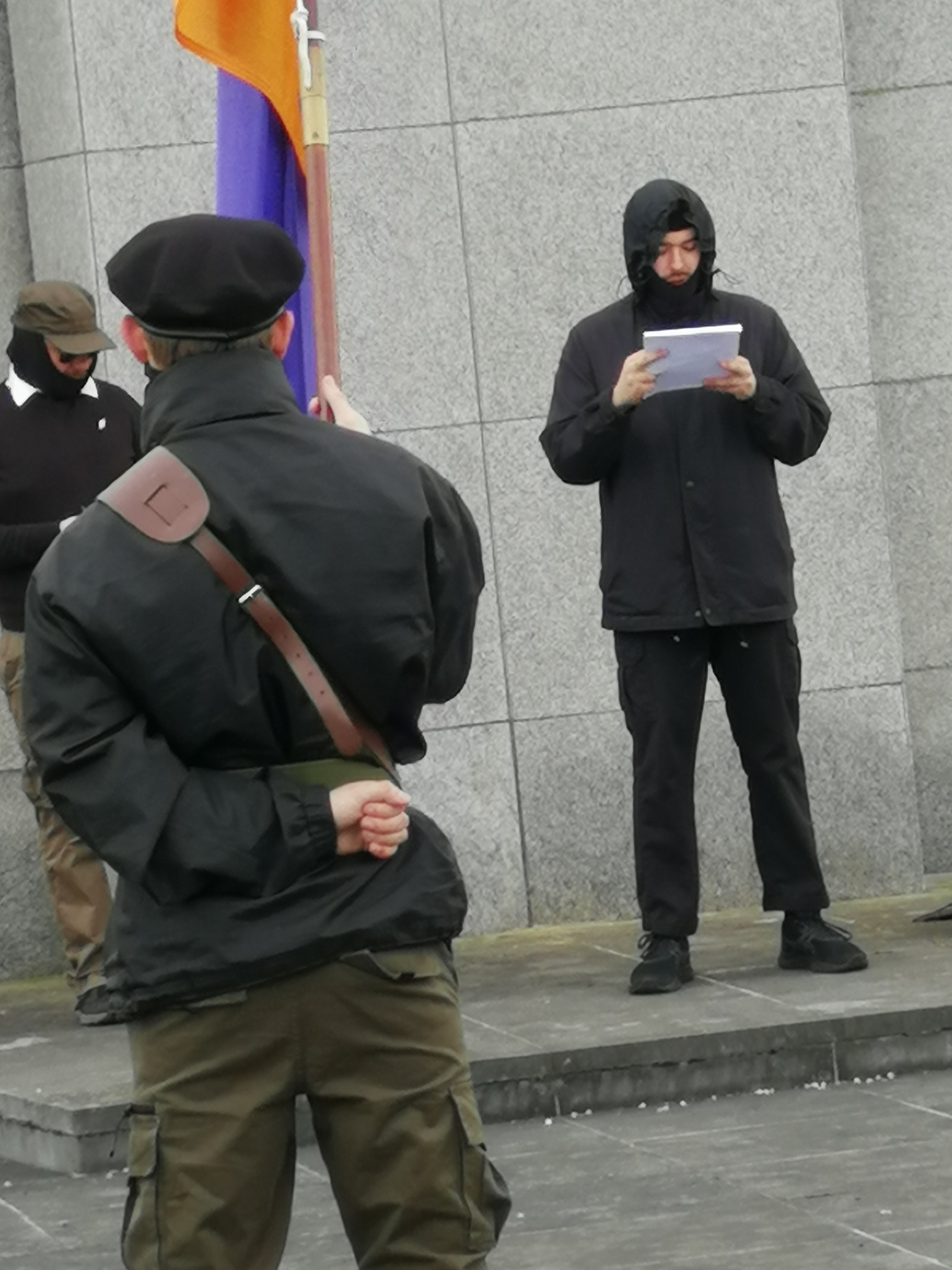
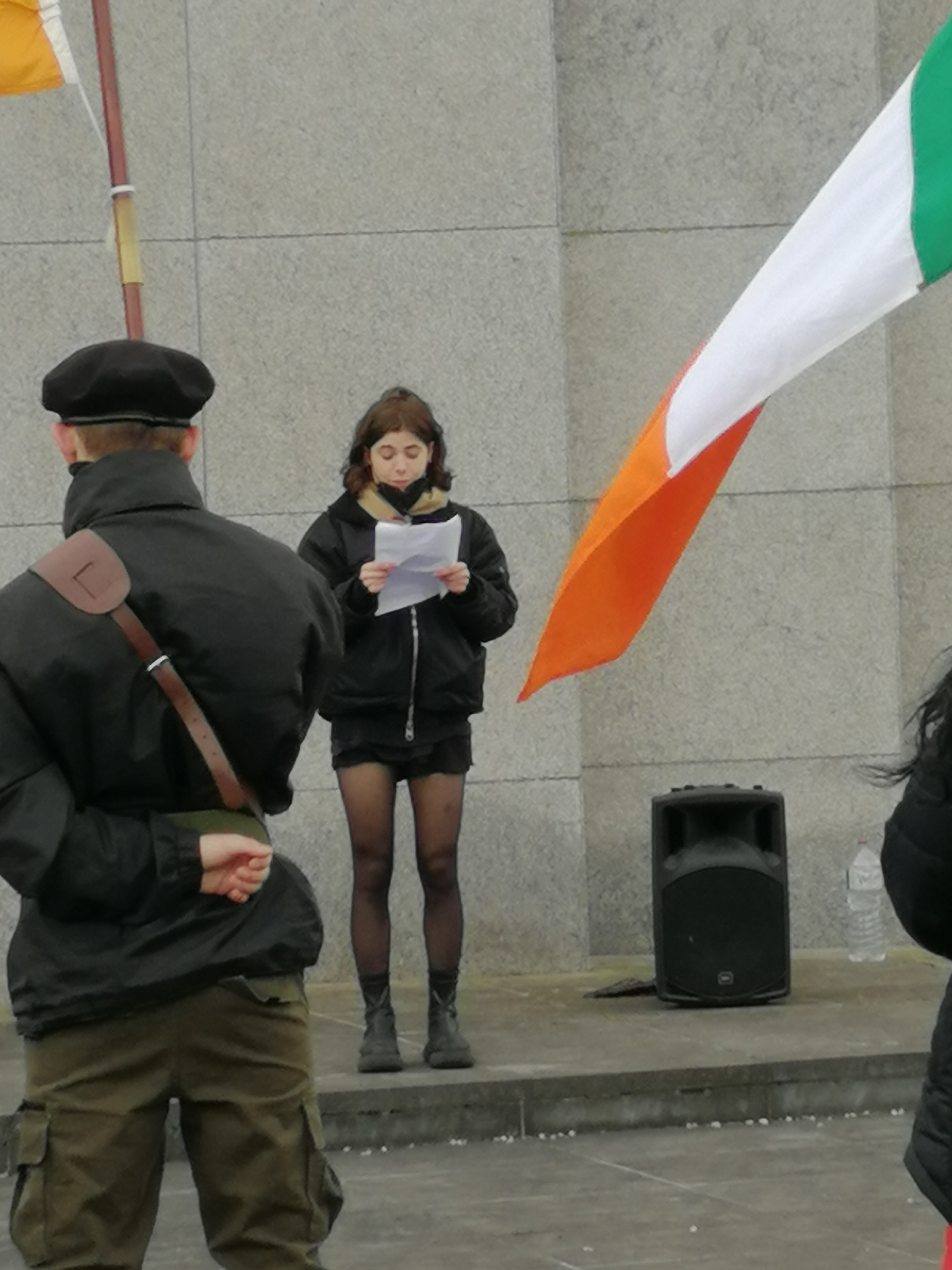
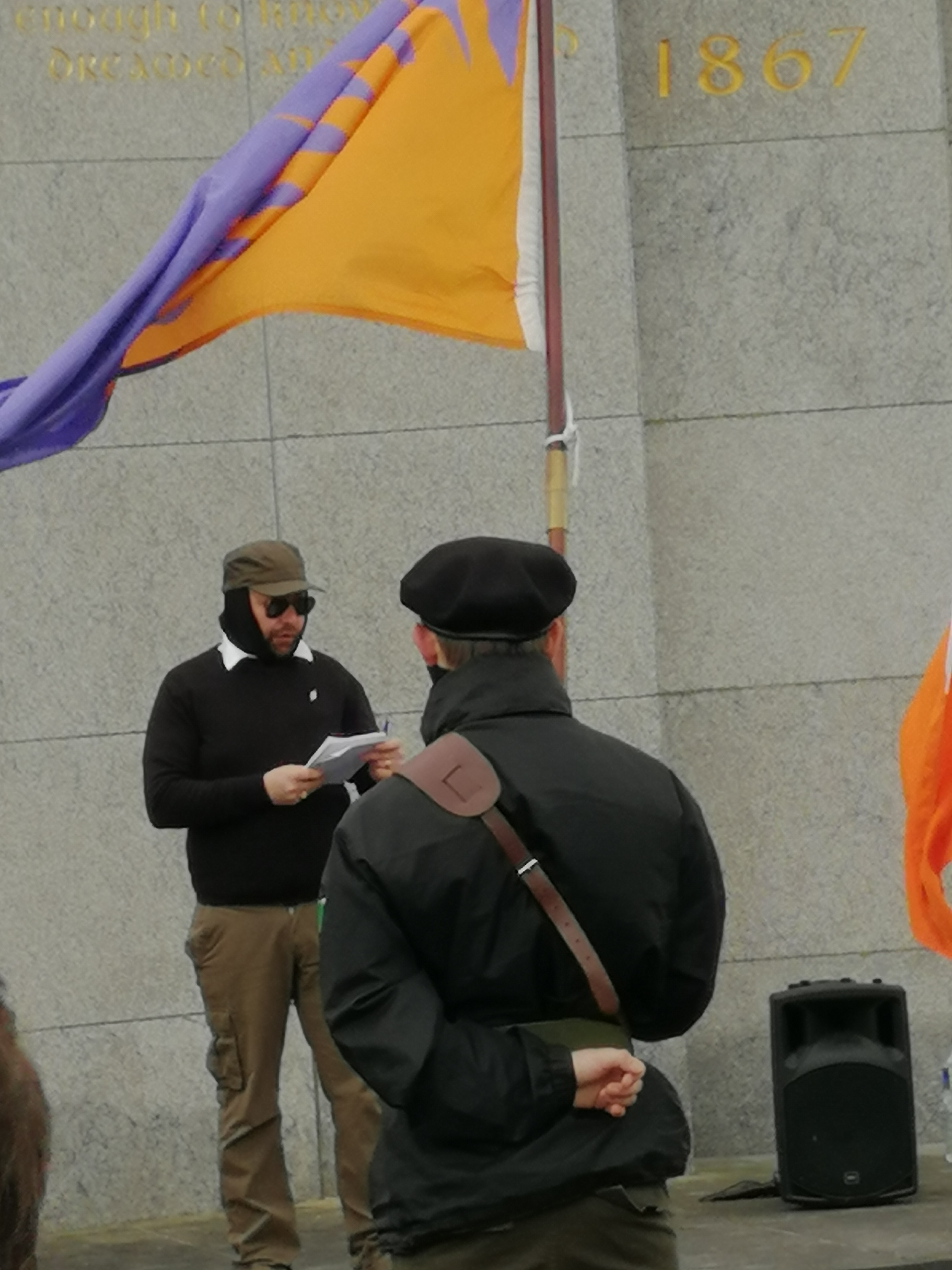
A man chaired the event for Anti-Imperialist Action and spoke briefly, introducing people for readings (all of which were from James Connolly) and for orations. The presentations of these were evenly divided between men and women, three of those being of young people.
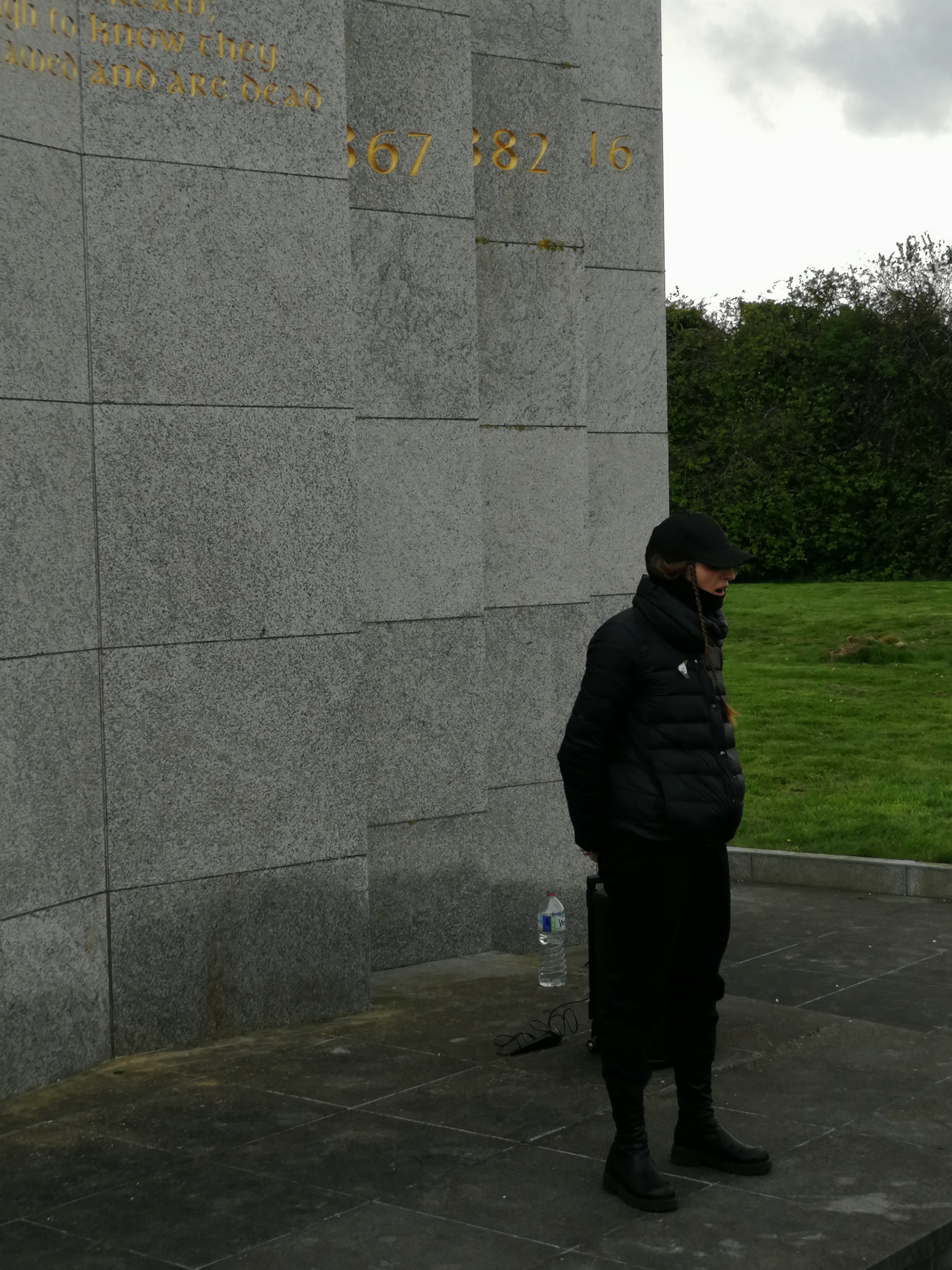
Three songs were sung: a woman sang The Foggy Dew (by Charles O’Neill) and Erin Go Bragh (by Peadar Kearney), while a man sang Patrick Galvin’s Where Is Our James Connolly? Two women read out pieces by James Connolly and another read out the 1916 Proclamation.
Person chairing the event (Photo: D.Breatnach)
The words of the chairperson and of those giving orations were different but there were common themes: upholding the historic Irish spirit of resistance, the importance of the working class in history and the objective of a socialist Republic encompassing the whole of the Irish nation.
These words were balanced by denunciation of US and British imperialism and the colonial/ NATO occupation of the Six Counties by the latter; the Irish client regime; the special no-jury courts8 of both administrations in Ireland and repression by police forces and occupation army.
One of the singers (Photo: D.Breatnach)
One of the readers (Photo: D.Breatnach)
One of the readers (Photo: D.Breatnach)
Also denounced were those political parties that had abandoned the struggle for the Republic and instead had become part of the colonial and neo-colonial administrations or, in the latter case, were on their way to becoming so.9
Floral tributes were laid by representatives of a number of announced organisations and then others came forward to lay floral tributes also. The colour party lowered flags for a minute’s silence in homage and salute before slowly raising them again and the piper played Amhrán na bhFiann.
The other singer Lowering of the colour party flags in homage to the fallen in the struggle (Photo: D.Breatnach)Colour party raises flags again in symbolism of the struggle continuing (Photo: D.Breatnach)
The chairperson thanked all for attendance, listing organisations by name and cautioning all to stay close together as they left, due to the threatening presence of Gardaí and in particular the Public Order Unit. In the event, the celebrants exited the cemetery and dispersed without incident.
1A small unit, an armed wing of a split from the more socially conservative USA version of the Ancient Order of Hibernians, their participation in the Rising was notable.
2Photos of much of the destruction are available on the Internet and accessible by search browser.
3The terrace they occupied still stands and is the object of a historical memory and conservation struggle against property speculator plans approved by the municipal city managers and Government political parties (see smsfd.ie).
4A remarkable document, the text of which is available from many postings on the Internet.
5Irish women commemorated it in public in contravention of British WWI martial legislation in 1917 and 1918 and for decades the public commemoration of the 1916 Rising (and even the flying of the Irish Tricolour) was forbidden in the British colony of the Six Counties with attendant colonial police attacks on any attempt to do so.
6Sometimes inaccurately called “the Tan War” (reference to a special colonial police auxiliary force that became known as the “Black n’ Tans”), the war saw the birth of the IRA and lasted from 1919-1921. A British “peace” proposal opened deep divisions in the nationalist coalition and was followed by a Civil War 1922-1923, in which the pro-Treaty government and armed forces were armed and supplied by the British to defeat the Republicans in a campaign of repression and jailing, military actions, kidnapping and torture, murder of prisoners, assassinations and over 80 formal executions.
7Also displaying text referring to the First Dáil’s Democratic Program of 1919.
8The Diplock court in the colony and the Special Criminal Courts in the Irish State, political special courts in all but name, with low proof bar and abnormally high conviction rate and refusal of bail while awaiting trial.
9References to 1) the 1930s split from the Sinn Féin party, the Fianna Fáil political party that became a preferred Government party of the foreign-dependent Irish ruling bourgeoisie and 2) to the Provisional Sinn Féin party who endorsed the British pacification plan in 1998 and embarked on the road to becoming a party of reformist nationalism in the colony and is heading for neo-colonial (and neo liberal capitalist) coalition government at the moment.
Currently the International Court of Justice1 has accused Premier Vladimir Putin and the Russian Commissioner for Children’s Rights of responsibility for the “forced abduction” of Ukrainian children and their adoption by Russian couples.
The charge implies ethnic cleansing and forced assimilation taking place during war and therefore would be classed a war crime. The Russian side denies the charge saying that instead what has taken place has been voluntary evacuation of families and evacuation of children from orphanages.
The western mass media (wsm) confines itself to repeating the charge and accusatory statements from western politicians, mostly from countries that are part of the NATO military alliance and briefly stating that the Russian leadership denies the charge. Is anyone actually investigating?
Well, Associated Press, a western media agency, says it has and that Russia is guilty. In that case, let’s see the evidence. And we’d have to wonder why a spokesperson for United Nations Childrens Fund (UNICEF) states that it has seen no evidence of Russian abduction of children.
The wsm has only informed us of UNICEF’s position recently in the course of reporting an informal UN Security Council meeting where Maria Lvova-Belova not only denied the charges of abduction but gave actual hard figures on whole family and orphanage children evacuation2.
Ms Lvova-Belova, said that since February 24th, 2022, Russia has taken in more than five million Ukrainians, including 700,000 children — all with parents, relatives or legal guardians except for 2,000 from orphanages in the eastern Donbas.3
To date, she said, about 1,300 children have been returned to their orphanages, 400 were sent to Russian orphanages and 358 were placed in foster homes4.
Lvova-Belova speaking at the informal UN Security Council meeting (Photo sourced: Internet)
Ms Lvova-Belova said her office has met with representatives of UNICEF, Refugees International and the International Committee of the Red Cross and “provide all available information about the situation of children” and are “coordinating with the Red Cross on reunification,” she said.5
The NATO countries declined to send their ambassadors to the meeting while chief NATO state representatives present, e.g. of the USA and UK, walked out of the meeting without listening, accusing Russia of using the situation for propaganda purposes.
Well maybe, UK and USA representatives, but everyone has been issuing propaganda in this war! Anyway why not answer the Russian case with your own counter-evidence? If you actually have a viable case that stands up to scrutiny?
Some war-time children’s evacuation examples
The war damage inflicted in the Donbas region by both sides in this war since 2022 — and by the Ukrainian state alone since 2014 – would make concern for children’s lives a natural motivation for relatives anxious to get their children to somewhere safe.
During the anti-fascist war in Spain, sympathetic families in Britain took in children from the Republican side for their safety from the advancing Spanish military-fascist forces and allied German Nazi and Italian Fascist military.
Later, as defeat loomed for the Spanish Republic, families with children fled to many countries (a few even to Ireland) and yes, to the Soviet Union. In fact a Basque descendant of that evacuation has passed a year in Polish jail accused of spying for Russia without presentation of any evidence.6
Basque and Spanish children, refugees from Spanish Anti-Fascist War (Photo sourced: Internet)
During WW2, children from British cities were sent to homes in rural areas for their safety. Whatever the issues around how they were treated in their new or temporary homes, nobody speaks of “abduction” of Basque, Spanish or British children7.
Well, actually, some children were abducted in Spain, from their murdered Republican parents or from working class women who were told their baby had died in childbirth. The fascist State and the Catholic church presented these children for adoption to rich and loyal childless couples.8
One of the reasons for abduction of children in those cases was to satisfy the needs of childless couples loyal to the regime and required the massive collusion of a number of health and social care agencies, all of which were exposed later. Does this seem a likely risk for Russia to take?
Ukrainian families with children evacuating to Russia (Photo crdt: Wall Street Journal)
Well what about the other objective, social engineering, of creating fascist children, or for example “Germanisation” but in this case “Russification”?
Hardly, the children are from the Donbas region, an area already largely Russian in language and culture and, since attacks of the Ukrainian forces on it since 2014, already hostile to the Kyiv regime and mostly sympathetic to Russia.
The Ukrainian State leadership, one of the main accusers of Russia’s alleged abduction of children, frequently issues population figures of towns and cities in the Ukraine War zone, comparing pre-war with current figures, showing a huge drop between both sets.
Presumably the fall in numbers of inhabitants in towns under their control could not have been carried out by Russia. So are we to accuse the Kiyv regime of the “abduction” an “ethnic cleansing” of thousands of Ukrainians, its own citizens? Or more reasonably, of their evacuation?
Returning to the question of actual evidence, an issue of apparent little importance to the wsm and NATO country states, surely an international agency responsible for children would be expected to have a reasonable handle on this?
Or is UNICEF to come under the accusation regularly thrown at those of us who don’t swallow everything NATO says, i.e. of being “putinistas?
The Target of the Propaganda
It’s worth considering who the targets in this propaganda war might be and the reasons therein. The state intelligence agencies of NATO countries presumably have a fair idea of which are truths and which are lies. So the target is not the heads of states.
THE MAIN TARGET OF THE PROPAGANDA IS US, i.e. the ordinary people in the western world, whether in NATO (which most are) or not. The objective being that we should support our governments in backing US/NATO’s confrontation with Russia.
And that if it should come to world war, which seems increasingly likely, that we support our governments and suffer the consequences, including dying in millions to support their objectives. Without rebelling.
End.
FOOTNOTES
1The western mass media makes a point of telling us that Russia does not recognise the authority of the ICC but rarely adds that nor does the Ukrainian regime. And nor does the USA!
2An interesting exercise to evaluate wsm bias is to put “Russia denies abduction of children” in a mainstream search engine and see how many hits one gets for UNICEF’s statement.
6Pablo Gonzalez, a journalist working for Spanish media, was born in Russia, grandson of such a refugee. He was covering the Ukraine war when detained by their state intelligence service and advised to leave the country; meanwhile Spanish state security visited and interviewed his family, his mother and friends. He left Ukraine but went to Poland and was arrested by their state intelligence service as he was accompanying other journalists crossing back into Ukraine. To this date well over a year later Gonzalez has had no evidence of spying presented against him. Unlike a journalist detained in Russia whose case elicited public concern from western politicians within days, none of them have mentioned the case of Pablo Gonzalez.