Revolutionary socialist & anti-imperialist; Rebel Breeze publishes material within this spectrum and may or may not agree with all or part of any particular contribution. Writing English, Irish and Spanish, about politics, culture, nature.
Eamon McGrath (31 October 1955 – 11 January 1923) singer and song lyrics-writer, activist in areas of housing, water and national sovereignty, historical memory and anti-fascism.
He was getting buried on Saturday and I wasn’t able to be at the service nor at the celebration of his life with comrades afterwards.
I hope this eulogy, if that’s the right word for this, will make up for my absence to his family, comrades and friends and, of course, to me.
Eamon came into my life through the Moore Street occupation in January of 2016. The property speculator Joe O’Reilly (Chartered Land) and the State were about to collude in the demolition of three buildings in the 1916 Terrace.
The State had declared only four buildings in the 16-building terrace, after a long struggle, to be a historical monument and even later, purchased – but around 300 men and women hadn’t occupied just four buildings in 1916.
The Save Moore Street From Demolition campaign group had called emergency demonstrations on to the street following which the buildings had been occupied by protesting conservationists.
The weather was bitterly cold but the occupiers held firm for a week until a stay of demolition had been imposed by the High Court. Despite his health status and challenged mobility, Eamon was there throughout, with humour and song.
Eamon McGrath to far right of photo while Dave Swift (centre) in Irish Volunteer uniform reads a historical document April 2017 in Moore Street, during historical commemoration event (the hoarding behind is covering the extension of the ILAC further into Moore Street, killing the market appearance for that side of the street for the block).
Subsequently, to prevent internal damage by contractors, a six-weeks’ blockade was imposed on the building by conservationists from 6.30am to 4.30pm each weekday. Eamon was very much a part of that too, driving himself and his close comrade Sean Doyle up from Wicklow every day.
Eamon was intensely loyal to close friends and comrades. On occasion I found him prickly or grumpy (especially at 6.30 am) but throughout any disagreements he never lost sight of who were his comrades and other people he respected.
Though a proud man, when he recognised himself in error, he didn’t hesitate to apologise.
A new broader group came out of the occupation and blockade, called Save Moore Street 2016 and Eamon attended and contributed to internal organising meetings and events we called on to the street – re-enactments, fake funerals of history, pickets, demonstrations and rallies.
As others drifted or were called away from the group by other commitments, Eamon remained with the active core.
(L-R) Paddy Reilly and Eamon McGrath in period costumes having a conversation during a history education event and anniversary commemoration of the founding of the Save Moore Street From Demolition campaign group. (Photo from Save Moore Street From Demolition FB page)
Of course, Eamon had been active before 2016: certainly very much so in the general awareness-raising and mass campaign against planned privatisation of our water and the installation of water meters.
He was to continue that activism, which resulted in assaults by a water contractor on him and Seán Doyle, court appearances for both and in May 2016 both of them went to jail for a period but remained unbowed.
Eamon was one of the original occupiers of Apollo House in December 2016 in protest against homelessness and as a co-founder of the Anti Eviction Flying Column, Eamon was to the fore in resisting evictions across the country and also a co-founder of the Bring It to Their Doors campaign.
The State authorities were making things awkward for Eamon by then, both in terms of working as a taxi driver and claiming benefit when he was not. His ability to reach events in Dublin declined but he still got there often enough on public transport, while remaining active nearer to home.
As his physical mobility declined further, comrades in Carlow started an on-line collection to buy him an electric wheelchair. Even as I made enquiries to contribute, the fund had already reached its target, so quickly did people support it.
Later still, his family installed a new chairlift for his home so he could access the room where he recorded his songs with lyrics commenting on the ongoing political struggles, adapted to popular airs.
Though our voices didn’t go well together, we sang together a couple of times – outside the GPO and outside Dublin City Hall.
Eamon McGrath, centre right after April 2016 event in Moore Street after which we brought it to in front of the General Post Office in Moore Street for awhile. Myself near centre, Glenda further to the left of photo, Sean Doyle nearly out of shot.
He remained active on social media but in particular in keeping an eye on the activities of right-wing people, covid-deniers, racists, fascists …. Eamon was a handy source for a quick update on the status of many of them.
Eamon arranged an interview for us both with the Dublin Near FM radio station, the interviewer being then a former drug addict who sadly returned later to his addiction and died on the street. It was on the way back from the interview that Eamon told me a little about his earlier years.
He had a difficult time in his childhood, including institutional confinement and his formal education suffered as a result. However, he educated himself about many things by reading, listening, discussing and viewing on line.
I think the last time I saw Eamon was at a commemoration at the Peter Daly monument in Wexford inSeptember 2022, in his electric wheelchair and attached oxygen cylinder for his lung condition and all in good cheer, asking me for Moore Street campaign updates in detail.
Eamon McGrath, centre in wheelchair, at Peter Daly commemoration in Wexford, September 2022 (Photo from Peter Daly FB page)
His comrades in Anti-Imperialist Action Ireland, which he had joined at its foundation in 2017 correctly called him “one ot the most dedicated political activists of the last decade” and no-one who knew him could argue with that.
I knew little of Eamon’s family life but he often emphasised how important family was, not just to him but in general. Though I do not know them tá mé i gcomhbhrón leo, offering them my condolences along with the many they have received and are no doubt still arriving.
A partner, father, grandfather, great-grandfather, extended family member and friend to many.
Eamon McGrath of Kenmare Heights, Greystones & formerly Wolfe Tone Square, Bray, Co. Wicklow, was buried in Radford Cemetery, Greystones Saturday after a service in the Holy Rosary Church, Bray, attended by family, comrades and friends.
The remains of more than 1,700 victims have already surfaced, twice as many as expected
Report from Info Libre, by Angel Munarriz, Seville — January 6, 2023 7:39 p.m. @angel_munarriz (translation and editing for publication here, also Footnotes and Glossary by D.Breatnach)
The mass graves in the Seville cemetery are a puzzle. Historiographical research has concluded that thousands and thousands of victims of Francoism lie dumped without order or recognition, but there is hardly full certainty of a few hundred names registered in the municipal registry.
What is underground is a sordid totum revolutum1 of bones of those shot right there and on nearby walls, of those killed in prisons and concentration camps or in confrontations with the rebel troops, or of victims of hunger and poverty who were was buried free of charge along with those who suffered repression.
Today the puzzle is still far from complete; it will probably never be so, because part of the mission of the placing of graves in the San Fernando cemetery was to erase the traces of the crime.
But some pieces are beginning to fit. It is even possible already to glimpse some forms. What is observed goes beyond any hypothesis.
Not everything in this story is summed up in numbers, because behind each number there is a human being. But numbers are essential to understand its dimension.
There they go: the search in the mass graves of the Franco regime led by the Seville City Council is now extended to more than 4,000 possible victims, according to the calculations of the consistory itself, based on historiographical sources.
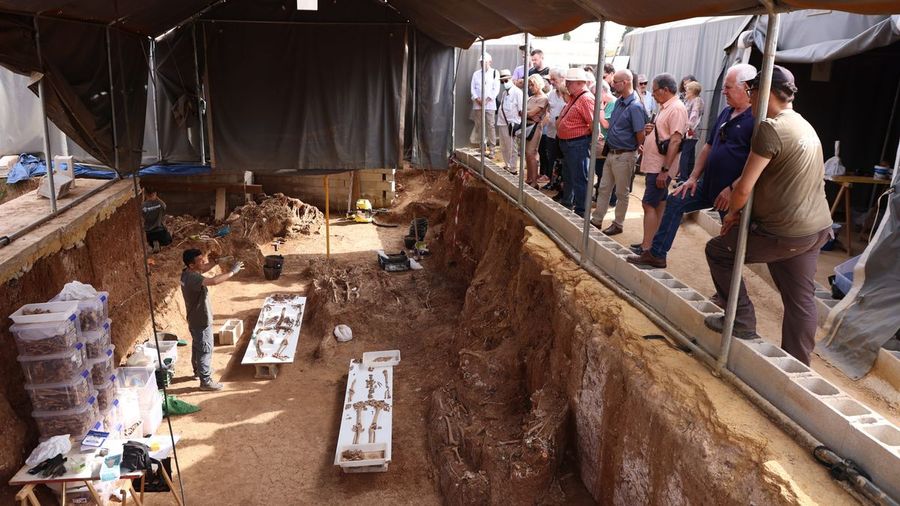
In the first excavated burial, Pico Reja, the remains of more than 1,700 victims have already surfaced, twice as many as expected, making it “the largest open mass grave in Western Europe since Srebrenica”, as the City Council highlights.
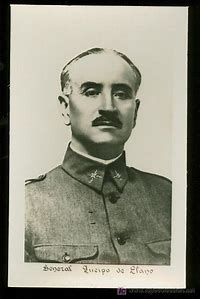
In the second, called Monumento, pending opening, there could be more than 2,600. The horror revealed in what was the fiefdom of Gonzalo Queipo de Llano2 seems to have no end.
Overflowing forecasts in Pico Reja
The exhumation work in the Pico Reja grave, which began a little less than two years ago, is nearing completion.
“The idea [of the City Council] is to carry out an act of symbolic closure of the pit before the end of January. We are going to do everything possible,” explains Juan Manuel Guijo, director of the excavation, which is in charge of the science society Aranzadi, a benchmark in this field.
Guijo is not certain about the deadlines.”The pit must be left clean, without remains,” he says. In addition, “a huge amount of funerary material is coming out.”
The anthropologist uses scientific jargon: “Huge amount of funerary material.” They are human bones.
The initial forecast for the number of deaths was just over 1,100, of which between 850 and 900 would be victims of Franco’s repression, according to the City Council. But reality has broken any forecast.
Guijo advances to InfoLibre the figures as of December 30: the remains of 8,600 individuals have been located, almost eight times more than previously thought; of these, 1,718 are victims of the Franco regime, around twice as many as expected.
The two figures, says Guijo, “will be exceeded” at the end of the excavation.
“We can reach 9,000 people exhumed. All this was impossible to foresee. It is beyond any possible forecast,” he says.
The mayor of Seville, Antonio Muñoz (PSOE), has said it in other words: “The reality was much worse than what was estimated in the initial forecasts.”
Visitors to the Pico Reja mass grave excavation in May 2022 (Photo sourced: InfoLibre)
An explanation? The grave “was not filled up shortly after the coup, as was thought, but was open until 1940, or at least it was opened punctually in 1940,” explains Councilor Juan Tomás de Aragón.
The remains –wires and shackles– or the posture allow us to conclude that a victim was tied up, either with the wrists together or with the hands behind the back. Clips found appeared to hold several in a row with rope or wire.
The skull is the most frequent area of impact of the projectile, especially from behind, but also on the face. There is an abundance of long-arm projectiles used for the Mauser rifle, as well as short-arm bullets, mainly 9 mm.
In addition to the unmistakable bullet holes, there are “simple” fractures that point to “illtreatment” and “cruelty,” Guijo explains. The extreme fragmentation, mutilation, shrapnel and grenade remains seem to be attributable to “high energy trauma”, typical of combat.
500 families waiting: from Blas Infante to Horacio Gómez
One of the pieces of the puzzle fell into place in June.
The technicians confirmed the existence of evidence that certifies the remains of at least thirty of the victims who were members of what is known as the Mining Column, a group of volunteer fighters from the Huelva mining area that arrived in Seville bringing dynamite.
The characteristics of some burials –bodies without a coffin, grouped and face down– and the evidence that they had been retaliated against –shots to the neck, ties, perimortem fractures– allowed, together with some specific findings, to outline the hypothesis that they were members of the Miners Column.
There was a way to confirm it. How? These workers breathed, drank and ate in a mining environment without current security measures, so there could be a transfer of heavy metals to their bodies.
Indeed, the analyses carried out at the University of Santiago de Compostela have ratified it.
Much remains to be confirmed. Some 500 relatives have offered DNA samples, which must be compared with the remains of the victims, especially femurs, with signs of repression. You can’t always. There are more than 300 victims who do not present viable skeletal remains.
They are practically pulverized. This, added to the fact that the percentage of identifications with respect to the total number of bodies exhumed in this type of work is usually around 10%, caution is advised.
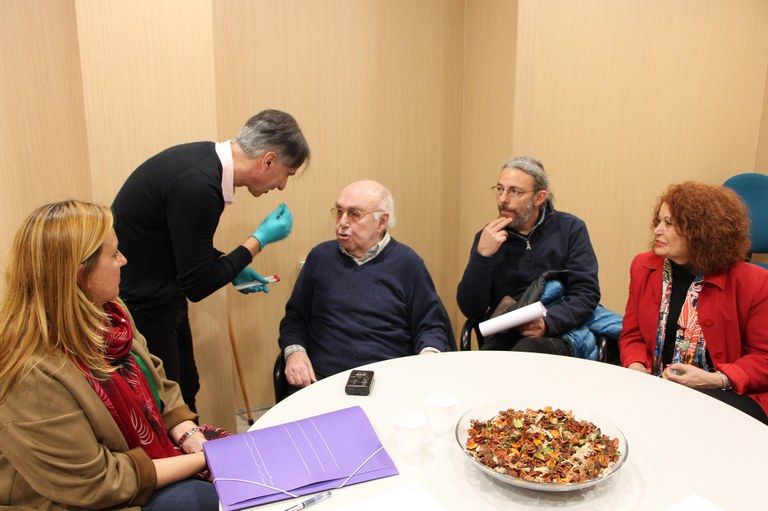
This same month of December, Horacio Hermoso, son of the former mayor of the city of the same name, a member of the Republican Left, assassinated in September 1936, died. Horacio Jr. gave his DNA, but did not arrive in time to see the end of the remains matching process.
DNA collection in 2019 from Horacio Hermoso, son of the former Republican mayor of Seville, of the same name, assassinated in September 1936. Sadly he died before his father’s remains were identified. (Photo sourced: InfoLibre)
Among the relatives who are still waiting is Estanislao Naranjo, grandson of Blas Infante, considered the father of Andalusianism, murdered in August 1936. “Things are going slowly, because it is a difficult grave,” he says.
Do you see the identification of his grandfather as possible? “In theory, yes. Due to the dates, they had to throw it into that pit. Now, it is difficult to know who was victimised and who was not. If the bullet hit a bone, you can see it. If it only touched soft parts, no,” he says.
Historical investigations maintain that, in addition to Infante, the remains of other political and union figures of the time rest in the grave, as well as loyal soldiers – Captain Ignacio Alonso – and assault guards3.
Councilor Juan Tomás de Aragón (PSOE) emphasises that all the victims will have a “dignified burial.” The City Council will build a memorial and a columbarium over the grave.
The Mayor tries not to generate excessive expectations about the identifications, so as not to pivot on this last phase the success or failure of the works. The truth is that the exhumation of Pico Reja has involved much more than exhumations and possible identifications.
For example, it has led to the making of several documentaries, such as Pico Reja. The truth that the earth hides. Students from schools, institutes and universities, from Seville and abroad, have organized visits to the work area.
Numerous university researchers have taken an interest in the process.
Monumento: the emblematic grave of Cruz de Lolo
The opening will not be limited to Pico Reja. The City Council plans to put out to tender in 2023 the excavation work for a second grave. It is known as the Alpargateros or Monumento pit.
According to available studies, it was open between September 1936 and January 1940 and no less than 7,440 bodies of deaths from different causes were deposited there, of which some 2,613 would be victims of Francoism.
Among them are believed to be the eight convicted of a plot against General Gonzalo Queipo de Llano, during which Concha Morón was arrested as part of The Resistence in Sevilla. An attempt to overthrow Queipo (Aconcagua, 2013).
Carmen Díaz may also be there, sister of the general secretary of the PCE, José Díaz.
If the forecasts of victims of the Franco regime in the Monumento pit are met, the total of the two burials would easily exceed 4,000. After Pico Reja‘s surprise, no one dares to say so. Perhaps, says the archaeologist Guijo, bodies attributed to Monumento were in Pico Reja.
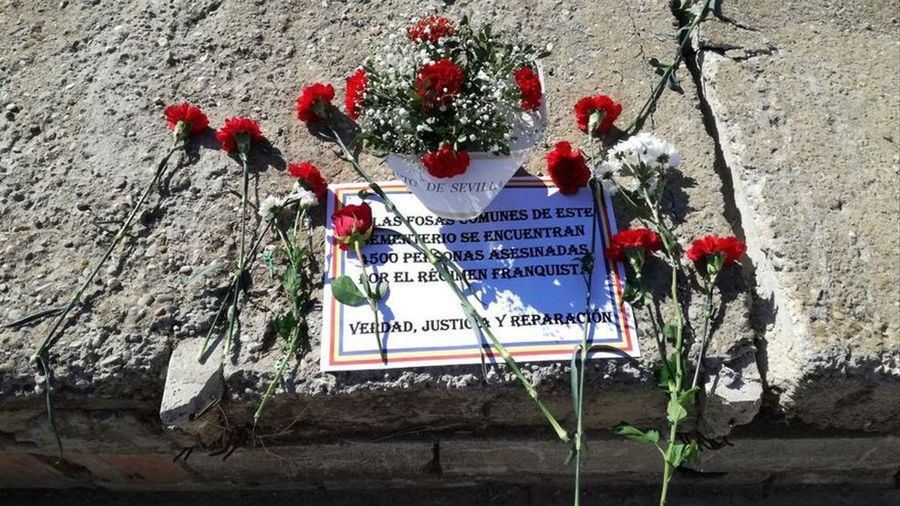
Flowers in memory of the victims of Francoism buried in mass graves in the Seville cemetery. (Image sourced: InfoLibre)
Graves (and more matters) pending
The City Council trusts that the collaboration of the Diputación, the Junta de Andalucía4 and the Government in Pico Reja, where they have invested 1.5 million euros, will be repeated in Monumento, so called because of a commemorative monument raised there in 2003 by initiative of the Association of former Political Prisoners and Victims of the Franco regime.
Almost everyone who remembers that in this entire area crime reached inhuman levels hovers around the Monument pit.
In addition to the monument, in its paved area there is a cross placed by a communist blacksmith in the early 50s, tolerated by the authorities and known as the Cruz de Lolo. For the rest, no one would say. Seville has lived for decades in a democracy with back turned to the memory of its horrors.
The remains of Blas Infante, named by Parliament “father of the Andalusian homeland”, was not begun to be searched for until 2020.
Those of Queipo, head of the repression in southern Spain, the coup leader who called for “raping Reds”, have only recently left the place of honour they occupied in the basilica of La Macarena,5 in compliance with a state law.
This was without the confraternity with the most members in the city acting on its own initiative. Apart from this exhumation, the honours granted to him still stain the city.
Councilor Juan Tomás de Aragón highlights the “normality” with which the exhumation of Pico Reja has been carried out, which he is sure will be repeated in the Monumento.
“Nobody has clutched their heads in their hands. People are more intelligent and mature than is sometimes thought,” he says. He believes that the key has been respect: “We have not hidden what we were doing, nor have we used it to confront anyone.”
There are more graves in the complex, in addition to Pico Reja and Monumento. Antigua –delimited and where it has been verified that there are no remains of victims, according to the councilor–, Rotonda de los Fusilados, Disidentes y Judíos, some extensions of filled graves…
“Francoism never admitted that there were graves, that’s why they were known by popular names. If it had admitted them, they would be called San Rafael, Santa Águeda …”, explains Juan Morillo, a reference to the memorialist movement in Andalusia.
He sees the exhumation process of Pico Reja as “exemplary”, but at the same time stresses: “All this, it must be remembered, has been done due to the pressure of family members and associations. No party had it on their pprogram.
“Memory continues to be the great democratic deficit in this country, where there are still unopened graves and streets with Francoist names”.
The City Council does not plan to disinter these graves, at least not while the largest ones are open. According to the available evidence, they have much fewer victims than Pico Reja and Monumento.
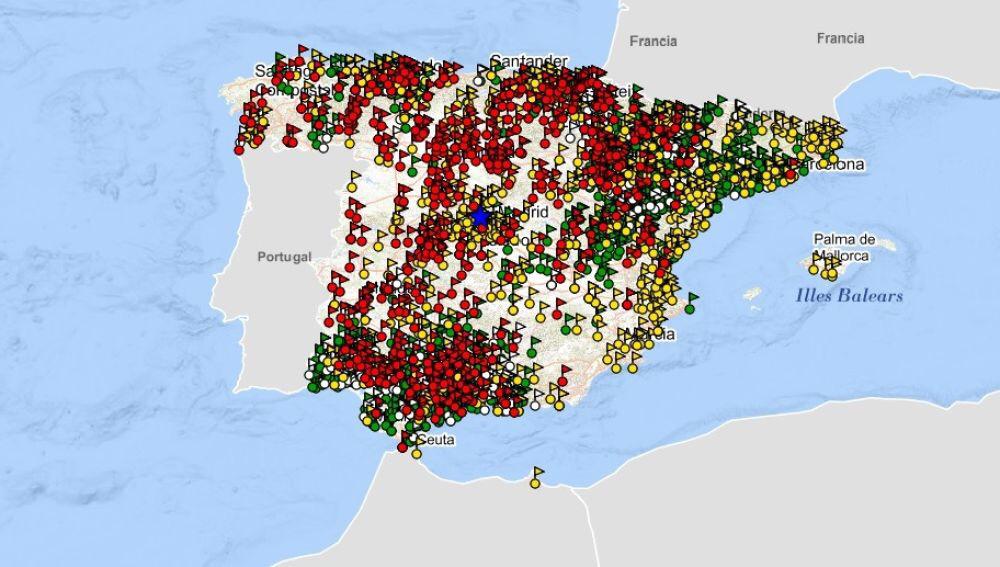
Known locations of mass and smaller graves from the Spanish Civil War and during the Dictatorship repression afterwards. (Image sourced: Internet)
Comment byDiarmuid Breatnach
It is important to note that most of the executions by the fascist-military forces during the Civil War took place outside combat zones, in which the fascist-military were in no danger whatsoever. They were punishing not only soldiers of the Second Republic but political activists and functionaries.
This is in contrast to the much lower number of executions in the zones under control of the Republic and, furthermore, as their authorities exercised greater control, the executions were reduced considerably.
Many executions also took place after the fall of the Republic and the terrible conditions of the vastly overcrowded jails and prison camps added their contribution to the fascist military harvest. Their purpose was revenge, deterrence of others and elimination of a democratic generation.
Generations growing up afterwards knew little of the extent of the horror unless informed by their family and communities, though may of these in turn felt obliged to remain silent unless they – or their sons and daughters – were to also become victims.
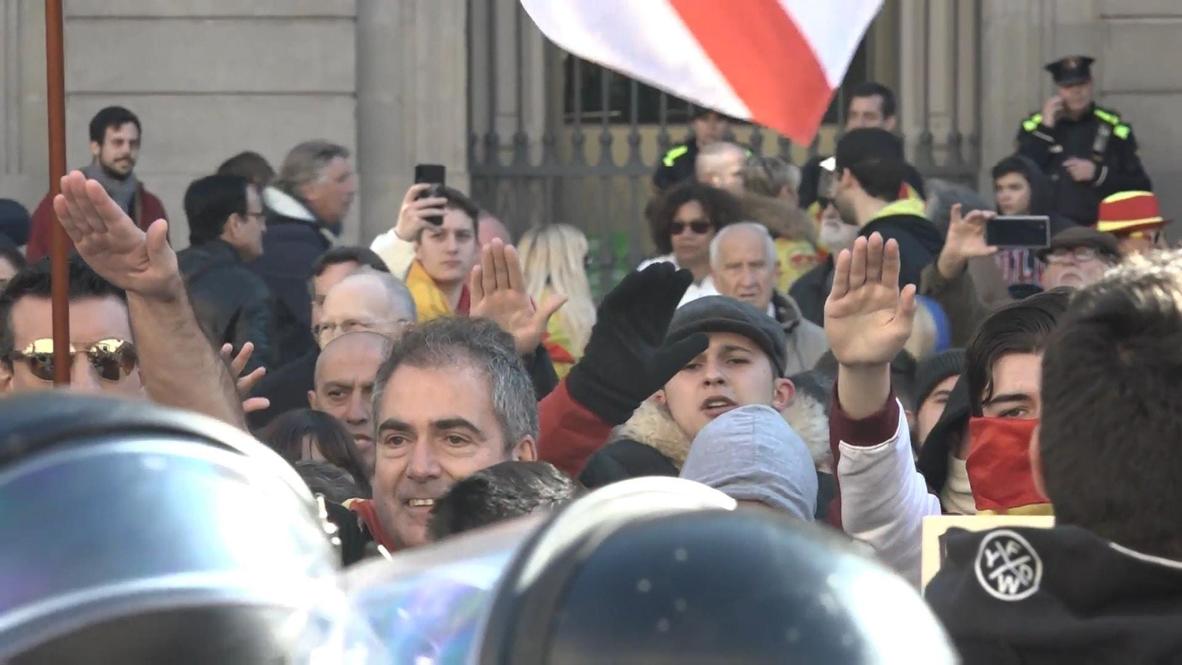
The subject is not taught in the schools and during the Dictatorship children were taught and expected to salute the icon of the Dictator Franco.
Unlike in Germany and even in Portugal, fascism was never defeated in the Spanish state and the Transition from Dictatorship brought the military, police, judges, civil servants, media moguls, university dons and Catholic hierarchy safely into the new “democracy”.
In addition, most of those who seized land, buildings, machinery and equipment, vehicles and personal wealth of the victims of the coup and war, were allowed to keep them
As Juan Morillo reminds us (see article), it is not the Spanish State that has pushed the process of disinterment and documentation of these mass graves, but relatives, communities and concerned citizens. And for a long time it was even dangerous to pursue such activities.
Fascism remains alive and strong in the Spanish state.
2Gonzalo Queipo de Llano y Sierra (5 February 1875 – 9 March 1951) was a Spanish military leader who rose to prominence during the July 1936 coup and soon afterwards the Spanish Civil War and the White Terror that followed. Capturing Seville with a force of at least 4,000 troops and ordering mass killings, he later made ridiculous claims, including that the city had been defended by 100,000 armed communists and that the fascist military troops had taken the city with as few as fifteen men. Quiepo de Llano publicly called for women of the Republican opposition to be raped.
3From Wikipedia: The Cuerpo de Seguridad y Asalto (English: Security and Assault Corps) was the heavy reserve force of the blue-uniformed urban police force of Spain during the Spanish Second Republic. (for more, see Glossary)
Andalusia: One of the ‘autonomous regions’ of the Spanish state, large southern region, from Al Andalus, province of the Moorish conquest of large areas of the Spanish state. After the Canary Islands it was the easiest for Franco’s troops to reach from the Spanish colony in North Africa; its defenders lacked time to prepare and did not last long against a well-armed and large invasion force.
Assault Guards (From Wikipedia): The Cuerpo de Seguridad y Asalto (English: Security and Assault Corps) was the heavy reserve force of the blue-uniformed urban police force of Spain during the Spanish Second Republic.The Assault Guards were special police and paramilitary units created by the Spanish Republic in 1931 to deal with urban and political violence. Most of the recruits in the Assault Guards were ex-military personnel, many of which were veterans.
At the onset of the Spanish Civil War there were 18,000 Assault Guards. About 12,000 stayed loyal to the Republican government, while another 5,000 joined the rebel faction.[1] Many of its units fought against the Franco supporting armies and their allies. Their siding with the former Spanish Republic’s government brought about the disbandment of the corps at the end of the Civil War. The members of the Guardia de Asalto who had survived the war and the ensuing Francoist purges were made part of the Policía Armada, the corps that replaced it.
Diputación: Regional administrative body in most regions of the Spanish state.
Izquierda Republicana Republican Left (from Wikipedia, translated): Izquierda Republicana (IR) was a Spanish left-wing republican political party founded by Manuel Azaña in 1934. It played a prominent role during the Second Spanish Republic and in the moments preceding the start of the Civil War. Azaña became President of the Republic between 1936 and 1939. During the Franco dictatorship the party practically disappeared from the political scene except in the sphere of Republican exile in Mexico, where it continued to have some activity. As of 1977 it was reconstituted in Spain again, although without having the (degree of) importance of the historical party.
La Macarena: Basilica of Nuestra Señora de la Esperanza Macarena (Our Lady of Hope of Macarena, base of the Holy Week Confraternity of that Catholic church. The procession on the early morning of Good Friday is one of the largest, most popular, and fervent in the whole of the Spanish state. The wooden statue of Our Lady of Hope of Macarena dates from the 17th century.
PCE:Partido Comunista de España (Communist Party of Spain) is a communist party, banned by Franco but supported the Transition from the Dictatorship and the monarchist Constitution, subsequently experiencing a number of splits. Comisiones Obreras (CCOO), one of the two main trade unions in the Spanish state, its associated trade union movement was the main underground workers’ element in forcing the change from dictatorship but is no longer under its control.
PSOE:Partido Socialista Obrero de España (Socialist Workers Party of Spain) is a social-democratic party, banned by Franco but supported the Transition from the Dictatorship and the monarchist Constitution, subsequently one of two main parties of government in the Spanish state, at the time of writing the senior member in coalition government with the Podemos party. Its associated trade union, Unión General de Trabajadores (UGT), is one of the two main trade unions in the Spanish state.
Working people have experienced many betrayals in history and the struggle for self-determination of the Irish nation has been – and is being – betrayed also.
When such betrayals occur, a range of common reactions is evoked; thinking about those responses may help the betrayed at least to moderate the harm and turn the experience to some benefit.
Equally, some ways of handling the experience can magnify and deepen the harm already caused.
Betrayal is a difficult experience for the betrayed certainly but not without some cost to the betrayer too and each has a number of common responses. This applies to the personal as well as to the political but there are some differences.
The betrayers have their followers to different degrees and these too have psychological reactions to the betrayal — and to criticism of the betrayal. We can observe these reactions in a number of recent historical cases of high levels of resistance subsequently betrayed.
The most recent phase of high degree resistance in Ireland took place largely in the British colony of the Six Counties, beginning with mass struggles for civil rights before passing through protracted guerrilla war and intense struggles of political prisoners in the jails.
In the Basque Country, the corresponding phase began with ideological-cultural struggle and mass industrial actions against the Franco dictatorship, quickly developing into a guerrilla campaign combined with street battles, resistance to conscription and struggles around prisoners in the jails.
The leadership of the Irish struggle came to political agreement with the colonial occupier, disbanded and decommissioned its guerrilla forces and acceding to its right of conquest, joined the occupier’s colonial administration, concentrating thereafter on building up its electoral base.
A similar process took place in the Basque Country but with important differences: the imprisoned activists were not released and the movement’s political leadership was not even admitted into joint management of the colonial administration.
Each nation witnessed splits, recrimination, dissidence, repression on groups continuing resistance but also a range of psychological responses which at best did not assist recuperation and in fact often deepened the harm of betrayal by the leadership.
STANDARD RESPONSES BY THE BETRAYED
DISMAY is a common reaction: How could he/ she/ they? I never thought they would. We’re finished now.
BLAME is another also common response: It was that leader’s or leadership’s fault. We didn’t fight hard enough. Those comrades criticised too much.
SELF-CENSORSHIP And EXCESSIVE CAUTION: We can see the harm in some of the leadership’s actions but we must be careful not to step too far out of the movement, where we will be marginalised and unable to have an effect1.
DESPAIR: That’s the end of everything. There’s no way out of this. It was all for nothing – all those sacrifices, all that pain.I’ll never trust people or get involved again.
APATHY: So I/ we might as well forget about it all. Just think about ourselves/ myself/ family. Drop out. Drink. Take drugs.
DENIAL: We’ve not really been betrayed. It’s just another way to go for the same thing. This is the only reasonable choice. We couldn’t keep on that way any longer, this is just a change of method. We’re just having a pause. The leadership is clever and has tricks up their sleeves. This is just to fool the authorities. It’s just going to take a little longer to win than we thought.
Those are defensive constructions in emotion and, in so far as that takes place, in thinking. But defensiveness can turn to aggression – and frequently does. The betrayers – and often the duped also – resent being reminded of what and where they are. It makes them uncomfortable.
HOSTILITY: How dare those people criticise us/ the leadership? They don’t understand and just want continual conflict. They’re endangering our secret plan. Who do they think they are? They’re just wrecking everything, undermining our new plans. They need to be taught a lesson.
PERSONAL ATTACKS: That critic is no great activist. S/he hasn’t suffered as some of us have. They were always troublemakers. Jealous, that’s what they are. They’re not very bright; no idea about real politics. They are in fact traitors, helping our enemies.
MARGINALISATION: We are not going to listen to those critics. We will not allow them space on our media. We’ll try to make sure they don’t get venues in which to spread their poison. If people are friends with them they can’t be our friends too. Such people will not enjoy our hospitality or invitations to our events. People should not even talk to them. If the authorities attack those dissidents, we are not going to trouble ourselves about them – it’s their own look out.
MANAGING THE BETRAYAL
PROMOTING LEADER ADULATION is a useful tool in shutting down the opportunities for criticism and in repressing them when they arise. “Who are we to criticise this great comrade’s thinking or actions?” becomes an implicit question, clearing the way for betrayal.
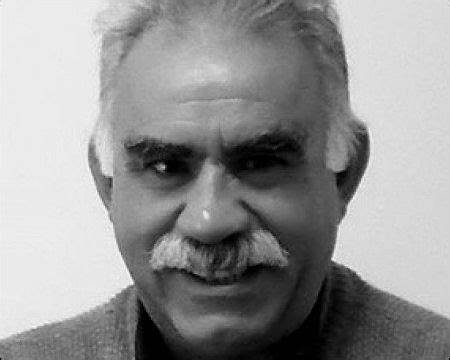
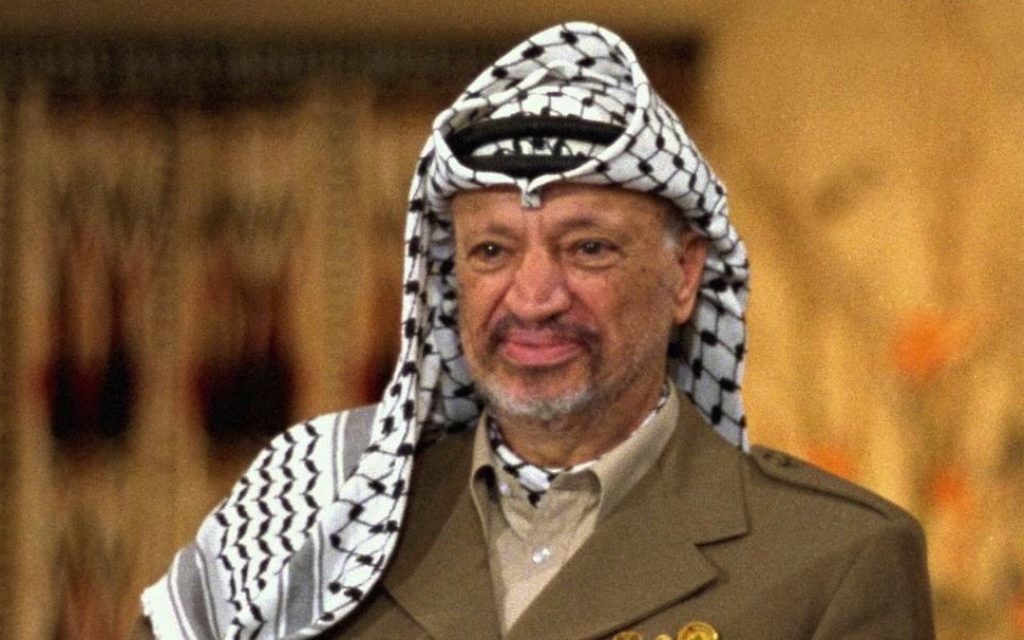
Leaders who have surrendered or compromised the struggle, L-R: Gerry Adams and Martin McGuinness of the Provisionals, Arnaldo Otegi of the Basque Patriotic Left, Abdullah Ocalan of the PKK and Yasser Arafat of Al Fatah. The latter seemed to be attempting to to turn back from the path of betrayal when he became very ill (quite probably poisoned) and died.
SEEKING COUNTER-REVOLUTIONARY ALLIANCES is engaged upon so as to appear to its members to make the organisation’s influence greater, or to outflank and isolate more revolutionary tendencies and often ultimately to make the leadership acceptable to the ruling circles.
BEGGING FOR CONCESSIONS when the revolutionary path has been abandoned can often be observed, as in “we’ve abandoned our militant struggle, please stop repressing us”, for example, a frequent response to repression of the Basque leadership once it abandoned the revolutionary path.
COLLUDING WITH THE OCCUPIER becomes a new second nature to a leadership abandoning revolution, not only in abandoning armed struggle, for example but in destroying weapons and suppressing elements still in resistance.
PROVING THEIR READINESS TO COLLUDE FURTHER, revolutionaries turned collaborators denounce continued resistance, try to convince revolutionaries to desist (or threaten or physically attack them), promote the repressive arms of the State such as the police and so on.
INTOLERANCE OF CRITICISM becomes default position; such criticism tends to expose the contradiction between the original purpose of the organisation and its concrete actions in the present. Censorship, expulsion and misrepresentation become common.
MARGINALISATION OF CRITICS follows from intolerance of criticism – the individuals or groups must be made pariahs so as to nullify or at least reduce their influence. Association with them, socially or politically – even in agitating around civil rights – must be discouraged.
REPRESSION OF DISSIDENTS finally becomes necessary, whether by threats or by actual violence or, when admitted to governing circles, by use of repressive state machinery.
DEALING WITH BETRAYAL RATIONALLY
The first necessary step is to analyse how the betrayal came about: how was it organised? What were the conditions that made it possible? What were the early signs?
Then, proceed to: what could we have done differently? What WILL we do differently in future?
Electoral work
One common assumption here in Ireland, especially in Irish Republican circles, is that the rot began with standing in elections. This is not logical and it is in effect making a negative fetish of electoral work, a taboo to be avoided.
It is often useful to the revolution in many ways to have representation in the parliament and local authorities, for example in promoting or blocking practical or legislative measures, getting media air time, visiting prisons — all without ever promoting reformism as a way forward.
Certainly the prioritisation of electoral work over other aspects is a sign that something has gone wrong: the strength of the popular revolutionary movement is on the street, in workplaces, communities, places of education, rather than in parliaments and local authorities.
The drive towards electoral representation can encourage bland slogans of the soap powder kind (“new improved” or “washes even better”) rather than those with revolutionary content and also the promotion of more bourgeois individuals in preference to grass-roots organisers.
Anodyne election slogan in both languages for Sinn Féin.
But none of that means that representation in those bodies cannot be used to further the popular struggles or that such aberrations cannot be avoided. And in fact, the concentration on criticism on the electoral factor served to distract from a more fundamental error.
Of course, electoral work should never, for revolutionaries, be about entering government under the current socio-economic system, i.e sharing in the administration of the State.
Leader adulation & intolerance of criticism
If criticism is not tolerated when errors are committed, they can hardly be corrected. Again and again it has been observed that the party/ organisation faithful refuse to accept external criticism from non-enemies. Internally the leadership inhibits criticism by the members.
The cult of the leader also inhibits criticism and therefore correction of errors. And behind this image others can hide and also commit errors. Problematic as dead icons may be, living ones are many times more dangerous – deceased ones at least do not change their trajectories.
Such created living icons have been Mandela in South Africa, Yasser Arafat among Palestinians, Gerry Adams and Martin McGuinness in Ireland, Arnaldo Otegi in the Basque Country and Abdullah Ocalan among Kurds (particularly in the Turkish and Syrian states).
Nobody knows everything or is always right. Bothersome as being criticised may be, its total absence is worse, allowing us no opportunity to question ourselves as activists and in particular as revolutionary organisations.
The revolutionary leadership, party or organisation is not the people
The revolutionary leadership, party or organisation does not have all the answers and is not the people. This might seem obvious but from the behaviour of such leaderships and their followers in the past it is clear that the opposite philosophy has been dominant.
Confusing the organisation with the people or with revolution itself, we assume that what is good for the organisation is also good for the people and the revolution. This however is not always so and leads to placing the perceived well-being of the organisation above the needs of the revolution.
Indulging this confusion leads to political opportunism and sectarianism, bad relations with other revolutionaries, ignoring all external criticism and placing the needs of the leadership higher than those of the membership and of the membership higher than those of the mass movement.
Internationalist solidarity
In internationalist solidarity work we build the unity of the people across borders and against the same or different enemies than those against which we are struggling.
One feature observed in a number of organisations where the leadership is moving towards betrayal is a reduction or elimination of such work.
To those in our ranks seeking an accommodation with imperialism and capitalism, those internationalist solidarity alliances are either a) unimportant or b) a hindrance to the alternative reactionary alliances to which they aspire.
The latter was very much the case with the Provisionals’ attitude to US imperialism. For decades, their leadership maintained apparently mutually-contradictory positions on what is the biggest imperialist superpower in the world.
On the one hand, for example, there could be involvement in solidarity with Cuba against the US economic blockade and, in the past, against US sabotage and terrorism against the Sandinista regime in Nicaragua.
On the other hand, the leadership sought the support of the US elite against British colonialism, which is occupying a part of Ireland and against which the movement was waging, in that colony, an armed and popular struggle.
Seeking support from the US imperialist elite entailed distancing from left-wing Irish USA and dropping support for even long-term inmates of US jails, such as American Indian Leonard Peltier and Black American Mumia Abu Jamal, arising out of popular struggles inside the US.2
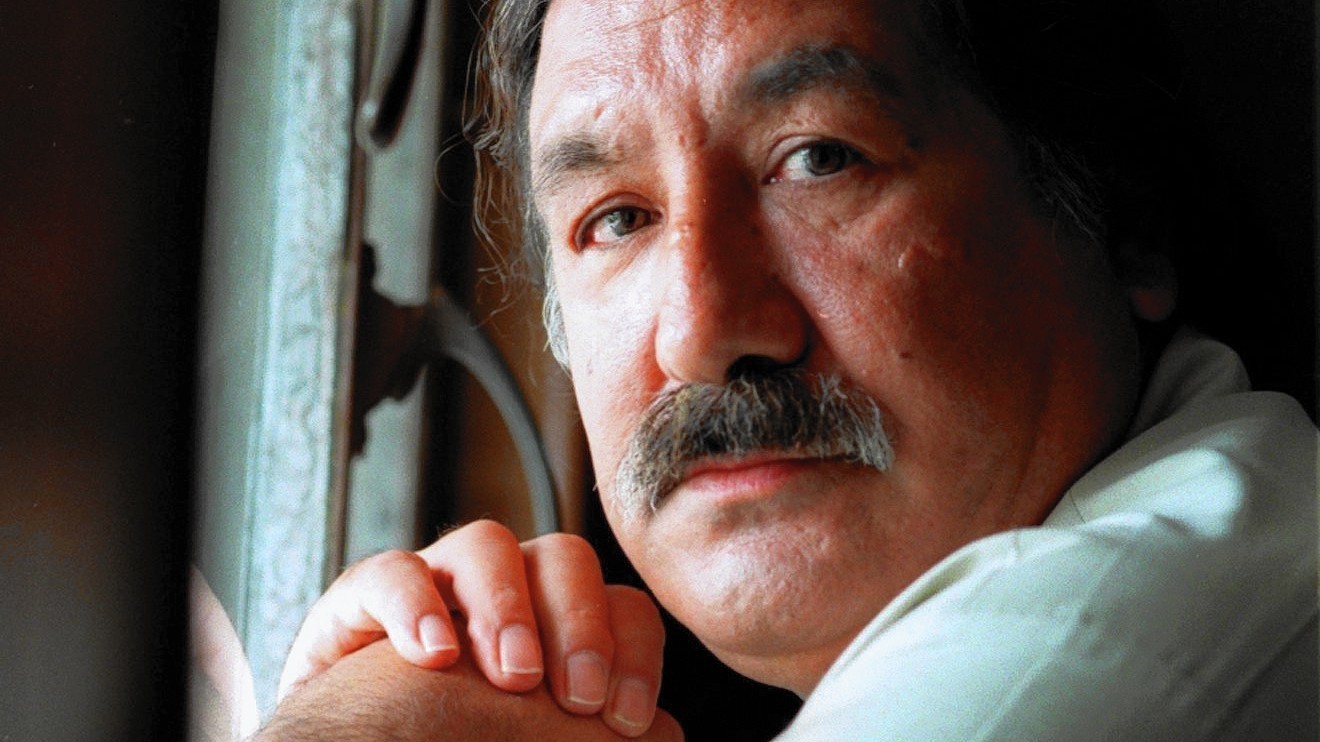
Leonard Peltier, Native American convicted in 1977 in deeply flawed trial for murder of two FBI agents in 1975 shootout on Pine Ridge Reservation. Nearly 80 years of age now and with multiple health issues, even release on clemency grounds is constantly blocked. His is one of many campaigns in the USA which SF cannot support as they seek to remain friends with the Democratic Party elite there.
Black American journalist and activist, framed for the murder of a corrupt Philadelphia policeman in 1981 and sentenced to death in 1982, sentence commuted to imprisonment for life without parole in 2011. Mumia is nearly 70 years of age now with a number of health issues. Another of the type of injustice in the USA about which SF cannot campaign as they seek to stay close to the Democratic Party elite. Anecdotally, a SF Councillor who was regularly writing to him was obliged to desist on instruction from her party leadership.
Unprincipled alliances
Another warning sign is the founding of unprincipled alliances with other organisations in struggle. For example, although it is correct to have a position of support for the Palestinian people, that should not necessarily bind us to exclusively support the fighters of one organisation only.
The Provisionals made their alliance with the Al Fatah organisation to the exclusion of all others in Palestine but worse was to come, for Al Fatah shoved aside the idea of a free Palestine and the right of return in exchange for administrative partial autonomy and funding.3
From there, Al Fatah became so corrupt that the Palestinian people, that had long supported a secular leadership, voted overwhelmingly for an islamic fundamentalist party, Hamas4. The unprincipled alliance with Al Fatah and the ANC was used to ‘sell’ the GFA to Irish Republicans.5
In the Basque Country, the mass movement’s leadership developed close links with the leadership of the Provisionals and refused links with Irish Republican organisations that dissented from the Provisionals’ position or with Republican prisoners after the Good Friday Agreement.
That should have sounded alarm trumpets in the Basque movement but if it did, it remained largely without practical effect. Askapena, the Basque internationalist solidarity organisation did split from the main movement but did not go so far as to support ‘dissident’ Irish Republican prisoners.
LESSONS
On the basis of the preceding I think we can draw a number of primary lessons.
LESSON ONE: ANALYSE THE MISTAKES OF THE PAST AND SEEK TO AVOID REPLICATING THEM
The type of struggle, location, timing, peripheral situation, long, medium and short-term objectives, experience and expertise of personnel, resources … all need to be analysed, in conjunction with the strengths and weaknesses of the enemy.
In carrying out this kind of analysis on the Irish struggle, we see that we faced one of the military superpowers, also well linked into the western imperialist world. The Republican movement’s battle area was in total one-sixth of the nation’s territory and the location deeply divided.
The rest of the nation was ruled by a weak foreign-dependent ruling class.
Map of Ireland showing the British colony of the Six Counties. The Provisionals took on the British state, mostly confining their struggle in that deeply divided politically and culturally region shown in yellow.
A movement cannot choose when it has to step forward in defence but it can choose how it develops the struggle afterwards. It seems obvious that in order to be victorious, at the very least the struggle would have to be spread throughout the nation.
That in turn would entail putting forward social and economic objectives to attract wider support which, in turn, would mean taking on the Catholic Church hierarchy.
In addition, the question of effective external allies was relevant here but even more so in the Basque Country, located across the borders of two powerful European states.
The total population of the portion of the Basque nation within the Spanish state is far short of three million, that of the rest of the state over 44 million.
Clearly allies external to the Basque nation would be essential for victory and these would have to come from across most of the Spanish state at least.
Map showing the ‘autonomous’ regions of the Spanish State; the southern Basque Country is shown in pink at the top, including ‘Navarre’ shown in yellow next to it. Essentially, the Basque Patriotic Left without allies confronted the Spanish state from there.
Such an assumption would entail, in turn, outlining objectives to attract considerable numbers from across the Spanish state which in turn would mean creating alliances with revolutionary and other progressive forces across the state.
LESSON TWO: REFRAIN FROM PERSONALISING THE ISSUES
When criticism of the counter-revolutionary line put forward by individual leaders becomes personalised, the political essence of the criticism becomes lost or at least obscured. It can seem as though the critics have personal reasons for their hostility or even jealousy of the individuals.
Much of what one sees publicly posted by opponents of pacification programs in Ireland and the Basque Country often seems more about hostility to the personalities of MaryLou MacDonald, Gerry Adams, Martin McGuinness or Arnaldo Otegi than about specific policies and actions.6
Crucially, focusing criticism on individual leaders serves to conceal other underlying causes of failure and betrayal that are usually more fundamental: problems in objectives, errors of strategy, in particular and also of tactics along with unhealthy organisational dynamics.
LESSON THREE: DEVELOP INTERNATIONALISM AND AVOID UNPRINCIPLED ALLIANCES
In the face of imperialist and other reactionary alliances, revolutionaries need internationalist solidarity, the basis for which should be revolutionary positions and action. Exclusive alliances are generally to be avoided as is uncritical support or unquestioning approval of all actions.
LESSON FOUR: CONTRIBUTE TO BROAD FRONTS WITHOUT SURRENDERING THE REVOLUTIONARY LINE
A broad front is essential not only for successful revolution but also often for defence against repression. Such fronts should be built on a principled basis with respect for the participating groups and individuals but without surrendering the revolutionary line.
At the same time, the possibility of betrayal, opportunism or sabotage and marginalisation by partners in broad fronts need to be guarded against and, if occurring, to be responded to in a principled and measured manner.
Broad fronts not only increase the numbers in resistance in a unified manner but also expose the activities of the constituent groups to the members of other parts of the broad front. Activists can then evaluate organisations and one another on the basis of experience rather than of reputation.
The revolutionary line should not be abandoned or concealed when in a broad front with organisations and individuals who have varying lines. At the same time, it is not necessary to be pushing the revolutionary line every minute.
LESSON FIVE: DON’T GIVE UNCONDITIONAL TRUST TO LEADERS
Of course, our leaders and activists must be trusted – but always in the knowledge that no-one is perfect or above the possibility of error. The shutting down of opportunity to voice criticism should sound alarm bells in any revolutionary movement.
There are of course “time and place” considerations in criticism; for example, the capitalist mass media, police interrogation or trial in court are hardly appropriate places to criticise a revolutionary movement’s leadership.
LESSON SIX: TOLERATE INTERNAL CRITICISM AND CAUCUSES IN BALANCE WITH COLLECTIVE RESPONSIBILITY
The above touches upon this area too. People who follow us without question may equally do so with another.
The right to caucus, i.e to collect around a particular revolutionary trend or focus needs to be acknowledged and formalised. Like-minded people will naturally associate and it is far healthier to have this occur in the open rather than in secret.
At the same time, when a discussion reaches democratic decision, the minority whose positions were rejected need to present a common front with the rest of the organisation or movement.
Similarly, political and organisation criticism needs to be welcomed or at least tolerated within the organisation or movement because it may be correct and point an alternative way forward and even if it isn’t, the discussion around the criticism will help to clarify matters.
Such openess to criticism and discussion encourages a conscious and thinking membership which by that measure alone and organisationally makes it more difficult for some individual or clique to manipulate the membership.
1“Outside the broad movement it is very cold”, said a Basque to me once. He was a member of a small Left group critical of the leadership’s approach but unwilling to completely rupture with them.
3With the Camp David (1978) and Oslo Accords (1993 & 1995).
4In 2006 (the most recent) Palestinian parliamentary elections, Change and Reform (Hamas) won 74 seats and Al Fatah 45. In Gaza Al Fatah rejected the result and tried to seize power but were defeated in a short battle, though Hamas did not battle their assumption of power in the West Bank. All dates for elections to Palestinian Parliament since have passed without polling.
5And since then, unprincipled alliances with Provisional Sinn Féin have been used by the main Basque organisation leadership and ditto with Colombia to ‘sell’ pacification processes in those countries (which have been even worse for them than has the GFA been in Ireland).
6As a historical note, it is said that some of the delegates who voted for the Anglo-Irish Treaty in January 1922 were moved to do so by the nature of the attacks of Cathal Brugha, for the anti-Treaty side on Michael Collins, leader of those for the Treaty. The majority of delegates voting in favour was only seven.
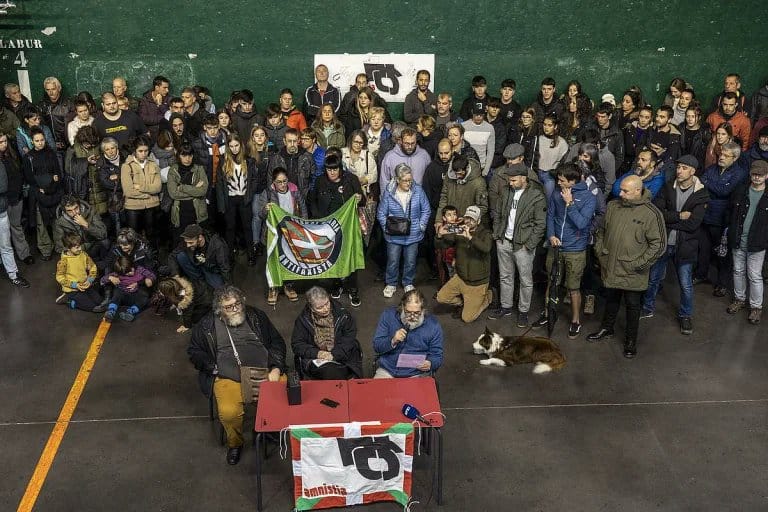
TINKO is an independent organization created to work for COMPLETE AMNESTY. As an amnesty organization, it intends to create the necessary means to fight against repression with its scope of work being the Basque Country.
As its name indicates2, it intends to reflect the attitude of determination and commitment of some political prisoners3 in these difficult times. Along with the dignity and toughness that is being maintained, there must be constant struggle in the streets.
It is our responsibility to keep the flame of the struggle burning; for this reason, we see it more necessary than ever to organise ourselves.
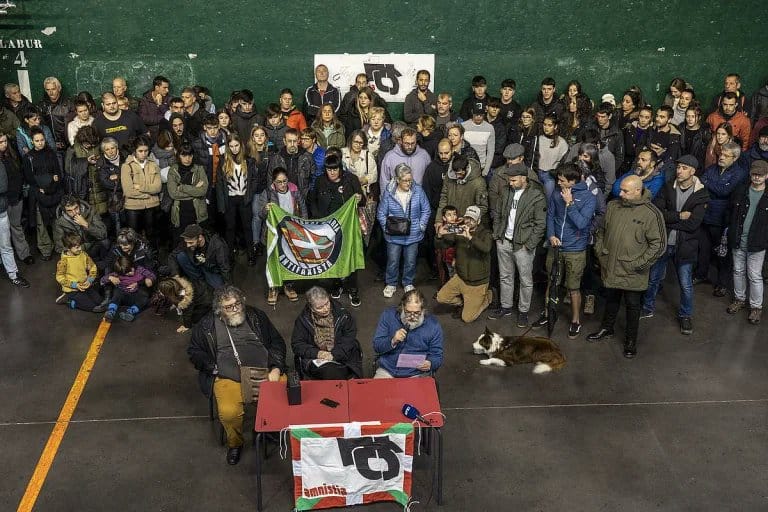
Drop-banners against repression in different locations in the southern Basque Country/ Spanish state (Photo: Tinko)
TINKO’s understanding of repression goes beyond reporting each case in isolation, since each of these cases responds to a general repressive situation.
The states are the ones that speak of the individualised treatment of prisoners, denying their political nature and hindering solidarity. Therefore, our duty in this regard is to promote unity and solidarity.
It is the slogan of COMPLETE AMNESTY that offers this overview of the aforementioned repression, as well as the political solution that opposes this repression.
Full amnesty includes freedom from all political repression without exclusion, as well as overcoming the underlying causes of repression, such as national and social oppression.
Therefore, TINKO is an organization made up of ideologically-conscious activists, who want to make their contribution in the field of anti-repression towards a Basque Socialist State.
If the intensity of the struggle is met with repression, it will be our task to counter that repression, to try to facilitate the conditions for the struggle.
It is necessary to take a broader reading of repression, paying attention to reality with the intention of joining our forces.
We aim to create a broad movement against the repression that upholds the interests of the political victims of the struggle cycles of yesterday, today and tomorrow, that will always be in accord with the declaration of complete amnesty and not establish differences according to the struggles carried out.
It is necessary to underline the enormous generosity of the militants who suffered the repression of the previous phase. They have been our compass even in the bleakest times and they continue to be so today.
Total amnesty is our strategic objective and we do not define it in a purely legal way but instead in a political way.
Amnesty includes the unconditional release and freedom of prisoners, fugitives, refugees and political deportees and also the resolution of the reasons that motivated these people to fight for their fundamental rights, in the case of the Basque Country, against national and social oppression by the Spanish and French states.
Only ending the denial of our rights can ensure that prisons do not fill up anew after they have been emptied. These are the other measures that a full amnesty should include, along with the aforementioned freedom from political repression:
The right to self-determination
Abolition of repressive laws against the working class. Repeal the labour reform laws, the muzzle law, the party law and the anti-terrorism law4.
Dismantle and expel the repressive and occupying forces from the Basque Country.
Press conference in November in solidarity with 18 people from Berango accused of “glorification of terrorism” (sic) for organising an “ongi etorri” (welcome) event for a released political prisoner. (Photo: Tinko)
ANTI-REPRESSION NETWORK
As we said at the beginning, TINKO intends to create the necessary means to combat repression.
We consider it necessary to create useful tools to organise in cases of repression, which allow the creation of effective solidarity networks for the protection of those who suffer repression for being active in different fields.
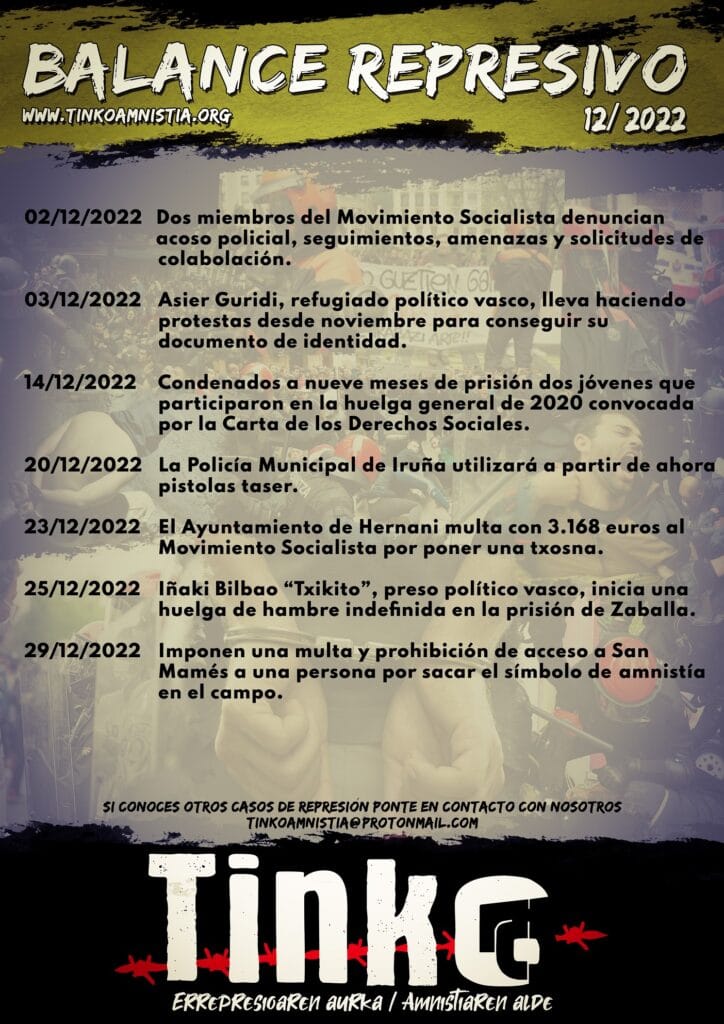
Monthly summary of repression (Castilian language version) December 2022, including: 9 months jail for two youth participants in the 2020 General Strike; municipal police in Irunea/ Pamplona are to get taser pistols; the municipal council in Hernani fine Socialist Movement 3,168 euro for running a street stall; Basque political prisoner initiates indefinite hunger strike in the Zabala prison. (Source: Tingo)
In addition to organising instruments for protection in the courts, insisting on repression as being general and calling for total amnesty. While the net would be politically wide, victims of repression would receive protection according to the following minimum essentials:
Joining the call for total amnesty.
Feeding the network itself, that is, strengthening the network against other cases of repression.
Putting the collective before the individual.
Not denying access to basic political rights in a possible trial: the right to political organization, the right to demonstrate, the right to assembly and the right to freedom of expression.5
End.
FOOTNOTES
1Tinko was founded some months after an internal dispute inside the Amnistia organisation in the autumn of 2020 about whether to support a demonstration in Madrid or not. Amnistia itself, as with Tinko, grew out of the perceived necessity to resist repression in order to move forward in struggle, while the official leadership of the left-nationalist movement was adapting itself to the requirements of the Spanish State.
2“Tinko” means ‘firmness’ in the sense of ‘resolved/ standing firm’.
3Note the qualification “some”: the leadership of the Basque prisoners’ organisation and of the relatives’ support group, Etxerat, followed the abandonment of the revolutionary path by the leadership of the Basque Izquierda Abertzale mass movement. Most of the prisoners followed the leaders’ line, which entailed prisoners not calling themselves “political” prisoners, not joining any protests and seeking parole as individuals, including apologising for their previous actions. The leadership dropped the call for Amnesty and confined their demands to an end to the dispersal of prisoners away from their home areas.
4In brief, laws restricting the right to strike and to record and disseminate police violence, along with laws permitting repression of political activists.
5There is a practical reason for the inclusion of this requirement: The Spanish State demands the political activists it arrests apologise for their resistance and undertake not to repeat it. Shamefully and to the shock of many, in September 2019, 47 activists in three organisations engaged in prisoner solidarity work, including officials of the Basque Left Movement, in exchange for non-custodial sentences on all but two (who received relatively light sentences) pleaded “guilty” to ‘anti-terrorism’ charges. Doing so endorsed the criminalisation by the Spanish State of prisoner solidarity work and was a great shock to many Basques, including the 50,000 who had demonstrated in Bilbao in solidarity with the accused only days before the trial and had been kept in ignorance of the deal. (SeeEuskal Herria. Iñaki Gil de San Vicente: “Es inadmisible engañar a 50.000 personas, pactando a sus espaldas” – Resumen Latinoamericano)
Whilst many of the Wokerati repeat uncritically any statement from the Western media or even NATO on Ukraine, wokeness itself was not to be found in Ukraine.
The rabid right wing homophobic sentiment expressed at gay rights marches before the war, was not a fertile ground for the Wokerati.
Homophobia abounds, as does racism, something we saw when black people were taken off or prevented from boarding trains leaving Ukraine at the start of the war.
Gay rights and racism are not woke issues per se, in fact the Wokerati in the West have abandoned gay rights, particularly Lesbian rights, in favour of male heterosexuals invading women’s spaces. But you get the general idea about Ukraine being a hostile terrain.
Not any more, wokeness and its methods have come to Ukraine. How it has done so, and on what issue, is illustrative of the reactionary nature of wokeness. When Russia invaded Ukraine, ridiculous calls were made to ban everything from Tchaikovsky to Tolstoy.
In doing so, they emulated woke calls for authors to be banned from the airwaves and also the rewriting of history with long dead authors being judged by current understandings of society on issues like race, but not class.
Class was still fair game, in fact it is the target of many woke comedians, whose middle-class audiences like to show their social sense of rightness by frowning on historical authors on issues, like race, women (to a degree only) and others.
So, we are only a few steps from Shakespeare, John Donne and others getting chopped, but they have no problem with working class people being the target of their jokes.
Now the Ukrainians have got in on the game with calls for the closure of a museum in Kiev dedicated to the writer Mikhail Bulgakov.1 Yes, I had to look him up too. I have to confess to the woke literati that he was never on my radar before this moment.
I mean, he is not Tolstoy, is he? And he is certainly not anything closer to home like Beckett, or even the English author Thomas Hardy, both of whom have survived the woke banning spree so far, but this might be because their stuff is a little dense and maybe they haven’t read them yet.
I know I haven’t, though as a child my Da would read them and sometimes out loud. So, I knew not to bother with them at an early age, unless you were going to get very serious.
Bulgakov’s crime was that he wasn’t enamoured with Ukrainian nationalism and so he must be expunged from the record.
Mikhail Bulkakov Museum Kiyv (Photo sourced: Internet)
Ukraine’s national writers’ union has called for the museum at number 13A Andriivskyi Descent – a historic cobbled street linking the upper town with the district of Podil, on the banks of the Dnipro River – to be closed down.2
Apparently, he even criticised some Ukrainian nationalists of his time and Stalin was fond of some of his plays, though he censored him at the same time. Bulgakov opposed the idea of an independent Ukraine.
And even The Guardian acknowledges that this was a common position at the time. He was not alone.
The museum’s director, Lyudmila Gubianuri, has also hit back against criticism, calling Bulgakov “a man of his time”.
“He was born and lived in the Russian empire. Bulgakov had an inherent imperial mindset, but neither he nor his family were ever Ukrainophobes,” she stressed. “Bulgakov did not believe in the reality of an independent Ukraine, like quite a lot of people at that time.”3
Mikhail Bolgakov (Photo sourced: Internet)
Were we to do this in Ireland, lots of people would come a cropper. Seán O’Casey would get it in the neck. Joyce would be frowned upon as well, not for the views that saw the Catholic Church come down upon him, but perhaps his general view of Ireland.
Brendan Behan was certainly in favour of Irish independence, but he joined the IRA and was arrested on bombing charges, so in the new climate of blessing the British government for taking up the White Man’s Burden in relation to us, he might also get it.
There is no end of writers who might be banned. Roddy Doyle, is no friend of Irish independence. His unpublished play My Granny Was A Hunger Striker, written shortly after the 1981 hunger strike which saw ten men die, gives you an idea of where he stands.
Maybe in the future someone might call for his works to be removed, no more The Van or Paddy Clarke Ha, Ha, Ha, or his work on violence against women in the home, The Woman Who Walked into Doors. I knew I should never have read him or even Behan, Joyce or Casey.
Yes, I actually read them, unlike Beckett.
The reactionary nature of wokeness can be seen in its arrival in Ukraine. It is about stifling dissent and debate and generally promoting reactionary ideas. It is something more at home in an authoritarian regime like the Ukrainian one.
Russia has been more straightforward in its censorship, though now a capitalist regime, its take on repression and censorship, has been borrowed straight out of the Soviet era book.
The Wokerati under the guise of liberalism also want to shape a view of society on the basis of authoritarian methods, such as social shaming and the banning of literature to the literary equivalent of Outer Mongolia and have had some success.
Liberals ban books and place authors in quarantine, Ukrainian nationalists adopt the same tactics. Tells you everything you need to know about both.
Though, that the Western Wokerati were streets ahead in the book burning club probably means they have the edge over the zealots of the East and this is also telling.
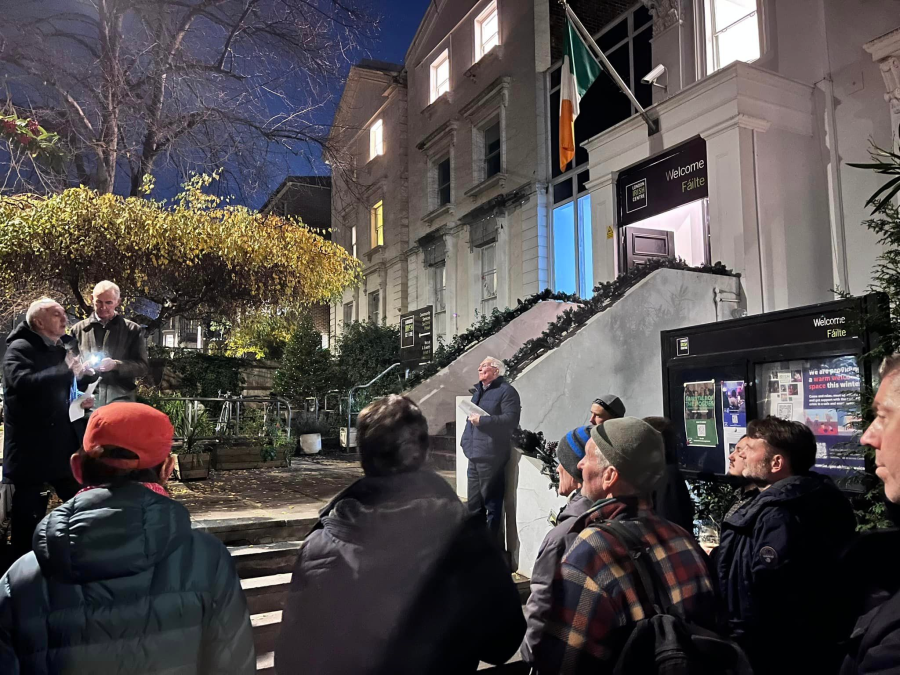
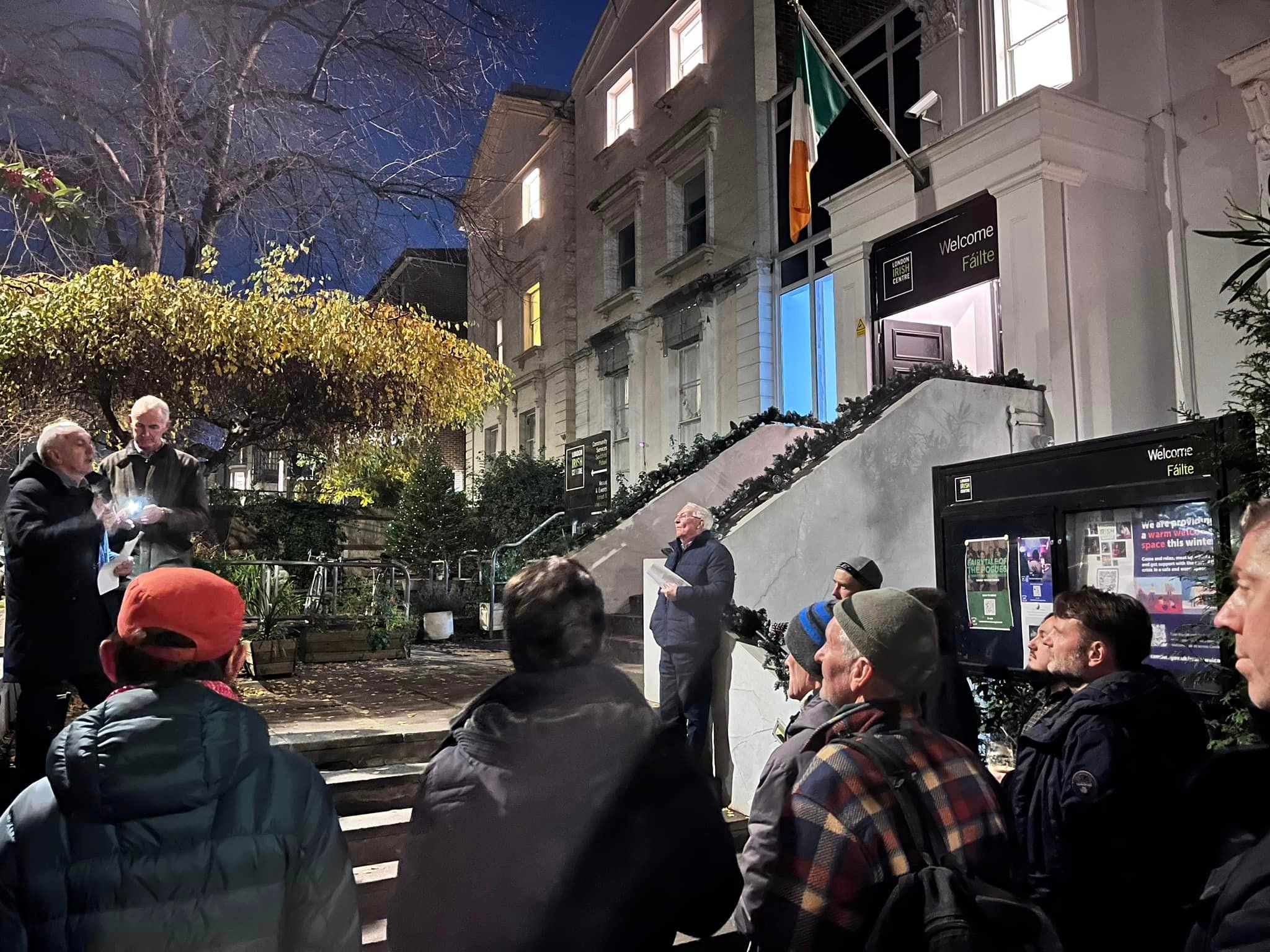
Speech by Pat Reynolds2 in Commemoration of Irish Civil Wars 1920-1923 on a sub-zero evening outside Camden Irish Centre, London on 8th Dec 2022
(Reading time: 15 mins.)
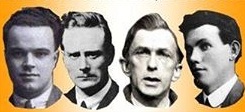
A Chairde Ghaeil agus a Chomrádaithe, tonight we are gathered here to remember and celebrate the lives of Liam Mellows, Rory O’Connor, Dick Barrett and Joe McKelvey, four great Irish patriots.
We also call out the neo-colonial Irish Free State for those unlawful murders and all other executions carried out by this British Imperialism-backed Dublin regime, acting on orders to attack the Irish Republic and its army and people.
In remembering this time and the setting up of the Irish Free State and the Northern Ireland government 1920 -1923 we take the Republican view of history in an All-Ireland context and avoid the narrow structures of the Free State 26-County centenaries.
These ignore the Six Counties and the heroic role played by the people there in defence of the Republic and a United Ireland.
In looking at this time in history we consider the two proxy wars waged in Ireland by British guns and on behalf of imperialistic interest to put down the Republican fight for a 32-county Irish Republic declared in Dublin at Easter 1916.
That was voted by a very large majority in 1918 for the same All-Ireland Republic, fought for in a war of independence from 1919 -1920 by an undefeated IRA.
The revisionists try to partition the Irish struggle to backdate some kind of imaginary Loyalist/Unionist state which never existed, was never fought for or voted on to create a colonial divide-and-rule in what was always even — under colonial rule — one country.
As Republicans we reject the 1948 Republic declared by the Blueshirts3 and fascist Franco ally Costello.
Those who want to read about this heroic struggle by the Irish people should read the two books by Ernie O’Malley TheSinging Flame on the War of Independence and On Another’s Man’s Wound on the Civil War.
In looking at the history of this time we see two wars being fought against the Republic, the first in what became Northern Ireland from June 1920 to June 1922, a two-year war to put down the Republican people in the North East of Ireland.
The second war was within the newly created 26 Counties Free State from November 1922 to May 1923, a nine-month war by British guns against the Republic.
It is sad to state here tonight that the only war ever fought by the Free State Army was to put down the Irish Republic and its own people.
James Joyce in the Dubliners short story collection has this wonderful story The Dead where at the end he looks out the window and sees it is snowing, in his words “it is snowing all over Ireland, snowing, on the living and the dead.”
At that time in history, we see British guns firing down all over Ireland, leaving us the heroic dead and the living nightmare that became the Irish Free State and the Six Counties, seen years earlier by James Connolly as “a carnival of reaction”.
What we see happening at this time of history is that Imperialism tried and won by negotiation what they had failed to do in war, to defeat the undefeatable IRA and the undefeated people.
The imposition of Partition upon the Irish people required the breaking up of the Republic declared in 1916 in rebellion, by democratic vote in 1918, and fought for in the War of Independence from 1919-1921.
The Imperialists moved first to break the Republicans and Nationalists in the North East of Ireland.
We see from Churchill’s father playing “the Orange card”4 to benefit the Tory party in the late 1800 to the Curragh Mutiny in 1913, and the arming of the Unionists their intentions on retaining the wealthiest part of Ireland and the Belfast manufacturing base of shipbuilding.
We see the hand of Sir Henry Wilson at play from the aftermath of the Curragh Mutiny, where he protected senior army officers, to his role in being political and military advisor to the emerging Northern Ireland government, and the arming of the new Unionist state.
We see his hand in diverting the body of Terence MacSwiney from Holyhead to Cork, the hanging of young Kevin Barry and the Orange led anti-Catholic pogroms of Belfast and Banbridge.
We see it in other links too with the Orange murder gangs which, led by Orangemen were involved in murders in Cork, and in the murder of Thomas MacCurtain Lord Major of Cork.
District Inspector Swanzy5 was believed to be responsible for the gang who murdered Thomas MacCurtain who was then moved to Lisburn, Co. Antrim. He was tracked there and executed by the IRA.
Sir Edward Carson in the House of Commons supported the Amritsar Massacre6 as did Churchill who falsely claimed that the protesters were armed and stated, ‘Men who take up arms against the State must expect at any moment to be fired on.
Men who take up arms unlawfully cannot expect that troops will wait until they are quite ready to begin the conflict. When asked What about Ireland?, Churchill stated, I agree and it is in regard to Ireland that I am specially making this remark.
We can see this in the murder of Thomas Mac Curtain7 and other Republicans
Also when another Orangeman from Banbridge, Colonel Smyth stated this policy that suspects could be shot on sight if the RUC had good reason to believe they might be carrying weapons or did not put up their hands.
Smyth’s new shoot-to-kill policy was published and he was recalled to London to meet Lloyd George. Michael Collins ordered that Smyth be executed before he could implement his shoot to kill policy.
Later on, Smyth’s brother,8 also in special forces was shot dead in a shoot-out with Dan Breen in Dublin. After Smyth’s funeral in Banbridge there was organised large scale anti-Catholic attacks on businesses and houses.
The anti-Catholic pogroms lasted for two years from June 1920-June 1922 in the North-East of Ireland in Belfast, Banbridge and other areas. There were over 500 deaths in these pogroms but only 13% (65) were army/police or IRA while the other 87% were civilians.
Here civilians are the main targets, with 58% of these being Catholic and 42% being Protestant. But based on the population of Belfast at the time, 76% Protestant and 24% Catholic, Catholics were four times more likely to be killed than Protestants.
The British government stood largely idly by while these pogroms went on and did absolutely nothing about it.
We see this clearly in how Catholic workers and Protestant socialists were driven out of the shipyards, some ten thousand Catholic workers driven out of their jobs for being Irish and Catholic and we see one thousand homes and business burned out.
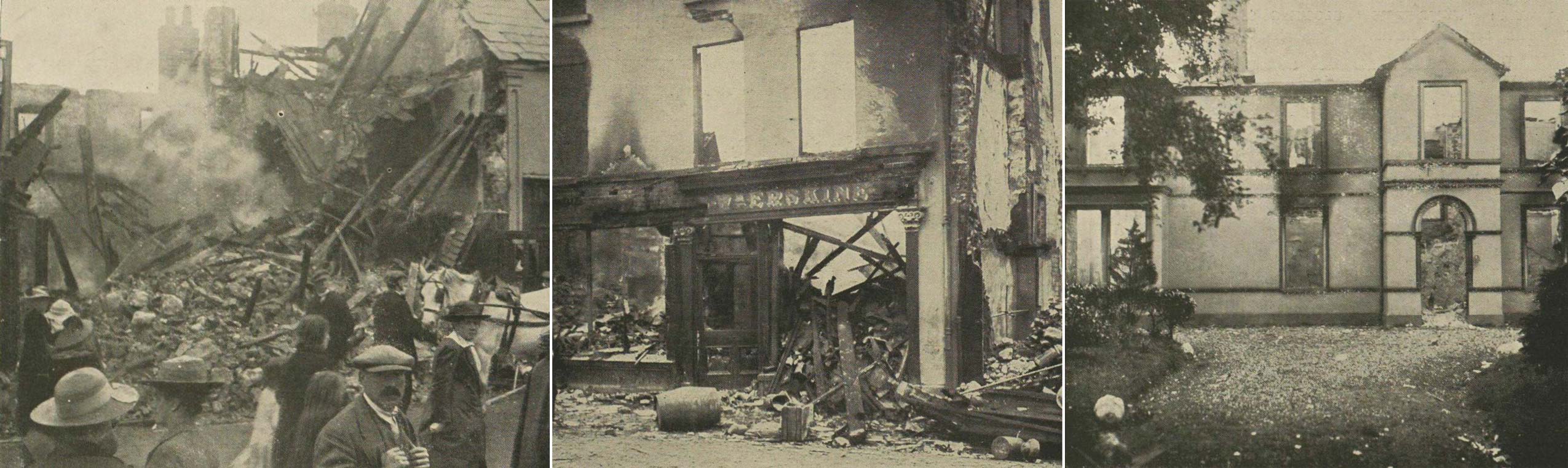
Damaged buildings in Lisburn due to sectarian riots. Note parochial hall gutted on far right.
Some 80%of the places burned out were Catholic-occupied or owned and 80% of the refugees were Catholic. Considering Catholics only made up one quarter of the Belfast population we can see what happened here.
This was the putting down of the Republican nationalist community to enforce the partition in Ireland and to prepare for a one-party neo-fascist apartheid Protestant statelet.
The impact of the ten thousand job losses and the burning of houses and businesses led to large scale migration of Catholics from the North east to Britain and to Dublin.
We also see at this time the use of British death squads to murder Catholic as they did in Cork City with McCurtain and now in Belfast with the McMahon family and others. These death squads were operating within the RUC9.
In the 1970-1995 period we see the emergence again of these British death squads in Northern Ireland linked to British intelligence, army and police with often open collusion and sharing of agents and information.
Collins had asked a Catholic priest and a university professor to record and write up each of the deaths during the pogroms, but when it was at the printers the Free State government after Collins death decided to pulp the whole print run.
This was in order to cover up what had happened to the Republican/nationalist community around Belfast in the pogroms, probably because of their own shame with the own war crimes of executions of prisoners and atrocities during the war.
It was to add to their shameful record. The story of the Orange pogrom was not published until the 1990s. Those who want to can read it under the title Orange Terror. Equally The Orange State or Arming the Protestants by Michael Farrell cover this time.
The execution of Sir Henry Wilson in London in June 1922 put an end to these pogroms against Catholics in that the head of the serpent, the rabid anti-Catholic Orange Bigot was gone.
He was a political and military advisor to the new Northern Ireland government and was largely responsible for the arming of the new Protestant state, including the B Specials10.
Tonight, we honour those brave Irish volunteers and community activists who tried to stop the pogroms and defend isolated Catholic areas in Belfast where most of the killings took place, those who stood for an All-Ireland Republic and against the imposition of Partition.
We must never separate their fight from the fight in the rest of Ireland to defend the Republic. The partitionist mind has no place in Republican history.
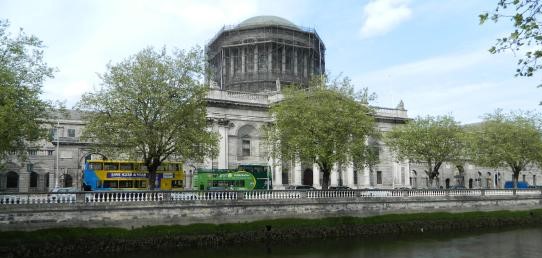
The war in Ireland to smash the Republic now turned to the rest of Ireland when under Churchill’s orders and Churchill-supplied weapons, Collins attacked the Republican army in the Four Courts starting a second proxy war on behalf of British imperialism in Ireland.
The Truce between the undefeated IRA and the British government started on 6th July 1921 and ended with the Treaty of 5/6 December 1921. The Treaty was signed under threats by Lloyd George of immediate and terrible war.
The Treaty today would be seen as unconstitutional under international law given the violent threats made by Lloyd George. The Treaty was for the Partition of Ireland with a British Governor General in Dublin and an oath of loyalty to the English King.
Two of the big lies around the Treaty were when Collins stated it was a stepping stone towards a united Ireland, in fact it was a millstone around the necks of the Irish people since then.
The second lie to justify this surrender was that the IRA was weak and low in arms. This was nonsense as evidenced by the Civil war fight.
The Dáil on 7th January 1922 voted 64-57 in favour of the Treaty, once again the Dáil11 voted under the duress of immediate and terrible war.
All the women deputies voted against it, as did the female relatives of the 1916 leaders Pearse, Connolly, the MacSwineys and Cumann na mBan
The Catholic Bishops fully supported the Treaty as they did with the Act of Union in 1800, and every priest in Maynooth took an oath of loyalty to the English Crown on ordination.
The Press in Dublin, TheIrish Times, Independent and The Freema ns Journal all supported the Treaty as did big businesses, big farmers and the Unionist community which included four Unionist TDs.
From January to May 1922 Collins rebuilt the new Irish army up to some 58,000 men. These included some 30,000 ex-British Army men, some 3,000 deserters from the IRA and some 25,000 new recruits.
The British Army allowed any serving Irishman to transfer into the new Irish army without any loss of pay or rank.
Collins was running to London on a regular basis to see Churchill who wanted to see the new army attack the IRA. In May 1922 Churchill stated that ‘there is a general reluctance to kill each other’.
There was a General Election on 16th June 1922 when Pro-Treaty group won 58 seats with 35 going to anti-Treaty, four to Unionists, 17 Labour, seven to a Farmers’ party and 17 others.
Collins broke the Pact with De Valera under orders from Britain and by June 1922 there were two armies in Ireland, the IRA and the new army set up by Collins and Mulcahy.
The IRA held an Army Convention in Dublin with over 200 delegates representing about 75% of the IRA and they voted to stand by the Republic.
They took over the Four Courts under the leadership of Rory O’Connor and Liam Mellows with Liam Lynch as Chief of Staff.
After the execution of Sir Henry Wilson on Collins’ command, the British government blamed the Four Courts garrison and Lloyd George openly called for the Four Courts to be attacked or the Treaty would be declared void.
On 28th June 1922 Collins ordered the Four Courts to be attacked using borrowed British big guns, but even the uniforms boots and the Lee Enfield rifles had been supplied by Churchill.
A big explosion of ammunition inside the Four Courts led to their surrender, while fighting continued around O’Connell Stree and Cathal Burgha died emerging from one building. The IRA retreated from Dublin towards their new Munster Republic.
Griffiths and Collins were to die in August 1922 and the war against the Republic entered a new and ugly phase. Mulcahy set up a semi-dictatorship, fascist in outlook and in practise. On 15th October he introduced the new Bill labelled “the Murder Bill” into Dáil Éireann.
The new government’s links with fascists can be clearly seen later on in the 1930s with their linking up with Blueshirts, their support for Franco and we saw against in the 1970s, with their police Heavy Gangs, press censorship and emergency courts12.
The Emergency Powers Act aka the Murder Bill is a shameful chapter of history which that party and the people involved including the church by its silence needs to be held accountable.
In November 1922 Ernie O Malley was arrested lucky for him he was badly wounded so escaped being executed, but on 17th November 1922 four young Republicans were executed by their State to get the public ready for bigger executions.
The Mountjoy Four executions by the Irish Free State in 1922 of one IRA Volunteer from each province.
The later execution of Erskine Childers a patriotic Irish man was most shameful. Griffiths’ mocking of Childers was racist and shocking as all the Irish abroad and at home would be offended by Griffiths. Childers with an Irish mother was as Irish as De Valera, Pearse, Cathal Brugha or Terence MacSwiney.
The Free state was formally up on 6th December 1922, on 7th Sean Hayes TD was shot dead by the IRA and the following morning the Free state executed Rory O’Connor, Liam Mellows Dick Barrett and Joe McKelvey from Belfast one from each province.
While the Free State made a big issue of a TD being killed, they themselves killed in cold blood Cathal Brugha, Harry Boland and Liam Mellows, all TDs.
The song composed after the executions,
Take it down from the mast Irish traitors, It’s the flag we Republicans claim. You murdered brave Liam and Rory You have taken young Richard and Joe.13
The Free State went on to commit further war crimes against the Republic and Republicans; in all they murdered over 80 men without proper trial and in cold blood.
They executed four young IRA men in Donegal and Sean McKeown was responsible for the cold-blooded murder of the Noble Six Republican prisoners in Sligo.
Co Kerry was the worst for Free State atrocities, in one case nine IRA prisoners were tied to a land mine and blown to pieces, along with four more executed in Kerry and more again executed by land mine in Cahirciveen.
In total 17 were murdered in cold blood by the Free State army in Kerry. There had been over 400 sentenced to death over 80 state executions, but we must also add in the number of surrendered prisoners who were executed.
Tod Andrews in his Book Dublin Made Me suggested the total figure of State and army executions during this time to be 153.
After the death of Liam Lynch, the IRA decided to dump arms at the end of April 1922.
In a general election in August 1922 the Free State got 63 seats with Sinn Féin getting 44 despite the loss of the Civil War. In 1926 DeValera14 broke with Sinn Féin and in 1927 won 44 seats with Fianna Fáil, thus taking the Sinn Féin vote.
In 1932 De Valera came to power and he in turn after using the IRA in the 1930s to defeat the Blueshirts turned against them and was cruel in his jailing and treatment of Republicans.
To finish, we are here tonight in Camden to honour all those who stood with the Republic in the War of Independence and in the battle to prevent the Partition of Ireland.
Those who died in the pogroms in the North East as much as the young soldiers who died defending the Republic in the Civil War.
In the Republic too the Free State used the same tool as the Unionists in using a form of ethnic cleansing to push out their opponents out by emigration.
Just as the Catholics in the North East were driven out of Harland and Wolf and driven abroad, so too were the defeated Republicans in the rest of Ireland who could not get a job in the army, police or civil service, in teaching or in any other public service.
We see in Sean Sexton’s book of Irish Photos15 whole IRA battalions in New York and in Chicago at their annual dinner dances driven out of |Ireland by the new Free state.
By 1923 the Irish Republican Army had been defeated in the battle for the Republic but their spirit was still alive among the Irish people. In every generation the Republican movement would attempt to fight on towards that original dream of a United Irish republic.
More so the Spirit of the Republic came alive in the 30-year war in Northern Ireland from 1969 -1998, and it came alive in the 1981 Hunger strike of Bobby Sands MP and his nine comrades.
As we approach another crucial stage in Irish history, we need to be wary of the dying embers of British imperialism, they will again try and dilute that Republican dream with offers of NATO, Commonwealth, and a role for British monarchy.
We can see the Tory Right again use the Orange card with the Protocol where they are prepared to break an international agreement.
And we see in the Legacy Bill how the Tory Party has contempt for all the people of Northern Ireland, Unionist and Nationalist, when it comes to protecting British imperial interest there.
We see it in unionist Keir Starmer16 when he stated that he would campaign for Northern Ireland to stay in the Union, contrary to another agreed international treaty to remain neutral on this issue. Let us as Republicans remain eternally vigilant against British deceit.
Pat Reynolds (extreme left of photo) speaking outside the Camden Irish Centre on the Free State executions.
Tonight, as we honour the men and women who stood by the Republic and against the Partition of Ireland, we should stand by the same Republic declared by the 1916 Proclamation free from any British interference and the pledge to treat all our children equally17.
We stand here too in the spirit of Tone and Connolly.
We stand proudly in honour of four brave Irish patriots here tonight, in honour of the workers driven from the shipyards of Belfast, the people who perished in the pogroms, the men and women in the North East and in the whole of Ireland who stood with the Republic, all those who gave their lives for the Republic, and those who down the long years have fought and kept that flame alive.
The view of Joyce that it is snowing all over Ireland stays with me on this cold night, but it moves on to a vision of Ireland of Easter lilies growing in freedom all over Ireland and dancing freely in the breeze.
It is there in the struggle of those who fought and died for the Republic. That we remember tonight. It is there in the words of Bobby Sands in his Rhythm of Time18 when he shouts that they, the Republicans, were Right.
End.
FOOTNOTES
1The title was chosen be Rebel Breeze as this take on the Irish Civil War consisting of two wars (or campaigns?) is unusual and worthy of consideration. The editing for publication and footnotes are Rebel Breeze’s also. The text was supplied thanks to Pat Reynolds.
2Pat Reynolds, from Longford, is a long-time Irish community activist settled in London. He was co-founder of the campaigning Irish in Britain Representation Group and is co-founder of the Terence McSwiney Commemoration Committee.
3Irish fascist organisation of the 1930s led by former Free State Commissioner of Police and former IRA officer Eoin O’Duffy.
4A reference to the 1886 quotation of the senior Churchill with regard to whipping up members of the unionist Orange Order in Ireland to defeat British Government proposals on Ireland.
5Of the Royal Irish Constabulary, the British colonial gendarmerie in Ireland.
6In India, 1919 when over 1,000 unarmed people were shot dead by British Army soldiers.
7IRA Volunteer and elected Lord Mayor of Cork in January 1920, murdered by Royal Irish Constabulary in March 1920.
8Major George Osbert Smyth, one of the British Army killed during an escape from a raid on a house in Drumcondra, Dublin of IRA Volunteers Dan Breen and Sean Tracy during raid to capture them.
9Royal Ulster Constabulary, British colonial gendarmerie, currently renamed Police Service of Northern Ireland.
10A part-time reserve of the RUC which had weapons at home or at work, greatly detested and feared among the nationalist community. The reserve was disbanded in May 1970 with many members incorporated into the Ulster Defence Regiment of the British Army.
11Dáil Éireann, an all-Ireland Parliament prior to Partition, now of the Irish State and excluding the six counties of the British colony.
12Reference to a special political police force tasked with repression of Republicans and gaining confessions under torture (see for example framing of The Sallins accused and Joanne Hayes case), the censorship under Section 31 of the Broadcasting Act and the Special no-jury Courts set up under the Amendment to the Offences Against the State Act.
13Two couplets from different verses of the Soldiers of Twenty-Two Irish Republican song.
14Éamonn De Valera, a 1916 commandant, later anti-Treaty leader, later still founder of the Fianna Fáil party after splitting from Sinn Féin, Taoiseach (Prime Minister) and later President of the Irish State.
On February 28, Pablo González was detained by the Polish secret services on the border with Ukraine while he was covering the migratory crisis caused by the war. 1
Since then, 10 months have passed without the authorities of that country having publicly presented evidence, detailing accusations against him or bringing him to trial.
This length of time in pretrial detention is generating significant expenses for the people around the journalist who pay for the defence and send money to him in prison.
For this reason, friends and colleagues of the reporter with Spanish and Russian nationality have founded the #FreePabloGonzález Association to raise funds to pay for legal coverage, launch initiatives to support the journalist and channel the fight for his rights.
One of the main problems in the case is that, a few hours after his arrest and just before being sent to prison, he was interrogated without legal assistance.
This, together with the fact that Poland accuses him of spying for Moscow — a very serious crime punished by the Polish penal code with up to 10 years in prison — explains why it has been necessary to strengthen the defence of Pablo González throughout the process.
At times, the journalist has had three legal teams, due to the complexity of the case and the impediments that the Polish courts have placed in his defence process. From the day of his arrest, Pablo González has been assisted by Gonzalo Boye, the lawyer who announced his arrest.
In April, thanks to collaboration in the journalist’s location, Polish lawyer Bartosz Rogala was hired, after the two lawyers assigned ex officio by the authorities of that country resigned from the case.
Since October, González also has, according to the family, a group of Polish criminal lawyers experienced in complex processes.
Pablo González holding a football displaying the logo of the Athletic Bilbao football team, photographed during on-line interview prior to his arrest (Photo sourced: Internet)
The financial burden of the process on the family
“Until now we have drawn on savings and the help of relatives and close people, but the situation has reached such a point that we are forced to request help from society.”
These are the words of Oihana Goiriena, mother of Pablo González’s three children,2 who stresses that part of the income will also go towards improving the conditions of the journalist in prison.
Faced with this situation, the friends who make up the #FreePabloGonzález collective have promoted the creation of the association, which is registered in the General Register of Associations of the Basque Country.
The association is chaired by Oihana Goiriena. She is accompanied on the management team by Maribel Martínez and Gabino Martínez Terán, friends from Bilbao and Elantxobe, respectively.
For his part, Juan Teixeira, a photojournalist and friend of Pablo’s with whom he has been working for more than a decade, is the spokesperson. The others of the platform are friends from different backgrounds of the Basque journalist.
Demonstration months past in González’ family area in the Basque Country demanding his release (Photo sourced: Internet)
Legal expenses beyond attorneys’ fees
As explained by the journalist’s circle, most of the contributions received will be used to cover the cost of González’s legal defence. In addition to paying the different legal teams, it is necessary to cover the daily and travel expenses of their representatives and necessary bureaucratic procedures.
Radom prison is located 100 km from Warsaw and the representatives travel there regularly.
Funds collected will be used also to pay for Pablo González’ maintenance in prison.
As he has detailed in letters to his family and friends and in complaint he filed before the Strasbourg Court, the food he is provided in prison is quite deficient and he needs food and vitamin supplements. “They cost around 300-400 euros per month,” says Goiriena.
The #FreePabloGonzález platform members request that contributors send an email to the address freepablogonzalez@gmail.com, with the basic contact information so that in the coming weeks all those people who helped the journalist can be personally thanked.
COMMENT
Diarmuid Breatnach
González had been covering the war in Ukraine apparently without difficulty for some time prior to his address but was named in a hostile published list, along with over a hundred other public commentators in the Spanish State, as “pro-Russian”.3
It seems suspicion was aroused when a broadcast of one of his La Sexta (TV) reporting pieces experienced a transmission breakdown and he was left facing a blank camera with Ukrainian troops in the background for half an hour while attempts were made to reconnect.
His detention by Ukrainian state security followed soon afterwards and among the issues for his interrogators, he reported after release, were his holding of two passports, one Russian with a Russian surname, the other Spanish with a Spanish surname.
González’s Russian passport names him as Pavel Rubtsov, using his father’s surname; his Spanish document identifies him as Pablo González Yagüe, using his mother’s two surnames4. Pablo is the Hispanicised version of the Russian name Pavel (Paul in English).
The reporter is the grandson of a Spanish Civil/ Antifascist War refugee who sought asylum in Russia, where his daughter married Gonzaléz’ father. Subsequently Pablo’s parents divorced and his mother went to live in the Basque Country in the Spanish state, taking Pablo with her.
According to his reports, among other sources of suspicion for Ukranian state security against him were that his employers include the Spanish left-wing on-line publication Publico.es and the Basque newspaper GARA– and that he had a bank card from Caja Laboral, a Basque workers’ cooperative bank.
While the passports issue might raise an eyebrow, dual nationality is legal in many state administrations and even the use of two versions of a name are known — no doubt a Russian passport and Russian surname smooths Gonzaléz’ periodic visits to his father.
The other issues raised by his early Ukrainian interrogators however are indicative of right-wing paranoia. Publico.es and GARA are moderately left-wing but have hardly departed far from the wsm’s (western mainstream media) line on the war in the Ukraine.
Pablo González photographed in Ukraine while reporting for La Sexta Spanish TV channel (Photo sourced: Internet)
It is of course possible that this reporter has not sufficiently toed that wms line in his reporting or that right-wing state security paranoia was sufficient; in any case he reported that his interrogators made it clear he was not welcome to continue in Ukraine.
González left but seemed determined to continue his reporting and went to Poland from where he was about to enter Ukraine again with a group of reporters when he was arrested by the Polish state security service, accusing him of spying for Russia but to date having produced no evidence.
Shortly after his Ukrainian detention, the reporter’s friends and family in the Basque Country were visited by Spanish State security also.
This latter provided grounds for WSWS5 to accuse the Spanish Government coalition of PSOE-Podemos of collusion but its report neglected to mention that Podemos’ co-founder Pablo Iglesias6 wrote publicly in defence of González and ridiculing the accusation against him.
The Polish state is entitled to charge González with any crime for which they have evidence but no administration is entitled to lock up someone because they don’t like him or what he writes — or because of some vague suspicion.
A number of journalist defence organisations have raised concerns but strangely, in its annual report for 2022, the Reporters Without Frontiers organisation has not listed him among last year’s victims of attacks or threats to journalists — because he has not yet been tried.7
This seems extraordinary, that a 10-month detention without trial does not count as an attack on a journalist. However the International Press Institute and other press freedom organisations have called for his release and application of due legal process.
The Guardian reported in May that a spokesperson for Polish state security claimed to have amassed “vast evidence”8 and yet seven months later, there are still no specific charges or evidence produced with which to confront González or his lawyers.
1Although González has been a reporter for Spanish printed and TV media, his is a case of detention and harassment of journalists that has received little attention in the mainstream western media. His detention by the Polish state security services follows interrogation by state intelligence services in Ukraine, where he had been based for some time reporting on the war there.
2In the Basque Country, to where his mother emigrated from Russia and where Gonzaléz and his family are domiciled.
3As we have learned during this conflict, such a designation can mean anything from what it says to “not wholly convinced by the Ukrainian authorities or NATO” and the reporting and censorship aspect of the war has been as prominent as the military aspect.
6Also former Minister in the Spanish coalition Government and former leader of the Podemos party from which he resigned last year after the poor electoral results of the Podemos-Unidas Left-coalition.
Despite complaining of stomach pain, political prisoner and rapper Pablo Hasel waited over a year for a medical examination, according to excerpts of a letter of his being shared on social media, in which he complains of medical neglect.
Hasel, a Catalan marxist, was jailed for the content of videos in which he denounced the Spanish State, its history and its former King. He was also convicted of a physical attack with others on Spanish fascists.
In the past the rapper has also created a video rap in which he celebrated Irish resistance to English colonialism and promoted the IRA. Hasel’s description of the former King as a criminal has been largely vindicated by what is known publicly.
Hasel views his ongoing medical neglect, despite frequent complaints of stomach pains, as additional punishment by the system. Although according to public penal policy the deprivation of liberty is the full content of sentence, to that is being added humiliation and neglect, he says.
The rapper had to refuse a scheduled colonoscopy because the Mossos d’Escuadra, Catalan regional police, insisted they would have to be present in the room with him while he was naked with a tube inserted into his rectum and during which although sedated he would be handcuffed.
Indeed, though serious enough, deprivation of liberty is rarely the only content of penal punishment. For political prisoners in particular, humiliation, as in strip searches is a frequent attendant, as also can be violence by guards or by social prisoners.
Other frustrations are known too as solitary confinement, harassment, refusing access to educational or creative opportunities or materials, blocking visits by family and friends, harassing the visitors themselves, even deliberate dispersal to prisons located far from their social environment.
Medical neglect can have consequences beyond worry for the prisoner and their friends and family but can also be the cause of pain, discomfort and even early death. Hasel says that he is “being treated worse than rapists or paedophiles.”
Political prisoners often endure these privations silently in the knowledge of the intentions of their tormentors and of the reality of their powerlessness as prisoners of the State. However, resistance against the conditions in prison is also a well-documented part of revolutionary struggle.
In solidarity with political prisoners, those on the outside disseminate information about the prisoners’ conditions, organise pickets and demonstrations, write to or visit prisoners. Complaining to the responsible authorities is also another avenue, informing them that they are under scrutiny.
When prisoners concerned are within the administration of another state, it can sometimes be effective to register a complaint with the embassy of the relevant state. Embassies are obliged to inform their state of concerns about their government raised in the state where they are located.
UPDATE
Good news from the Free Pablo Hasel Facebook page in Catalan but translation here:
👋 Good news! 🗣 Pablo Hasél, will have a visit from a specialist on January 23, respecting his right to privacy. We achieved it with the pressure in the streets. We will have to be alert so that Esquerra Republicana de Catalunya does not violate any rights again ❗ 🔥 Thanks to all the supporters, like Plataforma Antirepressiva de Barcelona, for making it possible ❗ 💥 Today as yesterday, solidarity is our best weapon ❗
NB: ERC, the Esquerra Republicana (Republican Left) de Catalunya party is currently in power in the Government of the Catalunya autonomous region of the Spanish State.
End.
Spanish Embassy in Ireland, 17A Merlyn Park, Ballsbridge, Dublin 4 Ireland
Telephone Number:
(+353) 1 269 1640 / 2597 (+353) 1 283 9900
Fax Number:
(+353) 1 269 1854
Email:
emb.dublin@maec.es
Writing to Pablo Hasel: Pablo Hasel, Centre Penitenciari Ponent, Módul 7, Victoria Kent, s/n 25071, Lleida, Catalunya, Spanish State.
Artem Lobov failed in his Irish High Court attempt to have former friend and associate Conor McGregor desist from calling him “a rat” on social media.
Justice Simon, presiding, took the view that the epithet might be insulting but was not defamatory, i.e did not tend to injure Lobov’s social or business standing.
In order to come to that decision in law, Judge Simons would have to 1) decide that Lobov had no reputation to lose and/ or 2) that the term was accurate or 3) that the term, though insulting, did not undermine his reputation.
The judge took the third view and in doing so, displayed his ignorance of the cultural milieu in which the antagonists operate. Justice Simons thought about his own social circles and others with which he had some familiarity and could see the term only as insulting.
Conor McGregor congratulating Artem Lobov on the latter’s win in 2016 (Image sourced: Internet)
Justice Simons did not look at it from a working class or Irish Republican or even criminal fraternity social viewpoint, each of them different but all with a disdain (and horror even) for the informer, an brathadóir, the turncoat, tout, carey,1 snake, grass, canary, fink — and ‘rat’.
The judge might have approached the weight of such an accusation in other cultures than his own, had he reflected on what “sneak” or “squealer” might have meant in his schooldays, in whatever high-class and expensive school he attended. Or even among fellow-students in university.
Back on the other levels of society, there is a deep understanding of the gap between those in power and those over whom they exercise that power, along with a dislike for those who pass information about any of ‘us’ to ‘them’. Calling someone in that culture a ‘rat’ is indeed to defame them.
Indeed, in some circles, having it believed that someone is an informer to the authorities can be the cause of their receiving physical violence or even their death. Scapaticci, himself an informer in the Provisional IRA for the British secret services, killed many accused of being what he was.2
Donaldson, who admitted to also being an informer with a high-ranking position in the Provisional IRA, was assassinated, either in retaliation by Irish Republicans or to keep him quiet by some branch of the British secret services.3
The Four Courts complex, Dublin, seen from the south side of the river. (Image sourced: Internet)
The test of whether “a reasonable person” might consider the term ‘rat’ to be “defamatory” failed but only because Judge Simons imagined such “a reasonable person” to come from his own social background and not from the circles generally inhabited by McGregor and Lobov.
The judge was wrong in law but Artem did himself no favour by taking the case to law and, apart from losing, appealing to that which is a branch of the authorities.
1However many Irish people disapproved or otherwise of the assassination of Lord Cavendish and Assistant Secretary Burke in Dublin’s Phoenix Park by the Invincibles in 1882, Carey, who had been one of the assassination party but turned against his former comrades and exultantly gave evidence against them, earned a wide disgust across Irish society. For the conviction and execution of the Irish Republicans the informer was rewarded by the Crown with money, false identity and opportunity to settle in a further British colony. When O’Donnell killed him in 1883 while Carey was on his way to South Africa, the feeling that informer deserved it was widespread across Irish society. “Carey” became a slang word for “informer” in some areas of Dubli. Informers are regularly denounced in Irish political ballads across the centuries.
(Translated from Publico report by Danilo Albin and with comment by D.Breatnach)
A few days before Nazi bookseller Pedro Varela’s date for trial in Malaga for the continued crime of provoking hatred and discrimination, the Hitlerite activist gave a talk in which he called for founding “cells of Christian, white, and European men.”
The audience listened in silence. On stage was Pedro Varela, the great leader of Spanish neo-Nazis and one of the few Hitlerites tried in Spain for spreading genocidal ideas.1
It was the morning of Sunday, November 6, there were a few days left before another trial for spreading hate and Varela, in his usual style, had not planned to move an inch from his script.
“You go down a street in Madrid or Barcelona and you see black boys, handsome, tall, stocky, who measure 1.90. They are going to be the owners of the situation and the owners of the country. Do you think they are going to pay your pensions?”2
That was one of the statements made by the owner of Librería Europa during the conference held that day, according to a video that has just seen the light.
The Nazi activist’s speech, organized by the far-right publishing house Fides, was made on November 6 within the framework of the XVI Days of Dissidence3.
The event, which was initially going to be held in a conference room on Calle Hilarión Eslava in Madrid, had to change location after the publication of a news item about said meeting by Público4.
That change of location angered Varela, who did not hesitate to lash out at this newspaper. “As you know, lovers of freedom of expression and democracy have tried and succeeded in cancelling the room in Madrid that for years we used for this rally,” he said.
“The Público newspaper, a pamphlet from the extreme left5, announced the address where the Sixteen Days of Dissidence were going to take place, and encouraged the anti-fascist mobs to call, bother, and outrage the owners of that place so that they finally barred us access to it for holding the ‘Dissidents’,” he continued.
This veteran Nazi activist also referred to an episode of the Cuéntame series in which there was an allusion to his bookshop, located in Barcelona and dedicated to the sale of National Socialist materials.
“The propaganda against this small group of 200 or 300 people here today is tremendous. A newspaper like Público, a television program like Cuéntame, dedicate part of their efforts to combat the spread of our thought and our struggle,” he warned.
As established by Court Number 11 of Barcelona in 2010, this “thought” and this “fight” imply the crime of spreading genocidal ideas. Varela was imprisoned between December 2010 and March 2012.
In 2016, after a raid on the Nazi bookstore in which the Mossos d’Esquadra seized 15,000 books glorifying genocide, the activist spent a few days on the run until he turned himself in at a police station.
Nazi Pedro Varela attending court in Malaga, Spanish state. (Image sourced: Internet)
He then paid a bail of 30,000 euros and returned to the street. Currently he is awaiting a new trial.
The Prosecutor for Hate Crimes and Discrimination requested 12 years in prison for exaltation, justification and denial of the Holocaust and for crimes of incitement to hatred against Jews, migrants, Muslims and homosexuals, among others, as well as the permanent closure of its business, the Europa bookshop in Barcelona.
“Do not fear prison or persecution”
“Whoever had something interesting to say who has not been in prison for that? Do not fear prison or persecution, because they are medalsto your credit in the afterlife,” he said during the conference on November 6.
The latter was held a few days before he was due to face another trial in Malaga as a result of a complaint made by the Movement against Intolerance directed by Esteban Ibarra.
The prosecutor in this case – which is now pending resolution – requested three and a half years in prison for Varela for the continued crime of incitement to hatred and discrimination as a result of the content of some conferences held in Seville and Malaga.
This was given that his rallies created “an evident feeling of hostility towards the affected groups (African, Muslim or Jewish migrants, basically) that generated an objective dangerous to peaceful coexistence”, affirms the Public Ministry.
In the talk on November 6 in Madrid, Varela returned to raise similar issues. Among other things, he linked the number of migrants to the “increase in rape on the streets of Spain, including Valencia.”
“The Spanish are peaceful people6, almost all of them have a partner, a girlfriend, a family… they have a culture of respect for women, something that does not happen with these immigrants.”7
At another point in his speech, he asserted that “60 million blacks are needed to take the place of 100,000 abortions per year that Spain has.”
He also alleged out that immigrants “go to look for a partner in Spain, and if Spanish women do not decide to become their partner, what is happening happens.”
Varela not only did not hesitate to refer to himself as “National Socialist”, but also claimed the role of the ‘Napola’, the male boarding schools of the Hitler Youth that served as a school for the Nazi elites.
In these centres “they educated them in austerity, order and discipline” and offered them “a sense of mission in life”, according to his interpretation.
He encouraged the founding of “those cells of Christian, white, European men”
“What do we have to do to face this world? We cannot organize the Napola, because they are going to be banned, but yes, you can form a Napola among yourselves, in your family, in your circles of friends.”
“You have to mould the youth, your family, the children and yourselves” – he remarked – “in the character of the Napola kids”.
The Nazi bookseller proclaimed that “resistance must be not only political, ideological and human, but also familial, ethical and religious”, while encouraging his followers to have children and “found those cells of Christian, white and European men who, with respect and good neighbourliness with other races and cultures, prefers to defend his own than to succumb”.
“What Happened at Auschwitz”
He alleged that in Spain there is a “gradual loss of freedom of expression” and condemned the Democratic Memory Law8, which he compared to the German laws against Nazi apology.
“In Germany, as you know, the whole question of what happened, what did not happen or could have happened in Auschwitz is not debatable, it is not debatable,” he indicated. “Any German who claims to defend his own identity is suspicious of Auschwitz.”
In his opinion, “this dictatorship against freedom of expression also exists here. This law of historical memory and cancellation of white culture9 is carried out in all Western countries.”10
He even asserted that the legal persecution against Nazi broadcasting in Germany is a “sword of Damocles that hangs above all Germans so that any possible resistance to the cultural and ethnic invasion of the country does not take place.”
Pedro Varela addressing a fascist meeting in the Spanish state (Image sourced: Internet)
“Where do the transsexuals go?”
His speech was also loaded with transphobia. “I read a very curious joke the other day. – Hey dad, women go to the gynaecologist, right? – Yes. – And do men go to the urologist? – Yes.
And where do transgender people go? – I don’t know, kid, probably to the psychiatrist“. As can be seen in the video, the transphobic joke was followed by laughter and applause from the ultra-rightists who inhabited the room.
“This is of course a joke, because otherwise transgender people are going to sue me.11 Humour is what it is, but that is the biological reality. You can feel whatever you want, but biology says what you are.
You are a man or a woman, or to the urologist or the gynaecologist, you cannot go anywhere else,” he concluded.
COMMENT by Diarmuid Breatnach
Fascism in Spain, then and now
The first thing to take into account is that unlike anywhere else in Europe, there was no overthrow of fascism in the Spanish State.
A cosmetic job of painting over four decades of the savage Franco dictatorship with pseudo-democracy was managed by the fascist ruling class with all their politicians, senior military and police officers, judges, bishops, bankers and media moguls remaining in place.
The second thing to note is that despite antifascist laws being passed as part of that “Transition” process, fascist glorification continued to be rampant in the Spanish state with fascist salutes and iconography regularly displayed in public and on photographs and video.
Spanish fascists against Catalan independence, Barcelona January 2020. (Image sourced: Internet)
And fascist speeches too, all with impunity. Except in this case, which is why the report states that Varela is one of the few Hitlerites to be tried: not because there are only a few of them but because the State has decided to make Varela an exception to the rule.
Varela complains about the “dictatorship” that he feels being exercised against him and his rhetoric. Fascists always raise the flag of democracy, which they despise, only when they feel unable to use the mailed fist. Once in power, they give democracy to none except their own12.
It’s not a little amusing that the State is trying to close Varela’s fascist bookshop through the court because they closed Basque social centres, newspapers and social media sites merely be decree and even when their own Constitutional Court made them recant, are yet to pay a cent in compensation.
Hollocaust denial is one pretty frequent plank in the fascist platform, wherever in the world it is erected.
This too is curious, in a way because in the 1930s and 1940s, the Nazis and other fascists boasted about what they were doing, in particular to the Jews in Germany, Austria and in Occupied Europe.
True, they did not admit publicly to the mass exterminations but all the rest of it, expropriations, mass round-ups, concentration camps were no secret and they corresponded among themselves and reported to authority about the rest – the story the photos, film and survivors told the world later.
Vulnerability of the fascist male ego
Varela’s worries about Spanish women’s vulnerability to men of migrant background is another area of irony, given the problem of Spanish gender violence (see below).
Whilst there have been prominent female fascists, historically the cult of the superior male has been prominent in most fascist movements. Indeed Hitler’s Nazis proclaimed the correct areas for women’s activity to be “kinder, kuche und kirke” (‘children, kitchen and church’).
Most fascist movements and organisations have denounced homosexuality and many gays and lesbians have been killed by them, including an estimated 60% fatalities of the 50-60,000 sent to concentration camps by Nazi German courts.
In their hetero-sexual male insecurity, fascists and other racists often fear “their” women being attracted to other men, specifically to men of other ethnic groups13.
Conversely, fascists regularly see themselves as the “defenders” of “helpless females” while simultaneously detesting any exhibition of female independence or assertiveness.
Those circumstances encourage acts of rape and other sexual violence towards women: last year in the Spanish state 37 women died in violence by men and 46 the previous year.
People still remember the “Manada” (‘wolf-pack’) case where five men videoed themselves raping a young woman whom they left in a doorway after they stole her mobile phone. Although it occurred in the Basque province of Navarra, all the assailants were Spanish.
What’s more, one was a Spanish policeman while the other was military and some had previously videoed themselves in a van with an unconscious woman, talking about their intentions. The “Manada” was the name of a WhatsApp group of which they were members.
Historical memory and mass graves
Many people hope that changes in Spanish law, such as the Law of Historical Memory in 2007 and more recent practical steps herald a coming to terms with the state’s fascist past.
Some mass graves of fascist victims have been exhumed and removal Franco’s remains in October 2029 and projected removal of Primo de Rivera’s from their mausoleum in the Valle de Los Caidios gives hope to some14.
The remains of General Queipo de Llano, believed personally responsible for the execution of poet and dramatist Garcia Federico Lorca in 1936, were removed from the La Macarena basilica in Seville on 2nd November this year.
Postcard of fascist General Queipo de Llano, whose remains were exhumed recently from the Macarena Basilica and reinterred in a family cemetery recently. (Image sourced: Internet)
After Cambodia, the Spanish state remains the one with most mass graves in the world and the majority of those have not been exhumed15. The names of fascists still decorate streets and, as noted earlier, fascist events continue with public displays of fascist affiliation.
The fascist political party Vox continues in existence with currently 52 (out of 250) members of the Congress (lower house) of the Spanish Parliament.
There exists a deep fascist pool which has reflected at various times the political parties Partido Popular, Ciudadanos and now Vox with the votes of the pool being divided among those parties according to the wishes of the day.
As is usually the case, Spanish fascism is combined with a reactionary ‘nationalism’ of a unitary Spain based on Castille and León but including all its current territories.
They tack on to that a fictional concept of Spain with Flamenco in Andalusia and holidays in the Balearics and Canaries but seek the suppression of any national self-determination.
The Basque Country, Catalonia and Galicia have all historically declared for self-determination but all three were murderously suppressed during the Civil War and the Dictatorship, with the former two suffering heavy repression in the post-Franco ‘democratic’ Spain.
Any move towards self-determination in those nations stirs a fascist hornet’s nest to venomous buzzing and threats.
Overall, the signs are not favourable for a future Spanish state cleansed of fascism – at any rate not by moderate and peaceful means.
2A variation of the “white replacement” irrational anxiety of racists.
316 Days of activism against gender-based violence:16 Days of Activism against Gender-Based Violence is an international campaign held every year. It begins on November 25, the International Day for the Elimination of Violence against Women, and runs until December 10, Human Rights Day. It is ironic, to say the least, for fascists to locate their events within this framework.
5From the perspective of fascists and far-right in the Spanish state, that on-line newspaper may seem “extreme Left” but although on the Left it is not even revolutionary.
6Oblivious to past and more recent history, obviously!
Recognition of the victims of political, religious and ideological violence on both sides of the Spanish Civil War and of Franco’s State.
Condemnation of the Francoist State
Prohibition of political events at the Valley of the Fallen – Franco’s former burial place.
The removal of objects which exalt the July 1936 coup, civil war and Francoist repression from public buildings and spaces. Exceptions may be given for artistic or architectural reasons, or in the case of religious spaces.
State help in the tracing, identification and eventual exhumation of victims of Francoist repression whose corpses are still missing, often buried in mass graves.
Rejection of the legitimacy of laws passed and trials conducted by the Francoist State.
Temporary change to Spanish nationality law, granting the right of return and de origen citizenship to those who left Spain under Franco for political or economic reasons, and their descendants.
Provision of aid to the victims and descendants of victims of the Civil War and the Francoist State.
9To Varela, there is such a thing as “white culture”, which will be a surprise at least to, let’s say Irish, Basque and Russians.
12And not even to their own, on occasion, as with the violent suppression of the whole leadership of the Browshirts by the Gestapo in The Night of the Long Knives 30th June-2 July 1934 in Germany.
13This has been nowhere more observable perhaps than in the ‘Deep Southern’ states of the USA, where black men were regularly lynched for alleged rape of white women without any proof. Conversely, the evidence of rape of black women in the same area during and after slavery is legion.
14Franco was the fascist dictator of four decades and Primo de Rivera was the founder of the fascist Falange, executed by the Spanish Republic.
15Holding the remains of an estimated 100,000 men and women.