ÓRÁID — CATHAL BRUGHA — ORATION

Tá Rebel Breeze fíor-bhuíoch do Kerron Ó Luain as cead foillsithe a óráid ag comóradh scaoileadh marfach an tSaor Stát le Chathal Brugha a thabhairt dúinn. Rebel Breeze is most grateful to Kerron Ó Luain for permission to publish his oration on the occasion of the fatal shooting by the Free State of Cathal Brugha.

(Reading time: 11 mins.)

Óráid a tugadh ag Comóradh Chathail Uí Bhrugha, 7ú Iúil 2022, Baile Átha Cliath

Oration given at a Commemoration for Cathal Brugha, 7 July 2022, Dublin

Buíochas leis an gcoiste as an gcuireadh a thabhairt dom labhairt ag an ócáid stairiúil seo. Tá tábhacht ar leith go líonfar an bhearna maidir le stair an Chogaidh Chathartha, óir tá an stát tar éis na maidí a ligeadh le sruth.

Ba mhaith liom an chaint ghairid seo a thabhairt in ómós do Mhícheál Ó Doibhilin, an staraí a bhásaigh an tseachtain seo.

Rinne Mícheál neart oibre ar leithéidí Anne Devlin agus d’fhoilsigh sé neart saothair tríd Kilmainham Tales, a thug léargas ar ghnéithe den stair poblachtach a ligeadh i ndearmad.

Le linn 2016, agus comóradh céad bhliain ar Éirí Amach 1916 faoi lán seoil tháinig sé chuig mo bhaile dúchais, Ráth Cúil, áit ar thug sé caint ar Josie McGowan, a bhí mar bhall de Chumann na mBan, agus a mharaigh na póilíní in 1918.

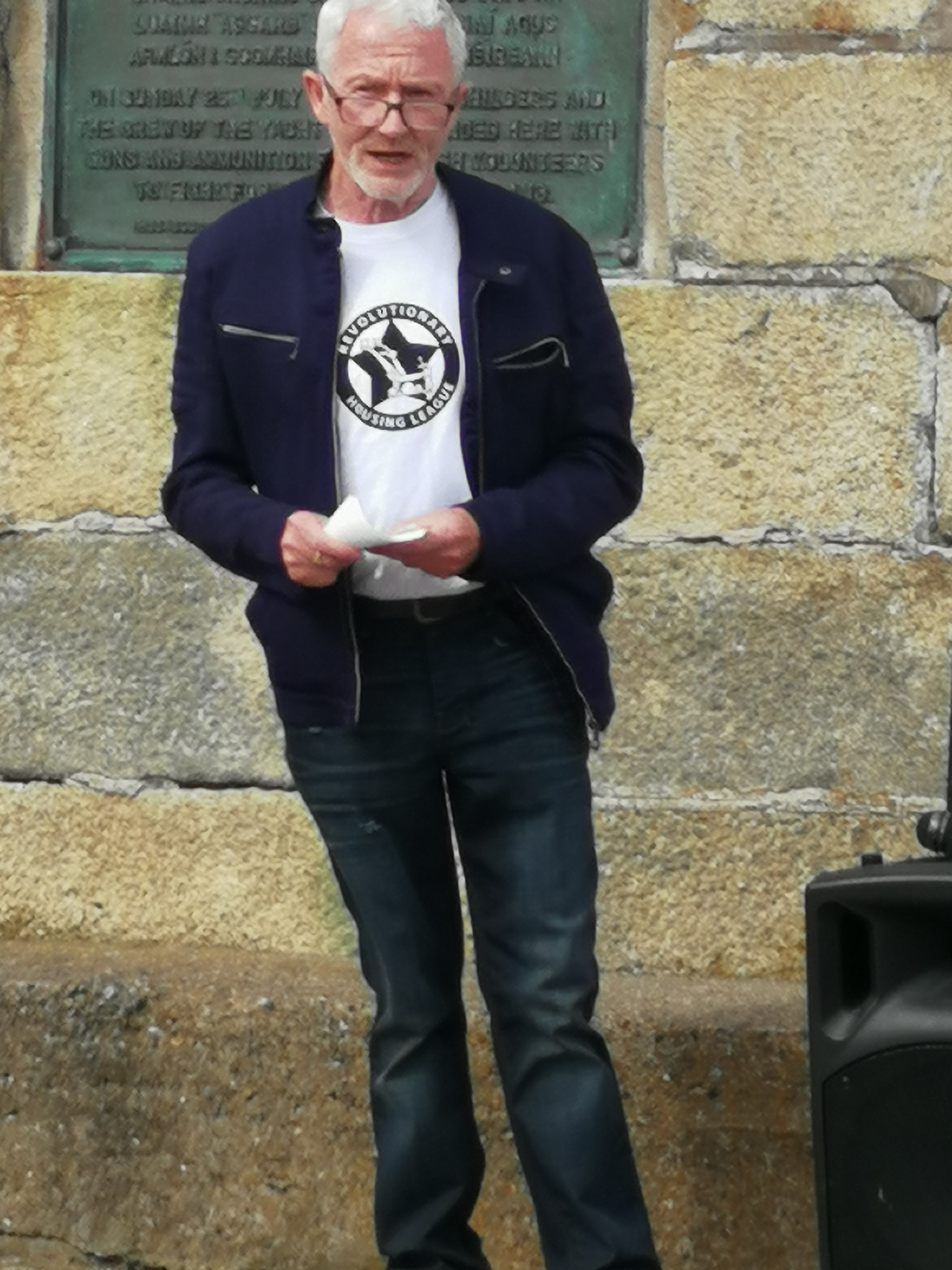
Micheál Ó Doibhlin giving a talk on Irish women in the struggle, 1918 (Photo: D. Breatnach)

Thanks to the committee for the invitation to give this short talk. It’s important to mark events such as these to do with the Civil War since the State has not seen fit to do so.

I’d like to dedicate this talk to Mícheál Ó Doibhlin, the historian who died just this week.

Mícheál carried out a great deal of work on the likes of Anne Devlin and he published numerous works through Kilmainham Tales which provided an insight into lesser known aspects of republican history.

During 2016, with the hundredth anniversary of the 1916 Rising in full swing, he came to my hometown of Rathcoole, where he have a talk on Josie McGowan, who was the first member of Cumann na mBan to be martyred when she was killed by police in 1918.

I’d like to speak about Cathal Brugha first and then the impact of the Civil War/Counter-Revolution.

CATHAL BRUGHA – EARLY YEARS

In terms of the historical sources, it is not easy to find a wealth of material on Cathal Brugha online. Unlike Michael Collins, for example, there is not an abundance of accessible sources online pertaining to Brugha.

He is referred to in the Bureau of Military History sources such as the Witness Statements, and these have been digitised, but his private papers, held in UCD, await digitisation.

The recently published biography of Brugha by Daithí Ó Corráin and Gerard Hanley, entitled Cathal Brugha: “An Indomitable Spirit”, will hopefully go some way to popularising a fuller and more nuanced account of his life and politics.

Kerron Ó Luain ag caint ag an comóradh i Sr. an Ard-Eaglais, 7ú Iúil 2022 (Photo: D.Breatnach)

Cathal Brugha was born as Charles Burgess in Dublin in 1874. He was born into a middle-class family, his father a cabinet maker. Brugha was born into a large family, which was not unusual at the time. Perhaps less common, was that he came from a mixed Protestant and Catholic marriage.

There is a good chance his father was a Protestant Fenian during the 1860s and 70s.

The crucial politicising force of this mid-twenties was Conradh na Gaeilge. He joined Craobh an Chéitinnigh in Dublin in 1899. And it was through the Conradh he met his wife Kathleen Kingston whom he married in 1909.

It was in this Gaelic revivalist and republican milieu that he met the likes of Seán Mac Diarmada, Tom Clarke and Piaras Béaslaí, and this influenced his move towards militant republicanism.

It is worth noting, at this point, that six of the seven signatories of the 1916 Proclamation were members of Conradh na Gaeilge, as were fourteen of the sixteen men executed in the wake of the Rising.

Photo-portrait of Cathal Brugha in IRA uniform. (Photo sourced: Internet)

PREPARATION FOR RISING, PREPARATION FOR WAR — AND FURTHER

In 1908, Brugha joined the IRB. He was employed as a travelling salesman with a candlestick company during those years and so, like many within Fenianism before him, was able to disguise his organising and recruitment under the cloak of his business activities.

Brugha was later instrumental in the setting up of the Irish Volunteers and then the Howth Gun Running. He was second in command to Éamon Ceannt at the South Dublin Union (now James’s Street Hospital) during the 1916 Rising.

He held a detachment of the British Army at bay singlehandedly with his ‘Peter the Painter’ revolver and nearly died from the wounds, including a lacerated nerve, he sustained in the feat. For the remainder of his life he walked with a limp and had to have a special boot made so that he could walk.

In the wake of the 1916 Rising Brugha was central to the re-organisation of the Irish Volunteers, which during these years, along with the Irish Citizen Army, began to coalesce into the Irish Republican Army.

In terms of his rejection of the Treaty in 1921 and death during 1922, we get a snapshot of the trajectory of his politics in 1917.

He was central to the debates over the formation of the Sinn Féin constitution in 1917, and he clashed with the dual-monarchist Arthur Griffith over the insertion of the word “Republic” into the document, which Brugha ardently supported.

Later, at the outbreak of the Black and Tan War in 1918 another indication of his politics can be seen. Brugha, as President of the Dáil, and later as Minister of Defence, was anxious that the IRA would do nothing that might effect Ireland’s case at the Peace Conference underway in Paris.

These were not the actions of a militarist fanatic, as state and revisionist historians have often portrayed him, but the strategic calculations of a principled political republican.

His dedication to the cultural and linguistic revolution is a feature of his activities during 1919 — particularly during the reading of the 1919 Democratic Programme.

Rinneadh gach rud trí Ghaeilge an lá sin agus ba é Brugha a bhí chun cinn.

During that day all the business was conducted through Irish and Brugha was very forthright about that. He understood not only the political importance of announcing the advent of the Dáil at an international level, but in doing so through Irish.

Another indication of his desire to advance the Irish language was that his plan for Conradh na Gaeilge be given sanction by the newly emergent state. “It was essential”, he said “that the authority of Dáil Éireann should be placed behind the Gaelic League”.

Plaque over the spot where Cathal Brugha was fatally shot at the junction of Cathedral and O’Connell Streets. (Photo: D.Breatnach)

LESSONS OF HISTORY

It is our duty as historians and as republicans who want to learn from the mistakes of the past to analyse things as they were and not gloss over them.

Brugha was less advanced when it came to other social questions, such as that of the land.

When a loan scheme was set up by the Dáil in 1919-1920 Brugha viewed it as “a scheme that would be a perfectly sound business proposition, and offer a good field to Irishmen who desire to invest their money”.

This speaks to the class composition of much of that era’s Irish Republicanism – with over-representation from the lower-middle and middle classes and under-representation from the urban and rural working-class.

There was a consequent lack of a radical social programme that might have attracted the masses, particularly during 1922.

Liam Mellows, according to a recent publication by Conor McNamara, only really came towards socialism late in the day whilst imprisoned in Mountjoy Jail.

In a similar vein, the great socialist-republican Peadar O’Donnell, remarked that during the occupation of the Four Courts in July 1922 there existed a gulf between the republicans inside and the workers outside.

Hammam Hotel after Free State attack. (Photo sourced: Internet)

We can also point to a lack of militancy within the leadership of the labour movement, as we can to a lack of socialism within the republican movement.

However, and despite a climate of soviets springing up, land agitation and general strikes over the course of several years, socialism and republicanism failed to fully synthesise into an organised and militant socialist and anti-imperialist movement.

Nevertheless, this is not to take away from Brugha, Mellows or any of his comrades. The picture that emerges of Brugha is one of a dedicated and political Irish Republican. A man of principle, honour and integrity.

It isn’t the picture of a mindless militarist, or “a fanatic”, as a recent review of the above-mentioned book Indomitable Spirit in the Irish Independent characterised Brugha. Likewise, some historians have derided Brugha essentially as a man of “no politics”.

However, as JJ O’Kelly, better known as Sceilg, said of Brugha, he was “showered with intellectual gifts of a high order, coupled with an exquisite literary taste; was a good linguist, a powerful writer, a fluent and convincing speaker, a pleasing singer and exquisitely fond of good music”.

Previously, during a potential split in Craobh an Chéitinnigh in 1908 Brugha was seen as a force for reconciliation, rather than as an apolitical “splitter”.

At its core, the realisation that the Treaty represented a half-way house between Empire and Republic that was doomed to failure informed Brugha’s actions during 1921 and 1922.

The mainstream historical narrative is that the “militarists” couldn’t see sense and get behind the so-called “empty formulas” of the oath. But, harking back to his dispute with Griffith in 1917, I think Brugha knew the importance of the term “Republic”.

Brugha understood that the wording and principles laid down in such documents would influence the character of any Irish state which might emerge. Thuig sé, creidim, go gcuireadh na prionsabail a leagfaí síos ag an bpointe criticiúil cruth ar an stát a bhí le tíocht.

Brugha had also pushed for an Oath to the Republic to be adopted by the IRA in 1919. The context for him doing so was the long tradition of oaths stretching back through Fenianism and other oathbound secret societies.

Oathbound secret societies were common throughout Europe in opposition to feudal and absolutist monarchies from the Enlightenment era onwards.

But in Ireland such secret societies, whether agrarian, nationalist or republican, or an admixture of each, represented an opposition to colonialism and their oaths were a necessary offering of allegiance to the community and the Irish body politic rather than to the invader.

Brugha’s dedication to the Republic and rejection of imperialism was shown again during the Treaty debates of 1921 when he spoke thusly:

“if …. instead of being so strong, our last cartridge had been fired our last thinking had been spent and our last man was lying on the ground and his enemies howling around him and their bayonets raised, ready to plunge them into his body, that man should say – true to the traditions handed down – if they said ‘will you come into the Empire?’ he should say and he would say : ‘No, I will not!’

That is the spirit which has lasted the centuries and you people in favour of the Treaty know that the British Government and the British Empire will have gone down before that spirit dies in Ireland”.

CIVIL WAR/ COUNTERREVOLUTION

Civil War eventually began in 1922 with the shelling of the Four Courts with British guns by Free State forces. Again, busting the myth that he was only out for war, Brugha had actually been reluctant to enter the Republican garrison with Mellows, Rory O’Connor, and Joe McKelvey.

Likewise, Oscar Traynor; he and Brugha occupied Hamman Hotel and Buildings on Upper O’Connell street as a secondary garrison. As the Battle of Dublin raged the buildings occupied by Brugha went ablaze.

Free State soldiers shouted at him to surrender, to which he replied “níl aon chuimhneamh agam ar a leithéid a dhéanamh” (I have no notion of doing so). After asking his own garrison to surrender Brugha approached the Free State soldiers and was shot dead.

The Civil War has often been over-simplified into a cartoonish clash of “brother against brother” and “the Big Fellow” (Collins) versus “the Long Fellow” (De Valera). This negates the aspects of it which were clearly counter-revolutionary in nature, and it can just as easily be labelled the Counter-Revolution of 1922-23.

The results of the Counter-Revolution in which Brugha died and which deepened in the years after, especially during the 1920s, speak for themselves.

Free State troops preparing artillery emplacement for British field-gun at Nelson’s Pillar (now location of the Spire) in the Battle of Dublin, Civil War/ Counterrevolution July 1922. (Photo sourced: Internet)

Republican men carry the coffin of Cathal Brugha with an honour guard of Cumann na mBan. (Photo sourced: Internet)

The Counter-Revolution:

Sided with Empire over Republic. The acceptance of the Treaty meant the acceptance of White Dominion status along with Canada, Australia and New Zealand.

In doing so the counter-revolutionaries severed the nascent anti-colonial links with the Third World which had existed throughout the nineteenth and early twentieth centuries.

This move, according to Bill Rollston and Robbie McVeigh in their recent publication Anois ar Theacht an tSamhraidh: Ireland, Colonialism and the Unfinished Revolution, informs the nature and perseverance of Irish racism today.

It sided with Rich over Poor. The infamous quote from the good Catholic and Christian W.T. Cosgrave about “people being reared in work houses taking it in their minds to emigrate”, resonates here.

This is the mentality which laid the blueprint for how the State facilitated and turned a blind eye to the horrors of the industrial schools and laundries – horrors which were inflicted against women and children mainly from the urban and rural working class.

It sided with Partition over Unity. The nationalists of the North were abandoned to the mercy of the Orange state, despite knowledge among the emergent conservative republican elite like Cosgrave and Kevin O’Higgins of the pogroms which had been going on in Belfast between 1920-22.

The lame duck Border Commission of 1925 was never going to challenge the economic or political viability of the Six Counties

It sided with Anglophone Ireland over what was left of Irish speaking Ireland. There was over half a million, or 543,511 to be precise, native Irish speakers in the state in 1926. Today there are less than 10% of that, roughly 20,000.

The Free State in the 1920s implemented a symbolic cultural programme – state departments used the cúpla focail, schools were superficially Gaelicized, post boxes were painted green.

This was also a means of shoring up support for the State against republicans and other “subversives” in the 1920s and 30s by capturing and channelling one ideological aspect of the revolutionary years. But no radical social programme was devised.

Rather than re-distribute wealth and local power to the West, a symbolic and centralised pseudo-revival was implemented, while Conradh na Gaeilge, which Brugha had been so loyal to, went into rapid decline naively thinking that the conservative state would somehow act as a genuine custodian of the language revival.

Tá go leor leor samplaí den leanúnachas seo leis an impiriúlachas le fáil.

Other examples of a continuity and no real break with imperialism abound. In law, the Free State remained wedded to British common law over a potential new system.

Brehon Law had been mooted as having communal benefits different from the individualist and property focussed British law by cultural nationalists and by Marxists such as James Connolly. But this mode of thought was not considered.

In administration, according to historian J.J. Lee, 98% of civil servants from the old British colonial administration were kept on during the years of the early Free State.

In finance, Ernest Blyth’s conservative fiscal policies were carbon copies of Westminster’s and the punt was shackled to the sterling.

Even down to seemingly innocuous cultural traits such as dress – W.T. Cosgrave and his ilk adopted the top hat and coat-tails of the British once in office – there were continuities.

While this last point may seem minor, it was a signifier of the whole ideology and culture of the state – Conservative, Catholic, Anglophone, with only a veneer of Gaelic symbology.

Little wonder then that the State lurched from dependence on one empire from the 1920s into dependence on others in the 1960s and 70s in the form of the US empire and the emergent EU empire — via the policies of Foreign Direct Investment and the Common Agricultural Policy.

The legacy then of the counter-revolution still weighs heavily on our people.
It is our duty to analyse the different forces – be they political, class or cultural – which defeated the Republic in 1922-23 and to work towards defeating them and breaking fully with Empire, as Cathal Brugha sought to do.

An Phoblacht Abú!

Kerron Ó Luain, staraí, Ráth Cúil, Co. Átha Cliath.

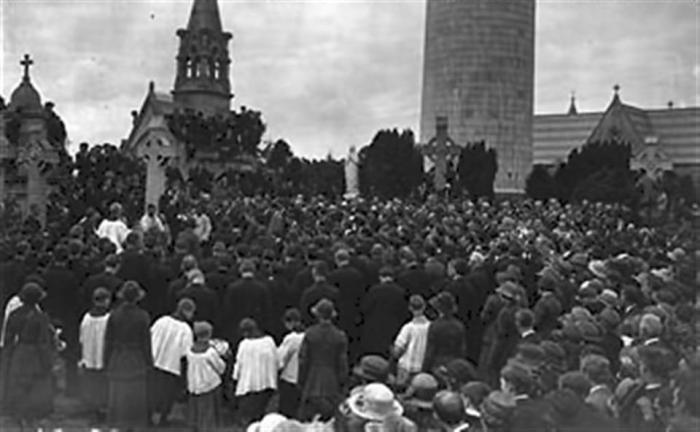
Section of the crowd at Cathal Brugha’s funeral in Glasnevin Cemetery. (Photo sourced: Internet)

FRAME-UP OF THE CRAIGAVON TWO HIGHLIGHTED ACROSS IRELAND

14 YEARS IN JAIL FOR SOMETHING THEY DIDN’T DO

Clive Sulish

(Reading time main text: 2 mins.)

On 16th July 2022 the frame-up of the Craigavon Two was highlighted in public events in locations across all four provinces of Ireland. John Paul Wooton and Brendan McConville were framed and convicted in 2012 of the killing of colonial police officer Stephen Carroll in 2009.

The agency that framed them is the colonial police force of the Six Counties statelet but then they were railroaded through the non-jury Diblock Courts. As a result the two men have spent 14 years in jail for something they did not do.

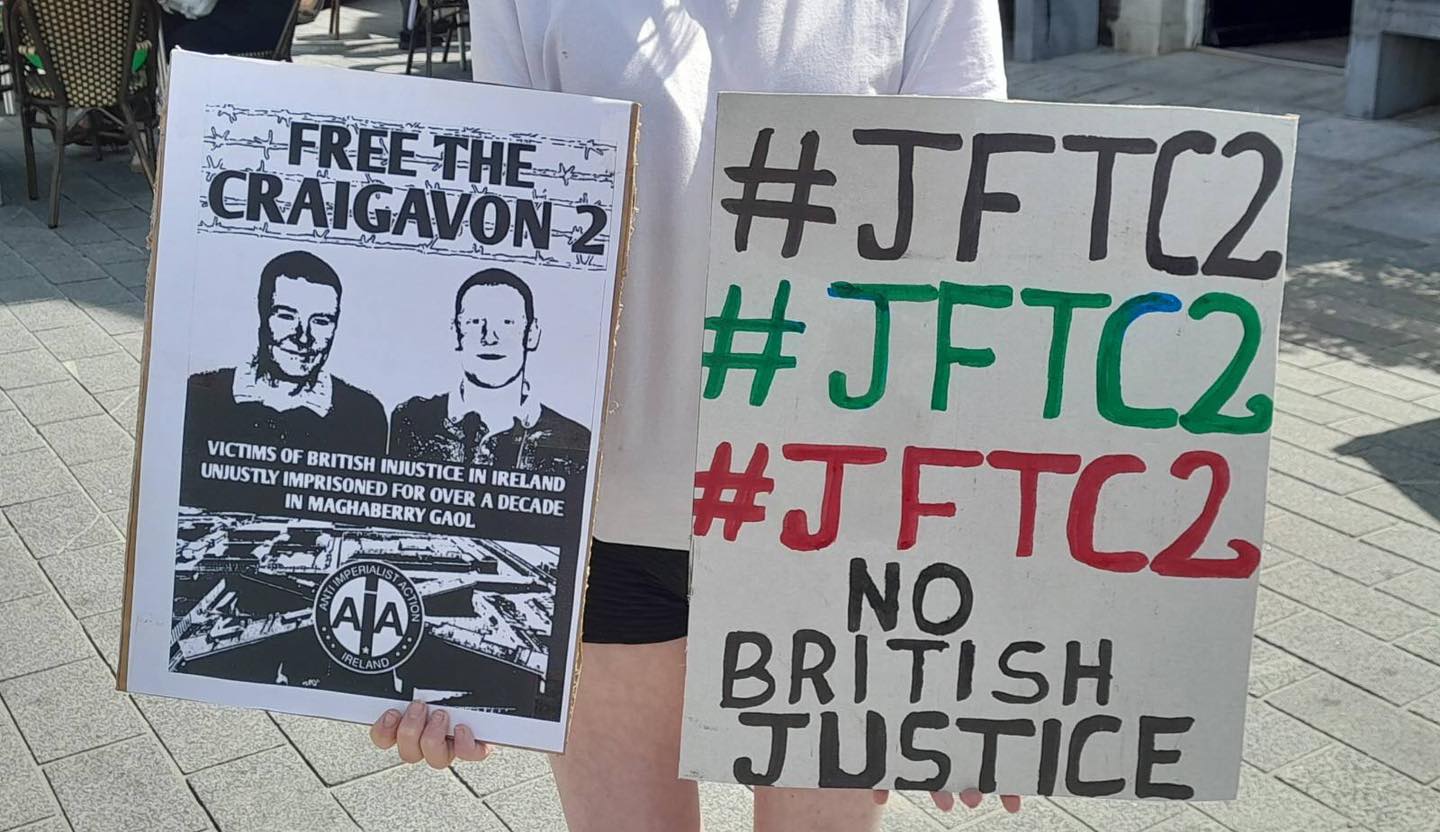
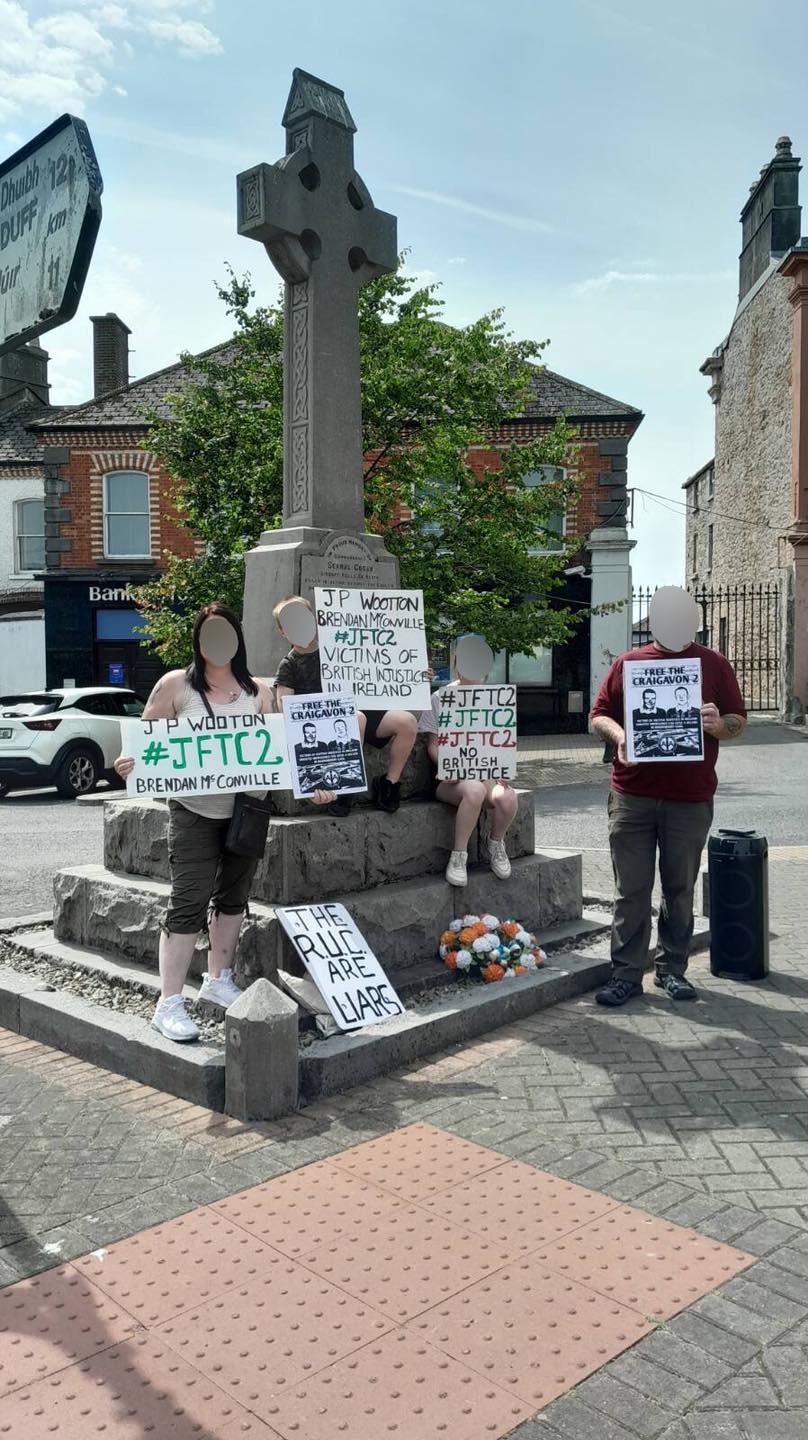
A young woman participating in the protest on the 16th in Mulingar, Co. Westmeath displaying two placards, one home-made, to passers-by. (Photo sourced: AIA)

EVENTS

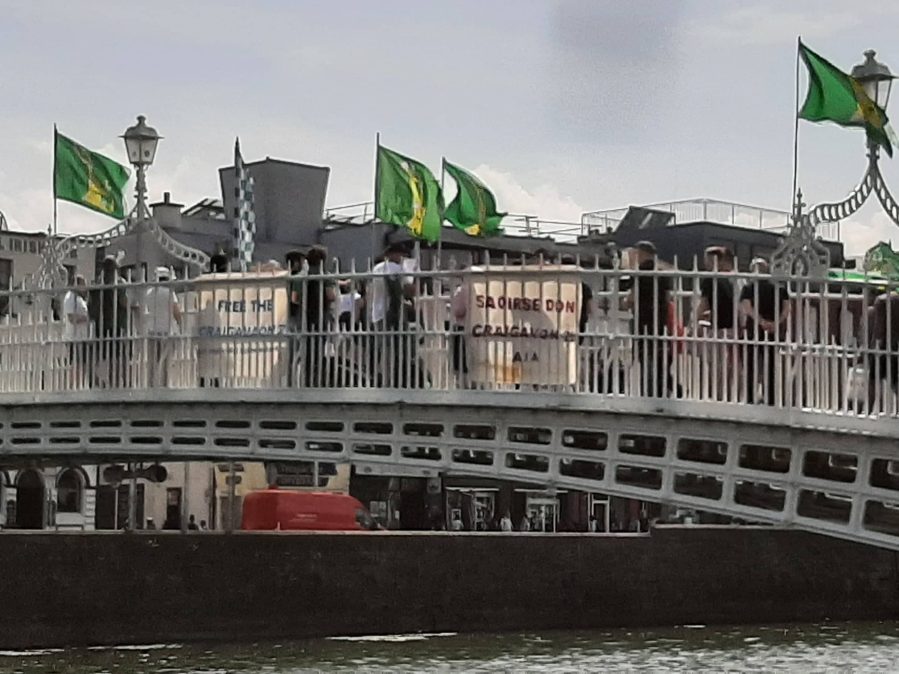
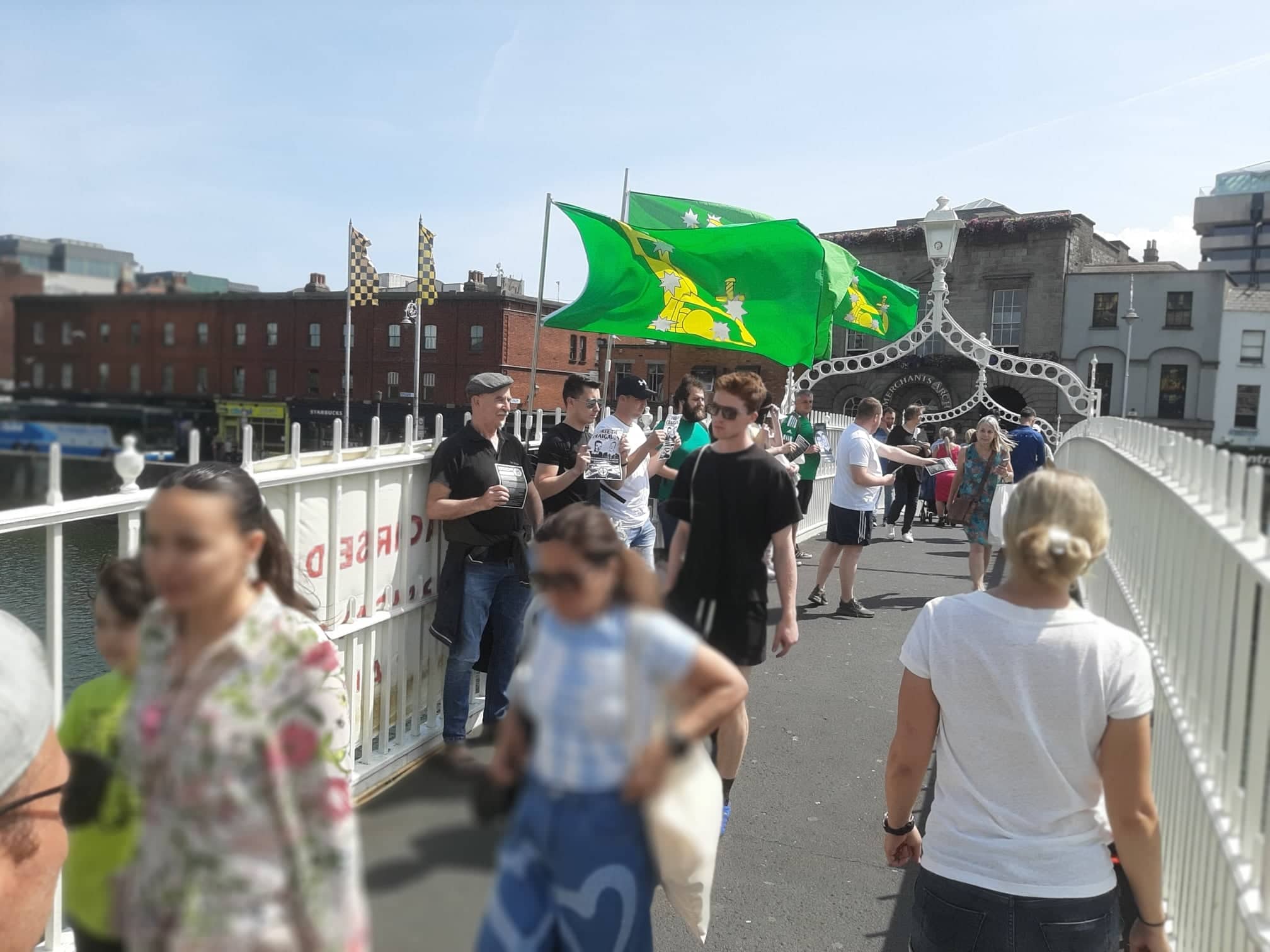
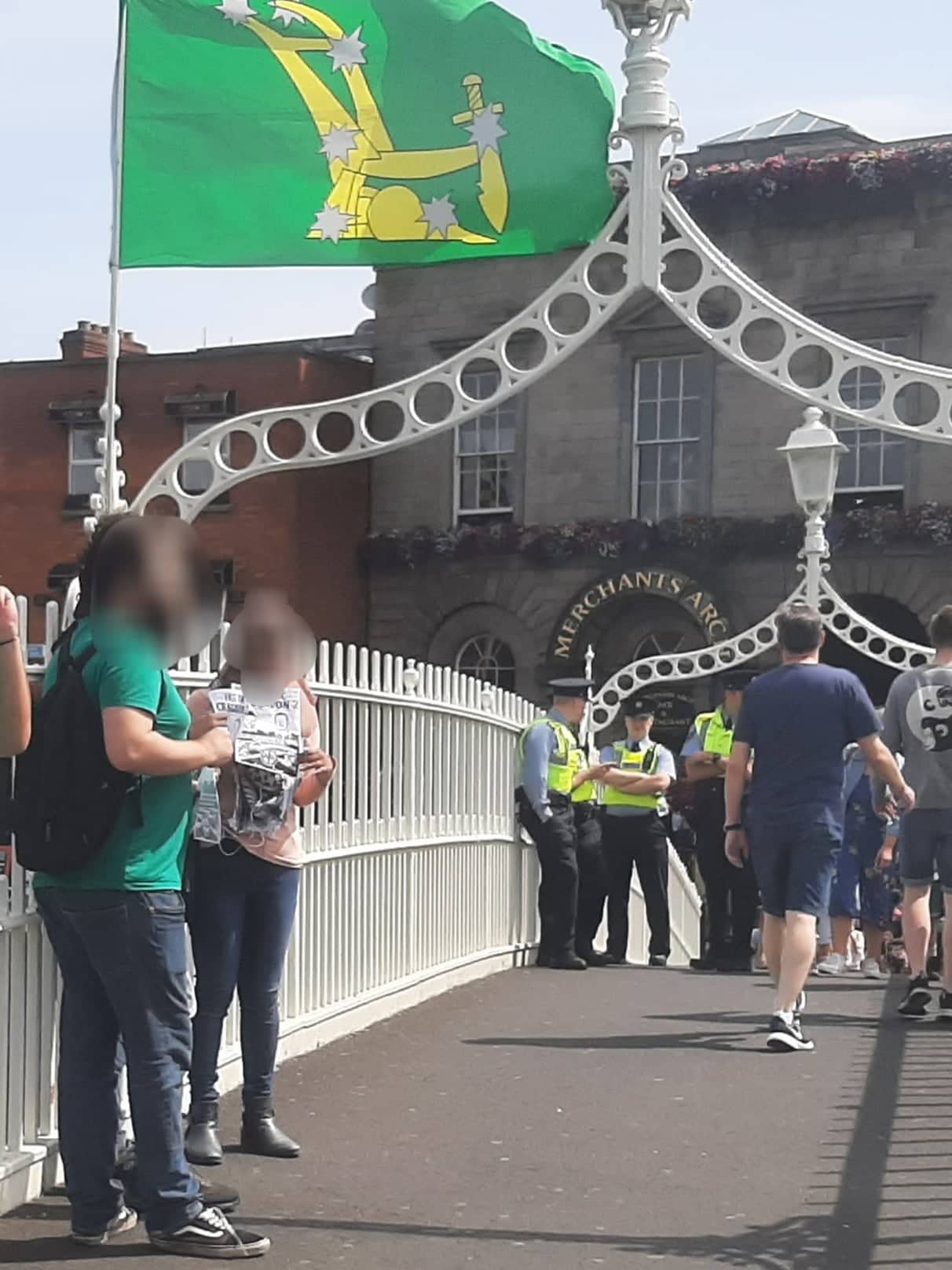
In Dublin city centre banners in Irish and in English calling for the freeing of the Craigavon Two were hung from the iconic curved pedestrian Ha’penny Bridge. Green and gold Starry Plough flags streamed in the breeze from the sea as leaflets were distributed to passers-by.

Hand-held Placards called for the men’s release and regular calls could be heard of “Justice for the Craigavon Two!” followed by “14 years in jail for something they didn’t do”. In addition there were calls to “Smash the Specials”1 and comments about “British justice”.

Strangely no artist(s) name was posted on line with the video

All the leaflets brought to the event were distributed and a number of conversations with interested people took place.

Leaflets being distributed and placards displayed on the Ha’penny Bridge, Dublin on the 16th. (Photo sourced: AIA)

At one point four members of the State’s police force, the Gardaí, walked past the picketers and gathered at the far end of the bridge, watching them. However, the picketers were not intimidated and the police took no further action.

The events in respect of the Craigavon Two were organised by the Anti-Imperialist Action Ireland organisation and took place in Waterford, Oldcastle (Meath), Naas (Kildare), Mullingar (Westmeath), Kerry, Galway, Dublin, South Derry, Armagh and Arklow (Wicklow.)

Gardaí watching the awareness-raising picket on the Ha’penny Bridge on the 16th. (Photo sourced: AIA)

A CROOKED CASE

To say that the case against the men was flimsy would be to give it too much credit. The killing weapon was recovered and the fingerprints on the weapon and magazine did not match either of the men’s. No eyewitness was found except one who claimed to have seen one of the men in the area.

The alleged eyewitness who identified one of the men, “Witness M” only came forward 11 months after the killing and long after the arrest of both men. Witness M’s inability to have identified anyone at night at the distance he claimed to have done was exposed in court.

Awareness-raising event on the 16th in Oldcastle, Co. Meath (Photo sourced: AIA)

That man’s father described him as “a Walter Mitty character” who was chronically untruthful and his own partner refused to corroborate the witness’ account of his movements on the night of the killing.

The ‘evidence’ against the second man of being in the area came from an MI5 agent who testified from behind a screen about a tracking device they claimed to have planted in the accused’s car which had unexplained gaps in its recording.

The agent declined to answer a number of questions under “public immunity” certificate related to “national security”.

The colonial police went further and detained Witness M’s father to intimidate him into not giving evidence about his son’s veracity (or lack of it) — and the witness was also paid a sum of money.

One can say that the no-jury Diplock Court was crucial in convicting the men of murder but even when they were eventually granted leave to appeal in 2014, their convictions were not overturned. The normal judicial system is bad but the no-jury courts are worse.

Another victim of being framed in the British ‘justice’ system, Gerry Conlon, 15 years in jail in the famous case of the “Guildford Four”, joined the campaign for the men and was proclaiming their innocence until a mere few days before his premature death in June 2014 (aged 60).

End.

In Naas, Co. Kildare. (Photo sourced: AIA)
Mulingar, Co. Westmeath. (Photo sourced: AIA)
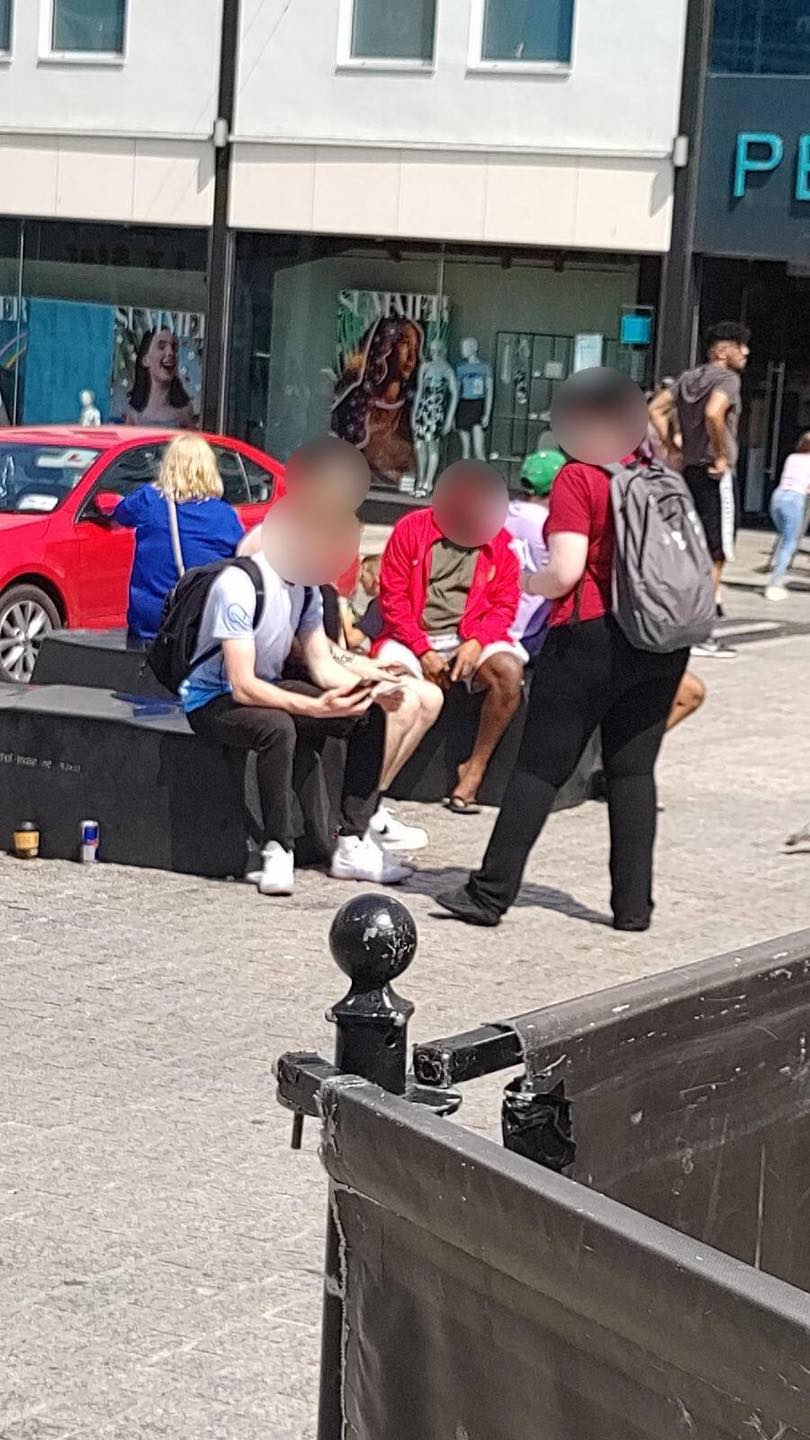
A woman leafletting in Co. Waterford on Saturday talking to people in the town centre. (Photo sourced: AIA)

FOOTNOTES

1A reference to the political no-jury courts of the colony and of the Irish State, the Diplock Courts and the Irish State’s Special Criminal Courts.

USEFUL LINKS

Craigavon Two campaign: https://www.facebook.com/mrsmcconville

Anti-Imperialist Action Ireland: https://www.facebook.com/AIAI-For-National-Liberation-and-Socialist-Revolution-101829345633677

“Justice Craigavon Two” song by Pól Mac Adaim: https://www.youtube.com/watch?v=TzUdD80obMY

In Waterford on Saturday. (Photo sourced: AIA)
The event on Ha’penny Bridge, Dublin, seen from the north side facing south-west. (Photo sourced: AIA)

A DIFFERENT PICTURE SLIPS THROUGH THE PROPAGANDA

Diarmuid Breatnach

(Reading time: 5 mins.)

We are being constantly reminded by the western press on a daily basis, quite rightly, of civilians being killed in the Ukraine conflict1. On the Ukrainian side. Somehow, the Ukrainian military never fire at the Russian side – or if they do, they somehow never manage to kill civilians.

Amazing, really, in a war which the media keeps telling us is ferocious.

The Russian side is rarely quoted but when it is, its statements are dismissed. They say that the Ukrainian military plant themselves among civilian housing and fire artillery from there. Well, they would say that, wouldn’t they and anyway, the Ukrainian State denies it.

The Russian military are, according to the Ukrainian State, not so much careless about the the targets of their bombardment but deliberately aiming at civilian structures.

Why they would do that when, according to the same sources, they want to extend the Russian empire there, is not explained. It’s all about terrorism, according to Zelensky, the Ukrainian premier and media figure.

The Russian State story, not so easy to come by, is that they never target civilian areas deliberately, unless the Ukrainian military are using them to fire from – which according to the Ukrainian State, quoted without question by the western media, the Ukrainian military never do.

BOMBARDMENT AND CIVILIANS

Yesterday’s issue of Breaking News Ireland carried a very unusual photo. It was unusual because it was taken during actual military action, whereas we normally only get photos of damaged buildings and occasionally Ukrainian military standing firm.

Ukrainian Soldiers run after missile strike in residential area of Kramatorsk, Donetsk Region, Eastern Ukraine (posted 13 July) (Cred: Nariman El-Mofty/AP)

But the photo was more unusual than that because it showed Ukrainian soldiers running for cover after a Russian artillery strike, naturally enough but a less-than heroic image for public consumption. The caption tells us it’s in a civilian area in the Donetsk region.

WAIT A MINUTE! In a civilian area? So the Ukrainian military were in a civilian area and got fired on by Russian artillery? Doesn’t that coincide with what the Russians have been saying? Were those Ukrainian military perhaps even firing from that area? We don’t know.

We don’t know because we get hardly any western media coverage from the actual battlefronts, just quotations from the Ukrainian State and, from time to time, commentary from US/ NATO sources. And never any detail from the Russian side.

If we want a more realistic picture, we have to go to sources banned or at least not promoted in the West.

One of those sources is Patrick Lancaster, reporting on the war. In a recent video, he interviewed wounded civilians in a hospital in Izium, Kharkiv region, an area the Ukrainian military left a couple of days earlier and which is now under Russian military occupation.

So refreshing to watch.

Some interviewees blame the Russian State, some blame the Ukrainian State, some seem impartial or keep their own counsel – as one might expect, really, if one thought about it past the propaganda line, which is that everyone there — except the “Russian separatists” — blames the Russians.

And actually, the Breaking News article reported the reluctance of many to leave Sloviansk and Kramatorsk as they are being publicly encouraged to do by the Ukrainian Donetsk Governor, presumably as those areas are going to be pounded by artillery (but by Ukrainian or by Russian?)

This too is interesting, because even anti-Ukrainian State or pro-Russia interviewees (not always the same thing) interviewed by Patrick Lancaster in the Izium town, said that the Russian artillery had hit their town “very hard”.

But then some also stated that Marchenko, the pro-Ukrainian Mayor of the city had announced publicly that the city had been evacuated. All lies, according to one, “only five buses here …. and 50 taxis (but) from Kramatorsk.”

So if the advancing Russian military believed that only Ukrainian military remained in the city …..?

This is a military conflict and of course both sides are firing and, as well as soldiers, civilians are being inevitably killed on both sides. When that happens, is it likely that either side is killing civilians deliberately?

Certainly less likely by the Russians in the Donetsk area, which is a largely Russian-speaking region that has been attacked by Ukrainian right-wing military since that state’s abrupt change of government in 20142.

By the Ukrainian military side, probably more likely on the basis of the previous eight years, or at least of being more careless.

The article I’ve quoted showed a range of attitudes to the call of Pavlo Kyrylenko, Ukrainian State’s Governor of the Donetsk region, for civilians to leave and to head into Ukrainian State-held territory — and also of different attitudes to the forthcoming Russian occupation.

Some are going, including a teacher of Russian, which is interesting, because another doesn’t want to go precisely because of the anti-Russian-speakers attitude of the State (and even more so of some of the Ukrainian military).

Some just don’t want to give up their homes and/ or be jobless (or elderly without support) in Ukrainian State territory. Some think they’ll be ok under the Russians while others think they’ll be no better off on the Ukrainian State side.

So, naturally enough a mixed picture but certainly very different to the one being projected day in, day out by the western media. How this article and photo slipped through that blockade is certainly curious.

DOES IT MATTER?

But at the end of the day, does it really matter much to us here in Ireland whether we are being subjected to inaccurate propaganda about the conflict in Ukraine?

Well, if that conflict was sparked by the expansion towards Russia’s borders of the NATO military alliance3, then it does.

If that conflict is part of the shaping up by US/NATO for a war against Russia and China (and possibly India), then it certainly does. Not just because all of those on both sides are nuclear powers and radiation can end up anywhere.

But also because the ruling elite of the British colony in Ireland is part of NATO and the ruling class of the Gombeen state is trying to push it into NATO — or at least into an EU military alliance, which would of course soon enough line up with NATO.

I don’t believe either side in this conflict without proof and analysis. But I do resent the completely one-sided propaganda coming from the western media. Maybe it’s the same in Russia with their own propaganda.

Maybe, but isn’t it the boast of the West that their democracies are superior, with free speech and press?

And if the western media is following the same propaganda line in its reporting out of common interest with US/NATO and EU, is the end result any different from the media in Russia saying what they are told to say?

End.

FOOTNOTES

1Would that they would equally well inform us of those beling killed by the Saudi proxy war in the Sudan or by the numbers of migrants being killed on a regular basis as they try to access safety or just a better life in western states – the same states that are usually responsible for their plight in the first place.

2Yes, eight years prior to the Russian invasion. On the rare occasions when the western media refers to this (they did in the Breaking News Ireland article) it is always portrayed as a problem caused by “pro-Russian separatists” without recording that those areas were attacked as Russian-speaking by Ukrainian fascist and far-Right military units, including the Azov Battalion and the people organised themselves in defence, then received Russian supplies and now, eight years later, a Russian invasion. The origin of the Crimea situation is a similar story.

3For those who think this is a ridiculous claim, type “NATO states in Europe map” into a search engine. Also look up “Minsk Agreement”.

SOURCES

Breaking News Ireland report: https://www.breakingnews.ie/ukraine/why-should-i-leave-some-ukrainians-refuse-to-flee-areas-caught-up-in-war-1334032.html

Patrick Lancaster reporting from Izum, Kharkiv region, 120 Km/ 75 miles southeast of Kharkiv city (random civilian interviews + civilians wounded in hospital): https://www.youtube.com/watch?v=3iFv5jxInOc

From Sirotino, Luhansk, now controlled by Russian an Luhansk People’s Militia (interviews with residents): https://www.youtube.com/watch?v=DRKNBYqb5DQ

Patrick Lancaster, December 2016 (yes, SIX YEARS AGO) in Luhansk People’s Militia trench, under Ukrainian shelling (breaking Minsk Agreement): https://youtu.be/DAo7go-4l0g

Senior Irish politicians thinking about joining a military alliance: https://www.irishtimes.com/world/europe/2022/06/08/ireland-would-not-need-referendum-to-join-nato-says-taoiseach/

CATHAL BRUGHA HONOURED AT SPOT WHERE FREE STATE SHOT HIM

Diarmuid Breatnach

(Reading time main text: 6 mins.)

On the evening of 7th July, people passing on O’Connell Street, Dublin’s main street in the north city centre either stopped a while or passed with a glance at the crowd gather at the intersection with Cathedral Street, a narrow lane leading eastward.

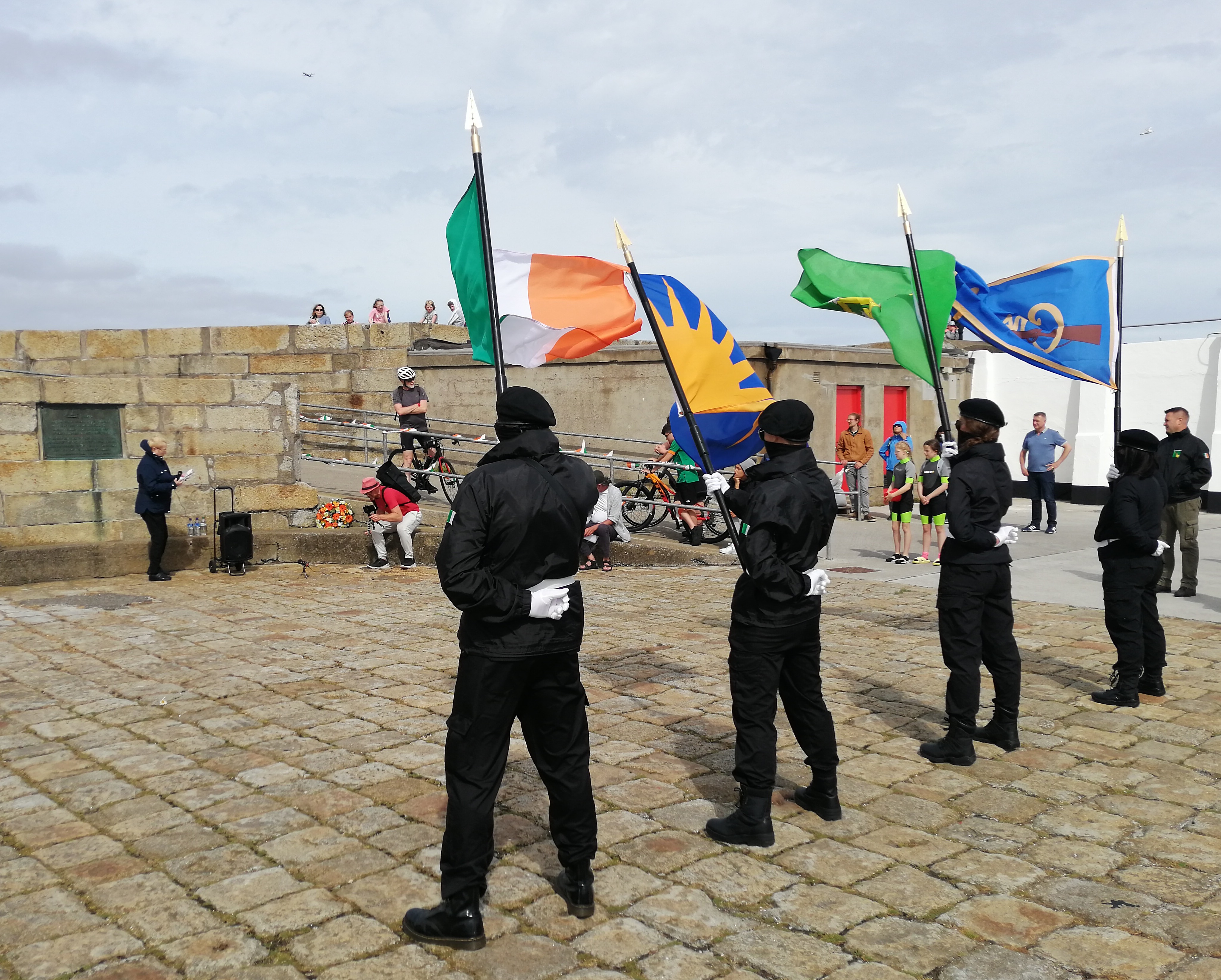
The Irish Tricolour and the Starry Plough flags (both versions1) held aloft gave a strong indication of the purpose of the gathering, which was to honour an Irish patriot shot down at that spot by Free State soldiers on 5th July 1922 and dying on the 7th.

A poster from the period with drawings thought to be by Constance Markievicz (Photo: D.Breatnach)

CATHAL BRUGHA RESUMÉ

Cathal Brugha was an Irish Republican, an Irish language activist, a soldier and politician. For a period in the Irish Republican Brotherhood, he joined the Irish Volunteers at the outset2 and was a lieutenant in charge of twenty Volunteers to receive with others the arms delivered to Howth Harbour in 1914.

In the 1916 Rising Brugha was second-in-command under Eamonn Ceannt at the South Dublin Union, now covered by James’ Hospital, where he received in excess of 25 wounds from bullets and grenade shrapnell and was not expected to live.

Surviving, Brugha was elected a Teachta Dála (member of parliament) for the abstentionist Sinn Féin coalition party in the UK General Election of 1918, serving until his death, first President of Dáil Éireann (the Irish Parliament) from January to April 1919, Minister of Defence from 1919 to 1922 and Chief of Staff of the IRA from 1917 to 1919.

Cathal Brugha, along with most Republican activists, was strongly opposed to the Anglo-Irish Agreement of 1921 which was supported by Michael Collins, Arthur Griffiths and others and joined the Republican opposition in the Dáil, resigning his government posts to do so.

A poster from the period with drawings thought to be by Constance Markievicz (Photo: D.Breatnach)

However, he and Oscar Traynor of the IRA both opposed the occupation of the Four Courts by IRA under Rory O’Connor but when it was bombarded by the Free State with British artillery on 28th June, Traynor ordered occupation of O’Connell Street buildings to divert some of the heat from the Four Courts.

The Free State Army bombarded the Republican positions in O’Connell Street with artillery and machine guns (as the British Army had done in 1916). Eventually the Republicans retreated apart from a small holding group which Brugha ordered to surrender but did not do so himself.

Approaching Free State soldiers with pistol in hand, he was shot by them in the leg, severing a femoral artery and died two days later in hospital. His widow Kathleen continued the Republican line as an activist and TD.

Mags Glennon, Chairing the event (Photo: D.Breatnach)

THE HONOUR CEREMONY

Mags Glennon, chairing the event, thanked people for coming, stressing the importance of remembering our history and listed briefly the important actions of and positions held by Cathal Brugha, before calling on Sean Óg to perform The Soldiers of ‘22,3 the five verses of which he sang, accompanying himself on guitar.

At intervals between speakers Sean Óg performed another two songs, Cathal Brugha and A Soldier’s Life4.

Joe Mooney brought a series of three posters for distribution, which were quickly taken up. These were copies from the period, condemning the Free State Army for the murder of Cathal Brugha, with drawings believed to be by Constance Markievicz.

A poster from the period with drawings thought to be by Constance Markievicz (Photo: D.Breatnach

MAIN ORATION

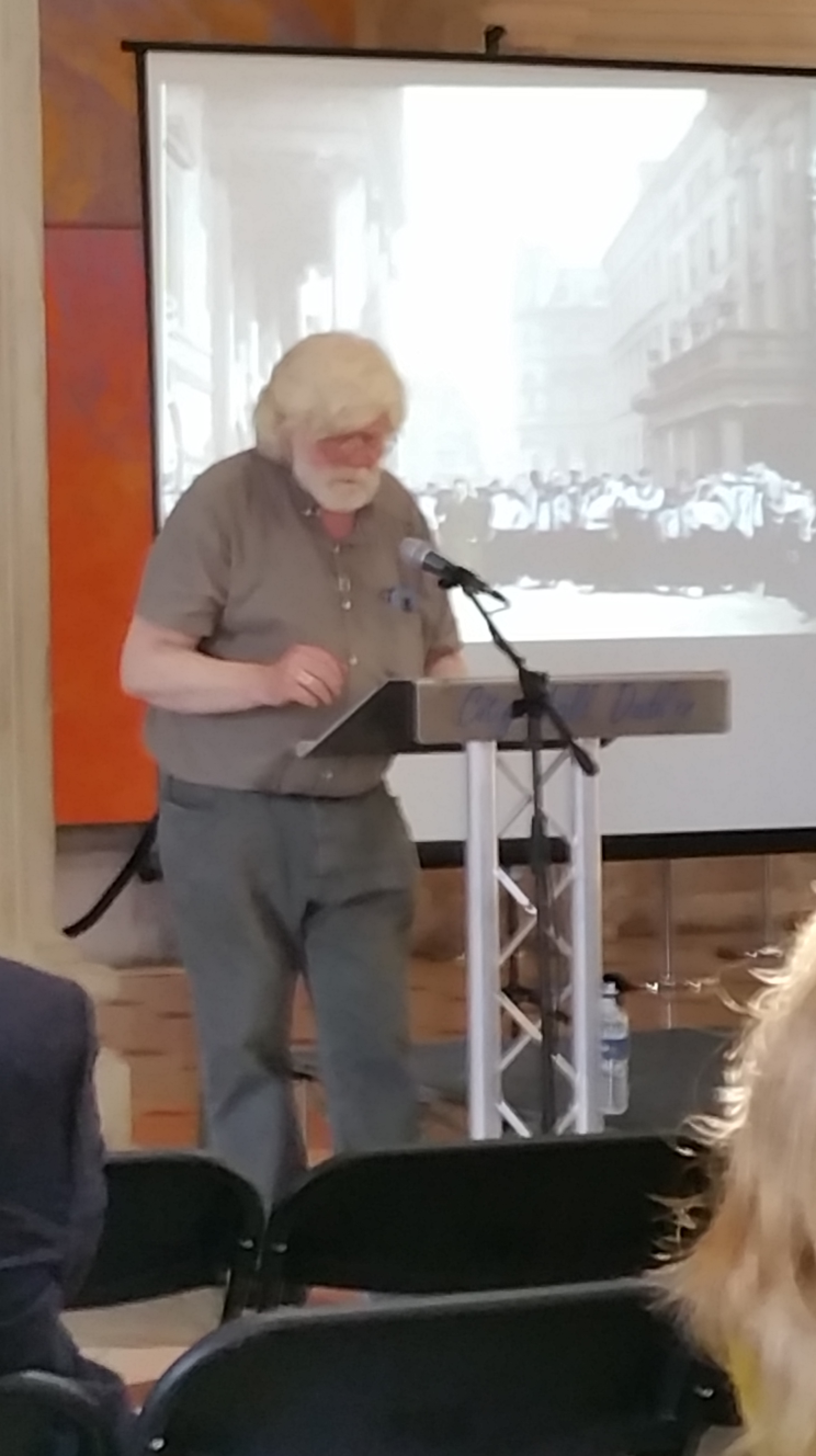
The main speaker was historian and author Kerron Ó Luain, who began speaking in Irish and returned to it on occasion, though the content of his talk was by far in English.

Ó Luain initially paid his respects to recently-deceased Mícheál Ó Doibhlin, a Dublin historian who had done much historical research to bring further into the light of today the contributions two Republican women in two different periods.

These were Anne Devlin of the United Irishmen (uprisings in 1798 and 1803) and Josephine McGowan, killed in 1918, the first Cumann na mBan martyr5. Ó Doibhlin had also assisted Ó Luain in the latter’s research into the insurrectionary history of his own area, Rath Cúil (Rathcoole)6.

Kerron Ó Luain speaking, Joe Mooney holding the microphone. (Photo: D.Breatnach)

Continuing to relate some brief facts about Brugha’s early life, born into a mixed-religion household, Ó Luain emphasised Brugha’s interest in the Irish language and his membership of the Gaelic League (Conradh na Gaeilge)7 in the same decade as its founding.

The speaker contrasted that aspect with the militarist image of Brugha often projected by hostile commentators. Brugha met his future wife at meetings of the Connradh and had been a strong advocate of the proceedings of the First Dáil being conducted mostly in Irish and of the Democratic Programme being first read and agreed in Irish.

The setting up of Sinn Féin to contest the 1918 UK General Elections had involved a coalition of many different elements Ó Luain said, including dual monarchism advocates such as the original founder Griffiths and even white Dominion aspirants, alongside Republicans such as Cathal Brugha.

Section of the crowd at the event. (Photo: D.Breatnach

These had been the lines along with the alliance had fractured when the British proposed the terms of the Anglo-Irish Treaty. British influence on the Free State was seen not only in its war on the Republicans but in the legal system adopted based on common law without any thought given to any of the principles of the native Brehon Law.

The British influence was evident also in the form of dress with some Free State politicians such as Cosgrave wearing a top hat and research has shown over 90% of the civil servants of the Free State had been employed by the previous British colonial administration.

The Free State adopted a formal position of support for An Ghaeilge, the Irish language, while doing nothing to support the struggling rural Irish-speaking areas, which were being drained by emigration, leading the inhabitants to want to acquire English for their future locations.

Some of the attendance. (Photo: D.Breatnach)
Another small section shot (Photo: D.Breatnach)

The number of Irish-speakers within the territory of the State has declined drastically since it was founded.

Unusually for an oration honouring an Irish martyr but very important historically, the speaker pointed out that Brugha was not a socialist Republican and had advocated land ownership whereas other Republicans such as Liam Mellows (executed by the Free State in 1922), Peadar O’Donnell and Frank Ryan in the 1930s had proclaimed the need for a socialist Republic.

In conclusion, the speaker said that Cathal Brugha was an honest courageous Republican with a genuine love of the Irish language and a staunch upholder of the truly independent Republic proclaimed in 1916 but yet to be achieved. He had been killed as part of the counterrevolution.

It is important for future efforts, Ó Luain stated, to be aware of the different strands in the Republican opposition to the status quo and to be clear on the desired future shape of society in the Republic.

View of many in the attendance at the event. (Photo: Cabra 1916-1921 Rising Committee)

OTHER REPUBLICAN MARTYRS OF THE BATTLE FOR DUBLIN 1922

Damien Farrell spoke on behalf of Dublin South Central Remembers and representing the McMenamy family from the area. Frank McMenamy had been asked to introduce the Roll of Honour on behalf of relative Ciaran McMenamy of F Coy, 1st Batt, anti-Treaty IRA (Ambulance Corp) but was unable to attend.

Ciaran was one of four brothers — Fergus, Manus and Francis — who fought in the revolutionary period 1916-23. Ciaran was part of the crew that tended Cathal Brugha and rushed him to hospital on the 5th July. When Brugha succumbed to his wounds, Ciaran was a pall bearer at his funeral.

Damien said that this most likely identified him for arrest which happened later and he was interned in the infamous Newbridge Camp and participated in the mass hunger strike of prisoners in 1923 against conditions.

Ciaran McMenamy contracted a cold that developed into consumption which secured his release to convalesce in the County Home in Kildare but this proved ineffective and Ciaran was eventually released from internment around Christmas 1923.

On the 26th of April 1924 Ciaran McMenamy died in 55 Pearse Square, a house connected to the family. For the past two years Dublin South Central Remembers have held remembrance events at the house, with the full permission and support of the current occupants (no relations) with the intention of having a plaque erected in time for his centenary in 2024.

Finnuala Halpin reading the Roll of Honour of the The Battle of Dublin 1922, in which her grandfather fought. (Photo: D.Breatnach)

Fionnuala Halpin read the roll of honour of those killed in The Battle of Dublin 1922, a battle in which her grandfather fought.

John Monks

William Clarke

Joe Considine

William Doyle

Francis Jackson

John Mahoney

Sean Cusack

Matthew Tompkins

Jack McGowan

Thomas Markey

Thomas Wall

Charles O’Malley

Cathal Brugha

Veteran Republican, hunger-striker and author Tommy McKearney placed a wreath in honour of the fallen on behalf of Independent Republicans and a minute’s silence was observed in their honour also.

COMMEMORATE THE CIVIL WAR MARTYRS OF YOUR AREA?

A number of different Republican organisations were represented at the event, along with many independent Republicans and historical memory activists, including walking history tour guides.

Poster and dedication floral wreath in honour of Cathal Brugha, Cathedral Street, Dublin city centre 7 July 2022 (Photo: Cabra 1916-1921 Rising Committee)

Mags Glennon asked people to keep in touch with the organisers and also to be aware of other commemorative events, offering to make available the commemorative posters with the local martyrs’ names incorporated into the design for display for others around the country.

End.

FOOTNOTES

1The original, with the design of plough in gold following the outline of the Ursa Mayor constellation in white stars, on a green background and the later Republican Congress version of the white stars alone on a light blue field.

2Formed in 1913.

3Composed by Brian Ó hUigínn, sung to the air of The Foggy Dew.

4A Soldier’s Life was originally composed by Young Irelander Thomas Davis (1814-1945) and recorded by The Wolfe Tones band; the composer of Cathal Brugha’s lyrics appears unknown and it was recorded by Declan Hunt.

5A rally held by women just off Dame Street in 1918 was batoned by members of the Dublin Metropolitan Police and she died of her injuries shortly afterwards. I have heard Ó Doibhlin relate her story and saw him becoming emotional as he did so. The DMP’s batons in September 1913 were also responsible for the deaths of at least three others, although one died in 1915.

6For a number of recent years Ó Doiblin has been noted, along with historian Liz Gillis and others, for research and exposition of information regarding the Burning of the Customs House on 25th May 1921, which corrected a number of common misapprehensions about that event.

7Founded by Protestant Douglas Hyde/ Dubhghlas de hÍde this month in 1893.

USEFUL LINKS

The Independent Republicans group do not appear to have a website or FB page but may be contacted through the Cabra 1916-1921 Rising Committee: https://www.facebook.com/cabra1916

The National Graves Association: https://www.facebook.com/NationalGravesAssociation

FLIGHT OF THE UNDERGROUND QUEEN

Diarmuid Breatnach

(Reading time: 6 mins)

They had been preparing for this for some time. The infants were selected, received special care and food and were raised carefully in the Palace chambers inside the Citadel. They were now adolescents, maturing sexually.

As the time approached for their great expedition, the tunnels leading to the departure terminal were widened and cleared of all obstructions. Experts tested the weather conditions daily and, when the majority of these were in agreement, the Queen gave the order to launch.

The adolescents took off then, a great host of them, amidst great excitement. Their pheromones, male and female, filled the air around them and those who could, which was most of them, quickly found a partner and coupled.

It was a maiden flight from which the adolescent females would land no longer maidens. Those who would land, that is. For suddenly the air was filled with giant flying monsters with huge eyes and giant whirring wings.

Black Ants busy while the good-times grasshopper looks on (Source image: Aesop’s Fables, Library of Congress, USA)

Much more accustomed to flight, these monsters flew among them, gobbling them up. Some even held rows of their hapless victims in their huge beaks as they flew off to feed them to their young.  Hundreds, perhaps thousands of the little flyers perished in minutes.

Those who managed to land safely and didn’t end up drowning in a lake or a river, or snapped by denizens of the deep who sprang up at them as they passed overhead, or caught in sticky webs, or who were not stamped carelessly to death by huge walking giants or flattened by roaring, stinking monsters, still had to contend with smaller predators on the ground. The casualty rate was huge but some made it alive – some always did.

The males who made it down to ground safely would all die within a couple of days. Their wings were only intended for their nuptial flight; on the ground, they were nothing more than a nuisance, impeding their progress over and underground.

The females, sexually sated and no longer interested, had left their male partners behind. They bit off their own wings, ate them and, quickly finding some reasonably soft ground, began to dig.

Each one dug down as though her life depended on it, which of course it did; and not only her own life – each one was pregnant. Then she blocked the entrance to her tunnel, went back down it, excavated a chamber and began to lay eggs.

It was completely dark down there but she had been reared in darkness – she had one day of daylight only, the day she flew.

The young grubs who hatched were all females. She supplied them with some sparse nutrition from herself and cared for them as they grew, shed skin, grew … until they spun a cocoon from which they emerged as very small worker ants.

Magnified: Queen Black Ant Queen, grubs hatched from her eggs and metamorphosed adult worker ants. (Source Photo: Internet)

They were infertile workers and tended to their large mother, their Queen; even when they were fully-grown she was still one-and-a-half times their size, although about half the size she had been when she left her old nest.

Her most recent meal had been her own wings the day she had flown and mated. If she got past this crucial stage, she would recover her size and weight and lay more and more eggs.

The workers soon went up the tunnel, unblocked it and spilled out into daylight for the first time in their lives, beginning to forage for food. They found small seeds and, if they were lucky, sweet material such as soft-skinned ripe or rotting fruit.

They soon had their surroundings covered with their hive-scent, carried by each and every worker. Sometimes they found insects they could kill but these had to be very small indeed – these workers had been fed on insufficient nutrition and were, compared to the majority of their kind, puny.

If they found a food-source worth another visit, they left a specially-scented trail on their way back to their home, to guide theirs sisters back to the prize later.

A rich source of food typically would show two streams of traffic between their nest and the food – one empty-jawed heading for the food and the other, with pieces in their jaws, heading away from it and towards the nest.

The food gathered by the workers fed them and their Queen, while she continued laying eggs. As time went by, more and more workers were born, who would care for the hundreds of eggs their matriarch laid and raise more and more workers. Extensive tunnel networks were dug.

At some point the workers found aphids and began harvesting their sugary secretions; tending them on the stems of the plants the aphids infested and carrying them down to their citadel but bringing them back up later. The workers would fight to protect the aphids from those who preyed on their ‘herds’.

Successive generations of ant workers grew bigger, until they reached the optimum size of five millimetres (still four millimetres short of the Queen in her prime). A well-established citadel could in time house as many as 40,000 individuals (although between four and seven thousand would be more common).

They, and previous generations, are all daughters of the same mother and the product of one mating only. Their Queen, barring unusual disasters, might live to 15 years of age.

Black Ants (magnified many times) tending to pupae (grubs metamorphosing into adult ant forms) in the nest (Source Photo: Internet)

Once the citadel is built, it is vulnerable in the ordinary course of things only to parasites, flood, fire and severe surface disturbance. In Ireland, without bears, wild boar and largely without foraging pigs, severe surface disturbance is unlikely away from human construction or ploughing and digging.

Fire might not reach underground but the heat generated or the lack of oxygen might kill anyway; flood, of course, would be the biggest threat.

If a citadel should be uncovered or invaded by flood waters, some workers will rush to deal with the problem while others rush to save the young, trying to carry eggs, pupae or cocoons away in their jaws to a safe place. Some others will rush to do whatever they can for their Queen.

A black ant defends itself by running away if possible and if not, by biting. But intruders to the citadel are swarmed by biting ants. However most human skin is impervious to the bite and this species does not sting.

One day, perhaps three years from the Queen’s maiden flight, she will decide it is time to send her own children into the wider world. She will lay eggs and have these emerging grubs fed special food, which will produce males for the first time in her citadel, as well as other fertile females besides herself.

Flying ants seen against a sky (Source Photo: Donegal News)

Then, one day in July or in August, she will send them out too, to start new colonies.

Lasius niger, the Black or Garden Ant, is the most common of the 21 species of ant in Ireland. It is the most common also across Europe and a sub-species, L. neoniger, is known in the USA where however, it is not one of the most numerous ant species.

Lasius niger is a very active, hardy and adaptable species, living mostly outdoors under rocks and but rarely inside houses (although it may well enter houses repeatedly if it learns of food within, especially sweet food).

Flying ants emerging from their underground nest through gaps in paving stones. (Source Photo: Internet)

In cities, its nests are to be found in parks and gardens but also under street paving stones, the workers emerging to forage from tunnels leading to the joints between the stone. When those joints are surrounded by thin lines or small heaps of bright sand in summer, one knows that the workers are clearing the tunnels for the adolescents’ flights.

Another indication is an unusual amount of seemingly erratic ant activity around a nest, though one would need to be aware of what normal activity looked like, for comparison.

The ants may delay, awaiting what they judge to be optimum conditions but someday soon, mid to late afternoon, they will take to the air, to fly, to mate, to die or to live, to start a new population.

End

THE FIRST WORLD WAR DEAD SHOULD BE COMMEMORATED

Diarmuid Breatnach

(Reading time: 3 mins.)

Irish Republicans and revolutionary Socialists have traditionally been opposed to the commemoration of the dead in the “Great War”, WWI. Recently Michelle O’Neill, top Minister in the British colonial political regime in Ireland with the Lord Mayor of Belfast, both members of the Sinn Féin party, laid a wreath at the WWI memorial in Belfast, to the bewilderment of some and the disgust of others. But actually those emotions are misplaced, since the leadership of the Sinn Féin party were never Socialist and are no longer Republican.

The long-held position of Irish Republicans and Socialists that WWI should not be commemorated is however illogical and runs against history. The conflict was a hugely-important event in such areas as military, social conditions and mores, medicine, politics and economics.

The toll of WWI is around 40 million military and civilian casualties of which 20 million died. Of those, around 10 million were civilian dead. How can an event of such historical magnitude not deserve commemoration?

We should certainly commemorate the fact that a small group of monopoly capitalists, aristocracies and monarchies, in the course of an argument about how to divide up the world among themselves, sent millions of ordinary people, mostly workers, to kill one another to settle the argument. People who had no quarrel with one another and nothing to gain from killing one another; people whose real verifiable enemies were those very people who were mobilising and arming them before sending them forth to kill or be killed.

The conditions of the working classes at the time they were thrown into the killing arena should be commemorated. The lies that the war was fought for democracy and freedom of small nations should be exposed. The disciplinary court-martials and executions within the armies should be revealed, along with the treatment of conscientious objectors. The propaganda used for recruitment and to keep the home populations happy should be deconstructed and exposed. The fact that capitalism ends up as imperialism, which in turn causes war, should be made clear to all.

That wars are not alone fought for profits but that huge profits are made in the course of war is a grotesque fact that should become widely known.

A pile of used artillery shells used in WWI — all manufactured and paid for, exploded, more ordered, paid for, fired ….. Part of the huge profits made during imperialist wars. (Photo sourced: Internet)

All of this was true of WWI and is true (to one extent or another) of the wars caused by imperialism today, whether in Somalia, Western Sahara, Palestine or Ukraine. But now, in addition to the huge death toll of WWI, we have the possibility of the destruction of human cities around the world — and even of ecological disaster — in yet another war.

We should expose the fact that far from encouraging us away from war, WWI commemorations are for the most part about concealing those salient facts and encouraging us to be proud of how our forebears were conned into killing one another. By whipping up reactionary nationalism1, their commemorations make us vulnerable to being conned into fighting further wars, to agree to be sent to other countries to kill or maim people like us in other countries – or to be maimed or killed by them.

An innovative protest by the socialist Republican group Lasair Dhearg which however confines itself to pointing to the occupying British Army’s collusion with Loyalist murder gangs. (Photo sourced: Internet)

Commemorating the truth about imperialist wars past and present mean rejecting the wearing of the Poppy symbol. The Poppy is not about commemorating the dead in wars, as it is sold. This promotional emblem of the British Legion only commemorates the British soldiers who have been killed in wars – it does not commemorate all the soldiers of the colonies (for example Ireland) or the Commonwealth who died in the wars, not to mention all the civilian auxiliaries helping cook, clean, carry, dig, build etc for the British armed forces. The Poppy does not commemorate the dead soldiers of Britain’s allies, for example France, USA or Russia in the case of WWI. It does not commemorate the soldiers or auxiliaries of the hostile states who were killed, which might seem natural, until we ask ourselves why not, if the idea really is just to commemorate the dead soldiers in war. Most tellingly, the Poppy does not commemorate the millions of civilians who have been killed in wars – actually more than the total number of soldiers and a percentage of war deaths that is growing with every war.

The real role of the Poppy is to build social support for the imperialist British armed forces, including helping recruitment — so in other words, the emblem and its publicity is actually helping to build support for future armed conflicts.

The WWI soldier sculpture made from scrap metal, pictured in Stephens Green, Dublin. Republicans protested its siting in a 1916 battleground, (Photo sourced: Internet)

Not addressing the nature of imperialist war and just boycotting any idea of commemoration leads to missed opportunities. A few years ago a sculpture of a WW1 British soldier constructed out of scrap metal was installed in Stephen’s Green, a recreational park in Dublin’s city centre. Some Irish Republicans staged a protest around it in which they castigated it being located there in what had been a 1916 Rising battleground. They were correct in the historical reference but was that all that could be said about that war? Would most of the tourists passing by relate to that 1916 reference or would the whole international horror of imperialist war not have engaged them more?

A small protest emphasising the nature of WWI commemorations at one such attended by SF representatives (the commemoration) in the Irish National (sic) War Memorial Gardens 10th July 2021 (Photo: RTÉ)

We should indeed commemorate WWI but we should do it in the framework laid out, of exposing what the wars are about, who they benefit, what class contains the main victims – and not just the dead but also the injured, many of them crippled for life.

That is not how the ruling elites commemorate war and it is not how Michelle O’Neill and Tina Black did it. Michelle O’Neill said that she did this symbolic act in order to demonstrate that she is going to be “a First Minister for everyone” – clearly meaning Nationalist and Unionist. Liberals may laud O’Neill for that but one cannot represent national liberation simultaneously with colonialism, republicanism at the same time as loyalism, democracy at the same time as reactionary sectarianism. Making a war wreath green does not change its nature. Sinn Féin will often seem to try to present themselves as all things to different groups of people but essentially they are serving Irish Gombeenism2 in the 26 Counties and English colonialism in the Six.

Sinn Féin members Tina Black and First Minister-in-waiting Michelle O’Neill as they approach the WWI memorial in Belfast to lay a wreath. (Photo sourced: Internet)

In addition, workers and lower middle-class people from the Protestant or Unionist community were also killed and maimed in imperialist war. How does concealing the reality of war help those people?

End.

FOOTNOTES

1I use the term in the sense that not all nationalism is reactionary.

2Native Irish foreign-dependent capitalism

“WOLFE TONE IS COMING BACK!” — BODENSTOWN 2022

Clive Sulish

(Reading time: mins.)

The “father of Irish Republicanism”, Theobald Wolfe Tone was honoured on Sunday afternoon at the Irish patriot’s final resting place, in Bodenstown churchyard in Co. Kildare, a place of annual pilgrimage for Irish Republicans. Irish Socialist Republicans and Anti-Imperialist Action Ireland convened the event including speakers, musicians, singers and colour party, in which the speeches drew on the past to comment on the present and on the future.

Colour Party flags against those permanently maintained there at the monument by the NGA. (Photo: Rebel Breeze)

WOLFE TONE AND THE RISINGS OF 1798

Theobald Wolfe Tone and others sought the extension of political participation from the Anglicans in Ireland to the Dissenters, i.e non-Anglican Protestants in addition to the Catholics. When efforts in this direction failed1 towards the end of the 18th Century he and others formed the United Irishmen. This was a secret revolutionary organisation, with a democratic, non-sectarian ideology, seeking assistance from republican France to rise against English control of Ireland.

One of the banners carried on the march and at the rally (Photo: Rebel Breeze)

The English authorities occupying Ireland harried the Republican communities (including hanging some individuals), pushing them into uprising in 1798 when they were in some disarray, particularly after the arrest of most of the Leinster Directorate of the United Irishmen in Bridge Street, Dublin. The French ship in which Tone was being brought back to Ireland was captured by an English naval vessel and though Tone was in French Army uniform he was recognised, tried and sentenced to public hanging but apparently cheated the hangman by cutting his own throat, though he died slowly and painfully.

The initial engagements in Wexford and Antrim were successful for the insurgents but Wexford was soon left as the only area in which they had control of most of the county. A small French invasion force arrived too late in Mayo and though again initially successful, the combined French-Irish force was soon surrounded and defeated.

Tone’s body was brought to the small churchyard in Bodenstown and buried there; Young Irelanders leader Thomas Davis later wrote about his own pilgrimage there and composed the “In Bodenstown Churyard” song; since then the annual pilgrimage there has become an important point on the Irish Republican calendar and, at the high point of support for the Republican movement in the latter half of the last century, attended by thousands.

THE BODENSTOWN EVENT

Colour party leads off on the march to the Churchyard (Photo: Rebel Breeze)
One of the banners at the event (Photo: Rebel Breeze)

SPEAKERS

The rally was preceded by a small march led by a colour party to approach the cemetery, where it was joined by others to march into the cemetery. Opening the event, the MC welcomed everyone in Irish before continuing to speak in English, putting the event in its context of history since the late 18th Century onwards up to the present, referencing recent activity of supporters of the ISR, AIAI and the Revolutionary Housing League before going on to introduce the next speaker.

(Photo: Rebel Breeze)
Peter Rogers speaking seen from a distance (Photo: Rebel Breeze)

Irish historian Peter Rogers recounted briskly a list of prominent Republican speakers who had taken part in Wolfe Tone commemorations down through the decades (some later martyred). Rogers spoke about the importance of the tradition and its relevance today as in the past and also spoke of his own participation as a young man at such commemorations in the past. Among those who had spoken at the monument, Rogers mentioned James Connolly, Patrick Pearse and Liam Mellows.

Seán Doyle, member of the Irish Socialist Republicans/ AIAI and a housing activist spoke about what the capitalist system is doing to the people in Ireland, particularly in the housing crisis, with deaths on the streets while houses lie empty, along with long-time harm being suffered by the victims in physical and mental health, including suicides.

Sean Doyle speaking at the event (Photo: Rebel Breeze)

Doyle stated that any system of law or property that justifies that kind of situation must be done away with, that the health of society over-trumps the property rights of the few and encouraged those who agreed with that to join the Revolutionary Housing League.

The MC noted the importance of internationalism in Irish Republican history including that of the United Irishmen2 and noted the presence of Basque and Palestinian flags before calling forward a recent supporter of the ISR/ AIAI activities from Turkey.

The man was not easy to understand but the gist seemed to be the different ways in which resistance expressed itself apart from armed resistance. The Turkish speaker listed among those the celebration of historical memory, the retention of language, the combatting of fear.

The final speaker was a housing activist and urban geographer who has been doing some research into past housing struggles in Ireland, particularly alluding to past actions in Dublin which CATU (Community Action Tenants’ Union) is researching currently. Republicans had taken part in these and initiated many of them but he felt they did not get the credit they deserved. The speaker mentioned also the 1970s tenant rent strike movement in against Dublin City Council, which is hardly ever mentioned, in effect a mass movement. The speaker maintained that we need to understand the different categories of empty houses so that we can understand the causes and address them but ultimately the cause is the capitalist system. The speaker called for resistance and support for CATU and for such initiatives as James Connolly House.3

Urban geographer speaking on housing within the Irish capitalist system (Photo: Rebel Breeze)

CULTURAL PART OF THE PROGRAM

Music and lyrics are an important part of the Irish Republican tradition, the MC commented, before calling up singers to perform at intervals between speakers. Seán Óg accompanied himself on guitar singing the Irish Republican ballads Tone Is Coming Back Again and Soldiers of ‘22. The latter song was one of a number of references by speakers to the counterrevolution of 1922-1924, more usually referred to as the Civil War. The MC commented that the Tone Is Coming Back4 song is rarely heard these days and Soldiers of ‘225 not often enough.

Diarmuid Breatnach preceded his singing of The Plane Crash at Los Gatos (sometimes known as Deportees) by saying that the victims of imperialism are often civilian refugees fleeing repression, or migrants fleeing famine or simple poverty (as we Irish had done), these most vulnerable sections of society then being targeted by racists and fascists. Mexican seasonal labourers hired to bring in the fruit harvests are often hunted if they remain in the USA. In 1948 a USA plane delivering deported labourers to Mexico crashed with everyone on board killed. However the radio news only gave the names of the USA citizen crew and Woody Guthrie composed the song about the incident. Breatnach also mentioned the deaths of trafficked Latin American migrants more recently in the USA and those killed in Morocco while trying to get into the nearby Spanish colony, numbers similar to some recent deaths in the war in Ukraine which become front page news while the migrant deaths may not reach anywhere near there.

Coiste na mBan of the AIAI banner at the event (Photo: Rebel Breeze)

The MC, drawing the event to a close, commented that more people had attended the event this year than last but more were still needed to mobilise. He gave his thanks to the colour party, also larger this year and including people who were new to the role, commenting that five counties were represented there. Some of them are women and the MC mentioned as a progressive development the formation of Coiste na mBan (Women’s Committee) within the Anti-Imperialist Action Ireland organisation.

The event concluded with thanks to all present from the MC, also to the National Graves Association6 and the singing of Amhrán bhFiann.

Section of the rally in Bodenstown Churchyard seen from behind (Photo: Rebel Breeze)

End.

FOOTNOTES

1The English Crown was opposed and rallied opposition to the move among the MPs but self-interest also played a part, in that some landowners feared that power given to the pre-settler indigenous might result in their lands being repossessed.

2The United Irishman had strong links with Republicans in France and in the USA but also with the United Englishmen and United Scotsmen in which the Irish diaspora was active. Irish Republicans had also had links with the movement for liberation from Spanish rule in Latin America in the mid-19th Century and with the Basques and Catalans in the early 20th.

3James Connolly House was the revolutionary re-naming title of a building leased by the Salvation Army on Eden Quay, Dublin, left empty for nearly two years in the midst of a homelessness crisis. Earlier this year it was occupied by activists of the ISR-related Revolutionary Workers’ Union for some weeks before a court-authorised eviction of over 80 gardaí to remove two activists a couple of weeks earlier.

4A song which was part of the ’98 Cantata written in celebration of the hundredth anniversary of the Rising. The cycle contained ten songs and was revived again in 1948 on the 150th anniversary. Thomas Francis Mullan was born near Ardmore, Co. Derry in 1860. He taught in Derry and later became headmaster of Faughanvale PES. He collaborated with a Derry music teacher, Edward Conaghan, in the writing of a ’98 Cantata devised to commemorate the centenary of the Rising. He died in 1937.

5Some online sources claim the author is unknown while others give Brian Ó hUigínn as the author, which seems likely.

6The NGA is a voluntary organisation independent of any political party and of the State, from which it seeks no funding; it is the major organisation caring for graves and memorials of the struggle for Irish freedom and has the responsibility of caring for the Tone memorial, which it has renovated in the past to facilitate commemoration events.

USEFUL LINKS

Revolutionary Housing League: https://www.facebook.com/groups/1062927280980792

Rent strike Dublin Council tenants: https://dublininquirer.com/2022/06/22/fifty-years-on-a-tenants-union-is-putting-together-a-history-of-the-1972-rent-strike

“Civil War to Avert a Workers’ Republic” – Peadar O’Donnell Forum talk in Dublin

Diarmuid Breatnach

(Reading time: 2 mins.)

Historians and political activists gave talks in Dublin presenting a review of the conduct of what is more usually called the Irish Civil and its effect since on life in Ireland. All the speakers described that conflict as “a counterrevolution”, to overturn many of the gains made in the period of struggle immediately before it and to head off any possibility of yet further gains in Irish political, economical and social life, having a braking effect on such progress up to this very moment.

Liz Gillis speaking (Photo: D.Breatnach)
L-R: Fearghal Mac Bloscaidh, Mags Glennon, Ciaran Perry (Photo: D.Breatnach)

BACKGROUND

The event on 26th June, held in the function room of The Cobblestone, was organised by the Peadar O’Donnell Socialist Republican Forum, itself established in early 2013, the result of a number of meetings and seminars organised over the course of 2012. It combined communists and socialist Republicans to organise discussions on a number of issues, such as Irish state neutrality, Irish national independence, working-class programs in struggle etc.

(Photo: D.Breatnach)

SPEAKERS

Ciaran Perry, a socialist Republican and Independent Dublin City Councillor, also a local history activist, introduced the event. He talked about the importance of history and in particular local history, the traditions of struggle and how some of those had been weakened in the trade unions and communities over the years.

Reading the account of the Ballysheedy Massacre (Photo: D.Breatnach)

Perry introduced the MC for the meeting, Mags Glennon who is also a socialist Republican activist and history enthusiast.

Glennon introduced historian Fearghal MacBhloscaidh from Tyrone who began in Irish and then continued in English, his presentation laying out clearly his position that the Civil War was a planned counterrevolution, quoting Cabinet papers and correspondence and supplying figures on the arms and equipment supplied to the Free State ruling elite by the British. MacBhloscaidh also maintained that the De Valera Government, though supported by the wider Republican movement at the time, was also a counterrevolutionary measure when subjected to a class analysis.

Sorry, slightly out of focus Jimmy Doran (Photo: D.Breatnach)

A woman (whose name I did not catch) was called to stage. In a clear voice she read an account of of the horrific Ballyseedy Massacre. Free State soldiers, after torturing their Republican prisoners, brought nine of them out to a road barricade, in which they had placed a landmine which they exploded. One survived by some miracle but spent the rest of his life needing frequent medical intervention.

At intervals between speakers, Pól MacAdaim performed his music, singing accompanied by guitar. Among the songs he sang were Tipperary So Far Away and Take It Down From the Mast (in the chorus of which some members of the audience could be heard joining).

Pól Mac Adaim performing at the event (Photo: D.Breatnach)

Mags Glennon then introduced historian Liz Gillis from Dublin who talked about the reaction of women to the Treaty and to the Civil War. The vast majority of Cumann na mBan members rejected the Treaty and many actively supported the Republicans in the following conflict. Gillis also spoke about how the women, who had been active in the struggle in 1916 and briefly to the fore in public life with the elections of 1918 and the War of Independence, were driven back to almost invisibility by the Free State Government and also the De Valera government and the 1937 Constitution. Gillis lauded Kathleen Clarke whom she said continued to fight the struggle for the rights of women in representational politics and criticised the De Valera Constitution of 1937.

Mags next introduced Jimmy Doran, a communist and long-time trade union activist, who talked about the contribution of the organised Irish workers to the struggle against British colonialism and for the advance of the working class. Doran went on to comment on the trade unions’ history and current situation in the Irish state. I had to go to the toilet and when I returned stayed near the entrance so as not to distract the audience by retaking my seat near the front and unfortunately, due to the lack of a PA system and the acoustics of that location, I was unable to hear the rest of his presentation.

Poster for the event.
Supporters and organisers (Photo: D.Breatnach)

Although the meeting was thrown open to questions or contributions, little was forthcoming although there was a short debate on whether the Irish bourgeoisie prepare well into the future and whether they prepare better than their opponents in the Republican movement.

The proceedings ended with announcements of forthcoming events, thanks from Mags to the speakers, audience and to Pol Mac Adaim who ended the day on a musical note.

End.

Upcoming events:

USEFUL LINKS

https://www.facebook.com/people/Peadar-ODonnell-Socialist-Republican-Forum/100057585515589/

https://www.facebook.com/profile.php?id=100057585515589

Ciaran Perry: https://cieranperry.ie/

Fearghal Mac Bhloscaidh blog: https://blosc.wordpress.com/

Pol Mac Adaim: https://www.antiwarsongs.org/artista.php?id=9761&lang=en&rif=1#:~:text=Pol%20MacAdaim%20is%2038%20years,%2C%20Rock%2C%20Soul%20and%20Contemporary.

Ballyseedy massacre: https://stairnaheireann.net/2016/03/10/what-really-happened-at-ballyseedy/

Liz Gillis: https://www.champlain.edu/academics/champlain-abroad/champlain-abroad-dublin/faculty-and-staff-dublin/gillis-liz

Jimmy Doran: https://www.peoplesworld.org/authors/jimmy-doran/

FLYING SPIDERS!

Diarmuid Breatnach

(Reading time main text: 2 mins.)

To an arachnophobe, the very idea of flying spiders must be a terrifying thought but they would reassure themselves that such a thing is only possible in horror movies. I am sorry to disabuse them but in fact many spiders do fly … and in fact, they’re flying in Ireland right now.

“Flying” might be a slight misnomer – “ballooning” might be more accurate, though they don’t use balloons. What they do is let out a line of silk – standard spider equipment – into rising warm air, or perhaps a breeze and …. up and away they go.

If it’s any consolation to the arachnophobes, the spider aeronauts are tiny – and probably need to be so for the airlift to work. On Wednesday in Dublin, at least three landed on me – one on my hand, one on my neck where I could feel the tickling (sorry, ararachnophobes!) and one on my bike, where it began to spin a web before I flicked it away to spin it somewhere else.

Traditionally, these have been called “money spiders” – apparently the folk belief or fancy was that if they landed on you, they meant good luck: as they symbolised a new suit being woven for you they were a prediction of an increase of wealth coming your way. They were landing on people all around Dublin on Thursday1 but wealth is coming sadly only to the same people as before: i.e native and foreign capitalists, property and finance speculators and landlords.

Looking up “money spiders” on the Internet, I find reference to Linyphidae which reminds me of Linyphia, that I recall2 spins those “hammock” webs in the hedges or bushes that you only really notice when they’re covered in dew.

Hammock or “sheet webs” of Linyphidae visible on foliage because of dew beading (Photo cred: James McNish)

But I had no ideal that “Linyphidae is a family of very small spiders comprising 4,706 described species in 620 genera3 worldwide. This makes Linyphiidae the second largest family of spiders after the Salticidae. The family is poorly understood due to their small body size and wide distribution, they are actually the most 3rd venomous spider worldwide4 after the black widow and Brazilian wandering spider;[citation needed] new genera and species are still being discovered throughout the world. The newest such genus is one from from Nepal …… Since it is so difficult to identify such tiny spiders, there are regular changes in taxonomy5 as species are combined or divided.”6

But wait a minute! No mention of our common wolf spider, which is small but not tiny except for its young, which I remember also take to the air. Was mine a false memory? Or was Crompton mistaken in Life of the Spider? So, I do a quick on-line check on the Wolf Spider into Wikipedia and yes, it mentions how the mother carries the tiny young on her back but …. no mention of them flying! However, a little more digging into the Internet (because it’s hard to believe I have been so mistaken about this for so long) and …. I find the reference! Yes, the young of Pardosa amentata, a species in the big family of wolf spiders, do also take to the air.

This is a small dark brown spider which you are most likely to see running over dry parched earth, especially when it cracks a bit, or over a stone or concrete path. It does not construct webs but runs its prey down, hence the “wolf” part of its name but unlike the wolf, Pardosa amentata hunts alone.

When she has been fertilised (whether her mate got away alive or not), she will weave a silk sheet into which she will lay her eggs and which she will then bind up into a round pill-shape, before strapping it on to her body underneath her abdomen. Since the egg-case is usually off-white, to a quick look it will appear that this is a brown spider with a white abdomen and most people who spend any time in a garden will have seen these7.

About real size (on standard laptop screen), Lycosa female carrying her egg-sac under her abdomen (Photo cred: Wikipedia Commons)

She carries this at all times, even when hunting or escaping from prey. She is very protective of that egg-case and if it is removed, Compton wrote, will try hard to retrieve it, even daring an ant-lion8 funnel to save it.

When she senses her young are are ready, she bites the egg-case open and tiny spiderlets come tumbling out, crawl up her legs and sit on her back, all linked legs, sometimes three layers deep.

Now when you see her, it looks like she is furry on the back or maybe has some kind of infestation. If the young are brushed off, she will try to wait for them to find her and climb back on. With egg-case or young, she can stil hunt and does but I don’t think anything is known of how the young receive alimentation – if indeed they do at all. Anyway, one day soon it’s goodbye Mam, goodbye back-travel mates and up they climb along stems and branches, let out the silk line …. wait …. wait …. wait …. YES! Up and up, soaring into the sky, to come down in …. somewhere. If they live that long.

Female wolf spider (family Lycosidae, magnified many times) carrying her young spiderlings on her abdomen (Photo cred: Science Photo Library)

Then they have to find prey that they can handle at their tiny size, avoid other predators, grow, moult, grow, moult until one day they will be a hopeful mature female or a hopeful and very cautious male. If the former, the cycle will begin again, all taking place in the space of only a couple of years.
But right now, all over Ireland, the little spider-nauts are flying …. and landing, somewhere near you.

End.

Ballooning spiderlet on a human finger (enlarged around x400 — images sourced internet)

Especially for arachnophobes — cover of Crompton’s book (Image sourced: Internet)

FOOTNOTES

1Apologies again to arachnophobes.

2I read John Crompton’s Life of the Spider (Mentor, UK, 1954) as a child and remember a lot of what I read there.

3Genera is the plural of genus and means the overall group after the family which is then divided into species. For example the wolves, coyotes, hyenas, foxes and the domestic dog are all members of the overall family Canidae, but that itself is divided into 12 genera, of which Canis is the one to which the wolves Canis lupus and their descendants the domestic dog Canis (lupus) familiaris belong, while the foxes belong to the genus Vulpes. https://en.wikipedia.org/wiki/List_of_canids

4Even should this be true, their tiny jaws are unable to pierce human skin; the spiderlet itself is no bigger than the head of an ordinary sewing pin.

5The branch of science concerned with classification, in particular of life-forms.

6https://en.wikipedia.org/wiki/Linyphiidae

7I’ve also seen a yellowish spider in water margins carrying a similar egg-case.

8The ant-lion is something like the “sand-worms” in the fictional Dune series, except that they remain in their funnel in a tip in the sand, waiting for the unwary traveler when their head emerges with fearsome jaws and …. well, you can imagine the rest.

SOURCES & USEFUL LINKS

“Money spiders”: https://en.wikipedia.org/wiki/Linyphiidae

Wolf Spider (no mention of ballooning young): https://en.wikipedia.org/wiki/Wolf_spider
Wolf Spider young fly: https://a-z-animals.com/blog/baby-wolf-spider-facts-unbelievable-pictures/
Wolf Spider with flying young Ireland: https://irelandswildlife.com/wolf-spider-pardosa-amentata/

Different spiders, different types of web: https://moleculestomammals.com/2020/08/23/types-of-spider-web/comment-page-1/

Spiders in Ireland: https://en.wikipedia.org/wiki/List_of_arachnids_of_Ireland

MIXED FOOTBALL TEAMS COMING?

Translation from piece in Catalan on VilaWeb

(Reading time: one min.)

Women’s football will become universal in Catalonia starting from the 2022-2023 season. Both field and indoor soccer players may participate in any male category within the territory, whether amateur or grassroots. This has been determined by vote of the Ordinary General Assembly of the Catalan Football Federation (FCF), held at the Ciudad Deportiva de Blanes, where the Catalan clubs have voted in favour of this new step for full equality between men’s and women’s football.

Barca women’s soccer team were in the teams of five different nations in the international championship in France in 2019.

The regulatory change will enable any female soccer player to process a federative license in a male team, starting this Friday, July 1, coinciding with the official start of the new soccer year. Consequently the cap for mixed football, now set in the cadet category, is eliminated, also incorporating players of youth and amateur age, who will be able to compete up to the Men’s Youth Preferred, in the first case, and up to the First Catalan, 2022-2023 season, and the Super League, 2023-2024 season, in the second.

Barcelona women’s team beat Espanyol (despite name, another Catalan team) to become Catalan champions in 2018. (Image processed by CodeCarvings Piczard ### FREE Community Edition)

Likewise the FCF will give a new impulse to women’s football through the development of the Women’s Football and Indoors Committee, which will be in charge of setting out the main lines for action in this area throughout the entire mandate.

end.

SOURCE & FURTHER INFORMATION:

https://www.vilaweb.cat/noticies/futbolistes-podran-participar-qualsevol-categoria-masculina-catalunya/?fbclid=IwAR1RFjQn1RUD6jBDAltTA7bnJCwAlVXyaapIJtcAPReSS6MWDgsMSrWxsjA

https://www.lemonde.fr/en/sports/article/2022/05/21/fc-barcelona-the-new-stronghold-of-women-s-soccer-in-europe_5984201_9.html