Revolutionary socialist & anti-imperialist; Rebel Breeze publishes material within this spectrum and may or may not agree with all or part of any particular contribution. Writing English, Irish and Spanish, about politics, culture, nature.
Another excellent video essay from the pop-culture commentator Leon Thomas of the YouTube channel Renegade Cut examining how American cinema in the 1980s and ’90s managed to craft a Hollywood version of the Vietnam War that transformed the United States into the chief victim of the conflict rather than the chief perpetrator. Which echoes how […]
(Para el informe en castellano haz clic en el enlace)
(Translated from Castillian by D.Breatnach)
(Reading time: 3 minutes)
MADRID 02/15/2020 1:57 PM ALEJANDRO TORRÚS
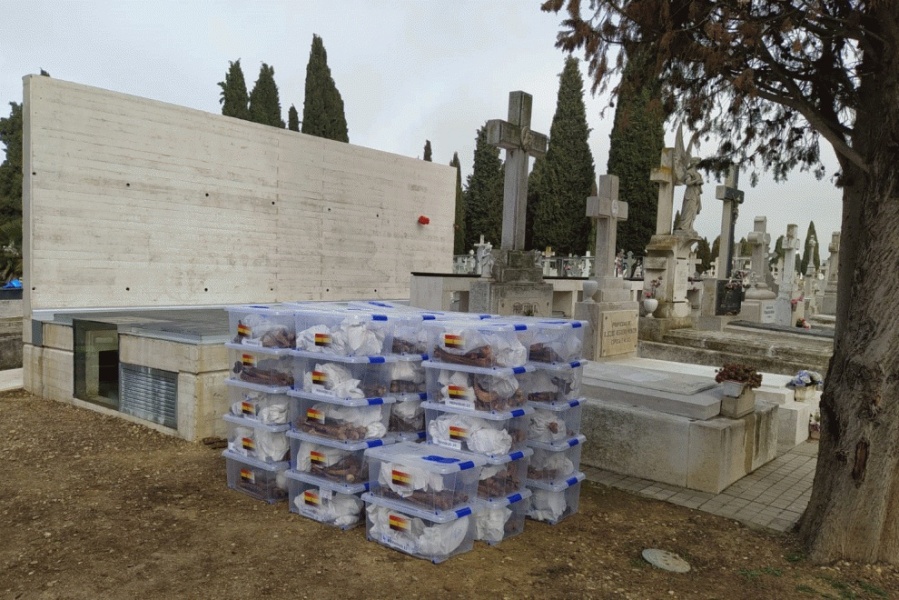
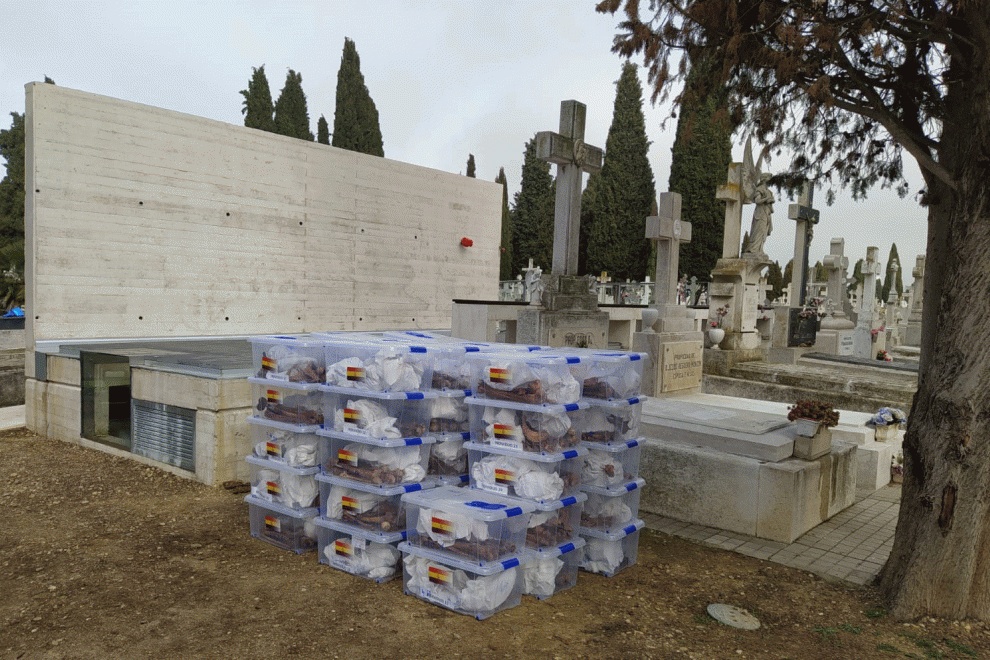
At last. The remains of 247 victims of Franco that have lain in a warehouse in Valladolid for over two years will be buried this Sunday in a memorial constructed within the Carmen cemetery. This will be the end of a long process that began in 2016 with the exhumations of communal graves in the cemetery itself, paralyzed since for a long time by the insistence of UGT to install a bust of Pablo Iglesias Posse. Finally, there will be a memorial, there will be the names of the more than 2,650 fatalities of the province, the 247 bodies recovered and there will be no bust of the founder of UGT and the PSOE.
(Trans: UGT is one of two main Spanish trade unions and is connected to the social democratic PSOE; both were banned — along with many other organisations — during the Franco Dictatorship but since then the PSOE has been in government more than any other party. Valladolid is about halfway between Madrid and the Bay of Biscay).
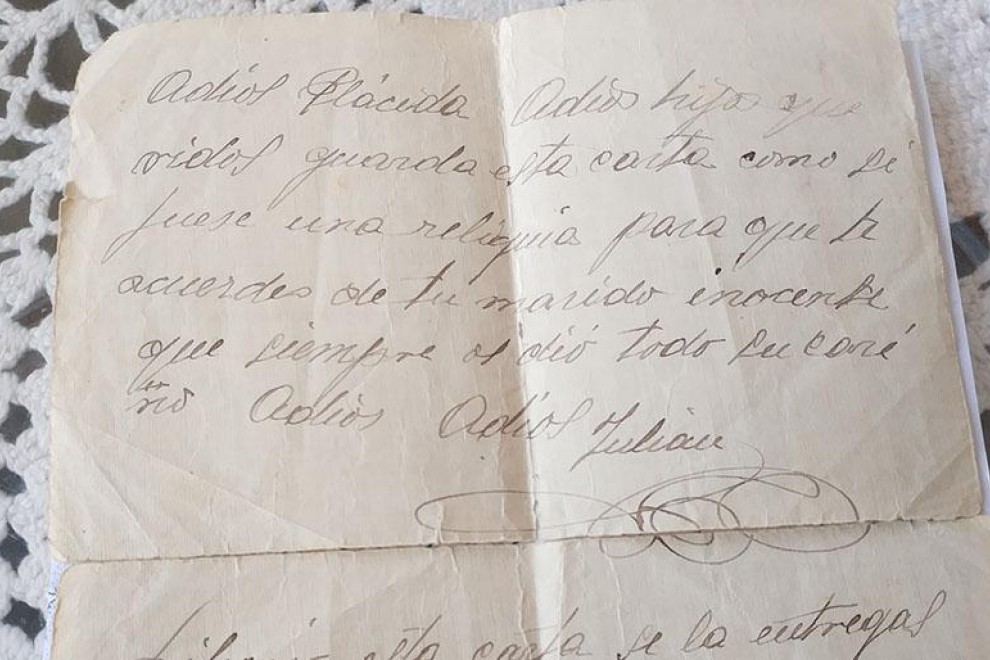
3) Letter sent by Julián Carlón to his wife and children from the Valladolid prison.- ALEJANDRO TORRÚS
“We want this tribute to be an act of democratic recognition and historical justice to all those who defended the Second Republic regardless of the party in which one was active,” explained Julio del Olmo, president of the Association for the Recovery of Historical Memory (ARMH) of Valladolid, responsible for the exhumation and custody of the bodies, to Público.
Memorial built in the Carmen cemetery, just a few meters from the location of the graves of the victims of the Dictatorship. (Photo: Valladolid ARMH)
The event will begin at 12.00 noon this Sunday and will include participation of relatives of the victims, the Valladolid writer Gustavo Martín Garzo, musical performances and the presence of the Mayor of Valladolid, Óscar Puente and the Secretary of State for Democratic Memory, Fernando Martínez.
However, the tribute comes too late for many victims. For example, for Saturnina, who passed away a few weeks ago. Her perseverance and struggle and that of her husband facilitated the ARMH in identifying the place where the graves were in the cemetery and proceed to their exhumation. Saturnina was only a child when Franco’s forces shot her father, Julián Carlón, on October 1, 1936.
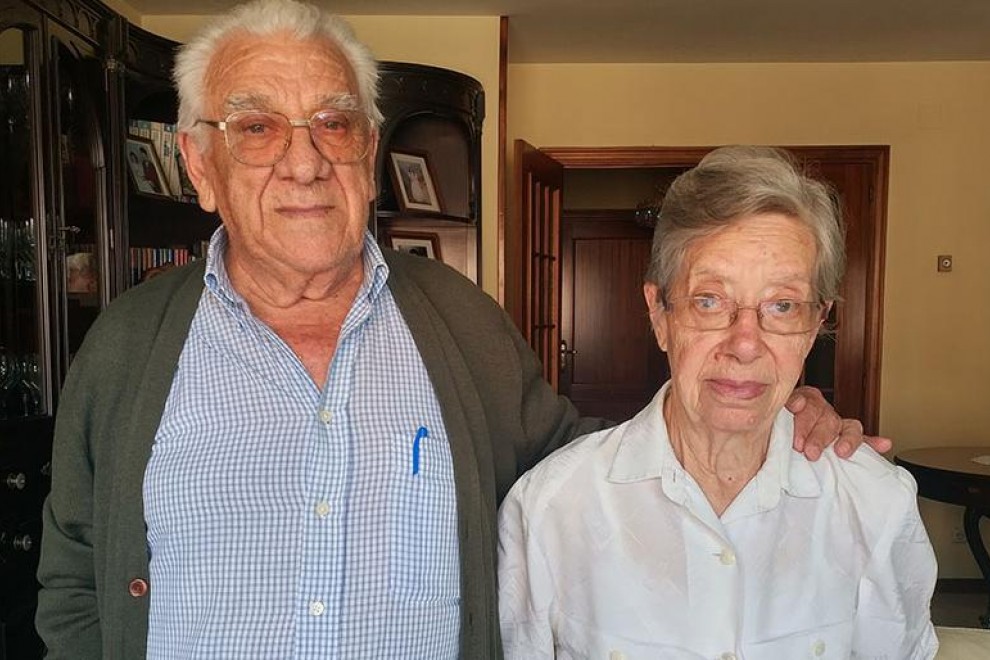
Saturnina, in fact, barely knew anything about her father. He was four years old when he was taken. “I only remember the day he was taken and the place where he was buried, which my uncle told me about,” she confessed tearfully to this newspaper in September 2019. “I don’t even know how he was killed. I just know he was taken away, that he never came back and that, from that day, there were only tears in my home. My mother never told me about my father because of fear,” she said. However, thanks to the indications of a relative, Saturnina kept a memory of the exact place where the bodies were buried after their execution.
Saturnina & Avilio at home September 2019. Saturnina was 4 years of age when the Francoist forces took her father away and shot him. (Photo: Torrus)
REMAINS OF THREE WOMEN AND TWO MEN IDENTIFIED
To date, the Valladolid ARMH has managed to identify “with total security” five of the 247 bodies recovered. These are of three women and two men: Lina Franco Meira; Republican Army sergeant Francisco González Mayoral; the Mayor of Casasola de Arión, Mateo Gómez Díez; and mother and daughter María Doyagüez and María Ruiz Doyagüez.
“Of the four graves with the 247 bodies that we have found, we have only been able to certify those five people to almost 100%. Of many others, we can be almost certain that they correspond to one group or another of those shot, but we cannot name each skeleton. We lack the means and it is a tremendously complicated process,” laments Del Olmo, who, however, points out that the remains of the victims will be well preserved so that, if possible, they continue working on identifications.
Letter from Julián Carlón in Valladolid Prison to his Wife & Children. (Photo: A. Torrús)
Cases such as that of Lina Franco Meira, which has been identified, are exceptional when 81 years have elapsed since the end of the Civil War. Her bones could be identified thanks to a DNA test sample of one of her daughters, 93 years old. An exceptional case of longevity that has allowed name and surname to be given to some bones and, in addition, allows us to believe that among the rest of those sharing her grave are her other 14 neighbors of the town of Castromocho (Palencia) that were taken along with Lina Franco to Valladolid to be executed and buried.
“SO THAT FRANCO AND AMNESIA DO NOT WIN”
Franco’s forces not only killed Lina Franco and more than 2,000 people in this province (Castille-Léon). They also tried to erase their names, their life stories and their struggles. Now, 84 years after the coup, a memorial will recover their names and try to spread their fight in defence of Republican values. The challenge, however, continues and consists in being able to identify as many of them as possible so that Franco and amnesia do not win the battle.
Why doesn’t SF just step back and wait for whatever government is formed, hammer them from the opposition benches and wait for the next General election (which might well be in the Autumn)?
Sinn Fein President Mary Lou McDonald and Micheál Martin, leader of Fianna Fáil. (Images source: Internet)
There are 160 seats in the Dáil, the Lower House of the Irish Parliament. Mícheál Martin, leader of the Fianna Fáil party (38 seats), tells Mary Lou McDonald that he won’t go into coalition with her party Sinn Féin (37 seats) and she rages at him. Fine Gael (35 seats) wants to go into coalition with Fianna Fáil – but at a price. Eoin Ó Broin of SF admits the numbers don’t add up for a coalition of the Left (couple of surviving TDs from Left parties and independents led by SF) which was clear before Sinn Féin (and some on the Left) even started talking about it.
The main reason for the weakness of the Left in the Dáil is that the Irish Labour Party, founded by Connolly, Larkin and others, has degenerated to a remarkable degree. Another reason is that as a result of centuries fighting colonialism and concentration on the national question, there has never been a substantial nationwide party or grouping of the Left in Ireland. Also some left-wing TDs (members of the Dáil) actually lost seats in the general election this month.
On Monday I think it was, the Guardian published and I shared what I thought was a brief and fair analysis of the results and of the possible coalition governments and even suggested that SF would be wise to let the established parties flounder in government and beat them in the next election. After all, most commentators seem to agree that if SF had fielded more candidates, they would have got even more seats, an error they can remedy next time.
A LEFT COALITION NEXT TIME?
Of course, that might not be anywhere near 81 seats, the number for an overall clear majority – but a Left coalition majority would be more possible then. Besides, they could form a Left platform to go intothe next election, which would give a lot more transfers of votes and possibly get more people elected from the Left too.
But instead, Sinn Féin are chomping at the bit and their eagerness to get into Government right now, even in coalition with neo-liberal capitalist and neo-colonialist parties, is disturbing.
Why do I care? After all, I am not a SF supporter, nor even of any of the Left parties – a revolutionary, in fact, not a reformist. But that doesn’t mean I would not welcome some reforms nor, more to the point, that I don’t see how the people are crying out for them. Like an immediate building program of public housing and an effective overhaul of the health system (both linked to youth training and employment). A defence and development of our natural resources and services. Saving Moore Street from “development” by vultures. Abolition of the no-Jury Special Criminal Courts (which SF seems to be retreating from already before they even got a Government coalition offer).
I could list many more but what’s the point?
If what we get is a coalition government led by Fianna Fáil or even containing Fine Gael – forget it! And if SF is not prepared to play a longer game and the Left is not prepared to put together a platform package, then the longer-term hope of revolution becomes the only viable one for the shorter term.
End.
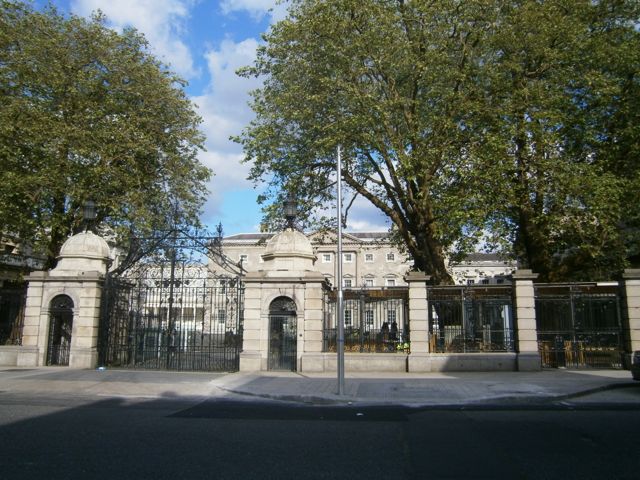
Leinster House, location of the Oireachtas (Irish Parliament). (Photo source: Internet)
I observed in Language Is a Treasure Chest 1 that it is full of wonders but that it has some horrors in it too. And I found it to be so again.
I was reading a novel in which the word “Cimarron” appeared and, doing some quick research on the word, I came across a 2004 query in an email website or page called Word Wizard:
What is the etymology of the word cimarron? I’ve always been told that it means “runaway slave” in Mexican Spanish. Can anyone verify this?
The reply is dated the same day:
From Greek. It refers to people who live in perpetual mist and darkness, akin to the ‘land of the dead’. Latin ‘Cimmerius’, Greek ‘Kimmerios’, Assyrian ‘Gimirri’ even the bible ‘Gomer’ Gen.10:2 and Esk. 38:6. In Western United States it refers to a stretch of land that gets rainfall when other near by areas are desert year round.
Apart from the topographical reference, I thought the expert’s explanation highly dubious. And in fact I happen to know something about the Spanish-language origins of the word.
The searcher replied:
Thanks, Jim. I just wonder what connection this word has to Hispanics of Mexican origin because it shows up in their surnames (although not as common as Lopez or Vargas or Garcia). Is it just Mexican in origin or did that also come from Spain? So the “runaway slave” theory has no foundation then?
The expert’s reply did come back with a Spanish-language connection and he may be on to something with the topography, though I think he has it the wrong way around (as we shall see).
The “runaway slave” theory is not so obsolete.
Mexico did not have slaves (Outlawed in 1810)but
American slaves who fled to Mexico had to pass
through lands with water, or else parish (sic).
When relating their tales of woe to the locals
the word ‘cimmaron’ arose to describe their flight
through the South West desert.
Very curiously, there was no further contribution to the discussion. I tried to leave my own but had to register, which I have done (though wondering if worth the trouble) and am now awaiting confirmation1.
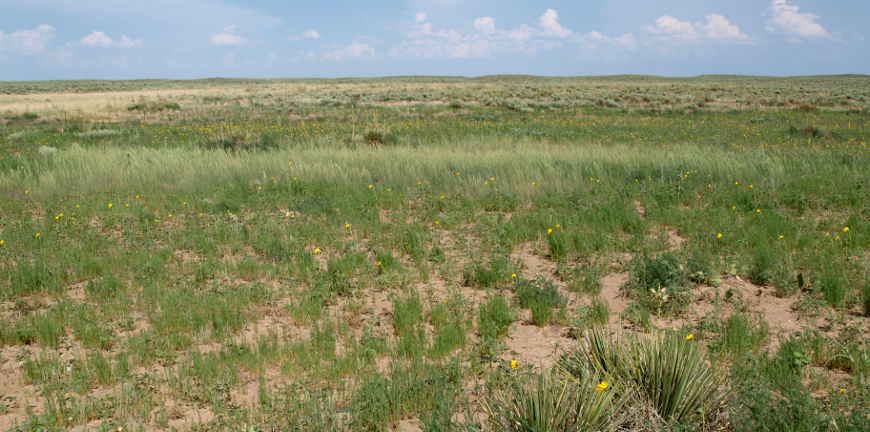
A view of the Cimarron National Grassland, the largest piece of public land in Kansas, a 108,175-acre property in the southwestern part of the state. It was recovered from the Dustbowl ecological devastation by soil recovery and management practices. (Photo source: The Armchair Explorer – Kansas)
THE FOLK MEMORY WAS TRUE
Continuing with a little light online research I find that the Castillian-language (Spanish) origin is the explanation most often given, with rarely a reference to Greek or other classical or archaic languages. For example, in yourdictionary.com:
American Spanish cimarrón, wild, unruly ( from Old Spanish cimarra, thicket): probably origin, originally referring to the wild sheep (bighorn) found along its banks
(Latin America, of animals) feral (having returned to the wild)
Synonyms: alzado, bagual, feral
(Latin America, of people) rural; campestral
(Latin America, of plants) of a wild cultivar.
But …. what about the “runaway slaves”? Under the title Cimarron People, Wikipedia has this to say: The Cimarrons in Panama were enslaved Africans who had escaped from their Spanish masters and lived together as outlaws. In the 1570s, they allied with Francis Drake of England to defeat the Spanish conquest. In Sir Francis Drake Revived (1572), Drake describes the Cimarrons as “a black people which about eighty years past fled from the Spaniards their masters, by reason of their cruelty, and are since grown to a nation, under two kings of their own. The one inhabiteth to the west, the other to the east of the way from Nombre de Dios”. (location in Panama — DB)
While we may indulge ourselves in a sardonic smile at commissioned pirate Francis Drake talking about the cruelty of others, or about slave-owning by a country other than England in 1570, we remember also that at the time Spain was the main competitor with England in the rush to plunder the Americas – and had got there well before them.2 Both colonial powers were already plundering Africa for raw materials and slaves.
The meanings of animals having gone “feral” or “returned to the wild” would easily have been applied by the society of the time to escaped African slaves, a society which, despite evidence to the contrary including agriculture in Africa, would have considered indigenous inhabitants of Africa as people living in the “wild”. Once escaped and no longer under European control, they would be seen as “returning to the wild”.
So what happened to the Cimarron People? Their settlements were subject to punitive raids by the Spanish, killing people and burning crops, so that in the end they came to a treaty with their old enemy. The Wikipedia entry says no more except that the “Cimarrons” and the English quarreled (not surprising, given that they were of no further use to the latter). I believe some of their settlements in Florida were raided and burned by US “pioneers” and soldiers and that the remainder became part of the Seminoles, a native American tribe that resisted the USA in the longest and most costly of the USA’s wars against the indigenous people, the Native (North) Americans. The Seminole had many tribe members of part-African origin in their midst.
And here – a surprise: The word “Seminole” is derived from the Muscogee word simanó-li, which may itself be derived from the Spanish word cimarrón, meaning “runaway” or “wild one”!
So, in line with what that on-line searcher back in 2004 had heard, no doubt a folk belief, the word cimarronis, in Mexico (and in the USA), of Castillian (Spanish) language origin and is connected to escaped slaves of African origin.
Some of the sources for “cimarron” also give us “marron” or “marrón” which is also related to escaped slaves and, in English, became “Maroons”. The Maroons, escaped slaves who inhabited mountainous regions of Jamaica and elsewhere became a great problem to the English settlers (after they took the island from the Spanish) which they failed totally to quell, the Maroons emerging victorious in many military engagements. In the Cockpits area of Jamaica, I have read, there is a place called Nanny Town, which is believed to be one of the settlements of the Maroons; their chief was said to be a woman called “Granny Nanny”3, whether because of her former slave occupation or for other reason4. In the end, like the Spanish with the Cimarron People, the English had to treat with them. Sadly the treaty required the Maroons to return newly-escaped slaves, which they did and for which they received payment.
Marroons in treaty with the British, shown here in a reversal of the actual power relations in the “Pacification with Maroons on the Island of Jamaica, by Agostino Runias (1728-96). (Source image: Internet)
However if instead of being a voluntary escapee to go to a wild place you were forced by people or circumstance, well then, like Alexander Selkirk’s “Crusoe”, you’d be “marooned”!
Well then, what about the “cimarron strips” in the southwest of the USA? Could the word refer to strips of land “gone wild”? Or could the expert replying to the question in 2004 have been on to something?
If the slaves escaping through the desert from the USA to Mexico did indeed make their way through strips of watered land (not just for the water, as the expert speculates but for vegetation to conceal them), then there is a connection between escaped slaves and these strips of land. But not as the expert sees it, rather the other way around: since the escaped slaves, the “cimarrones” were travelling the strips, they would be called by those who knew about it (escapee hunters, escapee helpers and just observers), “cimarron strips”, i.e “those strips through which the runaway slaves travel.”
CHRISTIAN ETHNIC PREJUDICE
However, if the word comes from Castillian (Spanish) what were the origins of the word in that language?
Perhaps a year ago, I was reading a book that described the Spanish State as having been characterised, contrary to many other European states, by mass expulsions and exiles on a number of occasions throughout its history5. Naturally enough, first on the list of expulsions was the well-known example of the Moors and the Jews. Those who were not slaughtered by the forces of the “Christian Monarchs” of Ferdinand and Isabella in the “reconquest” were obliged to convert to Christianity or to leave “with only the clothes on their backs”. This also occurred in Portugal.
Those Jews who left were the Sephardim or Sephardic Jews, who spoke Ladino, an archaic kind of Iberian Romance6language with Aramaic and Hebrew words, along with the Moors, who spoke an Iberian-Arabic mixture or Arabic. The key of their houses or gates have been handed down to this day in families of both groups.7
Many converted, often referred to by Christians as “conversos” (Jews) or “moriscos” (Arabs) but were constantly under suspicion of reverting to their old religion even with the threat and constant trials and torture of the Spanish Inquisition. According to what I have read they too were sometimes called “marronos”, i.e in the eyes of the Spanish Christian ruling class, those who had been “domesticated” (Christianised) but had “returned to the their wild way”, (Moslem) i.e “gone feral”.
Forced conversions that had to appear genuine: “The Moorish Proselytes of Archbishop Ximenes”, Granada, 1500 by Edwin Long (1829–1891). (Image source: Internet)
Wikipedia on Marrones in Iberia confirms:The (Spanish) Inquisition was aimed mostly at Jews and Muslims who had overtly converted to Christianity but were thought to be practicing their faiths secretly. They were respectively called marranos and moriscos. However, in 1567 King Phillip II directed Moriscos to give up their Arabic names and traditional dress, and prohibited the use of Arabic. In reaction, there was a Morisco uprising in the Alpujarras from 1568 to 1571. In the years from 1609 to 1614, the government expelled Moriscos.
THE BUSH FROM THE NUT?
And is “ci” or “cy” in “cimarron” then merely a prefix? The word “marrón” exists as a colour in Castilian and a number of Romance languages and came into English as the colour “maroon”. Its development is taken as originating from the colour of the large ripe chestnut, rather than given to it later. Of course there are a number of words for colours or tints which have a botanical origin, “orange” being an obvious one.
Castanea Silva, the edible or Sweet Chestnut. (Image source: Internet)
Alright, then the nut and tree might have been associated with uncultivated or “wild” areas, similar to those to which the “cimarrons” would escape. But where did the “ci” suffix come from? Somewhere in the midst of what I have been researching I came across an explanation, derived from Latin, meaning “towering”, “high” etc. But can I find it now?
The online sources are telling me that the relevant pages are up for deletion and I can join the discussion. No thanks, I do not have anything like sufficient knowledge to enter a debate on that, nor the patience of an academic to research it thoroughly.
But “high” and “wild” could easily correspond, given that valleys and plains lend themselves more easily to cultivation, as a rule, than mountainy areas, which might remain wooded or with with thick undergrowth. And that might also give us the “bush” or “thicket” referred to in a number of references for “cimarron”, which in turn might describe the “cimarron strips”. In parts of Latin America (and for all I know, in all of them) such as Chile, a “cimarra” is also a thicket or densely-grown area. The article in the Language Journal (see reference) comments that the “arra” cannot be a Romance language word-ending but even if true it seems to me that the author (or authors quoted) might be unaware that among those from Iberia who colonised or settled in the Americas, Romance language speakers were not alone. There were also Basques who spoke Euskera/ Euskara and for evidence, they applied a number of toponomics and left family names from the Basque Country (Basque descendants make up to 10% of the population of some Latin American countries). And “-arra” would be a common enough suffix or word-ending in Euskera.8
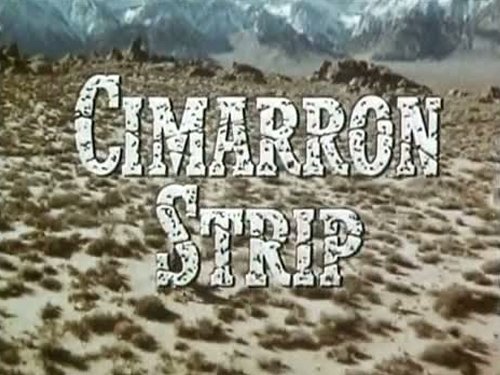
Opening title for the weekly TV Western series Cimarron Strip, starring Stuart Whitman, Judy Gleeson, Percy Herbert and Randy Boone. Though popular, only a years’ worth of episodes were screened. (Image source: Internet)
OKLAHOMA PANHANDLE AND THE CIMARRON STRIP
In the 19th Century wars between the Mexican Republic, the USA and the Native Americans in the area, it was carved up with less and less left to the Native Americans. Prior to the American Civil War, white Texas wanted to join the Union as a slave state and due to a US federal law prohibiting slavery north of 36°30′ parallel north, white Texas surrendered a strip of land north of that latitude. The settlement (temporary of course), left a strip as “Neutral Territory” (one can only imagine the temptation for African slaves in Texas to make for there). After the Civil War big cattle ranchers moved in, disregarding treaties and named the area the Cimarron Strip.
Map of Oklahoma territory and “Neutral Strip” before the American Civil War. Image source: Wikipedia, Texas Panhandle.
But that was because the word Cimarron was already in the area, from the “Cimarron Cutoff” leading to a crossing of the Cimarron river. And yes, there was a popular 1967-1968 TV series called “Cimarron Strip”, starring Stuart Whitman. But, though I used to watch it, that is only faintly related to the story of the word that set me out on this journey.
End.
FOOTNOTES
1Which days later had still not arrived – perhaps the site is no longer in operation, which would explain the silence after those two posters.
2Columbus voyage to America 1641 and Spain’s first colonial settlement 1565 (now Florida); Mayflower expedition to America with English settlers 1587 (now Virginia). However, Europeans had founded settlements much earlier, as with the Norse in the 10th Century and very likely Irish monks in the 6th Century. But it was the English and Spanish who conquered most, the Dutch, French and Portuguese less. The descendants of the English settlers after gaining independence from England completed the seizure and colonisation of most of the North American continent, while English colonists remaining loyal to the English Crown seized land to form what is now Canada.
4All the folk tradition, albeit conflicting on some points, declares that she had not been a slave which leaves one to wonder how she might have reached Jamaica from Africa without having been enslaved.
5 I borrowed the book from the public library and cannot remember its title at the moment.
6“Romance languages” is the name give to the group on Indo-European languages such as Castillian (Spanish), Catalan, Galician, Portuguese, Romanian, Italian and French. They are sometimes called “Latin-based” or “Latin Languages” but there is some dispute about the origins and developments of these languages.
7 Ironically, the door or gate “key” is also a symbol of return for Palestinian refugees driven from their homes by Zionist massacres, threats and fear during the founding of the State of Israel.
8 Among toponomics of North America’s southwest Durango (Colorado and Mexico), Navarro and Zavala Counties (Texas) are perhaps the best known; while Aguirre, Arana, Bolívar (Bolibar), Cortazar (Kortazar), Duhalde, Echevarria (Etxebarria), García, Guevara (Gebarra), Ibarra, Larrazábal, Mendiata, Muzika, Ortiz, Salazar, Ugarte, Urribe and Zabala are but some among a host of family names of Basque origin from the American south-west to Latin America. And of course the country of Bolivia, from Simon Bolívar, a Basque surname from a Basque toponomic.
Excerpt on-line from Language journal, Linguistic Society of America, Leo Spitzer, Vol. 14, No. 2 (Apr. – Jun., 1938), pp. 145-147: https://www.jstor.org/stable/408879?seq=1
“Sinn Féin is not like other Irish political parties” goes the propaganda campaign against the party by media commentators and rival mainstream politiciansduring the elections. What nonsense! It is exactly like the other main Irish political parties – and that’s the problem.
Their opponents’ main objection seems to be that Provisional Sinn Féin was widely seen as the political wing of the armed resistance group Provisional IRA and, although the IRA have dissolved and decommissioned their weapons, the party still carries that mark in the eyes of its detractors (and, it must be said, fondly in the eyes of some of its supporters).
This propaganda campaign is acutely unhistorical. A few short lessons in Irish history might be of use here.
The Irish Labour Party was founded by, among others, the revolutionary socialist James Connolly and anarcho-sindicalist Jim Larkin. In 1913 both advocated arming union workers to resist armed police attacks. In 1916, the Irish Citizen Army they founded was part of the armed Rising and two of their leaders were among the 16 executed by British firing squads.
The party stayed neutral during the Civil War and was an opposition party to the Cumann na nGaedheal government. Since then, the Labour Party has been in Government only as a coalition partner – most times with the right-wing Fine Gael party. Except for it links with trade unions, the party has little claim to having “Labour” in its name and has turned away from everything if which its founders believed.
Fine Gael was formedin 1933 when two smaller groups joined Cumann na nGaedheal, which had been the governing party of the partitioned Free State from 1923 up until the merger. Michael Collins and his followers were the kind of people The founders of Cumann na nGaedheal were among the pro-Treaty and Free State supporters, i.e people who until then had been active in leading or supporting a campaign of armed resistance to the occupying British forces, including assassinations, ambushes and robberies. The Free State began the Civil War in 1922 by an artillery bombardment of Republican positions in Dublinand over the next few years carried out repression on the civilian population, torture, summary executions of prisoners of war as well as State executions – and assassinations. The victors handed the reins over to Cumann na nGaedheal in 1923.
The parties that joined Cumann na nGaedheal in 1933 were 1) the National Centre Party, essentially a big farmers’ quasi-fascist party and 2) the Army Comrades Association (the fascist “Blueshirts”). Of the mainstream Irish political parties, Fine Gael has stayed truest to its founders and base.
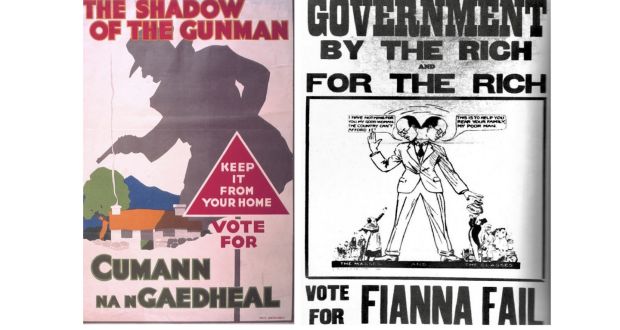
Fianna Fáil emerged from a split from Sinn Féin in 1926; interestingly, much of what is being said against Sinn Féin by establishment political commentators now – and worse — was said then about Fianna Fáil: “murderers”, “revolutionaries” (and even “Communists”!). The party first entered power in 1932, its leader De Valera having been — little more than a decade previously — a leader of the Republicans during the Civil War, opponents of the Treaty and of the Irish Government of the time. It freed the Republican prisoners locked up by the Cumann na nGaedheal government, also having a special police force (“Broy’s Harriers”) to persecute the Blueshirts, who aspired to taking power as had Fascists in Europe.
Cumann na nGaedheal (forerunner of Fine Gael) poster against Fianna Fáil during 1930s. (Image sourced: Internet)
By 1939, the Fianna Fáil government had introduced the savage repressive legislation of the Emergency Powers Act to intern republicans without trial and after a successful habeas corpus challenge by Seán McBride (one of the founders of Amnesty International), the Government brought in the Offences Against the State Act, was re-arresting Republicans and interning them without trial again (around 2,000). Two Republicans died on a hunger strike protest in Mountjoy Jail. Under Fianna Fáil the State executed six Republicans and some more are alleged to have died as a result of their treatment in the concentration camp.
In 1957, a Fianna Fáil government once again brought internment without trial into force, the colonial administration of the Six Counties having done the same the year previously. The last prisoner was released by FF in 1959.
Left: Cumann na nGaedheal poster urging votes against FF because of the party’s history. Right: Fianna Fáil poster appealing to the working class and small farmers. (Image sourced: Internet)
From having been seen as the main political party of Irish Republicanism, Fianna Fáil became in a short time the preferred party of the Irish capitalists (the “Gombeen” class) and has been in government more than any other party, more often indeed than the party that won the Civil War and set up the State.
JUST LIKE ANY OTHER IRISH PARTY
There is no historical basis for saying that Sinn Féin is very different from the other Irish mainstream political parties. It has traversed a similar path to all those others, perhaps most similarly to Fianna Fáil – it’s just a more recent arrival on the mainstream scene. It is already very like other main Irish political parties and is getting to be exactly like them.
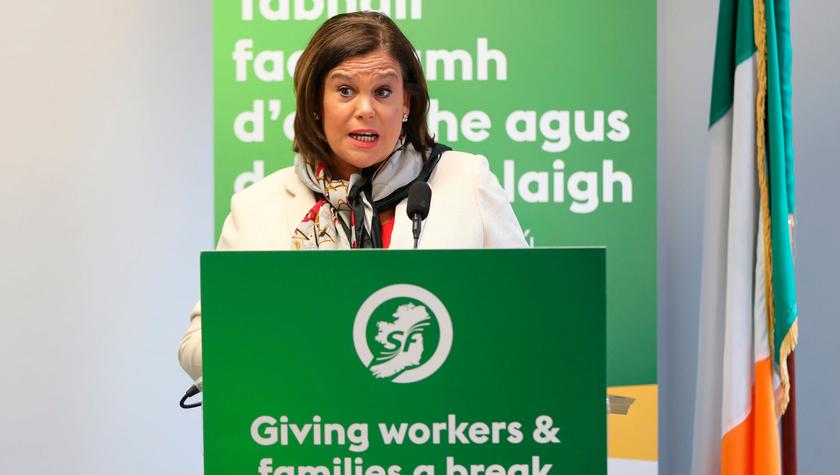
Leader of the Sinn Féin party, Mary Lou McDonald, at the launch of the party’s manifesto. With no intention of overthrowing capitalism it promised reforms for working people. (Photo source: Internet)
That is not a compliment.
This is a party that, in recent decades, had a revolutionary Irish republican – or at least nationalist – position. It strongly opposed the partition of the country and the colonial occupation of one-sixth of the nation’s territory. With the latter came — naturally enough — opposition to the colonial police force, the Royal Ulster Constabulary but this was much more than an ideological opposition: the RUC was an armed force created specifically for the repression of Irish Republicans and acted consistently against the Catholic minority in the Six Counties, which SF sought to represent and among which it organised.
The colonial Statelet itself, with its gerrymandering of electoral boundaries, sectarian allocation of housing and employment and its Special Powers Act, was the sworn enemy of the Sinn Féin party. And when British troops were sent in 1969 to repress the civil rights uprising, of course Provisional Sinn Féin and Provisional IRA fought them too.
The Provisional IRA gave up armed struggle against the British in 1998 and, although it maintained its armed force for control of its community for some time afterwards, eventually dissolved its organisation. By then it had already decommissioned its weapons.
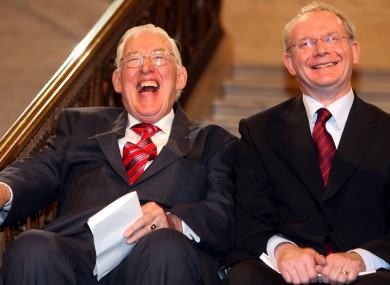
Martin McGuinness (right) of SF, formerly of the IRA, as Deputy Prime Minister of the British colony of the Six Counties. He partnered the Prime Minister Ian Paisley (left), a rabid religious sectarian, Christian fundamentalist and homophobe. They were dubbed “the Chuckle Brothers”. (Photo sourced: Internet)
In 2007 the SF party became part of the British colony’s administration in Stormont, with Martin McGuinness, former chief of the IRA in Derry, partnering Ian Paisley, notorious Loyalist religious sectarian and social bigot.
That same year the party agreed to support the armed and sectarian police force and in the reorganisation of the RUC had the name changed to “the Police Service of Northern Ireland”. The essence of the force, naturally, remains the same.
All the austerity measures inflicted on the working class by the administration since the party entered joint government of the colony have been approved by Sinn Féin MLAs.
Martin McGuinness publicly shaking hand of British colonial Queen when SF officially opposed the visit. However SF did not demonstrate against her visit and Gerry Adams later approved of it. (Photo sourced: Internet)
In 2011, despite an official SF policy of opposition to the visit of the Queen of England, Commander-in-Chief of the British Armed Forces, to the 26 Counties (the Irish state), leaders greeted her (one in person) and urged no protests be made against her visit.
In 2019, SF welcomed Prince Charles on a two-day visit to the colony and to the State; this man is not only son of the English Monarch but ceremonial commander-in-chief of the Parachute Regiment, authors of the massacres of Derry’s Bloody Sunday (14 dead) and Ballymurphy (11 dead) for which not a single soldier or commander has ever been tried. The SF Mayor of Derry, however, refused to meet him.
Gerry Adams shakes hands with Prince Phillip, titular head of the Parachute Regiment (the SF Mayor of Derry refused to meet him). (Photo sourced: Internet)
This year, 2020, the Six-County part of the leadership of Sinn Féin joined others in publicly seeking recruits for the PSNI, while the 26-County leadership withdrew from its previous position of seeking abolition of the repressive emergency powers of the Offences Against the State Act.
In the 26 Counties, SF long ago indicated its willingness to join in a governing coalition with some one of the other mainstream political parties: i.e capitalist, neo-colonial political parties.
On so many occasions, it has shown itself to be like the other parties and prepared to ditch formerly-declared principles for what it considered a political advantage, proving itself a “safe pair of hands” to the rulers of the system.
Yes, Sinn Féin is indeed a party like any other Irish mainstream political party: capitalist, neo-colonial, undemocratic and supporting State repression. As to the latter, why not? It won’t be SF that the State will be repressing — it’ll be Irish Republicans. And if SF ever get where they want to, into majority control of government – they’ll have plenty of opponents themselves to drag before those non-jury courts.
End.
L-R: PSNI Chief Constable Simon Byrne, Anne Connolly, Chairperson of the NI Policing Board, Gerry Kelly MLA, Deputy First Minister Michelle O’Neill and Deputy Chief Constable elect, Mark Hamilton at recruitment launch for the colonial police force.
A Ministry of Defence spokesperson has advised that members of the Brexit party returning from the European Parliament will be quarantined and monitored for 14 days in military facilities. “This is a necessary precaution to protect against the spread of dangerous ideas.”
They have advised the public to remain calm. “These are standard proceedures. The graves have only been prepared as a last resort.”
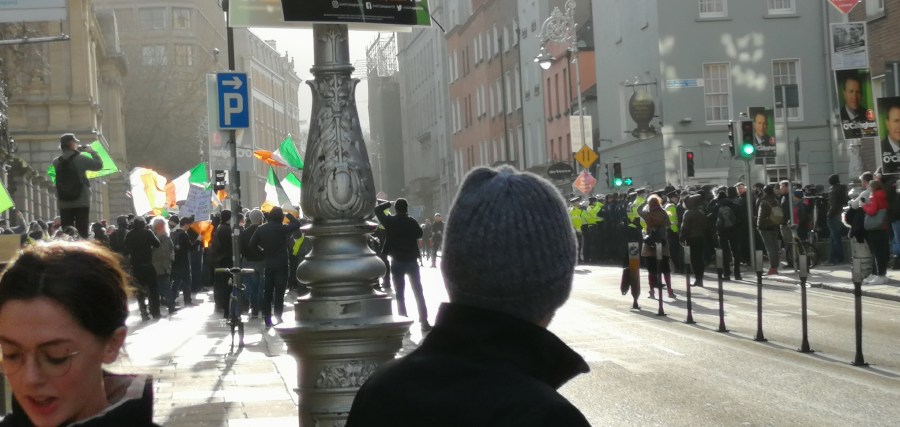
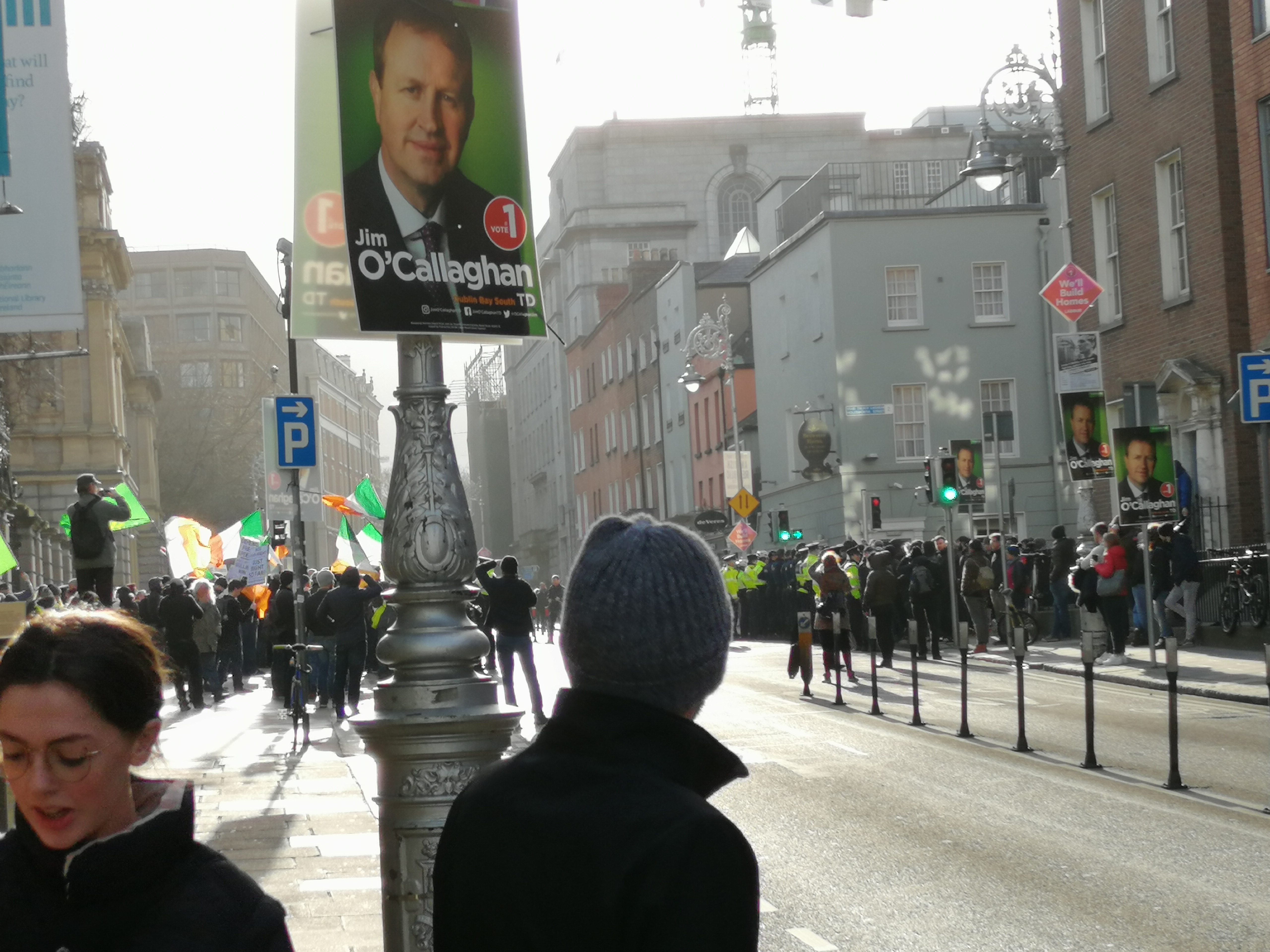
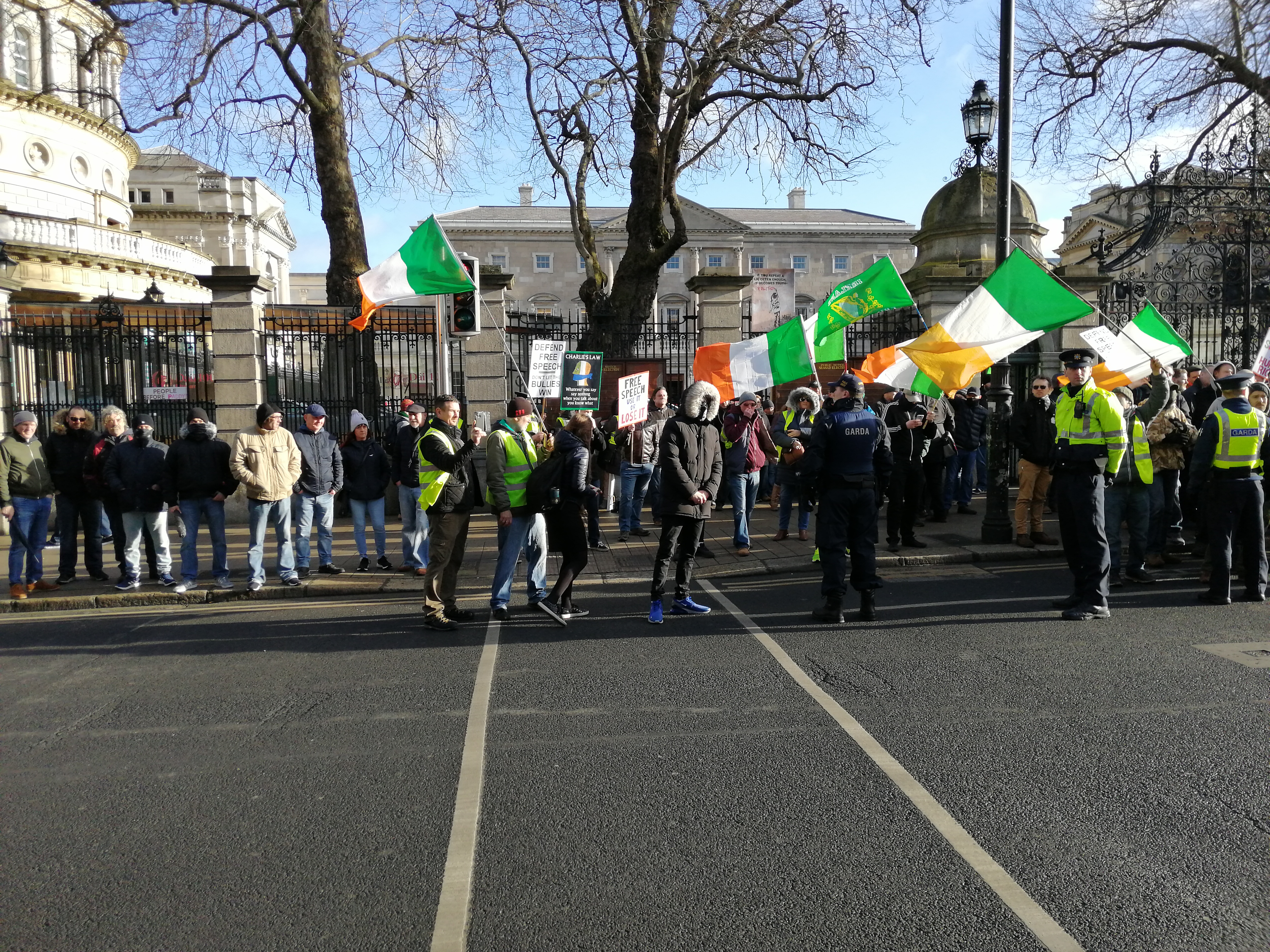
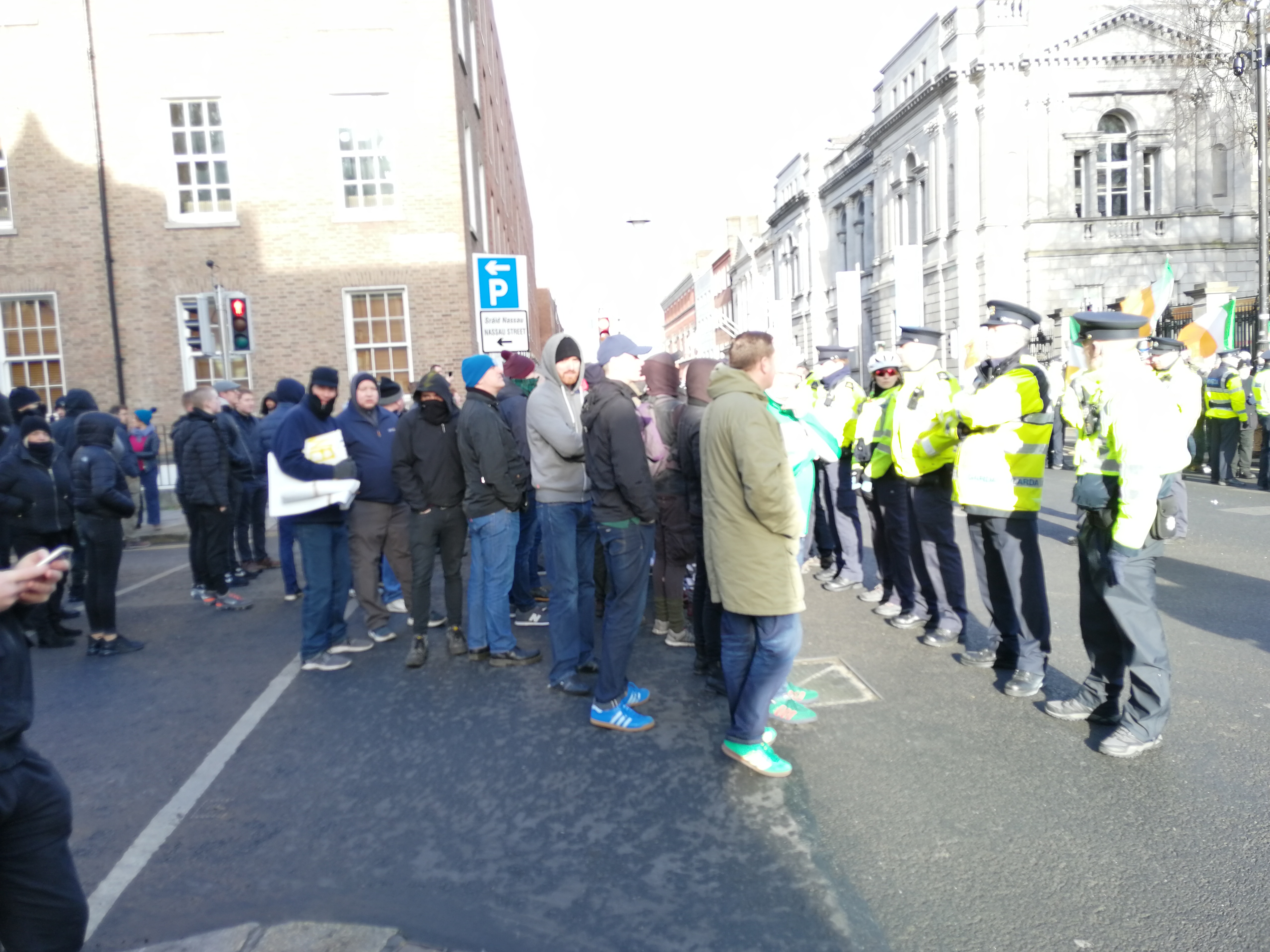
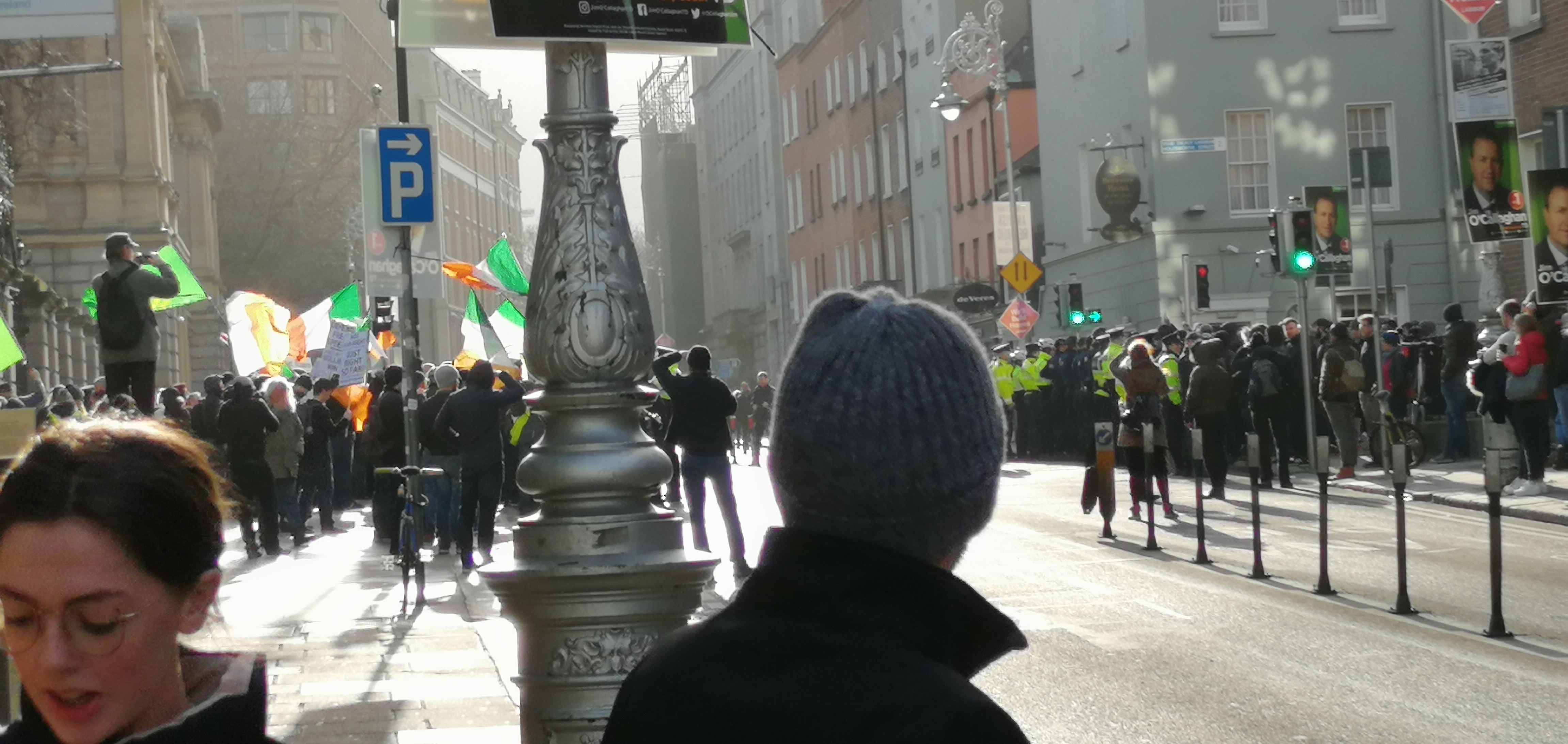
After weeks of propaganda and whipping up their support, a much-reduced turnout of the Irish far-Right lined up in front of Leinster House on Saturday 1st February and were confronted by an anti-fascist, anti-racist opposition a little smaller in size but which had been convened by word of mouth alone. There were some scuffles and a couple of arrests and the far-Rightists begged for a Garda escort to leave their protest after little more than one hour.
Confronting one another across Kildare St, far-Right and anti-fascists, seen from a little distance (Photo: D.Breatnach)
“FREE SPEECH”?
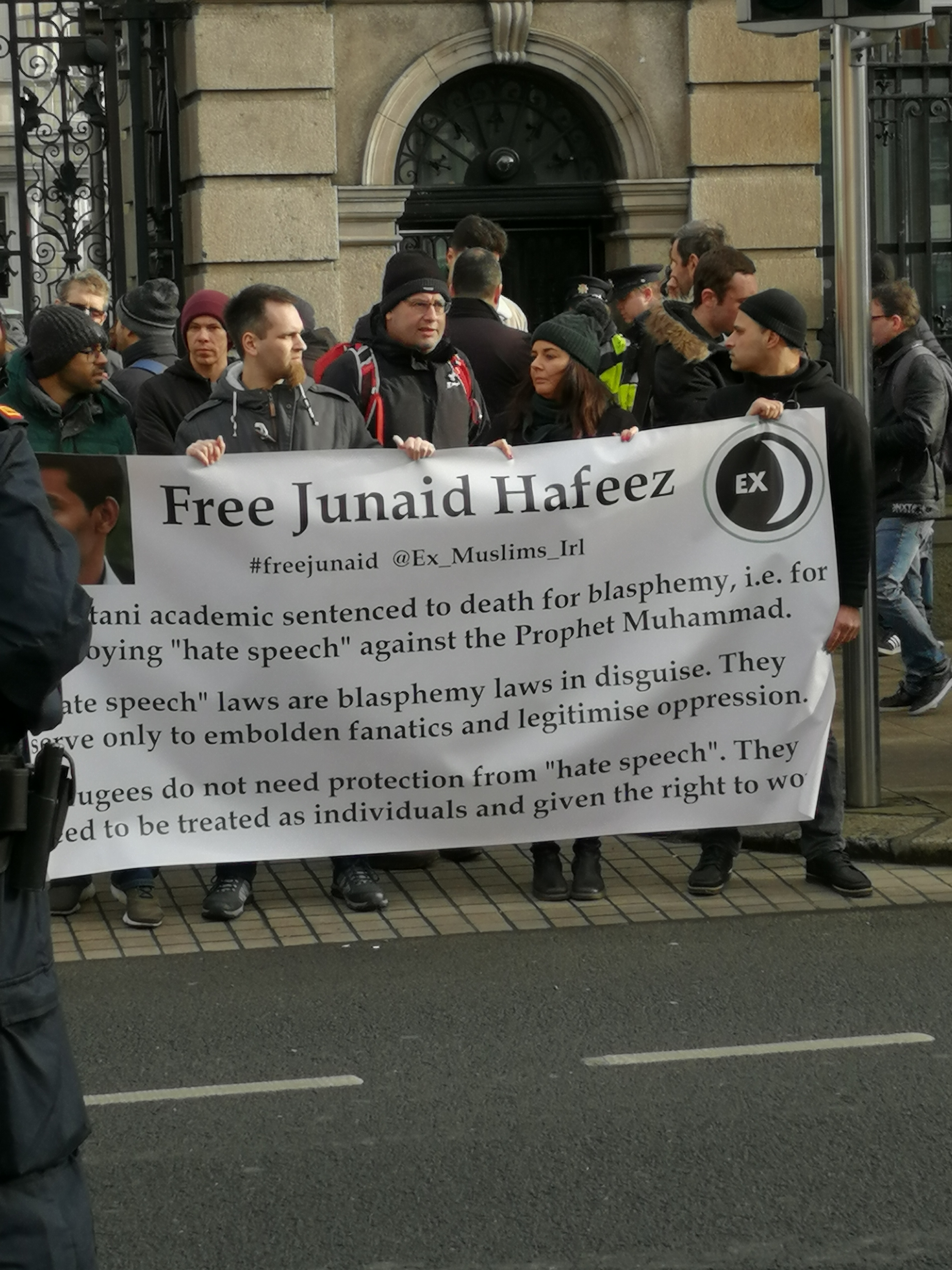
The far-Rightists had called the demonstration allegedly in defence of “free speech”, protesting legislation proposed recently by Fine Gael against “hate speech”. Apart from the fact that the detail of the legislation has not been published yet, most on the non-institutional Left in Ireland and perhaps especially Irish Republicans, would be extremely wary of such widely-framed legislation, known to have been used in other administrations primarily against people denouncing the police, political parties, politicians and even royalty.
However, most Republicans and the non-institutional Left would not agree with the “right to free speech” which the far-Right is seeking, which is the “right” to spout virulent and lying material in the course of their racism, islamophobia, LBGTphobia, attacks on women seeking pregnancy termination or campaigning for the right to choose. In fact, we can trace the public start of the far-Right concern with “free speech” in Ireland to July 2019 when Gemma O’Doherty had her Youtube account suspended and then closed by Google, due to complaints that her racist rants were violating Google’s own standards. A similar case occurred in January in Spain when the relatively new far-Right Spanish party Vox had their Twitter account suspended, after they had accused a municipal education program on equality of “using public funds to promote paedophilia”. (see also FAR RIGHT CHANTS OF “PAEDOS” below for more on this issue).
The far-Right demonstrators with Leinster House in the background. They fly a lot of Tricolour flags in an attempt to convey themselves as ‘patriotic’. (Photo: D.Breatnach)
Even thinking about the issue for a few seconds will make it clear that there is not and never has been an unfettered right to say whatever one wants in public. Long before there were modern laws against defamation of an individual based on lies, it was forbidden by the Brehon laws (the oldest surviving codified legal systemin Europe) which laid down punishment for the offence. Judaic and Christian traditions have it forbidden in the Ten Commandments as have those of many other cultures. The issue is not that all speech should be free but what kind of discourse should be permitted and which should not. And it is precisely that racist discourse, LBGTphobia, Islamophobia and attacks on the rights of women that the Republicans and non-institutional Left oppose, partly for its own sake and partly because it is along those lines that fascism seeks to build itself and split the working people in order to come to rule — in a dictatorship that will soon ban any criticism whatsoever of those in power.
Some confused or misguided Asian anti-blasphemy laws protesters among the far-Rightists, despite the common anti-migration and racist discourse of the far-Right. (Photo: D.Breatnach)
FAR-RIGHT CHANTS OF “PAEDOS”
Among the exchange of insults between both sides, at one point the far-Rightists were heard to chant “paedos” at their opposition. The word is an abbreviation of the word “paedophiles”, which describes people who sexually abuse children for their own twisted gratification.
Imagine if some of these far-Rightists were in one’s neighbourhood and began to accuse an anti-fascist of being a paedophile! This is one of the ways in which they abuse any right to free speech.
But in any case, what is the basis for this chant? Do they really believe that their opponents are all paedophiles? No, like the Spanish far-Right party Vox referred to earlier, they count LGBT people as equal to paedophiles, i.e people who sexually abuse children. That is how sick their thinking is. Nor do they believe that all their opponents are LGBT themselves but according to the far-Right, the fact that we uphold the right of people to decide their own sexuality and for consenting adults to choose their relationships, makes us the equivalent of those who sexually abuse children!
View of the anti-fascist, anti-racist demonstrators, at the Molesworth St. intersection, viewed northward down Kildare St. (Photo: D.Breatnach)
SURGE, SCUFFLES AND ARRESTS
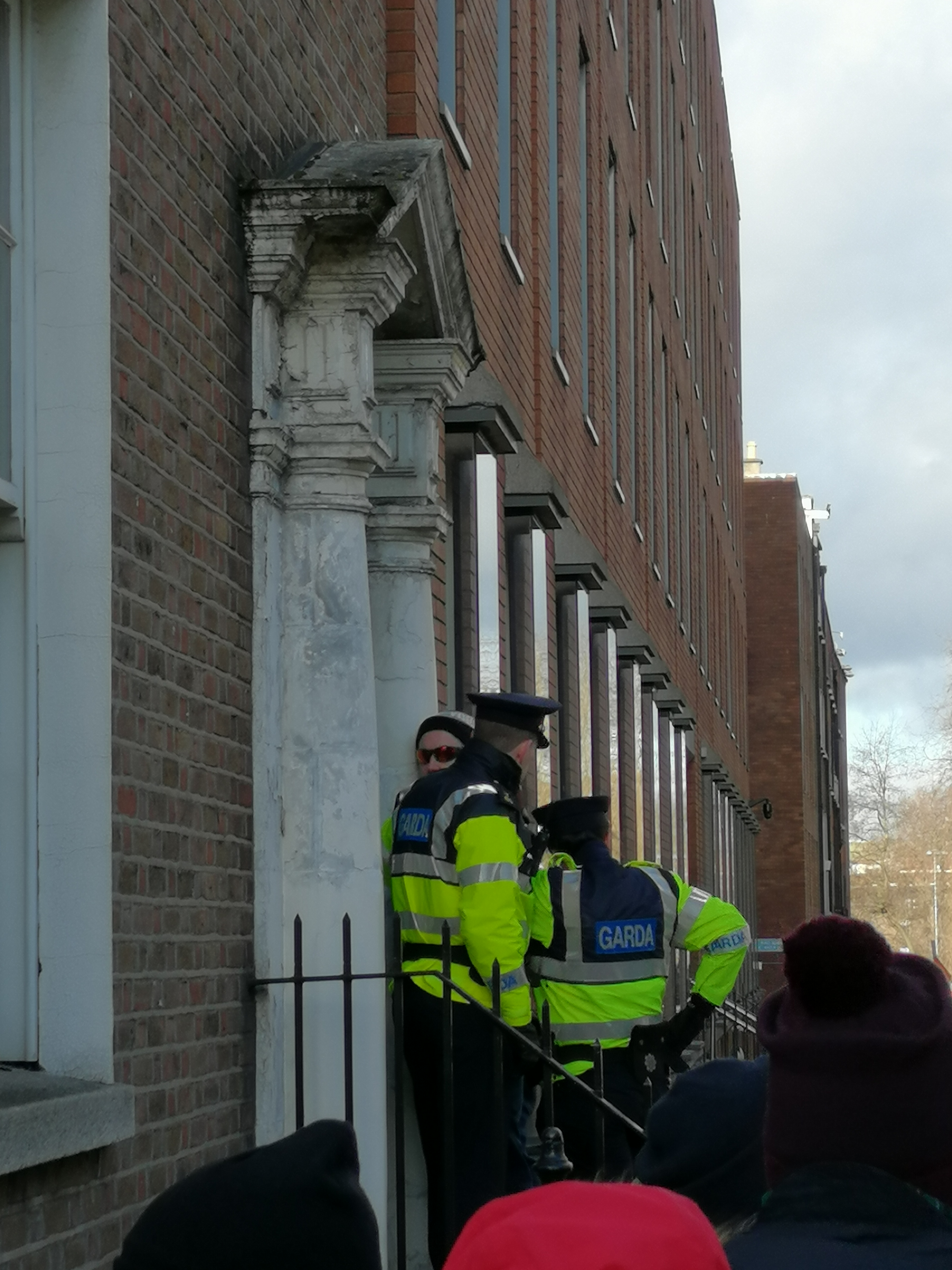
At one point, a surge developed among the anti-fascists towards the south of their numbers and the general Gardaí and Public Order unit (the Gardaí are the police force of the Irish state) charged the anti-fascists with batons drawn, with which they struck a number of antifascists. A man reported to be a fascist, on the steps outside a building on the same side of the street as the antifascists, was seen lashing out downwards, presumably at antifascists, with a pair of crutches. At that point the Gardaí restrained him and later it seems arrested him but apparently they had already arrested an anti-fascist. Most of the police dived at the anti-fascists during this brief episode and a few activists were rescued from police hands. However, a fascist who crossed the road from the Leinster House side with a stick, who took a number of swings at anti-fascists, was escorted back across the road by Gardaí, apparently without any attempt to arrest him.
The man seeing striking out at anti-fascists with crutches before being restrained by Gardaí. An antifascist was arrested during this incident. (Photo: D.Breatnach)
The far-Right rally had been scheduled for 1.00pm and at 2.15 pm they left, having begged the Gardaí for an escort, with which they were provided. Meanwhile, the riot police prevented the anti-fascists from following them.
However, a brief encounter on the quays a little later between small numbers of both groups necessitated the Gardaí once again to protect these “nationalist” warriors.
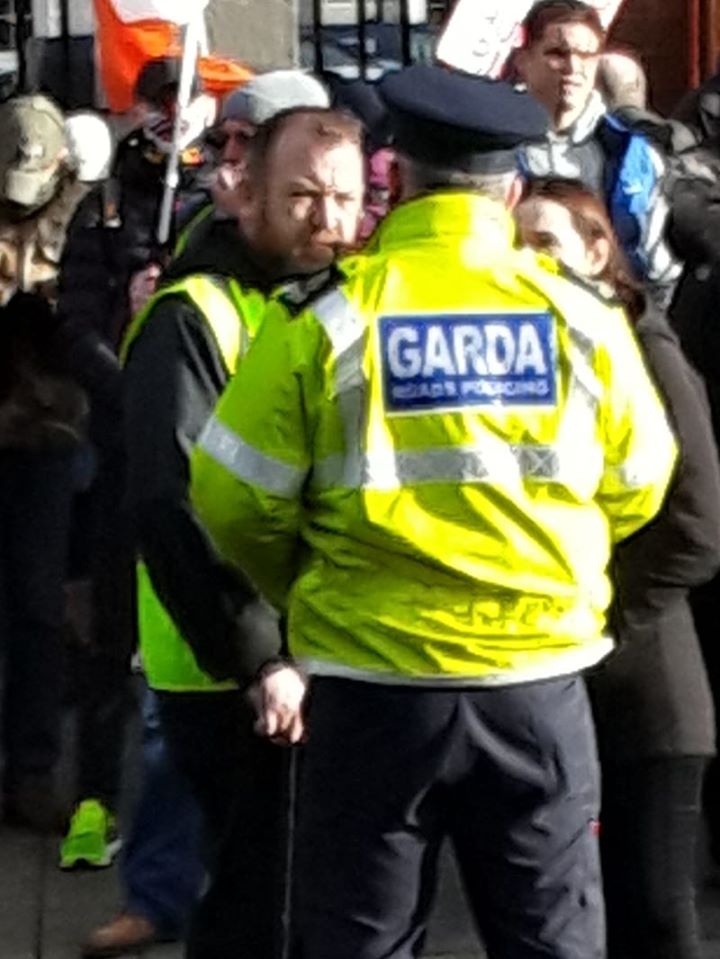
Yellow Vest Ireland fuhrer Glen Miller seeking escort from senior Garda officer. (Photo source: antifascist participant)
DIMINISHING AND DESERTED BY LEADERS?
Those who fancy themselves as the public leaders of the motley crew of the far-Rightists left their acolytes deserted, for apart from Yellow Vest leader and islamophobe Glen Miller, they did not attend. Neither Gemma O’Doherty nor Justin Barrett were to be seen there and the ex-British Army soldier Rowan Croft made only a brief appearance before vanishing.
As mentioned earlier, although extensively publicised in advance, the numbers of the far-Right were significantly down on previous events outside Leinster House, which may point to a limited reservoir of activists in the far-Right in Ireland, also to some inability to sustain an extended program of public events (after all, keyboard activism has been their main activity until recently).
On the other hand, their opponents, using personal contact only to mobilise from among Irish Republicans, Socialists, Anarchists and general Anti-Fascists of different organisations and none, were able to put together a counter-demonstration of a size approaching that of the far-Rightists.
However, it would be unwise to relax. The far-Right is on the rise across most of Europe; the capitalist system world-wide is heading for crisis and at such times turns to fascism to force the working people to pay for the crisis through austerity. In addition, in Ireland we are already in part of an austerity program with the bank bailout draining our taxes, our health service in crisis and no public housing program to counter spiraling homelessness and mortgage debt.
The Gombeens and foreign capitalists who feed on our sweat and blood will hesitate before taking on the working people in this country in an open fight. But with fascists and racists splitting the working people and diverting them from the cause of our woes, that would be a different matter. Continuing vigilance is required, along with mobilisation to counter their public events. But also, education of the people and giving genuine leadership in fighting for a decent life for working people of all ethnic backgrounds in Ireland.
Anti-Fascist Action Ireland (they published a report from which I took some of the information here, the rest being based on my observation): https://www.facebook.com/afaireland/?
The Save Moore Street From Demolition group runs a campaign stall every Saturday on Moore Street; it was founded in September 2014 and is independent of any political party or organisation. In addition to the banner announcing its nature and purpose, the group displays four flags every week. Three of those are copies of flags that were flown during the 1916 Rising and all them in locations close by Moore Street, each also with a very strong migrant connection – all three also survived the conflagration resulting from British artillery bombardment.
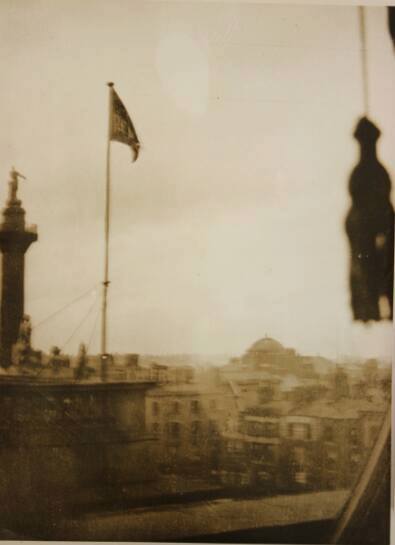
The Irish Republic flag, made by Constance Markievicz (born in England), flew at the Princes Street front corner of the GPO, 1916. (Photo source: Internet)
1) The “Irish Republic” flag was made from drape material by Constance Markievicz (born in England) and was flown on top of the GPO at the Princes Street corner. She was a member of the Irish Citizen Army (see (3)) and third-in-command at the Stephens Green/ College of Surgeons garrison during the Rising.
Volunteer Markievicz was sentenced to death after the Surrender but her sentence was commuted to imprisonment. In the UK General Election of 1918, Markievicz was elected as a part of the Sinn Féin coalition on an abstentionist policy and became the first woman elected to Westminster, though she did not take her seat. In the later banned First Dáil of 1919, Markievicz was elected the first Minister of Labour in world history and one of very few female cabinet ministers of her time.
2) The Tricolour was also hoisted on the GPO but at the Henry Street corner by Eamon Bulfin, born and raised in Argentina. In addition, the Tricolour, based on the pattern of the French Republican Tricolour but signifying unity for Irish freedom between descendants of the native Irish on the one hand with descendants of English and Scottish colonists on the other, had been presented to the Young Irelanders by French revolutionary women in Paris, in 1848.
The Irish tricolour flag, granted to Irish revolutionaries by women in revolutionary Paris, 1848. The Irish Republic flag at the Princes Street front corner of the GPO, 1916. It was raised by Eamon Bulfin from Argentina and flew on the front Henry Street corner of the GPO. (Photo source: Internet)
Volunteer Bulfin was part of the Moore Street/ GPO Garrison surrender, was taken prisoner and later deported by the British back to Argentina. While there, Bulfin became the Latin American publicity correspondent for the Irish Republican movement, later returning to Ireland to participate in the War of Independence (1919-1921).
3) James Connolly, born and raised in Edinburgh but Commandant of the 1916 Rising, sent ICA men to hoist the Starry Plough, flag of the Irish Citizen Army, on top of Clery’s building, across from the GPO. The design is based on the star constellation of Ursa Mayor, the Great Bear, which in Ireland is known as “The Plough” and therefore an instrument or tool of labour. The original design in gold on a green background, with the seven stars in silver, includes the cutting tool, the share, in the shape of a sword; this is apparently an anti-war message, evoking the King James Bible passage in Isaiah II: “They shall beat their swords into ploughshares, and their spears into pruning-hooks; nation shall not lift up sword against nation, neither shall they learn war any more.” The 1916 Rising was the first rising against the imperialist First World War, preceding the next (in Russia) by nearly a year.
Design of the Starry Plough flag of the Irish Citizen Army, erected on top of Clery’s during the 1916 Rising on the orders of James Connolly, born and raised in Edinburgh and Commander-in-Chief of the Rising. The Irish Republic flag at the Princes Street front corner of the GPO, 1916. (Photo source: Internet)
The Irish Citizen Army included women in its membership and they fought alongside male members during the Rising, some of them as officers; Volunteer Winifred Carney entered the GPO with a Webley pistol in one hand and an Olivetti typewriter in the other and was in Moore Street at the surrender. A number of male ICA members fought in Moore Street and at least one was killed there.
During the Surrender, James Connolly, with a shattered ankle and gangrene, was carried from Moore Street to Dublin Castle where he received medical treatment, was tried by court martial and sentenced to death. Connolly was one of the last of the 14 executed in Dublin, shot in Kilmainham Jail while strapped to a chair on 12th May 1916.
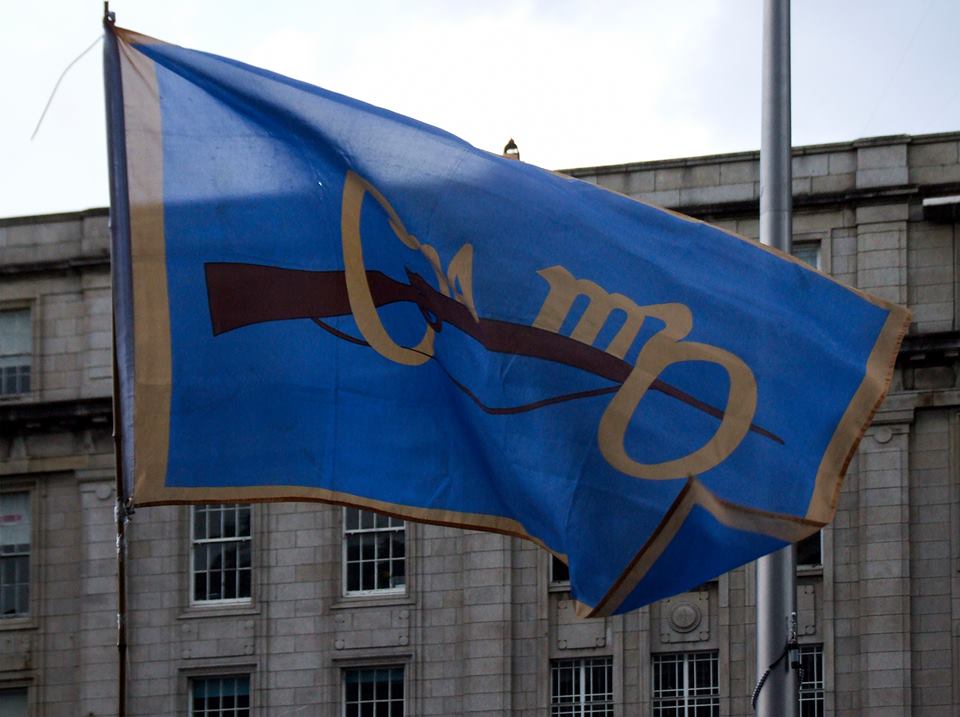
4) The Cumann na mBan flag with its lovely colours and design was not seen during the Rising, although many of that organisation participated in the Rising, two of them in Moore Street to the end: Volunteers Elizabeth O’Farrell and Julia Grennan. Cumann na mBan was the first revolutionary female organisation in world history to have its own uniform, under its own officers, while participating in an uprising.
As always you can support the campaign by sharing their Facebook posts from time to time.
The Cumann na mBan flag was not flown during the 1916 Rising, though many of the organisation participated in it. (Photo source: Internet)People signing petition and talking to some of the activists at the SMSFD stall in January this year. The Cumann na mBan flag is draped over the table. (Photo source: Bart Hoppenbrouwers, SMSFD)
Thank you for taking our Government satisfaction survey. Your opinion is important to us.
Please bear with us while we give you an opportunity to recheck your answers.
You indicated a satisfaction level of 0% with the current Government. Yes/ No
You indicated a satisfaction level of 0% with the previous Government. Yes/ No
To the question “Which past or current government did you approve of to a level of 50% or over?”
you entered “None.” Yes/ No
To the question “What, if any solution do you propose?” you entered “Revolution.” Yes/ No
In the event of having indicated “No” to any the questions above, please repeat the questionnaire again with more care.
In the event of instead having answered “Yes” to all, you need do nothing more. Our Satisfaction Team will shortly be with you to discuss matters further. Please do not leave the location at which you currently find yourself. Please do not switch off your phone or Satnav.
Thank you for taking the time to complete our questionnaire. Your opinion is important to us.
Published first in Dublin Republicans Against Fascism, reprinted by kind permission.
(Reading time: 2 minutes)
Dublin Republicans Against Fascism commend the diverse Balbriggan community for coming together yesterday, Monday 27th, to confront and ward off a motley crew of sinister far-right agitators who arrived in the town late evening to hold a public meeting.
Dublin Republicans Against Fascism who were present relay the following description of events:
The public meeting was to be an election launch for the carpetbagger candidate Gemma O’ Doherty who traveled from her residence in leafy South County Dublin to attend, and her fellow ACI (Anti-Corruption Ireland) candidate John Waters. A special guest speaker for the evening was to be Justin Barrett, the leader of the far-right National Party, a party primarily made up of landowners, businessmen and wealthy middle class elites.
KEEP DUBLIN TIDY
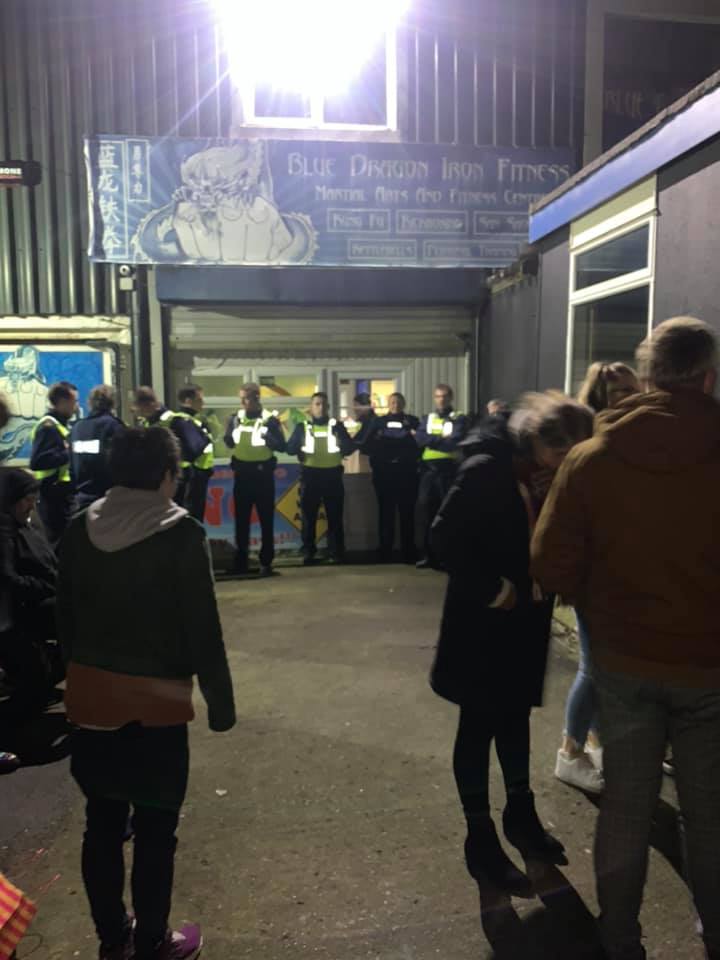
As they announced their meeting publicly the community of Balbriggan were concerned at the presence of these well-established racists and bigots coming into the town and inciting hatred and division. In response the community of Balbriggan, and at very short notice, assembled at the town square and decided to go down and attend the meeting to confront these carpetbaggers in person. Up to a hundred people from the community marched down the main street of Balbriggan to attend only to find at the venue, a scruffy disused gym down a back lane, to be guarded by three of Gemma’s acolytes who prevented access. Inside the building, and already assembled, were two of the speakers, Gemma and John, and a bussed-in gang of a dozen supporters from across the country.
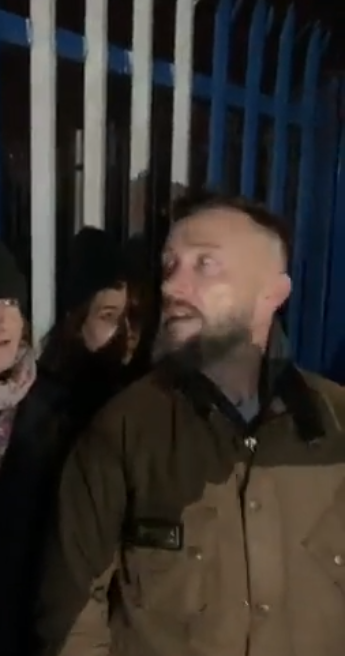
The Balbriggan community, having been denied access to the public meeting, decided to protest outside the gates. As the time of the start of the public meeting arrived, the Brit soldier Rowen ‘the rat’ Croft (a far Right Youtuber) and two of his Youtube army marched down, with his head held high as a compensatory measure, only to find the gate closed and locked. Rowen ‘the rat’ was left facing the anger of the Balbriggan community with no means of immediate escape. Beads of sweat percolated from his head as he tried to signal to those inside to open the gate.
Ex-British soldier Rowen Croft, one of O’Doherty’s minions, desperately trying to get through protesters into her miniscule meeting (Photo source: Dublin Republicans Against Fascism)
Shortly after this the Führer mobile of Justin Barrett of the National Party arrived. Despite the assembled protest occupying the road Justin arrogantly tried to ram through the crowd and into the gym. He was unsuccessful however as people blocked the front of his vehicle in scenes reminiscent of Joan Burton in Jobstown sitting in a fogged-up car surrounded by an angry community. Justin was seen frantically on the phone to the Gardai and the half-dozen far-right heavies assembled in the building to try and get him access, but to no avail. As it happens, the car Justin was driving was his girlfriend’s car, NP candidate Rebecca “Barrett”. The car had no valid NCT and the tax was out of date by a number of months. This was reported to Gardai but they did not act. Justin, causing tailbacks in traffic was eventually directed by Gardai to leave the area and he was not seen for the rest of the night.
Justin Barrett, Fuhrer of the National Party, prevented from entering by community protest. (Photo source: Dublin Republicans Against Fascism)
Despite the meeting being on lock down, one of Gemma’s supporters arrived in a 191 white Mercedes. Under heavy garda escort this supporter, who was wearing designer clothes, retrieved what looked like trays of foreign-grown food from the back her Merc and made her way into the building to supply the beleaguered Gemma and co with supplements.
As it became apparent that the meeting was locked down with no access for the Balbriggan community to attend, the protest continued for an hour before leaving the carpetbaggers to their meeting which turned out to be a demoralised echo chamber.
The Balbriggan community showed real unity yesterday. They showed that ethnic and religious differences will not divide them despite the best efforts of sectarian hate preachers like ACI and the NP. Dublin Republicans Against Fascism will continue to support the people of Dublin opposing this travelling carnival of hate wherever they go.
Gardaí protecting Gemma O’Doherty “public” meeting and helping prevent entrance from local community who disagree with her racist and islamophobic speeches. (Photo source: anti-racist protester)

















 rebelbreeze