THE TRUMP GAZA PLAN AND IRELAND PACIFICATION

Diarmuid Breatnach

(Reading time main text: 4mins.)

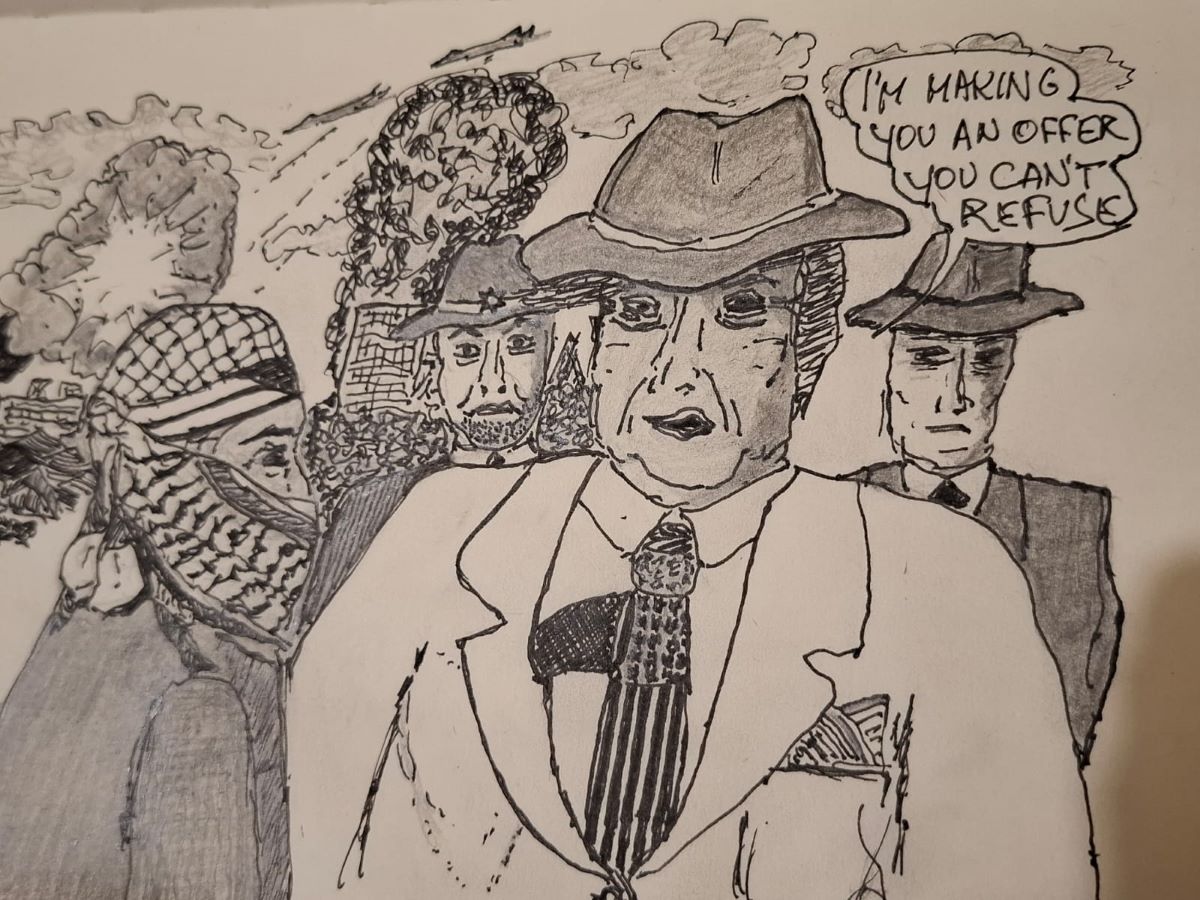
It was great to see the Irish pacification process being referenced with regard to the Trump plan for Gaza1 because that is exactly what the latter is: a plan to pacify the Resistance while ensuring it gets none of what it fought for.2

In other words, exactly like the Irish pacification process.

(Cartoon by D.Breatnach)

Hamas and Palestine Islamic Jihad grew out of previous Palestinian pacification processes. The Madrid Conference (1991) and the Oslo Agreement (1993) were imperialist/ Zionist attempts to pacify the wide-scale militant Palestinian resistance period of the First Intifada.3

Fatah at that time was the leading group in numbers and influence in the Palestine Liberation Organisation (from which Islamic groups were excluded) but also in Palestinian society in general. But Fatah had agreed to recognise ‘Israel’ and also the two-state solution (sic).

In the Oslo Agreement, furthermore, the question of the return to their homeland of the refugees was left aside. It appears that the Fatah leadership had lost faith in the eventual victory of their people’s struggle and had decided to get what they could by using the struggle to bargain.
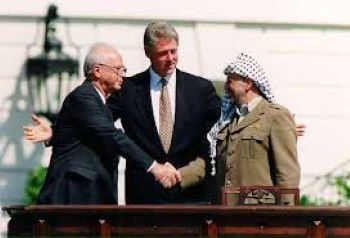
The Oslo Agreement: US Imperialism’s President Clinton oversees Yitzak Rabin, Premier of Zionist state of ‘Israel’ shaking hands with Yasser Arafat of Fatah, then leader of the PLO.

What Fatah got was Palestinian Authority control in the first elections (1996), with internal control over/ management of the Palestinian population of the West Bank and Gaza, but not of the Palestinians in Jerusalem (captured by ‘Israel’ in 1967): a far cry from a free Palestine.4

In the Algiers conference of 1988 Fatah had won majority agreement to recognise ‘Israel’ and to accept the two-state solution5 (sic), i.e. embodying a Palestinian state on 20% of Palestinian land, under the eyes and guns of their Zionist neighbour).

Fatah’s rule became known for corruption and nepotism, which then had to be protected and defended from the Palestinian masses, leading to authoritarian, repressive and often arbitrary rule. And repression of the Resistance, along with direct collusion with the ‘Israeli’ State.

Continuing ‘Israeli’ repression and settlement expansion in turn led to the Second Intifada; Fatah lost to Hamas in the Palestinian parliamentary elections of 2006 followed by defeat of Fatah’s attempted coup in Gaza in 2007 (but the West Bank remaining under unelected Fatah control).

Mahmoud Abbas of Fatah has refused to announce elections since, sitting in unelected control of the PA’s office in the West Bank, collecting the various international grants, presiding over corruption,6 repressing Palestinian resistance of deed or word and colluding with the ‘Israeli’ Occupation.

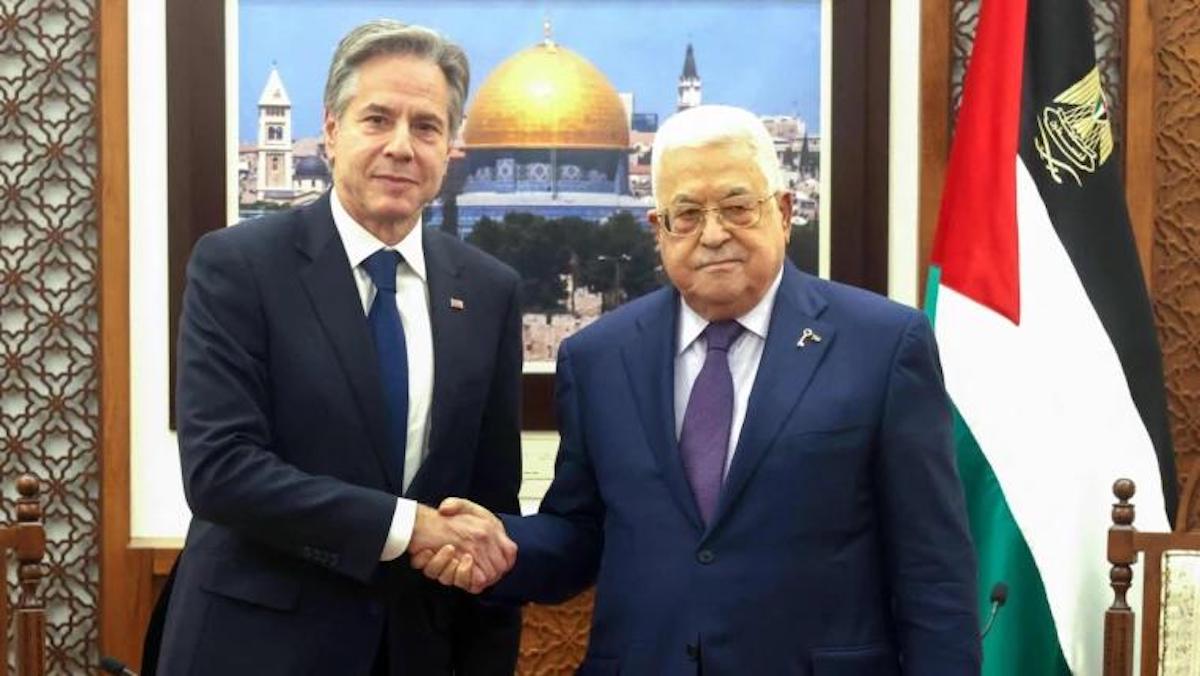
US Imperialism’s then Secretary of State Anthony Blinken and the PA’s Mahmoud Abbas in Palestine, soon after the start of the accelerated Zionist genocide in Gaza, December 2023

BUT WHAT ABOUT THE IRISH CONNECTION?

Starting with Palestine and South Africa in 1991, an imperialist pacification process spread to Ireland, Basque Country, Kurdish Turkey, Colombia, India, Philippines, Sri Lanka. With some variations the drive has been the same: to give up revolution and join the system.

One of the features of this process was the apparent need of a recognised leader to sell it to the resistance support base and to front it for the world: Arafat (Palestine), Mandela (S. Africa), Adams/McGuinness (Ireland), Ocalan (Turkish Kurdistan), Otegi (Basque Country).

The Provisional IRA was by far the major organisation in the Irish Republican resistance; it gave up armed struggle in return for vague promises and the release of its prisoners under licence.7 Another organisation complied also even as new ‘dissident’ fighters were being jailed.

Nearly 30 years after the signing of the Good Friday Agreement, Ireland is no nearer the Provisional IRA’s declared aims Irish reunification, independence and sovereignty. The Sinn Féin party helps run the colony8 and is attempting to become part of the neo-colony’s government.

Sinn Féin representatives Tina Black (Mayor of Belfast) and Michelle O’Neill, First Minister of the British colony, laying a wreath at the British War Memorial in Belfast, July 2022 (Cred: Liam McBurney/ PA Wire)

Neither the Spanish, French nor Turkish states were interested in other than crushing the Basque and Kurdish resistance and the corresponding movements disabled themselves without getting anything in exchange other than continued repression.9

The resistance movements in parts of India and Philippines continue to resist but in Sri Lanka was wiped out.10

One feature of the spread was the contagion-like way in which leaders of one infected resistance sought to entice others to follow suit: S. Africa and Palestine to Ireland; S. Africa and Ireland to Basque Country; Ireland to Colombia (where only the FARC but not the ELN accepted it).

In only one iteration of the pacification processes was there a partial achievement of the stated aims of the resistance: South Africa got national enfranchisement but the economy remained under imperialist extractive control and its working people under repression.11

In the course of giving up armed struggle, allegedly just changing the methods, the leaders gave up what they had fought for, the very reason for which they had first come into the struggle. Of course, they could still shout the slogans, just not make them real in any way.

The Irish version (and the Basque one) decommissioned their weapons, which makes it very relevant to the Trump Plan for the Palestinian Resistance, particularly Hamas and PIJ. No resistance movement should even discuss giving up their weapons until the defeat of the enemy.

(Image sourced: Internet)

It will be interesting to see what positions the former parties of Irish and Basque resistance, Sinn Féin and EH Bildu12 and their supporters take on this US/ ‘Israeli’ plan for the Palestinian Resistance.

One of the features of the pacification process was the apparent need of a recognised leader to sell it to the resistance support base and to front it to the world: Arafat (Palestine), Mandela (S. Africa), Adams/McGuinness (Ireland), Ocalan (Turkish Kurdistan), Otegi (Basque Country).

Who will the imperialists find to play this role in Palestine?13

End.

NB: If you found this article of interest, why not register with Rebel Breeze for free, so that you will be notified by email of subsequent articles. You can de-register any time you wish.

FOOTNOTES

SOURCES

Referencing the Irish pacification process in Gaza context: https://apnews.com/article/gaza-northern-ireland-peace-process

The Palestinian Authority: https://www.aljazeera.com/news/2023/10/11/what-is-the-palestinian-authority-and-how-is-it-viewed-by-palestinians

https://www.washingtoninstitute.org/policy-analysis/how-palestinian-authority-failed-its-people

1https://apnews.com/article/gaza-northern-ireland-peace-process

2Trump 20-point plan: https://www.bbc.com/news/articles

3https://en.wikipedia.org/wiki/First_Intifada

4“This mirrors Israel’s post-Oslo approach to the occupied West Bank in pacifying the population through economic incentives, avoiding political concessions, and entrenching structural dependence. This model, often dubbed “economic peace,” has transformed the Palestinian Authority (PA) into a subcontractor of occupation – flush with foreign funds, but powerless to deliver sovereignty.” https://thecradle.co/articles-id/34757

5https://ejil.org/pdfs/1/1/1136.pdf

6Which is why the imperialists and their servants keep alluding to the need for a “reformed Palestinian Authority” e.g. https://israelpolicyforum.org/blueprint-for-reforming-the-palestinian-authority

7Those released under licence could be returned to jail (and a number were) at the decision of the Secretary of State for Northern Ireland without trial, hearing or details of why the individual was considered to be ‘a threat to public safety.’

8Its representative, Michelle O’Neill, is currently First Minister of the colony’s government. In the Irish State, the party has 33 TDs (MPs), only two behind the party with next largest representation, Fianna Fáil. They Party has abandoned its opposition to the repressive legislation of the State, welcomed British Royal visits to both parts of Ireland, supports recruitment to the colonial gendarmerie and its leader refused to rule out coalition with the neo-colonial political parties of membership of the British Commonwealth. https://www.thejournal.ie/mar-lou-mcdonald-commonwealth-4561600-Mar2019/

9The Basque leadership abandoned armed struggle unilaterally at the time without gaining even the end of dispersal of their jailed fighters throughout the state. The Turkish Kurdish PKK tried to make progress through political electoral means only under continuing repression. But their Syrian version of armed Kurdish forces got a new lease of life with the vulnerability of the Assad regime in Syria but ended up as a NATO proxy in the latter’s war for regime change. The PKK in Turkey very recently agreed to disarm while their Syrian part remains in difficult relationship with the new (formerly ISIS) regime in Syria and some other ISIS elements under Turkish influence.

10https://www.vice.com/en/article/death-of-a-tiger-0000710-v22n8/

11See The Marikana Massacre of striking miners by the ANC Government’s police.

12Both parties support the Two-State proposal for Palestine.

13Some liberal and social-democratic sections seem to have fixed on Marwan Marghouti in this role, which of course is no reason not to support his release on human rights grounds. https://www.youtube.com/watch?v=q6IgjlHaaIs

COLONIAL PROXY MILITIAS, FROM IRELAND TO PALESTINE

Diarmuid Breatnach

Reading time main text: 5 mins.)

Currently the Palestinian Resistance is engaged in an important struggle to eliminate four Israeli-proxy militias. This type of militias of colonial and imperial powers have a long history, not least in Ireland from the 1800s to the present.

SETTLER AND NATIVE MILITIAS IN IRELAND

The British colonial occupation of Ireland had an army to quell native resistance but many settlers also organised themselves into armed bands (as in Palestine), such as the Hearts of Steel or Hearts of Oak in the late 18th Century in order to resist the big landlords.

The United Irishmen were successful in uniting a number of these, both native and settler bands such as the Whiteboys and Hearts of Oak, particularly in Antrim but the Peep O’Day Boys went mostly with the sectarian and royalist Orange Order.

The settlers also organised yeomanry militias which they labelled ‘Volunteers’, initially to defend against a feared invasion from Napoleonic France. Some of those contained Republican sympathisers and some quite the opposite.1

In response to the successful uniting efforts of the mostly Protestant-led United Irishmen, the Orange Order was founded by British loyalists and soon received official support in organising anti-Catholic pogroms and in exposing United supporters, especially among the Protestant communities.

LOW INTENSITY OPERATIONS AND “PSEUDO-GANGS”

During the three-decades war towards the end of the 20th Century mostly in the 6 Counties, the British Occupation also organised proxies such as the Ulster Volunteer Force and the Ulster Defence Association. These were recruited among the Protestant/unionist community.

But not only among civilians.

As has been a pattern among colonial possessions, the occupying power organised a gendarmerie, i.e an armed police force under central command of the occupying power. In Ireland that was the Royal Irish Constabulary which came to prominence in the suppression of the 1867 Fenian rising.

After the partition of Ireland by the British in May 1921, the RIC within the remaining direct colony of the Six Counties was renamed the Royal Ulster Constabulary2. British Intelligence used this force to channel intelligence, arms and recruits into the Loyalist gangs.

In addition, many members of the disbanded RUC’s semi-militia, the part-time B-Specials, were reorganised into the RUC Reserve of the colonial police or recruited into the British Army as the newly-formed Royal Ulster Regiment, from which the Loyalist militias could be supplied as before.

Brigadier Frank Kitson was a leading colonial counter-insurgency strategist who had served in Kenya and Malaya before he was sent to the Six County colony to coordinate the Loyalist militias and the official armed forces and gendarmerie, no doubt in coordination with MI5.

Kitson published Gangs and Pseudo-Gangs (1960) and Low Intensity Operations (19713) based on the experience of colonial resistance repression in Malaya and Kenya, going on to introduce these ideas organisationally in the occupation of the Six Counties.

Pseudo gangs give the occupying power deniability and, being generally from the occupied country,4 have local knowledge. They can carry on terrorism and assassinations at ‘a remove’ from the occupying power.5 In the case of criminal gangs, they have an existing organisation.

Such gangs may have family or other social relationships with some in the targeted community, introducing allegiances and communal fragmentation as has been occurring to some extent in Gaza. However, in Ireland, the gangs were all originating from the unionist community.

Frank Kitson (now Brigadier) in 1971 (Photo source: Internet)

Jeffrey Sluka summarises6 “… beginning in 1972, there has been a vicious, continuous campaign of sectarian assassination against Catholics in Northern Ireland waged by Loyalist paramilitary groups (the Ulster Defence Association [UDA] and Ulster Volunteer Force [UVF]) …

“… and their associated death squads (the Ulster Freedom Fighters [UFF], Red Hand Commandos, Protestant Action Force, etc.), who have killed nearly 700 innocent Catholic civilians – the largest category of casualties in the war.

“Thousands of other Catholics have survived Loyalist attempts to murder them.

“The existence of this campaign has never been publicly acknowledged by the British authorities, who have ignored it, downplayed it, and actively misrepresented it …

“… to influence the media and public in this regard, both at home and abroad, as an integral part of their counterinsurgency strategy.

“The official position of the British authorities is that there is no state terror in Northern Ireland, and certainly no death squads. When pressed, they admit that there is Loyalist terror against Catholics, but insist that they have nothing to do with it.

“When pressed with evidence such as the fact that hundreds of members of the Security Forces have been convicted of involvement with Loyalist paramilitaries, they claim that this collusion is informal – individual acts by rogue soldiers and policemen

“- and not a reflection of government policy or military strategy. All of these are political lies.”7

SEPOYS

The use of military forces recruited among the occupied people dates back further even than the Roman Empire and the British Empire used them extensively in India, where they called them ‘Sepoys’,8 which is what the Basque pro-independence people call the Basque Autonomous Police.9

In India, one of the most serious uprisings against British rule was sparked by a mutiny of its Sepoys.10

In Palestine, the ‘Zipaios’ equivalent are the police of the Fatah-controlled Palestine Authority. They are bad enough, brutally suppressing dissent, spying on and even attacking Palestine organisations in the West Bank, arresting and even killing critics.

The Royal Irish Constabulary in Ireland were a gendarmerie mostly composed of sepoys and of course there were many Irish regiments in the British Army and Irishmen also served in other British Army units, the Royal Navy and the Royal Air Force.

WORSE THAN SEPOYS

The militias in Gaza are however even worse. Based on criminal gangs and social groups, they have consistently looted aid trucks coming into Gaza before Israel closed all the gates, then selling the goods at high prices to the hungry population as Gaza starved and medicine became scarce.

According to reports there are currently four Zionist-linked militias in Gaza: Abu Shabab around Rafah in southern Gaza; Husam al-Astal in Khan Younis, Ashraf al-Mansi in Beit Lahia in the North, and Rami Heles in eastern Gaza.

Sourced from The Cradle based on Sky News investigation.

Their looting, supported by the Zionist state, was even used to try to blame on the Resistance, with Israeli spokespersons claiming that Hamas was stealing the aid. Conversely, as the Resistance strove to counter the proxy militias, the fighters were targeted by the Israeli Occupation Force.

Consequently it was almost impossible for the Resistance to suppress the proxy militias – until the current ‘ceasefire’. Now, able to operate to some extent more openly, the Resistance is settling accounts with the proxy militias. And it is very important that they do so.

Not only for what they have done, the plundering of emergency aid, attacks on displaced persons, torture and murder of famed journalist Salah al-Jafarawi.11 But because they are a serious infection, injected into Gazan society by the Zionazi occupation in order to cause serious harm to the society.

According to reports, undercover operatives of the Resistance have infiltrated the gangs and managed to appropriate a large number of weapons and vehicles of the gangs donated by the IOF or by the United Arab Emirates.12

Hamas advertised a truce for gang members to hand over their weapons and surrender themselves to the authorities, which some have done but many have not. The Resistance has operational clashes with the militias and has captured many. Some were publicly executed by gunshot.

Whether full-scale war returns to Gaza after this ‘ceasefire’ (full of IOF bombings, shelling and shooting) or not, their presence in Palestinian society cannot be tolerated, not by the civil government, nor by the broad community, nor by the armed resistance.

End.

Note: If you found this article of interest, why not register with Rebel Breeze for free, so that you will be notified by email of subsequent articles. You can de-register any time you wish.

APPENDIX:

A Sky News investigation has revealed that Israel is backing four Palestinian militias inside Gaza to weaken Hamas as part of what militia leaders call “Project New Gaza.” Hossam al-Astal, head of one of the groups, said the militias are coordinating their efforts to remove Hamas from power.

He claimed that Yasser Abu Shabab and Ashraf al-Mansi, leaders of other groups, have also joined the project. All four militias are reportedly positioned along the yellow line in areas under Israeli control.

Astal told Sky News his headquarters is only 700 meters from an Israeli military outpost and that an Israeli coordinator had agreed to establish a “Green Zone” free of shelling or gunfire. Footage reviewed by the outlet showed militia vehicles with Hebrew markings scratched off.

Astal admitted the group receives logistical support and ammunition from outside Gaza and has bought Hamas weapons on the black market. A senior fighter in the Abu Shabab militia also said Israel had enabled the smuggling of guns, cash, and vehicles.

The militias reportedly coordinate their movements with Israeli forces at Kerem Shalom to bring in supplies, while western powers are said to provide indirect material support. Two of the militia leaders are former Palestinian Authority security officers.

While the Mansi militia denied direct contact with the Israeli military, it acknowledged coordination with Israel’s District Coordination Office. Abu Shabab previously told Army Radio he was open to working with Israel, calling Trump’s ceasefire plan “a way to end the war.”

“Soon we will achieve full control of the Gaza Strip,” he told Sky News.

(Summarised by The Cradle online news updates on Telegram 26 October 2025).

FOOTNOTES

1The yeomanry militias deployed in Wexford, such as the North Cork, proved to be the most vicious and indisciplined of the Occupation’s forces and are noted in a number of songs in English and Irish:
“… He led us on against the coming soldiers,And the cowardly yeomen we put to flight…” (Boolavogue, Patrick McCall, 1898);

“… Is go gcuirfeam yeomen ag crith in a mbrógaibh
Ag díol a gcomhair ar Shliabh na mBan.”
(Sliabh na mBan, believed by Mícheál Óg Ó Longáin, 1798).

2Since then renamed the Police Service of Northern Ireland (sic).

3The same year that mass internment without trial was introduced by the British Occupation and that the Ballymurphy Massacre of protesting nationalist civilians was carried out by the Parachute Regiment.

4Sometimes even from the oppressed native community.

5They are more easily dispensed with too, should they be no longer needed or their relationship become too public.

6In his own chapter For God and Ulster: The culture of terror and Loyalist Death Squads in Northern Ireland in Death Squad: The Anthropology of State Terror, Ed. Jeffrey Sluka (200), USA.

7Excerpt from ibid, sourced in https://cain.ulster.ac.uk/issues/violence/docs/sluka00.htm

8The term in Persian originally denoted ‘soldier’ but borrowed into Urdu and Hindi and under British rule, denoted native soldiers and their units in the British armed forces.

9The Ertzaintza. The Navarran police (‘Forales’) could also be called ‘Sepoys’ but are more usually called by other uncomplimentary names.

10https://www.bbc.com/news/world-asia-india-40528129

11https://www.aljazeera.com/news/2025/10/12/palestinian-journalist-saleh-aljafarawi-shot-dead-in-gaza-city-clashes

12Weapons, warlords, and wasteland: Israel’s new strategy for Gaza

SOURCES

Weapons, warlords, and wasteland: Israel’s new strategy for Gaza

https://news.sky.com/story/revealed-the-plan-for-a-new-gaza-and-the-four-militias-israel-is-backing-to-defeat-hamas-13456416

BLANKET, NO WASH AND HUNGER-STRIKE – FIVE YEARS OF REPUBLICAN PRISONER STRUGGLE AGAINST CRIMINALISATION

Diarmuid Breatnach

(Reading time main text: 4 mins.)

We’ve recently passed by the date of the start of a monumental prison resistance struggle when IRA prisoner Kiaran Nugent refused on 14 September 1976 to wear prison uniform.

The Hunger Strike of 1981 tends to be remembered as an isolated event in the history of the Irish Republican prisoners’ opposition to criminalisation. But it was five years of struggle through stages that ended eventually in the martyrdom of ten Republicans.

Irish Republicans had been in imprisoned in British jails since the late 18th Century.1 After the Irish national bourgeoisie accepted the British partition of Ireland, Republican prisoners were held in prisons in the Irish State and in the British colony of the Six Counties and at times in Britain too.

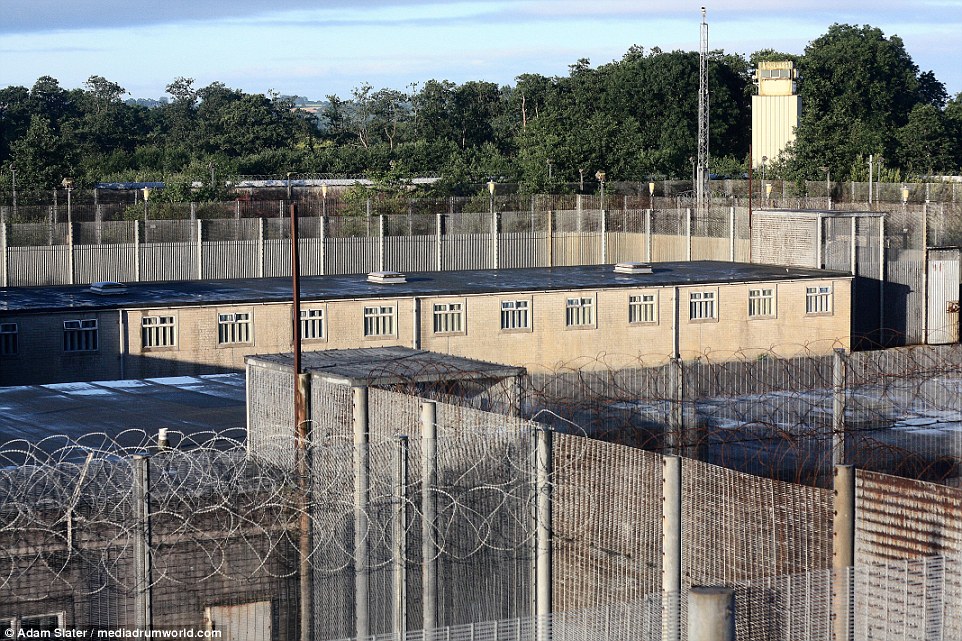
Long Kesh/ the Maze Prison, in the occupied 6 Counties.

This situation continued on low but constant level with higher points during the Civil War (1922-1923), the pogroms in the Six Counties, the 1930s,2 the 1940s, the Border Campaign (1958-1962) and the Civil Rights campaign from the mid-1960s onwards.

The Wikipedia section on Special Category Status states that it was introduced for Republican prisoners serving sentences in the Six Counties in 19723 but neglects to mention that it was already widespread among nationalist prisoners due to internment without trial a year earlier.

The British introduced internment without trial in their Irish colony in 1971 and one of the effects of that measure was to put a huge number of mostly nationalists from the Six County colony into jail. These prisoners were all accorded Special Category Status and wore their own clothes.

British soldiers capturing and taking away a civilian in the Occupied Six Counties of Ireland (Photo sourced: Internet)

Over the life of the measure, 1,981 people were interned without trial in the Six Counties (British Army’s Operation Demetrius). Of those detained 1,874 were from a Catholic/Republican background while, towards the end, 107 were from a Protestant/Loyalist background.

Special Category Status distinguished the internees from other political prisoners which were few in number at the time but its major impact was to distinguish them visibly from social prisoners or what are commonly called ‘criminals’ and was often called Political Prisoner Status.

In June 1972 other nationalists/ Irish Republicans4 charged and convicted were also accorded Special Category Status,5 which came to be seen as prisoner of war status for opponents of the British colonial occupation, despite Britain’s claims that the prisoners were just criminals.

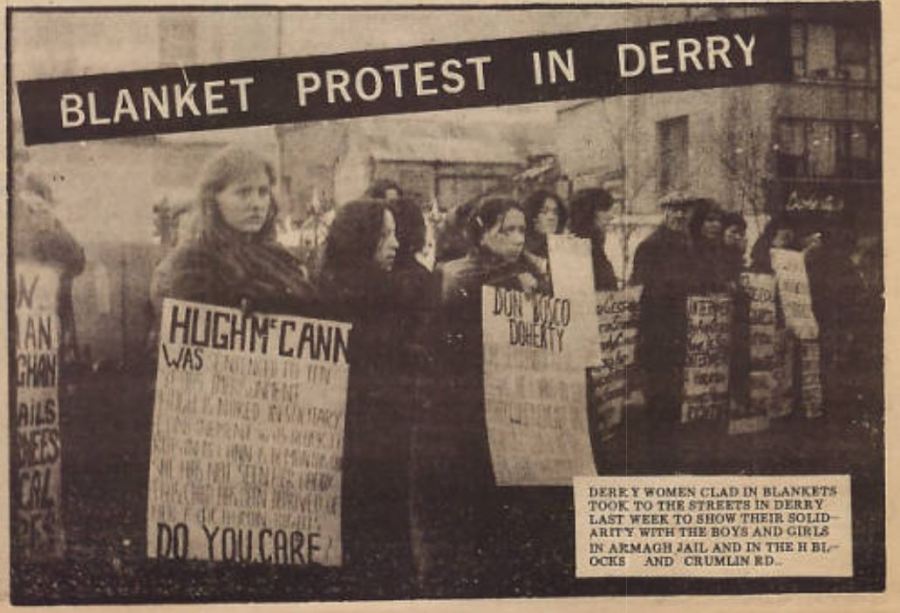
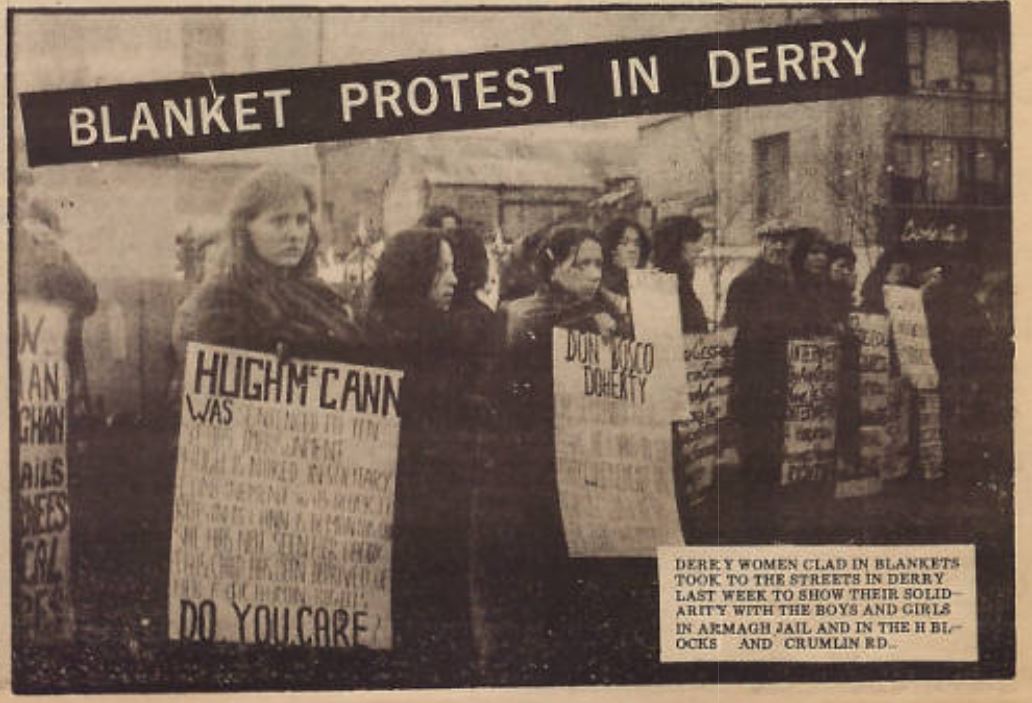
Early protests in support of the prisoners ‘on the blanket’ in 1976. It was mostly women relatives, partners and their friends who launched the Republican prisoner solidarity movement. As the photo legend also illustrates, there was still another male political prison, Crumlin Road (‘the Crum’) and Armagh Jail for female Republican prisoners. (Photo sourced: Internet)

Internment without trial in the Six Counties, generally recognised as a failure from both political and military points of view, was formally ended after four-and-a half years on 5 December 19756. As resistance continued, including now an armed aspect, more prisoners saw the inside of jails.

But they were still under Special Category regime and wearing their own clothes. The following year on 5 March 1976, Merlyn Rees as Secretary of State implemented the Labour Government’s7 decision to remove Special Category Status from any subsequently-convicted prisoners.

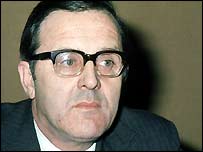
MERL

Merlyn Rees, British Labour Home Secretary who removed the Special Status from the Irish Republican prisoners, which precipitated the struggle that ended in the prison hunger strikes of 1981. He died at 85 years of age, having lived much longer than many of his victims. (Photo sourced: Internet)

The first Irish Republican prisoner to be informed he would have to wear prison uniform under the new rules was Kiaran Nugent. His reply, though pithy has gone down in the records of Irish resistance statements: “You’ll have to nail it to my back.

Stripped naked, Vol. Nugent was put in a cell, from which he found a blanket and wrapped it around himself. It was a natural act to cover his nakedness but he may also have known that Irish Republican prisoners of the Irish State in the 1940s had done the same.

The Blanket Protest had begun and spread as more prisoners coming into the prison system took the same stand. There it might have stayed were it not for the violence and cruelty of HM Prison regime by its warders regularly assaulting prisoners on their way to and back from the showers and toilets.

In 1978 the Irish Republican prisoners in the Maze H-Blocks8 resolved to remain in their cells, emptying their excreta out the window and their urine under their cell doors into the passageway. So the prison authorities blocked up their windows and warders pushed urine back under their doors.

The Irish prisoners then had nowhere to put their excreta so they smeared it on the walls. They built a dam of bread fragments around their door to prevent their urine being pushed back in. These conditions they endured until the prison riot squad beat them out of their cells for power-hosing.

Those who watched the film Hunger (2008) directed by Steve McQueen will have seen some of that and how they treated the naked prisoners too, beaten to the ground, anus probed for contraband messages or materials, the same gloved hand often opening their mouths to look inside also.

Their flesh was forcibly abraded with scrubbing brushes and they were often inserted into cells still wet from the hosing. Once back inside cells, they continued the protest.

On 27 October 1980 seven Republican prisoners, against the orders of IRA GHQ, embarked on a hunger strike included the Five Demands to break the system, which they terminated after 53 days on receiving promises from the authorities which were then reneged upon.

The 5 Demands:

  1. The right not to wear a prison uniform;
  2. The right not to do prison work;
  3. The right of free association with other Republican prisoners, and to organise educational and recreational pursuits;
  4. The right to one visit, one letter and one parcel per week;
  5. Full restoration of remission lost through the protests.9

Outraged at the reneging, Republicans renewed the hunger strike with their previous Provisionals’ jail Commanding Officer10 insisting he be first. So was Bobby Sands the first to die and another nine martyrs behind, seven Provisional IRA and 3 INLA as they came on to the strike in sequence.

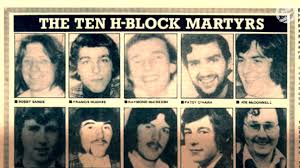
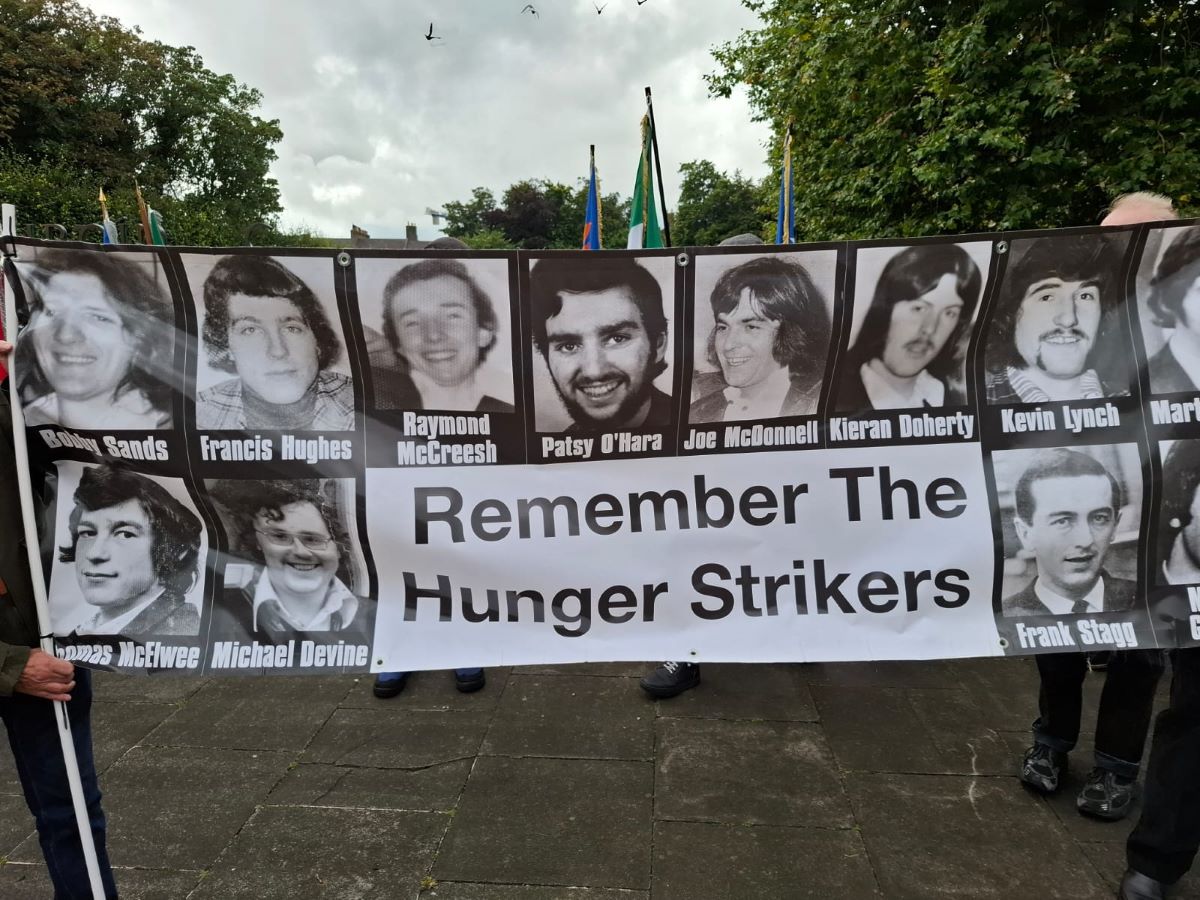
Photograph images with names of the ten Hunger Strike Martyrs of 1981 in the sequence of their death: Vols. Bobby Sands (IRA), Francis Hughes (IRA), Ray McCreech (IRA), Patsy O’Hara (INLA), Joe McDonnell (IRA), Martin Hurson (IRA), Kevin Lynch (INLA), Kieran Doherty (IRA), Thomas McElwee (IRA), Mickey Devine (INLA). (Photo sourced: Internet)

The effect of the hunger strikes of 1981 was huge in Ireland, Britain and further abroad. IRA Vol. Kieran Nugent had an important hand in pushing the process but so did Mervyn Rees, William Whitelaw, Brian Faulker and Edward Heath,11 in a long process of repression and resistance.

Today the struggle continues with approximately 20 Irish Republican prisoners, male and female in prisons between the neo-colonial Irish state and the British colony of the Six Counties. They have essentially won the five demands, though official harassment in the colony’s jails is endemic.

End.
NB: If you found this article interesting you may wish to subscribe to the blog free of charge, after which you would receive a notification in your email every time an article was published. You can unsubscribe any time you wish.

APPENDIX: Brief biography of Kieran Nugent (12th September 1958 – 3rd May 2000).

Volunteer Kieran Nugent began his short life presumably in the occupied Six Counties of Ireland but all the references I have found so far begin with him at the age of 15 years of age, standing at a corner with a friend on the corner of Merrion Street and Grosvenor Road, West Belfast.

It was 20th March 1973.12 A car pulled up beside them asking for directions but an occupant of the vehicle then opened fire with a submachine gun. Nugent was seriously wounded, shot eight times in the chest, arms and back. His friend, Bernard McErlean, aged 16, was killed.

Kieran Nugent, first of the Republican prisoners ‘on the Blanket’ (Photo sourced: Internet)

Another youth was seriously injured also.13 Local people reported that a British Army Saracen armoured car had crashed through a nearby barricade and that was what had allowed entry for the murder gang, later claimed by the UDA, a British proxy Loyalist militia.

“At some point afterwards, Nugent joined the IRA.”14 The youngest age for IRA membership was 17 and Nugent aged 16 was arrested by the British Army, automatically refused bail, and at trial, after five months on remand in Crumlin Road Prison, Belfast, case withdrawn, he was released.

Kieran became an active volunteer until his arrest and internment without trial, on 9 February 1975. He served nine months in Cage 4 of Long Kesh Detention Centre (later renamed The Maze) in the Six Counties, until 12 November 1975. But was arrested and imprisoned again on 12 May 1976.

Vol. Nugent was charged with hijacking of a bus, a frequent Republican resistance activity in Belfast where the vehicle would then be utilised as a barricade. His sentence was three years in jail which he was commencing when he began the blanket protest.

The cause of death for Kieran Nugent was given as heart attack. A number of his acquaintances remarked that he had sunk into alcoholism with some adding that the movement had given him no support. Whether true or not, many former Republican prisoners of the period had shortened lives.

FOOTNOTES

SOURCES

https://en.wikipedia.org/wiki/Special_Category_Status

SC status generalised for Republican prisoners: https://cain.ulster.ac.uk/events/bfriday/bac.htm

https://cain.ulster.ac.uk/events/intern/chron.htm

1Republican prisoners were held in British jails in Ireland, Britain and Australia – and for centuries before that Irish clan members had been incarcerated in Britain and Ireland.

2When the anti-fascist struggles also contributed to prisoner of the states.

3https://en.wikipedia.org/wiki/Special_Category_Status

4I am using the term “nationalists” as a broad and not strictly accurate term to describe the people of the Catholic ghettoes and areas of the British colony; of course many of them could have been also or instead mainly democrats, socialists. The term “Irish Republicans” I am using to describe those belonging to organisations nominally of Irish Republican kind but again how much each was truly Republican in ideology varied, for example in their opinion of the appropriate role of the Catholic Church in Irish society.

5Sentenced and remanded in custody Irish Republicans in jails went ona hunger strike for ‘political status’ in 1972 and the Provisional IRA during the Truce negotiations of June that year asked for political status for them which William Whitelaw conceded.

6https://cain.ulster.ac.uk/events/intern/chron.htm However internment without trial in fact continued by charged Republicans being refused bail and remaining in jail for two years or more awaiting trial. Bail decision and trial would be in the special no-jury Diplock Courts.

7It is difficult to understand any Irish person or indeed any anti-imperialist putting any faith in a British Labour government. Apart from its long imperialist history, it formed part of the national government that executed leaders of the 1916 Rising, sent troops to the Six Counties to quell the civil rights struggle in 1969, introduced the Prevention of Terrorism Act in Britain in 1974 and framed a score of Irish people for bombings, removed Special Category Status in 1976 …

8A special male political prison containing panopticon-designed blocks in Lisburn, Co. Antrim, built in 1971 and closed in 2000, the future of the empty buildings uncertain. Female Republican political prisoners were kept in Armagh Jail and fought with different tactics, including taking the Prison Governor hostage at one point.

9Prisoners disobeying prison rules are punished in a number of ways, one of which is loss of the remission off sentence normally expected.

10In a long tradition the prisoners of each political group in jail elect their leader and previous ranks are abandoned for the duration of the incarceration.

11In sequence: Labour Party Secretary of State; Conservative party Cabinet Minister; Unionist Prime Minister of the colony; Conservative Prime Minister of the UK.

12https://www.facebook.com/story.php?story_fbid=672093692010347&id=100076291652304&_rdr

13Ibid.

14Various sources

FIVE DECADES WAITING FOR A HEADSTONE – VOL. SEÁN Ó CONAILL HONOURED IN GLASNEVIN

Diarmuid Breatnach

(Reading time: 4 mins.)

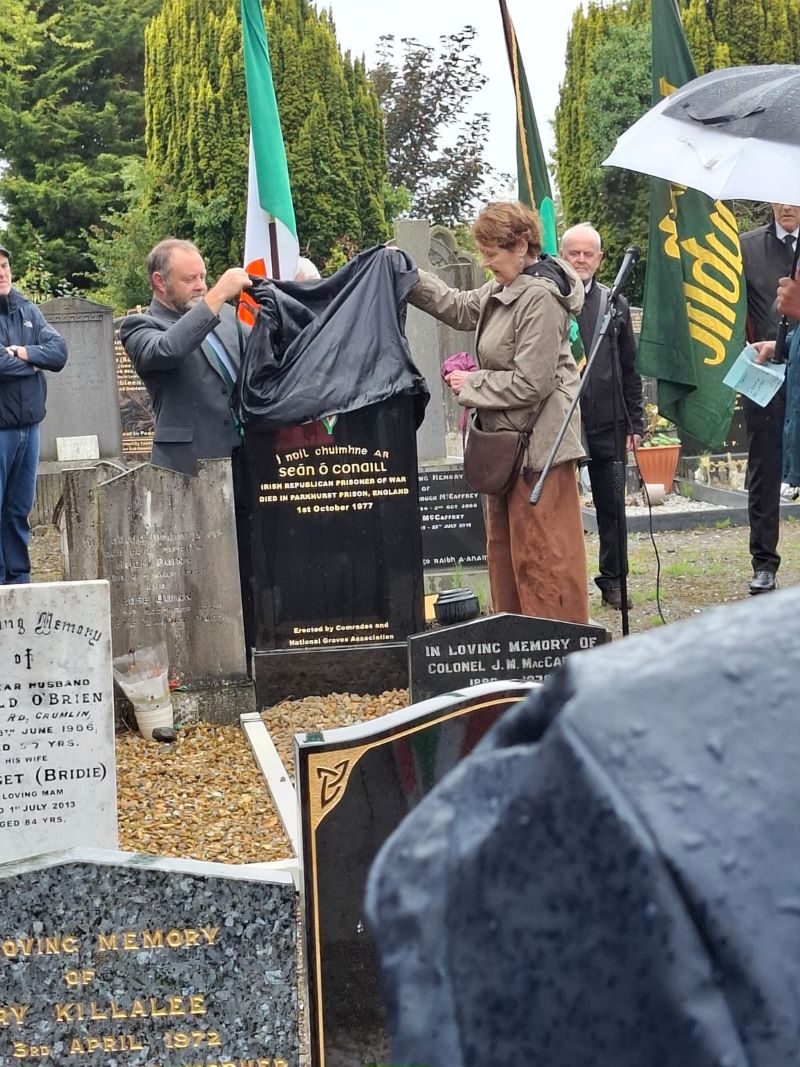
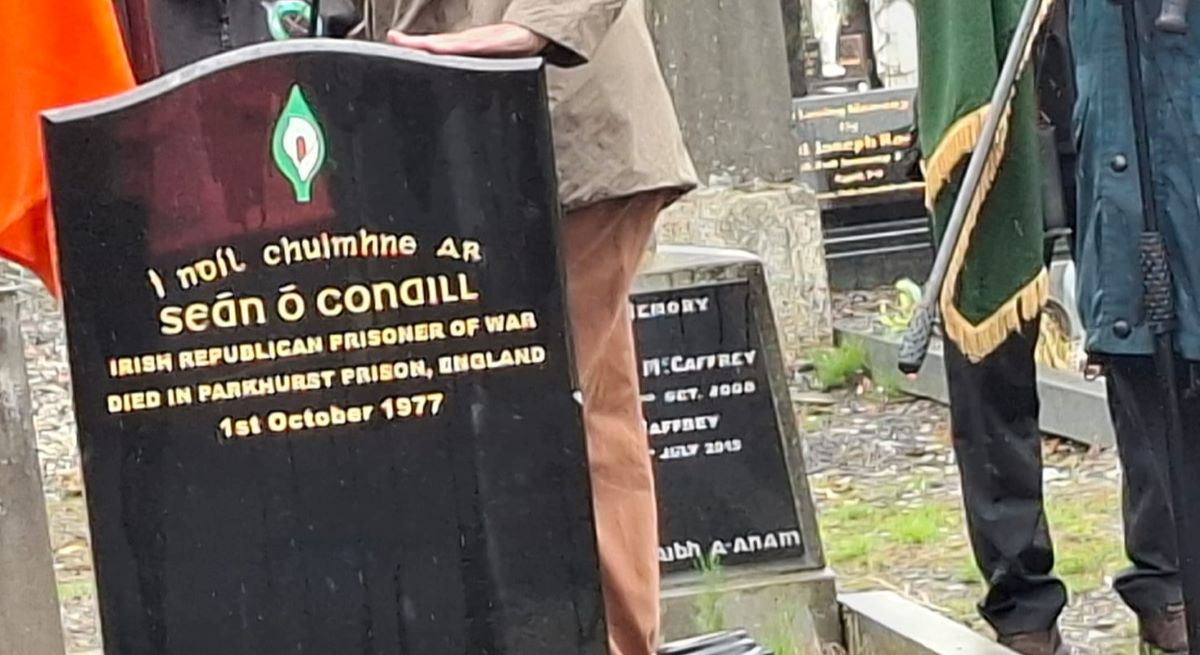
The grave of Irish Republican political prisoner Vol. Seán Ó Conaill received a headstone on Sunday (7th August) due to the efforts of the National Graves Association – nearly 50 years after his death in British custody.

Seán was born and brought up of Irish background in Birmingham and became interested in Irish history. After Bloody Sunday (1972) he tried to join the IRA but was not accepted and subsequently acted independently, assassinating a British Army Lieut. Colonel.

Tracked by British police, he wounded two of the group sent to arrest him, was captured and beaten up. His treatment in jail was bad also but after sentencing was accepted by the Irish Republican prisoners in British jails and, in time, sworn into the Provisional Irish Republican Army.

After his death his body was transferred for burial in Glasnevin. It seems that the NGA understood that his family wished to erect a headstone but for whatever reason the grave lay without one until last week.

The National Graves Association went ahead with commissioning a gravestone which they unveiled on Sunday in the St. Paul’s section of Glasnevin Cemetery1 with a colour party, speakers, music and a goodly attendance, though drenched during the ceremony.

The occasion was supported by members of Sinn Féin and Republican organisations in addition to independent Republicans and anti-imperialists. Seán Whelan, Chairperson of the NGA chaired the event and after some opening remarks introduced the speakers.

Section of the attendance at the event. (Photo: D. Breatnach)

SPEAKERS

Jacqui Kaye of the former Prisoners’ Aid Committee2 was introduced to speak and told her audience that Ó Conaill was diagnosed with terminal cancer and requested a visit from Kaye, permission for which was initially refused by the Home Office3 but granted after intervention by Lord Longford.

The visit was permitted for 10 minutes only for Parkhurst Jail but then changed to a hospice though when Kaye arrived it was to be told that he had just died there, leaving her with the suspicion that he had actually died in Parkhurst but that the Home Office did not wish that on their record.4

Jacqui Kaye, formerly of the Prisoners Aid Committee (no longer in existence), speaking at the event during a particularly heavy shower. (Photo: D. Breatnach)

Former Republican prisoner (21 years in British jails) Noel Gibson laid a wreath on behalf of the NGA and Paddy Lennon read The Rhythm of Time by hunger strike martyr Vol. Bobby Sands, after which a recording of uileann pipes filled the cemetery air with its haunting lament.

Liam Ó Culbáird of the NGA presented the main oration of the event, recounting details of Ó Conaill’s life and time in jail, information gathered from a number of sources, including that despite complaining of chest and stomach pains he did not receive medical investigation in jail.

It was only after coughing up blood that Ó Conaill received a medical visit, after which he was diagnosed with terminal cancer. His marriage had become estranged possibly as a result of his incarceration but official interference in personal relations of political prisoners was also known.5

Liam Ó Culbáird, giving the oration at the unveiling on Sunday. (Photo: D. Breatnach)

The speaker alluded to the practice of “ghosting” political prisoners, i.e. moving them to a different jail without notice, often as a scheduled visit by a family member was imminent, which occurred to Ó Conaill’s mother arriving at Wakefield Prison to be told he had been moved to Parkhurst Jail.6

Such practices imposed an additional punishment not only on the prisoner but in particular on family members7 who had often travelled long distances into sometimes hostile territory and had also the additional expense of paying for overnight accommodation.

The media at the time of his arrest had portrayed Ó Conaill as of unbalanced mind but his comrades in jail found him completely rational and dedicated to the cause. He began to learn Irish and encouraged the other Republican prisoners to expand their use of the language.

Liam Ó Cúlbáird and Jacqui Kay unveil the headstone to Vol. Seán Ó Conaill on Sunday. (Photo: D. Breatnach)

Commenting on Ó Conaill’s failure to be recruited by the IRA prior to his armed action, Ó Culbáird commented that disagreements between General Headquarters of the IRA and Volunteers were not unknown and related a GHQ approach to Brendan Behan after his release from jail.

Behan was informed that he had been been found guilty by GHQ court-martial8 in his absence and sentenced to be shot. Behan replied that since his court-martial had been in his absence, so equally could his execution and promptly departed!

Ó Culbáird commented also on the number of groups that had operated independently of the IRA’s GHQ and remarked upon the number of different groups that had participated in the 1916 Rising,9 all with their reasons for separate existence but all united in the struggle for independence.

The speaker ended his oration by pointing out in Irish and in English that Ó Conaill was an Irish Republican soldier who gave his life in the struggle for Irish freedom.

CONCLUDING

Bringing the ceremony to an end, Seán Whelan thanked the speakers for their contribution and audience for their attendance and added some words about the NGA, pointing out its political independence and refusal to accept donation from any governmental or other organisation.

Chairperson of the NGA, Seán Whelan, presiding over the unveiling on Sunday. (Photo: D. Breatnach)

Whelan also added that whereas the NGA acknowledges the right of anyone to commemorate their dead, their organisation prioritises the dead who participated in the Irish struggle for independence but also cannot agree to share their commemoration with those who fought against them.

He remarked that he did not know of any other country where that would be done. Whelan then called for attention to the playing of a recording of the the National Anthem.

End.

(Photo: D. Breatnach)

FOOTNOTES

1i.e the large section on the opposite side of the road from the main Glasnevin gates, also where stands the NGA memorial to the six uprisings mentioned in Pearse’s famous speech.

2The PAC was initially formed by Official Sinn Féin but within two years had left the Officials and operated independently.

3Irish Republican prisoners in British jails were listed as high-security Category A and were not permitted visitors other than immediate family.

4She was not permitted to see his body.

5Letters to the prisoner might be delayed or not delivered, whereas letters from the prisoner might be held back.

6262 miles distant.

7Though not mentioned in the oration, this was also a practice of the Spanish prison system against Basque political prisoners, in which case letters and parcels arriving for the prisoner, rather than be forwarded to the prisoner’s new location, would be returned to sender with a note that the prisoner was no longer at the posted address.

8Presumably for his solo unauthorised action in carrying a bomb to England.

9Irish Republican Brotherhood, Irish Volunteers, Cumann na nBan, Irish Citizen Army, Na Fianna Éireann, Hibernian Rifles. Some individuals not a member of any of those organisation also participated.

SOURCES

https://www.facebook.com/NationalGravesAssociation

https://www.nga.ie/index.php

A SATURDAY IN DUBLIN: TWO MARCHES AND A CONCERT

Clive Sulish

(Reading time: 4 mins.)

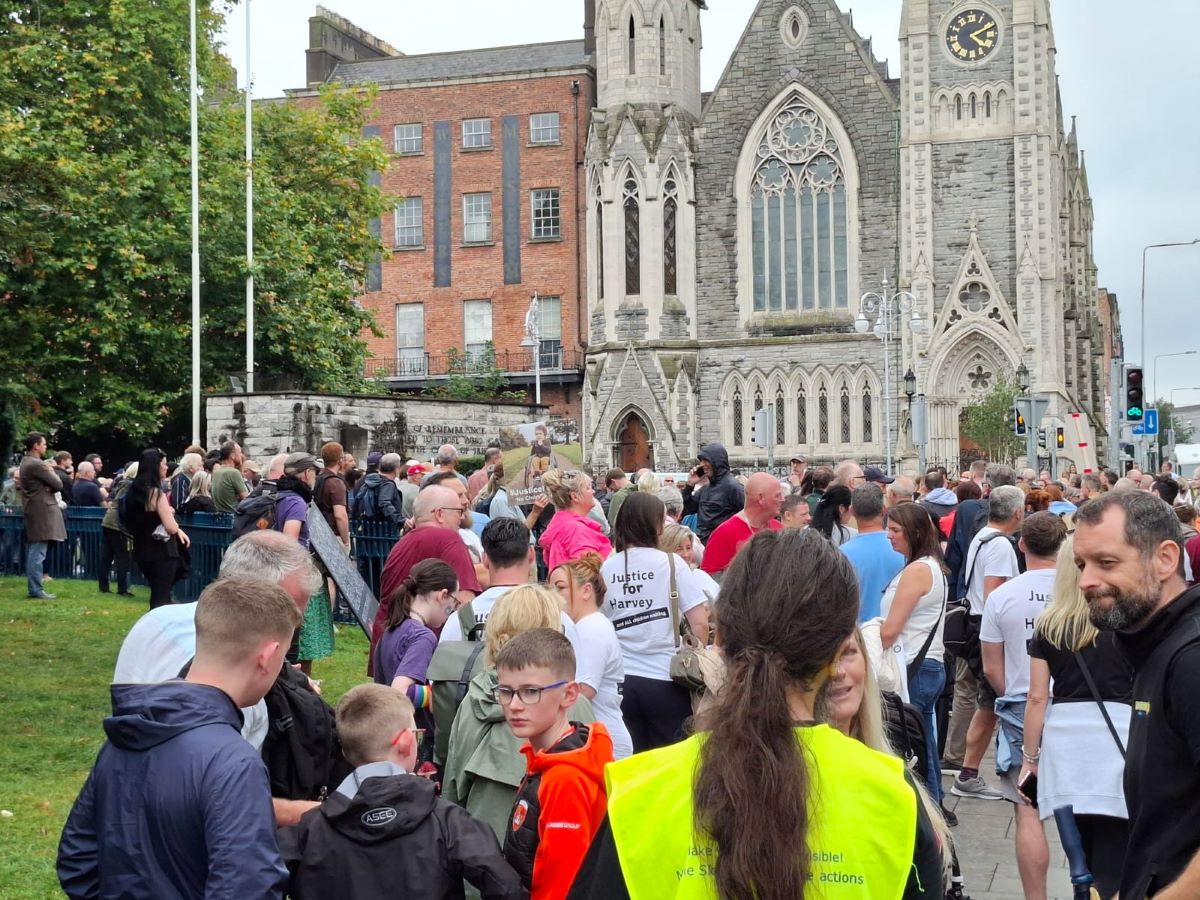
Dublin city centre on Saturday saw two marches scheduled to start at the same time from the Garden of Remembrance, both of which were drenched by heavy showers, as were fans attending the Robbie Williams concert in nearby Croke Park stadium.

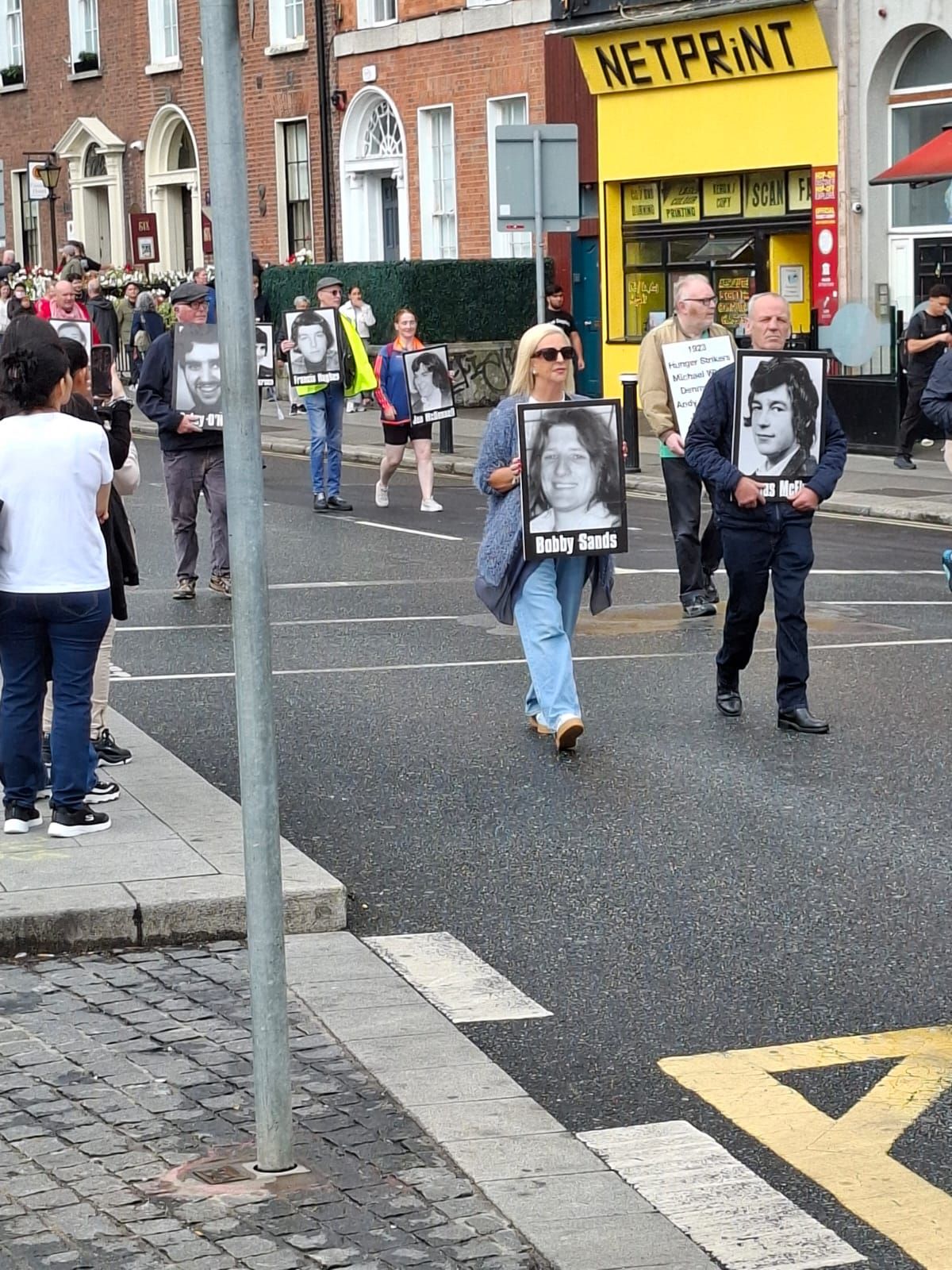
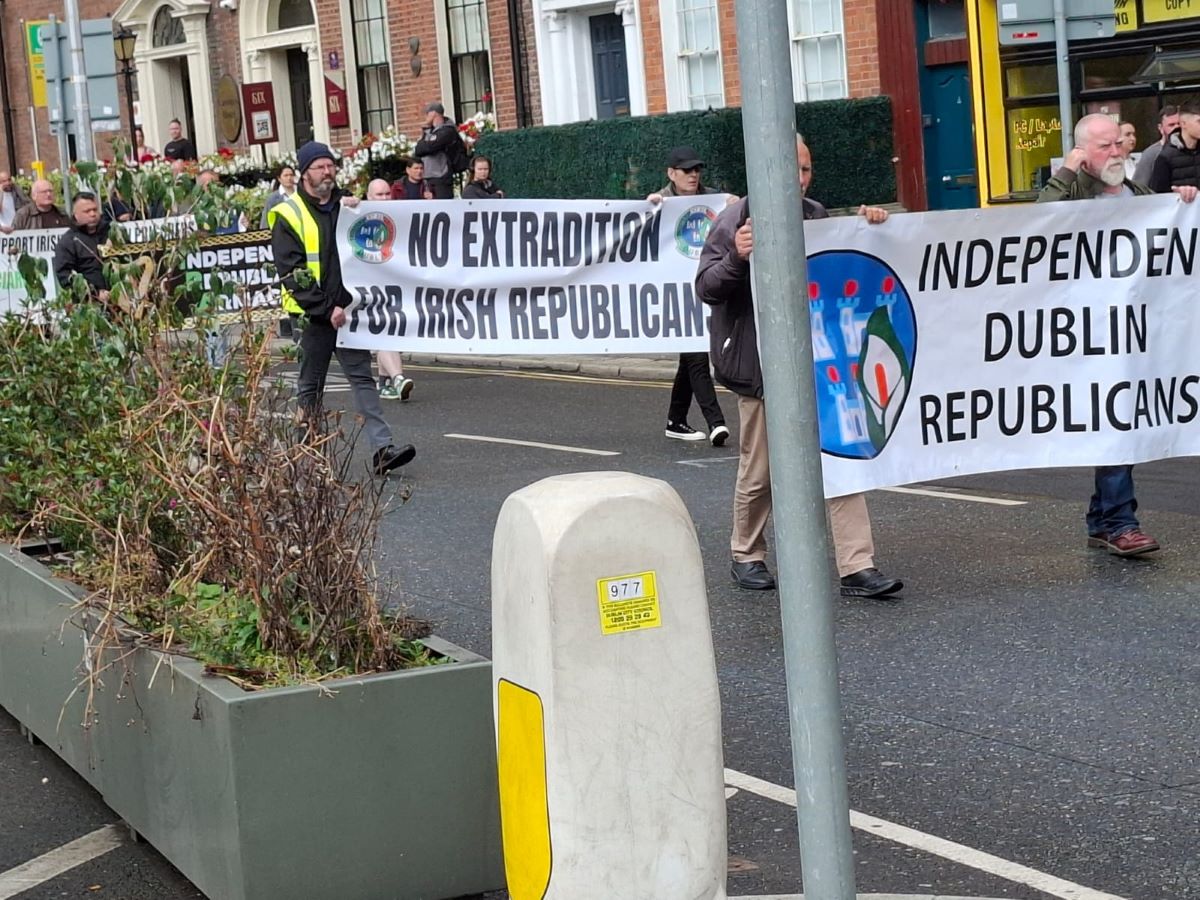
The first march to set off was the largest, the Harvey Morrison protest, the Hunger Strike Commemoration organised by Dublin Independent Republicans waiting for the space to clear in order to assemble theirs, with pipers, band and various banners forming up.

Supporters of both marches are mingled here though the majority are there for the Harvey Morrison march. (Photo: R.Breeze)

The Harvey Morrison protest was about the long wait the named boy had for appropriate treatment from the Irish health service for his condition of spina bifada and scoliosis. As he waited, his spine continued to curve causing him pain and though underwent surgery last year died on July 29th.

It emerged last year that Harvey had been removed from Children’s Health Ireland’s (CHI) urgent scoliosis surgery waiting list, without his family being informed. In 2017 Simon Harris declared that no child would wait for more than four months for scoliosis treatment.

Apart from those requiring specialist treatment for rarer medical conditions, people with much more common complaints face many hours in A & E before being seen by a doctor or having an X-ray taken, with an average of 500 people admitted to hospital on trolleys daily awaiting beds.1

Seven different speakers addressed them at their rally on Custom House Quay, being well received by the crowd with a small exception, which was when a participant shouted ‘Traitor!’at Mary Lou Mac Donald, President of the Sinn Fein party, before being told by march stewards to keep quiet.

Calling SF (and any in Government) politicians ‘traitor’ is a frequent position of those on the Far-Right2 in the Irish State, for racist reasons. Indeed, a number of Far-Right activists were spotted among the marchers but it seems they were unable to dominate the event.

THE HUNGER STRIKE MARTYRS COMMEMORATION

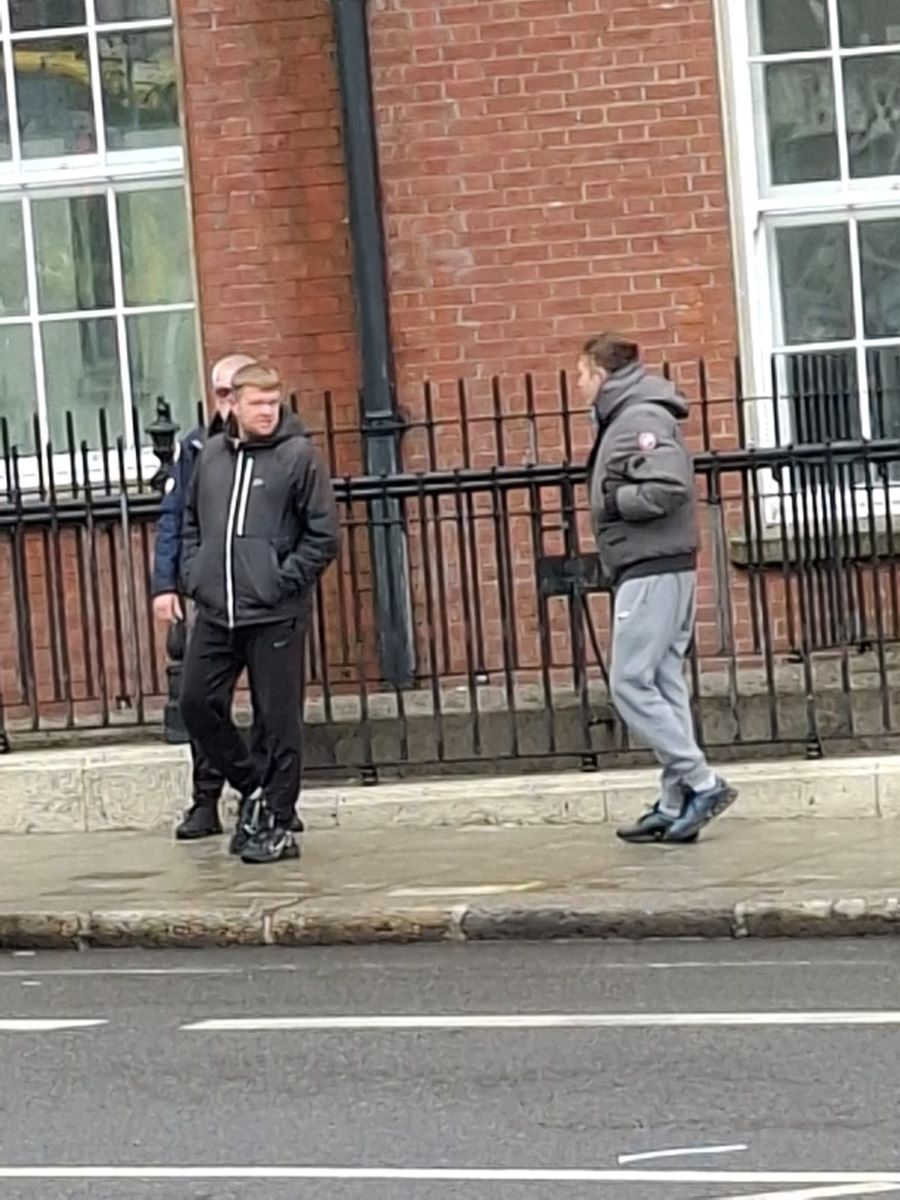
A handful of fascists were also observed watching the Hunger Strike martyrs’ commemoration gather and photographing them but when some of their targets began to photograph them in turn, they walked away, presumably to go and promote themselves and their lies on social media.

Fascists who had been filming the Hunger Strike Commemoration moving off as a camera turns on them. (Photo: R.Breeze)

Irish Republicans, who are opposed to (and by) the Far-Right, also call Sinn Féin ‘traitors’ but for the reason that they consider the party has left the struggle and colludes with the neo-colonial ruling class of the state and with the English occupation in the Six Counties.

The pipers prior to setting off on the march. (Photo: R.Breeze)

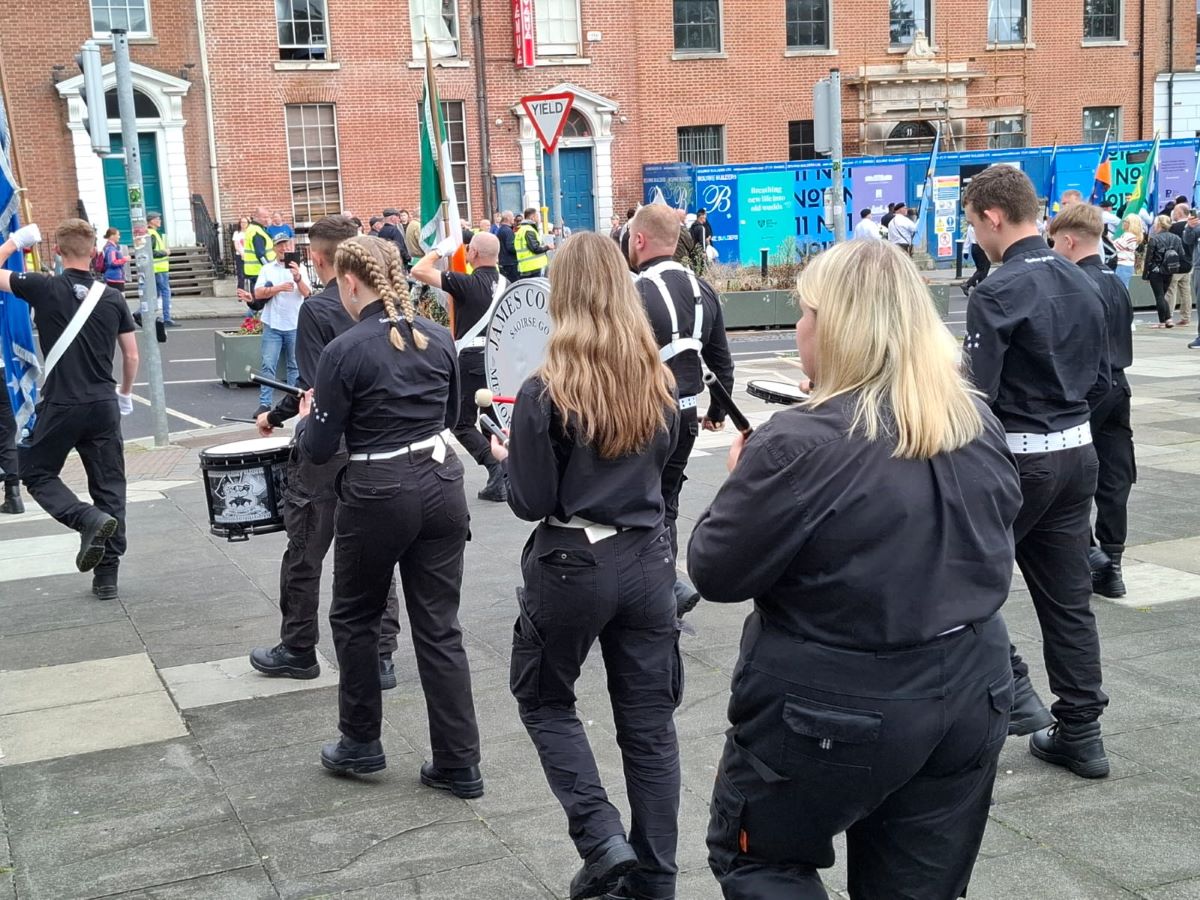
Two pipers led off the Hunger Strike commemoration organised by Independent Dublin Republicans followed by a full colour party and the James Connolly Republican Flute Band, from Derry. In traditional two lines style they marched through onlooking crowds in O’Connell Street.

The march crossed the Liffey into D’Olier Street, back up O’Connell Street and after a pause at the Government-threatened GPO, into Parnell Street, then around the western and northern sides of the Square and back into the Remembrance Garden for the commemoration ceremony.

The Hunger Strike Commemoration march proceeding down from the Garden of Remembrance and just about to enter Dublin’s main thoroughfare, O’Connell Street. (Photo: R.Breeze)

And it rained – it poured down rain. Which was bad enough on the audience but much much worse on the colour party in shirt and trousers, the RFB members and those holding the portraits of the ten hunger strike martyrs and a number of banners.

Dixie Elliot was introduced as the main speaker, well-known in Republican circles, former member of the Provisional IRA, an ex-POW and ‘Blanketman’.3

(Photo: R.Breeze)

Seemingly undeterred by the pouring rain, Elliot spoke at substantial length though whether through lack of projection or faulty amplifier, much of what he said was lost to many in the audience. From snatches he could be heard going through the history of the recent three decades’ war.

The targets of his condemnation were not alone the British occupation and the Irish State’s complicity but also the leadership of the Irish Republican movement who had abandoned the struggle and become part of the colonial administration in the Six Counties.

(Photo: R.Breeze)
(Photo: R.Breeze)

Expressing solidarity with the Palestinian struggle and against imperialism, Elliot also condemned the far-Right in Ireland who claim to be ‘patriots’ in order to promote their racism and he counter-posed the example of Bobby Sands’ internationalism in his poem The Rhythm of Time.

The Connolly Memorial Republican Flute Band setting out on the march from Garden of Remembrance. (Photo: R.Breeze)

Both Elliot and the Chairperson called for solidarity with Irish Republican political prisoners and the framed Craigavon Two, convicted in a no-jury political Occupation court and still in jail 16 years later.

Finally chairperson Ado Perry thanked people for their attendance, the colour party and audience stood to attention and the piper played the air to the chorus of the song generally known as Amhrán na bhFiann (and of which the chorus melody is also the ‘National Anthem’ of the Irish State).

(Photo: R.Breeze)

CROKE PARK CONCERT

The Gaelic Athletic Association stadium in Croke Park was the venue for a Robbie Williams concert in Dublin and the fans were flocking into town in rainproof macs that the marchers could have done with. The previous weekend it had been the Manchester Gallaghers, i.e. Oasis there.

The finals in Gaelic football for men and women and in hurling have been played in Croke Park in previous weekends and now it seems it’s rock concerts season.

The far-Right protested the couple of occasions that the stadium was rented to celebrate the Muslim feast day of Eid. Apparently English musicians and bands playing there are are not problematic for them. But then nor are the banks and property speculators causing the housing crisis.4

End.

(Photo: R.Breeze)
(Photo: R.Breeze)
(Photo: R.Breeze)
Main speaker, Dixie Elliot, speaking at rally in Garden of Remembrance at end of Hunger Strike Commemoration march. (Photo: R.Breeze)

FOOTNOTES

FURTHER INFORMATION

https://www.irishtimes.com/politics/2025/08/13/family-of-recently-deceased-boy-harvey-morrison-sherratt-to-meet-simon-harris/

https://www.irishtimes.com/news/ireland/irish-news/adams-and-mcguinness-betrayed-everyone-a-former-ira-prisoner-reflects-on-troubles-1.4578091

https://www.facebook.com/p/Independent-Dublin-Republicans-100090801607007

1https://www.inmo.ie/News-Campaigns/Trolley-Watch/

2It is also the position of a number of Irish Republican organisations and individuals for entirely different reasons. See e.g https://www.irishtimes.com/news/ireland/irish-news/adams-and-mcguinness-betrayed-everyone-a-former-ira-prisoner-reflects-on-troubles-1.4578091

3One of the Irish Republican ‘blanket protester’ prisoners who resisted the attempt of the colonial prison service to make them wear regulation prison uniform, wearing underwear and a blanket instead. This condition degenerated into the ‘no wash’ and ‘dirty protests’ which the prisoners sought to overcome with the hunger strikes of 1980 and 1981 when 10 prisoners died.

4Which the Far-Right blame instead on migrants.

FAKE PATRIOTS MISUSE IRISH HISTORY AND THE HOMELESS CRISIS

Diarmuid Breatnach

(Reading time: 6 mins.)

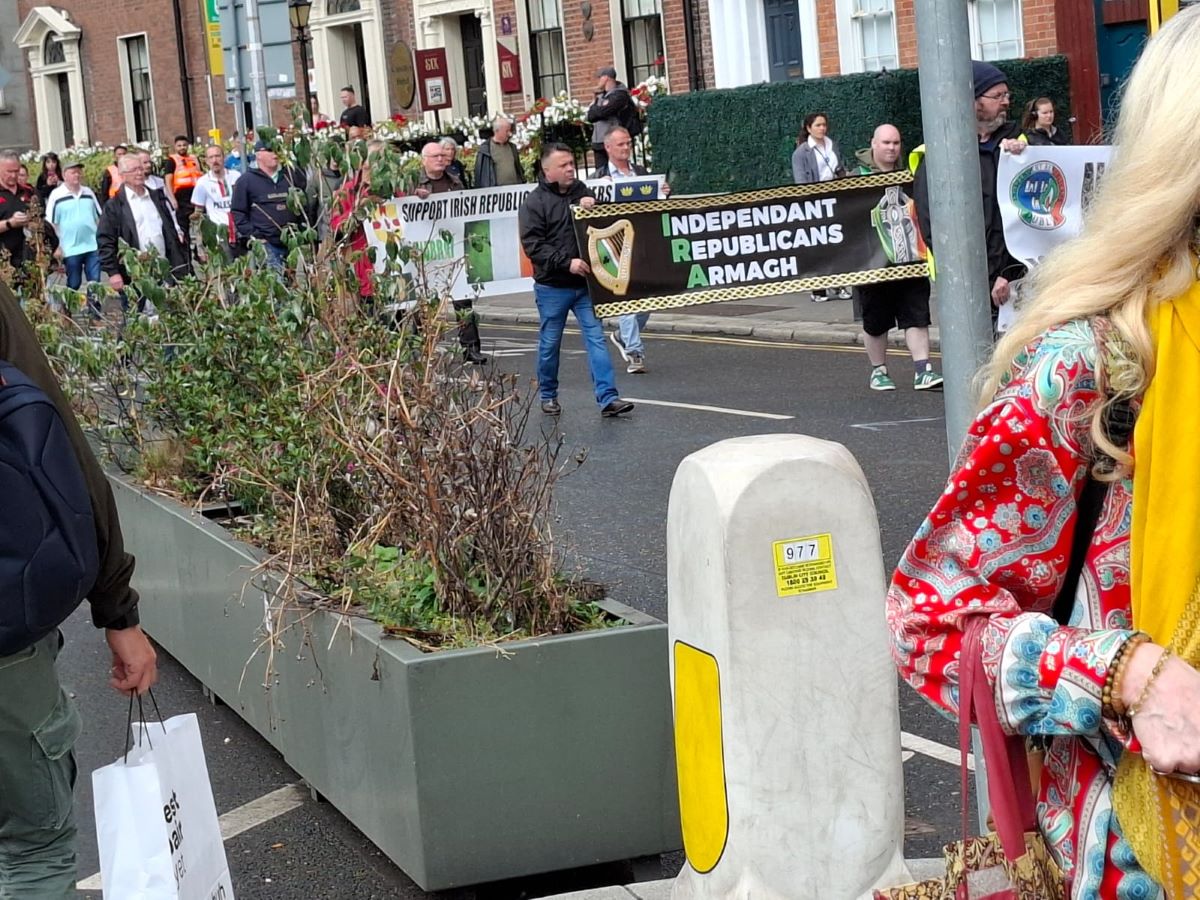
In recent days we have seen the far-Right mobilise people to allegedly defend the GPO and protest homelessness, not against its causes but instead against migrants. In defence of ‘Irishness’ they also menaced an annual religious Muslim procession.

Participants in these and similar events wave the Irish Tricolour and Irish Republic flags and claim to be ‘Irish patriots’ standing up for ‘the Irish nation.’ However, it’s far from that they are in reality as we can see.

They

  • disgrace the Proclamation

The far-Right claim to honour our national history of resistance to colonialism and occupation and even display copies of the 1916 Proclamation of Independence.1

Yet they are often also seen and heard denouncing Muslims, in direct contravention of the Proclamation’s words: “The Republic guarantees religious and civil liberty … to all”; similarly they held protests when use of Croke Park was hired to celebrants of the Eid festival.

  • disgrace the GPO as HQ of the 1916 Rising

They have and do disgrace the very symbolic building they claim to be trying to protect.

They have often held racist gatherings outside it; one of their organisers2 (e.g. of weekly protests during the Covid crisis) leading a chant of support for British fascist Tommy Robinson, who defended the Paratroopers who carried out the 1972 Bloody Sunday massacre in Derry.

Their recent protest at the GPO featured as speaker a man known for his active membership of the sectarian UVF murder gang, who admitted working for British Intelligence and who called for the strengthening of the colonial British Border – and was cheered for saying so.

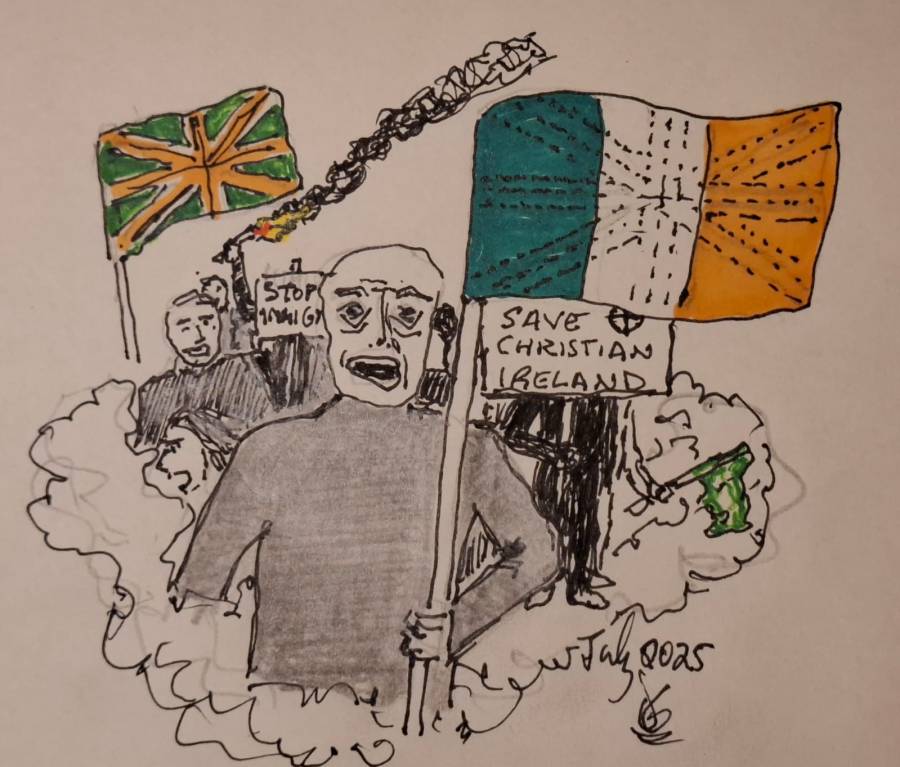
Cartoon by D.Breatnach
  • disgrace the flags

The far-Right disgrace and misuse the very flags they wave so keenly.

The Tricolour was presented to the revolutionary Young Irelander republicans3 by French revolutionary republican women in 1848. It signified peace and unity between the descendants of settlers and the indigenous Irish in revolutionary struggle against the British colonial occupation.

The flag with the words “Irish Republic” painted in white and gold on a green background was made on domestic material of socialist Republican Constance Markievicz (see next section) in her house and delivered by her to the GPO.

It was installed and flown on the roof at the Princes St. corner by Eamon Bulfin4 (see next section), a migrant from Argentina.

  • disown but also misappropriate real patriots

In dishonest manipulation, the far-Right claim to honour our patriots and even invoke them in their campaigns. In their agitation against migrants they hide the fact that Constance Markievicz, Thomas Clarke and James Connolly were all migrants (Connolly and Clarke no less than three times).5

Also a migrant was Eamon Bulfin (see previous section) along with many others who fought for Irish freedom and even sacrificed their lives (including Erskine Childers)6.

Placards on an anti-racist rally on Custom House Quay some years ago. The text placard quotes the 1916 Proclamation: “The Republic guarantees religious and civil liberty to all”. (Photo: D.Breatnach)

Of the Seven Signatories of the 1916 Proclamation (see earlier section), two – Pearse and McDonagh7 – were children of migrants and two were themselves migrants (Connolly and Clarke).

Among many such examples, the father of Young Irelander Republican patriot Thomas Davis (author of the song A Nation Once Again) was a migrant.

  • join with Loyalists and British fascists

A far-Right organiser calling for three cheers for British fascist Tommy Robinson was not the only such example and outside the GPO this week far-Right elements welcomed as speaker Mark Sinclair, a member of the UVF, a British colonial sectarian murder and terrorist squad.8

Prominent Irish leaders of fascist organisations have also shared a platform with Scottish fascist and Loyalist Jim Dowson.9 And of course how can we forget the desecration of the Tricolour unfurled among Union Jack and Loyalist flags in Belfast by some Dublin far-Right activists!10

Admitted UVF/ MI5 Sectarian Loyalist UVF murder gang member Mark Sinclair. (Photo sourced: Internet)
  • don’t act against British occupation

With all that background, it’s hardly surprising that the far-Right “patriots” don’t organise against the British occupation of the Six Counties or in support of Irish Republican political prisoners in jails on either side of the British Border.

  • burn buildings

Apart from misleading people and distracting them from the real sources of problems to Irish working people and seeking to intimidate refugees, what do the far-Right actually do? Ah, yes, they burn buildings that might be used as accommodation. A great help to the homeless indeed!

  • attack homeless refugee and migrant tents

But no, that’s not all. No, the brave ‘patriots’ slash tents and threaten migrants and refugees who are sleeping on the streets. They don’t take on the big landlords, bankers, property speculators and vulture funds – no, they strike down at people poorer and in worse conditions than themselves.

  • cover for the property speculators and vulture funds, big landlords, bankers

So with all this whipping up fear and hatred of migrants, the far-Right obscure the actual cause of the problems, which is not only Irish capitalism but its total subjection to foreign capitalism. The only ones to benefit from this activity are those who are the real causes of the problems.

  • are not patriots, nor nationalists

Despite their claims and flag-waving, the far-Right in Ireland are neither patriots nor true nationalists. They do not organise in defence of Irish sovereignty and against British occupation nor against foreign capitalist exploitation of Irish natural resources, labour or infrastructures.

Or the contrary, they work to distract attention away from these centrally-important issues for the Irish nation and raise false issues to divide the people. And usually their concept of ‘Ireland’ ends at the British border which the recent far-Right rally at the GPO called for strengthening!

  • are a sub-class of deprived individuals allowing themselves to be manipulated by fascists, MI5 and NATO

Many of those being mobilised against migrants come from parts of the cities neglected for generations, often associated with low educational level, substance misuse, unemployment and unresolved mental health issues.

The ideological fascists will recruit those elements to fight, not against the cause of their deprivation, the neo-colonial ruling class or the flooding of foreign capitalist companies into Ireland, assisted by banks and political decisions -but instead against migrant workers and refugees.

  • are filling a vacuum left by the Republican and Socialist movement

WILL WE LEARN FROM OUR FAILURES?

Many of those participating, while some are also unfortunate victims of Irish capitalism, will be recruited as the boot boys of fascism.

While it is true that historically capitalism in crisis turns to fostering fascism and that capitalism, including the neo-colonial variant in the Irish state is running out of other options, we must evaluate our own role in this development, examine our own failures, learn from and remedy them.

The ground was largely ceded to the Far-Right in the period of their initial growth during the Covid crisis. The socialist Left and Republican movement, in particular its organisations, had little response to the early FR mobilisations or to responding creatively to state-imposed restrictions.

Throughout that period and subsequently the socialist Left sector, despite its protestations of anti-imperialism and anti-colonialism, completely ceded the ground of Irish national sovereignty and its symbols to anyone who wished to occupy it.

They did not, for the most part, protest the use of State repression against Irish Republicans both sides of the British Border, whether through police harassment, special legislation and special no-jury courts, nor stand up for the human and civil rights of Republicans, including political prisoners.

Their distaste for the very issue of national sovereignty was reflected in their refusal to fly the Irish Tricolour, which, although now also the official flag of the Irish State, is originally and remains still a potent symbol of Irish Republican anti-colonial struggle over 170 years.

They might argue that they wished to be identified with the struggle of the working class rather than a nationalist one but they also chose not to fly the flag of the insurrectionary Irish working class, the Starry Plough, in among their internationally-recognised red flags.

The Irish Republican organisations in their fragmented movement, on the national question, failed to sustain unity even around opposition to repression of the states or even around solidarity with the movement’s political prisoners.

They also failed and, to an even greater extent, in fighting for universal affordable housing in a crisis which seems to offer no end and is seized upon by the Far-Right to target refugees and economic migrants, who of course have no responsibility whatsoever for the crisis.

This area too has been a notable failure of the socialist Left organisations which, although marching often enough in public demonstrations and participating in a couple of media-orientated occupations,11 failed to organise and lead a state-wide campaign of empty building occupations.

And so, here we are today, when the FR are able to bring Tricolour and Irish Republic flag-waving crowds on to the streets in false claims of patriotism, dividing and seeking to intimidate migrant workers and anti-racists, burning buildings and insisting on their definition of ‘Irish’ being correct.

Our omissions and failures, if we recognise and act to remedy them, also point the way forward.

End.

1In a travesty of frequent Irish Republican ceremonial occasions, it was even read out at the recent Far-Right gathering outside the GPO which was addressed by a known member of the UVF sectarian murder gang.

2Under the name Dee Wall (real name Dolores Webster).

3Including to Thomas Meagher ‘of the Sword’ who later recruited for, joined and fought in the Union Army in the US Civil War against slavery. Meagher unfurled the flag first in Wexford and later in Dublin, both acts in 1848.

4Bulfin came to Ireland around the age of ten with his family and later joined the IRB and the Irish Volunteers. After the surrender in Moore Street he was sentenced to death, later commuted to life sentence, then from Frongoch prison camp deported to Argentina from where he was the Latin American representative for the Movement.

5Clarke and Markievicz were both born in England. Clarke was first a migrant to Ireland, later to the US, then back again. Connolly was born in Edinburgh and a migrant to Ireland, then to England, then to the USA before his return to Ireland.

6Childers was born in England. He captained the yacht that brought the Mauser rifles and ammunition to Howth. Later he joined the IRA, took the anti-Treaty side and was executed by the Free State during the Civil War.

7The father of the Pearse brothers was English, as was McDonagh’s mother.

8During his trial for bank robbery for the UVF in Glasgow, Sinclair declared he had been working for MI5 which was well known to be steering Loyalist organisations. The UVF and British Intelligence bombed Dublin and Monaghan in 1974, causing the deaths of 34 people and a full-term baby, the highest death toll of one day during the recent 30 Years War.

9Rowan Croft, Herman Kelly (Irish Freedom Party) and Niall McConnell (Síol na hÉireann).

10A prominent group among the Dublin far-Right calling themselves Coolock Says No.

11https://www.irishtimes.com/ireland/2025/07/09/former-loyalist-uvf-prisoner-addressed-anti-immigration-protest-at-dublins-gpo/

12For example, the 27-day occupation of Apollo House, Dublin, from 15 December 2016 by housing activists and homeless people, with speeches and performances by prominent musicians.

BBC, Kneecap and the long history of censorship

Gearóid Ó Loingsigh June 2015

(Reformatted entire for publishing in Rebel Breeze from article of same title in his Substack)

(Reading time: 8 mins.)

Kneecap’s music is not really my thing. I am perhaps too old, or maybe my musical tastes are more conservative. But I do love their politics and their stance on Palestine.

I don’t think much of Hezbollah, but I do think waving their flag is not a criminal offence.

The BBC think otherwise as evidenced by their decision to not broadcast Kneecaps’s performance at the Glastonbury festival. The only reason for this was their support for Palestine. There was no other reason.

Though, it didn’t work out well for the BBC as Bob Vylan who was broadcast live got the crowd to chant Death to the IDF!, one of the noblest of chants ever to be heard at Glastonbury.

But there is a long history to the BBC and other British media censoring musicians. The BBC in its statement said:

Whilst the BBC doesn’t ban artists, our plans ensure that our programming meets our editorial guidelines.

We don’t always livestream every act from the main stages and look to make an on-demand version of Kneecap’s performance available on our digital platforms, alongside more than 90 other sets.[1]

In other words, the BBC does ban artists.

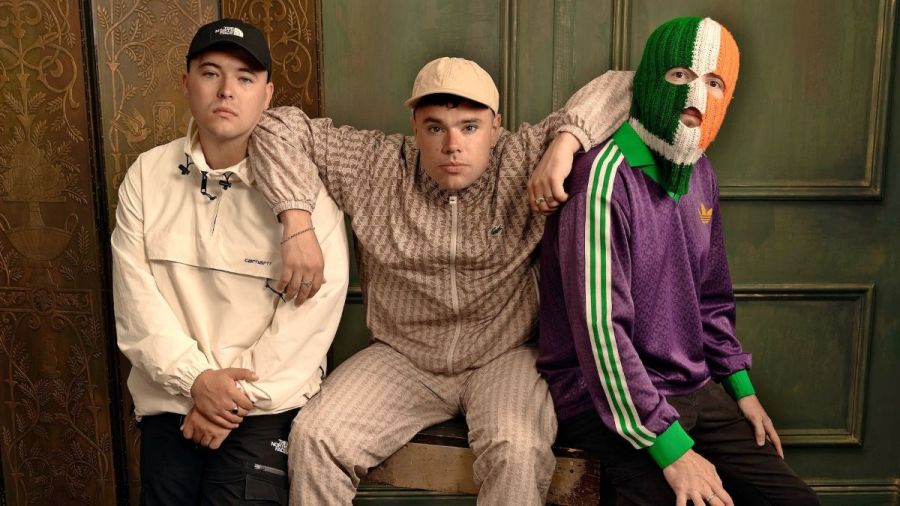
The rapper trio under the band name of Kneecap (Image sourced: on line)

It is not like this is the first time they have banned some of them. Following the Bloody Sunday massacre by the British Army in Derry in 1972, Paul McCartney, penned a song titled Give Ireland Back to the Irish.[2] It was the debut single of Wings.

It was instantly banned in Britain by the BBC but managed to get to No. 16 in the British charts nonetheless and got to No. 1 in Ireland.

They banned songs that mentioned sex, even Shirley Bassie’s Burn My Candle[3] and they banned songs that were considered more political such as The Sex Pistols’ Anarchy in the UK,[4] a song that wasn’t really political at all.

Not surprisingly they banned the then relatively unknown Heaven 17’s debut (We Don’t Need This) Fascist Groove Thang,[5] over concerns it might upset the then recently-elected US president Ronald Reagan.

This was a man whose government through the CIA went on to support deaths squads in Latin America and set up cocaine smuggling networks to finance them through his loyal servant Oliver North.[6] Reagan of course is referred to in the song.

Democrats are out of power
Across that great wide ocean
Reagan’s president elect
Fascist god in motion

That wasn’t the last of it either. The BBC went on to ban a song by The Police, Invisible Sun[7] because of a possible slight on the British Army contained in the lyrics and of course the official video to the song.

I don’t want to spend the rest of my life
Looking at the barrel of an Armalite
I don’t want to spend the rest of my days
Keeping out of trouble like the soldiers say

I don’t want to spend my time in hell
Looking at the walls of a prison cell
I don’t ever want to play the part
Of a statistic on a government chart

The BBC would, during the 1st Gulf War ban a total of 67 songs for the duration of the war, amongst them songs by such establishment figures as Elton John whose song Act of War [8] recorded in 1985 with Millie Jackson was put on the list.

As was Pat Benatar’s Love is a Battlefield,[9] recorded even earlier in 1983. It takes little to upset the BBC it would seem.

The former Irish Taoiseach (Prime Minister) Leo Varadkar criticised Keir Starmer’s call for Kneecap to be not allowed play at Glastonbury stating that

It’s not great for politicians to get into deciding which artists should be allowed to perform where or not.

To me, that’s illiberalism. Part of the whole point of art and music and literature is to be inappropriate, is to be challenging, is often to be anti-establishment,” he said.

We’ve had a situation now for quite some time in Ireland and in Europe and Britain, where politicians didn’t get into the space of saying who should be allowed to perform, who shouldn’t, what books you should be allowed to read, and I hope we don’t slip back into doing that under the guise of national security and anti-terrorism when it isn’t really about that.[10]

Varadkar tut tuts the BBC and Starmer. Sounds great, except his party and the Irish state in general does not have a great record in the matter.

The state broadcaster took an insidious approach to censorship with songs rarely being banned outright. Rather they were just not simply played on the radio station. Hint hint, nudge nudge. A very Irish way of doing things.

The Irish group The Wolfe Tones released many songs over the years about the conflict in the north of Ireland and got little to no airtime. Such was the situation that they even recorded a song about it, called Radio Toor I Li Ay (sometimes called They Don’t Play Our Songs on the Radio[11].

The lyrics are pertinent to Kneecap and Starmer and sum up exactly what the Establishment are about.

You don’t play our songs on radio
You say they’re too political!
Who controls the mind, where’s the mind’s control?
For the music on the airwaves
Follows empty minds, those empty heads
Play songs of sex and drugs instead
Don’t tell them how it really is

Won’t MI5 look after you, control your thoughts
Feed information to your hearts and minds
To save you all from thinkin’, thinkin’, thinkin’, thinkin’

It is a fact that RTE didn’t give them much airtime and still don’t. So much so that in 2024, Derek Warfield the lead singer with the group said it was time to end the ban on them.[12] It still hasn’t happened, nor will it.

In fact, the Irish women’s football team got into trouble for singing one of their songs, Celtic Melody,[13] and were excoriated by British sports journalists, who are not renowned for their knowledge of music, politics, history or much else aside from who ran how fast and where.

Not exactly intellectual heavyweights. Nonetheless these idiots led to the Irish women’s team being eventually fined €20,000 for singing the song.[14]

The Irish singer Christy Moore found himself on the wrong end of state repression in Ireland on many occasions and his songs, like those of The Wolfe Tones were not banned per se, but they never received much airplay.

Except those that were considered to be humorous and non-political, such as Don’t Forget Your Shovel.[15] 

But other songs of his were censored on the radio without the need for an official ban, such as Ninety Miles From Dublin,[16] which was about the IRA and INLA prisoners on the Blanket and Dirty Protests in the H-Blocks of Long Kesh.

Likewise, other songs he recorded about the prisoners and later on about the Hunger Strikers equally received no airplay. There was one brief exception to this.

Patsy O’ Hara (INLA) died on hunger strike on May 21st 1981 after 61 days. His mother Peggy O’Hara was initially adamant that she would not let her son die and that when he lapsed into a coma she would intervene and give the doctors the order to break his strike with an intravenous drip.

However, in her last conversation with her son, he said to her that he was sorry they had not won and asked her to let the fight go on, before lapsing back into unconsciousness. Christy Moore wrote a song about that exchange called The Time Has Come.[17] 

It was well received and got airplay and praise. Then someone informed the ignorant and arrogant mandarins at RTE what the song was about and suddenly it got no more airplay. Listening to the song, it is obvious what it is about.

The gentle clasp that holds my hand
Must loosen and let go
Please help me through the door
Though instinct tells you no

Our vow it is eternal
And will bring you dreadful pain
But if our demands aren’t recognized
Don’t call me back again

Ironically Christy Moore would record another song that got no airplay. It was called Section 31,[18] a reference to the article of the Broadcasting Authority Act (1960) that gave the minister power to ban interviews with members of Sinn Féin and proscribed organisations such as the IRA.

But in effect it led to RTE’s scant reporting of or carrying out of few interviews that were critical of state policy on the conflict. The song explained exactly why some issues are censored.

Who are they to decide what we should hear?
Who are they to decide what we should see?
What do they think we can’t comprehend here?
What do they fear that our reaction might be, might be?

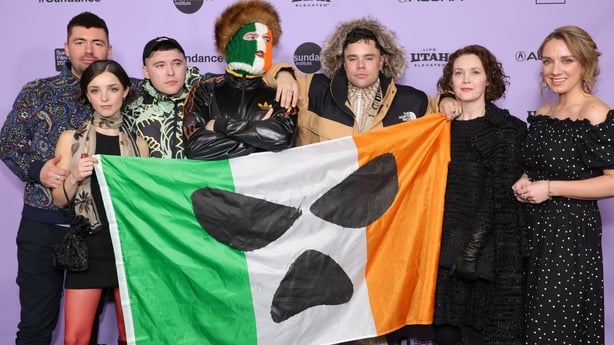
The Kneecap trio with friends at the Sundance Festival in January. (Photo sourced: RTÉ)

It is always about silencing the opposition and preventing a reaction to their repression and in this case genocide.

So back to Kneecap. They stand in a long line of artists who have put their money where their mouths are. They stand side by side with giants from other musical genres such as Woody Guthrie and Pete Seeger who were repressed by the McCarthyite wave in the US in the 1950s.

The BBC for its part continues to be the propaganda arm of the British Empire, or what is left of it, covering up, lying about or justifying murder, massacre, torture and plunder from India to Kenya, Ireland and now Palestine.

Woody Guthrie had the words This Machine Kills Fascists carved into his guitar, a slogan that might earn him a jail sentence nowadays.

It was meant more in the sense that his music was part of the struggle against fascism, carrying political messages to workers, Dustbowl refugees and migrants.

It didn’t literally kill anyone, though in his song Ludlow Massacre,[19] Guthrie celebrated the workers taking up arms to kill the scab thugs that came to shoot them.

Scabs at the behest of the Colorado Fuel and Iron Company, owned by the infamous Rockefeller family murdered 26 people, mainly the wives and children of the striking miners.

However, the massacre was just one large incident, the Baldwin-Felts Detective Agency had harried and harassed the striking miners, murdering them in ones and twos.

The detective agencies celebrated in comics and films were what would later become known in Latin America and elsewhere as death squads. The miners fought back and Guthrie celebrated this in his song. Resistance, including armed resistance was legitimate.

The state soldiers jumped us in a wire fence corners,
They did not know we had these guns,
And the Red-neck Miners mowed down these troopers,
You should have seen those poor boys run.

The press, at the time, described the striking miners as savages.

Any similarity to the current media onslaught on Palestine is not a coincidence, it shows the class interests of the media moguls and the western states. Working class people, foreign resistance movements will always be savages to the media.

And the use of armed masked thugs by the state is not new either. Before ICE, there were the detective agencies. Most of the dead at Ludlow were migrant workers. The final death toll according to Howard Zinn’s People’s History of the US was sixty six men women and children.

Kneecap have contributed to the fight against fascism and Bob Vylan’s chant Death to the IDF! should be on everyone’s lips. There is no reforming the IDF, just like there was no reforming Hitler’s SS. Only the complete destruction of the IDF will bring any change.

Can their music, like Guthrie’s be said to kill fascists? I don’t know, time will tell, but from the reception they got at Glastonbury it is looking good.[20] What I do know is Keir Starmer and Trump finance fascists.

Starmer like a fascist wants to ban Palestine Action. The BBC covers up for fascists, praises them and censors those who stand up to fascists. I know who is on the right side of history.

End.

NB: For more articles by Gearóid see https://gearoidloingsigh.substack.com

NOTES

[1] The Guardian (28/06/2025) Kneecap’s Glastonbury set Will not be broadcast live, BBC confirms. https://www.theguardian.com/music/2025/jun/28/kneecap-glastonbury-set-will-not-be-broadcast-live-bbc-confirms

[2] See Wings: Wild Life – Give Ireland Back To The Irish

[3] See

[4] See https://www.youtube.com/watch?v=q31WY0Aobro&list=RDq31WY0Aobro&start_radio=1

[5] See https://www.youtube.com/watch?v=lV5dbcOmw6I&list=RDlV5dbcOmw6I&start_radio=1

[6] Jacobin (12/11/2021) What We Really Know About the CIA and Crack. Daniel Finn. https://jacobin.com/2021/11/what-we-really-know-about-the-cia-and-crack

[7] See https://www.youtube.com/watch?v=1VuDjJ9KIxM&list=RD1VuDjJ9KIxM&start_radio=1

[8] See https://www.youtube.com/watch?v=vKbuDkueGek&list=RDvKbuDkueGek&start_radio=1

[9] See https://www.youtube.com/watch?v=IGVZOLV9SPo&list=RDIGVZOLV9SPo&start_radio=1

[10] The Journal (27/06/2025) Varadkar on Kneecap row: Terrorism is bombs and guns, not music. https://www.thejournal.ie/varadkar-on-kneecap-row-terrorism-is-bombs-and-guns-not-music-6745000-Jun2025/

[11] See https://www.youtube.com/watch?v=jtsxQaXdflU&list=RDjtsxQaXdflU&start_radio=1

[12] Newstalk (11/09/2024) ‘Systemic ban’ on The Wolfe Tones should be lifted – Warfield. Jack Quann. https://www.newstalk.com/news/systemic-ban-on-the-wolfe-tones-should-be-lifted-warfield-1764007

[13] See https://www.youtube.com/watch?v=rgWeD7tHhaE

[14] Sky News (08/12/2022) Ireland women footballers fined €20,000 for singing song referencing IRA in World Cup celebration. https://news.sky.com/story/ireland-women-footballers-fined-20-000-for-singing-song-referencing-ira-in-world-cup-celebration-12764012

[15] See https://www.youtube.com/watch?v=rV9c0OnekvM&list=RDrV9c0OnekvM&start_radio=

[16] See https://www.youtube.com/watch?v=Q98EcxrOr6w&list=RDQ98EcxrOr6w&start_radio=1

[17] See https://www.youtube.com/watch?v=6E7wJsDx2qg&list=RD6E7wJsDx2qg&start_radio=1

[18] See https://www.youtube.com/watch?v=m19Pc-b7EBc

[19] See https://www.youtube.com/watch?v=XDd64suDz1A&list=RDXDd64suDz1A&start_radio=1

[20] See https://www.instagram.com/reel/DLdeW1sI2A-/?igsh=YnJqeDd0bm1obzdi

WE FOUGHT THEM FOR 800 YEARS BUT WE ARE STILL NOT FREE

Diarmuid Breatnach

(Reading time main text: 4mins.)

I was jarred recently hearing the Irish actor and Palestine solidarity activist Liam Cunningham mention “700 years of British occupation”.1 And I have heard others not from Ireland speak admiringly of the “Irish freedom struggle of 700 years.”

Quite a few of those from other countries who quoted the “freedom” after “700 years” did so admiringly and may not be well acquainted with our nation’s history.

Liam Cunningham in Italy with two of the humanitarian activists about to sail on the Mayleen’s expedition to Gaza.

The foreign occupation of Ireland is normally dated from the Norman invasion of 1169 (although we could add to it the foreign occupation of Dublin by the Vikings from roughly 853 AD to 1170 AD).

I’m aware that I can be somewhat challenged in mathematics but after checking and re-checking I find that 856 years have elapsed since 1169, which means that the British-based occupation of Ireland has continued for well in excess of the 700 years quoted by Cunningham and others.

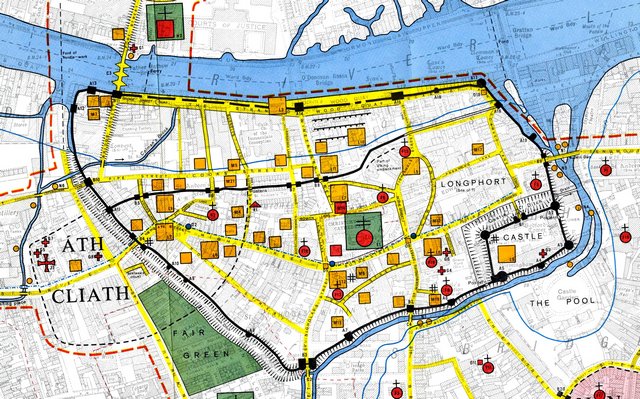
The Pale or walled city of Dublin under British Norman/ English occupation (Source image: https://www.census.nationalarchives.ie/exhibition/dublin/short_history/map_1.html)

So where did the “700” years figure come from? It occurred to me that in some people’s heads this might be based on the creation of the Irish State and an assumption that was the point at which we threw off the British colonial yoke. Well, even then it would be 752 years but o.k, that might be it.

So, all of Ireland was occupied for centuries, then after numerous uprisings, in 1921 the British ceded 26 counties to Irish State control. But Ireland has 32 counties – what happened to the missing six counties? Well, we know, they remained occupied.

The Irish State in 1921 abandoned the people of the Six Counties, in particular the 34%+ who were of Catholic background; abandoned them to institutional sectarian religious discrimination in housing, employment and representation — and to repression.2

And in fact, the fairly recent 30 Years War was precisely about that occupation. Inevitably, the people rose up against their repression and oppression. The Irish State formally claimed those Six Counties but took no steps to regain them and cooperated with the colonial forces.3

Clearly we can’t change history but we can choose not to collude with injustice. We can refuse to conceive of Ireland as missing six counties, as only four-fifths of its actual landmass. We used to have a word for the thinking that had a Six-County blind spot – we called it ‘partitionist’.

In other words, an attitude that agreed with, colluded with or merely accepted the partition of the Irish Nation.

The Irish State that was born in 1921 was dominated by a capitalist ruling class which was pro-British and socially conservative, even beyond the social conservatism of Britain. And the social conservatism of the colonial Six County regime was even more extreme.

The agreement to abandon the Six Counties was a good indication of the servile nature of the ruling class of the Irish State which became even more evident as the State developed — and even under a later government of former opponents of the State, the Sinn Féin split of Fianna Fáil.

The Irish economy was neither developed nor diversified. Emigration continued unchecked as it had for centuries under British rule and. Irish State obeisance in turn switched to the USA and then to the EU. Currently the Irish ruling class is trying to eliminate any Irish State neutrality.

In 1845 Ireland was able to feed over 8 million but today in 2025 cannot even feed a little over 7 million in (over 5.3 million in the Irish state, nearly 2 million in the Six Counties). Yes, we must import food in order to eat.

Most large companies and banks within the state are foreign-owned, including such national brands and flagships as Aer Lingus, Guinness (including Harp and Hop House lagers and Smithwicks ale), Jameson and Paddy’s whiskeys,4Erin Foods, our telecommunication system5.

Most financial institutions within the state such as insurance companies in health, life, accident, motors, travel are also foreign-owned, including the now ironically-named Irish Life. The health, transport and mail systems and infrastructures are increasingly penetrated by foreign companies.

Foreign-owned hotels, housing apartment and office blocks are the rule and growing while vulture companies gobble up the properties of people who already paid the construction costs of their homes.

In economic policies and in foreign political policy it is clear that the Irish State remains close to the major Western Powers. Responding to popular feeling over the genocide in Gaza, its political leaders may posture a little away from the pack but in effect?

The Irish State imports productsfrom the Israeli State (US$4.15 Billion in 2024),6 allows genocidal state munitions through the State’s ‘neutral’ air space, US munitions and personnel through Shannon International Airport while maintaining all normal links with the Zionist state.

What we believe and say is important

In his interview with The Group Chat Cunningham, with the agreement of the panel, stated that no state was fulfilling its legal duty to practically oppose genocide. This was an unjustified slur on Yemen, which has shut down Israeli inward or outward Red Sea traffic and hit the state itself.7

It is very interesting that even among the many condemnations of Israel by media commentators and politicians we rarely hear acknowledgement, never mind commendation of the anti-genocidal action and sacrifice of the Ansarallah state and the Yemeni people.

Perhaps the contrast is too painful.

However, in an interview during a Palestine solidarity march in Dublin8 Cunningham referred to 800 years. Was that a slip of the tongue, or were the references to 700 centuries instead the slips? Interestingly he also referred to foreign vulture funds and landlords in the same interview.

Liam Cunningham speaking about the seizure by the ‘Israeli’ navy of the humanitarian mission ship Mayleen. (Source photo: The Irish Star)

It is important that an actor in a popular drama series speaks up for Palestine and also for the Irish people and Cunningham has been doing so for years.

What we say and how we recall history is also important because they have an impact on the present and on the future. On what we aspire to. On how we act and think, on how those around us act and think.

Ireland is partitioned between a colonial ruling class and an Irish foreign-dependent ruling class. We fought the Viking occupation for 300 years and the British occupation for well over 800 years – and we are still fighting it. Without sovereignty we cannot develop our economy.

Without sovereignty we will be dragged into imperial and colonial conflicts but never to our historical and traditional place – on the side of the Resistance.

End.

NOTES

1A number of times but in particular in interview on https://www.youtube.com/watch?v=znTKPzXLfrI and on 21.17 minutes in the Empire Files interview

2It also abandoned the Protestant majority, including many descendants of the United Irishmen particularly in Antrim, to a sectarian, bigoted, racist and colonial ideology that helped maintain them for decades with the worst housing and lowest wages in the UK of which they were part.

3In 1998 it abandoned even the formality of that claim https://www.bbc.com/news/uk-northern-ireland-65184915

4And Bushmills in the colonial statelet.

5https://www.irishtimes.com/business/2025/03/16/french-billionaire-niel-inches-closer-to-full-ownership-of-eir/#:~:text=NJJ%20Boru%2C%20a%20company%20controlled,private%20equity%20firm%20Anchorage%20Capital

6https://tradingeconomics.com/ireland/imports/israel and https://www.irishtimes.com/business/economy/2025/06/08/despite-the-politics-ireland-is-israels-second-biggest-export-market-for-goods/

7Also in the Empire Files interview.

8On 24th April https://www.independent.co.uk/arts-entertainment/tv/news/game-of-thrones-liam-cunningham-gaza-b2534126.html

SOURCES

The Group Chat interview: https://www.youtube.com/watch?v=znTKPzXLfrI

The Empire Files interview: https://www.youtube.com/watch?v=ojQGOD3vywU

PALESTINIAN POLITICAL PRISONERS’ DAY IN DUBLIN

Diarmuid Breatnach

(Reading time: 4 mins.)

April 17th is the annual Palestinian political Prisoners’ Day and it was marked in O’Connell Street, the main street of Dublin’s city centre, by an event with speeches, banners and chants organised by the Ireland Palestine Solidarity Campaign.

Palestine national flags fluttered about the crowd being addressed by a number of speakers with occasional toots of solidarity from passing traffic – a common occurrence at Palestine solidarity events in most of Ireland.

View of eastward of section of the crowd at the event (Photo sourced: IPSC)

Dáithí Doolan was one of the speakers and though saying some progressive things about solidarity with Palestine and the terrible situation in which the occupiers have them, soon revealed the political poverty and lack of solidarity with resistance of his Sinn Féin party.

Doolan reminded his audience of when there were political prisoners in Ireland, as though this was no longer the case, presumably because the prisoners now are not of his party. Nor did he mention the current attempts to extradite Irish Republicans to British administrations.

The SF speaker went on to extol the South African process, perhaps not caring about the betrayal of the struggle and sacrifice of the masses there, the deepening grip of imperialism on the rich natural resources, the corruption and repression of the ANC regime and the massacre at Marikana.1

If Doolan thought about it he must have hoped that his audience did not remember that the South African process had a twin, the Palestinian one at Oslo which sabotaged the Palestinian struggle and brought into being the corrupt Palestinian Authority2, the Israeli proxy in the West Bank.

Sinn Féin has achieved a somewhat similar position in the Six Counties colony and has been working hard to reach a corresponding role in the Irish state. And why not, when it endorses the “Two State solution” giving the Palestinians 20% of their land under Zionist eyes and guns.

The very least, Doolan said, that the Irish Government could do to help the Palestinians, would be to enact the Occupied Territories Bill but he proposed nothing further, not even the ban on US military flights through Shannon Airport or on Israeli arms flights through Irish airspace.

Darragh Adelaide from the People Before Profit party spoke too about Palestine and solidarity but also about the Palestine refugees that have had to sleep in tents on Irish streets and the attacks on them both by the authorities and by fascists and other racists.

Palestinian prisoner conditions

A woman gave a detailed list of statistics relating to Palestinian political prisoners but also went through the tortures and terrible conditions in which they are kept. She concluded reminding her audience that each prisoner is a human being, a parent, a child, a sibling and not a number.

View of the crowd southward from behind a speaker (Photo sourced: IPSC)

In a year and a half, more than 15,800 Palestinians have been arrested, including 500 women, 1200 children, and thousands of detainees who were placed under arbitrary administrative detention.  64 Palestinians have died in prison since October 2024, including a child.3

The prison administration’s special units have carried out violent raids on prisoners’ cells, administering severe beatings, torture, and ill-treatment.4

Prisoners have suffered power and water cuts, and all of their belongings—including clothes, electrical appliances, and hygiene items—have been confiscated.5

They have been placed under complete isolation, family visits have been completely banned, and the International Committee of the Red Cross has been prevented from visiting them inside prisons. 

Additionally, a policy of starvation has been implemented against thousands of prisoners, who are being provided with only two extremely poor-quality and quantity meals a day.6

The MC of the event led chants in which he called out Palestinian political prisoners! and the audience responded with Free them all! Similarly with Free the children prisoners — Free them all! and Free the women prisoners! — Free them all!

Symbolising the Palestinian political prisoners (Photo sourced: IPSC)

He also referred to the woman arrested outside the Irish Embassy in Berlin for speaking in Irish and, in defiance, led the audience in a chant in Irish expressing solidarity with the Palestinian people: Saoirse don Phalaistín! (Freedom for Palestine!)7

What was notable in its total absence from all the speeches was any call to step beyond the marches and similar measures which have been supported by thousands in Ireland over more than 18 months but which have not succeeded in moving the Government even to enforcing its formal neutrality.

This is replicated in most solidarity events across the state, leaving those few who take action to increase greater pressure on the ruling class to face the repression of the Irish State, as with 23 men and women in three different events over a four-day period in Dublin recently.8

Political prisoners from the armed resistance

The Joe McDonnell Ballad9 would have been most appropriately performed at this event, in particular the chorus line: You dare to call me a terrorist, while you look down your guns … But the IPSC would hardly endorse the singing of that song nor wish to be associated with it in public.

There were two large prisoners’ solidarity banners of the IPSC at this event but it is remarkable how rarely one sees them on the IPSC’s national marches. The problem with the prisoners for liberal organisations is that some of them, at least, have been armed fighters of the Resistance.

This, combined with ignorance perhaps, accounts for the comparatively low numbers at this event. However, it has to be said that known revolutionary organisations were also visibly absent.

View south-westwards with the iconic GPO (General Post Office) building in the background. (Photo sourced: IPSC)

Doolan’s party was a problem for liberals when many of the political prisoners here had been armed Irish Republican resistance fighters; it’s still a problem for them today — but also for Doolan and his party now that the current Irish political prisoners are no longer associated with them.

If solidarity does not embrace resistance then it’s charity, not solidarity. And if resistance is to be embraced then it should be so for all its expressions, artistic, cultural, mass mobilisations, strikes, boycotts … and armed. Including solidarity with those who, because of resistance, end up in jails.

Free them all!

End.

NOTES

1Culminating on 16th August 2012 (while Mandela still lived) the police of the ANC Government carried out a massacre of over 40 striking miners over a period of three days. The massacre was to suppress a strike in a platinum mine of the Canadian Lonmin company, repressing also a breakaway union from theANC-allied National Union of Mineworkers. The massacre is widely believed to have been organised by Cyril Ramaphosa, then a millionaire and vice-President of the ANC Government and recent leader of the NUM, now President of South Africa.

2Which also beats and incarcerates Palestinians resisting the Occupation (exact figures are difficult to obtain) and has murdered some.

3https://www.addameer.org/news/5549

4Ibid.

5Ibid.

6Ibid.

7This slogan has now become well known in Ireland in voice but also in writing, appearing on flags, banners and placards. It represents a partial success for those of us who have tried to insert a measure of the Irish language into Palestine solidarity, in the belief that it is important for the Irish language to be present in progressive movements.

8See https://rebelbreeze.com/2025/04/06/irish-state-ramps-up-repression/

9By Brian Warfield of the Wolfe Tones band in honour of Volunteer Joe McDonnell of the Provisional IRA who died on hunger strike in 1981; the song also names other hunger strike martyrs of the Provisionals Vols. Bobby Sands, Francis Hughes, McCreesh but adds Vol. Patsy O’Hara of the Irish National Liberation Army. In total, seven of the Provisionals and three of INLA died on hunger strike in 1981.

USEFUL LINKS

IPSC:https://www.ipsc.ie

Adameer – Prisoner Support and Human Rights Organisation: https://www.addameer.org/

Adameer Statement on Prisoners’ Day: https://www.addameer.org/news/5549

“A March Travelling into the Future … a Beacon of Resistance”

Diarmuid Breatnach

(Reading time main text: 6 mins.)

Thousands of marchers with flags, banners and three marching bands retraced the route of the anti-internment march in 1972 that ended in the infamous Derry Bloody Sunday1, a massacre of unarmed civilians by the British Parachute Regiment.

The nearest Sunday to the date of the original march, which this year fell on February 2nd has been chosen annually for the commemorative march over the 53 years since the massacre. People travel from different parts of Ireland and indeed from beyond in order to attend.

Section of the march coming down from the Creggan. (Photo: D.Breatnach)
The colour party (bearing the flags) traditionally precedes the marching band. (Photo: D.Breatnach)

Derry is not well served by public transport from other parts of Ireland and there is no train station there.

There is a bus service from Dublin from the Translink company of the occupied colony but one would need to catch it at seven in the morning and then hang around in Derry for 3.5 hours waiting for the march to start. For this reason, many travel to Derry by car.

Equally, many others who would attend were the public transport available, stay home but an estimated over 7,000 participated in this year’s march. The theme this year was Palestine, once again as was last year’s too.

The day of the massacre

The original march was a protest against the introduction in August 1971 of internment without trial in the occupied colony. Almost immediately afterward the Parachute Regiment had massacred 11 people protesting against it in Ballymurphy, Belfast.2

Ballymurphy campaign banner in the Creggan awaiting start of march with Kate Nash centre. (Photo: D.Breatnach)

The 1972 march, along with many others, had been banned by the sectarian colonial administration. The Civil Rights campaigners knew that their legitimate demands3 were being obstructed by use of the Special Powers4 of the statelet and that they could win nothing if they were to acquiesce.

After the previous massacres it took considerable courage to march that day but perhaps they thought that with an advertised march, in daylight, with many film cameras covering, the Paras were unlikely to open fire. In any case, they decided to risk it.

At 4.10pm the first shots were fired by the Paras5 without warning and by around 20 minutes later they had killed 13 men and youths and wounded another 13, one of whom would die weeks later. According to the Saville Inquiry in 2010, they had fired over 100 rounds.

Not one of their targets was armed.

To justify the slaughter, the British Army claimed that they were fired upon and returned fire, killing IRA fighters. The British Government, in particular through Home Affairs Minister Reginald Maudling, repeated the lies as did the British media.

Bernadette (then) Devlin6 MP, a survivor, was prevented from speaking in the Westminster Parliament and she walked up to Maudling and slapped his face. In Dublin a general strike took place with schools closing and a huge crowd burned the British Embassy down.

In London, a giant march reached Trafalgar Square as its end was still leaving Hyde Park. In Whitehall the police prevented them from laying the symbolic coffins outside No.10 and in the scuffles the ‘coffins’ were eventually thrown at the police or knocked to the ground.

And a number of construction sites in Britain went on strike also.

The judicial response varied wildly. Coroner Hubert O’Neill, an ex-British Army major, presiding on the inquests in 1973, called it “Sheer unadulterated murder” whereas Lord Chief Justice Widgery in the ‘inquiry’ he led ignored all the local evidence and accepted the British Army’s lies.7

The last Bloody Sunday march”

Provisional Sinn Féin organised and managed the annual march for many years but in January 2011 Martin McGuinness announced that year’s march would be the last, because of the UK’s Prime Minister David Cameron’s public apology to the relatives of the 14 killed in Derry.

The apology followed quickly on the verdict of the Saville Inquiry8 which totally refuted the statements at the time by representatives of the Army and of the Political and Judicial establishments: the victims had been unarmed and the Army had not been “returning fire”.

One side of one of the marching band drums (Photo: D.Breatnach)
Section of the march about half-way along its length. (Photo: D.Breatnach)

Despite the UK State’s acknowledgement that they had no excuse for the massacre, not one of those who planned, organised or carried out the atrocity had been charged, never mind convicted, nor had those who conspired to cover up the facts. To this day, only a low-level soldier has faced charges.

Nor had there been government admissions of wrongdoing in the other massacres by the Paras intended to crush the resistance to the repressive internment measure, at Ballymurphy and Springhill.

A number of relatives and survivors of the original march declined to have the annual march cancelled, among them Kate Nash and Bernadette McAlliskey. Kate Nash’s brother William was shot dead on Bloody Sunday and her father, William, was wounded trying to save his son.

Bernadette McAlliskey was a survivor of the massacre and also survived nearly a decade later an assassination attempt in her home, being struck by nine bullets of a Loyalist murder gang. Despite opposition by and denunciation from SF, volunteers have kept the march going every year.

Each year different themes have also been incorporated into the Bloody Sunday March for Justice, including ones in Ireland, such as the framed Craigavon Two prisoners but also ones from beyond, e.g. the resistance of the Broadwater Farm housing estate in London to Metropolitan Police attack.

Section of the march in Creggan waiting to start, showing the Palestinian national flag and the Irish Tricolour in close proximity. (Photo: D.Breatnach)
Big drums of one of the marching bands getting a workout in the Creggan while waiting for the march to start. ‘Saoirse go deo’ = Freedom for ever. (Photo: D.Breatnach)

Since 2011 Sinn Féin have boycotted the march but also sought to mobilise public opinion against it, claiming that relatives of the victims didn’t want the march to continue. The truth is that some hadn’t wanted it even when SF were running it, some didn’t afterwards but some did.

Such an atrocity has of course huge personal impact on relatives of victims but its impact is also much wider on a society and beyond, historically and politically. That historical memory ‘belongs’ to the people of Derry but also to the people of the world (as do others such as Sharpeville SA).

Those in power in society are aware of that and the media outside of Derry gives little or no coverage to the annual march while promoting other events there of lesser numbers and significance.

The ‘Derry Peoples Museum’ ignores the march in its Bloody Sunday commemorative program.

This year’s march

Sunday just past was one of sunshine and little wind, as it was on the day of the Derry massacre. But regular marchers remember other Bloody Sunday commemoration days of pouring non-stop rain, of squalls, of snow and sleet, of wet clothes, socks and freezing fingers and toes.

The march starts in the afternoon at the Creggan (An Chreagáin) and winds down to just below the Derry Walls, then up a long slope again before eventually ending down at Free Derry Corner9, the destination of the original march, where speakers address the crowd from a sheltered stage.

Marchers underway, led by people carrying 14 crosses to represent the unarmed civilians murdered by the Paras on that day 53 years before. (Photo: D.Breatnach)
The band members are itching to go up in the Creggan. (Photo: D.Breatnach)

The sides of residential blocks in this area are also painted in giant murals to represent scenes from the civil rights and armed resistance period while nearby stands a monument to the martyrs of Bloody Sunday 1972 but also another to the 10 H-Blocks’ martyrs of the Hungers Strikes of 1981.

In this area, one needs to be blind not to be at least peripherally aware of the icons of proud struggle and of loss, of sacrifice.

Eamon McCann and Farah Koutteineh addressed the rally at the end of the march. McCann, a journalist and member of the People Before Profit political party is a survivor of the massacre. He is an early supporter of the Bloody Sunday March for Justice at which he has spoken on occasion.

Farah Koutteineh is a Palestinian journalist who was herself the news when in December 2023 she and a few other Palestinians were ejected from a Sinn Féin-organised meeting in Belfast being addressed by the Palestinian Ambassador as a representative of the Palestinian Authority.

Koutteineh had been denouncing the Palestine Authority’s collusion with Israel when she and the other Palestinians were hustled out to applause from many of the attendance. Not surprisingly from the Derry platform on Sunday she too drew applause in criticising SF’s position on Palestine.10

Speaking to this reporter after the march, Kate Nash said: “There is no chance the march will be ended. It will go forward into the future, a beacon of resistance against the injustices and crimes of states around the world.

“There are millions of us … people come from around the world to commemorate this massacre with us.”

end.

Series of images from the march (Photoa by D.Breatnach)

Footnotes:

1There have been a number of Bloody Sundays in the history of Ireland under colonialism and therefore the location and year are often incorporated into the name for clarity as to which is being discussed.

2There was substantial State interference with inquests during the period of the 30-years’ war in the Six Counties (and in some cases in the Irish state also), in order to avoid inquest juries finding the state armed forces culpable of homicide unjustified in law. The original inquest in 1972 on the Ballymurphy massacre recorded an ‘open verdict’ but a 2021 reopened inquest found the British Army killings “unjustifiable”. Even after the Derry massacre, in July of that year, the Paras again killed five unarmed people and injured two in the Springhill area of Belfast and again an ‘open verdict’ was recorded into the fatalities which included three teenagers and a priest.

3The demands were all of rights that were in existence in the rest of the UK, including an ending to discrimination in allocation of housing and employment and general enfranchisement.

4The Special Powers (Northern Ireland) Act 1922 gave legal powers to the authorities similar to martial law. Allegedly temporary, as is often the case the Act kept getting renewed until made permanent and its repeal was one of the demands of the Civil Rights campaign. The Act was finally repealed in 1973.

5There was a unit of other British Army soldiers stationed on the Derry Walls with special rifles and there has been speculation that some of the shots might have been fired by them but this has never been confirmed to date.

6Now McAlliskey then Devlin, she had been a candidate for the People’s Democracy party of the time, the youngest MP elected.

7And that was the ‘official record’ until the Saville verdict 38 years later. A clever contemporary lampooning of Widgery and playing on a soap powder advert, with excellent alliteration, had it that “Nothing washes whiter than Widgery White!”

8Although the Saville Inquiry delivered its verdict in June 2010, it had been set up in 1998, taking an inordinately long time (and a bonanza in legal fees for judge, barristers, lawyers and clerks) to reach a verdict already obvious to all the nationalist people of the Six Counties, most of the Irish people and probably millions around the world. The date of its setting up so near to that of the Good Friday Agreement suggests that its creation (and eventual verdict) was part of the ‘sweeteners’ of the Pacification Process and the Good Friday Agreement.

9A reconstruction of the iconic gable end of a small local authority house in the Bogside area of Derry which had been painted in 1967, during the Civil Rights resistance period, with giant letters proclaiming: YOU ARE NOW ENTERING FREE DERRY. The house was demolished during redevelopment of the area but the gable end was reconstructed as a monument to the resistance of the people of the city.

10Sinn Féin support the corrupt and collaborationist Palestine Authority and its backing political party Fatah and also celebrated St. Patrick’s Day with (then) President Joe Biden while the US was supplying the Zionist genocide with weapons, money and political backing.

1There have been a number of Bloody Sundays in the history of Ireland under colonialism and therefore the location and year are often incorporated into the name for clarity as to which is being discussed.

2There was substantial State interference with inquests during the period of the 30-years’ war in the Six Counties (and in some cases in the Irish state also), in order to avoid inquest juries finding the state armed forces culpable of homicide unjustified in law. The original inquest in 1972 on the Ballymurphy massacre recorded an ‘open verdict’ but a 2021 reopened inquest found the British Army killings “unjustifiable”. Even after the Derry massacre, in July of that year, the Paras again killed five unarmed people and injured two in the Springhill area of Belfast and again an ‘open verdict’ was recorded into the fatalities which included three teenagers and a priest.

3The demands were all of rights that were in existence in the rest of the UK, including an ending to discrimination in allocation of housing and employment and general enfranchisement.

4The Special Powers (Northern Ireland) Act 1922 gave legal powers to the authorities similar to martial law. Allegedly temporary, as is often the case the Act kept getting renewed until made permanent and its repeal was one of the demands of the Civil Rights campaign. The Act was finally repealed in 1973.

5There was a unit of other British Army soldiers stationed on the Derry Walls with special rifles and there has been speculation that some of the shots might have been fired by them but this has never been confirmed to date.

6Now McAlliskey then Devlin, she had been a candidate for the People’s Democracy party of the time, the youngest MP elected.

7And that was the ‘official record’ until the Saville verdict 38 years later. A clever contemporary lampooning of Widgery and playing on a soap powder advert, with excellent alliteration, had it that “Nothing washes whiter than Widgery White!”

8Although the Saville Inquiry delivered its verdict in June 2010, it had been set up in 1998, taking an inordinately long time (and a bonanza in legal fees for judge, barristers, lawyers and clerks) to reach a verdict already obvious to all the nationalist people of the Six Counties, most of the Irish people and probably millions around the world. The date of its setting up so near to that of the Good Friday Agreement suggests that its creation (and eventual verdict) was part of the ‘sweeteners’ of the Pacification Process and the Good Friday Agreement.

9A reconstruction of the iconic gable end of a small local authority house in the Bogside area of Derry which had been painted in 1967, during the Civil Rights resistance period, with giant letters proclaiming: YOU ARE NOW ENTERING FREE DERRY. The house was demolished during redevelopment of the area but the gable end was reconstructed as a monument to the resistance of the people of the city.

10Sinn Féin support the corrupt and collaborationist Palestine Authority and its backing political party Fatah and also celebrated St. Patrick’s Day with (then) President Joe Biden while the US was supplying the Zionist genocide with weapons, money and political backing.

Useful links: