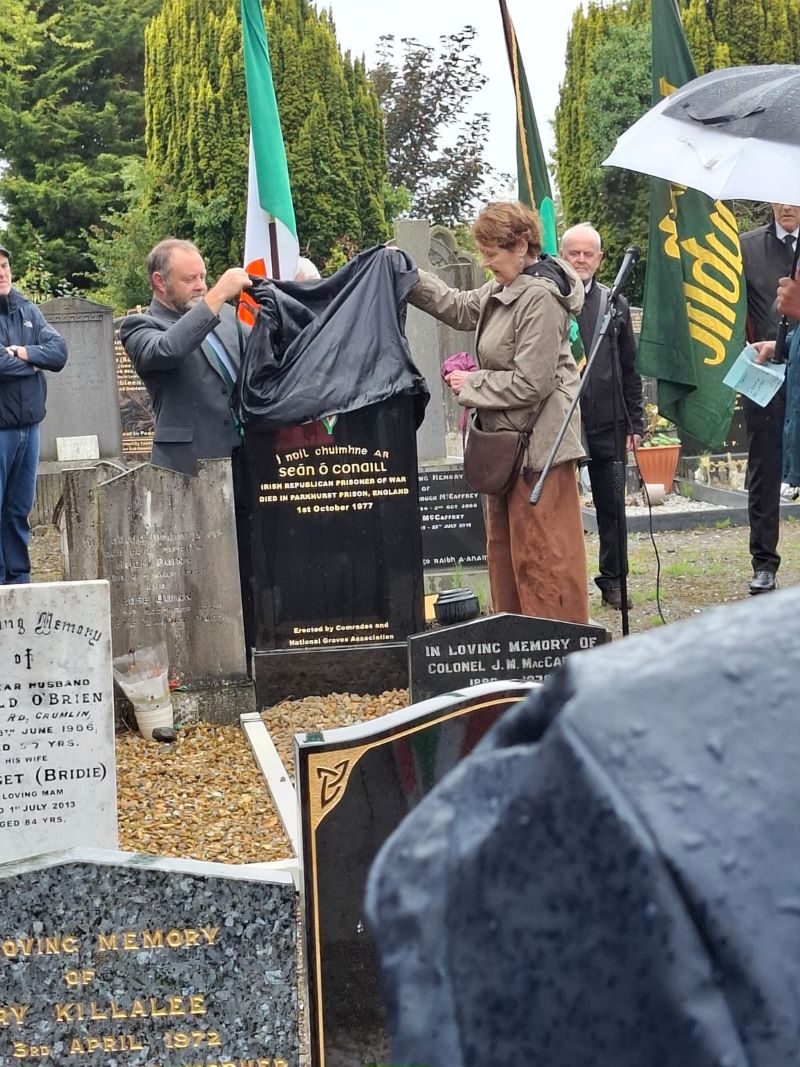
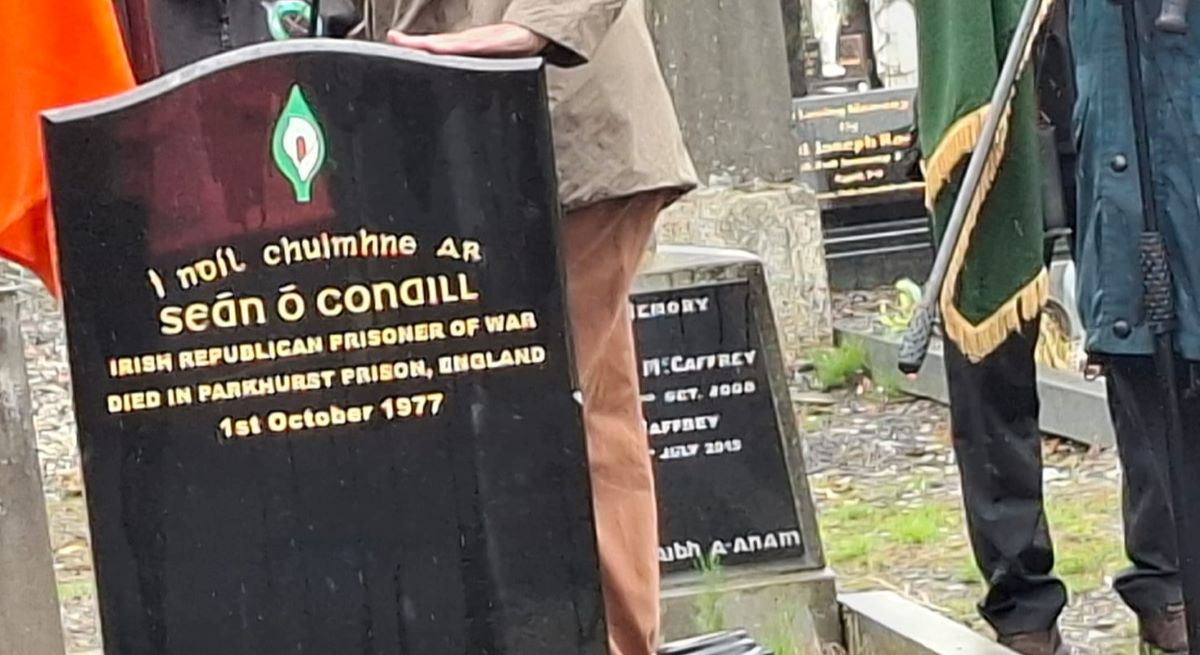
The grave of Irish Republican political prisoner Vol. Seán Ó Conaill received a headstone on Sunday (7th August) due to the efforts of the National Graves Association – nearly 50 years after his death in British custody.
Seán was born and brought up of Irish background in Birmingham and became interested in Irish history. After Bloody Sunday (1972) he tried to join the IRA but was not accepted and subsequently acted independently, assassinating a British Army Lieut. Colonel.
Tracked by British police, he wounded two of the group sent to arrest him, was captured and beaten up. His treatment in jail was bad also but after sentencing was accepted by the Irish Republican prisoners in British jails and, in time, sworn into the Provisional Irish Republican Army.
After his death his body was transferred for burial in Glasnevin. It seems that the NGA understood that his family wished to erect a headstone but for whatever reason the grave lay without one until last week.
The National Graves Association went ahead with commissioning a gravestone which they unveiled on Sunday in the St. Paul’s section of Glasnevin Cemetery1 with a colour party, speakers, music and a goodly attendance, though drenched during the ceremony.
The occasion was supported by members of Sinn Féin and Republican organisations in addition to independent Republicans and anti-imperialists. Seán Whelan, Chairperson of the NGA chaired the event and after some opening remarks introduced the speakers.
Section of the attendance at the event. (Photo: D. Breatnach)
SPEAKERS
Jacqui Kaye of the former Prisoners’ Aid Committee2 was introduced to speak and told her audience that Ó Conaill was diagnosed with terminal cancer and requested a visit from Kaye, permission for which was initially refused by the Home Office3 but granted after intervention by Lord Longford.
The visit was permitted for 10 minutes only for Parkhurst Jail but then changed to a hospice though when Kaye arrived it was to be told that he had just died there, leaving her with the suspicion that he had actually died in Parkhurst but that the Home Office did not wish that on their record.4
Jacqui Kaye, formerly of the Prisoners Aid Committee (no longer in existence), speaking at the event during a particularly heavy shower. (Photo: D. Breatnach)
Former Republican prisoner (21 years in British jails) Noel Gibson laid a wreath on behalf of the NGA and Paddy Lennon read The Rhythm of Time by hunger strike martyr Vol. Bobby Sands, after which a recording of uileann pipes filled the cemetery air with its haunting lament.
Liam Ó Culbáird of the NGA presented the main oration of the event, recounting details of Ó Conaill’s life and time in jail, information gathered from a number of sources, including that despite complaining of chest and stomach pains he did not receive medical investigation in jail.
It was only after coughing up blood that Ó Conaill received a medical visit, after which he was diagnosed with terminal cancer. His marriage had become estranged possibly as a result of his incarceration but official interference in personal relations of political prisoners was also known.5
Liam Ó Culbáird, giving the oration at the unveiling on Sunday. (Photo: D. Breatnach)
The speaker alluded to the practice of “ghosting” political prisoners, i.e. moving them to a different jail without notice, often as a scheduled visit by a family member was imminent, which occurred to Ó Conaill’s mother arriving at Wakefield Prison to be told he had been moved to Parkhurst Jail.6
Such practices imposed an additional punishment not only on the prisoner but in particular on family members7 who had often travelled long distances into sometimes hostile territory and had also the additional expense of paying for overnight accommodation.
The media at the time of his arrest had portrayed Ó Conaill as of unbalanced mind but his comrades in jail found him completely rational and dedicated to the cause. He began to learn Irish and encouraged the other Republican prisoners to expand their use of the language.
Liam Ó Cúlbáird and Jacqui Kay unveil the headstone to Vol. Seán Ó Conaill on Sunday. (Photo: D. Breatnach)
Commenting on Ó Conaill’s failure to be recruited by the IRA prior to his armed action, Ó Culbáird commented that disagreements between General Headquarters of the IRA and Volunteers were not unknown and related a GHQ approach to Brendan Behan after his release from jail.
Behan was informed that he had been been found guilty by GHQ court-martial8 in his absence and sentenced to be shot. Behan replied that since his court-martial had been in his absence, so equally could his execution and promptly departed!
Ó Culbáird commented also on the number of groups that had operated independently of the IRA’s GHQ and remarked upon the number of different groups that had participated in the 1916 Rising,9 all with their reasons for separate existence but all united in the struggle for independence.
The speaker ended his oration by pointing out in Irish and in English that Ó Conaill was an Irish Republican soldier who gave his life in the struggle for Irish freedom.
CONCLUDING
Bringing the ceremony to an end, Seán Whelan thanked the speakers for their contribution and audience for their attendance and added some words about the NGA, pointing out its political independence and refusal to accept donation from any governmental or other organisation.
Chairperson of the NGA, Seán Whelan, presiding over the unveiling on Sunday. (Photo: D. Breatnach)
Whelan also added that whereas the NGA acknowledges the right of anyone to commemorate their dead, their organisation prioritises the dead who participated in the Irish struggle for independence but also cannot agree to share their commemoration with those who fought against them.
He remarked that he did not know of any other country where that would be done. Whelan then called for attention to the playing of a recording of the the National Anthem.
End.
(Photo: D. Breatnach)
FOOTNOTES
1i.e the large section on the opposite side of the road from the main Glasnevin gates, also where stands the NGA memorial to the six uprisings mentioned in Pearse’s famous speech.
2The PAC was initially formed by Official Sinn Féin but within two years had left the Officials and operated independently.
3Irish Republican prisoners in British jails were listed as high-security Category A and were not permitted visitors other than immediate family.
7Though not mentioned in the oration, this was also a practice of the Spanish prison system against Basque political prisoners, in which case letters and parcels arriving for the prisoner, rather than be forwarded to the prisoner’s new location, would be returned to sender with a note that the prisoner was no longer at the posted address.
8Presumably for his solo unauthorised action in carrying a bomb to England.
9Irish Republican Brotherhood, Irish Volunteers, Cumann na nBan, Irish Citizen Army, Na Fianna Éireann, Hibernian Rifles. Some individuals not a member of any of those organisation also participated.
Dublin city centre on Saturday saw two marches scheduled to start at the same time from the Garden of Remembrance, both of which were drenched by heavy showers, as were fans attending the Robbie Williams concert in nearby Croke Park stadium.
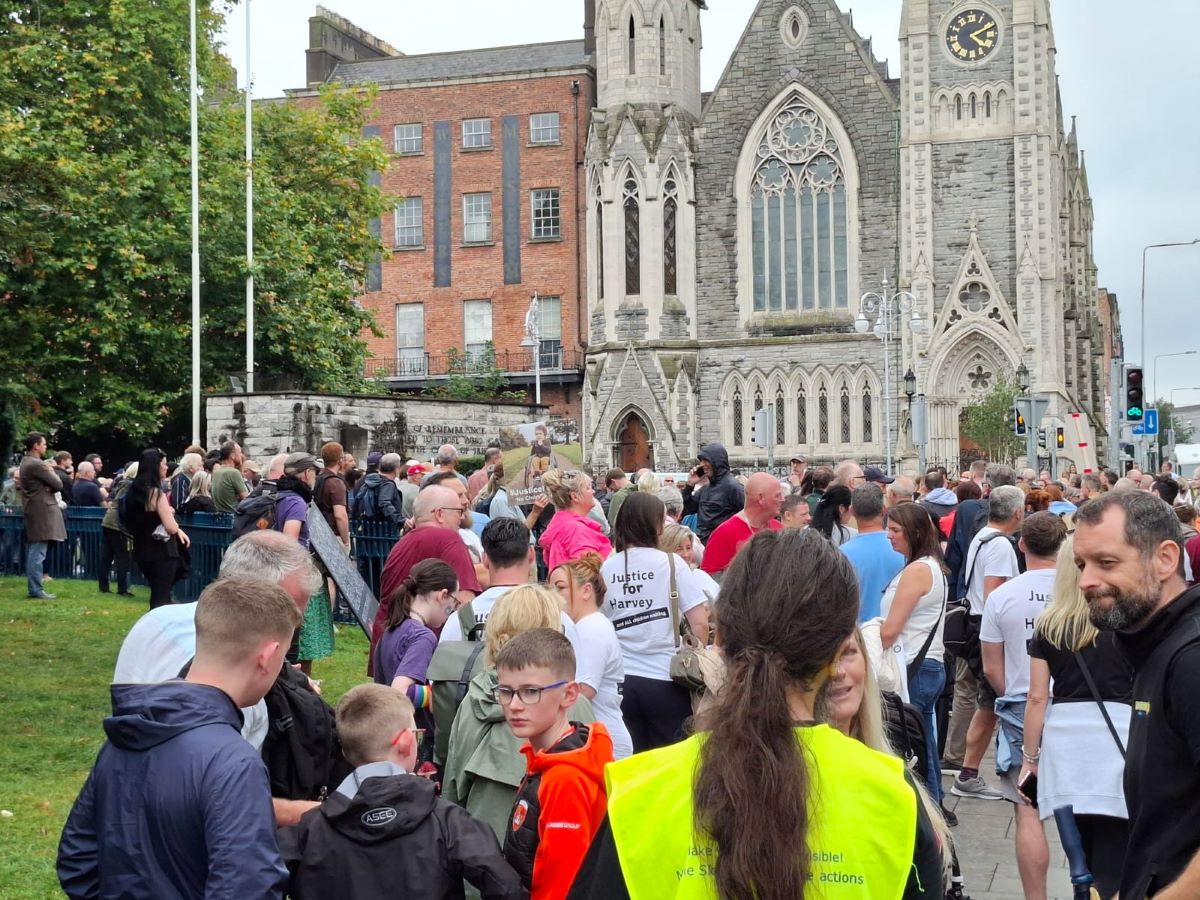
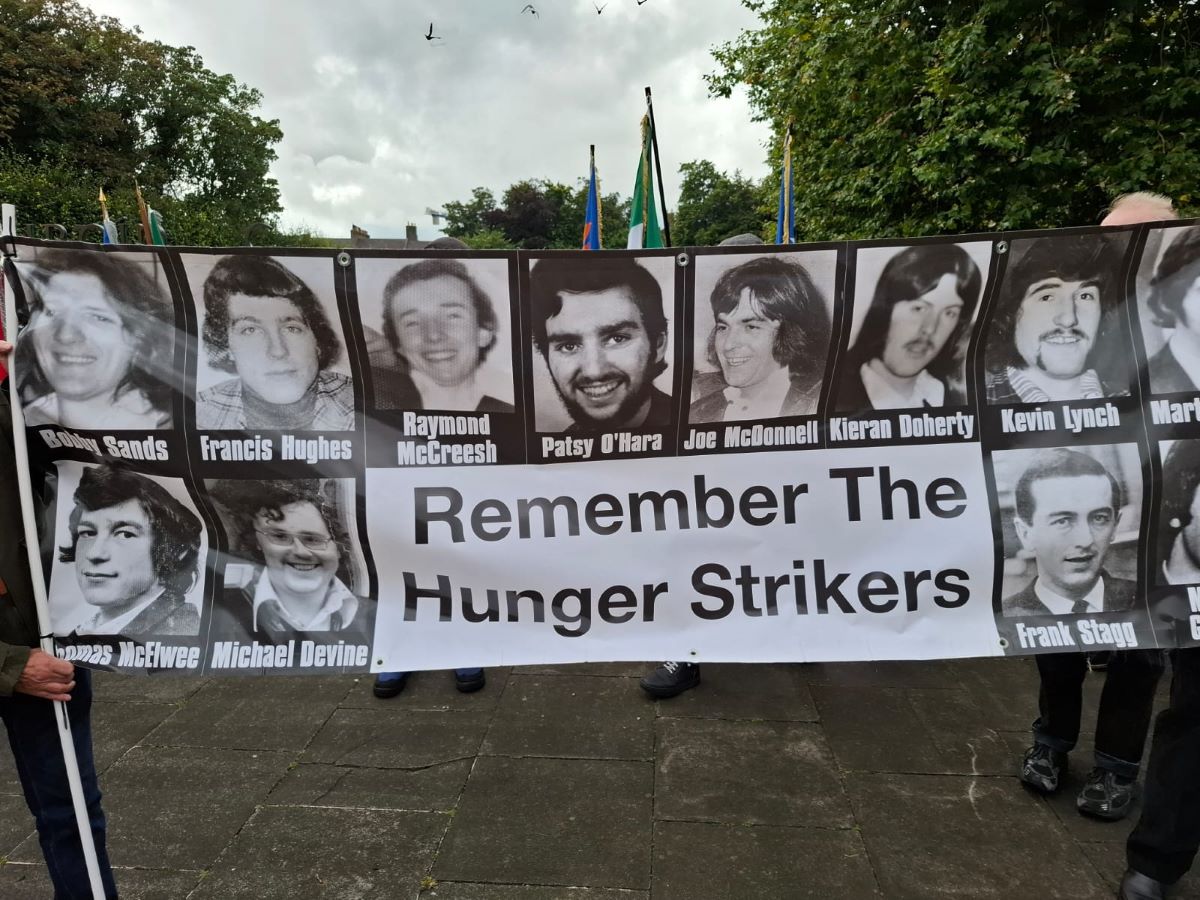
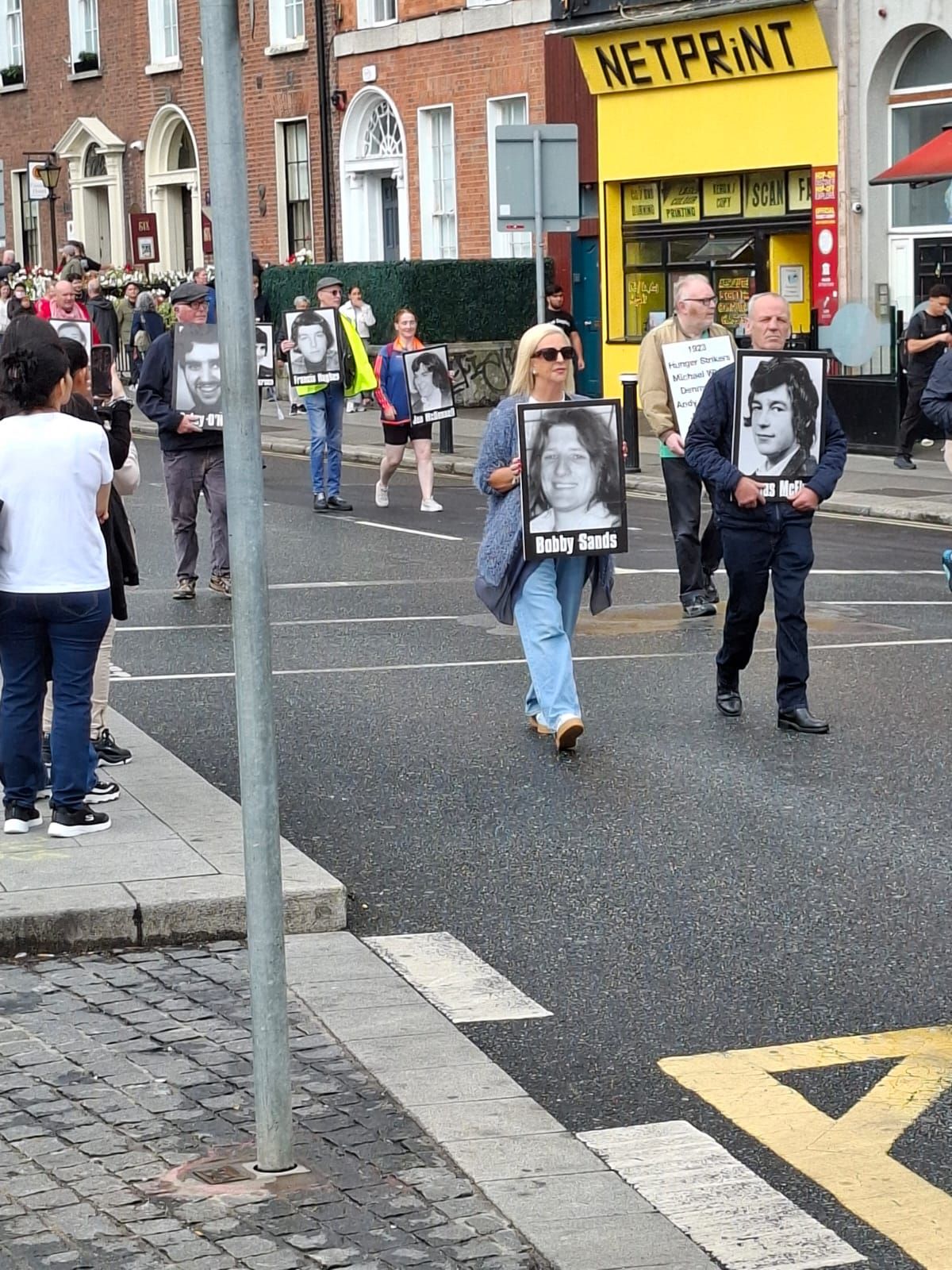
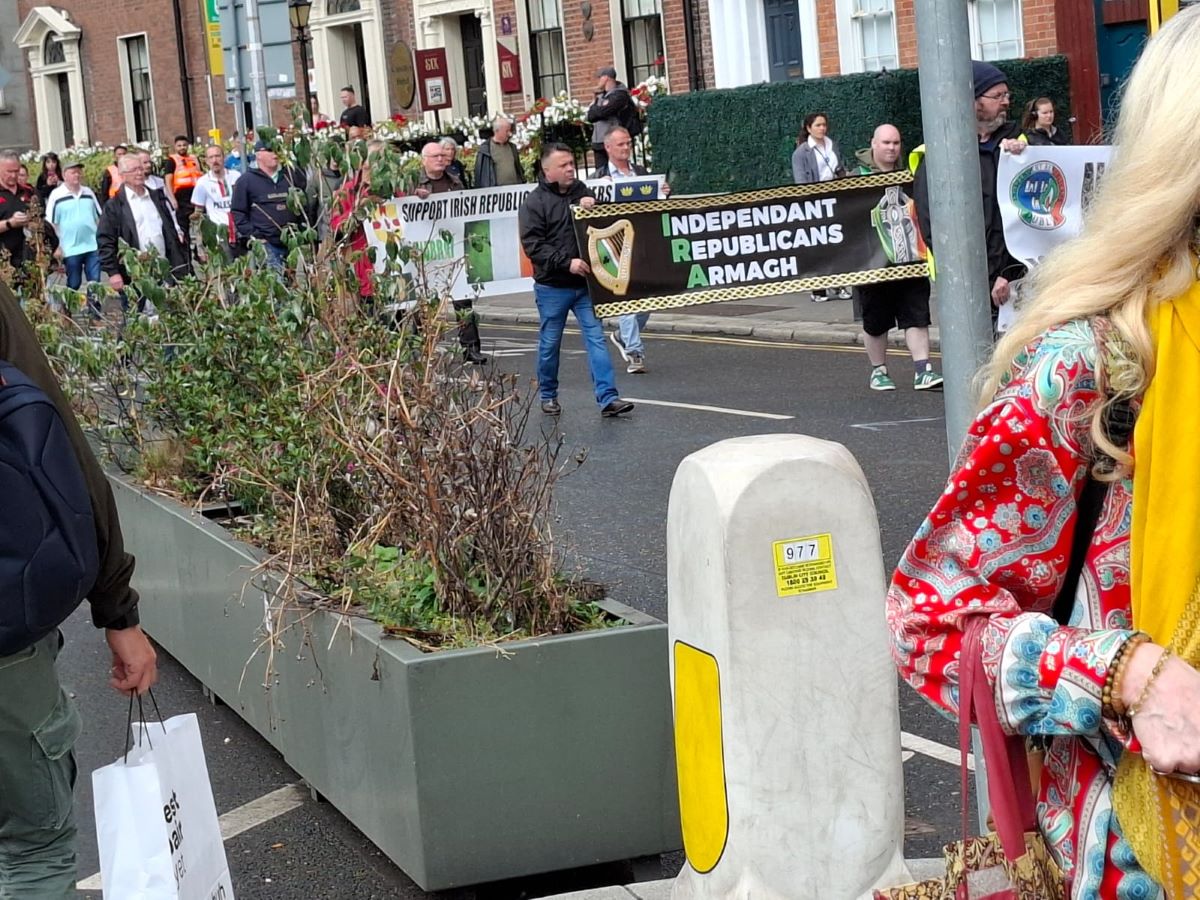
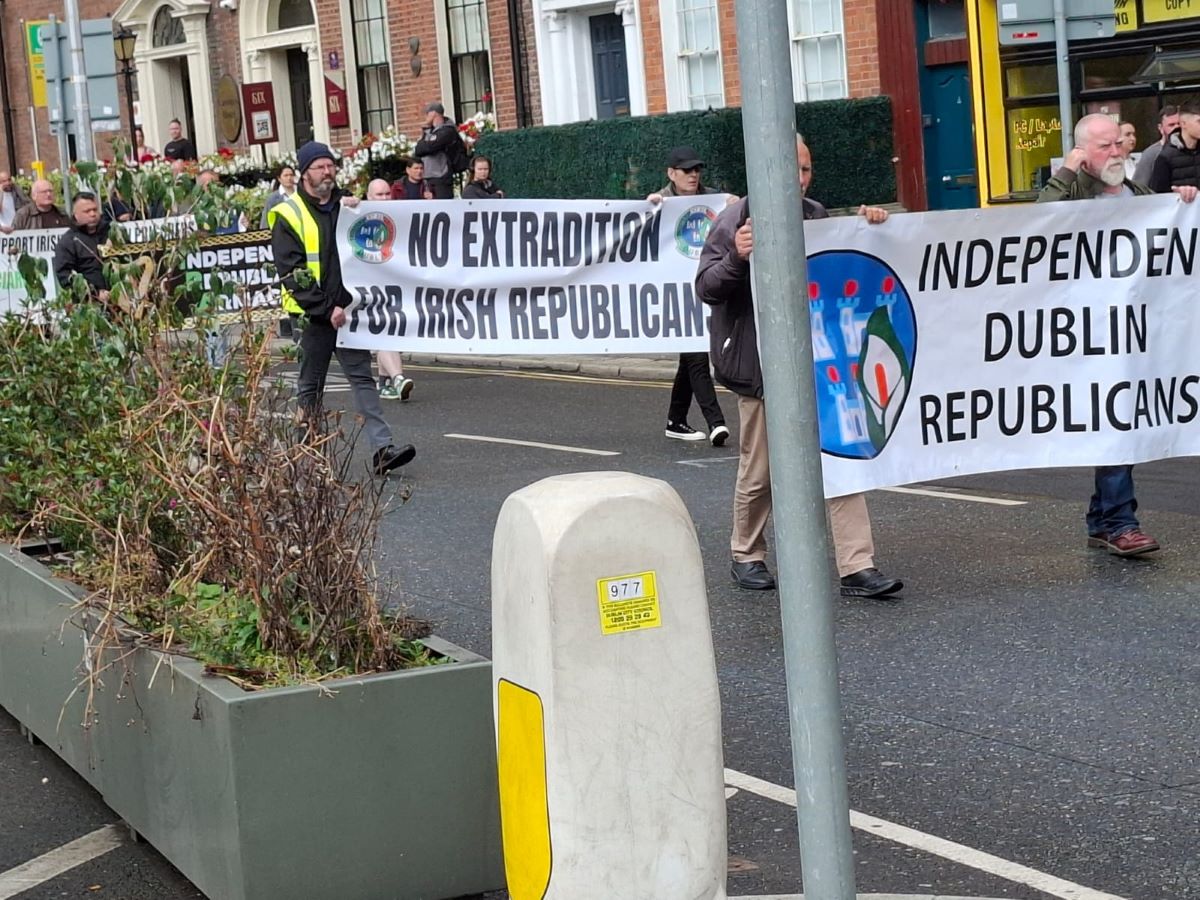
The first march to set off was the largest, the Harvey Morrison protest, the Hunger Strike Commemoration organised by Dublin Independent Republicans waiting for the space to clear in order to assemble theirs, with pipers, band and various banners forming up.
Supporters of both marches are mingled here though the majority are there for the Harvey Morrison march. (Photo: R.Breeze)
The Harvey Morrison protest was about the long wait the named boy had for appropriate treatment from the Irish health service for his condition of spina bifada and scoliosis. As he waited, his spine continued to curve causing him pain and though underwent surgery last year died on July 29th.
It emerged last year that Harvey had been removed from Children’s Health Ireland’s (CHI) urgent scoliosis surgery waiting list, without his family being informed. In 2017 Simon Harris declared that no child would wait for more than four months for scoliosis treatment.
Apart from those requiring specialist treatment for rarer medical conditions, people with much more common complaints face many hours in A & E before being seen by a doctor or having an X-ray taken, with an average of 500 people admitted to hospital on trolleys daily awaiting beds.1
Seven different speakers addressed them at their rally on Custom House Quay, being well received by the crowd with a small exception, which was when a participant shouted ‘Traitor!’at Mary Lou Mac Donald, President of the Sinn Fein party, before being told by march stewards to keep quiet.
Calling SF (and any in Government) politicians ‘traitor’ is a frequent position of those on the Far-Right2 in the Irish State, for racist reasons. Indeed, a number of Far-Right activists were spotted among the marchers but it seems they were unable to dominate the event.
THE HUNGER STRIKE MARTYRS COMMEMORATION
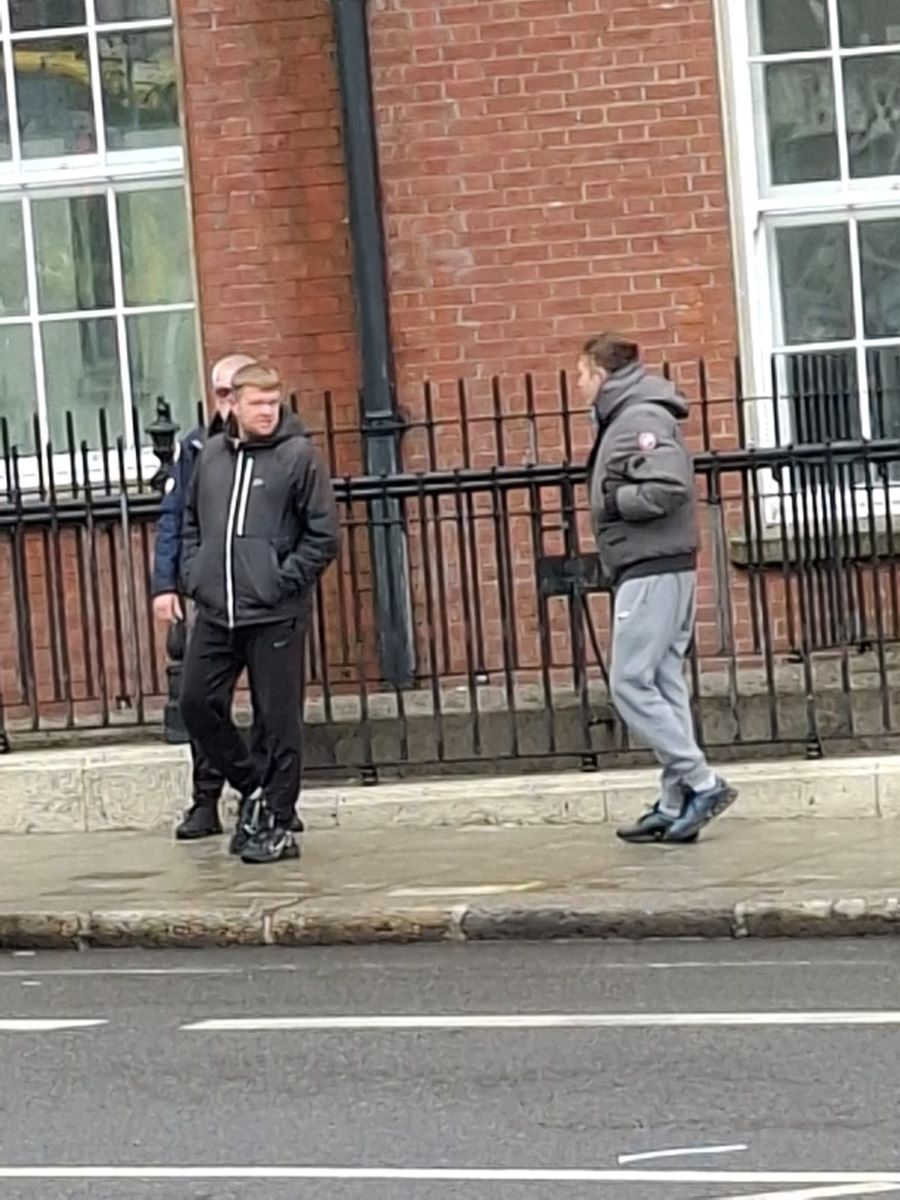
A handful of fascists were also observed watching the Hunger Strike martyrs’ commemoration gather and photographing them but when some of their targets began to photograph them in turn, they walked away, presumably to go and promote themselves and their lies on social media.
Fascists who had been filming the Hunger Strike Commemoration moving off as a camera turns on them. (Photo: R.Breeze)
Irish Republicans, who are opposed to (and by) the Far-Right, also call Sinn Féin ‘traitors’ but for the reason that they consider the party has left the struggle and colludes with the neo-colonial ruling class of the state and with the English occupation in the Six Counties.
The pipers prior to setting off on the march. (Photo: R.Breeze)
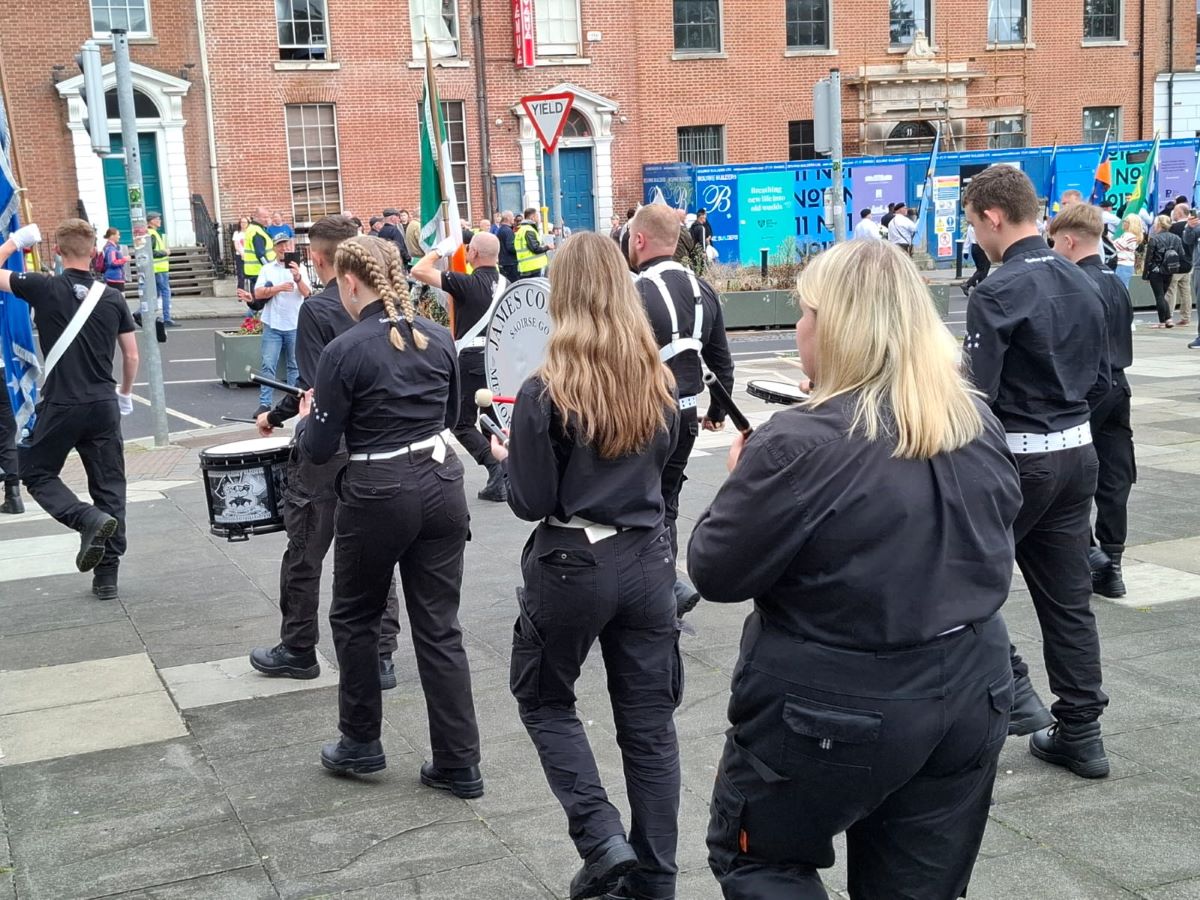
Two pipers led off the Hunger Strike commemoration organised by Independent Dublin Republicans followed by a full colour party and the James Connolly Republican Flute Band, from Derry. In traditional two lines style they marched through onlooking crowds in O’Connell Street.
The march crossed the Liffey into D’Olier Street, back up O’Connell Street and after a pause at the Government-threatened GPO, into Parnell Street, then around the western and northern sides of the Square and back into the Remembrance Garden for the commemoration ceremony.
The Hunger Strike Commemoration march proceeding down from the Garden of Remembrance and just about to enter Dublin’s main thoroughfare, O’Connell Street. (Photo: R.Breeze)
And it rained – it poured down rain. Which was bad enough on the audience but much much worse on the colour party in shirt and trousers, the RFB members and those holding the portraits of the ten hunger strike martyrs and a number of banners.
Dixie Elliot was introduced as the main speaker, well-known in Republican circles, former member of the Provisional IRA, an ex-POW and ‘Blanketman’.3
(Photo: R.Breeze)
Seemingly undeterred by the pouring rain, Elliot spoke at substantial length though whether through lack of projection or faulty amplifier, much of what he said was lost to many in the audience. From snatches he could be heard going through the history of the recent three decades’ war.
The targets of his condemnation were not alone the British occupation and the Irish State’s complicity but also the leadership of the Irish Republican movement who had abandoned the struggle and become part of the colonial administration in the Six Counties.
(Photo: R.Breeze) (Photo: R.Breeze)
Expressing solidarity with the Palestinian struggle and against imperialism, Elliot also condemned the far-Right in Ireland who claim to be ‘patriots’ in order to promote their racism and he counter-posed the example of Bobby Sands’ internationalism in his poem The Rhythm of Time.
The Connolly Memorial Republican Flute Band setting out on the march from Garden of Remembrance. (Photo: R.Breeze)
Both Elliot and the Chairperson called for solidarity with Irish Republican political prisoners and the framed Craigavon Two, convicted in a no-jury political Occupation court and still in jail 16 years later.
Finally chairperson Ado Perry thanked people for their attendance, the colour party and audience stood to attention and the piper played the air to the chorus of the song generally known as Amhrán na bhFiann (and of which the chorus melody is also the ‘National Anthem’ of the Irish State).
(Photo: R.Breeze)
CROKE PARK CONCERT
The Gaelic Athletic Association stadium in Croke Park was the venue for a Robbie Williams concert in Dublin and the fans were flocking into town in rainproof macs that the marchers could have done with. The previous weekend it had been the Manchester Gallaghers, i.e. Oasis there.
The finals in Gaelic football for men and women and in hurling have been played in Croke Park in previous weekends and now it seems it’s rock concerts season.
The far-Right protested the couple of occasions that the stadium was rented to celebrate the Muslim feast day of Eid. Apparently English musicians and bands playing there are are not problematic for them. But then nor are the banks and property speculators causing the housing crisis.4
End.
(Photo: R.Breeze) (Photo: R.Breeze) (Photo: R.Breeze)Main speaker, Dixie Elliot, speaking at rally in Garden of Remembrance at end of Hunger Strike Commemoration march. (Photo: R.Breeze)
3One of the Irish Republican ‘blanket protester’ prisoners who resisted the attempt of the colonial prison service to make them wear regulation prison uniform, wearing underwear and a blanket instead. This condition degenerated into the ‘no wash’ and ‘dirty protests’ which the prisoners sought to overcome with the hunger strikes of 1980 and 1981 when 10 prisoners died.
In recent days we have seen the far-Right mobilise people to allegedly defend the GPO and protest homelessness, not against its causes but instead against migrants. In defence of ‘Irishness’ they also menaced an annual religious Muslim procession.
Participants in these and similar events wave the Irish Tricolour and Irish Republic flags and claim to be ‘Irish patriots’ standing up for ‘the Irish nation.’ However, it’s far from that they are in reality as we can see.
They
disgrace the Proclamation
The far-Right claim to honour our national history of resistance to colonialism and occupation and even display copies of the 1916 Proclamation of Independence.1
Yet they are often also seen and heard denouncing Muslims, in direct contravention of the Proclamation’s words: “The Republic guarantees religious and civil liberty … to all”; similarly they held protests when use of Croke Park was hired to celebrants of the Eid festival.
disgrace the GPO as HQ of the 1916 Rising
They have and do disgrace the very symbolic building they claim to be trying to protect.
They have often held racist gatherings outside it; one of their organisers2 (e.g. of weekly protests during the Covid crisis) leading a chant of support for British fascist Tommy Robinson, who defended the Paratroopers who carried out the 1972 Bloody Sunday massacre in Derry.
Their recent protest at the GPO featured as speaker a man known for his active membership of the sectarian UVF murder gang, who admitted working for British Intelligence and who called for the strengthening of the colonial British Border – and was cheered for saying so.
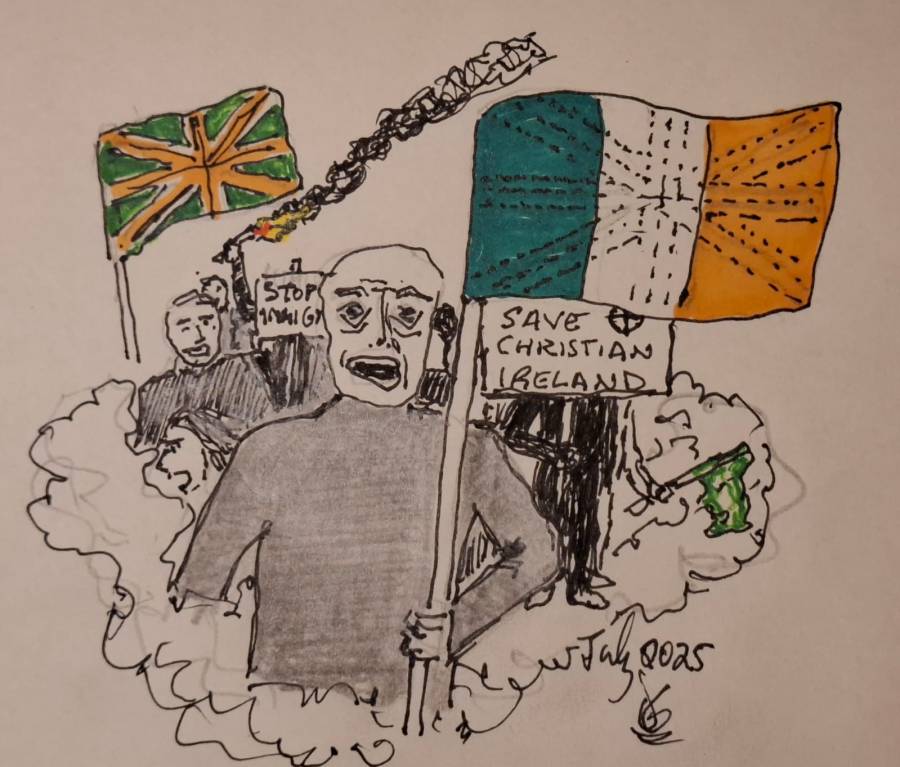
Cartoon by D.Breatnach
disgrace the flags
The far-Right disgrace and misuse the very flags they wave so keenly.
The Tricolour was presented to the revolutionary Young Irelander republicans3 by French revolutionary republican women in 1848. It signified peace and unity between the descendants of settlers and the indigenous Irish in revolutionary struggle against the British colonial occupation.
The flag with the words “Irish Republic” painted in white and gold on a green background was made on domestic material of socialist Republican Constance Markievicz (see next section) in her house and delivered by her to the GPO.
It was installed and flown on the roof at the Princes St. corner by Eamon Bulfin4 (see next section), a migrant from Argentina.
disown but also misappropriate real patriots
In dishonest manipulation, the far-Right claim to honour our patriots and even invoke them in their campaigns. In their agitation against migrants they hide the fact that Constance Markievicz, Thomas Clarke and James Connolly were all migrants (Connolly and Clarke no less than three times).5
Also a migrant was Eamon Bulfin (see previous section) along with many others who fought for Irish freedom and even sacrificed their lives (including Erskine Childers)6.
Placards on an anti-racist rally on Custom House Quay some years ago. The text placard quotes the 1916 Proclamation: “The Republic guarantees religious and civil liberty to all”. (Photo: D.Breatnach)
Of the Seven Signatories of the 1916 Proclamation (see earlier section), two – Pearse and McDonagh7 – were children of migrants and two were themselves migrants (Connolly and Clarke).
Among many such examples, the father of Young Irelander Republican patriot Thomas Davis (author of the song A Nation Once Again) was a migrant.
join with Loyalists and British fascists
A far-Right organiser calling for three cheers for British fascist Tommy Robinson was not the only such example and outside the GPO this week far-Right elements welcomed as speaker Mark Sinclair, a member of the UVF, a British colonial sectarian murder and terrorist squad.8
Prominent Irish leaders of fascist organisations have also shared a platform with Scottish fascist and Loyalist Jim Dowson.9 And of course how can we forget the desecration of the Tricolour unfurled among Union Jack and Loyalist flags in Belfast by some Dublin far-Right activists!10
Admitted UVF/ MI5 Sectarian Loyalist UVF murder gang member Mark Sinclair. (Photo sourced: Internet)
don’t act against British occupation
With all that background, it’s hardly surprising that the far-Right “patriots” don’t organise against the British occupation of the Six Counties or in support of Irish Republican political prisoners in jails on either side of the British Border.
burn buildings
Apart from misleading people and distracting them from the real sources of problems to Irish working people and seeking to intimidate refugees, what do the far-Right actually do? Ah, yes, they burn buildings that might be used as accommodation. A great help to the homeless indeed!
attack homeless refugee and migrant tents
But no, that’s not all. No, the brave ‘patriots’ slash tents and threaten migrants and refugees who are sleeping on the streets. They don’t take on the big landlords, bankers, property speculators and vulture funds – no, they strike down at people poorer and in worse conditions than themselves.
cover for the property speculators and vulture funds, big landlords, bankers
So with all this whipping up fear and hatred of migrants, the far-Right obscure the actual cause of the problems, which is not only Irish capitalism but its total subjection to foreign capitalism. The only ones to benefit from this activity are those who are the real causes of the problems.
are not patriots, nor nationalists
Despite their claims and flag-waving, the far-Right in Ireland are neither patriots nor true nationalists. They do not organise in defence of Irish sovereignty and against British occupation nor against foreign capitalist exploitation of Irish natural resources, labour or infrastructures.
Or the contrary, they work to distract attention away from these centrally-important issues for the Irish nation and raise false issues to divide the people. And usually their concept of ‘Ireland’ ends at the British border which the recent far-Right rally at the GPO called for strengthening!
are a sub-class of deprived individuals allowing themselves to be manipulated by fascists, MI5 and NATO
Many of those being mobilised against migrants come from parts of the cities neglected for generations, often associated with low educational level, substance misuse, unemployment and unresolved mental health issues.
The ideological fascists will recruit those elements to fight, not against the cause of their deprivation, the neo-colonial ruling class or the flooding of foreign capitalist companies into Ireland, assisted by banks and political decisions -but instead against migrant workers and refugees.
are filling a vacuum left by the Republican and Socialist movement
WILL WE LEARN FROM OUR FAILURES?
Many of those participating, while some are also unfortunate victims of Irish capitalism, will be recruited as the boot boys of fascism.
While it is true that historically capitalism in crisis turns to fostering fascism and that capitalism, including the neo-colonial variant in the Irish state is running out of other options, we must evaluate our own role in this development, examine our own failures, learn from and remedy them.
The ground was largely ceded to the Far-Right in the period of their initial growth during the Covid crisis. The socialist Left and Republican movement, in particular its organisations, had little response to the early FR mobilisations or to responding creatively to state-imposed restrictions.
Throughout that period and subsequently the socialist Left sector, despite its protestations of anti-imperialism and anti-colonialism, completely ceded the ground of Irish national sovereignty and its symbols to anyone who wished to occupy it.
They did not, for the most part, protest the use of State repression against Irish Republicans both sides of the British Border, whether through police harassment, special legislation and special no-jury courts, nor stand up for the human and civil rights of Republicans, including political prisoners.
Their distaste for the very issue of national sovereignty was reflected in their refusal to fly the Irish Tricolour, which, although now also the official flag of the Irish State, is originally and remains still a potent symbol of Irish Republican anti-colonial struggle over 170 years.
They might argue that they wished to be identified with the struggle of the working class rather than a nationalist one but they also chose not to fly the flag of the insurrectionary Irish working class, the Starry Plough, in among their internationally-recognised red flags.
The Irish Republican organisations in their fragmented movement, on the national question, failed to sustain unity even around opposition to repression of the states or even around solidarity with the movement’s political prisoners.
They also failed and, to an even greater extent, in fighting for universal affordable housing in a crisis which seems to offer no end and is seized upon by the Far-Right to target refugees and economic migrants, who of course have no responsibility whatsoever for the crisis.
This area too has been a notable failure of the socialist Left organisations which, although marching often enough in public demonstrations and participating in a couple of media-orientated occupations,11 failed to organise and lead a state-wide campaign of empty building occupations.
And so, here we are today, when the FR are able to bring Tricolour and Irish Republic flag-waving crowds on to the streets in false claims of patriotism, dividing and seeking to intimidate migrant workers and anti-racists, burning buildings and insisting on their definition of ‘Irish’ being correct.
Our omissions and failures, if we recognise and act to remedy them, also point the way forward.
End.
1In a travesty of frequent Irish Republican ceremonial occasions, it was even read out at the recent Far-Right gathering outside the GPO which was addressed by a known member of the UVF sectarian murder gang.
2Under the name Dee Wall (real name Dolores Webster).
3Including to Thomas Meagher ‘of the Sword’ who later recruited for, joined and fought in the Union Army in the US Civil War against slavery. Meagher unfurled the flag first in Wexford and later in Dublin, both acts in 1848.
4Bulfin came to Ireland around the age of ten with his family and later joined the IRB and the Irish Volunteers. After the surrender in Moore Street he was sentenced to death, later commuted to life sentence, then from Frongoch prison camp deported to Argentina from where he was the Latin American representative for the Movement.
5Clarke and Markievicz were both born in England. Clarke was first a migrant to Ireland, later to the US, then back again. Connolly was born in Edinburgh and a migrant to Ireland, then to England, then to the USA before his return to Ireland.
6Childers was born in England. He captained the yacht that brought the Mauser rifles and ammunition to Howth. Later he joined the IRA, took the anti-Treaty side and was executed by the Free State during the Civil War.
7The father of the Pearse brothers was English, as was McDonagh’s mother.
8During his trial for bank robbery for the UVF in Glasgow, Sinclair declared he had been working for MI5 which was well known to be steering Loyalist organisations. The UVF and British Intelligence bombed Dublin and Monaghan in 1974, causing the deaths of 34 people and a full-term baby, the highest death toll of one day during the recent 30 Years War.
9Rowan Croft, Herman Kelly (Irish Freedom Party) and Niall McConnell (Síol na hÉireann).
10A prominent group among the Dublin far-Right calling themselves Coolock Says No.
12For example, the 27-day occupation of Apollo House, Dublin, from 15 December 2016 by housing activists and homeless people, with speeches and performances by prominent musicians.
(Reformatted entire for publishing in Rebel Breeze from article of same title in his Substack)
(Reading time: 8 mins.)
Kneecap’s music is not really my thing. I am perhaps too old, or maybe my musical tastes are more conservative. But I do love their politics and their stance on Palestine.
I don’t think much of Hezbollah, but I do think waving their flag is not a criminal offence.
The BBC think otherwise as evidenced by their decision to not broadcast Kneecaps’s performance at the Glastonbury festival. The only reason for this was their support for Palestine. There was no other reason.
Though, it didn’t work out well for the BBC as Bob Vylan who was broadcast live got the crowd to chant Death to the IDF!, one of the noblest of chants ever to be heard at Glastonbury.
But there is a long history to the BBC and other British media censoring musicians. The BBC in its statement said:
Whilst the BBC doesn’t ban artists, our plans ensure that our programming meets our editorial guidelines.
We don’t always livestream every act from the main stages and look to make an on-demand version of Kneecap’s performance available on our digital platforms, alongside more than 90 other sets.[1]
In other words, the BBC does ban artists.
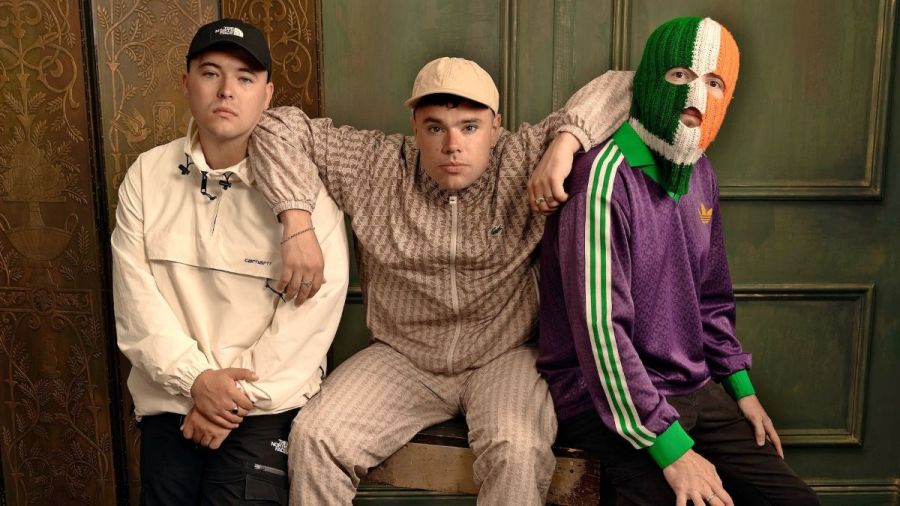
The rapper trio under the band name of Kneecap (Image sourced: on line)
It is not like this is the first time they have banned some of them. Following the Bloody Sunday massacre by the British Army in Derry in 1972, Paul McCartney, penned a song titled Give Ireland Back to the Irish.[2] It was the debut single of Wings.
It was instantly banned in Britain by the BBC but managed to get to No. 16 in the British charts nonetheless and got to No. 1 in Ireland.
They banned songs that mentioned sex, even Shirley Bassie’s Burn My Candle[3] and they banned songs that were considered more political such as The Sex Pistols’ Anarchy in the UK,[4] a song that wasn’t really political at all.
Not surprisingly they banned the then relatively unknown Heaven 17’s debut (We Don’t Need This) Fascist Groove Thang,[5] over concerns it might upset the then recently-elected US president Ronald Reagan.
This was a man whose government through the CIA went on to support deaths squads in Latin America and set up cocaine smuggling networks to finance them through his loyal servant Oliver North.[6] Reagan of course is referred to in the song.
Democrats are out of power Across that great wide ocean Reagan’s president elect Fascist god in motion
That wasn’t the last of it either. The BBC went on to ban a song by The Police, Invisible Sun[7] because of a possible slight on the British Army contained in the lyrics and of course the official video to the song.
I don’t want to spend the rest of my life Looking at the barrel of an Armalite I don’t want to spend the rest of my days Keeping out of trouble like the soldiers say
I don’t want to spend my time in hell Looking at the walls of a prison cell I don’t ever want to play the part Of a statistic on a government chart
The BBC would, during the 1st Gulf War ban a total of 67 songs for the duration of the war, amongst them songs by such establishment figures as Elton John whose song Act of War[8] recorded in 1985 with Millie Jackson was put on the list.
As was Pat Benatar’s Love is a Battlefield,[9] recorded even earlier in 1983. It takes little to upset the BBC it would seem.
The former Irish Taoiseach (Prime Minister) Leo Varadkar criticised Keir Starmer’s call for Kneecap to be not allowed play at Glastonbury stating that
It’s not great for politicians to get into deciding which artists should be allowed to perform where or not.
To me, that’s illiberalism. Part of the whole point of art and music and literature is to be inappropriate, is to be challenging, is often to be anti-establishment,” he said.
We’ve had a situation now for quite some time in Ireland and in Europe and Britain, where politicians didn’t get into the space of saying who should be allowed to perform, who shouldn’t, what books you should be allowed to read, and I hope we don’t slip back into doing that under the guise of national security and anti-terrorism when it isn’t really about that.[10]
Varadkar tut tuts the BBC and Starmer. Sounds great, except his party and the Irish state in general does not have a great record in the matter.
The state broadcaster took an insidious approach to censorship with songs rarely being banned outright. Rather they were just not simply played on the radio station. Hint hint, nudge nudge. A very Irish way of doing things.
The Irish group The Wolfe Tones released many songs over the years about the conflict in the north of Ireland and got little to no airtime. Such was the situation that they even recorded a song about it, called Radio Toor I Li Ay (sometimes called They Don’t Play Our Songs on the Radio) [11].
The lyrics are pertinent to Kneecap and Starmer and sum up exactly what the Establishment are about.
You don’t play our songs on radio You say they’re too political! Who controls the mind, where’s the mind’s control? For the music on the airwaves Follows empty minds, those empty heads Play songs of sex and drugs instead Don’t tell them how it really is
Won’t MI5 look after you, control your thoughts Feed information to your hearts and minds To save you all from thinkin’, thinkin’, thinkin’, thinkin’
It is a fact that RTE didn’t give them much airtime and still don’t. So much so that in 2024, Derek Warfield the lead singer with the group said it was time to end the ban on them.[12] It still hasn’t happened, nor will it.
In fact, the Irish women’s football team got into trouble for singing one of their songs, Celtic Melody,[13] and were excoriated by British sports journalists, who are not renowned for their knowledge of music, politics, history or much else aside from who ran how fast and where.
Not exactly intellectual heavyweights. Nonetheless these idiots led to the Irish women’s team being eventually fined €20,000 for singing the song.[14]
The Irish singer Christy Moore found himself on the wrong end of state repression in Ireland on many occasions and his songs, like those of The Wolfe Tones were not banned per se, but they never received much airplay.
Except those that were considered to be humorous and non-political, such as Don’t Forget Your Shovel.[15]
But other songs of his were censored on the radio without the need for an official ban, such as Ninety Miles From Dublin,[16] which was about the IRA and INLA prisoners on the Blanket and Dirty Protests in the H-Blocks of Long Kesh.
Likewise, other songs he recorded about the prisoners and later on about the Hunger Strikers equally received no airplay. There was one brief exception to this.
Patsy O’ Hara (INLA) died on hunger strike on May 21st 1981 after 61 days. His mother Peggy O’Hara was initially adamant that she would not let her son die and that when he lapsed into a coma she would intervene and give the doctors the order to break his strike with an intravenous drip.
However, in her last conversation with her son, he said to her that he was sorry they had not won and asked her to let the fight go on, before lapsing back into unconsciousness. Christy Moore wrote a song about that exchange called The Time Has Come.[17]
It was well received and got airplay and praise. Then someone informed the ignorant and arrogant mandarins at RTE what the song was about and suddenly it got no more airplay. Listening to the song, it is obvious what it is about.
The gentle clasp that holds my hand Must loosen and let go Please help me through the door Though instinct tells you no
Our vow it is eternal And will bring you dreadful pain But if our demands aren’t recognized Don’t call me back again
Ironically Christy Moore would record another song that got no airplay. It was called Section 31,[18] a reference to the article of the Broadcasting Authority Act (1960) that gave the minister power to ban interviews with members of Sinn Féin and proscribed organisations such as the IRA.
But in effect it led to RTE’s scant reporting of or carrying out of few interviews that were critical of state policy on the conflict. The song explained exactly why some issues are censored.
Who are they to decide what we should hear? Who are they to decide what we should see? What do they think we can’t comprehend here? What do they fear that our reaction might be, might be?
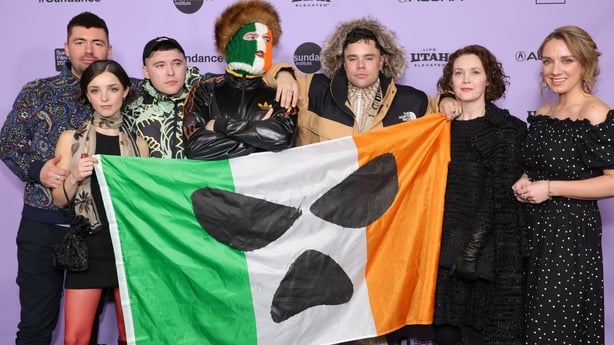
The Kneecap trio with friends at the Sundance Festival in January. (Photo sourced: RTÉ)
It is always about silencing the opposition and preventing a reaction to their repression and in this case genocide.
So back to Kneecap. They stand in a long line of artists who have put their money where their mouths are. They stand side by side with giants from other musical genres such as Woody Guthrie and Pete Seeger who were repressed by the McCarthyite wave in the US in the 1950s.
The BBC for its part continues to be the propaganda arm of the British Empire, or what is left of it, covering up, lying about or justifying murder, massacre, torture and plunder from India to Kenya, Ireland and now Palestine.
Woody Guthrie had the words This Machine Kills Fascists carved into his guitar, a slogan that might earn him a jail sentence nowadays.
It was meant more in the sense that his music was part of the struggle against fascism, carrying political messages to workers, Dustbowl refugees and migrants.
It didn’t literally kill anyone, though in his song Ludlow Massacre,[19] Guthrie celebrated the workers taking up arms to kill the scab thugs that came to shoot them.
Scabs at the behest of the Colorado Fuel and Iron Company, owned by the infamous Rockefeller family murdered 26 people, mainly the wives and children of the striking miners.
However, the massacre was just one large incident, the Baldwin-Felts Detective Agency had harried and harassed the striking miners, murdering them in ones and twos.
The detective agencies celebrated in comics and films were what would later become known in Latin America and elsewhere as death squads. The miners fought back and Guthrie celebrated this in his song. Resistance, including armed resistance was legitimate.
The state soldiers jumped us in a wire fence corners, They did not know we had these guns, And the Red-neck Miners mowed down these troopers, You should have seen those poor boys run.
The press, at the time, described the striking miners as savages.
Any similarity to the current media onslaught on Palestine is not a coincidence, it shows the class interests of the media moguls and the western states. Working class people, foreign resistance movements will always be savages to the media.
And the use of armed masked thugs by the state is not new either. Before ICE, there were the detective agencies. Most of the dead at Ludlow were migrant workers. The final death toll according to Howard Zinn’s People’s History of the US was sixty six men women and children.
Kneecap have contributed to the fight against fascism and Bob Vylan’s chant Death to the IDF! should be on everyone’s lips. There is no reforming the IDF, just like there was no reforming Hitler’s SS. Only the complete destruction of the IDF will bring any change.
Can their music, like Guthrie’s be said to kill fascists? I don’t know, time will tell, but from the reception they got at Glastonbury it is looking good.[20] What I do know is Keir Starmer and Trump finance fascists.
Starmer like a fascist wants to ban Palestine Action. The BBC covers up for fascists, praises them and censors those who stand up to fascists. I know who is on the right side of history.
I was jarred recently hearing the Irish actor and Palestine solidarity activist Liam Cunningham mention “700 years of British occupation”.1 And I have heard others not from Ireland speak admiringly of the “Irish freedom struggle of 700 years.”
Quite a few of those from other countries who quoted the “freedom” after “700 years” did so admiringly and may not be well acquainted with our nation’s history.
Liam Cunningham in Italy with two of the humanitarian activists about to sail on the Mayleen’s expedition to Gaza.
The foreign occupation of Ireland is normally dated from the Norman invasion of 1169 (although we could add to it the foreign occupation of Dublin by the Vikings from roughly 853 AD to 1170 AD).
I’m aware that I can be somewhat challenged in mathematics but after checking and re-checking I find that 856 years have elapsed since 1169, which means that the British-based occupation of Ireland has continued for well in excess of the 700 years quoted by Cunningham and others.
So where did the “700” years figure come from? It occurred to me that in some people’s heads this might be based on the creation of the Irish State and an assumption that was the point at which we threw off the British colonial yoke. Well, even then it would be 752 years but o.k, that might be it.
So, all of Ireland was occupied for centuries, then after numerous uprisings, in 1921 the British ceded 26 counties to Irish State control. But Ireland has 32 counties – what happened to the missing six counties? Well, we know, they remained occupied.
The Irish State in 1921 abandoned the people of the Six Counties, in particular the 34%+ who were of Catholic background; abandoned them to institutional sectarian religious discrimination in housing, employment and representation — and to repression.2
And in fact, the fairly recent 30 Years War was precisely about that occupation. Inevitably, the people rose up against their repression and oppression. The Irish State formally claimed those Six Counties but took no steps to regain them and cooperated with the colonial forces.3
Clearly we can’t change history but we can choose not to collude with injustice. We can refuse to conceive of Ireland as missing six counties, as only four-fifths of its actual landmass. We used to have a word for the thinking that had a Six-County blind spot – we called it ‘partitionist’.
In other words, an attitude that agreed with, colluded with or merely accepted the partition of the Irish Nation.
The Irish State that was born in 1921 was dominated by a capitalist ruling class which was pro-British and socially conservative, even beyond the social conservatism of Britain. And the social conservatism of the colonial Six County regime was even more extreme.
The agreement to abandon the Six Counties was a good indication of the servile nature of the ruling class of the Irish State which became even more evident as the State developed — and even under a later government of former opponents of the State, the Sinn Féin split of Fianna Fáil.
The Irish economy was neither developed nor diversified. Emigration continued unchecked as it had for centuries under British rule and. Irish State obeisance in turn switched to the USA and then to the EU. Currently the Irish ruling class is trying to eliminate any Irish State neutrality.
In 1845 Ireland was able to feed over 8 million but today in 2025 cannot even feed a little over 7 million in (over 5.3 million in the Irish state, nearly 2 million in the Six Counties). Yes, we must import food in order to eat.
Most large companies and banks within the state are foreign-owned, including such national brands and flagships as Aer Lingus, Guinness (including Harp and Hop House lagers and Smithwicks ale), Jameson and Paddy’s whiskeys,4Erin Foods, our telecommunication system5.
Most financial institutions within the state such as insurance companies in health, life, accident, motors, travel are also foreign-owned, including the now ironically-named Irish Life. The health, transport and mail systems and infrastructures are increasingly penetrated by foreign companies.
Foreign-owned hotels, housing apartment and office blocks are the rule and growing while vulture companies gobble up the properties of people who already paid the construction costs of their homes.
In economic policies and in foreign political policy it is clear that the Irish State remains close to the major Western Powers. Responding to popular feeling over the genocide in Gaza, its political leaders may posture a little away from the pack but in effect?
The Irish State imports productsfrom the Israeli State (US$4.15 Billion in 2024),6 allows genocidal state munitions through the State’s ‘neutral’ air space, US munitions and personnel through Shannon International Airport while maintaining all normal links with the Zionist state.
What we believe and say is important
In his interview with The Group Chat Cunningham, with the agreement of the panel, stated that no state was fulfilling its legal duty to practically oppose genocide. This was an unjustified slur on Yemen, which has shut down Israeli inward or outward Red Sea traffic and hit the state itself.7
It is very interesting that even among the many condemnations of Israel by media commentators and politicians we rarely hear acknowledgement, never mind commendation of the anti-genocidal action and sacrifice of the Ansarallah state and the Yemeni people.
Perhaps the contrast is too painful.
However, in an interview during a Palestine solidarity march in Dublin8 Cunningham referred to 800 years. Was that a slip of the tongue, or were the references to 700 centuries instead the slips? Interestingly he also referred to foreign vulture funds and landlords in the same interview.
Liam Cunningham speaking about the seizure by the ‘Israeli’ navy of the humanitarian mission ship Mayleen. (Source photo: The Irish Star)
It is important that an actor in a popular drama series speaks up for Palestine and also for the Irish people and Cunningham has been doing so for years.
What we say and how we recall history is also important because they have an impact on the present and on the future. On what we aspire to. On how we act and think, on how those around us act and think.
Ireland is partitioned between a colonial ruling class and an Irish foreign-dependent ruling class. We fought the Viking occupation for 300 years and the British occupation for well over 800 years – and we are still fighting it. Without sovereignty we cannot develop our economy.
Without sovereignty we will be dragged into imperial and colonial conflicts but never to our historical and traditional place – on the side of the Resistance.
2It also abandoned the Protestant majority, including many descendants of the United Irishmen particularly in Antrim, to a sectarian, bigoted, racist and colonial ideology that helped maintain them for decades with the worst housing and lowest wages in the UK of which they were part.
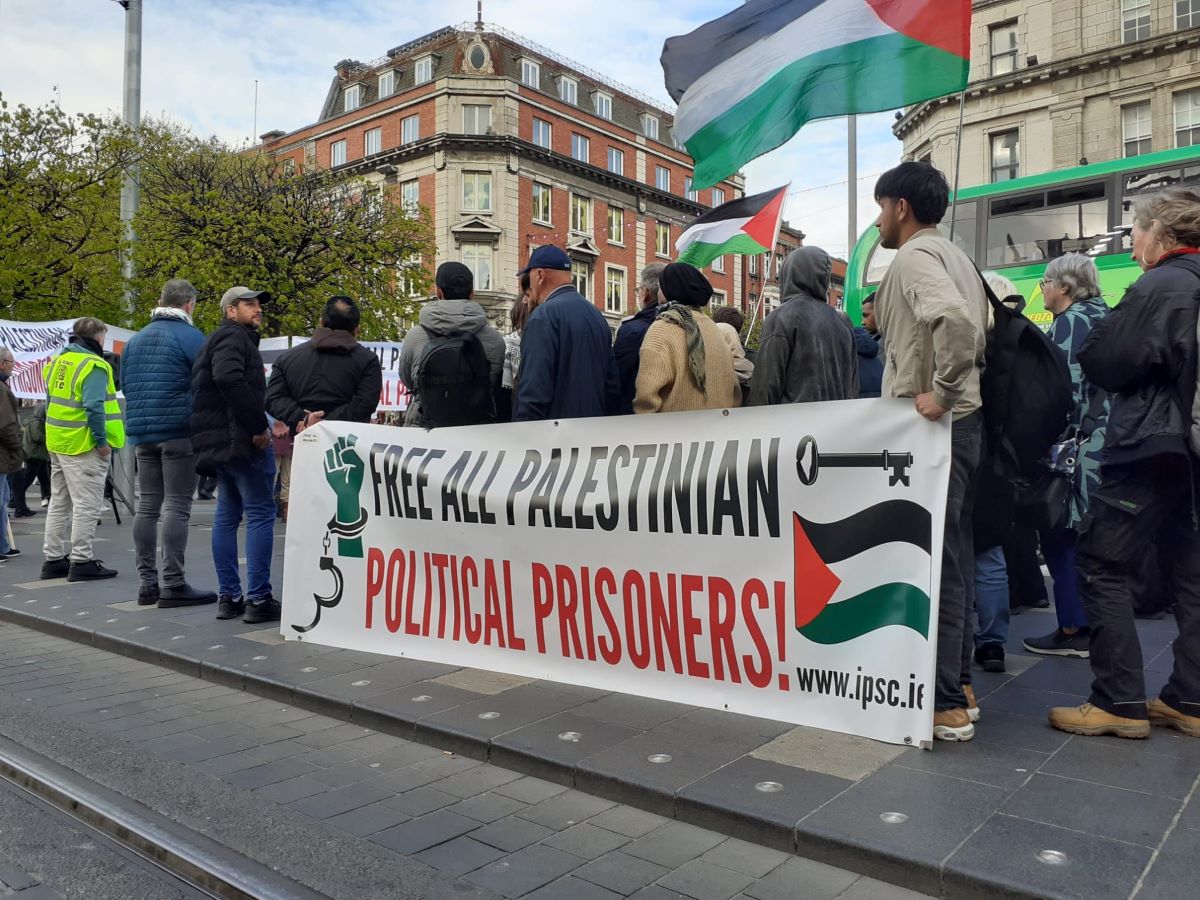
April 17th is the annual Palestinian political Prisoners’ Day and it was marked in O’Connell Street, the main street of Dublin’s city centre, by an event with speeches, banners and chants organised by the Ireland Palestine Solidarity Campaign.
Palestine national flags fluttered about the crowd being addressed by a number of speakers with occasional toots of solidarity from passing traffic – a common occurrence at Palestine solidarity events in most of Ireland.
View of eastward of section of the crowd at the event (Photo sourced: IPSC)
Dáithí Doolan was one of the speakers and though saying some progressive things about solidarity with Palestine and the terrible situation in which the occupiers have them, soon revealed the political poverty and lack of solidarity with resistance of his Sinn Féin party.
Doolan reminded his audience of when there were political prisoners in Ireland, as though this was no longer the case, presumably because the prisoners now are not of his party. Nor did he mention the current attempts to extradite Irish Republicans to British administrations.
The SF speaker went on to extol the South African process, perhaps not caring about the betrayal of the struggle and sacrifice of the masses there, the deepening grip of imperialism on the rich natural resources, the corruption and repression of the ANC regime and the massacre at Marikana.1
If Doolan thought about it he must have hoped that his audience did not remember that the South African process had a twin, the Palestinian one at Oslo which sabotaged the Palestinian struggle and brought into being the corrupt Palestinian Authority2, the Israeli proxy in the West Bank.
Sinn Féin has achieved a somewhat similar position in the Six Counties colony and has been working hard to reach a corresponding role in the Irish state. And why not, when it endorses the “Two State solution” giving the Palestinians 20% of their land under Zionist eyes and guns.
The very least, Doolan said, that the Irish Government could do to help the Palestinians, would be to enact the Occupied Territories Bill but he proposed nothing further, not even the ban on US military flights through Shannon Airport or on Israeli arms flights through Irish airspace.
Darragh Adelaide from the People Before Profit party spoke too about Palestine and solidarity but also about the Palestine refugees that have had to sleep in tents on Irish streets and the attacks on them both by the authorities and by fascists and other racists.
Palestinian prisoner conditions
A woman gave a detailed list of statistics relating to Palestinian political prisoners but also went through the tortures and terrible conditions in which they are kept. She concluded reminding her audience that each prisoner is a human being, a parent, a child, a sibling and not a number.
View of the crowd southward from behind a speaker (Photo sourced: IPSC)
In a year and a half, more than 15,800 Palestinians have been arrested, including 500 women, 1200 children, and thousands of detainees who were placed under arbitrary administrative detention. 64 Palestinians have died in prison since October 2024, including a child.3
The prison administration’s special units have carried out violent raids on prisoners’ cells, administering severe beatings, torture, and ill-treatment.4
Prisoners have suffered power and water cuts, and all of their belongings—including clothes, electrical appliances, and hygiene items—have been confiscated.5
They have been placed under complete isolation, family visits have been completely banned, and the International Committee of the Red Cross has been prevented from visiting them inside prisons.
Additionally, a policy of starvation has been implemented against thousands of prisoners, who are being provided with only two extremely poor-quality and quantity meals a day.6
The MC of the event led chants in which he called out Palestinian political prisoners! and the audience responded with Free them all! Similarly with Free the children prisoners — Free them all! and Free the women prisoners! — Free them all!
Symbolising the Palestinian political prisoners (Photo sourced: IPSC)
He also referred to the woman arrested outside the Irish Embassy in Berlin for speaking in Irish and, in defiance, led the audience in a chant in Irish expressing solidarity with the Palestinian people: Saoirse don Phalaistín! (Freedom for Palestine!)7
What was notable in its total absence from all the speeches was any call to step beyond the marches and similar measures which have been supported by thousands in Ireland over more than 18 months but which have not succeeded in moving the Government even to enforcing its formal neutrality.
This is replicated in most solidarity events across the state, leaving those few who take action to increase greater pressure on the ruling class to face the repression of the Irish State, as with 23 men and women in three different events over a four-day period in Dublin recently.8
Political prisoners from the armed resistance
The Joe McDonnell Ballad9 would have been most appropriately performed at this event, in particular the chorus line: You dare to call me a terrorist, while you look down your guns … But the IPSC would hardly endorse the singing of that song nor wish to be associated with it in public.
There were two large prisoners’ solidarity banners of the IPSC at this event but it is remarkable how rarely one sees them on the IPSC’s national marches. The problem with the prisoners for liberal organisations is that some of them, at least, have been armed fighters of the Resistance.
This, combined with ignorance perhaps, accounts for the comparatively low numbers at this event. However, it has to be said that known revolutionary organisations were also visibly absent.
View south-westwards with the iconic GPO (General Post Office) building in the background. (Photo sourced: IPSC)
Doolan’s party was a problem for liberals when many of the political prisoners here had been armed Irish Republican resistance fighters; it’s still a problem for them today — but also for Doolan and his party now that the current Irish political prisoners are no longer associated with them.
If solidarity does not embrace resistance then it’s charity, not solidarity. And if resistance is to be embraced then it should be so for all its expressions, artistic, cultural, mass mobilisations, strikes, boycotts … and armed. Including solidarity with those who, because of resistance, end up in jails.
Free them all!
End.
NOTES
1Culminating on 16th August 2012 (while Mandela still lived) the police of the ANC Government carried out a massacre of over 40 striking miners over a period of three days. The massacre was to suppress a strike in a platinum mine of the Canadian Lonmin company, repressing also a breakaway union from theANC-allied National Union of Mineworkers. The massacre is widely believed to have been organised by Cyril Ramaphosa, then a millionaire and vice-President of the ANC Government and recent leader of the NUM, now President of South Africa.
2Which also beats and incarcerates Palestinians resisting the Occupation (exact figures are difficult to obtain) and has murdered some.
7This slogan has now become well known in Ireland in voice but also in writing, appearing on flags, banners and placards. It represents a partial success for those of us who have tried to insert a measure of the Irish language into Palestine solidarity, in the belief that it is important for the Irish language to be present in progressive movements.
9By Brian Warfield of the Wolfe Tones band in honour of Volunteer Joe McDonnell of the Provisional IRA who died on hunger strike in 1981; the song also names other hunger strike martyrs of the Provisionals Vols. Bobby Sands, Francis Hughes, McCreesh but adds Vol. Patsy O’Hara of the Irish National Liberation Army. In total, seven of the Provisionals and three of INLA died on hunger strike in 1981.
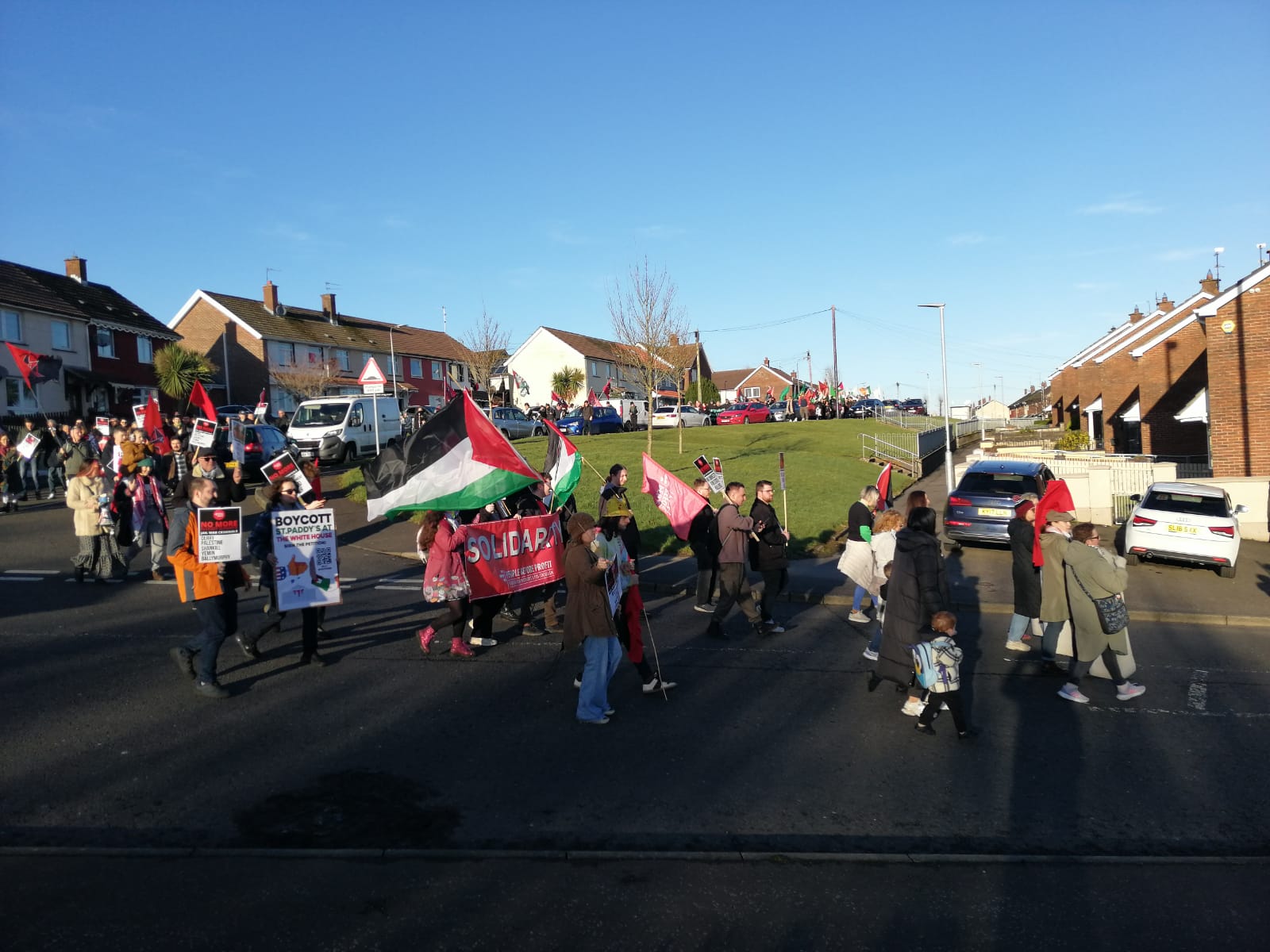
Thousands of marchers with flags, banners and three marching bands retraced the route of the anti-internment march in 1972 that ended in the infamous Derry Bloody Sunday1, a massacre of unarmed civilians by the British Parachute Regiment.
The nearest Sunday to the date of the original march, which this year fell on February 2nd has been chosen annually for the commemorative march over the 53 years since the massacre. People travel from different parts of Ireland and indeed from beyond in order to attend.
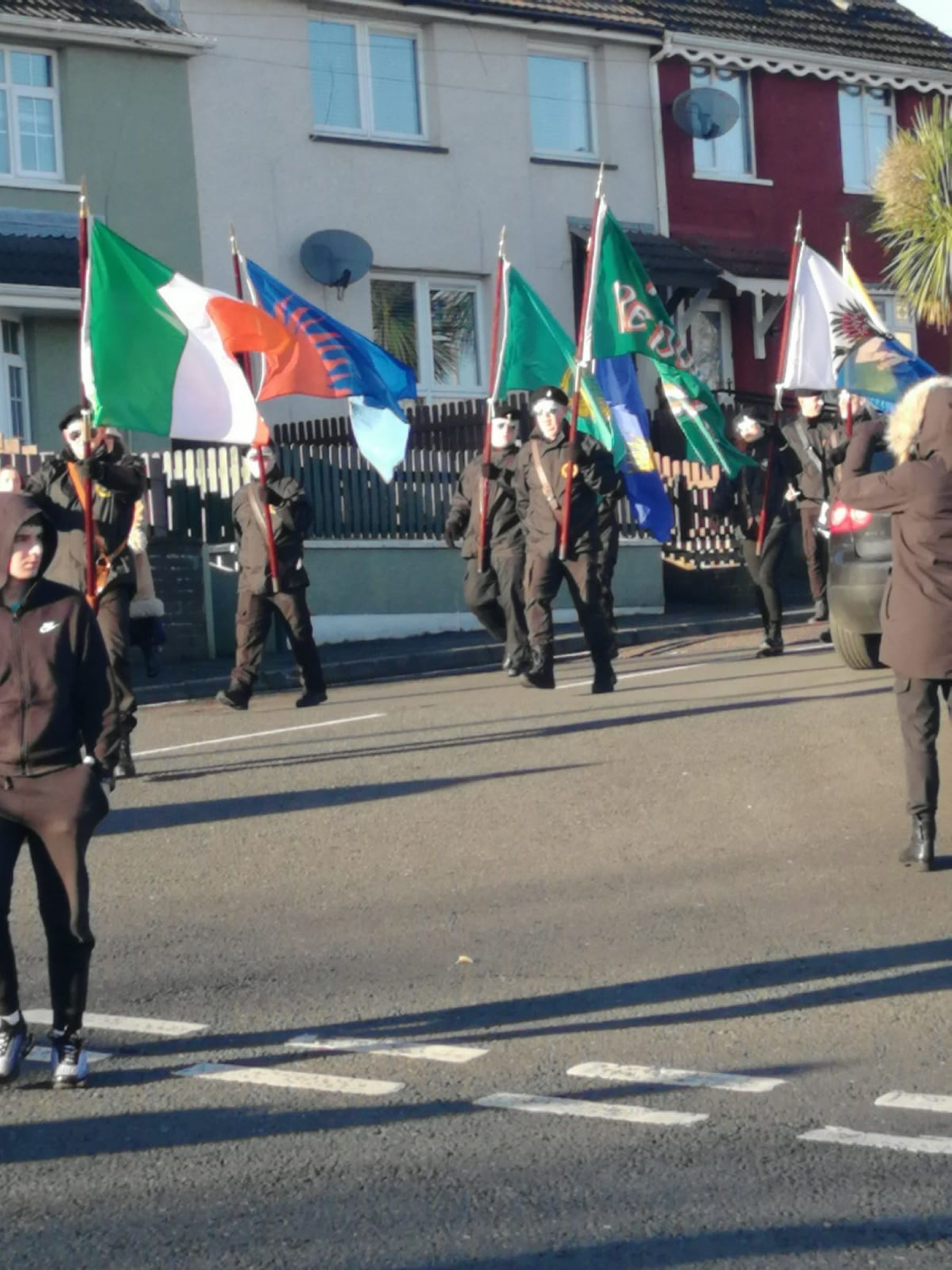
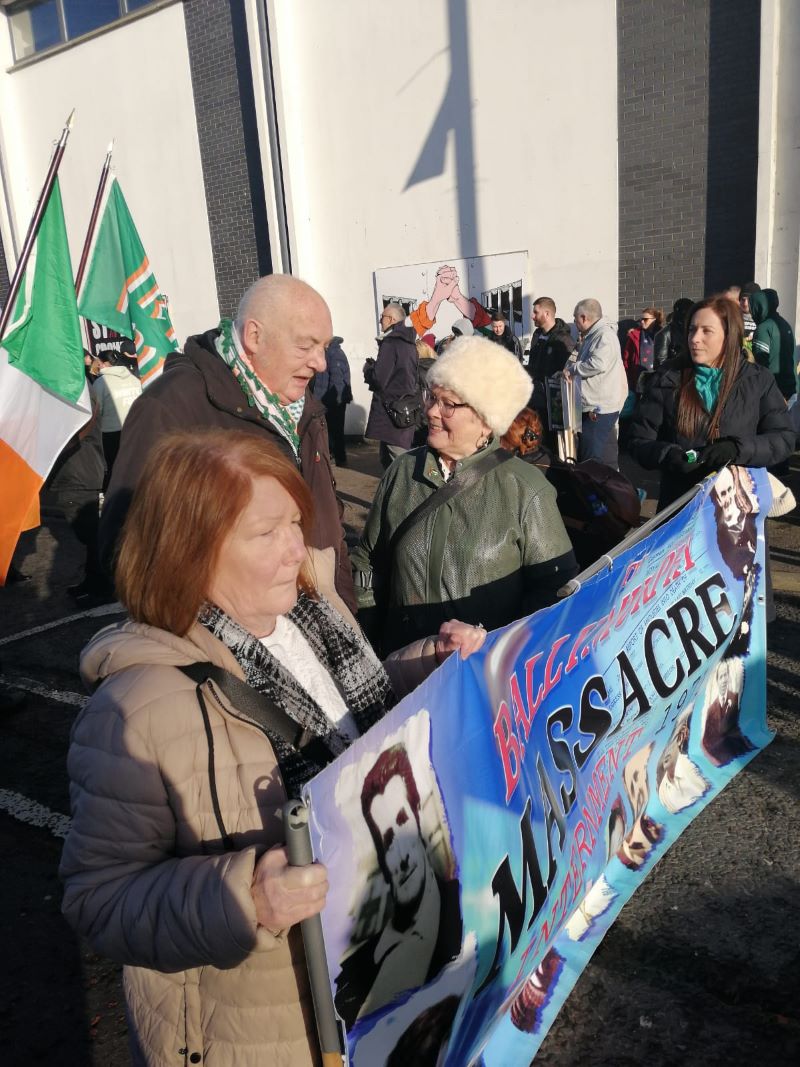
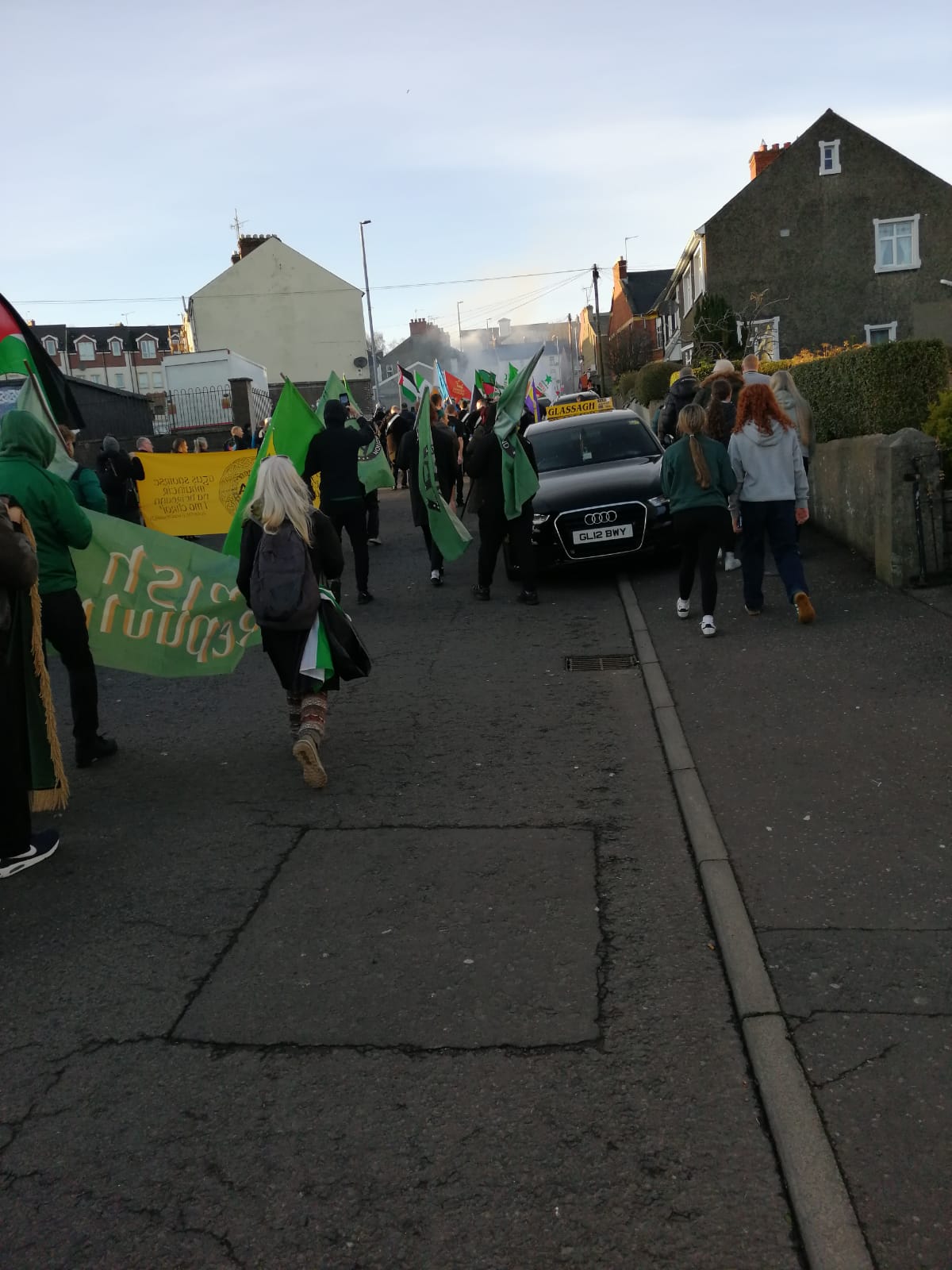
Section of the march coming down from the Creggan. (Photo: D.Breatnach)The colour party (bearing the flags) traditionally precedes the marching band. (Photo: D.Breatnach)
Derry is not well served by public transport from other parts of Ireland and there is no train station there.
There is a bus service from Dublin from the Translink company of the occupied colony but one would need to catch it at seven in the morning and then hang around in Derry for 3.5 hours waiting for the march to start. For this reason, many travel to Derry by car.
Equally, many others who would attend were the public transport available, stay home but an estimated over 7,000 participated in this year’s march. The theme this year was Palestine, once again as was last year’s too.
The day of the massacre
The original march was a protest against the introduction in August 1971 of internment without trial in the occupied colony. Almost immediately afterward the Parachute Regiment had massacred 11 people protesting against it in Ballymurphy, Belfast.2
Ballymurphy campaign banner in the Creggan awaiting start of march with Kate Nash centre. (Photo: D.Breatnach)
The 1972 march, along with many others, had been banned by the sectarian colonial administration. The Civil Rights campaigners knew that their legitimate demands3 were being obstructed by use of the Special Powers4 of the statelet and that they could win nothing if they were to acquiesce.
After the previous massacres it took considerable courage to march that day but perhaps they thought that with an advertised march, in daylight, with many film cameras covering, the Paras were unlikely to open fire. In any case, they decided to risk it.
At 4.10pm the first shots were fired by the Paras5 without warning and by around 20 minutes later they had killed 13 men and youths and wounded another 13, one of whom would die weeks later. According to the Saville Inquiry in 2010, they had fired over 100 rounds.
Not one of their targets was armed.
To justify the slaughter, the British Army claimed that they were fired upon and returned fire, killing IRA fighters. The British Government, in particular through Home Affairs Minister Reginald Maudling, repeated the lies as did the British media.
Bernadette (then) Devlin6 MP, a survivor, was prevented from speaking in the Westminster Parliament and she walked up to Maudling and slapped his face. In Dublin a general strike took place with schools closing and a huge crowd burned the British Embassy down.
In London, a giant march reached Trafalgar Square as its end was still leaving Hyde Park. In Whitehall the police prevented them from laying the symbolic coffins outside No.10 and in the scuffles the ‘coffins’ were eventually thrown at the police or knocked to the ground.
And a number of construction sites in Britain went on strike also.
The judicial response varied wildly. Coroner Hubert O’Neill, an ex-British Army major, presiding on the inquests in 1973, called it “Sheer unadulterated murder” whereas Lord Chief Justice Widgery in the ‘inquiry’ he led ignored all the local evidence and accepted the British Army’s lies.7
“The last Bloody Sunday march”
Provisional Sinn Féin organised and managed the annual march for many years but in January 2011 Martin McGuinness announced that year’s march would be the last, because of the UK’s Prime Minister David Cameron’s public apology to the relatives of the 14 killed in Derry.
The apology followed quickly on the verdict of the Saville Inquiry8 which totally refuted the statements at the time by representatives of the Army and of the Political and Judicial establishments: the victims had been unarmed and the Army had not been “returning fire”.
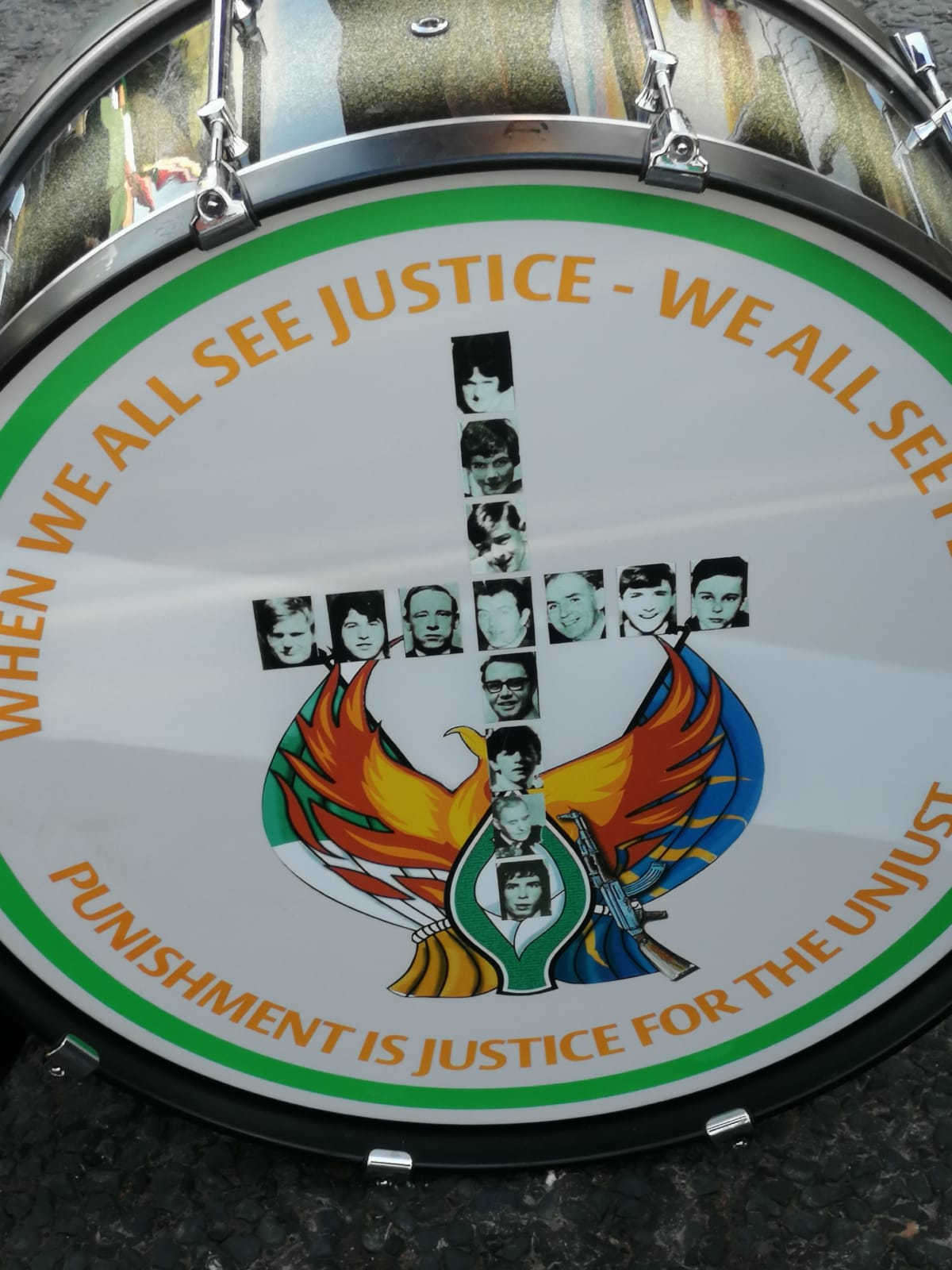
One side of one of the marching band drums (Photo: D.Breatnach)Section of the march about half-way along its length. (Photo: D.Breatnach)
Despite the UK State’s acknowledgement that they had no excuse for the massacre, not one of those who planned, organised or carried out the atrocity had been charged, never mind convicted, nor had those who conspired to cover up the facts. To this day, only a low-level soldier has faced charges.
Nor had there been government admissions of wrongdoing in the other massacres by the Paras intended to crush the resistance to the repressive internment measure, at Ballymurphy and Springhill.
A number of relatives and survivors of the original march declined to have the annual march cancelled, among them Kate Nash and Bernadette McAlliskey. Kate Nash’s brother William was shot dead on Bloody Sunday and her father, William, was wounded trying to save his son.
Bernadette McAlliskey was a survivor of the massacre and also survived nearly a decade later an assassination attempt in her home, being struck by nine bullets of a Loyalist murder gang. Despite opposition by and denunciation from SF, volunteers have kept the march going every year.
Each year different themes have also been incorporated into the Bloody Sunday March for Justice, including ones in Ireland, such as the framed Craigavon Two prisoners but also ones from beyond, e.g. the resistance of the Broadwater Farm housing estate in London to Metropolitan Police attack.
Section of the march in Creggan waiting to start, showing the Palestinian national flag and the Irish Tricolour in close proximity. (Photo: D.Breatnach)Big drums of one of the marching bands getting a workout in the Creggan while waiting for the march to start. ‘Saoirse go deo’ = Freedom for ever. (Photo: D.Breatnach)
Since 2011 Sinn Féin have boycotted the march but also sought to mobilise public opinion against it, claiming that relatives of the victims didn’t want the march to continue. The truth is that some hadn’t wanted it even when SF were running it, some didn’t afterwards but some did.
Such an atrocity has of course huge personal impact on relatives of victims but its impact is also much wider on a society and beyond, historically and politically. That historical memory ‘belongs’ to the people of Derry but also to the people of the world (as do others such as Sharpeville SA).
Those in power in society are aware of that and the media outside of Derry gives little or no coverage to the annual march while promoting other events there of lesser numbers and significance.
The ‘Derry Peoples Museum’ ignores the march in its Bloody Sunday commemorative program.
This year’s march
Sunday just past was one of sunshine and little wind, as it was on the day of the Derry massacre. But regular marchers remember other Bloody Sunday commemoration days of pouring non-stop rain, of squalls, of snow and sleet, of wet clothes, socks and freezing fingers and toes.
The march starts in the afternoon at the Creggan (An Chreagáin) and winds down to just below the Derry Walls, then up a long slope again before eventually ending down at Free Derry Corner9, the destination of the original march, where speakers address the crowd from a sheltered stage.
Marchers underway, led by people carrying 14 crosses to represent the unarmed civilians murdered by the Paras on that day 53 years before. (Photo: D.Breatnach) The band members are itching to go up in the Creggan. (Photo: D.Breatnach)
The sides of residential blocks in this area are also painted in giant murals to represent scenes from the civil rights and armed resistance period while nearby stands a monument to the martyrs of Bloody Sunday 1972 but also another to the 10 H-Blocks’ martyrs of the Hungers Strikes of 1981.
In this area, one needs to be blind not to be at least peripherally aware of the icons of proud struggle and of loss, of sacrifice.
Eamon McCann and Farah Koutteineh addressed the rally at the end of the march. McCann, a journalist and member of the People Before Profit political party is a survivor of the massacre. He is an early supporter of the Bloody Sunday March for Justice at which he has spoken on occasion.
Farah Koutteineh is a Palestinian journalist who was herself the news when in December 2023 she and a few other Palestinians were ejected from a Sinn Féin-organised meeting in Belfast being addressed by the Palestinian Ambassador as a representative of the Palestinian Authority.
Koutteineh had been denouncing the Palestine Authority’s collusion with Israel when she and the other Palestinians were hustled out to applause from many of the attendance. Not surprisingly from the Derry platform on Sunday she too drew applause in criticising SF’s position on Palestine.10
Speaking to this reporter after the march, Kate Nash said: “There is no chance the march will be ended. It will go forward into the future, a beacon of resistance against the injustices and crimes of states around the world.
“There are millions of us … people come from around the world to commemorate this massacre with us.”
end.
Series of images from the march (Photoa by D.Breatnach)
Footnotes:
1There have been a number of Bloody Sundays in the history of Ireland under colonialism and therefore the location and year are often incorporated into the name for clarity as to which is being discussed.
2There was substantial State interference with inquests during the period of the 30-years’ war in the Six Counties (and in some cases in the Irish state also), in order to avoid inquest juries finding the state armed forces culpable of homicide unjustified in law. The original inquest in 1972 on the Ballymurphy massacre recorded an ‘open verdict’ but a 2021 reopened inquest found the British Army killings “unjustifiable”. Even after the Derry massacre, in July of that year, the Paras again killed five unarmed people and injured two in the Springhill area of Belfast and again an ‘open verdict’ was recorded into the fatalities which included three teenagers and a priest.
3The demands were all of rights that were in existence in the rest of the UK, including an ending to discrimination in allocation of housing and employment and general enfranchisement.
4The Special Powers (Northern Ireland) Act 1922 gave legal powers to the authorities similar to martial law. Allegedly temporary, as is often the case the Act kept getting renewed until made permanent and its repeal was one of the demands of the Civil Rights campaign. The Act was finally repealed in 1973.
5There was a unit of other British Army soldiers stationed on the Derry Walls with special rifles and there has been speculation that some of the shots might have been fired by them but this has never been confirmed to date.
6Now McAlliskey then Devlin, she had been a candidate for the People’s Democracy party of the time, the youngest MP elected.
7And that was the ‘official record’ until the Saville verdict 38 years later. A clever contemporary lampooning of Widgery and playing on a soap powder advert, with excellent alliteration, had it that “Nothing washes whiter than Widgery White!”
8Although the Saville Inquiry delivered its verdict in June 2010, it had been set up in 1998, taking an inordinately long time (and a bonanza in legal fees for judge, barristers, lawyers and clerks) to reach a verdict already obvious to all the nationalist people of the Six Counties, most of the Irish people and probably millions around the world. The date of its setting up so near to that of the Good Friday Agreement suggests that its creation (and eventual verdict) was part of the ‘sweeteners’ of the Pacification Process and the Good Friday Agreement.
9A reconstruction of the iconic gable end of a small local authority house in the Bogside area of Derry which had been painted in 1967, during the Civil Rights resistance period, with giant letters proclaiming: YOU ARE NOW ENTERING FREE DERRY. The house was demolished during redevelopment of the area but the gable end was reconstructed as a monument to the resistance of the people of the city.
10Sinn Féin support the corrupt and collaborationist Palestine Authority and its backing political party Fatah and also celebrated St. Patrick’s Day with (then) President Joe Biden while the US was supplying the Zionist genocide with weapons, money and political backing.
1There have been a number of Bloody Sundays in the history of Ireland under colonialism and therefore the location and year are often incorporated into the name for clarity as to which is being discussed.
2There was substantial State interference with inquests during the period of the 30-years’ war in the Six Counties (and in some cases in the Irish state also), in order to avoid inquest juries finding the state armed forces culpable of homicide unjustified in law. The original inquest in 1972 on the Ballymurphy massacre recorded an ‘open verdict’ but a 2021 reopened inquest found the British Army killings “unjustifiable”. Even after the Derry massacre, in July of that year, the Paras again killed five unarmed people and injured two in the Springhill area of Belfast and again an ‘open verdict’ was recorded into the fatalities which included three teenagers and a priest.
3The demands were all of rights that were in existence in the rest of the UK, including an ending to discrimination in allocation of housing and employment and general enfranchisement.
4The Special Powers (Northern Ireland) Act 1922 gave legal powers to the authorities similar to martial law. Allegedly temporary, as is often the case the Act kept getting renewed until made permanent and its repeal was one of the demands of the Civil Rights campaign. The Act was finally repealed in 1973.
5There was a unit of other British Army soldiers stationed on the Derry Walls with special rifles and there has been speculation that some of the shots might have been fired by them but this has never been confirmed to date.
6Now McAlliskey then Devlin, she had been a candidate for the People’s Democracy party of the time, the youngest MP elected.
7And that was the ‘official record’ until the Saville verdict 38 years later. A clever contemporary lampooning of Widgery and playing on a soap powder advert, with excellent alliteration, had it that “Nothing washes whiter than Widgery White!”
8Although the Saville Inquiry delivered its verdict in June 2010, it had been set up in 1998, taking an inordinately long time (and a bonanza in legal fees for judge, barristers, lawyers and clerks) to reach a verdict already obvious to all the nationalist people of the Six Counties, most of the Irish people and probably millions around the world. The date of its setting up so near to that of the Good Friday Agreement suggests that its creation (and eventual verdict) was part of the ‘sweeteners’ of the Pacification Process and the Good Friday Agreement.
9A reconstruction of the iconic gable end of a small local authority house in the Bogside area of Derry which had been painted in 1967, during the Civil Rights resistance period, with giant letters proclaiming: YOU ARE NOW ENTERING FREE DERRY. The house was demolished during redevelopment of the area but the gable end was reconstructed as a monument to the resistance of the people of the city.
10Sinn Féin support the corrupt and collaborationist Palestine Authority and its backing political party Fatah and also celebrated St. Patrick’s Day with (then) President Joe Biden while the US was supplying the Zionist genocide with weapons, money and political backing.
By Nicki Jameson13 January 2025 (Reading time: 12 mins.)
(NB: An unconnected article with very similar title about the Irish organisation IPSC, rather than the English one as this is, was published on this blog in December 2023)
The below speech was delivered by Nicki Jameson at a Revolutionary Communist Group public meeting in London on 12 December 2024 titled ‘Defend the right to defend Palestine: fight back against state repression and media lies’.It is reprinted here from its publication in the RCG’s Fight Racism Fight Imperialism newspaper with permission and reformatted by RB for publication.
The genocidal Zionist onslaught which followed the 7 October 2023 Al Aqsa Flood operation caused a crisis for the imperialist ruling class. In both the US and Britain this was reflected in election results, for example.
Whatever now happens in the aftermath of this week’s events in Syria, and what splits in the solidarity movement this may lead to, it remains the case that international support for the resilient Palestinian struggle is widespread and not diminishing.
In this context, the British government, both under the previous Conservative administration and now under Labour, has sought to contain and limit the effectiveness of the protest movement.
It does not want to be seen to ban protests entirely, but it has aimed to render them impotent and tokenistic.
While it would, of course deny this, the role of the national Palestine Solidarity Campaign (PSC) is to facilitate this limitation.
It does this by ensuring that anger against the Zionist genocide is channelled into ‘safe’ slogans such as the demand for a ceasefire, and formulaic A to B marches, organised on terms dictated by the police, culminating with a passive crowd listening to anodyne speeches from the usual suspects.
Contained as they are, that PSC marches nonetheless constitute a regular expression of solidarity with the Palestinian struggle by a significant section of the British public is way too much for some in the political establishment.
And also for the vocal cohort of Zionists whose angry social media presence is used to decry ‘hate marches’ and demand greater policing and more arrests.
The police themselves vacillate between different approaches, dependent on the whims of the Home Secretary of the moment and Zionist political pressure.
Palestine protests
The very first protests in early October 2023 after the AAF operation were lightly policed. On 9 October we stood directly outside the Israeli embassy with no conditions or attempt to prevent the demo.
Within a very short period of time this had changed dramatically and the then weekly protests organised by PSC were subject to heavy policing.
Zionist keyboard warriors on twitter began immediately to play a role in fingering people, posting video footage of alleged crimes, with the demand that people be arrested. The police duly obliged.
While total overall arrest figures seem hard to track down, between October 2023 and March 2024 there were 305 arrests under the Metropolitan Police’s Operation Brocks – the policing operation related to Palestine protests in London.
This included 89 far-right counter protesters arrested on Remembrance Day, when – riled up by then Home Secretary Suella Braverman – they came to ‘defend the cenotaph’ from a non-existent attack.
During this period eight people were arrested on FRFI contingents in London. Their experience is fairly typical of those targeted at the time.
London police making an arrest on Palestine solidarity march 13 January 2024 (Photo cred: FRFI)
In the main they were profiled by Zionists on twitter, who flagged up to the compliant police that the comrades either had placards bearing the words ‘Victory to the Intifada’ or were using that slogan.
A young person was also arrested on the spurious pretext that he was wearing a symbol of a proscribed organisation, although the PFLP is not in fact proscribed in this country. He was subsequently de-arrested but not before those who came to his aid were also swept up.
Of this eight, only one person was charged. This was subsequently thrown out of court. Of the others, all but one have been definitively told they will not be charged.
A ninth comrade, arrested in a dawn-raid on their home remains on bail under the Terrorism Act in relation to a speech made 15 months ago.
It was clear from police interviews, that the cops in Operation Brocks had no idea what Intifada actually meant and had been given a script by their political masters.
We take the exoneration of those arrested to mean that VICTORY TO THE INTIFADA, a call for solidarity with the uprisings of Palestinians against Zionist oppression, is entirely legitimate and in no way criminal.
Spurious arrests continue to take place, using the now tried and tested process of Zionist twitter posts highlighting the offensive words or item, prompting either immediate arrest or the publishing of a police ‘wanted’ notice.
Following the lack of any prosecution for slogans such as ‘From the river to the sea’ or ‘Victory to the Intifada’, the most common ‘crime’ is comparison of Israeli genocide to the Nazi holocaust.
Although no-one has been successfully prosecuted along these lines, Zionists continue to claim it is an anti-Semitic hate crime.
Many of these arrests are farcical.
People will remember the arrest, charging, trial and not guilty verdict of Marieha Hussain, who had depicted Conservative politicians Rishi Sunak and Suella Braverman as coconuts on a homemade placard she took to a protest on 11 November 2023.
In May 2024, four activists from Camden Friends of Palestine were arrested under the Terrorism Act for holding a banner depicting a dove flying through the Israeli apartheid wall.
Police claimed that as the banner depicted ‘a clear blue sky with no clouds’ and there had been similar weather on 7 October, this showed obvious support for Hamas. After 3 months on bail they were told that there would be no charges.
A tremendous amount of police time and money is being spent on this process with what would appear to be no tangible reward in terms of convictions or imprisonment.
However, what simply looking at the charge or conviction rates fails to show is the way these arrests are used as harassment and interference both in people’s ability to protest and their everyday lives.
Those described here have had bail conditions which specified variously that they could not enter the borough of Westminster, could not enter university premises other than for study and must surrender their passports and not leave the country.
Arrestees from the CPGB-ML were banned for the duration of their bail from attending protests and distributing literature. People flagged for arrest by Zionist twitter have also been reported to their employers, professional bodies and universities in an attempt to ruin their ability to work or study.
While most early arrests were under Public Order police powers, there is increasing use of the Terrorism Act (TA) 2003 to criminalise solidarity with Palestine, targeting both protesters on the streets and what people say on line.
Journalists and youtubers, such as Richard Medhurst, Sarah Wilkinson and Asa Winstanley have been subject to arrests and house raids.
The TA was brought in by the last Labour government at a time when Keir Starmer was Director of Public Prosecutions.
On 27 November, the Met Police used the TA to raid the premises of the Kurdish Community Centre in Haringey, north London, arresting six people and placing the centre under siege.
Anti-Zionist blogger/activist Tony Greenstein will be in court next week on a charge under section 12 of the TA, for responding over a year ago to a Zionist tweet accusing him of being a Hamas supporter with the words: ‘I support the Palestinians, that is enough and I support Hamas against the Israeli army.’
Anti-imperialist Jewish and Palestine Solidarity activist Tony Greenstein, who is being persecuted by the British police. (Photo sourced: Internet)
The aim is to create a climate of fear in which people become scared to attend even the most peaceful and routine of protests, where we censor our own slogans, placards and behaviour in order to evade the eyes of the on-line harassers and the police.
Palestine Action and Elbit
Alongside all this has run another process in which the brave participants show no fear in the way they exercise their solidarity with the Palestinian struggle.
Palestine Action was set up in 2020 by activists who were frustrated by the PSC’s lack of direct action to enforce BDS – Boycott, Divestment and Sanctions.
Since then it has primarily targeted the British operation of Israeli arms company, Elbit Systems, as well as other companies collaborating with Elbit or are otherwise implicated in the arming of the Zionist war machine or sale of its ‘battle tested’ technology to other countries’ militaries.
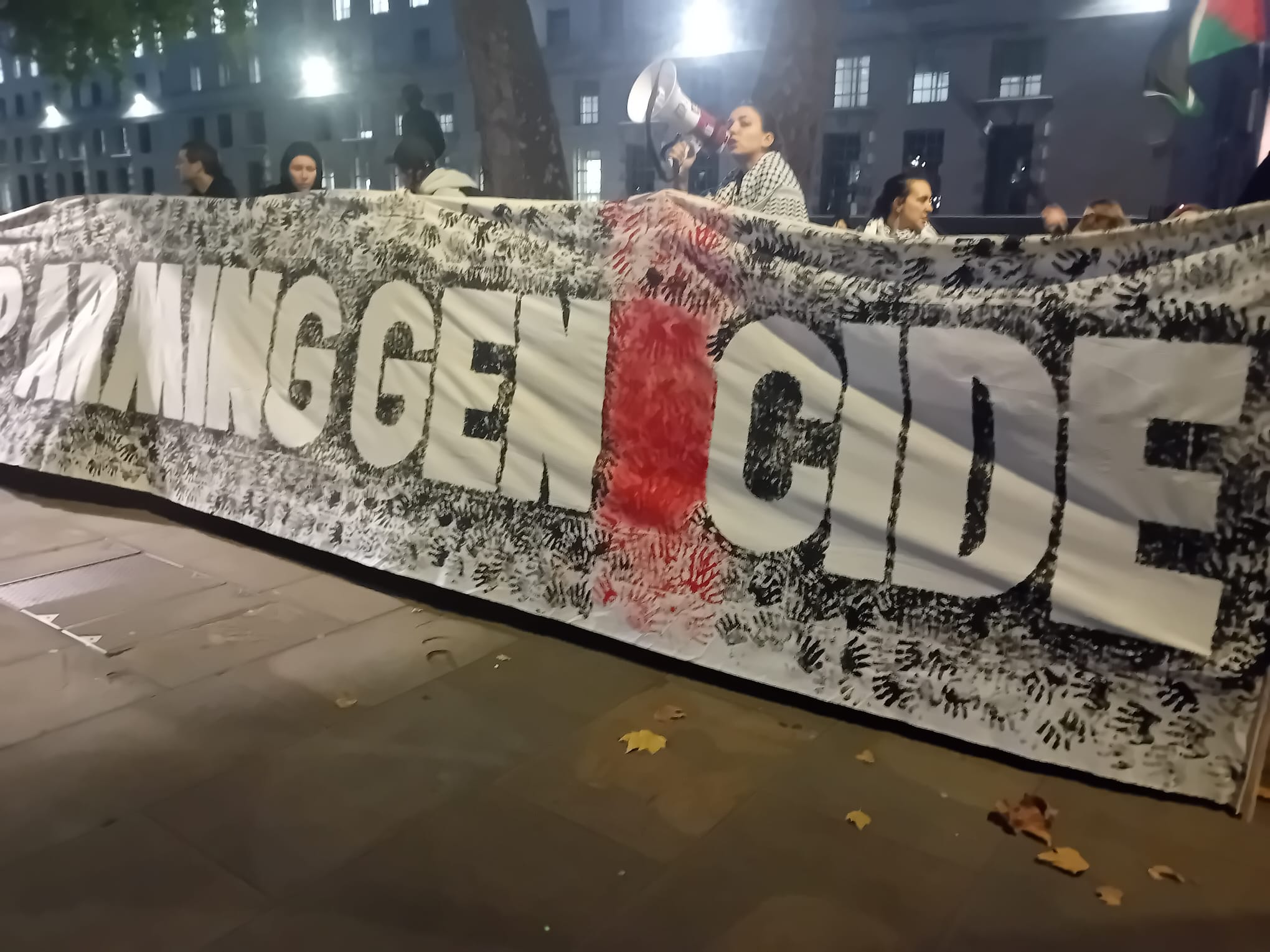
Palestine Action’s tactics mainly consist of occupations, blockades and drenching premises in red paint to symbolise the blood on the hands of these profiteering companies.
Until recently, although a lot of these actions led to arrests, very few Palestine Action activists ended up behind bars. This has changed since Keir Starmer’s Labour government came to power. There are currently 18 Palestine Action activists in prison in England, along with 2 in Scotland.
One of the Scottish prisoners is the last of the group known as the Thales 5, who were convicted of occupying the roof of the Glasgow premises of French company Thales in 2022. Thales was working with Elbit to produce Watchkeeper drones for the British military.
The prisoners in England have not been convicted and are all held on remand, having been refused bail by the courts. The majority were arrested in relation to actions against the Filton arms factory in Bristol. Ten people were remanded in August and a further eight in November.
Although none have been charged with terrorism offences, the TA was used to effect their arrests, allowing the police more powers to detain pre-charge, raid homes and generally act in a heavy-handed manner.
In the latest arrests in November, flatmates and families were evicted from their homes, sometimes for several days while the police searched premises. In one raid, the mother and younger brother of the person arrested were both handcuffed, despite not being accused of any offence.
In prison, those on remand for pro-Palestine direct action have come in for special scrutiny and additional intrusive measures on top of those which all prisoners are forced to deal with.
The six women detained in Bronzefield prison in August were all allocated to separate wings and deliberately prevented from associating with one another. Their mail has been heavily censored.
Four male prisoners in Wormwood Scrubs, although not subject to the same separation regime, have also had their correspondence held up, censored and returned to sender, with supporters being served with notices to the effect that no communication between them is permitted.
FRFI successfully appealed against such a notice in relation to our sending the paper to the prisoners, although the prison claims it still has a right to withhold the paper or other publications if the censors decide they are ‘inappropriate for a prison setting’.
The purpose of all this is clearly to scare those it is directly targeting it and to deter others from coming forward to join Palestine Action’s activities.
As Palestine Action carries out more actions against Elbit, including repeatedly blockading the UAV Engines site at Shenstone in the Midlands, which manufactures engines for Elbit, it is clear that the repression is not succeeding.
Palestine solidarity demonstration Downing Street 14 December 2024. (Source photo: Internet)
In addition to the litany of his war crimes, he will be remembered for authoring the text book Low Intensity Operations – Subversion, Insurgency and Peace-keeping (1971), a manual for dealing with subversive and recalcitrant populations, both at home and abroad.
Kitson’s work continues to form a central plank of British strategy for policing dissent and his disciples are clearly leading policing operations against pro-Palestine protesters.
In Kitson’s book, he details how ‘psychological operations’ should be used to isolate ‘subversives’ from the people while building links with and strengthening support for moderate elements who do not oppose the state but disagree on certain policies.
This technique was used both abroad in Britain’s colonies, and at home to police, for example, the Irish solidarity movement of the 1970s-80s.
Today’s ‘moderates’ take the form of the PSC, Stop the War and similar organisations. PSC marches are negotiated with the police, with strict conditions imposed on the protests.
The PSC has provided no support for people arrested on its demonstrations, citing the low arrest rates as proof of how respectable their protests are, while distancing itself from those who have been targeted.
While the PSC opposes Zionist massacres of the Palestinian people, it does not support the resistance of those under attack.
Consequently it does not complain when the British police uses Terrorism Act powers to criminalise people for supporting the right of Palestinians to resist their oppressors through armed struggle.
This treachery puts the PSC on the wrong side of international law – oppressed nations successfully fought for the right to self-defence by means of armed struggle to be enshrined in UN resolutions in 1974 and 1982.
Fighting back, building solidarity
For some of us, the culture around supporting our arrested comrades was drilled into us many years ago. A whole new generation has had to learn these lessons.
It is positive to see that, although the PSC and such organisations continue not to want to get their hands dirty with supporting anyone targeted by the police, a different attitude is also widespread and ‘arrestee support’, prison solidarity letter-writing etc are common currency among activists.
At the same time there is an element of this solidarity which is depoliticised. For example, the provision of a constant presence at a police station to monitor things and be there when arrestees are released is a good thing and the support organisations which provide this do an invaluable job.
However, when we have comrades under arrest, we want to do more than legal monitoring and instead turn the police station into a focus for protest. The same with courts and prisons.
It’s very positive to see Palestine Action, the SOAS encampment and others also doing this to great effect, thus ensuring that the focus is not just on the Israeli companies who are their principle targets, but also on the British criminal justice machinery which is being marshalled against those who take a stand.
Our task, as always, here in the belly of the imperialist beast, remains to protest against the British government and British corporations’ complicity in the Zionist genocide.
And to show unconditional solidarity with those who fight back against the Zionist war machine by whatever means are at their disposal.
Supporting the resistance and opposing the British state cannot fail to bring us into conflict with that same state and we must continue to stand alongside everyone who is criminalised for their solidarity.
There were also others: the Guildford Four, Maguire Seven and Judith Ward, all innocent and all convicted in separate cases, mostly in 1974, in the same year that the Prevention of Terrorism Act was passed to silence the Irish community.
Yet others continue being framed, including the Craigavon Two.
There were also others: the Guildford Four, Maguire Seven and Judith Ward, all innocent and all convicted in separate cases, mostly in 1974, in the same year that the Prevention of Terrorism Act was passed to silence the Irish community.
Paddy Hill in 2017 outside the Dublin court where the Jobstown case was being tried (Photo sourced: Internet)
The agitation for civil rights for the community of Catholic background in the British colony of the Six Counties in Ireland began in the last years of the 1960s and very soon people in Britain were marching in solidarity with those facing violent colonial repression in the Six Counties.
The Irish were the most numerous and longest-established migrant community in Britain and had become active in many social, trade union and political circles with the potential to educate and strongly affect the host community.1 This was a problem for the British ruling class.
The jailing of so many people, in many cases obviously innocent, hundreds of arrests, thousands of detentions and interrogations with desertion by much of the British liberal and Left sector terrorised the Irish community so that many stepped away from solidarity campaigning.
That repression muted the Irish community’s solidarity actions until the 1981 Hunger Strikes brought them out again in thousands.
After his release in March 1991 Paddy Hill founded Mojo to campaign for framed innocent people and supported the campaign to free the Graigavon Two, another case that bears many of the hallmarks of a frame-up for political reasons, as famous barrister Michael Mansfield2 commented:
“There is nothing more particular about it (the Craigavon Two case) than in all the other miscarriages and the same features appear in all these things.”3
PSNI Constable Steven Carroll was shot dead by an AK47 bullet on 9th March 2009 in Craigavon, Armagh while responding to a fake crime call, the “dissident” group the Continuity IRA claiming responsibility.4 The arrests of John Paul Wooton and Brendan McConville followed.
Political cases in the Six Counties almost invariably are tried by the no-jury Diplock Court and the judge there refused both men bail. This might seem normal except that they did not go to trial until three years later – and kept in jail throughout the period.
Shortly before the eventual trial a man approached the PSNI saying he had seen McConville near the scene and on the evening of the killing of the Constable. This man was the only witness for the PSNI Prosecution but his partner, with him on the evening in question, refused to confirm his tale.
The night was raining and dark and the eyesight of the alleged witness was exposed as weak by the Defence. The coat he alleged McConville to be wearing was a different type, length and colour to that which the Prosecution was alleging McConville had been wearing on the night in question.
This ‘witness’ was also described by his father as having ‘a Walter Mitty character’ and the PSNI admitted paying him as an informant. An AK47 was recovered near the scene of the killing and the one fingerprint recovered from it did not match those of either Wooton or McConville.
Craigavon Two
Brendan McConville and Paul Wooton, taken in 2017. (Photo sourced: Petition for the release of the Craigavon Two)
There was no evidence against either man of having even handled the weapon never mind fired it, no evidence placing either at the scene apart from the dubious testimony placing one of them nearby. Incredibly, it might seem, nevertheless they were found guilty on 12th May 2012.
McConville was sentenced to 25 years and Wooton to ten. Their appeal two years after conviction in May 2014 was unsuccessful and in fact the Prosecution used it to add another four years to Wooton’s sentence.
Paddy Hill of the Birmgham Six and Gerry Conlon of the Guildford Four, both sadly deceased, both innocent but served long years in jail, both supported the campaign of the Craigavon Two. (Photo sourced: Internet)
Paddy Hill was not the only former framed prisoner to support the campaign to free the Craigavon Two. Gerry Conlon was asked to examine the case and became a convinced and dedicated campaigner for the men, speaking out about it as late as a week before his untimely death.5
Paddy Hill and the rest of the Birmingham Six were framed by the British system and served 18 years in jail. In May this year McConville and Wooton will have reached their 16th in jail. For how much longer will they and their close ones be tortured?
End.
Footnotes
1The Irish diaspora in Britain had provided the British working class with its anthem (The Red Flag), its classic novel (The Ragged-Trousered Philanthropists) and two leaders of its first mass movement, the Chartists (Fergus O’ Connor and Bronterre O’Brien) and had also formed a strng section of the First International Workingmen’s Association led by Marx and Engels. In 1974 people of Irish background were estimated to form up to 10% of the population of some British cities.
2Mansfield led the appeal cases of the Birmingham Six and of the Guildford Four.
On 18 December, TheTelegraph published an extraordinary investigation into how the UK and US trained and “prepared” fighters in the Revolutionary Commando Army (RCA).
This was a “rebel” force that collaborated with Hayat Tahrir al-Sham (HTS) in the mass offensive toppling of Syrian president Bashar al-Assad weeks earlier.
In an unprecedented disclosure, the outlet revealed that Washington not only “knew about the offensive” well in advance, but also had “precise intelligence about its scale.”
Washington’s now-confirmed “effective alliance” with HTS was described as “one of many ironies” emerging from the decade-and-a-half-long proxy war.
The Telegraph suggested this collaboration was inadvertent – simply a symptom of how Syria’s grinding, protracted civil war gave birth to “a bewildering array of militias and alliances, most of them backed by foreign powers.”
US support of HTS: A ‘necessary’ alliance
Alliances were fluid, with groups often splintering, merging, and shifting allegiances. Fighters frequently found themselves switching sides, blurring lines between factions.
Yet, ample evidence indicates the UK and the US maintained deliberate, long-standing ties with the dominant rebels of HTS.
(Photo cred: The Cradle)
For instance, in March 2021, President-elect Donald Trump’s former lead Syria envoy, James Jeffrey, gave a revealing interview to PBS, during which he disclosed that Washington secured a specific “waiver” from then-secretary of state Mike Pompeo to assist HTS.
While this did not permit direct funding or arming of the UN/US-designated terrorist organization, the waiver ensured that if US-supplied resources “somehow” ended up with HTS, western actors “[could not] be blamed.”
The fungibility of weapons on the Syrian battlefield was something Washington counted on heavily.
In a 2015 interview, CENTCOM spokesman Lieutenant Commander Kyle Raines was quizzed about why Pentagon-vetted fighters’ weapons were showing up in the hands of the Nusra Front (precursor to HTS).
Raines responded: “We don’t ‘command and control’ these forces – we only ‘train and enable’ them. Who they say they’re allying with, that’s their business.”
This legal loophole enabled Washington to “indirectly” support HTS, ensuring the group did not collapse while maintaining its designation as a terrorist organization.
This status was complete with a now-rescinded $10 million bounty on leader Abu Mohammad al-Julani, who now goes by his real name Ahmad al-Sharaa.
Jeffrey rationalized this strategy, calling HTS “the least bad option” for preserving “a US-managed security system in the region,” and thus worth “[leaving] alone.” HTS’s dominance, in turn, gave Turkiye a platform to operate in Idlib.
Meanwhile, HTS sent unmistakable messages to their US patrons, pleading:
“We want to be your friend. We’re not terrorists. We’re just fighting Assad.”
‘Safe haven’
Since Assad’s fall, officials in London have markedly taken the lead in legitimizing the HTS-led interim administration as Syria’s new government.
The group was added to the UK’s list of proscribed terrorist organizations in 2017, its entry stating HTS should be considered among “alternative names” for the long-banned Al-Qaeda.
While UK Prime Minister Keir Starmer declared it “too early” to rescind the group’s designation, British officials met HTS representatives on 16 December – despite the illegality of such meetings.
This likely signals an impending, highly politicized western rehabilitation of HTS. Throughout Syria’s dirty war, UK intelligence waged extensive psychological operations to promote “moderate rebels,” crafting atrocity propaganda and human-interest stories.
These efforts were ostensibly aimed at undermining groups like HTS, ISIS, and Al-Qaeda. Yet leaked documents from UK intelligence reveal how HTS remained intertwined with Al-Qaeda post-2016, directly contradicting media narratives.
In other words, throughout the decade-and-a-half-long crisis, HTS was officially considered on par with the most fundamentalist, genocidal elements in the country.
British documents also make a total mockery of the common refrain that HTS severed all ties with Al-Qaeda in 2016. A 2020 file described how Al-Qaeda “co-exists” with HTS in occupied Syrian territory, using it as a launchpad for transnational attacks.
The document warned that HTS’s domination created a “safe haven” for Al-Qaeda to train and expand, fueled by instability. British psyops against HTS spanned years but ultimately failed.
Instead, leaked files lament HTS’s growing influence, territorial gains, and re-branding as an alternative government.
“[Al-Qaeda] remains an explicitly Salafi-Jihadist transnational group with objectives and targets which extend outside Syria’s borders. [Al-Qaeda’s] priority is to maintain an instability fuelled safe haven in Syria, from which they are able to train and prepare for future expansion. HTS domination of north west Syria provides space for [Al-Qaeda] aligned groups and individuals to exist.”
British-backed propaganda benefiting HTS
British intelligence psyops attempting to hinder HTS were in operation from the group’s founding until recently.
Yet, they appear to have achieved nothing. Numerous leaked files reviewed by The Cradle bemoan how HTS’s “influence and territorial control” had “dramatically grown” over the years.
Its successes allowed the extremist group “to consolidate its position, neutralize opponents, and position itself as a key actor in northern Syria.” But HTS’s “domination” was secured in part by the group re-branding itself as an alternative government.
HTS-occupied territory was home to a variety of parallel service providers and institutions, including hospitals, law enforcement, schools, and courts.
The group’s domestic and international propaganda specifically promoted these resources as a demonstration of an “alternative” Syria awaiting roll-out across the entire country.
Ironically, many of these structures and organizations – such as the infamous White Helmets, who also operated in ISIS-run territories – were direct products of British intelligence, created for regime change propaganda purposes.
Moreover, they were aggressively promoted by London at enormous expense.
Repeated references are made in leaked UK intelligence documents to the importance of “[raising] awareness of moderate opposition service provision,” and providing domestic and international audiences with “compelling narratives and demonstrations of a credible alternative to the [Assad] regime.”
There is no consideration evident in the files that these efforts might be assisting HTS greatly in its own efforts to present itself as a “credible alternative” to Assad.
Nonetheless, it is acknowledged that Syrians in occupied territory would accommodate HTS “particularly if [they are] receiving services from it.”
Even more eerily, the documents note, “HTS and other extremist armed groups are significantly less likely to attack opposition entities that are receiving support” from the UK government’s Conflict, Stability, and Security Fund (CSSF).
This was the mechanism through which Britain’s Syrian propaganda war and organizations like the White Helmets and extremist-linked Free Syrian Police were financed.
These UK-run governance structures and opposition elements, which were allegedly intended to “undermine” HTS, operated in areas controlled by the group safe from violent reprisals for their foreign-funded work, as they “demonstrably provide key services” to residents of occupied territory.
There is also the darker prospect that HTS was well aware these “opposition entities” were bankrolled by British intelligence, and they were unmolested on that very basis.
Coordinated offensive
As TheTelegraph‘s report explains, “the first indication that Washington had prior knowledge” of HTS’s offensive was when its RCA proxies were given a rousing pep talk by their US handlers three weeks prior.
At a secret meeting at the US-controlled Al-Tanf air base close to the borders of Jordan and Iraq, the militants were told to scale up their forces and “be ready” for an attack that “could lead to the end” of Assad. A quoted RCA captain told the outlet:
“They did not tell us how it would happen. We were just told: ‘Everything is about to change. This is your moment. Either Assad will fall, or you will fall.’ But they did not say when or where, they just told us to be ready.”
This followed US officers at the base, swelling the RCA’s ranks by unifying the group with other UK/US-trained, funded, and directed Sunni desert units and rebel units operating out of Al-Tanf under joint command.
According to The Telegraph, “RCA and the fighters of HTS … were cooperating, and communication between the two forces was being coordinated by the Americans.”
This collaboration proved to be of devastating effect in the “lightning offensive,” with RCA rapidly seizing key territory across the country upon explicit US orders.
RCA even joined forces with another rebel faction in the southern city of Deraa, which reached Damascus before HTS. RCA now occupies roughly one-fifth of the country, pockets of territory in Damascus, and the ancient city of Palmyra.
Hitherto “heavily defended” by Russia and Hezbollah, Moscow’s local base has now been taken over by RCA. “All members of the force continued to be armed by the US,” receiving salaries of $400 monthly, nearly 12 times what Syrian Arab Army (SAA) soldiers were paid.
It is uncertain whether this direct financing of the RCA and other extremist militias that toppled the Assad government continues today. What is clear, though, is that the UK and US supported HTS from the group’s inception, even if “indirectly.”
In turn, this covert backing played a pivotal role in positioning HTS financially, geopolitically, materially, and militarily for its “lightning” swoop on Damascus and assumption of government today.
Reinforcing the interpretation that this was the objective of London and Washington all along, following Assad’s ouster, Starmer promptly declared that the UK would “play a more present and consistent role” in West Asia as a result.
While western and certain regional capitals may celebrate the apparent success of their lavishly funded, blood-soaked campaign to dismantle decades of Baathism, British intelligence had long cautioned that the outcome would grant Al-Qaeda an even larger “instability-fueled safe haven” for “future expansion.”