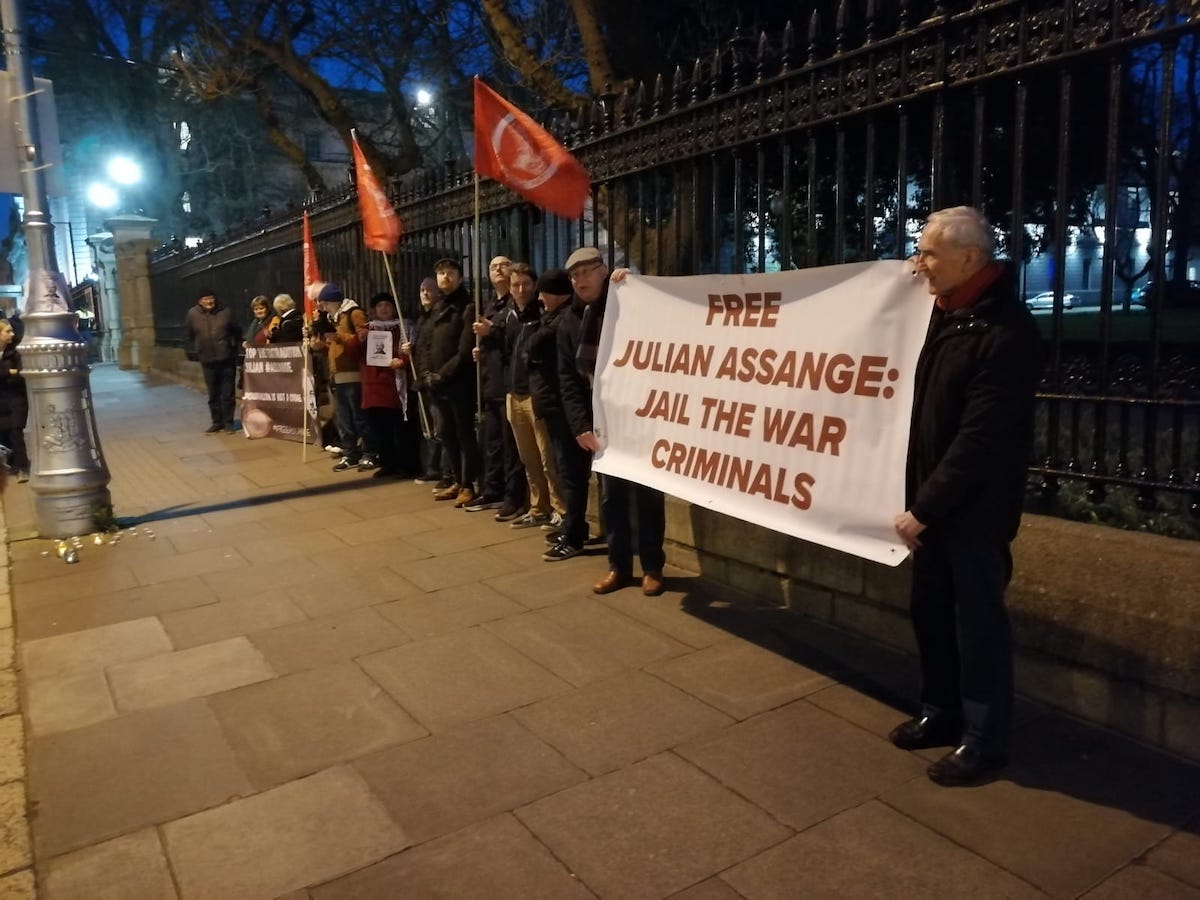
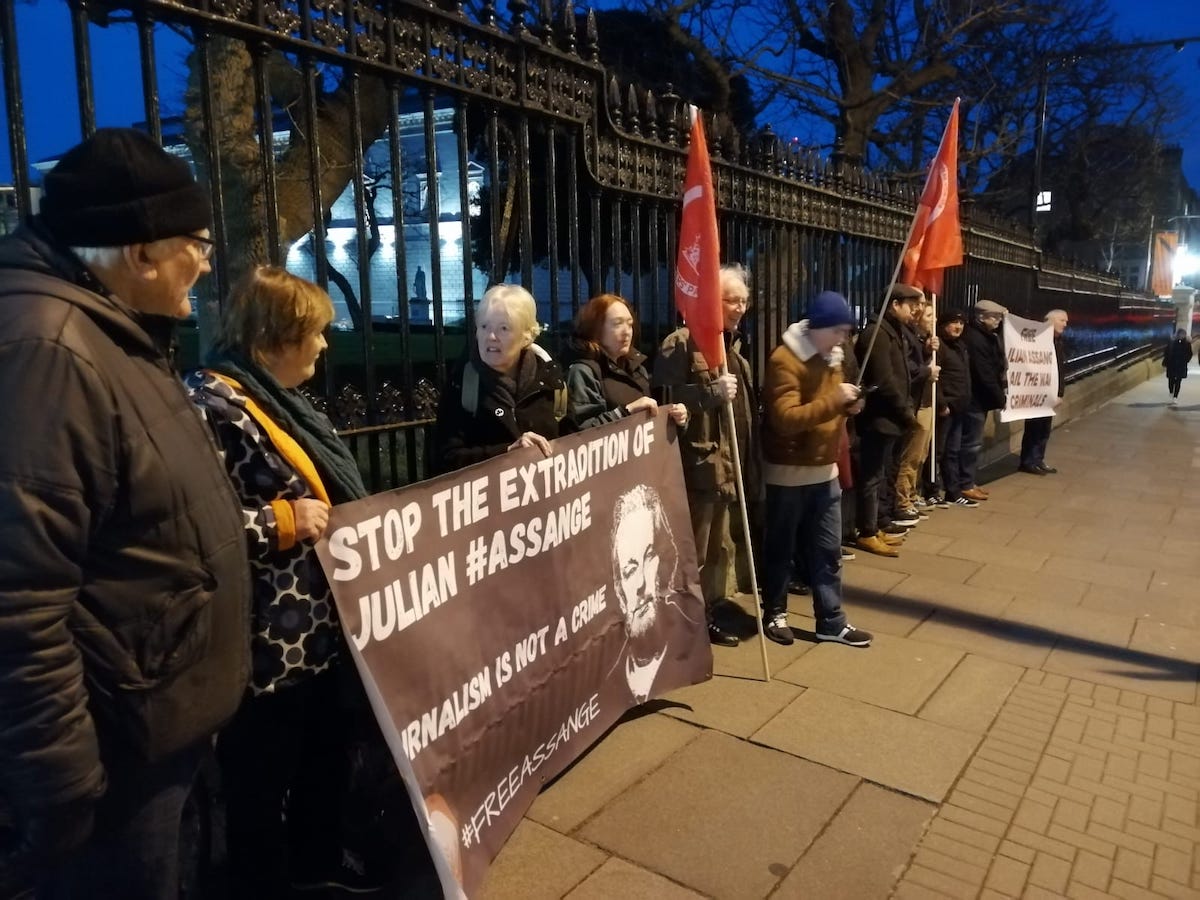
Crowds gathered in London on Tuesday and a solidarity picket with the Australian whistleblower was held in Dublin on Monday night as Julian Assange and his legal team fight their last chance in UK law to prevent his extradition to the USA.
On Wednesday the crowds in attendance inside and outside of the High Court and watching from around the world had to be content with awaiting the decision of the judges to be given at a later date.
(Photo: D.Breatnach)
Julian Assange has been hounded since he exposed murders and other murky secrets of the USA through the Wikleaks website he set up, posting items sent to him by former serving US Marine Chelsea Manning (who served military prison time but was pardoned by Obama) and others.
The CIA planned to assassinate Assange physically and then tried to assassinate his character by setting up a false rape allegation in Sweden and when all that failed, applied for his extradition from the UK under USA espionage legislation — though Wikileaks posting was entirely public.
Shamefully the UK colluded with the USA and, not trusting UK ‘justice’, he skipped bail from extradition hearings, sought and was granted asylum in the Ecuadorian Embassy in London. There a Spanish agency spied on confidential conversations between him and his legal team.
Assange lived in the Embassy under siege from 2012 to 2019, when the Ecuadorian State abrogated his asylum and allowed British police to enter what is legally Ecuadorian sovereign territory and remove him, since when he has been nearly seven years in high-security Belmarsh jail.
(Photo: D.Breatnach)
The Premier of Australia has now called for his release after the Parliament passed a motion valuing Wikileaks exposure of US wrongdoing and calling for dropping the case1 but for years governments of the ex-British colony, now much more under USA influence, did not do so.
As an indication of what Assange can face in the US system, the Guardian reports that “Earlier this month, in a separate case, Joshua Schulte, a former CIA officer, was imprisoned for 40 years for passing classified material to WikiLeaks.”
The small size of the picket in Dublin was in my view less a reflection of the level of concern in Ireland but about the organisation of his support being on occasion taken over and undermined and in earlier times depended on high-profile individuals rather than collective organisation.
(Photo: D.Breatnach)
The western mass media for which Assange provided a huge amount of column inches and many headlines through the Wikileaks exposés hardly fought for him. The Guardian spoke out for him recently but also took part in his character assassination years ago.
Even though it had been the main British benefactor of his news items. And the media is still getting footage viewing his travail, being drawn behind the cart on his way to – his execution?
The Irish Times recently spoke out for him and so did the Irish branch of the National Union of Journalists but the latter had no presence on the picket or on any other public protest at this time of which I’m aware.
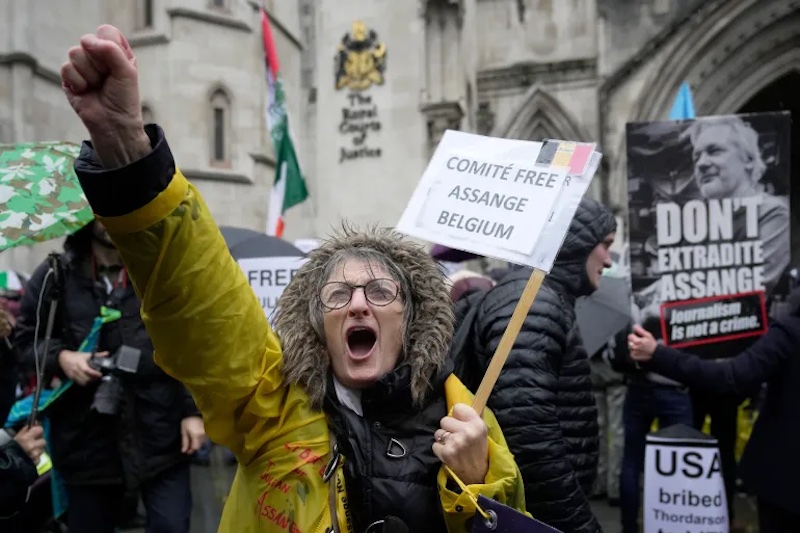
Scene from very wet and windy day outside the High Court in London (note Irish Tricolour and Palestine joint flags in background). (Photo cred: Kin Cheung/ AP)
However, the Irish Tricolour flew near the Australian flag in London outside the High Court building. Our people have been executed in that city too and we’ve had their executioners here in Ireland as well.
What we are witnessing is years of mental torture and attempt to silence permanently a man whose “crime” is to expose the sins of the world superpower and some of its allies and clients. The chief criminal of the world is hunting down a whistleblower to shut him up about its crimes.
And the ruling class of the UK, a world-class criminal also but in this case the accomplice of Mr. Big, is assisting him. The writers and editors in the mass media should be outraged and campaigning as Victor Hugo did in the Dreyfus case.
But they know who buys their bread and on which side it is buttered, as their ‘reporting’ on the genocidal Israeli campaign in Palestine has shown every day – and on the war in Ukraine before that.
My father was a journalist who had been made somewhat cynical about “the free press” by his experiences but even so he would be thoroughly sickened were he alive today.
End.
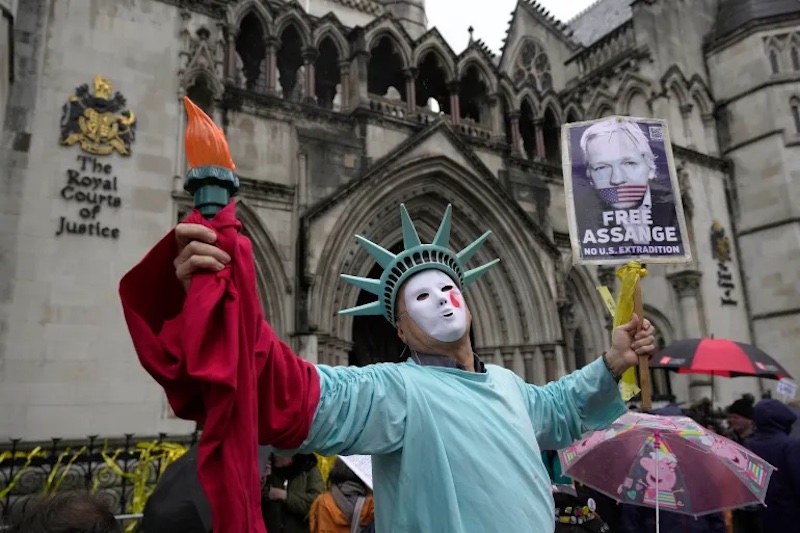
US Liberty satirised outside the High Court in London (Photo cred: Alastair Grant/ AP)
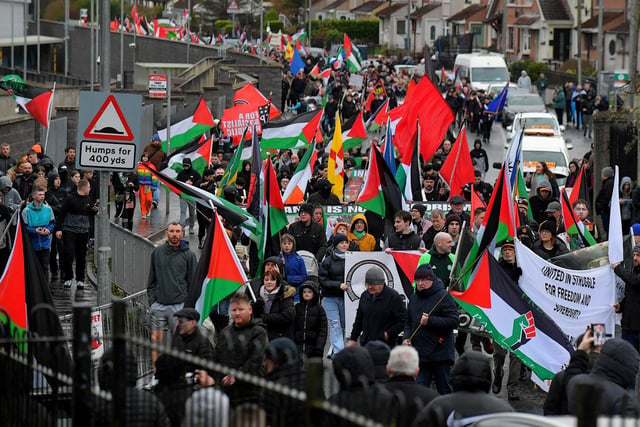
Led by four Republican marching bands and containing a number of organisations, around 6,000 people supported the annual march in Derry on Sunday commemorating the 1972 massacre by the British Parachute Regiment in the city.
This year a special focus on solidarity with Palestine had been called for by the organisers of the Bloody Sunday massacre commemoration and Palestinian flags mixed with ones of Irish Republican organisations decorated the march route.
The march begins at the Creggan Heights, overlooking Derry, a steep walk up from the Bogside, the city’s centre near the river and winds its way down (with a great view of the Foyle river and surrounding area) but then up Westland Street again and along Marlborough Terrace.
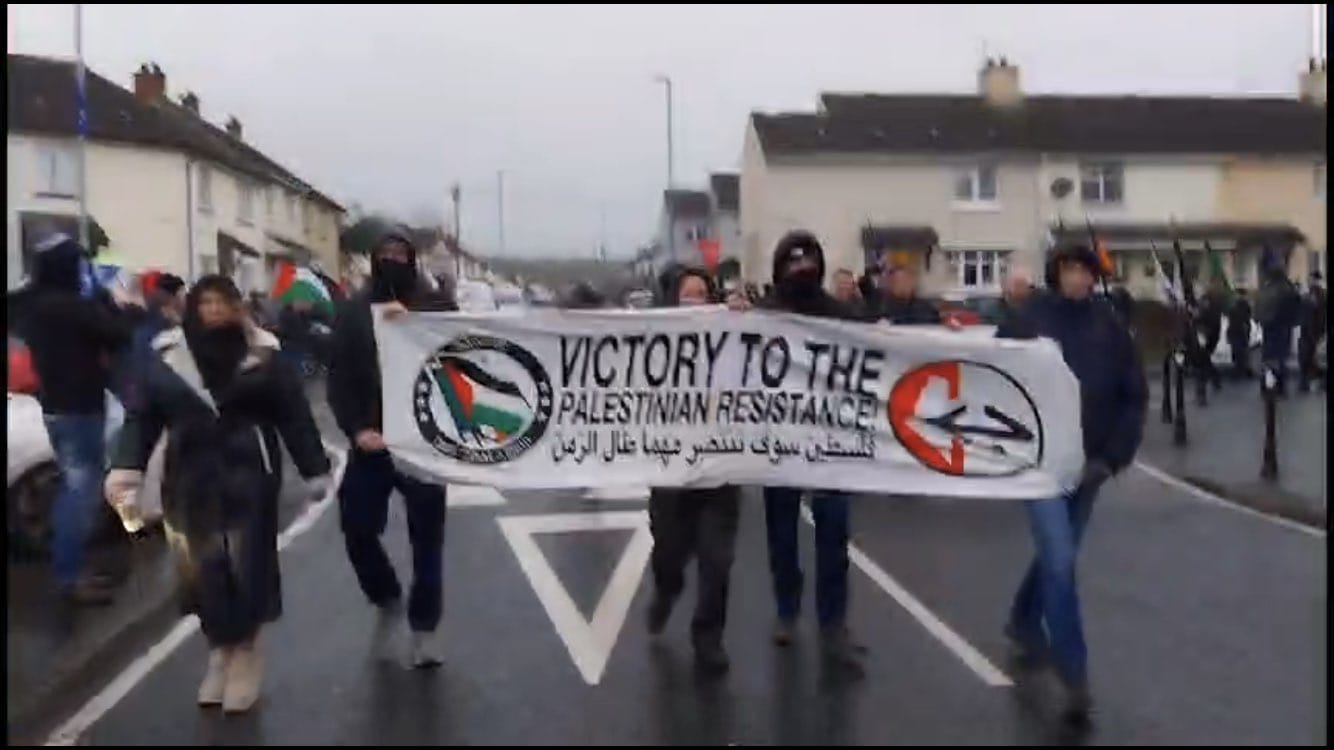
Rear banner of the AIA contingent on the Bloody Sunday commemoration march Sunday. (Photo source: AIA)
For a number of years this commemoration has taken place in heavy rain and high winds, or snow, or sleet but it was dry this year – until the march started! However after a short period of strong gusts driving rain it stopped for the rest of the march.
Down Creggan Road to the Bogside once more and past the Bloody Sunday and H-Block memorials to the rally at Free Derry Corner where Kate Nash, one of the main organisers of the march for years and a sister of one of those murdered in the massacre, welcomed the marchers.
The Bloody Sunday 52nd commemoration march makes it way along Lone Moor Road towards the Brandywell on Sunday afternoon. (Photo: George Sweeney via Derry News.)
RALLY AND SPEAKERS
Nash condemned the punitive EU/ UK/ USA cutting of funds to the UNRWA organisation carrying out relief and educational work in Gaza following an Israeli State intelligence allegation1 and also called for no Irish politicians to attend the annual US Presidential St. Patrick’s Day event.2
Kate Nash’s brother Willie was murdered by the Parachute Regiment during the massacre and her father was wounded by fire while trying to reach his fallen son. Kate called for a minute’s silence for the dead and wounded that day but also for those in Gaza, in particular the children.
Kate Nash also mentioned the Noah Donohoe case as being close to everyone’s heart.
The names of the dead and wounded by the Parachute Regiment were read out by Damian Donaghy,3 son of Damian Donaghy one of the survivors on that day. Paddy Nash performed the civil rights anthem “We Shall Overcome” which was popular among marchers of the time.
Section of the rally to the right as facing Free Derry Corner with a mural based on an iconic photograph from the massacre. (Photo: D.Breatnach)
Kate Nash introduced Huda Ammori, a Manchester-based Palestinian activist and one of the Elbit Eight,4 who said she felt at home in Derry because of the people’s solidarity with Palestine.5 The State in Britain failed to convict all but one of any charges arising out of direct action against the arms company.
Ammori drew parallels between the Irish and Palestinian struggles against colonialism and stated that her grandfather had been assassinated for rising up against the British colonisation of Palestine in 1936, when it was a British “Mandate”.
Mural on a wall in the Bogside, Derry; the words “don Phalaistín” are obscured by a vehicle. (Photo: D.Breatnach)
AIA Short Video with Music Bloody Sunday Derry 2024 AIA Video.MP4 (viewable on FaceBook)
“The British signed away the land of Palestine in 1917,” Amori told the rally, “they colonised our lands and then they armed and trained the Zionist militia to commit a Nakba, to displace over 750,000 Palestinians in 1948, over half the indigenous population.”
Huda Ammori said weapons were used on Palestinians in Gaza and then marketed as ‘battle-tested’. She also praised those who had taken direct action in Derry against arms firms (e.g Raytheon).
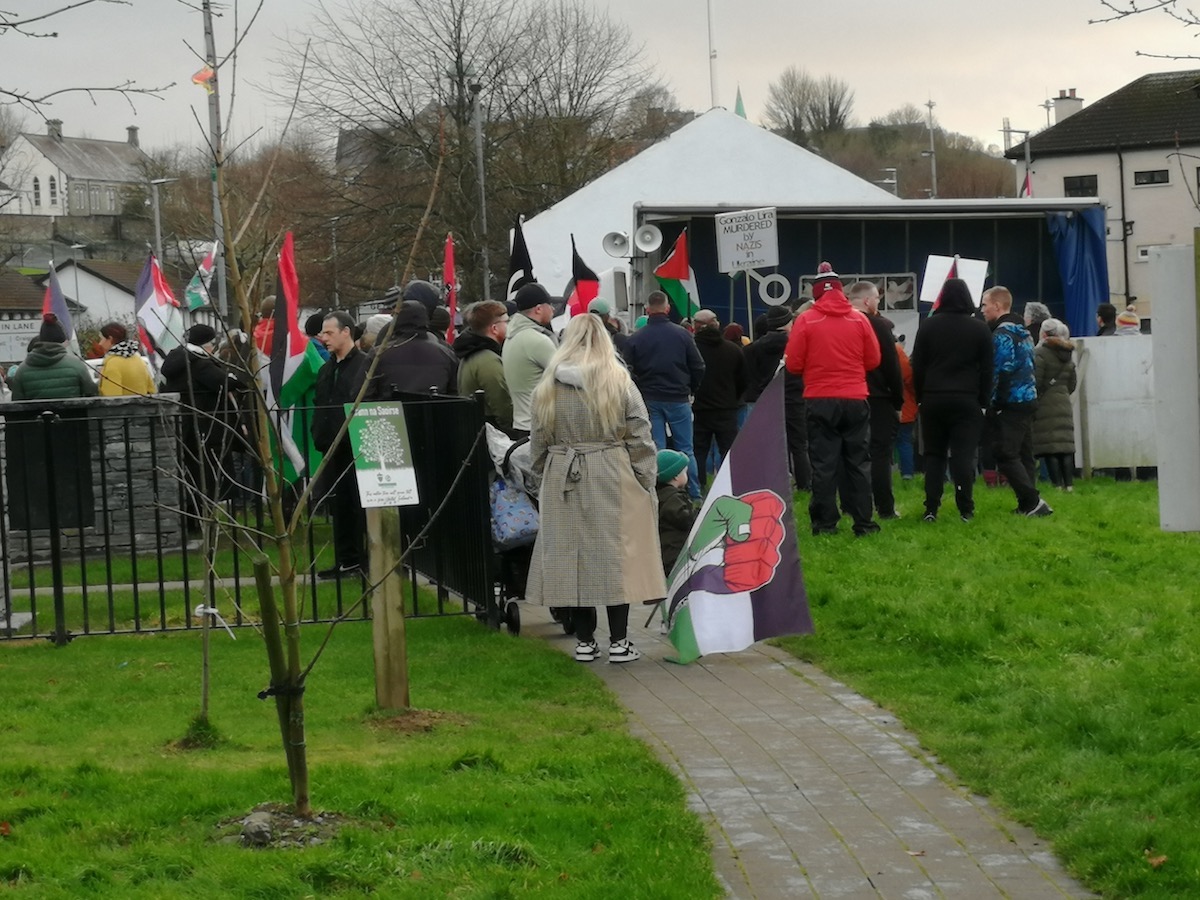
Section of crowd gathering in front of the stage for the rally. (Photo: D.Breatnach)
Geraldine Doherty, niece of Gerard Donaghy, youngest of the Bloody Sunday victims, also spoke from the platform, saying it was ‘sad’ but ‘heartwarming’ to see so many people attending the march.
“More than half a century since British troops committed this massacre on these streets, innocent children like my murdered uncle Gerard and hundreds of others as well are still being denied justice”, she said and denounced the British State attempting to prevent the trial of legacy cases being tried.
Doherty spoke of the remaining “trauma for Derry and for Ireland” from which many families have never recovered, with long-term post-traumatic damage such as depression, addiction and divided families.
“But while the people of Derry were battered and imprisoned, we were never broken,” she said to cheers from the rally participants. “Derry has rediscovered its … voice and we are using that voice to oppose the murder of children and women and men, and we stand with the people of Palestine.”
Section of crowd to the left of the stage at the rally.(Photo:D.Breatnach)
ON THE MARCH
Over the years since I returned to Ireland, I have marched in that commemoration many times, either as an individual or as a member of a solidarity committee and this year was glad to be welcomed as part of the Socialist Republican contingent, with Anti-Imperialist Action.
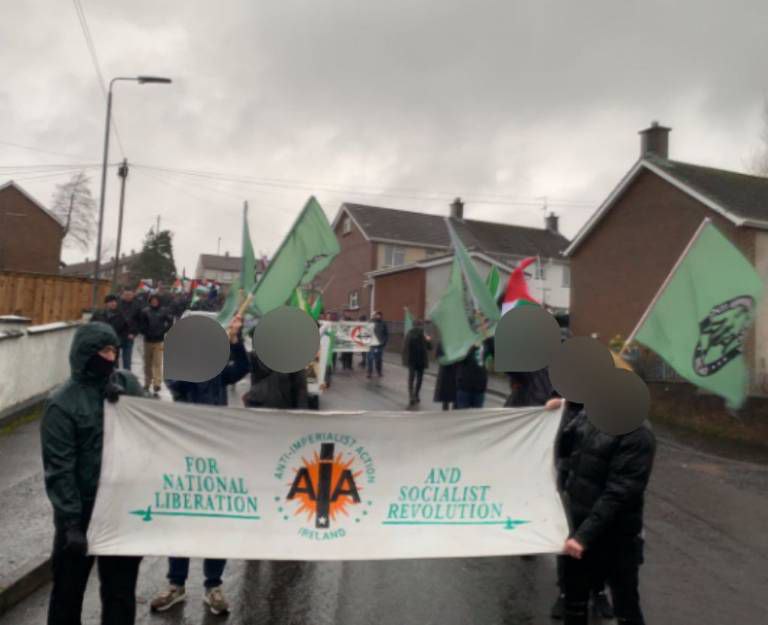
The bloc carried two banners: the one at the front was a new one in which the AIA called for anti-imperialist revolution and socialism, while at the rear the banner celebrated the Palestinian resistance. In between the banners marchers carried flags and placards.
New banner of the AIA in the organisation’s contingent on the march on Sunday. (Photo: D.Breatnach)
In the bloc men and women marched with a flags of the AIA, the Starry Plough, Palestine and Cumann na mBan. From the contingent on many occasions could be heard slogans of solidarity with Palestine and some equally applicable to that nation’s resistance or to Ireland’s.
“In the face of occupation – Resistance is an obligation!” and “No justice – No peace!” were in the latter category while “From the River to the Sea – Palestine will be free!”, “Free, free – Palestine!” and “Saoirse don – Phalaistín!” were specifically supporting the Palestinian struggle.
Most Republican organisations and some Irish socialist organisations attend the annual event, along with campaign groups and on occasion solidarity groups from abroad or Irish ones in solidarity with struggles abroad. Sinn Féin no longer attends but some supporters would as individuals.
Giant Palestinian flag displayed below the Derry Walls above the rally below. (Photo: D.Breatnach)
THE MARCH ROUTE AND HISTORY
The Bloody Sunday march covers the same route as the anti-internment march in January 1972 when the British Paratroopers murdered 14 unarmed marchers and injured so many others. Preceded by the Ballymurphy Massacre in August 1971, it was followed by another in Springhill in July ‘72.
The British military claimed that the Derry victims had been armed and fired first and an inquiry tribunal headed by Lord Justice Widgery exonerated the Army and blamed the victims although the Derry Coroner, an ex-British Army officer had called it “sheer unadulterated murder”.
In 1998, presumably as part of the Good Friday Agreement deal, the British State began a new inquiry which however did not deliver a published verdict until 2010,6 stopping short of accusing the Army of murder but exonerating all the victims except one about which it was equivocal.
At that point, Sinn Féin’s Martin McGuinness said that the march should not be continued; however not one British soldier had even been charged, to say nothing of the commanders and Government Ministers who had either given the orders or arranged the cover-up – or both.
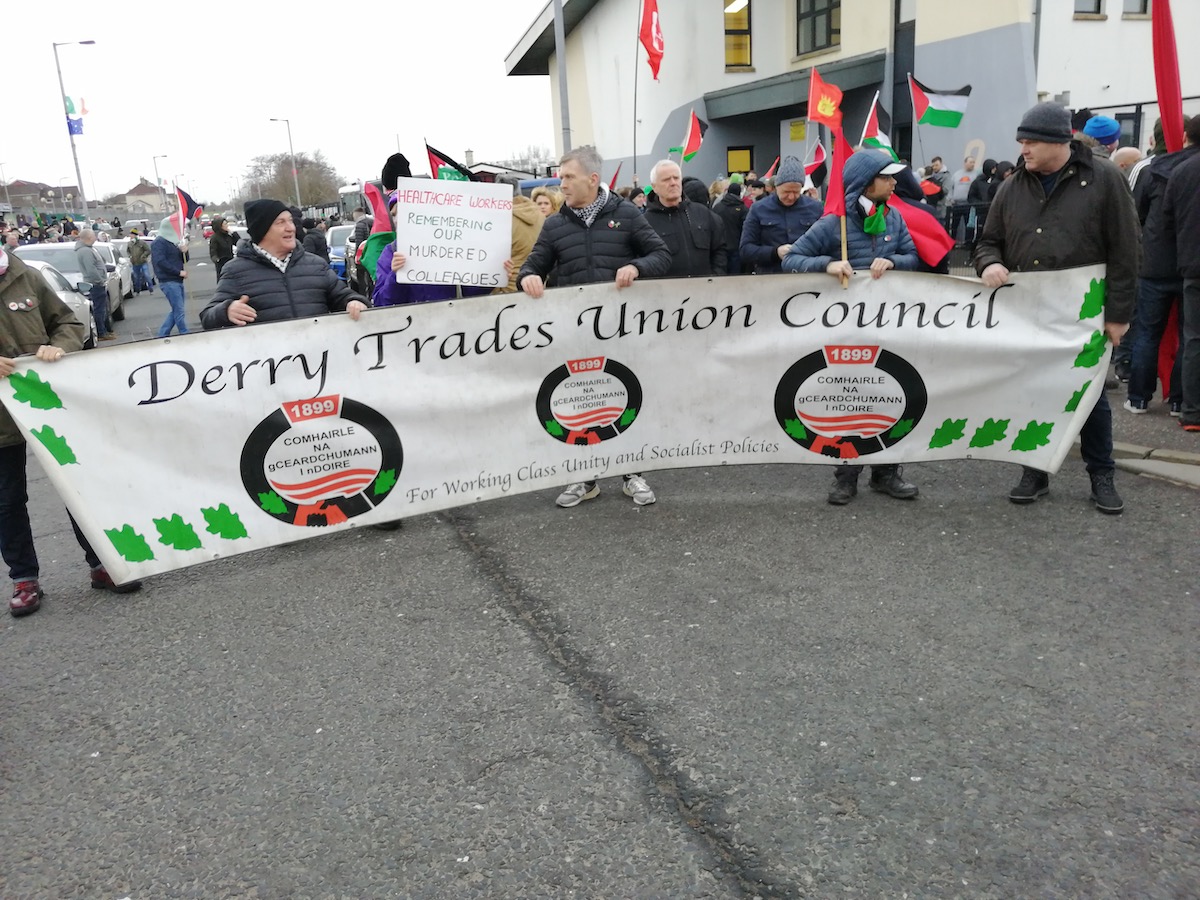
Banner of the organisation combining representation of trade unions in Derry. (Photo: D.Breatnach)
A small group of veterans of the original march and relatives, Kate Nash prominent among them, however decided to keep the march going and have done so every year, often in the face of accusations and disparaging remarks from supporters of Sinn Féin and others.
In 2022, the Massacre’s 50th anniversary, 20,000marched in it while the Bloody Sunday Trust, an institution and museum supported by the colonial state and Sinn Féin, organised a small “memorial walk” and indoors event in the Guild Hall – the only one reported by the mass media.7
An independent group, badly needed since the Coiste na nIarchimí is controlled by the Provisionals. (Photo: D.Breatnach)Display below Derry Walls created by the Saoradh Irish Republican organisation, according to their social media. (Photo: D.Breatnach)
Although veterans of the massacre and of the annual commemoration often meet one another only once a year at the commemoration, some having come from abroad, there are always new young people to be seen among them and hundreds come out to watch the march.
The march is an important commemoration of a massacre by British colonialism which still holds the colony of the Six Counties, a reminder no doubt inconvenient to unionists, neo-colonialists and those who have left the struggle, either through lack of will or for personal advancement.
In its championing and giving voice to other conflicts too, the commemoration march and other related events during the week are a strong expression of internationalist solidarity.
Wreath of the Bloody Sunday Commemoration Committee among others at the Bloody Sunday Monument. (Photo source:Bloody Sunday Commemoration Committee)
End.
FOOTNOTES
1The Israeli state intelligence agency reported that 12 out of 13,000 employees of UNRWA in Gaza had been implicated in the 7th October Palestinian raid following which at least some, possibly all, were sacked by UNRWA, apparently without any hearing or appeal process. The US, UK, Germany, Italy followed this up by suspending all funding to the relief organisation catering for 2 million people in dire circumstances.
2Traditionally, leading politicians of the main Irish political parties, both mainstream and Sinn Féin, have sent representatives to celebrate St. Patrick’s Day with US Presidents, many of whom are of Irish descent. This year a campaign has arisen calling on them not to do so but spokespersons of Fine Gael, Fianna Fáil and Sinn Féin have insisted they will attend, which the SDLP has declared it will not.
3Not to be confused with the family of Gerard V. Donaghy (20 February 1954 – 30 January 1972), sometimes transcribed as Gerald Donaghey, a native of the Bogside, Derry who was murdered by members of the 1st Battalion, Parachute Regiment on Bloody Sunday.
4Eight activists of British-based Palestine Action, a direct action organisation, who as a result of their actions against the Israeli-based military technology company Elbit in Britain, were charged with a total of 12 charges which included criminal damage, burglary and encouraging criminal damage. The trial, which commenced on November 13th, related to a series of actions taken during the first 6 months of Palestine Action’s existence from July 2020 to January 2021. In December last year, one activist was convicted on one charge by 10-2 majority, two were completely cleared and jury failed to reach a majority verdict on the rest of the charges on six remaining activists.
5That would be true of the majority ‘nationalist’ population of the city but not so much of the unionist minority, where support for Israel is more dominant, due in part to susceptibility to British propaganda and also simply out of sectarian hostility to anything favoured by the ‘nationalist’ community.
6At a cost of nearly £200m (€227.7m), half of which went in legal fees, a lawyer’s bonanza, to arrive at a decision that just about everyone in Ireland knew and many abroad knew already and which established no safeguards against a similar massacre being carried out by British military in future.
7Browser searches throw up report after media report, including Al Jazeera’s, of “hundreds” attending the early event, without a mention of the many THOUSANDS who marched later in the day.
Frank Kitson, a leading terrorist and General in the British Army, died today at the age of 97.
As the national liberation struggle of the Occupied 6 Counties began, Kitson was appointed as commander of British forces in Belfast in 1970. He organised “countergang” death squads such as the Military Reaction Force and the Force Research Unit.
These units bombed and randomly targeted innocent nationalists, attempting to place the blame on the IRA. He promoted infiltration of and psyops against the Republican movement. He emboldened and directed Loyalist death squads and deployed the Paras to massacre nationalists.
Kitson was a leading figure in the British counterinsurgency campaigns in Malysia and Kenya. It was here he developed his theories on how to crush national liberation and communist struggles.
He advocated for massive population control and terror to deprive struggles of support. He advocated for forming paramilitary groups that were free to terrorise and assassinate at will, as well as spread doubt among natives. He drew from these campaigns and deployed them in occupied Ireland.
As an advocate of psyops, Kitson used the mainstream media to spread malicious lies about the Republican movement, including absurd propaganda such as claiming that the IRA were found to be worshipping Satan.
Under his command and through his recommendations prisoners were tortured, civilians brutalised and countless were interned.
While Kitson was removed from his position in 1972, his theories and the framework he established in Belfast came to be adopted by the British imperialists in Ireland for decades.
Many of the terror strategies he developed are used in Ireland and in imperialist occupations around the world today as part of “low intensity operations”.
Frank Kitson was a crusader for Empire and he was well rewarded for his campaign of murder and terrorism. He also lauded by the British press and given countless awards.
It is shameful that he never faced the People’s Justice for his crimes. That this man was allowed to retire and live out his life in peace is a symptom of the deep sickness in British society. That this man dies with full honours shows that collusion, terror and murder were official British state policy in Ireland.
As the imperialists have developed their tactics and strategies, so have the people. No matter what new innovations in subversion, terror and brutality the enemy comes up with they will be overcome. The struggle of the Palestinian Resistance today has taught the imperialists that lesson once again.
The struggle for the All Ireland Republic continues despite the best efforts of British imperialism. One day soon the British Empire will be buried along with Frank Kitson.
Among Christmas shopping crowds in Dublin’s city centre, the calls for freedom of political prisoners rang out, while the Irish, Palestinian and Basque flags fluttered in the wind among festive lights and projected light-show.
The Ireland Anti-Internment Campaign was holding its annual political prisoner solidarity picket in the busy O’Connell street, supported by socialist Republican groups and independent activists.
View of picket line looking southward. (Photo: Rebel Breeze)
December is a traditional month in Ireland for focus on Republican prisoners. However, the IAIC campaign has always made a point of remembering political prisoners elsewhere too, with Palestinian and Basque flags erected on its regular pickets.
This year the Campaign had especially requested Palestinian flags and these were present, both the national flag and that of the Peoples Front for the Liberation Palestine, fluttering alongside Basque flags and the green-and-gold Starry Plough.1
In addition, one of the IAIC’s banner displayed a large copy of an image depicting a Palestinian’s arm extended through prison bars to grasp the hand of an Irish Republican prisoner’s hand also from nearby bars, from the original by political cartoonist Carlos Latuf,.
A black banner had been rigged with lights to spell “Saoirse”, the Irish word for “freedom” and the picketers set up in a line with other banners and flags facing the GPO building.2
Political prisoners sometimes have their family visits cancelled as a punishment and during the Covid pandemic prevention period it was used as an excuse to prevent Republican prisoners’ family visits. (Photo: Rebel Breeze)
SHOUTS
A speaker using a megaphone informed passers-by that internment without trial had not ceased in Ireland and that Republicans were being charged and then refused bail by non-jury courts on both sides of the British Border, spending two years in jail regardless of their trials’ outcomes.
All the Republican prisoners, the IAIC speaker said, had been convicted in non-jury special courts. Palestinians were also being convicted in special courts, he said, military courts and many were in jail – in “administrative detention”, i.e interned without ever having been convicted or tried.
Over 3,000 had been arrested in Israeli Army raids since October 7th,3 the speaker said through the megaphone, bringing the overall number of Palestinians in jail to over 7,000.4
(Photo: Rebel Breeze)
The recent exchange of prisoners between the Zionist state and the Palestinian resistance had resulted in liberty for 240 Palestinians, of which 1075 were children and 68 women.
There was regular chanting from the picket line including: “From Ireland to Palestine – Free all political prisoners!” “When there is occupation – Resistance is an obligation!” and “Free political prisoners – Free them now!”
At one point some kind of religious procession was briefly enacted in front of the GPO building and an elderly woman in apparent religious garb approached the picketers shouting something at them which they largely ignored, maintaining their solidarity slogans.
(Photo: Rebel Breeze)
In addition to interested people taking photos or filming video of the protest on their devices, some approached the participants to ask questions and to receive a leaflet, after which a number actually joined the protest line for a while (some until the end).
Occasional passing traffic also sounded their horns in solidarity.
The pavement in front of the GPO showing shoppers and people queuing for food distribution. (Photo: Rebel Breeze)
STATEMENT
As the end of the event’s allocated period approached, a representative of the IAIC asked the participants to gather around and spoke about how resistance brings repression and oppression brings resistance, resistance being the “crime” for which political activists are jailed.
The participants were thanked for their support, whether independents or activists of Ireland Anti-Imperialist Action and Saoirse Don Phalaistín organisations.
The event ended with the acapella singing of “The H-Block Song” by Diarmuid Breatnach, in an adaptation of the original air to the lyrics of what is “still a good song” he said, composed by a man who, along with his party, “no longer supported Republican prisoners”.6
(Photo: Rebel Breeze)
The lyrics recall the struggle of Republican prisoners in the late 1970s against the removal of their ‘Special Category’ political status, which began with refusal to wear prisoner uniform. The struggle escalated to the “no-wash protests” and to hunger strikes in 1980 with ten martyrs in 1981.
As the protesters collected their flags and wrapped up their banners, the nature of current Irish society was underlined by the queues forming up across the road for free food being distributed by charitable organisations.
Early view of picketers, looking northward. (Photo: Rebel Breeze)
INDEPENDENT AND OPEN DEMOCRATIC ORGANISATION
The IAIC is “an independent organisation and open democratic organisation” of ten years’ existence and although it has held events for specific cases such as the framed Craigavon Two,7 its main activity has been regular public pickets in Dublin to highlight ongoing internment in Ireland.
The Campaign group encourages participation by democratic people in its regular pickets, regardless of political organisation affiliation or none and, according to one of the organisers, expects to hold its next one in Dublin in January or February.
The IAIC expects also to take part again in the annual Bloody Sunday Commemoration march in Derry on Sunday 29th January 2024.
end.
Unintentionally impressionistic image, photo taken from the east side of O’Connell Street (Photo: Rebel Breeze)
APPENDIX: ANNIVERSARY OF HANGING OF IRISH REPUBLICAN
Though not mentioned in the discourse, the above event took place within days of the anniversary of the British colonial execution of an Irishman in revenge for his killing of an ex-Republican who had turned informer.
James Carey, in the midst of a ‘witness protection program’ provided as a reward for his betrayal of his comrades in giving evidence in court to ensure the jailing of some and hanging of five others, was killed in a gunfight with Pat O’Donnell.
Carey had been a leading member of the National Invincibles’ (a split from the Fenians) cell in Dublin, and had given the signal for the fatal stabbing of British Under-Secretary Burke and Chief Secretary Lord Frederick Cavendish in Phoenix Park on 6th May 1882.
However, Carey turned “Queen’s Evidence” to testify ensuring the conviction of his former colleagues and even gloated in court at their fate. His reward, but for O’Donnell, would have been a new life with pension under an assumed name with wife and children in the South African colony.
O’Donnell was an independent Republican from the Irish-speaking Gweedore area in Donegal but had been to the USA, where he had cousins who were prominent in the “Molly Maguires”, an Irish-led resistance organisation among miners in the USA.
O’Donnell was hanged on 17th December 1883 but is commemorated in the satirical song “Monto” and also in the serious “Ballad of Pat O’Donnell”. His home town of Gweedore also holds a monument in his honour.
end.
FOOTNOTES
1Flag of the Irish Citizen Army, the first workers’ army in the world, founded to protect workers from the police during the Dublin Lockout/ Strike of 1913.
2The General Post Office, iconic building on Dublin’s O’Connell Street, which was the HQ of the leadership of the 1916 Rising, left a shell by fire from British artillery bombardment but rebuilt later.
6Francis Brolly (1938-1920) of Provisional Sinn Féin, composed the song which was released in 1976. PSF abandoned the struggle in the imperialist-promoted pacification process towards the end of the last century and most of their prisoners were released under licence. However those who made public their disagreement with the colonial occupation and the pacification process were on occasion returned to jail while new “dissidents” were charged and refused bail in special no-jury courts, with tacit support of the PSF.
The Irish State is one of four of the European Union which are not also members of the US/NATO military organisation1 but the Irish national ruling class keeps up propaganda to get its citizens to accept the “need” for membership.
The UK’s colony of Six Counties is included in NATO which means that over one-fifth of Irish land is already formally a part of the imperialist military alliance.2 In addition, successive Irish State governments have long been collusive in permitting US military use of Shannon Airport.
The ruling class’s propaganda is emitted not only by politicians’ statements and pro-NATO conferences3 but also through media articles. In this article4 the headline clearly gives the impression that the UK is rendering Ireland needed protection from Russia:
“UK had to come to Ireland’s aid with Russian submarine hovering off Cork harbour”!
Image shows two RAF Typhoons sitting off of the wing of a Voyager tanker after taking on fuel. A multitude of Royal Air Force aircraft flew in-support of Exercise Joint Warrior 2020, most notably 617 Squadron F-35B’s who flew alongside US Marine Corps (USMC) VMFA 211 Squadron F-35B aircraft. (Image sourced: Internet)
WITH ‘PROTECTORS’ LIKE THAT …!
In fact, throughout the history of the existence of the Russian entity, whether as kingdom, empire, socialist or capitalist state, not once has it caused or even threatened the Irish people (and during the 1916 Rising and war of independence its leaders praised the Irish struggle for independence).
On the other hand, the rulers of England, being cast as our protectors, have invaded and colonised Ireland, stolen our natural resources, exploited and massacred our people, repressed our resistance, undermined language and culture, sabotaged our economy and finally partitioned our nation.
To obliterate that reality from Irish popular consciousness is far from easy but first the English and then the Irish national ruling class or bourgeoisie has been at work on that project for centuries.
In 1366, less than two centuries after invasion, the Statutes of Kilkenny sought to end the cultural integration of its colonists, whom the English rulers called “the degenerate English” and whom they accused of having “become more Irish than the Irish themselves”.
During the 16th and 17th centuries the English Crown carried out a number of wars in Ireland to force the indigenous Irish and many of its colonists to accept the Crown’s religion as their own and even exported Irish people as slaves to their American and Caribbean colonies.5
They also organised a number of settlement colonies on Irish land from which they had expelled the natives, requiring the settlers to be English-speaking, non-Catholics, to build house and town for defence and not to employ Catholics.
In the 1780s the English occupation created an Irish colonial chivalric order, the Order of St. Patrick, with a red saltire, to which Irish settlers and Irish were encouraged to belong. That saltire, along with St. Andrew’s, is worked along with the cross of St. George to make the Union Jack.
Towards the end of the 18th Century the English founded the Orange Order to foster division between those of Catholic faith and adherents of the various Protestant sects; then repressed the Republican rising and instituted a reign of terror.
They followed that up at the turn of the Century by organising the dissolution of the Irish Parliament and repression of another Rising. Later that century they oversaw the elimination of a third of our population once again through starvation, disease and forced migration.
Their colonial education service spread the English language further, penalised Irish-speaking children and encouraged children to think of themselves as “English”: ‘Indeed, the following verse was to be hung in every national school:
“I thank the goodness and the grace That on my birth have smiled, And made me in these Christian days A happy English child.“’6
In the early decades of the 20th Century the English ruling class, by now of the UK, suppressed another rising and sent thousands off to die in imperialist war, outlawed an Irish popular democratic parliament and fought a war or repression and terror against the Irish people.
Following up on that, the Crown subverted a section of the nationalist movement and instigated a civil war against Irish Republicans, arming and clothing the army of the neo-colonial Irish Free (sic) State which executed formally and informally over a hundred Republicans.
During the 1970s British intelligence service agents and proxy militia terrorists carried out a number of bombings in Ireland, the one in 1974 killing 34 people (including a full-time foetus) in Dublin and Monaghan,7 the highest toll of any day during the whole three-decades war.
In the final three decades of the last decade the UK waged a direct military and proxy terrorist war against the Irish nationalist people in their colony.
MASS MEDIA PROPAGANDA
As noted earlier, the Gombeen (neocolonial) Irish bourgeoisie has been trying to obliterate the deep consciousness of that history by promoting equivocation and doubts through reactionary historical revisionism and even removing significant sections from the history curriculum.
The mass media is another important leader in this work. In the featured piece we see that it is the headline that delivers the NATO-and neo-colonial conditioning message, albeit without mentioning those and indeed by adding material that cannot be read in the actual text of the article.
British nuclear submarine (Image sourced: Internet)
“Security and defence analyst Declan Power said Britain often finds out about these things before we do.” Yes, we can be sure that it does!
“What exactly was the Russian submarine doing there? It should be looked at in the broader array of defence arrangements in that the Russians will be regularly testing the defence responses of Nato nations… in particular the UK.”
“Because the UK and the Scandinavian countries have responsibility for monitoring an area known as the Icelandic gap.”8The piece concludes with a suggestion of threat to Ireland, stating that the incident occurred “south of the entrance to Cork Harbour.
Perhaps but over at least 12 miles away, so in fact it would’ve also been in a line west of Devon and Wales in Britain and line north-west of France! The article concludes by stating that “Russia has been regularly testing British air defences off Irish shores in recently (sic) years.”
Yes, “testing BRITISH air defences” and the UK is no doubt doing the same to Russia. Britain, as the UK, is a member of US/NATO, which is not only opposed to Russia but has been encircling it for decades before instigating a proxy war against it.
Far from protecting Irish people, British military manoeuvres around and over9 Ireland, its bases in the Six County colony and US military uses of Shannon airport actually place us in great danger in any wide conflict in Europe or in world war.
And then of course, there’s the little matter of colonial occupation of a part of our nation and neo-colonial domination of the rest through our compliant national ruling class. The UK military is no friend of people anywhere — and least of all a friend of the Irish people.
End.
Footnotes
1The other three are Cyprus, Malta and Austria. As of yet nor is Sweden but the expectation is of joining very soon.
2There are 32 counties in the whole Irish nation and the names of all but three in English are corruption of Irish words (including all of the Six in the colony).
The following is a compilation by Rebel Breeze of recent short communiqués from Anti-Imperialist Action on the confrontation with a British warship in Dublin and the raids on activists’ homes and arrests under the Gombeen State’s “terrorist” legislation (Offences Against the State Act).
Armed British Terrorists Confronted in Dublin.
On Sunday afternoon, members of Anti-Imperialist Action Ireland along with members of Saoirse Don Phalaistín, carried out a direct action against a British warship in Dublin port.
The protest was called to highlight the ongoing British Occupation of Ireland and to make clear the complicity of British Imperialism in the ongoing Zionist Occupation and Genocide in Palestine. The protest made clear the links between the National Liberation Struggles in Ireland and Palestine.
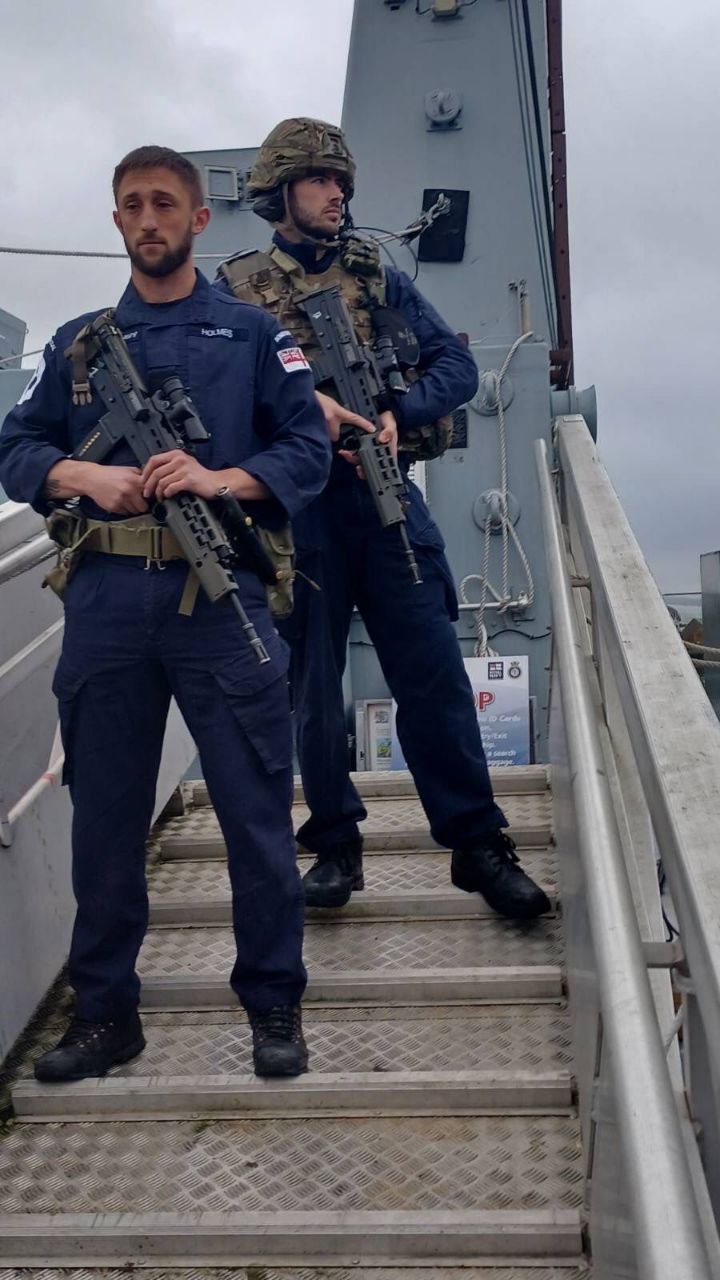
British Military confronting protesters in Dublin (Image sourced: AIA)
In a militant protest, the activists, chanted ‘From Ireland to Palestine, occupation is crime’ and Britain Out of Ireland and Palestine.’
During the course of the protest, the Republican Activists present confronted Armed British soldiers who appeared on the deck of the ship and a stand off ensued on the gangway.
End the occupation! End the genocide!
Free Palestine!
Free Ireland!
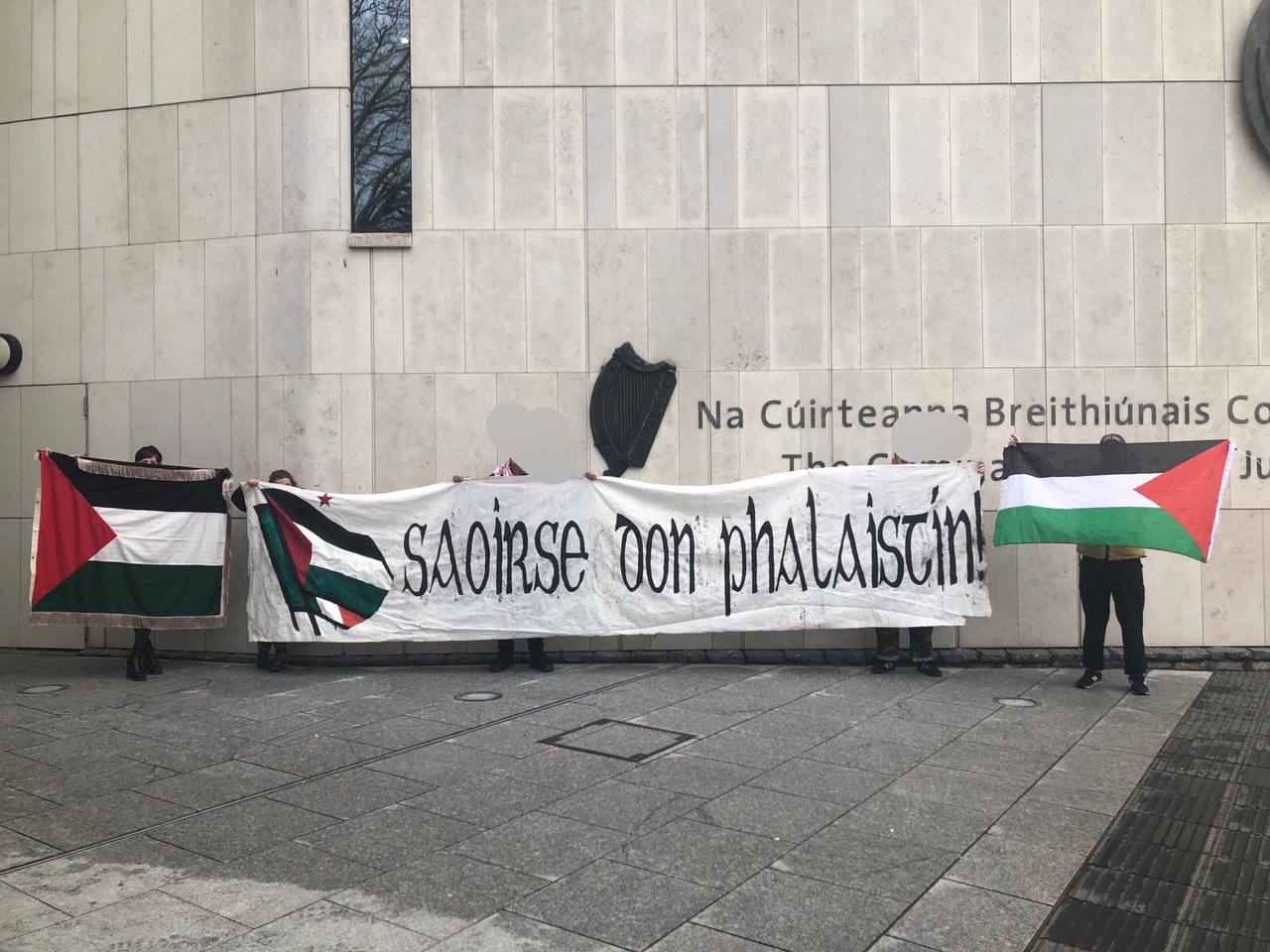
Solidarity picket outside the Dublin courts (Image sourced: AIA)
In a series of coordinated raids in Dublin this morning, a number of Republican Activists have been arrested and detained under section 30 of the Free States “Offenses against the state act”.
These arrests come as the state is increasingly fearful of the growth in Revolutionary Irish Socialist Republicanism and of Anti Imperialist Action Ireland in particular.
The arrests are timed to coincide with the leading role AIA has been playing in support of the Palestinian People and Resistance across the 32 counties and at a time when our members continue to confront and resist Imperialism across Ireland.
(Image sourced: AIA)
AIA condemn the raids and arrests by the Drew Harassers on Republican Community Activists and we call for these activists to be released back to their families and communities immediately.
Harassment, Raids, or Arrests will not stop AIA and Republican Activists from our work to rebuild the struggle for National Liberation and Socialist Revolution, resisting Imperialism or from taking a stand for Palestine.
The Republican Community Activists raided and arrested in Dublin yesterday have been released without charge.
The operation by the Drew Harassers, no doubt at significant cost, was designed to intimidate the growing membership and support base of AIA across Ireland, but it has failed, as all such operations will fail.
AIA welcome home these activists to their families and communities, where they belong. Republicans are not criminals. We will continue to promote the legitimate demand of rebuilding the Republic of 1916 at every opportunity. We will not be deterred and ultimately we will win.
Yesterday’s arrests are only further proof that the Free State fears the message of Revolutionary Socialist Republicanism, fears the growth and levels of support for AIA, fears our support for the Palestinian Resistance and fears our continued legitimate direct actions to confront and resist British, North American, European and Zionist Imperialism in Ireland.
We won’t be going away!
Free Ireland!
Free Palestine!
Also on Saturday, after the giant Palestine solidarity march in Dublin, according to another communiqué, members of AIA, Saoirse Don Phalaistín and Palestinian Solidarity Activists picketed the Leonardo Hotel on Parnell St.
The Leonardo Hotels are owned by Fatell Hotels the largest hotel group in ‘Israel’ and strong supporters of Zionist terrorism and genocide.
In response to the picket, the hotel has decided to enter lockdown, refusing to open the doors for guests.
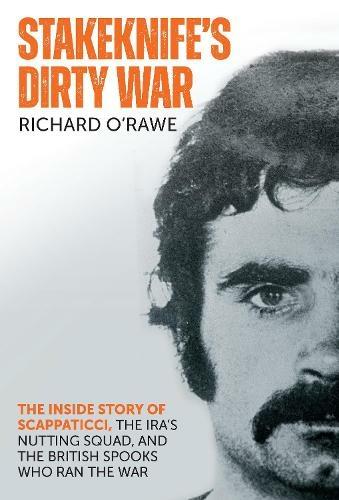
Richard O’ Rawe’s Stakeknife’s Dirty War is a timely book, coming as it does after the death, or supposed death of Stakeknife in England and what looks like a thwarting of the intent and findings of Boutcher’s Kenova Inquiry into the affair.
It is now accepted by all that IRA Volunteer Scappaticci was also the British agent known as Stakeknife.
O’Rawe had access to IRA volunteers and former intelligence operatives and weaves together aspects of Scappaticci’s life and role into a narrative that is convincing and despite the nature of the subject matter, torture, murder and betrayal it is an easy read.
O’Rawe also introduces us to Scappaticci the person. The person however, isn’t any more likeable than the British agent, torturer and murderer. In fact, it would seem they are flip sides of the same coin. Scappaticci was an industrious character, always on the make, running private tax scams.
He was used to money long before he became a paid British agent. His fortune earned from murders on behalf of the British and the IRA, though the IRA weren’t giving him anything like the sum the British did, is estimated to be in the region of a million pounds in pay-outs.
He also had various properties. Scappaticci was also a lowlife thug long before the British and the IRA gave him carte blanche to murder and torture his way through republican ranks. Some of things he did, had he not been in the IRA would have led to him being kneecapped by the IRA.
A man called Collins made the mistake of publicly calling the area in Twinbrook in which Scappaticci lived ‘Provie Corner’. Scappaticci did not like that and decided that Collins had to pay for his transgression.
He knocked on Collins’ door and, when it was answered, the informer battered the older man multiple times over the head with a sock containing a brick. Only when Collins collapsed did Scappaticci walk away.
This is the type of low life thuggish behaviour that the IRA was willing to tolerate and perhaps even encourage from people like Scappaticci. In a genuinely political movement, a thug like Scappaticci would have been out on his ear. But not in the IRA nor in Sinn Féin.
He was, to paraphrase the Yanks when talking about the Nicaraguan dictator Somoza, “he may be a son of a bitch, but he is our son of a bitch”, though in this case it would seem that not only was he theirs he had just the qualities that both the IRA and the British valued, ruthless thuggish qualities.
Scappaticci the person and agent are intimately related it would seem though O’Rawe doesn’t explicitly say so. He does however, give us ample material with which to draw that conclusion.
One of the issues never dealt with it in the press and not really fully covered here is what type of organisation recruits, tolerates and promotes such people. He was a reprobate who should never have graced the ranks of the IRA. That he did so, is down to Adams and co.
That is also clear from the book. It is not an aspersion on Adams or on McGuinness either to question their role.
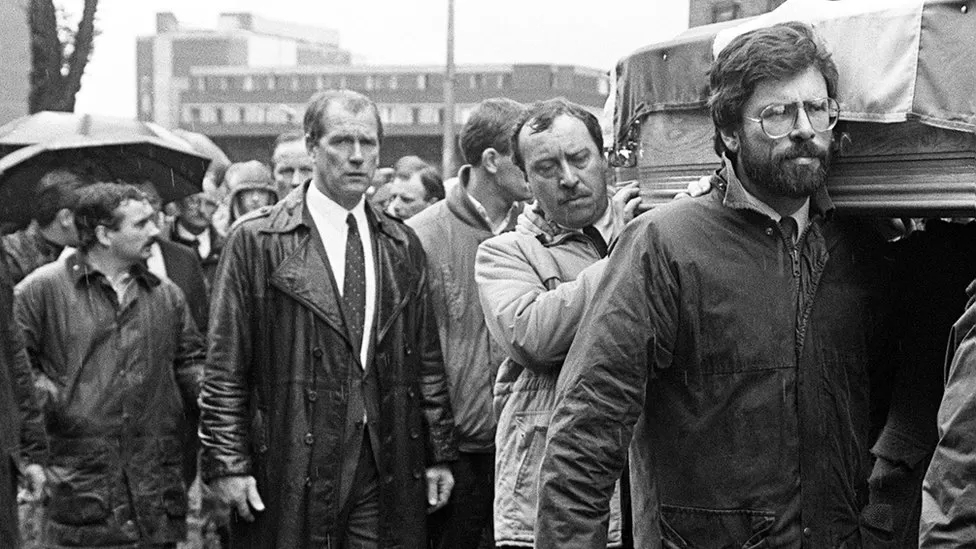
Republican funeral, Scappaticci on left photo, Adams on right (Photo cred: Pacemakers)
The latter of the two comes in for some questioning in the book regarding his role and O’Rawe goes into some detail and also explains in the epilogue that before beginning his research he was unaware of the level of unease amongst republicans about McGuinness’ trustworthiness.
Though he does point out earlier that if McGuinness was a tout, why was it necessary for the British to have a spy such as Willie Carlin get close to him. The same could also be said of Adams.
The British had an agent, Denis Donaldson, whispering sweet nothings in Adam’s ear over many years, shaping Adam’s view of the world and reporting back to the British how successful he had been in his endeavours.
The Peace Process, in that regard, was partially the result of what ideas the British planted in Adam’s and McGuinness’ minds through their various agents. However, it does seem unlikely either of them were touts in the classical sense of the word.
They didn’t need to be, they were at a different level. They were both on the same side as Scappaticci in winding down the war, they just had different methods of going about it.
It is possible that at some stage they had dealings with the British security services in pursuit of common aims. O’ Rawe is not the first to question McGuinness either.
Ed Moloney has put forward the idea that the reprehensible proxy bombs that provoked so much revulsion were signed off on, precisely because they would strengthen the hands of those who sought to wind up the war.
O’Rawe gives many examples of what Scappaticci and the other British agents in the Internal Security Unit did. It wasn’t limited to executing alleged informers or those the British thought should be removed for various reasons under the guise of them being informers.
They were also in a position to give information on operations which led to the British either arresting or killing the Volunteers involved. The book opens with an account of one such operation, where fortunately they were able to pull back from it without the planned British ambush going ahead.
There were of course other incidents, one of them being Loughall where the British ambushed an entire unit of the IRA. Scappaticci and his ilk did great harm to the IRA, but they were not the reason the IRA lost the war, and O’Rawe doesn’t argue it was either.
However, others have made this point. But the IRA was never going to win the war, they weren’t going to outgun the Brits ever.
Another part of the problem of course, is related to Scappaticci. A movement so highly infiltrated would always have problems, but it is telling of the political weakness of the IRA and Sinn Féin that a thug like Scappaticci could rise through the ranks and remain at the top for so long.
That says more about their weaknesses, than anything else.
That Denis Donaldson, a British agent was the chief advisor to the IRA and Sinn Féin on strategy, for so long, shaping policy, whilst Scappaticci weeded out of the ranks anyone who would oppose it, says more about the weakness of republican politics than whether operations went ahead or not.
O’Rawe, however, is more interested in what happened and who bears responsibility for it.
He is quite clear that the IRA are to blame and is equally clear that those in the intelligence services who allowed Scappaticci and other British agents in the ISU to murder their way through republican ranks are also to blame.
He is not wrong in that, Danny Morrison described Scappaticci as Number 10’s murderer(1) and that he was, he was also the IRA and Sinn Féin’s murderer.
Adam’s infamously justified in a blasé fashion the IRA murder of alleged informer Charles McIlmurray in 1987 when he said that “like anyone else living in West Belfast [he] knows the consequence for informing is death.”(2)
Neither the British, the IRA, Sinn Féin and Gerry Adams in particular, get to wash their hands of the affair.
This book is an important contribution to uncovering the truth of Troubles, one which will neither please Sinn Féin nor the British and Irish governments written from the perspective of a former IRA volunteer.
It deserves to be read and kept on the book shelf as the issue is not going away any time soon.
A post-Irish-Republican party prints a revisionist statement from a prominent British Republican at a festival it promotes.
Jeremy Corbyn spoke at the recent Féile an Phobail in West Belfast and Sinn Féin’s publication reported uncritically on his quoting of some words of James Connolly’s out of context:
“No Irish revolutionist worth his salt would refuse to lend a hand to the Social Democracy of England in the effort to uproot the social system of which the British Empire is the crown and apex.
And in like manner no English Social Democrat fails to recognise clearly that the crash which would betoken the fall of the ruling classes in Ireland would sound the tocsin for the revolt of the disinherited in England”.
James Connolly, quoted out of context by opportunists who ignore the rest of his writing. (Photo sourced: Internet)
People often pick and choose from revolutionary writings to find what they want and then quote out of context.1 In 1909 Connolly wrote the words Corbyn quoted at the Féile, clearly thinking that the large organised workers’ movement in Britain might bring about a revolution.
And also of the opinion that the revolution there would open the gates to a revolution in Ireland – or vice versa. Those are of course still possible outcomes but it seems to me more likely to occur with the Irish revolution giving the impetus to a British one.
In 1920 Lenin too recommended British revolutionaries to vote for Labour “as a rope supports a hanging man”.
That quotation has been repeated by social-democrats and some Trotskyists out of context and ad nauseam too, right up to the present. Lenin at no time argued that people should support the government of an imperialist state.
I think Lenin was mistaken because the British Labour Party had confirmed the imperialist ideology of its leaders at least six years earlier.
In 1914 most social-democratic parties overturned their earlier agreed declarations against war and supported their own national capitalist classes who were sending hundreds of thousands of working people out to slaughter the working people of other countries.
Connolly in Ireland, John MacClean in Scotland and the Bolsheviks in Russia were among the few who stuck to the flags planted earlier.
John MacLean photographed during a strike in 1919. The same year he visited Ireland which had a profound effect on the development of his revolutionary thinking. MacLean was one of the few European leaders of the social-democratic movement who, like Connolly and Lenin, stuck to the anti-war revolutionary stance during WWI. (Photo sourced: Internet)
THE BRITISH LABOUR PARTY’S ACTUAL RECORD
The British Labour Party leadership was represented in the WWI War Government and thus colluded in the suppression of the 1916 Rising in Ireland and the execution of 16 leaders, the news of which a number of Labour MP’s cheered in Parliament.
It might have been interesting to hear Corbyn commenting on that and on the subsequent history of the Labour Party. And has British social democracy uprooted “the social system of … the British Empire”? Not in the least, in fact propping it up time and again.
Since 1914 up to the present the party has shown itself, whenever it was not its actual executive, to be the social prop of the imperialist British bourgeoisie. But actually it has often been in government sending troops to suppress national liberation struggles in many parts of the world.
The struggles include those in Vietnam (recruiting Japanese POWs to fight the Viet Minh) so as to hand the country over to French colonialism, which they did. They rearmed Japanese POWs in the Dutch East Indies too in a bloody war against the national movement.
Because of how little-known this war is, I do not apologise from quoting extensively on it from socialist historian John Newsinger.2
Once again, British troops began arriving after Labour had taken office, and found themselves confronting a well-armed nationalist movement that had taken control of most of the country.
Fighting was so fierce that the British turned to the Japanese prisoners-of-war, rearming thousands of them and deploying them against the rebels.
The city of Semarang was taken by Japanese forces, using both tanks and artillery, killing over 2,000 rebel fighters and civilians, and driving the survivors out.
According to one account, ‘Truck loads of Indonesian prisoners with their hands tied behind their backs were driven into the countryside and never seen again.
When the Japanese handed over to the British on 20 October 1945, the British were so impressed that the Japanese commander, a Major Kido, was recommended for the Distinguished Service Order (DSO).
Such an award would, of course, have been political dynamite at a time when British prisoners were being liberated from Japanese camps and would have drawn unwelcome attention to the Labour government’s policy of imperial restoration.
Indeed, both Attlee and Ernest Bevin, the Foreign Secretary, lied to the House of Commons about the extent of the use of Japanese troops. The heaviest fighting took place in the port-city of Surabaya where some 4,000 British troops came under attack towards the end of October.
Over 200 British and Indian soldiers were killed, including their commander, Brigadier Mallaby. Reinforcements were poured into the city and on 9 November a full-scale assault, involving 24,000 troops supported by twenty-four tanks, was launched.
Surabaya was shelled by both land and sea and bombed from the air. On the first day of the assault, over 500 bombs were dropped on the city including 1,500 pounders. Two cruisers and three destroyers joined in pounding the city.
It was, according to one account, ‘one of the largest single engagements fought by British troops since the end of the Second World War’. Only after three weeks of heavy fighting were the nationalist forces driven from the city, suffering some 10,000 casualties in the process.
At the end of the fighting, ‘90 percent of the city’s population were now refugees’. Even today, this major battle is virtually unknown in Britain, although in Indonesia the first day of the British attack, 10 November, is still celebrated as ‘Heroes Day’ … (in) the Indonesian struggle for independence.
Although the Churchill Coalition sent troops and airforce to suppress the Greek Communist resistance after defeat of the Axis troops there, Labour in government continued the policy of restoring the discredited and largely unwanted Greek King against popular resistance.
In Malaya the British banning of strikes and opening fire on unarmed demonstrations of former allies led to armed resistance and war. In Kenya too, treatment of the people led to a war of resistance and British troops committed atrocities in both theatres, including rape and torture.
Later, the UK sent troops to fight in Korea, Cyprus, Aden, Oman, Afghanistan and Iraq and bombed Libya, always with Labour Party support whenever the party was not in the actual executive, i.e in government.
Now, perhaps the author of the article in SF’s publication is weak on international history (clearly the party has never spent any great effort in educating their membership in such areas).
But surely he would be familiar with the events of 1969 in Ireland and of the following three decades there?
Yes, it was a Labour Government that sent troops into the colony in 1969 to crush the struggle for civil rights there, civil rights by the way that were guaranteed by law in every part of Britain.
It was a Labour Government once again that brought in the Prevention (sic) of Terrorism Act in 1974, repressive legislation against the Irish community in Britain which led to intimidation and harassment of thousands of Irish people, raids on homes and deportations.
Under a Labour Government a score of innocent Irish people were framed on extremely serious charges in 1974 and the first antifascist on a demonstration was killed by police – coincidentally of Irish descent too (Kevin Gately, from Leeds, Red Lion Square, London).
In addition to the crimes abroad of British Labour while in government, it supported all the major crimes committed under a Conservative Government, including most definitely those in Ireland.
WHY DO THEY QUOTE THEM?
If social democrats and liberals politicians truly respect those revolutionaries they quote, why do they not follow their teachings? Because in reality, they fear revolution.
But why, in that case, do politicians quote revolutionaries in the first place, even if out of context? It’s because they know that the people love and honour the memory of those revolutionaries and they hope to use them to enlist the people in their reactionary projects.
Jeremy Corbyn, former leader of the British Labour Party with Gerry Adams, former leader of Provisional Sinn Féin, photographed at Féile an Phobail in West Belfast this year. (Photo sourced: Internet)
It should not surprise us to see promotion of British social democracy by a party that shares in the administration of a British colony and which is itself dabbling in social democracy — but it is sickening to see them welcoming the use of James Connolly in the course of that.
Connolly was quite clear on his attitude which set it down in song lyrics in Songs of Freedom, published in 1907 in New York3:
Some men, faint-hearted, ever seek Our program to retouch; And will insist, whene’er they speak That we demand too much. ’Tis passing strange, yet I declare Such statements give me mirth For our demands most moderate are: “We only want the Earth.”
“Be moderate,” the trimmers cry Who dread the tyrants’ thunder; “You ask too much and people fly From you aghast in wonder.” ’Tis passing strange, for I declare Such statements give me mirth For our demands most moderate are: “We only want the Earth.”
Our masters all, a godly crew Whose hearts throb for the poor; Their sympathies assure us, too If our demands were fewer. Most generous souls! But please observe What they enjoy from birth Is all we ever had the nerve To ask, that is, the Earth.
The Labour fakir, full of guile Base doctrine ever teaches And whilst he bleeds the rank and file Tame moderation preaches4. Yet in his despite we’ll see the day When with sword in their girths Workers5 will march in war array To claim their own, the Earth.
For workers1 long with sighs and tears To their oppressors knelt; Yet never yet to aught save fears Did heart of tyrant melt. We need not kneel, our cause is high, Of true hearts there’s no dearth And our victorious rallying cry Shall be: ‘We want the Earth!’
End.
FOOTNOTES
1It is even said that “the Devil can quote Scripture”.
2 Newsinger: War, Empire and the Attlee government 1945–1951 65
3No air was indicated for the song; in England I heard it sung to the air of A Nation Once Again, which gives the opportunity for a chorus of “We only want the Earth” etc and of all the airs to which I have heard it sung I believe that one suits it best.
4In my singing, I have reversed the order of ‘preaches’ and ‘teaches’ which to me seems more appropriate, particularly in this era.
5I inserted ‘workers’ rather than ‘labour’ for what should be obvious reasons.
Original Breaking News article: DAVID YOUNG, PA (with commentary in italics by Diarmuid Breatnach)
The rededication of a memorial to the National Army soldiers killed in the Civil War enables their memory to be rehabilitated, a ceremony in Dublin has heard.
Defence Forces Chief of Staff Lieutenant General Sean Clancy paid tribute to the some 810 soldiers killed serving on the Free State side in the 1922-2023 conflict as he addressed the event at Glasnevin Cemetery on Sunday.
Descendants of some of those who died, representative of all four provinces, were invited guests at the ceremony, among them relatives of Michael Collins, the commander in chief of the National Army who under direction by Churchill, gave the orders that began the Irish Civil War and who was killed in 1922.
Taoiseach Leo Varadkar and Tánaiste Micheál Martin, the leaders of Fine Gael and Fianna Fáil, the two main parties forged from the divisions of the Civil War, also attended the rededication of the National Army Monument.
Sinn Féin TD Matt Carthy also attended the military commemoration, as did Dublin Lord Mayor Daithí de Róiste.
This neatly brought together political parties of the neo-colonial and neo-liberal Irish State with opposing histories: Varadkar to represent the pro-British and fascist neo-colonial origins of Fine Gael; Mícheál Martin and De Róiste representing Fianna Fáil, the allegedly Republican but in reality Irish Gombeen split from the previous iteration of Sinn Féin; Carthy for the current neo-colonial, neo-liberal and colonial servant Sinn Féin.
Taoiseach Varadkar (Fine Gael) and Tánaiste Martin (Fianna Fáil) unveiling monument to soldiers of the ‘Free State’ killed in the Civil War 1922-1923. (Photo cred: Brian Lawless/ PA)Matt Carthy TD, who represented his party Sinn Féin at the unveiling and dedication of the monument to soldiers of the Free State killed in the Civil War 1922-1923. (Photo sourced: Internet)
Prior to the ceremony, there was no monument in the country specifically dedicated to the soldiers of the National Army who fought against the anti-Treaty side in the Civil War.
Weeks after the war ended, on August 3rd, 1923, the Oireachtas passed legislation that led to the creation of the modern-day Defence Forces, Óglaigh na hÉireann. That is, the defence forces of the neo-colonial ruling class who created the Irish state.
The rededication event for the forgotten fallen of the National Army, which had already robbed the Irish language version name of the IRA, adopted the name Óglaigh na hÉireann during the Civil War, took place on the Sunday prior to the centenary of that date.
“It is appropriate then, in the spirit of real inclusiveness, of ethical remembering, and with a full desire to deal with some of the more uncomfortable aspects of our shared history, that we remember some of 810 uniformed members of Óglaigh na hÉireann who gave their lives in the service of the State during the tragic and critical period at the foundation of our democracy,” Lt Gen Clancy told the ceremony.
It is necessary, in order to bury any idea of achieving the Republic declared at the start of the 1916 Rising, that we honour some of the 810 men we recruited to bury that Republic in 1922, kitted out in uniforms, armed and transported by our ancient enemy. We wish to pass over quickly over not only the kidnappings, torture, murders, killing of disarmed prisoners and even sexual assaults by this fine body of men – the precursors to the current army of the Irish State – but also their terrorising of major part of the country with raids on homes and internment of men and women. Although this fine body of men were fighting to establish a neo-colony not even covering the whole of Ireland, we make no apology for calling them what they clearly were not, Óglaigh na hÉireann, i.e “Warriors of Ireland”.
The monument in Glasnevin to soldiers of the Free State killed during the Civil War – apart from the Free State Army having appropriated the name in Irish of the IRA, the legend claims they “died for their country”, a clearly inaccurate statement since at best they were fighting for the government and state of the 26 Counties, which excludes the UK colony of the Six Counties (‘Northern Ireland’ sic). (Photo cred: PA)
“For far too long there has been no memorial of any kind, nor any complete listing of the National Army war dead.” Understandably.
“Indeed, this year represents perhaps the last real opportunity to rectify that.”
As we prepare to commit this armed force to NATO at some point in the future and to PESCO in the nearer future, it is important to take a further step in legitimising this armed force of the neo-colonial state.
The remains of some 180 of the 810 soldiers who died serving in the National Army are buried at the plot in Glasnevin Cemetery. Uncomfortably close to graves of many of their victims.
“Sources at the archives show that the average soldier buried here was in his early 20s, was unmarried and from a working-class background,” said Lt Gen Clancy. In other words, the typical recruitment profile of lower-rank soldiers in capitalist and imperialist armies.
“Many had previously served in the IRA during the War of Independence, some even in the 1916 rising, many others had served in the British Army, underlying yet again how complex is the weave of Irish history.”
Actually, “many” is a questionable though vague estimate of the numbers who had “served in the IRA during the War of Independence”, though some had, including some of the most vicious, such as Major-General Paddy Daly, torturer and murderer.
The chief of staff highlighted the “poignant example” of two young Belfast-born Dublin-raised brothers – Frederick (18) and Gerald McKenna (16) – who were buried in Glasnevin after being killed together in action in Cork in August 1922 only a month after joining the National Army.
Aye, two men born in Belfast, a city which the Free State was fighting to ensure remained a direct colony of the United Kingdom.
“Whatever the often very legitimate reasons our forebears may have had for forgetting in the intervening 100 years, I think it’s appropriate now that I as the 32nd Chief of Staff of Oglaigh na h Eireann should finally take this opportunity to rehabilitate their memory,” said Lt Gen Clancy.
Especially as I try to establish a legitimate background to the armed force of an illegitimate State preparing to enter foreign imperialist wars and suppression of legitimate uprisings.
After all, we have great experience in all that, as the history behind this monument shows.
In all areas of endeavour and no less in revolutionary work it is essential to review our actions (and those of others) periodically in order that we may draw lessons to improve the success of future activity.
Irish history provides an abundance of material to revise.
The most recent period worthy of intensive review in my opinion is the three-decade war, mostly in the Six Counties but also having repercussions within the territory of the Irish State, in Britain and even further abroad.
An article in the July issue of An Phoblacht Abú1, monthly hard-copy newspaper of the Anti-Imperialist Action organisation, discusses the psychological and organisational problems arising from the way that three-decade struggle came to an end and its effects on the resistance movement.
That period in Ireland commenced with a struggle for democratic civil rights, not one of the demands of which were for more than was already well established in the rest of the ‘UK’. But it soon changed into a guerrilla war with huge numbers of political prisoners and jail struggles.
The movement experienced a number of splits and changes of leadership but for most of of the time it was led by the Provisional organisation’s leadership although changes took place inside its own leadership too.
Ruairí Ó Brádaigh, President Provisional Sinn Féin 1970-1983, speaking at GPO rally 1976. He led an unwinnable war. (Photo cred: Pat Langan/ Irish Times)
Some of the Provisional IRA leadership following the 1970s split: Martin McGuinness, Dáithí Ó Conaill, Sean Mac Stiofáin, IRA press conference 1972, Derry. (Photo cred: LarryDoherty)
The period ended with that leadership not only abandoning armed struggle but being coopted with its structures into joint management of the colonial occupation and preparing for joint management of the neo-colonial Irish state, a number of smaller splits in the movement a much disillusion.
The An Phoblacht Abú article concentrates on building or rebuilding trust in leadership through measures such as clear communication, discussion, organisational restructuring, collective solidarity, open discussion, transparent communication and education.
The article does not say this but in my opinion one of the basic educational needs is to acknowledge that in the circumstances, what happened was inevitable (and to consider how different circumstances might be constructed in future).
UNWINNABLE
It is essential in my view to acknowledge that the struggle, as it was waged, was bound to lose. Yes, unwinnable: an unassisted armed struggle against a world imperialist power fought primarily in one-fifth of our territory where the population is deeply divided – how could we think otherwise?
Clearly, the Provisional leadership did think otherwise. Assuming they were not insane or very stupid, on what could their belief have been based?
I can see only two rational possibilities:
1) They believed the British had no essential need to retain the 6-Co. Colony and would abandon it if put under enough pressure, or
2) that the Irish ruling class, through its government, would step in and join the struggle.
If they believed the first, their analysis was not historically-based. Since its invasion and occupation of Ireland in the mid-12th Century, the British ruling class has repeatedly gone to enormous efforts to suppress Irish self-determination.
When they had the opportunity to leave in 1921 they had cultivated a client bourgeoisie, then instigated a civil war and partitioned the land, leaving themselves a firm foothold in the country.
Their initial response to a call for simple civil rights in the late 1960s was violent suppression on the streets, abolition of habeas corpus and introduction of internment without trial – and army massacres.
If the previous lessons of history were not clear to the movement’s leadership, then those events up to 1972 should have made them crystal clear.
If the Republican leadership believed the Irish ruling class would step up, they failed to draw the lessons of history since at least 1921 and to understand the neo-colonial nature of the Gombeen class, amply illustrated in the preceding 50 years of the Irish State.
As embarked upon and fought, the war could not be won but a strugglewas potentially winnable.
However, to have a chance of winning, the struggle would have to be over the whole 32 Counties. And to engage the maximum number of people, it would have to take up the social, cultural, economic and political deficits across the Irish state and across the colony.
The social rights of women and LBG2 people were widely-acknowledged deficit areas, yet the Republican movement did not seriously address them. Of course, doing so would have put the Movement in direct opposition to the Catholic Church hierarchy and its followers.
Why should that be a problem? Hadn’t the Hierarchy been pro-British occupation since the late 1800s3 and anti-Republican since the 1790s? Wasn’t it one of the cornerstones of the neo-colonial Irish State, its social prop and social control mechanism?
Yes but the problem was that some of the leadership themselves were in that ideological ambit and were in any case afraid to disaffect many of their followers. A natural fear, of course. Yet only in that way could the struggle go forward across the Irish state’s territory.
It was left to campaigners mostly outside the Republican Movement, including social democrats and liberals, to fight for the rights to contraception, divorce, equality for women, LGB rights. And later, to take on the huge institutional abuses of the Catholic Church in Ireland.
Those issues affected directly well over half the population of the Irish state and the the leadership lacked the interest or the courage4 to take part in their struggles, never mind lead them, which it left to mostly non-revolutionary leaderships.
There were many other issues that affected people in the 32 Counties which a revolutionary leadership could take up and, I would argue, should have taken up.
The latter includes emigration, rights of the Irish diaspora (particularly in Britain), foreign penetration of the Irish economy, foreign land ownership, housing shortage, industrial struggles, academic freedom, Irish language rights, Church control of education and the health service …
Some of those issues were taken up for a while by the movement in parts of the 26 Cos. prior to the split in the Republican Movement but were progressively dropped as the armed struggle in the 6 Cos. took off.
When years later the Provisional leadership got interested in social democratic reformism, they found they could hardly make any headway in the unions against the Labour Party and the remains of the Workers’ Party – because of the Provos’ earlier overwhelming neglect of that area of struggle.
SUMMARY
The struggle in the Six Counties could not be won precisely because it was primarily confined to that area and also one in which a powerful enemy had seduced a huge section of the population.
When the leadership acknowledged the unwinnability of the struggle as being waged, instead of changing their methods and aims of struggle to take in the whole 32 Cos, they decided on capitulation and getting the most possible out of it for themselves.
A change in the top leadership of Sinn Féin and the IRA: Gerry Adams and Martin McGuinness photographed in 1987. They recognised they could not win and set about managing abandoning it while getting something out of the system for the leadership. (Photo: PA)
The leadership of the Republican movement was unwilling to widen the struggle because they believed that it was unnecessary to do so and/ or they were unwilling to overcome their own ideological indoctrination and/or lacked the courage to confront prejudices among their following.
Some of the social struggles have now been won or hugely progressed but without the leadership of the Republican Movement, in fact by leaderships of mostly reformist trends.
Due to leaving the industrial struggle to social democrats, the trade union movement has degenerated hugely and is in a poor state to take on any substantial economic or rights struggle, to say nothing of a revolutionary one.
The surviving Republican movement seems unwilling to acknowledge those historical facts and its failure thus far in leadership. Admission of the facts is necessary in order to commence to repair the movement and to prepare for a struggle with a prospect of success.
End.
FOOTNOTES
1Page 9, entitled COMRADESHIP – GUARD AGAINST BETRAYAL; I intend to review the July issue of the newspaper separately some time soon.
2I have omitted the T from LGB because it is only comparatively recently that the transexual issue has gained wide acknowledgement, whereas the Gay, Lesbian and even Bi-Sexual issue were widely known about at the time under discussion.
3The Irish (settler) Parliament passed an act giving middle-class and higher Catholics the right to vote in 1793.













 rebelbreeze