BOBBY SANDS – FREEDOM FIGHTER AND BEACON FOR THE DIASPORA

Diarmuid Breatnach

(Reading time: 6 mins.)

The anniversary on Sunday of the death on hunger strike of IRA Volunteer Bobby Sands was marked with a number of posts on social media. I would like to add an Irish migrant’s1 perspective and some analysis of his legacy.

The Irish diaspora was a powerful sector in solidarity for the Irish struggle not only because of their cultural background but also because of their numbers. Some British cities had an estimated diaspora population of 10% (Irish-born and 1st and 2nd generations).

Furthermore, the higher proportion of those in turn was of the working class, a section of society which, although they in no way had their hands on the standard levers of power, certainly had a strong potential of the kind the British ruling class had learned to fear.

Irish Republicans of course formed part of that sector and organised within it but on the other hand the IRA’s bombing campaign in Britain was of no help at all. The popular fear of being caught in an explosion greatly enabled the Government to tighten the screws under the guise of “security”.
Karl Marx, a strong supporter of Irish freedom had commented after the Clerkenwell prison bombing of 18672 that “One cannot expect the London proletarians to allow themselves to be blown up in honour of the Fenian emissaries” (i.e who they were trying to free from the jail).
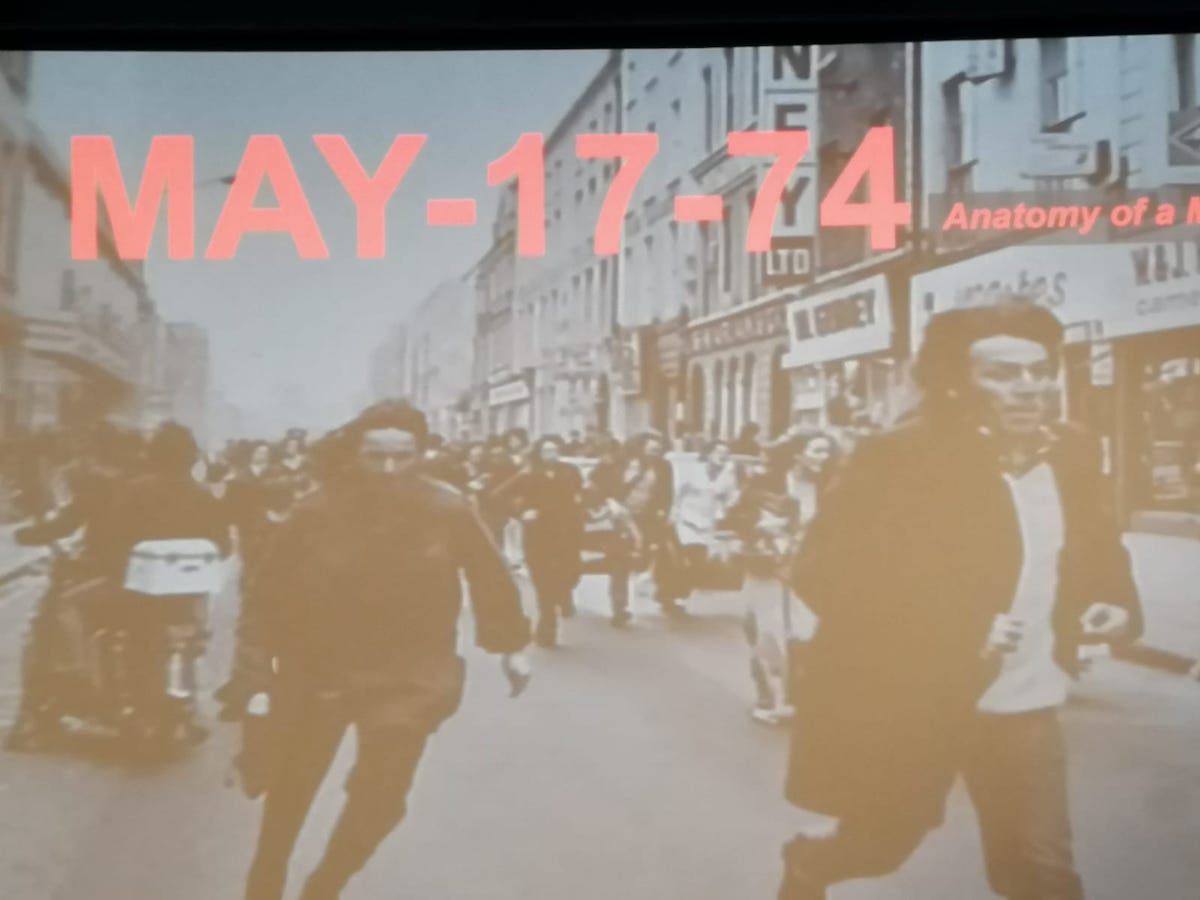
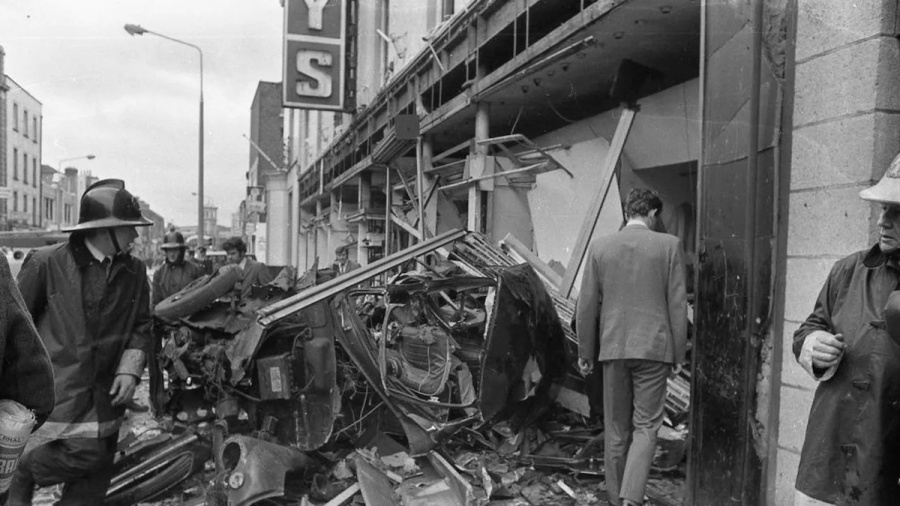
In 1974 the Labour Government had repressive legislation ready and on 29 November, using hysteria arising from the Birmingham and Guildford pub-bombings they rushed through the Prevention of Terrorism Act (1974) which permitted the holding of suspects for two days without charge.

An underground cell in London’s Paddington Green police station – this is where Irish detainees under the Prevention of Terrorism Act might be kept and interrogated for seven days without visitors or access to solicitor. “The old cells were 12-foot square, contained no windows and were reportedly too hot in the summer and too cold in winter” (Wikipedia).(Photo: Posted in 2020 on Internet by Green Anti-Capitalist Front who occupied the empty building intending to turn it into community centre.)

That could be extended for another five days – and often enough was — by application to the Home Secretary. Access to solicitor was usually denied and though not lawful, the fact of the detention itself was often denied to concerned people making enquiries of the police station.

The prospect of disappearing for seven days into police custody somewhere was naturally terrifying and a ‘suspect’ could also be deported without trial to Ireland – even to the British colony of the Six Counties, which amounted according to their law to “internal exile”.

Snapshot of London police harassment and intimidation of Irish solidarity activists in 1981. (Photo sourced: Internet)

The framing of a score of innocent Irish people3 in five different trials4 with very heavy sentences added to the intended terrorising of the Irish community in Britain, the “suspect community”5, many of whom believed the victims to be not only innocent but most not even politically active.6

Irish solidarity activity in Britain diminished greatly after 1974 as state repression impacted across the Irish community. But the hunger strikes and concerns to save the lives of the strikers in 1981 broke the hold of state terror as people took to the streets in their thousands once again.

They were unsuccessful but never returned to that state of immobilising fear that had settled over the community.

The Irish in Britain Representation Group got its initial start in 1981 which happened as follows: the bourgeois Federation of Irish Societies had its AGM in May 1981 and one of the members proposed that a motion of sympathy to the Sands family be recorded when he died.

IBRG and Irish Republican POW Support Committee banners on march Birmingham 1984 (Source: Mullarkey Archive)

The meeting’s Chairperson ruled the proposal out of order and ‘the Fed’ continued with their ordinary business. The then Editor of the Irish Post7, writing in his “Dolan” column, found this disturbing and suggested there might be a need for a new type of Irish community association.

A number of individuals wrote in and the ball got rolling, though it took until 1983 to set up the branch-based organisation with a constitution and democratic safeguards in operational rules. The IBRG soon had a number of branches in London and others in the North and Midlands.

For the next two decades the organisation campaigned for the release of the framed prisoners, against the Prevention of Terrorism Act, strip-searching, all racism but in particular the anti-Irish and anti-Traveller varieties, for Irish representation in education, services, Census category, etc.

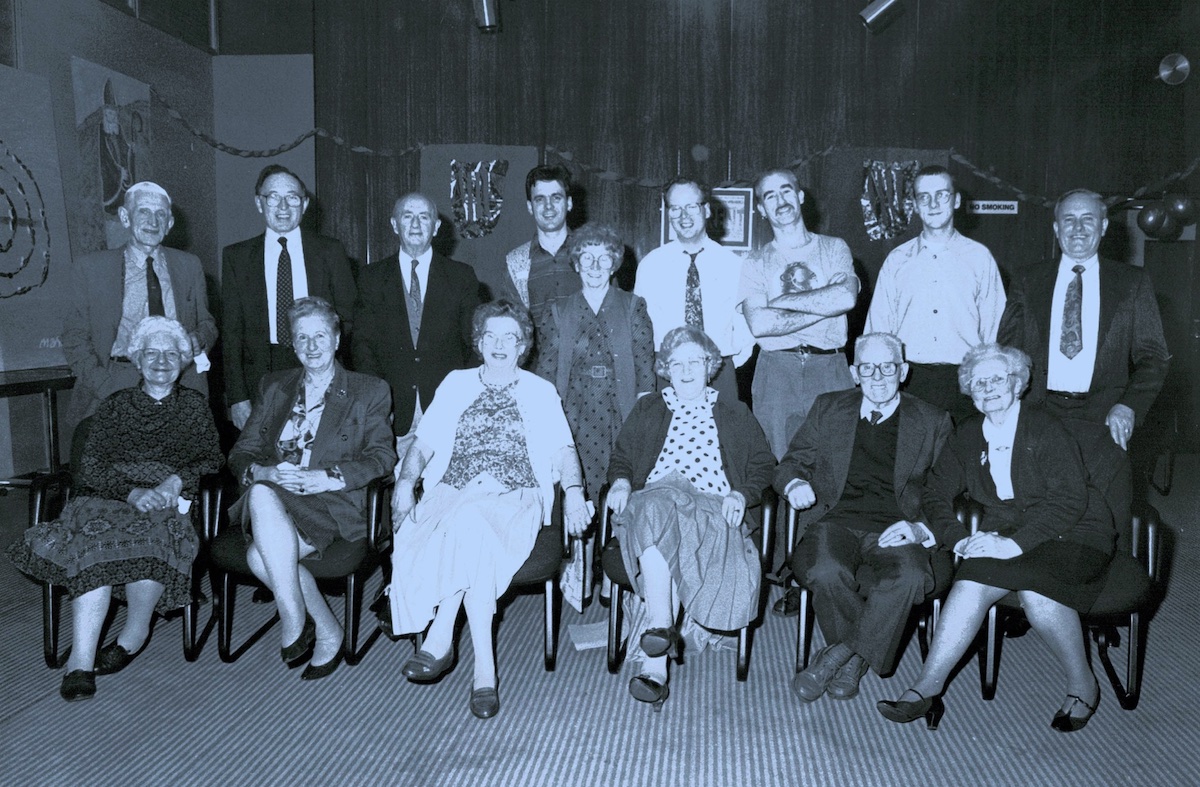
Lewisham Irish Centre Management Committee and Staff, possibly 1994. The Centre was campaigned for and won by the Lewisham Branch of the IRBG in conjunction with the Lewisham Irish Pensioners’ Association (which the IBRG had also founded).

The IBRG also called for British departure from Ireland and collaborated with other organisations in marches, demonstration, pickets, conferences, producing also a number of important report documents. The organisation’s officers were drawn from migrant Irish and those born in Britain.

THE LARK8 – a poem

Last night, from afar, I watched the Lark die

and inside me, began to cry,

and outside, a little too.

There’s nothing more that can now be done,

to save the life of this toilers’ son;

another martyr – Bobby, adieu.

Imperialism takes once more its toll,

another name joins the martyrs’ roll

and a knife of sadness runs us through.

But sorrow we must watch,

for it can still,

yes, it can kill

the song that Bobby listened to.

And if his death be not in vain,

let’s fuel our anger with the pain

and raise the fallen sword anew;

and this sword to us bequeathed:

let its blade be never sheathed

’till all our foes be ground to dust

and their machines naught but rust ….

Then will the servant be the master

and our widening horizons ever-vaster

and our debt

to Bobby

paid

as due.

(D.Breatnach, May 1981, London)

Bobby Sands Mural on gable end of a house in Belfast (Photo cred: Brooklyn Street Art)

REPRESENTATION OF BOBBY SANDS

Bobby Sands was a man of great courage whose leadership qualities were recognised by his fellow political prisoners when they elected him as their Officer Commanding in the H-Blocks. He was also an accomplished writer and poet.

When the British reneged on the agreement that ended the 1980 hunger strike and a new one was planned, Sands insisted on being first on the list, which also meant that in the event of resulting deaths, his would be the earliest.

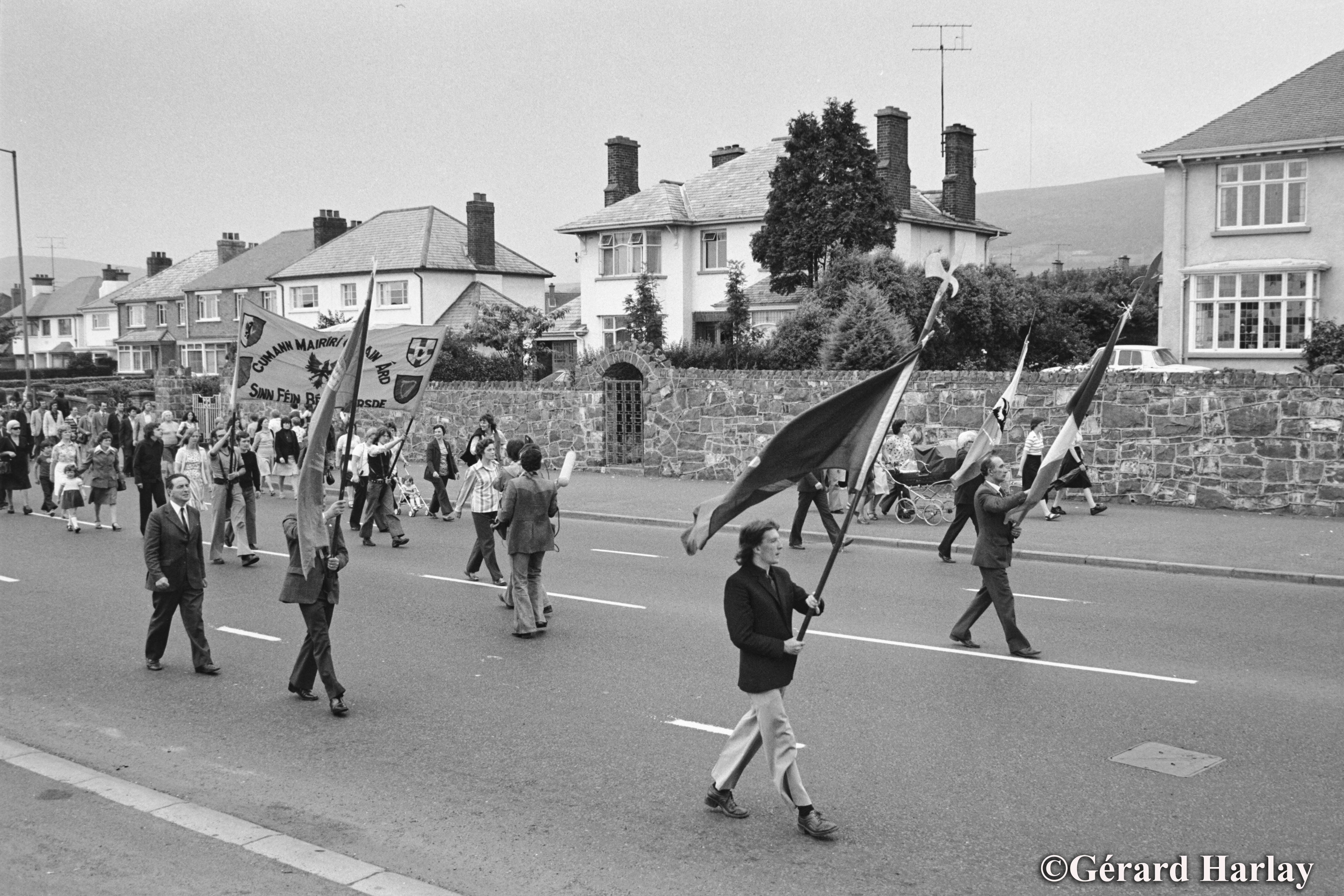
Bobby Sands (front left, colour party), Andersonstown Road,1976. (Photo: Gérard Harlay Archive)

Most people will agree easily with all the above evaluation of the man but from that point onwards, his representation is manipulated to suit different agendas, in particular those of pacifists, social democrats, liberals and a variety of opportunists.

Some of them love above all his quotation that “Our revenge shall be the laughter of our children”. They forget many other things he wrote and seek to turn him into an angel or saint of pacifism.

Since they embraced the pacification process, Sinn Féin try to represent Sands as an advocate for and proof of the effectiveness of participating in the parliamentary electoral system, based on his success in a 1981 Westminster by-election with 30,492 votes, 51.2% of the total of valid votes.

What both these groups fail to recognise is that Sands was an IRA volunteer and was sentenced for possession of handguns in 1972 and again in 1976. If he was an angel, it was of the Archangel type, fighting against what he considered evil.

He was proposed in the Fermanagh-South Tyrone by-election mainly in order to support the campaign of the prisoners against criminalisation and for the political status recognition that they had previously. Saving the lives of the hunger strikers was of course part of the plan too.

Nine protesting Republican prisoners contested the general election in the Irish State in June. Kieran Doherty and Paddy Agnew (who was not on hunger strike) were elected in Cavan-Monaghan and Louth respectively, and Joe McDonnell narrowly missed election in Sligo-Leitrim.

But that is a long way from proving that the electoral process is a viable way of dislodging the ruling class and their system and, in fact, history has proven the opposite.

Nobody knows what position Sands and the other nine would have taken on the electoral process had they lived. Possibly some would have gone along with the SF leadership on that and some others would now be reviled as “dissidents” (as are indeed some H-Block survivors).

All we can say for certain is that they were men of courage in that all of them had joined the armed struggle for Irish national liberation. They had even higher courage of a level hard to imagine, to risk and then experience slow physical disintegration and death by the day and by the hour.

Long after their erstwhile prominent enemies are forgotten, their names will shine in our history and Bobby Sands’s, the brightest of them all.

End.

FOOTNOTES

1At the time I was living and working in England.

2A bomb was planted against the prison wall to free a member of their group who was being held on remand awaiting trial at Clerkenwell Prison, London. The explosion damaged nearby houses, killed 12 civilians and wounded 120; no prisoners escaped and the attack was a failure. Michael Barrett was found guilty of the bombing despite his claim supported by witness testimony of having been in Glasgow during the bombing and was hanged on Tuesday 26 May 1868 outside Newgate Prison, the last man to be publicly hanged in England (the practice was ended from 29 May 1868 by the Capital Punishment Amendment Act 1868). https://en.wikipedia.org/wiki/Clerkenwell_explosion.
3Carole Richardson of the Guildford Four was not Irish but she was the girlfriend of one of three Irishmen.

4Birmingham Six, Guidford Four, Giuseppe Conlon, Maguire Seven and Judith Ward. They were not acquitted and released until decades later, by which time Giuseppe Conlon had died in jail.

5Suspect Community by Paddy Hillyard, Pluto Press (1993)

6Believing them innocent and not active worked even better to terrorise because if the likes of those could be framed and jailed, no-one was safe. But perhaps safest was to do absolutely nothing to draw the attention of the State.
7Brendán Mac Lua, co-founder of the Irish community newspaper in 1970 which is now a very different periodical.

8The lark is associated with Sands because he wrote a story about a man who had captured a skylark, a bird that unusually sings in flight. In the cage the bird would not sing so the man draped the cage with cloth and still the bird would not sing, nor would it do so when he refused it food and water until eventually, it died in the dark, silent to the last.
REFERENCES

Powers under the Prevention of Terrorism Act: https://cain.ulster.ac.uk/hmso/pta1974.htm

ANTI-IMPERIALIST ACTION HOLDS DUBLIN 1916 RISING COMMEMORATION

Clive Sulish

(Reading time: 6 mins.)

Easter is the time of year in Ireland for Easter Egg hunts and/or for attendance at religious services but for the Republican movement it is one of commemoration of the Easter Rising and its martyrs, with parades and speeches.

The commemoration parade proceeding along Phibsboro and approaching the Cross Guns canal bridge. (Photo: Rebel Breeze)

Easter Monday in Dublin saw one of those commemorations organised by the Socialist Republican organisation Anti-Imperialist Action at the Citizen Army plot in the St. Paul’s section of the famous Glasnevin Cemetery at the Republican Struggle Monument1.

Participants rallied near the Phibsboro Shopping Centre to march from there to the Cemetery, a distance of around two kilometres, over the “Cross Guns” bridge over the Royal Canal, then passing the main entrance to the Glasnevin Cemetery on the right before turning left for St. Paul’s.

Garda POU van parked extremely dangerously, hiding left turn from view of eastbound traffic, as they chat with other Gardaí and a ‘Branch man. As is said, “one rule for the people …!”
In the laneway between houses visible in the background, a cameraman lurked taking photos. (Photo: Rebel Breeze)

In a marked departure from the previous year, the State’s political police, plainclothes Gardaí of the “Special Branch”2 did not approach the participants to attempt to intimidate them and gather intelligence, demanding their names and addresses under the Offences Against the State Act.3

That had been followed up by a raid on the home of one of the leading activists. Sunday’s police behaviour was an even greater difference from Saturday’s, when a different Republican group, Saoradh, had their Easter Rising commemoration in Dublin’s city centre.

Around 300 police, including many in riot cop uniform (Public Order Unit) had harassed the participants demanding names, addresses and other information, attempting to intimidate them. At least seven police vans had been in attendance also to the bemusement of onlookers.4

(Photo: Rebel Breeze)

LOCAL 1916 HISTORY

The Phibsboro/ Glasnevin area also figured in the 1916 Rising, with an insurgent barricade in Phibsboro and a Fianna youth, Sean Healy, mortally wounded at the crossroads by a British artillery shell fragment (a plaque on the ground at the SW corner commemorates his death.

Earlier, Irish Volunteers had guarded the canal bridge briefly; these were seen by the dozen Volunteers that marched along the canal from Maynooth, slept in Glasnevin Cemetery and got into the headquarters garrison at the General Post Office on Tuesday.

Later British soldiers set up a barricade on the Bridge preventing even foot traffic across and shooting dead a deaf and dumb man who could not hear their challenge.

EYE IN THE SKY? (Photo: Rebel Breeze)

PARADE THROUGH STREETS TO CEMETERY

The parade from Phibsboro on Sunday was led by the Glasgow Republican Flute band (formerly the Garngad RFB, which is where most of them are based) playing the airs of known Republican ballads, muted to regular tocks on their drums as they entered the housing estate.

(Photo: Rebel Breeze)

Also leading was the colour party dressed in white shirts, black trousers, jackets, berets and sunglasses, carrying the traditional flags for Republican colour parties: the Tricolour, Starry Plough, Sunburst, followed by the flags of the four provinces of Ireland: Connacht, Leinster, Munster and Ulster.

Over the marchers the flags of the Tricolour and the Starry Plough, flag of the Irish Citizen Army flew in the breeze while those of the Basque nation, Palestine and of the People’s Front for the Liberation of Palestine lent an international flavour to the commemoration of the Irish Rising.

There was some beeping of passing traffic and cheering from bystanders at the entrance to the laneway that leads to the bridge across the railway tracks to the St. Paul’s section of the graveyard. The marchers filed in and proceeded to the monument.

The Chair of the proceedings welcomed the attendance before reading from the 1916 Proclamation of Independence and calling a singer to step forward. Revolutionary activist Diarmuid Breatnach introduced the two songs he was going to sing as emphasising the role of the working class in the Rising.

(Photo: Rebel Breeze)

“The decision to go ahead with the Rising on Easter Monday was taken in Liberty Hall, the headquarters of the working class at the time,” he reminded the gathering, “which is also where the Proclamation of Independence was printed.”

He sang the “Jim Larkin Ballad”:
In Dublin City in 1913,
the boss was rich and the poor were slaves;
The women working, the children hungry,
till on came Larkin like a might wave …

Diarmuid Breatnach singing (Photo: Donated by participant)

Pausing to focus on a different key, the singer followed the ballad with Patrick Galvin’s Where Is Our James Connolly?

After applause, floral tributes were laid on behalf of Anti-Imperialism Action Ireland and of Dublin Republicans Against Fascism.

(Photo: Rebel Breeze)
(Photo: Donated by participant)

The chairperson asked for a minute’s silence in honour of those men and women who had given their lives in the struggle for freedom in Ireland. The colour party lowered their flags slowly in homage to the fallen, raising them again slowly to signify the continuation of the struggle.

(Photo: Rebel Breeze)

John Heaney, Republican ex-prisoner from Armagh was called to give the oration for the event, which he dedicated to all those men and women who had opened their doors and their homes to fighters in the struggle, whether the latter were in hiding or just resting – his audience applauded.

The speaker also congratulated on those who came forward to carry on the struggle, youth, women and stated he was proud to see the traditions of struggle being upheld in the process to achieve the Republic for which so many gave their lives.

The speaker, John Heaney delivering his oration. (Photo: Rebel Breeze)

The marching band then played the air of Amhrán na bhFiann/ The Soldiers’ Song, verse and chorus and the formal part of the event came to an end. Band members lined up in front of the Monument for photos and a little later played the air of “Black Is the Colour” on whistles, to general applause.

SECOND 1916 COMMEMORATION FOR AIA THIS EASTER

This was the second 1916 Rising Commemoration to be attended by Anti-Imperialist Action as they had also participated in another organised by the Seamus Costello Memorial Committee in Bray on the previous day.

AIA is a young organisation, founded by socialist Republicans unhappy with the direction of the Republican organisation of which they had been members but now containing many young people.

AIA gave rise to the Revolutionary Housing League that occupied empty buildings in a campaign against homelessness and called for a general occupation campaign across the state. A number of court cases against them followed but sadly their lead was not followed.

(Photo: Rebel Breeze)

AIA have also been very active against NATO, picketing promotional meetings and a number have been charged following a demonstration against a visiting British Navy ship in Dublin last November.5 They have also been active as part of the Saoirse don Phalaistín activist group.

Following the event in Glasnevin, many of the participants relaxed at a social evening in a different part of the city where many songs of struggle were sung.

(Photo: Rebel Breeze)

OTHER EASTER COMMEMORATIONS

Other Easter Rising commemorations have been held around this time, for example: Lasair Dhearg held one in Belfast on Easter Monday, while Independent Dublin Republicans held theirs in the capital, marching from Liberty Hall to the GPO, then to Moore Street to lay a floral tribute.

On Monday too the Derry 1916 Memorial Committee held an event in its city.6

Former revolutionary Republican party Sinn Féin held theirs in Arbour Hill7 cemetery on Sunday; a large part of their President’s address was devoted to justification of support for the EU and a plea to support the party whenever the state’s general elections are held (this year or next)8.

End.

(Photo: Rebel Breeze)

FOOTNOTES

SOURCES & FURTHER READING

Anti-Imperialist Action: https://t.me/aiaireland

Lasair Dhearg commemoration: https://www.facebook.com/LasairDhearg/

Derry commemoration: https://www.belfasttelegraph.co.uk/news/northern-ireland/petrol-bombs-thrown-at-media-during-dissident-parade-in-derry/a1835461558.html?

Sinn Féin commemoration: https://www.breakingnews.ie/ireland/mary-lou-mcdonald-makes-election-plea-at-1916-event-1608211.html

1My name for the Monument in the St. Paul’s part of Glasnevin Cemetery which stands in recognition of six periods of Irish Republican-led insurrectionary activity in Ireland: 1798-1916.

2Now officially the Special Detective Unit, they were previously known as the “Special Branch”, a name they inherited from the British occupation which had set up a political intelligence unit, the Irish Special Branch, to spy on and disrupt the Fenian movement among the Irish diaspora in British cities. Most political activists in Ireland continue to call them “the Special Branch” or simply “the Branch”. Their equivalent in Britain today and in a number of its colonies and former colonies continues to officially bear the name “Special Branch”.

3As amended in 1972 after a British Intelligence bombing killing two public transport workers in Dublin but blamed on the IRA; the amendment also permitted the setting up of no-jury Special Courts which are in existence to this day.

4In the context of assaults on persons in the city centre there have been regular complaints in the media and in the Parliament about the lack of Gardaí visibly patrolling the area.

5 https://ukdefencejournal.org.uk/irish-activists-shout-at-british-naval-vessel-in-dublin

6https://www.belfasttelegraph.co.uk/news/northern-ireland/petrol-bombs-thrown-at-media-during-dissident-parade-in-derry/a1835461558.html?

7Where the 14 Dublin 1916 executed were buried, now a national monument in a former prison and church graveyard around the back of the former military barracks and now National Museum of Collins Barracks

8https://www.breakingnews.ie/ireland/mary-lou-mcdonald-makes-election-plea-at-1916-event-1608211.html

IT’S NOT BECAUSE OF THEIR SKIN COLOUR BUT ABOUT WHERE THEY ARE

Diarmuid Breatnach

(Reading time: 8 mins.)

There is a belief around that the reason that Israel is being supported by the US and getting away with genocide as far as the Western powers are concerned, is because the Palestinians are dark-skinned and that it wouldn’t happen to ‘whites’.

Those who believe that are mistaken: it would and it did. It is only marginally about skin colour but rather about where the Palestinians are.

Palestine sits in a strategic spot in the heart of the Middle East, with borders to Egypt, Lebanon and Syria, with the Red Sea to the South-east and a Mediterranean coastline to the west, connecting by sea to Europe, Africa and Asia. That made it important to old and to new empires.

The historic land known as “Palestine” in the 19th and early 20th Century was that which up until 1917 was ruled by the Ottoman Empire, now occupied by the zionist Israeli State and those areas recognised as Palestinian by international law including Gaza, the West Bank and Jerusalem.

After WWI, during which the Ottoman Empire, along with Germany had been on the losing side, in the divvying up of the colonial spoils, Palestine (occupied by the British since 1917) was given by the League of Nations in 1922 to one of the War’s victors, the UK.

The UK began to invite Ashkenazi Jews to settle there as part of a European colonial and partly anti-semitic1 project. Of course in those days “semitic” was understood to apply to the Arabs as well as to the Jews and the latter were often referred to by Europeans as “oriental”.

The British, as is the wont of colonisers in general and of them in particular, played the settlers off against the Arab majority.

And of course broke promises about restricting the number of settlers. But after WWII, a high influx of Holocaust survivors organised by Zionists began to head for Palestine and the British, fearing the destabilisation of their colony, tried to prevent unapproved Jews from landing.

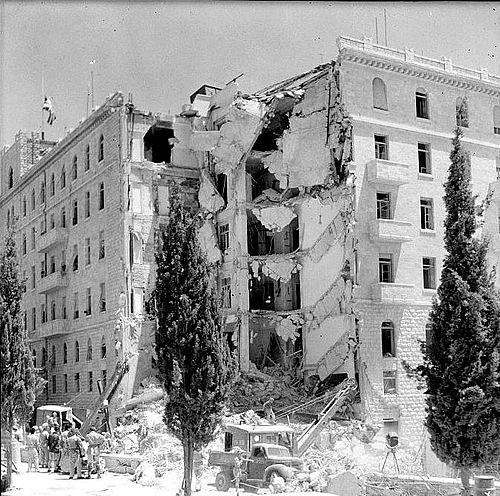
The zionist terrorist militias (Irgun, Haganah, Stern Gang) began to attack the British colonial forces and Arab villages. In July 1946, Zionist group Irgun killed 91 people and injured 46 in an explosion at the King David Hotel, location of the British administrative and occupation army HQ.

Damage to the King David Hotel after bomb planted by Zionist terrorist group Irgun in 1946. (Photo sourced: Wikipedia)

The British pulled out in 1947, reneging on all their promises to the native Palestinians. The Zionists began their genocidal settler project with threats to and massacres of Palestinians and the expulsion of 700,000, mostly Muslims — and declared a Jewish State in 1948.

Thereafter the Israeli State began a program of repression and oppression of Palestinians and of colonial expansion. Naturally, this project required ethnic cleansing and genocide of the Palestinians and aggression against Israel’s neighbours.

The USA and the USSR quickly recognised the Zionist State, the USA increasingly funding the state and supplying it with weapons while the USSR permitted its Ashkenazi Jewish citizens to emigrate to the settler colony.

In October 1956, eight years after the founding of the Zionist state, in response to Egyptian nationalisation of the Suez Canal, the Israeli air force attacked Egyptian airfields without warning while British and French Army and Naval forces invaded the country.

The invaders were forced to retreat and the USA admonished France and the UK for, in effect, not realising that the USA and not the old European colonial powers was now the boss of most of the world.

The zionist lobby (both Jewish and Christian) in the USA is often blamed for that imperialist state’s continual support for Israel’s genocidal attacks on the Palestinians.

But the US imperialists have their own reasons for supporting the only state in the Middle East that is susceptible to neither internal national liberation struggle or muslim fundamentalist uprising. It gives the US a safe foothold and also a guard dog to watch the neighbours (e.g Syria and Iran).

RACISM

The Nazis had a racist view of the Ashkenazi Jews, who were mostly fair-skinned. But they also considered the Slavic people (the majority European and light-skinned) as “untermenschen” (i.e ‘subhuman’). It’s estimated they killed at least 1.9 million Polish non-Jewish civilians.2

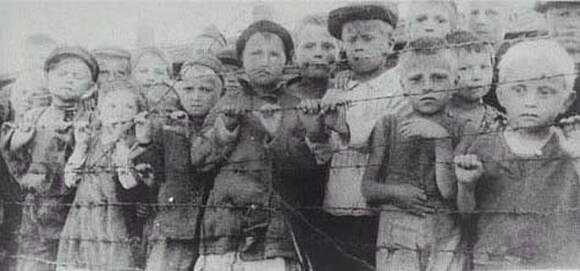
The Nazis also murdered millions of Russian non-Jewish civilians in genocidal ethnic cleansing of territory, in labour concentration camps, near sensitive battle formations and in reprisals for partisan resistance.

Fair-skinned and even blonde children victims of Nazi racism and genocide. (Source: New Zealand Holocaust Centre “Button project”)

The South African settler racist regime discriminated against all non-European people, in their official categories of “Native”, “Coloured” (mixed race) and “Asian” (mostly from the Indian sub-continent). Nevertheless, they also made some groups “honorary whites”.3

Racism isn’t primarily about skin colour anyway: It is a discriminatory social ideology based on ethnicity and the marker for ‘difference’ can be ‘racial’, national or religious. The Anglo-Norman invaders of Ireland in the mid-12th Century racialised the Irish, who were generally fair-skinned.4

The rational reason behind the racism is to unite in opposition to the targeted groups, whether in order to wage war against them or so as to repress their resistance as slaves or as occupied people. The racists colonise their own minds and attempt to colonise the minds of their targets also.

Not quite two centuries after the initial invasion and part-occupation of Ireland, the British-based Anglo-Normans, now describing themselves as “English”, criticised most of their people settled in Ireland for ‘going native’ and passed laws against their social acclimatisation.

The Statutes of Kilkenny in 1366 attempted to prevent “the degenerate English” from speaking Irish, adopting Irish customs and laws, dressing in Irish style, patronising Irish cultural performance, intermarrying with the Irish and becoming “more Irish than the Irish themselves.”

The main purpose for the Anglo-Norman invasion of Ireland had been occupation by feudal lords to gather rents from the natives but it soon became a question of replacing the natives with settlers. This was not always successful since the Irish people and many clan chiefs resisted.

The cities became fortified centres of colonial occupation, administration and garrison, the colonial city of Dublin known as “the Pale” in reference to the original earthworks surmounted by a palisade; hence “beyond the Pale” signified the native Irish and barbarism to the colonists.

The earlier occupation settlements were in or around fortified constructions, castles and ‘keeps’. Later, town and villages were established with a central square or diamond, i.e in a good defensive shape and entry by natives forbidden. Settler churches were also built as defensive structures5.

Pseudo-scientific racism from white Anglo-Saxon Harper’s Weekly magazine 1899 in the USA. (Sourced: Nothing But the Same Old Story, Liz Curtis).

With the creation of Irish Republican Brotherhood (or the ‘Fenians’) in the 19th Century and their activities in Ireland, the USA and in Britain, the British elite combined anti-Irish racism with pseudo-evolutionary ‘science’ representing the Irish as not quite human or childlike – but violent.

Cartoons in some British popular periodicals, in particular Punch, Fun, Judy(and Puck in the USA) represented the Fenians as monsters, in particular ape-like creatures and racist jibes and ‘humour’ were popularised, a practice which sprouted new variants during the recent 30 Years War.

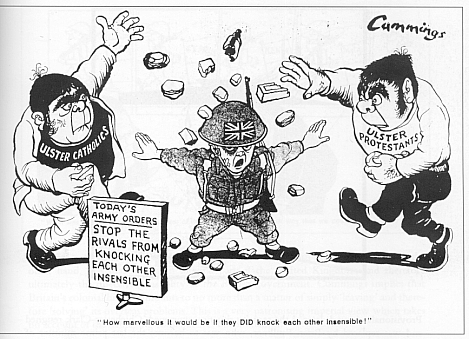
Updated British anti-Irish racism by cartoonist Cummings, Daily Express, London, 12 August 1970, depicting the colonial British Army as “keeping the peace” between the colonised Catholic/ Nationalist population and the British Loyalists. (Sourced: CAIN)

ETHNIC CLEANSING AND GENOCIDE

All European settler projects imply ethnic cleansing accompanied by genocide to one degree or another: in Africa, Latin America, North America, Australia, New Zealand … but this was practiced by a European power against a European nation also: Ireland.

The British elite used atrocity stories from the 1641 uprising of the Irish to justify and encourage the genocide by Oliver Cromwell’s campaign in Ireland in 1649. Through ethnic cleansing, battle and starvation, Cromwell killed nearing 40% of the Irish population.6

British atrocity propaganda image about the Irish uprising of 1641 to justify Cromwell’s campaign of ethnic cleansing, genocide and enslavement. (Sourced: online).

These figures do not include those he had sent to British colonies in the Americas as slaves.7

The Great Hunger (1845-1848) wiped out, through starvation, well over 2 million of the Irish population of around 8 million and during that and the following decade, probably another 2 million emigrated (many of those too dying on the way or on arrival8).

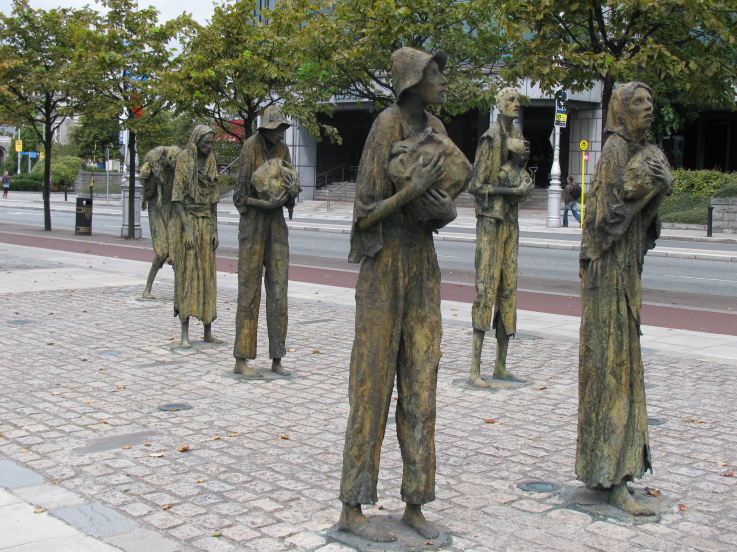
Monument on the Liffey quays in Dublin to the Great Hunger (1845-1852) genocide of the Irish by the British ruling class. (Photo: D.Breatnach)

DOES IT MATTER WHETHER IT’S DRIVEN BY RACISM OR BY COLONIAL EXPANSION?

Yes, it does. The difference between the two does not change the situation of the Palestinians but it does affect how the genocide may be understood and what the targets of our actions may be.

Liberals would probably prefer the issue to be primarily of racism. If that were the source of the problem we could still be pushing for economic and isolation pressure as was the focus with the anti-apartheid campaign against the South African racist regime.

That is being done now and that’s fine. But the assumption would be that with enough pressure, Israel would be obliged to change its ways and the US leaders would feel pressured to advise it to end its racist discrimination (as they did in the case of white South Africa).

But if the project is colonial expansion, presupposing ethnic clearing and genocide, it is a different situation completely.

No arguing with Israeli zionists, boycott or isolation culturally and in sport is going to change that or get ‘liberal’ Zionism to act against their Right; as Finkelstein recently pointed out, the Nakba and all the settler expansions were carried out under ruling periods of the ‘Left’ side of zionism.

Also, if this settler expansion (or supporting such at least) is part of a US imperialism project, then no amount of campaigning to expose the behaviour of the Zionists is going to be effective in persuading the ruling class of the USA to apply corrective pressure to the zionist regime.

The fact that the basic source of the problem is zionist settler expansion means that genocide and ethnic cleansing will continue as long as the Israeli zionist state exists. And US and Western imperialism will continue to support that as long as they believe it benefits their regional interests.

This makes it clear that the long-term solutions can only consist of ending the zionist project or the ending of imperialism which supports it. The former is of course a smaller objective but at the moment western imperialism is energetically defending the zionists.

A whole neighbourhood in Gaza wiped out by Israeli bombardment months ago (Photo cred: WAFA agency)

It is doings so politically and culturally, with armaments, also with propaganda from its mass media, by repression of its own populations where these are protesting in solidarity with the Palestinians – and in the course of that it is endangering all its facades of justice and objectivity.

In the longer term that is probably a good thing, helping to create the subjective conditions for the overthrow of imperialism and monopoly capitalism.

But we need to help that process along in our own struggles while also making their continued support for zionist genocide of Palestinians as costly for them as we possibly can. While we act in solidarity with the Palestinians we are acting also against our own immediate enemies.

End.

FOOTNOTES

1This may surprise some but the British ruling class was deeply anti-semitic even before Shakespeare wrote his Merchant of Venice script. Not only that, but Balfour, infamous for his eponymous Declaration that Palestine was suitable for Jewish settlement, was personally strongly anti-semitic (I am thankful to Ali Abunimah for pointing that out in one of the youtube discussions of the Electronic Intifada)

2https://www.hmd.org.uk/learn-about-the-holocaust-and-genocides/nazi-persecution/non-jewish-poles-and-slavic-pows/

3For example, east Asians such as Japanese and Koreans with whom they wished to have good commercial and financial relations https://en.wikipedia.org/wiki/Honorary_whites

4I keep telling people struggling against colonialism and imperialism that they should study Irish history. It’s practically all there: racism, invasion, division, settlers, plantations and ethnic cleansing, recruitment of native enforcers, undermining of native culture, religious oppression, genocide (twice), partition, recruitment of sections of the elite and nationalist political parties.

5Though this also had a history in medieval Europe. The administrators of the Ulster Plantation at the start of the 17th Century allocating grants of land specified that those who got parcels of land had to be English-speaking, be Protestant, build defensive structures and not employ Catholics.

6https://www.historyireland.com/how-many-died-during-cromwells-campaign/

7This has become something of a controversy, with racists of Irish diaspora background claiming parity with the slavery experience of Africans in the southern USA and some anti-racists denying it, saying the Irish were indentured servants. Both are mistaken: Irish were sent in slavery by Cromwell but subsequent Irish were sent in indentured servitude which, bad as it is, is not chattel slavery and the historical slavery period of the Irish in the USA was nowhere near as long as it was for the Africans.

8Over 3,000 are buried on Grosse Isle alone, an island in the St. Lawrence River in Quebec, Canada.

SOURCES

https://www.hmd.org.uk/learn-about-the-holocaust-and-genocides/nazi-persecution/non-jewish-poles-and-slavic-pows/

https://www.historyireland.com/how-many-died-during-cromwells-campaign/

https://www.thriftbooks.com/w/nothing-but-the-same-old-story-the-roots-of-anti-irish-racism_liz-curtis/

DUBLIN POLITICAL PRISONERS’ PICKET REFUTES MINISTER’S LIE

Clive Sulish

(Reading time: 2 mins.)

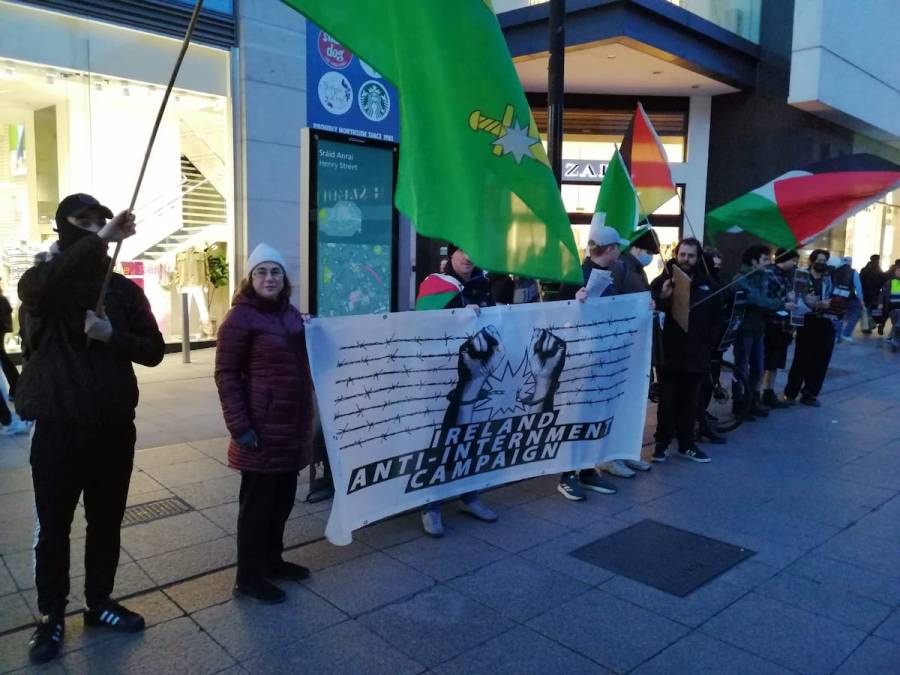
On Tuesday evening in one of Dublin city centre’s high-end shopping street picketers refuted colonial Minister for ‘Justice’ Naomi Long’s lie that “There are no political prisoners in Northern Ireland” (sic – she means the Six-County colony).

The Ireland Anti-Internment Campaign came on to the street to highlight that yes indeed, there ARE political prisoners in Ireland – over two score between both sides of the Border. And that furthermore, they are convicted in special political no-jury judicial processes.

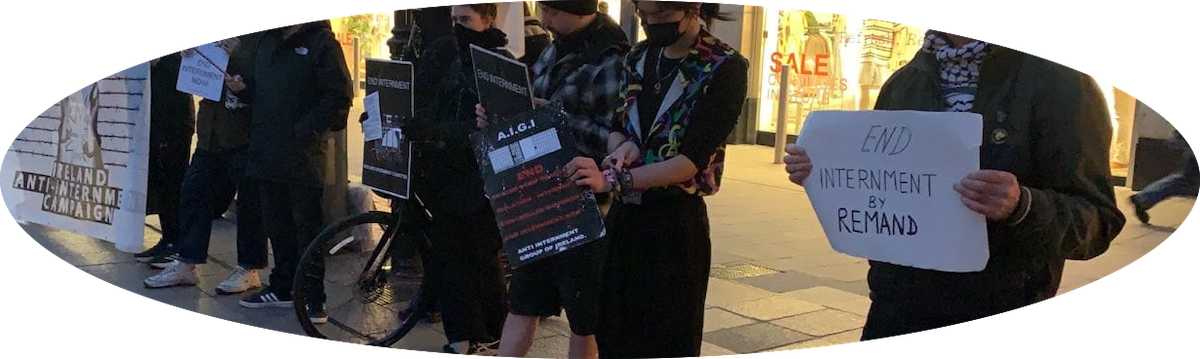
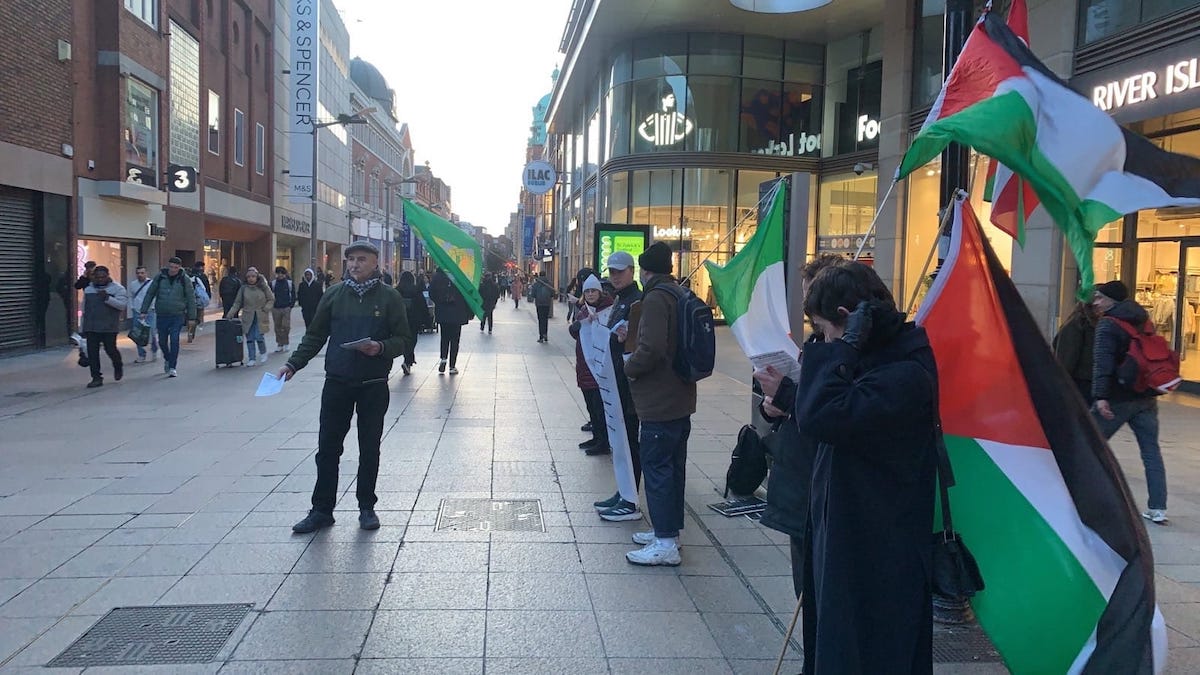
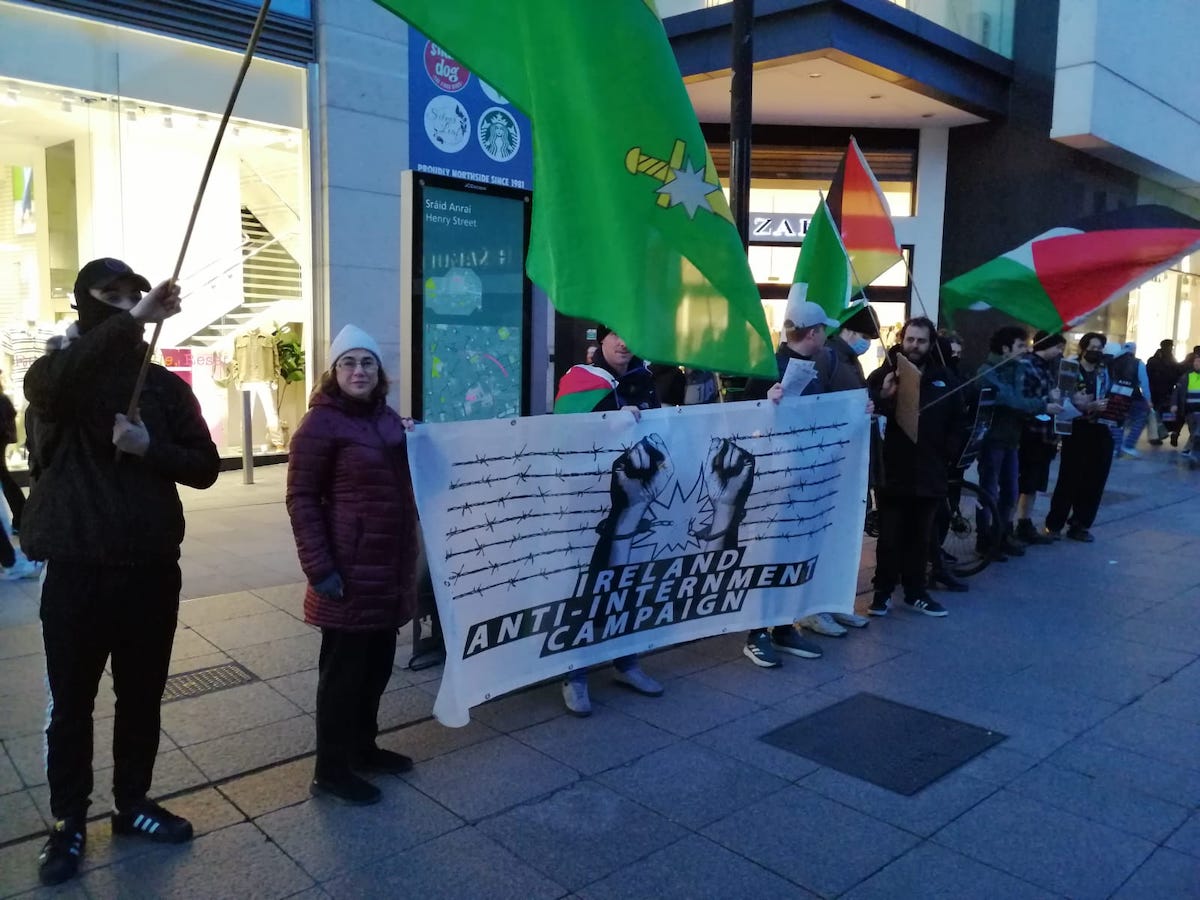
View of the picket and the IAIC banner in Henry Street on Tuesday (Photo: Rebel Breeze)

The IAIC states that these judicial processes are called the “Diplock Court” in the occupied Six Counties and the “Special Criminal Courts” in the Irish state and were “specifically created in both cases for the easy conviction and jailing of Irish Republicans.”

The SCC has been labelled “a sentencing tribunal” rather than a court of law by human rights campaigners. IAIC states that the Diplock Court is “now being administered by former Republicans while the SCCs have now, after years of opposition, been approved by those same people.”

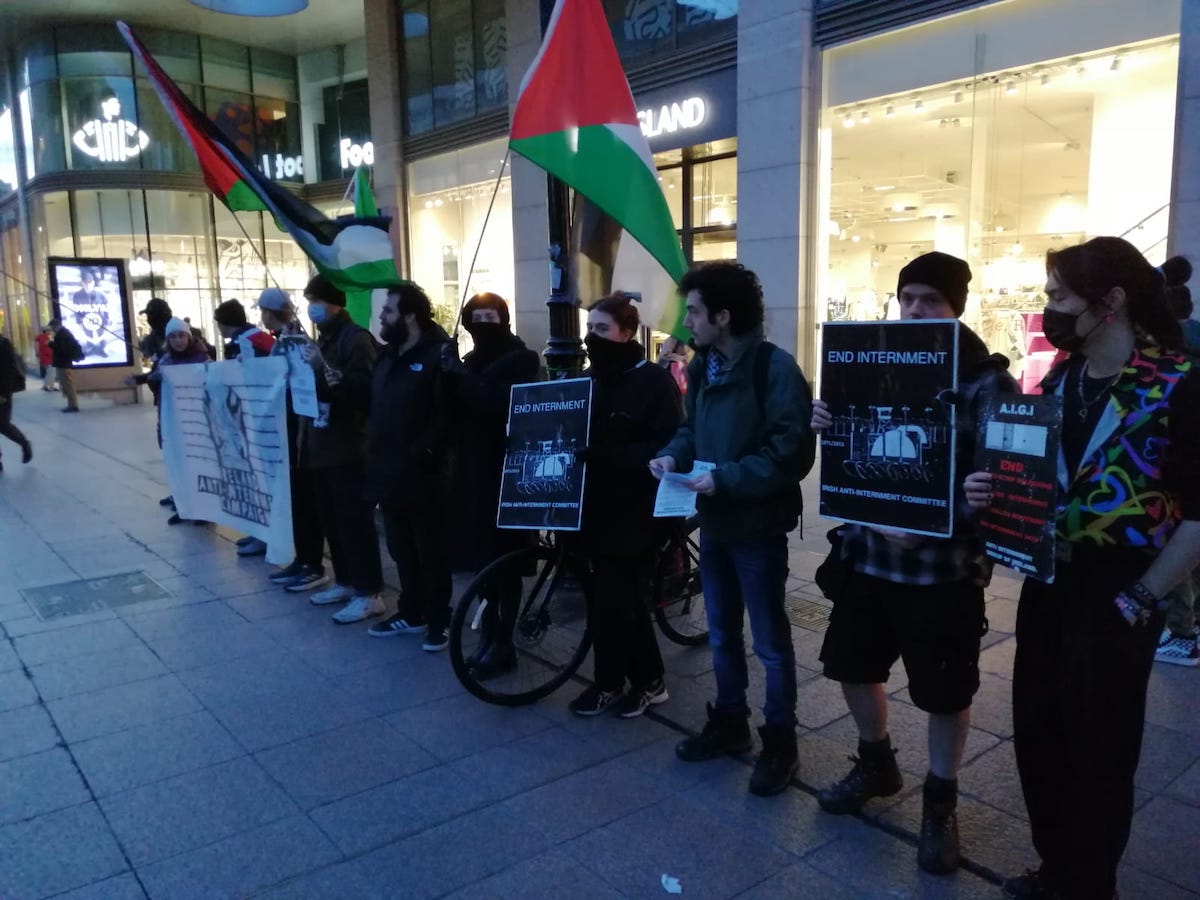
View of placards on the IAIC banner in Henry Street on Tuesday (Photo: Rebel Breeze)

However, as accused before these courts are also regularly refused bail, IAIC points out they are also effectively administrators of internment without trial, jailing activists for around two years before judicial process. If bail is granted, it is always under severe conditions preventing political activity.

The IAIC, an independent group campaigning for ten years, was supported in their picket yesterday by Irish Republicans and Socialists including from the Anti-Imperialist Action and Saoirse Don Phalaistín groups, in addition to some independent activists.

Although Henry Street is a high-end shopping street of Dublin city centre, lots of working class people use it also.

A member distributes leaflets to passers-by near the picket in Henry Street on Tuesday (Photo: Rebel Breeze)

Over 100 leaflets were distributed and a number of people stopped to discuss the issues. Some queried the mix of flags flown (Irish Starry Plough, Palestinian and Basque) and participants explained that these represented some of the struggles where repression has taken prisoners.

“We thought it particularly important to refute the colonial Minister’s lie today,” commented a spokesperson for the IAIC “and we’re glad for the support we received on the picket line and from interested people on the street. We hope to do it more often this year.”

“Internment continues in Ireland, just on a different scale and more selectively than for example in the Six Counties in the 1980s”, continued the spokesperson.

View of the picket and the IAIC banner in Henry Street on Tuesday (Photo: Rebel Breeze)

The IAIC states that it is “an independent campaigning group run on a participative democratic basis” and that it “welcomes democratic people” on their pickets. The Facebook page https://www.facebook.com/profile.php?id=100063166633467 is their usual public outlet for notification of events and highlighting of related issues.

End.

JULIAN ASSANGE LAST DITCH FIGHT IN UK LAW AGAINST EXTRADITION TO USA

Diarmuid Breatnach

(Reading time: 3 mins.)

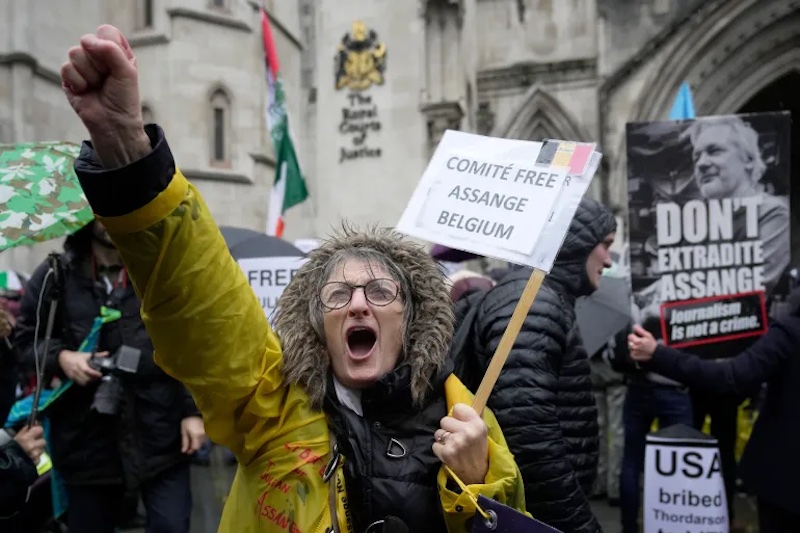
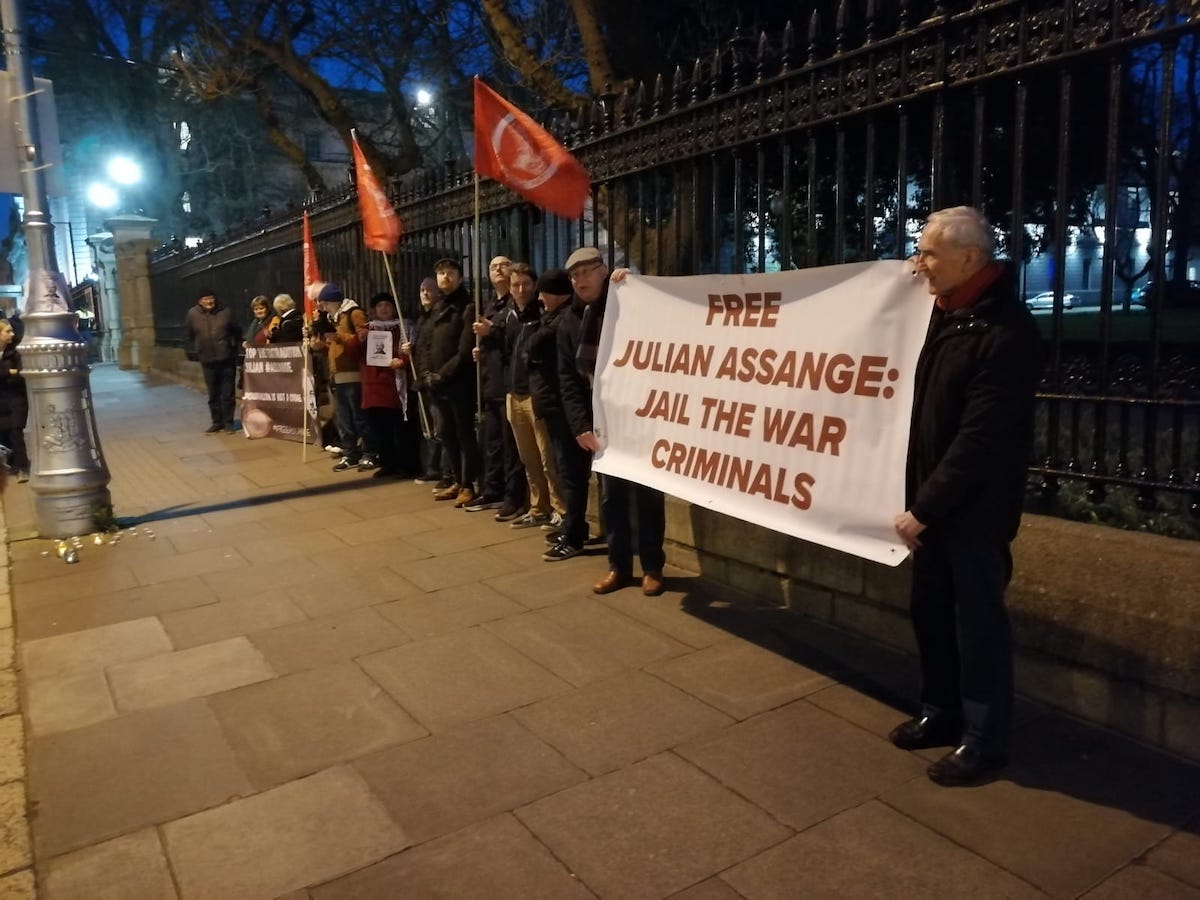
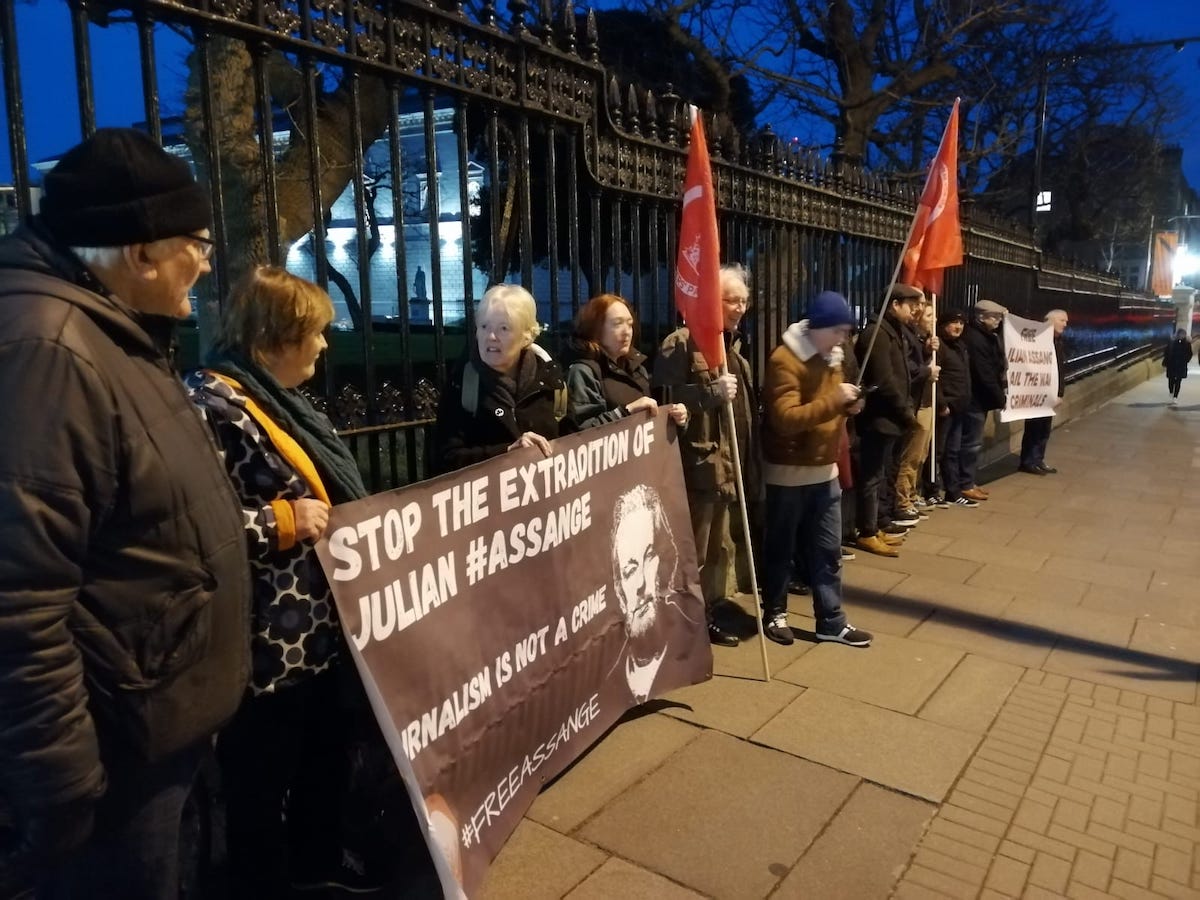
Crowds gathered in London on Tuesday and a solidarity picket with the Australian whistleblower was held in Dublin on Monday night as Julian Assange and his legal team fight their last chance in UK law to prevent his extradition to the USA.

On Wednesday the crowds in attendance inside and outside of the High Court and watching from around the world had to be content with awaiting the decision of the judges to be given at a later date.

(Photo: D.Breatnach)

Julian Assange has been hounded since he exposed murders and other murky secrets of the USA through the Wikleaks website he set up, posting items sent to him by former serving US Marine Chelsea Manning (who served military prison time but was pardoned by Obama) and others.

The CIA planned to assassinate Assange physically and then tried to assassinate his character by setting up a false rape allegation in Sweden and when all that failed, applied for his extradition from the UK under USA espionage legislation — though Wikileaks posting was entirely public.

Shamefully the UK colluded with the USA and, not trusting UK ‘justice’, he skipped bail from extradition hearings, sought and was granted asylum in the Ecuadorian Embassy in London. There a Spanish agency spied on confidential conversations between him and his legal team.

Assange lived in the Embassy under siege from 2012 to 2019, when the Ecuadorian State abrogated his asylum and allowed British police to enter what is legally Ecuadorian sovereign territory and remove him, since when he has been nearly seven years in high-security Belmarsh jail.

(Photo: D.Breatnach)

The Premier of Australia has now called for his release after the Parliament passed a motion valuing Wikileaks exposure of US wrongdoing and calling for dropping the case1 but for years governments of the ex-British colony, now much more under USA influence, did not do so.

As an indication of what Assange can face in the US system, the Guardian reports that “Earlier this month, in a separate case, Joshua Schulte, a former CIA officer, was imprisoned for 40 years for passing classified material to WikiLeaks.”

The small size of the picket in Dublin was in my view less a reflection of the level of concern in Ireland but about the organisation of his support being on occasion taken over and undermined and in earlier times depended on high-profile individuals rather than collective organisation.

(Photo: D.Breatnach)

The western mass media for which Assange provided a huge amount of column inches and many headlines through the Wikileaks exposés hardly fought for him. The Guardian spoke out for him recently but also took part in his character assassination years ago.

Even though it had been the main British benefactor of his news items. And the media is still getting footage viewing his travail, being drawn behind the cart on his way to – his execution?

The Irish Times recently spoke out for him and so did the Irish branch of the National Union of Journalists but the latter had no presence on the picket or on any other public protest at this time of which I’m aware.

Scene from very wet and windy day outside the High Court in London (note Irish Tricolour and Palestine joint flags in background). (Photo cred: Kin Cheung/ AP)

However, the Irish Tricolour flew near the Australian flag in London outside the High Court building. Our people have been executed in that city too and we’ve had their executioners here in Ireland as well.

What we are witnessing is years of mental torture and attempt to silence permanently a man whose “crime” is to expose the sins of the world superpower and some of its allies and clients. The chief criminal of the world is hunting down a whistleblower to shut him up about its crimes.

And the ruling class of the UK, a world-class criminal also but in this case the accomplice of Mr. Big, is assisting him. The writers and editors in the mass media should be outraged and campaigning as Victor Hugo did in the Dreyfus case.

But they know who buys their bread and on which side it is buttered, as their ‘reporting’ on the genocidal Israeli campaign in Palestine has shown every day – and on the war in Ukraine before that.

My father was a journalist who had been made somewhat cynical about “the free press” by his experiences but even so he would be thoroughly sickened were he alive today.

End.

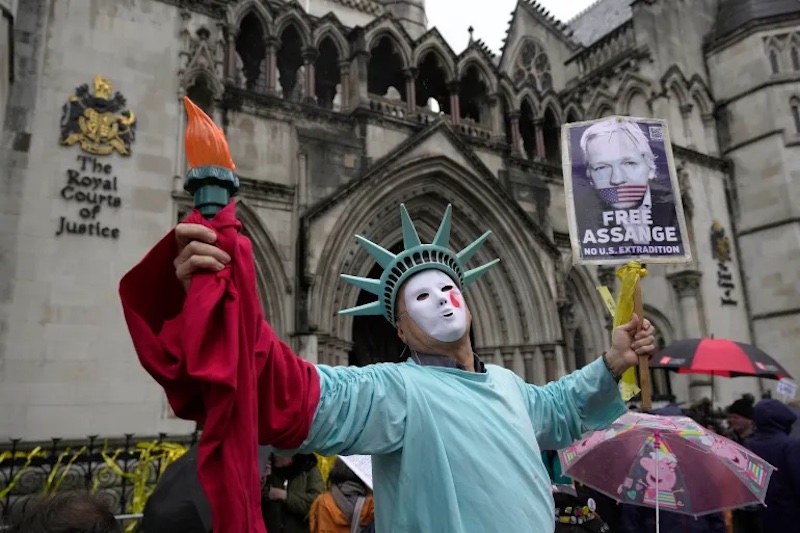
US Liberty satirised outside the High Court in London (Photo cred: Alastair Grant/ AP)

SOURCES & FURTHER READING

https://www.theguardian.com/media/2024/feb/20/julian-assange-court-considers-last-ditch-bid-to-fight-us-extradition

https://www.theguardian.com/commentisfree/2024/feb/18/the-guardian-view-on-julian-assange-why-he-should-not-be-extradited

https://www.breakingnews.ie/world/julian-assange-faces-wait-for-decision-on-whether-appeal-can-go-ahead-1591927.html

1https://www.reuters.com/world/australia-pm-backs-parliament-motion-calling-julian-assanges-release-2024-02-14/

6,000 March to Commemorate Derry’s Bloody Sunday and in Solidarity with Palestine

Diarmuid Breatnach

(Reading time: 7 mins.)

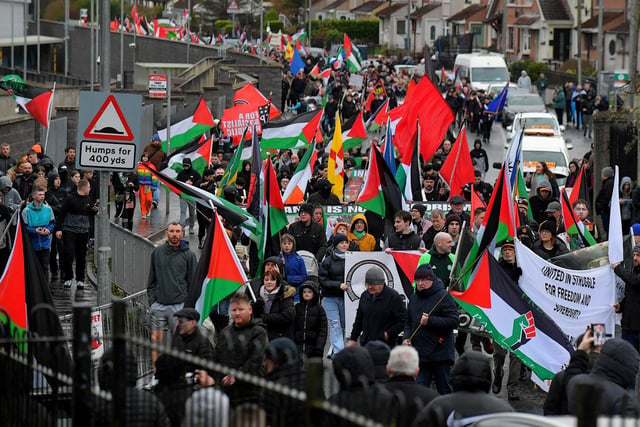
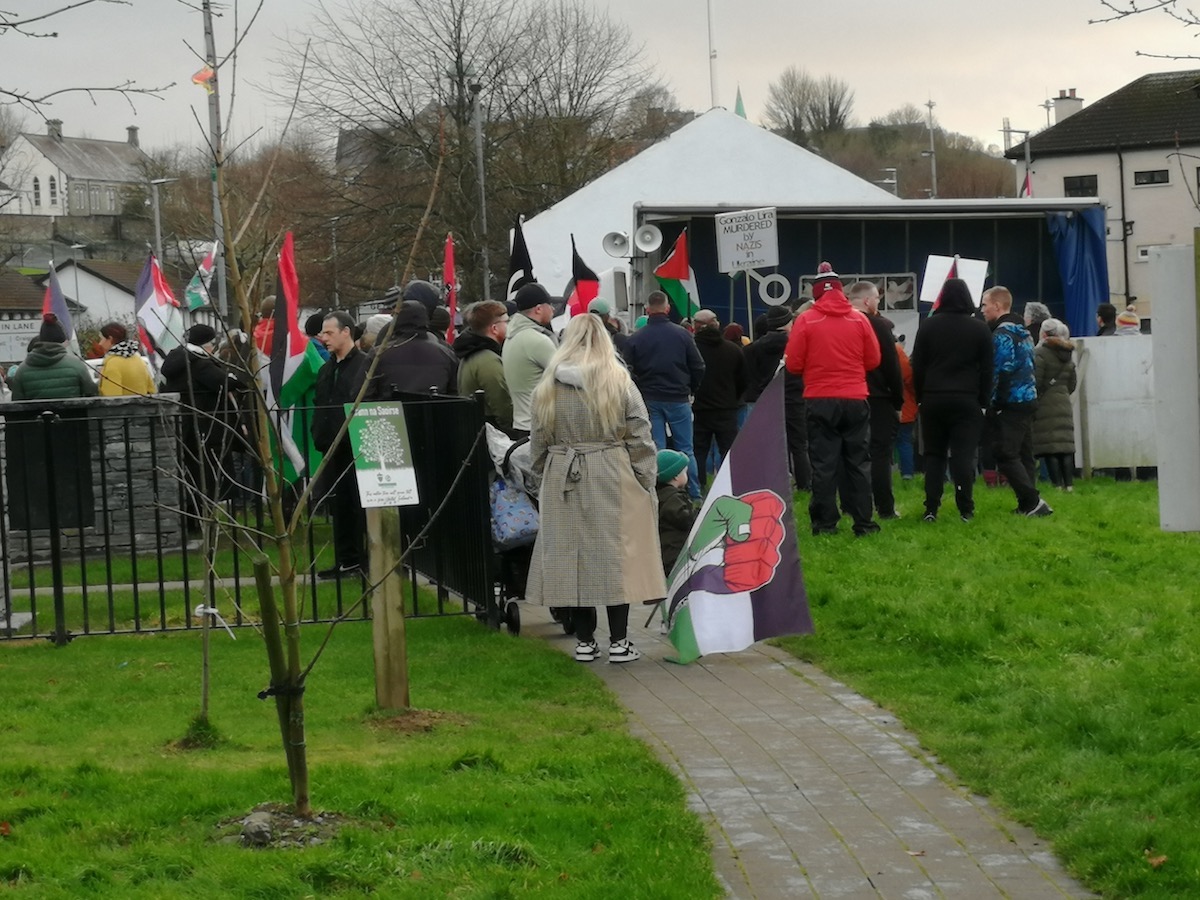
Led by four Republican marching bands and containing a number of organisations, around 6,000 people supported the annual march in Derry on Sunday commemorating the 1972 massacre by the British Parachute Regiment in the city.

This year a special focus on solidarity with Palestine had been called for by the organisers of the Bloody Sunday massacre commemoration and Palestinian flags mixed with ones of Irish Republican organisations decorated the march route.

The march begins at the Creggan Heights, overlooking Derry, a steep walk up from the Bogside, the city’s centre near the river and winds its way down (with a great view of the Foyle river and surrounding area) but then up Westland Street again and along Marlborough Terrace.

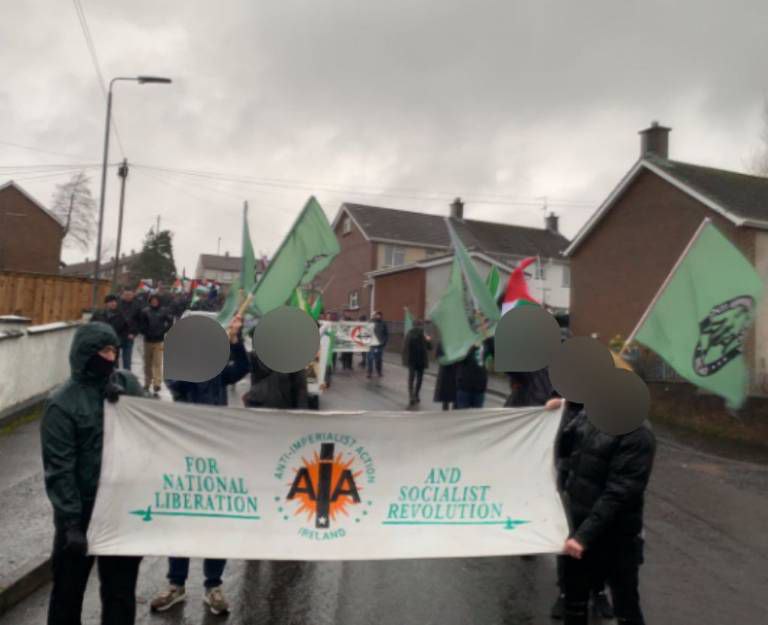
Rear banner of the AIA contingent on the Bloody Sunday commemoration march Sunday. (Photo source: AIA)

For a number of years this commemoration has taken place in heavy rain and high winds, or snow, or sleet but it was dry this year – until the march started! However after a short period of strong gusts driving rain it stopped for the rest of the march.

Down Creggan Road to the Bogside once more and past the Bloody Sunday and H-Block memorials to the rally at Free Derry Corner where Kate Nash, one of the main organisers of the march for years and a sister of one of those murdered in the massacre, welcomed the marchers.

The Bloody Sunday 52nd commemoration march makes it way along Lone Moor Road towards the Brandywell on Sunday afternoon. (Photo: George Sweeney via Derry News.)

RALLY AND SPEAKERS

Nash condemned the punitive EU/ UK/ USA cutting of funds to the UNRWA organisation carrying out relief and educational work in Gaza following an Israeli State intelligence allegation1 and also called for no Irish politicians to attend the annual US Presidential St. Patrick’s Day event.2

Kate Nash’s brother Willie was murdered by the Parachute Regiment during the massacre and her father was wounded by fire while trying to reach his fallen son. Kate called for a minute’s silence for the dead and wounded that day but also for those in Gaza, in particular the children.

Kate Nash also mentioned the Noah Donohoe case as being close to everyone’s heart.

The names of the dead and wounded by the Parachute Regiment were read out by Damian Donaghy,3 son of Damian Donaghy one of the survivors on that day. Paddy Nash performed the civil rights anthem “We Shall Overcome” which was popular among marchers of the time.

Section of the rally to the right as facing Free Derry Corner with a mural based on an iconic photograph from the massacre. (Photo: D.Breatnach)

Kate Nash introduced Huda Ammori, a Manchester-based Palestinian activist and one of the Elbit Eight,4 who said she felt at home in Derry because of the people’s solidarity with Palestine.5 The State in Britain failed to convict all but one of any charges arising out of direct action against the arms company.

Ammori drew parallels between the Irish and Palestinian struggles against colonialism and stated that her grandfather had been assassinated for rising up against the British colonisation of Palestine in 1936, when it was a British “Mandate”.

Mural on a wall in the Bogside, Derry; the words “don Phalaistín” are obscured by a vehicle. (Photo: D.Breatnach)

AIA Short Video with Music Bloody Sunday Derry 2024 AIA Video.MP4 (viewable on FaceBook)

“The British signed away the land of Palestine in 1917,” Amori told the rally, “they colonised our lands and then they armed and trained the Zionist militia to commit a Nakba, to displace over 750,000 Palestinians in 1948, over half the indigenous population.”

Huda Ammori said weapons were used on Palestinians in Gaza and then marketed as ‘battle-tested’. She also praised those who had taken direct action in Derry against arms firms (e.g Raytheon).

Section of crowd gathering in front of the stage for the rally. (Photo: D.Breatnach)

Geraldine Doherty, niece of Gerard Donaghy, youngest of the Bloody Sunday victims, also spoke from the platform, saying it was ‘sad’ but ‘heartwarming’ to see so many people attending the march.

“More than half a century since British troops committed this massacre on these streets, innocent children like my murdered uncle Gerard and hundreds of others as well are still being denied justice”, she said and denounced the British State attempting to prevent the trial of legacy cases being tried.

Doherty spoke of the remaining “trauma for Derry and for Ireland” from which many families have never recovered, with long-term post-traumatic damage such as depression, addiction and divided families.

“But while the people of Derry were battered and imprisoned, we were never broken,” she said to cheers from the rally participants. “Derry has rediscovered its … voice and we are using that voice to oppose the murder of children and women and men, and we stand with the people of Palestine.”

Section of crowd to the left of the stage at the rally. (Photo: D.Breatnach)

ON THE MARCH

Over the years since I returned to Ireland, I have marched in that commemoration many times, either as an individual or as a member of a solidarity committee and this year was glad to be welcomed as part of the Socialist Republican contingent, with Anti-Imperialist Action.

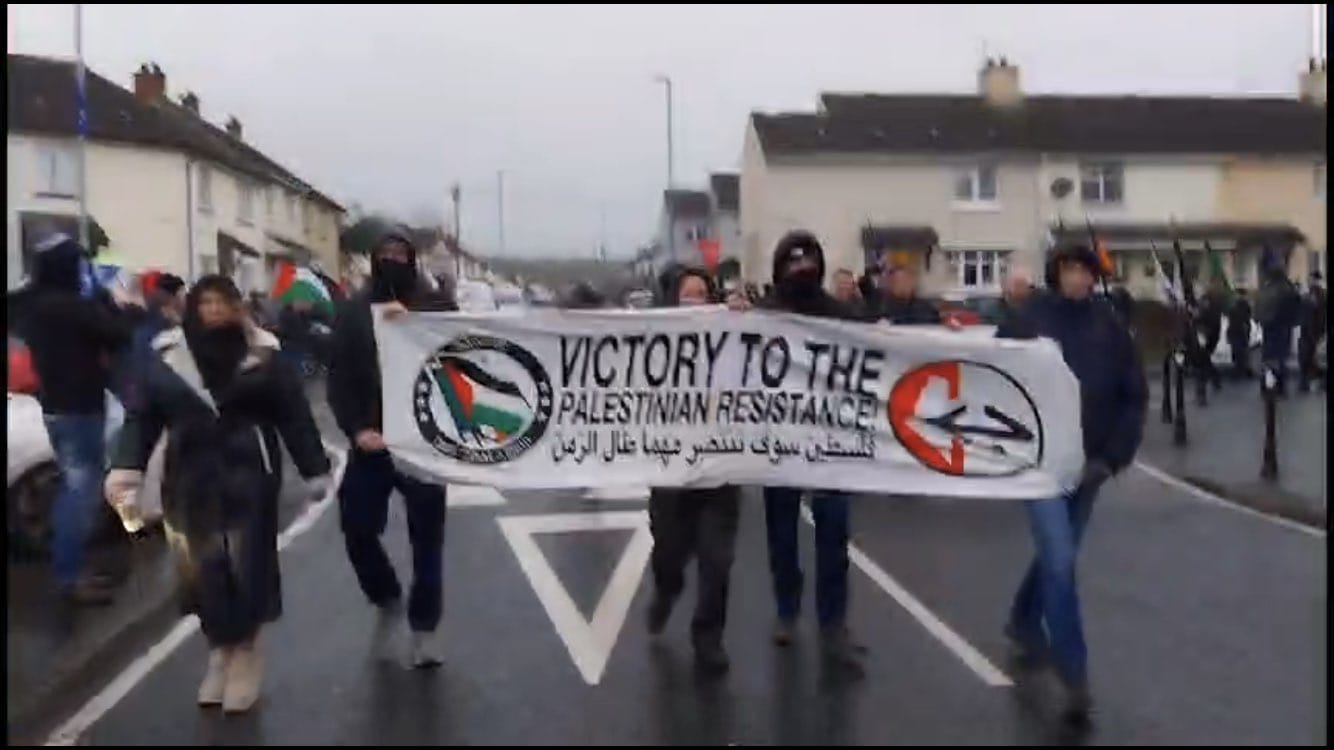
The bloc carried two banners: the one at the front was a new one in which the AIA called for anti-imperialist revolution and socialism, while at the rear the banner celebrated the Palestinian resistance. In between the banners marchers carried flags and placards.

New banner of the AIA in the organisation’s contingent on the march on Sunday. (Photo: D.Breatnach)

In the bloc men and women marched with a flags of the AIA, the Starry Plough, Palestine and Cumann na mBan. From the contingent on many occasions could be heard slogans of solidarity with Palestine and some equally applicable to that nation’s resistance or to Ireland’s.

“In the face of occupation – Resistance is an obligation!” and “No justice – No peace!” were in the latter category while “From the River to the Sea – Palestine will be free!”, “Free, free – Palestine!” and “Saoirse don – Phalaistín!” were specifically supporting the Palestinian struggle.

Most Republican organisations and some Irish socialist organisations attend the annual event, along with campaign groups and on occasion solidarity groups from abroad or Irish ones in solidarity with struggles abroad. Sinn Féin no longer attends but some supporters would as individuals.

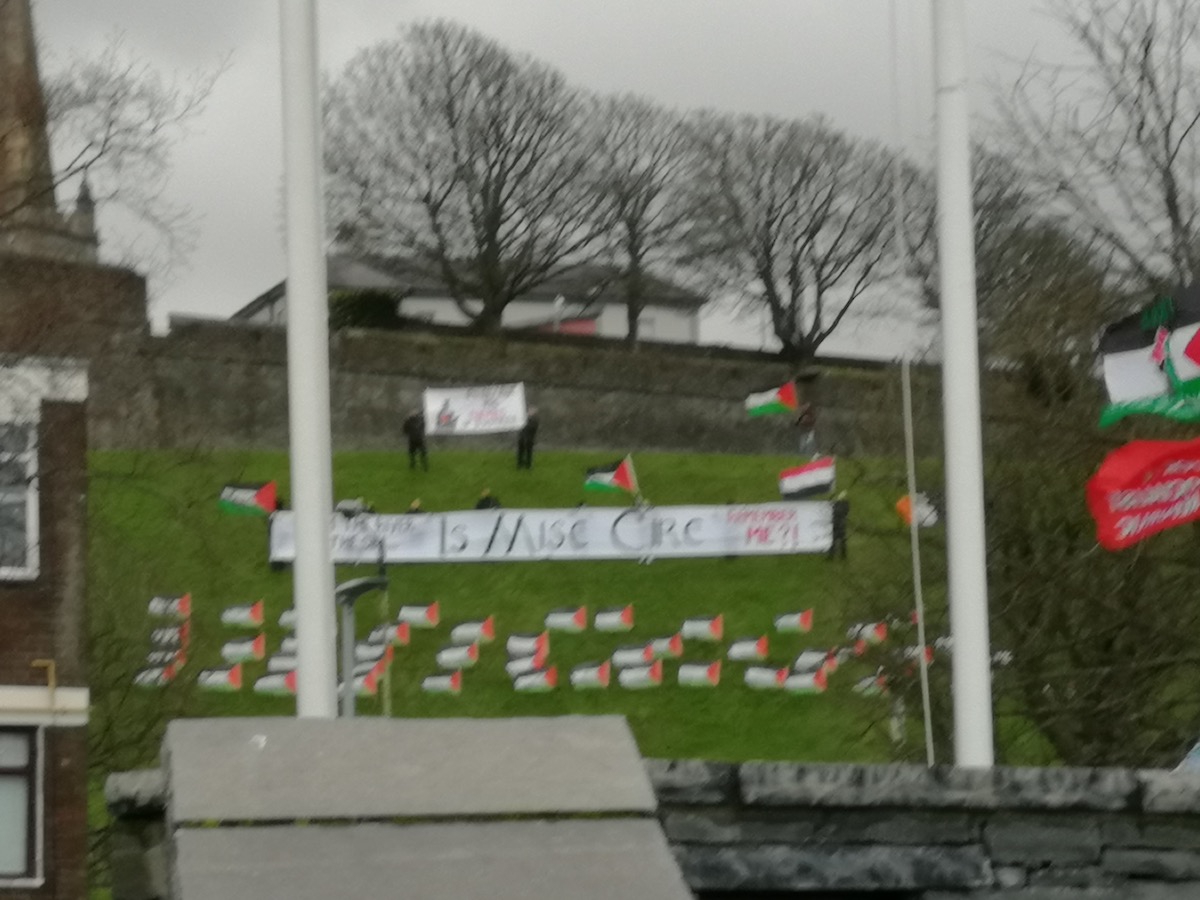
Giant Palestinian flag displayed below the Derry Walls above the rally below. (Photo: D.Breatnach)

THE MARCH ROUTE AND HISTORY

The Bloody Sunday march covers the same route as the anti-internment march in January 1972 when the British Paratroopers murdered 14 unarmed marchers and injured so many others. Preceded by the Ballymurphy Massacre in August 1971, it was followed by another in Springhill in July ‘72.

The British military claimed that the Derry victims had been armed and fired first and an inquiry tribunal headed by Lord Justice Widgery exonerated the Army and blamed the victims although the Derry Coroner, an ex-British Army officer had called it “sheer unadulterated murder”.

In 1998, presumably as part of the Good Friday Agreement deal, the British State began a new inquiry which however did not deliver a published verdict until 2010,6 stopping short of accusing the Army of murder but exonerating all the victims except one about which it was equivocal.

At that point, Sinn Féin’s Martin McGuinness said that the march should not be continued; however not one British soldier had even been charged, to say nothing of the commanders and Government Ministers who had either given the orders or arranged the cover-up – or both.

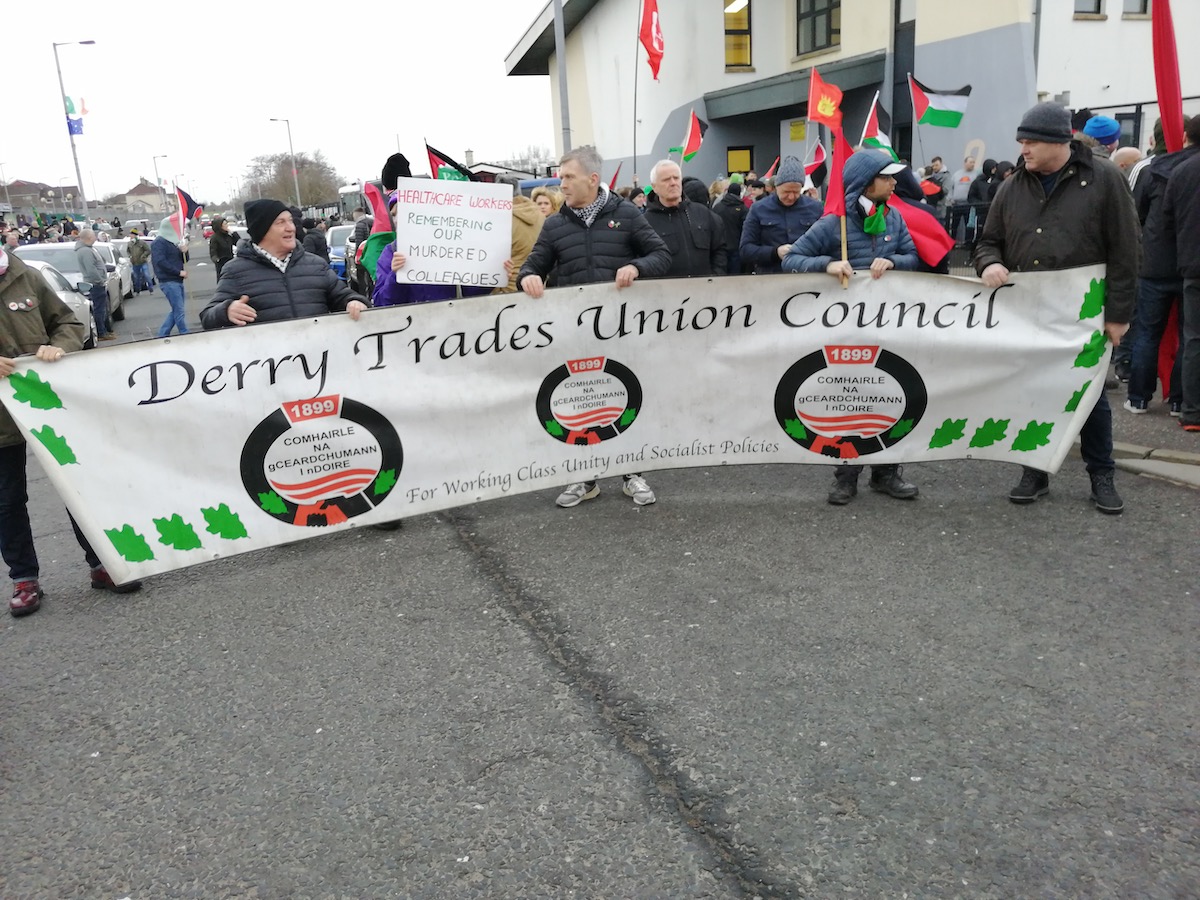
Banner of the organisation combining representation of trade unions in Derry. (Photo: D.Breatnach)

A small group of veterans of the original march and relatives, Kate Nash prominent among them, however decided to keep the march going and have done so every year, often in the face of accusations and disparaging remarks from supporters of Sinn Féin and others.

In 2022, the Massacre’s 50th anniversary, 20,000 marched in it while the Bloody Sunday Trust, an institution and museum supported by the colonial state and Sinn Féin, organised a small “memorial walk” and indoors event in the Guild Hall – the only one reported by the mass media.7

An independent group, badly needed since the Coiste na nIarchimí is controlled by the Provisionals. (Photo: D.Breatnach)
Display below Derry Walls created by the Saoradh Irish Republican organisation, according to their social media. (Photo: D.Breatnach)

Although veterans of the massacre and of the annual commemoration often meet one another only once a year at the commemoration, some having come from abroad, there are always new young people to be seen among them and hundreds come out to watch the march.

The march is an important commemoration of a massacre by British colonialism which still holds the colony of the Six Counties, a reminder no doubt inconvenient to unionists, neo-colonialists and those who have left the struggle, either through lack of will or for personal advancement.

In its championing and giving voice to other conflicts too, the commemoration march and other related events during the week are a strong expression of internationalist solidarity.

Wreath of the Bloody Sunday Commemoration Committee among others at the Bloody Sunday Monument. (Photo source: Bloody Sunday Commemoration Committee)

End.

FOOTNOTES

1The Israeli state intelligence agency reported that 12 out of 13,000 employees of UNRWA in Gaza had been implicated in the 7th October Palestinian raid following which at least some, possibly all, were sacked by UNRWA, apparently without any hearing or appeal process. The US, UK, Germany, Italy followed this up by suspending all funding to the relief organisation catering for 2 million people in dire circumstances. 

2Traditionally, leading politicians of the main Irish political parties, both mainstream and Sinn Féin, have sent representatives to celebrate St. Patrick’s Day with US Presidents, many of whom are of Irish descent. This year a campaign has arisen calling on them not to do so but spokespersons of Fine Gael, Fianna Fáil and Sinn Féin have insisted they will attend, which the SDLP has declared it will not. 

3Not to be confused with the family of Gerard V. Donaghy (20 February 1954 – 30 January 1972), sometimes transcribed as Gerald Donaghey, a native of the Bogside, Derry who was murdered by members of the 1st Battalion, Parachute Regiment on Bloody Sunday.

4Eight activists of British-based Palestine Action, a direct action organisation, who as a result of their actions against the Israeli-based military technology company Elbit in Britain, were charged with a total of 12 charges which included criminal damage, burglary and encouraging criminal damage. The trial, which commenced on November 13th, related to a series of actions taken during the first 6 months of Palestine Action’s existence from July 2020 to January 2021. In December last year, one activist was convicted on one charge by 10-2 majority, two were completely cleared and jury failed to reach a majority verdict on the rest of the charges on six remaining activists.

5That would be true of the majority ‘nationalist’ population of the city but not so much of the unionist minority, where support for Israel is more dominant, due in part to susceptibility to British propaganda and also simply out of sectarian hostility to anything favoured by the ‘nationalist’ community.

6At a cost of nearly £200m (€227.7m), half of which went in legal fees, a lawyer’s bonanza, to arrive at a decision that just about everyone in Ireland knew and many abroad knew already and which established no safeguards against a similar massacre being carried out by British military in future.

7Browser searches throw up report after media report, including Al Jazeera’s, of “hundreds” attending the early event, without a mention of the many THOUSANDS who marched later in the day.

SOURCES

https://www.derryjournal.com/news/people/when-im-in-derry-i-feel-like-i-am-home-palestinian-activist-tells-bloody-sunday-rally-4496030

Elbit Eight trial and verdict: https://www.palestineaction.org/elbit-eight-verdicts/

The Saville Bloody Sunday Inquiry: https://en.wikipedia.org/wiki/Bloody_Sunday_Inquiry

Cost of: https://www.irishexaminer.com/news/arid-30477561.html

BRITISH IMPERIALIST ESCAPES JUSTICE

(from Anti-Imperialist Action Ireland)    (Reading time: 2 mins.)

Frank Kitson, a leading terrorist and General in the British Army, died today at the age of 97.

As the national liberation struggle of the Occupied 6 Counties began, Kitson was appointed as commander of British forces in Belfast in 1970. He organised “countergang” death squads such as the Military Reaction Force and the Force Research Unit.

These units bombed and randomly targeted innocent nationalists, attempting to place the blame on the IRA. He promoted infiltration of and psyops against the Republican movement. He emboldened and directed Loyalist death squads and deployed the Paras to massacre nationalists.

Kitson was a leading figure in the British counterinsurgency campaigns in Malysia and Kenya. It was here he developed his theories on how to crush national liberation and communist struggles.

He advocated for massive population control and terror to deprive struggles of support. He advocated for forming paramilitary groups that were free to terrorise and assassinate at will, as well as spread doubt among natives. He drew from these campaigns and deployed them in occupied Ireland.

As an advocate of psyops, Kitson used the mainstream media to spread malicious lies about the Republican movement, including absurd propaganda such as claiming that the IRA were found to be worshipping Satan.

Under his command and through his recommendations prisoners were tortured, civilians brutalised and countless were interned.

While Kitson was removed from his position in 1972, his theories and the framework he established in Belfast came to be adopted by the British imperialists in Ireland for decades.

Many of the terror strategies he developed are used in Ireland and in imperialist occupations around the world today as part of “low intensity operations”.

Frank Kitson was a crusader for Empire and he was well rewarded for his campaign of murder and terrorism. He also lauded by the British press and given countless awards.

It is shameful that he never faced the People’s Justice for his crimes. That this man was allowed to retire and live out his life in peace is a symptom of the deep sickness in British society. That this man dies with full honours shows that collusion, terror and murder were official British state policy in Ireland.

As the imperialists have developed their tactics and strategies, so have the people. No matter what new innovations in subversion, terror and brutality the enemy comes up with they will be overcome. The struggle of the Palestinian Resistance today has taught the imperialists that lesson once again.

The struggle for the All Ireland Republic continues despite the best efforts of British imperialism. One day soon the British Empire will be buried along with Frank Kitson.

CHRISTMAS LIGHTS AND POLITICAL PRISONER SOLIDARITY

Clive Sulish

(Reading time: 4 mins.)

Among Christmas shopping crowds in Dublin’s city centre, the calls for freedom of political prisoners rang out, while the Irish, Palestinian and Basque flags fluttered in the wind among festive lights and projected light-show.

The Ireland Anti-Internment Campaign was holding its annual political prisoner solidarity picket in the busy O’Connell street, supported by socialist Republican groups and independent activists.

View of picket line looking southward. (Photo: Rebel Breeze)

December is a traditional month in Ireland for focus on Republican prisoners. However, the IAIC campaign has always made a point of remembering political prisoners elsewhere too, with Palestinian and Basque flags erected on its regular pickets.

This year the Campaign had especially requested Palestinian flags and these were present, both the national flag and that of the Peoples Front for the Liberation Palestine, fluttering alongside Basque flags and the green-and-gold Starry Plough.1

In addition, one of the IAIC’s banner displayed a large copy of an image depicting a Palestinian’s arm extended through prison bars to grasp the hand of an Irish Republican prisoner’s hand also from nearby bars, from the original by political cartoonist Carlos Latuf,.

A black banner had been rigged with lights to spell “Saoirse”, the Irish word for “freedom” and the picketers set up in a line with other banners and flags facing the GPO building.2

Political prisoners sometimes have their family visits cancelled as a punishment and during the Covid pandemic prevention period it was used as an excuse to prevent Republican prisoners’ family visits. (Photo: Rebel Breeze)

SHOUTS

A speaker using a megaphone informed passers-by that internment without trial had not ceased in Ireland and that Republicans were being charged and then refused bail by non-jury courts on both sides of the British Border, spending two years in jail regardless of their trials’ outcomes.

All the Republican prisoners, the IAIC speaker said, had been convicted in non-jury special courts. Palestinians were also being convicted in special courts, he said, military courts and many were in jail – in “administrative detention”, i.e interned without ever having been convicted or tried.

Over 3,000 had been arrested in Israeli Army raids since October 7th,3 the speaker said through the megaphone, bringing the overall number of Palestinians in jail to over 7,000.4

(Photo: Rebel Breeze)

The recent exchange of prisoners between the Zionist state and the Palestinian resistance had resulted in liberty for 240 Palestinians, of which 1075 were children and 68 women.

There was regular chanting from the picket line including: “From Ireland to Palestine – Free all political prisoners!” “When there is occupation – Resistance is an obligation!” and “Free political prisoners – Free them now!”

At one point some kind of religious procession was briefly enacted in front of the GPO building and an elderly woman in apparent religious garb approached the picketers shouting something at them which they largely ignored, maintaining their solidarity slogans.

(Photo: Rebel Breeze)

In addition to interested people taking photos or filming video of the protest on their devices, some approached the participants to ask questions and to receive a leaflet, after which a number actually joined the protest line for a while (some until the end).

Occasional passing traffic also sounded their horns in solidarity.

The pavement in front of the GPO showing shoppers and people queuing for food distribution. (Photo: Rebel Breeze)

STATEMENT

As the end of the event’s allocated period approached, a representative of the IAIC asked the participants to gather around and spoke about how resistance brings repression and oppression brings resistance, resistance being the “crime” for which political activists are jailed.

The participants were thanked for their support, whether independents or activists of Ireland Anti-Imperialist Action and Saoirse Don Phalaistín organisations.

The event ended with the acapella singing of “The H-Block Song” by Diarmuid Breatnach, in an adaptation of the original air to the lyrics of what is “still a good song” he said, composed by a man who, along with his party, “no longer supported Republican prisoners”.6

(Photo: Rebel Breeze)

The lyrics recall the struggle of Republican prisoners in the late 1970s against the removal of their ‘Special Category’ political status, which began with refusal to wear prisoner uniform. The struggle escalated to the “no-wash protests” and to hunger strikes in 1980 with ten martyrs in 1981.

As the protesters collected their flags and wrapped up their banners, the nature of current Irish society was underlined by the queues forming up across the road for free food being distributed by charitable organisations.

Early view of picketers, looking northward. (Photo: Rebel Breeze)

INDEPENDENT AND OPEN DEMOCRATIC ORGANISATION

The IAIC is “an independent organisation and open democratic organisation” of ten years’ existence and although it has held events for specific cases such as the framed Craigavon Two,7 its main activity has been regular public pickets in Dublin to highlight ongoing internment in Ireland.

The Campaign group encourages participation by democratic people in its regular pickets, regardless of political organisation affiliation or none and, according to one of the organisers, expects to hold its next one in Dublin in January or February.

The IAIC expects also to take part again in the annual Bloody Sunday Commemoration march in Derry on Sunday 29th January 2024.

end.

Unintentionally impressionistic image, photo taken from the east side of O’Connell Street (Photo: Rebel Breeze)

APPENDIX: ANNIVERSARY OF HANGING OF IRISH REPUBLICAN

Though not mentioned in the discourse, the above event took place within days of the anniversary of the British colonial execution of an Irishman in revenge for his killing of an ex-Republican who had turned informer.

James Carey, in the midst of a ‘witness protection program’ provided as a reward for his betrayal of his comrades in giving evidence in court to ensure the jailing of some and hanging of five others, was killed in a gunfight with Pat O’Donnell.

Carey had been a leading member of the National Invincibles’ (a split from the Fenians) cell in Dublin, and had given the signal for the fatal stabbing of British Under-Secretary Burke and Chief Secretary Lord Frederick Cavendish in Phoenix Park on 6th May 1882.

However, Carey turned “Queen’s Evidence” to testify ensuring the conviction of his former colleagues and even gloated in court at their fate. His reward, but for O’Donnell, would have been a new life with pension under an assumed name with wife and children in the South African colony.

O’Donnell was an independent Republican from the Irish-speaking Gweedore area in Donegal but had been to the USA, where he had cousins who were prominent in the “Molly Maguires”, an Irish-led resistance organisation among miners in the USA.

O’Donnell was hanged on 17th December 1883 but is commemorated in the satirical song “Monto” and also in the serious “Ballad of Pat O’Donnell”. His home town of Gweedore also holds a monument in his honour.

end.

FOOTNOTES

1Flag of the Irish Citizen Army, the first workers’ army in the world, founded to protect workers from the police during the Dublin Lockout/ Strike of 1913.

2The General Post Office, iconic building on Dublin’s O’Connell Street, which was the HQ of the leadership of the 1916 Rising, left a shell by fire from British artillery bombardment but rebuilt later.

3https://en.wikipedia.org/wiki/Mass_detentions_in_the_2023_Israel%E2%80%93Hamas_war

4https://www.hrw.org/news/2023/11/29/why-does-israel-have-so-many-palestinians-detention-and-available-swap

575% had not been convicted of any crime https://en.wikipedia.org/wiki/2023_exchange_of_Israeli_hostages_for_Palestinian_prisoners

6Francis Brolly (1938-1920) of Provisional Sinn Féin, composed the song which was released in 1976. PSF abandoned the struggle in the imperialist-promoted pacification process towards the end of the last century and most of their prisoners were released under licence. However those who made public their disagreement with the colonial occupation and the pacification process were on occasion returned to jail while new “dissidents” were charged and refused bail in special no-jury courts, with tacit support of the PSF.

7Quoted from the FB page at https://www.facebook.com/profile.php?id=100063166633467

IRISH MEDIA WITH BRITISH & NATO PROPAGANDA

News & Views No. 11 Diarmuid Breatnach

(Reading time: 5 mins.)

The Irish State is one of four of the European Union which are not also members of the US/NATO military organisation1 but the Irish national ruling class keeps up propaganda to get its citizens to accept the “need” for membership.

The UK’s colony of Six Counties is included in NATO which means that over one-fifth of Irish land is already formally a part of the imperialist military alliance.2 In addition, successive Irish State governments have long been collusive in permitting US military use of Shannon Airport.

The ruling class’s propaganda is emitted not only by politicians’ statements and pro-NATO conferences3 but also through media articles. In this article4 the headline clearly gives the impression that the UK is rendering Ireland needed protection from Russia:

“UK had to come to Ireland’s aid with Russian submarine hovering off Cork harbour”!

Image shows two RAF Typhoons sitting off of the wing of a Voyager tanker after taking on fuel. A multitude of Royal Air Force aircraft flew in-support of Exercise Joint Warrior 2020, most notably 617 Squadron F-35B’s who flew alongside US Marine Corps (USMC) VMFA 211 Squadron F-35B aircraft. (Image sourced: Internet)

WITH ‘PROTECTORS’ LIKE THAT …!

In fact, throughout the history of the existence of the Russian entity, whether as kingdom, empire, socialist or capitalist state, not once has it caused or even threatened the Irish people (and during the 1916 Rising and war of independence its leaders praised the Irish struggle for independence).

On the other hand, the rulers of England, being cast as our protectors, have invaded and colonised Ireland, stolen our natural resources, exploited and massacred our people, repressed our resistance, undermined language and culture, sabotaged our economy and finally partitioned our nation.

To obliterate that reality from Irish popular consciousness is far from easy but first the English and then the Irish national ruling class or bourgeoisie has been at work on that project for centuries.

In 1366, less than two centuries after invasion, the Statutes of Kilkenny sought to end the cultural integration of its colonists, whom the English rulers called “the degenerate English” and whom they accused of having “become more Irish than the Irish themselves”.

During the 16th and 17th centuries the English Crown carried out a number of wars in Ireland to force the indigenous Irish and many of its colonists to accept the Crown’s religion as their own and even exported Irish people as slaves to their American and Caribbean colonies.5

They also organised a number of settlement colonies on Irish land from which they had expelled the natives, requiring the settlers to be English-speaking, non-Catholics, to build house and town for defence and not to employ Catholics.

In the 1780s the English occupation created an Irish colonial chivalric order, the Order of St. Patrick, with a red saltire, to which Irish settlers and Irish were encouraged to belong. That saltire, along with St. Andrew’s, is worked along with the cross of St. George to make the Union Jack.

Towards the end of the 18th Century the English founded the Orange Order to foster division between those of Catholic faith and adherents of the various Protestant sects; then repressed the Republican rising and instituted a reign of terror.

They followed that up at the turn of the Century by organising the dissolution of the Irish Parliament and repression of another Rising. Later that century they oversaw the elimination of a third of our population once again through starvation, disease and forced migration.

Their colonial education service spread the English language further, penalised Irish-speaking children and encouraged children to think of themselves as “English”: ‘Indeed, the following verse was to be hung in every national school:

“I thank the goodness and the grace
That on my birth have smiled,
And made me in these Christian days
A happy English child.
“’6

In the early decades of the 20th Century the English ruling class, by now of the UK, suppressed another rising and sent thousands off to die in imperialist war, outlawed an Irish popular democratic parliament and fought a war or repression and terror against the Irish people.

Following up on that, the Crown subverted a section of the nationalist movement and instigated a civil war against Irish Republicans, arming and clothing the army of the neo-colonial Irish Free (sic) State which executed formally and informally over a hundred Republicans.

During the 1970s British intelligence service agents and proxy militia terrorists carried out a number of bombings in Ireland, the one in 1974 killing 34 people (including a full-time foetus) in Dublin and Monaghan,7 the highest toll of any day during the whole three-decades war.

In the final three decades of the last decade the UK waged a direct military and proxy terrorist war against the Irish nationalist people in their colony.

MASS MEDIA PROPAGANDA

As noted earlier, the Gombeen (neocolonial) Irish bourgeoisie has been trying to obliterate the deep consciousness of that history by promoting equivocation and doubts through reactionary historical revisionism and even removing significant sections from the history curriculum.

The mass media is another important leader in this work. In the featured piece we see that it is the headline that delivers the NATO-and neo-colonial conditioning message, albeit without mentioning those and indeed by adding material that cannot be read in the actual text of the article.

British nuclear submarine (Image sourced: Internet)

“Security and defence analyst Declan Power said Britain often finds out about these things before we do.” Yes, we can be sure that it does!

“What exactly was the Russian submarine doing there? It should be looked at in the broader array of defence arrangements in that the Russians will be regularly testing the defence responses of Nato nations… in particular the UK.”

“Because the UK and the Scandinavian countries have responsibility for monitoring an area known as the Icelandic gap.”8 The piece concludes with a suggestion of threat to Ireland, stating that the incident occurred “south of the entrance to Cork Harbour.

Perhaps but over at least 12 miles away, so in fact it would’ve also been in a line west of Devon and Wales in Britain and line north-west of France! The article concludes by stating that “Russia has been regularly testing British air defences off Irish shores in recently (sic) years.”

Yes, “testing BRITISH air defences” and the UK is no doubt doing the same to Russia. Britain, as the UK, is a member of US/NATO, which is not only opposed to Russia but has been encircling it for decades before instigating a proxy war against it.

Far from protecting Irish people, British military manoeuvres around and over9 Ireland, its bases in the Six County colony and US military uses of Shannon airport actually place us in great danger in any wide conflict in Europe or in world war.

And then of course, there’s the little matter of colonial occupation of a part of our nation and neo-colonial domination of the rest through our compliant national ruling class. The UK military is no friend of people anywhere — and least of all a friend of the Irish people.

End.

Footnotes

1The other three are Cyprus, Malta and Austria. As of yet nor is Sweden but the expectation is of joining very soon.

2There are 32 counties in the whole Irish nation and the names of all but three in English are corruption of Irish words (including all of the Six in the colony).

3https://peoplesdispatch.org/2023/06/24/anti-war-groups-in-ireland-disrupt-security-conference-at-cork-university/

4https://www.breakingnews.ie/ireland/uk-had-to-come-to-irelands-aid-with-russian-submarine-hovering-off-cork-harbour-1563754.html

5Later also as indentured labour.

6https://www.familysearch.org/en/wiki/Protestants_in_Ireland_their_impact_on_society_and_the_family

7And injuring around 300.

8“responsibility” to whom? Presumably to US/ NATO!

9https://www.irishtimes.com/ireland/2023/05/09/raf-jets-may-have-entered-irish-airspace-martin-says/

Sources

https://www.cbsnews.com/news/nato-countries-maps-list-membership-requirements/

https://www.breakingnews.ie/ireland/uk-had-to-come-to-irelands-aid-with-russian-submarine-hovering-off-cork-harbour-1563754.html

https://www.familysearch.org/en/wiki/Protestants_in_Ireland_their_impact_on_society_and_the_family

The St. Patrick’s Saltire and Order of St. Patrick: https://www.bbc.com/news/uk-northern-ireland-36846914

BRITISH NAVY CONFRONTATION IN DUBLIN – GOMBEEN STATE RAIDS ON ACTIVISTS’ HOMES

The following is a compilation by Rebel Breeze of recent short communiqués from Anti-Imperialist Action on the confrontation with a British warship in Dublin and the raids on activists’ homes and arrests under the Gombeen State’s “terrorist” legislation (Offences Against the State Act).

Armed British Terrorists Confronted in Dublin.

On Sunday afternoon, members of Anti-Imperialist Action Ireland along with members of Saoirse Don Phalaistín, carried out a direct action against a British warship in Dublin port.

The protest was called to highlight the ongoing British Occupation of Ireland and to make clear the complicity of British Imperialism in the ongoing Zionist Occupation and Genocide in Palestine. The protest made clear the links between the National Liberation Struggles in Ireland and Palestine.

British Military confronting protesters in Dublin (Image sourced: AIA)

In a militant protest, the activists, chanted ‘From Ireland to Palestine, occupation is crime’ and Britain Out of Ireland and Palestine.’

During the course of the protest, the Republican Activists present confronted Armed British soldiers who appeared on the deck of the ship and a stand off ensued on the gangway.

End the occupation! End the genocide!

Free Palestine!

Free Ireland!

Solidarity picket outside the Dublin courts (Image sourced: AIA)

In a series of coordinated raids in Dublin this morning, a number of Republican Activists have been arrested and detained under section 30 of the Free States “Offenses against the state act”.

These arrests come as the state is increasingly fearful of the growth in Revolutionary Irish Socialist Republicanism and of Anti Imperialist Action Ireland in particular.

The arrests are timed to coincide with the leading role AIA has been playing in support of the Palestinian People and Resistance across the 32 counties and at a time when our members continue to confront and resist Imperialism across Ireland.

(Image sourced: AIA)

AIA condemn the raids and arrests by the Drew Harassers on Republican Community Activists and we call for these activists to be released back to their families and communities immediately.

Harassment, Raids, or Arrests will not stop AIA and Republican Activists from our work to rebuild the struggle for National Liberation and Socialist Revolution, resisting Imperialism or from taking a stand for Palestine.

The Republican Community Activists raided and arrested in Dublin yesterday have been released without charge.

The operation by the Drew Harassers, no doubt at significant cost, was designed to intimidate the growing membership and support base of AIA across Ireland, but it has failed, as all such operations will fail.

AIA welcome home these activists to their families and communities, where they belong. Republicans are not criminals. We will continue to promote the legitimate demand of rebuilding the Republic of 1916 at every opportunity. We will not be deterred and ultimately we will win.

Yesterday’s arrests are only further proof that the Free State fears the message of Revolutionary Socialist Republicanism, fears the growth and levels of support for AIA, fears our support for the Palestinian Resistance and fears our continued legitimate direct actions to confront and resist British, North American, European and Zionist Imperialism in Ireland.

We won’t be going away!

Free Ireland!

Free Palestine!

Also on Saturday, after the giant Palestine solidarity march in Dublin, according to another communiqué, members of AIA, Saoirse Don Phalaistín and Palestinian Solidarity Activists picketed the Leonardo Hotel on Parnell St.

The Leonardo Hotels are owned by Fatell Hotels the largest hotel group in ‘Israel’ and strong supporters of Zionist terrorism and genocide.

In response to the picket, the hotel has decided to enter lockdown, refusing to open the doors for guests.

End items.