A WORKERS’ UNION IS ITS DEMONSTRATED STRENGTH

Diarmuid Breatnach

(Reading time: 13 mins.)

Arising out of a recent discussion, I was thinking about what makes a workers’ union – when is an organisation a union and when is it not. And what does it have to do to prove that it is a union, as well as can what once was a union become defunct as a union while still not being defunct as an organisation. In the present time of low union activity as well as in higher activity periods, there are some fundamentals worth considering.
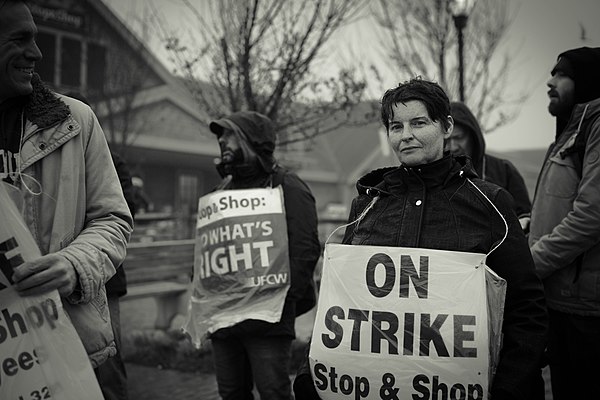
Picketers in the 2019 Stop & Shop strike (USA) in the rain in Natucket after their management forced them off company property. The workers won a victory in 11 days. (Photo credit NickleenF)

DEFINITIONS

Searching for definitions on line as to what constitutes a trade union, I came across the following:

Oxford on-line English Dictionary: an organized association of workers in a trade, group of trades, or profession, formed to protect and further their rights and interests.

Citizens Information: A trade union is an organisation that protects the rights and interests of its members. Members are employees in a particular sector or job, for example, teaching or nursing.

A trade union can:

  • Be an important source of information for employees
  • Provide employees with protection on employment issues
  • Negotiate with the employer for better pay and conditions

A trade union must have a negotiating licence in order to negotiate on employee wages and other conditions of employment.

The Irish Congress of Trade Unions (ICTU) is the single umbrella organisation for trade unions, representing a range of interests of ICTU members, both in Ireland and in Northern Ireland. ICTU also run the website unionconnect.ie to facilitate people to join a union.

Companies Registration Office (registration as a Friendly Society1): Trade unions are registered under the Trade Union Acts 1871-1990. Trade unions are established to represent workers in their relations with employers or to act as representative bodies for particular interest groupings.

In order to register a trade union, the grouping involved, which must consist of at least seven people, must draw up a set of rules governing the operation of the union. The rules must as a minimum contain the matters required to be provided for by the First Schedule of the Trade Union Act 1871. The rules, together with the prescribed application form and fee are submitted to the Registrar for examination and, once the rules are found to be in accordance with statute, the union is registered.

Registration as a trade union does not guarantee that a union will receive a negotiation licence; this is a matter for the Minister for Enterprise, Trade and Employment in which the Registrar of Friendly Societies has no function. Application form is available by emailing rfs@enterprise.gov.ie.

Wikipedia: A trade union (or a labor union in American English), often simply referred to as a union, is an organization of workers who have come together to achieve common goals, such as protecting the integrity of their trade, improving safety standards, and attaining better wages, benefits (such as vacation, health care, and retirement), and working conditions through the increased bargaining power wielded by solidarity among workers. Trade unions typically fund the formal organization, head office, and legal team functions of the trade union through regular fees or union dues. The delegate staff of the trade union representation in the workforce are made up of workplace volunteers who are appointed by members in democratic elections.

The trade union, through an elected leadership and bargaining committee, bargains with the employer on behalf of union members (rank and file members) and negotiates labour contracts (collective bargaining) with employers. The most common purpose of these associations or unions is “maintaining or improving the conditions of their  employment“.[1] This may include the negotiation of wages, work rules, occupational health and safety standards, complaint procedures, rules governing status of employees including promotions, just cause conditions for termination, and employment benefits.

Unions may organize a particular section of skilled workers (craft unionism),[2] a cross-section of workers from various trades (general unionism), or attempt to organize all workers within a particular industry (industrial unionism). The agreements negotiated by a union are binding on the rank and file members and the employer and in some cases on other non-member workers. Trade unions traditionally have a constitution which details the governance of their bargaining unit and also have governance at various levels of government depending on the industry that binds them legally to their negotiations and functioning. ……………………………

A modern definition by the Australian Bureau of Statistics states that a trade union is “an organization consisting predominantly of employees, the principal activities of which include the negotiation of rates of pay and conditions of employment for its members.”[6]

Yet historian R.A. Lesson, in United we Stand (1971), said:

Two conflicting views of the trade-union movement strove for ascendancy in the nineteenth century: one the defensive-restrictive guild-craft tradition passed down through journeymen’s clubs and friendly societies, … the other the aggressive-expansionist drive to unite all ‘labouring men and women’ for a ‘different order of things’.

Karl Marx described trade unions thus: “The value of labour-power constitutes the conscious and explicit foundation of the trade unions, whose importance for the … working class can scarcely be overestimated. The trade unions aim at nothing less than to prevent the reduction of wages below the level that is traditionally maintained in the various branches of industry. That is to say, they wish to prevent the price of labour-power from falling below its value” (Capital V1, 1867, p.1069).

We can note, across these definition from different sources, some constants: Trade unions (henceforth referred to by me as “unions” or “workers’ unions”) are

  • representative associations
  • of workers
  • that represent them in negotiations with employers

So, they have to be representative of workers (employers have their own formal associations) and they must, in general represent their worker-members. Well, few would debate the first condition and for the moment we can accept the second (though we will return to discuss this further).

I would argue however that there is another essential qualification which has not been mentioned even though for some it may be taken for granted: A union must be able to call a significant number of workers in a significant workplace, company or industry into industrial action and does so when necessary (whether that be strike, sit-down, go-slow, ban on certain kinds of work, etc.). In stating that I can quote for the moment no authority or source and yet I am adamant that if the association is not able to do so, it is not a union. I base my definition on experience and logic.

THREAT AND NEGOTIATION

We note that the “negotiation” with employers is mentioned in most if not all definitions. Present in every successful negotiation of workers with employers is a threat, that of action by the workers which will reduce or postpone the profits of the employers. This in turn is mediated by the threat of the employer to dismiss or otherwise penalise workers, to starve them into submission or to unleash private or State violence upon them2. The main reason for non-State employers to be in business of whatever kind is to make a profit and a substantial one at that and, in the case of an employer failing to avail of opportunities to do so, other employers, i.e other capitalists, will move in, outcompete and even take over the company3.

State companies have a responsibility to the ruling class to keep systems going, e.g public transport to deliver employees to work for private businesses, power supply to run the private enterprises, water and refuse collection to manage sanitation of working areas and reduce infections of the workforce, etc. So in successful negotiation with a State employer, the threat of workers’ action must be present also.

The threat may be implicit only but cannot remain effective if unrealised forever and every once in a while, employers will test it by a refusal (or procrastination) to accede to the demands of a union. In such a situation, the “negotiation” is ended or at least halted while both sides test the ability to resist of the other. If the employers are resolute and have enough resources but the workers are either not resolute or their resources are insufficient, the employers will win.

If the workers are resolute enough and are well-resourced and their action costs the employers enough so that the latter consider it better in the long run to accede to the demands, the workers will win. However, even when the workers are defeated in one battle, the action may have hurt the employers and next time there is a confrontation, they may be prepared to concede more. Even in failure in some cases, the threat of action has been shown to be a real one.
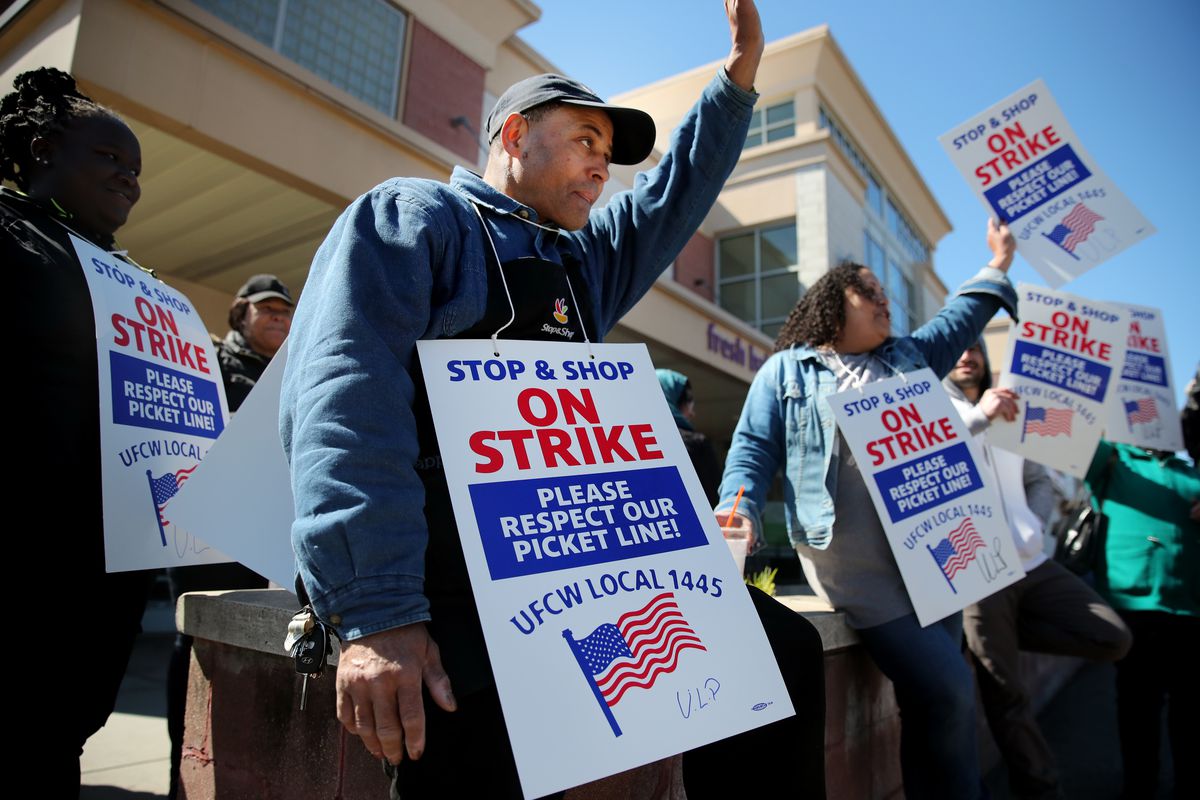
Picketers in the successful 2019 strike at the Stop & Shop chain by the United Food & Commercial Workers (USA & Canada). The Teamsters’ union instructed their members to respect the picket lines. After protracted negotiations failed, the strike began on 11 April 2019 and ended on April 21, 2019, after the company and the striking workers reached a tentative agreement, which preserved health and pension benefits and raised employee pay. The 11-day strike cost the company $224 million in lost sales and $90–100 million in lost profits. The tentative agreement was viewed by the union as a “powerful victory”.
In August 2019, Ahold Delhaize reported the 11-day strike resulted in a $345 million loss in sales, with an estimated 1 in 10 customers not coming back to the store as a regular customer after the strike. (Photo sourced: Internet) https://en.wikipedia.org/wiki/2019_Stop_%26_Shop_strike

If however over a number of years the unions do not exercise their muscle while at the same time enduring reductions in the working conditions and living standards of their members, the workers, they become more and more unions in form but not in content and the employers will pay less and less attention to their demands. Indeed, the only threat perceived by the employers in such situations is that the ineffective unions may be replaced by another or others more effective or lose control of their members to “unofficial” or “wildcat” action. Better the devil that they not only know but can manage, than the one they don’t.

I repeat: A union must be able to call a significant number of workers in a significant workplace, company or industry into industrial action and does so when necessary (whether that be strike, sit-down, go-slow, ban on certain kinds of work, etc.). In that respect, the crucial condition is not whether the organisation is more or less democratic, or socialist, or egalitarian, more or less environmentalist etc, though of course all those attributes are desirable. It must be effective, able to threaten and make good its threat.

Therefore calling an organisation a “union” does not of itself make it one and indeed an organisation may conversely be a workers’4 union without calling itself one, providing it is able to call a significant number of workers in a significant workplace, company or industry into industrial action and does so when necessary.

So I have extended the definition of a union: an organisation consisting predominantly of employees to defend the interests of its members and improve their remuneration and conditions of work and that is able to call a significant number of workers in a workplace, company or industry into industrial action and which does so when necessary.
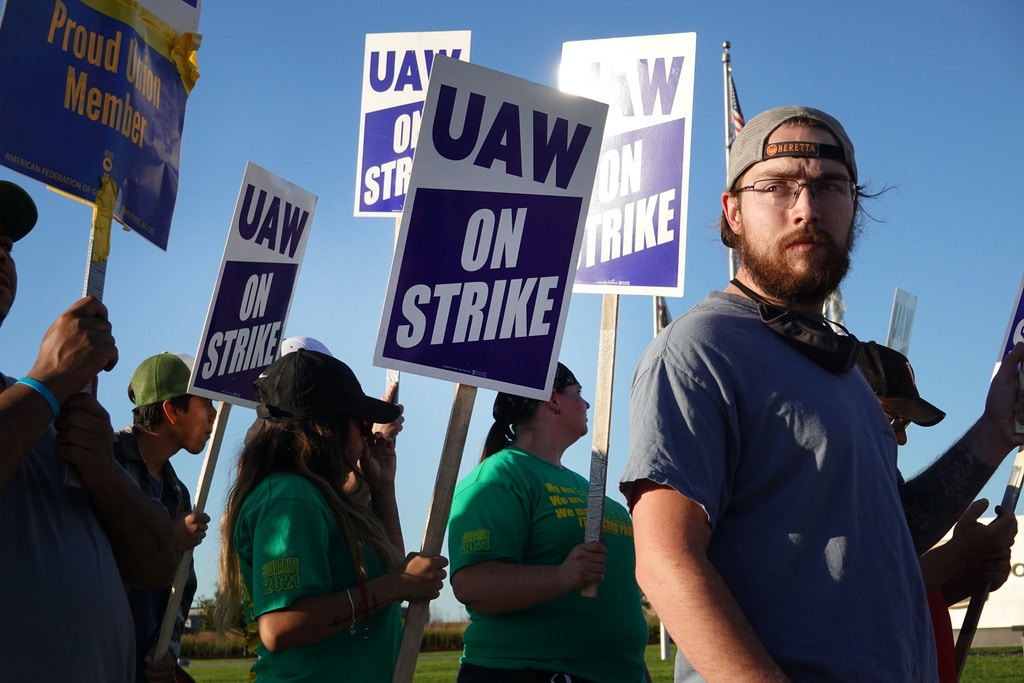
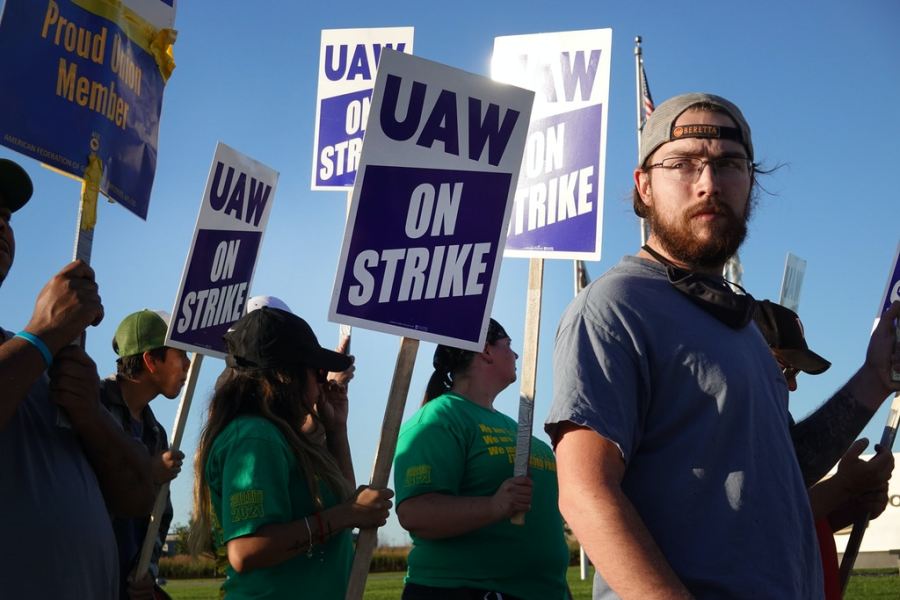
Workers of the United Auto Workers on strike picket the John Deere Harvester Works facility on Oct. 14, 2021, in East Moline, Illinois.
 Photo: Scott Olson/Getty Images

But what is a “significant number of workers in a significant workplace, company or industry”? Though this is more open to interpretation, it is nevertheless determined by two things, one of which is its ability to call an effective number of workers in the designated workplace into industrial action and the other is the relative size of the workplace, company or industry concerned. Of course, the workplace may be a shop or small garage or small farm, employing say around 50 people, in which all the workers are able to strike and do so, forcing the employer to accede to their demands or at least a significant (yes, that word again) number of them. The workers’ organisation in that case I would submit qualifies as a union on all grounds except one: the workplace is not a significant one in terms of industry or agriculture. It may go on from that initial success to extend to other workplaces but until it does so, it is a union only in the specific sense of that particular workplace.

However, if the organisation were to represent the majority of workers in one necessary part of a company’s production, willing to exercise its power and able to adversely affect the company’s output and profits, then that organisation would qualify as a union, according to my definition, even though it might represent only a small fraction of the total workforce.

Or if the one workplace in which the workers’ organisation is active is an extended one, for example a chain of stores or a major utility company. Or, as is sometimes the case, the workers’ organisation were to represent workers across an entire industry (“industrial unionism”), or groups of them in a number of different industries ( “general unionism”) or seeking to recruit all workers (“syndicalism”).

WHEN IS A UNION NOT A UNION?

It is important (and I would contend, crucial) also to define what a union is not. It is not

  • an organisation set up by a State and controlled by it
  • an organisation set up by employers
  • or the worker organisation’s offices, officers and other employees

Unions” set up by the State

States have set up “unions”, for example in the case of corporate states, i.e fascism and when they have done so, have banned real workers’ unions.

In Nazi Germany, workers’ unions were abolished. On 2nd May 1933, (after the large annual May Day marches), their leaders were arrested, their funds confiscated and strikes declared illegal. Workers lost the right to negotiate wage increases and improvements in working conditions and all workers had to join the German Labour Front (DAF) run by Dr. Robert Ley. Within two years, under various pressures, 20 million workers had joined DAF but they had no independent rights.5

Italian fascists waged war on the unions between 1920 and 1922 when Mussolini took power, burning trade union offices, and beating and torturing trade unionists. In Turin, the key industrial centre, fascist squads celebrated Mussolini coming to power by attacking trade union offices and killing 22 trade unionists”6.

“The Pact of Vidoni Palace in 1925 brought the fascist trade unions and major industries together, creating an agreement for the industrialists to only recognise certain unions and so marginalise the non-fascist and socialist trade unions. The Syndical Laws of 1926 (sometimes called the Rocco Laws after Alfredo Rocco) took this agreement a step further as in each industrial sector there could be only one trade union and employers organisation. Labour had previously been united under Edmondo Rossoni and his General Confederation of Fascist Syndical Corporations, giving him a substantial amount of power even after the syndical laws, causing both the industrialists and Mussolini himself to resent him. Thereby, he was dismissed in 1928 and Mussolini took over his position as well.

“Only these syndicates could negotiate agreements, with the government acting as an “umpire”. The laws made both strikes and lock-outs illegal and took the final step of outlawing non-fascist trade unions. Despite strict regimentation, the labour syndicates had the power to negotiate collective contracts (uniform wages and benefits for all firms within an entire economic sector).”7

In Spain the communists, anarchists and social democrats had organised trade unions which supported the Popular Front Government and mobilised against the military-fascist coup in 1936. Following the victory of the military and fascists the State, under General Franco, jailed or executed many of the trade union leaders and members and declared their unions illegal.

The Franco regime set up the “vertical union” (i.e controlled from above) officially known as the Organización Sindical Obrera (OSE); industrial resistance was illegal and in any case extremely difficult to organise, due to the defeat of the republican and socialist forces and the massive repression of all democratic and socialist trends.8

Union resistance under fascism

However, when workers of various kinds of socialist thinking joined these state unions either through being forced to do so or in conscious infiltration, many maintained their old allegiances and worked to subvert fascist rule and control of the workers.

“On 5 March 1943, workers at the giant FIAT Mirafiori car plant in Turin walked out on strike. As it became clear the dictatorship could not repress the strike it spread within Northern Italy, involving one hundred thousand workers. Mussolini was forced to grant pay rises and better rations, but in conceding he struck the death knell for the regime.”9

In 1947, eight years after the victory of the military-fascists, metal workers in the Basque province of Bizkaia went on strike in spite of repression by the authorities and a clandestine trade union movement began to organise. “Another historic year in the incipient union movement was 1951, when there were strikes and demonstrations in Barcelona, Madrid and the Basque Country in the early part of the year. These were mainly spontaneous, although the clandestine unions which had grown up since 1947 did support and take part in them. An important role was also played by the Spanish Communist Party PCE, and Roman Catholic workers’ groups.” “In a context of socio-economic change in Spain in the late 1950s, as industrialisation accelerated …. there was a significant growth in the Spanish working class. In 1962 miners and industrial workers began to hold strikes all over the country.”10

The two main trade unions in the Spanish state today, the CCOO (Comisiones Obreras) and the UGT (Unión General de Trabajadores), the first originally under Communist Party direction and the smaller second under the social democratic PSOE (Partido Socialista Obrero de España) grew out of that resistance (although the UGT had been in existence prior to the military-fascist uprising). Activists had infiltrated the vertical union and workers began to elect militants to represent them in demands to the employers – this in particular was the origin of the Comisiones Obreras.

Employer-led ‘unions’:

Employers have also set up “unions” in order to undermine an existing union or in order to prevent a real union from organising workers in their enterprises.

These have been called “company unions”11 or “yellow unions”, the latter possibly after the French Fédération nationale des Jaunes de France (“National Federation of the Yellows of France”) which was created by Pierre Biétry in 1902.12

Up to the mid 1930s, ‘company’ or ‘yellow’ unions were quite common in the USA and after the Ludlow Massacre13, John D. Rockefeller had one created to improve his company’s image and to resist the struggles of mineworkers and of the United Mineworkers’ Union in Colorado; he called it the Employee Representation Plan.14

“In 1935, the National Labor Relations Act (also known as the Wagner Act) was passed, dramatically changing labour law in the United States. Section 8(a)(2) of the NLRA makes it illegal for an employer “to dominate or interfere with the formation or administration of any labor organization or contribute financial or other support to it.” Company unions were considered illegal under this code, despite the efforts of some businesses to carry on under the guise of an ‘Employee Representation Organization.’”15

Japan has company unions that are not in the RENGO federation of independent unions and the company ones appeal to an ideology of loyalty towards one’s paternalistic employer.16

In the 1930s, unions in Mexico organized the Confederation of Mexican Workers (Confederación de Trabajadores de México, CTM). The state of Nuevo Leon, however, coordinated its workers into sindicatos blancos (“white unions”), company unions controlled by corporations in the industrialised region.

Naturally a “union” of this type is unwilling and indeed unable to call a significant number of workers in a workplace, company or industry into industrial action to defend the interests of its members and improve their remuneration conditions of work (my definition of a workers’ union). Therefore I contend that they are not workers’ unions.

UNIONS INACTIVE IN STRUGGLE TODAY

But there are unions that have built themselves up in membership (and incidentally by union dues revenue) by proving themselves willing and able to call their members out in action to enforce their demands of the employers – but who have not been doing so for some time. We are increasingly seeing these in Western Europe at least and often the reason quoted is that state legislation is making it harder for the unions to organise, or to take action effectively. And rather than jail for union activists as in the past, the threat of the State is sequestration of union funds. The union leaders, officers and clerical support staff view such threats as extremely serious, evoking the possibility of the demise of the trade union or at the very least its inability to maintain its functions and payment for its superstructure of staffing, buildings and equipment.

Those are of course real threats with some states proving their ability to carry them out in the past and consequently union leaders draw back from struggles that might result in such an eventuality – or even attempt to smother them. The union leadership become, in effect, the firefighters of the employers. When they reach that position, they are not really the union any more. The union is not the organisation’s offices, officers and other employees. Its leaders are forgetting that back in the history of this or of many other unions, its organisers and members maintained only a rudimentary bureaucracy while they fought for the gains to be wrenched from the employers — organisers and even ordinary members faced sacking, police baton charges, strike-breaker violence, deportation, transportation, jail, torture and even death. When safeguarding the superstructure of the union outweighs defending and advancing the members’ interests, it is time for the union leadership to retrace its steps – or vacate the spot.

A union may fail to be recognised as such by the employers and/ or the State but (based on my definition) that does not affect its status as a union, so long as it is an organisation consisting predominantly of employees to defend the interests of its members and improve their remuneration and conditions of work and able to call a significant number of workers in a workplace, company or industry into industrial action and does so when necessary.

To be sure, an employer refusing to recognise the right of the union to represent its employees and to negotiate on their behalves does represent an additional challenge. But we should not forget that all workers’ unions once faced that initial obduracy but nevertheless in time became accepted by the employers. And it required a long process for some of those unions, with unsuccessful industrial action and many sacrifices as part of it.

The opposition of the State, acting in the first place for the capitalist class it represents and secondly in its own interests as an employer, is another serious obstacle for unions. Currently in most of Europe and certainly in Ireland, the State does not outlaw unions but it does place many restrictions around them and, in some cases, removes their protections.

The protection received by a union that is recognised by the State exists mostly in exemption from some legal procedures such as being sued for causing loss of profits for a company and exemption from arrest for picketing (“loitering”, “obstruction”, etc). However, the laws of none of the European states exempt workers from arrest for persistently obstructing the entry of strike-breakers or goods to a workplace where the workers are on strike. In most European countries, picketing, boycott and blockade in solidarity by “non-involved” unions – i.e “secondary picketing” etc — is against the law to a greater or lesser degree. Well, such laws are made by the capitalist class to protect themselves and then processed through a parliament where most of the elected public representatives are supporters of that same class. To receive legal protection from capitalist laws the union must be recognised by the capitalist State which entails meeting the necessary requirements in order to be registered as “a friendly association” and receiving “a negotiation licence”.

However, while these provisions affect very deeply the ease or otherwise of the organisation, they do not in my opinion have anything to do with whether it is or is not a workers’ union.

Another hurdle to get over for “recognition” is that of acceptance by the Irish Trade Union Congress. A union not recognised by the ITUC will receive no support from that body in application to the State for a “negotiation licence” and members of other “recognised” unions will be encouraged to cross any picket line of an “unrecognised” union. That is obviously a serious situation for a young union that is “unrecognised” but again, it does not define whether or not it is a union.

Say what the State, employers or the ITUC leadership may say, the reality remains that a union is an organisation consisting predominantly of employees to defend the interests of its members and improve their remuneration and conditions of work and that is able to call a significant number of workers in a workplace, company or industry into industrial action and which does so when necessary. Not whether it is — or is not — recognised or facilitated by those other bodies.
Funeral of James Byrne, shop steward of the Irish Transport & General Workers’ Union, who died as a result of his hunger strike in protest at imprisonment during the 1913 Lockout (Photo sourced: Internet). The workers were defeated in an 8-month struggle but the union recovered and bounced back. The ITGWU has gone through a number of changes resulting in the largest union in Ireland today, SIPTU. But is it carrying out its responsibilities as a union today, to say nothing of living up to its inheritance?

As the unions in many states have become more and more passive (in the Irish state particularly through the years of “social partnership”17) they have lost much of their accreditation in reality. As they fail further to justify their existence they will be replaced and for example the British-based union Unite is moving into the Irish arena. But the new union, despite its local leaders speaking militantly at rallies of some campaigns and investing some of its effort into building support in the community, is demonstrating the same reluctance to take determined action against the employers, whether private or State. Should that state of affairs continue then that too will fall and be replaced.

But by what and when?

End.

FOOTNOTES

1A friendly society has nothing necessarily to do with being friendly but is is a mutual association for the purposes of insurance, pensions, savings or cooperative banking. It is a mutual organisation or benefit society composed of a body of people who join together for a common financial or social purpose.

2While some readers may be surprised or even dismissive of reference to “private or State violence”, there can hardly be a state which does not at least on occasion – some more often than others — employ police or judicial violence against striking workers. In the past in many countries and perhaps in particular in the USA, companies employed private security staff or company police to act against worker disobedience, in addition to agencies such as the Pinkerton not only to gather intelligence on union organisers but to attack them physically or to prepare cases for their conviction of law-breaking in court. In some parts of the world companies – often with their HQs in the “West” — continue to employ their own security staff against union organising, sometimes with fatal results for the union organisers.

3This applies even if the company should still be making a profit but is not maximising it. The company’s shareholders and investors, including institutions such as banks, trust funds, pension funds etc will begin to desert the company to a competitor offering a higher return on investments and said company may even engage in a “hostile takeover” bid, by bringing sufficient numbers of shareholders to vote in favour of its takeover. This is one of the laws of the operation of capitalism and one reason why it there is little point in appealing to the individual consciences of capitalists.

4Sometimes workers’ unions have called themselves by other names, including “society” and “association” in order to circumvent anti-trade union legislation for example.

5https://www.bbc.co.uk/bitesize/guides/zxs2pbk/revision/8#:~:text=Trade%20unions%20were%20abolished.,which%20was%20run%20by%20Dr.

6https://www.counterfire.org/articles/opinion/19778-why-fascists-hate-trade-unions

7https://en.wikipedia.org/wiki/Economy_of_Fascist_Italy

8https://en.wikipedia.org/wiki/Spanish_Syndical_Organization

9https://www.counterfire.org/articles/opinion/19778-why-fascists-hate-trade-unions

10https://www.surinenglish.com/lifestyle/201809/14/september-1964-birth-what-20180914090919-v.html

11To be confused with a genuine employee’s union built up within a particular company, for example in a power-generating monopoly or state service company, whether privatised or not.

12https://en.wikipedia.org/wiki/Company_unions (“Yellow” in opposition to the “Red” of socialism; however “yellow” also exists as a pejorative description of cowardice)

13Massacre by company guards and the National Guard of strikers and their children on 20 April 1914 during the Great Colorado Coal Strike, after which the workers took up arms. It was the subject of a song composed and sung by Woody Guthrie and others, e.g Jason Boland and Andy Irvine.

14Ibid.

15 Ibid,

16Despite this and generally not recruiting part-time workers, membership of workers’ unions in Japan stood at 18.5% in 2010 https://en.wikipedia.org/wiki/Labor_unions_in_Japan

171983-???? In 2010: “Following 23 years of social partnership the Irish trades unions (ICTU) entered the new decade seriously weakened and with union employee density down to 31% compared to a density highpoint of 62% in the early 1980s preceding the series of seven corporatist social pacts.[2] Union penetration is highly imbalanced with a density approaching 80% in the public sector and around 20% in the larger private sector.”

SOURCES AND REFERENCES

Definitions of workers’ union:

https://www.citizensinformation.ie/en/employment/employment_rights_and_conditions/industrial_relations_and_trade_unions/trade_unions.html

https://www.cro.ie/Society-Union/RFS-Trade-Unions

Unions under fascism:

https://www.bbc.co.uk/bitesize/guides/zxs2pbk/revision/8#:~:text=Trade%20unions%20were%20abolished.,which%20was%20run%20by%20Dr.

https://en.wikipedia.org/wiki/Spanish_Syndical_Organization

https://en.wikipedia.org/wiki/Economy_of_Fascist_Italy

https://www.counterfire.org/articles/opinion/19778-why-fascists-hate-trade-unions

Yellow unions:

https://en.wikipedia.org/wiki/Company_union

https://www.theguardian.com/commentisfree/2013/feb/18/boots-defeat-meek-unions

Social Partnership: https://en.wikipedia.org/wiki/Social_Partnership

“DEADLY CUTS” FILM IS … DEADLY

Clive Sulish

(Reading time: 4 mins.)

“DEADLY CUTS” FILM IS … DEADLY1

Michelle (Angeline Ball) runs a hairdressing salon in Piglinstown, a fictional Dublin city suburb that looks like Finglas3 and the area is suffering the attention of a local gang of thugs led by Deano (Ian Lloyd Anderson). The Gardaí4, represented by one individual played by Dermot Ward, are ineffectual in dealing with local crime and seem also well-disposed to a local politician, a Dublin City councillor, whose solution to the area is demolition of a parade of shops, including the hairdressing salon, followed by redevelopment. Michelle’s staff are Stacey (Ericka Roe), Chantelle (Shauna Higgins) and Gemma (Lauren Larkin).

Playing smaller roles are the local butcher Jonner (Aaron Edo), along with owners of the fish and chip shop, the local pub, pub entertainment organiser and three elderly ladies in particular.

Darren Flynn (Aidan McArdle) is the local politician, a Dublin City Councillor, who lets slip later in the film that he has a lot of property speculators waiting to get their hands on the area. Of course, in real life, nothing like that would happen in Dublin City Council, among the Councillors or the City Managers, would it? Quite apart from that, one must feel some sympathy for a certain Dublin City councillor who must surely wince every time he hears “Councillor Flynn” mentioned in the film’s dialogue.

(Image sourced: Internet)

If you know Dublin working and lower-middle class suburbs then some of the visual scenes will be familiar, the streets of housing, the green area, short strips of shops, including the chipper, the cheeky kids on bikes, the pub as a social centre. But for women the hairdressing salon plays a social role too as one can see from the varied ages and requirements of the customers. There was a time in some areas when the local barber shop played the same role for men, the waiting customers, the customer in the chair and the barber all taking part in the same conversation.

You’ll know too that unemployment tends to be higher in such areas and that there are social problems in particular with bored and disengaged youth, drug-taking and selling …. but not necessarily more of the taking than occurs in middle-class areas, particularly when the young people start clubbing.

Areas that could do with regeneration around the local community are not unusual in and around Irish cities but when that regeneration takes place it’s usually for another class – the gentrification project. That’s what’s in store for Piglinstown, if Mr. Flynn and his invisible property speculators have their way. This film is making its debut at a time when property speculators are visibly running wild over Dublin, building hotels, residential apartment and student accommodation blocks (of which most students can’t afford the rents), meanwhile destroying communities, cultural amenities and historical sites. And Dublin City Managers are giving the go-ahead for these planning applications while An Bord Pleanála regularly turns down appeals or moderates the application somewhat but rarely in essence.

The highpoint of the film both in tension and in flash and showbiz buzz is the Ahh Hair competition, which the Piglinstown hair dressing salon wants to win in order to boost their profile and avoid demolition by the speculators. Here Pippa (Victoria Smurfit) plays the vicious upper-class nasty with abandon, aided by her three familiars, the snooty Eimear (Sorcha Fahey) chief among them, many hands in the film’s audience surely itching to slap. Nor is the nastiness only verbal.

Snooty upper-class hair stylist Pippa, played by Victoria Smurfit, at the Ahh Hair competition. (Image sourced: Internet)

But it is also high satire, from Thommas Kane-Byrne as Kevin, the camp announcer and poseur judges with ridiculous hyperbole, including the star hairdresser D’Logan Doyle (Louis Lovett), to the cheering hooray henry and henrietta types in the audience. Even the finalist hairdressing creations would be to most people ridiculous, as are some of the creations and installations that win the annual Turner prize. Are the real hairdressing competitions anything like this?

Among the actors, it’s good to see Angeline Ball who charmed us in The Commitments (1991), 30 years ago and still looking good as the salon owner Michelle and Pauline McLynn who insisted in the eponymous series that Father Ted would have a cup of tea, “Ah, you will, you will, you will”. Comedienne Enya Martin, from Giz a Laugh sketches plays the staff’s somewhat sluttish friend.

The Deadly Cuts salon team in film promotion poster (Image sourced: Internet)

As I noted earlier, most reviewers have given the film high marks for entertainment value – not so Peter Bradshaw, who dealt it savage cuts in the Guardian and gave it only two stars out of five. “With violent gangsters, a gentrification storyline and a hairdressing competition, this movie can’t figure out what it wants to be.” Really, Peter? It seems to me that the film is all those things and manages them well within an overall comedic form, something like Dario Fo and the problem is that you just don’t get it.

The incidental music is a series of lively hip hop by clips from different artists, including the mixed English-Irish language group Kneecap. These should have your foot tapping and body swaying as you follow the plot and the dialogue, smoothly edited from scene to scene, laughing and occasionally shocked.

The resolution of the Piglinstown community’s problems in the film is as drastic as unlikely, (however much some viewers may agree with it). But the film is a very enjoyable and if you haven’t seen it already, I strongly recommend you do so.

End.

FOOTNOTES

1“Deadly” was a common Dublin slang expression which has fallen out of use but would still be recognised by many; in the way that much counter-culture slang uses the opposite from an accepted term, “deadly” meant “excellent” and is being employed here in that sense.

2Notably at the moment threats of demolition to the street market and historical site of Moore Street, part of the traditional music pub the Cobblestone and to the laneway at the Merchant’s Arch.

3In fact, Finglas’ in one of the communities acknowledged in the credits, the other being Loughlinstown.

4Police force of the Irish state.

SOURCES

https://www.imdb.com/title/tt11366736/

https://www.rte.ie/entertainment/movie-reviews/2021/1008/1251092-irish-comedy-deadly-cuts-is-a-cut-above-the-competition/

https://www.rottentomatoes.com/m/deadly_cuts

https://www.dublinlive.ie/news/celebs/giz-laugh-comedian-enya-martin-21694809

https://www.theguardian.com/film/2021/oct/06/deadly-cuts-review-ortonesque-dublin-comedy-thats-more-silly-than-funny

HOWARD ZINN — US INTELLECTUAL CRITIC AND ACTIVIST

By Geoff Cobb

(Reading time: 3 mins.)

Like many Brooklyn Jews of his generation, Howard Zinn, an icon of the American left, questioned laissez fair American capitalism and American nationalist glorification of country. He was the author of “A People’s History of the United States,” a best seller which sold more than two million copies and inspired a generation of high school and college students to rethink American history. He was also a strong supporter of the civil rights movement and an opponent of the Vietnam war, as well as being a much-loved professor. Proudly, unabashedly radical, Zinn delighted in debating ideological foes, including his own college president, and in attacking conventional ideas, not the least that American history was a heroic march toward democracy.

One of the many different jacket covers for reprints of Zinn’s most famous book — this one abridged for teaching purposes (Image sourced: Internet)

Born Aug. 24, 1922, Howard Zinn grew up in Bedford Stuyvesant. His parents were Jewish immigrants who met in a factory. His father worked as a ditch digger and window cleaner during the Depression. His father and mother ran a neighborhood candy store for a brief time, barely getting by. For many years his father was in the waiter’s union and worked as a waiter for weddings and bar mitzvahs. “We moved a lot, one step ahead of the landlord,” Zinn recalled. “I lived in all of Brooklyn’s best slums.”

“NO LONGER A LIBERAL”

His parents were not intellectuals and Zinn recalled that there were no books in his home growing up. At some point his parents, knowing his interest in books, and never having heard of Charles Dickens, sent in a coupon with a dime each month to the New York Post and received one of ultimately twenty volumes of Dickens’ complete works. He became interested in fascism and began to read about its rise in Europe and to engage in political discussions and debates with some young Communists in his neighborhood. Zinn was radicalized thanks to a peaceful political rally in Times Square, where mounted police charged the marchers, hit Zinn knocked him unconscious. Zinn explained, “From that moment on, I was no longer a liberal, a believer in the self-correcting character of American democracy. . . The situation required not just a new president or new laws, but an uprooting of the old order, the introduction of a new kind of society—cooperative, peaceful, egalitarian.”

After graduating from Thomas Jefferson High School, Zinn became an apprentice shipfitter in the Brooklyn Navy Yard, where he and a few other apprentices began to discuss books and strategize about how to improve their dangerous working conditions. Excluded from the craft unions of skilled workers, they formed their own Apprentice Association. On an overnight boat trip he organized to raise money for the association, he met his future wife, Roslyn Shechter, who shared Howard’s progressive views and was also a Jewish child of immigrants. Zinn joined the Army Air Corps in 1943, eager to fight the fascists, and became a bombardier in a B-17. While in the Air Force he was disturbed by the race and class inequality among the servicemen. It wasn’t until years after the war that he questioned the necessity of the bombs that he dropped.  But at the end of the war, back in New York, he deposited his medals in an envelope and wrote: “Never Again.”

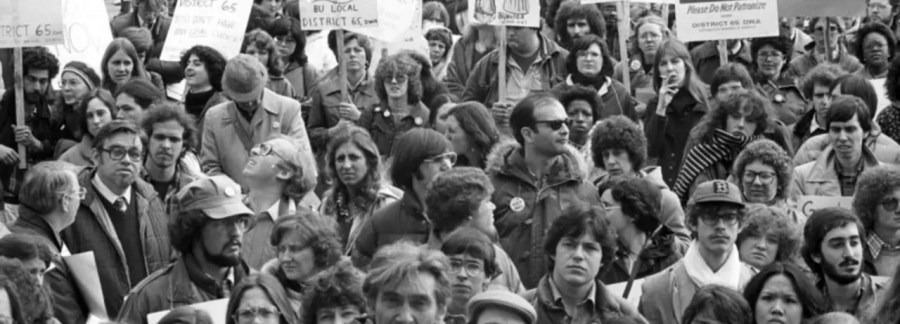
View of students and faculty carrying signs during a strike by faculty and staff of Boston University, on Commonwealth Avenue, Boston, 1979. Historian Howard Zinn, then a professor at BU, is just visible in the centre foreground. (Photo by Spencer Grant/Getty Images)

“I would not deny that [WWII] had a certain moral core, but that made it easier for Americans to treat all subsequent wars with a kind of glow,” Zinn said. “Every enemy becomes Hitler.”

After the war, he went back to interview victims of the bombing, and later wrote about it in two books. His own experience and his subsequent interviews led him to conclude that the bombing had been ordered more to enhance the careers of senior officers than for any military imperative, and he later wrote about the ethics of bombing in the context of Hiroshima and Nagasaki, Tokyo and Dresden, as well as Iraq.

Zinn and Roz married in 1944. While Zinn worked various jobs after the war, they lived on meager income in a rat-infested basement apartment in Brooklyn. Their daughter Myla was born in 1947 and Jeff in 1949. They moved to new public housing in 1949 and Zinn went to New York University for his B.A in history.

Thanks to the GI Bill, which paid the tuition of veterans, Zinn went to Columbia, where he earned an MA in 1952 with a thesis about a famous coalminers’ strike in Colorado, then obtained his PhD with a dissertation about the career in Congress of Fiorello LaGuardia, the reforming mayor of New York. He studied at Columbia under Richard Hofstadter who taught Zinn that American liberals were not as liberal as they thought they were, and that the two common threads in all American history were nationalism and capitalism.

PROFESSOR ZINN

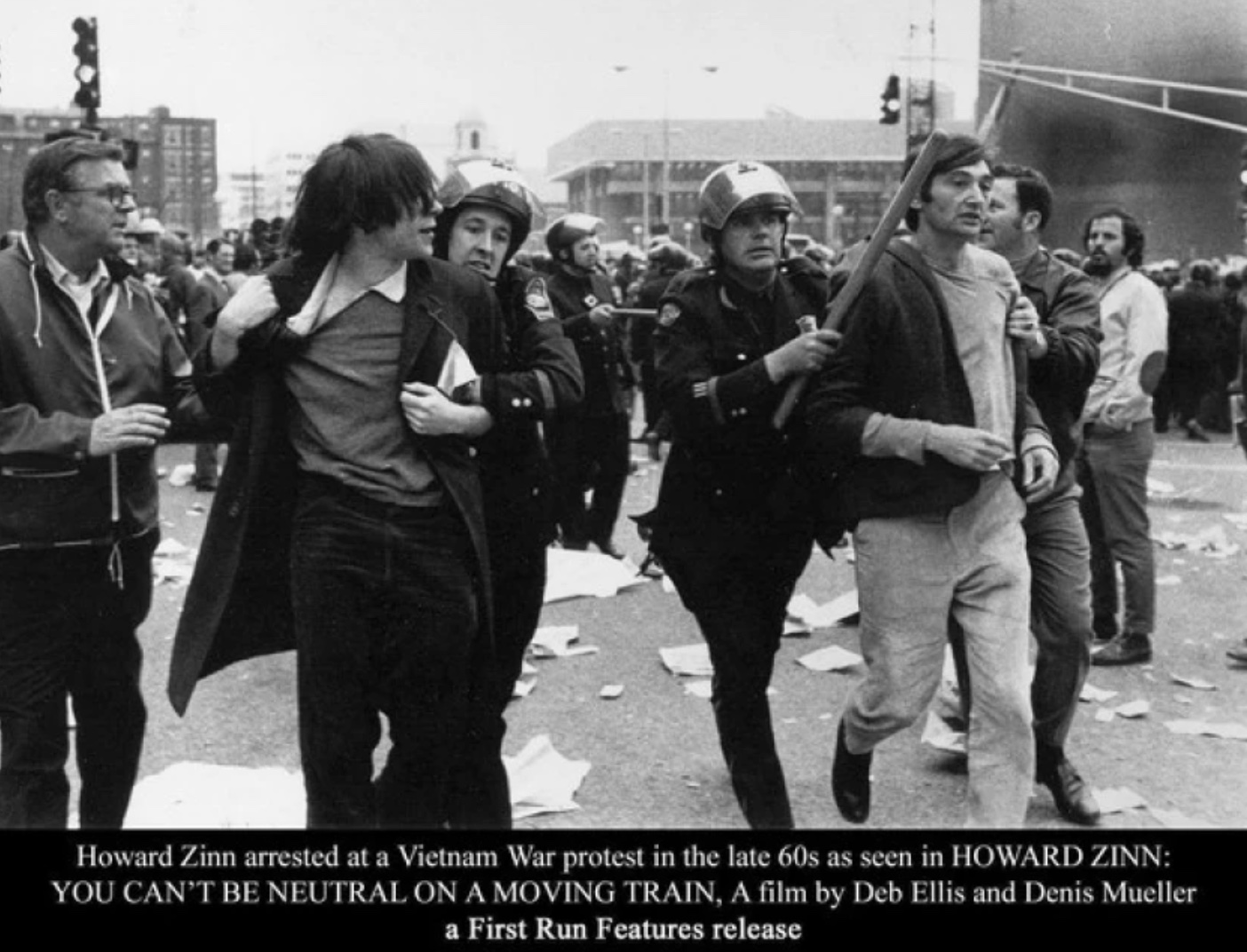
In 1956, Zinn accepted a professorship at Spelman College, a traditionally black college for women in Atlanta, Georgia. Among his students were Maria Wright Edelman, the campaigner for children’s rights, and the future novelist Alice Walker, author of The Color Purple. At Spelman, he was a mentor to and later the historian of the Student Non-Violent Co-ordinating Committee (SNCC), the radical student wing of the civil rights movement. Zinn took part in many civil rights protests, and he encouraged his students to join him in these marches, which angered Spelman’s president. Zinn angered the authorities at Spelman over his insistence that its students should not be trained to be ladies, but should be actively involved in politics. “I was fired for insubordination,” he recalled. “Which happened to be true.” Zinn moved to Boston University in 1964, where he quickly became an outspoken critic of the Vietnam War. He angered many Americans, including Boston University’s president, by traveling with the Rev. Daniel Berrigan to Hanoi to receive prisoners released by the North Vietnamese, and produced the antiwar books “Vietnam: The Logic of Withdrawal” (1967) and “Disobedience and Democracy” (1968). When Daniel Ellsberg, a previously gung-ho John F Kennedy and Lyndon B Johnson administration official, came out against the war, he gave one copy of the Pentagon Papers (officially titled United States-Vietnam Relations, 1945–1967: A Study Prepared by the Department of Defense, the government’s secret history of the war) to Zinn and his wife, Roslyn. Zinn and Noam Chomsky edited what became known as the Mike Gravel edition, published in Boston in 1971-72 by the Beacon Press.

In 1980, he published his most successful work, A People’s History of the United States, which was a highly controversial revision of American history. Instead of the usual congratulatory tone of most American history textbooks, his work concentrated on what he saw as the genocidal depredations of Christopher Columbus, the blood lust of Theodore Roosevelt and the racial failings of Abraham Lincoln. He also highlighted the revolutionary struggles of impoverished farmers, feminists, laborers and resisters of slavery and war. Bruce Springsteen said the starkest of his many albums, “Nebraska,” drew inspiration in part from Mr. Zinn’s writings.

For decades, he poured out articles attacking war and government secrecy. 

When President Ronald Reagan bombed Tripoli in 1986, Zinn wrote: “There is no flag large enough to cover the shame of killing innocent people for a purpose which is unattainable.” He denounced the invasion of Iraq and also criticized President Barack Obama’s intensification of the war in Afghanistan. He was sharply attacked in Israel and by many of his fellow American Jews for saying that war was morally the equivalent of terrorism.

Howard Zinn (Photo sourced: Internet)

Mr. Zinn retired in 1988, concluding his last class early so he could join a picket line. He invited his students to join him. Zinn also wrote three plays: “Daughter of Venus,” “Marx in Soho” and “Emma,” about the life of the anarchist Emma Goldman. All have been produced. Zinn died in 2010.

Zinn always believed in standing up to injustice and fighting for oppression. He said near the end of his life, “Where progress has been made, wherever any kind of injustice has been overturned, it’s been because people acted as citizens, and not as politicians. They didn’t just moan. They worked, they acted, they organized, they rioted if necessary to bring their situation to the attention of people in power. And that’s what we have to do today.”

End.

POSTSCRIPT from Rebel Breeze:

TRUMP ATTACKS ZINN AFTER LATTER’S DEATH

“If you want to read a real history book,” Matt Damon’s character tells his therapist, played by Robin Williams, in the 1997 film “Good Will Hunting,” “read Howard Zinn’s ‘A People’s History of the United States.’ That book will knock you on your ass.”

It is very unlikely that President Donald Trump knew who Howard Zinn was before he saw the name on his teleprompter. And it is even less likely that he’s read “A People’s History of the United States.” But that didn’t stop him from saying — at the White House Conference on American History on Thursday — that today’s “left-wing rioting and mayhem are the direct result of decades of left-wing indoctrination in our schools. It’s gone on far too long. Our children are instructed from propaganda tracts, like those of Howard Zinn, that try to make students ashamed of their own history.”

Quoted from https://www.commondreams.org/views/2020/09/23/rights-long-war-howard-zinn-reaches-white-house

Dublin City Council Threatens Charity Food Tables

Diarmuid Mac Dubhghlais

(Reading time: 5 mins.)

DRHE threaten to clamp down on food tables feeding the homeless

Diarmuid Mac Dubhghlais

(Reading time: mins.)

Rebel Breeze editorial introduction: Through its agency Dublin Regional Homeless Executive, Dublin City Council recently threatened to close down the charity services delivering food and bottled water to homeless and hungry people. On the back of scandal about the alleged sexual predation of the deceased founder of the Inner City Homeless organisation, the Council issued a press statement which implied the threat, supported also by indications of Garda cooperation. Diarmuid Mac Dubhghlais, founder and organiser of the Éire Nua Food Initiative, one of the many charity services engaged in the work, has responded in a detailed article, reprinted here with the author’s permission.

THE 26-County State released figures on September 24 showing that there are currently 8,212 people accessing emergency accommodation in the State, a total of 6,023 adults and 2,189 children who are homeless.

A homeless person’s bed outdoors, cardboard as insulation underneath sleeping bag, this one located under the arch of the GPO (the building that was the HQ of the 1916 Rising). (Photo: Éire Nua Initiative)

These figures of homelessness have long been disputed by many others who work within the homeless sector as the State refuses to count those who are couch-surfing, or otherwise sharing accommodation with friends/family. The vast majority of the nation’s homeless are in the capital with 4,220 people accessing accommodation. 953 families are homeless in Ireland, according to the report.

Homelessness charities have warned that more families face losing their homes in the coming months due to private rental market constricts and evictions rise. This has already been borne out with reports of new faces showing up at the many soup runs/food tables that are in the city centre.
Pat Doyle, CEO of Peter McVerry Trust, said “Any increase is disappointing because it means more people impacted by homelessness. However, we are now at the busiest time of year for social housing delivery and we would hope that the number of people getting access to housing will significantly increase in the coming months.”

Dublin Simon CEO Sam McGuiness cited the toll on the physical and mental health of people trapped in long-term homelessness. He said: “This population is desperate to exit homelessness and yet they are spending longer than ever before in emergency accommodation. This group deserves far better lives than the ones they are currently living. We see first-hand the toll this is taking in the increased demands for our treatment services, counselling services and the increase in crisis counselling interventions. Outcomes for people in emergency accommodation will not improve until they have a secure home of their own. Until this happens there is scant hope of a better future for this vulnerable group.”

MANY CHILDREN NOW SPEND THEIR FORMATIVE YEARS IN HOMELESSNESS”

Éire Nua food initiative founder Diarmuid Mac Dubhghlais pointed out at a homelessness protest that many children now spend their formative years in homelessness and have no real idea of what it is like to have a traditional “Sunday dinner” or their own bedroom/play area. This will severely impact their personalities far into the future.

A report published on September 14 by the Irish Human Rights and Equality Commission and the Economic and Social Research Institute (ESRI) found that lone parents and their children account for 53% of all homeless families. The report said that lone parents and their children are much more likely to experience poor housing than other household types. The report also highlights the disadvantages experienced by young people, migrants, people with disabilities and Travellers in the Irish housing system. Researchers looked at six dimensions of housing adequacy – accessibility, affordability, security of tenure, cultural adequacy, quality, and location. They found that less than 25% of lone parents reported home-ownership, compared with 70% of the total population.
Lone parents had higher rates of affordability issues (19%) when compared to the general population (5%) and were particularly vulnerable to housing quality problems such as damp and lack of central heating (32% compared to 22%).

Ethnic minority groups had a significantly higher risk of over-crowding, the research found. Over 35% of Asian/Asian Irish people, 39% of Travellers and over 40% of Black/Black Irish people live in over-crowded accommodation, compared to 6% of the total population. Almost half of all migrants in Ireland live in the private rental sector, compared to 9% of those born in Ireland. Migrants, specifically those from Eastern Europe (28%) and non-EU countries (27%), are more likely to live in over-crowded conditions.

One of the queues for free food and water at a charity food table outside the GPO building. (Photo: Éire Nua Initiative)

The research found that almost one third of persons living with a disability experience housing quality issues, compared to 21% of those without a disability. Researchers said there remains a real risk that levels of homelessness will worsen after the pandemic restrictions are lifted and they raised concern about rents increasing faster than mean earnings in Dublin and elsewhere. In 2020, mean monthly rent in Ireland was estimated to be 31% of mean monthly earnings. “Adequate housing allows people to not only survive but thrive and achieve their full potential, whilst leading to a more just, inclusive and sustainable society.”

Meanwhile, the Dublin Regional Homeless Executive (DRHE) said on September 28 that it is to seek greater regulation of organisations providing services for homeless people in the capital as soon as possible in the wake of the Inner City Helping Homeless (ICHH) controversy. Dublin City Council’s deputy chief executive Brendan Kenny, who has responsibility for the Dublin Regional Homeless Executive (DRHE) in his role, said that due to the high number of informal homeless organisations set up in recent years there is “currently no vetting, no controls, on many people who are actually interacting directly with homeless people”. Kenny said he doesn’t want “over-regulation” to lead to certain groups disbanding but added: “At the moment there’s nothing and that’s not good enough.”

In a statement, the DRHE said it is “strongly of the view that greater regulation, vetting, and scrutiny is required for organisations/charities that set themselves up as service providers for homeless persons, including the provision of on-street food services”. “Several such organisations not funded by the DRHE have come into existence in recent years and the DRHE and our partner agencies will be endeavouring in the coming months to bring the necessary expanded scrutiny and regulation to all such organisations.”

Garda Commissioner Drew Harris said there will be a review of Garda vetting procedures for the homelessness sector. Kenny said a report commissioned by Dublin City Council into the impact of unvetted charities is near completion and will provide further insight on the matter.
It has been pointed out several times over the past four months that the DRHE, DCC and others have long tried to close the soup runs/food tables in the city centre and many now fear that what has been revealed through the ICHH debacle will be used to close many of these down. The DRHE are ignoring the fact that it is their rules and the oversight bodies recognised by them that has let the homeless down, not the food tables. Much of the work done by the food tables is done in the open and in full public view.

The issues highlighted through the ongoing ICHH investigation show it is what went on behind closed doors that is the problem. Those in oversight positions didn’t do their jobs; people were put in positions of authority without relevant qualifications. The DRHE, DCC and the police should look to how they can improve safety within their “regulated” organisations before seeking to regulate the volunteers who serve a need without any remuneration.

Many of the volunteers at food tables would have difficulty meeting the requirements of police vetting as some would be former addicts, and many others have no desire to become registered charities.

Again, it was pointed out by Diarmuid that many of these “regulated” charities will have high overheads such as transport insurance, maintenance and fuel costs. Some will have CEO wages and petty cash expenses to cover before any donations can be spent on the service user, whereas the Éire Nua food initiative and some others do not seek cash donations. All is done voluntarily and any costs are borne by the volunteers themselves. He cited that many registered charities are little more than businesses operating within the homelessness sector.

Diarmuid has been quoted in the past citing that “there are now many businesses making huge money out of those who are in homelessness” and “that the volunteer ethos that surround many food tables is not to be found within some charities”.

IMPROVE THE STANDARD OF REGISTERED ACCOMMODATION, NOT SHUT DOWN THE VOLUNTARY ORGANISATIONS”

Kenny said the large number of pop-up soup runs mean some people are less likely to engage with the larger charities funded by the DRHE and in turn, less likely to engage with their support services. The DRHE views sleeping in a homeless hostel, rather than on the street, as a “much safer” option. However, he acknowledged that some homeless people don’t want to stay in a hostel, for a variety of reasons.

“We fully understand that but we’re strongly of the view that a hostel bed is absolutely safer and more hygienic than sleeping in a sleeping bag on the side or a street or in a tent. We know there are some people that just won’t go to a hostel – it may be that they have mental health issues.
“We are also aware that some people would prefer to stay in a tent in order to stay involved in drugs and be taking drugs because they may not be able to do it in the hostel.” Kenny added that while hostels provide shelter and food, they “wouldn’t be the nicest place to sleep” but are still “far safer” than being on the street.

He totally ignores the many testimonies from residents, former residents and former workers within these hostels of the theft of personal property, the numerous assaults on residents by other residents, the bullying of residents by some staff members, low hygiene standards, open drug and alcohol abuse and the arbitrary nature operating within some hostels where a resident can be denied access on the whim of staff.

It is incumbent of the State, DRHE and the various councils to bring the standard of these types of accommodation up to a better standard and NOT try to shut those organisations who look after the many who fear staying within State accommodation.

Kenny also noted that sometimes tourists or those who are not homeless queue up to get food from the soup runs. He said fights also break out sometimes. “We’ve come across situations of tourists maybe going up to a food van and getting food, and maybe other people that are not in need of services. And the reality is that anybody that’s sleeping in a hostel, food is provided for them so there is not a shortage of food in the hostel services.

“[Soup runs] do attract a lot of people. I know there are times when large numbers of vulnerable people congregate and you end up with disputes and fights as well.”

Éire Nua free food service workers with table, outside the GPO. (Photo: Éire Nua Initiative)

On the issue of tourists queuing for food, he may well be right, but as the Éire Nua group has pointed out, “we feed the homeless AND hungry, we will not discriminate or question anyone who stands waiting for some food”.

Also pointed out by many residents of various hostels is the small proportions of meals given; while enough to sustain it is often not enough to keep that empty stomach feeling at bay.
And for the five to six years that Diarmuid has volunteered alone, with the Éire Nua group or on another soup run, he or other volunteers have never had to call the police. On the few occasions where trouble has occurred, it is often rectified within seconds as the majority of people awaiting food know that: (1) the volunteers are their friends and out there to help them and (2) causing disruption to the smooth running of the tables can result in being denied food.
The final word to Kenny from the Éire Nua food initiative: “Let the DRHE look to itself and those under its umbrella before looking to those outside their group; let them ensure the regulations in force within are enforced. Do not blame those who volunteer out of the goodness of their hearts for the sins of those who worked for them.”

End.

EDITORIAL COMMENT:

It may be that the primary concerns of the Dublin municipal authorities and the Gardaí are to remove the visible signs of poverty and homelessness, rather than protection of the vulnerable among these. DCC Brendan Kenny’s comments in mid-August against the proliferation of homeless people living in tents may be seen as a concern that the charity food services constitute an unwelcome reflection on the performance of the Irish State and the municipal authorities of its capital city, visible not only to the city’s inhabitants — at all levels of society — but also to its visitors.

USEFUL LINKS

https://www.thejournal.ie/drhe-call-for-more-regulation-of-homeless-organisations-5560886-Sep2021/

Kenny previous comments against homeless in tents: https://www.joe.ie/news/dublin-city-council-ceo-criticised-following-comments-homeless-tents-dublin-728819

The Inner City Homeless scandal: https://www.irishtimes.com/news/ireland/irish-news/homeless-charity-faces-uncertain-future-following-death-of-co-founder-1.4688838

STATE MOVES TO BAN LEFT WING SPANISH PARTY

Political Statement against the new banning attempt: the Ministry of the Interior initiatates a procedure in the Spanish National Court for the “extinction” of Izquierda Castellana

(Translated by D.Breatnach from https://izca.net/2021/08/06/declaracion-politica-ante-el-nuevo-intento-de-ilegalizacion-el-ministerio-del-interior-impulsa-un-procedimiento-en-la-audiencia-nacional-para-la-extincion-de-izquierda-castellana/ )

The Central Contentious-Administrative Court No. 6 of the Spanish National Court has notified us on August 5th of the motion put forward by the Ministry of the Interior through the State Lawyers in which the “extinction” of Izquierda Castellana is sought, that is, its disappearance as a legal political organization.

Demonstration of Izquierda Castellana with their logo on banner declaring “Spanish State Prison of Peoples”.

On this occasion, the Ministry of the Interior resorts to administrative tricks, arguing that IzCa’s statutes do not comply with the changes introduced through the legislative reform of Organic Law 3/2015, of March 30, on the control of the financial-economic activity of Political Parties.

It is paradoxical that a political organization that, as is the case with Izquierda Castellana, never in its entire history requested or received any financial subsidy, is intended to be outlawed based on these kinds of reasons, especially when most of the political parties that ostensibly breach the legal regulations on such matters are not even warned of such a possibility.

In our opinion, the attempted extinction / banning of IzCa sponsored by the Ministry of the Interior has a political motivation: the intention of making disappear an organization whose essential activity is the denunciation of all the corrupt, antisocial, antidemocratic and antipatriotic activities of the current Regime of the 2nd Bourbon Restoration; and whose ultimate aim inevitably passes through the establishment of a democratic, republican and social rights system.

IzCa, as we pointed out, has not received or requested a single euro from the public treasury. Our activity is based solely and exclusively on our resources, especially on our human resources, that is, on the militants and activists who support us every day in one way or another. IzCa does not have as such – nor does it claim – representation in the institutions of this post-Franco regime. We do not despise this sphere of action, but it seems to us that the most important and useful thing in this historical moment is to promote the movement and popular organization in the various sectors, and we focus on this and we also believe with some success; that is what the Regime and its successive governments have not forgiven us.

IzCa has suffered permanent harassment from the constituted power since our founding; numerous media-police operations have been plotted against our organization. In 2008 there was already an attempt to ban IzCa, which was finally archived without action in the National Court itself. Last December the trial against our comrade Luis Ocampo was held – Doris Benegas was also on trial – with regard to the events that occurred in the Republican demonstration in Madrid in October 2014. In that trial, a year and a half in prison was requested by the Prosecution. Finally, our comrade was acquitted; in its judgment, the Madrid Provincial Court Court recorded that his version of events was fully credible.

IzCa has been denouncing the repressive policy towards the popular movement and at the same time favourable to the extreme Right that has been carried out by the Ministry of the Interior and very especially by the Government Delegation in Madrid, intensified repression since the beginning of the Covid-19 pandemic. We accurately forecast the overwhelming defeat of the institutional Left in Madrid in the last regional elections on May 4; and we predict – we believe that without the slightest possibility of error – the defeat of the institutional Left in the next general elections if it continues on the current path. If you try to make activist organizations disappear, those that with more dedication and commitment defend the interests of the working classes, you are facilitating the path of access to the government by the Right. If the interests of the peoples of the Spanish State are subordinated to those of imperialism – certainly in a phase of full decline – one of the most significant expressions of which is the scheduled holding of the next NATO summit in Madrid in 2022, it is refusing to build its own project in solidarity with the peoples of the world and, once again, facilitating the advance of the right wing, militarism and warmongering.

We are going to fight against our outlawing at the National High Court and before all judicial bodies, including European ones, where it is necessary. In the National Court, that special court of which we do not recognize any democratic legitimacy, nor for the entire institutional framework of the ’78 Regime,starting with its Head of State, just as “exemplary” in its general terms as the rest of its institutions and whose legality is based on Franco’s legality. But above all, we will continue to fight in the streets.

Study and reflect; organize and mobilize; build popular power. That’s the only way.

Izquierda Castellana, August 6, 2021

COMMENT:


The Izquierda Castellana is a revolutionary socialist organisation basing itself on the territory of Castille (a central area of the Spanish state including Madrid) and claiming its right to self-determination, drawing its historical inspiration from the revolt of the Comuneros in the 1520s. The party or organisation seeks social justice internally, self-determination for its own territory and supports the struggles for self-determination of others (for example, the Basques and Catalans), is opposed to imperialism abroad and military alliances such as NATO. IzCa is anti-racist and anti-fascist and has suffered repression.

The potential for revolution in the Spanish State is not in the Basque Country and Catalonia alone, nor only in other areas such as Galiza and Asturies but in the heartland of the State also, in Madrid and in other parts of Castille. It seems clear that the struggles for independence of the Basque Country and Catalonia as in the past will be met with heavy Spanish repression and the only possibility for success in such circumstances would a situation in which the State was met with uprisings in other parts also. I have long advocated the building of the type of alliances that could make that possible.

Diarmuid Breatnach

USEFUL LINKS

Izquierda Castellana website: https://izca.net/

IzCa on Facebook: https://www.facebook.com/Izquierda-Castellana-IzCa-110789122300175/

POLICE RIOTS — THE BIRTH OF THE IRISH CITIZEN ARMY

Diarmuid Breatnach

(Reading time main text: 2 mins.)

The Dublin police played a fundamental role in the creation of the first workers’ army in the world, the Irish Citizen Army.

The Dublin employer syndicate’s offensive against the working-class “syndicalism” of the Irish Transport & General Worker’s Union1 began with the 1913 Lockout, in turn triggering strikes on August 26th, when workers were presented with a document they were to sign declaring that they would leave the ITG&WU or, if not a member, would refuse to support it in any action2. Most workers of any union and none refused to sign and 20,000 workers were confronted by 400 employers.

However, the employers’ numbers were added to by the Dublin Metropolitan Police and the Royal Irish Constabulary, backed up by the judiciary. Morally and ideologically the Irish Times and Irish Independent (the latter owned by W.M. Murphy, leader of the employers) backed the employers as, to a large extent, did the Irish Catholic Church hierarchy3.

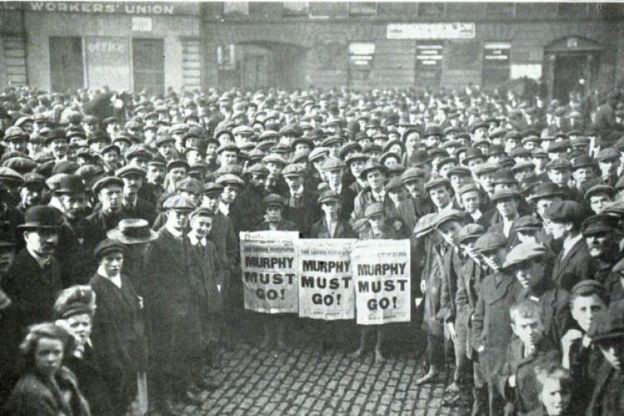
Workers’ demonstration with newsboys (WM Murphy owned the Irish Independent newspaper). (Source image: Internet)

The national (non-workers’) movement was divided in its opinion: many of Redmond’s Irish Parliamentary Party representatives were employers or landlords and their sympathies were naturally not with the workers. But for example Seán Mac Diarmada, a republican and national revolutionary, organiser for the secret Irish Republican Brotherhood4, opposed the strike on the basis that foreign business interests would profit by the paralysing of Irish business concerns5. On the other hand, Mac Diarmada’s mentor and head of the IRB in Ireland, Tom Clarke, was sympathetic to the strikers.

POLICE RIOTS

Unlike the gendarmerie6 British police force throughout Ireland of the Royal Irish Constabulary, at this time the constables of the DMP were unarmed except with truncheons but even with those they managed to kill people. On 30th August 1913 the DMP baton-charged a crowd in a street meeting on Eden Quay, outside Liberty Hall, HQ of the union7. Among the many injured were James Nolan and John Byrne who died 31st August and 4th September respectively, both in Jervis St. Hospital. (see also other riots and police attacks in Sources & Further Reading below).

On the 31st Jim Larkin went in disguise to address an advertised public meeting, banned by a magistrate, in Sackville (now O’Connell) St., Dublin. In view of the behaviour of the police, most of the IT&GWU activists went instead to their rented facilities at Fairview but a large enough crowd of the committed and the curious were assembled in O’Connell Street, along with large force of the DMP. Larkin, disguised as an elderly Protestant minister arrived by horse-drawn carriage and, as befitted a man made infirm by age, was assisted by Nellie Gifford8 into the Clery’s building which housed the Imperial Hotel restaurant, which belonged to W.M. Murphy (as did the Dublin Tram Co.). In order that Larkin’s strong Liverpool accent should not give him away, Nellie Gifford did all the talking to the staff inside. Shortly afterwards Larkin appeared at a restaurant window on the first floor and, top hat removed, spoke briefly to the crowd below but, as DMP rushed into the building, tried to make his getaway.

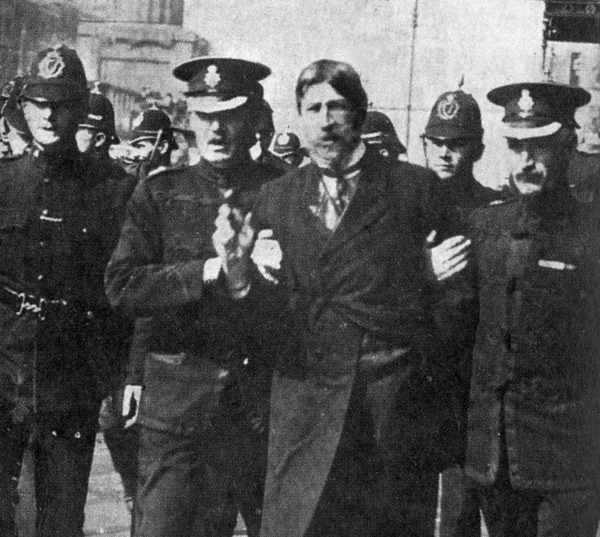
The arrest of Jim Larkin on 31st August 1913, being removed from the Clery’s building (see plinth of the Nelson Pillar behind and to the left) in O’Connell Street, just before the Dublin Metropolitan Police attack on the crowd. (Source image: Internet)

The DMP arrested Larkin and when the crowd cheered him (led by Constance Markievicz), the DMP baton-charged the crowd, striking out indiscriminately, including knocking unconscious a Fianna (Republican youth organisation) boy Patsy O’Connor who was giving First Aid to a man the police had already knocked to the ground. Between 400 and 600 were injured and Patsy suffered from headaches thereafter; though active in the Republican movement (he was prominent in the 1914 Howth guns collection9) he died in 1915, the year before the Rising. Among those beaten were journalists and casual passers-by. Those caught in Princes Street10 between DMP already in that street and the police charging across the main street were beaten particularly savagely.

The police attack became known as “Bloody Sunday 1913” (though two workers had been fatally injured on Eden Quay the day before and are often wrongly listed as having been killed on that day).

A photo of the police riot taking place on 31st August 1913 in O’Connell St; police can be seen striking with their truncheons even those on the ground. (Source image: Internet)

Also on that day the DMP attacked the poor working-class dwellings of Corporation Buildings (in “the Monto”, off Talbot St11), beat the residents and smashed their paltry furniture. The raid was a revenge attack for the reception of bottles and stones they had received on the 30th, when they were chasing fleeing workers from Liberty Hall (others crossed Butt Bridge to the south side and a running battle took place along Townsend Street and almost to Ringsend.

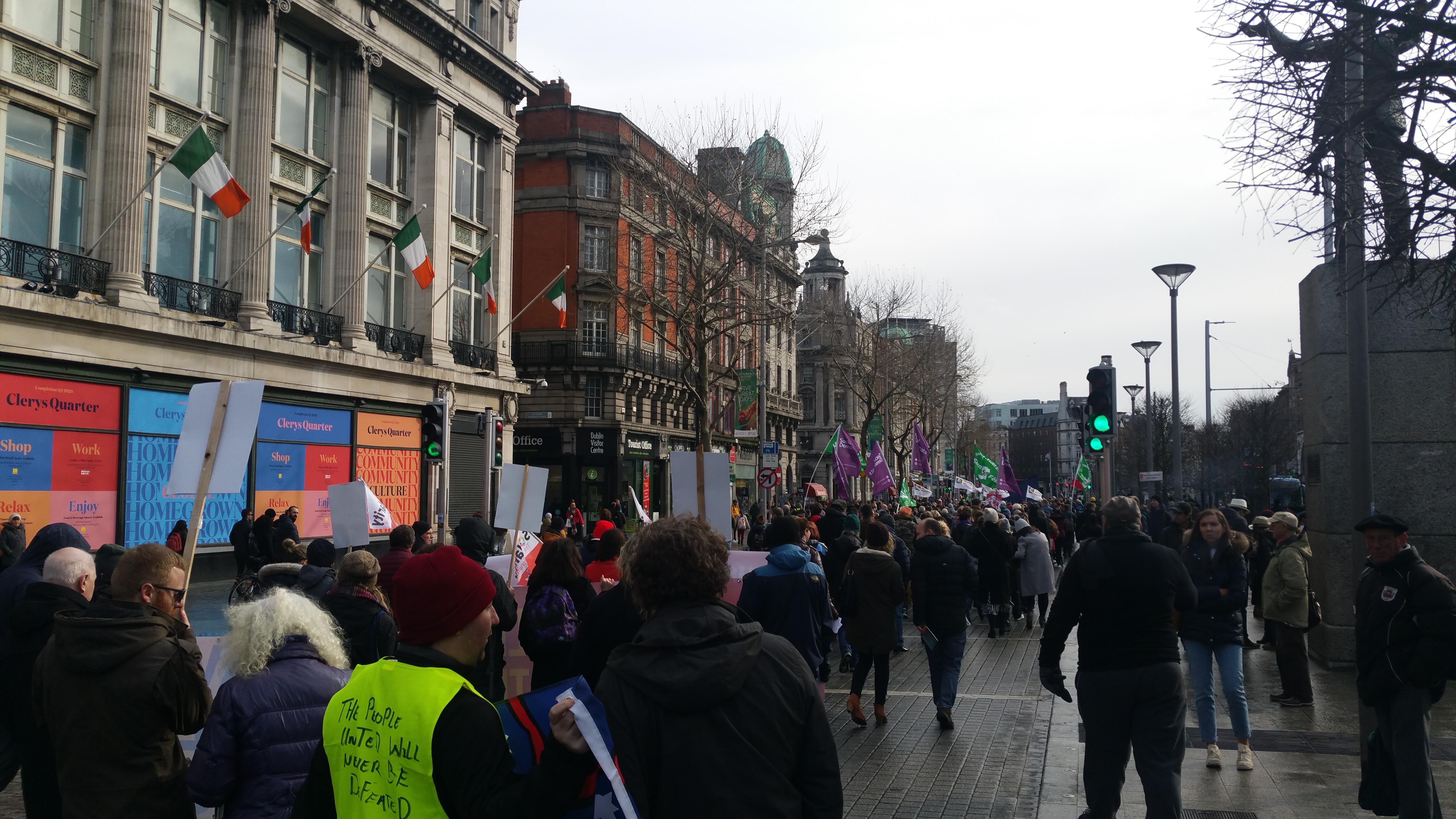
Protest march goes past closed-down Clery’s to the left in 2016 while Larkin looks down from his pedestal to the right. (Photo: D.Breatnach)

THE IRISH CITIZEN ARMY 1913 AND 1916

Very soon after those attacks, Larkin and Connolly each called publicly for the formation of a workers’ defence force, which became the Irish Citizen Army. Around 120 ICA, including female members fought with distinction in the 1916 Rising and raised their flag, the Starry Plough on the roof of WM Murphy’s Imperial Hotel on the upper floors of Clery’s building, opposite the GPO13. A number of its Volunteers were killed or wounded in action and two of the ICA’s leaders, Connolly and Mallin, were executed afterwards; another, Constance Markievicz, had her sentence of death commuted.

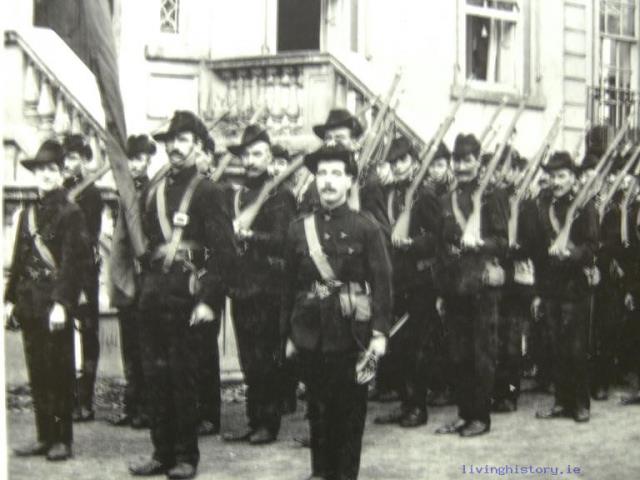
Irish Citizen Army on parade at their facility in Fairview. (Source image: Internet)

A much-diminished ICA took part in the War of Independence.

The end of August 1913 on Eden Quay and in O’Connell Street may be seen as the period and birthplaces of the ICA, the “first workers’ army in the world” and the first also to recruit women, some of whom were officers.

The Jim Larkin monument stands opposite the Clery’s building, which is now under renovation but without a mention on the monument or on the building of Bloody Sunday 1913 or its background and result. Sic transit gloria proletariis

end.

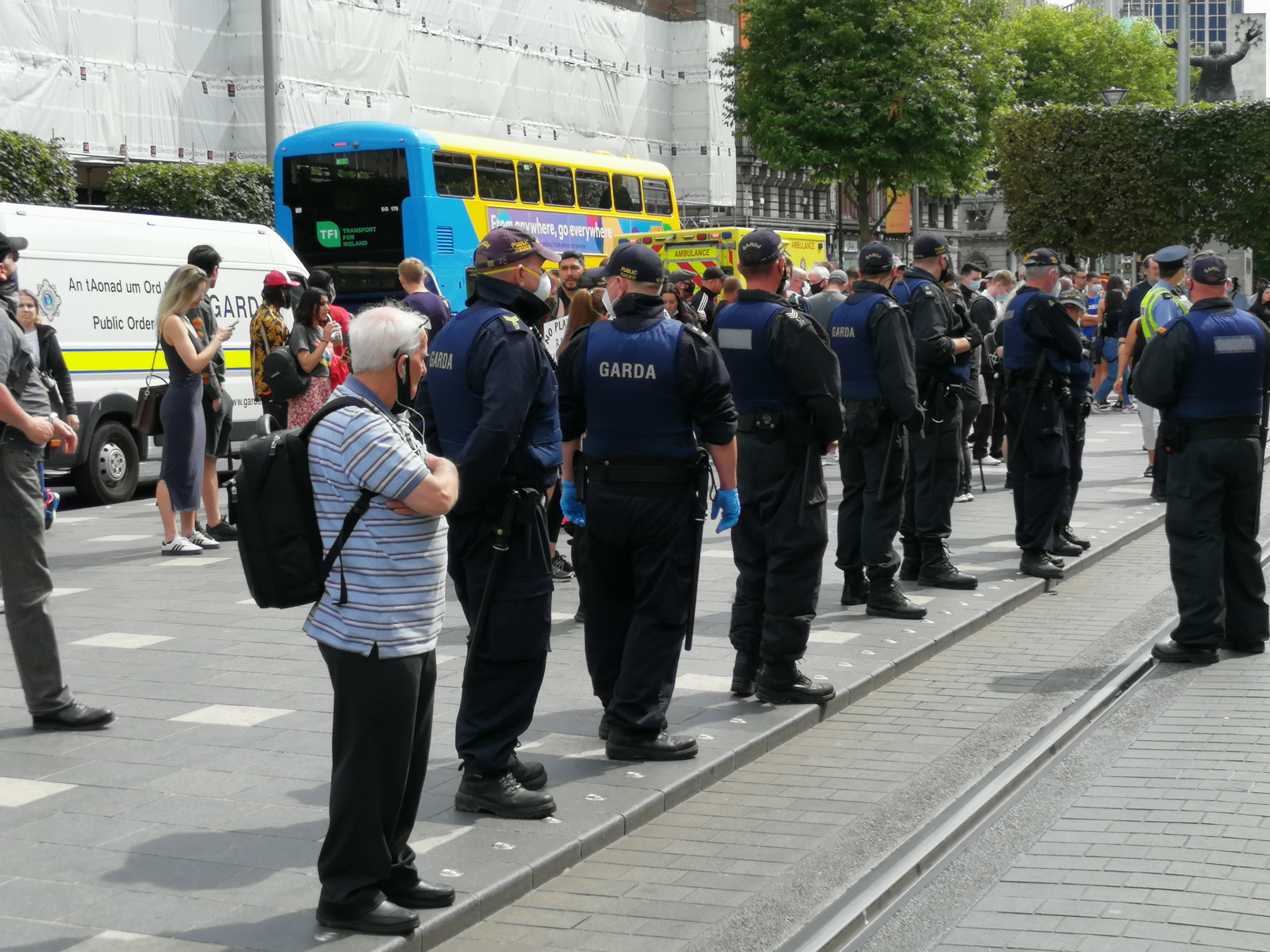
Today’s DMP, Garda Public Order Unit guarding far-Right gathering in O’Connell Street in 2020 (facing them, out of photo view). The Larkin monument can be seen in part at the top right-hand corner. (Photo: D.Breatnach)

FOOTNOTES

1The ITGWU was formed in 1909 by James Larkin, former organiser for the National Union of Dock Labourers after his bitter departure from that union. Most of the members Larkin had recruited for the NUDL, with the exception of the Belfast Protestant membership, left the NUDL and joined the IT&GWU.

2The provision in the declaration for members of unions other than the iT&GWU was necessary for the employers because of the general credo in Irish trade unionism that one did not cross a picket line, whether of one’s own union or of another, a credo that persisted in Ireland until the 1980s when the Irish Trade Union Council joined the “Social Partnership” of the State and the employers’ Federation. In addition, Larkin had added the principle that goods from a workplace on strike, even if strike-breakers could be got to bring them out, were “tainted goods” and would not be handled by members of the IT&GWU, nor should they be by any other union either.

3 Apart from any statements by bishops and priests, the religious charity organisation, the St. Vincent de Paul, refused assistance to families of strikers.

4 The IRB was founded simultaneously in Dublin and New York on 17th March 1858 and became known as “the Fenians”. In 1913 the movement had declined but was being rebuilt under the leadership of Tom Clarke, who went on to become one of the Seven Signatories of the 1916 Proclamation of Independence, all of which were executed b y firing squad after surrendering, along with another nine. Both were signatories of the Proclamation of Independence.

5It is one of the many ironies that on May 12th 1916, the last of the of the 14 surrendered leadership executed in Dublin (another two were executed elsewhere, one in Cork and the last in London) were Mac Diarmada and James Connolly, shot by British firing squads in Kilmainham Jail; the one an opponent of the workers’ action and the other one of its leadership.

6The gendarmerie is a particular militarised type of police force, armed and often operating out of barracks, like the Carabinieri of Italy, Gendarmerie of Turkey and Guardia Civil of the Spanish State. It is an armed force of state repression designed to control wide areas of potentially rebellious populations and it is notable that the parallel of the RIC did not exist in Britain, where the police force was mostly unarmed except by truncheon.

7Liberty Hall is still there today but a very different building (the original was shelled by the British in 1916) and SIPTU is a very different union too.

8Nellie was one of 12 children of a mixed religion marriage and was, like all her sisters (unlike the six unionist boys), a nationalist and supporter of women’s suffrage. Her sister Grace married Volunteer Joseph Plunkett hours before his execution and is, with Plunkett, the subject of the plaintive ballad “Grace” and Muriel married Thomas McDonagh, one of the Seven Signatories of the Proclamation, all of whom were among the 16 executed after surrendering in 1916. Nellie Gifford was the only one who participated in the Rising; she was a member of the Irish Citizen Army and was active in the Stephen’s Green/ College of Surgeons garrison, jailed and continued to be active after her release.

926th July 1914, when the yacht Asgard, captained by the Englishman Erskine Childrers, delivered a consignment of Mauser rifles and ammunition to the Irish Volunteers.

10Those may have been heading for Williams Lane which even today leads out from Princes Street to Middle Abbey Street (the junction of which is where James Connolly received the impact to his ankle in 1916).

11Corporation Buildings as one might expect housed working class people and the “Monto” (Montgomery Street) was a notorious red light district.

12The police station is still there, staffed by the Garda Síochána but in 1913 it housed also a British Army garrison.

13This flag, one of at least four different flags flown during the Rising, is now in the Irish National Museum at Collins Barrack. Shortly after the Rising it was noted by a British Army officer still in place upon the gutted Clery’s building and taken by him as a trophy to England. In 1966, the 50th anniversary of the Rising, the officer’s family returned the flag to the Irish people.

SOURCES AND FURTHER READING

Nellie Gifford: https://en.wikipedia.org/wiki/Nellie_Gifford

The Fianna boy who suffered a head injury: https://fiannaeireannhistory.wordpress.com/2014/12/

http://multitext.ucc.ie/…/Report_of_the_Dublin

1913 Ringsend Riot: http://comeheretome.com/…/04/07/1913-the-riot-in-ringsend/

Witch-Hunting in the imperialist British Labour Party

Diarmuid Breatnach

(Reading time comment: 2 mins; and article: 5 minutes)

People who’ve been following the witch-hunts in the British Labour Party — or even just generally aware of them — have seen left-wingers like Jeremy Corbyn, the party’s elected leader, actually expelled. Though Corbett has now been allowed back in with his electoral wings clipped, others have been expelled, including left-wing film-maker Ken Loach. It is witch-hunting, a type of McCarthyist hounding in which victims must prove themselves innocent of anti-semitism, which turns out to be impossible. This is because the Zionists and their supporters have succeeded in making any attack on Israel or Zionism, a political target, correspond to anti-semitism, a religious-racist view. That is all wrong certainly but it is not the job of socialists nor of anti-imperialists to “save” or “democratise” the British Labour Party.

British troops suppressing anti-colonial struggle in Malaya 1948-1960, (then a part of what is now Malaysia), carrying a bloodied Malayan prisoner (Photo sourced: Daily Mail)

Lenin famously once advised British socialists to support the Labour Party “as a rope supports a hanging man”. He was saying that as Labour had never yet been in sole government, it was bound to carry the idealised hopes of many working people — therefore give them the opportunity to see it in action. Whether Lenin was correct in his advice to help get Labour into government or not (and not all revolutionary socialists agreed with him), Labour was in the coalition War Government in 1915-1918 and subsequently in the periods 1924, 1929, 1945-1950, 1964-1970, 1974-1977, 1997-2010. It has had plenty of opportunities to show its real nature and has done so.

However, over the years, radical social democrats and various Trotskyist trends, along with the old Communist Party of Great Britain, have sought to support the Labour Party, not by pulling the rope, kicking the chair or unlocking the scaffold trapdoor, but by desperately getting underneath the body and propping it up. General elections were replete with slogans from the Left exhorting us to elect Labour “under a socialist program”, “under Left pressure” and “with socialist demands” or even “internal democracy” (to give the entrists room to move).

Ken Loach (right) and Jeremy Corbyn at premier of the film “I, Daniel Blake in 2016. (Photo credit: Joel Ryan, AP via Getty Images).

Such demands and manoeuvrings are in complete contradiction to history or a basic socialist class analysis. Lenin was certainly correct when he analysed the Labour Party as fundamentally capitalist and imperialist and the party has obligingly gone on to vindicate that analysis both in and out of government. But how could it be otherwise? It is a capitalist imperialist class that runs the UK and a party truly representing the working class will not be permitted to take over except if the ruling class is overthrown in revolution.

And such attempts will be met with whatever force the ruling class has at its disposal. In the Hebrew-Christian creation myth, the originators of humanity are driven from Paradise by an angel with a flaming sword and apparently never try to get back in (not in this life anyway). It will certainly take a flaming sword to drive capitalism from its Paradise of exploitation of labour power but in fact its predicament then is worse than Adam and Eve’s — for to be barred from entry forever means its very extinction as a class.

This is all Basic Socialist Theory 101 and proven time and again by Modern Class History 101. And yet, people on the Left who can quote volumes of Marx, Lenin, Trotsky and even sometimes Bakunin, have somehow come out of those 101 courses with an entirely different understanding. And so time and time again, the hunt for the Left Messiah to lead the Labour Party and within, the gatherings of radical Leftists cliques, conspiring like the Christians in the Catacombs beneath Rome.

British troops and detainees in Kenya; the record of tortures inflicted on many is truly horrific. Although the Conservatives were in government throughout the period, it was never seriously challenged by the Labour Party on the actions of the troops. (Photo sourced: Internet)

Just a moment’s review will show that at its first opportunity, Labour participated in management of the imperialist WWI which, by the way, included the murder of surrendered Irish insurgent leaders in 1916. The review will also reveal the agreement in the partition of Ireland in 1921, undermining of the 1926 UK General Strike, complicity in the anti-liberation wars in Persia (now Iraq), Egypt, Greece, Korea, Malaya, Cyprus, Kenya, Aden (now Yemen), Oman …. and participation in joint invasion or attacks on Libya, Iraq, Syria, Afghanistan. Not to mention being the party actually in Government when in 1969 it sent the troops in to quell the large oppressed Catholic minority in the Six Counties seeking civil rights.

Well, actually yes, let us mention it because that and its collusion with the Conservative government’s introduction of internment without trial in 1971 and subsequent massacres of protesters that year and in 1972 ratcheted up a cycle of violence that lasted three decades, with huge loss of human life among civilians, liberation fighters and its own soldiery and Loyalist auxiliaries.

The first anti-fascist fighter killed in Britain by police, by the way, Kevin Gately, was killed by mounted police in 1974 — under a Labour Government.

Those who really want an end to capitalism and imperialism — and the attendant racism — in Britain need to find a solution that does not involve electing a “Left Labour Government” or anything of that kind. We can argue and discuss what that solution might involve but one thing we should insist upon is that a “Left Labour Government” is not one of the options on the table for discussion.

End.

SOURCES:

UK Labour Party pro-Israel purge continues: celebrated film maker Ken Loach latest member to be expelled

https://en.wikipedia.org/wiki/List_of_British_governments

IN DUBLIN, WORKING ON THE SOUP RUN

Diarmuid Breatnach

(Reading time: 5 mins.)

Go to Dublin city centre any evening and you will see people queuing up for food and water, being dispensed by teams of volunteers. There are at least 16 different organisations carrying out this work in the city centre, mostly outside the General Post Office, an imposing building and historical icon, the location of the HQ of the 1916 Rising from Easter Monday to Friday1. These are mostly community initiatives or if not, religious organisations (Christian, Muslim, Sikh), their staff volunteers, their efforts supported by donations. I arranged to speak to one of those volunteers.

DB: Orla, thank you for talking to me. You help with one of the soup-run-type initiatives? In Dublin City Centre?

Orla: That’s ok. Yes. Ours is one of the ones that sets up in front of the GPO, under the arch. We take over after another group has already been there.

And there are still people to feed? Even though a group has been feeding people before you?

Oh, yes. Sometimes the queue is already stretching to the corner of the GPO when I get there.

How long have you been doing it?

Since September last year with this group and a few stints with another group before that.

What made you take it up?

Over the years, like I suppose lots of other people, I’ve been seeing the rich get richer, the poor poorer. It’s made me more sympathetic to people in difficult situations. I don’t think people get where they are just by entitlement. It’s given me different perspectives. One Christmas Night … it was 2016 …. I got to go with a homeless outreach team, supporting people sleeping on the street …. It really opened my eyes. So I got to know a few of the volunteers, started off donating to their teams. Then one day I joined the volunteers.

What is it like to do that?

It can be challenging. We need to wear masks and gloves. Some of the people have mental health issues. You might get someone trying to take more than their share – well, if you see they have kids, that’s OK, or you really know they are taking one for someone else …. but you have to explain that the food is being shared, it’s for all and has to last. The queue has to form up at one end and has to keep moving …. Most are grateful and cooperate.

So, what do you and the other organisations provide?

Mostly food and bottled water.

You spoke earlier about donations. I have heard some volunteers say they don’t want money, also claims that some organisations asking for money have been scams. Would you like to talk a little about all that?

It is an issue. Most of the organisations are not registered charities that have audited accounts ….

Some registered charities have been found to be crooked too …

Yes, some certainly have. There was concern about a particular organisation that was collecting in front of the GPO. A reliable person who knew the score challenged them and warned others about them and we haven’t seen them since.

But getting back to donations to the teams feeding people …. are they in money or in food and water?

Mostly they are in water food and – bread, cakes, chocolates. There’s some shops, including convenience stores, that donate us bottled water and also food. Some of the food is prepared elsewhere and then brought down to the teams, already packed into single containers – because of the danger of infection. And we provide plastic forks and spoons. And there’s hot water containers for hot drinks. There’s one group of people who make sandwiches to bring down – they’re very popular. Some people help in preparing stuff but don’t work on the table handing it out.

But money?

Occasionally, but we usually ask people to buy food with the money and donate it. Occasionally a money donation might be accepted and a receipt would be given. But what can you do when someone just walks up to us when we’re busy, hands over a ten-euro note and walks away? Oh by the way, we don’t do a clothes service but if we know someone in particular needs clothes or shoes, we might bring them in. Or pass them on to the Lighthouse or Inner City Homeless.2 Sometimes outreach teams from registered services will come along to us too, so they can get someone into a hostel.

I have heard of some groups of far-Right or fascist orientation saying we should only be looking after the Irish. What would you say about that?

Well, I don’t agree. We feed people of whatever nationality, so long as they’re not scamming. Sometimes we get some Irish people in the queue making remarks like that and we have to be careful not to rise to it, to get in big arguments with them — but we don’t agree. They shouldn’t be judging. We don’t get people from Direct Provision but I’ve heard those are certainly not holiday camps. Racists say foreigners get things for free but any accommodation they get, they pay rent for. People might be here from abroad, working, paying rent, then they lose their job, things go wrong for them …. could happen to anyone.

Then, you might be from one county and be refused help in another. I remember a program on TV early in the year about a young person left on the street because he was from another county …. shocked a lot of people.

Has there been any trouble from racist organisations?

I remember that just before Christmas there were some threats made on social media from some far-Right people to some of the volunteers.

I heard about those threats too. Did anything happen?

No …. supporters turned up to defend them and stayed near for the whole shift.

So, is it tiring, after a day’s work, helping on the soup run line for two hours,?

Yes, after work I get something to eat, then head over there.

Well, thank you Orla for taking the time for the interview and for your work.

Thank you.

List of groups organising and serving the soup-runs (may not be complete)

  • Ocras Éire
  • Éire Nua Food Initiative
  • Grubs Up Homeless Services
  • Caring Is Sharing
  • Muslim Sisters of Éire
  • Gurdwara Nanak Darbar
  • Snowball Church
  • Church of God
  • Hope In The Darkness
  • Lámh Fáilte
  • Lending Hand
  • Streetlink Homeless Services
  • Liberty Soup Run
  • Ballymun Soup Run
  • Everyone Matters
  • Kilkenny group on Grafton Street

Go raibh maith agaibh go léir and to those who supply them with donations of food and bottled water.

Queuing for food from one of the voluntary services outside the GPO, Dublin 2020. (Photo sourced: Internet)

Comment

Thankfully these organisations are providing services but it is a sad comment on any society that they are needed, let alone in a State that claims it won independence a century ago. The GPO is a central location in the city centre and is obviously convenient for the operation of the services. Nevertheless the fact the building housed the headquarters of the 1916 Rising for nearly five days is a poignant counterpoint to the aspirations of those who fought for independence and a better life for the people.

That some far-Right and outright fascist organisations such as the National Party are using the issue of poverty and homelessmess to point the finger not at the system but at migrants, is disgusting. Preying on the vulnerable, poisoning their minds and using them as a front to pretend that they are actually doing charitable work, filming their occasional propaganda forays into the city.

Meanwhile, there are real people of many different ethnic backgrounds actually out there week after week, doing the real work, whether by religious or communal solidarity. Some of the latter are also, at other times, political activists and to learn that they have been threatened by fascists makes one’s blood boil.

Fair play to those who are doing the real work. But it shouldn’t be necessary. The system is sick. It needs a fundamental change or at least a sharp shock.

…. charging ….. step back ….. JOLT!

…. charging ….. step back ….. JOLT!

End.

FOOTNOTES:

1On that afternoon some of the garrison left to take wounded to Jervis Street Hospital and the major part, to head for the north-east of the city to continue the resistance but having to stop in Moore Street.

2Registered NGO services working with the homeless in Dublin.

GUNSHIPS IN THE MERSEY, ARMED TROOPS ON THE STREET — LIVERPOOL 1911

Diarmuid Breatnach

(Reading time: 6 mins)

As part of a general rise in workers trade union militancy in the UK (including then Ireland), a general transport strike was called in August 1911. This involved train operators, dockers, sailors, carters and other types of worker. At one point the British State drafted extra police into Liverpool and, eventually, armed soldiers (as had been done against striking miners in the Rhonda Valley, Wales) and Royal Navy gunboats were sent up the Mersey river. On 12th August a massive police charge on workers attending a rally in Liverpool resulted in nearly two hundred injuries and became known as the city’s Bloody Sunday1.

BACKGROUND

1888 is seen by many labour historians as the point at which the weight of importance in the trade union movement shifted from the craft unions with their guild traditions, to the general workers, the “unskilled” (sic) and “semi-skilled” and when trade union actions began to be more militant and sustained. Over the following years, the working class built up its strength through many industrial struggles, many of which it lost but the general impetus was forward.

The great areas of need for capitalism were coal extraction for power, factory production for producing commodities and machines, along with transport to convey the coal to the factories and the commodities from the factories to the country and to the world. In 1911 transport involved trains and shipping, as well as horse and cart (motor transport had yet to generally oust the horse), the unions being those of train workers, ship-builders, carters and sailors. Factory workers were in engineering, textile and other unions. Miners unions recruited the coal-diggers and sorters. Construction workers were needed to build housing for workers, factories for them to work in, roads, railways and canals to transport goods and fuel.

In general, workers were becoming more militant and more politicised, more aware of ideas about the situation of their class and its future. Increasingly, workers in one union would support those of another on strike (although it was not until 1914 that three unions formed the Triple Alliance: The Miners Federation of G. Britain, The National Union of Railwaymen and The National Transport Workers’ Federation).

LIVERPOOL

In Liverpool on May 11th 1911 there was a huge demonstration in the port city of Liverpool as part of the seamen’s strike led by the Transport Workers Federation. The strike being total and with difficulty in employing trained scabs, the employers were obliged to agree new terms with the union.

Mass workers meeting, Liverpool August 1911 (Sourced photo: Gunboats article)

“Hearing of the victory of the seamen, 4,000 dockers immediately walked off the job on June 28 demanding improved pay and conditions. The dockers, many of whom had refused to load ships during the national strike, were quickly followed out by the scalers and coal heavers, and by the end of the day 10,000 men were on strike. Seeing this, the seamen walked out on strike again purely in support of the dockers. Mass meetings were held, and the largely un-unionised dock workers began to flock to the National Union of Dock Labourers (NUDL2).” (Libcom)

“It was the Transport strike during August that was to see matters escalate even further and near pushed the country to revolution. This incidentally was a national dispute with the railways going out on strike. This in turn was supported by dockers and other transport workers that saw the transportation of goods being brought to a grinding halt.

“Tensions were rising with the shipping companies stating that the dockers were in breach of their contract and declaring a lockout. To add fuel to the fire they also tried to call the military in as strike breakers.” (Gunboats up the Mersey)

As the rail strike began to spread across the country, a mass demonstration in Liverpool was declared as a show of support.

Support for the strike cut across the sectarian lines existing in Liverpool. “Reading Fred Bower’s account of workers marching from all over Liverpool must have shaken the establishment. ‘From Orange Garston, Everton and Toxteth Park, from Roman Catholic Bootle and the Scotland Road area they came. Forgotten were their religious feuds. The Garston band had walked five miles and their drum major proudly whirled his sceptre twined with orange and green ribbon.’

‘Never in the history of this or any other country had the majority and might of the humble toiler been so displayed. A wonderful spirit of humour and friendliness permeated the atmosphere.’ ” (Gunboats etc)

Tom Mann addressing a mass meeting in Liverpool August 1911 (Sourced photo: Gunboats article)

“Taking place on August 13 at St George’s Plateau, 100,000 workers came to hear speeches by workers and leaders of the unions, including Tom Mann. The demonstration went without incident until about 4 o’clock, when, completely unprovoked, the crowds of workers suddenly came under attack from the police. Indiscriminatedly attacking bystanders, the police succeeded in clearing the steps of St George’s Hall in half an hour, despite resistance from strikers who used whatever they could find as weapons. Fighting soon spilled out into nearby streets, causing the police and troops to come under attack as workers pelted them with missiles from rooftops. Becoming known as Bloody Sunday, the fighting resulted in scores of injuries on both sides.” (Libcom)

Mounted Police escorting material with armed troops marching behind them, Liverpool August 1911 (Sourced photo: Gunboats article)

“There are no records of why the Police decided to charge a peaceful crowd which resulted in a mass panic with 186 people being hospitalised and 95 arrests. Fred reports how after the carnage caused by the Police that it resembled a battlefield with wounded men, women, and children, lying singly in heaps over a vast area.” (Gunboats etc)

(Police with prisoners, Liverpool August 1911 (Sourced photo: Gunboats article)

“Fighting across the city continued for several days, coming to a head when a group of workers attacked a prison van carrying some arrested strikers. Two workers were shot dead by troops during the ensuing struggle, one a docker and the other a carter.

“A general strike of all transport workers in Liverpool was arranged for the night of August 14, and the next day saw the city come to a complete halt. Any movement of goods was closely guarded by troops, most of whom were drafted in from outside of Liverpool as the territorials of the city had largely been confined to barracks, the authorities wary of their loyalty3.” (Libcom)

Liverpool August 1911 (Sourced photo: Gunboats article)

“Following Bloody Sunday a convoy of prisoners who had been arrested on that day were being escorted by thirty-two soldiers of the 18th Hussars on horseback fully armed with live ammunition along with mounted Police. A magistrate was also present carrying a copy of the riot act. However before it could be even read a disturbance broke out on Vauxhall road with troops opening fire, injuring five people, two fatally. The victims were John W. Sutcliffe and a twenty-nine year old docker Michael Prendergast. Five days later, on the 19th August two more civilians were shot by troops in Llanelli. These are the last occasions in history when British soldiers have killed civilians on the streets of mainland Britain.” (Gunboats etc)

Troops ride a lorry load of material, Liverpool August 1911 (Sourced photo: Gunboats article)

“However, the strike’s days were numbered. Under intense pressure from the government to end the dispute, the railway employers and moderate leaders of the railwaymen’s union began a series of talks. A deal was struck ensuring that all strikers would be reinstated, and the railwaymen returned to work on August 21, with a general return to work ordered for the next day. Sporadic rioting occurred in working class districts throughout the end of August.” (Libcom)

Troops bearing rifles, Liverpool August 1911 (Sourced photo: Gunboats article)

“The show of strength displayed by the transport workers of Liverpool in 1911 clearly demonstrated the material gains that could be won through cross-industry solidarity. Paving the way for the massive industrial revolts by British workers during 1910-1914, the strike movement inspired similar action throughout the pre-war years.” (Libcom)

COMMENT:

Some historical commentary from the Left criticises the union leadership for their actions in settling the strike but I find it hard to see the justification for this. They got reinstatement of all sacked and locked-out workers (which is a lot more than the union leaders did in 1926 as, under the influence of the Labour Party, they scrambled to call off the General Strike). The alternative would seem to have been to go for revolutionary insurrection (which would certainly have impeded the later carnage of WWI 1914-1918) but: a) is it reasonable to expect revolutionary leadership from trade union leaders and (b) were conditions such that a significantly large section of the workers in Britain would have answered the call to revolution?

A different question is perhaps that of preparation for a possible police charge, of which there had been enough examples. Workers could have been encouraged to prepare pieces of timber as placard holders and staffs as flag and banner-poles. A defeat of a police attack is both a welcome defensive action as well as a confidence-building one for oppressed people.

The role of Churchill is striking in this period, particularly in the midst of recent disputes about his racism in general and his encouraging the setting up of the terror units of the Auxiliary Royal Irish Constabulary (Black and Tans) and the Auxilliary Division in Ireland. Although it must be remembered that Government Ministers generally act as representatives and in the interest of the ruling class, Churchill was a particularly imperialist and capitalist reactionary and had in January of that same year sanctioned the burning of an East End building in which anarchists had taken refuge in the Siege of Sidney Street.
In fact, Churchill was so reactionary and bellicose that during the 1926 General Strike he was kept away from any operational control in the Cabinet and entrusted with editing and producing eight editions of the virulent anti-striker British Gazette. The challenge to the adulation of the British ruling class and sycophantic historical cheerleaders of the historical person of Churchill does not lack for material to justify that challenge.

The fact that local troops in Liverpool could not be trusted by the ruling class is interesting and occurred again during the Glasgow General Strike in 1919 when, arguably a revolution should have been called for. By then the soldiers had been conscripted into a horrific imperialist war and were being prevented from demobilisation because they were going to be needed to suppress the national liberation struggles breaking out across the Empire. And one of those struggles was the War of Independence in Ireland which one can confidently predict would have allied with a British insurrection both from class solidarity and from opportunism. One of the leaders of the Glasgow workers, Willie Gallacher, of Irish descent (so was Tom Mann, by the way), member of the Independent Labour Party and later a Communist, commented later that the workers were ready but that the leaders were not. A revolutionary outlook should alert one that if the ruling class does not trust a part of their repressive forces, the least revolutionaries should do would be to call on those to join the struggle.

Liverpool’s son Jim Larkin was already in Ireland as an organiser for the NUDL and by 1911 leading the breakaway Irish Transport & General Workers Union, with the great struggle of the Lockout still to come in 1913. Then with Edinburgh-born-and-raised James Connolly, he went on to initiate the first workers’ army in the world, the Irish Citizen Army.

The 1911 martyrs of Sutcliffe and Prendergast were recorded as being A contingent of Liverpool city’s Irish diaspora would join the Irish Volunteers and embark for Dublin to take part in the 1916 Rising, when a Royal Navy gunboat would sail up a different river and open fire on what was considered a British city. Later, sailors and dockers operating from Liverpool would be sending consignments of arms to the IRA for their War of Independence.

But in Britain, the workers of Liverpool fought some great battles and those of August 1911 were a harbinger of others to come.

End.


FOOTNOTES

1 (NB: I remember reading about this many years ago and as the anniversary is with us decided to write it up however briefly. I have used material from some articles rather than the articles themselves because some lacked detail, others were more general or I did not agree with descriptions of workers’ motivations being solely about wages and good working conditions. However I hope this article encourages people do their own reading on the events or at the very least raises their awareness of the history of the working class and of its enemies.)

2This was the trade union that employed Jim Larkin as an organiser and also sent him to organise in Belfast. Subsequently Larkin was sent to Dublin where he led the building up the NUDL up very successfully with a number of successful strikes. Subsequently Larkin and the NUDL’s Irish leader, Sexton, parted company after the latter had Larkin tried in court. After that, Larkin founded the Irish Transport & General Workers’ Union and most of the Dublin members of the NUDL left that union to join the ITG&WU, of which James Connolly also became a leader.

3This is similar to the situation of the 1919 Glasgow General Strike, when the locally-garrisoned troops were confined to barracks for fear they’d support the workers.

REFERENCES AND SOURCES

https://en.wikipedia.org/wiki/1911_Liverpool_general_transport_strike

https://libcom.org/history/1911-liverpool-general-transport-strike

Send the gunboats up the Mersey.

https://en.wikipedia.org/wiki/Triple_Alliance_(1914)

UNREMITTING SLAUGHTER OF WORKERS

Diarmuid Breatnach

(Reading time: 4 mins.)

A fire in a Bangladesh factory last Thursday killed at least 52, some of them children as young as 11 years of age, according to relatives and neighbours. “Emergency services told Al Jazeera they had recovered 49 of the bodies at the Hashem Food and Beverage factory in Rupganj, an industrial town 25km (15 miles) east of the capital, Dhaka. Three people also died after jumping out of the building.” The police chief of Narayanganj district in which the factory was located, Jayedul Alam, was quoted saying that multiple fire and safety regulations had been breached and that, at the time of the fire, the entrance/ exit had been padlocked, the latter also confirmed by firefighters.

Those who died were workers, part of the world-wide slaughter of workers to satisfy the greed of a few. Every second, every minute of every day, all over the world, workers are killed or mutilated by the capitalist system in accidents at work. They are “accidents” only in the sense that the employers in most cases did not deliberately set out to kill the workers – they merely required them to work in conditions and without precautions that risked – no, ensured — accidents would happen. In fact, as a safety blog writer recommended (see Sources), we should stop calling them accidents – let’s call them mishaps instead, incidents that could have been avoided. And a proportion of those mishaps that were bound to occur would be fatal.

Those left behind to mourn a sibling, parent, partner, friend or – heavens above – a child, are of the workers also. Gone too, an income, a precarious investment in survival. The ripples of the “accident” spread outward through family and worker neighbourhood, ripples that very rarely, if ever, reach the rich neighbourhoods, the place where live those who profit from those workplaces.

From time to time here in the “western world” or the “North” as this sector, more in economic terms than political is variously described, we hear of such disasters in the “other” world, such as that at Rana Plaza in 2013. These are the places around the world where smaller-to-medium local capitalism is at work alongside foreign mega-capitalism. Many of the brand-name products we consume, wear or use are manufactured or processed in those countries. For the capitalists to make the profits their system requires and to compete with one another, consumption needs to be high and therefore the prices to be relatively low. And the wages – much, much lower. And safety conditions? Negligible.

The Tazreen Fashions factory fire in Dhaka, 2012 killed 112 workers (Photo source: Al Jazeera)

In November 2012 a blaze at Tazreen Fashions in Dhaka, which makes clothes for foreign clients including C&A, Walmart, Sears, Disney and others, killed 112 workers. Commenting on the background to the disaster, in a Guardian article in 2012, journalist Scott Nova, (see Sources) stated:

“In the last two years, fires in Bangladesh and Pakistan have taken the lives of nearly 500 apparel workers, at plants producing for Gap, H&M, JC Penney, Target, Abercrombie & Fitch, the German retailer KiK and many others”. Nova went on to comment (in 2012): Bangladesh is now the world’s second-largest apparel producer. It did not attain that status by achieving high levels of productivity, or a strong transportation infrastructure; it got there by being the rock-bottom cheapest place to make clothing.

“This derives from three factors: the industry’s lowest wages (a minimum apparel wage of 18 cents an hour), ruthless suppression of unions and a breathtaking disregard for worker safety. The industry in Bangladesh has been handsomely rewarded for its cost-cutting achievements, with an ever-rising flood of business from western brands …… And local factory owners understand that if they do not continue to offer the lowest possible prices, those brands will be quick to leave.”

Some of the western world’s high street brands that are produced by super-exploited workers in firetrap factories abroad. (Photo sourced: Internet)

Added to that is the apparel industry’s indulgence in “fast fashion”, in order to boost consumption still further. No longer is the year divided into four seasons but “52 micro-seasons”. “Fast fashion giants H&M and Forever 21 receive new garment shipments every day. Topshop features 400 new styles every week, while Zara releases 20,000 designs annually” (see Green America link in Sources). To keep up with that demand requires a frenetic level of production, albeit at lower quality, layoffs when each ‘micro-seasonal” demand is filled and of course, even less concern with safety conditions. The factory fire last Thursday is only the latest in a long list and there will be many more.

But lest we think industrial mishaps are a problem only somewhere else, it would be useful to remind ourselves that even in our relatively under-industrialised economy in Ireland, workplace accidents continue to maim and kill. According to the Irish state’s Health & Safety Authority: “Regrettably, 47 fatal work-related accidents were reported to the Authority in 2019, representing a substantial increase from 2018, which was the lowest year on record with 39 fatal accidents. … The number of work-related non-fatal injuries also increased in 2019, with 9,335 reported to the Authority.” And: “the 39 fatalities recorded in 2018 was one of the lowest numbers of workplace fatalities on records. However, despite the current pandemic circumstances, it would appear that 2020 is heading for number in the mid to late 40s.”

As we may imagine, construction comes high on the mishap list but so also do factories, agricultural work, transport and fishing and mishaps occur also in hospitals and care homes, shops, restaurants and even offices. The Covid19 pandemic revealed that many areas of occupation are necessary for our daily lives but are also vulnerable. And revealed also how slowly and inefficiently protective measures for those workers were taken by their management levels or sadly, enforced or even monitored by trade unions.

Firefighters work at the scene of the burning Bangladesh factory last Thursday (Photo credit: Mohammad Ponir Hossain/Reuters)

IMPUNITY OR CRIMINAL PENALTY?

It is reported that the owner of the burned Bangladeshi factory and a number of his sons have been arrested. This is to be welcomed and hopefully the prosecution of those responsible will be followed through. Prosecution of employers responsible for mishaps is one measure that can be taken to extend the protection of workers but the process is rarely in the hands of the workers and in addition deals with structures that are more aligned with the interests of employers than they are with those of their workers.

Such procedures that have been tried have usually been under civil1 law and involved claims for financial compensation alleging negligence; however increasingly criminal law is being invoked, as is presumably the case with the Bangladeshi factory.

Years ago I was associated with a militant organisation by the name of The Construction Safety Campaign.2 If I recall correctly, at the time, one worker was being killed every week on a construction site in Britain, with injuries on a daily basis.

The CSC maintained that every time a fatality occurred on a construction site, work should cease for the whole day. It is indicative of the attitude of the big construction companies and indeed of many subcontractors that such a demand actually required voicing.

Among their other demands was that whenever there was such a fatality, that the main contractor be charged with manslaughter, i.e the crime of being responsible for an unintended fatality through action or inaction. Such a demand was very reasonable but was seen as almost revolutionary at the time. But a few years later a construction company boss did indeed stand trial for manslaughter and, although he was acquitted, a precedent had been set. However it remained a difficult process to even have the employer charged, to say nothing of convicted.

It was not until 2008 that legislation was specifically enacted to facilitate the charging of companies when individual company directors proved difficult to charge with manslaughter in the event of fatalities in their workplaces. The first case under the new legislation took place in 2009 and the sole company director in this case was also charged separately under common law with manslaughter. Seeing alleged culpability of the employer in this case, that he had required a geologist to work in an unshored trench deeper than his own height which, when collapsed, suffocated the geologist, reminded me of the claim of the defendants in the Shrewsbury 24 trials arising out of the 1972 construction strike.3

(Sourced at IDCOMMUNISM.ORG)

CONTINUING SLAUGHTER? 6,000 DEATHS A DAY.

“The ILO (International Labour Organisation) estimates that some 2.3 million women and men around the world succumb to work-related accidents or diseases every year; this corresponds to over 6000 deaths every single day. Worldwide, there are around 340 million occupational accidents and 160 million victims of work-related illnesses annually.” (see Sources)

Capitalism kills. It kills and maims millions of workers by workplace mishaps, overwork, diseases, psychological stresses, environmental disasters – and let’s not forget wars.

Revolution, we are often cautioned, is chaotic and entails death and injury to many – most of which will be workers, whether in the revolutionary forces, or enlisted by the system, or in one way or another swept into the casualty figures. This is all true. But Revolution killing as many as capitalism? Hardly. And after successful Revolution, production can be organised to eliminate mishaps and unhealthy working conditions. At least, with the mechanisms in the hands of the workers, they have the possibility of removing workplaces from danger or, where danger might be inevitable, to reduce it greatly. Industrial mishaps, let’s not forget, are avoidable.

MEANWHILE

While we work for revolution and a society under the control of the workers, we have a duty to ourselves and to our dependents to work to reduce the occurrence of mishaps. We can do this by improving conditions and prevention in our own workplaces, by reporting health and safety violations elsewhere to the relevant authorities and by demanding reparations and improvements from the companies whose products we consume through their use of production facilities abroad – such as firetrap sweatshops4.

Under legislation in Ireland and the UK, workers are entitled to elect health and safety representatives, with which management are obliged to consult. These may be coincidentally representatives of a trade union but they need not be even union members – the legal right to health and safety representation is separate from the question of trade union representation. Of course, raising issues of concern that would cost the management time and money to address may necessitate the H&S representatives to ensure they have trade union protection, legislation notwithstanding.

In a workplace years ago, wishing for a period of relative calm, I declined nomination as trade union shop steward and instead accepted that of staff health and safety representative. Quite quickly I found myself in more arguments with local management than the union representative needed to be and across the organisation too, as I pushed for Risk Assessments to be carried out, as we had done in my workplace, examining every operation. The organisation’s Health & Safety Committee agreed the need for the assessments but failed to push for them and unfortunately so did the trade union itself. Health and Safety representatives may find themselves struggling not only with Management but also with their own trade union structures (and at times with their own co-workers). Nevertheless, comprehensive workplace risk assessments are the only reasonable way to avoid or limit mishaps.

Practice fire procedures or drills are necessary too. In another workplace, this time as a manager myself, we made recorded fire checks on every shift and stepped up fire drills from every six months to monthly, from always announced to some unannounced. Who would remember was required after six months? Had there been changes in the building, procedures or staff since the lat exercise? On one of our early drills, the observer we had detailed to follow with checklist and notepad found problems that had never been recorded previously and which required our team to take remedial measures. On the occasion of another drill, I learned that the front entrance had been used instead of the emergency exit. Investigation revealed that in the passage way towards that emergency exit, one of the staff had placed his bicycle for safe-keeping – and he was the staff health and safety representative!

The election of workers’ representatives and the monitoring of their performance in those roles is the responsibility of the workers, not management. All I could do was to instruct the person to remove the bicycle and to make all staff aware that the placing of any obstruction in the emergency exit passage way was a serious disciplinary offence.

SOLIDARITY

As most of us around the world are workers, it is necessary for us to express internationalist solidarity towards one another. Note I said “necessary”, not just desirable. When our labour power is at the mercy of employers who move factories around the world, or contract factories anywhere they find sufficiently profitable, our gains in separate countries can be undermined, we can be undercut and made unemployed. The effective response to these threats lies in internationalist solidarity, so that we assist workers in other lands in their organisation and we target their exploiters when we find them nearby.

In 2015 I joined a picket of major French clothing company Benetton’s shop in the Stephens Green Shopping Centre, Dublin. We also did a sit-in inside the shop, defying threatening behaviour of the Centre’s security staff and likewise the threat to call the police. A subsequent picket and sit-in also took place (see Sources). Benetton was one of the many foreign companies exploiting the workers of Rana Plaza and, after the disaster there, had promised to pay financial compensation to the relatives of the workers killed there. Such offers are often made in similar situations for public relation reasons, usually without admitting culpability. At the time their store in Dublin was picketed, Benetton had still not paid the compensation promised two years earlier.

In contrast to fascists and other racists who advocate protecting our own native workforce above all else, we should extend solidarity to all other workers who are being exploited. When all workers are achieving protection from the worst working conditions and lowest wages, it will be that much harder for our employers to use one section against another. In the past, our employers in every business, industry, city or country tried to treat with us as individual workers but we found that banding together was the only way to improve our conditions and remuneration for all. Internationalist solidarity is the application of that lesson on an international level — the same level as that on which our exploiters operate.

End.

FOOTNOTES:

1 Civil law deals with matters like company law, family law, personal injury cases, libel and slander. A number of penalties including financial damages can be imposed and awarded by the judiciary in such cases but not prison terms (however failure to comply with penalties imposed can result in imprisonment for “contempt of court”).

2 I got a bit of a scare when attending one of the CSC’s pickets which was of the Houses of Parliament in Westminster, prior to a meeting inside booked by an MP and which we were going to attend. As we went through the security sensors, the construction worker I had been talking to set off the sensor alarms. As we were both political activists and I was Irish in Britain at a time of IRA bombings there, this made me very nervous. The construction worker began pulling nails and screws out of his pockets and piling them into a tray while I grinned nonchalantly at the security police. His pockets emptied, he went through again – and set the alarms off once more. I was sure we were going to be taken into a room and strip-searched. However, once they ascertained that it was the steel toecaps in his construction boots that were setting off the alarms, we were allowed through, me wanting to punch my comrade a number of times.

3 During their trial for alleged intimidation in flying pickets from construction site to site during the 1972 construction strike in Britain, some of the Shrewsbury 24 gave evidence that among the violation of health and safety regulations they had witnessed at sites they had picketed was workers being obliged to work in unshored trenches deeper than their own height. Twenty-four construction trade unionists were charged with serious crimes as a result of their activism during the strike and twenty-two were convicted across three trials in 1973 and 1974 with six, including the later actor Ricky Tomlinson, being sentenced to years in prison. The convictions of all 22 were overturned on appeal earlier this year but a number had died in the intervening years.

4. In view of the reality, it is shocking that a fashion clothing company should call itself, even in some attempt at irony, “Firetrap”. This company is now part of the Fraser Group, with factories in much of the world producing clothing, in particular sports wear. https://en.wikipedia.org/wiki/Firetrap

SOURCES:

Recent Bangladesh factory fire: https://www.aljazeera.com/news/2021/7/10/murder-bangladesh-factory-owner-held-after-deadly-fire

Rana Plaza disaster 2013: https://www.corpwatch.org/article/benetton-others-tied-bangladesh-factory-disaster-400-killed

https://www.theguardian.com/world/2015/apr/17/rana-plaza-disaster-benetton-donates-victims-fund-bangladesh

https://www.theguardian.com/world/2014/apr/19/rana-plaza-bangladesh-one-year-on

https://www.thejournal.ie/rana-plaza-benetton-2065943-Apr2015/

Number of other factory fire disasters: https://www.theguardian.com/commentisfree/2012/dec/13/apparel-industry-outsourcing-garment-workers-bangladesh

Dublin Benetton picket and sit-in:

https://www.thejournal.ie/rana-plaza-benetton-2065943-Apr2015/

Fast fashion: https://traidcraftexchange.org/fast-fashion-crisis-2020-campaign

https://www.greenamerica.org/blog/factory-exploitation-and-fast-fashion-machine

Ireland, industrial mishaps: https://www.hsa.ie/eng/publications_and_forms/publications/corporate/annual_review_of_workplace_injury_illness_and_fatality_statistics_2018-2019.pdf

First case under (2008) UK law on corporate manslaughter: https://www.theguardian.com/uk/2009/jun/17/mudslide-corporate-manslaughter-charge

Shrewsbury Twenty-Four: https://www.thejournal.ie/shrewsbury-24-ruling-ricky-tomlinson-5389409-Mar2021/

General: https://www.memic.com/workplace-safety/safety-net-blog/2019/march/are-all-accidents-preventable

https://www.ilo.org/moscow/areas-of-work/occupational-safety-and-health/WCMS_249278/lang–en/index.htm

Health & Safety worker representation: Safety, Health & Welfare at Work Act (2005): https://www.hsa.ie/eng/Topics/Safety_Representatives_and_Consultation_/