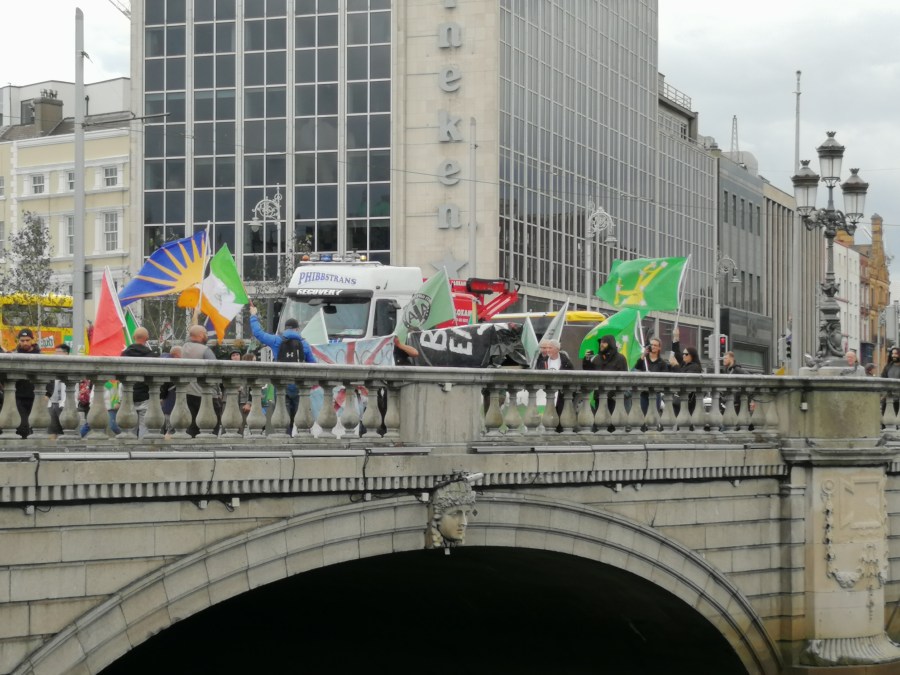
On Monday, as the remains of Queen Elizabeth II were being conducted in State funeral in London, Socialist Republicans rallied against monarchy in front of the James Connolly1 monument in Dublin.
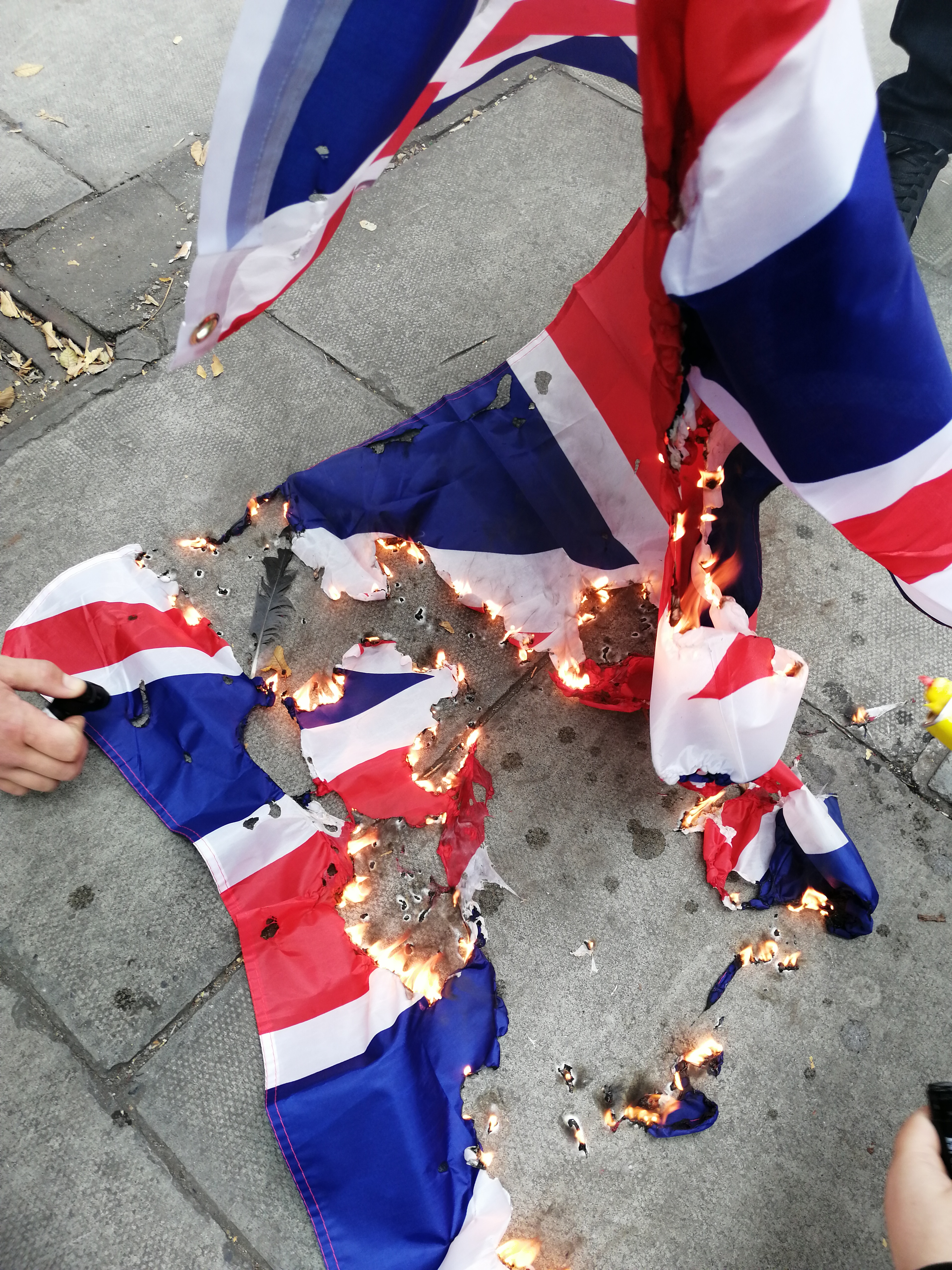
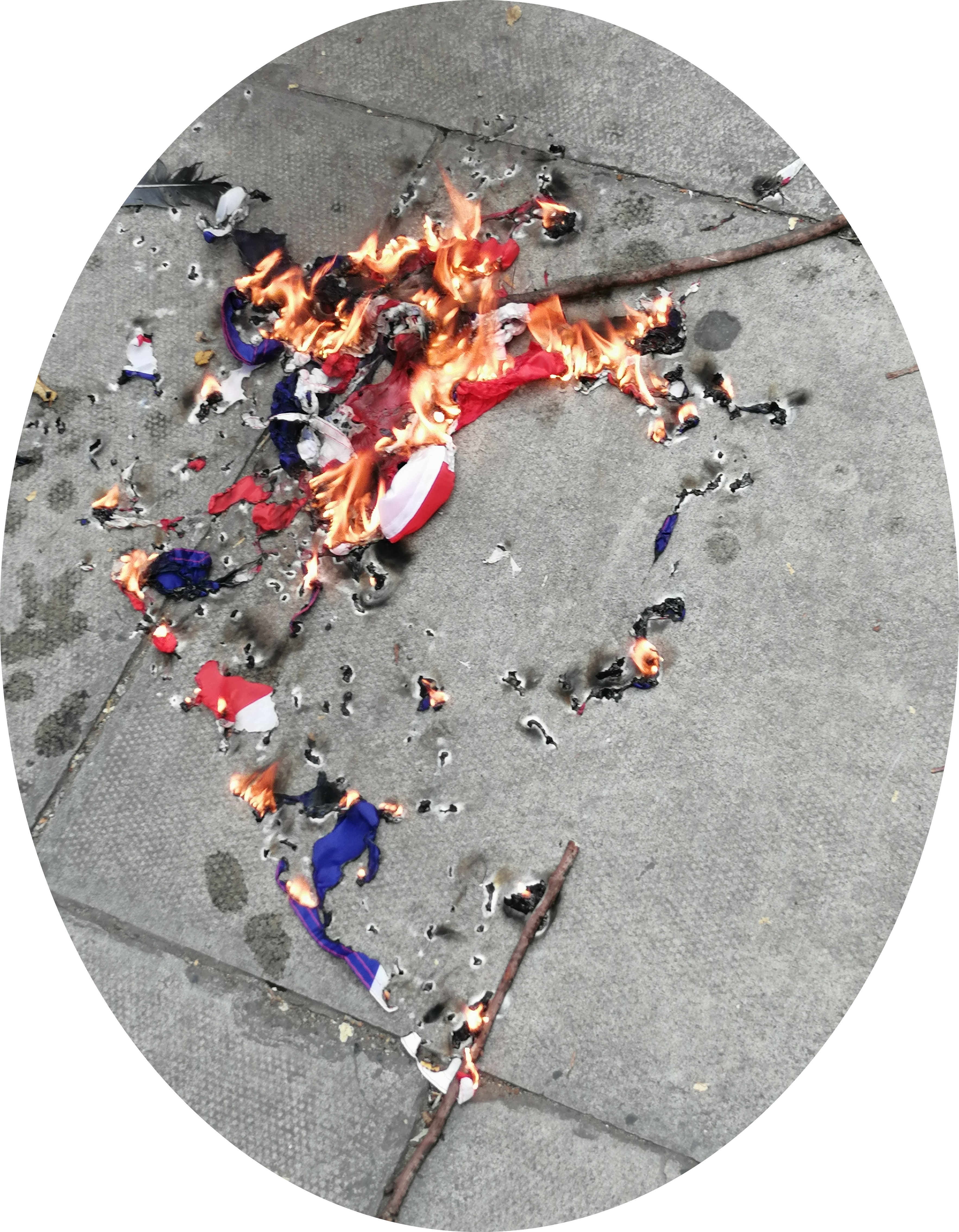
They displayed flags and placards, heard speeches and burned the flag of the UK.
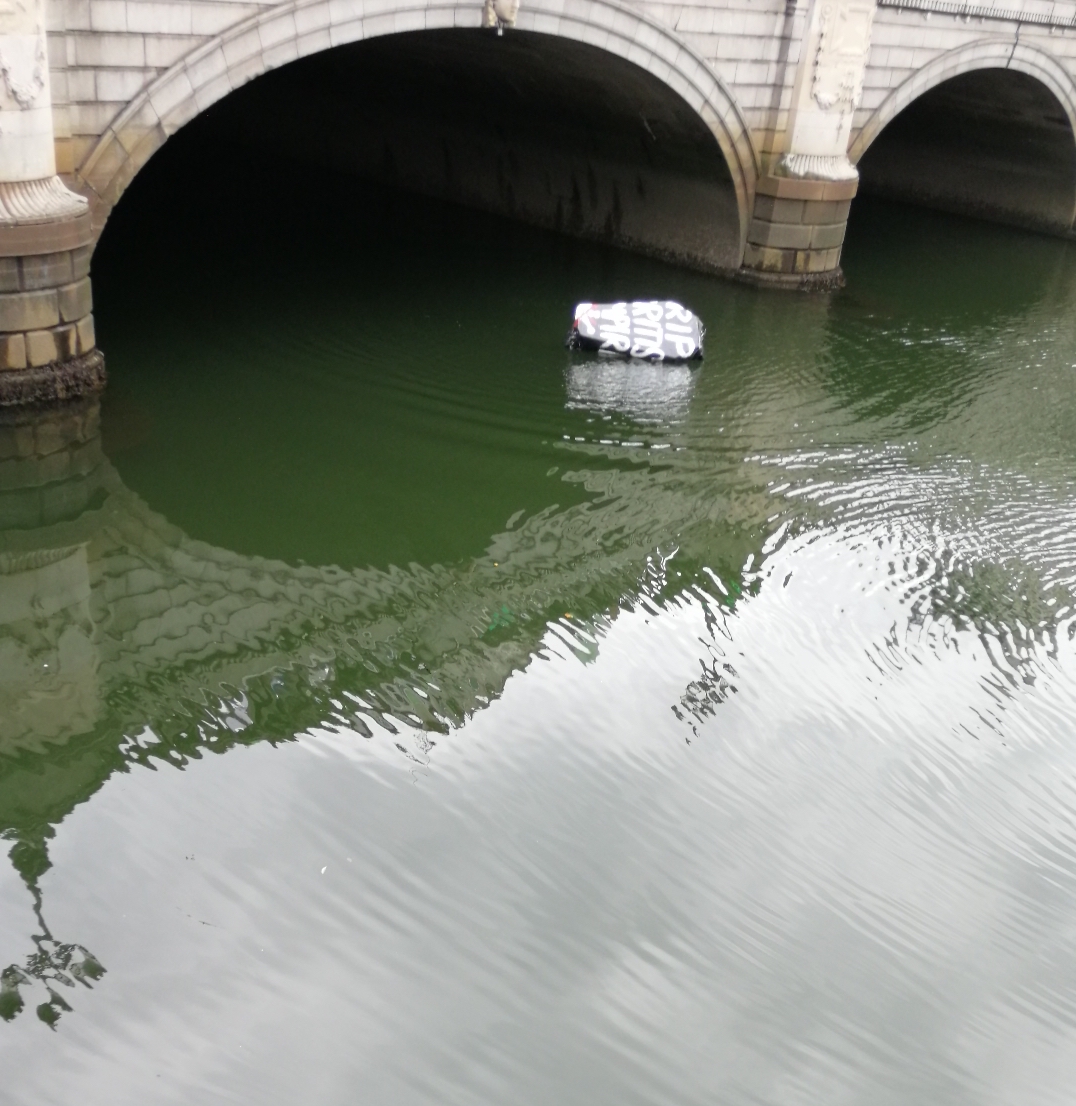
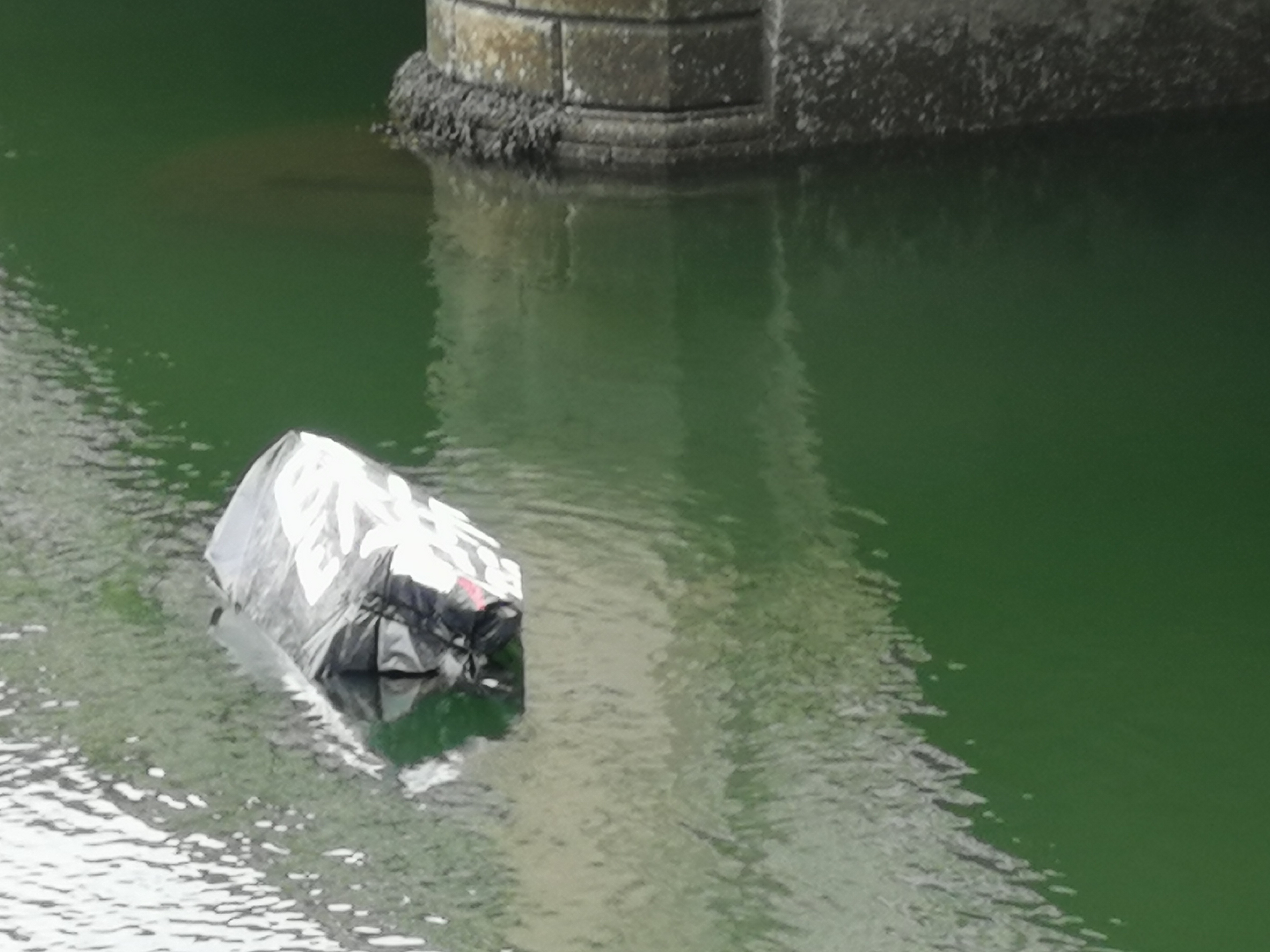
They then marched to O’Connell Bridge carrying a “coffin” bearing the words “British Empire RIP”, dumped it into the Liffey and marched on to the General Post Office building, where a large force of Irish state police prevented their entry.
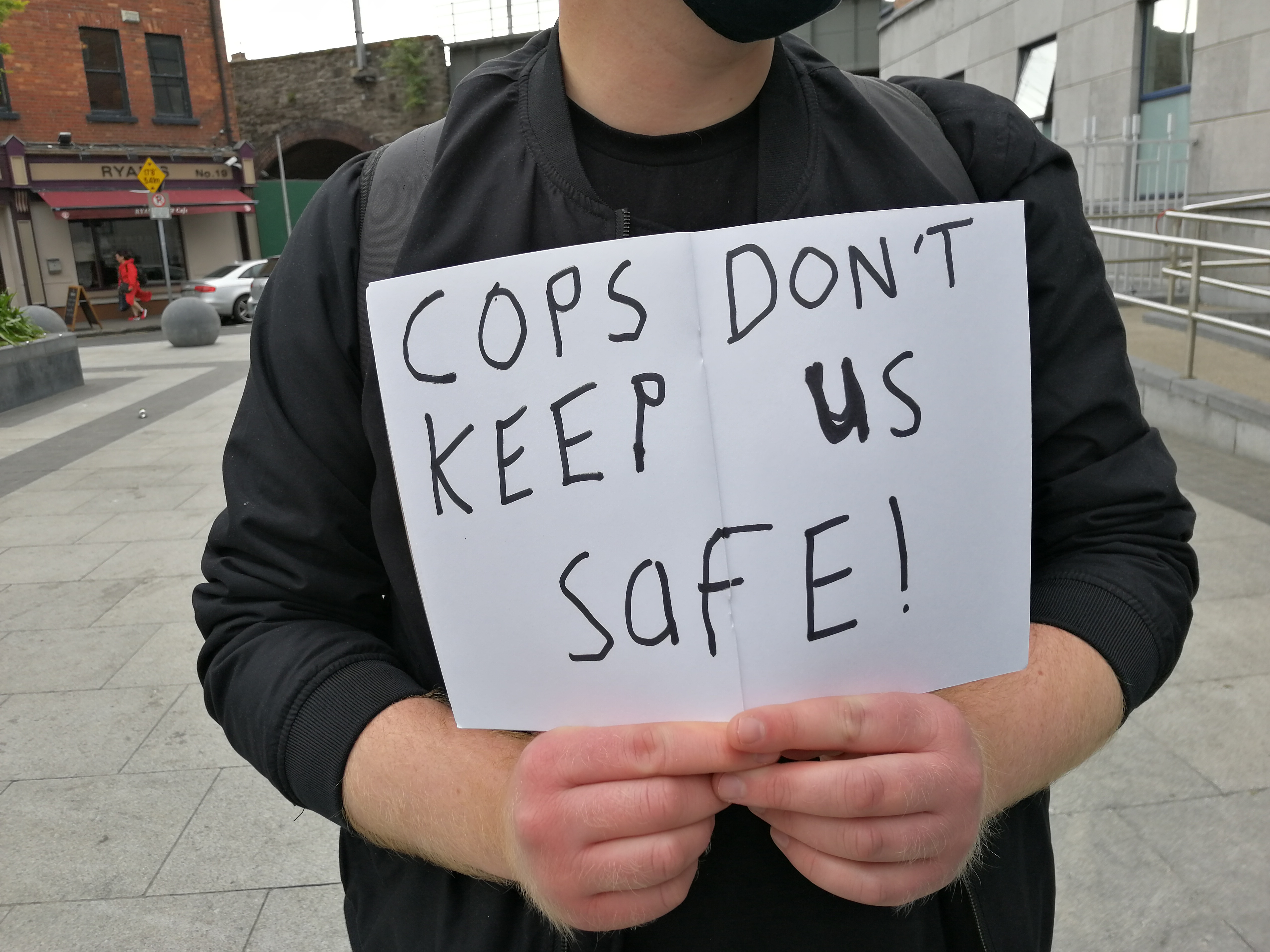
Bob Marley’s lyrics applied to the situation on a home-made placard at the event (Photo: Rebel Breeze)
The actions occurred as the royal funeral was taking place in London. In a move that drew public criticism from presenter of independent program Newstalk, national broadcaster RTÉ sent a crew to cover the funeral in London to film it in realtime for Irish national television.
Taoiseach (equivalent of Prime Minister) Mícheál Martin and President Michael D. Higgins in persons represented the Irish State at the British royal funeral.
Many Irish politicians (including leaders of the Sinn Féin political party) and public figures had sent fulsome messages of condolence and praise of the late British Queen.
“DOWN WITH THE MONARCHY!”
The chairperson of the event and speakers lambasted the “sycophancy” of Irish Government figures and other politicians and public figures. They drew attention of the past record of British Royalty and to the ongoing British occupation of Ireland.
The “RIP British Empire” ‘coffin’ parked temporarily next to James Connolly Monument (Photo: Rebel Breeze)
The event had been publicised on social media under the slogan of “Down with the Monarchy!” and that was very much the tone of the event as occupants in a police van watched from across the street.
The chairperson opened proceedings by reminding the attendance of Connolly’s slogan at the outbreak of WWI that “We serve neither King nor Kaiser but Ireland.” Passing vehicles occasionally tooted their horns in approval.
Police van surveilling events across street at James Connolly Monument (Photo: Rebel Breeze)
A young socialist Republican read out Connolly’s article in The Workers’ Republic of March 1902 on the occasion of the coronation of Edward VIII.
Connolly stated that to Socialists the replacement of one exploiter by another hardly mattered and would excite little comment.
“But although we would rather treat the matter thus philosophically, we find that the machinations of those in power do not leave us that possibility; with them, and because of them, the festivities attending the Coronation have taken on the aspect not merely of a huge parade of pomp and magnificence – cloaking the festering sores of that slave society on which it is built – but have also become an elaborately contrived and astutely worked piece of Royalist and Capitalist propaganda, designed to captivate the imagination of the unthinking multitude, and thus lead them to look askance upon every movement which would set up as an ideal to work for something less gorgeously spectacular, even if more solidly real.
The evil effects of private ownership of industries is thus illustrated once more in a manner that ought to appeal to those patriots in our midst who still dread the innovating effects of Socialism on the National spirit of the Irish people2.”
A home-made banner carried by participants at the event (Photo: Rebel Breeze)
DIVINE RIGHT AND WORKERS’ RIGHT
Diarmuid Breatnach quoted John Ball, a leader of the English Peasant’s Revolt of 1381 who, addressing the crowd in reference to the Christian Bible story of Adam and Eve, enquired: “When Adam delved (dug) and Eve span, who then was the gentleman?”
For that challenge to divine right to rule or right by birth, Breatnach related, King Richard II had John Ball hanged, drawn and quartered, his head stuck on a pike on London Bridge and a quarter of his body displayed at each of four different towns in England.
Breatnach contrasted this to the right of workers, who he said produce all things, to the ownership of all things and called on working people to take their place in history as conscious beings.
(Photo: Rebel Breeze)
Another speaker, on behalf of Spirit of Irish Freedom Republican Society and the Michael Fagan Fenian Society based in Westmeath also spoke and included the Sinn Féin leadership in his denunciation of Irish politicians who had accepted and praised British Royalty.
Seán Doyle spoke about the attitude of servility which works its way into many different aspects of life, for example into accepting the laws of the capitalist system and the housing crisis.
Doyle likened the acceptance of this right of capitalism to acceptance of the divine right to rule and stated that workers had to break from this acceptance, which is what the Revolutionary Housing League was advocating and practicing in action.
UNION JACK IN FLAMES AND COFFIN INTO THE RIVER
After the speeches a copy of the “Union Jack” flag was set on fire to symbolise the future of the forced union of nations — including a part of Ireland — under England rule.
(Photo: Rebel Breeze)
(Photo: Rebel Breeze)
Participants formed up into two columns flying flags, headed by four persons carrying a large pseudo-coffin. Taking to the road, they crossed Butt Bridge, turned right along the quay until they reached O’Connell Bridge.
There Gardaí and three Public Order Vehicles awaited them. Undeterred, the marchers cheered a short speech and chanted some slogans. Then at the count of “a h-aon, a dó, a trí” the “coffin” was heaved over the parapet into the Liffey river.
Marchers led by four carrying the “British Empire” ‘coffin’ crossing Butt Bridge (Photo: Rebel Breeze)
This action emulated a similar one carried out by James Connolly and revolutionary socialists in 1897 during Queen Victoria’s visit to Dublin.
It is worth recording too that Queen Victoria visited again in 1900 to affirm Ireland as part of the UK and to help recruit more Irish to go and fight the Boers in South Africa.
In response to that occasion, Iníní na hÉireann (Daughters of Ireland) led over 50 women in organising a Children’s Patriotic Party on the Sunday after the Wolf Tone Commemoration in July of that year.
Over 30,000 children had paraded from Beresford Place to Clonturk Park in north Dublin where they were served picnic lunches and listened to anti-recruitment speeches.
The marchers on O’Connell Bridge just before the “British Empire” ‘coffin’ is thrown into the Liffey (Photo: Rebel Breeze)
After disposing of the “coffin” of the “British Empire” on Monday, the marchers proceeded to the General Post Office where the building had been closed and a strong force of Gardaí also prevented access.
The GPO was the HQ of the insurrectionary forces during the 1916 Rising and many considered it insulting to their memory that the Irish tricolour above the building was lowered to half-mast in respect for the British monarchy.
March concluding at the GPO in Dublin’s main street — the police are blocking the doorway to the left of photo (Photo: Rebel Breeze)
The event concluded with cheers from passers-by and without any arrests.
End.
“British Empire RIP” ‘coffin’ immediately after being thrown over the bridge into the Liffey. (Photo: Rebel Breeze) The ‘coffin’ emerging on the east side of the Bridge on its journey seaward. (Photo: Rebel Breeze)
FOOTNOTES
1The James Connolly monument in Dublin is located in Beresford Place, across the street from what was the old Liberty Hall, the HQ of the Irish Transport and General Workers’ union (now replaced by SIPTU).
2See Sources & Further Information for a link to the full text.
Irish newscaster slams Irish broadcasting team sent to cover royal funeral: teahttps://economictimes.indiatimes.com/news/international/uk/elizabeth-is-not-our-queen-irish-presenter-slams-tv-coverage-of-monarchs-funeral/articleshow/94281107.cms
Main article by CHEMA MOLINA@CHEMAMOLINAA in Publico.es, translation and comment by Diarmuid Breatnach
(Reading time entire: 4 mins.)
The origin of the Bella Ciao song is uncertain and there are different theories about how this mythical popular song came about.
Over the years it has acquired a meaning closely related to the anti-fascist protest movements and in defence of democracy.
However, the Italian artist Laura Pausini refused to sing it during the El Hormiguero1 (show), reasoning that it is “very political”.
The piece has a clear political nature that goes beyond the success which the Money Heist series has given it and that has made it one of the most listened-to Italian songs in the world.
Italian partisans had already employed verses of this hymn against Mussolini’s fascism and the Nazi occupation during World War II.
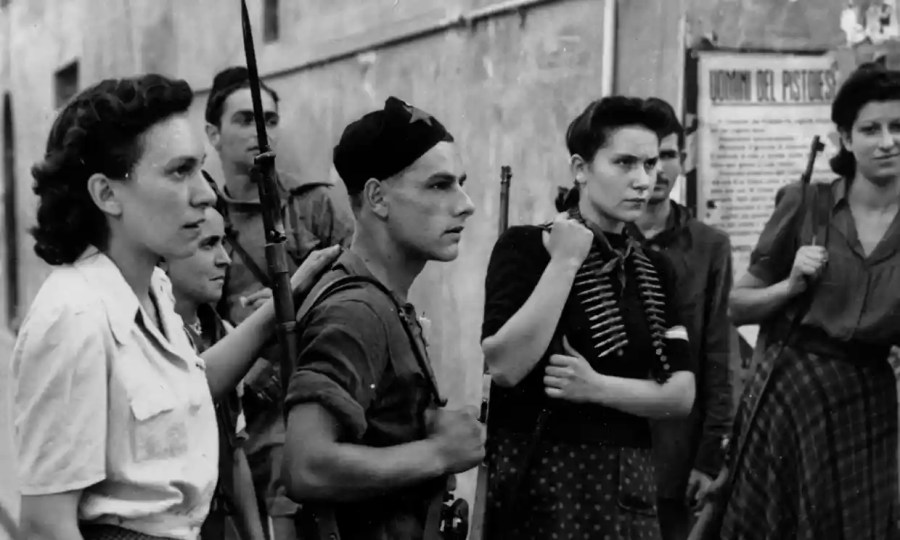
Armed Italian anti-fascist Partisans in Pistoia, Tuscany (central Italy) Dec 1944 (Photo credit: Keystone/Getty Images)
Specifically, it was the partisans of the Maiella Brigade, in the Abruzzo region (east of Rome), and the Garibaldi Brigade, in the Marche area, a territory located between the Apennine mountains and the Adriatic Sea, who began to sing it, mixing traditional melodies with militant lyrics.
But there are other theories that suggest that the beginning of this song dates back to the 19th century.
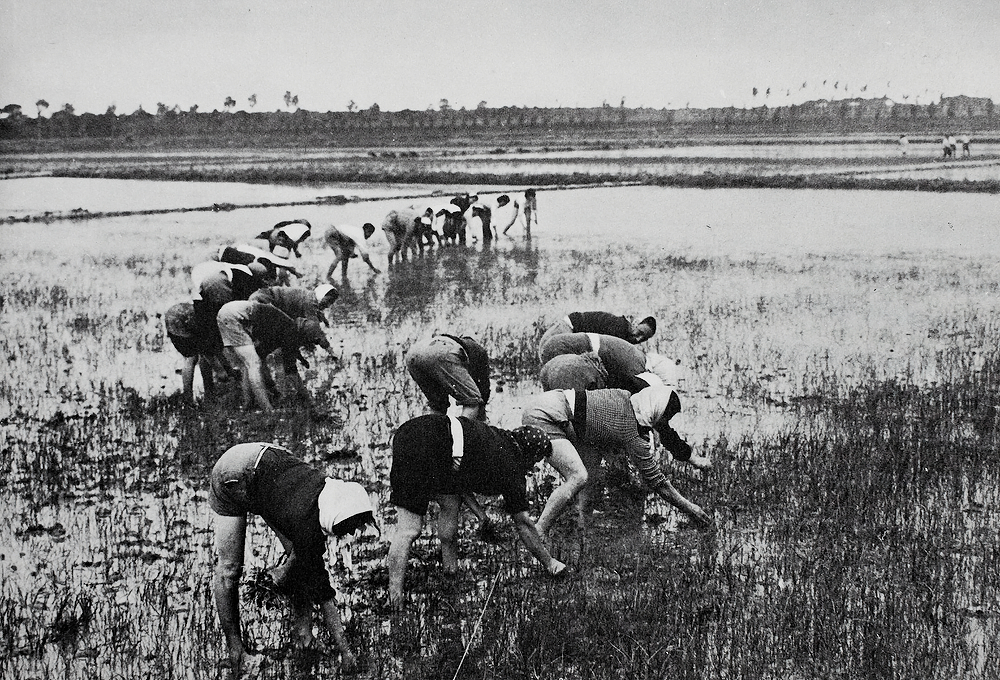
Line of Mondinas at their back-breaking work (Photo sourced: Internet)
The Mondinas, women who worked in the rice fields of northern Italy, recited the lyrics of this song as a sign of protest against the harsh working conditions they experienced every day.
In fact, the historian Cesare Bermani explains that the origin of Bella Ciao comes from a song called Fior di tomba (Flower of the grave) and that the poet Costantino Nigra had previously mentioned it in the second half of the 19th century.
One of the versions of this song reached the Mondinas of the provinces of Vercelli and Novara, both in the Piedmont region.
The Mondines’ (Italian female rice workers) song.
Another theory points out that the anthem could have Ukrainian roots. The musician Mishka Ziganoff, born in Odessa in 1889, moved to New York and composed a piece that could have been the origin of the start of the Bella Ciao air2.
Later, Italian migrants spread the air of this song when they returned to their country3.
Apart from its origin, the song began to become popular and to take on a political meaning due to the festivals organized by communist youth in different European countries. In the summer of 1947, the World Festival of Youth and Students took place.
There, the partisan version of the anthem was promoted, which later reached the Festival of the Two Worlds (also called the Spoleto Festival) in 1964.
The Bella Ciao show was performed at that event, organised by the Italian group Il Nuovo Canzoniere Italiano. The singer-songwriter Giovanna Marini, an artist who also helped to popularise the song, participated in the performance.
Bella Ciao has crossed borders and has been translated into many languages. In Spanish, one of the best known versions is that by the author Diego Moreno, who published his interpretation in 2014 on the album Bella Ciao! Adios Comandante!
COMMENT
THERE IS NO NEUTRAL POSITION ON FASCISMby Diarmuid Breatnach
The current controversy over a prominent Italian singer’s refusal to sing Bella Ciao at a kind of game show was predated by controversy over the origin of the song.
Most authorities now seem to refute the popular belief that it had been sung by Italian partisans, instead dating its emergencer as an antifascist song soon after WWII.
All are agreed however that it was predated by “Alla mattina appena alzata” a song with different lyrics of women rice-planting labourers, the Mondines, bewailing their extremely hard working conditions, their exploitation and expressing their hope in liberation.
Its origins therefore in women workers’ resistance is noble but so also is the antifascist sense in which it is usually sung today.
Woman Singing ‘Bella Ciao’ from window in Bologna Italy on Liberation Day 2020 (Photo credit FTimes)
Laura Pausini, when declining to sing the song, excused herself by saying that “it is very political”. Yes, it is and Pausini needs to realise that neither in the world of today nor in the past is there, nor has there ever been, a neutral position on exploitation of labour or on fascism.
The responses to Pausini recorded by Publico on Twitter were mostly negative towards her decision and rationale but also revealed a fair amount of confusion.
Laura Pausini in 2009 (Photo sourced: Internet)
The most common critical response was along the lines that anti-fascism is fundamental to democracy and therefore above politics, one commentator going so far as to state that Pausini is confusing position or stance on the one hand with ideology, on the other.
Fascism is a political ideology and so therefore is anti-fascism. Of course, anti-fascism is normally associated with the Left of the political spectrum but some conservative individuals and groups have been known in history to be actively anti-fascist too.
However that does not change the fact that anti-fascism is a political position whether ascribed to by revolutionary communists and anarchists, social-democrats or conservatives.
As the world capitalist system in crisis turns to making the workers pay more through rising costs of essentials and wage controls, along with cuts in state social services, the masses will resist. In many states, it is then that the ruling class turns to fascism to repress the resistance.
Neither Pausini nor anyone else can rise above that struggle. One may certainly attempt to be neutral but circumstances will not permit it, will certainly frustrate the attempt. Objectively one’s actions and words will either favour fascism or work against it.
End.
FOOTNOTES
1El Homiguero (“The Anthill”) is a Spanish television program with a live audience focusing on comedy, science and guest interviews running since September 2006 https://en.wikipedia.org/wiki/El_Hormiguero
2Without listening to the air, I am unable to venture an opinion on this. However, thinking about it, Bella Ciaodoes evoke Eastern European Jewish music to me. According to Wikipedia, Ziganoff was a Christian Roma from Odessa, Ukraine but well familiar with Yiddish and Klezmer music. https://en.wikipedia.org/wiki/Mishka_Ziganoff
3This is a well-known process of the dissemination of song airs and even lyrics by migrant workers or sailors (or even soldiers). For example the air of the ballad Once I Had a True Love may be found on an Alan Lomax collection of traditional songs from Extremadura, central-western part of Spain.
The Truth Commission (CEV) in Colombia has just published its report on the Colombian conflict. As was to be expected it is a very detailed report and deals with many aspects of the conflict and therefore it is impossible to carry out a detailed criticism in just one article.
This article aims to deal with the document entitled Call for Peace and in later articles I will deal with some points in greater detail such as the regions, the business class and drug trafficking.
Of course, there are very positive aspects, such as the statistics compiled, some proposals that they make and also the stories of the victims that they included.
However, there are also some very problematic aspects on the ideological plane and how they present the conflict, the actors, motives and there is an underlying idea in the document that we should advance towards a new society — with changes — but a society that continues to be the same with regard the economy.
They discount any class struggle as not only as anachronistic but also as something which is undesirable, regardless of the methods used.
The document is full of adjectives, some of them emotive, something which is not a criticism as such, emotions have a place in this setting, but it is imbued with Christian references and the Catholic faith as such.
That is not that surprising given that the boss is a Jesuit priest, Francisco de Roux, s.j. But due to this, its starting point is based on suppositions not shared by everyone and that are very questionable.
President-elect of Colombia Gustavo Petro shakes hands with Francisco de Roux at the launch of the Report.
OH BROTHER!
They start off with the statement and question “We started off from the issue that has dogged humanity from the beginning: where is your brother?”
I don’t know whether this first part is true or not, but the question about the brother presumes we know and share this concept of brother. In the Catholic faith we are all theoretically brothers, though not in practice.
But the idea informs a concept taken from family therapy that the Colombian conflict is between siblings that love each other or at least can love each other, just as a woman can love the man who abuses her in their relationship or the man who can stop abusing her and love her as she deserves.
It is a deservedly highly questioned concept, but it is applied in many countries that have gone through peace processes and truth commissions. But it is not the case, this conflict is not between siblings, but rather between interests.
The conflict has names and surnames and moreover surnames of the great and good and its victims are everyone else. There are power relationships. There are also economic interests.
It is an insult to say that the powerful, such as Luís Carlos Sarmiento and the Santos family are the brothers of their employees, or that associations such as the cattle ranchers of FEDEGAN represent people that are the brothers of the displaced peasants.
Though the report does acknowledge the role of some business people in the conflict.
…what has been grievous for the pain and injustice for the victims is the finding that leading business initiatives paid paramilitary groups in order to displace and steal the land and territories from the communities and implant mining or agribusinesses, or within their enterprises they stigmatised the workers and are complicit in the murder of hundreds of trade unionists.1
Such people, responsible for the murder of hundreds of trade unionists are nobody’s brothers, other than their shareholders’. They killed them as part of a strategy to accumulate wealth, the most base reason for doing so.
The CEV’s position turns the businessman into our brother, though it does acknowledge that
… we did not carry out any specific study on the armed conflict and the economy, following four years of listening to the drama of the war, the Commission takes as given that if no major changes are made to the economic model of development in the country it will be impossible to prevent the repetition of the armed conflict which will reappear and evolve in an unpredictable manner.
But despite not carrying out any specific analysis of the conflict and the economy the CEV calls on businesses to avoid a resurgence in the armed conflict.
The state, society and in particular the business people behind the large industrial and financial projects should prioritise guaranteeing the welfare and dignified life of the people and communities without any exclusions, with a shared vision of the future to overcome the structural inequality that makes this country one of the most unequal countries in the world in terms of the concentration of income, wealth and land.2
It is part of the discourse that we are all brothers. Instead of criticising the call they make for a society where the welfare of the people is a priority for the businesses, we only have to ask a question. Where does this happen? In what countries does this occur?
They usually make clumsy references to Switzerland or Sweden, ignoring that it is not quite the case and the welfare programmes in Europe (those that are left) are the result of social struggles and are largely financed by the super-exploitation of the Global South.
It is an illusion and part of liberal mythology, that is usually sold during elections every four or more years depending on the country, but is not to be found anywhere in reality and couldn’t be — legally a company looks out for the welfare of its shareholders and nobody else.
The lack of an analysis of the economic model as a factor in the conflict is a serious weakness, something I will deal with in another article.
But in a conflict for land, where the landlords and business people murder peasants and trade unionists3, failing to analyse the context of the economic model is disingenuous.
AN OLD VERY BAD JOKE
The CEV, however, engages in another great act of untruthfulness when it repeats the old refrain of the business class and the state that paramilitaries are reactive i.e. they react to the presence of guerrillas.
It seems like a bad joke that at this stage a commission that supposedly seeks the truth repeats such a lie: a lie challenged at the time by many of the organisations that now praise the CEV, in the days when they didn’t receive as many cheques from USAID and the European Union.
It has also been shown that companies paid armed groups large amounts of money as indispensable operational costs to keep their projects active.
And the reality of economic actors that in despair at the guerrillas and in the face of insecurity, contributed to the creation of the Convivir [rural security cooperatives] and on other occasions sought out the paramilitaries to bring their security of terror.
Following that there were those who took advantage of the land abandoned in midst of the terror to buy land through frontmen and set up projects. And there were those who used money to place members of the armed forces at their disposal.4
When the bloodthirsty Carlos Castaño called his paramilitary organisation United Self-Defence Forces of Colombia, he did so for a reason: the need to present his barbarous acts as a necessary evil, that of self-defence.
Javier Giraldo, s.j. also a Jesuit has spent his entire life fighting against just such a lie. He has documented how the paramilitaries existed before the foundation of the guerrillas and they were not reactive, but rather they were a state policy.5
The problem with the focus that ignores the state and its role and says that we are brothers is that it asks for reconciliation on that basis, that we are brothers. De Roux in his presentation asked more than once “how did we do” and asked for reconciliation.
But this “We” doesn’t exist. As Javier Giraldo points out.
A similar effort must be made in order to translate the value of Christian reconciliation to the judicial/political arena. There must be a public clarification and admission of guilt, an explicit condemnation of the mechanisms, structures and doctrines which facilitate crimes, the implementation of corrective measures to stop them from being repeated and reparation to victims and society. These must all be dealt with head-on and unequivocally. The very nature of a political community makes this imperative: unless there is an explicit and profound social sanction of crimes, internalized by society’s members and engraved in society’s “collective memory,” such crimes are not truly delegitimated. Without these conditions, the Christian value of forgiveness becomes a perverse expression of its real essence: from a fraternal and creative act to an act which covers up the institutionalization of crime(bold not in original) and destroys the barriers which protect human dignity.6
THE GERMAN EXAMPLE – AN OLD ILLUSION
The CEV points to the case of Germany following the Second World War as an example to follow. It is usually a sign of the poverty of the arguments when someone refers to the Nazis in order speak ill of someone, like saying some such a leader is the new Hitler.
But it is also a sign of argument povery to a degree when they refer to the topic to speak of reconciliation and so forth in post-War Germany. However, that is what the CEV did.
Our German friends who accompany us in the Commission’s process have shown us how its people recovered its dignity and pride when, even decades after the genocide of Jews and the war crimes committed, took on board the suffering of the victims, the wound as part of the national psyche and accepted its collective responsibility.7
What they claim just isn’t true. First of all, the post-Nazi Germany was not a denazified country.
Various later personalities from that period held high positions of responsibility, amongst them Kurt Waldheim, an officer in the Nazi army who became Secretary General of the United Nations and also President of Austria; war criminal Adolf Heusinger who became President of the Military Committee of NATO8 and Johannes Steinhoff who was in charge of the Luftwaffe after the War.
Kurt Georg Kiesinger was a member of the Nazi party, and worked side by side with Nazi propagandist Goebbels and later between 1966 and 1969 he was the German Chancellor.
Another Nazi, Wernher von Braun, who designed the Nazis’ bombs and rockets earned a good wage in the USA in order to put one of the rockets on the Moon. None of them confessed or accepted their responsibility.
And let’s not forget that young member of the Hitler Youth, one Joseph Ratzinger who became head of the Catholic Church. Of course, being a young man, he bore a lesser responsibility than the others.
The Nazis’ anti-gay legislation was applied up to 1969 and between 1946 and 1969 50,000 people were tried under that law. And whilst the Nazis had high-ranking posts the Communists were banned from working in the public administration and they and other dissidents, such as pacifists, were pursued.
Even under the “Communist Clause” victims of the Nazis who were Communists were not compensated.9 They chose a very bad example — or perhaps De Roux is conscious of the example he chose.
However, what it is about is blending one myth with another. It is surprising that they don’t mention South Africa, maybe because it is easier to see the reality of its Truth Commission and it is a more realistic comparison than Germany after the War.
What they aim to say is that if the Germans could accept their collective guilt, why can’t Colombia do so? But such collective guilt does not exist, or at least not in the way De Roux and company mean.
Many Germans lost their lives in the struggle against the Nazis, it has been calculated that the Nazis murdered 288,000 members of the opposition, including before Hitler came to power.
It wasn’t all Germans who did it but amongst those who did, there are familiar household names, Siemens and Krupps, just to name two companies — both used slave labour in their factories and had close relations with the Nazi Party.
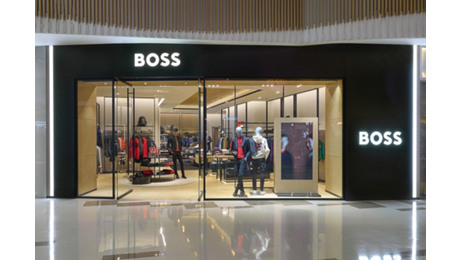
Or there is Hugo Boss, the Nazi Party member who made his fortune manufacturing the uniforms of the Nazi Party, later of the Wehrmacht and of course of the SS, which is why they looked so good.
Hugo Boss menswear shop in Dublin. The company founder was a close supporter of the Nazi regime and produced uniforms for the Nazi Party, Wermacht and SS. (Image sourced: Internet)
And of course, Bayer, the company that made Zkylon-B, the gas they used, still exists and is still rich. Following the war, 13 directors from the company were convicted of war crimes but were freed without serving their full sentences and took up their posts in the company.
The murderers continued in power with the tale of “collective guilt”. The Nazis were a political project of a sector of the German bourgeoisie to stop the rise of the Communists, any similarity to cattle ranchers declaring Puerto Boyacá the anti-capitalist capital10 is a mere coincidence, I suppose.
The reference to Germany as an example of reconciliation is a cheap tale. If Colombia goes down the same road, the surnames Mancuso, Uribe, Santo Domingo, Samper and Santos and the others will be the dominant surnames in the future, with their economic and social power intact.
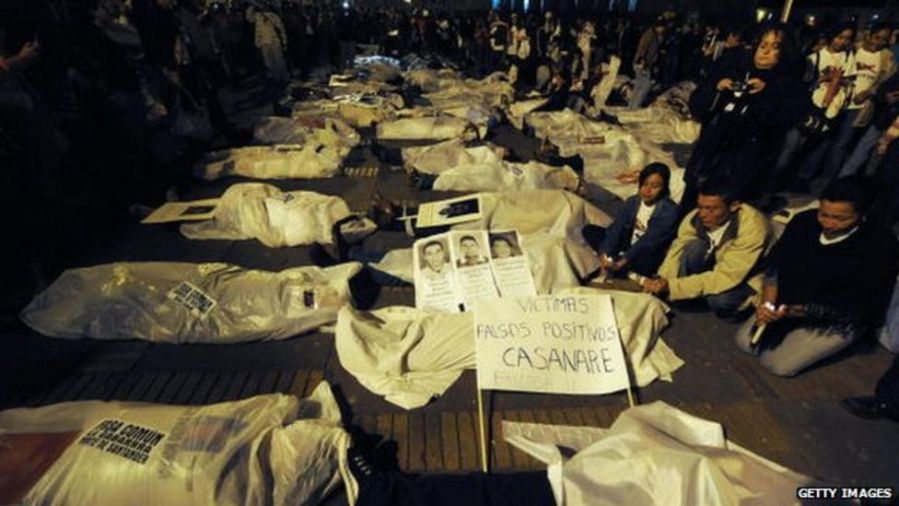
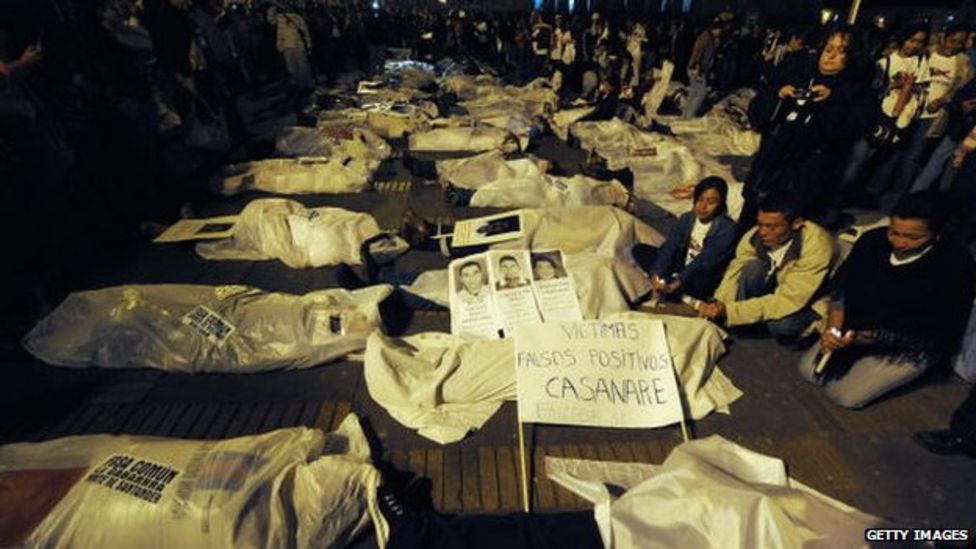
Protest about the army murders of civilians claimed as “positive” FARC guerrillas by relatives portraying the victims, Bogotá in 2009
THE “FALSE POSITIVES”
The CEV also deals with the issue of the “False Positives” and states something about the issue which is absolutely true that “If there had been ten, it would be very serious. If there had been one hundred, it would enough to demand a change of army. But there were thousands and it was monstrous.”11
But almost immediately it states that:
There was no law or written instructions that ordered it, but the soldiers who fired felt that they were doing what the institution wanted, due to the incentives and pressure that demanded immediate results with corpses, the publicity that they gave to those “killed in combat” and the protection given to the perpetrators.12
Yes, it is true that there was no law or written order that instructed them to do so. But we can’t expect criminals to leave us easy proof. There was no law, but there were incentives as they pointed out.
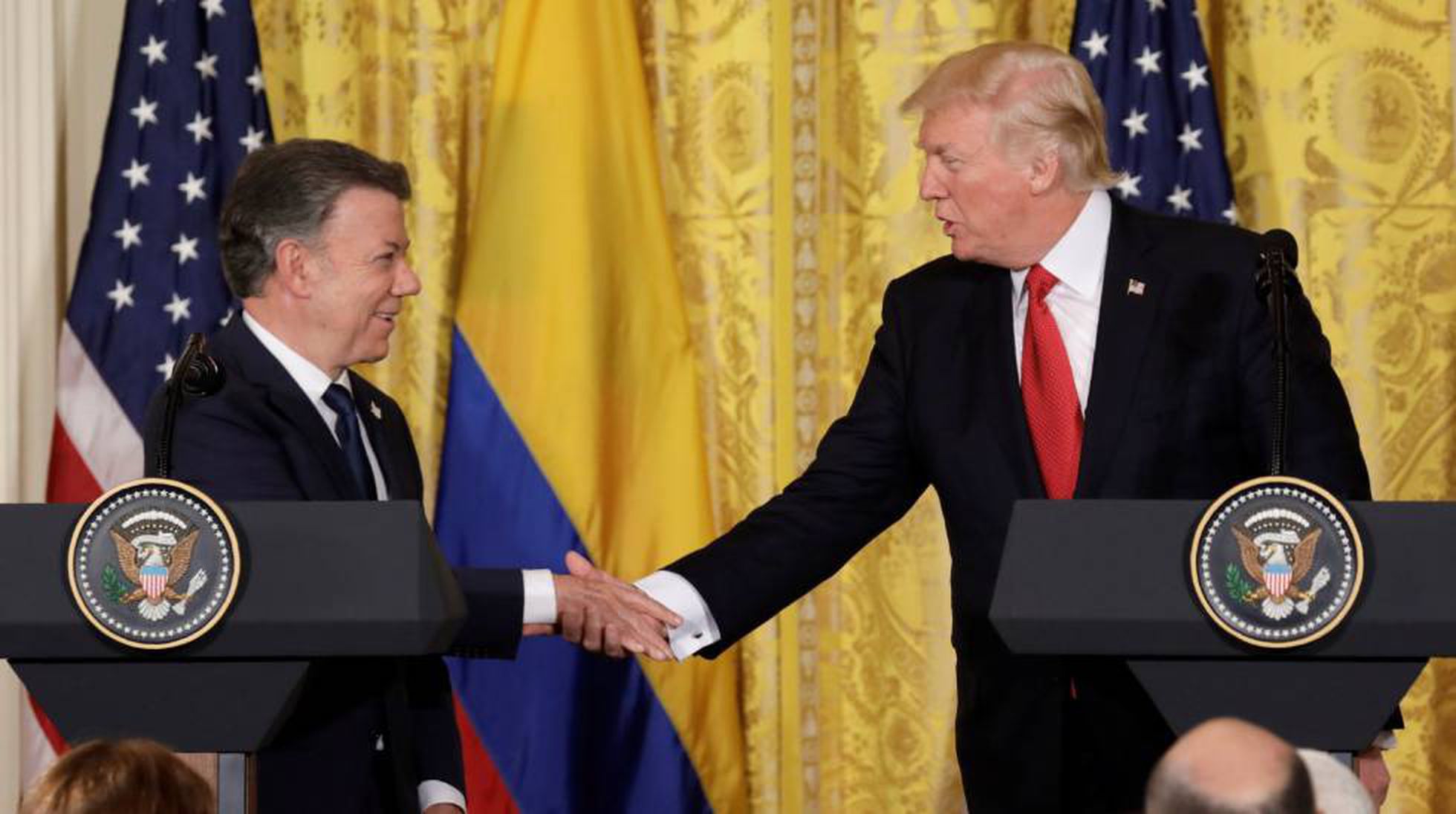
There were directives and a system for bonuses that encouraged the murder of civilians. Who authorised the payments? The then minister of Defence, Juan Manuel Santos. What does the document say about Santos?
The former president Santos – who was Minister for Defence from the end of 2006 to the end of 2008 – came to the Commission to contribute to the truth with his testimony, as ex-President and public servant, and he centred his intervention on the rigorous analysis of the False Positives to conclude asking for forgiveness from all the families and Colombia and invited the Armed Forces to ask the national and international community for forgiveness.13
It is not true, his intervention was not very rigorous and he ended by asking for forgiveness, as the CEV says, but at the same time he said he wasn’t to blame.
He took up Samper’s excuse regarding drug trafficking and said that it all happened behind his back and he lied on various occasions in his declaration to the CEV.14
Juan Manuel Santos, them President of Colombia shaking hands with Donald Trump, then President of the USA, in the White House 18 May 2017 (Image sourced: Internet).
IN CONCLUSION
Without a doubt the CEV will contribute to the knowledge of the conflict with its data, interviews and in some parts, its analysis. But the report as a whole will not be the truth about the conflict.
The CEV stated that “we don’t share the position, according to which, there are many truths that are equally valid regarding the same matter.”15
Yes, not all “truths” are equal, you have to analyse them, discuss them, contrast them with the facts and even look at who is enunciating them to see which perspective is closer to the truth, but in this case, it is not the “truth” of the CEV that is true.
Neither do I share the idea that any truth is of equal value no matter how powerful or well thought-of those who write that truth are.
3 “The Human Rights Information System of the National Trade Union School (ENS) recorded 15,430 violations of trade unionists’ rights to life, freedom and integrity in Colombia between 1 January 1971 and 29 September 2021. Around a fifth of the cases reported were murders: 3,288 trade unionists have been assassinated over the last five decades in Colombia.” https://www.equaltimes.org/colombia-has-signed-a-peace?lang=en#.YtXwJuzMI6E
9 Creuzberger, S. ‘Make life for communists as difficult as possible’ State-run anticommunism and ‘psychological warfare’ in the early years of the Federal Republic of Germany. Asian j. Ger. Eur. stud.2, 9 (2017). https://doi.org/10.1186/s40856-017-0020-7
10 The location was the birth place of the paramilitary model that arose in the 1980s and was avowedly right wing. There was a sign on the way in to it, that said “Welcome to Puerto Boyacá, Anti-Communist Capital of Colombia.”
Historians and political activists gave talks in Dublin presenting a review of the conduct of what is more usually called the Irish Civil and its effect since on life in Ireland. All the speakers described that conflict as “a counterrevolution”, to overturn many of the gains made in the period of struggle immediately before it and to head off any possibility of yet further gains in Irish political, economical and social life, having a braking effect on such progress up to this very moment.
Liz Gillis speaking (Photo: D.Breatnach)
L-R: Fearghal Mac Bloscaidh, Mags Glennon, Ciaran Perry (Photo: D.Breatnach)
BACKGROUND
The event on 26th June, held in the function room of The Cobblestone, was organised by the Peadar O’Donnell Socialist Republican Forum, itself established in early 2013, the result of a number of meetings and seminars organised over the course of 2012. It combined communists and socialist Republicans to organise discussions on a number of issues, such as Irish state neutrality, Irish national independence, working-class programs in struggle etc.
(Photo: D.Breatnach)
SPEAKERS
Ciaran Perry, a socialist Republican and Independent Dublin City Councillor, also a local history activist, introduced the event. He talked about the importance of history and in particular local history, the traditions of struggle and how some of those had been weakened in the trade unions and communities over the years.
Reading the account of the Ballysheedy Massacre (Photo: D.Breatnach)
Perry introduced the MC for the meeting, Mags Glennon who is also a socialist Republican activist and history enthusiast.
Glennon introduced historian Fearghal MacBhloscaidh from Tyrone who began in Irish and then continued in English, his presentation laying out clearly his position that the Civil War was a planned counterrevolution, quoting Cabinet papers and correspondence and supplying figures on the arms and equipment supplied to the Free State ruling elite by the British. MacBhloscaidh also maintained that the De Valera Government, though supported by the wider Republican movement at the time, was also a counterrevolutionary measure when subjected to a class analysis.
Sorry, slightly out of focus Jimmy Doran (Photo: D.Breatnach)
A woman (whose name I did not catch) was called to stage. In a clear voice she read an account of of the horrific Ballyseedy Massacre. Free State soldiers, after torturing their Republican prisoners, brought nine of them out to a road barricade, in which they had placed a landmine which they exploded. One survived by some miracle but spent the rest of his life needing frequent medical intervention.
At intervals between speakers, Pól MacAdaim performed his music, singing accompanied by guitar. Among the songs he sang were Tipperary So Far Away and Take It Down From the Mast (in the chorus of which some members of the audience could be heard joining).
Pól Mac Adaim performing at the event (Photo: D.Breatnach)
Mags Glennon then introduced historian Liz Gillis from Dublin who talked about the reaction of women to the Treaty and to the Civil War. The vast majority of Cumann na mBan members rejected the Treaty and many actively supported the Republicans in the following conflict. Gillis also spoke about how the women, who had been active in the struggle in 1916 and briefly to the fore in public life with the elections of 1918 and the War of Independence, were driven back to almost invisibility by the Free State Government and also the De Valera government and the 1937 Constitution. Gillis lauded Kathleen Clarke whom she said continued to fight the struggle for the rights of women in representational politics and criticised the De Valera Constitution of 1937.
Mags next introduced Jimmy Doran, a communist and long-time trade union activist, who talked about the contribution of the organised Irish workers to the struggle against British colonialism and for the advance of the working class. Doran went on to comment on the trade unions’ history and current situation in the Irish state. I had to go to the toilet and when I returned stayed near the entrance so as not to distract the audience by retaking my seat near the front and unfortunately, due to the lack of a PA system and the acoustics of that location, I was unable to hear the rest of his presentation.
Poster for the event.Supporters and organisers (Photo: D.Breatnach)
Although the meeting was thrown open to questions or contributions, little was forthcoming although there was a short debate on whether the Irish bourgeoisie prepare well into the future and whether they prepare better than their opponents in the Republican movement.
The proceedings ended with announcements of forthcoming events, thanks from Mags to the speakers, audience and to Pol Mac Adaim who ended the day on a musical note.
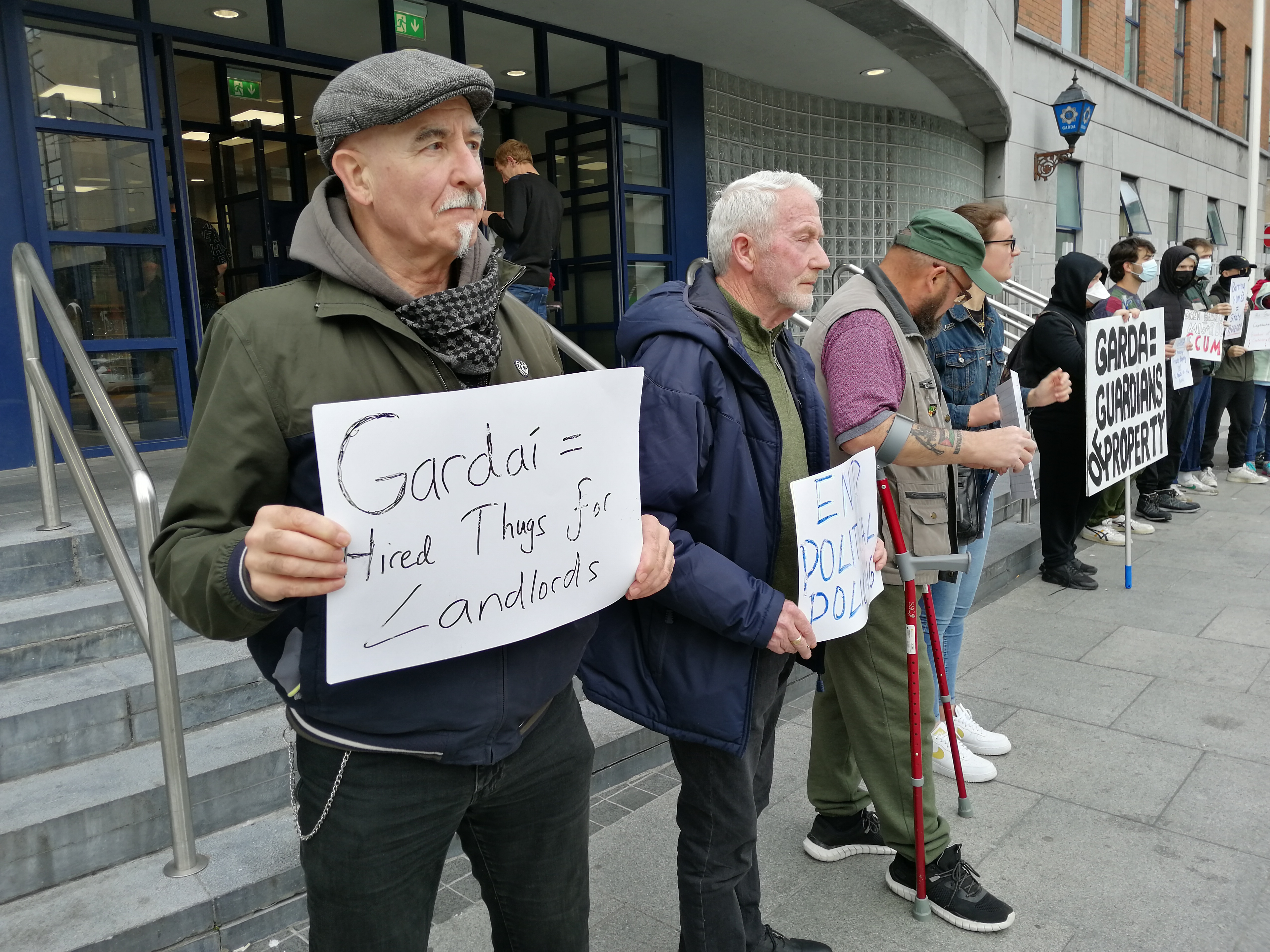
Passers-by on foot and on the Luas tram lines watched curiously as housing activists and others held a picket outside Store Street Garda station in Dublin on the evening of 13th June 2022. The picket was called for by the Revolutionary Workers Union, protesting the taking by over 80 Gardaí of a house on Eden Quay and arresting of two occupants, followed by the arrest of another two activists near another address.
Poster advertising the event on social media. (Image sourced: Internet)
The picket was called at fairly short notice and supported by people from a variety of political backgrounds, all with what were clearly home-made placards. Picketing a police station is somewhat counter-intuitive, given that’s to where the police take their prisoners and most people want to stay away from those places, with good reason. However, the station is the location of the police symbolically and in reality and Store Street is one of the main ones in Dublin so, when one wants to protest about the police …… Once having protested at a police station, the apprehension is never quite the same again.
Some passers-by stopped to ask what the protest was about, some of whom expressed anger at the actions of the Gardaí and a reporter from an independent media interviewed some of the participants.
Picketers outside Store Street Garda Station, Dublin City centre on Monday. (Photo: Rebel Breeze)
Some time later the picketers were addressed by Seán Doyle of the RWU who spoke about the morality of the landlords and speculators and the Gardaí who work for them. Doyle contrasted that morality with the one that saw provision for need instead of profit. During the course of his address, Doyle pointed out that the RWU knows people who work in emergency interventions such as with people attempting suicide, who are then brought to agencies to help them but who are soon out again and homeless. “This is not ‘ethnic cleansing’,” the activist said, “it’s class cleansing.”
(Photo: Rebel Breeze)
The RWU spokesperson at the picket remarked on the use of the law and the Gardaí against housing activists while speculators and landlords make big profits out of the misery of homelessness. A law that upholds and defends that kind of practice must be defied, he stated as he drew to a close.
Some of the picketers on Monday (Sean Doyle is second to the right). (Photo: Rebel Breeze)
Seán Doyle was one of two activists that were removed recently by over 80 Gardaí from a one-and-a-half years empty homeless hostel which the RWU had “acquisitioned” and renamed “James Connolly House”. Another premises subsequently acquisitioned, also empty for a long period, the RWU renamed “Liam Mellowes House” and the Gardaí arrested two activists near there also, despite any occupation of the building being a civil law matter and outside the remit of the Gardaí.
The RWU on a number of occasions have called on people to “take back empty buildings” and have declared that they will not be intimidated by arrests but will continue to fight for the right of people to a secure home.
Another view of part of the picket on Monday (Photo: Rebel Breeze)
One of the home-made placards at the event. (Photo: Rebel Breeze)
End.
A placard denounces the recent 80+ Garda eviction of “James Connolly House” and arrest of two occupants (Photo: Rebel Breeze)
The 1974 British Intelligence and Loyalist bombing of Dublin and Monaghan towns, with the highest number of people killed in one day during the 30 Years’ War, was commemorated in Dublin today at the Memorial in Talbot Street, near the corner with Amiens Street. The commemoration, organised by the perennial Justice for the Forgotten campaign, was addressed by the Taoiseach (Irish Prime Minister) and elected representatives of Dublin and Monaghan municipalities. A poet and two musicians performed, wreaths were laid and one former politician gave a strong oration highly critical of the Irish, British colonial and British authorities.
On 17th May 1974, around the work-leaving and shopping-ending busy time of 5.30pm, three car bombs exploded within minutes of each other in the centre of Dublin. The car bombs had been parked in the mainly working and lower-middle class sParnell Street, Talbot Street, and South Leinster Street (as distinct from such streets as Henry, Grafton or Dawson streets, for example). Twenty-six people were killed in Dublin. To cover their way back across the British border, another car-bomb was set off in Monaghan Town, killing another seven. Even excluding a full-term unborn child, the total death toll was 33, the highest number killed in any one day of the three decades of conflict. Around 300 were injured.
Suspicion should naturally fall in the first place on the British Loyalists, since they had been planting bombs in Dublin since 1969 and in 1972 and 1973 their bombs had killed Dublin public transport workers. But the authorities had pretended to believe that the IRA was responsible for the 1972 bombing and used the panic around it to steamroll repressive political legislation through the Dáil, thereby setting up the no-jury Special Criminal Courts to sent Irish Republicans to jail.
However, it is believed that Irish Army Intelligence and Garda Intelligence were quickly aware that the Dublin and Monaghan bombers had in fact been Loyalists of the Ulster Volunteer Force and even knew the names of a number of them.
“No one has ever been charged with the bombings. A campaign by the victims’ families led to an Irish government inquiry under Justice Henry Barron. His 2003 report criticised the Garda Síochána‘s investigation and said the investigators stopped their work prematurely. It also criticised the Fine Gael/Labourgovernment of the time for its inaction and lack of interest in the bombings. The report said it was likely that British security force personnel or MI5 intelligence was involved but had insufficient evidence of higher-level involvement.” (Wikipedia)
Incredibly, despite long-standing allegations of collusion between the colonial police, the RUC (now the PSNI) and Loyalists, the Gardaí sent the car-bomb remnants to the RUC for analysis. Shortly after that, Ned Garvey rose from the Deputy position to Gárda Commissioner and met with a British secret agent in his office – without informing his superiors. When the agent began to blow the whistle on his past activities he exposed Garvey as a British “asset” – Garvey of course denied it but had to admit he had indeed met clandestinely with the agent in his office. When the Fianna Fáil goverment came in, they sacked Garvey as “not having confidence” in him but did it so baldly and outside established procedures that Garvey was able to take the Government to court, have his pension secured and have damages awarded to him!
BRITISH POLICY OF COLLUSION WITH LOYALIST MURDER GANGS
Most experts have been clear that construction of the type of bomb used was beyond the capability of the Loyalists at that time and, in any case, it is clear that British Intelligence and military were working with Loyalist gangs, as were the RUC (some of whom were members of the gangs) and RUC Special Branch. In addition there were reports of British accents in connection with suspects.
Collusion of that type had been openly advocated by a British military expert on counter-insurgency, Major (later Brigadier) Frank Kitson, for example in his “Gangs and Counter-gangs” (1960), based on his experiences in fighting the Kenyan insurgency for national liberation.
Frank Kitson (now Brigadier) in 1971 (Photo source: Internet)
Brigadier Frank Kitson was operational commander of the occupation forces in the British colony from 1970-’72 and left a substantial legacy of military assassinations and collusion with Loyalist murder gangs, along with other “dirty war” operations before he went on to lecture at British military training college.
“….. the de Silva Report (2013) on collusion with loyalist paramilitaries led to two further ‘unconditional’ British apologies for the behaviour of its security forces in Northern Ireland. In November 2013, a BBC ‘Panorama’ investigation into British counterinsurgency in Northern Ireland in the early 1970s revealed that members of a special covert operations unit known as the Military Reaction Force (MRF) admitted to the murder of suspects and unarmed Catholic civilians. These admissions by the state or its agents confirm previous claims by critics dating back many decades. Such abuses were not merely low-level tactical excesses by undisciplined and racist troops but were institutional, systematic, and approved or covered up at the highest levels ….”1
The British State has admitted it has secret papers relating to this atrocity but has refused to hand over copies to successive Irish goverments.
“THE LARGEST MASS MURDER IN THE HISTORY OF THE STATE”
Maureen O’Sullivan, ex-TD (Member of Irish Parliament) for the local area gave the main oration for the Justice for the Forgotten Campaign and called the bombing “the largest mass murder in the history of the State”. She went on to castigate successive governments and most of the political class for their lack of interest in pursuing the planners and perpetrators of the massacre over the years. In her repeated reference to their “ignorance”, O’Sullivan inferred that the legislators’ lack of interest was such that they could not even be bothered to inform themselves of the known facts.
Maureen O’Sullivan castigating the authorities (Photo: Rebel Breeze)
In addition to the Taoiseach, the Ard-Mhaora of Dublin and Cathaoirleach of Monaghan Council spoke and a Catholic priest delivered a short blessing. The event was chaired throughout by a representative of the Justice for the Forgotten campaign group.
Rachael O’Hegarty introduced and recited one of her collection of poems about the victims, this one about Maureen Shields who was 44 years of age when she was killed in Talbot Street.
Rachael O’Hegarty speaking and reciting her poem (Photo: Rebel Breeze)
Cormac Breatnach and Eoin Dillon on whistles played Sí Beag, Sí Mór and later Dillon playing the lament known as Táimse I Mo Chodhladh (I Am Asleep), accompanied by Breatnach on whistle, concluded the event.
Cormac Breatnach and Eoin Dillon on whistles (Photo: Rebel Breeze)
Eoin Dillon on uileann pipes and Cormac Breatnach on whistle (Photo: Rebel Breeze)
THE BOMBINGS EXPOSED THE NEO-COLONIAL NATURE OF THE IRISH CAPITALIST CLASS
In summary, a foreign power — which is also occupying by force one-sixth of Ireland — carried out a number of terrorist attacks in the capital city of the Irish State culminating in a massacre intended to cause maximum loss of life and limb – “the largest mass murder in the history of the Irish State”, as Maureen O’Sullivan correctly characterised it.
The Irish ruling elite failed to stop the escalating attacks and turned the investigation of the massacre into a farce. The Irish ruling elite failed to prevent the foreign power subverting the highest rank of its police force (and no doubt other levels in other areas).
Section of the crowd at the commemoration, the Taoiseach, Mícheál Martin speaking (Photo: Rebel Breeze)
The Irish ruling elite failed to take a full range of diplomatic and legal action to condemn the UK, the foreign power over its actions and failure to respond to requests for release of relevant secret papers. The ruling elite continues in that failure today as can be read into the weak speeches of Government Ministers at this ceremony – this time by the Taoiseach and last time the Minister for Justice.
No self-respecting elite or ruling class of any independent state would permit such violations of the security of its capital city and citizens without taking resolute and persistent action. The Irish ruling class is a neo-colonial capitalist class, undeserving even within capitalist terms to be in charge of any Irish state.
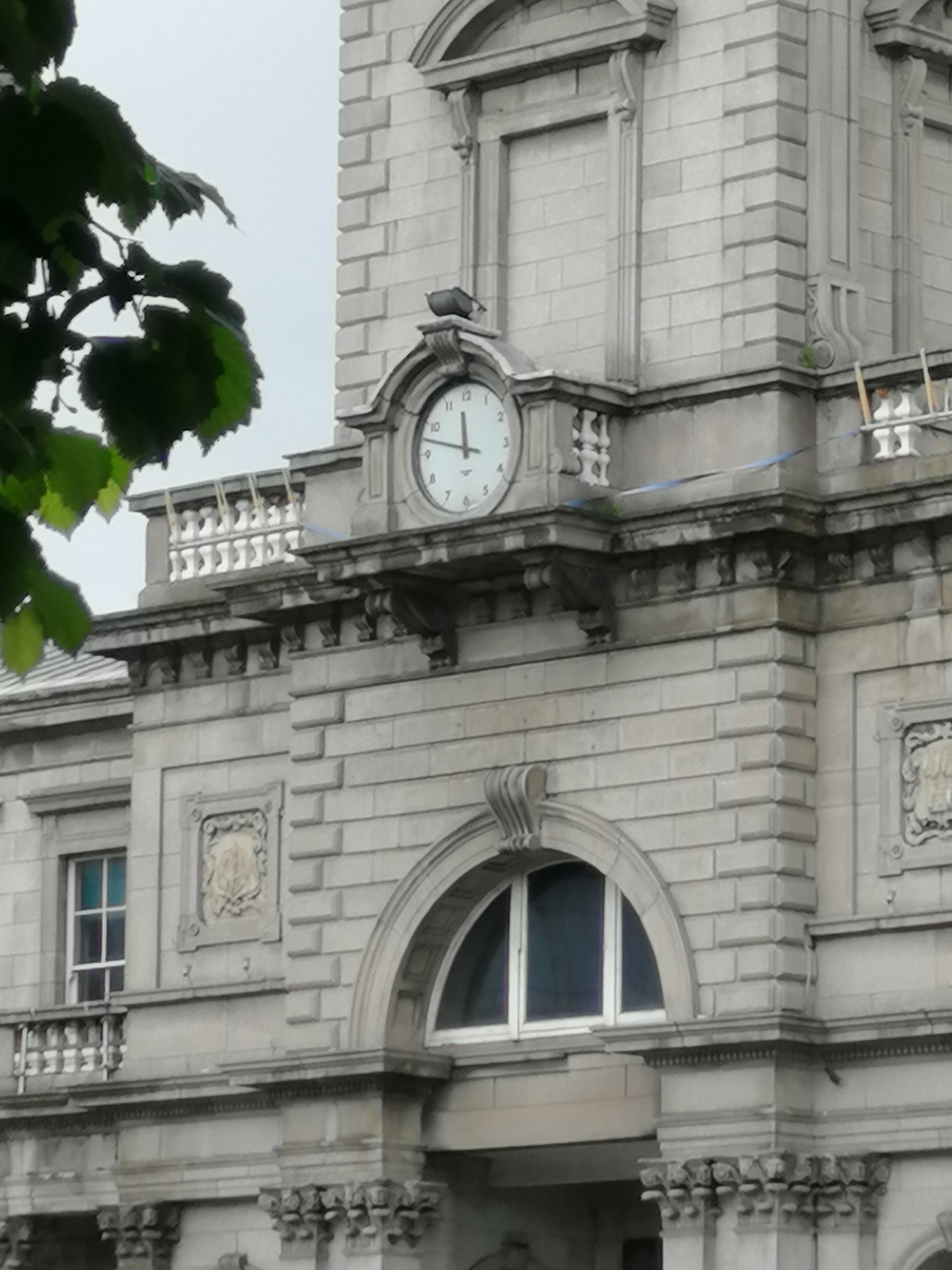
The north side of the Memorial (Photo: Rebel Breeze)The south side of the Memorial (Photo: Rebel Breeze)The clock on the tower of Connolly (formerly Amiens Street) Station — British soldiers fired a machine gun from that tower at Irish insurgents in 1916. (Photo: Rebel Breeze)
The grasshopper was enjoying the early May sunshine, playing his fiddle a bit, eating succulent new grass a bit, just enjoying life – a lot. Now and again, the grasshopper noticed an ant scurrying by but at first paid it no attention. Eventually though, he began to be a little curious and also, probably, a little irritated by this constant scurrying to and fro.
“Hey, Ant,” the grasshopper called out, the next time the busy insect passed him, “Why are you so busy? Why can’t you just enjoy life?”
The ant stopped and looked around to find out where the voice had come from.
“Ah, Grasshopper …. sorry, what did you say?”
“I asked why be so busy, why not just enjoy life?”
“Because food has to be gathered while it’s growing,” replied the ant, disbelieving anyone could be so stupid as not to know that. “And stored.”
“But Ant,” said the grasshopper indulgently, “there’s plenty of food around. No need to store it at all.”
“Yes, there’s plenty of food now, Grasshopper. But when the winter comes, hardly anything will grow. We gather the food now and store it so we won’t starve come winter.”
“Oh Ant, let winter look after itself. Now is the time to enjoy life.”
How can anyone be so stupid, thought the ant, shaking her head.
“Please yourself”, she said, hurrying on.
“Don’t worry, I will,” replied the grasshopper, striking up a merry tune.
He’ll only learn when it’s too late, thought the ant.
But she was wrong. The grasshopper began to think about the coming winter and absence of food. In between chewing the juicy grass-stems and playing tunes on the fiddle, the grasshopper went about making arrangements.
Summer turned to Autumn and Autumn turned to Winter. Most growing plants either died or went dormant. Cold winds blew through leafless branches.
Underneath the ant-hill, inside the ant-nest, it was warm and there was plenty of food, thanks to the hard work of the ant colony throughout the Summer and Autumn. The ants were enjoying their food, warmth and old stories.
A thunderous knocking announced someone at the main door. When the ants cautiously opened the door, whom should they see but the grasshopper, looking cold and hungry.
“I need some of your food,” he said. “Hunger is making me cold. And when I get cold, I get hungrier.”
“Too bad,” chorused the ants in the doorway.
“You should have listened to me in the Summer,” exclaimed one ant smugly.
“Oh, I did,” replied the grasshopper, even more smugly and let out something like a whistle, whereupon a large and aggressive crowd of blue beetles jumped out of hiding and ran for the door, overcoming the ants there in minutes. Into the the ant-nest they poured and sounds of fighting and injury could be heard within.
The blue beetles had been hiding but at the Grasshopper’s command, stormed the ant nest.
After a while, an injured but surviving ant at the doorway saw a blue beetle come staggering back out and approach the grasshopper.
“We need reinforcements, Master,” it whined. “The ants are massed and fighting hard defending their food stores. We threatened their young but they’re protecting them too.”
The grasshopper seemed unsurprised, almost as though he could have predicted that. He gave a different kind of whistle and a horde of dark green beetles poured out of hiding and into the nest. The noise of fighting grew louder and then ceased.
When the blue beetles ran into stiff resistance, the Grasshopper sent in the green beetles to finish off the opposition.
Any hope the ant had that the silence meant the elimination of the beetles was destroyed as a steady stream of beetles began to emerge, most of them carrying bundles of food.
“Lazy scum!” cried the surviving ant at the nest’s door. “You’re leaving us to starve!”
“No such thing,” scoffed the grasshopper. “If you all died of starvation, who would gather the food and store it next year? And the year after? You will probably go hungry – but you won’t starve. Not most of you anyway.”
The ant said nothing in reply, just watched the food parcels being carried out of the nest.
When they were all ready to leave, the grasshopper turned to the ant.
“No fighting next year, Ant. You just give us what you gather and we’ll give you back enough to live on and to raise new ants. No need for all that fighting, is there?”
The grasshopper turned away without a backward glance and followed the long lines of his food-carrying beetles in dark green and blue, his personal security platoon of blue beetles around him.
End.
The Grasshopper and Ants (Source image: illustration in book Aesop’s Fables, Library of Congress)
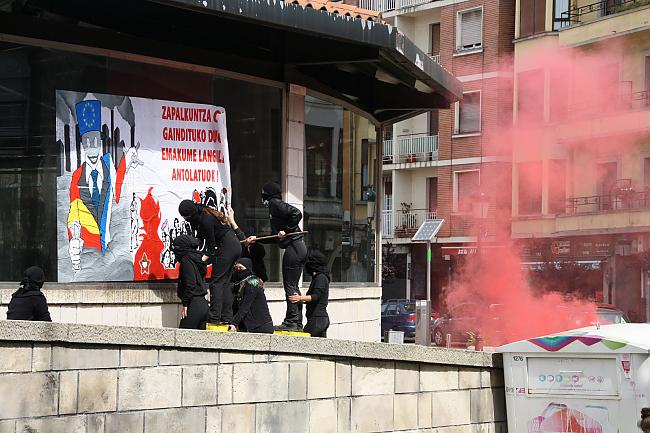
The revolutionary Basque socialist coordination organisation Jardun Koordinadora organised a celebration of Aberri Eguna, the Basque national day, combining political, social and cultural forms. Aberri Eguna takes place annually on Easter Sunday, a date chosen by its founder Elias Gallestegi based on a traditional commemoration day of the Easter Rising in Ireland. Aberri Eguna was first celebrated in Bilbo in 1932 attended by 65,000 people, including members of Emakume Abertzale Batza1, the Basque nationalist women’s organisation founded by Gallestegi also in emulation of the Irish organisation Cumann na mBan. Around 1,000 people, with a high representation of youth but also of veterans of the struggle, attended the events in Gernika2.
Jardun-organised Aberri Eguna procession passing through Gernika (Photo courtesy Jardun)
The Irish connection was reiterated on Sunday by the reading at the political rally of messages of solidarity from three Irish-based sources: Anti-Imperialist Action, Anti-Internment Committee of Ireland and Dublin Basque Solidarity Committee.
Jardun Koordinatora is a relatively new initiative which is a sharp departure from the trajectory in recent decades of the official leadership of the Abertzale Left, a trajectory which has served to dismember and dishearten the movement.
La Haine Report
(Translation by Dublin Basque with explanatory notes in italics)
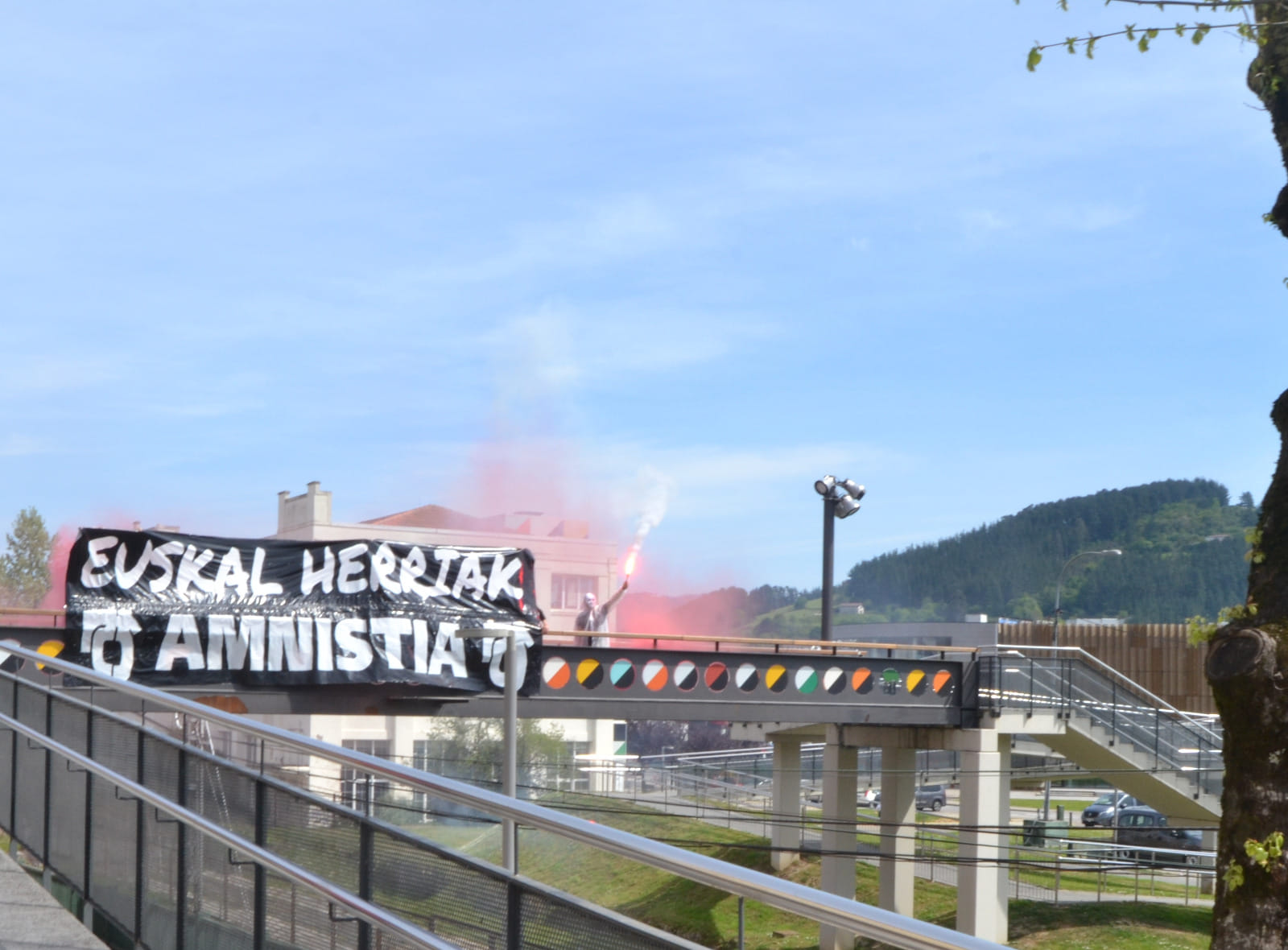
The different organisations comprising this Coordination (Jardun) demonstrated in Gernika under the slogans “Aberri gorria, biharko Euskal Herria, “Independentzia eta Sozialismoa”, “Euskal Herrilangilea Aurrera”, “Presoak Kalera Amnistia osoa” and “Amnistiarik gabe bakerik ez” (“Bright future in tomorrow’s Basque Country” “Independence and Socialism”, “Forward Basque workers”, “Prisoners Free with Full Amnesty” and “No Peace Without Amnesty”).
This Sunday, April 17, the JARDUN Coordination convened the Aberri Eguna (Basque National Day) gathering some 1,000 people to claim the national objective of the Basque Working People.
Along with a Zanpantzar group (performers with bells in traditional costumes representing animals), the event began with a march starting from Plaza Mercurio and during the journey different acts were carried out to demand prisoner amnesty and rights for working women. The event ended with the speeches read in Pasealeku Plaza: the first two were messages of solidarity sent by Anti-Imperialist Action and Anti-Internment Committee (both of Ireland) and ended with the political statement of the JARDUN Coordination.
Tradition Zapantzarak lead the procession (Photo courtesy Jardun)
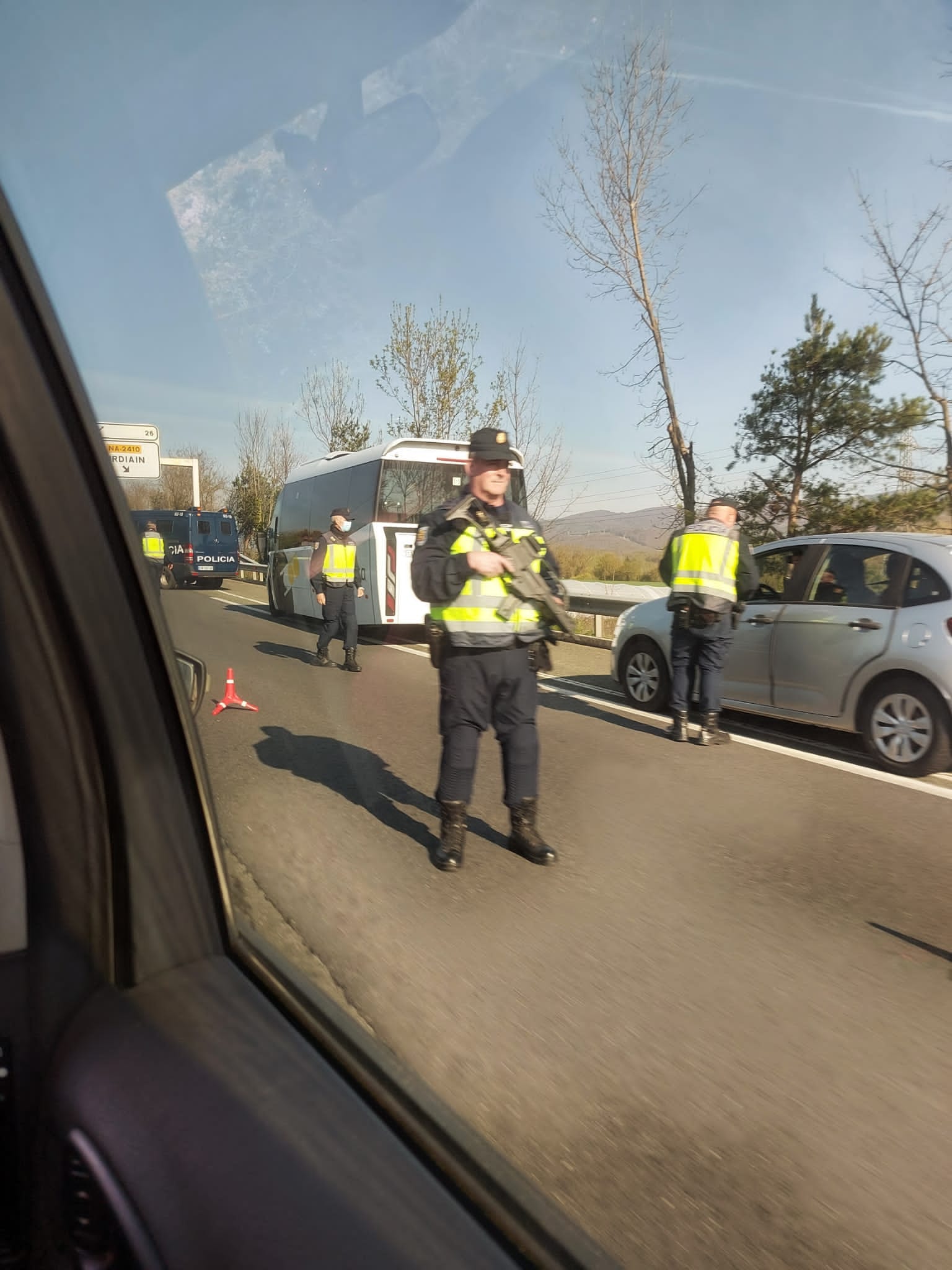
The demonstration went smoothly. However, the bus that departed from Irunea/ Pamplona had problems getting there because the National Police stopped it in Urdiain, taking details of the occupants.
To conclude, JARDUN Coordination stated that the only alternative for the Basque Working People will come from the hand of independence and socialism. To conclude, the Internationale and the Eusko Gudariak (Basque Soldier) were sung.
Spanish armed police stopped the contingent from Irunea/ Pamplona heading for Gernika and recorded their details. (Courtesy of Jardun)
Jardun Statement for Aberri Eguna 2022 (Translated by D.Breatnach from text supplied in Castillian Spanish)
Under capitalism, we workers are condemned to survive. We build our lives around work and the exploitation we suffer in it, while the bourgeoisie lives at the expense of this work. Such is the dynamic of capital. This is the logic of the economic system currently in force in the world. That is why it is important to clearly identify and point out the adversary facing us; because the capitalist system, the bourgeoisie, normalises and legitimises the fears and the repression that it produces daily to absorb the blood of the workers.
(Photo courtesy Jardun)
But with 19 years in prison for the freedom of his people, the murder of Iván Colona, a direct consequence of the criminal French prison policy, is not normal. The situation of the working people of Ireland, suffering from crushing British occupation for more than 800 years, is not normal. After eight long years of war, the situation of the working people of Donbass, who experience bombings, murders and massacres on a daily basis, is not normal. And much more heinous, outside of the norm, are the attempts to whitewash and legitimise criminal institutions such as NATO murderers.
We must situate ourselves in that context, understand within that reality, the situation that Euskal Herria (the Basque Country) is experiencing. Today our country are controlled by both the French and Spanish states. Not only do both these states not recognise Euskal Herria but they carry out an oppression based on that denial against the working class of Euskal Herria. In effect, we must understand well that, beyond the national question providing the a joint market for the states, the working class can only use the political project of the bourgeoisie as an element of unity to support and protect it, promoting interclassist attitudes.
“We, the organized women workers, will overcome all oppression!” (Photo courtesy Jardun)
The aforementioned denial, as well as the attacks carried out by the Spanish and French States against the Basque Working People, must be understood as an ideological motivation of the national State. We must, therefore, situate the oppression of Euskal Herria in the very creation of the Spanish and French capitalist states; because the objective of the denial is clear, the assimilation of Euskal Herria. To do this, the states take advantage of the institutions aimed at creating divisions and gaps in the Basque consciousness. And to protect these institutions and guarantee the supremacy of the bourgeoisie, they take advantage of dogs of various colours to attack the working people. To promote alienation and renounce our identity, in addition to normalising the attacks against the language, they have turned the Basque language and culture into souvenirs of a territory that today wants to dedicate itself to tourism, since for the bourgeoisie everything is business, to the point of commodifying our places of residence.
This being the case, given that denial is a decision of a political nature, we must cover with a political character the oppression experienced by Euskal Herria to view it with a class vision. We have to be clear about the concept of the political nature with regard to Euskal Herria nationality. Therefore, we have to fight against normalised oppression. Along this path, it is up to the workers of Euskal Herria to build our own political project and in response to this we have to equip ourselves with our own institutions that have to arise out of the counter-power that we need to form. And for this it is necessary for a Workers’ Euskal Herria to break politically with the Spanish and French states.
Photo shows a substantial following by veterans of the struggle (Photo courtesy Jardun)
These States offer the working people the use and threat of both persecution and violence, within the capitalist system that condemns the working class to servitude for the benefit of the bourgeoisie. For this reason, to carry out the aforementioned political rupture, political confrontation must be a valued concept in order to carry out the political project of the workers of Euskal Herria. Political confrontation must also be the engine of the revolutionary process aimed at achieving an independent and socialist Basque state in Euskal Herria.
For this, it is necessary to take the revolutionary process to the extreme and form a political body that must feed the revolutionary alternative. Specifically, a political body to be formed by organised workers in favour of national and social liberation and the sale of their labour power in the Basque Country. A political body that is committed to achieving an independent and socialist Basque State. Because the Basque Working People cannot be limited to the forms of work authorised by the capitalist system. These not only destroy the revolutionary potential of the working class, but are aimed at sustaining and reproducing the ideology of the bourgeoisie; because the enemy will not give, in any way, more than he is willing to give. The bourgeoisie will not voluntarily give up its privileges.
(Photo courtesy Jardun)
It is essential to set in motion the revolutionary process that must take place on the path of a classless society, towards the acquisition of political power by the working class; the aforementioned subject will only be achieved through the confrontation carried out with the capitalist state. Through the counter-power built in the confrontation, the Basque Working People must articulate revolutionary structures that wear down the centres of power of the oppressor and guarantee his liberation against the exploiters, to guarantee the achievements obtained during the revolutionary process. Because the political power of the Basque Working People must be based on counter power. In other words, the revolutionary alternative of the working people will be built and take root as the control and power of the capitalist states over the workers of the Basque Country is annulled. The revolutionary alternative must be a comprehensive political alternative that satisfies the needs of the Basque Working People.
It must be understood that this will be capable of leading struggles based on the activation and commitment of the workers. Therefore, in order to weave and build a revolutionary alternative at this time, the priority is the activation of workers aimed at promoting the ideological struggle and mobilization, understanding the JARDUN coordinator as an instrument to achieve this. In short, JARDUN is a framework created with the aim of promoting the organisation of bodies and militants to win the freedom of Euskal Herria. Its objective is that, under a common political project and strategic approach, each organisation carries out its contribution in specific political areas, but that all act within the framework of a common strategy and direction.
We have to be aware that this will be achieved through gradual activation and participation through the awareness of the Basque Working People. In this process, the revolutionary process itself will be carried out gradually, and the Alternative of the Basque Working People must carry out struggles based on the different forces, conditions and problems of the moment. As its political work deepens and Basque workers’ participation in the Coordination increases, JARDUN will create new framework organisations and acquire comprehensiveness and integrity, with the revolutionary movement’s priority being to create the conditions to achieve it.
(Photo courtesy Jardun)
When talking about the liberation of Euskal Herria, self-determination is a frequently mentioned term: self-determination, a term that appears many times when a nation is subjected to the sovereignty of another against its will. But when we speak of self-determination, considering the revolutionary process developed under a counter-power based on political rupture, we are not referring, in any way, to the vote marked, accepted and facilitated by the States that persecute Euskal Herria, but to the process of separation of one nation from the state structures of another nation. Self-determination as synonymous with the revolutionary process that must be carried out to achieve an independent and socialist Basque State, in the case of Euskal Herria.
Autonomism, because it is a struggle based on the management of the remains provided by the states, is not an option. It is not a legitimate choice on the table for the revolutionary movement, since this implies reformism and the strengthening of the position of power and subjugation of the States, together with the renunciation of the strategic objectives aimed at the liberation of the Basque Working People. However, it would be a serious mistake to believe that, through national liberation, the liberation of the workers will take place mechanically. This must be understood within the class struggle, in which we must place self-determination itself within the class conflict.
On the other hand, there exists the denial, underestimation or rejection of the national question, the strengthening of the repression that the capitalist states carry out and accepting the framework of the oppressive nation imposed, in the name of socialism, with the argument of unity of the workers. Regarding the national issue, the lack of correct position also allows the French and Spanish States to continue applying unjust laws and coercion, helping to hide the dimension of oppression suffered by the working class of Euskal Herria. Keeping silent before a crushing stomp, since taking a neutral position means protection from crushing; taking neutral positions allows oppressive power relations to continue unchanged over time and space, perpetuating them.
The political rally of Jardun’s celebration of Aberri Eguna in Gernika (Photo courtesy Jardun)
Consequently, the mere demand for independence only benefits the interest and political project of the bourgeoisie of the Basque Country. And the socialism that in Euskal Herria does not address the national question goes hand-in-hand with denial, denying in class parameters the revolutionary potential of the national question. The achieving of the independent and socialist State must be the result of the revolutionary process of Euskal Herria due to the national oppression suffered by the Basque workers. Revolutionary alternatives beyond the essential defence of independence and socialism must be the basis of the political position of the Basque Working People. They are only alternative for the Basque Working People, because it inevitably comes hand-in-hand with independence and socialism.
Long live a free Basque Country!
Long live a socialist Basque Country!
End.
FOOTNOTES
1A strong organisation in the antifascist resistance to the fascist-military uprising against the Spanish Republic but no longer in existence.
Recently the Queen of the UK and Commonwealth regions reached the 70th year of her reign, called by convention the “platinum jubilee” and has received congratulations from the heads of imperialist, colonial and neo-colonial states around the world. In Ireland, she has also received the congratulations of the head of a formerly Republican party now aspiring to neo-colonial government. When Mary Lou MacDonald, President of Sinn Féin praised Elizabeth II for her “long service” we should ask: service to whom and to what? We are also entitled to compare her words to those of James Connolly, Irish revolutionary socialist and republican, in reference to the British Monarchy.
WHAT THE PRESIDENT OF SINN FÉIN SAID
Mary Lou McDonald, President of Sinn Féin was widely reported reacting to the news that a tree is to be planted in the grounds of Parliament Buildings at Stormont to mark the anniversary.
“I think it is important that we are respectful of the identity of our citizens who are British,” she said on Thursday.
“I think that is entirely appropriate and I welcome that decision.
She was reported wishing well to those who will celebrate the jubilee, and said she believes those who won’t “are now big enough, bold enough, generous enough to acknowledge the identity of others.”
“Can I also extend to the British Queen a word of congratulations because 70 years is quite some record,” she added.
“That is what you call a lifetime of service.”
Any logical consideration of those words should quickly find some problems with them. What does “respecting the identity of our (Irish) citizens who are British” or “acknowledging the identity of others” actually mean? One would imagine that respecting the identity of others would involve primarily not subjecting them to discrimination, racism or religious sectarianism. Does respecting the national identity of any people give them the right to seize with armed force and occupy a part of the nation? Because that is what constitutes the basis for the British colony of the Six Counties in Ireland and the administration of that colony is the purpose of the Stormont Parliament and Executive. Furthermore, discrimination and sectarianism is precisely what is suffered by a huge part of the population of that colony – from the very institutions being upheld by SF and by its President.
Stripped down to its essentials, we are only “big enough, bold enough, generous enough” if we accept the partition of our small nation, the forcible retention of a colony and pay our respects to the Head of that state and the Commander-in-Chief of its armed forces.
This is a monarch who has presided over her armed forces’ participation in at least 24 wars or interventions since her inauguration, two of them in our national territory. Her armed forces invaded foreign lands, bombed and shot down those who resisted, carried out massacres, tortured prisoners and she has personally decorated the leaders of those armed forces, including those who murdered Irish people. The very least one could expect from an Irish politician with any dignity would have been silence or “no comment” on the occasion.
A poster calling for retired Army officer General Sir Mike Jackson to be jailed and advertising a march commemorating Bloody Sunday, on display in the Bogside area of Derry, Six Counties. Jackson was one of many military murderers to be decorated by the British Queen. (Photo by Niall Carson/PA Images via Getty Images).
This is far from the worst thing that the Sinn Féin leadership has done with regard to the British Monarch, for in May 2011 they called for no protests against her while she desecrated the Garden of Remembrance in Dublin and while the Gardaí attacked “dissident” Republican protesters nearby and outside her state reception in Dublin Castle, the old seat of her royal enforcers in Ireland. The following year, Martin McGuinness, prominent in the leaderships of both the IRA and Sinn Féin, welcomed her to her colony and shook her hand.
Martin McGuinness, in leadership of Sinn Féin and the IRA, welcomes the British Queen to visit her colony in 2012 (Photo sourced: Internet)
WHAT JAMES CONNOLLY SAID
James Connolly on occasions too referred to contemporary British monarchs – but in markedly different terms to those from the leadership of Sinn Féin in recent decades.
“What is monarchy? From whence does it derive its sanction? What has been its gift to humanity? Monarchy is a survival of the tyranny imposed by the hand of greed and treachery upon the human race in the darkest and most ignorant days of our history. It derives its only sanction from the sword of the marauder, and the helplessness of the producer, and its gifts to humanity are unknown, save as they can be measured in the pernicious examples of triumphant and shameless iniquities.
“Every class in society save royalty, and especially British royalty, has through some of its members contributed something to the elevation of the race. But neither in science, nor in art, nor in literature, nor in exploration, nor in mechanical invention, nor in humanising of laws, nor in any sphere of human activity has a representative of British royalty helped forward the moral, intellectual or material improvement of mankind. But that royal family has opposed every forward move, fought every reform, persecuted every patriot, and intrigued against every good cause. Slandering every friend of the people, it has befriended every oppressor. Eulogised today by misguided clerics, it has been notorious in history for the revolting nature of its crimes. Murder, treachery, adultery, incest, theft, perjury – every crime known to man has been committed by some one or other of the race of monarchs from whom King George is proud to trace his descent.
…………………….
Two completely opposite attitudes to British Monarchy: Mary Lou McDonald (L) and James Connolly (R)
“Fellow-workers, stand by the dignity of your class. All these parading royalties, all this insolent aristocracy, all these grovelling, dirt-eating capitalist traitors, all these are but signs of disease in any social state – diseases which a royal visit brings to a head and spews in all its nastiness before our horrified eyes. But as the recognition of the disease is the first stage towards its cure, so that we may rid our social state of its political and social diseases, we must recognise the elements of corruption. Hence, in bringing them all together and exposing their unity, even a royal visit may help us to understand and understanding, help us to know how to destroy the royal, aristocratic and capitalistic classes who live upon our labour. Their workshops, their lands, their mills, their factories, their ships, their railways must be voted into our hands who alone use them, public ownership must take the place of capitalist ownership, social democracy1 replace political and social inequality, the sovereignty of labour must supersede and destroy the sovereignty of birth and the monarchy of capitalism.
“Ours be the task to enlighten the ignorant among our class, to dissipate and destroy the political and social superstitions of the enslaved masses and to hasten the coming day when, in the words of Joseph Brenan, the fearless patriot of ’48, all the world will maintain
“The Right Divine of Labour To be first of earthly things; That the Thinker and the Worker Are Manhood’s only Kings.”2
SUPPORT FOR SINN FÉIN
Most followers of the Sinn Féin party, who are by long tradition anti-monarchist and desire a reunified and independent Ireland, tend to regard those kinds of heretical statements by the party leaders as no more than some kind of camouflage to get them into power. Once there, they imagine, their party will lead them to the hallowed objectives of Irish independence and unity. In fact, the same kind of attitude that was that of the early followers of Fianna Fáil, “the Republican party”3.
The blindness, or more accurately the ability of self-deception exhibited by these followers is amazing. The majority continued to believe the leadership when it publicly abandoned armed struggle against British colonialism and declared it would never return to that (believing that to be a fake position) and even when it had most of its arms decommissioned. Then the party not only fielded candidates in elections in the partitioned Irish state but also in the colonial one and, in arguably its greatest betrayal of its previous position, participated in the running of the colonial state which it continues to do. Since then its leaders have sought support for and even assisted in recruitment for the sectarian and colonial gendarmerie4 and, more recently, declared its acceptance of non-jury special courts, a clear reference in particular to the no-jury Special Criminal Courts of the Irish state5, condemned by a number of civil rights organisations6 and of which the party’s own supporters have been frequent victims.
The attitude of the larger mass of instinctively pro-independence people, mostly working-class or lower middle-class is that they might as well give Sinn Féin a turn in government – after all they can hardly treat them worse than the other gombeen7 parties that have been in government since the creation of the Irish State. Such attitudes account for the rapid growth in the party’s electoral base in recent years when it became the first party in terms of elected representatives so that two other neo-colonial parties, with a long history of hatred for one another, were obliged to join and form a coalition with a third8 in order to form a government excluding the new kid on the block.
General Jackson with Prince Charles, heir apparent to the throne of England and Commander-in-Chief of the Paratroop Regiment (Photo sourced: Internet)
The attitude expressed by the President of the SF party runs not only completely contrary to the traditions of Irish Republicanism but even to its own history. It is more than that, it is an expression of the lack of dignity and craven forelock-tugging attitude of the neo-colonial Gombeen class that has ruled the Irish state since its inception.
While socialists and republicans rightly condemn that mentality and its practical applications, we should place our hopes in another outlook, as outlined by Connolly over a century earlier, and in the practical expression of that outlook today and in the near future. It is surely appropriate then to end this commentary with Connolly’s own words on another British royal jubilee, Queen Victoria’s in 1897:
“….. It is time then that some organised party in Ireland — other than those in whose mouths Patriotism means Compromise, and Freedom, High Dividends — should speak out bravely and honestly the sentiments awakened in the breast of every lover of freedom by this ghastly farce now being played out before our eyes. Hence the Irish Socialist Republican Party — which, from its inception, has never hesitated to proclaim its unswerving hostility to the British Crown, and to the political and social order of which in these islands that Crown is but the symbol — takes this opportunity of hurling at the heads of all the courtly mummers who grovel at the shrine of royalty the contempt and hatred of the Irish Revolutionary Democracy. We, at least, are not loyal men; we confess to having more respect and honour for the raggedest child of the poorest labourer in Ireland to-day than for any, even the most virtuous, descendant of the long array of murderers, adulterers and madmen who have sat upon the throne of England ….
“The working class alone have nothing to hope for save in a revolutionary reconstruction of society; they, and they alone, are capable of that revolutionary initiative which, with all the political and economic development of the time to aid it, can carry us forward into the promised land of perfect Freedom, the reward of the age-long travail of the people.”9
End.
APPENDIX:
List of armed interventions and wars by British Armed forces under Queen Elizabeth II:
1In Connolly’s time, the term “social democrats” covered most revolutionaries in Europe in addition to reformists whereas today it is confined to describing only the latter.
3Fianna Fáil was a 1926 split from Sinn Féin led be De Valera, based on participating in elections within the Irish State, initially supported by many Irish Republicans in elections and when voted into Government in 1932 released Republican political prisoners jailed by the Government of pro-Treaty forces. Subsequently however a FF Government banned the IRA and jailed and even executed some Republicans.
4A gendarmerie is an armed state-wide military-like police force, such as for example the ones in the Spanish, Italian and Turkish states, typical of a State endeavouring to impose central rule on subject nations or regions where recurrent resistance may be expected. In Ireland the English occupation had the Royal Irish Constabulary which after 1922 in the colonial statelet became the Royal Ulster Constabulary, later changing its name to the Police Force of Northern Ireland. It has always been a sectarian (anti-Catholic) and repressive force.
5Both the Irish State and the colonial statelet have no-jury courts to jail political dissidents on low evidential requirements and under emergency legislation. The position SF’s elected representatives since 1972 has been to vote against the existence of the Special Criminal Court until two years ago, when it began to abstain and finally this year at its Ard-Fheis (annual general meeting), after an extremely poor debate, the party voted to accept such a court.
6Including the Irish Council for Civil Liberties and Amnesty International.
7A term of contempt dating from the years of the Great Hunger to describe capitalists who are happy to use the colonial system to amass personal wealth at the expense of their compatriots; its source is in the Irish language (an gaimbín/ gaimbíneachas — https://www.dictionary.com/browse/gombeen)
8Fianna Fáil, Fine Gael and the Green Party. The first two have been the major parties of the State almost since its inception, with the Greens being a smaller and more recent phenomenon. Fine Gael are the political representatives of the neo-colonial class that supported the partition of the country in the Anglo-Irish Agreement of 1921 for which they fought a Civil War (1922-1923) against the Irish Republicans (chiefly the IRA and Sinn Féin). Fianna Fáil led a major split in the Republican movement to form an Irish Government and soon attracted support (and later domination) by a section of native capitalists, soon becoming the favoured choice of the neo-colonial Irish capitalist class, alternating in government from time to time with Fine Gael (the latter in coalition, several times with the social-democratic Labour Party). However, since 1981 no Irish political party has commanded an absolute majority in elected representatives and all governments of the State since then have been coalitions of one kind or another.
9https://www.marxists.org/archive/connolly/1897/xx/qundimnd.htm Queen Victoria’s Jubilee Day, 22 June 1897, was marked by Connolly and Maud Gonne with protests on the streets of Dublin. Connolly dumped a symbolic coffin into the River Liffey and shouted “to hell with the British Empire”, for which ‘crime’ he spent the night in jail.
Queen Elizabeth II / Sinn Fein president Mary Lou McDonald
Mary Lou McDonald, the current president of Sinn Féin, surprised a few, just a few, with her recent comments thanking the English queen, Elizabeth, for her service. She stated that “Can I also extend to the British Queen a word of congratulations because 70 years is quite some record. That is what you call a lifetime of service.”(1)
Why someone who describes herself as a republican would want to heap praise on a monarch and refer to the reign of the monarch as service is bewildering. However, it is not that strange in the context of the Irish peace process. It is part of the long road of Sinn Féin’s accommodation to the British state that was laid out in the Good Friday Agreement. Sinn Féin at that time abandoned any pretence of having a critique of imperialism and capitalism.
The agreement signed basically stated that the British had no selfish interest in Ireland and the conflict was a communal one. Putting it in blunt terms, two savage tribes agreed to settle their differences, the British state was not one of those savage agents in the conflict.(2)
Exactly what service has the English queen given and to whom? As a monarch she has blessed every British military adventure since her coronation in 1953, including the savagery of the British repression of the Mau Mau rebellion in Kenya, various other colonial wars, not to mention her awarding of an OBE to Lt. Colonel Derek Wilford the man responsible for Bloody Sunday in Derry in 1972. In 2019 she stood over her behaviour when she stated that the British government would “bring forward proposals to tackle vexatious claims that undermine our armed forces, and will continue to seek better ways of dealing with legacy issues that provide better outcomes for victims and survivors”.(3) The massacre of Bloody Sunday was placed in the category of vexatious claims.
Part of the service that McDonald now lauds includes this and many more such incidents. Though it is not unexpected. It can only surprise those who pay no attention to the outcomes of peace processes around the world. Yasser Arafat spent more time repressing Palestinians than he did fighting the Israelis after the Oslo Accords. In South Africa, the former mining trade union leader Cyril Ramphosa became a mining magnate, whose company was involved in the massacre of 34 striking miners at Marikana in 2012.(4) He and the ANC made their peace with white capitalists and obtained a share of the wealth, in Ramphosa’s case a very substantial amount which some estimates place around $780 million dollars. In El Salvador, the FMLN eventually gained power, but did not implement a single thing they had ever fought for and their former commander Joaquín Villalobos is now a consultant to right wing forces on how to defeat left wing movements and contributes to the right-wing think tank The Inter-American Dialogue, which includes such illustrious figures as Violetta Chamorro from Nicaragua and former head of the World Bank, Robert Zoellick, to name just two unsavoury characters.(5) In Colombia, the ink hadn’t even dried on the agreement and the FARC commander Timochenko declared that the Colombian armed forces would be allies of the FARC in building a new country. The murder of just over 300 members of the FARC since the signing of the peace agreement has not caused him to change his evaluation of the Colombian armed forces, in fact he has doubled down on his position.
It is in the nature of the beast. In every peace process that has happened, the former enemies of the state reconciled themselves to the regime and the system, without exception. McDonald’s declarations are just a confirmation of that and also a sign that it is a bottomless pit and there is no level of political depravity that Sinn Féin will not sink to.