When I read or hear someone say something like: “We should stop supporting Israel” or even “We need to stop ignoring Israel’s crimes”, my hackles rise somewhat and I ask myself “Who are this ‘we'”?
Are you turning a blind eye? No, you are not. Amy I? Are those who post the crimes of the Zionist state and all the others who have “liked” those posts, or the thousands who have demonstrated in Ireland in solidarity with Palestine? Or those who go on solidarity visits every year, braving Zionist surveillance and traveling under cover? Or the unknown thousands who don’t buy goods produced in Israel, so much so that when supermarkets display avocados from Israel they leave off the country of origin and one no longer sees herbs for Israel on sale in their shops (not in Dublin anyway). No matter the limited effect these actions have, clearly “they” are not supporting Israel and are in solidarity with the Palestinians.
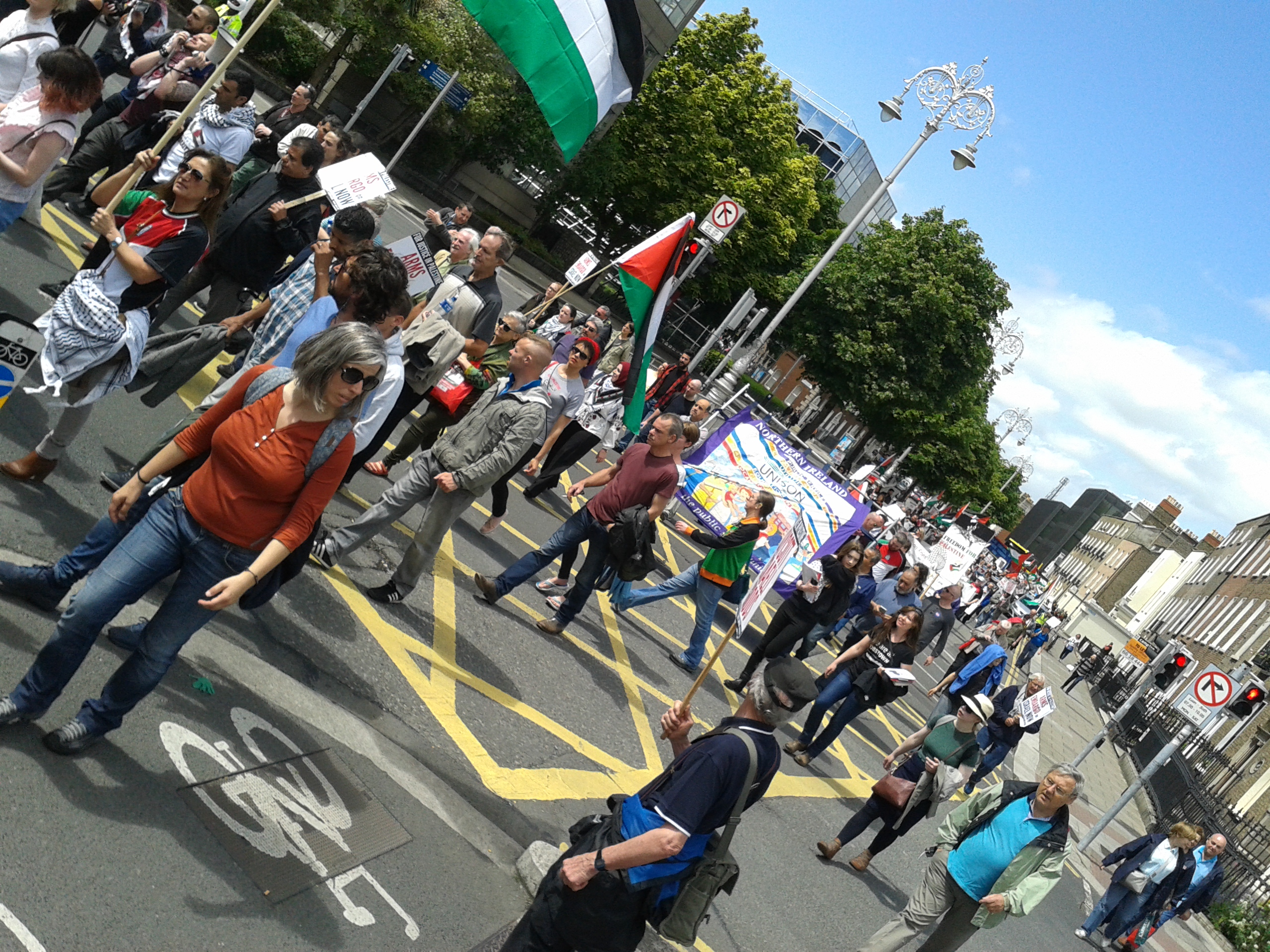
Part of Palestine solidarity march in Baggot Street, Dublin, June 2021 (Photo: D.Breatnach)
This is more than personal protest at being lumped in with the imperialists and their collaborators or even the apathetic in the “we”. More importantly, I am making what I consider to be an essential political point.
I and “we” are not part of the oppressors (nor of the apathetic sections, those who have not yet awoken). To speak in that way is liberalism. It implies that you and I and so many others are part of a society that we order and run and that its rulers represent us. We are not and they do not.
Our society’s managers are representatives of capitalists and worse, monopoly capitalists, whose governing ethos is profit, maximisation of profit and continuation of profit, amen. In pursuit of that they compete with other monopoly capitalists and other monopoly capitalist-run states but also cooperate and collude with them when their interests coincide. Clearly for some substantial time now the interests of the rulers of the EU and other Western capitalist states coincide with those of the USA. And clearly, Israel serves US interests in the Middle East, the only state in that region which is safe from a) socialist revolution and b) take over by anti-imperialist Islamicism.
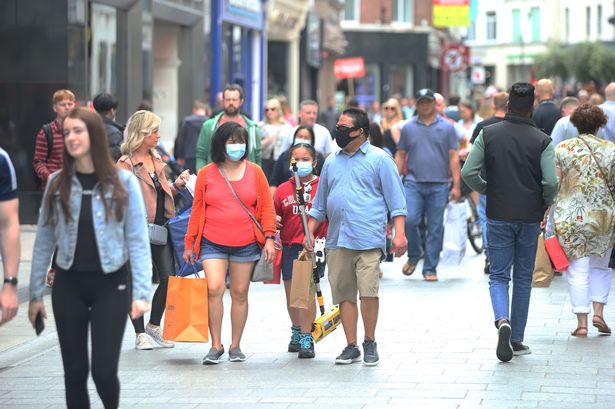
People in Grafton Street, Dublin (Photo credit: Stephen Collins)
So if WE are in solidarity with Palestine and WE want to see it free, WE must be against Israel. And if WE are against Israel, WE have to be against the USA. And if WE are for that people and against those powers, then WE are on the other side of a line from the Zionists and their local supporters. The greatest help WE can give the Palestinians in addition to expressions of solidarity is to overthrow the imperial powers and their monopoly capitalist allies wherever WE are.
If we think of those rulers as being part of us, as part of “We”, we are ideologically disarmed and unfit to go into battle against them. In that case, the assistance WE can give the Palestinians will be even more limited than that for which we have the potential at the moment.
The wolf was hunted to extinction in Ireland during English occupation1 – in fact, a similar bounty was paid by the colonial administration on delivery of Catholic priests and resistance fighters as was paid on a wolfskin2. They were extirpated in most of western Europe and in large parts of the USA and plans to reintroduce them run into lots of opposition. But really, what is the problem with wolves?
The canine with closest ancestry to our domestic dog is the wolf, the Eurasian and American subspecies – close enough to our dog to mate and produce viable offspring – and the divergence from a common ancestor is estimated to have occurred 11,00 to 16,00 years ago.3 The wolf is an apex predator usually in a pack ruled by an alpha male and alpha female, the only ones permitted to mate and their offspring are cared for by the whole pack.
Highly social, adaptable to different terrain and weather, the wolf is a highly-intelligent animal able to travel long distances and fierce in defence or attack. Many people might fear wolves through imagining they or their children being attacked by them – and certainly there are enough childhood stories to feed that fear — but the main opposition to their conservation or reintroduction does not come from that source. Nor is the source those pet owners, particularly of weak or diminutive descendants of the ancient canine stock, like those for example in Los Angeles who complain that a coyote ate their toy poodle.
Wolves playing among themselves in juxtaposition to humans in Gorbeia, the largest natural park in the south-western Basque Country. The presence of wolves there is mentioned in only some of the tourist promotional literature and no explanation was provided with the youtube posting of this remarkable video.
The main opposition, and by far the most powerful, are the livestock farmers4. And their fears are far from irrational. Wolves are top-range predators easily capable of killing a sheep, pig or goat and, as a pack, of killing cows and even horses too5. Most livestock farmers are not going to be convinced by arguments in favour of biodiversity when they largely favour one or two breeds of meat or dairy animal, selectively-bred for high production relative to maintenance cost.
And the bigger the livestock farmer, the more realistic his problem with wolf conservation — or worse, wolf reintroduction. The bigger the herd, the more widely it is dispersed for grazing, the more difficult to protect. Paid guards with high-powered rifles are only effective by day. Corralling by night requires electrified fencing and even they are not infallible.6
So how did people manage before? In some parts of Western Europe, there have been wolves in living memory and people raising livestock in those areas made a reasonable living. How did they do it?
The answer is dogs7. Not the poodle or spaniel or terrier type but big strong dogs capable of fighting wolves and, in the case of some breeds, more than a match in a one-on-one contest. The studded or spiked collar was invented to shield the dog’s vulnerable neck and throat.
PROTECTION FROM WOLVES BY DOG
In a video from the Basque Country I viewed some years ago, some villagers talked about wolves and the mastiff dogs they had and these are discussed also in a video in Spanish included here with shepherds from the Zamora region, in Castille and León, in central Spain. This type of dog is not a sheep or cattle herder8 but rather a livestock guard; living around the livestock, it knows them and does not permit predators of any size to approach them. In some parts of the world and in the case of some breeds, nor will they permit the approach of any humans, other than their masters and their known associates. Livestock guardian dogs are not all mastiffs but all are typically big and strong breeds, hardy to the prevalent weather conditions typical to their area, socialised to the herd animals and therefore at ease with them (and vice versa), protective of the livestock and inhibited from injuring or killing them, even when hungry. They are comfortable enough with their owners (although reputedly some do not enjoy petting) and his or her close associates, with some breeds also very protective of their owners.
Vikham LGD from Pakistan (Image sourced: Internet)
There are around fifty currently known breeds around the world to fill this role9 including: Akbash and Aksaray Malaklisi of Turkey, Bakharawal of India, Beauceron of France, Cane di Manara of Sicily, Estrella Mountain dog of Portugal, Georgian Mountain Dog, Great Pyrenees and Pyrenean Mastiff, Greek Shepherd, Himalayan Sheepdog, Karakachan of Bulgaria, Mazandrani of Iran, Mucuchies of Venezuela, Slovak Cuvac, Vikhan Sheepdog of Pakistan. The Irish Wolfhound was probably not one, it seems to have been primarily a hunting chase dog, though its name suggests it might have been used to hunt wolves too.10
2019 interviews in Castillian Spanish with shepherds who use Mastiffs livestock guard dogs in Zamora region, central Spain.
It should be born in mind that in many parts of the world, wolves are not the only mammalian apex predators; big cats and bears compete with them; in those regions guard dogs have to be and are willing and able to confront those species too. Despite the size and armament differential, a good guard dog will confront such predators displaying extreme threat in appearance and sound (and possibly also summoning assistance). Livestock guard dogs have been known to fight to the death but bear or even lions will usually back off to seek easier prey. Besides, a flock needs a minimum of two livestock guard dogs and and there might be more.11
These breeds are mostly comparatively rare now in many parts of the world, where apex predators have been extirpated, since their function has largely been dispensed with, or they are maintained as pets or competition show dogs.
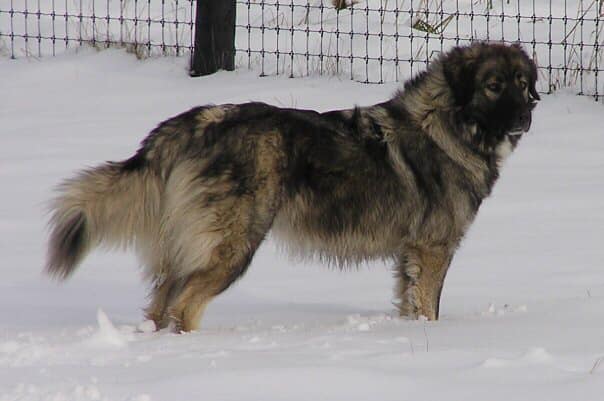
Carpathian LGD (Image sourced: Internet)
None of the Basque villagers interviewed had mastiffs any longer, although one Basque livestock farmer informed the interviewer that his father had two. However, in some other parts of Iberia, the mastiff breed is still active as a working dog and a shepherd in Zamora (Castille and León autonomous community, central Spain) with a flock of 450 sheep has five mastiffs; all five might not be necessary but as he explains, one must have a working reserve in case of injury, sickness etc among the guard dogs. He spends €5,000 p.a on the dogs. The shepherds there have no interest in the show specimens of the breed saying that they are not being judged by their working ability. “If a wolf sees a show dog, it laughs,” says another shepherd. “If our dogs see one, they’d laugh too.” “It is impossible for the necessary qualities of a working dog to be judged in show environment”, says another shepherd, pointing out too that a mastiff that is too heavy cannot run, thereby rendering it it useless for guarding the flock.12 The dogs also need to learn from experience how to respond not just to an individual wolf but to a pack, where individual members of the pack will seek to lure the dog away towards others in ambush, or to detach it from the prey which others will then attack.
Iberian Mastiffs LGD with sheep (Image sourced: Internet)
A wikipedia entry on Livestock Guard Dogs links their use with wolf coexistence: “With the reintroduction of predators into natural habitats in Europe and North America, environmentalists have come to appreciate Livestock Guard Dogs because they allow sheep and cattle farming to coexist with predators in the same or nearby habitats. Unlike trapping and poisoning, LGDs seldom kill predators; instead, their aggressive behaviors tend to condition predators to seek unguarded (thus, non-farm animal) prey. For instance, in Italy’s Gran Sasso National Park, where LGDs and wolves have coexisted for centuries, older, more experienced wolves seem to “know” the LGDs and leave their flocks alone.”13
Adult Akbash LGD & juvenile Central Asian Ovcharkas guarding beef calves, Sublette County, Wyoming, USA. (Photo sourced: Internet)
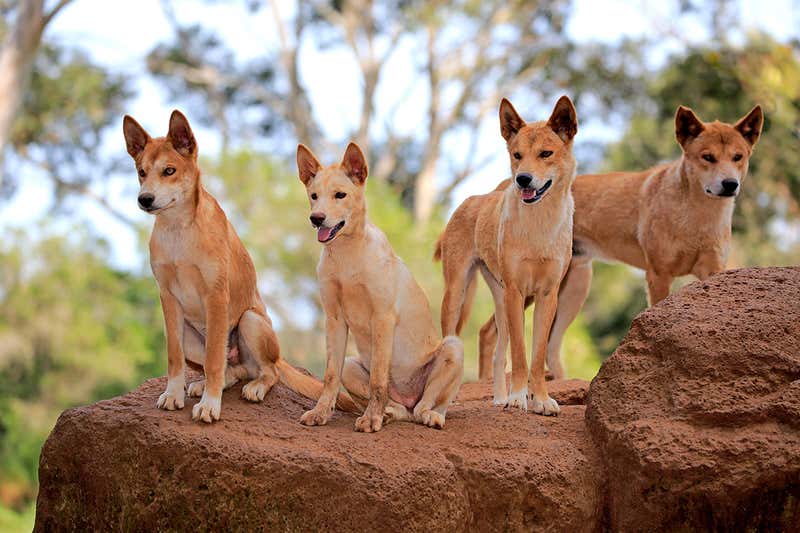
Some Basque and Spanish shepherds seem to agree and are prepared to coexist with the wolf, using more traditional methods of livestock farming, corralling their stock by night with dogs to protect on duty as they are also by day.14 With a different apex predator in Australia, the widely-hated by farmers dingo, a few farmers are seeking to coexist with the predator against the opposition of the majority of their colleagues, in areas where dead dingoes may be seen suspended from trees or even roadside structures.
Dingoes are pack animals in which only the alpha pair breed (like wolves) and one of the cattle farmers states that dingo extermination attempts break up the pack, resulting in more individuals breeding. He also relates that kangaroos eat down the vegetation which competes with his cattle but also contributes to drying out of the land. When he stopped trying to eliminate the dingo, he says, they preyed on the kangaroo which in turn resulted in more surviving vegetation and land in better condition.15
A shepherd in the Zamora range states too that the wolf keeps down the numbers of wild boar and deer and generally across Europe these ungulates are reported to be on the increase (the white-tailed deer also in the USA). Boar are well-known in some regions for raiding cultivated fields, trampling growing plants to reach what they find edible, well able to knock down types of fencing, squeeze through gaps and so on. Increasingly on the Internet one can find videos of wild boar, often accompanied by their litter, foraging in villages and towns (in one video, even successfully overturning a trash dumper to feed on the contents). These types of ungulates contribute their own kind of environmental damage in addition in some cases to nuisance to humans16.
The Zamoran shepherd comments also that deer, a natural prey of wolves, often carry brucelosis and infect cattle, which in turn is is transmissible to humans and treated as a serious disease. In cattle it results in loss of weight, abortion of fetuses and lower milk production and as the shepherd says, state control procedures require the destruction of the whole herd upon finding of some infected animals. Apart from anything else, clearly this measure can have serious economic consequences for the farmer and for the whole state in question.17
If wolf conservation and reintroduction is be successful in the long-term, it will require livestock farmers to have smaller herds and a partnership with herd guard dogs, as well as other defensive means. This entails the irony that the expansion in herd protector dogs results in protection for wolves, in preventing their cousins from causing depredation in the herds, which would entail reprisals from humans.
It may be that farmers will occasionally lose a lamb or a calf or a pig from their ranges to a predator – but they lose occasional animals anyway, to pests, disease and mishap. Their stock animals will probably be healthier and tend towards the sturdier types.
Yes, but smaller herds? Well, is it not widely accepted (except by big farmers and banks) that we breed too many meat animals, with huge emission of greenhouse gasses and lots of waste? Smaller herds would surely be environmentally welcome.
Map of Grey Wolf distribution in the present (green) and past (red). (Source: Wikipedia, Grey Wolf distribution by Country)
CONSERVATION AND REINTRODUCTION PROGRAMS
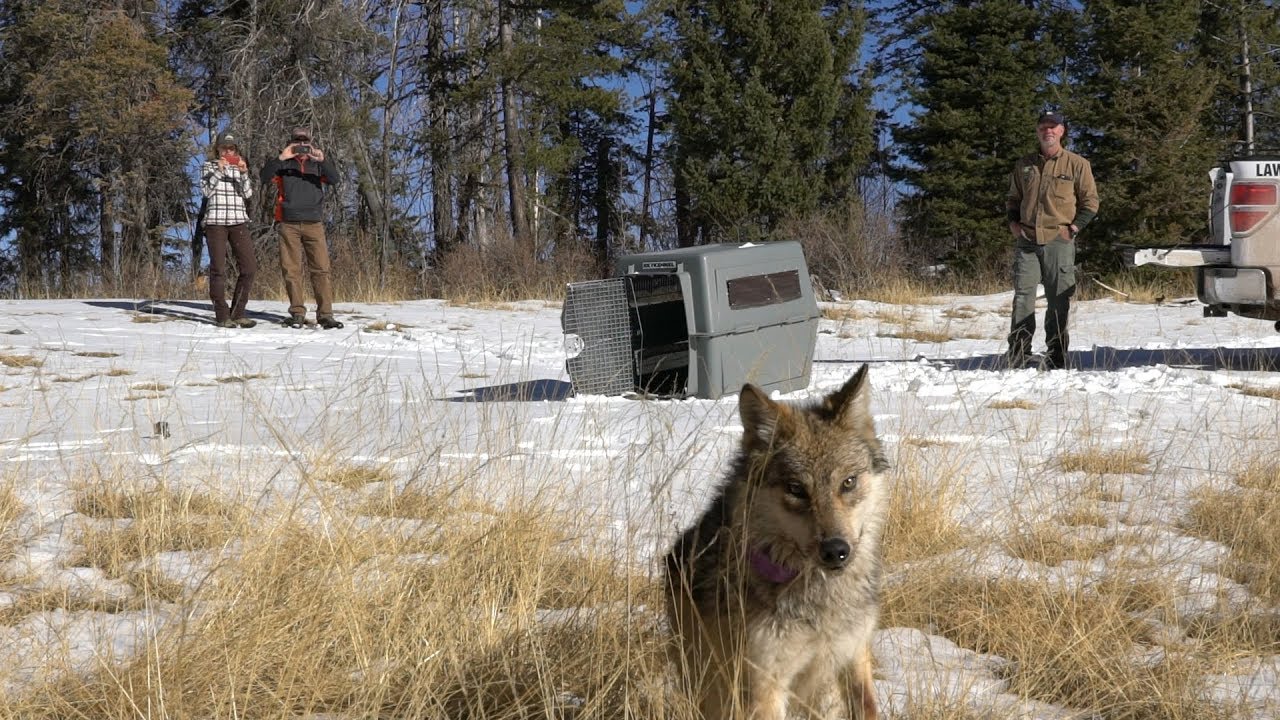
Reintroduction methods for wolves vary from releasing adult animals from captivity, whether alone or as a pair, to placing captive-bred pups within a wild litter, when according to reports they are fostered without difficulty by the wolf bitch.
The problems involved in projects of conservation and reintroduction are not small. The wild mammalian apex predators can compete with and threaten the other mammalian apex predator – the human. Direct predation on humans by the other land-based predators is statistically low; fatal encounters for humans are much, much rarer than those for the other mammal involved and, when occurring, usually arise from self-defence by the animal or defence of kind (especially of the young), along with rabid animals. So, in general, leave them alone and they’ll leave us alone.
Still of a Mexican Wolf Reintroduction from video (Videocredit: Arizona Game & Fish Dept. 2018)
OPPOSITION
But leaving our livestock alone is a different proposition entirely and even more so if our livestock and livestock management systems have reduced the wolves’ natural prey, both in number and variety. And we tend to do that. Our systems tend to reduce forest to favour grassland for our domesticated grazers, which reduces or wipes out forest prey. Then we set out to reduce or even eliminate the wild grazers competing with our domesticated ones. Even when we develop forests we tend to favour monoculture or restrict to a few species of commercial timber with high turnover in comparatively shorter time.
Hunting and fishing reserve managers kill predators ranging from hawks, eagles, and owls to stoats, badgers, wolverines, foxes, otters, bears, felines and wolves; legal and illegal means of killing predators include shooting, trapping and poisoning. But those practices also favour only those particular wild species valued for hunting, often edging out a diversity of other species which are now faced with “unfair competition” from the “sport” species, resulting in damage to diversity and to the particular eco-system.
Large-scale elimination of prey animals in order, for example, to protect crops, also reduces the natural prey available to predators. Growing only particular kinds of trees will result in quicker turnover and or greater profits but also in monoculture forests giving little shelter to diverse wild life.
For good reasons as explained by their supporters, the presence of apex predators affects not only their prey and other predators but also vegetation, which in turn affects other animals, birds and fish (through their effect on water courses) – in fact, a top-down effect on the whole local environment which has been shown to beneficial.
The objectors argue that large mammalian predators can cause significant problems to humans and most significant among those humans are the livestock farmers. They, ranging from rancher livestock operations of thousands of animals, down through the medium enterprises of some hundred head, to small farmers with up to a sore or so, are the main source of opposition to wolf conservation or – what are we thinking of? — reintroduction.
The opposition based on fear of attack on person, largely without contemporary logic but relying on ignorance and some folklore, can be educated and managed by conservationists but the livestock farmers are a different proposition. Those who rely on livestock to make a decent living and those companies for which it is big business, along with their shareholders and banks, are not going to be easily persuaded. The smaller or even medium-sized concerns are potentially more amenable to convincing, especially if aided by state grants to offset losses to predation18. The evidence is that for them a change to investing in livestock guard dogs would be manageable and very possibly more emotionally rewarding19.
Big business is another matter. Grants would have to be substantial to convince them and, in any case, ecological grants to big business have not turned out to be of benefit to the environment overall. Quite crudely, big business will need to be forced to reduce the size of its operations or be put out of business one way or another; how that may be achieved is another day’s discussion. Meanwhile, progressing with smaller and medium-sized livestock farmers will make some difference and play an important educational role in what is good for the environment and for us.
NATURAL REINTRODUCTION AND VIABILITY
Not all reintroduction is human-initiated. In the Pyrenean region of the Iberian peninsula, in areas devoid for years of the native wolf, they speak of the appearance of the Italian wolf (sub-species) slightly divergent from its Iberian cousin), though none of those migrants having yet bred and thereby established a pack. This situation is leading to increased discussion around the pros and cons of wolf conservation and herd protection there.
The wolf is protected in Iberia and though classified as game species in the northern part of the Spanish state20 a ban on hunting wolf was introduced even there in February of this year (2021). This had been agreed some years earlier by the Euskadi regional Government but not implemented, until conservationists (with the support of some traditional shepherds took a successful court case to force the implementation.21 Compensation is paid for livestock killed by wolf or bear but in uneven amounts and by different systems across the state.
In the case of achieving general agreement and support for reintroduction, there remains the problem of viability of the reintroduced animals. Although the White-Tailed Eagle reintroduction to Ireland has been successful, reintroduced Golden Eagles struggle to survive and expand on the amount of suitable prey available to them. Wolves might not fare much better, once they had reduced the red and roe deer populations in the country.
However, a puzzle for us is that the earlier well-referenced wolf existence in Ireland predates that of the deer, raising questions on what were its main prey animals at that time. Perhaps it was the wild boar and certainly the presence of the torc is attested to in many Irish place-names.
In a number of other European countries, wolves could probably build sustainable populations preying on deer and boar, in addition to rodents and lagomorphs, along with some waterfowl (in particular ground-nesting ones such as the mallard). Swans in Ireland for example would presumably have to change their nesting habits to more isolated reed-beds and islands (though wolves are good swimmers).
In countries with large wild areas the problems of wolf and human interaction are reduced but Ireland is not such a country. The success of such a project in Ireland would require substantial areas apart from bogland being given over to wildness, with substantial forest coverage (the benefits of the latter are discussed below). Sheep flocks and cattle herds would need to be smaller and require guarding by day and night; the benefits of smaller livestock herds and a mechanism for their protection has been discussed earlier here.
Also required would be a rigorous enforcement of predator protection legislation which does not have a good record in Ireland (see http://trinitynews.ie/2016/10/farmers-wildlife-freak-outs-and-facts/) and and a compensation scheme for farmers in case of livestock loss (or indeed cultivated land loss to wilding habitat, multi-species deciduous forest planting, etc).
SUPPORT — WHY BOTHER?
The financial and educational benefits of eco-tourism are often quoted in defence of reintroduction of wolves and other terrestrial apex predators and, for some, those are sufficient justification. Eco-tourists are particularly interested in seeing apex predators and even hearing them, especially in the case of wolves. Certainly providing for such tourism is a niche which can permit a living to be made from management of low livestock numbers or even land without any livestock at all. As such it can be a convincing argument for small herding communities or for individual farms in livestock country.
Another reason quoted is the psychological and scientific benefits of living more in tune with the natural world and, though hard to quantify, in a world heading for ecological disaster such potential benefit should not be ignored. Which is what it is likely to be, however, in communities and enterprises focused on surviving in the present (not to mention those for whom extracting maximum profits is the only viable reason for any undertaking).
Another and more tangible benefit of encouraging mammalian apex predator conservation or reintroduction is the early and visible environmental improvement resulting in places where it has been tried. Wild grazers compete with livestock grazers, often more efficiently than livestock can manage. Not only that but they will graze areas being left for regrowth by the farmer. Such overgrazing results in arid ground, retaining little moisture, soil erosion and can even end in desertification. What long-term benefit to the environment if reducing domestic herds results in more and more land being overgrazed?
In addition, there are the problems of infection of livestock and in turn humans by diseases carried by wild ungulates (e.g. deer, bison, antelope, boar, wild goats, mountain sheep22).
The large predator can be the solution. Wolves and other apex predators keep down the numbers of wild ungulates, keeping them also on the move (in fear of predators), allowing vegetation to recover from grazing, in turn assisting moisture retention in the soil. These changes in turn benefit many other animals and plants, from invertebrates up to birds, mammals, reptiles and amphibians.
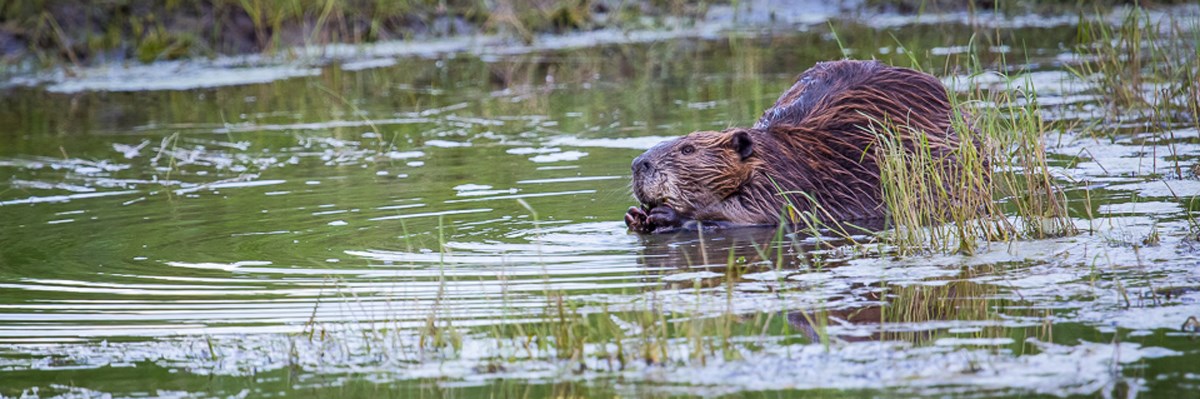
Previously to wolf reintroduction to Yellowstone, the moose had only the occasional bear to worry about and they chewed their way through branch and leaf; rangers had to cull large numbers every year and even so there was substantial deforestation and large numbers of moose would die during severe winters, only to be quickly replenished the following year. Only one family of beavers was seen at work (their food of shrubs and low trees by the water margins was being eaten by the moose).
Twenty-five years after the reintroduction of wolves, willow and aspen had recovered in some areas of Yellowstone, beaver colonies had increased 14-fold, song-birds had recovered and some new species were being seen. The soil is retaining greater moisture. There are arguments about how much these changes are due to the action of the wolves but most experts grant the wolves at least some credit while some others give them a lot.23
Yellowstone Park protected wolf pack (Photo credit: Doug Smith, via National Park Service)
So that’s good news for the environment and the wolf, not so good for the moose, right? Actually, it seems to be good news for the moose too, with lower die-off for moose in winter,24 signalling a general improvement in health of the stock surviving predation.
When the numbers of grazers is controlled, tree seedlings of willow and alder get a chance to grow on the edges and banks of bodies of freshwater, which tends to control soil erosion on banks and reduce flooding. When grazers are prevented or restricted from eating seedlings, new trees survive to extend the woods and forests or to replace fallen trees and harvested timber.
Beaver in Yellowstone National Park (Photo crdt: Neal Herbert, National Park Service). Although wolves will kill and eat beaver if they can, the wolves also control Moose which were a greater threat to the beaver, eating the woody waterside vegetation upon which the beaver depends for food.
Many ecologists and forestry experts blame the white-tailed deer for changes across large parts of the USA, involving reductions in canopy-cover, reductions in diversity of tree species and general forestry maintenance (to say nothing of failure to extend)25.
For the ecology of the world, the thinning out of wild grazers is perhaps the most valuable service rendered by large mammalian predators although other factors need to be taken into account, including pattern and variety of planting and management, domestic herd sizes, along with of course responses to insect and fungal pests.26
It has long been known too that many species of trees prevent or restrict soil erosion and restrict flooding by holding water margins and, in some cases such as mangroves, sap the effects of hurricanes coming from the seaward side, along with tidal waves.
More crucially, trees produce oxygen and consume or hoard carbon. According to the U.S. Department of Agriculture, “One acre of forest absorbs six tons of carbon dioxide and puts out four tons of oxygen”.
We all know that we need oxygen to breathe and also to combine with other elements, such as carbon dioxide, to produce water.27 But the problem of excess loose carbon dioxide is recognised as one of the most serious confronting the eco-system at this moment, with carbon dioxide emissions creating part of the “greenhouse” cover over the earth, contributing hugely to global warming. This process in return is causing sea-levels to rise and also to warm, causing mass deaths in seas, along with big changes in weather systems with devastating effects for human and animal populations.
The wolf can also play a role in mediating the effect of other predators and has done so in part of the USA with regard to the coyote, similar to what the dingo has done to the European-introduced red fox, which has become a problem in Australia.
American mink in Ireland, an invasive versatile semi-aquatic predator (Photo sourced: Irish News). Could the wolf help control this pest?
In Ireland another introduced species, more likely through escape from fur farms, the american mink, is also a problem and is spreading.28 It may be that the wolf can play a helpful role there too, along with having some effect in controlling that other american, the grey squirrel which, in turn, might assist the red squirrel’s return to areas from which it has long been absent.
End.
FOOTNOTES
1Though indications exist of some hunting of wolves by humans in Ireland, in England, wolf persecution was enforced by legislation and the last wolf was killed in the early 16th century during the reign of Henry VII (see Wikipedia on the Eurasian Wolf). Ireland was invaded by British-based forces in 1169 and over time native forces were defeated and the whole country came under English rule until partly independent in 1921.
2For priests: “An 1709 Penal Act demanded that Catholic priests take the Oath of Abjuration and recognise the Protestant Queen Anne as Supreme Head of the Church of England and, by implication, in Ireland. Priests who refused to conform were arrested and executed. ……….The reward rates for capture varied from £50–100 for a bishop, to £10–20 for the capture of an unregistered priest; substantial amounts of money at the time. The work was dangerous, and some priests fought in self-defence. https://en.wikipedia.org/wiki/Priest_hunter
For Wolves: “In AD 1652 the Commissioners of the Revenue of Cromwell’s Irish Government set substantial bounties on wolves, £6 for a female, £5 for a male, £2 for a subadult and 10 shillings for a cub”. https://en.wikipedia.org/wiki/Wolves_in_Ireland
4In some parts of the USA and Western Europe, where hunting big game is a widespread activity, fear of competition with the wolf in hunting season is also an important factor and one where “the common man” may come into conflict with those wishing to protect or reintroduce the wolf.
5It is worth noting that wild grazing mammals are capable of defence against hunting canines by outrunning them and, usually as a last resort, by fighting them with horn, antler, tusk, teeth or hoof. In turn, wolves have to plan, ambush, select targets and coordinate attacks. Old and very young grazers are vulnerable but calves and foals are pushed by their mothers to stand minutes after birth; in an hour or two, they can run. A wolf injured in attack cannot travel with the pack and will miss out on most food and, if failing to heal rapidly enough, will die. There is a constantly flexing relationship between the survival mechanisms of both prey and predator.
6In the first place they need to be high enough to prevent wolves leaping or scrambling over them, also proof against digging under. And since anecdotal evidence relates livestock guard dogs being willing to stand the pain of electric shock if sufficient stimulus is provided to get out of an electrified enclosure, one must assume that wolves will develop that same resolution at some point. Finally, there is the issue of possible weather damage and failure of the power supply to the barrier.
8There are a few types that can combine the characteristics of herding and guard, such as the Beauceron but in general livestock dog breeds specialise in either guarding or herding. In Australia, where the apex land predator is not the wolf but the smaller and lighter Dingo, some herding breeds also act as livestock guard dogs.
9Two are known to be extinct: The Alpine Mastiff and the Molossus.
10It seems that this breed was so valued abroad that Irish chieftains and English occupiers exported them, so that no originals of the breed remain. The current breed that goes by that name, a gentle attractive dog of high stature, is derived by cross-breeding. Wikipedia: “Based on the writings of others, Graham had formed the opinion that a dog resembling the original wolfhound could be recreated through using the biggest and best examples of the Scottish Deerhound and the Great Dane, two breeds which he believed had been derived earlier from the wolfhound. Into the mix went a Borzoi (“Korotai”), who had proved his wolf hunting abilities earlier in his native Russia. For an outbreed a “huge shaggy dog” was added, which may have possibly been a Tibetan Mastiff.
14See videos in Spanish from Zamora and the Basque Government region (latter in References & Resources)
15See Sources and References at article end for items in relation to dingo conservation,
16Apart from upending trash containers and raiding farms, boar may also attack humans, especially in the case of a sow accompanied by her litter and is capable of inflicting mortal wounds. Should boar become widespread in very close contact with humans, children might be attacked too.
18A Zamoran shepherd says he receives no grant and though not asking for one, says he should be supplied free of charge the ID chip he is required by law to embed in his dogs. On the other hand the Euskadi regional Government agreed to pay a grant and other regions have done so too, in areas where the wolf and bear are known to be in residence, without having to prove or even claim a kill of any of their stock.
19Partnership with working dogs is likely to be therapeutic in itself and surely wholly preferable to setting out traps, poison bait (which kills other predators and scavengers too) and shooting, including even killing cubs. Besides, break up the pack and more wolves will mate and bear litters.
20Ironically that status can serve to protect predators from extermination and since it was given that status in Poland, the wolf population increased substantially (see Wikipedia the Eurasian Wolf).
In 1843 the lyrics of In Memory of the Dead were published anonymously in The Nation but it seems to have been an open secret in Dublin political circles that the author was John Kells Ingram. As often happens, the song became known by its opening line “Who Fears to Speak of ‘98” and years later Ingram admitted having written the lyrics. Though it never once mentions Daniel O’Connell, taken in context of its subject, time and where it was published, the song was a blistering attack on the politician and his Repeal of the Union organisation. Yet while Kells Ingram was many things, he was no revolutionary — unlike the editors of the Nation and many of its readers.
Plaque indicating former location of The Nation newspaper in Middle Abbey Street, Dublin, premises bought out ironically by The Irish Independent. (Photo: D.Breatnach)
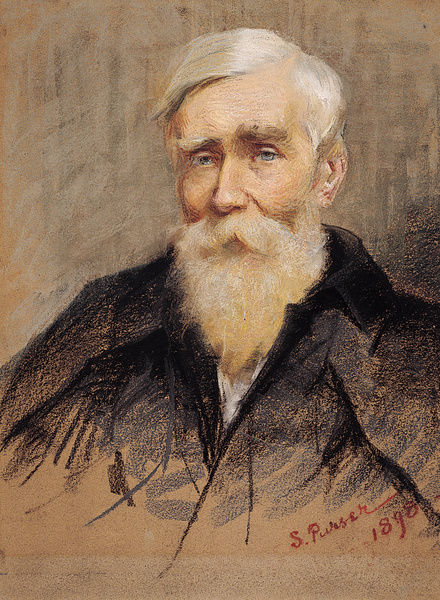
John Kells Ingram was a mildly nationalist mathematician, economist, philosopher and poet who was selected to write expert entries for the Encyclopedia Britannica. But although he was no revolutionary it is clear that he felt a distaste for O’Connell’s distancing himself from the memory of those who had risen in rebellion four decades earlier.
John Kells Ingram 1823-1907 (1890) by Sarah Purser (1848 – 1943). (Photo sourced: Internet)
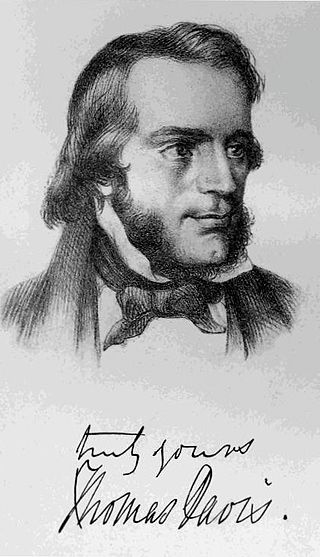
Supporting O’Connell initially, The Nation sought to create a patriotic and indeed revolutionary culture through its pages. One of The Nation’s founders and editors, Thomas Davis was perforce also one of the periodical’s contributors and his compositions The West’s Awake and A Nation Once Again are still sung today, the latter very nearly becoming Ireland’s national anthem. The lyrics of Who Fears to Speak celebrated historical memory of resistance and lamented death and exile, the latter to the USA, where many of the surviving United Irish had gone (“across the Atlantic foam“). Davis’ In Bodenstown’s Churchyard, commemorated and celebrated Theobald Wolfe Tone, remembered as the father of Irish Republicanism and martyr.
Portrait of Thomas Davis (Sourced on: Internet)
Three years after co-founding The Nation, Thomas Davis died of scarlet fever in 1845, a few months short of his 31st birthday. Two years later, in “Black ‘47”, the worst year of the Great Hunger, the Young Irelanders finally and formally split from O’Connell’s Repeal Movement and in 1848 had their ill-fated and short uprising – again jail and exile for the leaders followed. Just under a score of years later, 1867 saw the tardy and unsuccessful rising of the Fenians with again, resultant jail sentences and exile (in addition to the executions of the Manchester Martyrs).
Two years following the rising of the Young Irelanders, in 1850 Arthur M. Forrester was born near Manchester in Salford, England (the “Dirty Old Town” of Ewan McColl) and in 1869 his stirring words of The Felons of Our Land appeared in Songs of a Rising Nation and other poetry (Felons reprinted by Kearney Brothers in a 1922 collection including songs by Thomas Davis). Songs of a Rising Nation was a collection published by the militant and resourceful Ellen Forrester from Clones, Co. Monaghan, who struggled to raise her children after the early death of her husband and included poems by her son Arthur and daughter Cathy.
Felons of Our Land indeed contains some of the themes of Who Fears to Speak (of which Arthur was doubtless aware) but in addition those of jail and death on the scaffold. By that time, the Young Irelanders had been added to the imprisoned and exiled, some in escape to the USA but others to penal colony in the Australias. And Forester added the theme of pride in our political prisoners:
A felon’s cap’s the noblest crown
an Irish head can wear.
and
We love them yet, we can’t forget
the felons of our land.
Twenty years after the publication of The Felons of Our Land, in 1889, another Irishman, Jim Connell, writing in SE London, would contribute the lyrics of the anthem of the working class in Britain, The Red Flag. Although commonly sung to the air of a German Christmas carol, Connell himself put it to the the traditional Jacobite air of The White Cockade. Connell, from Crossakiel in Co. Meath, also invoked historical memory and included the theme of martyrdom in explanation of the flag’s colour:
The workers’ flag is deepest red —
it shrouded oft’ our martyrs dead,
And ‘ere their limbs grew stiff and cold
their life’s blood dyed its every fold.
Jim Connell (Sourced on: Internet)
The traditions and themes of resistance and struggle are handed from generation to generation and song is one of the vehicles of that transmission. But songwriters borrow themes not just from history but from the very songs of the singers and songwriters before them. In 1869 Arthur M. Forrester wrote in Who Fears to Speak of ‘98:
Let cowards mock and tyrants frown
ah, little do we care ….
Jim Connell, three decades later, took up not only the themes but also that line:
Let cowards mock and traitors sneer,
we’ll keep the red flag flying here.
End.
APPENDIX
References in lyrics to themes
of exile:
In Who Fears to Speak of ‘98 (1843)
Some on a far-off distant land
their weary hearts have laid
And by the stranger’s heedless hands
their lonely graves were made.
But though their clay
be far away
Across the Atlantic foam …
In The Felons of Our Land (1869)
“…We’ll drink a toast
to comrades far away …
and
…. or flee, outlawed and banned
In The Red Flag (1889)
None.
of imprisonment:
In Who Fears to Speak of ‘98 (1843)
None.
In The Felons of Our Land(1869)
(Apart from the title and refrain)
… though they sleep in dungeons deep
and
Some in the convict’s dreary cell
have found a living tomb
And some unseen unfriended fell
within the dungeon’s gloom …
also
A felon’s cap’s the noblest crown
an Irish head can wear……
In The Red Flag (1889)
Come dungeons dark or gallows grim ….
of martyred death:
In Who Fears to Speak of ‘98 (1843)
Alas that might should conquer right,
they fell and passed away …..
In The Felons of Our Land (1869)
….. Some on the scaffold proudly died …
In The Red Flag (1889)
….. their life’s blood dyed its every fold ….
and
….. to bear it onward til we fall;
Come dungeons dark or gallows grim,
this song shall be our parting hymn.
of cowards and/ or traitors:
In Who Fears to Speak of ‘98 (1843)
Who fears to speak of ‘98,
who blushes at the name?
When cowards mock the patriot’s fate,
who hangs his head for shame?
He’s all a knave or half a slave
Who slights his country thus …
In The Felons of Our Land (1869)
…. And brothers say, shall we, today,
unmoved like cowards stand,While traitors shame and foes defame,
the Felons of our Land.
and
Let cowards mock and tyrants frown, …
In The Red Flag (1889)
. ..Though cowards flinch and traitors sneer (repeated in the chorus, sung six times)
and
It suits today the weak and base, Whose minds are fixed on pelf and place To cringe before the rich man’s frown, And haul the sacred emblem down.
of the higher moral fibre of revolutionaries:
In Who Fears to Speak of ‘98 (1843)
Repeated reference in every verse to such as
a true man, like you man and you men, be true men etc.
Alas that Might should conquer Right ….
In The Felons of Our Land (1869)
… No nation on earth can boast of braver hearts than they ….
also
And every Gael in Inishfail,
who scorns the serf’s vile brand,
From Lee to Boyne would gladly join
the felons of our land.
In The Red Flag (1889)
The banner bright, the symbol plain, Of human right and human gain.
and
With heads uncovered swear we all To bear it onward till we fall; Come dungeons dark or gallows grim, This song shall be our parting hymn.
of eventual victory:
In Who Fears to Speak of ‘98 (1843)
… a fiery blaze that nothing can withstand …
In The Felons of Our Land (1869)
None – but inferred.
In The Red Flag (1889)
It well recalls the triumphs past, It gives the hope of peace at last; The banner bright, the symbol plain, Of human right and human gain.
In the midst the protests in Colombia the press can be heard denouncing the vandals and various politicians from the left and right have echoed these criticisms in one way or another. The headlines speak of the destruction of private property and in some cases they try to mark a distinction between what they say is legitimate protest and vandalism.
The word “vandal”, means someone who commits acts pertaining to savage and destructive people and is who destroys a public asset or installation. Other definitions speak of destroying or damaging what is beautiful. It should be said that the Transmilenio mass transport system stations are not one bit beautiful. But should the youths be ashamed or proud of being called vandals?
Resisters in Colombian city of Madrid shelter behind makeshift shields as they are bombarded with water canon in May 2021 (Photocrdt. Juan Pablo Pino, AFP/Getty)
We should look at the origin of the word. The first vandals were Germanic tribes that in 455 A.D. attacked and sacked Rome carrying away great riches and also destroying buildings, amongst them the Temple of Jupiter, though there is some dispute about the severity of the destruction of the city. However, they went down in history as the vandals who destroyed that city. The more modern use of the person who destroys public assets or private property or damages what is beautiful dates from the middle ages and its use is widespread nowadays.
Of course when Vicky Dávila and other right wing journalists speak of vandals they are not talking about Germanic tribes, or at least that is what we believe, though with Vicky even drug traffickers, paramilitaries and corrupt politicians are decent folk, so one is never sure about the meaning of the words that fall from her lips like the Police stun grenades.
“The Police rape and murder” (Photo: G.O.L)
But words and their meanings are not set in stone. Some words enter a language and in short time fall into disuse, others last for centuries and some come back to life when least we expect like when Kim Jong-un’s translator used the word “Dotard” to describe Trump. That word hadn’t seen the light of day since the US Civil War in the 19th Century. Other words simply change their meaning, sometimes slowly and on other occasions they do so more abruptly.
The press has used this word so often to describe and disparage the social protests that we may be witnesses to another change in meaning. The bourgeois press has emptied the word of any meaning and now in the marches people can be seen with placards that say Vandal’s Honour and in social media there are memes doing the rounds on the subject. One of them says “The country turned upside down and this one says, what are you and I? Well, vandals my love.” They used the word so often to describe any act of rebellion, nonconformity or to and try and shut down and discredit the demonstrators that it has lost its power, its meaning. Now it is a badge of honour for many. Vandal no longer means a savage destructive person but rather a person who fights to be heard, for justice. A vandal is whoever fights against Duque, neoliberalism and poverty.
The word is changing its connotation and once again it is closer to its original meaning, a tribe that defied an Empire, although in this case the Colombian emperor seems more like the Emperor Nero (54-68 A.D.) who played on his Lyre whilst Rome burned than the poor Petronius Maximus who only lasted a few weeks in power. Duque doesn’t play the Lyre but rather the Guitar, but there he is and Nero’s regime was one of extravagance, waste and tyranny and Nero in the middle of it all playing on his Lyre.
The sacking of Rome in 455 A.D. was the third sacking that the city suffered. There were a further five sackings after the Vandals. It should be remembered that the Vandals sacked the capital of a decadent Empire that deserved to be extinguished.
Burnt out bank from 2006 (G.O.L)
So as the meme puts it, ask the question, what are you and I? And answer:
We are Vandals my love, we damage the hated system of mass transport built with public funds legally stolen to set up a private transport business which to top it all takes 94% of the profits of a business and barely contributes a penny to its own maintenance.
We are Vandals my love, we destroy banks that receive more subsidies from the state than the poor who are denied loans by these banks, which don’t hesitate for a single moment to confiscate the houses of the poor.
We are Vandals my love, who in the face of the lives and censorship of the bourgeois press make our smothered voices reverberate on the walls of the city. Who needs Twitter when you even the poorest can see the walls?
We are Vandals my love, who in the face of the attacks by the Police throw rocks at them that are found all about the place in the poorly built public infrastructural projects, in a country where the thieves don’t know how to build a pavement and where half the bricks are badly placed.
We are Vandals my love, we fight against a decadent government and system.
We are Vandals my love, and our favourite letter is V:
V for Vengeance on the rich that kill us, rob us and lie to us.
Cur síos ar bheagán d’obair ealaíona na Gaeltachta agus macnamh air ag ealantóir Eoin Mac Lochlainn a bhfuil a thaispeántas féin aige i mBaile Átha Cliath.
A description of a little of the art work from the Gaeltacht along with ruminations upon it my artist Eoin Mac Lochlainn who has his own exhibition in Dublin.
The oppression of the Palestinians led to an outbreak of active resistance recently in Jerusalem, to which the Israeli Army reacted with increased repression, timed to harass Palestinian Muslims during the period of Ramadan.
At the height of devotees attending the Al-Aqsa mosque, this escalated into attacks on worshippers within the temple itself. At the same time, Israeli Zionist settlers threatened dozens of Palestinian families with eviction from their homes in East Jerusalem.
Reacting to these events, one of the Palestinian organisations fired home-made rockets into officially Israeli territory, to which the Israeli armed forces responded in turn with drone missiles and missiles from its air force jets on Gaza.
The Zionist military fired on protesting Palestinians in the West Bank with live ammunition. The death toll has climbed to 200 Palestinians, according to Gaza’s Health Ministry, including 59 children and 35 women, with 1,305 people wounded. Ten Israelis have been killed, two of them children.
The casualty figures once again show the gross disproportion between what the Palestinians and their Zionist masters experience: in civil and human rights, citizenship, in land ownership, electricity and clean water supply, heating, fishing, education facilities, building materials …
… in freedom to travel inside and outside the state, in depth and breadth of surveillance, in arms and defence capability, in states that support them.
And in city structural damage: despite the many home-made rockets launched against the zionists, there has yet been no significant damage in Israeli towns, while their armed forces have effected large-scale structural damage in Gaza and bodies are still being pulled from the rubble.
In only one area perhaps do the Palestinians have the advantage over the Israeli Zionists: in support among the people around the world.
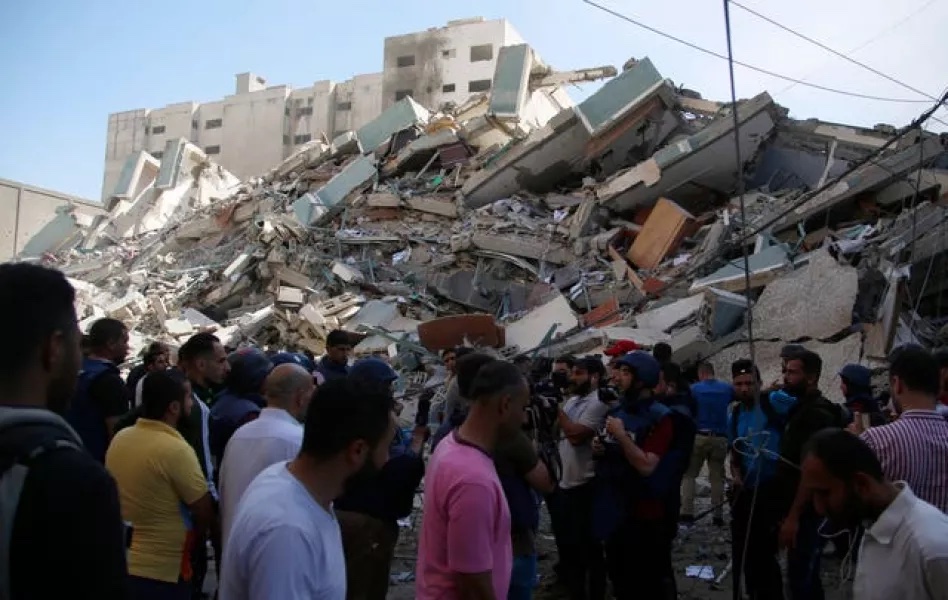
Israeli Zionist missiles strike the tower housing many media services, including Associated Press and Al Jazeera, which drew broad criticism from the mass media for a change. But families also lived here. Everyone was given ten minutes to get out. The Israeli Occupation Force has not yet bothered to explain its rationale for targeting this building. (Photo source: Internet)
PALESTINIAN SOLIDARITY MARCH DEFIES POLICE THREATS
Responding to these attacks on Palestinians, the Ireland Palestine Solidarity Campaign, the main organiser of Palestinian solidarity action in Ireland, called for solidarity demonstrations and in particular advertised a solidarity rally to take place in Dublin’s city centre for 2pm on Saturday 15th May.
The organisation asked those in attendance to comply with measures against Covid19 infection, to wear masks, maintain social distancing and comply with stewards’ instructions.
However the IPSC was contacted by the Irish police force, the Gardaí, who told them not to go ahead with the event, that if they did they would intervene to stop it and also made threats of €5,000 fines and prison against the organisers.
In a later public statement the Gardaí declared that they “have no role in permitting or authorising marches or gatherings. There is no permit/ authorisation required for such events”!
But there is apparently an ability and power to intimidate and threaten progressive organisations to deter them from organising solidarity events.
Or to kettle socialist and socialist republican Mayday marchers and demand all their names, addresses and dates of birth before threatening them with arrest if they did not disperse.
Or to threaten Debenham workers and their supporters, assaulting some of them while escorting KPMG forces in to evaluate stocks during pandemic restrictions.
A Palestinian policeman stands among the rubble of the tower in Gaza recently occupied by families and media agencies. (Photo source: Internet)
The predicament of the IPSC exposed the vulnerability to this kind of intimidation of a broad organisation that seeks to win friends in ruling circles. The leaders and organisers are placed in a position of not only personal but also of organisational vulnerability.
Even should they be prepared to defy the State to fine and/or imprison them, would they also be prepared to damage their organisation or to lose some friends they are cultivating in the circles of political influence?
What was one of the strengths of a broad organisation thus becomes a weakness; a more radical or even revolutionary organisation, with less influence in influential circles can decide on defiance, risk fines and jail with however perhaps less possibility of influencing official opinion and ultimately, action.
Fortunately in this case one such organisation did step forward and took up the baton: the Trinity College BDS group expressed its solidarity with the IPSC on its treatment by the Gardaí and called their own rally for the exact same place and time as the original one called by the IPSC.
Video of rally at end of demonstration, near Israeli Embassy
Despite concern over Covid19 transmission and Garda threats – and the extremely short notice and much smaller circle of contacts of the TC BDS group — the response was magnificent, both in internationalist solidarity and in maintenance of the right to organise such progressive events.
Before the appointed hour, people began to gather in large numbers at the Spire in O’Connell Street, Dublin’s main street and north city centre.
After being addressed by a number of speakers, they set off in a march towards the Israeli Zionist Embassy near Ballsbridge, beyond the south city centre. As they marched their numbers grew until, approaching the Embassy, they numbered several thousand.
Along the way, bystanders applauded the marchers and passing vehicles blew their horns in solidarity.
A section of the Dublin rally in solidarity with Palestine photographed outside the GPO in the city’s main street before they set off on the 5.5km march to the Israeli Embassy (Photo credit: PA, Breaking News)
Marchers shouted slogans of solidarity with the Palestinians, calling for the freedom of Palestine and the expulsion of the Israeli Ambassador as a mark of the Irish people’s objection to what is being done to the Palestinians.
Near the Embassy, a number of speakers addressed the crowd and after dispersing, a number of demonstrators boarding public transport to return home were congratulated by the drivers.
LESSONS FOR US
The situation regarding calling and holding the demonstration in Dublin outlined some of the weaknesses of a broad organisation when it faces repression from the State and the greater resilience of a smaller organisation in being able to defy the State.
It may be necessary in future to maintain support for both types of organisation, each being appropriate for particular situations.
Also demonstrated was the necessity to openly defy unjust laws and prohibitions at times and particularly around the right to organise, to protest and to show solidarity, which the demonstrators did so well on Saturday.
Such situations also reveal the difficulty for the Gardaí in carrying out repressive actions and they are reduced to threatening individuals.
THE FAR-RIGHT MARCHES TOO – FOR WHAT?
Meanwhile, a couple of hundred of the far-Right also marched in Dublin, allegedly in defence of civil liberty. Not in solidarity with the Palestinians’ civil liberties and not in defence of our civil liberty to organise to show solidarity with people in other struggles.
No, they marched in defence of the right to defy health protection regulations, in proclaiming the Covid19 pandemic to be a) a hoax or b) greatly exaggerated and in claiming that wearing masks damages one’s health and even intelligence(!).
They were insisting that vaccinations are a) dangerous to one’s health or b) means of injecting nano-machines into people’s bloodstream in order to control them.
A clip posted by Ireland Against Fascism showed one of the QAnon Saturday screechers for months outside the GPO, Dolores Webster, aka Dee Wall, lately self-declared “digital journalist” (don’t laugh) posting her reactionary propaganda.
In apparent total ignorance of the actual reality (but when has that mattered?), she broadcasted a claim by video from her studio (her car), accompanied by the strains of Abba from the headphones of her head-bobbing passenger.
She claimed that the “scum in the Dawl” had allowed the Palestinian solidarity march to go ahead to distract from the alleged general removal of freedom and in particular from the far-Right group Irish Yellow Vests to hold their rally on May 1st!
When all the Covid19 precautionary restrictions are removed, what will these elements have to march about? The will need to return to the topics that engaged many of them in the recent past: racism, anti-immigrants, islamophobia, homophobia and anti-socialism, along with their false patriotism.
None of that is welcome of course but at least it will be without this false concern for “civil rights and freedom” and closer to the reality of what the far-Right in general – and fascists in particular — stand for.
SUPERPOWER BACKING AND IMPUNITY
The current atrocities of the Zionist State, which it carries out with impunity, along with its history, starkly reveals the effect of its main backing power, the USA, and the imperialist alliance dominated by that Power.
The USA backs Israel with military aid to the tune of $10 Million daily, which is aside from other direct and indirect aid. Israel is the only state in the Middle East which is not only very friendly to the USA but totally dependent on the support of that superpower.
For the ruling class of the USA, Israel is the only state in the Middle East which is totally safe forever from fundamentalist Muslim revolution or from left-wing anti-imperialist revolution and is therefore an extremely important factor in the USA’s plans to totally dominate the Middle East.
Solidarity marcher in Dublin on Friday with a home-made placard (Photo Credit: PA, Breaking News.ie)
This imperialist alliance finds reflection not only in the action/ inaction of governments in Europe, for example but also in the reporting of the mass media.
One of the latter’s tropes is the constant emphasis on the numbers of Palestinian missiles fired, without revealing their general ineffectiveness in delivering destruction, in total contrast to the Israeli missiles. Another is their constant repetition of a lie, that “Hamas seized power in Gaza”.
The truth is that Hamas swept the board in the 2006 elections for the Palestinian Authority. The “seizing” that was done was by Al Fatah, which usurped the results in the West Bank and installed themselves there; they tried to do the same in Gaza and, in a short fierce struggle, were beaten.
But the Western powers decided that Hamas was illegitimately in power, seized funds due to it and supported its blockading – by both Israel and Egypt.
No explanation is offered in the general mass media as to how a generally politically-secular Palestinian public would turn from its decades of allegiance to Fatah to vote for the fundamentalist Muslim Hamas.
The main reason was Fatah’s surrender of the goals of Palestinian independence and freedom and the return of the refugees, in exchange for running a colonial administration with opportunities for living off bribery and corruption and Fatah’s settling down to that status quo.
CASTING A GIANT DARK SHADOW
It was not only in Dublin and in towns across Ireland that Palestine solidarity demonstrations were held on May 15th but by people across much of the world, generally in opposition to the wishes of their governments and ruling elites.
It is worth thinking about how this has come about, in particular in contradiction to a mass media hostile to the Palestinians.
Palestinians come to view the remains of the tower block that was home to families and that housed a number of media agencies. (Photo source: Internet)
The Zionist state of Israel was declared in 1948, its anniversary actually only three days ago – May 14th, the first states to recognise it being the USA and the USSR. In Ireland at the time, there was general support for the new state which continued to the “June War” of 1967 and somewhat beyond.
The general Irish population were horrified by the history of the Nazi-organised Holocaust and sympathised with the Jewish survivors.
Irish nationalists and even Republicans empathised with the Zionist civil and armed struggle against the British (who, ironically, had begun the process of Zionisisation of Palestine).
The 1966 film Cast a Giant Shadow purporting to show that struggle, starring Kirk Douglas and a cameo appearance by Frank Sinatra, was widely enjoyed and cheered in cinemas across Ireland.
Though some of the film’s characters were based on real-life counterparts, the general narrative was a grotesque distortion, hiding the massacres of Palestinians and the expulsion of thousands as the Zionist state was created.
Many Irish language supporters admired how the new state had brought the Hebrew language, for centuries only spoken in religious contexts, back into everyday usage.
Solidarity marcher in Dublin on Friday with a home-made placard and a thought-provoking message (Photo Credit: Sam Boal, The Journal)
Yet, by a few years ago, general pro-Palestinian sympathy across Ireland had become so strong that Israel’s Ambassador to Ireland declared the country “the most anti-semitic in Europe”. That of course is the Zionists term for anyone who supports the Palestinians or criticises the Israeli state harshly.
Only a few days ago, the current Ambassador accused some politicians of spewing hate towards Israel. He was responding not only to Left and Sinn Féin TDs who criticised the actions of Israel towards the Palestinians, but also to the Tánaiste (Deputy Prime Minister equivalent) Leo Varadkar!
Varadkar had commented that Israel’s actions are “indefensible” and Government Minister for Foreign Affairs Simon Coveney said at an EU conference that the EU had “fallen short” and failed to project its influence in agreeing a position in against illegal activity by the Israelis against Palestinians.
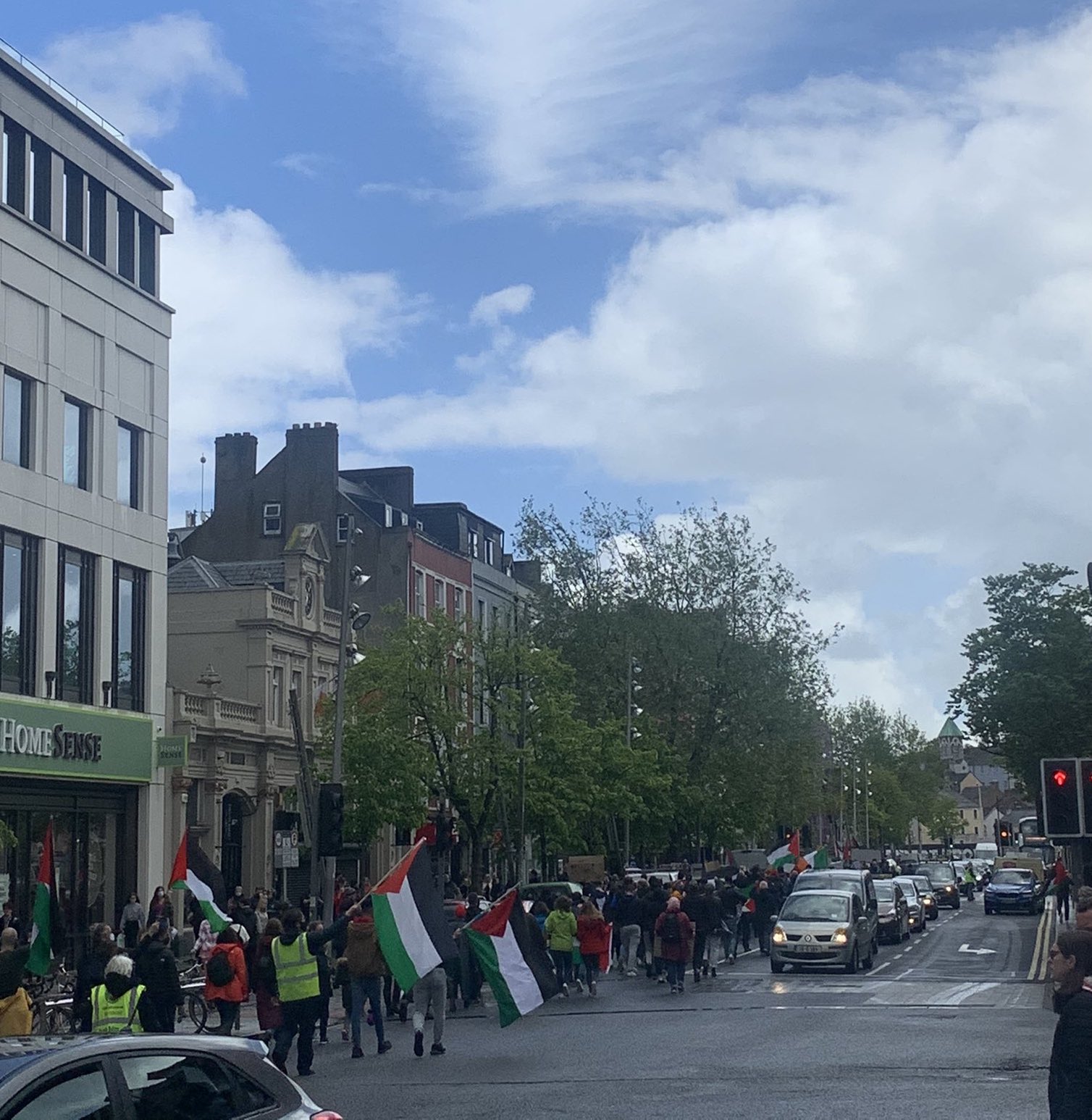
Palestinian solidarity march in Cork on Saturday (Photo source: Internet)
The fact that establishment right-wing/ conservative politicians feel obliged to take a public stand, however ineffectively, against actions of the Israeli Zionists is a strong indication of how much Irish public opinion has changed over decades.
Implicitly such stands reflect against the Zionists’ biggest international backer and world superpower, the USA. Since the Cast a Giant Shadow film, the state’s shadow of which we are aware now is indeed frighteningly giant and very dark.
In response, the natural cultural and historical feelings of the Irish people have stirred in sympathy with the oppressed Palestinians – and in defiance of threatened police repression at home.
Garraithe na Lus/ Botanic Gardens is one of the jewels in Dublin, either in the city centre or just beyond, depending on how one calculates it.1 It is free to enter and open all days of the week, though there have been closures and reduced hours during the current Covid19 pandemic. It contains over 5,000 living species and cultivars2 and also accidental fauna, most but not all of which is indigenous and the Tolka, one of the few uncovered rivers of Dublin, flows along its border and through part of it. Walking through the garden is relaxing but one is walking not only through nature but history too.
Text on the official website proclaims truthfully that “the National Botanic Gardens are an oasis of calm and beauty” and goes to state that the whole is “A premier scientific institution … and that “the gardens also contain the National Herbarium and several historic wrought iron glasshouses.” All of the glasshouses are closed currently as an infection protection measure but one that had fallen into disrepair will hopefully be restored to working order and will be available when the rest can be safely reopened.
In defence of its status as a “scientific institution” the website states that“we do not allow dogs, picnics, bicycles, fishing, ball games, jogging or running, nor the playing of musical instruments or recorded music”, however this prohibition adds considerably to its calmness and the ability for visitors to take in the natural atmosphere, sound, views and smells without being jarred by those other features so common in many public spaces.
The gardens, at 19.5 hectares are not very large and certainly nowhere near the size of those at Kew, London, which are over 132 hectares in size but the smaller acreage of the Dublin site is arguably part of its charm. It is bordered on the west and south by Glasnevin Cemetery (well worth visiting too) and connected by a gate, while the Tolka (an Tulcadh) borders it to the north and cuts off the rose garden, which can be accessed by a short bridge. A road called Glasnevin Hill borders the eastern side of the Gardens and the Tolka runs under a bridge there on its way to the sea.
A bluebell glade (with a white variant) in Dublin’s Botanical Gardens, April 2021 (Photo: D.Breatnach)
The Gardens were a project of the Dublin Society (later the Royal Dublin Society), founded in 1731, the Gardens themselves being opened in their current location in 17953 and are now owned and managed by the Office of Public Works, a State body.
WALK LATE APRIL
IRISH YEW AND NORTH AMERICAN SQUIRRELS
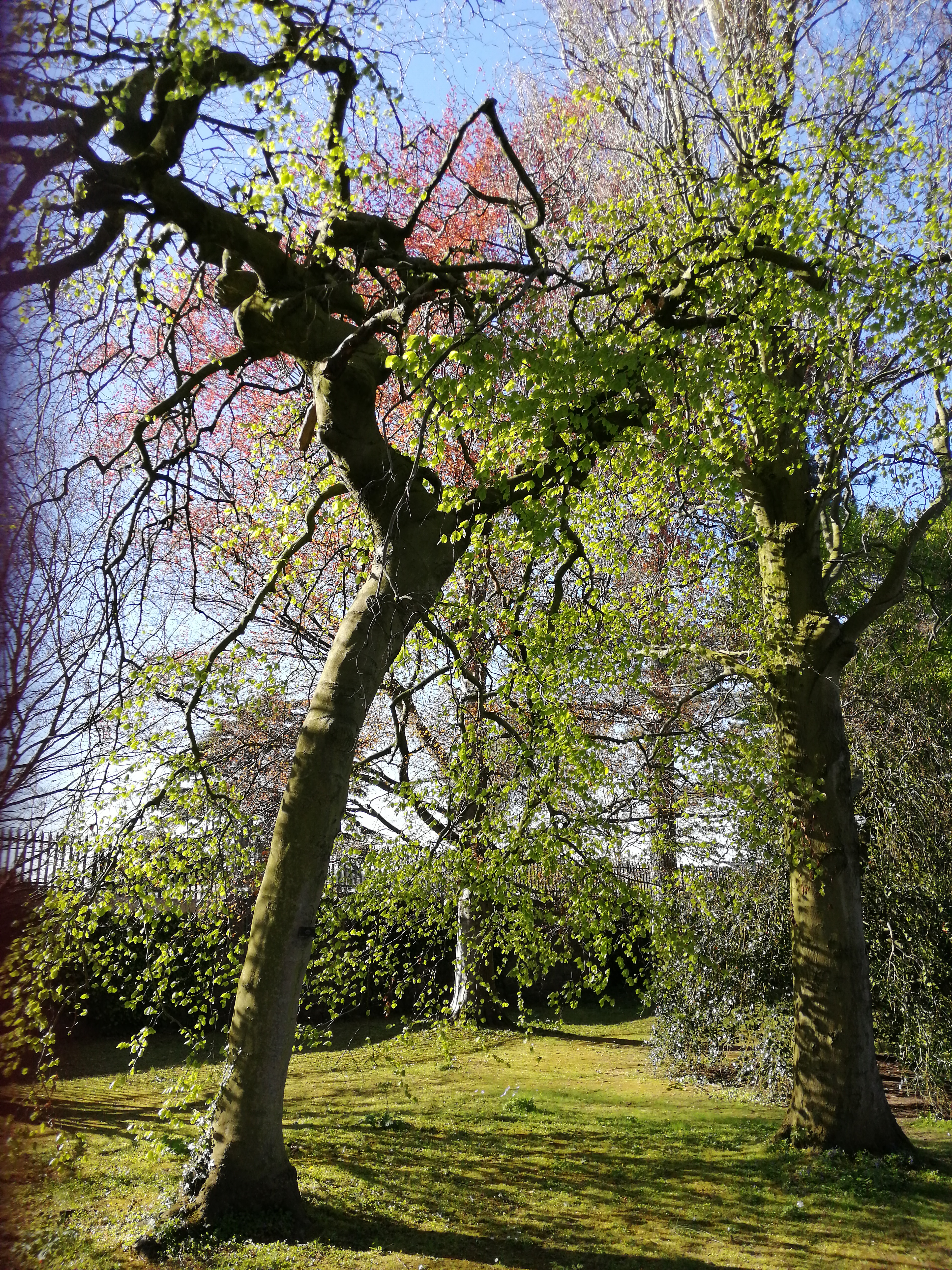
At this time of year, some of the trees are in full leaf, some in early stages and some still bare or just in bud. It is a good time to note the shapes of branches, some seemingly fantastic and also the effect of the emerging leaves against them. The clumps of the parasitic mistletoe (Sú darach) can be seen high in the branches of many species in the Gardens and having spread also to some trees in the Cemetery.
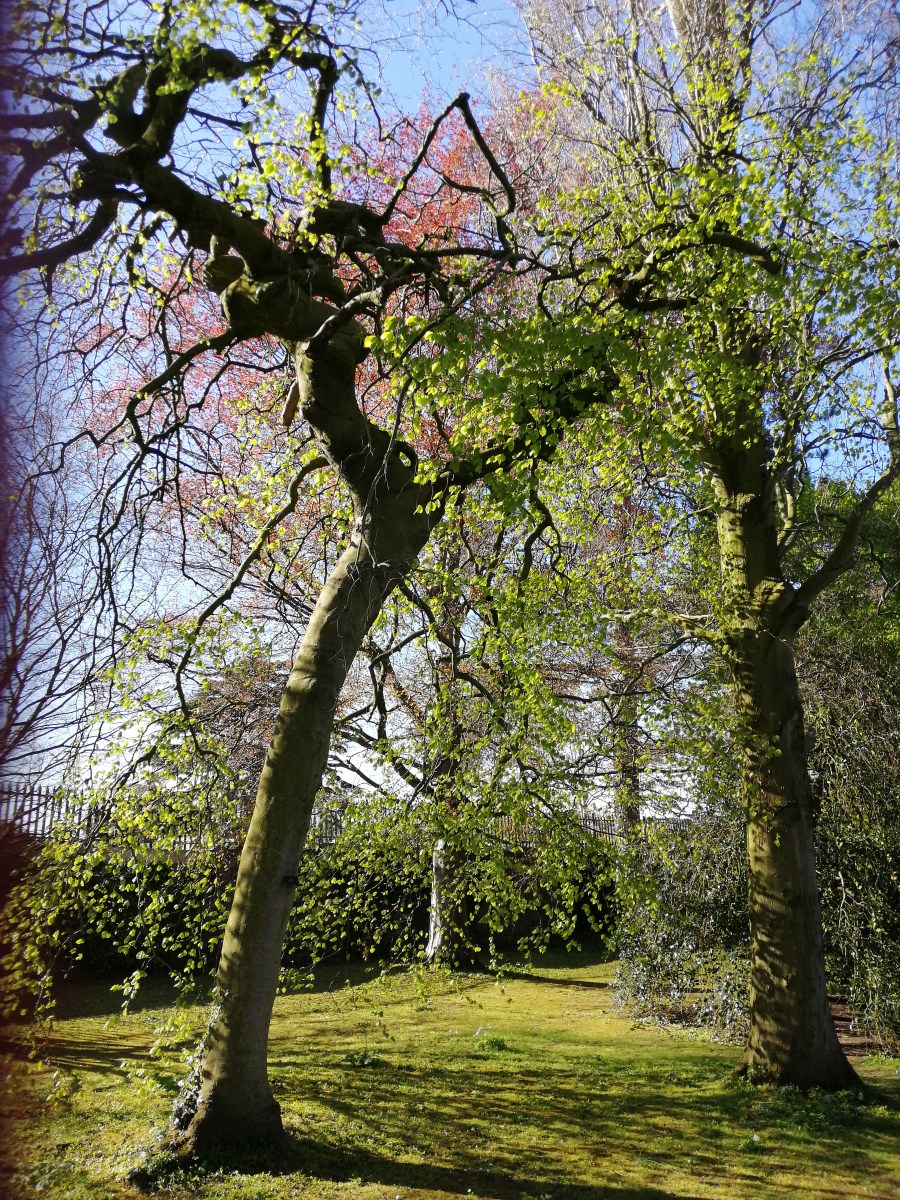
Some strange branch shapes seen here surrounded (and contrasted) by early leaf and sky, April 2021(Photo: D.Breatnach)Close-up of the contorted shapes, with some of the contrasts lost but more play on shadow. (Photo: D.Breatnach)The dark clumps are mistletoe, a photo taken in June (2020), when they are less obvious among the leaves of the tree. (Photo: D.Breatnach)
We would not expect the Gardens to be restricted to native species and although there are examples of those present, there are species of plants present from at least six continents, varying from tall trees to low cacti or succulents. But among the native flora there is a surprise for many: the Irish (compact) yew.
Many places in Ireland are named in connection with trees and the yew (Iúir) figures in a number of those, the most prominent perhaps being Iúr Chinn Trá or its more modern name An tIúir (Newry). The heartwood of yew was used to make the English longbow, from which the “cloth yard” (about 37 inches, or 94 cm) arrows played such a decisive role in the defeat of the flower of the French knighthood and cavalry at Agincourt in 1415. Because the yew is slow-growing it was policy in England to plant them in order to ensure a supply and yeomanry were required to practice at weekends. No doubt the English took their toll on the yew in Ireland as they did on other trees such as the oak.
The European Yew typically had a spreading growth but in County Fermanagh in 1767 George Willis, a local farmer, discovered two freak seedling specimens that grew in a tight, compact shape. Of those original two, one is still living4 in the grounds of Florence Court Estate demesne and it estimated that over five million offspring have been propagated from that one tree, typically seen in churchyards, graveyards and parks, not only in Ireland but in many parts of the world.
Four Irish Yew in the Dublin Botanical Gardens early April 2021 (Photo: D.Breatnach)An Irish Yew specimen at close quarters in Dublin’s Botanic Gardens. Millions of these around the world were propagated from two ‘freak’ types found in Fermanagh, Ireland in 1767. (Photo: D.Breatnach)
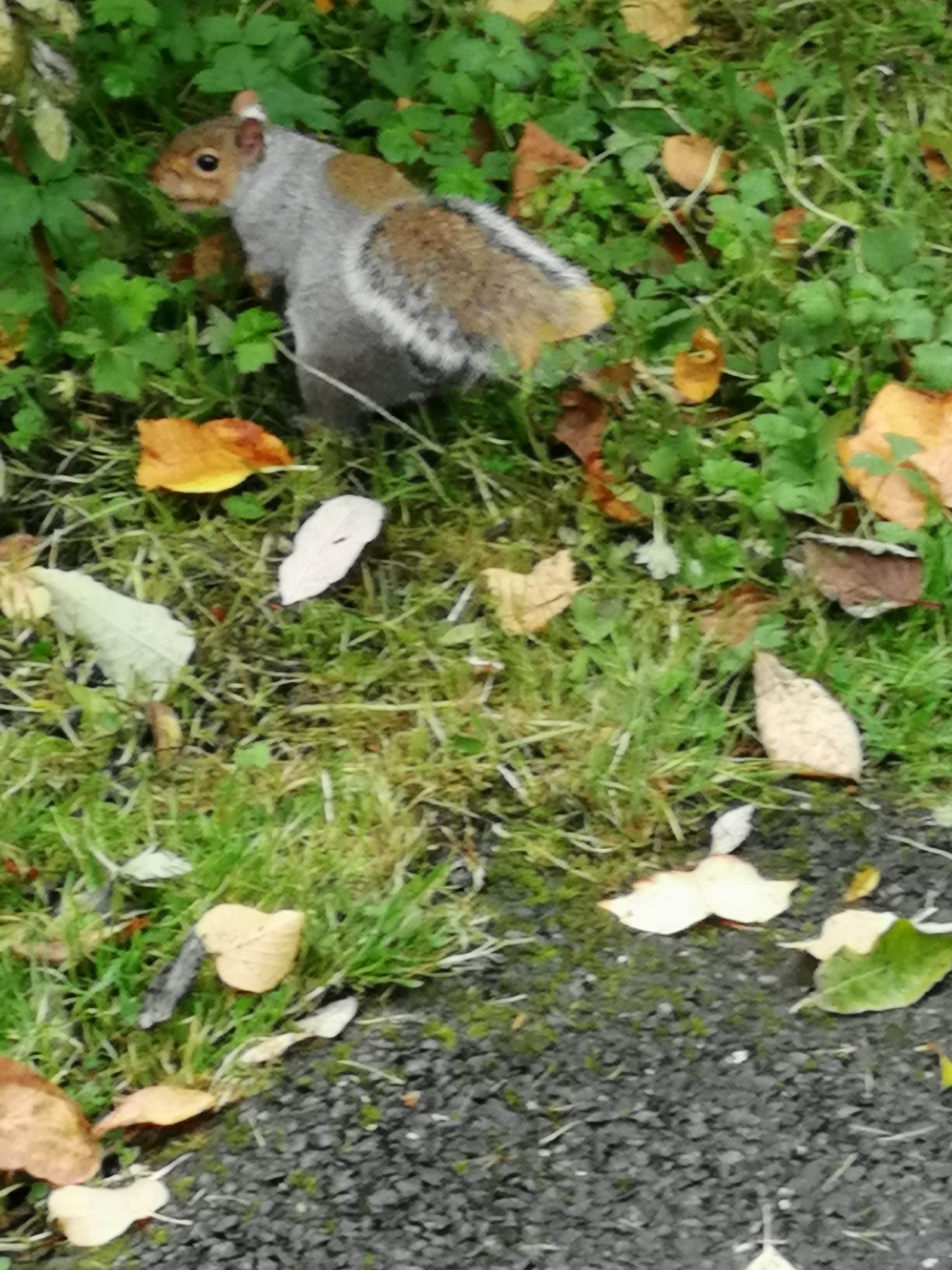
From export to the world let’s turn to an import ubiquitous in the Gardens – the grey squirrel (Iora liath). This is an invasive species to Ireland originally from North America and is blamed for helping to greatly reduce our own native species, the red squirrel (Iora rua) which, to my mind, is a much more attractive animal.
Research on Irish wildlife a few years ago showed the red squirrel making a comeback in some areas and that is associated with the slow increase in the presence of the pine marten (I prefer its traditional if inaccurate name “Cat chrainn” to “Marten péine”) which had been recently nearing extinction in Ireland. It is a predator on squirrels but apparently finds the grey species easier to catch since the latter spends longer on the ground.
Strangely, I have not noted grey squirrels in the nearby Griffiths Park so they do not seem to be expanding in that direction – at least, not yet.
Grey Squirrel (Iora Liath) in Dublin’s Botanical Gardens (Photo: D.Breatnach))
HISTORY
BATTLE OF CLONTARF
The Battle of Clontarf, which was fought in this area on 23rd April 1014, was between Brian Boróimhe’s (Boru) forces of mainly Munster and Connacht forces, along with some Viking allies, against the forces of the Viking King of Dublin and the King of Leinster, aided by a substantial force of Viking mercenaries from the Orkneys and Manx. It was of great consequence since the High King of Ireland and many petty kings were killed in it but it also put a definitive stop to any further expansion of Viking power in Ireland (though their Dublin kingdom was tolerated but required to pay tribute).
The available history tells us that Brian’s headquarters camp for the Battle of Clontarf (Cluain Tairbh) was in Glasnevin (Glas Naíonn). Brian’s camp may have been where the Cemetery is now, since the highest point there is higher than the Gardens’, or even a little further north around where St. Mobhi’s Church is today, higher still. Wherever it was is where he was slain too, in a sneak attack by one of the Viking mercenaries from the Isle of Man, according to one of the accounts.
The Battle was certainly not fought at Clontarf but is where one part of it ended, as defeated Viking mercenaries ran for their ships there, many being killed at a bottleneck at a salmon weir (round about where Ballybough is now), only some surviving to reach their longships.
Some boys brave a small weir on the Tolka just east of the Botanical Gardens. There is little sign on this day in late April 2021 of the surging flood of which the river is capable and from which it takes its name. (Photo: D.Breatnach)
The name of the river is an old Irish word for “flood” and had there been heavy rains in the Dublin hills, the river level might have been high generally but would certainly be so anyway in the estuary at high tide. Since the record tells us that the battle started at high tide and was still high tide when it finished, it means the battle lasted 12 hours. Twelve hours of fighting in any kind of battle is hard enough but with hand-operated kinetic weapons, along with shields and armour, impossible without taking rest breaks. So the fighting waned at times by agreement or by mutual exhaustion but was engaged again. The actual battle site has never been found5 but was probably fought along the Tolka (Tulcadh) for some of its length.
Unlike battles today, all the commanders of high rank in it on both sides were killed, including Brian (though not in the actual battle) and the King of Leinster, Maél (‘Maol’ in modern Irish) Mórda Mac Murchada, the latter killed along with many of his troops and Dublin Vikings at the other bottle-neck, the only bridge then in existence across an Life (the Liffey), perhaps around Islandbridge (Droichead na hInse). This was probably at the delayed intervention in the battle of the forces of the King of Meath, Maél Sechneill Mac Domnaill (though one of the annals has his actual death at the hands of a relative of Brian’s who himself received mortal wounds from Maél Mórda).
1916 RISING
The cancellation of the Rising by Mac Néill for Easter Sunday (23rd April that year) and its reinstatement by the IRB’s Military Council was resolved by going ahead on Easter Monday (24th April). When news of that reached the area around Maynooth, a group of Irish Volunteers who had gathered the day before but stood down, set off for Dublin along the banks of the Royal Canal, arriving in Dublin city late on Easter Monday. They found two Volunteers guarding the Cross Guns Bridge over the canal and were advised that proceeding into Dublin city centre might not be advisable in that evening.
The men spent the night in Glasnevin cemetery and set off again the following morning, crossing the now unguarded bridge and making their way, hungry and footsore, down to the very centre and the GPO on the Tuesday of Easter Week, where they remained in action until the evacuation of the burning building on the 28th. One of their number, Tom “Boer” O’Byrne, who had served in the Irish Brigade against the English in the Boer War, had his sore feet bathed there by Cumann na mBan Volunteer Lucy Agnes Smyth, whom he escorted with most of the other women Volunteers from the GPO and wounded prisoners to Jervis Street Hospital on Friday 28th and whom he would later marry.
End.
Missel Thrush (Smólach Mór), if I’m not mistaken. This one seemed quite unafraid, going about its hunting a few yards from me. The caterpillar-seeming forms on the ground are catkins from the poplars in Griffiths Park, which follows the Tolka eastward from the Botanical Gardens (Photo: D.Breatnach) Hooded Crow (Caróg Liath), the Irish (also Scottish, Icelandic) species closely related to the all-black carrion crow, seen here on a field of grass and daisies, late April 2021, Dublin Botanical Gardens. They are wary and difficult to get close-ups of without a tele-lens. (Photo: D.Breatnach)Mostly dandelion (caisearbhán) on a grassy slope above a stretch of the Tolka between Botanical Gardens and Griffiths Park. The dandelion is a plant with a cheery flower which would be highly prized were it not so common (it also has a startling nature which is not discussed here). (Photo: D.Breatnach)
FOOTNOTES
1One of the ways in which people locate Dublin’s city centre is “between the canals”, i.e between the Royal Canal on the south side (of the Liffey) and the Grand Canals on the north side. However, the location of the Botanic Gardens is only a little past the Royal Canal, a matter of five minutes’ walk.
2A cultivar is an artificially developed variety of a plant through selection or the result of cross-breeding (eg the Loganberry or the Nectarine). As to the numbers, Wikipedia claims “approximately 20,000 living plants” for the site while the figure given here is from the Botanical Gardens’ own web page.
3That century was one in which Dublin rose in status as a city of the British Empire and many of its prominent residents took civic pride in the city and strove for improvements in a number of fields for the city and for Ireland in general. The Botanical Gardens were opened three years before the United Irishmen uprising but when the organisation was already in existence and pushing, along with more liberal constitutional elements, for Catholics and Presbyterians to have the vote and to be permitted to stand for election for the Irish Parliament, which was being blocked by the Crown administration and some vested interests. After the Rising, the Irish Parliament was abolished and so began the decline in importance of Dublin from what had been considered the second city of the British Empire.
4The other was recorded as having died in Willis’ garden in 1865, almost a hundred years later.
5I did hear years ago that some artifacts had been found in excavations for the site of the current meteorological station building near Mobhi Road but I have not seen any documentation of that. There was mention in one account of the battle of tired fighters slaking their thirst at a well and the location of that was thought to be in Phibsboro/ Glasnevin, at the junction of the southward part of the one-way system. And a housing development I noted there is called “Danewell”.
Catalan political activists are in jail for following their electorate’s wishes for independence from the Spanish State, while many election observers are on trial or threatened, along with 700 town mayors in Catalonia … meanwhile other political activists are in exile. In exile too is a rapper who had been sentenced to jail for his lyrics and actually in jail is rapper and poet Pablo Hasél.
Excellently compiled performance slices here in this video put together by rappers (and dancers) in Castillian (Spanish) and Catalan: “Freedom of expression!
Take up a position!
Down with the prisons!
The Bourbons are robbers!”
Repression reigns in the southern Basque Country too and anywhere people in the Spanish state take up a position of dedicated resistance. But Catalonia is the current frontline.
Pablo Hasel portrait mural painted by street artist Jordit on a basketball court in Naples, southern Italy Photo: Ciro Fusco/ EFE)
Love, life, death and lots of alcohol! Yeah the sort of themes you expect to hear on a Celtic-Punk album but in the hands of German band Tir Nan Og on their new album Sing, Ye Bastards! these traditional themes are anything but traditional!