We now approach the festival called Christmas. A Christian festival, apparently, celebrating the birth of Christ, the baby Jesus. But are there darker aspects in its references?
Away in a manger No crib for His bed The little Lord Jesus Lay down His sweet head
The stars in the sky Look down where He lay The little Lord Jesus Asleep on the hay
Such a sweet, holy image.
But actually, when we look around us, it seems more like a festival of the pagan gods: of Bacchus, the god of alcohol and of Mammon, the god of wealth. Bacchus, because in non-Moslem countries, drinking of alcohol will be for most a big component of the festival.
Whiskey, brandy, wine and beer will be bought to stock up the house. Alcohol will be drunk at Christmas parties (including office parties, where for months afterwards some people will regret what they did or said – or even what they didn’t do or say).
Alcohol will be not just drunk but also put into some of the traditional food and even poured over it.
Then Mammon. Well, you can see the retail businesses stocking up for weeks or even months ahead of the festival which, after all, was only supposed to be a one or at most a two-day event.
Giving and receiving gifts has now become part of the festival and in most cases, gifts have to be bought. Which is a really big gift to the retail businesses and thence, really a sacrifice to Mammon.
In the Christian gospels of both Matthew and Luke, it is written that one “cannot serve both Mammon and God” — which goes to show how little they understood capitalism, where Mammon IS God.
A theologian of the Fourth Century saw Mammon as a personification of Beelzebub, which in his time was another name for Satan or the Devil.
Interestingly, Protestant Christianity, which some credit as having invented capitalism, at the same time regarded Mammon, or said they did, as “one of the Seven Princes of Hell”.
Cartoon depiction of Mammon, God of Wealth (Image sourced: Internet)
Sculpture representation of Bacchus, God of Alcohol, in California winery, USA (Image sourced: Internet)
SANTA
Now, Santa Claus is also a big part of the Christmas festival, especially in western countries, a much more acceptable face than that of greedy Mammon and alcoholic Bacchus, right?
But originally, the Christians saw him a representation of St. Nicholas, 4th Century Bishop of the Greek city of Myra, a location now in Turkey. He was he patron saint of archers, repentant thieves, sailors and prostitutes. The prostitutes probably had to be repentant ones too, of course!
The sailors, who probably had at least as much recourse to prostitutes as had any other calling, were apparently not required to be repentant – to be in danger on the sea was deemed enough.
But St. Nicholas was also the patron saint of children, pawnbrokers and brewers, so we can see how close he was getting there to the modern spirit of Christmas.
GERMAN TRAPPINGS
Now, the Christmas Tree, der tannenbaum, so much a part of the symbolism of modern western Christmas, came to us from Germany, as did the sled and the reindeer.
The reindeer are not autochthonous or endemic in historic times to Germany, so they must have been brought in their myths from Scandinavia from where originally, the Germanic tribes came.
In turn, the Christmas Tree, Yule Log, reindeer and sled were exported from Germany to England in the reign of Queen Victoria, by her consort Prince Albert, who was German.
And since the English ruled all of us in Victoria and Albert’s time, the Christmas Tree came to us too, to the cities first and then slowly spreading through the rural areas.
A representation of St. Nicholas (before he got the red suit makeover) looking more like a pagan god of the woods. (Image sourced: Internet)
***
When you think about it, this German-English worship of the tree was a bit ironic, since the English had wiped out most of our forests already and were still cutting down our remaining trees in Queen Victoria’s time.
***
And Victoria, through Albert, gave us the Santa Clause we know and love today. A jolly man, well fed, white beard, twinkly eyes, dressed all in red with white trim ….
IN RED?
Now, wait a minute! It turns out he wasn’t always dressed in red. Originally, he was dressed in a brown, or green cloak. He was, originally among the Germanic people, a god of the forests – hence the evergreen Christmas tree.
And like any sensible woodsman, he dressed in appropriate colours, brown or green. Neither Albert nor Victoria ever represented him as dressed in red. So how did it become so that we are incapable of seeing him today in any other colour than red?
Well, it turns out that Coca Cola is the responsible party.
Yes, although it was the cartoonist Thomas Nast in 1870s United States who first portrayed Santa in a red suit with a belt but it was Coca Cola, in their advertising campaign of 1931 and onwards who made his clothes red world-wide.
Coca Cola is a drink served cold and almost undrinkable when warm but who needs a cold drink in cold weather? I guess Coca Cola needed a warm image to make it still attractive in winter. So therefore the warm, jolly man dressed in red, with a bottle of Coca Cola in his hand.
1931, Santa Clause first appears in red, in Coca Cola advertisement, USA.
(Image source: Internet)
Coca Cola brand is worth about $106.1 billion dollars today,1 far ahead of any other cold drinks product. Which I guess brings us back to …. yes, Mammon.
You can mix the drink with a number of alcoholic beverages too, so tipping a nod – and a glass – to Bacchus.
Now, the German Santa Claus, this originally woodland god, is also thought to have been something like Thor, a god of fire and lightning. So can it be any coincidence that two of his reindeer are called Donner und Blitzen, i.e “Thunder” and “Lightning”? Nein – of course not!
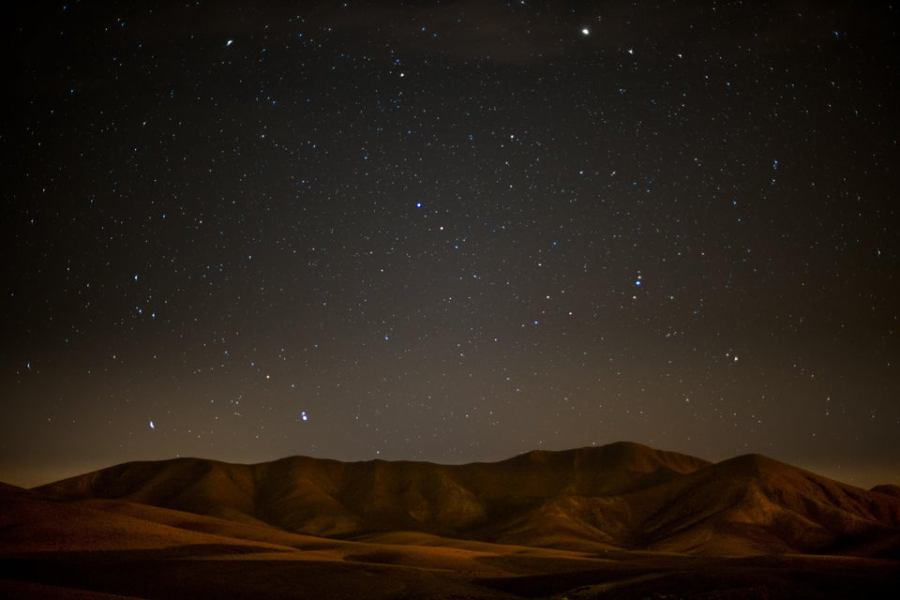
A starry night over desert hills, like the Nativity scene but without the Guiding Star. (Photo source: Internet)
INVISIBLE
Although we see the image of Santa Claus everywhere and even pretend Santa Clauses all over our city streets, everyone knows that nobody sees the real Santa Claus. Children have to be asleep when he arrives to distribute his presents and somehow adults don’t see him either.
Which I suppose is a good thing ….
I mean if you found an adult intruder in your house at night, not to mention near your children, you’d be liable to whack him with a hurley (that’s an Irish cultural reference) …. or a baseball bat (that’s a U S cultural reference) …. or stab him with a sharp kitchen knife (that’s an international cultural reference).
It was bad enough when somehow that portly – not to say fat – man could somehow come down your chimney and go up again, without waking anyone … but now he can get in your house or flat even when you don’t have a chimney.
Which is at least creepy, if not downright scary.
Oh, let’s lighten the mood and sing together:
You better watch out You better not cry You better not pout I’m telling you why
Santa Claus is comin’ to town Santa Claus is comin’ to town
He’s making a list He’s checking it twice He’s gonna find out Who’s naughty or nice
Santa Claus is comin’ to town Santa Claus is comin’ to town
He sees you when you’re sleeping He knows when you’re awake He knows if you’ve been bad or good So be good for goodness sake
Yes, lovely but wait …
“You better watch out, you better not cry …” — Is it just me, or is that not downright threatening? And he knows when we’re sleeping or awake? He has our children under surveillance? In some kind of list?
HO! HO! HO! IN MORALITY PLAYS
Morality Plays were a genre of theatrical performances of the medieval and Tudor eras in which a character was tempted by a personification of Vice.
Now Vice (not unlike a lot of police Vice Squads), was often seen as the epitome of evil, corruption and greed – in other words, the Devil. The playwrights tended to portray the Devil as somewhat of a comical character, perhaps to keep their audiences entertained (or to disarm them).
So the character who played the Devil would announce his arrival with a stage laugh: “Ho, Ho, Ho!”
You can probably see where I’m going with this.
Nowadays, we tend to see the Devil portrayed in black but in earlier times, he was more often seen as coloured in red. The colour in which Coca Cola just happens to have dressed Santa too.
The German or Nordic Santa was originally a god of fire also, while even the modern Santa drives a magical chariot pulled by horned beasts and he is portrayed all in red. Traditionally, the Devil is seen as residing in Hell, a supposed place of eternal flames below ground.
What does Santa Claus give to children who have not been good? A lump of coal! In other words, a mineral from underground that can burn to make fire.
NICHOLAS
Santa Claus is supposed to be modelled on St. Nicholas …. and what is the popular abbreviated version of Nicholas, i.e the nickname? Yes, Nick.
And the common name for the Devil, Mammon, Beelzebub, Satan is ….. Old Nick!
Recently then-Minister for Home Affairs of the UK Suella Braverman claimed the common Palestinian solidarity slogan, From the River to the Sea, Palestine will be free! to be antisemitic, genocidal in effect and looked set to try to have it banned.
In some other western institutions, for example Columbia University USA, it HAS been banned and a Palestine solidarity student group has had its rights within the University revoked despite, reportedly, the opposition of the majority of students to that sanction.
Suella Braverman, MP, former UK Minister for Home Affairs. (Photo sourced: Internet)
How can a basic solidarity slogan be claimed to be genocidal?
Definition of a genocidal act: In the present Convention, genocide means any of the following acts committed with intent to destroy, in whole or in part, a national, ethnical, racial or religious group …1
Obviously there can be such a thing as a genocidal slogan and, in fact, there are many examples in history: “The only good Indian (sic) is a dead Indian”2; “Juden raus”3; “To Hell or to Connaught”4; “Nits make lice”5; “Kill the cockroaches”6; “There are no Kurds, only mountain Turks”.7
Anti-Jewish racist and genocidal slogan in German with the Nazi Swastika symbol on wall in Florence, Italy.
But really, “From the River to the Sea, Palestine will be free”? Genocidal? For the Palestinian people to be free and in control of their own land, there has to be genocide?
Would “Scotland Free from Dunnet Head to Tweed” be considered a genocidal slogan? Or for example slogans such as “Ireland free from Donegal to Cork” or “A 32-County socialist Republic” be thought genocidal?
“Oh, but the Palestinian one means Palestine for the Arabs only, no Jews!” Really? And you know this how? Before the British started driving Jews into Palestine the maximum size of the Jewish population there was 6% but there was no attempt by the mostly Arab people to drive them out.
Could the slogan not equally or even more likely be a call for a free, equal, democratic state across the whole of the original Palestine? Such as the stated objective of a number of Palestinian resistance organisations, the PFLP for example?
The nationalist slogans for Ireland and Scotland could be interpreted to mean clearing out all non-Scottish and non-Irish respectively but for the vast majority they not mean that nor are they generally thought to do so. So why suspect genocidal intention of the Palestinians?
The opposition to the slogan is not at all based on fear of genocide but in fact on support for it: the Zionist genocide against the Palestinians! It is based on denying the right to self-determination of the indigenous Palestinian people, of which a huge majority are Arab.
To deny the right of the Palestinians to self-determination is to support the right of the Zionists to colonise, a project entailing expulsion or massacre of the ethnically Arab Palestinian majority that existed in Palestine even up until 1948.
That Zionist project has continued with a constant ethnic cleansing pressure and genocidal attacks on the Palestinian people.
And the same people who oppose the slogan “From the River to the sea” etc support such slogans as “Israel has a right to self-defence” and “The Jewish people have a right to their own state”, which ARE racist and genocidal statements based on Zionist and European colonial ideology.
If Israel has a right to self-defence, what that means is that those who occupy a territory, steal the land and resources, colonise it and attack the indigenous people … have the right to defend themselves against the legitimate resistance of the people.
It gives the settlers the right to defend their occupation and repress the resistance, which naturally is given no rights at all. The robber has the right to the loot.
If the Jewish people have a right to their own state, where is that to be? Where will a land be found without people in it for them to take as their own?
And if such an empty land does not exist – which it does not – then what gives Jews or anyone else the right to occupy and settle a land, removing the rights of the indigenous people? An alleged promise by a being of religious belief? Or the backing of imperialist colonial powers?
The defence of the solidarity slogan’s content and the right to use it across the world are important democratic standards in the peoples’ struggles for justice and to express and build internationalist solidarity across the world.
The realisation of the slogan will be an important contribution to peace and justice in the world.
FROM THE RIVER TO THE SEA, PALESTINE WILL BE FREE!
End.
FOOTNOTES
1Article II, UN Convention on the Prevention and Punishment of the Crime of Genocide
2Whether correctly attributed to General Phillip Sheridan of the US Army or not it was certainly a popular saying in the white US colonial wars against the Indigenous native people.
4Attributed to Oliver Cromwell in his mid-17th Century genocidal and ethnic cleansing campaign against the Irish Catholics.
5Horrific slogan justifying the killing of children because they will grow up to be the hated/ feared people. This slogan or saying has probably been heard at one time or another in most parts of the world but certainly against Native Americans in the USA; among Nazis against Jews, Slavs and Gypsies; in Israel against Palestinians.
6One of the slogans of the Hutu against the Tutsi in the 1994 ethnic cleansing and massacres in Rwanda.
7Remark attributed to the Turkish nationalist Kemal Ataturk with regard to the very large ethnically distinct Kurdish people in Turkey.
Basque actress Clara Galle, criticised for not wearing a bra under her t-shirt at Basque team Osasuna’s football ground, kicks the ball back to score. “You have learned nothing,” she adds.
From Publico.es 09/26/2023Translation by D.Breatnach (Reading time:2 mins.)
The Navarrese actress Clara Galle went to Osasuna’s stadium, El Sadar, last weekend. As a famous fan of theirs, the club decided to honour her with a reception before the match against Sevilla. Luis Sabalza, president of Club Atlético Osasuna, gave her a t-shirt with her name on the back.
Actress Clara Galle photographed while watching her team play Sevilla at El Sadar, Osasuna’s stadium.
The visit was eagerly showcased on the official accounts of X and the club’s Instagram. However, as is often the case, the photos in which the outlines of her nipples were visible due to the absence of a bra triggered a multitude of sexist comments.
The actress, far from remaining silent, decided to respond forcefully with a comment on Instagram: “I’ve been going to El Sadar to see my team since I was a little girl … Given the comments I’ve read, I feel that I have to react.
“When I was getting dressed before arriving at the field, it didn’t occur to me that my nipples were to be such a topic of conversation,” she said. “If you notice them, it’s because I have them. I have never seen this kind of hullabaloo when any player from any team takes off his shirt on the field,” she added.
Osasuna’s president presents actress Clara Galle with a club t-shirt with her name on the back.
“I have a clear conscience, I’m not doing anything wrong by not wearing a bra.
“It doesn’t bother me that they say that I was wearing the two points that they didn’t win, it bothers me that my breasts are the only topic, among so many more interesting ones in existence, that many choose to talk about”, she declared.
Gale ended with an urgent reminder after the controversy over Luis Rubiales’ kiss of Jenni Hermoso: “It seems that we have learned nothing in recent weeks,” the actress concluded.
COMMENT
Sexism and adolescent behaviour by male adults is oppressive to women and at least tiresome to everyone else. It is an unfortunate feature of many – perhaps all – countries but the Spanish state seems to have a particularly high share of it.
The imagination’s land of the Red Cross, cheese, cuckoo clocks and chocolates plans the massacre of 70% of its wolf packs.1
In reality of course Switzerland is a very regulated country, with a rich financial/ industrial economy and is a major arms producer.
However in 2020 Swiss voters made their desire to protect endangered species clear, when 52% of voters rejected a hunting law that would have made it easier to kill endangered species such as wolves.2
Despite the vote, the Swiss parliament passed a new law in December 2022 that allows the wolf population to be ‘regulated’. Then, just days ago, the government proposed a regulation that will wipe out 19 of the 31 wolf packs remaining in Switzerland!
Eurasian Grey Wolf in snow (Photo sourced: Internet)
WOLF MYTH & REALITY
Childhood and adult fiction is replete with horror stories about wolves (to say nothing of werewolves) attacking humans but, when set against reality, these seem like propaganda. The reality is that it’s not to humans that wolves are generally a danger but to their livestock.
Wolves (Canis lupus) are highly intelligent pack canines and, apart from having donated the dog (Canis lupus famialaris) as a worker and companion for humans, is well aware of its survival boundaries with Earth’s very apex predator – humans (Homo sapiens).
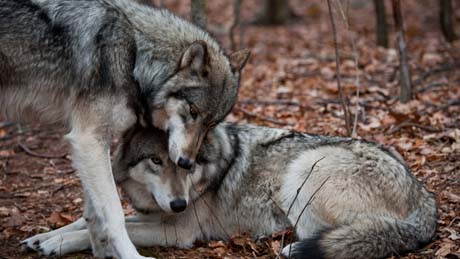
Wolf fondling another; pack members are very affectionate to one another while the alphas maintain boundaries. (Photo source: Internet)
Wolves prey substantially on rodents but must also, for pack survival, prey on larger mammals such as deer, mountain goats and boar. When these are in poor supply or other prey is temptingly easy, such as cattle and sheep, they will take those too.
The traditional human fear of wolves is therefore not one based on self-preservation but on economic priorities. And in the moralistic story of “The Boy Who Cried ‘Wolf’” it is not the human villagers that are attacked by the wolf pack but the community’ssheep.
However, if humans are to continue consuming a diet that will include meat, they will of course need to protect their livestock from wolves and have being doing so even before history was written.
Traditionally the main agent in that protection has been, ironically perhaps, the wolves’ own descendant, the dog – or more specifically, several livestock guardian breeds of dog.
Known livestock guardian dog (LDG) breeds include the Aidi (Atlas Mountain Dog), Carpathian Shepherd, Estrela, Greek Shepherd, Komondor, several breeds of Mastiff and Sardinian Shepherd; a known extinct breed is the Alpine Mastiff (before 5th century BC to 19th century AD).3
Mastín (Mastiff) amidst sheep it guards near Lagunas de Somoza (León, Spain). (Photo sourced: Internet)
Livestock guardian dogs are socialised to the livestock and to their immediate human ‘family’ and will not tolerate the close approach of any potential predator (which often includes even other humans). The primary role is to protect the herd, warn of danger and if necessary, attack.
Where employed in the past, LGDs have been highly effective in protecting their charges, in most cases not even having to fight predators but rather intimidating them. If they have to fight, they are bred for fearlessness and tenacity and their throats also protected by a “wolf-collar”.
Anatolian or Kangol Livestock Guard Dog, with sheep herd it is protecting, Eastern Turkey. (Photo sourced: Internet)
Predators, however courageous, also have strong survival instincts which warn against danger to life or limb (the latter, for a predator in the wild, often in time equalling the first). Unless absolutely desperate they will move on to safer although more difficult-to-catch prey.
For a good LGD however, there is no backing down possible, it is in defence of its own (as a wolf pack might defend its pups). The herder, when present with a firearm, is mainly an additional protection, as well as an alpha member of the dog’s ‘pack’ to obey and protect.
In contemporary times, LGDs have proved effective throughout the world, even in the experimental reintroduction of wolves to the USA.4 So why are they not being more widely employed and, instead, the remaining large predators being exterminated?
Central Asian breed of Livestock Guardian Dog beside its owner (Photo sourced: Internet)
It is no doubt more profitable for big livestock famers to have huge herds roaming freely and when they run out of edible pasture, to move the herd by herding dogs, mechanised herding vehicles or even helicopters. But is it all-around better? And are huge herds environmentally viable?
Apart from other considerations, wolves have been shown to have an environmentally positive effect in a balance between predator, prey and the environment, including vegetation and even water courses, for example in the famous case of the reintroduction of wolves to Yellowstone.5
Deer are pretty to look at but eat young trees and cause damage to reachable branches, while wild goats will eat almost anything, right down to the roots. Wild boar can also be very destructive and, being omnivorous like humans, even prey on ground-nesting birds.
Eurasian Grey Wolf in woodland (Photo sourced: Internet)
All of those invade agricultural crop lands to eat, in the course of which they also trample other crops; wild boar6 are now invading villages and suburbs in a number of towns and cities, overturning large refuse containers for their edible contents.
Female wild boar with litter of piglets in German urban area (Photo cred: Florian Mollers)
Wolves and other predators keep those species down to numbers in better balance with the environment but also of less bother to human settlements. Wolf packs on the other hand do not grow in size beyond the food supply that is fairly safely available.
The human race has made a huge impact on the environment which is sustainable up to a point beyond which, however, we are rapidly passing. We live in a sustainable balance with the environment — or we perish. Perhaps “let the wolf live” can be part of the lesson we need.
4“After the reintroduction of wolves, that were eliminated in the United States in the 1930s, American farmers were losing about a million sheep annually to wolf attacks. 76 farmers took part in the Coppingers program, which introduced European livestock guardian dogs into the US sheep breeding (in their project they used Anatolian Shepherd Dogs). In all farms, where, in the absence of dogs, up to two hundred attacks of wolves per year happened, not a single sheep was lost under the protection of LGDs. At the same time, none of the predators protected by law got killed: the dogs simply did not allow them to approach the herd.” – https://en.wikipedia.org/wiki/Livestock_guardian_dog
6A wild boar is much more likely to attack a human than is a wolf in Ireland, where the Wolfehound breed was famous, it was a boar that mortally gored Diarmuid of the legendary Fianna after his return from exile. Wild boar also carry diseases that can infect domestic pigs and humans.
According to media reports, Taoiseach Leo Varadkar said he expects to see a united Ireland in his lifetime. I think he’s wrong but he’s entitled to his opinion. However, some of his following remarks are objectionable and need to be challenged.
Varadkar claimed that in a united Ireland “there will be roughly a million people who are British.” That is false. There may – or may not – be a million IRISH PEOPLE who consider themselves British in a united Ireland, we’ll see. But they will be IRISH CITIZENS.
And they should have equal rights with all other citizens. They should have an equal right to vote, to housing, to their language, without any special restrictions, not to mention pogroms – in other words, nothing like the way their statelet treated its large Catholic minority.
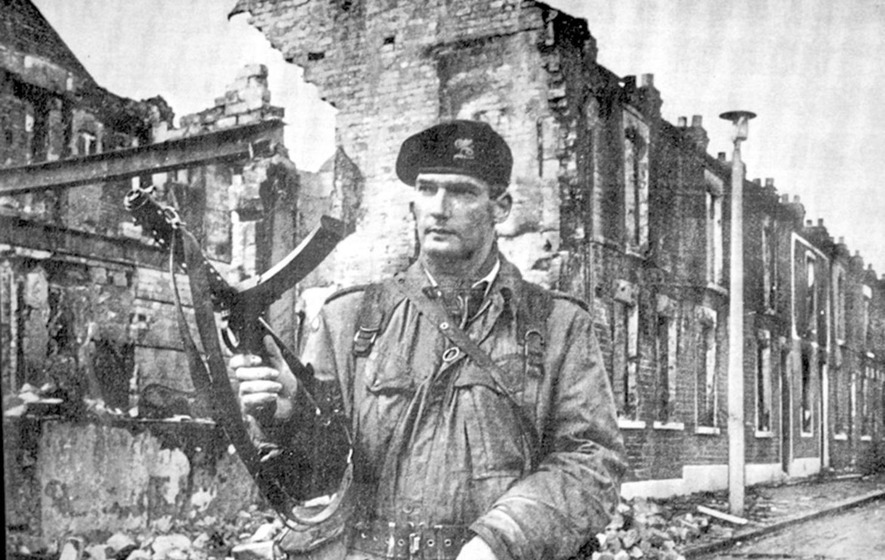
A British soldier stands in front of a section of the burned out houses of Catholics in Bombay Street, Belfast in 1969 (which the Army did not try to prevent Loyalists burning). The arson was the Loyalist response to demands of Catholics for civil rights (while the colonial police response was batons, bullets and gas). (Photo source: Clonard Residents’ Association)
I agree with Varadkar that the quality of a country should be judged “by the way it treats its minorities.” So Varadkar, how did and does your Gombeen State treat its probably oldest ethnic minority? You know, the Irish Travellers?
It is true that “a Republican ballad, a nice song to sing, easy words to learn for some people can be deeply offensive to some people.” Presumably he means to Unionists and Loyalists. Yes, and antifascist and anti-racist songs can be deeply offensive to fascists and racists.
It is also true that some people in the Southern States sing songs about the Confederacy and Robert E. Lee and call it their culture. And the comparison fits – but not with Republicans but with Loyalists!
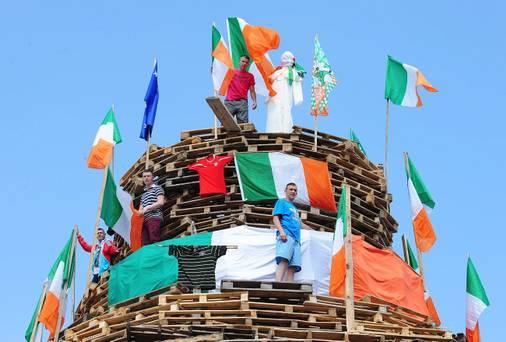
One of the charming annual expressions of Loyalist culture: a huge bonfire to burn Irish Tricoloursand representations of Catholicism. Palestinian flags and representations of Celtic FC are frequently burned too. Slogans such as KAT (‘Kill All Teagues [i.e Catholics]) are often displayed also. (Photo source: Wikipedia)
It’s not Irish Republicans who spread racism and sectarianism: the Republican creed came into existence precisely against sectarianism. And we know Varadkar actually knows that because not long ago he made some remarks about the wide embrace of the Irish Tricolour.
The Irish Tricolour: a flag presented to revolutionary Irish Republicans by revolutionary French Republican women in Paris in 1848. Not a flag of monarchism, sectarianism or collusion with imperialism or colonialism.
While we uphold Republican principles we don’t have to apologise to anyone, least of all in our own country, Varadkar. It’s you and your party (and the rest of them serving the Gombeen class who threw away independence and slaughtered Irish Republicans) who need to be ashamed.
Leo Varadkar, Taoiseach (Prime Minister) of the current Coalition Government, who made the remarks this week. (Photo sourced: Internet)
People living in Ireland can think and feel what they like, good or bad. But in public, we will celebrate the valuable things in our history and culture. And we’ll do so proudly without apology to anyone.
On the other hand, public displays of Orange sectarianism, racism, homophobia, fascism and anti-LGBT targeting won’t be tolerated in an independent, reunited Ireland. Not for one minute.
Diarmuid Breatnach (Reading time main text: 11 mins.)
LANGUAGE IS A TREASURE CHEST – 2
I observed in Language Is a Treasure Chest 1 that while language is full of wonders, it has some horrors in it too. And I found that to be true again.
I was reading a novel in which the word “Cimarron” appeared and, doing some quick research on the word, I came across a 2004 query in an email website or page called Word Wizard:
What is the etymology of the word cimarron? I’ve always been told that it means “runaway slave” in Mexican Spanish. Can anyone verify this?
The reply is dated the same day:
From Greek. It refers to people who live in perpetual mist and darkness, akin to the ‘land of the dead’. Latin ‘Cimmerius’, Greek ‘Kimmerios’, Assyrian ‘Gimirri’ even the bible ‘Gomer’ Gen.10:2 and Esk. 38:6.
In Western United States it refers to a stretch of land that gets rainfall when other near by areas are desert year round.
Apart from the topographical reference, I thought the expert’s explanation highly dubious. And in fact I happen to know something about the Spanish-language origins of the word.
The searcher replied:
Thanks, Jim. I just wonder what connection this word has to Hispanics of Mexican origin because it shows up in their surnames (although not as common as Lopez or Vargas or Garcia).
Is it just Mexican in origin or did that also come from Spain? So the “runaway slave” theory has no foundation then?
The expert’s reply did come back with a Spanish-language connection and he may be on to something with the topography, though I think he has it the wrong way around (as we shall see).
The “runaway slave” theory is not so obsolete. Mexico did not have slaves (outlawed in 1810) but American slaves who fled to Mexico had to pass through lands with water, or else parish (sic).
When relating their tales of woe to the locals the word ‘cimmaron’ arose to describe their flight through the South West desert.
Very curiously, there was no further contribution to the discussion. I tried to leave one of my own but was required to register, which I did (though wondering if worth the trouble) and never received confirmation1.
“A view of the Cimarron National Grassland, the largest piece of public land in Kansas, a 108,175-acre property in the southwestern part of the state. It was recovered from the Dustbowl ecological devastation by soil recovery and management practices.” (Photo source: The Armchair Explorer – Kansas)
THE FOLK MEMORY WAS TRUE
Continuing with a little light online research I found that the Castilian-language (Spanish) origin is the explanation most often given, with rarely a reference to Greek or other classical or archaic languages. For example, in yourdictionary.com:
American Spanish cimarrón, wild, unruly (from Old Spanish cimarra, thicket): probably origin, originally referring to the wild sheep (bighorn) found along its banks.
(Latin America, of animals) feral (having returned to the wild)
Synonyms: alzado, bagual, feral
(Latin America, of people) rural; campestral
(Latin America, of plants) of a wild cultivar.
But …. what about the “runaway slaves”? Under the title Cimarron People, Wikipedia has this to say: The Cimarrons in Panama were enslaved Africans who had escaped from their Spanish masters and lived together as outlaws.
In the 1570s, they allied with Francis Drake of England to defeat the Spanish conquest.
In Sir Francis Drake Revived (1572), Drake describes the Cimarrons as “a black people which about eighty years past fled from the Spaniards their masters, by reason of their cruelty, and are since grown to a nation, under two kings of their own.
The one inhabiteth to the west, the other to the east of the way from Nombre de Dios”. (location in Panama — DB)
We may indulge ourselves in a sardonic smile at commissioned pirate Francis Drake talking about the cruelty of others, or about slave-owning by a country other than England in 1570.
But we remember also that at the time Spain was the main competitor with England in the rush to plunder the Americas – and had got there well before them.2 Both colonial powers were already plundering Africa for raw materials and slaves.
The meanings of animals having gone “feral” or “returned to the wild” would easily have been applied by the society of the time to escaped African slaves.
A European society which, despite evidence to the contrary including agriculture in Africa, would have considered indigenous inhabitants of Africa as people living in the “wild”. Once escaped and no longer under European control, they would be seen as “returning to the wild”.
So what happened to the Cimarron People? Their settlements were subject to punitive raids by the Spanish, killing people and burning crops, so that in the end they came to a treaty with their old enemy.
The Wikipedia entry says no more except that the “Cimarrons” and the English quarrelled (not surprising, given that they were of no further use to the latter).
I believe some of their settlements in Florida were raided and burned by US “pioneers” and soldiers, the remainder becoming part of the Seminoles, a native American tribe that resisted the USA in the longest and most costly of the USA’s wars against the indigenous people.
The Seminole had many tribe members of part-African origin in their midst.
And here – a surprise: The word “Seminole” is derived from the Muscogee word simanó-li, which may itself be derived from the Spanish word cimarrón, meaning “runaway” or “wild one”!
So, in line with what that on-line searcher back in 2004 had heard, no doubt a folk belief, the word cimarronis, in Mexico (and in the USA), of Castillian (Spanish) language origin and is connected to escaped slaves of African origin.
Some of the sources for “cimarron” also give us “marron” or “marrón” which is also related to escaped slaves and, in English, became “Maroons”. These were escaped slaves inhabiting mountainous regions of Jamaica and elsewhere and became a great problem to English settlers.
The latter had taken the island from the Spanish but they failed totally to quell the Maroons, these emerging victorious in many military engagements.
In the Cockpits area of Jamaica, I have read, there is a place called Nanny Town, which is believed to be one of the settlements of the Maroons; their chief was said to be a woman called “Granny Nanny”3, whether because of her former slave occupation or for other reason4.
In the end, like the Spanish with the Cimarron People, the English had to treat with them. Sadly the treaty required the Maroons to return newly-escaped slaves, which they did and for which they received payment.
Maroons in treaty with the British, shown here in a reversal of the actual power relations in the “Pacification with Maroons on the Island of Jamaica”, by Agostino Runias (1728-96). (Source image: Internet)
However if instead of being a voluntary escapee to go to a wild place, you were forced by people or circumstance, well then, like Alexander Selkirk’s “Crusoe”, you’d be “marooned”!
Well then, what about the “cimarron strips” in the southwest of the USA? Could the word refer to strips of land “gone wild”? Or could the expert replying to the question in 2004 have been on to something?
If the slaves escaping through the desert from the USA to Mexico did indeed make their way through strips of watered land (not just for the water, as the expert speculates but for vegetation to conceal them), then there is a connection between escaped slaves and these strips of land.
But not as the expert sees it, rather the other way around: since the escaped slaves, the “cimarrones” were travelling the strips, they would be called by those who knew about it (escapee hunters, escapee helpers and just observers), “cimarron strips”.
Or in other words, “those strips through which the runaway slaves travel.”
2. CHRISTIAN ETHNIC PREJUDICE
However, if the word comes from Castilian (Spanish) what were the origins of the word in that language?
Perhaps a year before this word-quest, I was reading a book that described the Spanish State as having been characterised, contrary to many other European states, by mass expulsions and exiles on a number of occasions throughout its history5.
First on the list of expulsions was the well-known example of the Moors and the Jews.
Those who were not slaughtered by the forces of the “Christian Monarchs” of Ferdinand and Isabella in the “reconquest” were obliged to convert to Christianity or to leave “with only the clothes on their backs”. This also occurred in Portugal.
Those Jews who left were the Sephardim or Sephardic Jews, who spoke Ladino, an archaic kind of Iberian Romance6 language with Aramaic and Hebrew words, along with the Moors, who spoke an Iberian-Arabic mixture or Arabic.
The key of their houses or gates have been handed down to this day in families of both groups.7
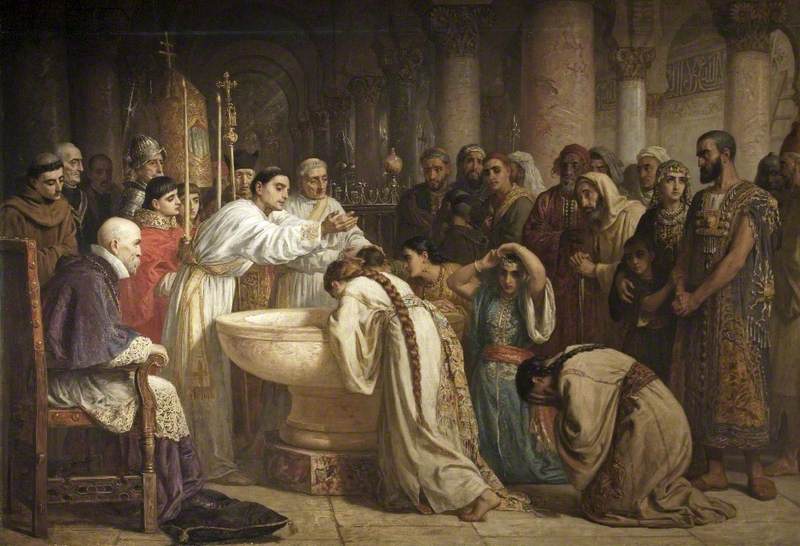
Many converted, often referred to by Christians as “conversos” (Jews) or “moriscos” (Muslims) but were constantly under suspicion of reverting to their old religion even with the threat and constant trials and torture of the Spanish Inquisition.
According to what I have read the latter too were sometimes called “marronos”, i.e in the eyes of the Spanish Christian ruling class, those who had been “domesticated” (Christianised) but had “returned to the their wild way” (Moslem), i.e “gone feral”.
Forcedconversionsthat had to appear genuine: “The Moorish Proselytes of Archbishop Ximenes”, Granada, 1500 by Edwin Long (1829–1891). (Image source: Internet)
Wikipedia on Marrones in Iberia confirms: The (Spanish) Inquisition was aimed mostly at Jews and Muslims who had overtly converted to Christianity but were thought to be practicing their faiths secretly. They were respectively called marranos and moriscos.
However, in 1567 King Phillip II directed Moriscos to give up their Arabic names and traditional dress, and prohibited the use of Arabic. In reaction, there was a Morisco uprising in the Alpujarras from 1568 to 1571. In the years from 1609 to 1614, the government expelled Moriscos.
3. THE BUSH FROM THE NUT?
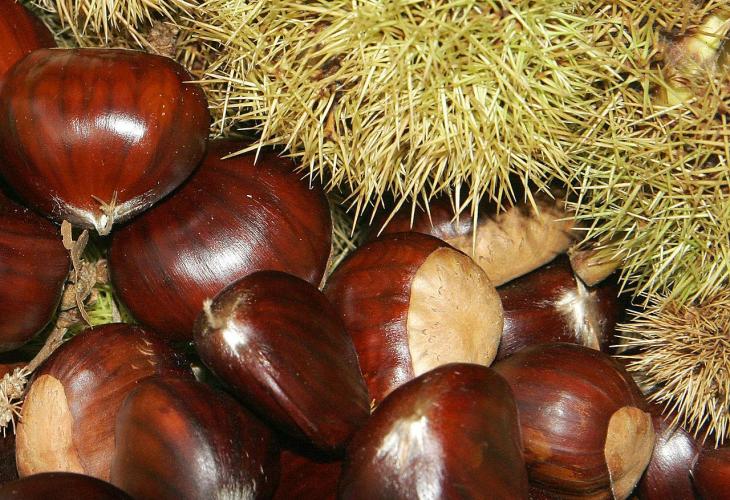
And is “ci” or “cy” in “cimarron” then merely a prefix? The word “marrón” exists as a colour in Castilian and a number of Romance languages and came into English as the colour “maroon”.
Its development is taken as originating from the colour of the large ripe edible chestnut, rather than given to it later. Of course there are a number of words for colours or tints which have a botanical origin, “orange” being an obvious one.
Castanea Silva, the edible or Sweet Chestnut in Mallora. (Image source: Internet)
Alright, then the nut and tree might have been associated with uncultivated or “wild” areas, similar to those to which the “cimarrons” would escape.
But where did the “ci” suffix come from? Somewhere in the midst of what I have been researching I came across an explanation, derived from Latin, meaning “towering”, “high” etc. But can I find it now? No.
The online sources are telling me that the relevant pages are up for deletion and I can join the discussion. No thanks, I do not have anything like sufficient knowledge to enter a debate on that, nor the patience of an academic to research it thoroughly.
But “high” and “wild” could easily correspond, given that valleys and plains lend themselves more easily to cultivation, as a rule, than mountainy areas, which might remain wooded or with with thick undergrowth.
And that might also give us the “bush” or “thicket” referred to in a number of references for “cimarron”, which in turn might describe the “cimarron strips”. In parts of Latin America such as Chile (and for all I know, in all of them), a “cimarra” is also a thicket or densely-grown area.
The article in the Language Journal (see reference) comments that the “arra” cannot be a Romance language word-ending.
But even if true it seems to me that the author (or authors) quoted might be unaware that among those from Iberia who colonised or settled in the Americas, Romance language speakers were not alone. There were also Basques who spoke Euskera/ Euskara.
And for evidence, they applied a number of toponyms and left family names from the Basque Country (Basque descendants make up to 10% of the population of some Latin American countries). And “-arra” would be a common enough suffix or word-ending in Euskera.8
Opening title for the weekly TV Western series ‘Cimarron Strip’, starring Stuart Whitman, Judy Gleeson, Percy Herbert and Randy Boone. Though popular, only a years’ worth of episodes were screened. (Image source: Internet)
OKLAHOMA PANHANDLE AND THE CIMARRON STRIP
In the 19th Century wars between the Mexican Republic, the USA and the Native Americans in the area, the area was carved up with less and less left to the Native Americans.
Prior to the American Civil War, white Texas wanted to join the Union as a slave state and due to a US federal law prohibiting slavery north of 36°30′ parallel north, white Texas surrendered a strip of land north of that latitude.
The settlement (temporary of course), left a strip as “Neutral Territory” (one can only imagine the temptation for African slaves in Texas to make for there). After the Civil War big cattle ranchers moved in, disregarding treaties and named the area the Cimarron Strip.
Map of Oklahoma territory and “Neutral Strip” before the American Civil War. (Image source: Wikipedia, Texas Panhandle)
But that was because the word ‘Cimarron’ was already in the area, from the “Cimarron Cutoff” leading to a crossing of the ‘Cimarron’ river.
And yes, there was a popular 1967-1968 TV series called “Cimarron Strip”, starring Stuart Whitman. But, though I have watched it, that is only faintly related to the story of the word that set me out on this quest.
End.
FOOTNOTES
1Which days later had still not arrived – perhaps the site is no longer in operation, which would explain the silence after those two posters.
2Columbus voyage to America 1641 and Spain’s first colonial settlement 1565 (now Florida); Mayflower expedition to America with English settlers 1587 (now Virginia). However, Europeans had founded settlements much earlier, as with the Norse in the 10th Century and very likely Irish monks in the 6th Century. But it was the English and Spanish who conquered most, the Dutch, French and Portuguese less. The descendants of the English settlers after gaining independence from England completed the seizure and colonisation of most of the North American continent, while English colonists remaining loyal to the English Crown seized land to form what is now Canada.
4All the folk tradition, albeit conflicting on some points, declares that she had not been a slave which leaves one to wonder how she might have reached Jamaica from Africa without having been enslaved.
5I borrowed the book from the public library and cannot remember its title at the moment. Interestingly it mentioned Ireland as having the only comparable history (though of course there the ‘expulsions’ were due to colonial occupation rather than actions of the indigenous state.
6“Romance languages” is a name given to the group of Indo-European languages including Castilian (Spanish), Catalan, Galician, Portuguese, Romanian, Italian and French. They are sometimes called “Latin-based” or “Latin Languages” but there is some dispute about the origins and developments of these languages.
7Ironically, the door or gate “key” is also a symbol of return for Palestinian refugees driven from their homes by Zionist massacres, threats and fear during the founding of the State of Israel.
8Among toponyms of North America’s southwest, Durango (Colorado and Mexico), Navarro and Zavala Counties (Texas) are perhaps the best known; while Aguirre, Arana, Bolívar (Bolibar), Cortazar (Kortazar), Duhalde, Echevarria (Etxebarria), García, Guevara (Gebarra), Ibarra, Larrazábal, Mendiata, Muzika, Ortiz, Salazar, Ugarte, Urribe and Zabala are but some among a host of family names of Basque origin from the American south-west in Latin America. And of course the country of Bolivia, from Simon Bolívar, a Basque surname from a Basque toponym.
Excerpt on-line from Language journal, Linguistic Society of America, Leo Spitzer, Vol. 14, No. 2 (Apr. – Jun., 1938), pp. 145-147: https://www.jstor.org/stable/408879?seq=1
26 July 2023 (First published in Socialist Democracy, reprinted by kind permission of author)
Sinéad O’Connor has died. Her death at the age of 56 was announced on RTÉ.
The evening news programmes went into overdrive to pay tribute to an incredibly talented musician. As with all such tributes, the great and good were asked for their opinions or they offered them in any case and they were carried uncritically.
Sinéad O’Conner and daughter Roisín on anti-racist demonstration, Dublin, 2000. (Photo sourced: Internet)
You are not supposed to speak ill of the dead in Ireland, but more than that, you shouldn’t speak ill of those who seek to praise the dead, no matter how hypocritical they are.
There were many milestones in her musical career, not least her rendition of Nothing Compares 2 U. The media highlighted her musical talent, her voice, sometimes describing her as controversial and outspoken and much loved by the public.
Yes, she was loved by the public, to a point, and also by other musicians around the world. However, she was also despised by many, written off and derided by commentators. As with many artists when they die, there is a tendency to rewrite history.
Her politics were sometimes erratic and lurched from one thing to another, though she was always honest and forthright when she did so, unlike many a coward. As erratic as some of her opinions could be, there were no smug self-serving platitudes to fall from her lips. She was no Bono.
She was honest, frequently angry and went after the powerful at times.
The famous incident where she tore up a photo of then Polish Pope, Wojtla in protest at his covering up and enabling of child sexual abuse, a topic she was painfully personally aware of in her own personal life did not go down well with some of those now praising and lamenting her passing.
Bono doesn’t do tearing up photos of popes, he sups with George Bush, the late senator McCain, toured Africa with the head of the World Bank, to name just a few of the scumbags he was not only too happy to rub shoulders with but positively revelled in.
Fianna Fáil and Fine Gael leaders have expressed their sorrow at her death.
They weren’t expressing any support when she denounced child sexual abuse, the entire Irish political establishment were busy helping the Catholic Church cover it up, and later facilitated the institution to evade its legal, financial and moral responsibility.
Their attitude is best summarised in a typical hypocritical Irish attitude when dealing with those who make us uncomfortable that goes through phases of saying, “She’s mad, isn’t she great gas altogether, she may have a point but…, fair play to her, didn’t she speak up at the time”.
All of this without ever examining their own role in it all. The fact that, as we speak, reports of the sexual trafficking of children in care are being ignored by the government, says all you really need to know about their attitude.
If a new musician of her talent and courage were to speak out now, she would be cancelled and silenced by many of those now praising her, including some of those on the left, who have grown quite fond of not breaking ranks and clamping down on those who did.
She always spoke about mental health issues, though she became much more public about her own issues as she got older. She even broke down on a video about it, locked away in a hotel, crying. The video led to many expressing their concern, but also a bit of “there goes that one again”.
We will no doubt get many commentaries on air and in print about her struggles with her mental health, many expressing concern and sympathy with her plight. Many of them will be hypocritical.
It is true that Irish society is more open now about people who have mental health problems, though there is still a stigma attached to it.
Sinéad O’Connor (Photo sourced: Internet)
Ironically RTE followed up the news of her death with another story on the shambolic, criminal (my word, not the words of the media cowards) state of the child mental health services in Ireland (CAMHS).
Micheál Martin and Leo Varadkar may even refer to her troubles in their tributes, but they never cared about them then, they don’t care now and the proof is not only the state of CAMHS, but mental health facilities in general, with long waiting lists, a rush to medication and forgetting about the patient model of care.
Her politics were erratic in many ways, though in fairness they weren’t much more erratic than others who are not judged as quickly. She flirted with republicanism, then broke with them, even applied to join the more recent incarnation of Sinn Féin in 2014, before withdrawing it.
It may be hard to take that seriously, but it was no less ridiculous than Bono condemning the IRA and then spluttering out nonsense about how he admired Bobby Sands. He didn’t, never, ever, when it mattered.
Sineád for all her failings took positions that were unpopular unlike some of the vomit inducing smug types that populate the modern music industry.
For my own part, her politics on racism were without fault. Her song Black Boys on Mopeds is excellent. It points out the hypocrisy of Thatcher criticising China whilst British Police like James Bond had a licence to kill.
“Margaret Thatcher on TV Shocked by the deaths that took place in Beijing It seems strange that she should be offended The same orders are given by her”
The song goes on to say something truer today than before.
“These are dangerous days To say what you feel is to dig your own grave”
And then a description of England, that the great and good would run a mile from.
“England’s not the mythical land of Madame George and roses It’s the home of police who kill black boys on mopeds.”
Now she will be lionised in death, praised, described as troubled, talented, controversial and much loved. We should ignore the sanitised version we will be given and remember the Sineád O Connor who was treated with contempt and disdain at times.
Aside from her incredible musical talent, that is the version that is worth remembering and celebrating, the version they weren’t too happy to celebrate when she was alive.
In Ireland we like to celebrate talented uncomfortable artists and writers in death in a manner we don’t do when alive. She deserves some coherence from us on this.
Recently the Taoiseach1 of the Irish State criticised people protesting the Government’s plans to slide the state into external military alliances of “misappropriating” the Irish Tricolour and, incredibly, even of “weaponising” it.
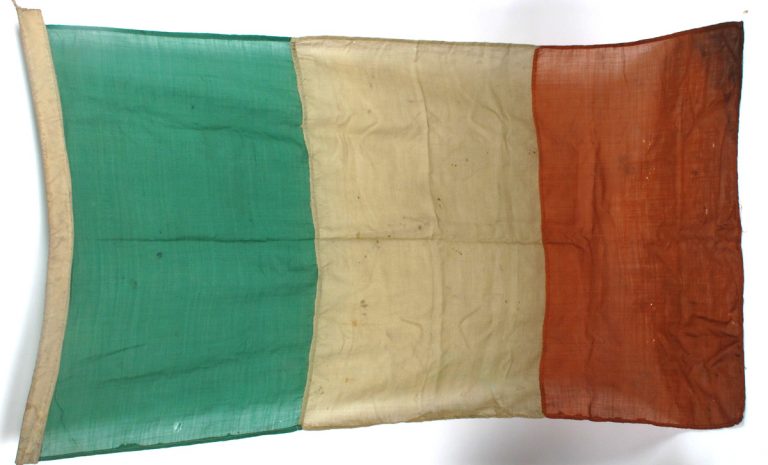
The Irish tricolour was a weapon from the moment it was sewn – a psychological weapon, laden with political meaning, sewn by French revolutionaries, presented to and flown by Irish Republican revolutionaries from generation to generation.
Painting by Philoppoteaux depicting the revolutionaries of the French 1848 Revolution outside the Paris Town Hall and Lamartine rejecting the Red Flag in favour of the French Republican one. Women participants in this revolution presented the Irish Tricolour sewn in silk to Young Irelanders including Thomas Francis Meagher (Source photo: Wikipeda) [When Paris rose again in 1871 under the Paris Commune, the preference was for the Red flag.]
Prior to the advent of the Tricolour, the Irish Republican flag was typically the gold harp on a green background2 but when a group of Young Irelanders went to Paris in solidarity with the revolution of 1848 there, the Tricolour sewn in silk was presented to them by revolutionary French women.
The symbolism of the Tricolour was firstly in its form; the French Revolution adopted a tricolour in opposition to the monarchist Fleur-de-Lison a blue background and different tricolours became popular as flags of new republics.
In the Irish Tricolour, the ancient Irish and the Norman-Irish, basically Catholics, were represented symbolically by green, with orange for the settlers (after William of Orange) of one sect or another of the Protestant faith; the colour white, symbolised peaceful national unity in an Irish Republic.
And it presented an equal unity, as opposed to the unity of Scotland and Ireland with England but under the clear domination of the latter, as represented in the Union Jack, which incorporates the St. Andrew’s and St. Patrick’s crosses with the English one of St. George.
THE TRICOLOUR UNFURLED IN IRELAND
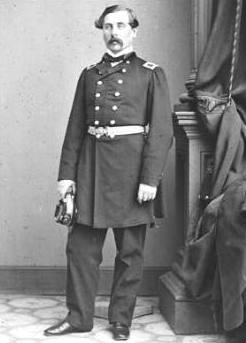
The Irish Tricolour we know was first unfurled by Thomas Francis Meagher “of the Sword” at the Wolfe Tone Club in Wexford on 7th March 1848 and in Dublin in Lower Abbey Street on 13th April 1848.
Meagher’s nickname was due to his renunciation of the Gombeens of his day trying to deny the right to resort to arms if necessary to win freedom3.
Meagher and other Young Irelanders were arrested around the failed uprising of 1848, just after the worst year of the Great Hunger and, after wide-scale international and domestic protests at the sentences of execution, transported to penal colonies, from which many escaped.
Taking his Republicanism and inclusivity seriously, both in Ireland and abroad, Meagher raised and commanded the Irish Brigade (composed of five regiments4) in the United States, fondly nicknamed Mrs. Meagher’s Own, to fight for the Union against the Confederacy and slavery.
As the years of struggle progressed, the Tricolour took its place among the ranks of Irish Republicans alongside the older Harp on Green or, for some Fenians, the gold or orange Sunburst on a blue background and so it was in the 1916 Rising when it began to be the most chosen.
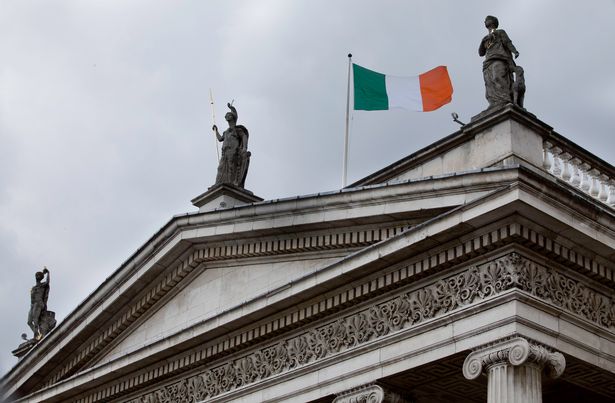
Other flags were flown during the 1916 Rising also but the Tricolour was one of two erected on the roof of the GPO, headquarters of the Rising and became the most prominent during the War of Independence (1919-1921).
The Irish Tricolour in modern times flying over the General Post Office building in Dublin City’s main street (Source photo: Internet)
During the Irish Civil war by the British-supported, armed and provisioned Free State Army against the Republican movement (1922-1923), it was flown by both sides. Even after the defeat of the Republican movement and repression, it was not immediately named the state’s flag.
Though it was displayed by the Free State when joining the League of Nations in 1923, and denounced by the Republican movement as an usurpation, it did not seem that the new state was too attached to it5 and some Irish ships flew the British Red Ensign until 1939 and WW2.
The first time the Tricolour was formally adopted by the Irish State was in the 1937 Bunreacht (Constitution) which was brought in by De Valera’s Fianna Fáil6 Government and even then it was under a pretence of Republicanism with claim laid to the whole of Ireland.
Display of the Tricolour was suppressed in the Six Counties colony from 1922 and officially banned under the Flags and Emblems Acts (1954). Many a battle was fought with the colonial police by people asserting their right to display it, the Act not being repealed until 1987.7
“A FLAG OF INCLUSIVITY, MISAPPROPRIATED BY A MINORITY”
One must agree with Varadkar that the flag signifies inclusivity and was misappropriated by fascists and other racists in recent years but it is shameful of him to attribute similar exclusivity to Republicans, who in many cases fought those same fascists to which he referred.
Leo Varadkar, current Taoiseach of the Irish Government, who accused protesters for Irish neutrality of “weaponising” the Irish Tricolour (Source photo: Internet)
Not only fought them in recent years but also back in the 1930s, when Irish fascists were called the Blueshirts. Surely Varadgar is familiar with the latter’s history also, since they were one of three reactionary groups that joined to create Fine Gael – yes, Varadkar’s own political party.
And the first Irish Republicans, the United Irishmen, sought the unity of “Catholic, Protestant (Anglican) and Dissenter (other Protestant sects)” for an independent Republic, an ideology carried on by all Republican groups thereafter and given expression in the 1916 Proclamation.
But this is not the first time that people in authority have tried to equate Irish Republicans with fascists, as a few years ago Garda Commissioner Drew Harris issued a press statement in which he accused Republicans of having organised a far-Right demonstration — which he later recanted.
One would think Drew Harris, ex-Assistant Commissioner of the British colonial police force, the PSNI8, well-known for their sectarianism and collusion with the colonial brand of fascism, the Loyalists, would be able to distinguish between Irish Republicans and fascists with ease.
Varadkar is ridiculous in accusing Republicans of “weaponising” the Tricolour since it wasalways an ideological weapon from the moment of its creation and then eventually used by the State to try, with monumental lack of success, to deny it to Republicans.
But Varadkar is right in that the Irish Tricolour has been misappropriated by a minority; but rather than Republicans, that minority is the Gombeen ruling class, foreign-dependent, neo-liberal, selling out the country’s resources and networks to foreign capitalist monopolies.
And causing homelessness, or rent and mortgage hopelessness, emigration and austerity for the vast majority of the people in the Irish state, both native and immigrant, for the benefit of a tiny minority of parasites incapable of even developing a viable Irish national economy.
Republican groups, like all groups are minorities but so are the elites, though even smaller. But in representation? Republicans, whatever faults they may have from time to time clearly represent a much larger and wider section of society than do the Gombeens.
This has been evidenced by the militant opposition of wide Irish society to triple water taxation and privatisation, repugnance for the celebration of British occupation forces and the wide opposition to joining a military alliance, all projects pushed by the Gombeens in different governments.
The Irish Tricolour has been commented upon in a number of Irish Republican songs, sometimes even in the song title: White, Orange and Green and Green, White and Gold.
Probably it is most appropriately referenced in the chorus of a song directed at the Gombeens, the very minority who have misappropriated it:
Take it down from the mast, Irish Traitors, It’s the flag we Republicans claim; It can never belong to Free Staters For you’ve brought on it nothing but shame9.
End.
The Irish Tricolour that was flown over the GPO in 1916 (Source photo: 1916 Rebellion Tours)
FOOTNOTES
1 Currently Prime Minister of the Coalition Government of Fianna Fáil, Fine Gael and the Greens.
2 Flag of the Society of United Irishmen, who led insurrections in 1798 and 1803.
3 Daniel O’Connell’s son intended to force a motion of that kind on the Irish Repeal Association founded by his father and also sought to have the motion passed without debate. O’Meagher said that while he did not exalt violence, neither would he allow his sword to be taken from him in case it should be needed. He and others such as Thomas Davis left the Association at that point and became known as “the Young Irelanders”, first mockingly and later with pride.
4 Including the 69th New York Infantry or “Fitghting 69th”. 7,715 men served in the brigade, 961 were killed or mortally wounded and around 3,000 were wounded. (Wikipedia The Irish Brigade)
5 A 1928 British document said: The government in Ireland have taken over the so called Free State Flag in order to forestall its use by republican element and avoid legislative regulation, to leave them free to adopt a more suitable emblem later. (Wikipedia)
6 The party was a split from the losers of the Civil War of which De Valera had been leader, formed in order to participate in elections for Government and presented itself as Republican. The 1937 Bunreacht also laid claim in Articles 2 & 3 to the whole of Ireland which were removed in
7 During a period of direct rule by the British Government.
8 The colonial gendarmerie, formerly the Royal Ulster Constabulary for the Six Counties, preceded by the Royal Irish Constabulary for the whole of Ireland.
9 Soldiers of ‘22 by Brian Ó hUigín, acclaiming the Republican resistance to the counter-revolution of the Free State during the Civil War.
(Translated to Spanish by unknown source and from there to English by D.Breatnach)
(Reading time:2 mins.)
An amazing history of cooperation between a Russian woman and her cat to survive the starvation of the Nazi siege of Leningrad Sep 8, 1941 – Jan 27, 1944. History presentation in a Saint Petersburg museum.
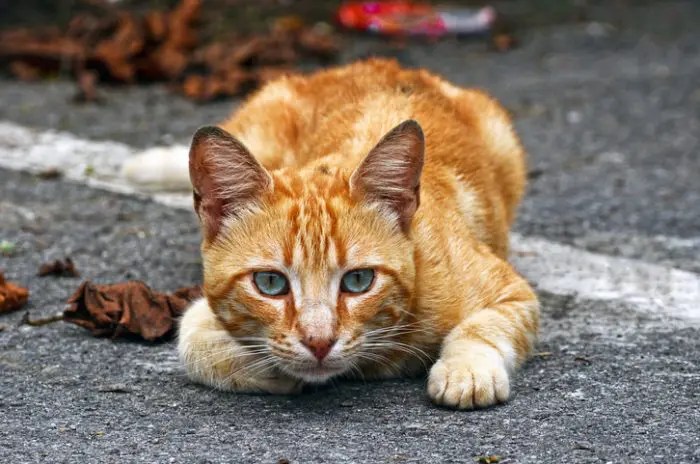
“My grandmother always said that both she and my mother survived the Siege of Leningrad by the Nazis (1941-1944) thanks to their cat Vaska. If it hadn’t been for that cunning red-furred rascal, they would both have starved, as many others did.”
– Granddaughter and daughter of Vaska’s humans.
An image from the Siege of Leningrad (Sourced: Internet)
“Every day, Vaska would go hunting and bring home a mouse or even a big rat. My grandmother gutted the mice and made stew, while with the rats, she managed to make a good goulash.
“The cat always sat next to her (her grandmother) and waited for her turn to eat. During the night, the three of them got under the same blanket and he lulled them to sleep with his purring.
“The hunger was terrible. Vaska was hungry and skinny, like everyone else. All winter my grandmother saved crumbs for the birds, and when spring came she and Vaska would go hunting for them. She would spread the crumbs and then hide with the cat to ambush them.
(Image sourced: Internet)
“Her pounce was always surprisingly accurate and fast. But Vaska was as malnourished as they were, and he no longer had the strength to kill the bird. So, my grandmother would let him just catch it and then she would come to help him. So, between spring and fall, they only ate birds.
“He was aware of the bombing long before they could hear the noise of the planes. When Vaska began to fidget and meow in anguish, my grandmother knew it was time to take her clothes, water, my mother, and definitely Vaska too, and leave home at a run.
“When they had to run to a bomb shelter, being a member of the family, they would also take Vaska and watch him closely so that no one would take him and eat him.”
“At that point in the war, Vaska was very weak, but present in his family, like his story in Russian museums today. Rats abounded because bombing survivors ate cats. Hence, in the middle of the enemy invasion, plagues of rats were also unleashed that further complicated the scenario.
“When the blockade of the city was finally lifted and food came again, and even after the war, my grandmother always saved the best bits for the cat. She would caress him lovingly saying ‘you are our breadwinner’.
“Vaska died in 1949 and my grandmother arranged to bury him in the cemetery. So that no one would trample on his grave, she put a cross on it where she wrote ‘Vasily Bugrov’.
“When her time came, my mother buried my grandmother next to the cat, and later I buried my mother with them. Today, the three lie together under the same tombstone, as in the war, the three together under the same blanket.”
end.
Note: The Siege of Leningrad cost an estimated 800,000 of the city’s inhabitants, one of the statistics that goes to make the 24,000,000 Russian dead of WW2, of which less than half were military deaths.
The decisive turning point of the War was in Russia and all of Eastern Europe was liberated by the Red Army, though today most people in the West would be under the impression that defeating the Nazis was mainly the work of the USA and the UK.
Can you tell which of the clovers growing wild in Ireland is the genuine Shamrock (Seamair óg)?
Now, while it is still in bloom, is a good time to spot the plant, the smaller leaves and the yellow (buí) flower on it is what really distinguishes it from its clover cousins, with their bigger leaves and flowers in white (S. Bhán, T. repens) or pink-red-purple (S. Dhearg, T. Pratense).
How do we know that the Seamair Bhuí (Lesser clover, Trifolium dubium) is the genuine “shamrock”? Well, perhaps we can’t be certain but in the 1890s out of a survey of opinions of people in a still quite traditional Irish society, T. Dubium emerged as the first choice.
The shamrock, Seamair Bhuí/ Trifolium dubium/ Lesser trefoil, about real size, photographed in Dublin city with grass growing through it. (Photo: D.Breatnach)
Amateur botanist and zoologist Nathaniel Colgan (1851-1919) asked people from around Ireland send him specimens of what they believed to be an Irish shamrock, of which the two most common were the yellow clover followed by the white.1
A hundred years later, Dr Charles Nelson repeated the experiment in 1988 and found that yellow clover was still the most commonly chosen.2 According to Wikipeida, the yellow clover is the species nominated by the Department of Agriculture as the “official” shamrock of Ireland.
If you want to pick your own for St. Patrick’s Day, you’ll need to learn to identify it by its leaves because in Ireland it won’t be flowering in March. However, you can spot it now by its flowers and get a mental picture of the size of its leaves to retain in your memory.
THE IRISH AND THE SHAMROCK
What is it with the shamrock and the Irish anyway? The children’s fable of the Christian missionary Patrick using the leaf to explain the Christian Holy Trinity is just that, a fable, although repeated in one of the Wikipedia entries for “shamrock”.
Neither the Celts in general nor the Gaels in particular needed anyone to explain a three-in-one deity, since they had their own pagan trinities (Éiriu, Fódlha, Banba; the Mór-Righean/ Morrigu). Researchers have found no reference to any importance of the shamrock prior to 1681.3
Patrick himself, in what is considered his genuine autobiographical Confessio, never mentioned the shamrock once. My suspicion is that the shamrock-Christian-Trinity fable was fancifully created either by British settlers such as botanist Caleb Threkeld or by native Irish Christians around 1726.4
Although a few sources on line have claimed medicinal properties or druidic use for the shamrock, they never quote the actual original sources which may indicate that the references are undependable or obscure, if they exist at all.
Interestingly, writing a little before the 1798 Rising, Drogheda Presbyterian and United Irishman John Sheil used the shamrock as a reference for a different trinity, i.e that of Catholic, Protestant (Anglican) and Dissenter (all the non-Anglican Protestant denominations).
“ ….. the three-leaved plant …. It is three in one To prove its unity In that community That holds with impunity To the Rights of Man.”5
However, green was the colour of the United Irishmen and at times of repression by the occupation forces and the Loyal Orange Order, a sprig of shamrock on St. Patrick’d Day could be a useful way of indicating resistance while also claiming it was a harmless obeisance to a Christian saint.
Nevertheless, even wearing it on St. Patrick’s Day might have been dangerous in some quarters as when TheWearing of the Green reported, in reference to the shamrock, that
“… It’s the most distressful country that you have ever seen For they’re hanging men and women for the wearing of the Green.”
5The Rights of Man, by John Sheils. The air to which it is most commonly sung is that of the Irish Language song Eanach Cuain/ Anach Cuan but I have composed an original air for it and sing it a little faster than the song about that boat sinking tragedy.
















 rebelbreeze

