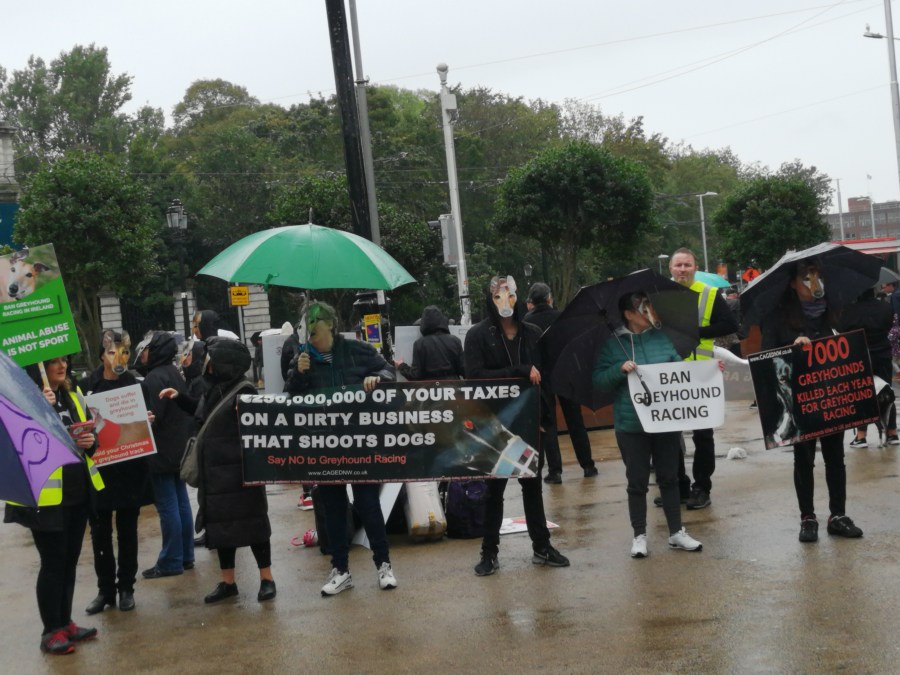
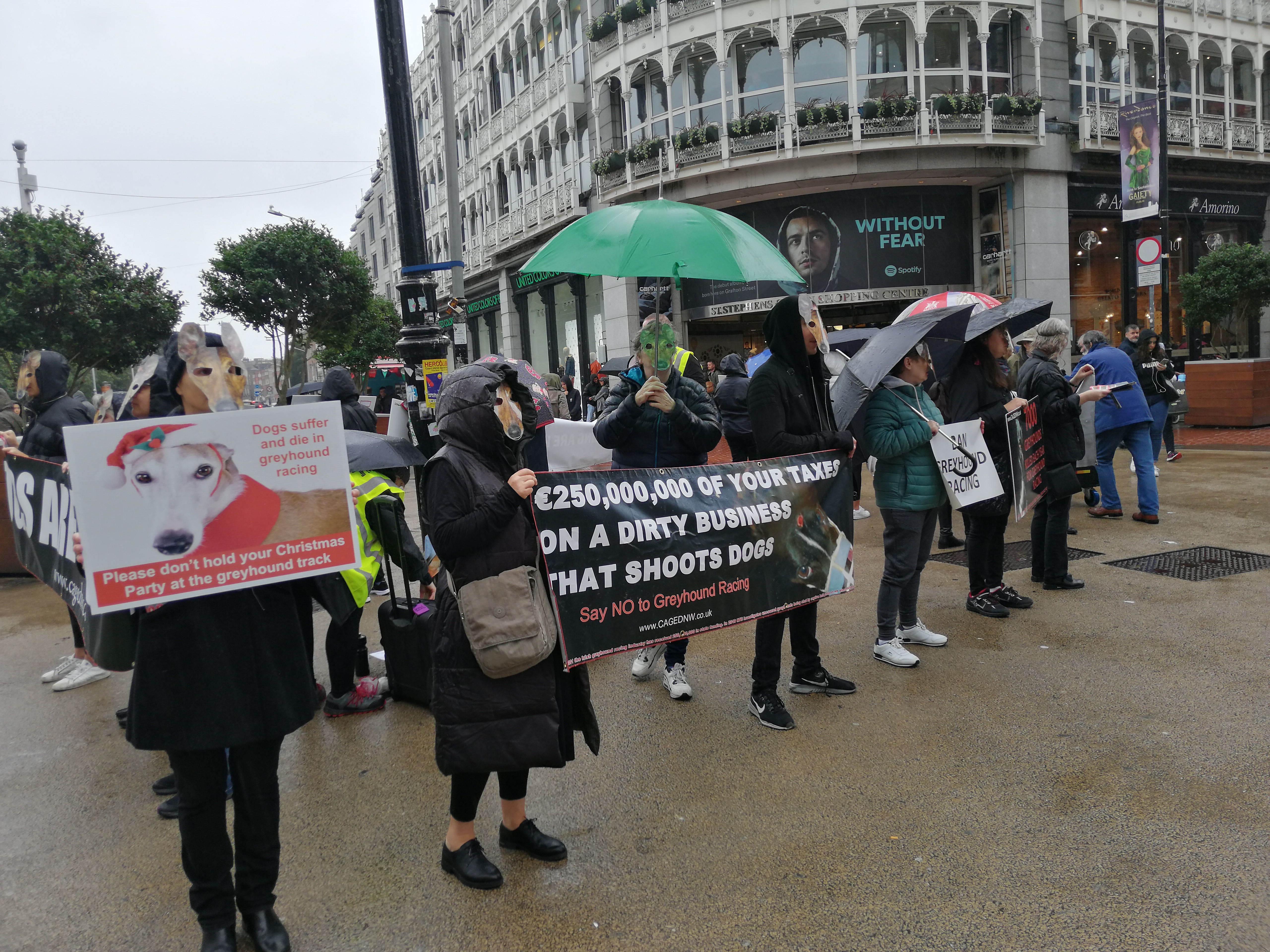
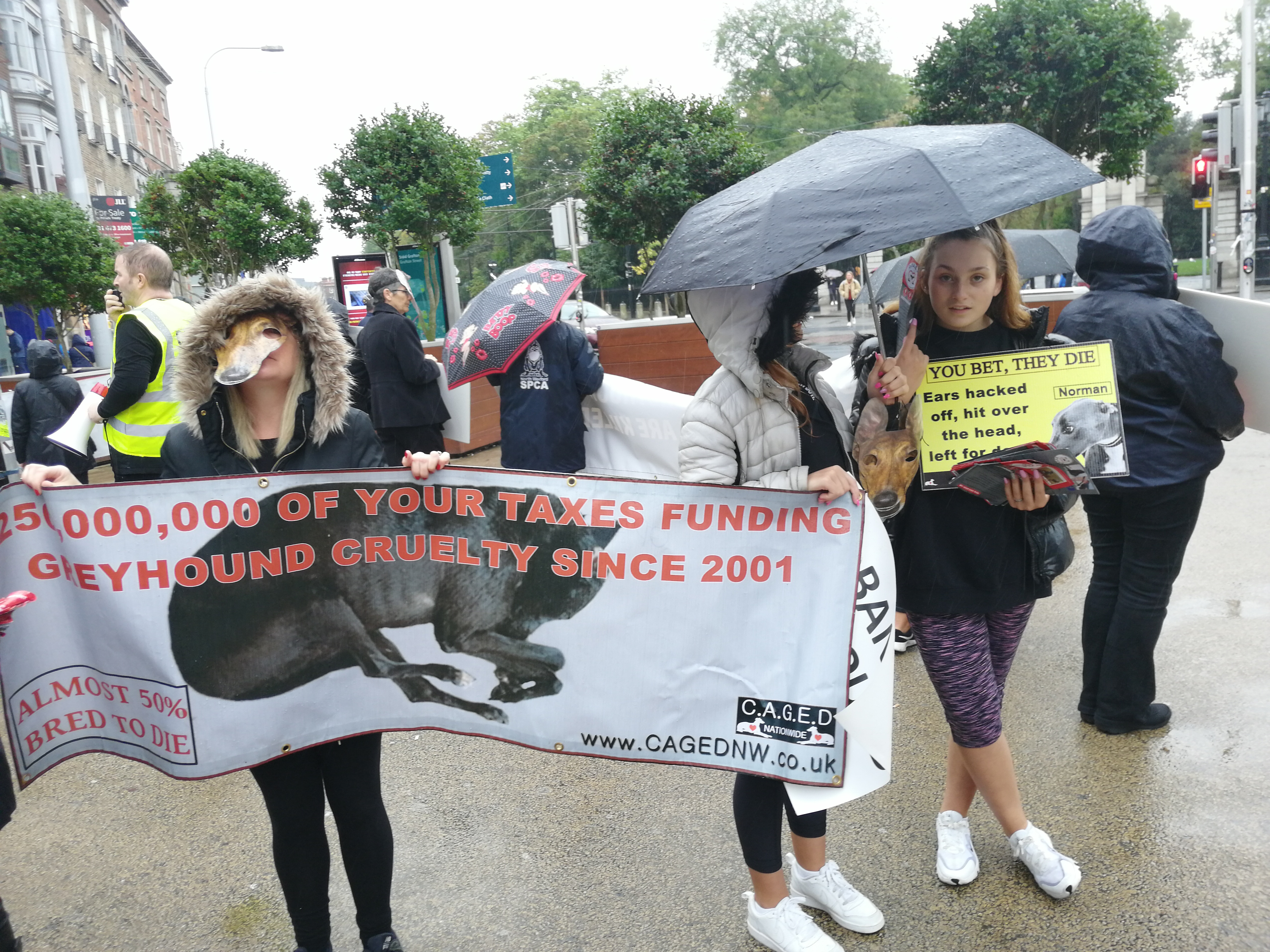
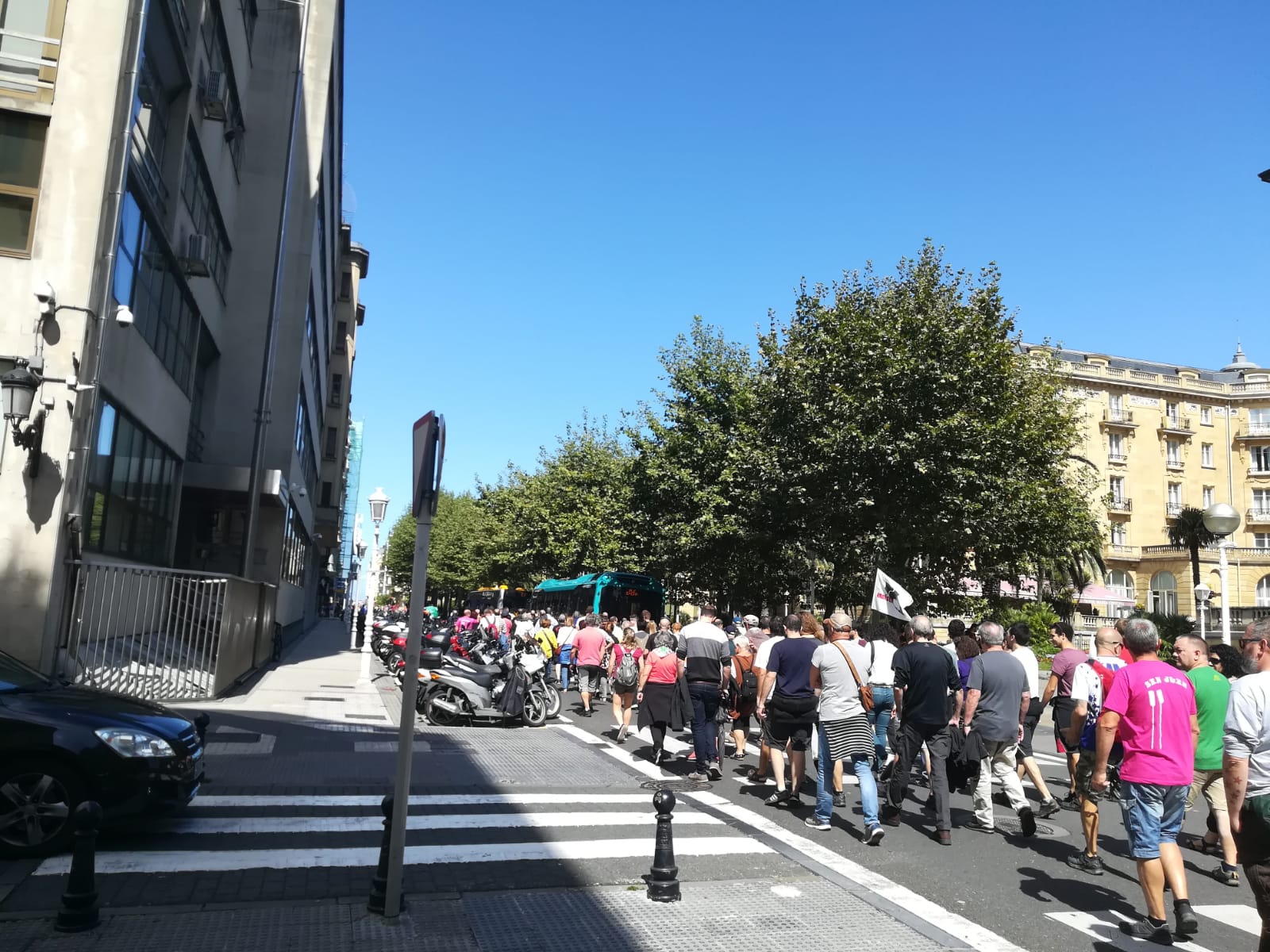
The sight of more than a score of people standing in the rain at the top of Dublin’s Grafton Street drew a lot of attention. And it wasn’t just the dog masks that most of them were wearing. This wasn’t near enough to Hallowe’en, nor was it a carnivale, nor a masque as such: the message projected had nothing of the freedom and joy of carnivale, none of the sexual play and mystery of masque and was darker than the usual one of Hallowe’en. The grim message was on the banners, in the leaflets, in the slogans and the amplified speech.
One of the banners of protesters on Saturday at the top of Grafton St. (Photo: C.Sulish
“You bet – they die” was one of the slogans chanted, illustrating the grim reality of commercial greyhound racing. This slogan was developed for protests outside greyhound racing stadia, notably at Shelbourne Park, near the south Dublin docklands (and, incidentally, not far from the Aviva Rugby Stadium).
Public perception
The reactions of passers-by seemed to vary between amusement, interest, support, surprise and even shock. People who tend to view animal welfareprotesters as cranks who are likely to be middle-class might be somewhat amused or dismissive and it is no doubt to counter this perceived image that the group organising this event is called “Ordinary People Against Greyhound Exploitation”. The support likely came from those who had watched the RTÉ documentary in June, while other reactions might have been from Irish people as yet unaware of the treatment of greyhounds by the industry or by visitors to Ireland who are not only ignorant of the issues but even of the existence of the industry itself.
One onlooker seemed to be demonstrating to his companion the pole lassoo dragging of a dog and then shooting it with a pistol, probably recounting a secretly-filmed incident featured in the RTÉ film. Popular opposition to the greyhound racing industry has been gathering since the screening of the exposure program by the “RTÉ Investigates” team of the Irish television company in the last week of June. The revelations were a shock to people who understood the dogs racing to be a harmless spectator sport with not even a live hare being pursued, a relatively cheap night out (providing the betting was not too heavy) or gambling based on a mixture of luck and previous form knowledge, or even just the communal sport of a few rural people who owned a few hunting dogs.
View of a section of the protesters, viewer facing south. (Photo: C.Sulish)
The industry breeds many dogs in order to ensure a constant supply of fast-running animals and flow of profits and, as a result, bitches are put to breed litter after litter. Pups showing any disabilities will be “culled” and, as the survivors grow, those not considered fast enough will face the same fate. Later, as age begins to take its toll, they will be killed also except for some that might get a few more years as stud or breeder. Campaigners claim that over 6,000 dogs are killed annually and some animal welfare organisations believe the figure may be as high as 10,000. It is the commercial drive that brings these results and the support of the betting public that sustains it – but not that alone, since the Irish State supports the industry with an annual grant of 16.8 million euro. This fact was also highlighted by campaigners in voice and leaflet, while pointing out other better uses for the funding, including relieving the homeless and housing crisis.
Few countries outside of Ireland an Britain have greyhound racing stadia but campaigners claim – and the RTÉ program revealed – that many Irish dogs are sent abroad in inhumane conditions, some at least of which will end up for human consumption.
Section of protesters facing south (Stephens Green Shopping Centre in background). (Photo: C.Sulish)
The campaigners call for the greyhound racing stadia to be closed and, in Dublin particular, the Shelbourne Park stadium, outside of which are held regular demonstrations. They call also for sponsorship by commercial enterprises to cease, a call heeded by a number of companies fearful of a negative commercial impact upon their reputations. This drive was clearly successful when, audibly fearful of a negative impact on the tourism industry, Irish Minister for Tourism Shane Ross called for a suspension of State support in advertising which was followed by Bord Fáilte and Tourism Ireland’s1 removal of greyhound racing from their promotions for visitors to Ireland.
Tourism and Greyhound Racing
The tourist industry is of course vulnerable to the image of the country abroad, which is why campaigners for democratic rights often strive to alter precisely that image, in order to exert pressure on the ruling regimes. Tourists, as they concentrate on sun, sea and possibly Turkish or Iberian food, may be able to set aside images of Spanish police bashing Catalan voters or Turkish police jailing Kurdish campaigners. Ireland has little sun to sell and though plenty of sea, without the sun it can be too cold for most to bathe. What Ireland has for most tourists is an ambience of welcome, of traditional and folk culture and scenery – but the ill-treatment and slaughter of dogs in an Irish industry could quite possibly offset those positive points.
Ross might indeed have been, as he said he was, “shocked” by the revelations but it was clearly the financial rather than principled humanitarian objectives which forced his hand. Martin Ferris, Sinn Féin TD for Kerry, wasn’t motivated by humanitarian principles either when he confronted Ross in the Dáil (see Links below). Although his SF Dáil position is as Spokesperson for Marine and Fisheries, in his intervention he was clearly representing rural support for greyhound racing including, no doubt, commercial dog breeding and racing interests. He claimed the industry was being tarred with the brush of “the actions of a few individuals” and that he was speaking up for “the small boys and girls” (well done for getting that gender equality in, Ferris!) of the rural industry.
“A few individuals” may have been caught red-handed and exposed but the issues are clearly endemic to the industry, the governing board of which suppressed a critical report which it had itself commissioned. Ferris’ public support for that industry and criticism of the Minister’s actions in this case may win him some votes in some parts of Kerry but will hardly be a help to Sinn Féin, increasingly seeking to project itself in the Irish state as a social-democratic party leaning slightly to the Left.
Section of younger protesters facing west. (Photo: C.Sulish)
And the employment figures which Ferris quoted arising from the greyhound racing industry might well be offset by possible negative impact on the Kerry tourism economy.
The dogs in the streets will be talking about what he said ….
end.
FOOTNOTES:
1Bord Fáilte promotes tourism in throughout the Irish state, i.e the Twenty-Six Counties, while Tourism Ireland promotes the same but throughout “the island of Ireland”, i.e including the Six Counties. Tourism NI cooperates with the latter organisation, particularly with regard to tourism in the Six Counties and maintains an information office in Dublin city centre. The first two above are in receipt of funding from the Irish State while the third is funded by the British State.
View of section of protesters facing northwards, down Grafton St. (Photo: C.Sulish)
When ETA, the armed Basque Left pro-Independence group) abandoned armed resistance and decommissioned its weapons, many wondered at the absence of public dissent among its ranks. A dissident trend did appear in the Basque pro-independence movement but it took longer than it had in Ireland; it is in existence now and growing.
In using the term “dissident”, a description not always accepted by those to whom it is applied, I mean those who disagree with the direction taken by the leadership of the organisation and who have therefore separated themselves from the organisation. It becomes a problematic term when it is implied that the “dissidents” have diverged from the original path – on the contrary, those who have left the organisation would say, it is the leadership which has left the path and it is those being called “dissidents” who remain on the “true path”.
ATA demonstration in Donosti/ San Sebastian, 8th September 2019. (Photo source: Amnistia Garrasia FB page)
In the Basque pro-independence movement, as in the Irish Republican movement, the “dissidents” are in a minority but that should not be taken to mean that those who have remained within the “official” movement are in complete agreement with the leadership nor happy with the state of affairs within the movement. Indeed, within the Izquierda Abertzale (Basque Left pro-Independence movement), many are very unhappy indeed. Some do not agree with alliances with social democrats or attempted with the PNV (Basque Nationalist Party), others with complete disarmament, some with disarmament without concessions in return, yet others with particular decisions at various junctures (such as pleading guilty to “terrorism” when the work they had been doing was nothing of the sort, as happened recently in the mass trial of prisoner solidarity activists arrested back in 2013). Or with “apologising to the victims” as the Spanish State has been pressing on prisoners and detainees (the Spanish State of course apologises for nothing, neither the fascist-military uprising of Franco and company, nor the Dictatorship of almost four decades, nor executions, nor recent torture).
There were splits enough in the Irish Republican movement even soon after the Civil War but they also came thick and fast in the early 1970s, out of which grew the Provisionals (Sinn Féin and PIRA) and the IRSP and INLA, leaving Official Sinn Féin and OIRA as a rapidly-diminishing and eventually disintegrating remainder. Another split came about as a result of the electoral path of Provisional SF in 1986, out of which came Republican Sinn Féin. But it was the Good Friday Agreement and its effects which caused the most splits and desertions from the ranks of the Provisionals, leading to the creation of a number of organisations over time: éirigi, 32 County Sovereignty Movement, 1916 Societies, Saoradh and others.
POLITICAL PRISONERS, IRELAND & BASQUE COUNTRY
Most unfortunately, the number of Republican organisations led also to a number of political prisoner support groups and currently there are three main ones: Cabhair (RSF), Cogus (mainly 32 CSM) and Irish Republican Prisoners’ Welfare Association (mainly Saoradh).
In the Basque movement, the Izquierda Abertzale, although there were the abiding split has come over the issue of the Republican prisoners. The traditional line of the IA has always been that the prisoners, whether captured ETA volunteers or political activist victims of repression, are political prisoners. It follows that they should be released in any settlement of the Basque national question. But in the meantime, if prisoners, they should be kept in prisons near their homes so that they can be visited without too much difficulty by relatives and friends. That is not only a humane principle but is underwritten by EU and UN policy recommendations on the treatment of prisoners. The Spanish State, however, keeps its political prisoners dispersed throughout its territory, hundreds and even a thousand kilometres away from the family and friends of the prisoners (as does the French State). This is not only an additional punishment on the prisoners, one which was not a specified part of their sentence but also – and perhaps principally – on their relatives, children, partners and friends.
The organisation Amnistia (Gestoras pro Amnistia) was created in 1970 within the movement to agitate for a total amnesty for the prisoners. As is usual with the Spanish State, in 2002 it banned this organisation also as one “assisting terrorism”, threatened its activists with prison and the organisation ceased to exist publicly, their trial beginning in 2008. The State’s outlook was fully expressed in the infamous statement of the former judge and overseer of torture but so beloved of liberals, Baltazar Garzon: “Everything is ETA”.
The organisation of relatives of prisoners on the movement’s “official” list, Etxerat (Homeward) continued to exist and to organise visits, share information and agitate about the prisoners’ treatment but it is not a political organisation as such, which is difficult to combine with welfare work.
To carry out the specifically political work around the prisoners, the organisation Herrira (to the Homeland) was created some years ago. The Spanish State reacted in the usual manner and arrested a number of its activists – for “assisting terrorism”, of course. After that, it was noted that the official line had changed – while not specifically abandoning the call for amnesty, now only the call for and end to dispersalwasheard (along with of course the repatriation of seriously or terminally-ill political prisoners).
View from the rear of ATA demonstration in Donosti/ San Sebastian, 8th September 2019. (Photo source: Amnistia Garrasia FB page)
LEADERSHIP CHANGE IN LINE AND DISSIDENCE
The change in line, the dropping of the demand for amnesty, led to the creation of a new Amnestia, but with the addition of Ta Askatasuna (and Freedom), this time in the hands of “dissidents”. The “oficialistas”, the current leadership of the main body of the pro-independence movement, Otegi, EH Bildu etc, say this is pure opportunism on the part of the dissidents, who are expressing their disagreement with the abandonment of armed struggle and dissolution of ETA by seizing on the issue of amnesty for political prisoners. They could be right, of course, at least in part. But unlike the leadership of SF and PIRA, the Basque “oficialistas” got no deal whatsoever for their prisoners.
Recently, a significant part of their youth section Ernai left the “oficialistas” and maintains a working relationship with the new ATA. Their issue was that they had prepared a position paper for discussion at the annual congress and the “oficialistas” had refused to permit it to be discussed, since it was critical of current leadership positions.
Another group, Jarki, is revolutionary, socialist, for independence, internationalist and in defence of the language and has been organising.
Apart from those three trends, there also exist anti-authoritarian, ecological etc trends that owe no allegiance to the official leadership of the movement. These are national in the sense that they are spread across the Basque Country and also in that they speak and write in Euskera (Basque language); they are also for social justice, feminist, anti-racist and anti-sexuality discrimination.
It remains to be seen to what degree these various trends will coalesce and whether the “official” movement will continue to see defections from its ranks.
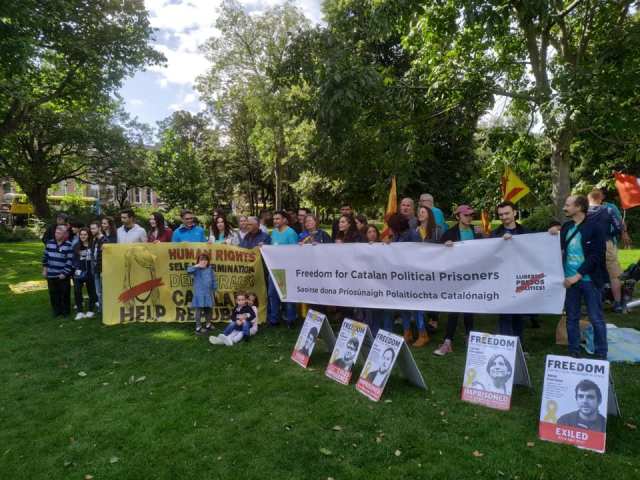
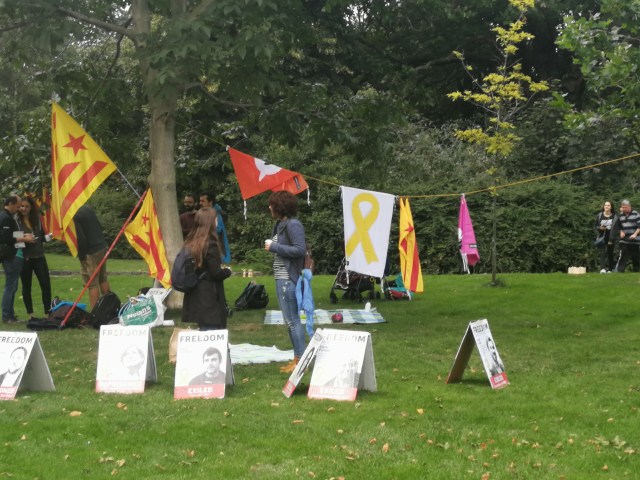
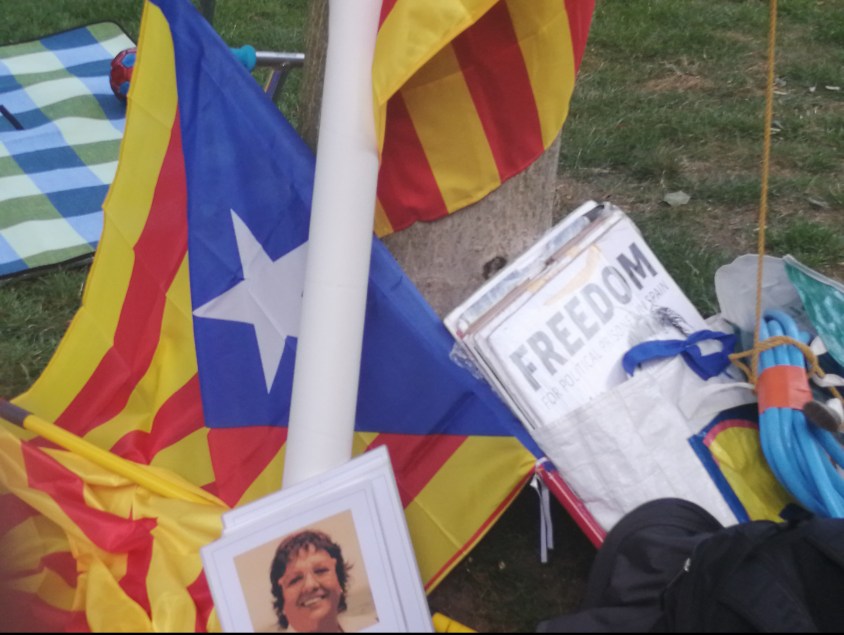
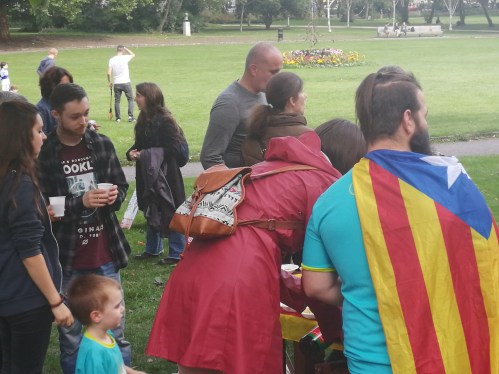
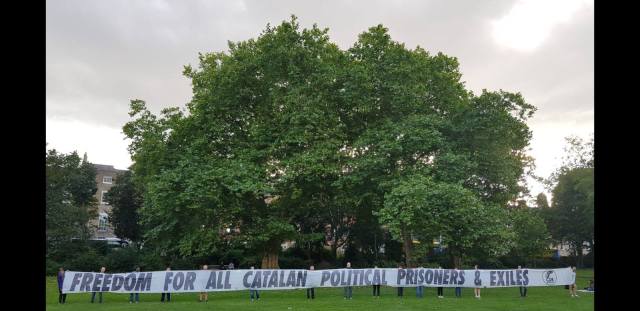
The Diada, national day of Catalan identity and of resistance was celebrated in Dublin’s Merrion Square on Saturday 7th September with traditional food, drink, games and music. Catalan independentist flags and banners were also on display as were portrait placards of Catalan political prisoners of the Spanish State.
Some of the attendance at the Dublin Diada lined up with banners etc (photo: D.Breatnach)
THE DIADA
The Diada Nacional de Catalunya (Diada for short) is the National Day of Catalonia, a one-day event celebrated annually on the 11th of September. It commemorates the fall of Barcelona during the War of the Spanish Succession in 1714, which resulted in Catalonia’s institutions and legal system being abolished and coming under the domination of the Spanish crown.
The Army of Catalonia backed the Habsburg claim to the Spanish throne, believing thereby that Cataloni’s national autonomy would be respected. However, the army of the Bourbon King Philip V of Spain was successful and Barcelona fell after a siege of 14 moths.
It Diada first began to be celebrated in 1888 and gained in popularity over succeeding year and in 1923 was a mass event with events all over Catalonia. However clashes with the Spanish police resulted in 12 protesters and five police being wounded and a number of arrests. Primo Rivera’s dictatorship banned it but during the 2nd Spanish Republic (1931-1939) the Catalan Generalitat (Government) made it an institutional festival. With the fall of Catalonia to the military-fascist forces of Franco and others, it was banned and celebrated only in people’s homes.
The first renewed public celebration of the festival was in 1976, following the death of Franco the preceding year and in 1977 was the occasion for a huge demonstration demanding independence for Catalonia and in 1980 was made official by the Generalitat.
With the renewed growing push for Catalan independence, the day has been the occasion for huge demonstrations demanding self-determination. For some years now the ANC (National Assembly of Catalonia), which claims to be the largest grass-roots organisation not only in Catalonia but in the world, has been the main organiser of the Diada and has used it as part of its mobilisation for indpendence (which presumably is the reason the Spanish State has put its former President, Jordi Sanchez, on trial on charges of sedition and rebellion and in detention since 2017, the verdict expected this month or next.
Although the Diada commemorates a crushing defeat for Catalan self-determination, its celebration has become an occasion of re-affirmation of that desire, a public sign of resistance. Massive demonstrations once again have been held and, as in Dublin, expatriate and Catalan diaspora communities around much of the world have celebrated it publicly this year, particularly in Europe but also in Latin America and in the USA.
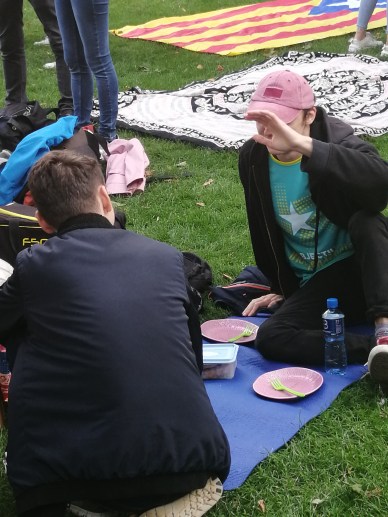
“So now you skip while I turn the rope.” (Photo: D.Breatnach)“Ok — but what is ‘skip’?” (Photo: D.Breatnach)A good time to plan. (Photo: D.Breatnach)
THE DUBLIN EVENT
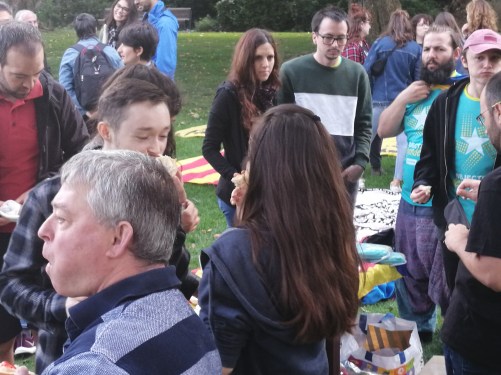
Merrion Square, a public park in the Dublin city centre, was the venue for the Diada event organised by Catalans in the Irish branch of the ANC and by Dublin CDR (Comite de Defensa de la Republica) on a the 7th, which was a Saturday.
Photo: D.Breatnach
The area was decked out with estelladas (Catalan independence flags) and placards bearing portraits of the Catalan political prisoners (see following section on the Situation in Catalonia). Parents attended with their children and games were played with them as well as a traditional Catalan game being available for adults and a few engaged in a version of the poc fada Irish activity with camáin (hurley sticks).
Traditional food and drink was provided also. Commenting on the event, a spokesperson for the organisers said:
“We had a festive and family-oriented Diada (National Catalan Day) in Dublin. We also publicised a call for freedom for the political prisoners and the right of self-determination for Catalonia.”
Not a Catalan sport but when in Ireland …. (Photo: D.Breatnach)(Photo: D.Breatnach)
SUMMARY OF SITUATION IN CATALONIA
The Catalan Parliament has twice passed a number of legal measures which have been judged “unconstitutional” by the Spanish Court and therefore cancelled. These included:
Increased taxes on large companies
a “sugar tax” on sweet soft drinks
ban on bullfighting
access to public medical care for migrants
ban on evictions and high rents
The growing push for Catalan self-determination found expression in a number of growing public events and in October 2017 a referendum was held. The Spanish State banned the referendum and its police raided the Government offices and other places for ballot boxes. On the day of the Referendum, October 1st, Spanish police attacked voters and referendum supporters with a reported nearly one thousand seeking medical attention. They also fired rubber bullets, which are banned in Catalonia, at peaceful demonstrators.
The Catalan right-wing anti-independence parties had called for a boycott of the referendum and many ballots were confiscated by the Spanish police. The majority of those available gave a high majority for an independent Catalonian republic (there were no other options other than “No”).
The then President Puigdemont, backed by the pro-independence majority in the Catalan Parliament, acting on their mandate, in 2017 declared an independent Catalan Republic but immediately suspended it, urged by EU advisers to seek talks with Madrid (which he reflects now was a mistake).
Subsequently the Spanish State prorogued the Catalan Parliament until new elections were held and also charged a number of politicians and social activists with sedition, rebellion and misuse of public funds (allegedly to fund the Referendum). Some, like Puigdemont, went into exile and others to jail without bail; their trial is now over and the verdict is expected later this month or next. In addition, numbers of secondary school teachers have been called to testify because of their responses to the questions of pupils about the Referendum and the destruction to their schools by police and around 700 town mayors are also called to testify for allegedly facilitating the Referendum.
The elections forced by the Spanish State returned a broad political backing for Catalan independence from right to left which finds expression in a number of coalition parties (Junts per Catalonia, Esquerra Republican and Candidatura d’Unidad Popular), opposedby a substantial but minority hard-right unionist oppositioncoalition too (mostly Ciudadanos). The coalition based on the Catalan version of Podemos also has seats but its actual position on independence is not easy to define.
Since then, the Spanish State elections and the European elections have also returned pro-independence candidates but EU senior officials blocked Catalan MEPs who are in exile from taking their seats and another is in Spanish jail, awaiting a verdict.
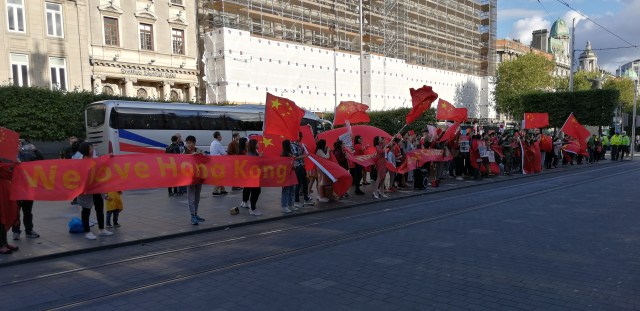
Chinese people protesting the proposed extradition law in Hong Kong and the repression of protests there by the authorities were outnumbered, out-coloured and out-sung by their Chinese opponents in O’Connell Street on Saturday 31st August. However the counter-protesters gave the impression of having been mobilised through the Chinese Embassy.
Those protesting the proposed Hong Kong legislation outside the GPO seemed somewhat cowed by the counter-protesters facing them in the central pedestrian reservation. The former had some printed placards while their opponents had a massive banner bearing the legend “We Love Hong Hong”. They also had an effective public address system and a cheer-leader with a microphone and every now and again he got the whole crowd to burst into some Chinese song. Their numbers and coordination made one think of the cast of the film version of the Chinese revolutionary opera “The East Is Red.”
Counter demonstration in Dublin to Hong Kong protests solidarity demonstration. (Photo: D.Breatnach)
I chanced upon the protest by accident, cycling up O’Connell Street, not having heard about it in advance. As I neared to take a photo, I noted that among the Chinese protesting about Hong Kong, there were some placards of the People Before Profit organisation and some familiar faces.
Upon commenting to their leader that they had been outsung (a flippant comment, I’ll admit), he told me that those protesting about events in Hong Kong had felt apprehensive and had asked for solidarity. He commented to me that he would “always support people struggling for democracy, against extradition” etc. Perhaps – but I don’t recall seeing him (or most of his party) on pickets calling for civil rights for Irish Republicans or against their extradition from the Irish state to British administration.
I don’t believe for one minute he and his party prefer Chinese to Irish people but I do think they are much readier to take up cases of injustice where the target is not either the Irish or the British state. Which is curious for an organisation that declares a revolution in Ireland to be necessary.
SOME HONG KONG BACKGROUND
Hong Kong has a population of around 7,300,000, which includes many who are not nationals. It is a port city of 1,104 sq. Kilometres (426 sq. Miles) and one of the most densely-populated areas in the world.
Hong Kong was occupied by the British in 1812 after they beat the Chinese in the First Opium War, fought by the British in support of their right to sell opium through Chinese ports to the Chinese, which the Emperor unreasonably thought was destroying the Chinese aristocracy and administrative classes.
The British extended their territorial base in Hong Kong to Kowloon in 1860 after beating the Chinese again in the Second Opium War (there were still unreasonable Chinese who didn’t want the British selling opium to them). From 1898 the British ran Hong Kong on the ‘legal’ basis of a 99-year lease (which actually, the British forced the Chinese to grant them) which ran out in 1997. In 1941 the British surrendered Hong Kong to Imperial Japanese forces which remained there until 1945, after which the British took it over again.
The Chinese Emperor having long gone by 1997 and the Taiwan western-supported authorities having no legitimate or believable claim, once the lease ran out, Hong Kong reverted to the main Chinese authorities, i.e the Government of China. Unfortunately for the Hong Kong people, that is the People’s Republic of China which, though flaunting communist symbols, has long ago ceased to be any kind of Communist regime but is not a capitalist democracy either.
However, under arrangements made when the British lease expired, Hong Kong maintains separate governing and economic systems from those of mainland China, expressed in the phrase “one country, two systems.”
DEMOCRACY?
Headlines in the leaflet being distributed by the Hong Kong protesters in Dublin declared that the fight is about democracy and democratic rights. Many media commentators agree with them. Some even talk about restoring democracy to that region.
In fact, Hong Kong has never had democracy. Before Britain annexed it, the port city was run by officials appointed by the Chinese Emperor. After the British took it over, not only was there no democracy for Chinese working people but the administration was openly racist and some “public” areas there declared that no Chinese were permitted entry. In 1925, British troops and police opened fire to suppress a dock strike and demonstrations in Shanghail resulting in over 60 killed in two separate incidents. The resistance spread to Hong Kong and the port was also boycotted, which cost the British dearly.
Even in modern times, the Hong Kong administration was known to be highly corrupt and the special anti-corruption police squad became known as “the graveyard of corruption complaints”, for that is where the allegations and complaints were buried by those supposedly investigating them.
In 1967 Leftist demonstrations grew out of a strike and became wide-scale riots when Hong Kong Police moved to brutally repress them and many of the demonstrators’ leaders were arrested.
In 2013 a dockers’ strike in Hong Kong fought a hard battle against shipping transport companies for 40 days, out of which they emerged victorious. The working conditions that came to light during the struggle revealed aspects that organised workers would not accept in any capitalist democracy or even in some dictatorships.
CURRENT STRUGGLE
The present Hong Kong authorities seem to have come to an arrangement with the mainland Chinese Government, since Carrie Law, the Chief Executive of Hong Kong, introduced the bill which has sparked three months of protest. Under the provisions of this bill, an alleged lawbreaker in Hong Kong could be extradited to mainland China. When people protested in Hong Kong, the authorities sent their police to beat up the protesters and to arrest them, just as the British used to do in the old days.
And the laws that are being used to attack and jail demonstrators are exactly the same ones that have been in force for decades in British Hong Kong, as the Financial Times points out, although it suggests they were OK under the British but are “outdated now” (see References)!
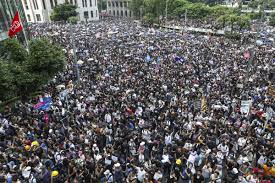
Photo taken on demonstration in Hong Kong (Photo source: Internet)
The opposition to the bill has seen demonstrations, occupations and strikes. On 5 August, there was a strike, this time successful, with the airport and flight industry employees playing a prominent role. The Communist Party of China is now asking for the list of Cathay Pacific employees who went on strike but the union won’t release the list. Estimates of participation in the strike vary between 300,000 and 400,000 people.
Airport public areas have also been occupied en masse which of course hits tourism and personal contact business, along with some exports and imports. On 12 August, another huge occupation of the airport brought about a threatening response from the PRC State; it sent about 10,000 armed police to the border with Hong Kong.
Carrie Law recently stated that she has withdrawn the bill which satisfies one of the demands of demonstrators but another four have been put forward:
“Retract the classification of the protests as ‘riot’ ” (presumably with legal consequences)
“Appointment of an independent commission to inquire into the excessive violence used by the police in the protests”
“Dropping charges against demonstrators” (but what about those already jailed?)
“Implement a Dual Universal suffrage to elect a truly democratic government”
WHO OR WHAT SHOULD WE SUPPORT?
As in many of these types of struggles there are likely to be a number of elements involved among the demonstrators and strikers, including leftists, basic democrats, anti-communists (even fascists) and pro-western imperialists.
I do not see any reason to defend the current or past administration of Hong Kong – quite the contrary. Nor do I see any reason to defend the Chinese State administration which has lost all content of communism it once had and in which only some of its form survives. As far as democracy goes, the People’s Republic of China has suppressed demonstrations against corruption or by defenders of their environment, as well as hundreds of strikes and sent tanks to suppress a demonstration in Tienamen Square, resulting in an unknown number of dead, injured and jailed. On the other hand, Hong Kong is not even a bourgeois — to say nothing of a workers’ – democracy as is shown at present and in its past.
Photo of demonstration in Hong Kong (Photo source: Internet)
It is natural that people in Hong Kong would not want to be extradited to the PRC and it seems to me that resistance to that is worthy of support along with in general the other four demands (although what “independent commission” to enquire into “excessive violence by police” can be appointed in this setup?). But the fundamental problem is that working people in Hong Kong do not control the fruits of their labour and the granting of not even all of the five demands can possibly change that. Where workers are in that situation, their rulers will alway keep repressive measures on hand for use whenever they feel the need to employ them.
Clearly the solution is not for the intervention of the USA or any other imperialist state either.
Therefore what I think we should support most is the mobilisation of the working people for socialist revolution and their participation in these current struggles will educate them as well as giving their most class-conscious elements the opportunity to enhance that education and, necessarily, organisation.
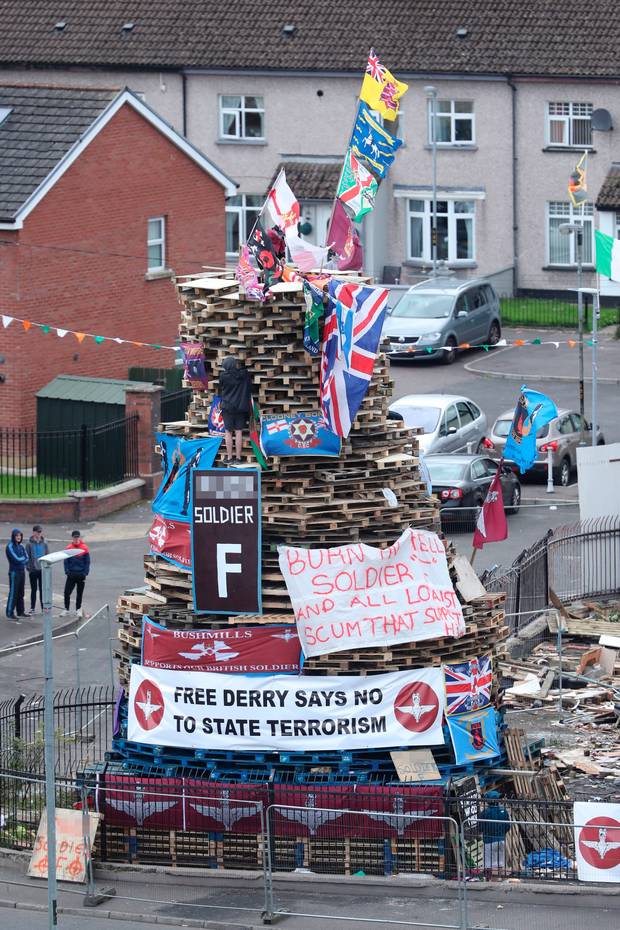
A recent article of the Belfast Telegraph, a British-Unionist paper, reports that nationalist youth have built a bonfire and decorated it with, among other things, a banner representing the Parachute Regiment and another representing “Soldier F”. The article reports that the Police Service of Northern Ireland are treating this as “a hate crime”.
The bonfire preparation referred to in the Belfast Telegraph article (Photo source: Internet)
The newspaper comments also that this bonfire is associated with “anti-social behaviour” the nature of which however they neglect to specify. Although the article treats the PSNI statement as unremarkable and neglects to interrogate it as responsible journalism should do, the police statement is actually not only totally inaccurate in terms of law but also discriminatory and oppressive.
One definition of “hate crime” from an on-line dictionary is a crime, typically one involving violence, that is motivated by prejudice on the basis of race, religion, sexual orientation, or other grounds.
Wikipedia posts at greater length and depth:A hate crime (also known as a bias-motivated crime or bias crime is a prejudice-motivated crime which occurs when a perpetrator targets a victim because of their membership (or perceived membership) in a certain social group or race.
“Hate crime” generally refers tocriminal acts which are seen to have been motivated bybias against one or more of the social groups listed above, or by bias against their derivatives. Incidents may involve physical assault, damage to property, bullying, harassment, verbal abuse or insults, mate crime or offensivegraffiti or letters (hate mail).
Now, how does placing an emblem or banner to represent the Paratroop Regiment constitute a “hate crime” under any of those definitions? First of all, is it a crime to burn the banner? Not in itself, no and therefore it cannot be a hate crime. But even if burning a banner were defined in law as a crime, how would it fit the definition of “hate crime” as given above? It is none of those categories above that leads to the Parachute Regiment being reviled.
It is interesting, since the issue of “hate crimes” was brought into law, how incorrectly they are being ascribed by people in authority and by mass media and, curiously, applied to people struggling for national self-determination against repressive states and also to those opposing fascists. In other words, it is progressive forces that are being accused of “hate crimes” because of their resistance to oppression and resistance. Not the reactionary forces one might suppose were the object of the classification.
Certainly, it is the discriminatory and repressive behaviour towards its large Catholic minority of the ‘Northern Ireland’ statelet since its formation which clearly fits into the definitions of “hate crime”, although often its actions were not defined as crimes since they were authorised by its repressive legislation. Nevertheless, even within the parameters of that body of legislation the Statelet and its police committed thousands of crimes, including petty harassment, beatings, torture, perjury, arson, collusion with Loyalist paramilitaries and murder.
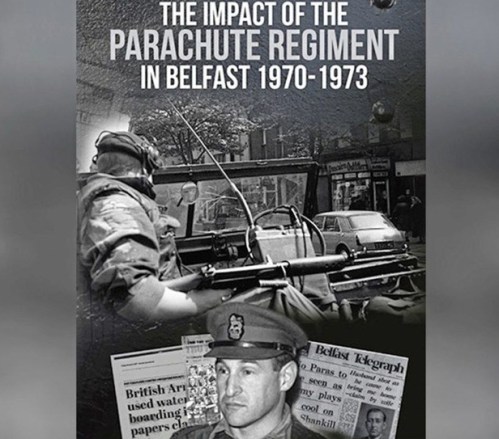
The British Army became an active participant in those crimes when it was sent into the Six Counties to bolster the crumbling government and exhausted sectarian police. Chief among those in criminality was the Parachute Regiment, responsible for an admitted list of unarmed civilian fatalities which includes 10 in Ballymurphy in August 1971, 13 in Derry in January of 1972 and another five in July of that year on the Springfield Estate.
Booklet published by the Pat Finucane Centre documenting the murderous activities of the Parachute Regiment in just four years in Belfast. The bonfire preparation referred to in the Belfast Telegraph article (Photo source: Internet)
It is perfectly reasonable, natural and, I would say healthy to hate the people who carried out those massacres. And to hate them cannot reasonably be called a crime.
“Soldier F” is the only member of that regiment to have been charged with the crime of murder and to be facing trial. As a representative of that murderous regiment he did not become a public target of hate until the Loyalists chose to publicly flaunt their support for him with banners, graffiti and badges. None of those, motivated by hate for the nationalist community, were charged with committing a hate crime. However, when nationalist youth, responding to that hateful campaign of the Loyalists, place the soldier’s alias on a bonfire, suddenly it is they who are accused of perpetrating a “hate crime”.
Photographs of a small selection of prominent street banners in different areas of the Six Counties supporting ‘Soldier F’ and the Parachute Regiment erected by Loyalists (and over which no action was taken by the authorities). The bonfire preparation referred to in the Belfast Telegraph article (Photos source: Internet)
Unfortunate it may be that the nationalist youth have focused on this individual soldier but it is not a hate crime. They are targeting him not because of race, ethnicity, colour, religion, sexuality, disability etc, etc but because of his membership of a murderous regiment and, furthermore, in response to a campaign of provocation by Loyalists against which the sectarian PSNI and Statelet authorities have taken no action whatsoever.
And you know what? Although I am not from Derry or Belfast, I hate the Paratroop Regiment too.And the sectarian Statelet and its sectarian police force and the Loyalist bigots who support it and try to suppress the democratic rights of the nationalist population, as well as of migrants, women and LBGT people.
I could get to hate the Belfast Telegraph as well.
(Reading time: Introduction, one minute; Part One: 5 mins; Part Two 2 mins: Part Three: 3 mins; Part Four: 2 mins; Total: 13 mins.)
Diarmuid Breatnach
INTRODUCTION:
Although I often think about the big questions – and am generally guided by my philosophy on them, my mind and energy are usually too occupied with specific struggles to focus on them for long. Recently however I had the opportunity and the need to think about the war, the one we have yet to win.
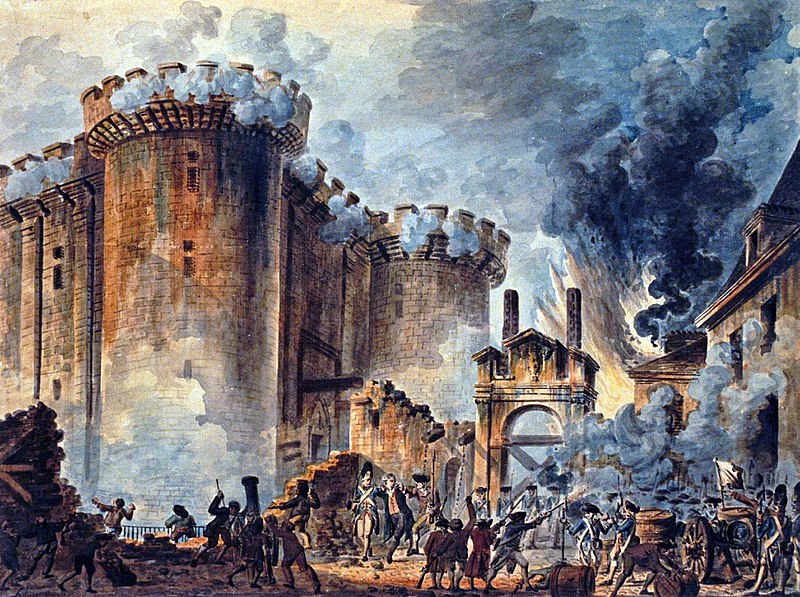
The Storming of the Bastille (translation), French Revolution, 1789 by Jean-Pierre Houel. (Image sourced: Internet)
But to which war am I referring? The Irish war of national liberation that has been flaring up for centuries, being lost each time before flaring up again? Or the class war, which has had a few sharp Irish episodes but has been, for the most part in Ireland, in abeyance? The answer is BOTH, though it may seem that my emphasis in the discussion, certainly in the early part, is on the national liberation war.
In order to imagine how we might win, it is helpful to examine past struggles and analyse what went wrong with them. Pessimists love to focus on those things I know – but in order to push us towards reformism or just surrender; my approach instead is from a revolutionary perspective.
Generally, Socialists analysing the class struggle don’t even ask themselves why we have not had a revolution yet. From week to week, month to month, they tend to focus on this or that particular trade union or social struggle but without going into the big picture. It seems as though they can’t even imagine a socialist uprising in Ireland, it’s just too far away to think about, apparently. But if one can’t even imagine such a revolution, how could one consider the necessary steps to get there?
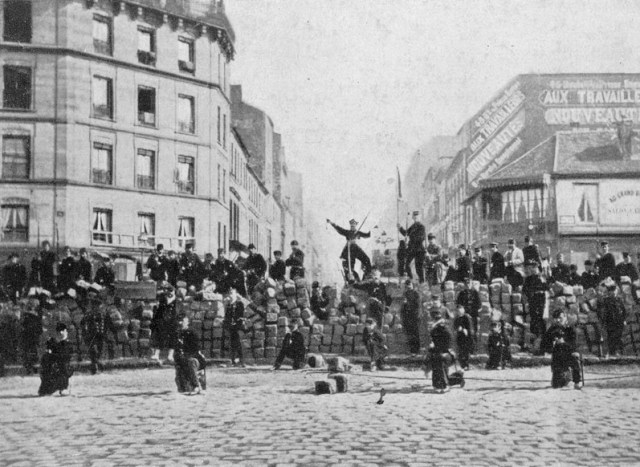
Communards at barricade, Paris Commune 1871. (Image source: Internet)
Irish Republicans on the other hand are often thinking in terms of revolution, usually including armed struggle. However it seems to me that Irish Republicans don’t like analysing past failures of the movement but when they do, their verdicts tend to be that the leaders betrayed the struggle or that taking part in public elections corrupted the movement; or that infiltration, spies and informers was the problem. And some other reasons. The thing is, although all those things played a particular part, they are not the fundamental reason.
“Defeat of the Rebels at Vinegar Hill” by George Cruikshanks, i.e United Irishmen last major position in Wexford overrun, 1798.
PART ONE: THE THIRTY-YEARS’ WAR – DOOMED TO LOSE
(Reading time this section: less than 5 minutes)
Derry Monument and Mural of the Civil Rights struggle which preceded the armed struggle in the Six Counties. (Image sourced: Internet)
The national liberation war that began in 1969 in the Six Counties and ended in 1998 (though some armed incidents continue from time to time) began as a civil rights struggle and changed into a war of communal defence and of national liberation. The military part of the struggle for the most part took place in the occupied Six Counties. The political element of the struggle was waged all over Ireland (and abroad) but in the main consisted of support for the struggle in the Six occupied Counties.
Fought in that way, the struggle was bound to lose. It could never win. How could anyone imagine that they could win a struggle fought against a world power in one-sixth of the country, where even the population there was divided against them? What could they have been thinking?
To my mind, there are only two possible sane replies to that question, which is that they believed: 1) that the British ruling class would get worn down by struggle and leave and/ or 2) that the Irish ruling class would intervene in some way to assist the struggle and make continued British occupation untenable.
1) ‘The British ruling class would get worn down and leave’: This theory must have depended on British repression being condemned abroad and being unpopular at home but had to rest fundamentally on the British having no great stake in continuing its possession of its colony there.
Anyone who thought that (and there were many who did and still many who do, not just Irish Republicans) made a fundamental error. Time and again the British ruling class has shown its determination to hang on to what might be considered its first colony, even as the ruling class’ composition changed from feudal-colonialist to capitalist-imperialist and as the world changed around it.
Mural in nationalist area in the Six Counties (Image sourced: Internet)
Even when the British ruling class, weakened by WW1 and facing an Irish guerrilla war which enjoyed the support of the vast majority of Irish people, with national liberation uprisings breaking out across its Empire and with its repression in Ireland increasingly unpopular at home, entered into negotiations with the Irish resistance, it held on to a foothold, the Six Counties.
Subsequently, it had that colony managed in a permanent state of emergency laws, with institutionalised sectarian discrimination at all official levels and outbreaks of pogroms in the street and workplace.
That became even more exposed during the civil rights struggle and the national liberation war that followed when the British State compromised whatever good international reputationremained to its Armed Forces, its judiciary, its legal establishment, its media and its very legal framework.
Even now, when many believe that the Good Friday Agreement means that a 50% plus-one-vote in favour in the Six Counties will be sufficient to end Partition, they do not realise that such a decision will have to also obtain a majority in the British Parliament and be endorsed by the British Monarch. They are also forgetting the broken promises that surrounded Partition in the first place.
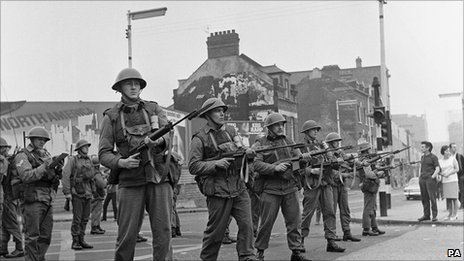
British Army in Belfast 1969 (bayonets and guns pointed towards nationalist area). (Image sourced: Internet)
When analysing what holding on to the Six Counties has cost the British State in terms of reputation, military and financial contributions, one can only rationally assume that continuing to hold on to that foothold is of great importance to the British State. One may speculate as to the reasons underlying that but the central fact cannot be denied.
2) ‘The Irish ruling class would intervene in some way to assist the struggle and make continued British occupation untenable’:
There was some basis for this belief in that a section of Fianna Fáil, a party that had emerged from a split in Sinn Féin in the 1930s and had become one of the mainstream parties in the Irish state, had retained some traditional commitment to seeking a united Ireland. However it was a thin enough basis on which to depend in a national liberation struggle since that section had no majority within the party itself, to say nothing of the foreign-dependent nature of the Irish native capitalist class, the Gombeens, as a whole.
The question came to a trial of strength in the Arms Crisis of 1970, in which at least two Fianna Fáil Government Ministers were involved in secretly buying arms for the defence of nationalist areas in the Six Counties (since the IRA had insufficient weapons at the time) from rampaging Loyalist mobs and the Royal Ulster Constabulary (including the part-time B-Specials). The Ministers alleged that they had acted in the full knowledge of the rest of the Government. By the time the whole affair was over, two Ministers had been sacked and another two resigned in protest.
If it had not been clear before that the Gombeens, the native Irish capitalist class was no patriotic capitalist class but rather a neo-colonial one, it should have been clear after that. But the armed struggle in the Six Counties intensified, especially after the massacres of unarmed civilians carried out by British Paratroopers the following year, 1971 in Belfast and again in Derry in 1972. And the war lasted until 1998.
If, as had been demonstrated to be the case that the British ruling class were determined to hold on to the Six Counties and the Irish ruling class was not going to seriously challenge that possession, did the Republican movement have any other option than to fight on a war that they could not possibly win?
I am clear that it did.
Clearly, in order to have a chance of success, the war had to be extended to the other five-fifths of the country, which is to say into the territory under the control of the Irish native capitalist class. This class had seized power after the War of Independence (1919-1921) and had beaten and suppressed its opposition duringand afterthe Civil War (1922-1923) and furthermore was supported by a powerful ally, the Irish Catholic Church. Since the founding of the first Irish Republican organisation, the United Irishmen of the late 1790s, the Catholic Church hierarchy had opposed Irish Republicanism; it had condemned four Irish priests who participated in the uprising of 1798, excommunicated the Fenians, had at first condemned the 1916 Rising and the War of Independence only to latch on to it at the end along with the Gombeen class.
The general Irish population likely would not have supported or sustained an armed struggle in the 1970s against the Gombeen class but that class could have been fought politically, through agitation and mobilisation, on many social, political and economic fronts. Without going into the specific details of each, these were:
against the huge wastage of Irish youth through emigration
to remedy the shortage of affordable housing (which in part contributed to the above)
to end unemployment (also contributing hugely to emigration)
to raise the level of wages and lower wage earners’ taxation
for the right to divorce
for equality for women in law
for the right to contraception devices and medication for men and women
against decriminalisation and for equal rights for gay and lesbians
to halt the decline of the Irish language, in particular of the rural Irish-speaking areas
to improve services for the rural areas
to oppose the open-door policy for foreign multinationals to exploit Irish natural and human resources
to secularise the education service
and the health service.
to remove the privileged status of the Catholic Church within the state.
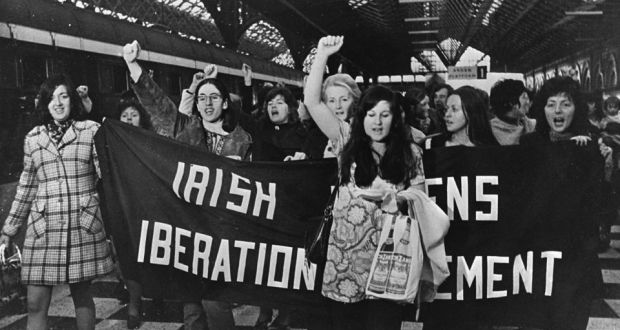
Irish women photographed at Connolly Station 1971, about to board train to Belfast to purchase contraceptives to bring back to the Irish state, illegal at the time. There was no right to abortion either or divorce and a husband’s signed permission was necessary to take out a hire purchase agreement. (Image sourced: Internet)
The Republican movement in general, with some exceptions, declined to take on any of those struggles. They did not organise in the trade union movement, left the social struggles to others and most of all, declined to take on the Catholic Church on any issue except its opposition to the national liberation struggle. Even there, it was happy to publicly avail of the services of members of the Church clergy who supported them. Republicanism was, from its very beginning, as well as anti-monarchist, about separation of Church and State but it was difficult to see that in the Irish Republican movement, particularly after the War of Independence.
A full half of those fourteen points above (nos. 5,6, 7, 8, 12, 13 and 14) would have meant taking on the Church head-on and no doubt the hierarchy would have hindered the struggle over most of the others too, due to its strong links with the State and its ruling class.
Because of its tactical and no doubt ideological refusal to take up those struggles, the Republican movement could do little more in the 26-County state than to agitate for solidarity with the beleaguered nationalist population inside the British colony.
Though this could be effective for a time it could not become a mass movement, nor survive a long struggle, without any remedy being sought for the issues facing the population within the state.
The wonder is not that the majority leadership of the Republican Movement threw in the towel on the military struggle in 1998 but that they had waited so long to do it. Of course, they never admitted the true nature of what they were doing: abandoning the armed struggle and revolution in total and instead, using their negotiating position to advance themselves politically – not in the economic, social and political struggle envisioned above but rather in a political struggle to find themselves a place among the Gombeen political class in the Irish state and as accomplices in the governing of the colonial state.
PART 2: COLLECTING THE FORCES FOR REVOLUTION
(Reading time this section: 2 minutes)
A successful revolution in Ireland, as in most places, would require the involvement of a mass movement. That mass movement would be unlikely to be one that had national self-determination as its only aim – certainly not in the 26 Counties (the Irish state). Mass movements arise at times around different issues and exist as long as the issue does or instead until the movement gets worn down or broken up. Such movements arose around the Household Tax and, later, around the additional Water Charges.
Section of protest against water charges, O’Connell Street, Dublin, 29 Aug. 2015 (Image source: Internet)
Even though the objectives of such movements are often not revolutionary, the participation in them by revolutionaries is necessary if, in the future, there is to be a revolution. Revolutionary activists can make contacts and prove themselves by the way they participate whilst at the same time pointing out that a revolution is necessary in order to resolve all these issues completely and permanently. Such activists can also influence the movement (or sections of it) to act in more revolutionary ways, so that the movement can be guided by – and imbued with — revolutionary spirit.
Working people in struggles come up against concrete problems which need to be resolved in order to move forward. Prior to 1913 in Ireland, workers learned the need for unity in struggle which was emphasised by the employers’ attempts to break the Irish Transport and General Workers’ Union in August 1913. The attacks on them by the Dublin Metropolitan Police illustrated the need for organised defence and Larkin and Connolly called for the formation of what became the Irish Citizen Army, which later also fought prominently in the 1916 Rising.
Members and supporters of the Irish Transport & General Workers’ Union cheering outside the union’s HQ, Liberty Hall, August 1913. Later the union formed the ICA to defend themselves from the DMP; the ICA took a prominent part in the 1916 Rising. (Image source: Internet)
Trade unions are the only mass organisations of the working class in Ireland and it is necessary for revolutionaries to be active within them. Currently, other than social democrats, it is mainly members of both trotskyist parties and independent activists who engage politically with the trade unions. Those members are mostly in clerical work and their political work tends to concentrate on employment demands around wages and working conditions. When they introduce politics it is generally to get some motion passed by their branch. Also at times, they will campaign to get a perceived left-wing candidate elected to some position within the trade union bureaucracy.
None of the above are without value but they remain disjointed in terms of program and often confined to just one trade union. Not only that, but often the Left party involved will engage in order to recruit some new members and in order also to retain their own members by providing them with activity. When broad front trade union groups are formed, they tend to become an arena where the dominant trotskyist parties compete for dominance.
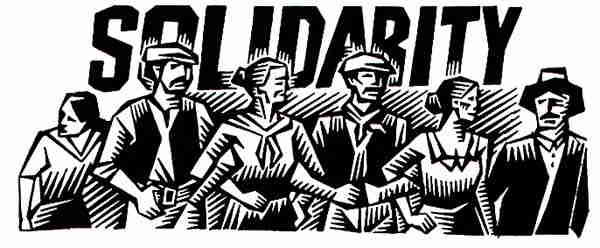
If we are to have a successful revolution – and in particular a socialist one – participation in the struggles of workers in the trade union movement is absolutely necessary. But participation should be primarily among the rank and file of the trade union and also across trade unions, focused on providing solidarity to members of whichever union is in struggle – in addition to encouraging unorganised workers to organise and become active. The objective is not to help make one trade union or one section more militant but rather to create a militant workers‘ solidarity movement within the whole trade union movement. It is essential to have members in the ‘blue-collar’ work unions or departments as well as in the clerical unions or sections. And the cross-union organisation I advocated should be independent — the preserve of no political party.
Participation in such struggles provides an opportunity for revolutionaries to make contact with people who are activists but not yet revolutionaries and to give those people an opportunity to evaluate the revolutionaries in terms of their actual practice. Revolutionaries can support the people struggling for worthwhile reforms while at the same time pointing to their partial and temporary nature. Revolutionary activists can play an educational role in the mass movements while at the same time becoming educated themselves by the daily reality faced by the masses in this system.
PART 3: THE ABSOLUTE NEED FOR UNITY – BUT WHAT KIND?
(Reading time this section: 3 minutes)
It is, most people would think, a ‘no-brainer’ (i.e an obvious truth) that unity is necessary in the struggle to overthrow the current system. It might be thought surprising, therefore, that disunity is more the rule among those who aspire to revolution.
Generally, those who claim to be revolutionary socialists will not unite with Irish Republicans. In addition, those socialists of one party will often fail to unite with those of a different party. The same dynamic is to be seen among Irish Republicans also.
There have been many attempts to overcome this problem. In the 1930s the Republican Congress sought to unite Irish Republicans with revolutionary socialists. In the face of hostility within the mainstream Republican movement and also with divisions among the communist element in Ireland at the time, faced in addition with anti-communist hysteria whipped up by the Catholic Church, the experiment failed. The leadership of the Sinn Féin and the IRA of the later 1960s tried to combine socialism and republicanism within one party and military organisation, an attempt that crashed when it was discovered that the arms necessary to defend ‘nationalist’ community areas in the Six Counties, particularly in Belfast, were unavailable, leading to an acrimonious split in the movement. A subsequent attempt to combine the socialist and republican elements in another organisation survived a little longer but also failed for a number of reasons, some internal and also due to Irish State repression.
Socialist Republicans, members of Republican Congress from Shankhill Road, marching to annual Wolfe Tone commemoration, Bodenstown 1934. They were attacked by conservative Republicans. (Photo source: Internet)
There have been some attempts to unite the non-republican Left itself also, which usually failed due in part to ideological differences but also to political sectarianism and personality clashes. Currently both trotskyist parties have an uneasy working relationship, the small grouping of Independents for Change exists also, the Communist Party is very small too and the anarchists are scattered and unable for years now, for the most part, to mount united action.
Attempts to unite the various parts of the Irish Republican movement have, in general, focused on creating a new organisation or absorbing activists unhappy with one organisation into another.
A frequent approach has been for some people to sit down and produce what they consider solid policy and a constitution, then to propose this format to others around which to unite. Even when accepting amendments from the elements they seek to recruit, these attempts too have largely failed.
It seems a rational approach: if we want unity, surely first we have to agree on what for, how, etc, etc before we can go into action? I believe, contrary though it may seem, that actually we should unite in action first. Uniting in action tends to break down barriers of mistrust that are built on hearsay or suspicions fostered by sectarian elements. Action also tends to clarify certain questions that until then are theoretical only. Of course, at some point, action will need to be guided by worked out policy but initially the action itself can be sufficient guide, especially since approaching the question the other way around has been so generally unproductive.
The question then arises: with whom to unite? In general, I would say that the answer is: with all with whom we can, in actual practice, unite: different types of revolutionary socialists (including anarchists), Irish Republicans, Left social democrats, human and civil rights activists.
There are some exceptions I think necessary to mention: fascists, racists, religious sectarians and parties that participate in Government. Fascists seek to impose an undemocratic regime completely hostile to the interests of working people and, far from our uniting with them, need to be defeated; racists and religious sectarians seek to divide the movement along lines of ethnicity or religious affiliation. Revolutionaries need to draw a clear line of distinction between the movements of resistance and those who participate in a native capitalist or colonial government, i.e the management organisations of the enemy.
Many issues lend themselves to united action but perhaps none more so, and none are more essential, than against repression.
PART FOUR: UNITY AGAINST REPRESSION
(Reading time this section: 3 minutes)
All revolutionary movements – and many that are progressive but not revolutionary – face repression at some point in their existence. Not to recognise that fact and to have some kind of preparation for it, even if very basic, is indicative of a non-revolutionary attitude to the State. Nor have we any reason in Ireland to be complacent on this question.
The Irish State turned to military suppression in the first year of its existence as did also the colonial statelet. Detentions, torture, murders and official executions were carried out by Free State forces over a number of years, followed by censorship and arrests, all facilitated by emergency repressive legislation. In the Six Counties, in addition to similar even more repressive legislation, there were two sectarian militarised police forces and sectarian civilian organisations.
After a change of government, the Irish State introduced internment without trial during the Emergency (1939-1946), the Offences Against the State Act in 1939, Special Criminal (sic) Courts in 1972 and the Amendment to the OAS in that same year.
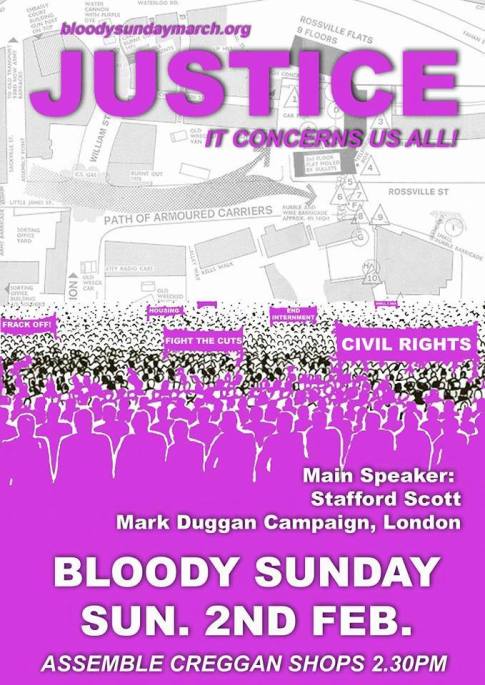
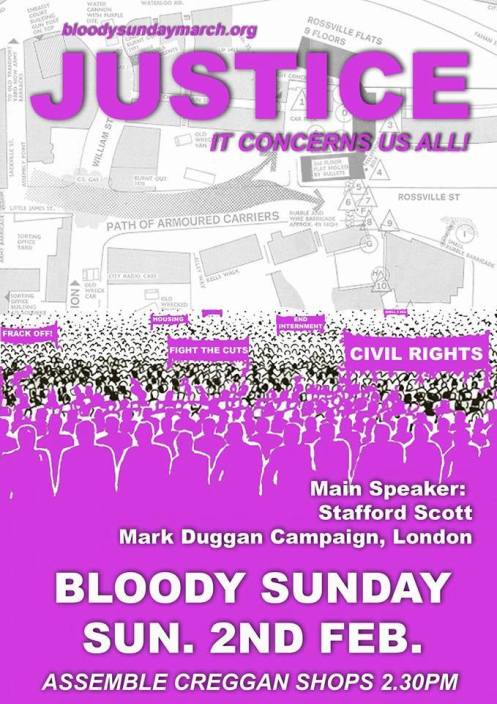
Poster for 2014 Commemoration of Bloody Sunday massacre, Derry 1972. The poster calls for unity. (Image source: Internet)
The Six County statelet had the Special Powers Act (1922) and brought in internment without trial in 1971 (the Ballymurphy Massacre that year and the Derry Massacre the following year, both by the Parachute Regiment, were of people protesting the introduction of internment). The statelet also introduced the Emergency Provisions Act and the no-jury Diplock Courts in 1973 and, though technically abolished in 2007, non-jury trials can and do take place up to today.
The British state targeted the Irish diaspora in Britain in 1974 with the Prevention of Terrorism (sic) Act and that same year and the following, framed and convicted nearly a score of innocent people of bombings in five different cases – had the death penalty not been previously abolished for murder, most of them would have been executed. It took the victims over 15 years to win their freedom, by which time one had died in jail. Brought in as a temporary measure, the PTA continued in force until 1989 but a general Terrorism Act was brought into British Law in 2000 and remains in force today.
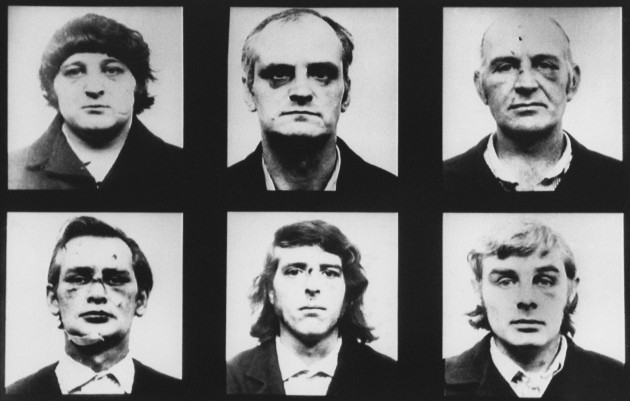
Photos of the Birmingham Six, Irishmen resident in England, showing bruises from police beatings after their arrest in 1974; they were also beaten by jailers. Also arrested, brutalised, framed and convicted were the Guildford Four, Maguire Seven and Giuseppe Conlon and Judith Ward. (Photo source: Internet)
State repression rarely targets the whole population and, particularly in a capitalist “democracy” focuses on particular groups which it fears or feels it can safely persecute. However, we should also recall Pastor Niemoller’s words about the creeping repression which even the German Nazi state instituted, going after first one group, then another, and another …. Among the list of groups targeted eventually by the Nazis were Jews, Roma, Communists, Socialists, Anarchists, Social Democrats, Jehova’s Witnesses, Free Masons, Gays and Lesbians, Mentally Ill or challenged, physically challenged ….
It is in the interests of the vast majority of the population to oppose repression of different groups, whether those groups be based on ethnicity, gender, sexuality, citizenship status or democratic politics. Not everyone recognises this of course but one might expect that political activists challenging the status quo would do so. Sadly, experience shows that they do not in practice (though they may acknowledge it intellectually).
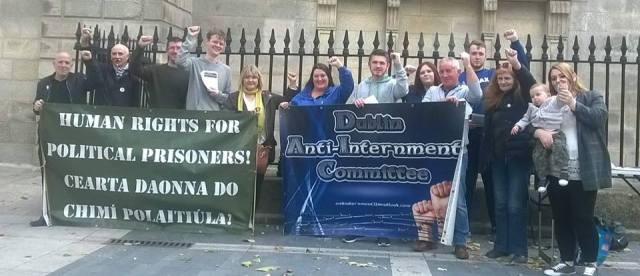
Anti-Internment and political prisoner solidarity picket September 2016 at Kilmainham Jail, Dublin (a former place of detention and execution for political prisoners under both the British occupation and the Irish State, now a museum). (Photo source: Rebel Breeze)
With some periodic exceptions, socialist groups in Ireland do not support protests against repression of republicans. Furthermore, some republican groups will not support others when the latter are subjected to repression. Yet at any time, Republicans of any group can be and are regularly harassed in public or raided at home; their employers may be warned about them by the political police; they may be detained on special repressive legislation, denied bail, effectively interned; they can be easily convicted in the non-jury Special Criminal Courts or Diplock Courts; ex-prisoners released on licence in the Six Counties can be returned to jail without any charge or possibility of defence.
The Irish State’s non-jury Special Criminal Court is a tempting facility for putting away people whom the State finds annoying and it is widely thought it was considered for the trials of the Jobstown protesters. The result of the trial, where the jury clearly took a different view to the presiding judge, may well have justified the opinion of those in the State who considered sending the defendants to the SCC.
Unity against repression is a fundamental need of a healthy society and of movements that challenge the status quo. Practical unity in any kind of action also tends to break down barriers and assists general revolutionarybroad unity. Unity against repression is so basic a need that agreement with this or that individual is unnecessary, nor with this or that organisation in order to defend them against repression. Basic democratic rights were fought for by generations and have to be defended; in addition they give activists some room to act without being jailed. On this basis, all must unite in practice and political sectarianism has no place in that.
Without some basic unity in practice across the sector challenging the status quo, there can be no revolution. But more than that: we stand together against repression ….. or we go to jail separately.
End.
Diarmuid Breatnach is a veteran independent revolutionary activist, currently particularly active in committees against repression, in some areas of internationalist solidarity and in defence of historical memory.
Well, I can see that it would be for Britain, to leave the European Union, the European Economic Community, the Common Market …… It will impact in particular on trade and they’ll have to leave the euro currency ….. no, wait, they never joined that anyway, kept their own currency throughout. In fact, British ruling circles were never that keen to join a “community” that they were not in charge of and, even worse, that Germany was.
And I can see that the Brexit drama has has had quite an unsettling effect on the leadership of the Conservative Party (sorry, Conservative and Unionist parties), with one Prime Minister getting sacrificed so an apparently worse one can step into the vacancy.
I can also see that it has rocked the shaky Union, with the majority of Scotland and the Six Counties voting to stay in the EU and (unproven) concerns among many in Britain that the vote in favour of leaving was dominated by right-wing, jingoistic and even racist elements.
But why is it a problem for the population of Ireland, as we keep being told it is – or will be?
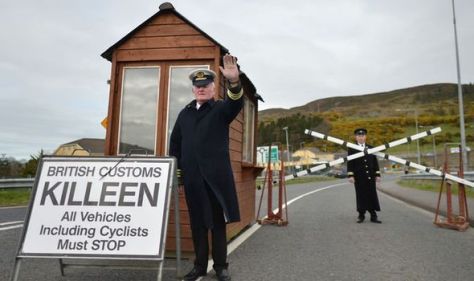
Well, apparently we might get a “hard Border” around the British colony of one-sixth of our nation. There might be customs and military controls, checkpoints, watch towers ….. And this will all undermine the Good Friday Agreement. Apparently.
Why would it? Apparently the illusion of normality around the armed occupation of our country will disappear, once we have to go through checkpoints and pay tax on shopping from one side of the Border or the other. Once that illusion is swept away, those “dissident” Republicans will take arms and launch another war of resistance, or campaign of terrorism, according to how you feel about it.
Really? Border checkpoints will do that? Amazing!
So, was that what started the last three decades or so of armed conflict in what some geography-challenged people call “Northern Ireland”? Well, no, not really. Firstly, it was that fifty years earlier, those six counties (hence the title of “The Six Counties”) had been hijacked when the rest of the nation was being given a measure of independence, then had been put under a police state run by sectarian religious bigots. Yes I know it’s not nice to say that but when you go into a hardware shop to buy a spade, you don’t ask for “a spoon”.
And then those people who were at the receiving end of that bigotry and police state treatment felt a wind of change blowing around the world and had the temerity to demand an end to sectarianism in the allocation of work, housing and voting rights, along with wanting ordinary civil rights that were available in the rest of the UK but not for the people in the Six Counties, despite the colony being, we were told, “as British as Finchley”.
Naturally the police and the sectarian bigots set upon those marchers with batons, rocks and toxic tear gas – and even live rounds – but still couldn’t get them to give up their outrageous demands. The poor cops were getting worn down so, naturally again, the colonial power sent in the troops, with guns and fixed bayonets. And so the war started.
It wasn’t the checkpoints that led to war, honestly. It was other things completely.
Of course, it is possible that something different from before might trigger another war. That’s the thing about occupation forces and indigenous populations – the relationship usually begins with violence, has a number of recurrent bouts of violence …. and is ended by violence.
British colonial police force, the PSNI, harassing an Irish Republican in Newry. If armed struggle breaks out anew, it is more likely to be about regular incidents such as these rather than the customs checkpoints of a “hard Border”!
So, the Good Friday Agreement – a great achievement, right. Er … why? Oh, it brought peace. Actually no, it didn’t. It brought a pause in the armed resistance struggle is what it did. And that’s only something like peace if it holds. I don’t think it will, nor do I think border controls are what will undermine it. And even if it stayed as it is, it would be pacification, not peace.
The Good Friday Agreement amounts to this, in crude essence:
Colonising power: We can kill you and you can kill ours – but you can’t send ours to prison for decades and make their families suffer. We can’t beat you but we can outlast you and outhurt you.
Republican organisation: We will resist.
CP: Yes, you have been. But you are not going to win. Why not do a deal?
RO: What deal is on offer?
CP: Peace process.
RO: What does it involve?
CP: 1. We get to keep the colony. 2. You stop fighting. 3. You destroy your weapons.
RO: What do we get out of it?
CP: 1. You get your prisoners out (but under licence of good behaviour). 2. You get to build a political career, if you want it. 3. And if you do, one day you could help us manage this colony.
RO: Hmmm. OK, we’ll take it.
In all the discussion about the Brexit question, particularly by mass media pundits and establishment politicians (and wannabe establishment politicians like SF’s), when do we hear it being said that the Six Counties is a colony occupied by force?
This isn’t another country with which we happen to have a border, such as between Germany and the French state, for example, or between the French and Spanish states. They aren’t people of another nation on the other side of that Border — they are Irish. It is a part of our country and for nearly eight centuries the British invaders and colonisers saw it as one country too — until they had to pull out and decided it was important to keep a foothold in it.
So, coming back to the question of the people in Ireland, why should we be too concerned, one way or another with regard to Brexit? Apart from people in the Border areas who need to travel regularly across it and are going to be greatly inconvenienced by it, I don’t think we should.
Maybe we can find some real problems for us to deal with instead. Apart from the colonial status of those Six Counties, along with its continuing dominant sectarianism and bigotry, which is not even mentioned in the dominant discourse, we have a continuing bank bailout debt, a massive social housing deficit, a crumbling health service, public services and natural resources being plundered and a corrupt police force …..
Part of series HOW TO WIN THE WAR — GETTING INTO POSITION.
See also: INTRODUCTION:
PART ONE: THE THIRTY-YEARS’ WAR – DOOMED TO LOSE
PART TWO: COLLECTING THE FORCES FOR REVOLUTION
PART THREE: THE ABSOLUTE NEED FOR UNITY – BUT HOW AND WHAT KIND? WITH WHOM?
All revolutionary movements – and many that are progressive but not revolutionary – face repression at some point in their existence. Not to recognise that fact and to have some kind of preparation for it, even if very basic, is indicative of a non-revolutionary attitude to the State. Nor have we any reason in Ireland to be complacent on this question.
The Irish State turned to military suppression in the first year of its existence as did also the colonial statelet. Detentions, torture, murders and official executions were carried out by Free State forces over a number of years, followed by censorship and arrests, all facilitated by emergency repressive legislation. In the Six Counties, in addition to similar even more repressive legislation, there were two sectarian militarised police forces and sectarian civilian organisations.
After a change of government, the Irish State introduced internment without trial during the Emergency (1939-1946), the Offences Against the State Act in 1939, Special Criminal (sic) Courts in 1972 and the Amendment to the OAS in that same year.
Poster for 2014 Commemoration of Bloody Sunday massacre, Derry 1972. The poster calls for unity. (Image source: Internet)
The Six County statelet had the Special Powers Act (1922) and brought in internment without trial in 1971 (the Ballymurphy Massacre that year and the Derry Massacre the following year, both by the Parachute Regiment, were of people protesting the introduction of internment). The statelet also introduced the Emergency Provisions Act and the no-jury Diplock Courts in 1973 and, though technically abolished in 2007, non-jury trials can and do take place up to today.
The British state targeted the Irish diaspora in Britain in 1974 with the Prevention of Terrorism (sic) Act and that same year and the following, framed and convicted nearly a score of innocent people of bombings in five different cases – had the death penalty not been previously abolished for murder, most of them would have been executed. Brought in as a temporary measure, the PTA continued in force until 1989 but a general Terrorism Act was brought into British Law in 2000 and remains in force today.
Photos of the Birmingham Six, Irishmen resident in England, showing bruises from police beatings after their arrest in 1974; they were also beaten by jailers. Also arrested, brutalised, framed and convicted were the Guildford Four, Maguire Seven and Giuseppe Conlon and Judith Ward. (Photo source: Internet)
State repression rarely targets the whole population and, particularly in a capitalist “democracy” focuses on particular groups which it fears or feels it can safely persecute. However, we should also recall Pastor Niemoller’s words about the creeping repression which even the German Nazi state instituted, going after first one group, then another, and another …. Among the list of groups targeted eventually by the Nazis were Jews, Roma, Communists, Socialists, Anarchists, Social Democrats, Jehova’s Witnesses, Free Masons, Gays and Lesbians, Mentally ill or challenged, physically challenged ….
It is in the interests of the vast majority of the population to oppose repression of different groups, whether those groups be based on ethnicity, gender, sexuality, citizenship status or democratic politics. Not everyone recognises this of course but one might expect that political activists challenging the status quo would do so. Sadly, experience shows that they do not in practice (though they may acknowledge it intellectually).
With some periodic exceptions, socialist groups in Ireland do not support protests against repression of republicans. Furthermore, some republican groups will not support others when the latter are subjected to repression. Yet at any time, Republicans of any group can be and are regularly harassed in public or raided at home; their employers may be warned about them by the political police; they may be detained on special repressive legislation, denied bail, effectively interned; they can be easily convicted in the non-jury Special Criminal Courts or Diplock Courts; ex-prisoners released on licence in the Six Counties can be returned to jail without any charge or possibility of defence.
The Irish State’s non-jury Special Criminal Court is a tempting facility for putting away people which the State finds annoying and it is widely thought it was considered for the trials of the Jobstown protesters. The result of the trial, where the jury clearly took a different view to the presiding judge, may well have justified the opinion of those in the State who considered sending the defendants to the SCC.
Anti-Internment and political prisoner solidarity picket September 2016 at Kilmainham Jail, Dublin (a former place of detention and execution for political prisoners under both the British occupation and the Irish State, now a museum (Photo source: Rebel Breeze)
Unity against repression is a fundamental need of a healthy society and of movements that challenge the status quo. Practical unity in any kind of action also tends to break down barriers and assists general revolutionary broad unity. Unity against repression is so basic a need that agreement with this or that individual is unnecessary, nor with this or that organisation in order to defend them against repression. Basic democratic rights were fought for by generations and have to be defended; in addition they give activists some room to act without being jailed. On this basis, all must unite in practice and political sectarianism has no place in that.
Without some basic unity in practice across the sector challenging the status quo, there can be no revolution. But more than that: we stand together against repression ….. or we go to jail separately.
End.
Diarmuid Breatnach is a veteran independent revolutionary activist, currently particularly active in committees against repression, in some areas of internationalist solidarity and in defence of historical memory.
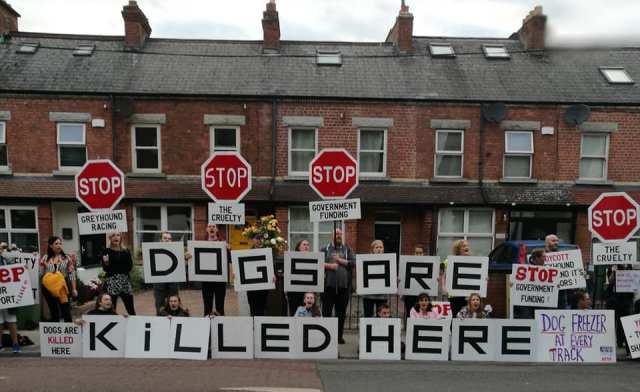
People attending Shelbourne Park Greyhound Stadium on Saturday last (20th July) were booed, a number of passing cars and vans blew their horns in support of protesters but one dog racing supporter assaulted a protester. The picketers quoted an RTÉ television documentary that the industry is killing large numbers of dogs annually; they want an end to Irish Government funding for the industry and dog racing banned.
Section of the protesters on one side of the street outside Shelbourne Racing Stadium on Saturday 20th July.
A quick trawl through Google reveals greyhound track or stadium protests at a number of venues in Ireland as well as Dublin, including Cork, Limerick and Newbridge and there are campaigns to ban greyhound racing in a number of other countries (although apparently dog racing only exists in another eight countries world-wide).
The protesters on Saturday chanted a number of slogans, including “You bet, they die!”, a reference to people betting on the outcome of the races and to the high death-toll of dogs bred for activity. Greyhound bitches are bred to what are considered successful dogs and breeders will choose pups to raise from the litters, killing the rest. Only some dogs are considered suitable for racing and after trial, some more will be killed (or perhaps sold abroad, which may even be worse). Finally, when their racing life is over, most will be killed also. The industry says it finds homes for old or worn-out greyhounds but there are not enough homes to take them all in.
The Irish Government funds the industry to the tune 16M euro and campaigners say this is not justifiable to fund an industry killing dogs for profit-making. In addition, according to the RTÉ documentary 7,000 dogs are exported to Britain, effectively sustaining their industry – on Irish tax-payers’ money. Some of these dogs are transported from Ireland in unhygienic conditions, even by people who are banned from the greyhound industry in Britain for doping or keeping dogs in bad conditions, since their bans are only effective in Britain itself.
Doping of dogs has increased enormously in Ireland and Britain, according to people inside the industry but very few have been charged or the kennel breeders sanctioned by the industry’s regulating body. The RTÉ team found that 80% of animal doping chemicals seized over the years have come from greyhound kennels, but more than 50% seized in a three-year period came from one dog trainer, Mr. Gerry Holian in Athenry.
The film also showed dogs being badly treated abroad and produced evidence to show that restrictions on their export from Ireland and Britain are routinely evaded.
Line of protesters facing the entrance to the dog racing stadium last Saturday (another longer line on the opposite side). Two Gardaí of the Public Order Unit are visible too. (Photo: D.Breatnach)
VIOLENCE TOWARDS PROTESTERS
Early during the protest last Saturday, a man physically attacked a woman protester outside the Shelbourne Stadium. Witnesses gave evidence to Gardaí who advised them to go to a Garda station and make a complaint, without explaining why they themselves would not act upon the reported crime. Some Public Order Unit Gardaí arrived soon afterwards and some of the protesters, including the assaulted woman, did go to the station and made a complaint.
Four days after the Dublin protest and the attack on a protester, the Irish Greyhound Board posted the following statement:
The IGB would request, and based on the strong advice from An Garda Siochana, that the greyhound community would not engage in any form of ‘counter protest’ at greyhound tracks and stadia as such activity is likely to enflame an already volatile situation and result in an unsafe environment for all. Such outcomes do not reflect well on anybody, including the greyhound community.
A Bus Átha Cliath public transport vehicle carries the message. (Photo source: Bart Hoppenbrouwers)
A SOCIAL AND CULTURAL ACTIVITY?
Of course for many people attending dog racing, who will be unaware of the high death-toll endemic to the industry, it seems a harmless night out. Even many who do not attend dog racing will be unaware of the cost to the dogs. The RTÉ Investigates TV documentary Racing for Their Lives quoted figures from a commissioned report that 6,000 greyhounds are killed every year. That report was kept secret by the Irish Greyhound Board until the RTÉ Investigates team revealed they had a copy of the Report and then the IGP released sections of it. As the protests continue, even those who have not seen the program will become increasingly aware.
(Photo: D.Breatnach)(Photo: D.Breatnach)
In many working-class communities greyhound racing has been a participative activity for individuals owning one or two dogs, as outlined in “The Town I Love So Well”:
In the early morning the shirt-factory horn Called women from Creggan, the Moor and the Bog
While the man on the dole played the mother’s role,
Fed the children and then trained the dogs.
This activity is not comparable in scale, turnover or treatment with the dog-racing industry of greyhound breeding and training establishments and racing stadia and, in any case, is much reduced as a passtime now.
There are 16 dog-racing stadia within the Irish state and two in the Six Counties. Currently protests are organised outside Shelbourne Stadium for two evenings a week, Tuesdays and Saturdays, while protesters at other stadia have their own arrangements.
End.
View facing north (the Stadium is to the left of photo, the entrance just by the visible column). (Photo: D.Breatnach)
Recently the left-wing Spanish on-line newspaper, Publico, got a scoop on other media when it broke the story of the Spanish secret service and the terrorist1 cell in Catalonia, the one that carried out the killing spree in La Rambla in Barcelona in October 2017. Publico revealed that the head of the cell had been recruited as an informant while in jail on drug smuggling charges and that the secret service had helped him become an imam, a Muslim priest, in the province of Girona. Not only that but that they had the photos and mobile phone numbers of a number of the Ramblas terrorists and had been following them up to days before the attack.
Aftermath of terrorist attack in the Rambla, Barcelona in 2017. (Photo image sourced: Internet)
So why had the whole lot not been apprehended? It’s a question many people are asking, along with the Catalonian and many foreign newspapers – but, strangely, only one of the main Madrid newspapers.
THE LEADER OF THE TERRORISTS WAS WORKING FOR THE SPANISH SECRET POLICE
Abdelbaki Es Satty came to the Spanish State in 2002 and was around 44 years of age when he died in an explosion in Catalonia. According to Wikipedia,
“Es Satty was implicated in the 2006 Operation Chacal, in which five Islamists were arrested for sending jihadis to fight in Iraq.From 2003 he had shared an apartment with Islamists connected to the Moroccan Islamic Combatant Group(GICM) and the 2003 Casablanca bombings.
“In 2012, (he) completed a four-year prison sentence for drug trafficking in Castellón. While in prison, he is reported to have established a “special friendship” with Rachid Aglif, who was serving an 18-year sentence for his role in the 2004 Madrid train bombings.
“He was convicted of drug smuggling in 2014 and was to be deported from Spain, but …… A successfulasylum application in November 2014 facilitated him moving freely in the 26 EU countries of the Schengen area.”
Es Sattty, believed leader of the terror cell that carried out the attacks in Catalonia in 2017. He was an informant of the Spanish Secret Service (CNI). (Photo image sourced: Internet)
The suggestion in the Publico articles is that Es Satty was recruited by the Spanish secret service (CNI) while in jail and that they ensured that he was not deported, also that they assisted him in getting employed as an imam (a Muslim priest) at the mosque in Ripol in 2015, a post he suddenly resigned in June of 2017. Ripol is a town in the province of Girona, Catalonia.
Publico now reports that the CNI file on Es Satty has been “wiped”!
THE EVENTS
On the evening of 16 October 2017, El Satys and another man were killed, presumably by a premature explosion while handling the material. There were over 120 gas canisters which appeared stored for a number of terrorist bombs. The explosion occurred in the town of Alcanar, the southernmost of Catalonia and almost on the border with the province of Valencia.
When other in the cell heard that El Satys had been killed and another with him while handling the explosives, it seems they decided on a ‘revenge’ spree to honour their ‘martyr’ and carried out the attacks on innocent civilians in Catalonia.
La Rambla is in Barcelona city centre, a medium-length wide street heading towards the port, with a tree-shaded pedestrian reservation down the middle, where stalls sell all kinds of ware and coffees, snacks etc. It is a favourite destination of tourists (and pickpockets).
La Rambla, Barcelona, on a happier day.
On the late afternoon of 17 October, a member of the terrorist cell driving a van zigzagged down the Rambla, running down pedestrians and cyclists. During his escape from the scene, he hijacked a car and fatally stabbed the driver, bringing his total death-toll to 15 and injuring 131.
Later that evening, five men, apparently of the same cell, purchased knives and an axe and, at 1.00 am, drove into the Catalonian coastal town of Cambrils (not far from the popular tourist destination of Salou) and into a crowd of pedestrians, where they fatally stabbed a 63-year old woman and injured another six, before being shot by Catalan police. Four died at the scene and the fifth later of his injuries.
On 21st August, five days after the Alcanar explosion and four after the Barcelona massacre, the Rambla killer was fatally shot by the Mossos, the Catalan police, in Subirats, about 25 miles (40 Km) from Barcelona.
Initially, Catalan police believed the first violent event, the Alcanar explosion, had been caused by an accidental gas leakage but once they discovered the explosions and other events had occurred, connected them. Not only did the Spanish secret service, the CNI, fail to inform the Catalan police about the existence of this cell prior to the Alcanar explosion but it seems that at no time during the subsequent operations of the Catalan police did the CNI give them any information whatsoever.
The on-line newspaper that broke the story. (Photo image sourced: Internet)
THE DIRTY WORLD OF STATE SECRET SERVICES
Secret services penetrate cells and movements opposed to the status quo as a matter of course, whether they have an armed agenda or not. But when they do have such an agenda, typically they try to recruit some inside people for information, building up a wider and more detailed picture as time goes on. This takes time and meanwhile the informants’ ‘handlers’ will typically give their insider ‘asset’ money, protect him or her from prosecution, feed the informant’s fear or ego – or both.
As not-so-distant history shows with the British and US secret services (and probably all others around the world), these informants are permitted to break the law, even to kill, in order to keep up their cover. Yes and even to kill another, less-valued or more exposed informant, as the British had at least one informant do inside the Provisional IRA.
But it goes even further and informants or deep-cover agents also often act as agents provocateurs. They actually incite people around them to carry out armed actions. This can vary from encouraging them to attack where, unknown to the victims, the state forces are ready and waiting to kill them, as is believed happened at Loughgall, in occupied Co. Armagh in 1987. The informant can also be used to incite a group of political activists to carry out armed actions to facilitate the breaking up of the organisation2. Or to set off bombs that will, intentionally or not, kill uninvolved civilians, thereby losing insurgents popular support. Or that might set off inter-communal violence in an occupied country.
And religion-based organisations have long been recognised by secret services as useful opposition to leftist national liberation movements. Or against the USSR, for example, when the latter were invited into Afghanistan by the ruling circles. They may also be used to incite inter-communal violence in a country occupied by a foreign power or to help overthrow a ruling group which a foreign power wishes to replace with another more amenable to the power concerned — or in a country it wishes to invade.
The role of the Phalangist militias, Christian, in Lebanon is well-known, in their war against the growing power of the Muslim community. The CIA and Israel3 armed the Phalangists and encouraged them in their attacks Lebanese Muslims and on Palestinian refugee camps, not only against fighters but also massacres of the elderly, women and children. The CIA funded, supplied and even often trained Islamic fundamentalist jihadists4 and warlord bands in Afghanistan, Al Qhaeda among them, as they did also in Iraq. They did it in Syria too but ended up having to fight one such jihadist group, ISIS, which threatened to take the whole cake and the commanders of which were unpredictable in terms of future policy. But many of the war bands in the NATO-led Alliance fighting Assad and ISIS were themselves Jihadists too.
SUSPICIONS AND SILENCE
There are many people within the Spanish state territory that distrust the State and Catalans, due in particular to their recent experiences, would figure prominently among them. When Publico broke the story about the CNI and their close connection to the terrorist cell, it was inevitable that speculation would take off and that it would not stop at the secret service’s ineptitude.
Some thought that the original intention had been to discredit the Mossos, who were later accused by some Spanish politicians of not cooperating fully with the Spanish police operations against Catalan independence campaigners. Presumably the explosions planned by the terrorist cell would leave the Catalan police looking useless.
Another theory went that explosions would be blamed in some way on the Catalan independence movement, which has until the present been remarkably peaceful in the face of Spanish police violence. In fact Aznar, the Spanish Prime Minister at the time of the Madrid train bombing by another cell, immediately blamed the bombing on the Basque armed group ETA. When it was proven to be an Islamist fundamentalist cell, his false claim contributed to his party losing the elections soon afterwards.
No doubt there were other theories speculated also and the response from Madrid did not help to quell them.
Many commentators have wondered at the Spanish state’s silence on the matter but even more so at the silence of all but one of the Madrid main newspaper. Surely this is a really big story? If the Government says that “it’s not a big issue (for them) to investigate”, would one not expect the Spanish media to be hounding them? That media silence is, really, the most puzzling aspect. One can readily see that the Government might not want to expose the ineptitude and dirty work of their State’s secret service … but the media?
The only answer that makes any sense is its Catalonia connection, that all locations in which the events occurred are in Catalonia. And that the independence movement for Catalonia is locked in a struggle with the Spanish unionist State. Therefore reporting on Spanish secret service ineptitude in Catalonia could well go to justify separatist wishes in Catalonia.
Or have the editors been made aware that this terrorist cell had an important role to play in that independentist conflict and asked to keep quiet? What if a campaign of terrorist massacres in Catalonia gave a plausible excuse for the Spanish State to impose emergency legislation on Catalonia, an excuse that would be thought convincing not only within the Spanish state but abroad also?5 Of course, if that was the gameplan, it did not work out for the Spanish State since the cell messed up and it was finished off by the Catalan police, the Mossos d’Escuadra.6
So, to answer the question in the title of this piece: in my opinion it is incompetence – and something else. But probably not the various “something elses” that are being most widely speculated.
However, the Spanish media silence tells us something about the Spanish state too. In what other European state would its media remain silent about its secret service penetrating a terrorist cell but then failing to prevent attacks on its citizens by members of that cell?
End.
FOOTNOTES
1The word “terrorist” is frequently applied in the mass media to a wide range of organisations employing armed, from small cells to popular movements, of a wide variety of ideological motivation ranging from fascist to communist or just national liberationist. There can even be paid terrorists, such as the Contras run by the CIA against the Sandinista-run Nicaragua. Even some animal liberation organisations have come under this term and, indeed individuals without an organisation backing them (such as the Australian who carried out the massacre in New Zealand last year). In addition, some states have been labelled “terrorist” by others. Therefore the term cannot have a precise definition and I use it here only to describe small or larger organisations that target uninvolved civilians in order to cause terror among a population and instability among the rulers.
2British secret services did this in a case in England where they got a member of the local Sinn Féin branch (the party had branches in Britain at the time) to incite them to raise funds for the cause by carrying out a bank robbery, during which the robbers were arrested. Then he incited breaking them out of jail and that group got arrested too. After that he feared he was exposed and confessed to, strangely enough Jazz musician George Melly and then to the National Council for Civil Liberties (now Liberty). Very shortly after that he was killed, whether by the IRA or by his handlers is unclear. Though a famous case at the time several Google searches have failed to turn it up for me.
3The French may well have done so too as many of the Lebanon Christians had their origins in former French colonisation.
4From Jihad, a term meaning “struggle”, usually used in religious contexts. It can mean a moral struggle in society, within oneself or against “the enemies of Islam”, when it is sometimes characterised as a religious war, which may be defensive, or offensive (as with the Christian Crusades). In the political sense, especially when used in the West, it can be either defensive (e.g repelling or overthrowing a non-Islamic invader) or aggressive (e.g invading territories under non-Islamic rulers or under a different Islamic sect, or overthrowing such) but is always military and that is the sense in which I am employing it here.
5After the Twin Towers and other bombings by Al Qhaeda, US legislators were able to introduce the Patriot Act 2001 which gave the US State wide powers violating many civil rights.
6Whose Chief is currently on trial in Madrid, accused of undermining Spanish police operations against Catalan independentism through lack of cooperation.