OASIS, MANCHESTER & THE FENIANS

Diarmuid Breatnach

(Reading time: 4 mins.)


The Oasis rock band are performing on 16 and 17 August in Croke Park, the Gaelic sports stadium in Dublin, to a sold out capacity of 82,300. Brothers Liam and Noel Gallagher are the two leading members of the band.

Oasis-marked t-shirts and caps are being sold from stalls in the city and posters announcing the forthcoming concerts adorned shop windows and lampposts but how many fans know the Gallaghers’ background?

Liam and Noel Gallagher of Oasis (Source imag: Internet)

Liam and Noel were born in Manchester to Irish migrant parents but their mother Peggy split from her abusive husband and moved elsewhere in Manchester, taking the kids with her. Liam dedicated Stand by Me to her on Saturday night and gave a shout-out to her her birthplace in Co. Mayo.1

Ireland fed the British ‘industrial revolution’ and the Irish have a long association with Manchester. In 1845 the city’s factories were already attracting Irish workers and its farms probably also agricultural workers to replace English labourers deserting the farms for the factories.

Friedrich Engels wrote The Condition of the Working Class in England,2 published in 1845 (the first year of the Great Hunger) and mentioned the Irish migrants not too favourably. He was writing mostly about Salford, the subject of Ewan McColl’s Dirty Old Town,3 just outside the city then.

By the time Engels’ book was published, the Great Starvation was gearing up. Uncomplimentary references to the Jews can also be found in that work but whatever about that ethnic minority,4 Engels changed his mind radically about the Irish in Britain and came to admire them greatly.

Instrumental in learning about the Irish for Engels were two Irish sisters living in Manchester, Lizzie and Mary Burns, illiterate but intelligent and militant mill workers. Mary and Friedrich became life partners and, after her death, Friedrich became Lizzie’s partner thereafter.

The Irish, as the natives and diaspora of what is often referred to as “England’s first colony” were of considerable interest to the revolutionary partnership of Engels and Karl Marx and more so still as the Fenian movement, the Irish Republican Brotherhood, spread throughout Britain.5

Karl Marx and Frederick Engels, leading theoreticians and activists of the revolutionary socialist movement. (Source: Workers Liberty)

A largely proletarian movement, the Fenians were admitted to the First International Workingmen’s Association6; no doubt the Irish struggle against British domination greatly influenced the political opinions of Marx and Engels in relation to nations under colonialist rule by capitalist states.

The struggle spilled over from Ireland into the Irish diaspora, particularly that in North America, Australia and Britain. In Australia the Fenians’ role seems to have been mostly in facilitating and escaping British jails there7 while in America, they invaded the British colony of Canada.8

The charge of the Fenians (wearing green uniforms) under Colonel John O’Neill at the Battle of Ridgeway, near Niagara, Canada West, on June 2, 1866. In reality, the Fenians had their own green flags but wore a very mixed bag of Union and Confederate uniforms (if they still had them, or parts of them left over from the Civil War), or civilian garb, with strips of green as arm or hat bands to distinguish themselves. (library and archives canada, c-18737)

In Britain itself, the Fenians went to war against the ruling class with dynamite. To spy on them, Scotland Yard created the Irish Special Branch which evolved into the Special Branch, the political police in Britain and in any colony the British had since then.9

The activities of the US Fenians intersected with those of Britain-based Fenians when two of the former, Thomas J. Kelly and Timothy Deasy, American Civil War veterans, were arrested in England. On their prison van’s journey to jail it was ambushed10 and both officers spirited away.

Artists’ impression of the rescue of the Fenian prisoners.
(Image source: Internet)

Unfortunately and entirely unintentionally, Constable Brett was killed during the breakout. Refusing to hand over the keys from inside the wagon, he was bending to look through the keyhole when in order to release the prisoners one of the Fenians fired at the lock, the bullet entering Brett’s brain.11

The British police swept vengefully through the Irish quarters of Manchester and Salford arresting at least 28 people but eventually sending five for trial on ‘murder’ charges. Three were hanged, all innocent of intentional killing and at least two probably not even present at the scene.

As sentence of death was passed upon them, all five cried “God save Ireland!” Although the sentences on two were commuted, Timothy Sullivan used those words for his ballad about The Manchester Martyrs, as the executed three became known among the Irish at home and abroad.

The song travelled quickly and became an unofficial national anthem of Ireland and the Irish until it was decisively supplantedafter the 1916 Rising by Peadar Kearney’s The Soldiers Song (latertranslated: Amhrán na bhFiann).12 A memorial to the three was erected in Mostyn Cemetery.

Artist’s impression of the trial of the five convicted including the three Manchester Martyrs.
(Image source: Internet)

Manchester continued to be a destination for Irish migrants, for factories still, including motor car production but also post-WW2 reconstruction and motorway building.

Manchester United FC, along with a number of other British soccer teams, recruited Irish players and Irishman Liam Whelan was one of the eight players killed in the Munich air crash of 1958. Another 30 Irish have played for the club at one time or another, some quite famous.13

The city is one of a number of British cities that has a name in the Irish language; Mancunians would probably be delighted to know that their city’s name in Irish is Manchuin.

From the late 1960s to late 1990s the city was host to an active branch of the Troops Out Movement in solidarity with Ireland, also from 1980s to an active branch of the Irish in Britain Representation Group; the Special Branch was active in monitoring and, from time to time, harassing their activists.

The Provisional IRA bombed the city in 1996 as part of its campaign against the British State and — despite a 90-minute warning — 212 were injured.

Today Manchester, alongside South Asian ethnic influences, continues its Irish ethnic presence with Irish traditional cultural activities14 and no doubt the sons and daughters of Manchester’s Irish diaspora will continue to contribute to other sport and artistic culture in Britain and in the world.

Footnotes

1https://www.breakingnews.ie/ireland/oasis-review-the-band-were-great-the-service-was-not-1793012.html

2https://en.wikipedia.org/wiki/The_Condition_of_the_Working_Class_in_England

3https://www.youtube.com/watch?v=s11BuatTuXk here performed by The Pogues

4Given that Marx, a German Jew, became his closest political comrade and writing partner, it’s likely he changed his bias against Jews also.

5https://www.marxists.org/history/international/iwma/documents/1867/fenians.htm and Introduction to https://journals.sagepub.com/doi/10.1177/030639688202400204

6https://en.wikipedia.org/wiki/International_Workingmen%27s_Association

7For example, the escape on board The Catalpa https://www.irishtimes.com/opinion/an-irish-diary/2023/11/01/the-greatest-escape-frank-mcnally-on-one-mans-mission-to-make-a-movie-about-the-catalpa-rescue/

8https://www.irishcentral.com/roots/history/irish-fenian-invasion-canada Unlike many other accounts easily available this one gives a reasonable assessment of the rationale for the invasion, including its potential and the reasons of its ultimate failure, the interests of the ruling class of the USA, which the Irish Republican movement should have learned from forever afterwards – but failed to do.

9Often referred to simply as ‘the Branch’ or ‘Branchmen’ (though the organisation of course also recruits women).

10The location, by an arch under a railway bridge, is still unofficially known as “Fenian Arch.”

11https://en.wikipedia.org/wiki/God_Save_Ireland

12https://en.wikipedia.org/wiki/God_Save_Ireland

13For example, George Best and Roy Keane.

14Manchester has a Comhaltas Ceoltóirí Éireann club (for Irish traditional music) and informal music sessions, also an Irish dancing school https://www.facebook.com/profile.php; Gaelic Athletic Association clubs  including St Brendan’s, St Peter’s, Oisín, and St. Lawrence’s.

Sources

The Fenian Ambush: https://ballymacoda.ie

The ballad: https://en.wikipedia.org/wiki/God_Save_Ireland

The First International and Fenians: https://www.marxists.org/history/international/iwma/documents/1867/fenians.htm

The Saturday concert in Croke Park: https://www.breakingnews.ie/ireland/oasis-review-the-band-were-great-the-service-was-not-1793012.html

“Building resistance through culture”: successful Solidarity Sessions launch in Dublin

Clive Sulish

(Reading time: 3 mins.)

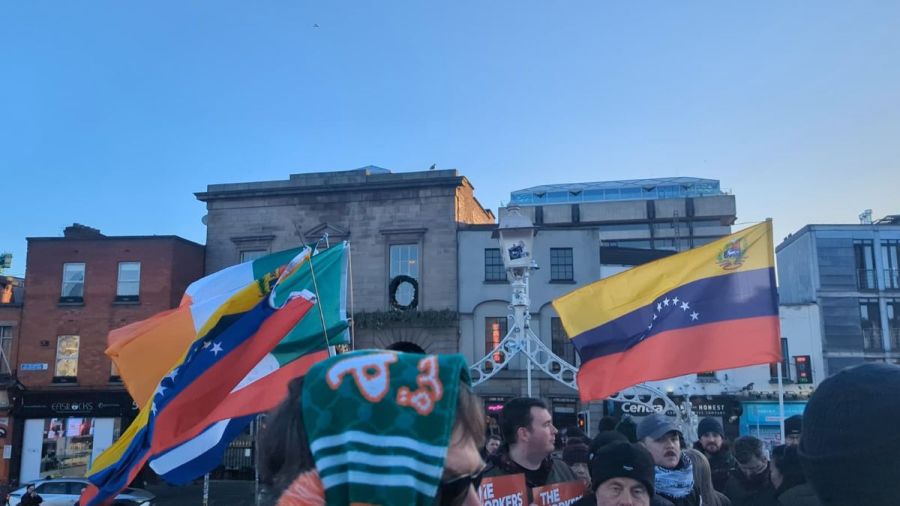
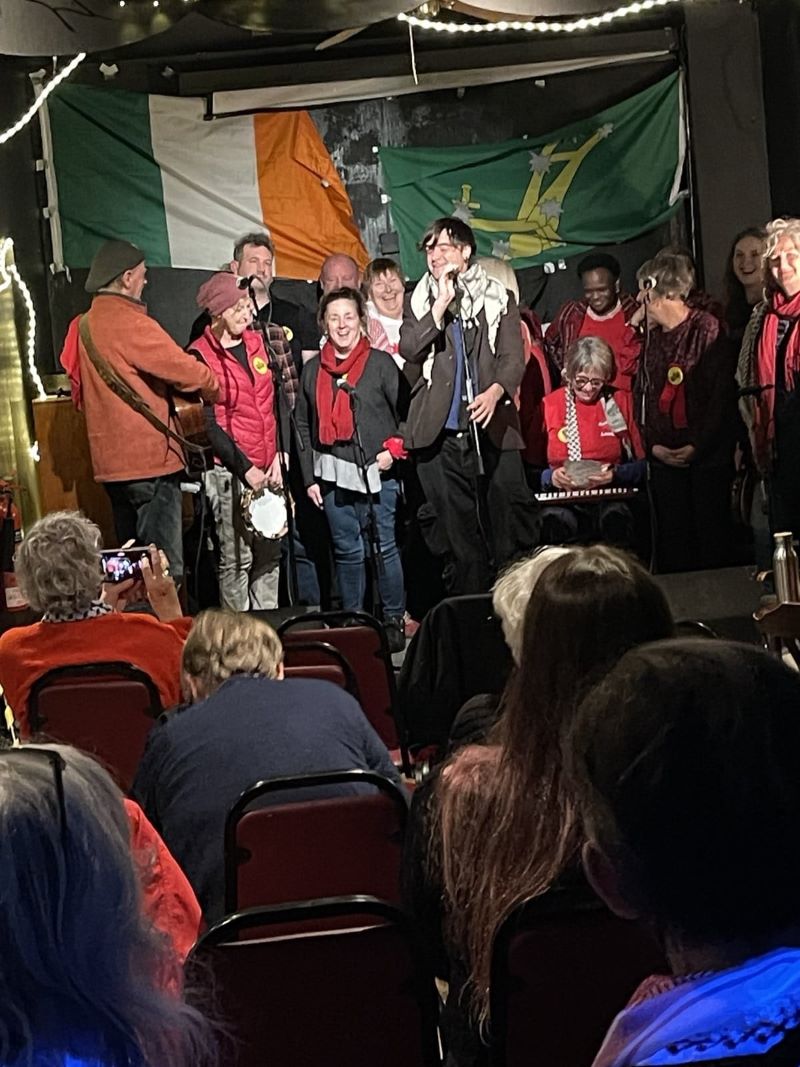
Around 80 people attended a concert in the back room of Dublin’s Cobblestone pub launching an initiative to “build a community of solidarity and resistance through culture”. Flags of Irish and other struggles around the world decorated the venue.

The evening’s entertainment consisted of five musical acts and one of poetry. The MC for the evening, Diarmuid Breatnach, told the audience that Irish struggles had always found an expression in culture and that culture itself encouraged further resistance.

He gave the example of Thomas Davis who founded with others the patriotic newspaper The Nation in the mid-1800s, publishing contributed songs and poems and his own, including The West’s Awake and A Nation Once Again, songs still sung in Ireland nearly two centuries later.

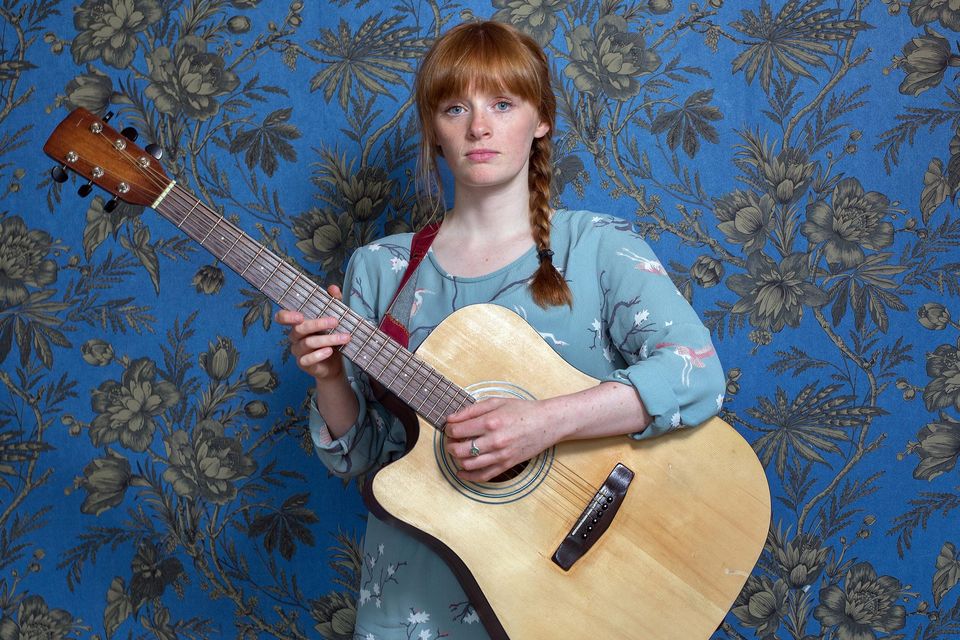
The first act of the evening was the folk duo The Yearners, specialising in harmonies around renditions of song covers and their own song about the Mary of the New Testament, as a woman pressured to bear a child because “How can you say no to God?

The audience joining in on Pearse’s Gráinne Mhaol was followed by some songs with hard satirical edges like the Kinky Boots song from the Irish Republican repertoire and their own Save A Landlord.

The Yearners during their performance. (Photo credit with thanks: Dermo Photography)
Dúlamban during their performance. (Photo credit with thanks: Dermo Photography)

The MC introduced another all-female duo, Dúlamban, recently formed from two individual singer-musicians. Among their material, Sinéad on violin played two compositions of her own while Aisling sang her adaptation and translation of the Rising of the Moon: Ar Éirí na Geallaigh.

The one poet of the evening, Barry Currivan, performed a number of shorter and longer pieces of his repertoire. He was particularly applauded for his “anti-othering” piece Those People and his humorous concluding piece comparing himself to a good cup of tea or coffee.

After the break, the MC spent a few minutes outlining the Solidarity Sessions collective’s project and encouraging the audience to take part in it by spreading word of its events and supporting them in person, in addition to stepping forward to assist in organisation and in poster design.

Barry Currivan during his poetry performance at the Solidarity Sessions launch. (Photo credit with thanks: Dermo Photography)
Section of the audience presumably during Currivan’s performance. (Photo credit with thanks: Dermo Photography)

Another female duo took the stage, Sage Against the Machine on guitar accompanied by Ríona on violin, performing a number of love pop covers and SAM’s own song against patriarchy.

Some remarks about Bob Dylan’s Zionism followed in Sage’s introduction of the former’s Masters of War which she performed with great feeling and followed with El Gallo Rojo, an anti-fascist song from the Spanish ‘Civil War’.

Sage Against the Marchine (right) and Ríona during their performance. (Photo credit with thanks: Dermo Photography)
Jimi Cullen during his performance at the Solidarity Sessions launch. (Photo credit with thanks: Dermo Photography)

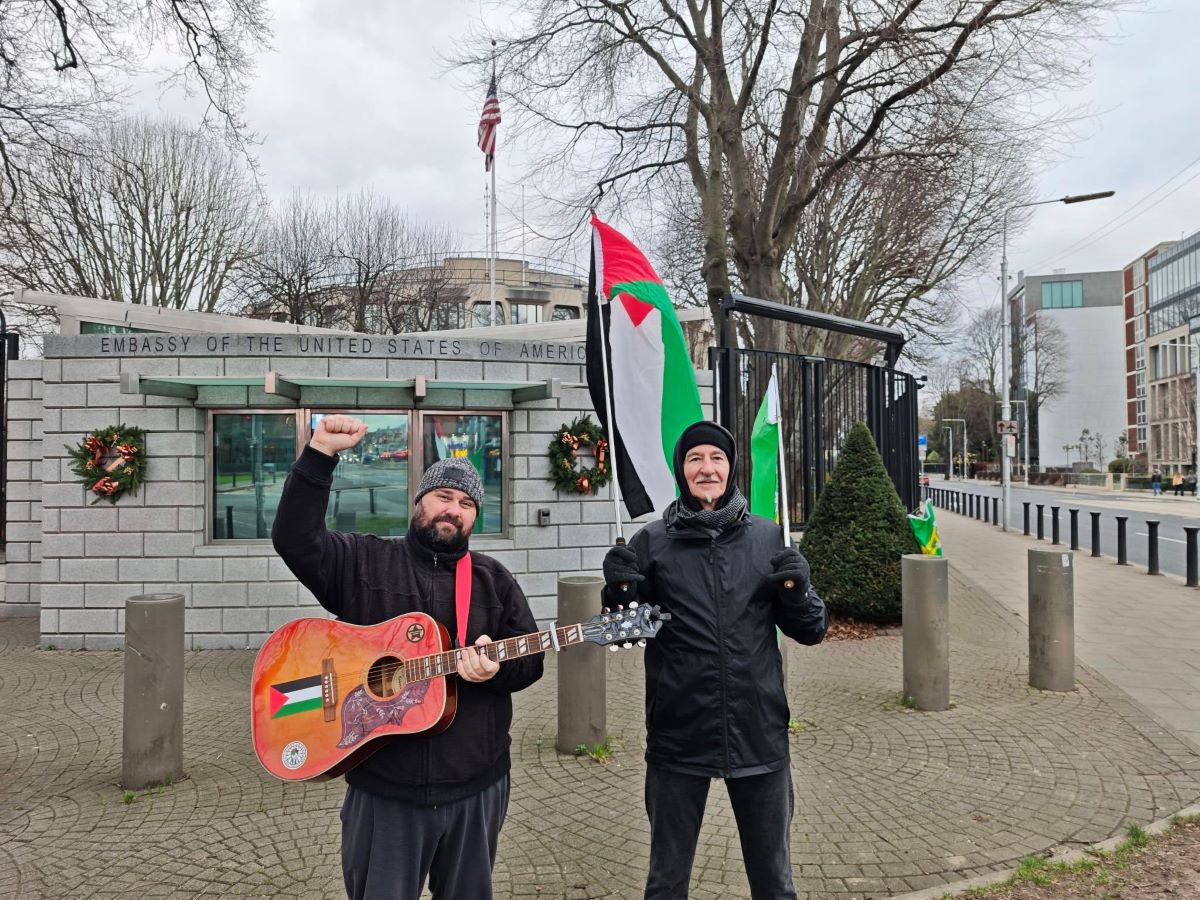
Breatnach then introduced Jimi Cullen who he said has been hosting a weekly musical protest picket for an hour on Wednesdays (2-3 pm) outside the US Embassy for a great many weeks, in which the MC had sometimes accompanied him amidst the solidarity beeping of passing traffic.

Jimi accompanied himself singing his Housing for All and Guthrie’s You Fascists Bound to Lose, then commenting on Bob Marley’s Zionism while introducing the latter’s One Love song, saying that love above all is what binds humanity together, a theme also of his We Are All Palestinians.

His monologue The Genocide Will Be Televised was much sharper and renewed an earlier Death, death to the IDF!1 chant from the audience.

Trad Sabbath during their performance. (Photo credit with thanks: Dermo Photography)

There was much irreverent comment about the name of the band to conclude the evening, Trad Sabbath, a four-piece band of guitars, banjo, bodhrán and fiddle, apparently in the context of the very recent death of the Black Sabbath band’s lead vocalist, Ozzie Osbourne.

Sardonic cries about “his poor widow”, Sharon Osbourne2 were also heard, a Zionist personality star in a ‘reality’ TV show about the late Ozzie’s family. To fill in the delay in their setting up with the sound engineer, Breatnach sang Kearney’s Down by the Glenside ballad.

The band concluded the evening with traditional melodies and some songs from Eoghan and Hat with others backing on choruses.

Poster advertising the event (Design: Ríona and D.Breatnach)

The MC thanked all for their attendance, performances and technical support before reiterating the Solidarity Sessions’ objective and encouraging participation. His comment that “Repression is here and more is coming down the road” was underlined by the presence there of a prominent victim.

In the audience was Richard Medhurst, the Britain-based journalist specialising in Middle Eastern coverage who was recently detained under anti-terror (sic) legislation and charged by British police as he returned from abroad and again later detained though not actually charged by Austrian police.

Richard Medhurst’s tweet during the evening at the event.

End.

FOOTNOTES

1Made famous by the Bob Vylan duo at Glastonbuy getting the audience chanting the slogan. The IDF is what the Israeli Occupation Forces call themselves.

2Who had called for the banning of the the Irish rap group Kneecap.

“70,000” IN DUBLIN MARCH DEMAND GOVERNMENT ACTION AGAINST GENOCIDE

Diarmuid Breatnach

(Reading time main text: 4 mins.)

The fact that the Irish Times reported ‘tens of thousands’ on Saturday’s march in Dublin was telling, avoiding their usual euphemism of ‘thousands’ or even ‘hundreds’ for a demonstration’s great multitude.1

Even so, it was much larger, the organisers claiming 70,000 participants.

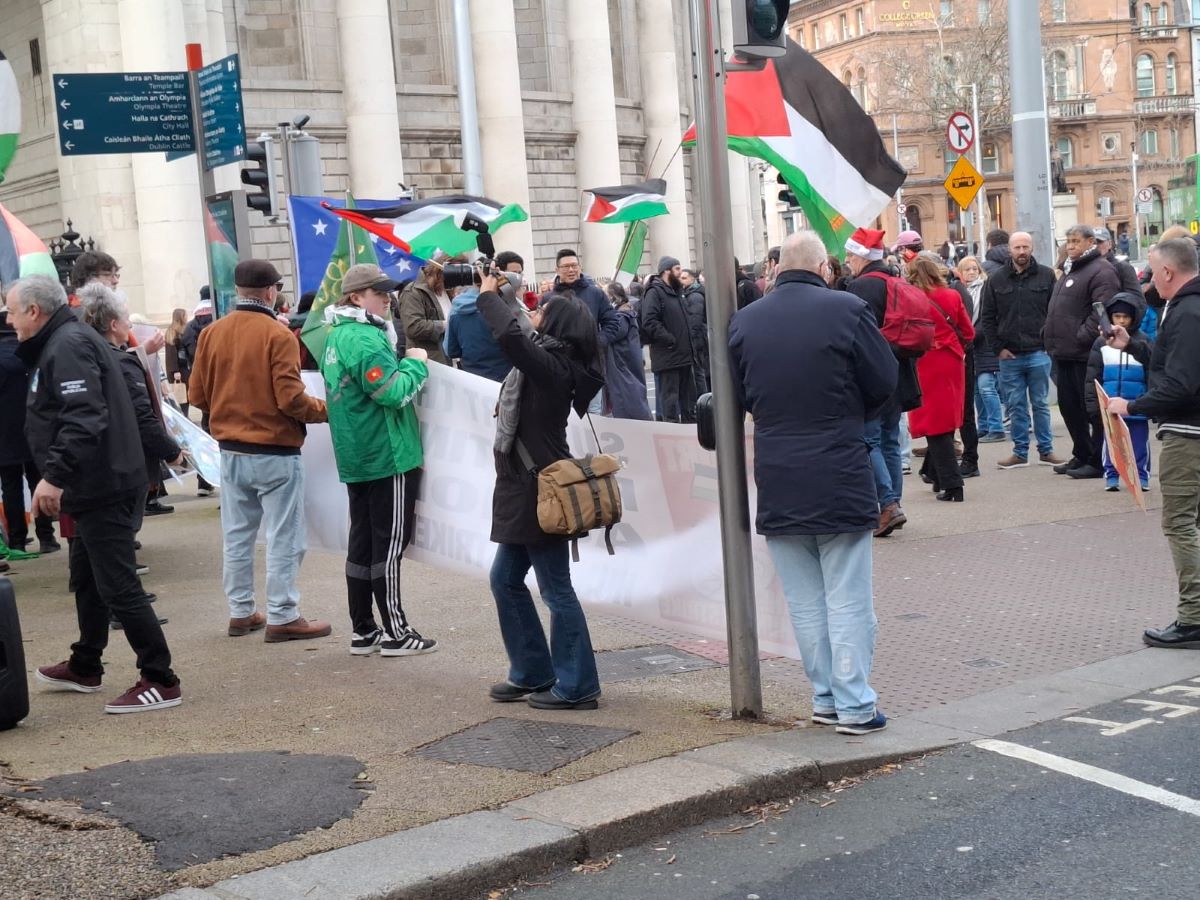
It was huge, without a doubt. From the D’Olier Street northern corner, the front of the march organised by the Ireland Palestine Solidarity Campaign had gone to the gates of Trinity College while the rest of it could be seen northwards the length of O’Connell Street and possibly beyond.

In the distance marchers may be seen along the length of O’Connell Street. Behind the photographer, a section of the march is proceeding while the front has reached the Trinity College gates. (Photo: D.Breatnach)

This was the 16th national mobilisation in Palestine solidarity since October 2023 organised to take place in Dublin, while many smaller marches, pickets, vigils, public meetings, talks, film shows and other solidarity events have been held weekly across the nation.

BANNERS, FlAGS & PLACARDS

In addition to local branches of the IPSC, banners on the march also proclaimed party, trade union and professional body allegiance, along with specific declarations and calls for actions.

Placards included the professionally-printed but also a wide range of the ‘home-made’ examples and these can be of particular interest, such as the one that declared that “Blaming Hamas for firing rockets at Israel is like blaming a woman for punching her rapist.” Indeed.

“Gaza is a death camp”. (Photo: D.Breatnach)

As the marchers passed the iconic General Post Office a small group organised by socialist Irish Republican organisation Éirigí held up giant letters spelling SAVE THE GPO.2 A group wearing blue tops with PRESS on the back marched and held up photos of individual journalists in Gaza.3

The PBP-Solidarity contingent carried a banner calling for the enacting of the Occupied Territories Bill which seemed a rather tame demand of the Irish State from an organisation claiming to be revolutionary socialist (see Irish State Options section).

A bagpiper playing amongst the marchers. (Photo: D.Breatnach)

The most popular non-party flag on the march was of course the Palestinian one but the Irish Tricolour has been making a greater appearance on these marches of late and not before time.4 I noted only one Starry Plough, in green with the Plough design in gold and white stars.

DESTINATIONS AND ROUTES

The IPSC marches tend to begin at the Garden of Remembrance and end near Leinster House,5 seat of the Irish State’s parliament, or occasionally at the Department of Foreign Affairs. Saturday’s march also went to Molesworth Street but through a longer circular route.

This route saw the march take in part of Dame Street, then the whole of South George’s St. and Aungier Street, turn left towards Stephens Green and proceed along the Green’s west side, then along part of its southern side before turning down Dawson Street.

(Photo: D.Breatnach)

Molesworth Street was full of marchers already but IPSC stewards hustled marchers off Dawson Street, eventually giving up their usual endeavour to push the crowd past the Schoolhouse Lane junction so the Gardaí could erect barriers across that section to enclose the marchers.

The unusual route on this occasion avoided the temptation to march up the pedestrianised shopping area of Grafton Street, which the Gardaí do not like and at which there was a confrontation during the previous IPSC march when a number of protesters tried to take that route.

One of the supporters of the march. (Photo: D.Breatnach)

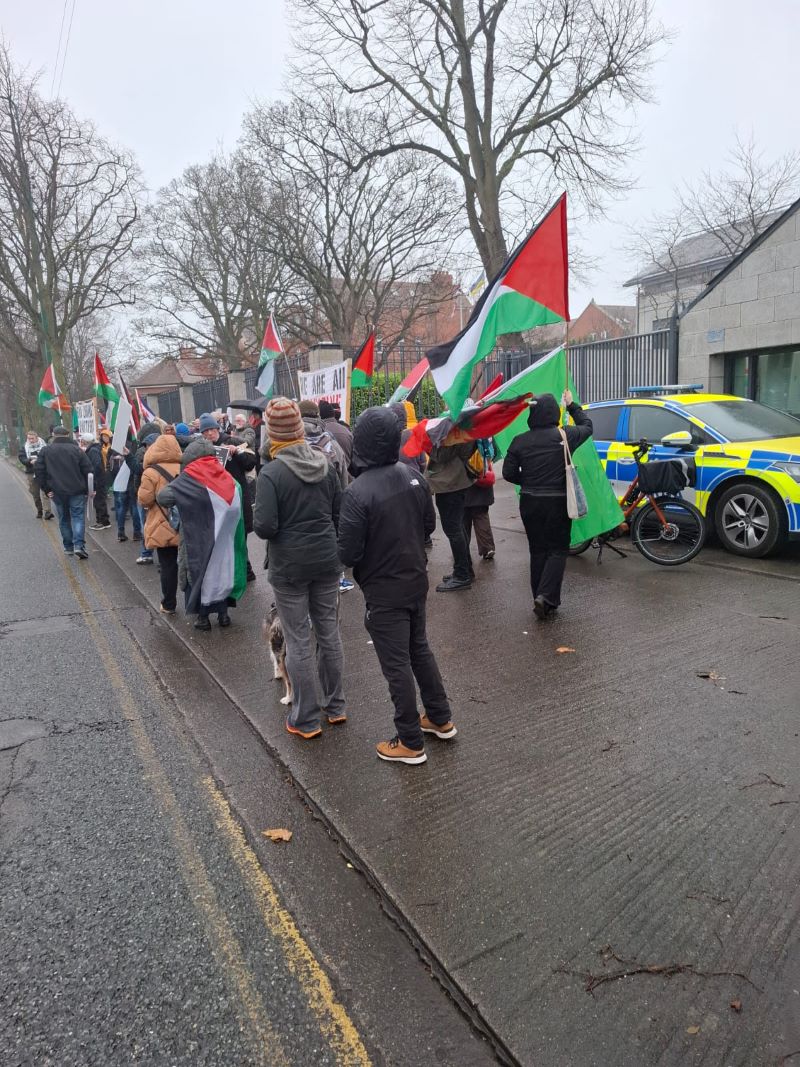
Despite the crucial role of the USA as chief supplier of arms, funding and political cover for the genocidal Zionists of the ‘Israeli’ state, since 2023 the IPSC have approached Dublin’s US Embassy only twice, no doubt respecting the Gardaí wish not to have the main road outside blocked.

On those two occasions the IPSC halted the march in a street behind the Embassy and away from one of the main roads into Dublin from the south (and along which the ill-fated Northumberland Fusiliers marched in April 1916). Marches to the Israeli Embassy were rare during the period too.6

(Photo: D.Breatnach)

IRISH STATE & OPTIONS

Both leaders of the Irish Coalition Government7 have built up some kudos with many anti-genocide people around the world for publicly stating that Israel is committing genocide – the first leaders of an EU or indeed Western state to say so.

In addition, the Irish Government joined with those of the Spanish and Norwegian states in a failed attempt last week to have the EU remove ‘Israel’ from its preferential trade agreement for violation of the human rights conditions of the Agreement.8

(Photo: D.Breatnach)

However, as a number of speakers at the IPSC rally and some marchers’ placards declared, the Irish State is in fact complicit in genocide by allowing military equipment for ‘Israel’ to fly through Irish airspace and by not enforcing its neutrality on US military transit through Shannon Airport.

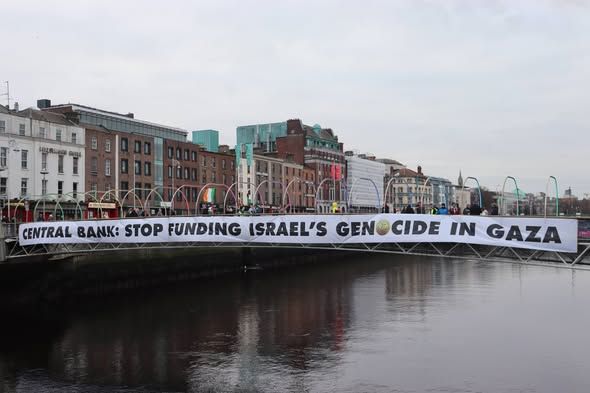
And in allowing the Central Bank of Ireland to process ‘Israeli’ war bonds, which was the target of a number of representations including its huge logo on the march and a speech by Gary Gannon, DCC Councillor of the Social Democrats party.

(Photo: D.Breatnach)

The glacial progress of the moderate Occupied Territories Bill,9 delayed and then attempted weakening of it by removing services from the ban,10 is another hallmark of the Irish Government’s collusion (notwithstanding expressed Zionist rage and bullying by some US Congressmen).

Next to the USA, the Irish state is the biggest importer of ‘Israeli’ goods and a ban on these would greatly affect the genocidal state not only morally but also practically. In the absence of government action, the trade unions could impose a ban on their members handling those goods.

The contradiction is that the Western state most overwhelmingly pro-Palestinian is the biggest importer of ‘Israeli’ products and having hardly any practical effect towards preventing the genocide against the Palestinians, contrary to what the majority in Ireland actually want.

End.
Note: For the photos in this report I concentrated on the more unusual of those participating.

(Photo: D.Breatnach)
Molesworth Street, the destination, is full from one end to the other. (Photo: D.Breatnach)

FOOTNOTES

IRISH MEDIA REPORTING

Irish Times: https://www.irishtimes.com/ireland/2025/07/19/this-war-took-my-entire-life-from-me-thousands-attend-pro-palestine-march-in-dublin

RTÉ: Thousands take part in march for Palestine in Dublin

1https://www.irishtimes.com/ireland/2025/07/19/this-war-took-my-entire-life-from-me-thousands-attend-pro-palestine-march-in-dublin Nevertheless, that was the national broadcaster RTÉ’s approach.

2https://www.businesspost.ie/politics/plan-for-gpo-to-house-offices-and-retail-to-be-signed-off-by-government/

3https://en.wikipedia.org/wiki/Killing_of_journalists_in_the_Gaza_war

4The Irish far-Right of fake patriots has been permitted illegitimately to almost monopolise the Irish Tricolour.

5‘Near’ rather than at Leinster House, because the Gardaí set up a crowd barricade at the end of Molesworth Street across the street from the House and that is as far as the march goes and also where the speakers’ platform is set up.

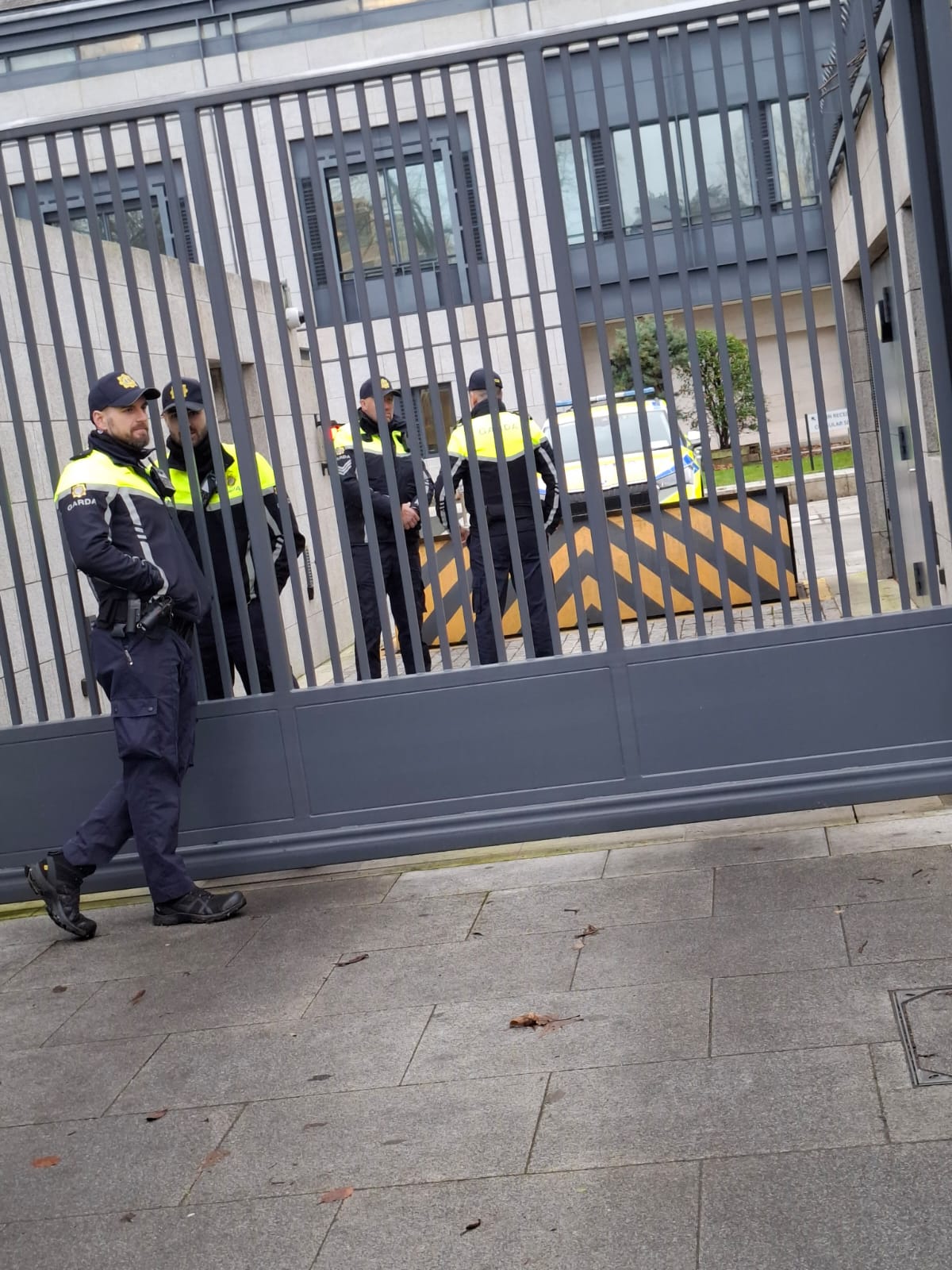
6This was so even before the Israeli Ambassador abandoned her Dublin post in disgust at popular Irish hostility to genocide and prior to the reputed closure of the Embassy (despite which the site has a 24-hour Garda guard).

7Taoiseach (Prime Minister equivalent) Mícheál Martin of the Fianna Fáil party and Tánaiste (Deputy PM equivalent), also Minister of Defence Simon Harris of the Fine Gael party. The Green Party is also a member of the Coalition.

8The European Union as a body and economic area is the largest consumer of Israeli exports https://www.aljazeera.com/news/2025/5/22/which-countries-trade-the-most-with-israel-and-what-do-they-buy-and-sell

9https://en.wikipedia.org/wiki/Occupied_Territories_Bill

10https://www.trocaire.org/news/what-you-need-to-know-about-the-occupied-territories-bill/

THOUSANDS MARCHING IN DUBLIN BLAME VULTURE FUNDS AND THE GOVERNMENT FOR HOMELESSNESS

Diarmuid Breatnach

(Reading time: 4 mins.)

An estimated 10,000 people marched through Dublin city centre on Saturday in a national protest organised by CATU about homelessness, high rents, lack of public housing and the facilitation of property speculators by Irish Governments.

Groups from across Ireland attended the national march organised by the Community Action Tenants Union and without regard to the British Border around the Six-County occupied colony. They gathered at the Garden of Remembrance before marching towards Leinster House.

One of the housing groups that travelled to Dublin from the occupied Six Counties (Photo: D.Breatnach)

It was warm but not excessively so and the rain held off. The march ended with a rally in Molesworth Street, where Garda barricades prevent marchers from crossing the street to approach the gates of Leinster House, where the parliament of the Irish State sits.

In addition to drummers and also some singing, many chants could be heard: Homes for need – not for greed! What do we need? – Public housing; When do we need it? Now! When tenants are under attack? Stand up, fight back! (also something like: Get the landlords out of the Dáil!).

Among banners and flags of local area housing action groups and trade unions there were a great many Irish Tricolours in view; to see them being flown on a demonstration not of the Far-Right was a welcome sight. There were some Starry Ploughs and some red flags flying also.

It was good also to see the Irish language on some placards among the demonstrators. A notable feature was the high proportion of young people participating, many with their own home-made placards.

A certain species of vulture seems to have raised hostility in Ireland! (Photo: D.Breatnach)
(Photo: D.Breatnach)
Too Damn everything – except good! (Photo: D.Breatnach)

A lot of people were also in Dublin that afternoon for other events, including supporters of Gaelic Athletic Association county teams competing in Croke Park, in particular the Cork Vs Dublin teams in the Hurling Semi-Final. (Dublin getting that far surprised many but Cork beat them decisively).

A large anti-abortion demonstration also took place in the city centre, starting later than its advertised hours but immediately after the start of the CATU march. There are a range of attitudes on abortion but in general those campaigners like to project themselves as ‘pro-life’.

Some might comment that a pro-life cause would also include good housing for all – or to support the Palestinian people but generally the anti-abortion campaigners do not march in support of those, which is why they are often accused of being ‘pro-birth’ rather than ‘pro-life’.

Numbers of homeless single people and families with children rising annually passes 15,000 for the first time.

Out of 10,743 adults accessing emergency accommodation in March this year, 1,178 were under 24. In addition, 4,675 children were also using emergency accommodation.1 In January 134 individuals were counted sleeping on streets and in parks in the four Dublin areas, a 14% increase on 2024.2

In addition, the numbers of homeless does not include those sofa-surfing, awaiting eviction, in domestic violence refuges or unaccommodated refugees.

CATU’s list of demands points to the unfilled needs across a range of indicators and in itself is an indictment of the current state of affairs. In addition, the numbers of homeless has been rising annually and does not include those sofa-surfing, in violence refuges or unserviced refugees.

(Photo: D.Breatnach)

Prior to the march, CATU published a list of objectives and demands:

  • End child homelessness by 2026
  • Eviction ban North & South, Lower rents
  • Properly resource the Tenant In Situ scheme
  • End Direct Provision
  • Ban Vulture Funds
  • Build and maintain Public Housing – use public land
  • Build and resource culturally-appropriate Traveller Accommodation
  • Homes, not Holiday Lets
  • Build Communities of Care: education, community, addiction & mental health services now!
Front of the CATU march comes around from D’Olier Street while the rest of it is still coming down O’Connell St. (Photo: D.Breatnach)
(Photo: D.Breatnach)

COMMENT – Housing Need and Action

It was an excellent turnout for CATU who are to be congratulated on their mobilisation and organisation around the country and in Dublin. The housing crisis is one of the great practical problems facing working people and a very big public housing program is the only solution.

However, the Irish neo-liberal ruling class are clearly wedded to housing provision by the private sector, with its soaring rents and mortgage payments resulting for many in sleeping on the street or living in hotels and hostels, not just single people but family groups with children too.

Housing marches and occasional symbolic occupations of buildings through the years have not changed the situation which worsens annually. The far-Right use the issue to target migrants who have not caused the crisis and even asylum seekers who cannot possibly have any effect on it.

Plentiful public housing is clearly the answer, rented according to the occupiers’ income. After the initial building cost, the rents will pay for maintenance, repairs, upgrades and even new buildings. And the construction program will provide much employment too.

Clearly a radical program of action will be needed to force the Irish ruling class to adopt a large public housing program. It does not require a revolution to achieve the change but it will almost certainly need the fear of one to move our rulers in the necessary direction.

In the 1960s and 1970s a number of housing schemes construction and renovation programs were won by the direct action of the Housing Action Committees of Dublin and Dún Laoghaire. The Committees included occupations in their program, alongside street rallies and marches.

Some years ago a small group called Revolutionary Housing League began a series of occupations of empty buildings, also refusing to give guarantees not to continue the actions when taken to court. They called for replication action on a wide scale along the same lines but that did not materialise.

Action of the kind up and down the country seems to be what is required and activists may be jailed before this ruling class is prepared to supply the basic human need of decent and affordable housing for the working people. It remains to be seen what role CATU will play in all of that.

End.

“Resist Evictions” banner (Photo: D.Breatnach)

1https://homelessnessinireland.ie/

2https://www.irishtimes.com/ireland/social-affairs/2025/01/03/number-of-homeless-people-passes-15000-for-first-time-since-records-began/

3https://homelessnessinireland.ie/

4https://www.irishtimes.com/ireland/social-affairs/2025/01/03/number-of-homeless-people-passes-15000-for-first-time-since-records-began/

Don’t Change the System – Just the Parties in Government

Diarmuid Breatnach

(Reading time: 2 mins.)

I was relieved by my attendance at the Raise the Roof housing demonstration in Molesworth Street in Dublin City Centre. That was because I learned from speakers that just by voting in ‘a Left Government’ we could receive the housing we need.

Raise the Roof is a coalition of trade unions with its address at the Labour Party-orientated ICTU and a number of housing NGOs. The coalition also contains political parties: Sinn Féin; Labour Party; People Before Profit/ Solidarity; Social Democrats; Independents4Change.1

A view of the protest in Molesworth St. Leinster House is in the background across Kildare Street with access prevented by police barriers at the end of Molesworth St with a special gate to allow entry and exit for customers of the hotel on the corner. (Photo: D.Breatnach)

Previously I’d thought that either we’d need a revolution or a country-wide campaign of direct action occupying empty properties. This is because the housing crisis is deliberately constructed for the benefit of profits for big landlords, vulture funds and the banks that finance them.

And since they keep making massive profits out of the situation, they won’t want it to change as it would if, for example, were the State to seize empty properties2 for conversion to housing along with a massive public housing for rent construction campaign.

And if the profiteers don’t want that, naturally their (sorry, ‘our’) government will make sure not to do anything of the sort.

So it was great to learn that we won’t have to really fight and break the law, going to jail and all that. Phew! Just change the parties in the Government at the next election! Elect a Left Government!

Visual accidental irony comment in the same street. (Photo: D.Breatnach)

But… lately I have to admit I’ve been having doubts about this solution. First of all, there’s the question of numbers of TDs available to form this aspired-to government. There are overall 174 TDs in Leinster House (the Parliament of the Irish State) and a fragile majority requires 88.

The Sinn Féin party has 39 TDs and People Before Profit/ Rise/ Solidarity five in total, a combination of 44 still needing another 44 to reach the 88 minimum. FG and FF, formerly opposition parties but now in government have 86 votes between them and needed some extras to run the Government.

But I’ve got a much bigger doubt really, and that’s whether SF will stand up to the bankers and property magnates.

SF has for decades being setting out its stall that it is safe pair of hands to run the system, in other words that the profiteers have nothing to worry about. And to tell the truth, I believe them. Though some of their followers think SF is fooling the system, I think it’s the followers being fooled.

View of the Raise the Roof protest in Molesworth street. (Photo: D.Breatnach)

So … after further consideration, it really does look like a revolution will be required to end the housing crisis — or at least something so near as to make the managers of the system believe that unless they resolve the housing crisis, there will be a revolution. So I’m worried again.

Anyway, it was interesting seeing the amount of Tricolours in what was predominantly a left-wing rally of hundreds (despite a small contingent holding an Aontú banner) and there was some nice music with singers including Lisa O’Neill and Jimi Cullen (with his Homes for All composition).

I still left early, however.

End.

Footnotes

1https://www.raisetheroof.ie/about-raise-the-roof

2https://www.socialjustice.ie/article/vacancy-and-dereliction-ireland

“FIX OUR HOMES!” – DUBLIN COUNCIL TENANTS DEMONSTRATE AT CITY HALL

Diarmuid Breatnach

(Reading time main text:5 mins.)

A large number of tenants organised by the Community Action Tenants’ Union (CATU) from a number of Dublin City Council housing estates gathered outside City Hall on Monday 12th May evening to lobby the monthly elected Councillor’s meeting.

Those attending for the most part came from public housing blocks and estates from Ballymun to the Liberties and Coolock to Pearse Street. They carried placards and demanded that Dublin City Council negotiate with them.

A section of the lobby outside City Hall facing Parliament Street (note on top extreme left of photo plaque commemorating two leaders of the Irish Citizen Army shot dead in 1916). (Photo: D.Breatnach)

The recently-appointed Assistant Chief Executive over housing and community came out to receive the Union’s demands and petitions from tenants organising within their complexes and areas and the lobbyists also forced the issues onto the agenda of the council meeting that night.

The protest was organised by the Dublin city CATU branch with wide support from community organisers and was attended by a number of elected councillors from some political parties and independents.

(Photo: D.Breatnach)

The problems CATU representatives listed verbally and in writing included a general low level of maintenance and upkeep of their estates and blocs, of the actual dwellings, communal areas, playgrounds and rubbish chutes. Rat infestations were a problem in some.

Damp leading to mould, rainwater penetration, inadequate proofing, badly fitting windows and doors were also listed at a number of sites, as were inadequate insulation leading to high heating costs and a need for overhaul of the heating system itself.

Among the slogans chanted was: Dublin City Council – Negotiate!

(Photo: D.Breatnach)

Included in their demands was that DCC officials recognise the right of their tenants to be represented by CATU as their union, which they stated was not always respected and they sought formal meetings with named officials responsible for the areas in question within one month’s time.

Although apparently currently not members of CATU, the organisation had invited the Pearse House Residents’ Committee to attend and speak at the lobby. Their chairperson Neil Maloney did so, addressing the issue of the long overdue regeneration of their housing bloc.

(Photo: D.Breatnach)

Maloney described the “blow to the community” when funding for stage two of the regeneration project to eliminate overcrowding was withdrawn, after their hopes had been raised by presentation of a regeneration timescale and a physical design in August of the previous year.

Ironically, the housing crisis was implicated in the Government’s reason for refusing to support the regeneration going ahead, in that the increase in inner space of the dwellings would reduce the number of actual housing units.

(Photo: D.Breatnach)

The Pearse House chairperson commented that “the current bedsits are illegal” and that their homes currently don’t meet European standards, going on to state “a real need for bigger homes to address overcrowding and family needs.”

“This was always going to be a challenge for this protected structure, but in phases 2 and 3 of the regeneration plan, there would be 2 additional blocks built. The additionality that the Government is seeking would be gained through the social homes gained during the decanting process.”

Pearse House residents attended CATU’s protest “to highlight our anger and what we see as another block on this project,” Maloney said. And note that although DCC has committed to redesigning the project for submission to the Government there is no guarantee this will be successful either.

(Photo: D.Breatnach)

“Ireland is still in breach of the European Charter for social housing and our human rights. Our community has seen the redevelopment and construction of new buildings, offices etc. and Pearse House is the eyesore in the middle of our community.”

“We were the community before all this redevelopment, and we will be the community when it’s all over,” concluded Maloney, voicing a common complaint along the south Dublin dockside. 1

A section of the lobby outside City Hall viewed looking down Dame Street. (Neil Maloney is pictured after his speech). (Photo: D.Breatnach)

Public Housing Background

There was little public housing in Dublin under British rule and the big town houses of the rich had been sold and sub-divided for rent by private landlords (including some who were elected councillors (or aldermen).

The new State built “2,000 local authority homes by 1924, a feat all the more remarkable in the context of a shortage of State funds, and the need to rebuild much of the infrastructure damaged in the War of Independence.”2

But of course it was not keeping up with the existing need or population growth and 40% of the population were forced to emigrate in the first 50 years of the Irish State.3

However 1924 too was the introduction of legislation facilitating state money subsidising the building of private housing.4 “In the decade after 1932 some 82,000 homes were built, the vast majority (public and private) with State subsidies.”5

Prof. Kenna relates that by 1940, some 41% of the Irish housing stock had been built by local authorities, far higher than that in England and Wales (25%) and also comments on the effect this had on subsidiary employment not only in construction but in sourcing and supply of materials.6

Although by 1964, a further 74,000 private and 63,000 local authority homes were built with State support and that between the 1950s and 1960s a million people had left the country, there was still a housing shortage and rents on private properties dug deep into workers’ incomes.7

Prof. Kenna comments that little attention was paid to the need for housing estate management, amenities, shops and the social, educational or other needs of the new community established there. That this should coincide with a boom time for property developers should not surprise us.

(Photo: D.Breatnach)

Government schemes to facilitate the purchase of their local authority accommodation from the 1950s resulted in the disappearance of much public housing stock into the private sector.8 Theoretically they would be replaced by new public housing builds but that didn’t happen.

Public land and land held by NAMA9 has been increasingly sold or even given away to private developers on promises of provision of a low percentage of public housing and often those individuals or consortiums do not even keep their earlier promises.

The Report of the Commission on the Relief of the Sick and Destitute Poor in 1927, Prof. Kenna reminds us, found 3,257 homeless people including 901 children, while in January 2021 there were 5,987 homeless adults and 2,326 homeless children in Ireland.

The Far-Right has jumped on the opportunity of the current housing crisis to blame it – not upon lack of public housing construction, big landlords, property speculators and vulture funds – but on migrants.

The Left in Ireland has until now in practical terms left this ground for exploitation of racists.

One of a number of speakers, photographed from across the street as too crowded there. (Photo: D.Breatnach)

GOING FORWARD

CATU seemed pleased with the lobby turnout and announced their intention to organise a housing protest march on Saturday July 5th. In the meantime they will no doubt be following up on the meetings they requested with area housing managers and agreeing objectives and deadlines.

Hopefully, seeing the initial results in the attention of DCC housing and amenity officials, and reflecting on their numbers when they take joint action, tenants of DCC will take heart and grow in confidence in their ability to ensure provision of decent housing and services for their needs.

Of course, the Far-Right won’t like that as it distracts from their targets – but the extension of this campaign does provide some hope of something like a solution to the current terrible grinding crisis of both housed and homeless.

End.

One of a number of speakers, photographed from across the street as too crowded there. (Photo: D.Breatnach)

APPENDIX: I916 Battleground

It might or might not have been mentioned (I couldn’t hear much of the speeches) that City Hall, outside of which CATU were protesting, had been a 1916 resistance centre, occupied by a small force of the Irish Citizen Army, known in some circles as the first workers army in the world.

Unaware of the extremely low British garrison on the Castle that day, the ICA had failed to take the complex and retreated to City Hall and some outposts in Dame Street and Parliament Street where they resisted until overwhelmed by British Army reinforcements.

The symbolism of the Castle, the administrative seat of the British occupation in insurgent hands, resulted in a ferocious assault on the ICA garrison and it fell on the Monday/ Tuesday of that week. One of the statues inside bears what appears to be a bullet hole to this day.

A steel plaque on the right of the outside front of the building lists the names of the ICA garrison of the area, around 50% of which were women. An older cast plaque at the east corner lists the names of two of the five who were killed there, Sean Connolly (OC) and Sean O’Reilly (2i/c).

The 1916 Rising was followed by the election of the First Dáil in 1919 with its Democratic Program affirming that all right to private property must be subordinated to the public right and welfare, and that no child should suffer hunger or cold from lack of food, clothing, or shelter.10

That was followed by the War of Independence and the Anglo-Irish Agreement; and the new State that came into being had no intention of fulfilling the promise of the Democratic Program but rather a determination to suppress any who tried for that fulfilment.

Footnotes

1For example the construction plans for the Irish Bottle Glass site (sold by Nama to the Ronan consortium) contain no components of public housing and units at expected prices will not be affordable by most local people.

2Prof. Padraic Kenna https://www.jcfj.ie/article/100-years-of-irish-housing/

3Ibid.

4Ibid.

5Ibid.

6Prof. Padraic Kenna https://www.jcfj.ie/article/100-years-of-irish-housing/

7References in Prof. Padraic Kenna https://www.jcfj.ie/article/100-years-of-irish-housing/

8https://www.dublininquirer.com/a-new-book-weighs-up-the-history-and-impact-of-selling-off-irelands-social-homes-to-tenants/#:~:text=In%20the%201950s%2C%20the%20first,than%20we%20could%20have%20had.%E2%80%9D

9https://www.irishtimes.com/ireland/housing-planning/2025/05/11/no-deal-on-affordable-housing-at-glass-bottle-site/

10https://www.nootherlaw.com/archive/democratic-programme.html

Useful Links

CATU: https://catuireland.org/

A Hundred Years of Irish Housing by Professor Padraic Kenna: https://www.jcfj.ie/article/100-years-of-irish-housing/

The Democratic Program of the First Dáil: https://www.nootherlaw.com/archive/democratic-programme.html

Housing: https://www.irishtimes.com/ireland/housing-planning/2025/05/11/no-deal-on-affordable-housing-at-glass-bottle-site/

Lack of consultation on traffic management?: https://m.independent.ie/regionals/dublin/dublin-news/local-residents-complain-of-absolute-mayhem-following-new-pearse-street-traffic-restrictions/a240993177.html

PERFORMATIVE ANTI-ISRAEL MEASURES FROM PETRO

Gearóid Ó Loingsigh (reformatted entire for Rebel Breeze from article in his substack: Petro Announces Another “New” Measure Against Israel

(Reading time: 3 mins.)

Petro’s government announced another measure against Israel, or to be more precise the Foreign Minister Laura Sarabia, who despite all the criticisms we made of her seems more trustworthy than the erratic Petro, made the announcement.

Colombia will require an entry visa for Israeli citizens.

Before celebrating another blow to Zionism and a gesture of solidarity with the suffering people of Palestine, we have to read the reasons behind it. It is not a response to the genocide, but rather because Israel unilaterally imposed a visa on Colombians from May 14th of this year.[1] 

Laura Sarabia, Foreign Affairs Minister in the Petro government, at work. (Photo sourced: Internet)

When Colombia broke off diplomatic relations with Israel last year, at the very least it should have required a visa from Israelis travelling to the country. But Petro learnt very well the lesson of the nuns in the schools that it more important to appear to be than to be.

And he and his government appears to be the most progressive on the planet and an adversary of the Zionist state. But it is not true. It is not the case in migratory issues nor on economic issues and despite Colombia announcing it would no longer export coal to Israel, it continues to do so.

What is the point of requiring a visa from Israelis when many have double nationality and can enter with another passport? We have to be more radical.

Firstly, Colombia should state that those who have Israeli nationality automatically lose their Colombian citizenship. There are many countries in the world that do this, amongst them Nepal and India.

There are others that do not accept double nationality, you can only have one passport, though the loss of citizenship is not automatic. And further still there are countries, such as Ireland, that accept triple nationality.

Colombia should not recognise double nationality when the second nationality is Israeli. It could go even further.

Some countries, especially the USA, restrict visitors who have travelled to countries such as Iran or Cuba. Colombia could deny entry to anyone who has an Israeli passport, regardless of whether they enter with that document.

There are certain difficulties when it comes to implementing this, but there are legal implications for the person that uses another passport to enter Colombia if they are an Israeli citizen. With that alone they would close the brothels in Taganga and the sex tourism of Israeli soldiers in Colombia.

But neither Petro, nor Sarabia, when she stands in for the drunkard, aim to do anything like that. What they are about is appearances and this is to be seen in the economic measures taken against the genocidal state of Israel.

Gustavo Petro in handshake with Mahmoud Abbas, leader of the Palestinian Authority, the repressive Israeli and US proxy regime in the Palestine West Bank. (Photo source: WAFA)

With great showmanship they announced the end of coal exports to Israel.

But a recent communiqué from a group of trade unions and social organisations, amongst them the oil workers union, USO and the coal workers union, Sintracarbon, show that they continue to export coal to Israel.

According to the communiqué, based on data from Colombian Customs and Tax Office (DIAN) they exported 905.666 tonnes of coal to the tune of US $90 million since August 2025 when Petro issued his decree.

It is worth pointing out that Petro’s statement gained him fans in many parts, the Progressive International that includes personalities such as Walden Bello and Jeremy Corbyn reproduced an article from the US social democratic magazine Jacobin. 

The article pointed to Colombia as a model to copy and that 60% of Israeli coal came from Colombia and that

…the Israeli power grid depends on coal for 22 percent of its output. The same grid supplies electricity to Israel’s illegal settlements and arms factories as well as the infrastructure used by the Israeli military in perpetrating genocide…

…this decision is not only a victory in symbolic terms but shows the enormous impact that a wider energy embargo could have in ending Israel’s genocide in Gaza.[2]

In fact, according to data from the DIAN, between January and April 2024, i.e. before Petro’s decree US $101,658.000 worth of products were exported to Israel and in 2025 for the same period US $ 75,247,000 was exported.

This represents a reduction but it is clear that Colombia not only continues to export coal but many other products to the Zionist genocidaires.

So, what does it matter if Israelis are required to have a visa? What the government says is that it is going to impose a visa on Israelis because they did it first.

But the Zionist soldiers can come on other passports or even on an Israeli passport, providing they have a visa, i.e. the response to the genocidaires is a bureaucratic inconvenience when what we really need is to ban the entry of all Israelis to Colombian territory.

And to close all the brothels in Taganga and other places that function as places for the “rest and recreation” of the murderers after their “exploits” in Gaza.

End.

NB: For more articles by Gearóid see https://gearoidloingsigh.substack.com

NOTES

NO SHOW OF FAR-RIGHT AND FASCIST RALLY TO CLOSE DOWN DUBLIN SOCIALIST REPUBLICAN PUB

Clive Sulish

(Reading time: 3 mins.)

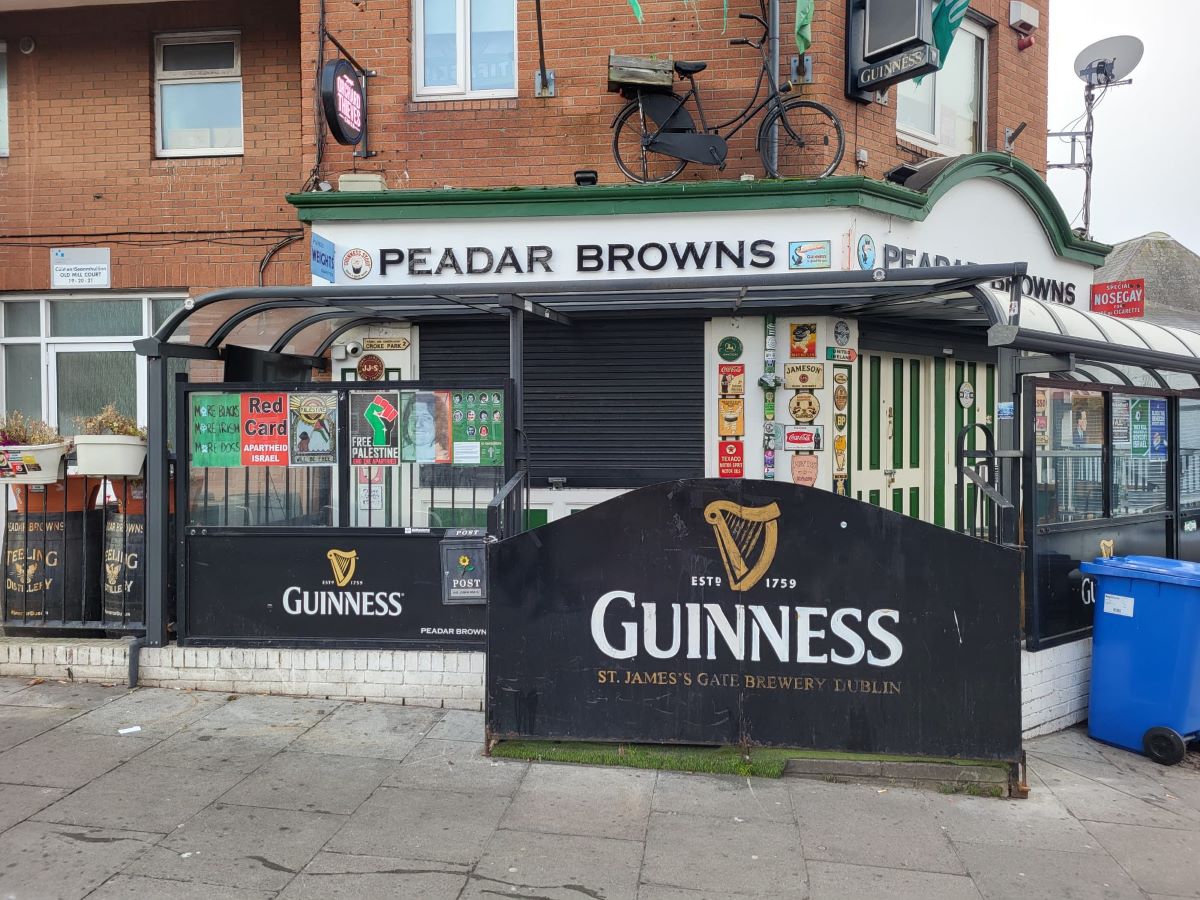
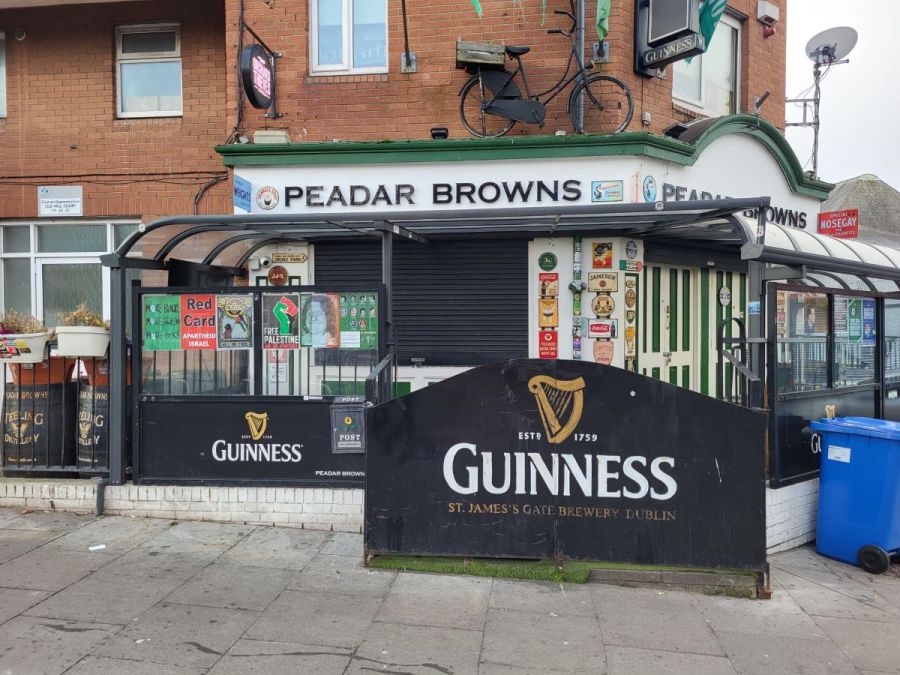
Far from the declared aim to “close down this kip” in an online call for a rally against Peadar Brown’s pub in Dublin, not a single far-Right supporter of the call made even a token appearance at the appointed hour Saturday afternoon.

This was no huge surprise; these elements tend mostly to attack small groups of people or torch empty building and surely quickly came to the conclusion that neither of those things would they be facing in the case of Peadar Browne’s. No indeed. A full building of many people.

The on-line event poster for the far-Right rally was followed by a number of posts and comments vilifying the pub’s management for allegedly banning a customer over his racist remarks but went further to attack the pub’s history and general political ambience too.

Recently-elected fascist member of Dublin City Council Gavin Pepper had himself videoed outside the pub on Friday night after it was closed, issuing veiled threats.

Closer view of section of the crowd last Saturday outside the front of the pub. (Photo: R.Breeze)

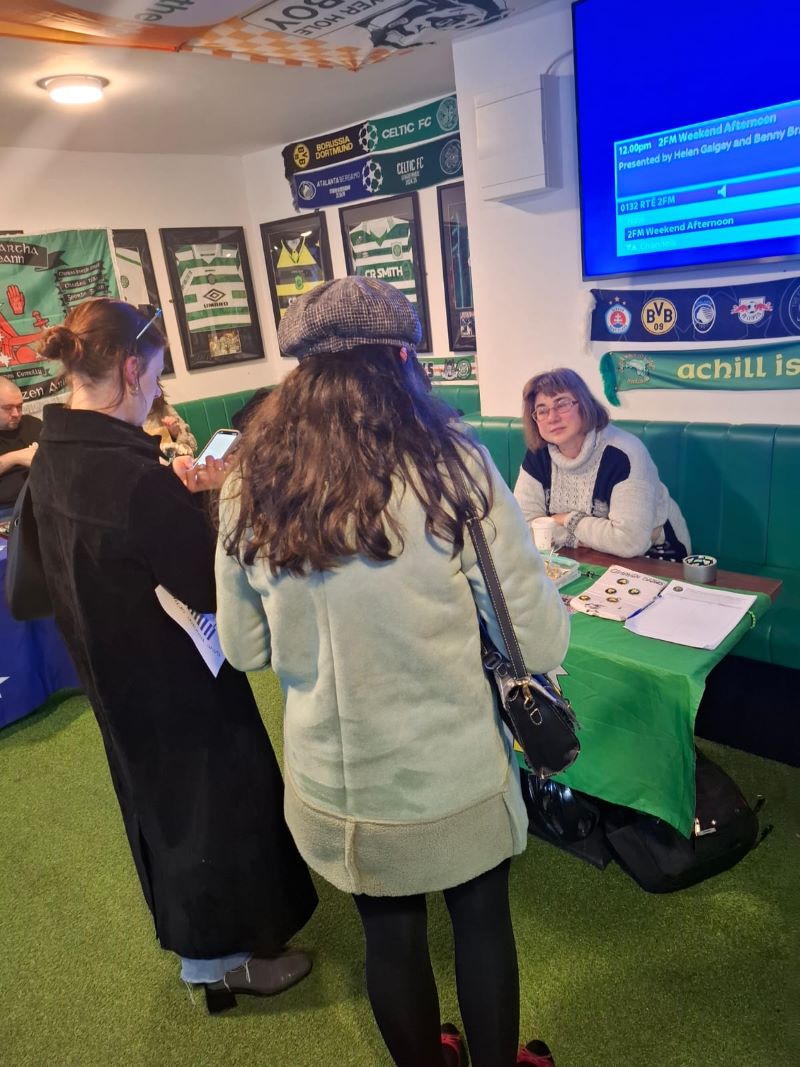
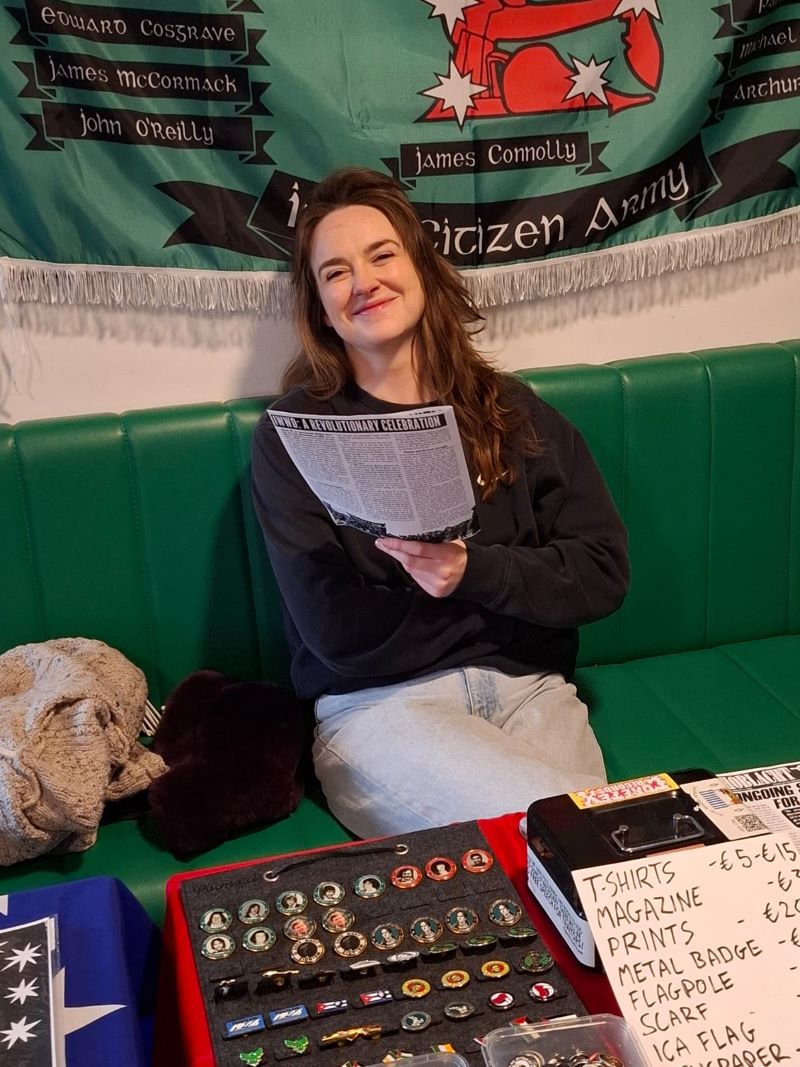
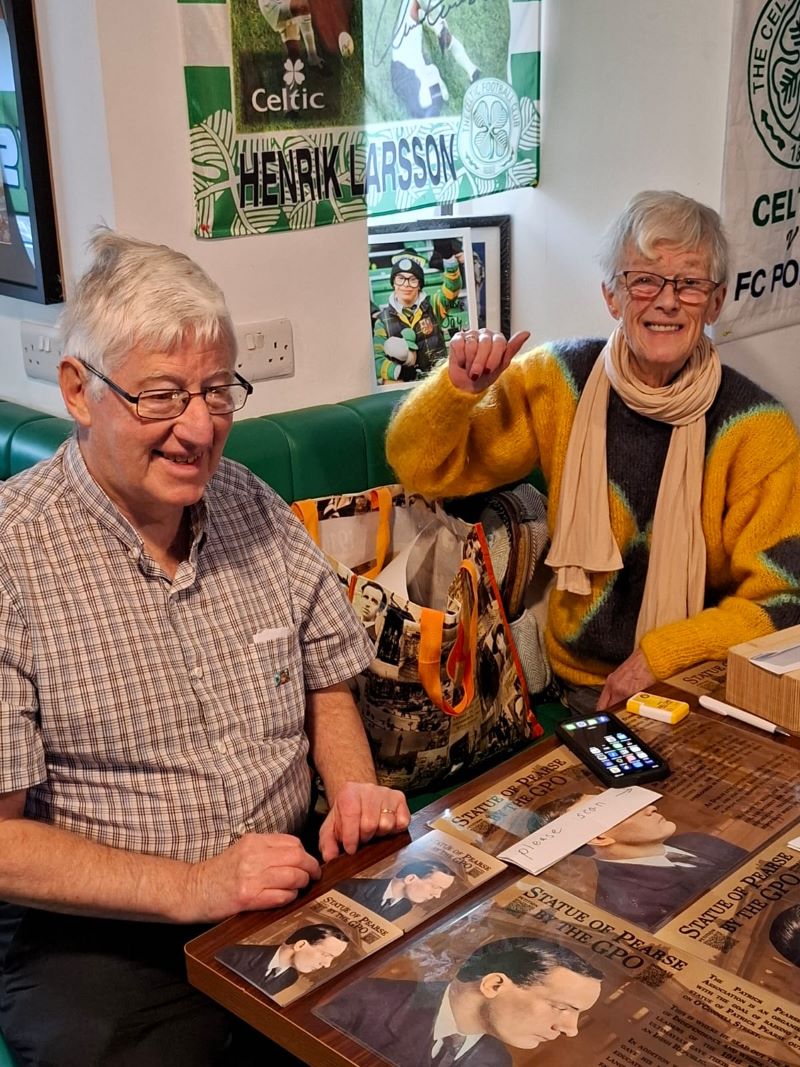
Peadar Browne’s pub has built up a reputation over years as one of socialist Irish Republican outlook, with both external appearance in flags and mural along with the interior decorations unashamedly declaring the broad sympathies of both owners and clientele.

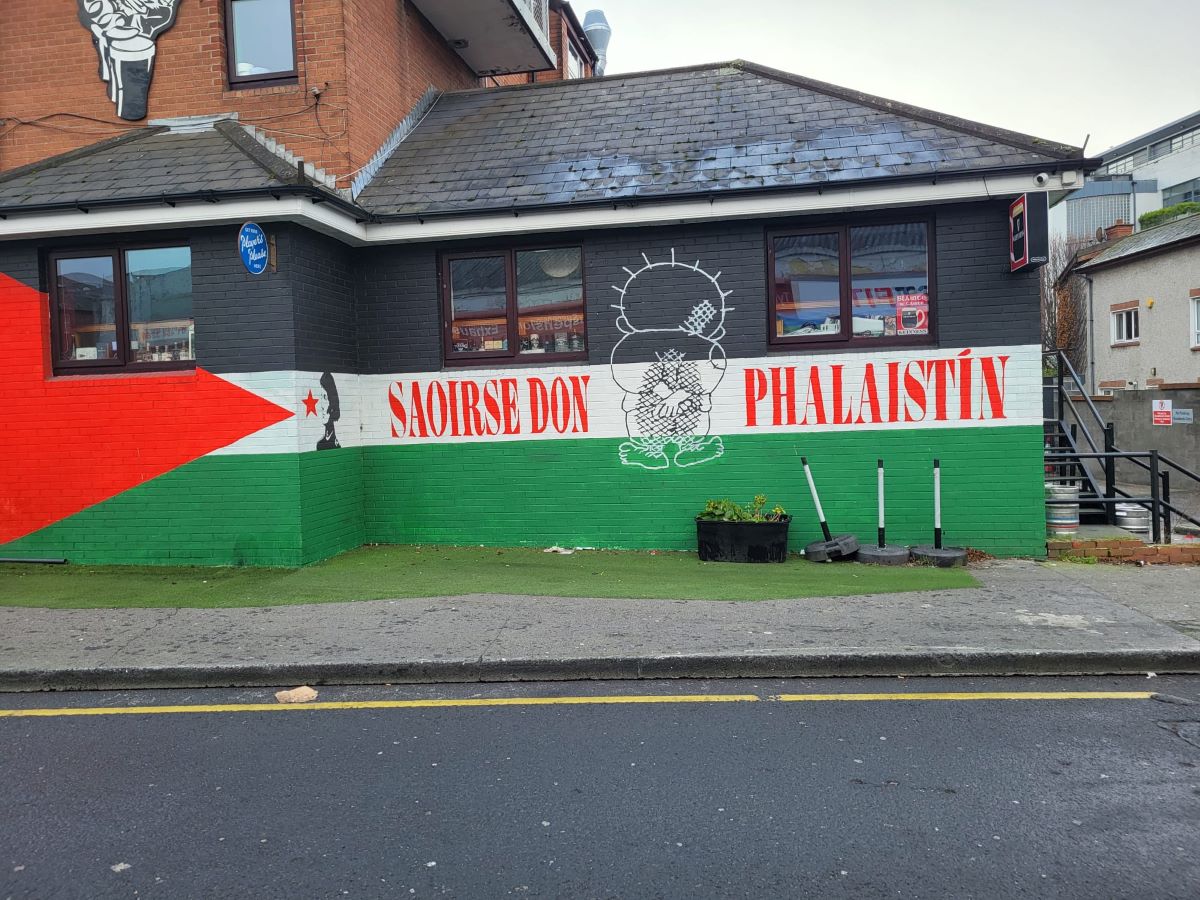
The venue has seen a number of events in keeping with that perspective held there, ranging from concerts to fund-raising events of various kinds, in addition to public and private meetings. The large mural of a Palestinian flag on the pub’s side also declares their internationalist sympathies.

Section of last Saturday’s crowd outside Peadar Brown’s, this one at the side of the pub. (Photo: R.Breeze)

For some time Saturday before the 3pm appointed for the rally, defenders were arriving, including Irish Republicans and Irish socialists of various organisations and none, Palestine supporters Irish and other, along with activists more specifically antifascist.

Soon both the inside and external areas of the pub were full, with extra banners and flags lining the external area facing the road. Occasionally the driver of a passing vehicle tooted its horn in solidarity, sometimes with extended clenched fist and encouraging roar from the passenger’s side.

Section of last Saturday’s crowd outside Peadar Brown’s, viewed from the middle of the road outside. (Photo: R.Breeze)

Near to the rally’s appointed hour it began to rain and continued for a while but the pub’s external area had been canopied over so few had to move – unless it were to use the toilet or refresh their glasses.

Conversations slowed on occasion as people checked their timepieces, looked outwards, shrugged and resumed talking. By 4pm most of those who hadn’t left decided they’d be staying, already in their evening weekend socialising venue, or at least for the first stage of the evening.

Section of last Saturday’s crowd outside Peadar Brown’s, this one at the top side of the pub. (Photo: R.Breeze)

In fairness, the absence of any uniformed Gardaí on the ground to protect the far-Right had been an indication that they were not expected to appear.

In Conclusion, drawing up The Balance:

The pub had one of its fullest Saturday afternoons and boosted its reputation among many who knew of it only vaguely, while online calls for a boycott were taken by many as recommendations for “a pub with no racists”. Fascists and racists in turn suffered a hit to their morale.

Some of the defenders on Saturday at the lower side with the mural behind them. (Photo: R.Breeze)

Socialists, communists, Irish Republicans and independent antifascists stood together in defence of a pub with an Irish Republican socialist ambience and strong pro-Palestine presence against a threat from far-Right and fascist elements.

Liberals, social democrats and former Republicans, usually prominent on anti-racist marches? Not so much.

End.

1916 Rising Commemoration in Glasnevin: James Connolly, the Citizen Army and Palestinian Resistance

Clive Sulish

(Reading time: 4 mins.)

An Irish Republican Easter Rising commemoration conducted on Sunday 20th April followed tradition in some aspects but departed in others. The event in Glasnevin Cemetery was organised by the Anti-Imperialist Action group.

As the 1916 Rising commenced on Easter Monday it is traditionally commemorated on various days around the Easter weekend. The actual date however was 24th April which a now-deceased socialist Republican activist publicly celebrated every year as Republic Day in front of the GPO.1

Taken from near rear of the marching columns approaching Cross Guns Bridge. (Photo: R.Breeze)

Among the commemorations organised by Irish Republicans around the past weekend was that by the AIA group on Sunday, rallying by the Phibsboro shopping parade for 1pm, before marching out to Glasnevin cemetry along the Phibsboro Road in two parallel separate lines.

This gathering in the past has been marred by the Special Branch, the political plainclothes police, harassing and attempting to intimidate those present, demanding their names and addresses under anti-terrorist (sic) special legislation. This time they were there but did not approach.2

Just after passing Crossguns Bridge over the Royal Canal, a flare was lit and the march stopped in the street.3

After a short pause the march resumed, led by the colour party,4 six men and women, each carrying a different flag with the Tricolour and Starry Plough in the lead, all dressed in black trousers, white shirts, black berets, sunglasses and lower face masked.

The images of each of the Seven Signatories of the 1916 Proclamation, all shot by British firing squads were on large placards were carried among the marchers: Tom Clarke, James Connolly, Patrick Pearse, Seán Mac Diarmada, Joseph Plunkett, Thomas McDonagh, Eamonn Ceannt.

(Photo: R.Breeze)

A variety of flags were also flown among the marchers, including the green and gold Starry Plough,5 Palestinian flag, Basque Ikurrina and red flags (with gold hammer and sickle emblem on at least one).6 The AIA banner carried at the front bore a quotation from Bobby Sands in Irish.

The march soon passed the main gates of Glasnevin Cemetery to their right but continued before turning leftward to then cross over the pedestrian railway bridge to the newer part of Glasnevin Cemetery and up to the monument to the Six armed struggles referred to in the Proclamation.7

Formed in two lines the attendance was welcomed in Irish and English by the event’s MC, calling also for the reading of the Proclamation of Independence, which a man stepped forward to do. The MC recommended a careful reading of the still-relevant document to attendees from abroad.

Section on the left of the attendance at the commemoration rally with another section to the right out of shot. (Photo: R.Breeze)

Following the reading, the MC commented on the important role of culture in the 1916 Rising8and called on an activist who he said has done much to promote traditional and folk Irish song, who proceed to sing Patrick Galvin’s Where Oh Where Is Our James Connolly? “with some changes”.

Next the call was given for those who wished to lay floral tributes while the colour party lowered their flags in homage to the fallen to commands in Irish, then slowly raised them again before responding to the command in Irish to stand ‘at ease’.

(Photo: R.Breeze)

Another activist was called to read the 1915 statement on the Irish Citizen Army by James Connolly in which the revolutionary leader outlined the police violence during the 1913 Lockout that created the need for the ICA and how it had gone beyond defence in assertiveness.

The statement declared its class allegiance and origins “Hitherto the workers of Ireland have fought as parts of the armies led by their masters, never as members of an army officered, trained, and inspired by men of their own class.”

Reading Connolly’s “To the Irish Citizen Army” (Photo: R.Breeze)

The PA amplification failed on the reader but she carried on in a strong voice reading Connolly’s words that the ICA sought alliance with all progressive forces but remained independent, not to be bound by the limits others set themselves and going further on their own if necessary.9

Another singer was called to perform Erin Go Bragh10 specifically about the 1916 Rising (by Dominic Behan, originally called A Row in the Town).

Singing Erin Go Bragh at the Monument (Photo: R.Breeze)

It is traditional for organisations to deliver a keynote message or statement of aims at 1916 commemorations and a statement was read on behalf of the Irish Socialist Republican Movement (of which the AIA is a part) restating the objectives of national independence and socialism.

In that context the struggles against the Irish ruling class putting the State into imperialist alliance and against the British occupation of the nation, also a NATO member, were greatly important and the Gardaí had broken a comrade’s foot in that struggle.

(Photo: R.Breeze)

Referring to the international context of the 1916 Rising and the international connections of the revolutionary movement in 1916, the MC read out a fraternal message to AIA from the People’s Front for the Liberation of Palestine,11 declaring that the struggles of both peoples are one.

The event concluded at around 2.45pm with a singer performing Amhrán na bhFiann12 (first verse and chorus) followed by an announcement or reminder of a public meeting organised by the AIA titled Rebuilding the Republic to take place at 4pm at a venue not very far distant.

End.
Footnotes

1Easter is a religious festival and its date varies from year to year according to computations based on the lunar and solar calendars and cannot fall on the same date annually in the Gregorian calendar (or the Julian one). After the insurrectionary forces had taken possession of the building, Patrick Pearse with James Connolly by his side read the Proclamation outside the General Post Office (GPO) building on the first day of the Rising (after its rescheduling from the previous day, Sunday): 24 April 1916. Tom Stokes tried for years to have the date adopted as Republic Day and annually organised an event outside the GPO on that date. After his death others carried on commemorating the date but rather than outside the GPO, at Arbour Hill. The Republican movement continues to hold its 1916 commemoration events over the Easter weekend.

2Possibly because the dust has not yet settled on the Gardaí’s recent violent arrests on 23 peaceful activists in three different events over four days (See Rebel Breeze’s Irish State Ramps Up Repression) recently.

3This spot has a 1916 history: A group of Irish Volunteers walked from Maynooth on Easter Monday along the banks of the Royal Canal, meeting two Irish Volunteers guarding the bridge and that night slept in Glasnevin Cemetery. The following morning they continued their journey to the city centre. Later, as the Rising was being suppressed, the British soldiers placed a barrier on the Bridge and prevented most people from passing through. A local man who had been deaf from birth failed to heed the soldiers’ challenge and they shot him dead.

4The ‘colour party’ carries the ‘colours’, i.e the flags and usually marches at the front. The number and type of flags varies but Irish Republican colour parties always carry the Tricolour among them, usually followed by the Starry Plough of which for many years the white stars on a blue background version was the most common. Often a flag of each of the four provinces would also carried and the Gal Gréine (or Sunburst) of the Fianna and of the Fenians would be carried too. The Harp on a Green background was another flag that was often carried by Colour Parties.

5The original design of the flag of the first workers’ army in the world, the Irish Citizen Army, created in 1914. It is a plough following the form of the Ursa Mayor constellation with a sword replacing the ploughshare.

6This is usually considered a symbol inherited from the Bolsheviks, the sickle representing the agricultural workers and the hammer, the industrial workers, their conjunction symbolising unity of peasants and industrial proletariat.

71798 and 1803 (United Irishmen), 1848 (Young Irelanders), 1867 (Fenians), 1882 (Invincibles group within the Fenians), 1916 (IRB, Irish Volunteers, Irish Citizen Army, Cumann na mBan, Fianna Éireann)

8Irish language revival, national theatre groups, national sports, poetry, music and song all contributed to an atmosphere conducive to resistance and uprising.

9However it may be for others, for us of the Citizen Army there is but one ideal – an Ireland ruled, and owned, by Irish men and women, sovereign and independent from the centre to the sea, and flying its own flag outward over all the oceans. We cannot be swerved from our course by honeyed words, lulled into carelessness by freedom to parade and strut in uniforms, nor betrayed by high-sounding phrases.

The Irish Citizen Army will only co-operate in a forward movement. The moment that forward movement ceases it reserves to itself the right to step out of the alignment, and advance by itself if needs be, in an effort to plant the banner of freedom one reach further towards its goal. https://www.marxists.org/archive/connolly/1915/10/forca.htm

10The slogan Éirinn (or Éire) go brách (“Ireland for ever”) was rendered in English spelling as Erin go bragh.

11 A socialist and secular resistance Palestinian resistance organisation; its armed wing is Brigades of the Martyr Abu Ali Mustafa which has been part of the armed resistance throughout the period, often in coordination with other groups.

12In a reversal of the usual sequence, the lyrics of this song by Peadar Kearney and Patrick Heeney were first composed in English but later translated to Irish, that being the most popular version of the chorus today.

Further information

https://www.marxists.org/archive/connolly/1915/10/forca.htm

isrmedia@protonmail.com

PALESTINIAN POLITICAL PRISONERS’ DAY IN DUBLIN

Diarmuid Breatnach

(Reading time: 4 mins.)

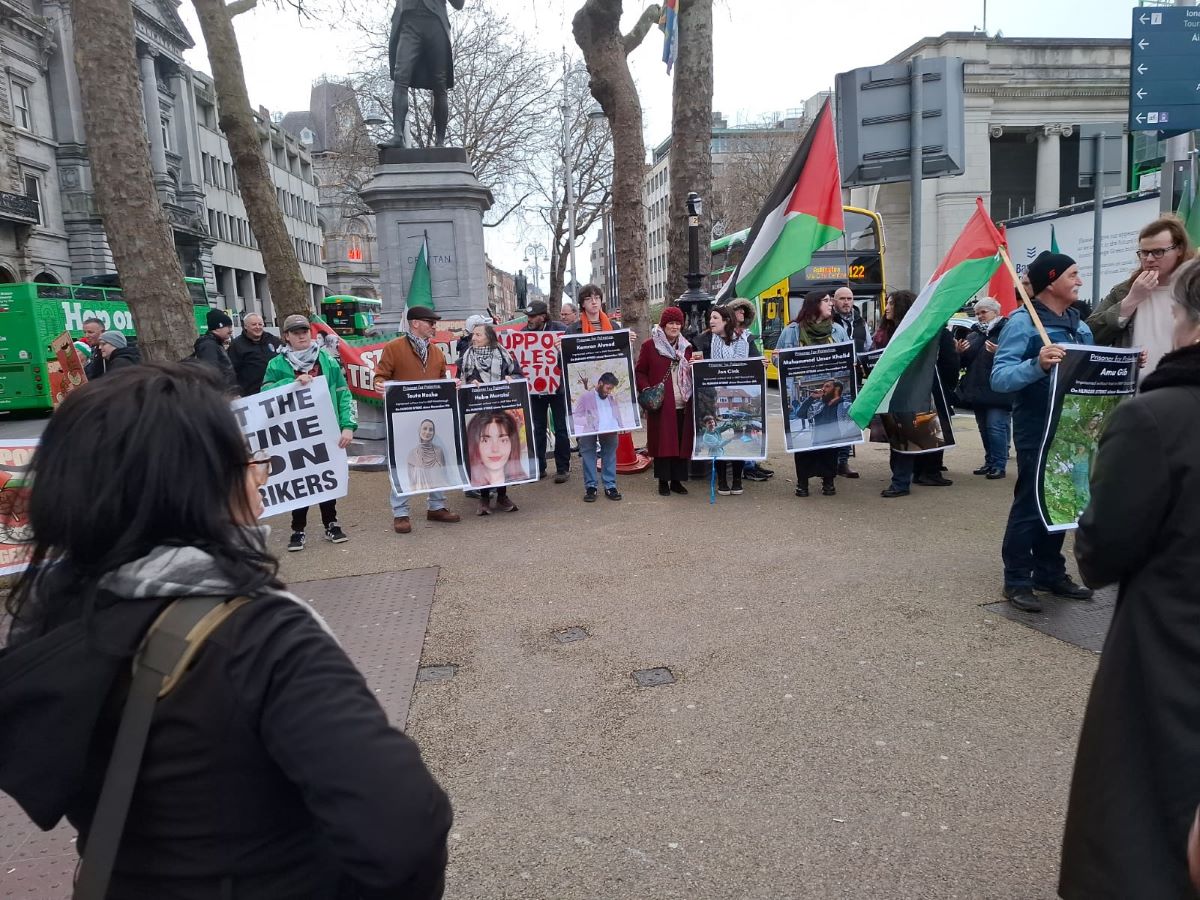
April 17th is the annual Palestinian political Prisoners’ Day and it was marked in O’Connell Street, the main street of Dublin’s city centre, by an event with speeches, banners and chants organised by the Ireland Palestine Solidarity Campaign.

Palestine national flags fluttered about the crowd being addressed by a number of speakers with occasional toots of solidarity from passing traffic – a common occurrence at Palestine solidarity events in most of Ireland.

View of eastward of section of the crowd at the event (Photo sourced: IPSC)

Dáithí Doolan was one of the speakers and though saying some progressive things about solidarity with Palestine and the terrible situation in which the occupiers have them, soon revealed the political poverty and lack of solidarity with resistance of his Sinn Féin party.

Doolan reminded his audience of when there were political prisoners in Ireland, as though this was no longer the case, presumably because the prisoners now are not of his party. Nor did he mention the current attempts to extradite Irish Republicans to British administrations.

The SF speaker went on to extol the South African process, perhaps not caring about the betrayal of the struggle and sacrifice of the masses there, the deepening grip of imperialism on the rich natural resources, the corruption and repression of the ANC regime and the massacre at Marikana.1

If Doolan thought about it he must have hoped that his audience did not remember that the South African process had a twin, the Palestinian one at Oslo which sabotaged the Palestinian struggle and brought into being the corrupt Palestinian Authority2, the Israeli proxy in the West Bank.

Sinn Féin has achieved a somewhat similar position in the Six Counties colony and has been working hard to reach a corresponding role in the Irish state. And why not, when it endorses the “Two State solution” giving the Palestinians 20% of their land under Zionist eyes and guns.

The very least, Doolan said, that the Irish Government could do to help the Palestinians, would be to enact the Occupied Territories Bill but he proposed nothing further, not even the ban on US military flights through Shannon Airport or on Israeli arms flights through Irish airspace.

Darragh Adelaide from the People Before Profit party spoke too about Palestine and solidarity but also about the Palestine refugees that have had to sleep in tents on Irish streets and the attacks on them both by the authorities and by fascists and other racists.

Palestinian prisoner conditions

A woman gave a detailed list of statistics relating to Palestinian political prisoners but also went through the tortures and terrible conditions in which they are kept. She concluded reminding her audience that each prisoner is a human being, a parent, a child, a sibling and not a number.

View of the crowd southward from behind a speaker (Photo sourced: IPSC)

In a year and a half, more than 15,800 Palestinians have been arrested, including 500 women, 1200 children, and thousands of detainees who were placed under arbitrary administrative detention.  64 Palestinians have died in prison since October 2024, including a child.3

The prison administration’s special units have carried out violent raids on prisoners’ cells, administering severe beatings, torture, and ill-treatment.4

Prisoners have suffered power and water cuts, and all of their belongings—including clothes, electrical appliances, and hygiene items—have been confiscated.5

They have been placed under complete isolation, family visits have been completely banned, and the International Committee of the Red Cross has been prevented from visiting them inside prisons. 

Additionally, a policy of starvation has been implemented against thousands of prisoners, who are being provided with only two extremely poor-quality and quantity meals a day.6

The MC of the event led chants in which he called out Palestinian political prisoners! and the audience responded with Free them all! Similarly with Free the children prisoners — Free them all! and Free the women prisoners! — Free them all!

Symbolising the Palestinian political prisoners (Photo sourced: IPSC)

He also referred to the woman arrested outside the Irish Embassy in Berlin for speaking in Irish and, in defiance, led the audience in a chant in Irish expressing solidarity with the Palestinian people: Saoirse don Phalaistín! (Freedom for Palestine!)7

What was notable in its total absence from all the speeches was any call to step beyond the marches and similar measures which have been supported by thousands in Ireland over more than 18 months but which have not succeeded in moving the Government even to enforcing its formal neutrality.

This is replicated in most solidarity events across the state, leaving those few who take action to increase greater pressure on the ruling class to face the repression of the Irish State, as with 23 men and women in three different events over a four-day period in Dublin recently.8

Political prisoners from the armed resistance

The Joe McDonnell Ballad9 would have been most appropriately performed at this event, in particular the chorus line: You dare to call me a terrorist, while you look down your guns … But the IPSC would hardly endorse the singing of that song nor wish to be associated with it in public.

There were two large prisoners’ solidarity banners of the IPSC at this event but it is remarkable how rarely one sees them on the IPSC’s national marches. The problem with the prisoners for liberal organisations is that some of them, at least, have been armed fighters of the Resistance.

This, combined with ignorance perhaps, accounts for the comparatively low numbers at this event. However, it has to be said that known revolutionary organisations were also visibly absent.

View south-westwards with the iconic GPO (General Post Office) building in the background. (Photo sourced: IPSC)

Doolan’s party was a problem for liberals when many of the political prisoners here had been armed Irish Republican resistance fighters; it’s still a problem for them today — but also for Doolan and his party now that the current Irish political prisoners are no longer associated with them.

If solidarity does not embrace resistance then it’s charity, not solidarity. And if resistance is to be embraced then it should be so for all its expressions, artistic, cultural, mass mobilisations, strikes, boycotts … and armed. Including solidarity with those who, because of resistance, end up in jails.

Free them all!

End.

NOTES

1Culminating on 16th August 2012 (while Mandela still lived) the police of the ANC Government carried out a massacre of over 40 striking miners over a period of three days. The massacre was to suppress a strike in a platinum mine of the Canadian Lonmin company, repressing also a breakaway union from theANC-allied National Union of Mineworkers. The massacre is widely believed to have been organised by Cyril Ramaphosa, then a millionaire and vice-President of the ANC Government and recent leader of the NUM, now President of South Africa.

2Which also beats and incarcerates Palestinians resisting the Occupation (exact figures are difficult to obtain) and has murdered some.

3https://www.addameer.org/news/5549

4Ibid.

5Ibid.

6Ibid.

7This slogan has now become well known in Ireland in voice but also in writing, appearing on flags, banners and placards. It represents a partial success for those of us who have tried to insert a measure of the Irish language into Palestine solidarity, in the belief that it is important for the Irish language to be present in progressive movements.

8See https://rebelbreeze.com/2025/04/06/irish-state-ramps-up-repression/

9By Brian Warfield of the Wolfe Tones band in honour of Volunteer Joe McDonnell of the Provisional IRA who died on hunger strike in 1981; the song also names other hunger strike martyrs of the Provisionals Vols. Bobby Sands, Francis Hughes, McCreesh but adds Vol. Patsy O’Hara of the Irish National Liberation Army. In total, seven of the Provisionals and three of INLA died on hunger strike in 1981.

USEFUL LINKS

IPSC:https://www.ipsc.ie

Adameer – Prisoner Support and Human Rights Organisation: https://www.addameer.org/

Adameer Statement on Prisoners’ Day: https://www.addameer.org/news/5549