A VERBAL HANGING IN DUBLIN’S THOMAS STREET

Clive Sulish

While eastbound drivers in Thomas Street on Friday 3rd March gawped, traffic slowed in the westbound lane to allow az small procession pushing a gallows, trundling along on wheels. There were surprisingly few witty comments, even the notoriously quick Dubliners too surprised to come up with a witty bon mot (or even a focal maith).

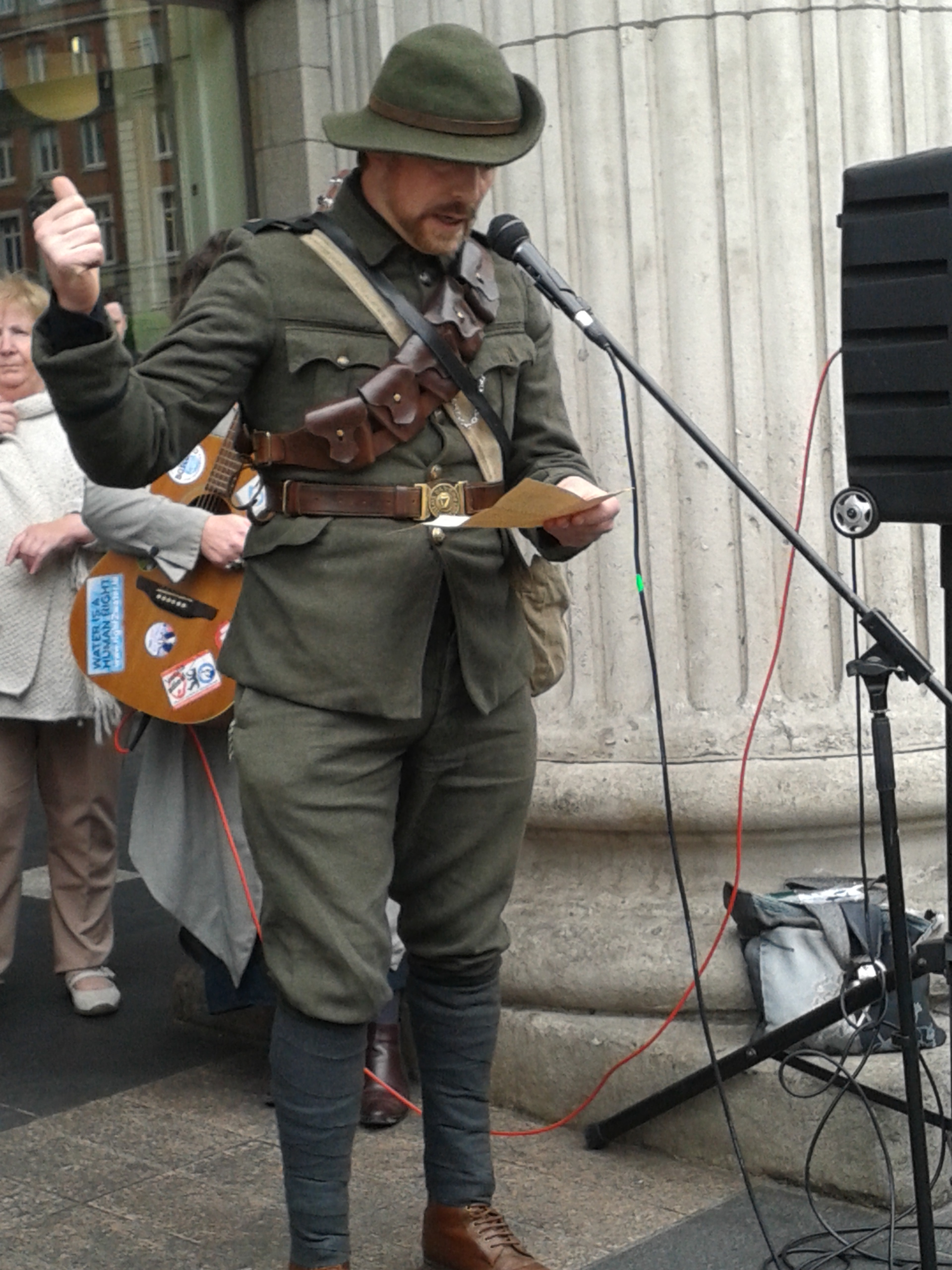
Diarmuid Breatnach outside St. Catherine’s Church, Thomas Street.
(Photo: /////)

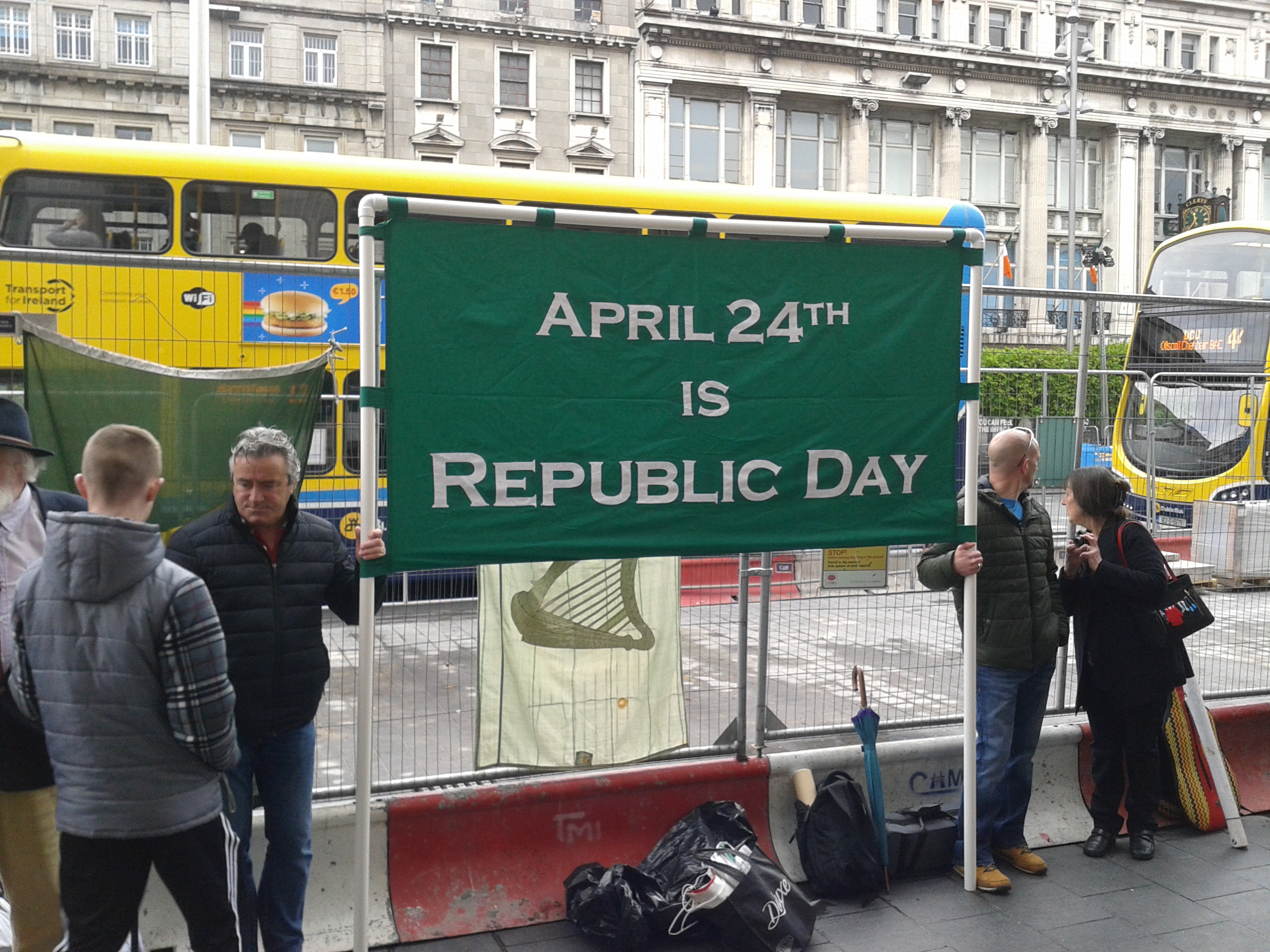
The procession stopped at the Robert Emmet plaque, in the railing wall of the former Protestant St. Catherine’s Church, approximate place of execution of Robert Emmet on 20th December 1803.

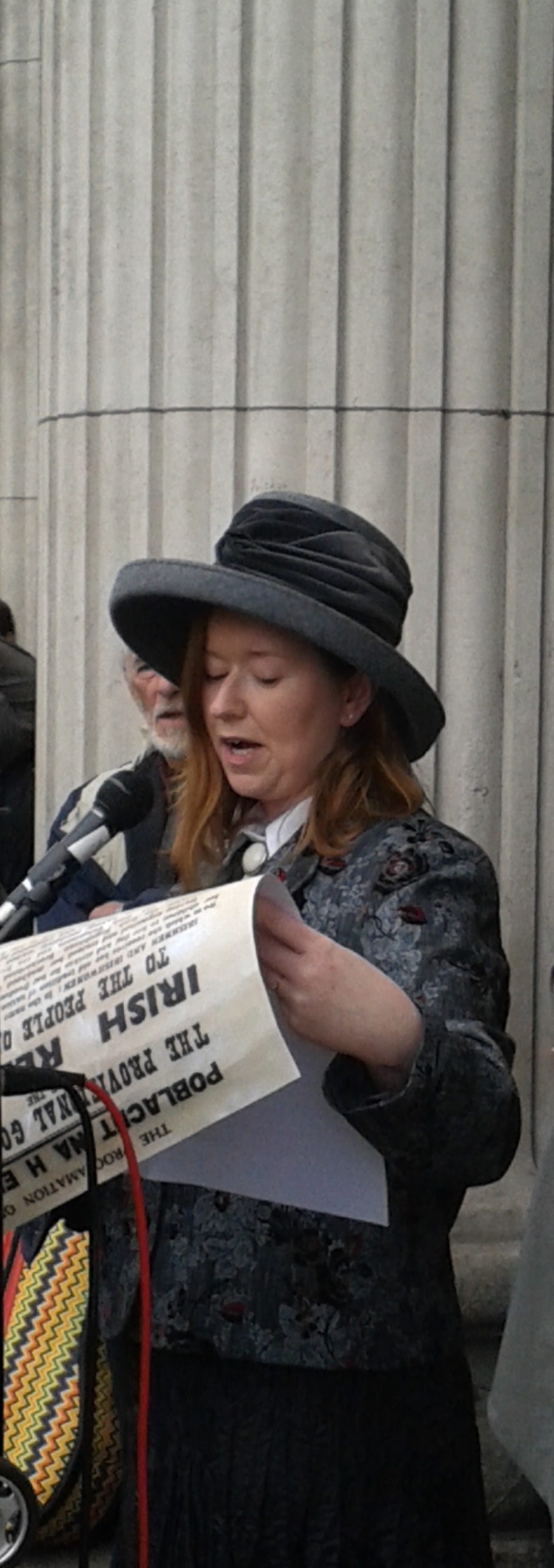
Elayne Harrington, aka Temperamental MiscElaynous performing her piece outside St. Catherine’s Church, Thomas Street.
(Photo: D.Breatnach)

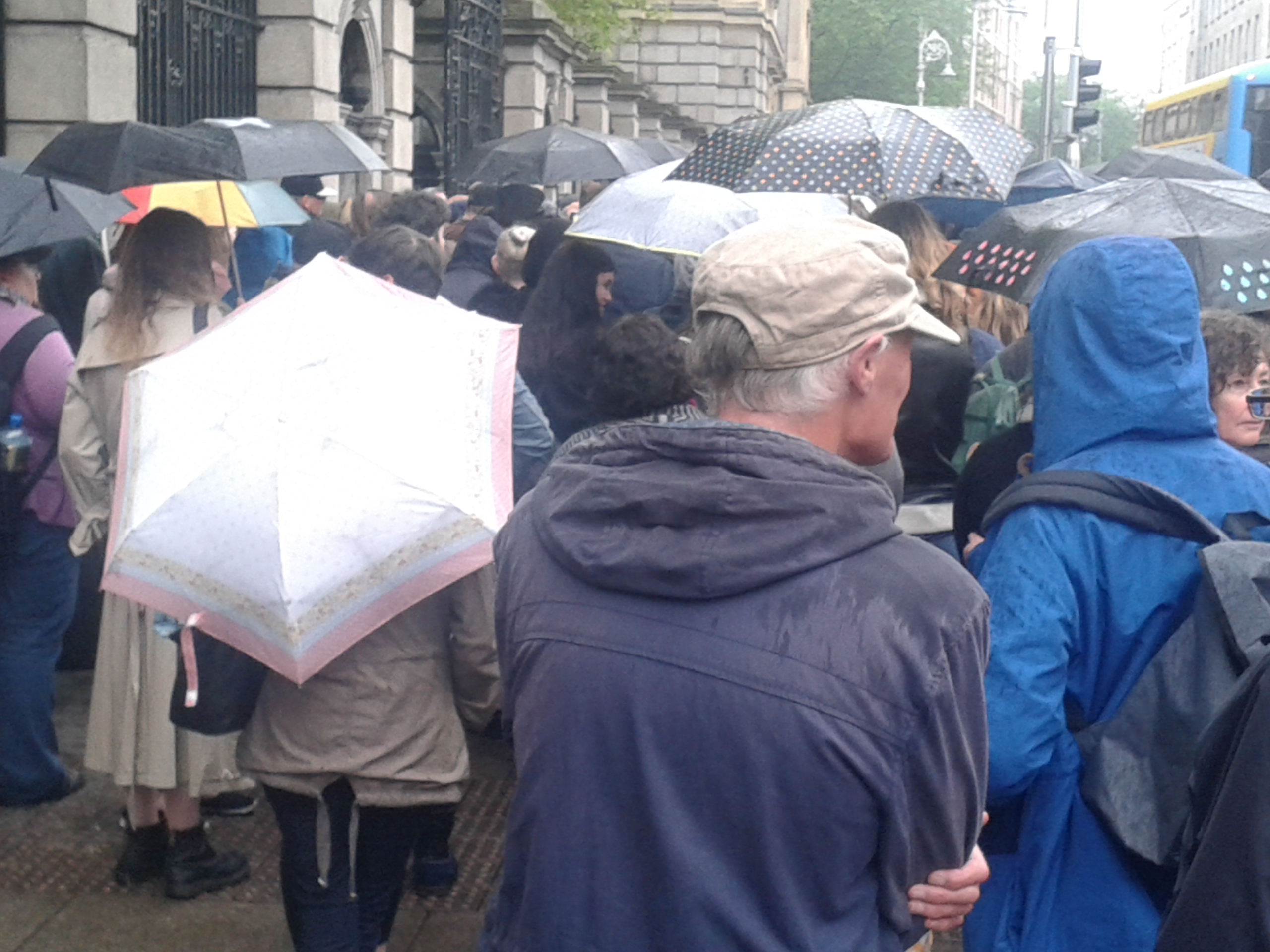
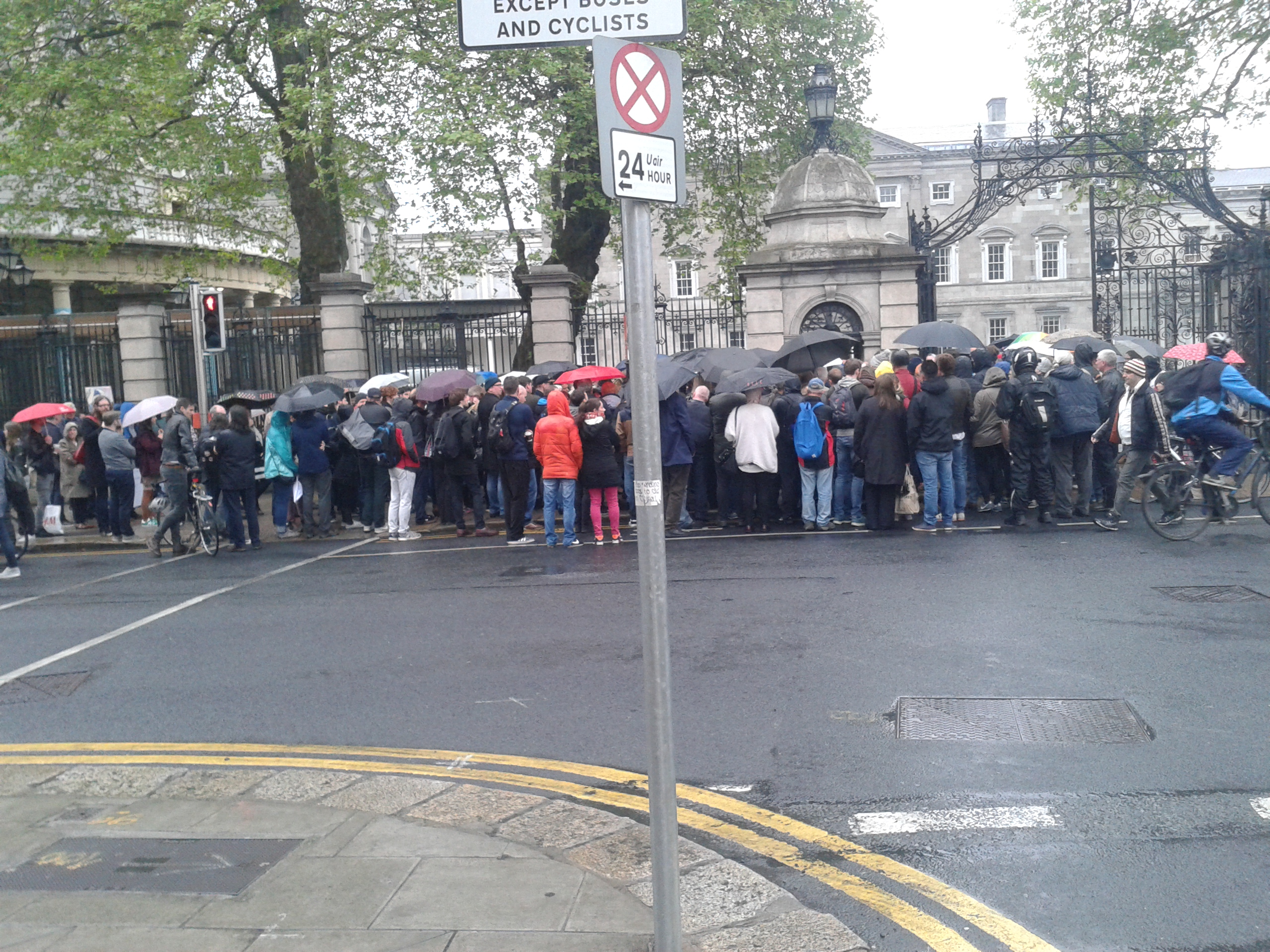
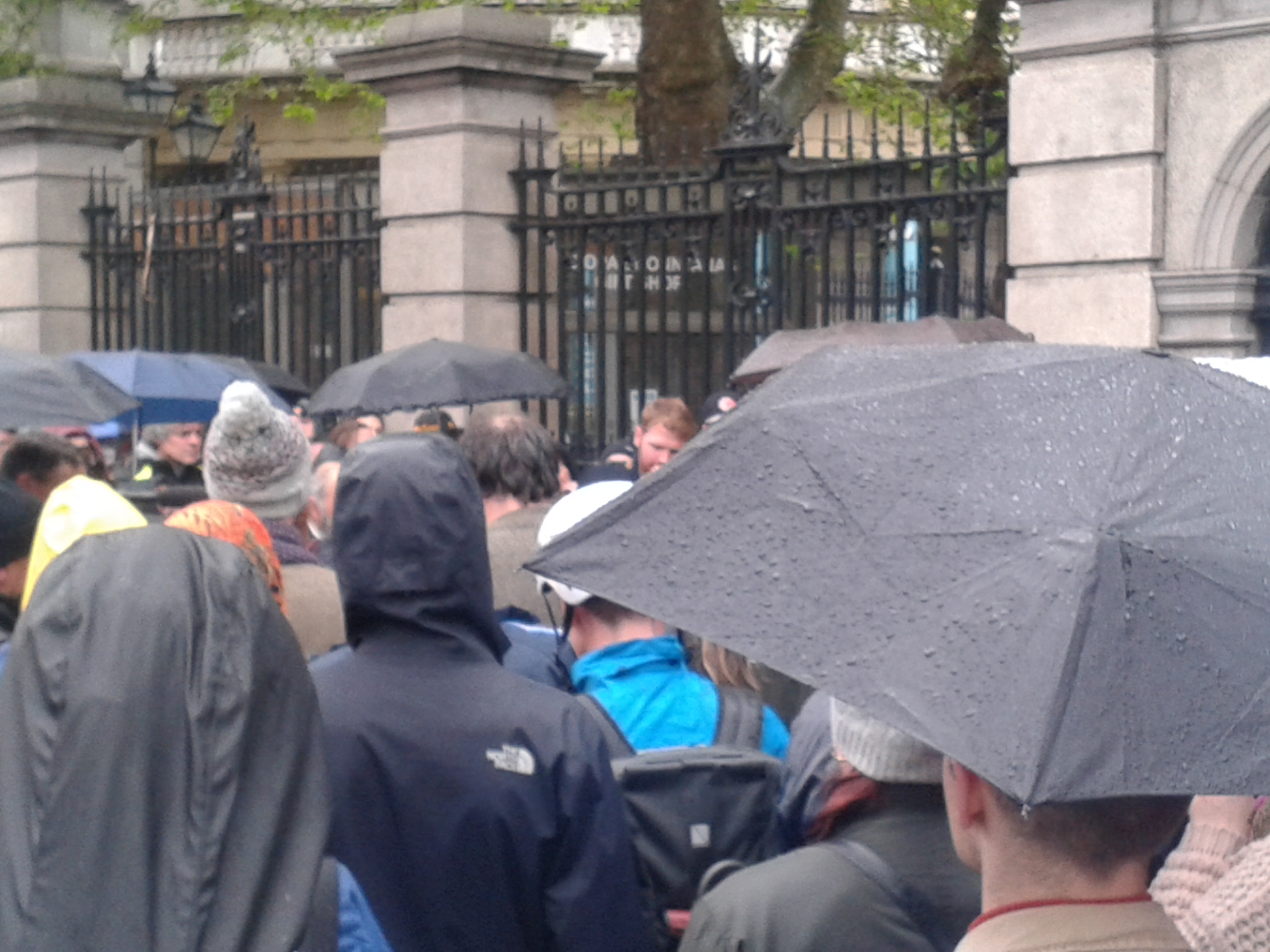
Despite continuous rain a small crowd had gathered on the pavement in front of the monument and the gallows, with a small platform less than a foot high, was placed facing them. Dublin artist Elayne Harrington, also known as the well-established street poet/ rapper artist from Finglas, Temperamental MiscElayneous, stood on the platform to announce that the event was to honour Robert Emmet and was a project as part of the Liberties Street Project, a continuation of the IPIP (In Public In Particular) program at the National College of Art and Design, Thomas Street, Dublin 8.

Harrington thanked people for attending despite the weather and, after outlining the program for the event, announced Diarmuid Breatnach, who took up position with the gallows and hanging noose just behind him.

Breatnach is best known as a co-founder of the Save Moore Street From Demolition campaign, maintaining a campaign table with a petition and leaflets on the market street for a few hours every Saturday but is also known as an acapella singer, particularly in Dublin traditional-folk circles.

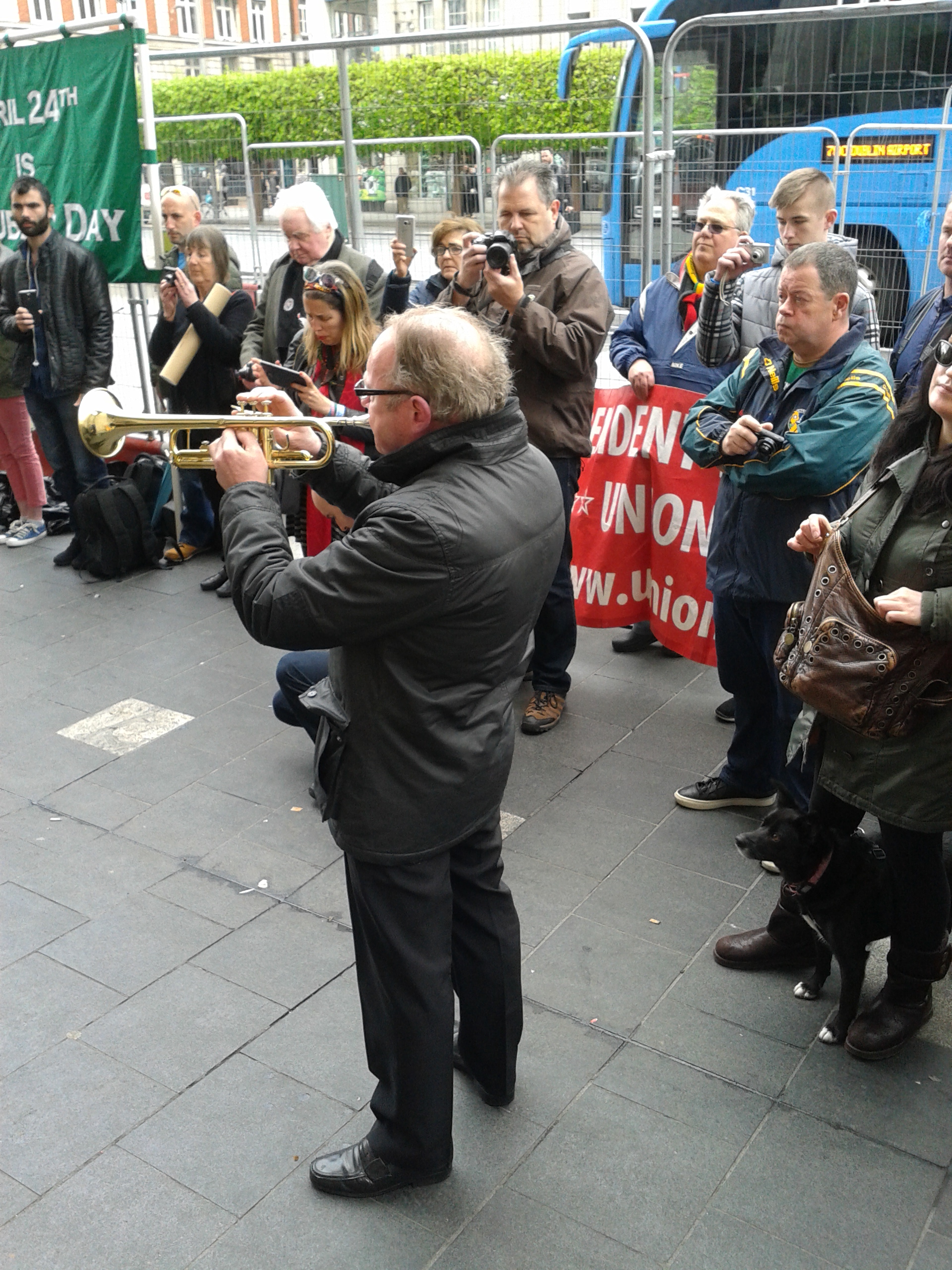
Section of the crowd at the event outside St. Catherine’s Church, Thomas Street.
(Photo: D.Breatnach)

After thanking MiscElayneous for the invitation and the crowd for attendance, Breatnach proceeded to reiterate that the event was taking place very near the spot where, at the age of 25, Robert Emmet had been hung and then decapitated by the British colonial administration in 1803.

Harrington reminded him to stand on the low platform which Breatnach did, drawing a laugh from the crowd when he indicated the hanging noose and commented: “Me Ma always said I’d end up like this.”

Breatnach asked the audience to imagine the scene of the execution in 1803 and referred them to a painting of the scene available on the Internet, showing a huge crowd, with people looking out of windows in nearby buildings and mounted redcoats keeping the crowd back from the gallows. Many of in the crowd would have been supporters but the better-known would not have been there – they were in jail or in hiding.

The execution was carried out there, Breatnach said, because the whole Thomas Street and Liberties was known as a revolutionary area, which Breatnach went on to describe (see video below).

Elayne Harrington, aka Temperamental MiscElaynous performing her piece outside Stl Catherine’s Church, Thomas Street.
(Photo: D.Breatnach)

Executions, said Breatnach, have been carried out down through the ages on Irish people resisting invasion, colonialism and imperialism and fighting for social justice. The gallows have become an enduring image in Irish history and a number of songs (Breatnach mentioned ten from the 19th century up to the present) refer to it.

The state we have now, said Breatnach, set up in 1922, preferred shooting, which was the method by which it eliminated its opponents at the time, 81 of them in official executions. Hanging remained however in this state but the last execution was in 1954.

Breatnach stated that we are often taught history as a dead subject, something in the past to which we are largely unrelated but he believed history to be a living thing, in the stones of walls and streets, in the air and in the words people have left us. And in our songs.

Breatnach selected three songs that mentioned Robert Emmet: The Three Flowers, written early last Century by Norman G. Reddin (two verses); Bold Robert Emmet perhaps by Tom Maguire around 1916 but certainly published in 1934; and Anne Devlin in recent decades by Pete St. John. Breatnach sang the three songs one after the other with MiscElayneous accompanying on her bodhrán.

Diarmuid Breatnach outside St. Catherine’s Church, Thomas Street, talking about the radical revolutionary history of the area.
(Photo: ////)

During the applause which greeted the end of Breatnach’s performance, Elayne Harrington replaced him on the stage, thanked him and introduced herself as Temperamental Miscellaneous and spoke about her contribution, which was to be an extract of Emmet’s famous speech from the dock in the Green Street Courthouse, but re-worked into more modern Dublin idiom. Harrington then launched into a spirited rendition of her piece (see video below for the full performance).

No matter what words I utter, it’ll fail to change your mind and I wouldn’t have it any other way. You’ve made me a bed and I’ll lie in it. ………….

There’s plenty I could tell why my reputation should be kept clean from the utter lies and slander which’ve been lashed upon it. ……………

I wouldn’t dream that I could impress upon a court as trapped in its own self and corrupted, a fair impression of my character. …………………….

If merely dying was the case, after being deemed in the wrong and you in the right I’d take it on the chin and I wouldn’t breathe a word but that same law that not only wants to get rid of me also aims at filthying my name and sullying the memory of me. ……………..

In the hope that my memory won’t fade and that it might retain its honour among my brothers and sisters, I’ll stand up for myself and my integrity and weaken those charges against me. ……………

…. our cloths are entwined, mine and the martyred heroes of the gallows and battlefield, consecrated by sacrifice … for protection and guardianship of their homestead and their righteousness. ………..

This is what I hope: for my memory and name to serve those who live on by it being a source of empowerment …. witness the malignant malicious government that gains its false riches through sin alone, that treats a people as wolves to be domesticated and blooded to the taste of their fellows, to dance to their tune and to the death knell ……………..

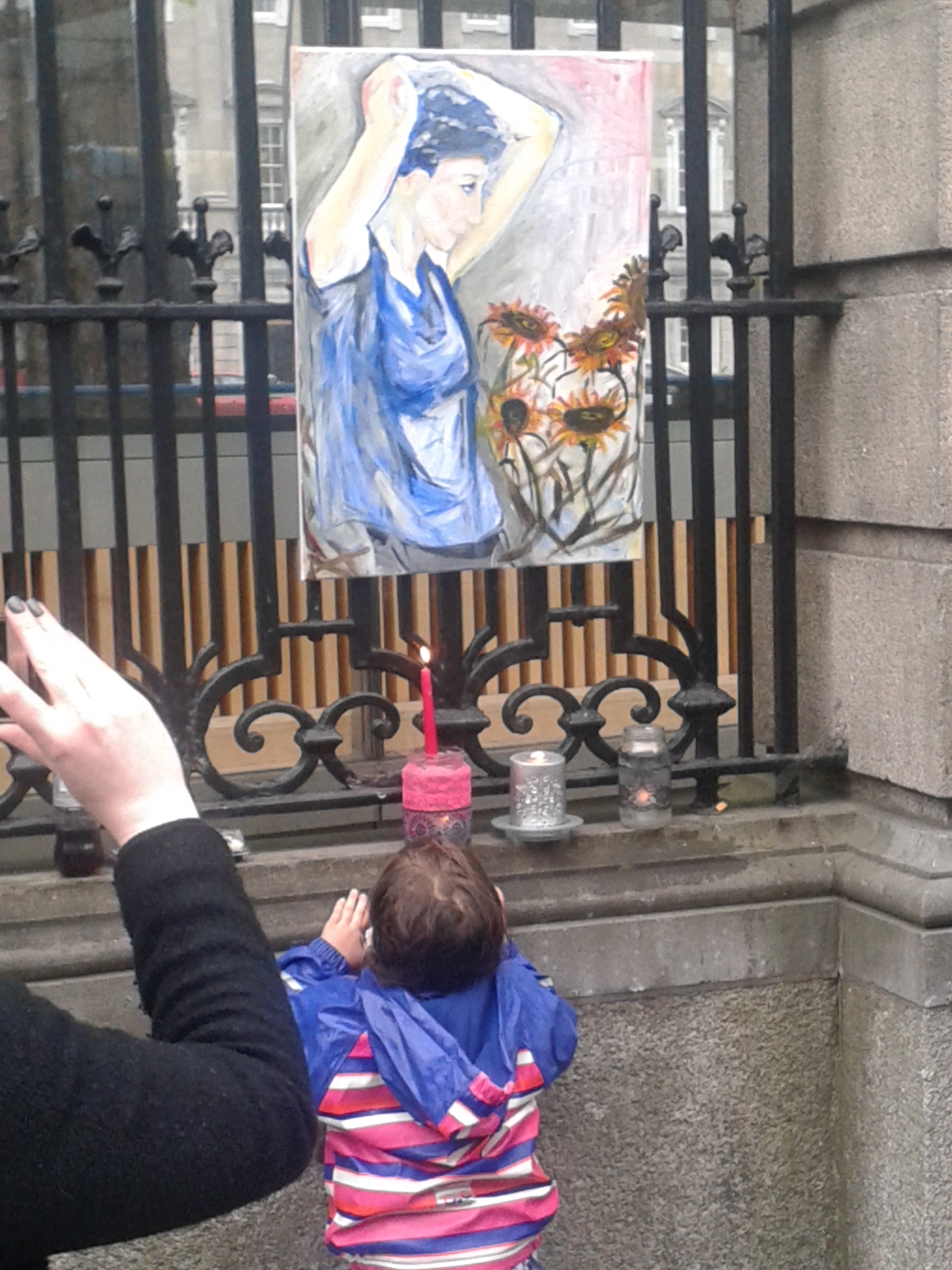
Concluding the event, Harrington thanked the attendance and invited them to place small pots of growing flowers she had provided in front of the monument, which they did.

Stablising the scaffold outside St. Catherine’s Church, Thomas Street.
(Photo: D.Breatnach)

WHY THE EVENT?

What had led Elayne Harrington to choose this act as part of her course?

“I was interested in Robert Emmet and his uprising ever since I heard a Dublin tour guide dismiss Robert Emmet while briefly mentioning his uprising”, explained the rapper from Finglas.

“I came to think that although Emmet failed in his objective, he had attempted a brave and good thing and his speech was really impressive. His uprising attempt took place in the area where my college is and he was executed just down the road, so that’s how I came to think of this event.

“I’m thankful to my course tutor and fellow students for supporting me in this act and to another tutor who helped me with the construction of the gallows. I am grateful to Diarmuid Breatnach also, who has been very supportive and contributed to the performance and I was really glad that my Da was able to be here and help today too.”

Why did Harrington call this “the first of the verbal execution series”?

“I see this as an event that can be brought to other places – like the gallows I built, it is transportable” she says with a grin but then turns serious. “The performances can be adapted also to other occasions of which Irish history is full.”

We’ll be watching this space!

Elayne Harrington and section of audience outside St. Catherine’s Church, Thomas Street, looking eastward (in the direction of Dublin Castle, ten minute’s walk away).
(Photo: D.Breatnach)

VIDEO OF EVENT

(complete event outside St. Catherine’s)

https://www.youtube.com/watch?v=wJmb553yKf8


DUBLIN FIRE BRIGADE AMBULANCE PROTEST AT CITY HALL

Diarmuid Breatnach

DUBLIN FIRE BRIGADE AMBULANCE SERVICE WORKERS PROTEST AT CITY HALL — hundreds of workers protest Dublin City Council Executive Officer’s plan to “outsource” their service.

Gathering to hear the speakers on Cork Hill, outside the side entrance of Dublin City Hall (left of photo).
(Photo: DBreatnach)

The monthly meeting of the elected representatives of Dublin City Council is often an occasion for protest, with placards and banners, of a number of campaigns protesting measures of the Council’s administrators or for calling on City Councillors for support ffor the campaigners’ objectives.

The March meeting of the Council on Monday night this week was no different in that respect but on this occasion, unusually, there were hundreds of protesters outside, the majority of them in uniform, filling the Cork Hill space in front of City Hall’s side entrance, up to the ceremonial entrance gates of Dublin Castle.

Several hundred thronged the area, most of them in either the dark blue of the Dublin Fire Brigade or in red-and-yellow or tan-and-yellow jackets, also bearing the legend “Dublin Fire Brigade”. Dotted among the crowd too were others in ordinary street clothes, presumably members of the public and a few with young children, probably relations to fire fighters or paramedics.

A young supporter of the fire-fighters’ struggle
(Photo: D.Breatnach)

The protest meeting was seeking the support of elected Dublin City Councillors in their dispute with the Chief Executive of the Council, Owen Keegan. The highest officer in the Council does not want the local authority responsible for funding the Dublin Fire Brigade’s ambulance service call-and-dispatch service and announced two years ago that it would be transferred from the Tara Street centre and put under the control of the HSE at their national control centre in Tallaght.

However, his plan ran into trouble not only with the fire-fighters themselves but with a large number of the elected public representatives and as a result a consultative forum was set up. Its eventual recommendations were not however what Keegan wished for, proposing instead a technological linkup between the HSE’s and the DFB ambulance services and as a result Keegan and other DCC senior management pulled out of the consultative forum in January. Brendan Kenny, second-in-command at DCC said that there was no point in continuing with the forum since it did not carry out the task it was set up to do but came up with different recommendations.


STRIKE NOTICE

View from the steps of City Hall (State Entrance gates to Dublin Castle to the extreme left of photo). (photo: D.Breatnach)

Since the intention of the City’s management was clearly to proceed with their plan, both the main trade unions affected, SIPTU and IMPACT, balloted their members for strike action and obtained an overwhelming majority in February: 93% to 7% in favour of strike action and 97% to 3% in favour of industrial action. On Monday SIPTU served strike notice on Dublin City Council management and IMPACT did likewise the following day.

The strikes are due to take place from 9am on Saturday, March 18th and Monday, March 27th.

The demonstration on Monday night was addressed by a number of speakers, including many elected Councillors. However, first to address them was SIPTU’s Brendan O’Brien who expressed regret that “SIPTU members in Dublin Fire Brigade have been forced into conducting these work stoppages” which he said was a result of his “members’ total commitment to providing the best emergency services possible to the residents of Dublin” and the intransigence of DCC management, headed by Owen Keegan.

Speaking to the press, he said that “These firefighters are withdrawing their labour to indicate, in the strongest manner open to them, their complete opposition to an attempt by senior management in Dublin City Council to break up the DFB Emergency Medical Service by removing its ambulance call and dispatch function.”

Before speakers addressed the crowd: top section of the crowd, approaching the State Entrance gates of Dublin City Castle
(photo: D.Breatnach)

Addressing the demonstration on Monday evening, O’Brien said that if the strikes were not sufficient to make DCC management see reason, “make no mistake, this fight will become a national one.”

A number of Councillors addressed the crowd, representing most of the political groupings on the Council. Christy Burke, ex-Lord Mayor (2015), representing a group of Independent councillors, stated that DCC management had refused to let them use the power in the nearby building for amplification for speakers. Burke drew cheers when he quipped that what the Management did not realise was that “the power is not in there, it is out here on the street.”

Burke also stated that the DFB Ambulance Service was working well and asked rhetorically “why fix something that isn’t broken”, a theme taken up by a number of other speakers. The Sinn Féin speaker made the point that she was representing the largest political party in the Council, totally supported the Fire Fighters and would be seeking legal advice on Keegan’s plan and the other speakers likewise promised support to the fire-fighters.


OTHER UNDERLYING ISSUES IN THE DUBLIN FIRE-BRIGADE AMBULANCE SERVICE PROTEST

Although speakers for the fire-fighters a number of times expressed support for the colleagues employed by the Health Servive Executive, their members must be concerned at the prospect of coming under the management of an organisation so under-funded and reportedly often mismanaged as has been the HSE for decades now.

Another element playing itself out here is the recurring conflict between many elected City Councillors and the unelected City Management. The political colouring of the public representation in the Council changed considerably with the local elections in 2014, when Sinn Féin with 16 seats and Independents with 12 became the groups most represented. Next in numbers of Councillors is Fianna Fáil with 9 seats, while Fine Gael and Labour each have 8 each and People Before Profit have 5. The remaining 5 are divided between the Greens, Anti-Austerity Alliance and United Left.

This struggle between many of the elected and the appointed few has broken out on a number of issues previously, most notably perhaps on the Moore Street Quarter issue, with Keegan and Jim Keoghan, formerly second-in-command and head of the Planning Department, proposing a deal with a property developer for a ‘land swap’ involving Council buildings on Moore Street, a plan which mobilised significant campaigning opposition and which was defeated by a large majority of Councillors voting in November 2014. The Councillors were however unable to prevent Keoghan’s “executive action” in agreeing a number of property speculator planning applications and the most controversial extension of the ‘giant shopping mall’ permission towards the end of last year.

This level of conflict between the elected Dublin public representatives and the appointed senior officials has perhaps not been seen since the War of Independence (1919-1921), when an Irish Republican and Labour majority on the Council, after the 1920 Local Government elections, found itself in recurring confrontation with officials appointed under a colonial administration.


BACKGROUND

According to Dublin Council’s website, “The Fire Brigade has provided the citizens of Dublin City and County with a fire and rescue service since 1862. This service was enhanced in1898 by the addition of an emergency ambulance service. In 2007 with 12 emergency ambulances DFB responded to 78,864 ambulance incidents, with the figure growing each year.

Dublin Fire Brigade provides an emergency ambulance service to the citizens and visitors of Dublin. Dublin Fire Brigade is the only Brigade in the country to provide an Emergency Ambulance Service. Dublin Fire Brigade operates 12 emergency ambulances with one ambulance operating from each full time station with the exception of Dun Laoghaire.

DFB’s Firefighters are trained to Paramedic level and are registered as practitioners with the pre-hospital Emergency Care Council (PHECC), meaning there are over 100 Paramedics available on a 24/7 basis in the event of a major emergency. All operational firefighters rotate between Fire and Rescue to Emergency Ambulance duties. Dublin Fire Brigade Ambulance Service has achieved accreditation under the ISO 9001/2000 Quality Management System.”

Lively ladies active in the Campaign for social housing Irish Glass Bottle site, Ringsend.
(photo: D.Breatnach)
Banner of campaign for social housing Irish Glass Bottle site, Ringsend.
(photo: D.Breatnach)


OTHER CITY HALL PROTESTS

Also protesting outside City Hall (see photos) were lively and good-humoured campaigners for social housing on the former Glass Bottle company site in Ringsend and others calling for the renaming of the Artane Band (it is hoped to cover these campaigns in a little more detail in future reports).

Campaigners to rename the Artane Band because of the abuse that went on in the Artane Industrial School, which formed the original Artane Boys’ Band.
(photo: D.Breatnach)


UNSCIENTIFIC MYTH AND IGNORANCE ABOUT THE IRISH LANGUAGE

Clive Sulish

A most interesting and stimulating lecture was held on Wednesday night at Pearse House in Dublin. Hosted by Misneach, an Irish language campaigning organisation, the lecture was titled “Miotas agus Aineolas faoin nGaeilge” (“Myth and Ignorance about the Irish Language”).


What Colm Ó Broin, who described himself as an Irish language activist, has done is to take a number of frequently-expressed ideas hostile to or dismissive of the Irish language and to deconstruct them, analyse them and compare them with other languages and social situations. For the purpose of the lecture, he took around ten of those ideas, encapsulated in stock phrases well known to Irish speakers and campaigners – and probably to many others not within those categories.

Some of the attendance at the lecture before its start

Over the years, we have heard and read these stock phrases and ideas expressed with tedious regularity, for example that the language is archaic or dead, is full of English words, that it is an expensive commodity, that Irish language schools are elitist, that the language is or was badly taught or that it was “beat into” people. Over the years, many speakers and activists have of course countered these ideas, sometimes by reasoned argument and sometimes by a trenchant phrase, such as: “What, was it only Irish that was bet into you then?” or “Was it only Irish that was taught with an overwhelming concentration on grammar to the exclusion of conversation?”

But Ó Broin has gone about this work scientifically, methodically. For the purpose of his lecture he took around ten of these propositions, deconstructed and exploded them, revealing their underlying lack of logic and scientific fact. For example, dealing with the proposition that the language is dead, Ó Broin produced a long list of living languages around the world – the vast majority, actually – that have less speakers than does Irish. On the allegation that Irish is full of English words, he produced pages of English-language words that are of French origin (leaving aside the easier and also huge list of words or Greek or Roman origin).

Colm Ó Broin, Irish language activist and presenter of the lecture

Having revealed the lack of scientific truth or logic as a basis for hostility or contempt towards the Irish language, Ó Broin turned to psychology as an explanation, finding fear and/or shame as the motivating factor. Turning back to history, he reminded his audience of the Statutes of Kilkenny of 1366, when the England-based descendants of the Norman Conquest of England dating from 1066, attacked the ‘gone native’ customs of the Irish-based descendants of the Norman Conquest of Ireland beginning in 1169 (though Ó Broin did not say so, the English Normans had gone quite ‘native’ themselves by then, integrating with the Saxon nobility and the Statutes were written in English, not French).

The Statutes forbade the Irish Normans (“the degenerate English” who had become “more Irish than the Irish themselves”) from playing Irish games and music, speaking Irish, submitting themselves to Irish law, adopting Irish cultural and social customs including marriage. It was the coloniser’s fear, fear of the Irish-Normans losing their allegiance to the English Crown, that was at the heart of that hostility.

Since the Irish who oppose the Irish language cannot be said to be “the coloniser”, something else must be at work there. Ó Broin twice in his lecture called on the state-funded or supported Irish-language organisations Foras na Gaeilge and Connradh na Gaeilge to undertake social research into what is behind this attitude among large sections of the public (according to opinion polls).

Some of the attendance at the lecture

This would of course be useful work, especially if it led to the production of measures to counter such myths and ignorance. It is likely however that the answer has already been supplied, by for example the work Patrick Pearse (1879-1916) and Franz Fanon (1925-1961), though it would be useful to have more up-to-date validation. Fanon’s work focused on the coloniser’s view being culturally and psychologically internalised by the colonised individual and society and Pearse focused more on the mechanisms by which that was done through the educational system run by the coloniser. The idea is expressed succinctly, though in a different context, in the words of a popular nationalist song, Memory of the Dead by John Kells Ingram (1823 – 1907):

“He’s all a knave or half a slave

who slights his country thus …”.


franz-fanon-cognitive-dissonancecover-the-murder-marchine

The lecture was delivered by Ó Broin in Irish to an audience that contained Irish speakers and presumably all present could at least understand the language. My feeling was that this research and deconstruction needs to go out to the non-Irish-speaking public in this country. In response to a question, Ó Broin replied that he had in fact written some of it in English some years ago and that material had been posted on a website that no longer exists. Currently, his work exists only in Irish. It is to be hoped that he returns to putting this work out there among the people who perhaps most need it.

End.
HUNDREDS ATTEND MIDDAY WEEKDAY RALLY TO SUPPORT APOLLO HOUSE OCCUPATION

Diarmuid Breatnach


HUNDREDS ATTENDED AT APOLLO HOUSE in bitter cold from late morning today to indicate their support for the homeless people and housing activists in occupation of the building.  At the same time, a court refused to extend the

 Closer view of banner on Tara Street side of occupied Apollo House (Photo: D.Breatnach)
Closer view of “Homes Not Hostels” banner on Tara Street side of occupied Apollo House (Photo: D.Breatnach)

deadline by which it has ordered the occupiers to leave.

Banner suspended from the Tara Street side of Apollo House (Photo: D.Breatnach)

While they were there, representatives were attending court seeking an extension on the deadline given by a court order to leave the building by noon today.

Housing activist Rosie Leonard told the crowd that the alternative accommodation some Apollo House homeless people had been offered was totally unsuitable and that some were houses for people with addiction issues and that there were even bloodstains on the walls. They had asked for an extension as the State had not provided alternative accommodation but this had been refused.

In response, people cried “Shame!” and “We shall not be moved!”

Supporters linking arms around Apollo House from Townsend St, through Tara St to Poolbeg St. (Photo: D.Breatnach)
Supporters linking arms around Apollo House from Townsend St, through Tara St to Poolbeg St.
(Photo: D.Breatnach)

People were asked to link arms symbolically around the building, which many did and the line extended from Townsend Street/ Tara St. and the full length of Poolbeg Street.

PEOPLE QUEUE TO SIGN UP TO ACTIVELY SUPPORT

Shortly afterwards, announcements were made asking people willing to support the continued occupation to give their names to organisers and queues of people formed giving their names and phone numbers to put on a list.

People linked arms symbolically protecting Apollo House occupiers from Townsend St, through Tara St and here seen to western end of Poolbeg St. (Photo: D.Breatnach)
People linked arms symbolically protecting Apollo House occupiers from Townsend St, through Tara St and here seen to western end of Poolbeg St.
(Photo: D.Breatnach)

Speakers addressed the crowd at intervals and musicians, singers and percussionists also performed for the crowd. A group including a Vulture Capitalist, Banker and Woman & Child being evicted also performed for the crowd.

Chants included:
What do we want?
Homes not hostels!

Also: Is a doorway a bed?

No!
Is a mattress a bed?

No!

Since December 15th, the Home Sweet Home coalition of activists and homeless people has been occupying this building which state agency NAMA had repossessed from a property developer with unrepayable debts. The group is calling for NAMA to use the properties it has taken control of to house the homeless.

Rosie Leonard relaying court decision to cries of "Shame1" and chants of "We shall not be moved!"
Rosie Leonard relaying court decision to cries of “Shame1” and chants of “We shall not be moved!”
Percussionist, Guitarist, Acitivist (Photo: D.Breatnach)
Percussionist, Guitarist, Acitivist
(Photo: D.Breatnach)
Vulture Capitalist (Photo: D.Breatnach)
Vulture Capitalist
(Photo: D.Breatnach)
 (Photo: D.Breatnach)

(Photo: D.Breatnach)
 (Photo: D.Breatnach)

(Photo: D.Breatnach)

IRISH LANGUAGE CAMPAIGNERS CALL FOR URGENT ACTION — “10 years remaining for Irish as a living language in the Gaeltacht”

(English-language version below)

De réir ráiteas a d’eisigh craobh BÁC den dream Misneach inné (15/12/2016) d’éirigh go maith le hagóid Misneach  ar son Cearta Teanga lasmuigh de Theach Laighean. Bhailigh daoine i rith am lóin chun seasamh i gcoinne cur i gcéill na hairí Humphreys agus Kyne. Bhí neart tacaíochta don agóid ó dhaoine a d’imigh thar bráid, cuid mhaith acu a d’iarr leithscéil nach raibh mórán Gaeilge acu féin agus cúpla daoine ó thíortha i gcéin ina measc.


Map on Misneach banner illustrates the decline of areas where Irish is a living community language under the Irish state's administration. (Photo D.Breatnach)
Map on Misneach banner illustrates the decline of areas where Irish is a living community language under the Irish state’s administration. (Photo D.Breatnach)

D’ardaigh urlabhraí Misneach, Kerron Ó Luain, ceist an buiséad a pléadh i measc an chomhchoiste inniu:

Gheall Sean Kyne go dtabharfaí 1,000,000 euro breise don Ghaeilge ar Adhmhaidin ar RnaG níos luaithe. Is ardú 1% atá i gceist le sin. Ach, is méid suarach é 1% nuair a smaoinítear go gearradh 75% de bhuiséad Údarás na Gaeltachta agus 35% ó bhuiséad Foras na Gaeilge ó 2008.

D’fhógair an tAire McHugh i rith 2015 go mbeadh 1,000,000 euro breise do bhuiséad caipitil na Gaeilge chomh maith. Tá sé soiléir gur cleas atá sna fógraí seo. Gearrtar na deicheannaí de mhilliún ó bhuiséad ach, ar an láimh eile, fógraítear “airgead breise” de mhéid an-bheag amhail is gur dul chun cinn é. Is cleas é leis an bpobal Gaeilge a cheannach agus faraor tá an cuma ar an scéal go n-oibríonn an chleasaíocht seo.’

Chríochnaigh Ó Luain:

Arís tá Misneach ag glaoch ar na ceanneagraíochtaí Gaeilge gníomhú agus Lá Mór eile a eagrú. Tá sé feicthe ón ngluaiseacht a d’fhás i gcoinne príobháidiú a dhéanamh ar ár n-uisce, gurb é an t-aon chineáil cumhacht a dtugann na polaiteoirí aird ar bith air ná cumhacht na sluaite amuigh ar na sráideannaí.

Section of protest demonstration outside the Dáil (Photo D.Breatnach)

Má leantar ar aghaidh mar atá agus an pobal Gaeilge ina dtost caithfear milliúin euro chugainn anseo is ansiúd i mbealach soiniciúil ach ní dhéanfar aon dul chun cinn i ndáiríre. Agus gan ach 10 mbliain fágthaí ag an nGaeilge mar theanga pobal laethúil sa Ghaeltacht tá gníomh raidiciúil de dhíth láithreach.’

———————————————————————-

According to a statement of the Dublin branch of the Misneach organisation yesterday (15/12/2106),  a successful demonstration for Language Rights was held outside Leinster House. People gathered during lunchtime to highlight the hypocrisy of the government ministers charged with overseeing the language, Heather Humphreys and Sean Kyne. There was plenty of support from passers-by, including people who apologised for their own lack of Irish and a few people from abroad.

Spokesperson for Misneach, Kerron Ó Luain, alluded to the budget being discussed by the committee today:

Tongue-in cheek use of road traffic sign (Photo D.Breatnach)
Tongue-in cheek use of road traffic sign
(Photo D.Breatnach)

Sean Kyne apparently promised an additional million euro for the Irish language on RnaG’s Adhmhaidin programme this morning. That amounts to a 1% rise. Realistically, 1% is a pitiful amount when it is considered that 75% has been cut from the budget of Údarás na Gaeltachta agus 35% from that of Foras na Gaeilge since 2008.

Then Minister for the Gaeltacht, Joe McHugh, made a similar announcement in 2015 when he said that one million additional euros would go to the capital budget for the Irish language. It is patently obvious to all that this is a cynical ploy. Tens of millions are cut from the budget only for grand announcements of “additional funding” of pitiful amounts to be made afterwards as if this were progress. It is a ploy being adopted to buy off the Irish language community, and unfortunately it appears to be working.’

Ó Luain finished:

Misneach is once more calling on the chief Irish language organisations to mobilise towards another Lá Mór. It is evident from the movement which opposed the privatisation of our water that the only type of power politicians pay any heed to is the power of the people marching on the streets.

If the situation persists and the Irish language community remains silent, and accepting of token gestures of one million euro here and there, then no real progress will be made. With only 10 years left for Irish as a living community language in the Gaeltacht now is the time for radical action.’

(Photo D.Breatnach)
(Photo D.Breatnach)
Section of protest after some people had left (Photo D.Breatnach)

Joe Kelly — and a generation passing

A generation is passing. Actually they have been passing for some time, the generation of the fighting years of the late 1960s, the 1970s, the 1980s and even the 1990s.

They campaigned variously for social housing; civil rights north and south; for human rights; against Church domination; against Unionist sectarianism; for free access to contraception; for right to divorce; for an end to censorship; for national self-determination; for Gaeltacht civil rights; for Irish language rights and Irish on TV; in support of political prisoners; the rights of women; for Irish Traveller rights; protection of heritage and environment; solidarity with many struggles around the world, including Cuba, Vietnam, Rhodesia, South Africa, Chile, the Black Panthers; against drug dealers; for freedom to choose lifestyle; decriminalisation of gay and lesbian life; for community projects in deprived areas including youthwork and, let’s not forget, organised, fought in and supported strikes.


That generation fought many battles, some of which they won and some which built bases for later battles and their story is told only in bits and pieces here and there. They organised, marched, sat in, occupied, wrote, made placards, painted slogans, put up posters and some fired guns; they were watched, raided, beaten, fined, jailed, calumnied, sacked, expelled, kept unemployed, derided from pulpit, press and judge’s bench, some were shot, and not just they but their families made to suffer too.

I am not referring to people of any specific age but of all those who were any age from young to old and active during those years. The causes of death have been many, from simple old age and life lived out to the death penalty.

But the death penalty was not in force in Ireland in the 1960s, you may think? Actually it was, it wasn’t abolished until 1990 in this state. But you’d be kind of correct as in practice no formal execution has been carried out by this state since 1954.

So, then what am I talking about? Maybe referring to the ‘United Kingdom’, since six counties of Ireland are included in that state? Yes, and no. The death sentence still exists in the UK only for “Arson in Her Majesty’s shipyards” but it was abolished in Britain for the crime of murder in 1965 and, in fact, no-one had been formally executed there from the year before. If the judicial death penalty had still been in force, the people in charge of that state might’ve been been spared the embarrassment of seeing nearly a score of Irish people they had wrongly convicted in 1974 walk free decades later as judges eventually had to find them ‘Not Guilty’.

A bit late for Giuseppe Conlon, against whom there had not even been a shred of doubtful evidence, but never mind. But had they all died in prison or been executed, people might not have worked so hard to see their convictions in court overturned – people among whom Joe Kelly, who died this week and who was cremated on Saturday, stands tall.
But the death penalty was not removed from the judges’ arsenal in that bastion of reaction, Six Counties state, until 1973, when the 30 Years’ War had entered its early years (somebody from the British state clearly had to sit down with the Unionist bigots and explain, although of course they sympathised with their loyal brethren, how bad it would be for Britain and the Queen if they started sentencing and executing IRA and INLA fighters).

There are more ways to skin a cat …. yes, and to kill too. The orange and SAS and MRF death squads killed more against whom there was not even a court conviction. And some of the Republicans killed one another too. And twelve died on hunger strike, one each in 1974 and in ’76 and ten in 1981. Actually, considering the brutality of force-feeding, it’s surprising there weren’t more deaths – Marian and Dolours Price were force-fed 167 times over 203 days in 1973 and it was the publicity around their case and the deaths of Gaughan and Stagg that ended the practice of force-feeding, ensuring that the Hunger Strikers of 1980 and ’81 at least did not have to endure that experience.

But there are more ways to kill …. Many of that generation of fighters died from ‘natural’ causes but died early – cancers, heart attacks, liver damage, despair ….. ah, yes, that brings to mind suicide, of which some also died. But despair also can drive you to drink, even more easily if it has been part of your experience of socialising and alcohol is one of the top killers in the world. And some died of drugs …. or drugs and alcohol …. or infections from unsafe drug injection …. But most who died early did so in summary from the wear and tear of struggle, of prison, of separation, of relationship breakdowns, of betrayal, despair.
Not all died, even those who are not among the fighters today. Some walked away from the struggle and though I can’t imagine being in their shoes, I do not begrudge them. So long as they didn’t betray any on their way out or make a living out of spitting on their former comrades and causes afterwards. But some, a very few, did exactly that and you can read what they have to say quite often in their articles or hear them quoted in the newspapers or on TV or radio.

Some found other ways to betray and did it in secret, feeding information to their handlers and some even diverting attention from themselves by accusing others, some innocent and some of a lesser grade of betrayal than that of the accusers. We know of some of them but may never learn about them all.

Joe Kelly

Poster displayed at memorial in Teacher's Club (photo accessed from a Facebook posting)
Poster displayed at memorial in Teacher’s Club (photo accessed from a Facebook posting)

A few have survived and are still around, fighting the struggle, whether in organisations or as independents. Joe Kelly was one in both categories, in a sense. I knew him but did not know him well and met him only in the last decade, after I had returned from decades living and working in London. I am given to understand that he had passed through a number of political organisations, including Fianna Fáil and the Labour Party. A strange CV, one might think, for a radical left-wing social and political activist. The last political group with which I had associated Joe was People Before Profit, on a local level, around Phibsboro. Joe invited me to attend a quiz they were running and I did so mainly to return a favour – he had attended, to contribute to the singing at my invitation, an evening of the Clé Club where I had been “Fear a’Tí” for that night. I was amazed to win a Blackberry at the quiz (sorry, Joe, I still haven’t gotten around to learning and using it!). Last I heard, he wasn’t with the PBP.

Somebody told me years back that he had been a central organiser of a solidarity event in Dublin for the Birmingham Six in which lights had been floated down the Liffey. Of course I was impressed – on a political/ human rights level but also for the poetic vision involved. I have found little about that event since and Joe, who I found a modest man, didn’t give me much in response to my pressing. A couple of searches on the Internet yielded me only a passing reference to the River Parade, of 1990, a year before the Birmingham Six were finally cleared in court and released. Likely I have not been asking the right people or looking in the right corners.

I met Joe by arrangement for a coffee a couple of times, while I tried to get him into something I was doing and he tried to get me into something he was working at – neither of us succeeding in our efforts to recruit the other. Since Joe was working for awhile in the community sector I also approached him to explore possibilities for me when, despite a long track record in the fields of working in homeless shelters and addiction as well as other community activism I was out of work, but he wasn’t able to help me.

And of course I bumped into him on demonstrations, as in those in solidarity with Palestine or against the Water Tax or against the Lisbon Treaty. For awhile we were active together in the Dublin branch of the Ireland Palestine Solidarity Committee and I believe he left like me after witnessing some nasty in-fighting years ago, though we both often turned up to protest pickets and demonstrations and public meetings called by the organisation. We would also meet at events in solidarity with the Cuban people.

I heard him described at his funeral service, by someone who should know, as a Republican. Certainly Joe was very proud of his father and uncle who had both fought in the 1916 Rising, the first in the GPO and the second in Bolands’ Mill and proudly displayed his father’s medal at a public event in the Teachers’ Club in Dublin.

Joe Kelly displaying his father's 1916 service medal at a 1916 commemoration event (photo: D.Breatnach)
Joe Kelly displaying and talking about his father’s 1916 service medal at a 1916 commemoration event (photo: D.Breatnach)

However, he was among the number that I invited but failed to get to events over the last decade to highlight the plight of Irish Republicans being hounded by the State and imprisoned without trial. That did puzzle me, for I knew Joe to have a track record of fighting for human rights. And this was shown not only in his campaigning for the Birmingham Six.

Joe fought for the rights of divorce and choice of abortion, as well for the right to freedom from partner abuse, in particular through the movement for women’s refuges, what many people still refer to as “battered wives hostels”. He was active in the campaign for the right to gay marriage, so amazingly successful in Ireland. And Joe was also active in campaigns against racism towards migrants.

“Conas atú tú?” or “Dia dhuit”, Joe would invariably greet me whenever we met. I would not call him exactly fluent but he could understand and speak Irish. I suppose I assumed he had some affection for the language and was also paying me, a known native speaker, the courtesy of addressing me in Irish and speaking awhile in the language. At his funeral service, I learned it went further than that. I heard his grandchildren say that he frequently spoke to them in Irish and when they did not understand him, would translate what the words meant. Some people in the audience chuckled to hear this. I felt sad and somewhat angry too, that a question so important to our cultural identity, an aspect so threatened today, should be treated so apparently lightly by some and that the only words to be spoken at his funeral service in Irish were those in the final sentence spoken by his brother, Jim, in his eulogy: “Slán leat, Joe”. In the booklet produced for the occasion and freely available at Club na Múinteoirí, there was however one dedication in Irish (and I have since learned that one of the speeches at the Teacher’s Club was in Irish) and I note that both grandchildren who spoke bear Irish-language names.

Paying respects and memorial service

On Saturday, laid out in the lovely Room 2 in the Teacher’s Club (sin Club na Múinteoirí, Joe) in Dublin’s Parnell Square, a venue often used for social, cultural and political events, in a closed wicker basket coffin, Joe received his visitors. And they were MANY. Feminists, Palestine solidarity activists, Cuba solidarity activists, community activists, independent political activists and a sprinkling of activists in various parties all attended and many contributed their memories or words dedicated to him while he was laid out there.  (I took many photos here and some at Mount Jerome but somehow seem to have lost them all).joe-kelly-speaking-at-event

Attending first another funeral (of another singer) that morning in Howth, then travelling into Dublin to take part in the Moore Street Awareness weekly table, I had to miss some of that. I spelled a comrade while he attended to pay his respects, then attended later while he took over back at the table.

Room No. 2 was still packed but so was the whole bar lounge area. I had missed all the eulogies and reminiscences and even singing – “The Foggy Dew” I was told. Had anyone sung “The Parting Glass”, I asked. No, apparently not. So then to ask his sister if it would be alright to do it, then the MC, his long-time collaborator, comrade and friend, Brendan Young. It would be welcome, I was told. And Fergus Russell (also his second funeral that day) and I did three verses together, using a mic so it might carry through to the lounge and, though we took turns at fluffing a line, not too badly. It is a great song for such occasions and each verse was particularly appropriate to Joe.1

A little later, the Internationale was sung by all (copies of the words of a verse and the chorus distributed beforehand), the wicker coffin (I must have one of those when my time comes!) was lifted on to shoulders by family and friends and brought through the respectful lines while Joe’s daughter sang The Night They Brought Old Dixie Down.2

Then the hearse came out and led the cortege to Mount Jerome cemetery. I didn’t know the protocol regarding cycling in a funeral cortege but followed anyway, managing to get temporarily lost on the way and arriving just as the hearse arrived at the cemetery. Again, the chapel was packed.

The ceremony was non-religious and officiated by Therese Caherty, ex-partner and friend. In turn Therese herself, his brother, his bereaved current partner, relatives and his comrade and friend Brendan Young all gave their moving eulogies and often funny anecdotes. Brendan emphasised that for Joe, the process of the conduct of a struggle was as important as the end to be reached, which I knew to be true from our time together in the Dublin IPSC and I’d be in agreement with Joe on that.

There were, despite the many I did see during those events, some faces I did not see in the congregation or at the Club na Múinteoirí before the service or later, when many returned to the Club to free sandwiches and soup laid on by the management there. It was their loss.

I never saw him dance but am told he loved it and taught his grandchildren not only to sing but to dance too. I did know he’d learned to tango. He’s left this dance floor now and gone on to another and whateverone steps and two steps and the divil knows what new steps”they are dancing there, I’m sure Joe is learning them and probably teaching a few of his own.

Slán leat, Joe – árdaigh iad!

A chríoch.

FOOTNOTES

1  “Of all the money that e’er I had, I spent it in good company


And all the harm that e’er I’ve done, alas, it was to none but me


And all I’ve done for want of wit to memory now I can’t recall


So fill to me the parting glass, good night and joy be with you all

“If I had money enough to spend and leisure time to sit awhile


There is a fair maid in this town, that sorely has my heart beguiled


Her rosy cheeks and ruby lips I own, she has my heart enthralled


So fill to me the parting glass, good night and joy be with you all

“Of all the comrades that e’er I’ve had, they are sorry for my going away


And all the sweethearts that e’er I’ve had,

they would wish me one more day to stay


But since it falls unto my lot that I should rise and you should not


I’ll gently rise and I’ll softly call good night and joy be with you all”

2  This song of nostalgia for the American Confederacy has a haunting melody but its ideology is often ignored by those who sing it.

3  Line from The Charladies’ Ball

ANTI-INTERNMENT CONVOY AND MARCH HARASSED BY IRISH POLITICAL POLICE


Clive Sulish


A convoy of cars set off from the Six Counties to Dublin on Saturday morning, arriving in Dublin that afternoon to join in a short march through the city centre, to highlight the ongoing internment of Irish Republican activists.  The event was organised by two organisations independent of political parties or organisations: Duleek Independent Republicans and Anti-Internment Group of Ireland.

Convoy passing through Dundalk (photo from )
Convoy passing through Dundalk (photo: S. Lynch )

The convoy set out on Saturday morning at 11am am from Newry and passed in turn through the towns of Dundalk, Drogheda, Julianstown and Whitehall to conclude at the Garden of Remembrance in Dublin city centre. Unusually for such events, the convoy received no harassment in the Six Counties from the RUC/ PSNI – that work was left to their counterparts in the Twenty-Six Counties.

Supporters of the Dublin march began to gather at the Garden of Rembrance around 1.15pm and from then on every arrival was stopped by Irish Special Branch asking them their names and addresses. Some refused to give them.

The political police also asked for the driving licences of three of the convoy cars that arrived at the Garden of Rembrance (others had parked elsewhere in the city).

Garda Special Branch harassing convoy arrivals near Garden of Remembrance (photo D.Breatnach)

All of this harassment was exceeding the legal powers of the Gardaí and some of those they targeted told them so and refused to cooperate with them.

The march set off from its mustering point and proceeded down Dublin’s main street, O’Connell Street, passed by the Larkin Monument and the location of Bloody Sunday 1913, on to pass the O’Connell Monument (which still bears bullet holes from the 1916 Rising and possibly from the Civil War also) and across O’Connell Bridge.

Then D’Olier Street going south, turning right at the wall of Trinity College then right again at the Bank of Ireland building (until 1800 the Irish Parliament, from which Catholics and Presbyterians were barred).

The march turned right again into Westmoreland Street and headed back across the bridge to the GPO, along the same route as so many British artillery shells and rifle and machine gun bullets had poured one hundred years ago.

The march attracted considerable attention from people along its short route with many audible exclamations about internment still being in existence in Ireland.

Duleek Independent Republicans in O'Connell Street with their new banner (photo: T..Conlon)
Duleek Independent Republicans in O’Connell Street with their new banner (photo: S. Lynch )

SPEAKERS AT THE GPO

At the GPO building (the Headquarters of the Rising in 1916) the marchers gathered around to hear speakers. Diarmuid Breatnach from the Anti-Internment Group of Ireland greeted the marchers and other listeners briefly in Irish and then went on in English to note that internment without trial, which people believed had ended decades ago, continues still being used against Republican activists.

Breatnach recalled that one Republican had been sent to jail without trial for four years in the Six Counties. Another Republican activist had spent two years in jail on remand only to have the case against him collapse and he had been set free – however, having spent two years in jail already. Breatnach then introduced Cait Trainor, an Independent Republican.

Cait Trainor speaking at rally at GPO (Photo: T. Conlon)

Speaking in a strong carrying voice, Trainor pointed out that the Good Friday Agreement had not brought an end to political prisoners in Ireland and that among the crowd there that day there were “family members of Irish political prisoners and indeed some who have been prisoners themselves in the not-so-distant past.”

Trainor pointed out that different forms of internment have emerged over the years, including internment by remand, where activists are held in jail for long periods of time before coming to trial or sometimes the charges are dropped before they even get a chance to have their say in court but “in the meantime the person could have done the equivalent of a five-year sentence”. Moving on to another type of internment, that reserved for prisoners released “under licence”, Trainor mentioned that for example Martin Corey, Marion Price and currently Tony Taylor do not get to trial nor to see the reason they are being put in prison, it being a secret which will only be heard in a court hearing also held in secret.

“Every man was a right to know his accuser and to know at least what he is accused of,” Trainor pointed out.

Front of the march in O'Connell Street (photo: S. Lynch
Front of the march in O’Connell Street (Photo: T.Conlon)

Speaking to those who believe that there are no political prisoners in Ireland, Trainor asked how they explain “the scores of men currently in Roe House and Maghaberry Gaol”? Trainor stated that “while there has been British occupation of Ireland there has always been resistance to it, that did not end with the Good Friday Agreement.”

“The Freestate Government is no better,” stated Trainor and referred to the case of Dónal Ó Coisdealbha remanded in custody since May 2015 and convicted, not on anything he has done but on what he has said in conversation. To that has been added “the usual trumped-up charge of membership of an illegal organisation” and the state broadcaster RTÉ added the fabrication that he was in court on explosives charges.

At the GPO (Photo: D.Breatnach)
At the GPO
(Photo: D.Breatnach)

Referring to special legislation in the 26 Counties by which the word of a Garda Superintendent is sufficient to secure a conviction on a charge of membership of an illegal organisation, Trainor highlighted the cases of five men from Sligo and three from Dublin so charged and reminded her listeners that these Gardaí are part of a force “rotten with corruption as Garda whistle-blowers will attest to.”

Trainor pointed out that December is traditionally prisoners’-focus month for Republicans and called for unity around the issue of prisoners, stating that in the future it will be only through the ridding Ireland of British occupation that there will be no political prisoners.

At the GPO (Photo: D.Breatnach)
At the GPO
(Photo: D.Breatnach)

After the applause had died down, Breatnach referred to the special powers of the Offences Against the State Act in the Irish state and reminded listeners that a few days previously had been the day on which in 1972, British agents had exploded two bombs in Dublin City Centre in order to help the state push through the amendment to that legislation. Two years later they had exploded another two bombs in Dublin and one in Monaghan, killing more people in one day than any other explosion during the conflict. Yet little is said about those explosions, because they were not caused by Republicans.

Breatnach referred also to another point made by Trainor, saying that the Irish state is also becoming increasingly repressive and using its courts against people resisting the water tax and evictions. But those victims of the State appear not to see themselves as sharing the fate of Irish Republicans. “If we do not stand together we will fall,” said Breatnach, “but if we unite against repression we can defeat it.” In that context Breatnach regretted that “Irish socialists are not yet marching with us against internment.”

Breatnach then introduced Dave Hopkins, of the Irish Republican Socialist Party.

hopkins-photo-for-cropping
David Hopkins, who spoke at the rally on behalf of IRSP ( Cropped from photo by: T.Conlon)

Hopkins addressed some of the points that had earlier been made by Cait Trainor and stated that “even being in the company of a known dissenting voice could be deemed reason enough to charge a person with ‘membership’ now in this failed statelet.”

Turning to the Six Counties, Hopkins attacked the “stop and search tactics” being used by the PSNI (“the unreformed RUC”) to harass activists.

As Trainor had earlier, Hopkins also referred to the wrongful conviction of John Paul Wooton and Brendan McConville (the Craigavon Two) and to previous cases of wrongful conviction such as the Birmingham Six, the Maguire Seven and the Guildford Four and pointed out that it had taken decades for these to clear their names.

Hopkins went on to discuss further repressive legislation which will “ensure further abuses of power and lead to more and more people becoming victims of injustice.” Hopkins referred to the “Investigatory Powers Act 2016” introduced by the Westminster Government which gives intelligence agencies …. the powers to track, monitor and use in evidence web browsing and internet use against all kinds of individuals.”

“What London does, Dublin will surely follow,” said Hopkins.

At the rally GPO (Photo: T.Conlon)
At the rally GPO
(Photo: T.Conlon)

Following the applause at the end of Hopkins’ speech, Breatnach thanked both speakers on behalf of the Anti-Internment Group of Ireland and Duleek Independent Republicans, also pointing out that both organisations are independent of any political party or organisation, thanked all who had come to support the event, also the speakers and wished them all a “Slán abhaile.”

End

Irony intrudes (photo: T. Conlon)
Family of supporters leaving Garden of Remembrance ad tail end of march
Family of supporters leaving Garden of Remembrance ad tail end of march (Photo: T. Conlon)
A bunch of them
A bunch of an Craoibhín Slíbhín
Special Branch harassment at work (but don't like being photographed)
Special Branch harassment at work (but don’t like being photographed)

MARXISM 2016 AND STATE REPRESSION OF IRISH REPUBLICANS


Diarmuid Breatnach

The Sunday November 6th meeting of Marxism 20161 on the theme “When Governments Lie” hosted as speakers four women campaigners and Eamon McCann, a male campaigner, addressing the packed downstairs hall of the Club na Múinteoirí. A number of cancellations of speakers had taken place, including Gareth Pierce who sent a message which was read out to the meeting.

hillsborough-speaker-when-gvts-lie-marxism-2016
Brid Smith of the SWP (centre photo) chairing the meeting When Governments Lie public meeting at Marxism 2016 weekend (Photo: I.O’Kelly)

On the podium, taking turns to speak, were Sheila Coleman of the Hilsborough Justice Campaign, Kate Nash of the Bloody Sunday Justice Campaign, Joanne Donnelly of the Justice for the Craigavon Two Campaign, and Antoinette Keegan of the Justice for Stardust/ 48 Never Came Home Campaign (summary of these campaigns below).

After being introduced by Bríd Smith, chairing the event, Joe Black with guitar, accompanied wonderfully by a musician on bazouki (if I can get his name will insert it here), launched the evening with Black’s powerful song about Giuseppe Conlon, father of Gerry Conlon of the Guildford Four. The Guildford Four were wrongly convicted in 1975 of IRA bombings and served fourteen years before they were cleared. Giuseppe Conlon, who went to England to clear his son, was also jailed, as were his relatives the Maguire family. The Maguire1 Seven were cleared in 1991 but by that time Giuseppe had died in prison, an event that, along with his own imprisonment, devastated his son and affected him for his remaining years until he died in 2004 at the age of only sixty years.

All of the speakers emphasised that the State’s officials lied with regard to their respective cases and concealed evidence and most speakers also accused the media of complicity. In the cases of Bloody Sunday, the Craigavon Two and Hillsborough, the British state was placed in the dock by the speakers while the Stardust fire cover-up was laid at the feet of the Irish state.

Most of the speakers also warned people in similar circumstances to beware of establishment party politicians who try to flatter campaigners and decide which are the “reasonable” ones to deal with, always at the price of reducing the objectives being sought. The speakers for the Bloody Sunday and Hillsborough campaigns in particular warned against this element, Kate Nash singling out Sinn Féin as the party that acted that way with regard to Bloody Sunday (Kate Nash’s brother was killed that day and her father shot and injured) and how they tried to bring the campaign to an end with an apology from the then British Prime Minister, while no senior officer or government official was held to account and while one of the unarmed dead remained accused of carrying a nail bomb.

Brid Smith of the SWP (also SWP/AAA) addressing When Governments Lie public meeting at Marxism 2016 weekend (Photo D.Breatnach)
Sheila Coleman of the Hillsborough Justice Campaign addressing When Governments Lie public meeting at Marxism 2016 weekend (Photo D.Breatnach)

Eamon McCann, who was on the march in Derry on Bloody Sunday 1972, finished the evening with one of the rants for which he is famous, going beyond his allocated time by a fair bit and despite the Chairperson’s frequent reminders. McCann located the similarities of the cases within the class system – most of those injustices represented were about repression of working class communities, or ignoring the damage done to them and the lies were told to protect the system and its supporters – big businessmen, politicians, the police, the Army.

The meeting ended to sustained applause but without any opportunity to ask questions or to make contributions, to the regret certainly of a number of Republicans and campaigners against what they consider to be ongoing internment without trial. All however seemed agreed that the talks had been interesting and educating in at least some aspect of the issues and events covered.

WHY SO LONG?

It is good that this meeting about State injustice and lies was held by an Irish socialist organisation. It is the duty of socialist organisations to point out the injustice of the State even when the victims are not socialists – or not socialists in the way that socialist organisations think they should be. Prominent socialists Karl Marx and Frederick Engels were not Fenians but they campaigned for the release of Fenian prisoners being held in English jails (where, by the way, it said that one third of them died and one third went insane).

It is said that we learn more from our mistakes than we do from our successes and certainly, if we are to bring about a revolution and the society we want, we must learn from our failures. And in that spirit, I must ask: why has it taken so long for Irish socialist organisations, particularly in Dublin, to wake up to the repression being exercised against Irish Republicans?

Five years ago Marian Price, a former Republican prisoner released under licence as part of the Good Friday Agreement, had her licence revoked and was taken to Maghaberry jail, kept for months without charge or bail, eventually charged and kept in jail without bail, sick, until her mental and physical health was broken. In Dublin the socialist organisations sent a couple of representatives to one demonstration for her freedom and never attended a picket about her case afterwards.

After the Marian Price campaign ended with her release in 2013 on “compassionate (sic) grounds”, some of those involved in Dublin launched a campaign against “internment by other names”, a process by which ex-prisoners released on licence are returned to jail without even a trial in the no-jury courts of the Six Counties2 and other Republican political activists are harassed and arrested and refused bail on spurious charges which eventually collapse after the accused have been held for months or years in jail3.

I must ask again: why has it taken so long for Irish socialist organisations, particularly in Dublin where the major part of their organisation is located and most of their activities organised, to wake up to the repression being exercised against Irish Republicans?

Is it perhaps because the socialists feared to be painted with the nationalist brush? But did they not fear being daubed with complicity with imperialism instead? It is a strange kind of socialist organisation that can’t make common cause with Republicans against the tyranny of the colonial statelet and capitalist State! In that failure, it misses the opportunity to unite forces against its enemies’ state and also to disseminate its ideas among Republican activists. One might also remark that a failure of people who are prepared at times to unite with social democrats for reforms, to unite with Irish Republicans against a capitalist state is a strange indication of revolutionary socialism!

Or is it purely because they didn’t care – it wasn’t happening to them – that Irish socialist organisations haven’tt campaigned against State repression of Irish Republicans, or even protested in solidarity with them? If so, they will by the seed of their inactivity one day certainly reap a harvest of repression for themselves too. Solidarity against State attacks is not only a noble thing with a long tradition; it is a necessity for revolutionaries.

So now that this “Marxism” weekend is over, when its organisers are taking a deserved rest, or writing it up for the British and Irish version of their newspaper, or compiling their recruitment slips to see how many new members or at least mailing list contacts they have gained – will they do anything different?

Will we see the highlighting, from time to time, of the almost everyday harassment of Irish Republicans in the leaflets and newspaper of the SWP and PBP? Will their TDs in the Dáil raise these issues where they might get some bourgeois media coverage? Are we going to see PBP and SWP militants on the regular pickets organised by the Anti-Internment Group of Ireland anywhere and, in particular on those called by the Dublin Anti-Internment Committee?

We can hope, I suppose.

Diarmuid Breatnach

APPENDIX: THE CAMPAIGNS

Hillsborough Justice Campaign seeks vindication that the original disaster was due to crowd mismanagement by the South Yorkshire Police and that some of the subsequent deaths were also due to their mismanagement of some still-breathing victims and lack of coordination of the emergency services. The disaster took place at Hillsborough football stadium in Sheffield, England, UK, on 15 April 1989, during the 1988–89 FA Cup semi-final game between Liverpool and Nottingham Forest. With 96 fatalities and 766 injured it is the worst disaster in British sporting history. Originally, the Liverpool football fans were blamed for the disaster but subsequently it became clear that the blame lay elsewhere.

Bloody Sunday Justice Campaign seeks a proper accounting of the deaths of 14 and injury of at least 14 after British troops opened fire on unarmed people demonstrating in Derry on 30th January 1972 against Internment. Originally, the British Army and Government claimed that they had shot “terrorists” in “returning fire” after being first fired on and a British enquiry backed them on this and claimed to have evidence that some of the dead had been handling weapons.

The campaign organises a march every year on the Sunday nearest to the date of the massacre https://www.facebook.com/BloodySundayMarch/?fref=ts.

Justice for the Craigavon Two Campaign https://www.facebook.com/JFTC2

Founded in 2012, a campaign to overturn the clearly unjust convictions in May 2012 of John Paul Wooton and Brendan McConville for the killing of a member of the British colonial police force, the PSNI, in March 2009.

The forensic evidence was contradictory and in a number of cases even pointed to the innocence of the accused, electronic surveillance equipment had been interfered with by the British Army; the State produced no witnesses to the incident and only one who placed one of the accused at the scene – this witness came forward a year after the arrests of the two, his account of his movements that evening were not supported by his wife; a close family relative called him a habitual liar and then this family member was arrested and subjected to intimidation by the colonial police after he had given a statement to the accused’s legal team..

(see also forthcoming fundraiser in Dublin https://www.facebook.com/events/705695282938993/)

Justice for Stardust/ 48 Never Came Home Campaign https://www.facebook.com/JusticefortheStardust48/?fref=ts

In the early hours of 14 February 48 young people died in a fire at a disco at the Stardust nightclub in Artane, Dublin and 214 were injured.

The campaign seeks to shift the blame from alleged “arsonists” to a fault in the premises wiring and other factors within the responsibility of the club’s management and owners, including blocked emergency exits. The allegation is that there has been a cover-up connived at by the Irish Government to exonerate businessmen friends, who to add insult to injury, received substantial financial compensation for the loss of the building. An ongoing controversy over inquiry findings and ignoring of important pieces of evidence have lent increasing credence to the version of the campaigners.

1This is organised annually in Dublin, Ireland by the Socialist Workers’ Party

2A prominent example in the past has been Martin Corey of Republican Sinn Féin; a current example is Tony Taylor

3For example Stephen Murney of the éirigí political party and the independent activist Colin Duffy and members of his family

15 YEARS PRISON THREATENED FOR BASQUE YOUTHS IN BAR ALTERCATION PROVOKED BY SPANISH POLICE

BREAKING NEWS …………… BREAKING NEWS …………… BREAKING NEWS ……………

FIFTEEN YEARS PRISON THREATENED FOR BASQUE YOUTHS IN BAR ALTERCATION PROVOKED BY SPANISH POLICE – SIX ALREADY IN JAIL


Monday 15 November 2016

Diarmuid Breatnach


Six Basque youths are in jail without bail tonight and altogether twelve face fifteen years in prison, in a case arising out of an altercation in a bar in the southern Basque Country (i.e under Spanish occupation) involving two officers of the Guardia Civil (Spanish militarised police force) in Altsasu in the province of Nafarroa (Navarra).

Protest demonstration in Altsasu tonight. The slogan says: "FREE THE DETAINED!" (Source: Basque contacts)
Protest demonstration in Altsasu tonight. The slogan says: “FREE THE DETAINED!”
(Source: Basque contacts)

Altsasu is known as a town with a particularly strong history of Basque resistance and a continuing sympathy among the population. The town also has, by no means accidentally, one of the strongest barracks of the Guardia Civil.

On the night of 15th October, the two male Guardia Civil officers, off duty and with their female partners, went into Taberna Koxka, a well-known bar and night spot frequented by the Abertzale (pro-Basque Independence) Left, where they behaved provocatively. Inevitably the policemen were challenged by some of the patrons of the bar and a scuffle broke out.

No injuries were sustained by the police although one of them claimed an injury to his ankle, a story that fell flat when it was revealed that he was already on sick leave at the time of the incident due to an injury to his ankle. In addition, the Guardia Civil report itself, though claiming the officers’ behaviour was non-provocative and peaceful, did not claim police injuries and the province’s “autonomous” police force (but very hostile to the Abertzale Left), the Policía Foral, also denied there had been any injuries.

The pro-Spanish media not only spread police lies but added to them, one surreal story alleging that the quietly relaxing police officers and their partners had been attacked by 50 Abertzale Left youth throwing martial arts punches and kicks. Tragically, such lies will find a ready audience in much of the Spanish state outside the Basque and Catalan countries.

At first the police classified the incident as a “hate crime” but the State Prosecution upgraded its classification to “terrorism”.

The eight youths were detained in police raids this morning and taken to the National Court in Madrid although, upon learning that they had been named by the Guardia Civil in a list of 12 people involved, they had already voluntarily presented themselves to testify before a judge in Irunea who, however, could not be found. Despite that earlier voluntary attendance, arisk of fleeing” was given as the primary reason for refusing them bail. Two others were released under stringent reporting to police conditions and two others, who also presented themselves voluntarily to be tried with the others, were told to return to court tomorrow.

Guardia Civil provocatively driving through an Abertzale Left demonstration. The people in costume are Zapantzarak, traditional performers particularly in Spring festivals but often participating in Abertzale Left events also. (Source: Basque contacts).
Guardia Civil provocatively driving through an Abertzale Left demonstration.
The people in costume are Zapantzarak, traditional performers particularly in Spring festivals but often participating in Abertzale Left events also.
(Source: Basque contacts).

“Terrorism”

The Prosecution has asked for the Basque youths to be tried under Article 573 of the new Penal Code, set aside for crimes of “terrorism”, the definition of which even the UN has declared to be “excessively imprecise and broad” and which “may criminalise behaviour which is not terrorist.” Conviction under Article 573 can carry a sentence of 15 years in jail.

Tonight in Altsasu, Basque youth took to the streets in peaceful but militant protest demonstration (see photo).

This incident is not without a context: in recent months the town has seen hundreds of Guardia Civil driving through the town at various times and a demonstration organised by Abertzale Left on 22nd October was penetrated by Guardia Civil vehicles (see photo). The strongest anti-repression organisation in the Basque Country, “Ospa Mugimendua”, has an active following in the town.

Guardia Civil has his photo taken mocking an event organised by the anti-repression organisation Ospa Mugimendua. (Source: Basque contacts).
Guardia Civil has his photo taken mocking an event organised by the anti-repression organisation Ospa Mugimendua.
(Source: Basque contacts).

The Guardia Civil, although established in the Spanish state in 1844, is a militarised police force (type of carabinieri) associated in the minds of most Basques, Catalans and progressive Spaniards with the Spanish Civil War and with General Franco, whom the force enthusiastically supported. The force has a long history of violent repression, torture, murder and even rape. After the “reform” of the State with the death of Franco, the force was neither abolished nor reformed. The Guardia Civil is also much loved by the Spanish Right and the “Association of Victims of Terrorism” (sic), which regularly demands increased repression against Basques and Basque political prisoners, is mostly composed of relatives of the Guardia.

end

(Sources: Naiz and contacts in Euskal Herria)