SPANISH CIVIL WAR AIR RAID SHELTER, HIDDEN SINCE 1938, DISCOVERED IN MADRID


RECENTLY DISCOVERED DURING DEMOLITION WORK, THE UNDERGROUND COMPLEX HAD NOT BEEN SEEN BY HUMAN EYES SINCE 1938

(Translation to English by D.Breatnach from article by Daniel Ramirez in El Espanol on line on 14 May this year — link given at end of translation.  Photos reproduced and article translation published by kind permission of El Espanol)

A hole in the ground, in the entrails of the city. Dry earth covered with mud. It had rained. The American girls and those dressed up run in search of a taxi when the Raimundo Fernández Villaverde street dies, just as they rise in the Nuevos Ministerios area. Noise from horns, ambulances, shouts. And in the middle of it all, the big hole.

It is surrounded by cranes and scrap metal. Also building workers and architects in yellow vests. In the centre, five or six metres deep, a door of cement and brick. It may not be interfered with. In the guts of the Artillery Workshop, recently demolished, the financial heart of Madrid has just discovered an air raid shelter, built in 1938. That’s the reason for the dug earth, the mud, the emptiness.

The Condor Legion was a Luftwaffe air force unit supporting Franco)
(Image source: Internet)

The demolition of this neomudéjar-style building to make room for a block of housing split the Madrid City Council of which Carmena is Mayor. Those who wanted to keep it lined up against the rest, but few knew what was hidden by the floor of the now defunct first concrete construction of the city, built in 1899 by the Ministry of War. It belonged to the state – in military use for decades – until 2014, when it was sold to a real estate cooperative for 111 million euros.

“It’s the first visit after its discovery”

Steps descending from entrance.
(Photo Jorge Barreno, El Espanol newspaper)

Just beyond the open door, stairs. The cement benches that allayed the fear of death appear six metres down. Virgin earth for camera and notebook. “This is the first visit after its discovery,” says Isabel Baquedano, archaeologist of the General Directorate of Heritage of the Community of Madrid, which froze the work permit until the survival of the shelter had been ensured.

One last look at daylight. Baquedano brings to life the race to the basement. The hole in the earth was then an inner courtyard in the Artillery Workshop. On the floor, a door. Then another, like the one that we are now going through.

Photo showing entrance to air-raid shelter in a demolition/ building site (Photo Jorge Barreno, El Espanol newspaper)

HEMINGWAY AND THE AERIAL BOMBING

Hemingway said that, at the beginning of the war, the citizen would quickly see the enemy plane and the sirens would soon be screaming. Then they flew much higher and the deaths multiplied. A bomb was “that growing whistle, like a subway train that crashes against the cornice and bathes the room in plaster and broken glass.” The American, with lively irony, used to joke: “While you hear the glass tinkle as you fall you realize that, at last, you are back in Madrid.”

The stairs and walls are brick. “Like those of almost all shelters,” explains Baquedano. The archaeologist who acts as a guide for this visit outlines a universal, institutionalised architecture, fruit of necessity, constructed in a race against time. “The International Red Cross came to draw up a map of the air raid shelters in Madrid,” says Javier Rubio, a historian whose brother was hiding in Madrid at the time.

The shelter, when built, had an electricity supply.
(Photo Jorge Barreno, El Espanol newspaper)

Small steps for the flashlight to illuminate. In 1938, a filthy, rusty cabling gave light to the whole refuge. There were also subterranean armchairs and red velvet, but this is not the case now.

The chroniclers wrote that seeing a drunk and desperate man who pushed and jumped over elderly people and children was not unusual. Here is a quick but military descent. It is believed that this basement only sheltered the military of the Artillery Workshop, when a few meters away, in the Glorieta de Cuatro Caminos, a hospital had a similar space.

One of the galleries
(Photo Jorge Barreno, El Espanol newspaper)

The lightbulbs, intact, but empty. The shelter is a labyrinth of intersecting galleries. The photographer and Javier, one of the construction workers, leads the route with lanterns. The cement benches show some marks, made by the archaeological study commissioned by the Community, which confirmed the finding. They are almost at ground level. “Capacity is estimated for between 80 and 100 people,” says Baquedano.

WHAT DID NOGAL KEYS SAY?

In 1938, Madrid was the epic of a lost war. General Miaja, a Republican hero, defended the trenches exposed to gunfire. Gun in hand, he shouted for men who knew how to die. Strips of paper were stuck to shop windows to prevent the bombing’s vibration from shattering them.

“Everybody went scared to his hole. Life had fled streets and squares; not a light, nor a noise in the ghostly environment of the big city,” said journalist Manuel Chaves Nogales. “This little bourgeois liberal”so he described himself – who predicted the birth of a dictatorship regardless of the colour of victory, saw in the bombings a sort of lottery in which Madridians participated unconcerned: “Insensate and heroic, Madrid learned to live with joyful resignation. “

Little is left of that daily fear in these difficult tunnels, sometimes too narrow, fresh, guardians of absolute silence, still oblivious of the shopping centres that have grown up around them.

Intersection of galleries in the underground complex (Photo Barreno)

SÁNCHEZ MAZAS AND TALES TO FORGET

Some spoke, others were silent. Close or open your eyes? Different ways of coping. The fearful Rafael Sánchez Mazas, in the words of those who dealt with him then, wrote a novel to the rhythm of the bombs. For evasion and for other reasons. Chapter by chapter, he read it to his Falange colleagues at the Chilean embassy, where Carlos Morla Lynch, the diplomat in charge, provided refuge for them.

In the famous photo, Sánchez Mazas in the middle, several refugees listen to that unfinished novel of the title Rosa Kruger. Here the benches, in a row, do not invite conversation. Only recollection, although it may be the lack of habit.

In line with what Chaves said, Agustín de Foxa, in his “De Corte a Checa”, reflected: “At five o’clock in the morning, the local people commented on the bombardment by eating churros and drinking glasses of anise.”

“To leave a trail, not to disappear at all”

At the doors of the shelter, or perhaps inside, in these benches unequivocal proof of the finding, the tears of farewells ran. “Like those insects that perform the nuptial flight before they die, the men who were being sent to the Sierra or those who awaited in agitation their execution were longing for female presence and love so as to leave a trail, so as not to disappear altogether.”

Old cabling from 1938 (Photo Jorge Barreno, El Espanol newspaper)

“Little is known of this shelter,” Baquedano continues on this path of short steps. Archaeologists found no traces beyond the benches. The soldiers who arrived after the war used the subway as a shooting gallery. That is the reason for the gouges that bullets have left in the brickwork.

THE NOISE OF THE BOMBS

Suddenly a noise. Loud, deafening. The conversation ends abruptly. The cameraman and the journalist look at Javier, who laughs. “Calm down, the cranes are moving the scrap and it will have fallen up above.” It is a noise to make one cower and which makes the legs tremble.

A cosmopolitan and naive noise, which has nothing to do with the thunder of the shell that haunted Arturo Barea. In his “Forging of a Rebel” he confessed to having nightmares about the impact. He imagined the mutilation of bodies, their rotting, the limbs torn off the sidewalk … When the sirens began to sound and the danger became true, Barea reported feeling “a deep relief”, a result of the return to reality, the only way out then from that spiral of madness.

“My mouth was filled with vomit”

“We would go down to the basement, sit there with other guests, all in pajamas or gowns, while the antiaircraft barked and the explosions shook the building, sometimes my mouth filled with vomit, but it was a comfort because everything was real, I was deeply asleep,” he wrote.

On leaving, the light, and a city that beats, has nothing to do with that Madrid that, in Foxa’s words, turned off the lanterns for fear of bombing, while the last trams passed on their routes with their tragic, blue-green painted lights.

At the fence, several curious people approach the hole. Office workers, clerks, consultants, lawyers … In 1938, Barea said, there were neighbors of distant neighborhoods who came to see up close what a bombing was. “They left happy and proud with pieces of shrapnel, still hot, as a souvenir.”

Additional notes from translator, D. Breatnach:

There were a few words and phrases with which I had difficulty since the apparent translation from dictionaries did not seem to make sense in the article and I converted them into what seemed to be the sense in the text and context.

The future of the archaelogical site by law requires protection from the owners of the site in which it is located.  It may or may not be open to limited or full public access.

In the original article there was a lovely version of the Viva la Quinta Brigada song, about the 5th Brigade of the Republican forces (not Christy Moore’s wonderful song which, despite the original title is about the 15th International Brigade).  I tried to embed it here but failed but you may find it on the original article link below.

LINKS

Original article: http://www.elespanol.com/espana/20170513/215728433_0.html

DARA QUIGLEY PROTEST AT DÁIL

Diarmuid Breatnach

A substantial crowd gathered at a few days’ notice at 5.30pm to protest outside the Dáil at the Garda treatment of Dara Quigley, social activist and blogger.

Section of crowd outside the Dáil (Photo: D Breatnach)

During an apparent mental ill-health episode recently, Dara was apprehended by Gardaí under the Mental Health Act while she was walking in the street naked.  One of the Gardaí shared the arrest video on the Whatsapp social media, where it was seen by a great many people before the provider removed it.  Dara took her own life five days later, on April 12th.

Dara’s family organised the event and a number of people spoke at it but due to what seemed inadequate public address system and noise of passing traffic, many could not hear what was being said.  According to a press report, Dara Quigley was remembered as “a strong and intelligent woman” at a vigil outside Leinster House on Friday evening.  Ms Quigley’s brother Seán told a congregation of about 100 people on Kildare Street that his sister had opened the world to him.

Dara Quigley, who took her life on April 12th
(Photo source: Internet)

“Without her, I don’t know where I would have been. She didn’t just do that with me, she led by example in a lot of ways. She wasn’t afraid and she wasn’t a victim.”

Painting of Dara Quigley, on display at railings of the Dáil during the protest (Phot0: D Breatnach)

The Justice Department has stated that the officer is suspended on full pay pending disciplinary investigation.  Outside the Dáil today many in the crowd were saying that the Garda responsible could post such a video without an expectation of punishment only in a force that has become accustomed to acting with impunity, from the highest to the lowest rank — with the exception of whistleblowers, of course.

Protest crowd viewed from across the road from the Dáil (Photo: D Breatnach)

LINKS

http://www.irishtimes.com/news/ireland/irish-news/dara-quigley-she-wasn-t-afraid-and-she-wasn-t-a-victim-1.3081474

(Photo: D Breatnach)

PUBLIC DISORDER AND ASSAULTS AS PEOPLE PROTEST ROYAL VISIT AND COMMEMORATE PATRIOT DEAD


Clive Sulish


Scuffles broke out and people were pushed to the ground by Gardaí as an unidentified man, later assumed to be an undercover Special Branch officer, grabbed a megaphone from the hands of a person chairing the protest.  Yes, the public disorder and assaults were all the work of the Gardaí.

Garda blockade on Glasnevin Road, Dublin

An ad-hoc group called Socialist Republicans Against Royal Visits had organised the protest, also with the intention of marking 12th May, anniversary of the execution in 1916 by British firing squad of James Connolly, revolutionary socialist, as well as the death after 59 days on hunger strike of Francis Hughes in 1981.

Today Prince Charles of the British Royal Family, also Admiral of the Fleet, Field Marshal, Marshal of the Royal Air Force, Colonel-in-Chief of the Parachute Regiment (perpetrators of the Ballymurphy and Derry massacres), was due to visit Glasnevin Cemetery.

Participants in the event met this morning at Phibsboro Shopping Centre and marched along Phibsborough Road towards Glasnevin cemetery, carrying banners, flags and two floral sprays. Led by a banner carrying the legend which Connolly had erected over Liberty Hall during WW1, “We Serve Neither King nor Kaiser”, they passed over Cross Guns Bridge on the Royal Canal and on towards Glasnevin Cemetery, heading for the Hunger Strike Memorial there. However they found their way barred by a metal screen and blackout material, fronted by Riot police and other Gardaí with mounted police also being brought up.

Some participants and Police at Garda barrier

The marchers were not allowed to proceed and uninvolved members of the public were also prevented by police from proceeding along the pavement. After awhile, Dáithí Ó Riain, chairing the proceedings began to hand a megaphone to Diarmuid Breatnach who was about to speak when a man in plainclothes rushed forward and grabbed the megaphone. At no point did he identify himself nor give a reason for wishing to take the appliance except to say “Because I say so.”

Mounted Police visible at edge of barricade

Participants came forward to defend the speaker being assaulted and the police charged in, knocking people to the ground and twisting people’s hands and bending fingers back until they succeeded in forcibly removing the megaphone.

As participants demanded to have the megaphone returned and the police continued to refuse, Breatnach addressed onlookers to explain what had just happened and to say that “this is the kind of democracy that exists in this country …… when people want to peacefully protest and it doesn’t suit the State that they do so. When you hear of disturbances at a demonstration this is most likely how they started, with a police attack on people.”

Overhead, a helicopter kept circling the area for a period of hours.

Section of participants showing the man in plainclothes who later grabbed the megaphone (dark clothes 3pm position on right of photo)

A number of speakers addressed the participants and bystanders and congratulated them on not allowing themselves to be provoked by the police assault and a chant of “Shame!” was taken up against the police, in addition to the crowd singing two verses of “Take It Down From the Mast Irish Traitors” directed at the Gardaí.

Dáithí Ó Riain, chairperson of the event speaking after the police attack.

The floral sprays were laid at the corner of the wall of the cemetery since further progress was prevented by the Gardaí.

After some time, the protesters marched back to Phibsboro Shopping Centre where they held a short street meeting, to be addressed briefly by a number of speakers and to hear a reading of James Connolly’s last statement before his execution, after which they dispersed.

During the event, Sean Doyle and Ger Devereaux engaged with a radio program explaining the reasons for the protest and the commemoration, in addition to dealing with the statements of callers denouncing the participants.  The police attack occurred during the radio interview so listeners got to hear more of what went on than was expected.


A speaker on behalf of the organisers
Another view of the police and their barrier
Breatnach, who had the megaphone wrenched from his hand at Glasnevin after a struggle, addressing a short meeting afterwards in Phipsborough


LINKS:

Sean Doyle and Ger Devereaux interviewed live on radio from demonstration:


SONS OF MOLLY MAGUIRES PLAYS IN DUBLIN

Diarmuid Breatnach

The play about the Irish miners in Pennsylvania and their exploitation and the secret society they formed to resist, written by US-Irishman John Kearns and directed by Dara Carolan, received its Irish premiere tonight/ last night (Wednesday) in Liberty Hall.

Wonderful banner honouring the Molly Maguires, designed by Jer O’Leary, pictured on Liberty Hall Theatre staircase.
(Photo: D.Breatnach)

In the Pennsylvania coalmines of the 1870s, Irish miners resisted their exploitation as workers and the racism they experienced as Irish Catholics to form a trade union. But when their efforts seem to avail them little, drawing on their Irish experience of peasant resistance societies fighting landlords and their agents, some went on to form a secret society: the Sons of Molly Maguire, also known as the “Mollies”.

They suffered unsafe conditions (one fall in a mine with only one exit trapped and killed 110 miners), high prices in the company store and felt they were being cheated even on the agreed wages. Eventually miners began to carry out retribution on informers and on mine-owners’ agents and their property. It seems the “Mollies” used the Ancient Order of Hibernians as a cover but that may also have been political and racial propaganda against them.

The mine-owners engaged the Pinkerton Detective Agency who inserted one of their agents, a Catholic Ulsterman called McPartland, among the miners and he gave information on the men leading to their arrest and then gave evidence against them in court.

As the Irish Echo review in the US stated: The play employs an “… effective blending of pageant, mime, kitchen sink realism, and even flights of poetry”. It also has some moments of high drama. An interesting feature from a US playwright is the use of appropriate Irish language phrases at times, reminding us that an Ghaeilge would have been the mother language of many of those migrant Irish while nearly all would have had at least a nodding acquaintance with it.

Photo said to be of hanging of one of the Molly Maguires (Photo source: Internet)

One phrase used a number of times was “Ní thuigeann an sách an seang” of which I had no previous recollection. Looking it up, I noted a number of meanings, of which the prevalent was along the lines of the equivalent in English of No one knows where the shoe pinches, but he who wears it.” But a deeper examination which I found on another site (see link) gives a darker interpretation, which seems more in line with the play: “It is about more than a misunderstanding by the corpulent of the cadaverous. One variant is, “Ní thuigeann an sách an seang, nuair a bhíonn a bholg féin teann.” This literally means, the well-fed one does not understand the slender one, when his stomach is usually taut. In other words, the well-fed do not understand hunger.

Another variant is, “Ní mhothaíonn an sách an seang.” The verb ‘mothaigh’ can be translated as either ‘feel’ or ‘hear.’ Use either English transitive verb and it suggests that the satiated simply do not care about the starved.

There is certainly a wealth of meaning to be found in many of the pithy phrases in the Irish language.

Molly Maguire Executions marker. Schuylkill County Prison (Photo source: internet)

Twenty “Mollies” were hanged (including at least some innocent men) between 1877 and 1879 and this is sometimes said to be the largest known mass hanging of any specific group in the USA – it was not. Nor was the hanging of ten “Mollies” on the 21st June 1877 the largest hanging of one group in one day. The dubious honour for most men hanged of any group and on one day goes to the 38 Dakota Native Indians who were hanged on December 26, 1862. However, the Dakota were hanged by the US military and the “Mollies” were tried in civil courts, so the Mollies can claim the most judicially executed in the USA of one group as well as on one day.

Hanging place perhaps in Mauch Chunk jail, Pennsylvania, USA.
(Photo source: Internet)

The play’s showing in Liberty Hall was its first on an Irish stage for John Kearns play “Sons of Molly Maguire” but it has previously been performed at the Midtown International Theatre Festival in New York. John Kearns is the Treasurer and Salon Producer for Irish American Writers and Artists. He is the author of the short-story collection, Dreams and Dull Realities and the novel, The World, along with plays including “In the Wilderness”and “In a Bucket of Blood”.

The play received an enthusiastic reception from the audience. Raging you missed it? Don’t worry – you can still catch it tomorrow/ today, that is Thursday 11th May as part of Mayfest at the Liberty Hall Theatre.

End.

LINKS:

http://www.irishcentral.com/roots/history/the-us-executed-20-molly-maguires-in-biggest-federal-executions-ever

http://www.daltai.com/proverbs/personal-qualities-types-of-people/ni-thuigeann-an-sach-an-seang/

MARCH AGAINST CHURCH CONTROL OF MATERNITY HOSPITAL

Clive Sulish


Tens of hundreds, mostly women but also containing some men and couples with children, gathered in bright sunshine today at the Garden of Rembrance and then marched through O’Connell Street in Dublin’s city centre. They continued along the northside quays and across Talbot Memorial Bridge, up past Pearse Station (where Constance Markievicz was welcomed by a huge crowd upon her release from British jail in 1917), then past Hollis St. Hospital to end at the south side of Merrion Square.

Marching along O’Connell Street.
(Photo: Rebel Breeze)
Rally to start at Garden of Remembrance
(Photo: Rebel Breeze)

The event was organised by a coalition of Parents for Choice, Uplift, the National Women’s Council of Ireland and Justice for Magdalenes “to send a loud clear message to Health Minister Simon Harris”. The march was part of the ongoing protests against the ownership of the new National Maternity Hospital being given to the religious order the Sisters of Charity but also, as at least one speaker made clear, about the long history in the 26-County state of health services being provided by a combination of Catholic Church and State. Some others on the demonstration made the point that hospitals should be publicly owned and controlled.

Heading east under railway bridge at Butt Bridge.
(Photo: Rebel Breeze)

A petition containing 103,700 signatures – on 50 meters of paper was carried by protesters- demanding that the €300m taxpayer-funded hospital be taken into public ownership. The viral petition had been hosted by campaign organisation Uplift and was printed on 50 feet sheets of card, which was laid out like a path on the approach to the rally’s stage.

An all-women group called the Repeal Choir sang a number of songs before the speeches at the rally; one of their number announced that they had been formed only a few weeks earlier and they sang with gusto.

End.

(Photo: Rebel Breeze)


(Photo: Rebel Breeze)
Crossing Talbot Memorial Bridge (Photo: Rebel Breeze)
End of march approaching Talbot Memorial Bridge
(Photo: Rebel Breeze)
Lombard St. and quay junction.
(Photo: Rebel Breeze)


Hollis St and its Hospital.
(Photo: Rebel Breeze)
Not on the march — sunning themselves in Merrion Square park (Photo: Rebel Breeze)
Hollis St. Hospital front facing Merrion Square.
(Photo: Rebel Breeze)

(Photo: Rebel Breeze)
The only placard in Irish on the march
(Photo: Rebel Breeze)
The Repeal Choir
(Photo: Rebel Breeze)


BOMBING OF BASQUE TOWN OF GERNIKA COMMEMORATED IN DUBLIN

Clive Sulish

The bombing of Gernika during what is sometimes termed “The Spanish Anti-Fascist War” and more often “The Spanish Civil War”1 was commemorated in Dublin by a weekend of events organised by the Gernika 80 — then and now committee. The event featured a launch of a commemorative pamphlet, including talks by Spanish Civil War historian Enda McGarry and by Irish socialist, republican and civil rights activist Bernadette McAliskey; a ska music event; talks and a planting of a “Gernika Tree” at Glasnevin cemetery.2

People in attendance at the talk in Wynne’s Hotel (chairperson’s reflection may be seen in the mirror).
(Photo source: Gernika 80 event page)

The pamphlet was on sale for €5 a copy in the large function room of the historic Wynne’s Hotel where the well-attended launch was held. The pamphlet has articles by Richard McAleavey, Enda McGarry, Stewart Reddin, Brian Hanley, Aoife Frances, Sam McGrath, Fin Dwyer, and Goiuri Alberdi.

Enda McGarry was first to speak and in a clear voice, with only an occasional glance at his notes, began by giving the background to the Gernika bombing – the military rebellion against the elected government of the Popular Front and the military campaigns that followed. General Mola was in charge of the fascist forces’ “Northern Front” while battles were taking place elsewhere, including in the suburbs of Madrid.

McGarry outlined the waves of air attack on 26th April 1937, the dropping of incendiary bombs and the strafing of running men, women and children by fighter planes and gave details of some of the horror experienced in the town. The bombing was one of the first aerial bombings of civilian population centres and Gernika, of particular historic-cultural importance to Basques, was hit on a market day. It had no anti-aircraft defences, not surprisingly, since it contained no features of significant military interest.

Going on to describe the lies told by the fascist leaders, McGarry related how in turn the communists, anarchists and Basque nationalists had been blamed for burning the town. Subsequently, apologists had tried to excuse the action by claiming that the Renteria bridge had been the target, in order to cut off the Basque nationalists’ retreat or lines of reinforcement from the northern Basque Country (i.e within the French state).

The speaker pointed out that this line of argument is still being peddled by some, including a fairly recent historian. Demolishing this falsehood by analysing the planes that were used, Heinkels, a Dornier, Junkers 52 bombers, Italian SM 79s and Messershmidt 109, along with the bombs and armament, McGarry showed how this could not be consistent with a bombing run to destroy a bridge. At Burgos airfield sat a number of planes that would have been ideal for destroying the bridge – Stukas, the most advanced dive bomber in general production of the time. They did not use them because neither was the Bridge the target nor pin-point bombing required – what those planning the attack wished to do was to carpet-bomb the area with high-explosive and incendiaries, then machine-gun civilians fleeing the bombing.

Ultimately, the historian continued, of course Generals Franco, Mola and other fascist military leaders were responsible. However McGarry believed that the Spanish fascist leaders, needing to crush Basque resistance but keep the conservative Catholic Carlist troops (from Navarra) and other right-wing Basques on board, would have been unlikely to agree to the destruction of Gernika (a holy historic place to the Carlists as well as to the Basque Nationalists). Oberstleutnant Wolfram Freiherr von Richthofen was the commanding officer of the Condor Legion, Nazi Germany’s “loan” of airforce to the Spanish fascist forces – he, along with others including commander-in-chief of the Luftwaffe, Herman Göring, wanted to use the Spanish conflict as a testing ground for warfare from the air and the tactic of terror-bombing a civilian population, which they later employed at Warsaw, Stalingrad and other cities.

The talk ended to strong applause and the chairperson of the meeting introduced Bernadette McAliskey, a long-time socialist and Irish Republican, campaigner for civil rights and in support of migrants.

The chairperson could also have alluded to her survival of an assassination attempt by Loyalist paramilitaries the “Ulster Freedom Fighters”, in which she was shot 14 times and her husband shot too, and that she had before that twice been elected a Member of the British Parliament. Of course McAliskey herself might have requested the omission of those details.

Bernadette McAliskey speaking; sitting R-L, Finn Dwyer, Enda McGarry. (Photo source: Gernika 80 event page)

McAliskey began by praising the inclusiveness of the pamphlet, which has contributions from many different writers. She then moved on to expounding what kind of people are fascists, a term she believed too widely applied, and what kind of people fascism serves. In a rather long discourse, entirely without notes, the speaker went on to analyse what Republicanism is, rejecting a definition which said the basic unit of a Republic is the State, insisting instead along with Thomas Paine that the basic unit is the individual. Believing otherwise, she declared, makes one a nationalist rather than a Republican, á la Gerry Adams.

At times one could be forgiven for assuming that McAliskey thought she was addressing liberals, saying for example that “we don’t think enough about what goes on in other countries”, or “we don’t think about what is happening to certain groups”, such as migrants, Travellers – those considered “non-people”; or when she declared that she had no understanding of what was going on in Syria because neither her background nor experience could help her to understand it. McAliskey seemed unconscious that this is a line which was also commonly disseminated in Britain about the war in the Six Counties.

But then, McAliskey would switch without warning, as in her mischievous assertion that one should deal with liberals by throwing them in at the deep end: “they either learn to swim or they no longer give you any trouble.” Or when later, she pointed out that those in power never give up their weapons, and that one day we might present ourselves to our exploiters and insist that they step aside, as “there are more of us than there are of you”, to which they will reply: “Maybe so, but we have the weapons.”

When Bernadette McAliskey finished her talk, to sustained applause and cheers, the chairperson invited questions, of which there were three and a comment. The first question was whether McAliskey thought Gerry Adams was a psychopath, to which she discoursed on the question of insanity and on the number of lies that were told by politicians such as Gerry Adams. One of the big lies was that the IRA had forced the British to the negotiating table, which McAliskey emphatically denied was true, insisting that the reality was that the IRA went to the negotiating table because they could fight no longer, the rate of attrition was too great.

The next question, by a woman who announced that she had a USA background, in the context of her declaring that racism is about white supremacy, was about how to make the Irish aware of their role in this supremacy. Bernadette said it was an important question and that the process by which the oppressed can become the oppressors was one observed on a number of occasions in history.

This reporter thought that the questioner’s statement about the nature of racism being white supremacy might also have been questioned, a proposition disproved for example by the experience of the Armenians under the Turks, Jews and Slavs under Nazism, the Irish in Britain or at home under British rule, Irish Travellers in Irish society, etc.

The last question enquired what Bernadette would say to Basques, as some had said to the questioner, that the Irish were “lucky to have a peace process”, given that we were now approaching the second decade after the Good Friday Agreement. McAliskey replied that Ireland did not have a peace process but rather a pacification process, and that the ‘new dispensation’ divided up the Six Counties between political parties along sectarian lines, with cuts to services being imposed by those in power and substantial unemployment and unfair treatment of the “other minorities”: migrants, Travellers …. And that jails in the Six Counties today contain “about as many political prisoners as they did when the Good Friday Agreement was signed but the prisoners with less politics than had their fathers.”

End.

FOOTNOTES

1Neither term sitting well with probably most Catalans and Basques, who do not consider themselves Spanish, having a different cultural identity, most aspects of which were suppressed by the victors of the War, the General Franco dictatorship regime but had been suppressed by others before them too.

2Gernika’s historic importance to the Basques before the bombing was based on the fact that Basque nobles met there to discuss their administration of Basque lands and it was there that a Spanish King had stood, under the ancient Basque oak tree, Gernikako Arbola, the “Gernika Tree”, promising to respect their rights to rule within their territory.

INTERNATIONAL WORKERS’ DAY IN DUBLIN


Clive Sulish

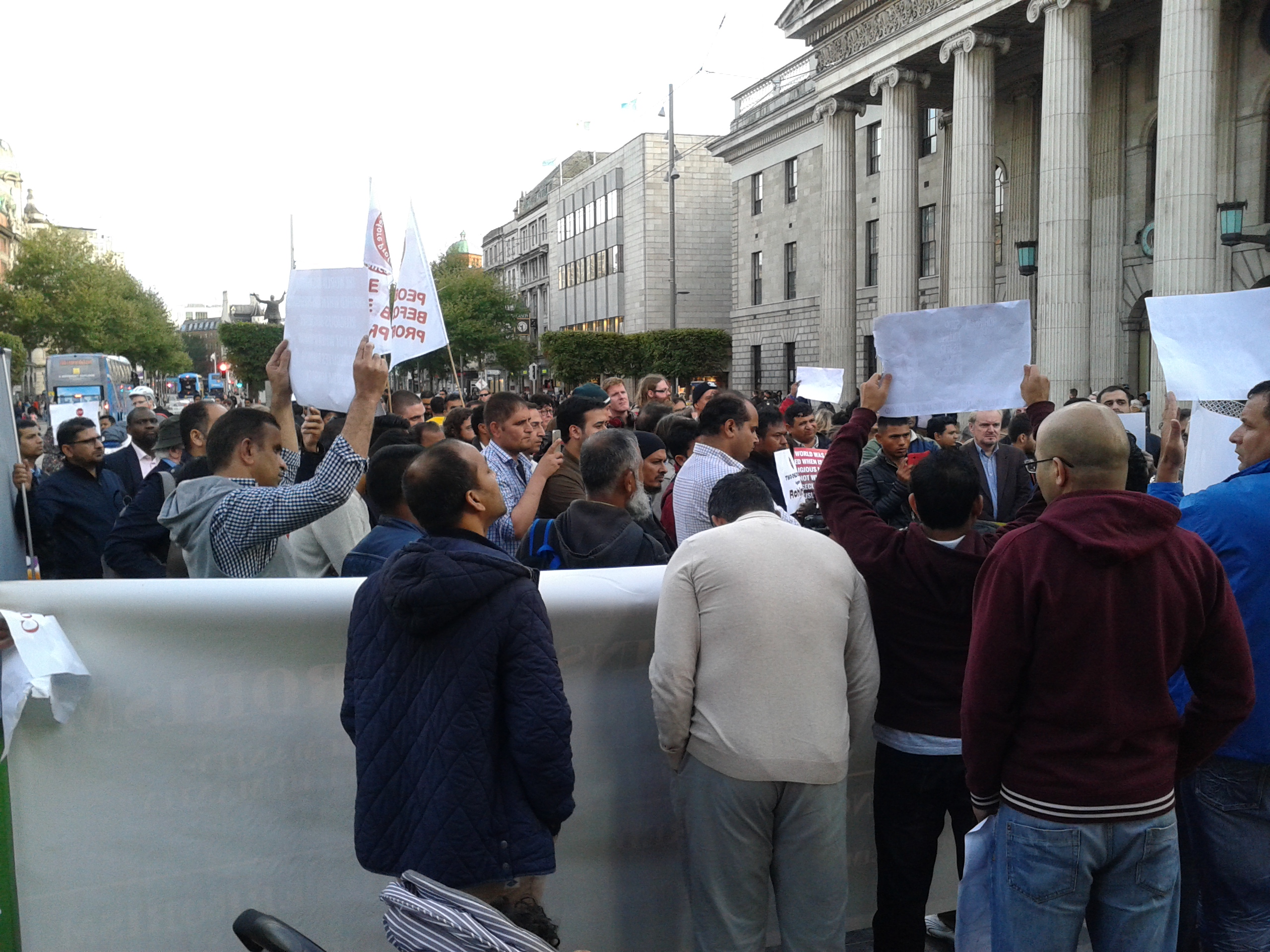
May 1st, International Workers’ Day was celebrated in warm sunshine in Dublin with a parade and rally organised by the Dublin Council of Trade Unions and a later event organised by the Independent Workers’ Union.

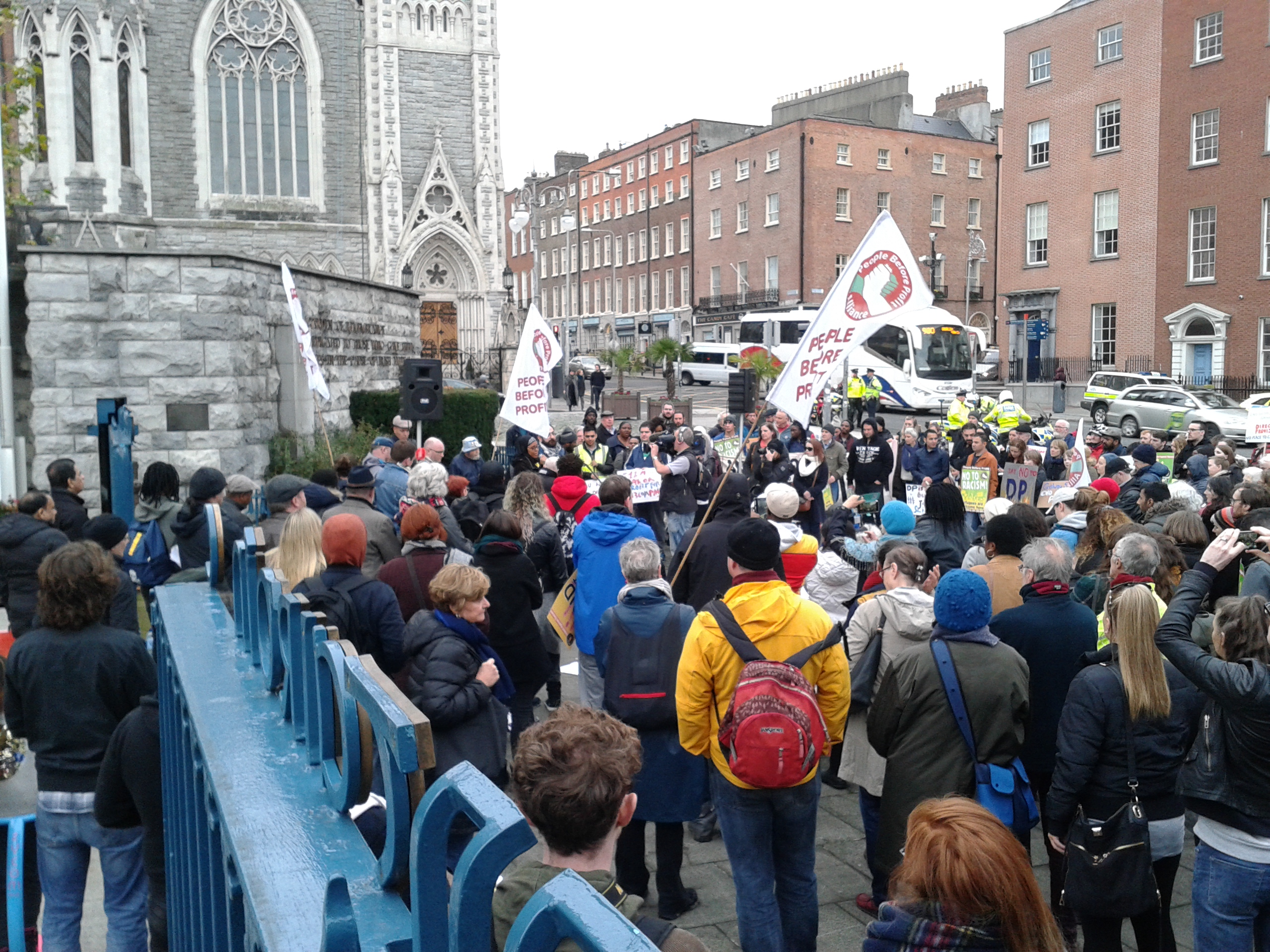
Crowd scene outside Garden of Remembrance, the starting point of the DCTU march

The DCTU-organised event met at the Garden of Remembrance at 2pm and set off at nearly 3pm, with numbers although still small by European standards nevertheless larger than has been seen for some time in Dublin, according to the organisers filling O’Connell Street, the city’s main street throughout its whole length (500 metres or 547 yards).

Seen on the parade were trade union banners, those of some political parties, also of campaigns and community groups.

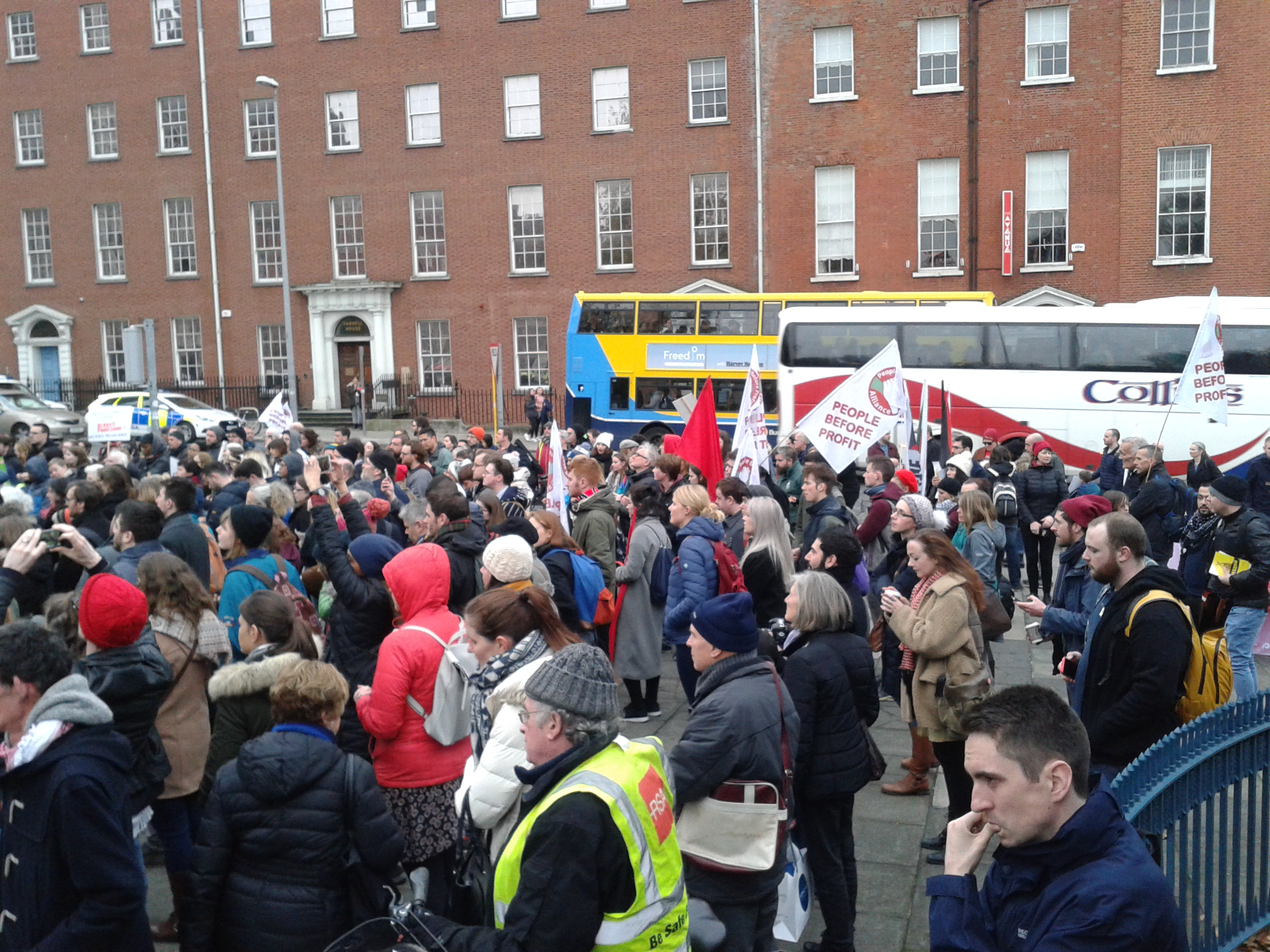
As it has been doing for years, the parade ended in a rally in Beresford Place, in front of Liberty Hall, the very tall building owned by the SIPTU trade union, where the audience were addressed by speakers from trade unions and campaigns and NGOs.

Section of crowd at rally in Beresford Place

Curiously, soon after arrival the comparatively strong showing of Sinn Féin flags, the green one with their logo and the blue and white version of the Starry Plough, were nowhere to be seen.

Similar section with some banners noticeably missing

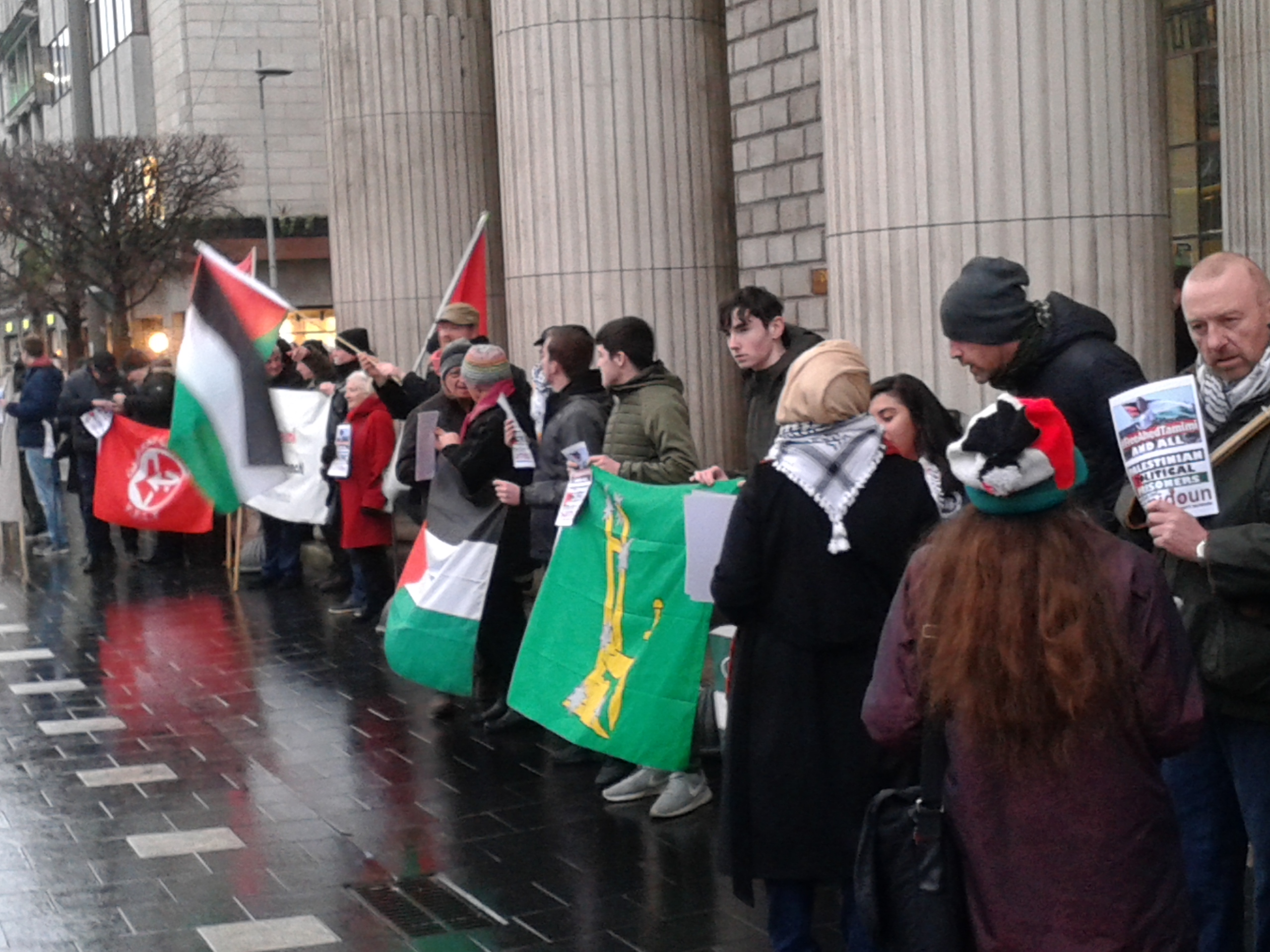
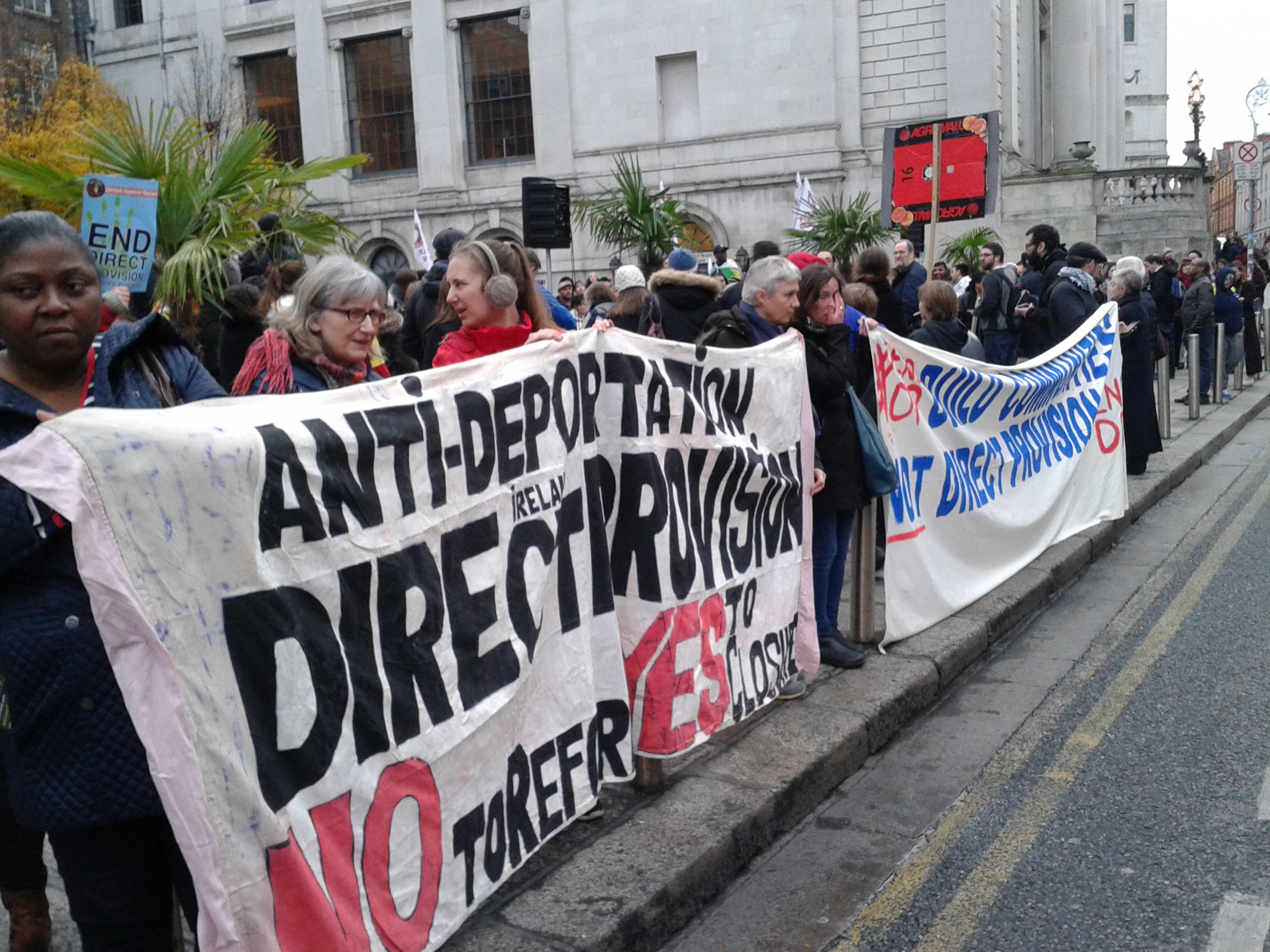
The issues of lack of affordable housing, of public land being sold for private housing and speculation, of precarious employment, of financial speculation and cuts in services were addressed by speakers, with a mention also of solidarity for the Palestinian prisoners on hunger strike. A number of speakers also addressed the treatment of migrants and in particular the conditions suffered by refugees in the Direct Provision hostels of the state’s welfare service.

Stage erected at Beresford Place, outside SIPTU’s offices
The Moore Street campaign banner was one of the campaign groups present on the parade and mentioned from the stage by the rally’s chairperson.
One of the speakers at the rally — she denounced the sale of private land including the deal done at O’Devaney Gardens estate in Dublin.
Somewhat later, the Independent Workers’ Union held their own event, marching with a colour party from their offices to James Connolly monument, also in Beresford Place and across the road from Liberty Hall.

IWU event colour party at Connolly Monument

Damien Keogh chaired the event and introduced veteran campaigner Sean Doyle who gave a short and to the point speech about the situation in which working people find themselves today and ending with a quotation from James Connolly, in which the revolutionary socialist castigated those who claimed to love Ireland but could tolerate seeing poverty and deprivation among its people. Doyle also sent solidarity greetings to the Palestinian political prisoners on hunger strike in Israeli jails.

Paul Bowman was then introduced and in a longer speech covered Connolly’s time in the USA, his membership of and activities of the IWW (“the Wobblies”); the Haymarket Incident in Chicago which led to the choosing of May 1st as International Workers’ Day and the state murder of the Haymarket Martyrs; the principles and attitude of the IWU today.

Another Moore Street campaign banner and supporters in period costume also participated in the IWU event
Some random tourists, one form London and the other from Madrid, who chanced to pass by and remained for the whole ceremony.

Damien then introduced Diarmuid Breatnach to sing “We Only Want the Earth” (an alternative title to the original of “Be Moderate”). Breatnach explained that the lyrics had been composed by James Connolly and published in a songbook of his in New York in 1907 without an air. As a consequence the lyrics have been sung to a variety of airs but Breatnach said he sings it to the air of “A Nation Once Again” (composed originally by Thomas Davis some time between 1841 and 1845). This arrangement provides a chorus and Breatnach invited the audience to join in the chorus with him, which they did.

We only want the Earth,

we only want the Earth,

And our demands most moderate are:

We only want the Earth!”

A wreath was laid at the monument on behalf of the IWU by Leanne Farrell.

The chairperson then thanked those in attendance, speakers and singer and invited all back to the offices of the IWU in the North Strand for refreshments.

End.

REPUBLIC DAY CELEBRATION HELD IN DUBLIN FOR EIGHTH CONSECUTIVE YEAR


Diarmuid Breatnach


On Monday 25th April people gathered in front of the General Post Office building in Dublin city centre. The occasion was the commemoration and celebration of the reading of the Proclamation of Independence by Patrick Pearse outside that same building, shortly after the 1916 Rising had begun under his overall command. Standing nearby during the reading had been James Connolly, Commandant of the GPO Garrison and also commanding officer of the Irish Citizen Army. Both were executed by the British weeks later for their part in the Rising, along with another thirteen (twelve in Dublin, one in Cork) and months later Roger Casement was tried in civilian court in London and hung.


Tom Stokes, who has been a chief organiser of this event since 2010, opened the proceedings, addressing the crowd and the flag colour party. He reminded his audience that in 1917 it had been Republican women who had organised the 1916 commemoration, printing many copies of the Proclamation and pasting them around the city, also defying British military law to gather outside the GPO to mark the events.

Tom Stokes speaking at the event outside the GPO (photo: D.Breatnach)

Among the reasons for this given by Stokes was that many Republican men had but recently been released from British prisons and concentration camps but also that the women had a special stake in the Republic for which the Rising had taken place – they in particular stood to gain from its achievement the status of citizens and many other changes in their status as a result.

So it was appropriate, Stokes said, to have women take prominent roles in the event, starting with Evelyn Campbell, who accompanied herself on guitar while singing her compositions Fenian Women Blues and Patriotic Games.

Evelyn Campbell performing (photo: D.Breatnach)

Following that, Tom Stokes gave the main oration, outlining his vision of a Republic and castigating the Irish state for what it had produced instead, in particular attacking its treatment of women and declaring that abortion was a private matter in which the State had no right to interfere.

This was followed by Fiona Nichols, in period costume, reading the Proclamation and after that came Dave Swift in Irish Volunteer costume, reading a message given by a wounded James Connolly  (he had been injured Thursday of Easter Week by a ricochet in Williams Lane while on a reconnaissance mission).

Fiona Nichols reading the 1916 Proclamation.
(photo: D.Breatnach)

Cormac Bowell, in period Volunteer costume played an air on the bagpipes, Fergus Russel sang The Foggy Dew, Bob Byrne sounded The Last Post on the bugle and Evelyn Campbell came forward again, this time to accompany herself on guitar singing Amhrán na bhFiann.

Cormac Bowell playing at the event.
(photo: D.Breatnach

Tom Stokes thanked the performers and everyone else for their attendance and said he hoped to see them all again on the 24th April 2018, which will be a Tuesday. He said it was his wish that this day be an annual National Holiday and they had started the annual celebration because no-one else was doing it.

Some of those present marched to Moore Street with a Moore Street campaign banner, taking the GPO Garrison’s evacuation route on Friday of Easter Week through Henry Place, past the junction with Moore Lane and on to Moore Street, where Dave Swift, still in Irish Volunteer uniform, competing with the noise of construction machinery coming from the ILAC’s extension work, read the Proclamation before all dispersed, leaving the street to street traders, customers, passers-by and builders.


A chríoch.


Bugler Bob Byrne sounding The Last Post.
(photo: D.Breatnach)
Dave Swift reading Connolly’s statement after he had been wounded. (Photo: D. Breatnach)


RIVAL MANDARINS FIGHTING IN DUBLIN

Cycling through Griffith Park off the Mobhi Road, after a walk in the nearby Botanic Gardens, a flurry of wings and a flash of colours attracted my attention.  Three birds came down with a splash into the Tolka.

Rival males and female on a rock in the Tolka.
(Photo: D.Breatnach)

You don’t need to be any kind of expert to identify the Mandarin Duck, especially the males and that’s what two of those birds were.  The dowdier third one was the female.

I have often noted two male mallard ducks peacefully accompanying one female and wondered whether they had a menage-a-trois going or what the arrangement was.  But there was nothing like that going on with the Mandarins as the males made clear quite quickly.  After briefly circling around one another they were quickly into fisticuffs (or beak-and-wing-cuffs), scuffle-splashing, clucking insult or challenge, until the rival to the established male would take to the wing either for a break or to get next to the female.  In the latter case, the male would take to the air also, in pursuit.

The female?  She swam demurely apart waiting for the victor.

The female Mandarin Duck in the Tolka.
(Photo: D.Breatnach)

There was clearly one established male who for the moment was the dominant one but the rival kept coming back while I was watching and they were still at it when I left.  The established one has the psychological dominance factor on his side, which is a strong advantage but it is by no means a guarantee of success.  The rival might wear him down.  Or the established one might become injured.  Being a male and keeping one’s bird is not easy.

Rivals circling briefly in mid-water prior to another scuffle on the river.
(Photo: D.Breatnach)

According to Charles Darwin, genders of many species but many birds in particular have become colour-differentiated through part of the evolutionary process described as sexual selection (The Descent of Man and Selection in Relation to Sex, 1871).  This has reached amazing and one might say even bizarre though beautiful extremes with such birds as the peacock and the bird of paradise.

Darwin’s ideas make more sense than other explanations being proposed but it is nevertheless hard to credit that a female’s appreciation of colour, shape and behaviour would so impress upon the male the need to flaunt gaudy colour and shape in direct contravention of the need to survive predators by NOT calling such attention to himself.  Still, there is no other viable contender explanation around (as distinct from the Mandarin contender, who may still be biding his time or pressing his suit, which if the established male has anything to say about it, is all he is going to press).

Established male with female on rock and the rival that won’t give up. (Photo: D.Breatnach)

Aix galericulata is the Latin species name and the only other species in the Aix genus is the North American Wood duck.  A chromosome in the Mandarin makes hybridisation between the two impossible.

Mandarin Ducks originate in East Asia but have been kept in Europe in aviaries and in ponds and lakes.  Stephens Green used to have some, along with many other kinds of wildfowl, until the OPW allowed the Herring Gulls to take over to the extent that they have.  I have not seen them do it but would not be in the least surprised if the gulls ate the chicks of many of the waterfowl species until they died out or took off somewhere else.

However, there have been feral Mandarin populations in Ireland for some time, notably in Co. Down and in Wexford and pairs may be establishing themselves in other places, including in the Glasnevin/ Drumcondra area, based around the Tolka (and perhaps the Royal Canal).

The Mandarin is a perching duck and this kind have feet capable of grasping a branch.  They build their nests in hollows in trees which is good for the safety of the nesting female and the eggs.  But what of the chicks or ducklings?  As we know, ducklings take to the water long before they can fly.  So what can these ducklings in tree hollows, many feet from the ground, do?  They simply jump.  A veritable leap into the unknown.

When they hit the ground, which at first sight seems to ensure they have broken practically every bone in their little bodies or a least concussed themselves and messed up their insides, they bounce a little, get up and waddle to their mother.  Yes, she called them out, which is why they came.

One needs to see the process to believe and I have included some Youtube links.  It would seem at first that they need soft leaf litter or water in which to land but one of the links I have posted shows Mandarin ducklings jumping from a nestbox on to bare stone — and getting up, apparently unhurt.  It is difficult to understand, even with accounting for the relationship of weight to surviving a fall.  We probably know that we can drop lots of insect species on to the ground and they don’t get hurt but the principle goes farther — apparently a mouse can survive a fall from a great height (unless a hawk gets it on the way down, or a cat is waiting below); conversely a fall of four foot on to its feet can kill an elephant (so it is said — I have not actually tried this with elephants but I have inadvertently confirmed the mouse theory).

Often invasive species should not be welcomed as they upset the natural ecological balance.  The grey squirrel in the nearby Botanic Gardens, originally from the USA, may be cute but it is helping to wipe out the native red species.  And that’s just one of the invasive species of animal and plant that are causing problems in Ireland (see https://rebelbreeze.wordpress.com/2014/07/01/the-scent-of-intruders/).  On the other hand, the widely-distributed Red Valerian (also with white and pink varieties) does not seem to be causing any problems and it is difficult to see how the Mandarin can become a serious problem either.  But of course, one does not know for sure.  It can be stated that the populations so far established in Britain and in Ireland do not seem to have caused any ecological problems.  And it is true that we don’t have many dense woods in Ireland anywhere (thanks to certain human invaders in our history), least of all close to slow-flowing water, although some species have shown remarkable adaptability, witness in these climes the rat, fox, pigeon, herring gull and, of course, homo sapiens.

One of the curious things about the Mandarin is the name we have for it.  Apparently, it is a Portuguese word for the Chinese government bureaucrats in existence when the Portuguese first began to trade with them (before they and other Europeans decided to invade China and confiscate areas, in particular ports and islands).  How they became associated with the duck was not revealed in my short internet search.

However, in China and in Korea the mandarin duck is associated with fertility, good fortune and constancy in monogamy, so that it is often presented as a wedding gift, either as living pairs or symbolically in an ornament.  It is not currently considered an extermination-threatened species.

End.

Video links (second one is of merganser ducklings and is even more impressive):

https://rebelbreeze.wordpress.com/wp-admin/post-new.php

Other information sources:

Mandarin duck unlikely invader | Irish Examiner

21 Facts on Mandarin Duck – Tweetapedia – Living with Bird

https://en.wikipedia.org/wiki/Mandarin_duck