Diarmuid Breatnach
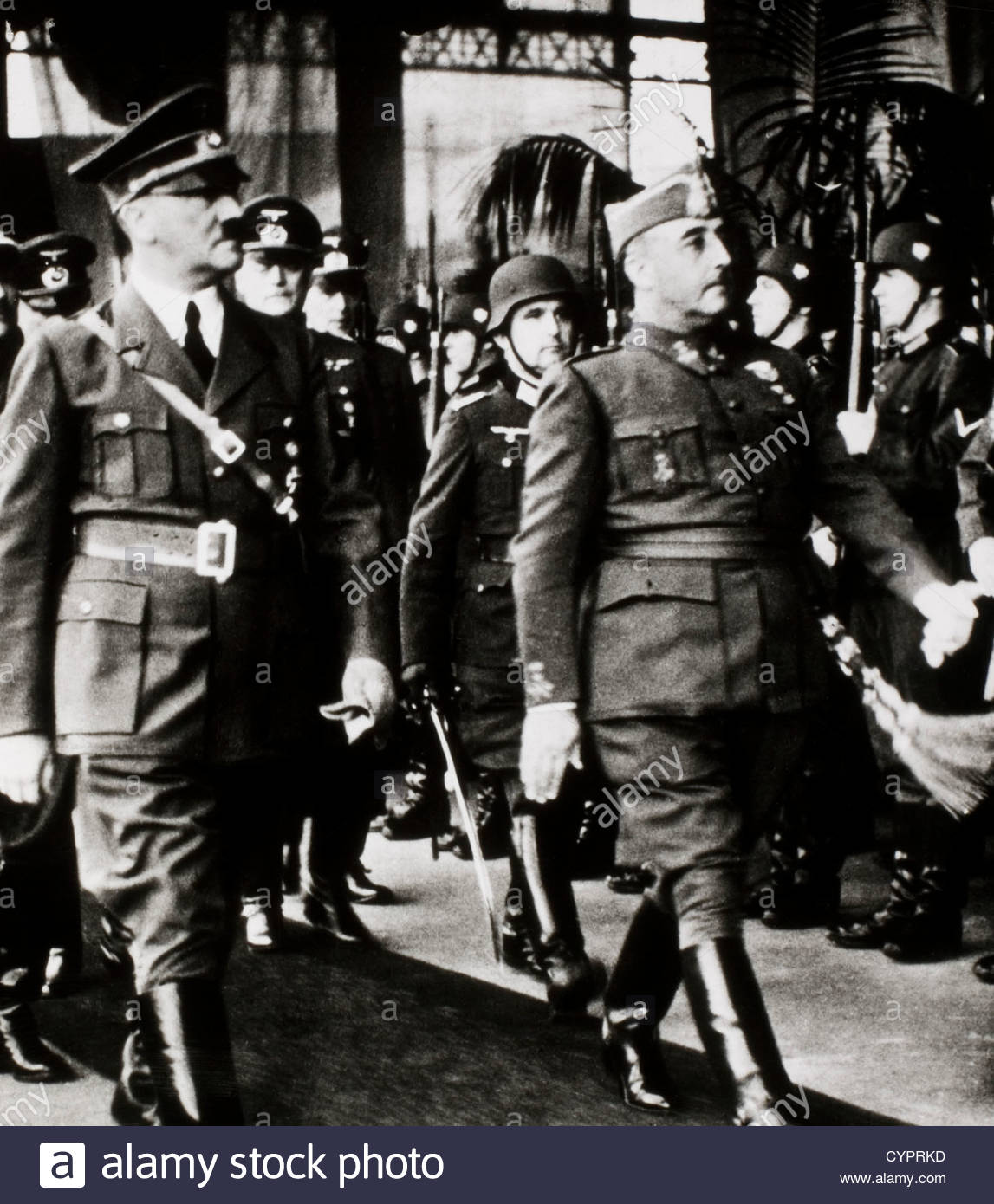
The German police have arrested Catalan Independence activist and elected politician Carles Puigdemont. Nice to see Spanish-German cooperation, just like the old days.

Diarmuid Breatnach
The German police have arrested Catalan Independence activist and elected politician Carles Puigdemont. Nice to see Spanish-German cooperation, just like the old days.
End Internment FB page
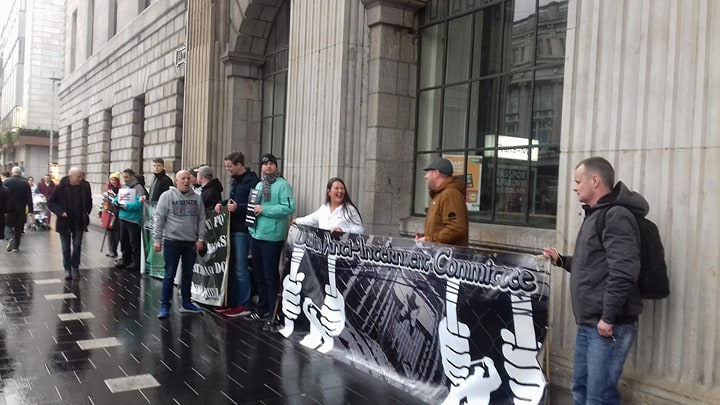

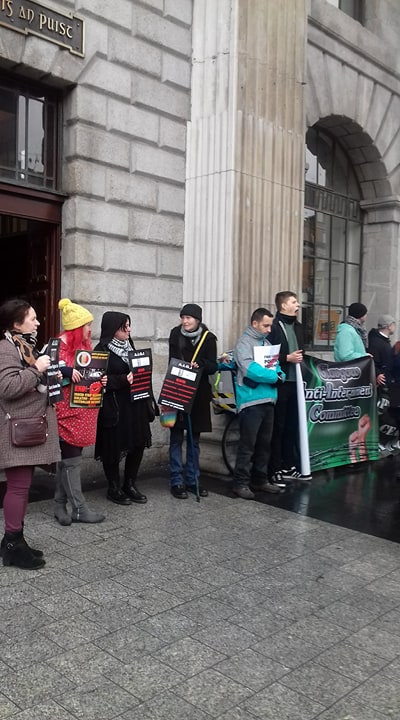
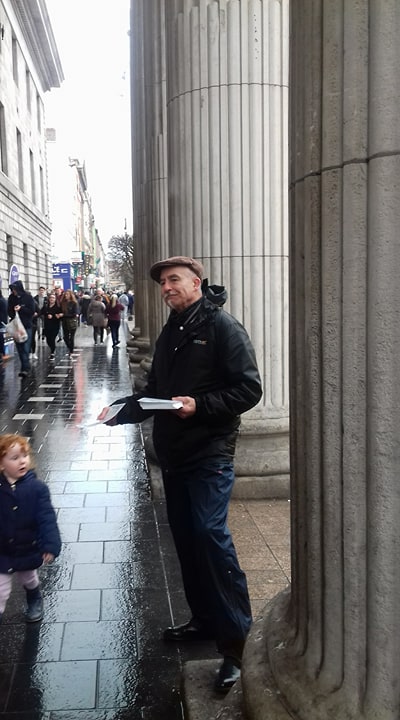
Leaflets of the Anti-Internment Group of Ireland were distributed to shoppers and visitors passing by, along with others about the conviction of Brendan McConville and John Paul Wooton (the Craigavon Two), framed and jailed in 2009 and still in jail, serving life sentences. Songs about internment and political prisoners were played on a sound system, as well as Labi Siffre’s Something Inside So Strong and Christy Moore’s Viva La Quinze Brigada.

Despite the official end of internment by the British in 19751 and by the Irish state in 19572, Republican activists continue to be jailed without trial in a number of ways: Licence revoked and bail refused or revoked.
When a Republican leaves jail under license, she or he can be returned there without any court hearing or the presentation of any evidence against them; this is what has happened to Tony Taylor and Gerry Mackle, for example. Refusing bail for accused Republicans has become almost standard, despite the fact that this is supposed to be a last resort, for example when there is a serious risk of the accused fleeing the administration, or interfering with witnesses – which has rarely applied to Republicans refused bail. The real reason has usually been revealed when they have been granted bail: they are required not to attend protests, meetings or to associate with other active Republicans. In other words, they are being prevented from exercising their civil rights to express their opinions and to organise politically.
Welcoming the participation of the Glasgow Committee in Dublin, a spokesperson for the Dublin Committee stated that “members of the Dublin Committee have been proud to attend anti-internment protests in Glasgow in the past” and went on to say that “we look forward to future cooperation with the Irish diaspora and internationally against political repression, particularly of jailing without trial of political activists.”
The Dublin Anti-Internment Committee is entirely independent of any political party or organisation and holds regular awareness-raising protests at different locations. The Committee welcomes the participation of other organisations or individuals in their protests but asks them not to bring political party material etc to the anti-internment protests.
On its FB page the Committee also maintains a list of Republican prisoners in jails on both sides of the British Border, updating it from time to time.


10th ANNIVERSARY OF DEATH OF VOLUNTEER BRENDAN HUGHES COMMEMORATED IN DUBLIN
(From the End Internment FB page, courtesy of the Dublin Committee of the Anti-Internment Group of Ireland)

Around two score assembled with black flags and portraits of the IRA Volunteer who died aged only 59 ten years ago (2008). Hughes was from a Belfast Republican working class family and entered the struggle, enlisting in the Provisional IRA in 1969. He was arrested in 1973, beaten and jailed but escaped, leaving Belfast but subsequently returning to Belfast, to the Malone Road middle-class area under an assumed name while he continued in his resistance activities.
Captured again in 1974 with a number of firearms at his address he was sentenced to 15 years in jail. In 1973 he was convicted of assaulting a prison guard in the jail and was sent to Long Kesh. This was after political status had been removed from Republican prisoners and Hughes joined the “blanket protest” (refusing to wear prison uniform). Later he led the “dirty protest” (prisoners refused to “slop out” after being beaten by guards and emptied their bodily wastes out the windows until these were blocked up, then out under their cell doors, until they were swept back at them and finally on to the walls of their cells).
Hughes began hunger strike which he maintained for 53 days in 1980, ending with others only after what appeared to be a deal offered by Thatcher. It is believed his health never recovered from his prison experiences; he suffered from problems with his heart and eye problems, in addition to arthritis.

Released from jail after 10 years, he became a serious critic of the “Peace” (pacification) process; according to his brother, Hughes asked that his former comrade Gerry Adams not be permitted any role in his funeral. His brother admitted later that he had bent to pressure and had allowed Adams to carry Hughes’ coffin.
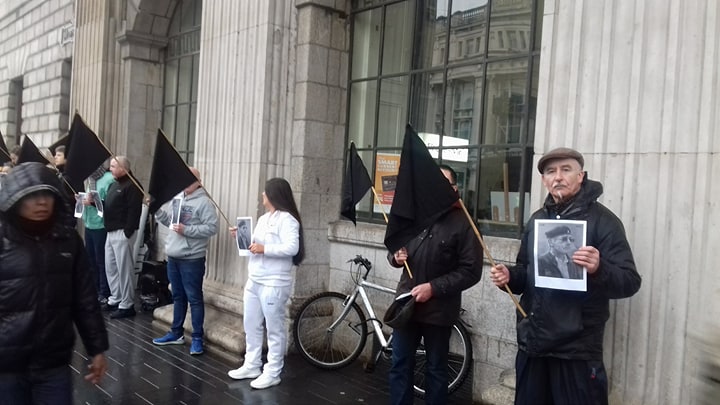
Brendan “The Dark” Hughes died on 16th February 1998.

Guardian obituary:
https://www.theguardian.com/uk/2008/feb/19/northernireland
Translation by Diarmuid Breatnach
https://www.pagina12.com.ar/93239-en-cushamen-siguen-los-atropellos
Six months after the repression that led to the death of Santiago Maldonado, members of the (Argentine) Gendarmerie entered the Mapuche community this morning. They tied up several of their members and seized the horses, which were then taken to a van owned by businessman Luciano Benetton. They (the victims – translator) said that the operation was illegal and do not rule out that “planting evidence” was the purpose.
Members of the Mapuche Pu Lof community in Resistencia Cushamen, in Esquel (in Argentina – trans.), denounced that this morning Gendarmerie officers carried out a new raid ordered by Judge Graciela Rodríguez and prosecutor Díaz Meyer after a complaint from the Leleque ranch, owned by Italian magnate Luciano Benetton. According to the members of the community, the occupants were cuffed with plastic ties during the operation and their horses seized, these being taken to a van belonging to the Tierras del Sud (Southern Lands – trans.) company, owned by Benetton. A woman was injured and had to be taken to hospital. Yesterday was six months since the disappearance and death of Santiago Maldonado, victim of the police repression of that same community.
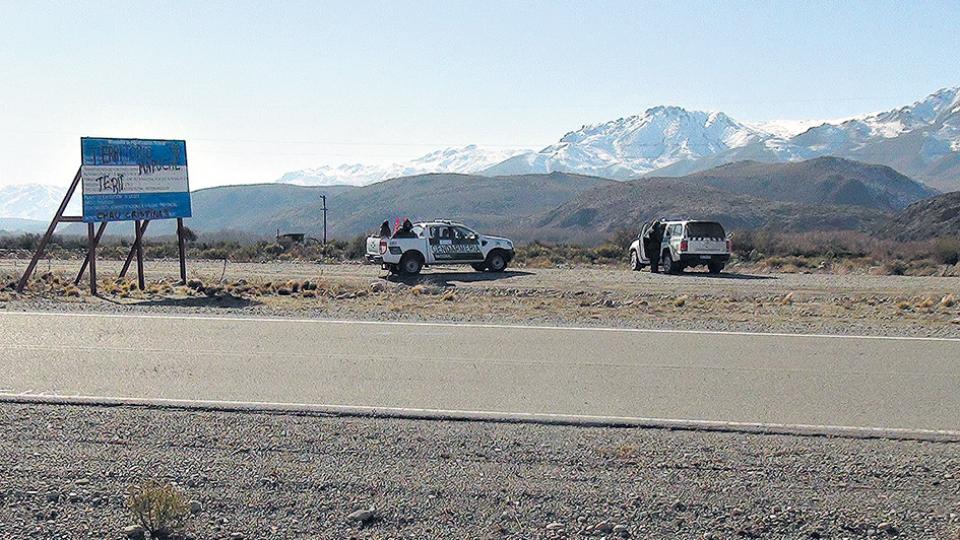
The reports of community members were disseminated through the Communities in Conflict Support Network, reporting that the troops arrived in the community at the first hour of the morning and “kept the members of the community under guard without even letting them go to the bathroom.” They reported that the officers took the horses that they had in the community, which they loaded on to a truck of the company Tierras del Sud, owned by Benetton. After the operation, a woman named Vanesa Millañanco had to be transferred to the hospital in Maitén and the community maintained that her health status is unknown.
“We denounce this new outrage at Pu Lof Resistance Cushamen as totally illegal because it was not supervised by witnesses, that is to say that the repressive forces did what they wanted during the time when they could incriminate members of the community through planting false evidence,” the community statement declared. The community also targetd the Security Minister, Patricia Bullrich, as responsible for a “hunt against the Mapuche people and a truly unscrupulous media defamation campaign.”
Clive Sulish

View of section of crowd before start of event with the Memorial in the background (Photo: D.Breatnach)


As people assembled, a crowd of European youngsters was noted passing by, no doubt part of some scheme to learn English and something of the culture outside their own country. Sadly their teacher passed by the Monument without calling their attention to it.
The bombings on 17 May 1974, killing 33 civilians and a full-term unborn child and injuring almost 300, claimed the highest toll of any event during the 30 Years War and was the deadliest attack in the history of the Irish State. The bombings were organised by British Intelligence agents with Loyalist participation and not one person was ever charged.
It was not a good day for the march and participants came prepared for the worst but the rain stopped just before the event and held off, apart from an occasional drizzle, until after the event, when it fairly lashed down.


Pádraig Ó Fearghaill spoke first in Irish welcoming all who had attended, outlined the order of events and then called on George Galloway, famous British anti-imperialist politician, writer and broadcaster, to lay a floral wreath at the monument, which he did. Ó Fearghaill then called on Diarmuid Breatnach to sing the Woody Guthrie song about the massacre of mineworkers in Colorado, USA, by capitalists including the imperialist John D.Rockefeller. Breatnach sang “The Ludlow Massacre”.
The march then formed up and, led by a floral wreath-holder and black flags, proceeded up Talbot Street, into North Earl Street and up to the GPO. Along the way they chanted “From Ireland to Palestine- Occupation is a Crime” and “Donald Trump/Theresa May- How many kids did you kill today?” The demonstration received a lot of support from passers by along the way and drivers of cars and buses who beeped to show support. The marchers, some of who were carrying candles or light up boards made there way to the GPO where a further crowd had already gathered.

From well-known activists participating and banners carried it was clear that the march had attracted wide support across sections of the Republican movement in parties and campaigns, with participation of independent activists of republican, anarchist and socialist background.

Outside the GPO building, Ó Fearghaill called on Máire Uí Mhaoileoin to lay a wreath in memory of those who have lost their lives as a result of imperialist war-crimes and then introduced George Galloway, who remarked that he was proud to speak outside the building that had played such a part in the first blow against the British Empire of the last century. Galloway went on to refer to continuing British occupation of the Six Counties of Ireland and imperialist interference in the Middle East and the occupation of some countries. In the latter category he praised the Palestinian Ehed Tamimi, whose 17th birthday was just that day and called her “a leader of the resistance for the whole Middle East”.

Reminding the attendance of the ongoing crime of internment, Ó Fearghaill announced a representative of a campaign around Tony Taylor, who announced he was reading a statement from Lorraine Taylor, Tony’s wife. Taylor, a Derry Republican, was detained in March 2016 and has been in jail since, without trial or even charge.

Presenting Diarmuid Breatnach again to sing the famous Eric Bogle anti-war song “The Band Played Waltzing Matilda” referencing the bush-ballad of “Waltzing Matilda”, the Australian unofficial national anthem. However, following
a suggestion from a participant, Breatnach led the crowd in singing “Happy Birthday” in English and in Irish to Palestinian child-prisoner Ehed Tamimi. After Breatnach’s rendition of Bogle’s song, Ó Fearghaill thanked all the the participants and promised that Anti-Imperialist Ireland would continue to build up resistance against imperialism in Ireland and in the world beyond.
End


Diarmuid Breatnach

A hollow space existed inside the crowd where young people knelt, blindfolded and with hands bound, to represent children taken prisoner by the Israeli state. According to the Ireland Palestine Solidarity Campaign, which organised the solidarity protest, between 500 and 700 children are detained every year by the Israeli military, i.e up to an average of two a day.
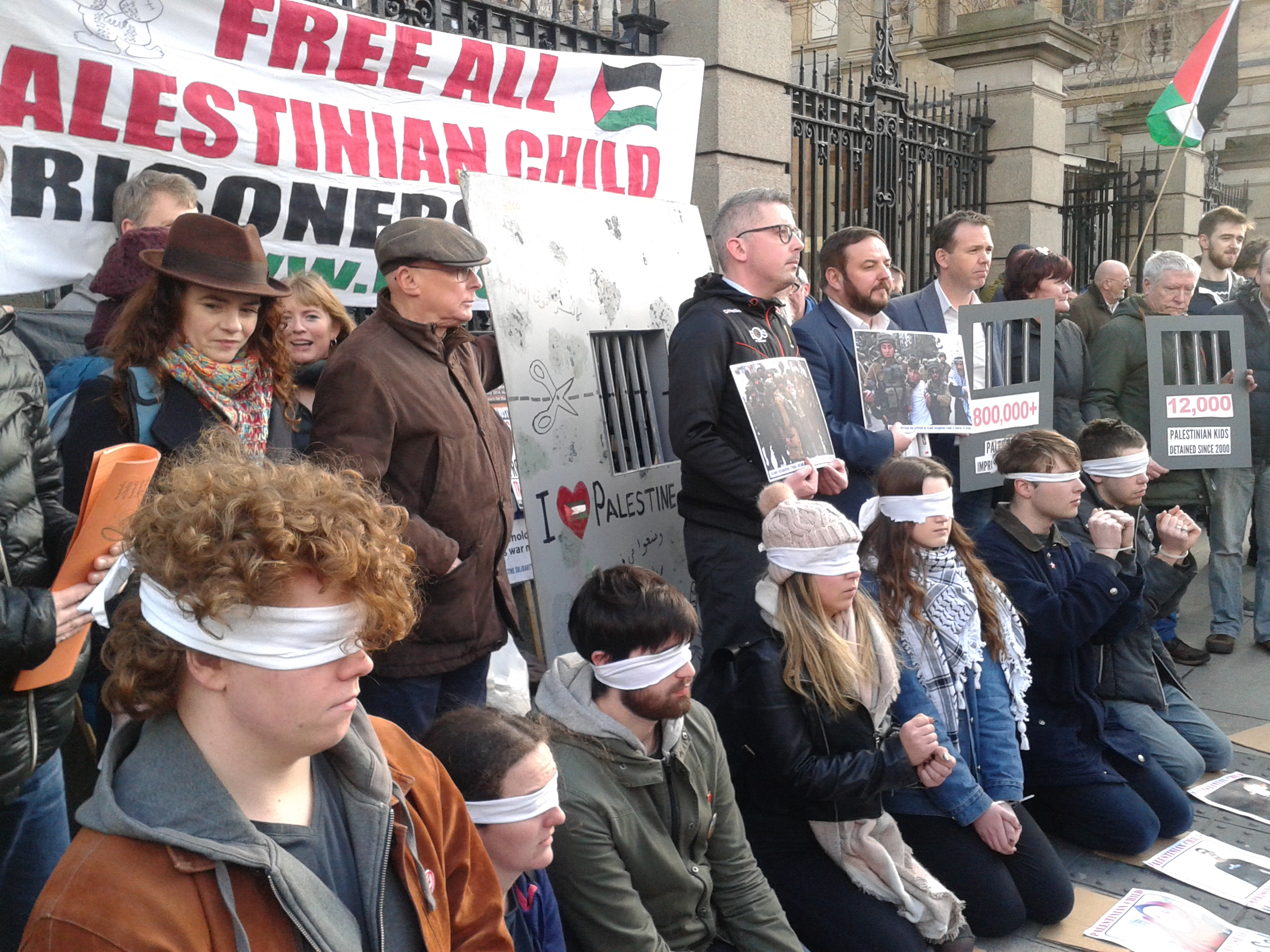
The protest was attended by many TDs (members of the Irish Parliament) and Senators comprising a broad representation of political parties and independents. Ibrahim Halawa, the Irish citizen who was arrested by Egyptian police while still a minor of 17 years of age, subsequently to spend four years in jail without trial, also attended.
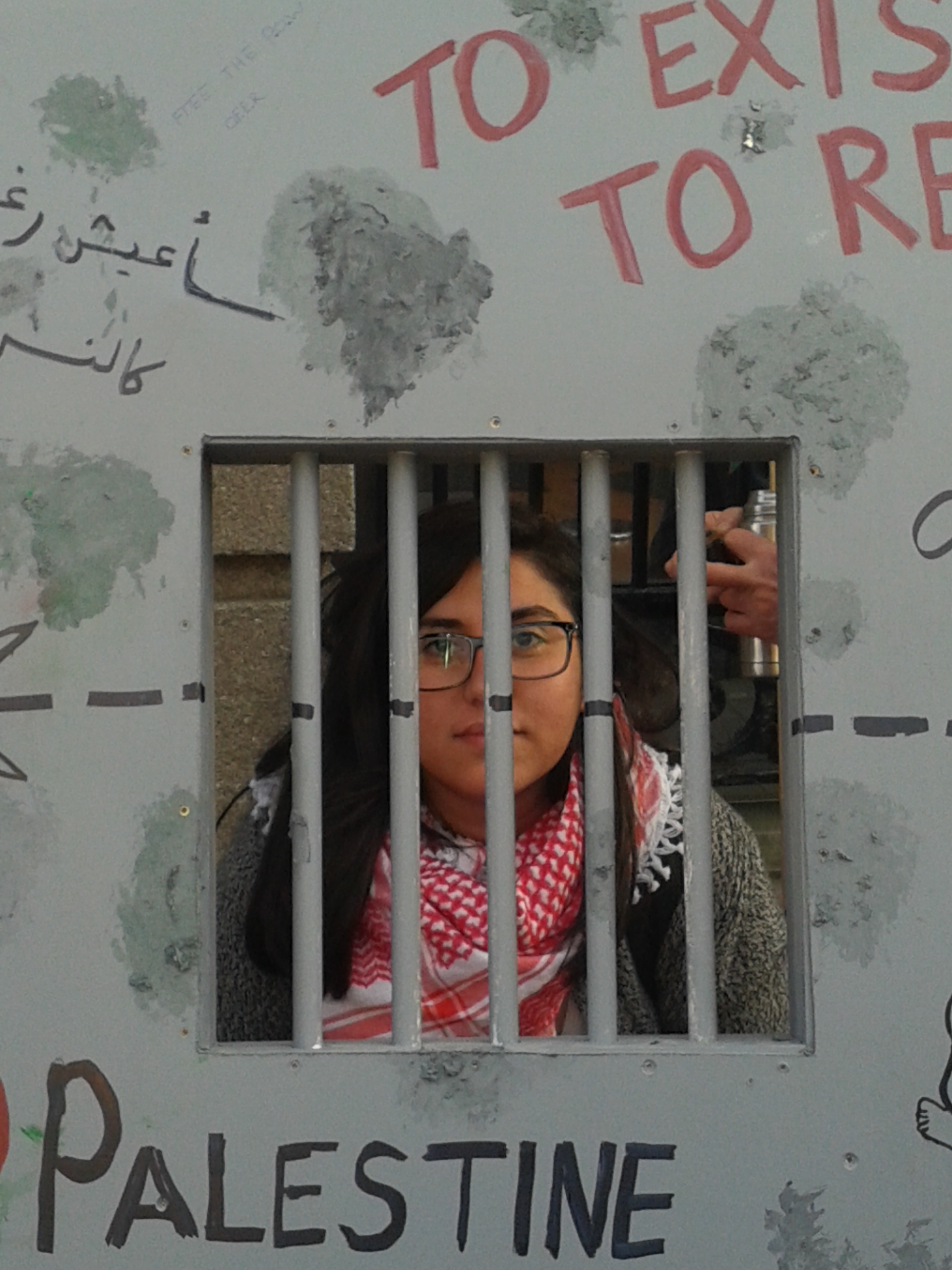
IPSC Chairperson Fatin Al Tamimi addressed the gathering and referred to “Israel’s apartheid prison system where torture and ill treatment during arrest and detention are routine, including horrendous abuses against children.” Tamimi went on to say, to loud applause: “Apartheid Israel must be held to account for its outrageous treatment of Palestinian children which violates the right of the child.”
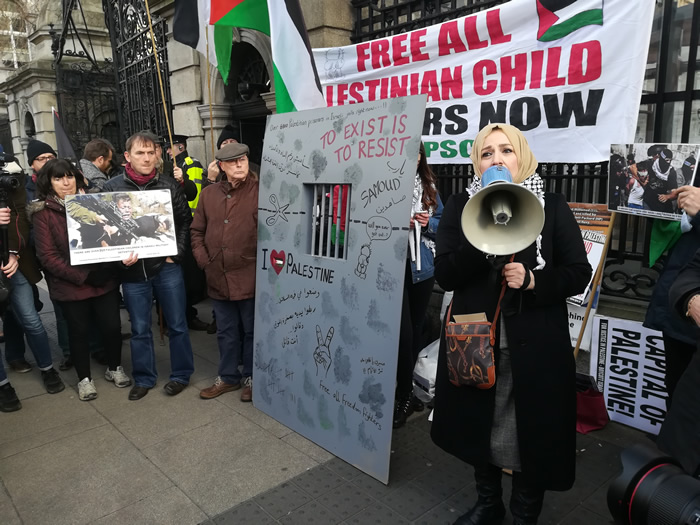
After the protest a letter was handed in to the Irish Minister for Foreign Affairs calling on the “the Irish Government to do all it possibly can to end these abuses of Palestinian children by Apartheid Israel. More than just condemnation, action is needed to bring pressure to bear of Israel to end these attacks on children, children who have known nothing but occupation and systemic violence their whole lives. Palestinians, not least Palestinian children, deserve freedom, justice and equality.”
The Irish Government action required was not specified but over the years demands have been made to call the Israeli Ambassador in for censure or even to expel him but no such action has taken place. As a participant on the demonstration said: “When the Irish Government did not even take serious action at the use of forged Irish passports by Mossad assassination squads, you know that they are not going to do anything about Palestinian children being jailed and ill-treated.” (The Irish Government expelled one minor diplomat only over that revelation in 2010 and even then the Ambassador stated that he could not guarantee that such faked passports would not be used again).
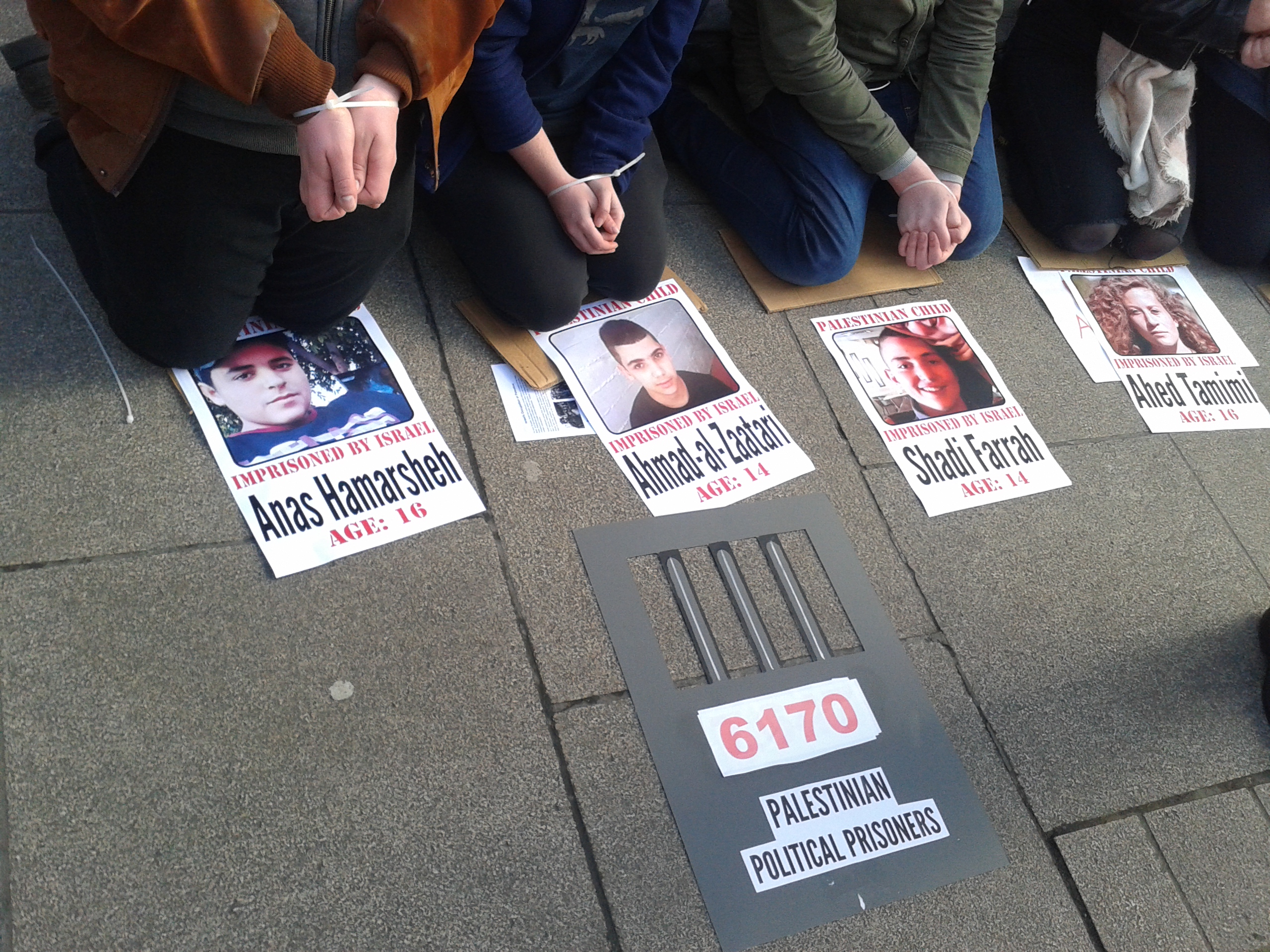

According to the UN Convention on the Rights of the Child, apart from rights to survival (violated by Israel in its 2014 bombardment of Gaza, for example, when it killed 504 children and made thousands homeless), and adequate living standards (also violated by Israel in Gaza with damaged sewage treatment plants and water, power and fuel restrictions), children also have
By jailing children, Israel is violating the rights of the child in each of these three broad categories above. Yet, according to UNICEF, only two states have currently failed to ratify the Convention after signing: the USA and Somalia. In other words, Israel has signed it but clearly is violating it as a matter of course.
Trials of Palestinian children have a 99.74% conviction rate, and “do not meet international standards for fair trial” according to Amnesty International. According to the IPSC, many more children are temporarily detained, sometimes taken by soldiers raiding homes in the dead of night, and later released after severe interrogation periods without prosecution. Defence for Children International Palestine states that some two-thirds of all children detained will face some sort of physical or mental abuses, including torture and sexual threats, during this process. UNICEF says that “Ill-treatment of Palestinian children in the Israeli military detention system appears to be widespread, systematic and institutionalised”.
According to the IPSC, “over 12,000 Palestinian children have gone through the Israeli prison system since 2000, while nearly 2,500 have been killed and countless thousands wounded. In Gaza alone, where children have borne the brunt of three vicious Israeli assaults over the past decade, UNRWA estimates that “more than 300,000 children are in need of psycho-social support”.”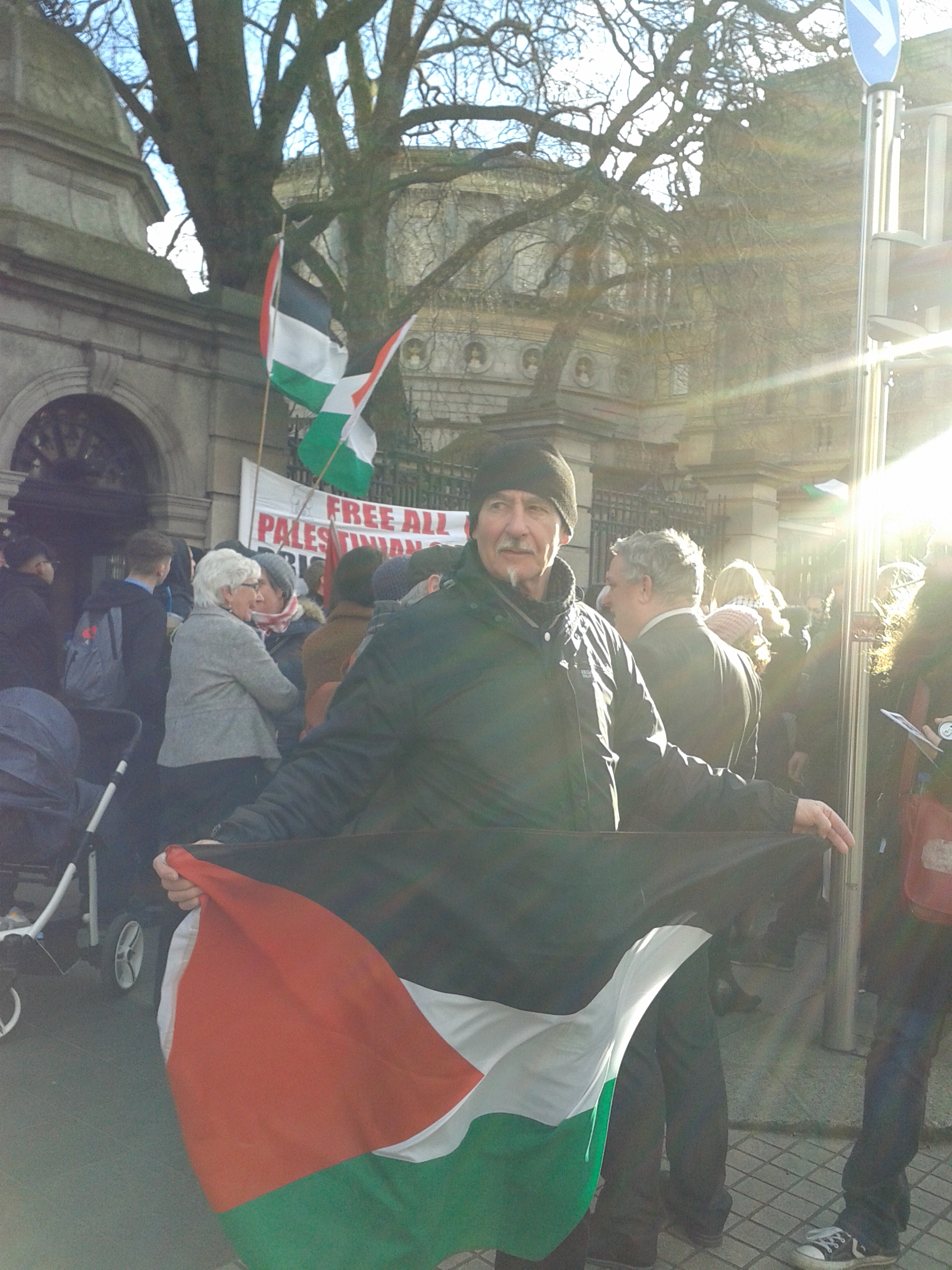
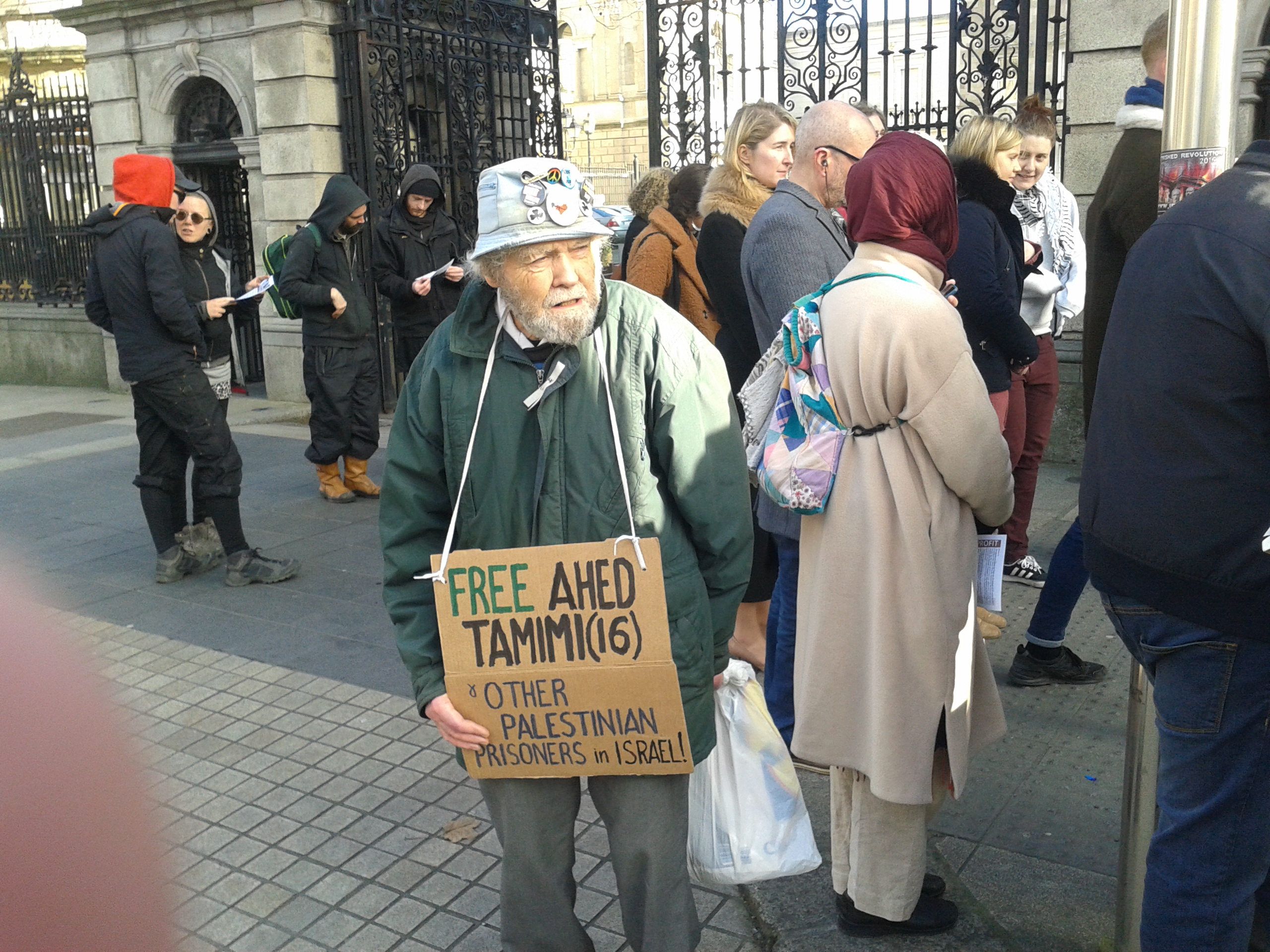
http://www.ipsc.ie/child-prisoners/pictures-solidarity-ahed-tamimi-palestinian-child-prisoners
https://www.unicef.org/crc/index_30229.html
Diarmuid Breatnach
The Catalan Parlament went ahead recently with its house management work, electing a Speaker and Deputy Speaker and four Secretaries (see fly-on-the-wall report below).
After that, they had 10 days to elect a President of the Government. The choice of the Independists seems to be unanimously for Carles Puigdemont, the previous Government’s President; however, the Spanish State wants to arrest him (as it has done with other independist parliamentarians, without granting bail and threatened to others, including the previous Speaker of the Parlament, which is one reason why Puigdemont has been living in Brussels in recent months). The President of the Catalan Parlament, Roger Torrent, despite a threat by the Spanish State to arrest him also, announced that Puigdemont was the only choice for President of the Government. Naturally the Spanish unionists in the Parlament objected vociferously but the independists have the majority.

Could Puigdemont be sworn in as President by proxy? This was a question to which contrary replies were given. The Spanish State said not but a number of others said it was a possibility. The Spanish State is not preventing the jailed Catalan politicians from having proxies vote on their behalves and presumably, even if they jail Puigdemont, though it would disrupt the Parlament considerably, he would still be able to vote through a proxy. The Spanish National Court in Madrid seems to have had this in mind when it rejected an application by the state’s Attorney General to renew the European Warrant for the arrest of Puigdemont when he arrived in Denmark. Puigdemont was there to take part in a debate organised by the University of Copenhagen titled “Catalonia and Europe at a Crossroads for Democracy? Debate with Carles Puigdemont.”
In a statement which clearly revealed the political nature of the Spanish Court, Judge Pablo Llarena declared Mr Puigdemont was seeking to “provoke” his own detention in order to “force the context” in which he could delegate his vote, and therefore he refused to renew the EAW which the state had withdrawn on 5th December (apparently on advice that the Belgian court was not going to grant it — the “crimes” with which the Spanish court charged Puigdemont a) do not have criminal status in Brussels or b) are not those covered by the convention on the EAWs).
Puigdemont has asked the Spanish State whether it is going to arrest him if he returns to Catalunya in order to be inaugurated as President of the Parlament. Torrent has asked for dialogue to discuss the matter with the Spanish Prime Minister, Rajoy, who has refused. Rajoy’s party, the Partido Popular, lost heavily in the recent elections in Catalunya and had only one member elected to the Parlament (it also has only one elected town mayor in the whole of Catalunya). The Spanish Government has also threatened to continue its direct rule under Article 155, which it imposed after the Catalan Government declared for independence, on foot of the referendum on October 1st.

ELECTIONS OF HOUSE COMMITTEE POSITIONS IN CATALAN PARLAMENT
The Catalan Parlament pressed ahead with some necessary internal work on 17th January. They needed to elect the President del Parlament (not of the Government – this position is like the Ceann Comhairle in the Dáil or the Speaker in Westminster), a Vice-President and four Secretaries. As they were doing this in the public eye, Alan King, of the FB page Support Catalonia, translated and posted as it was happening. The summary below is taken from that commentary with his permission and our thanks.
Voting is taking place for the “speaker” (president del Parlament – not the same as the President of the Goverment). The name of each MP is called out and they walk up and hand over their ballot at the front of the chamber. Loud applause accompanies the names of those who are imprisoned or in exile. Those who are political prisoners have delegated their votes except for Carles Puigdemont, who has refused to do so.
The seats in the chamber have been decorated with large yellow ribbons. (This is to remember the members of the Parlament jailed by the Spanish State while awaiting trial for carrying out the wishes of their electorate and defying the Spanish Government; also for a leader of a Catalan independist organisation).
The new candidate for speaker is Roger Torrent, who will be the youngest person to occupy the position. Voting has ended and the names on each ballot are being read out. Hundreds of people are standing outside, surrounded by many Catalan flags, to follow the proceedings live from the street.
The candidate of the independence parties, Roger Torrent, was born in 1979. Here is a piece about him (in Catalan):
The “now you see me now you don’t” Podemos group decided to abstain in the vote. As a result, with the votes counted, no candidate has the absolute majority which means that now there will be a second vote, which is taking place. In this second round a simple majority will suffice.
The Podemos group which represents a Spanish so-called “left” movement go under the name of “Catalunya En Comú” (Catalonia in Common). They suffered heavy losses in the latest elections and only have eight Mps.
The people outside are chanting: “PUIGDEMONT! FREEDOM!”
Comment from another observer at this point: “I’ve been watching live reporting on the Al-Jazeera TV news programme. Nothing on BBC ….”
The count for the first round of votes was:
Torrent (the independence candidate): 65
Espejo (the unionist candidate): 56
Abstentions; 9
The voting is over for the second round and the ballots are now being counted.
Roger Torrent is 38 years old and a member of the Esquerra Republicana (Republican Left) party. He is described as a perfectionist and a good communicator.
Torrent has replaced Carme Forcadell as speaker of the Catalan Parliament. Forcadell announced she wanted to step down on account of the many legal issues she must face because of persecution by the Spanish courts.
One of Torrent’s well-known quotes: “We will build the Republic without asking permission” (Farem República sense demanar permís).
The session now continues with the election of the Deputy Speaker (vice-president de la Mesa). There are two candidates again, put forward by Junts Per Si and Ciudadanos respectively.
The election of Deputy Speakers has concluded. The First Deputy Speaker will be Costa (the independence candidate), while Espejo (Ciudadanos’ unionist candidate) will be the Second Deputy.
Finally, votes are now being counted for the four secretaries of the Mesa del Parlament. It is expected that there will be one secretary each proposed by Junts Per Catalunya, Esquerra Republicana and the unionist parties Ciudadanos and PSC.
It has been pointed out that the presence of more men than women in the Mesa fails to reflect the fact that women are in the majority in the parliament as a whole.
Roger Torrent is beginning his first speech as Speaker of the Catalan Parliament.
Torrent promises to try to win the confidence of all the members of parliament.
He is going on to draw attention to the intolerable situation with political prisoners and cabinet members in Brussels who cannot return to their country.
It is his job to represent the voices of all the elected members of parliament including those who cannot be present today.
There is an unprecedented situation where the Catalan institutions are under attack, and the first task must be to stop that. He calls on everyone to join forces to retrieve the institutions and put them at the service of the whole country.
The polls are the maximum expression of the will of the people and must be respected. The country’s civil and social rights depend on it.
Social progress is one of parliament’s essential goals.
It is their responsibility to forge agreements and understandings even among groups who don’t see eye to eye. He has worked for that as Mayor and will now do it in his new position.
But he demands one thing: respect. For the institutions, for each other, and for will of the people.
Democracy and coexistence are the two basic principles.
Catalonia is a diverse country and that diversity is reflected in the composition of parliament.
He has referred to his two female predecessors and says that he personally espouses the feminist vision, which is still unachieved in Catalan society and its institutions, but which he promises to do his best to advance.
After his speech, all stand for the Catalan national anthem, Els Segadors.
The anthem is followed by shouts of “Visca Catalunya” (Long live Catalunya!) and “Lliure!” (Free!), and of “Llibertat!” (freedom).
The session is over. The President of the Government remains to be elected, which needs to be done tend days from now.
Clive Sulish
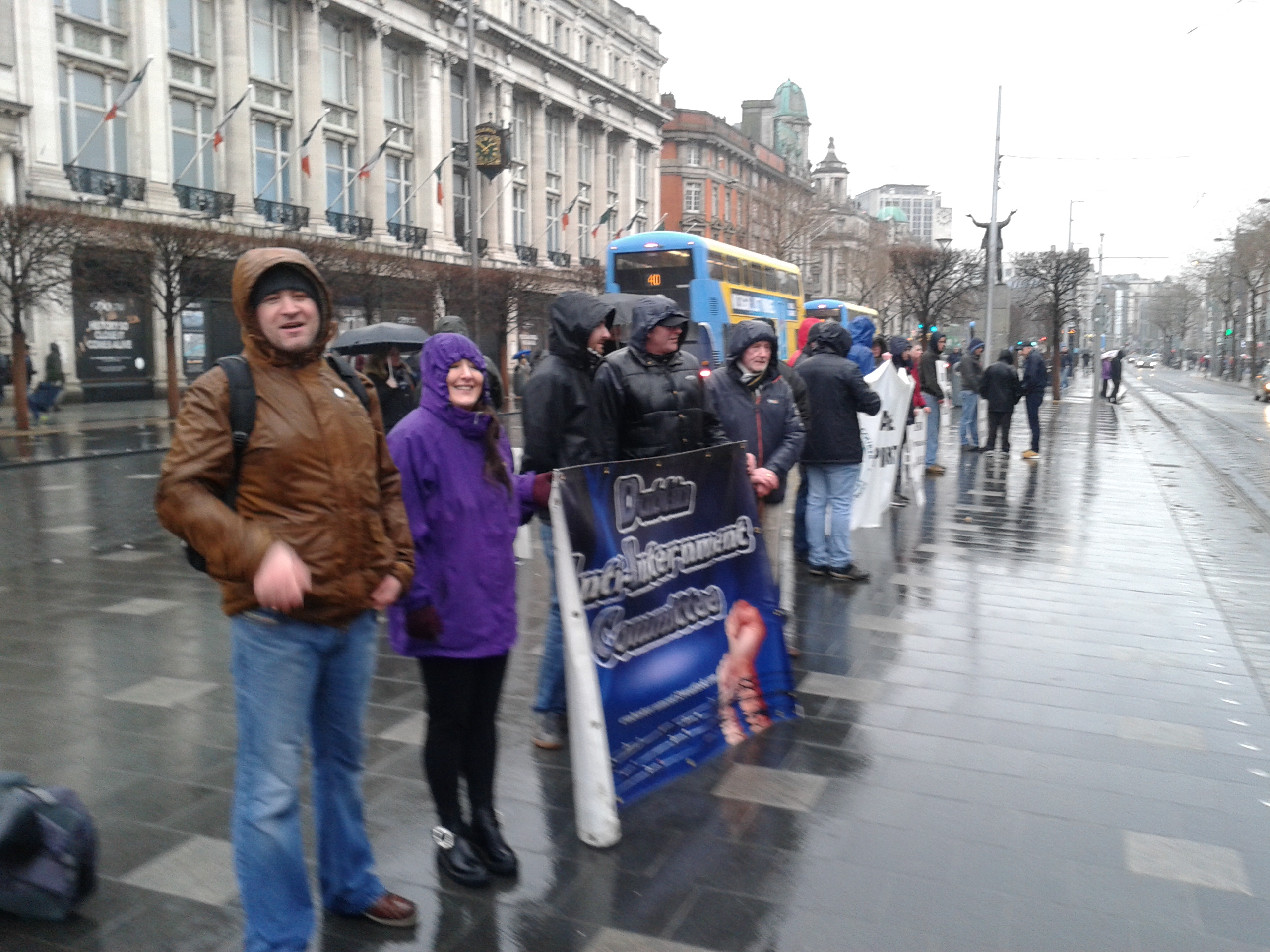
They lined up opposite the iconic General Post Office, site of the HQ of the Easter Rising in 1916 and still bearing the marks of British Army bullet and shrapnel strikes. As traffic and shoppers hurried by or stopped to stare, the protesters were observed by members of the Garda Special Branch, the political section of the police force of the Irish state, one of whom ducked behind one of the GPO’s columns as someone pointed a camera in his direction (to cause some mirth among the picketers).
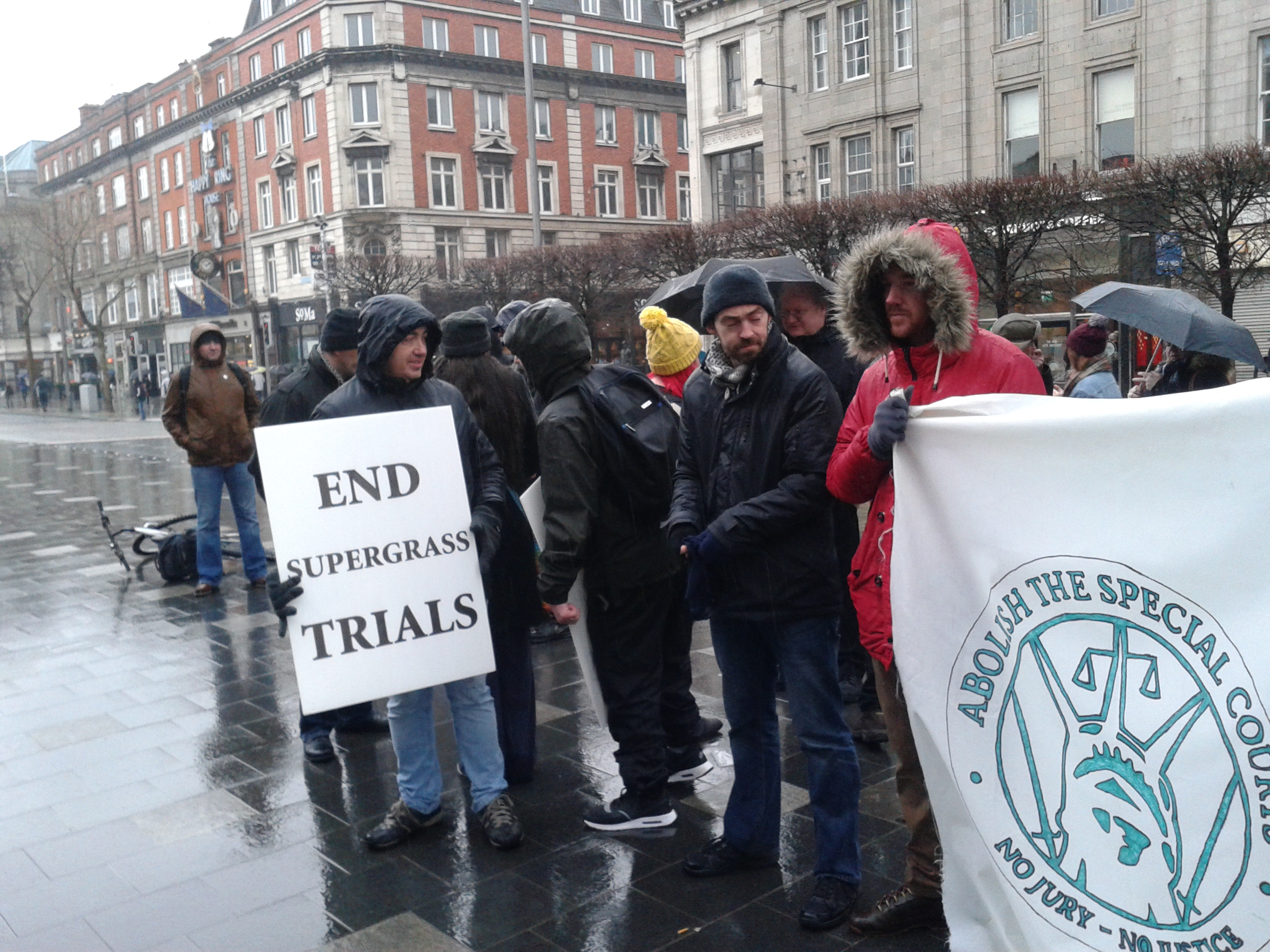
Among the picketers on the 20th January 2017 were members of different Irish Republican groups and campaigns as well as a number of independent activists of Republican, Socialist and Anarchist backgrounds.
After standing for a while displaying placards and banners, the protesters gathered around to hear Sean Doyle, who had been presented as the campaign’s spokesperson.

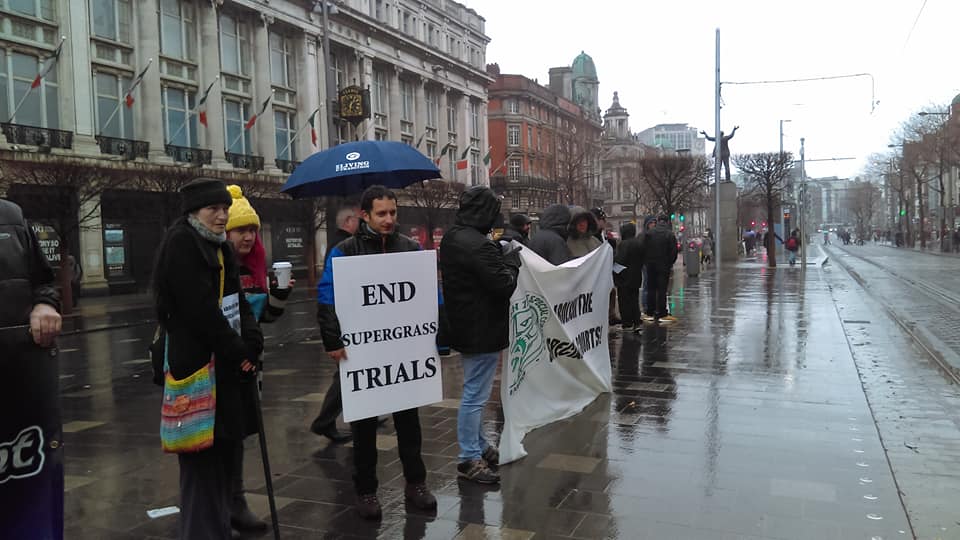
Remarking that the Special Courts are “a travesty in law”, Doyle added that one should “never equate law with justice.” Doyle accused the Courts of being “a political tool to deny due process”. He encouraged those present to ask themselves whether Maurice McCabe or John Wilso (both Gardaí who fell foul of the force) would nowadays trust uncontested evidence. Doyle went on to say, in reference to administrations both sides of the Border, that “Political special courts are structured to deny your civil and human rights and must be abolished.”
Special courts of the Israeli Zionist regime, or US military-occupied areas were also condemned by the speaker, who called for “cooperation and sharing of information across the world” because “injustice knows no borders.”

After Doyle’s short speech had been applauded, Ger Devereaux thanked everyone for attending and informed them that the campaign against the Special Courts would continue with pickets and meetings and asked people to spread the word to help the campaign to grow and to achieve success.

The operation of the law in what are called “democratic” societies is supposed to be that a person suspected of committing a crime is accused and brought to trial, where the evidence is presented against him and should he choose to do so, he or his representation defend him. A jury drawn at random then considers the evidence, decides the verdict and, should that be of “guilty”, the judge pronounces sentence, within the parameters of the maximum and minimum set by law. That’s the theory, anyway.
We all know that there are flaws in that system, even without considering the laws under which the operate and the real power and wealth in society, as well as the power of the media, prejudices among jury members, lying witnesses, faulty expert testimony, etc. Nevertheless, the system is an advance on what existed before and provides some protection to the accused. At times the jury arrives at a verdict which is manifestly contrary to that desired by the forces of the State, i.e on the side of democracy and justice and against repression. A quite recent example was the finding of “not guilty” for the Jobstown protesters last year after a politically-orchestrated attempt by State, politicans and media to find them “guilty”. Another example, further back, was the exoneration of the five anti-war activists in 2006 for their actions against US warplanes in “neutral” Shannon airport.
The State has decided upon a way to overcome this problem, which is to do away with juries completely and, with the Special Courts, it has achieved this: these courts have no juries and, furthermore, a majority verdict of two out of three judges is sufficient for conviction. This would be of concern enough were it not for the fact that the Government appoints all of those judges.

The first of these courts was set up in 1939 under De Valera, as part of the Offences Against the State Act but fell into general disuse after the 2nd World War, to be briefly brought back during the IRA’s Border Campaign of the 1950s, when hundreds were interned. The Special Court was resuscitated in 1972 (as was the Amendment to the Offences Against the State Act – more about this below), again by a Fianna Fáil government under Jack Lynch.
A second Special Court was created by Minister for Justice Frances Fitzgerald, in the FG-Labour coalition Government, ironically on the centenary year and month of the Easter Rising. The justification was quite baldly that it was difficult for the State to achieve verdicts of guilty in some cases through the use of a jury. Of course the State declares that the difficulty arises in that the members of a jury may be intimidated by criminals or “terrorists”. But might it not equally be that the accused are not guilty at all? Or that the State has not bothered with the niceties of the democratic system and carried out its investigation? And if the jury system is to be judged ineffective in one kind of case, why not in others?
Originally, the target of the Special Courts was clearly political activists. When the atmosphere allowing political persecution by the State dissipated somewhat, it was claimed that the target was gangsters. However, for long years the victims continued to be political activists – exclusively of the Irish Republican brand. With an occasional suspect of the gangster type occasionally brought before the Special Courts however a stream of Irish Republicans find themselves facing them.
Among the famous convictions of the Special Courts were the sentencing to death in 1976 of the Anarchist couple Noel and Marie Murray for alleged murder of a Garda, the sentences being quashed on appeal after a campaign and reduced to life instead.
In 1978, then IRSP members Osgur Breatnach, Brian McNally and Nicky Kelly were all sentenced to long terms in jail. Their sentences were overturned in 1980 (and 1984 for Kelly) and years later they received compensation, reportedly in six figures.

A few more big convictions of political activists followed which were not overturned on appeal until in 2001, Colm Murphy was convicted of conspiracy to cause the Omagh bombing but in 2005 his conviction was quashed after revelations that the judges had acted improperly and that Garda witnesses for the Prosecution had falsified their notes. He was finally cleared by the SCC in 2010.
In 2003, Michael McKevitt was convicted by the Special Court of allegedly “directing terrorism” and “membership of ….. the Real IRA” in a judgement which has been criticised by a number of people unconnected to him.
There were no ‘gangland’ cases before the SCC until 1977/’78 and the Guerin murder trials, when one man was convicted on the evidence of a gang member turned State’s witnesses, a case about which many questions remain today. A big gap followed in ‘gangland’ cases until the years 2013, 2014 and 2016, with one case in each of those years..
Throughout all these years a steady stream of convictions and jailing of Irish Republicans for the lesser charges of “membership of an illegal organisation” have been processed through the Special Courts.
The same year that the Special Criminal Courts were introduced, i.e 1972, was when the Amendment to the Offences Against the State Act was brought into law. This provision permits conviction with the only evidence being the word of a Garda officer of the rank of Chief Superintendent or higher. Although historically judges have been reluctant to convict on this alone the quality of what other evidence they require has been slipping lower in recent years. Irish Republicans are now being convicted, for example of membership of an illegal organisation, on the word of a senior Garda who says that he has reason to believe that they are such, supported by spurious “evidence”. In one case this “evidence” consisted of a piece of paper allegedly from a prisoner the man had been visiting which discussed some recent events and in another, that Gardaí had “seen him turn down a dark lane”.
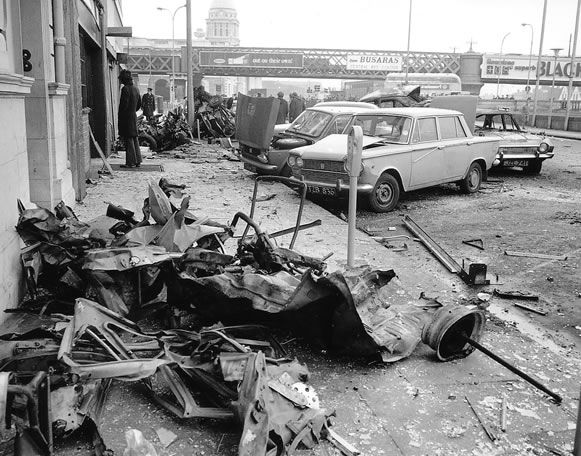
The irony is that the resuscitation of the Special Courts and the introduction of the Amendment to the OAS Act were voted in after a terrorist bomb planted by British agents. The Jack Lynch Fianna Fáil Government seemed to be heading for a defeat in the Dáil on their proposal, with Fine Gael. Labour TDs and others set to vote against. During the debate, on 1st December 1972, two car bombs exploded in Dublin, one Eden Quay and another on Burgh Quay, killing two CIE workers and wounding 131. In the succeeding panic, the opposition to the measure collapsed and it was was passed. Wikipedia: “It is believed that the 26 November and 1 December bombings were executed to influence the outcome of the voting.”
Both sides of the Border, Irish Republicans are now being convicted and sent to jail by non-jury courts, by the Diplock Courts of the Six Counties colonial administration one side and by the Special Courts of the Irish State on the other. Ironically, in Britain itself there are no non-jury criminal courts.
Given the patently undemocratic nature of the courts and the clearly political use by the State, what has the reaction of the civil and human rights sector been? In earlier days, it has been criticised by the Irish Council for Civil Liberties, Amnesty International and the UN Commission on Human Rights. In recent years, these critics, especially the Irish ones, have tended towards silence on the matter. The non-Republican Irish organised Left has likewise remained silent, as it tends to do with all persecution of Irish Republicans.
However, history has shown us that once the State succeeds in repression against one sector, it moves on to another it finds threatening or an inconvenience. It is therefore in the interests of all democratic and Left sections of society to unite against these undemocratic and repressive courts and to campaign for their total abolition.
End.
https://en.wikipedia.org/wiki/Special_Criminal_Court
https://en.wikipedia.org/wiki/1972_and_1973_Dublin_bombings
https://en.wikipedia.org/wiki/Offences_against_the_State_Acts_1939%E2%80%931998
http://www.irishstatutebook.ie/eli/1972/act/26/enacted/en/html
Diarmuid Breatnach

Numbers on this march are always high (especially taking the total population of the Basque Country of less than three million into account) but may have been boosted somewhat this year by a) the ongoing resistance to Spanish state repression in Catalunya and b) news that the French state is at last moving away from its policy of dispersing its political prisoners far from their home country.
Saturday’s march was organised by Sare, a broad front set up a few years ago and was supported by EH Bildu (political party of the Abertzale Left) along with the Basque majority trade unions ELA and LAB. The political parties PP, PSE and Podemos-Euskadi did not support it, although the latter’s General Secretary Lander Martínez attended in a personal capacity. The Basque Nationalist Party PNV did not support it either (although members may well have done).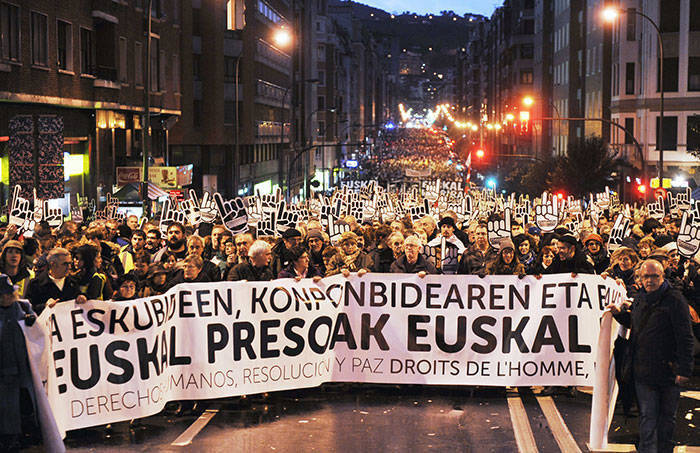
Also in attendance were Joan Tardà of the Catalan party ERC; Xabier Sánchez, brother of the jailed President of ANC, Jordi Sánchez; and the writer Kirmen Uribe.
Arnaldo Otegi for the EH Bildu party said the Spanish State should learn from the action of the French one; LAB’s General Secretary Garbiñe Aranburu declared that this year needs to be decisive in the Spanish state with regard to political prisoners and called for new alliances to achieve this. Adolfo Muñoz, Gen. Sec. of the largest trade union in the southern Basque Country, ELA, credited civil society with having achieved the change in French State policy, achieving the transfer of Basque political prisoners to jails near their homes, without waiting for the Spanish state to do likewise.

The banner at the head of the march stated “Elkarrekin aurrera egiteko prest gaude” (We are ready to advance together; human rights, resolution, peace) while, according to media report, throughout the march the following slogans were heard: “Euskal presoak etxera!” (Basque prisoners to home!) and “Presoak kalera, amnistía osoa!” (Prisoners to be free, total amnesty!).
At the end of the march, Sare’s manifesto calling for an end to the dispersal was read out by ETB (Basque TV channel) presenter Kike Amonarriz and Beatriz Talegón, ex-leader of the youth wing of the Spanish social-democratic unionist party the PSOE.
The great attendance in pouring rain is encouraging and once again the Basques show their high level of concern for their political prisoners, bringing at least 3% of their population out on a solidarity demonstration.
The reported (and audible on the video) slogans of “Euskal presoak etxera” (Basque prisoners to home) and “Presoak kalera, amnistía osoa” (Prisoners to be free, total amnesty) being shouted are interesting, given that the Abertzale Left leadership and organisations such as Sare have dropped such demands in recent years, concentrating instead on calling for an end to the dispersal policy and for the release of seriously-ill prisoners. The slogans mentioned above have been raised by the Amnistia Ta Askatasuna (ATA) organisation, whose supporters are highly critical of the changes in policy of the Abertzale Left leadership for some years now but presumably made their presence felt on the demonstration.
Despite the permanent ceasefire declaration of ETA a number of years ago and changes in the policies of the Abertzale Left leadership, the Spanish state has not given an inch, which leaves the leadership with no gains to show, not even the end of the dispersal policy. This policy, contravening human rights and the EU’s own conventions, sees prisoners located as far from the Basque Country as southern Spain, a drive of around nine hours there and the same back, on motorways that have already claimed the lives of a number of prisoners’ friends and relatives and injured an average of one a month.
Video clip: http://euskalpmdeushd-vh.akamaihd.net

