THE TRUMP GAZA PLAN AND IRELAND PACIFICATION

Diarmuid Breatnach

(Reading time main text: 4mins.)

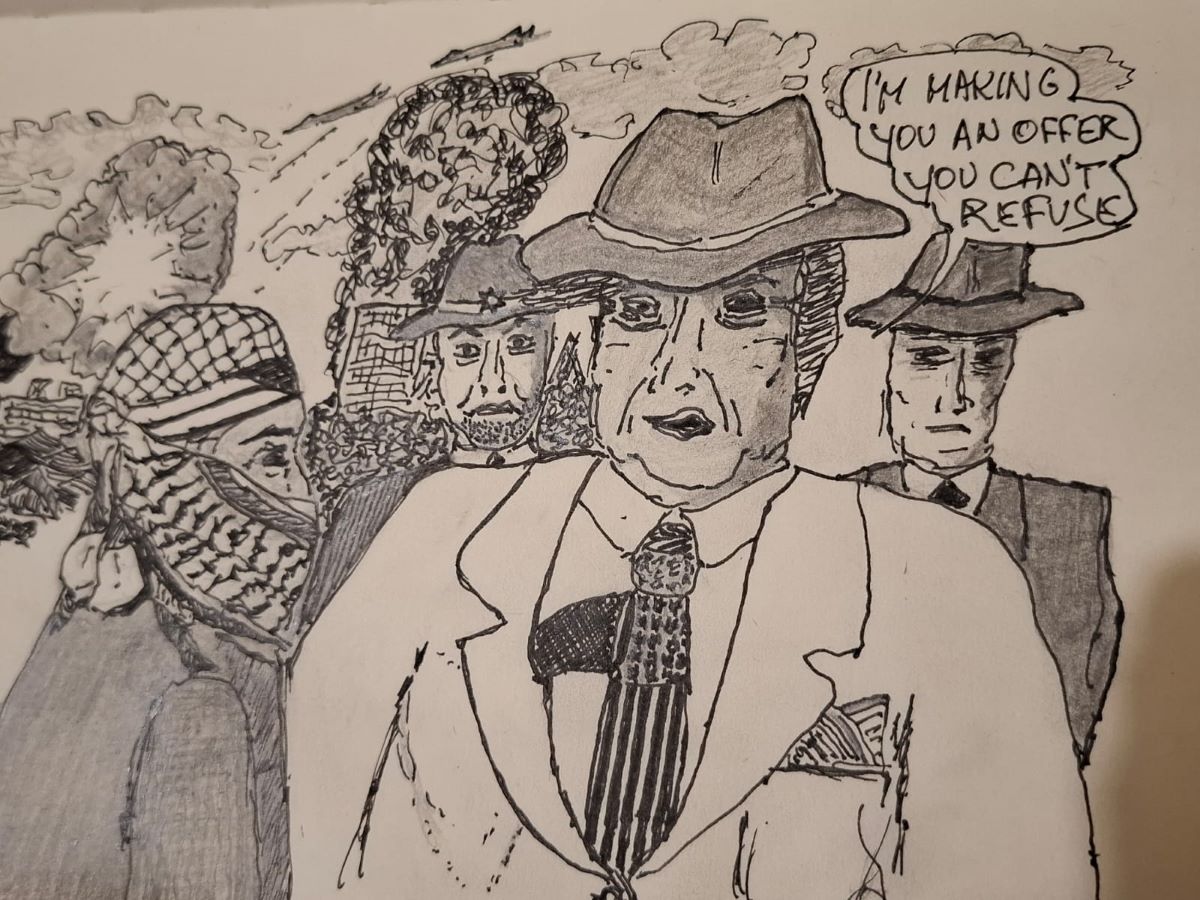
It was great to see the Irish pacification process being referenced with regard to the Trump plan for Gaza1 because that is exactly what the latter is: a plan to pacify the Resistance while ensuring it gets none of what it fought for.2

In other words, exactly like the Irish pacification process.

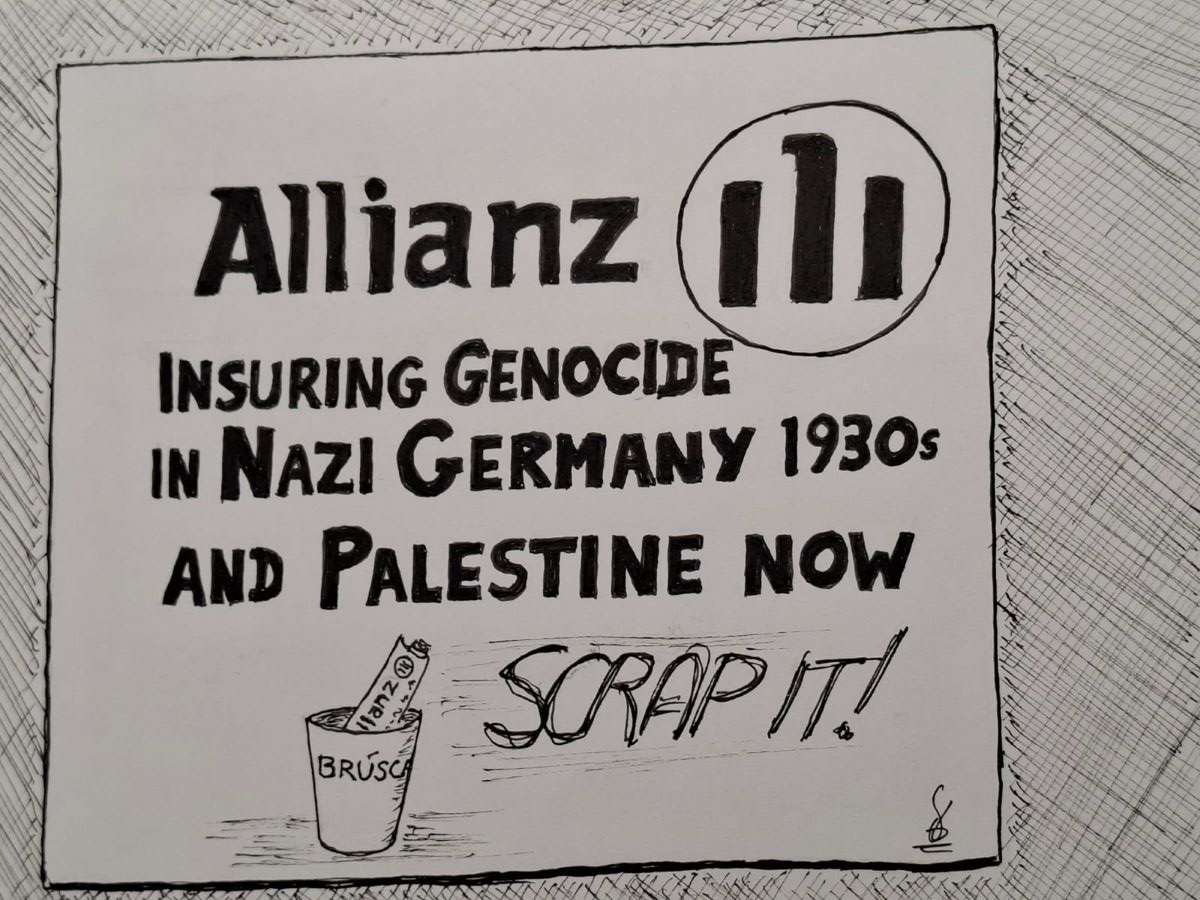
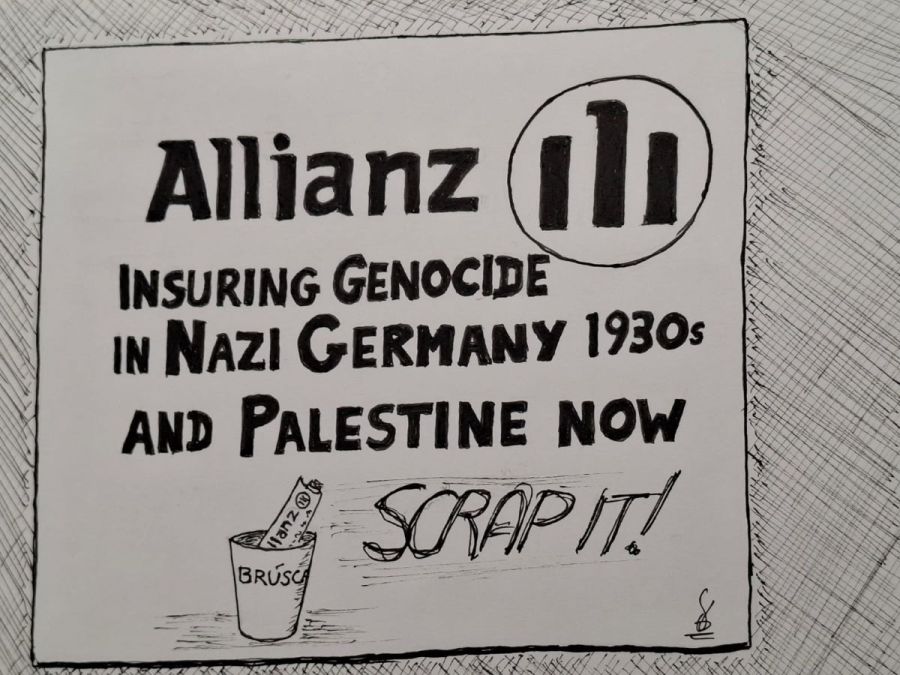
(Cartoon by D.Breatnach)

Hamas and Palestine Islamic Jihad grew out of previous Palestinian pacification processes. The Madrid Conference (1991) and the Oslo Agreement (1993) were imperialist/ Zionist attempts to pacify the wide-scale militant Palestinian resistance period of the First Intifada.3

Fatah at that time was the leading group in numbers and influence in the Palestine Liberation Organisation (from which Islamic groups were excluded) but also in Palestinian society in general. But Fatah had agreed to recognise ‘Israel’ and also the two-state solution (sic).

In the Oslo Agreement, furthermore, the question of the return to their homeland of the refugees was left aside. It appears that the Fatah leadership had lost faith in the eventual victory of their people’s struggle and had decided to get what they could by using the struggle to bargain.

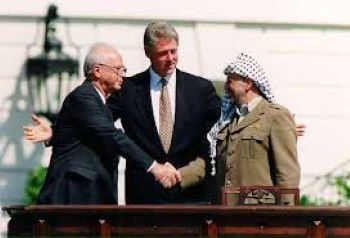
The Oslo Agreement: US Imperialism’s President Clinton oversees Yitzak Rabin, Premier of Zionist state of ‘Israel’ shaking hands with Yasser Arafat of Fatah, then leader of the PLO.

What Fatah got was Palestinian Authority control in the first elections (1996), with internal control over/ management of the Palestinian population of the West Bank and Gaza, but not of the Palestinians in Jerusalem (captured by ‘Israel’ in 1967): a far cry from a free Palestine.4

In the Algiers conference of 1988 Fatah had won majority agreement to recognise ‘Israel’ and to accept the two-state solution5 (sic), i.e. embodying a Palestinian state on 20% of Palestinian land, under the eyes and guns of their Zionist neighbour).

Fatah’s rule became known for corruption and nepotism, which then had to be protected and defended from the Palestinian masses, leading to authoritarian, repressive and often arbitrary rule. And repression of the Resistance, along with direct collusion with the ‘Israeli’ State.

Continuing ‘Israeli’ repression and settlement expansion in turn led to the Second Intifada; Fatah lost to Hamas in the Palestinian parliamentary elections of 2006 followed by defeat of Fatah’s attempted coup in Gaza in 2007 (but the West Bank remaining under unelected Fatah control).

Mahmoud Abbas of Fatah has refused to announce elections since, sitting in unelected control of the PA’s office in the West Bank, collecting the various international grants, presiding over corruption,6 repressing Palestinian resistance of deed or word and colluding with the ‘Israeli’ Occupation.

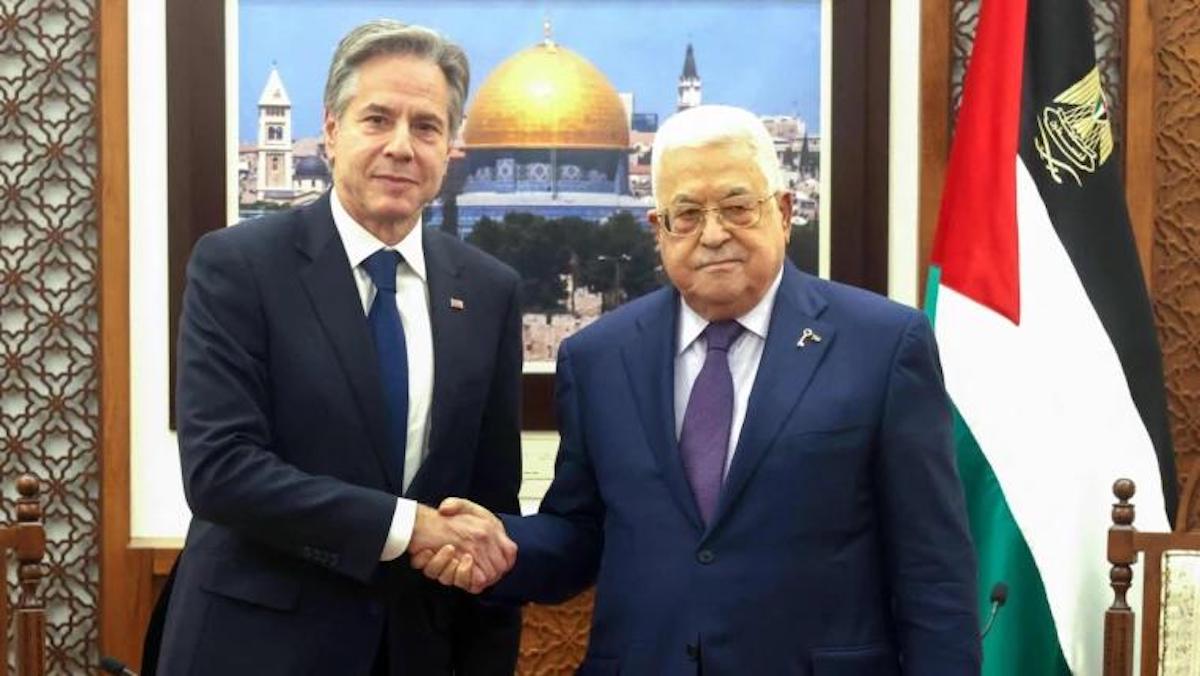
US Imperialism’s then Secretary of State Anthony Blinken and the PA’s Mahmoud Abbas in Palestine, soon after the start of the accelerated Zionist genocide in Gaza, December 2023

BUT WHAT ABOUT THE IRISH CONNECTION?

Starting with Palestine and South Africa in 1991, an imperialist pacification process spread to Ireland, Basque Country, Kurdish Turkey, Colombia, India, Philippines, Sri Lanka. With some variations the drive has been the same: to give up revolution and join the system.

One of the features of this process was the apparent need of a recognised leader to sell it to the resistance support base and to front it for the world: Arafat (Palestine), Mandela (S. Africa), Adams/McGuinness (Ireland), Ocalan (Turkish Kurdistan), Otegi (Basque Country).

The Provisional IRA was by far the major organisation in the Irish Republican resistance; it gave up armed struggle in return for vague promises and the release of its prisoners under licence.7 Another organisation complied also even as new ‘dissident’ fighters were being jailed.

Nearly 30 years after the signing of the Good Friday Agreement, Ireland is no nearer the Provisional IRA’s declared aims Irish reunification, independence and sovereignty. The Sinn Féin party helps run the colony8 and is attempting to become part of the neo-colony’s government.

Sinn Féin representatives Tina Black (Mayor of Belfast) and Michelle O’Neill, First Minister of the British colony, laying a wreath at the British War Memorial in Belfast, July 2022 (Cred: Liam McBurney/ PA Wire)

Neither the Spanish, French nor Turkish states were interested in other than crushing the Basque and Kurdish resistance and the corresponding movements disabled themselves without getting anything in exchange other than continued repression.9

The resistance movements in parts of India and Philippines continue to resist but in Sri Lanka was wiped out.10

One feature of the spread was the contagion-like way in which leaders of one infected resistance sought to entice others to follow suit: S. Africa and Palestine to Ireland; S. Africa and Ireland to Basque Country; Ireland to Colombia (where only the FARC but not the ELN accepted it).

In only one iteration of the pacification processes was there a partial achievement of the stated aims of the resistance: South Africa got national enfranchisement but the economy remained under imperialist extractive control and its working people under repression.11

In the course of giving up armed struggle, allegedly just changing the methods, the leaders gave up what they had fought for, the very reason for which they had first come into the struggle. Of course, they could still shout the slogans, just not make them real in any way.

The Irish version (and the Basque one) decommissioned their weapons, which makes it very relevant to the Trump Plan for the Palestinian Resistance, particularly Hamas and PIJ. No resistance movement should even discuss giving up their weapons until the defeat of the enemy.

(Image sourced: Internet)

It will be interesting to see what positions the former parties of Irish and Basque resistance, Sinn Féin and EH Bildu12 and their supporters take on this US/ ‘Israeli’ plan for the Palestinian Resistance.

One of the features of the pacification process was the apparent need of a recognised leader to sell it to the resistance support base and to front it to the world: Arafat (Palestine), Mandela (S. Africa), Adams/McGuinness (Ireland), Ocalan (Turkish Kurdistan), Otegi (Basque Country).

Who will the imperialists find to play this role in Palestine?13

End.

NB: If you found this article of interest, why not register with Rebel Breeze for free, so that you will be notified by email of subsequent articles. You can de-register any time you wish.

FOOTNOTES

SOURCES

Referencing the Irish pacification process in Gaza context: https://apnews.com/article/gaza-northern-ireland-peace-process

The Palestinian Authority: https://www.aljazeera.com/news/2023/10/11/what-is-the-palestinian-authority-and-how-is-it-viewed-by-palestinians

https://www.washingtoninstitute.org/policy-analysis/how-palestinian-authority-failed-its-people

1https://apnews.com/article/gaza-northern-ireland-peace-process

2Trump 20-point plan: https://www.bbc.com/news/articles

3https://en.wikipedia.org/wiki/First_Intifada

4“This mirrors Israel’s post-Oslo approach to the occupied West Bank in pacifying the population through economic incentives, avoiding political concessions, and entrenching structural dependence. This model, often dubbed “economic peace,” has transformed the Palestinian Authority (PA) into a subcontractor of occupation – flush with foreign funds, but powerless to deliver sovereignty.” https://thecradle.co/articles-id/34757

5https://ejil.org/pdfs/1/1/1136.pdf

6Which is why the imperialists and their servants keep alluding to the need for a “reformed Palestinian Authority” e.g. https://israelpolicyforum.org/blueprint-for-reforming-the-palestinian-authority

7Those released under licence could be returned to jail (and a number were) at the decision of the Secretary of State for Northern Ireland without trial, hearing or details of why the individual was considered to be ‘a threat to public safety.’

8Its representative, Michelle O’Neill, is currently First Minister of the colony’s government. In the Irish State, the party has 33 TDs (MPs), only two behind the party with next largest representation, Fianna Fáil. They Party has abandoned its opposition to the repressive legislation of the State, welcomed British Royal visits to both parts of Ireland, supports recruitment to the colonial gendarmerie and its leader refused to rule out coalition with the neo-colonial political parties of membership of the British Commonwealth. https://www.thejournal.ie/mar-lou-mcdonald-commonwealth-4561600-Mar2019/

9The Basque leadership abandoned armed struggle unilaterally at the time without gaining even the end of dispersal of their jailed fighters throughout the state. The Turkish Kurdish PKK tried to make progress through political electoral means only under continuing repression. But their Syrian version of armed Kurdish forces got a new lease of life with the vulnerability of the Assad regime in Syria but ended up as a NATO proxy in the latter’s war for regime change. The PKK in Turkey very recently agreed to disarm while their Syrian part remains in difficult relationship with the new (formerly ISIS) regime in Syria and some other ISIS elements under Turkish influence.

10https://www.vice.com/en/article/death-of-a-tiger-0000710-v22n8/

11See The Marikana Massacre of striking miners by the ANC Government’s police.

12Both parties support the Two-State proposal for Palestine.

13Some liberal and social-democratic sections seem to have fixed on Marwan Marghouti in this role, which of course is no reason not to support his release on human rights grounds. https://www.youtube.com/watch?v=q6IgjlHaaIs

MIND YOUR LANGUAGE!

Diarmuid Breatnach

(Reading time: 3 mins.)

If it is true that language at least influences the way we think, then surely it behoves us to pay more attention to our choice of words. But not only because of the influence of our words on others but indeed on us as we utter them.

Take the word ‘Ireland’ – surely a neutral one describing a geographical entity? But if we query “the population of Ireland” on line and receive a reply that the figure is 5.83 million, whereas we know it to be over 7 million, we experience at least puzzlement at the disparity in figures.

Of course, what has has occurred is that “Ireland” is being considered in political terms and the Six County colony’s population is being omitted. The reply may qualify that it is referring to “the Republic of Ireland” (as when commenting on the FAI’s football selection internationally).

But this does not really make everything alright semantically (i.e. in meaning) either. True, the Irish State holds regular elections and does not acknowledge a monarch, so it generally fulfils the description of ‘a Republic’. But that is not a historically or politically-neutral term in Ireland.

The word has a long history in Ireland as applied to the nation and was always imagined as referencing the whole geographical entity. The most influential use of the word in documentary form was probably the 1916 Proclamation, which did not in the least anticipate partition.

Even the 1937 Constitution, which formally baptised the Irish State a ‘Republic’, claimed sovereignty over the entire 32 Counties, a position that stood until the removal of Articles 2 and 3 from the Constitution by the current State in 1999.

The Football Association of Ireland is actually only the Association of the sport for the 26 Counties state and the use of “R.o.I” on the screen to refer to the State’s team during games is, as explained, deeply problematic. However the Irish Rugby Team is indeed an all-Ireland one.

As is the largest sports association of Ireland, the Gaelic Athletic Association. And also Tennis Ireland, Cricket Ireland, Table Tennis Ireland, and both Badminton Ireland and the Irish Judo Association organise on a four-province basis.1

If we call the entity the ‘Irish State’ instead we would be correct. And we could call its territory ‘the Irish state’, with a lower-case ‘s’ to distinguish between the political construction and the territory over which, in constitutional and legal terms, it holds power.

Or we could call it the ‘26 Counties.’ Or, seemingly becoming increasingly popular in some quarters: ‘the Free State’.2 But what about the entity’s parliament? That’s ‘the Dáil’, right?

That’s how we hear it described and, as “Dáil” is an equivalent of ‘parliament’ in Irish, that’s ok, right? No, not at all really; its full title is actually “Dáil Éireann” and we’ve already established that not even by Constitutional lip service does this parliament govern the whole nation.

The first time we had an all-Ireland parliament, open to election across the whole of the nation and open also to participation of all elected candidates was in January 1919 but it was banned in September by the occupying British authority, thenceforth operating under conditions of secrecy.

Then in January 1922, the pro-Treaty majority in the Dáil supported the British Treaty, including Partition, ending Dáil Éireann. There has not been a Dáil Éireann since. The most accurate brief description of the current institution is “Leinster House”.3

Is this the home of Dáil Éireann? Leinster House, west-facing side. (Image: Wikipedia).

Well, does it matter what we call them – we know what they are, right?

If it’s true that the words we use to describe things influence how we think about them, then it matters quite a lot. And how we describe them may also influence how others think about them, which also matters a great deal.

If we want to imply by the words we use that this state is independent and covers the whole nation – and that its parliament administers the whole nation – well then, there’s no need to change our words. Especially if we think that the extent of Irish sovereignty is fine or sufficient.

But if we don’t think along those lines then perhaps we need to examine our terminology more carefully and, where appropriate, amend it.

End.

Note: If you found this article of interest, why not register with Rebel Breeze for free, so that you will be notified by email of subsequent articles. You can de-register any time you wish.

FOOTNOTES

1Interestingly, I note that the Irish Ten-Pin Bowling Association (ITBA) is in the process of becoming a 32-county association.

2This was the official title of the State following its adoption of the terms of the Anglo-Irish Treaty.

3The building is actually formally called “Leinster House” since it was the city resident of the Duke of Leinster, of the Cambro-Norman invader dynasty of FitzGeralds and FitzMaurices. The Duke was Lord Deputy and at times Chief Justice of Ireland under the English Occupation.

REFERENCES

https://www.bonn-institute.org/en/news/psychology-in-journalism-2#introduction-82539

THE BLOOD-RED POPPY – remembrance or militarisation?

Diarmuid Breatnach (edited from article posted in Rebel Breeze 2014)

(Reading time: 6 mins.)

Part 1 – who and what gets ‘remembrance’

In the lands under the direct dominion of England, i.e. the “United Kingdom”, and in some others that are under its influence, the dominant class calls the people to join in a cultural event in November which they call “Remembrance”.

The organisation fronting this event in the ‘UK’ is the Royal British Legion and their symbol for it (and registered trademark) is the Red Poppy, paper or fabric representations of which people are encouraged to buy and display — and indeed often pressured to wear.

In some places, such as the BBC for personnel in front of the camera,  they are forced to wear them. In many schools and churches throughout the ‘UK’, Poppies are sold and wreaths are laid at monuments to the dead soldiers in many different places.

Prominent individuals, politicians and the media take part in a campaign to encourage the wearing of the Poppy and the participate in the ‘Festival of Remembrance’ generally and of late, to extend the Festival for a longer period.

High points in the ‘Festival’ are the Royal Albert Hall concerts on the Saturday and the military and veterans’ parades to the Cenotaph memorial in Whitehall, London, on “Remembrance Sunday”. (Also a focus for commemorations by the British far-Right and fascists).

“The concert culminates with Servicemen and Women, with representatives from youth uniformed organizations and uniformed public security services of the City of London, parading down the aisles and on to the floor of the hall. There is a release of poppy petals from the roof of the hall.1

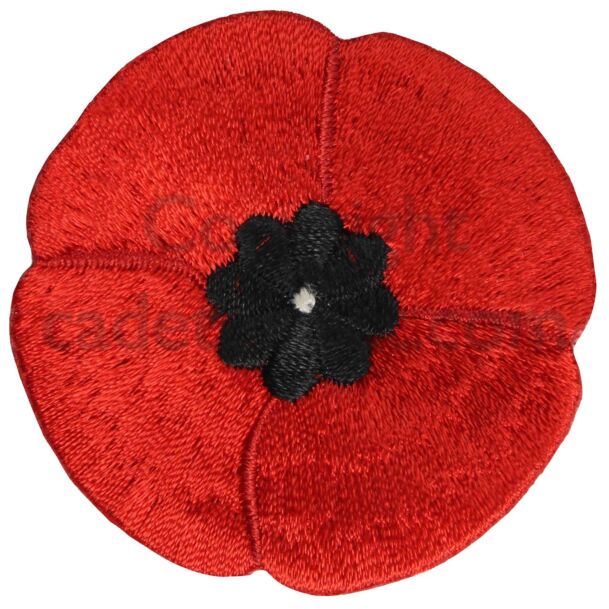
An embroidered version of the poppy emblem (Sourced: Internet)

“The evening event on the Saturday is the more prestigious; tickets are only available to members of the Legion and their families, and senior members of the British Royal Family (the Queen, Prince Phillip, the Prince of Wales, the Duke of York [not this year!] and the Earl of Wessex). 2

“The event starts and ends with the British national anthem, God Save the Queen3 (and) is televised. Musical accompaniment for the event is provided by a military band from the Household Division together with The Countess of Wessex’s String Orchestra.”4

The money raised from the sale of the “Poppies” and associated merchandise is said to be used to support former military service people in need and the families of those killed in conflict. On the face of it, military and royal pomp apart, the Festival may seem a worthy charitable endeavour.

Also one which commemorates very significant historical events — therefore a festival which at the very least, one might thing, should not be opposed by right-thinking and charitable people.  

Yet the main purpose of this festival and the symbol is neither remembrance nor charity but rather the exact opposite: to gloss over the realities of organised violence on a massive scale and to make us forget the experience of the world’s people of war.

And to prepare the ground for recruitment of more people for the next war or armed imperialist venture – and of course more premature deaths and injuries, including those of soldiers taking part.

Video and song “On Remembrance Day” from Veterans for Peace lists British conflicts (including Ireland) and condemns the Church of England for supporting the wars, calling also on people to wear the White Poppy (see Part 3 for the White Poppy)

Partial Remembrance – obscuring the perpetrators and the realities of war

The Royal British Legion is the overall organiser of the Festival of Remembrance and has the sole legal ‘UK’ rights to use the Poppy trademark and to distribute the fabric or paper poppies in the ‘UK’.

According to the organisation’s website, “As Custodian of Remembrance” one of the Legion’s two main purposes is to “ensure the memories of those who have fought and sacrificed in the British Armed Forces live on through the generations.”

By their own admission, the Legion’s “remembrance” is only to perpetuate the memories of those who fought and sacrificed in the British Armed Forces – it is therefore only a very partial (in both senses of the word) remembrance. More recently it tries to hide this exclusivity.5

It is left to others to commemorate the dead in the armies of the British Empire and colonies which Britain called to its support: in WWI, over 230,500 non-‘UK’ dead soldiers from the Empire and, of course, the ‘UK’ figure of 888,246 includes the 27,400 Irish dead.  

Cossack soldier volunteers WWI. Imperial Russia was an ally of Britain and France; the war was one of the causes of the Russian Socialist Revolution 1917. The following year, the war ended. (Image sourced: Internet)

The Festival excludes not only the dead soldiers of the British Empire and of its colonies (not to mention thousands of Chinese, African, Arab and Indian labourers employed by the army) but also those of Britain’s allies: France, Belgium, Imperial Russia, Japan, USA … and their colonies.

No question seems to arise of the Festival of Remembrance commemorating the fallen of the “enemy” but if the festival were really about full “remembrance”, it would commemorate the dead on each side of conflicts.

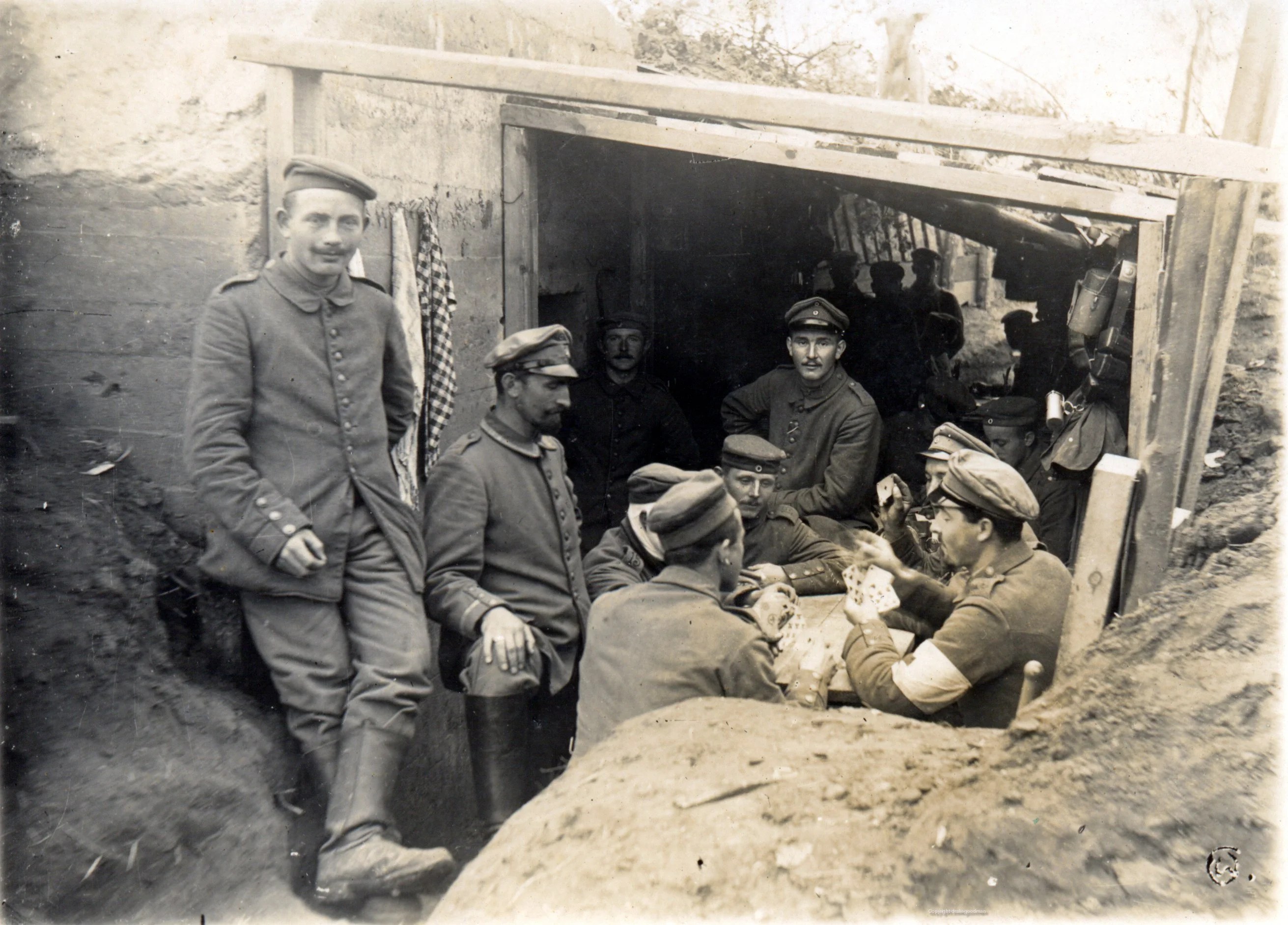
German soldiers playing cards during WWI. Photos of Germans in WWI more readily available show them wearing masks and looking like monsters. (Photo sourced: Internet)

That would particularly be appropriate in WWI, an imperialist war in every respect.  But of course they don’t do that; if we feel equally sorry for the people of other nations, it will be difficult to get us to shoot, bomb or stab them in some future conflict.

A real festival of remembrance would commemorate too those civilians killed in war (seven million in WWI), the percentage of which in overall war casualty statistics has been steadily rising through the last century with increasingly long-range means of warfare.

Very recently, the Royal Legion has tried to claim that the “acknowledge innocent civilians who have lost their lives in conflict” but add “and acts of terrorism.” Since we know that that ‘terrorism’ is a highly politicised word and for imperialists has mostly meant resistance struggle, that is hardly welcome.

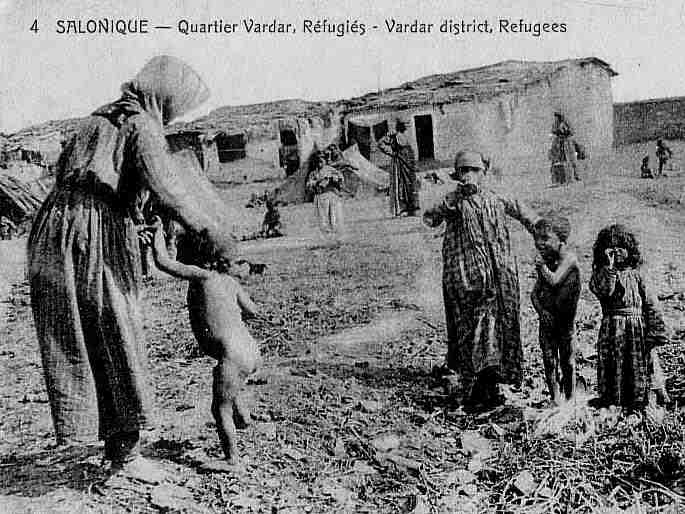
Civilian war refugees in Salonika, NW Greece, WWI (Photo sourced: Internet)

Civilians in the First World War died prematurely in epidemics and munitions factory explosions as well as in artillery and air bombardments, also in sunk shipping and killed in auxiliary logistical labour complements in battle areas.

And through hunger, as feeding the military became the priority in deliveries and as farmhands became soldiers.

In WWII 85,000,000 civilians died in extermination camps or forced labour units, targeting of ethnic and social groups, air bombardments, as well as in hunger and disease arising from the destruction of harvests and infrastructure.

Air bombardments, landmines, ethnic targeting and destruction of infrastructures continue to exact a high casualty rate among civilians in war areas.

One admittedly low estimate up to 2009 gave figures of 3,500 dead in Iraq during the war and aftermath and another 100,000 dead from western trade sanctions, along with 32,000 dead civilians in Afghanistan.

Another review up to 2011 gave a figure of 133,000 civilians killed directly as a result of violence in Iraq and “probably double that figure due to sanctions”.6

The number of civilians injured, many of them permanently disabled, is of course higher than the numbers killed.  Most of those will bring an additional cost to health and social services where these are provided by the state and of course to families, whether state provision exists or not.

Real and impartial “remembrance” would include civilians but not even British civilians killed and injured are included in the Festival of Remembrance, revealing that the real purpose of the Festival is to support the existence of the armed forces and their activities.7

And contributing at the same time to a certain militarisation of society and of the dominant culture.  

If the Festival were really about “remembrance”, they would commemorate the numbers of injuries and detail the various types of weapons that caused them.  

But that might reflect unfavourably on the armaments manufacturers, who run a multi-billion industry in whatever currency one cares to name, so of course they don’t.  

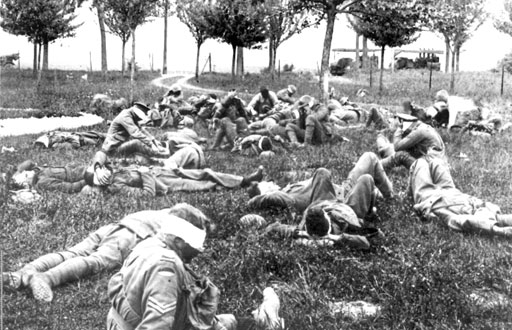
Australian soldiers who survived gas attack but injured by it awaiting hospitalisation, Northern France, WWI 1916. (Photo sourced: Internet)

And if really concerned about death and injury in war, they would campaign to end such conflict – for an end to imperial war.

But then how else would the various imperial states sort out among themselves which one could extract which resources from which countries in the world and upon the markets of which country each imperial state could dump its produce?

So of course the Royal British Legion doesn’t campaign against war. That’s not its role. Quite the opposite.

End.
(Parts 2 and 3 to follow).

Note: If you found this article of interest, why not register with Rebel Breeze for free, so that you will be notified by email of subsequent articles. You can de-register any time you wish.

FOOTNOTES:

1Sourced from the British Legion’s website in 2014, its WW1 centenary year.

2Ibid.

3Now of course God Save the King.

4Sourced from the British Legion’s website in 2014.

5 “We unite across faiths, cultures and backgrounds to remember the service and sacrifice of the Armed Forces community from United Kingdom and the Commonwealth. We will remember them.” https://www.britishlegion.org.uk/get-involved/remembrance/about-remembrance

6 Civilian war deaths Iraq and Afghanistan to 2009 http://www.foreignpolicy.com/posts/2009/11/30/why_they_hate_us_ii_how_many_muslims_has_the_us_killed_in_the_past_30_years Civilian war deaths Iraq to 2011: http://costsofwar.org/article/iraqi-civilians

7“shoulder to shoulder with our armed forces” from the British Legion’s website.

Dear Minister Humphreys,

(Another one from the Rebel Breeze archives, this one from 2015)

I write to express my admiration for your work and my sympathies with regard to the criticisms with which you are currently being bombarded.

I hope you will forgive my ignorance of much of the work you have been doing in the area of Heritage, which is not really where my strengths lie. But I love the way you talk, the way you shoot down those critics, especially those TDs who ask those nasty questions.

And I’m sure you had something to do with removing Westport House from the NAMA sell-off, even if it is in Enda’s constituency. Such a fine example of our colonial architectural heritage!

Heather Humhpreys, Minister for Arts, Heritage and the Gaeltacht

But as we know, Minister, that wouldn’t be the kind of thing that would be appreciated by your critics. They’d rather you devoted your talents to a shabby row of Dublin houses of dubious architectural importance in a grubby street market.

A street which they say is “pre-Famine” — as if that were something to boast about! Laid down earlier than Sackville Street (now O’Connell Street) they say ….

Sure why would we want to keep a street that old …. or remember that embarrassing episode in our history either, when we lost a third of our population to over-reliance on one crop! We learned from that, though, didn’t we? Sure we grow hardly any crops at all now and get them all in from abroad. 

And we live in cities now — who wants to be getting up at 6 a.m. in all kinds of weather and plodding through muck? If people like growing things that much, get a house with a garden, I say. And a gardener to do the donkey work.

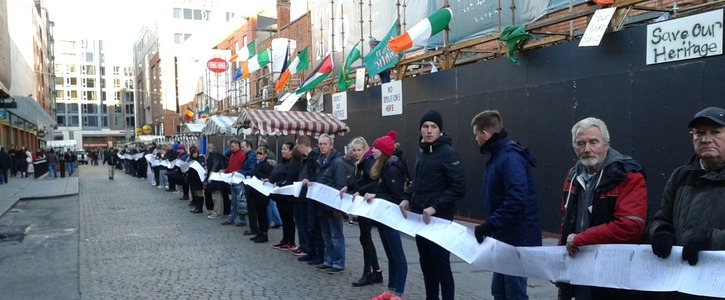
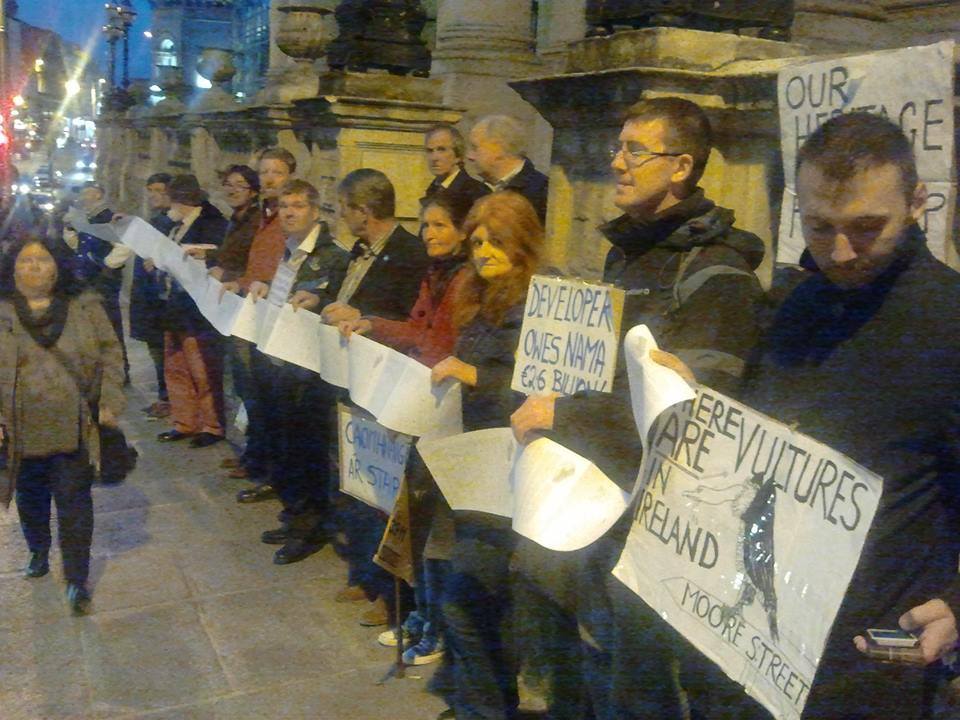
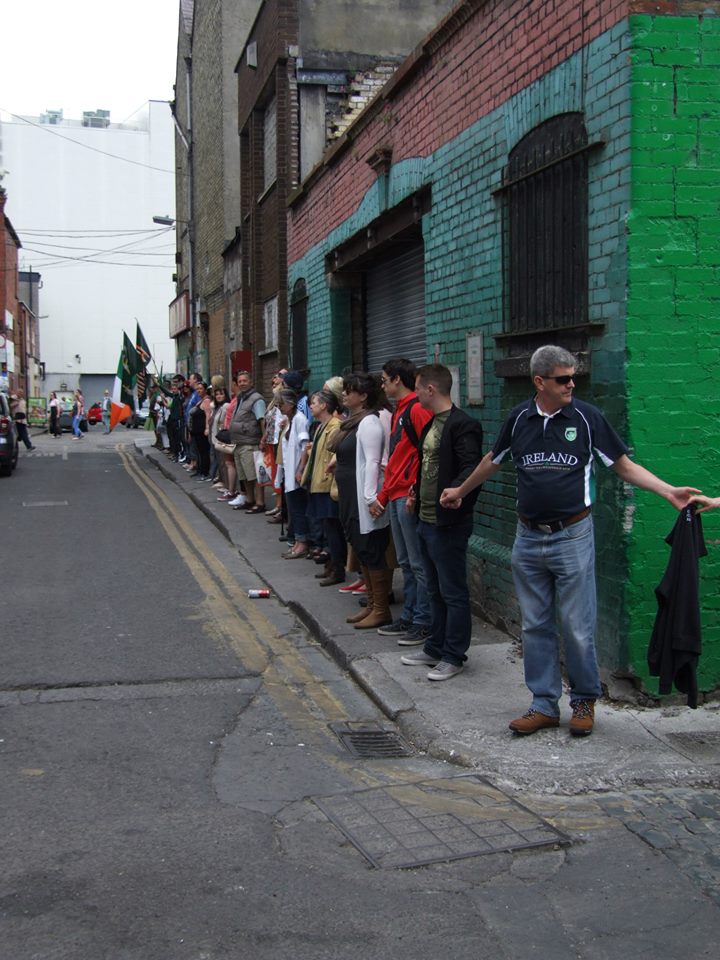
Supporters at the symbolic Arms Around Moore Street event organised by the Save Moore Street From Demolition campaign in June this year.
Supporters at the symbolic Arms Around Moore Street event organised by the Save Moore Street From Demolition campaign in June 2016. This is the corner of Moore Lane and Henry Place, across which Volunteers had to run under machine-gun and rifle fire from Parnell Street (at the end of Moore Lane, to the right of the photo) and at least one Volunteer died here.

But I’m digressing, Minister, my apologies. Apparently the reason they want to save that shabby terrace, that “pre-Famine street” — and the backyards and surrounding lane-ways, if you please! — is for HISTORICAL reasons. Historical!

Sure have we not had enough of history – Brehon Laws, Golden Age, Clontarf, Normans, 800 years of British occupation, blah, blah, blah! Weren’t we sick of it at school?

I’ve never liked Labour too much (somehow even the word sounds sweaty) but I have to admire their Education Ministry’s efforts to remove history as a subject from the compulsory school curriculum.

I’m sure they’re doing it for their own reasons – after all, wasn’t their party founded by that communist James Connolly? Sorry, revealing my own knowledge of history there, ha, ha! But whatever their reasons, they are on the right track.

Who wants to know where we are coming from? It’s where we ARE and where we are GOING TO, that matters!

But some people just can’t let it go, can they? They trail history around like something unpleasant stuck to a shoe. So what if 300 of the GPO garrison occupied that terrace in 1916?

The Rising, if you ask me, was a big mistake and I know plenty of people agree with me, even if most don’t have the courage to say so. Wouldn’t we be much better off if we’d stayed in the UK? And kept the Sterling currency? And as for the War of Independence …. don’t get me started!

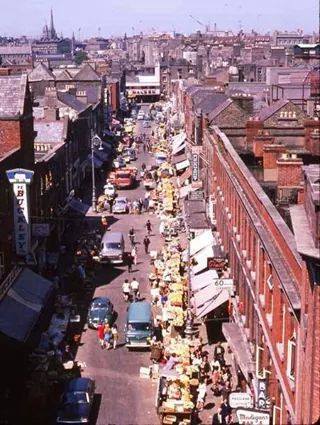
Aerial View Moore St. 60s
Aerial view Moore Street, looking northwards, 1960s, before the building of the ILAC and the running down of the street market.

And then there’s all that communist-sounding stuff about treating “all the children of the nation equally” — what kind of rubbish is that? Some are born to big houses with swimming pools and some are born to flats, or even rooms. That’s just the way of life.

And some will claw their way up to get to own big houses and if they are a bit uncouth, well that can’t be helped, they still deserve where they get to. And their children at least will be taught how to fit into their new station. That’s democracy! But everyone equal? Please!

Sorry, back to the Moore Street controversy. OK, after the mob pressured the Government, four houses in the street were made a national monument. But was that enough for the mob? Oh, no, not at all — eight years later the State had to buy the four houses to satisfy them.

Thankfully the specul ….. sorry, the developer, got back a good return on his investment – four million, wasn’t it? That’s the kind of thing that makes one proud to be Irish – buying run-down buildings and letting them run down more, then selling them for a million each.

That’s your entrepreneur! If only we had more like that, to lift this country up!

I must say I really liked that developer’s plan to build a big shopping centre from O’Connell Street into the ILAC, knocking those old houses in Moore Street down (although I know he had to leave those “national monument” four houses still standing in the plans).

I do hope whoever has bought the debt off NAMA and now owns those houses will carry on with that plan. Actually, I’d like the whole of O’Connell Street under glass if it were possible.

Wouldn’t it be great to do your shopping from the north end of the street to the south and from left to right, without ever having to come out into the weather? Of course, not much shopping there now, with Clery’s closed …. still ….

And then they’re going on about the market ….. traditional street market …. blah, blah. What’s wrong with getting your veg and fruit from the supermarket? Or getting them to deliver it your house, come to that? “Traditional street market” my ar….. excuse me, I got carried away there.

Those street markets are all very well for your Continentals, your Africans, Asians, Latin Americans and so on. Or for us to go wandering around in when we’re abroad on holiday, maybe.  But back home?  It’s the nice clean supermarkets for me any day.

Well now, if the mob insists on saving the street market, here’s an idea: why not provide a showcase stall or barrow, stacked with clean vegetables and polished fruit, right in the middle of the new shopping centre. After all, that’s heritage, isn’t it? And aren’t yourself the Minister for Heritage?

Most sincerely,

Phillis Tine-Fumblytil

Note: If you found this article of interest, why not register with Rebel Breeze for free, so that you will be notified by email of subsequent articles. You can de-register any time you wish.

BLANKET, NO WASH AND HUNGER-STRIKE – FIVE YEARS OF REPUBLICAN PRISONER STRUGGLE AGAINST CRIMINALISATION

Diarmuid Breatnach

(Reading time main text: 4 mins.)

We’ve recently passed by the date of the start of a monumental prison resistance struggle when IRA prisoner Kiaran Nugent refused on 14 September 1976 to wear prison uniform.

The Hunger Strike of 1981 tends to be remembered as an isolated event in the history of the Irish Republican prisoners’ opposition to criminalisation. But it was five years of struggle through stages that ended eventually in the martyrdom of ten Republicans.

Irish Republicans had been in imprisoned in British jails since the late 18th Century.1 After the Irish national bourgeoisie accepted the British partition of Ireland, Republican prisoners were held in prisons in the Irish State and in the British colony of the Six Counties and at times in Britain too.

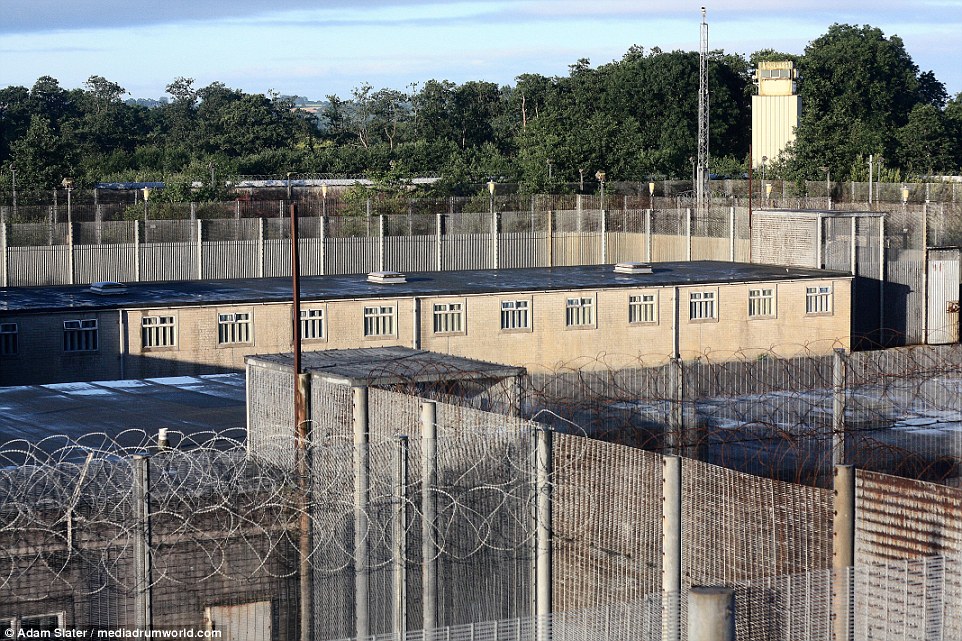
Long Kesh/ the Maze Prison, in the occupied 6 Counties.

This situation continued on low but constant level with higher points during the Civil War (1922-1923), the pogroms in the Six Counties, the 1930s,2 the 1940s, the Border Campaign (1958-1962) and the Civil Rights campaign from the mid-1960s onwards.

The Wikipedia section on Special Category Status states that it was introduced for Republican prisoners serving sentences in the Six Counties in 19723 but neglects to mention that it was already widespread among nationalist prisoners due to internment without trial a year earlier.

The British introduced internment without trial in their Irish colony in 1971 and one of the effects of that measure was to put a huge number of mostly nationalists from the Six County colony into jail. These prisoners were all accorded Special Category Status and wore their own clothes.

British soldiers capturing and taking away a civilian in the Occupied Six Counties of Ireland (Photo sourced: Internet)

Over the life of the measure, 1,981 people were interned without trial in the Six Counties (British Army’s Operation Demetrius). Of those detained 1,874 were from a Catholic/Republican background while, towards the end, 107 were from a Protestant/Loyalist background.

Special Category Status distinguished the internees from other political prisoners which were few in number at the time but its major impact was to distinguish them visibly from social prisoners or what are commonly called ‘criminals’ and was often called Political Prisoner Status.

In June 1972 other nationalists/ Irish Republicans4 charged and convicted were also accorded Special Category Status,5 which came to be seen as prisoner of war status for opponents of the British colonial occupation, despite Britain’s claims that the prisoners were just criminals.

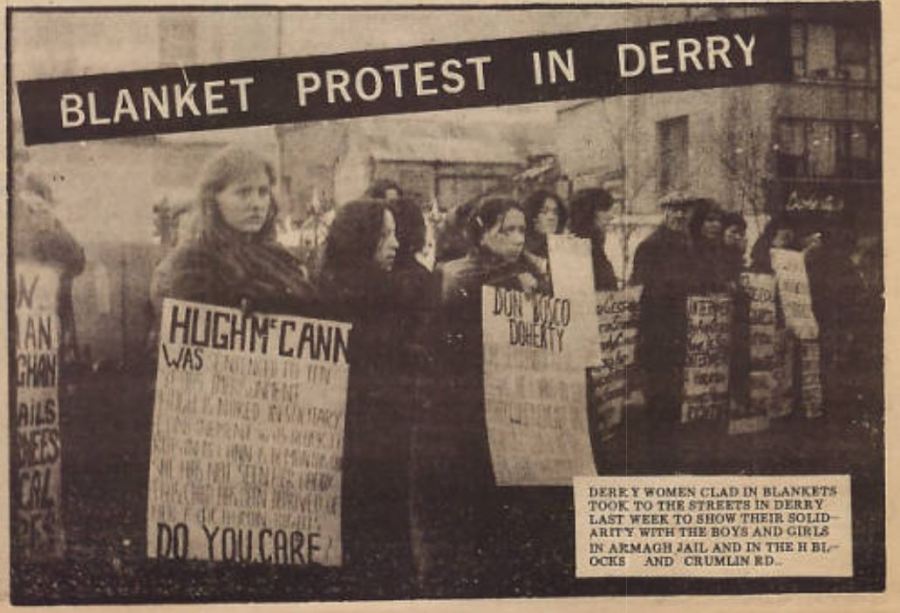
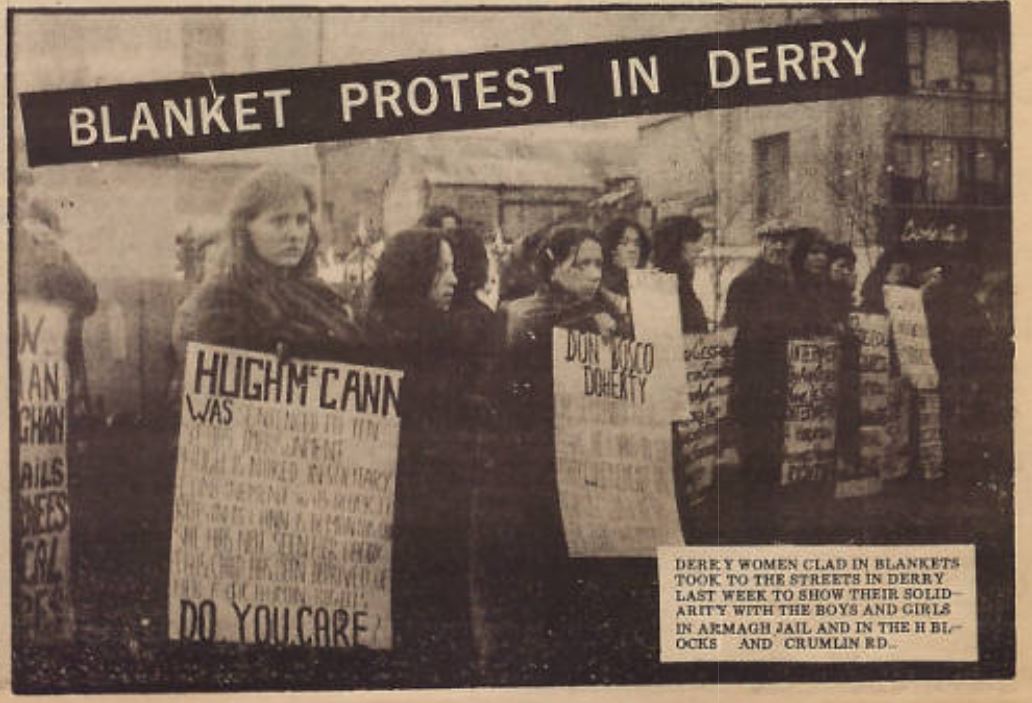
Early protests in support of the prisoners ‘on the blanket’ in 1976. It was mostly women relatives, partners and their friends who launched the Republican prisoner solidarity movement. As the photo legend also illustrates, there was still another male political prison, Crumlin Road (‘the Crum’) and Armagh Jail for female Republican prisoners. (Photo sourced: Internet)

Internment without trial in the Six Counties, generally recognised as a failure from both political and military points of view, was formally ended after four-and-a half years on 5 December 19756. As resistance continued, including now an armed aspect, more prisoners saw the inside of jails.

But they were still under Special Category regime and wearing their own clothes. The following year on 5 March 1976, Merlyn Rees as Secretary of State implemented the Labour Government’s7 decision to remove Special Category Status from any subsequently-convicted prisoners.

MERL

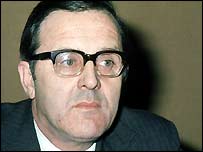
Merlyn Rees, British Labour Home Secretary who removed the Special Status from the Irish Republican prisoners, which precipitated the struggle that ended in the prison hunger strikes of 1981. He died at 85 years of age, having lived much longer than many of his victims. (Photo sourced: Internet)

The first Irish Republican prisoner to be informed he would have to wear prison uniform under the new rules was Kiaran Nugent. His reply, though pithy has gone down in the records of Irish resistance statements: “You’ll have to nail it to my back.

Stripped naked, Vol. Nugent was put in a cell, from which he found a blanket and wrapped it around himself. It was a natural act to cover his nakedness but he may also have known that Irish Republican prisoners of the Irish State in the 1940s had done the same.

The Blanket Protest had begun and spread as more prisoners coming into the prison system took the same stand. There it might have stayed were it not for the violence and cruelty of HM Prison regime by its warders regularly assaulting prisoners on their way to and back from the showers and toilets.

In 1978 the Irish Republican prisoners in the Maze H-Blocks8 resolved to remain in their cells, emptying their excreta out the window and their urine under their cell doors into the passageway. So the prison authorities blocked up their windows and warders pushed urine back under their doors.

The Irish prisoners then had nowhere to put their excreta so they smeared it on the walls. They built a dam of bread fragments around their door to prevent their urine being pushed back in. These conditions they endured until the prison riot squad beat them out of their cells for power-hosing.

Those who watched the film Hunger (2008) directed by Steve McQueen will have seen some of that and how they treated the naked prisoners too, beaten to the ground, anus probed for contraband messages or materials, the same gloved hand often opening their mouths to look inside also.

Their flesh was forcibly abraded with scrubbing brushes and they were often inserted into cells still wet from the hosing. Once back inside cells, they continued the protest.

On 27 October 1980 seven Republican prisoners, against the orders of IRA GHQ, embarked on a hunger strike included the Five Demands to break the system, which they terminated after 53 days on receiving promises from the authorities which were then reneged upon.

The 5 Demands:

  1. The right not to wear a prison uniform;
  2. The right not to do prison work;
  3. The right of free association with other Republican prisoners, and to organise educational and recreational pursuits;
  4. The right to one visit, one letter and one parcel per week;
  5. Full restoration of remission lost through the protests.9

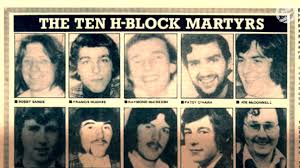
Outraged at the reneging, Republicans renewed the hunger strike with their previous Provisionals’ jail Commanding Officer10 insisting he be first. So was Bobby Sands the first to die and another nine martyrs behind, seven Provisional IRA and 3 INLA as they came on to the strike in sequence.

Photograph images with names of the ten Hunger Strike Martyrs of 1981 in the sequence of their death: Vols. Bobby Sands (IRA), Francis Hughes (IRA), Ray McCreech (IRA), Patsy O’Hara (INLA), Joe McDonnell (IRA), Martin Hurson (IRA), Kevin Lynch (INLA), Kieran Doherty (IRA), Thomas McElwee (IRA), Mickey Devine (INLA). (Photo sourced: Internet)

The effect of the hunger strikes of 1981 was huge in Ireland, Britain and further abroad. IRA Vol. Kieran Nugent had an important hand in pushing the process but so did Mervyn Rees, William Whitelaw, Brian Faulker and Edward Heath,11 in a long process of repression and resistance.

Today the struggle continues with approximately 20 Irish Republican prisoners, male and female in prisons between the neo-colonial Irish state and the British colony of the Six Counties. They have essentially won the five demands, though official harassment in the colony’s jails is endemic.

End.
NB: If you found this article interesting you may wish to subscribe to the blog free of charge, after which you would receive a notification in your email every time an article was published. You can unsubscribe any time you wish.

APPENDIX: Brief biography of Kieran Nugent (12th September 1958 – 3rd May 2000).

Volunteer Kieran Nugent began his short life presumably in the occupied Six Counties of Ireland but all the references I have found so far begin with him at the age of 15 years of age, standing at a corner with a friend on the corner of Merrion Street and Grosvenor Road, West Belfast.

It was 20th March 1973.12 A car pulled up beside them asking for directions but an occupant of the vehicle then opened fire with a submachine gun. Nugent was seriously wounded, shot eight times in the chest, arms and back. His friend, Bernard McErlean, aged 16, was killed.

Kieran Nugent, first of the Republican prisoners ‘on the Blanket’ (Photo sourced: Internet)

Another youth was seriously injured also.13 Local people reported that a British Army Saracen armoured car had crashed through a nearby barricade and that was what had allowed entry for the murder gang, later claimed by the UDA, a British proxy Loyalist militia.

“At some point afterwards, Nugent joined the IRA.”14 The youngest age for IRA membership was 17 and Nugent aged 16 was arrested by the British Army, automatically refused bail, and at trial, after five months on remand in Crumlin Road Prison, Belfast, case withdrawn, he was released.

Kieran became an active volunteer until his arrest and internment without trial, on 9 February 1975. He served nine months in Cage 4 of Long Kesh Detention Centre (later renamed The Maze) in the Six Counties, until 12 November 1975. But was arrested and imprisoned again on 12 May 1976.

Vol. Nugent was charged with hijacking of a bus, a frequent Republican resistance activity in Belfast where the vehicle would then be utilised as a barricade. His sentence was three years in jail which he was commencing when he began the blanket protest.

The cause of death for Kieran Nugent was given as heart attack. A number of his acquaintances remarked that he had sunk into alcoholism with some adding that the movement had given him no support. Whether true or not, many former Republican prisoners of the period had shortened lives.

FOOTNOTES

SOURCES

https://en.wikipedia.org/wiki/Special_Category_Status

SC status generalised for Republican prisoners: https://cain.ulster.ac.uk/events/bfriday/bac.htm

https://cain.ulster.ac.uk/events/intern/chron.htm

1Republican prisoners were held in British jails in Ireland, Britain and Australia – and for centuries before that Irish clan members had been incarcerated in Britain and Ireland.

2When the anti-fascist struggles also contributed to prisoner of the states.

3https://en.wikipedia.org/wiki/Special_Category_Status

4I am using the term “nationalists” as a broad and not strictly accurate term to describe the people of the Catholic ghettoes and areas of the British colony; of course many of them could have been also or instead mainly democrats, socialists. The term “Irish Republicans” I am using to describe those belonging to organisations nominally of Irish Republican kind but again how much each was truly Republican in ideology varied, for example in their opinion of the appropriate role of the Catholic Church in Irish society.

5Sentenced and remanded in custody Irish Republicans in jails went ona hunger strike for ‘political status’ in 1972 and the Provisional IRA during the Truce negotiations of June that year asked for political status for them which William Whitelaw conceded.

6https://cain.ulster.ac.uk/events/intern/chron.htm However internment without trial in fact continued by charged Republicans being refused bail and remaining in jail for two years or more awaiting trial. Bail decision and trial would be in the special no-jury Diplock Courts.

7It is difficult to understand any Irish person or indeed any anti-imperialist putting any faith in a British Labour government. Apart from its long imperialist history, it formed part of the national government that executed leaders of the 1916 Rising, sent troops to the Six Counties to quell the civil rights struggle in 1969, introduced the Prevention of Terrorism Act in Britain in 1974 and framed a score of Irish people for bombings, removed Special Category Status in 1976 …

8A special male political prison containing panopticon-designed blocks in Lisburn, Co. Antrim, built in 1971 and closed in 2000, the future of the empty buildings uncertain. Female Republican political prisoners were kept in Armagh Jail and fought with different tactics, including taking the Prison Governor hostage at one point.

9Prisoners disobeying prison rules are punished in a number of ways, one of which is loss of the remission off sentence normally expected.

10In a long tradition the prisoners of each political group in jail elect their leader and previous ranks are abandoned for the duration of the incarceration.

11In sequence: Labour Party Secretary of State; Conservative party Cabinet Minister; Unionist Prime Minister of the colony; Conservative Prime Minister of the UK.

12https://www.facebook.com/story.php?story_fbid=672093692010347&id=100076291652304&_rdr

13Ibid.

14Various sources

“WHEN MY COUNTRY TAKES ITS PLACE AMONG THE NATIONS OF THE EARTH”

Diarmuid Breatnach

(Reading time: 3 mins.)

Dublin Political History Tours Facebook page reminds us of the 20th September anniversary of the public execution on of “Bold Robert Emmet, the darling of Erin”, leader of the unsuccessful Republican insurrection in Dublin on 23rd July 1803.

Coloured drawing: The executioner holds up Robert Emmet’s head to the crowd, sections of which demonstrate their repugnance of the act and are repressed English soldiers on horseback. (Sourced: Internet)

I reproduce the Dublin Political History Tours text (reformatted for R. Breeze):

On Saturday we passed by the anniversary of the execution by the English occupation forces of Robert Emmet, United Irishman. Emmet had been condemned to death for planning an insurrection for Irish self-determination which the English Occupation called ‘treason’.

Leaving behind in Kilmainham Gaol his comrade Anne Devlin, who had endured torture and death of family members without giving the authorities any information, Emmet was taken to the front of St. Catherine’s Church.2

(This building is) on Thomas Street in Dublin’s Liberties area on the west side of the city centre. The site chosen was sending a message to the populace of the area that had nationalist and republican sympathies.

There, in front of a huge crowd and many soldiers, Emmet was hanged and then beheaded, the executioner holding up the dripping head to the crowd. His body was later returned to the Gaol before being later buried in Bully’s Acres in the grounds of the Royal Hospital Kilmainham.

Emmet’s corpse was later disinterred in secret and reburied elsewhere by friends or family and, despite a number of sites being speculated, its current location is unknown.

There is a monument to the execution inside the grounds of the St. Catherine’s building and a stone plaque on the wall outside it.

The monument inside the ground at the front of St. Catherine’s Church, Thomas Street, Dublin. (Source: Kilmainham Tales)

Robert Emmet was very popular in Ireland at the time and his memory is still. A statue in his honour stands in Dublin’s Stephens Green, a replica of another two at locations in the United States.

Anne Devlin endured three years in Kilmainham Gaol and according to Richard Madden (1798 – 5 February 1886), chronicler of the United Irishmen who sought her out, was followed everywhere in public by police.

(who were) observing anyone who she spoke to, as a result of which many were afraid to speak to her. Her body lies in Glasnevin Cemetery.

“Bold Robert Emmet” is a traditional ballad in the martyr’s honour and “Anne Devlin” also has a much more recent song in hers by Pete St.John.

(quoted passages end)

In the 1916 Proclamation of Independence, “the right of the people of Ireland to the ownership of Ireland” is proclaimed and that “six times in the past 300 years they have asserted it in arms”, probably referring to insurrections of 1641, 1689, 1798, 1803, 1848 and 1867.3

Historians have mostly dismissed the 1803 uprising as never likely to succeed but a minority have rated the preparations highly, including the innovations of signal rockets and folding pike handle for concealed personal carrying.

RH Madden, the first historian of the United Irishmen was of the opinion that the insurrection attempt was engineered by the English Occupation’s administration in Dublin Castle in order to justify continued repression of Irish republicanism and to eliminate some leaders.

Generally historians have tended not to give much credence to Madden on that issue but it is certain that the Occupation had a network of spies in operation in Ireland and that some had penetrated Emmet’s conspiracy.

Emmet on the scaffold with St. Catherine’s Church behind, the executioner beside him, the crowd in the street and many English soldiers, on foot and on horseback. The illustration was employed by Dublin Political History Tours but easily sourced on the Internet.

However it is not for the manner of the 1803 insurrection that Emmett has been fondly remembered in Ireland to this day 123 years later – and abroad for decades after his death4 – but for the calm manner in which he faced his enemies, including his executioner and for his eloquence at his trial.

Past insurrections contain lessons for us today and a serious evaluation should be attempted, perhaps with a number of submissions from historians of different opinions on the matter, to deal with questions around Emmet’s return from France and the planning of the insurrection in Ireland,.

For us today however, whether Republicans or more generally anti-colonialists and anti-imperialists, it is also necessary to revere the memory of revolutionary action for a democratic Irish Republican and to uphold his and Anne Devlin’s spirit of defiance in resistance.

End.

Note: If you found this article of interest, why not register with Rebel Breeze for free, so that you will be notified by email of subsequent articles. You can de-register any time you wish.

Statue monument of Robert Emmet in Washington DC, a copy of which stands in St. Stephens Green, looking across the road to his erstwhile home and other copies stand in Emmetsburg, Iowa and Golden Gate Park, San Francisco, California. Those in the USA were all cast by the artist Jerome Connor between 1916 and 1919. (Photo sourced: Internet)
Statue monument in Rathfarnham dedicated to Anne Devlin from Wicklow, a member of the United Irishmen conspiracy, tortured and jailed but never gave her captors any information. Sculptor: Clodagh Emoe (Gracies, Maria, for bringing this to my attention).

FOOTNOTES

1From Emmet’s famous speech from the dock of the courthouse in Green Street that not until then should his epitaph be written. I have no doubt that Emmet meant “nation-states of the world” because Ireland was in his time more than what we would understand today from the vague term of “country” – it was clearly, though under foreign occupation, already a nation with its own unique culture and a long history. She has yet to take that place to which Emmet referred and aspired for her.

2Note that was the Anglican St. Catherine’s Church, as a Catholic St. Catherine’s is also located not far away on Meath St. The Anglican church was closed in the 1960s but later reopened and reconsecrated as an Anglican Church. The interior seems very untypical of Anglican churches. Emmet was raised in the Anglican faith.

3Believed to refer to, in sequence: the Irish and Norman Irish clans in the Confederation’s uprising, the Williamite War’s, United Irishmen’s, Robert Emmets’, Young Irelanders’, the Fenians’. Coincidentally, the large monument to uprisings in Ireland erected by the National Graves Association in the St. Paul’s section of Glasnevin Cemetery also includes only six dates but they are of Republican risings only, beginning with 1798 and ending with 1916.

4I read somewhere that even in England Radicals would read Emmet’s speech as a high point of their events including formal dinners.

SOURCES

https://www.facebook.com/profile.php

Start of the Irish Starvation in the News

Diarmuid Breatnach

(Reading time: 2 mins.)

On 13th September 1845 the widely-read British weekly publication The Gardener’s Chronicle apprehensively reported the appearance of the blight on potatoes in Ireland but doubtful if the full extent of the holocaust to follow was expected.

(Sourced: Internet)

True, no other national population in any other known part of the world was as heavily dependent on the potato as was Ireland’s. Other crops were grown but were mostly destined as feed for domestic animals1 or for export directly or indirectly as in the case of alcoholic drinks.2

A national diet is that of the mass of the population, which in Ireland was the peasantry. On the potato and a little milk the Irish peasantry grew strong enough to be recognised in Britain as healthy able workers, seasonally in agriculture or longer-term in manufacturing and construction.

They were reputed to be the tallest and most fecund in Europe, according to Frederick Engels writing in Britain a year before the piece in the Chronicle.3 In Ireland the peasantry were for the most part tenants-at-will or landless labourers for the settler big landowners and descendants.

The original Irish had been expropriated by sword, fire and pen (legal decrees) and their expropriators lived on the rents they extracted from their tenants in a mixture of crops, animals, cash and labour. After the abolition of the Irish Parliament,4 most big landowners found no reason to even live in Ireland.

The estates of the absentee landlords were then managed by agents, middlemen who forwarded the extracted wealth to their masters in Britain, or perhaps travelling ‘on the Continent’, or trying their hand in the American colony, minus the agents’ commission, of course.

As people went hungry, meat, dairy and grain continued to be exported.

The dependency of the Irish mass on the potato was known of course and even mocked in some ruling British quarters at times. But so were the Irish landlord aristocracy who seemed to have no interest in developing industry.

But could anyone predict that the blight would intensify each year and that the Government of the UK would tolerate such devastation in one of its parts? By the time it had run its course six years later, Ireland had lost at least 2.5 million of its original over eight million5 and more were emigrating.

Memorial to the Great Starvation on Dublin’s north side quays. (Sourced: Internet)

And both the Irish planter aristocracy and the cotter class of Irish peasantry had been wiped out, leaving the field to the Gombeen6 class of money-lenders and bigger farmers, the latter now expanding their holdings and who would farm meat instead of agricultural produce.

When the overall national population stabilised again it did so at five million,7 at which level, despite a high birth and survival rate, it remained until the early 1990s. The magic trick was achieved by constant annual emigration, giving the Irish one of the largest diasporas in the world.8

The Gardener’s Chronicle’s writer noting the arrival of Phytophthora infestans could not have imagined the extent of its devastation. But if he knew the history of Ireland as well as that of the blight, he would have concluded that it was not the worst blight upon the Irish nation.

No, that was the arrival of the Anglo-Normans in 1169, with the second-worst blight being the growth of the Gombeen class.

end.

Note: If you found this article of interest, why not register with Rebel Breeze for free, so that you will be notified by email of subsequent articles. You can de-register any time you wish.

FOOTNOTES

1Grazing animals live on forage in Ireland but in winter or if overgrazed must be given additional food, while draught animals need cereal feed, typically oats. Pigs and domestic fowl were fed on mixtures of potato, beet, pulses and domestic leftovers.

2Typically eorna (barley) for beer brewing and whiskey distilling. These products continued to be produced and exported during the years of famine. Hops are also used for brewing but much was imported from southern England where climatic conditions are more favourable.

3The Condition of the Working Class in England (1844).

41799, followed immediately in 1801by Ireland becoming part of the United Kingdom and Irish MPs being required to attend the Westminster Parliament.

5A historical and statistical riposte to the anti-immigration claim that today “Ireland is full”.

6Originally from the Irish word Gaimbín and applied to moneylenders and land speculators during and following the holocaust period it, came to be applied by many to the Irish neo-colonial national bourgeoisie.

7Of the whole nation, with over 3 million in the Irish state and under two million in the British colony, the Six Counties.

8The bleeding through emigration was constant but fluctuated in degree, with a high point in the 1950s when it amounted to 15% of the Irish state (i.e. of the 26 Counties) and another in the 1980s.

SOURCES

https://www.irishhistorian.com/OnThisDayInHistory.html#SEPTEMBER

https://en.wikipedia.org/wiki/The_Gardeners%27_Chronicle

https://www.sciencedirect.com/topics/agricultural-and-biological-sciences/phytophthora-infestans

https://www.ucc.ie/en/emigre/history/

A MOTHER’S HEART – A Review.

Diarmuid Breatnach

(Reading time:4 mins.)

On August 1st singer Mary Black released A Mother’s Heart for Palestine, a soundtrack and video.1 The title and music built on the 1992 track by Mary Black and Eleanor McEvoy, A Woman’s Heart (title of album also).2

The voices are beautiful and the adaptations of the Arab women particularly so. Or at least, they affected me even more deeply.

Like actions by Mothers Against Genocide,3 the recording seeks to transverse borders in the mind, to represent Palestinians as humans, as human as ourselves, through the image of the mother, which almost all of us have had and which many women are or have been.

It is worth thinking about this a bit further. The image of the mother is a powerful one in all cultures for at least biological evolutionary reasons. The future of the human species depends on productive motherhood and in all cultures, in that capacity at least, pregnant women are protected.

The image is also overlain by personal affect, of ourselves nurtured (in most cases) by a mother or ourselves as a mother, nurturing in turn.

The image of the mother is also manipulated by all degrees of the Right, whether to uphold clerical control, to counter assertion of reproductive rights, or to deny the right of lesbian (and gay) sexuality. And ‘to protect ‘our women’’ from imagined migrant assault (or indeed intermarriage).

In Christian religious iconography, the Mother as Madonna is particularly prevalent and she is always passive, whether depicted serene or suffering.

A detail from the Madonna and child painting by Duccio, late 13th Century (Image sourced: on line)

The mother image is also employed by imperialists to send us to war and was crudely used for example in the UK (of which Ireland was then a part) in a WWI poster depicting a mother and child telling the man to go and fight (for them, of course – not for the imperialists, mar dhea!).

WW1 recruitment poster for Britain (Image sourced: on line)
A particularly offensive recruitment poster for the British Army in WW1 given that Ireland was under British occupation and only six decades after a British genocide of Irish people through starvation. (Image sourced: on line)

But in nearly all cases it is a passive representation of womanhood and is combined in the Mothers Heart video with images of sorrow – naturally, about all the children killed or starving, soon to die — which is also a passive emotion.

Many of the visual representations of Palestinian women are in domestic roles assigned to women around the world: food preparation, washing and drying clothes and of course child care.

Mothers are uniquely women but women are also more than mothers. Slightly more than one-half the human race, they are also workers,4 cultural producers, thinkers, leaders — and fighters. Even in revolutionary iconography we rarely see the woman, never mind mother, represented armed.

This is despite the 1970s images of a Mozambican or Vietnamese woman carrying a gun and a child. Or the famous staged INLA photo of a skirted woman in the Six Counties aiming an automatic rifle. Such images are very much exceptions to the rule.5

Poster promoting the Mozambique People’s Liberation Army. (Image sourced: on line)
Poster from the Vietnam War. (Image sourced: on line)

The music video shows Palestinian women, among their domestic roles, lamenting, speaking on mobile phones, presumably worried about relatives, carrying belongings, on the move, displaced. The lyrics also are of lament.

As complete counterpoint in the Arab world we have only one image that I know of, which is Leila Khaled with an automatic rifle, because her society too insists on a largely passive role for women, even though their position in that society otherwise seems very influential.

The women shown in the video accompanying the music and lyrics are apparently Arab, Arab-Irish and mostly Irish. On the Palestine solidarity marches here my impression is that born women are the majority over born males and many have taken militant action, for which some are facing prosecution.

Women, in particular Arab women, often lead these marches, calling out the chants for others to respond.

Newsreels show Palestinian and other Arab women abroad marching, shouting slogans, clenched fists in the air. I have seen them denouncing ‘Israeli’ soldiers for invasion and occupation, for mistreatment of children, for demolition of houses, one slapping an armed Israeli soldier in the face.

In our own history (as distinct from mythology and legend) we had few female figures of armed action and Pearse mythologised Gráinne Ní Mháille6 in song to epitomise resistance when he had her represent the nation. But compare that to his poem The Mother!

In recent years Markievicz, Skinnider7 and to a degree Farrell8 have part-emerged from history’s shadows bearing weapons but there is still a long way to go in changing the image of women (through all their biological phases) in the struggle.

This song for all that it affects me emotionally does not do that nor is it expected to and, more to the point, I fear will be used to reinforce passivity in the assigned role of women in struggles — fortitude and solidarity in suffering no doubt, but passivity none the less.

It seems to me that social democrats and liberals perpetuate the mother aspect of the woman manipulatively in order to promote pacifism and much as I appreciate this cultural production, it will be used in that way.

While enjoying cultural productions visually, in sound or in print, we need also to be aware of the social packages they carry and their effects upon us, intended or otherwise.

End.

(Image sourced: The Beat.ie)

FOOTNOTES

1https://www.mary-black.net/

2https://en.wikipedia.org/wiki/A_Woman%27s_Heart_(compilation_album)

3Whose official stamp is also on the video.

4Industrial, agricultural, municipal, health services, technical and scientific services.

5There was some coverage of armed Kurdish women in Syria fighting ISIS (I wrote about some myself) but it is now clear that was in the context of NATO coordination in the war to overthrow the non-western aligned regime.

6A 17th Century female chief of the Uí Máille clan in Mayo who led attacks on her enemies by land and sea. Pearse adapted the ancient bride-welcoming song to bid her welcome with armed warriors to reclaim her land and disperse the English occupiers.

7Both Markievicz (nee Gore-Booth) and Skinnider were members of the Irish Citizen Army and both carried and fired weapons in the 1916 Rising.

8Though unarmed, she was part of an Active Service Unit of the IRA when she and her two comrades were gunned down in the British colony of Gibraltar on 6th March 1988.

SOURCE

https://www.mary-black.net/

1https://www.mary-black.net/

2https://en.wikipedia.org/wiki/A_Woman%27s_Heart_(compilation_album)

3Whose official stamp is also on the video.

4Industrial, agricultural, municipal, health services, technical and scientific services.

5There was some coverage of armed Kurdish women in Syria fighting ISIS (I wrote about some myself) but it is now clear that was in the context of NATO coordination in the war to overthrow the non-western aligned regime.

6A 17th Century female chief of the Uí Máille clan in Mayo who led attacks on her enemies by land and sea. Pearse adapted the ancient bride-welcoming song to bid her welcome with armed warriors to reclaim her land and disperse the English occupiers.

7Both Markievicz (nee Gore-Booth) and Skinnider were members of the Irish Citizen Army and both carried and fired weapons in the 1916 Rising.

8Though unarmed, she was part of an Active Service Unit of the IRA when she and her two comrades were gunned down in the British colony of Gibraltar on 6th March 1988.

FROM EYESORE TO EYE-CHARMING GARDEN IN INNER CITY DUBLIN

Diarmuid Breatnach

(Reading time: 3 mins.)

How does a rat-ridden eyesore become a charming garden? And how does a sheet-metal fabricator-welder who knew nothing about gardening become its creator? The answers are: slowly, learning as he goes along and with support in the community.

In a little housing cul-de-sac or ‘turning’ as we used to call them, in a Dublin inner-city southside dockland, there was a disused area overgrown with brambles harbouring rats. Its only attractive feature was a big beech tree (Feá) left there when the area was cleared for housing construction.

But Jimmy saw something else there. In the eye of his mind, he saw a garden, a place of calm and beauty. The vision nagged at him until he began to clear the brambles and other undergrowth. And then to plug the rat-runs inside the brick back wall.

Though he was no stranger to the area, living as he does in the Markievicz flats, the neighbours might have been wary at first of what he was doing. But before long, they were bringing him cups of tea and biscuits, commenting approvingly on progress.

Flower bed in the garden (Photo: D.Breatnach)
“… in vacant or in pensive mood,
they flash upon that inward eye
which is the bliss of solitude …

Jimmy Browne, creator of the garden, caught in a moment of reflection. (Photo: D.Breatnach)

NOW AND FUTURE

Trees are valuable oxygenators and carbon-sequestrators, absorbing CO2 in the environment, as well as attractive but the big beech tree was shading the whole garden, restricting many other plants from growing. Sadly it had to go and two of its sections provide nice features in the garden.

Flowering shrubs and perennial flowers now grow in borders around an attractive brick floor. To those Jimmy has added other features of stone, metal posts and a garden bench.

Among the many that Jimmy acknowledges helping him is Shane Daly of the Windjammer, Leo for garden bench donation and Christy Barry who transported materials Jimmy collected to the garden.

Younger Rowan trees in the garden. (Photo: D.Breatnach)

The beech has been replaced by some Rowan trees, also known as Mountain Ash (Caorthainn), some in full berry flush when I visited the garden with local man Christian, who introduced me to Jimmy. I hoped Jimmy would install a pond that frogs or newts might breed in, attracting also damselflies.

The garden is attractive now and safe for children to visit but Jimmy has plans for a rockery, a fountain, a small shelter from rain showers over a seat and bird nest boxes, for tits for example. The Blackbird and robin are sure to nest in trees there in time, sending their songs into the area.

Section of beech trunk, now the stand for a table. (Photo: D.Breatnach)

FROM DERRY TO DUBLIN

Jimmy Browne is from Derry and came to Dublin in the 1970s, “on the hop” he says and indeed there were many from the Catholic areas that did the same in those years, whether temporarily or permanently. Coincidentally, the area around the garden has a strong political history too.

Around the corner, next to the Windjammer pub, is a plaque commemorating the founding of the Irish Republican Brotherhood in a wood yard there on St. Patrick’s Day, 1858, its counterpart in the USA being formed on the same day, soon to be known as “Fenians” which was adopted here too.

(Photo: D.Breatnach)

Almost facing the open end of Lombard Close is a little park with a monument, both dedicated to Elizabeth O’Farrell, of the 1916 Rising GPO Garrison, who took part in the occupation of Moore Street, where she had the dangerous responsibility of negotiating the surrender.

She grew up in that area as did nearby also her childhood friend, comrade and later lifelong house partner Julia Grennan, who also fought in the Rising and was there in Moore Street at the end also.

By strange coincidence, both Jimmy’s employers in Dublin, before he set up his own fabrication/ welding shop, had his own family name: Browne’s Foundry and Brownes Brothers.

Older Rowan trees in the garden (Photo: D.Breatnach)

Contrary to the drive for profits that dominates our society, a great many people contribute their physical and mental energy not only to their immediate family and friends but to the community at large. The garden is a benefit to the 19 homes in the Close and 40 others in attached streets.

Jimmy is not being paid to do this work. But he is being rewarded and not only by cups of tea and biscuits. He enjoys the feeling of creation, of making things from his mind come to life, of keeping busy in retirement, of feeling contentment. And of knowing his work is appreciated in the area.

End.

View of the garden from the outside: (Photo: D.Breatnach)
Plaque to the birth-place of the Ireland section of the Fenians in Lombard Street, Dublin. (Photo sourced: eadingthesigns.weebly.comblog).
(Photo: D.Breatnach)
Garden bench suigh síos and relax (Photo: D.Breatnach)

FAKE PATRIOTS MISUSE IRISH HISTORY AND THE HOMELESS CRISIS

Diarmuid Breatnach

(Reading time: 6 mins.)

In recent days we have seen the far-Right mobilise people to allegedly defend the GPO and protest homelessness, not against its causes but instead against migrants. In defence of ‘Irishness’ they also menaced an annual religious Muslim procession.

Participants in these and similar events wave the Irish Tricolour and Irish Republic flags and claim to be ‘Irish patriots’ standing up for ‘the Irish nation.’ However, it’s far from that they are in reality as we can see.

They

  • disgrace the Proclamation

The far-Right claim to honour our national history of resistance to colonialism and occupation and even display copies of the 1916 Proclamation of Independence.1

Yet they are often also seen and heard denouncing Muslims, in direct contravention of the Proclamation’s words: “The Republic guarantees religious and civil liberty … to all”; similarly they held protests when use of Croke Park was hired to celebrants of the Eid festival.

  • disgrace the GPO as HQ of the 1916 Rising

They have and do disgrace the very symbolic building they claim to be trying to protect.

They have often held racist gatherings outside it; one of their organisers2 (e.g. of weekly protests during the Covid crisis) leading a chant of support for British fascist Tommy Robinson, who defended the Paratroopers who carried out the 1972 Bloody Sunday massacre in Derry.

Their recent protest at the GPO featured as speaker a man known for his active membership of the sectarian UVF murder gang, who admitted working for British Intelligence and who called for the strengthening of the colonial British Border – and was cheered for saying so.

Cartoon by D.Breatnach
  • disgrace the flags

The far-Right disgrace and misuse the very flags they wave so keenly.

The Tricolour was presented to the revolutionary Young Irelander republicans3 by French revolutionary republican women in 1848. It signified peace and unity between the descendants of settlers and the indigenous Irish in revolutionary struggle against the British colonial occupation.

The flag with the words “Irish Republic” painted in white and gold on a green background was made on domestic material of socialist Republican Constance Markievicz (see next section) in her house and delivered by her to the GPO.

It was installed and flown on the roof at the Princes St. corner by Eamon Bulfin4 (see next section), a migrant from Argentina.

  • disown but also misappropriate real patriots

In dishonest manipulation, the far-Right claim to honour our patriots and even invoke them in their campaigns. In their agitation against migrants they hide the fact that Constance Markievicz, Thomas Clarke and James Connolly were all migrants (Connolly and Clarke no less than three times).5

Also a migrant was Eamon Bulfin (see previous section) along with many others who fought for Irish freedom and even sacrificed their lives (including Erskine Childers)6.

Placards on an anti-racist rally on Custom House Quay some years ago. The text placard quotes the 1916 Proclamation: “The Republic guarantees religious and civil liberty to all”. (Photo: D.Breatnach)

Of the Seven Signatories of the 1916 Proclamation (see earlier section), two – Pearse and McDonagh7 – were children of migrants and two were themselves migrants (Connolly and Clarke).

Among many such examples, the father of Young Irelander Republican patriot Thomas Davis (author of the song A Nation Once Again) was a migrant.

  • join with Loyalists and British fascists

A far-Right organiser calling for three cheers for British fascist Tommy Robinson was not the only such example and outside the GPO this week far-Right elements welcomed as speaker Mark Sinclair, a member of the UVF, a British colonial sectarian murder and terrorist squad.8

Prominent Irish leaders of fascist organisations have also shared a platform with Scottish fascist and Loyalist Jim Dowson.9 And of course how can we forget the desecration of the Tricolour unfurled among Union Jack and Loyalist flags in Belfast by some Dublin far-Right activists!10

Admitted UVF/ MI5 Sectarian Loyalist UVF murder gang member Mark Sinclair. (Photo sourced: Internet)
  • don’t act against British occupation

With all that background, it’s hardly surprising that the far-Right “patriots” don’t organise against the British occupation of the Six Counties or in support of Irish Republican political prisoners in jails on either side of the British Border.

  • burn buildings

Apart from misleading people and distracting them from the real sources of problems to Irish working people and seeking to intimidate refugees, what do the far-Right actually do? Ah, yes, they burn buildings that might be used as accommodation. A great help to the homeless indeed!

  • attack homeless refugee and migrant tents

But no, that’s not all. No, the brave ‘patriots’ slash tents and threaten migrants and refugees who are sleeping on the streets. They don’t take on the big landlords, bankers, property speculators and vulture funds – no, they strike down at people poorer and in worse conditions than themselves.

  • cover for the property speculators and vulture funds, big landlords, bankers

So with all this whipping up fear and hatred of migrants, the far-Right obscure the actual cause of the problems, which is not only Irish capitalism but its total subjection to foreign capitalism. The only ones to benefit from this activity are those who are the real causes of the problems.

  • are not patriots, nor nationalists

Despite their claims and flag-waving, the far-Right in Ireland are neither patriots nor true nationalists. They do not organise in defence of Irish sovereignty and against British occupation nor against foreign capitalist exploitation of Irish natural resources, labour or infrastructures.

Or the contrary, they work to distract attention away from these centrally-important issues for the Irish nation and raise false issues to divide the people. And usually their concept of ‘Ireland’ ends at the British border which the recent far-Right rally at the GPO called for strengthening!

  • are a sub-class of deprived individuals allowing themselves to be manipulated by fascists, MI5 and NATO

Many of those being mobilised against migrants come from parts of the cities neglected for generations, often associated with low educational level, substance misuse, unemployment and unresolved mental health issues.

The ideological fascists will recruit those elements to fight, not against the cause of their deprivation, the neo-colonial ruling class or the flooding of foreign capitalist companies into Ireland, assisted by banks and political decisions -but instead against migrant workers and refugees.

  • are filling a vacuum left by the Republican and Socialist movement

WILL WE LEARN FROM OUR FAILURES?

Many of those participating, while some are also unfortunate victims of Irish capitalism, will be recruited as the boot boys of fascism.

While it is true that historically capitalism in crisis turns to fostering fascism and that capitalism, including the neo-colonial variant in the Irish state is running out of other options, we must evaluate our own role in this development, examine our own failures, learn from and remedy them.

The ground was largely ceded to the Far-Right in the period of their initial growth during the Covid crisis. The socialist Left and Republican movement, in particular its organisations, had little response to the early FR mobilisations or to responding creatively to state-imposed restrictions.

Throughout that period and subsequently the socialist Left sector, despite its protestations of anti-imperialism and anti-colonialism, completely ceded the ground of Irish national sovereignty and its symbols to anyone who wished to occupy it.

They did not, for the most part, protest the use of State repression against Irish Republicans both sides of the British Border, whether through police harassment, special legislation and special no-jury courts, nor stand up for the human and civil rights of Republicans, including political prisoners.

Their distaste for the very issue of national sovereignty was reflected in their refusal to fly the Irish Tricolour, which, although now also the official flag of the Irish State, is originally and remains still a potent symbol of Irish Republican anti-colonial struggle over 170 years.

They might argue that they wished to be identified with the struggle of the working class rather than a nationalist one but they also chose not to fly the flag of the insurrectionary Irish working class, the Starry Plough, in among their internationally-recognised red flags.

The Irish Republican organisations in their fragmented movement, on the national question, failed to sustain unity even around opposition to repression of the states or even around solidarity with the movement’s political prisoners.

They also failed and, to an even greater extent, in fighting for universal affordable housing in a crisis which seems to offer no end and is seized upon by the Far-Right to target refugees and economic migrants, who of course have no responsibility whatsoever for the crisis.

This area too has been a notable failure of the socialist Left organisations which, although marching often enough in public demonstrations and participating in a couple of media-orientated occupations,11 failed to organise and lead a state-wide campaign of empty building occupations.

And so, here we are today, when the FR are able to bring Tricolour and Irish Republic flag-waving crowds on to the streets in false claims of patriotism, dividing and seeking to intimidate migrant workers and anti-racists, burning buildings and insisting on their definition of ‘Irish’ being correct.

Our omissions and failures, if we recognise and act to remedy them, also point the way forward.

End.

1In a travesty of frequent Irish Republican ceremonial occasions, it was even read out at the recent Far-Right gathering outside the GPO which was addressed by a known member of the UVF sectarian murder gang.

2Under the name Dee Wall (real name Dolores Webster).

3Including to Thomas Meagher ‘of the Sword’ who later recruited for, joined and fought in the Union Army in the US Civil War against slavery. Meagher unfurled the flag first in Wexford and later in Dublin, both acts in 1848.

4Bulfin came to Ireland around the age of ten with his family and later joined the IRB and the Irish Volunteers. After the surrender in Moore Street he was sentenced to death, later commuted to life sentence, then from Frongoch prison camp deported to Argentina from where he was the Latin American representative for the Movement.

5Clarke and Markievicz were both born in England. Clarke was first a migrant to Ireland, later to the US, then back again. Connolly was born in Edinburgh and a migrant to Ireland, then to England, then to the USA before his return to Ireland.

6Childers was born in England. He captained the yacht that brought the Mauser rifles and ammunition to Howth. Later he joined the IRA, took the anti-Treaty side and was executed by the Free State during the Civil War.

7The father of the Pearse brothers was English, as was McDonagh’s mother.

8During his trial for bank robbery for the UVF in Glasgow, Sinclair declared he had been working for MI5 which was well known to be steering Loyalist organisations. The UVF and British Intelligence bombed Dublin and Monaghan in 1974, causing the deaths of 34 people and a full-term baby, the highest death toll of one day during the recent 30 Years War.

9Rowan Croft, Herman Kelly (Irish Freedom Party) and Niall McConnell (Síol na hÉireann).

10A prominent group among the Dublin far-Right calling themselves Coolock Says No.

11https://www.irishtimes.com/ireland/2025/07/09/former-loyalist-uvf-prisoner-addressed-anti-immigration-protest-at-dublins-gpo/

12For example, the 27-day occupation of Apollo House, Dublin, from 15 December 2016 by housing activists and homeless people, with speeches and performances by prominent musicians.