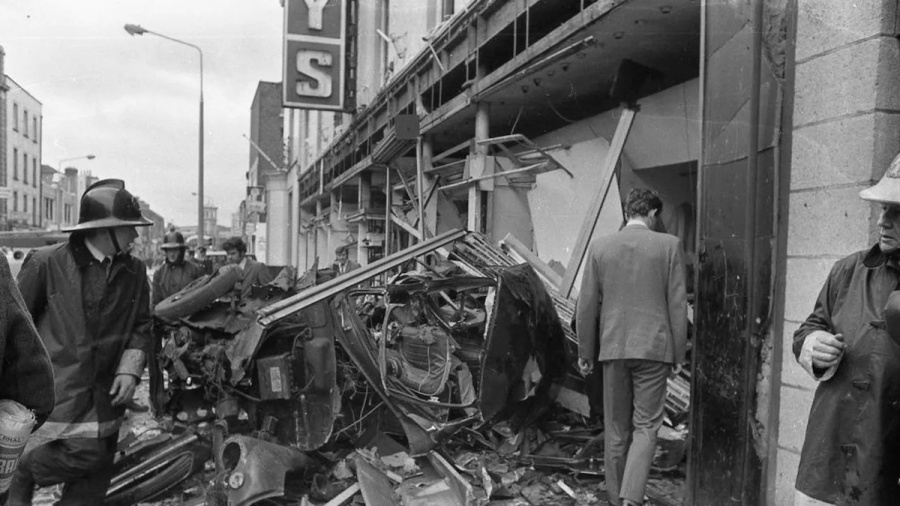
Although the 1916 Rising had been planned to take place on Easter Sunday, April 23rd, it was publicly cancelled by the titular head of the Irish Volunteers, Eoin Mac Néill and it went ahead instead on the 24th, the following day.
The 1916 Rising was unsuccessful but is considered the birth event of the Irish Republic and for some therefore Republic Day is on April 24th, the first day of that Rising and when Patrick Pearse, with James Connolly by his side, read out that remarkable Proclamation of Independence.
Banner of the Republic Day event organisers in Arbour Hill (Photo: R.Breeze)
Tom Stokes, an independent Irish Republican campaigned for some years for April 24th to be recognised as Ireland’s national day, replacing St. Patrick’s Day which is religious festival and now an excuse for excessive drinking and pseudo-Irishness.
Replacing too Easter Sunday and Monday, these being religious dates that move around on the calendar, never being on the same dates in any consecutive year.
Tom Stokes died in December 2018 and a small group of disparate independent Republicans have striven to keep his campaign going.
Stokes always held his Republic Day event at noon on the 24th in front of the GPO, the location of the first public reading of the Proclamation (as did also the Save Moore Street From Demolition one year) but this group carrying on his campaign have been holding their event in Arbour Hill.
This is the location of an old British prison containing the location of a mass grave into which had been put the bodies of 14 of those executed by British firing squads after the surrender of the leadership and majority of the fighters, their bodies covered in quicklime and earth.
The mass grave of 14 of the sixteen executed in 1916, with their names in Irish one side and in English on the other. (Photo: R.Breeze)
CEREMONY IN ‘ARBOUR HILL’
The name Arbour Hill is a corruption of the original Irish name for the location which meant something distinct from “arbour”: Cnoc (hill) an (of the) Arbhair (cereal crop). Today it is a quiet spot tastefully laid out, the names of the dead etched around the mass grave-site in both languages.
A little distance away is a tall flagpole bearing the Irish Tricolour in front of a high wall on which are chiselled the words of the Proclamation in their original English and also in Irish translation.
Dramatist Frank Allen welcomed those present, in particular members of Limerick Men’s Shed who had travelled a distance to be present at the event. He also referred to descendants who were present of martyrs of the struggle Cathal Brugha, Thomas McDonagh and Harry Boland.
Frank Allen as MC for the event (Photo: R.Breeze)
Allen also reviewed the history of Tom Stokes’ campaign for the marking of the date as Republic Day and a national holiday, outlining also the man’s background and his family connections to the struggle for Irish independence, along with his support for Palestine..
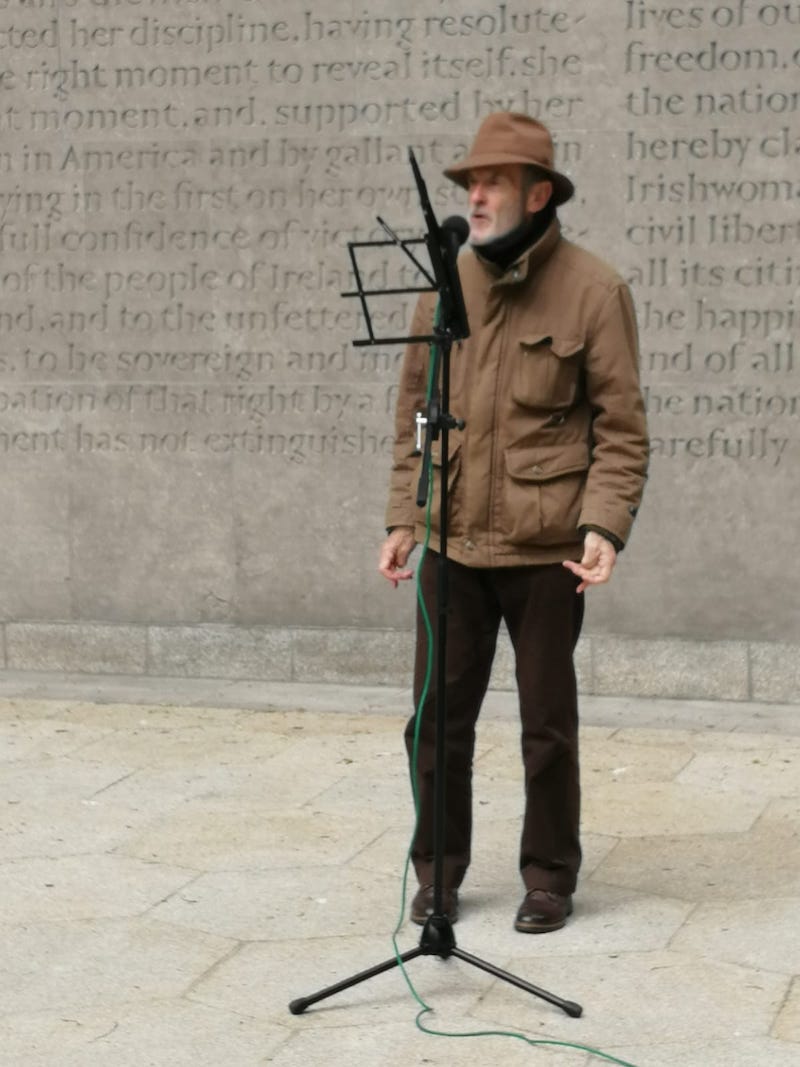
First to be called to perform was Pat Waters, professional musician and a regular contributor to the 1916 Performing Arts Club who accompanied himself singing his own composition Where Is Our Republic Day? composed at request from Tom Stokes.
Pat Waters performing his composition Where Is Our Republic? (Photo: R.Breeze)
Allen called on Glen Gannon also of the 1916 PAC to read the Proclamation and then on Shane Stokes to read one of his father’s articles which clearly outlined the man’s socialist Republican principles and their distance from the reality of the current national society and polity.
In succession Fergus Russell of the Goleen Singers organising committee was called to sing The Foggy Dew, a song about the 1916 Rising which he performs every year and Shannon Pritzel to read Patrick Pearse’s famous oration on the grave of Ó Donnabháin Rosa.
Aidan recited the eulogy poem to the 1916 fighters composed by an ex-British Army officer living in Ireland. Anne Waters of the 1916 PAC was asked to present red roses to a number of those present to lay on the named dead on the stonework surrounding the mass gravesite.
Larry Yorell (best known as a long-time activist of the National Graves Association)1, made an appeal for support for an initiative to build a monument to Patrick Pearse.
Aidan reciting a eulogy poem for the 1916 Rising fighters (Photo: R.Breeze)
Frank Allen declared total opposition to a trend seeking to eliminate Amhrán na bhFiann as the “National Anthem” for being thought too war-like.
The Anti-Imperialist Action group called a picket against imperialism to take place in the evening of the 24th outside the General Post Office, which had been the HQ of the Rising forces in 1916.
(Photo: R.Breeze)
While a number distributed leaflets, others lined out carrying a number of national flags of Palestine and one of the PFLP, in addition to a large Irish Tricolour, smaller Starry Plough and flags of the New Philippines Army.
Along with some of the standard Palestine solidarity slogans heard everywhere in Ireland on demonstrations, they called out “From Ireland to Palestine – Occupation is a crime!”; “There is only one solution – Intifada revolution!” and “Saoirse – don Phalaistín!”
Flag of the New People’s Army of the Phillippines displayed alongside other flags of anti-imperialist struggle. (Photo: R.Breeze)
A number of passers-by congratulated the picketers while some stopped to discuss. A representative of the organisers gave a short address regarding the background to Republic Day and the current situation in Ireland, commenting also on the zionist genocide in Palestine.
The event concluded with a youth reading the 1916 Proclamation out loud, followed by an acapella singer performing The Larkin Ballad which relates a compressed history of the 1913 Dublin Lockout but concludes with verses about the 1916 Rising.
A youth reads the text of the Proclamation of Independence near where Patrick Pearse read it out on 24th April 1916 (Photo: R.Breeze)
End.
Southward view of part of the group marking Republic Day with a statement against imperialism today. (Photo: R.Breeze)
FOOTNOTES
1The main organisation throughout Ireland maintaining and renovating and erecting monuments, graves, plaques in memory of Irish patriot men and women and battle sites; the NGA remains independent of political parties and declines to be in receipt of funding from government or political party.
2Kearney wrote the lyrics in 1907 in cooperation with musical composer Patrick Heeney. The music for the chorus was adopted by the Irish Free State as its national anthem. The lyrics were translated into Irish in the 1930s and unusually it is the Irish version that one most often hears, first verse and chorus. The opening sentence of the chorus “Sinne fianna fáil” (‘we are soldiers of destiny’) have been changed by some to “Sinne laochra fáil” (‘warriors of destiny) in order to avoid reference to a specific political party that called itself Fianna Fáil.
Easter is the time of year in Ireland for Easter Egg hunts and/or for attendance at religious services but for the Republican movement it is one of commemoration of the Easter Rising and its martyrs, with parades and speeches.
The commemoration parade proceeding along Phibsboro and approaching the Cross Guns canal bridge. (Photo: Rebel Breeze)
Easter Monday in Dublin saw one of those commemorations organised by the Socialist Republican organisation Anti-Imperialist Action at the Citizen Army plot in the St. Paul’s section of the famous Glasnevin Cemetery at the Republican Struggle Monument1.
Participants rallied near the Phibsboro Shopping Centre to march from there to the Cemetery, a distance of around two kilometres, over the “Cross Guns” bridge over the Royal Canal, then passing the main entrance to the Glasnevin Cemetery on the right before turning left for St. Paul’s.
Garda POU van parked extremely dangerously, hiding left turn from view of eastbound traffic, as they chat with other Gardaí and a ‘Branch man.As is said, “one rule for the people …!” In the laneway between houses visible in the background, a cameraman lurked taking photos. (Photo: Rebel Breeze)
In a marked departure from the previous year, the State’s political police, plainclothes Gardaí of the “Special Branch”2 did not approach the participants to attempt to intimidate them and gather intelligence, demanding their names and addresses under the Offences Against the State Act.3
That had been followed up by a raid on the home of one of the leading activists. Sunday’s police behaviour was an even greater difference from Saturday’s, when a different Republican group, Saoradh, had their Easter Rising commemoration in Dublin’s city centre.
Around 300 police, including many in riot cop uniform (Public Order Unit) had harassed the participants demanding names, addresses and other information, attempting to intimidate them. At least seven police vans had been in attendance also to the bemusement of onlookers.4
(Photo: Rebel Breeze)
LOCAL 1916 HISTORY
The Phibsboro/ Glasnevin area also figured in the 1916 Rising, with an insurgent barricade in Phibsboro and a Fianna youth, Sean Healy, mortally wounded at the crossroads by a British artillery shell fragment (a plaque on the ground at the SW corner commemorates his death.
Earlier, Irish Volunteers had guarded the canal bridge briefly; these were seen by the dozen Volunteers that marched along the canal from Maynooth, slept in Glasnevin Cemetery and got into the headquarters garrison at the General Post Office on Tuesday.
Later British soldiers set up a barricade on the Bridge preventing even foot traffic across and shooting dead a deaf and dumb man who could not hear their challenge.
EYE IN THE SKY? (Photo: Rebel Breeze)
PARADE THROUGH STREETS TO CEMETERY
The parade from Phibsboro on Sunday was led by the Glasgow Republican Flute band (formerly the Garngad RFB, which is where most of them are based) playing the airs of known Republican ballads, muted to regular tocks on their drums as they entered the housing estate.
(Photo: Rebel Breeze)
Also leading was the colour party dressed in white shirts, black trousers, jackets, berets and sunglasses, carrying the traditional flags for Republican colour parties: the Tricolour, Starry Plough, Sunburst, followed by the flags of the four provinces of Ireland: Connacht, Leinster, Munster and Ulster.
Over the marchers the flags of the Tricolour and the Starry Plough, flag of the Irish Citizen Army flew in the breeze while those of the Basque nation, Palestine and of the People’s Front for the Liberation of Palestine lent an international flavour to the commemoration of the Irish Rising.
There was some beeping of passing traffic and cheering from bystanders at the entrance to the laneway that leads to the bridge across the railway tracks to the St. Paul’s section of the graveyard. The marchers filed in and proceeded to the monument.
The Chair of the proceedings welcomed the attendance before reading from the 1916 Proclamation of Independence and calling a singer to step forward. Revolutionary activist Diarmuid Breatnach introduced the two songs he was going to sing as emphasising the role of the working class in the Rising.
(Photo: Rebel Breeze)
“The decision to go ahead with the Rising on Easter Monday was taken in Liberty Hall, the headquarters of the working class at the time,” he reminded the gathering, “which is also where the Proclamation of Independence was printed.”
He sang the “JimLarkin Ballad”: In Dublin City in 1913, the boss was rich and the poor were slaves; The women working, the children hungry, till on came Larkin like a might wave …
Diarmuid Breatnach singing(Photo: Donated by participant)
Pausing to focus on a different key, the singer followed the ballad with Patrick Galvin’s Where Is Our James Connolly?
After applause, floral tributes were laid on behalf of Anti-Imperialism Action Ireland and of Dublin Republicans Against Fascism.
(Photo: Rebel Breeze)(Photo: Donated by participant)
The chairperson asked for a minute’s silence in honour of those men and women who had given their lives in the struggle for freedom in Ireland. The colour party lowered their flags slowly in homage to the fallen, raising them again slowly to signify the continuation of the struggle.
(Photo: Rebel Breeze)
John Heaney, Republican ex-prisoner from Armagh was called to give the oration for the event, which he dedicated to all those men and women who had opened their doors and their homes to fighters in the struggle, whether the latter were in hiding or just resting – his audience applauded.
The speaker also congratulated on those who came forward to carry on the struggle, youth, women and stated he was proud to see the traditions of struggle being upheld in the process to achieve the Republic for which so many gave their lives.
The speaker, John Heaney delivering his oration. (Photo: Rebel Breeze)
The marching band then played the air of Amhrán na bhFiann/ The Soldiers’ Song, verse and chorus and the formal part of the event came to an end. Band members lined up in front of the Monument for photos and a little later played the air of “Black Is the Colour” on whistles, to general applause.
SECOND 1916 COMMEMORATION FOR AIA THIS EASTER
This was the second 1916 Rising Commemoration to be attended by Anti-Imperialist Action as they had also participated in another organised by the Seamus Costello Memorial Committee in Bray on the previous day.
AIA is a young organisation, founded by socialist Republicans unhappy with the direction of the Republican organisation of which they had been members but now containing many young people.
AIA gave rise to the Revolutionary Housing League that occupied empty buildings in a campaign against homelessness and called for a general occupation campaign across the state. A number of court cases against them followed but sadly their lead was not followed.
(Photo: Rebel Breeze)
AIA have also been very active against NATO, picketing promotional meetings and a number have been charged following a demonstration against a visiting British Navy ship in Dublin last November.5 They have also been active as part of the Saoirse don Phalaistín activist group.
Following the event in Glasnevin, many of the participants relaxed at a social evening in a different part of the city where many songs of struggle were sung.
(Photo: Rebel Breeze)
OTHER EASTER COMMEMORATIONS
Other Easter Rising commemorations have been held around this time, for example: Lasair Dhearg held one in Belfast on Easter Monday, while Independent Dublin Republicans held theirs in the capital, marching from Liberty Hall to the GPO, then to Moore Street to lay a floral tribute.
On Monday too the Derry 1916 Memorial Committee held an event in its city.6
Former revolutionary Republican party Sinn Féin held theirs in Arbour Hill7 cemetery on Sunday; a large part of their President’s address was devoted to justification of support for the EU and a plea to support the party whenever the state’s general elections are held (this year or next)8.
1My name for the Monument in the St. Paul’s part of Glasnevin Cemetery which stands in recognition of six periods of Irish Republican-led insurrectionary activity in Ireland: 1798-1916.
2Now officially the Special Detective Unit, they were previously known as the “Special Branch”, a name they inherited from the British occupation which had set up a political intelligence unit, the Irish Special Branch, to spy on and disrupt the Fenian movement among the Irish diaspora in British cities. Most political activists in Ireland continue to call them “the Special Branch” or simply “the Branch”. Their equivalent in Britain today and in a number of its colonies and former colonies continues to officially bear the name “Special Branch”.
3As amended in 1972 after a British Intelligence bombing killing two public transport workers in Dublin but blamed on the IRA; the amendment also permitted the setting up of no-jury Special Courts which are in existence to this day.
4In the context of assaults on persons in the city centre there have been regular complaints in the media and in the Parliament about the lack of Gardaí visibly patrolling the area.
7Where the 14 Dublin 1916 executed were buried, now a national monument in a former prison and church graveyard around the back of the former military barracks and now National Museum of Collins Barracks
Led by four Republican marching bands and containing a number of organisations, around 6,000 people supported the annual march in Derry on Sunday commemorating the 1972 massacre by the British Parachute Regiment in the city.
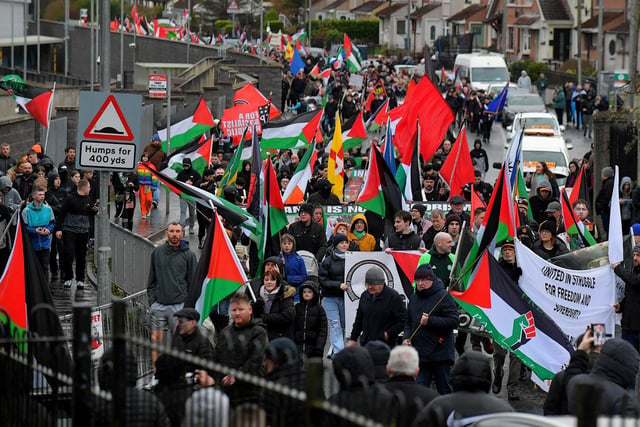
This year a special focus on solidarity with Palestine had been called for by the organisers of the Bloody Sunday massacre commemoration and Palestinian flags mixed with ones of Irish Republican organisations decorated the march route.
The march begins at the Creggan Heights, overlooking Derry, a steep walk up from the Bogside, the city’s centre near the river and winds its way down (with a great view of the Foyle river and surrounding area) but then up Westland Street again and along Marlborough Terrace.
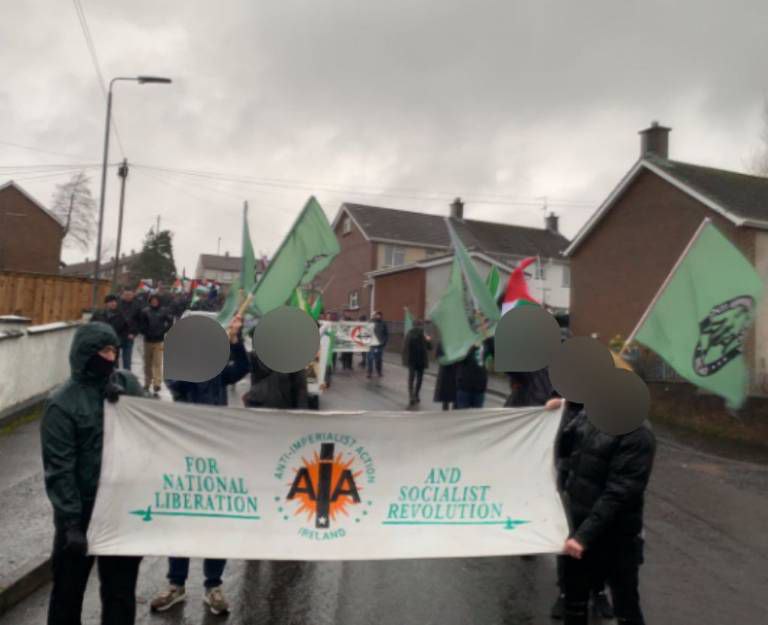
Rear banner of the AIA contingent on the Bloody Sunday commemoration march Sunday. (Photo source: AIA)
For a number of years this commemoration has taken place in heavy rain and high winds, or snow, or sleet but it was dry this year – until the march started! However after a short period of strong gusts driving rain it stopped for the rest of the march.
Down Creggan Road to the Bogside once more and past the Bloody Sunday and H-Block memorials to the rally at Free Derry Corner where Kate Nash, one of the main organisers of the march for years and a sister of one of those murdered in the massacre, welcomed the marchers.
The Bloody Sunday 52nd commemoration march makes it way along Lone Moor Road towards the Brandywell on Sunday afternoon. (Photo: George Sweeney via Derry News.)
RALLY AND SPEAKERS
Nash condemned the punitive EU/ UK/ USA cutting of funds to the UNRWA organisation carrying out relief and educational work in Gaza following an Israeli State intelligence allegation1 and also called for no Irish politicians to attend the annual US Presidential St. Patrick’s Day event.2
Kate Nash’s brother Willie was murdered by the Parachute Regiment during the massacre and her father was wounded by fire while trying to reach his fallen son. Kate called for a minute’s silence for the dead and wounded that day but also for those in Gaza, in particular the children.
Kate Nash also mentioned the Noah Donohoe case as being close to everyone’s heart.
The names of the dead and wounded by the Parachute Regiment were read out by Damian Donaghy,3 son of Damian Donaghy one of the survivors on that day. Paddy Nash performed the civil rights anthem “We Shall Overcome” which was popular among marchers of the time.
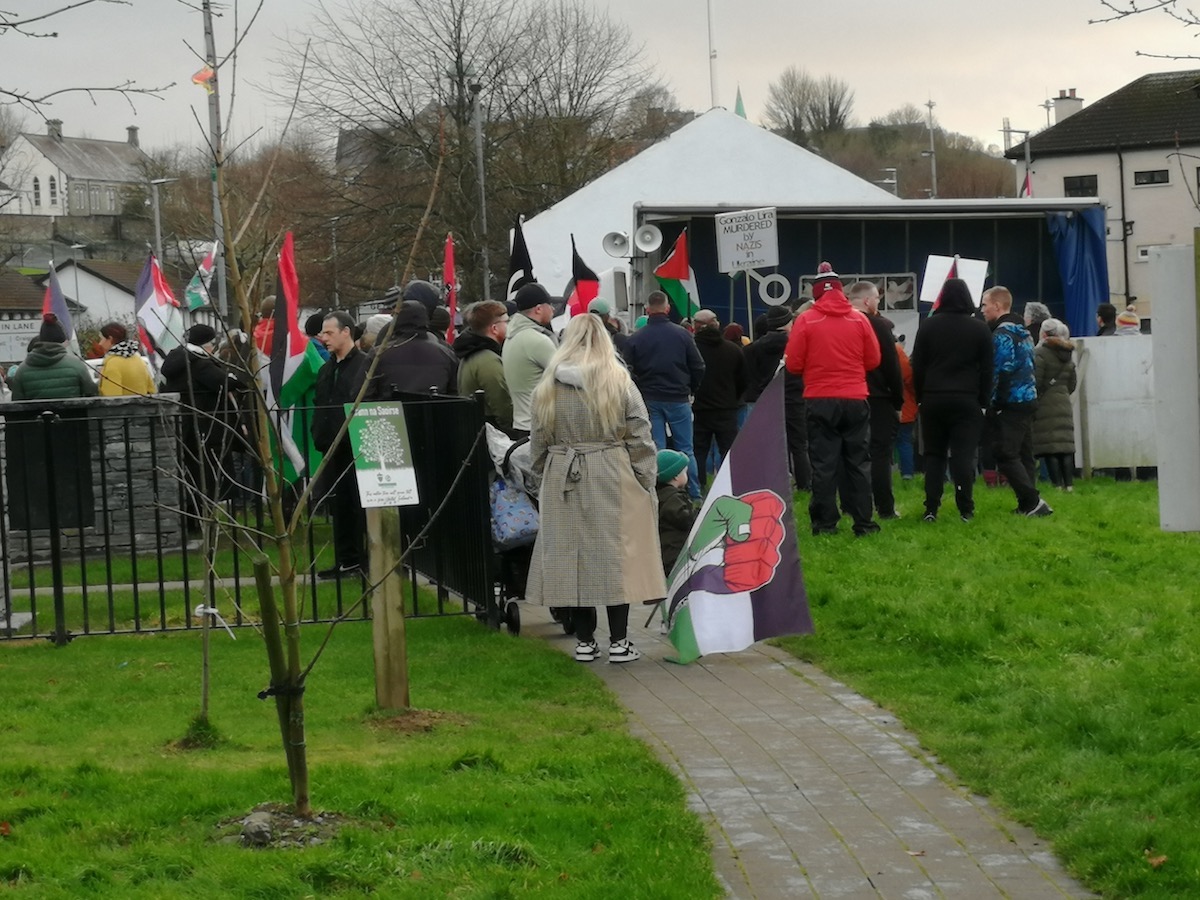
Section of the rally to the right as facing Free Derry Corner with a mural based on an iconic photograph from the massacre. (Photo: D.Breatnach)
Kate Nash introduced Huda Ammori, a Manchester-based Palestinian activist and one of the Elbit Eight,4 who said she felt at home in Derry because of the people’s solidarity with Palestine.5 The State in Britain failed to convict all but one of any charges arising out of direct action against the arms company.
Ammori drew parallels between the Irish and Palestinian struggles against colonialism and stated that her grandfather had been assassinated for rising up against the British colonisation of Palestine in 1936, when it was a British “Mandate”.
Mural on a wall in the Bogside, Derry; the words “don Phalaistín” are obscured by a vehicle. (Photo: D.Breatnach)
AIA Short Video with Music Bloody Sunday Derry 2024 AIA Video.MP4 (viewable on FaceBook)
“The British signed away the land of Palestine in 1917,” Amori told the rally, “they colonised our lands and then they armed and trained the Zionist militia to commit a Nakba, to displace over 750,000 Palestinians in 1948, over half the indigenous population.”
Huda Ammori said weapons were used on Palestinians in Gaza and then marketed as ‘battle-tested’. She also praised those who had taken direct action in Derry against arms firms (e.g Raytheon).
Section of crowd gathering in front of the stage for the rally. (Photo: D.Breatnach)
Geraldine Doherty, niece of Gerard Donaghy, youngest of the Bloody Sunday victims, also spoke from the platform, saying it was ‘sad’ but ‘heartwarming’ to see so many people attending the march.
“More than half a century since British troops committed this massacre on these streets, innocent children like my murdered uncle Gerard and hundreds of others as well are still being denied justice”, she said and denounced the British State attempting to prevent the trial of legacy cases being tried.
Doherty spoke of the remaining “trauma for Derry and for Ireland” from which many families have never recovered, with long-term post-traumatic damage such as depression, addiction and divided families.
“But while the people of Derry were battered and imprisoned, we were never broken,” she said to cheers from the rally participants. “Derry has rediscovered its … voice and we are using that voice to oppose the murder of children and women and men, and we stand with the people of Palestine.”
Section of crowd to the left of the stage at the rally.(Photo:D.Breatnach)
ON THE MARCH
Over the years since I returned to Ireland, I have marched in that commemoration many times, either as an individual or as a member of a solidarity committee and this year was glad to be welcomed as part of the Socialist Republican contingent, with Anti-Imperialist Action.
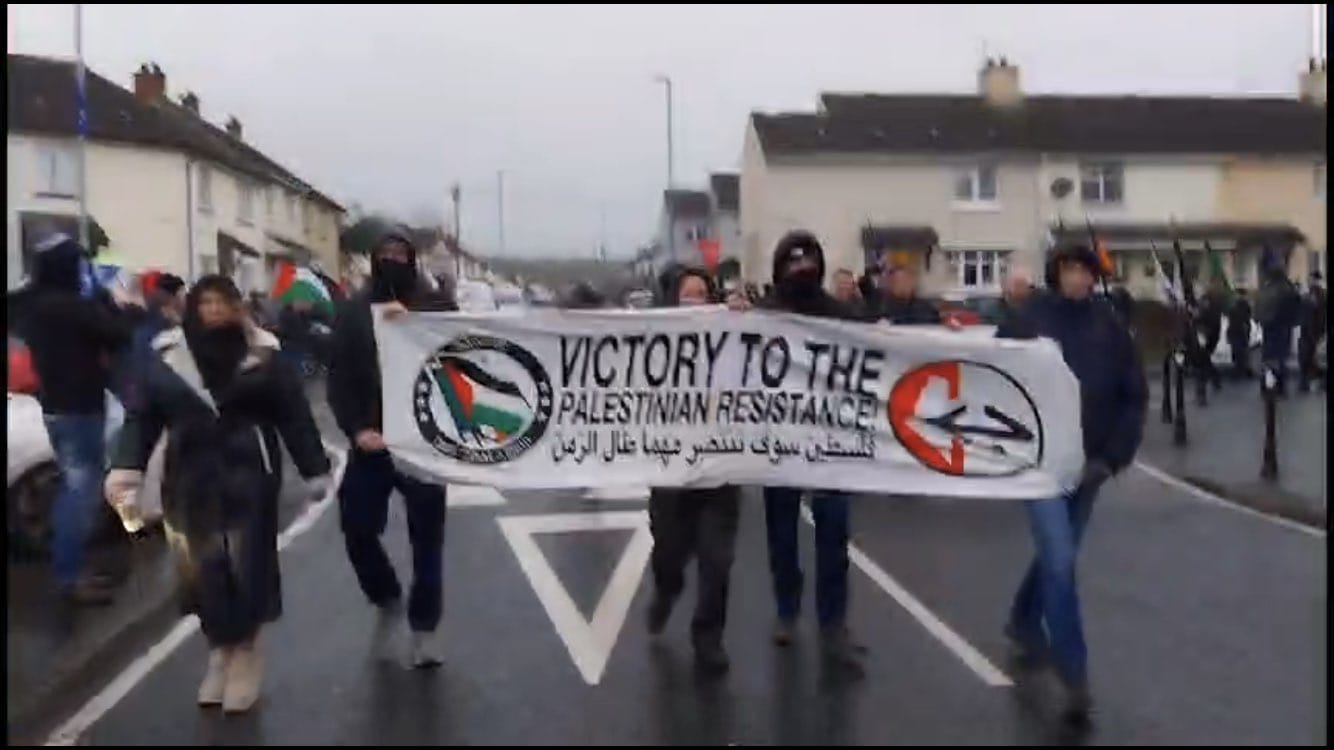
The bloc carried two banners: the one at the front was a new one in which the AIA called for anti-imperialist revolution and socialism, while at the rear the banner celebrated the Palestinian resistance. In between the banners marchers carried flags and placards.
New banner of the AIA in the organisation’s contingent on the march on Sunday. (Photo: D.Breatnach)
In the bloc men and women marched with a flags of the AIA, the Starry Plough, Palestine and Cumann na mBan. From the contingent on many occasions could be heard slogans of solidarity with Palestine and some equally applicable to that nation’s resistance or to Ireland’s.
“In the face of occupation – Resistance is an obligation!” and “No justice – No peace!” were in the latter category while “From the River to the Sea – Palestine will be free!”, “Free, free – Palestine!” and “Saoirse don – Phalaistín!” were specifically supporting the Palestinian struggle.
Most Republican organisations and some Irish socialist organisations attend the annual event, along with campaign groups and on occasion solidarity groups from abroad or Irish ones in solidarity with struggles abroad. Sinn Féin no longer attends but some supporters would as individuals.
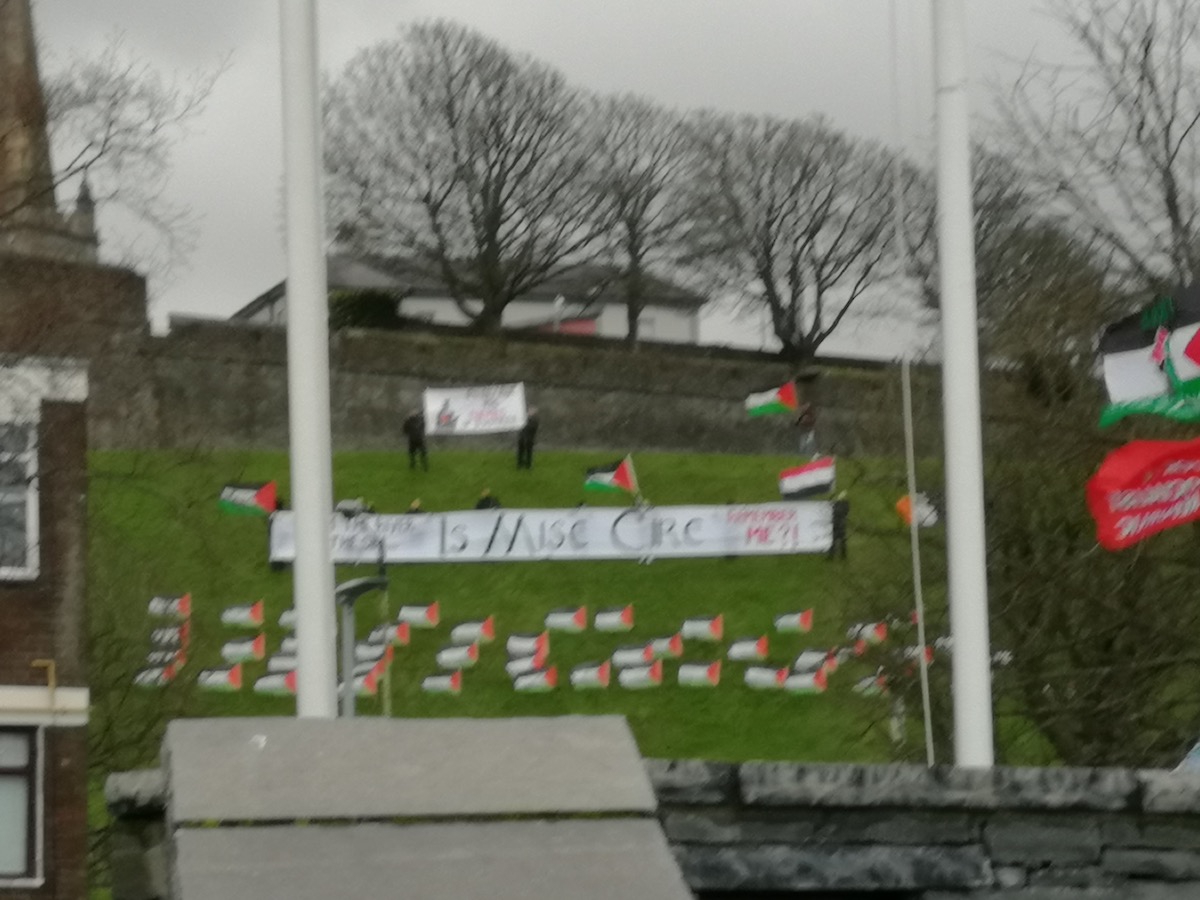
Giant Palestinian flag displayed below the Derry Walls above the rally below. (Photo: D.Breatnach)
THE MARCH ROUTE AND HISTORY
The Bloody Sunday march covers the same route as the anti-internment march in January 1972 when the British Paratroopers murdered 14 unarmed marchers and injured so many others. Preceded by the Ballymurphy Massacre in August 1971, it was followed by another in Springhill in July ‘72.
The British military claimed that the Derry victims had been armed and fired first and an inquiry tribunal headed by Lord Justice Widgery exonerated the Army and blamed the victims although the Derry Coroner, an ex-British Army officer had called it “sheer unadulterated murder”.
In 1998, presumably as part of the Good Friday Agreement deal, the British State began a new inquiry which however did not deliver a published verdict until 2010,6 stopping short of accusing the Army of murder but exonerating all the victims except one about which it was equivocal.
At that point, Sinn Féin’s Martin McGuinness said that the march should not be continued; however not one British soldier had even been charged, to say nothing of the commanders and Government Ministers who had either given the orders or arranged the cover-up – or both.
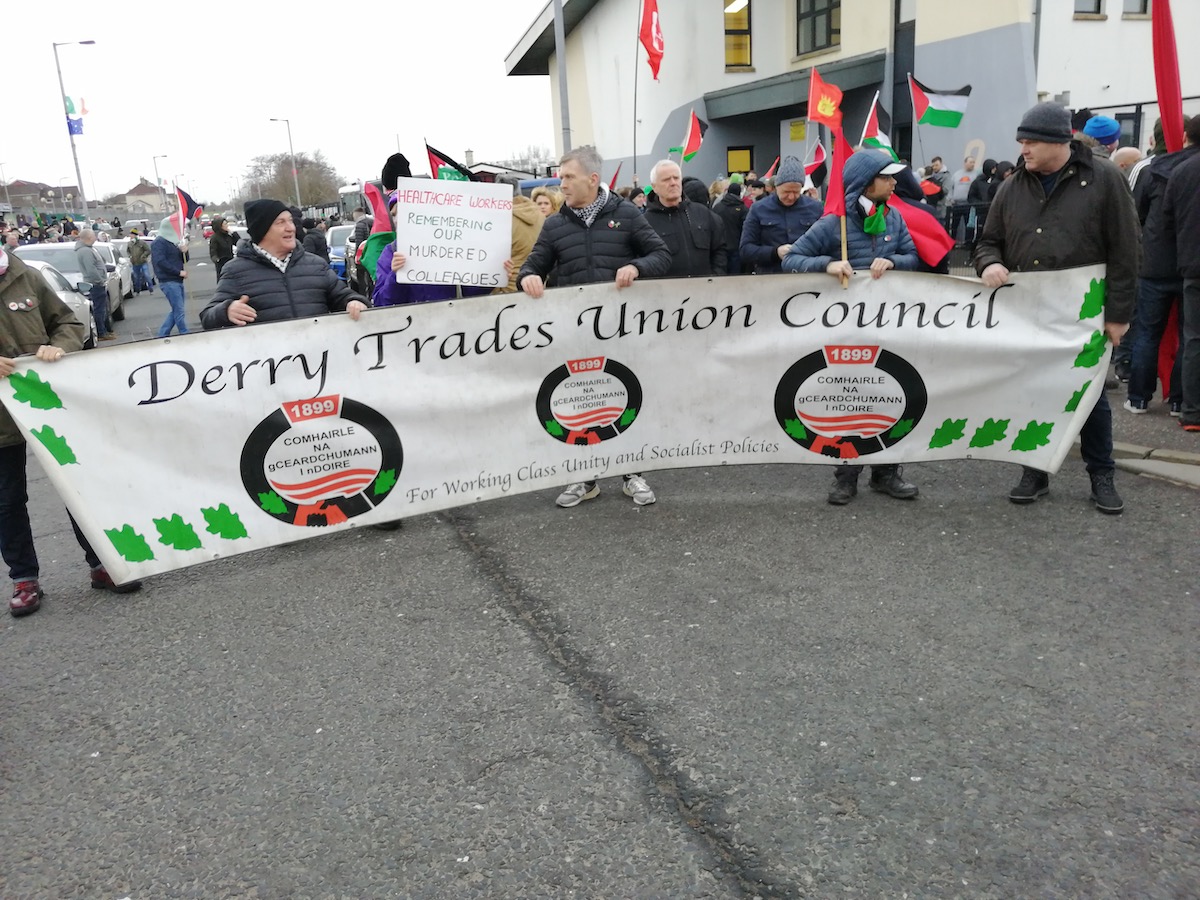
Banner of the organisation combining representation of trade unions in Derry. (Photo: D.Breatnach)
A small group of veterans of the original march and relatives, Kate Nash prominent among them, however decided to keep the march going and have done so every year, often in the face of accusations and disparaging remarks from supporters of Sinn Féin and others.
In 2022, the Massacre’s 50th anniversary, 20,000marched in it while the Bloody Sunday Trust, an institution and museum supported by the colonial state and Sinn Féin, organised a small “memorial walk” and indoors event in the Guild Hall – the only one reported by the mass media.7
An independent group, badly needed since the Coiste na nIarchimí is controlled by the Provisionals. (Photo: D.Breatnach)Display below Derry Walls created by the Saoradh Irish Republican organisation, according to their social media. (Photo: D.Breatnach)
Although veterans of the massacre and of the annual commemoration often meet one another only once a year at the commemoration, some having come from abroad, there are always new young people to be seen among them and hundreds come out to watch the march.
The march is an important commemoration of a massacre by British colonialism which still holds the colony of the Six Counties, a reminder no doubt inconvenient to unionists, neo-colonialists and those who have left the struggle, either through lack of will or for personal advancement.
In its championing and giving voice to other conflicts too, the commemoration march and other related events during the week are a strong expression of internationalist solidarity.
Wreath of the Bloody Sunday Commemoration Committee among others at the Bloody Sunday Monument. (Photo source:Bloody Sunday Commemoration Committee)
End.
FOOTNOTES
1The Israeli state intelligence agency reported that 12 out of 13,000 employees of UNRWA in Gaza had been implicated in the 7th October Palestinian raid following which at least some, possibly all, were sacked by UNRWA, apparently without any hearing or appeal process. The US, UK, Germany, Italy followed this up by suspending all funding to the relief organisation catering for 2 million people in dire circumstances.
2Traditionally, leading politicians of the main Irish political parties, both mainstream and Sinn Féin, have sent representatives to celebrate St. Patrick’s Day with US Presidents, many of whom are of Irish descent. This year a campaign has arisen calling on them not to do so but spokespersons of Fine Gael, Fianna Fáil and Sinn Féin have insisted they will attend, which the SDLP has declared it will not.
3Not to be confused with the family of Gerard V. Donaghy (20 February 1954 – 30 January 1972), sometimes transcribed as Gerald Donaghey, a native of the Bogside, Derry who was murdered by members of the 1st Battalion, Parachute Regiment on Bloody Sunday.
4Eight activists of British-based Palestine Action, a direct action organisation, who as a result of their actions against the Israeli-based military technology company Elbit in Britain, were charged with a total of 12 charges which included criminal damage, burglary and encouraging criminal damage. The trial, which commenced on November 13th, related to a series of actions taken during the first 6 months of Palestine Action’s existence from July 2020 to January 2021. In December last year, one activist was convicted on one charge by 10-2 majority, two were completely cleared and jury failed to reach a majority verdict on the rest of the charges on six remaining activists.
5That would be true of the majority ‘nationalist’ population of the city but not so much of the unionist minority, where support for Israel is more dominant, due in part to susceptibility to British propaganda and also simply out of sectarian hostility to anything favoured by the ‘nationalist’ community.
6At a cost of nearly £200m (€227.7m), half of which went in legal fees, a lawyer’s bonanza, to arrive at a decision that just about everyone in Ireland knew and many abroad knew already and which established no safeguards against a similar massacre being carried out by British military in future.
7Browser searches throw up report after media report, including Al Jazeera’s, of “hundreds” attending the early event, without a mention of the many THOUSANDS who marched later in the day.
News & Views No.9: Chile Coup – Twin Towers – the Legacy Bill
Diarmuid Breatnach (Reading time: 5 mins.)
September 11th is the anniversary of the al Qaeda attack on the new World Trade Center in the USA known as “the Twin Towers” and also of the Pinochet Coup in Chile. The former caused the deaths of 2,996 people and the latter of over 40,000.
These are not happy anniversaries and US Imperialism bears a major portion of the blame for both events.
How so, one might ask? The coup in Chile, probably with CIA help, sure. But the Twin Towers? That was a Muslim jihadist attack AGAINST the USA! Surely we’re not expected to believe that stupid conspiracy theory that the USA ruling class actually staged the attack?
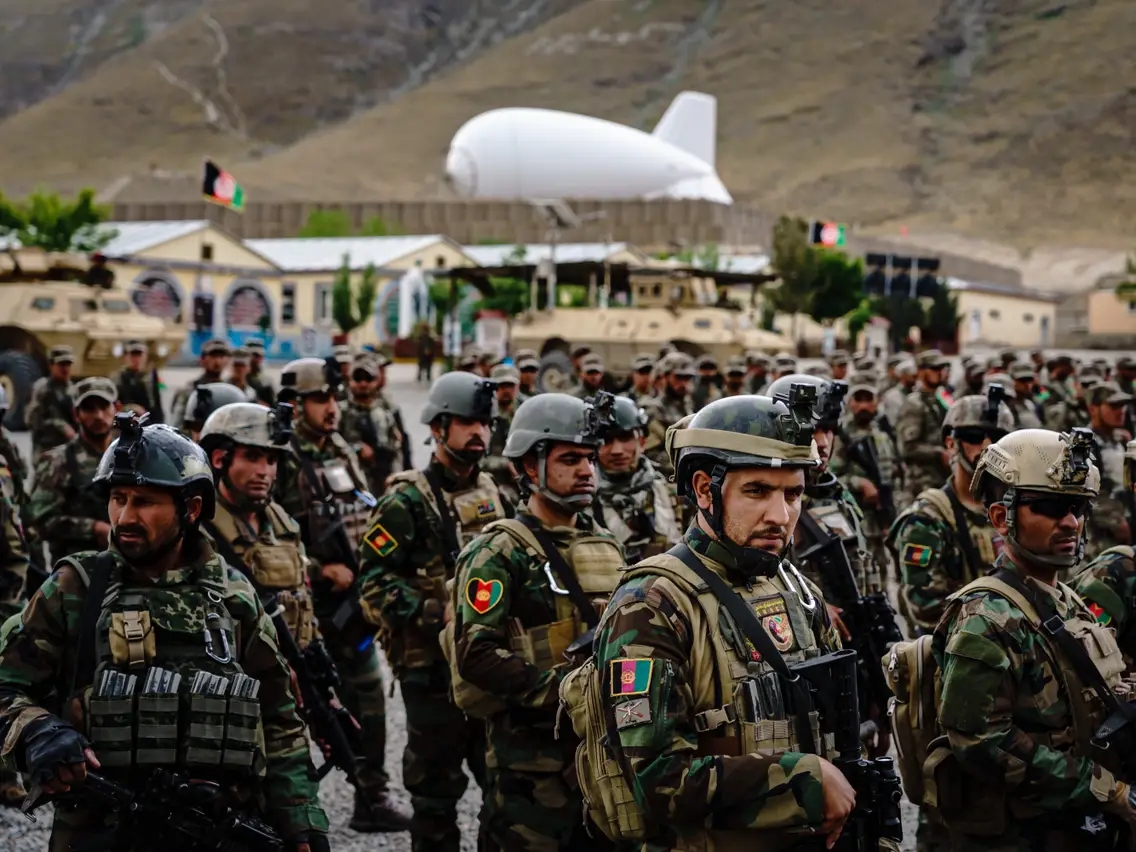
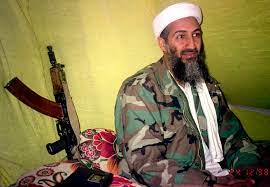
US proxy soldiers, Special forces Afghan National Army, 2021 (Photo sourced: Internet)Osama Bin Laden (10 March 1957 – 2 May 2011), Saudi-born founder and first general emir of Al Qaeda from 1988 until his assassination. (Photo sourced: Internet)
That is truly a crazy conspiracy theory but the historical truth does indeed involve a conspiracy. In 1997 the government of Afghanistan was socialist which was worrying for the USA, so in partnership with Saudi elements, they funded and even founded Muslim jihadist groups there.
These groups were to be encouraged to overthrow the socialist regime and when the USSR sent troops to support the government, to defeat the Russians too. Which they did.
But forget about fantasy stories of traditional tribesmen with ancient muskets fighting a world power’s army – these were jihadists, fundamentalists, armed with modern automatic weapons and mobile missile launchers including SAMs (Surface to Air Missiles).
Forget too about Rambo-led simple hill people – since the US achieved the overthrow of the socialist regime and invaded Afghanistan alongside their British allies, those jihadist groups have been squabbling over their share of the spoils, often murderously.
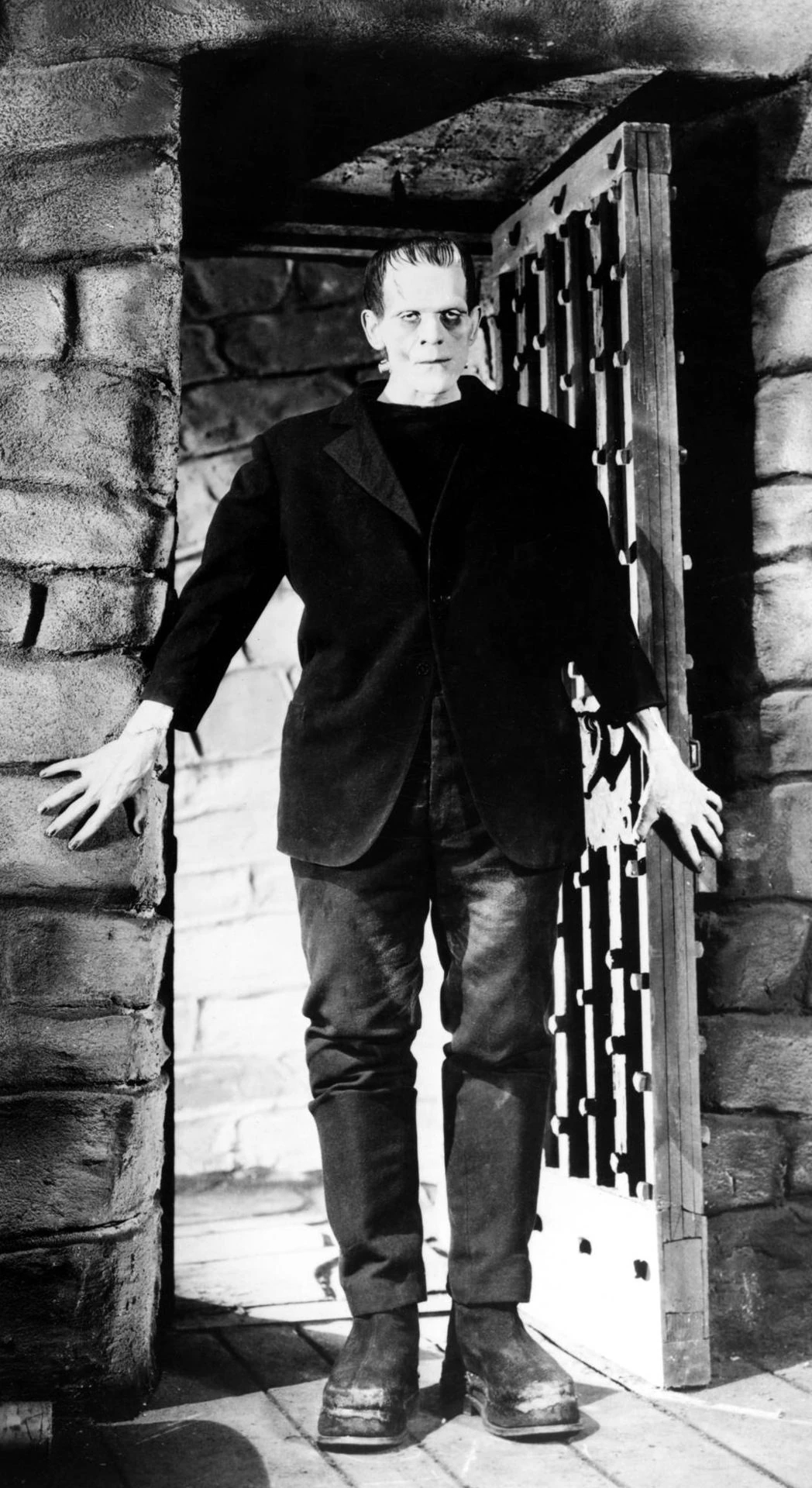
In fact, US imperialism is largely responsible for the world pestilence of not only jihadism of the Al Qaeda type, but the even more virulent Islamic State variety (which indicates Mary Wollstonecraft’s story of Frankenstein’s monster to be more prediction than fiction).
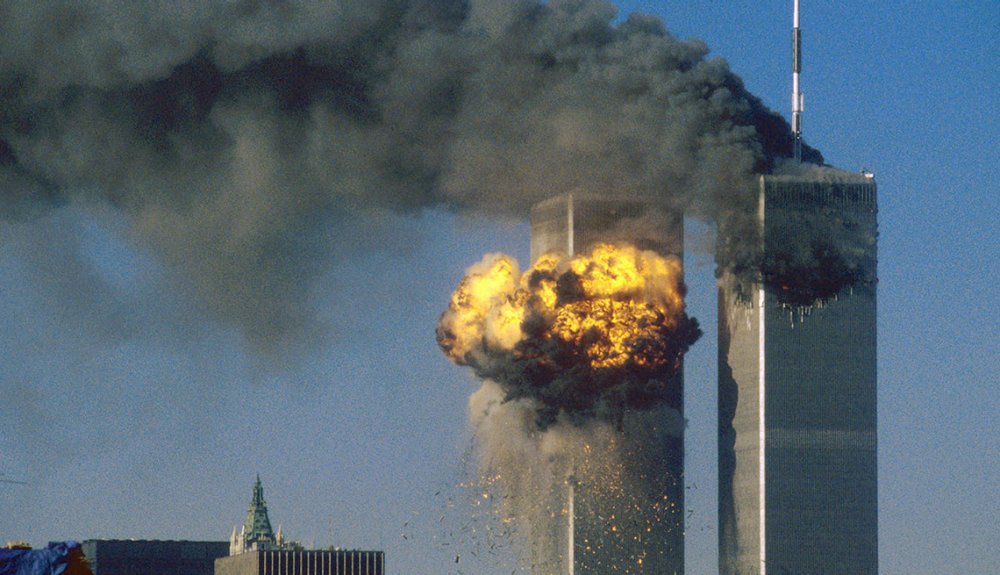
Explosion in one of the Twin Towers on 11th September 2001 in Al Qaeda attack. (Photo: Sean Adair/ Reuters)Frankenstein’s monster in Mary Wollstonecraft’s famous story; he returns to attack his creator (Image sourced: Internet)
Although US Imperialism had created Al Qaeda and although Saddam Hussein’s regime in Iraq was totally opposed to the jihadist group (and vice versa), US politicians used the attack on the Twin Towers to ‘justify’ the US military invasion of Iraq.
“Sweet are the uses of adversity” indeed when manipulated by US Imperialism for domestic consumption and for world public opinion, also when assisted by British Imperialism’s Labour Government, in particular by lying-through-his-teeth Tony Blair.
The US-led campaign against Iraq resulted in about 1.5 million deaths through economic sanctions alone followed by over 300,000 civilians in the Western military campaign. These figures do not include deaths and injuries of Iraqi military and of the invading allies under the USA and UK.
Nor do those figures include the many deaths, military and civilian, in internal conflicts since the invasion of Iraq which continue to mount.
The deaths resulting from the coup in Chile were overwhelmingly of civilians as the coup was carried out by the Army with little opposition within the military and the civilian population were mostly unarmed.
Most of the deaths occurred in succeeding days and years as the regime rounded up communists, trade union militants and others suspected of having supported Allende’s party, to torture and execute them, including most famously the renowned musician and singer-songwriter Victor Jara.
The anniversaries of both the Pinochet coup and the Twin Towers have been commemorated in various parts of the world with, it appears, the coup being remembered in most of them, not only in Latin America but also in many countries in Europe where Chilean political exiles found refuge.
In the USA, of course, the attack on the Twin Towers was officially commemorated and probably communally too much more so than the coup in Chile.
Another imperialist-generated disaster, the anniversary of which falls only a couple of days after those two, is that of the Oslo Accords, signed on 13th September 1993 and often also known as a stage in “the Palestinian Peace Process”.
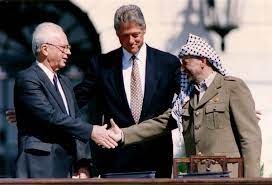
At the White House, supervised by Bill Clinton, elected chief of US Imperialism at the time, Yitzak Rabin for the Israeli Zionist state and Yasser Arafat, for the Palestine Liberation Organisation, signed an agreement, as a result of which the PLO would be permitted to run their own statelet.
Oslo Accords, 13 September 1993, Washington: Yasser Arafat of the PLO shakes hands with Yitzak Rabin of the Zionist State under the stewardship of (then) US President Bill Clinton, representing US Imperialism. (Photo: Gary Hershom/ Reuters)
Hailed as a great breakthrough by most media at the time, the PLO, dominated by Arafat’s Al Fatah, got to have limited self-government within the Zionist State, with the borders of any future Palestinian state undefined and no mention of the millions of Palestinian exiles around the world.
Although the increasing encroachment on Palestinian lands by Zionist settlers was temporarily halted, the land already taken and built upon remained in Zionist hands, that issue and others ‘to be discussed later’ but the Palestinians were to give up the armed resistance immediately.
The South African pacification process had begun earlier and, though enfranchisement of non-white South Africans was not to come until 1994, it was clearly on the way. The ANC promoted pacification processes to Al Fatah and both parties promoted them to Provisional Sinn Féin.1
The Palestinian ‘Process’ was controversial among their people from the start and grew more so as it became clear how little the Palestinian cause had gained and how much had been set aside, along with the growing official corruption and nepotism growing among the Al Fatah organisation.
Though the pacification process was widely rejected in Palestine and failed to install a widely-recognised ‘official’ collusive leadership, it did achieve the fragmentation of the Palestinian leadership and helped to ‘justify’ the demonisation of Hamas, winner of the 2006 elections.
ALTERNATIVES
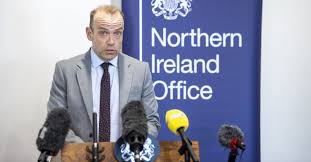
The Secretary of State for Northern Ireland (sic) is quoted in the media as saying that there is no alternative to the UK’s legacy legislation, which proposes to prevent recourse in law for any crimes committed by its soldiers, colonial police, proxies or Government Ministers.
Secretary of State for the Northern Ireland (sic) colony, Chris Heaton Harris (Photo cred: PA)
The legislation in question is titled The Troubles (Legacy and Reconciliation) Bill.
All political parties in Ireland on both sides of the British Border have vigorously opposed this legislation and THERE CLEARLY IS AN ALTERNATIVE, which is to abandon it. What the UK’s ‘colonial governor’ of the Six Counties means is: no alternative acceptable to the ruling class.
While we’re on alternatives, all liberation movements had and have the alternatives to embracing pacification processes, which is to maintain the path of resistance upon which they embarked until the day they win that for which their people and fighters have sacrificed their liberty and lives.
Allende and the communists in Chile had the alternative of arming the people and purging the Army but instead chose to put their faith in the ‘loyalty’ of Pinochet, ‘democracy’ and the opinion of the Western powers.
“The people armed cannot be harmed”, perhaps, rather than “The people united can never be defeated”.2 Allende’s error cost him his life but also the lives of hundreds of thousands of others.
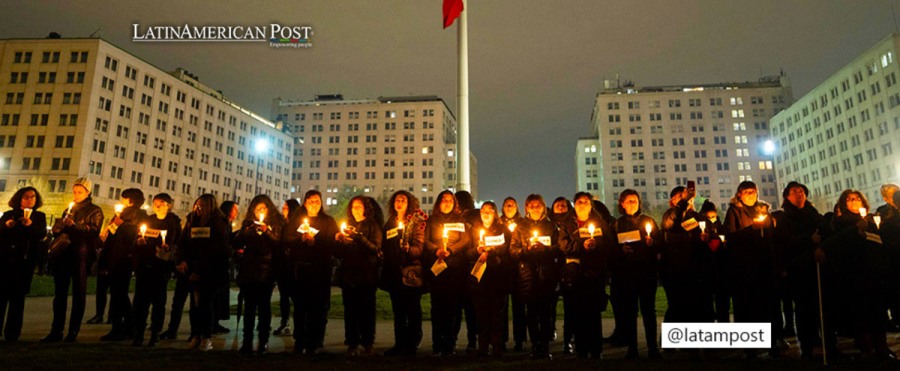
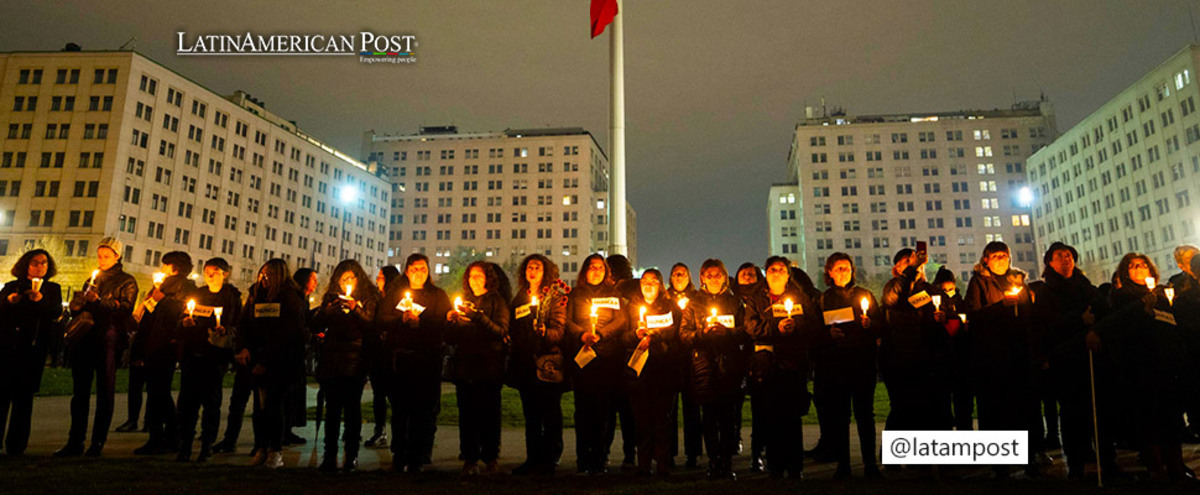
Women on 11th September hold a candlelit commemoration at La Moneda, Santiago, Chile for the victims – in particular of sexual violence – of the Pinochet coup and dictatorship. (Photo: Adriana Thomasa / EFE)
Imperialists have the alternative of respecting the right to self-determination of the peoples of the world and to cease from exploiting, oppressing and repressing them.
But if they did that, they wouldn’t be imperialists, would they? And since they cannot change their nature, they have to be overthrown.
End.
FOOTNOTES
1Provisional Sinn Féin signed up to the Irish Pacification Process in 1998 and they and the ANC then moved on to promote a pacification process to the leadership of the Basque movement for independence, which also finally signed up to it without even obtaining release of the political prisoners. By that time the Palestinian Process had shown its empty promise and the Second Intifada (2000-2005) demonstrated its rejection by most Palestinian youth and the elections to the 2006 Palestinian Legislative Council were won convincingly by Hamas.
2An alternative slogan to “El pueblo unido jamás será vencido” was even then being promoted by a smaller communist group: “El pueblo armado jamás será aplastado!”, i.e ‘The armed people will never be crushed’.
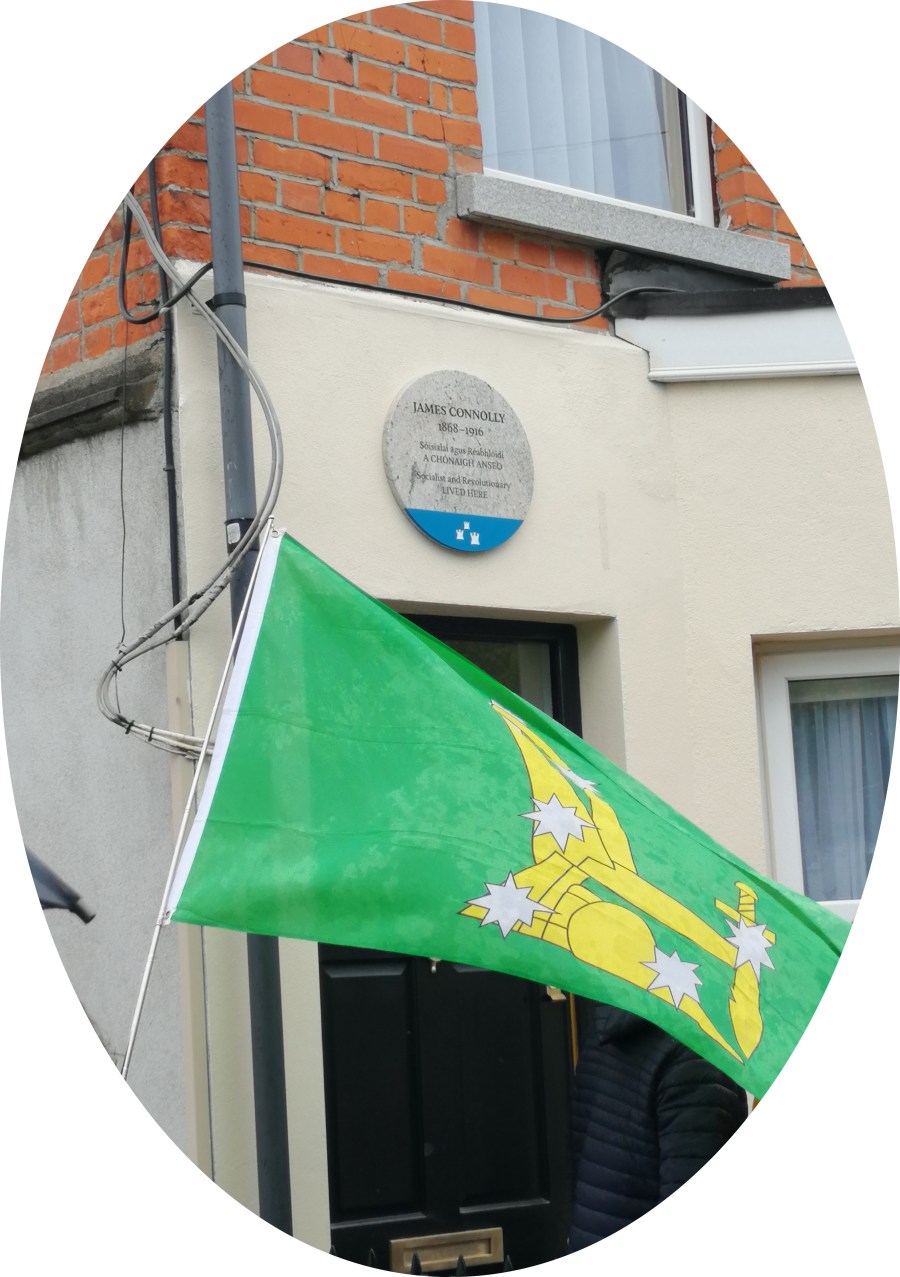
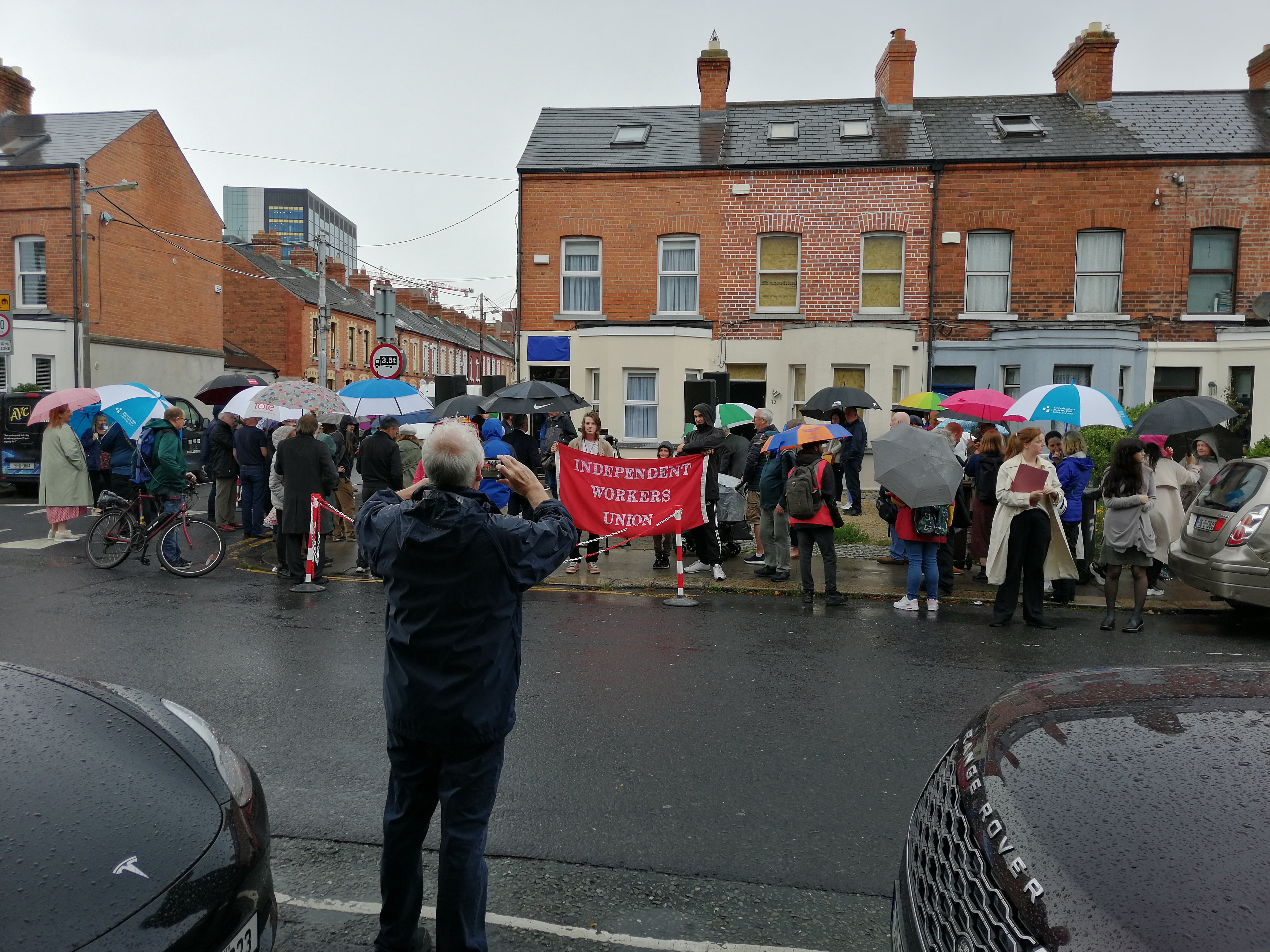
A new plaque commemorating James Connolly was unveiled on the morning of 31st July on 70 South Lotts, the house to which he returned from New York with his wife Lillie and children in 1910 and lived there until May 1911.
(Photo: D.Breatnach)
Connolly was born and reared in Edinburgh, left school at 10 and worked with his older brother John for the local authority as a carter, lied about his age and name to join the British Army, in which he first saw Ireland and where he met Lillie Reynolds; they were married soon afterwards.
Like his brother, Connolly became a militant socialist and trade unionist and returned to Ireland at the request of socialists to form the Irish Socialist Republican Party, the first socialist party in Ireland but left for the USA when the party failed to recruit significant numbers.
The ISRP’s office was in Middle Abbey Street, across the road from the premises of the Irish Independent, owned by Irish nationalist William Martin Murphy who was to become an arch-enemy from the Lockout and strikes of 1913 onwards1.
Connolly was a historian and journalist as well as a socialist, trade union organiser and a revolutionary. A report in Breaking News on the unveiling infers that he reluctantly committed to the Rising with the Volunteers; in fact, he had been pushing them to rise for months!
Unveiling speeches
The event started late and in rain. Dáithí De Róiste2, Dublin’s current Lord Mayor, opened the proceedings and commented that the plaque on the house was a reminder that Connolly lived a life in some ways like many ordinary Dubliners, living in a Dublin house and walking city streets.
Dublin Mayor Dáithí De Róiste speaking at the event. (Photo: D.Breatnach)Historian Conor McCabe, who did the research for the plaque, speaking outside No.70. (Photo: D.Breatnach)
Historian Dr Conor McCabe, of Queen’s University Belfast, proposed the plaque as his research established the background that Connolly was living at the address around the time that his most famous work, Labour In Irish History, was first published in book form.
In deference to those in attendance standing in the persistent rain, Conor McCabe kept his speech very short. This was not the case with every speaker.
Joe Cunningham, General Secretary of Siptu3, an amalgamation with other unions of Jim Larkin’s ITGWU which Connolly had led for six years, commented in his speech that it was Connolly who ensured that the interests of working people were incorporated in the 1916 Proclamation4.
Also that, at the ceremony of raising an Irish flag over Liberty Hall5 in April 1916, had declared that “The cause of labour is the cause of Ireland, the cause of Ireland is the cause of labour.”6
Section of crowd in front of No.70 waiting for event to begin. (Photo: D.Breatnach)
Dublin City Council Commemorations & Naming Committee was responsible for the placing of the plaque, in consultation with the house occupants and its chairman, Councillor Mícheál Mac Donncha7 welcomed suggestions from the public for commemoration of people and events.
Sinn Féin Councillor Mac Donncha also commented that James Connolly was a personal hero of his.
Jim Connolly Heron, great-grandson of James Connolly, was called to say a few words and invited family members present to join him in front of the house while he spoke and commented also on the importance of commemorative plaques in protecting historical sites.
He did so in reference to the plaque on a house in Moore Street that had disappeared and come to light in a property developer’s office, raising concerns that had led to the long Moore Street conservation struggle.8
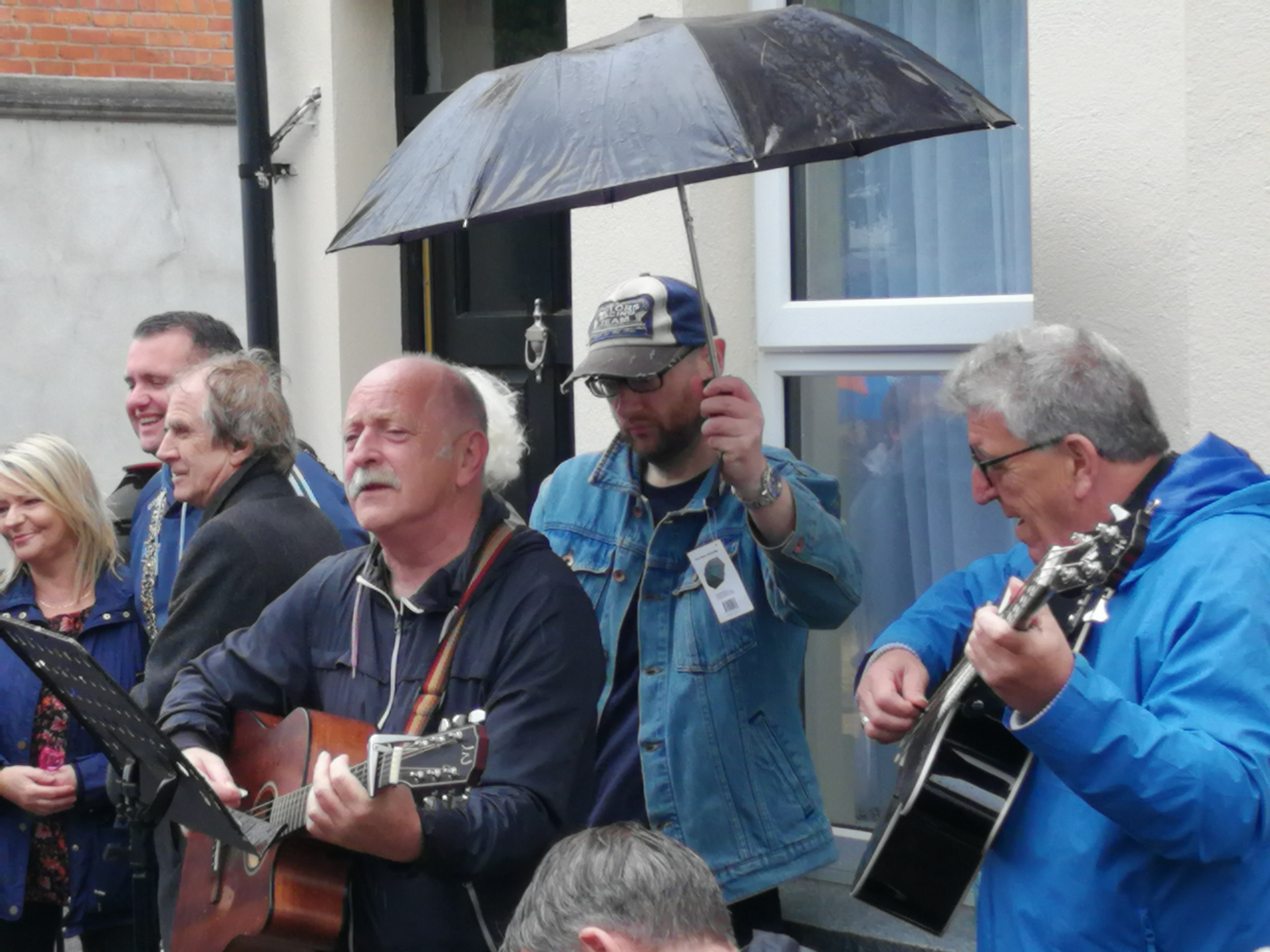
Music and song for the event was performed by The Pullovers ballad group but the amplification system had been removed by then which was a pity as it was needed for the music.
Ballads were performed at the event by The Pullovers band. (Photo: D.Breatnach)
The 1913 Lockout
James Connolly and family returned to Dublin when Jim Larkin9 offered Connolly a post in the young breakaway Irish Transport and General Workers’ Trade Union, which he took up in 1910. Three years later the union was in a fight for its life.
It is sometimes wrongly claimed that the 1913 Lockout was an attempt by employers in Dublin to prevent workers from joining a trade union but there were other unions operating in Dublin during the period and they were accepted by most of the employers.
Apart from the ITGWU recruiting large numbers of ‘unskilled’10 manual workers, it pursued its objectives militantly, using sympathetic solidarity action by other workers to increase the effectiveness of the workers who were in industrial dispute with their employer.
In August 1913 a combination of around 200 employers presented their workforce with a declaration to sign which committed them to having nothing to do with the ITGWU. En masse, the workers refused to sign, were locked out while others struck work and were locked out too.
Right from the beginning the Dublin Metropolitan Police11 attacked the workers on behalf of the employers and in a baton charge on Eden Quay on 30th August fatally wounded two workers, also beating strikers and onlookers the following day in O’Connell Street (‘Bloody Sunday 1913’)12.
As a direct response, Connolly and Larkin set up the Irish Citizen Army as militant response to police attacks, dedicated also to Irish independence and their flag was the gold Starry Plough on a green background,13 which they flew over the Clery’s building in 1916.14
The only Starry Plough flag unfurled at the event, brought by a member of the attendance. (Photo: D.Breatnach)
Comment
The only Starry Plough to be seen at the event was one unfurled during the event independently of the organisers and speakers.
Many who claim to admire Connolly or even to follow his teachings do so on occasion in words but never in action and if Connolly were alive and acting as he did when he was, most of the speakers at the unveiling event would call, if not for his shooting, certainly for his jailing.
SIPTU is much larger than the ITGWU was but it and other unions are much less effective; as a result of the lack of active resistance by the leadership, union membership in Ireland is at an all-time low in modern times. Nor would Connolly have ever agreed to the partition of Ireland.
The Irish Labour Party, which Connolly and Larkin formed in order to give the working class a voice in municipal affairs, has been in coalition government a few times, always capitalist and most often with the right-wing Fine Gael, when they have joined in attacks on the working class.
Joan Burton, while Tánaiste15 of the Labour-Fine Gael coalition government in 2014, complained about working class people being able to afford video-phones and tried to get people jailed for organising an effective protest against her in Jobstown.16 She too attended the unveiling today.
Joan Burton, who attended the event. (Photo: D.Breatnach)
Fianna Fáil is a party of the Gombeen client class and has been in government more often than any other, whereas Sinn Féin in its current incarnation is seeking to replace it with more of the same.
It is a tribute to the memory of James Connolly held so dearly among the working people that these types, so far from Connolly in their reality, are obliged to pay public homage to the man and to his principles while their daily practice is in opposition to all that he stood for.
End.
FOOTNOTES
1An editorial in his newspaper, The Irish Independent (still one of two main newspapers of the state), after a number of British executions of a number of 1916 leaders, called for continued executions of leaders prior to the execution of Connolly and Mac Diarmada, the last of the 14 to be executed in Dublin (Kent was shot in Cork and Casement hanged in London).
3The largest union in Ireland, owner of the current Liberty Hall which stands on the ground of the original union building.
4There is no record that this is the case but it is a natural and widely-held assumption. It is a fact that the Proclamation was printed in Liberty Hall.
5Cunningham said it was “the Irish flag” which most would think a reference to the Tricolour. However that flag had not yet been accepted by the majority as the primary flag of the nation, which really occurred after the 1916 Rising. The flag raised instead by teenager Molly O’Reilly at Connolly’s request had the golden harp on a green background, the essential flag of Irish Republicans from the 1790s until the 1916 Rising.
6This was not a random statement by Connolly but rather a strategic one; on an earlier occasion he had observed that of all social classes in Ireland, the working class remained “the incorruptible inheritors of the fight for Irish freedom”. Connolly wrote that in his foreword to his work Labour in Irish History, clearly indicating that only the working class could be trusted to lead the national struggle through to successful conclusion.
7A prominent member of one of the groups campaigning for Moore Street Battlefield conservation, the Save Moore Street Trust, of which Mac Donncha is Secretary.
8That occurred at the beginning of this century and the struggle has been ongoing since.
9Like Connolly, also a migrant and member of the Irish diaspora but from Liverpool. He founded the Irish Transport & General Workers’ Union after his departure from the British-based National Union of Dock Labourers, for which for a time he had been chief organiser in Ireland. Most of the NUDL’s members in Ireland left to join the ITGWU but in Belfast there was a division along sectarian lines.
10This is the general appelation for work not requiring long periods of training. However, anybody who has been employed in work of this category soon learns that such work requires skill to achieve the objectives set, to pace oneself and to guard against injury. This is the reason those recruiting for such ‘unskilled’ work prefer ‘experienced workers’, a code for ‘skilled’.
11A police force of the period for Dublin City, most of its members being without firearms, unlike the armed all-Ireland colonial gendarmerie of the Royal Irish Constabulary (of which the Police Service of Northern Ireland is a descendant body). DMP minimum height requirements were 5ft 9” in a city where many working people were of low stature; this disparity gave substantial momentum to the swing of a truncheon.
12The event wrongly named as leading to the death of two workers, whose deaths were caused by the previous day’s police attack on Eden Quay, just by Liberty Hall. However, a previously healthy Fianna Éireann boy, Patsy O’Connor, who was clubbed in the O’Connell Street police riot while he administered first aid to a victim, suffered frequent headaches thereafter and died in 1915 at the age of 18.
13The design has seven stars in the Ursa Mayor configuration, with the design of a plough following the stars and a sword as the ploughshare. There is also a plainer version flown by the Republican Congress of the 1930s, the outline of the Ursa Mayor constellation in white or silver stars alone on a blue background.
14The flag survived the shell explosions and raging fires along the southern half of O’Connell Street and is currently in the Military History Museum, Collins Barracks, Dublin, along with a number of other flags flown by the insurgents during the Rising.
15Title of the Deputy Prime Minister in the Irish government.
16A number of activists from different organisations, including Paul Murphy TD (member of the Irish parliament) were arrested in raids some time later and among the charges was “kidnapping” Burton. The untruthfulness of a number of witnesses for the Prosecution including a senior Garda officer were exposed (ironically by video taken by protesters) and the jury acquitted all the defendants of all charges.
Opposition leader Elly Schlein accused the prime minister of “historical revisionism” over her ambiguous language.
08/03/2023 PUBLICO / EFE (Translated by D.Breatnach)
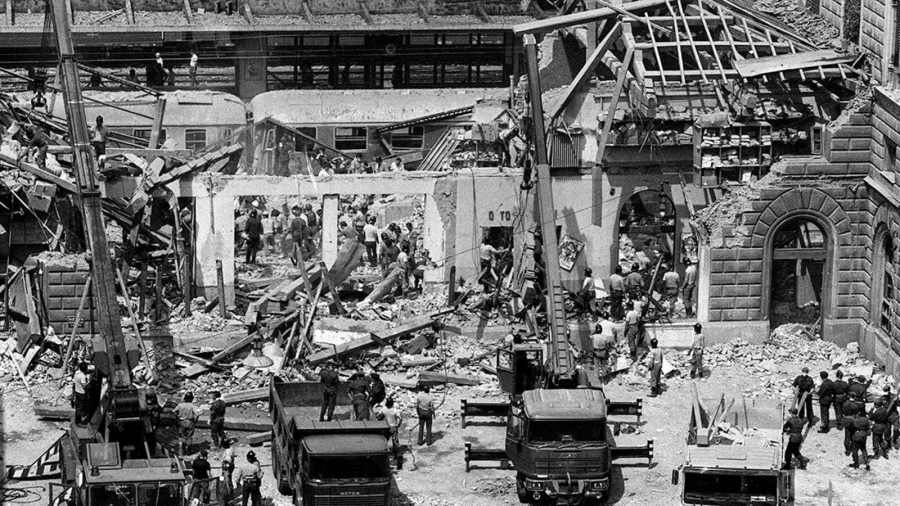
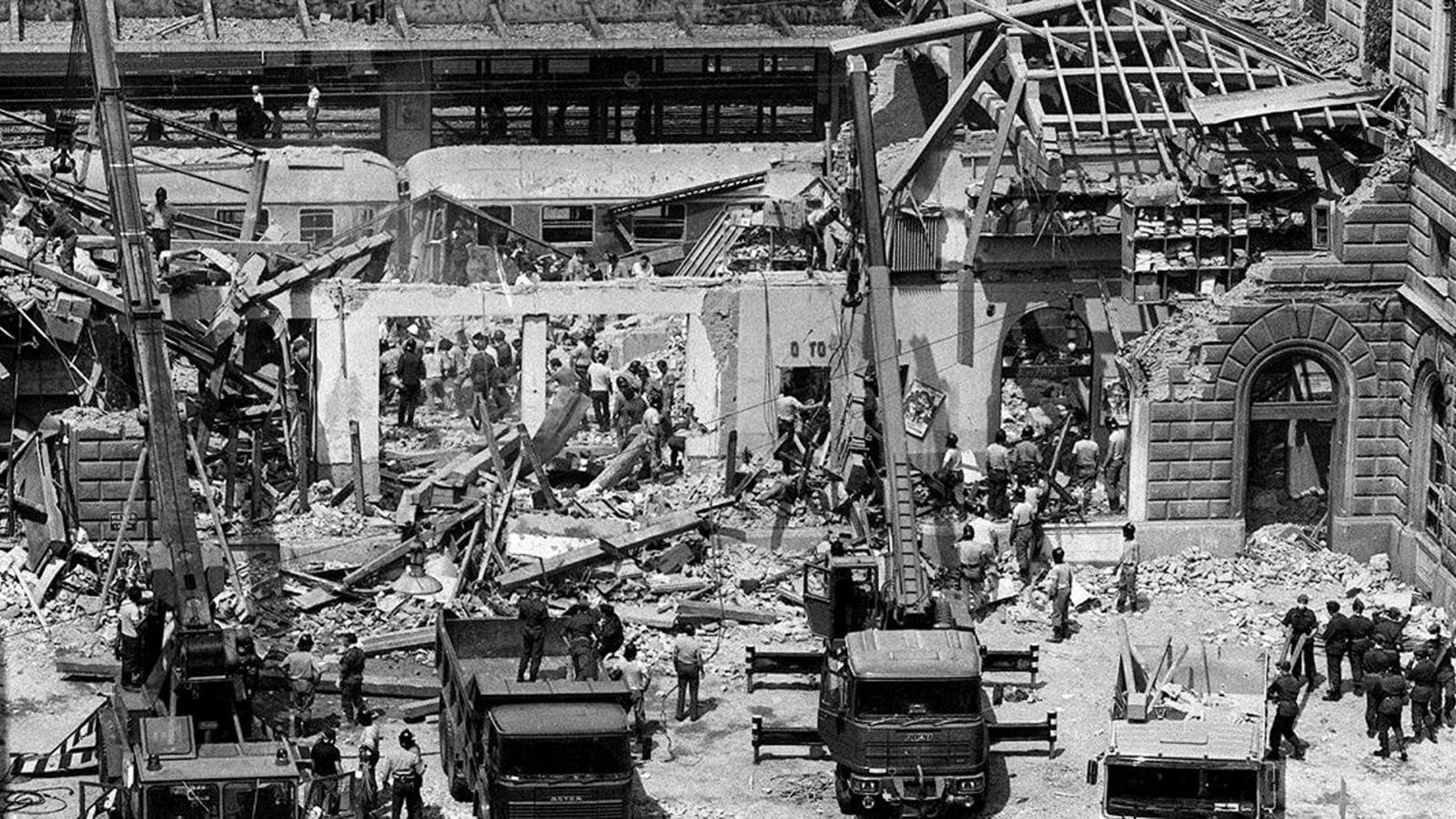
Italian Prime Minister Giorgia Meloni completely avoided using the word ‘neofascist’ in her message marking the 43rd anniversary of the Bologna Massacre, a terrorist attack by a far-Right organization that killed 85 people.
Meloni did not go to Bologna to participate in the commemoration.
“43 years have passed but, in the heart and conscience of the nation, the violence of that terrible explosion still resonates with all its force,” said the leader of the Executive and the ultra-right party Brothers of Italy.
Giorgia Meloni, the Prime Minister of Italy. (Photo: Fabio Frustaci / EFE)
In her message, she asked to “get to the truth about the massacres that marked Italy in the postwar period,” an ambiguous phrase that makes no direct reference to the far-right groups that carried out the massacre on 2nd August 1980.
The absence of specific terms in Meloni’s speech to refer to the attack has prompted opposition leader Elly Schlein, a progressive, to accuse Meloni of promoting “historical revisionism.”
“We are here in Bologna together with the families of the victims of the massacre to reiterate that we do not accept any further attempts to rewrite history. The judicial evidence already makes it clear that it was a neo-fascist massacre and also with subversive intent,” Schlein said.
In the message shared by the president, Sergio Mattarella, to commemorate the date, he did refer to “the neo-fascist matrix of the massacre.” Likewise, he recalled that in the subsequent trials “ignoble deviations, in which secret associations and treasonous agents of the state apparatus participated,” came to light.
Meloni has ruled out any anti-democratic nuance of her formation, but she maintains as a symbol of the Brothers of Italy the so-called “tricolor flame”, emblem of the youth organisation of the old and post-fascist Italian Social Movement (MSI) in which she was a member of her youth.
The Bologna Train Station, Italy, following the fascist explosion on 2nd August 1980 (Photo sourced: Internet)
The Bologna Massacre
The Bologna massacre was the most serious terrorist attack in Italy after World War II, in which 85 people died and more than 200 were injured and extreme right-wing militants belonging to the organization Armed Revolucionary Nuclei were convicted for it.
Comment by D.Breatnach: However, parts of the Italian State were implicated in the bombing and/or coverup too, with elements in the Italian police, judiciary and secret service but also with suspicions of CIA/NATO involvement. It seemed that the purpose of that bombing and others in the period was to create fear and confusion in which the State could return to fascism.
A broad group of socialist Republicans gathered at the grave of Theobald Wolfe Tone on Sunday 2nd July to honour his memory and to reiterate their commitment to an independent and socialist Ireland outside of imperialist military alliances.
Wolfe Tone’s grave in the Bodenstown Church graveyard has been a place of pilgrimage for Irish Republicans at least since the days of Thomas Davis1 of the Young Irelanders of the 1840s, who wrote of his own visit to the grave and composed the song “In Bodenstown’s Churchyard”.
The late 1960s saw huge numbers of people in attendance at annual commemorations there near the village of Sallins, Co. Kildare, including not only Sinn Féin2, who led them, but many political and social organisations, GAA clubs, along with many non-aligned people.
Over the years, the voluntary and unfunded National Graves Association has improved the site comprehensively and sensitively, leaving the ruins of the Protestant church as they are but building a stage attached to one side, fronted with plaques and commemorative flag stones.
Commemorations currently are usually organised around a Sunday near the date of the patriot leader’s birthday on 20th June but have to be managed between different groups wishing to hold their own commemorations.
Speeches, songs and Garda harassment
The Annual Wolfe Tone commemoration organised by the Wolfe Tone Commemoration Committee took place over the weekend with members of a number of groups and Independent Republicans in attendance.
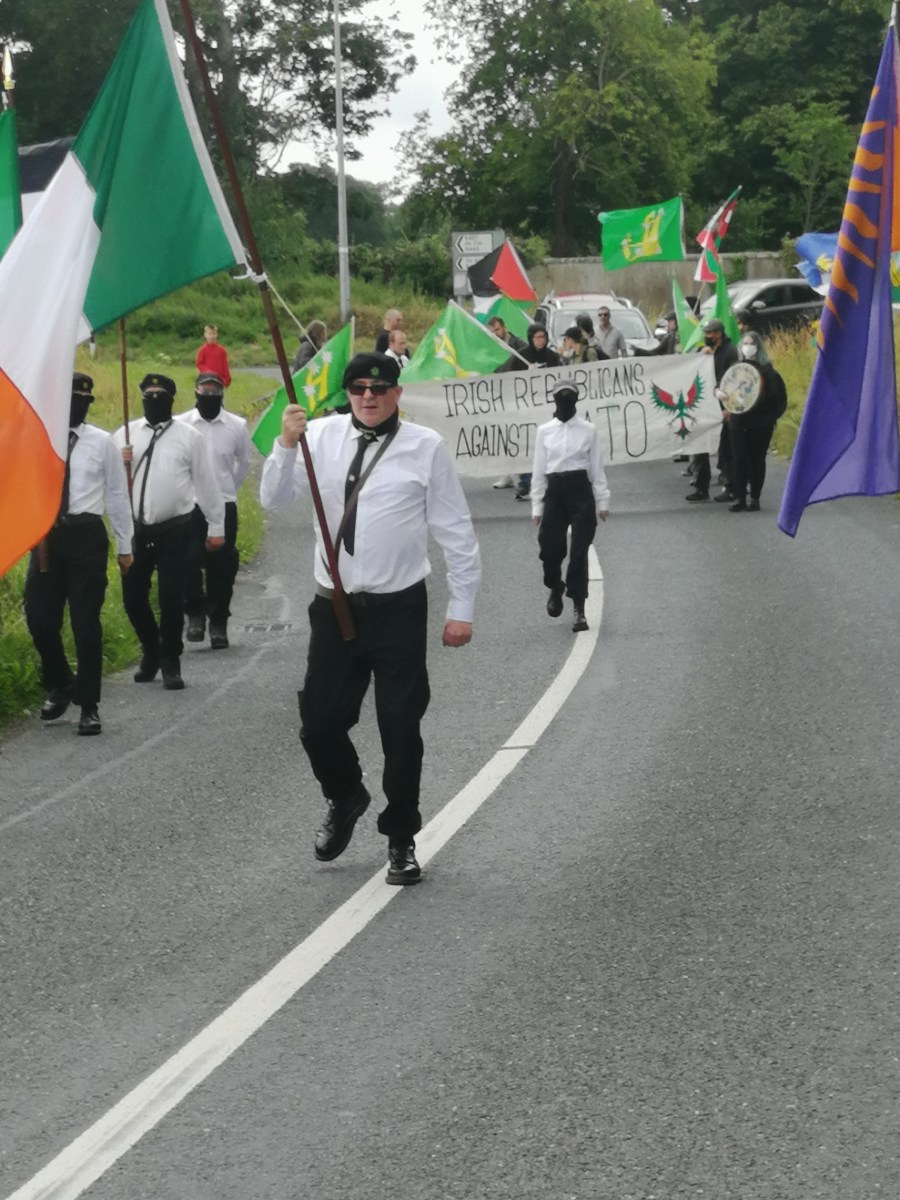
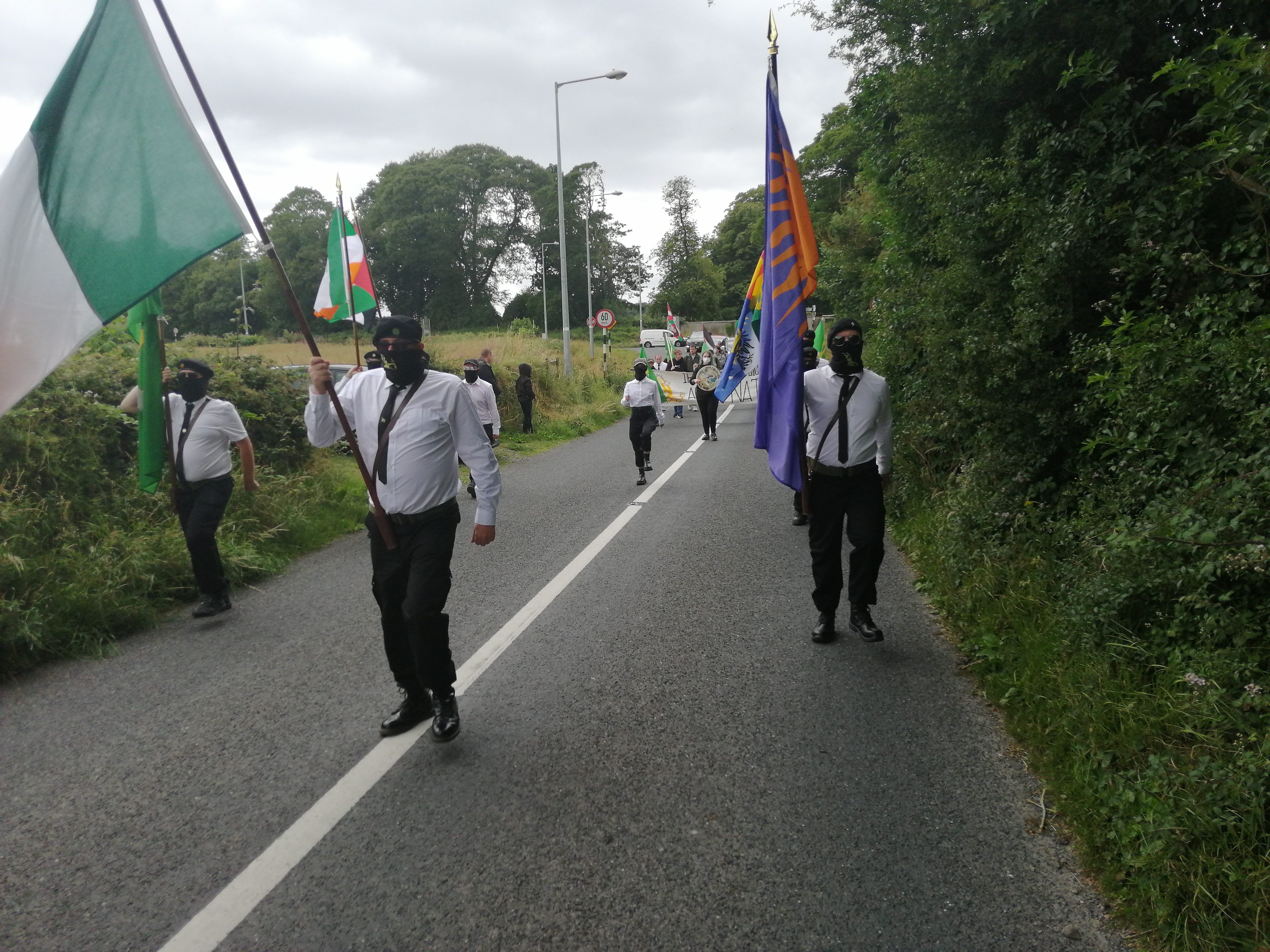
A Socialist Republican Colour party led the march up from the bottom of the road, turning in to the graveyard through a side gate and taking up positions in front and to one side of the monument, at ordú scíthe (parade rest) position but with flags held high.
Colour party in front of Wolfe Tone monument, Bodenstown Churchyard (Photo: Rebel Breeze)
Behind the colour party followed a crowd carrying banners bearing the legends “Irish Republicans against NATO”, “We serve Neither King nor Kaiser but Ireland” and an assortment of flags including green-and-gold Starry Ploughs, Irish Tricolour, Palestinian and Basque national flags.
The event was chaired by a young Socialist Republican who spoke about the importance of the event before introducing a representative of a midland Republican commemoration group who read a short message of solidarity.
This was followed by a socialist republican accompanying himself on guitar singing The Three Flowers.3
The main oration was delivered by veteran Independent East Tyrone Republican Margaret McKearney who linked the past with the present, including the current housing crisis, the British occupation and the Irish State’s push to join PESCO and NATO military alliances.
Musician performing The Three Flowersat the Wolfe Tone monument (Photo: Rebel Breeze)Veteran Republican from Tyrone delivering the oration at the commemoration event (Photo: Rebel Breeze)
There was a clear message at the event that the push towards NATO will be energetically resisted at every turn by the people of Ireland.
Wreaths were laid and a minute’s silence was observed, while the colour party lowered the flags in memory of all those who paid the ultimate sacrifice in the ongoing struggle for Irish Freedom. The event was brought to a close with the musician playing and singing Amhrán na bhFiann.
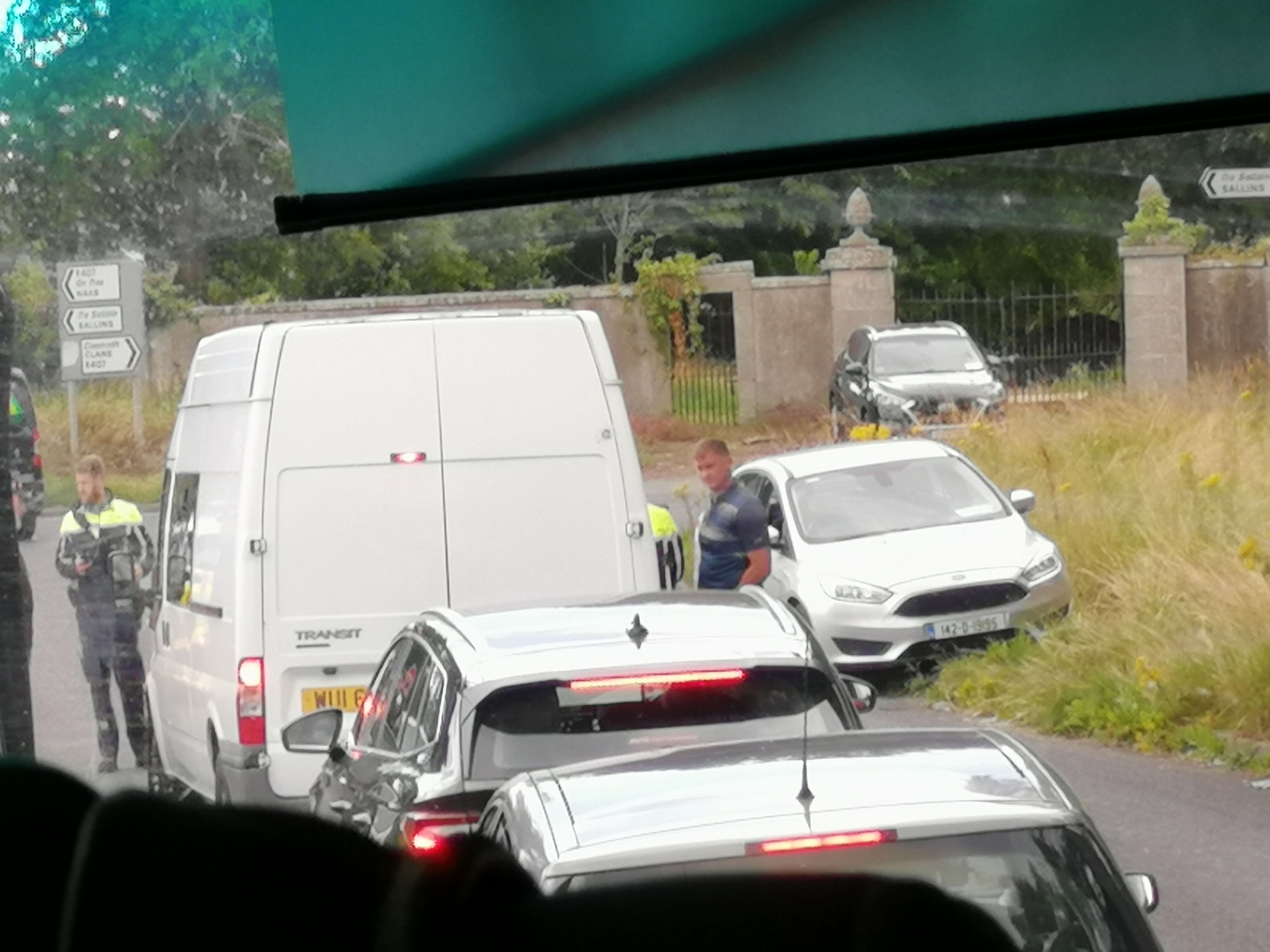
A handful of Gardaí4 in uniform and in plainclothes (Special Branch, the political police) were parked outside the graveyard watching people arriving and leaving but at that point having no direct interaction with those attending the event.
Part of long tail-back cause by Garda checkpoint very near to Bodenstown Churchyard after the commemoration event (Photo: Rebel Breeze)Gardaí in uniform and Special Branch in plain clothes harassing and attempting to intimidate people who had attended the commemoration event (Photo: Rebel Breeze)
However, once the event concluded, the Gardaí set up a checkpoint at the bottom of the road and began to harass and attempt to intimidate drivers of vehicles, stopping them, asking for identification, where they were from etc, causing a long tailback.
This is part of the regular harassment of Irish Republicans by police on both sides of the British Border.
“The Father of Irish Republicanism”
Theobald Wolfe Tone (1763-1798) was formally a member of the Church of Ireland5 congregation (Anglican), in his time the dominant religious group in England-occupied Ireland but also one of the smallest.
No-one could be elected to the Irish Parliament unless of that congregation.
In the early 19th Century a section of the Irish bourgeoisie, nearly all Anglican or of the other Protestant churches, “dissenters”, wished to develop the Irish economy free of interference, control, patronage and bribery associated with being an English colony.
Many of them understood the need for a strong base in the population, for which they recognised the need to include representation for the majority population in the country, the Catholics, along with the most populous of the Protestants, the Presbyterians.6
When the liberal but pro-English Crown Henry Grattan brought the issue to a vote in the Westminster Parliament, his motion failed due to many MPs’ sectarianism or vested interests, a situation which continued for decades afterwards.7
That seemed to point to revolution as the only logical way forward.
Theobald Wolfe Tone was one of the founders of the Society of United Irishmen in October 1971, the first broad Republican organisation in Ireland, which soon developed a comprehensive revolutionary agenda, for Irish independence and a Republic based on universal male suffrage.8
In order to accomplish a successful uprising, they invited assistance from Republican France and planned a simultaneous uprising across Ireland, with particular concentration on Antrim (largely Presbyterian and Anglican), Wexford and Wicklow, Midlands and Mayo (largely Catholic).
Colour party leading a march towards the Wolfe Tone monument (Photo: Rebel Breeze)
Spies and informers working for the English occupation betrayed some of their plans and most of the Leinster Directorate of the United Irishmen, including Wolfe Tone, were arrested, a disaster for uprising plans in Dublin but also for overall leadership in Leinster.
The 1798 Rising had initial great success in the south-east, particularly in Wexford but was quickly and bloodily suppressed in the Midlands and in Antrim. Mayo rose when a too-small detachment of French soldiers arrived under Humbert in Kilalla but they were outnumbered and beaten.
Tone was was unapologetic at his trial, was sentenced to death by hanging but appears to have attempted to take his own life while awaiting execution, surviving for a few days in great pain before dying on 19th November 1798 as British and Orange loyalist repression swept the country9.
Wolfe Tone Monument by Edward Delaney (d.2009) at S.E entrance to Stephen’s Green, Dublin city centre (image sourced: Internet)
Many leaders of the United Irishmen are honoured in song, writing and in commemorative events to this day but Theobald Wolfe Tone is still the most widely remembered of them all.
End.
The Colour Party and some of the participants line up for a group photo by the monument (Photo: AIA)
FOOTNOTES
1Thomas Davis (1814-1845), journalist, author of the song A Nation Once Again and other works, also co-founder of The Nation newspaper.
2Prior to its split resulting in Provisional Sinn Féin and the later split resulting in the Irish Republican Socialist Party.
3Composed by Norman G. Reddin, a Republican ballad honouring the memory of three United Irish leaders, Robert Emmet, Michael Dwyer and Wolfe Tone. Both Tone and Emmet were sentenced to execution, the latter carried out in 1803 on Thomas Street in Dublin. Dwyer was transported to exile in Australia where he was later accused of planning an uprising in New South Wales for which he was twice imprisoned and tried but exonerated, became Police Chief in Liverpool, Sydney in 1813 but was imprisoned again in 1825 for alleged non-payment of a £100 debt, contracted dysentery, was released again and died very soon afterwards.
5A branch of the Church of England, the state religion of the UK of which their Monarch is the titular head (in addition to being the commander-in-chief of the Armed Forces).
6“Catholic, Protestant and Dissenter”, as Wolfe Tone famously called the alliance.
7In May 1808 Grattan proposed emancipation in the House of Commons, with certain qualifications, but his motion was defeated by 281 votes to 128. In June 1812 the Commons accepted, by 225 votes to 106, a motion in favour of considering Catholic claims. An emancipation Bill, introduced in February 1813, received a second reading but was lost in committee by a narrow margin. Frustration at this lack of progress led to the formation of the Catholic Association in 1823 (of which Wolfe Tone was an active member). Parliament passed an Act to restrict the Association’s activities two years later.
8Very few radical or revolutionary individuals, not to mention movements of the 18th (or even much of the 19th or early 20th) Centuries proposed universal female suffrage, one reason why the 1916 Proclamation of Irish Independence is such a remarkable document, beginning its address with the words “Irishmen and Irish women”.
9Which many, in particular Protestants, fled the country to escape, some settling in the United States and in Canada. The great Catholic emigration from Ireland did not occur until the Great Hunger of the mid-19th Century and later.
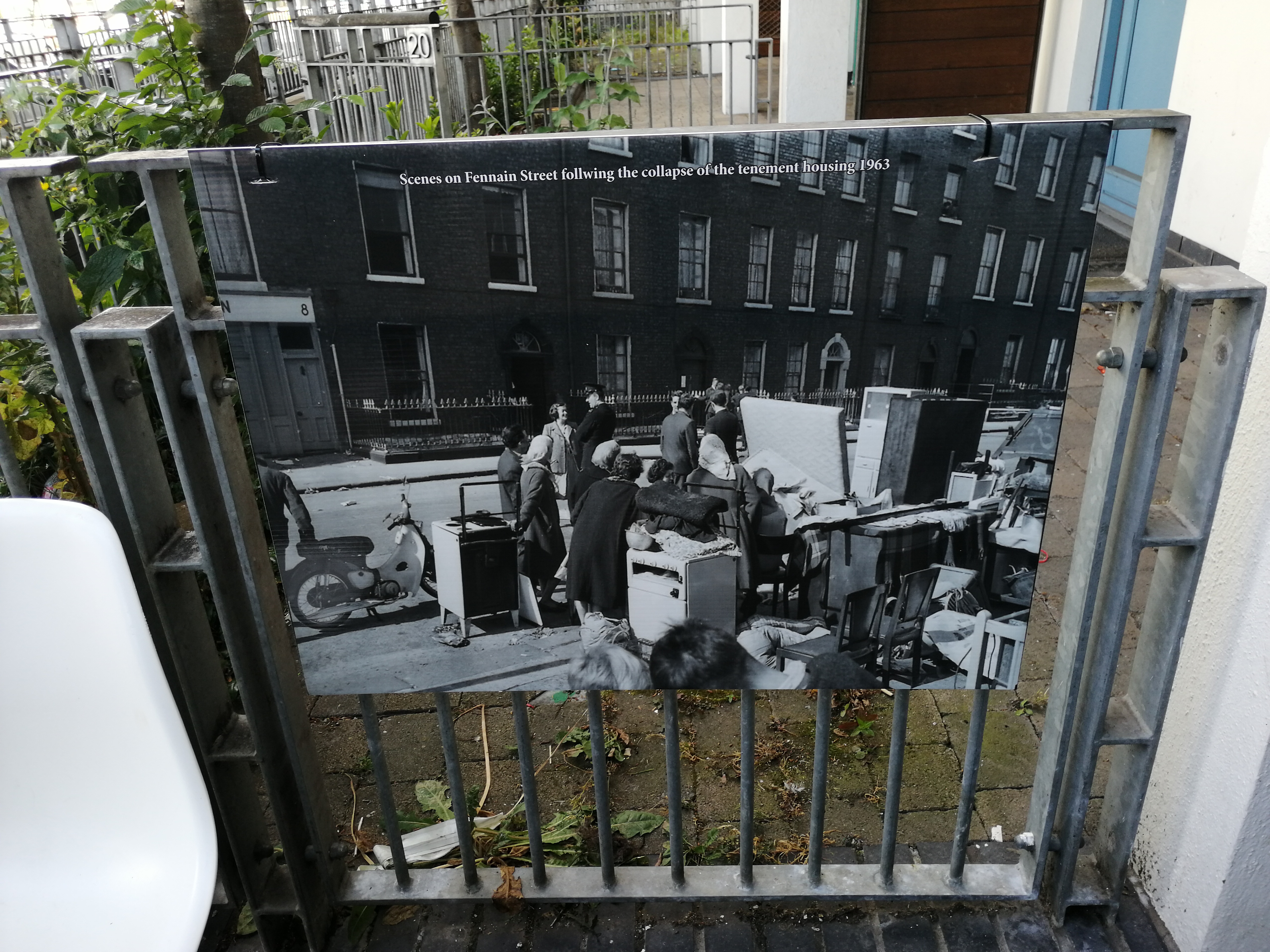
The collapse of multi-occupation buildings in Dublin’s Fenian Street killed two girls. A day from the anniversary of the tragedy sixty years later, local residents in a working-class block of flats organised a moving and informative commemoration.
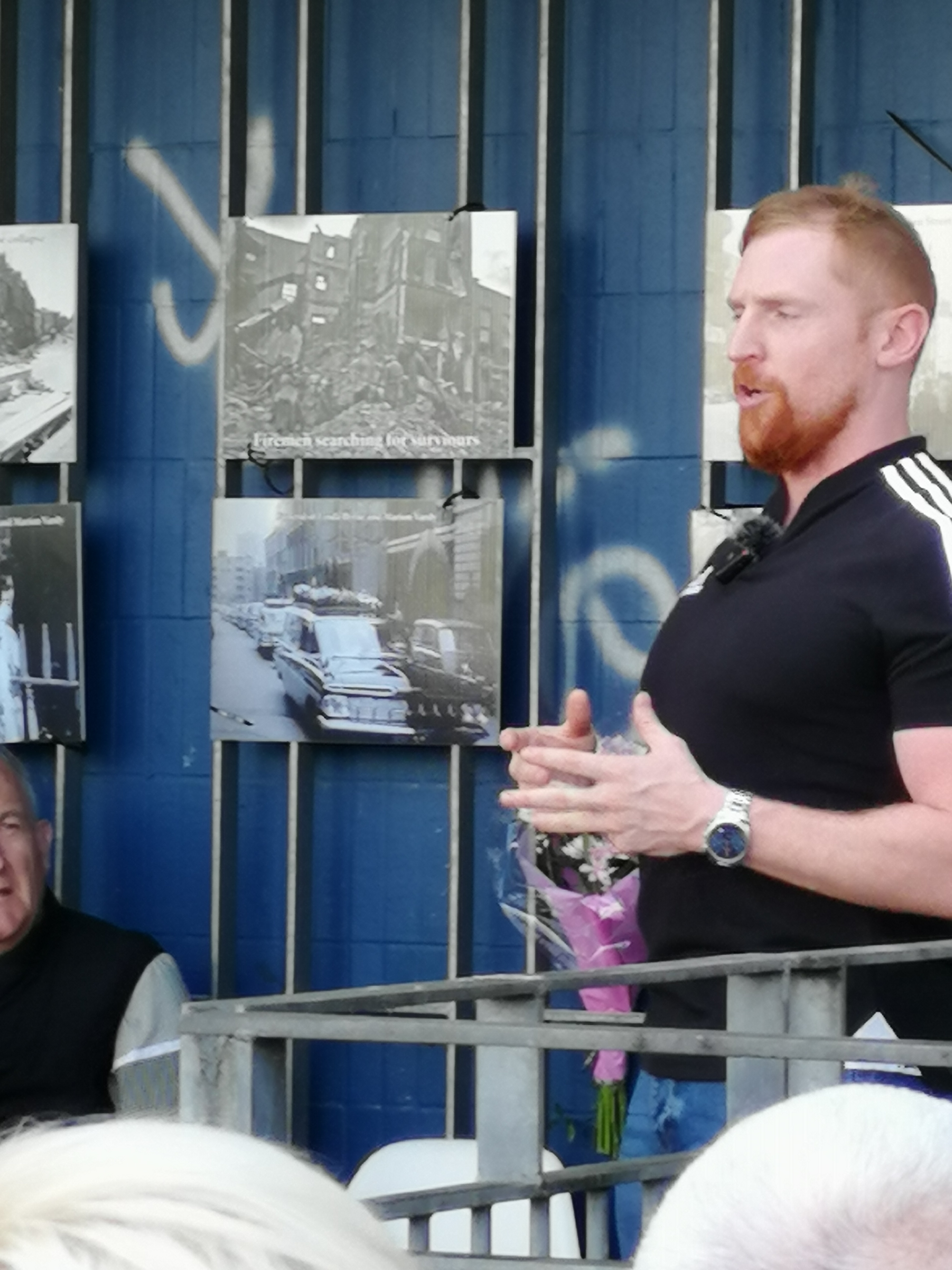
On 12th June 1963, Marion Vardy and Linda Byrne, returning from a shop were killed when the buildings collapsed.
After another two people were killed in a Bolton Street collapse, a galvanised Dublin City Council inspection condemned many other buildings in the city and 155 families were rehoused immediately, though some in Army barracks.
And a number had to camp out for some days in the street. But it was not the first fatal building collapse in Dublin. On 2nd September 1913 (with the epic Lockout struggle only days old), two adjacent buildings had collapsed in Church Street, killing seven people.1
All the buildings in question were privately-owned with working class people paying rent to the owners. Emergency inspections by Dublin City Council inspectors in 1963 resulted in the condemning of 156 Dublin buildings as too dangerous for residence.
For years, other buildings in the Dublin inner city could be seen braced on a side by a massive timber frame.
Organisers’ panel photographed by D.BreatnachOrganisers’ panel photographed by D.Breatnach
COMMEMORATIVE EVENT
A display of panels describing the tragedy and panels of photos had been erected around the entrance to St.Andrew’s Court block of flats in Fenian Street, where a crowd had gathered for the well-organised commemoration.
Paul McKeown chaired the event speaking eloquently when he could be heard (there was no public address facility) about the actual tragedy and the context of housing provision for working class people in the inner city.
Paul McKeown, who chaired the event, speaking. (Photo: D.Breatnach)
As a Catholic priest had performed the religion’s Last Rites over the bodies of the girls in 1963, McKeown invited a priest to recite some prayers at the event, which he duly did, after which the MC introduced a representative from the Henrietta Street Tenement Experience.2
The Henrietta Street speaker provided interesting snapshots of what past life was like for working people of the inner city in terms of occupation, accommodation and schooling. Some women sewed shirts in a factory while others sold items in street markets, such as Moore Street.3
Speaker from the Henrietta Street Tenement Museum. (Photo: D.Breatnach)
The floors in the poorest homes had no covering and toilets were very few, their use often shared by a great many residents. Although virtually all children would end schooling at the age of 14, the eldest boy often left years earlier to work, as a newsboy or shop messenger, for example.
Labouring on the nearby docks and carting would be the main employment for the men. No doubt emigration, almost a constant in Irish history, played a part too. Rats and mice were endemic in the buildings.
Though alternative and eventually new housing was found for all, it was to Dublin’s outlying areas, breaking up communities and their ways of life, separating them from services used, employment, etc. Many felt isolated and took the long journey to return to the city centre for social contact.
Organisers’ panel photographed by D.Breatnach
ATTACK ON NEARBY REFUGEES
The local flats overlook the location in Sandwith Street that in May had seen an attack by fascists on refugees who had been living in tents because the nearby International Protection Office, a State body, had failed to allocate them accommodation while processing their applications.
A few locals might have joined in and certainly some had attended the crowd but the fascists were imported (as indeed were the refugees and subsequently their antifascist defenders). Some locals at least resented the way they were being portrayed in some social media subsequently.
Refreshments, some of which were provided by Dublin City Council, were served by residents in the inner courtyard after the speeches. (Photo: D.Breatnach)
“We’ve had generations of Travellers4 in the flats and migrant people too,” commented one. “We’re more ethnically diverse than Dalkey,” he added. “Middle class people don’t talk to us, they talk down at us,” was another comment.
They claim that they have been neglected for generations by all the government parties but also by small left-wing parties, also by people who were quick to criticise them and to see them in negative stereotypes. “Nobody talks about class prejudice”, commented McKeown.
The inner city working class population has been moved out of much of the city and this area, which was previously seen as the least valuable real estate in Dublin, as McKeown observes, is now attracting property speculators for gentrification.
Some of the residents and others in attendance in the inner courtyard after the speeches. (Photo: D.Breatnach)
McKeown feels his people are not wanted in the area and he’s probably right. It’s not just that they are not the typical users of the wine bars and coffee bars of gentrified areas but that their current location would take in big rents after construction of hotels and upper-market flats.
Past the site of the attack on the refugees there is a new block of apartments, two bedrooms for 3,000 euro a month, one bedroom for 2,000. An empty bloc across the road which people say was well-maintained, remains empty since Dublin City Council moved the residents out 5 years ago.
The local residents say that they have been promised that a new block of apartments will be built on the latter site and that all the units will go for “social housing”, presumably meaning for affordable rent.5They want that to be true but are not sure whether they should trust the authorities.
After the speeches of the commemoration people were invited to partake of food and music in the inside square of the flats which contains minimal playground facilities.
Shay Connolly (centre) and friends performing at the event (Photo: D.Breatnach)
The music was provided by a trio including Shay Connolly playing ballads with the food served by local residents, in a relaxed atmosphere. The area at the back of the flats had become a sun-trap and while some soaked it up, I and some others eventually fled the heat.
PAST, PRESENT AND FUTURE
The commemoration of historical events can be of great importance. The event in 1963 forms part not only of an older story but also of the present, which is the lack of decent housing provision for the population of Ireland, in particular for those living in the inner cities.
Some of the residents and others in attendance in the inner courtyard after the speeches. (Photo: D.Breatnach)
Working and lower middle class people were wanted in the inner city to work its industries and its shipping port and to service the houses of higher social classes. As industry and port declined and the higher social classes moved out, the need for their work declined.
When their poor areas are seen instead as development prize areas, there is even less demand for the people who have lived in these areas for generations.
One can see this as the inexorable play of impersonal market forces or as the operation of finance and rentier capitalism in a capitalist economy and more, a Gombeen capitalist state where everything is done for the foreign capitalists and as little as possible for the working classes.
From the latter viewpoint, voting different political parties in to government will make no essential difference; what is needed is a fundamental change in the economy which can only be brought about by an organised, conscious and militant working class seizing their rightful inheritance.
End.
Organisers’ panel photographed by D.BreatnachOrganisers’ panel photographed by D.Breatnach
FOOTNOTES
1 I recall reading that a number of Dublin City Councillors, including Nationalist ones, were slum landlords.
2 It is open for visits from Wednesdays through to the weekend, I am told.
3 The market and area are subject to a long war between property speculators and conservationists (see smsfd.ie)
4 An Irish indigenous nomadic ethnic group of at least five centuries existence, much discriminated against.
5 “Social housing” is often understood as provision for people unemployed and on state welfare provision. Perhaps “Public housing on affordable rent” is a better description, housing both people working and those on benefits, the rents adjusted to means. This was widely built in the middle of the last century but none has been built in Dublin for decades, all governments insisting that the “private sector” (i.e big landlords, property speculators and vulture funds) can solve the problem while the housing crisis intensifies year after year.
The Irish State recently commemorated the end of the Irish Civil War but what it was really doing was celebrating its victory over the democratic national liberation forces.
The Irish national bourgeoisie, the Gombeen ruling class, armed and supplied by British Imperialism and colonialism, in 1922 launched a war against the forces that had brought the British Occupiers to the negotiation table.
In that short war or counterrevolution, the Irish State formally executed over 80 Irish Republican Volunteers – many more than had the British during the War of Independence 1919-1921. It also shot dead and blew up surrendered Volunteers and kidnapped, tortured and murdered others.
The Irish government of the day put the financial cost of the Civil War at 50 million sterling which today would be near to 3 billion euro.
A curtain of repression settled over Ireland, in the Irish state and in the colony in the Six Counties (in particular from the RIC re-baptised as RUC and the State-armed Loyalists of the B-Specials). Many Republicans were in jail and if not, could not find work and so emigrated.
The political party allegedly representing the Republicans, Fianna Fáil, led by a former leader of the forces attacked by the State, joined the Gombeen system and became in fact the preferred party of the Irish ruling class.
Though the Republican forces recovered and returned to the struggle in the 1930s (with the Communists against the fascist Blackshirts), again in the 1940s and onwards, they never again came close to winning control over the State.
What the Irish State has given us since its inception, even after the Civil War, has been generations of underdevelopment; unemployment and emigration; a huge decline in the Irish-speaking areas; inequality and social repression of women and LGBT people.
The latter was due to Catholic Church domination in every sphere of life, resulting in institutional physical, mental and sexual abuse, along with censorship in printed, audio and visual media and in banning of contraception.
The ruling class of the Irish State, the Gombeens, tolerated the foreign occupation and control of more than one-fifth of the island’s land mass and abandoned the large Catholic minority in the colony to discrimination and pogroms.
It tolerated also institutional and media racism against the Irish diaspora in Britain, the repressive legislation of the Prevention of Terrorism Act and the jailing for long sentences of a score of innocent Irish people in five different cases in the 1970s.
The Irish State tolerated Loyalist/ British Intelligence bombing inside its territory, failed to protect its citizens from terrorist bombing in the 1970s and covered up its complicity, for example with regard to the Dublin and Monaghan Bombings.
In addition, it used a Loyalist bombing to disarm the opposition to repressive legislation, not against Loyalists but against Irish Republicans, sending Republican activists to jail on the unsupported word of a senior police officer.
More recently this Irish State that we inherited has given us a housing crisis while it makes the territory a rich hunting ground for property speculators, bankers, landlords and vulture funds and also sells off/ gives away our natural resources, public transport and other infrastructures.
The selling-off includes our health service which is also in crisis while the private companies chop off parts of it and sell service back to the State at a profit. And a country that was able to feed 8.5 million prior to 1845 (and export foodstuffs) cannot now feed 5 million without huge imports.
They have given us nothing to celebrate but as always, there is a choice. We can bemoan the situation or we can “take back the nation they’ve sold” (Soldiers of Twenty-Two). And that cannot be done through electing any party or parties into the system.
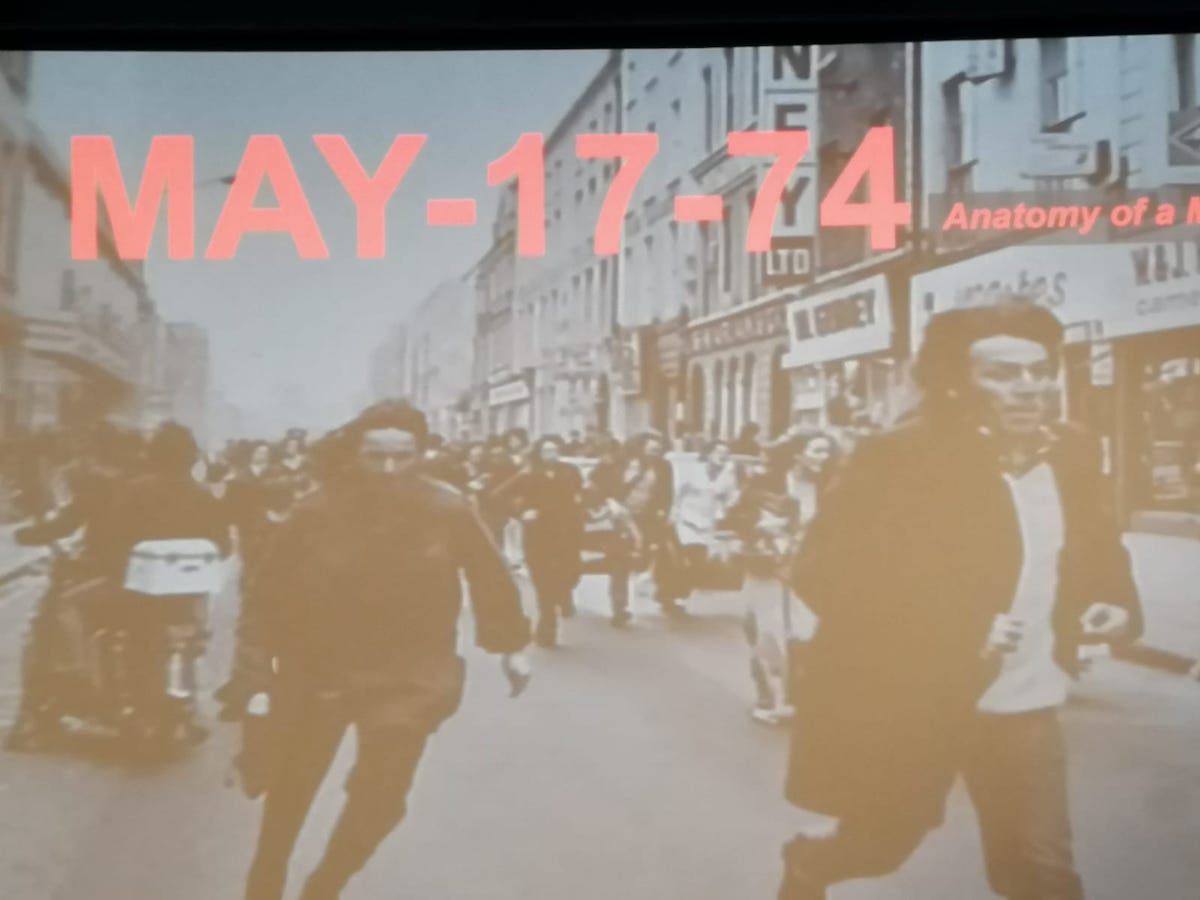
On the 49th anniversary of the Dublin and Monaghan Bombings a number of speakers criticised the Garda closure of its investigation a mere four months after the bombing with the highest number killed in any one day of the 30 years war.
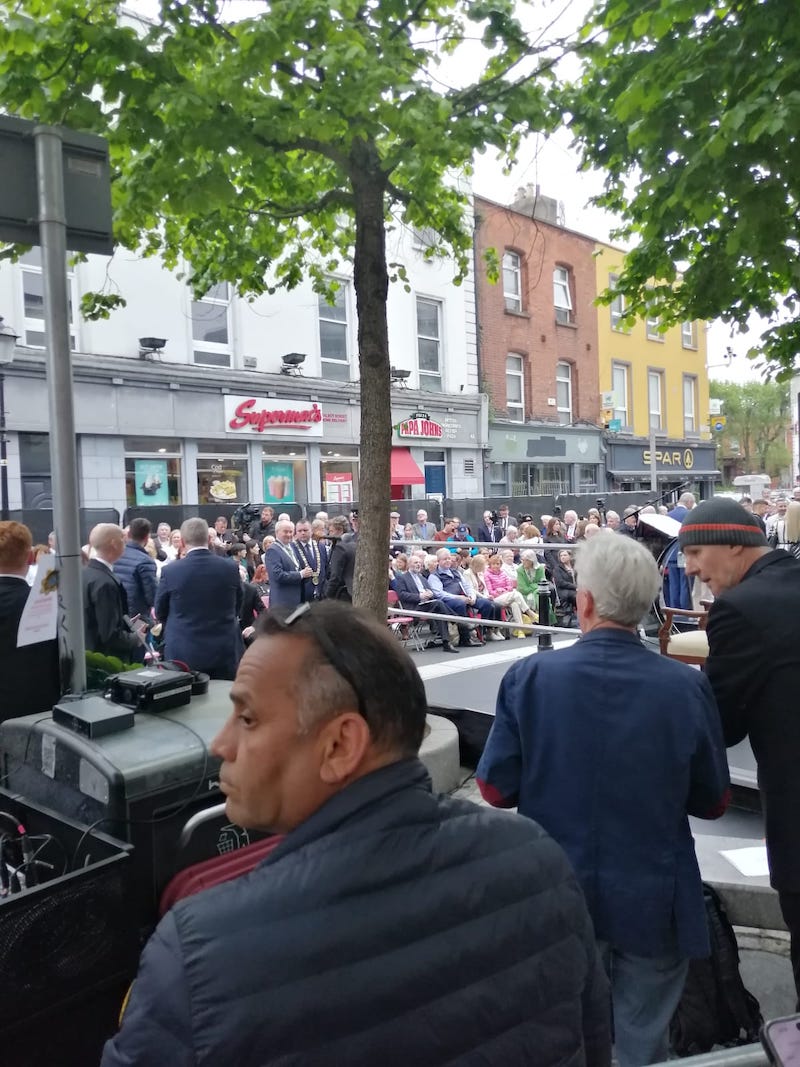
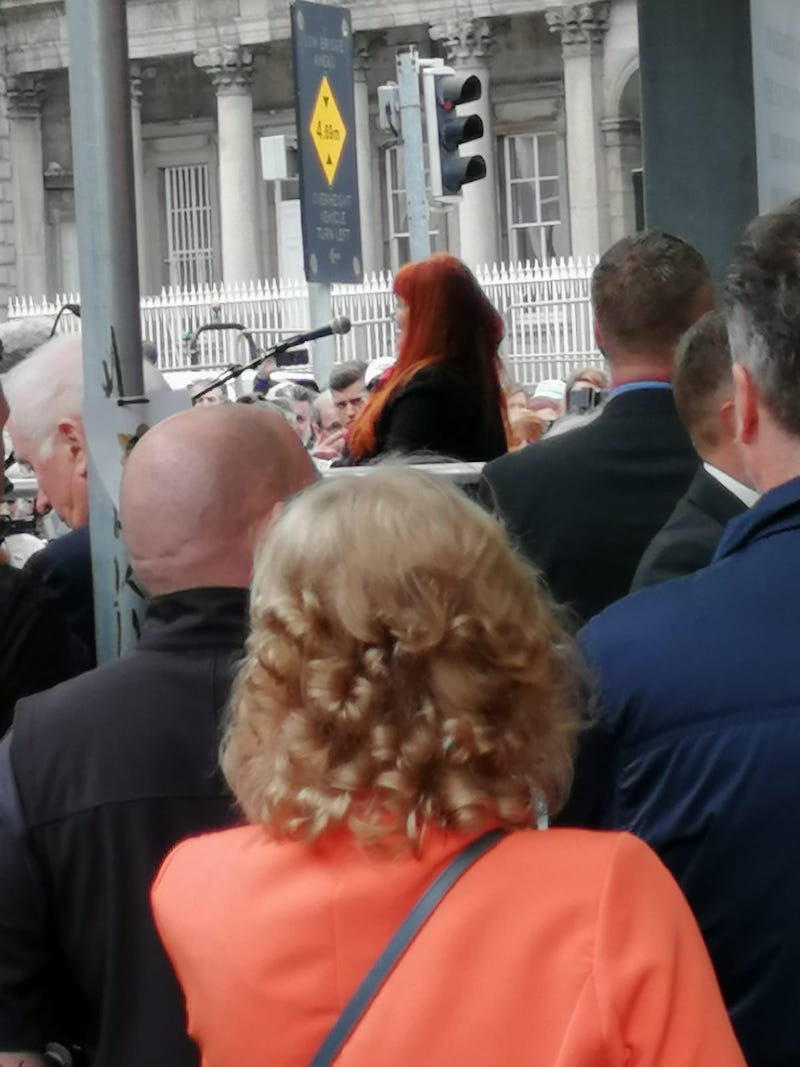
The criticisms were made on 17th May at the annual commemoration of the atrocity in Talbot Street, Dublin, organised by the Justice For the Forgotten campaign, held at the location of the memorial on the site of one of the bombings of that day.
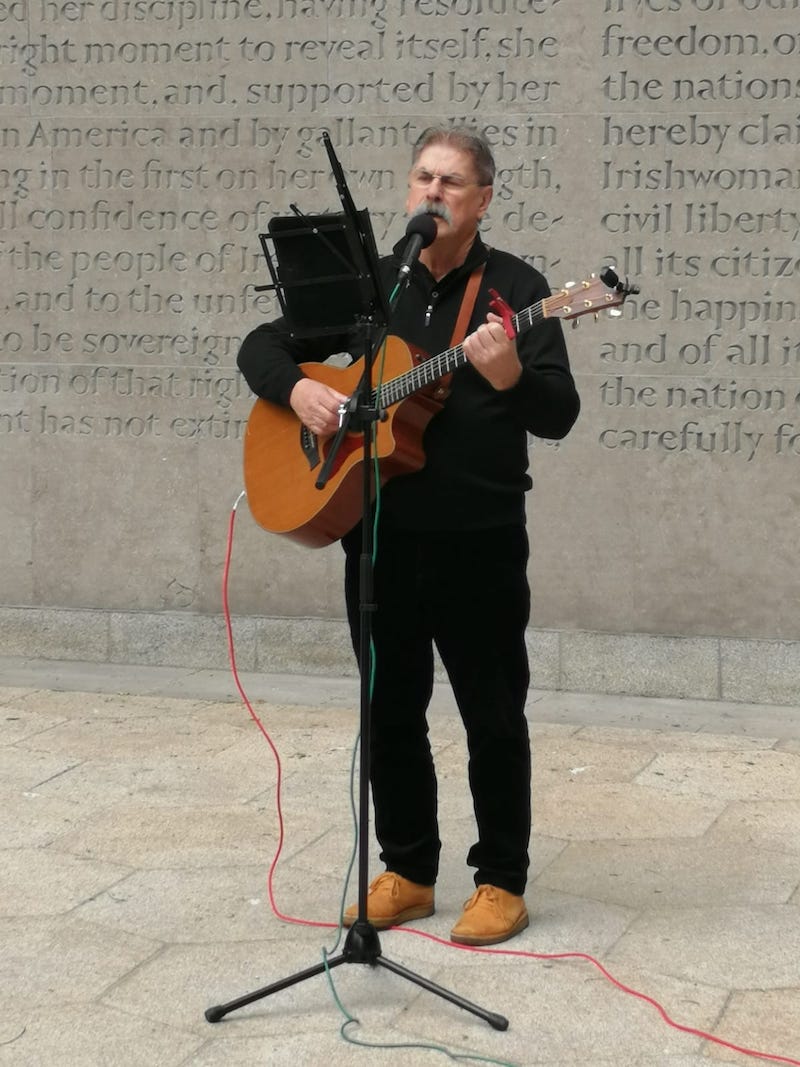
The annual commemoration has been organised for many years by the Justice For the Forgotten campaigning group at the Talbot Street monument to the bombing1. It usually comprises reminiscences, poetry and music and a call for the British State to release its secret papers.
As of rote, an Irish Government Minister is invited to speak who routinely says how hard the Irish Government has been trying to get the British State to release the secret papers revealing the latter’s connection to those who carried out the bombing.
Years after the bombings, a British TV company (!) pointed the finger at the Ulster Volunteer Force, a British Loyalist paramilitary group but believed acting under British Intelligence agency direction, named some of those involved and a week later the UVF claimed responsibility.
In addition to British Intelligence, the British colonial police2 and British Army3 had been widely known to be working in collusion with Loyalists.
But few would have suspected Irish State collusion.
THE BOMBINGS AND AFTERMATH
On 17th May 1974 three car bombs exploded without warning in crowded Dublin city centre streets and another in Monaghan town centre. Thirty-three people were killed along with a full-term baby and a miscarriage with around 300injured. No-one was ever even charged in relation to the atrocity.
Scene post-bombing in Talbot Street, the site where the Monument was erected later is out of shot to the right. (Photo sourced: Internet)
The intention, unlike that of many other city car-bombings in the Six Counties and in England, was clearly to cause maximum death and injury to civilians. The areas chosen in Dublin were full of shops with bus stops and 5.30pm was going home time from shopping and work.
And no warning was given.
In the course of the short Garda4 investigation, in macabre irony the remains of the exploded cars were sent for forensic examination to their very source: the Six Counties, i.e to the colonial police force (at the time, the RUC5). Unsurprisingly, nothing useful came back.
In a war that was already five years old (six years, if the civil rights marches are included) the collusion between the British colonial police and Loyalist paramilitary murder gangs was well known and collusion with the British Army widely suspected.
Floral tributes on the north face of the monument in Talbot Street. (Photo: D.Breatnach)Floral tributes on the south face of the monument in Talbot Street. (Photo: D.Breatnach)
CAMPAIGN OF BOMBING DUBLIN
The Loyalist bombing of two cities in the Irish state in 1974, although by far the worst of the whole period, were not the first in Ireland, not even the first fatal ones.
In 1973 a Loyalist bomb in Dublin city killed Tommy Douglas and the year before that another killed George Bradshaw and Tommy Duffy – all were employees of Irish public transport state company CIE.
Even after the horror of 1974, on 29th November 1975, another a bomb at Dublin Airport killed John Hayes, a worker there.
And there were other earlier ones where no-one was injured, such as the blowing up of the Wolfe Tone monument just outside Stephens Green on 8th February 19716 and the Daniel O’Connell Monument in Glasnevin Cemetery (the round tower) in December 1971.
Pieces of the statue of Theobald Wolfe Tone on St Stephen’s Green. The statue was blown up by a loyalist bomb. A report at the time noted that ‘Huge slabs of the bronze sculpture were hurled 20 feet in the air’. 08/02/1971 (Photo sourced: Internet)The O’Connell Monument in Glasnevin (round tower) seen here at sunset from the Botanic Gardens was a target of Loyalist bombing in 1971. (Photo: D.Breatnach)
If the Irish State had pursued investigations and cross-Border links after the earliest of those bombings, they might have headed off the carnage that followed later.
Not only did they not do so but in fact used the 1972 bombing to blame Irish Republicans so as to get an unpopular piece of repressive legislation through parliament, the Amendment to the Offences Against the State Act, along with the establishment of the no-jury Special Criminal Court7.
The Garda Commissioner at the time of the 1974 bombings was Patrick Malone and Ed Garvey, his Assistant Commissioner, was later exposed as a British Secret Service asset run by Fred Holroyd, a disenchanted British agent who revealed he had visited the policeman in his Dublin HQ.
Garvey, by then Commissioner, denied being a British agent and claimed no memory of the visit.
The Barron Report (2003) concluded that visit had undoubtedly occurred and that he had not informed his superiors, contrary to all rules regarding contact with agents working for a foreign government.8 When Fianna Fáil came into Government again, they sacked Garvey.
Since FF had not subjected him to a regular disciplinary process, probably in order to avoid the sordid story going public, Garvey was able to sue the Irish Government, win damages and ensure he received his former pension entitlements.
THE COMMEMORATION EVENT
Aidan Shields, who lost his sister Maureen in the bombing, chaired the event for Justice for the Forgotten and introduced its Secretary Margaret Unwin who, as all speaking or performing at the event seemed conscious that next year would be the 50th anniversary of the atrocity.
(Photo: D.Breatnach)
The regular Government slot was occupied by the current Tánaiste (Dep. Prime Minister) Mícheál Martin who, as has every Government representative since the JFTF commemorations began, claimed energetic diplomatic discussions for release of the papers with their British counterparts.
Martin also criticised the British Government’s widely-criticised intended legislation to prevent official investigations and trials regarding past crimes committed by British forces, while he simultaneously praised the British pacification process.
A young Italian woman played the theme from the Schindler’s List film and another air on violin. A visiting Italian couple had been killed in the bombing also but that was not mentioned when she was introduced.
Rachel Hegarty read from her poetry compilation about the victims, based on testimonies by surviving relatives and friends. Cormac Breatnach on high D whistle and Eoin Dillon on uileann pipes played the Irish air Tabhair Dom Do Lámh (“Give Me Your Hand”).
Poet Rachel Hegarty reciting from her work on the bombing. (Photo: D.Breatnach)Closeup of Cormac Breatnach on high whistle playing at event. (Photo: D.Breatnach)Eoin Dillon playing uileann pipes at event. (Photo: D.Breatnach)Fuller shot of Cormac Breatnach playing at event with Eoin Dillon out of shot to the left. (Photo: D.Breatnach)
The Shillelagh North Ukulele Group played and sang The Sound of Silence and Things (we used to do), both appropriate in metaphorical context, the first for the official silence about the perpetrators and their British intelligence organisation, the second about the loss of the victims and to their loved ones.
Dublin City Lord Mayor Caroline Conroy, of the Green Party, spoke about the atrocity and criticised the closing of the Garda investigation a mere four months after the bombing.9
Vincent Browne giving his oration. (Photo: D.Breatnach)
Well-known journalist and former TV presenter Vincent Browne gave the oration at the event and went into horrific detail on some of the injuries he had witnessed as a journalist at the scene with his doctor brother as they struggled to help the victims still alive.
Browne departed from the subject of the bombing, as a few had done to speak of the long war and the Good Friday Agreement but in his case also to accuse the Provisional IRA of having killed most of the people during the 30 Years War which seemed not appropriate on this occasion.
Seán Conlon, Cathaoirleach (Chair) of Monaghan Council10 spoke of the bombing and focused on the effect on his town. He also condemned the early closing of the Garda investigation and the failure to pressurise the British State into releasing security papers relevant to the bombing.11
Seán Conlon, Cathaoirleach of Monaghan Council, speaking with part of monument visible to his left. Aidan Shields is standing right next to the Monument. (Photo: D.Breatnach)
A number of speakers referred optimistically to the investigation into the Glenanne Gang by former English police chief Jon Boucher, who was present in the crowd at the commemoration. Boucher is heading a number of other historical investigations, including that of Stakeknife.12
The older age profile of the attendance was noticeable with only two teenagers visible and this in itself must be of concern.
FATAL CONSEQUENCES OF STATE COLLUSION AND COVER-UP
The failure to investigate the earlier Loyalist bombings and apprehend the perpetrators made the planning and execution of the Dublin and Monaghan bombings much easier. The early closing of the Garda investigation of the 1974 bombings ensured the perpetrators would run free.
As well as failing relatives and friends of those murdered and injured in Dublin on the 17th May 1974, the lack of pursuit had repercussions for many other victims of Loyalist murder squads, in particular the over 120 victims of the Glenanne Gang, including the Miami Band Massacre in 1975.
An aspect not normally commented upon was the choice of predominantly working class areas for Dublin massacre victims. It was not the high-end Henry or Grafton Streets that were chosen but the more working-class shopping areas of Talbot Street and Parnell Street.
The fatal Dublin bombings of 1972 and 1973 had also been directed at workers by location: three public transport workers and an airport worker.
Section of the Shillelagh North Ukulele Group playing and singing at the event (Photo: D.Breatnach)
THE GOMBEENS: A CRAVEN CLIENT RULING CLASS
The whole chain of events from the first Loyalist bombing of Dublin points quite clearly to the client nature of the Irish national bourgeoisie, the ruling class of the Irish State. Even if it wanted to, it is too weak to make strong demands of the British State.
What self-respecting national ruling class would allow a foreign power to send terrorists to bomb its capital city? And then collude with that power in drawing silence and secrecy over the atrocity?
None, of course. But the Irish bourgeoisie came into being in a truncated client state and, armed and equipped by its master, went to war for two years (1922-1923) against the very national liberation forces that had brought the British State with offered concessions to the negotiation table.13
To talk of uniting Ireland under such a class, apart from being impractical nonsense, is a travesty. To expect any real change by electing a party or combination of parties to government in such a situation is a pipe-dream.
The 1974 bombing, the subsequent investigation and the record of Irish governments since in relation to the bombing are together a stark illustration of the spineless nature of the Irish bourgeoisie when dealing with their masters.
A client ruling class yes but more accurately, a servant.14
End.
Section of the crowd in attendance viewed from the north-east of the location. (Photo: D.Breatnach)Section of the crowd with the tower of Connolly (formerly Amiens Street) Station in the background. During the British suppression of the 1916 Rising, British Army machine-gun fire was directed from there along Talbot Street towards the General Post Office garrison and North Earl and Henry Streets. (Photo: D.Breatnach)
FOOTNOTES
1There was originally a plaque at the Garden of Remembrance and the Talbot Street monument was erected in 1977 after campaigning by relatives and victims. There is also a monument in Monaghan Town. In Dublin there is also a plaque at the site of another explosion that killed people that day in Parnell Street.
2Now the Police Service of Northern Ireland, formerly the Royal Ulster Constabulary (and before that, up until 1921, the Royal Irish Constabulary, when the whole of Ireland was under direct British rule).
3In particular the Ulster Defence Regiment, which had recruited from the part-time RUC B-Specials when the latter were disbanded but also special units such as the MRF in special operations and more generally across the whole of the occupation forces.
5When the Irish State and colony statelet were created in 1921, the colonial gendarmerie of the Royal Irish Constabulary in the colony became the Royal Ulster Constabulary. In more recent years the force has change its name to the Police Force of Northern Ireland.
6The body of the monument to the Anglican leader of the United Irishmen was destroyed but the head was salvageable and rests on the re-cast body of the monument today.
7The Irish Council for Civil Liberties has dubbed that Court “a sentencing tribunal” but every party in government since has upheld those repressive provisions and Sinn Féin has abandoned its decades of opposition to them as it prepares to enter government in coalition with one party or another.
8Having a Garda Commissioner who was or became a British Intelligence agent might be shocking until we remind ourselves that the current Garda Commissioner, Drew Harris, coming from being Assistant Commissioner of the PSNI, was at least formerly part of MI5 operations in the colony and that must have been known to those who appointed him!
9Mayors of Dublin City are selected for one year from among the elected councillors. It is more of a ceremonial role than an executive one and the choice is usually negotiated in turn from among the represented political parties.
11A number commented that his contribution was so much better in every way than that of last year’s Monaghan Cathaoirleach. Conlon is a member of the Sinn Féin party and some may say his posture would therefore be expected. However, given changes in the party’s public position on many questions in recent years, a hard stand against the British administration no longer seems natural for this party’s public representatives.
13Irish Civil War (or as some see it, the Irish Counterrevolution) 1922-1923.
14It should be noted that the Gombeen class has also been a client in turn of US Imperialism and of EU Imperialism, with all of which it aligns itself on most questions of international policy and to which it opens up its markets, natural resources and infrastructure networks.