BOBBY SANDS – FREEDOM FIGHTER AND BEACON FOR THE DIASPORA

Diarmuid Breatnach

(Reading time: 6 mins.)

The anniversary on Sunday of the death on hunger strike of IRA Volunteer Bobby Sands was marked with a number of posts on social media. I would like to add an Irish migrant’s1 perspective and some analysis of his legacy.

The Irish diaspora was a powerful sector in solidarity for the Irish struggle not only because of their cultural background but also because of their numbers. Some British cities had an estimated diaspora population of 10% (Irish-born and 1st and 2nd generations).

Furthermore, the higher proportion of those in turn was of the working class, a section of society which, although they in no way had their hands on the standard levers of power, certainly had a strong potential of the kind the British ruling class had learned to fear.

Irish Republicans of course formed part of that sector and organised within it but on the other hand the IRA’s bombing campaign in Britain was of no help at all. The popular fear of being caught in an explosion greatly enabled the Government to tighten the screws under the guise of “security”.

Karl Marx, a strong supporter of Irish freedom had commented after the Clerkenwell prison bombing of 18672 that “One cannot expect the London proletarians to allow themselves to be blown up in honour of the Fenian emissaries” (i.e who they were trying to free from the jail).

In 1974 the Labour Government had repressive legislation ready and on 29 November, using hysteria arising from the Birmingham and Guildford pub-bombings they rushed through the Prevention of Terrorism Act (1974) which permitted the holding of suspects for two days without charge.

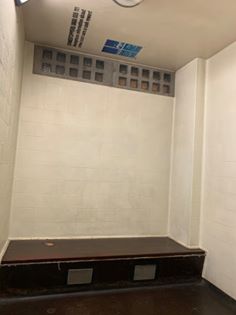
An underground cell in London’s Paddington Green police station – this is where Irish detainees under the Prevention of Terrorism Act might be kept and interrogated for seven days without visitors or access to solicitor. “The old cells were 12-foot square, contained no windows and were reportedly too hot in the summer and too cold in winter(Wikipedia).(Photo: Posted in 2020 on Internet by Green Anti-Capitalist Front who occupied the empty building intending to turn it into community centre.)

That could be extended for another five days – and often enough was — by application to the Home Secretary. Access to solicitor was usually denied and though not lawful, the fact of the detention itself was often denied to concerned people making enquiries of the police station.

The prospect of disappearing for seven days into police custody somewhere was naturally terrifying and a ‘suspect’ could also be deported without trial to Ireland – even to the British colony of the Six Counties, which amounted according to their law to “internal exile”.

Snapshot of London police harassment and intimidation of Irish solidarity activists in 1981. (Photo sourced: Internet)

The framing of a score of innocent Irish people3 in five different trials4 with very heavy sentences added to the intended terrorising of the Irish community in Britain, the “suspect community”5, many of whom believed the victims to be not only innocent but most not even politically active.6

Irish solidarity activity in Britain diminished greatly after 1974 as state repression impacted across the Irish community. But the hunger strikes and concerns to save the lives of the strikers in 1981 broke the hold of state terror as people took to the streets in their thousands once again.

They were unsuccessful but never returned to that state of immobilising fear that had settled over the community.

The Irish in Britain Representation Group got its initial start in 1981 which happened as follows: the bourgeois Federation of Irish Societies had its AGM in May 1981 and one of the members proposed that a motion of sympathy to the Sands family be recorded when he died.

IBRG and Irish Republican POW Support Committee banners on march Birmingham 1984 (Source: Mullarkey Archive)

The meeting’s Chairperson ruled the proposal out of order and ‘the Fed’ continued with their ordinary business. The then Editor of the Irish Post7, writing in his “Dolan” column, found this disturbing and suggested there might be a need for a new type of Irish community association.

A number of individuals wrote in and the ball got rolling, though it took until 1983 to set up the branch-based organisation with a constitution and democratic safeguards in operational rules. The IBRG soon had a number of branches in London and others in the North and Midlands.

For the next two decades the organisation campaigned for the release of the framed prisoners, against the Prevention of Terrorism Act, strip-searching, all racism but in particular the anti-Irish and anti-Traveller varieties, for Irish representation in education, services, Census category, etc.

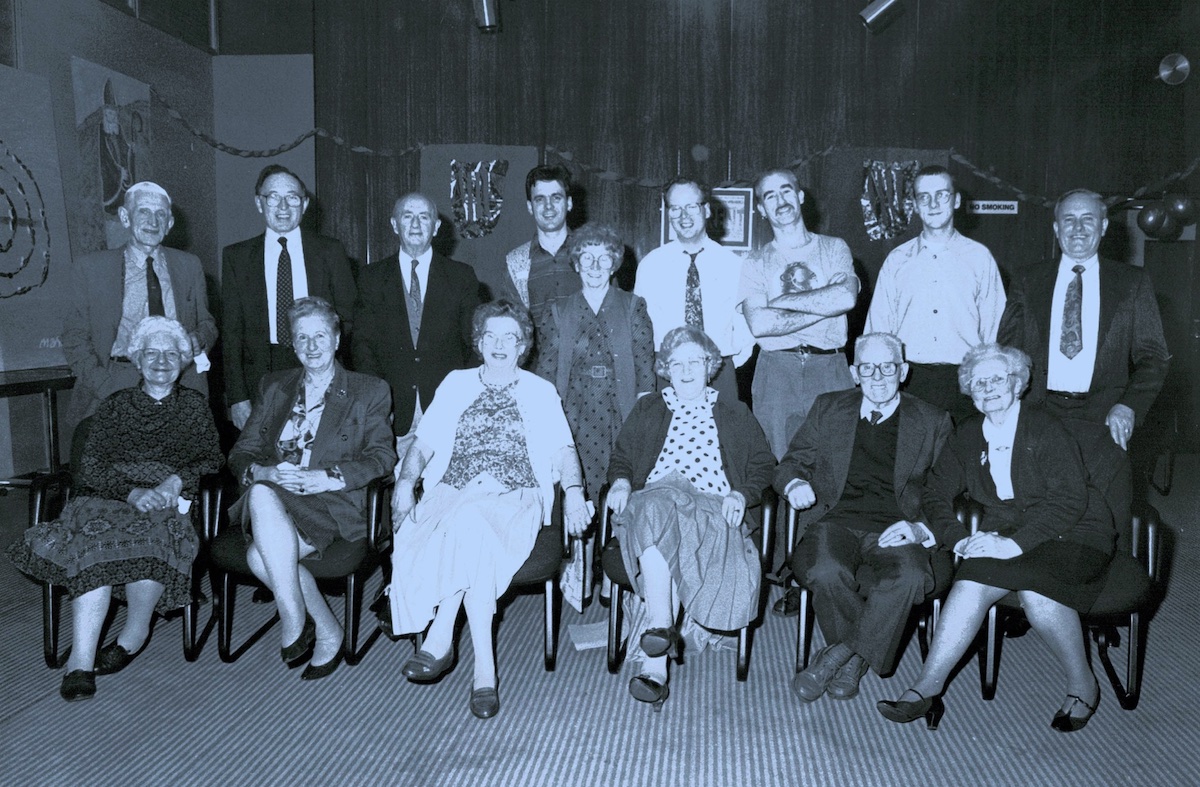
Lewisham Irish Centre Management Committee and Staff, possibly 1994. The Centre was campaigned for and won by the Lewisham Branch of the IRBG in conjunction with the Lewisham Irish Pensioners’ Association (which the IBRG had also founded).

The IBRG also called for British departure from Ireland and collaborated with other organisations in marches, demonstration, pickets, conferences, producing also a number of important report documents. The organisation’s officers were drawn from migrant Irish and those born in Britain.

THE LARK8 – a poem

Last night, from afar, I watched the Lark die

and inside me, began to cry,

and outside, a little too.

There’s nothing more that can now be done,

to save the life of this toilers’ son;

another martyr – Bobby, adieu.

Imperialism takes once more its toll,

another name joins the martyrs’ roll

and a knife of sadness runs us through.

But sorrow we must watch,

for it can still,

yes, it can kill

the song that Bobby listened to.

And if his death be not in vain,

let’s fuel our anger with the pain

and raise the fallen sword anew;

and this sword to us bequeathed:

let its blade be never sheathed

’till all our foes be ground to dust

and their machines naught but rust ….

Then will the servant be the master

and our widening horizons ever-vaster

and our debt

to Bobby

paid

as due.

(D.Breatnach, May 1981, London)

Bobby Sands Mural on gable end of a house in Belfast (Photo cred: Brooklyn Street Art)

REPRESENTATION OF BOBBY SANDS

Bobby Sands was a man of great courage whose leadership qualities were recognised by his fellow political prisoners when they elected him as their Officer Commanding in the H-Blocks. He was also an accomplished writer and poet.

When the British reneged on the agreement that ended the 1980 hunger strike and a new one was planned, Sands insisted on being first on the list, which also meant that in the event of resulting deaths, his would be the earliest.

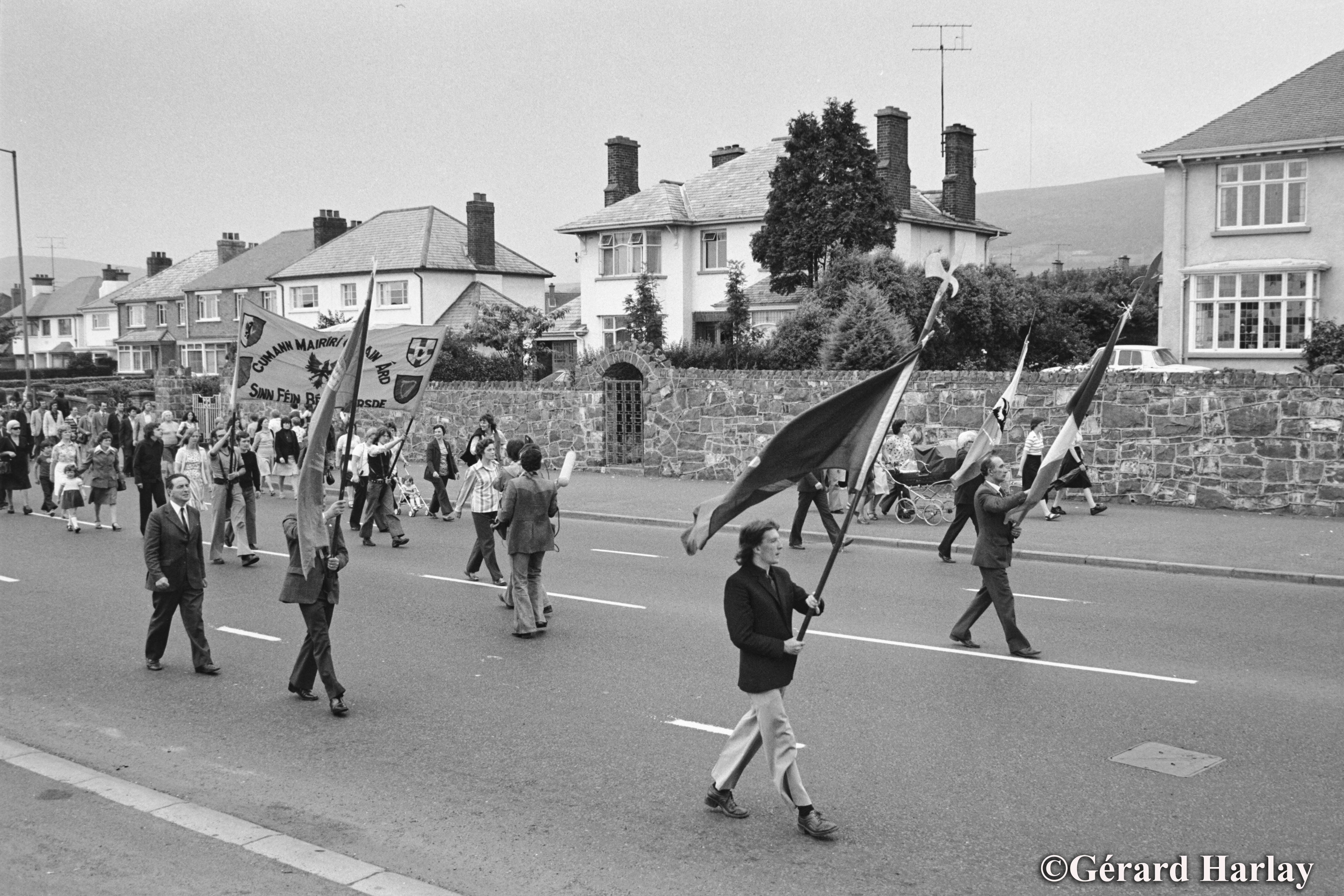
Bobby Sands (front left, colour party), Andersonstown Road,1976. (Photo: Gérard Harlay Archive)

Most people will agree easily with all the above evaluation of the man but from that point onwards, his representation is manipulated to suit different agendas, in particular those of pacifists, social democrats, liberals and a variety of opportunists.

Some of them love above all his quotation that “Our revenge shall be the laughter of our children”. They forget many other things he wrote and seek to turn him into an angel or saint of pacifism.

Since they embraced the pacification process, Sinn Féin try to represent Sands as an advocate for and proof of the effectiveness of participating in the parliamentary electoral system, based on his success in a 1981 Westminster by-election with 30,492 votes, 51.2% of the total of valid votes.

What both these groups fail to recognise is that Sands was an IRA volunteer and was sentenced for possession of handguns in 1972 and again in 1976. If he was an angel, it was of the Archangel type, fighting against what he considered evil.

He was proposed in the Fermanagh-South Tyrone by-election mainly in order to support the campaign of the prisoners against criminalisation and for the political status recognition that they had previously. Saving the lives of the hunger strikers was of course part of the plan too.

Nine protesting Republican prisoners contested the general election in the Irish State in June. Kieran Doherty and Paddy Agnew (who was not on hunger strike) were elected in Cavan-Monaghan and Louth respectively, and Joe McDonnell narrowly missed election in Sligo-Leitrim.

But that is a long way from proving that the electoral process is a viable way of dislodging the ruling class and their system and, in fact, history has proven the opposite.

Nobody knows what position Sands and the other nine would have taken on the electoral process had they lived. Possibly some would have gone along with the SF leadership on that and some others would now be reviled as “dissidents” (as are indeed some H-Block survivors).

All we can say for certain is that they were men of courage in that all of them had joined the armed struggle for Irish national liberation. They had even higher courage of a level hard to imagine, to risk and then experience slow physical disintegration and death by the day and by the hour.

Long after their erstwhile prominent enemies are forgotten, their names will shine in our history and Bobby Sands’s, the brightest of them all.

End.

FOOTNOTES

1At the time I was living and working in England.

2A bomb was planted against the prison wall to free a member of their group who was being held on remand awaiting trial at Clerkenwell Prison, London. The explosion damaged nearby houses, killed 12 civilians and wounded 120; no prisoners escaped and the attack was a failure. Michael Barrett was found guilty of the bombing despite his claim supported by witness testimony of having been in Glasgow during the bombing and was hanged on Tuesday 26 May 1868 outside Newgate Prison, the last man to be publicly hanged in England (the practice was ended from 29 May 1868 by the Capital Punishment Amendment Act 1868). https://en.wikipedia.org/wiki/Clerkenwell_explosion.

3Carole Richardson of the Guildford Four was not Irish but she was the girlfriend of one of three Irishmen.

4Birmingham Six, Guidford Four, Giuseppe Conlon, Maguire Seven and Judith Ward. They were not acquitted and released until decades later, by which time Giuseppe Conlon had died in jail.

5Suspect Community by Paddy Hillyard, Pluto Press (1993)

6Believing them innocent and not active worked even better to terrorise because if the likes of those could be framed and jailed, no-one was safe. But perhaps safest was to do absolutely nothing to draw the attention of the State.

7Brendán Mac Lua, co-founder of the Irish community newspaper in 1970 which is now a very different periodical.

8The lark is associated with Sands because he wrote a story about a man who had captured a skylark, a bird that unusually sings in flight. In the cage the bird would not sing so the man draped the cage with cloth and still the bird would not sing, nor would it do so when he refused it food and water until eventually, it died in the dark, silent to the last.

REFERENCES

Powers under the Prevention of Terrorism Act: https://cain.ulster.ac.uk/hmso/pta1974.htm

STEP FORWARD, YOUTH!

Diarmuid Breatnach

(Reading time: 8mins.)

University students in the USA protesting, setting up encampments, occupying university buildings; threats from administrators; police invasions, assaults on students, resistance, arrests …

Step forward, Youth and shake the towers

Those ivory towers stand on sweat and blood

Make those lies fall in showers —

Become the earthquake and the rushing flood.

Step forward youth

For solidarity and truth!

Academic freedom and investigation

and principles too of democracy

Have taken now academic vacation

Revealing true base in hypocrisy.

Step forward youth

For solidarity and truth!

Look down below your feet

Reach out to workplace and street

Stretch out solidarity’s hand

to the struggling in another land.

Step forward youth

For solidarity and truth!

only thus can you also be

in a better world, at peace and free.

(Dublin, May 2023)

It seems as though we’ve been here before, a sense of dejá vu … Ah, yes! During the Vietnam War (1955-1975). University students in the US were in conflict with the authorities about lifestyle, content and style of the curriculum, racism, sexism, sexuality and .. yes, the US’s war in Indochina.

Students lost their study and work plans, got hit by truncheons, were sickened by teargas and some were shot dead, as in Kent State University, Ohio by the National Guard and in Jackson, Mississippi 11 days later.1

Which is why the suggestion of House Speaker Mike Johnson to send that same body in against the students last week was a vicious act of intimidation.

In the 1960s Trinity College Dublin, the academic bastion of the British-unionist Ascendancy, was a hotbed of protest and even revolutionary organisation along many fronts – including gay rights, contraception rights, Irish socialism and national liberation.2

The Ulster University in Belfast, in the British Six-County colony saw protests for Catholic civil equality, a struggle that faced armed repression and developed into a responding armed struggle of three decades.

In the USA those years coincided too with marches for black civil rights and also the rise of militant revolutionary groups such as the Black Panthers, the Young Lords, Weathermen, SLA and later the American Indian Movement.

Women’s liberation and Gay & Lesbian liberation movements3 also moved more to the fore.

The responses of the US State to many of those movements were even more vicious than they had been against the students, with trials, jailings,4 shootings5 and downright unofficial executions.6 As the campus protests now draw in wider communities, are we heading for something similar?

In the USA, the authorities seem terrified of that conjunction — or how else can we understand the violence of their reaction which has even horrified some university senates?

DIFFERENCES BETWEEN THEN AND NOW

When the students in the USA fought the institutional authorities, it was partly in solidarity with the people of Vietnam (and later of Laos and Cambodia). Yes, but many also feared being sent to the Vietnamese War meat grinder and being airlifted home from there in body bags.

The draft had been introduced in 19647 and though middle-class students had a better chance of avoiding conscription, they were far from immune.8 Being an officer might make one safer from the enemy than being a grunt but not from the grunts themselves as “fragging” incidents soared.9

The students now protesting in US Universities are doing so in solidarity with Palestinians, in horror at their state’s support of Israeli genocide. They may have other issues with their universities’ management and society at large but in general we can rule out the motive of self-preservation.

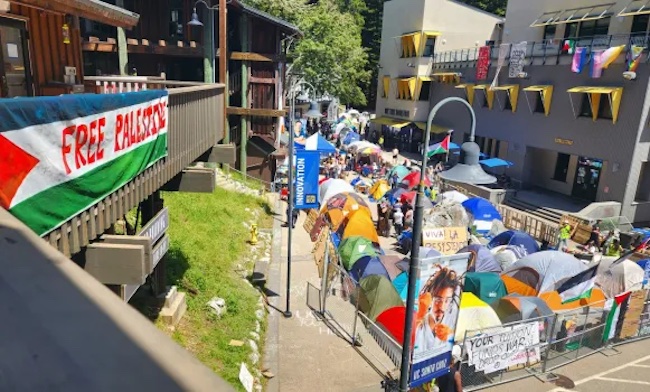
Encampment Palestine solidarity Vera Cruz University California Thursday (Photo cred: Aric Sleeper Santa Cruz Sentinel)

The drug culture was very much seen as part of the protest movement back then, though opposed by some such as Panthers and viewed with suspicion by other revolutionaries. Pacifist trends were strong and Timothy Leary’s “turn on, tune in and drop out” mantra attracted many.

Much of the revolutionary potential of the movement was lost under that influence, nowhere near as powerful now and revolutionaries who know their history will be aware that such arch-opponents of the system as Leary became an FBI informant to get out of jail.10

Many may argue as to degree but the power of patriarchy and oppression of LBG sexuality, though certainly present, are nowhere near as strong today in the “western world” as they were in the 1960s.

The power of the Catholic Church hierarchy in Irish society has been greatly weakened by struggles, Church scandals and society’s evolution. Discrimination against Catholics in the Six Counties is also less than it was in the previous era.

The armed struggle is not currently being waged.

However, Ireland remains divided between a 26-County neo-colony and a Six-County colonial statelet. The economies are hugely penetrated by foreign multinationals, the health services tottering and a huge housing crisis due to turning housing over to big landlords and property speculators.

The main parties of the ruling classes have been exposed to such degree that they no longer act in the charade of opposition: Sinn Féin and the DUP share political administration of the British colony while Fine Gael and Fianna Fáil share it for the neo-colony, prepared to admit SF there too.

Fascists gather some of the disenchanted, marginalised and disinherited to try to mould them into a fascist movement against migrants and refugees, against LGBT rights, against socialism. The State facilitates that development while it grows more repressive in both the administrations.

The ruling class will be aware of the potential of a rise in student protest coinciding with a feeling of Palestine solidarity and frustration at Irish state complicity very widely spread throughout Ireland. But then the Irish state is not imperialist, it’s just complicit in imperialism.

UNIVERSITY PROTESTS NOW

Students in universities across the USA have staged occupations or built encampments in explicit solidarity with Palestine against their own government and against the collusion of their academic institutions with zionist genocide of Palestinians and the destruction of every university in Gaza.

The response of the academic authorities has been denunciation, threat, eviction and false characterisation of the high motives of the students as “anti-semitism”.11

Municipal, county and state police forces have responded violently to peaceful protest, including bodily assault, pepper spray, tear gas, rubber bullets and arrests. The Government has drafted a change of the legal meaning of anti-semitism to include opposition to the Israeli zionist State.12

Rutgers students tents 29 April 2024 (Photo cred: Sophie Nieto-Munoz/ New Jersey Monitor)

The violence of the authorities has not been confined to the protesting youth but has been extended to staff who stood with them. During the week Dr. Steve Tamari, professor at the University of Southern Illinois got nine ribs fractured by cops – for filming what was going on.

Chair of Jewish Studies at Dartmouth University, New Hampshire, Annelise Orleck (senior citizen) was violently arrested and banned from campus for six months.

In some cases not only have the protesters resisted valiantly but actually drove the cops into retreat and in Portland, Oregon, police cars were set alight. Also a fascist who drove at protestors and pepper-sprayed them was, according to reports, identified and his car destroyed.

On the other hand, Zionists (and suspected fascists) have mobilised against the students in many universities, with the tired old propaganda of “anti-semitism” and in one case attacked an encampment with sticks and fireworks, also playing a “crying child” Israeli drone recording.13

Irish Republicans and other anti-fascists will not be surprised to learn that a) the police disappeared shortly before the violent attack and b) none of the attackers were arrested when the cops returned.

More than 2,100 people have been arrested at US campuses since April 1814 and students have been barred from their own campuses which, for many, means also their own accommodation.

Police Attack Palestine solidarity UCLA campus Thursday 2 May 2024 LA (Photo cred: Ethan Swope/ AP)

The university protests have spread beyond the USA and have broken out in Canada (McGill), Australia (Brisbane and Sydney) and even Humbold in Germany, main Israel arms supplying country after the US, where state repression of Palestine solidarity has been particularly heavy.15

In France, where there has also been much repression of Palestinian solidarity activity, there have been occupations at the Sorbonne and Sciences Po in Paris) and in England, Newcastle and London, while an encampment was set up in Edinburgh in front of the Scottish Parliament.16

SHAMEFUL SILENCE”

In Ireland, the universities have been relatively quiet until now but the Trinity College Dublin administration fined their Students Union €214k for a one-day Palestine solidarity picket outside the building housing the Book of Kells exhibition, citing loss of visitor revenue in justification.

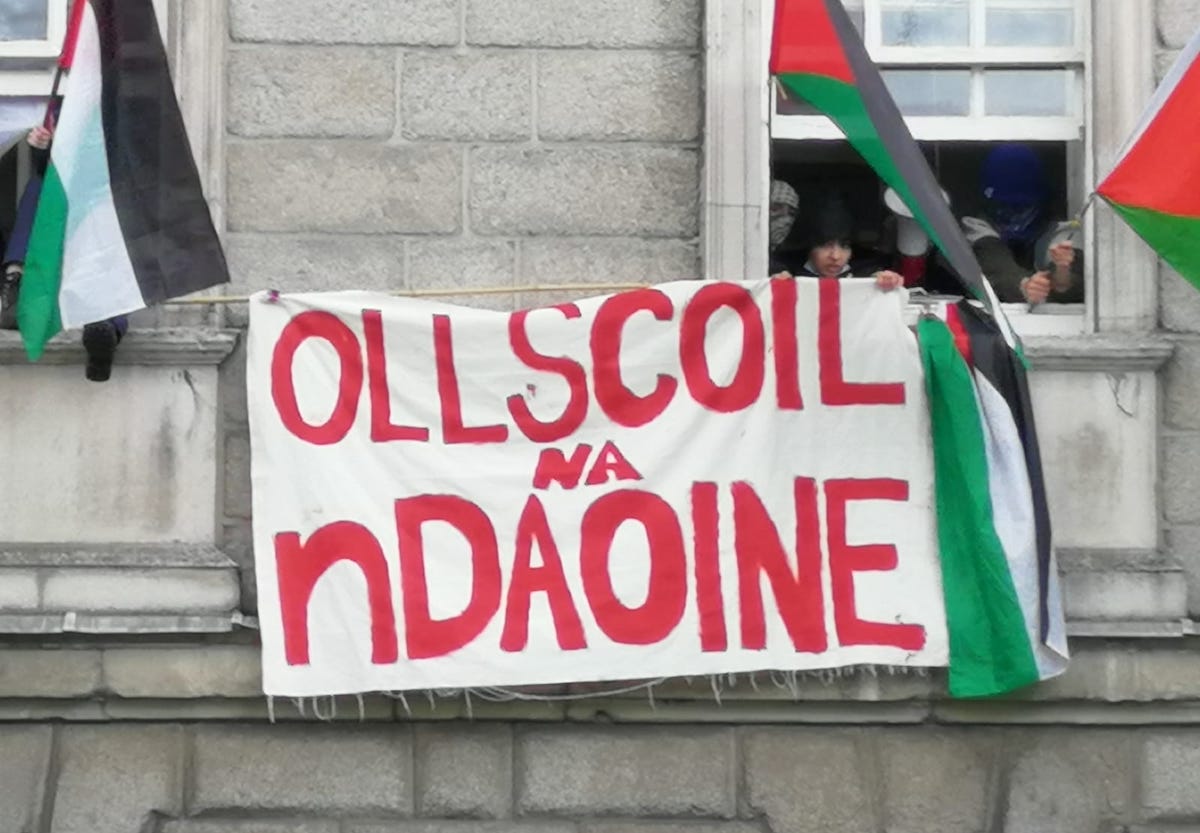
“The People’s University” banner hanging from windows in Trinity College Saturday (Photo: D.Breatnach)

But repression leads to resistance; now there is a Palestine solidarity encampment on the green in front of the Kells exhibition. People are mobilising to support the student resistance in Trinity and today saw a march there from the Spire with the administration locking the gates shut.

“We plan on staying here indefinitely, our message is there is no ‘business as usual’ during a genocide,” outgoing students’ union president Laszlo Molnarfi said.17

(Photo: Social Rights Ireland)

“When our academic institution, Trinity College Dublin, has ties to Israeli companies, entities and universities that are complicit in the war industry, we must speak up. That is why we are doing this.

“And we must speak up in this disruptive, powerful way. Because when we tried to engage with the authorities, with petitions and letters and meetings, we were met with shameful silence.”18

Inside Trinity College grounds Friday night/ Saturday morning (Photo: Social Rights Ireland)

In the wider ‘global South’, Palestine solidarity protests have been seen in India at Jawaharlal Nehru University in New Delhi against a visit from the US Ambassador to the country, Eric Garcett, which had to be cancelled.

More dangerous by far to the US ruling class and Israeli-colluding King of Lebanon, so geographically close to Palestine and with a strong Hizbollah guerrilla presence, are the student demonstrations at the university of Beirut.

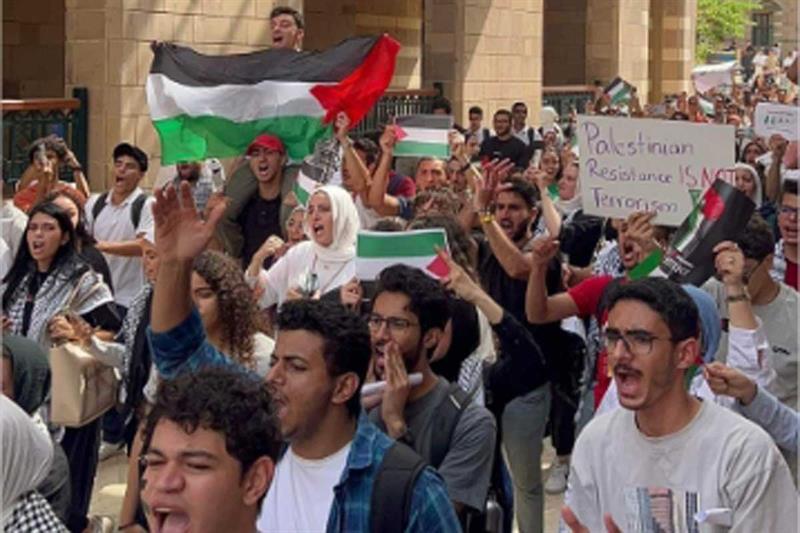
Students at American University in Cairo (AUC) Demonstrating Monday in Solidarity Palestinians (Photo source: X Twitter)

Whether overall these actions of students, who comprise a large and influential section of youth, will significantly deepen, widen and energise the growing Palestine solidarity movement, and simultaneously the wider anti-imperialist movement, remains to be seen.

End.

Victory to the Palestinian Resistance” banner on Trinity College railings Saturday (Photo: D.Breatnach)

FOOTNOTES

14th May 1970, killed by the Ohio Kent National Guard during a protest against the Vietnam War. The Jackson killings occurred 11 days later on Friday, May 15, 1970, at Jackson State College (now Jackson State University) in Jackson, Mississippi. On May 14, 1970, city and state police confronted a group of students outside a campus dormitory. Shortly after midnight, the police opened fire, killing two students and injuring twelve.

https://en.wikipedia.org/wiki/Jackson_State_killings

2Ironically, precisely because it was free of the major socially controlling agency in Ireland at the time, the Catholic Church hierarchy.

3See the Stonewall Riots of 1969 in the US against homophobic police harassment.

4Including many frame-ups, some of which were only exposed decades later. Leonard Peltier was jailed on dubious evidence in 1977 which had already collapsed against a co-accused but is still in jail, 79 years of age with diabetes and other health problems.

5See MOVE organisation in the late 1970s https://en.wikipedia.org/wiki/MOVE_(Philadelphia_organization)#1978_shoot-out

6Fred Hampton and Mark Clarke were assassinated by police and other Black Panthers wounded in 1969 https://en.wikipedia.org/wiki/Fred_HamptonS and Black Panther George Jackson, shot dead by prison guards in 1971 allegedly while participating in a prison escape. https://www.freedomarchives.org/George%20Jackson.html

7Between 1964 and 1973, the U.S. military drafted 2.2 million American men out of an eligible pool of 27 million https://michiganintheworld.history.lsa.umich.edu/antivietnamwar/exhibits/show/exhibit/draft_protests/the-military-draft-during-the-

855% working class, 25% poor and 20% middle class, according to one study https://www.studentsofhistory.com/vietnam-war-draft

9Attack from lower ranks by fragmentation grenade rolled into a toilet being used by an officer or his tent. Between 800 to 1,000 such incidents are thought to have occurred among US Marines during the Vietnam War https://www.marxists.org/history/etol/writers/geier/1999/xx/vietnam.htm

10https://www.independent.co.uk/news/timothy-leary-was-an-fbi-informer-1103070.html

11Thereby also devaluing the meaning of that particular form of racism which was a basic ideological aspect of Nazism and Fascism and continues to be a strong trend in European fascism today.

12Ditto.

13One of the latest horrors from the Israeli Zionist cabinet, killer drones playing sounds of a crying baby or a woman needing help in order to bring would-be helpers out where they can then be shot dead, being played in this case mockingly.

14https://edition.cnn.com/2024/05/03/world/pro-palestinian-university-protests-worldwide-intl-hnk/index.html

15https://www.aa.com.tr/en/europe/german-police-break-up-pro-palestinian-protest-at-humboldt-university/

16A semi-autonomous legislative assembly but part of the United Kingdom.

17https://www.itv.com/news/2024-05-04/students-at-protest-camp-inside-trinity-college-vow-to-stay-indefinitely

18Ibid.

SOURCES

https://en.wikipedia.org/wiki/Jackson_State_killings

https://edition.cnn.com/2024/05/03/world/pro-palestinian-university-protests-worldwide-intl-hnk/index.html

Trinity College protest: https://www.bbc.com/news/articles/cn0wzgp7q0do?

https://www.itv.com/news/2024-05-04/students-at-protest-camp-inside-trinity-college-vow-to-stay-indefinitely

The Trinity occupation: https://www.instagram.com/tcd_bds

LESSONS THE PALESTINIANS AND THE ISRAELI ZIONISTS HAVE TAUGHT US (Part 2)

The past six months of an almost incredible level of Israeli genocide and Palestinian resistance have taught the world some valuable lessons but particularly perhaps those of us living among the Western powers.

PART TWO: LESSONS FROM THE ISRAELI ZIONISTS

Diarmuid Breatnach

(Reading time: 5 mins.)

  • The Nature of Zionism

The Zionists have taught us the nature of Zionism as an ideology upholding a people allegedly chosen by religion to occupy a land and to repress or expel the indigenous occupants of that land.

  • Nature of settler states

As Zionism is a variant of occupier-settler ideology we have, by extension, learned to recognise the nature of all settler states. To be fair, the evidence of that nature was clearly before us but we had perhaps learned to push it to the backs of our minds.

The European settler states of USA and Canada practiced genocide against their native indigenous peoples, of which only discriminated fractions remain from “California” to “Newfoundland”, from Pacific to Atlantic coasts. Both those states have diligently supported the Zionist settler project.

Lithograph image of aftermath of the Wounded Knee massacre of Indigenous people, USA, 29 December 1890 (Image sourced: Internet)

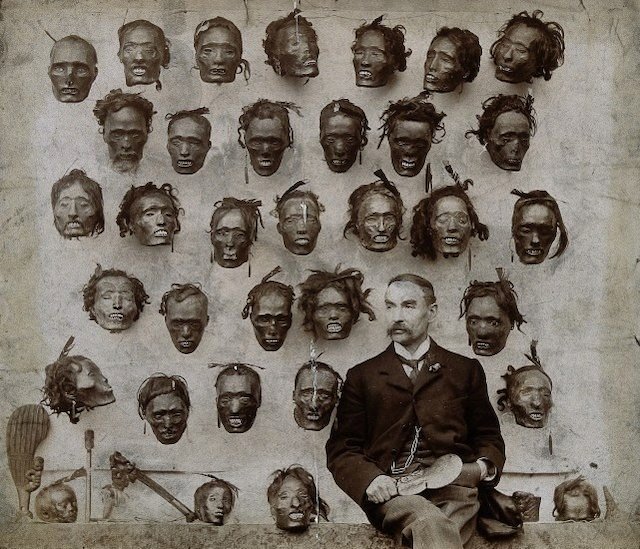
Those Northern American territories were primarily English colonies1 as were Australia and New Zealand, both also practicing genocide and discrimination against their indigenous populations and both those states too have supported the Zionist settler project.

European coloniser collection of New Zealand Indigenous heads 1895 (Photo source: Khamen.ir)

Less unanimous have been the mainly Spanish and Portuguese settler colonies of what is now called “Latin America”, from Brazil to Argentina to Mexico. Their indigenous populations too were ethnically cleansed and subjected to genocide, although to varying degrees of intensity.2

The Caribbean islands have all been settler and imported slave colonies of the states of England, Spain and France3, all now having nominal independence but, with the exception of Cuba,4 remaining within the imperial ambit of the USA (mostly) and France and have responded accordingly.

  • Nature of the zionist state

The Zionist State has demonstrated to us the true outcome of the Israeli zionist ideology, expansionist and prepared to inflict any horror upon the indigenous people in order to achieve its aims, descending to depths of inhumanity unimaginable only if Nazism were forgotten history.

An early mass grave of Palestinians killed by the Israeli military in Gaza back in November 2023 as the cemeteries were already full (Photo cred: Mohammed Salem/ Reuters)

Currently the Israelis’ toll of Palestinians is at least 34,049 dead and 76,901 wounded, with an estimated further 8,000 under rubble in Gaza, nearly 2 million displaced (many several times), all medical, educational and social facilities and infrastructure degraded if not totally destroyed.5

And with at least 9,500 prisoners (i.e hostages) reportedly ill-treated, humiliated and even tortured, of which an Israeli-admitted 27 have died during these six months alone and 3,660 are held without trial or release date in “administrative detention”.6

  • Brazen Truth and Lies

We have also learned from the Zionist state its brazen genocidal intentions towards the Palestinians, expressed for internal Israeli consumption, alongside its outlandish lies for the international public about October 7th: beheaded babies, mass rapes, disfigurements, burning alive, etc.

All of those have been debunked and the recorded statistics alone (but also backed by evidence of other agencies) expose the lies that the Israeli army is attacking only7 the Palestinian resistance, that it is not applying collective punishment and using starvation as a weapon.

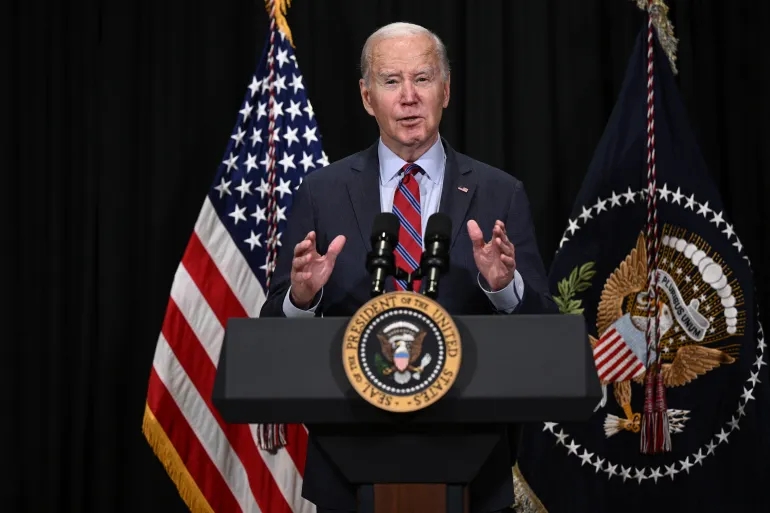
False Israeli Zionist propaganda about the Palestinian resistance “beheading babies” repeated by US President Joe Biden in press statement, claiming he had seen photos. His aides later ‘clarified’ that he was relying on reports from the Israeli state and had not seen actual photos. (Photo sourced: Internet)

Not bothering to give excuses for its demolition of universities and museums, schools and places of Muslim and Christian worship, ‘Israel’ has claimed the existence of tunnel entrances in them as excuses for the total elimination of Palestine’s main hospitals and degradation of all others.

It has done this despite its lack of evidence of such use of the hospitals, despite denials of hospital staff and organisations and without having to explain how such claims, even if they were true, could justify siege of hospitals, killing patients and staff and their destruction as functioning hospitals.

(Three before-and-after images of Israeli military destruction of Al Shifa Hospital, internally and externally)
https://www.instagram.com/reel/C5XQ2YQIQwP/
  • Impunity from world legal order

What Israel and the western imperialist states have shown us to date is that Israel has impunity to carry on its genocide. Not only will it not be boycotted, much less blockaded, not to even mention invaded, it will continue to be supplied with weapons, money and political support.
Even after the ICJ judgement in favour of S. Africa that Israel was “plausibly committing genocide” and restrictions imposed on Israel by the court, the genocide continued without pause and without any serious international repercussions by any western state.
Israel has given us a clear demonstration in practice of the hollowness of western institutional democracy and liberalism, not only in its continued support for the genocidal state but in the repression by western states of those who have supported the Palestinians in word or deed.

Demonstrations and pickets have been forbidden8, protesters threatened and arrested9, academics hounded and sacked,10 artists and public speakers cancelled, social media profiles hampered or blocked. In fact, all the kinds of undemocratic actions of which some other states are often accused.

  • Exposure of the world order of legal democratic institutions

The exposure of these institutions was almost complete. The United Nations of 193 states was shown powerless to act without the authorisation of the five Permanent Members11 of the Security Council — which itself was shown nullified by a veto of even one Member.12

United nations

United Nations building with approach flanked by national flags of member states(Photo sourced: Internet)

The International Court of Justice, a sub-institution of the UN itself, with a history of never even trying a western power, though judging Israel plausibly guilty of genocide,13 failed in its judgement on 26th January to order an immediate cease to the state’s attacks on the Gaza population.

The ICJ failed even to take action on Israel’s non-compliance with the interim measures it ordered, viz: “to take all measures to prevent any acts that could be considered genocidal according to the 1948 Genocide Convention”, other than to issue another non-complied order on 28th March.14

The United Nations failed to defend its own aid organisation for the relief of Palestinians (both in Palestine and as refugees in other parts) from unsupported Israeli allegations of the participation of 0.04% of its staff in the Palestinian resistance operation of October 7th 2023.

The UNWRA chiefs responded by failing to stand up to Israeli bullying and by sacking nine of their own workers without any evidence presented against them and without a right to a hearing or appeal. It also for a time failed to denounce Israel for reported torture of the agency’s employees.15

The UN failed to defend the staff of UNWRA from unproven allegations, unfair internal treatment and Israeli intimidation and murder or to maintain the essential funding of UNWRA essential for the Palestinians, or to insist on the regular and protected entry of aid trucks safe from Israeli attack.

The European Union refused to even call for a ceasefire; continued to act as Israel’s biggest export market; some of its members withdrew UNRWA funding and continued to supply the genocidal state with arms, while many states repressed their own citizens acting in solidarity with Palestine.

  • The need for revolutionary resistance

The Zionist state and its imperialist backers and, to be fair to it, our own Irish state too, have demonstrated to us the fragile and temporary nature of western liberalism and democracy on the one hand and the need, by implication, of revolutionary resistance and organisation on the other.

IN CONCLUSION

It remains to us to learn those hard-earned lessons, to internalise them and to apply them externally. We owe that to the Palestinians and to ourselves.

End.

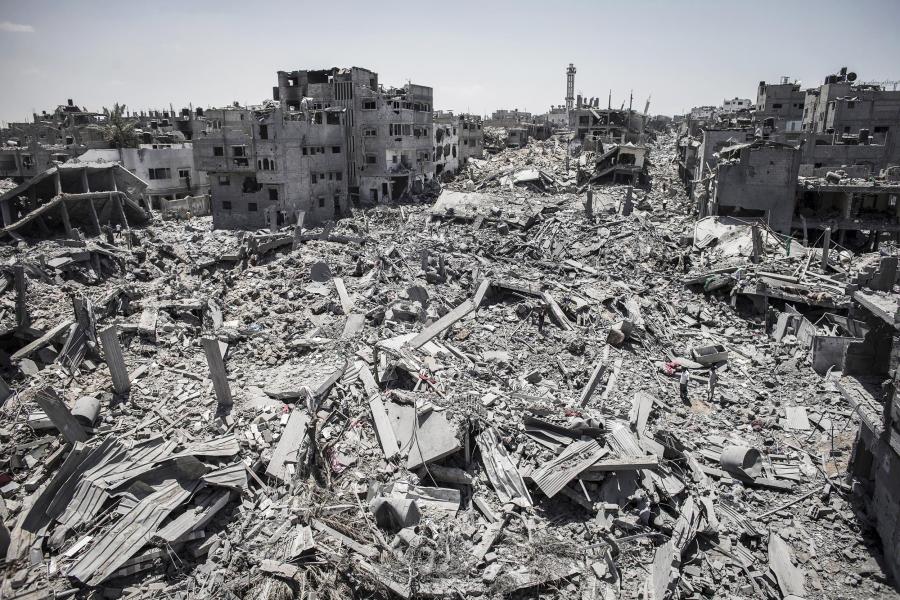
Part of Gaza after Israeli bombardment back July 2014; now of course it is much, much worse. (Image sourced: Internet)

FOOTNOTES

SOURCES

https://www.voanews.com/a/7577969.html

https://www.addameer.org/statistics

https://en.wikipedia.org/wiki/South_Africa_v._Israel_(Genocide_Convention)

https://www.unrwa.org

https://en.wikipedia.org/wiki/Israeli_allegations_against_UNRWA

1The Dutch also colonised the north-east of what is now the USA and the French particularly Louisiana, in what is now the USA and Quebec in what is now Canada. What is now SW USA was part of the Spanish colonial empire, subsequently part of the Mexican Empire and gained by the USA in two wars with Mexico.

2The disparity in approach of these states is underlined by for example on the one hand El Salvador unreservedly supporting the zionist state and by Nicaragua on the other hand taking Germany to the International Court of Justice in accusation of being complicit in the Israeli genocide by supporting the state with weapons and finance.

3Without overlooking the fact that each of those states (England now as the United Kingdom) contains other dominated nations within it.

4During the existence of the USSR Cuba was often described as being under Soviet colonial influence but remains today the only truly independent (though part-occupied) state in the whole of the Caribbean.

5https://www.voanews.com/a/7577969.html, a pro-Israeli source.

6 At the time of writing Adameer, the Palestinian prisoner and human rights organisation reports 9,500 Palestinian prisoners of which 3,660 are “administrative detainees”, 200 children and 80 women. Seventeen of the prisoners are elected Legislative Council members (similar to MPs or TDs) https://www.addameer.org/statistics. These figures have changed regularly during the 6 months of zionist genocide and the trend is always upward except for a brief period during the truce and exchange of hostages.

7In fact, not even mainly.

8Particularly in Germany and France

9Particularly in Britain

10Particularly in the USA

11UK, France, USA, Russia, China

12Most often and recently in the case of Israel/ Palestine several time by the USA but at times also by the UK and France.

13In a case taken by South Africa lodged at the end of December 2023. https://en.wikipedia.org/wiki/South_Africa_v._Israel_(Genocide_Convention)

14In response to application of South Africa again. https://en.wikipedia.org/wiki/South_Africa_v._Israel_(Genocide_Convention)

15https://en.wikipedia.org/wiki/Israeli_allegations_against_UNRWA

IT’S NOT BECAUSE OF THEIR SKIN COLOUR BUT ABOUT WHERE THEY ARE

Diarmuid Breatnach

(Reading time: 8 mins.)

There is a belief around that the reason that Israel is being supported by the US and getting away with genocide as far as the Western powers are concerned, is because the Palestinians are dark-skinned and that it wouldn’t happen to ‘whites’.

Those who believe that are mistaken: it would and it did. It is only marginally about skin colour but rather about where the Palestinians are.

Palestine sits in a strategic spot in the heart of the Middle East, with borders to Egypt, Lebanon and Syria, with the Red Sea to the South-east and a Mediterranean coastline to the west, connecting by sea to Europe, Africa and Asia. That made it important to old and to new empires.

The historic land known as “Palestine” in the 19th and early 20th Century was that which up until 1917 was ruled by the Ottoman Empire, now occupied by the zionist Israeli State and those areas recognised as Palestinian by international law including Gaza, the West Bank and Jerusalem.

After WWI, during which the Ottoman Empire, along with Germany had been on the losing side, in the divvying up of the colonial spoils, Palestine (occupied by the British since 1917) was given by the League of Nations in 1922 to one of the War’s victors, the UK.

The UK began to invite Ashkenazi Jews to settle there as part of a European colonial and partly anti-semitic1 project. Of course in those days “semitic” was understood to apply to the Arabs as well as to the Jews and the latter were often referred to by Europeans as “oriental”.

The British, as is the wont of colonisers in general and of them in particular, played the settlers off against the Arab majority.

And of course broke promises about restricting the number of settlers. But after WWII, a high influx of Holocaust survivors organised by Zionists began to head for Palestine and the British, fearing the destabilisation of their colony, tried to prevent unapproved Jews from landing.

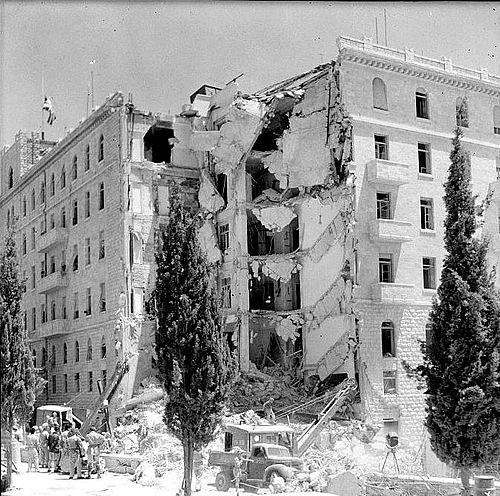
The zionist terrorist militias (Irgun, Haganah, Stern Gang) began to attack the British colonial forces and Arab villages. In July 1946, Zionist group Irgun killed 91 people and injured 46 in an explosion at the King David Hotel, location of the British administrative and occupation army HQ.

Damage to the King David Hotel after bomb planted by Zionist terrorist group Irgun in 1946. (Photo sourced: Wikipedia)

The British pulled out in 1947, reneging on all their promises to the native Palestinians. The Zionists began their genocidal settler project with threats to and massacres of Palestinians and the expulsion of 700,000, mostly Muslims — and declared a Jewish State in 1948.

Thereafter the Israeli State began a program of repression and oppression of Palestinians and of colonial expansion. Naturally, this project required ethnic cleansing and genocide of the Palestinians and aggression against Israel’s neighbours.

The USA and the USSR quickly recognised the Zionist State, the USA increasingly funding the state and supplying it with weapons while the USSR permitted its Ashkenazi Jewish citizens to emigrate to the settler colony.

In October 1956, eight years after the founding of the Zionist state, in response to Egyptian nationalisation of the Suez Canal, the Israeli air force attacked Egyptian airfields without warning while British and French Army and Naval forces invaded the country.

The invaders were forced to retreat and the USA admonished France and the UK for, in effect, not realising that the USA and not the old European colonial powers was now the boss of most of the world.

The zionist lobby (both Jewish and Christian) in the USA is often blamed for that imperialist state’s continual support for Israel’s genocidal attacks on the Palestinians.

But the US imperialists have their own reasons for supporting the only state in the Middle East that is susceptible to neither internal national liberation struggle or muslim fundamentalist uprising. It gives the US a safe foothold and also a guard dog to watch the neighbours (e.g Syria and Iran).

RACISM

The Nazis had a racist view of the Ashkenazi Jews, who were mostly fair-skinned. But they also considered the Slavic people (the majority European and light-skinned) as “untermenschen” (i.e ‘subhuman’). It’s estimated they killed at least 1.9 million Polish non-Jewish civilians.2

The Nazis also murdered millions of Russian non-Jewish civilians in genocidal ethnic cleansing of territory, in labour concentration camps, near sensitive battle formations and in reprisals for partisan resistance.

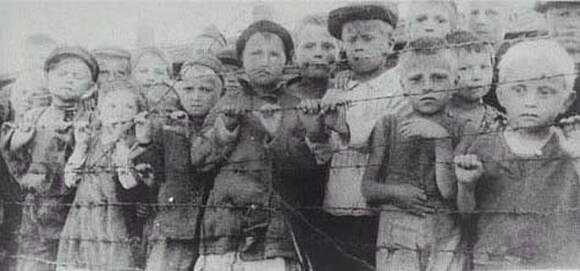
Fair-skinned and even blonde children victims of Nazi racism and genocide. (Source: New Zealand Holocaust Centre “Button project”)

The South African settler racist regime discriminated against all non-European people, in their official categories of “Native”, “Coloured” (mixed race) and “Asian” (mostly from the Indian sub-continent). Nevertheless, they also made some groups “honorary whites”.3

Racism isn’t primarily about skin colour anyway: It is a discriminatory social ideology based on ethnicity and the marker for ‘difference’ can be ‘racial’, national or religious. The Anglo-Norman invaders of Ireland in the mid-12th Century racialised the Irish, who were generally fair-skinned.4

The rational reason behind the racism is to unite in opposition to the targeted groups, whether in order to wage war against them or so as to repress their resistance as slaves or as occupied people. The racists colonise their own minds and attempt to colonise the minds of their targets also.

Not quite two centuries after the initial invasion and part-occupation of Ireland, the British-based Anglo-Normans, now describing themselves as “English”, criticised most of their people settled in Ireland for ‘going native’ and passed laws against their social acclimatisation.

The Statutes of Kilkenny in 1366 attempted to prevent “the degenerate English” from speaking Irish, adopting Irish customs and laws, dressing in Irish style, patronising Irish cultural performance, intermarrying with the Irish and becoming “more Irish than the Irish themselves.”

The main purpose for the Anglo-Norman invasion of Ireland had been occupation by feudal lords to gather rents from the natives but it soon became a question of replacing the natives with settlers. This was not always successful since the Irish people and many clan chiefs resisted.

The cities became fortified centres of colonial occupation, administration and garrison, the colonial city of Dublin known as “the Pale” in reference to the original earthworks surmounted by a palisade; hence “beyond the Pale” signified the native Irish and barbarism to the colonists.

The earlier occupation settlements were in or around fortified constructions, castles and ‘keeps’. Later, town and villages were established with a central square or diamond, i.e in a good defensive shape and entry by natives forbidden. Settler churches were also built as defensive structures5.

Pseudo-scientific racism from white Anglo-Saxon Harper’s Weekly magazine 1899 in the USA. (Sourced: Nothing But the Same Old Story, Liz Curtis).

With the creation of Irish Republican Brotherhood (or the ‘Fenians’) in the 19th Century and their activities in Ireland, the USA and in Britain, the British elite combined anti-Irish racism with pseudo-evolutionary ‘science’ representing the Irish as not quite human or childlike – but violent.

Cartoons in some British popular periodicals, in particular Punch, Fun, Judy(and Puck in the USA) represented the Fenians as monsters, in particular ape-like creatures and racist jibes and ‘humour’ were popularised, a practice which sprouted new variants during the recent 30 Years War.

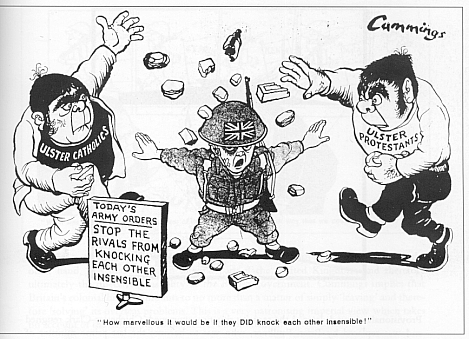
Updated British anti-Irish racism by cartoonist Cummings, Daily Express, London, 12 August 1970, depicting the colonial British Army as “keeping the peace” between the colonised Catholic/ Nationalist population and the British Loyalists. (Sourced: CAIN)

ETHNIC CLEANSING AND GENOCIDE

All European settler projects imply ethnic cleansing accompanied by genocide to one degree or another: in Africa, Latin America, North America, Australia, New Zealand … but this was practiced by a European power against a European nation also: Ireland.

The British elite used atrocity stories from the 1641 uprising of the Irish to justify and encourage the genocide by Oliver Cromwell’s campaign in Ireland in 1649. Through ethnic cleansing, battle and starvation, Cromwell killed nearing 40% of the Irish population.6

British atrocity propaganda image about the Irish uprising of 1641 to justify Cromwell’s campaign of ethnic cleansing, genocide and enslavement. (Sourced: online).

These figures do not include those he had sent to British colonies in the Americas as slaves.7

The Great Hunger (1845-1848) wiped out, through starvation, well over 2 million of the Irish population of around 8 million and during that and the following decade, probably another 2 million emigrated (many of those too dying on the way or on arrival8).

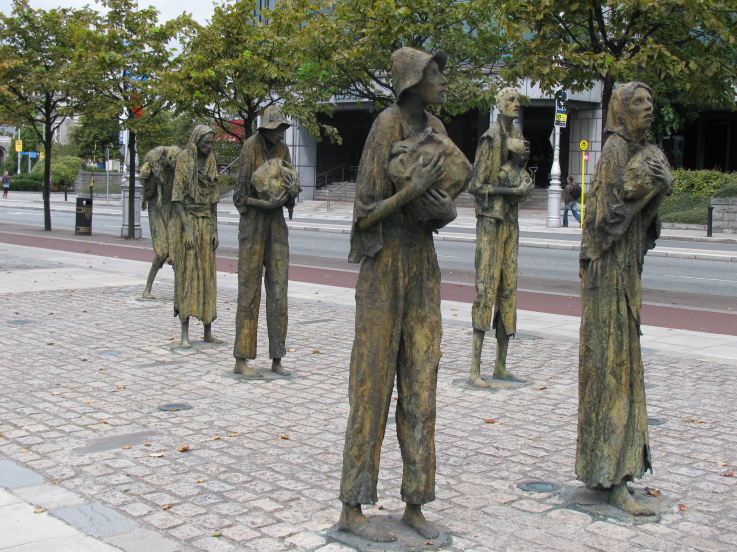
Monument on the Liffey quays in Dublin to the Great Hunger (1845-1852) genocide of the Irish by the British ruling class. (Photo: D.Breatnach)

DOES IT MATTER WHETHER IT’S DRIVEN BY RACISM OR BY COLONIAL EXPANSION?

Yes, it does. The difference between the two does not change the situation of the Palestinians but it does affect how the genocide may be understood and what the targets of our actions may be.

Liberals would probably prefer the issue to be primarily of racism. If that were the source of the problem we could still be pushing for economic and isolation pressure as was the focus with the anti-apartheid campaign against the South African racist regime.

That is being done now and that’s fine. But the assumption would be that with enough pressure, Israel would be obliged to change its ways and the US leaders would feel pressured to advise it to end its racist discrimination (as they did in the case of white South Africa).

But if the project is colonial expansion, presupposing ethnic clearing and genocide, it is a different situation completely.

No arguing with Israeli zionists, boycott or isolation culturally and in sport is going to change that or get ‘liberal’ Zionism to act against their Right; as Finkelstein recently pointed out, the Nakba and all the settler expansions were carried out under ruling periods of the ‘Left’ side of zionism.

Also, if this settler expansion (or supporting such at least) is part of a US imperialism project, then no amount of campaigning to expose the behaviour of the Zionists is going to be effective in persuading the ruling class of the USA to apply corrective pressure to the zionist regime.

The fact that the basic source of the problem is zionist settler expansion means that genocide and ethnic cleansing will continue as long as the Israeli zionist state exists. And US and Western imperialism will continue to support that as long as they believe it benefits their regional interests.

This makes it clear that the long-term solutions can only consist of ending the zionist project or the ending of imperialism which supports it. The former is of course a smaller objective but at the moment western imperialism is energetically defending the zionists.

A whole neighbourhood in Gaza wiped out by Israeli bombardment months ago (Photo cred: WAFA agency)

It is doings so politically and culturally, with armaments, also with propaganda from its mass media, by repression of its own populations where these are protesting in solidarity with the Palestinians – and in the course of that it is endangering all its facades of justice and objectivity.

In the longer term that is probably a good thing, helping to create the subjective conditions for the overthrow of imperialism and monopoly capitalism.

But we need to help that process along in our own struggles while also making their continued support for zionist genocide of Palestinians as costly for them as we possibly can. While we act in solidarity with the Palestinians we are acting also against our own immediate enemies.

End.

FOOTNOTES

1This may surprise some but the British ruling class was deeply anti-semitic even before Shakespeare wrote his Merchant of Venice script. Not only that, but Balfour, infamous for his eponymous Declaration that Palestine was suitable for Jewish settlement, was personally strongly anti-semitic (I am thankful to Ali Abunimah for pointing that out in one of the youtube discussions of the Electronic Intifada)

2https://www.hmd.org.uk/learn-about-the-holocaust-and-genocides/nazi-persecution/non-jewish-poles-and-slavic-pows/

3For example, east Asians such as Japanese and Koreans with whom they wished to have good commercial and financial relations https://en.wikipedia.org/wiki/Honorary_whites

4I keep telling people struggling against colonialism and imperialism that they should study Irish history. It’s practically all there: racism, invasion, division, settlers, plantations and ethnic cleansing, recruitment of native enforcers, undermining of native culture, religious oppression, genocide (twice), partition, recruitment of sections of the elite and nationalist political parties.

5Though this also had a history in medieval Europe. The administrators of the Ulster Plantation at the start of the 17th Century allocating grants of land specified that those who got parcels of land had to be English-speaking, be Protestant, build defensive structures and not employ Catholics.

6https://www.historyireland.com/how-many-died-during-cromwells-campaign/

7This has become something of a controversy, with racists of Irish diaspora background claiming parity with the slavery experience of Africans in the southern USA and some anti-racists denying it, saying the Irish were indentured servants. Both are mistaken: Irish were sent in slavery by Cromwell but subsequent Irish were sent in indentured servitude which, bad as it is, is not chattel slavery and the historical slavery period of the Irish in the USA was nowhere near as long as it was for the Africans.

8Over 3,000 are buried on Grosse Isle alone, an island in the St. Lawrence River in Quebec, Canada.

SOURCES

https://www.hmd.org.uk/learn-about-the-holocaust-and-genocides/nazi-persecution/non-jewish-poles-and-slavic-pows/

https://www.historyireland.com/how-many-died-during-cromwells-campaign/

https://www.thriftbooks.com/w/nothing-but-the-same-old-story-the-roots-of-anti-irish-racism_liz-curtis/

The Influence of the Working Class on the 1916 Rising

Diarmuid Breatnach

(Reading time: 9 mins.)

The 1916 Rising is usually seen as a nationalist Rising of Irish Republicans with perhaps some socialist involvement. Even Connolly is often portrayed as a patriot only (see the song James Connolly the Irish Rebel) with socialist views.

Of the six organisations that participated actively in the 1916 Rising1 only one of them was specifically of the Irish working class. Perhaps that’s why the great influence of the working class on the Rising tends to be generally overlooked.

As is well-known, James Connolly is one of the Seven Signatories2 of that wonderful and progressive document, the 1916 Proclamation of Independence. However, Connolly only became part of the planning committee for the Rising a very short time before the scheduled date.3

That is true but we should ask ourselves why they included him at all. The Irish Volunteers had a nationwide organisation with the also nationwide Cumann na mBan as auxiliaries, whereas Connolly could perhaps mobilise a couple of hundred fighters.

(Photo sourced: Internet)

It is said he was brought on board because the IRB believed that his constant demand for a Rising during WWI and the military exercises of the Irish Citizen Army indicated that Connolly was likely to lead the ICA to rise on their own and would spoil their schedule.

How likely was he to do that? It’s true that as a socialist Connolly was horrified by the slaughter of war, where workers of one state are sent to kill and be killed by workers4 of another and perusal of his writings do show that he thought an uprising to sabotage war was desperately needed.

Would he have gone ahead alone with the roughly 250 men and women of the Irish Citizen Army, hoping perhaps to inspire a popular upsurge and to encourage the Irish Volunteers to join it, in spite of even their leaders?5 It’s hard to believe so but of course it’s possible.

However, from the moment the Republican planners of the Rising took Connolly on board, we can see a significant organisational shift towards the working class in Dublin and nowhere more so than around Liberty Hall, where the first flag for an uprising was hoisted and the Proclamation printed.

Liberty Hall was of course the headquarters of the Irish Transport & General Workers’ union,of which James Connolly was the leader at that time and also editor of its newspaper,The Irish Worker.

And for a person brought in to the planning so recently, how extraordinary that Connolly was given the rank of Commandant General! A responsibility he took seriously, sending couriers around the country and attempting to direct defence preparations around the various Dublin garrisons.

The first battle flag of the Rising

A week before the Rising Connolly and the Irish Citizen Army had an Irish Republican flag raised above Liberty Hall as a flag of war and the one chosen to do the raising was a girl of 16 years, Molly O’Reilly.6

The associated circumstances are worth retelling, if only to illustrate the difference between the Liberty Hall of then and today. Adults took classes in Irish language and cultural activities there while their children and those of union activists waited for their parents, took dancing classes or played.

In playing, Molly O’Reilly accidentally broke a window and in terror and shame, ran home.

When Connolly sent a message to her home that he wanted to see her, she went to Liberty Hall expecting a severe telling off. Instead he told her not to worry and what he was asking of her. She was proud to do it but so small she had to stand on a chair to pull the cord raising the flag.

Remnant of the flag raised on Liberty Hall (Image sourced: National Museum)
Commemoration ceremony “Women of 1916” with relatives of Molly O’Reilly in place of honour (note the uniforms are of Irish Volunteers rather than Irish Citizen Army).(Photo: D.Breatnach)

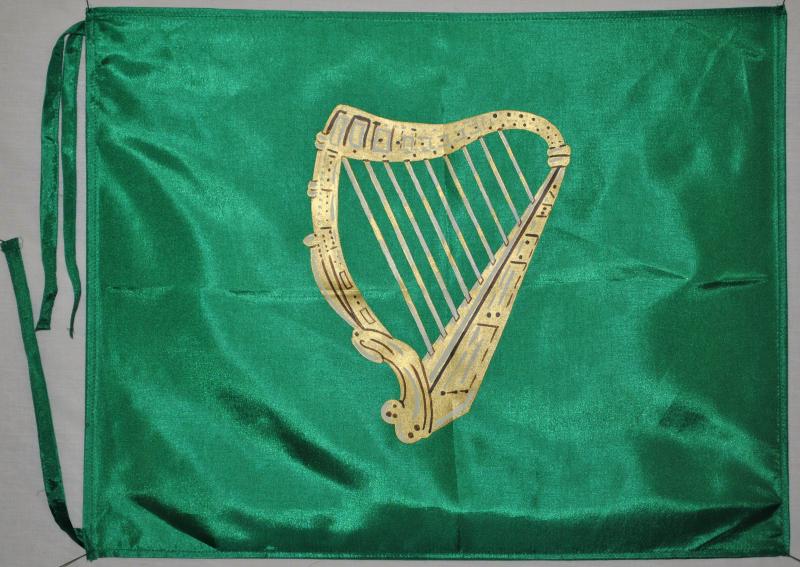
Of course we know that flag was not of the revolutionary workers but instead the harp on green which was that of the early Fenians and was very similar to that of the United Irishmen, the first revolutionary Irish Republican organisation.7

Those early Fenians were mostly composed of working class members and their 1867 proclamation to the world was largely proletarian in outlook. In Britain, the Fenians formed part of the First International Workingmen’s Association which was led by Marx and Engels.

Their flag was flown over at least one of the 1916 Rising garrisons, I believe at theJameson Distillery in Marrowbone Lane.

Similar flag to that hoisted over Liberty Hall (Photo sourced: Internet)

The other flags of the Rising included the Tricolour, presented to the Irish Republicans of the ‘Young Irelanders’ by women in revolutionary Paris in 1848, which was one of two flown on the roof of the GPO, the headquarters of the Rising.

Sharing the GPO roof with the Tricolour was the flag made only days before from domestic material and painted with the words “Irish Republic” in the house of Constance Markievicz, an officer in the Irish Citizen Army, shortly before the Rising.

The Irish Citizen Army’s own flag, the Starry Plough, flew over the Clery’s building facing the GPO. Sadly today most Irish people do not know that flag, though awareness of it and its background is growing among the indigenous Irish and the migrant community.

The design of the Starry Plough, flag of the ICA as it was in 1916 (Image sourced: Internet)

The first workers’ army in the world8

The Irish Citizen Army was formed as a workers’ militia during the great Lockout and strike of 1913-1914, to defend against the attacks of the police, the physical repressive front line of the capitalist class; the ICA’s flag was placed above Murphy’s Imperial Hotel in Clery’s.9

The Irish Citizen Army on exercises at their grounds near what is Fairview today (Photo sourced: Internet)

Though its constitution was more nationalist than socialist, the ICA was in its membership and purpose the first workers’ army in the world and when reorganised a few years later, represented also working class feminism, recruiting women, some of whom were officers commanding men.

Once the preparations for the Rising were in tatters with MacNeil’s countermanding order, where did organisers gather to discuss what to do? In Liberty Hall, the building of the Irish Transport and General Workers Union and it was there that the decision to rise on Monday instead was taken.

It is hard to overstate the importance of the fact that the decision to go ahead with insurrection was taken in the building which had become de facto the HQ of the revolutionary working class in Dublin, with an illegal flag of rebellion flying and where the Proclamation was to be printed.

The writing and text of the Proclamation

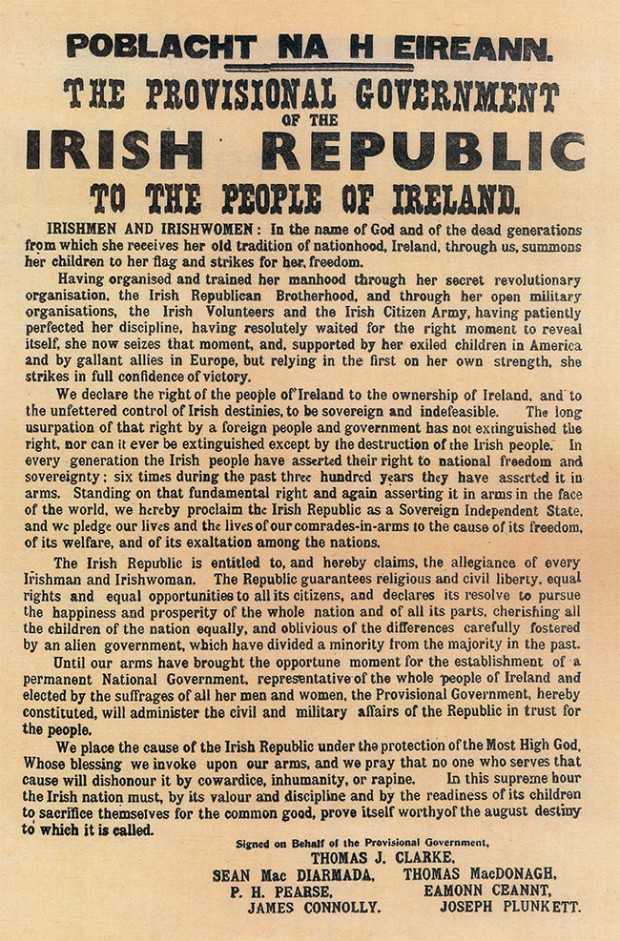
The wording of the Proclamation is thought largely composed by Pearse but influenced by Connolly, including its address to “Irish men and Irish women” and perhapsWe declare the right of the people of Ireland to the ownership of Ireland, and to the unfettered control of Irish destinies”.

Another section which could bear Connolly’s fingerprint reads: The Republic guarantees religious and civil liberty, equal rights and equal opportunities to all its citizens, and declares its resolve to pursue the happiness and prosperity of the whole nation and of all its parts, cherishing all the children of the nation equally.

(Image sourced: Internet)

But, whoever composed or influenced the Proclamation text, it was printed in Liberty Hall. An Irish Citizen Army member went to Stafford Street (Wolfe Tone St. today) to borrow the print type from a printer there to bring back to Liberty Hall, which was under daily 24-hour armed guard.

Having printed the Proclamation in Liberty Hall under armed guard and having decided there to rise on Easter Monday, where did the assault groups for Stephens Green, Castle and the GPO, including the Headquarters Battalion, meet on the morning of the Rising? …. Again, at Liberty Hall.

An early non-combatant casualty of the Rising was Ernest Kavanagh,10 who drew cartoons for the newspaper of the ITGWU, The Irish Worker. For some reason he went to Liberty Hall on Tuesday and was shot dead on the steps of the union building, presumably by a British Army sniper.

The working class in armed resistance

Once the Rising was in motion, the Irish Citizen Army had primary responsibility for two areas, the Stephens Green/ College of Surgeons garrison and the Dublin Castle/ City Hall garrison but also fought in other areas, for example on Annesley Bridge and in the GPO/ Moore Street area.

All who fought alongside them commented on their courage and discipline. After the surrender, many, along with Irish Volunteers were sentenced to death, most being commuted to life imprisonment. But two leaders of the Irish Citizen Army were shot by firing squad.

One of the areas from which the British forces were sniped at for days after the Rising was the docks area, then predominantly surrounded by working class residential areas.

A question we should ask ourselves is why the forces coming from Britain to suppress the Rising landed at Dún Laoghaire, from where they had to march nearly 12 km (approaching eight miles) to Dublin city centre, instead of at the excellent Dublin docks on the Liffey.

Hugo McGuinness, who specialises in history of the North Wall area, believes that the British expected Dublin to be in the hands of the working class resistance and that it was simply too dangerous to land British troops there, though gunboats could fire from the Liffey.

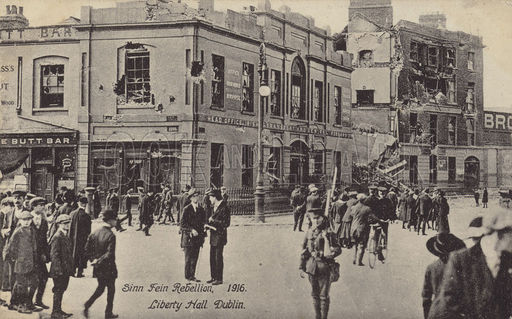
Certainly, the British believed Liberty Hall and buildings along Eden Quay were occupied as fighting posts by the Irish Citizen Army and they fired artillery at the union building from Tara Street, as photos of shell holes in that building and right through to the next testify.

Photo shell-damage Liberty Hall (first building with corner towards the camera, viewed northwards from Butt Bridge) as one of a set of commemorative postcards. (Photo sourced: Internet)
Another postcard with closeup of shelling damage to Liberty Hall and to the building next to it. Interestingly, in this one Liberty Hall is labeled “the Rebel Headquarters”. (Photo sourced: Internet)

Much is made in some historical accounts of the opposition to the Rising from sections of the Dublin population, during and immediately after the Rising. The city was the capital of a British colony, only just over a century earlier spoken of as “the second city of the British Empire”.

A substantial proportion of the wealthy and middle classes were Loyalist, including some Catholics; even ‘nationalist’ sections were committed to supporting the UK in WWI and John Redmond, leader of the ‘nationalist’ political party had openly recruited for the British Army.

Also, among the working class and the lumpen elements, many were depending on “Separation Allowances” with regard to males serving in the British Army. It is true that the insurgents in some places had to threaten, club or even shoot some civilians who tried to obstruct the Rising.11

These incidents during the Rising were not many but afterwards there were insults and other things thrown at prisoners being marched to imprisonment (or firing squad). The city was under martial law but even so a Canadian journalist reported the insurgents being cheered in working class areas.

There were also other individual witness accounts, such as a man on a tram saluting prisoners in Parnell Street until threatened by soldier escorts and a firefighter in the GPO doing likewise. A year later most of even the earlier hostility had changed to admiration and pride in the fighters.

Leadership of the working class

James Connolly wrote and said many things of importance but surely, with regard to the struggle for Irish national independence, the greatest of these was: “Only the Irish working class remains as the incorruptible inheritors of the fight for freedom in Ireland.”

By that he meant — and I agree — that all other social classes can gain something from selling out the interests and resources of Irish nationhood but that the working class can gain nothing from that.

The Irish working class staked their claim on the struggle for Irish independence in 1916 but have not succeeded in leading it and because of that, that struggle remains to be won.

Today and in other days, remembering that long struggle and the class whose leadership revolutionary socialists seek to represent and to uphold, we declare the need for that leadership over a broad front of all others who wish to struggle to advance.

In doing so, we declare that far from the working class having to wait for socialism, in the course of national struggle it must also shape its own demands around the economy, natural resources, infrastructure, social services, social questions, culture and, above all, to the fruits of its labour.

End.

FOOTNOTES

1Irish Republican Brotherhood, Irish Volunteers, Irish Citizen Army, Cumann na mBan, Na Fianna Éireann, Hibernian Rifles.

2All of which were executed by British firing squad, along with another seven in Dublin and yet another in Cork. The 16th execution was by hanging in London.

3(See Sources: Cooption of James Connolly etc) Connolly was a lifelong socialist and a revolutionary throughout his adult life, author, historian, journalist, song-writer, trade union organiser; active politically in Scotland, Ireland, New York and back in Ireland.

4The international socialist movement viewed the imperialists’ movement towards war with horror and in international conferences vowed to oppose it with all their might, including turning war resistance into revolution (“War against war”). However, once imperialist war was declared that resolve collapsed in most states, Russia, Germany and Ireland being notable exceptions and each saw a rising against war, in Ireland’s being the first.

5Joseph E.A. O’Connell (Jnr.) suggests a possible intention of goading of the State into attacking him and the ICA which might spark the general rising.

6(See Sources)

7The harp on the United Men’s flag was more ornate and was inscribed with the words “It is newly-strung and shall be heard”.

8https://www.connollybooks.org/product/irishcitizenarmy

9It was a good central location but more than that – the Hotel was one of the businesses of William Martin Murphy, chief organiser of the employers’ bloc to break the Irish Transport & General Workers’ Union.

10Kavanagh was a supporter of the workers, of votes for women and against participation in the imperialist war, contributing cartoons also to the Irish Citizen, Fianna and Irish Freedom publications, also to accompany poems of his sister, Maeve Cavanagh McDowell.

11I do not include in this the three members of the Dublin Metropolitan Police who were a force for the British occupation and also for the Dublin capitalists. The Irish Citizen Army in particular had good reason to settle accounts with them for attacks on them including inflicting mortal baton injuries on two workers during a charge on a union meeting on 30th September 1913 on Eden Quay and beating people and smashing up furniture in Corporation Street a little later.

SOURCES

Co-option of James Connolly to the Military Council planning the Rising: https://www.historyireland.com/connollys-kidnapping/

Raising the flag on Liberty Hall: https://microsites.museum.ie/1916objectstories/ObjectDetail/remains-of-irish-flag
Molly O’Reilly breaking a window incident: https://www.independent.ie/irish-news/ladies-day-for-1916-heroines/26528456.html

Printing of the Proclamation of Independence: https://libguides.ucc.ie/1916Proclamation
https://www.dublincity.ie/library/blog/printing-1916-proclamation-transcript

Decision taken to go ahead with the Rising on Easter Monday: https://www.irishtimes.com/culture/heritage/easter-rising-uneasy-calm-before-the-storm-1.2575638
https://www.nli.ie/1916/exhibition/en/content/risingsites/libertyhall/

“Only the Irish working class remains the incorruptible heirs …” (end second sentence from last): https://www.marxists.org/archive/connolly/1910/lih/foreword.htm

Erasing Murals and Erasing Gaza

Gearóid Ó Loingsigh 13 March 2024

(Reading time: 2 mins.)

       
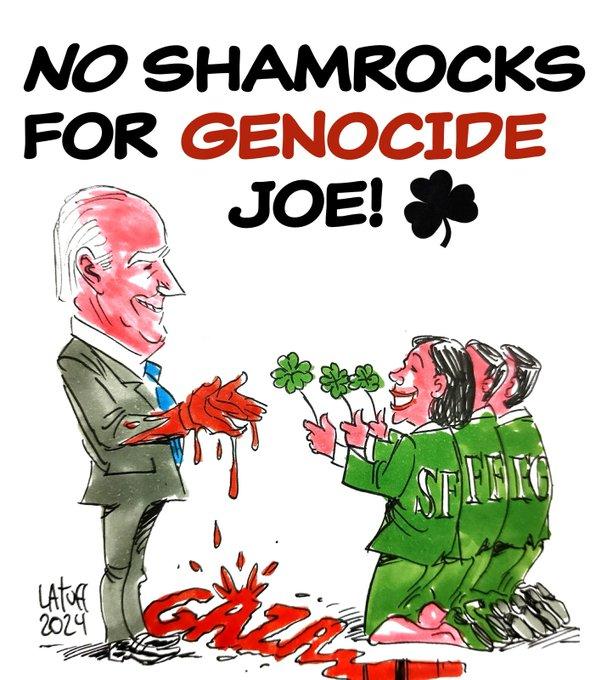
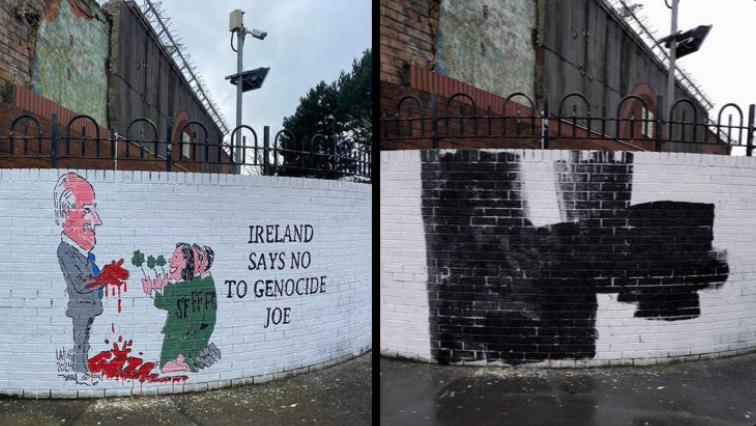
         Original Latuff cartoon.                              West Belfast mural.                                  Mural blacked out.

Once upon a time, Belfast was famed for its murals, so much so that even now a part of the tourist industry depends on a plastic paddy tour of the current murals on display in nationalist areas of Belfast.

It was the 1981 hunger strike and its aftermath that saw an explosion in political murals in nationalist areas.  As the 1980s went on, the technical and artistic quality of them improved dramatically and the politics they sought to represent expanded. 

Some of them were very militaristic, others much more political in content.  On international issues, murals sprang up on South Africa, Palestine and figures from revolutionary struggles around the world were to be found on gable ends all over the city and indeed in other cities throughout the North. 

Nelson Mandela, Steve Biko, Camilo Torres, Che amongst others looked down at the wandering revolutionary tourists who would come over in August.  The message was clear: Ireland was part of an international struggle against imperialism.(1)

After the peace process the quality continued to improve, but the politics went for a walk.  Twee Celtic murals abounded, young girls dancing a jig displaced images of women holding an armalite aloft for International Women’s Day. 

about Imperialism were softened, when not blunted entirely or removed.  So, it comes as no surprise to see what has happened to recent murals.

Sinn Féin supporters recently unveiled murals in solidarity with Palestine.  They are of good quality and try to capture the suffering of the Palestinians through the images and poignant quotes. 

However, they say nothing about who is causing the suffering: the US and Israel, though there are silhouette ghostly like images of soldiers standing over dead children. 

There was once a mural on the White Rock Road which pictured a US Indian superimposed over a US flag saying Your struggle, Our struggle.  No references are to be made now to the US role in exterminating a people.  That is strictly Verboten.

However, someone decided to reproduce a cartoon from the artist Carlos Latuff in mural form in Belfast.  It depicts Joe Biden, standing with bloodied hands in front of Mary Lou, who is clearly identifiable in the image, and the leaders of FG and FF, who can be identified from the initials FG and FF on their backs.

The British Army and the RUC used to deface republican murals, not any more.  Very quickly, Sinn Féin, officially or unofficially (no pun intended, though it is apt) painted over the mural.  It was quickly restored by others, who the artist Latuff described as real republicans.(2)

Sinn Féin are clearly uncomfortable about the issue in the run up their fest in Washington with Biden and not only are they content to throw Palestinians out of public meetings, they will now supress any public artistic attempts to draw people’s attention to the Slaughter Soirée they will have in the White House.

Many Palestinian voices such as the Electronic Intifada have called on Sinn Féin not to go to Washington, the calls in Ireland have been much more muted and tamer on the issue.  However, it is a clear issue, what is colloquially called a no-brainer. 

You don’t have to think very deeply to understand that Sinn Féin shouldn’t go to Washington DC, that they should tell Genocide Joe they don’t want to meet him.  They will go and they will say nothing about Palestine. 

Their erasure of a mural criticising them, tells you everything you need to know about their real attitude to Palestine.

Whatever you say, say nothing used to be a catchphrase about loose talk and informers, now it means never to mention Joe Biden and the Palestinians in the same breath, unless you are green washing genocide. 

Meanwhile Sinn Féin does its part, emulating the British army and vandalising political murals.

Notes

(1)  A selection of images can be seen on Bill Rolston’s website.  Rolston has chronicled and photographed murals going right back to the 1970s.  See https://billrolston.weebly.com

(2) See https://x.com/LatuffCartoons/status/1767239594083324017?s=20


Return to top of page

Dunnes Stores, South Africa, Gaza: A Tale of Two Boycotts

Gearóid Ó Loingsigh

29 February 2024

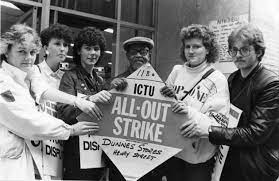
Anti-apartheid activist Nimrod Sejake with some of the Dunnes Stores striker.

Reference has been made on a number of occasions to the heroic actions of the Dunnes Stores Anti-Apartheid strikers in 1984 who spent nigh on three years on strike because they refused to handle South African merchandise.

It has been pointed to as a success story for boycotts and one to emulate. The real story of the strike points to the difficulties we now face in implementing a real boycott of Israel.

I used to go down to the picket line at the Dunnes branch in Henry Street every Wednesday, as we had a half day at school and on Saturdays when there was no school and then more regularly once I had sat my Leaving Cert exam and was, like many young people in 1980s Ireland, unemployed.

So, I recently bought a copy of Mary Manning’s autobiographical account of the strike, Striking Back: The Untold Story of an Anti-Apartheid Striker (Collins Press).

The book brought to mind many of the instances and difficulties that they faced and it raises many questions for those who wish to point to them as an example to follow.

The strikers were implementing a trade union resolution, and at first knew little of the reality of South Africa, something they corrected relatively quickly, thanks in no small part to a South African exile, Nimrod Sejake, who turned up to join them on the picket line.

Sejake was an activist who had been arrested as part of the infamous Treason Trial. Mary Manning is full of praise for Nimrod and rightly so.

Others do not come out so well and it is worth remembering the reality of that strike as it tells us some of the things that need to happen if we want to see similar action in relation to Israel.

The first thing that jumps out of the pages, early on, is that the trade bureaucracy did not give them any support and even their own trade union, IDATU (now called Mandate) was very reluctant to support them.

What support they got was down to their official Brendan Archbold who was a stalwart in supporting them and the then head of the union John Mitchell. At every twist and turn they had to fight the executive of IDATU, whilst the rest of the trade union movement ran for cover.

There will be no similar type of action around the Zionists unless it is put to the bureaucracy and they are challenged over their inaction in the midst of a genocide.

Karen Gearon, the shop steward at Dunnes Store made a call at the National March in Dublin on February 17th for the trade union movement to stop talking and take action. It is not something that has been seriously echoed by others.

Neither People Before Profit TDs or the IPSC have ever made a clear call for action from the trade union movement. It should be a central part of any boycott movement now.

It is all well and good picketing Starbucks, but stopping the importation of Israeli goods would be more important and will only happen if the bureaucracy is pushed to it. The history of PbP is one of cowering in the shadow of the bureaucrats and never putting it up to them on any issue.

They frequently share polite platforms with the bureaucrats and never challenge them. Their calls, when made are generic and are in passing. Their website and the IPSC site is limited to a consumer boycott with calls for the government, not workers, to take action.

I was also reminded by the book how the great and good in Irish society stood by whilst these workers were on strike. The Minister for Labour at the time was Ruairí Quinn, a member of the Irish Anti-Apartheid Movement (IAAM) and yet he did nothing.

He was not the only mealy-mouthed figure in Irish society, nor indeed in the Irish Anti-Apartheid Movement.

The head of the Catholic Bishops Aid Agency, Trócaire, Bishop Eamon Casey privately wrote to IDATU early on describing the strike as ‘economically harmful to the already impoverished Black South Africans.’

The strikers’ request for support from the Catholic Church was described as impertinent and just in case anyone doubted how he saw himself, he was of the view that both he and Trócaire should have been consulted before the strike took place.

Their currency now is much devalued in Ireland but there are others like them who also think they have a veto on decisions.

He was later forced to publicly back the strike having been embarrassed by Archbishop Desmond Tutu’s decision to present two strikers to the world at his London press conference en route to pick up his Nobel Peace Prize.

Though that took a while and meantime nuns proudly scabbed and crossed the picket line. Casey’s attempts at sabotage and his later hypocrisy in belatedly supporting the strike, should not be forgotten.

At the time he was seen as a moral guardian, his plundering of church funds to keep his lover and his child comfortable was not known.

There are lots of other figures like him around now, who we might expect to support workers implementing a boycott, but might not when faced with the reality of it.

Another figure who comes out badly in it is Kader Asmal, the head of the IAAM. After three months of strike action, he met with John Mitchell and Brendan Archbold and told them to call off the strike, that it had served its purpose and that he was pulling his support.

When Desmond Tutu invited the strikers to South Africa he privately told them he would not support them going as it was a breach of the cultural boycott of South Africa.

Their trip to the country and the refusal of the Apartheid regime to let them in along with their detention at the airport was a pivotal moment in the strike.

Upon their return to Ireland, Asmal was one of the people to rush to the airport and give interviews and bask in the glory, as his position opposing the trip was never made public. He comes across very badly in the book.

I recall him asking me for information on South African goods coming through the port where I had begun working and Brendan Archbold telling me not to trust him, that he was a sleiveen and would hang me out to dry. He was, and like him there are others just like that on the issue of Gaza.

The contrast with Nimrod Sejake could not have been greater.

Sejake was a working class militant who suffered greatly and enjoyed none of the middle class trappings of Kader Asmal’s life in Ireland and unlike Asmal he had never crossed a picket line, something Asmal did in Trinity College where he worked, scabbing during a strike there.

There are Palestinian equivalents to Asmal and also to Sejake. The IPSC pretends otherwise.

So, what are the lessons of the Dunnes Stores strike?

One is that it wasn’t just a consumer boycott, it was a workers’ boycott and they were left high and dry by many of those who would have been expected to support them.

If we are going to call for workers action, various people and bodies need to be challenged and would have to commit themselves publicly to it. So far this is absent. PbP and the IPSC are not putting it up to any of the institutions.

View of the protest outside Axa Insurance 14 December 2023 while others inside carried out a protest sit-in. (Photo: D.Breatnach)

In fact, the UNITE union complained about a sit-in at Axa Insurance company saying it was harmful to the workers. The sit-in was not organised by the IPSC but by CATU and Dublin for Gaza.

It turns out that UNITE is a bit like IDATU.

The union has also passed resolutions supporting the campaign of BDS and yet “according to union insiders, Axa is Unite’s insurer in Ireland – and Unite’s designated provider of hotel accommodation is the Leonardo hotel group, which is part-owned by the Israeli Fattal group.”(1)

UNITE members taking action would most likely be shunned by their own union. Just like the head of the IAAM, Kader Asmal had tried to undermine the Dunnes Stores strike, there are those in the IPSC who would run for the hills were workers to take action against Israel.

So, we do need to emulate the Dunnes Stores strikers, but we need to be clear about the challenges and the opposition we would face from the trade union movement itself, the Catholic Church (they never went away either) and sectors of the IPSC.

It is time for action, but it is also high time that both PbP and the IPSC made clear calls for action and workers are not left hung out to dry, should they take action.

Notes

(1)Skwakbox (15/12/2023) Outrage builds over Unite’s use of Israel-linked firms as protestors occupy Axa Dublin office
https://skwawkbox.org/2023/12/15/outrage-builds-over-unites-use-of-israel-linked-firms-as-protesters-occupy-axa-dublin-office/

“THEY WANT US TO MOVE OUT – BUT WE’RE STAYING”

Diarmuid Breatnach

(Reading time: 6 mins.)

In Dublin’s south docklands the property developers and the corporations dominate city planning and therefore the landscape. And the working class community there feel that they’re being squeezed out.

I’ve met with some concerned people from parts of this community in the past to report on their situation and concerns for Rebel Breeze and did so again recently.

A view eastward of a section of the south Liffey riverfront, showing a very small amount of more traditional buildings squashed between or loomed over by the “glass cages that spring up along the quay”. (Photo 1 March 2024: D.Breatnach)

YOUNG PEOPLE – education, training, socialising

“There’s nothing here for our young people” said one, expressing concern over the attraction for teenagers of physical confrontations with other teens from across the river which have taken place on the Samuel Beckett Bridge over the Liffey.

A young man training as an apprentice in engineering attends a mixed martial arts club but has to go miles away to another area to attend there. Between his industrial training, travel and athletic training he has little time to spare for socialising.

I comment that those sporting activities tend to concentrate on male youth and only some of those also but he tells me that nearly half the regular membership of his club is female. A community centre could provide space and time for such training but they say they have no such centre.

St. Andrew’s Hall is a community centre in the area and there are mixed opinions in the group about it but I know from my own enquiries that the available rooms are committed to weekly booked activities (and our meeting had to take place in a quiet corner of an hotel bar).

As a former youth worker and in voluntary centre management, I know that a community centre can serve all ages across the community, from parents and toddlers through youth clubs to sessions for adults and elders.

Discussing youth brings the talk into education and training. As discussed in a previous report of mine, the youth are not being trained in information technology, which is the employment offered in most of the corporations in “the glass cages that spring up along the quay.”1

Section of the south Liffey docks showing some of the few remaining older buildings as they are swamped by the “glass cages”. The building on the far right of photo, very near to Tara Street DART station, once an arts centre, is already targeted for demolition and replacement with commercial building. (Photo sourced: Internet)

“If they’re lucky, they’ll get work in the buildings as cleaners or serving lattes and snack in the new cafes”. Some opined that the corporations in the area should be providing their youth with the training while others thought Trinity College should be doing so.

HOUSING – price and air quality

Universal municipal housing in the area has declined due to privatisation of housing stock and refusal to build more. A former municipal block in Fenian Street, empty for years is now to be replaced but the “affordable” allocation has been progressively reduced, ending now at zero.

Pearse House in south Liffey docklands, believed earmarked for demolition and site sold to property speculators. (Photo 1 March 2024: D.Breatnach)

Property speculators (sorry, “developers”) with banker support are building office blocks and apartment blocks in the areas, the latter units priced beyond the range of most local people. The average rent for a two-bed apartment in the area is €2,385;2 to buy a 3-bedroom house €615,000.3

The Joyce House site and attached ground area could provide housing and a community centre but appears planned to go to speculators.

Continuation of ‘Pearse House site’ in south Liffey docklands, believed earmarked for demolition and site sold to property speculators. (Photo 1 March 2024: D.Breatnach)

The Markievicz swimming pool near Tara Street has been closed and the local people are told they can go to Ringsend for swimming, an area which already has better community facilities than are available to the communities further west along docklands

A huge amount of traffic goes through the area and one person stated that Macken Street tested as having the worst air quality in Ireland. “I have to close my windows to keep out the noise and pollution,” said another; “the curtains would be black.”

Townsend Street side of ‘Pearse House site’ in south Liffey docklands, believed earmarked for demolition and site sold to property speculators (prospective property speculators must be salivating). The gambling advertisement coincidentally erected there seems to show the likely social types to benefit from these kinds of deals. (Photo 1 March 2024: D.Breatnach)

They want us out’

If some town planner were intending to establish a community somewhere, s/he would plan for housing, obviously, so the people would have somewhere to live. But a proper plan would provide also for education and training, along with social facilities — and employment.

But if someone were intending instead to get rid of a community, s/he would target exactly the same elements, whittling them down or removing them altogether. This what some local people feel is intended for their community.

“We feel we’re not wanted here,” said one and others agreed, “They want us to move out.” “But we’re not going! We’re staying,” said another, to grim nodding of heads around.

HISTORY of struggle … and of neglect

In the late 1800s and early 1900s, Dublin had the worst housing in the United Kingdom and many of its elected municipal representatives – including a number of Nationalists of Redmond’s party – were themselves slum landlords.

When the Irish Transport and General Workers Union was formed by Jim Larkin with assistance from James Connolly and the Irish Women Workers’ Union founded by Delia Larkin, many of the dockers, carters and Bolands Mill workers who joined them came from the south docklands.

And when the employers’ consortium led by William Martin Murphy set out to break the ITGWU in 1913, many of those workers

… Stood by Larkin and told the bossman
We’d fight
or die but we would not shirk.
For eight months we fought
And eight months we starved,
We stood by Larkin through thick and thin …4

And the women of Bolands’ Mill were the last to return to work, which they did singing, in February 1914.

They also formed part of the Irish Citizen Army, the first workers’ army in the world,5 to defend the striking and locked-out workers from the attacks of the Dublin Metropolitan Police and which later fought prominently in the 1916 Easter Rising.6

Many also joined the larger Irish Volunteers which later became the IRA, along with Cumann na mBan,7 fighting in the Rising, the War of Independence and the Civil War, supporting resistance of class and nation for decades after.

The Irish Republican Brotherhood (the Fenians) was founded in the area; Peadar Macken8 was from here and has a street named after him; Elizabeth O’Farrell9 is from the area too with a small park named after her and Constance Markievicz10 also lived locally.

The Pearse family lived in the area too and Willie Pearse and his father both worked on monumental sculpture at the same address; Connolly and his family for a while lived in South Lotts.

Home of the Pearse family and monumental sculpting business (Photo: Dublin Civic Trust)

The working class communities in urban Ireland suffered deprivation throughout the over a century of the existence of the Irish state and the colonial statelet. The communities in dockland suffered no less, traditional work gone, public and private housing in neglect in a post-industrial wasteland.

The population of Ireland remained static from the mid-1800s until the 1990s, despite traditionally large families — emigration in search of employment kept the numbers level. Married couples lived with parents and in-laws while waiting for a house or flat – or emigrated.

In the 1980s, like many parts of the world, Ireland fell prey to what has been described as the “heroin epidemic” and the neglected urban working class worst of all, with the State assigning resources to fight not so much the drug distributors as the anti-drug campaigners.

One of those in the meeting became outwardly emotional when he talked of “the squandered potential” of many people in the local community.

A workers’ day out trip on the Liffey ferry (Photo sourced: Dockers’ Preservation Trust)

The heirs of these then are the marginalised and abandoned that are targeted with disinformation and manipulated by the far-Right and fascists, to twist their anger and despair not against the causes of their situation but against harmless and vulnerable people.

But the Left has to take a share of the blame, for leaving them there in that situation, for not mobilising them in resistance. After all, issues like housing, education and employment are supposed to be standard concerns for socialists, of both the revolutionary and the reformist varieties.

Republicans cannot avoid the pointing finger either. These communities provided fighters and leaders not only in the early decades of the 20th Century but again from the late 1960s and throughout the 30 years war.

The Republicans led them in fighting for the occupied Six Counties but largely ignored their own economic, social and educational needs at home. Perhaps this is why the people are now organising themselves.

Protest placard by housing block in Macken Street protesting noise and dirt from nearby construction (Photo: Macken Street resident)

THEY DON’T VOTE”

A number of the local people to whom I spoke quote a local TD (Teachta Dála, elected representative to the Irish parliament) who commented that most of the local residents don’t vote in elections.

Whether he meant, as some have interpreted, that therefore they don’t matter or, that without voting, they cannot effect change, is uncertain. However, community activism is not necessarily tied to voting in elections.

Protest placard by housing block in Macken Street protesting noise and dirt from nearby construction. (Photo: Macken Street resident)

As we know from our history and that of others around the world, voting is not the only way to bring about change and, arguably, not even the most effective one.

Whatever about that question, people are getting organised in these communities and those who hold the power may find that they are in for a fight.

End.

The landscape (and airscape) viewed from a housing block in Macken Street (Photo: Macken Street resident).

FOOTNOTES

1From song by Pet St. John, Dublin in the Rare Aul’ Times.

2https://www.statista.com/

3https://www.dublinlive.ie/

4From The Larkin Ballad, about the Lockout and the Rising, by Donagh McDonagh, whose father was one of the fourteen shot by British firing squad after the 1916 Rising.

5Formed in Dublin in 1913 to defend strikers and locked-out workers from the Dublin Metropolitan Police; members were required to be trade union members. The ICA was unique for another reason in its time: it recruited women and some of them were officers, commanding men and women.

6Historian Hugo McGuinness based on the other side of the Liffey believes that the reason the British troops sent to suppress the Rising disembarked at Dún Laoghaire rather than in the Dublin docks was because they feared the landing being opposed by the Irish Citizen Army and its local supporting communities.

7Republican Female military organisation, formed 1914.

8Fenian, socialist, trade unionist, house painter who learned and taught Irish language, joined the Irish Volunteers, fought in the Rising and was tragically shot by one of the Bolands Mill Garrison who went homicidally insane (and was himself shot dead).

9Member of the GPO Garrison in the 1916 Rising, subsequently negotiator of the Surrender in Moore Street/ Parnell Street and courier for the 1916 leadership to other fighting posts.

10Member of multiple nationalist organisations, also ICA and in the command echelon of the Stephens Green/ College of Surgeons Garrison. Also first woman elected to the British Parliament and first female Labour Minister in the world.

SOURCES & FURTHER READING

Biography Peadar Macken: https://www.dib.ie/biography/macken-peter-paul-peadar-a5227

DUBLIN POLITICAL PRISONERS’ PICKET REFUTES MINISTER’S LIE

Clive Sulish

(Reading time: 2 mins.)

On Tuesday evening in one of Dublin city centre’s high-end shopping street picketers refuted colonial Minister for ‘Justice’ Naomi Long’s lie that “There are no political prisoners in Northern Ireland” (sic – she means the Six-County colony).

The Ireland Anti-Internment Campaign came on to the street to highlight that yes indeed, there ARE political prisoners in Ireland – over two score between both sides of the Border. And that furthermore, they are convicted in special political no-jury judicial processes.

View of the picket and the IAIC banner in Henry Street on Tuesday (Photo: Rebel Breeze)

The IAIC states that these judicial processes are called the “Diplock Court” in the occupied Six Counties and the “Special Criminal Courts” in the Irish state and were “specifically created in both cases for the easy conviction and jailing of Irish Republicans.”

The SCC has been labelled “a sentencing tribunal” rather than a court of law by human rights campaigners. IAIC states that the Diplock Court is “now being administered by former Republicans while the SCCs have now, after years of opposition, been approved by those same people.”

View of placards on the IAIC banner in Henry Street on Tuesday (Photo: Rebel Breeze)

However, as accused before these courts are also regularly refused bail, IAIC points out they are also effectively administrators of internment without trial, jailing activists for around two years before judicial process. If bail is granted, it is always under severe conditions preventing political activity.

The IAIC, an independent group campaigning for ten years, was supported in their picket yesterday by Irish Republicans and Socialists including from the Anti-Imperialist Action and Saoirse Don Phalaistín groups, in addition to some independent activists.

Although Henry Street is a high-end shopping street of Dublin city centre, lots of working class people use it also.

A member distributes leaflets to passers-by near the picket in Henry Street on Tuesday (Photo: Rebel Breeze)

Over 100 leaflets were distributed and a number of people stopped to discuss the issues. Some queried the mix of flags flown (Irish Starry Plough, Palestinian and Basque) and participants explained that these represented some of the struggles where repression has taken prisoners.

“We thought it particularly important to refute the colonial Minister’s lie today,” commented a spokesperson for the IAIC “and we’re glad for the support we received on the picket line and from interested people on the street. We hope to do it more often this year.”

“Internment continues in Ireland, just on a different scale and more selectively than for example in the Six Counties in the 1980s”, continued the spokesperson.

View of the picket and the IAIC banner in Henry Street on Tuesday (Photo: Rebel Breeze)

The IAIC states that it is “an independent campaigning group run on a participative democratic basis” and that it “welcomes democratic people” on their pickets. The Facebook page https://www.facebook.com/profile.php?id=100063166633467 is their usual public outlet for notification of events and highlighting of related issues.

End.

ANTI-FASCISTS CONFRONT FAR-RIGHT & FASCISTS IN DUBLIN CITY CENTRE

Diarmuid Breatnach

(Reading time: 6 minutes)

A far-right march containing known fascists and fascist organisations opposed to immigration or to providing housing for refugees confronted an antifascist counterprotest half its size in Dublin city centre’s main street on Monday.

The counter-protest was convened for 1pm by the United Against Racism organisation (a kind of liberal anti-racist and antifascist confederation set up by the People Before Profit party) in order to confront an advertised mobilisation of the far-Right on a broad racist platform.

The racists had been building for this ‘national’ march since early January.

A view of the west side of the anti-racist gathering some time before the arrival of the anti-immigration march. (Photo: D.Breatnach)

The antifascists gathered on the central pedestrian reservation while a group of less than 20 strutted in front of the GPO waving Tricolours,1 an Erin go Bragh flag2 and, most unusually, a Cumann na mBan3 flag. Did they know or care that one of the founders of that organisation was a migrant?4

Or that the Tricolour was presented to us in 1848 by women revolutionaries in Paris? The far-Right in Ireland is replete with ironies, whether ignorant of them or aware while manipulating their ignorant followers in neglected cross-generational families and communities.

Among the anti-racist gathering, at first there were red, rainbow and some Palestinian flags but not one specifically Irish one apart from a white Starry Plough on a red background, until a little later when a number of Irish Tricolours made their appearance among the anti-racists.

East side of the anti-racist gathering some time before the arrival of the anti-immigration march. (Photo: D.Breatnach)

This gives the unfortunate appearance that it’s the far-Right that cares about the national struggle and not the antifascists, which is untrue since the fascists have never lifted a finger for Irish freedom and unity (as pointed out by one of the placards displayed by the anti-racists).

It seemed strange that the anti-racists had not occupied the space directly in front of the GPO, thereby not only denying it to the far-Right but also giving them a position with a safe rear and only exposed from the front and flanks, as distinct from the central reservation, open on all sides.

Many Garda Public Order Unit vehicles had been seen at the Garden of Remembrance where the far-Right were rallying along with two mounted Garda, with another two of those outside the GPO and many police in ordinary uniform, along with a few POU there also.5

A strong turnout of Gardaí lined up in front of the GPO with their backs to the fascists and facing the antifascists, a formation clearly anticipating antifascists moving against the far-Right. A number of shouts were traded between the opposing forces.

Early view of section of the anti-racist demonstrators showing in the background a section of the far-Right demonstrators outside the GPO before they left to join their rally at the Garden of Remembrance. (Photo: D.Breatnach)

A senior Garda officer approached an anti-fascist and obliged her to remove her mask, an action that exposed her not only to Garda photographers but also to media and far-Right snaps and video.

Unlike a number of other occasions prior to and during the Covid emergency, the police restrained the fascists from crossing the road or even engaging in sustained exchanges. After awhile, the latter departed to join the others at their rally at the Garden of Remembrance

The antifascist gathering listened to speeches (or ignored them and chatted among themselves) and a number of a cappella songs about Irish emigration and anti-racism, regularly joining in slogans of “Say it loud and say it clear – Refugees are welcome here!” and “Fáilte – roimh theifigh!”

Another slogan6 shouted was “When refugees are under attack – Stand up, fight back!”

THE FASCIST MARCH

Word reached the antifascists that the far-Right had finally got into their march and the whole anti-racist gathering moved to face the east side of O’Connell Street, where stewards packed them in tighter and tighter and Gardaí lined up facing them with arms linked.

Photo taken of section of anti-racist protesters on east side of central reservation shortly before arrival of anti-immigration marchers – note the Gardai linked arms against the anti-racists, possibly out of habit before they reversed their positions as the far-Right protesters approached. The flag centre photo is of the Second Spanish Republic during the Spanish Antifascist War. (Photo: D.Breatnach)

A little later, perhaps conscious of the size of the far-Right march, the Gardaí turned their backs to the anti-racists and faced the street upon which the racists were going to march. The POU also deployed around the area and both mounted police moved across on to the central reservation.

The far-Right began to proceed southward along the street a couple of feet only away from the anti-fascists, from which the slogans in support of refugees were chanted in unison but there were also individual comments flying back and forth, along with gestures, between both groups.

Their stewards were clearly keen to keep them moving, however. At one point a large group of the far-Right mounted the central reservation and approached the antifascists aggressively but between the Gardaí and their own stewards they soon resumed their march south.

The anti-immigration marchers pause in order to hurl abuse at the anti-racist counter-protesters, some of who respond in kind. (Photo sourced: Internet)

It became clear that the racist march outnumbered the counter-protest in the order of around two to one. When banners of the National Party and the Irish Freedom Movement were seen (and placards of Síol na hÉireann)7 a roar of “Nazi scum off our streets!” emerged from the anti-racists.

There were also some cries of “MI5!” at those. Some large placards bearing the legend “Ireland is full” drew the reply: “No it’s not – you don’t know your history or your geography!”8

A racist and a fascist trope side by side: The “Replacement” conspiracy theory originated in white European settler colonies in fear of being replaced by the indigenous people, while fascists regularly demand freedom of speech for racism and lies but shut down all freedoms when they get into power. (Photo sourced: Internet)

The march passed and according to information received made its way to Custom House Quay for a rally. The antifascists were then called on to the street to march to the Garden of Remembrance in a move that puzzled some (one suggestion was that it was to “disinfect” the site!).

Later and photos from Anti-Imperialist Ireland confirmed the sighting of a number of known fascists at the racist rally, including Derek Bligh (IF), Jim Ferguson, Herman Kelly (IFM) and Rowan Croft, all with connections to British Loyalism and British Intelligence.

Four prominent fascists from different groups who were present (some as speakers) at the anti-refugee and immigration rally on Monday. (Photo source: AIA)

EVALUATION

The question must be asked how a minority of far-right and fascist parties in Ireland can outnumber the vastly numerically superior anti-fascist mass in the country at a public (and publicised) event? Clearly the counter-protest organisers failed to mobilise the wide anti-fascist masses.

View of section of the anti-immigration march. (Photo sourced: Internet)

Or the wide anti-fascist movement failed to respond to the call. Where were the Irish Republican forces, the specifically antifascist organisations, the anti-fascist trade unionists – and the broad masses that they can mobilise?

Some of those may say that they don’t trust the UAR group, that they’re not serious about confronting fascists, etc. That may be but it would be a poor and shameful excuse for allowing a successful fascist attack on an antifascist gathering.

On the other hand, when the UAR was being founded, it deliberately excluded those forces – Republicans, antifascist activists, anarchists – who had already been confronting the far-right in Dublin and had been in a number of clashes with the fascists.

A placard displayed by a migrant solidarity demonstrator. (Photo: D.Breatnach)

This is a most serious situation in which the democratic masses to be as the racists and fascists mobilise their thugs and feel the wind behind their sails while simultaneously the State surreptitiously encourages them and the capitalist system seeks to make the workers pay for its crisis.

The racist march took place in the context of a recent fascist mobilisation in the city centre burning cars and public transport and ongoing burning of buildings across the country earmarked – or just believed to be earmarked – for housing of refugees.

Government Ministers can claim shock and anger at such fascist mobilisations but how is it that the wave of arson attacks is being permitted? And how is it that communications of the culprits are not being monitored by the State’s intelligence services?

How is that there is not one case of Garda or property security being on hand and apprehending the arsonists?

We need not believe any nonsense about insufficient personnel because the private security industry employs over 30,000 people across a broad range of sectors9 and the Gardaí can mobilise 100 with helicopter back-up to evict a handful of housing activists occupying an empty building.10

The State is clearly allowing the fascists a loose rein whilst at the same time permitting an atmosphere favouring repression to build up – repression which as is usually the case will be used not against the fascists but against the antifascists and against the Left resistance in general.

We are being given warnings and it is up to all of us whether we act upon them. If we don’t not only we but our children will pay the price.

End.

FOOTNOTES

1The green, white and orange flag that became the ‘national’ flag of the Irish State.

2Anglicisation for pronunciation of Éirinn go Brách (Ireland for ever!), the slogan in gold on a green background, usually also bearing the emblem of the harp in gold was a common flag seen among gatherings of the Fenians (Irish Republican Brotherhood) in Ireland, Britain and the USA during the second half of the 19th and early 20th centuries.

3Possibly the world’s first female republican military organisation, it was founded in 1914 as an auxiliary to the male Irish Volunteers founded the year before; around 40 of them participated in the 1916 Rising. Later the organisation developed more independence.

4Constance Markievicz: A founding member of Fianna Éireann, Cumann na mBan and the Irish Citizen Army, she took part in the Easter Rising in 1916, when Irish republicans attempted to end British rule and establish an Irish Republic.

5And some in ordinary street clothes, clearly the political ‘undercover’ police (now officially the Special Detective Unit but still widely known among political activists (and some of its own officers) by their former name of “the Special Branch”).

6https://en.wikipedia.org/wiki/Slogan

7Three of the prominent fascist and racist organisations recently founded in Ireland, though not much of “Síol” has been seen for many months.

8Presumably a reference to the fact that in 1845 Ireland had a population of over 8 million and was not “full” even then while the population today is around 7 million.

9“and has an estimated annual turnover in excess of €960 million” https://www.cpsa.ie/en/organisation-information/8018a-the-private-security-authority

10On two occasions in Dublin alone, against the Revolutionary Housing League occupations of empty buildings on Eden Quay in June 2022 and on Berkeley Road in July last year. https://rebelbreeze.com/tag/revolutionary-housing-league/

SOURCES

March and counter-demonstration: https://www.irishtimes.com/ireland/social-affairs/2024/02/05/anti-immigrant-march-and-counter-protest-in-dublin-see-300-gardai-deployed/

https://www.thejournal.ie/anti-immigration-protest-dublin-6291088-Feb2024

Fascist speakers at Monday’s rally: https://anti-imperialist-action-ireland.com/blog/2024/02/06/dont-be-fooled-by-britains-far-right-in-ireland/

Far-Right arson of buildings and riots: https://www.dublinlive.ie/news/arsonists-burning-buildings-set-house-28568335

https://www.breakingnews.ie/ireland/dublin-riots-taoiseach-receives-mixed-messages-on-far-right-thugs-and-uncontrolled-immigration-1583306.html

https://www.breakingnews.ie/ireland/man-charged-in-connection-with-dublin-riots-1585211.html

Gardaí available in large numbers when evicting housing activists: https://rebelbreeze.com/tag/revolutionary-housing-league/