The Influence of the Working Class on the 1916 Rising

Diarmuid Breatnach

(Reading time: 9 mins.)

The 1916 Rising is usually seen as a nationalist Rising of Irish Republicans with perhaps some socialist involvement. Even Connolly is often portrayed as a patriot only (see the song James Connolly the Irish Rebel) with socialist views.

Of the six organisations that participated actively in the 1916 Rising1 only one of them was specifically of the Irish working class. Perhaps that’s why the great influence of the working class on the Rising tends to be generally overlooked.

As is well-known, James Connolly is one of the Seven Signatories2 of that wonderful and progressive document, the 1916 Proclamation of Independence. However, Connolly only became part of the planning committee for the Rising a very short time before the scheduled date.3

That is true but we should ask ourselves why they included him at all. The Irish Volunteers had a nationwide organisation with the also nationwide Cumann na mBan as auxiliaries, whereas Connolly could perhaps mobilise a couple of hundred fighters.

(Photo sourced: Internet)

It is said he was brought on board because the IRB believed that his constant demand for a Rising during WWI and the military exercises of the Irish Citizen Army indicated that Connolly was likely to lead the ICA to rise on their own and would spoil their schedule.

How likely was he to do that? It’s true that as a socialist Connolly was horrified by the slaughter of war, where workers of one state are sent to kill and be killed by workers4 of another and perusal of his writings do show that he thought an uprising to sabotage war was desperately needed.

Would he have gone ahead alone with the roughly 250 men and women of the Irish Citizen Army, hoping perhaps to inspire a popular upsurge and to encourage the Irish Volunteers to join it, in spite of even their leaders?5 It’s hard to believe so but of course it’s possible.

However, from the moment the Republican planners of the Rising took Connolly on board, we can see a significant organisational shift towards the working class in Dublin and nowhere more so than around Liberty Hall, where the first flag for an uprising was hoisted and the Proclamation printed.

Liberty Hall was of course the headquarters of the Irish Transport & General Workers’ union,of which James Connolly was the leader at that time and also editor of its newspaper,The Irish Worker.

And for a person brought in to the planning so recently, how extraordinary that Connolly was given the rank of Commandant General! A responsibility he took seriously, sending couriers around the country and attempting to direct defence preparations around the various Dublin garrisons.

The first battle flag of the Rising

A week before the Rising Connolly and the Irish Citizen Army had an Irish Republican flag raised above Liberty Hall as a flag of war and the one chosen to do the raising was a girl of 16 years, Molly O’Reilly.6

The associated circumstances are worth retelling, if only to illustrate the difference between the Liberty Hall of then and today. Adults took classes in Irish language and cultural activities there while their children and those of union activists waited for their parents, took dancing classes or played.

In playing, Molly O’Reilly accidentally broke a window and in terror and shame, ran home.

When Connolly sent a message to her home that he wanted to see her, she went to Liberty Hall expecting a severe telling off. Instead he told her not to worry and what he was asking of her. She was proud to do it but so small she had to stand on a chair to pull the cord raising the flag.

Remnant of the flag raised on Liberty Hall (Image sourced: National Museum)
Commemoration ceremony “Women of 1916” with relatives of Molly O’Reilly in place of honour (note the uniforms are of Irish Volunteers rather than Irish Citizen Army).(Photo: D.Breatnach)

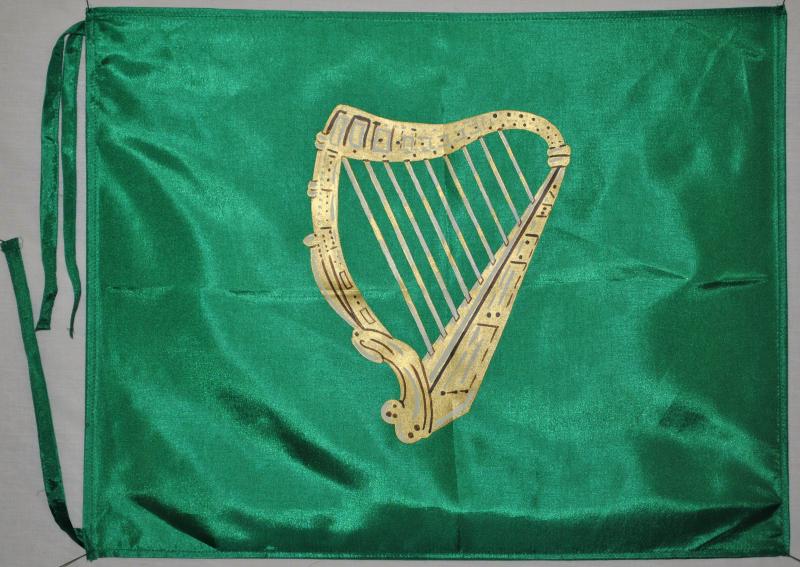
Of course we know that flag was not of the revolutionary workers but instead the harp on green which was that of the early Fenians and was very similar to that of the United Irishmen, the first revolutionary Irish Republican organisation.7

Those early Fenians were mostly composed of working class members and their 1867 proclamation to the world was largely proletarian in outlook. In Britain, the Fenians formed part of the First International Workingmen’s Association which was led by Marx and Engels.

Their flag was flown over at least one of the 1916 Rising garrisons, I believe at theJameson Distillery in Marrowbone Lane.

Similar flag to that hoisted over Liberty Hall (Photo sourced: Internet)

The other flags of the Rising included the Tricolour, presented to the Irish Republicans of the ‘Young Irelanders’ by women in revolutionary Paris in 1848, which was one of two flown on the roof of the GPO, the headquarters of the Rising.

Sharing the GPO roof with the Tricolour was the flag made only days before from domestic material and painted with the words “Irish Republic” in the house of Constance Markievicz, an officer in the Irish Citizen Army, shortly before the Rising.

The Irish Citizen Army’s own flag, the Starry Plough, flew over the Clery’s building facing the GPO. Sadly today most Irish people do not know that flag, though awareness of it and its background is growing among the indigenous Irish and the migrant community.

The design of the Starry Plough, flag of the ICA as it was in 1916 (Image sourced: Internet)

The first workers’ army in the world8

The Irish Citizen Army was formed as a workers’ militia during the great Lockout and strike of 1913-1914, to defend against the attacks of the police, the physical repressive front line of the capitalist class; the ICA’s flag was placed above Murphy’s Imperial Hotel in Clery’s.9

The Irish Citizen Army on exercises at their grounds near what is Fairview today (Photo sourced: Internet)

Though its constitution was more nationalist than socialist, the ICA was in its membership and purpose the first workers’ army in the world and when reorganised a few years later, represented also working class feminism, recruiting women, some of whom were officers commanding men.

Once the preparations for the Rising were in tatters with MacNeil’s countermanding order, where did organisers gather to discuss what to do? In Liberty Hall, the building of the Irish Transport and General Workers Union and it was there that the decision to rise on Monday instead was taken.

It is hard to overstate the importance of the fact that the decision to go ahead with insurrection was taken in the building which had become de facto the HQ of the revolutionary working class in Dublin, with an illegal flag of rebellion flying and where the Proclamation was to be printed.

The writing and text of the Proclamation

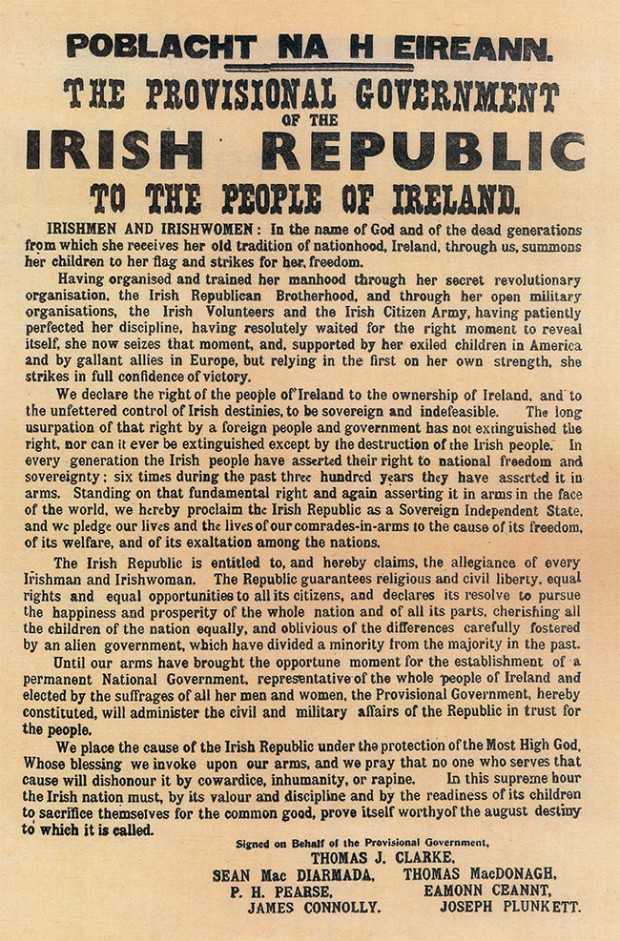
The wording of the Proclamation is thought largely composed by Pearse but influenced by Connolly, including its address to “Irish men and Irish women” and perhapsWe declare the right of the people of Ireland to the ownership of Ireland, and to the unfettered control of Irish destinies”.

Another section which could bear Connolly’s fingerprint reads: The Republic guarantees religious and civil liberty, equal rights and equal opportunities to all its citizens, and declares its resolve to pursue the happiness and prosperity of the whole nation and of all its parts, cherishing all the children of the nation equally.

(Image sourced: Internet)

But, whoever composed or influenced the Proclamation text, it was printed in Liberty Hall. An Irish Citizen Army member went to Stafford Street (Wolfe Tone St. today) to borrow the print type from a printer there to bring back to Liberty Hall, which was under daily 24-hour armed guard.

Having printed the Proclamation in Liberty Hall under armed guard and having decided there to rise on Easter Monday, where did the assault groups for Stephens Green, Castle and the GPO, including the Headquarters Battalion, meet on the morning of the Rising? …. Again, at Liberty Hall.

An early non-combatant casualty of the Rising was Ernest Kavanagh,10 who drew cartoons for the newspaper of the ITGWU, The Irish Worker. For some reason he went to Liberty Hall on Tuesday and was shot dead on the steps of the union building, presumably by a British Army sniper.

The working class in armed resistance

Once the Rising was in motion, the Irish Citizen Army had primary responsibility for two areas, the Stephens Green/ College of Surgeons garrison and the Dublin Castle/ City Hall garrison but also fought in other areas, for example on Annesley Bridge and in the GPO/ Moore Street area.

All who fought alongside them commented on their courage and discipline. After the surrender, many, along with Irish Volunteers were sentenced to death, most being commuted to life imprisonment. But two leaders of the Irish Citizen Army were shot by firing squad.

One of the areas from which the British forces were sniped at for days after the Rising was the docks area, then predominantly surrounded by working class residential areas.

A question we should ask ourselves is why the forces coming from Britain to suppress the Rising landed at Dún Laoghaire, from where they had to march nearly 12 km (approaching eight miles) to Dublin city centre, instead of at the excellent Dublin docks on the Liffey.

Hugo McGuinness, who specialises in history of the North Wall area, believes that the British expected Dublin to be in the hands of the working class resistance and that it was simply too dangerous to land British troops there, though gunboats could fire from the Liffey.

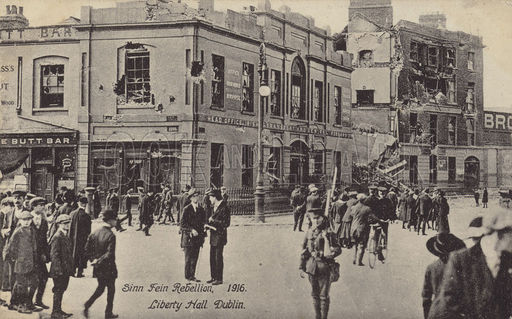
Certainly, the British believed Liberty Hall and buildings along Eden Quay were occupied as fighting posts by the Irish Citizen Army and they fired artillery at the union building from Tara Street, as photos of shell holes in that building and right through to the next testify.

Photo shell-damage Liberty Hall (first building with corner towards the camera, viewed northwards from Butt Bridge) as one of a set of commemorative postcards. (Photo sourced: Internet)
Another postcard with closeup of shelling damage to Liberty Hall and to the building next to it. Interestingly, in this one Liberty Hall is labeled “the Rebel Headquarters”. (Photo sourced: Internet)

Much is made in some historical accounts of the opposition to the Rising from sections of the Dublin population, during and immediately after the Rising. The city was the capital of a British colony, only just over a century earlier spoken of as “the second city of the British Empire”.

A substantial proportion of the wealthy and middle classes were Loyalist, including some Catholics; even ‘nationalist’ sections were committed to supporting the UK in WWI and John Redmond, leader of the ‘nationalist’ political party had openly recruited for the British Army.

Also, among the working class and the lumpen elements, many were depending on “Separation Allowances” with regard to males serving in the British Army. It is true that the insurgents in some places had to threaten, club or even shoot some civilians who tried to obstruct the Rising.11

These incidents during the Rising were not many but afterwards there were insults and other things thrown at prisoners being marched to imprisonment (or firing squad). The city was under martial law but even so a Canadian journalist reported the insurgents being cheered in working class areas.

There were also other individual witness accounts, such as a man on a tram saluting prisoners in Parnell Street until threatened by soldier escorts and a firefighter in the GPO doing likewise. A year later most of even the earlier hostility had changed to admiration and pride in the fighters.

Leadership of the working class

James Connolly wrote and said many things of importance but surely, with regard to the struggle for Irish national independence, the greatest of these was: “Only the Irish working class remains as the incorruptible inheritors of the fight for freedom in Ireland.”

By that he meant — and I agree — that all other social classes can gain something from selling out the interests and resources of Irish nationhood but that the working class can gain nothing from that.

The Irish working class staked their claim on the struggle for Irish independence in 1916 but have not succeeded in leading it and because of that, that struggle remains to be won.

Today and in other days, remembering that long struggle and the class whose leadership revolutionary socialists seek to represent and to uphold, we declare the need for that leadership over a broad front of all others who wish to struggle to advance.

In doing so, we declare that far from the working class having to wait for socialism, in the course of national struggle it must also shape its own demands around the economy, natural resources, infrastructure, social services, social questions, culture and, above all, to the fruits of its labour.

End.

FOOTNOTES

1Irish Republican Brotherhood, Irish Volunteers, Irish Citizen Army, Cumann na mBan, Na Fianna Éireann, Hibernian Rifles.

2All of which were executed by British firing squad, along with another seven in Dublin and yet another in Cork. The 16th execution was by hanging in London.

3(See Sources: Cooption of James Connolly etc) Connolly was a lifelong socialist and a revolutionary throughout his adult life, author, historian, journalist, song-writer, trade union organiser; active politically in Scotland, Ireland, New York and back in Ireland.

4The international socialist movement viewed the imperialists’ movement towards war with horror and in international conferences vowed to oppose it with all their might, including turning war resistance into revolution (“War against war”). However, once imperialist war was declared that resolve collapsed in most states, Russia, Germany and Ireland being notable exceptions and each saw a rising against war, in Ireland’s being the first.

5Joseph E.A. O’Connell (Jnr.) suggests a possible intention of goading of the State into attacking him and the ICA which might spark the general rising.

6(See Sources)

7The harp on the United Men’s flag was more ornate and was inscribed with the words “It is newly-strung and shall be heard”.

8https://www.connollybooks.org/product/irishcitizenarmy

9It was a good central location but more than that – the Hotel was one of the businesses of William Martin Murphy, chief organiser of the employers’ bloc to break the Irish Transport & General Workers’ Union.

10Kavanagh was a supporter of the workers, of votes for women and against participation in the imperialist war, contributing cartoons also to the Irish Citizen, Fianna and Irish Freedom publications, also to accompany poems of his sister, Maeve Cavanagh McDowell.

11I do not include in this the three members of the Dublin Metropolitan Police who were a force for the British occupation and also for the Dublin capitalists. The Irish Citizen Army in particular had good reason to settle accounts with them for attacks on them including inflicting mortal baton injuries on two workers during a charge on a union meeting on 30th September 1913 on Eden Quay and beating people and smashing up furniture in Corporation Street a little later.

SOURCES

Co-option of James Connolly to the Military Council planning the Rising: https://www.historyireland.com/connollys-kidnapping/

Raising the flag on Liberty Hall: https://microsites.museum.ie/1916objectstories/ObjectDetail/remains-of-irish-flag
Molly O’Reilly breaking a window incident: https://www.independent.ie/irish-news/ladies-day-for-1916-heroines/26528456.html

Printing of the Proclamation of Independence: https://libguides.ucc.ie/1916Proclamation
https://www.dublincity.ie/library/blog/printing-1916-proclamation-transcript

Decision taken to go ahead with the Rising on Easter Monday: https://www.irishtimes.com/culture/heritage/easter-rising-uneasy-calm-before-the-storm-1.2575638
https://www.nli.ie/1916/exhibition/en/content/risingsites/libertyhall/

“Only the Irish working class remains the incorruptible heirs …” (end second sentence from last): https://www.marxists.org/archive/connolly/1910/lih/foreword.htm

Erasing Murals and Erasing Gaza

Gearóid Ó Loingsigh 13 March 2024

(Reading time: 2 mins.)

       
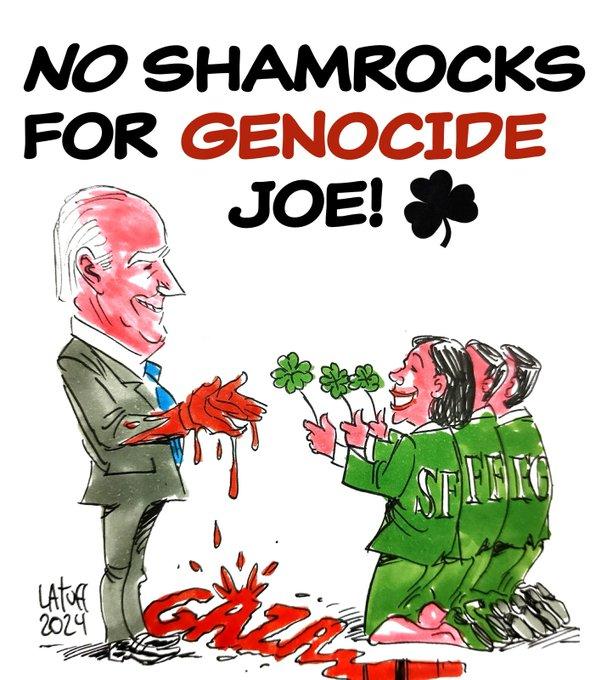
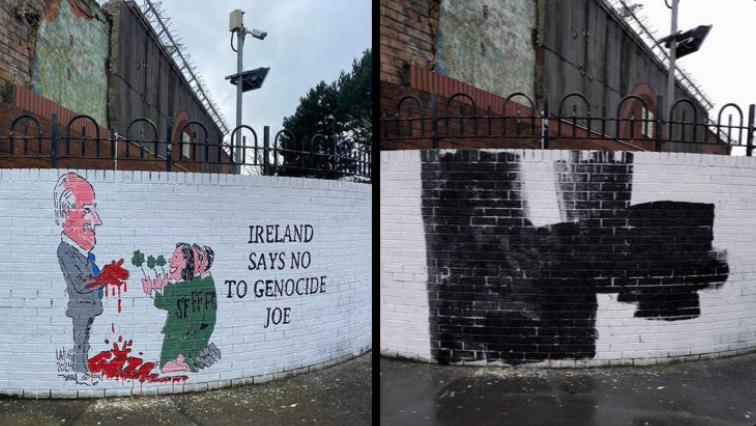
         Original Latuff cartoon.                              West Belfast mural.                                  Mural blacked out.

Once upon a time, Belfast was famed for its murals, so much so that even now a part of the tourist industry depends on a plastic paddy tour of the current murals on display in nationalist areas of Belfast.

It was the 1981 hunger strike and its aftermath that saw an explosion in political murals in nationalist areas.  As the 1980s went on, the technical and artistic quality of them improved dramatically and the politics they sought to represent expanded. 

Some of them were very militaristic, others much more political in content.  On international issues, murals sprang up on South Africa, Palestine and figures from revolutionary struggles around the world were to be found on gable ends all over the city and indeed in other cities throughout the North. 

Nelson Mandela, Steve Biko, Camilo Torres, Che amongst others looked down at the wandering revolutionary tourists who would come over in August.  The message was clear: Ireland was part of an international struggle against imperialism.(1)

After the peace process the quality continued to improve, but the politics went for a walk.  Twee Celtic murals abounded, young girls dancing a jig displaced images of women holding an armalite aloft for International Women’s Day. 

about Imperialism were softened, when not blunted entirely or removed.  So, it comes as no surprise to see what has happened to recent murals.

Sinn Féin supporters recently unveiled murals in solidarity with Palestine.  They are of good quality and try to capture the suffering of the Palestinians through the images and poignant quotes. 

However, they say nothing about who is causing the suffering: the US and Israel, though there are silhouette ghostly like images of soldiers standing over dead children. 

There was once a mural on the White Rock Road which pictured a US Indian superimposed over a US flag saying Your struggle, Our struggle.  No references are to be made now to the US role in exterminating a people.  That is strictly Verboten.

However, someone decided to reproduce a cartoon from the artist Carlos Latuff in mural form in Belfast.  It depicts Joe Biden, standing with bloodied hands in front of Mary Lou, who is clearly identifiable in the image, and the leaders of FG and FF, who can be identified from the initials FG and FF on their backs.

The British Army and the RUC used to deface republican murals, not any more.  Very quickly, Sinn Féin, officially or unofficially (no pun intended, though it is apt) painted over the mural.  It was quickly restored by others, who the artist Latuff described as real republicans.(2)

Sinn Féin are clearly uncomfortable about the issue in the run up their fest in Washington with Biden and not only are they content to throw Palestinians out of public meetings, they will now supress any public artistic attempts to draw people’s attention to the Slaughter Soirée they will have in the White House.

Many Palestinian voices such as the Electronic Intifada have called on Sinn Féin not to go to Washington, the calls in Ireland have been much more muted and tamer on the issue.  However, it is a clear issue, what is colloquially called a no-brainer. 

You don’t have to think very deeply to understand that Sinn Féin shouldn’t go to Washington DC, that they should tell Genocide Joe they don’t want to meet him.  They will go and they will say nothing about Palestine. 

Their erasure of a mural criticising them, tells you everything you need to know about their real attitude to Palestine.

Whatever you say, say nothing used to be a catchphrase about loose talk and informers, now it means never to mention Joe Biden and the Palestinians in the same breath, unless you are green washing genocide. 

Meanwhile Sinn Féin does its part, emulating the British army and vandalising political murals.

Notes

(1)  A selection of images can be seen on Bill Rolston’s website.  Rolston has chronicled and photographed murals going right back to the 1970s.  See https://billrolston.weebly.com

(2) See https://x.com/LatuffCartoons/status/1767239594083324017?s=20


Return to top of page

Dunnes Stores, South Africa, Gaza: A Tale of Two Boycotts

Gearóid Ó Loingsigh

29 February 2024

Anti-apartheid activist Nimrod Sejake with some of the Dunnes Stores striker.

Reference has been made on a number of occasions to the heroic actions of the Dunnes Stores Anti-Apartheid strikers in 1984 who spent nigh on three years on strike because they refused to handle South African merchandise.

It has been pointed to as a success story for boycotts and one to emulate. The real story of the strike points to the difficulties we now face in implementing a real boycott of Israel.

I used to go down to the picket line at the Dunnes branch in Henry Street every Wednesday, as we had a half day at school and on Saturdays when there was no school and then more regularly once I had sat my Leaving Cert exam and was, like many young people in 1980s Ireland, unemployed.

So, I recently bought a copy of Mary Manning’s autobiographical account of the strike, Striking Back: The Untold Story of an Anti-Apartheid Striker (Collins Press).

The book brought to mind many of the instances and difficulties that they faced and it raises many questions for those who wish to point to them as an example to follow.

The strikers were implementing a trade union resolution, and at first knew little of the reality of South Africa, something they corrected relatively quickly, thanks in no small part to a South African exile, Nimrod Sejake, who turned up to join them on the picket line.

Sejake was an activist who had been arrested as part of the infamous Treason Trial. Mary Manning is full of praise for Nimrod and rightly so.

Others do not come out so well and it is worth remembering the reality of that strike as it tells us some of the things that need to happen if we want to see similar action in relation to Israel.

The first thing that jumps out of the pages, early on, is that the trade bureaucracy did not give them any support and even their own trade union, IDATU (now called Mandate) was very reluctant to support them.

What support they got was down to their official Brendan Archbold who was a stalwart in supporting them and the then head of the union John Mitchell. At every twist and turn they had to fight the executive of IDATU, whilst the rest of the trade union movement ran for cover.

There will be no similar type of action around the Zionists unless it is put to the bureaucracy and they are challenged over their inaction in the midst of a genocide.

Karen Gearon, the shop steward at Dunnes Store made a call at the National March in Dublin on February 17th for the trade union movement to stop talking and take action. It is not something that has been seriously echoed by others.

Neither People Before Profit TDs or the IPSC have ever made a clear call for action from the trade union movement. It should be a central part of any boycott movement now.

It is all well and good picketing Starbucks, but stopping the importation of Israeli goods would be more important and will only happen if the bureaucracy is pushed to it. The history of PbP is one of cowering in the shadow of the bureaucrats and never putting it up to them on any issue.

They frequently share polite platforms with the bureaucrats and never challenge them. Their calls, when made are generic and are in passing. Their website and the IPSC site is limited to a consumer boycott with calls for the government, not workers, to take action.

I was also reminded by the book how the great and good in Irish society stood by whilst these workers were on strike. The Minister for Labour at the time was Ruairí Quinn, a member of the Irish Anti-Apartheid Movement (IAAM) and yet he did nothing.

He was not the only mealy-mouthed figure in Irish society, nor indeed in the Irish Anti-Apartheid Movement.

The head of the Catholic Bishops Aid Agency, Trócaire, Bishop Eamon Casey privately wrote to IDATU early on describing the strike as ‘economically harmful to the already impoverished Black South Africans.’

The strikers’ request for support from the Catholic Church was described as impertinent and just in case anyone doubted how he saw himself, he was of the view that both he and Trócaire should have been consulted before the strike took place.

Their currency now is much devalued in Ireland but there are others like them who also think they have a veto on decisions.

He was later forced to publicly back the strike having been embarrassed by Archbishop Desmond Tutu’s decision to present two strikers to the world at his London press conference en route to pick up his Nobel Peace Prize.

Though that took a while and meantime nuns proudly scabbed and crossed the picket line. Casey’s attempts at sabotage and his later hypocrisy in belatedly supporting the strike, should not be forgotten.

At the time he was seen as a moral guardian, his plundering of church funds to keep his lover and his child comfortable was not known.

There are lots of other figures like him around now, who we might expect to support workers implementing a boycott, but might not when faced with the reality of it.

Another figure who comes out badly in it is Kader Asmal, the head of the IAAM. After three months of strike action, he met with John Mitchell and Brendan Archbold and told them to call off the strike, that it had served its purpose and that he was pulling his support.

When Desmond Tutu invited the strikers to South Africa he privately told them he would not support them going as it was a breach of the cultural boycott of South Africa.

Their trip to the country and the refusal of the Apartheid regime to let them in along with their detention at the airport was a pivotal moment in the strike.

Upon their return to Ireland, Asmal was one of the people to rush to the airport and give interviews and bask in the glory, as his position opposing the trip was never made public. He comes across very badly in the book.

I recall him asking me for information on South African goods coming through the port where I had begun working and Brendan Archbold telling me not to trust him, that he was a sleiveen and would hang me out to dry. He was, and like him there are others just like that on the issue of Gaza.

The contrast with Nimrod Sejake could not have been greater.

Sejake was a working class militant who suffered greatly and enjoyed none of the middle class trappings of Kader Asmal’s life in Ireland and unlike Asmal he had never crossed a picket line, something Asmal did in Trinity College where he worked, scabbing during a strike there.

There are Palestinian equivalents to Asmal and also to Sejake. The IPSC pretends otherwise.

So, what are the lessons of the Dunnes Stores strike?

One is that it wasn’t just a consumer boycott, it was a workers’ boycott and they were left high and dry by many of those who would have been expected to support them.

If we are going to call for workers action, various people and bodies need to be challenged and would have to commit themselves publicly to it. So far this is absent. PbP and the IPSC are not putting it up to any of the institutions.

View of the protest outside Axa Insurance 14 December 2023 while others inside carried out a protest sit-in. (Photo: D.Breatnach)

In fact, the UNITE union complained about a sit-in at Axa Insurance company saying it was harmful to the workers. The sit-in was not organised by the IPSC but by CATU and Dublin for Gaza.

It turns out that UNITE is a bit like IDATU.

The union has also passed resolutions supporting the campaign of BDS and yet “according to union insiders, Axa is Unite’s insurer in Ireland – and Unite’s designated provider of hotel accommodation is the Leonardo hotel group, which is part-owned by the Israeli Fattal group.”(1)

UNITE members taking action would most likely be shunned by their own union. Just like the head of the IAAM, Kader Asmal had tried to undermine the Dunnes Stores strike, there are those in the IPSC who would run for the hills were workers to take action against Israel.

So, we do need to emulate the Dunnes Stores strikers, but we need to be clear about the challenges and the opposition we would face from the trade union movement itself, the Catholic Church (they never went away either) and sectors of the IPSC.

It is time for action, but it is also high time that both PbP and the IPSC made clear calls for action and workers are not left hung out to dry, should they take action.

Notes

(1)Skwakbox (15/12/2023) Outrage builds over Unite’s use of Israel-linked firms as protestors occupy Axa Dublin office
https://skwawkbox.org/2023/12/15/outrage-builds-over-unites-use-of-israel-linked-firms-as-protesters-occupy-axa-dublin-office/

“THEY WANT US TO MOVE OUT – BUT WE’RE STAYING”

Diarmuid Breatnach

(Reading time: 6 mins.)

In Dublin’s south docklands the property developers and the corporations dominate city planning and therefore the landscape. And the working class community there feel that they’re being squeezed out.

I’ve met with some concerned people from parts of this community in the past to report on their situation and concerns for Rebel Breeze and did so again recently.

A view eastward of a section of the south Liffey riverfront, showing a very small amount of more traditional buildings squashed between or loomed over by the “glass cages that spring up along the quay”. (Photo 1 March 2024: D.Breatnach)

YOUNG PEOPLE – education, training, socialising

“There’s nothing here for our young people” said one, expressing concern over the attraction for teenagers of physical confrontations with other teens from across the river which have taken place on the Samuel Beckett Bridge over the Liffey.

A young man training as an apprentice in engineering attends a mixed martial arts club but has to go miles away to another area to attend there. Between his industrial training, travel and athletic training he has little time to spare for socialising.

I comment that those sporting activities tend to concentrate on male youth and only some of those also but he tells me that nearly half the regular membership of his club is female. A community centre could provide space and time for such training but they say they have no such centre.

St. Andrew’s Hall is a community centre in the area and there are mixed opinions in the group about it but I know from my own enquiries that the available rooms are committed to weekly booked activities (and our meeting had to take place in a quiet corner of an hotel bar).

As a former youth worker and in voluntary centre management, I know that a community centre can serve all ages across the community, from parents and toddlers through youth clubs to sessions for adults and elders.

Discussing youth brings the talk into education and training. As discussed in a previous report of mine, the youth are not being trained in information technology, which is the employment offered in most of the corporations in “the glass cages that spring up along the quay.”1

Section of the south Liffey docks showing some of the few remaining older buildings as they are swamped by the “glass cages”. The building on the far right of photo, very near to Tara Street DART station, once an arts centre, is already targeted for demolition and replacement with commercial building. (Photo sourced: Internet)

“If they’re lucky, they’ll get work in the buildings as cleaners or serving lattes and snack in the new cafes”. Some opined that the corporations in the area should be providing their youth with the training while others thought Trinity College should be doing so.

HOUSING – price and air quality

Universal municipal housing in the area has declined due to privatisation of housing stock and refusal to build more. A former municipal block in Fenian Street, empty for years is now to be replaced but the “affordable” allocation has been progressively reduced, ending now at zero.

Pearse House in south Liffey docklands, believed earmarked for demolition and site sold to property speculators. (Photo 1 March 2024: D.Breatnach)

Property speculators (sorry, “developers”) with banker support are building office blocks and apartment blocks in the areas, the latter units priced beyond the range of most local people. The average rent for a two-bed apartment in the area is €2,385;2 to buy a 3-bedroom house €615,000.3

The Joyce House site and attached ground area could provide housing and a community centre but appears planned to go to speculators.

Continuation of ‘Pearse House site’ in south Liffey docklands, believed earmarked for demolition and site sold to property speculators. (Photo 1 March 2024: D.Breatnach)

The Markievicz swimming pool near Tara Street has been closed and the local people are told they can go to Ringsend for swimming, an area which already has better community facilities than are available to the communities further west along docklands

A huge amount of traffic goes through the area and one person stated that Macken Street tested as having the worst air quality in Ireland. “I have to close my windows to keep out the noise and pollution,” said another; “the curtains would be black.”

Townsend Street side of ‘Pearse House site’ in south Liffey docklands, believed earmarked for demolition and site sold to property speculators (prospective property speculators must be salivating). The gambling advertisement coincidentally erected there seems to show the likely social types to benefit from these kinds of deals. (Photo 1 March 2024: D.Breatnach)

They want us out’

If some town planner were intending to establish a community somewhere, s/he would plan for housing, obviously, so the people would have somewhere to live. But a proper plan would provide also for education and training, along with social facilities — and employment.

But if someone were intending instead to get rid of a community, s/he would target exactly the same elements, whittling them down or removing them altogether. This what some local people feel is intended for their community.

“We feel we’re not wanted here,” said one and others agreed, “They want us to move out.” “But we’re not going! We’re staying,” said another, to grim nodding of heads around.

HISTORY of struggle … and of neglect

In the late 1800s and early 1900s, Dublin had the worst housing in the United Kingdom and many of its elected municipal representatives – including a number of Nationalists of Redmond’s party – were themselves slum landlords.

When the Irish Transport and General Workers Union was formed by Jim Larkin with assistance from James Connolly and the Irish Women Workers’ Union founded by Delia Larkin, many of the dockers, carters and Bolands Mill workers who joined them came from the south docklands.

And when the employers’ consortium led by William Martin Murphy set out to break the ITGWU in 1913, many of those workers

… Stood by Larkin and told the bossman
We’d fight
or die but we would not shirk.
For eight months we fought
And eight months we starved,
We stood by Larkin through thick and thin …4

And the women of Bolands’ Mill were the last to return to work, which they did singing, in February 1914.

They also formed part of the Irish Citizen Army, the first workers’ army in the world,5 to defend the striking and locked-out workers from the attacks of the Dublin Metropolitan Police and which later fought prominently in the 1916 Easter Rising.6

Many also joined the larger Irish Volunteers which later became the IRA, along with Cumann na mBan,7 fighting in the Rising, the War of Independence and the Civil War, supporting resistance of class and nation for decades after.

The Irish Republican Brotherhood (the Fenians) was founded in the area; Peadar Macken8 was from here and has a street named after him; Elizabeth O’Farrell9 is from the area too with a small park named after her and Constance Markievicz10 also lived locally.

The Pearse family lived in the area too and Willie Pearse and his father both worked on monumental sculpture at the same address; Connolly and his family for a while lived in South Lotts.

Home of the Pearse family and monumental sculpting business (Photo: Dublin Civic Trust)

The working class communities in urban Ireland suffered deprivation throughout the over a century of the existence of the Irish state and the colonial statelet. The communities in dockland suffered no less, traditional work gone, public and private housing in neglect in a post-industrial wasteland.

The population of Ireland remained static from the mid-1800s until the 1990s, despite traditionally large families — emigration in search of employment kept the numbers level. Married couples lived with parents and in-laws while waiting for a house or flat – or emigrated.

In the 1980s, like many parts of the world, Ireland fell prey to what has been described as the “heroin epidemic” and the neglected urban working class worst of all, with the State assigning resources to fight not so much the drug distributors as the anti-drug campaigners.

One of those in the meeting became outwardly emotional when he talked of “the squandered potential” of many people in the local community.

A workers’ day out trip on the Liffey ferry (Photo sourced: Dockers’ Preservation Trust)

The heirs of these then are the marginalised and abandoned that are targeted with disinformation and manipulated by the far-Right and fascists, to twist their anger and despair not against the causes of their situation but against harmless and vulnerable people.

But the Left has to take a share of the blame, for leaving them there in that situation, for not mobilising them in resistance. After all, issues like housing, education and employment are supposed to be standard concerns for socialists, of both the revolutionary and the reformist varieties.

Republicans cannot avoid the pointing finger either. These communities provided fighters and leaders not only in the early decades of the 20th Century but again from the late 1960s and throughout the 30 years war.

The Republicans led them in fighting for the occupied Six Counties but largely ignored their own economic, social and educational needs at home. Perhaps this is why the people are now organising themselves.

Protest placard by housing block in Macken Street protesting noise and dirt from nearby construction (Photo: Macken Street resident)

THEY DON’T VOTE”

A number of the local people to whom I spoke quote a local TD (Teachta Dála, elected representative to the Irish parliament) who commented that most of the local residents don’t vote in elections.

Whether he meant, as some have interpreted, that therefore they don’t matter or, that without voting, they cannot effect change, is uncertain. However, community activism is not necessarily tied to voting in elections.

Protest placard by housing block in Macken Street protesting noise and dirt from nearby construction. (Photo: Macken Street resident)

As we know from our history and that of others around the world, voting is not the only way to bring about change and, arguably, not even the most effective one.

Whatever about that question, people are getting organised in these communities and those who hold the power may find that they are in for a fight.

End.

The landscape (and airscape) viewed from a housing block in Macken Street (Photo: Macken Street resident).

FOOTNOTES

1From song by Pet St. John, Dublin in the Rare Aul’ Times.

2https://www.statista.com/

3https://www.dublinlive.ie/

4From The Larkin Ballad, about the Lockout and the Rising, by Donagh McDonagh, whose father was one of the fourteen shot by British firing squad after the 1916 Rising.

5Formed in Dublin in 1913 to defend strikers and locked-out workers from the Dublin Metropolitan Police; members were required to be trade union members. The ICA was unique for another reason in its time: it recruited women and some of them were officers, commanding men and women.

6Historian Hugo McGuinness based on the other side of the Liffey believes that the reason the British troops sent to suppress the Rising disembarked at Dún Laoghaire rather than in the Dublin docks was because they feared the landing being opposed by the Irish Citizen Army and its local supporting communities.

7Republican Female military organisation, formed 1914.

8Fenian, socialist, trade unionist, house painter who learned and taught Irish language, joined the Irish Volunteers, fought in the Rising and was tragically shot by one of the Bolands Mill Garrison who went homicidally insane (and was himself shot dead).

9Member of the GPO Garrison in the 1916 Rising, subsequently negotiator of the Surrender in Moore Street/ Parnell Street and courier for the 1916 leadership to other fighting posts.

10Member of multiple nationalist organisations, also ICA and in the command echelon of the Stephens Green/ College of Surgeons Garrison. Also first woman elected to the British Parliament and first female Labour Minister in the world.

SOURCES & FURTHER READING

Biography Peadar Macken: https://www.dib.ie/biography/macken-peter-paul-peadar-a5227

DUBLIN POLITICAL PRISONERS’ PICKET REFUTES MINISTER’S LIE

Clive Sulish

(Reading time: 2 mins.)

On Tuesday evening in one of Dublin city centre’s high-end shopping street picketers refuted colonial Minister for ‘Justice’ Naomi Long’s lie that “There are no political prisoners in Northern Ireland” (sic – she means the Six-County colony).

The Ireland Anti-Internment Campaign came on to the street to highlight that yes indeed, there ARE political prisoners in Ireland – over two score between both sides of the Border. And that furthermore, they are convicted in special political no-jury judicial processes.

View of the picket and the IAIC banner in Henry Street on Tuesday (Photo: Rebel Breeze)

The IAIC states that these judicial processes are called the “Diplock Court” in the occupied Six Counties and the “Special Criminal Courts” in the Irish state and were “specifically created in both cases for the easy conviction and jailing of Irish Republicans.”

The SCC has been labelled “a sentencing tribunal” rather than a court of law by human rights campaigners. IAIC states that the Diplock Court is “now being administered by former Republicans while the SCCs have now, after years of opposition, been approved by those same people.”

View of placards on the IAIC banner in Henry Street on Tuesday (Photo: Rebel Breeze)

However, as accused before these courts are also regularly refused bail, IAIC points out they are also effectively administrators of internment without trial, jailing activists for around two years before judicial process. If bail is granted, it is always under severe conditions preventing political activity.

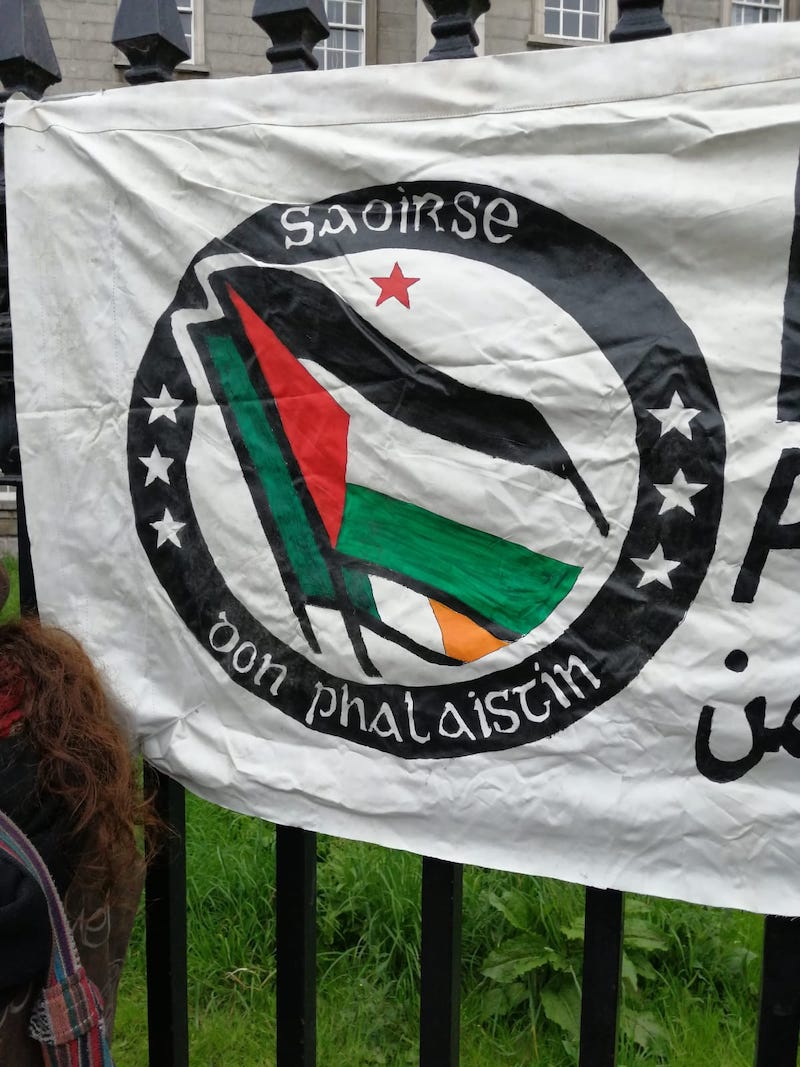
The IAIC, an independent group campaigning for ten years, was supported in their picket yesterday by Irish Republicans and Socialists including from the Anti-Imperialist Action and Saoirse Don Phalaistín groups, in addition to some independent activists.

Although Henry Street is a high-end shopping street of Dublin city centre, lots of working class people use it also.

A member distributes leaflets to passers-by near the picket in Henry Street on Tuesday (Photo: Rebel Breeze)

Over 100 leaflets were distributed and a number of people stopped to discuss the issues. Some queried the mix of flags flown (Irish Starry Plough, Palestinian and Basque) and participants explained that these represented some of the struggles where repression has taken prisoners.

“We thought it particularly important to refute the colonial Minister’s lie today,” commented a spokesperson for the IAIC “and we’re glad for the support we received on the picket line and from interested people on the street. We hope to do it more often this year.”

“Internment continues in Ireland, just on a different scale and more selectively than for example in the Six Counties in the 1980s”, continued the spokesperson.

View of the picket and the IAIC banner in Henry Street on Tuesday (Photo: Rebel Breeze)

The IAIC states that it is “an independent campaigning group run on a participative democratic basis” and that it “welcomes democratic people” on their pickets. The Facebook page https://www.facebook.com/profile.php?id=100063166633467 is their usual public outlet for notification of events and highlighting of related issues.

End.

ANTI-FASCISTS CONFRONT FAR-RIGHT & FASCISTS IN DUBLIN CITY CENTRE

Diarmuid Breatnach

(Reading time: 6 minutes)

A far-right march containing known fascists and fascist organisations opposed to immigration or to providing housing for refugees confronted an antifascist counterprotest half its size in Dublin city centre’s main street on Monday.

The counter-protest was convened for 1pm by the United Against Racism organisation (a kind of liberal anti-racist and antifascist confederation set up by the People Before Profit party) in order to confront an advertised mobilisation of the far-Right on a broad racist platform.

The racists had been building for this ‘national’ march since early January.

A view of the west side of the anti-racist gathering some time before the arrival of the anti-immigration march. (Photo: D.Breatnach)

The antifascists gathered on the central pedestrian reservation while a group of less than 20 strutted in front of the GPO waving Tricolours,1 an Erin go Bragh flag2 and, most unusually, a Cumann na mBan3 flag. Did they know or care that one of the founders of that organisation was a migrant?4

Or that the Tricolour was presented to us in 1848 by women revolutionaries in Paris? The far-Right in Ireland is replete with ironies, whether ignorant of them or aware while manipulating their ignorant followers in neglected cross-generational families and communities.

Among the anti-racist gathering, at first there were red, rainbow and some Palestinian flags but not one specifically Irish one apart from a white Starry Plough on a red background, until a little later when a number of Irish Tricolours made their appearance among the anti-racists.

East side of the anti-racist gathering some time before the arrival of the anti-immigration march. (Photo: D.Breatnach)

This gives the unfortunate appearance that it’s the far-Right that cares about the national struggle and not the antifascists, which is untrue since the fascists have never lifted a finger for Irish freedom and unity (as pointed out by one of the placards displayed by the anti-racists).

It seemed strange that the anti-racists had not occupied the space directly in front of the GPO, thereby not only denying it to the far-Right but also giving them a position with a safe rear and only exposed from the front and flanks, as distinct from the central reservation, open on all sides.

Many Garda Public Order Unit vehicles had been seen at the Garden of Remembrance where the far-Right were rallying along with two mounted Garda, with another two of those outside the GPO and many police in ordinary uniform, along with a few POU there also.5

A strong turnout of Gardaí lined up in front of the GPO with their backs to the fascists and facing the antifascists, a formation clearly anticipating antifascists moving against the far-Right. A number of shouts were traded between the opposing forces.

Early view of section of the anti-racist demonstrators showing in the background a section of the far-Right demonstrators outside the GPO before they left to join their rally at the Garden of Remembrance. (Photo: D.Breatnach)

A senior Garda officer approached an anti-fascist and obliged her to remove her mask, an action that exposed her not only to Garda photographers but also to media and far-Right snaps and video.

Unlike a number of other occasions prior to and during the Covid emergency, the police restrained the fascists from crossing the road or even engaging in sustained exchanges. After awhile, the latter departed to join the others at their rally at the Garden of Remembrance

The antifascist gathering listened to speeches (or ignored them and chatted among themselves) and a number of a cappella songs about Irish emigration and anti-racism, regularly joining in slogans of “Say it loud and say it clear – Refugees are welcome here!” and “Fáilte – roimh theifigh!”

Another slogan6 shouted was “When refugees are under attack – Stand up, fight back!”

THE FASCIST MARCH

Word reached the antifascists that the far-Right had finally got into their march and the whole anti-racist gathering moved to face the east side of O’Connell Street, where stewards packed them in tighter and tighter and Gardaí lined up facing them with arms linked.

Photo taken of section of anti-racist protesters on east side of central reservation shortly before arrival of anti-immigration marchers – note the Gardai linked arms against the anti-racists, possibly out of habit before they reversed their positions as the far-Right protesters approached. The flag centre photo is of the Second Spanish Republic during the Spanish Antifascist War. (Photo: D.Breatnach)

A little later, perhaps conscious of the size of the far-Right march, the Gardaí turned their backs to the anti-racists and faced the street upon which the racists were going to march. The POU also deployed around the area and both mounted police moved across on to the central reservation.

The far-Right began to proceed southward along the street a couple of feet only away from the anti-fascists, from which the slogans in support of refugees were chanted in unison but there were also individual comments flying back and forth, along with gestures, between both groups.

Their stewards were clearly keen to keep them moving, however. At one point a large group of the far-Right mounted the central reservation and approached the antifascists aggressively but between the Gardaí and their own stewards they soon resumed their march south.

The anti-immigration marchers pause in order to hurl abuse at the anti-racist counter-protesters, some of who respond in kind. (Photo sourced: Internet)

It became clear that the racist march outnumbered the counter-protest in the order of around two to one. When banners of the National Party and the Irish Freedom Movement were seen (and placards of Síol na hÉireann)7 a roar of “Nazi scum off our streets!” emerged from the anti-racists.

There were also some cries of “MI5!” at those. Some large placards bearing the legend “Ireland is full” drew the reply: “No it’s not – you don’t know your history or your geography!”8

A racist and a fascist trope side by side: The “Replacement” conspiracy theory originated in white European settler colonies in fear of being replaced by the indigenous people, while fascists regularly demand freedom of speech for racism and lies but shut down all freedoms when they get into power. (Photo sourced: Internet)

The march passed and according to information received made its way to Custom House Quay for a rally. The antifascists were then called on to the street to march to the Garden of Remembrance in a move that puzzled some (one suggestion was that it was to “disinfect” the site!).

Later and photos from Anti-Imperialist Ireland confirmed the sighting of a number of known fascists at the racist rally, including Derek Bligh (IF), Jim Ferguson, Herman Kelly (IFM) and Rowan Croft, all with connections to British Loyalism and British Intelligence.

Four prominent fascists from different groups who were present (some as speakers) at the anti-refugee and immigration rally on Monday. (Photo source: AIA)

EVALUATION

The question must be asked how a minority of far-right and fascist parties in Ireland can outnumber the vastly numerically superior anti-fascist mass in the country at a public (and publicised) event? Clearly the counter-protest organisers failed to mobilise the wide anti-fascist masses.

View of section of the anti-immigration march. (Photo sourced: Internet)

Or the wide anti-fascist movement failed to respond to the call. Where were the Irish Republican forces, the specifically antifascist organisations, the anti-fascist trade unionists – and the broad masses that they can mobilise?

Some of those may say that they don’t trust the UAR group, that they’re not serious about confronting fascists, etc. That may be but it would be a poor and shameful excuse for allowing a successful fascist attack on an antifascist gathering.

On the other hand, when the UAR was being founded, it deliberately excluded those forces – Republicans, antifascist activists, anarchists – who had already been confronting the far-right in Dublin and had been in a number of clashes with the fascists.

A placard displayed by a migrant solidarity demonstrator. (Photo: D.Breatnach)

This is a most serious situation in which the democratic masses to be as the racists and fascists mobilise their thugs and feel the wind behind their sails while simultaneously the State surreptitiously encourages them and the capitalist system seeks to make the workers pay for its crisis.

The racist march took place in the context of a recent fascist mobilisation in the city centre burning cars and public transport and ongoing burning of buildings across the country earmarked – or just believed to be earmarked – for housing of refugees.

Government Ministers can claim shock and anger at such fascist mobilisations but how is it that the wave of arson attacks is being permitted? And how is it that communications of the culprits are not being monitored by the State’s intelligence services?

How is that there is not one case of Garda or property security being on hand and apprehending the arsonists?

We need not believe any nonsense about insufficient personnel because the private security industry employs over 30,000 people across a broad range of sectors9 and the Gardaí can mobilise 100 with helicopter back-up to evict a handful of housing activists occupying an empty building.10

The State is clearly allowing the fascists a loose rein whilst at the same time permitting an atmosphere favouring repression to build up – repression which as is usually the case will be used not against the fascists but against the antifascists and against the Left resistance in general.

We are being given warnings and it is up to all of us whether we act upon them. If we don’t not only we but our children will pay the price.

End.

FOOTNOTES

1The green, white and orange flag that became the ‘national’ flag of the Irish State.

2Anglicisation for pronunciation of Éirinn go Brách (Ireland for ever!), the slogan in gold on a green background, usually also bearing the emblem of the harp in gold was a common flag seen among gatherings of the Fenians (Irish Republican Brotherhood) in Ireland, Britain and the USA during the second half of the 19th and early 20th centuries.

3Possibly the world’s first female republican military organisation, it was founded in 1914 as an auxiliary to the male Irish Volunteers founded the year before; around 40 of them participated in the 1916 Rising. Later the organisation developed more independence.

4Constance Markievicz: A founding member of Fianna Éireann, Cumann na mBan and the Irish Citizen Army, she took part in the Easter Rising in 1916, when Irish republicans attempted to end British rule and establish an Irish Republic.

5And some in ordinary street clothes, clearly the political ‘undercover’ police (now officially the Special Detective Unit but still widely known among political activists (and some of its own officers) by their former name of “the Special Branch”).

6https://en.wikipedia.org/wiki/Slogan

7Three of the prominent fascist and racist organisations recently founded in Ireland, though not much of “Síol” has been seen for many months.

8Presumably a reference to the fact that in 1845 Ireland had a population of over 8 million and was not “full” even then while the population today is around 7 million.

9“and has an estimated annual turnover in excess of €960 million” https://www.cpsa.ie/en/organisation-information/8018a-the-private-security-authority

10On two occasions in Dublin alone, against the Revolutionary Housing League occupations of empty buildings on Eden Quay in June 2022 and on Berkeley Road in July last year. https://rebelbreeze.com/tag/revolutionary-housing-league/

SOURCES

March and counter-demonstration: https://www.irishtimes.com/ireland/social-affairs/2024/02/05/anti-immigrant-march-and-counter-protest-in-dublin-see-300-gardai-deployed/

https://www.thejournal.ie/anti-immigration-protest-dublin-6291088-Feb2024

Fascist speakers at Monday’s rally: https://anti-imperialist-action-ireland.com/blog/2024/02/06/dont-be-fooled-by-britains-far-right-in-ireland/

Far-Right arson of buildings and riots: https://www.dublinlive.ie/news/arsonists-burning-buildings-set-house-28568335

https://www.breakingnews.ie/ireland/dublin-riots-taoiseach-receives-mixed-messages-on-far-right-thugs-and-uncontrolled-immigration-1583306.html

https://www.breakingnews.ie/ireland/man-charged-in-connection-with-dublin-riots-1585211.html

Gardaí available in large numbers when evicting housing activists: https://rebelbreeze.com/tag/revolutionary-housing-league/

IRISH SHAMROCK TO SOAK IN PALESTINIAN BLOOD?

Diarmuid Breatnach

(Reading time: 10 mins.)

A call has gone out for Irish politicians, as part of pressure on the USA to stop supporting Israeli genocidal attacks on the Palestinians, not to attend friendship ceremonies with the President of the USA on St. Patrick’s Day this year.1

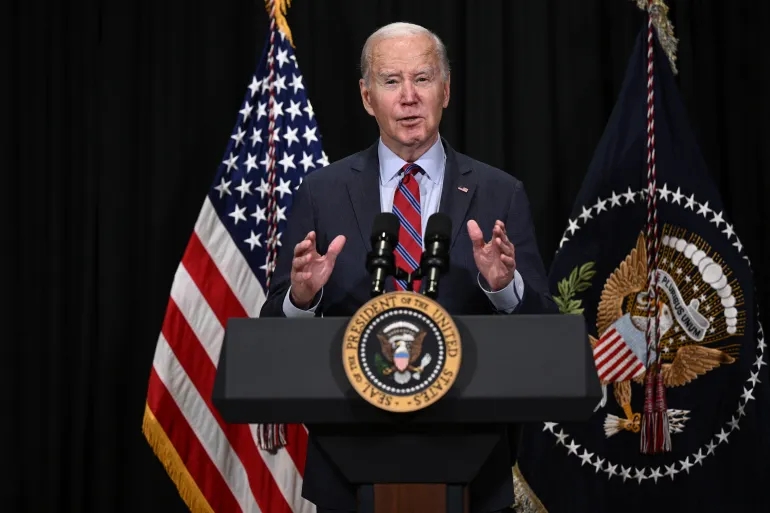
With the US Presidential election scheduled for September, “Genocide Joe” Biden will still be in office on March 17th, a man who apart from representing the major imperialist power in the world, ordered his state’s veto in the UN against a call for a humanitarian ceasefire.

A man who repeated ridiculous Zionist propaganda against the Palestinians of beheading children and rapes, who said that if Israel had not existed the US would have had to invent it, who received more Zionist lobby for his campaigns as Congressman than any other in the whole USA.2

Even without his personal history, after a US-supported slaughter so far of 25,000 Palestinians, mostly women and children and displacement of 85% of Palestinians, you’d think that this would be what UStaters call “a slam dunk”, that Irish politicians would feel too disgusted to make the trip.

Placard carried by a Palestine solidarity marcher in Dublin on 28 October. (Photo: D.Breatnach)

Sadly this revulsion is not felt among most politicians in Ireland, who from from Varadkar in the Government to Mary Lou MacDonald of Sinn Féin in the Opposition have indicated that they have no intention of foregoing this annual pilgrimage to the Boss of the World

What is this strange Irish obsession with the United States of America anyway? Yes, of course, it is a (or the) major world power and yes, a number of people of Irish antecedence have become its Presidents – including the first Roman Catholic to reach that office.3

But really, what has the US concretely done for Ireland? Did it send us troops to help drive the English from our land? No, the Spanish Kingdom did that once and the French did it twice, once as Kingdom and again as Republic. But the US? Never.

It might be protested that the USA permitted Irish to emigrate there but a) it did so for many others too and b) only in order to populate its European colonisation of the Indigenous land and c) to compete against other European colonial powers – in particular the Spanish, French and Dutch.

It is true that it has on occasion served as a haven for Irish ‘on the run’ from British jurisdiction but so did France and in any event, those cases were nearly always when the USA was at war or in diplomatic conflict with the United Kingdom in the USA’s own interests.

WHEN THE USA COULD HAVE REALLY HELPED THE IRISH STRUGGLE

When the US-based Fenians raised an army to invade British colonial Canada in 18664, they had hopes that the government of the US would at least not impede them. The British had supported the Confederacy in the American Civil War which had cost 650,000-800,000 lives.5

That number represented the highest number of US dead in any military conflict before that (or since), fought to eliminate slavery, which the UK had abolished 50 years earlier6 – yet it supported the Confederacy7 in a number of ways including building warships for them.

The charge of the Fenians (wearing green uniforms) under Colonel John O’Neill at the Battle of Ridgeway, near Niagara, Canada West, on June 2, 1866. In reality, the Fenians had their own green flags but wore a very mixed bag of Union and Confederate uniforms (if they still had them, or parts of them left over from the Civil War), or civilian garb, with strips of green as arm or hat bands to distinguish themselves. (library and archives canada, c-18737)

The USA closed the border with Canada and arrested Fenian war veterans under arms8 waiting to cross but only after (perhaps to make a point with the British) an advance Fenian force had already entered British Canada, seized Fort Erie and defeated British soldiers of the line and militia.

The US President, Andrew Johnson issued the border closure and arrest of Fenians by Executive Order on June 5th 1866, which was enforced under orders from General Ulysses Grant9 and put an end to the operation, as the US did to subsequent attempts.

The British subsequently paid $15.5 million in 1872 for damage caused by the British-built Confederate warship, the Alabama, after which both states entered into friendly relations.10

The USA did not support the Irish insurrection of 1916 nor the War of Independence. After WWI, while the victorious imperialists held their “Peace Conference” to discuss the new world order and re-divide up the world, US President Wilson declined to meet the Irish Republican delegation.11

The USA did not support the Irish in the War of Independence (1919-1921) nor support the Republican side in the Civil War (1922-1923). Nor again during the Border Campaign, nor during the Civil Rights Campaign followed by armed struggle (1968-1998).

In 1992, after a long legal and political battle, IRA Volunteer Joe Doherty, in the US since 1983 was finally extradited to the Six Counties despite a) the political nature of his charge and b) the well-known low proof standards of the political courts in the British colony.12

It is true of course that, in deference to the feelings of its large Irish-American population and their representation in the US polity, that it has permitted certain Irish solidarity activities on US soil and, at times, issued statements of concern over British actions in Ireland – but nothing more.

The Irish-American political representation is for the most part US first and Irish second, i.e US Imperialist first and foremost. Ireland is also used by US monopolies as a side door into the markets of the EU and, through registering head offices in Ireland, for avoiding taxes in the USA.

NEO-COLONIAL ASPIRANTS TO THE GOMBEEN CLUB

So what is all this US homage in the Irish official polity about — and in particular among Sinn Féin? How can leaders of the party correctly criticise the genocidal actions of the Israeli State and yet speak no word against the main backer of the zionist state, i.e the USA?

It’s a new SF – two of the party’s leaders, Mary Lou MacDonald and Michelle O’Neill, smiling in joint photo with the Commander-in-Chief of the armed forces occupying part of Ireland (and engaged in imperialist actions elsewhere) and a hereditary monarch. (Photo cred.: Irish Times)

The answer is simply that the new SF, which was never overall socialist nor even particularly anti-imperialist throughout the Provisionals phase, is now neo-colonialist and knocking on the doors of the established gombeens,13 asking for admittance, which they are sure to receive in time.

They are not the first to make the transition from revolutionary Irish Republicans to gombeen party. Fianna Fáil, representing some of the leadership of the losing IRA side in the Irish Civil War, was an Irish ‘constitutional’ party and became the preferred choice of the gombeen ruling class.

Fianna Fáil has been in government more often than any other party in the history of the Irish State and is there now, sharing government with their former binary opposition party, Fine Gael, along with the Greens. The FF party too considered the friendship of the USA to be important.

For the SF party leadership however the US is important also based on their perception of it being a guarantor in the Irish pacification process. In their twisted reality, US imperialism is forcing British imperialism and colonialism to do – what?

Remove the British colonialists? Remove the sectarian colonial government? Stop the penetration of the Irish economy by foreign multinationals, including those of the USA?

Of course not and in the unlikely event that thoughts of doing so ever crossed the minds of US imperialists, they would discard them instantly in favour of the continued alliance with the imperialist UK as their junior partner.

NO SOAKING THE SHAMROCK IN PALESTINIAN BLOOD

Although there are many other complicit states, the USA is the major supporter of the Israeli State, financially, militarily and politically, using its position as one of the five Permanent Members of the UN Security Council to veto resolutions proposed against the Zionist state.

The Israeli State represents a western imperialist foothold for the USA in the Middle East, the only one that is entirely safe from either internal national liberation or fundamentalist islamist uprising and it has continued to support Israel throughout the state’s genocidal history.

The role of the US in this conflict is to defend and supply the Zionist state but also to manage client states in the region and around the world get them to support ‘Israel’ (or at least to limit their opposition to the state), alongside preventing or hampering assistance reaching the Palestinians.

Placard produced in support of the demand, seen on recent Palestine solidarity march in Dublin. (Photo: D.Breatnach)

Sinn Féin called recently for the Zionist Ambassador to be expelled from Ireland but initially, Mary Lou had declined to do so, saying it would not be helpful. She came under strong pressure from within the party’s membership and had to join the call for the person’s expulsion.

However, that’s easy to explain to Biden as the necessity of staying on top of a troublesome horse in order to bring it eventually under control. After all, the Government wasn’t going to expel the Ambassador, no matter what anybody said, was it?

There is a statement applicable here from the Christian Bible which has since become a proverb (if it was not already one at the time of writing), that “one cannot serve two masters”. One of the ‘masters’ is usually understood to mean money but that’s not what I mean here.14

The SF leadership cannot serve both Palestinian solidarity and US imperialism but there’s no danger of their even trying to do so – they know who their real master is. The Palestinian solidarity posturing is for their supporters and to show they can play their required role in the world.

Their President, Mary Lou did so when she offered the Irish pacification process as an example for the Palestinians15 and the whole of the SF leadership does so in supporting the imperialist “two-state solution” (sic) in which a colonial Palestinian state is to be set up under Israeli guns.

And on 40% or less of their original land, with the least water.

Neither the SF leadership nor the other politicians have any intention of missing the event in the USA in March when they offer their allegiance along with the symbolic tribute, the bowl of leaders’ shamrock which now, however, is soaked in Palestinian blood.

We should at least make it difficult for them by signing the petition and in other opportunities as may arise between now and that date.

End.

end.

Footnotes

1In three weeks, this has received 5,000 signatures so far https://www.irishnews.com/news/northern-ireland/petition-calling-for-white-house-st-patricks-day-boycott-surpasses-5k-signatures. The petition was originated I believe in Derry by PBP supporters and the IPSC has backed the call publishing their own statement on their media.

2“During his 36 years in the Senate, Biden was the chamber’s biggest recipient in history of donations from pro-Israeli groups, taking in $4.2 million, according to the Open Secrets database.” https://www.reuters.com/world/us/i-am-zionist-how-joe-bidens-lifelong-bond-with-israel-shapes-war-policy-2023-10-21/

3John F. Kennedy, elected in 1963. Biden, current US President has an Irish Catholic background and Obama and Reagan both had Irish antecedents.

4The Civil War ended that year and many Fenians were War veterans, mostly of the Union but with some of the Confederacy.

5https://www.history.com/news/american-civil-war-deaths

6https://www.zinnedproject.org/news/tdih/britain-slavery-abolition-act/

7https://www.military-history.org/feature/american-civil-war/it-was-british-arms-that-sustained-the-confederacy-during-the-american-civil-war-peter-tsouras.htm and https://en.wikipedia.org/wiki/United_Kingdom_and_the_American_Civil_War

8And many in US Army uniforms, for it was straight after the end of the American Civil War.

9https://prologue.blogs.archives.gov/2021/03/25/celebrating-irish-americans-the-fenian-brotherhood/ Grant’s mother and grandfather were from Co. Tyrone, as was Johnson’s grandfather. https://epicchq.com/story/us-presidents-with-irish-heritage/

10https://history.state.gov/milestones/1861-1865/alabama

11Or even to reply to their correspondence although interestingly he did reply to that of a young Ho Chi Minh of Vietnam in ‘French’ Indo-China (according to research presented in Dublin some years ago and noted by me)

12He had been a member of a unit in Belfast that killed a captain of an SAS undercover unit attempting to surround them.

13From the Irish language “gaimbíneachas”, a pejorative term describing the practice of those Irish with capital who took advantage of the hardships of the Great Hunger to appropriate land holdings and businesses, something similar to the disdained “carpetbaggers” in the defeated states of the American Confederacy. The term is now applied to Irish politicians and business people who facilitate foreign exploitation of Irish natural resources, labour, infrastructure and housing need.

14Although in that sense too the saying is applicable to the SF leadership.

15 https://www.irishexaminer.com/news/arid-41308273.html

Sources

https://www.irishnews.com/news/northern-ireland/petition-calling-for-white-house-st-patricks-day-boycott-surpasses-5k-signatures-BXEYUDQHH5GDBHMUBJZOYRZNGE/

Fenian invasion of Canada: https://prologue.blogs.archives.gov/2021/03/25/celebrating-irish-americans-the-fenian-brotherhood/

Petition: https://my.uplift.ie/petitions/boycott-st-patrick-s-day-celebrations-at-the-whitehouse-2024

IRISH MEDIA WITH BRITISH & NATO PROPAGANDA

News & Views No. 11 Diarmuid Breatnach

(Reading time: 5 mins.)

The Irish State is one of four of the European Union which are not also members of the US/NATO military organisation1 but the Irish national ruling class keeps up propaganda to get its citizens to accept the “need” for membership.

The UK’s colony of Six Counties is included in NATO which means that over one-fifth of Irish land is already formally a part of the imperialist military alliance.2 In addition, successive Irish State governments have long been collusive in permitting US military use of Shannon Airport.

The ruling class’s propaganda is emitted not only by politicians’ statements and pro-NATO conferences3 but also through media articles. In this article4 the headline clearly gives the impression that the UK is rendering Ireland needed protection from Russia:

“UK had to come to Ireland’s aid with Russian submarine hovering off Cork harbour”!

Image shows two RAF Typhoons sitting off of the wing of a Voyager tanker after taking on fuel. A multitude of Royal Air Force aircraft flew in-support of Exercise Joint Warrior 2020, most notably 617 Squadron F-35B’s who flew alongside US Marine Corps (USMC) VMFA 211 Squadron F-35B aircraft. (Image sourced: Internet)

WITH ‘PROTECTORS’ LIKE THAT …!

In fact, throughout the history of the existence of the Russian entity, whether as kingdom, empire, socialist or capitalist state, not once has it caused or even threatened the Irish people (and during the 1916 Rising and war of independence its leaders praised the Irish struggle for independence).

On the other hand, the rulers of England, being cast as our protectors, have invaded and colonised Ireland, stolen our natural resources, exploited and massacred our people, repressed our resistance, undermined language and culture, sabotaged our economy and finally partitioned our nation.

To obliterate that reality from Irish popular consciousness is far from easy but first the English and then the Irish national ruling class or bourgeoisie has been at work on that project for centuries.

In 1366, less than two centuries after invasion, the Statutes of Kilkenny sought to end the cultural integration of its colonists, whom the English rulers called “the degenerate English” and whom they accused of having “become more Irish than the Irish themselves”.

During the 16th and 17th centuries the English Crown carried out a number of wars in Ireland to force the indigenous Irish and many of its colonists to accept the Crown’s religion as their own and even exported Irish people as slaves to their American and Caribbean colonies.5

They also organised a number of settlement colonies on Irish land from which they had expelled the natives, requiring the settlers to be English-speaking, non-Catholics, to build house and town for defence and not to employ Catholics.

In the 1780s the English occupation created an Irish colonial chivalric order, the Order of St. Patrick, with a red saltire, to which Irish settlers and Irish were encouraged to belong. That saltire, along with St. Andrew’s, is worked along with the cross of St. George to make the Union Jack.

Towards the end of the 18th Century the English founded the Orange Order to foster division between those of Catholic faith and adherents of the various Protestant sects; then repressed the Republican rising and instituted a reign of terror.

They followed that up at the turn of the Century by organising the dissolution of the Irish Parliament and repression of another Rising. Later that century they oversaw the elimination of a third of our population once again through starvation, disease and forced migration.

Their colonial education service spread the English language further, penalised Irish-speaking children and encouraged children to think of themselves as “English”: ‘Indeed, the following verse was to be hung in every national school:

I thank the goodness and the grace
That on my birth have smiled,
And made me in these Christian days
A happy English child.
“’6

In the early decades of the 20th Century the English ruling class, by now of the UK, suppressed another rising and sent thousands off to die in imperialist war, outlawed an Irish popular democratic parliament and fought a war or repression and terror against the Irish people.

Following up on that, the Crown subverted a section of the nationalist movement and instigated a civil war against Irish Republicans, arming and clothing the army of the neo-colonial Irish Free (sic) State which executed formally and informally over a hundred Republicans.

During the 1970s British intelligence service agents and proxy militia terrorists carried out a number of bombings in Ireland, the one in 1974 killing 34 people (including a full-time foetus) in Dublin and Monaghan,7 the highest toll of any day during the whole three-decades war.

In the final three decades of the last decade the UK waged a direct military and proxy terrorist war against the Irish nationalist people in their colony.

MASS MEDIA PROPAGANDA

As noted earlier, the Gombeen (neocolonial) Irish bourgeoisie has been trying to obliterate the deep consciousness of that history by promoting equivocation and doubts through reactionary historical revisionism and even removing significant sections from the history curriculum.

The mass media is another important leader in this work. In the featured piece we see that it is the headline that delivers the NATO-and neo-colonial conditioning message, albeit without mentioning those and indeed by adding material that cannot be read in the actual text of the article.

British nuclear submarine (Image sourced: Internet)

Security and defence analyst Declan Power said Britain often finds out about these things before we do.” Yes, we can be sure that it does!

What exactly was the Russian submarine doing there? It should be looked at in the broader array of defence arrangements in that the Russians will be regularly testing the defence responses of Nato nations… in particular the UK.”

Because the UK and the Scandinavian countries have responsibility for monitoring an area known as the Icelandic gap.”8 The piece concludes with a suggestion of threat to Ireland, stating that the incident occurred “south of the entrance to Cork Harbour.

Perhaps but over at least 12 miles away, so in fact it would’ve also been in a line west of Devon and Wales in Britain and line north-west of France! The article concludes by stating that “Russia has been regularly testing British air defences off Irish shores in recently (sic) years.”

Yes, “testing BRITISH air defences” and the UK is no doubt doing the same to Russia. Britain, as the UK, is a member of US/NATO, which is not only opposed to Russia but has been encircling it for decades before instigating a proxy war against it.

Far from protecting Irish people, British military manoeuvres around and over9 Ireland, its bases in the Six County colony and US military uses of Shannon airport actually place us in great danger in any wide conflict in Europe or in world war.

And then of course, there’s the little matter of colonial occupation of a part of our nation and neo-colonial domination of the rest through our compliant national ruling class. The UK military is no friend of people anywhere — and least of all a friend of the Irish people.

End.

Footnotes

1The other three are Cyprus, Malta and Austria. As of yet nor is Sweden but the expectation is of joining very soon.

2There are 32 counties in the whole Irish nation and the names of all but three in English are corruption of Irish words (including all of the Six in the colony).

3https://peoplesdispatch.org/2023/06/24/anti-war-groups-in-ireland-disrupt-security-conference-at-cork-university/

4https://www.breakingnews.ie/ireland/uk-had-to-come-to-irelands-aid-with-russian-submarine-hovering-off-cork-harbour-1563754.html

5Later also as indentured labour.

6https://www.familysearch.org/en/wiki/Protestants_in_Ireland_their_impact_on_society_and_the_family

7And injuring around 300.

8“responsibility” to whom? Presumably to US/ NATO!

9https://www.irishtimes.com/ireland/2023/05/09/raf-jets-may-have-entered-irish-airspace-martin-says/

Sources

https://www.cbsnews.com/news/nato-countries-maps-list-membership-requirements/

https://www.breakingnews.ie/ireland/uk-had-to-come-to-irelands-aid-with-russian-submarine-hovering-off-cork-harbour-1563754.html

https://www.familysearch.org/en/wiki/Protestants_in_Ireland_their_impact_on_society_and_the_family

The St. Patrick’s Saltire and Order of St. Patrick: https://www.bbc.com/news/uk-northern-ireland-36846914

THOSE AMBASSADORS

Diarmuid Breatnach

(Reading time: 4 mins.)

Ambassadors generally don’t represent people but rather states. They report to their home state on attitudes at different levels in the country where they are based and on friendly and not-so-friendly contacts also.

Two ambassadors have been in the news recently and they are both from the same part of the world – one is Israeli and the other is Palestinian.

Individually ambassadors may be nice and friendly or, like the Israeli one, arrogant and aggressive but all that is really not the main thing to remember about them, which is that they represent the state that sent them. What you do or say to them, you do or say to their state.

The Israeli Dana Erlich is in the news because a number of political parties have tabled motions in the Irish Parliament for her expulsion.1 She is representing the Israeli State, a racist, Zionist colonial state which is at present carrying out a genocidal bombardment on the Palestinian people.

Dana Erlich, Israeli Ambassador to the Irish state (Photo sourced: Internet)

Wahba Abdalmajid is the Palestinian Ambassador in Ireland and, in the news mostly because she was warmly received at the recent Ard-Fheis (annual congress) of the Sinn Féin political party. A look at her “Embassy’s” website gives little indication of a people struggling for freedom.2

WHOM DOES THE PALESTINIAN AMBASSADOR REPRESENT?

Despite there existing formally a Palestinian state, in reality its people have been actively prevented from creating one. Wahba Abdalmajid’s real employer may be said to be the Palestinian Authority which functions somewhat like a state – but under the control of the Israelis.

Wahba Abdalmajid, Palestine Ambassador to Ireland, photographed recently (Photo sourced: Internet)

In a recent interview, Norman Finkelstein commented that Israel had a great many spies in Gaza, most of them former employees of the Palestine National Authority, i.e the administration of which Al Fatah lost control when beaten in the 2006 legislative elections by Hamas.3

In the wave of imperialist pacification processes (incorrectly called “peace processes”4) that swept through anti-imperialist conflicts around the world, the Palestinian variant in 1993 seems to have been the first, which then spread like a virus to South Africa, Ireland, the Basque Country5

In the Oslo Accords of 1983, the leadership of the PLO recognised the ‘legitimacy’ of the Zionist colonial state of Israel and agreed to the idea of a Palestinian state on a part of Palestine, with the worst land and least water, forever to be under the guns of Israel.

No arrangement was made for the descendants of the 700,000 Palestinians expelled by Israel when the Zionist State was created in 1948, forbidden by Israel to return.

The attraction for the PLO’s leadership was getting to run their own administration and with that went a spiraling of the already-existing corruption and nepotism. And accompanying that, repression of dissent through the use of their ‘security force’ where they were in control.

Financial aid comes from the European Union and USA to the PNA (to the total of US$1 billion in 2005) and, despite 2006 elections won by Hamas, the funds are paid to the West Bank HQ, i.e to Mahmoud Abbas’ offices.

Mahmoud Abbas, imperialist and zionist stooge, glued to the presidential seat of the Palestinian National Authority. (Photo sourced: Internet)

The dissatisfaction of Palestinian youth and of much of society with Al Fatah and their agreement to the Oslo Accords broke out into the Second Intifada 2000-2005 and since then Palestinian resistance to Israeli occupation has been led by other organisations.

At a Tokyo meeting of foreign affairs ministers,6 USA’s envoy Blinken indicated that after Israel’s hoped-for defeat of Hamas (and cowing of Palestinians) they would favour the Palestine Authority administering Gaza again, to which PNA President Mahmoud Abbas indicated agreement.

Meanwhile, elections have not been held for the PNA since 2008, despite promises a couple of years ago. The reason is obvious: Al Fatah would again lose. Nevertheless, the western imperialist bloc recognises the PA as the legitimate representative of the Palestinian people!

The same bloc and the Irish State also supports the “2-state solution” which was no solution even when being mooted back in the 1970s and is visibly risible now7; furthermore surveys show that most Palestinians do not want that option.8

So who does represent the Palestinian people? Difficult to see how that question can be answered at the moment. There are a number of resistance organisations that can legitimately claim to represent sections of the Palestinian people while the PA can only represent collusion and repression.

End.

FOOTNOTES

1Unsuccessfully, so far, with the Government and its allies in opposition.

2And the most recent entry in the Embassy’s news section is dated 14 August of this year!

3That was the last election held for the PA, which remains under the control of Al Fatah, which did not accept the election results. In Gaza in 2007, Hamas had a short fierce conflict with Al Fatah and took the administration to which they had been elected but refrained from doing so in the West Bank.

4Inaccurate because they do not address the central issues and therefore do not at all bring peace.

5Also Turkish Kurdistan, Colombia … The only one where the people gained anything was South Africa, which got universal suffrage but under a neo-colonial corrupt and repressive regime whose police in 2012 murdered two score striking miners.

6Earlier this month.

7Also supported by Sinn Féin in Ireland and by the Chinese Government.

8Gallup poll found “24% of Palestinians support a two-state solution, down from 59% in 2012.” Also, a Pew Research poll showed only 35% of Israelis think “a way can be found for Israel and an independent Palestinian state to coexist peacefully.” 

SOURCES

https://news.gallup.com/poll/512828/palestinians-lack-faith-biden-two-state-solution.aspx

IRISH SAVED PUBLIC SPEAKING AREA FOR LONDONERS

Diarmuid Breatnach

(Reading time main text: 6 mins.)

November 17th is the anniversary of the date when a demonstration, mainly of Irish in solidarity with Fenian prisoners in British jails, saved the public Speakers’s Corner in Hyde Park from State control for everyone.

‘Frederick’ (Friedrich) Engels was there and reported on it (see below) with great admiration for the Irish diaspora. In his seminal The Condition of the Working Class in England (1845) he had not had that feeling for the Irish but had matured as a person and a revolutionary since.1

The Clerkenwell jail wall blown by Fenians (Photo sourced: Internet)

Frederick Engels and Karl Marx, both exiles from Germany, one by choice and the other as a refugee, came to form a strong corresponding, writing and organising partnership. Together they formed the International Working Men’s Association.

The First International, as it came to be called, took a position on many international questions but did not shirk the Irish one and indeed exposed and agitated about the terrible conditions under which Fenians were being held in British jails.

Jeremiah O’Donovan Rossa (1831-1915), a Fenian prisoner, wrote that he was for a period chained to the wall and had to eat his food from a bowl on the floor like a dog. It is also recorded that a third of the prisoners died in jail or went insane.

Frederick Engels as a young man (Photo sourced: Internet)

The Irish Republican Brotherhood had been founded in Dublin and in New York on St. Patrick’s Day, 1858 and in the USA quickly became better known as “the Fenian Brotherhood”. In Ireland they were frequently referred to as “the Fenians” or, by those on ‘the inside’ as ‘the IRB’.

Clearly from Engels’ description, “Fenians” was also the common description in Britain too. The Fenians took the war to Britain; the Crown responded by organising a specific police department, the Special Irish Branch of Scotland Yard, to spy on the Irish diaspora and to arrest suspects.

The “Special Branch” became known henceforth as the political department of the British police force but also of British colonial police forces in Ireland, Commonwealth countries such as Australia, and colonies such as Kenya, Uganda, Hong Kong …

We know that that the Fenian prisoners were not forgotten in Ireland, with campaigns for their freedom including articles, public events and even songs composed for them. But evidently they were not forgotten by the Irish diaspora in Britain nor by their socialist and democratic allies.

On November 17th 1872 the First International organised a march to Speakers’ Corner in London to protest the conditions under which those Fenian convicts were having to exist. Engels reported on the march and that he public speaking area was under threat of State control.

The Irish diaspora in Britain, the Irish-born migrants and descendants, contributed hugely to society and especially so to the working class in Britain, including presenting its anthem,2 its classic novel3 and two leaders4 of the Chartists, the working class’ first first genuinely mass movement.

In addition, members of the Irish diaspora helped build up the trade unions and were present in every movement against state repression, police violence, fascism, racism, colonialism and imperialism, fighting in organisations for housing, wages, free speech, political and civil rights.

Depiction of Speakers’ Corner meeting about the Fenian prisoners (Photo sourced: Internet)

Frederick Engels:

III
Meeting in Hyde Park

London, November 14, 1872

The Liberal5 English Government has at the moment no less than 42 Irish political prisoners in its prisons and treats them with quite exceptional cruelty, far worse than thieves and murderers.

In the good old days of King Bomba, the head of the present Liberal cabinet, Mr. Gladstone, travelled to Italy and visited political prisoners in Naples; on his return to England he published a pamphlet which disgraced the Neapolitan Government before Europe for its unworthy treatment of political prisoners.

This does not prevent this selfsame Mr. Gladstone from treating in the very same way the Irish political prisoners, whom he continues to keep under lock and key.

The Irish members of the International in London decided to organise a giant demonstration in Hyde Park (the largest public park in London, where all the big popular meetings take place during political campaigns) to demand a general amnesty.

They contacted all London’s democratic organisations and formed a committee which included MacDonnell (an Irishman), Murray (an Englishman) and Lessner (a German) — all members of the last General Council of the International.

A difficulty arose: at the last session of Parliament the government passed a law which gave it the right to regulate public meetings in London’s parks.

It made use of this and had the regulation posted up to warn those who wanted to hold such a public meeting that they must give a written notification to the police two days prior to calling it, indicating the names of the speakers.

This regulation carefully kept hidden from the London press destroyed with one stroke of the pen one of the most precious rights of London’s working people — the right to hold meetings in parks when and how they please.

To submit to this regulation would be to sacrifice one of the people’s rights.

The Irish, who represent the most revolutionary element of the population, were not men to display such weakness.

The committee unanimously decided to act as if it did not know of the existence of this regulation and to hold their meeting in defiance of the government’s decree.

Last Sunday at about three o’clock in the afternoon two enormous processions with bands and banners marched towards Hyde Park.

The bands played Irish songs and the Marseillaise6; almost all the banners were Irish (green with a gold harp in the middle) or red.

There were only a few police agents at the entrances to the park and the columns of demonstrators marched in without meeting with any resistance. They assembled at the appointed place and the speeches began.

The spectators numbered at least thirty thousand and at least half had a green ribbon or a green leaf in their buttonhole to show they were Irish; the rest were English, German and French.

The crowd was too large for all to be able to hear the speeches, and so a second meeting was organised nearby with other orators speaking on the same theme.

Forceful resolutions were adopted demanding a general amnesty and the repeal of the coercion laws which keep Ireland under a permanent state of siege.

At about five o’clock the demonstrators formed up into files again and left the park, thus having flouted the regulation of Gladstone’s Government.

This is the first time an Irish demonstration has been held in Hyde Park; it was very successful and even the London bourgeois press cannot deny this.

It is also the first time the English and Irish sections of our population have united in friendship.

These two elements of the working class, whose enmity towards each other was so much in the interests of the government and wealthy classes, are now offering one another the hand of friendship; this gratifying fact is due principally to the influence of the last General Council of the International,[307] which has always directed all its efforts to unite the workers of both peoples on a basis of complete equality.

This meeting, of the 3rd November, will usher in a new era in the history of London’s working-class movement.

You might ask: “What is the Government doing? Can it be that it is willing to reconcile itself to this slight? Will it allow its regulation to be flouted with impunity?”

Well, this is what it has done: it placed two police inspectors and two agents by the platforms in Hyde Park and they took down the names of the speakers.

On the following day, these two inspectors brought a suit against the speakers before the ustice of the Peace. The justice sent them a summons and they have to appear before him next Saturday.

This course of action makes it quite clear that they don’t intend to undertake extensive proceedings against them.

The government seems to have admitted that the Irish or, as they say here, the Fenians have beaten it and will be satisfied with a small fine. The debate in court will certainly be interesting and I shall inform you of it in my next letter.[308]

Of one thing there can be no doubt: the Irish, thanks to their energetic efforts, have saved the right of the people of London to hold meetings in parks when and how they please.

Notes


307 By the “last” General Council Engels means the London Council that existed before the Hague Congress of the International at which a decision was adopted to transfer the scat of the General Council to New York.

308 In the fourth article of the Letters from London series: “Meeting in Hyde Park. — The Position in Spain,” written on December 11, 1872, Engels reported that the Justice of the Peace could do no more than impose the smallest possible fine, and since his decision anyway ran contrary to the rules governing behaviour in Hyde Park the accused demanded that the case be brought before a court of appeal.

Engels’s Letters from London appeared in La Plebe, the newspaper of the International’s sections in Italy, early in April 1872, and continued throughout the year.

Early in 1873, Engels’s co-operation with La Plebe was temporarily interrupted due to government reprisals against the paper’s editors.

La Plebe was published under the editorship of E. Bignami in Lodi between 1868 and 1875, and in Milan between 1875 and 1883. Up to the early seventies the newspaper followed a bourgeois-democratic line, later it became socialist.

In 1872-73 La Plebe played an important role in the struggle against the anarchist influence in the Italian working-class movement. Engels’s contributions greatly promoted the paper’s success.

In 1882, the first independent party of the Italian proletariat the Workers’ Party — formed around La Plebe.


FOOTNOTES

SOURCES

https://www.marxists.org/archive/marx/works/1872/11/17.htm?fbclid=IwAR1BNFtIJtykuVT0fPrlhyQVOky5W8kUX7YDup55_aP0opQTI6QLF3ycyPc

Source: Marx and Engels on Ireland, Progress Publishers, Moscow 1971;
First Published: in Italian in La Plebe, November 17, 1872;
Transcribed: by Andy Blunden.

1Aided by the Burns sisters Lizzie and Mary when he lived in Manchester, one of whom was his partner until she died and the other, subsequently his wife.

2The Red Flag, by Jim Connell, from Co. Meath

3The Ragged-Trousered Philanthropists, by Robert Noonan aka Tressel, from Dublin.

4Fergus O’Connor and Bronterre O’Brien.

5The two main bourgeois political parties in Britain at the time were the Conservatives and Liberals; over time the latter declined and was replaced in its counterpoint to the Conservatives by the British Labour Party.

6French national anthem now but originally song of the French Republican uprising of 1789. In addition the air has been used for the lyrics other revolutionary songs.