(click on the link above to find the whole article)
“During this past week, near Strokestown, County Roscommon, a usually tranquil corner of rural Ireland, events have unfolded that exhibit undeniable echoes of the Land War of 1879-82. On 11December, three siblings in their fifties and sixties were brutally evicted from their homestead and family farm by private security goons backed by An Garda Síochána (the ‘Guardians of Peace’, aka the police) at the behest of KBC Bank, or by a receiver acting on behalf of the bank.”
The area in 1879: “Evictions of tenant farmers by bailiffs, agents, and sheriffs, with the backing of the Royal Irish Constabulary, were commonplace during this period. As were organized blockades, rent strikes, social ostracism, and other forms of civil disobedience to resist them.”
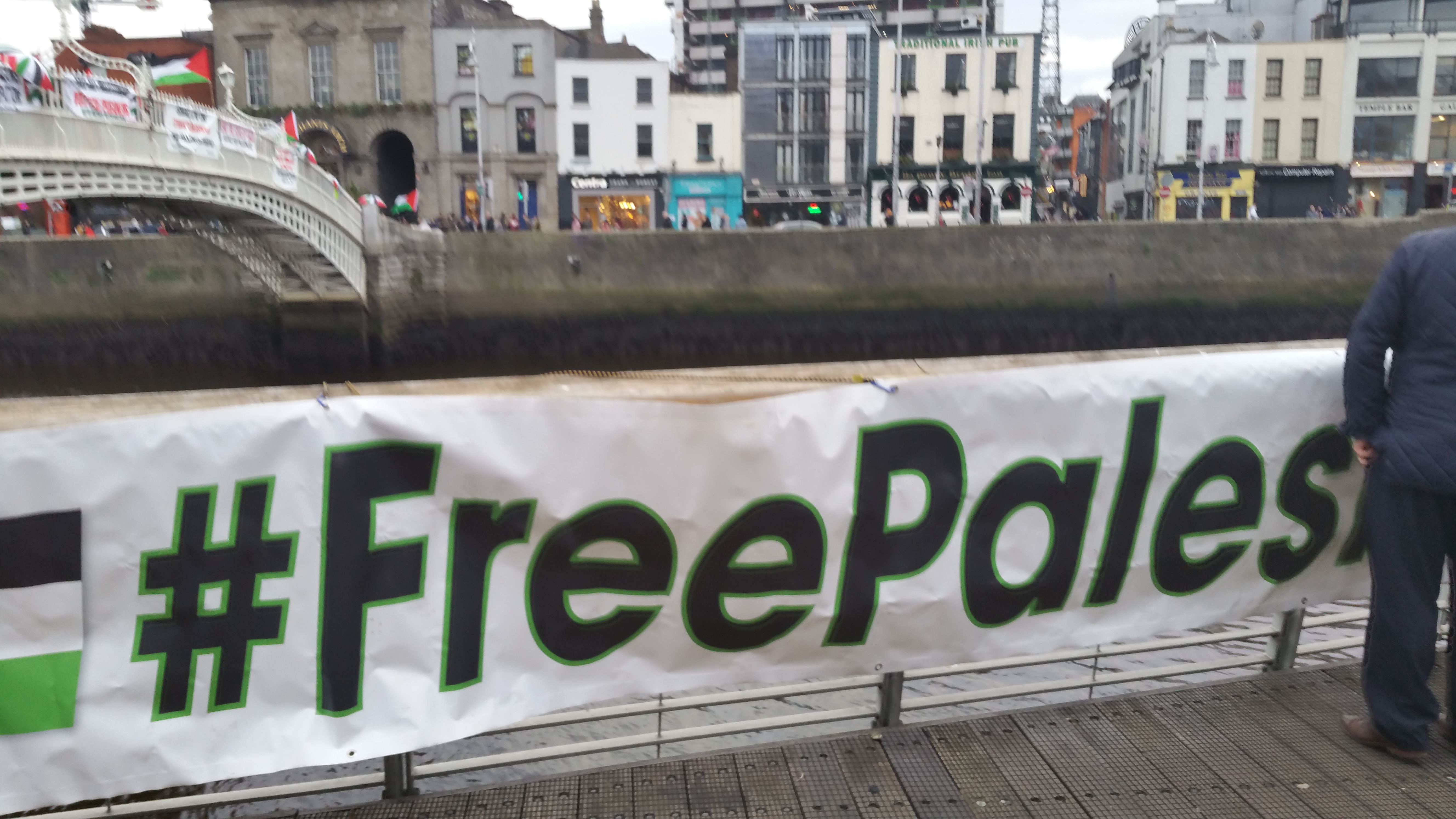
Palestinian flags and solidarity banners decorated each side of Dublin’s iconic Ha’penny Bridge on Sunday 31st December as people crossing towards both sides of the river passed between people holding flags, wearing kifiyehs or standing under umbrellas in the Palestinian colours. The overwhelming majority of the supporters seemed Irish and could be identified as from a range of socialist and republican backgrounds, whether independent or not.
A bridge of Solidarity (Photo: D.Breatnach)
This is an annual New Year’s Eve event, organised by the Ireland Palestine Solidarity Campaign, whose stall had been set up on the south side, near Merchant’s Arch.
On the Boardwalk (Photo: D.Breatnach)
Two versions of leaflets were being distributed; one which called for an end to the siege of Gaza pointed out that in 1017 a UN report stated that “the unliveability threshold has already been passed there.” Among other recommended actions the leaflet asked people to contact their TDs (Irish parliamentary representatives) and urge them to support Senator Frances Black’s Bill this year which will ban trade with Israeli illegal settlements in Palestine. Those settlements seize Palestinian land and water resources and are illegal by UN declaration.
The west side of the bridge, from the northern side of the river (Photo: D.Breatnach)
According to a report “Between July 2016 and June 2017, Israeli authorities authorized construction work on more than 2,000 new housing units for settlers in the West Bank, excluding East Jerusalem”, another area of Zionist expansion.
The Bridge was busy (Photo: D.Breatnach)
During the same period, “Israeli authorities destroyed 381 homes and other property, forcibly displacing 588 people as of November 6, in the West Bank, including East Jerusalem, as part of discriminatory practices that reject almost all building permit applications submitted by Palestinians.”
A closeup on some of the banners on the east side of the bridge. (Photo: D.Breatnach)
During the Great March of Return protests on Gaza’s border which began in May, Israeli Occupation Force snipers shot dead or caused death by gassing of 168 Palestinians and injured 17,259 people, including women, children, medical workers and journalists. During the same period one Jewish Israeli was killed 11 and injured, six of which were soldiers.
A great many passers-by expressed their approval of the demonstration, some stopping a while to talk with the demonstrators.
It was a child-friendly affair (Photo: D.Breatnach)
Some chanting of Palestinian supporters could be heard as well as occasional passing drivers tooting their horns in solidarity, occasionally with a clenched fist also raised outside the window. A counter-protest planned by the zionist Irish Friends of Israel on Essex Bridge however failed to materialise.
End.
LINKS FOR REFERENCES & FURTHER INFORMATION:
IPSC (an organisation independent of all political parties): www.ipsc.ie
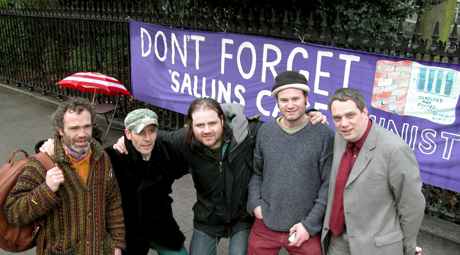
The violation of the civil rights of Osgur Breatnach (then a leading member of the IRSP) exposed in the program in the Finné series on TG4 (Irish language TV channel) shown recently and repeated a week later was set in the 1970s but the injustice did not end there.
Osgur Breatnach, photographed recently and still wanting his beating and framing investigated (Source image: Dara Mac Dónaill, Irish Times).
Even after a High Court admission that he and McNally had been subjected to “oppression” and his conviction thereby overturned 17 months after his jailing, the court still maintained he had beaten himself up – a fiction it maintains to this day.
Of course to say otherwise would have been to admit the Gardaí special unit that came to be known as “The Heavy Gang” were vicious thugs who fabricated “confessions”. And that the judiciary of the Special Criminal Court had, despite the medical evidence and signs of beating on all, including the three who had “confessed” and the repudiation of those statements in court, colluded with the beatings, accepted the statements as true confessions and convicted three of the men for up to 12 years’ jail. And to admit that the Court of Appeal and High Court had been complicit in accepting as a “finding of fact” which could not be overturned that they had beaten one another up (and done it to himself, in the case of Breatnach).
All of which meant that the Heavy Gang got more encouragement for their ‘work’ so that some of them were able to turn up on the scene of other scandals, including that of the false confessions of Joanna Hayes and her family (about which Gardaí nothing has been done either).
Even today, not one of those Gardaí has been even charged and the complicit judiciary and State Prosecution carried on in their jobs and in some cases rose higher.
The injustice did not stop there, for when Nicky Kelly, who had been on the run, gave himself up, even though exactly the same evidence had been used to convict him, he was told he had run over the timeframe in which he could appeal and it took four years of campaigning to get him out too. And then only for “humanitarian reasons,” so the “guilty of armed robbery” verdict still stood for his reputation, potential relationships, job prospects etc.
Another eight years later he received a Presidential “Pardon” from Uachtarán Mary Robinson.
Then the State fought the financial compensation case, taking it to the extreme of bringing Gay Byrne to court over an interview he had given Osgur Breatnach. At this point some wiser heads decided to limit the damage, pay up but with the condition that the three did not go after the police or proceed with any case about the beatings.
A facet of British and Irish civil law of which many are probably unaware is this: If the respondent (i.e the one against which you are taking the case) offers you a sum and you refuse it, and you later win the case but are awarded less than what you were offered earlier, you have to pay all the costs of the defence! You can actually end up owing money!
But back to ongoing injustice. Since not a single one of the Heavy Gang was ever even charged or disciplined over this and other similar behaviour and some were even promoted; since not a single member of the legal profession or judiciary was even reprimanded for their part in it; no warning about where the boundaries are has been given to the Gardaí much less to the judiciary. Which means that it can all easily happen again.
The defendants in the Jobstown case were not beaten up to force them to ‘confess’ but when we hear Garda after Garda, including a senior one, affirm under oath in court that one of the defendants said something which all the video evidence proves he did not, at what conclusion can we arrive other than that they were all lying? But not one of them has been charged or even disciplined either.
Conversely, the State has no problem with dragging anti-fascists to court recently and this to answer charges such as “violent disorder” arising out alleged actions preventing the European fascist organisation Pegida from launching a branch in Dublin.
12-hour protest at Department of Justice in January 2004 –Cormac Breatnach, musician and brother of heavy gang victim Osgur with other musicians including of the Ó Snodaigh family and TD Aongus, their brother. (Photo source: Indymedia — see Links)
ARE THINGS TODAY IMPROVED?
The Heavy Gang is not operating as such today (or at least not yet) but in some respects things are actually worse than they were back in the 1970s ad ’80s. There was one Special Criminal Court then – now there are two! The Public Order Act was brought into force in 1994 to give Gardaí great powers to repress public protests and the scheduled offence of Violent Disorder was included in that Act: three unconnected individuals at the scene of a “disorder” can be convicted under the latter provision and sentenced up to ten years in jail or fined an unlimited amount (or both)!
The non-jury Special Criminal Court on its last day in Green Street before it moved to its new location in Parkgate Street (Photo source: Internet)
Courts are imposing bail conditions preventing activists from continuing to be politically active, i.e from attending public meetings, rallies, demonstrations, pickets etc – for up to the two years it can take the case to come to trial.
And just as in the ‘bad old days’, the unsupported opinion of a Garda of Superintendent rank or over is sufficient to convict Republicans of “belonging to an illegal organisation” and visitors to the public gallery of the SCC have to give their names and addresses to the Gardaí before being admitted.
Special Branch officers still routinely and openly watch Republicans carrying out their peaceful political work and demand their names and addresses on pickets. But now not only is surveillance carried out on people’s electronic communication equipment, communication is also being blocked at times by special equipment of the Gardaí.
Sadly, as the struggle over social and political issues becomes more acute in this state, we will see more repression, as the State tries to force the whole of civil society into compliance, especially by concentrating that repression on society’s more politicised and active sectors. Already in Dublin we have seen masked bailiffs and masked police carrying out an eviction of a small token occupation group in an empty house and, a week later, armed police turning up to a dispute between a couple and their landlord.
Only by admission of wrongdoing followed by actions overturning the current impunity of the Gardaí and the judiciary can a worsening of the situation perhaps be averted. But there is no sign of that happening.
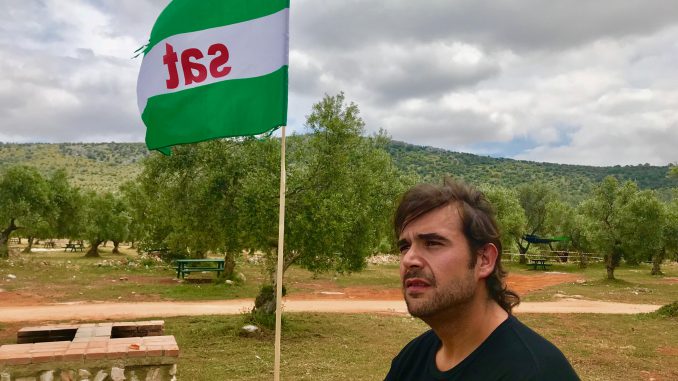
According to his trade union and other sources, Oscar Reina, spokesperson for SAT (Sindicato Andaluz de la Tierra — Andalucian Workers’ Union) was arrested at midday in Granada today while lunching with some of his colleagues, taking a break from preparations for the big demonstration on December 4th, the National Day of Andalucía as well as postering for a festival against repression planned for December 8th in Marinaleda, at which the band Ska-P will launch their most recent CD.
Oscar Reina, spokesperson for SAT, who was arrested today on a charge of “disrespect for the Monarchy” (the union flag seen nearby bears the traditional colours of Andalucia). (Image sourced: Internet)
Reina has been required to attend court since being ordered to do so to answer charges of sending a “disrespectful to the Monarchy” tweet in 2016. H
According to trade union colleague José Caballero, communicated to the newspaper El Salto, he had not presented himself voluntarily to answer the charges in line with his union’s policy of disobedience for the leadership, adopted unanimously some years ago against the rising repression suffered by SAT, with a million in government fines and demands for imprisonment of more than 300 years with nearly 500 trade unionists charged.
The tweet for which the trade union leader is to be tried: “You must feel little shame Felipe de Borbón; you are a disgrace. Your position which nobody has voted for is inherited from an institution that was maintained as a result of a Francoist and terrorist coup.
I would award you the Prize for Lack of Decency and Hypocrisy, with a trip into exile.”
The SAT (Andalusian Worker’s Union) is a trade union operating within the Andalusian autonomous region within the Spanish state and claims a membership of 20,000. It was founded in 2007 and describes itself as: a trade union of class, alternative, anti-capitalist, assemblyist, of solidarity, internationalist, pluralist, anti-patriarchal, confederal, republican, Andalusian nationalist, of the Left and communist. Its General Secretary is Diego Canamero. The union is known for actions such as occupations of unused land and a 2013 raid on a supermarket to distribute school materials on families in need.
A recent protest of the union has been against the proposed Lands Law which they say will “sink forever the dream of our Andalusian working population for Agrarian Reform. One cannot understand Andalusia with the struggle for the land and that is more recent than might appear ….”
Andalusia has an unemployment rate of 24.4% (2017 official figures), with male unemployment at 21.6% and female unemployment reaching 27.9%. According to SAT’s figures, 50% of the land is in the hands of 2% of the population and that concentration is increasing. That is an average and in some areas the situation is much worse. One worker a day dies on the land, according to the union and 60% of Andalusians earn less than 1,000 euro a month. Around 40% are so poor they cannot afford educational materials.
The union spokesperson denounced the PSOE (which has the majority in the autonomous government) and put forward a six-point program of reforms demanded by the union which they say will address all these issues.
Reina ended the communiqué by calling on the working population of Andalusia to mobilise militantly and to demand “Tierra y Libertad!” (Land and Liberty).
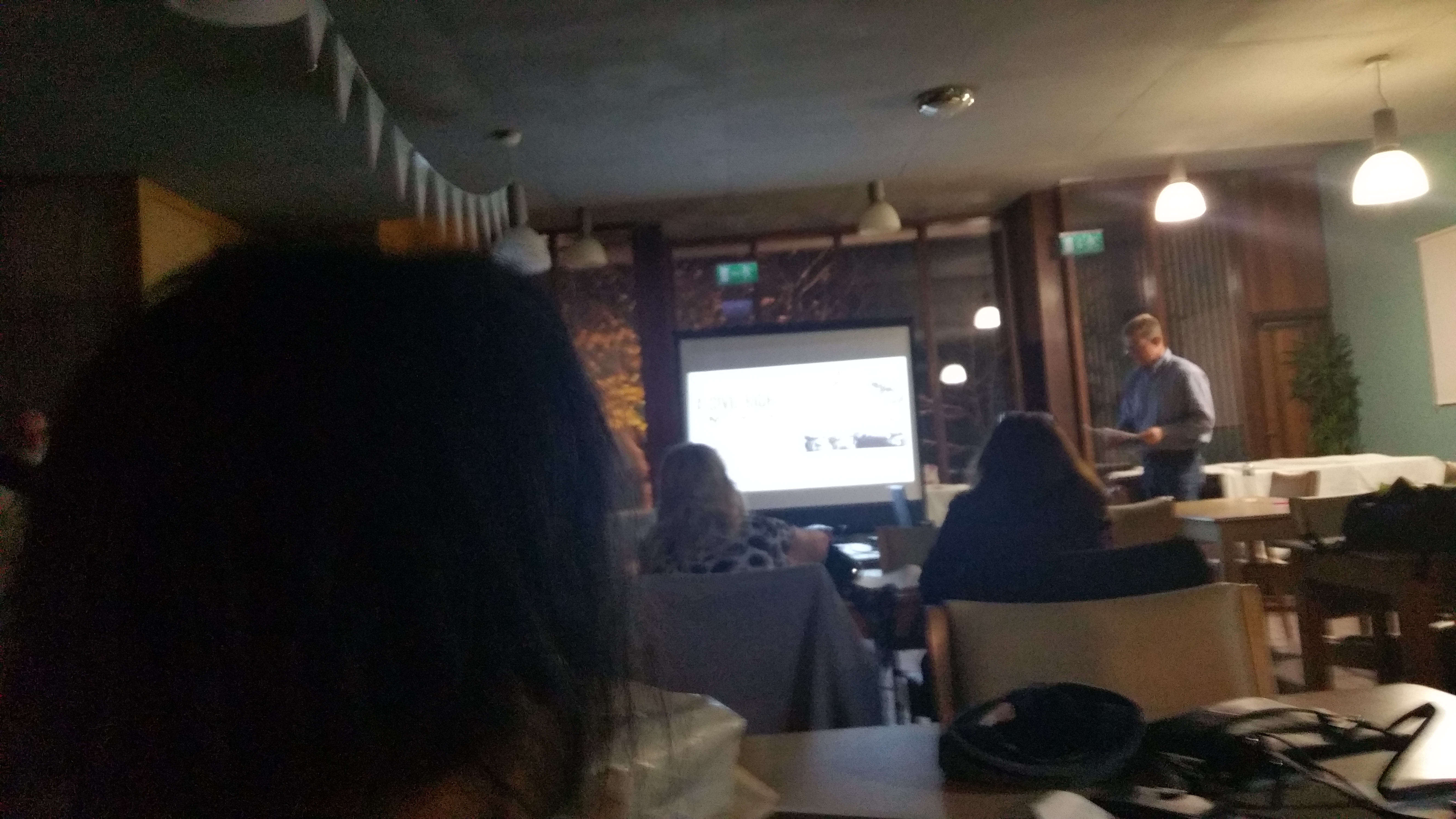
Two very interesting talks were given last night as part of a series of history talks at the Sean O’Casey Community Centre in East Wall, Dublin. The theme was black civil rights in the USA and Catholic civil rights in the Six Counties of Ireland (‘Northern Ireland’ according to some).
Joe Mooney of the East Wall History Society introduced the speakers and chaired the question-and-answer session afterwards.
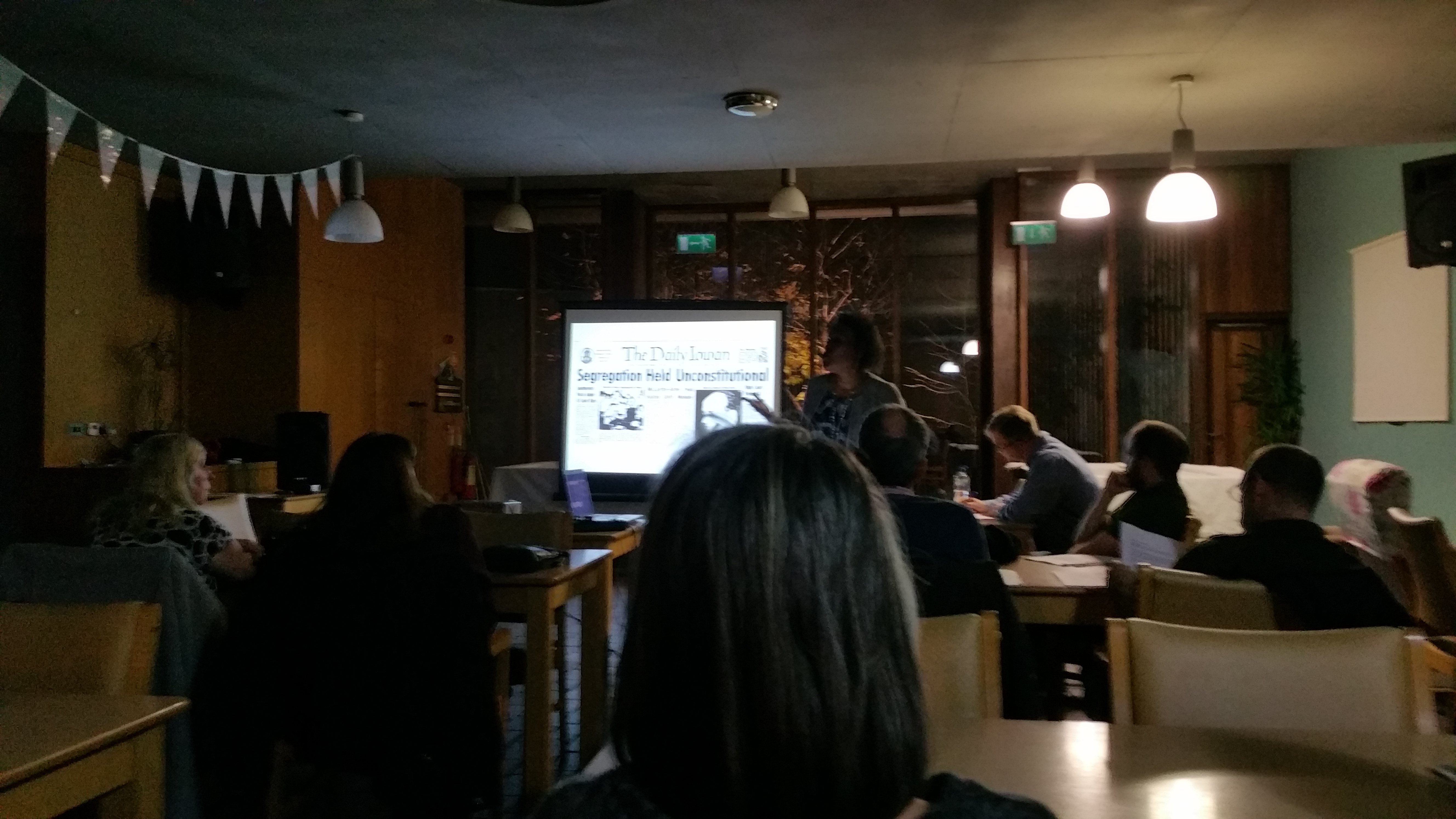
The session opened at 8pm and Cecilia Hartsell had a lot of ground to cover. She spoke on the history of the Civil Rights movement of blacks in the USA, going through the history of seminal events, illustrated with Powerpoint slides and recordings of two White House phone calls between President JF Kennedy and Ross Barnett, Governor of Mississippi and key figure trying to prevent the historic enrollment of James Meredith, a black man, into the University of Mississippi.
Cecilia Hartsell delivering her talk on the black civil rights movement in the USA
Recalling that in the first two years of his term, JF Kennedy had little to say about black civil rights but was focusing on other issues,Cecilia Hartsell somewhat undermined the (incorrect) image we tend to have in Ireland of Kennedy as an ardent civil rights fighter. In fact he was enforcing Federal legislation on equality and trying to go slowly, while the black campaigners were pushing the agenda along and white racist reaction was holding the USA up to international ridicule and opprobrium during the Cold War with the Soviet Union.
When Brian Hanley took the floor for his talk he fairly zipped along, which he does very well. Hanley undermined some myths or wrong impressions too. Early organisers of the civil rights marches and other events such as the Dungannon house occupation were Irish Republicans; Loyalists had killed four people before the first Civil Rights march. The rhetoric of SDLP and Labour Party notables was much more militant in the early years and Fine Gael was agitating more about issues of discrimination in the Six Counties than was Fianna Fáil, the party in government. And FF had been pushing a referendum to do away with the proportional representation electoral system at the same time that the PR system was among the demands of civil rights campaigners in the Six Counties.
Brian Hanley delivering his talk on the civil rights movement in the Six Counties.
In the session for questions, answers and contributions later, Hanley pointed out that the Southern Democratic Party was the pro-slavery party historically and, after the Civil War, anti-integration and civil rights, whereas the Republican Party was anti-slavery (debunking another false image we tend to have in Ireland).
Both historians made the point that a hundred years is not as long as some might think (this is especially true in ‘historical memory’). The 1940s, when some historians would say, as Hartsell told us, is the date from which to date the renewed fight for black equality in the USA, as surviving black soldiers returned from WWII, was only 80 years from when Federal troops were withdrawn from the former Confederate states. The partitioning of Ireland had been carried out less than 50 years before the Civil Rights protests broke out in the Six Counties, Hanley reminded his audience and many Catholics still lived who remembered vividly the fierce repression that had accompanied it.
It also emerged that albeit there were many similarities, there were also profound differences between the two movements. The black campaigners in the USA were saying that they were citizens of the USA State and demanding the same rights as other citizens, they often marched with the Stars and Stripes flag and even called for the intervention of US troops to defend their rights. The Catholics marching for civil rights in the Six Counties mostly saw themselves as Irish citizens and would never march with the Union Jack. Some did call for the intervention of British troops but many did not; it was mostly Irish troops they hoped would intervene.
The importance of the presence of news photographers at events and their covering in newspaper reports and on television broadcasts was an important factor in both struggles.
USA soldiers facing unarmed marchers for black civil rights. (Source: Internet).
Cecilia Hartsell did not feel that the Black Power movement could have survived Southern racist repression in the 1940s, ’50s and early ’60s and most of the big gains on desegregation of education, public transport, eateries and voter registration and effective right to vote in the Southern States were won during those years with peaceful marches and pickets and legislation (which however were met by much racist violence, including a number of murders). By the time the Black Power movement was coming on to the political stage, so was the Vietnam War and huge changes were taking place in the US, including many mass violent struggles on race and other issues.
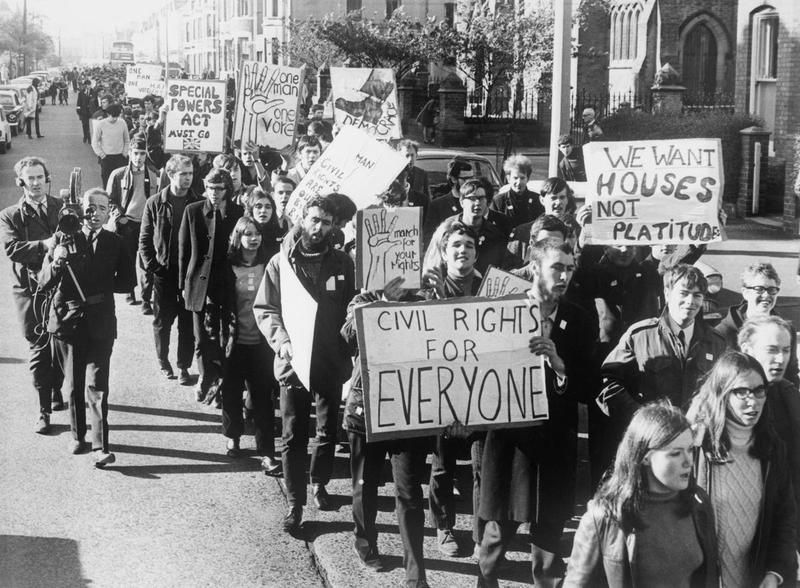
Section of march for civil rights in the Six Counties (Source: Internet).
TERMINOLOGY AND DEEPER MEANING
Wikipedia: “Though often used in history books to refer to the seven states that originally formed the Confederacy, the term “Deep South” did not come into general usage until long after the Civil War ended. Up until that time, “Lower South” was the primary designation for those states. When “Deep South” first began to gain mainstream currency in print in the middle of the 20th century, it applied to the states and areas of Georgia, southern Alabama, Florida, Mississippi, north Louisiana, and East Texas, all historic areas of cotton plantations and slavery. This was the part of the South many considered the “most Southern”.”
“Later, the general definition expanded to include all of South Carolina, Georgia, Alabama, Mississippi, and Louisiana, and often taking in bordering areas of East Texas and North Florida. In its broadest application today, the Deep South is considered to be “an area roughly coextensive with the old cotton belt from eastern North Carolina through South Carolina west into East Texas, with extensions north and south along the Mississippi”.
“Lower South” probably originally referred to its location on the typical north-orientated map of the USA. But I speculate that “Deep” has another meaning – a deeper psychological one, in fact. It suggests that this is a place difficult to understand for people not from there, which means most people. Different rules apply there, we might believe.
I speculate further that after the initial first years of the Civil Rights movement in the Six Counties, that area and the people living in it came to be seen as “different” too. Of course, it was different in that it was a colony (as had the whole country been only 50 years earlier) and that it was run along blatantly sectarian lines, the Catholics a minority there, unlike in the rest of Ireland. And of course, people in a different environment respond differently. But they were still people and the substantial Catholic minority were so clearly oppressed in a statelet into which the Irish ruling class had delivered them. For many people in the 26 Counties it became easier to think of them as somehow foreign in a foreign kind of land, hence my description as “Deep North”.
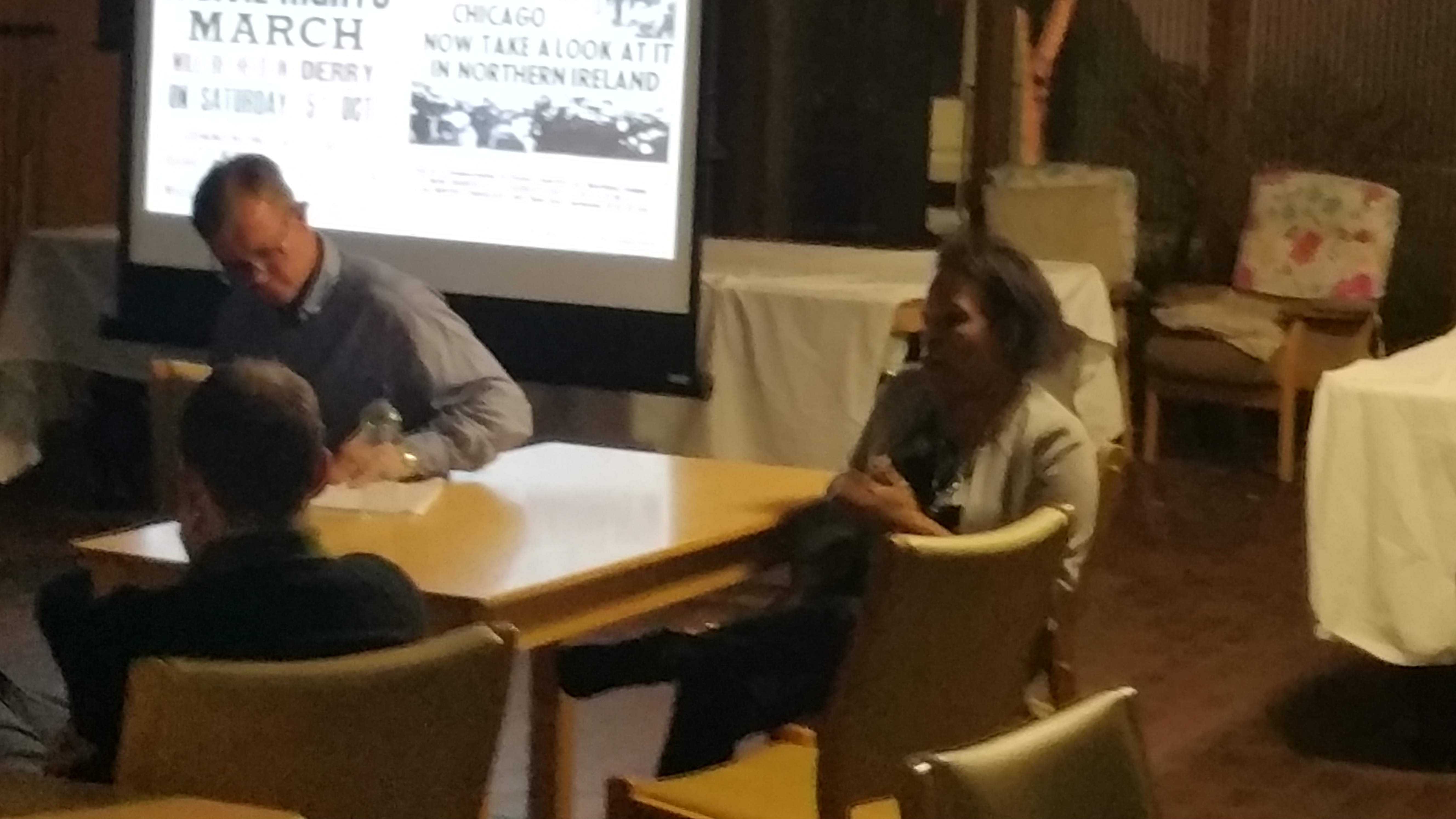
Cecilia Hartsell and Brian Hanley during the question-and-answer session.
THE SPEAKERS (as posted by EWHG)
Cecelia Hartsell is a researcher of American history. She has been a contributor to the RTE History Show and Radio Kerry on topics in U.S. history and frequently gives U.S. history talks for the Dublin Festival of History and in the Dublin Public Libraries. Cecelia has a Masters degree in U.S. history from Fordham University and a Masters degree in History from UCD.
Brian Hanley is an historian and author. He is currently a Research Fellow at the School of Classics, History and Archaeology, University of Edinburgh . He has lectured at a number of major Irish universities and was Historian in Residence at Dublin City Library and Archives . His books include “A Documentary History of the IRA, 1916-2005” (Dublin, Gill and MacMillan, 2010) with his most recent being “The impact of the Troubles on the Republic of Ireland, 1968-79: boiling volcano?” (Manchester University Press, 2018).
NEXT HISTORY TALK
There will be another talk in the series next week when Dr. Mary Muldowney will present a talk on “The 1918 Election – the Woman Who Stood for a Worker’s Republic.”
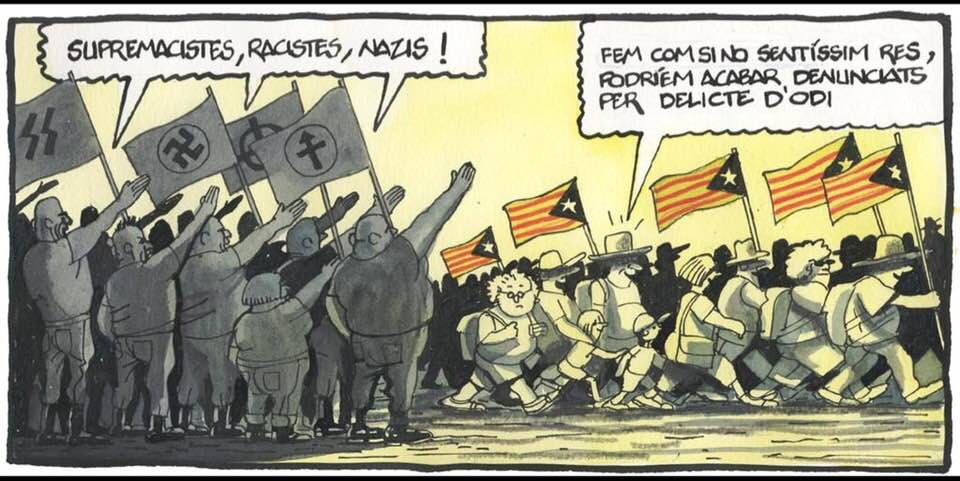
On the anniversary of Kristalnacht, the Spanish TV channel Telecinco showed a program about the Nazi attack on Jewish premises and people on 9-10 November 1938 which, because of the breaking of shop windows and looting, came to be be known by that name, which translates as Broken Glass Night. In showing the program, they inserted shots of Catalan independentist events, drawing a clear parallel between the two.
A journalist at a German television channel denounced the Spanish TV station for this and challenged them to explain their actions.
Wikipedia: Estimates of the number of fatalities caused by the pogrom have varied. Early reports estimated that 91 Jews were murdered during the attacks.Modern analysis of German scholarly sources by historians …. puts the number much higher. When deaths from post-arrest maltreatment and subsequent suicides are included, the death toll climbs into the hundreds. Additionally, 30,000 Jewish men were arrested and incarcerated in concentration camps.
Jewish homes, hospitals, and schools were ransacked, as the attackers demolished buildings with sledgehammers.The rioters destroyed 267 synagogues throughout Germany, Austria, and the Sudetenland,and over 7,000 Jewish businesses were either destroyed or damaged.
Spanish unionists have often accused the Catalan independentist movement of being Nazi or Fascist. No evidence has ever emerged of the Catalan pro-independence movement being anti-semitic or even right wing. A few years ago the Catalan Parlament, with a pro-independence majority, passed a law to give migrants equal access to health care with Catalan nationals but the Spanish High Court ruled the law illegal. The Parlament passed the law again this year. Giving migrants equal rights in health services hardly sounds typical of fascists.
But logic has nothing to do with this. Nor has history.
In accusing the Catalan movement of being fascist in nature, Spanish unionists not only exhibit their ignorance of the nature of Catalan society and the independence movement, but also their ignorance of the history of the Spanish State.
It is in fact the Spanish unionist forces which have a very close connection with fascism.
It was the military coup and fascist forces in the Spanish Civil War (or more correctly, the Anti-Fascist War) which sought the overthrow of the democratically-elected Popular Front Government and which, in order to succeed, called in the German Nazis and Italian Fascists for military assistance. Catalonia ndependentists were a major component of the anti-fascist alliance but Barcelona eventually fell to the fascist forces and a fascist dictatorship under General Franco followed. After Franco died, the right-wing forces put together a political party to participate in forthcoming ‘democratic’ elections and named it the Partido Popular.
Franco & Hitler reviewing fascist troops in the northern Basque Country during the Iberian Antifascist War (Image source: Internet)
This party gathered most of the old regime and die-hard fascists into it and is one of the two main political parties of the Spanish state. From December 2011 until it was unseated recently in a no-confidence vote due to corruption scandals, the PP was in Government of the Spanish state. It was that Government that sent Spanish police searching for referendum ballot boxes in September last year and on 1st August 2017 to attack voters with truncheons, boots, fists and rubber bullets. It was the PP Government which charged and jailed without bail Catalan independence activists and began proceedings against hundreds of others including a great many Catalan town mayors, which the current PSOE Government is processing.
The PP has been nearly eliminated electorally in Catalonia but another political party with similar ideology is strong there, also Spanish unionist, criticising the Catalan independence movement at every opportunity and supporting Spanish repression of the movement.
There are also actual openly-fascist organisations in the Spanish state which have representation inside the police and military and which regularly flaunt their banned fascist emblems, salutes and slogans with impunity. As well as being anti-semitic and otherwise racist, Spanish state unity is a central them with these too.
(Source of image: Internet)
All of these elements – along with many Spanish unionists of other political types, such as many in the PSOE – have denied the democratic right to self-determination of the Catalan people and supported fascist-type attacks on their activists and movement.
In summary then, although of course one may – as anywhere else – find some anti-semites and nazi types in Catalan society, even in the independence movement, the greatest number and natural home of this type is to be found in the Spanish unionist movement and its various political parties – the very ones who are accusing the Catalans of being fascists.
But drawing parallels, no matter how irrational, between the Nazi Kristalnacht and the democratic Catalan independence movement is a new low, even for them.
Quite a few pro-Catalan independence people have expressed horror and indignation at the statements of Spanish politician José Manuel García-Margallo in an interview recently. They should instead that be grateful that he spoke much of the truth and dispelled unrealistic illusions about the way forward for Catalonia.
Ex-Foreign Minister of the Spanish State José Garcia-Margallo, photographed recently. (Photo source: VilaWeb)
Did he threaten the independence movement with violence? Yes and not too subtly. That was no doubt his purpose as well as perhaps reassuring Spanish unionists, whether fascist or otherwise. But nevertheless, he spoke an important truth.
Spanish ex-Foreign Minister José Manuel García-Margallo said that Spain would not withdraw ‘peacefully’ from the Principality. ‘It will not deliver the keys to the dependencies and furl up the flag’, he told ‘El morn de Catalunya Ràdio’. He expressed support for the accusations of ‘rebellion’ against the Government of Puigdemont, President Forcadell, Jordi Cuixart, Jordi Sànchez and the General Secretary of ERC, Marta Rovira. According to him, the unilateral way to achieve independence ‘necessarily’ implies violence.
Margallo was raised in a family with close military relatives, two of which died in the anti-colonial Rif uprising, one of whom was a colonial Governor of a town there. The ex-Minister of Foreign Affairs was educated (and presumably brought up in) a part of the occupied Basque Country which must have helped condition him and his early adult life was spent under the Franco dictatorship. His early political career was there too and took shape during the ‘Transition‘ and since.
Translation of the transcript of the excerpt below:
“-Mónica Terribas: Crime of ‘rebellion’, does it exist there are or not, José Manuel? (DB: one of the charges against the Catalan activists but which requires the use of violence).
“-García-Margallo: I think there is a crime of rebellion. I share the theses of Llarena, that is, I believe that what we saw on the streets during the course of the (events outside the) Ministry of Economy was violent. I think that, by definition, unilateral secession can only be achieved by violence. That is, I say that hypothetically this leads to violence. Because? We have discussed it many times and we all agree: the Constitution does not allow secession. Therefore there will be no referendum agreed. Secondly, the Spanish state will not withdraw peacefully, that is, it will not deliver the keys to the dependencies and furl up the flag. So how is the Catalan Republic proclaimed? If it cannot be by agreement and it can not be by unilateral abandonment, then it will have to be by violence. And that necessarily leads to rebellion.”
Margallo’s political party, the Partido Popular is of course a coalition of a number of Franco-fascist organisations, put together to operate in the ‘new’ Spanish state. But the greater truth about the Spanish ruling class is more important than all this.
The Dictatorship ruled as the only face available of the Spanish ruling class – representing “old money”, from the expropriation of the labour power of workers and the plunder of its colonies but also “new money”, appropriated from the losers in the Spanish Anti-Fascist War.
In the 1960s and 1970s the Spanish State began to receive substantial US and other investment, particularly in military form. But the concern of investors was that with the rise of national liberation movements and the upsurge of the youth and student movement around the world, that an unyielding dictatorship would lead to revolution, so pressure began to be applied, although it was understood that attempts at reform after so much repression could also precipitate a revolution. Given the prevailing circumstances within the Spanish state, such a revolution could only be a socialist one.
When General Franco died in November 1975 two years and one month after his chosen successor Admiral Carerro Blanco had been assassinated, the reformers got room to move (internally Opus Dei and externally the US and others, especially the EU or Common Market as it was then). Reform and normalisation of control meant bringing on board of the ship of State two significant political forces with their corresponding large trade unions, illegal until then: the social-democratic PSOE with their UGT trade union and the Marxist CPE with their more militant Comisiones Obreras union. And imposing a Monarchy.
Both those illegal opposition forces agreed, accepted the monarchy and were legalised; then controlled and even sacrificed their own members. They pushed for agreement of the monarchist and unionist Constitution of 1978, in which the majority of a dazed and hopeful population of the state (but not in the Basque Country) voted in favour of it (and which is now being used to illegalise Catalan bids for independence).
Subsequently the PSOE gained an electoral majority and while in government in the 1980s ran assassination squads against the Basques (chiefly GAL and BVE groups, although foreign fascist gunmen were also brought in for individual jobs).
Under alternating governments of the PSOE and of the PP, the State forcesregularly used repression, particularly in the Basque Country, including torture of detainees and jailing people on the basis of ‘confessions’ tortured from them and which they repudiated in court. And they dispersed political prisoners throughout the jails of the State, hundreds or thousands of kilometres from their families.
This Spanish State is one that had at one time ruled much of the world and never ceded territory without a fight — with the English, the French, the Dutch, the North Americans; with native resistance and liberation movements from the Canaries to the Caribbean, to America, the Philippines and Africa. As a monarchy and feudal system, it overthrew the Arab colony of generations and expelled Arabs and Jews, brought in the terror of the Inquisition (the worst of all the states that had it), suppressed the rising of the Comuneros and resistance of the Basque and Catalan nations. As a semi-feudal capitalist monarchy, it overthrew a Republic and then raised a military coup with foreign fascist aid to overthrow another.
So this José Manuel García-Margallo is being on the whole brutally honest here and shattering the illusions many people had, especially those of a liberal or social-democratic turn of mind, that somehow Catalonia would win genuine independence without having to fight a Spanish military repression. But they should look on his utterances as doing them a favour, forcing them to look at reality.
In fact, for all that I have recounted about the particular nature of the Spanish State and its history, the more general historic truth is also that NO capitalist state (not to mention an imperialist one) is going to stand by and see itself being dismembered and losing huge chunks of what it considers its territory and economy.
Nations that won true independence had to fight for it. In the last century alone, how did Algiers win independence from the French? How did Kenya in Africa and Aden in the Middle East expel the British occupation forces? How did the Vietnamese expel the French occupation forces and defeat the US aggressors? How were the Nazi and Italian fascist and Japanese invaders of so many countries defeated?
People who hear the truth, no matter how bitter it tastes, should spend no time in bewailing it but instead concentrate on preparation.
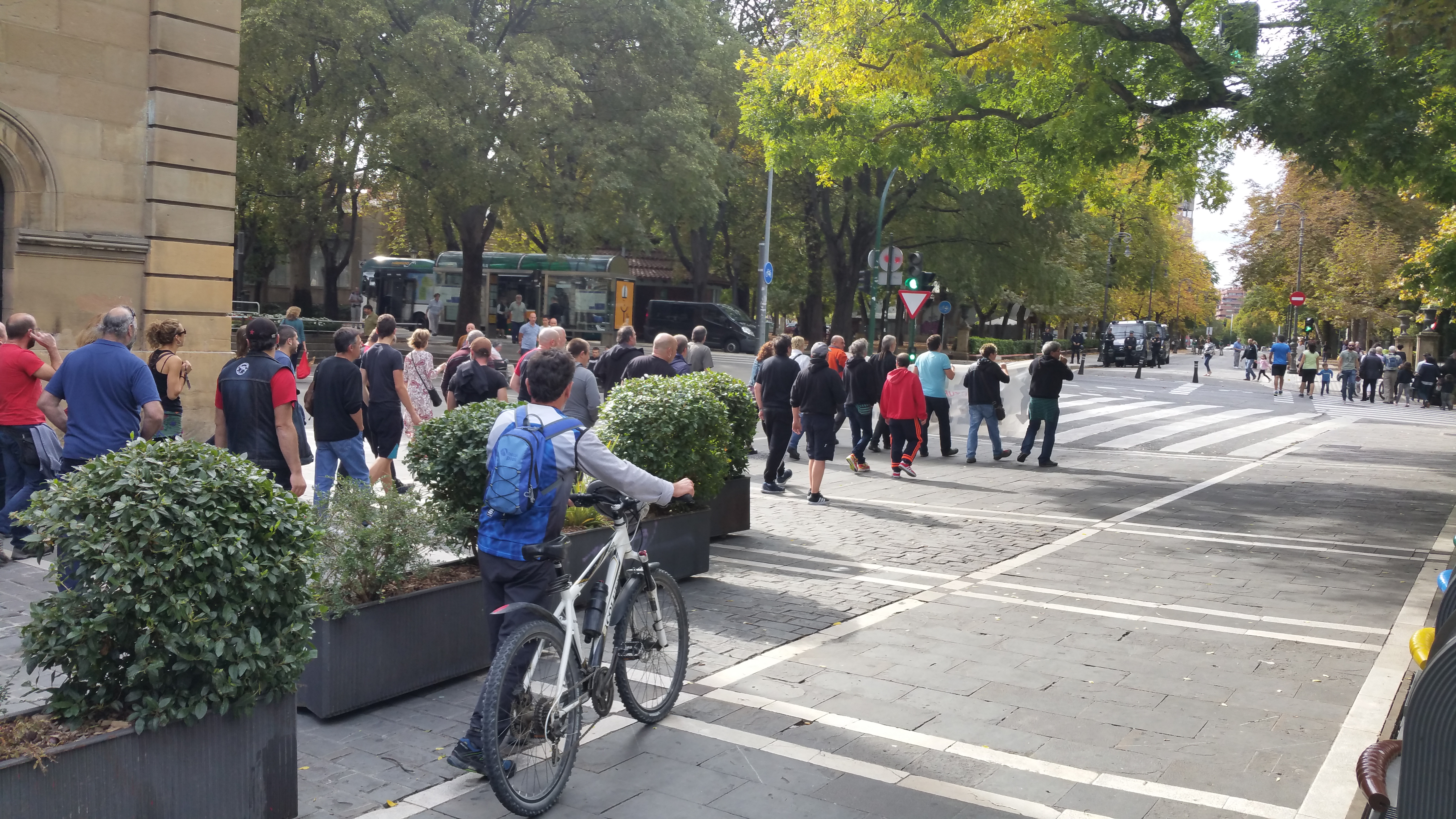
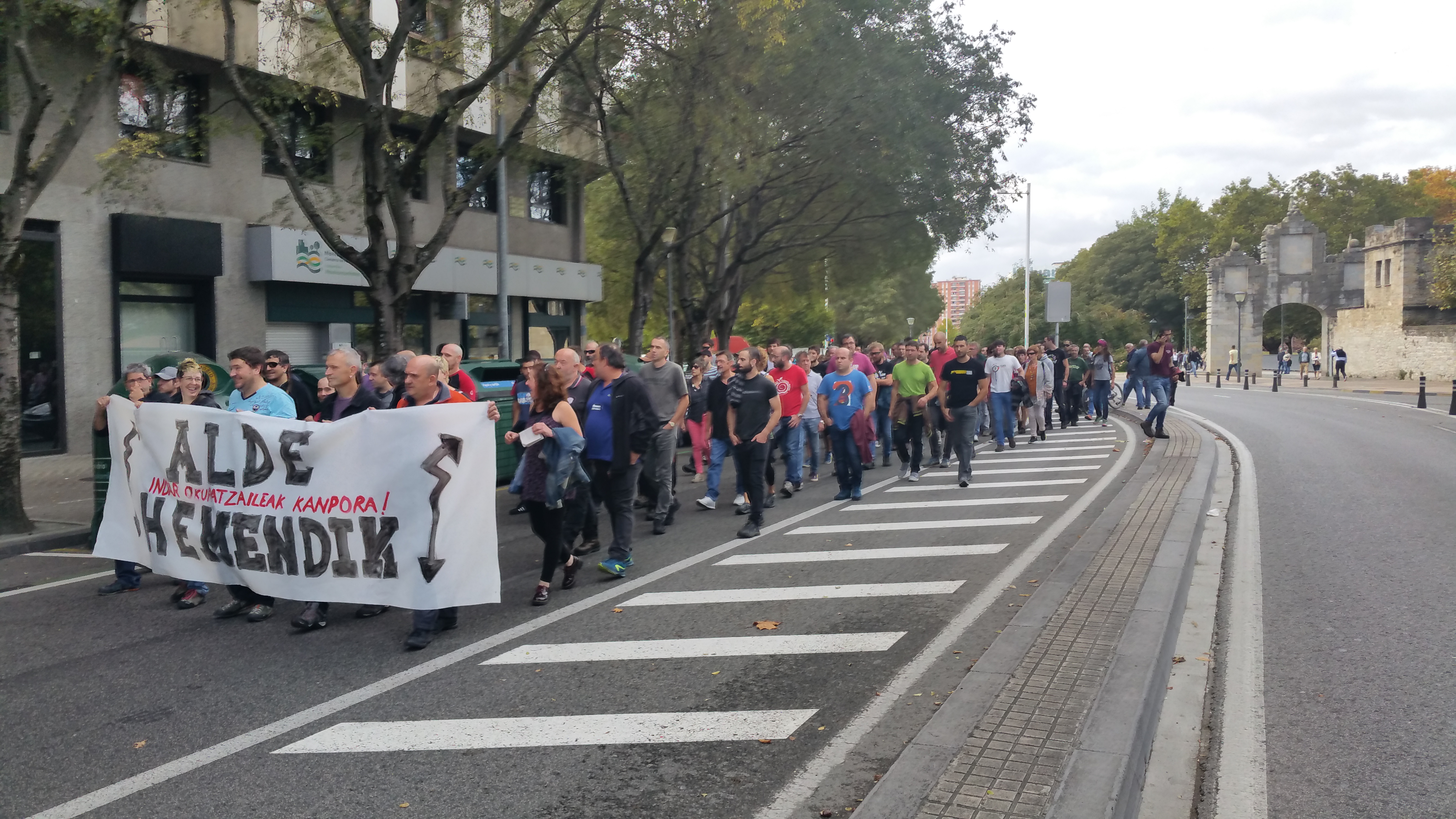
Marchers in Iruňa (Spanish: Pamplona) called “Alde Hemendik!” for the Spanish occupation forces to get out of their country and also called the Nafarroan police “murderers”, in addition to calling for the liberation of Basque political prisoners.
Posters for the march seen in a number of locations in the town (Photo: D.Breatnach)
The marchers were obliged to seek permission from the authorities for the demonstration and route as otherwise, from past experience, a police attack would have been certain. Even when approved, marchers in the past had to pass by ranks of police in full riot gear, which earned the latter the nickname “Romanos”, from their superficial resemblance to Roman Legionaires. Of course the police are given many other names too. On this occasion, the police presence was not as intimidatory as is normally the case.
The event took place on October12th which is national Spanish holiday, the Día de la Hispanidad, in which the State celebrates the spread of the Castillian language through conquest of the Canaries, Americas and part of North Africa. Naturally enough, forces that are opposed to the character of the Spanish State or to its presence in their country tend to hold counter-demonstrations on that day.
The marchers form up and begin (Photo: D.Breatnach)View from almost rear of march (Photo: D.Breatnach)
Although I did see one poster of the ‘official’ Basque Abertzale (pro-Independence) Left in the town I saw no other sign of them except banners on their local HQ (at least that’s what I was told it was). There seemed to be no intention of their holding a demonstration on that day.
The size of the march was perhaps somewhat less than had been hoped for but it made a good show going through the old town. Curiously, the march seemed much reduced by the time it reached the end square.
Front banner and march turning back into the old town after passing the police twice. (Photo: D.Breatnach)
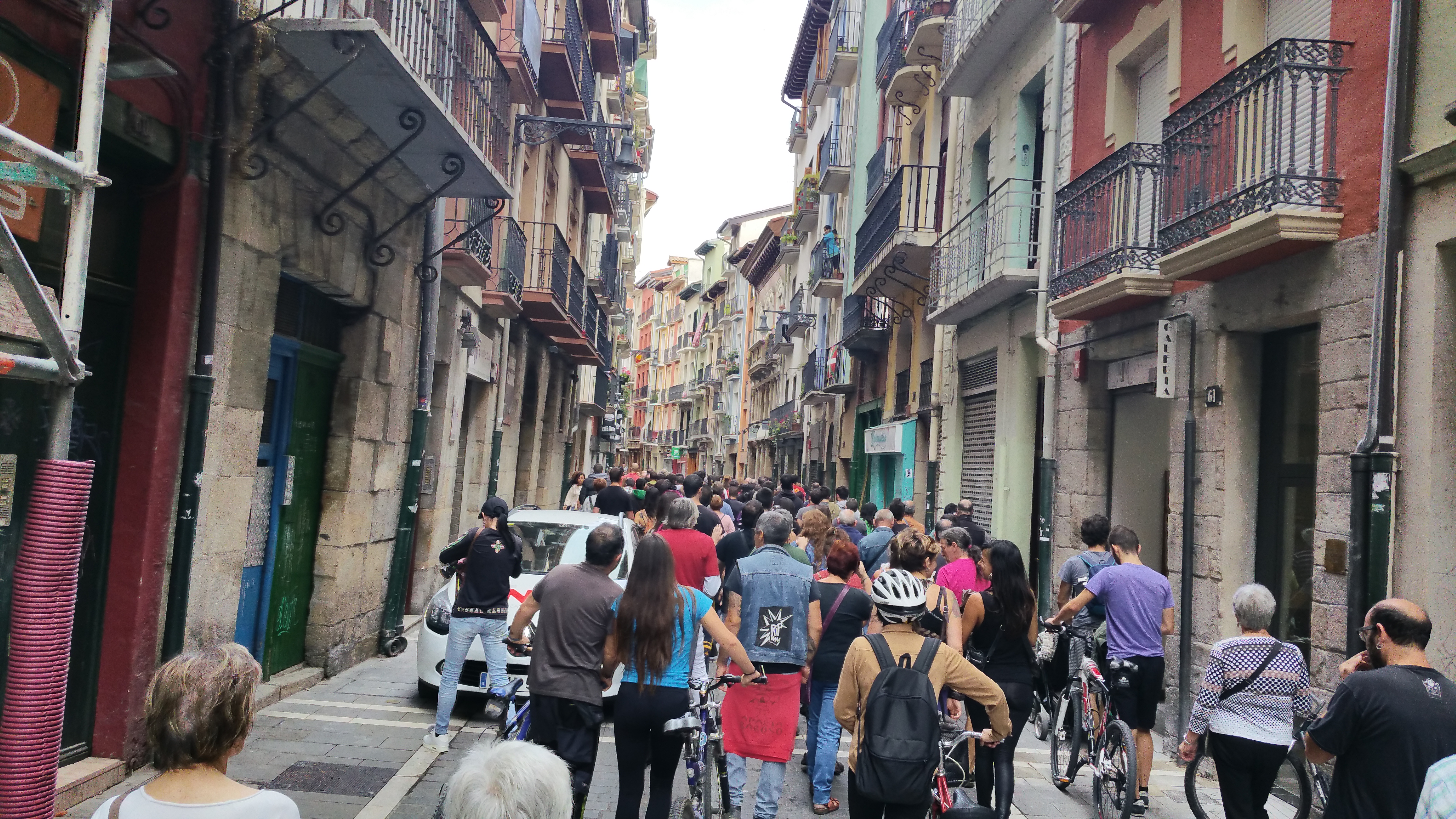
The marchers set the tone from the start with their banner and slogans and did not hesitate to call out “Policia asesina!” (‘police murderers’ in Castillian) as they approached and passed the police. Later people within the march began to lead chants also, some in Castillian and many in Catalan. The march did not pass by the nearby local HQ of the ‘official’ leadership of the Basque Abertzale Left. A marcher told me the were not permitted to do so but I was unsure whether that was an assumption taken for granted or whether they had been refused. However, the march leaders took people on a winding route through the old town, passing by residences, bars, businesses and many tourists.
March wending its way through streets of the old town (Photo: D.Breatnach)In the Plaza de San Francisco singing Basque song ((Photo: D.Breatnach)
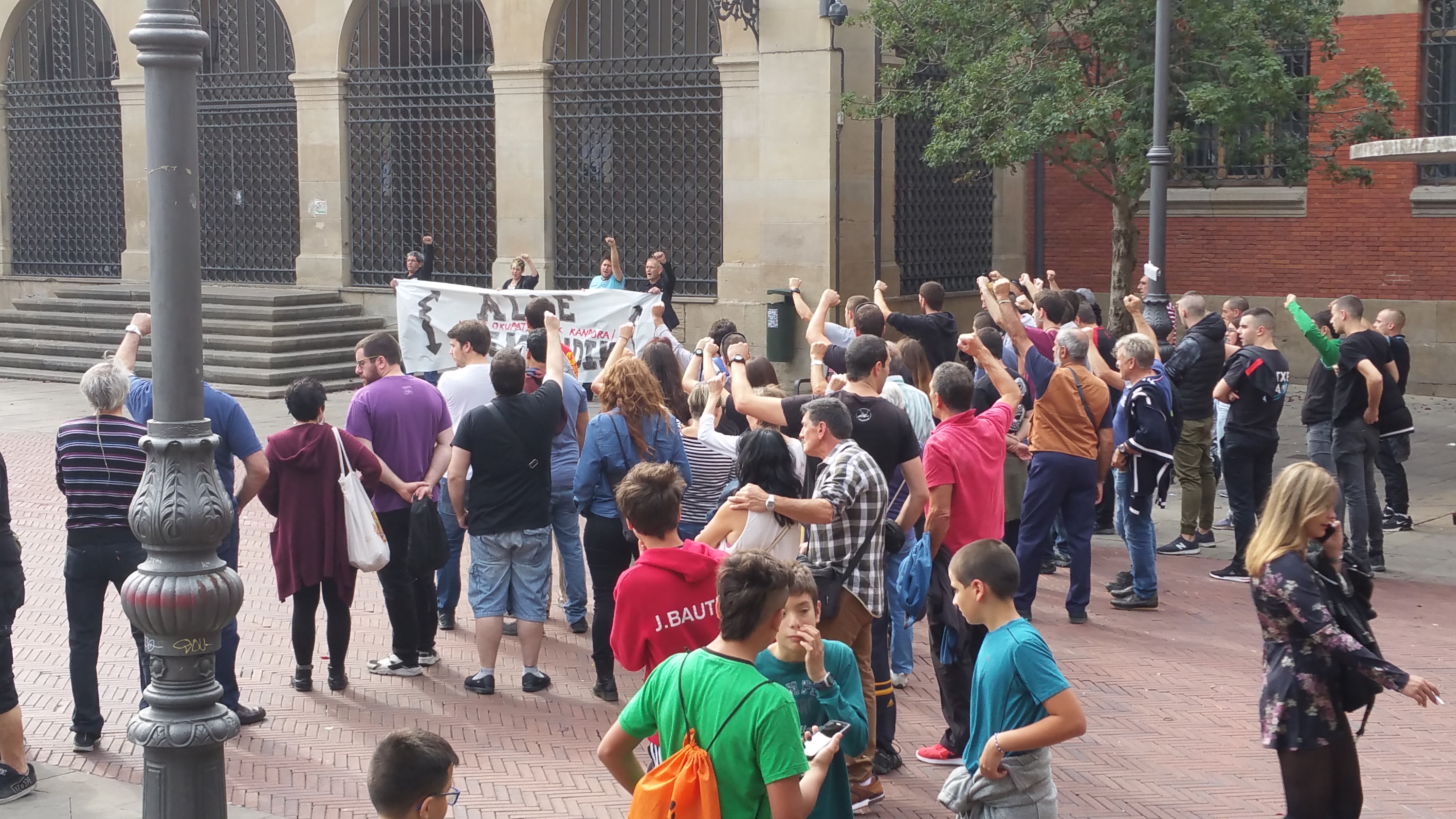
Concluding in the Plaza de San Francisco (St. Francis [of Assisi1] square) opposite the Municipal School, to the security bars of which the banner was secured, no speech was given but the marchers sang “Eusko Gudariak” (‘Basque Soldiers’), a Basque song of resistance (and anthem) with clenched fists, at the end of which a woman let out a long irrintzi.
IRUŇA AND NAFFAROA
Iruňa is the capital of the ‘autonomous’ southern Basque province of Nafarroa/ Navarra (and according to some, to be the capital of an independent Basque Country though by no means agreed by all). The Basque Kingdom of the Middle Ages was called the Kingdom of Nafarroa (Navarra in Castillian, Navarre in French). The present-day province is located at the north end of the Spanish state, on the border with the French state, much of that border area in the Pyrenees mountain range. The province has the other southern Basque ‘autonomous’ region of Euskadi (three provinces) to its west and the Aragon region to its east (with Basque provinces on the other side of the French Border too).
“ALDE HEMENDIK! (GET OUT OF HERE!) “Indar okupatzaileak kanpora! (Occupying forces out!) The march banner is left hanging on the security bars of the Municipal School (staff will probably remove it on their first shift after the holiday). (Photo: D.Breatnach)
Until recently, the majority political party there was the mainstream Spanish unionist party, the Partido Popular, now outnumbered and ousted by a coalition of pro-independence Basque parties.
The legal linguistic provision of Nafarroa is unique in the Basque Country as its territory is divided into three distinct linguistic regions: all Castillian-speaking; Castillian and Euskera bilingual; Euskera-speaking. Access to services, education and facilities through Euskera depends on in which area one lives or works, which might seem fair until one remembers that official services through Castillian are available always, no matter the region – it is the official language of the Spanish state. Euskera speakers also complain that in the bilingual region they are not getting the provision which they need and to which their numbers entitle them.
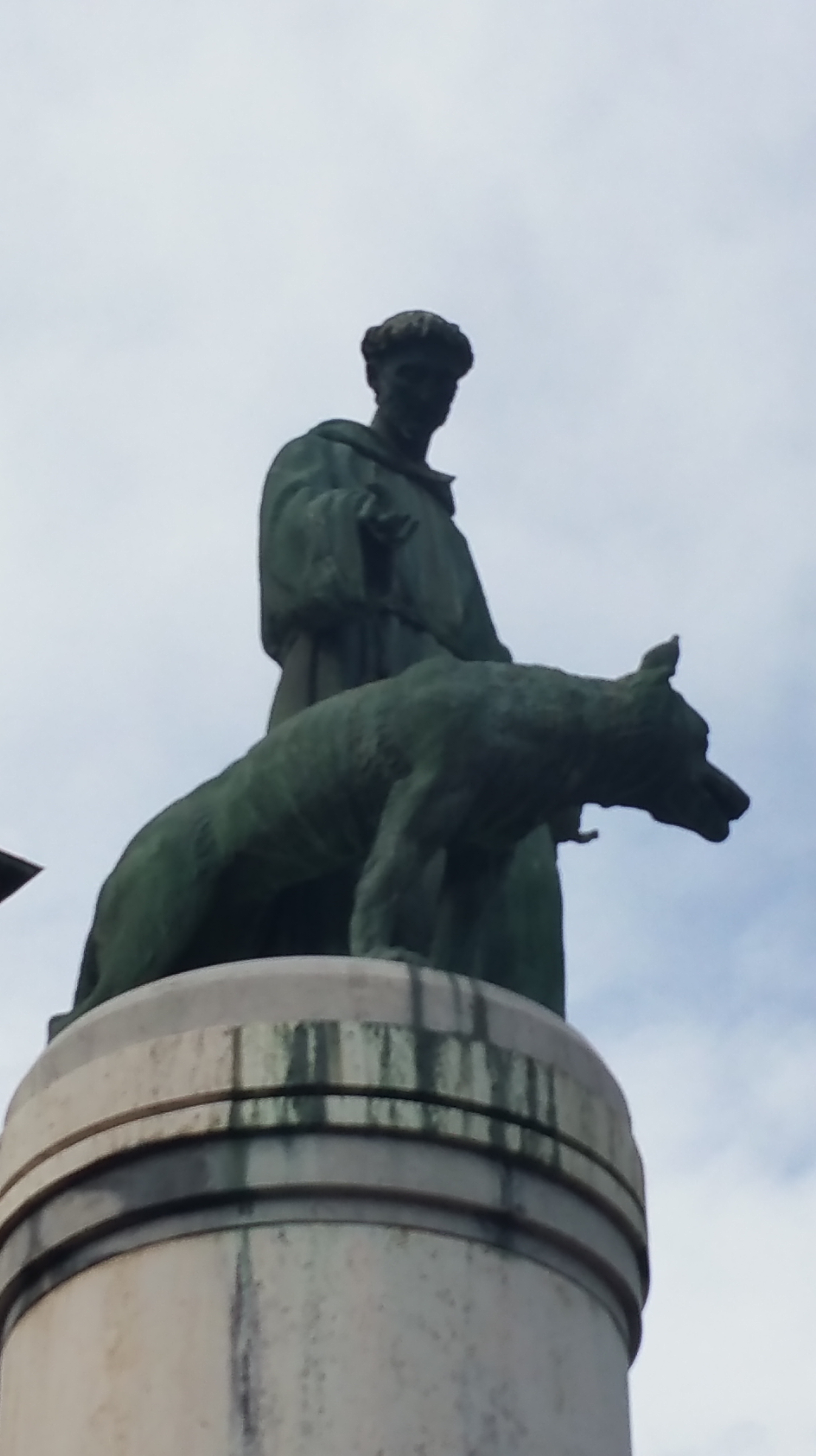
Monument statue of St. Francis of Assisi in the square named after him. (Photo: D.Breatnach)
Nafarroa was the only part of the Basque Country which can be said to have experienced what is called “the Spanish Civil War” (i.e an internal war) since the right-wing Carlists there slaughtered the 3,000 or so active Republicans, Communists and Anarchists — or just anti-fascists — before any of Franco’s troops or the Falange arrived there. As a result, the province was treated more lightly by the Franco dictatorship than the other three southern Basque provinces. This did not prevent repression of the Basque language in Nafarroa nor the armed attack on the more progressive Carlist movement of the 1980s during the “Transition” after Franco’s death.
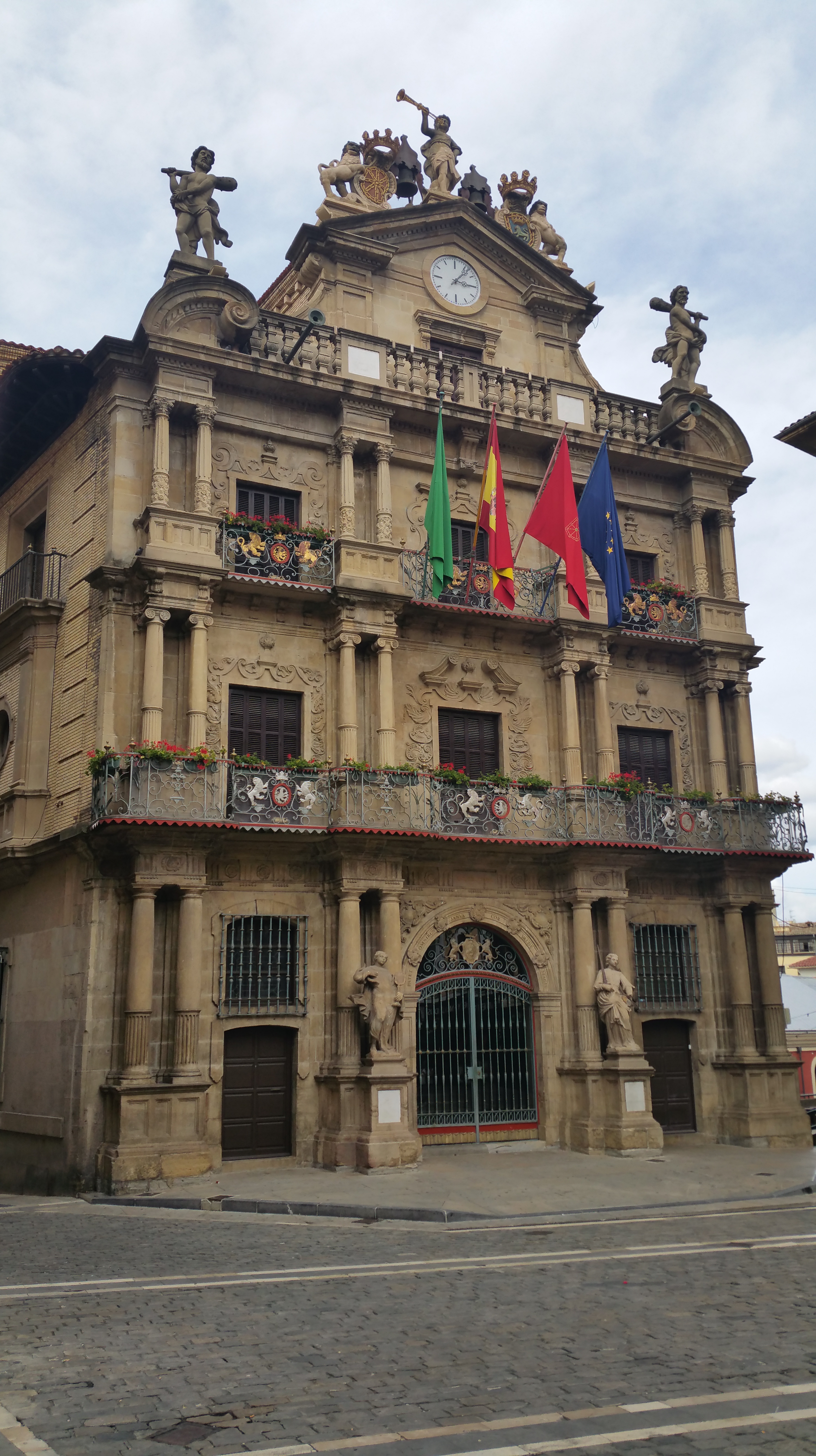
The Town Hall. All such municipal buidlings throughout the Spanish state are required by law to fly the Spanish State flag which must be at equal or higher elevation than all others. (Photo: D.Breatnach)
Many political and physical battles have been fought by pro-independence Basques since the 1930s, even around bringing a giant Basque flag into the main square for the ceremony to begin the San Fermines festival in Iruna/ Pamplona and at this festival too, many women have been molested and one gang-raped in 20162. The shocking nine-years jail sentence over a barroom brawl with Guardia Civil was imposed some months ago on youth from Altsasu, a town in Nafarroa.
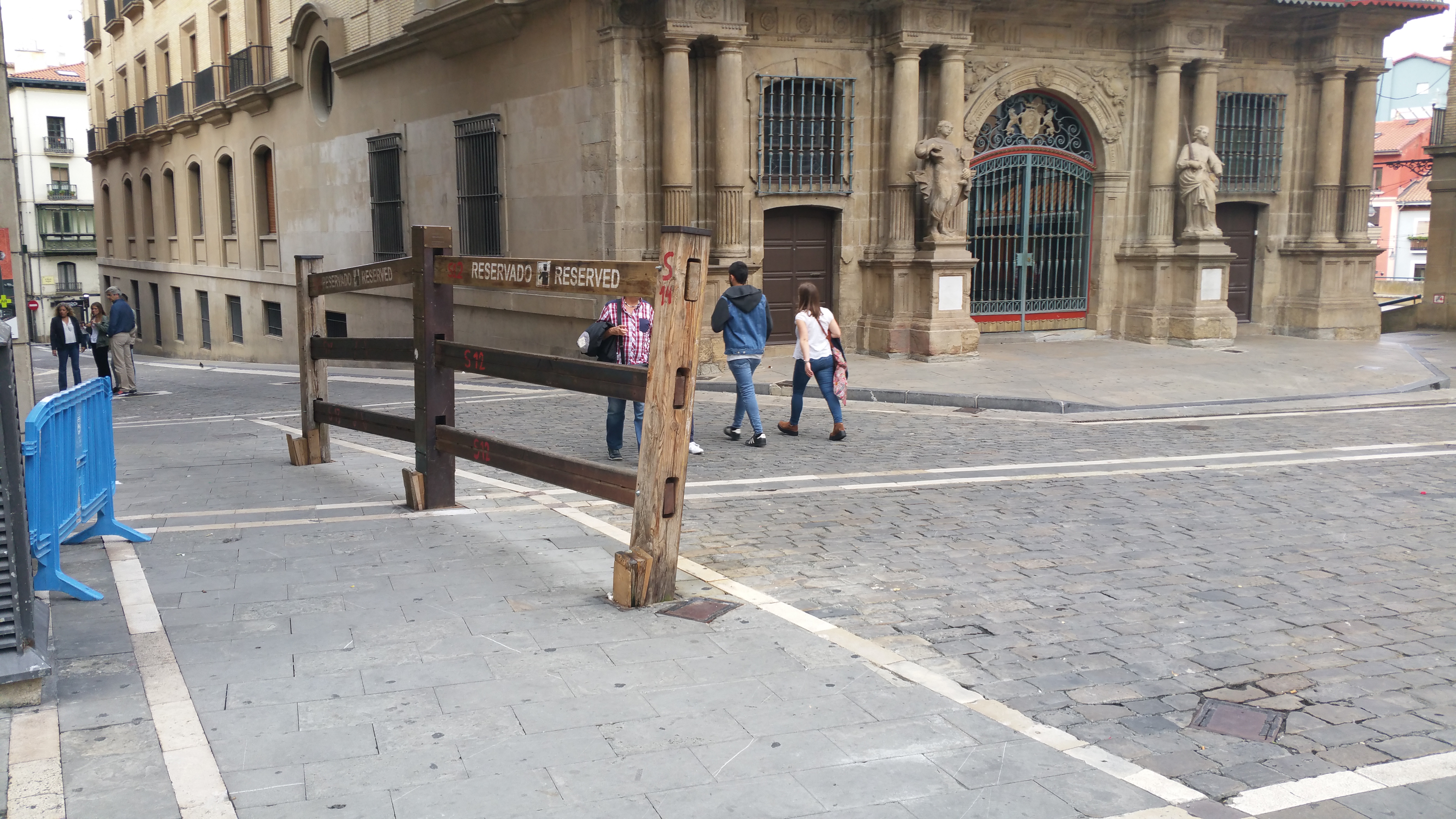
Area through which the bulls run as part of the San Fermines festival. (Photo: D.Breatnach)
FOOTNOTES
1St. Francis Xavier (1506-1562), born in Nafarroa, is the more common St. Francis to find referred to in the Spanish state and many Basques are called Xavier. St. Francis of Assisi (1881/2-1226) was Italian. There’s a story that an airman is falling out of the sky, his parachute having failed and he calls desperately for St. Francis to help him. A giant hand appears under him and as he comes to rest on it, a voice booms from the sky: “Which St. Francis did you mean, my son?” “Of Assisi”, gasps the airman. “I was named after him. Thank you!” “Alas,” the voice replies, “I am St. Francis Xavier.” And the hand is removed ….
From Eoin O’Donnel’s filming and editing via Joe Mooney of East Wall History Group, a recording of Diarmuid Breatnach singing Christy Moore’s wonderful song Viva La Quinze Brigada (also known as Viva la Quinta Brigada which, however, is also the title of another song from the same conflict but in Castillian or Spanish language). The Fifteenth Brigade of the Spanish Republican Army was also the Fifth International Brigade, the mostly English-speaking one. It contained volunteers from English-speaking USA, Canada, Australia, Scotland, Wales, England and ireland but due to high Irish emigration, all those countries also contained Irish diaspora and they were to be found in the contingents from those countries.
The video also contains photos of the commemoration of Jack Nalty, resident of East Wall’s, the last Irishman to die in action during the Iberian Anti-Fascist War (usually known as the “Spanish Civil War”). The day-long event on 28th September (anniversary of his death) included songs and poems, a march led by a lone piper, unveiling of a plaque, booklet launch and showing of two films. It was a celebration in particular of Jack Nalty’s life but more generally of the Irish who, against the position of their Government, the Church of the majority, the dominant media and even, for those in the IRA, against their own organisation’s orders, went to fight against a fascist military uprising against the elected Republican Government of the Spanish state.
It was also a celebration of antifascist resistance around the world and of the principle and practice of internationalist solidarity.
A plaque to the fallen of the Irish volunteers of the International Brigade (containing many names but by no means all of the Irish who fell there). The plaque is on the wall of the Theatre side of Liberty Hall, HQ of SIPTU, Dublin. (Photo D.Breatnach).
Liam Herrick, Executive Director of the Irish Council for Civil Liberties and Mallachy Steenson, Irish Republican and practicing lawyer, on Friday 7th June addressed a Dublin meeting on The Right to Protest, convened by the Dublin Anti-Internment Committee.
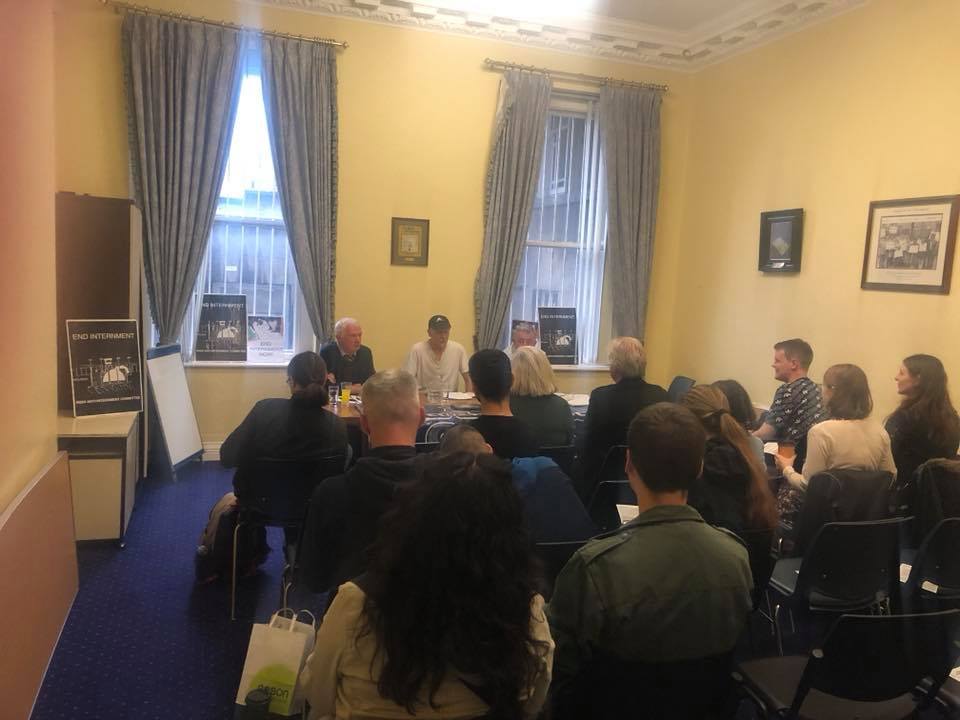
Section of audience and panel at Right to Protest meeting (Photo source: Dublin Anti-Internment Committee)
CHAIR’S INTRODUCTION:
The origins of the Anti-Internment Committee and the Right to Protest
Opening the meeting and speaking for the organisers, the Dublin Anti-Internment Committee, Diarmuid Breatnach welcomed the attendance, introduced the Committee and related how it had grown out of a previous committee, to have Marion Prices released from prison, which had been partially successful (she was released pending trial but her health was destroyed). She and a number of other former Republican prisoners who had been released under license under the Good Friday Agreement, such as Martin Corey and more recently Tony Taylor, had their licenses revoked and were brought to jail without a trial or the right to challenge whatever evidence the Secretary of State for Northern Ireland claimed to have against them. Some considered this a form of internment by some and the Anti-Internment Committee had been set up in June 2013.
Breatnach emphasised that the Dublin Committee had always been and remained — attempts at takeover and accusation notwithstanding — independent of any other organisation and committed to reaching decisions in a democratic manner and conducting themselves in a principled manner towards other organisations. The Committee organises the annual Anti-Internment rally in Newry and holds more-or-less monthly pickets in different parts of Dublin, which anyone is welcome to support, he told the audience.
Chair of meeting Diarmuid Breatnach speaking at Right to Protest meeting (Photo source: Dublin Anti-Internment Committee)
Although the Dublin Anti-Internment Committee updates a list of Republican prisoners in jail and also raises issues about the human rights of Republican prisoners such as right to education and art work, appropriate medical treatment, release from solitary confinement and on occasion about miscarriages of justice such as the Craigavon Two, nine years in jail now – nevertheless the true focus of the Committee is on issues of internment.
Introducing other areas of repression by the states on both sides of the Border which the Committee considers to be types of internment, Breatnach outlined the practice of refusing bail to the accused or of making bail conditional on the individuals removing themselves from all political activity. When the accused justifiably refused to accept these conditions, they were jailed, only perhaps to be found not guilty two or three years later, as had been the case with Stephen Murney. But still having effectively served a jail sentence.
“The right to protest is everywhere under attack” stated Breatnach and declared that maintaining that right was necessary for the winning and maintaining of a wide group of basic social and political rights, from practicing one’s sexuality or religion, or indeed criticising the Church, to forming a trade union, going on strike and marching against unjust laws or measures. Breatnach bemoaned the apparent inability of a number of Republican groups to unite in defence of this right and of Socialists in uniting with them even on this most basic of levels. “We can either stand together or fall separately” he said.
Internment is used by states against political opponents, said Breatnach, recalling that the British had used it in Ireland after the 1916 Rising, the new Irish state had used it during the Civil War and again during WWII under De Valera; the British in the Six Counties between 1971 and 1975.
Internment is a means of “removing unwanted members of the public”, Breatnach said, quoting the words of anti-insurgency specialist Brigadier Frank Kitson, who had been present during the repression of the Malayan resistance and also an operational Commander in Ireland from 1970-1972, years which Breatnach reminded his listeners were those covering the introduction of internment and the massacres of civilians in Ballymurphy and Derry.
Referring to the infamous “Heavy Gang” of the Gárda Síochána whose brutal methods had extracted false confessions on the Sallins Mail Train robbery from socialist republicans in the 1970s and from the family in the Kerry Babies case, Breatnach recalled the formation of the Irish Council for Civil Liberties at that time and that it had been a campaiging organisation unafraid to challenge the State on its repressive actions. Sadly over the years the organisation had fallen away from that path, he said and he was particularly glad to welcome Liam Herrick of the ICCL to speak at the meeting and in the hope that the organisation was returning to its roots.
LIAM HERRICK, ICCL: The Right to Protest and the work of the ICCL.
Liam Herrick, Executive Officer of the ICCL, speaking
After the applause, Liam Herrick thanked the Committee for having invited him to speak. He wished to list some of the efforts in which the Irish Council of Liberties was engaged and also to hear from the audience some of the problems they were encountering.
Briefly covering the early years of his organisation, Herrick related that it had been formed as a response to police repression, mostly of Republicans but also of some Socialists, and in particular due to the activities of the Gárda unit known as the “Heavy Gang”, by academics, activists and lawyers. It had taken up early cases of the ill-treatment of detainees, the use of the Offences Against the State Act, repression of protesters of the Ronald Reagan visit including the case of Petra Breatnach in 1984 and Water protests in the mid-1990s, also in the street-traders’ protests in which Tony Gregory was prominent.
The issue of the right to protest and State repression had come up again a number of times including in 2002 against the Anti-War Movement with the use of the OAS Act and in particular with the Reclaim the Streets protest in 2002, in which video recording of police actions had revealed the extent of police brutality without any arrests. Similar problems had been encountered by protesters at the 2004 EU Council meeting in Dublin, and water canons had even been imported by the State from the UK and widescale repression and had come up again at the Corrib Shell protests.
The ICCL had in 2014 published “Know Your Rights” booklet. And had called for a root and branch review of procedures for dealing with protests, noting that there existed a major gap in rights and policing process and has published a publication by the title of “Take Back the Streets” and has made submissions to the EU and the UN on how states should not just tolerate but manage and create conditions to facilitate the right to protest. The ICCL is part of a network which includes the ACLU in the US.
“If Notifications to the authorities are required should be minimal and reasonable”, Herrick said and gave the contrary example of African Jews who wished to protest against Israeli measures but were charged a 25,000 dollars as a cost of the application for permission.
Police should have a chain of command to deal with protests and be trained not only in weapons and control movements as they are at present but also in de-escalation, in engagement with protesters. Their internal Garda policies should be available to public access but are not.
Herrick said journalists should be facilitated in having access and only just employees of big media organisations but alternative media and individual bloggers whose coverage is often essential to understanding the incidents at an event (in the Reclaim the Streets event such sources were the only source on the Garda violence). There should be restrictions on the use of force as is law and police in Northern Ireland, whatever people might think about practice on the ground, Liam Herrick said. The PSNI every 6 months have to submit a report to the Policing Board which details incidents o the use of force. In the Irish state Gárdaí don’t have to make any report on the use of force which is remarkable in the European context – the use of pepper-spray would seem to be increasing here but no records are available..
Surveillance is an issue and of course can intimidate and have “a chilling effect on protest”, Herrick said. In England face recognition technology is being used which apart from questions about its accuracy, is intrusive. Also trapping of mobile phone activity in the vicinity of a protest. Data collection is an issue and there should be no database on protesters maintained; covert agents have been used and in some cases become personally involved with those they were surveilling – a recording procedure is needed. There needs to be an independent complaint process as the existing process in Ireland has been shown to be inadequate.
At the moment the ICCL is involved in discussions on Gárda reform and the following Friday would be producing a document on Human Rights Policing which people are welcome to read. The international perception is that the law and policy of the PSNI is good, without making any comment on their practice on the ground. The Gardaí should publish a report on their handling of protests every year including statistics (despite the problems on drink-driving statistics) on arrests and the use of non-lethal weapons.
The Gardaí in Ireland have a national security function and there needs to be a discussion on this – in many other countries a separate body is responsible for this. But no legal body is overseeing the operation of the Gardaí on national security or the powers they exercise.
Liam Herrick concluded to applause and Breatnach told the audience that questions could be asked of him and of the next speaker after the conclusion of the latter, then introducing Mallachy Steenson to welcoming applause.
MALLACHY STEENSON: Republicans and the Right to Protest
Mallachy Steenson speaking Section of audience and panel at Right to Protest meeting (Photo source: Dublin Anti-Internment Committee)
Mallachy quoted the right to protest under Article 41 of the Constitution of the State under which document however Republicans would not support.
Moving on to suppression of protests Steenson referred to the most frequently used being the Public Order Act, justification which depends on the subjective view of a cop and is therefore virtually unchallengeable. The result is usually a fine but the use of the Offences Against the State Act is much more serious. In the 1950s there were many arrests of Republicans under the section which prohibits a demonstration within a certain distance of the Dáil and Section 30 was widely used.
Steenson pointed out that almost any gathering of Republicans consitutes some kind of protest due to the basic opposition to the State of Republicans. Funerals are usually protests too, partly in solidarity with the family, partly with movement but also of making a stand and, in the case of the ten dead 1981 Hunger Strikers, in solidarity with their Five Demands.
Steenson believes that most of the protests that occur in the state will be allowed because the they don’t threaten the state from the “trendy liberal side”. For example the housing protests including activist occupations are permitted but when a house was occupied in Charlemont Street and in preparation for moving in a family three years earlier, armed police removed the occupiers.
“The State takes a different view of Republicans” Steenson declared. Referring to the 2016 Sinn Féin Easter 1916 commemorations, Steenson wondered whether they remember their history because the 76th anniversary of the Rising commemoration (1992) was banned and people on the platform arrested. The 66th anniversary commemoration had been beaten off the street in Dublin and people arrested for “membership”, including his own father and others.
“What we have is mostly controlled dissent”, Steenson said. “People remember the Birmingham Six” but are not aware that their campaigners here had their homes raided by police, their jobs visited by the Special Branch, threatened and often lost their jobs.
“What has happened in Ireland is a privatisation of dissent,” Steenson said. “They are funded by the State and he who pays the piper calls the tune.”
The only ones who could really carry out a successful protest in Ireland were the farmers who here, as in France, had no hesitation to block roads and motorways and dump slurry at the Dáil, Steenson declared. The only other really effective protest that hurts the State is the withdrawal of labour as in a general strike – which should have happened when the banks were bailed out — but the trade union movement in Ireland works hand in glove with the State.
“Republicans are well-used to surveillance” Steenson went on to say with a reference to “the new MI5 Garda Commissioner” who declared upon coming into office that the biggest threat to the State is the armed ‘dissident’ Republicans, which Steenson commented were no real threat to anyone except themselves.
“The State is built on the defeat of the Republic,” said Steenson and therefore naturally Republicans are its enemy. Referring to the water protests and their suggested victory, Steenson opined that the success was only due to Fianna Fáil changing sides and he believed that the USC (Universal Social Charge) should be the main object of protest which takes much more out of people’s pockets.
In 1972 the British Embassy in Dublin had been burned in protest at the Bloody Sunday massacre in Derry. Steenson declared that too was managed by the State, having a national Day of Mourning, allowing people to blow off their anger at the sacrifice of a building and listed other protests he believed had been managed or controlled by the State, including the medical cards for the elderly.
People should be able to go to protest without asking the State, Mallachy believed and asked what is a valid protest, referring to gathering protest against the expected visit of Trump while that of Clinton in Dublin passed quietly by without protest. “What is it about Trump?” asked Steenson. “If it’s about killing people, Clinton killed many more. If it’s about treatment of women, well we all know Clinton’s record on that.”
The real problem impacting on most working people is drugs, Steenson said, and the gangs involved in it. Families Against Drugs had been a big campaign but some of the activists were in it to get funding. “People should separate their political activism and their job,” Steenson declared. “We need to move away from having paid groups organise protests”, Mallachy said. “Most protests now are during the week,” he added, “because activists don’t want to interfere with their weekends.”
“We need to look at what is an issue and what is effective”, he said and talked about empty houses and the way housing protesters in the 1960s and ’70s not only occupied them but moved homeless families into them.
“During WWII we didn’t intern Germans or English here”, Steenson commented, “we interned Republicans.”
“Protests will be allowed as long as they don’t threaten the State”, Steenson said, coming to a conclusion and the only ones organising protests that threaten the State are Republicans. He posed the question whether democracy is any use to working people, because it had not brought them much.complained too about police being masked and said that in a normal society you would not have that, nor armed police everyday on the streets. He commented also on the degree of video surveillance used by the State which could track people from leaving the door of the building all the way home.
“Gardaí are there to protect the State, not to protect the citizen, whatever combination of political parties are in government,” he told his audience. “To them and to the State, Republicans are the enemy. That’s just the way it is.”
CONTRIBUTIONS AND QUESTIONS FROM THE AUDIENCE
After the applause following Steenson’s talk, Breatnach opened up the meeting to contribution or questions from the audience, asking them to keep them brief and telling them he was going to take questions in groups and the speakers could choose to which to reply.
Side view of section of the audience (Photo source: Dublin Anti-Internment Committee)
An audience members spoke about the level of repression from Lurgan RUC/PSNI and how eight people had been charged and their bail conditions were not to associate with one another but two of them live near one another.
A contribution declared that Drew Harris being appointed as Garda Commissioner was equivalent to a railroad to jail and related a case of an elderly woman being persecuted in Rossport.
Another directed a question specifically at Liam Herricks about treatment of people in some of the rural courts where protesters were being very badly treated.
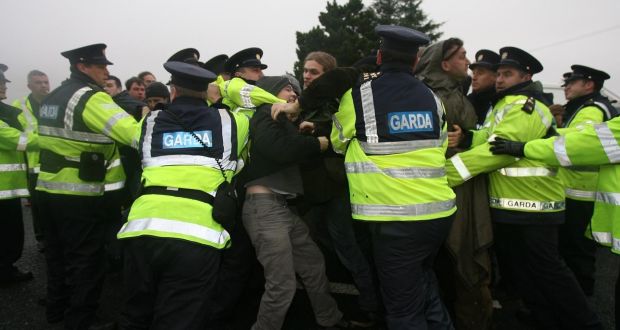
Gardaí attacking protesters
An Ireland Palestine Solidarity Committee activist said that usually they don’t get much trouble from the Gárdaí but more often from the private sectors, from private security personnel when they protest at a business as part of the solidarity campaign. And the Bank of Ireland had closed their account, which caused the organisation considerable difficulty. He wondered whether this was the State’s influence under pressure from the Israelis or others, or instead the banking company under pressure from the same sources or from financial sources. Or whether it was part of the general “de-risking” measures people talked about. The Cuba support group had suffered a similar problem.
Relating his contribution to issues of surveillance, one person described a car journey from an event for about two hours across Dublin, after which he stopped at a fast food takeaway facility. He had felt followed earlier on and when the Garda came in behind him in the takeaway with the usual harassment, he confronted the officer and asked him how had followed him all that way. The Gárda pointed to cameras above on street poles and said: “We don’t have to follow you, they do.”
Another person related how “membership of an illegal organisation” is being frequently used to jail Republicans under the OAS on the word, without the need to display any proof, of a Gárda senior officer.
He thought he had heard of one case where it had been used against a gang member and wanted to know were there any others that the speakers knew of?
Neither had heard of any and Mallachy commented that next year the OAS will be 40 years old. Liam Herrick referred to a piece of research carried out by Nuala Ní Fhaoláin at the UN.
A Polish and a Catalan separately expressed their solidarity with Irish people struggling against repression, briefly alluding to their own struggles and the Polish person mentioning the recent arrest and jailing of a comrade of his in Turkey.
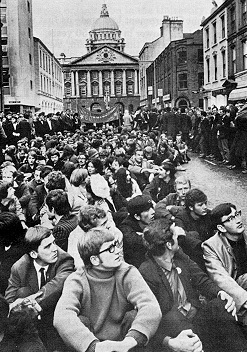
Queens University Belfast students sit-down protest when prevented from marching, 1968.
As there were no further questions or contributions, Breatnach thanked people for their attendance, the speakers for the talks and audience members for their contribution and asked for contribution towards the rent of the room. “This is not the beginning of a broad campaign to defend human rights or if it leads to it, it will not by our Committee leading it,” said Breatnach, adding that no doubt they would be happy to contribute to such a campaign. Urging people present to keep in touch with internment issues through the End Internment Facebook page he stressed once again the need to unite across ideological divisions against State repression.
End.
POSTSCRIPT:
A number of public meetings in Dublin about similar issues followed the one above in quick succession, no doubt coincidentally:
A meeting as part of the Anarchist Bookfair on Saturday 15th September on “State Violence and Cover-ups: Community Responses” heard from a speaker on police infiltration of campaigning groups; from Anne Cadwaller of the Pat Finucane Centre (also author of the “Lethal Allies” exposure) about colonial police and British Army collusion with Loyalist murder gangs; and from Hilary Darcy about what might be considered legitimate reforms to be pursued by revolutionaries.
A public meeting in Abolishthe Special Criminal Courts campaign was held on 17th September and heard from international and Irish speakers.
The Justice Delayed Is Justice Denied group held a public meeting on 19th September, raising issues pertaining to the Ballymurphy and Derry Massacres, the Miami Showband Massacre and the Stardust Fire (report: https://rebelbreeze.wordpress.com/2018/09/24/justice-delayed/ )
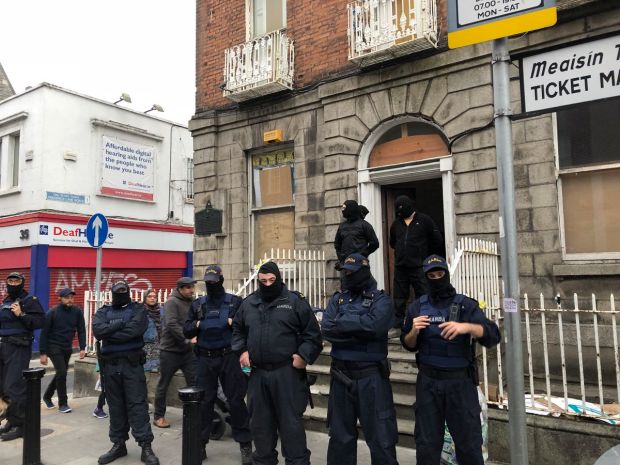
Masked Police, Police with machine guns.
In addition five days after the Right to Protest meeting, masked Gardaí brandishing batons and pepper-spray cannisters assisted a masked “security team” in evicting housing campaigners carrying out a symbolic occupation of an empty building, drawing protest statements from Liam Herrick on behalf of the ICCL to be followed, most unusually, by Colm O’Gorman on behalf of Amnesty International. Five or six housing protesters were detained and at least one was injured..
A few days after that, Gardaí turned up with machine guns and a battering ram to a house where a couple were in dispute with their landlord, leaving when supporters of the couple arrived.
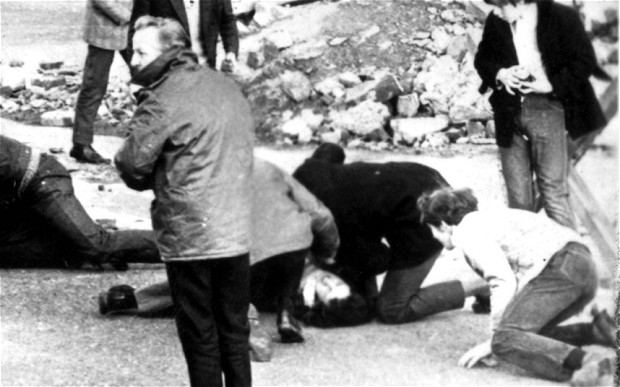
Masked Gardaí and masked “security guards” at eviction of peaceful housing protesters soon after the Right to Protest meeting. (Photo source: Irish Times)1963 Alabama, 17-year-old black civil rights protester attacked by police and police dog. (Photo source: Internet)1972, Derry, part of Bloody Sunday Massacre (Photo source: Internet)Lone man confronting Chines Army tanks on their way to suppress protest in Tienamen Square, 1989Massed Marikana Strikers at Lonmin Mine, South Africa, 2012– 40 were shot dead by police. (Photo source: Internet)



















 rebelbreeze