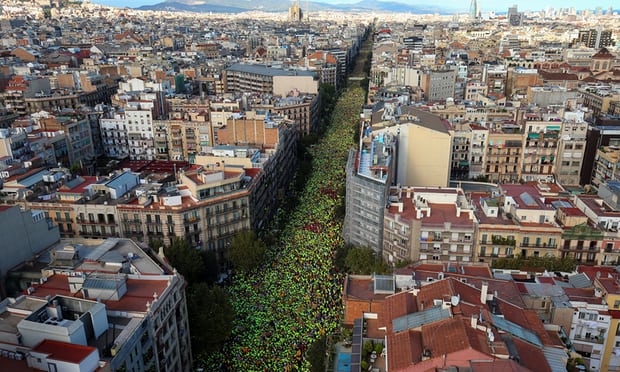
JUSTICE DELAYED

Diarmuid Breatnach

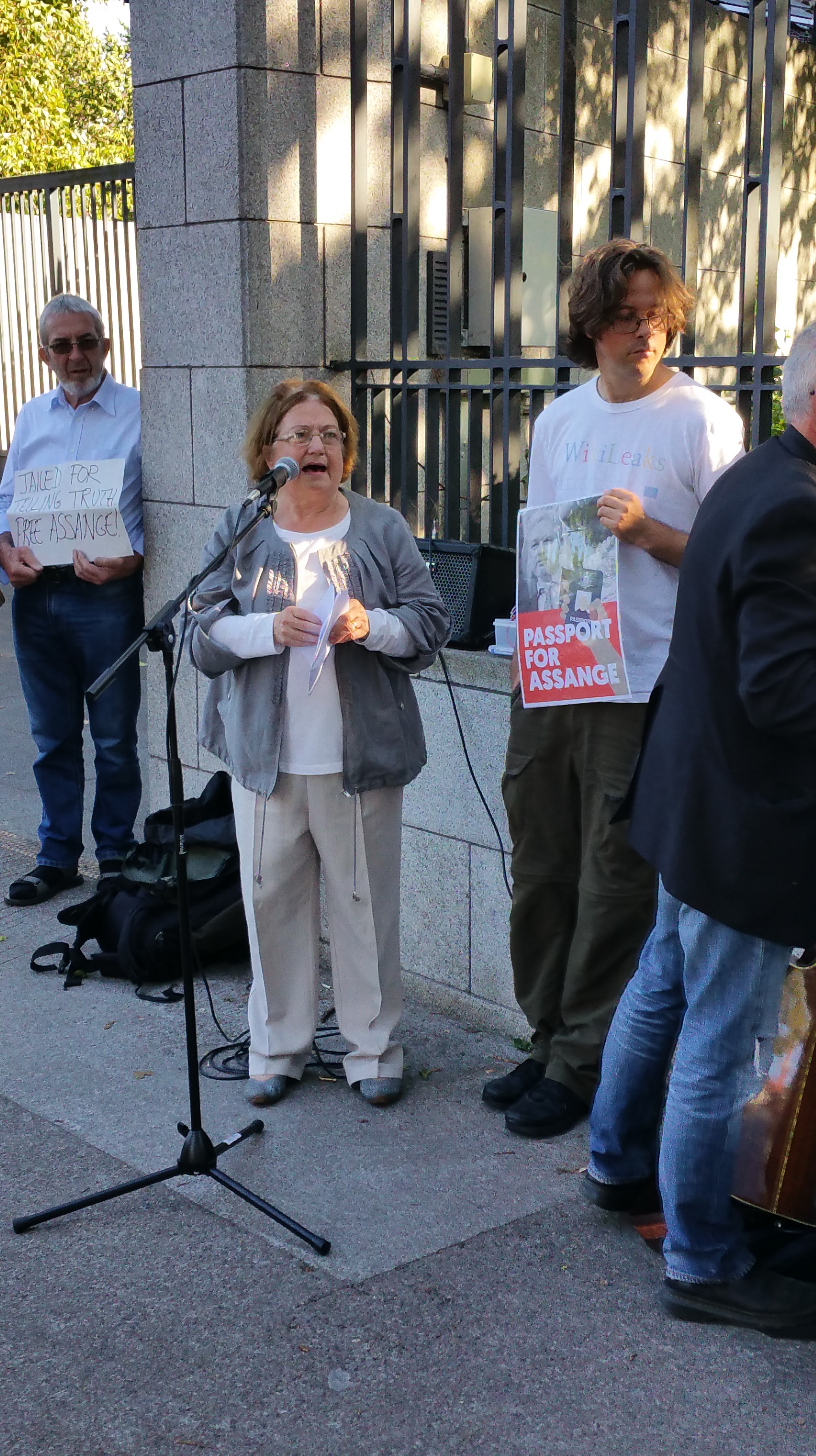
(Left to right) Antoinette Keegan, Kate Nash, Stephen Travers and Eamonn McCann at the Garden of Remembrance before the public event. (Photo: Cate McCurry/PA Wire).

Speakers from the massacres at Ballymurphy, Derry, of the Miami Showband and the victims of the Stardust Fire addressed a Dublin Audience on Wednesday evening last (19th September) in the hall of Club na Múinteoiri.

They are victims and also campaigners and their stories held the audience spellbound. The campaigns arising from the Stardust Fire, the massacres of the Miami Showband, Ballymurphy and Derry all put speakers up to address the audience on their need for Truth and Justice under the banner of Justice Delayed Is Justice Denied. It was the personal sides to their stories that were particularly powerful, without losing at all the political thrust; McCann did his usual storming speech which he does very well but somehow, for all the eloquence and good points made, did not have the same impact – at least on this reporter.
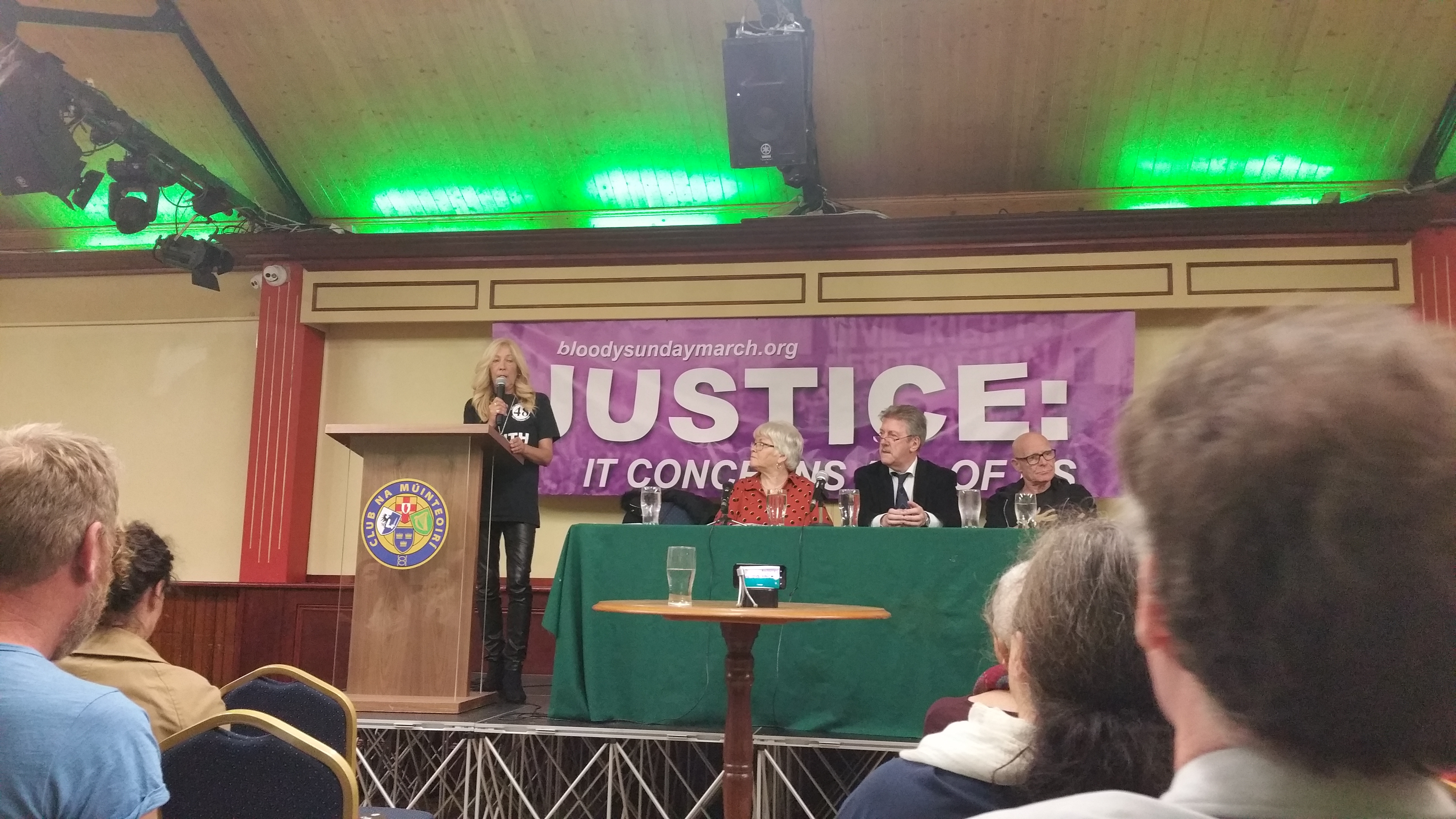
Annette Keegan speaking at the event
(Photo: D.Breatnach)

STARDUST FIRE

     Ann (Antoinette) Keegan, chairing the event and welcoming the attendance, said that she spoke both as a victim and a survivor of the Stardust Fire where 48 young people were killed and 241 injured at a Valentine’s disco on 14th February 1981. Annette survived but lost her two sisters in that fire: Mary and Martina.

She listed the steps in the slow and unjust procedures of alleged investigation that followed the fire at the disco. The first inquest had listed arson as the “probable” cause of the fire which had caused the deaths but the relatives challenged this verdict as incorrect procedurally as well as in fact and eventually had it overturned in 2009. Another inquiry years later under Judge McCartan, appointed by the Government, heard that there had been two emergency calls, one about a small fire of 18” high which could easily be extinguished and another about “smoke pouring from the loft” which had not been discussed in any previous hearing (this is the area that campaigners believe to have been the real origin of the fatal fire – DB).

Ann Keegan recollected that Judge McCartan had said that the families should have located that caller, even after all those years and got her testimony but Anne stated that it was wrong to apportion the responsibility for that to the families.

Historical note: It is a matter of record that the building’s owners, the Butterly brothers, had flagrantly violated many fire safety regulations in the building and that Dublin City Council had failed in its duty of ensuring entertainment venues it licensed were compliant with fire regulations. The Butterlys never even apologised and were compensated under the original verdict of “probable arson” to the sum of Ir£580,000 (€634,869).

Anne Keegan went on to say that the campaign had now decided that any further inquiry would be a waste of time and was calling for the reopening of the inquests as a matter of public interest. They had launched their campaign objective on June 14th at the Dáil and were pressing ahead with it now.

Anne then called a member of the campaign up from the floor to talk about the experiences of her family.

     Selina McDermott took the stage and said that she had lost two brothers and a sister in the fire: William (22), George (18) and Marcella (16). Her father, she told the audience, who was known by the nickname of “Minnow” was a Dublin Fireman, though not on duty that evening. Alhough he had saved many people in the course of his career it ate away at him that he could not save his two daughters.

Both he and Selina’s mothers campaigned for the truth but her father’s workmates, who were very supportive of him, calling often at the house when he was off duty, knew he was going against vested interests and the Government and advised him to give it up because he would never win. On the other hand their mother wanted to continue the fight, which led to arguments at home. Selina’s father died six years after the fire.

I thought how sad that so many, particularly in the working class, have become conditioned to the propaganda of the ruling class that the latter cannot be beaten, a way of thinking that is perhaps much weakened now but still influential for all that. It is one of the ways in which the very small minority which is the ruling class can keep down the vast majority from rising up against them.

BLOODY SUNDAY DERRY

Kate Nash speaking on the Derry Bloody Sunday Massacre at the event (Photo: D.Breatnach)

Selina sat down to applause and Anne Keegan called on Kate Nash, of the Bloody Sunday March for Justice campaign to speak.

     Kate, like Ann and especially Selina before her, spoke in an informal way, telling the story of her family’s ordeal in Derry in 1972 when 14 unarmed civilians received fatal wounds from British Army bullets and another fourteen survived their injuries.

Kate’s teenage brother William was shot in the chest and three others were shot trying to go to his aid, including his father, Alexander Nash. Kate spoke about going to visit her father in hospital and he telling her that her brother was in the morgue. Her mother was in hospital too and it was considered unsafe to inform her of her son’s killing – until William was to be buried, when it was felt necessary to tell her so that she could attend the funeral. Kate said her mother never spoke until she returned to their home after the burial of her son but no sooner had she set foot inside the house than she let out a scream and broke down.

Kate also spoke about the devastation to the family and how her mother once said to her husband “It should have been you”, to which he replied “I know”, knowing what she meant.

The hurt did not stop there for the British Army alleged that all those shot had been armed and the Widgery Tribunal, convened with unusual speed, agreed with them. The majority of the media supported that verdict and also said nasty things about their family, in addition to alleging that they were IRA supporters (they were not, their allegiance had been to the SDLP1), accusing them also of living in filthy conditions.

Soldiers had also said nasty things to them at the hospital and at the morgue and on the streets afterwards.

Section of Dublin crowd before they burned the British Embassy in Merrion Square in 1972
(Image Source: Stair na hÉireann)
The fire takes hold at British Embassy (then in Merrion Square) Dublin 1972
(Photo source: Internet)

Finally the Saville Inquiry was convened in the year 2000 which turned out to be the longest legal inquiry in British history, taking six years and costing a reputed 400 million pounds Sterling (approx. €450,800,000 today), with the families having to wait another six years for the publication of the report. Kate Nash made the point that the cost of the Inquiry was not the responsibility of the families and that “they (i.e the Government) spent that money clearing themselves”. David Cameron’s apology following the publication of the report in June 2010 was “a political thing”, she said.

The campaign wants prosecutions now of the British soldiers who had been identified as participating in the murders of unarmed civilians in 1972 but everything is being delayed and delayed, with the British Army providing legal advice and representation to those same murderers.

This recalled to me the words of Anne Cadwaller, speaking for the Pat Finucane Centre less than a week earlier, in the same building, as part of the Anarchist Bookfair. Cadwaller said that the British Government have what they call “three Ds” to deal with their scandals: Deny, Delay and Death (meaning hoping the accusers die meanwhile). Cadwaller could have added another “D” to her list: Deflect, i.e turn the blame in some other direction.

What Kate Nash did not tell the audience (and could not, considering the association of Sinn Féin with other campaigns represented on the platform), was that relatives and other activists had been dropping out of the Bloody Sunday campaign over the years and that when Cameron voiced his apology, Sinn Féin had called for the ending of the annual Bloody Sunday March, supported by some of the relatives. She and some other relatives and activists disagreed and have kept the march going every year since and it will take place again in Derry in the last weekend in January 2019.

She did not say either that she and some others had collected over 1,000 Derry signatures to a protest petition and conducted a sit-in protest at the “Museum of Free Derry” because of the inclusion of the names of British soldiers killed in the conflict alongside the names of Derry people killed by the Army, including the 14 Bloody Sunday victims. The protest was a success, at least for the time being.

Kate Nash sat down to applause and Ann Keegan called up the next speaker.

THE MIAMI SHOWBAND MASSACRE

Stephen Travers, Miami Showband Massacre survivor and author, photographed on another occasion (Photo source: Internet)

     Stephen Travers described himself as the last remaining survivor of the attack on their showband in 1975. For many years he had refused to acknowledge that he was a victim and said that when he did so at last “the wall fell in on me.” Acknowledging yourself as a victim, he told the audience, makes one “lose the sense of self”.

Miami Band Massacre Monument on north side of Parnell Square, across from the Garden of Remembrance.
(Photo source: Internet)

Historical note: Showbands were an Irish music phenomenon popular from the mid-1950s to the mid-1980s; a five or six-player dance band playing standard dance numbers, covers of popular music hits and waltzes. The bands’ versatility extended to traditional and folk numbers and even blues and a number of famous Irish musicians and singers got their start in showbands. The typical venue was the dance-hall, cheaply-constructed buildings without an alcohol licence located in towns and villages across the country and to these the bands travelled, usually in their minibus, returning home after the conclusion of their gig.

Stephen told the audience that as a bass guitar player he had been headhunted by major bands of the time but chose the Miami because unlike the others, they did not wear band suits (one needs to remember that even the Beatles and the Animals wore suits at first). He had not been interested in politics, nor had his family and the band included two of Protestant background although apparently religion was not a subject of discussion (or possibly of interest) among them either. However, people should take an interest in current affairs and the political background, he told the audience now.

The band (minus one who lived in Antrim) was returning from a gig in Banbridge Co. Down (one of the Six Counties) and heading to cross the Border (into the Irish state) when they were stopped at what appeared to be a British military checkpoint and asked to get out, which they did. Stephen made a point of saying that he would always refer to those men as “British soldiers” rather than Loyalists or paramilitaries although their membership of the Ulster Defence Regiment is often glossed over or even concealed.2

The soldiers exchanged jocular banter with the band members while they pretended to search the back of the van but were in fact placing a bomb in it. Stephen remarked on the mindset that could permit people to joke like that with those they intended to be their victims. Another man arrived of noticeable military bearing and the demeanour of the other soldiers changed immediately, smartening up and becoming more professional. This man was also in uniform but his beret was of a lighter shade and he had an upper-class English accent (Stephen said he had a good ear and had also worked in England for a period); other band members took him to be a British officer and expected that the whole thing would be expedited now and they would soon be on their way.3

Stephen believes that the plan was for the bomb placed in their van to explode as the band traveled on and that the incident would be used to justify checkpoints and searches of traffic crossing the border in the area, accusing the IRA of using the roads to transport arms and implicating the dead members of the Miami Showband as IRA “carriers” into the bargain.4

Softly spoken but his voice sometimes thickening with emotion, Stephen described how the bomb went off prematurely, dismembering the two UDR/UVF men and blowing the band members over a ditch and into a field. The soldiers then opened fire at the band members. Stephen was shot with a dum-dum bullet which made it impossible for him to walk, although he felt no pain; he could see no blood but his stomach was bloated as the bleeding was internal. He lay down and pretended to be dead. Two band members tried to drag him out of a pile of bodies but were shot down and Stephen described how the handsome Fran O’Toole, keyboard player, was shot many times in the face and a number of times in the groin. A number of band members pleaded not to be killed but were savagely shot amidst a stream of obscenities from their killers.

When the murderers left, there were only two band survivors in the field and the other flagged down a car and was taken to the nearest RUC5 barracks, from where officers hurried to the scene and, for awhile, were afraid to approach Stephen in case the bodies were booby-trapped. Three band members had been killed and two injured non-fatally (although one has died since, leaving Stephen the only survivor).

Stephen referred also to the fact that he had been around the Dublin City centre in 1981 when he learned of a big fire at the Stardust and headed out there in his van. He said he was able to drive right up to it since no attempt had been made by the Gardaí to preserve forensics at the scene of crime.

There was one unexpected postscript in this deeply personal and yet highly political story: Stephen Travers, who loved playing music and gigging, who had been head-hunted as a talented bass guitar player, told us that he never got to play in any showband again. Whenever a band was up on stage helping people to enjoy themselves, they could not afford to have the mood darkened by the survivor of the Miami Showband Massacre sharing the stage with them.

Stephen Travers concluded by saying that all those of whatever political background who had lost people in events of that kind or in the conflict wanted the same thing: truth and justice.

EAMONN McCANN

Eamonn McCann is a journalist and broadcaster from Derry and member of the People Before Profit Alliance (formerly Socialist Workers’ Party) and former elected Member of the Six County statelet’s legislature. He is a veteran campaigner and was prominent in the Civil Rights movement in the Six Counties; he was to be one of the speakers at the rally on what turned out to be Bloody Sunday and supports the ongoing Bloody Sunday March for Justice.

Journalist and activists Eamonn McCann speaking at the event
(Photo: D.Breatnach)

McCann generally speaks forcefully without need of notes and in an enclosed space would not need a microphone (but unfortunately was handed one which thankfully failed some time later).

McCann referred to the Ballymurphy and Derry massacres by the Parachute Regiment and other killings by them of unarmed civilians in Ireland, including a drunk Shankill6 character who was heard to shout mockingly at them seconds before they gunned him down.

The Parachute Regiment’s last posting on active service had been Aden, which is in what is now Yemen, he told the audience, where they had been fighting a national liberation insurgency led by FLOSY7.. There the Paras had been engaging in atrocities against the Arabs and they had of course got away with it, so when they were sent to Ireland they did it again. And essentially got away with it there too.

The Saville Enquiry, which McCann said the Irish Government had insisted on as part of the Good Friday Agreement process, had essentially blamed seven low-ranking British Army soldiers. Then Captain Michael Jackson and General Robert Ford, who were in charge overall and in Derry that day, were not harmed by the incident and Jackson’s career in particular had “taken off like a rocket”, McCann said, as by the time of the Saville Inquiry he was Chief of Staff of the British Army.
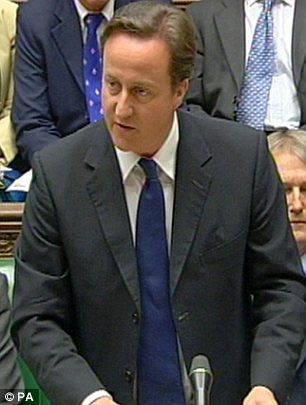
David Cameron’s apology for Bloody Sunday in the Westminster House of Commons was “a political thing” (Kate Nash) and “a cover” (Eamonn McCann).
(Photo source: Internet)

Jackson had written a false account of the shootings of 14 victims as “terrorists” which could not correspond to any of the actual accounts of what had happened; “in some cases the bullets would have had to go through buildings” stated McCann and recalled that these had been presented to the world press after the murders and became the official British version around the world. However, when confronted with this evidence during the Saville Inquiry, at first Jackson “could not remember” and later “had a vague memory” of doing it.8

“They would not have been able to hold that Inquiry nor to make that apology in the House of Commons if Jackson and Ford were being held up to blame,” McCann told the audience. “They’ll sacrifice a few lower-rank soldiers – they are cannon-fodder and killers, that’s all they are to them – but they won’t blame their own.”

McCann alluded also to the Grenfell Tower disaster in London and was sure that the Inquiry would not end up placing the blame on the local authority and politicians’ connections to property companies. He then went on to draw connections between the Butterlys who owned the Stardust and the ruling class of Ireland on the one hand and the ruling class of Britain on the other, how their crimes are always being covered up and how it is necessary to change the system that protects that class.

After the applause that met McCann’s conclusion, Anne Keegan thanked everyone for their attendance and encouraged them to follow the campaigns and to continue to support them and people dispersed.

Audience and speakers gathering to exchange some words after the meeting.
(Photo: D.Breatnach)


COMMENT: THE UNDERLYING REAL STORY?

The Stardust fire was an accident, possibly due to dangerous procedures and/ or lack of safeguards. It was not an accident that emergency exits were locked; they were locked deliberately, against all legal fire safety requirements, no doubt to prevent anyone entering without paying at the front entrance. But when the smoke and fire took hold, many people could not escape nor those outside break in to rescue them and 48 young people died and 241 were injured, families and whole communities devastated.

Therefore the owners, the Butterleys, should have faced trial for manslaughter; instead they were compensated to the tune of nearly €635,000. That the Butterlys were not charged, that the matter was badly investigated and that they were exonerated in the first inquest, was due to connections of the owners of the business with the Irish ruling class, and with the leaders of its main political party, Fianna Fáil. The appropriate term for that kind of collusion is criminal conspiracy.


     Many people, most perhaps in Europe and the English-speaking world, would think that the sending of the Paratroop Regiment to Ireland and the British encouragement of Loyalist death-squads and active collusion with them was an aberration. Others might think them deliberate plans but the responsibility only of individual officers and politicians. Some would see the massacres carried out by the Paras and the Loyalist murder gangs as unconnected, as different initiatives.

However, any objective evaluation should take the following sequence of events and their nature into account:

  • The Six Counties was a portion of Ireland which the British colonialists insisted upon holding on to 800 years after their invasion of Ireland (1169), after a guerrilla war encouraged them to withdraw from the rest of the country (1921). It was ruled by a manifestly sectarian regime discriminating against its substantial but minority Catholic population in every area of life but most brutally in law, policing, employment and housing.

  • Popular resistance begins or is renewed in 1964 after a dormant period reaching a high point in 1968.

  • Repression is deployed (police baton charges, gas, bullets) in 1968-’69 but fails – resistance increases

  • British perception is that it is faced with insurgency and begins to deploy its various arms and methods

  • British Army is sent in 1969

  • At some point the SAS is also sent in (difficult to pin down the year)
  • Control of mass media increases over following years (many journalists attend Army briefings in hotel and file their reports without checking with local communities)

  • Brigadier Frank Kitson installed as Area Commander (1970) with a free hand

  • Gangs (UDA) and Pseudo-Gangs (MRF) are created under Kitson’s guidance (1970)

  • More British troops sent in. Raids on Catholic areas and 3-day curfew on Falls Road (1970)

  • Community resists and first armed retaliation against the British takes place (1970)

  • British Army arms the gangs through recruiting them into the Army itself (Disbandment of B-Specials and creation the UDR British Regiment January 1970)

  • Paratroopers sent in (1971)

  • Gangs (UVF) semi-pseudo gangs (UDA/ UFF) operating fully integrated with British undercover squads and Pseudo-gangs (MRF and UDR) Summer 1971

  • Internment without trial introduced August 1971

  • Immediate civilian protests against internment August 1971

  • Ballymurphy Massacre of protesters by Paratroopers August 1971

  • Derry giant demonstration against Internment and Ballymurphy Massacre January 1972

  • Massacre of protesters by Paratroopers January 1972

  • Formation of highly-secretive and untypical Red Hand Commando Loyalist paramilitary organisation (1972)

  • British Army-RUC-Loyalist murder gangs (UVF) joint operations

  • Trial by jury abolished for those charged with resistance “offences” and Diplock Courts founded Aug. 1973

  • The “conveyor belt” is created – standard torture in Castlereagh Barrack, conviction in courts using tortured “confessions”, prison sentences (1970s-1990s)

  • Prevention of Terrorism Act is introduced to terrorise and silence the large Irish community in Britain 1974
  • Nearly a score of innocent people from the Irish community in Britain are framed on bombing charges and sentenced to long terms in prison (if the death penalty were still in force they would have been hanged) 1974
  • SAS soldiers are detained on undercover operation within the Irish state but are soon released 1976
  • Rules for Coroner’s Courts in the Six Counties changed to restrict the scope of verdicts from pointing towards the perpetrators (e.g Crown forces) or the legal status of the homicide (e.g “murder”) 1976.

  • Campaign to break Republican prisoners’ resistance 1976-1981

  • Change in British electoral legislation to prevent prisoners standing for election (1981see link)
  • Recruitment of informers and double-agents by Army and RUC intelligence

  • Elimination of prominent figures in the Resistance unlikely to agree to the deal 1976-19879

  • Testing the remainder to find supporters for the deal

  • The deal is offered and some concessions made (but no fundamental ones), resulting in the Good Friday Agreement 1998.

One does not have to be a conspiracy theorist to see here a pretty standard response of a colonial power to insurgency in one of its colonies, escalating to deal with an escalating resistance and aiming, if military defeat seems impossible, for wearing down the resistance and the communities supporting it, then to subvert, suborn and to bring the leadership to negotiate a deal which will end the resistance but not the existence of the colony.

Of course the process was bound to have some tweaks, as this anti-colonial resistance was taking place within Europe and breaking out just 50 years after a national liberation war within that country. Still, overall, a pretty standard colonial war.

And there are many other aspects not dealt with in that timeline, including subversion of the early 20th Century Irish national liberation movement and the subsequent State, bombings and killing of civilians there in the 1970s, recruitment of agents among news reporters, blackmail operations, promotion of pseudo internal communal opposition to the resistance, such as the SDLP and “Peace (sic) Women”, the use of gas and plastic bullets in particular ways and others.

Indeed, it is those who insist on seeing all these factors as unrelated or not part of colonial policy, agreed at the highest level, who are taking the unrealistic view. One has to be determined not to see the facts and their connection to colonial policy in order to maintain the illusion they insist upon, that the problem was/is one of “some bad apples” and “some bad decisions”.

End.

References and Further Reading (it is not suggested that everything stated in these sources is correct):

https://en.wikipedia.org/wiki/Stardust_fire

https://en.wikipedia.org/wiki/Bloody_Sunday_(1972)

https://en.wikipedia.org/wiki/Bloody_Sunday_Inquiry

https://en.wikipedia.org/wiki/Miami_Showband_killings

Travers, Stephen; Fetherstonhaugh, Neil (2007). The Miami Showband Massacre: A Survivor’s Search for the Truth. Hodder Headline Ireland, Ltd. ISBN 978-0-340-93792-1

Brigadier Frank Kitson: https://www.historyireland.com/volume-22/frank-kitson-northern-ireland-british-way-counterinsurgency/

https://en.wikipedia.org/wiki/Aden_Emergency

https://www.findmypast.ie/articles/world-records/full-list-of-united-kingdom-records/armed-forces-and-conflict/british-armed-forces-first-world-war-soldiers-medical-records

https://www.thenational.ae/world/mena/secret-colonial-era-files-reveal-british-cover-up-of-torture-in-aden-1.667507

https://www.theguardian.com/uk/2004/may/17/military.iraq1

https://www.irishtimes.com/news/crime-and-law/bloody-sunday-secrets-taken-to-the-grave-1.1523812

http://www.nihrc.org/documents/advice-to-government/2002/proposed-coroners-practice-and-procedure-rules-january-2002.pdf (p.4)

Click to access UKPGE-Part-1-Can-you-stand-for-election.pdf

FOOTNOTES

Social and Democratic Labour Party, a reformist party in the Six Counties which displaced the Irish Nationalist Party in nationalist area voter support and later got displaced by Sinn Féin.

The Wikipedia entry on the “Miami Showband Killings” (sic) and a Wikipedia entry on showbands (https://en.wikipedia.org/wiki/Irish_showband) which also mentions the incident as contributing to the decline of the showbands both refer to the unit involved entirely as UVF, the Ulster Volunteer Force (a Loyalist paramilitary organisation responsible for more than 500 deaths, mostly Catholic civilians and a great number chosen at random). Only later in the text does it reveal that “at least four of the gunmen were serving soldiers from the British Army’s Ulster Defence Regiment”.

3 In his book, which I have yet to read but referred to in the Wikipedia entry on the massacre, Stephen said that the RUC interviewing him were not willing to accept this description of that individual. The man is believed by some to have been Captain Robert Nairac of the Grenadier Guards regiment but seconded to one of the special undercover units of the British Army. The IRA announced that it had executed Nariac in May 1977, having been captured by them while undercover; his body is still missing.

The UVF did in fact issue a lying statement to that effect in a eulogy to two of their dead members.

The Royal Ulster Constabulary, notoriously sectarian and armed British colonial police force taking over from the also-armed Royal Irish Constabulary in 1922, soon after the partitioning of Ireland. In 2001 it was rebranded as the Police Service of Northern Ireland (PSNI).

Strongly British Loyalist district of Belfast.

7 The Aden conflict or “emergency” as usually referred to in posts about this British colonial conflict (and totally absent from a number of Wikipedia and other pages about Aden) was an insurgency against British forces in Aden, a British colony since 1839. Although an “emergency” was declared on 10 December 1963, the conflict had been going on for longer. At peak the British Army had 30,000 service personnel there and 15,000 South Arabian troops and of their combined forces suffered 382 killed (227 British Army) 1,714 wounded (510 B.A.). No statistics on the number of Arabs killed by British forces and their allies are easily available. “Britain dropped more than 3,000 heavy bombs and more than 2,500 rockets in a bid to pacify the guerrilla insurgency who used the Radfan Mountains for cover” (Daily Mail article 2017 glorifying the British in general and the Paras in particular).

A joint effort was created between the British forces and the Federation Regular Army (FRA – of the Federation of Southern Emirates, a British protectorate) to combat the National Liberation Front and the Front for the Liberation of Occupied South Yemen (FLOSY). The paramilitary groups initiated a guerrilla campaign of grenade attacks against the British forces. By 1967 the situation in Aden escalated and the evacuation of British families and citizens was enforced. The city erupted in riots, tensions were heightened further by the Six Day War and a mutiny broke out within the Federation Regular Army.

The conflict ended on 30 November 1967. British forces withdrew from Aden and the National Liberation Front seized control of the government. The People’s Republic of South Yemen was declared.

8 In a short piece in the Irish Times in September 2013 (see link in References and Further Reading section) Eamonn McCann cast doubt upon the same testimonies which he denounced in the meeting reported here. McCann attended nearly every day of the Saville Inquiry in London, staying with family there and traveling there and back at his own expense and wrote a weekly report on the Inquiry for the Irish Times.

Too many to list all here but covered in a number of publications; the first was probably Máire Drumm of Sinn Féin by the mysterious Red Hand Commando Loyalist paramilitary organisation (also claimed by the UFF) and those convicted afterwards included one “ex British soldier”. The eliminations encompassed the attempted murders of veteran Civil Rights campaigner, ex-MP and active anti-imperialist socialist Bernadette McAlliskey (shot 14 times) and her husband in 1981; the ambush and execution of members of the IRA unit of the East Tyrone Brigade, including IRA Vols. Jim Lynagh and Pádraig McKearney, by the Special Air Service in 1987; and the last perhaps, Dominic McGlinchey 1994 by persons unknown.

SPEAKING TRUTH TO POWER – REALLY?

Diarmuid Breatnach

Again and again we come across activists, journalists, musicians and other artists who are lauded for “speaking truth to power”. They are often praised for that, even idolised. “Speaking truth to power” seems to be brave thing to do. And an important thing. But is it really?

First of all, let us think of who are those usually thought of as “Power”: governments, big companies, military dictators, church leaders, powerful individuals in the media or in the arts …..

Why is it considered a good thing to speak truth to them? It may well be brave to do so and often is. People who spoke the truth in certain situations throughout history and currently have had their careers destroyed, been the subject of all kinds of horrible allegations, been marginalised, lost their families and friends, been framed on charges, jailed as a result or just automatically, tortured, killed and “disappeared”. Yes, we could hardly deny the courage of many of those who chose to take that step. But whether it’s an important thing to do is another thing completely.

What? A courageous act against power not important? What can I be suggesting!

Let’s look at those in power again, taking for examples a government, a military dictatorship and the CEO of a powerful company. In our example, we set out to “speak truth” to them.

For the government, we send them an email, or a letter because there are too many Ministers and Secretaries to address verbally – unless of course we are in some kind of privileged position. They in turn ignore us or send us a dismissive reply (possibly tailored to be quoted) or they have us subjected to surveillance, just in case we should turn out to be a real problem in future. And any government in the world is capable of putting citizens under surveillance.

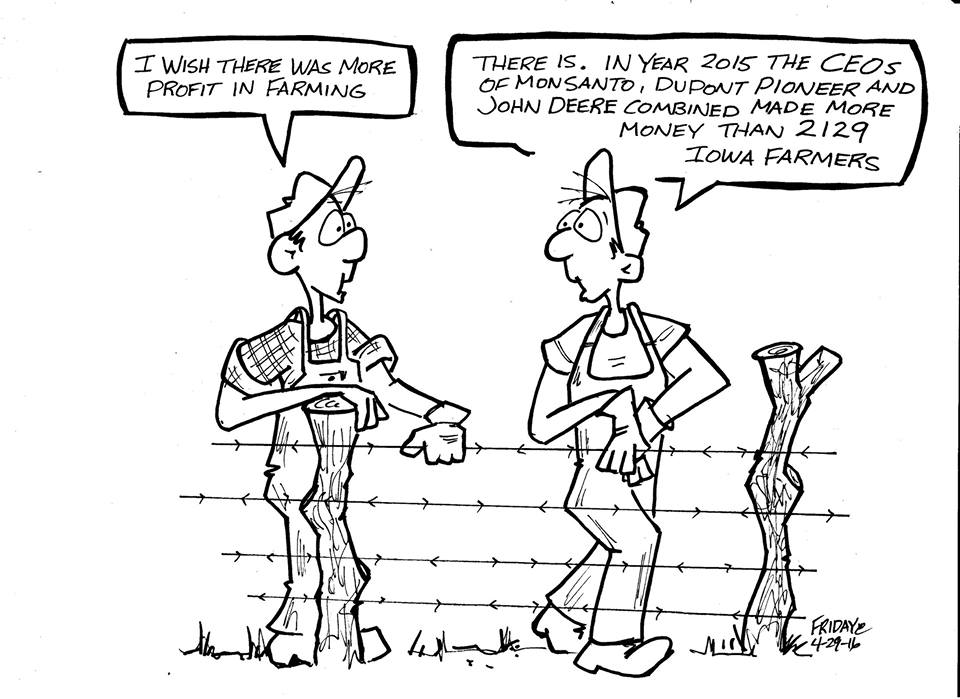
(Cartoon strip source: Internet)

We send the military dictator a letter and he has us arrested, detained for torture and questioning. Or we accost him when he is somewhere in public …. and his security guards shoot us dead. Or arrest us for torture and questioning.

With regard to the CEO, we send him an email. He ignores it but may have us put under surveillance – just in case. And he’ll have our employment and tax records, families and friends checked out too. Like governments, the CEOs of big companies can easily put people under surveillance and run background checks on them. And CEOs likely last longer in the power position than most governments. Or he might reply dismissively. Or he might have his legal services people threaten us with legal action which, as well as shutting us up, would cost us a lot of money we don’t have, probably bankrupting us.

This is the illusion of liberals and social-democrats but the reality is very different.
(Image sourced: Internet)
(image source: Internet)

In the military dictator’s case, we are out of the picture. In the case of the other two, nothing further may happen if we shut up now. But if not, well …. there’s that list of bad outcomes I listed above. Brave? Certainly – but to what effect? Have we changed anything?

Some people think we can change the essence of the way those in Power think by Speaking the Truth to them. If only we can say it powerfully enough. Nonsense. Those in the Power have already chosen who they want to be, what side they are on and understood the basic dynamics or been taught them along the way. Many choices made have confirmed them in their roles and ideology.  Furthermore they know that to break ranks with their own is a dangerous thing to do which can result in bad outcomes for them too and also expose them to painful and even fatal thrusts from their competitors or rivals. Remember the 1983 film Trading Places? Remember how the main hero falls at first, is shunned, loses his privileges, friends and associates? Unlike the film’s ending, there is no coming back from there.

If those CEOs and company owners ever took a progressive step it was because they were shown it would increase their profitability or at very least were shown it wouldn’t hurt it ….. or they were forced to do so by people’s resistance. Not ever by having “Truth Spoken” to them. Unless it was the truth of resistance (and we’ll come back to that).

I don’t see the point of Speaking Truth to Power … except in very exceptional situations. For example, if we are being sentenced in court, even if the public gallery has been cleared or packed with cops (which has happened even in this state on occasion), we might wish to raise a clenched fist and yell “Death to Fascism!” before the guards jump on us and bundle us to the cells, giving us a few punches on the way.

Or being tortured, if we are capable of it (and while we are still capable) we might want to shout something similar or just plain “Fuck you!” Or in front of a firing squad, to shout “Long live the revolution!” before the order comes to “Fire!”

Will it do any good, make any difference? Without an audience apart from those in Power, almost certainly not. It might affect some soldiers or police in the firing squad or some jailers but such results are usually negligible. But in doing so, we assert our humanity, our spirit against them and it is for ourselves alone, at that moment, that we Speak Truth to Power. Otherwise, there is no point, none at all.

I don’t want to Speak Truth to Power and what’s more, question why anyone else would. Is he or she suffering from some kind of liberal illusion that such words make a difference, can convert or subvert Power? Or from an inflated ego that convinces him or her that they have the gift, the eloquence, the importance to make Power change? Or that somehow, by force of their excellent will, they can overcome history and change reality?

Or even worse, are they signaling to the Power that they are articulate, eloquent even with “alternative” credentials and that they are worth recruiting by the Power?

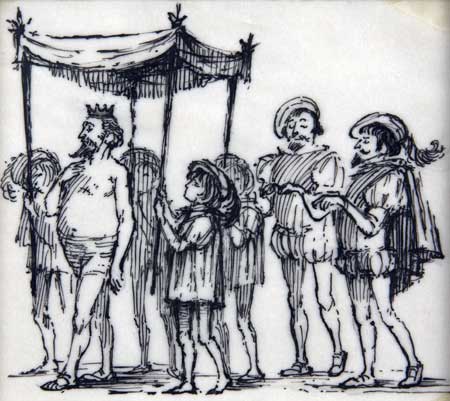
The Naked Emperor. In Hans Christian Andersen’s subversive tale, an undoctrinated child remarks that, contrary to royal propaganda, the Emperor is naked and the people can then admit this to themselves. The child spoke Truth — but to the People.
(image source: Internet)
Speaking truth among the people. (Cartoon source: Internet)

I repeat: I don’t want to Speak Truth to Power. I want to Speak Truth alright … but to the PowerLESS! I want to expose the Powerful to the people. I want to show them the long list of the crimes of the Power and that it is unreformable. But I don’t want to just read the people a horror story; I want to show them how I think the monster can be killed. I want to show the people that THEY CAN DO IT! The people can grasp power with which to overthrow the Power. I want to show the people what their forebears have done in rebellions, uprisings, revolution, creation of resistance organisations, art, discovery of science, production ….. I want to share what I think with them, argue with them, encourage them, criticise them. And the only time I want to Speak Truth to Power is when they, the People, are listening, or reading what I am saying. Because then, it’s not to Power, in reality, that I’ll be Speaking Truth; the important audience is not Power at all.

So, Speaking Truth to the People is the thing to do. And will those who do so be safe from painful outcomes, that list given earlier? Having careers destroyed, being the subject of all kinds of horrible allegations, being marginalised, losing families and friends, being framed on charges, jailed as a result or just automatically, tortured, killed and “disappeared”? Alas, no, each of those is a distinct possibility: all have happened even to the people of our small island and nearly all of them fairly recently. Some very recently and even ongoing.

There is no safe way to Speak Truth. But at least this way, there is a chance that Speaking Truth will have some effect, will make a difference. It might even make a big difference. We hope so.

And the final Truth is that words, for all their power on people’s minds, don’t change the real world. People do that, through action.

End

(image source: Internet)

APPROPRIATE MEMORIAL FOR MAGDALENE LAUNDRIES VICTIMS: CAMPAIGN WINS IMPORTANT BATTLE IN DUBLIN CITY COUNCIL

Diarmuid Breatnach

Dublin City Councillors at their meeting on Thursday (13th September) voted by huge majority not to sell the former Magdalene Laundry building in Seán McDermott Street in the city centre. Deputy City Manager Brendan Kenny had earlier announced the possibility of the Council selling the building at an expected price of €14.5 million to a Japanese company that planned and hotel and supermarket on the site.

A campaign group called Separate Church & State had lobbied for the building to become a memorial to the suffering of the inmates of the Magdalene Laundries. The group called people to support an event outside City Hall to coincide with a motion being put forward to prevent the sale of the building.  A range of people attended, seeming mostly Left social and political activists independent of any party and a sprinkling of People Before Profit activists.

The motion was propose by Gary Gannon, a Councilor of a very small political party (with only one member on the Council), the Social Democrats. However the motion was supported by the overwhelming majority of a Independent councillors (i.e of no party) and those belonging to a number of other parties and was passed with 37 voting in favour, eight against and two abstentions.

Campaigners and supporters in front of Dublin City Hall from across the street
(Photo: D.Breatnach)

The successful motion called on the Council not to sell the building and land and that instead those who suffered abuse there should be commemorated with a memorial. Other than preventing the sale, exactly how the memorialising might be put into effect remains to be outlined and agreed. There is talk of the State taking it over but whether by donation of the Council or sale has not been clarified. There are very few memorials to the Magdalene Laundry victims and all but one of them are small

The Sean McDermott building appears to have been the last of the Magdalene Laundries in Ireland and was closed in 1996. It is also the last of those buildings in the possession of Dublin City Council.

(Photo: D.Breatnach)

The significance of the victory is greater than that of elected representatives versus unelected City Managers, the former being more responsive to public pressure than to the demands of high-ranking officials who seem happy to hand over much of the city centre to property speculators, shopping centres, hotels and large student accommodation complexes.

The terms in which the issue was raised are an attack on the legacy of the Catholic Church’s grip on secular society and its relationship with the State.  The campaigners clearly see the Council vote as a victory, though a moral one, against that legacy.  And they are planning to press ahead with the offensive in the terms indicated by the title of their campaign, indicating further targets such as the national health and education services, along with legislation to follow on the national referendum’s rejection of Amendment 8 of the Constitution outlawing abortion.

The Magdalene Laundries – some brief background

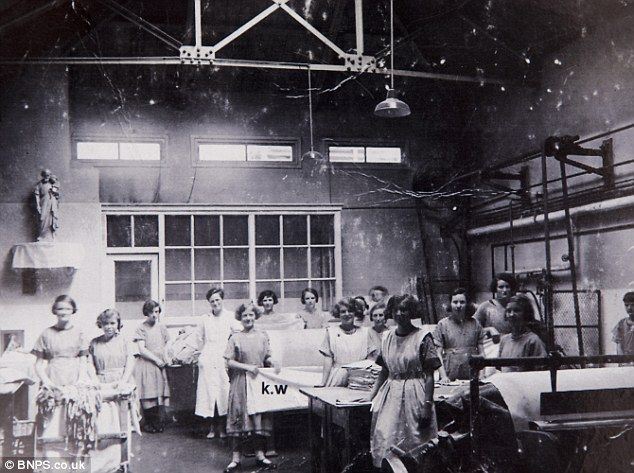
       The Magdalene Laundries were a major institution of the Irish Catholic Church from the 18th to the late 20th Century. There were some Protestant parallels too in the Six Counties (“Northern Ireland”) run by the Anglican and Presbyterian churches but the vast majority of the Irish population were of the Catholic faith. The Laundries took in and accommodated women who were considered “fallen women” which at first meant sex workers but later included unmarried women who had a child or children or even women whose behaviour was considered immoral or flirtatious (or even whose beauty attracted male attention) and they were put to work in the laundries for no pay. Ostensibly at first a charitable initiative, their title drew on the New Testament story of Mary Magdalene who, from being a “morally loose” woman, after meeting him became one of the most ardent supporters of Testament’s Jesus.

But if the name was associated with the alleged mercy and lack of judgementalism of the Christ, it also implied moral sin and judgement. In the extremely conservative Catholic Church that it became after the Great Hunger, the main element was likely to be punishment and, when allied to an also socially reactionary political class, the Laundries became an institution of social control of the Catholic Church in Ireland and of the new Irish State.

The Magdalene laundries soon became known to their inmates as places of hard work and ill-treatment, mostly of a psychological nature but also physical. If women left them without permission, they were pursued by the police and brought back. Continuous escapes could lead to jail sentences.

(Photo: D.Breatnach)

During their time in operation an estimated 30,000 Irish women were kept in these institutions in Ireland, approximately 11,000 after the State was created in 1922.

The horrors of these “charitable institutions” began to be revealed to the public during the last decade of the 20th Century, notably in 1993 after a mass grave of 155 corpses was uncovered in the north Dublin convent grounds which housed one of the laundries and the last Laundry was finally closed down in 1996. The Church never accepted any financial responsibility for reparations.

The Irish State set aside a sum of up to €58 million (about half of which has been paid out – see Links) but the religious institutes concerned, the Sisters of Mercy, Sisters of Our Lady of Charity of the Good Shepherd and Sisters of Charity refused demands from the Irish Government, the UN Committee on the Rights of the Child and the UN Committee against Torture, along with other groups in Irish society, to contribute to the compensation fund for the the surviving victims, an estimated 600 of whom were still alive in March 2014 (see Wikipedia in Links).

(Photo: D.Breatnach)

The Taoiseach (Prime Minister) of the Irish State apologised publicly and emotionally in the Dáil (Parliament) in February 2013 but the State never accepted any legal responsibility, its representatives saying that they did not control the Church. When they were reminded that the victims had washed not only clothes and vestments of priests and nuns but had also done laundry service for such state institutions as Aer Lingus, the Irish Army, the Gárdai, the State’s representatives declared that the Laundries were like any other contractor in that regard and that the State could could not accept responsibility for how contractors treated their “employees”. But it is known that State courts sent a number of women to the Magdalene Laundries. And it was the State that allowed the Catholic Church to dominate social care, health care and education, areas which are usually considered the responsibility of the State.

The general story of the Laundries is fairly well-known in Ireland now through media coverage and the testimonies of victims and even abroad in some countries through the 1992 Peter Mullan film Magdalene Sisters (see Links) and a number of documentaries for TV. Mary Coughlan sang a fierce attack on them too the same year as the film, composed by J.Mulhern (see Links for a Youtube video).

View of the protesters outside the meeting (some were inside) looking eastward.
(Photo: D.Breatnach)

There are very few monuments to the suffering of the victims of the Magdalene Laundries and they are all of a small size except the statue in Ennis which aroused some local controversy.

The monument at Forster Street, Ennis, Co. Clare, dedicated to the Magdalen women and a subject of some controversy.
(Photo: Mike Shaughnessy)

Despite the duration of their existence and numbers involved and the international coverage, the Pope claimed when tackled by some survivors on his recent visit to Dublin that he had no knowledge of the existence of the institutions.


Sale of Council buildings and land – the legal position and some background

Due to a legislative change some years ago, Dublin Council Executives such as the City Manager and Senior Planning Officer can make major decisions without consulting elected Councillors and even against their expressed wishes. In this way, for example, the planning permission for the Shopping Centre Plan over the Moore Street Battleground and Market quarter was firstly agreed and secondly, even after the High Court judgement that it is a national monument, was renewed in 2016 by the Chief Planning officer of the time, Jim Keogan.

Many feel and have felt since such decisions that this is an unhealthy state of affairs, with no democratic controls and leaving key officials open to suspicion of bribery from developers influencing their decisions.

Fortunately however when it comes to the disposal of Council assets, the Councillors must agree by majority. This prevented the “land swap” proposed in 2014 by Joe O’Reilly of buildings in Moore Street, which if successful would have enabled his company to demolish half the 1916 Terrace: responding to campaigners and interested elected Councillors, the Council voted the proposal down against senior officials’ recommendations in November of that year.

Links:

Separate Church & State campaign group: https://www.facebook.com/separatechurchandstate/

Short article on the Dublin Council lobby and vote in Look Left: https://www.lookleftonline.org/2018/09/dcc-votes-not-to-sell-off-ex-magdalene-laundry-site/

Closing of the Magdalene Laundry on Sean McDermott Street: https://www.irishtimes.com/culture/last-days-of-a-laundry-1.89388

Proposed sale of the Sean McDermott Street building: http://www.thejournal.ie/sean-mcdermott-magdalene-laundry-3941031-Apr2018/

State compensation package: https://www.rte.ie/news/2013/0626/458868-magdalene-report/ and https://www.irishexaminer.com/ireland/flanagan-257m-paid-out-to-682-magdalene-laundry-survivors-462711.html

The Magdalene Laundries on Wikipedia: https://en.wikipedia.org/wiki/Magdalene_Laundries_in_Ireland

The Pope “had no knowledge”: https://www.buzz.ie/latest/pope-magdalene-laundries-297205

Film The Magdalene Sisters, Peter Mullan (1992): https://en.wikipedia.org/wiki/The_Magdalene_Sisters

Song Magdalene Laundry by Mulhern and sung by Mary Coughlan (Sentimental Killer album (1992)): https://www.youtube.com/watch?v=GHWsLYtxzz0


(Photo: G.Guilfoyle)
Irish TV (RTÉ) cameraman filming the protest (Photo: D.Breatnach)


Section of protest (Photo: D.Breatnach)

THANK YOU YOUR HOLINESS

YOUR HOLINESS,

Thank you so much for visiting our island (well, the independent part). It was a wonderful experience and its effect upon us, the faithful, was at one and the same time energising and calming. And for sure we needed that, needed it so badly.

These past few years have seen this state sinking into greater and greater godliness, between different lifestyles on the one hand and the terrible revelations of what went on in some of the religious charitable institutions on the other.

Pope Francis
(Photo sourced: Internet)

Years ago we lost the battle on condoms and the Pill but our Church survived that. And to be honest, if some of the priesthood were going to engage in immorality then it would have been better if they had indeed used condoms, God help me for saying that – but certainly in the case of a certain Galway bishop it would have been useful …. for the Greater Good, of course.

But then legal divorce, and we survived that too. It seemed hardly had we managed to coexist with those travesties than we had marriage between homosexuals legislation, now flaunting their sinful ways not only publicly – but legally married! And now, worst of all by far, abortion legalised! Well, up to three months of pregnancy but we all know, the faithful and the sinful, that once that door is wedged open ….!

Of course the abuse in the institutions run by religious orders was shocking, both in its content and extent. But people want to throw the baby out with the dirty bathwater! Or the dirty laundry water, perhaps. And knowing what people are like and the enemies the Church had and has, of course it was necessary to cover it up. The first duty of any institution is to survive and therefore to protect itself. Why do people find that so hard to understand? Have we not seen political parties and governments doing the same for years? Why do people find it so strange?

So anyway, we badly needed some comforting, some reassurance and it was wonderful that in our hour of need, Your Holiness came. How wonderful to see the gold-and-white Papal Colours fluttering on flagpoles, on bunting festooned! To see so many youngsters bussed in to Dublin from other parts of Ireland, their faces aglow with the excitement (and not just because of a day out in other adolescent company, or in the excitement of youth overnight “camps”, as the cynics have commented). So what if they were somewhat incoherent or illogical when interviewed about their reasons for attendance! The brilliance of the Holy See is enough to bring incoherence to anyone!

And I understand, Your Holiness, understand perfectly why it was necessary to say Your Holiness had not known about the Magdalene Laundries. How could the mass of ordinary people be expected to understand the balancing act of the Holy See, between Perfect Good and Necessary Evil? To balance things in favour of the Greater Good? What a field day the media vultures would have had if Your Holiness had tried to explain the intricacies to them! And the unbelieving hyenas too would have gathered to the feast on our dying bodies, to crunch the bones of our faith.

Sure where else would the Irish priests, bishops and nuns have had their laundry done? Not to mention Áras an Uachtaráin, Guinness, Clery’s, the Gaity Theatre, Dr. Steevens’ Hospital, the Bank of Ireland, the Departments of Defence, Agriculture and Fisheries, CIÉ, Clontarf Golf Club and several leading hotels! In the end there was altogether too much dirty laundry washed in public really.

A Magdalene Laundry (Photo sourced: Internet)

Considering that the story involved the whole Irish church and was publicly recorded going as far as the US, and a film about it went right around the world, I thought it was very brave of Your Holiness to deny all knowledge. Only by the grace of God surely could Your Holiness have kept a straight face. I could not have managed it for a second myself but sure I am but a humble sinner.

Of course Your Holiness’ visit did not take place in the same society as we had in 1979, when your predecessor-but-one His Holiness John Paul the 2nd visited Ireland. One in ten boys born in 1980 were named John Paul in his honour. All the same, we can look forward to a crop of baby boys named Francis this year and next, though it’s unlikely to be anything like one in ten this time. We’d be lucky to reach one in thirty, if you’ll forgive my gloominess.

Still, even Francis — and we’ve had a crop of them over the years anyway, named after the two Saints of that name and maybe even after Frank Sinatra or – God help us – Frank Zappa! Yes, believe it or not, some parents were capable of doing that in the Sixties, Seventies and even the Eighties.

I was going to say, even Francis would be a mile more likely than your Holiness’ original names. I don’t imagine that many male Irish children born this year will be baptised “Jorge Mario”. I shudder to think of the damage done to that first name in Ireland. Horhay, would be the best attempt, I’d guess but for sure there would be Horjays, Georgeays and Georgies. Your Holiness doubts this? Your Holiness has yet to hear mothers calling a “Sor-tchah” in for their tea, instead of the actual centuries-old Irish name, “Sorcha”. Or to hear of a male or female child being proudly introduced as “Sheersheh” instead of “Saoirse”, which means “freedom” — but not the freedom to mangle Irish words, God help us!

Without wishing to be in the least insulting to Your Holiness but with a name like Mario ….. well, not many Irish or migrants are going to want to sound as though their children are Italian – except of course in the Irish-Italian community. Then also, how many would want their child’s name to remind people of a popular 1980s video game, perhaps imagining all kinds of things about the parents, what they were doing when the mother conceived, etc …. And Princess Toadstool! I ask you! Pagan erotic symbolism for sure!

Forgive me, Holy Father, I have digressed.

Anyway, I hope the visit did not tire Your Holiness out too much and hope the ten thousand or so oppositional marchers did not even impinge on Your Holiness’ consciousness. To us however that showing was worrying – a couple of decades ago, only a score would have dared and they would not even have been allowed on the street!

There are signs that soon we will face a battle over the Church’s control of the primary and secondary educational institutions in Ireland. The Godless have the bit between their teeth now and it seems they will shy at no obstacle. Sorry, that’s a riding metaphor; does Your Holiness ride?

It seems we are in danger of losing the gain for which the Holy Mother Church has been striving since the mid-1800s, and which even that Protestant fornicator Parnell championed for us. If we lost control of the schools, Catholic baptisms and marriage ceremonies would cease to be required to get on the premium enrollment lists. Then religious sacraments would be confined to the truly religious and Holy Communion and Confirmation would slowly disappear out of the schools. Losing Education would mean losing most of the population of this state and already the Godless are circling. I shudder to think of it.

Poster with principles of Education Bill being promoted in Ireland
(Photo sourced: Internet)

Would it be wrong of us to pray for a religious spectacle, Holy Father? Some kind of miraculous apparition, such as with the young wans at Lourdes or at Fatima? It does seem as though only a miracle might save the Church here in the long run.

Yours in faith and humble obedience,

Pious O’Madaun.

OREGON USA: NO FREE SPEECH FOR FASCISTS!

Diarmuid Breatnach


Like fascists in many other parts of the world, those on the Oregon demonstration marched under the slogan of “free speech”.  NO FREE SPEECH FOR FASCISTS!


Police in Oakland, Oregon, went into riot police mode at a fascist march on Saturday (4th August 2018) which was opposed by anti-fascists. After maintaing a presence between the two forces for some time they eventually moved to break them up and employed ‘flash-bangs’ and other methods. The march without a permit by fascists was organised by the Patriot Prayer organisation led by Joey Gibson who is running for election to the US Senate and who declares that they are demonstrating for free speech.

Right-wing supporters of the Patriot Prayer group gather during a rally in Portland, Oregon, U.S. August 4, 2018. REUTERS/Jim Urquhart – RC1E0096DB40

Feelings in the town are already running high after a Patriot Prayer supporter was charged with stabbing a man who allegedly intervened to defend from harassment two women on a light-rail train last year, one of whom was wearing a hijab.

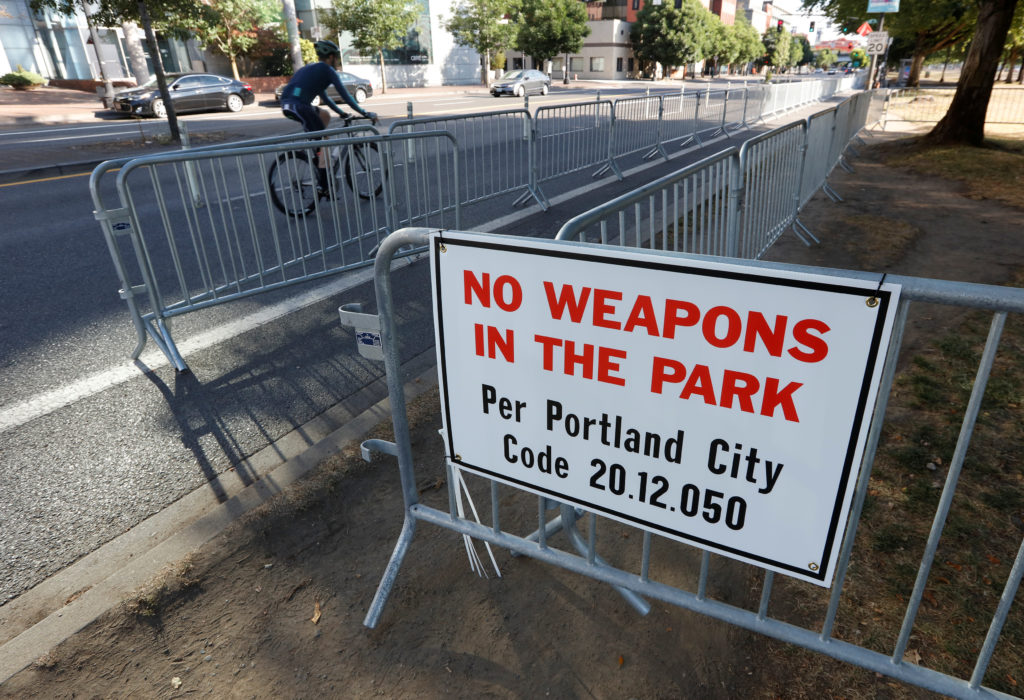
According to reports, Gibson declared to supporters that they were there “to teach a lesson to the country” minutes before they began to march. On June 30th, a previous Patriot Prayer event led to clashes with anti-fascist demonstrators, during which the Oakland police revoked the permit for the demonstration and declared a riot. Earlier on Saturday, in a response to Oakland Police reminding people of a city code banning carrying weapons in the public park, Gibson posted: We’ve always had guns at the rally. I cannot think of one rally when we didn’t have guns with us. Everywhere we go, we have guns.”

Anti-fascist opposition to Patriot Prayer march in Oregon USA. Note mixed attitudes of people wearing improvised riot gear and a placard apparently calling for peaceful opposition
(photo US Media).

Earlier, Portland Mayor Wheeler had expressed concern about the planned Patriot Prayer march, as had the Police Chief. Portland Police Bureau Chief Outlaw (yes, honestly) was appointed to post last year; an African-American woman, she started her career as a patrol officer and was appointed Deputy Chief to Oakland’s police department in 2013.

FASCISM AND FREE SPEECH ACROSS THE WORLD

In 2016 Tommy Robinson led a couple of hundred supporters in Birmingham, Britain to launch the anti-Muslim group Pegida UK, which he founded as part of a Europe-wide fascist initiative intending to launch Pegida in a city in every European state (they failed spectacularly in Dublin, see Rebel Breeze report in Links). Two years earlier, he had led the Islamophobic English Defence League which soon split and melted away.

(photo US Media).

Like Robinson, who was recently given a 13-month sentence for contempt of court in Britain and even more recently released on bail for retrial, the call of fascists when not in power or in position of strong dominance is always for “free speech”. Once dominance is achieved, the fascist call for “free speech” changes to slogans such as ending freedom of speech if it is considered “unpatriotic”, advocating “race-mixing” or “moral degeneracy” and, of course “communist propaganda”. When in power they enforce the elimination of what they consider undesirable free speech, including criticism of policies or leadership even from within their own ranks. When in a dominant position in a country, region or area, fascists enforce their control of “free speech” through terror attacks on their opposition or target communities, with or without collusion with the State, military or local police force. When fascists have state control, they limit free speech through laws, court and prison, in addition to extra-legal fascist attacks and assassination squads.1

Fascists seek to establish a safe “beach head” upon which to build and from which to extend. If successful, they attract more and more followers, while they intimidate their opposition and their targets. But in failure, as when driven off the street, their opposition and targets grow in confidence and the fascist organisations usually disintegrate in internal struggles between cliques and denunciations of their unsuccessful leaders.

That is the well-documented history of fascism which the fascists try to conceal while weak but in which they glorify when in power. Unfortunately, liberals, whose bodies exist in the real world but whose ideology lives in a world of make-believe, unknowingly collude with this trajectory. Again and again they insist that the fascists and racists which they abhor must be given freedom of speech and even accuse the anti-fascists of a kind of fascist authoritarianism.

When liberals do turn to wanting to control the freedom of fascists to organise, as some do at some stages, they always appeal to the State to carry out that task for them. Sometimes, according to its interests at the time, the State will oblige, with measures sometimes including a wholesale banning2 but will often simultaneously ban progressive resistance movements.  More often it will oblige liberals by fines or short prison sentences on fascists or by anti-racist or anti-”hate” legislation. And often, fascists attempt to turn these too to their advantage, projecting themselves as martyrs of “free speech”.

The only effective remedy is that anywhere and everywhere, fascists are denied free speech – not by the State (whose capitalist interests are anti-socialist and will often recognise the usefulness of fascists) but by the alliance of anti-fascist interests: ethnic minorities, LBGT groups, communists, women, trade unions. This thesis has emerged out of an ideological battle that has been largely won decades ago among the Left and Republican movement in Ireland but which the general Left at times fails to put into practice – had it been left to them, Pegida’s attempted Dublin launch would not have been quite the ignominious defeat it was.

In this context the stand of the “Resist Patriot Prayer” march must be applauded. Their Facebook event description included the following sentence: “We make no apologies for the use of force in keeping our communities safe from the scourge of right-wing violence.”


End.

LINKS

Oregon, Oakland events, report by PBSO News Hour: https://www.pbs.org/newshour/nation/portland-police-city-officials-prepare-for-right-wing-rally-and-counter-protest

and Associated Press in ABC7 News: http://abc7.com/politics/heavy-police-presence-as-right-wing-rally-begins-in-portland/3883335/

Rebel Breeze report on failed Pegida launch in Dublin: https://rebelbreeze.wordpress.com/2016/02/08/pegida-planned-launch-ends-in-sinking-survivors-take-to-lifeboats/).

Attempted coordination of Fascist movement from USA across Europe: https://www.theguardian.com/uk-news/2018/jul/29/tommy-robinson-far-right-resurgence-steve-bannon-us-support


FOOTNOTES

1 Fascist movements and states are often plagued by splits, attempted coups and conspiracies. In June 1934, the Nazi SS and Gestapo attacked their former allies, the Nazi SA (Brownshirts), wiping out the leadership and dispersing the organisation in the event often called “The Night of the Long Knives”. They also wiped out a number of conservative anti-nazis. The death-toll has been widely debated, some estimates placing it between 700 and 1,000.

2  As by the British state of the British Union of Fascists during WWII, while their leader Oswald Mosely was placed under house arrest in a comfortable country house and land (or by De Valera of the Blueshirt movement in 1930s Irish state). However, less than a decade earlier in 1936, at the Battle of Cable Street when anti-fascists defeated the Blackshirts’ attempted invasion of London’s East End, the primary force fighting the anti-fascist resistance was 7,000 foot police and all the mounted police in London.

‘PEACE’ PROCESS LESSON FROM THE PALESTINIANS

Diarmuid Breatnach


                        The ongoing slaughter by Israeli soldiers of Palestinians demonstrating at the border of the Israeli State for the right to return to their homeland has rightly received media attention and, after a motion condemning Israel in the UN Security Council was blocked by the USA, the General Assembly passed another by a huge majority. The shootings demonstrate the total disregard of the Zionist authorities for Palestinian life and also the degree to which, by refusing to condemn and by supplying finance and equipment, the USA and major European states stand in support of Israel and are therefore complicit in its murderous actions. But the whole history of the right of return of Palestinians raises another issue of international importance and provides a historical and political lesson applicable widely, far beyond Palestine or even the Middle East.

A Palestinian woman brandishes a key, symbol of the house her family left behind when forced out of Palestine. Ironically Sephardic Jewish families were forced out of medieval Spain and some still keep a key to their ancestral home.
(Photo from Internet)

Negotiations, Agreements and ….?

Back in 1993, the Palestinian Liberation Organisation was in secret negotiation with Israel in Oslo, with Norway in the ‘honest broker’ role (but a later Norwegian Foreign Office investigation concluded that the Norwegian participants had acted as “Israel’s errand boys” – see link). Later it was to be the USA playing the ‘facilitator’ role — yes, bizarre, given the USA’s major economic and strategic interests in the Middle East and its role in supporting Israel. But then, perhaps the PLO figured they’d best have both their enemies there at the same time, both tied to whatever agreement was hammered out.

What had brought the parties to the negotiation table was the First Intifada, a Palestinian uprising against Israeli occupation of Gaza and the West Bank. This uprising had begun on 9th December 1987 and had been characterised by repeated street fighting, barricades, refusal to work for the Israelis and strikes and boycotts, along with refusal to pay taxes. The Israeli state had replied with arrests and shootings, killing over 1,600 Palestinians as against 277 Israelis killed. Between 23,600–29,900 Palestinian children required medical treatment from Israeli Occupation Force beatings in the first two years (Wikipedia).

Palestinian youth throwing stones at Israeli military during First Intifada (Photo: Internet)


Palestinian women confront Israeli soldiers during First Intifada (Photo: Internet)

After signing the Oslo Accords in Washington, Yasser Arafat, Chairman of the PLO and Yitzak Rabin, Prime Minister of Israel, were photographed there shaking hands with US President Bill Clinton looking on approvingly, arms almost around them, like a big friendly uncle making peace between nephews. Yizhak Rabin, Shimon Perez and Arafat were jointly awarded the Nobel Peace Prize in 1994 (a prize already devalued ever since it had been awarded to notorious warmonger Kissinger).

Rabin, Clinton and Arafat, Washington, after signing of the Oslo Accords.
(Photo: Internet)

Much was made of the Oslo meeting and the Accords (including later meetings and agreements) in the international media with talk of coming peace in Palestine and a resolution to the conflict etc signposted and not too far ahead. These prediction proved false and hopes were dashed.

But anyone examining the situation cooly would not have been surprised. Leaving aside other issues such as whether a two-state solution was justifiable, or viable even then, or whether the legitimacy of Israel should ever have been agreed to, the right of return of Palestinian exiles had been set aside by the PLO in the final Oslo agreement, a postponement, along with a number of other big issues, such as illegal settlements, to be discussed later. The Palestinian diaspora is today estimated at 9.6 million people (see link).

Since the omissions were of issues fundamental to any solution even within the parameters of the dubious two-state solution, it would have been obvious to anyone who had their eyes open that the Oslo Accords were no solution nor even a step towards a solution. So why were they agreed by the PLO?

A belief in the Accords as a stepping-stone would not have been sustainable on its own (except for wishful-thinking liberals) and the partial withdrawal of Israeli armed forces insufficient, given that Israel controlled all borders (except the Gaza one with Egypt, in which that state colluded with Israel). In addition, the Israeli troops had the capacity to return whenever they wished (and did so many times).

The motivation has to have been status or money.

The PLO, although containing a number of Palestinian organisations at that time (but not Islamic Jihad or Hamas), was dominated by Al Fatah, a secular Palestinian national liberation organisation. Fatah had the prestige of long existence and of having withstood the Israeli armed assault at Karameh in Jordan in 1968 during which, at a huge cost, it had forced the Zionist army to retreat. The following year Fatah had reportedly racked up 2,432 guerrilla attacks on Israel too — for a population with the Zionist jackboot on its neck, that counted for a lot.

Concluding an agreement with the Israelis, who previously said they would not talk to the Palestinian resistance, might have seemed like a status-raising event to Fatah. And setting up the Palestinian Authority, which of course they would run, would definitely give them status in the eyes of many outside and even inside Palestine.

But running the PA, which would be in receipt of funds and in charge of their distribution, also managing employment, would also provide myriad opportunities for corruption and nepotism, unless the organisation were to be rigorously monitored either externally or internally. That monitoring did not happen and corruption among Fatah was rife. Only the people on the ground seemed to mind, the ones who wanted strong opposition to the Israeli occupation and whatever development could be brought about in the infrastructure and communities, along with the longer-term aims of a Palestinian state and the return of refugees and exiles. And who weren’t part of the corruption.

Failure of Agreements and Insurrection

In 2000, after the failure of the Camp David talks in the US and many failures in the Accords in the nine years of their existence, no-one seriously believed in the Oslo Accords any more and the Second Intifada began. An intifada had provided the reason to negotiate for the Israelis, however insincerely intended and now another intifada brought the negotiation period formally to a close.

As observed earlier, Fatah was the organisation to which the majority of Palestinians (certainly within Palestine) had given their support and it was a secular party (although for the first time the PLA declared the “state religion” to be Islam in 2003, where previously there had been no mention of religion whatsoever). We can assume that most Palestinians were happy to be represented by a secular organisation and perhaps even preferred it.

But in the 2005 municipal, most Palestinians voted for Hamas, a fundamentalist Moslem organisation, for the first time pushing Fatah into second place. And in the Presidential and Parliamentary elections of 2006, again. What brought about that change? Was it a sudden devotional conversion? No, it was that Al Fatah had become corrupt, was not seen to be fighting Zionism hard enough (some would have said was becoming collaborationist) and had given up on the right of refugees and exiles to return. Hamas, though not officially represented in the PLO, was running social programs, its activists seemed disciplined and it was resolutely opposing Israeli Zionism politically and militarily. And it insisted on the right of refugees and exiles to return.

Hamas won the 2006 Palestinian elections with a 3% lead over the incumbents. Unwilling to accept the popular will, Fatah staged an armed uprising against Hamas which, in the Gaza strip, Hamas decisively won (what the Wikipedia entry on Hamas calls a “takeover”!). For some reason, although Hamas was undoubtedly the winner electorally, they let Fatah hang on to power in the West Bank. And the US-led demonisation and isolation of Hamas in Gaza by the West began, along with a series of Israeli armed attacks from that year until 2014, including full-scale missile and air bombardments and infantry incursions, killing thousands of Palestinians including civilians, women and children and destroying much infrastructure.

Since then, the Gaza population is being squeezed with electricity supply reduced to four hours a day and hardly any fuel to run generators or transport allowed in past Egyptian and Israeli gates, its water supply contaminated by damaged sewage treatment plant, the inshore sea likewise contaminated and Palestinians fishing further out attacked by Israeli gunboats, factories bombed out ….

The message seems to be: “Get rid of Hamas, get back with Fatah and we’ll stop exterminating you.” But a delayed extermination is all it would be, as evidenced from the deeper penetration of Zionist colonist enclaves on to Palestinian land, the Zionist-only roads, the ongoing takeover of Jerusalem, the Israeli Wall, the continual theft of water and the harassment by settlers and Israeli Army of any populations of Palestinians living near to Israeli colonists.

The Processes outside of Palestine

Taking a trip back in time to 1993, we saw the Oslo Accords being hailed as a great step forward by the majority of commentators across the West. These coincided with the new interim constitution as a result of the negotiations in South Africa — so that then two major areas of conflict were being hailed as definitely on the way to a solution, to come sooner rather than later. “Peace process” became a buzz-word, firstly among the participants and some of the commentators, then in the agreed discourse of the rest of the media and politicians.

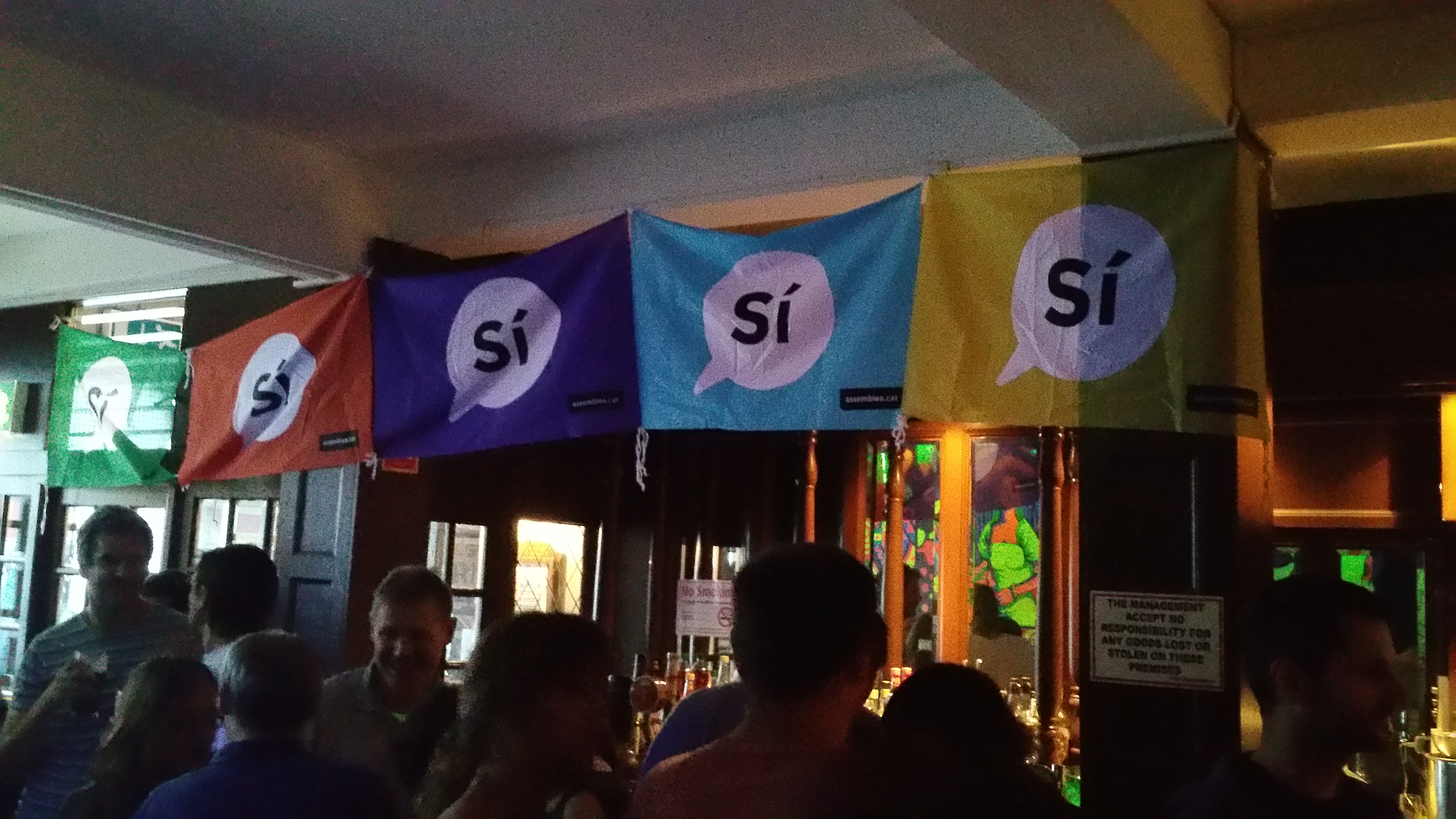
In Ireland, as the Provisionals’ leadership and the British looked at one another across the dance floor, the former wondered what they could get from the same kind of process but crucially, how to sell it to their rank and file. At the Sinn Féin Ard-Fheiseanna (annual congresses of the party), the ANC and Al Fatah (wearing their PLO hat) fraternal delegates were welcomed by hype from the SF leadership and enthusiastic reception from the floor of the hall. The ANC and Fatah of course talked up their parts of the Processes and no-one seemed to examine critically what either the South African blacks or the Palestinians were likely to get out of them.

Ramaphosa, Mandela & Zuma at Jo’burg Conference 2012. Zuma is now deposed from ANC for corruption and Ramaphosa is millionaire President of South Africa and ex-leader of the National Union of Mineworkers. (Photo: from Internet, by Walter Dhiadhia)

And the Pal-African partnership continued to attend congresses, to send fraternal messages to areas of ongoing anti-imperialist resistance, to sing their siren song with a Western chorus backing. The Provisionals joined the actors and took to the stage as they neared and finally accepted the Good Friday Agreement in 1998. But with the Palestinian conflict showing no sign of resolution (unless one considers a kind of genocide of Palestinians) or even a respite — and in particular after the 2006 elections victory by Hamas — the Palestinians were no longer quoted as a good example of the “peace process”. Various actors, including South Africans and Irish, went on to try to sell the “Process” to areas of stubborn anti-imperialist resistance: the southern Basque Country, Turkish Kurdistan, Columbia, Phillipines, Sri Lanka ….. But the Palestinians (or rather Fatah) had been dropped off the billing and bowed quietly out of the Traveling Peace Process Show. They had not even an illusion to portray any more.

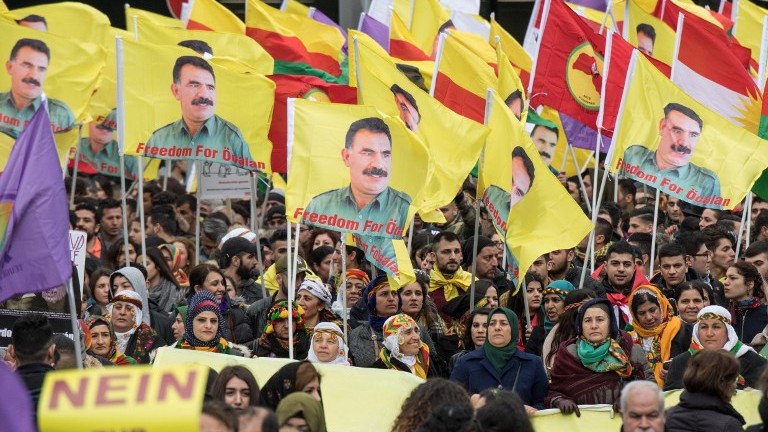
Kurds demonstrating against Turkish dictatorship in Germany fly flags bearing image of Abdullah Ocalan. Some years ago he said he supports a peace process in Turkey but he needs to be freed from prison to lead it
(Photo: the Times in Israel).

However, the show must, as we are often reminded, go on. It failed to deliver in Kurdistan and the Basque Country, not because the leaders of the resistance movements were not amenable but because of the unwillingness to adapt of the Turkish and Spanish regimes respectively. However, the Basque armed organisation ETA threw in the towel a couple of years ago anyway, abandoning their fighters in the jails to seek their own individual ways out through begging forgiveness of the occupiers of their land and oppressors of their people. The Turkish and Syrian Kurds were drawn into partnership with the imperialist allies dominated by the US, in their war against ISIS but also for the overthrow of the Assad regime, though deep Kurdish contradictions continue with the Turkish regime, to which it looks like the US Coalition will abandon them and they may seek an accommodation of sorts with Assad.

The Colombian FARC and MIR swallowed the Processed bait and gave up the armed struggle for a promise of a political one but those of their leaders who are resolute are being hunted by the regime, the quasi-liberated areas terrorised by the Army and assassination squads, the resistance fragmenting and disorientated. The Tamil Tigers didn’t entertain the Peace Process Show but the Sri Lankan Army were able to surround their liberated areas and bombard them to defeat, murdering their leaders and raping, murdering and repressing their followers.

The Phillipines and India? The resistance groups in both these areas are led by a Maoist-type leadership and we wait to see.

And in Ireland, after two decades since the signing of the Good Friday Agreement, the colonial occupier has the leadership of Sinn Féin, the former resistance, in joint colonial government, the party’s southern arm seeking admittance to the Irish comprador capitalist club, the remaining anti-imperialist resistance fragmented and the country not one step nearer to unity and independence.

The Palestinian lesson for the world

All the issues which led to these conflicts and which the processes of pacification did not address – were never intended to address – will return again, to be struggled over anew, under new leaderships. In Palestine now, that is what has been happening. The Right of Return for exiles and refugees, put to one side by Fatah in the Oslo Accords nearly three decades ago, is being demanded again on the Israeli border, the protesters (along with the ‘collateral damage’ of journalists and paramedics) being bombarded by tear gas and shot down by Israeli snipers. The Palestinians, whose leadership nearly three decades ago were chosen by US imperialism to be among the first to accept the new round of historical pacification processes and to become complicit in being its missionaries, are teaching us the fallacy of the facile promises they were made at the time.

There is another irony here: while refusing the right of return to Palestinians who were themselves exiled or are children and grandchildren of exiles, i.e within living memory, the State of Israel offers “the right of return” (sic) to people who have never been there and cannot even prove that their ancestors were, providing only they can prove their Jewishness. And a further irony: Sephardic Jews, who were expelled by the Christian kingdoms in Spain and Portugal in the Middle Ages, were being offered a “right of return” by the Spanish Government in 2014 (see link).

Over time, the people in the other areas of anti-imperialist resistance around the world will regroup, gather strength and return to the resistance. The imperialists almost certainly know this. But they have bought themselves three decades of damage to their opposition and, since they need the people as producers and consumers, cannot eliminate the deep wells of resistance. And capitalism is not about enduring solutions – they work away at undermining the resistance on a temporary basis and as for the future, like Micawber in Dickens’ David Copperfield, believe that “something (else) will turn up”.

End.

LINKS (NB: I have deliberately chosen most background references regarding Palestine from Wikipedia, which is known to be heavily monitored by Zionist interests and also has inputs from friends of the Palestinians and therefore cannot be said to be completely favourable to either side):

Palestinian exiles and the right of return: https://en.wikipedia.org/wiki/Palestinian_diaspora

Account of the Oslo Accords: https://en.wikipedia.org/wiki/Oslo_Accords

The Oslo Accords negotiations and their legacy: https://interactive.aljazeera.com/aje/palestineremix/the-price-of-oslo.html#/14

The Palestine Liberation Organisation: https://en.wikipedia.org/wiki/Palestine_Liberation_Organization

The right of return to Palestine of Palestinians: https://en.wikipedia.org/wiki/Palestinian_right_of_return#UN_General_Assembly_Resolution_194

The right of return to Spain of Sephardic Jews: https://theconversation.com/spain-moves-to-right-a-522-year-wrong-but-still-overlooks-some-23526

DUBLIN PROTESTS JAILING OF ALTSASU EIGHT

People gathered early evening Thurday (21st) on O’Connell Street, Dublin city’s main street, to protest the convictions and sentencing of the Altsasu Eight. They held Basque and Catalan flags and displayed placards demanding “Free the Altsasu Eight!” and another pointing out the severity of the sentences for what was a bar brawl with Spanish police.

Section of protest and conversation with passers-by
(Photo: D.Breatnach)

From the leaflet distributed: “In November 2016, during a festival in Altsasu, Nafarroa (Navarra) Province of the southern Basque Country, a lieutenant and sergeant in the Spanish Guardia Civil police force, both off-duty with their girlfriends, entered a late-night bar well-known as a place for pro-independence Basques to socialise. An altercation occurred in which the police said they were attacked by the Basque youth and claimed a fractured ankle suffered by one; others say it was just some shoving and pushing.

(Photo: D.Breatnach)

The Navarran regional police force, the Policía Foral, first on the scene, treated it as an alleged assault case which is how the local court wished to deal with the issue. However the Spanish state Prosecutor intervened and, transferring the case to Madrid, accused eight youth of “terrorism” for which they could face a total of 375 years in prison. He failed to prove that but on charges of public disturbance, assault and threats alone, on 1st this June the eight youth were variously sentenced to between 2.5 and 13 years in jail as well as fined thousands of euro.”

Leaflets were distributed to raise awareness of this injustice and many passers-by stopped to talk and ask questions. One group of interested youth was from Zaragoza, which is in Aragon province and not far from the Basque Country.

Protesters including musicians
(Photo: D.Breatnach)

Live music was provided for the participants and passers-by: two women sang Txoria Txori in harmonies and a Basque sang a new song that has been composed about the Altasasu 8, while another accompanied him on guitar (hope to post the lyrics and translation). Txoria Txori is a short simple allegorical song about a man who loves a bird and says that if he cuts its wings it would stay with him but he can’t do that because then no longer would it be a bird – and he loves the bird. This song is well-known and loved in the Basque Country.

The picket was an event of internationalist solidarity, not only because it was carried out in Ireland in support of victimised youth in the Basque Country, but also because the picket line included Irish, Basque, Catalan and Italian people.

(Photo: D.Breatnach)

Further information in the English language on this case (and other events in the Basque Country) will be posted from time to time on https://www.facebook.com/dublinbasque/

Trad for Catalonia Fundraiser in Dublin a Success

TRAD FOR CATALONIA SEES MIX OF INSTRUMENTS, LANGUAGE AND MUSIC STYLES

Clive Sulish

Ukelele, fiddle, guitars, cajón, gralla, flutes and uileann pipes, along with different voices in various styles filled performances at the Trad for Catalonia night in the Back Room, at the Cobblestone pub, Smithfield Dublin on 14th June (2018). Despite the wide variety, the quality of sound production was excellent and much appreciated by the audience.

“Sí” bunting from the October Referendum on Catalan Independence (Photo: D.Breatnach)

Eight different acts took to the stage in a crowded function room at the Cobblestone, which was decorated in the three varieties of the Catalan national flags (Senyera, Estelada and Vermella), and flags from the Referendum period declaring Sí, along with the Basque Ikurrina and the Irish Starry Plough.

The Basque Ikurrina, the Catalan Vermella and the Yellow Ribbon for the prisoners.
(Photo: D.Breatnach)

Diarmuid Breatnach, on behalf of With Catalonia/ Leis an Chatalóin welcomed the people attending in Irish and in English. A group called Whistle went first, playing lively Old-Time American songs, followed by Eoghan Ó Ceannabháin and John Flynn playing Irish tunes on flutes and also singing sean-nós songs in Irish, including Sadhbh Ní Bhruinneallaigh.

The band “Whistle” playing (Photo: D.Breatnach)

Ó Ceannabháin then introduced Berta Freixas Ylla-catalá, who played some Catalan tunes on the Gralla, a traditional Catalan instrument after which Paul O’Toole followed with some of his own songs, including the quasi-satirical “I Saw Jesus on a Bus”.

Breatnach, accompanied on guitar by O’Toole, sang two songs relating to prisoners, both from the latter half of the 19th Century, one from Ireland and another from the USA. The

John Flynn & Eoghan Ó Ceannabháin playing flutes (Photo: D.Breatnach)

Felons of Our Land was almost certainly written with regard to the suppression of the Fenians (Irish Republican Brotherhood) he said, while How Can I Keep from Singing began life as a Christian hymn but was worked over somewhat in the 1960s to make it a song of political resistance. The two emotions which the repressive forces seek to employ by taking political prisoners as hostages, said Breatnach, are shame and fear; these songs counter those with the emotions of pride and courage. Breatnach invited the attendance to support a picket in solidarity with Catalan political prisoners the following Thursday, 6pm at the GPO building in the city centre.

Visitors from the USA and Canada enjoying the evening
(Photo: D.Breatnach)
Paul O’Toole performing (Photo: D.Breatnach)

After the break and the holding of the raffle, which raised further funds in addition to the low entrance fee of 5 euro, Síomha Nic Aonghusa sang voice-only the sean-nós song Dónal Óg in Irish, then, all in English and accompanying herself on guitar, sang in turn an Irish Republican ballad and different songs, on themes of love, loss and addiction. Fionn Ó hAllmhain brought his uileann pipes on to the stage and, after explaining something of how they work, played a number of tunes, including a polka which had a couple up dancing set-dance polka moves. Ó hAllmhain also sang an Irish sean-nós song.

(Photo: D.Breatnach)
Síomha Nic Aonghusa performing (Photo: D.Breatnach)

Oncle Pau of Casal Catalan, accompanying himself on ukelele, performed some Catalan songs which had many Catalans in the audience singing along, finishing his set with Somewhere Over the Rainbow.

Oncle Pau performing (Photo: D.Breatnach)

Concluding the evening, Ó Ceannabháin thanked all for attending, also the singers and musicians who performed free of charge, the Cobblestone for providing the venue, Shane the sound engineer and Aoife behind the bar.

Aoife, Cobblestone staff and very helpful
(Photo: D.Breatnach)

The event was organised by With Catalonia/ Leis an Chatalóin, with strong support from the cultural Catalan organisation, Casal Catalana d’Irlanda and promoted also by CDR (Comité de Defensa de la República) Dublin.

Tina McVeigh, busy on the night (Photo: D.Breatnach)
Michael Grange, active during the night.
(Photo: D.Breatnach)
Berta Freixas playing the Gralla, traditional Cataln instrument.
(Photo: D.Breatnach)

With Catalonia/ Leis an Chatalóin 


Links

Catalan solidarity in Ireland:

https://www.facebook.com/WithCataloniaIreland/

Casal Catalan d’Irlanda https://www.facebook.com/casalcatalairlanda/

CDR Dublin https://www.facebook.com/CDRDublin/

Engish-language news and information pages:

Catalan News http://www.catalannews.com/

Support Catalonia https://www.facebook.com/groups/506863443039295/

FREE JULIAN ASSANGE PICKET AT BRITISH EMBASSY DUBLIN

CROWD AT BRITISH EMBASSY DUBLIN CALLS FOR RELEASE OF JULIAN ASSANGE

Diarmuid Breatnach

View of crowd at British Embassy from across the street (Photo: D.Breatnach)

Today, June 19th, is the anniversary of the date when Julian Assange sought asylum in the Ecuadorian Embassy in London, which he was granted. That was 2012, since which he has been confined to a few rooms in that building, unable to leave for fear of British arrest and extradition to the US, where he is wanted for broadcasting their secrets on their murderous campaigns in Afghanistan and Iraq and other matters. A crowd gathered outside the British Embassy to demand Assange be set free – among them as speakers were TDs Clare Daly, Mick Wallace, along with Nobel Peace Laureate Mairéad Corrigan and musician Paul O’Toole (also another musician).

Paul O’Toole playing and singing
(Photo: D.Breatnach)

At least five Gardaí were in attendance, along with a police van.

From Wikipedia: Julian Paul Assange (born Hawkins; 3 July 1971) is an Australian computer programmer and the editor of WikiLeaks. Assange founded WikiLeaks in 2006, but came to international attention in 2010, when WikiLeaks published a series of leaks provided by Chelsea Manning. These leaks included the Collateral Murder video (April 2010), the Afghanistan war logs (July 2010), the Iraq war logs (October 2010), and CableGate (November 2010). Following the 2010 leaks, the federal government of the United States launched a criminal investigation into WikiLeaks and asked allied nations for assistance.

Poster of image of Julian Assange with the flag of the USA as a gag on him. (Image source: Internet)

All the speakers outside the British Embassy made the point that Assange’s only crime is to reveal some murderous secrets of the USA and other powers and that if he can be jailed then so can anyone for speaking or publishing the truth. Clare Daly said that his crime was to be a conscientious reporter.

Paul O’Toole played two songs, one of which was The Cry of the Morning, a song about internment. The other musician played some tunes and then led the crowd in singing “All we are saying, is free Julian Assange.”

Fintan thanked all for coming and the speakers and musicians and the event came to an end.

Mick Wallace TD speaking outside the British Embassy (Photo: D.Breatnach)
Another musician supporting the event (Photo: D.Breatnach)
Section of crowd, looking southward
(Photo: D.Breatnach).


Clare Daly TD speaking outside the British Embassy
(Photo: D.Breatnach)(Photo: D.Breatnach)
Nobel Peace Laureate Mairéad Corrigan speaking outside British Embassy (Photo: D.Breatnach)
Police van & 2 of the six Gardaí that were visible (Photo: D.Breatnach)


(Photo: D.Breatnach)


BACKGROUND

Assange went to Sweden to talk about Wikileaks and its revelations in August 2010. A woman in Sweden wanted Assange to have a HIV test after he had sex with her. Her friend, who had also had sex with Assange in the past, encouraged her to go to the police. Assange went voluntarily to the police station, was interviewed and told he could go, there was no charge and he went back to England. Afterwards, a Swedish Special Prosecutor charged him with sexual molestation and “lesser-degree rape” (a particular Swedish charge) although the original complainant did not accuse him of rape.

By then it was becoming clear that another agenda was behind the Swedish Special Prosecutor and the two women. Assange offered to be interviewed again by Skype or in person in London or, if necessary in Sweden but only if that country guaranteed not to extradite him to the USA. The Swedish authorities refused to give that guarantee. The Prosecutor said Swedish law did not permit an interview on foreign soil but this was publicly contradicted by Swedish legal experts and the Prosecutor eventually interviewed him in London but by this time it was November 2016, by which time the statute of limitations had run out on the less serious charges. In May 2017, the Swedish authorities dropped their investigation against Assange and Chief Prosecutor Marianne Ny officially revoked his arrest warrant.

However, as a result of Sweden’s attempt to extradite Assange, he had been brought to court in London and released on bail. Due to Sweden’s refusal to guarantee him no extradition to the USA, Assange jumped bail and sought asylum in the Ecuadorian Embassy on 19th June 2012 and has been there since. He cannot leave for fear of arrest by the British for breach of bail conditions and extradition to Sweden, from where he may be extradited to the US, where politicians and officials have said publicly that he should be jailed and some even wanted him executed under anti-espionage laws or assassinated.

End.

DANGEROUS ILLUSIONS IN A CATALAN INDEPENDIST PART

Diarmuid Breatnach

             Very recently, the pro-Catalan independence on-line periodical VilaWeb interviewed Marta Vilalta, the spokesperson for the ERC (Republican Left of Catalonia) party, an important component of the pro-independence majority in the Catalan Parlament. Her replies and statements presumably reflect the thinking in the leadership of the ERC party or, if it should not be unanimous, at least the thinking of the dominant section of the party’s leadership.

Marta Vilalta photographed during interview (Photo by online Catalan newspaper VilaWeb)

ERC has 32 Deputies in the Catalan Parlament (and two Members of the European Parliament). The other components of the Catalan independist majority at the time of writing (June 2018) are JuntsxCat (Together for Catalonia – 34 seats) and CUP (Candidatura d’Unitat Popular — 4 seats). The latter is taking the ‘confidence and supply position’ (i.e they will not vote with the Opposition and will vote to keep the Government in power if necessary).

ERC’s President, Oriol Junqueras, has been in a Madrid jail since the October Referendum, awaiting trial on charges of “Rebellion”. The party’s General Secretary, Marta Rovira, went into exile to avoid a similar fate.

The party, along with JuntsxCat, whose President Carles Puigdemont is also in exile, has faced repression by the Spanish State, as has also the cultural organisation ANC (Asamblea Nacional Catalana), whose President, Jordi Sànchez i Picanyol, is also in the Madrid jail.

The independist parties are to be commended for continuing their stance for independence and for facing up to Spanish State repression. In this, they enjoy the support of the majority of the Catalan population, as evidenced by votes in the December elections and the mobilisations and votes cast in the October Referendum, albeit disrupted by Spanish police raids to confiscate ballot boxes and assault voters and demonstrators.

But how prepared are they for the struggle ahead? How critically do they evaluate their past performance and expectations? How willing to learn from mistakes? The signs are not encouraging.

ILLUSIONS ABOUT THE SPANISH STATE

           “The Spanish State has been capable of everything …. to defeat independence and the Republic project”, Vilalta says in the course of the interview, with what seems to be an air of surprise, meaning one presumes that there was no lengths to which they were not prepared to go to suppress Catalonian independence. If the Spanish state has been capable of everything, one must assume that it will also be “capable of everything” in future, at least in the absence of some limiting factors, which were not mentioned by Vilalta (except perhaps in the context of reactions outside the Spanish state, which we can look at under the heading of “Illusions about other states”).

So this admission of Vilalta should imbue us with confidence that ERC is taking that into tactical and strategic consideration. However, this appears to be far from the reality, based on the insistence of Vilalta that their struggle will be based exclusively on both “peaceful and democratic” means; nor is this only an iteration of Vilalta’s but it has been stated repeatedly by leading figures of the ERC and of the JunstxCat, i.e of the parties with by far the most numerous deputies in the Parlament. We’ll look at this more carefully under the section dealing with Pacificism but for the moment we can reflect that history in general (and the history of the Spanish state in particular) demonstrates that the combatant that relies principally on moral and or legal means must be defeated by the aggressor who relies on force and its tactical application.

“I suppose the Spanish State understands and agrees with the International treaties that it has signed and which are included in the Constitution,” says Vilalta, in reference to the right to self-determination recognised by the Charter of Human Rights of the United Nations. Why does Vilalta suppose that the Spanish State “agrees” with this right? On the contrary, all its actions with regard to the nations incorporated within its state territory show that it fundamentally disagrees with them, at least where applied to itself. In fact, its own Constitution forbids the secession of any part of the State without a majority vote in favour in the Spanish Parliament and further underlines that the Armed Forces are the guarantors of the Constitution!

Of course, it is possible that Vilalta is being somewhat ironic here, or making a statement for its propaganda value. Maybe she only means that the Spanish State should uphold the right to self-determination in the international treaties which it has signed. Let us hope so. But surely it would be more useful to point out that the Spanish State has a record of fundamentally violating most of the human rights to which it has signed up, including some actually stated within its own Constitution? Such an exposure would help in any project of isolating the Spanish state internationally, undermine its propaganda and, crucially, help to prepare the Catalan people and their allies for what the Spanish State may bring against them.

The Spanish State has repeatedly violated not only the human rights to life (for example in running assassination squads against the Basque movement for independence); the right to serve one’s prison sentence in a prison near one’s relatives, children and friends (by deliberately dispersing its political prisoners as far from their homes as possible); the right for terminally and seriously ill prisoners to be released on parole to continue their sentences at home or in hospital (routinely violated in the cases of political prisoners); the right to freedom from torture (routinely used until very recently against political detainees and against some migrant minorities); and the right to upholding one’s language (by originally outlawing the use of Iberian languages other than Castillian and currently banning them from the Spanish Parliament).

Furthermore the Spanish State has a lively record of violating the civil rights of political activity, of assemply, of speech, of publishing, of broadcasting: it has banned Basque demonstrations, cultural and political organisations, radio stations, newspapers and even seized the financial and property assets of organisations; it has jailed Basque and Catalan (and some Spanish) political and cultural activists; jailed and fined rappers and cartoonists and social media posters elsewhere in the Spanish State. It is illegal to “insult” the Spanish King publicly in speech, writing, or other means. Fairly recently the Spanish State created a law which makes it illegal to film police misbehaviour in public, to insult them (i.e denounce what they are doing) or to hold demonstrations in the vecinity of certain state buildings, including Ministries and the Parliament, with very high fines and/ or prison sentences for transgression of any of these prohibitions.

Marta Vilalta, representing Esquerra Republicana, major party of the Catalan independist majority. (Image source: Internet)

PACIFISM

For pacifists, of course, pacifism is a principle. For others, peaceful methods and civil disobedience are tactics, i.e responses to specific issues at a particular time and place, not principles to uphold in all situations on every occasion.

It is a fact that no class has freed itself from domination by peaceful means alone and that similarly, no nation has liberated itself from colonial or imperialist domination without resorting to the use of force. This is not, in a sense, a choice for oppressed people – it is the oppressor itself which uses force and obliges the oppressed, in self-defence, to use force too.

Some recent examples will hopefully suffice to convince the doubtful. The first public actions against the division of Vietnam and the grooming by the French and USA of a puppet regime in the southern part of the nation were largely pacific. Demonstrations were suppressed and activists arrested by the puppet regime. Monks immolated themselves in public. Monks too were suppressed. Anti-imperialist forces within the southern part united in armed action with the Vietnamese state set up in the northern part of the country, which was supported by the People’s Republic of China (the Chinese communist state). Decades of terrible war followed but today the country of Vietnam is united and largely independent of imperialism.

In fact we can observe that all of the states of Europe which were formerly under the domination of another have had to rely on armed force to free themselves from their armed dominators: e.g Austria, Belgium, France (from Nazi Germany), Denmark, Holland (from Spain, France, Nazi Germany), Hungary, Italy (from France and Austria), Norway, Poland (from Russia, Nazi Germany), Switzerland (from the Austro-Hungarian Empire), and indeed the Spanish state itself (from France).

If that were not enough and though it should be, the history of the Spanish State itself shows its reliance on armed force, from the medieval period right up to the 20th Century. The Kingdom of Spain was created firstly by the joint kingdoms of Castile and Aragon, picking up other allies, driving out the Arab kingdoms (and incidentally driving out also Jews, the origin of the Sephardics, along with the Arabs, even their own allies who would not convert to Christianity. The Spanish kingdom became an imperial force outside its own state territory and conquered and plundered territories from the Canary Islands to the Caribbean, the South American sub-continent, Central America and parts of what are now the southern USA. It did the same to parts of Northern Africa and the Philippines. In no circumstance did it refrain from the use of armed force.

In the struggles within the State itself, the ruling class suppressed by armed force the uprisings of the Communeros and many others regionally-based and, crucially, both the First and Second Republics, which had come into being through popular elections. To take the most recent, the ruling class instigated an uprising among its military against the elected Spanish Government, which led to what some call the Spanish Civil War (1936-1939), with enormous loss of life and destruction, and the instalation by the victors of a fascist military dictatorship and a monarchy.

Unlike the other fascist states of Europe (with the exception of Portugal and even they had their Carnation Uprising), no purges of former fascist rulers took place within the Spanish State; on the contrary, the heirs of the fascist military leaders, politicians and industrialists continued in the footsteps of their parents and in the luxury of their appropriations.

Under some external and internal pressure, a veneer of democracy was drawn over the State after the death of the dictator Franco and the social-democratic PSOE and the Communist Party of Spain were drawn into an alliance with the existing fascist ruling class1 in what is often called the Transition (i.e to “democracy”). Far from this addition adulterating the fascism of the ruling class, the reverse happened and both political parties colluded in the suppression of movements of resistance both national and of class; the PSOE in government actually ran assassination squads against the Basque independence movement in the 1980s.

Hopefully this short review of Spanish State history has been sufficient to illustrate the readiness of the State to resort to violence against opposition, whether peaceful or not. What then are the prospects of a resistance which will confine itself to peaceful means alone? Its leadership will be killed or imprisoned, as will the cadres of the popular movement, repression will be the order of the day. The militants will be driven underground, dispersed and the movement will lose the initiative, which is fatal for a revolution.

As to the prospects of a comparatively small nation like Catalonia2 in insurrection against a major power and its military resources, we shall address near the end of this article.

INADEQUATE SELF-CRITICISM

With regard to the issue of preparedness for the actions of the Spanish State, Vilalta responds to a question by saying that ERC have carried out self-criticism of their inability to defend the Catalan referendum against Spanish State attack. Such an admission should not shame them nor demoralise their followers and allies (though it sometimes does so, sadly) – on the contrary, an organisation that does not admit its mistakes is unlikely to learn from them and in any case is not going to be honest with its membership and followers.

It is however worrying that a party pursuing an independist and Republican path in the teeth of the historical and well-known opposition of the quasi-fascist and monarchical state, should have been unprepared for the response of that State. Nevertheless, one could draw reassurance from the fact that ERC acknowledge their error and carried out self-criticism. Or at least, that would have been the case were it not for the fact that Vilalta states that “it is very easy to look back with perspective and think that it could have been done in a different way. I do not dare to say what we should have done differently. The decisions taken at that time, in a specific context and with the information that was had, seemed the best.”

Huge Barcelona Demonstration (in green) for self-determination on Catalonian day, Diada 11 Sep2017, three weeks before the Referendum. (Image sourced: Internet)

Whether that can be called “self-criticism” is debatable but it certainly does not qualify as adequate. It amounts to saying “we were wrong but could not have come to any other conclusion and even now I can’t think of what we could have done differently.” Which is almost to say “We are likely to be as mistaken and to prepare as insufficiently in future.”

As discussed earlier, both the history of national struggles in general and the history of the Spanish State in particular should have informed the independist forces of the full range of possible responses of the Spanish State. Those who were unable to anticipate the actions of the Spanish State need to ask themselves a vital question: “Why, despite that accumulation of historical practice, were we unable to count on a police invasion as one of the possible measures of our opponent?” A truthful reply to that question would tell them and us a lot about their limitations but their refusal to even consider the question is more worrying than whatever their current conceptual limitations might be.

ILLUSIONS ABOUT OTHER STATES

In the course of her interview, Vilata commented that “the international situation is key.” She said that in the context of forcing an unwillingtonegotiate Spanish State to, in fact, negotiate. How she sees this happening is not very clear. In this context she also said the following:

The Charter of the United Nations recognizes the right of self-determination of peoples. The Spanish government has had and has the opportunity to discuss and negotiate how other countries, such as the United Kingdom and Scotland, have done. They have opted for repression to the limit and always say no. It is they who have pursued political leaders and freedom of expression. We will continue to defend dialogue and negotiation by asserting that Spain has subscribed to the right of self-determination and confronting violence and repression.”

Leaving aside the fact that Scotland is not truly independent, somehow Vilalta envisages using the treaties referred to above to force the Spanish State to negotiate or to have “it is forced from the outside. This mandate to make it possible to negotiate can come from international spheres.” What does she mean by “international spheres”? She is not specific but in this context mentions the reversals for Spanish extradition warrants, the Catalan Members of the European Parliament (and presumably other friendly MEPs) and the Catalan politicians in exile in European countries, presumably all coordinated by the Council for the Republic, which also gets a mention.

But even in a best case scenario, how is the Spanish state to be “forced”? Economic sanctions? They can only be imposed by individual states or by groups of states, for example the EU. The European Parliament has not seen fit even to condemn in words the repressive actions of the Spanish state and, in fact, the EU President, Junkers, commented that they don’t wish to see “an EU of 99 states”, a clear indication that the independence of Catalonia and other states breaking away is not something the EU would welcome.

And in fact, even without Junker’s comments, that attitude could easily have been predicted. In the case of a successfully independent Catalonia, not only would the Spanish state be vulnerable to similar bids by other nations within its state territory but so would the French and Italian states also. It seems that Vilalta expects the EU to act against the interests of not only its Spanish member state but the interests of two other major European states as well. But why would it do that or, more to the point, why does Vilalta think they will or even might?

Possibly Vilalta envisages some kind of external moral pressure or perhaps “good neighbour advice”. With regard to moral pressure, the Spanish state, both during and after Franco, has shown itself impervious to that. Its practice of torture and impunity for torturers has been criticised regularly by relevant committees of the United Nations and the EU and every year by Amnesty International. None of that has brought about any change.

The European Court of Human Rights has found against the Spanish State on a number of occasions (failure to investigate torture allegations, illegal extension of sentences by retrospective legislation but never on actual torture, which is “difficult to prove”); the Spanish State sometimes appeals the judgement (and loses) but eventually pays the fine, releases the prisoners at their release dates and …. carries on as before.

The major European state response to the PSOE Government’s undercover campaign of terrorism in the northern Basque Country (i.e within the French State) has been to facilitate the extradition of Basque refugees to the Spanish state (sometimes without even bothering with a court appearance).

No doubt the Spanish State has been given “good neighbour” advice from time to time from European states and even by the USA, advised to appear nicer, to be more democratic etc and even advised that it was in the long-term interests of its own ruling class to do. Perhaps the Spanish State responded, with well-known Spanish fascist arrogance, that it knows its own busisness best or perhaps they replied that only an iron grip can keep Spain “Una, Grande y Libre” (United, Great and Free”, i.e non-communist). In either case, neither good neighbour nor critical state has shown an interest in taking any kind of coercive action against the Spanish State and there is no reason to believe that they will do so now.

European states may not wish to soil their hands doing Spain’s dirty work for them by extraditing refugees to Spain on dodgy European Arrest Warrants but that is a long, long was from being willing to act in a coercive way against a major European partner.

It seems almost certain that Vilalta, in discussing “international force” against the Spanish state was referring to action by other European states and traditionally when “the international community” has been invoked in discussions of ‘peace processes’ and sanctions that is generally what is meant. But there is another way of looking at international pressure.

To examine that possibility, we need to ask ourselves: What are the circumstances in which the Spanish State would be unable to send armed forces to suppress Catalan independence or, if it did, that they would be neutralised?

Such a situation could only be envisaged occurring when the State faced insurrections and similar crises in many other parts of the State at the same time as its crisis in Catalonia. And in fact the Spanish state, of all those in the EU, is probably the most vulnerable to such a scenario. Along with Catalonia and the Catalan Countries, there are the nations of Asturias and Galicia (both of Celtic culture) and the four southern Basque provinces.

Within those areas and in all others of the Spanish state, there is a major disaffection with the dominant order. Never have the institutions of banking and politicians been so widely exposed in corruption, never has the Royal Family been so condemned, nor repression by police so exposed. Unemployment is high as is work on short-term or casual contracts, the housing crisis is serious and numerous victims of eviction have publicly comitted taken their lives over the years. Both political parties of the traditional bi-party system (PP and PSOE) have lost prestige and electoral support, so that now each can only govern as a minority party and their decline has allowed the emergence of a two more sizeable parties, Podemos of the Left and Ciudadanos of the Right (without however much hope of a fundamental change from either). Huge demonstrations have taken place across the state and in particular in Madrid. The collusive trade unions of the Comisiones Obreras and the Unión General de Trabajadores have been found wanting and many independent unions have sprung up.

In other words, the prestige of the State has been slipping and its enemies multiplying. But to tap into these currents of disaffection with the Spanish State, the independist forces would need to do more than threaten the State with the independence of Catalonia. It would need to develop a social-economic program that would not only benefit the majority of Catalons but would also serve as an illuminated example to the rest of what is currently the Spanish territory.

Vilalta does talk a little about a socio-economic program emanating from the Catalan Government and local authorities but says next to nothing about its content. Last week a man about to be evicted in Catalonia killed himself and there are many others facing eviction through inability to pay their rents or their mortgage instalments. A solution to that problem would not only bring many doubters in Catalonia over to the side of the Republic but serve also as an example of what could be done elsewhere in the Spanish State. Support for a Spanish military intervention would be severly undermined in such a scenario, both externally and from within the armed forces and the breaking out of many fires across the state would leave the firefighters stretched too thinly to carry out their task.

This scenario could also affect the French state should it consider a military intervention of its own and the Bretons, northern Basques, northern Catalans and Occitans might seize that opportunity to advance their own claims for independence or autonomy.

The problem for ERC with instituting deep socio-economic changes in Catalonia and in appealing to wide national and class disaffection is that, notwithstanding the “Left” in its title, it is a bourgeois or capitalist party and can hardly be expected to cut off its own head just because it will make its legs firmer. And the JuntsXCat is even more so, at its core a liberal capitalist party.

All of which might serve to remind us of the quotation from James Connolly, a revolutionary socialist who also fought for the independence of a small nation – Ireland. Recognising that only the working class was unable to gain some advantage through a compromise with the imperialist and coloniser, he wrote: “Only the Irish working class remain as the incorruptible inheritors of the fight for freedom in Ireland”. If the words “Irish” were to be replaced by “Catalan” and “Ireland” by “Catalonia”, leaving the rest of the statement intact, would it also be true?

End.

FOOTNOTES

1This was necessary for the Spanish fascist ruling class not mainly as partners in the production of the farce of ‘democracy’ but chiefly for their control of the two main non-fascist trade unions then (and still): the Comisiones Obreras of the CPE and the Unión General de Trabajadores of the PSOE, both illegal until that point but also powerful and with a potential for creating industrial and political instability.

2For the sake of convenience, Catalonia is being described here as a nation, although for many, including the ERC party, at least in the past, it is the Paises Catalans (Catalan Countries) which is the Catalan Nation, a territory extending from Pau in the French state through Catalonia to Tarragon, Valencia and the Balearic Islands.


APPENDIX

Link for original interview in Catalan:

https://www.vilaweb.cat/noticies/marta-vilalta-voluntat-de-fer-autonomisme-ni-una-voluntat-de-fer-republica-tota/

My full translation to English of introduction and interview:

Marta Vilalta (Torregrossa, 1984) is the spokeswoman for Esquerra Republicana since March. A journalist by profession and Parliamentary representative since 2015, Vilalta has been a member of the ERC since 2004 and, after handling several responsibilities, has now taken a step forward as a result of the repression suffered by the party, with President Oriol Junqueras in prison, Secretary General, Marta Rovira, exiled and members of the Executive persecuted and prosecuted by Spain for having collaborated in the organization of the 1st October Referendum.

We talked with Vilalta about theCatalan political situation, the Republic, autonomism, the new Government of the Generalitat, the effects of repression and the new road map that ERC must approve in its national conference at the end of June . Young, energetic and smiling, Vilalta takes this new stage as a personal challenge, but with the bitter aftertaste of having had to go through the situation of repression against the party and independence.

– Is it true that you do press conferences prepared not to answer questions? Will you respond to this interview?

– [Laughs] I did not say that! It was a joke in relation to this and Sergi Sabrià [the previous spokesman], speaking to the journalist, said laughingly that he had advised me not to answer the questions. We laughed, but it was included in the interview. I am a journalist and I am empathizing with you, it is about responding well.

-Good! Now that there is ‘effective government’, how is the Republic to be brought about?

-Firstly, getting the Government back has been an important and indispensable step towards achieving the objective, which is the Republic. We advocate that to make the Republic real and to complete it we must be strong at all levels and have all the possible tools. Therefore, this also means recovering the Government and the institutions, being connected with the social mobilization and citizenship, being strong in the international bodies, the city councils and the Parliament. We have to be stronger and stronger, to increase and have an amazingly hegemonic social majority that will allow us to bring into existence the Republic we have decided to have, but unfortunately we have not yet been able to make it effective. But it will happen, we’re sure.

-Let’s talk about the ERC strategy paper, the new roadmap to be approved. A fear has been expressed because a section of the grassroots, such as the Mayor of Montblanc, Josep Andreu, believes that the unilateral path is not given enough importance.

-I think that the debate or the controversy about the strategic presentation has been magnified, I do not know if deliberately or not. It analyzes the situation based on the lessons of recent months. It places us where we are and helps us to define what we do and with what instruments to do it in order to bring about the Republic. That’s why it is called ‘Let Us Create the Republic’. We do not rule out any path, providing it is peaceful and democratic, to arrive there. Yes, it is true that it emphasises the need to be stronger and stronger, to expand support in many sectors that share the anti-repressive struggle but yet do not see the need for the Republic. And it defines the multilateral framework of play because it is a process where many political, judicial, economic, and social agencies intervene … We need to know how to move in all this multiplicity of agencies and to maximize opportunities.

– And the unilateral path?

-The paper does not rule out the unilateral path, we understand it as part of the multilateral framework. Perhaps part of the membership thinks that we have not been explicit enough. We are in the process of making amendments so that all the membership can participate and improve the text. We debate with a wish to reach a consensus and for everyone to feel represented. We are very pleased with the level of participation, with 1,400 amendments. Some 1,100 have been incorporated to be negotiated. This shows a vital strength in the organization and the very participative health of the membership of ERC. One must shine the lights ahead to see the medium term to bring about the Republic and to see what we need to do to achieve it.

-Andreu regretted, however, that there was little participation in the territories (? Trans), and he made a public appeal.

-Yes, the call to participation should be done by all. But I insist, there has been a huge volume of amendments. In 2013, some 300 amendments were presented and now there are 1,400! There have been assemblies in the territories. We hope that on June 30 and July 1 there will also be a lot of participation because the moment requires it. The more participation, the more endorsement of the final paper.

-The CUP accuses the Government of being autonomist.

-We have heard them say this several times, but I do not agree. Whenever we have had the chance to rule, we have done it with a republican call and overtaking autonomy. Interest in autonomy is minimal. Willingness to create a republic, total. This is what the Government of the Generalitat is doing at the moment. The examples of recent days show that there is no intention to go for autonomy nor to drag out the process.

-What examples?

-We need to recover the institutions because we believe that makes us stronger. This is not autonomism, it is to put them into the hands of the citizens and in the service of the country to be able to move forward. With the first government actions alone, both symbolic and effective, it was shown that it was essential to recover the Government. Unlock the money that social agencies had to receive, more than 300 million euros, the reactivation of delegations abroad, the money to recover the quality of TV3 and Catalunya Ràdio, 250 million for social rental … Damn it, they are essential policies! And since they are destined to improve the country, we are sure that they will help us to add more people (to our support — Trans).

-The people who have doubts about independence understand this?

-This is one of the main ideas. From government action and being able to respond to people’s needs and make policies with Republican logic, we can show that with good governance and caring for the citizenship we are able to respond to needs and to improve well-being. We are convinced that this will lead us to make more people see that this is the only way to defend the social, civil and political rights of citizens. This will surely result in an increase of the people who will see that the republican project is the only alternative to guarantee well-being, social justice and equal opportunities. There is no other project that guarantees us all this. It has become clear that in Spain these fundamental rights are not guaranteed and that they have been violated. We have to be capable and must strive to explain all this.

– Will this legislature be a constituent process?

-The intention is that it will be. I cannot say when. We see it as a great space for debate about how we want the country in all its aspects. It also has to serve to reach many people who feel called to participate. In fact, the project of the Catalan Republic is the only one which will ask this of the citizens. The Spanish state will not enact any constituent process. It is only with that that many people can see the opportunity that there is an opportunity for real change and everything that implies. To think and rethink how we want to organize ourselves and how we want our society to be. This will happen, soon; we must ensure maximum participation of the convinced people and of those who feel called to participate. It will help us to add to our numbers and open the project to accumulate forces. It must be a consensual process, with territorial capillary (reach? – Trans) that allows us to know what we want and what goals to have as a country. The constituent process can be one of the tools at our disposal to exceed the limits of the Republican project.

-The conclusions of the citizens’ debate within the territory will be taken to Parliament?

-I do not know the methodology nor what the phases are. To be successful, we will have to agree with all the political, social and economic actors that can participate. Therefore, we will see what steps must be taken. It is obvious that everything that comes out of the constituent process must be channeled institutionally so that it has the effects that we want and so that it does not remain only in a debate.

-Your party has carried out self-criticism of the October events?

-Yes, it’s been done. In any case, it is very easy to look back with perspective and think that it could have been done in a different way. I do not dare to say what we should have done differently. The decisions taken at that time, in a specific context and with the information that was had, seemed the best. Everything was done with the intention of making effective the 1-O (Referendum – Trans) and to be able to vote, after facing the repression and proclaiming and bringing about the Republic. Unfortunately, we could not defend it. Maybe over time we will have more information. In any case, I really appreciate that everything that was done was because at that time it was believed that it was the best way to reach the goal that we all wanted. From now on, I think the most important thing is to learn from lessons. One of the most important is that Spain is willing to anything. We thought they ‘would not be able’, that ‘could not be allowed’, but they were.

-The Spanish state has been capable of everything.

-To defeat independence and the Republic project, it has been capable of dispensing with the rule of law and democracy. This is a very important lesson, because we moved in an ambit of democracy and defence of rights and freedoms, and we continue there. But we have seen the axis upon which Spain moves. We have to be stronger and stronger because it is the only way to face this repressive and strong State. We must continue defending all democratic channels with allies at all levels. Surely we will have a new opportunity. If we keep alive and resisting, we’ll be able to win.

– Do you have any expectation of the new Spanish government? On Thursday, Grande-Marlaska disclaimed the responsibility for bringing the political prisoners closer to home and then Llarena reminded him that this depended on the Ministry of the Interior (of which Grande-Marlaska is Minister — Trans).

– Different things. First of all, to go back a little. We supported the motion of censure (against the PP Government of Rajoy – Trans) because we believe that it was the responsible action to remove the PP and bring down Rajoy. That Government that had repressed us, the leader of repression and corruption …

-The PSOE too.

-Yes, yes. I say that was the responsible action at that time to make that government fall. Not to support the PSOE. That said, obviously, a new scenario opens, but we do not have much expectation of it. We will observe the following steps. On the concrete question of the prisoners, it is shameful what happened on Thursday. The Minister and the Judge passed the ball about the prisoners to one another. It is an aberration, an arbitrariness, that they are detained as hostages, as revenge. And we demand, it is not contradictory, that they bring them to Catalonia. It is a correct action, the law says, that they be as close as possible to families and children. If the Spanish Government had wanted to, it could have already made the decision.

-The other day you commented that any negotiation should start from the first of October. What does this mean?

-We continue defending dialogue and negotiation. If we want a sincere and effective dialogue, we must be able to speak of everything, without renunciations or initial conditions. We should not only talk about concrete demands of economic, social and sectoral policies that have been dragging on for many years, but also about the situation in Catalonia and how we exercise the right of self-determination and make the Catalan Republic real. When we say that we must start from the first of October, let’s talk about it. Conflict must be resolved through the political path, negotiation and dialogue. The 1-O is the founding moment of the Catalan Republic, marks a point of departure in our most recent history.

– Can this be negotiated with Spain?

-I suppose the Spanish State understands and agrees with the International treaties that it has signed and which are included in the Constitution. The Charter of the United Nations recognizes the right of self-determination of peoples. The Spanish government has had and has the opportunity to discuss and negotiate how other countries, such as the United Kingdom and Scotland, have done. They have opted for repression to the limit and always say no. It is they who have pursued political leaders and freedom of expression. We will continue to defend dialogue and negotiation by asserting that Spain has subscribed to the right of self-determination and confronting violence and repression.

– If we want to open a negotiation, the international field will be important. Until now, Spain has refused to accept any mediation offer. Does the Council for the Republic have any role in this regard?

– The international situation is key. When we talk about negotiating with the State, we know that it will not negotiate because it has not given any evidence (of such willingness — Trans). We must force the State to negotiate, or force it so that it is forced from the outside. This mandate to make it possible to negotiate can come from international spheres. The judicial battles of the exiles must also be taken into account. Spain has suffered the first judicial reversals because no European justice recognizes non-existent crimes that are and invented to punish and silence the people of Catalonia. International action must be organized and coordinated. It is clear that the Council for the Republic can be an instrument that helps us to make heard this voice of the demands of Catalonia everywhere and that can help us denounce the violations of rights and repression. We will help the voice that we have in the European Parliament, the exiles, the government delegations that will be reopened … With all these tools we must be able to win.

– Will Marta Rovira be part of the Council for the Republic?

-We will have see how it will be composed. Much has been said about it, but it must be ascertained how the Council is composed by the Republic. Marta Rovira was forced to leave because of this brutal persecution by Spain and will surely play a relevant and important role in the international arena in defense of individual and collective rights and freedoms. We’ll see what role everyone has.

– Does she participate in the internal life of the party?

– She is the General Secretary of Esquerra Republicana and that continues to be the case. She participates in internal meetings and we hope that in the future she will have a more public role. It continues on a daily basis in the way that new technologies permit her.

– In this situation of abnormality and repression, ERC has recovered from having the General Secretary in exile and the President in prison?

-Our organisation has suffered a brutal persecution. They have tried to behead us to weaken, frighten us and make us disappear. In addition to Marta Rovira in exile and Oriol Junqueras in prison, we have many members of the Executives accused and activists persecuted for having done everything possible so that Catalans could vote on 1-O. It was a tough blow, but luckily we are a broad, strong and cohesive organisation. Other people who have been able to take up the duties and responsibilities to continue resisting and persisting, despite the cruelty of the moment.

-The municipal elections will be a good test to measure if the base has been expanded?

-Once polling has taken place we will count and validate the majority in favor of independence and the Republic. Democracy does not frighten us. That is why we know that the Republic will end up winning. The democratic and peaceful way is ours and what we have to use to reach the Republic. In addition to revalidating the majority, we must increase it to show that we are many and that we are multiplying. The independentist movement has grown in recent years, although we still have on the margins many people who have not taken the step but that are in favor of democracy, rights and freedoms.

– Will more than 50% of the votes in the municipal councils involve some change in the political landscape?

-For a start, it places us in a new scenario. Let’s see how the correlation of forces turns out. Surpassing 50% is to pass over one of the important thresholds to validate and certify the majority in favor of independence. We will have to evaluate new steps because we will be stronger and stronger, which is what we want. I cannot specify what will happen, but it would be a very important step to advance, materialize and consolidate the Republic.

– Is it decisive if independentism wins in Barcelona?

– It is very important. But also in other important cities and other capitals, such as Lleida and Tarragona.

-The usual debate has been begun. United lists, separate lists.

-We must be able to compare the projects with everyone in all the elections, whether they are municipal or parliamentary. Confronting all ideas and projects makes us maximize results for all. The elections on December 21 were a test, distinct from September 27. When we present all together as one, it is difficult to widen the base, we are small. When we each present separately, each trying to maximize their results with their project, is when we truly achieve the maximum widening of our perimeter. With the results achieved there will be a need to agree, join and have unity of action to going ahead with the town councils and the policies that are decided. The municipalities must serve so that there are as many republican and independentist city councils as possible. We can make a qualitative leap in many areas, especially in the metropolitan area and the capitals.

-Do you think that you can govern Barcelona without a pro-independence list being the most voted? The last published survey gave a draw between Barcelona in Comú and Citizens.

-If the votes independentist lists are compiled and achieve a majority, we can govern. The Council will end up being controlled by those that who can unite and that are able to agree. So, obviously, yes.

-Will ERC agree with the communes (Catalan version of Podemos – Trans.) and the PSC (Catalan version of the PSOE – Trans.)?

– We do not rule out any option with the objective of being able to guarantee republican, independentist city councils and allowing us to develop the policies to advance. In each case we will have to look at how that turns out. Right now we do not rule it out. But our logic and the priority is to have as many republican city councils as possible for the better. We know that ERC can often be this binding agent, this project that from the centrality of the independentism can unite the most.

-Oriol Junqueras was your teacher. You have a very personal relationship with him. Did you watch the videos from inside Estremera prison?

-I did not want to see them. I have seen some images, but nothing else.

-What did you hear?

-From the little I have seen and what I know, the dignity of these people is clear. The images have been stolen and that is undignified. But their dignity, even though the State holds them as hostages in prison … They are good people. Oriol is one of the best people we know and is kidnapped because he is able to lead, bring together and unite like no one else. With an open mindedness and caring, to be in the company of people and to listen. He and the rest of prisoners are seen as a threat to the State, and that is the reason they are kidnapped.

-Well there is a government in Catalonia, change of Executive in Spain, is there a risk of normalizing the situation of political prisoners?

-We must do everything possible so that it is not normalized. This country will not be normal until all judicialization is ended, until all imprisoned people are on the street or until all exiled people return home. We know that all acts to remember reprisals, lunches and yellow dinners, actions to raise money and report the situation help to ensure it is not normalised. The prisoners tell us not to cry but rather to demand their freedom.

-The situation of the party has led you personally to have to take a step forward. How have you found it?

-It’s a contradictory and bittersweet feeling. Any new responsibility is always accompanied by enthusiasm, but at the same time I have the bitter and sad feeling of having to do it in this context. In addition, it coincided with the second round of imprisonments of Carme Forcadell, Dolors Bassa, Raül Romeva, Jordi Turull and Josep Rull. And when Marta Rovira went to exile. Therefore, in a very tough context. But absolutely convinced that we all have to fight and each one contributes the grain of sand and plays the role that falls to us in the anti-repression struggle and which at the same time advances the Republic. This we do, not only myself, but many colleagues, each with the desire to be of use for the project.

END