It is reported in the news today that Trump has ordered the deregistration on the Stock Exchange of three China companies in the belief that they are basically fronts for the Chinese military. It is reported also that the incumbent, Joe Biden, is unlikely to take a different line and that “US officials have complained that China’s ruling Communist Party takes advantage of access to American technology and investment to expand its military, already one of the world’s biggest and most heavily armed.”
China’s military may indeed be one of the world’s biggest and most heavily armed but there is no question of which power isthe most heavily-armed, far above all others: the USA. According to statistics supplied by an EU armed forces comparison site (see SOURCES below), China spends $288 billion on its military, which is much more than doubled by the USA’s $610 billions. And the USA’s military share of its GDP (Gross Domestic Production), at %3.1 is way ahead that of China’s 1.9%.
One of the few areas in which China’s military outstrips the USA’s is in active personnel, at 2,300,000 against 1,281,900. Which is hardly surprising, as China’s population is more than four times that of the USA’s (1.43 billion, compared with 329 million). And that too would account for its reservist imbalance, 8,000,000 versus the USA’s 811,000.
China Type99 Tank. Armoured vehicles and numbers of personnel are the few areas in which China outstrips the USA. (Photo source: Internet)
Another area in which the Chinese military outstrips the USA’s is in tanks, armoured vehicles, artillery, self-propelled artillery and rocket artillery (that last by not so large a margin). But the USA has three times the total military aircraft of China, twice the number of attack aircraft, nearly four times the number of multirole aircraft and over four times the number of helicopters. Only in fighter aircraft does China outnumber the US’s and that by a significant amount: 1,150 against 587 – but multirole aircraft, of which the USA has 2,192, are designed for air-to-air combat as well as missile launching against ground targets.
In naval power, although China’s total of 780 looks impressive next to the USA’s 437, the USA has 20 aircraft carriers while China has …. two. The USA is not bothered with frigates or corvettes, of which China has respectively 54 and 42 but the USA’s 85 destroyers are more than double China’s 36. In submarines they are not far off level pegging, with China’s 76 against the USA’s 71.
The USA has 20 aircraft carriers while China has just two. This hi-tech US carrier cost $13 Billion. (Photo source: Internet)
These figures tell us that the USA far outranks China in military hardware and also that its military production per head of population is vastly greater than China’s. But when we look at the type of weapons in which one predominates over another (without regard to quality or modernity), it tells us something else: the USA is far better fitted for long-range warfare than is China. No state is safe from long-range attack by the USA military but many parts of the world are relatively secure from such an attack by China’s current military capability.
Furthermore, in a war between both powers, the USA would rely on hitting China from afar with bombing raids from air bases in countries with US-friendly regimes (e.g Pakistan, Indonesia, Australia, Thailand, Philippines, South Korea, Japan) and from its fleet of aircraft carriers.
China could perhaps overrun the USA’s defences on the ground but how could their troops and vehicles reach America?
Of course, the USA vastly outnumbers China in nuclear warheads too: 6,500 against 280.
MILITARISATION OF THE ECONOMY
Lenin and others wrote that increasingly in the capitalist countries, finance capital had become merged with industrial and whereas finance had earlier fed industrial development, it was towards the end of the 19th Century deserting industry at home to invest in super-profits available through exploitation of natural resources and labour power in the developing world. Countries that had large colonial territories and foreign investment preferments or monopolies were neglecting their industries in the time of imperialism while capitalist countries without the same outlets were concentrating their capital on modernising their production models and methods.
In the USA, finance capital merged long ago with industrial but, since WW2, with military expenditure also. But not only merged — the military side has come to dominate. Not necessarily in actual production statistics, though these are pretty high – according to industrial analyst Louise Echitelle writing in 2017, Roughly 10% of the $2.2 trillion in factory output in the United States goes into the production of weapons sold mainly to the Defense Department for use by the armed forces. But in addition, over half the World’s arms sales in 2013, according to a SIPRI (Stockholm International Peace Research Institute) pie chart quoted by Wikipedia, were by the USA and this share is likely to have increased since.
USA’s multirole fighters far outnumber China’s. This is the F-15E Strike Eagle. (Photo source: Internet)
Military production is publicly funded in Government purchasing and also in allocation of production sites – Echitelle wrote three years ago that the bidding to get a major company to locate in a municipality
“can sometimes top $100 million per factory location. A manufacturer who finally accepts a municipality’s bid collects tax breaks, a gift of land on which to put a factory and sometimes the cost of building and equipping the factory itself at taxpayers’ expense.”
Share of arms sales by state in 2013: chart by the Stockholm International Peace Research Institute (Photo source: Wikipedia)
Incidentally, that level of reliance on military production also makes for a militarisation of the labour force, a binding of workers and trade unions to military production. This will be reflected also in cultural products such as war films (documentaries of US Wars, fictional or semi-fictional war films, Sci-Fi with US military in the future), war games and novels, USA Armed Forces Day barbecues and street parties on the third Saturday of each May, all together resulting in social support for war, invasion of other countries and …. further military expenditure.
Although the figures here have concentrated on military production and its public funding in the USA, one has to take into account many other aspects, such as that expended on raising and educating a child to military age and all that is involved in that huge investment over a period of 18 years or so.
Another factor in the calculation is what is not being produced because of the concentration on military production and its secure source of public funding. Or no longer being produced. Echitelle points out that at the end of WW2, US industry produced cars and appliances, clothing, shoes, houses and furnishings for the home market and exported many of them too. The reliance on military spending in production facility and its public funding has seen the US give way to foreign competitors in those consumer goods not only abroad but in its domestic economy too. On the other hand, China is increasingly producing such goods for its huge home market and even exporting some, for example in communication technology products.
One does not need to be a supporter of the Chinese regime to burst out laughing at the irony when a US President or US officials accuse the Chinese of militarising their economy.
Few people know the pain of being dispossessed of their land better than the Irish, but tragically in the 1870s, thousands of impoverished Irish immigrants ended up enlisting in American armies that were fighting to push Native Americans off their land.
Irishmen fought and died in the most iconic conflict between Native Americans and the United States Army at the Battle of the Little Bighorn in Montana. The defeat of the General Custer’s 7th Cavalry by Native Americans on June 25, 1876 has become legendary. Many people know the story of Custer’s defeat, but few are aware of the role the Irish played in fighting the battle, and in creating the most famous painting of it.
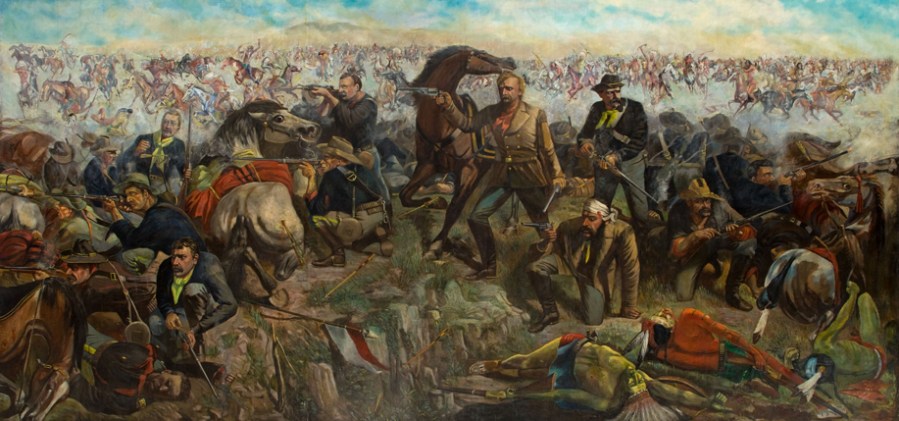
One hundred and three Irish soldiers perished on that fateful day, and yet another Irishman, John Mulvany, realizing the popularity a canvas of the battle would create, painted his iconic “Custer’s Last Rally,” which remains today one of the most celebrated paintings of the American West.
Custer’s Last Rally, painted by John Mulvaney (Photo sourced: Internet)
In the 1870s, the hard and dangerous life of an American cavalry trooper was still the best option for many poor, newly arrived Irish immigrants. In 1875, Custer’s 7th Cavalry was full of Irish-born recruits when gold was discovered in the Black Hills of South Dakota, the sacred ground to the Lakota. These soldiers must have known the danger they faced when the United States claimed the land and invaded it, despite treaties the American government had signed with the Lakota, guaranteeing them its ownership. The military’s armed incursion into the area led many Sioux and Cheyenne tribesmen to leave their reservations, joining the rebel leaders, Sitting Bull and Crazy Horse, in Montana. By the spring of 1876, more than 10,000 Native Americans were camped along the Little Bighorn River – defying a War Department order to return to their reservations and setting the stage for the famous battle.
The charismatic General George Armstrong Custer and almost 600 troops of the 7th Cavalry rode into the Little Bighorn Valley, determined to attack the native encampments. Riding with Custer were over 100 Irishmen, ranging in rank from newly recruited troopers, many of whom could barely control their mounts, to Captain Myles Keogh, a heroic veteran of the Civil War from County Carlow. There were 15 Irish sergeants and three Irish corporals in Custer’s command, the backbone of his noncommissioned officers.
Today, we imagine Custer wearing his trademark buckskin jacket – it was sewn by an Irishman, Sergeant Jeremiah Finley from Tipperary, the regiment’s tailor. The song of the 7th Cavalry was another Irish influence. Just prior to Custer’s arrival in Fort Riley, Kansas, where he took command of the 7th Cavalry, Custer ran into an Irish trooper who, “under the influence of spirits,” was singing “Garryowen,” an Irish song. Custer loved the melody and began to hum the catchy tune to himself. Custer made it the official song of the 7th Cavalry and it was the last song played before Custer and his men separated from General Terry’s column at the Powder River and rode off into history.
Centre section of The Battle of Aughrim, by John Mulvany. (Photo sourced: internet
John Mulvany, who is known for his paintings of the American West and in particular “Custer’s Last Rally,” also painted “The Battle of Aughrim,” in 1885, which was exhibited in Dublin in 2010. The battle, fought between the Jacobite and the Williamites forces in Aughrim, County Galway on July 12, 1699, it was one of the bloodiest battles in Ireland’s history, over 7,000 killed. The battle marked the end of Jacobitism in Ireland, a movement that aimed to restore the Roman Catholic Stuart King James II of England and Ireland (as James VII in Scotland) to the throne
Before the battle, the legendary Lakota chief Sitting Bull had a vision in which he saw many soldiers, “as thick as grasshoppers,” falling upside down into the Lakota camp, which his people saw as a foreshadowing of a major victory in which a large number of soldiers would be killed. Custer, however, blinded by ego and visions of glory, made a reckless decision to attack the huge gathering of Native Americans head on, saying, ironically, “Boys, hold your horses, there are plenty down there for us all.”
Foolishly splitting his command into three units, Custer tried in vain to attack and envelop the largest concentration of Native American fighters ever to face the American Army. The first assault against the Native American encampment was launched shortly after noon by three companies – 140 officers and men – led by Major Marcus Reno, whose men attacked along the valley floor towards the far end of the camp. Thrown back with many casualties, the survivors scrambled meekly for their lives to the top of a hill. Custer, with five companies totaling more than 200 men, advanced along the ridgeline, commanding the river valley on its eastern side. He further divided this force into two groups, one of them led by Captain Keogh.
There is debate about what occurred when Custer engaged the Native American forces just after 3 p.m. because the General and all his men were killed, so no one from Custer’s command could tell their tragic tale. Archaeological evidence suggests that Keogh and his men fought bravely, being killed while trying to reach Custer’s final position after the right wing collapsed.
On June 27, 1876, members of Gen. Terry’s column reached the Little Bighorn battlefield and began identifying bodies. Keogh was found with a small group of his men and his was one of the few bodies that had not been mutilated, apparently owing to a papal or religious medal that he wore about his neck (Keogh had once served in the in the Battalion of St. Patrick, Papal Army). Although Captain Keogh did not survive the battle, his horse, Comanche, did. The horse, spared by the Native American fighters for its heroism, recovered from its serious wounds and was falsely honored as the lone survivor of the battle (many other U.S. Army horses also survived). Comanche was retired with honors by the United States Army and lived on another 15 years. When Comanche died he was stuffed, and to this day remains in a glass case at the University of Kansas.
Comanche, Keogh’s horse, which survived his master who died at the battle.
(Sourced: Internet)
White Americans, shocked and angered by the defeat of Custer and his men, demanded retaliation. And they got it. Soon after, over 1,000 U.S. troops under the leadership of General Ranald Mackenzie opened fire on a sleeping village of Cheyenne, killing many in the first few minutes. They burned all the Cheyenne’s winter food and slit the throats of their horses. The survivors, half naked, faced an 11-day walk north to Crazy Horse’s camp of Oglalas.
The victory at Little Big Horn marked the beginning of the end of the Native Americans’ ability to resist the U.S. government, but 37-year-old John Mulvany from County Meath saw opportunity in the tragedy.
John Mulvaney, photo by Anne Webber (Sourced: Internet)
12 YEARS OLD IN THE USA
Mulvany arrived in America as a 12-year-old. He went to art school in New York City and became an assistant of famed Civil War photographer Mathew Brady. He later covered the Civil War as a sketch artist for a Chicago newspaper, developing an amazing ability to capture battlefields on canvas.
Mulvany knew that a painting of the fight would be a sensation. He visited the battlefield twice and also found Sitting Bull in Canada so that his painting could capture even minute details of the battle and its combatants. Mulvany finished the epic 11 ft. x 20 ft. canvas in 1881, which was hailed as a masterpiece, and began a 17-year tour of the United States. The canvas made Mulvany the toast of Chicago, but his good fortune would not last.
Sitting Bull of the Lakota, photo by William Notman. John Mulvany sought him out to consult him about the Battle of the Little Big Horn. (Image sourced: Internet)
Mulvany eventually sold his painting and ended up destitute in Brooklyn, where he drowned in the East River in 1909 in what many labeled a suicide. Mulvany quickly became forgotten, but not the fame of his great canvas, which recently sold for $25 million. Mulvany painted many great works, but they are lost and there is a concerted effort to find these missing canvases. Perhaps we will soon find more works of this great, tragic Irish painter.
Last Saturday (November 28th) saw the centenary of the Kilmichael Ambush, when a column of the West Cork IRA commanded by Tom Barry ambushed two lorry-loads of Auxiliaries and fought them to a finish, losing three of their own in the fight. It was a battle of tremendous importance in rural Ireland during the War of Independence, when the forces of British occupation of the nation turned to undisguised terrorism and employed the Auxiliaries as the knife edge of that terror. Despite the Covid19 pandemic restrictions, the 100th centenary was marked by physical commemorations in addition to on-line talks and articles. However, it appears that the “patriots” of the Far Right and fascists1 in Ireland failed to commemorate this important event – why might this be?
The Auxiliary Division were all ex-British Army officers but were recruited in July 1920 as a mobile strike force to bolster the British colonial police, the paramilitary Royal Irish Constabulary. This was in addition to another police support group which became known as the “Black and Tans”. The massive swelling of the ranks of the police was because the British rulers wanted to deny that they were fighting a liberation war and instead to present it as a policing problem (though they were obliged to use 20,000 British Army nevertheless)2. Both the ‘Tans and the Auxies gained a reputation for rough and arrogant treatment of civilians, torture of captives, theft, drunkenness and general indiscipline. However, a fear of the the “Auxies” had also grown, a feeling that they could not be beaten. The Kilmichael Ambush smashed that myth and was as important in the rural areas as the wiping out of much of the British intelligence network in Dublin was for the city.
Auxies raiding the James Connolly College and Irish Socialist Party at 42 North Gt. Georges Street, November 1920 (they raided the building twice that month, along with many other organisations considered subversive by the colonial authorities).
However although they have been posing as Irish patriots, we saw no sign of the commemorative celebration of the Kilmichael Ambush from the Irish Far-Right and fascists. They have played patriotic ballads and anthems often at events and strutted around under — and sometimes wrapped in — Irish flags. They have tried to appropriate Irish patriot heroes and martyrs including Wolfe Tone, James Connolly and Terence MacSwiney. But they left Tom Barry untouched.
Niall McConnell, head of the fascist organisation (registered as a business) Síol na hÉireann, posted about James Connolly as though Connolly would have supported McConnell’s type of people and claimed Connolly was born in Ireland. Laughable though it may be to think that revolutionary socialist and anti-sectarian, anti-imperialist Connolly would ever have supported a little Ireland religious sectarian and fascist like McConnell, the latter did try to appropriate him. And although Connolly was born to Irish parents in Edinburgh, where he grew up, that was not enough for McConnell, who had to claim he’d been born in Ireland.
Wolfe Tone, a revolutionary patriotic democrat who strove to unite the mass of people in Ireland of different religions and who fought for a secular independent state, would have crossed the street to avoid the likes of McConnell – but that didn’t prevent McConnell from trying to appropriate him.
Recently we passed through the 100th anniversary of the death on hunger strike of Terence MacSwiney – and they tried to appropriate him too. MacSwiney was a devout Catholic but the IRA, of which he was a prominent officer in Cork, was a non-sectarian body. Presumably MacSwiney, like his IRA comrades, fought under the principles of the 1916 Proclamation, part of which read: “The Republic guarantees civil and religious liberty to all ….” Nevertheless, got up somewhat reminiscently of the Ku Klux Klan, McConnell led a small torchlit group allegedly to MacSwiney’s grave and had himself videoed making a speech there.
Dee Wall (real name Dolores Webster), whose Saturday afternoon screeching on behalf of the QAnon negationists and conspiracy theorists assails the ears of people passing the GPO in Dublin and whose social media tries to reach those who avoided that experience, tried to claim MacSwiney too, only she pronounced the surname as rhyming with “tiny” instead of like “sweeney” (as one who had never heard the name before might from the spelling alone).
Jim Dowson, a British fascist and sectarian Loyalist, who has shared a platform with fascists Rowan Croft (aka “Tan” Torino) and Herman Kelly of the Irish Freedom Party (but formerly of UKIP), has cheered the armed fascists of the National Party in attacking unarmed counter-protesters, calling them “my Fenians”. Yes, bizarre to call his fascist comrades anything to do with the revolutionary Irish Republican Brotherhood but even more so when “Fenians” is one of the hate-names of Dowson’s Loyalist brethren for Irish Republicans.
Another centenary we passed by very recently with a number of commemorations held outside the stadium was that of the Bloody Sunday Massacre in Croke Park by Auxiliaries, ‘Tans and RIC. Apparently the fascist National Party sneaked in an early videoed commemoration of their own before anyone else on the day and left a wreath among other floral tributes there.
Yet, despite this focus on recent centenaries in the Irish struggle for independence, the “patriots” of the Far Right and fascists in Ireland seem to have let that great event of the Kilmichael Ambush slip them by without a commemoration of any kind. Not a murmur, not a video, not a post, not a photo, not even a tweet from these publicity-obsessed types.
The start of the action in the Kilmichael Ambush as depicted in a scene from Loach’s film The Wind that Shakes the Barley. (Image sourced: Internet)
THEIR PROBLEM WITH KILMICHAEL AND TOM BARRY
What possible reason could there be for this omission by the fascists and Far Right?
Was it because Tom Barry, who led that ambush was anti-sectarian and proved it by publicly punishing two men who had robbed from a Protestant chapel in West Cork? Doubtful, because that did not stop the fascists trying to appropriate Wolfe Tone, whose main effort was precisely to end sectarianism.
Photo of a young Tom Barry, guerrilla leader, on the cover of a reprint copy of his memoir (Image sourced; Internet)
Or was it because following the Kilmichael Ambush, the IRA were condemned by the Bishop of Cork, Daniel Colohan? We might be on to something there. “Demented” Dee Wall, Niall McConnell and National Party representatives all attended the anti-Muslim protest earlier this year, organised by Gemma O’Doherty, who unfurled a banner bearing the slogan “Make Ireland Catholic Again”, where they prayed the rosary through amplification. The new fascist parties, far-right organisations and the anti-mask people are building on the remaining fundamentalist hard-right reactionary core of the Catholic Church in Ireland who have seen its grip on the social and political life of society slipping over the years, due to its scandals and people’s democratic desire for equality.
By the way, Barry commented in his memoir that, although practicing Catholics, the threat of excommunication deterred the patriots of West Cork not in the least, as they were able to separate their religious from their patriotic views.
It may be that the false patriots have another problem with Barry: he fought against the Free State at least twice. Tom Barry, like the overwhelming majority of the military part of the resistance movement, rejected the terms of the Anglo-Irish Agreement of 1921 and refused allegiance to the 26-County Free State. The latter, in 1922 under Michael Collins, opened artillery fire upon the Republicans, launching a civil war which persisted until 1923 and during which the State, apart from those killed in battle, killed at least another 120, either through shooting prisoners, martial court executions or covert assassinations. Barry was part of the IRA’s leadership in the Civil War.
Bombardment of Republican-held Four Courts in Dublin by Free State forces from the bottom of Winetavern Street (with British artillery on loan) starts the Civil War on 28 June 1922 (Source Internet)
Although because he felt the war could no longer be won and was narrowly outvoted on ending it, Barry had resigned his leadership position shortly before the end of the Civil War, he rejoined the IRA leadership in 1927 and was jailed by the DeValera Government in 1934 for seven months on a charge of illegal possession of firearms.
In March 1936 Barry was suspected — but never charged — of involvement in the assassination of retired Vice-Admiral Henry Somerville at his home in Cork, because he was attempting to recruit people into the British Naval forces3. In 1937 Tom Barry was elected Chief of Staff of the IRA after the resignation of Seán McBride but resigned the position himself in 1938 over a tactical dispute.
Yet another problem for the Far Right and the fascists is that from the 1970s onward, though he publicly disagreed with some of their actions, Tom Barry stated he supported the Provisionalsand later, Republican prisoners in the H-Blocks. At a commemoration at Crossbarry in 1980, the scene of another of Barry’s famous battles, shortly before his death, he was quoted as saying:
‘I don’t want you to fall out4 until the same prayers are said for men who are being crucified in H-block, Long Kesh. I want you to say prayers for them to show our unity with these men, many of whom are completely innocent and are railroaded by the same British that killed these men whom we are commemorating.’
The Far Right and fascist “patriots” have a big problem with the Provisionals5 and others who were, during the recent war of three decades, at the time fighting against British occupation for a united, independent Ireland.
IN CONCLUSION
Of course, given their flexibility with history, logic and integrity6, there is no guarantee that at some time in the future the Far Right and fascists will not try to appropriate the Kilmichael Ambush. However, their present difficulty with commemorating the event and celebrating the memory of a true patriot, Tom Barry, exposed the false patriotism of the Far Right and fascists in Ireland. But it did more: it gave a clear indication of what they do support.
The Far Right and fascists in Ireland support:
the 26-County neo-colonial State
the continuation of British colonial occupation and division of Ireland
a Catholic Church dictating in political and social affairs to the population within the Irish state
The Far Right and fascists, for all their slogans about “freedom”, “free speech” and posturing as “patriots”, are in oppositionto freedom, both national, social and individual. There is nothing patriotic about them.
End.
FOOTNOTES:
1 Though the dividing line in Ireland between most of of the Far Right and committed fascists is a thin one, it nevertheless exists but it is important to note their past cooperation in staging public events and the continued presence of fascists within the Far Right.
2 Wikipedia gives the following figures: British Army 20,000; Royal Irish Constabulary 9,700; Black and Tans 7,000; Auxiliary Division 1,400; Ulster Special Constabulary 4,000 (i.e a total of 42,000 combatants). These were opposed in fighting by little more than 15,000 IRA and about 250 ICA (although those were supported by a large network of formal and informal non-combatants).
3 With the signing of the Anglo-Irish Agreement of 1921, the British had retained the three deepwater “Treaty Ports” of Lough Swilly in Donegal, Berehaven and “Queenstown” (Cóbh) in Cork. The Irish State took these ports over with British agreement in 1938. De Valera’s refusal to allow the UK to use these ports during WW2 led to a threat of invasion by Churchill and the resultant declaration of an “Emergency” by the Irish Government and recruitment into its armed forces; the threat was unfulfilled and the Irish State remained neutral through the war though generally friendly to the Allies.
4 A military parade command: “Fall out” indicates that the parade is formally over and soldiers may disperse for recreation or take up other duties.
5 However the history-illiterate Dee Wall of the QAnon group, protesting outside Maghaberry Jail in solidarity with an anti-masker jailed for a few days in Maghaberry for refusing to give his name, stated that Bobby Sands had died there. Bobby Sands, the first of ten hunger strikers of the Provisional IRA and of the INLA, died on hunger strike in the H-Blocks of the Maze prison, which was closed 20 years ago.
6 Along with their willingness to libel with the most vile and outlandish personal accusations individuals who oppose them
On October 31st two people died, one known around the world for his cinema roles, Seán Connery, who played James Bond and many better and less well known roles. The other death was that of the Colombian liberal politician Horacio Serpa. No sooner had he died the liberals and NGOs and all the former revolutionaries began to write and comment on the life of Serpa with a script that not even Connery could convincingly play.
So, just who was Horacio Serpa and what was his role in Colombian politics? His body hadn’t time to go cold and they were already rewriting the history of the country. The headline on El Espectador said it all, Remembering an Authentic Liberal. i Of course part of the problem depends on what you understand as a liberal, as in the current times when they talk of liberals and the Liberal Party one can barely recognise that it is and always has been the party of a sector of the Colombian oligarchy, that it is the party that gave us legalised paramilitaries, it is the party of massacre after massacre and of course they talk about it as if it wasn’t Liberal Party that gave us the health reform Law 100 (the liberal senator Uribe was the the speaker to the motion on the law, but the law was a proposal from the entire Liberal Party), nor that it was the party that gave us the infamous economic aperture of 1990.
So, for starts, Horacio Serpa who was the Minister of the Interior, under Samper, a government which deepened the aperture, was a neoliberal politician. In the midst of the political poverty of the current Colombian left, such as statement comes across like a grenade thrown or a burst of gunfire against Serpa’s good name. But, how are we to describe a minister in a neoliberal government as anything else? They say we shouldn’t and part of the problem is there are those who forget who President Samper was and what his government’s policies were. Worse still, they forget their own criticisms of that government. So let’s remind ourselves. Serpa was a neoliberal. Of course, he was a neoliberal speaking out both sides of his mouth, capable of calming the angels whilst defended the devils tooth and nail. A man of the right wing at the service of the oligarchy who with his populist discourse made himself out to be a progressive. Once again, some will say he wasn’t right wing. Is there another type of Minister of the Interior? Not only was he Minister of the Interior under Samper and champion in defending him against accusations of links to drug traffickers, but also he would later be Uribe’s ambassador to the Organisation of American States.
As we are in Colombia and politicians like Serpa are very deft, there is no lack of supposed lefties who will talk about how Serpa helped them. So in order to see what he was really like we should deal with some examples when Serpa did the exact opposite. In his passage through the Procurator General’s office he did nothing for the disappeared from the Palace of Justice. It was not at all surprising given his own role in that. The then Procurator Carlos Jiménez Gómez drew up a report and formerly denounced to
… the House Commission of Accusations President Belisario Betancur and his Minister of Defence, Miguel Vega Uribe for violating the Constitution and the Law of Nations now known as International Humanitarian Law.
The Procurator Jiménez’s denunciation with precise hard-hitting proof in hand was shelved through a motion presented by the representatives Carlos Mauro Hoyos, Horacio Serpa and Darío Alberto Ordoñez, arguing that “it was a typical act of government in the most important area under the remit of the President of the Republic namely to uphold public order and re-establish it wherever it has broken down”.ii
That is Horacio Serpa, the man who ensured that there would be no investigation of the events. A friend and accessory after the fact of criminals. It is worth pointing out that two of those who suppressed the accusation would later hold the office of procurator, Hoyos was the successor to the whistleblower Jiménez Gómez and Serpa then replaced Hoyos and thus the truth was buried underneath the ruins of the palace and the manoeuvres of Serpa and company.
But some claim he was a friend of the workers and an enemy of paramilitaries. Leave aside that he served in governments that actively promoted paramilitaries, those of Samper and Uribe and lets look at when workers reached out to his office to seek protection. After the 1995 massacre of palm workers in San Alberto, Cesar, the workers met with Horacio Serpa who was the Minister of the Interior at the time. In their oral history published in 2018, the workers narrate how Serpa told them “there was nothing that could be done as the paramilitary project was very big, and upon finishing the meeting and when we were heading towards the door he said ‘lads it is best that you be careful, because in this country if you stick your head above the parapet it will get knocked off.”iii Of course, he didn’t want to do anything to protect the workers of the palm company Indupalma, whilst at that exact time both he and his government maintained a military base within the plantation to protect the company’s assets. That is Horacio Serpa, loyal friend of the oligarchy, traitor speaking out both sides of his mouth to the workers, a defender of criminals such as the murderers behind the events of the Palace of Justice and a man capable of placing an entire battalion at the disposition of a company in order to protect it and not lift a finger to protect the workers in that company.
So, on October 31st, one of the greats died who we will remember fondly, with admiration, someone who contributed positively to our lives. Rest in Peace, Seán Connery.
After a military invasion by the Moroccan Kingdom into the “buffer zone” in Western Sahara, the Polisario Front, liberation and resistance organisation of the Saharawi, gave the MINURSO (UN) mission in Western Sahara 12 hours to leave the territory. Meanwhile the Polisario also retaliated against the Moroccan occupation with an attack against the Wall, while young Saharawi confronted occupation forces in a number of localities.
According to sources close to Polisario, the Saharan People’s Liberation Army, in response to the Moroccan invasion, undertook artillery strikes against Moroccan military targets along the Moroccan military wall that cuts through Western Sahara. The targets of the attacks were the following Moroccan military bases and surveillance points along the wall: Moroccan military base No.23 (Mahbes), Moroccan military base No.4 (Hauza), Surveillance Point No.71, Moroccan military base No.17 (Oust), surveillance point No.172, Moroccan military base Nos. 17 and 18. A press release from the Saharan People’s Liberation Army added that its fire on Moroccan military positions led to human casualties and material losses for the Moroccan Army and that Moroccan soldiers fled some of their positions along the Moroccan Wall.
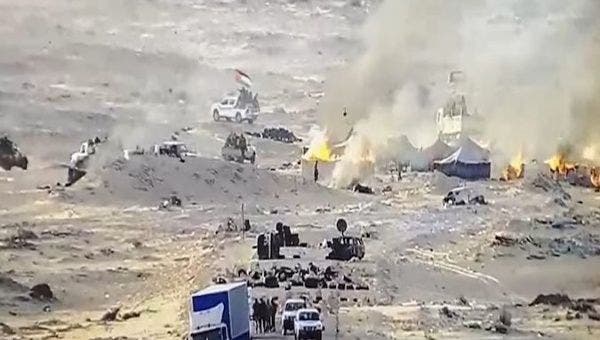
Conflict at the protest camp as Moroccan forces attack civilian protesters.
(Photo source: Telesur)
The Polisario also alleged that Moroccan forces had attacked Saharawi civilians who had gone to protest peacefully at the first breach of the buffer zone, at Guerguerat, civilians which subsequently the Polisario had evacuated safely. Subsequently Moroccan military had breached the zone at another three points, it alleged.
The General Secretary of the Polisario Front, Brahim Ghali, gave a press statement in which he announced the retaliatory attacks against what he called a violation of the 1991 ceasefire, “repeatedly violated by Morocco” but which, with the invasion of the buffer zone, “has now gone past the point of no return”.
Leader of the Polisario, Brahim Ghali, giving a press statement. (Photo source: ec.saharaui)
“DIFFICULT TO RESTRAIN THE YOUTH”
Over the years since 1991, as no progress towards independence seemed to be made, the Polisario leadership has at times found it difficult to restrain its youth from returning to armed struggle. And Moroccan police have carried out much repression of peaceful protest demonstrations, plain-clothes officers beating even women and children in the street. At a conference in Dublin last year (see Rebel Breeze report link below) representatives of the Saharawi people spoke about the human rights abuses by the Moroccan authorities in Western Sahara and about the discrimination and deprivation of the Saharawi people in a number of important areas of life.
At the above conference, despite reference by a number of people to a “Western Saharan peace process”, in reply to a direct question from the floor, the European representative of the Polisario, Mr. Mohamed Belsat, tacitly admitted that no such process existed and talked about the Polisario’s difficulty in restraining the Saharawi youth.
Mohamed Belsat of the Polisario speaking at the conference in Dublin last year (Photo: D.Breatnach)
A source close to Saharan activists from the city of El Aaiún confirmed that dozens of young Saharauis in the El Inach Matalaa and Tatan districts were confronting Moroccan gendarmerie and police patrols during the early hours of Friday evening. According to the sources, these protests against the occupation and support for the start of war against the regime have shifted and hardened in the Ghiyadet, Bucraa and Lahum districts. The source consulted stated that as of Friday night, the riots against the occupation administration in the city of El Aai ún were continuing.
BACKGROUND
The Spanish colony of Western Sahara (also known in the past as “Spanish Sahara”) was abandoned by the Spanish State in 1975; instead of decolonising it and facilitating a referendum on independence, the Spanish State’s evacuation cleared the stage for two neighbouring states to invade the country: the Kingdom of Morocco and Mauritania.
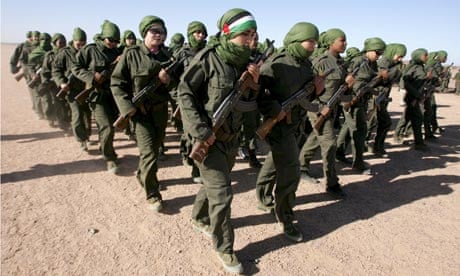
The Saharawi people formed the Polisario Front guerrilla organisation to resist the invasion and occupation of their land and also formed a government in exile, the Saharawi Arab Democratic Republic, in Tindouf in Algeria. Mauritania relinquished the territory it occupied and any claim to Western Sahara in 1979 but Morocco continues to pursue its annexation and its attendant repression of the Saharawi people.
Female fighters of the Polisario about ten years ago (Photo source: Inernet)
“Western Sahara has been described as the last colony in Africa and has been illegally occupied by Morocco since 1975. Morocco is obliged under international law and as a member of the UN to allow a vote of self-determination for the people of the territory. Yet for 35 years 165,000 Saharawi people have lived in refugee camps in Southern Algeria, ethnically cleansed from their own country. Morocco built a 2,700km wall visible from Google earth to stop the Saharawi people returniing to their country.” (From press release at the launch of Western Sahara Ireland Action group in November 2010).
Formally the UN considers that the Saharawi people have the right to self-determination and recognises the Polisario Front as the legitimate representative of the Saharawi people. In 1991 the UN brokered a ceasefire and established a mission on the territory. However over the years the UN has failed to take any action and many people have wondered at the point of its mission there. Interestingly, it is the only UN permanent mission that does not have a human rights watch brief. At the same time, the Moroccan authorities put a media blanket over Western Sahara to prevent reports of repression, including torture, emerging or, if leaked out, being investigated by journalists.
In addition, the ceasefire agreement authorised Morocco to administer two-thirds of the country and most of the Atlantic coastline, which has facilitated its plunder of Western Sahara’s natural resources and by others, including by EU states. One of the big member states of the EU, France is a big supporter of its former colony, the Kingdom of Morocco and the US has also tacitly to date supported Morocco.
A referendum was supposed to be held after 1991 but it kept getting blocked as Morocco disputed the terms under which it would take place. About 85,000 voters were identified by the UN in 1991, nearly half of which were in the Moroccan-controlled parts of Western Sahara, with the others scattered between the Tindouf refugee camps, Mauritania and other places of exile. The Polisario accepted this voter list, as it had done with the previous list presented by the UN (both of them originally based on the Spanish census of 1974), but Morocco refused and, as rejected voter candidates began a mass-appeals procedure, insisted that each application be scrutinised individually. This brought the process to a halt once more.
The ceasefire agreement of 1991 also provided for a buffer zone in Western Sahara which, in effect, protects the Moroccan wall from Saharawi attack but was supposed to protect the Saharawi also from further Moroccan incursion. This zone by Morocco’s Wall was to be patrolled by the UN but it was that same zone which the Moroccan Army has now invaded; the Polisario have obviously lost patience with the state of affairs, retaliated against Morocco’s troops on the Wall and ordered the UN Mission to leave the country.
A soldier of the UN MINICURSO in Western Sahara — where were they when the Moroccan Army came through the buffer zone supposed to be patrolled by the UN? (Photo source: PUSL — para una sahara libre)
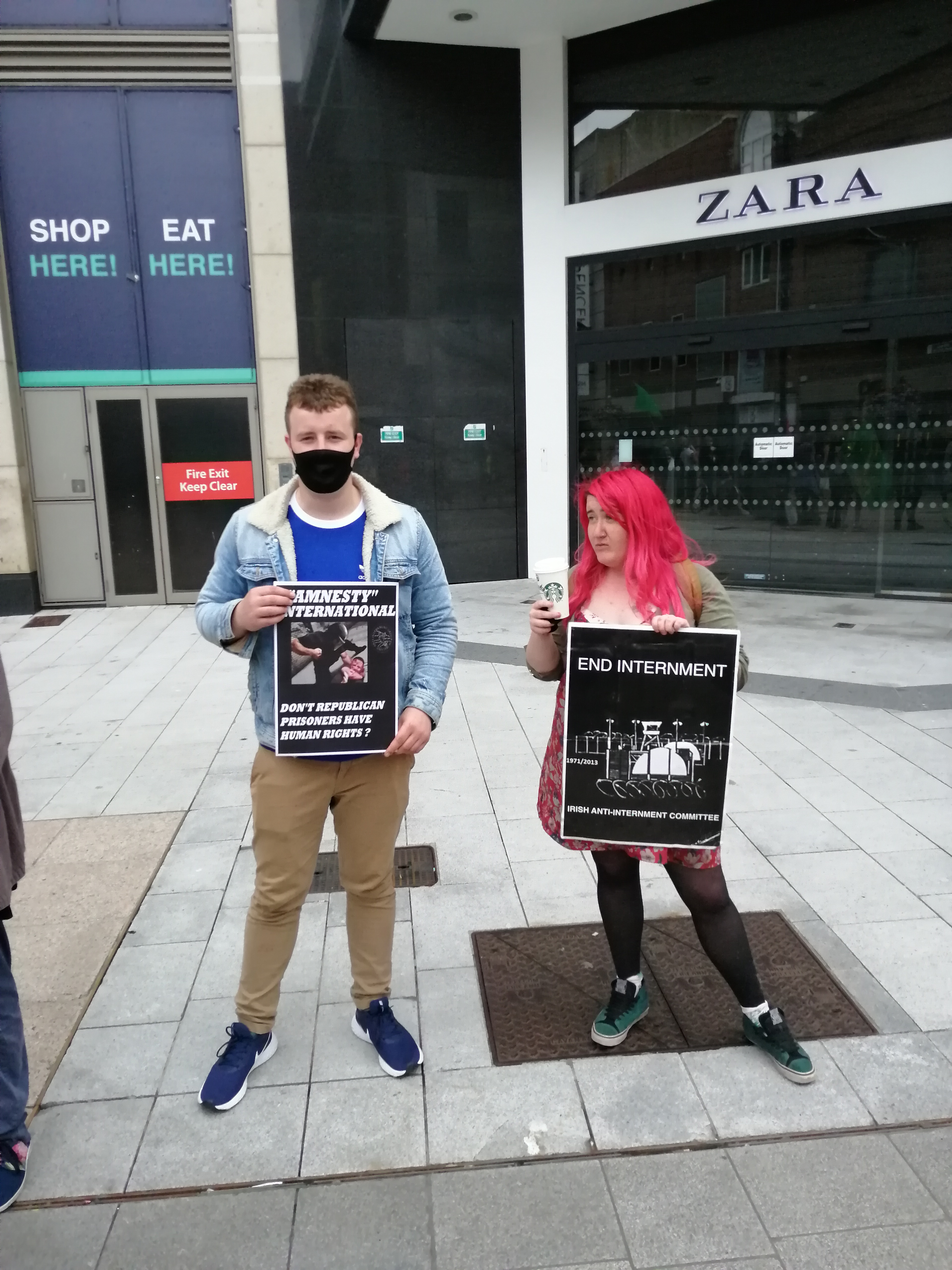
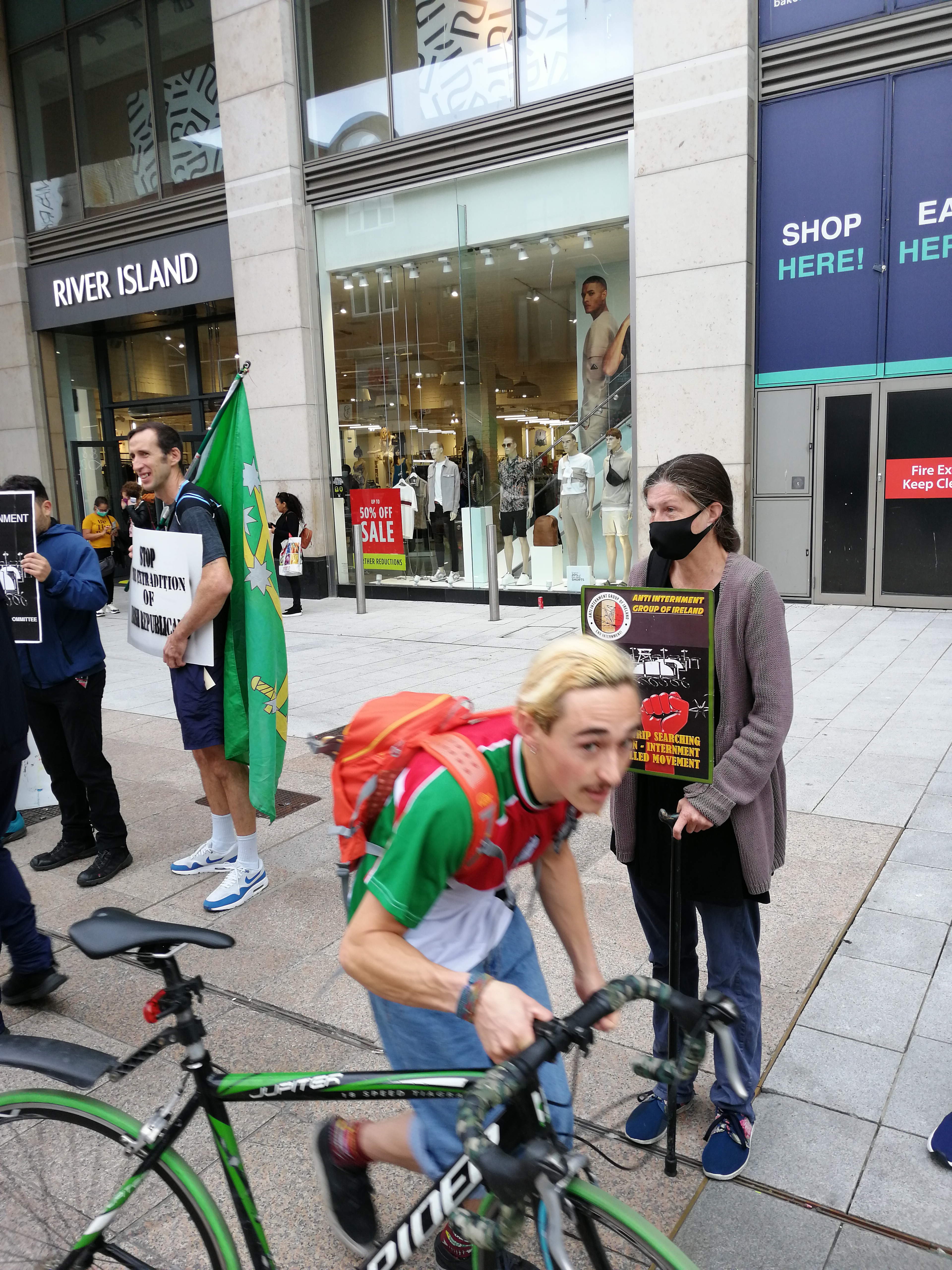
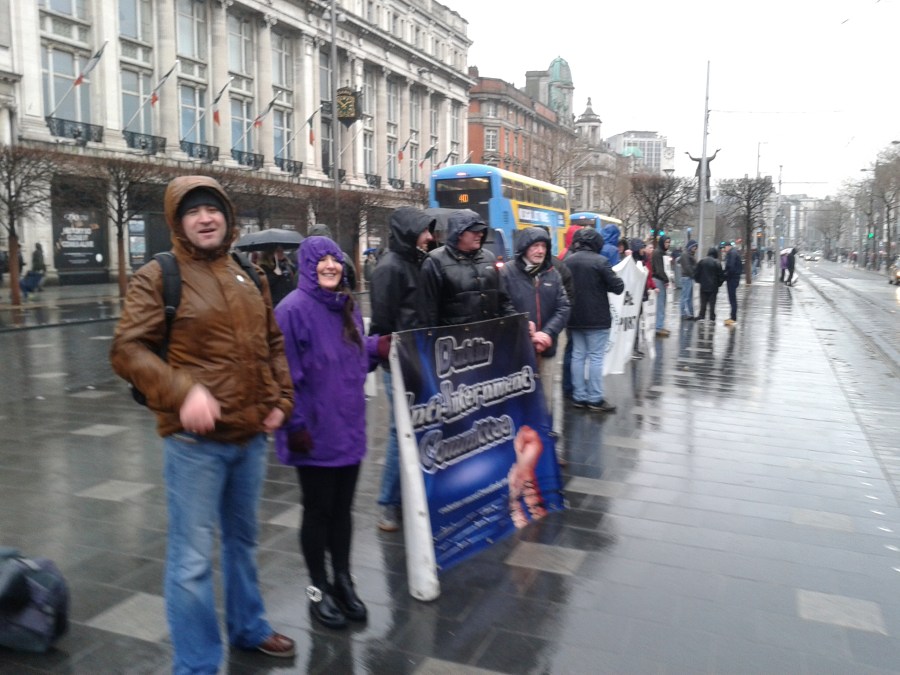
The monthly picket of the Dublin Anti-Internment Committee on Saturday attracted broad support across the spectrum from Irish Republican to Anarchist and revolutionary Socialist. Shoppers and passers-by on Dublin’s busy Henry Street observed the picket with interest, some stopping to engage the picketers in discussion. Several hundred leaflets were distributed explaining that, albeit under another name, internment without trial continues in Ireland on both sides of the British Border.
The anti-racist group on Henry St just before the anti-internment picket (Photo: D.Breatnach)
Just prior to that event, a mostly young Black Lives Matter campaign group had held a lively protest also in Henry Street and the Debenham’s sacked workers’ campaign were demonstrating outside the entrance to the store from which the staff were sacked while they were out due to the pandemic lockdown. The BLM group protest then moved to the Spire and apparently there had been a protest about political prisoners in Belarus outside the GPO, while the Far-Right and fascists gathered to support an Irish Yellow Vests demonstration outside the Custom House on the north quays. Earlier there had also been a protest in Molesworth Street at the auctioning by Whyte’s of a large number of artifacts of Irish history, including a Wolfe Tone’s handwritten notes for his address to the court that sentenced him to hang in 1798.
The two banners and a few of the protesters. (Photo: D.Breatnach)
AGAINST EXTRADITION
As well as about the practice of jailing Republican activists without jail, the picket today focused on the cases of three Irish people being extradited to other states and of Georges Ibrahim Abdallah, 36 years so far in a French jail.
A spokesperson on the issue of extradition pointed to, apart from Liam Campbell, another two Republicans: Ciaran Maguire, currently in Port Laoise jail fighting extradition to the Six Counties British colony and Sean Farrell, who was extradited there fairly recently from Scotland. The spokesperson conveyed solidarity greetings to their families and supporters and, in regard to Maguire and Farrell, to stated their attendance in order to “highlight injustice by the British and the the ineffectiveness of the ‘Free State’ Government” in allowing these.
video-1595691448.mp4
(Photo: D.Breatnach)
Liam Campbell is a veteran Irish Republican whom the Lithuanian state seek to extradite to face charges of arms smuggling but he has never been nor is he accused of ever having set foot in that country. For a state to be able to extradite a person who has never been in their country is a serious precedent to set — it would have permitted the USA for example to extradite Julian Assange to face trial there for what a number of their politicians have described as “spying” — i.e exposing many dark secrets of human rights violations through “Wikileaks” In fact the USA military brought prisoners to an illegal jail they ran in Lithuania for which they were heavily criticised. Nevertheless a judge in the Irish High Court has agreed to the extradition and Campbell, currently in custody, awaits to appear in court to be served with the warrant and flown abroad. During this week Donegal Council passed a motion condemning the extradition of Campbell and will be writing to the Government to ask that the extradition be not permitted.
(Photo: D.Breatnach)
36 YEARS IN JAIL, SEVEN YEARS PAST RELEASE DATE
According to the End Internment FB page, this month’s international focus was on Georges Ibrahim Abdallah, Lebanese but “in a French jail for 36 years now due to fighting in defence of Palestine during the 1982 Lebanon War. 14 January 2013 was the scheduled date for Abdallah to be released and deported to Lebanon after almost 30 years of imprisonment in France.”
Georges Ibrahim Abdallah. (Photo source: Internet)
BIG POWER INFLUENCE
There are allegations that both the extradition demands and the ongoing keeping in jail of Georges Ibrahim Abdallah are influenced by the interventions of other powerful states. It is claimed that Campbell’s extradition to Lithuania is influenced by the UK authorities, although similar charges against Campbell have already failed to have him convicted by a British court. In Abdallah’s case, after a number of legal cases his release date was set for six years ago but the USA objected, the French Minister of the Interior then refused to sign his release papers and Abdallah remains in a French jail.
Commenting on the picket today, a spokesperson for the Dublin Anti-Internment Committee indicated that the organisers were pleased with the numbers attending and the broad spread of political ideology represented there.
“The Starry Plough” flag of the Irish Citizen Army and two banners (Photo: D.Breatnach)
“We are an independent committee and we welcome the participation of all who are genuinely concerned with civil rights, in particular the right to organise and to protest to affect change” said the spokesperson. “Today there are Irish Republicans, Anarchists and revolutionary Socialists here, many of them independent activists and we view “that very positively. Indeed there are other bodies that we think should be represented here too – the protection of civil rights is a concern for all democratic people.”
The Dublin Anti-Internment Committee expects to organise another picket on similar issues next month, the details as usual to be announced on the End Internment FB page.
(Photo: D.Breatnach)
End.
The Palestinian flag was flown in solidarity with Georges Ibrahim Abdallah, a Lebanese but a fighter for the Palestinian cause. (Photo: D.Breatnach)
Mick Healy of the Irish Marxist History Project was kind enough to interview me about some of the issues about which I have been active. Parts I and II were published together a couple of months ago and here’s Part III now.
Mostly its snippets about the founding of the Irish in Britain Representation Group, my involvement in the foundation of the Lewisham branch of IBRG in SE London and from there, the Lewisham Irish Centre. Also my participation in Kurdish solidarity and a trade union delegation to Turkish-occupied Kurdistan (the YPG placard photo is of me in Trafalgar Square, London a couple of years ago when I was over visiting kids & grandkids) and the anti-water charge campaign in Ireland.
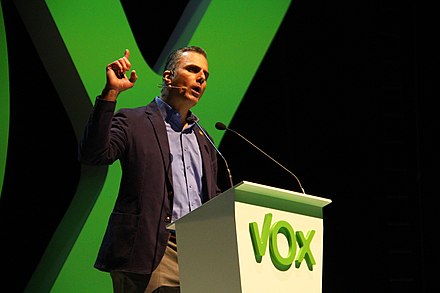
Javier Ortega Smith, No.2 in the leadership of the fascist Spanish party Vox recently attacked the Basque language, he did more than reveal the hatred of the core of Spanish unionism for the diversity of national cultures currently in existence within the Spanish state – he revealed his abysmal depth of ignorance about how languages, including his own are formed. And got lambasted and ridiculed in comment even in some conservative media as also social media, especially in tweets.
“Vox in the Battle for Spain” (uncertain whether this meme is intended in irony or not). (image source: social media)
Javier Ortega Smith, No.2 in the leadership of Vox, speaking at a party rally. (Photo source: Internet)
Vox was on an expedition into what is for them electorally virgin territory in the run up to the elections in the Basque Country Autonomous Region this weekend, where they have no elected representation at all. Far from what might have been expected, their presence and speeches seemed calculated to arouse hostility and expose their few supporters there to embarrassment.
Gaining the prize for generating hostility was Javier Ortega Smith, No.2 of the Vox party, speaking in Vitoria/ Gastheiz in Alava, one of the three provinces of the “Basque Autonomous Region”. Calling the second party in electoral strength in the region “terrorists” would cause little surprise, since EH Bildu is descended from Herri Batasuna, which was once associated with the armed group ETA and considered by some to be terrorists (by others, freedom fighters). But to say of the party of main electoral strength, the Basque Nationalist Party, that they are only “four cats”, equivalent in English to “three men and a dog”, this in a region where Vox has failed to get even one delegate elected …. well!
But Ortega Smith really put his hoof in it when he blundered into linguistics. “Asturian (language) is invented and Euskera (Basque language) also,” he declared, going on to declare that Batua, the standarised form of the Basque language, was formed “from dialects” of communities “who would not even have understood one another.”
Asturias, to the north-west of the Spanish state, with a population of around 1.02 million, is in some cultural expressions a Celtic nation but their language is of the Romance group, like Castillian (Spanish), with contributions from the Iberian-Celtic of the Astures tribe and later Germanic languages of the conquering Visi-Goths and Suevi. Euskera, the Basque language, is of uncertain origin but certainly ancient and currently spoken over the seven provinces of the Basque nation, three under French and four under Spanish control (total population a little over 2.17 million). All languages in the Spanish Kingdom other than Castillian have come under suppression at one time or another and most widely and rigorously under the four decades of the Franco dictatorship, a period nostalgically recalled by fascists and by even many conservatives in the Spanish state. What language has rights where and at what level is a battleground of struggle with the central State and a preoccupation for Spanish unionists.
Anyone who understands even the basics of how languages and their vocabularies are formed and developed would not have dared make such a statement as did Ortega Smith.
One would not even need to know that English, belonging to the Germanic group and currently a dominant world language, has a vocabulary which is 60% from French, with heavy sprinklings of words of Greek and Latin origin. Latin, which was a ‘world language’ before English, French or Spanish, started life as a Romance language in small province of Italy called Latium. Latin influenced heavily the development of Castilian, which includes many words of Arabic origin as well as from other languages and yes, even from Euskera! Nearly all European languages are thought to have developed from an Asian ancestor something like Sanskrit, so that they are grouped together as ‘Indo-European’. And what language was spoken in Europe before the advent of those Asian-influenced tongues? None other than Euskera, probably the original language of the early early Neolithic settlers!
Still, who needs knowledge when prejudice is king!
Some of the social media comments are sarcastically amusing, reproduced here in translation:
“Asturian is invented and Euskera also. Unlike Spanish which already existed in the time of the dinosaurs” or
“unlike Spanish, which came out of the Big Bang” or
“unlike all the other languages, that only use words growing on trees” or
“Unlike Castillian (Spanish) which arrived in Noah’s Ark with all the words”.
“Do you know how to say Ortega Smith in the Valencian tongue? ‘IGNORANT’”
“Well now, Ortega Smith, the vocabulary of all the languages of the world are invented, like your patriotism.”
“Ortega Smith is sure that the Basque Language has been taken from The Lord of the Rings.”
The Vox party was formed in 2013 from an extremely right-wing political core that has contributed in turn to the creation of the Partido Popular, from former supporters of Franco and Ciudadanos before going on to the creation of Vox. It has campaigned for the abolition of the statutes of autonomy for regions, for the right of parents to withdraw their children from liberal sex and gender education, spoken against a focus on male violence against women. The party climbed in popularity in recent years, in particular in the more economically depressed regions and now has 52 deputies in the Spanish Parliament and four MEPs.
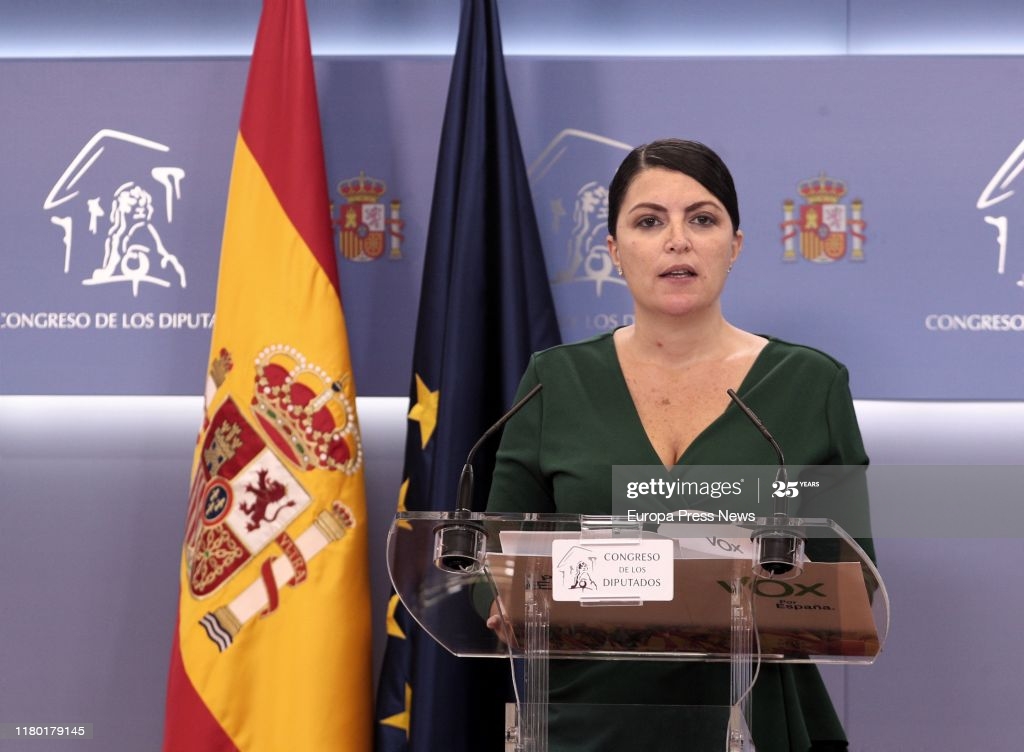
Spokeswoman of Vox party Macarena Olona, who also spoke in the Basque Country. (Photo source: Internet)
Still intent on their version of making friends and influencing people, on Wednesday in Oñati in Gipuzkoa province, where Vox carried out a ceremony to honour the militarised Spanish police force, the Guardia Civil, spokeswoman for the fascist party Macarena Olona screamed at protesters that “Oñate is in Spain, you crockful of ETA!Oñate is in Spain!” In this township of 11,000 people Vox received, in the last general election, a total of 21 votes.
Basque opposition to Vox back in June in Donosti/ San Sebastian when the party representatives left under police escort. (Photo source: Internet)
Basque riot police confronting Basque crowd hostile to Vox. Later the police charged the crowd. (Photo source: Internet)
Throughout their visits to the Basque Country, Vox representatives were surrounded by Basque police and left quickly after their rallies.
On June 24th, as the repressive Offences Against the State Act was up for debate in the Dáil, it was voted for renewal by TDs of the Fianna Fáil, Fine Gael and Green parties, along with Labour, while only a Solidarity/People Before Profit and two Independent TDs voted against. For the first time since Sinn Féin had TDs present in the Dáil in 1997, they abstained in the vote. They failed to vote against an undemocratic Act that was brought into being precisely to repress their own political ancestors.
The Offences Against the State Act was made law by the De Valera Government (Fianna Fáil) in 1939 and 1940 to nullify the writ of habeas corpus served by Seán McBride (Irish Republican, former IRA officer and later one of the founders of Amnesty International) which gained the release of IRA prisoners interned without trial under the previous Emergency Powers Act 1939. The Act established the Special Criminal Court which processed the rearrested internees and sent them back to prison and concentration camp in the Curragh.
BRITISH INTELLIGENCE FATAL BOMBING HELPED TOUGHEN LAW AGAINST REPUBLICANS
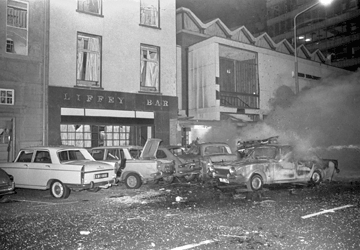
In 1972 the Fianna Fáil Government sought to strengthen the Act even further, among other attacks on civil liberties to permit an inference of guilt by the Special Criminal Court from refusal to answer questions by the Gardaí, along with the taking of a senior Garda officer’s word, unsupported by any substantial evidence, as the main “proof” of membership of an illegal organisation. However, the forecast looked bad for the Government since the Labour Party and Fine Gael were predicted to vote the Amendment down. During the debate, two bombs exploded in Dublin killing two Dublin public transport workers and injuring a number of others, some horrifically (two years later a similar bombing team was to kill 33 and injure around 260 in Dublin and Monaghan). The 1972 explosions, most likely the work of Loyalists working with British Intelligence, were blamed on the IRA and the opposition to the Amendment crumbled, ensuring it passed into law — and there it has remained.
A photo of the bombing adjacent to Liberty Hall (Photo source: Internet)
The Act empowers the Government to bring internment without trial into force by order (i.e without debate, even if the Government should be a minority one). Among its powers the OAS permits the State to ban organisations and subsequently (with its 1972 Amendment) jail people for membership of said organisation, the unsupported testimony of a Garda not below the rank of Chief Superintendent being considered prima facie evidence of said membership.
In a state where trials of all indictable offences under criminal law are by jury with a judge presiding, the Special Criminal Court is a non-jury court. Virtually all Irish Republicans serving time in prisons of the State have been convicted in the SCC, where even the unsupported word of a senior Garda officer is considered important proof and the standard of additional evidence required is very low. As one might expect in such conditions, the conviction rate is unusually high. On the charge of “membership of an illegal organisation” and largely on the word of senior Garda officer, conviction is almost certain and becomes an easy way to remove Irish Republican activists from circulation for the standard two years.
“GREATEST MISCARRIAGE OF JUSTICE IN THE IRISH STATE”
In two trials in 1978, the Special Criminal Court, in what has been called “the greatest miscarriage of justice of the Irish State”, tried and sentenced three Republicans to long terms of imprisonment for a mail train robbery at Sallins in which they had played no part. The judges in the Court chose to believe what 12 jurors would likely not have done: that the defendants had voluntarily confessed to actions they had not committed, that they had not been beaten by Gardaí and that the defendants’ bruising had been self-inflicted. The Garda “Heavy Gang” went on to obtain “voluntary confessions” from others, including Joanna Hayes and her relations in the “Kerry Babies” case, later also cleared and recipients of a Government apology in 2019. Those convicted of the Sallins mail train robbery were eventually cleared and released. The circumstances of those false “voluntary confessions” accepted by the SCC have never been investigated.
A poster from the campaign in support of four framed activists in the Special Criminal Court. All but the last one to the left were convicted and sentenced for up to 12 years, being eventually exonerated after long campaigning. The Gardaí involved were never even disciplined and some went on to frame others. (Image source: http://www.thewhistleblower.ie).
Joanna Hayes, another who “confessed” to a crime she had not committed as did members of her family. Some of the Garda Heavy Gang, permitted by the SCC to get away with beating false confessions in the Sallins Train frameup, went on to be involved in the Hayes case. Even after the Government and Gardaí apologised to her years later, still no investigation. (Photo source: Internet)
In 2001 Colm Murphy was convicted in the Special Criminal Court of conspiracy to cause a bombing on the basis of Garda evidence which Murphy said was untrue — but the judges chose to believe the Gardaí. The Court of Appeal ordered a retrial when it was shown that the Gardaí’s notes had been fabricated and Murphy was cleared in the SCC in 2010.
In 2003 Michael McKevitt was convicted in the Special Court of leadership of the Real IRA on evidence widely believed not to have met the standard necessary for conviction, including that given by a paid informer. McKevitt is still serving his 20-year sentence.
Although the title of the Court includes the word “criminal” it was clearly created for political purposes and until 1998 all but one of its trials have been of Irish Republicans. That did not prevent the TDs of the Greens, a party with a record of previous opposition to the Act, using gang crime along with Labour as an excuse for voting for the Act’s renewal during the recent debate.
“THE SPECIAL BRANCH ACT”
The granting of wide powers to the State to use against their political opponents has resulted in even those powers being regularly exceeded. Without ever even charging anyone with any crime, the Act has been used by generations of the Special Branch, the political police renamed the Special Detective Unit, to harass and intimidate Republican activists and their supporters. People have been approached and their contact details demanded by these secret police when they have attended a protest picket or rally, public meeting, visited a Republican office or were observed talking to a Republican. People have been searched in the street, had their vehicles stopped and searched also.
Sellers and distributors of Republican newspapers have been harassed and threatened. Without any authorisation even by the Act, officers have approached parents of young activists and their school or college, as well as the place of employment of older activists, to express their concern at the activity or associations of the activists concerned. Officers of the special unit, all of which go armed, have displayed their weapons on occasion to intimidate Republicans (on one famous occasion discharging their firearm in a busy shop). They have filmed and photographed Republicans without any legal right to do so, followed them around, sat obtrusively outside their offices and even their homes, often day after day for months or even years. So widely have the secret police of the Irish State come to see the Act as entitling their intimidation and file-building that when, at a recent Dublin picket about political prisoners, a Republican asked what legal authority the officer had for harassing him, the man replied in all seriousness: “Special Branch Act.”
But on the 24th June, only three TDs voted against the Act’s renewal: Mick Barry (Solidarity/ People Before Profit), Michael MacNamara (Independent, formerly Labour) and Thomas Pringle (Independent). Two TD abstentions were recorded: Pa Daly and Martin Kenny (both Sinn Féin).
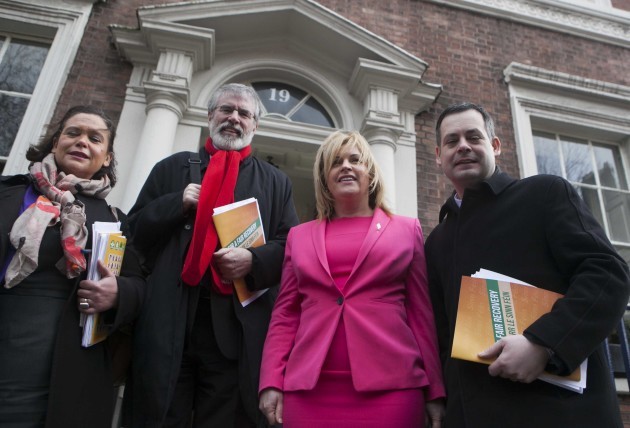
Leaders of Sinn Féin photographed in 2016 after announcing they would put their traditional opposition to the OAS in their election manifesto. (Photo source: Internet)
“UNTENABLE IN A DEMOCRACY”
Traditionally, Sinn Féin, along with other Irish Republicans, have opposed this undemocratic repressive legislation. But not just SF, also the Irish Council for Civil Liberties, Amnesty International, Irish and international jurists and UN Rapporteurs and Committees on democratic rights of the United Nations. And not just once but a number of times. The following statement was released by the ICCL in the week before the debate.
23 June 2020
The Irish Council for Civil Liberties (ICCL), ahead of the mooted renewal of the Offences Against the State Act next week and the Dáil debate tomorrow, renews our call for repeal of the Act and with it the abolition of the non-jury Special Criminal Court.
There is no jury at the Special Criminal Court and it accepts secret evidence from gardaí. This is in violation of our right to a fair trial, our right to trial by jury and our right to equality before the law. ICCL has opposed both the Act and the Court since their introduction to deal with a terrorist threat in 1972. We continue to strongly oppose these emergency measures which have now become the norm in dealing with organised crime.
ICCL’s Executive Director, Liam Herrick, said:
“It’s untenable that in a democracy like ours, which prides itself on its human rights record abroad, a law and court like these can exist.
The State contends that it needs the Special in order to protect juries but it has never considered alternatives to abandoning jury trial.”
The protection of jury members is of deep concern to ICCL. But the State has never demonstrated, as required by human rights law, that alternatives to a non-jury trial are ineffective. There are a number of obvious options for protecting juries such as anonymising juries, the use of video link for juries, or granting special protections for juries.
Last year at the Special Criminal Court, Judge Tara Burns acquitted two men of IRA membership after the head of the Garda Special Detective Unit refused to disclose underlying evidence pertaining to “belief evidence” to the prosecution. This meant gardaí were seeking a conviction without disclosing evidence to the defendant’s legal team, the Court or the DPP. ICCL welcomed the Judge’s decision but the case revealed some concerning attitudes and practices at the Court.
ICCL is not alone in our opposition to the Special Criminal Court. Various UN human rights independent experts and the UN Human Rights Committee have repeatedly declared the State to be in violation of its human rights obligations because of the continued use of the Court beyond the emergency it was designed to address. Eminent Irish legal experts, Mr. Justice Hederman, Professor Dermot Walsh and Professor William Binchy have also called for abolition of the Court.
At its introduction in 1972, the Special Criminal Court was considered a radical and purely temporary departure from the norm. Forty years have passed since then. It’s time for its abolition. Statement ends.
CONCLUSION
Defenders of Sinn Féin have said that dropping opposition to the OAS from their election program for government and even after their party won the highest number of elected TDs (delegates) in the February 2020 General Election, was purely a temporary tactical one. Presumably this decision was in response to Mícheál Martin’s statement last year that Sinn Féin was not a legitimate choice for government because they were against the Act.
Part of the sculpture outside the modern criminal courts building in Dublin, which also houses the Special Criminal Court. (Image sourced: Intenet)
Special no-jury Criminal Court. Image sourced: internet)
Not a legitimate choice for whom? one might ask. Do the mass of working people in the country want this undemocratic Act in place? Not that they were ever asked by any Irish Government! Now there was an opportunity to put this before the electorate — but it is not the opinion of the mass of working people that Sinn Féin worries about but that of the ruling class and their media hounds.
When however the two main parties of the Irish Gombeen capitalist class went into coalition with the “alternative” Green Party in order to exclude Sinn Féin from government – and one might have thought SF had nothing now to lose by voting against the renewal of the OAS – even then they failed to oppose it. Some say SF’s tacticians expected the negotiations between the other parties to collapse and then to be able to put themselves forward as a credible alternative. But again, credible to whom?
For years now, Sinn Féin has been at pains to demonstrate that it is a safe pair of hands for Irish capitalism (which entails also being safe for foreign capitalism and British colonialism). It is not necessarily a question of supporting armed struggle or not but to enter into the administration of an invader, as SF did in 2007 when it became part of the British colony’s government, would for most patriots and anti-imperialists be considered a clear crossing of the line. After WW2 many liberated countries executed a number of those who had taken part in such administrations and from one example, a new adjective entered the English language: “quisling”.
Sinn Féin has gone even further now to show the Irish ruling classes and both states that their panoply of repression on both sides of the British Border is safe: undemocratic legislation granting special powers to the police, politicised police forces and special non-jury courts with low quality “proof” required for convictions.
It is understandable with so little viable alternative choice that so many voted for SF candidates in February and in fact, would probably have elected even more had the party fielded sufficient candidates. All the other main parties and even the Greens have been in Government previously, all have approved bank bailouts and austerity budgets.
Sinn Féin is the only major party who had not been in Government and those who wanted to see them in practice had a reasonable point. But seeing them in “opposition” is also instructive. A political party that is so afraid of the ruling class and its media that even in opposition it will not vote against undemocratic repressive legislation and instruments, that were brought in precisely against its own earlier members and supporters – is not going to be braver in government, when it will inevitably be in a coalition with a capitalist party or parties.
Protesters from a variety of Republican organisations and none protest the Special Courts in Dublin City Centre on a rainy afternoon in 2018. (Photo: D.Breatnach)
However, the undemocratic Offences Against the State Act and its non-jury Special Courts remain and must be opposed. The struggle against them will continue to be waged by its victims, currently the “dissident” Republicans and by people and bodies concerned with civil rights. As the State encounters increasing resistance to austerity measures it may well be that it will widen the list of targets of this Act to include social and economic campaigners, as it was rumoured considering against the Jobstown water protest defendants in 2017, all of whom were cleared by the jury who did not believe Garda witness lies (exposed by recordings).
It is essential to oppose this Act and a wider opposition to it needs to be built – one that does not depend on false friends.
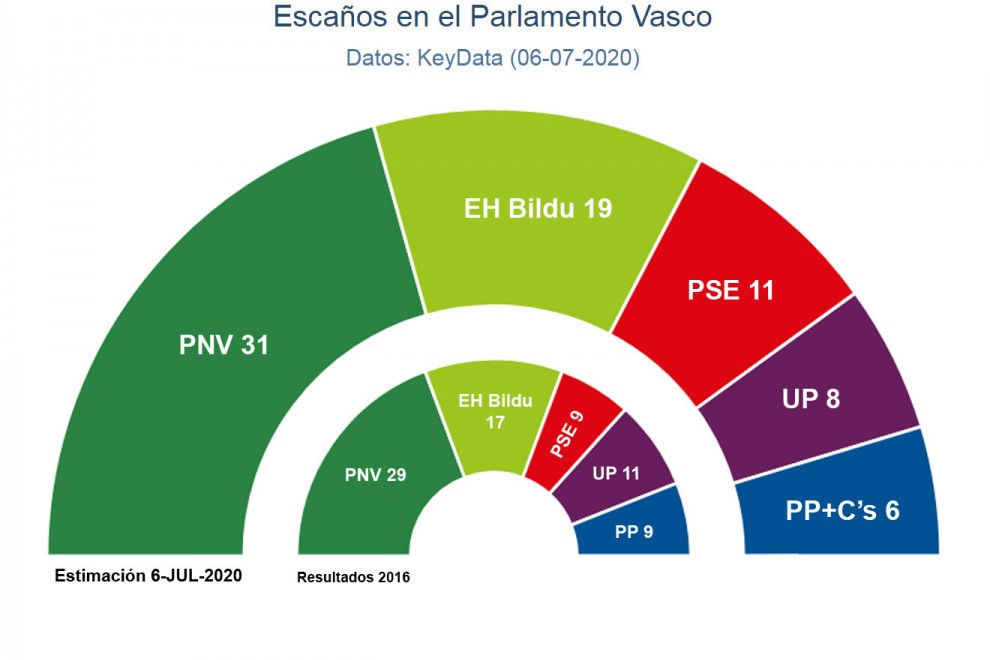
The results of opinion polls prior to the the elections for the government of Euskadi predict a majority for the Basque Nationalist Party. The predictions have EH Bildu, the party of the official Abertzale Left leadership, coming second with third place going to the social-democratic PSE, the Basque version of the PSOE, currently governing the Spanish State in coalition with Podemos Izquierda (whose Basque version will come a very poor fourth).
Maddalena Iriarte, EH Bildu’s candidate for Lehendakari (President) of the Euskadi regional government. (Photo source: Internet)
The elections on Sunday, although they usually described as for “the government of the Basque Country” are nothing of the sort. The are for the government of what is termed “the Basque Autonomous Region”, which covers only the Basque provinces of Bizkaia, Alava and Guipuzkoa – the fourth province within the Spanish state, Nafarroa (Navarra), has its own autonomous regional government. The remaining three provinces of Euskal Herria, the true Basque Country, are over the border in the territory controlled by the French State. And the Spanish State allows the Basque regions autonomy only to a point, as with all the “autonomous regions”, ultimately answerable to the Spanish State.
The PNV, Basque Nationalist Party, many of whose ancestors fought Franco in the Spanish Anti-Fascist War, have long accommodated themselves to this situation and given up the dream of Basque independence and the party has hardly any representation even in Nafarroa, to say nothing of the three northern provinces, across the Border. Since their fiefdom was granted autonomy after the death of Franco, they have dominated it electorally and used that domination to the commercial and financial advantage, both legal and illegal, of the Euskadi capitalist class (Irish readers will readily see a parallel with the Fianna Fáil party).
EH Bildu is the official party of the Abertzale Left, political descendants of the Herri Batasuna party, substantially changed and the main internal opposition to the PNV, at least on the electoral front. Herri Batasuna evolved as the political expression of ETA, the left-wing movement for Basque independance that in the 1960s developed an armed wing against the armed might of the Spanish State. Under the leadership of Arnaldo Otegi and others, ETA gave up armed struggle in 2012 and the EH Bildu and Sortu parties developed a theory of a “Basque Peace Process” which had no substance, since the Spanish State’s only interest was in surrender and never even ceased repression or released its around 900 Basque political prisoners (now around 700 as prisoners served their sentences – or died).
Prediction electoral distribution of seats in Euskadi elections 2020 based on opinion polls. (Image sourced: Publico.es)
Batasuna and its iterations over the years in the face of bannings by the Spanish State have at many times sought alliance on a nationalist basis with the PNV (the Irish parallel holds here again, as with periodic overtures of the leadership of the Provisional Sinn Féin party to the Fianna Fáil party), which on the whole have been rejected by the leadership of the PNV. The Basque Nationalist Party has preferred to rule in coalition with the PSE and even to allow the Spanish-unionist party to rule Euskadi on its own. Therefore the call from some Basque nationalist quarters for a PNV-EH Bildu coalition is very unlikely to bear fruit.
At least as unlikely is the raising by the electronic media Publico of the possibility in Euskadi of a “Government of the Left”, on the basis of the poll results. The left-wing Publico itself conceded it an unlikely eventuality, based on a coalition of EH Bildu/ PSE/ Unidas Podemos (the Basque version of Podemos Izquierda). Whatever one may say of the “Left” credentials of EH Bildu and of Unidas Podemos, one can hardly credit the PSOE or its Basque version with any. No doubt there are genuine people of the Left in that social-democratic party, as there are within the Irish and British Labour Parties too – but that does not affect the character of the parties in government, which have always been servants of capitalism and, in the cases of the UK and Spanish state, of their imperialist ruling classes.
On the poll results therefore it is certain that the PNV will be in government, whether in coalition with the PSE or with its tactical support. EH Bildu looks no nearer to achieving its dream of governing even Euskadi, not to mention all four southern provinces of the Basque Country.
MEANWHILE, ON THE STREETS
The Amnistia movement meanwhile has shown little interest in the elections, apart from chiding EH Bildu for its focus on elections and neglect of resistance anywhere else, including the jails. The Basque struggles for independence and against repression have paid a price in huge numbers of political prisoners and, though down to around 700 now from its height of 900, the Basque nation probably has the highest percentage of political prisoners of anywhere in the world. After all, the total population of the Basque Country is under 1.5 million and such a high concentration of political prisoners means that there is hardly a Basque who does not know a relation or friend of a prisoner, if not indeed the prisoner him or herself.
When Arnaldo Otegi and others led the majority of the Abertzale Left to the institutional road, they kept referring to the Good Friday Agreement in Ireland and the release of political prisoners. However, the Provisionals ensured that the release of political prisoners of their allegiance was delivered before finally decommissioning their weapons. The Otegi initiative went in reverse and their prisoners are still in jail. For some years now the leadership has been telling the prisoners that basically they are on their own and must negotiate with the prison authorities their reduction from Grade 1 down to Grades 2 and 3 and eventual release on parole. And telling the families that they have no hope of an amnesty so to stop asking for it and instead demand an end to the dispersal of political prisoners all over the jails of the Spanish (and French states), hundreds of kilometres from their families. There is no sign of even that basic human right being granted.
One of the Basque political prisoners, Patxi Ruiz, publicly denounced the new path of the movement and, after attempts to silence him were unsuccessful, he was expelled from the Basque Political Prisoners’ Collective. His treatment caused another four to break with the Otegi leadership too. Amnistia supported them and criticised the leadership of the movement which, in turn, accused them of using the prisoners for their own ends, since they did not agree with the new direction.
Persecution by the prison authorities including beatings by guards and refusal to allow him to attend his father’s funeral drove Ruiz last month to a hunger-and-thirst strike. After 8 days he abandoned the thirst strike but continued refusing food, ceasing that protest too after 31 days. His support movement led by Movement for Amnesty and Against Repression (to give Amnestia’s full title in English) brought Basque political prisoner solidarity back on to the streets, from which it had largely disappeared apart from the ritual demonstration each January and weekly pickets by families and friends, diminishing in attendance.
Solidarity actions were taken in the jails too, not only by the other four “dissidents” but by some of those still in the Collective and by a number of political prisoners from other struggles, GRAPO and PCE(r).
In a number of statements, Amnistia acknowledged that some of their support in street actions has come from progressive sectors not traditionally from within their own ranks. There is a substantial autonomous movement in the Basque country consisting of youth occupations of empty buildings, anarchists, feminists, LGBT campaigners, animal rights campaigners, environmental activists …..
On Saturday 4th July, in spite of a ban by the Spanish State’s Delegation in the city and a heavy police presence at an expected starting location, Amnistia led a fairly large demonstration through streets of Irunea/ Pamplona, capital city of Nafarroa, calling for complete amnesty for the prisoners and that “the struggle does not cease”.
Today, the 11th, they led a march to the Murcia jail (where Patxi Ruiz is held currently). In a brief report on the event and their reasons for undertaking it, they commented even more briefly on the elections due tomorrow:
“There will be elections tomorrow in a part of Euskal Herria (the Basque Country) but none of the political parties will propose any alternative to bring to an end the capitalism that tramples on and murders the working class or to destroy the imperialism that occupies peoples and makes them disappear but will instead debate different ways to manage the same system and the same misery.
“None of them will demand amnesty for those who endure repression for fighting for these goals. The strength and pressure exerted by the people on the street will be the key to reversing the situation. With the popular struggle amnesty, independence and socialism.”
End.
Amnistia picket on Murcia Jail in solidarity with Basque political prisoners. (Image source: Amnistia Garassi FB page).