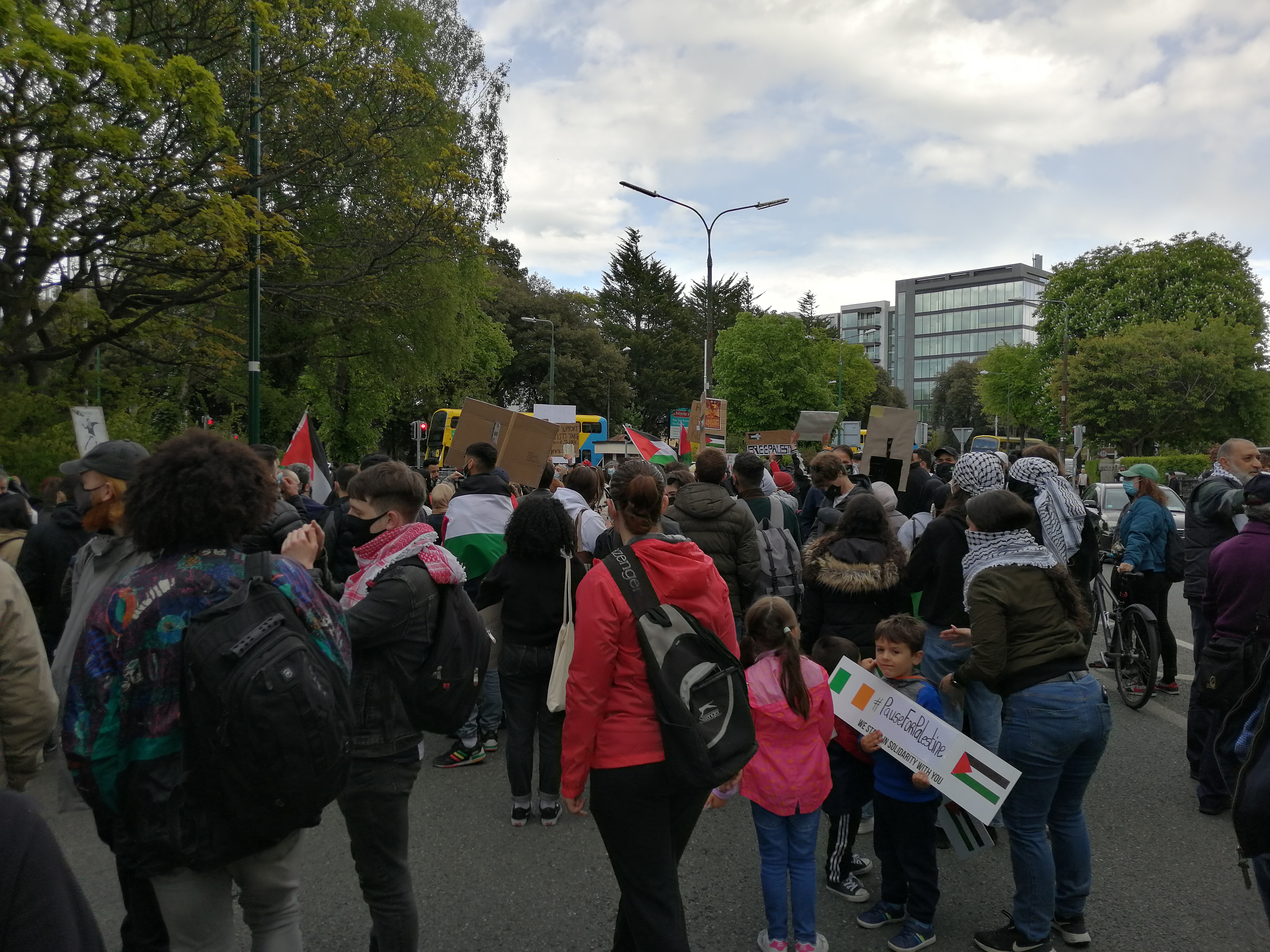
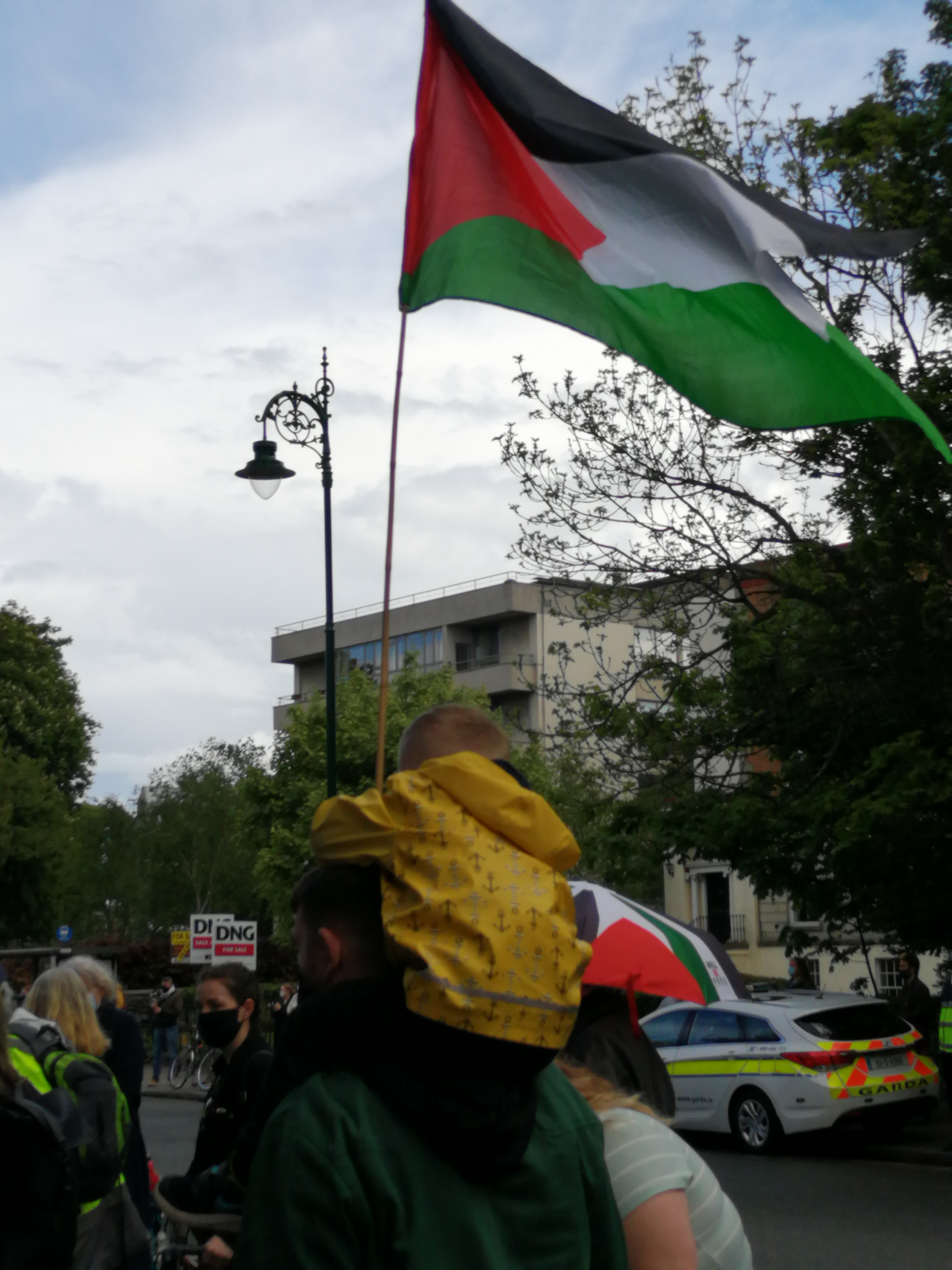
A rally today outside the Israeli Embassy in Dublin heard Palestinian speakers and an Irish socialist TD (Member of the Irish Parliament) denounce Israel’s attacks on Palestinians, its slaughter of civilians including children and women, call for sanctions against Israel and for its Ambassador to be expelled. The rally was jointly organised by Ireland Palestine Solidarity Campaign and Trinity BDS Campaign in solidarity with the Palestinians and with the general strike organised in Palestine.
Fatin Al Tamimi, Chair of the IPSC, opened the meeting, welcoming people and, to loud cheers, declared that she is “a Palestinian and proud to be a Palestinian”. Fatin went on to list the numbers of Palestinians dead and injured, the numbers of those who were women and children and called the Israeli regime “racist, apartheid” and murderous and called for the boycott of Israeli goods, alluding to the famous 1970s Dunne’s Stores workers’ strike in support of boycott of South African goods during the white minority apartheid regime. Fatin’s pauses were punctuated by demonstrators chanting “Free, free Palestine!” and “Boycott Israel!” At one point she said that she had children born here but they would also always be Palestinian and she hoped one day to go back and to welcome all the Irish supporter to a free Palestine, which brought a tremendous cheer from the crowd.
Fatin Al Tamimi, Chairperspon of the IPSC, opening the rally. (Photo: D.Breatnach)
She introduced Wesam Ahmed, from Al Haq, the main Palestine human rights organisation, who spoke through an audio link from Palestine.
Dr. Ibrahim Natil, a DCU academic also spoke, as did Zayd, representing Trinity BDS Campaign.
All the speakers called for stepping up of solidarity action, boycott, divestment and sanctions but also for action by the Irish government, both in their current temporary membership of the United Nations Security Council and in the EU.
Richard Boyd Barrett TD told the crowd that he and Gino Kelly and Paul Murphy had all tackled Mícheál Martin in the Dáil (Irish Parliament) earlier during Taoiseach’s Questions and Martin had claimed he had criticised Israel while also criticising the rockets fired by Hamas. Boyd Barrett said that we had to get rid of this discourse of equivalence because there is no equivalence between the positions of the Israeli Zionists and the Palestinians, neither in terms of justice nor in power, military or otherwise.
Fatin Tamimi also called for solidarity with all the Palestinian political prisoners
Dr. Ibrahim Natil speaking (Photo: D.Breatnach)
Zayd of Trinity BDS Campaign speaking. (Photo: D.Breatnach)
GARDA HARASSMENT CONTINUES
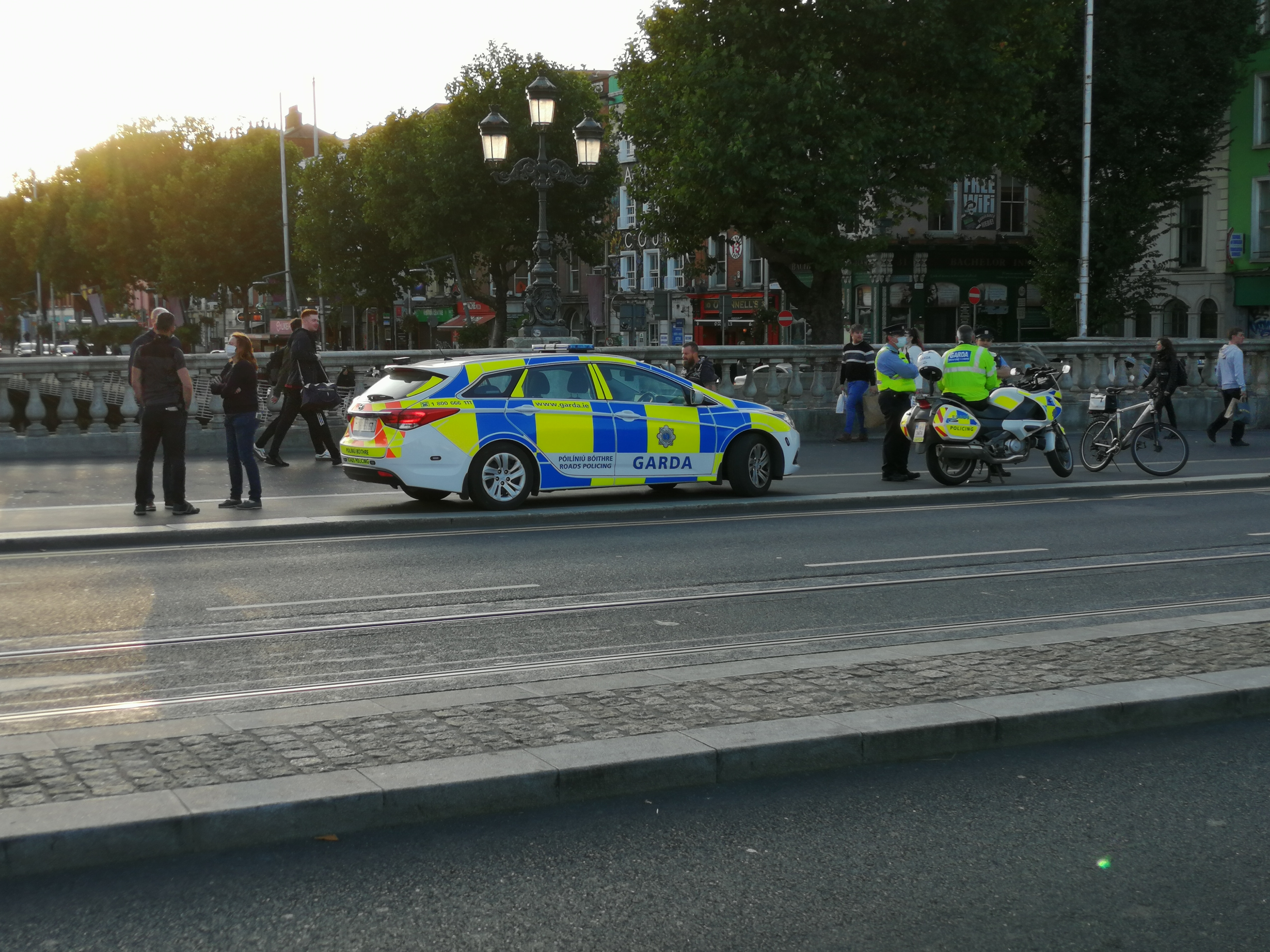
The Irish police, the Gardaí continued to display on Tuesday the hostility they had exhibited in advance of last Saturday’s demonstration, when they threatened the Ireland Palestine Solidarity Campaign that if they went ahead with their advertised rally the Gardaí would intervene and threatened the organisers with €5,000 fines and possible jail sentences. Fortunately the Trinity BDS Campaign group had stepped in and held the rally, which turned into a march supported by several thousand.
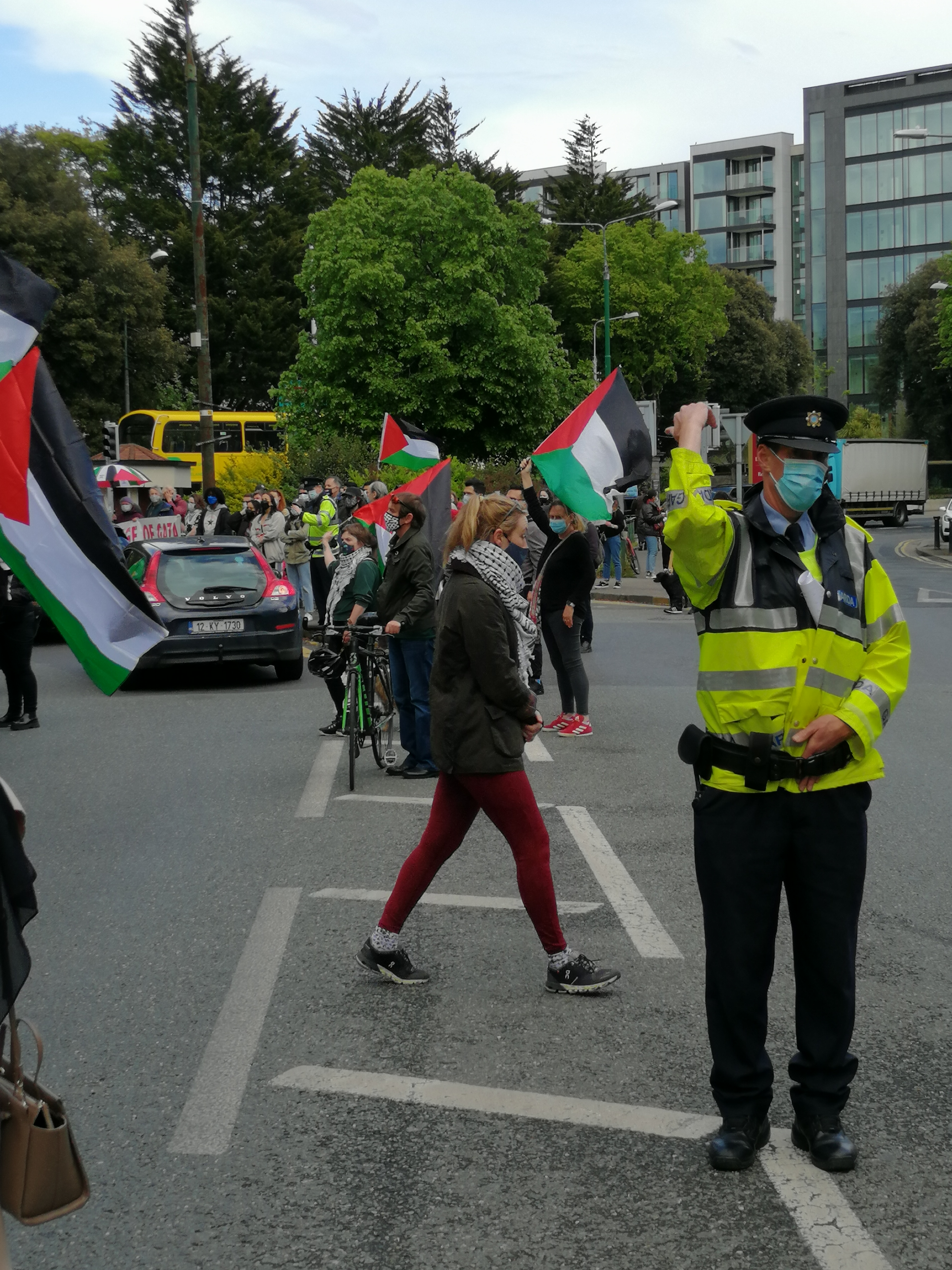
A Garda beckons traffic on. Gardaí kept the road open despite the inevitable crowd spillover on to the street and then pressured people into crowding closer, despite that clearly going against Covid19 transmission precautions. (Photo: D.Breatnach)
The Gardaí began on Tuesday by telling supporters as they arrived that they were required to spread out to social distancing but were soon ushering people in towards one another. A woman next to me complained to a Garda that he was moving her into close proximity with other people and violation of social distancing — the Garda shrugged. As they continued to urge people to push in towards the already crowded space, the Gardaí continually urged traffic to come through and kept repeating to rally supporters that “The road is open”. Indeed it was and the question is why was it open? Clearly forcing traffic through put people in danger of vehicle impact or Covid19 infection; the safest measure and easily enough done would have been to divert the traffic before it reached the rally. But no — the Palestinian solidarity supporters were to be shown that the Gardaí are not to be gainsaid.
Standing the line. Some women took their position on the white line dividing the traffic lanes, declining to be pushed into the crowd by the Gardaí. (Photo: D.Breatnach)
PLACARDS
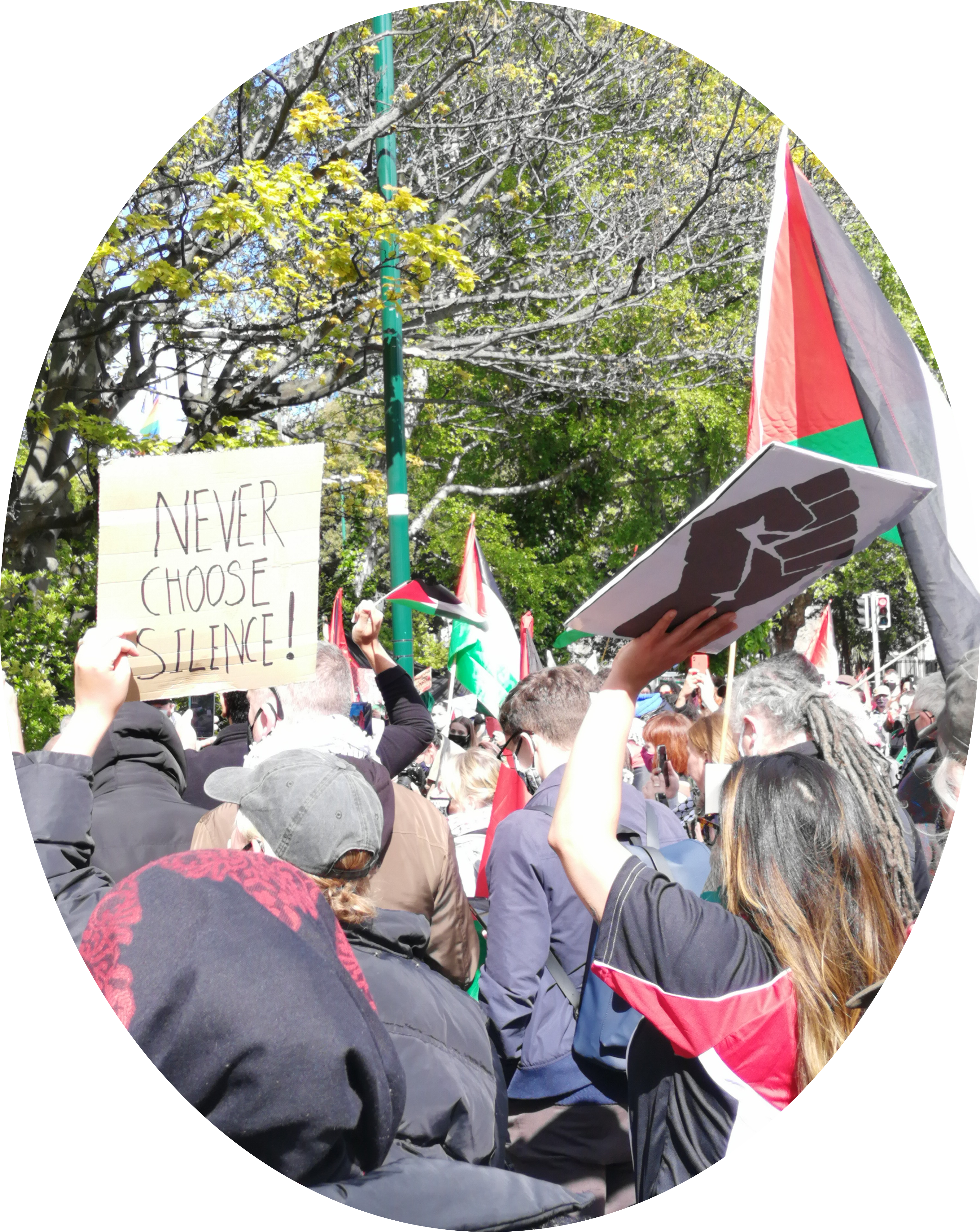
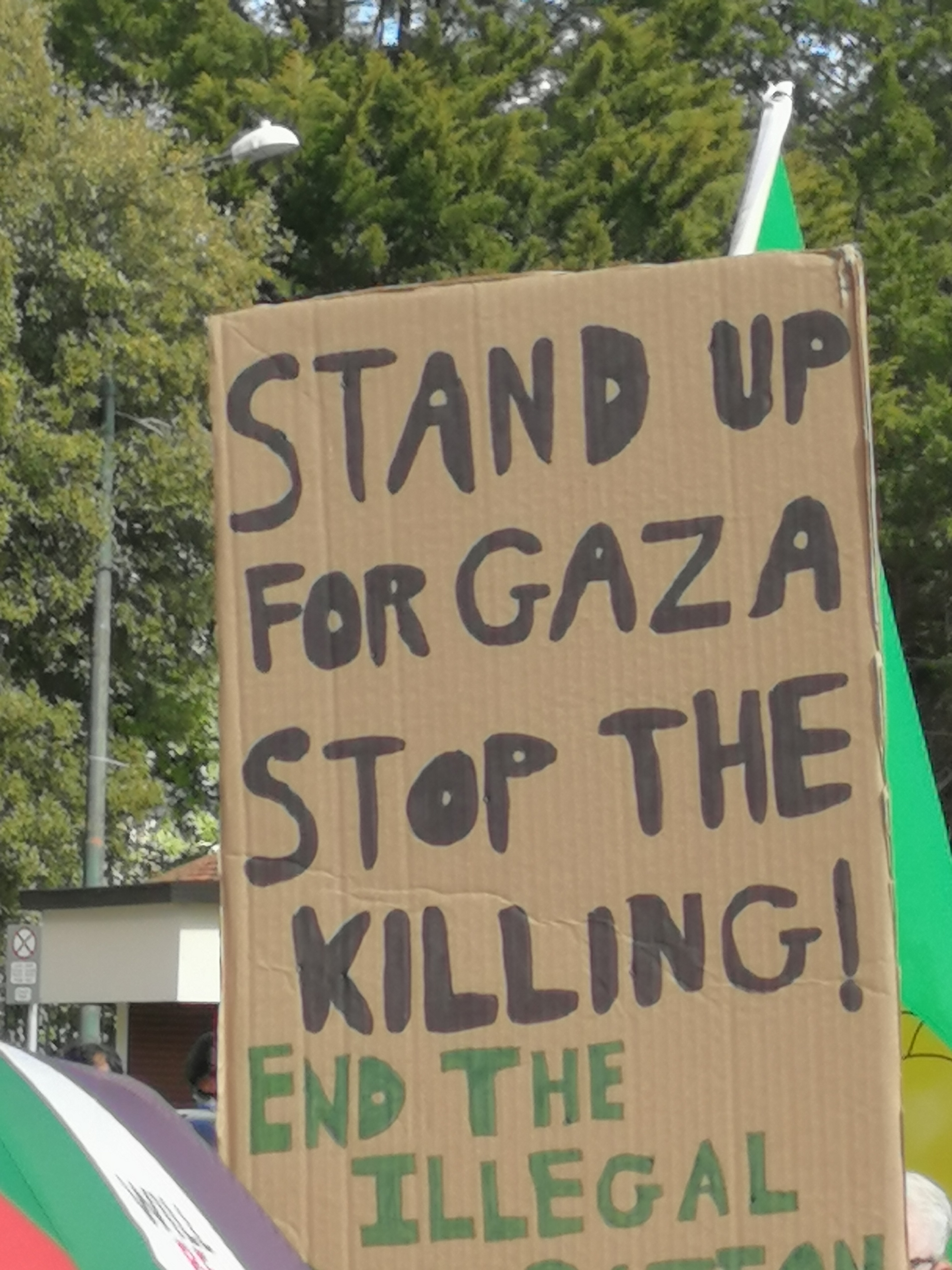
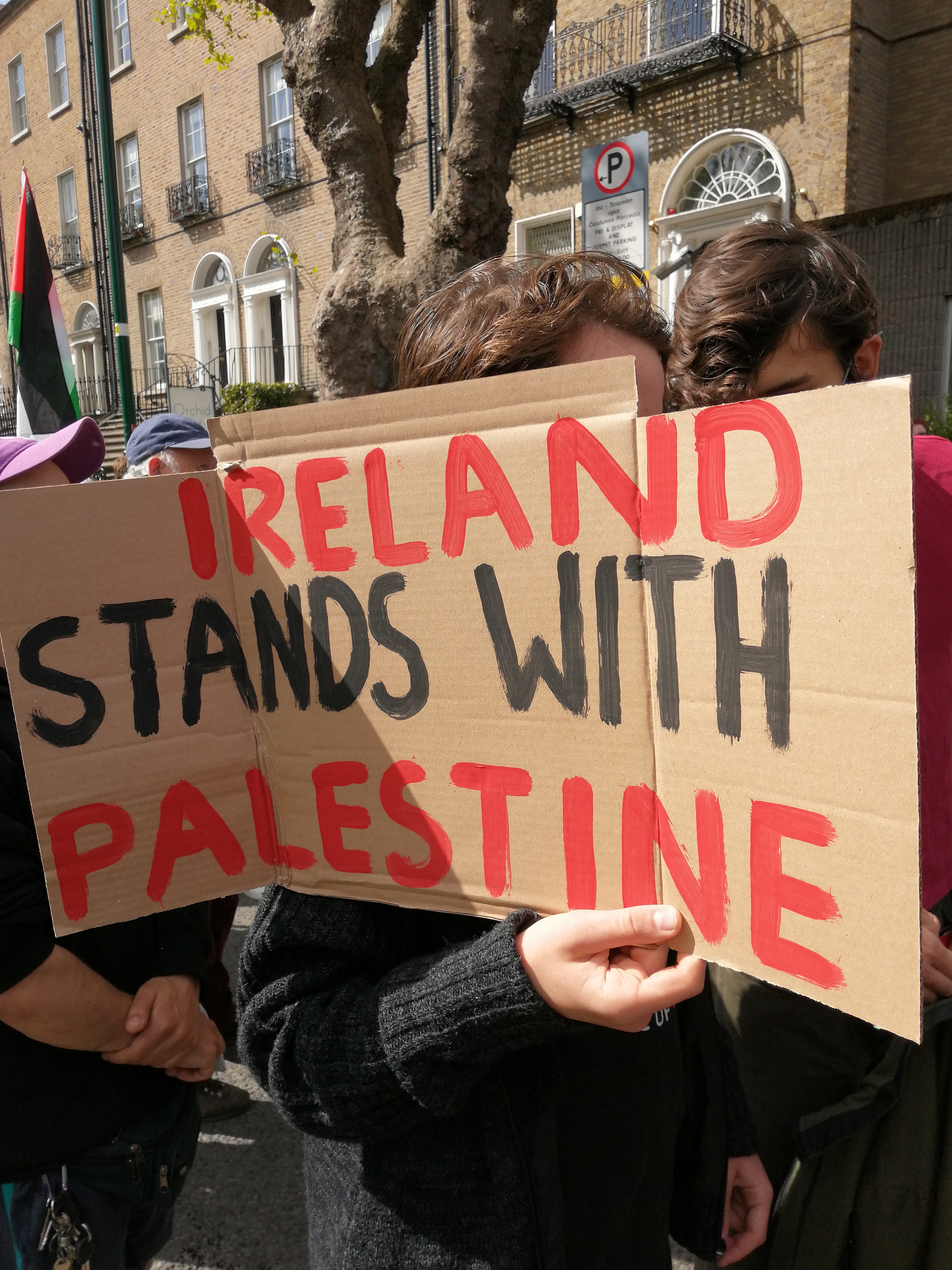
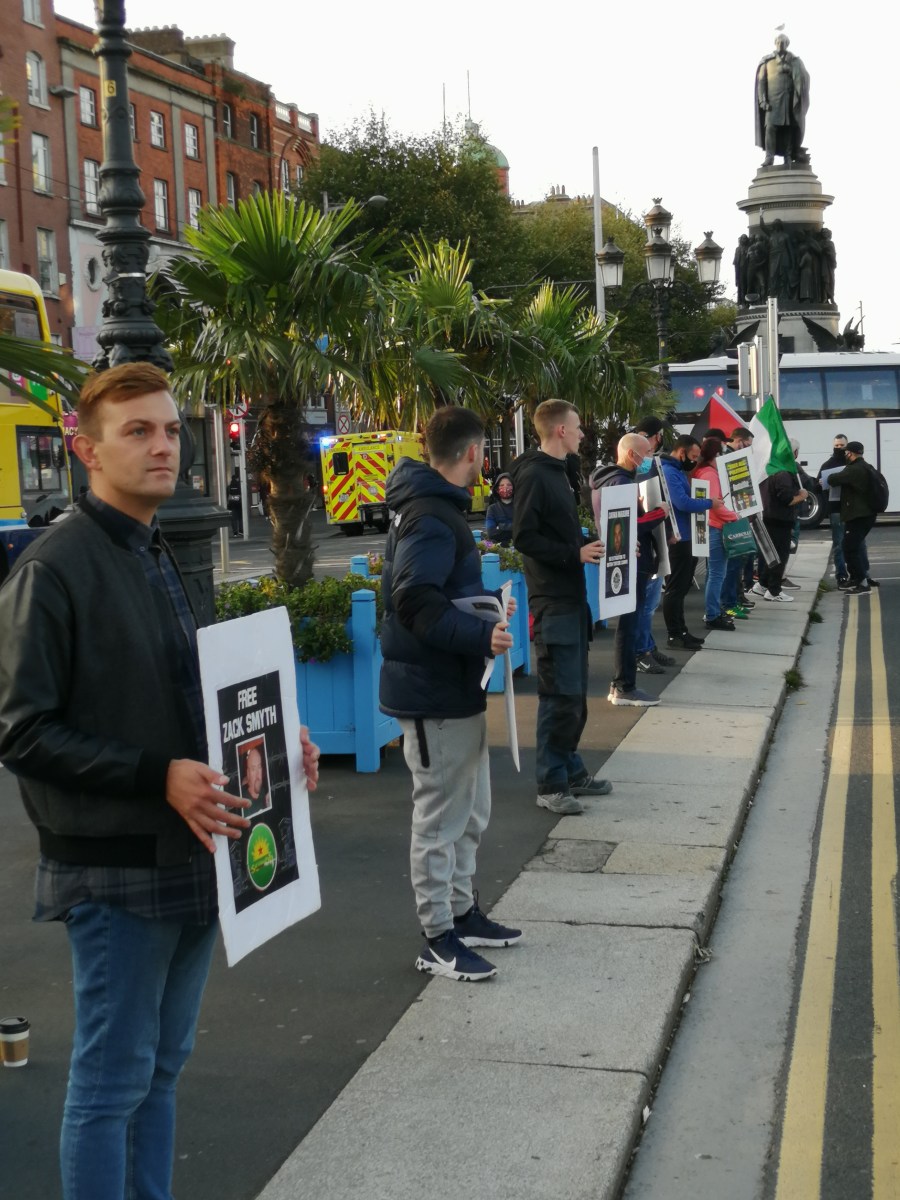
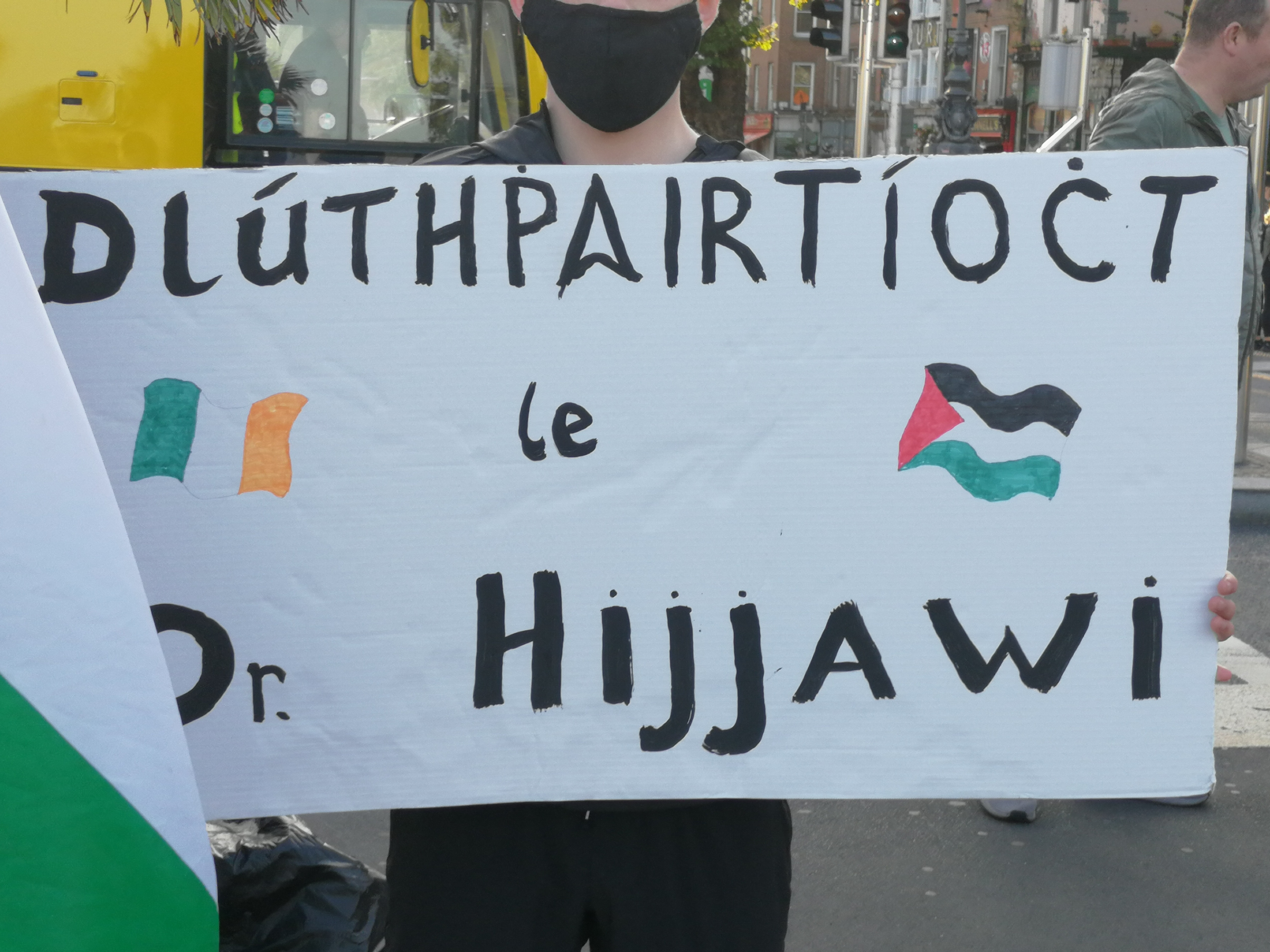
I find it interesting to collect some photos of the placards displayed at these events and in particular, some of the homemade ones. These are interesting in a number of ways, some humorous, some very pointed, some quite artistic but they are all also individual expressions and a kind of commitment, to make something in advance to bring to the demonstration or rally.
(Photo: D.Breatnach)
There was one in Irish but sadly the only one I could find. Will there be more at the next demonstration? If the Irish language is not audible and visible in the progressive sector of society, how are we to expect it to survive, never mind thrive?
A SPACE FOR THE YOUTH
As the rally came to an end, one could observe Palestinian and some other youth, many in their teens coming together to chat but also to chant slogans. I have seen this before and it appears that this point in events is their space — but it is a dangerous one with the event formally ended and the organisers dispersing, making it easier for repressive moves to be made against them or also to be led into acts which may end in their arrest. Of course it is the organisers dispersing, adults socialising etc that also allows them to make it their space.
The youth need a space of their own but one which is also safe and in which they can be helped to consider consequences and effective action. Generally political organisations do not give the youth that space and, when they do, tend to confine them to following the line of the leaders, who are generally much older.
Young people at the end of the rally. (Photo: D.Breatnach)
More young people at end of rally (Photo: D.Breatnach)
If organisations do not provide those spaces and assist the youth in self-organising, the likelihood is that others will and, in the case of Palestinians or Arabs in general, those others may be Islamic fundamentalists.
RALLY AGAIN NEXT SATURDAY, 2pm at the Spire, Dublin.
(Photo: D.Breatnach)
POSTSCRIPT COMMENT:
There is a slight sense of futility in what speakers ask us to do because justified as the calls are, there seems little hope of convincing most of our politicians of breaking radically with the western imperialist alliance, even though Ireland is not, generally speaking, itself an imperialist country. And yes, we can continue boycotting but how much of the stock in the supermarkets continues to be from Israel? And when it is, if one supermarket comes under heavy pressure, the management will often just temporarily remove the products from the targeted shop while they continue to be sold in the others. And once the pressure is off, the produce might be back on the shelves. And even if they’re not …. What can we actually DO that will make a real difference?
In one way, nothing, since the USA is the main backer of the Zionist state and the USA is the world’s major superpower. But in another way, we are making a difference, though it is not easy to see sometimes. Despite our rulers, Ireland has become the most pro-Palestinian country in Europe. Out of that may come great things in the future.
But it seems to me that there is more that we could do. Many Irish trade unions formally support the Palestinians — could they not put a motion in their annual conferences calling on the Government to expel the Ambassador? Could they not at least put a pro-Palestinian poster on each workplace union noticeboard and also advertise each solidarity march? I know that the unions are not anything like the fighting organisations they once were but that above is surely not asking too much.
end.
(Photo: D.Breatnach)Section of the crowd seen from above (Photo: D.Breatnach)I wish I had got a closeup photo of this placard but couldn’t see it again as the crowd broke up (Photo: D.Breatnach)I thought I had caught the whole placard but clearly did not — I thought the whole text said that “Resistance is made in Palestine” and “We stand with Palestine” but on another’s page saw that what is said was “Courage is made in Palestine” and “we stand with you”. (Photo: D.Breatnach)
The only one i nGaeilge, is trua a rá. (Photo: D.Breatnach)
You can probably work out that “occupation” is the word partly missing in the photo. (Photo: D.Breatnach)
(Photo: D.Breatnach)
(Photo: D.Breatnach)
(Photo: D.Breatnach)
(Photo: D.Breatnach)
Someone is sure to grab that for a quotation (Photo: D.Breatnach)
The oppression of the Palestinians led to an outbreak of active resistance recently in Jerusalem, to which the Israeli Army reacted with increased repression, timed to harass Palestinian Muslims during the period of Ramadan.
At the height of devotees attending the Al-Aqsa mosque, this escalated into attacks on worshippers within the temple itself. At the same time, Israeli Zionist settlers threatened dozens of Palestinian families with eviction from their homes in East Jerusalem.
Reacting to these events, one of the Palestinian organisations fired home-made rockets into officially Israeli territory, to which the Israeli armed forces responded in turn with drone missiles and missiles from its air force jets on Gaza.
The Zionist military fired on protesting Palestinians in the West Bank with live ammunition. The death toll has climbed to 200 Palestinians, according to Gaza’s Health Ministry, including 59 children and 35 women, with 1,305 people wounded. Ten Israelis have been killed, two of them children.
The casualty figures once again show the gross disproportion between what the Palestinians and their Zionist masters experience: in civil and human rights, citizenship, in land ownership, electricity and clean water supply, heating, fishing, education facilities, building materials …
… in freedom to travel inside and outside the state, in depth and breadth of surveillance, in arms and defence capability, in states that support them.
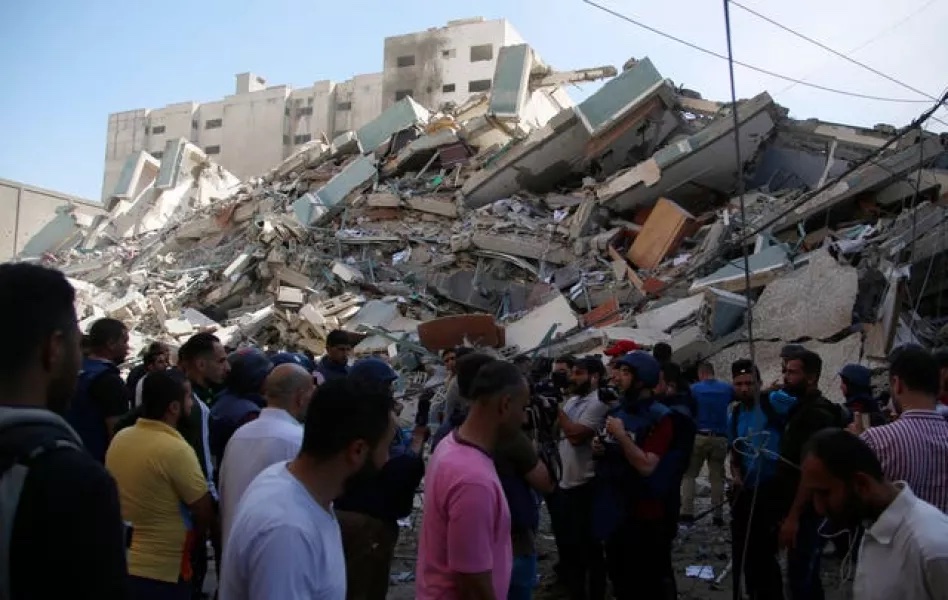
And in city structural damage: despite the many home-made rockets launched against the zionists, there has yet been no significant damage in Israeli towns, while their armed forces have effected large-scale structural damage in Gaza and bodies are still being pulled from the rubble.
In only one area perhaps do the Palestinians have the advantage over the Israeli Zionists: in support among the people around the world.
Israeli Zionist missiles strike the tower housing many media services, including Associated Press and Al Jazeera, which drew broad criticism from the mass media for a change. But families also lived here. Everyone was given ten minutes to get out. The Israeli Occupation Force has not yet bothered to explain its rationale for targeting this building. (Photo source: Internet)
PALESTINIAN SOLIDARITY MARCH DEFIES POLICE THREATS
Responding to these attacks on Palestinians, the Ireland Palestine Solidarity Campaign, the main organiser of Palestinian solidarity action in Ireland, called for solidarity demonstrations and in particular advertised a solidarity rally to take place in Dublin’s city centre for 2pm on Saturday 15th May.
The organisation asked those in attendance to comply with measures against Covid19 infection, to wear masks, maintain social distancing and comply with stewards’ instructions.
However the IPSC was contacted by the Irish police force, the Gardaí, who told them not to go ahead with the event, that if they did they would intervene to stop it and also made threats of €5,000 fines and prison against the organisers.
In a later public statement the Gardaí declared that they “have no role in permitting or authorising marches or gatherings. There is no permit/ authorisation required for such events”!
But there is apparently an ability and power to intimidate and threaten progressive organisations to deter them from organising solidarity events.
Or to kettle socialist and socialist republican Mayday marchers and demand all their names, addresses and dates of birth before threatening them with arrest if they did not disperse.
Or to threaten Debenham workers and their supporters, assaulting some of them while escorting KPMG forces in to evaluate stocks during pandemic restrictions.
A Palestinian policeman stands among the rubble of the tower in Gaza recently occupied by families and media agencies. (Photo source: Internet)
The predicament of the IPSC exposed the vulnerability to this kind of intimidation of a broad organisation that seeks to win friends in ruling circles. The leaders and organisers are placed in a position of not only personal but also of organisational vulnerability.
Even should they be prepared to defy the State to fine and/or imprison them, would they also be prepared to damage their organisation or to lose some friends they are cultivating in the circles of political influence?
What was one of the strengths of a broad organisation thus becomes a weakness; a more radical or even revolutionary organisation, with less influence in influential circles can decide on defiance, risk fines and jail with however perhaps less possibility of influencing official opinion and ultimately, action.
Fortunately in this case one such organisation did step forward and took up the baton: the Trinity College BDS group expressed its solidarity with the IPSC on its treatment by the Gardaí and called their own rally for the exact same place and time as the original one called by the IPSC.
Video of rally at end of demonstration, near Israeli Embassy
Despite concern over Covid19 transmission and Garda threats – and the extremely short notice and much smaller circle of contacts of the TC BDS group — the response was magnificent, both in internationalist solidarity and in maintenance of the right to organise such progressive events.
Before the appointed hour, people began to gather in large numbers at the Spire in O’Connell Street, Dublin’s main street and north city centre.
After being addressed by a number of speakers, they set off in a march towards the Israeli Zionist Embassy near Ballsbridge, beyond the south city centre. As they marched their numbers grew until, approaching the Embassy, they numbered several thousand.
Along the way, bystanders applauded the marchers and passing vehicles blew their horns in solidarity.
A section of the Dublin rally in solidarity with Palestine photographed outside the GPO in the city’s main street before they set off on the 5.5km march to the Israeli Embassy (Photo credit: PA, Breaking News)
Marchers shouted slogans of solidarity with the Palestinians, calling for the freedom of Palestine and the expulsion of the Israeli Ambassador as a mark of the Irish people’s objection to what is being done to the Palestinians.
Near the Embassy, a number of speakers addressed the crowd and after dispersing, a number of demonstrators boarding public transport to return home were congratulated by the drivers.
LESSONS FOR US
The situation regarding calling and holding the demonstration in Dublin outlined some of the weaknesses of a broad organisation when it faces repression from the State and the greater resilience of a smaller organisation in being able to defy the State.
It may be necessary in future to maintain support for both types of organisation, each being appropriate for particular situations.
Also demonstrated was the necessity to openly defy unjust laws and prohibitions at times and particularly around the right to organise, to protest and to show solidarity, which the demonstrators did so well on Saturday.
Such situations also reveal the difficulty for the Gardaí in carrying out repressive actions and they are reduced to threatening individuals.
THE FAR-RIGHT MARCHES TOO – FOR WHAT?
Meanwhile, a couple of hundred of the far-Right also marched in Dublin, allegedly in defence of civil liberty. Not in solidarity with the Palestinians’ civil liberties and not in defence of our civil liberty to organise to show solidarity with people in other struggles.
No, they marched in defence of the right to defy health protection regulations, in proclaiming the Covid19 pandemic to be a) a hoax or b) greatly exaggerated and in claiming that wearing masks damages one’s health and even intelligence(!).
They were insisting that vaccinations are a) dangerous to one’s health or b) means of injecting nano-machines into people’s bloodstream in order to control them.
A clip posted by Ireland Against Fascism showed one of the QAnon Saturday screechers for months outside the GPO, Dolores Webster, aka Dee Wall, lately self-declared “digital journalist” (don’t laugh) posting her reactionary propaganda.
In apparent total ignorance of the actual reality (but when has that mattered?), she broadcasted a claim by video from her studio (her car), accompanied by the strains of Abba from the headphones of her head-bobbing passenger.
She claimed that the “scum in the Dawl” had allowed the Palestinian solidarity march to go ahead to distract from the alleged general removal of freedom and in particular from the far-Right group Irish Yellow Vests to hold their rally on May 1st!
When all the Covid19 precautionary restrictions are removed, what will these elements have to march about? The will need to return to the topics that engaged many of them in the recent past: racism, anti-immigrants, islamophobia, homophobia and anti-socialism, along with their false patriotism.
None of that is welcome of course but at least it will be without this false concern for “civil rights and freedom” and closer to the reality of what the far-Right in general – and fascists in particular — stand for.
SUPERPOWER BACKING AND IMPUNITY
The current atrocities of the Zionist State, which it carries out with impunity, along with its history, starkly reveals the effect of its main backing power, the USA, and the imperialist alliance dominated by that Power.
The USA backs Israel with military aid to the tune of $10 Million daily, which is aside from other direct and indirect aid. Israel is the only state in the Middle East which is not only very friendly to the USA but totally dependent on the support of that superpower.
For the ruling class of the USA, Israel is the only state in the Middle East which is totally safe forever from fundamentalist Muslim revolution or from left-wing anti-imperialist revolution and is therefore an extremely important factor in the USA’s plans to totally dominate the Middle East.
Solidarity marcher in Dublin on Friday with a home-made placard (Photo Credit: PA, Breaking News.ie)
This imperialist alliance finds reflection not only in the action/ inaction of governments in Europe, for example but also in the reporting of the mass media.
One of the latter’s tropes is the constant emphasis on the numbers of Palestinian missiles fired, without revealing their general ineffectiveness in delivering destruction, in total contrast to the Israeli missiles. Another is their constant repetition of a lie, that “Hamas seized power in Gaza”.
The truth is that Hamas swept the board in the 2006 elections for the Palestinian Authority. The “seizing” that was done was by Al Fatah, which usurped the results in the West Bank and installed themselves there; they tried to do the same in Gaza and, in a short fierce struggle, were beaten.
But the Western powers decided that Hamas was illegitimately in power, seized funds due to it and supported its blockading – by both Israel and Egypt.
No explanation is offered in the general mass media as to how a generally politically-secular Palestinian public would turn from its decades of allegiance to Fatah to vote for the fundamentalist Muslim Hamas.
The main reason was Fatah’s surrender of the goals of Palestinian independence and freedom and the return of the refugees, in exchange for running a colonial administration with opportunities for living off bribery and corruption and Fatah’s settling down to that status quo.
CASTING A GIANT DARK SHADOW
It was not only in Dublin and in towns across Ireland that Palestine solidarity demonstrations were held on May 15th but by people across much of the world, generally in opposition to the wishes of their governments and ruling elites.
It is worth thinking about how this has come about, in particular in contradiction to a mass media hostile to the Palestinians.
Palestinians come to view the remains of the tower block that was home to families and that housed a number of media agencies. (Photo source: Internet)
The Zionist state of Israel was declared in 1948, its anniversary actually only three days ago – May 14th, the first states to recognise it being the USA and the USSR. In Ireland at the time, there was general support for the new state which continued to the “June War” of 1967 and somewhat beyond.
The general Irish population were horrified by the history of the Nazi-organised Holocaust and sympathised with the Jewish survivors.
Irish nationalists and even Republicans empathised with the Zionist civil and armed struggle against the British (who, ironically, had begun the process of Zionisisation of Palestine).
The 1966 film Cast a Giant Shadow purporting to show that struggle, starring Kirk Douglas and a cameo appearance by Frank Sinatra, was widely enjoyed and cheered in cinemas across Ireland.
Though some of the film’s characters were based on real-life counterparts, the general narrative was a grotesque distortion, hiding the massacres of Palestinians and the expulsion of thousands as the Zionist state was created.
Many Irish language supporters admired how the new state had brought the Hebrew language, for centuries only spoken in religious contexts, back into everyday usage.
Solidarity marcher in Dublin on Friday with a home-made placard and a thought-provoking message (Photo Credit: Sam Boal, The Journal)
Yet, by a few years ago, general pro-Palestinian sympathy across Ireland had become so strong that Israel’s Ambassador to Ireland declared the country “the most anti-semitic in Europe”. That of course is the Zionists term for anyone who supports the Palestinians or criticises the Israeli state harshly.
Only a few days ago, the current Ambassador accused some politicians of spewing hate towards Israel. He was responding not only to Left and Sinn Féin TDs who criticised the actions of Israel towards the Palestinians, but also to the Tánaiste (Deputy Prime Minister equivalent) Leo Varadkar!
Varadkar had commented that Israel’s actions are “indefensible” and Government Minister for Foreign Affairs Simon Coveney said at an EU conference that the EU had “fallen short” and failed to project its influence in agreeing a position in against illegal activity by the Israelis against Palestinians.
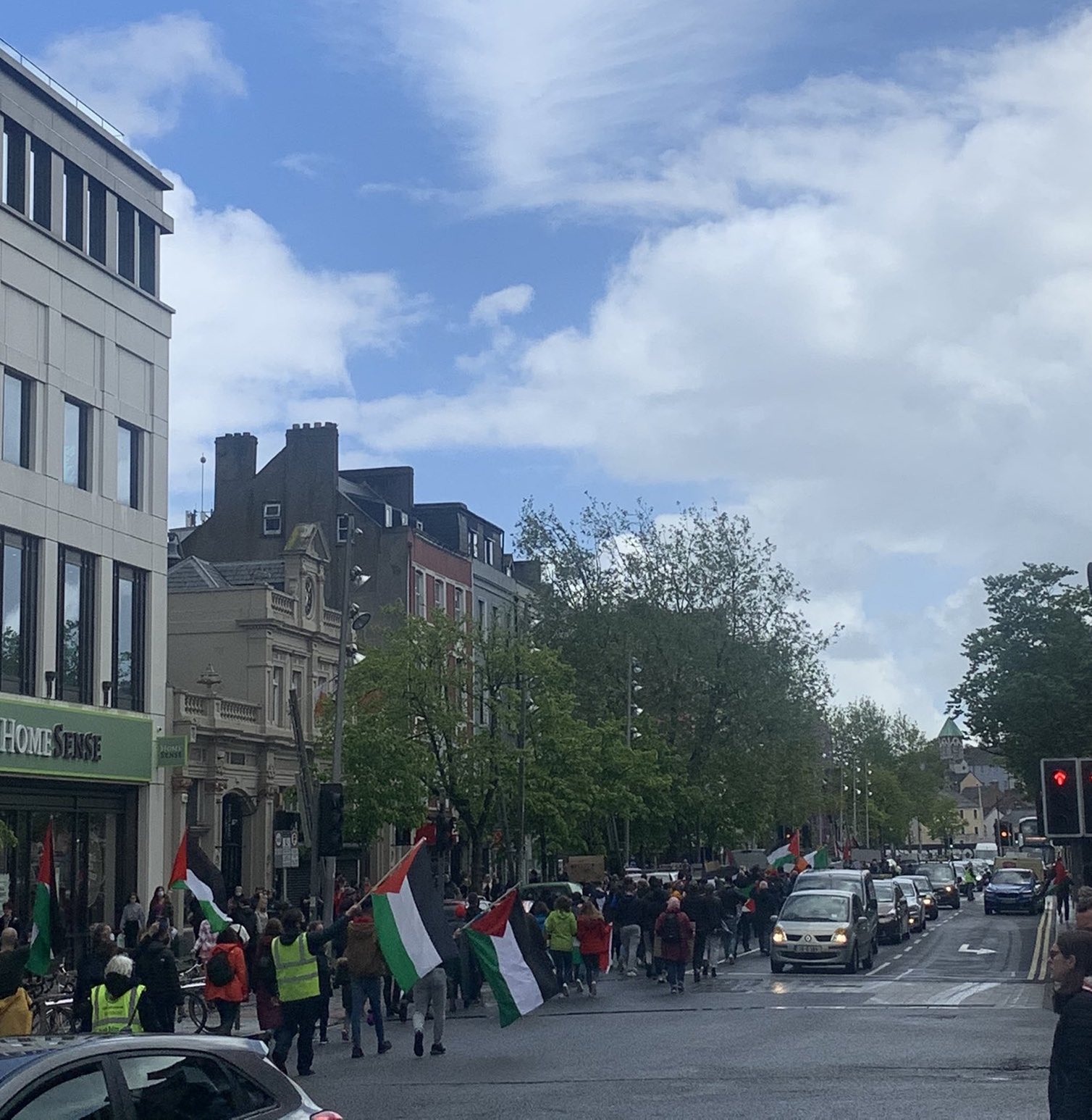
Palestinian solidarity march in Cork on Saturday (Photo source: Internet)
The fact that establishment right-wing/ conservative politicians feel obliged to take a public stand, however ineffectively, against actions of the Israeli Zionists is a strong indication of how much Irish public opinion has changed over decades.
Implicitly such stands reflect against the Zionists’ biggest international backer and world superpower, the USA. Since the Cast a Giant Shadow film, the state’s shadow of which we are aware now is indeed frighteningly giant and very dark.
In response, the natural cultural and historical feelings of the Irish people have stirred in sympathy with the oppressed Palestinians – and in defiance of threatened police repression at home.
On 2nd September 2020, a Paraguayan military operation took place in the north of the country which resulted in the deaths of two Argentinian girls of 11 years of age. Later three men were killed and the aunt of those girls was captured by Paraguayan military and is currently in jail. Those are the only elements upon which everyone is agreed; the rest is a matter of hot dispute, not only between the Paraguayan authorities and relatives of the dead girls and the detained woman, but also between those authorities and human rights organisations in Argentina, a feminist collective in Paraguay (currently subject to repression) and the appropriate organisation of the United Nations. There is also the question of a missing 14-year old girl.
Some of the human rights organisations, such as the Gremial de Abogados de Argentina (Association of Argentinian Lawyers) and feminist collectives in Paraguay itself have said the girls were captured alive and subsequently murdered. Some others, such as Human Rights Watch have cast heavy doubts on the version (actually, a number of different versions) of the Paraguayan authorities, also pointing out a number of actions taken which raise suspicions of murder and of attempts to cover up the events.
ACCORDING TO THE FAMILY AND SUPPORTERS
Last year Laura Villalba Ayala – sister of Carmen Villalba, one of the former top leaders of the EPP guerrilla organisation who has been in prison for 17 years – travelled from Argentina to Paraguay with three girls who were going to visit their relatives. According to some sources, to visit their fathers, whom they had never met in person, having been born in Argentina to where their mothers had fled and been brought up there.
Paraguayan intelligence detected the group and they were ambushed on 2nd September in the El Paraíso ranch, located in the city of Yby Yaú, in the Department of Concepción of the Republic of Paraguay. The belief is that they took them alive as prisoners and then executed two of the 11-year-old girls, Lilian and Maria Carmen Villalba and wounded 14-year-old Carmen Elizabeth (Lichita) who managed to flee along with others. Or executed the girls after the others had successfully got away – after interrogating them.
Two 11 year-old cousins killed by Paraguayan military last year who they claim were “guerrilleras”. (Photo sourced: Internet)
A relentless hunt pursued the fugitives and on 20th November 2020, while passing through the forest the three men who accompanied them were executed in cold blood: Lucio Silva, Esteban Marín López and Rodrigo Arguello. Their executioners fired infrared targeted shots at a distance of 500 meters.
Alone and without knowing the area, the girl and woman fled the hunt into the forest but got lost and separated and on December 23rd when Laura was looking for Carmen Elizabeth, she was arrested. The girl is still missing, while Laura is prisoner in a military camp and, according to her family and supporters, probably being tortured.
Carmen Elizabeth Villaba, the 14 year-old still missing after Paraguayan military attacked an EPP camp.
(Image sourced: Internet)
ACCORDING TO THE PARAGUAYAN AUTHORITIES
The “raid on an EEP camp” was hailed by the President of Paraguay, Mario Abdo Benítez himself as a great victory against the EEP and mentioned that some young women guerrilleras had been killed. When giving more detail, the military said that the young women were around 14 or 15 and supplied photographs of their bodies in military-style fatigues/ uniform.
The authorities reported that the bodies had been found with weapons, that a paraffin test on one of them established that she had fired a weapon, that both had ammunition in their pockets, their clothes had been burned (“due to Covid19 precautions”) and both had been buried without autopsy.
Ferreira, a Government official who arrived at the site of the incident after it had occurred, said that he recorded bullet wounds which he said had been at a distance of between 10 and 20 metres and that the girls had been shot while running away.
Paraguayan anti-insurgency military in training. (Image sourced: Internet)
After enquiries from anxious relatives, the Paraguayan authorities requested the Argentinian state to send copies of the birth certificates of the girls which, when supplied, confirmed that the girls had been 11 years of age. The Director of Forensic Science of the Paraguayan Prosecutor’s office then had the bodies exhumed and, carrying out tests on them, confirmed their ages at around 11 years of age. After that examination of the remains, the Forensic Science Director, Pablo Lemir said one girl was shot seven times – from the front, the back, and the side – while the other girl was shot twice, from the front and the side.
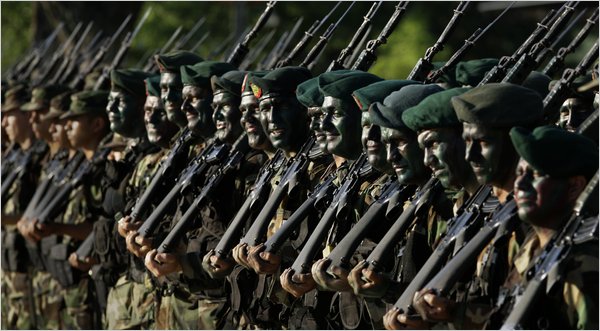
Paraguayan special forces on parade.
(Image sourced: Internet)
The Paraguayan State and its supporting media then began to talk of a “training camp for child soldiers” and accusing Laura Villalba Ayala of having accompanied them into Paraguay for that purpose.
DOUBTS AND SUSPICIOUS CIRCUMSTANCES
Numerous sources including Human Rights Watch, commenting on the available information, cast doubts or outright challenged the Paraguayan state account, pointing out the following:
no autopsy was carried out on the bodies prior to burial as is required in particular by the Minnesota Protocol in cases of death caused by government agents (the international standard for conducting autopsies and other forensic analysis in the United Nations Manual on the Effective Prevention of Extra-legal, Arbitrary, and Summary Executions).
neither family, Argentinian Consul or independent observers were permitted to attend the eventual autopsy
the clothes of the deceased, material of great forensic importance were not only not preserved but burned
the reason given for that burning, defence against Covid19 contagion, is not recommended in any of the Covid19 procedures and was not carried out with regard to other material in the camp (bedding, food sacks etc) and in any case makes no sense since the bodies were immediately buried, according to the military
despite videoing by Government forces of previous such operations, there was none of this one
there were no interviews of the military personnel to establish what weapons they had or who had fired or their account of the incident
the photos seen showed the uniforms clean and without bullet holes while the girls were by military admission killed by a number of bullets and relatives shown the photos contrasted the clean state of the uniforms with the girls’ faces and hands, which suggested to them that they had been dressed in the uniforms after torture and execution
Beyond 1.5 metres, it is not possible to determine the distance of firing since the entry wound will look the same at vastly different distances, according to two IFEG forensic analysts (Independent Forensic Expert Group of the International Rehabilitation Council for Torture Victims) giving Human Rights Watch their expert opinions in this case.
The paraffin test is not considered conclusive of having fired a gun, according to the IFEG experts, since there is a wide range of other substances that can give the same result.
According to Pablo Lemir, Director of Forensic Science of Paraguay’s Prosecutor’s Office, the failure to carry out an autopsy and burning of clothes violated standard procedures for such cases.
The Government expended some effort originally to claim that the girls were years older than their actual age. Now it is refusing to allow an experienced Argentinian team to exhume the girls and carry out a forensic examination.
REPRESSION AND RESISTANCE IN PARAGUAY ARISING FROM THIS CASE
A feminist collective responded spontaneously to the news of the killing with around 70 demonstrating with a samba band at the national building of the Pantheon of Heroes, carrying placards stating that the victims were only girls (“eran niñas” — which also became a hashtag about the case). The Pantheon building had been sprayed earlier with graffiti quoting from Paraguay’s child protection legislation and there was an attempt to burn a flag of the state’s colours.
The Attorney General’s Office immediately issued arrest warrants for three women on charges of “damage to national heritage”, which carries a maximum sentence of 10 years. Paloma Chaparro, who had been recorded carrying out the acts, later surrendered herself to authorities, while Marian Abdala and Giselle Ferrer fled to Argentina despite continued border closures due to Covid-19. Subsequently summonses were issued for at least six of the organisers of the protest to answer charges of violation of Covid19 regulations and extradition requests were made of Argentina for the two who fled the country.
Paraguayan politicians, who have nothing to say about the killing of 11-year-old girls by their military, have vied to express disgust and horror at the crimes on the national monument, with patriotic associations even laying floral tributes of thousands of dollars at the monument. The Paraguayan media, all very aligned with the regime, has made great issue of this “crime” (at worst mild vandalism) with the effect of drawing a veil over the case of executions of two 11-year-old girls and three adults, the continuing disappearance of a 14-year-old girl and the continuing detention of their adult relative in a male-only military compound.
Paraguayan politicians and other right-wingers lay floral and flag tributes at the national monument in abhorrence of the feminists’ protest but without mention of two 11 year-old girls killed and a 14 year-old missing.
(Image sourced: Internet)
Both women who fled to Argentina gave numerous death and rape threats as their reason, along with lack of faith in fair treatment by Paraguay’s judicial system.
Paloma Chaparro spent two weeks in jail before being bailed at $14,300 to house arrest.
During a press conference on Monday 11th, a member of the lawyers’ delegation who had entered the conflict zone in an effort to find and rescue Carmen Elizabeth Oviedo Villalba and also to investigate the incident, said they were accompanied throughout by five military vans and that the intimidation of the local people was such that they were unable to talk to any of them. However, some who separatedly had managed to speak to local people confirmed that the girls had been arrested alive during the raid.
Later the Paraguayan authorities claimed that one of the lawyers is the new leader of the EPP! Commenting on the accusation during the press conference a representative of the organisation clearly found it amusing but then became serious, pointing out that such accusations could put their lives in danger.
On 11 September 2020 the Paraguayan government stated that former Vice President Óscar Denis and one of his employees were kidnapped by members of the EPP not far from the site of the guerrilla camp assaulted by the army on 2nd September. The pick-up vehicle in which the two men were riding was found abandoned with propaganda leaflets scattered around, the statement said. The EPP appears to have made no statement in that regard.
Both men are reported still missing.
THE EPP
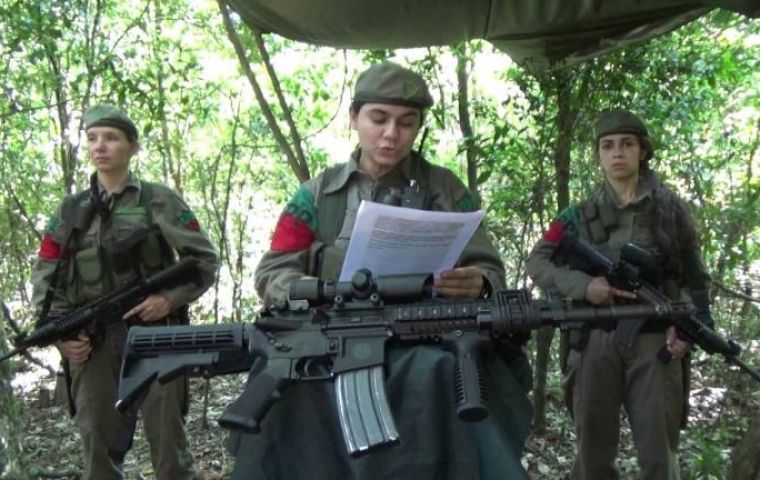
The Ejército del Pueblo Paraguayo (Paraguayan People’s Army) is a very small guerrilla army of communist ideology, which sees itself as a liberation organisation but which the regime classifies as a terrorist organisation. Estimates of its numbers vary from 50-100 and it operates mostly in the Concepción department (administrative area) in northern Paraguay and also in the neighbouring departments of Caníndeyu and San Pedro.
EPP Guerilla fighters, one reading a statement while others stand guard. (Image sourced: Internet)
Wikipedia and other websites describing such organisations regularly list the alleged killings, kidnappings etc by the guerrilla organisations without listing the corresponding arrests, killings and other actions by the police and army forces or other arms of the State or proxy forces. In those circumstances quoting statistics of armed actions by the guerrilla organisation can amount to propaganda in favour of the state in question.
Logo or arms of the EPP.
(Image sourced: Internet)
The origins of the organisation are in the taking apart of the Partido Patria Libre (Free Homeland Party) by Paraguayan police in 2005.
Whatever others may say about them it does appear that the guerrilleros are well-regarded in the EPP operational area and the chairperson of the press conference in Argentina on Monday commented in passing that the funerals of the three fighters executed by the Paraguayan military were attended by large crowds of local people paying their respects.
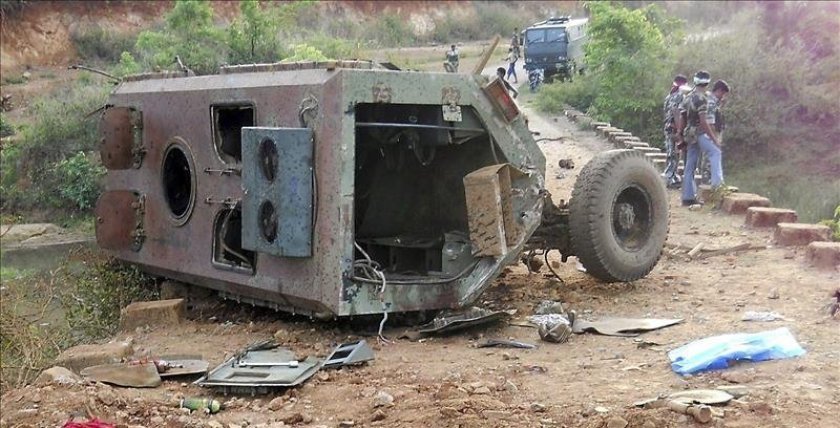
Paraguayan Army vehicle overturned in explosion 2014, officer and private killed. (Image sourced: Internet)
ACTION
A coalition of Argentinian human rights organisations have written an Open Letter (see Appendix 2) to Alberto Fernandez, the President of Argentina, calling on him to suspend commercial relations with Paraguay until the regime responds satisfactorily to the following
“Demand the Paraguayan government authorize the immediate entry of the Argentine Forensic Anthropology Team to carry out an autopsy within the framework of an impartial investigation that can guarantee justice for the girls María Carmen and Lilian Mariana Villalba.
“Demand of the Paraguayan government the appearance alive of Carmen Elizabeth Oviedo Villalba, aged 14, who has been missing since November 30, 2020.
“Demand of the Paraguayan government the immediate release of Laura Villalba, who is being held illegally in a military prison, probably subjected to torture.
“Grant political refuge in Argentina for the Villalba family, which is constantly harassed and criminalized by the Paraguayan government.”
Supporters of the family and human rights organisations in Argentina are asking for details of the case to be widely disseminated and for people internationally to add their voices to the campaign (should you wish to add your name or organisation in support of the letter, please notify estadoparaguayoinfantocida@gmail.com and name which category you come under from the list on the open letter).
At an on-line press conference on Monday last week it seemed that the only media present from outside Latin America were from the Italian and Spanish states. A member of the family, Myrian, thanked all for their efforts and vowed to continue the campaign while an elderly Nor Cortiñas, a member of the famous Mothers of May Square, who in the 1970s and 80s demonstrated in Buenos Aire’s city centre demanding justice regarding those “disappeared” by the military dictatorship then, spoke words of encouragement and said “Venceremos!” (“We shall win`!”) with upraised clenched fist.
Both the United Nations and the Inter-American Commission on Human Rights have demanded an investigation into the killings.
ACCURACY:
Under a feeling of some urgency I have done best I have been able to assist in a small way the application of international pressure upon firstly the Paraguayan state to admit a proper investigation, along with the return to Argentina of Laura Villalbaand the currently disappeared 14-year-oldCarmen Elizabeth Oviedo Villalba and, in the second place, that the Argentinian Government take all action possible to achieve those aims. It was just a few days ago that I received the first knowledge I had of this case through a comrade abroad forwarding me the press release of the Argentinian Lawyers’ Association, since when I have tried to find more details and also some press coverage (see Sources). It is possible therefore that I have omitted some relevant matters or erred in some detail and if so, I can only apologise and hope that will not be the cause of anyone failing to disseminate information about this atrocity and the present and continuing danger to a woman in jail and a 14 year-old girl missing in Paraguay.
End.
APPENDED DOCUMENTS (total 2)
APPENDIX (1)
THE ARGENTINIAN LAWYERS’ ASSOCIATION REPORTS THE ARRIVAL OF A DELEGATION OF INTERNATIONAL LAWYERS IN THE CONFLICT ZONE IN SEARCH OF INFORMATION ABOUT THE WHEREABOUTS OF CARMEN ELIZABETH OVIEDO VILLALBA (English translation from original by DB)
It was public knowledge in the past that more than ten years ago several members of the Villalba family, mostly boys and girls, had to settle in our country (Argentina) fleeing the persecution unleashed by the Paraguayan Government against the families of the combatants of the EPP (Ejercito del Pueblo Paraguayo- Paraguayan People’s Army), who are not part of the organization.
Last year Laura Villalba Ayala – Carmen Villalba’s sister, one of the top leaders of the EPP who has been in prison for 17 years – travelled to Paraguay with three girls who were going to visit their relatives.
Paraguayan intelligence detected the group and the persecution against them was unleashed immediately, managing to ambush them on 2nd September in the El Paraíso ranch, located in the city of Yby Yaú, in the Department of Concepción of the Republic of Paraguay. They took them alive as prisoners and then executed two of the 11-year-old girls, Lilian and Maria Carmen Villalba and wounded 14-year-old Carmen Elizabeth (Lichita) who managed to flee along with the others.
From there, the chase after them was relentless. In this context, on 20th November 2020, the three people who accompanied them: Lucio Silva, Esteban Marín López and Rodrigo Arguello were executed in cold blood while passing through the forest. The executioners fired shots at 500 meters distance with weapons equipped with caloric and infrared mechanisms that detect human heat and direct the shot.
Alone and without knowing the area, they went into the forest trying to flee the persecution. They got lost and on December 23rd when Laura was looking for Carmen Elizabeth, she was arrested.
From the testimonies of local people collected by Laura before her arrest, some said that the army had captured Carmen Elizabeth and others said that a group of civilians captured her.
Throughout these days the Government of Paraguay has launched an intense campaign against the EPP, in particular against the Villalba family. To justify the executions of the girls and now the disappearance of Carmen Elizabeth “Lichita”, they are spreading false news about the recruitment of minors in the EPP, obscenely conducting a cover-up for their crimes and their need to use the persecution of girls as spoils of war in their fight against the EPP.
For that reason, several colleagues offered to organize a search group with the participation of our colleague Gustavo Franquet, along with the lawyer Daysi Irala from Paraguay, the lawyer Sabrina Diniz Bittencourt Nepomuceno from Brazil and the comrade Germán from Aníbal Verón’s CTD, who also volunteered to accompany and assist.
On the 4th of January 2021 this delegation arrived at Yby Yaú, North of Paraguay after 6 hours by the bus. From there, they will have to walk into the conflict zone, in an area with a lot of forest to try to reach the area where aboriginal communities have reported that they saw Lichita alive.
They will try to confirm the information gathered so far and look for more information about the 14-year-old girl (twin) daughter of Carmen Villalba.
We publicise the presence of our colleagues in the area, aware of the danger that the delegation has assumed when entering the conflict zone.
The Government and the Paraguayan military forces are informed of the entry into the area of a non-belligerent foreign group of which none carry any weapons.
We hold the Government and the Joint Task Forces of Paraguay responsible for the physical integrity, life, and liberty of our comrades, since the official Paraguayan organizations and the Argentine consul in Asunción have been formally notified of their presence.
Finally, and with all our heart, we want to show our immense gratitude to so many colleagues, as well as to very diverse organizations of different political positions that assisted with money (in some cases a lot of money, which was unexpected by us) to pay for the trip, tickets and the huge expenses that this mission entails for us.
Know that we will never ever forget such a gesture and that without this assistance this trip would have been impossible.
We will continue to provide all the information that we receive.
APPENDIX (2)
Open letter to President Alberto Fernández: You cannot do “business” with an infanticidal state.
We the undersigned, social organizations, intellectuals, academics, trade unionists, activists, defenders of human rights, feminists, professionals, members of civil society, political organizations, ask the Argentina Government presided over by Alberto Fernández to suspend commercial relations with the Paraguayan State until the clarification of the crime perpetrated by the Joint Task Forces (FTC) against the Argentinian girls María Carmen and Lilian Mariana Villalba, who were only 11 years old, in Yby Yaú, Concepción, Paraguay, on September 2, 2020, and thatCarmen Elizabeth Oviedo Villalba, 14 years old, disappeared since November 30, appears alive.
Along the same lines, the immediate cessation of the persecution of the Villalba family is required, which currently has Laura Villalba, mother of one of the massacred girls, illegally detained in the Viñas Cué military prison. Both Carmen Elizabeth and Laura witnessed the capture of the girls at Yby Yau on September 2nd. Therefore, the arrest of one and the disappearance of the other are intimately related to the intention of the terrorist state of Paraguay,faced with a fact that is internationally known, to erase the evidence and viciously punish the next of kin.
Laura, María Carmen, Lilian Mariana and Carmen Elizabeth resided in the missionary town of Puerto Rico (Argentina) and were stranded in Paraguay by the COVID 19 pandemic. The Paraguayan State had a duty to protect them and return them in good health. On the contrary, the repressive forces of that country violated their lives, with the operation celebrated as a success by the President of the country himself, Mario Abdo Benítez.
The bodies of the girls were not subjected to an autopsy and were quickly buried, with false information from official sources about the age and condition of the girls at the time of being killed. The alleged clothes that the girls were wearing were cremated as a preventive operation against COVID 19, a fact that lacks substance and reason. The second autopsy that was carried out under pressure from civil society determined the age of the girls and added more confusion to the way in which they were executed, so we understand that an impartial investigation is still necessary to determine what happened and to allow progress in a process of reparation and justice.
Although the Paraguayan Government has supposedly responded affirmatively to the request for an investigation made by the Argentinian State, it has done nothing in that direction and, on the contrary, has withdrawn its support for the UN in the face of its pronouncement in this case; it has persecuted the protesters who demand justice, has criminalized children, adolescents and indigenous communities in the region, has held the families of the victims responsible as well as relatives who suffer persistent persecution, has fostered wild hypotheses about Argentina, as some kind of “guerrilla nursery” place, has wished to prohibit the dissemination of information about the murdered girls, thereby trying to hide the fact that they were girls and push the case into oblivion, has continued with its policy of militarization of the northern region of the country. As if all this were not enough, we also observe an intention – reinforced by the hegemonic media and social networks – to deny the Argentinian nationality of the girls María Carmen and Lilian Mariana, to remove relevance of the incident from the Argentinian State, which worries us doubly: first, because it is intended to strip us of the tool of international law; second, because in this way the Paraguayan State demonstrates that it assumes the power to murder girls if it so wishes.
The Paraguayan State has a history of abuses that are recorded with six judgments of the IACHR, of which it has only partially complied with one of them, so we are talking about a serial violator of human rights. Under no point of view can we entrust the clarification of the massacre of our girls to whoever murdered them. Such is the impunity that no person is charged, investigated or detained for such an outrage, unlike the case of the people who participated in the protests demanding justice for the girls, for which there are summons, detentions and requests for international arrest. These recent verified events reveal not only disproportionate cruelty but also the direction taken by the Paraguayan judiciary.
If the Argentinian State is committed to the defense of human rights, in no way can it ignore such an outrage that physically assaults the bodies of girls, women and social activists. That is why through this letter we urge the Argentinian government to:
Demand the Paraguayan government authorize the immediate entry of the Argentine Forensic Anthropology Team to carry out an autopsy within the framework of an impartial investigation that can guarantee justice for the girls María Carmen and Lilian Mariana Villalba.
Demand of the Paraguayan government the appearance alive of Carmen Elizabeth Oviedo Villalba, aged 14, who has been missing since November 30, 2020.
Demand of the Paraguayan government the immediate release of Laura Villalba, who is being held illegally in a military prison, probably subjected to torture.
Grant political refuge in Argentina for the Villalba family, constantly harassed and criminalized by the Paraguayan government.
We are convinced that you cannot do business with the infanticidal state led by Mario Abdo Benítez, direct heir to the Stroessner dictatorship.
Without further ado and awaiting a favorable response, sincerely:
HUMAN RIGHT ORGANIZATIONS (original endorsements but many more since then: 10)
TRADE UNIONS (original endorsements but many more since then: 7)
POLITICAL ORGANIZATIONS (original endorsements but many more since then: 33)
SOCIAL AND PROFESSIONAL MOVEMENTS AND ORGANIZATIONS (original endorsements but many more since then: 119)
INTERNATIONAL SOLIDARITY ORGANISATIONS (original endorsements but many more since then: 33)
INDIVIDUAL ACTIVISTS (original endorsements but many more since then: 200+)
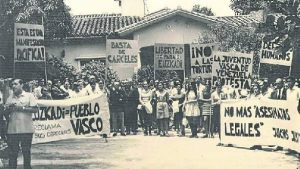
Basques marked the 50th anniversary of the Burgos military trials by the Franco dictatorship of 16 members of ETA, the armed Basque socialist independentist organisation. A few days ago a group went to the town of Burgos itself and posted slogans on the wall of the Spanish Ministry of Defence building there declaring that the Spanish State had not succeeded in its repression in 1970 and would not do so in future. In the Basque Country itself events were also held in commemoration.
The military trials of 16 members of ETA took place between 3rd and 9th December 1970 in the Spanish city of Burgos in Castille (north-central Spain). The trial concluded on the 28th with sentences of death on six and sentences up to 70 years on the remaining ten. Intended to be a mortal blow to ETA and to Basque resistance the trials instead inspired greater and more united resistance in the Basque Country and became an international publicity debacle for the Franco dictatorship.
Within the Basque Country, demonstrations and pickets took place and a general strike saw 100,000 workers there out on strike. ETA distributed pamphlets and leaflets among the people and in its repressive measures the Spanish police beat many workers and killed a number, as in Etxarri in Nafarroa (Navarra) province.
Internationally, protest demonstrations took place across Europe and other parts of the world, particularly outside Spanish Embassies, often leading to battles with the police of the host country. Pope Paul VI appealed for the death sentences to be commuted and Jean-Paul Sartre, a leading intellectual of the French Left and with an international literary reputation congratulated the defendants on having brought the situation of the Basque Country under Franco to international attention.
ETA hired prominent lawyers of Left and Human Rights reputation to defend the sixteen. The organisation also kidnapped the German honorary Consul as a hostage (and later released him unharmed). The defendants themselves used the trial politically, turning it into an exposure of the Franco regime and its repression. A number described the tortures to which they had been subjected, all of them declared their commitment to socialist freedom and some even stated that they were fighting for the rights of all working people.
Protest demonstration in front of Spanish Embassy, Caracas, Venezuela in December 1970 (Photo sourced: Internet)
The military judges, aware that the publicity of the trial was going against the Dictatorship, began to clamp down and restrict the defendants from saying anything that was not directly, as they saw it, pertinent to the charges, after which the defendants refused to speak at all. At one point during the trial the defendants all stood and sang the battle-song and national anthem of the Basque nation, Eusko Gudariak1. An even greater sensation occurred in a brief incident when the final defendant to speak, Mario Onaindia, attempted to attack the judges with an axe.2
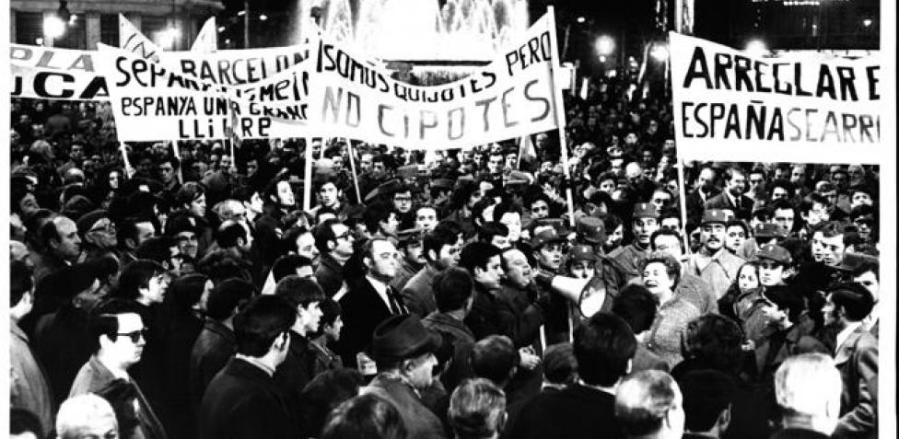
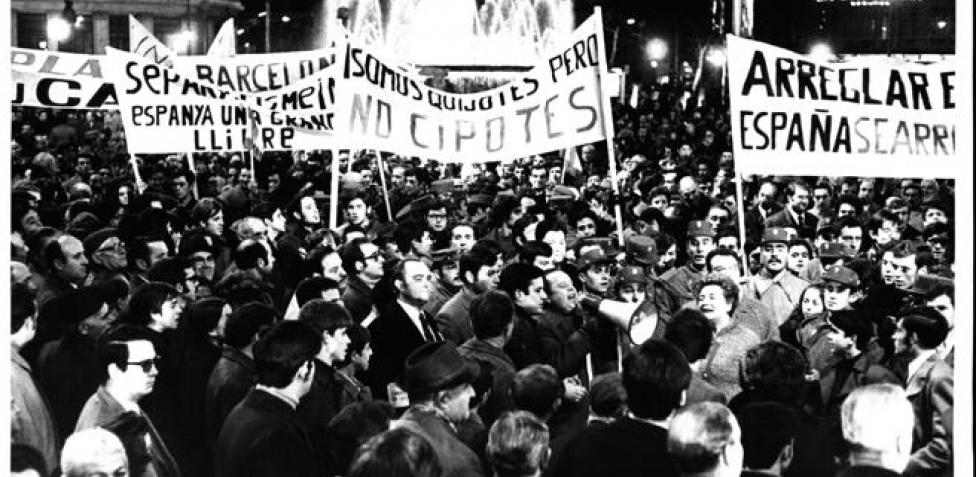
Demonstration in Barceloneta, Catalonia in solidarity with Burgos defendants, December 1970 (Photo sourced: Internet)
BACKGROUND
A military-fascist uprising against the elected Popular Front government of Spain took place in 1936 and in the Spanish Antifascist War that followed, the Spanish Republic was defeated by the military with substantial assistance from Nazi Germany and Fascist Italy, while the UK and France blockaded the Republican forces.
Hitler and Franco reviewing invader Nazi troops in Hendaye, French Basque Country.
(Photo source: Internet)
A military-fascist dictatorship with the strong assistance of the Spanish Catholic Church followed amongst huge repression, making Spain the state with the most mass graves in Europe and second only to Cambodia in the world.
The Popular Front Government had granted autonomy to the Basque Nation (and to Catalonia) for the first time in centuries of the Spanish State, although Nafarroa province had sided with the military-fascist forces. Any notion of autonomy was withdrawn under the Dictatorship and even use of the Basque and Catalan languages in public or in education was forbidden.
Some guerrilla resistance continued for a period in the mountains of the Basque Country, Catalonia and other parts of the Spanish state territory but the fighters were hunted down or fled the Spanish state. The Communist Party and some socialist organisations continued an underground existence and built illegal trade unions but the CP of Spain did not support independence for the Basque Country or for Catalonia, on the theory that this would “break up the Spanish working class” (however later they all mobilised against the Franco Dictatorship and in solidarity with the Burgos defendants).
Euskadi3 Ta Asakatasuna (Basque Land and Freedom) was formed in 1959 out of a coalition between a left-wing Basque youth group and the youth wing of the Basque Nationalist Party (PNV) who were discontented with the lack of action of their elders. In June 1968 ETA carried out its first armed action against Spanish police when killing a police officer asking for their identification papers at a checkpoint and shortly afterwards one of the ETA pair was gunned down by police. Two months later the organisation carried out its first planned attack when they killed Melitón Manzanas, Commander the Political Police Brigade in Alava Province. Manzanas was a notorious fascist and torturer who had hunted down Jewish refugees to turn them over to the Nazis during WWII.
The Burgos trials was intended to smash ETA completely but as outlined above, had an entirely opposite effect. The death sentences were commuted in an attempt to reduce the damage the trials had caused the international reputation of the Spanish State.4
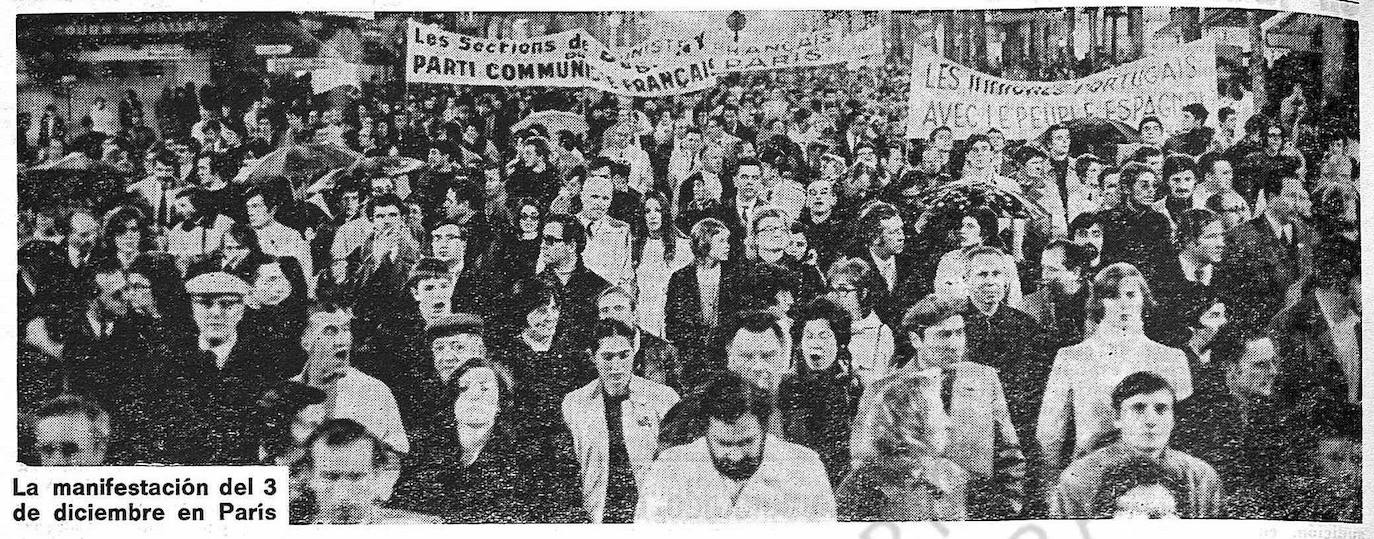
Solidarity with Burgos Defendants in Paris, Dec. 3rd 1970 (Photo sourced: Internet)
Angry Brigade Communique on machine-gunning of Spanish Embassy, London on 3rd December 1970. (Photo sourced: Internet)
AFTER BURGOS AND TODAY
ETA continued its armed and non-military actions and other revolutionary armed communist resistance began to take shape elsewhere in the Spanish territory.
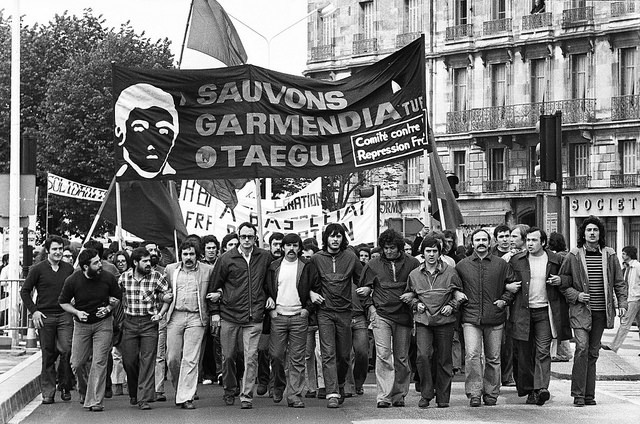
Despite the huge success of the Basque solidarity mobilisations to prevent the executions in 1970, five years later a similar wave failed to prevent the executions of another two ETA members and three FRAP (Revolutionary Anti-Fascist Patriotic Front) members: Ángel Otaegui Etxeberria; Juan “Txiki” Paredes Manot; José Humberto Baena; Ramón García Sanz; and José Luis Sánchez Bravo.
French solidarity with ETA defendants 1975. This time the international campaign was unsuccessful and the Spanish State executed the two ETA and three FRAP activists (Photo sourced: Internet)
ETA counted some actions notable for the harmful effect on them but also some spectacular successes in its armed campaign. Included in the latter were the assassination in Madrid in 1973 of Admiral Carrillo Blanco, Franco’s appointed successor and the abandonment of the nuclear reactor project in Lemoiz5 in Bizkaia in 1983. Blanco’s assassination and the death of the Dictator Franco in 1975 hastened the Transition of the Spanish State to an alleged democracy and a monarchical and unitary state constitution in 1978.
The Basque resistance constructed a network which beyond the armed group consisted of trade unions, youth organisation, social centres, daily bilingual newspaper and political parties. The Spanish State waged war against that movement with repressive laws, arrests, torture, jailings, closure of organisations and media, along with armed action against ETA. In addition, it organised and funded a terror and assassination campaign over a period of 26 years6.
In the late 1990s the Basque Left-Independentist movement began a process of unilateral disarmament and change in political direction which led first to an indefinite ETA truce in 2010, then to decommissioning of arms and finally to the dissolution of ETA in 2018. However around 250 Basque political prisoners remain in jail, a tiny group of which have declared their dissidence from the leadership’s path and are supported outside the jails by a growing movement which has a very different line to that of the “official” leadership.
The Spanish State insists that the only possible relaxation of prison conditions, end of dispersal7 or granting of parole for the prisoners is “if they recant their beliefs and apologise to the victims.”
Political repression continues at some level within the Basque Country. There is no indication that there is any intention in Spanish ruling circles to grant independence to the southern Basque Country – quite the contrary (as seen also in Catalonia).
THE 50th ANNIVERSARY
A group of activists from the official Abertzale Left carried out a publicity commando raid in Burgos recently (see video below) and attached a banner poster to the Spanish Ministry of Defence building which read: “NEITHER WERE YOU ABLE to repress the struggle of the people NOR WILL YOU BE ABLE” and LONG LIVE THE REPUBLIC!
A number of public meeting and on-line events were also held this month, including the commemoration in Etxarri of two Basques who were killed by Spanish police during the Burgos Trials protests.
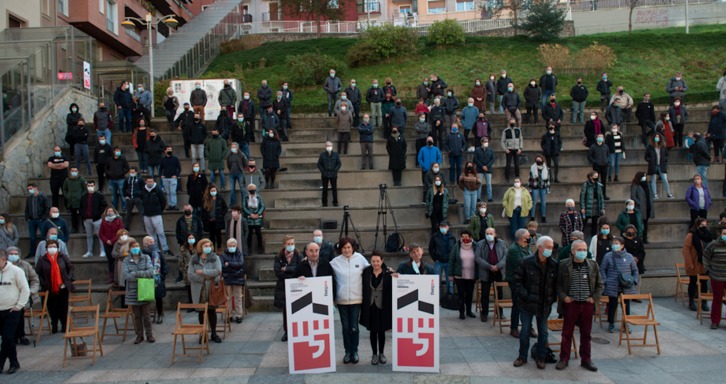
In Eibar city in Gipuzkoa province around 100 people assembled despite Covid19 restrictions in the open air to mark the anniversary and included one of the Burgos trial defendants who, along with another woman, read out a manifesto which has been signed by many in the Basque independentist movement.
Burgos Trials 50th Anniversary Commemoration in Eibar, Gipuzkoa, Dec.2020. (Photo source: Naiz.eu)
“The Franco regime wanted to prosecute, punish and subdue again a people that in the darkness of the dictatorship had dared to rise from the ashes of war,” they read, introducing the manifesto.
Recalling the moment when the defendants rose in court and with upraised clenched fists sang the Eusko Gudariak, the manifesto commented: “With their courage, that handful of young militants taught us to stand up even when it seems impossible, and their example lives on today in us and in the future in the actions and dreams of the new generations.”8
The manifesto also states that the Burgos Trials were “a milestone” for the survival of Euskal Herria. However today, 50 years later, the substantive process has not concluded, since “they continue to take Basque youth to court, thinking that by disciplining them they will quench the desire for freedom of this people, and the states that surround us have not abandoned their strategy against the independence movement.”
The anniversaries of milestones in the struggle, of successes and failures, of martyrs, continue to be marked. And the journey is far from finished.
End.
FOOTNOTES
1“Soldiers of the Basque Country”, very similar in title and theme to the Irish national anthem, Amhrán na bhFiann/ The Soldiers’ Song.
2How Onaindia managed to get his hands on an axe in court is one question but the significance of the axe cannot be underestimated – it was a traditional tool of foresters but also of ancient Basques in war and formed one part of ETA’s emblem, the other being the snake, representing wisdom.
3Formerly used to describe the whole Basque nation, “Euskadi” nowadays mainly describes the Basque Autonomous Region of the provinces of Bizkaia, Alaba and Gipuzkoa. “Euskal Herria” (The Country of Basque Language”) is more commonly used today to describe the whole seven provinces of the Basque nation, four currently within the Spanish and three within the French states.
4It also increased the pressure on the Spanish ruling class from the USA and European states to become more moderate politically and less vulnerable to revolution.
5This was in addition to frequent large protest mobilisations.
7The vast majority of the prisoners are in jails dispersed throughout the Spanish and French states, between hundreds and even a thousand kilometres from their homes, placing a huge burden on their families and friends in visiting them.
8Comment: One wonders whether they felt any sense of irony in reading that out, considering that only in September last year 47 Basque prisoner solidarity activists pleaded guilty in a plea deal that ended their trial in 25 minutes with suspended sentences for all except for a few months’ jail for a couple of them. The deal came as a total shock to the estimated 50,000 people who had, only two days earlier, marched in solidarity with the accused, defending their right to do solidarity work without being persecuted or prosecuted.
(Note: It was intended to post this on the anniversary of MacSwiney’s death but technical problems prevented that.)
(Reading time text: 15 mins.)
Terence MacSwiney, Lord Mayor of Cork died in Brixton Prison, London, on October 25th 1920: it was the 74th day of his hunger strike. His struggle brought international attention not only to his sacrifice but also to an Ireland in the second year of its War of Independence, a political and guerrilla war against the occupying power, the British State.
Between 1917 and 1981, twenty-two Irish people died on hunger strike against the injustice of British occupation of Ireland.1
HEROISM AND SELF-SACRIFICE
MacSwiney exhibited heroism and self-sacrifice in a number of steps he took before he embarked on his fatal hunger-strike. He did so first of all in putting his liberty and very life in jeopardy in opposing the colonial occupation and domination of his land. He took a second step towards endangering his liberty and life by joining the Irish Republican Brotherhood, an organisation dedicated at the time to the overthrow of British rule in Ireland.
Thirdly, he took the trend further still by not only joining the Irish Volunteers in 1913 but by being one of the founders of the Cork Brigade. Fourthly, MacSwiney opposed Redmond’s offer of the Volunteers to the British imperialist Army and stood with the dedicated minority in the subsequent split.
Fifthly, he joined the IRA after the 1916 Rising.
His sixth step was to take the Lord Mayor position in which his predecessor, Tomás Mac Curtain, had recently been murdered by Crown forces. Seventh, he embarked on his hunger-strike to the end.
Tomás Mac Curtain and family; he was murdered by British agents two months after his election to Lord Mayor of Cork City.
(Photo sourced: Internet)
That trajectory reminds us all that the path of revolution is a dangerous one, requiring courage and sacrifice, though not necessarily always to that same degree.
PACIFICISM
Because he chose in the end to offer up his life in a hunger-strike to the death, Terence MacSwiney is often held up as the ideal example of pacifism and especially so when a particular phrase of his is quoted: It is not those who can inflict the most but those who can endure the most who will conquer.
Of course, the reality is that both are absolutely necessary. No struggle can be won by endurance alone, no more than a struggle can be won merely by inflicting damage upon the enemy.
There are genuine pacifists and fake ones. I don’t agree with either but I have some respect for those who put their liberty and even their lives at risk in a pacifist struggle. For the others, the social democrats and liberals who enjoin us to have all our resistance be peaceful, while they support the violence of the ruling class and their states at home and abroad, we should have nothing but contempt. It would indeed suit our enemies if we set out to endure every attack and made them pay nothing in return!
Those who remind us only of that quotation from MacSwiney, or of the one from that other hunger-striker and poet Bobby Sands, that “Our revenge will be the laughter of our children”, choose to forget – and try to make us forget – a very important fact about Sands and MacSwiney: each was a revolutionary soldier. Each was arrested because he was known to be a member of an armed force of resistance – the IRA.
INTERNATIONALIST SOLIDARITY
For some people, internationalist solidarity is almost all, ensuring that they don’t become any danger to the State in which they live or to its ruling class.
For some others, internationalist solidarity is something kind of extra, to be indulged in now and again.
I think both those tendencies are wrong. We need to confront our own ruling class and State, not only for the benefit of our own working class but also as a contribution to the world. But at the same time we need to pay attention to questions of solidarity with other struggles around the world.
And that can serve as a barometer too – for I have noticed in a number of organisations that when the leadership was heading towards giving up on revolution, inconvenient internationalist solidarity was one of the first things they threw out the window.
MacSwiney’s hunger strike drew the eyes of much of the world to his struggle and to that of his people. In India, the Nehru and Gandhi families made contact with MacSwineys and those connections were maintained for decades afterwards. It is said that Ho Chi Minh was working in a hotel in London when he heard of MacSwiney’s death and remarked that with such people as that, Ireland would surely win her freedom. In Catalonia, people fought daily battles with the Spanish police outside the British Legation in Barcelona. The story reached the Basque Country too and the example of Cumann na mBan was taken a little later to create the female section of the Basque Nationalist Party.
Photo Ho Chi Minh
A young Ho Chi Minh (not his name then) at Marseilles conference in 1919
(Sourced on Internet)
Some of AIA front Hunger Strike Memorial Glasnevin MacSwiney Commemoration Oct 2020Spanish police fought Catalans sometimes daily outside the British Consulate there during MacSwiney’s hunger strike as they protested in solidarity with the Irish patriot.
(Photo sourced: Internet)
Photo shows the Emakume Abertzale Batza, the women’s section of the Basque Nationalist Party, parading in celebration of Aberri Eguna, Basque national day, in 1932. Their formation was inspired by learning of Cumann na mBan. (Photo sourced: Internet)
In Britain too, there was great solidarity, a fact not often spoken about; 30,000 people walked in his funeral procession from the jail to St. George’s Cathedral in Southwark. Who were these people? Certainly many were of the Irish diaspora, the longest-established and largest ethnic minority throughout most of Britain’s history. But there were English socialists too.
At that time, the London Borough of Poplar – not far from the area where the anti-fascist Battle of Cable Street was fought, the anniversary of which we celebrated recently — was in dispute with the Government, who were expecting the rates to be collected there to be on the rental value, which meant the poor East London borough had to pay more than rich boroughs of West London.
The Councillors were planning to refuse to set the expected rates and were threatened with jail, whereupon their leader, George Lansbury said they would be proud to go to the same jail where MacSwiney was being kept. British socialists of that kind marched in the funeral procession (besides, at least two of the Poplar Councillors bore Irish surnames: Kelly and O’Callaghan).
In my opinion, it is a great pity that the leaders of the Irish struggle for independence did not work on building links with the British working class. In 1920 the British ruling class was in serious trouble – it had thousands of military conscripts wanting demobilisation after WWI but the British didn’t want to let them go as they felt they would need them to suppress risings in many parts of the British Empire. The working class in industry was building a strike movement and in 1919 the Government had sent soldiers to shoot strikers in Liverpool and to threaten strikers in Glasgow. The great coal strike of 1925 was not far off, nor was the General Strike of 1926.
If the leaders of the Irish independence struggle had made those connections, not only might the history of Ireland have turned out differently but that of the very world.
The preceding is a very close approximation to the speech I gave on the 25th October 2020 by the Hunger Strike Memorial in Glasnevin Cemetery at the Terence MacSwiney commemoration organised by Anti-Imperialism Action Ireland.
Hunger Strike Martyrs’ Memorial, Republican Plot, Glasnevin Cemetery.
(Photo D.Breatnach)Some of Anti-Imperialist Action in front of the Hunger Strike Memorial, Glasnevin Cemetery, after their MacSwiney Commemoration Oct 2020 (Photo: D.Breatnach).
FUNERALS AND FUNERAL PROCESSIONS IN DIFFERENT COUNTRIES
The working class Irish, who had had some scuffles with the police during vigils at the jail, were there in their thousands at the funeral procession in London in their Sunday best, with the middle class represented too. Some of the Irish women could be identified at a distance, wearing their traditional shawls of Irish city and countryside. The Mayor of Poplar was not the only town mayor to walk in the procession. British socialists took part as did visitors from abroad and the world media was well represented. Aside from the procession, huge crowds lined the South London streets as the cortege passed.
World media interest was intense. The funeral procession, the vast majority walking, travelled the 3.5 miles (nearly 6 kilometres) from Brixton jail northwards to the cathedral where McSwiney’s body was to be received for requiem service the following day.
London Funeral Terence MacSwiney St.George’s Cathedral, Painting by John Lavery
The church where Terence Mc Swiney’s body was laid out under IRA guard of honour, with 30,000 filing past was St. George’s, on the south side of the river, near Southwark Bridge. It had been formally opened in 1848, known as “the year of revolution” in Europe and Ireland had its own contribution with the Young Irelanders’ brief rising. St. George’s was the first Catholic Cathedral of London until the Catholic Westminster Cathedral opened up in 1903. The English Catholics, who were a very small minority in their country had not dared challenge the anti-Catholic restrictions for generations but under the influence of large Irish Catholic congregations became more assertive; however that did not mean that the mostly aristocratic English Catholics were eager to rub shoulders with their largely plebeian Irish brethren and also, north of the river were the main desirable areas. So in 1903 they built the Catholic Cathedral in Westminster and left St. George’s to the Irish plebs on the south side of the Thames.
The Bishop of Westminster in 1920, Cardinal Francis Bourne, head of the Catholic Church of England and Wales, did not comment publicly on the hunger-strike but let it be known in private that he considered it suicide. The London inquest however, at the insistence of his widow Muriel and the evidence of the Governor of Brixton Jail, had recorded the cause of death as heart failure. A week after MacSwiney’s funeral mass in Southwark, Bourne conducted a mass in Westminster for Catholic British Army officers killed in Ireland.
Front view Westminster Catholic Cathedral (Photo sourced: Internet)
Muriel McSwiney before here widowhood (Photo sourced: Internet)
The next day after the removal of the body from Brixton Jail, Bishop William Cotter of Portsmouth gave the Solemn Requiem with Bishop Amigo, Archbishop Daniel Mannix of Melbourne, and Archbishop Anselm Kennealy of Simla, India, in attendanc. It was a ticket-only even; six of those who had tickets were a close group of men, all wearing long coats – once inside they stripped these off and revealed their IRA uniforms. After the previous Republican guardians departed, McSwiney’s body was guarded by six men in the uniform of the army to which he had belonged and of which he had co-founded its Cork element. The Bishop of Southwark might or might not have been pleased but it would not be for long.2 Certainly Peter Emmanuel Amigo, originally from Gibraltar, Bishop of Southwark from 1904 to 1949, had pleaded publicly for MacSwiney’s release before he should die, writing to politicians at Westminster petitioning his release. In a telegram to prime minister David Lloyd George on September 5th, Bishop Amigo warned: “Resentment will be very bitter if he is allowed to die.”
After the service a large entourage accompanied the body in its coffin to Euston Station for the train journey to Hollyhead. From there it was to go on to Dublin, to be received by the people of the Irish capital and then onwards to his home city and final resting place. But it was not to be.
The train left Euston station early with many police on board. At Hollyhead the grieving relatives and friends were informed that the boat they had engaged would take them and the body instead to Cork. The funeral party protested, produced their contract of shipment — to no avail. Porters were called to remove the coffin but were resisted and left. The police were summoned and, manhandling the protesting mourners, seized the coffin (sadly it was not the only kidnapping of an Irish rebel’s body in history, one of the other occasions being by the Irish State with Vol. Michael Gaughan’s body in 1974).
The British authorities feared fueling the fire of patriotic fervour already burning in Dublin at the news of MacSwiney’s death and the impending execution by hanging of Volunteer Kevin Barry. The funeral party were determined to travel to Dublin as arranged and had to engage another ship, which they finally succeeded in doing. While McSwiney’s body travelled on to Cork, the reception was held in Dublin, a city in official mourning declared by the First Dáil and in the midst of an urban guerrilla war against a foreign military occupation.
Mourners in Boston, Chicago, Melbourne, Newcastle upon Tyne, and Manchester held symbolic funerals with empty caskets.
When the Rathmore dropped anchor in Cobh harbour, the coffin containing MacSwiney’s body was transferred to the Mary Tave tug to travel on to Cork to deliver the body to a waiting funeral party. The deck was packed with Auxies, murderers of his predecessor, the final indignity.
Arrival MacSwiney’s Coffin tug surrounded by Auxies Custom House Quay Cork. (Photo sourced: Internet)
A special meeting of Cork Corporation was convened where councillors (those not “on the run”) expressed their condolences and raw emotion at losing the City’s Lord Mayor.
The Deputy Lord Mayor Councillor Donal Óg O’Callaghan, revealing that he had received death threats, issue a defiant statement, decrying that despite Terence’s death, the merit of Republicanism would still linger and pass on:
“The only message that I on behalf of the Republicans of Cork give today over the corpse of the late Lord Mayor is that Cork has definitely yielded its allegiance to the Republic, that the people of Cork will continue that allegiance unswervingly and that those of us who man the Municipal Council will attempt as far as in us lies to follow the noble and glorious lead of the two martyred Republican Magistrates.
“The Republican hold on the Municipal Chair of Cork ceases only when the last Republican in Cork has followed Tomás MacCurtain and Terence MacSwiney into the Grave. Death will not terrorise us”.
After a funeral service in Cork Cathedral a massive crowd accompanied his coffin to the cemetery, with Republican organisations and ordinary citizens in the procession. The occupation authorities had banned marching in uniform or even in military fashion, or display of flags.
Nationalists under colonial occupation of European powers (including nations within Europe) would be taking inspiration from the Irish struggle for decades. The war of resistance in Ireland would continue, with Cork County and City seeing more than its share. The special terrorist units of the British and their regular army would burn the City on the night of 11th-12th December of that same year. Irish Republicans in Britain would concentrate on supplying intelligence and arms to the struggle at home, in addition to organising some prison escapes. Some British socialists would continue solidarity activities on a publicity level and liberals and social democrats would protest the British reprisals on the Irish civilian population.
But the body of Terence McSwiney had come home.
End.
MacSwiney’s Free, composed and performed by Pat Waters, with video footage:
Footage London & Cork funeral processions Terence MacSwiney:
Terence MacSwiney Cork funeral only footage:
FOOTNOTES
1Some, like MacSwiney and the ten in 1981, died of the depletion of the body through the hunger-strike while some were killed by force-feeding, like Thomas Ashe in 1917, Michael Gaughan in 1974 and Frank Stagg in 1976. Others survived hunger strike and force-feeding but their bodies (and sometime their minds) suffered for the rest of their lives, such as the Price sisters (1973-1974).
2Part of that journey was marked in reverse by the Terence MacSwiney Commemoration Committee with a march in 1989. The idea as far as I can recall had been Brendan O’Rourke’s, an Irish solidarity activist and at that time Manager of the Lewisham Irish Community Centre, the Management Committee of which I was Chairperson and with a few others, Brendan and I led that Commemoration Committee.
The march, supported by Irish Republicans and some English socialists, rallied at Kennington Park, on the lookout for National Front or police attack but knowing that in Brixton itself, an area of high Afro-Caribbean settlement, both those misfortunes were unlikely. We were led by a Republican Flute Band from Scotland and applauded by people as we marched past the police station (the State garrison of the area) and through the centre of Brixton. The march proceeded without incident up Brixton Hill to the entrance of the road leading in to the Jail, held a moment’s silence there and marched down to the centre of Brixton Town, ending there for people to proceed to a reception at Fr. Matthew Hall.
It was the last such march as we could not get another band from Scotland to lead us. We were independent of Provisional Sinn Féin and Scottish RFB members told us that the bands had been told, unofficially of course, that participating in our events would adversely affect their chances of being invited to play at annual events in the Six Counties, which for those bands was the high point of their annual calendar.
Around 30 Irish Republican prisoners in Roe House, a wing of Maghaberry Prison in Co. Antrim (occupied Six Counties) and in Portlaoise Jail in the Irish state announced a two-week hunger strike on Wednesday 16th in solidarity with Dr. Issam Hiijawi, a Palestinian, who is also on hunger strike within Maghaberry jail. Over 30 attended a solidarity picket this evening in Dublin, which was harassed by Garda Special Branch.
(Source photo: Internet)
A number of Irish Republicans in the Six Counties were arrested some weeks ago in what was admitted to be an operation fed by MI5 intelligence and which involved entrapment with a British agent named in a number of reports as Dennis McFadden. Dr. Issam Hiijawi, a Palestinian, was arrested along with them.
All the arrested were remanded in custody and went through solitary confinement in a different block to the usual one for Republican prisoners, allegedly for Covid19 quarantine but have been back in Roe House for some time. Dr. Issam Hiijawi had been waiting for an MRI scan due to his medical condition but, after finally being taken to an outside hospital for the scan, was returned to solitary confinement once again upon his return to the prison. This is in Foyle House, which the prisoners describe as “filthy and dilapidated” and point out that Dr. Hiijawi could easily have been quarantined in Roe House, in communication with other political prisoners but was not permitted to do so. The prison guards who accompanied him to the hospital are under no restrictions. Vindictive harassment and oppression and not health requirements appear to be the real motivation here and Dr. Hiijawi went on hunger strike.
The Irish Republican prisoners of Maghaberry Jail, Roe House and Portlaoise Jail landings E3 and E4 said in a statement that Dr. Hiijawi has been subjected to “concerted, petty targeting ……. since entering Maghaberry” and took their action in solidarity with him. The IRPWA called on “the Maghaberry regime to step back from confrontation and apply common sense by transferring Issam to Roe House ….”
Banner in Irish on the Dublin picket (Source photo: D.Breatnach)
DUBLIN PICKET HARASSED BY POLITICAL POLICE
Over 30 Irish Republicans and independent socialists responded to a short-notice call by Saoradh and the Irish Republican Prisoners’ Welfare Association to assemble in Dublin to highlight the hunger-strike. The picket was held on O’Connell Bridge and received some support from passing vehicle drivers and pedestrians, with others interested in reading the leaflet being distributed or hearing the reason for the picket.
A small section of the picket on the other side of the road. (Source photo: D.Breatnach)
A section of the picket (Source photo: D.Breatnach)
There were a number of uniformed Gardaí hanging around on both sides of the Bridge, including some in plainclothes, i.e the specifically political section known as “the Special Branch”. It was not long before two of the latter force began to accost picketers, demanding their names and addresses under threat of arrest if they refused, under the Offences Against the State Act. This Act is supposed to be used by the police to prevent a crime being committed but these Branchmen were using it to build up profiles on peaceful and legal political activists and also as an act of intimidation.
Two Special Branch officers who had been harassing the pickets. (Source photo: D.Breatnach)
Some of the Gardai in the vicinity of the picket, including three Special Branch officers. (Source photo: Internet)
Picket looking northward towards O’Connell St. (Source photo: D.Breatnach)
Some passers-by took notice when one of the picketers began to shout out to them explaining what was happening but the Branchmen just ignored him and carried on filling their notebooks.
The Dublin protest was the first on this issue but others are planned in various towns and cities in Ireland, in particular in the occupied Six Counties.
The construction of an Independent and Socialist State that integrates Araba, Bizkaia, Gipuzkoa, Lapurdi, Nafarroa Behera, Nafarroa Garaia and Zuberoa.
(On the 18th I reported on the launch of the Basque organisation Jardun, a coordinating body seeking to unite Basque left-national organisations and collectives in a revolutionary movement. Since then they have published a fuller manifesto of their aims, here translated from the Castillian version.)
The construction of a society based on the power of the Basque working class, on overcoming the class struggle and on the socialization of the means of production.
Overcoming all oppression against working women.
Reunification of Euskal Herria.
Remaking Euskal Herria Basque-speaking.
Map showing the seven provinces of the Basque Country — the three northern ones are currently ruled by the French State, the others by the Spanish State. (Source image: Internet)
The new alternative of the Basque Working People is a pro-independence and socialist political project whose ideological principles have six main points:
Independence.
Socialism.
Internationalism.
Class feminism.
Amnesty.
Environmentalism.
Independence.
The national question is framed within the various oppressions suffered by the Basque Working People, oppression that in the opinion of this coordinating organisation can only be overcome through independence. In other words, when we speak of self-determination, we are referring to the undeniable right of the Basque Working People to separate from the states that oppress them and to undertake a process of building an independent and socialist state.
Socialism.
Before talking about socialism, it is convenient to specify what we mean when we speak of the Basque Working People. The Basque Working People is made up of everyone who lives and sells their labour power in Euskal Herria. Every worker within the Basque Working People, from the moment they suffer exploitation and oppression, that is, from the moment they suffer the blow of capital in a crude way in their day to day life, has the potential to organize the revolution. Therefore, when we speak of socialism, we refer to overcoming the class oppression suffered by the Basque Working People, on the way to creating a classless society.
Internationalism.
We must understand that the Basque Working People cannot undertake the fight against capital alone. It is necessary to maintain contact with the different oppressed peoples and to acceptmutual aid. Even so, JARDUN will always set down an unpassable red line, that the national framework of the Basque working people can never be doubted. (Translator’s note: I was unsure about what exactly was meant by this sentence but one Jardun’s supporters told me it means that any struggle expecting solidarity from Jardun must accept the Basque people as a nation).
Class feminism.
It is necessary to overcome the sex-gender dichotomy and the reproductive role that capital imposes on working women, in order to overcome the oppression suffered by working women and the structural reasons that originate it.
“Freedom for political prisoners; Jail for those who oppress the people.” Cartoon poster from Chile but which summarises the Jardun position. (Image sourced: Internet)
Amnesty.
Amnesty is a strategic term that, going beyond confining itself to the freedom of all those fighterswho have worked for the freedom of Euskal Herria, implies political recognition in the eyes of working people of the struggle they have carried out and placing at the disposal of popular justice those who have systematically oppressed them.
Environmentalism.
Within the current capitalist production model, the environment suffers from overexploitation, responding to the logic of obtaining the highest possible economic performance, generating more waste than can be managed and creating a degradation that in many cases puts living conditions at risk. That is why the environmental struggle can only be approached from a root change in the production processes.
Photo taken during the Albertia battle commemoration and launch of Jardun earlier this month. (Photo source: Jardun)
The six points outlined above that define the ideology of JARDUN cannot be understood or addressed in an isolated way, since if their achievement does not go hand in hand with the others, the only thing that we will achieve will be to perpetuate the oppression suffered by the Basque Working People. In the same way, only by addressing these points from a class point of view will the workers of Euskal Herria be able to obtain control of the productive processes and political power, neutralizing the bourgeoisie.
Although the Basque Working People have the potential to carry out the revolution, only by acquiring awareness of their situation and organizing themselves in pursuit of national and social liberation can they begin the revolutionary process, forming the Basque Revolutionary Proletariat. JARDUN needs to be the organizational space of the Basque Revolutionary Proletariat. At the same time, the working people at an organic levelshould be composed of different sectoral organizations working under the same strategic objectives, for the construction of an independent and socialist Euskal Herria.
In the same way that our predecessors faced the oppression that this people has suffered and fought against fascism in Albertia, today, it is up to us to confront the oppression that working people suffer and for that, unity is necessary, it is necessary join forces. It is time to start joining forces. It is time to start adding forces. It is necessary to get together with different groups in Euskal Herria and defend a common project. It is necessary for different groups to join JARDUN, so that each one from their own fighting trenches can contribute what they can, with a firm commitment, and thus respond as a people, as a working people to capital. Since we are very clear about the way forward and what strategy has to be carried out. And let there be no doubt that we will continue working in that direction. For those who have given their lives, for Euskal Herria and for the workers of Euskal Herria.
The monthly picket of the Dublin Anti-Internment Committee on Saturday attracted broad support across the spectrum from Irish Republican to Anarchist and revolutionary Socialist. Shoppers and passers-by on Dublin’s busy Henry Street observed the picket with interest, some stopping to engage the picketers in discussion. Several hundred leaflets were distributed explaining that, albeit under another name, internment without trial continues in Ireland on both sides of the British Border.
The anti-racist group on Henry St just before the anti-internment picket (Photo: D.Breatnach)
Just prior to that event, a mostly young Black Lives Matter campaign group had held a lively protest also in Henry Street and the Debenham’s sacked workers’ campaign were demonstrating outside the entrance to the store from which the staff were sacked while they were out due to the pandemic lockdown. The BLM group protest then moved to the Spire and apparently there had been a protest about political prisoners in Belarus outside the GPO, while the Far-Right and fascists gathered to support an Irish Yellow Vests demonstration outside the Custom House on the north quays. Earlier there had also been a protest in Molesworth Street at the auctioning by Whyte’s of a large number of artifacts of Irish history, including a Wolfe Tone’s handwritten notes for his address to the court that sentenced him to hang in 1798.
The two banners and a few of the protesters. (Photo: D.Breatnach)
AGAINST EXTRADITION
As well as about the practice of jailing Republican activists without jail, the picket today focused on the cases of three Irish people being extradited to other states and of Georges Ibrahim Abdallah, 36 years so far in a French jail.
A spokesperson on the issue of extradition pointed to, apart from Liam Campbell, another two Republicans: Ciaran Maguire, currently in Port Laoise jail fighting extradition to the Six Counties British colony and Sean Farrell, who was extradited there fairly recently from Scotland. The spokesperson conveyed solidarity greetings to their families and supporters and, in regard to Maguire and Farrell, to stated their attendance in order to “highlight injustice by the British and the the ineffectiveness of the ‘Free State’ Government” in allowing these.
video-1595691448.mp4
(Photo: D.Breatnach)
Liam Campbell is a veteran Irish Republican whom the Lithuanian state seek to extradite to face charges of arms smuggling but he has never been nor is he accused of ever having set foot in that country. For a state to be able to extradite a person who has never been in their country is a serious precedent to set — it would have permitted the USA for example to extradite Julian Assange to face trial there for what a number of their politicians have described as “spying” — i.e exposing many dark secrets of human rights violations through “Wikileaks” In fact the USA military brought prisoners to an illegal jail they ran in Lithuania for which they were heavily criticised. Nevertheless a judge in the Irish High Court has agreed to the extradition and Campbell, currently in custody, awaits to appear in court to be served with the warrant and flown abroad. During this week Donegal Council passed a motion condemning the extradition of Campbell and will be writing to the Government to ask that the extradition be not permitted.
(Photo: D.Breatnach)
36 YEARS IN JAIL, SEVEN YEARS PAST RELEASE DATE
According to the End Internment FB page, this month’s international focus was on Georges Ibrahim Abdallah, Lebanese but “in a French jail for 36 years now due to fighting in defence of Palestine during the 1982 Lebanon War. 14 January 2013 was the scheduled date for Abdallah to be released and deported to Lebanon after almost 30 years of imprisonment in France.”
Georges Ibrahim Abdallah. (Photo source: Internet)
BIG POWER INFLUENCE
There are allegations that both the extradition demands and the ongoing keeping in jail of Georges Ibrahim Abdallah are influenced by the interventions of other powerful states. It is claimed that Campbell’s extradition to Lithuania is influenced by the UK authorities, although similar charges against Campbell have already failed to have him convicted by a British court. In Abdallah’s case, after a number of legal cases his release date was set for six years ago but the USA objected, the French Minister of the Interior then refused to sign his release papers and Abdallah remains in a French jail.
Commenting on the picket today, a spokesperson for the Dublin Anti-Internment Committee indicated that the organisers were pleased with the numbers attending and the broad spread of political ideology represented there.
“The Starry Plough” flag of the Irish Citizen Army and two banners (Photo: D.Breatnach)
“We are an independent committee and we welcome the participation of all who are genuinely concerned with civil rights, in particular the right to organise and to protest to affect change” said the spokesperson. “Today there are Irish Republicans, Anarchists and revolutionary Socialists here, many of them independent activists and we view “that very positively. Indeed there are other bodies that we think should be represented here too – the protection of civil rights is a concern for all democratic people.”
The Dublin Anti-Internment Committee expects to organise another picket on similar issues next month, the details as usual to be announced on the End Internment FB page.
(Photo: D.Breatnach)
End.
The Palestinian flag was flown in solidarity with Georges Ibrahim Abdallah, a Lebanese but a fighter for the Palestinian cause. (Photo: D.Breatnach)
Mick Healy of the Irish Marxist History Project was kind enough to interview me about some of the issues about which I have been active. Parts I and II were published together a couple of months ago and here’s Part III now.
Mostly its snippets about the founding of the Irish in Britain Representation Group, my involvement in the foundation of the Lewisham branch of IBRG in SE London and from there, the Lewisham Irish Centre. Also my participation in Kurdish solidarity and a trade union delegation to Turkish-occupied Kurdistan (the YPG placard photo is of me in Trafalgar Square, London a couple of years ago when I was over visiting kids & grandkids) and the anti-water charge campaign in Ireland.
Two separate political prisoner solidarity pickets took place Saturday 13th in Dublin City centre, one on O’Connell Bridge and the other at the Instituto Cervantes, the cultural arm of the Spanish Embassy, on the one-way traffic system at Lincoln Place, linking Nassau Street and Westland Row.
The Basque political prisoner solidarity protest on O’Connell Street last Saturday, looking northward (Photo: C.Sulish)
The first, at 2pm on the pedestrian reservation on O’Connell Bridge, was the fourth weekly one organised by a broad coalition in solidarity with Patxi Ruiz, who had ended his hunger strike in a Spanish jail on its 31st day earlier in the week. The second picket, outside the Instituto Cervantes at 3pm, was organised by the Irish Republican group Saoradh, not only in solidarity with Basque prisoners but with all political prisoners, although Patxi’s struggle had given the original impulse for a picket at this time. In addition, Irish Republican prisoners in Port Laoise had on Friday embarked on a 72-hour solidarity fast.
Patxi Ruiz is one of around 200 Basque political prisoners serving sentences in the Spanish and French states, almost invariably, in jails far from their homes, their families and friends, if not too sick, elderly or too young, having to travel long distances to visit them. Ending the dispersal policy was one of Ruiz’s demands, the end of beatings by warders another. He also called for the automatic right to attend funerals of close family (he had been denied permission to attend his father’s funeral) and the resumption of family visits. It is not known whether any of those demands have been conceded but thought unlikely.
Poster produced in Derry for Patxi Ruiz solidarity mobilisation (Image source: Internet)
Although Ruiz is one of five prisoners who have publicly rejected the new path of their movement’s official leadership announced in 2012, his struggle was supported during the hunger-strike by protest mobilisations across the Basque Country, involving pickets, solidarity fasts and sit-ins, protest marches and car-cavalcades. After ten days the official leadership criticised his following through statements by the political parties Sortu and EH Bildu (the latter may be seen as a successor to Herri Batasuna). More recently, the leader of EH Bildu Arnaldo Otegi, generally seen as the main architect of the shift in 2012, publicly attacked the hunger-striker and his support movement, including the Amnistia group, accusing them of directing the whole thing against his party. Amnistia, whose full name translates as “Movement for Amnesty and Against Repression”, replied that they had more important things to focus on than damaging that party’s electoral chances, such as conditions in the prisons, the liberation of their nation and of the working class.
INTERNATIONAL SUPPORT
Plainclothes political police and uniformed Gardaí harassing protesters on O’Connell Bridge on June 6th.
Patxi Ruiz’s struggle found support internationally: a monster petition in Argentina, a rally in Italy, a mass picket in Barcelona and a number of public expressions of solidarity in Ireland. An ad-hoc coalition of four groups composed of Anti-Internment Group of Ireland, Dublin Basque Solidarity Committee and Anti-Imperialist Flying Column, all in Dublin, along with Derry Anarchists mobilised to support the prisoner’s hunger and thirst strike. A hunger strike can be sustained by a healthy individual for a number of weeks without irreparable harm, however going without fluids is not only painful but hastens collapse of a number of bodily organs. Fortunately Patxi Ruiz decided to end the thirst part of his strike on the 18th of May.
A Patxi Ruiz solidarity picket in Derry (Photo: Derry Anarchists)
“The method political prisoners choose to protest is their choice, not ours,” one of the organisers said in Dublin on Saturday; “our role is to support them and publicise their situation. We don’t have access to the mass media, so if we need to highlight something, what we have is our social media along with whoever shares our posts — and our presence on the street.”
Their first picket was on O’Connell Street in front of the GPO on May 23, the second by the Jim Larkin monument in the same street on the 30th and the last two on O’Connell Bridge in June, while in Derry people gathered at the Free Derry Corner monument every Saturday. Each week photos were taken, some sent to the Basque Country and some published on social media, with an update on the situation.
SECRET POLICE HARASSMENT IN DUBLIN
One of the secret policemen who was harassing the protesters on Saturday. (Photo credit: Clive Sulish)
During a number of those pickets, participants were approached by plainclothes Gardaí, of the political surveillance section colloquially known as “the Special Branch” and required to give their names and addresses. Although the Special Powers Act does give the Gardaí quite extensive powers to question and even detain suspects, they are supposed to have a reasonable suspicion that the suspects are committing – or about to commit — a crime. It is hard to imagine in this case that such reasonable suspicion existed in the minds of these Gardaí and much easier to believe that the purpose is a cross between intimidation and amassing files on people who are carrying out a peaceful protest and breaking no law. Meanwhile a vocal group of far-Right people demonstrating against pandemic restrictions have been staging protests in front of the GPO, reportedly without any interference by the Special Branch. A number of participants commented that the Irish Council for Civil Liberty should be doing something about this abuse of Garda powers.
One of the Special Branch officers questioning a protester who is holding a placard (Photo credit: Clive Sulish)
The secret political police were again very much in evidence at the second political prisoner solidarity picket on Saturday. Organised by the Irish Republican organisation Saoradh, it began at 3pm and soon collected a half-dozen of these gentlemen who proceeded to demand names and addresses from all present. Unable or unwilling to state which crime they suspected the picketers were committing or about to commit ensured that in the case of a couple of strong-willed individuals who understood the provisions of the quoted Act, the ‘Branch officer was unsuccessful. In a couple of other cases their inability to question in the Irish language left them also without success when confronted with some who were fluent and insisted upon their Constitutional right to have the whole exchange conducted “i nGaeilge”. Some of those problems the ‘Branch had encountered before with the picketers in O’Connell Street and on O’Connell Bridge.
Another view of one of the secret police at his harassment work. The building centre middle distance is Oriel House, interrogation, torture and murder-planning centre of the Irish Free State during the Civil War. (Photo credit: Clive Sulish)
Neither Gardaí nor protesters remarked upon the irony of the presence of Oriel House less than 100 metres away on the corner of Westland Row. The building, which operated as a police station during the Irish Civil War, was notorious for the torture inflicted on detainees within, as well as being used as an operations base for kidnapping and murder by the Free State Army and Gardaí.
IRISH REPUBLICAN PRISONERS IN PORTLAOISE ON 72-HOUR FAST
The protesters, who included some from the earlier protest on O’Connell Street, were spread following the curve of the pavement outside the Instituto, which was closed. A number of Basque flags were in evidence, along with a Palestinian one and a number of Irish ones too. Banners and placards completed the display.
One of the banners on the second picket. The non-jury special courts both sides of the Border are where Republicans are convicted on palry or non-existent evidence and sentenced to terms of imprisonment. (Photo credit: Clive Sulish)
Some time into the protest, the picketers gathered to hear a statement read out on behalf of the Irish Republican prisoners in Portlaoise prison, Co.Laois, Ireland. The statement had been published on social media earlier in the week as part of an announcement of a 72-hour fast of Republican prisoners en Portlaoise, commencing on Friday and expressed solidarity with Patxi Ruiz and other political prisoners arising from the struggles of the Basques, Catalans, Palestinians, Kurds and socialists in Turkey.
One of the banners on the Saoradh picket (Photo credit: Clive Sulish)
The Portlaoise prisoners’ statement went on to point out that they too are political prisoners as are those in Maghaberry and to denounce the strip-searching and sectarian abuse in the latter, along with the antiquated conditions in Portlaoise, as well as the special courts that are used to jail them on both sides of the Border. It also criticised people who campaign about faraway struggles without seeing those at home, along with some ex-prisoners who had signed a recent appeal in solidarity with Patxi Ruiz but who, according to the statement, did nothing about the current Irish political prisoners. (The End Internment Facebook page of the Anti-Internment Group of Ireland lists around 70 Irish Republican prisoners, mostly in Portlaoise or in Maghaberry).
View of the protest outside the Instituto Cervantes, cultural centre of the Spanish Embassy, Dublin. (Photo: C.Sulish)
Solidarity with Patxi Ruiz placard in Irish on the 2nd picket last Saturday. (Photo credit: Clive Sulish).
A statement from the Saoradh group was read out too which, though shorter, covered much of the same ground. Both statements were applauded by those present and the protesters dispersed soon afterwards.