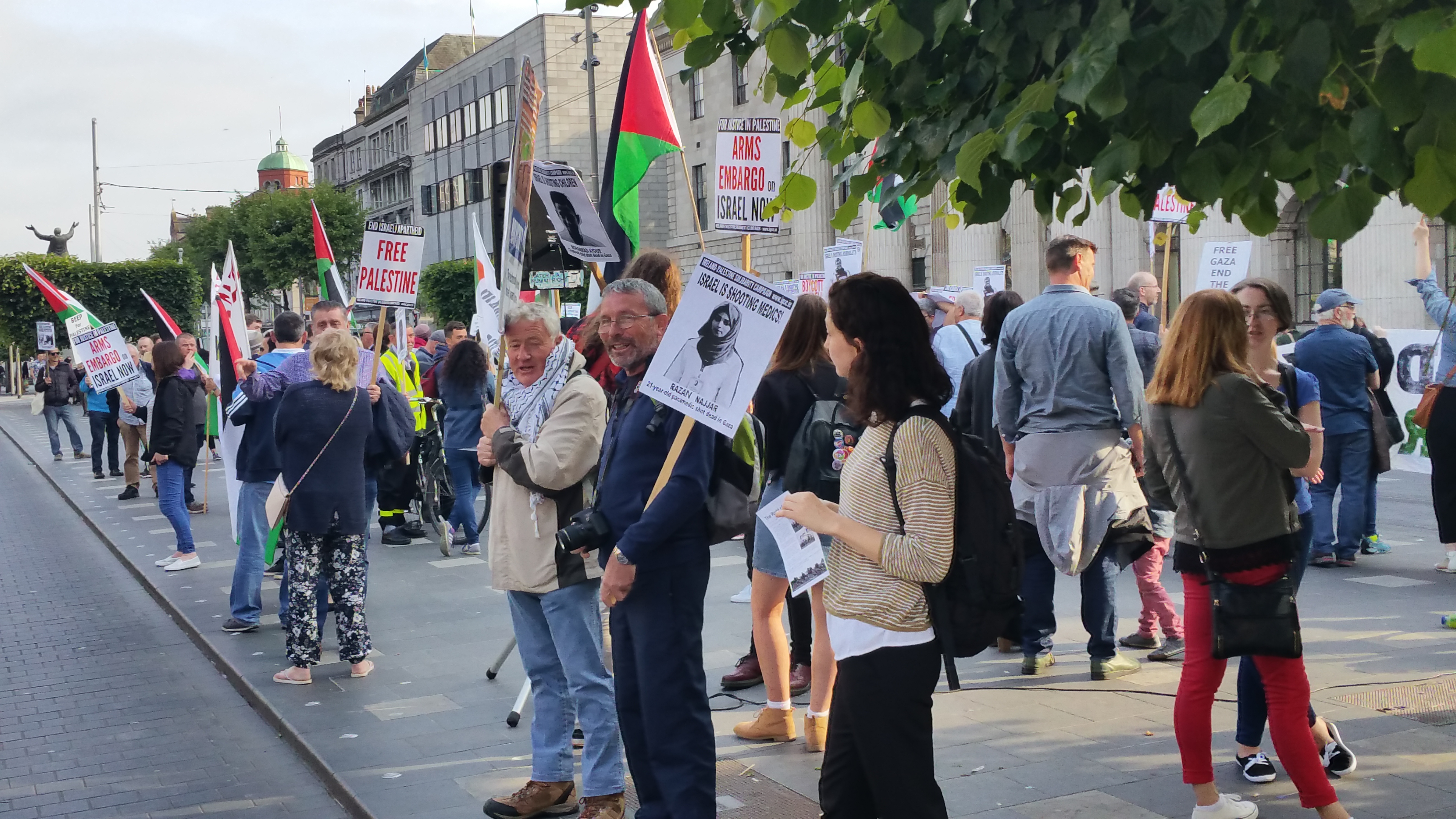
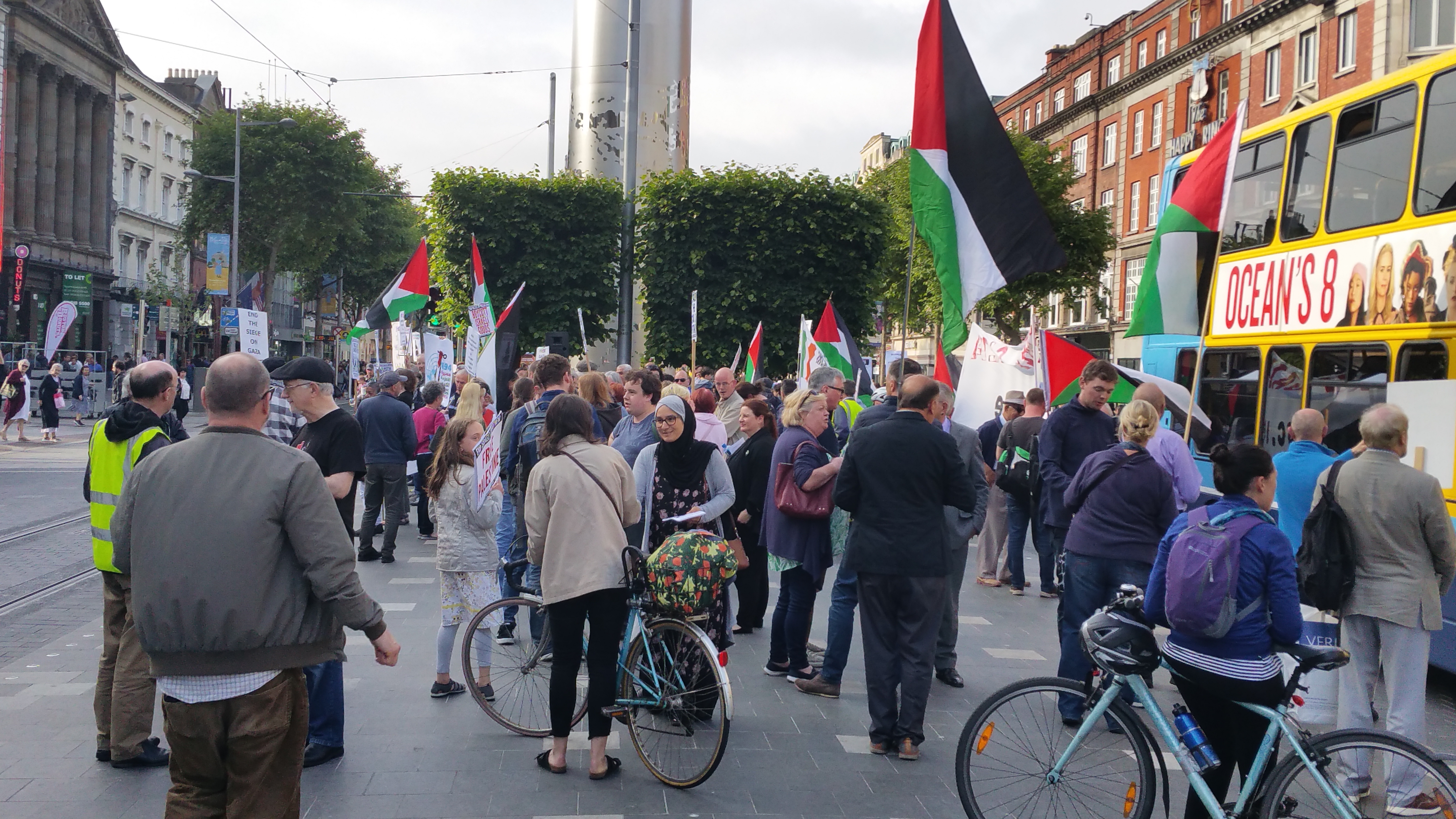
The regular blowing of horns by passing motorists, including taxis and buses, would have indicated that something of interest was happening in the city centre yesterday, Monday 5th June. As people came within sight of the centre of O’Connell Street, they could also see the Palestinian flags flying, the banners and the placards.
View of the rally on the east side of the central pedestrian reservation, looking southwards. (Photo: D. Breatnach)
The Great Return March
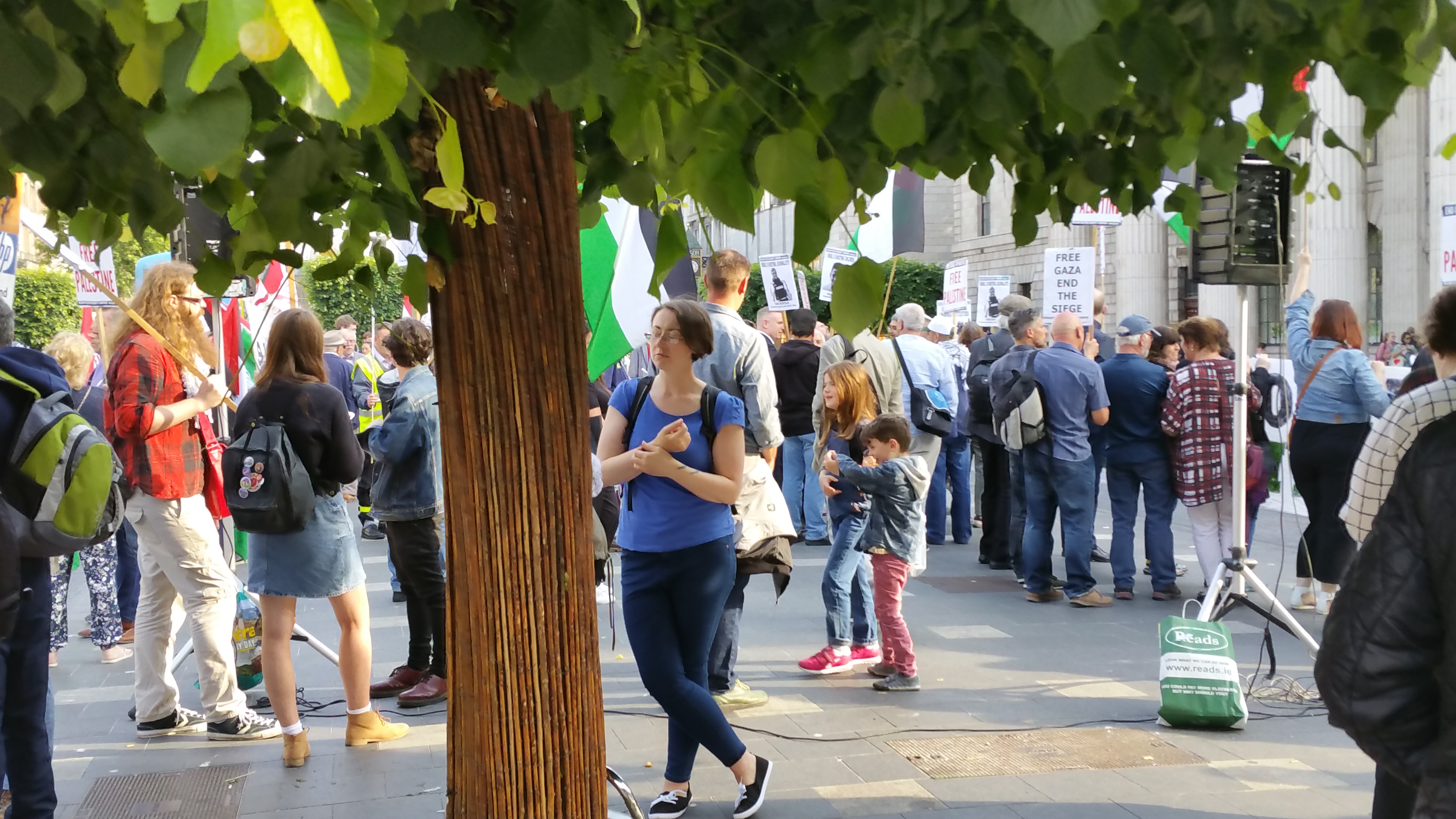
The Ireland Palestine Solidarity Campaign had convened a rally of hundreds in the central pedestrian reservation of O’Connell Street, main street of Ireland’s capital city, near to the Spire and opposite the historic and iconic building, the General Post Office. Billed as a rally in solidarity with the Great Return March of Palestinians, demonstrators carried placards denouncing the shooting dead by Israeli soldiers of demonstrators as well as of journalists and paramedics. The Palestinian death toll since March 30th has reached 120, with over 5,500 injured. Palestinians have also accused Israeli snipers, when they wish not to kill, of shooting young men through parts of their legs calculated to ensure permanent disability. The shooting dead of unarmed protesters, the killing of paramedics and journalists (who wear clearly identifiable clothing), are all crimes according to international law but, as Palestinians and their supporters repeatedly ask, who will hold Israel to account?
A view of part of the rally on the central pedestrian reservation, looking southwards. (Photo: D. Breatnach)
The demonstrators being targeted by Israeli military are protesting the expulsion by Israel of 700,000 of what was then the majority Arab population of Palestine in 1948, followed by their exclusion and that of their descendants from Israeli-controlled Palestine. There are an estimated four million Palestinians 1 barred from entry to Palestine, their lands or those of their grandparents, while anybody in the world who can prove his or her Jewishness, even though their families had not lived there for thousands of years2, can gain entry and claim Israeli citizenship.
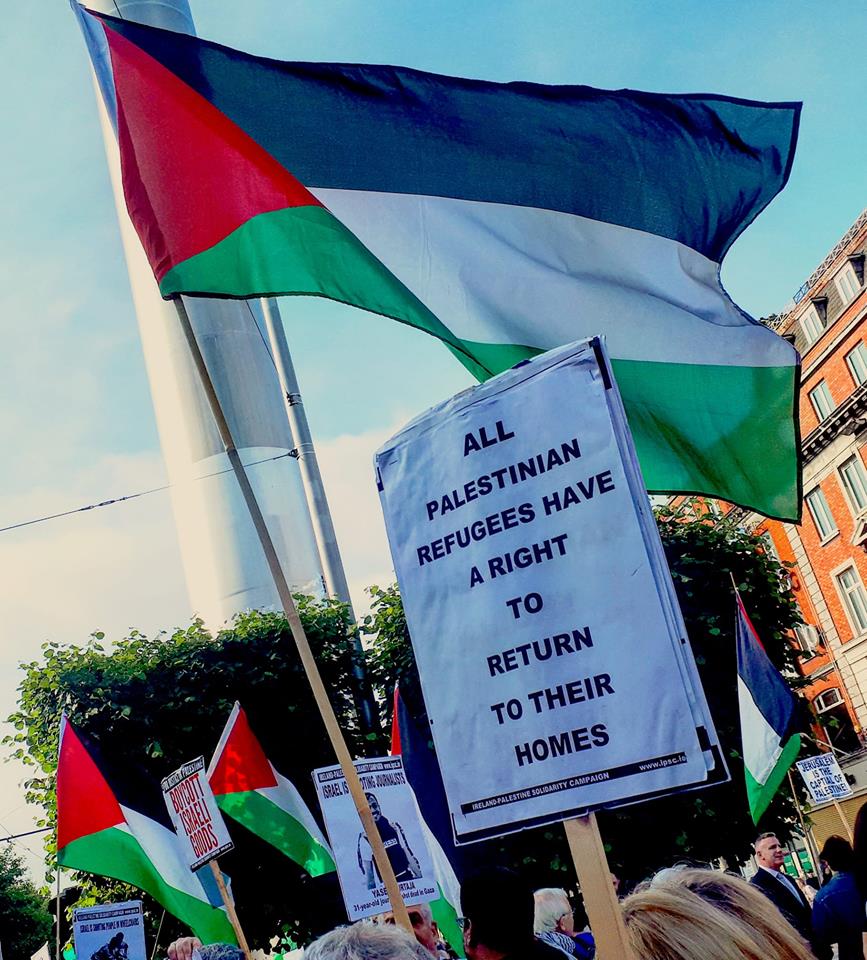
Placards held by supporters in the rally yesterday upheld the right of the Palestinians to return to their homeland. It is ironic that the Zionists since 1924 at least have been upholding that demand for people who had never set foot in the land, nor whose ancestors had not for thousands of years but are denying that right to Palestinians driven out within living memory and their descendants.
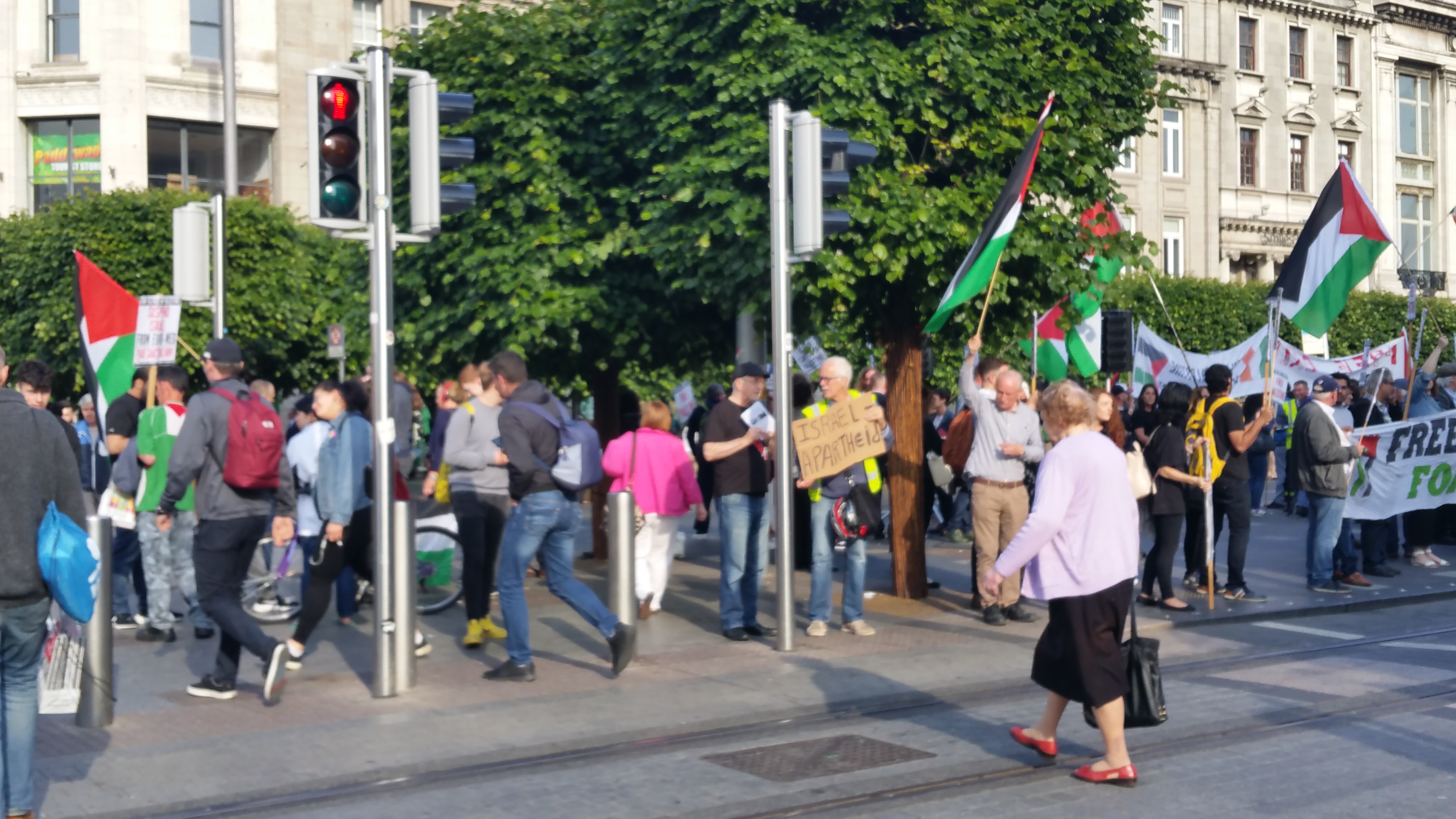
View of the rally on the west side of the central pedestrian reservation, sretching southwards. (Photo: D. Breatnach)
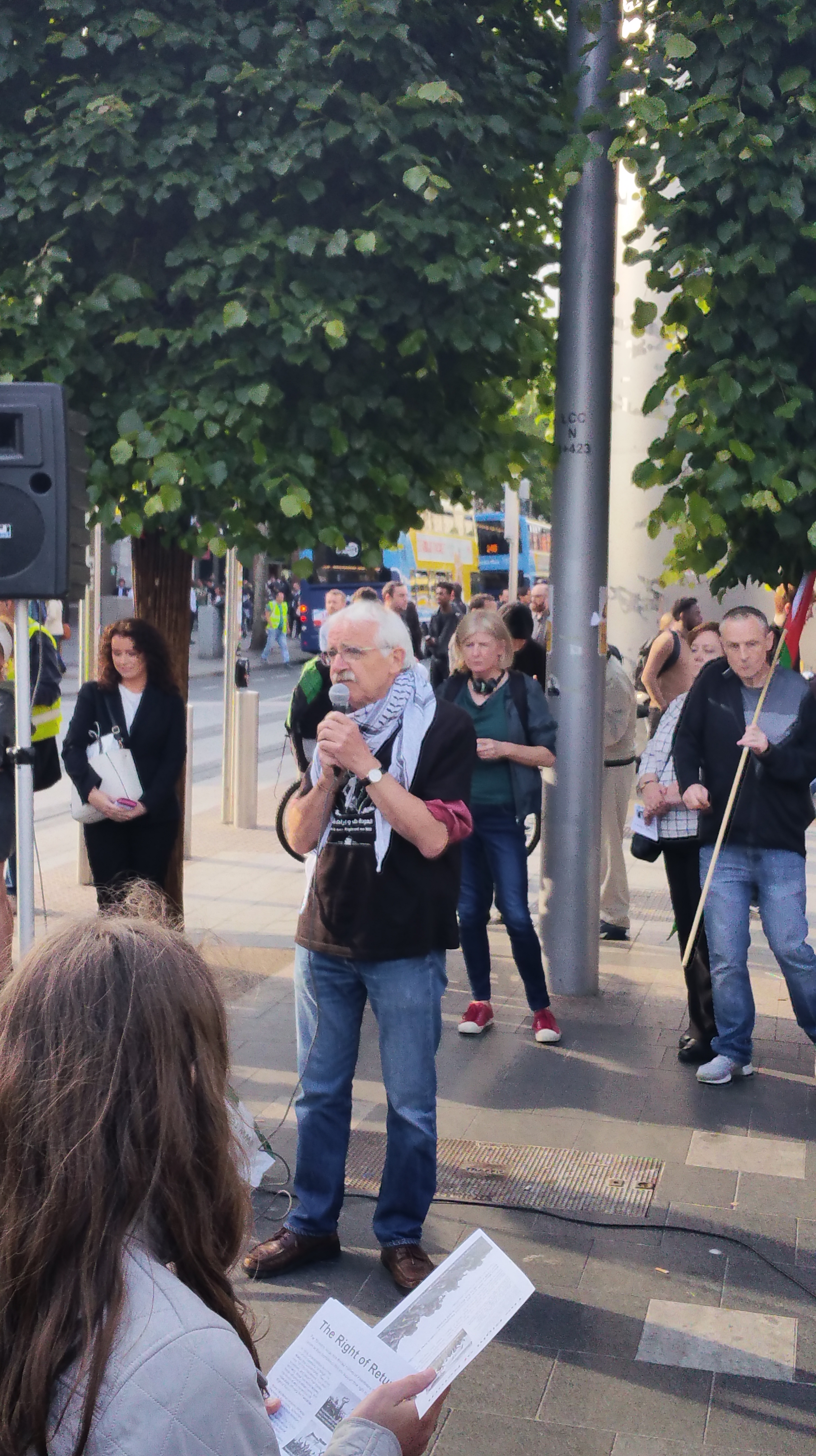
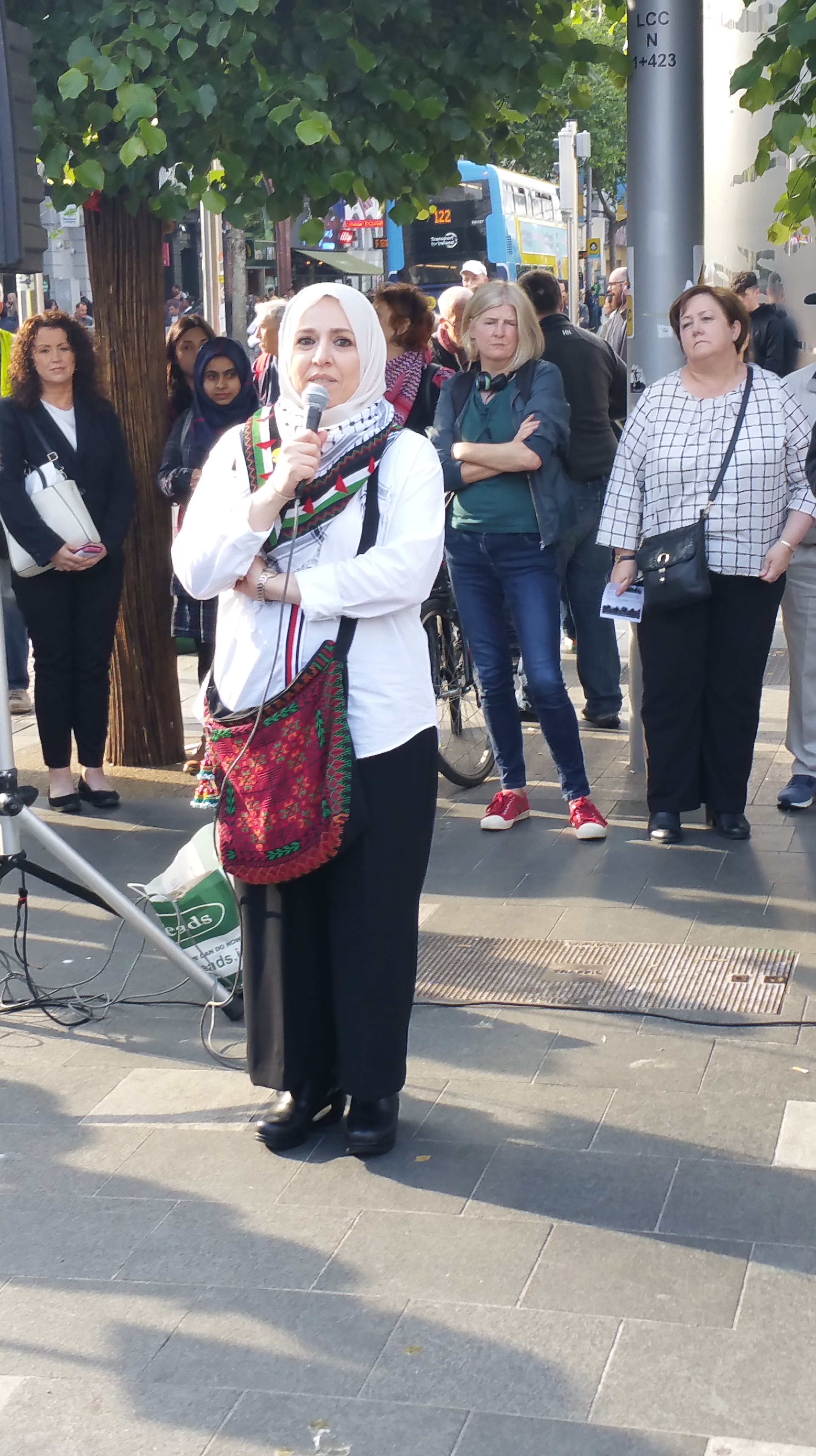
Speaking through a microphone, Martin Quigley thanked those attending the rally and after some remarks, introduced the Chairperson of the IPSC, Fatin Al Tamimi. Speaking about the right of return of Palestinians, Tamimi also said that she had relatives in both Hebron (West Bank) and in the Gaza strip and spoke about the privations of the people there blockaded by Israel, including contaminated water and lack of electricity. However not only is Israel guilty but also Egypt, as Tamimi alluded to when she said that Egypt had only temporarily opened the Rafah Crossing Gate, which Egypt maintains, for the feast of Ramadan, as a result of which she was expecting to be able to see her sister for the first time in seven years (the crowd cheered and applauded this news).
Marting Quigley for IPSC. (Photo: D. Breatnach)
“Expel the Israeli Ambassador and close down the Embassy!”
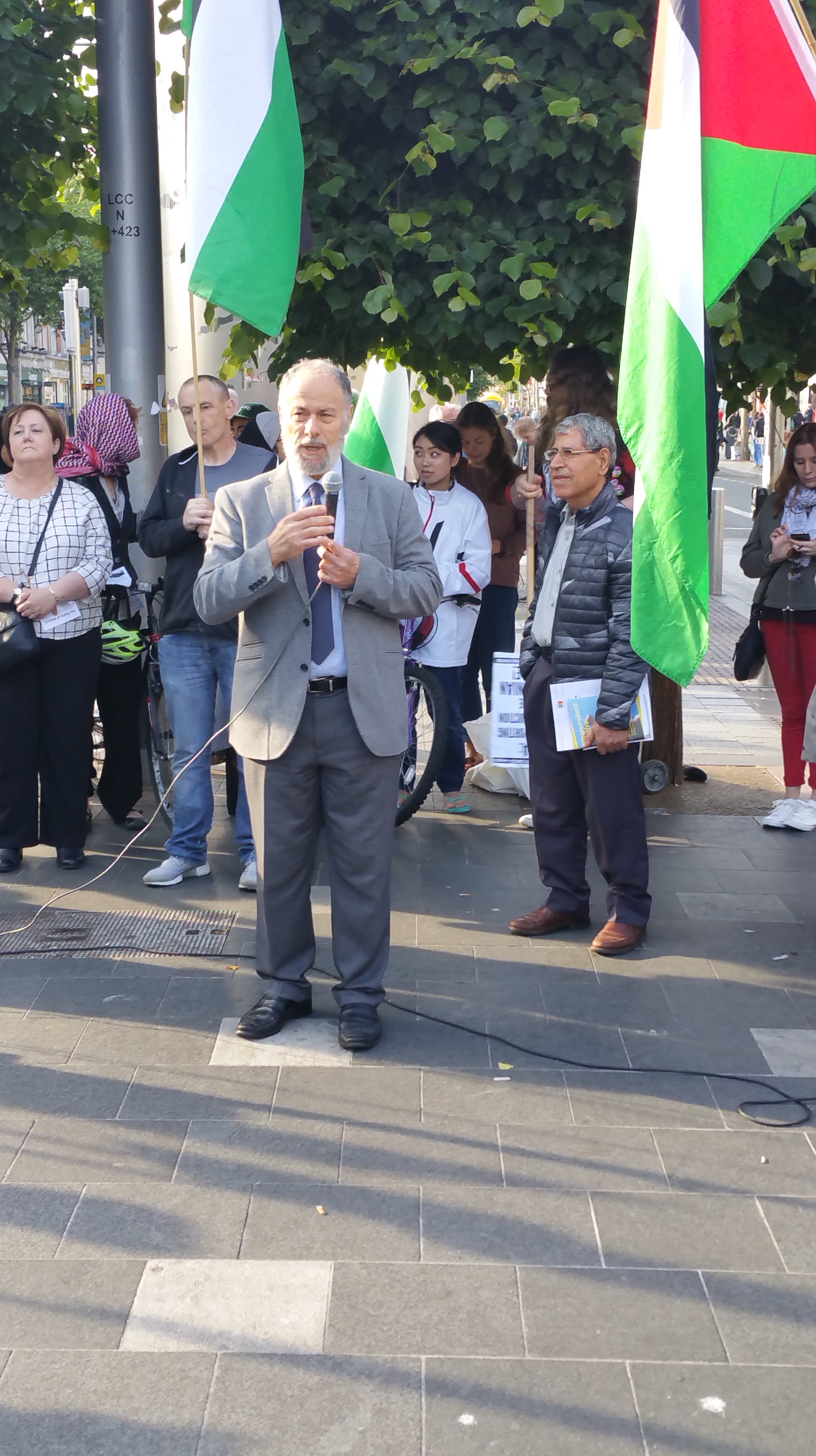
Two other Palestinian speakers addressed the rally, including one who had come out through that very Rafah crossing, Asad abu Shark who was introduced as from the Great March of Return and Ahmad El Habbash, introduced as representing the Palestinian Community in All Ireland3. All speakers drew attention to the Nakba (from Yawm an-Nakba, meaning “Day of the Catastrophe”, referring to the expulsion of thousands of Palestinians in 1948 –), to the right of return, the terrible conditions within the Gaza strip (which place, they said, would become uninhabitable by 2020 — see link), the impunity of the Israeli authorities and the inactivity of “the international community”.
Fatin Al Tamimi, Chairperson of IPSC, addressing the rally. (Photo: D. Breatnach)
Al Tamimi was cheered loudly when she called for the expulsion of the Israeli Ambassador to Ireland and the closure of the Israeli Embassy, a call repeated by other speakers.
Ronit Lenten, who introduced herself as “an Israeli Jew” and representing Academics For Palestine (Ireland), also spoke briefly.
Last to speak was John Lyons, a Dublin City Councillor for the People Before Profit party, who made similar points. Referring to visit of his own to Palestine he referred to the courage and persistence of the Palestinians in merely trying to live their daily lives under the conditions of Israeli military occupation, apartheid and harassment and called on the Irish people to match that determination in taking action in solidarity with the Palestinians.
An Ireland-based Palestinian speaker addressing the rally. (Photo: D. Breatnach)
Throughout the speeches, the solidarity beeping of horns of passing car and bus drivers could be heard and occasionally shouts of encouragement from open bus or car windows.
Bill to ban imports from Occupied Territories
All speaker highlighted the importance of the BDS campaign (Boycott, Divestment and Sanctions) and the need for Irish people to contact their elected public representatives to ask them for concrete action in support of Israel, including for a Bill to be introduced in the Seanad by Senator Francis Black, (well-known singer, also campaigner for human rights and for support for recovery from alcohol addiction). The Bill in question is the Occupied Territories Bill, the intention of which is to place a national ban on any products shown to be exported from territories under illegal occupation. The Bill, a draft of which has already been approved in committee (see link), is expected to go before the Seanad in July, though that may change and, if passed twice there, will go on to the Oireachtas for debate and, if passed there, into Irish law.
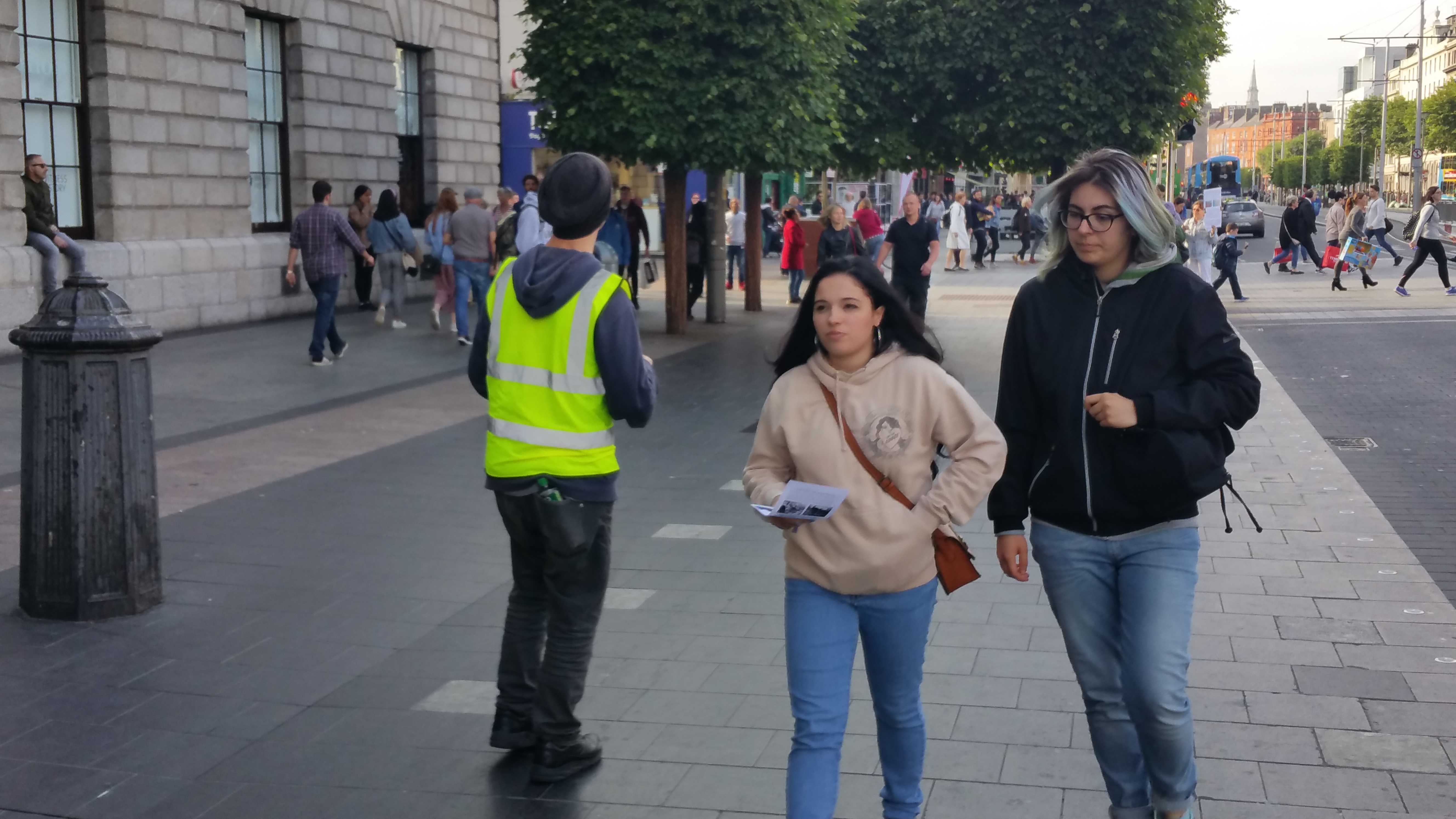
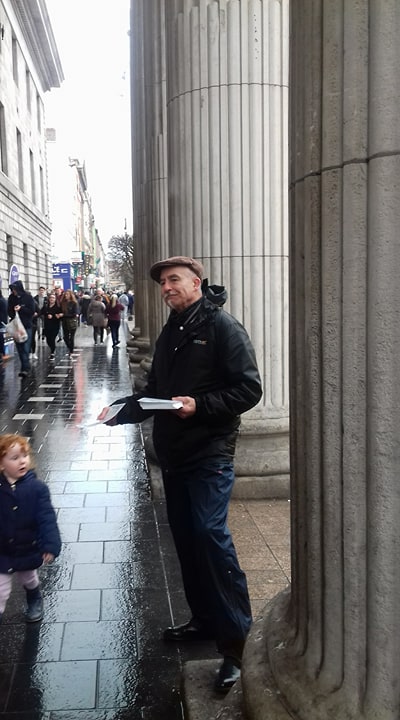
One of the IPSC’s leafleters and passers-by who have just accepted a leaflet. (Photo: D. Breatnach)
Calling on all present to stay in touch with the IPSC or with other Palestine solidarity organisation, Martin Quigley brought the event to an end by leading the rally in leading a number of chants: “From the river to the sea, Palestine will be free!” “Free, free Palestine!” “One, two, three, four – occupation no more!” “Five, six, seven, eight – Israel is a fascist state!”
Early moments as Palestinian supporters gather, view northwards. (Photo: D. Breatnach)
Argentina cancels scheduled football match with Israel. Dozens of Palestine flags defy GAA ban.
In a separate but related development, the national soccer team of Argentina yielded to calls to abandon its scheduled ‘friendly’ match with the Israeli national soccer team (see relevant link). Strong advocacy for the cancellation had been brought about by the movement for BDS both within and outside Argentina but statements of team officials to the media made it appear that members of the team had been threatened (but without producing any evidence of such).
And on Sunday, dozens of Palestinian flags were flown during a match at Omagh between Senior Gaelic Football teams Tyrone and Monaghan. The actions seemed not only to represent solidarity with the Palestinians at this time but also defiance of GAA officials who had removed flags and a banner at a previous match (see relevant link).
End.
POSTSCRIPT:
Palestinian solidarity demonstration in Dublin Friday 8th June (not organised by IPSC). (Photo: D.Breatnach)
Footnotes:
1“Today the number who qualify for UNRWA’s (United Nations Refugee and Welfare Agency) services has grown to over 4 million. One third of whom live in the West Bank and Gaza; slightly less than one third in Jordan; 17% in Syria and Lebanon (Bowker, 2003, p. 72) and around 15% in other Arab and Western countries. Approximately 1 million refugees have no form of identification other than an UNRWA identification card.”
2Or the many Jewish converts who never had any contact whatsoever with Palestine.
3 Actually no individual or separate organisation can claim legitimately to “represent the Palestine community in Ireland or anywhere” but there does exist a Palestinian organisation in Ireland which has appropriated that title as its organisational name. A number of different organisations (and none) find support among the general expatriate Palestinian community, including Hamas, Al Fatah and perhaps the PFLP.
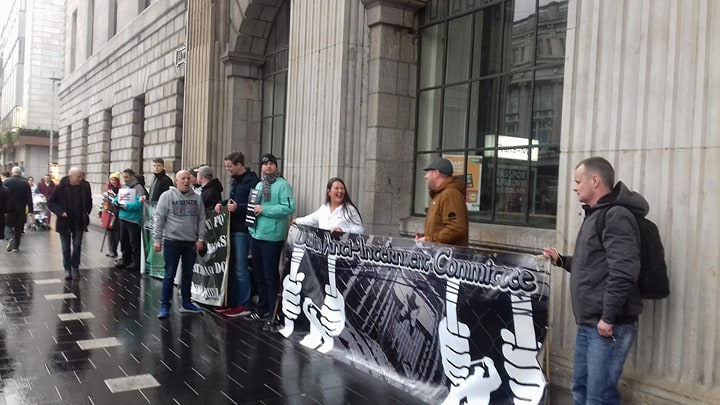
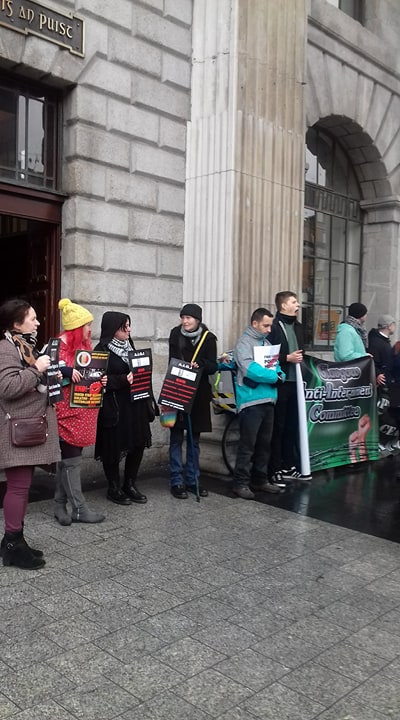
Glasgow and Dublin Anti-Internment Committees joined forces on 18th February in a protest against continuing internment without trial in Ireland. Around two score protesters gathered outside the iconic General Post Office building in Dublin city centre’s main thoroughfare, O’Connell Street. They displayed the anti-internment banners of the Dublin and Glasgow committees and placards against internment, including one against the jailing of Catalan political activists by the Spanish state (also refused bail).
Section of protesters outside the GPO building, O’Connell Street, Dublin (Photo source: End Internment FB page)(Photo source: End Internment FB page)
Leaflets of the Anti-Internment Group of Ireland were distributed to shoppers and visitors passing by, along with others about the conviction of Brendan McConville and John Paul Wooton (the Craigavon Two), framed and jailed in 2009 and still in jail, serving life sentences. Songs about internment and political prisoners were played on a sound system, as well as Labi Siffre’s Something Inside So Strong and Christy Moore’s Viva La Quinze Brigada.
Young passer-by accepts leaflet from Dublin Committee leafleter (Photo source: End Internment FB page)
Despite the official end of internment by the British in 19751and by the Irish state in 19572, Republican activists continue to be jailed without trial in a number of ways: Licence revoked and bail refused or revoked.
(Photo source: End Internment FB page)
When a Republican leaves jail under license, she or he can be returned there without any court hearing or the presentation of any evidence against them; this is what has happened to Tony Taylor and Gerry Mackle, for example. Refusing bail for accused Republicans has become almost standard, despite the fact that this is supposed to be a last resort, for example when there is a serious risk of the accused fleeing the administration, or interfering with witnesses – which has rarely applied to Republicans refused bail. The real reason has usually been revealed when they have been granted bail: they are required not to attend protests, meetings or to associate with other active Republicans. In other words, they are being prevented from exercising their civil rights to express their opinions and to organise politically.
Welcoming the participation of the Glasgow Committee in Dublin, a spokesperson for the Dublin Committee stated that “members of the Dublin Committee have been proud to attend anti-internment protests in Glasgow in the past” and went on to say that “we look forward to future cooperation with the Irish diaspora and internationally against political repression, particularly of jailing without trial of political activists.”
Another Dublin Committee leafleter. (Photo source: End Internment FB page)
The Dublin Anti-Internment Committee is entirely independent of any political party or organisation and holds regular awareness-raising protests at different locations. The Committee welcomes the participation of other organisations or individuals in their protests but asks them not to bring political party material etc to the anti-internment protests.
On its FB page the Committee also maintains a list of Republican prisoners in jails on both sides of the British Border, updating it from time to time.
FOOTNOTES
1By then more than 1,900 people – only around 100 of them Loyalists – had been interned, many of them tortured; it was during protests against it in 1971 in Ballymurphy and 1972 in Derry that the Parachute Regiment killed 25 unarmed people.
2Introduced by De Valera’s government in July 1957 during the “Border Campaign” of the IRA.
(Photo source: End Internment FB page)(Photo source: End Internment FB page)
A crowd gathered at the Dublin and Monaghan Bombing Monument in Talbot Street this evening for a short ceremony and the start of a march to rally at the General Post Office building in Dublin city’s main street. The event was organised by Anti-Imperialist Action Ireland “to highlight imperialist war-crimes around the world, from Ireland to Yemen and Syria.”
View of section of crowd before start of event with the Memorial in the background (Photo: D.Breatnach)
View of section of crowd near the Memorial before start of event (Photo: D.Breatnach)View of section of crowd near the Memorial before start of event (Photo: D.Breatnach)View of section of crowd near the Memorial before start of event (Photo: D.Breatnach)
As people assembled, a crowd of European youngsters was noted passing by, no doubt part of some scheme to learn English and something of the culture outside their own country. Sadly their teacher passed by the Monument without calling their attention to it.
The bombings on 17 May 1974, killing 33 civilians and a full-term unborn child and injuring almost 300, claimed the highest toll of any event during the 30 Years War and was the deadliest attack in the history of the Irish State. The bombings were organised by British Intelligence agents with Loyalist participation and not one person was ever charged.
It was not a good day for the march and participants came prepared for the worst but the rain stopped just before the event and held off, apart from an occasional drizzle, until after the event, when it fairly lashed down.
George Galloway approaching the Monument to lay a floral (Photo: D.Breatnach)George Galloway after laying wreath, hat removed for a moment in respect. (Photo: D.Breatnach)
Pádraig Ó Fearghaill spoke first in Irish welcoming all who had attended, outlined the order of events and then called on George Galloway, famous British anti-imperialist politician, writer and broadcaster, to lay a floral wreath at the monument, which he did. Ó Fearghaill then called on Diarmuid Breatnach to sing the Woody Guthrie song about the massacre of mineworkers in Colorado, USA, by capitalists including the imperialist John D.Rockefeller. Breatnach sang “The Ludlow Massacre”.
The march then formed up and, led by a floral wreath-holder and black flags, proceeded up Talbot Street, into North Earl Street and up to the GPO. Along the way they chanted“From Ireland to Palestine- Occupation is a Crime” and “Donald Trump/Theresa May- How many kids did you kill today?” The demonstration received a lot of support from passers by along the way and drivers of cars and buses who beeped to show support. The marchers, some of who were carrying candles or light up boards made there way to the GPO where a further crowd had already gathered.
Section of crowd at GPO (Photo: D.Breatnach)
From well-known activists participating and banners carried it was clear that the march had attracted wide support across sections of the Republican movement in parties and campaigns, with participation of independent activists of republican, anarchist and socialist background.
Section of crowd at GPO (Photo: D.Breatnach)
Outside the GPO building, Ó Fearghaill called on Máire Uí Mhaoileoin to lay a wreath in memory of those who have lost their lives as a result of imperialist war-crimes and then introduced George Galloway, who remarked that he was proud to speak outside the building that had played such a part in the first blow against the British Empire of the last century. Galloway went on to refer to continuing British occupation of the Six Counties of Ireland and imperialist interference in the Middle East and the occupation of some countries. In the latter category he praised the Palestinian Ehed Tamimi, whose 17th birthday was just that day and called her “a leader of the resistance for the whole Middle East”.
Section of crowd at GPO (Photo: D.Breatnach)
Reminding the attendance of the ongoing crime of internment, Ó Fearghaill announced a representative of a campaign around Tony Taylor, who announced he was reading a statement from Lorraine Taylor, Tony’s wife. Taylor, a Derry Republican, was detained in March 2016 and has been in jail since, without trial or even charge.
Section of crowd at GPO (Photo: D.Breatnach)
Presenting Diarmuid Breatnach again to sing the famous Eric Bogle anti-war song “The Band Played Waltzing Matilda”referencing the bush-ballad of “Waltzing Matilda”, the Australian unofficial national anthem. However, following
Section of crowd at GPO (Photo: D.Breatnach)
a suggestion from a participant, Breatnach led the crowd in singing “Happy Birthday” in English and in Irish to Palestinian child-prisoner Ehed Tamimi. After Breatnach’s rendition of Bogle’s song, Ó Fearghaill thanked all the the participants and promised that Anti-Imperialist Ireland would continue to build up resistance against imperialism in Ireland and in the world beyond.
End
Section of crowd at GPO (Photo: D.Breatnach)Section of crowd at GPO (Photo: D.Breatnach)
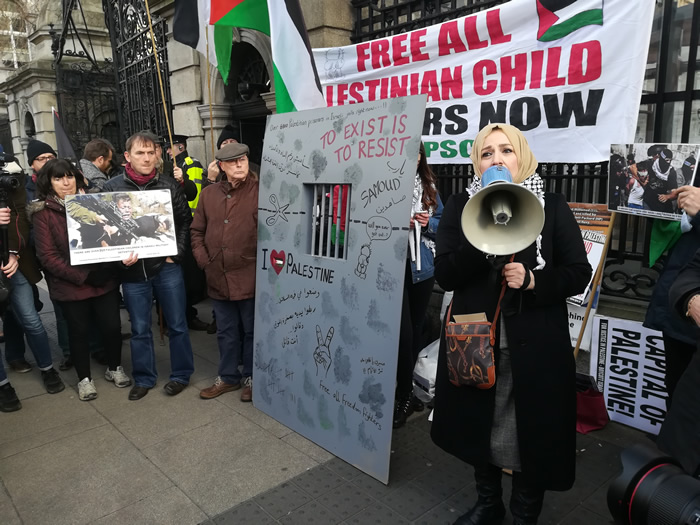
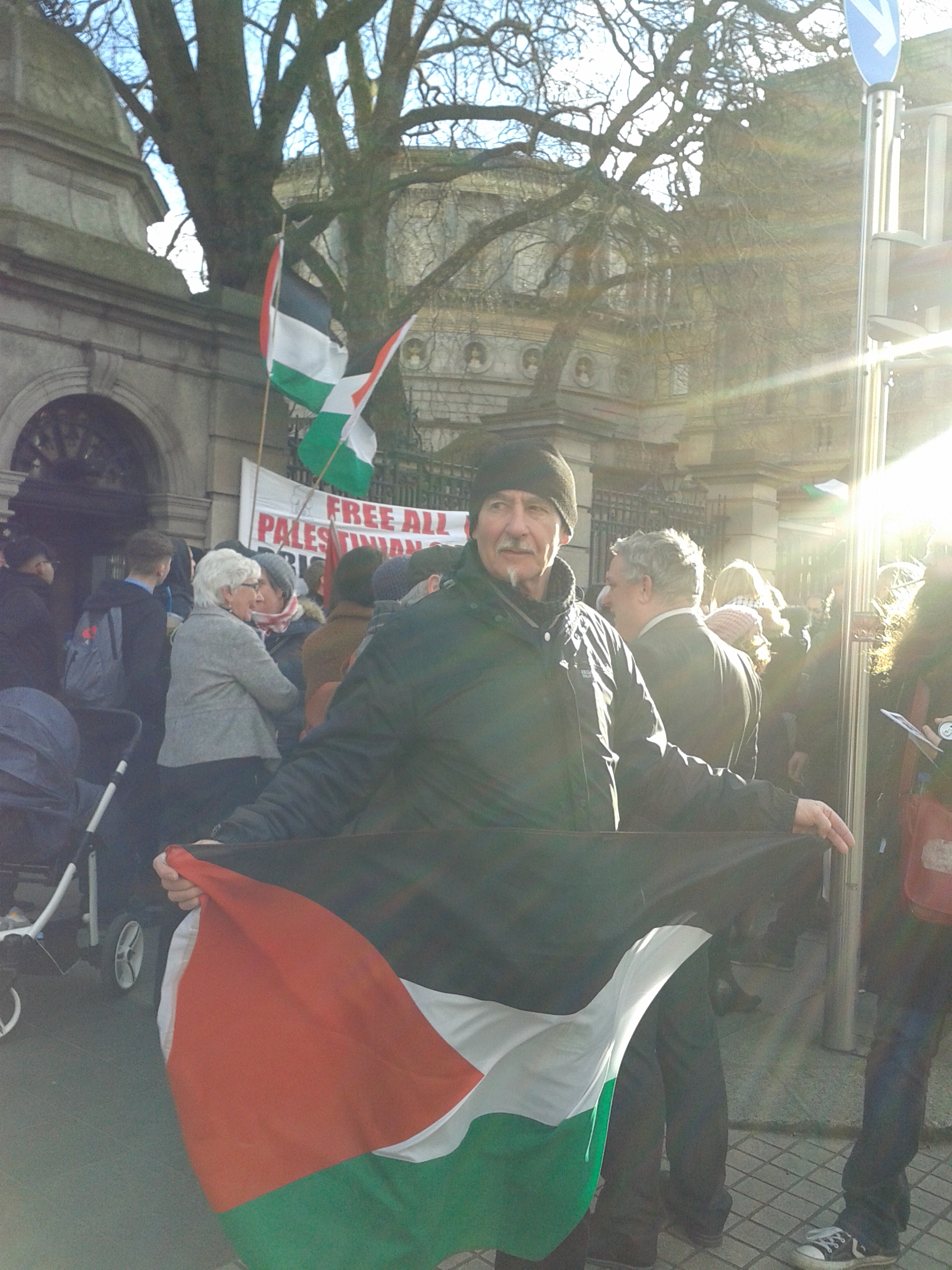
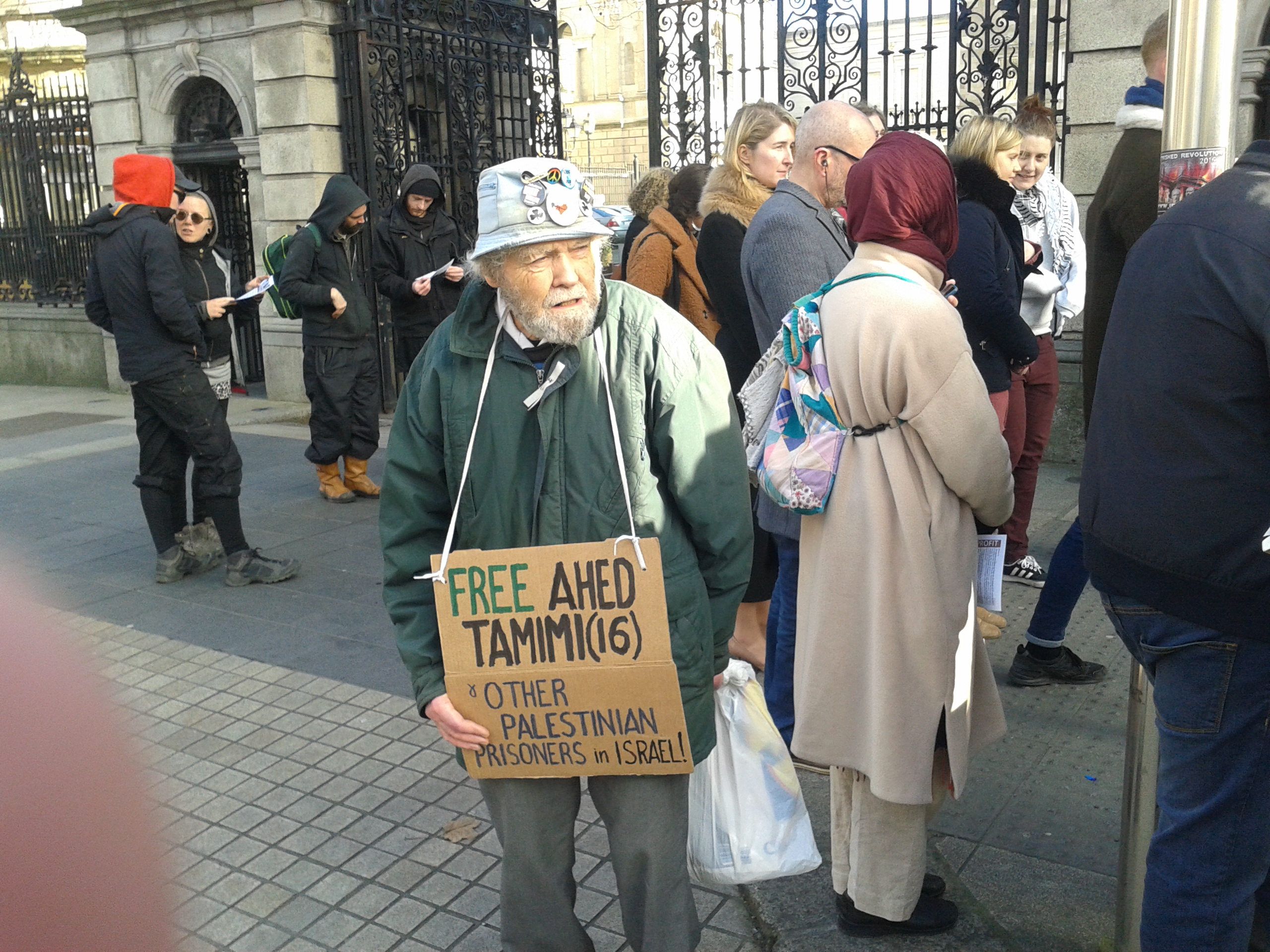
A dense crowd gathered outside Leinster House, home of the Dáil (Irish Parliament), at lunchtime today. Palestinian flags were in evidence as was a banner denouncing the jailing of Palestinian children by the Israeli authorities. Some passing drivers tooted their horns in solidarity.
View of section of crowd outside the Dáil (Photo: D.Breatnach)
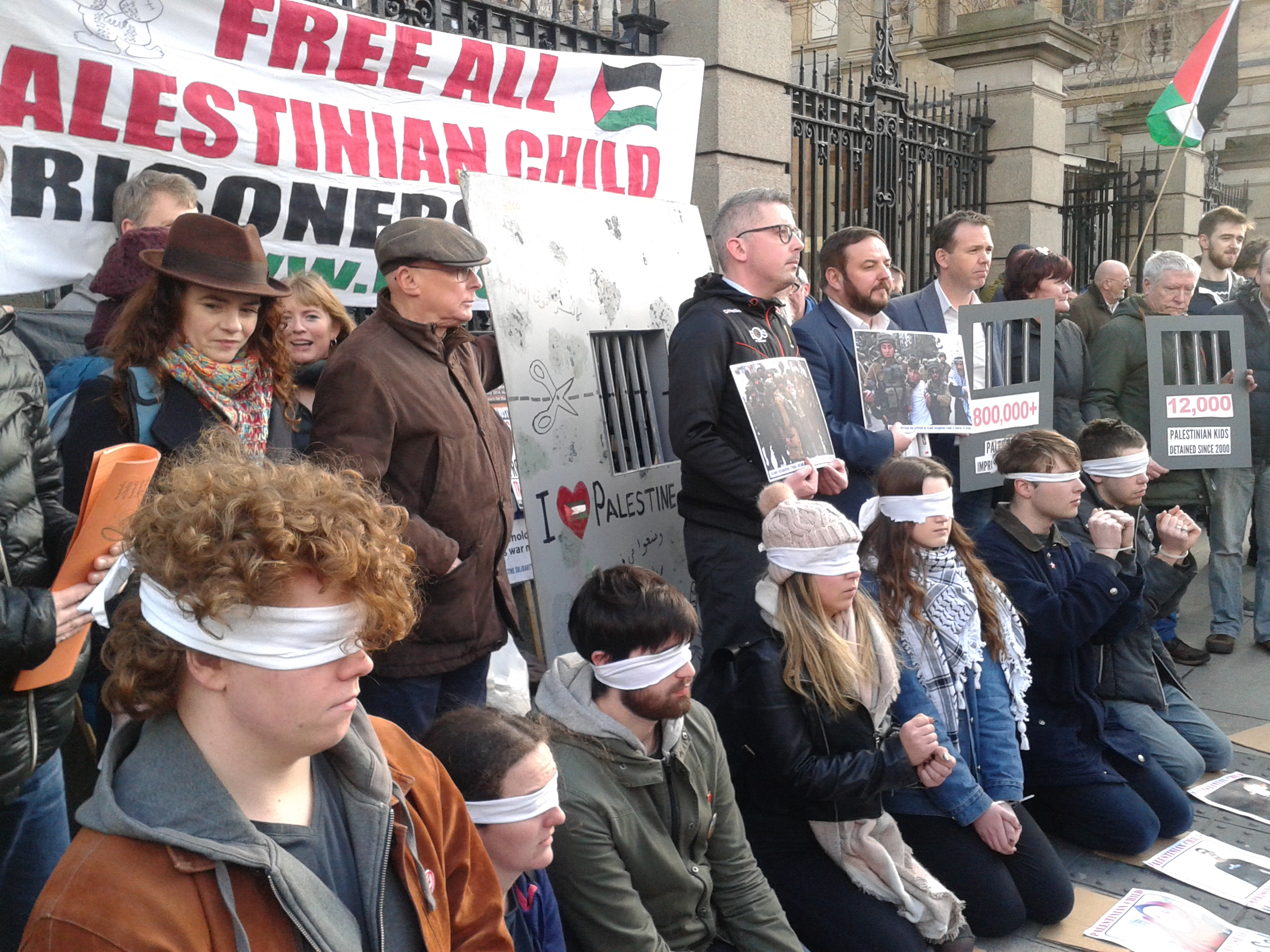
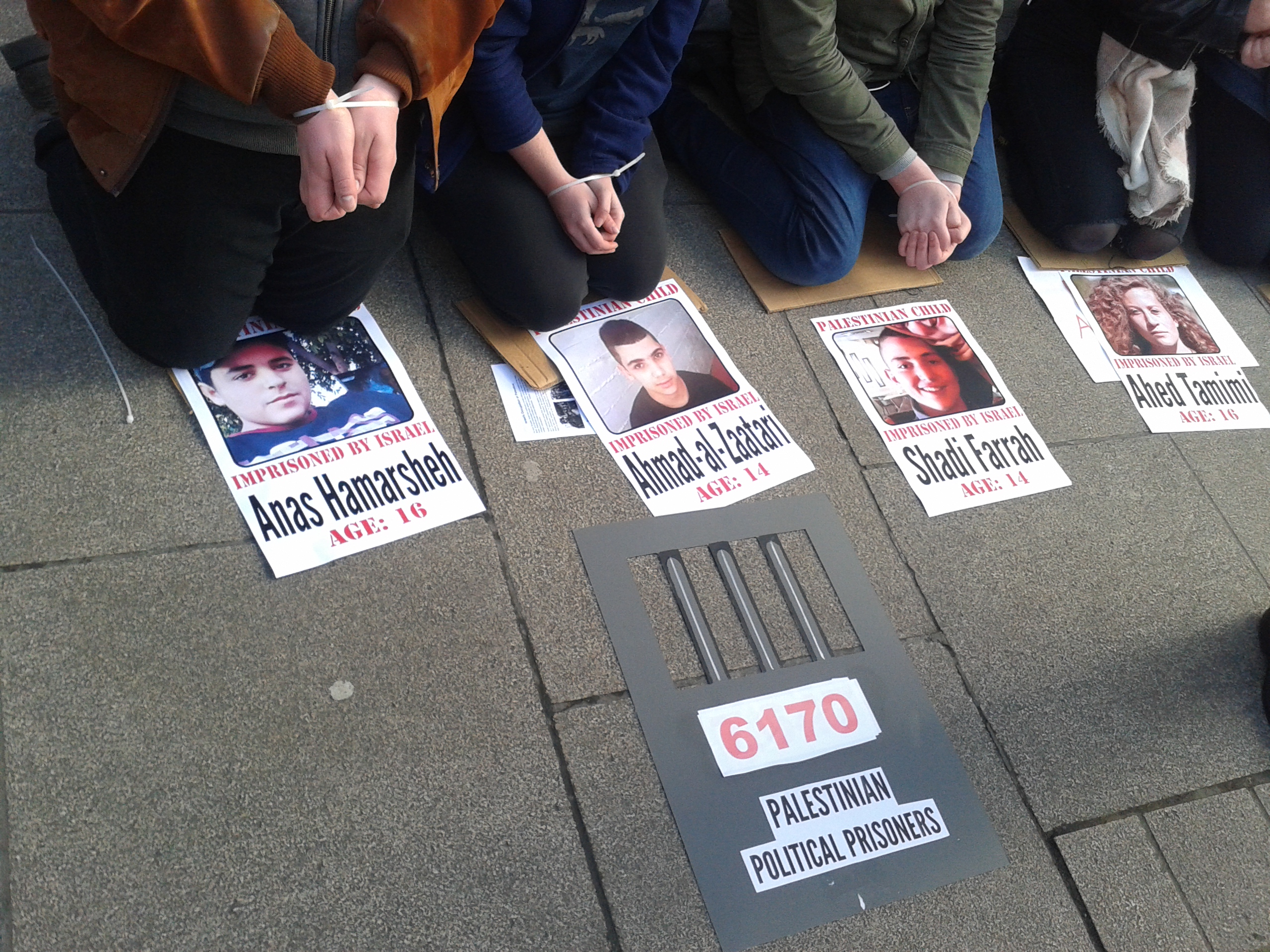
A hollow space existed inside the crowd where young people knelt, blindfolded and with hands bound, to represent children taken prisoner by the Israeli state. According to the Ireland Palestine Solidarity Campaign, which organised the solidarity protest, between 500 and 700 children are detained every year by the Israeli military, i.e up to an average of two a day.
Young people acting as Palestinian children arrested by Israeli military (Photo: D.Breatnach)
The protest was attended by many TDs (members of the Irish Parliament) and Senators comprising a broad representation of political parties and independents. Ibrahim Halawa, the Irish citizen who was arrested by Egyptian police while still a minor of 17 years of age, subsequently to spend four years in jail without trial, also attended.
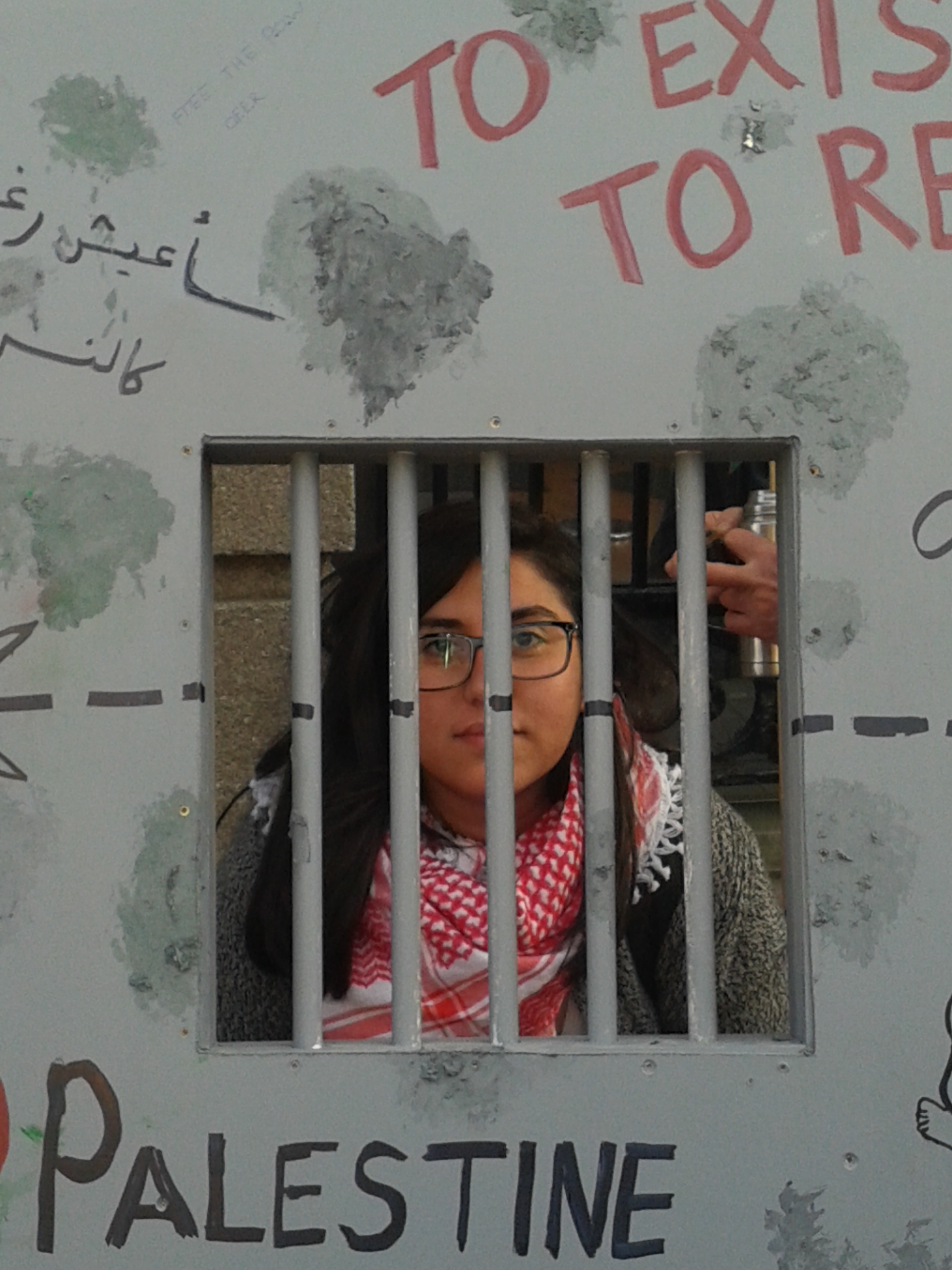
Young woman representing Palestinian children jailed by the Israeli authorities (Photo: D.Breatnach)
IPSC Chairperson Fatin Al Tamimi addressed the gathering and referred to “Israel’s apartheid prison system where torture and ill treatment during arrest and detention are routine, including horrendous abuses against children.” Tamimi went on to say, to loud applause: “Apartheid Israel must be held to account for its outrageous treatment of Palestinian children which violates the right of the child.”
After the protest a letter was handed in to the Irish Minister for Foreign Affairs calling on the “the Irish Government to do all it possibly can to end these abuses of Palestinian children by Apartheid Israel. More than just condemnation, action is needed to bring pressure to bear of Israel to end these attacks on children, children who have known nothing but occupation and systemic violence their whole lives. Palestinians, not least Palestinian children, deserve freedom, justice and equality.”
The Irish Government action required was not specified but over the years demands have been made to call the Israeli Ambassador in for censure or even to expel him but no such action has taken place. As a participant on the demonstration said: “When the Irish Government did not even take serious action at the use of forged Irish passports by Mossad assassination squads, you know that they are not going to do anything about Palestinian children being jailed and ill-treated.” (The Irish Government expelled one minor diplomat only over that revelation in 2010 and even then the Ambassador stated that he could not guarantee that such faked passports would not be used again).
Photos of a small sample of detained children (Photo: D.Breatnach)Photos of another small sample of Palestinian children detained by Israeli Occupation Force (Photo: D.Breatnach)
WIDESCALE VIOLATION OF THE RIGHTS OF THE CHILD
According to the UN Convention on the Rights of the Child, apart from rights to survival (violated by Israel in its 2014 bombardment of Gaza, for example, when it killed 504 children and made thousands homeless), and adequate living standards (also violated by Israel in Gaza with damaged sewage treatment plants and water, power and fuel restrictions), children also have
Development rights: include the right to education, play, leisure, cultural activities, access to information, and freedom of thought, conscience and religion.
Protection rights: ensure children are safeguarded against all forms of abuse, neglect and exploitation, including special care for refugee children; safeguards for children in the criminal justice system; protection for children in employment; protection and rehabilitation for children who have suffered exploitation or abuse of any kind.
Participation rights: encompass children’s freedom to express opinions, to have a say in matters affecting their own lives, to join associations and to assemble peacefully. As their capacities develop, children should have increasing opportunity to participate in the activities of society, in preparation for adulthood.
By jailing children, Israel is violating the rights of the child in each of these three broad categories above. Yet, according to UNICEF, only two states have currently failed to ratify the Convention after signing: the USA and Somalia. In other words, Israel has signed it but clearly is violating it as a matter of course.
Trials of Palestinian children have a 99.74% conviction rate, and “do not meet international standards for fair trial” according to Amnesty International. According to the IPSC, many more children are temporarily detained, sometimes taken by soldiers raiding homes in the dead of night, and later released after severe interrogation periods without prosecution. Defence for Children International Palestine states that some two-thirds of all children detained will face some sort of physical or mental abuses, including torture and sexual threats, during this process. UNICEF says that “Ill-treatment of Palestinian children in the Israeli military detention system appears to be widespread, systematic and institutionalised”.
According to the IPSC, “over 12,000 Palestinian children have gone through the Israeli prison system since 2000, while nearly 2,500 have been killed and countless thousands wounded. In Gaza alone, where children have borne the brunt of three vicious Israeli assaults over the past decade, UNRWA estimates that “more than 300,000 children are in need of psycho-social support”.”
After the Spanish police attack on voters in a referendum on independence in Catalunya1 on October 1st, People Before Profit2 Councillor Tina McVeigh put forward a motion condemning the attack and calling for the Catalan Flag to be flown over Dublin City Hall as a mark of solidarity with the Catalan people and their right to determine their future.
Front view of Dublin City Hall showing the Ensaya flying next to the Irish Tricolour (Photo: Casal Catala Irlanda)
This was not such a wild step for the Council to take as it may seem: the Palestinian flag had been flown from City Hall in May, to the delight of most Dubliners but to the disgust of the Israeli Ambassador and to Zionist sympathiser and former Government Minister Alan Shatter. And Dublin city has been ‘twinned’ with Barcelona since 1998.
Nevertheless, in November the Protocol Committee agreed to recommend flying it by majority only, seven votes for and five against. It still had to be voted on by the whole Council and so went forward on to the agenda for the monthly meeting in December. Councillors began receiving emails from Spanish unionists asking them to vote against, which at first substantially outnumbered those in favour. As the first Monday in December drew nearer, the correspondence equalised between those in favour and those against. But the meeting ran over time before the motion was reached on the agenda and another date was set to discuss it. When the councillors reconvened, the motion was proposed, discussed and voted on. Unlike the decision on the Palestinian flag earlier this year, the vote was very close but the motion passed by three votes.
Section of the attendance at the event (Photo: D.Breatnach)
In January this year the Catalan flag was hoisted – the regional ensaya and not either of the independence esteladas3 – on top of City Hall, where it will fly for a month. City Hall is itself a historic site, having been part of a battleground during the 1916 Rising. On January 6th, Catalans and some supporters gathered outside City Hall to celebrate the show of solidarity in the flying of the Catalan flag.
Joan Pau of Casal Catala of Ireland4 welcomed the attendance and thanked the Councillors for flying the flag and introduced the Lord Mayor, Mícheál Mac Donncha, telling those present how he had approached the Catalans to help them. Mac Donncha (SF)5 thanked the Catalans for the invitation to attend and said that he was proud of the Council for the decision they had taken. He remarked also that in the past Ireland had political prisoners just like those now in Spanish jails for supporting the Catalan referendum and deplored elected officials of Catalunya being jailed for following the mandate of the people. He spoke also about Ireland’s fight for freedom and how in the 1916 Rising, Volunteers had taken over City Hall itself.
Another view of a section of the attendance Front view of Dublin City Hall showing the Ensaya flying next to the Irish Tricolour (Photo: Casal Catala Irlanda)
Joan Pau then expressed his regret that Cnclr. Tina McVeigh could not be present due to a family bereavement, since she had been very active in solidarity with the Catalan people. He introduced Cnclr. John Lyons (also PBP) who also expressed his pride on the result of the vote, as well as his condemnation of the Spanish Government, as distinct from the Spanish people, for their undemocratic and violent behaviour in the October 1st attacks and subsequently in the jailing of Catalan public representatives. He also condemned the Irish Government for not supporting the right of the Catalan people to self-determination.
Front view of Dublin City Hall showing the Ensaya flying next to the Irish Tricolour (Photo: D.Breatnach)
Although a Spanish unionist had contacted the Council to threaten a counter-demonstration, there was no sign of any such presence throughout the ceremony. A number of passing tourists took photos (some even having themselves photographed with the group) and a number of passing motorists tooted their horns in solidarity.
Section of the attendance with flags (including the “Sí” ones used campaigning for the referendum) & placards calling for the release of the political prisoners. (Photo: D.Breatnach)
After the formal part of the meeting was over, Dublin walking history tour guide Diarmuid Breatnach invited Catalans to gather around DCC’s plaque to the garrison of City Hall and surrounding buildings in 1916. The guide explained the origin of the Irish Citizen Army in the Dublin Lockout of 1913 as a workers’ defence militia against brutal attacks by the Dublin Metropolitan Police Force. It has been called “the first workers’ army” Breatnach told them and drew attention also to it being the only one of the various organisations taking part in the Rising that formally gave equal status to men and women. There were women officers in the ICA and after the killing of the commandant of this garrison Seán Connolly, it was a woman who took over as commandant. The fighting here had been fierce as Dublin Castle is just next door and that had been the HQ of the British Occupation of Ireland since 1169.
Plaque (located to the right side of the front of City Hall) listing the names of men and women of the Irish Citizen Army who fought at that location in 1916. Four ICA Volunteers died there.
After receiving answers to a few questions, many of those present retired to a local pub to warm up and to carry on conversation on a number of topics, in the best Irish – and Catalan – manner. Up above, the Catalan flag on the east side of City Hall’s roof waved in the breeze, with the Irish tricolour next to it, in the centre, waving too.
End.
FOOTNOTES:
1Catalunya is considered part of wider nation called Paisos Catalans (Catalan Countries) which includes Valencia, the Balearic Islands and parts of Aragon and Murcia; most of it lies within the current territory of the Spanish state, with a small part within the French state. Catalunya (capital Barcelona) is one of the regions within the Spanish state with limited autonomy and it is there that the referendum was held, the result mandating its Parlament to create and independent republic. The Spanish Government and Constitutional Court ruled the referendum illegal, confiscated ballot boxes, assaulted hundreds of voters, declared the referendum result non-valid, jailed a number of elected members and activists, threatened others with jail, ruled Catalunya directly Spain and called for new elections, which confirmed the situation more or less as before. The struggle is ongoing.
2People Before Profit was launched as a broad front by the Trotskyist organisation the Socialist Workers’ Party Ireland, formerly the Socialist Workers’ Movement, founded in 1971 and close to the SWP of Britain.
3There are two Catalan independence flags or estelladas: the Republican one with red stripes on a yellow background, with a small blue triangle to the left, containing a white star; the Socialist (or Communist) one, also with red stripes on a yellow background but with a red star to the left and no triangle. The regional ensaya, without any star, was proposed as the one least likely to cause division.
4Casal Catala are Catalan cultural associations that have been founded in a number of countries outside Catalunya.
5SF or Sinn Féin – the party is represented on Dublin City Council and tradition has it that the Lord Mayor is elected yearly in rotation from among the elected representatives; this Council year it was SF’s turn again.
Let us suppose that the Minister of Justice of an Irish Government held a conference with representatives of the Gardaí, the Army and the judiciary. As a result of the conference the Government created a strike force and issued a 180-page report in which the main tendency was the need to eliminate an organisation called the Irish Resistance Movement.
The mass media hails this Report and highlights the danger of the IRM.
However, Left and alternative political activists have never heard of this IRM before but we find that a Traveller activist is named as the spokesperson, Irish socialist and republican organizations are listed as belonging to it, in addition to campaigns against homelessness, the Water Charge and some smaller ones for political prisoners, human rights, civil rights etc. Some of the names of independent political activists also appear on the list.
As proof of the existence of the IRM and who belongs to it, the report shows a crowd demanding the exoneration of the Jobstown defendants, which includes a person whom a large force of police later killed in an attack on himself and a few comrades. A number of ongoing trials still not concluded are also added for good measure.
Then, the Report also claims that the “IRM” contains internationalist solidarity organisations in solidarity with the Kurds fighting ISIS and with the Palestinians and is receiving arms training from ETA.
And the “IRM” is linked to a number of demonstrations which have shut down the centre of Dublin in protest against austerity measures, protest occupations of buildings, etc.
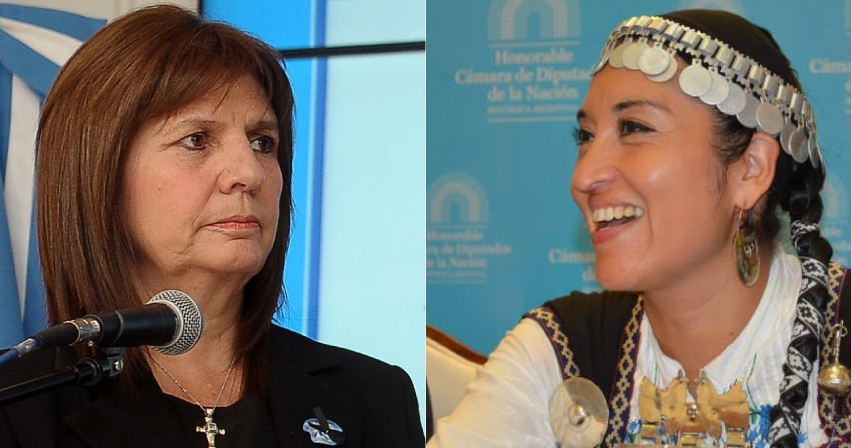
L-R: Minister of Security Patricia Bulrich and Mapuche historian and activist Moira Millán (photos: Internet)
What would we think?
We would probably conclude that the Government was preparing the ground for a massive attack on our organisations of resistance and on the right to protest.
If in addition to the publication of the Report, the Traveller’s spokesperson, which the Minister of Justice claims to be a spokesperson for “IRM”, two months ago had a the body of a mutilated vixen left on her doorstep, we might also think that the Government might be setting her up to be killed.
Demonstration in Argentina in protest at arrest and subsequent disappearance of Mapuche solidarity activist Santiago Maldonado on 1st August 2017. (Photo source: Latin American Media)
The preceding is an approximation of what is currently going on in Argentina. On December 29th 2017 Patricia Bulrich, Minister for Security of the Nation of the Cambiemos coalition Government of Argentina held such a conference with provincial security executives and issued a 180-page report on the danger of “RAM” (“Ancestral Mapuche Resistance”). This organisation has never before been heard of but Bulrich claimed in the Report and in a televised press conference that it is coordinating the activity of a huge number of organisations and is creating a great terrorist threat to the State.
“Resistance is not Terrorism! Freedom for all the Mapuche political prisoners”! (Photo of poster from Anarkismo.net)
Linked to “RAM” she gave a long list of organisations including those of original people and resistance in the areas of trade union, community, socialist and anarchist activity. Support for the Kurds was listed as evidence against some anarchist organisations and other organisations were alleged to be funding and publicising “RAM” while the Colombian FARC was alleged to be giving them military training.
Mapuche demonstration Patagonia January 2017 (Photo: Latin America Media)
The “RAM” may be a fake organisation but the State terror threatened is real.
The Minister publicly named Moira Millan, a Native People activist of the Mapuche, as the spokesperson of this “RAM”. This in the context of the recent killing of one Mapuche activist and the disappearance of Mapuche solidarity activist Santiago Maldonado in August 2017, which events led to demonstrations of Mapuche protest. Santiago was later found dead.
Millán lives in Patagonia, is a mother and in fact a member of two Mapuche organisations: The March of Native Women for Holistic Living and the Pillan Mahuiza Community. She writes and lectures on the history of the Mapuche, organises meetings in particular of Native women, gives traditional cooking classes, and speaks publicly on the rights of the Mapuche people. Millán has never been charged with any illegal let alone armed activity but last October, the mutilated body of a vixen was left on her doorstep. The message is both an insult — vixen in Spanish is “zorra” and is used as a moral and gender insult, particularly by the Right against female Left activists – as well as a death threat, i.e that her body will be next.
Millán’s reaction to the release of the Report and Bulrich’s press conference was quick and scathing:
“Yesterday, while I thanked the children who voted that the library of School No. 8 Luis Bernet of Parque Chacabuco should bear my name, the Minister of Security, Mrs. Patricia Bullrich, mentions me in her absurd and ridiculous report as the main spokesperson for RAM”, she said, adding that “the lady Minister – Bullrich — continues with her delirium tremens, inventing terrorists where there are none”.
“In her fevered dreams she sees herself, hooded, like the Ku Klux Klan, hunting Mapuches, assisted by the insipid and mediocre Governors of the South,” said Millán.
“Lie, lie but something will remain … ‘The lie has short legs’, says the popular saying: Are you coming for me, Mrs. Bullrich? Why are you afraid of us so much?” asked the Mapuche campaigner.
“Here I am, holding my truth as a weapon, and the wisdom of the Mapu as a shield; they have initiated ‘the hunger games’ and you believe that your government will win; make no mistake, we belong to a people that has been invaded, but never defeated”, concluded Millán.
(See further down for a way to take a few minutes to help)
Those who wish to express their concern at this demonisation of resistance, the killing of Santiago Maldonado and to lift the threat of incarceration or death on Moira Millan may wish to write to their local Argentinian Embassy, which is obliged to relate information back from their host countries on attitudes to Argentina.
Embassy of Argentina Dublin: 5 Ailesbury Drive Ballsbridge Dublin 4 Ireland
Minister of Security of the Nation of Argentina is currently blocked (for some reason). The Minister of Justice may be accessed through the Department’s page (see link), then use their email contact system: http://www.jus.gob.ar/contacto.aspx
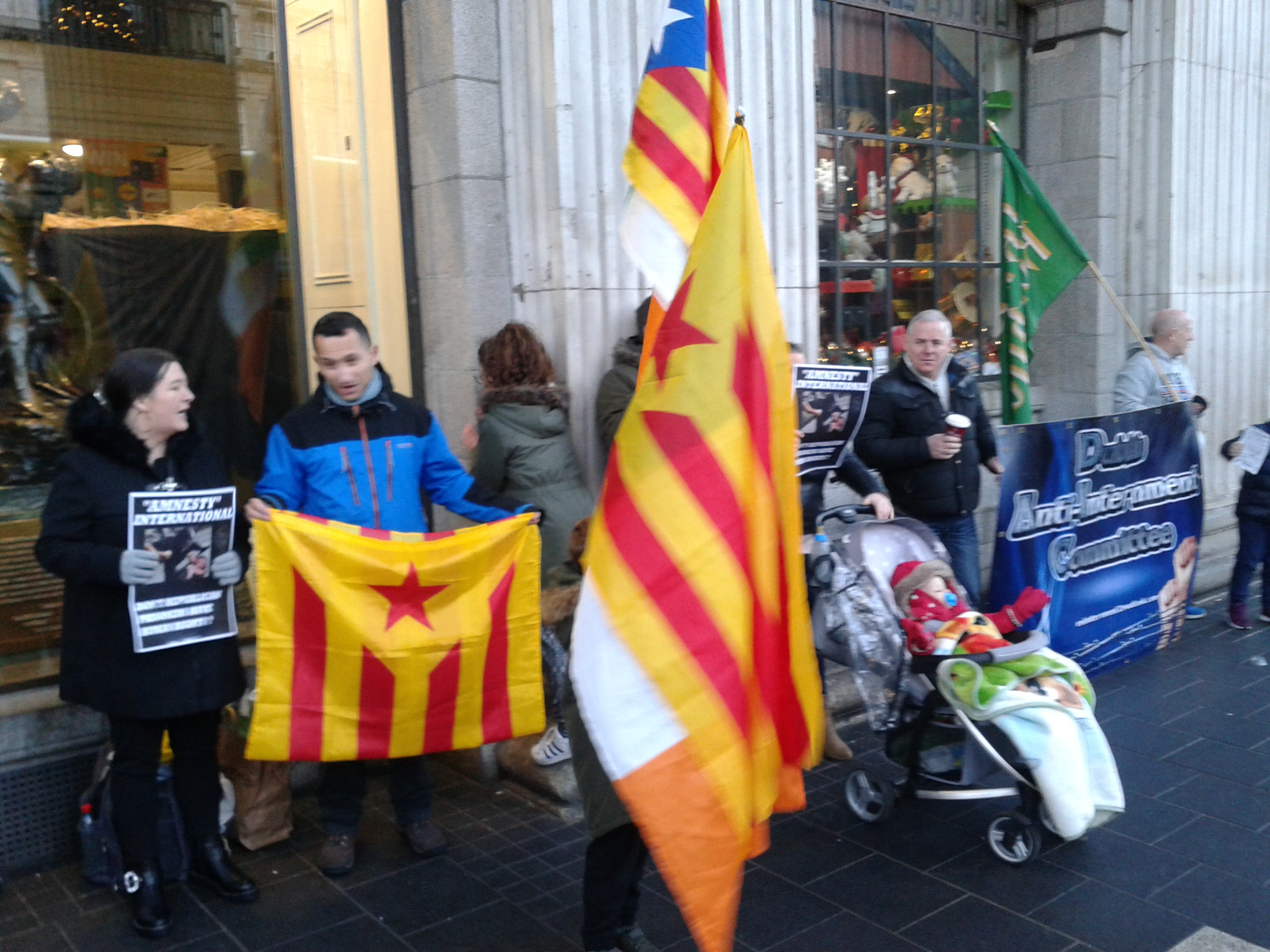
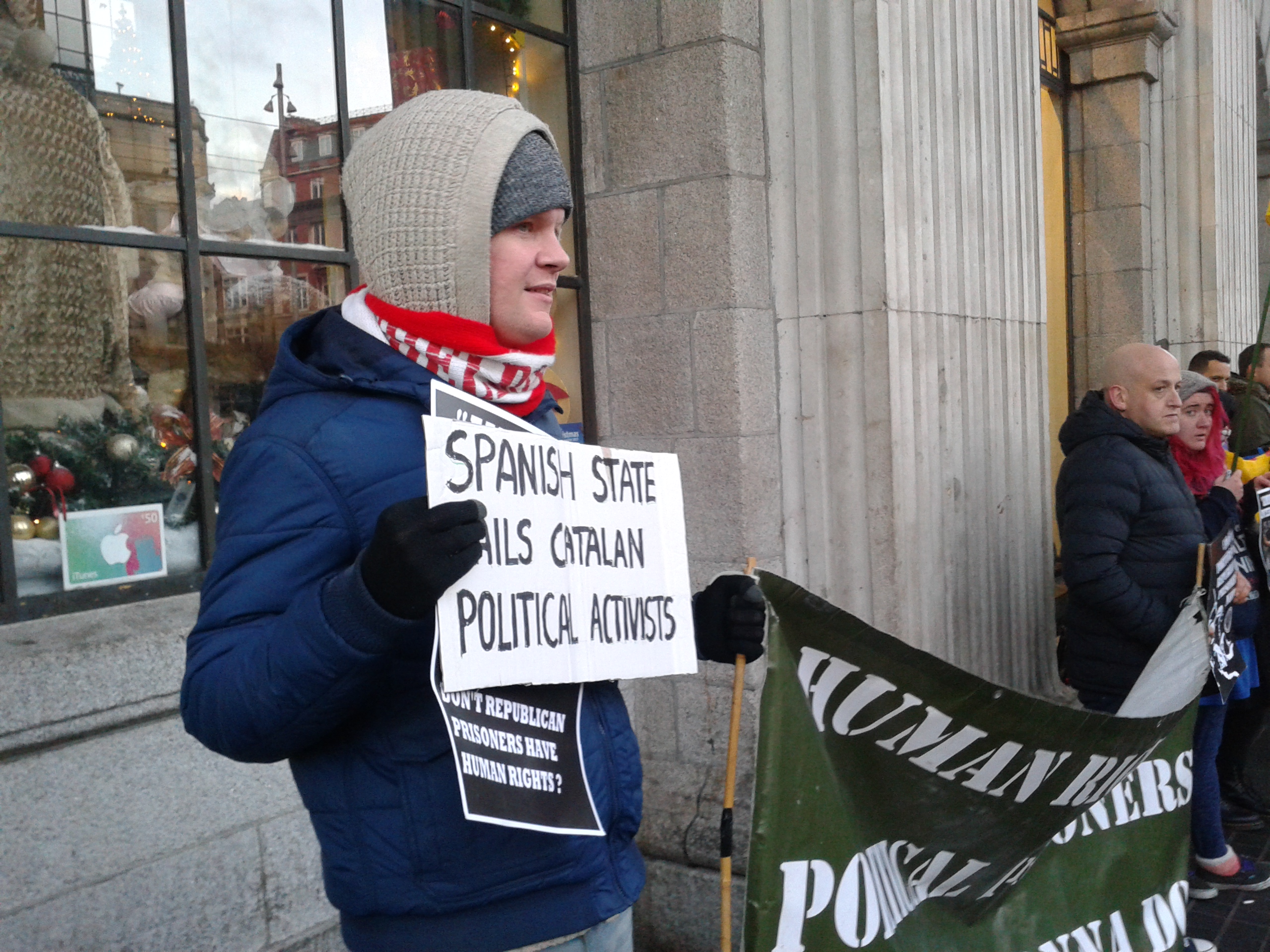
Catalan Esteladas flew next to Irish Tricolours at the GPO in Dublin on Saturday afternoon (25 November 2017). The occasion was a picket organised by the Dublin Anti-Internment Committee to protest the internment without trial of Irish Republicans and also of Catalan political activists for independence. Placards raised the issue of internment of Irish Republicans and their treatment once in jail, as well as criticising the lack of action of Amnesty International on this question. Some placards also declared that the “Spanish State jails Catalan political activists”.
Mix of Irish and Catalan flags outside the GPO building, O’Connell Street, Dublin (Photo: D.Breatnach)
Despite the seriousness of the issue and the bitter cold, the mood was upbeat, assisted by a music player broadcasting a range of songs, from Sifre’s “Something Inside So Strong”, through Warshaw’s “The Cry of the Morning” (sung by Christy Moore) to “Els Segadors”. Some protesters sang along to the songs and passers-by could be heard joining in too.
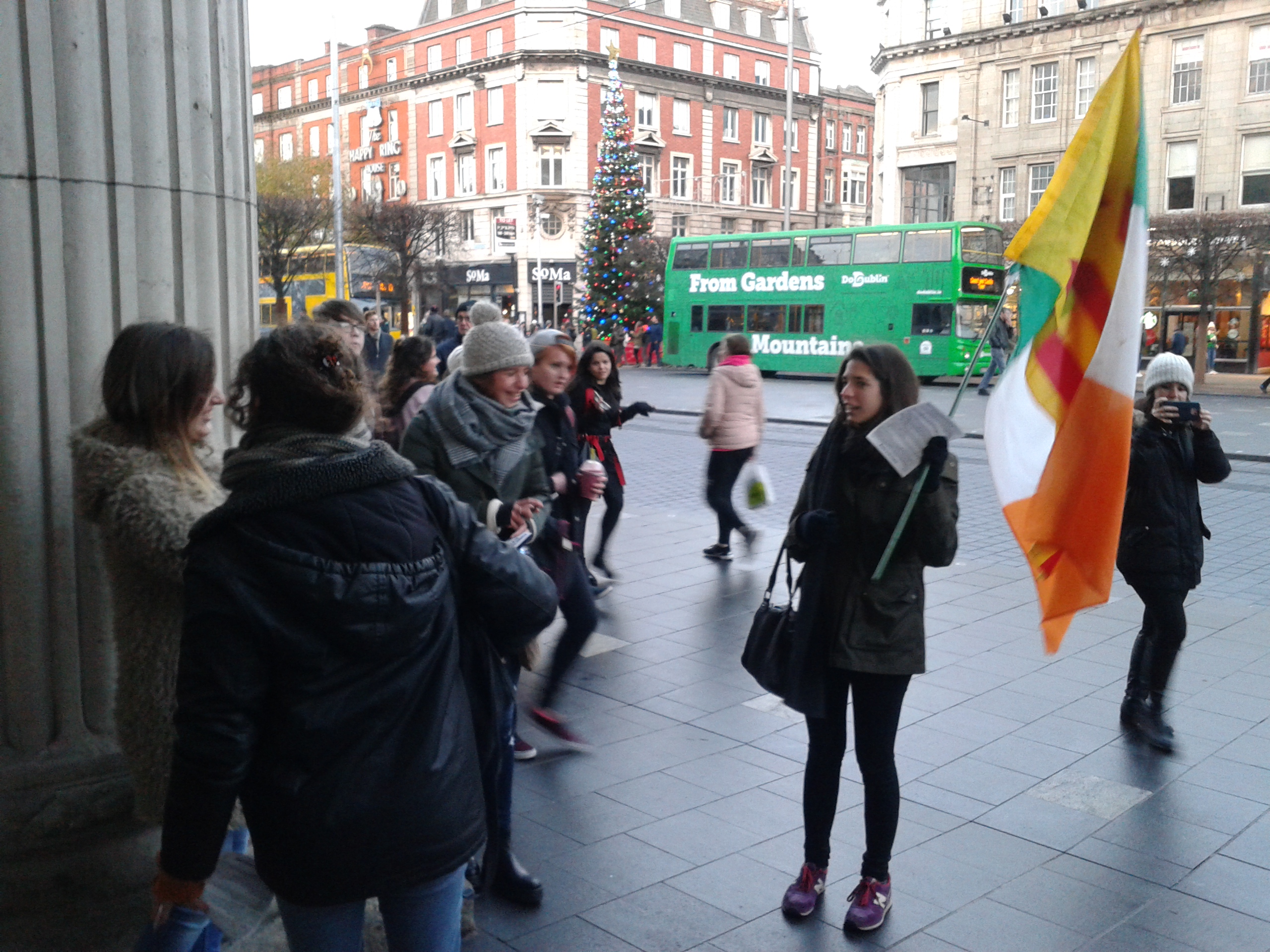
Many leaflets were distributed. A number of Catalan young women passers-by were excited to see the Estelada flags and were ecstatic when “Els Segadors” (“The Reapers”), the Catalan national anthem, was played.
Catalan and other young women passers-by reacting to the protest excitedly borrowed some joint flags to take photos of one another. (Photo: D.Breatnach)
Some people passing occasionally shouted “Viva Espaňa!” in hostility which gave rise to the response of “Viva la democracía! Viva la libertad!” On the other hand, other visitors passing by were very supportive, for example a young woman from Asturias (northern Spanish state) and an older man from Andalusia (southern Spanish state).
A spokesperson for the Committee briefly addressed the attendance at the end of the event, thanking them for attending to support Irish and Catalan political activists being jailed without trial. Referring to the few passers-by who shouted “Viva Espaňa!”, the spokesperson said that there is nothing wrong with pride in one’s country but queried why the sight of a Catalan flag brought that response and why the definition of Spanish nationhood for these people is bound up with the denial of the rights of another nation to determine its own future. The spokesperson declared that every nation has a right to determine its own future and to do so without threats and repression, pointing out that the Spanish State is attempting to jail the whole Catalan Government for carrying out their election promises and has jailed the leaders of two independence organisations without trial.
The spokesperson thanking the attendance once more, the event came to a close, flags were furled, banners rolled and placards put away for another occasion.
The Dublin Anti-Internment Committee was launched in 2013 and is independent of all political parties and organisations, holds regular pickets and people who support the civil and human rights of Irish Republican prisoners are welcome to attend.
This Autumn I made myself available to give talks in the southern Basque Country (i.e. in the Spanish state) on the situation of Irish political prisoners and a series was arranged for mid-October for nearly two weeks.
As well as having private conversations, I gave a total of five public talks to audiences ranging in size from ten to over forty. The composition of the audiences varied from youths to older middle-aged; in some places the latter predominated and in some, the former.
All the meetings I spoke at were arranged by an organisation called Amnistia Ta Askatasuna which calls for total amnesty for Basque political prisoners. This was also a demand of the whole movement and of the leadership of the Abertzale Left until fairly recently and the Gestoras pro-Amnistia organisation had been created under the Abertzale Left umbrella but then banned by the Spanish State. But the Abertzale Left’s leadership have now dropped this demand from public discourse, saying the conditions are not ripe for it and concentrating instead on the end of the dispersal. (More about this and the Basque prisoner situation later).
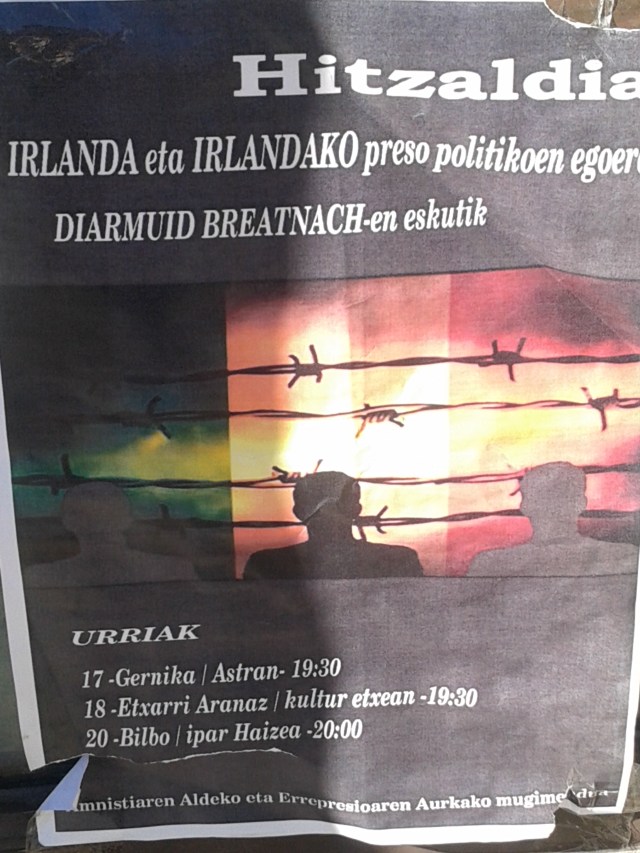
Poster on a wall advertising three talks in the southern Basque Country before the remaining two were confirmed. October 2017. (Photo: D.Breatnach)
I had not intended to confine my talks to those organised by ATA but it was they who organised the talks on dates that were offered, with the exception of one from an independent source that unfortunately clashed with one I had already accepted elsewhere.
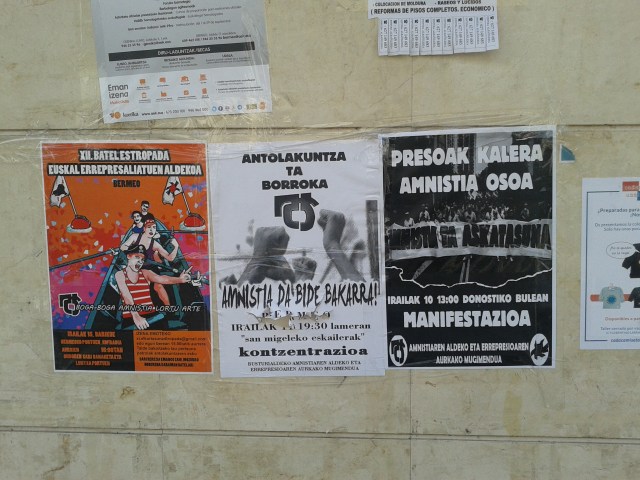
ATA posters share with other advertising on a wall in the southern Basque Country, October 2017 (Photo: D.Breatnach)
THE TALKS
The types of venues for the talks were community cultural centres (two), occupied buildings (two) and one local (a space for which the users’ association paid rent and used for their activities). Geographically, the talks were held in Gernika and two in Bilbao (Bizkaia province), Etxarri (Nafarroa) and Ibarra (Guipuzkoa province). There were none in Alava province (although earlier this year I gave interviews to Hala Bedi pirate radio there, in Gastheiz/ Vitoria). On this occasion also I gave a video interview to a rapper who also makes videos for Hala Bedi, though he is located in Bizkaia.
From conversations and discussion it became clear that all the older people in the audiences were veterans of the Basque struggle over decades and a number were ex-prisoners. Some had relatives in jail. The youths had come to political activity or thinking in recent years.
Talk in cultural centre in Ibarra, Guipuzkoa, southern Basque Country, October 2017. (Photo: ATA)
For the content of the talks I briefly reviewed the more distant history of political prisoners in Ireland, moving on then to the Good Friday Agreement and the release of
Torn poster advertising the talk in Ibarra, Guipuzkoa province, southern Basque Country, October 2017. (Photo: D.Breatnach)
most Irish Republican prisoners in the Six Counties under its terms. The re-arrest and jailing without charge of a number of these ex-prisoners was part of the talk, in which the specific examples given were of Marian Price, Martin Corey and Tony Taylor. I also dealt with the procedure of arrest on ridiculous charges and refusal of bail, or granting it under undemocratic and restrictive conditions, for which I used Stephen Murney as an example. These were all members of different organisations or none. Conviction on charges which the evidence does not support is also a category I mentioned, giving the Craigavon Two as an example there. Arrest on possession of arms charges is also a feature on both sides of the Border.
With regard to the 26 Counties, i.e the Irish state, I discussed the Special Court, Membership-of-an-illegal-organisation charges and charges of obtaining arms or having assisted terrorism. I mentioned the planned second Special Court in particular in the context of the State’s failure to convict most of the Jobstown protesters on charges that included “false imprisonment” (i.e kidnapping).
While noting that splits had occurred before in the Republican movement – the Provisionals themselves having emerged from such a split in 1970 – I noted that since the GFA, splits had multiplied and listed a number of the resulting organisations, including those that had existed already at that time.
Listing the number of Irish political prisoners (at the latest count then 79) and reminding the audience that the Irish had extended solidarity to Basque political prisoners, I asked the Basques for solidarity towards our political prisoners too. And I did so not only as a moral issue of internationalist solidarity but also in recognition that internationalist solidarity is one of the first casualties (i.e aspects to drop or weaken) by those who are seeking to surrender the struggle or even to become collaborators.
Talk in cultural centre in Etxarri, Nafarroa province, southern Basque Country, October 2017. (Photo: ATA)
QUESTIONS
I timed the talks to give sufficient space for – and encouraged — questions and comments, even critical ones.
It was interesting that the same questions tended to come up again and again:
Did the different Republican organisations cooperate with one another inside and outside the jails?
What were the conditions in the prisons like for the prisoners?
How are political prisoners in ill-health being treated?
Is there a dispersal issue with regard to political prisoners?
Did the population support the prisoners?
What were the conditions for their release under the Good Friday Agreement?
Did INLA prisoners sign the GFA release agreement?
Are there armed actions continuing in Ireland?
Are the youth involved in solidarity actions and campaigns?
What was the attitude of Sinn Féin towards the political prisoners?
Are prisoners “on the run” still in danger of arrest and imprisonment?
In one meeting, one of the smaller audiences and containing only youth, I was asked about the role of women in the national liberation struggle in Ireland today.
Talk in the occupied former Astra factory building, Gernika, Bizkaia province, southern Basque Country, October 2017. (Photo: ATA)
Some of the questions asked reflect the situation of the Basque political prisoners and also of the censored and inaccurate information about Ireland that reaches them, including through the Abertzale Left‘s (the “official” umbrella organisation) daily newspaper, GARA. At a number of times in the past spokespersons of the Abertzale Left’s organisations had claimed that there were no longer Irish political prisoners, a claim repeated in GARA. More recently, the tendency is to ignore their existence or to represent them as very few, without a program other than return to armed struggle and without a support base (i.e Sinn Féin’s line).
The new direction of the Abertzale Left’s leadership, which included a “permanent truce” and disarmament of their armed organisation ETA (formally declared in January 2011) was said at the time to have been agreed by the Basque political prisoners in their organisation EPPK. There have been persistent claims by friends and relatives of some prisoners and by some prisoners released in the last couple of years that they had not even been consulted.
A number of people to whom I spoke claimed that the prisoners’ collective no longer really exists, with prisoners left to act individually; some others said this was true to an extent but not completely. Certainly one feels a general air of disillusionment and uncertainty – and also of anger. And it is true that a small number of prisoners have formally denounced the leadership and left the collective.
Grafitti in Ondarroa, Bizkaia province, southern Basque Country, October 2017. (Photo: D.Breatnach)
From figures collected in 2003, up to 30,000 Basque activists out of a total population of less than three million) had been arrested, 8,170 were accused of being members of ETA and roughly half of those convicted and imprisoned. The prisoners’ relatives and friends’ organisation Etxerat (also under the Abertzale Left’s umbrella) in its July-September report of this year (2017) recognises 315 Basque political prisoners, of which 310 are dispersed through 61 prisons, with only two in 2 prisons in the Basque Country.
In 39 prisons in the Spanish state, 239 Basque political prisoners are being kept and 68 in twenty prisons of the French state. There are 212 (68.85%) Basque political prisoners in prisons at distances of between 600 and 1,100 km of the Basque Country; from a distance of 400 to 590 km from their country there are 67 (21.75 %) and between 100 and 390 km of home another 29 (9.40 %).
The strain on relatives and friends is considerable, road accidents are frequenton their journeys to visit prisonersand a number have been killed.
Twenty-one prisoners (21) are diagnosed as being seriously or terminally ill and according to the states’ own penal codes should have been released on parole to home or hospital but instead of reducing the number of sick prisoners the total is climbing (almost doubled in recent years). I accompanied ATA comrades to the port town of Ondarroa to participate in a demonstration organised by a broad platform calling for the release of terminally-ill Basque political prisoner Ibon Iparragirre.
Section of rally after demonstration in Ondarroa, Bizkaia, in solidarity with local seriously-ill prisoner Ibon Iparragirre, October 2017. (Photo: D.Breatnach)Stage of the rally after demonstration in Ondarroa, Bizkaia, in solidarity with local seriously-ill prisoner Ibon Iparragirre, October 2017. (Photo: D.Breatnach)
The Spanish state has rejected all the “peace process” (sic) overtures of the Abertzale Left leadership and says that ETA should just disappear and prisoners wishing to be pardoned and released must repent their previous actions, apologise to their “victims” and give information on their previous activities and comrades. It also says that all still at liberty and wanted for past illegal activities will continue to be pursued.
COMMENTS AND CONTRIBUTIONS
These too tended to be of a kind to come up again and again throughout the tour:
The situation in Ireland with regard to the liberation movement and prisoners is like that in the Basque Country or that which the latter will face as time goes on
The prisoners’ cause is being deserted by the Abertzale Left leadership
Their media and leadership had lied to the movement about the situation in Ireland
The leadership is only interested in penetrating the institutions and is neglecting the politics of the street
Otaegi and Adams are alike and McGuinness was a traitor when he asked people to inform on paramilitaries
The Abertzale Left did not of course comment on the talks – why would they? However, in Ibarra, I saw posters for the meeting torn down in areas where other political ones remained and according to my hosts, this was the work of the “oficialistas” (i.e followers of the leadership’s line) in the town. It was notable too that with a few exceptions, a number of people within the Abertzale Left but whom I know to be very critical of the change of direction, did not attend the talks held in their areas. Since some had previously attended a meeting at which I spoke a year ago and engaged in discussion critical of the Abertzale leadership, I took it that these either disapproved of the ATA organisers or did not wish, for whatever reason, to be seen attending a meeting held by the organisation.
At all the talks I was received with friendliness and courtesy and after some I had a meal in company in a txoko (Basque building — or part of one — owned or rented by a gastronomic association) or the home of my hosts for the evening. Although I invited criticisms with genuine interest in hearing them, none were voiced publicly, whether of the content of my talk or of the Irish people generally — although there were some questions as to why the people “in the south” had not supported more widely the “struggle in the north”. I explained that what they call “the north” is one-fifth or the country and also divided in its population; in addition the Republican movement had left the social and economic concerns of the people in the other four-fifths largely unaddressed and in fact had opposed some social reforms in earlier times. People in the 26 Counties had given a lot of support but without mobilising them on their own concerns and specific conditions this was likely to be a minority activity and to decline over time.
CATALUNYA: SOUTHERN BASQUE ATTITUDE TO THE STRUGGLE THERE
Inevitably, the struggle in Catalunya came into the discourse at some point – after all, I had arrived in Euskal Herria just under two weeks after the Referendum.
The Catalan national flags, the esteladas (both versions) were in evidence across the Basque Country as were some solidarity banners and posters. The two solidarity demonstrations I witnessed (and in which I participated but for a while – each having been called for the same evening as my talk locally) in Nafarroa and in Bizkaia appeared to have been called by the “official” movement and were fairly small and quiet. The largest, of over fifty people, did not even have a flag, placard or banner, which was puzzling.
Large image on the wall of the youth local in Errekalde, Bilbao, where they hosted one of the talks, October 2017. (Photo: D.Breatnach)
It was reported to me that some time back, the Abertzale Left had been close to the militant CUP (Catalan left-wing and independist popular movement) but now were moving closer to the Eskerra Republicana, often perceived as being less militant and closer to the Catalan bourgeoisie. Among the critics of the Abertzale Left leadership and others there seemed to be a doubt that the Catalan leadership was serious; however, both the “officials” and the “dissidents” had sent people to help the Catalans in their referendum.
After the Spanish police violence on October 1st there was a feeling that the Catalans were enduring what the Basques had endured for decades so why the great shock now? When two leaders of the Catalan movement were arrested and jailed without bail and called “political prisoners”, of course the Basques pointed to their own hundreds of political prisoners (and also to two Catalans who were ETA prisoners). The failure to declare a Republic on the promised day seemed to bear out those with a more cynical view but actions since then and the application of the repressive Article 155 of the Spanish Constitution are bound to raise feelings of respect and solidarity across the Basque national liberation movement, whether “official” or “dissident”.
IN CONCLUSION
It is clear that there is interest in the Irish situation and of that of the prisoners in at least some sections of the broad Basque national liberation movement. It is also clear that there is a substantial discomfort with the direction of the Abertzale Left’s leadership since 2011 (and for some since even earlier). Frustration is also evident as is a great concern for the political prisoners and a worry that they are being left without leadership, to come to their own arrangements with the Spanish state or to endure many more years in jail or die there (as Kepa De Hoyo did in August and as Ibon Iparragirre faces now).
This level of concern, disquiet and even distrust is not currently reflected in great numbers attending pickets or demonstrations organised by ATA, as numbers attending the talks showed in some areas but as the talks also showed, there is a network of support for ATA across the southern Basque Country. It was clear that a greater lead-up would have resulted in talks being hosted in further areas, including the province of Alava which was not included on this occasion. The general composition of the movement represented by ATA is healthy in its spread across generations, comprised of veterans (including ex-prisoners) and youth new to the struggle.
The pedestrian bridge at Ondarroa, scene of one of the “human walls” organised some years ago by Basque youth in resistance to the arrests of activists. Supporters placed the activist whom police were seeking in the middle and then packed the bridge with supporters, causing the police hours of work to carry out the arrest. I was told that the official leadership had ordered the cessation of these events. October 2017. (Photo: D.Breatnach)
From a personal point of view it was an interesting if somewhat hectic and stressful period but also one that increased my understanding of the reality.
From a political perspective I hope it helped build some links for solidarity between the struggles in each of the two nations and an awareness that pacification processes are not an alternative but only another face of repression. For the struggles in which so many have sacrificed so much to succeed, we need to raise our awareness of these processes. In these processes political prisoners, often seen by their populations as heroes and people to be cherished, are used by the repressive power as hostages and often too as bargaining counters, the temptation always there for some of those in struggle to use them in kind.
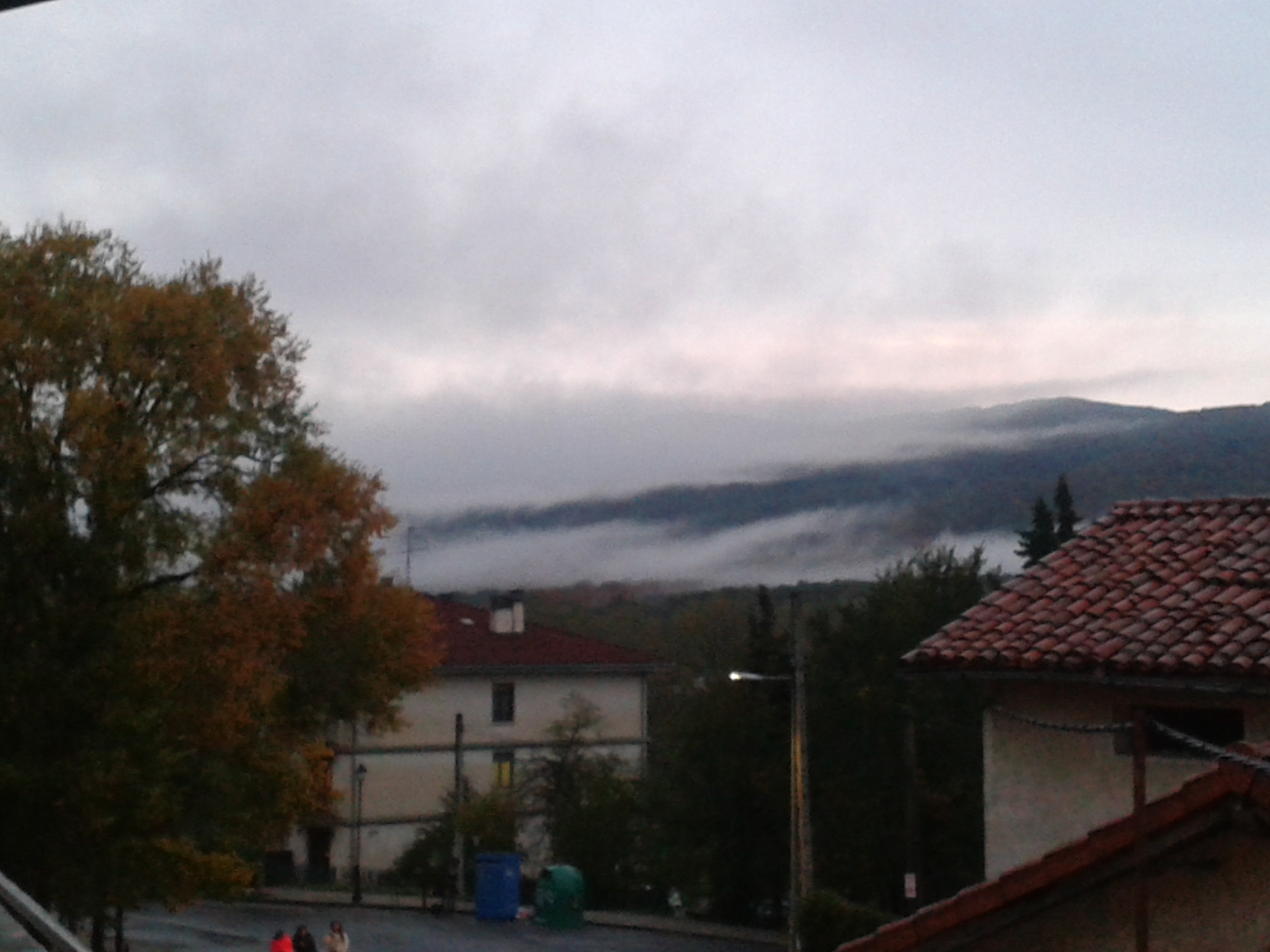
From Axpe de Busturia train station, Bizkaia, October 2017. (Photo: D.Breatnach)Morning view of misty mountains from a host’s house in Etxarri, Nafarroa province, October 2017. (Photo: D.Breatnach)Bermeo Harbour and some of the town from heights above, October 2017. Near the big building at 9 o’clock on the photo was the location of a Franco prison for Resistance women — I was told that Basque nuns locally brought food to the jail for them every day. (Photo: D.Breatnach)Part of the Bay of Bizkaia (Biscay), October 2017, from the site of a Basque Gudari artillery battery during the Anti-Fascist War. (Photo: D.Breatnach)
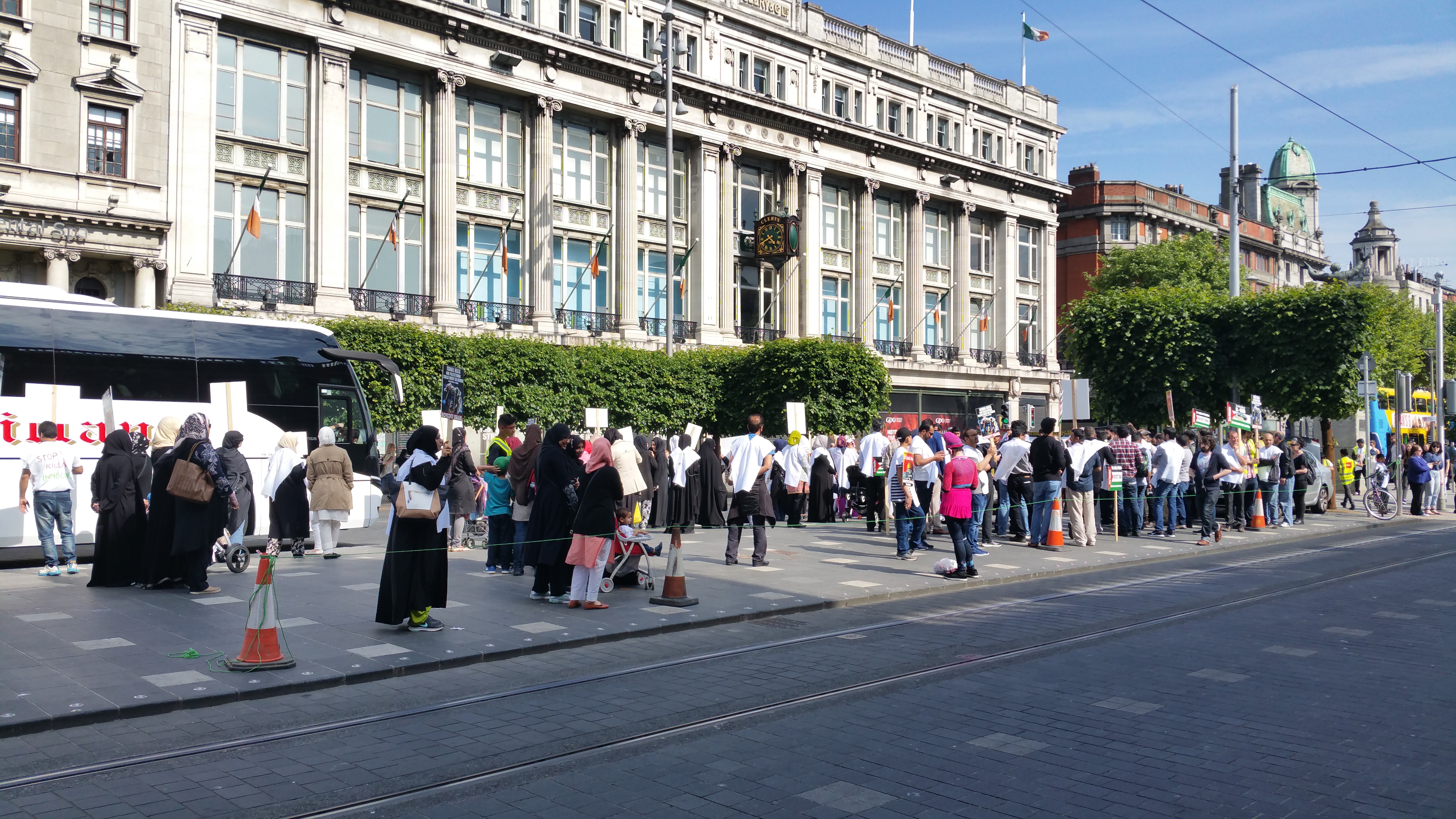
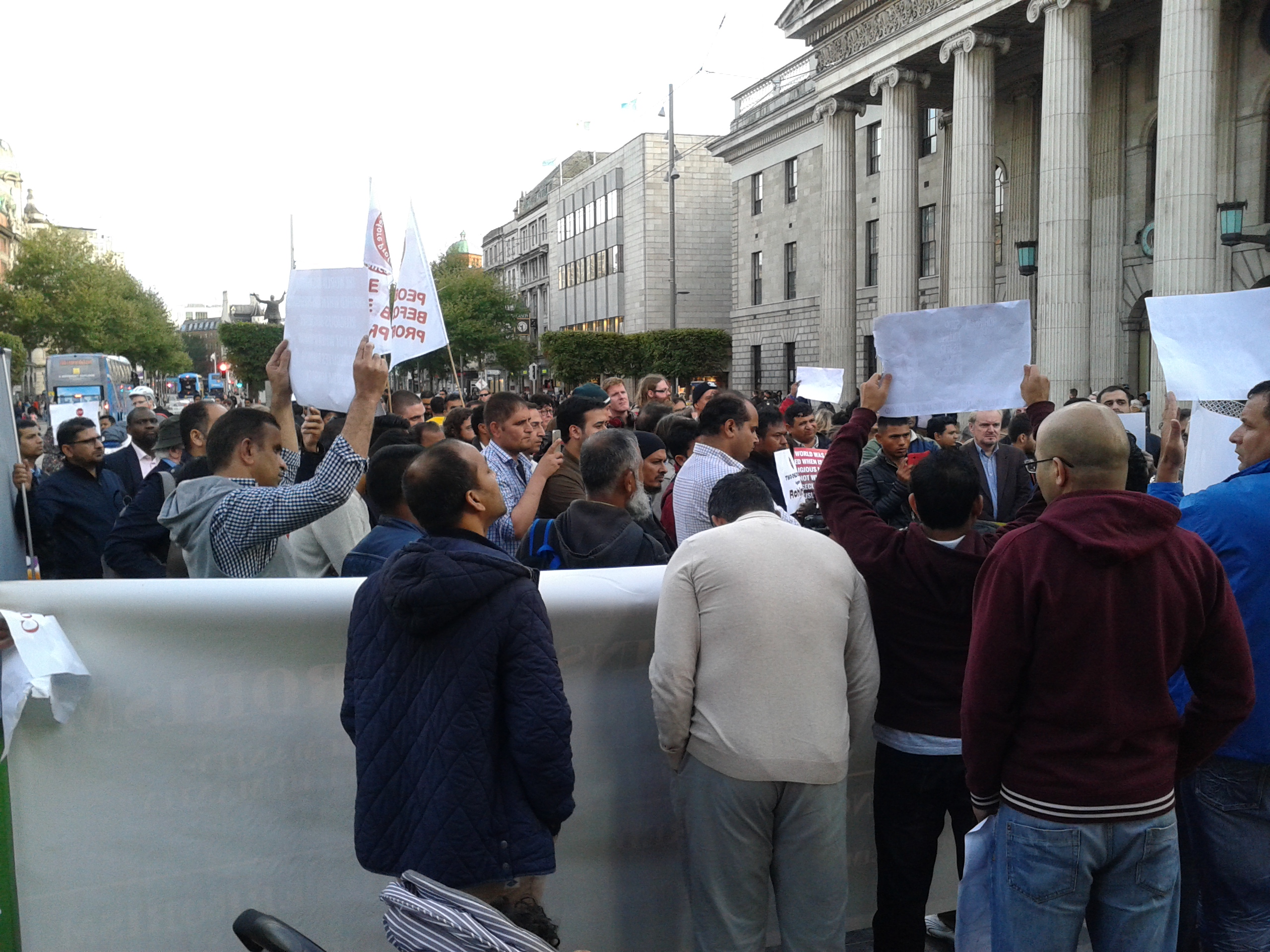
I came upon this demonstration on Sunday by chance, shortly before it ended; a protest composed almost entirely of people of south Asian appearance.
Rohingya solidarity demonstration on central reservation O’Connell Street, Dublin, Friday 8th September. (Photo D.Breatnach)
The Royhinga people are in crisis in Burma, abused by the State army, which is using the excuse of rooting out insurgents. About one thousand have been killed by the Burmese Army, according to a UN Special Rapporteur and according to Al Jazeera 164,000 have crossed the border to escape. Villages have been burned and there are also allegations of rape and of ethnic cleansing.
The Army’s recruits are of mainly Buddhist background, while the Rohingya people are mostly Muslim. The state refuses to grant them citizenship, considering them illegal immigrants from Bangladesh. Reactionary opinion, for example among some extremist Buddhist monks, considers Burma to be a Buddhist country and other religions not welcome. The Army accuses the Royhingians of burning their own villages.
The State Cunsellor (position equivalent to Prime Minister or Head of Government), Ms. Aung San Suu Kyi, in a recent statement talked about the attack two weeks after the crisis began. In this statement she avoided taking responsibility for the events, talking about “an iceberg of misinformation” and a problem that has years of heritage “even pre-colonial.” She has not gone there herself.
Aung San Suu Kyi, State Counsillor (Head of government) of Burma and Nobel Peace Prize Laureate. (Photo source: Internet)
Aung San Suu Kyi was generally supported by the West and lauded as a human rights campaigner through years of struggle against the previous regime. As a result she was awarded the Nobel Peace Priize in 1991.
Now, it seems the West is critical of the State Counsellor’s response to the crisis in the UN and in the media.
DUBLIN PROTEST TODAY
Both women and men were active in the protest today, ages mainly from late teens to young adulthood. There were some children too, cheerful and assertive. Some of the protesters apparently had come up from Carlow.
(Photo: D.Breatnach)Crowd shot near speaker addressing the rally; the General Post Office building to the right in Dublin’s main street, O’Connell Street. (Photo: D.Breatnach)


















 rebelbreeze