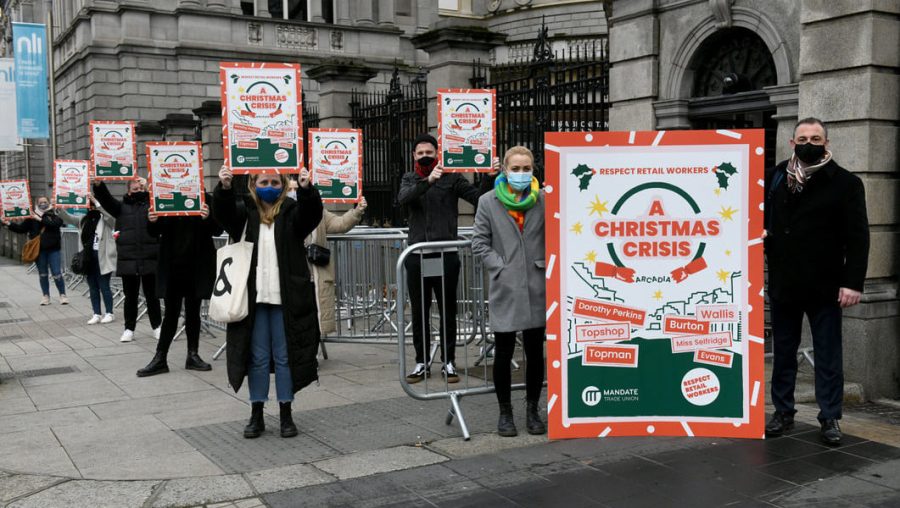
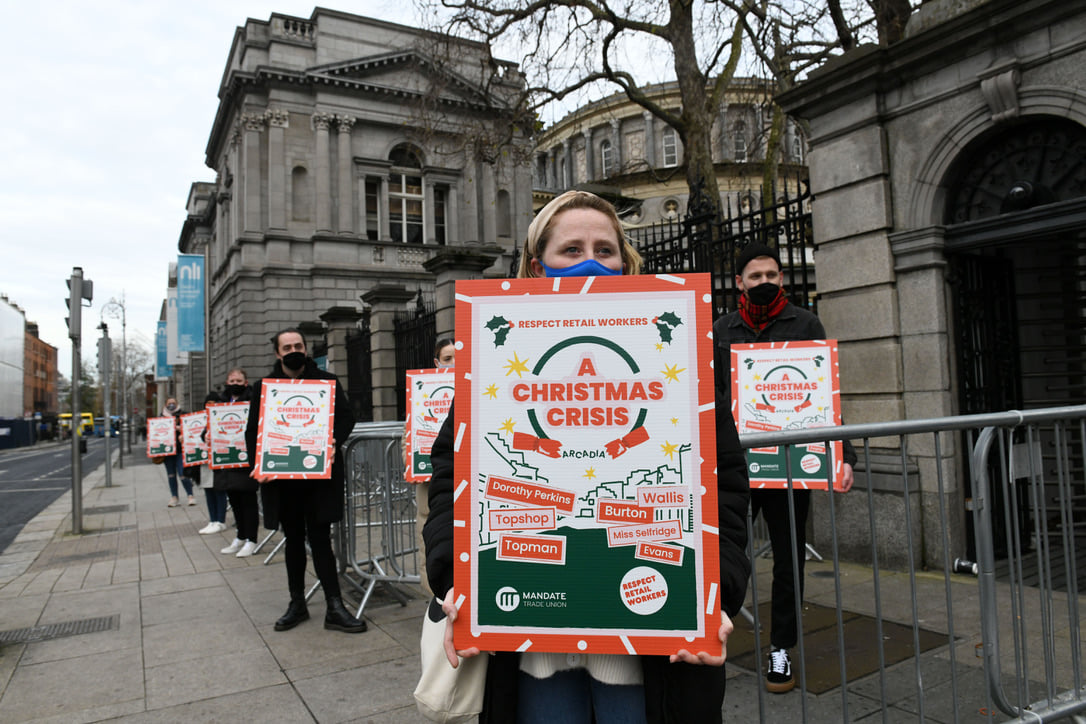
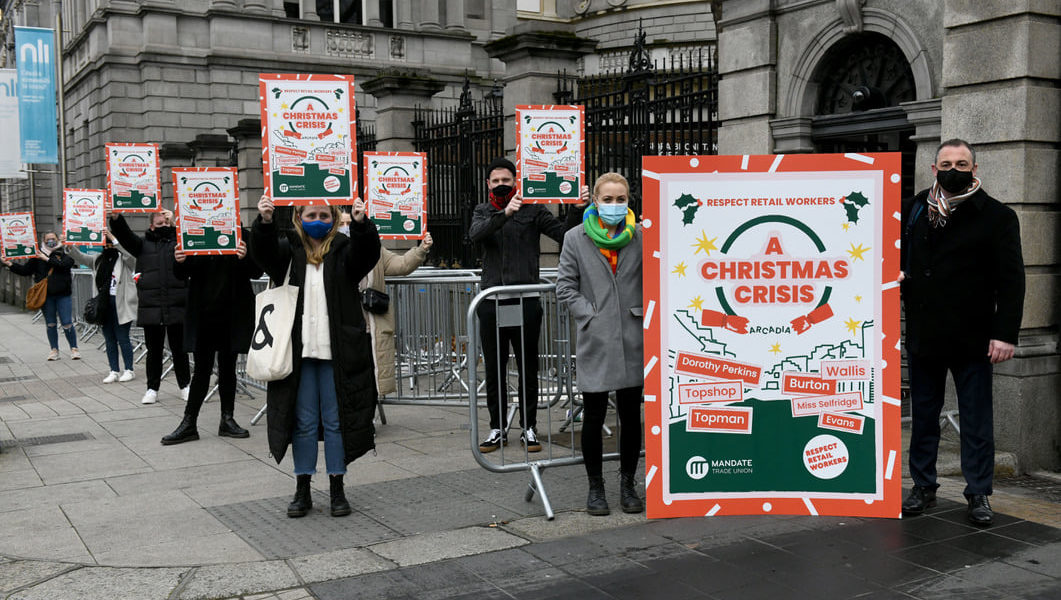
“Mandate Trade Union members employed by Arcadia (Topshop, Topman, Burton, Miss Selfridge, Dorothy Perkins, Burton, Outfit, Wallis and Evans) held a socially distanced protest on Kildare Street yesterday (Tuesday, December 22nd) where they handed a letter into the Dail demanding stronger protections for workers losing their jobs due to liquidation scenarios.
Members of Mandate trade union employed by Arcadia protest at Leinster House 22nd December 2020.
(Photo source: Mandate website)
“We’ve seen workers in Debenhams, Clerys, the Paris Bakery, La Senza, and many more other companies lose their jobs while their employer abandoned their obligations. The government commissioned its own report on this issue in 2016 (Duffy/Cahill) and for more than four years has refused to implement it.Every day workers are losing their jobs while our government procrastinate and sit on their hands. We need action, and we need it now.” (Mandate, on their website)
Members of Mandate trade union employed by Arcadia protest at Leinster House 22nd December 2020.
(Photo source: Mandate website)
Comment:
The ruthless action of capitalists in sacking workers — often without even paying agreed redundancy pay — to safeguard their rates of profit during the Covid19 crisis is a harbinger for the austerity they will force on working people with the collusion of the government as soon as this pandemic has been quelled.
Dear Mr. Tony Holohan, We write to congratulate you on being voted Man of the Year for 2020 in the Today FM poll this month1. It must have come as a pleasant surprise to you – it certainly surprised us. We couldn’t have expected the Irish public would forget that embarrassing debacle with the cervical cancer checks.
People might think it reasonable to send the test results off to the USA for screening but, when it turned out that many of those “all clear” results were in error and that some who who later learned of the error were too late for treatment and going die …. you couldn’t hope they would forgive you for trying to keep a lid on the news or for declining to create an urgent response. Well, of course, some of those who wouldn’t be likely to forgive you aren’t with us any more …. but surely so many others would remember? Well thank God for short memories, you must’ve thought!2
Mr. Tony Holohan in a sombre moment.
(Image sourced: Internet)
Still, that was news in 2018 and your award was for this year. What is more surprising is that they forgot that when the HSE first became officially aware of the pandemic in February this year, as Chief Medical Officer, you did not advise the Government to close the ports. Or even to isolate those returning from watching the rugby in Italy, where the pandemic was raging. Well, we can’t have the flow of capital interrupted, can we?
We wonder too how it slipped the mind of so many that you did not advise the Government to order precautionary arrangements and protective measures in essential services, so that An Post workers had to strike for such provision and shops and supermarkets only put them in place slowly, piecemeal. We’re sure your thinking was that those who are making money out of such establishments are the best placed to decide what is needed and when – even if they won’t actually be working at the danger point.
Then there was the advice to lockdown, relax, lockdown, relax, lockdown again …. what one know-it all TD called “the yo-yo policy” as reducing rates of contagion recovered and shot up again, etc.
More surprising still — and must have been more than you dared hope — was that people who are nearly unanimously and everywhere now wearing masks, apparently forgot that back in the early days you declared in public that wearing masks was of no help at all in reducing the spread of the virus.
We thought your humble acknowledgement of the award was excellent and especially that you refrained from one of those insincere responses one often hears like: “I feel I don’t really deserve this award.”
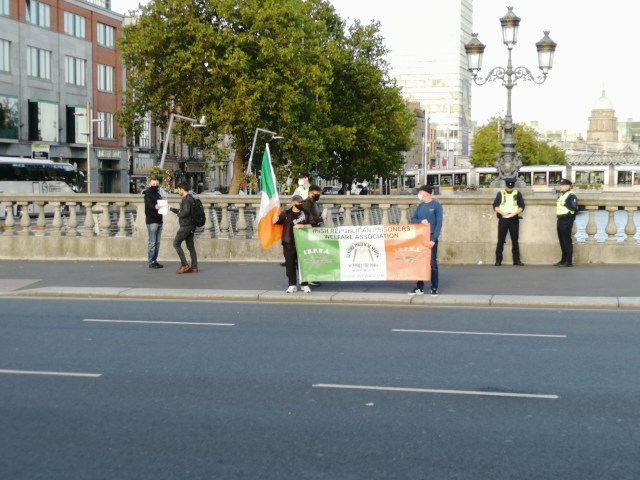
Around 30 Republicans and Socialists gathered on a very wet O’Connell Street in the Dublin City centre on Friday evening in solidarity with Irish Republican prisoners. Despite the rain and darkness, many passers-by took an interest in the banners and placards and some stopped to converse with the picketers. Behind the picket line other events were illustrating the sad state of a section of Irish society: one voluntary free meals service finished and another began, a Muslim one, with a queue along half the length of the General Post Office.
View of picket line from across the road
(Photo: C. Sulish)
The December prisoner solidarity event is organised annually by the Anti-Internment Group of Ireland, an independent collective of activists which also organises other awareness-raising pickets during the year; this evening it was supported by Irish Republicans and Socialists of different organisations and by independent activists.
(Photo: C. Sulish)
As the picket drew near to its scheduled end, placards were gathered, banners rolled up and picketers gathered (though some had already left) to hear a few words from the organisers.
The man speaking on behalf of the AIGI spoke a little in Irish welcoming those present before doing so again in English.
(Photo: C. Sulish)
“60 POLITICAL PRISONERS IN IRELAND BETWEEN BOTH ADMINISTRATIONS”
“We send solidarity greetings from here to the political prisoners in jail,” he said. “We do this every year at a particularly difficult time for the prisoners and their families and friends.”
He went on to say that they also did it to remind people, “those who would like to be reminded and those who would not” of the existence of “60 political prisoners in Ireland between both administrations.”
In reference to the pandemic, the speaker noted that it had been a difficult year for ordinary people but even more so for the prisoners, their families and friends, with restrictions and reduced visits and that in some cases the authorities had used the health restrictions “as a stick to beat the prisoners with.”
“It’s been a hard year too for Republicans, for some more than others”, he continued, alluding to house raids, arrests, incarcerations, cars stopped and searched, intimidation and harassment of pickets by the police.
On the other hand, the AIGI spokesperson stated, “anti-vaxers, racists and fascists” had been “strutting around” pretending to be patriots and “desecrating our national monuments”, without any attempt being made to compel them to adhere to the pandemic regulations.
(Photo: C. Sulish)Closeup Saoirse Banner (Photo: C. Sulish)
The speaker said that when Republicans and socialists had confronted with approaching or equal numbers those elements, they had “seen them off” clinging to “the protection of the British colonial police or of the Gardaí.” He pointed out that “They scream about ‘freedom’” but “they don’t know what freedom is”, pointing out that they are not being jailed for being active for the freedom of their country (implying that such is what is happening to Irish Republicans).
View of section solidarity picket line looking southward
(Photo: C. Sulish)
“We are here today,” said the spokesperson, “for those who cannot be, who would be here for us if we, in turn, could not.”
He thanked all who had attended the event that evening, “go raibh maith agaibh, particularly those who have supported our picket during the year.” On behalf of Anti-Internment Group of Ireland he thanked those present again and wished them and the prisoners, along with their friends and families all the best for the festive season.
The AIGI spokesperson concluded by saying. “Feicfimíd sibh arís ar an tsráid. We will see you again on the street.”
end.
NB: An updated list of political prisoners and the addresses of the prisons may be found on the End Interment FB page.
View of section of solidarity picket line looking northward (Photo: C. Sulish)
Few people know the pain of being dispossessed of their land better than the Irish, but tragically in the 1870s, thousands of impoverished Irish immigrants ended up enlisting in American armies that were fighting to push Native Americans off their land.
Irishmen fought and died in the most iconic conflict between Native Americans and the United States Army at the Battle of the Little Bighorn in Montana. The defeat of the General Custer’s 7th Cavalry by Native Americans on June 25, 1876 has become legendary. Many people know the story of Custer’s defeat, but few are aware of the role the Irish played in fighting the battle, and in creating the most famous painting of it.
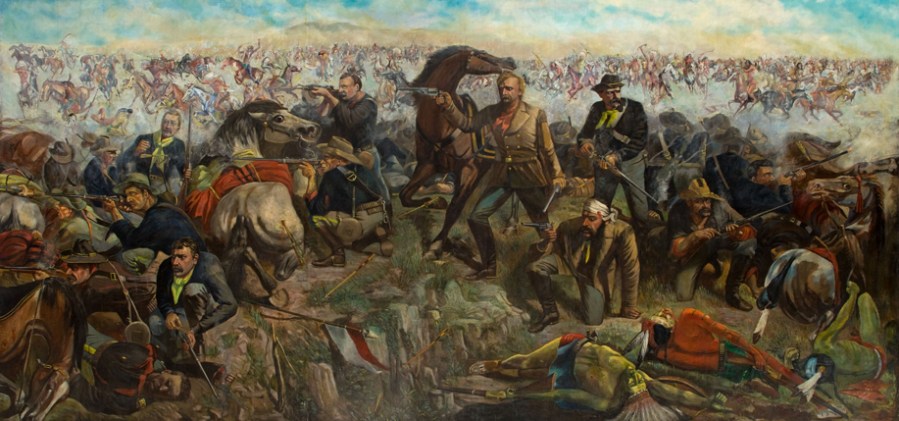
One hundred and three Irish soldiers perished on that fateful day, and yet another Irishman, John Mulvany, realizing the popularity a canvas of the battle would create, painted his iconic “Custer’s Last Rally,” which remains today one of the most celebrated paintings of the American West.
Custer’s Last Rally, painted by John Mulvaney (Photo sourced: Internet)
In the 1870s, the hard and dangerous life of an American cavalry trooper was still the best option for many poor, newly arrived Irish immigrants. In 1875, Custer’s 7th Cavalry was full of Irish-born recruits when gold was discovered in the Black Hills of South Dakota, the sacred ground to the Lakota. These soldiers must have known the danger they faced when the United States claimed the land and invaded it, despite treaties the American government had signed with the Lakota, guaranteeing them its ownership. The military’s armed incursion into the area led many Sioux and Cheyenne tribesmen to leave their reservations, joining the rebel leaders, Sitting Bull and Crazy Horse, in Montana. By the spring of 1876, more than 10,000 Native Americans were camped along the Little Bighorn River – defying a War Department order to return to their reservations and setting the stage for the famous battle.
The charismatic General George Armstrong Custer and almost 600 troops of the 7th Cavalry rode into the Little Bighorn Valley, determined to attack the native encampments. Riding with Custer were over 100 Irishmen, ranging in rank from newly recruited troopers, many of whom could barely control their mounts, to Captain Myles Keogh, a heroic veteran of the Civil War from County Carlow. There were 15 Irish sergeants and three Irish corporals in Custer’s command, the backbone of his noncommissioned officers.
Today, we imagine Custer wearing his trademark buckskin jacket – it was sewn by an Irishman, Sergeant Jeremiah Finley from Tipperary, the regiment’s tailor. The song of the 7th Cavalry was another Irish influence. Just prior to Custer’s arrival in Fort Riley, Kansas, where he took command of the 7th Cavalry, Custer ran into an Irish trooper who, “under the influence of spirits,” was singing “Garryowen,” an Irish song. Custer loved the melody and began to hum the catchy tune to himself. Custer made it the official song of the 7th Cavalry and it was the last song played before Custer and his men separated from General Terry’s column at the Powder River and rode off into history.
Centre section of The Battle of Aughrim, by John Mulvany. (Photo sourced: internet
John Mulvany, who is known for his paintings of the American West and in particular “Custer’s Last Rally,” also painted “The Battle of Aughrim,” in 1885, which was exhibited in Dublin in 2010. The battle, fought between the Jacobite and the Williamites forces in Aughrim, County Galway on July 12, 1699, it was one of the bloodiest battles in Ireland’s history, over 7,000 killed. The battle marked the end of Jacobitism in Ireland, a movement that aimed to restore the Roman Catholic Stuart King James II of England and Ireland (as James VII in Scotland) to the throne
Before the battle, the legendary Lakota chief Sitting Bull had a vision in which he saw many soldiers, “as thick as grasshoppers,” falling upside down into the Lakota camp, which his people saw as a foreshadowing of a major victory in which a large number of soldiers would be killed. Custer, however, blinded by ego and visions of glory, made a reckless decision to attack the huge gathering of Native Americans head on, saying, ironically, “Boys, hold your horses, there are plenty down there for us all.”
Foolishly splitting his command into three units, Custer tried in vain to attack and envelop the largest concentration of Native American fighters ever to face the American Army. The first assault against the Native American encampment was launched shortly after noon by three companies – 140 officers and men – led by Major Marcus Reno, whose men attacked along the valley floor towards the far end of the camp. Thrown back with many casualties, the survivors scrambled meekly for their lives to the top of a hill. Custer, with five companies totaling more than 200 men, advanced along the ridgeline, commanding the river valley on its eastern side. He further divided this force into two groups, one of them led by Captain Keogh.
There is debate about what occurred when Custer engaged the Native American forces just after 3 p.m. because the General and all his men were killed, so no one from Custer’s command could tell their tragic tale. Archaeological evidence suggests that Keogh and his men fought bravely, being killed while trying to reach Custer’s final position after the right wing collapsed.
On June 27, 1876, members of Gen. Terry’s column reached the Little Bighorn battlefield and began identifying bodies. Keogh was found with a small group of his men and his was one of the few bodies that had not been mutilated, apparently owing to a papal or religious medal that he wore about his neck (Keogh had once served in the in the Battalion of St. Patrick, Papal Army). Although Captain Keogh did not survive the battle, his horse, Comanche, did. The horse, spared by the Native American fighters for its heroism, recovered from its serious wounds and was falsely honored as the lone survivor of the battle (many other U.S. Army horses also survived). Comanche was retired with honors by the United States Army and lived on another 15 years. When Comanche died he was stuffed, and to this day remains in a glass case at the University of Kansas.
Comanche, Keogh’s horse, which survived his master who died at the battle.
(Sourced: Internet)
White Americans, shocked and angered by the defeat of Custer and his men, demanded retaliation. And they got it. Soon after, over 1,000 U.S. troops under the leadership of General Ranald Mackenzie opened fire on a sleeping village of Cheyenne, killing many in the first few minutes. They burned all the Cheyenne’s winter food and slit the throats of their horses. The survivors, half naked, faced an 11-day walk north to Crazy Horse’s camp of Oglalas.
The victory at Little Big Horn marked the beginning of the end of the Native Americans’ ability to resist the U.S. government, but 37-year-old John Mulvany from County Meath saw opportunity in the tragedy.
John Mulvaney, photo by Anne Webber (Sourced: Internet)
12 YEARS OLD IN THE USA
Mulvany arrived in America as a 12-year-old. He went to art school in New York City and became an assistant of famed Civil War photographer Mathew Brady. He later covered the Civil War as a sketch artist for a Chicago newspaper, developing an amazing ability to capture battlefields on canvas.
Mulvany knew that a painting of the fight would be a sensation. He visited the battlefield twice and also found Sitting Bull in Canada so that his painting could capture even minute details of the battle and its combatants. Mulvany finished the epic 11 ft. x 20 ft. canvas in 1881, which was hailed as a masterpiece, and began a 17-year tour of the United States. The canvas made Mulvany the toast of Chicago, but his good fortune would not last.
Sitting Bull of the Lakota, photo by William Notman. John Mulvany sought him out to consult him about the Battle of the Little Big Horn. (Image sourced: Internet)
Mulvany eventually sold his painting and ended up destitute in Brooklyn, where he drowned in the East River in 1909 in what many labeled a suicide. Mulvany quickly became forgotten, but not the fame of his great canvas, which recently sold for $25 million. Mulvany painted many great works, but they are lost and there is a concerted effort to find these missing canvases. Perhaps we will soon find more works of this great, tragic Irish painter.
In Irish history, which arquably is full of such wars, what is generally termed “The War of Independence” began with the Soloheadbeg Ambush on 21st January 1919 and ended with the Anglo-Irish Treaty on 11th July 1921 (which however, because of its limited measure of Irish independence led shortly afterwards to the Civil War 1922-1923). That ambush was one of many during the war by Irish guerrillas on the Royal Irish Constabulary, the British colonial police force and these attacks continued with a three-fold aim: to capture arms for the guerrillas, to eliminate much of the intelligence source for the Crown from rural districts and to open up areas of relative safety in the Irish countryside for the forces of independence.
In 1920 two different constabulary forces were recruited in Britain to bolster the Royal Irish Constabulary: the “normal” recruits in January and the Auxiliary Division RIC in July1. There were insufficient police uniforms for the “normal” constable recruits at first, leading to their being issued a mix of dark green RIC and khaki Army uniforms (usually Army trousers and RIC tunics) and Christopher O’Sullivan wrote in the Limerick Echo that they reminded him of the “Black and Tans”, from a well-known pack of Kerry beagles in the Scarteen Hunt. The nickname spread quickly and soon they were almost universally known (and thereafter in Irish history and folklore) by that name or shortened to “the ‘Tans”. The Irish translation is “na Dubhchrónaí” but it is likely that even in the Gaeltachtaí, the Irish-speaking areas, they were also known as “na ‘Tans”.
WW1 had ended in November 1918 and many of the ‘Tans were ex-British Army soldiers. Some were perhaps even demobbed (discharged) specifically in order to enlist in the new force. At the time there was ongoing agitation for discharge from the armed forces and even riots among thousands of British soldiers, many of whom had been conscripted but whom the British High Command was reluctant to allow to leave, knowing that many would be needed to suppress resistance to British colonial rule across the Empire, on the Indian sub-continent, in the Middle East, Africa and China.
The Tans quickly gained a reputation for brutality towards prisoners and the general civilian populace when conducting personal and home searches. They were also considered generally indisciplined, liable to intoxication on duty and to carrying out theft and harassment of women. Their behaviour towards civilians was so bad that even some British Army officers and loyalists in Ireland complained of it. The fighters of the Irish Republican Army, the new name for the reorganised Irish Volunteers, though they might fear being captured by the Tans, quickly enough gained their measure and were soon engaging them with arms.
The Auxiliaries, or “Auxies” as they became known, were a different matter. Their role was a rapid response motorised strike force and every single member was a War veteran and ex-officer, some indeed having been awarded battle decorations. Just as inclined to brutality and indiscipline in some respects, they gained a fearful reputation for their counter-guerrilla aptitude; though their commanding officer, Frank Crozier, sacked 21 of them in January 1921 because of their brutal raids in Trim, Co. Meath and murder of two Republicans in Drumcondra, Dublin, Chief of Police Henry Hugh Tudor reinstated them, so that Crozier resigned. One IRA officer commented that if the Tans were ambushed they would hide behind cover to return fire, whereas the Auxies would quickly be seeking to outflank their opposition and counter-attack.
The relaxed but warlike attitude of the Auxies is evident in this photograph of two of them with a Dublin Metropolitan Police officer (not sure what unit the fourth man represents).
(Source photo: Internet)
The Auxies could carry out operations against the IRA and the civilian population with impunity, it seemed. The Kilmichael Ambush was planned specifically to take on the Auxiliaries and smash the myth of their invincibility.
THE LEADER AND THE COLUMN
The operation was led by a 23 year-old ex-British soldier: Tom Barry, Commandant of the West Cork Flying Brigade was at the time only 23 years of age and only a little over three months active in the IRA. When news of the 1916 Easter Rising reached him and other British troops fighting the Ottoman Empire in Mesopotamia (now Iraq), he “had not a nationalist thought in my head”, he confessed in his book Guerrilla Days in Ireland (1949). Barry was discharged at the end of the War but did not join the IRA until the capture and torture of Republicans Tom Hales and Pat Harte by Arthur Percival of the Essex Rifles in July 19202 so appalled him that he joined the IRA’s 3rd Cork Brigade, operating in the West Cork area. Barry’s highest rank in the British Army had been Corporal, in which role the limit of his command would usually have been of seven to 14 men. By the end of 1920, Barry had quickly risen to command 310 men in the IRA, operating over large areas of West Cork and occasionally further afield.
Early print of Tom Barry’s memoir by Anvil in pulp fiction paperback cover style. (Image sourced: Internet)
Later reprint copy of Barry’s memoir showing Tom Barry at the age of 23 when he commanded the Flying Column (Image sourced: Internet)
One of the many innovations of the IRA at that time was the flying column, designed to maximise the effective striking force of a guerrilla army in rural Ireland. This had been advocated by Seán McLoughlin while organising in South Tipperary. McLoughlin had been a member of the Irish Volunteers during the 1916 Rising, employed on reconnaisance and communication work by Commandant James Connolly in Dublin. He was only 20 years of age when, impressed by his conduct up to that point and during the evacuation from the GPO to Moore Street, James Connolly3 promoted him to Dublin Commander. Later, McLoughlin had proposed the flying column tactic in discussion with guerrilla leaders from Tipperary, Limerick and North Cork4 and recommended it to IRA HQ in Dublin, where the idea found favour and was soon disseminated. In West Cork the flying column organisation reached perhaps its apogee.
Younger and mature men in a rural community are likely to be engaged in agriculture or servicing that economy. In the first they are needed intensively at particular times of the year and families may depend on their work. Servicing work is usually more evened out throughout the year but is also less likely to have long periods when those employed in it are not needed. This is one reason why maintaining a medium-sized permanent guerrilla force in the field was difficult.
Another restricting factor was the shortage of armament – the guerrilla movement was dependent on firearms and ammunition captured from the opposing armed forces, confiscated from loyalists or purchased in small amounts at home or abroad. Some explosive material could be home-made but was sometimes of unreliable effectiveness, especially so in the case of hand-grenades.
Supposing sufficient armament could be found, a force of around 50 fit men could be maintained in a flying column, trained in the field, flexible, able to travel fairly long distances, carry out an attack and then travel far enough out of the area to avoid enemy encirclement. They had to carry their equipment and their own food or be fed by civilians in the localities through which they passed.
But this arrangement left a larger potential force of men mostly untrained and inactive. Barry solved that problem by the rotation of men to the flying column in his brigade area. For a period of a number of weeks, a force of perhaps up to 100, fully armed, would be engaged in a training program in the field, in the course of which at least one attack operation would be planned and carried out. A small core of permanent officers and guards would be maintained to ensure continuity of command, intelligence, armament supply and security. After their training period, the majority of the column would be demobilised, leaving the command core and at some point a new batch taken on. The arms carried by the previous trainees would be distributed to the next batch. Smaller groups could be rotated in and out of the column too.
The highest number fielded by Barry at any one time was a little over 100 when, on the 19th March 1921, four motorised columns totaling 1,200 British Army and Auxiliaries, supported by spotter planes, set out to encircle the column at Crossbarry5, Co.Cork. In a fighting retreat, the column killed at least ten of the enemy but lost only two men (a third, senior officer Charlie Hurley, had been surprised by the encircling British just prior to the engagement at a local house some distance from the main body and shot dead).
Charlie Hurley, Adjutant to Tom Barry, was the first casualty of the Crossbarry Battle and his monument lies a little distance from the centre of the main fighting. (Photo sourced: Internet)
This development of the flying column proved effective and made the West Cork area a particular problem to the British occupation forces and it was not long before Cork was declared a “martial law area”, along with Limerick, Kerry and Tipperary (December 6th 1920). The military in these areas were empowered to execute anyone found carrying arms or ammunition and intern people without trial, also to carry hostages on their trucks to discourage attacks.
Auxies with prisoner explains the caption on this photo but the unfortunate passenger may have been a hostage against attack. (Image source: National Library Ireland)
In November 1920 local IRA intelligence had noted the regular travelling on Sundays of two British Army lorries, Crossley Tenders, from the Auxies’ base at Macroom Castle to Dunmanway and it was decided to attack them. The Crossleys normally carried up to three men in front and eight in the rear so the maximum force with which the IRA would need to contend would be 22, well-trained and armed. The flying column had only recently been given permanent status and three days’ training with only three rounds for firing practice (due to shortage of ammunition). Barry mobilised a force of 37 for the operation, barely sufficient to take on two lorries, no more.
On the 28th Day of November,the Auxies came out of Macroom;
They were seated in two Crossley Tendersthat were taking them straight to their doom.They were on the road to Kilmichael and never intending to stop .....
The spot chosen for the ambush was at Dus a’Bharraigh, on a stretch of the road between the village of Kilmichael and Gleann but it was remarkable in IRA ambush sites in having no obvious escape route for the attackers to use in case the operation were unsuccessful or only partially so.
The start of the ambush is fairly well represented in a scene from the Ken Loach-directed film The Wind That Shakes the Barley (2006). Barry, dressed in Irish Volunteer uniform on the assumption that most British soldiers had never seen one and would take it as being of an officer in some branch of their own armed services, flagged down the leading lorry, threw one of two Mills grenades at the driver, fired a pistol and the attack began (Loach has the ambush organiser in British officer uniform, standing by an apparently malfunctioning motorbike and shooting the driver when he slowed down).
Still from the film The Wind that Shakes the Barley, depicting Auxies approaching an ambush site.
(Image sourced: Internet)
The earliest full account of the ambush is Tom Barry’s (in Guerrilla Days etc) and that should be read but Conor Kostik put together an even fuller account, drawing on material that would not have been available to Barry in 1949.6
Those Auxies not killed outright quickly took cover and fought back. They were pinned down and surrounded and their position was hopeless without reinforcements, of which there was no reason to expect any soon. The Auxies called out they wanted to surrender and two IRA men stood up, whereupon the Auxies immediately shot them dead. Barry had signalled to cease firing but had also issued orders that none of the ambushing party were to reveal themselves until he gave the order to do so but the two Volunteers, flushed with the battle and success, had forgotten the order and left their cover.
Raging at the treachery of the Auxies and at the unnecessary loss of two of his men, Barry ordered the battle to continue, ignoring all further cries of “we surrender” until every single Auxie appeared dead or seriously injured. The ambush party then, with the exception of the lookouts, came down into the road, collected the enemy’s arms and, removing the bodies from the vicinity of the Crossley tenders, set fire to the vehicles. Two men of the Flying Column were dead and a third was seriously wounded: Vice-Commandant Michael McCarthy in the fighting and Volunteer James O’Sullivan and 15-years-old Signals Lieutenant Pat Deasy7 by the false surrender, the former dead and the teenager dying.
Then Barry did a truly remarkable thing. Amidst the bodies of the Auxies, near the burning lorries, he took his men suffering from reaction through parade drill, then in front of the rock where the bodies of Michael McCarthy and Jim O’Sullivan lay, they presented arms as a tribute to the dead Volunteers. It was half an hour after the opening of the ambush when Barry called down the lookouts and the column moved away southwards, intending to cross the Bandon River upstream from the British-held Manch Bridge. Eighteen men carried the captured enemy rifles8 slung across their backs. It started to rain again and the men were soon drenched. The rain continued as the IRA marched through Shanacashel, Coolnagow, Balteenbrack and arrived in the vicinity of dangerous Manch Bridge. The Bandon River was crossed without incident and Granure, eight miles south of Kilmichael, was reached by 11pm.
One severely wounded Auxie had survived and was rescued when the British arrived at the scene. The driver of the second lorry somehow got away and made it to a house when two local IRA sympathisers took him prisoner — he was executed the next day and his corpse hidden.
The lorries were ours before twilightAnd high over Dunmanway town
Our banner in triumph was waving
For the Auxies were beaten right down.So we gathered our rifles and bayonets
And soon left the glen so secure
And we never drew rein till we halted
At the faraway camp at Granure
In the first planned attack on the Auxiliaries, the IRA had defeated a platoon of 18 (the lorries were not travelling full to capacity), of which they had killed 16. The guerrillas’ casualties were two dead, one of whom had been victim of the false surrender and the second victim severely wounded; these were removed to safe houses by horse and cart. The column had all the weapons and remaining ammunition of the Auxies and had burned the two lorries. It was a hard slog after the battle and carrying all that equipment to their billet in an empty house at Granure, eight miles away, which they reached at eleven. There the wounded were treated, they were fed by local people and the Column’s support structure, with men and Cumann na mBan standing guard over them while they slept.
Pat Deasy died during the night and temporary graves had to be found for his and the other two bodies until the area had calmed down.and high over Dunmanway town
Pat Deasy died during the night and temporary graves had to be found for his and the other two bodies until the area had calmed down.
BATTLE TACTICS
BATTLE TACTICS
The topography along the Auxies’ route had made the choice of a good ambush site far enough away from quick enemy reinforcements impossible, which was what dictated the eventual choice of the site by Barry and Vice-Commandant McCarthy. Available cover for the ambush was in short supply and even more so along any possible route of evacuation; which would mean heavy casualties for the guerrillas in any retreat from an undefeated enemy at that site. This in turn meant that the battle had to be fought to a successful conclusion – the complete defeat of the Auxie column. In this respect the planning of the engagement violated the general practice of the IRA at that time as well as the general rules of guerrilla warfare, which are of heavily outnumbering the enemy at the point of attack9 and at least being able to withdraw quickly and safely from enemy reaction. Barry and McCarthy no doubt knew this and were opting for daring rather than caution, taking a calculated risk (which is not the same as being reckless).
Old but post-ambush photo showing the ambush location.
(Image sourced: Internet)
For a maximum enemy number of 22, Barry had mobilised a force of 37 but three of those and perhaps more would have to be scouts, to alert of the approaching Auxie lorries and to guard against being surprised by British reinforcements. Eventually, 34 including Barry were appointed to the actual fighting, his command post with three riflemen, another two sections of ten and a third section of twelve — but six of those would have to be prepared to hold off a third lorry if one appeared. The ratio of attackers to the target force was therefore just under two to one, which is far from ideal for an attacking force and less so when taking the topography into account. It would indeed have been wonderful for the Column had they the 100 in the ambush party group later claimed by the British!
The enemy could be expected to have the latest in Lee Enfield rifles, firing two clips of five bullets before needing to reload and also quickly re-loadable. In addition, they carried holstered revolvers. They would probably have some grenades and might well have at least one Lewis machine gun. Against that impressive potential and even certain firepower, the IRA column had a mix of rifles, shotguns, a few revolvers and two grenades10.
These considerations dictated the order of battle for the guerrilla force and plan of action: the battle could not be a long one and many of the enemy had to be eliminated at short range and in the first few minutes of the battle. This meant that after throwing one of their two British Army-issue Mills grenades, to disable the first lorry and front occupants, the attack on those in the rear of the lorry would have to be savage and almost hand-to-hand after discharge of shotguns at close range, followed by bayonet and rifle-butt.
Apart from Barry who had experience of combat in the British Army, few of the guerrillas had any military experience other than guerrilla training periods during earlier months and most had no combat experience whatsoever. The force they were intending to attack however were all ex-military, probably every single one with combat experience at least in WW1, which had ended only two years previously.
In terms of leadership, all of the Auxies had held officer rank and, if in the field, had commanded a minimum of 30 soldiers if at the rank of lieutenant and 120 if a captain. Barry would hardly have commanded more than 14 at a stretch and no more than seven normally. All the British officers other than those who had been appointed in the field during wartime perhaps, would have received training in officer school whereas Barry had had to train himself while also training their fighting force.
One hundred years ago this force of guerrillas in West Cork carried out a courageous and successful attack on a merciless enemy, in conditions both physically and emotionally difficult. The result was a huge boost in morale for the forces of Irish resistance at a time when it was needed, in particular in rural Ireland, while other responses were being developed to meet the changing tactics of the enemy in the cities, for example seven days earlier in Dublin with the wiping out of the “Cairo Gang” of British Intelligence. Both events shook the British occupation authorities but did not deter them and the war thereafter intensified further.
AFTERMATH
As was becoming standard behaviour of the British armed forces after an attack on them, they retaliated against the civilian population. All the houses near the ambush site were burned but they also went on to burn houses, shops and barns in Kilmichael, Johnstown and Inchigeelagh. And four days later, on 3rd December, three IRA Volunteers were arrested in Bandon, Cork County by soldiers of the Essex Rifles; after beating them, their dead bodies were dumped on the roadside.11
Barry wrote that some of the British media printed lies about the Kilmichael ambush, claiming that the dead Auxies had been mutilated but of course that could have been on the basis of information supplied by the British occupation forces; certainly there had been close quarter fighting which included bayonets and rifle-butts. He also recorded that after that War, the British State had written to him asking him to confirm details of the Auxies’ deaths for the sake of pensions to relatives and that he had declined to reply. However the body of Gutteridge, the driver of the second lorry, who had been killed after escaping the ambush site, was disinterred in 1926 by the IRA at the request of relations and buried in the Church of Ireland graveyard in Macroom.
The false surrender of the Auxies was an important issue to explain the wiping out of the column which otherwise might have been seen as execution of prisoners after the battle. The incident was described in a number of recorded accounts, of which the earliest was in 1937 by participant Stephen O’Neill. Tom Barry’s, although years later (1949), remains the fullest published account of the battle by a participant. The false surrender was mentioned in a number of British sources, including by the Auxies’ former commander, Crozier, who quoted an unnamed source in the area in his Ireland Forever (1932).
In The IRA And Its Enemies Professor Peter Hart (1963–22 July 2010) took issue with the false surrender account, focussing on Tom Barry’s recall in his book. Mistakenly believing Crozier’s to have been the first published account (and a concoction), Hart asserted that the false surrender claim was invented to conceal the killing of surviving Auxiliary officers after surrendering.
Most of Hart’s claimed sources in interviews in 1988 have been disproved in research by a number of historians, including Meda Ryan, Brian Murphy and Niall Meehan, among others (including by some of his supporters): one participant was already dead when supposedly interviewed by Hart, another was considered by his son incapable due to ravages of age and a stroke (he would have been 97 years of age) and some utterances quoted were matched to recorded interviews, including Fr. John Chisholm’s in 1970, taken long before Hart’s alleged interviews (and to which only Hart had been given access for over a decade).
It would seem that the issue has been long settled but the controversy continues albeit without any real substance. Hart was one of those people active around Irish history who have been called “revisionists” which, in the Irish context, means historians who wish to present an alternative discourse to the popular one of anti-colonialist Irish forces fighting a courageous war of resistance against a powerful and ruthless military occupying power.12 History is not just about the past but also about the present and the future, in which we all have a stake, which no doubt influences what some historians would like to believe (and to make others believe). Understandable though all that may be, to plagiarise and to falsify in order to achieve the desired result is inexcusable.
The Kilmichael Ambush modern monument (Image sourced: Independent Left)Information text and diagram display at the ambush site (Image sourced: Internet)
TOM BARRY
After the 28th of November 1920 the myth of Auxiliary invincibility had been well and truly shattered and there would be many further engagements between the IRA and the Auxies, with varying results. A figure of 12,500 British Army troops stationed in County Cork during the conflict has been quoted but it is not clear whether this includes the ‘Tans, Auxies and the regular RIC. The war would continue with assassinations by both sides, ambushes and attacks on barracks by the guerrillas, burning of homesteads and towns by Crown forces along with raids including murders, detentions, torture and executions. Barry stated that the West Cork Flying Column had suffered 34 fatalities but that his 310 men had killed over 100 enemy combatants and wounded another 93 during that conflict.
The Truce of 11th July 1921 was followed by the Anglo-Irish Agreement, signed in London by Michael Collins and the Irish negotiating party against the advice of their English adviser Erskine Childers13 and ratifed by a slim enough majority in the First Dáil, the separatist Irish Parliament. Its limited provisions would lead to a vicious Civil War in which the majority of the guerrilla fighters and their close support structures were opposed to the new Free State Government; the latter however had the support of British armament and transport and a hastily-recruited regular army of native personnel.
During the Truce, Tom Barry married Lesley Mary Price, a 1916 Rising veteran (and later Director of Cumann na mBan, the Republican women’s auxiliary military organisation) and survived the War of Independence. He took the Anti-Treaty side and was appointed to the IRA Executive (although he later wrote that the considered the struggle unwinnable once Dublin was lost to the Free State forces – he believed a decisive blow should have been struck at the outset against the Free State and to challenge the British). Barry was taken prisoner with most of the Republican garrison of the Four Courts in the Battle for Dublin in July 1922 and imprisoned in Mountjoy Jail, later transferred to the internment concentration camp at Gormanstown in Co. Meath.
In September Barry escaped from the concentration camp and headed south, where he was appointed to command the Southern Division of the Republican forces, which eventually defeated, ended their resistance in May 1923. However, Republicans continued to be liable to arrest (and murder) by Free State forces and had to remain on the run (or emigrate) at least until the Amnesty of November 1924.
Narrowly outnumbered in a leadership vote on whether to end the Civil War, Barry had resigned from the IRA leadership as the Republican resistance limped on for a short period before the order to cease hostilities. However he returned to the leadership in 1927 and during the 1930s, like Republicans elsewhere in the territory of the State and the Republican Congress in Dublin, he was engaged in fighting the “Blueshirts”, the Irish fascist movement led by former IRA officer and comrade Eoin O’Duffy.14 And in May 1934, under the De Valera government, Barry was convicted of arms possession and jailed until December of that year. In March 1936 Vice-Admiral Henry Somerville was shot dead in his home in Castletownshend, Cork for attempting to recruit men to join the Royal Navy and Barry, though not tried for the act was believed to have been involved. When Sean McBride resigned as IRA Chief of Staff, Barry was elected to the position but resigned in 1938 over a tactical dispute.
Otherwise Barry settled down to a civilian post as Superintendent of Cork Harbour Commission from 1927-1965, during which he published his book but was much in demand for interviews and led Cork Republicans in commemorations of the War of Independence and of the Civil War. In the 1970s he publicly declared his support for the Provisional IRA (while disagreeing with some of their actions).
Tom Barry in 1966 addressing a meeting at the site of the Kilmichael Ambush at the age of 69 (Image sourced: Internet)
Tom Barry died on 2nd July 1980 — despite a number of questions regarding his political trajectory,15 perhaps Ireland’s foremost guerrilla leader, certainly in modern times. He had led many engagements against the British enemy and had lost not one; although in those engagements his force suffered some casualties they were always relatively very low. There are monuments to two of those battles at the site of the initial engagements, the Kilmichael Ambush and the Crossbarry Retreat, and to him personally at Fitzgerald Park in Cork City, near the bank of the river Lee (which also holds a monument to fellow Corkman and Barry’s opponent during the Civil War, Michael Collins).
Tom Barry bust in park in Cork City, where there is also the bust of an urban guerrilla who became an adversary of his but who died long before Tom Barry.
THE BALLAD
In admittedly light research, I have been unable to find the date of the composition or publication of the Boys of Kilmichael ballad (which I presume to have been around the mid-1960s) and only a little about the author? (listed on a couple of sites), Declan Hunt himself, who played with groups Battering Ram and Marks Men. The musicians received enthusiastic reviews for the quality of their singing and playing, as well as for commitment impact of their lyrics.
From a historical point of view the Kilmichael song contained a surprisingly inaccurate theme in its depiction of the ‘Tans as being the targets of the ambush and perhaps this is a reflection of the also inaccurate description of that conflict as “the Tan War”. I amended the lyrics to figure the Auxies instead of the Tans and, in order to maintain the rhythm, had to change one line completely (see footnotes to lyrics).
The song has a number of slightly different versions both published and in the vernacular16 and has been recorded by a number of artists. The structure and even some of the lyrics are strongly based on an earlier song, Men of the West, by Michael Rooney (1873-1901)) and the air to which it is sung is the same as the other’s. Men of the West is about the 1798 United Irishmen rising in Mayo with some French military assistance and Conchúr Mag Uidhir won a prize for the translation of the lyrics into Irish as Fir and Iarthair at the 1903 Feis Ceoil (a traditional music convention held in different areas annually) in Mayo.
The video below (reproduced with kind permission of Anti-Imperialist Action) includes near the beginning a clip of the ballad being sung in Glasnevin Cemetery, Dublin at the end of last month. There are of course better renditions musically but this is the only one publicly available to date in which the lyrics record that it was the Auxiliaries who were defeated there.
LYRICS OF THE BALLAD (amended by me for historical accuracy)
BOYS OF KILMICHAEL
By Declan Hunt?
I
While we honor in song and story The memory of Pearse and McBride17 Whose names are illumined in glory With martyrs who long have since died; Forget not the boys of Kilmichael Who feared not the might of the foe: The day that they marched into battle They laid the Auxilliaries low.
Chorus
So here’s to the boys of Kilmichael Those brave lads so gallant and true — They fought ‘neath the green flag of Erin And conquered the red white and blue.18
II
On the 28th day of November The Auxies came out of Macroom; They were seated in two Crossley Tenders That were bringing them straight to their doom. They were all on the road to Kilmichael And never expecting to stop, They there met the boys from the Column Who made a clean sweep of the lot.
(chorus)
So here’s to the boys of Kilmichael …
III
The sun in the west it was sinking ‘Twas the eve of a cold winter’s day When the Auxies we were eagerly waiting Sailed into the spot where we lay And over the hill came the echo The peal of the rifle and gun And the flames from the lorries brought tidings That the boys of Kilmichael had won.
(chorus)
So here’s to the boys of Kilmichael …
IV
The lorries were ours before twilight And high over Dunmanway town Our banners in triumph were waving For the Auxies were beaten right down19. So we gathered our rifles and bayonets And soon left the glen so secure And we never drew rein till we halted At the faraway camp at Granure.20
(chorus)
So here’s to the boys of Kilmichael …
End.
FOOTNOTES
1At its height the Auxiliary Division RIC numbered 1,900.
2For whose capture Percival was awarded the Order of the British Empire.
3James Connolly, born to Irish migrants and reared in Edinburgh, developed into a revolutionary socialist and was Dublin Commandant of the Easter Rising but could not have known that McLoughlin would later himself become a communist.
4McLoughlin proposed the formation of bands of around 40 in which those for whom there were not enough firearms would be employed in roles such as first aid and demolition (scouting would have been another obvious role). Of course, as arms were seized those men could be armed. Interestingly, Liam Lynch had proposed the inclusion of Cumann na mBan and McLoughin had agreed; given the attitudes of the time one assumes their role would have been in an auxiliary one to that of the fighters.
5The location’s name is not directly related to Tom Barry but rather to the Norman family De Barry or, in Irish, De Barra; or possibly in West Cork of Ó Báire, an ancient Irish family name.
6I came across that account while searching for images for this article which by then was nearly completely written; had I come across it much earlier I doubt I would have written on the event at all but I hope I have added an additional something to the account, even if no more than about the ballad and about Barry himself.
7He had not been enlisted for the ambush party but followed them at a distance, his presence being discovered when nearing the site. He had begged to be allowed to stay and, unfortunately for him, had convinced them to do so.
8The Auxie who ran away had left his rifle behind so the Column had gained 18 modern rifles.
9Obviously this does not include the sniper or bomb attack.
10A number of accounts state that each of the attacking party had a rifle with 35 rounds which, if accurate, since accounts agree that shotguns were used, must mean some men carried a rifle in addition to a shotgun, which hardly makes sense. It is more likely that there were insufficient rifles for all and that some had shotguns, those in particular being assigned close-quarter fighting.
11Barry wrote that apart from the Auxies and Tans, who soon gained no mercy from the IRA, generally those who surrendered to the IRA were deprived of their weapons, told not to take up arms against the Irish people again and set free. Because of their treatment of civilians on raids and prisoners, an exception was made of soldiers of the Essex Regiment – but not until a note from Barry to their Commanding Officer warning him to have his men – and in particular his Intelligence Officer Arthur Percival — desist from torture and murder, was ignored. During WW2, to the disgust of many British, Dominion and Empire troops under his command, and civilians on the island, Lieut-General Percival surrendered Singapore to the Japanese Imperial Army along with 80,000 of his command, most of whom had not fired a shot. More than half of those POWs never returned home.
12Peter Hart rejected the term “revisionist historian”, saying it was pejorative, which in terms of Irish history it generally has been. In some other historical contexts however, for example the USA, revisionist historians have gone against the historical canon and have been concerned to tell the stories of the working class, women, indigenous people, slaves and ethnic minorities. Something similar has occurred in Britain. In Europe some revisionist historians have questioned the dominance of the post-Nazi discourse of a generally resisting population and researched the degree of collaboration among the occupied populations.
13Erskine Childers was an English sailor and author of the best-seller The Riddle of the Sands. He had brought his yacht The Aud, crewed by his wife and others, to Howth in 1914 to deliver Mauser rifles for the Irish Volunteers; these were in particular use during the 1916 Rising. He enlisted in the British Army for the duration of WW1 but, returning to Ireland, joined the reorganised Volunteers/ IRA, where he directed the insurrectionary war’s publicity department. Siding with the majority of the resistance military against the Anglo-Irish Treaty, he was captured during the Civil War, condemned to death by Free State military tribunal and executed. His son became fourth President of the Irish State.
14These were later incorporated into the Fine Gael political party, for generations one of the two main political parties in Governmentwhich, at the time of writing, is in coalition government with the Fianna Fáil and Green parties.
15He had advocated joining forces with Fianna Fáil during the 1930s and had also opened relations with Nazi Germany which he maintained up to 1939 while during WW2 he worked for the Irish State’s Army intelligence for the Southern Command with the rank of Commander and even wrote for its publication An Cosantóir.
16As for example in the lines
"For the boys of the Column were waiting
With hand grenades primed on the spot
And the Irish Republican Army
Made shit of the whole bloody lot."
17Two of the 14 executed by the British in Dublin after the 1916 Rising; Patrick Pearse was Commander-in-Chief and stationed at HQ (GPO and Moore Street) while Major John McBride joined the garrison at Jacobs at the last minute (he had his rank from the Irish Transvaal Brigade, in which he had fought the British in the 2nd Boer War).
18The Tricolour, not the green flag was the generally-accepted national flag at this time. The “red, white and blue” are the colours of the “Union Jack” the flag of the United Kingdom. The name of Ireland is “Éire” and “Erin”, although often used, does not exist (probably originally taken in error from the Genitive “na h-Éireann” or the dative, “in Éirinn”).
19My substituted line for “to show that the Tans had gone down”.
20The song lyrics I saw list “Glenure”; there are two places listed as “Glenure” in Cork County, both a long distance from Kilmichael, even without having fought a battle and being loaded down with captured equipment. However, in the military pension statement of Stephen O’Neill, one of the participants, I found the place listed as Granure which, at just over 8 miles away from the ambush site, was more reasonable, though still a heavy slog. They reached it about an hour before midnight.
(Note: It was intended to post this on the anniversary of MacSwiney’s death but technical problems prevented that.)
(Reading time text: 15 mins.)
Terence MacSwiney, Lord Mayor of Cork died in Brixton Prison, London, on October 25th 1920: it was the 74th day of his hunger strike. His struggle brought international attention not only to his sacrifice but also to an Ireland in the second year of its War of Independence, a political and guerrilla war against the occupying power, the British State.
Between 1917 and 1981, twenty-two Irish people died on hunger strike against the injustice of British occupation of Ireland.1
HEROISM AND SELF-SACRIFICE
MacSwiney exhibited heroism and self-sacrifice in a number of steps he took before he embarked on his fatal hunger-strike. He did so first of all in putting his liberty and very life in jeopardy in opposing the colonial occupation and domination of his land. He took a second step towards endangering his liberty and life by joining the Irish Republican Brotherhood, an organisation dedicated at the time to the overthrow of British rule in Ireland.
Thirdly, he took the trend further still by not only joining the Irish Volunteers in 1913 but by being one of the founders of the Cork Brigade. Fourthly, MacSwiney opposed Redmond’s offer of the Volunteers to the British imperialist Army and stood with the dedicated minority in the subsequent split.
Fifthly, he joined the IRA after the 1916 Rising.
His sixth step was to take the Lord Mayor position in which his predecessor, Tomás Mac Curtain, had recently been murdered by Crown forces. Seventh, he embarked on his hunger-strike to the end.
Tomás Mac Curtain and family; he was murdered by British agents two months after his election to Lord Mayor of Cork City.
(Photo sourced: Internet)
That trajectory reminds us all that the path of revolution is a dangerous one, requiring courage and sacrifice, though not necessarily always to that same degree.
PACIFICISM
Because he chose in the end to offer up his life in a hunger-strike to the death, Terence MacSwiney is often held up as the ideal example of pacifism and especially so when a particular phrase of his is quoted: It is not those who can inflict the most but those who can endure the most who will conquer.
Of course, the reality is that both are absolutely necessary. No struggle can be won by endurance alone, no more than a struggle can be won merely by inflicting damage upon the enemy.
There are genuine pacifists and fake ones. I don’t agree with either but I have some respect for those who put their liberty and even their lives at risk in a pacifist struggle. For the others, the social democrats and liberals who enjoin us to have all our resistance be peaceful, while they support the violence of the ruling class and their states at home and abroad, we should have nothing but contempt. It would indeed suit our enemies if we set out to endure every attack and made them pay nothing in return!
Those who remind us only of that quotation from MacSwiney, or of the one from that other hunger-striker and poet Bobby Sands, that “Our revenge will be the laughter of our children”, choose to forget – and try to make us forget – a very important fact about Sands and MacSwiney: each was a revolutionary soldier. Each was arrested because he was known to be a member of an armed force of resistance – the IRA.
INTERNATIONALIST SOLIDARITY
For some people, internationalist solidarity is almost all, ensuring that they don’t become any danger to the State in which they live or to its ruling class.
For some others, internationalist solidarity is something kind of extra, to be indulged in now and again.
I think both those tendencies are wrong. We need to confront our own ruling class and State, not only for the benefit of our own working class but also as a contribution to the world. But at the same time we need to pay attention to questions of solidarity with other struggles around the world.
And that can serve as a barometer too – for I have noticed in a number of organisations that when the leadership was heading towards giving up on revolution, inconvenient internationalist solidarity was one of the first things they threw out the window.
MacSwiney’s hunger strike drew the eyes of much of the world to his struggle and to that of his people. In India, the Nehru and Gandhi families made contact with MacSwineys and those connections were maintained for decades afterwards. It is said that Ho Chi Minh was working in a hotel in London when he heard of MacSwiney’s death and remarked that with such people as that, Ireland would surely win her freedom. In Catalonia, people fought daily battles with the Spanish police outside the British Legation in Barcelona. The story reached the Basque Country too and the example of Cumann na mBan was taken a little later to create the female section of the Basque Nationalist Party.
Photo Ho Chi Minh
A young Ho Chi Minh (not his name then) at Marseilles conference in 1919
(Sourced on Internet)
Some of AIA front Hunger Strike Memorial Glasnevin MacSwiney Commemoration Oct 2020Spanish police fought Catalans sometimes daily outside the British Consulate there during MacSwiney’s hunger strike as they protested in solidarity with the Irish patriot.
(Photo sourced: Internet)
Photo shows the Emakume Abertzale Batza, the women’s section of the Basque Nationalist Party, parading in celebration of Aberri Eguna, Basque national day, in 1932. Their formation was inspired by learning of Cumann na mBan. (Photo sourced: Internet)
In Britain too, there was great solidarity, a fact not often spoken about; 30,000 people walked in his funeral procession from the jail to St. George’s Cathedral in Southwark. Who were these people? Certainly many were of the Irish diaspora, the longest-established and largest ethnic minority throughout most of Britain’s history. But there were English socialists too.
At that time, the London Borough of Poplar – not far from the area where the anti-fascist Battle of Cable Street was fought, the anniversary of which we celebrated recently — was in dispute with the Government, who were expecting the rates to be collected there to be on the rental value, which meant the poor East London borough had to pay more than rich boroughs of West London.
The Councillors were planning to refuse to set the expected rates and were threatened with jail, whereupon their leader, George Lansbury said they would be proud to go to the same jail where MacSwiney was being kept. British socialists of that kind marched in the funeral procession (besides, at least two of the Poplar Councillors bore Irish surnames: Kelly and O’Callaghan).
In my opinion, it is a great pity that the leaders of the Irish struggle for independence did not work on building links with the British working class. In 1920 the British ruling class was in serious trouble – it had thousands of military conscripts wanting demobilisation after WWI but the British didn’t want to let them go as they felt they would need them to suppress risings in many parts of the British Empire. The working class in industry was building a strike movement and in 1919 the Government had sent soldiers to shoot strikers in Liverpool and to threaten strikers in Glasgow. The great coal strike of 1925 was not far off, nor was the General Strike of 1926.
If the leaders of the Irish independence struggle had made those connections, not only might the history of Ireland have turned out differently but that of the very world.
The preceding is a very close approximation to the speech I gave on the 25th October 2020 by the Hunger Strike Memorial in Glasnevin Cemetery at the Terence MacSwiney commemoration organised by Anti-Imperialism Action Ireland.
Hunger Strike Martyrs’ Memorial, Republican Plot, Glasnevin Cemetery.
(Photo D.Breatnach)Some of Anti-Imperialist Action in front of the Hunger Strike Memorial, Glasnevin Cemetery, after their MacSwiney Commemoration Oct 2020 (Photo: D.Breatnach).
FUNERALS AND FUNERAL PROCESSIONS IN DIFFERENT COUNTRIES
The working class Irish, who had had some scuffles with the police during vigils at the jail, were there in their thousands at the funeral procession in London in their Sunday best, with the middle class represented too. Some of the Irish women could be identified at a distance, wearing their traditional shawls of Irish city and countryside. The Mayor of Poplar was not the only town mayor to walk in the procession. British socialists took part as did visitors from abroad and the world media was well represented. Aside from the procession, huge crowds lined the South London streets as the cortege passed.
World media interest was intense. The funeral procession, the vast majority walking, travelled the 3.5 miles (nearly 6 kilometres) from Brixton jail northwards to the cathedral where McSwiney’s body was to be received for requiem service the following day.
London Funeral Terence MacSwiney St.George’s Cathedral, Painting by John Lavery
The church where Terence Mc Swiney’s body was laid out under IRA guard of honour, with 30,000 filing past was St. George’s, on the south side of the river, near Southwark Bridge. It had been formally opened in 1848, known as “the year of revolution” in Europe and Ireland had its own contribution with the Young Irelanders’ brief rising. St. George’s was the first Catholic Cathedral of London until the Catholic Westminster Cathedral opened up in 1903. The English Catholics, who were a very small minority in their country had not dared challenge the anti-Catholic restrictions for generations but under the influence of large Irish Catholic congregations became more assertive; however that did not mean that the mostly aristocratic English Catholics were eager to rub shoulders with their largely plebeian Irish brethren and also, north of the river were the main desirable areas. So in 1903 they built the Catholic Cathedral in Westminster and left St. George’s to the Irish plebs on the south side of the Thames.
The Bishop of Westminster in 1920, Cardinal Francis Bourne, head of the Catholic Church of England and Wales, did not comment publicly on the hunger-strike but let it be known in private that he considered it suicide. The London inquest however, at the insistence of his widow Muriel and the evidence of the Governor of Brixton Jail, had recorded the cause of death as heart failure. A week after MacSwiney’s funeral mass in Southwark, Bourne conducted a mass in Westminster for Catholic British Army officers killed in Ireland.
Front view Westminster Catholic Cathedral (Photo sourced: Internet)
Muriel McSwiney before here widowhood (Photo sourced: Internet)
The next day after the removal of the body from Brixton Jail, Bishop William Cotter of Portsmouth gave the Solemn Requiem with Bishop Amigo, Archbishop Daniel Mannix of Melbourne, and Archbishop Anselm Kennealy of Simla, India, in attendanc. It was a ticket-only even; six of those who had tickets were a close group of men, all wearing long coats – once inside they stripped these off and revealed their IRA uniforms. After the previous Republican guardians departed, McSwiney’s body was guarded by six men in the uniform of the army to which he had belonged and of which he had co-founded its Cork element. The Bishop of Southwark might or might not have been pleased but it would not be for long.2 Certainly Peter Emmanuel Amigo, originally from Gibraltar, Bishop of Southwark from 1904 to 1949, had pleaded publicly for MacSwiney’s release before he should die, writing to politicians at Westminster petitioning his release. In a telegram to prime minister David Lloyd George on September 5th, Bishop Amigo warned: “Resentment will be very bitter if he is allowed to die.”
After the service a large entourage accompanied the body in its coffin to Euston Station for the train journey to Hollyhead. From there it was to go on to Dublin, to be received by the people of the Irish capital and then onwards to his home city and final resting place. But it was not to be.
The train left Euston station early with many police on board. At Hollyhead the grieving relatives and friends were informed that the boat they had engaged would take them and the body instead to Cork. The funeral party protested, produced their contract of shipment — to no avail. Porters were called to remove the coffin but were resisted and left. The police were summoned and, manhandling the protesting mourners, seized the coffin (sadly it was not the only kidnapping of an Irish rebel’s body in history, one of the other occasions being by the Irish State with Vol. Michael Gaughan’s body in 1974).
The British authorities feared fueling the fire of patriotic fervour already burning in Dublin at the news of MacSwiney’s death and the impending execution by hanging of Volunteer Kevin Barry. The funeral party were determined to travel to Dublin as arranged and had to engage another ship, which they finally succeeded in doing. While McSwiney’s body travelled on to Cork, the reception was held in Dublin, a city in official mourning declared by the First Dáil and in the midst of an urban guerrilla war against a foreign military occupation.
Mourners in Boston, Chicago, Melbourne, Newcastle upon Tyne, and Manchester held symbolic funerals with empty caskets.
When the Rathmore dropped anchor in Cobh harbour, the coffin containing MacSwiney’s body was transferred to the Mary Tave tug to travel on to Cork to deliver the body to a waiting funeral party. The deck was packed with Auxies, murderers of his predecessor, the final indignity.
Arrival MacSwiney’s Coffin tug surrounded by Auxies Custom House Quay Cork. (Photo sourced: Internet)
A special meeting of Cork Corporation was convened where councillors (those not “on the run”) expressed their condolences and raw emotion at losing the City’s Lord Mayor.
The Deputy Lord Mayor Councillor Donal Óg O’Callaghan, revealing that he had received death threats, issue a defiant statement, decrying that despite Terence’s death, the merit of Republicanism would still linger and pass on:
“The only message that I on behalf of the Republicans of Cork give today over the corpse of the late Lord Mayor is that Cork has definitely yielded its allegiance to the Republic, that the people of Cork will continue that allegiance unswervingly and that those of us who man the Municipal Council will attempt as far as in us lies to follow the noble and glorious lead of the two martyred Republican Magistrates.
“The Republican hold on the Municipal Chair of Cork ceases only when the last Republican in Cork has followed Tomás MacCurtain and Terence MacSwiney into the Grave. Death will not terrorise us”.
After a funeral service in Cork Cathedral a massive crowd accompanied his coffin to the cemetery, with Republican organisations and ordinary citizens in the procession. The occupation authorities had banned marching in uniform or even in military fashion, or display of flags.
Nationalists under colonial occupation of European powers (including nations within Europe) would be taking inspiration from the Irish struggle for decades. The war of resistance in Ireland would continue, with Cork County and City seeing more than its share. The special terrorist units of the British and their regular army would burn the City on the night of 11th-12th December of that same year. Irish Republicans in Britain would concentrate on supplying intelligence and arms to the struggle at home, in addition to organising some prison escapes. Some British socialists would continue solidarity activities on a publicity level and liberals and social democrats would protest the British reprisals on the Irish civilian population.
But the body of Terence McSwiney had come home.
End.
MacSwiney’s Free, composed and performed by Pat Waters, with video footage:
Footage London & Cork funeral processions Terence MacSwiney:
Terence MacSwiney Cork funeral only footage:
FOOTNOTES
1Some, like MacSwiney and the ten in 1981, died of the depletion of the body through the hunger-strike while some were killed by force-feeding, like Thomas Ashe in 1917, Michael Gaughan in 1974 and Frank Stagg in 1976. Others survived hunger strike and force-feeding but their bodies (and sometime their minds) suffered for the rest of their lives, such as the Price sisters (1973-1974).
2Part of that journey was marked in reverse by the Terence MacSwiney Commemoration Committee with a march in 1989. The idea as far as I can recall had been Brendan O’Rourke’s, an Irish solidarity activist and at that time Manager of the Lewisham Irish Community Centre, the Management Committee of which I was Chairperson and with a few others, Brendan and I led that Commemoration Committee.
The march, supported by Irish Republicans and some English socialists, rallied at Kennington Park, on the lookout for National Front or police attack but knowing that in Brixton itself, an area of high Afro-Caribbean settlement, both those misfortunes were unlikely. We were led by a Republican Flute Band from Scotland and applauded by people as we marched past the police station (the State garrison of the area) and through the centre of Brixton. The march proceeded without incident up Brixton Hill to the entrance of the road leading in to the Jail, held a moment’s silence there and marched down to the centre of Brixton Town, ending there for people to proceed to a reception at Fr. Matthew Hall.
It was the last such march as we could not get another band from Scotland to lead us. We were independent of Provisional Sinn Féin and Scottish RFB members told us that the bands had been told, unofficially of course, that participating in our events would adversely affect their chances of being invited to play at annual events in the Six Counties, which for those bands was the high point of their annual calendar.
In London in 1847 (i.e the worst year of the Great Hunger — Editor Rebel Breeze), though images of the suffering and starvation in Ireland appeared in newspapers, few upper class British people were moved to help. One exception to this indifference was a Polish count who became a naturalized British subject, Paul (Pawel) Strzelecki. A new exhibit at the Royal Irish Academy in Dublin: A Forgotten Polish Hero in the Great Irish Famine, Paul Strzelecki’s struggle to save thousands, honours this selfless Pole who helped feed at least 200,000 starving people in the west of Ireland. Created by Nikola Skowska-Moroney at the Polish Embassy in Dublin, the exhibition will be part of a nationwide tour at various venues throughout the country.
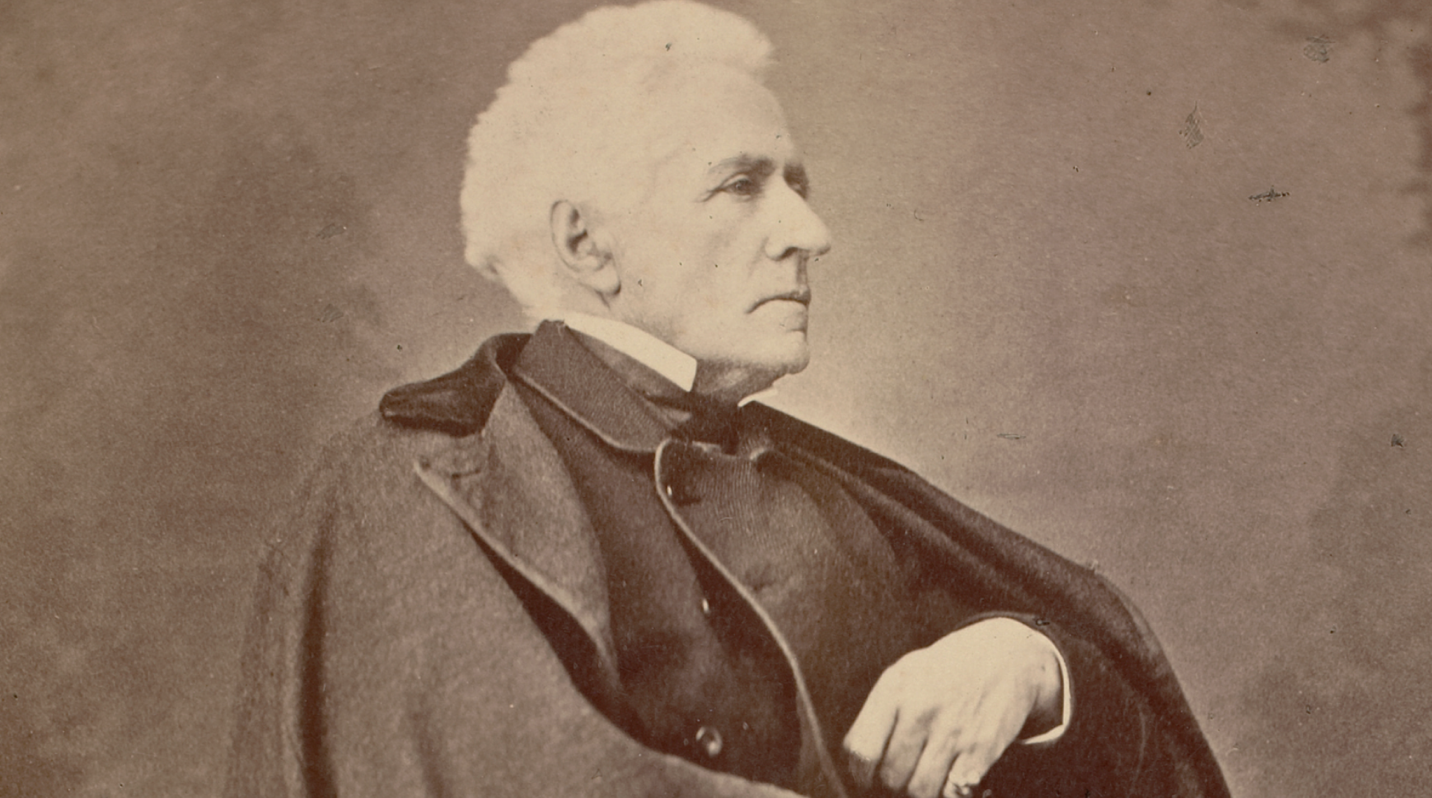
An older Paul Strzelecki
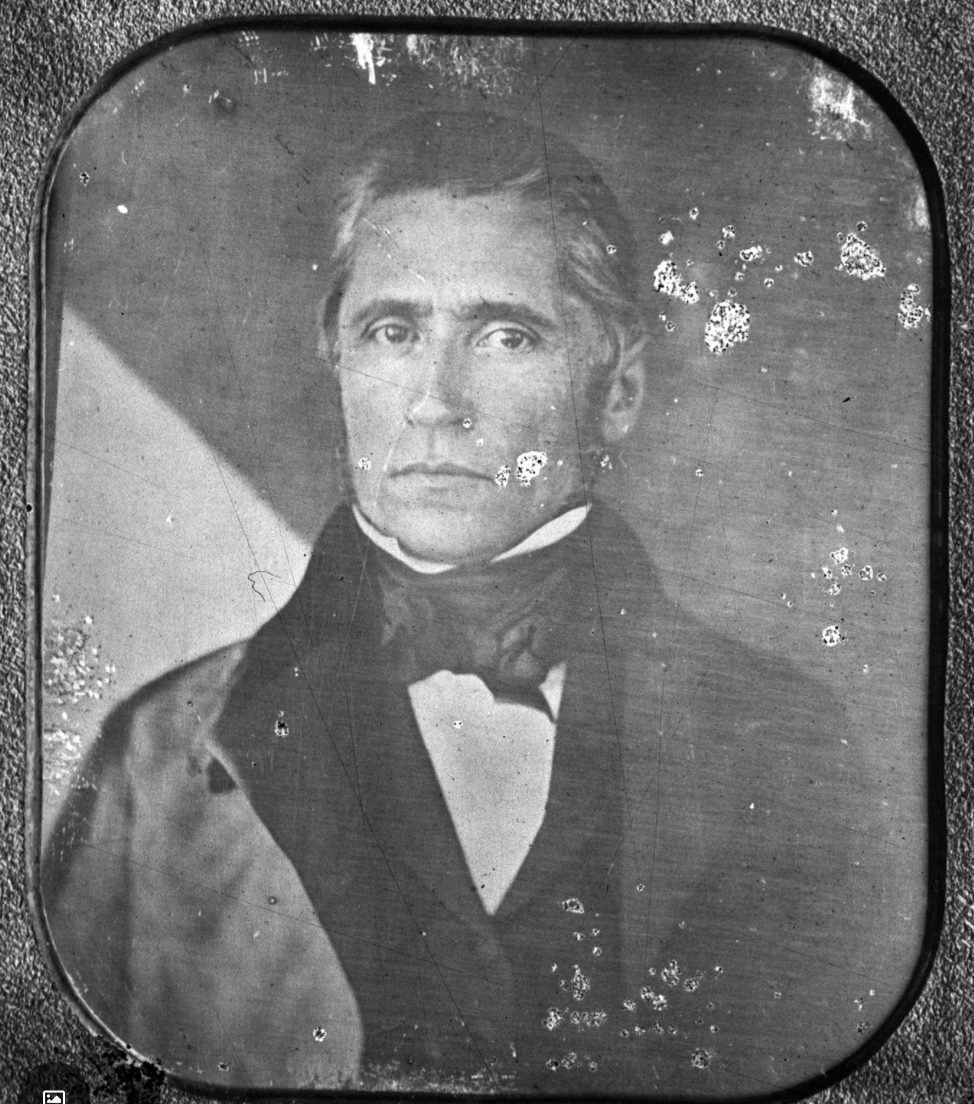
Strzelecki was not only a great humanitarian, but also a fascinating character in his own right. Born into a minor aristocratic family, he served in the Prussian army and had his heart broken when the family of the young woman he had fallen in love with refused his offer of marriage on account of his modest means. Crushed, he decided to leave Poland and traveled the world, visiting Africa, North and South America before traveling to Polynesia and Australia. He became a self-taught scholar in geography, geology and anthropology and corresponded with Charles Darwin. In Australia, he climbed the continent’s highest peak, naming it for the great Polish revolutionary Tadeusz Kosciuszko and explored Tasmania. He became a British subject in 1845 and published his Physical Description of New South Wales and Van Diemen’s Land, for which he received the Founder’s medal of the Royal Geographical Society.
Paul Strzelecki
In 1845, he returned to London where he became friendly with Samuel John Lloyd, an associate of the powerful banker Baron Lionel de Rothschild. The two bankers, moved by the suffering of the Irish, founded the British Relief Association, which collected money for famine relief. Strzelecki volunteered to go to Ireland as an unpaid agent of the B.R.A. Traveling across the famine stricken land, Strzelecki was shocked by the suffering and death he saw around him. In Co. Mayo, Strzelecki organized soup kitchens and gave cash to relief committees. He focused much of his relief work on children. Strzelecki decided to stay in Ireland because, unlike others, he correctly predicted that famine would return to Ireland the following year. The B.R.A. named Strzelecki as agent for all of Ireland and he helped the hungry until the organization’s funds were depleted. He then returned to London where he pled for further funds and explained that humanitarianism must take precedence over every other consideration. In 1849, he again returned to Ireland where he tried to feed the hungry.
Strzelecki also helped many Irish families to emigrate to Australia and the United States. His efforts were recognized by the Crown and he was knighted in 1849. For many years Strzelecki’s heroism was forgotten, but the Polish Embassy in Ireland has sponsored the exhibition to remind Ireland of this great Polish humanitarian. Hopefully, Strzelecki’s story will resonate both with the Irish and with the many Polish people who now call Ireland home and bond the two groups closer together.
End.
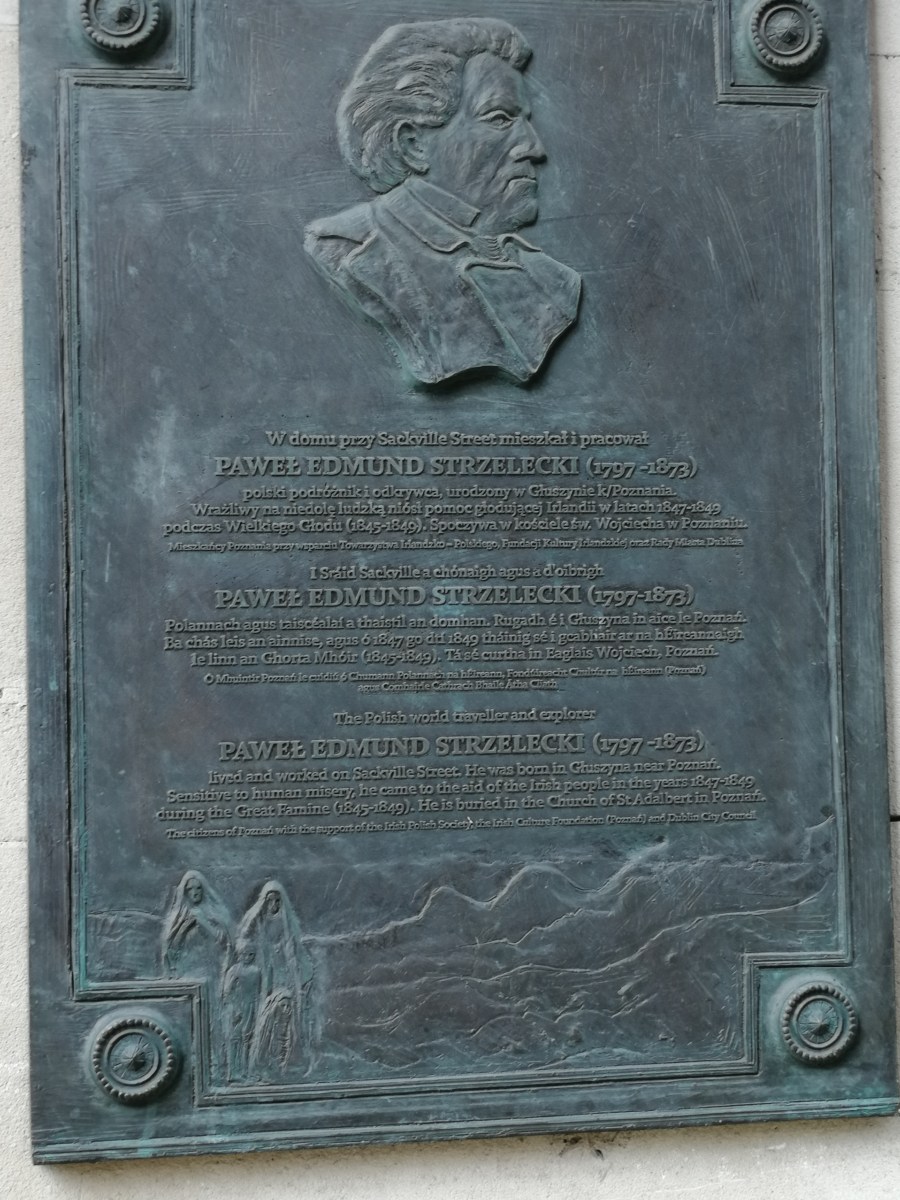
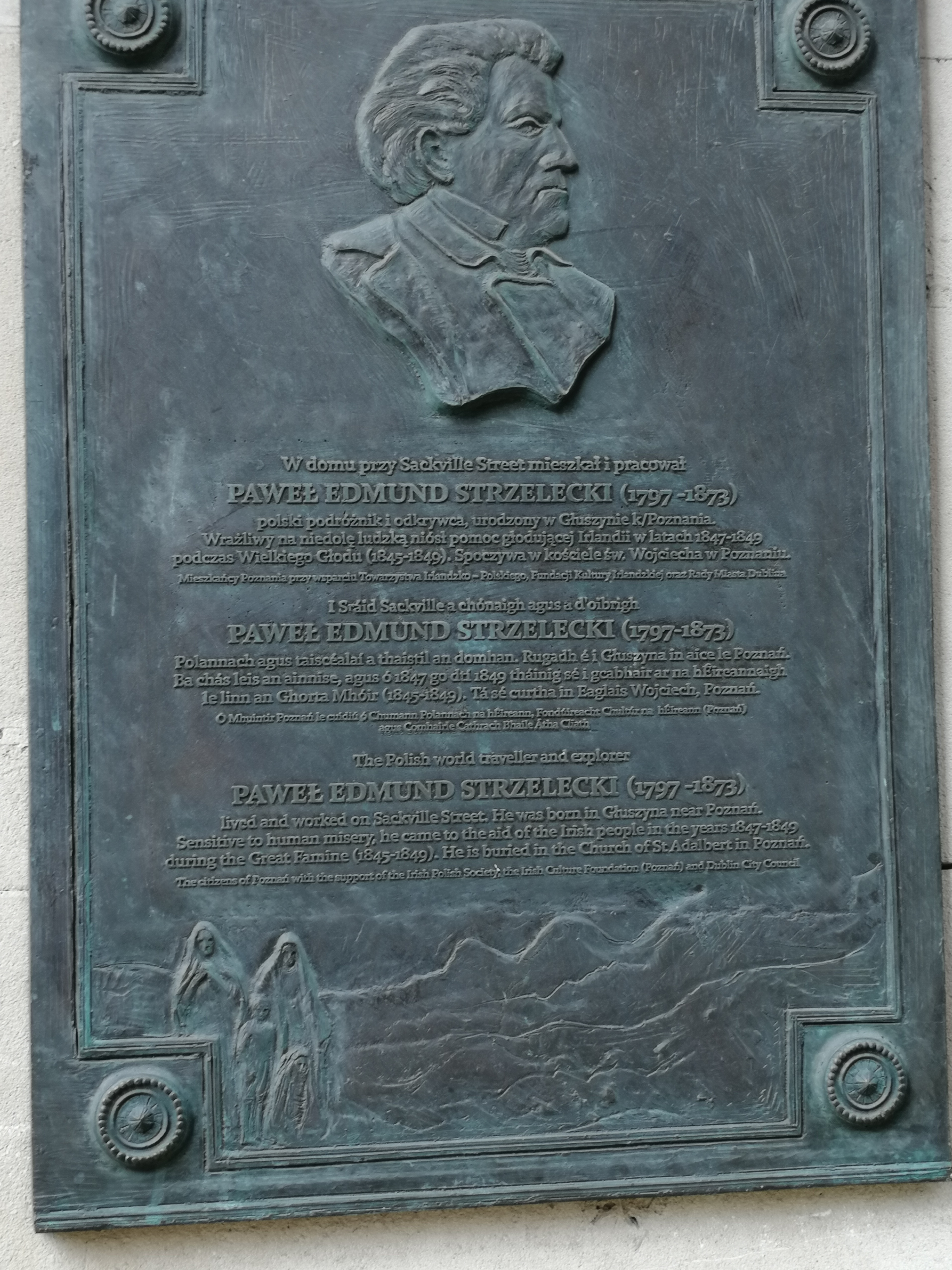
Postscript from Editor Rebel Breeze: There is a plaque in Dublin commemorating this man on the side of the Clery’s building in Sackville Place, at the corner with O’Connell Street. Do our readers know of any other such plaques or monuments to him, for example in Mayo?
Plaque Sackville Place Polish Count Paul Strzelecki (Photo: D.Breatnach)
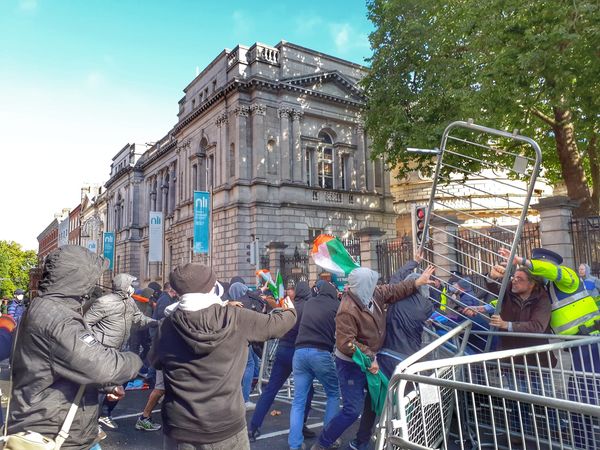
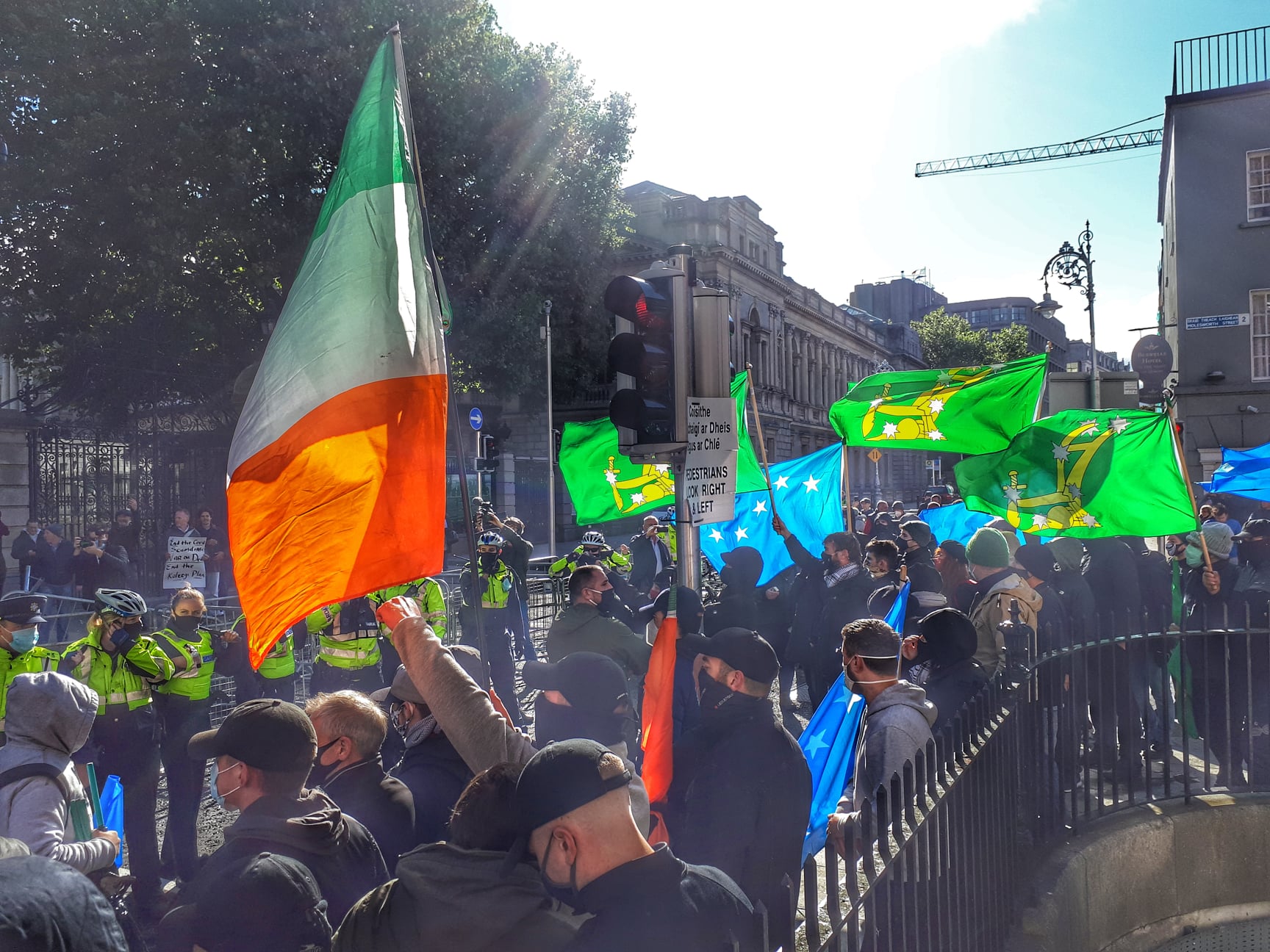
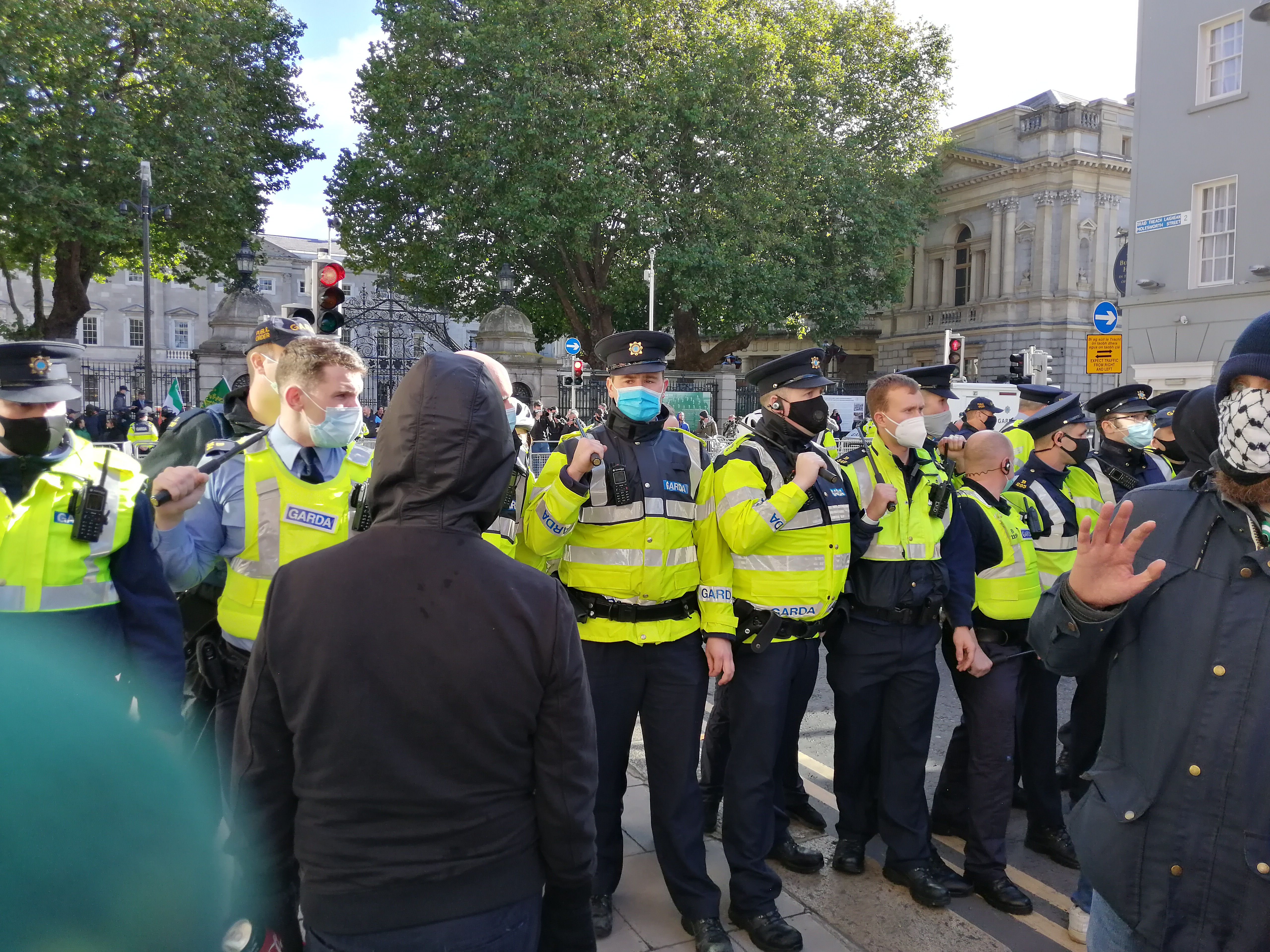
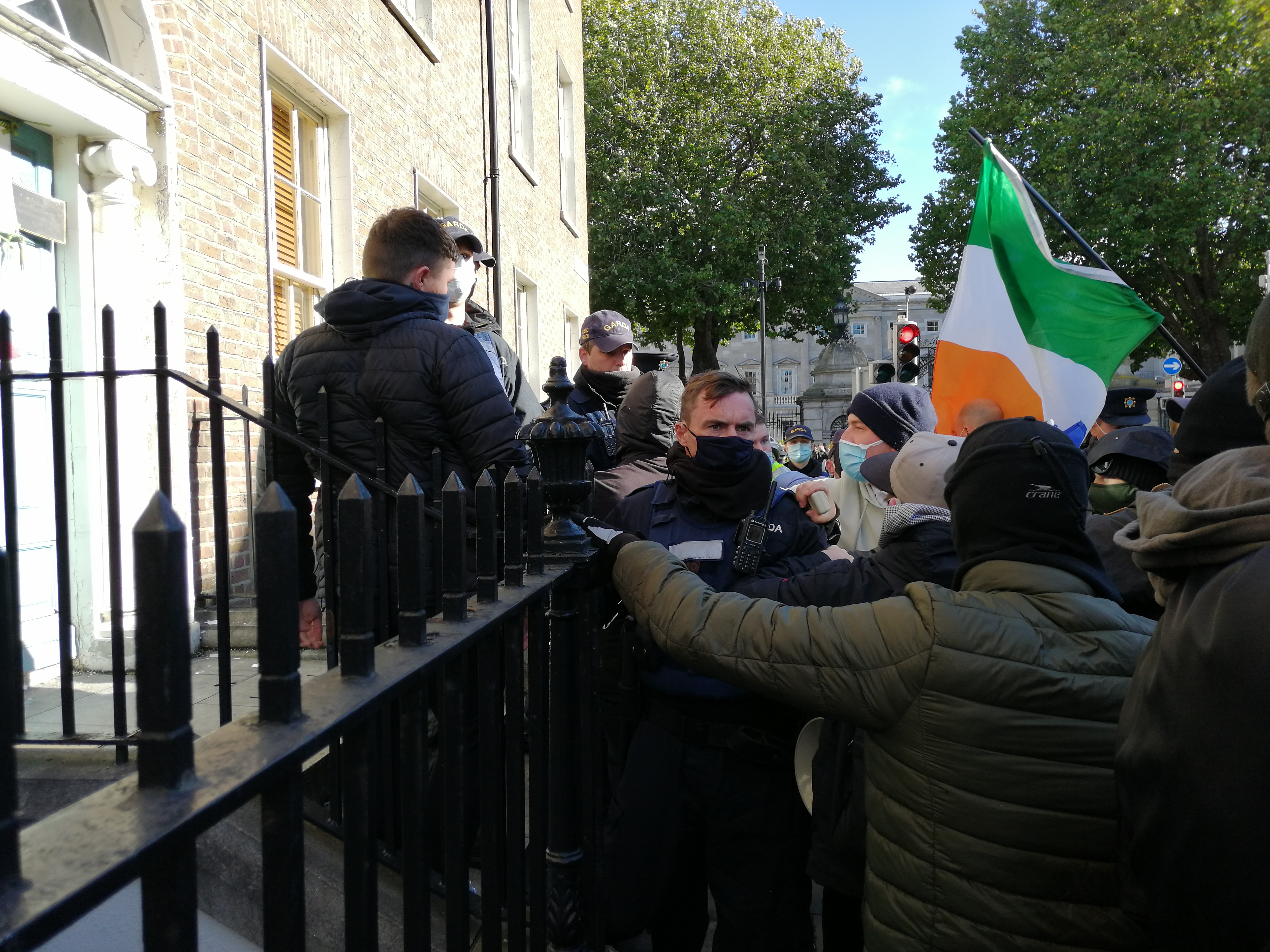
A rally outside Leinster House organised by the Irish fascist National Party for Saturday 10th October survived a clash with antifascists thanks only to the protection of a large force of Gardaí. The rally was a continuation of the attempt of the Far-Right in Ireland to use popular frustration over the Government’s haphazard and stop-go restrictions to build up their fascist and racist organisations.
The Irish Tricolour and both versions of the socialist Starry Plough, the original one of the Irish Citizen Army and the later one of the Republican Congress. (Photo source: AFA Ireland)
A broad coalition of antifascists, Irish Republicans, Socialists, Communists, LGBT activists etc, led by Antifascist Action Ireland, mobilised a counter-protest to the National Party’s presence. Immediately the counter-protesters arrived, the two forces clashed. The NP supporters were visibly taken aback as the barriers between them and their opponents flew aside or were thrown down, some actually going into the air. Two flash-bangs they threw into the antifascists seemed to have no effect and it was the Gardaí with baton blows that saved the NP. The rally’s banner was seized by antifascists and only retrieved by Gardaí.
NP supporters (right of photo) in shock as the antifascists (right of photo) clash with them. (Photo source: Internet)
The National Party, formed in 2016, are a fascist, racist, homophobic and fundamentalist sectarian Catholic organisation. Their leader Justin Barrett recently commented that when he got into power he would remove the citizenship of the current elected Mayor of Dublin, Ms. Hazel Chu, although she was born and raised in Ireland. The party propagates the “Replacement conspiracy”, where the EU is supposedly planning to replace all Irish people with migrants, proposes hanging for doctors who carry out a pregnancy termination and opposes LGBT equality. A prominent member of their organisation boasted about having organised the mob of up to 60 men who attacked a peaceful counter-protest on Custom House Quay on August 22nd with iron bars and lengths of timber.
With threatening batons and at times striking with them, the Gardaí first of all pushed all the counter-protestors into Molesworth St. where uniformed Gardaí and POU (Public Order Unit) faced off the antifascists, who alternated between shouting at the fascists over the heads of the Gardaí and shouting at the Gardaí themselves, e.g “Garda Blueshirts!”1
Original defensive screen for the NP of Gardaí with drawn batons (Photo source: Rebel Breeze)
At one point POU officers blocked off access to some antifascists who were on the steps of one of the buildings in the street and proceeded to search them but apparently found nothing. They did not conduct searches among the supporters of the NP, who had earlier thrown the flash-bangs and some other missiles at their opponents. Nor were they seen confiscating any flags from the NP supporters, while they wrenched flags from a number of antifascists – including a tricolour on a long fairly fragile carbon plastic rod (shown on Breaking News, which also showed NP supporters in a different photo striking at antifascists with flags that seemed to be on metal rods).
Public Order Gardaí forcibly searching an antifascist but nothing found (Photo source: Rebel Breeze)
Things could have remained at stasis at that point but the Gardaí several times pushed the antifascists savagely back, a few feet at a time. They were successful in doing so over some metres but it was not made easy for them – there was strong militant resistance and a number of clashes.
During the whole of these interactions after the initial clash with the NP, a number of antifascists were guarding the rear of their numbers and some fascists approaching, presumably latecomers for the rally, were turned away.
The Public Order Unit, which took over from the Gardaí and began to aggressively push the antifascists back but were resisted. The fascists may be seen beyond, with the Irish Parliament beyond that. (Photo source: Rebel Breeze)
At one point it appeared that the Gardaí were mobilising numbers to block off the antifascists’ exit but in response to a call to fall back, the solid mass passed through the Gardaí’s incomplete lines thereby defeating any intention of “kettling” the antifascists and shutting down their mobility.
NP SPEAKERS AND SPEECHES
The fascists chanted “Pedos off our streets!” in response to the antifascists’ calls for “Nazi scum off our streets!” — to the fascists, LGBT people are “paedophiles” and they find it a handy though baseless slogan to throw at all antifascists. The antifascists, apart from regularly chanting also met any attempt at fascist speeches with a barrage of shouts, rhythmic clapping, whistles and booing. Consequently, although the speakers were visible to the antifascists albeit at a distance, the content is known only from media reports.
The speakers were Mick “Chopper” O’Keefe, Rowan Croft (“Tan” Torino)2 and Justin Barrett. According to The Beacon, Barrett claimed that the Government is altering the death figures in relation to COVID-19 in order to justify its actions and that that the virus is part of a wider agenda on the part of “international finance capital”3 to destroy the world’s economies. Barrett insisted that the “restrictions are here to stay” as part of the economy-destroying agenda.
(Photo source: Rebel Breeze)
(Photo source: Rebel Breeze)
(Photo source: Rebel Breeze)
Prior to the event, on social media the NP cautioned its supporters to be friendly towards the Gardaí: “The Gardaí know the reds are scum, remember the migration compact protest: the Gardaí were having the banter with us, they had their batons out for the reds. We need to maintain that dynamic.”
(Photo source: Rebel Breeze)
According to the Beacon, Barrett, who beats the law-and-order drum, told the Gardai “you are of us and we are of you”.
(Photo source: Rebel Breeze)
FASCISTS CHASED AND REPORTING
After mocking the fascists as they left, the antifascists marched off in apparently the opposite direction, then swung around to pursue the NP supporters. Apart from the Garda circle around the latter, they also threw up a cordon against the antifascists at the Nasseau Street junction with Kildare Street.
The main body of antifascists turned then and marched through the city centre chanting “Fascist scum off our streets” to applause from some bystanders, then rallied at the GPO. Gardaí reported two arrests and it is known that they arrested an antifascist in Moore St for having allegedly confiscated a POU cap back in Molesworth Street. There are rumours that a few unguarded fascists were also met by antifascists to the dismay of the former but these have not been confirmed.
Media reporting varied, from a wildly inaccurate account in Dublin.Live to RTÉ’s equating of both groups on the same level, with the Irish Times giving the very erroneous impression that the NP were as eager to get to grips with the antifascists as the antifascists were with them.
Commenting on the events in a statement later, Anti-Fascist Ireland said: “The NP event was a failed attempt to use current Covid-19 restrictions as a rallying point to attract unsuspecting members of the public who may hold genuine grievances with the lockdown.”
Quoting the London-based Anarchist antifascist Albert Meltzer (1920-1996) “there’s no such thing as a fascist march – only a police march”4 the statement referred to” the massive Garda operation required to ensure the larger anti-fascist mobilisation was kept away from the underwhelming fascist presence.”
Referring to the recent fascist boast of about ‘controlling’ the streets of Dublin, the AFA statement commented that “they seemed genuinely shocked and scared by the sight of hundreds of working-class anti-fascists in Dublin today” and reported that “A nervous Torino was spotted leaving the vicinity immediately after his rant and did not even stay around for Justin Barret’s rambling long speech.”
The statement pointed out that the NP oppose the use of masks to prevent the spread of Covid19 and that their supporters disregard any restrictions. “We know that huge numbers of our supporters did not take to the streets today out of concern for the most vulnerable in society”, the statement continued. Those of us out today did so out of a sense of necessity and true patriotism to protect our country from their dangerous and toxic ideologies.”
The statement concluded: “AFA Ireland is a militant anti-fascist organisation formed in 1991. We believe in physically and ideologically confronting fascism whenever and wherever it rears its ugly head. As always, we encourage all anti-fascist minded people across the island to reach out to us and work together in a militant, disciplined movement against fascism. Profound thanks again to all our members and supporters in the republican, socialist, grassroots, LGBTQ+ and trade union movements.
Beir Bua. La Lucha Continúa. No pasarán.”
FAILURE OF THE LEFT FACILITATED GROWTH OF THE FAR-RIGHT
The National Party is one of a number of similar organisations and parties that make up the Far-Right in the 26 Counties (in addition there are the Loyalists in the Six Counties). There are also the Irish Freedom Party led by Herman Kelly, Síol na hÉireann led by Niall McConnell, QAnon led by Dee Wall (real name Dolores Webster) – who was at the NP rally, Anti-Corruption Ireland led by Gemma O’Doherty and Irish Yellow Vests, led by Glen Miller and Ben Gilroy (who also has his own promotion through the Tiger Reborn FB page). Despite their wide representation on social media, most of these are tiny groups which is why until recently they have been banding together at a number of events and in particular participating in events organised by the more popular Irish Yellow Vests. The IYV have been making a comeback since they fizzled out a couple of years ago after the Islamophobia of Miller, opportunism of Gilroy and racism of some of their supporters was exposed.
The failure of the Irish Left to mount a comprehensive resistance to the attacks of the Irish ruling class on working people over the years and, in particular, its failure to construct an adequate response to the Covid19 pandemic and to the Government’s handling of it has proved a boon to the ‘Vests and they have provided platform and marching space for all the other parts of the Far-Right, including the obvious fascists, but also attracting a number of innocent but confused people.
Recently the ‘Vests have been trying to clean up their image a bit by dumping the likes of O’Doherty, despite having using her notoriety up to now, along with the parties led by Barrett, McConnell and Kelly. And a report in the Examiner recently suggested that the State wished to assist the Vests in gaining popularity, as the report quoted unnamed senior Garda sources alluding to their alleged investigation of the “penetration” of the anti-mask movement “by fascist organisations”. If this is so however, the Gardaí on Saturday seemed to have not yet received the message – unless it was just their old prejudice against Republicans and the Left coming into play.
The media reported that Gardaí were going to “investigate the organisers” of the NP event (pretty obvious really!) and of the antifascist counter-protest. This is a ritual verbal response from a police force which has left the weekly QAnon protest outside the GPO unmolested from the very start of the Covid19 restrictions, while they harassed Debenhams workers’ pickets around the corner in Henry Street and their Special Branch did the same to political prisoner solidarity pickets further down O’Connell St.
End.
LGBT and Irish Tricolour flown among the antfascists. (Photo source: Rebel Breeze)
FOOTNOTES
1A reference to the fascist movement in 1930s Ireland, the leader of which was the former first Commissioner of the Free State Gardaí.
2Rowan Croft nicknamed himself the “Gran Torino” but has been nicknamed “Tan Torino” by opponents due to his past service in the British Army and possibly also due to his participating in a panel, along with Herman Kelly, with notorious fascist and British Loyalist Jim Dowson.
3This term in the past has been and today too is often a coded expression of anti-semitism and Barrett has let slip some remarks indicating in that direction.
4Based on the experience of antifascists when fascist marches are accompanied or even led by police, as for example in London at Cable Street in 1936 and Lewisham in 1977.
El 18 de agosto, se llevaron a cabo redadas contra partidarios del partido republicano irlandés Saoradh tanto en los Seis Condados ocupados como en el estado irlandés. Las redadas en los Seis Condados fueron coordinadas por el MI5 (Servicio de Inteligencia británica) y las de los 26 Condados (el Estado Irlandés) a instancias de los británicos o planificadas por ellos (el jefe de la Gardaí, Drew Harris, es un exdiputado jefe de de la policía colonial británica, el PSNI y sería un activo del MI5, por lo tanto).
Patrula de Garda y policía política del Special Branch, los cuales habian anteriormente identificado a varios manifestantes, O’Connell Bridge (Photo: D.Breatnach) Concentración en la mitad el Puente O’Connell, Dublín, en solidaridad con los presos en Maghaberry (Photo: D.Breatnach)
Las redadas en los 26 condados, aunque derribaron violentamente las puertas de las casas y atemorizaron a las parejas y los niños, hasta la fecha no han dado lugar a cargos, pero las de los Seis Condados, facilitadas por un agente del MI5, resultaron en cargos graves y encarcelamiento de ocho. sin fianza en espera de juicio sin jurado en el Tribunal Diplock.
Todos los detenidos en los Seis Condados fueron encarcelados en la cárcel de Maghaberry, teniendo primero que pasar dos semanas en cuarentena en Foyle House. La instalación donde los presos fueron obligados a soportar este período ha sido descrita por los presos como “sucia y ruinosa” y con “cartones de leche pegados a la pared con heces” pero, habiéndolo soportado, fueron trasladados a la población general de presos políticos en Maghaberry.
Uno de los detenidos es el doctor Issam Hijjawi, que tiene problemas de salud por lo cual hace tiempo que buscaba hacerse una resonancia magnética. Finalmente se le concedió y fue trasladado bajo custodia al hospital donde se realizó el procedimiento. Sin embargo, a su regreso, fue nuevamente enviado a Foyle House para pasar otras dos semanas en esas condiciones insalubres, aunque fácilmente podría haber sido acomodado en la cárcel cerca de los otros presos para concluir otras dos semanas de cuarentena allí. Además, la naturaleza punitiva es clara cuando uno se entera de que los funcionarios de prisiones que acompañaron al doctor Issam Hijjawi no estaban obligados a ponerse en cuarentena y cuando la “focalización concertada de molestías que ha sufrido desde que entró en Maghaberry”, según los presos, se lleva a la cuenta.
HUELGAS DE HAMBRE
El doctor Issam Hijjawi se declaró en huelga de hambre en protesta y el 17 de septiembre 20 presos políticos en Roe House Maghaberry y 25 en E3 y E4 en las cárceles de Portloise se embarcaron en una huelga de hambre en solidaridad (tres presas políticas de Hydebank prisión también se incorporó la semana pasada). Se trata de prisioneros que están bajo el cuidado de la IRPWA (Asociación de Bienestar de Presxs Republicanxs de Irlanda), que tiene una estrecha relación con el partido Saoradh.
Saoradh y la IRPWA organizaron piquetes de protesta en varias partes de Irlanda, incluidas Dublín, Belfast, Derry, Tralee, Kilmainham Jail, que contaron con el apoyo de militantes del amplio movimiento republicano y antiimperialista.
Para el 26 de septiembre, el día 11 de la huelga de hambre, también organizaron una protesta frente a la cárcel de Maghaberry, con discursos, cánticos y fuegos artificiales. Más tarde ese mismo día, el PSNI (la policía colonial británica, antes RUC) detuvo a dos de los partidarios de Saoradh, incluido su presidente de la sucursal de Derry, por “comportamiento desenfrenado”, “comportamiento desordenado” y “posesión de fuegos artificiales ilegales”.
Cencentración de solidaridad con los presos Republicanos en la cárcel de Maghaberry, en los Seis Condados occupados. (Fuente: IRPWA)
Los participantes que iban al estacionamiento para apoyar a los detenidos fueron recibidos por policías coloniales con equipo antidisturbios que, según testigos republicanos, empujaron, golpearon, estrangularon y tiraron del cabello a los manifestantes.
Mientras que los dos republicanos de Derry fueron llevados por la policía colonial a la Unidad de Interrogatorios de Musgrave, más policías coloniales con equipo antidisturbios se trasladaron al campo de solidaridad frente a la cárcel de Maghaberry y detuvieron a dos partidarios del grupo juvenil republicano Éistigí, que también fueron llevados a la Unidad de Musgrave.
Policía colonial británica (PSNI) frente a la cárce de Maghaberry, enfrentando los solidarios con los presos republicanos en huelga de hambre (Fuente: IRPWA)
Dos días después, el lunes por la mañana, los cuatro comparecieron en el Tribunal de Lisburn a través de un enlace de video de la Unidad Musgrave, donde se les concedió la libertad bajo fianza en condiciones que violaban sus derechos civiles: no se les permite estar en compañía del otro ni en contacto; no deben estar a menos de 100 metros de una protesta o procesión notificada o no notificada; los cuatro hombres tienen que presentarse en un cuartel británico tres veces por semana.
La policía colonial quería aún más, que fueran etiquetados electrónicamente, en el toque de queda de 16.00 a 8.00 y no se les permitiera viajar en ningún “vehículo privado” — pero al final no se impusieron.
Luego, aunque les habían concedido la libertad bajo fianza, los cuatro fueron esposados y llevados a la cárcel, dos a Foyle House (anexo a la cárcel de Maghaberry) donde observaron lo sucias que estaban las celdas y posteriormente ambos fueron despojados a la fuerza y cacheados íntimamente por los guardias de la prisión. Los otros dos detenidos, ambos menores de 21 años, fueron trasladados a Hydebank.
Pancarta colgada frente puertas exteriores de la cárcel de Maghaberry, acusando a la policía colonial británica de ser contralado por servicios de inteligencia del Reino Unido y de ser respaldado por “Quislings” (es decir, traidores nacionales, se refiere a Vidkun Quisling, principal politico colaborador noruego con la ocupación Nazi).
Cuando finalmente fueron liberados, los cuatro detenidos tuvieron que viajar a casa en automóviles separados debido a las condiciones de fianza que se les impusieron, a pesar de que tres de ellos vivían en la misma ciudad. Un automóvil fue seguido por policía, detenido y expulsado a sus ocupantes y el automóvil registrado en Glenshane Pass. Otro fue detenido y registrado en la ciudad de Derry.
Los cuatro manifestantes ahora están recibiendo asesoramiento legal sobre su detención ilegal, cacheo desnudo y encarcelamiento por las fuerzas de la Corona británica.
El Dr. Hijjawi ha sido devuelto ahora a Roe House en Maghaberry y las protestas sobre ese tema han concluido. El carácter político vengativo del aislamiento en Foyle House se ha confirmado con la información de que once presos no republicanos, dos de ellos Lealistas, han estado de viaje fuera de la prisión sin que fueran puestos en cuarentena a su regreso en Foyle House.
PRISIONEROS POLÍTICOS EN IRLANDA HOY
En otro tema, las autoridades penitenciarias de los Veintiséis Condados (Estado de Irlanda), como consecuencia de la pandemia de Covid19, han reducido a la mitad el número de visitantes permitidos y han restringido los horarios de visita de los presos. El preso republicano Kevin Hannaway ha solicitado una revisión judicial de esta restricción alegando que viola sus derechos humanos. En su acción ante el Tribunal Superior, Hannaway afirma que según las reglas de la prisión, un preso tiene derecho a al menos una visita semanal de un familiar o amigo de no menos de 30 minutos de duración. Hannaway fue torturado en 1971 durante la introducción del internamiento sin juicio en los Seis Condados y es uno del grupo conocido como “los hombres encapuchados” porque les mantuvieron encapuchados durante sus días de tortura. Su caso fue dictaminado como tortura en el Tribunal Europeo de Derechos Humanos, pero luego fue modificado, en una apelación del Estado británico, a ser “trato inhumano y degradante”.
El Acuerdo del Viernes Santo de 1998 no vació las cárceles de los presos republicanos irlandeses, aunque los pertenecientes a los Provisionales fueron liberados con licencia y algunos otros aceptaron los términos y fueron liberados de manera similar. Sin embargo, se estaban realizando nuevos arrestos y encarcelamientos de republicanos que no apoyaban el Acuerdo (“disidentes”) y a algunos otros se les revocó la licencia y fueron devueltos a la cárcel sin cargos ni juicio.
Actualmente hay alrededor de 70 prisioneros republicanos irlandeses en cárceles de la autoridad colonial británica y del Estado irlandés. Aunque algunos están en espera de juicio (a veces hasta dos años), la mayoría está cumpliendo condenas, habiendo sido condenados en los Tribunales Especiales sin jurado utilizados para juicios políticos en ambas administraciones. Los problemas de los que se han quejado los presos republicanos incluyen el registro sin ropa, el acoso por parte de los funcionarios de prisiones, la ausencia o las restricciones en las instalaciones educativas y los largos períodos de aislamiento para algunas personas. Algunos presos también se enfrentan a la extradición del estado irlandés a los Seis Condados o al extranjero.
A leaflet from the Socialist Party of Ireland distributed at the antifascist rally in Dublin on Saturday 12th made a correct analysis of the source of the problems in Irish society of which the Far-Right are taking advantage in order to mislead people but also grow. But the leaflet text failed shamefully when it came to outlining the next steps to take.
Titled “OPPOSE RACIST DIVISION — Organise to stop the far right”, the leaflet correctly identified the haphazard Government restrictions as the cause of insecurity and confusion about the Covid19 virus, which fed the negationist movement. It also stated that the Far-Right was manipulating these people and working to infect them with racism and homophobia.
It was correct also to point to the need for socialists to expose the real issues and organise to resolve them.
However, the leaflet text went on to state: “Recent experiences have shown that small counter demonstrations with confrontational tactics have jeopardised the safety of anti-fascist protestors and can drive some some people further into the arms of the far right.”
Perhaps the Socialist Party can tell us what kind of counter demonstration would not be seen as having “confrontational tactics”. In fact since to their credit for the first time some of their comrades actually took part in one such counter-protest, on Custom House Quay on the 22nd August, they couldinform their party that the counter-protesters were attacked almost as soon as they stepped on to the Quay, before anything at all was said by them. Also, the Far-Right have been staging regular street protests since last year, many of them centred around the racist and conspiracy theorist Gemma O’Doherty, who recently unfurled a banner calling to “Make Ireland Catholic Again”. Should the Far-Right have been permitted to continue without public opposition?
Some of the armed fascists that attacked a counter-protest on Custom House Quay on 22 August 2020. (Source Image: Internet, then cropped)
The counter-protests were small because the majority of the antifascist movement did not participate in them. It was independent anarchists, socialists and Irish Republicans who first took up that task and at that time the Far-Right protests were quite small. When the Far-Right called a larger one for Leinster House, in a coalition of fascist parties and organisations, a fairly large force of Irish Republicans and independent antifascists confronted them and a number of the Republicans were arrested. Following that event, on 14th December 2019 a larger combined force of antifascists including Irish Republicans, Antifascist Action and socialist parties occupied the protest ground planned by the Far-Right outside Leinster House and outnumberedthe latter by about ten to one.
The small ad-hoc antifascist coalition of various political and social threads has been left to confront all the other fascist gatherings on their own. A Far-Right group called QAnon occupied the GPO forecourt for Saturday rallies as soon as the Covid19 restrictions were introduced and were left largely unmolested by antifascists to establish themselves as a weekly event, supported by fascist activists who travelled from different parts of the country to attend it. They were left unmolested by the Gardaí too, who nevertheless used Covid19 powers to harass Debenhams picketers around the corner in Henry Street and also by the Special Branch, Ireland’s political police, who harassed pickets held in solidarity with Irish Republican and Basque political prisoners, demanding the names and addresses of the picketers.
All subsequent rallies, pickets and meetings of the Far-Right were left entirely to the small aforementioned coalitions to oppose but when the Debenhams workers staged their march and rally on 8th August, the QAnon group abandoned their Saturday spot and took to Phoenix Park instead, showing the antifascist potential of a large gathering of the Left.
HISTORY OF ANTIFASCIST STRUGGLE IN IRELAND
The rise of the fascist movement in Ireland in the 1930s was defeated by Irish Republicans, who confronted them physically on the streets to the extent that the ruling class feared revolution and mostly acquiesced with De Valera’s government banning a Blueshirt march, after which the Blueshirts became integrated into the Fine Gael party and ceased to have a separate existence.
Eoin O’Duffy exchanges fascist salute with Blueshirt rally in 1930s Ireland. (Photo source: Internet)
Every attempt to establish a fascist party since then has been promptly squashed by antifascists. In 2016 the European islamophobic fascist organisation Pegida tried to launch itself in Dublin and was driven off the street by massive mobilisation of both those advocating peaceful opposition as well as those favouring physical confrontation (by the way four Republicans still face serious charges arising out of those events). The tiny group of native Irish fascists was attacked on its way into the city centre and the East European contingent had to run or be brought to safety in Garda vans.
Attempted Pegida launch February 2016. After some short battles between antifascists and fascists with Gardaí moving in to protect the latter, they spirit them away in police vans while staging a diversion in O’Connell St. (Photo: D.Breatnach)
IN BRITAIN
The fascist movement of Sir Oswald Moseley’s Blackshirts was physically opposed in numerous battles on the streets of British cities throughout the 1930s and after WW2, Moseley himself being knocked to the ground in Manchester and hit by a flying brick in Liverpool. Numerous battles took place in London too of course, the most famous being at Cable Street, where a coalition of Irish and Jewish antifascists, along with local Communist Party activists, fought a battle of several hours on 4th October 1936, principally with 7,000 London Metropolitan Police and all the mounted police of the city. The police got through the first barricade but failed to penetrate the second and the Blackshirts had to turn away, many being ambushed at other points such as at Hyde Park Corner.
Scene from the antifascist Battle of Cable Street 1936, fought mainly against the police who were trying to clear the way through the Jewish migrant area for the fascists. (Source photo: Internet)
Section of mural near the scene presenting an artist’s impression of the Battle of Cable Street, East London 1936. (Photo source: Internet).
After WW2 all attempts of Moseley and other fascists to organise were suppressed by robust action on the streets, the most serious being in 1958 in London’s Notting Hill area. Many of the post-war migration of Afro-Caribbean people to London lived in that area. Moseley’s Union of Fascists and the White Defence League organised and whipped up gangs of white youths to attack first migrant Caribbean males, then the white wife of a Caribbean man and finally Caribbean families. The Caribbean migrants and Irish and British antifascists organised defence and battles went on for two weeks. According to Wikipedia: “The riots caused tension between theMetropolitan Police and the British African-Caribbean community, which claimed that the police had not taken their reports of racial attacks seriously. In 2002, files were released that revealed that senior police officers at the time had assured the Home Secretary, Rab Butler, that there was little or no racial motivation behind the disturbance, despite testimony from individual police officers to the contrary.” (That pattern of police denial of racism and neglect of targeted communities became a repeated pattern and has also been seen in many other countries).
When fascists began to organise again in Britain at the end of the 1960s, the parties of the Left first advocated ignoring them and when they did eventually mobilise counter-demonstrations, marched them away from confrontation with the fascists. Meanwhile fascists were attacking sellers of socialist papers, socialist meetings, migrants and ethnic minorities. Some elements of the Left after a while adopted the slogan of “no platform for fascists” which became popularised among students and some staff in institutions of third-level education, eventually becoming policy of the National Union of Students.
A coalition of antifascists of various political backgrounds, including some acting unofficially outside their party discipline, mainly in AFA (Anti-Fascist Action) and small groups of revolutionary communists, anarchists, Irish Republicans and antifascists expelled from their parties (e.g. Red Action) took on the National Front, the League of St. George and the British National Party in numerous battles and smashed the ability of the fascists to take possession of any significant physical space in order to organise. On September 13th we passed by the anniversary of one of those battles in Lewisham, SE London in 1977 and we are nearly at the the anniversary of another,on the 18th in 1992 at Waterloo (the London Underground and train station, not the site of the 1815 battle in Belgium).
Scene from the antifascist Battle of Lewisham 1977. Left groups and Afro-Caribbean youth successfully battled mainly against police to prevent the fascist National Front marching through the borough’s centre. (Photo source: Internet)
Throughout that period the main parties of the left (with the exception for a period of the SWP and the IMG) refused to confront the fascists physically and instead concentrated on organising events to attract youth away from fascism, principally through the Anti-Nazi League. It was however clearly the physical confrontations by antifascists on the streets, as had been the case in the 1930s that again defeated the rising fascist threat in Britain – for a time. Clearing the fascists from the street not only prevented the intimidation of Left activists and ethnic minorities and prevented the creation of fascist areas but also made it much more difficult for fascists to recruit and marshall forces.
LEARNING THE LESSONS?
Rather than draw on the lessons of those struggles in Ireland and in Britain, the leaflet text advocates repeating the mistakes. In effect, the leaflet advocates leaving the antifascist mobilisations for the moment and concentrating on the class struggle against the system. That strategy entails allowing the fascists to become established and grow unhindered, making it much harder to root them out later. But not only that – the Left in Ireland has a pretty poor record of taking on the capitalist system and is particularly weak at the moment, with the trade union movement largely supine. The leaflet points to the just struggle of the Debenhams workers, with which the SP is particularly closely connected, at least in Dublin; however it is well to note that those workers have been sacked, their workplaces closed and the struggle is a last-ditch defensive one for redundancy pay. In other words, we are nowhere near a situation where the overall struggle against the capitalist system is such as to cut the ground from under the Far-Right.
Because those loose antifascist networks currently active are not under the control of the SP and are hardly likely to heed their call, the effect of the leaflet text is to advocate a continuation of the current situation, where counter-protests will be outnumbered by mobilisations of the Far-Right, despite the fact that the fascist parties actually have tiny support, bussing in people to swell the numbers. Fascist attacks will continue and may well even escalate. Fascists will continue to arm with Garda impunity for their attacks but it is certain that when the antifascists arm likewise, they will be arrested for “possession of offensive weapons” and even jailed.
Finally, the leaflet failed to give any specific indication of a short or medium-term way forward except to “join the socialists”, i.e the Socialist Party. The leaflet could have advocated building a broad antifascist front and called on people to help in that work, to bring in people not currently active, to ensure large turnouts to counter mobilisations of the Far-Right. But it didn’t.