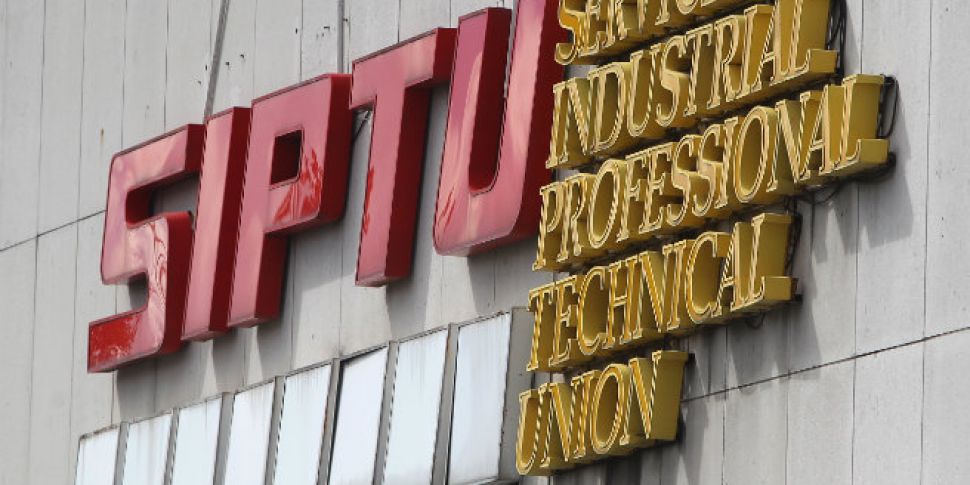
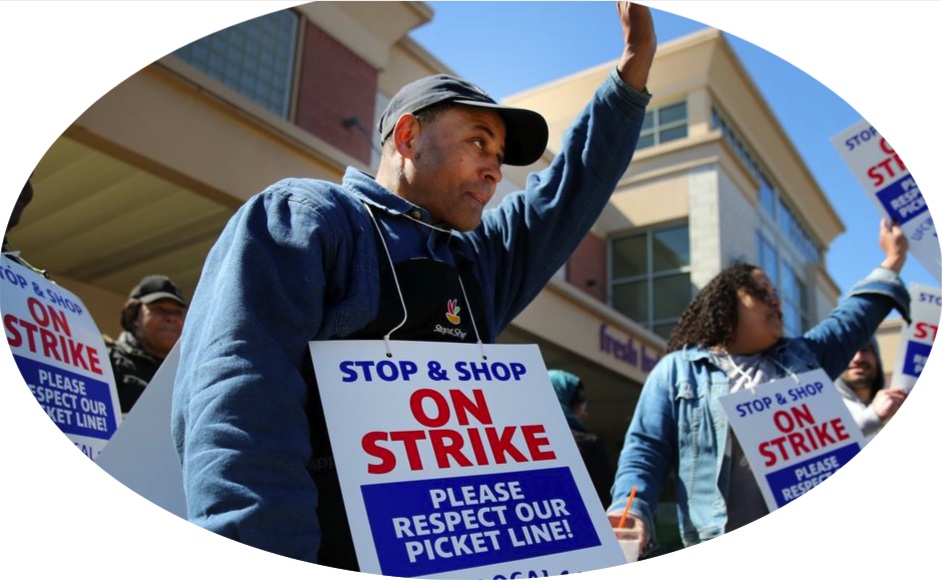
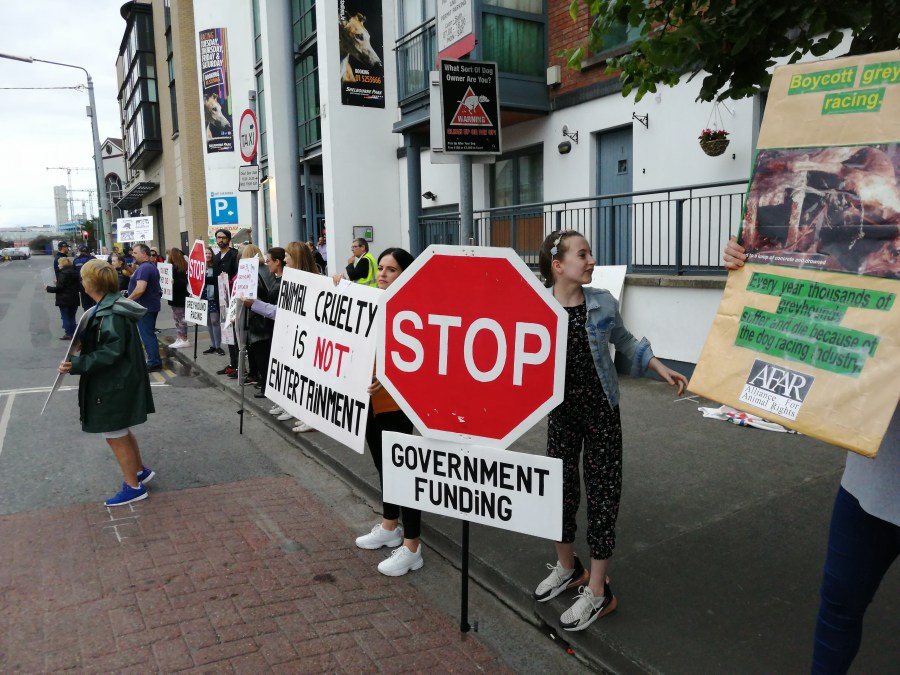
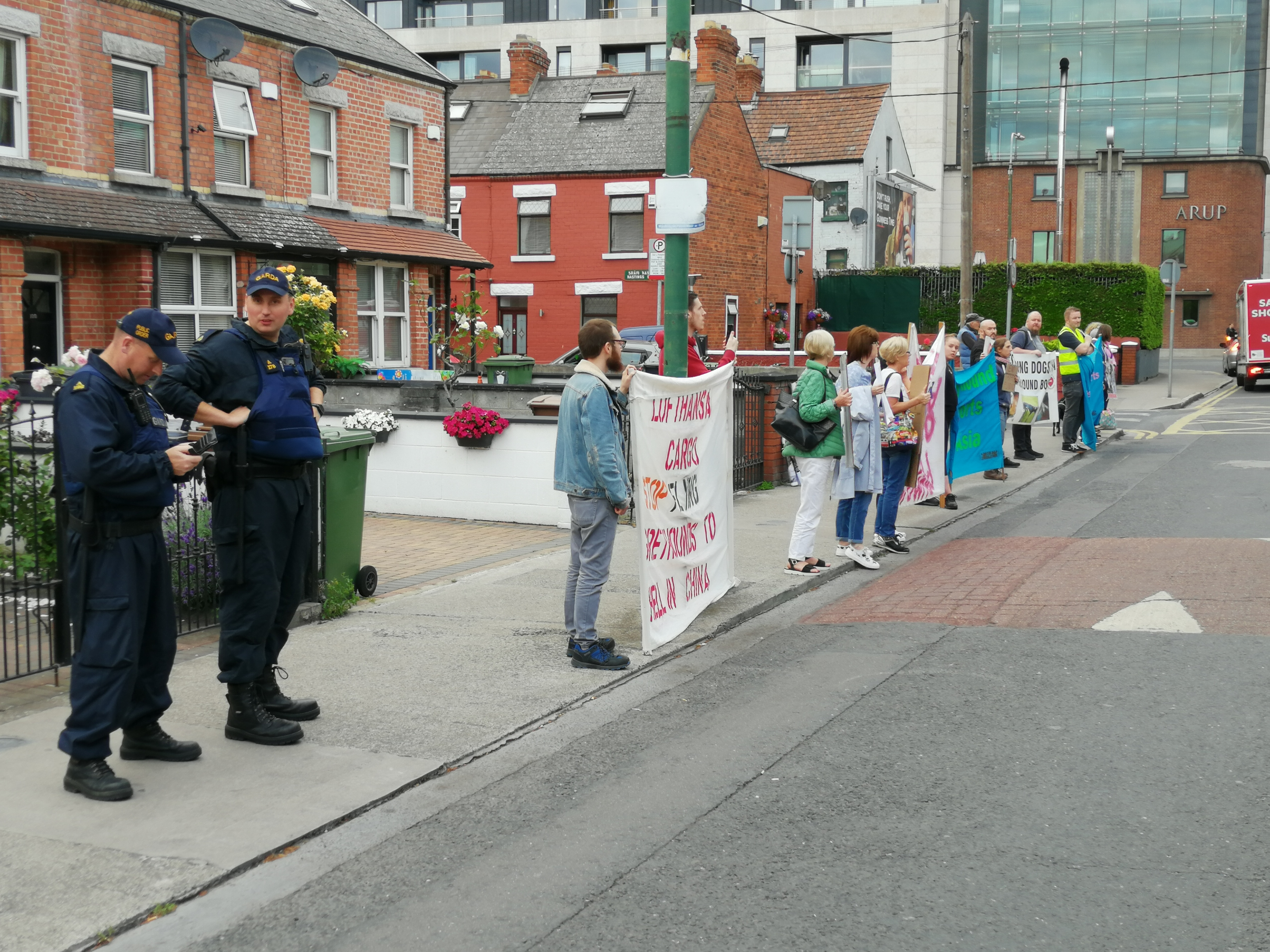
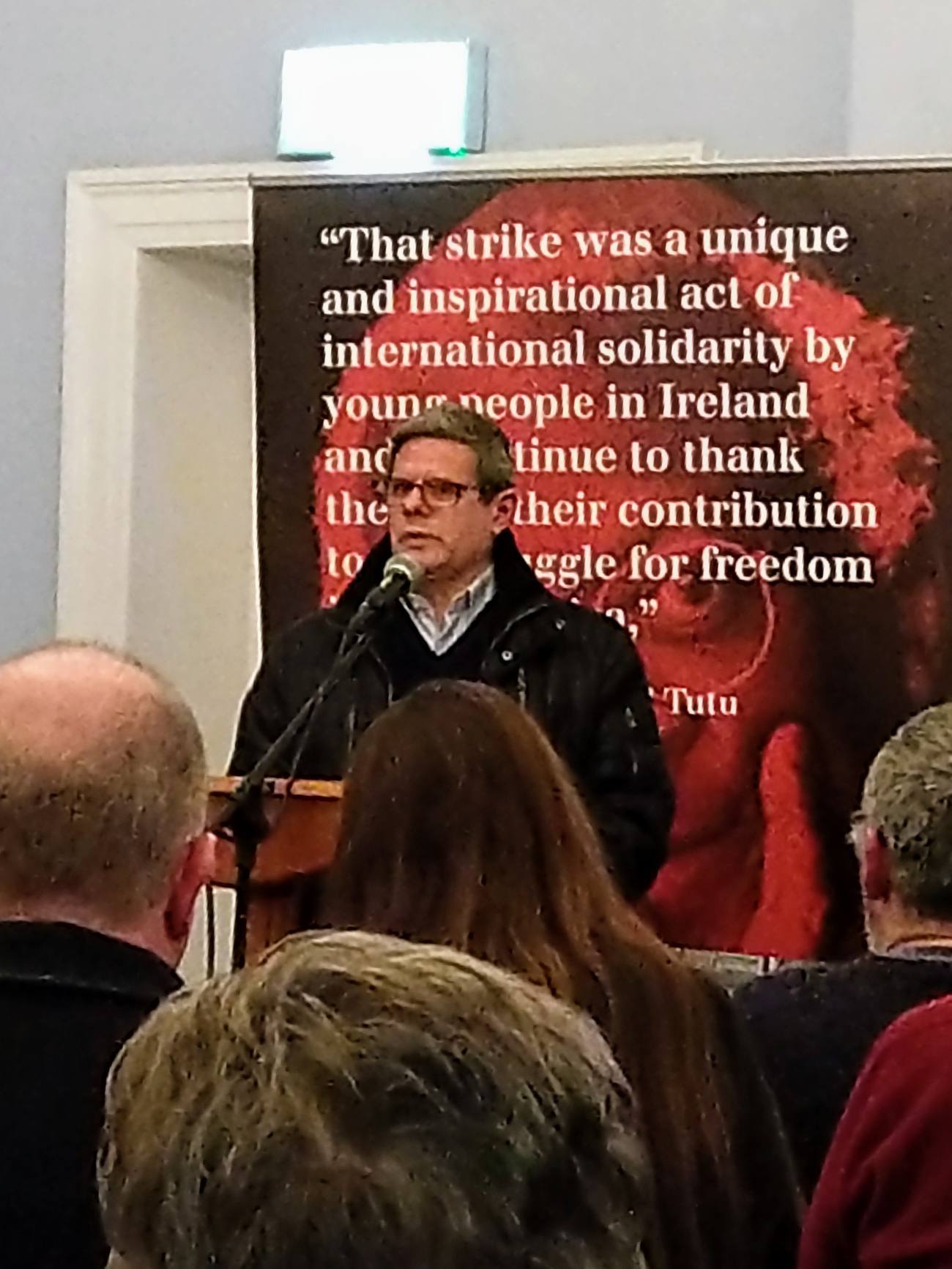
The Ivy Restaurant in Dawson Street Dublin, which steals part of its workers’ tips to make up their wages, continued to do so despite protests throughout 2019 and their only response to the campaigning has been to install and lower blinds whenever the protesters gather outside. Two members of staff were sacked for protesting the theft of tips (which customers assume are going to the staff) and trying to organise a trade union at their workplace.
View northward along Dawson St. in front of the Ivy Restaurant (Photo: D.Breatnach)
The Stop Tips Theft Campaign has been focusing on the Ivy not only in order to rectify the injustices there but also in order to clamp down on the practice in some other eateries and to prevent it spreading.
On 17th December 2019, the campaigners again picketed the restaurant for the last time for 2019, mixing serious calls for justice with songs with adapted lyrics and many wearing Christmas regalia.
It is scandalous that tips are being taken from these workers in what is now called the “hospitality sector”, who tend to the least-union-organised and also the worst paid and treated – which is exactly why the Ivy owners and management think they can get away with this.
(Photo: D.Breatnach)
End.
Joan Collins TD, a regular at these protests, with megaphone. (Photo: D.Breatnach)
The iconic Halfpenny Bridge over the river Liffey in Dublin seemed to be flying on Palestinian flags on New Years’ Eve. The annual event organised by the Ireland Palestine Solidarity campaign was favoured with not only a dry but also mild day this year and supporters and passers-by clicked their cameras to capture the scene, in the midst of which an Irish currach showing Palestinian colours was rowed up and down the river nearby by three women.
Currach (traditional light Irish rowing boat) rowed downriver by three women in solidarity with the Palestinian people (Photo: D.Breatnach)
Communists, Socialists. Irish Republicans (both pro and anti-Good Friday Agreement) and generally democratic people lined both sides of the Bridge itself and spilled out at each end, which the IPSC had a busy stall on the south side, next to the Merchants’ Arch.
Yesterday brought to an end a year that was far from the worst in the long history of the bloody Zionist occupation of Palestine and the oppression of the Arab-Palistinian population. Even so, 149 Palestinians were killed during 2019 according to a statistical collection agency and 35 of those were children. During the same period 10 Israelis were killed, including two children. However, in December alone, nearly 45 Palestinians were killed by Israeli Zionists against no Israelis. The hugely disproportionate balance of death and injury in favour of Israeli Zionism has been a consistent pattern since the the beginning of the Occupation and makes any notion of there being a “war between two sides” deemed nonsense by many commentators who instead, see the conflict as vicious repression by the Israeli State and largely ineffective resistance by what is now a minority Palestinian population, controlled to a prison-like degree by a highly-militarised state.
A bridge of flags. (Photo: D.Breatnach)
USA SUPPORTING A RACIST STATE AND ILLEGAL OCCUPATION
2019 was also the year in which the USA Administration for the first time pronounced the Israeli settlements in what are termed “the occupied territories” to be no longer illegal, flying in the face of world opinion and many declarations of the United Nations. This comes after the introduction of the new Israeli citizenship law last year, pushed through by the right-wing and religious coalition with 62 votes against 55, which defines Israel as the nation-state of the Jewish people, completing the process of making it officially a racist and religious state, downgrading the political, civil and cultural rights of all other ethnic and religious communities within the territory it controls. The measure was widely criticised by human rights groups around the world and within Israel itself, as also by much of the Jewish world population.
Part of the Ha’Penny Bridge yesterday (Photo: D.Breatnach)
Solidarity with Palestinians is traditionally demonstrated in other places in Ireland too on New Year’s Eve as well as at various other times during the year: between yesterday and today, eight Irish cities and towns demonstrated publicly in support of the Palestinians. Some years ago the Israeli Ambassador to Ireland described Ireland as “the most anti-Semitic country in Europe”. Since what he really meant was “the most anti-ZIONIST country in Europe”, most Irish people took that comment as a compliment. It is the Zionists who try to equate Jewishness with Zionism and the Israeli State in order to further their ideological indoctrination and intimidate democratic opposition; in doing so, the put all Jewish people in danger of the backlash against the crimes of the Israeli State. Fortunately there have been – and continue to be – Jewish people, some of them quite prominent, who speak out against the crimes of Zionism but these are dubbed “self-hating Jews” by the Zionists, who heap insults upon them.
The IPSC continues to organise a number of Palestine solidarity events every year and welcomes wide participation.
end.
The Palestinian solidarity currach going upriver. (Photo: Mel Mac Giobúin) [cropped]
Racists and Fascists, posing as Irish “patriots”, malign migrants to Ireland and target them in racist propaganda. This is a fundamentally unpatriotic activity, flying against not only our own huge history of migration to other lands but also against the great history of migrants’ contribution to the struggle for Irish independence and socialism.
Of the Seven Signatories of the 1916 Proclamation of Independence, two were migrants and two more were sons of migrants.
Of the sixteen of the Rising executed by the English, two were migrants (Connolly and Clarke), another three were sons of migrants (Pearse brothers, Mac Donagh) and at least six bore family names of foreign ancestry (Casement, Ceannt, Clarke, Colbert, Kent, Plunkett).
Numerous migrants took part in the 1916 Rising, mostly from England and Scotland but also some from the USA, one from Argentina, another from Finland and yet another from Sweden).
James Connolly, revolutionary socialist and anti-imperialist, author, songwriter, journalist and trade union organiser was a migrant who did not see Ireland until he was a young man. (Design: Maria Castella; photo: B.Hoppenbrouwers)
Constance Markievicz (nee Gore-Booth), feminist, Irish Republican, Socialist, officer in the Irish Citizen Army, first woman elected to the British Parliament, first female Minister of the Dáil and first Labour Minister in the world, was born in England; she was sentenced to death in 1916 by the English but had her sentence commuted. Volunteer Eamon De Valera, a 1916 Rising garrison Commander, was born in the USA to an Irish mother and a Cuban father. The captain of the Asgard yacht that delivered the Mauser rifles for the 1916 Rising was an Englishman, Erskine Childers and among the crew were his wife Molly from the USA and Mary Spring Rice (born London). Childers fought in the War of Independence and the Civil War and was executed by the Irish Free State in 1922.
Jim Larkin, trade union organiser and Lockout resistance leader, who was in the USA during the Rising, was co-founder of the Irish Transport & General Workers’ Union and of the Irish Citizen Army, also of the Irish Labour Party. Larkin was born and raised in Liverpool and did not see Ireland until sent to Belfast by his England-based trade union.
Constance Markievicz, Irish Republican, revolutionary socialist, officer in the Irish Citizen Army, sentenced to death in 1916 but commuted. She was a migrant, born in England. (Image source: Internet)
A LONG HISTORY OF MIGRANT CONTRIBUTION TO IRISH STRUGGLES
The aforesaid should not surprise us as migrants have often participated in struggles for freedom and social progress in their adopted countries and they and their descendants have a long history of taking up those struggles in Ireland – often sacrificing their liberty and even their lives in doing so.
Patrick Sarsfield, a hero of the resistance to William of Orange in the army of James II was of Anglo-Norman descent (he was a prominent member of the Wild Geese and was killed in military service abroad in 1683).
Nearly all the leaders of the Society of United Irishmen, the first Republican revolutionary organisation of Ireland, were Protestants of various sects and descendants of migrants. Henry and Mary Joy McCracken were active in saving Irish traditional melodies; their ancestors were Huguenots (French Protestant refugees).
Henry Joy was executed publicly in Belfast by the English in 1798, his sister walking hand-in-hand with him to the gallows. General Henry Munro, another Antrim Unitedmen leader, also executed in 1798, was of Scottish descent.
Theobald Wolfe Tone, Anglican co-founder of the Unitedmen and often described as the “father of Irish Republicanism”, was also of Huguenot ancestry; he died in jail in Dublin, while his brother Matthew was hanged. Edward Fitzgerald, another leader of the Unitedmen who died of his injuries in a Dublin jail, was a Protestant and descendant of Norman invaders.
Robert Emmet, another famous United Irishman but martyred in 1803, bore a surname of English origin as did one of his prominent comrades, Thomas Russell (“The Man from God Knows Where”), also executed by the English that year.
The Young Irelanders were the next Irish Republican organisation in history, their leaders a mixture of Protestant and Catholic background. One of the most famous was Thomas Davis, the son of a Welshman in the British Army and an Irish woman descended from Irish chieftain Ó Súilleabháin Béara.
Davis founded The Nation newspaper and composed a number of poems and songs, some of the latter being still sung today (e.g A Nation Once Again and The West’s Awake).
James Stephens and a handful of others founded the Irish Republican Brotherhood on 17th March 1858 in Dublin, the third Irish Republican organisation in Irish history and the life of which extended into the 1920s. Stephens is a family name of Anglo-Norman origin.
John Devoy of the Irish Republican Brotherhood in the USA, who was very active in supporting the 1916 Rising and the War of Independence, carried a family name of Welsh origin. Wales was also the likely origin of Michael Davitt’s family name, he who was chief organiser of the Land League’s base membership.
Volunteers Terence McSwiney and Kevin Barry, who both died in the same week in 1920, the first on hunger strike and the second hanged by the English, had family names of foreign origin.
WHO IS NOT A DESCENDANT OF MIGRANTS?
Of course, we are ALL descendants of migrants. The earliest date for human occupation of parts of Ireland has been calculated as being 7,000 BCE.
Since the earliest date given for the existence of homo sapiens is 300,000 years ago in the Horn of Africa (although throwing spears in Germany have been assessed as being between 380,000 and 400,000 years old), it follows that human settlement in Ireland was comparatively late and that all Irish are descended from migrants.
Stone age people arrived first, then the metal workers of bronze, followed by people of Celtic culture working iron.
Subsequently Ireland saw influxes of other groups, from Norse and Danes when they began to settle in parts of Ireland, followed by their cousins based in Normandy (and mercenaries they brought with them), then English and so on.
Religious groups seeking security such as Jews or fleeing persecution, for example the Huguenots, also entered at various times. Just a study of family names common in the Ireland of today reveals some of those ancestries.
The Norse, Danes, Normans and early English came as invaders, some more came subsequently as planters and many others came just to make a living in Ireland, like most migrants of today.
But descendants of all those groups, including of invaders and planters, contributed to and even led the struggle for Irish independence and social progress. Not only that but a significant number of those who arrived as migrants themselves took a stand for Irish independence, some of them paying the ultimate price.
Patrick Pearse, author in Irish and English, poet, journalist, Irish Republican and in overall command of the insurrectionary forces in 1916, was the son of an Englishman, as was his brother William. Both were executed after the surrender. (Design: Maria Castella; photo: B.Hoppenbrouwers)
CONCLUSION
Far from being “patriotic”, maligning migrants simply for being migrants is counter to the history of the general struggle for Irish independence and of Irish Republicanism in particular. It actually undermines the unfinished struggle for Irish independence and unification as well, of course, as the struggle of the working people for socialism.
End.
TRADUCCIÓN AL CASTELLANO:
LOS INMIGRANTES EN LA HISTORIA IRLANDESA
Los racistas y fascistas, haciéndose pasar por “patriotas” irlandeses, atacan a los inmigrantes en Irlanda en su propaganda racista. Esta actividad es fundamentalmente antipatriótica, que vuela no solo contra nuestra enorme historia de migración a otras tierras sino también contra la gran historia de la contribución de los inmigrantes a la lucha por la independencia y el socialismo irlandés.
De los Siete Signatarios de la Proclamación de Independencia de 1916, dos eran inmigrantes y un tercero era hijo de un inmigrante. De los dieciséis del Azamiento ejecutados por los ingleses, dos eran inmigrantes (Connolly y Clarke), otros dos eran hijos de inmigrantes (hermanos Pearse) y al menos seis tenían apellidos de ascendencia extranjera (Casement, Ceannt, Clarke, Colbert, Kent, Plunkett). Numerosos inmigrantes participaron en el Alzantamiento de 1916, principalmente de Inglaterra y Escocia, pero también algunos de los EEUU, uno de Argentina, otro de Finlandia y otro de Suecia).
Constance Markievicz (soltera Gore-Booth), feminista, republicana irlandesa, socialista, oficial del ejército ciudadano irlandés y primera mujer elegida para el Parlamento británico, la primera mujer ministra del Parlamento irlandés y primera ministra femenina de trabajo del mundo, nació en Inglaterra; fue condenada a muerte en 1916 por los ingleses, pero la conmutaron la pena. El voluntario Eamon De Valera, un comandante de la guarnición del Azamiento de 1916, nació en los Estados Unidos de una madre irlandesa y un padre cubano. El capitán del yate Asgard que entregó los fusiles Mauser para el Alzamiento de 1916 era un inglés, Erskine Childers y entre la tripulación estaban su esposa Molly (de los Estados Unidos) y Mary Spring Rice (nacida en Londres). Childers luchó en la Guerra de la Independencia y la Guerra Civil y fue ejecutado por el Estado Libre de Irlanda en 1922.
Jim Larkin, organizador sindical y líder de la resistencia al Cierre Patronal, que estuvo en los EEUU durante el Alzamiento, fue cofundador del Sindicato de Trabajadores Generales y de Transporte de Irlanda y del Ejército de Ciudadanos de Irlanda, también del Partido Laborista. Larkin nació y creció en Liverpool y no vio Irlanda hasta estar enviado a Belfast por su sindicato con sede en Inglaterra.
UNA LARGA HISTORIA DE CONTRIBUCIÓN MIGRANTE A LAS LUCHA IRLANDESA
Lo anterior no debería sorprendernos, ya que los migrantes a menudo han participado en luchas por la libertad y el progreso social en sus países adoptados y ellos y sus descendientes tienen una larga historia de asumir esas luchas en Irlanda, a menudo sacrificando su libertad e incluso sus vidas al hacerlo. .
Patrick Sarsfield, un héroe de la resistencia a Guillermo Naranja en el ejército de Jaime II de Gran Bretaña, era de ascendencia anglo-normanda (era un miembro destacado de los “Gansos Silvestes” y fue asesinado en el servicio militar en el extranjero en 1683).
Casi todos los líderes de la Sociedad de Irlandeses Unidos, la primera organización revolucionaria republicana de Irlanda, eran protestantes de varias sectas y descendientes de inmigrantes. Henry y Mary Joy McCracken fueron activos en salvar las melodías tradicionales irlandesas; sus antepasados eran hugonotes (refugiados protestantes franceses). Henry Joy fue ejecutado públicamente en Belfast por los ingleses en 1798, su hermana caminó de la mano con él hacia la horca. El general Henry Munro, otro líder de Los Irelandeses Unidos de Antrim, también ejecutado en 1798, era de ascendencia escocesa. Theobald Wolfe Tone, cofundador anglicano de los Irelandeses Unidos y a menudo descrito como el “padre del republicanismo irlandés”, también era de ascendencia hugonote; murió en la cárcel de Dublín, mientras que su hermano Matthew fue ahorcado. Edward Fitzgerald, otro líder de los Irelandeses Unidos que murió por sus heridas en una cárcel de Dublín, era protestante y descendiente de invasores normandos.
Robert Emmet, otro famoso de los Irelandeses Unidos pero martirizado en 1803, tenía un apellido de origen inglés, al igual que uno de sus camaradas prominentes, Thomas Russell (“The Man from God Knows Where”), también ejecutado por los ingleses ese año.
Los Jóvenes Irlandeses fueron la próxima organización republicana irlandesa, sus líderes una mezcla de antecedentes protestantes y católicos. Uno de los más famosos fue Thomas Davis, hijo de un galés en el ejército británico y una mujer irlandesa descendiente del jefe irlandés Ó Súilleabháin Béara. Davis fundó el periódico The Nation y compuso una serie de poemas y canciones, algunas de las cuales todavía se cantan hoy (por ejemplo, A Nation Once Again y The West’s Awake).
James Stephens y un puñado de otros fundaron la Hermandad Republicana Irlandesa el 17 de marzo de 1858 en Dublín, la tercera organización republicana irlandesa en la historia de Irlanda y cuya vida se extendió hasta la década de 1920. Stephens es un apellido de origen anglo-normando.
John Devoy, de la Hermandad Republicana Irlandesa en los EEUU, que fue muy activo en el apoyo al Alzamiento de 1916 y la Guerra de la Independencia, llevaba un apellido de origen galés, lo qual también fue el origen probable del apellido de Michael Davitt, el principal organizador de la membresía base de la Liga de la Tierra.
Los Voluntarios del IRA Terence McSwiney y Kevin Barry, quienes murieron en la misma semana en 1920, el primero en huelga de hambre y el segundo ahorcado por los ingleses, tenían apellidos de origen invasor.
¿QUIÉN NO ES UN DESCENDENTE DE MIGRANTES?
Por supuesto, TODOS somos descendientes de migrantes. La fecha más temprana para la ocupación humana de partes de Irlanda se calculó ser en 7,000 aC. Dado que la fecha más temprana dada para la existencia del homo sapiens es hace 300,000 años en lo que hoy es Marruecos, se deduce que el asentamiento humano en Irlanda fue relativamente tarde y que todos los irlandeses son descendientes de migrantes.
Primero llegaron personas de la edad de piedra, luego los trabajadores metalúrgicos de bronce, seguidos por gente de la cultura celta que trabajaban el hierro. Posteriormente, Irlanda vio la afluencia de otros grupos, de nórdicos y daneses cuando comenzaron a establecerse en partes de Irlanda, seguidos por sus primos con sede en Normandía (y mercenarios que trajeron con ellos), luego ingleses, etc. Los grupos religiosos que buscaban seguridad como los judíos o huían de la persecución, por ejemplo los hugonotes, también ingresaron en varios momentos. Un estudio de apellidos comunes en la Irlanda de hoy basta para revelar algunos de esos antepasados.
Los nórdicos, daneses, normandos y los primeros ingleses llegaron como invasores, algunos más llegaron posteriormente como plantadores y muchos otros vinieron para ganarse la vida en Irlanda, como la mayoría de los inmigrantes de hoy. Pero los descendientes de todos esos grupos, incluidos los invasores y plantadores, contribuyeron e incluso lideraron la lucha por la independencia de Irlanda y el progreso social. No solo eso, sino que un número significativo de los que llegaron como migrantes tomaron posición por la independencia de Irlanda, algunos de ellos pagando el precio final.
CONCLUSIÓN
Lejos de ser “patriótico”, difamar a los migrantes simplemente por ser migrantes es contrario a la historia de la lucha general por la independencia de Irlanda y del republicanismo irlandés en particular. De hecho, mina la lucha todavía inconclusa por la independencia y la unificación irlandesa, así como, por supuesto, la lucha de los trabajadores por el socialismo.
On what was an extremely cold day, faith groups joined with migrants and community groups, Irish Republicans, socialists, communists and anarchists to oppose a mobilisation by racists and fascists outside Leinster House, which houses the Oireachtas, the Irish Parliament. There were a couple of moments of surges towards the right-wingers but these were contained without arrests.
The anti-racist demonstrators responded to a call for the counter-rally and occupied the space from 12.00 noon on 14th December 2019, which left the racists and fascists having to face them from the other side of Kildare Street, at the junction with Molesworth Street but, in any case, they were outnumbered at about ten to one by the anti-racists and anti-fascists. The call came from SARF (Solidarity Alliance against Racism and Fascism), Islamic Foundation of Ireland, United Against Racism and Irish Network Against Racism (INAR).
The two opposing groups facing one another seen from the northern end of Kildare Street. The anti-fascists are to the left of photo. (Photo: D.Breatnach)
“FREE SPEECH”
The right-wing group had called for a rally to protest about the legislation proposed by the party in Government, Fine Gael, against “hate speech”. Ironically, Fine Gael are themselves a right-wing party which was formed in part out of the 1930s Irish fascist organisation, known colloquially as “the Blueshirts” (a name by which Fine Gael are known to this day by many). Earlier this year, Gemma O’ Doherty’s Youtube account was suspended and then terminated by Google because of its anti-migrant content, which gave the racists another issue: censorship of “free speech”.
Historically fascists, when their movement is weak, have often mobilised under the banner of “freedom of speech”. This has meant not only freedom to speak out against the government in power (which many anti-fascists would also wish for) but also the freedom to demonise targeted social, ethnic and religious groups and to call for their restriction, expulsion, jailing — or even death. Immediately upon gaining power, fascists restrict the freedom of speech of all others: not only of the social, ethnic and religious groups they targeted but also of their critics, the political opposition and trade unions. In this of course they are not so different from some socialist, communist or Irish Republican groups that rail against suppression and censorship only subsequently to silence criticism within their own ranks by threats, expulsions and censorship in the media they control. The point however is not to be fooled by the “free speech” demands of fascists and racists.
Section of the anti-racist mobilisation seen from a facing northward position. Beyond the irish Tricolour in the foreground, the Catalan estelada may be seen in the background, also Anarchist and Communist flags. (Photo: D.Breatnach)
All the same, this does not mean that we should support the proposed Fine Gael legislation either. “Anti-Hate Speech” legislation elsewhere was passed in capitalist states under the guise of protection of vulnerable minorities but then at times used for the protection of capitalists, royalty, government ministers and the police. If racist or homophobic incitement is the supposed target, why not specify that? Is hate itself necessarily a bad thing, if the hated object is racism, state suppression, exploitation?
Section of antifascist rally (left of photo) and most of racist rally (right) seen from facing southward position. Those wearing pink hi-viz vests are stewards. (Photo: D.Breatnach)
A BROAD RIGHT-WING, RACIST COALITION SHELTERING FASCISTS
The origin of this right-wing coalition seems to have coalesced around former anti-corruption journalist Gemma Doherty who, some time subsequent to being fired by her newspaper after she exposed some aspects of the financial dealings of the paper’s owner, apparently underwent a transformation into a rabid anti-immigration racist. People opposed to legislation legalising gay marriage and permitting greater access to abortion gathered around her, as did others against the State’s problematic child and family agency TUSLA and some others. Accordingly it is a broad but small, generally right-wing movement of many who feel a sense of their values being ignored or undermined. How disparate at times can be judged by their demonstration at the Department of Justice building a little over a month ago, when among their signage was a banner attacking TUSLA and abuses by the Catholic Church, while a woman among their number shook a set of rosary beads at the counter-demonstration!
Viewed from near the southern end of the crowds, the right-wingers across the street to the left of photo, anti-racists closer in foreground. (Photo: D.Breatnach)
The confusion was illustrated yesterday too when a woman among the right-wingers could be seen flying an estelada, a flag of Catalan independentists. From a number of people from among the counter-demonstrators who spoke to her, including Catalans and other people from the Spanish state, it appears that she equated the demonstration with demanding free speech, which she rightly stated was being denied by the Spanish state to many, including Catalan independentists.
Such groups are often believers in bizarre conspiracies (nor are they alone in that) and current among some of them is a belief that the EU plans to replace Irish people with migrants. For that reason the EU, which many Irish Republicans and socialists also oppose for very different reasons, is one of the targets of this right-wing coalition.
Organised fascists, who are currently a tiny group in the territory of the Irish state (but much larger, in the shape of Loyalists, in the British colony in Ireland, the Six Counties) find themselves generally isolated in society within the Irish state and no doubt threatened too. Therefore they try to infiltrate broader anti-government groups, as they did with a brief emergence of an Irish “Yellow Vest” movement, mostly in Dublin (see https://rebelbreeze.wordpress.com/2019/02/16/irish-yellow-vests-and-questions/) – in which they do not reveal their fascist project but present themselves as being against the Government, against corruption, for remedy of homelessness and as Irish patriots. And of course for free speech.
Nor are organised fascists the only opportunists, as a small number of politicians seeking election (or reelection) have been known to whip up fear of migrants and racist sentiment against Irish Travellers (originally a nomadic group). These offenders very recently have included an Independent TD (parliamentary delegate) from Galway and a Fine Gael candidate seeking election.
At some point of course, if they intend to come to power in society, fascists need to reveal some of their agenda but before they can do that they need to train some of their stormtroopers, public speakers and organisers and they need to command the street, at least in some areas. That was the reason for the 1930s rallies and attempted march on Dublin of the Blueshirts in Ireland, Mussolini’s Blackshirts March on Rome, the rallies and street-fighting of the Brownshirts in Germany and Moseley’s Blackshirts’ failed attempt to penetrate London’s East End. In the Spanish and Portuguese states, the fascists needed a military coup to aid them and, in the former case, the logistical and personnel assistance of the already-fascist states of Germany and Italy (a military coup was feared by the young Fianna Fáil government in 1930s Ireland too). In 2016, the need for a street presence was the reason for the attempted Dublin city centre launch of the European islamophobic organisation Pegida, which was defeated by mass mobilisation and physical opposition (for which some Irish Republicans are still being processed through the Irish courts).
Although Gemma O’Doherty and her supporters had been confronted before in Ireland, yesterday’s was the first large mobilisation against their racist anti-immigration message and it vastly outnumbered that of the racists.
Another view of both sides, mostly the anti-racists, from facing southward position. (Photo: D.Breatnach)
POLICE AND STEWARDS SAVE RACISTS AND FASCISTS FROM A TROUNCING
Generally the two opposing forces seemed content with shouting and chanting across the street at one another, apart from the occasional anti-fascist wandering over to verbally confront the opposition. The anti-racists who in the opinion of the police got too close to the racists were sent back by the police but one of the antifascists had to approach the Gardaí (Irish state police) to remove one of the racists who had embedded himself among the anti-fascists. This seemed dangerously like asking the police to deal with the fascists whereas police bias at least is generally against the antifascists. Surely the crowd could have easily expelled him (at least) unaided?
As has been the custom with them and their intention to appear patriotic, the racists and fascists were displaying a host of Irish tricolours but this time there were a number of these also among the antifascists, along with a number of green-and-gold Starry Plough flags, as well as some communist and anarchist flags.
However, when a small group among the right-wingers pulled out the blue-and-white version of the Starry Plough, flag of the Republican Congress of the 1930s, along with the Sunburst flag of the Fianna Éireann (Republican youth group of past generations) and began waving them, a section of Irish Republicans surged forward in outrage and for a few moments the stewards and the Gardaí struggled to contain them.
Those who had brandished those particular flags were clearly delighted with the reaction they had provoked. Since at previous demonstrations of the racists and fascists they had never displayed those particular flags and, since they only made an appearance later in their rally yesterday, it seems clear that they had displayed them solely for the purpose of provocation.
A little later there was another surge from a different point which was again contained.
It was understandable, given the broad composition of the anti-racist rally, that the organisers would wish to prevent physical fighting breaking out from among their ranks on this occasion. However, there is a danger of this kind of stewarding becoming collusion with the State – or at the very least being seen to be so by sections of anti-fascists.
MIGRANTS AND IRELAND
The bubble expansion of the Irish economy for an unexpectedly long period from the late 1980s to the beginning of this century, provided employment opportunities which could not be filled by the low level of the Irish population (a result of two centuries of heavy migration from Ireland to other countries). These employment opportunities, mostly in construction and services, tended to be availed of by migrants, mostly from European states with declining or stagnant economies but also by some from states in Africa, Latin America, the Middle East and China.
Although Ireland had seen foreign colonisation from Britain for centuries, it had only experienced small emigration from elsewhere, which also tended to restricted to certain periods, for example Huguenots at the end of the 17th Century and Italians in two waves, following each World War. The change in population composition in some areas at the end of the 20th Century was startling and difficult for some to which to accustom themselves (though welcomed by others). When combined with the subsequent bursting of the Irish economic bubble and cuts in public services, severe housing crisis and a health service failing spectacularly, migrants became a handy scapegoat for some people and a useful target for fascists.
Some of the migrant communities in Ireland were represented among the anti-fascists but apart from a sprinkling of black faces, were not so easy to identify. A Catalan estelada (yes, another one) revealed a small group of Catalans representing CDR Dublin and a representative of Asamblea Nacional de Catalunya Ireland also spoke from the PA system earlier in the day. Some Spanish were in evidence and a Basque Antifascist flag could also be seen but undoubtedly the largest migrant antifascist contingent was Italian. Many of these were supporters of the Sardine movement against Italian right-wing populist politician Salvini and which welcomes migrants. Perhaps a hundred strong, they sang antifascist songs, including of course the Bella Ciao and made speeches in Italian and in English.
Section of the Italian ‘Sardine’ movement supporters. (Photo: D.Breatnach)
THE FUTURE?
As increasingly around the world governments become more right-wing and fascist organisations mobilise, anti-fascists need to organise too. The thesis that fascism is capitalism in crisis seems well-proven which means that antifascists should not nor cannot rely on the forces of the capitalist State to prevent the growth of fascism or to protect the social and ethnic groups targeted by fascists and racists.
Although the Catholic Church in Ireland no longer has the power it had in the Irish state since its creation in the 1920s and the fascists cannot rely on its heavy backing as in the 1930s, there is no room for complacency in Ireland or anywhere else.
Mobilisation against the fascists and racists to deny them public spaces from which to recruit and to organise is essential. And a broad anti-fascist and ant-racist unity in action needs to be built, similar to what was seen yesterday although within that broad movement there also needs to be struggle against liberal ideology. But one cannot combat sickness purely by countering infection – care needs to be given to cultivation of a healthy body too. The Ireland body is sick: sick from cultural and physical colonialism, sick from territorial partition, from racist Loyalism and native gombeenism, from underdeveloped economy and plundered resources, from housing and health crises. While these remain unresolved we can expect at least sporadic outbreaks of fascist and racist infection and quite possibly an epidemic. It is not only in the struggle against fascism that unity is needed.
end
POSTSCRIPT
From information either not available to me or unconfirmed at the time, the blue-and-white Starry Plough which had been used to provoke anti-fascists was actually seized by the latter in the scrimmage. There was apparently another, which was allegedly seized by Republicans after the right-wingers had left for which two men were arrested and handcuffed.
According to reports, one of the right-wing women attempted to kick one of the arrested men while he was handcuffed and she was also arrested.
We now approach the festival called Christmas. A Christian festival, apparently, celebrating the birth of Christ, the baby Jesus.
Away in a manger
No crib for His bed
The little Lord Jesus
Lay down His sweet head
The stars in the sky
Look down where He lay
The little Lord Jesus
Asleep on the hay
Such a sweet, holy image.
But actually, when we look around us, it seems more like a festival of the pagan gods: Bacchus, the god of alcohol and of Mammon, the god of wealth. Bacchus, because in non-Moslem countries, drinking of alcohol will be for most a big component of the festival. Whiskey, brandy, wine and beer will be bought to stock up the house. Alcohol will be drunk at Christmas parties (including office parties, where for months afterwards some people will regret what they did or said – or even what they didn’t do or say).
Alcohol will be not just drunk but also put into some of the traditional food and even poured over it.
Then Mammon. Well, you can see the retail businesses stocking up for weeks or even months ahead of the festival which, after all, was only supposed to be a one or at most a two-day event. Giving and receiving gifts has now become part of the festival and in most cases, gifts have to be bought. Which is a really big gift to the retail businesses and thence, really a sacrifice to Mammon.
In the Christian gospels of both Matthew and Luke, it is written that one “cannot serve both Mammon and God” — which goes to show how little they understood capitalism, where Mammon IS God. A theologian of the Fourth Century saw Mammon as a personification of Beelzebub, which in his time was another name for Satan or the Devil.
Interestingly, Protestant Christianity, which some credit as having invented capitalism, at the same time regarded Mammon, or said they did, as “one of the Seven Princes of Hell”.
Cartoon depiction of Mammon, God of Wealth (Image sourced: Internet)Sculpture representation of Bacchus, God of Alcohol, in California winery, USA (Image sourced: Internet)
SANTA
Now, Santa Claus is also a big part of the Christmas festival, especially in western countries, a much more acceptable face than that of greedy Mammon and alcoholic Bacchus, right?
But originally, the Christians saw him a representation of St. Nicholas, 4th Century Bishop of the Greek city of Myra, a location now in Turkey. He was he patron saint of archers, repentant thieves, sailors and prostitutes. The prostitutes probably had to be repentant ones, of course! The sailors, who probably had at least as much recourse to prostitutes as had any other calling, were apparently not required to be repentant – to be in danger on the sea was enough.
But St. Nicholas was also the patron saint of children, pawnbrokers and brewers, so we can see how close he was getting there to the modern spirit of Christmas.
GERMAN TRAPPINGS
Now, the Christmas Tree, der tannenbaum, so much a part of the symbolism of modern western Christmas, came to us from Germany, as did the sled and the reindeer. The reindeer are not autochthonous or endemic in historic times to Germany, so they must have been brought in their myths from Scandinavia from where originally, the Germanic tribes came from. In turn, the Christmas Tree, Yule Log, reindeer and sled were exported from Germany to England in the reign of Queen Victoria, by her consort Prince Albert, who was German. And since the English ruled all of us in Victoria and Albert’s time, the Christmas Tree came to us too, to the cities first and then slowly spreading through the rural areas.
A representation of St. Nicholas (before he got the red suit makeover) looking more like a pagan god of the woods. (Image sourced: Internet)
***
When you think about it, this German-English worship of the tree was a bit ironic, since the English had wiped out most of our forests already and were still cutting down our remaining trees in Queen Victoria’s time.
***
And Victoria, through Albert, gave us the Santa Clause we know and love today. A jolly man, well fed, white beard, twinkly eyes, dressed all in red with white trim ….
IN RED?
Now, wait a minute! It turns out he wasn’t always dressed in red. Originally, he was dressed in a brown, or green cloak. He was, originally among the Germanic people, a god of the forests – hence the evergreen Christmas tree. And like any sensible woodsman, he dressed in appropriate colours, brown or green. Neither Albert nor Victoria ever represented him as dressed in red. So how did it become so that we are incapable of seeing him today in any other colour than red? Well, it turns out that Coca Cola is the responsible party.
Yes, although it was the cartoonist Thomas Nast in 1870s United States who first portrayed Santa in a red suit with a belt but it was Coca Cola, in their advertising campaign of 1931 and onwards who made his clothes red world-wide. Coca Cola is a drink served cold and almost undrinkable when warm and who needs a cold drink in cold weather? I guess Coca Cola needed a warm image to make it still attractive in winter. So therefore the warm, jolly man dressed in red, with a bottle of Coca Cola in his hand.
1931, Santa Clause first appears in red, in Coca Cola advertisement, USA. (Image source: Internet)
Coca Cola brand is worth about $74 billion dollars today, far ahead of any other cold drinks product. Which I guess brings us back to …. yes, Mammon.
You can mix the drink with a number of alcoholic beverages too, so tipping a nod – and a glass – to Bacchus.
Now, the German Santa Claus, this originally woodland god, is also thought to have been something like Thor, a god of fire and lightning. So can it be any coincidence that two of his reindeer are called Donner and Blitzen, i.e “Thunder” and “Lightning”? Of course not!
A starry night over desert hills, like the Nativity scene but without the Guiding Star. (Photo source: Internet)
INVISIBLE
Although we see the image of Santa Claus everywhere and even pretend Santa Clauses all over our city streets, everyone knows that nobody sees the real Santa Claus. Children have to be asleep when he arrives to distribute his presents and somehow adults don’t see him either.
Which I suppose is a good thing …. I mean if you found an intruder in your house at night, not to mention near your children, you’d be liable to whack him with a hurley (that’s an Irish cultural reference) …. or a baseball bat (that’s a U S cultural reference) …. or stab him with a sharp kitchen knife (that’s an international cultural reference).
It was bad enough when somehow that portly – not to say fat – man could somehow come down your chimney and go up again, without waking anyone … but now he can get in your house or flat even when you don’t have a chimney.
Which is at least creepy, if not downright scary.
Let’s lighten the mood and sing together:
You better watch out You better not cry You better not pout I’m telling you why
Santa Claus is comin’ to town
He’s making a list
He’s checking it twice
He’s gonna find out
Who’s naughty or nice
Santa Claus is comin’ to town
He sees you when you’re sleeping
He knows when you’re awake
He knows if you’ve been bad or good
So be good for goodness sake
Yes, lovely, lovely.
“You better be good, you better be nice, I’m not telling you twice” — Is it just me, or is that not downright threatening? And he knows when we’re sleeping or awake? He has our children under surveillance? In some kind of list?
HO! HO! HO! IN MORALITY PLAYS
Morality Plays were a genre of theatrical performances of the medieval and Tudor eras in which a character was tempted by a personification of Vice. Now Vice (not unlike a lot of police Vice Squads), was often seen as the epitome of evil, corruption and greed – in other words, the Devil. The playwrights tended to portray the Devil as somewhat of a comical character, perhaps to keep their audiences entertained (or to disarm them). So the character who played the Devil would announce his arrival with a stage laugh: “Ho, Ho, Ho!”
You can probably see where I’m going with this.
Nowadays, we tend to see the Devil portrayed in black but in earlier times, he was more often seen as coloured in red. The colour in which Coca Cola just happens to have dressed Santa too.
The German or Nordic Santa was originally a god of fire also, while even the modern Santa drives a magical chariot pulled by horned beasts and he is portrayed all in red. Traditionally, the Devil is seen as residing in Hell, a supposed place of eternal flames below ground. What does Santa Claus give to children who have not been good? A lump of coal! In other words, a mineral from underground that can burn to make fire.
NICHOLAS
Santa Claus is supposed to be modeled on St. Nicholas …. and what is the popular abbreviated version of Nicholas, i.e the nickname? Yes, Nick.
And the common name for the Devil, Mammon, Beelzebub, Satan ….. Old Nick!
At little over a week’s notice, a protest picket took place on the evening of Friday, 6th December in Dublin City’s main street in protest at the lack of democracy of the Spanish Constitution. The date chosen was the same as the public holiday designated by the Spanish State to celebrate the adoption of the Spanish Constitution by majority in 1978.
(Photo: D.Breatnach)
The protest was organised by three Catalonia-solidarity organisations in Dublin: With Catalonia/ Leis an Chatalóin, ANC Ireland and CDR Dublin. Calling the Constitution “a forced marriage without right to divorce”, the organisers published a statement in advance explaining the background to the Constitution and calling on people to support the protest.
The statement explained that when General Franco, the fascist-military dictator of the Spanish state, died near the end of 1975, opposition of various kinds that had illegal under the dictatorship – trade union, anti-fascist, republican, national-independentist – had been building for some time and took encouragement from his death. But State repression intensified with attacks by police, military and by fascist gangs.
Centre view of picket on Friday with GPO Christmas Nativity scene in background (Photo: C.Pujol)
“In 1977 the regime proposed to legalise their opposition parties, the PSOE and the Communist Party – on condition those parties agreed to support the installation of Franco’s nominee as King and Head of State and to control their affiliated (illegal) trade unions, the UGT and Comisiones Obreras.” This was the price for prisoners being released but no action could be taken against the torturers and murderers of thousands during the Anti-Fascist War or the Dictatorship or against those who had stolen children, raped and plundered. The (republican!) party leaders agreed and recommended the 1978 monarchical and unionist Constitution to their members and affiliated trade unions. Amid a wave of repression the take-it or leave-it Constitution was agreed in the Parliament and then in Referendum on 6th December 1978 by a large majority throughout the Spanish state, except in the Basque Country.
The statement pointed out that while the Constitution guarantees the right to self-determination, tht can be only if the majority of the Spanish Parliament agrees. in 1919 when Ireland had a majority of pro-independence delegates elected, as Catalonia has now, the text recalled that they declared independence. The statement went out to point out the close parallels of Ireland 100 years ago and Catalonia today, as the British proclaimed the declaration illegal, banned the First Dáil (Irish Parliament) and jailed elected delegates it could catch.
Poster for the event (creation D.Breatnach & B.Hoppenbrouwers)
Although the Catalan Government has not yet been declared illegal, the statement pointed out that “seven of its Ministers and elected officers have been jailed for 13 years and others heavily fined (two grass-roots organisation leaders have also been jailed for nine years); 700 town mayors are to be judicially processed for allowing the Referendum on independence to go ahead in their towns on 1st October 2017, a Referendum when many polling stations witnessed a savage Spanish police attack that was seen around the world (but much of it not in the Spanish state, outside of Catalonia and the Basque Country). Opinion polls have shown that 70-80% of people in Catalonia want to have a referendum on independence, free from attack or threat but the Spanish State uses the excuse of the Constitution to deny them that opportunity.”
On the picket in Dublin a banner was displayed in Irish and English supporting Catalan political prisoners, along with a number of estelades (flags supporting Catalan independence), most of them of the red star variety (rather than the more common white star in a blue triangle). There was also a Basque Antifascist flag.
View of picket looking northwards (Photo: D.Breatnach)
As the protest drew to a close, outlining their reasons for supporting the protest, a number of individuals gave short video interviews; one in Irish and Marc Loan of CDR Dublin gave one in in English.
Carles Pujol of ANC Ireland thanked everyone for attending and said a few words about the need for the protest and referred also to the Catalan political prisoners in Spanish jails. Diarmuid Breatnach of WCLC spoke briefly about the appropriateness of the protest taking place in front of of the General Post Office building, which had been the HQ of the 1916 Easter Rising against British domination. He went on to point out some of the parallels between Catalan and Irish history and concluded by saying that Catalonia today is in the same situation as Ireland was a century before.
As the protest began to conclude, another picketbegan to assemble in solidarity with Irish Republican prisoners and there was some friendly interaction between both groups. However the Catalan solidarity protesters were heading off for a performance in Dublin by Els Pets, a long-standing Catalan band in a kind of folk-rock genre.
During the band’s performance, which was enthusiastically received by the mainly expatriate Catalan audience, a number of references were made from the stage to the aspiration for Catalan independence. At one point, a band member ironically sympathised with the Irish not having a king, saying “You don’t know what you’re missing.” The Spanish King is hated by many Catalans because of his personal position with regard to violent repression against Catalan Referendum voters in October 2017 but also because the monarchy was re-imposed on a Republican Catalonia by General Franco. When the satirical song “I want to be a King” was performed, members of the audience began to blow yellow balloons and to bounce them around the area (yellow is the colour designated for ribbons supporting Catalan political prisoners).
At the end of the concert, a number of supporters lined up with placards supporting the right to self-determination, also denouncing the Constitution and Spanish State repression.
The placard display at the end of the Els Pets concert. (Photo: C.Pujol)
Note:
The politically-independent organisations concerned have organised more than ten public Catalan solidarity events in Dublin this year, including a cultural day in the park, film showings, talks and protest pickets. In addition, there have been organisational meetings and external meetings with public representatives and participation in a Spanish-Embassy sponsored debate (which wasn’t!).
End.
Els Pets on stage. (Photo: D.Breatnach)No, it certainly is not! (Photo: D.Breatnach)Yellow ribbon banner in solidarity with the prisoners. (Photo: D.Breatnach)Estelada waving among the audience. (Photo: D.Breatnach)Yellow balloons time! (Photo: D.Breatnach)
Artist’s representation of the public hanging of the Manchester Martyrs. (Image source: Internet)
The 23rd November is the anniversary of the hanging of the Manchester Martyrs by the English State in 1867 in front of Belle Vue Gaol, Salford1, Manchester.
The “noble-hearted three” were Phillip Allen, William Larkin and Michael O’Brien.
The Wikipedia page on the Manchester Martyrs says they were hanged for the murder of Constable Brett but this is completely incorrect. Although it was indeed the verdict, no murder occurred and, it is doubtful if even a verdict of manslaughter would have been correct.
On the 18th December of that year, Colonel Thomas J. Kelly and Captain Deasy, Fenian Brotherhood officers and Union Army veterans of the American Civil War, who had been arrested in England, were being transported in a horse-drawn prison van from the courthouse to Belle Vue Gaol.
Manchester was an industrial town with a large working class population, of which at least a 10% of the population was of Irish origin. A large group of Fenians ambushed the prison van at a place since called locally “Fenian Arch”, as a railway line ran overhead.
The Irish rescue party drove off the 12-man mounted police escort but failed to break open the van door with hatchets and crowbars and one of them fired a pistol shot at the lock.
Artists’ impression of the rescue of the Fenian prisoners. (Image source: Internet)
It was unfortunate that just at that moment, Constable Charles Brett was peering through the keyhole – the bullet entered his brain through his eye and killed him.
The lock was not broken and keys were still inside with the dead policeman but a female prisoner recovered them from his body and passed them out to the rescue party through a grille.
Kelly and Deasy were spirited away. A reward of £300 (£24,000 as of 2015, according to Wikipedia) was offered for information leading to their recapture but was never paid.
Friedrich Engels, communist revolutionary lived in Manchester at the time with his common-law Irish patriot wife, Mary Burns and some say they were involved in hiding the fugitives (the Fenian Brotherhood had been welcomed by Marx and Engels into the First International Workingmen’s Association). Kelly and Deasy were never recaptured, getting back eventually to the USA.
A heritage plaque marks the spot. (Phot sourced: Internet)
A WAVE OF ANTI-IRISH HYSTERIA
But a huge wave of British State repression descended upon the working class areas of Manchester, in particular upon “Little Ireland” and scores of people were arrested. The British media named the events the “Manchester outrages”.
Twenty-six were sent for trial in a wave of anti-Irish hysteria and and eventually five were convicted of murder and sentenced to hang. As noted earlier, without any intention to kill the officer, there should not have been even a charge of murder, never mind a conviction.
Thomas O’Meagher Condon and Thomas Maguire had their sentences overturned; the first through the offices of the USA (of which he was a citizen) and the second was a Royal Marine and had a cast-iron alibi, as they say and the witnesses against him were exposed in lies.
No convincing evidence was ever produced against the remaining three, Allen, Larkin and O’Brien and of those, only one had probably even been present at the rescue. But they hanged them all the same.
Artist’s impression of the trial of the five convicted including the three Manchester Martyrs. (Image source: Internet)
When their sentences were passed down by the judge, they cried “God Save Ireland!” and it was that which inspired TD Sullivan, an Irish constitutional nationalist politician, to write the lyrics to the ballad, known and sung to this day.
TD Sullivan remarked that within a month of the executions, the song could be heard performed in pubs in England and Ireland, a remarkable feat for a time without radio, not to speak of mobile phones and the Internet! (Listen to Youtube video of the song being performed by the Dubliners ballad group).
(Image sourced: Internet)
Commemorations of the Manchester Martyrs became part of the events on the Irish Republican and Nationalist calendars and formed part of the tradition and history that helped form subsequent Irish revolutionaries. Six Irish counties hold monuments to the three, two of those counties holding two each.
The Irish community in Manchester commissioned a memorial to them in Moston Cemetery, Manchester, which was several times defaced by fascists and an annual commemorative march was held there for years (sometimes too clashing with British fascists). There is a grand memorial to them too in Dublin’s Glasnevin Cemetery.
The monument erected in Moston Cemetery, Manchester, by the Irish community. (Photo sourced: Internet)
FOOTNOTES
The plaque on the Monument to the Manchester Martyrs in Glasnevin, work of that wonderful voluntary organisation, the National Graves Association. (Photo: Wikipedia)
1Salford has received a number of uncomplimentary literary references, one in Frederik Engels’ The Condition of the Working Class in England (1845) and another being in Ewan McColl’s song Dirty Old Town (1949).
“We bring colour to Grafton Street, not ‘clutter’!” was the response of street traders in Grafton Street to a request from multinational property company Hines to Dublin City Council to remove the street trading stalls away from Grafton Street, to which Hines allege they bring “clutter”. The street traders also pointed out that they and their predecessors had been on that street much longer than Hines.
Catherine Claffey, a Grafton Street flower seller, from whom I took the “Colour, not ‘clutter'” quotation. (Photo: D.Breatnach)
Although the request to Dublin City Council had been made in August, it only hit the news earlier this week and brought a swift response of outrage from the street traders, some public representatives and ordinary members of the public. Broadcaster Joe Duffy joined the chorus and also referred to the difficulties experienced by the street traders on Moore Street with an unhelpful DCC Management.
Hines PR people soon found themselves removing their feet from their mouths and eating not only their words in public but very humble pie.
Dublin architecture, history and soul is under constant attack by property speculators, both native and foreign, to whom everything is a potential ‘development site’ and a possible source of profit – and without the production of a single commodity.
Victoria Dempsey, Grafton Street flower-seller, hugs a friend. (Photo: D.Breatnach)
GRAFTON STREET THEN AND NOW
Dublin’s Grafton Street was a premier Dublin residential street as the upper classes deserted the north for the south side of Liffey river in the late 18th and early 19th Centuries. Perhaps that was the spur for the street becoming known for prostitution in the period. According to Wikipedia: “In the 1870s, 1,500 prostitutes were reputed to work in the street.”
When the O’Connell Bridge (then the Carlisle Bridge) was completed in 1795 (just in time to hang United Irishmen from it), it led not only to the doubling of the length of Drogheda Street, which then became Sackville Street but also to much traffic backwards and forwards across the river to both sides of the city centre. Grafton Street soon became a premier shopping street with many Irish-based companies selling fresh, preserved and tinned food, higher end male and female clothing, jewelry and ‘exotic’ imports such as coffee through Bewley’s Oriental Café (1927). This state of affairs persisted into the late 1960s but in the decades since then however, the profile of the street has changed to feature mostly British high street outlets and a Mac Donalds fast food place.
For two centuries there have been street traders selling a variety of products on the street, of which the flower-sellers, newspaper stand and a hat and jewelry stall are all that remains.
The street was very narrow to accommodate both pedestrian and vehicle traffic both sides of the street and pedestrianisation of Grafton Street began in 1971, however at an extremely pedestrian rate (pun intended), not being completed until 1983 and it was paved the following year, repaved in 1988 and then partially again more recently. The pedestrianisation facilitated performance by buskers (street musicians) and music and song of high quality may be heard any day in different genres from Irish traditional to world rock and classical. Perhaps they would have been the next to be accused of “clutter”?
Flower Sellers, Grafton Street by Norman Teeling. (Image sourced: Internet)
The Dice Man (Thom McGinty 1952–1995) regularly carried out his performances there too. Dublin world-famous musician Phil Lynott (1949-1986) had a statue commemorating him placed in Harry Street, just off the north end of Grafton Street in 2005 while the statue of fictional sea-food street trader Molly Malone was moved from the north end of Grafton Street to a less crowded space in Suffolk Street in 2014.
The street features in much of Irish literature and some song but also in images: two are particularly striking: IRA men walking up a wet Grafton Street during the Civil War and Flower Sellers, Grafton Street by impressionist Irish artist (and musician) Norman Teeling (b. 1944). It was also the scene of the shooting dead by the IRA of a G-man, the political plain-clothes branch of the Dublin Metropolitan Police, in 1921.
Famous photograph of the IRA proceeding up a rainy Grafton Street in June 1922.
WE BRING COLOUR TO THE STREET, NOT ‘CLUTTER’
Talking briefly to some street traders there on Wednesday about the threat to move them, one of them remarked: “We bring colour to Grafton Street, not ‘clutter’” and reiterated their declaration that they and their predecessors had been on that street long before Hines.
Another controversial recent initiative in Moore Street has been the changing of the traditional Irish-language Christmas lighting decoration and the ‘renaming’ of the street to “the Grafton Quarter”. Irish language comment on the new design? “Tá sé gránna!” Indeed. Sometimes it seems as though the poor property magnates can’t put a foot right.
Perhaps Hines had ideas of greater expansion, changing the street into a “quarter” which, as some Dublin City Councillors have pointed out, does not exist.
All that aside, doing away with Irish language Christmas lighting and wanting to get rid of flower-sellers doesn’t accord very well with Point Four of Hines’ own Guiding Principles: “Hines is committed to fostering an inclusive culture where diversity is respected and valued.”
Another comment in Irish? “Seafóid!”
end/ a chríoch
Irish language Christmas illumination now removed. (Photo sourced: Internet)The new Christmas lighting (Source image: extra.ie)
A Catalonian firefighter and trade unionist addressed a Dublin audience to talk about the independence for Catalonia movement and the role of the trade unions in it, the repression from the Spanish State and the how the firefighters found themselves between the rampaging Spanish police and referendum voters on the 1st of October 2017.
Panel and screen at the Dublin meeting. Oriol is seated in the middle.
With some words in Irish and then speaking in English, the Chair of the meeting, Marc Loan of CDR Dublin welcomed the mostly-Irish audience to the meeting in Club na Múinteoirí (Teachers’ Club) on 13th November and outlined how the presentation would go, before opening up to questions and contributions from the audience. The meeting was part of a short tour of Irish cities by a Catalonian firefighter and trade unionist, organised jointly by three Ireland-based organisations in solidarity with Catalonia: With Catalonia/ Leis an Chatalóin, ANC Ireland and CDR Dublin.
The room lights were dimmed and an electronic presentation operated by Carles Pujol of the Irish branch of the ANC (National Assembly of Catalonia) took the audience through dates in the history of Catalonia as a nation and its relationship with the Spanish Kingdom. Then the presentation switched to some dates in international recognition of the right to self-determination of peoples, before focusing on the fairly recent attempts of the Catalan Government to legislate for its needs, legislation reduced or eliminated by subsequent judgements of the Spanish court. And thence to the Referendum on Independence of 1st October 2017, at which point the Chair presented the guest speaker.
Section of audience in the meeting and presentation screen.
The Chair introduced the firefighter from Catalonia, a slim tanned man in his forties, with shaved and balding head and lively brown eyes. Oriol Duch had the previous day addressed an audience in Derry, hosted by Derry Trades Council and the day before that in Queen’s University Belfast, organised by Belfast ANC. Mr. Duch had worked at one job or another since the age of sixteen, had been a firefighter for 15 years and a member of his union, Intersindical CSC, for seven of those. From its website, Intersindical declares itself to be a class trade union, which is to say that it specifically excludes members of state repressive forces, senior officials of state departments or management officials of companies. Mr. Duch is employed as a firefighter at the Girona Airport, Catalonia but also volunteers for the firefighting service of the Catalan Government administration, the Generalitat.
Oriol Duchs posing for a photograph outside the family and business home of the Pearse family, home of brothers Patrick and William, executed by British firing squads in 1916. (Photo: D.Breatnach)
“WE ARE NOT HEROES”
As Oriol Duch spoke about the involvement of the firefighters as a defensive screen for voters in the October 1st Referendum in Catalonia, the projection screen showed massive crowds marching and demonstrating for independence. Catalonian firefighters had taken part in uniform in a number of those demonstrations for the democratic right to self-determination and had organised a demonstration of their own (seen on the poster for the speaking tour). The firefighters had discussed what to do since the Spanish Government had threatened the Referendum organisers and social media was full of threats too from right-wingers, including Spanish police officers and Army members. They knew that among the masses coming out to vote, there would be vulnerable people including the elderly and children and decided that those who wished to would turn out voluntarily in their uniforms and stand between the Spanish police and the crowds wanting to vote.
Manus O’Riordan, whose father fought in the International Brigades at Gandesa, mentioned a song for Catalonia he had liked and sang his translation of it into English there and then. As the applause died down, an Irish voice called for the national song of Catalonia, a song of workers’ resistance, the Els Segadors (the Reapers), which all Catalans present sang, the whole audience standing in respect.
Bringing the meeting to a close, the Chair thanked the guest speaker, the panel and the audience for their attendance and contributions (a thanks separately expressed by Oriol Duchs too) and encouraged them to keep in touch with the three solidarity organisations. He also expressed the organisers’ gratitude to the Dublin Fire Brigade and to the Teachers’ Club.
Poster for the Catalan firefighter tour shows one of the events organised by Catalan firefighters in support of self-determination for Catalonia. (Poster design: CDR Dublin)
On the day, the firefighters distributed themselves around in a number of places, Oriol Duch told his audience, by ad hoc arrangements, the organisers arranging by texts to send firefighters to areas where they were felt to be needed. On the Sunday in question, as voters queued outside the polling stations, mostly schools closed for the day, convoys of police arrived with Spanish police in riot gear who charged into the buildings, breaking down doors and windows, to beat people and seize ballot boxes. They also attacked people waiting to vote with batons, boots and fists, Oriol Duch said, as the firefighters attempted to stand between the unarmed civilians and the police. Over 800 people that day had required medical treatment, he said (including a number of firefighters).
As the firefighter from Catalonia spoke, the presentation began to show scenes of Spanish police beating people with their truncheons, throwing others to the ground, kicking and punching them, pulling people by their hair and putting them in choke holds
“People have called the firefighters heroes but we do not see ourselves that way,” he said. “We were doing what we could to protect people and save lives, which is what we do in our job.”
DFB officer showing Oriol some of the equipment in a DFB truck. (Photo: D.Breatnach)Carles Pujol, Oriol & Diarmuid Breatnach inside the Dublin Fire Brigade museum.
A MASS MOVEMENT FOR SELF-DETERMINATION
The Catalonian movement for independence is a mass movement that has been built especially by grassroots organisations, which have pushed the Catalan independentist political parties forward. Chief among these grassroots organisations is the National Assembly of Catalonia (whose former President, Jordi Sanchez, is one of the independentist activists jailed recently by the Spanish court). Firefighters for the Republic, of which Oriol is an active member, is a sub-group of the ANC.
Since the police attacks, others have come forward to direct mass resistance, in particular after the jail sentences of 9-13 years on seven elected public representatives and two leaders of grassroots organisations (ANC and Omnium Cultural) were announced in October. The “Catalan Tsunami” organisation contacted supporters through social media and masses followed their direction. For example, when the call to flood the Barcelona Airport with people had gone out, thousands had walked kilometres to get there and despite police violence, had effectively shut the airport down for hours. More recently, people had for a weekend closed by blockade one of two main motorways from the French State into the Spanish one, which passes through Catalonia (the other, passing through the Basque Country, was more recently shut down by Basques also — CS).
Oriol Duchs told the Dublin audience that the repression of peaceful people by the Spanish State included heavy jail sentences for “sedition” and police attacks on people in the street, “including firing rubber bullets, the use of which are banned in Catalonia but that is ignored by the Spanish police”. News media has reported that victims of rubber bullets fired at close range directly at people, contrary to instructions on their use, have caused a number of people recently to lose an eye. However, the police cannot control the masses of people, Oriol said.
After the applause for the Catalan firefighter had died down, the Chair opened the meeting to questions and comments from the audience.
Among the comments was that of an Irish woman who had been in Catalonia during the Referendum and talked about the frightening advance of the Spanish police in their riot gear and with their weapons. She disagreed with what Oriol Duchs had said in only one particular: “You ARE heroes”, she said, to applause and cheering from the audience.
An Irishman who had been there too as an international observer spoke about the police attack, which he said was fascist in nature. Another Irishwoman who had been there in a similar capacity said that she had witnessed much police violence but that the scenes depicted on the screen had reminded her just how violent those had been. She asked what people in Ireland could do to help.
From the panel the advice was to support Catalonia solidarity activities, to stay in touch through of the Catalonian solidarity organisations in Dublin, whilst from the floor an Irishman said that people should tell the elected public representatives what was going on and call for statements of support and interventions to the Spanish Government.
This brought about discussion of the posture of the Irish Government, as in recent Dáil questions to the Depart of Foreign Affairs, the responsible Minister of State had reiterated the Government line, that it was an internal matter for the Spanish State, that the rule of law had to be maintained and that the Spanish State is a democratic one with separation of judiciary and government executive. An intervention from the floor pointed out that one of the TDs (parliamentary delegates) had pointed out that in 1919 the First Dáil (Irish Parliament) had declared its independence of Britain and issued a call to the democratic nations of the world asking for recognition, although it was in violation of British constitution and law. The First Dáil had been declared illegal a few months later and its delegates hunted, arrested and jailed. “Catalonia today is Ireland 100 years ago,” he had said. Without the stance taken by that First Dáil, predecessors of all other parliaments of Ireland since, the present Government would not even exist nor would that Minister’s Department, the man commented..
“The struggle in Catalonia and the repression by the Spanish State is not ‘an internal matter for the Spanish State’”, Oriol Duch said. “It is a problem for Europe.”
Manus O’Riordan, whose father fought in the International Brigades at Gandesa, mentioned a song for Catalonia he had liked and sang his translation of it into English there and then. As the applause died down, an Irish voice called for the national song of Catalonia, a song of workers’ resistance, the Els Segadors (the Reapers), which all Catalans present sang, the whole audience standing in respect.
Bringing the meeting to a close, the Chair thanked the guest speaker, the panel and the audience for their attendance and contributions (a thanks separately expressed by Oriol Duchs too) and encouraged them to keep in touch with the three solidarity organisations. He also expressed the organisers’ gratitude to the Dublin Fire Brigade and to the Teachers’ Club.
Some of the attendance stayed around in the bar area to discuss for another hour or so.
Oriol Duchs with Derry Trades Council and other Catalan solidarity supporters on 11th November. (Photo: C.Pujol)
POSTSCRIPT
According to information contained in a press statement issued more recently by the speaking tour organisers, Oriol Duchs the following day paid a fraternal visit to a fire station of the Dublin Fire Brigade, as well as to the DFB’s Training Centre and Museum and was given a conducted tour of all three facilities. Also in Dublin, the firefighter had visited Leinster House hosted by Independents For Change TD Thomas Pringle, where he had met TDs Maureen O’Sullivan (Ind4C), Aengus Ó Snodaigh (Sinn Féin) and Éamon Ó Cuív (Fianna Fáil) along with Senators Paul Gavan and Máire Devine (both Sinn Féin). In a related but separate building he had also met with TDs Gino Kenny and Richard Boyd Barrett (both members of Solidarity/ People Before Profit). Oriol Duchs also took part, shared with a Kurdish representative, in a seminar on international law organised by the Law faculty of Griffiths College, Dublin.
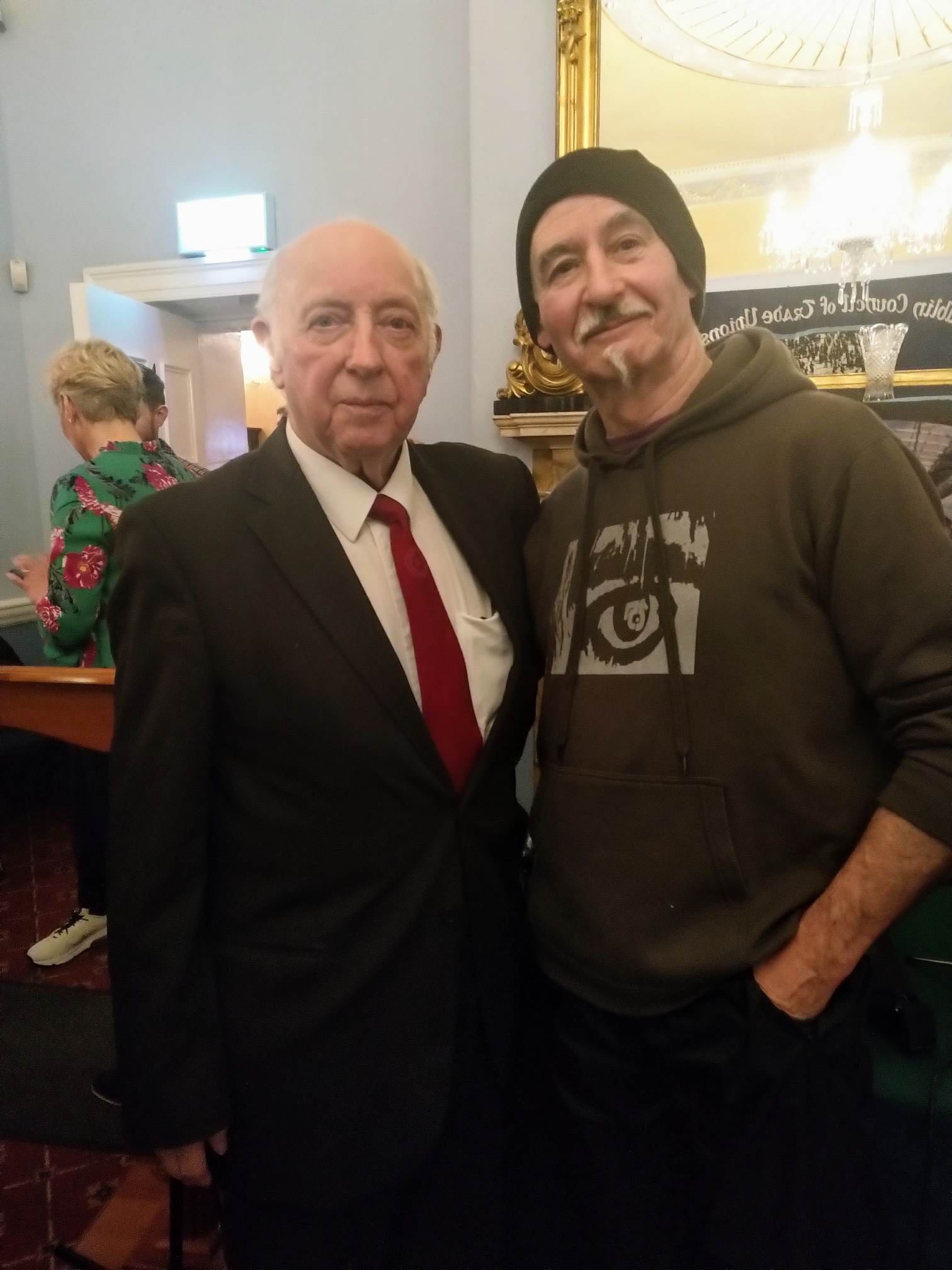
In Belfast on Monday he had spoken in Queen’s University Belfast without contact with any political representatives but in Derry had met Eamon McCann and Shaun Harkin, both members of Solidarity/ People Before Profit and public representatives on Strabane and Derry District Council, as well as Elisha McCallion, Sinn Féin MP for Foyle at Westminster,
He met too with Derry Trades Council which, indeed, had hosted his public meeting in that city. How was it then that, considering his publicity promotion as a trade unionist, member of a trade union that organised three general strikes in Catalonia since 2017, the press statement issued by the speaking tour organisers included no mention of engagement with Irish trade unionists in Dublin, in a city where so many Irish trade unions had their head offices?
“That was not for want of trying,” responded Diarmuid Breatnach, a member of With Catalonia/ Leis an Chatalóin, to the question. “We contacted a number of trade union organisations in Dublin in order to host a public meeting or to meet with Oriol privately. One trade union quoted us commercial hire prices and failed to respond afterwards, another promised a meeting but failed to make arrangements, a number simply did not reply. It was sad, really, not only for solidarity with Catalonia, for I think Irish trade unionists would have benefited much from the interaction with Oriol and his trade union.”
Hopefully they will display a different attitude to any future such visits.
End.
Oriol in Leinster House with Carles Pujol, Cnclr. Micheál Mac Donncha (left) and Senator Paul Gavan (right).
CATALAN SOLIDARITY
Oriol in meeting with TDs Richard Boyd Barrett and Gino Kenny, also present are Diarmuid Breatnach and Tina McVeigh from With Catalonia/ Leis an Chatalóin. (Photo: C.Pujol)
ORGANISATIONS IN DUBLIN (joint organisers of the speaking tour)