THEY DON’T BELIEVE IN REVOLUTION

Diarmuid Breatnach

          Most people here in Ireland and probably in large parts of the world, don’t believe in revolution, i.e in the act of overthrowing the social class in control. It’s not so much that they are against it, although a minority might fear the consequences or others might think that whatever gains they’d make would be transitory; it’s that they don’t believe it’s possible. Or they think it might be but in some distant future.


This is not surprising because if they did, if the mass of ‘ordinary’ people believed that a revolution was not only necessary but possible, it would already be occurring or at least well on the way.

What is surprising is that so many revolutionaries, or individuals, parties and organisations who think of themselves as revolutionary, or who would, if pressed, claim that they were – they don’t believe in it either!

By that I mean that they don’t see revolution as somewhere down the road, within sight if not necessarily close now, something to be moving towards that could well be reachable within their lifetimes. They might argue that it is not so, that they study revolutionary theory, try to conduct themselves according to revolutionary principles, study revolutionary struggles in history, organise, propagate revolutionary ideas ….. In general, I would not refute those claims but I would still say: They don’t believe in revolution.

And what’s more, that applies equally but in different ways to Irish socialists and to Irish Republicans.

I remember attending a small discussion group once organised by one of the small Irish socialist parties (small are the only kind we have in Ireland) at which the topic being discussed was the H-Blocks campaign. At one point, a prominent member of the organisation declared that the Republicans believe in armed struggle and that their party did not believe in that. Of course I pointed out Lenin’s position on this and the person backtracked but still …..

That was but a small indication of the general malaise but significant all the same. Both socialists and Republicans declare that they are not merely for reform but for the overthrow of the Irish native and colonial ruling classes. Objectively they would acknowledge that this endeavour would require an enormous effort and sacrifice. They would also concede that the ruling classes would not go quietly and, if pressed, would admit (some more readily than others), that the ruling class would resort to imprisonment, repressive legislation and, ultimately, armed power in order to prevent their overthrow.

If they believed the above and also believed a revolution was not only necessary but possible, they’d be preparing for that – but they are not.

Clearly an understanding of the theory of class, history, economics, culture etc. are all necessary. Principles of personal conduct and of organisation are very important too. But the application of principles of revolutionary organisation, the organisational preparedness for conflict and repression, the bringing of the objective into view as attainable – where is that? In the socialist camp, it is generally nowhere to be seen. In the Republican camp, it is visible only in very limited and restricted forms.


ORGANISATION

          Socialists accept on a theoretical level that the revolutionary organisation of at least a large section of the working class is necessary in order to achieve a socialist revolution. Many Republicans would probably agree. But the overall practice of both camps is in clear contradiction to that principle.

We can see that clearly if we investigate a little how the working class needs to be organised as a fighting movement in which a large section can become revolutionised, conscious of itself as the leading class of the revolution and not only preparing for but engaging in struggle to that end.

Clearly, an actual mass workers’ organisation is required, a mass organisation based on workplaces, industries, communities where workers live. For the moment, I don’t wish to discuss whether that mass organisation be a party, a movement, a trade union, or a federation of collectives — nor do I think it necessary to specify type in order to develop the point I am making.

OK, so what are the Republicans or socialists doing to achieve that mass organisation of the working class?

In Ireland the most readily-understood and ready-to-hand mass organisations for workers are the trade unions. They are led for the most part by bureaucrats from the top down to shop steward and often even there, the dominant societal ideology is some level of reformist social democracy, the higher leadership is dominated by careerists and opportunists, often linked to a political party of the capitalist system and, as if that weren’t enough, all those tendencies brought them into two decades of formal social partnership (sic) with State and Employers which totally atrophied whatever fighting muscle they may once have had.

Yes, all that. And even so, it is the place to begin.

On the whole, except for some exceptional individuals and perhaps some very short historical periods, Irish Republicans have not bothered with trade unions. Certainly, the Republican movement as a whole has not considered it an important area of struggle for the movement.

Socialists, on the other hand, have generally rated the importance of struggle in the trade union movement very highly. They have participated in elections to become shop stewards, organised industrial resistance action, at times combined to try to elect more militant higher officials, produced leaflets for and about workers’ struggles, sold papers on picket lines and brought speakers from strikes to speak at public meetings. But all those efforts have not produced a revolutionary or even a militant workers’ movement.

A shop steward represents the members who elected her and, her personality apart, they will have a range of views about her political ideology. A more militant trade union higher official may push for more militant action with more or less success – or may increasingly become part of the problem. Some workers may find an interest in some of the ideas expressed in newspapers of the Left and may or may not join this or that party. None of that is organising a worker’s mass movement.

How about then, organising a broad worker’s movement, across many different workplaces?

Now, that has actually been done. Such organisations have been given titles like “Broad Left” or “Grassroots”. And in terms of building a workers’ organisation, they were a colossal failure, the experience of them probably enough to put most workers off socialist politics for a long time, if not forever. The main reason for their failure is that various socialist organisations or parties used them as forums to fight for the dominance within the broader organisation of their party, their organisation, over others.

In one kind of work or large organisation, one of those parties became dominant while another party claimed dominance in another. Sometimes control of one “grassroots” union organisation shifted backwards and forwards, year after year, between different political Left parties as the latter’s fortunes waxed and waned, as they suffered splits, as they formed different alliances.
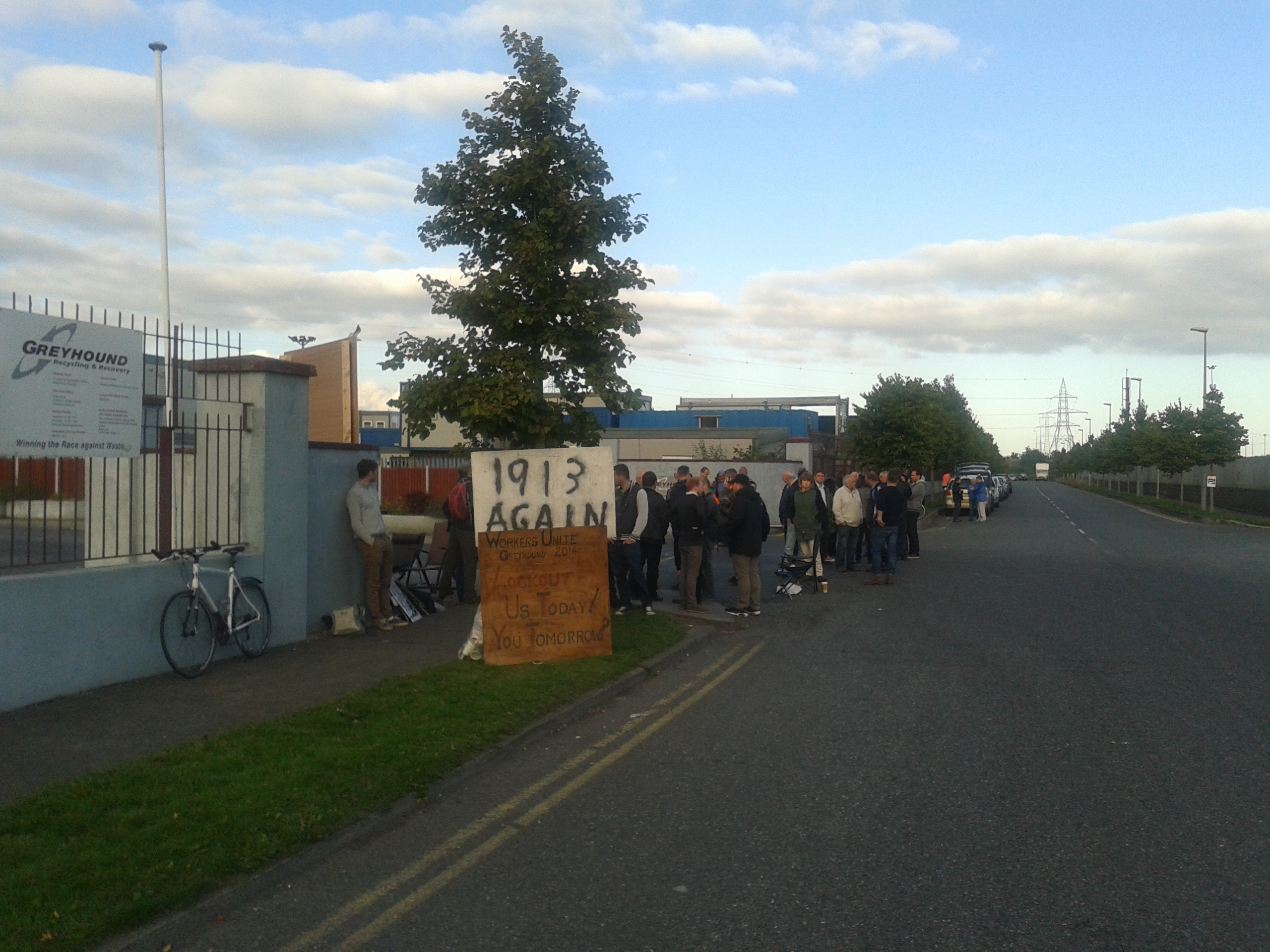
Pickets outside the Dublin depot of the Greyhound waste collection company in a 14-week dispute in 2014. Community and political activists organised support but there was no workers’ grassroots movement do the same.
(Photo: D.Breatnach)

Still, it does seem to me, as one who has been a worker in both the manual and what might be called the clerical types of work, as a revolutionary and active trade unionist, that the grassroots model is the one to follow, in order to create the nucleus for the mass workers’ movement. It needs to be based not in one union, not organised around electing different officials (though it may do that from time), certainly not around parliamentary electoral politics in general and not to be the fief or plaything of any political party or parties of the Left. It needs to be based in general on active resistance, on struggle, on solidarity across unions, across workplaces and across industries. It can develop participative democratic forms of membership and representation, its own mass media and in time, cultural and education groups, mutual aid etc, extending into the whole life of the working class.

But who is undertaking that work? Nobody.

REPRESSION & UPRISING

          Moving on to another area of preparation for revolution, if we accept that the revolutionary path necessarily incurs repression from the class (or classes) that we seek to overthrow, then we’d need to know something about street fighting, about being interrogated in detention, and prison life, right? At least here we find quite a few Republicans nodding in agreement. But the socialists? Blank looks from them.

Deviating from the rich literature on the Irish Republican jail experience, this is about the prison struggles of John Barker, an English political prisoner jailed with social criminals in British jails in the 1970s. (Image source: Internet).

However, not all is well here among the Republicans, either. Not all will be having any kind of training in resisting interrogation and hardly any at all in discussion of theory and practice in street fighting. Due to traditions in particular from the 1970s onwards, prison for Republicans in Ireland usually means segregation from people convicted of social crimes and segregation from other Republicans too, according to organisational membership or alliance. Still, a lot of experience has been accumulated in that kind of environment and extensively written and talked about in the Republican movement. But next to nothing about street fighting, unless we include in that the use of firearms or at least the construction of a Molotov cocktail. The engagements envisaged in that respect are of a hit-and-run nature, skirmishes and small battles ….. and not at all a popular uprising in which extended conflicts will become the rule, at least until revolution occurs or the ruling class, at least temporarily, gains the upper hand.

Two sides of street fighting — the people and the forces of repression — the Battle of the Bogside, Derry 1969. (Image sourced: Internet)

CONCLUSION

          If the areas I have pointed out are crucial areas of revolutionary preparation, we can perhaps agree on some principles:
A revolution in a developed capitalist society is not possible without a mass, militant and socially-politicised workers’ movement.

A revolutionary struggle entails physical confrontation, including large-scale street fighting and must expect repression; therefore revolutionary preparation must include training revolutionaries in conducting the first and resisting the second.

Those who are not undertaking work around those principles above, or at least considering how to do so, no matter how energetic or militant they may be, cannot be said to really believe in revolution; at most they can only see it as some distant thing, which perhaps another generation will undertake, some kind of life after their death.

And if they don’t believe in it, how can they expect others to believe?

End.

SHOWING THE BRITISH ROYAL COUPLE AROUND DUBLIN

Diarmuid Breatnach

English Prince Harry Windsor and his bride Meaghan were in Ireland this week and were shown around Dublin.


“Ah yeah, this is where we fought yez in 1171 ….

“Our people were banned from the city for a while after that. Yes, security … quite ….

In 1366 yez got in a strop wit yer own people for starting to talk Irish, wearing Irish clothes, playing Irish games ….  Called them ‘the degenerate English’ … said they’d become ‘more Irish than the Irish themselves.’ Yes, a few of them got hung.

There’s where some of our chieftains’ sons escaped your jail in 1592 after you took them hostage — some never escaped of course, ha, ha and their heads remained on spikes.  Yes, a bit gruesome.
Then in the 1640s again because yer people wouldn’t change their religion (nor us, as it happens).  Yes, old Oliver.  I know, your family’s not too fond of him either ….
“This used to be ours, Meaghan.”
Prince Harry Windsor and Meaghan in Dublin Castle, July 2018.
(Photo source: Internet)
Yes, Trinity College, founded by yer own Queen Elizabeth. What, no, bless me, not her Majesty now — the first one! Well, to educate yer people here in the Protestant faith because they were being sent off to Catholic countries to be educated.
Just down the hill there’s where yez arrested the Leinster Directorate of the United irishmen in 1798.  No, mostly Protestants …
And the bridges there, where yez hung a lot of their followers, putting their bodies in Croppies’ Acre afterwards, just across the river there. No, not a graveyard as such — a mass grave, just a hole in the ground.  There are quite a few songs about that period. Yes, still sung today.
And across the road there is where the irish Parliament was — well, Anglicans only — abolished to precede the Act of Union in 1801.  Yes, that was when all of Ireland became part of the UK.
….. Back up there, Robert Emmet was hung and beheaded two years later …. Yes, there is a song about that too.
Ah yes, and just down from the Castle, which was yer Headquarters, is where the The United Irishman newspaper was suppressed in 1848 and its editors and writers sent to Australia and Tasmania.  No, not for a holiday — as convicts.
Now, across the river … Worker killed there during the 1913 Lockout and many injured by police the day after too. Oh, it lasted about eight months. Yes, it is a long time, your Highness. But they had some help from England. Oh, not from the Government, not at all, bless your Highness. From British trade unionists. Yes, a few songs about that Lockout also. Yes, we are very musical, thank you.
Oh yes, Bachelor’s Walk Massacre over there, 1914 …. No, nothing to do with stag parties — though sometimes …. No, not by the IRA — by the Scottish Borderers, British Army.
1916 Rising fighting post there …. there …. over there to the East …. further back there to the west…. and south …. and there. Yes, fourteen executed in the Kilmainham Gaol Museum …. no, it wasn’t a museum at the time … Oh, many, many songs …
Now, over there was where Kevin Barry was hung … Yes, there is a song about that as well, your Highness.
One of the RIC G-men shot there by our people… and another over there … Ah, the RIC? Well, sort of like yer PSNI up north now …
Civil War, yes, 1922 -’23. Yes, Collins was glad of yer cannons for that.
Dublin Bombings …. yes, in 1974. The IRA? No, bless me, not at all! Yer own intelligence service and loyal allies. Yes, it was …. biggest number of deaths in one day during the whole recent 30 years war. No, strangely, not one arrest ……
No, the British Embassy’s not in the City Centre anymore, Your Royal Highness Meaghan …. not since 1972. Well it got burned. No, not accidentally — a big crowd burned it after Bloody Sunday up in Derry, you know, when 14 were killed by your father-in-law’s regiment ….
end

‘PEACE’ PROCESS LESSON FROM THE PALESTINIANS

Diarmuid Breatnach


                        The ongoing slaughter by Israeli soldiers of Palestinians demonstrating at the border of the Israeli State for the right to return to their homeland has rightly received media attention and, after a motion condemning Israel in the UN Security Council was blocked by the USA, the General Assembly passed another by a huge majority. The shootings demonstrate the total disregard of the Zionist authorities for Palestinian life and also the degree to which, by refusing to condemn and by supplying finance and equipment, the USA and major European states stand in support of Israel and are therefore complicit in its murderous actions. But the whole history of the right of return of Palestinians raises another issue of international importance and provides a historical and political lesson applicable widely, far beyond Palestine or even the Middle East.

A Palestinian woman brandishes a key, symbol of the house her family left behind when forced out of Palestine. Ironically Sephardic Jewish families were forced out of medieval Spain and some still keep a key to their ancestral home.
(Photo from Internet)

Negotiations, Agreements and ….?

Back in 1993, the Palestinian Liberation Organisation was in secret negotiation with Israel in Oslo, with Norway in the ‘honest broker’ role (but a later Norwegian Foreign Office investigation concluded that the Norwegian participants had acted as “Israel’s errand boys” – see link). Later it was to be the USA playing the ‘facilitator’ role — yes, bizarre, given the USA’s major economic and strategic interests in the Middle East and its role in supporting Israel. But then, perhaps the PLO figured they’d best have both their enemies there at the same time, both tied to whatever agreement was hammered out.

What had brought the parties to the negotiation table was the First Intifada, a Palestinian uprising against Israeli occupation of Gaza and the West Bank. This uprising had begun on 9th December 1987 and had been characterised by repeated street fighting, barricades, refusal to work for the Israelis and strikes and boycotts, along with refusal to pay taxes. The Israeli state had replied with arrests and shootings, killing over 1,600 Palestinians as against 277 Israelis killed. Between 23,600–29,900 Palestinian children required medical treatment from Israeli Occupation Force beatings in the first two years (Wikipedia).

Palestinian youth throwing stones at Israeli military during First Intifada (Photo: Internet)


Palestinian women confront Israeli soldiers during First Intifada (Photo: Internet)

After signing the Oslo Accords in Washington, Yasser Arafat, Chairman of the PLO and Yitzak Rabin, Prime Minister of Israel, were photographed there shaking hands with US President Bill Clinton looking on approvingly, arms almost around them, like a big friendly uncle making peace between nephews. Yizhak Rabin, Shimon Perez and Arafat were jointly awarded the Nobel Peace Prize in 1994 (a prize already devalued ever since it had been awarded to notorious warmonger Kissinger).

Rabin, Clinton and Arafat, Washington, after signing of the Oslo Accords.
(Photo: Internet)

Much was made of the Oslo meeting and the Accords (including later meetings and agreements) in the international media with talk of coming peace in Palestine and a resolution to the conflict etc signposted and not too far ahead. These prediction proved false and hopes were dashed.

But anyone examining the situation cooly would not have been surprised. Leaving aside other issues such as whether a two-state solution was justifiable, or viable even then, or whether the legitimacy of Israel should ever have been agreed to, the right of return of Palestinian exiles had been set aside by the PLO in the final Oslo agreement, a postponement, along with a number of other big issues, such as illegal settlements, to be discussed later. The Palestinian diaspora is today estimated at 9.6 million people (see link).

Since the omissions were of issues fundamental to any solution even within the parameters of the dubious two-state solution, it would have been obvious to anyone who had their eyes open that the Oslo Accords were no solution nor even a step towards a solution. So why were they agreed by the PLO?

A belief in the Accords as a stepping-stone would not have been sustainable on its own (except for wishful-thinking liberals) and the partial withdrawal of Israeli armed forces insufficient, given that Israel controlled all borders (except the Gaza one with Egypt, in which that state colluded with Israel). In addition, the Israeli troops had the capacity to return whenever they wished (and did so many times).

The motivation has to have been status or money.

The PLO, although containing a number of Palestinian organisations at that time (but not Islamic Jihad or Hamas), was dominated by Al Fatah, a secular Palestinian national liberation organisation. Fatah had the prestige of long existence and of having withstood the Israeli armed assault at Karameh in Jordan in 1968 during which, at a huge cost, it had forced the Zionist army to retreat. The following year Fatah had reportedly racked up 2,432 guerrilla attacks on Israel too — for a population with the Zionist jackboot on its neck, that counted for a lot.

Concluding an agreement with the Israelis, who previously said they would not talk to the Palestinian resistance, might have seemed like a status-raising event to Fatah. And setting up the Palestinian Authority, which of course they would run, would definitely give them status in the eyes of many outside and even inside Palestine.

But running the PA, which would be in receipt of funds and in charge of their distribution, also managing employment, would also provide myriad opportunities for corruption and nepotism, unless the organisation were to be rigorously monitored either externally or internally. That monitoring did not happen and corruption among Fatah was rife. Only the people on the ground seemed to mind, the ones who wanted strong opposition to the Israeli occupation and whatever development could be brought about in the infrastructure and communities, along with the longer-term aims of a Palestinian state and the return of refugees and exiles. And who weren’t part of the corruption.

Failure of Agreements and Insurrection

In 2000, after the failure of the Camp David talks in the US and many failures in the Accords in the nine years of their existence, no-one seriously believed in the Oslo Accords any more and the Second Intifada began. An intifada had provided the reason to negotiate for the Israelis, however insincerely intended and now another intifada brought the negotiation period formally to a close.

As observed earlier, Fatah was the organisation to which the majority of Palestinians (certainly within Palestine) had given their support and it was a secular party (although for the first time the PLA declared the “state religion” to be Islam in 2003, where previously there had been no mention of religion whatsoever). We can assume that most Palestinians were happy to be represented by a secular organisation and perhaps even preferred it.

But in the 2005 municipal, most Palestinians voted for Hamas, a fundamentalist Moslem organisation, for the first time pushing Fatah into second place. And in the Presidential and Parliamentary elections of 2006, again. What brought about that change? Was it a sudden devotional conversion? No, it was that Al Fatah had become corrupt, was not seen to be fighting Zionism hard enough (some would have said was becoming collaborationist) and had given up on the right of refugees and exiles to return. Hamas, though not officially represented in the PLO, was running social programs, its activists seemed disciplined and it was resolutely opposing Israeli Zionism politically and militarily. And it insisted on the right of refugees and exiles to return.

Hamas won the 2006 Palestinian elections with a 3% lead over the incumbents. Unwilling to accept the popular will, Fatah staged an armed uprising against Hamas which, in the Gaza strip, Hamas decisively won (what the Wikipedia entry on Hamas calls a “takeover”!). For some reason, although Hamas was undoubtedly the winner electorally, they let Fatah hang on to power in the West Bank. And the US-led demonisation and isolation of Hamas in Gaza by the West began, along with a series of Israeli armed attacks from that year until 2014, including full-scale missile and air bombardments and infantry incursions, killing thousands of Palestinians including civilians, women and children and destroying much infrastructure.

Since then, the Gaza population is being squeezed with electricity supply reduced to four hours a day and hardly any fuel to run generators or transport allowed in past Egyptian and Israeli gates, its water supply contaminated by damaged sewage treatment plant, the inshore sea likewise contaminated and Palestinians fishing further out attacked by Israeli gunboats, factories bombed out ….

The message seems to be: “Get rid of Hamas, get back with Fatah and we’ll stop exterminating you.” But a delayed extermination is all it would be, as evidenced from the deeper penetration of Zionist colonist enclaves on to Palestinian land, the Zionist-only roads, the ongoing takeover of Jerusalem, the Israeli Wall, the continual theft of water and the harassment by settlers and Israeli Army of any populations of Palestinians living near to Israeli colonists.

The Processes outside of Palestine

Taking a trip back in time to 1993, we saw the Oslo Accords being hailed as a great step forward by the majority of commentators across the West. These coincided with the new interim constitution as a result of the negotiations in South Africa — so that then two major areas of conflict were being hailed as definitely on the way to a solution, to come sooner rather than later. “Peace process” became a buzz-word, firstly among the participants and some of the commentators, then in the agreed discourse of the rest of the media and politicians.

In Ireland, as the Provisionals’ leadership and the British looked at one another across the dance floor, the former wondered what they could get from the same kind of process but crucially, how to sell it to their rank and file. At the Sinn Féin Ard-Fheiseanna (annual congresses of the party), the ANC and Al Fatah (wearing their PLO hat) fraternal delegates were welcomed by hype from the SF leadership and enthusiastic reception from the floor of the hall. The ANC and Fatah of course talked up their parts of the Processes and no-one seemed to examine critically what either the South African blacks or the Palestinians were likely to get out of them.

Ramaphosa, Mandela & Zuma at Jo’burg Conference 2012. Zuma is now deposed from ANC for corruption and Ramaphosa is millionaire President of South Africa and ex-leader of the National Union of Mineworkers. (Photo: from Internet, by Walter Dhiadhia)

And the Pal-African partnership continued to attend congresses, to send fraternal messages to areas of ongoing anti-imperialist resistance, to sing their siren song with a Western chorus backing. The Provisionals joined the actors and took to the stage as they neared and finally accepted the Good Friday Agreement in 1998. But with the Palestinian conflict showing no sign of resolution (unless one considers a kind of genocide of Palestinians) or even a respite — and in particular after the 2006 elections victory by Hamas — the Palestinians were no longer quoted as a good example of the “peace process”. Various actors, including South Africans and Irish, went on to try to sell the “Process” to areas of stubborn anti-imperialist resistance: the southern Basque Country, Turkish Kurdistan, Columbia, Phillipines, Sri Lanka ….. But the Palestinians (or rather Fatah) had been dropped off the billing and bowed quietly out of the Traveling Peace Process Show. They had not even an illusion to portray any more.

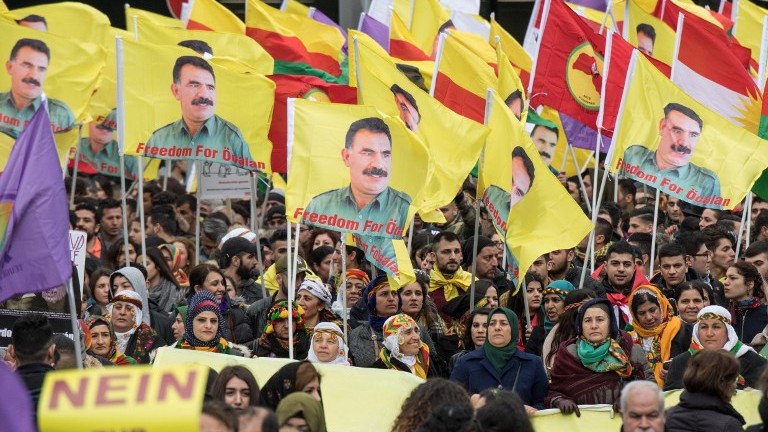
Kurds demonstrating against Turkish dictatorship in Germany fly flags bearing image of Abdullah Ocalan. Some years ago he said he supports a peace process in Turkey but he needs to be freed from prison to lead it
(Photo: the Times in Israel).

However, the show must, as we are often reminded, go on. It failed to deliver in Kurdistan and the Basque Country, not because the leaders of the resistance movements were not amenable but because of the unwillingness to adapt of the Turkish and Spanish regimes respectively. However, the Basque armed organisation ETA threw in the towel a couple of years ago anyway, abandoning their fighters in the jails to seek their own individual ways out through begging forgiveness of the occupiers of their land and oppressors of their people. The Turkish and Syrian Kurds were drawn into partnership with the imperialist allies dominated by the US, in their war against ISIS but also for the overthrow of the Assad regime, though deep Kurdish contradictions continue with the Turkish regime, to which it looks like the US Coalition will abandon them and they may seek an accommodation of sorts with Assad.

The Colombian FARC and MIR swallowed the Processed bait and gave up the armed struggle for a promise of a political one but those of their leaders who are resolute are being hunted by the regime, the quasi-liberated areas terrorised by the Army and assassination squads, the resistance fragmenting and disorientated. The Tamil Tigers didn’t entertain the Peace Process Show but the Sri Lankan Army were able to surround their liberated areas and bombard them to defeat, murdering their leaders and raping, murdering and repressing their followers.

The Phillipines and India? The resistance groups in both these areas are led by a Maoist-type leadership and we wait to see.

And in Ireland, after two decades since the signing of the Good Friday Agreement, the colonial occupier has the leadership of Sinn Féin, the former resistance, in joint colonial government, the party’s southern arm seeking admittance to the Irish comprador capitalist club, the remaining anti-imperialist resistance fragmented and the country not one step nearer to unity and independence.

The Palestinian lesson for the world

All the issues which led to these conflicts and which the processes of pacification did not address – were never intended to address – will return again, to be struggled over anew, under new leaderships. In Palestine now, that is what has been happening. The Right of Return for exiles and refugees, put to one side by Fatah in the Oslo Accords nearly three decades ago, is being demanded again on the Israeli border, the protesters (along with the ‘collateral damage’ of journalists and paramedics) being bombarded by tear gas and shot down by Israeli snipers. The Palestinians, whose leadership nearly three decades ago were chosen by US imperialism to be among the first to accept the new round of historical pacification processes and to become complicit in being its missionaries, are teaching us the fallacy of the facile promises they were made at the time.

There is another irony here: while refusing the right of return to Palestinians who were themselves exiled or are children and grandchildren of exiles, i.e within living memory, the State of Israel offers “the right of return” (sic) to people who have never been there and cannot even prove that their ancestors were, providing only they can prove their Jewishness. And a further irony: Sephardic Jews, who were expelled by the Christian kingdoms in Spain and Portugal in the Middle Ages, were being offered a “right of return” by the Spanish Government in 2014 (see link).

Over time, the people in the other areas of anti-imperialist resistance around the world will regroup, gather strength and return to the resistance. The imperialists almost certainly know this. But they have bought themselves three decades of damage to their opposition and, since they need the people as producers and consumers, cannot eliminate the deep wells of resistance. And capitalism is not about enduring solutions – they work away at undermining the resistance on a temporary basis and as for the future, like Micawber in Dickens’ David Copperfield, believe that “something (else) will turn up”.

End.
LINKS (NB: I have deliberately chosen most background references regarding Palestine from Wikipedia, which is known to be heavily monitored by Zionist interests and also has inputs from friends of the Palestinians and therefore cannot be said to be completely favourable to either side):

Palestinian exiles and the right of return: https://en.wikipedia.org/wiki/Palestinian_diaspora

Account of the Oslo Accords: https://en.wikipedia.org/wiki/Oslo_Accords

The Oslo Accords negotiations and their legacy: https://interactive.aljazeera.com/aje/palestineremix/the-price-of-oslo.html#/14

The Palestine Liberation Organisation: https://en.wikipedia.org/wiki/Palestine_Liberation_Organization

The right of return to Palestine of Palestinians: https://en.wikipedia.org/wiki/Palestinian_right_of_return#UN_General_Assembly_Resolution_194

The right of return to Spain of Sephardic Jews: https://theconversation.com/spain-moves-to-right-a-522-year-wrong-but-still-overlooks-some-23526

DUBLIN PROTESTS JAILING OF ALTSASU EIGHT

People gathered early evening Thurday (21st) on O’Connell Street, Dublin city’s main street, to protest the convictions and sentencing of the Altsasu Eight. They held Basque and Catalan flags and displayed placards demanding “Free the Altsasu Eight!” and another pointing out the severity of the sentences for what was a bar brawl with Spanish police.

Section of protest and conversation with passers-by
(Photo: D.Breatnach)

From the leaflet distributed: “In November 2016, during a festival in Altsasu, Nafarroa (Navarra) Province of the southern Basque Country, a lieutenant and sergeant in the Spanish Guardia Civil police force, both off-duty with their girlfriends, entered a late-night bar well-known as a place for pro-independence Basques to socialise. An altercation occurred in which the police said they were attacked by the Basque youth and claimed a fractured ankle suffered by one; others say it was just some shoving and pushing.

(Photo: D.Breatnach)

“The Navarran regional police force, the Policía Foral, first on the scene, treated it as an alleged assault case which is how the local court wished to deal with the issue. However the Spanish state Prosecutor intervened and, transferring the case to Madrid, accused eight youth of “terrorism” for which they could face a total of 375 years in prison. He failed to prove that but on charges of public disturbance, assault and threats alone, on 1st this June the eight youth were variously sentenced to between 2.5 and 13 years in jail as well as fined thousands of euro.”

Leaflets were distributed to raise awareness of this injustice and many passers-by stopped to talk and ask questions. One group of interested youth was from Zaragoza, which is in Aragon province and not far from the Basque Country.

Protesters including musicians
(Photo: D.Breatnach)

Live music was provided for the participants and passers-by: two women sang Txoria Txori in harmonies and a Basque sang a new song that has been composed about the Altasasu 8, while another accompanied him on guitar (hope to post the lyrics and translation). Txoria Txori is a short simple allegorical song about a man who loves a bird and says that if he cuts its wings it would stay with him but he can’t do that because then no longer would it be a bird – and he loves the bird. This song is well-known and loved in the Basque Country.

The picket was an event of internationalist solidarity, not only because it was carried out in Ireland in support of victimised youth in the Basque Country, but also because the picket line included Irish, Basque, Catalan and Italian people.

(Photo: D.Breatnach)

Further information in the English language on this case (and other events in the Basque Country) will be posted from time to time on https://www.facebook.com/dublinbasque/

FREE JULIAN ASSANGE PICKET AT BRITISH EMBASSY DUBLIN

CROWD AT BRITISH EMBASSY DUBLIN CALLS FOR RELEASE OF JULIAN ASSANGE

Diarmuid Breatnach

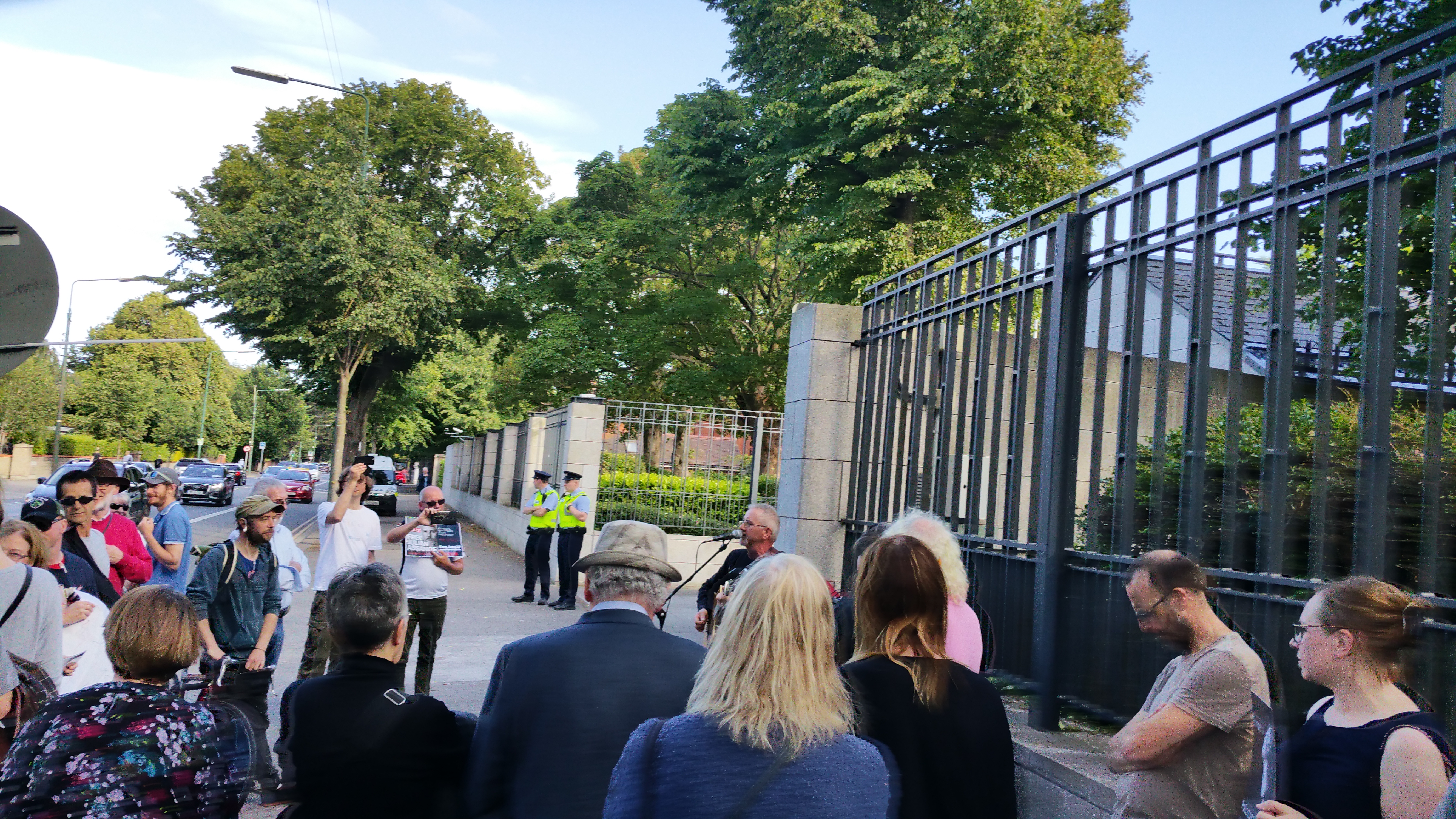
View of crowd at British Embassy from across the street (Photo: D.Breatnach)

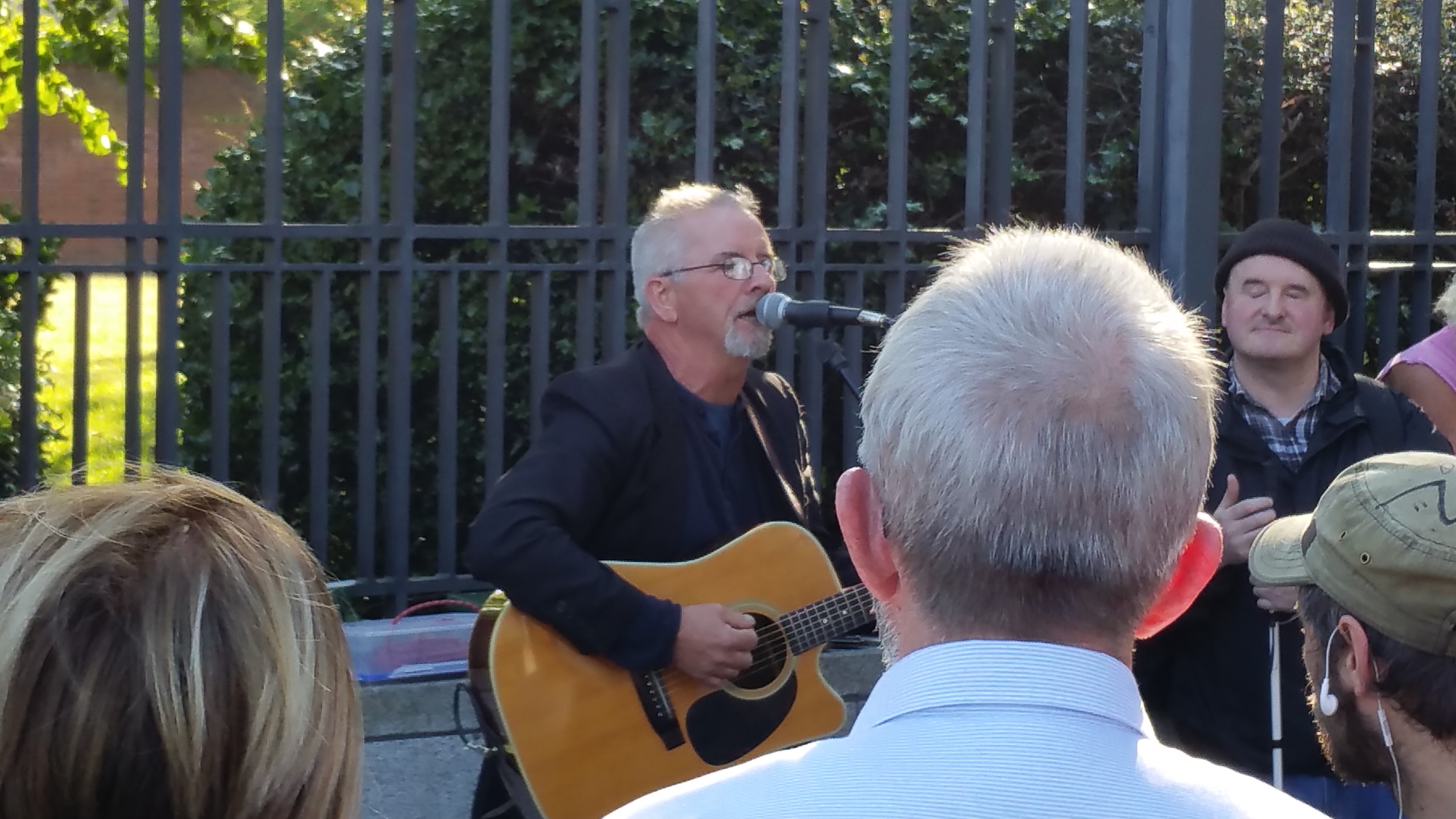
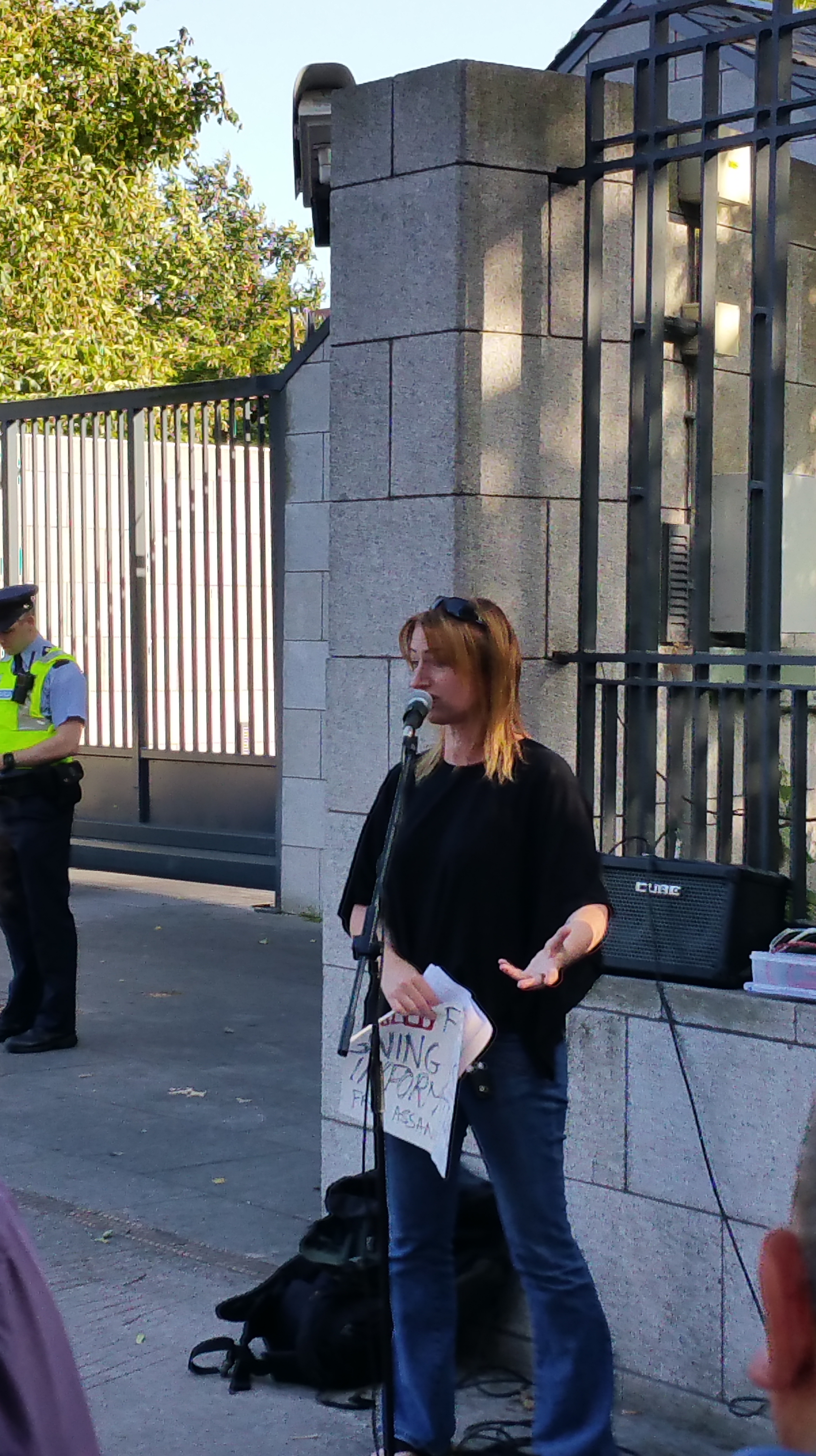
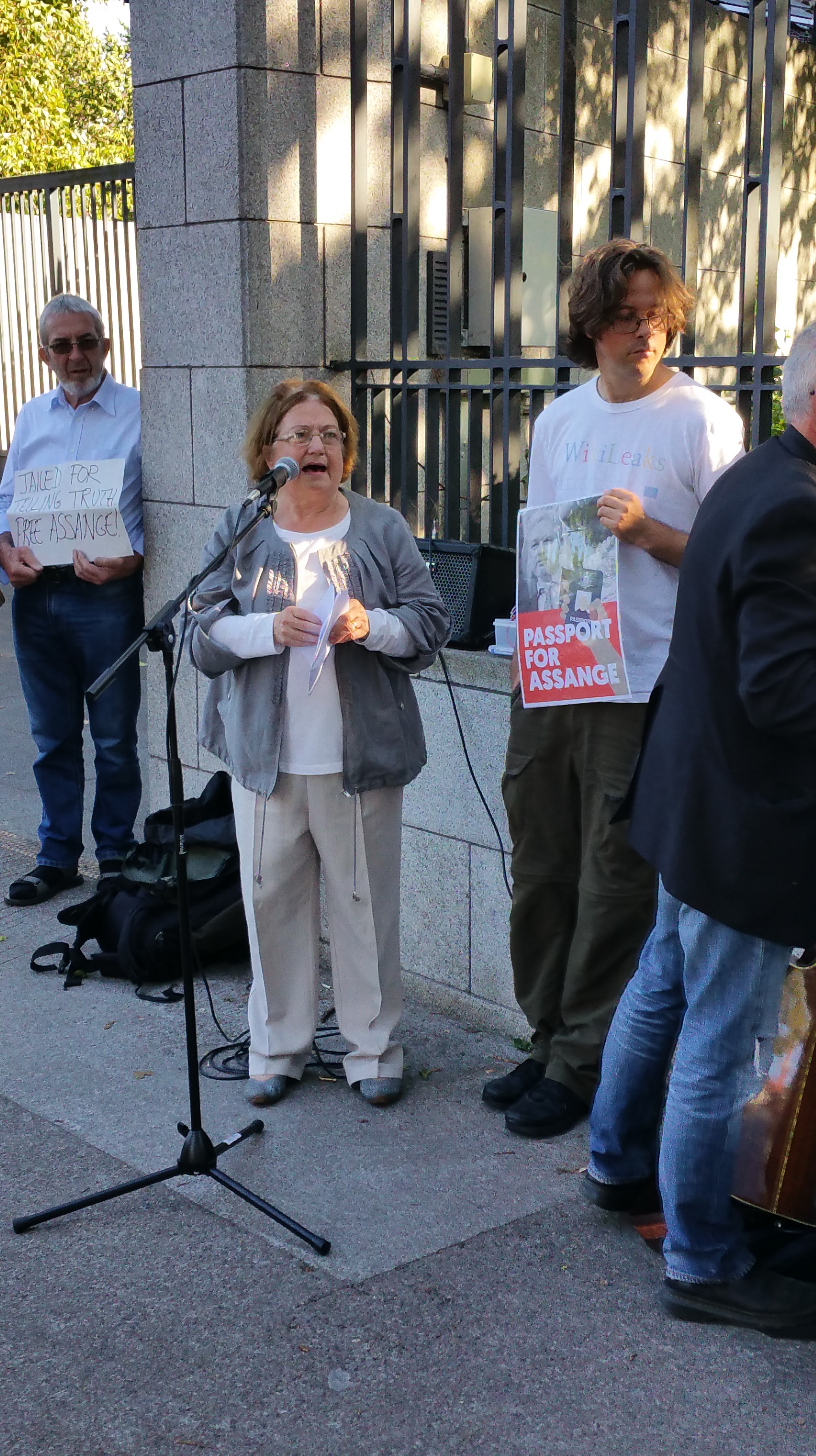
Today, June 19th, is the anniversary of the date when Julian Assange sought asylum in the Ecuadorian Embassy in London, which he was granted. That was 2012, since which he has been confined to a few rooms in that building, unable to leave for fear of British arrest and extradition to the US, where he is wanted for broadcasting their secrets on their murderous campaigns in Afghanistan and Iraq and other matters. A crowd gathered outside the British Embassy to demand Assange be set free – among them as speakers were TDs Clare Daly, Mick Wallace, along with Nobel Peace Laureate Mairéad Corrigan and musician Paul O’Toole (also another musician).

Paul O’Toole playing and singing
(Photo: D.Breatnach)

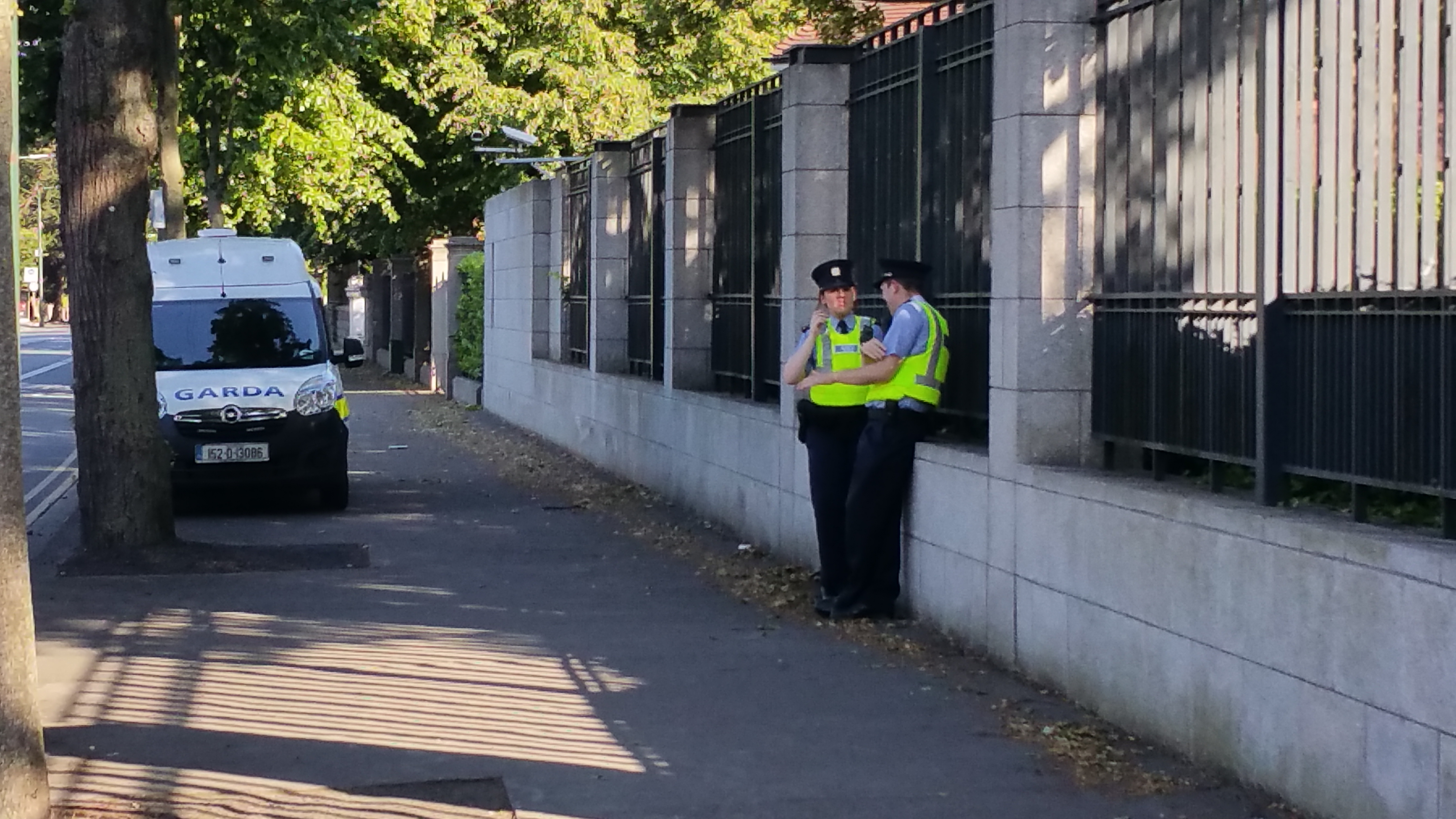
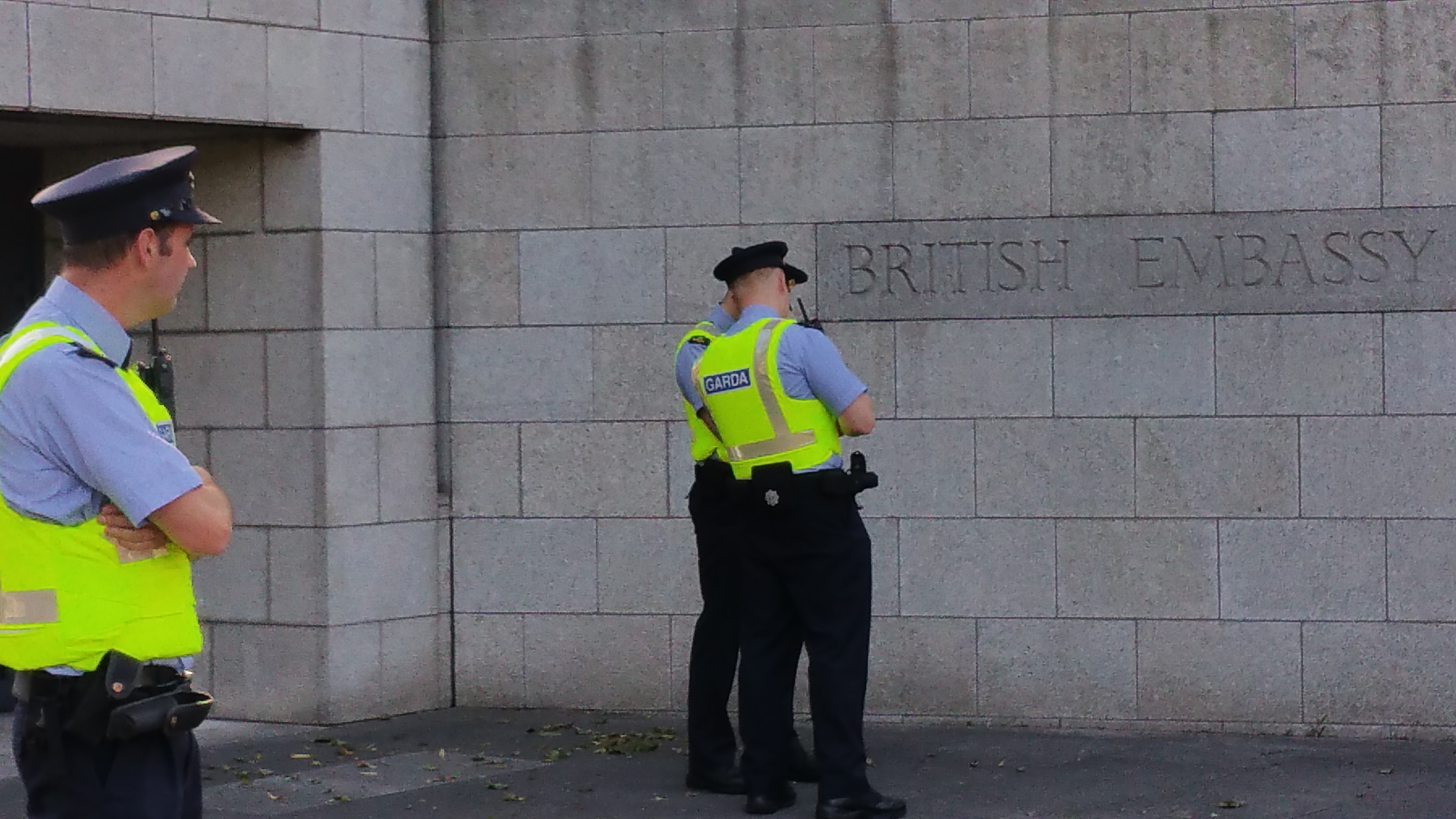
At least five Gardaí were in attendance, along with a police van.

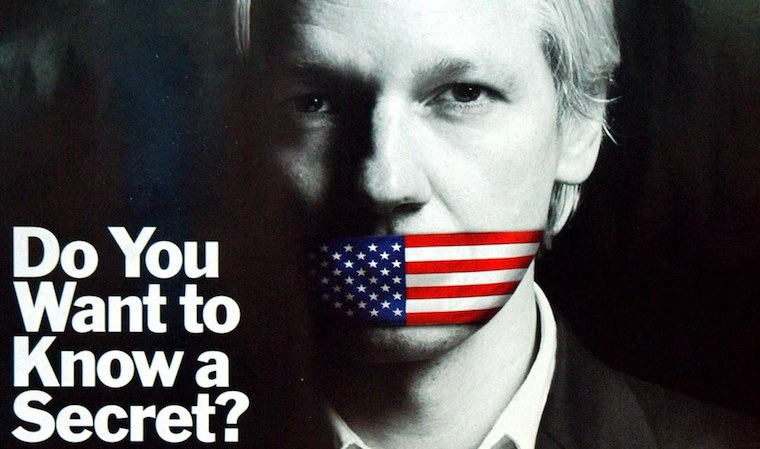
From Wikipedia: Julian Paul Assange (born Hawkins; 3 July 1971) is an Australian computer programmer and the editor of WikiLeaks. Assange founded WikiLeaks in 2006, but came to international attention in 2010, when WikiLeaks published a series of leaks provided by Chelsea Manning. These leaks included the Collateral Murder video (April 2010), the Afghanistan war logs (July 2010), the Iraq war logs (October 2010), and CableGate (November 2010). Following the 2010 leaks, the federal government of the United States launched a criminal investigation into WikiLeaks and asked allied nations for assistance.

Poster of image of Julian Assange with the flag of the USA as a gag on him. (Image source: Internet)

All the speakers outside the British Embassy made the point that Assange’s only crime is to reveal some murderous secrets of the USA and other powers and that if he can be jailed then so can anyone for speaking or publishing the truth. Clare Daly said that his crime was to be a conscientious reporter.

Paul O’Toole played two songs, one of which was The Cry of the Morning, a song about internment. The other musician played some tunes and then led the crowd in singing “All we are saying, is free Julian Assange.”

Fintan thanked all for coming and the speakers and musicians and the event came to an end.

Mick Wallace TD speaking outside the British Embassy (Photo: D.Breatnach)
Another musician supporting the event (Photo: D.Breatnach)
Section of crowd, looking southward
(Photo: D.Breatnach).


Clare Daly TD speaking outside the British Embassy
(Photo: D.Breatnach)(Photo: D.Breatnach)
Nobel Peace Laureate Mairéad Corrigan speaking outside British Embassy (Photo: D.Breatnach)
Police van & 2 of the six Gardaí that were visible (Photo: D.Breatnach)


(Photo: D.Breatnach)


BACKGROUND

Assange went to Sweden to talk about Wikileaks and its revelations in August 2010. A woman in Sweden wanted Assange to have a HIV test after he had sex with her. Her friend, who had also had sex with Assange in the past, encouraged her to go to the police. Assange went voluntarily to the police station, was interviewed and told he could go, there was no charge and he went back to England. Afterwards, a Swedish Special Prosecutor charged him with sexual molestation and “lesser-degree rape” (a particular Swedish charge) although the original complainant did not accuse him of rape.

By then it was becoming clear that another agenda was behind the Swedish Special Prosecutor and the two women. Assange offered to be interviewed again by Skype or in person in London or, if necessary in Sweden but only if that country guaranteed not to extradite him to the USA. The Swedish authorities refused to give that guarantee. The Prosecutor said Swedish law did not permit an interview on foreign soil but this was publicly contradicted by Swedish legal experts and the Prosecutor eventually interviewed him in London but by this time it was November 2016, by which time the statute of limitations had run out on the less serious charges. In May 2017, the Swedish authorities dropped their investigation against Assange and Chief Prosecutor Marianne Ny officially revoked his arrest warrant.

However, as a result of Sweden’s attempt to extradite Assange, he had been brought to court in London and released on bail. Due to Sweden’s refusal to guarantee him no extradition to the USA, Assange jumped bail and sought asylum in the Ecuadorian Embassy on 19th June 2012 and has been there since. He cannot leave for fear of arrest by the British for breach of bail conditions and extradition to Sweden, from where he may be extradited to the US, where politicians and officials have said publicly that he should be jailed and some even wanted him executed under anti-espionage laws or assassinated.

End.
BASED ON HISTORY BUT FAR FROM IT– McCann’s “After the Lockout”.

Diarmuid Breatnach

History can and should be researched, interpreted, discussed, argued and used for lessons on current questions and projections into the future. It can also be used in fiction: as the backdrop for a novel; as a way of bringing historical events to life; as a what-if speculative story.

James Plunkett (21 May 1920 – 28 May 2003) used the Dublin Lockout as a backdrop for his Strumpet City and did it wonderfully well; Walter Macken (3 May 1915 – 22 April 1967) wrote a fictionalised account of brothers in the War of Independence and the Civil War in The Scorching Wind and also did it well1. Roddy Doyle did NOT do it well at all in his historical novel (A Star Called Henry) and sadly nor did Darran McCann in “After the Lockout”. Interestingly, the central characters in both latter books were what one might call “Left critics” of the leaders of the struggle and one is tempted to conclude that the attitudes of the central characters mirror those of their creators.

(Image sourced: Internet)

It seems fair enough that we can play with history in fiction but, when using it as a backdrop for a story, it should be accurately represented – otherwise, surely one should invent something else entirely?

Doyle did some reading on the GPO garrison’s struggle for the background of his “A Star Called Henry” but seemed to have done none for the War of Independence, in which he had his hero and heroine like a kind of Republican Bonny and Clyde living in ditches and shooting up the Free State forces. McCann seems to have done hardly any reading on the Lockout (and not that much on the GPO garrison’s fight either). Having Jim Larkin give a speech from the restaurant in Murphy’s Imperial Hotel restaurant window is bad enough – when we know he only got to say a few sentences before the Dublin Metropolitan Police ran in to arrest him – but having him then shin down a rope and get away is absolutely ridiculous.

McCann set the story of his central character, Victor Lennon, in between the 1916 Rising and the War of Independence and it has many of the elements of the story of James Gralton (17 April 1886 – 29 December 1945), the only Irish person to have been officially exiled from Ireland by an Irish government (in 1933).

The arrest of Jim Larkin after he spoke briefly from the Imperial Hotel in 1913. He did not shin down a rope!
(Image sourced: Internet)

McCann’s Victor Lennon, a communist and member of the Irish Citizen Army, gets people in his home town to build a dance hall in opposition to the local Bishop, which a mob then burns down. Gralton, a communist also, did that too, in Leitrim; however, he ran dances there and also gave talks – it was a success, to a considerable degree. The Irish Catholic Church vehemently opposed Gralton and in McCann’s novel the Bishop and local supporters also mobilise against Victor: the hall is burned down before any dance is held in it. Like Gralton’s story, there is a shooting incident around the dance hall too – a fatal one, in which Victor’s father and two IRA men are killed. But instead of being deported from Ireland, as Gralton was (illegally) by an Irish Government, which in McCann’s story had not yet come into existence, Victor heads off for Dublin to join the Volunteers in what will become the IRA and the War of Independence.

Newspaper photograph of James Gralton in the process of his deportation in 1933 (note he is described as “Irish-American” as though to justify his deportation, though in fact he was born in Ireland and did not leave for the USA until 23 years of age, subsequently returning to fight in the 1916 Rising and the War of Independence.
(Image sourced: Internet)
What actually happened after Larkin spoke briefly from the Imperial Hotel — a vicious police baton charge and indiscriminate beating of all in the area.
(Image sourced: Internet)

Roddy Doyle wrote very disrespectfully about Volunteers, Pearse and a number of other leaders and even salaciously about anonymous wives of martyred men. He did so by placing those words and thoughts in the mouth and mind of his central character, Henry Smart. McCann does somewhat the same but to nowhere near the same extent as did Doyle.

I admit to finding that lack of respect extremely distasteful but also from a historical point of view I see it as anachronistic. I find it hard to believe that those who took part in the Rising despised those who fought alongside them, no matter the difference in ideology – or that they spoke so contemptuously of their leaders, martyred or not. Disagreed, certainly – disagreed strongly, probably. But disrespect and contempt? No, that is attaching a post-Free State intellectual revisionist attitude on to participants in the Rising and in the War of Independence. Later, there would be fear and hatred, during the Civil War, but even then, none of that contemptuous and dismissive attitude.

I am not the only critic from a historical perspective, as I see from a quick Googling. Reviewing the book for the Irish Independent in 2012, Pat Hunt had this to say:

“The opening section set in Dublin reads more like a 1917 Thom’s Street Directory and a survey of political events and personalities of the time. The seediness of the red-light Monto district in the inner city does not ring true. The period feel of the city of Armagh is much better realised.

“The author’s editor has done him no favours. It was never possible to hop on a train at Amiens Street and hop off at Harcourt Street station (not unless one took a scenic route via Bray).

“The Big Wind of 1839 occurred on the Feast of the Epiphany, not Pentecost. Forecasts of wine lakes and butter mountains (concepts that emerged with the EEC and its common agricultural policy) could not have been envisioned by even the most ardent socialist in 1917.”

Hilary Mantel, who writes historical fiction, praised McCann’s book and I can only assume that she knows very little of Irish history, nor indeed should we expect that she should – her background is not Irish. Glen Patterson, novelist from the Six Counties, praised it highly too and I assume did so on the composition of the writing, turn of phrase, story-telling etc – but I sincerely hope he did not do so on a historical basis.

After the Lockout, Darran McCann, Harper Collins 2012.

End.


FOOTNOTE:

1 Though not perhaps as well as the other two books in the trilogy, those dealing with the Cromwellian war and Great Hunger periods: Seek the Fair Land and The Silent People)

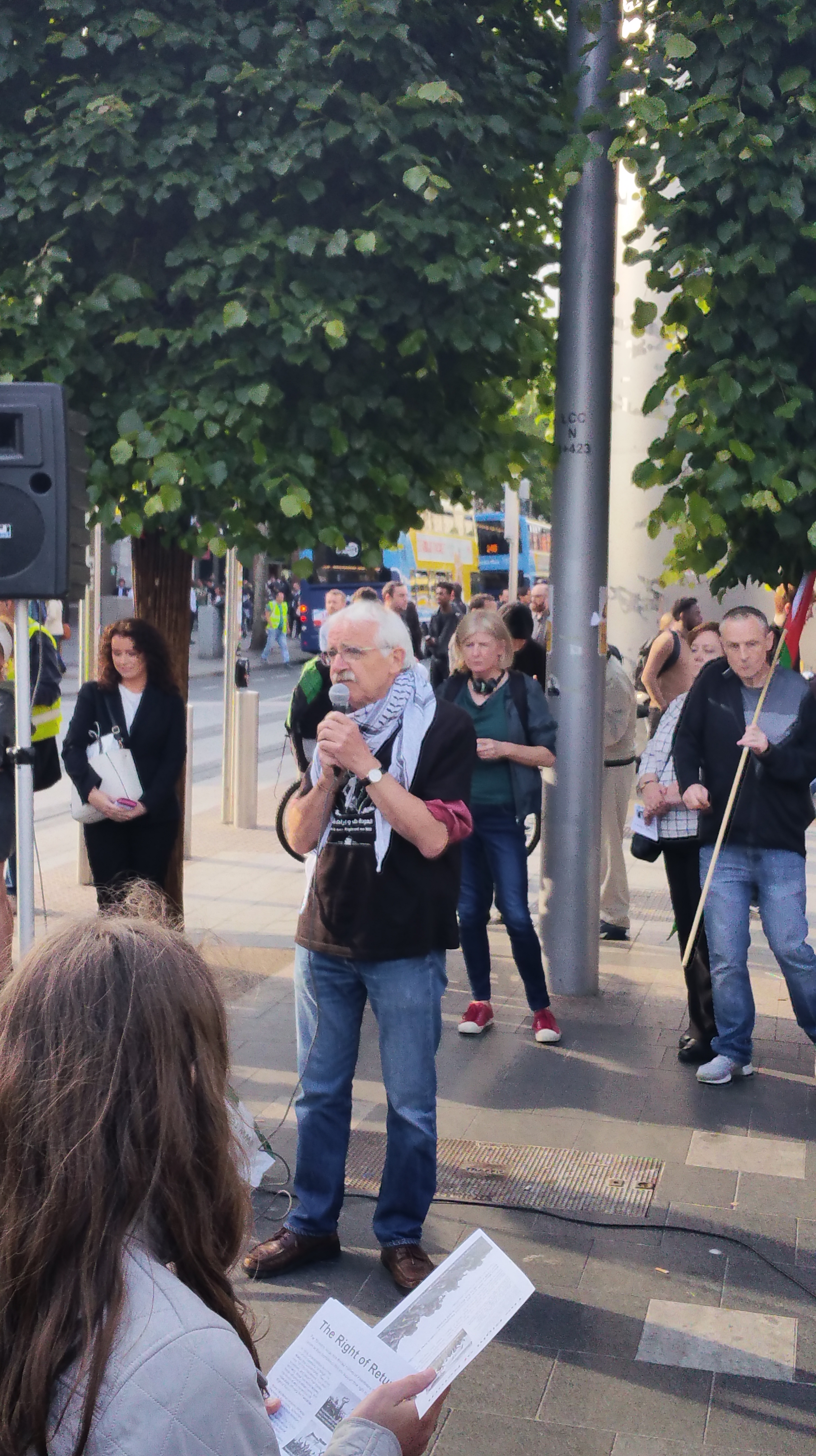
DUBLIN PALESTINIAN SOLIDARITY DEMONSTRATION – CROWD CALLS FOR EXPULSION OF ISRAELI AMBASSADOR

Diarmuid Breatnach

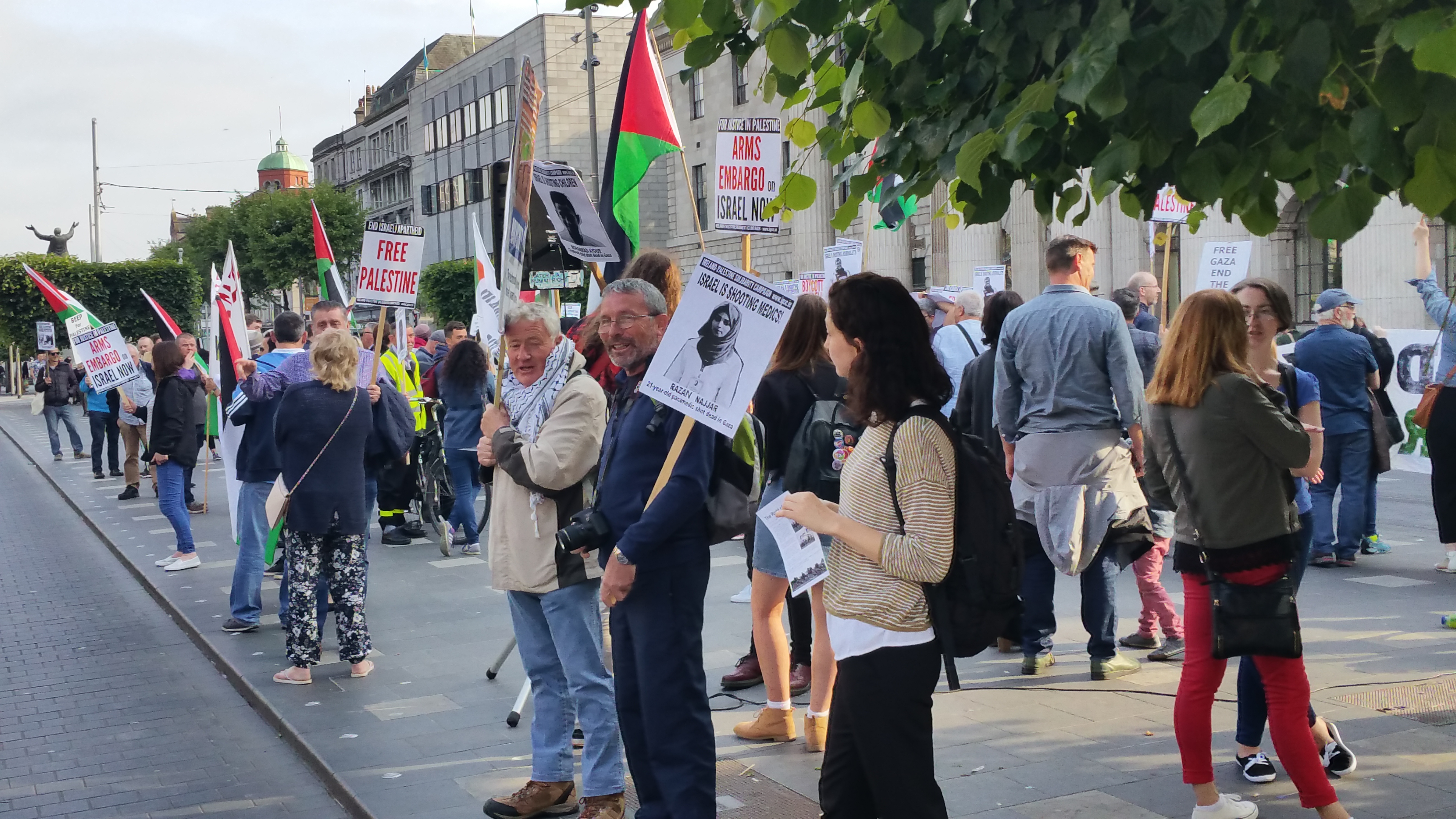
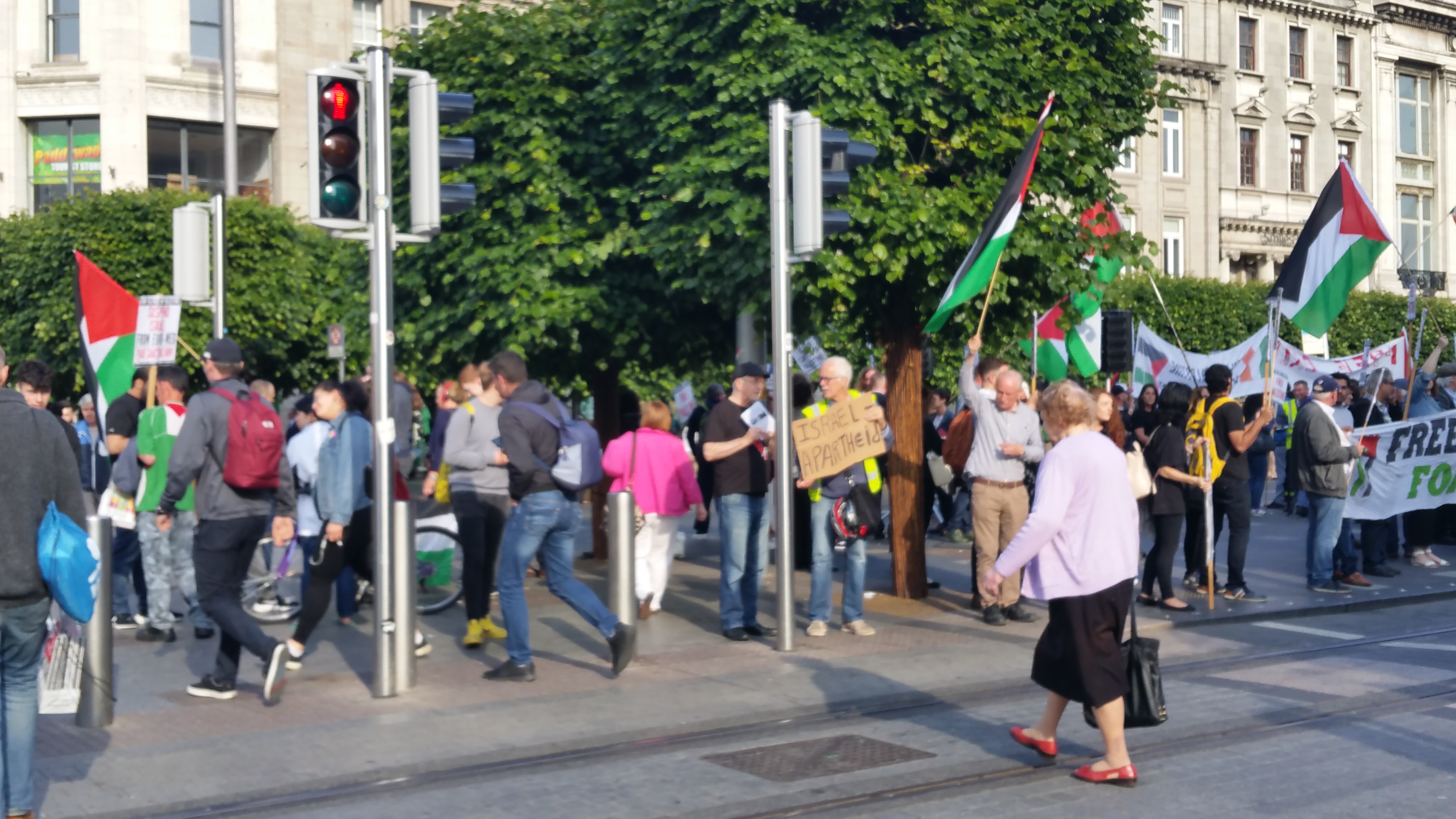
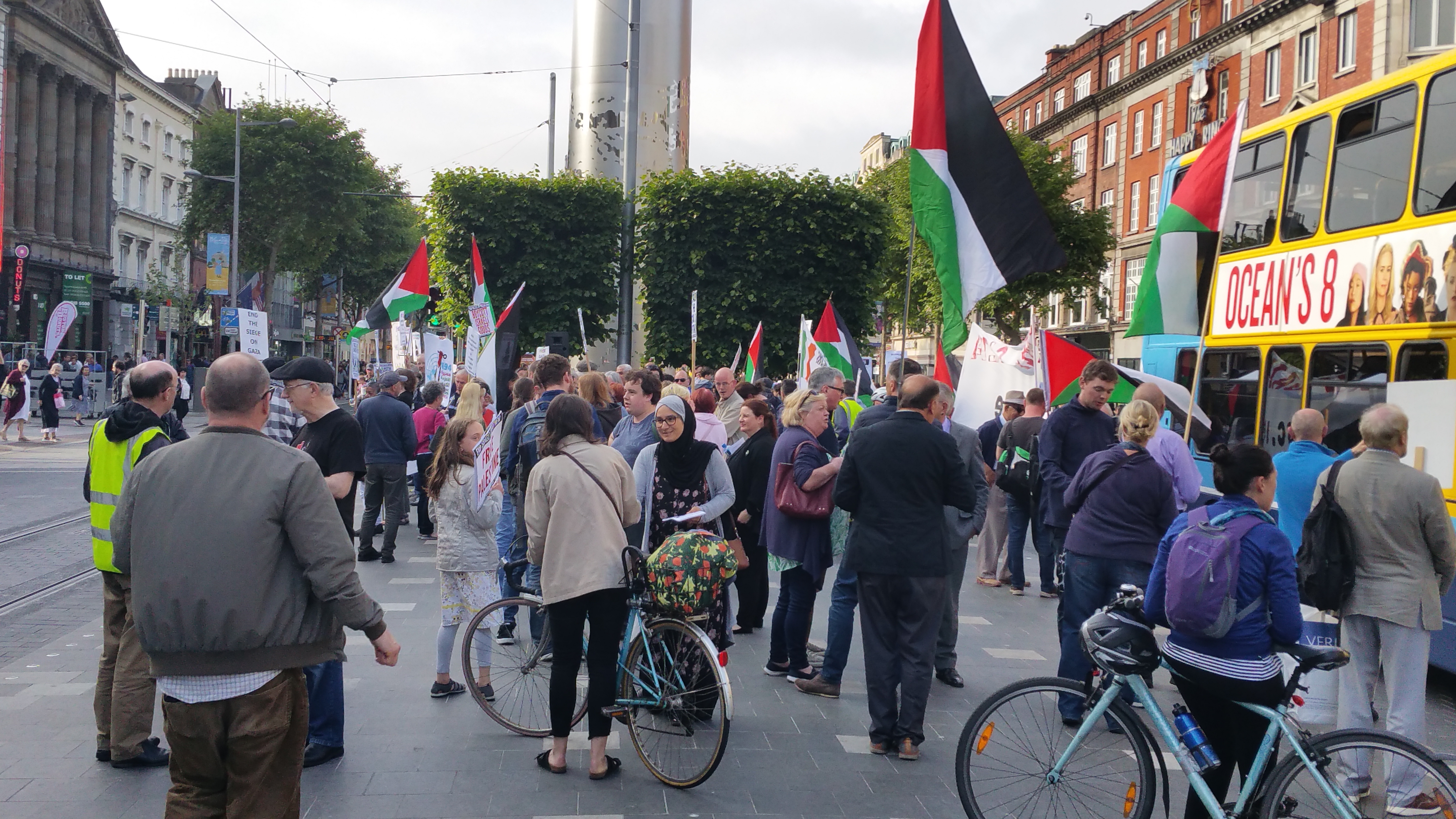
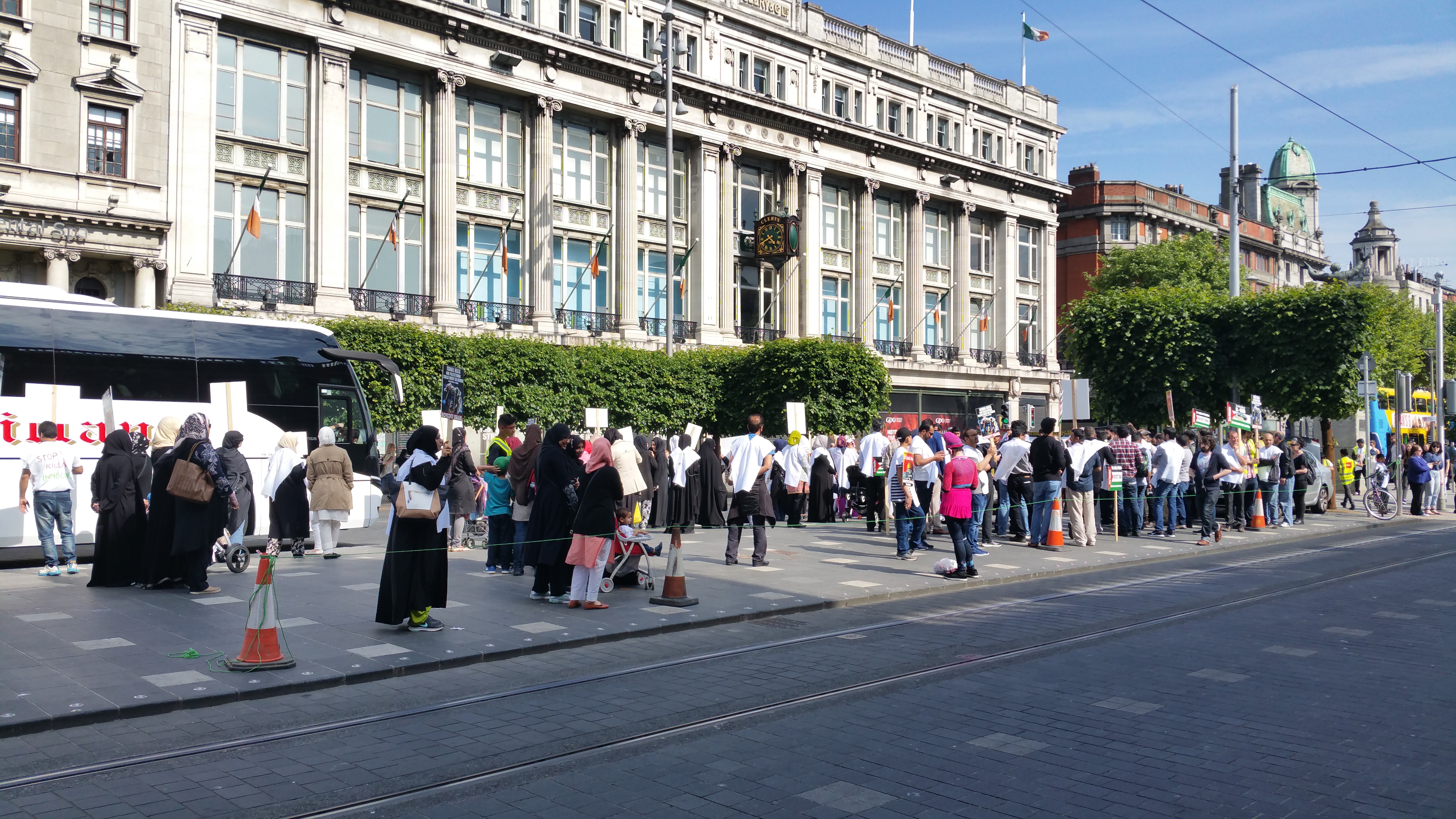
The regular blowing of horns by passing motorists, including taxis and buses, would have indicated that something of interest was happening in the city centre yesterday, Monday 5th June. As people came within sight of the centre of O’Connell Street, they could also see the Palestinian flags flying, the banners and the placards.

View of the rally on the east side of the central pedestrian reservation, looking southwards. (Photo: D. Breatnach)

The Great Return March

The Ireland Palestine Solidarity Campaign had convened a rally of hundreds in the central pedestrian reservation of O’Connell Street, main street of Ireland’s capital city, near to the Spire and opposite the historic and iconic building, the General Post Office. Billed as a rally in solidarity with the Great Return March of Palestinians, demonstrators carried placards denouncing the shooting dead by Israeli soldiers of demonstrators as well as of journalists and paramedics. The Palestinian death toll since March 30th has reached 120, with over 5,500 injured. Palestinians have also accused Israeli snipers, when they wish not to kill, of shooting young men through parts of their legs calculated to ensure permanent disability. The shooting dead of unarmed protesters, the killing of paramedics and journalists (who wear clearly identifiable clothing), are all crimes according to international law but, as Palestinians and their supporters repeatedly ask, who will hold Israel to account?
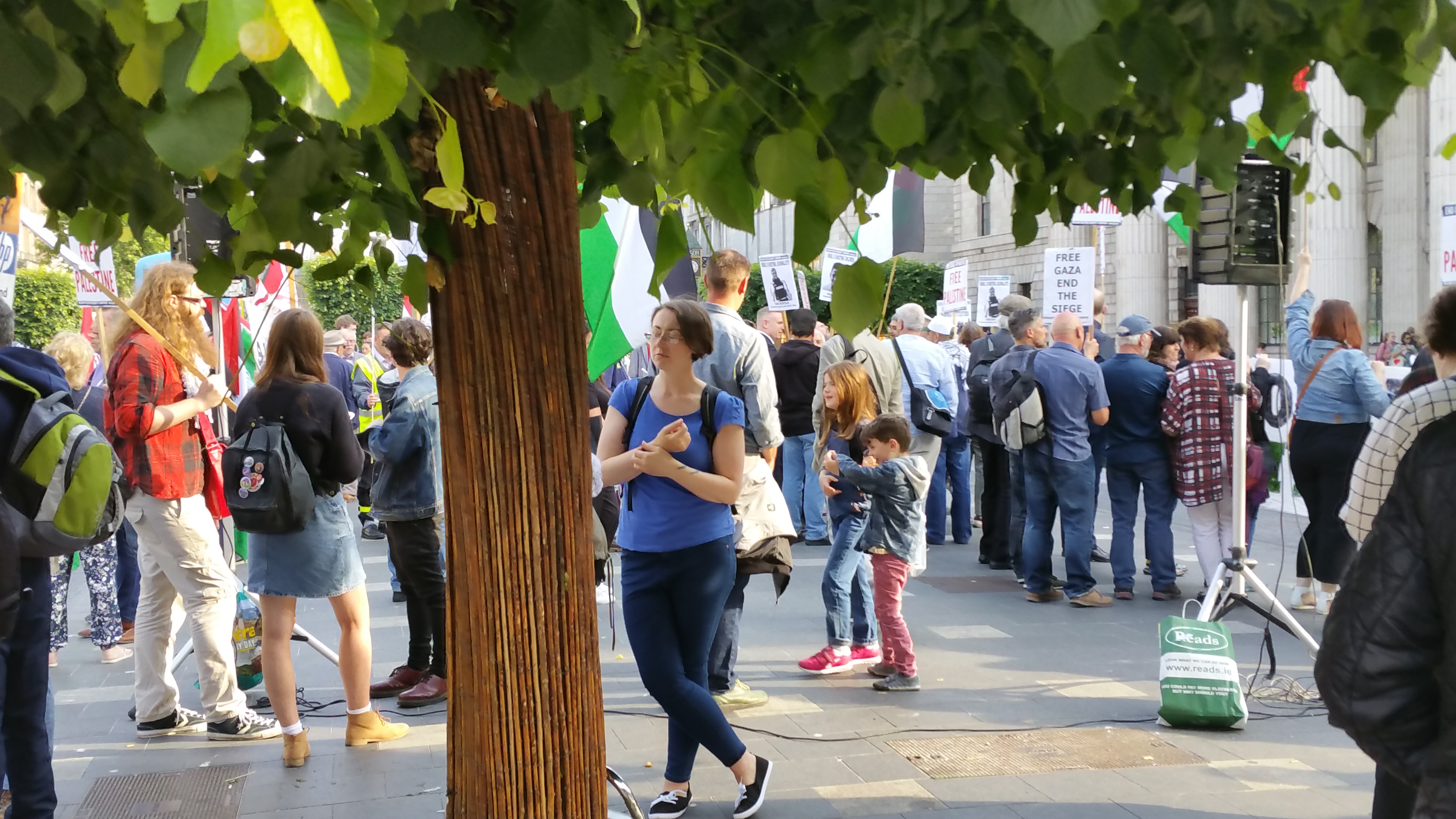
A view of part of the rally on the central pedestrian reservation, looking southwards.
(Photo: D. Breatnach)

The demonstrators being targeted by Israeli military are protesting the expulsion by Israel of 700,000 of what was then the majority Arab population of Palestine in 1948, followed by their exclusion and that of their descendants from Israeli-controlled Palestine. There are an estimated four million Palestinians 1 barred from entry to Palestine, their lands or those of their grandparents, while anybody in the world who can prove his or her Jewishness, even though their families had not lived there for thousands of years2, can gain entry and claim Israeli citizenship.

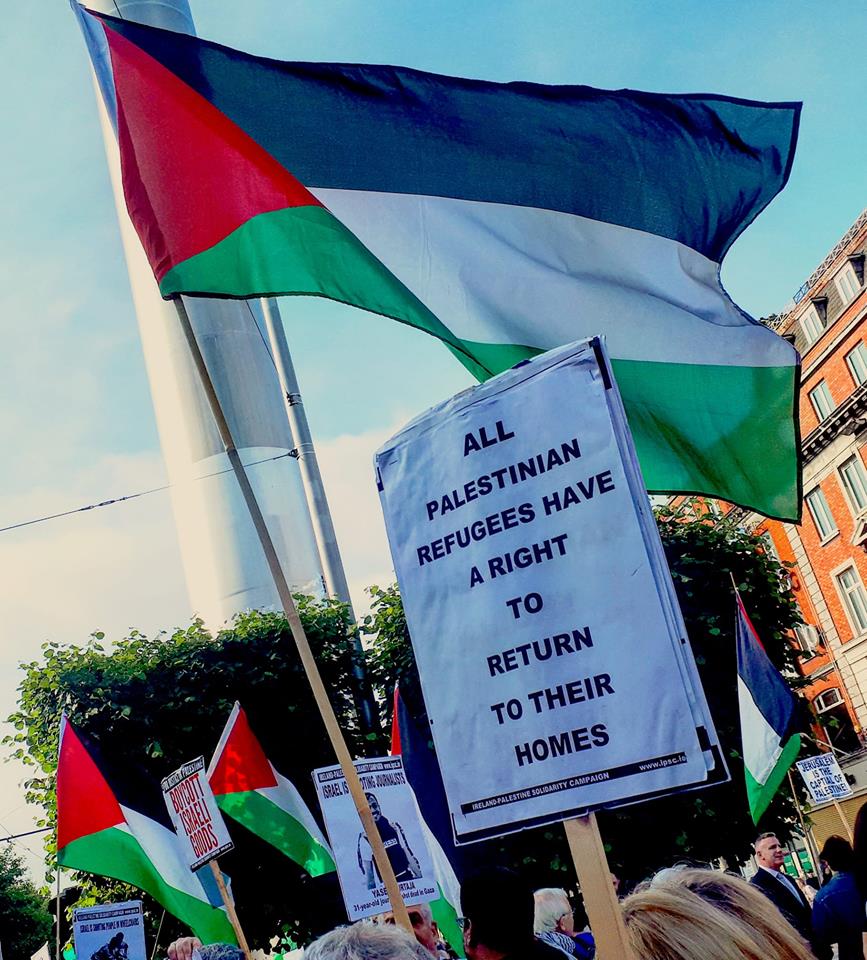
Placards held by supporters in the rally yesterday upheld the right of the Palestinians to return to their homeland. It is ironic that the Zionists since 1924 at least have been upholding that demand for people who had never set foot in the land, nor whose ancestors had not for thousands of years but are denying that right to Palestinians driven out within living memory and their descendants.

View of the rally on the west side of the central pedestrian reservation, sretching southwards. (Photo: D. Breatnach)

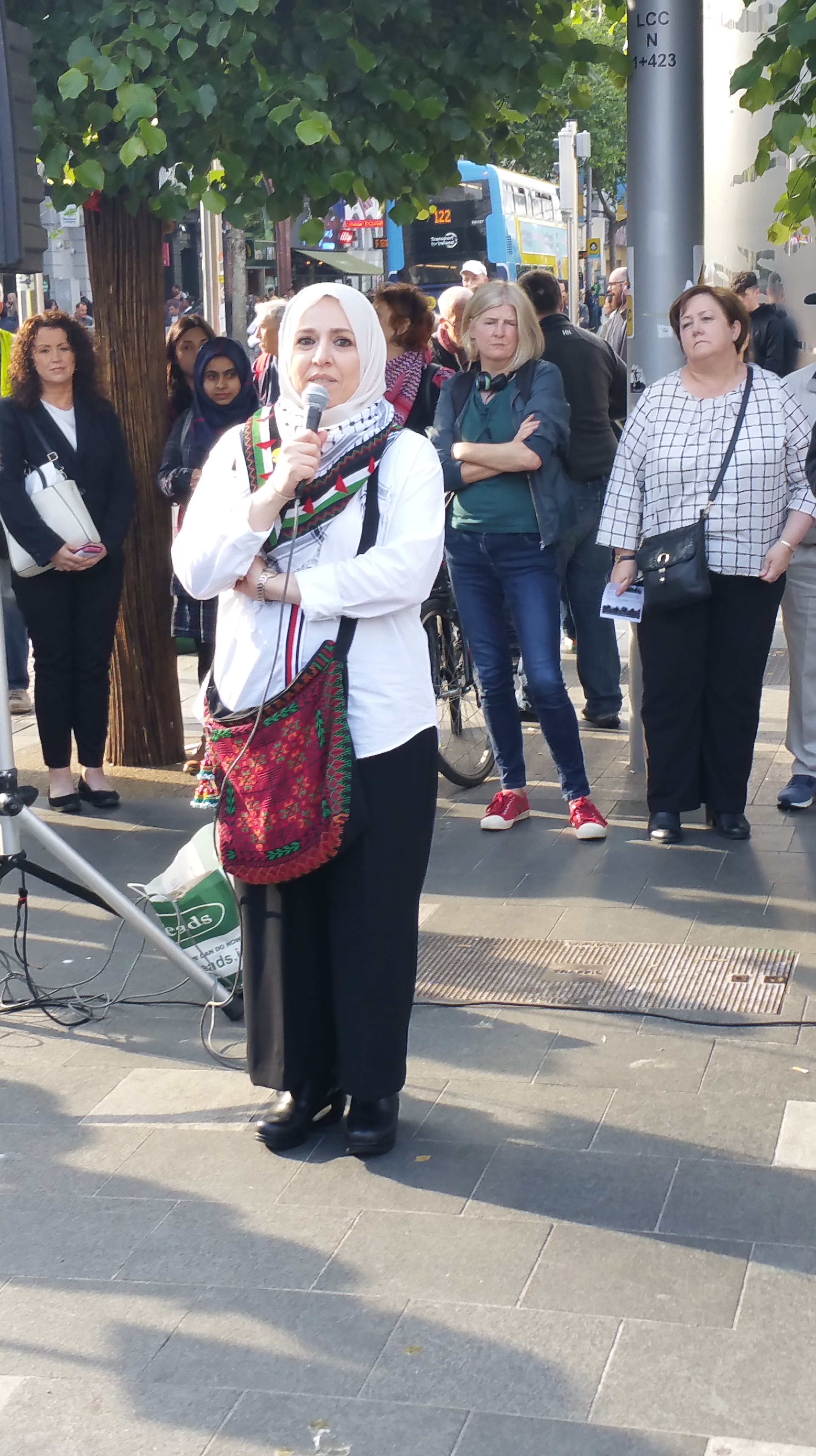
Speaking through a microphone, Martin Quigley thanked those attending the rally and after some remarks, introduced the Chairperson of the IPSC, Fatin Al Tamimi. Speaking about the right of return of Palestinians, Tamimi also said that she had relatives in both Hebron (West Bank) and in the Gaza strip and spoke about the privations of the people there blockaded by Israel, including contaminated water and lack of electricity. However not only is Israel guilty but also Egypt, as Tamimi alluded to when she said that Egypt had only temporarily opened the Rafah Crossing Gate, which Egypt maintains, for the feast of Ramadan, as a result of which she was expecting to be able to see her sister for the first time in seven years (the crowd cheered and applauded this news).

Marting Quigley for IPSC. (Photo: D. Breatnach)

“Expel the Israeli Ambassador and close down the Embassy!”

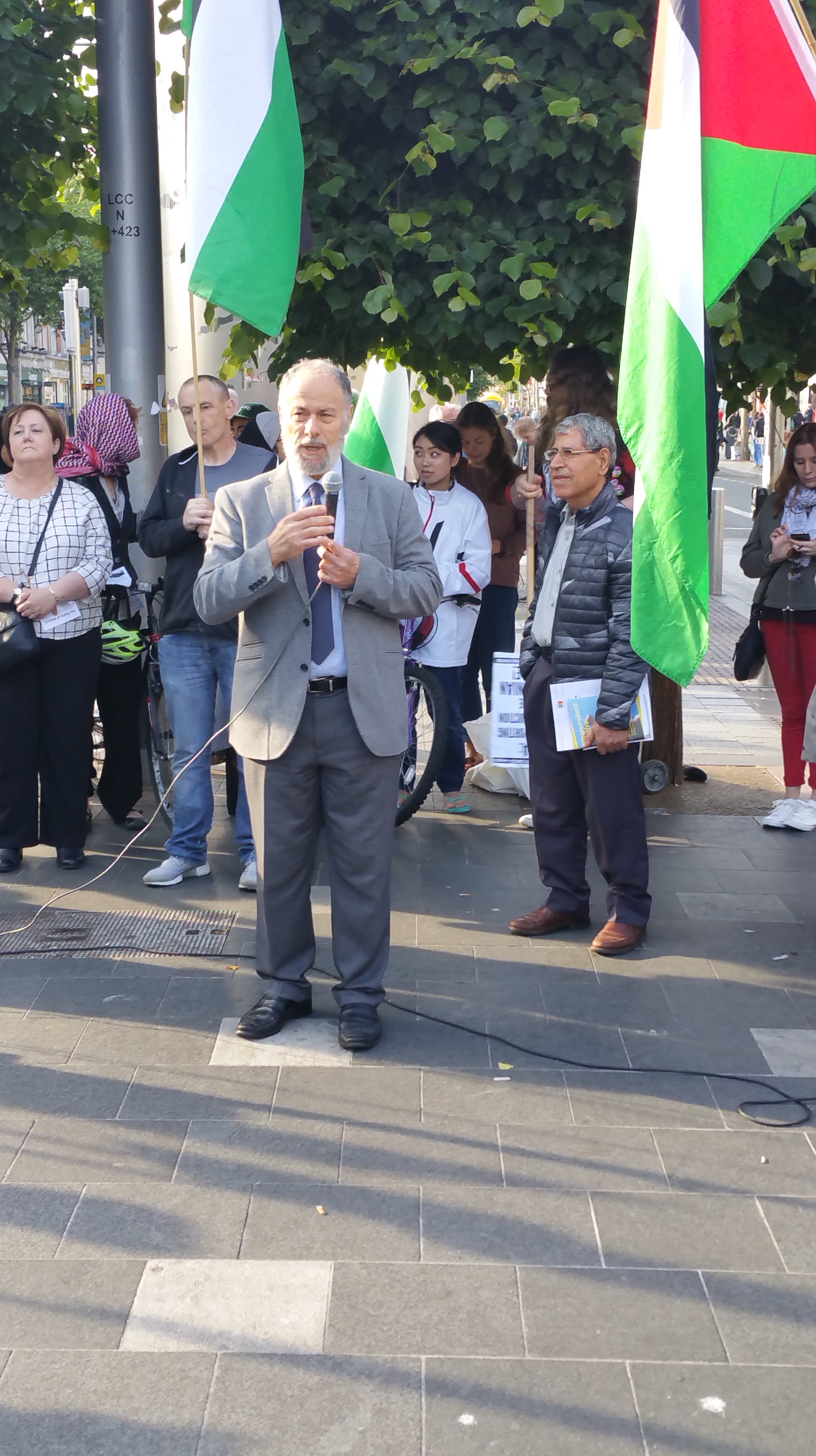
Two other Palestinian speakers addressed the rally, including one who had come out through that very Rafah crossing, Asad abu Shark who was introduced as from the Great March of Return and Ahmad El Habbash, introduced as representing the Palestinian Community in All Ireland3. All speakers drew attention to the Nakba (from Yawm an-Nakba, meaning “Day of the Catastrophe”, referring to the expulsion of thousands of Palestinians in 1948 –), to the right of return, the terrible conditions within the Gaza strip (which place, they said, would become uninhabitable by 2020 — see link), the impunity of the Israeli authorities and the inactivity of “the international community”.

Fatin Al Tamimi, Chairperson of IPSC, addressing the rally.
(Photo: D. Breatnach)

Al Tamimi was cheered loudly when she called for the expulsion of the Israeli Ambassador to Ireland and the closure of the Israeli Embassy, a call repeated by other speakers.

Ronit Lenten, who introduced herself as “an Israeli Jew” and representing Academics For Palestine (Ireland), also spoke briefly.

Last to speak was John Lyons, a Dublin City Councillor for the People Before Profit party, who made similar points. Referring to visit of his own to Palestine he referred to the courage and persistence of the Palestinians in merely trying to live their daily lives under the conditions of Israeli military occupation, apartheid and harassment and called on the Irish people to match that determination in taking action in solidarity with the Palestinians.

An Ireland-based Palestinian speaker addressing the rally. (Photo: D. Breatnach)

Throughout the speeches, the solidarity beeping of horns of passing car and bus drivers could be heard and occasionally shouts of encouragement from open bus or car windows.

Bill to ban imports from Occupied Territories

All speaker highlighted the importance of the BDS campaign (Boycott, Divestment and Sanctions) and the need for Irish people to contact their elected public representatives to ask them for concrete action in support of Israel, including for a Bill to be introduced in the Seanad by Senator Francis Black, (well-known singer, also campaigner for human rights and for support for recovery from alcohol addiction). The Bill in question is the Occupied Territories Bill, the intention of which is to place a national ban on any products shown to be exported from territories under illegal occupation. The Bill, a draft of which has already been approved in committee (see link), is expected to go before the Seanad in July, though that may change and, if passed twice there, will go on to the Oireachtas for debate and, if passed there, into Irish law.

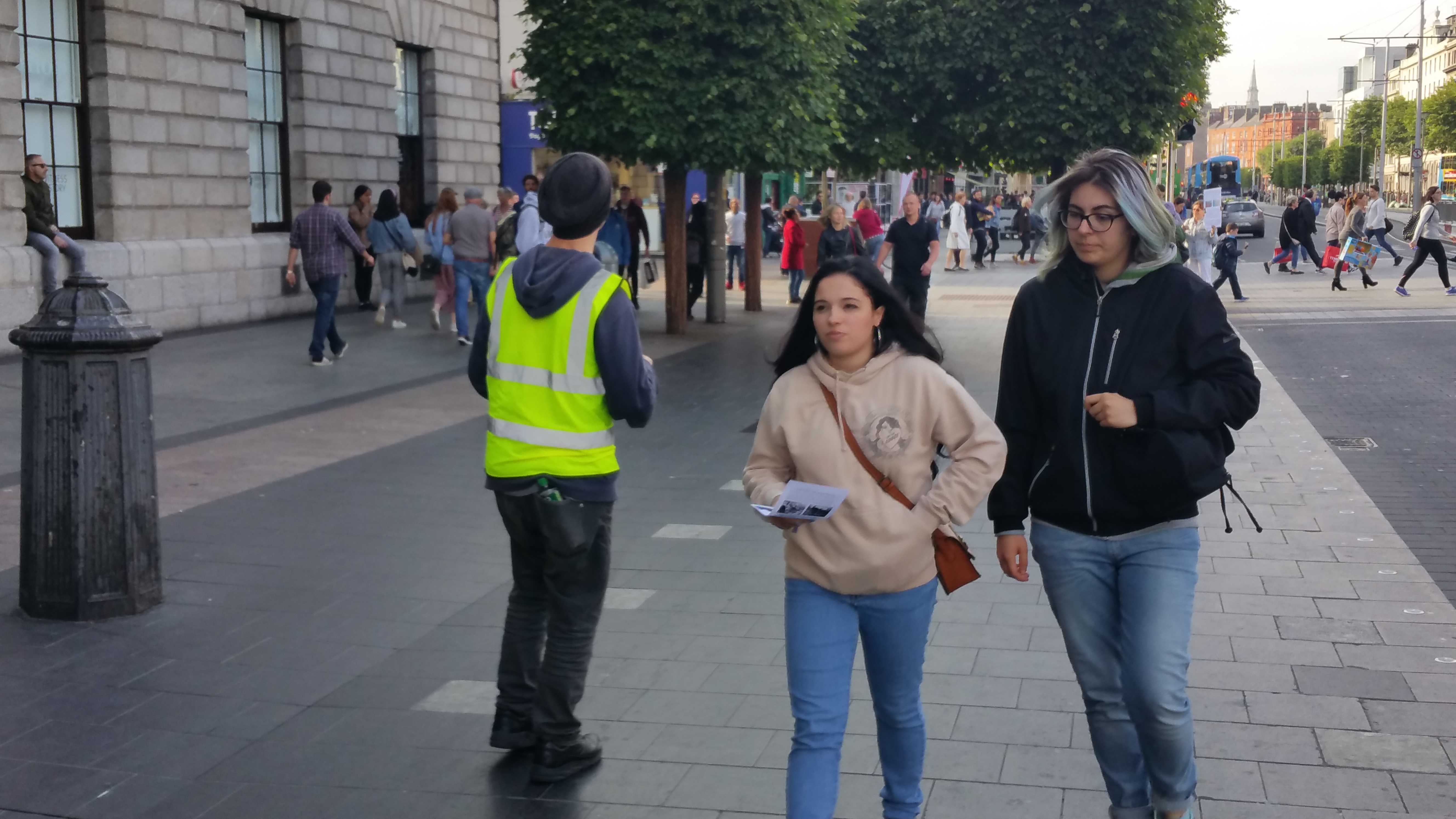
One of the IPSC’s leafleters and passers-by who have just accepted a leaflet. (Photo: D. Breatnach)

Calling on all present to stay in touch with the IPSC or with other Palestine solidarity organisation, Martin Quigley brought the event to an end by leading the rally in leading a number of chants: “From the river to the sea, Palestine will be free!” “Free, free Palestine!” “One, two, three, four – occupation no more!” “Five, six, seven, eight – Israel is a fascist state!”

Early moments as Palestinian supporters gather, view northwards. (Photo: D. Breatnach)

Argentina cancels scheduled football match with Israel. Dozens of Palestine flags defy GAA ban.

In a separate but related development, the national soccer team of Argentina yielded to calls to abandon its scheduled ‘friendly’ match with the Israeli national soccer team (see relevant link). Strong advocacy for the cancellation had been brought about by the movement for BDS both within and outside Argentina but statements of team officials to the media made it appear that members of the team had been threatened (but without producing any evidence of such).

And on Sunday, dozens of Palestinian flags were flown during a match at Omagh between Senior Gaelic Football teams Tyrone and Monaghan. The actions seemed not only to represent solidarity with the Palestinians at this time but also defiance of GAA officials who had removed flags and a banner at a previous match (see relevant link).


End.

POSTSCRIPT:

Palestinian solidarity demonstration in Dublin Friday 8th June (not organised by IPSC).
(Photo: D.Breatnach)

Footnotes:

1 “Today the number who qualify for UNRWA’s (United Nations Refugee and Welfare Agency) services has grown to over 4 million. One third of whom live in the West Bank and Gaza; slightly less than one third in Jordan; 17% in Syria and Lebanon (Bowker, 2003, p. 72) and around 15% in other Arab and Western countries. Approximately 1 million refugees have no form of identification other than an UNRWA identification card.”

2Or the many Jewish converts who never had any contact whatsoever with Palestine.

3 Actually no individual or separate organisation can claim legitimately to “represent the Palestine community in Ireland or anywhere” but there does exist a Palestinian organisation in Ireland which has appropriated that title as its organisational name. A number of different organisations (and none) find support among the general expatriate Palestinian community, including Hamas, Al Fatah and perhaps the PFLP.

Links:

Expulsion of Palestinians from their homeland and statistics on refugees: https://en.wikipedia.org/wiki/1948_Palestinian_exodus#Palestinian_refugees

IPSC: http://www.ipsc.ie/ and Facebook https://www.facebook.com/IrelandPSC/

Sadaka Ireland: http://www.sadaka.ie/

Frances Black‘s Occupied Territories Bill: https://www.irishtimes.com/news/politics/oireachtas-to-table-bill-on-goods-from-illegal-israeli-occupations-1.3308838

Living conditions in Gaza — “uninhabitable by 2020”:

https://www.irishtimes.com/news/world/middle-east/gaza-could-be-uninhabitable-by-2020-un-warns-1.2337255

Cancelation by Argentina of match against Israel (this report doesn’t mention alleged threats): https://www.aljazeera.com/news/2018/06/palestinians-argentina-cancels-israel-game-180606113926752.html

Dozens of Palestinian flags defy GAA ban: http://www.irishnews.com/news/2018/06/04/news/dozens-of-palestinian-flags-flown-at-healy-park-despite-ulster-council-saying-they-are-banned-1346368/?param=ds12rif76F

I Will Stand With You — Will You Stand With Me?

Julieann Kelly

I am a proud Irish Republican woman.

I stand shoulder to shoulder with my fellow countrymen and women against the injustices wrought on the people of my beloved country, be it civil rights or human rights I will stand with you. If I ask you the people of Ireland to stand with me to ensure my civil and human rights are upheld – will you? Or will you exile me to foreign soil to seek a medical procedure that is denied to me here unless I`m at death’s door?

I grew up in the 70`s & 80`s. Abortion was not a subject that was openly discussed, the general consensus was only “floozies” had them. Abortion came into my young life when a conversation between adults was overheard: “yer one took the boat”; “she is a baby killer”; “the babbie was deformed” etc. Their victim was a mother of one who had an abortion due to FFA (fatal foetal abnormality); if she carried to term like she was advised by doctors it would have resulted in her death. This woman lived the rest of her life filled with shame and guilt not only for making the choice to terminate but because of the closed minds and nasty hateful words of those around her. Cancer claimed her life, in her words “it was God`s punishment for killing my baby”. Like so many women before and after her she had to leave her baby’s remains in a foreign clinic, forever separated because of laws that said a mother trying to save her own life was a criminal! Her husband and son had the baby’s name engraved on her headstone, uniting them again if only in name.

Here we are in 2018, a so-called new liberal age when marriage between same-sex couples is legal, they are rightfully afforded the same rights as a heterosexual married couple, yet a woman is denied the right to her own bodily autonomy. The fear-mongering is still the same, cries of “it will be used as a form of contraception!” echo the cries of “Floozie”.

I am a mother of three much wanted children; my eldest daughter from my first marriage was conceived with the help of ICSI. I miscarried two of the embryos implanted with her early in the pregnancy and in time suffered more miscarriages. I was then blessed with my son and youngest daughter with my second husband. I have also suffered because of the 8th Amendment. I was forced to have three major abdominal surgeries against my will to save the life of the baby. My eldest was delivered a month early as my waters broke but not completely. The decision was taken to deliver her by c-section when I developed an infection that they feared would put the baby at risk although she showed no signs of any ill effects. I was put under general anaesthetic and did not get to see my baby till the next day due to my reaction to the anaesthetic. I developed a massive infection in my wound in the hospital which took six months to clear. My son was delivered in the same way as I was not progressing fast enough; I was in labour a mere five hours.

After my first experience I was terrified, in the height of pain and in great fear I refused. My husband was told if I kept refusing I would be sectioned under the mental health act and he could lose me and my son. The doctor was somewhat sympathetic, he allowed my husband to try and comfort me yet at the same time booking the theatre for the c-section.

I was lucky this time, I was awake for the birth but again developed a massive wound infection while in hospital.

My third and final dance with the 8th came when I was told during my pregnancy on my youngest daughter that as my womb was so weak due to the previous sections and subsequent wound infections I would not be allowed deliver her naturally. All my children suffered with shock due to their arrival into the world. My consent was not needed for any of these major surgeries, my body was not my own because the baby`s life came before my own, I live with the consequences of the infections to this day.

RAGING DEBATES — HOW FAR HAVE WE COME?

The raging debates regarding the upcoming vote have brought out the worst in many. I have had my life threatened, been called the vilest of names, my morals and suitability as a mother called into question because I`m pro choice. Ridiculous arguments thrown at me, I answer all these arguments with “I am pro-choice be that keep, abortion or adoption”, only to be met with more scorn and a refusal to engage in a sensible debate. I have been judged without people knowing what brought me to my stand on repealing the 8th: the suffering of a mother, my own experience of the 8th, a love for the women of my country.

100 years after a minority of woman were given the right to vote, I hear about sexual equality but I have to question this when an unborn foetus up until birth shares the same if not more rights than the woman who is used as a vessel. How far have we truly come in this liberal country? How can we speak of equality or loving both when our women have no say over their own body at the most vulnerable time of her life?

Crisis pregnancies, FFA, happen each day, the support we offer these woman is to exile them in shame to face a medical procedure in many cases alone on foreign soil. We force women to procure abortion pills online putting her life at risk in fear of discovery and face up to 14 years in prison, we force women to leave the babies remains in a foreign clinic, or to smuggle it into the country to bury it in secret, to have the cremated remains delivered in the post.

I will vote to repeal the 8th as I want to live in a country where I have a say over my own body, for my daughters and all the generations to come. I will stand shoulder to shoulder with all the women in Ireland. I will stand against the shame and fear culture we inflict on our women. I will vote Yes so young girls like Ann Lovett do not die because she could tell no one she was pregnant, so young girls like the X Case have a choice, for all the women like Savita Halappanava who died unnecessarily. Ireland owes it to our women to put them first.

End

IRA VOLUNTEER, PAYROLL HEIST MAN, THRILLER WRITER


Diarmuid Breatnach


To discuss a thriller-writer who was in jail in the USA for one of the largest payroll heists in US history and who before that was in the H Blocks, an incarcerated IRA Volunteer, is to have most people thinking one is writing about a fictional character – but I’m not. The man exists and his name is Sam Millar.

WRITER

Millar has a number of novels and a memoir to his credit, all the most recent published by the O’Brien Press. Some of them are detective novels, centred around Karl Kane, a tough private investigator, back-talking cops and gangsters alike. Yes, we’re familiar with the type, from Chandler’ Philip Marlowe to Spillane’s Mike Hammer, Hammet’s Sam Spade or Towne’s Jake Gittes in Chinatown (1974). But if we’ve liked his type in print or film before, them then we tend to like him again. To be truthful, Kane is a bit different: I can’t recall or even imagine any of the others ever opening their front door dressed only in their lover’s short pink dressing gown and falling on their arse, accidentally flashing their tackle at passing schoolgirls. And Kane’s health problems are perhaps more reminiscent of some of the Scandinavian fictional police detective heroes (and heroines) than his fast riposting counterparts in the USA-based stories.

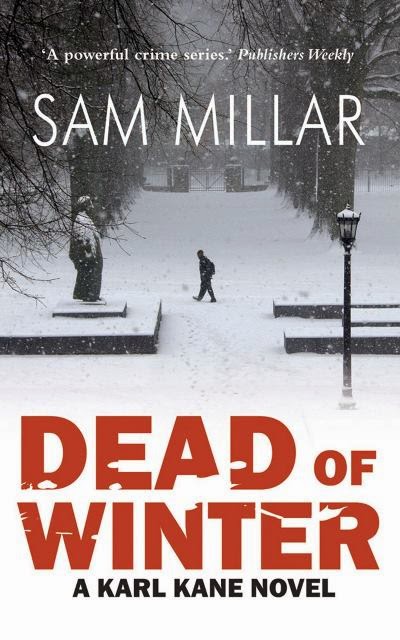
Cover Dead of Winter, a Karl Kane novel by Sam Millar.

The dialogue and commentary in the Karl Kane novels is good with some very funny lines, his plots interesting and he keeps the story moving along at a good pace, with a few twists along the way. Kane, like Marlowe has a conscience pushing through his hard exterior and though he’s tough he tends not to invite more slaps after the first few. And not every thread in the story is tidily tied up at the end of the book.

The dialogue is not so slick in some of his other novels (one set in the USA) but the conjuring of the ill-boding atmosphere is well done, as is the description of the thinking in the adolescent characters’ minds.

Belfast is where his writing is centred now:

“I have deliberately used (Belfast) as a backdrop for all my crime noir novels for a number of reasons”, he was quoted as saying in a Crime Review author profile “- mainly because I know it so well, but chiefly to bring the imaginary one-dimensional Belfast of badly written novels into the modern era.”

Sam Millar
(Photo source: Democrat and Chronicle)

His stories are dark (which is part of the meaning of “noir”) but generally not without humour or redemption, at least for some of the characters. The Police Service of Northern Ireland are not presented as shining good guys and in that Millar fits in with the general attitude to the enforcers of law and order in the detective noir stories: the cast of cops usually includes the downright nasty (and often corrupt), the in-between and the good guy – the latter being the cop who feeds the private investigator information or warns him of trouble coming his way from the cop’s superiors. For the genre and for Millar’s stories it works, providing one doesn’t step back too much to think about the sectarian and often murderous RUC now transformed by name into the PSNI.

However, Millar doesn’t try and paint a rosy picture of a post-Good Friday Agreement society and has been quite open about his own views: “I hate bursting people’s bubbles, everybody wants to believe something like a fairytale has happened over here but it hasn’t”, he said in a 2014 interview with David Henessy in the Irish in Britain weekly The Irish World.

“It’s changed superficially but for working-class Protestants and working-class Catholics it hasn’t changed. There’s still a lot of people out of work, a lot of poverty and it seems the politicians are the only ones who seem to benefit out of this Good Friday Agreement which has been a terrible let down, to be honest with you, especially in nationalist communities.

“But for myself being a writer, of course, I have been able to move away and I felt guilty. You don’t want to turn your back on your neighbourhood but at the same time, I’ve young children. I want them to have a better life…”

SELLING WELL ABROAD

A number of Millar’s books have been translated and sold well in France (where he was won a number of literary awards), Italy, Germany and Poland and some as far as Turkey and Bulgaria. He is not without Irish awards either: the prestigious Aisling Award for Art and Culture; Martin Healy Short Story Award; Brian Moore Award and Cork Literary Review Award, et al.

“I could probably sell more books in Ireland if I kept my mouth shut about what I thought,” Millar commented more recently. Perhaps he’s right. I find it hard to believe I never heard about him until picking out a book by chance in the library, saw it was about a PI working in Belfast and with a sigh, felt obligated to read it. But without any great expectations, having come across some novels allegedly about the Six Counties that seemed to be about somewhere else in the world but also bearing Ulster place and family names. I was glad I chose it and am now working my way through his other published works.

Asking some Dublin Republicans about Millar and his writing, I was again surprised that they had not heard of him, particularly since they would share his view of the Six Counties today.

IRA VOLUNTEER AND HEIST

Millar was brought up a Catholic in Belfast (but with a Protestant grandfather), became politically active and went to jail in 1973, “the first nationalist put away under the Diplock court system. That’s a forgotten historical footnote, except for me”, he says. Released in 1975, his days of freedom were short, like many another in those days and a year later he was back inside after being caught with explosives in Belfast city centre. He joined the blanket protest against the British policy of criminalisation of Republican prisoners.

Released from the H-Blocks in 1982, he got acquainted with Bernadette, now his wife, whom he had known as a child, a few streets away from his family‘s home.

Photo source: New York Times

Moving to the USA, in 1993 Millar got involved in the New York Brinks Armoured Car Depot robbery, “the biggest in US history” (in which no-one was killed), for which he got caught a year later and served six years in a penitentiary, to be released by Clinton. Millar wrote about the heist in On the Brinks (2003) and apparently investigators believe that though Millar masterminded the robbery, he fictionalised some of the details in order to protect some accomplices.

Cover of extended version of the best-seller On the Brinks, Millar’s memoir of Republican activism, British colonial jail and the Brinks Heist of 1993.

Warner Bros. bought the rights to the book for a screenplay before backing out of making the film and a long “and draining” legal battle followed as Millar fought to win back the rights, so as to have some other company make the film.

 THRILLER WRITER AND REVIEWER

Writing for the New York Journal of Books, Millar said he had “reviewed tons of books”, in reply to an accusation by Armagh author Stuart Neville that he had indulged in “sock puppeting”, i.e using fake identities to rate his own work highly and do down some others, including Neville’s.

“If you look at my books reviewed by people on Amazon,” said Millar to Nuala McCann for BBC News in September 2012, “you will see one stars and two stars, some by writers. I have never asked Amazon to remove them, nor complained on line about them.

“Ironically, the only book I’ve ever read by Mister Neville I reviewed for the influential website New York Journal of Books,” he added.

“I think if you read it, it wasn’t too bad a review. I get lousy reviews sometimes myself, but take it on the chin. I’ve reviewed ‘tons’ of fiction/crime books for writers, and never given a negative review of any of them.

“If I don’t like a book (after a few chapters) I will not review it, as I do not like to give bad reviews to fellow writers, as I know how difficult enough it is without adding grief.”

Cover of Millar’s next novel, with a new anti-hero, due out in June.

Sam Millar has another anti-hero novel (not Kane) novel due out in June, The Bespoke Hitman, as part of a three-book deal with O’Brien. I’m looking forward to reading it.

End.

BIBLIOGRAPHY:

Dark Souls (April 2003)

The Redemption Factory (July 2005)

The Darkness of Bones (2006)

Bloodstorm: A Karl Kane Book (2008)

The Dark Place: A Karl Kane Book (2009)

The Dead of Winter: A Karl Kane Book (2012)

Brothers In Arms (Stage play 2012)

Black’s Creek [originally Small Town Killing] (2014)

On The Brinks, O’Brien Press (April, 2014) [but originally by Wynkin de Worde (Sep. 2003) then bought by Millar’s present publisher, The O’Brien Press]

Past Darkness: A Karl Kane Novel (2015)

LINKS FOR SOME SOURCES:

http://crimeire.blogspot.ie/2015/03/sam-millar.html

http://www.theirishworld.com/sam-millar-back-from-the-brinks/

http://www.bbc.com/news/world-europe-19465081

https://www.nytimes.com/2016/08/14/nyregion/brinks-heist-made-for-hollywood.html

https://www.democratandchronicle.com/story/news/2016/03/21/brinks-heist-may-become-hollywood-film/82085488/

Author’s website: http://www.millarcrime.com/

SPRING IN TREE, FLOWER AND SONG

Diarmuid Breatnach

As we have been shown this year, if we did not already know, Spring comes in its own time. Roughly around the calendar yes, but not exactly. It’s not like the clothing merchants, who withdrew the gloves in March and left people like me, who regularly lose them, with frozen hands unable to buy cheap replacements while the models stood in windows in shorts and bikinis.

But spring wild flowers are already out and have been for weeks, though the city is not a great place to see them. However in gardens, parks, canal banks and on empty sites, the dandelion, much disregarded as a decorative flower has been flaunting its bright yellow flower for weeks and will continue to do so for quite a while yet.

Some variety of Speedwell and Cat’s Ear (Photo D.Breatnach)
Furze (Aiteann) in bloom (photo: D.Breatnach)

In early April I spent a few days in Wicklow by the Dartry river. In a very short walk to Ashford I encountered eight types of wild flowers in bloom, including furze (or gorse), daisies,

Fumitory maybe (pink), mystery white flower on stalk and Groundsel on a bit of waste ground.
(photo: D.Breatnach)
The humble daisy (Nóinín) looking splendid on some waste ground.  (Photo: D.Breatnach)

groundsel, cat’s ear, speedwell, and of course dandelion. On a longer walk heading away from the river I came upon primrose, lesser celandine and wild or barren strawberry (not knowing how to tell the two apart at this time of year). And a mystery plant also (see photo). Swathes of wild garlic (creamh), grew both sides of the country road; I had long thought this plant a foreign import but it seems I was wrong. It certainly spreads when established however, as witnessed by this Wicklow road and wooded areas of Dalkey Hill where I have also seen large patches of it. My father transplanted some to our garden but rarely used it in cooking – or if he did, not often enough, for it soon took over large areas of the smallish garden.

Wild Garlic (Creamh).
(Photo: D.Breatnach)
Blue Tits even upside down on bird feeder (note that the tree is the Cherry Laurel, an invasive tree species).   (Photo: D.Breatnach)


At a Wicklow hotel garden’s bird feeder, blue tit, chaffinch and some other species flicked in to take a snack and flicked out again, making it very difficult to photograph them but which of course did not bother them at all.

Returning through Ashford (Áth na Fuinseoige) I came across one of our

Chaffinch (Rí rua) picking up some of the spillage from the feeder on the ground. (Photo: D.Breatnach)

feathered anglers, the smaller grey heron. Patience personified, this species stands in the water waiting for the appropriate moment to strike, apparently not feeling the cold. But perhaps this one did feel it, for it stood on the bank.

Grey Heron (Corr réisc) on the Vartry riverbank.
(Photo: D.Breatnach)

The Gael reckoned the start of Spring with the feast of St. Brigid (and probably the Goddess Brig before her), February 1st, when the ewes come into milk, with their expected birth of lambs. As Brigid/ Brig was associated with butter in some traditions it is possible that some early butter was made from sheep’s milk, though that is not recorded in records, as far as I know. The lambs and many other animals born in Spring had no choice regarding when to appear – that had been decided in the Autumn or Summer of the year before when their mothers mated. Birds, on the other hand, who are more vulnerable, mate in the Spring itself.

In Dublin city until perhaps a week ago, there was very little sign of Spring apart from the lengthening of the day. The blind wandering poet Antoine Ó Raifteirí (1779-1835), writing in the month of January, was already anticipating spring in one of his better-known poems:

Anois teacht an Earraigh beidh an lá dúl chun síneadh, 


Is tar éis na féil’ Bríde ardóigh mé mo sheol;


Ó chur mé ‘mo cheann é, ní stopfaidh mé choíche 


Go seasfaidh mé síos i lár Chondae Mhaigh Eo.

He’s thinking of heading home to County Mayo, he feels Spring coming but will wait until Bridget’s feast day to “hoist his sail” and since it’s in his head now won’t stop till he gets there. We might have been anticipating Spring ourselves in January this year and into February — though cold and wet enough — but if so we were in for a shock towards the end of the month and into March with “snow dumps”.

The birds have to set up their territory even so and in fact the robin (Spideog) was marking its territory in song sporadically through December and January, often enough even at night in the city and particularly near street or train station lighting. The polygamous wren (Dreoilín), if not already at it followed in February. The seagulls at their nesting sites on roofs were calling and mating in mid-March but may have been delayed a little by the snow; however they are hardy birds. Some blackbird males have been singing since March and now are all in full throaty song. In March also we heard the high-pitched “peeps” of those acrobats, the tits as they foraged for invertebrates through the branches of tree and bush and at the end of April, also the bursts of chaffinch song which remind us often of caged canaries — and why not, when the canaries are often taught that very bird’s song to sing.

The Lesser Celandine, I think (Grán arcáin)
(Photo: D.Breatnach)

January was the time to hear adult foxes in the city, the somewhat frightening scream of the vixen and the two or three-times bark in quick succession of the dog fox. This month the cubs, born a month earlier, will venture out of their den and may be heard sometimes by night at play too, though this is more likely in the months to come.

The mystery plant with flower or hood bud (going by the leaves, not ‘Lords and Ladies’).
(Photo: D.Breatnach)
The Primrose (Sabhaircín) leaf, bud and flower.(Photo: D.Breatnach)
Wild (or perhaps Barren) Strawberry (Sú talún or bréige) in blossom.  (Photo: D.Breatnach)

The trees and ground plants apparently respond more to length and angle of sunlight to tell them it is time to grow from seed or to burst open into bud and some of them are doing so now in late April, for example the birch (Beith). Others delay and the ash trees (source of our camáin or hurley sticks and much else) are still in their black hard bud stage in late April and the oak waits along too. Trees that flower tend to do so first and put out leaf later, as the blackthorn (Draighneán donn) did in February with its little white blossoms which will develop into sloes (airne) later in the year. In March hawthorn (Sceach geal), willow (Sail, from which we get “The Sally Gardens”) and elder (Ceireachán), all of which may be seen in gardens or parks (and the elder growing even on empty sites) were already green-misting in tiny leaf and are now well advanced. The “candles” of the horse chestnut (Crann Cnó capaill), to be seen in parks and in some leafy suburb streets, are however forming alongside the tree’s large leaves right now at the end of April (Aibreán) and the rowan (Caorthann) and sycamore (Seiceamar) of the whirling seeds are also in stages of leaf.

Slender Speedwell perhaps (there are a number of different species). (Photo: D.Breatnach)

Spring is really coming for us but for many plants, mammals and birds, it is already here.

end

PS: When checking The Tree Council of Ireland for tree species names in Irish, I was shocked to find that they do not supply them. Nor reference the huge number of places across the land whose names in English are corruptions of the original Irish place names derived from the names of trees.

Links for more information:

Identifying wildflowers by month through the year: http://www.irishwildflowers.ie/this-month/april.html

Wildflower information, photo and names in Irish, English and Latin: http://www.wildflowersofireland.net/plant_detail.php?id_flower=220

Song of the Chaffinch: https://www.youtube.com/watch?v=GVyW9t5wX3U

Native trees in leaf throughout the year: http://www.thegardenshop.ie/native-trees