The prison experience and escape of IRA man Seán Murphy as related by himself in book form was launched on 31st March to a large audience in Wynne’s Hotel. Republicans of all shades not part of Sinn Féin (and perhaps some of those too) attended the event, bought copies of Having It Away and queued to have them signed by Seán’s widow, Betty Murphy. Seán O’Mahony, whose assistance with the publication of the book was acknowledged by Sean Murphy’s family, presided over the event.
Seamus Murphy (Photo source: Internet)
On 13th August 1955, a party of the IRA led by Ruairí Ó Brádaigh raided Arborfield British Army Depot and came away with many guns and ammunition; the party’s members were Seán Murphy, Donal Murphy (no relation), Frank Skuse, Jack Hick, Tom Fitzgerald, Joseph Doyle, Liam Walsh and Paddy Considine. One of the party’s vehicles was apprehended by British police and the weapons later recovered. Three IRA Volunteers of those ten who took part were captured and, after trial, sentenced to life imprisonment. Donal Murphy and Joseph Doyle were two of them, the third was Seán Murphy and the book is his story.
Section of crowd at book launch event in Wynne’s Hotel (Photo: D. Breatnach)
The book is what most people would call “a great read”. Murphy’s descriptions of the grim realities of prison life, his interactions with other prisoners political and non-political, as well as the screws (prison officers) and Governor, are pointed and yet often humorous.
Cathal Goulding was in the jail before Murphy arrived and after an attempted escape was obliged to wear “patches”, these being large and of a contrasting colour, sown on to a prison uniform. A prisoner wearing “patches” was under constant surveillance in the prison and was kept in solitary confinement when not on exercise. The prison Governor tried to get Goulding to promise not to escape, which Goulding felt unable to do, considering it his duty to escape whenever a decent opportunity presented itself.
(Photo: D. Breatnach)
Murphy’s opinion expressed in the book is that Goulding should have given his promise and then escape when possible, considering that one was not bound to honesty with one’s captors. Murphy’s position is not without rationality and even morality but it is in strange contrast to he and his two co-accused refusing to provide a defence against the charges, since that would have meant “recognising the British court”.
The Republican prisoners considered themselves political prisoners but they did not seek segregation from social prisoners as later generations of Republican prisoners have done. And in fact, Murpy made friends among a number of prisoners convicted of social rather than political offences, some of whom went to some lengths to help him and put their scheduled liberty at jeopardy in doing so. Murphy has this to say about them (and Sean O’Mahony quite rightly included that phrase too in his written introduction): “Taken all round, the circle of friends we had collected in this prison were made up of men, generous and decent almost beyond belief and one would be hard put to find their equals in any walk of life.”
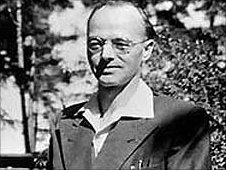
On the other hand, interaction with other political prisoners also forms part of the narrative. These included Klaus Fuchs, a German Communist who had fled Nazi Germany and became naturalised in Britain. He was a physicist and after the War was hired as part of the team developing the Atomic Bomb at Los Alamos in the USA. From there he had passed information to the USSR to help them in their development of the their own atomic weapon. for which he was sentenced in 1950 to fourteen years imprisonment and had his British citizenship removed. Released not long after Murphy’s escape, having served nine years, we went to the GDR (East Germany) where he remained until his death in 1988 at the age of seventy-six.
Klaus Fuchs, German Communist, jailed for feeding information on the USA’s development of the atomic bomb to the USSR. He was in Wakefield Prison at the same time as Murphy. (Photo source: Internet)
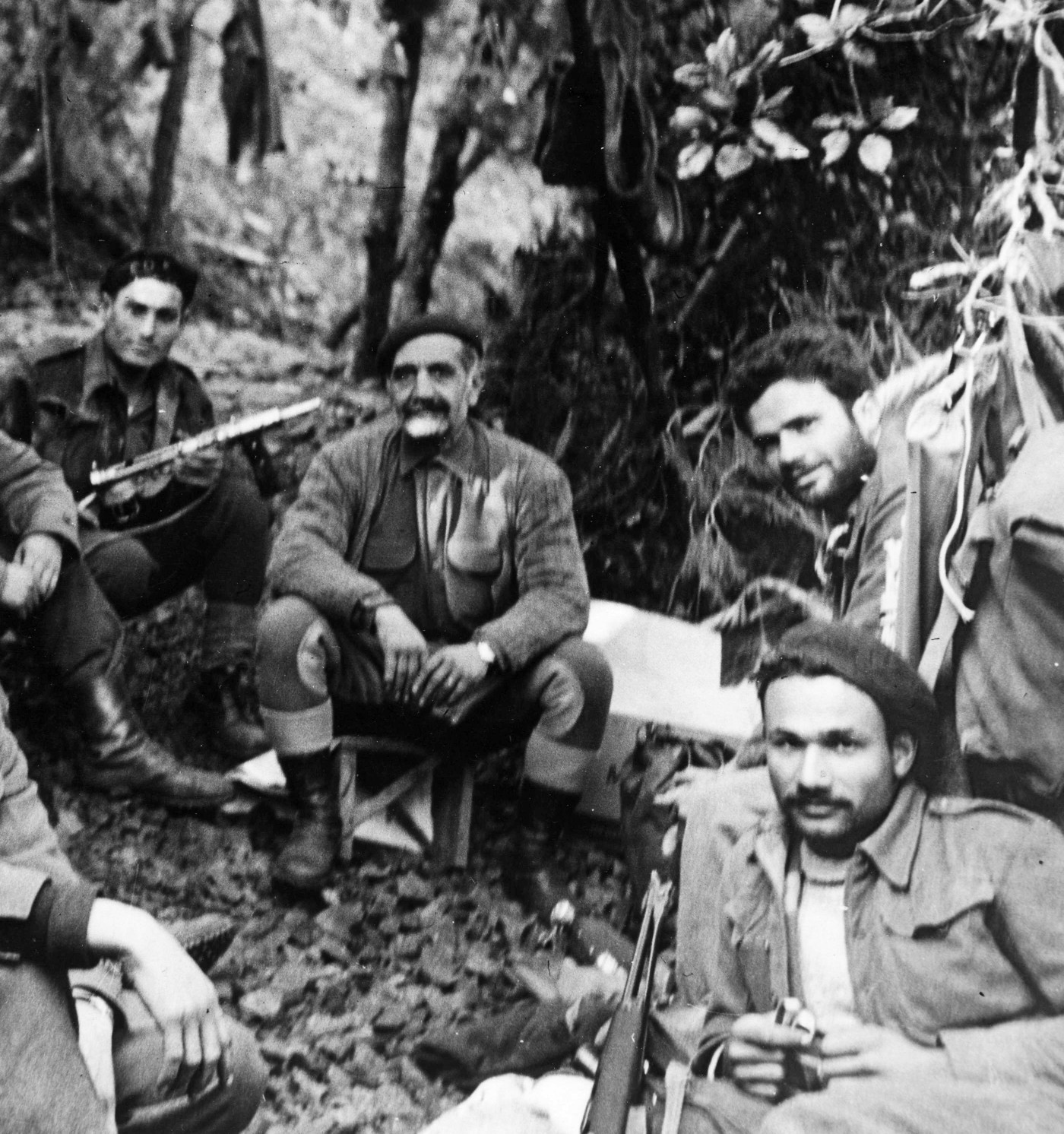
Although Fuchs was already there when Murphy arrived, other prisoners arrived afterwards from the struggle against the British in Cyprus. These were from EOKA, a Greek-Cypriot guerrilla organisation which from 1954-’59, fought to end British rule in Cyprus and for union with Greece (“enosis”). Many soldiers, guerillas and civilians were killed in the conflict, the British executed a number and also practiced torture on prisoners. In addition, the British recruited their colonial police force exclusively from among the Turkish minority on the island, which helped entrench and deepen communal tensions. Unlike EOKA B, which was considered right-wing, had links to fascist Greek colonels and was responsible for a massacre and rape of Turkish-Cypriot civilians, Eoka had socialist national liberation leanings and one of the prisoners in jail with Murphy went on to translate James Connolly’s writings into Greek. Some of EOKA supporters, like Bishop Makarios, later went on to advocate complete independence from either Greece or Turkey but an attempted EOKA B coup sparked a Turkish invasion and another massacre, this time of Greek-Cypriot civilians. Today the island is partioned between an independent Cyprus and the Turkish state, each area more or less abandoned by the other major ethnic group.
Eoka guerrilla fighters in camp (Photo source: Internet)
One of the EOKA prisoners sharing Wakefield Prison with Murphy was Nicos Sampson who had a dark history by then and which got no lighter as time went on.
Almost incredibly, one of the Eoka prisoners, serving five years in jail, was a member of the British Army who had deserted and fought alongside the Greek Cypriots – his name was Tony Martin.
The typography of the book leaves much to be desired – something seems to have gone amiss between editing, proofing and checking the galley copy. Punctuation has suffered and occasionally spelling too; sentences are broken up by large spaces and footnotes end up half-way down the the next page. Somehow however, though one is aware of those faults, the narrative grabs most of the attention.
More irritating than the faulty typography are the omissions: what went wrong that of the escape party of five, only one made it? How did those left behind fare? Did the British seek his extradition from the Irish state? What did Murphy make of the subsequent twists and turns in the Republican movement and of its various splits? Some information on the subsequent lives of some players in the prison and escape organisation is provided in two pages of Biographical Notes but I found it nowhere enough to satisfy my curiosity. For example, Murphy rates Cathal Goulding very highly in the book’s narrative yet I am given to understand that he did not support the line taken by what became Official Sinn Féin (and eventually The Workers’ Party) and the Official IRA, led by Goulding.
All that said, the book is very readable and also well worth reading.
Although Murphy’s writing reveals a strong leaning towards socialist republicanism and therefore the comment in the Irish Times obituary that “he did not embrace Goulding’s move to socialism” should be treated with caution. Nevertheless he did not by all accounts support the Official IRA after the 1969 split in the Republican movement; this may have been due to the failure of the IRA leadership to organise support for an escape, while most of those who did spring him seem to have come from the Saor Uladh or Christle faction groups. Murphy appears to have dropped out of active participation in politics after his escape but in recent years was known to be opposed to the Belfast Agreement.
Seán O’Mahony, who presided at launch of “Having It Away” and Betty, widow of Seamus Murphy, the author. (Photo: D. Breatnach)
Seamus Murphy was born 1935 and raised in Castledermot, Co.Kildare and joined the IRA while attending Terenure College, Dublin. In 1963, four years after his escape and return to Ireland, Murphy married Betty O’Donaghue from his home county in 1963; they settled down in Bray and had a son, Pearse. Murphy was writing his memoire unbeknownst to most people and though he received some assistance with it he died in 2015, three years before it was published.
Women’s Day and the approach of Easter again might be appropriate times to remind ourselves of the great role women in Ireland have played in the nation’s struggles. Most Irish people, including sadly some of those who wear it, will be unaware that the idea to create the Easter Lily was that of Republican women and that they were the first to produce and sell them.
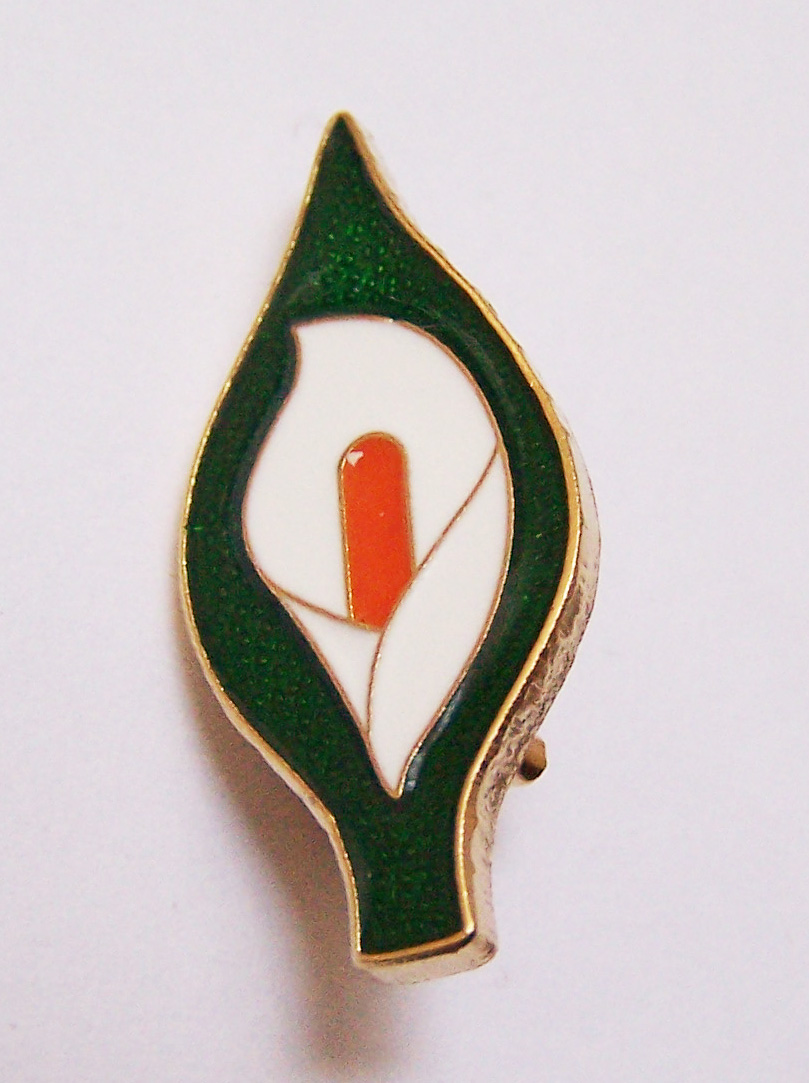
The Easter Lily emblem, although in close relationship to the Easter Rising of 1916, represents to some all of those who have died for Irish freedom. Traditionally, some people will wear the emblem at Easter, whether in the paper form or enamelled metal, at Easter, while some wear the latter all year around.
THE WOMEN CONCEIVE OF THE EMBLEM IDEA
In 1926, three years after the defeat of the Republican forces by those of the Irish Free State (sic), the Republican women’s organisation Cumann na mBan1 produced the Lily badges and sold them. They used them to raise funds for the Republican prisoners of the Free State and for their dependents but it was also a way for them and others to declare visibly their support for the Republicans at a time when the new State had an iron grip on its opposition, many of its enemies in jails or in concentration camps, in hiding or had left the country. The formal executions of prisoners by the State had ceased in 1923 but the assassinations carried out by CID and Irish Army murder squads had continued afterwards (overall 80 formal executions and up to as many as 153 shooting of captured fighters and assassinations).
It may also have been intended as a visible counterpoint to the British Legion’s “Poppy”, which was worn by thousands in Ireland in those years (tens of thousands of Irish had been killed in the British Army and a great many maimed) .
The 12,000 Republican prisoners of the Free State included around 400 women, members of Cumann na mBan, Sinn Féin or of the Irish Citizen Army but towards the end of 1923 most of these were released. However, it was a brave person who publicly declared their support for the defeated Republic — the banned Cumann na mBan, most of whose members had opposed the Treaty, stepped forward to occupy that dangerous public space.
A SPLIT IN THE REPUBLICAN MOVEMENT
The same year that Cumann na mBan developed the Easter Lilly, De Valera and Aiken, formerly of the Republican forces, formed the Fianna Fáil (“Soldiers of Destiny”) political party to campaign within the Dáil (the Irish Parliament) for a Republic, their elected public representatives entering in 1927, having taken the Oath of Allegiance to the Free State and of fidelity to the English monarch in Ireland.
Meanwhile, the rest of the Republican movement, IRA, most of Cumann na mBan and Sinn Féin, remained opposed to participation in what they considered to be an endorsement of the partition of Ireland. During the early period thereafter Fianna Fáil continued to grow while Sinn Féin and the IRA declined in numbers and electoral votes but largely supported Fianna Fáil electorally at first, though the IRA prohibited its members from joining the party.
While Fianna Fáil was heading towards Constitutional methods, the IRA in November 1926 captured 11 Garda Síochánabarracks, in the course of which they shot dead two Gardaí. The Free State reacted immediately, interning 110 IRA men without trial the following day. The following year IRA Volunteers assassinated Free State minister Kevin O’Higgins for his responsibility in executions of Republican prisoners during the Civil War.
FROM PAPER FLOWER TO BADGE
Originally the Easter Lily was actually a three-dimensional paper flower rather than a badge. The flower on which it was modeled was the Easter Lily but now is more imagined as the Calla Lily (Zandeteschia aethiopica). Anne Matthews, who wrote a rather hostile history of Cumann na mBan, also wrote in her blog a good account of the origins of the Easter Lily emblem within the organisation.2
“In early 1926 the reformed (fourth) Sinn Féin party3 instigated the first Day of National Commemoration, to commemorate the tenth anniversary of the 1916 Easter Rebellion at Glasnevin Cemetery on Easter Sunday. Cumann na mBan planned to take part in this event, and early in February the Executive saw an opportunity to use the event to raise some funds and perhaps increase membership and they decided to hold a flag day at the cemetery.
“Over a series of meetings of the executive committee the women discussed the idea of the flag day, and decided instead to make it a ‘Flower Day’. Sighle Humphreys said they had considered flowers that bloomed in spring such as the crocus and the pansy, but eventually decided on a flower known generically as the Easter lily (botanical name is Lilium longiforum).
“Within weeks Fiona Plunkett sent a circular letter to all branches of Cumann na mBan to explain the purpose of the Flower Day.
“ ‘The flower we have decided upon is a lily (enclosed find sample) as we consider this would be the most suitable for Easter and it has also the Republican colours…You ought to call a meeting of all Republican women and young girls… and arrange for the collection at masses and at Commemoration Parades, football matches or fairs during the preceding week.‘
The Easter Lily flower, Lilium Longiflorum — this was reproduced as a paper flower, the first Easter Lily symbol by Cumann na mBan (Photo sourced: Internet)
“The first Republican Easter lily was a paper flower. Cumann na mBan ordered 45,000 and asked the IRA for support by issuing a joint proclamation and assisting them in selling the flower. The men refused the invitation. The first Easter lily ‘Flower Day’ made a profit of £34 (£1,453 at today’s rates — DB4) but despite their disappointment with lack of support from the IRA, they gave them half the profits. Undaunted, the women continued with the Flower Day campaign every Easter. In 1929 and Cumann na mBan in its circular proclaimed:
“Funds are needed to create an atmosphere favourable to our army… Funds are needed to educate people to resist the Free State and Northern “governments” …When you buy an Easter lily you are directly helping to overthrow foreign rule in Ireland.”
“By the early 1930s the membership of Cumann na mBan had shrunk to such small numbers they could not do it alone and an Easter lily committee was formed comprising members of Cumann na mBan, the IRA, and Sinn Féin, consequently Cumann an mBan lost control of the venture.
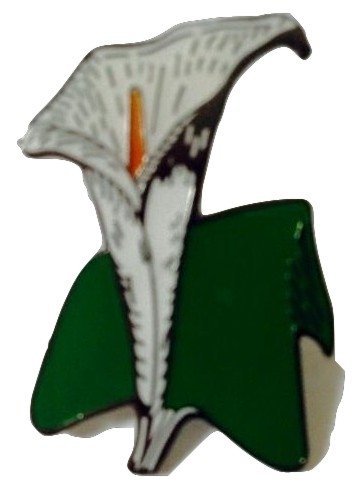
“In 1933, there was difficulty in sourcing Irish-made paper for the artificial flowers, and as Cumann na mBan were spearheading a ‘buy Irish’ campaign, a decision was taken to stop making the flowers and instead create a paper flag/badge, which could be worn on the lapel. However, the Lilium longiforum/ Easter Lily did not transfer well to the flag and the resulting image is more like the Calla Lily. The design they chose is the same design that is sold to this day.
The design of a typical (pinned) paper Easter Lily badge nowadays. (Image sourced: Internet)
“In 1937 Cumann na mBan made a statement about the money raised by the Easter lily campaign:
‘The men of Easter Week laid down a very definite road for the Irish people to travel towards freedom… All those who support the lily campaign can rest assured that the money raised is devoted to no other purpose than the propagation of these ideals and the securing of the necessary materials for their realisation.‘”
The Calla Lily (Zantedeschia aethiopica), which the paper badge image came mostly closely to represent. (Image sourced: Internet)
THE LILY EXTINGUISHES THE TORCH
Fianna Fáil continued its policy of participation in the Dáil in opposition until it was able to form the Government in 1932, abolished the Oath of Allegiance and brought in a new Constitution in 1937, and soon became the political party most often in Government of the Irish State. On coming into power in 1932 Fianna Fáil unbanned the IRA, released interned Republican prisoners and during the early years Republicans largely supported the party even if they didn’t join it.
Another version of the Easter Lily enamelled badge. (Image source: Internet)
Cumann na mBan continued to sell the Easter Lily and not only they, Sinn Féin and IRA wore and sold it but many supporters of Fianna Fáil also. But in the mid-1930s the differences between Fianna Fáil and Republicans who contested the legitimacy of the Dáil sharpened and during this period too the IRA grew considerably in numbers. Agitation around social conditions within the new state was attracting more people to the IRA as was the struggle against the “Blueshirt” fascist movement and their supporters among the original Free Staters’ political party, Cumann na nGaedheal. In 1935 the Fianna Fáil Government again banned the IRA, along with the Blueshirts.
In February 1935, after the IRA killed Richard More O’Ferrall (due to his eviction of 11 families from his lands in 1934), the Fianna Fáil Government cracked down hard including introducing trial without jury in the Special Criminal Courts and Military Courts, against the sentences of which no appeal was permitted.
The FF party’s leadership instructed its members to stop selling the Lily. However, as many would no doubt at least continue to purchase and wear the emblem, the party attempted to introduce a replacement badge, the “Easter Torch”.
Advert for FF’s “Easter Torch” or “An Lóchrann” badge (supplied by Méabh O’Leary, grma)
It was abandoned after a number of years having failed to gain popularity and many FF members and supporters continuing to wear the Lily.
An Easter Lily enamelled pin — there are a number of versions, some with a legend inscribed and some without. (Image source: Internet)
‘STICKIES’
In 1967 Sinn Féin produced a version of the Easter Lily paper badge with a gummed surface on the reverse. This seemed an interesting innovation, doing away with the need for a pin but as the day wearing it progressed, the badge had a tendency to become unstuck at one end or another – and sometimes both – and to curl unattractively.
Sinn Féin and the IRA both experienced an acrimonious split over a number of issues in 1969 from which emerged “Official SF” (and OIRA) and Provisional Sinn Féin (and PIRA). For the annual traditional commemoration of the Easter Rising in 1970, the ‘Officials’ continued with the new gummed version while the “Provos”, less for aesthetical than for symbolic reasons perhaps, reverted to the older pin-secured version of the badge.
Whoever baptised the Official SF and OIRA “Stickies” as a result is unknown but the use of the term became so widespread as to gain almost official (forgive the pun) status. The party continued to be known by that nickname through a number of splits and incarnations and today, the Workers’ Party have not quite shaken it off.
An attempt to baptise the other Republicans as “Pinnies” or “Pinheads”never really gained ground.
Those who sold the Easter Lily in the Six Counties or who wore it were liable to arrest under the colonial statelet’s Flags and Emblems (Display) Act (1954-1987). It was not formally illegal in the Twenty-Six Counties (the Irish State) but sellers were subject to Garda Special Branch harassment under the excuse that the sellers did not have a license to sell (they declined to ask the partitioned State for permission and perhaps they would not have been be granted one). Flags and donations were seized by Gardaí and sellers at times arrested.
“Whenever they tried grabbing the Lilies and money from me, I slung it all on the ground. Let them go picking it all up if they wanted it!” commented a veteran Republican to me a couple of years ago. One can imagine that in such a situation, onlookers might pick the money and badges up, some to return to the victim or his comrades and some perhaps to keep for themselves. In either case, the Special Branch would be presented with the difficulty of badges blowing in the wind and coins rolling in all directions.
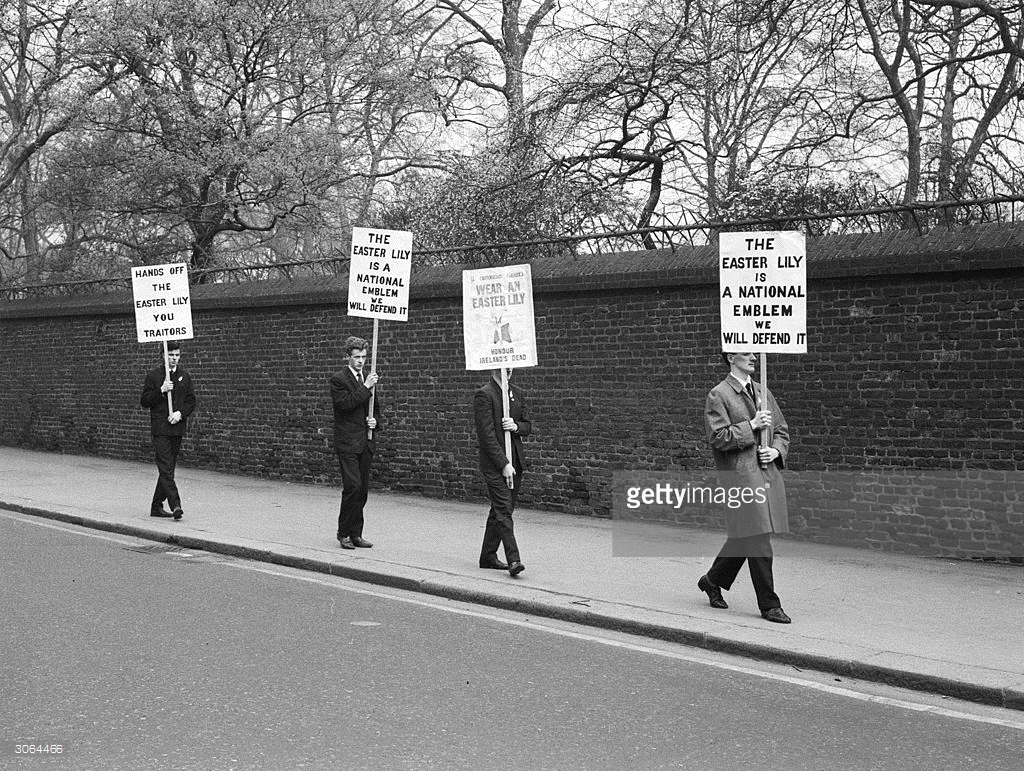
Placard parade defending right to sell and wear the Easter Lily — late 1950s/ early 1960s? (Image source: Internet)
Today, the Easter Lily is visible much less than it was up to perhaps the 1980s. It is viewed by most people who know what it represents (many do not) largely as a Republican emblem (either SF or “dissident”). That is a pity. It should be viewed, I would submit, as a badge of national resistance, of anti-imperialism and as a commemoration honouring generations of men and women who have fought the colonial occupation and exploitation of their land. But let us also remember that it was the women who created the emblem and braved non-cooperation and repression to popularise it.
1 Cumann na mBan (“The Women’s Association”) was an Irish Republican organisation formed in 1914 in Wynne’s Hotel in response to the formation of the Irish Volunteers in 1913. It was organised, as were the Volunteers, along military lines and although set up originally as an auxiliary to the men’s organisation, it had its own uniform, structures and commanders. In that respect and in its insurrectionary intentions, it was the first women’s organisation of its kind in the world. Other revolutionary women at the time joined the Irish Citizen Army, also the first of its kind in the world, where women and men were accorded equal status. Both organisations played prominent roles in the 1916 Rising along with a number of other organisations. Cumann na mBan survived the ICA by a number of decades.
2 See url in References and Further Information at end of article
3 The word “fourth” is a reference by Matthews to the various incarnations of the party which started off as a nationalist one seeking a dual Irish and English monarchy for Ireland, with limited autonomy. The current party to which people normally refer when they say “Sinn Féin” may be seen as the party’s fifth or even sixth version, although the current party claims its origin in the first incarnation.
I’m sick of seeing foreigners everywhere. I mean, don’t get me wrong, I’m not racist or anything …. but they’re just everywhere. And as for Muslims building mosques! Here, in Ireland!
What’s wrong with that? We’ve got hundreds, maybe thousands of churches in Ireland.
Yeah, but we’re a Catholic country.
Do you object to Presbyterian, Anglican, Methodist and Unitarian churches too?
Er … no, they’re Christian religions. Muslim is completely different. We’re a Christian country – always have been.
Actually, no.
What do you mean?
We were pagans once. Before Christian missionaries came in.
OK, before St. Patrick. And yes, I do know he was a foreigner. But since then, we’ve been a Christian country, right?
Yes, I grant you that.
That’s what we need to go back to – Christian Gaelic Ireland.
An bhfuil Gaeilge agat?
No, I don’t speak it. No need to be smart. That’s another thing that was taken from us!
They teach it at school, though.
Not very well. And they force it, which turns people off.
They force maths on people too. And other subjects.
Yes …. well. Anyway, this is getting away from the subject. I was talking about … Getting back to the old Christian Ireland. The Ireland we fought against the British for. Which so many people died for.
James Connolly Monument, across from Liberty Hall, Beresford Place. (Photo: D.Breatnach)
Like James Connolly, Patrick Pearse, Tom Clarke ….
Yes, exactly!
James Connolly was born in Scotland, Tom Clarke in England.
Well I knew about Connolly, but Clarke … are you sure?
Yep, Isle of Wight, SE England.
OK …. but …. they were still Irish, weren’t they …. like our soccer team?
Yes, I agree with you there. And about Constance Markievicz ….
Listen, don’t try that one on me! She married a Polish count – but she was Irish.
She was born in England too.
Was she? Well ok, but of Irish stock too.
Gore-Booth – not exactly a Gaelic name, is it?
Look, let’s go back to Pearse – he was Irish through and through. He wrote in Irish – articles, stories and poems, didn’t he?
He most certainly did.
Well then!
His father was English, though.
What? You’re codding me!
No, seriously. James Pearse was English. And had married previously in England.
Now you’re telling me Patrick Pearse’s father was a BIGAMIST?
No, no, calm down. She died – he was a widower. Thomas Davis’ father was Welsh, by the way.
Thomas Davis Statue monument and fountain, Dame Street, Dublin, Irealand (Photo: D.Breatnach)
Who wrote A Nation Once Again? That Thomas Davis?
Yes. And The West’s Awake.
OK, OK but Thomas himself was born in Ireland, wasn’t he?
Yes. Eamon Bulfin wasn’t though.
Bulfin? Who was he?
He hoisted the tricolour up on the GPO on Easter Monday 1916.
Did he? Was he born in England too?
No – in Argentina.
WHAT?
Yep. And De Valera’s da was apparently Cuban. Dev was born in the USA.
OK, OK, OK – but they were all part-Irish or wholly Irish …. in blood, I mean. Part of what they call the Irish diaspora.
True. But Erskine Childers wasn’t. Totally English.
Ah now you’re trying to wind me up. He was President of Ireland – of course he was born here.
That Erskine Childers was but his Da wasn’t.
OK, so what?
Well, he’s the one who brought the Mausers into Howth. In his yacht. And he was murdered by the Free Staters in the Civil War.
That was him?
The Irish tricolour flag — presented to the ‘Young Irelanders’ by Parisian revolutionary women in 1848. (Image source: Internet)
Yeah, and part of the crew were two women – one born in England and one in the USA. By the way, the Tricolour that Bulfin hoisted on the GPO? You know what it signifies?
Yes. Peace between the original Irish, the Catholics and the descendants of the planters, the Protestants.
OK. Well, that’s not originally Irish either.
What? The Tricolour? Not Irish?
Not originally, no.
Where is it from then? Please don’t say England!
No – Paris. During the Paris uprising of 1848, French female revolutionaries presented it to an Irish Republican delegation.
So the Irish flag before that was …. just Green?
Well, Green yes, often with a harp in gold ….
Yes, Green, forever green, always the Irish colour …
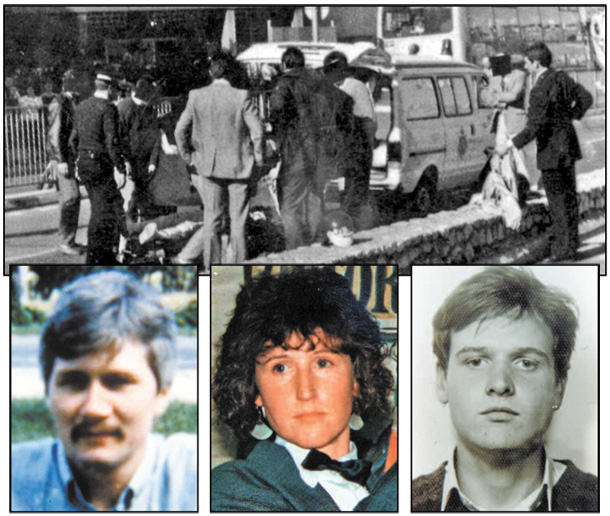
On the 6th of March 1988, an undercover unit of the IRA in the Spanish State was being tracked by Spanish police. As the unit headed in to Gibraltar, their surveillance was taken over by a British Army unit of the Special Air Service. Very soon afterwards, the SAS attacked the IRA unit and shot them down, shooting them again with execution shots on the street. The IRA unit were unarmed and there was no attempt made to arrest them. The SAS claimed that they had a bomb ready to detonate but no such bomb was ever found. The three Volunteers were Mairéad Farrell, Seán Savage and Daniel McCann.
Above: Gibraltar 3 murder scene. Below: Daniel McCann, Mairéad Farrell, Sean Savage. (Source: Stair na hÉireann)
A Gibraltar woman, Carmen Proetta, who witnessed the murders from her flat and testified to what she had seen was villified and libelled in the British media (she successfully sued a number of them later). A Gibraltar inquest judged the killings to have been unlawful. Amnesty International in Britain denounced the killings — one of the few occasions in which Amnesty criticised the British Government with regard to its conduct in relation to the 30 Years’ War in Ireland.
Almost two months after the shootings Margaret Thatcher and her Foreign Secretary Geoffrey Howe tried to prevent an independent British TV company’s documentary on the killings, Death On the Rock and the career of the lead Editor, Roger Bolton, suffered severely, although an independent investigation of the program vindicated the program.
Coffins of the Gibraltar Three being carried through West Belfast (Source image: The Irish News)
Streets of Gibraltar song
By The Irish Brigade (long version) + verse by DB*
Chorus
Oh, sad are three homes in Belfast Town,
all Ireland shares their sorrow;
as they walked in the sun, the Brits drew their guns
and they died on the streets of Gibraltar.
1
They flew out of Belfast with an ambitious plan
to carry the struggle to free Ireland –
Mairéad Farrell, Seán Savage and Daniel McCann –
and they died on the streets of Gibraltar.
Chorus
2
Hidden eyes had been watching, they followed each one They knew they weren’t armed, that none had a gun
They gave them no warning and no chance to run For the three must die on Gibraltar.
3
Each of them unarmed, without mercy gunned down, *
shot again in the head as they lay on the ground
by the Special Air Service, assassins of the Crown –
they were murdered on the streets of Gibraltar.
(Chorus)
4
The SAS stood there, so proud of their deed –
three more freedom fighters shot down in the street:
Mairéad Farrell, Seán Savage and Daniel McCann –
they died on the streets of Gibraltar.
5
Mairéad, while in prison we watched you with pride; True to all you believed in and for this you’ve died With two fine volunteers Dan and Sean by your side — A part of us died in Gibraltar.
(Chorus)
6
It happens each time that a Volunteer dies — They screen out the truth with a cover of lies; But we know what happened on that warm peaceful night The Brits planned their deaths on Gibraltar.
The heights around Phibsboro and Glasnevin were reported snowbound so I decided to head down to the Tesco post for my shopping. Bundled up warm and with boots coated in dubbin, I stepped out into snow powder whipped up by the icy wind. I had to close my eyes to slits when it blew against my face.
Heading towards Drumcondra Tesco station
A whistle woke the dogs and they came out of their snow-holes, shaking themselves and trotting over. Handing out small pieces of meat which they wolfed down, I called Buck to follow me over to the sled, where he sat supervising while I put the other dogs in harness. They were eager to go, skittish, whining, tail-wagging, occasionally growling at a perceived trespass by a team-mate. Buck stared down the most fractious but ignored Bríd altogether. Lately she’d been getting at Buck, undermining him. I didn’t know what to do about it. I couldn’t put her in the lead as, apart from that reversing the problem, the team probably wouldn’t follow a bitch. A dog team is like a wolf pack – there can be a dominant male and a dominant female but in almost all cases the male is the lead, the top dog.
Heaving the sled to left and right a couple of times I broke it free of its ice, took the leads and, with my shouted “Mush!” we were off.
A little later, going down towards the frozen Tolka, I had to apply the brakes a little to ensure the sled didn’t run into the hindmost dogs. They all felt the drag and then the jolt as the left brake hit something hard frozen under the snow, canting the sled momentarily to one side. Buck looked back at me reproachfully. You think dogs can’t look reproachful? Many can … and Buck is a master at it.
“Sorry, Buck, couldn’t help it … couldn’t see it.”
But he was already turned away, his shoulder muscles bunched, pulling along, leading. We crossed the Tolka no trouble despite one of the hindmost dogs slipping for a moment, righting himself some what embarrasedly, continuing. The sled runners hissed from the snow, then a grating tooth-gritting high-pitched scraping and then a low hiss across the ice.
Crossing the frozen Tolka
“Up boy, pull away!” I shouted but Buck was already bunching himself for the slope of the far bank, pulling steadily, all dogs in the traces pulling together. As soon as the sled was clear of the ice I jumped off and ran alongside it, one hand on the sled. As it gained the top of the bank, the dogs already over, I jumped back on and mushed them on to the Tesco post, the wind whipping ice powder towards me, sometimes higher than my head but often only at knee height.
There was another sled there, hitched to the rail outside the post, its dogs still in traces, huddled down against the wall. Swinging the team around by pulling on the leads, I got the sled in near the other dogs with my team furthest away. I didn’t want to come out to the aftermath of an argument between that team and mine.
Hitching the sled to the rail, I walked up to the front entrance, scraped the snow off my boot soles on the steel scraper and slapped it off where I could reach on my fleece-lined jacket. Opening the door, I stepped in quickly on to the mat and closed the door behind me.
Arnka Flaherty was on duty at the register and flashed me a smile.
“Fuar go leor duit?” I enquired.
“It is, yes it is cold enough,” she replied, still smiling, the blue eyes and curly hair looking a little out of place on her broad Inuit face. But her smile would light a dance hall.
I saw a few pairs of snowshoes by the door and guessed some customers had hiked it in. Not too bad really at the moment with snow only a foot to two feet deep most places, though in some hollows you might sink up to your waist in drifts.
Bart was there, a big Dutchman from over Santry way, as I already knew. I’d recognised his sled and some of his dogs outside.
“Bart”, I nodded.
“Diarmuid,” he nodded back.
“Looks like getting worse,” I said.
“Yes, says on the Internet.”
“Best get supplies in then, right?”
“Right.”
So saying, we went about our separate business. In that little exchange, we had enquired without the exact words about one another’s mental and physical health, whether we each had enough fuel and food. And said that we cared about one another and would help, were it needed.
Going through the aisles picking up my items I nodded to the other customers, a spry old woman who must have snowshoed in and two young students from the college not far away, a male and a female, perhaps a couple, perhaps not. Their winter clothes looked on the expensive end of the range.
I picked up some tins of fish (though I might catch some fresh later, hole-fishing through the Tolka ice), frozen meat for the dogs, a bag of tatties and a smaller one of rice, a parcel of briquettes, a bag of porridge oats and laid them in front of Arnka. Then I went back for milk powder, beet sugar, frozen butter, olive oil, frozen greens and a butane cylinder.
Arnka raised her eyebrows at the latter. “Where’s the empty?” she queried.
“I forgot and left it at home. I’ll bring it in tomorrow. I promise.”
She said nothing and started to tot up my account. Perhaps she minded, perhaps not. It was hard to tell with Arka. I paid, bid her slán on my second trip outside with the last of my supplies, waving to Bart and to the old lady on the way.
Outside, the wind had died down below but up above the clouds were moving fairly fast, leaving a clear starlit night. Beautiful but cold and soon to get colder. The dogs were already on their feet, shaking themselves, some whining. I loaded up the sled, pulled by scarf across my nose and mouth and we mushed back homeward, the dogs glad of the exercise and knowing they’d be fed soon. We crossed the Tolka ice, now glittering in the starlight or ghostly shining in places and up the opposite bank, the dogs straining, me pushing the heavy sled this time and trying not to slip ….
Then clear and pulling away up the rise into Drumcondra proper and soon to be home. Hot food and warmth for me, defrosted meat for the dogs and their own holes in the snow, curled up inside and soon warm with the snow piling up around them.
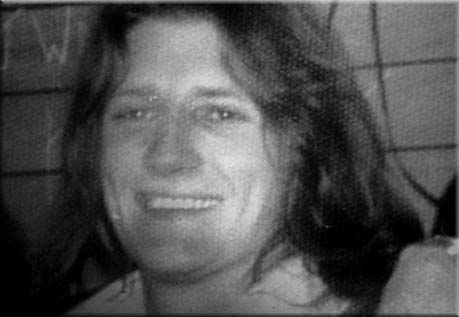
Bobby Sands, Officer Commanding Provisional IRA prisoners in H-Blocks before hunger-strike (Image source: Internet)
Last night, from afar, I watched the Lark die
and inside me, began to cry,
and outside, a little too.
There’s nothing more that can now be done,
to save the life of this toilers’ son;
another martyr – Bobby, adieu.
Imperialism takes once more its toll,
another name joins the martyrs’ roll
and a knife of sadness runs us through.
But sorrow we must watch,
for it can still,
yes, it can kill
the song that Bobby listened to.
And if his death be not in vain,
let’s fuel our anger with the pain
and raise the fallen sword anew;
and this sword to us bequeathed:
let its blade be never sheathed
’till all our foes be ground to dust
and their machines naught but rust ….
Then will the servant be the master
and our widening horizons ever-vaster
and our debt
to Bobby
paid
as due.
(Written in London as the death of Bobby Sands was imminent or had just occurred, after the author had attended pickets and demonstrations in solidarity with the hunger strikers in attempt to avert their deaths by pressurising the British Government to accede to their just demands. Bobby Sands died on 5th May 1981, to be followed by nine others in the weeks and months that followed. The struggle was one for the human dignity of Irish Republican political prisoners of Britain in the Six Counties British colony).
Senior Metropolitan Police officer accompanied by Constables harass Sands solidarity protesters in London (Image source: Internet)Skylark in Flight (Image source: Internet)Gates Long Kesh (Image source: Internet)
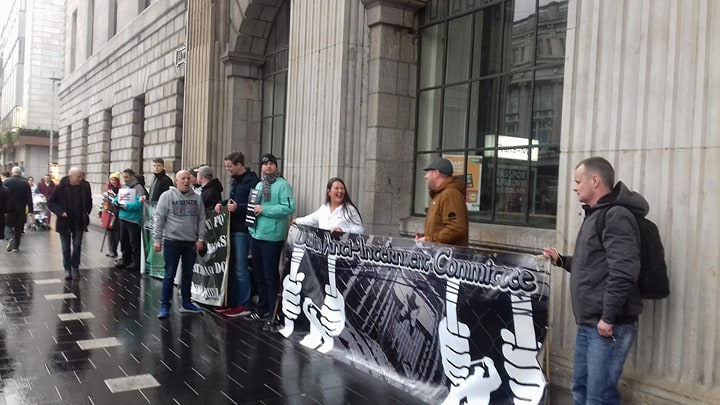
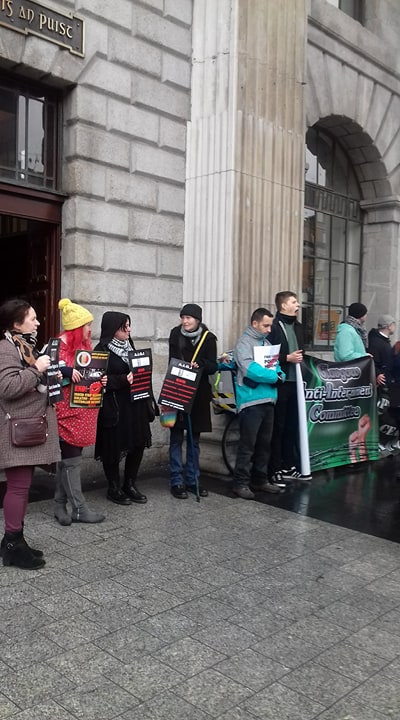
Glasgow and Dublin Anti-Internment Committees joined forces on 18th February in a protest against continuing internment without trial in Ireland. Around two score protesters gathered outside the iconic General Post Office building in Dublin city centre’s main thoroughfare, O’Connell Street. They displayed the anti-internment banners of the Dublin and Glasgow committees and placards against internment, including one against the jailing of Catalan political activists by the Spanish state (also refused bail).
Section of protesters outside the GPO building, O’Connell Street, Dublin (Photo source: End Internment FB page)(Photo source: End Internment FB page)
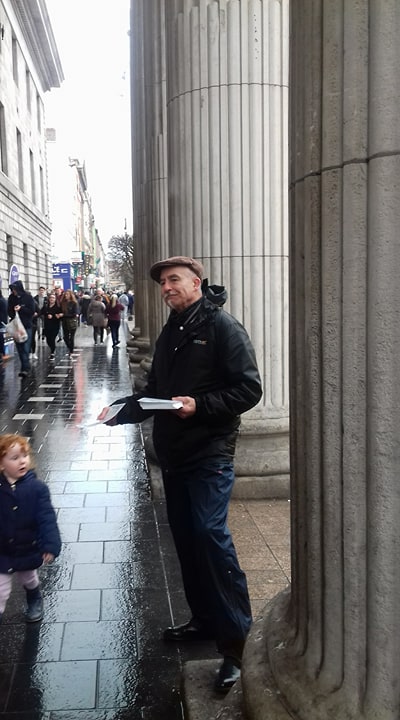
Leaflets of the Anti-Internment Group of Ireland were distributed to shoppers and visitors passing by, along with others about the conviction of Brendan McConville and John Paul Wooton (the Craigavon Two), framed and jailed in 2009 and still in jail, serving life sentences. Songs about internment and political prisoners were played on a sound system, as well as Labi Siffre’s Something Inside So Strong and Christy Moore’s Viva La Quinze Brigada.
Young passer-by accepts leaflet from Dublin Committee leafleter (Photo source: End Internment FB page)
Despite the official end of internment by the British in 19751and by the Irish state in 19572, Republican activists continue to be jailed without trial in a number of ways: Licence revoked and bail refused or revoked.
(Photo source: End Internment FB page)
When a Republican leaves jail under license, she or he can be returned there without any court hearing or the presentation of any evidence against them; this is what has happened to Tony Taylor and Gerry Mackle, for example. Refusing bail for accused Republicans has become almost standard, despite the fact that this is supposed to be a last resort, for example when there is a serious risk of the accused fleeing the administration, or interfering with witnesses – which has rarely applied to Republicans refused bail. The real reason has usually been revealed when they have been granted bail: they are required not to attend protests, meetings or to associate with other active Republicans. In other words, they are being prevented from exercising their civil rights to express their opinions and to organise politically.
Welcoming the participation of the Glasgow Committee in Dublin, a spokesperson for the Dublin Committee stated that “members of the Dublin Committee have been proud to attend anti-internment protests in Glasgow in the past” and went on to say that “we look forward to future cooperation with the Irish diaspora and internationally against political repression, particularly of jailing without trial of political activists.”
Another Dublin Committee leafleter. (Photo source: End Internment FB page)
The Dublin Anti-Internment Committee is entirely independent of any political party or organisation and holds regular awareness-raising protests at different locations. The Committee welcomes the participation of other organisations or individuals in their protests but asks them not to bring political party material etc to the anti-internment protests.
On its FB page the Committee also maintains a list of Republican prisoners in jails on both sides of the British Border, updating it from time to time.
FOOTNOTES
1By then more than 1,900 people – only around 100 of them Loyalists – had been interned, many of them tortured; it was during protests against it in 1971 in Ballymurphy and 1972 in Derry that the Parachute Regiment killed 25 unarmed people.
2Introduced by De Valera’s government in July 1957 during the “Border Campaign” of the IRA.
(Photo source: End Internment FB page)(Photo source: End Internment FB page)
10th ANNIVERSARY OF DEATH OF VOLUNTEER BRENDAN HUGHES COMMEMORATED IN DUBLIN
(From the End Internment FB page, courtesy of the Dublin Committee of the Anti-Internment Group of Ireland)
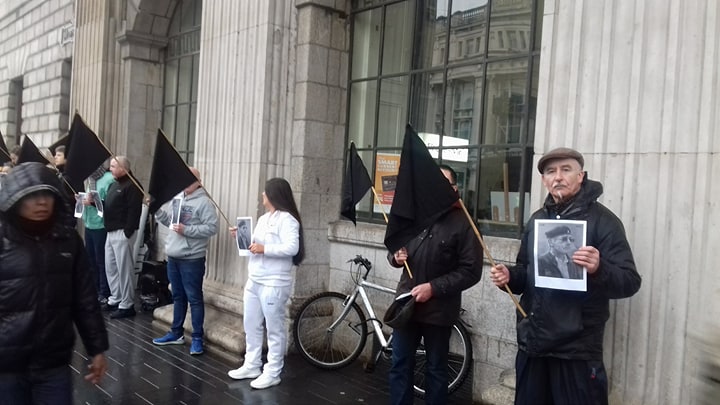
Irish Republicans (mostly independent) and a number of anarchists and socialists commemorated Brendan Hughes (“The Dark”) today (18th Feb 2018) at the General Post Office building in O’Connell Street, main street of Dublin. Republicans from Glasgow also participated.
People with black flags and portrait photos of Brendan Hughes outside the GPO building in Dublin marking the 10th anniversary of the freedom fighter’s death. (Photo source: End Internment FB page)
Around two score assembled with black flags and portraits of the IRA Volunteer who died aged only 59 ten years ago (2008). Hughes was from a Belfast Republican working class family and entered the struggle, enlisting in the Provisional IRA in 1969. He was arrested in 1973, beaten and jailed but escaped, leaving Belfast but subsequently returning to Belfast, to the Malone Road middle-class area under an assumed name while he continued in his resistance activities.
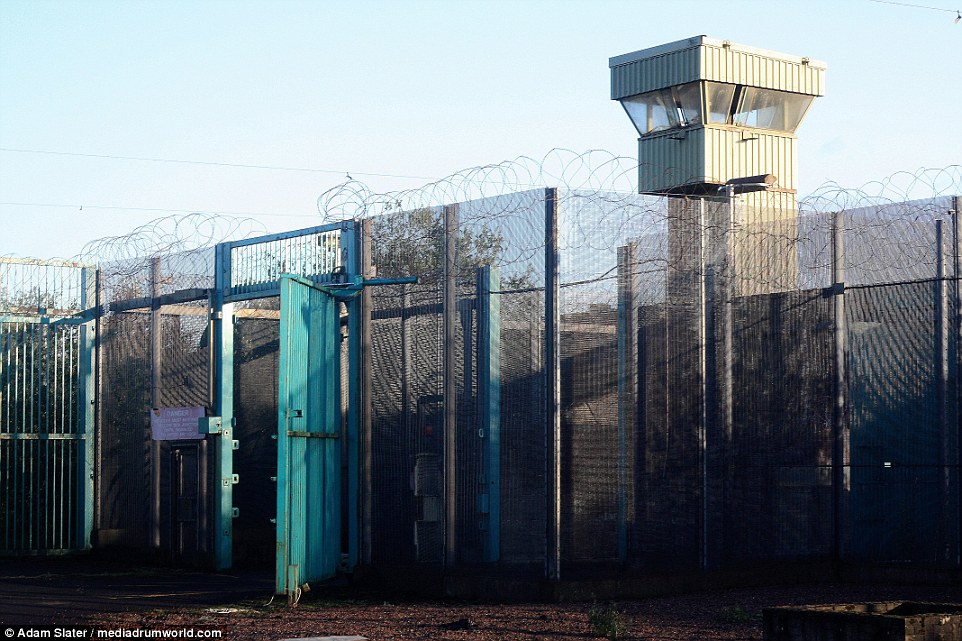
Captured again in 1974 with a number of firearms at his address he was sentenced to 15 years in jail. In 1973 he was convicted of assaulting a prison guard in the jail and was sent to Long Kesh. This was after political status had been removed from Republican prisoners and Hughes joined the “blanket protest” (refusing to wear prison uniform). Later he led the “dirty protest” (prisoners refused to “slop out” after being beaten by guards and emptied their bodily wastes out the windows until these were blocked up, then out under their cell doors, until they were swept back at them and finally on to the walls of their cells).
Hughes began hunger strike which he maintained for 53 days in 1980, ending with others only after what appeared to be a deal offered by Thatcher. It is believed his health never recovered from his prison experiences; he suffered from problems with his heart and eye problems, in addition to arthritis.
Brendan Hughes in Youtube program exposing the pacification process. (Image source: Youtube)
Released from jail after 10 years, he became a serious critic of the “Peace” (pacification) process; according to his brother, Hughes asked that his former comrade Gerry Adams not be permitted any role in his funeral. His brother admitted later that he had bent to pressure and had allowed Adams to carry Hughes’ coffin.
Brendan “The Dark” Hughes died on 16th February 1998.
When one hears or reads the words “Gaelic Ireland”, the reference usually takes one of four forms:
Historical
Geographical-cultural
Nostalgical
Sneering
Historically
“Gaelic Ireland”, when used in a historical sense, is a reference to either a time when the majority of Irish people spoke the Irish language (up to 1800 CE many scholars agree) or to a time when the Gaelic order of society was dominant or when the Gaelic Order survived in some part of Ireland (for example up to the Flight of the Earls in 1607) .
Geographically-Culturally
Perhaps used to describe those shrinking parts of Ireland where Irish remains the mother tongue, more normally called the “Gaeltacht” or “Gaeltachtaí”.
Nostalgically
This is a usage which corresponds somewhat to the historical sense above but is also imbued with nostalgia, a regret for what passed then and perhaps a wish to restore it. Despite the accusations of many of those hostile to the Irish language, relatively few people — including among Irish speakers, have any wish to return to that historical period.
Sneeringly
When referred to in this way, it is to link Irish-speaking with out-of-date things, some kind of anachronism, a backward thing, not suitable for our modern society; frequently linked also to Irish nationalism and De Valera’s concept of the desirable kind of society for Ireland and the 1937 Constitution, therefore linked also to the social and political dominance of the Catholic Church. Such a disdainful attitude is often connected to the disparaging way in which a person may speak about a “Gaeilgeoir” — it is as though the person referring to the Gaeilgeoir, which originally meant only “Irish language speaker”, has in mind a devout Catholic wearing an Aran jumper and generally unfashionable clothes and hairstyle, with a gold “fáinne” (a ring-shaped pin awarded for proficiency in Irish) in his or her jacket (probably Irish tweed).
I fear that this type of attitude is present in most enunciations of “Gaelic Ireland” — certainly outside those of the historical sense.
Although by no means associating the writer of a recent article with this contemptuous opinion of Irish speakers, there was more than a hint of a disparaging attitude expressed, in my opinion, in an article much-praised by many Republicans and some socialists, commenting on the racist expressions of some people after the recent lethal incident in Drogheda recently. Dieter Reinisch, whom I understand to be a left-wing Irish Republican, wrote to separate Irish racist commentators on the recent fatal incident in Drogheda from Irish Republicanism.
The article had a progressive intent and made some valuable points but it also linked this Irish racism with “Gaelic Ireland nationalism”1. Although the article does this through reference to individuals it smears “Gaelic Ireland” through doing so. I would doubt that those Irish racists were even Irish speakers, never mind campaigners for the retention of the language.
IRISH NATIONALISM AND REPUBLICANISM
Reinisch is of course correct historically to say that Irish Republicanism is not fundamentally linked to “Gaelic Ireland” but what is the point he is making? Irish nationalism as a force, in the sense of wanting and acting to achieve an Ireland under its own cultural-social order and not under the economic, social and political rule of a foreign power, can be traced as far back as the time of the O’Neill and O’Donnell partnership, who tried to unite the clans of the native people, the Gael, to oust English occupation from Ireland. They came close to succeeding but in the end, failed and with their exile and that of other Irish clan chiefs the Gaelic Order of society collapsed. The Gaelic Order by the way was in many ways socially superior to that of the feudal Norman invaders, which is one reason why most of the invaders adopted so much of it that, less than two centuries after the start of their invasion of Ireland, their England-based relatives called them “the degenerate English” and passed laws to forbid their adoption of Irish custom and law and end their integration into Gaelic Ireland.2
Irish nationalism continued to try to assert itself, finding large-scale expression at two particular moments in the 17th Century – firstly against Cromwell and secondly against William of Orange. Irish nationalism at that point fought in alliance with the Gall-Ghael, the Irish-speaking or bilingual descendants of the Norman invaders (“the degenerate English”, according to their England-based relatives in 1366), who were mostly concerned with preserving and defending their religion against the imposition of the English Reformation.
A kind of Irish nationalism later began to develop among the colonial settlers, a similar type to that expatriate or colonist nationalism developing among the colonists of Northern America and of what is now called Latin America. Since what made them Irish rather than English, Welsh or Scots was that they lived in Ireland (and for many, had been there for a few generations), they looked through the history of Gaelic Ireland to establish a historical background. They organised the Granard Harp Festival in 1786 and the Belfast Harp Festival in 1792. Edward Bunting noted down the airs played at the latter and published a collection in 1796 (and twice again over following decades).
The colonists of North and Latin America did not, for the most part, incorporate the original natives into their new nationalism3. They did not incorporate them in Ireland either but the United Irishmen did have that as their program and they did try to make it a reality. When Grattan’s attempt to open the Anglican-sectarian Irish Parliament to Presbyterians and Catholics failed through bribery and fear of Anglicans being outvoted, of planters losing the lands their ancestors had grabbed, the United Men became convinced that only armed insurrection could bring about a majority (male) democracy and Irish control of Irish affairs. And the symbol on their flag was that of Gaelic Ireland: the Harp. Underneath it, they had the words: “It is new-strung and shall be heard”.
United Irishmen Harp Motif (Image sourced on Internet)
Reinisch in his article quotes approvingly on three separate occasions from the writings and speeches of Seán Ó Brádaigh. It might surprise some readers to know that this same Ó Brádaigh and his brother the late Ruairí, were Irish-speakers and writers and promoted the speaking of the language.They were for a Gaelic Ireland, albeit a Republican one. They and the organisation they helped create, Provisional Sinn Féin and Provisional IRA, unfortunately in many ways bowed to the influence of the Catholic Church, even thoughthe hierarchy and many clergy denounced them continuously. Mac Stiofáin, who also gets a mention in Reinisch’s article, told me once that although he believed Church and State should be separated, in true republican fashion, also maintained that there should be no freedom to propagandise against religion!
Could Irish Republicanism in the 1700s not have adopted the language of the majority of the people? Some did indeed learn Irish and probably most Ulster Presbyterians, at least outside Belfast city, were at least competent in the basics up to 1798 and many probably fluent. It is hard to imagine that anyone living in Mayo in that year, whether planter or native, was not conversant with the Irish language and certainly it would have been the language of the vast majority there and in the surrounding counties. Wexford is generally agreed an exception by historians, in having been the most Anglicised of Irish counties in 1798.
English was the dominant language of the State and of the colonist administration. But also of the United Irishmen leaders, we can assume – certainly it was the dominant language of their political discourse as recorded in both their own publications and in the reports of the Crown spies and witnesses. Radical and revolutionary ideas were coming in from Revolutionary France and from the revolutionaries of the United States, as Reinisch relates but also very importantly from England – for example Tom Paine’s “The Rights of Man”. The native Irish were either totally excluded from the strata of society where – and the language in which — these ideas were being discussed or they occupied a much more insecure position in which they tried to improve their situation through English without calling down disfavour or even repression upon themselves. There was probably a strata which tried to advance itself under colonial rule and considered that Irish would ‘hold them back’.
There is very little contemporary folk record in existence in Irish of the United Irishmen and one must go to Mícheál Óg Ó Longáin4, Irish language scholar, poet and Unitedman who was “out” or “up” that fateful year, to find his “Buachaillí Loch Garman” (“the Boys of Wexford”) and lyrics of “Sliabh na mBan” to the song’s wonderful air …. and probably “Maidin Luan Chincíse” too.5
The Rising of 1798 failed as did Emmet’s attempt in 1803. Irish Republicanism and Irish nationalism continued to exist and were partly asserted by O’Connell’s campaigns for Catholic civil rights and repeal of the Union as well as by trends such as those of Mitchell and the “Young Irelanders”, most of the latter being Protestants and often hostile to what they saw as O’Connell’s linking Irish nationalism to Catholicism. Mitchell was not a democratic republican but other Young Irelanders were.
Here again, the creation (or renewal) of an Irish nationalism did not incorporate the Irish language although there were nods in its direction. Again, most of its leaders were Protestants but they looked back, as others of colonist background had before, to a Gaelic Ireland. Take Thomas Davis’ celebration of the 1798 uprising in Mayo:
That chainless wave and lovely land Freedom and nationhood demand; Be sure the great God never planned For slumb’ring slaves a home so grand. And long a brave and haughty race Honoured and sentinelled the place. Sing, Oh! not even their sons’ disgrace Can quite destroy their glory’s trace.
For often, in O’Connor’s van, To triumph dashed each Connacht clan. And fleet as deer the Normans ran Thro’ Corrsliabh Pass and Ardrahan; And later times saw deeds as brave, And glory guards Clanricard’s grave, Sing, Oh! they died their land to save At Aughrim’s slopes and Shannon’s wave.
Davis here looks to the history of the Gaelic clans of Connacht resisting foreign invasion, incorporating also the mostly Gaelicised Norman-Irish clan of Clanricarde, the Mac Williams who became Burkes or De Búrca.
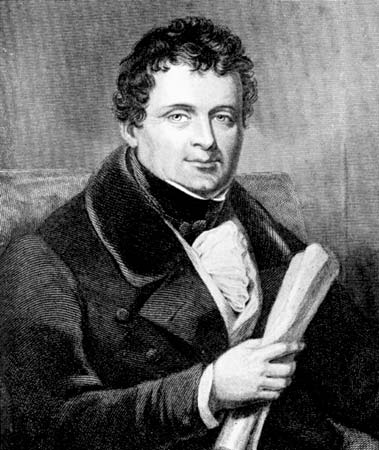
It is well to remember, particularly for those who link “Gaelic Ireland” with Irish Catholic nationalism, that many of those prominent in the latter category had no time for the Irish language – in fact, on that issue at least, they would have seemed very at home among those today who say the words “Gaelic Ireland” with a sneer. Daniel O’Connell, who was a native Irish speaker and apparently spoke only Irish until five years of age, stated that he was “sufficiently utilitarian not to regret ….. the gradual abandonment” (of the Irish language) – and this at a time when probably 40% of the country’s population were Irish-speaking.
Portrait of Daniel O’Connell, campaigner for Catholic rights and the repeal of the Union — but no lover of the Irish language (Image source: Internet)
Irish nationalism and republicanism continued as a strong thread through Irish history, peaking again in the late 19th Century with the Fenians. The Irish Republican Brotherhood or ‘Fenians’ as we know them in that period today contained many Irish-speakers including the famous O’Donabháin Rosa, who wrote his biography in Irish but the Irish language was still not their main language of political literature.
Some of the IRB were deeply working class and they were accepted into the First International Working Men’s Association in England, championed by Marx and Engels (the latter was learning Irish with the intention of writing a history of Ireland which sadly he did not bring to fruition). In the USA also most of the Fenians would have been working class although they included some of the upper middle class among the Irish diaspora. The Fenian conspiracy in Ireland was discovered and plans for insurrection largely upset, leaders and journalists arrested and the military units considered at risk sent away out of Ireland.
IRISH LANGUAGE REVIVAL
Another kind of Irish nationalism saw a resurgence in the later years of the 20th Century and, again, it was the Anglo-Irish, descendants of planters and mostly Protestant, who were the intelligentsia leading it. A kind of antiquarian and romantic interest in the Irish language and culture was followed by a more practical and restorative one and the Gaelic League (now Connradh na Gaeilge) was founded in 1893 by a group led by Douglas Hyde (Dubhghlas de hÍde)6, an Anglican and son of Anglican clergy, who became fluent in the language. This was followed in 1898 with the founding of the Irish Texts Society, a publishing initiative with Hyde as one of the founders and its publication of Dineen’s thick dictionary, Foclóir Gaedhilge agus Béarla, which was first published in 1904 (and still a wonderful source of words and phrases).
The Gaelic League promoted Irish dance, games and culture in addition to the language. Although Hyde’s passion for an Ghaeilge originated in his childhood and early adolescence in Co. Roscommon, he graduated in 1884 as a Moderator in Modern Literature from Trinity College, Dublin, where he had became fluent in French, Latin, German, Greek and Hebrew.
The League/ Connradh grew fast, branches and courses attracting not only the Anglo-Irish aristocracy and upper middle classes but also other social strata. In fact it became a mass movement, with 600 branches in 1903 and through its influence the language was introduced to 1,300 national schools.7
A year later, Conradh na Gaeilge’s membership extended to some 50,000 members in 600 branches8, probably assisted by rising nationalist feeling but in turn it certainly fed that outlook. As a mass movement, it took in professionals and others of middle-class background, as well as labourers and tradesmen.
Among the many prominent Irish nationalists and Republicans (called “progressive nationalists” at the time) of those years was Patrick Pearse/ Pádraig Mac Piarais and Reinisch reminds us that his father was not Irish. Son of a Cornishman and Unitarian who formally converted to Catholicism, Pearse soon gained prominence as a writer and speaker in both English and the Irish language and also founded a school to teach through the medium of the Irish language.
Like many other active Republicans of his day, Pearse was recruited into the IRB and chosen to give the seminal oration at the interment of repatriated Fenian O’Donobháin Rosa’s body in 1915. As related earlier, O’Donobháin Rosa was an Irish speaker and when Pearse spoke at his grave, first in Irish which is rarely quoted, in the rest of his speech in English he said: “The clear true eyes of this man almost alone in his day visioned Ireland as we of to-day would surely have her: not free merely, but Gaelic as well; not Gaelic merely, but free as well.”
Pearse was chosen again as Commander-in-Chief of the insurrectionary forces in the 1916 Rising. Pearse’s memory is often attacked by ‘revisionist’ historians and some of the “Gaelic Ireland with a sneer” crowd – accusations of a repressed homosexual identity, of ‘green nationalism’, of blood-thirst etc. However, a fair assessment of his life would reveal a political activist who sympathised with the workers fighting the Lockout in 1913 and objected to Redmond’s refusal to allow women to speak at a meeting on Home Rule; would find also an individual generous with his time and energy, a talented writer who sought the creation of a modern literature in Irish on a par with those of England, France and Germany, as well as being an educator and proponent of progressive youth educational theory that stands well the test of time.
Pearse was among the people that Hyde accused of politicising the language, which Hyde gave as his reason for resignation of the Presidency of Connradh na Gaeilge. Looking back now, we might well ask how could it have been otherwise? Everything cultural of a national aspect was becoming politicised in those years: sport, song, drama, literature, journalism, oratory, lectures, representational art – even cooperatives, trade unions and some commercial ventures – why expect language to be any different? In fact, surely instead expect politicisation there first of all!
The other Irish nationalists of the time, the Irish Parliamentary Party led by John Redmond, ‘constitutionalist’, Catholic and socially conservative, expressed no great interest in the Irish language. Another branch of Irish constitutional nationalism, represented by William Martin Murphy, was no friend of the Irish language either and ran the most vicious campaigns against the Irish Republicans.
Of the Seven Signatories of the 1916 Proclamation of Independence, four (Ceannt, MacDiarmada, Mac Donagh and Patrick Pearse) were members of the Connradh. The remaining three were at least neutral or approving of the movement. Of the fifteen executions by British firing squads and one by hanging following the Rising, at least six were members of the Gaelic League. Large numbers of activists and leaders in the Republican movement from 1916 to 1922 were Irish speakers, either fluent or at least competent and christening records of the period show increasing numbers of Irish language names (or Irish versions of names from abroad) given to children. This period was the last great flowering of the Irish language as a mass movement in modern history.9
What of the Left in Ireland? A house painter by trade, Peadar Kearney (Peadar Ó Cearnaigh)10 of Catholic background joined the Gaelic League and at some point attendees at Irish classes he taught included the socialist writer and founder of the Irish Citizen Army, Sean O’Casey11 (Seán Ó Cathasaigh), of Anglican background. Irish was taught in Liberty Hall, HQ of the Irish Transport & General Workers’ Union.
Later, native Irish speaker Peadar O’Donnell, republican fighter, socialist activist and writer, was employed for a while teaching in Aranmore, Co. Donegal, an Irish-speaking area, where he apparently adopted socialism and joined the IT&GWU, for which he also became an organiser. In later years he founded the ill-fated Republican Congress, fought against Franco and founded The Bell literary journal. O’Donnell seems to have written little in Irish but in his acclaimed “Islanders”, the construction of dialogue is clearly derived from the Irish language. Later still, Brendan Behan (Breandán Ó Beacháin), a socialist Republican, wrote in Irish and in English and a Republican who became a Marxist, Connemara man Máirtín Ó Cadhain12, wrote in Irish and campaigned on the rights of Irish speakers and of people living in the Gaeltacht.
In and around those names there would have been many others, Left activists and supporters, unknown now but native speakers or those who learned the language, thought it important and spoke it.
Many socialists seem sometimes to think that the “unity of the working class” is best achieved by doing away with different cultures. They seem to forget that though there is one working class, there are a great many national cultures — and what a poor world it would be if those cultures disappeared.
THE STATE AND POLITICAL PARTIES
Some of the attacks on “Gaelic Ireland” seek to tie it first of all to the right-wing neo-colonial state set up in 1921, or the form it took after 1922, or as mentioned earlier, the De Valera/ Fianna Fáil state from the mid-1930s.
The New State
When the Irish Free State was set up as a compromise with British imperialism and colonialism, backed by a section of the nationalist-Republican movement and in alliance with Irish gombeen capitalism and the Catholic Church, it was actually a very insecure and uncertain endeavour. This perhaps explains the ferocity of the State in the Civil War and afterwards, with large-scale repression, 83 official executions and around a 120 assassinations of Republicans – in less than a 12-month period. Two years later, in 1924 the State faced an attempted Army mutiny and possible coup d’etat, led by Major-General Liam Tobin, with a number of prominent right-wing nationalist politicians in support.
The new owners of the State tried to ensure that nationalist symbols were not left unclaimed to be appropriated by Irish Republicans and so appropriated them themselves: the Tricolour, the Soldiers’ Song and the Irish language. However, this was no foregone conclusion nor an easy process. They had to bear in mind also the British, who had merely stepped off stage into the wings, who were also on stage in the Six Counties, as well as the large constituency of Unionists on both sides of the Border.
For example, God Save the King was played and sung at some State and many other formal occasions, though The Soldiers’ Song was sung by many Republicans. Let Erin Remember was the song favoured by some in the State and it was the air played for the Irish State at the 1924 Paris Olympics. After a struggle, The Soldiers’ Song was finally agreed as the National Anthem in 1926.
Far from being enthusiasts for any kind of “Gaelic Ireland”, the new State continued to use English as the language of administration, even in areas where 80% of the population were Irish-speaking.
A qualification in Irish was required to apply for state jobs but a high level of fluency was not needed13, “and few public employees were ever required to use Irish in the course of their work. On the other hand, state employees had to have perfect command of English and had to use it constantly. Because most public employees had a poor command of Irish, it was impossible to deal with them in Irish. If an Irish speaker wanted to apply for a grant, obtain electricity, or complain about being over-taxed, they would typically have had to do so in English.”14 As late as 1986, a Bord na Gaeilge report noted “…the administrative agencies of the state have been among the strongest forces for Anglicisation in Gaeltacht areas”15
The two main daily newspapers at the time in Ireland were the right-wing nationalist Irish Independent and the Unionist-minded Anglophile Irish Times16 and neither promoted the Irish language nor even covered Gaelic games, although they reported on rugby and cricket matches.
Fianna Fáil and the Blueshirts
Fianna Fail was created early in 1926 and in 1932, only six years later it was in government of the State. One year later, the right-wing Army Comrades Association adopted the uniform which included the blue shirt and by that time had over 30,000 members and battles were taking place between them and the IRA and other Republicans. Eoin O’Duffy had been an IRA guerrilla leader in the Irish War of Independence, a general in the Free State Army in the Civil War and Commissioner of the state’s police force, the Garda Síochána from 1922 to 1933. After Fianna Fáil’s easy re-election in February 1933, De Valera dismissed O’Duffy as Commissioner and a few months later O’Duffy took leadership of the ACA and renamed it the National Guard, adopting the straight-arm Roman salute favoured by the fascists.
That same year the Blueshirts planned a march on Dublin, believed my many historians to be a prelude to a coup d’etat; certainly De Valera thought so and, unsure of the Army’s loyalty, banned the march and subsequently outlawed the organisation. That year also Fine Gael was formed, incorporating the Blueshirts, Cumann na nGaedhal and the National Centre Party, with O’Duffy as its President.
De Valera founded the daily newspaper Irish Press in 1931 which had an alternative version of its title in Irish – Scéala Éireann – and as well as covering the GAA games, had sections in Irish. However the position of the Irish language in the affairs of the State did not change.
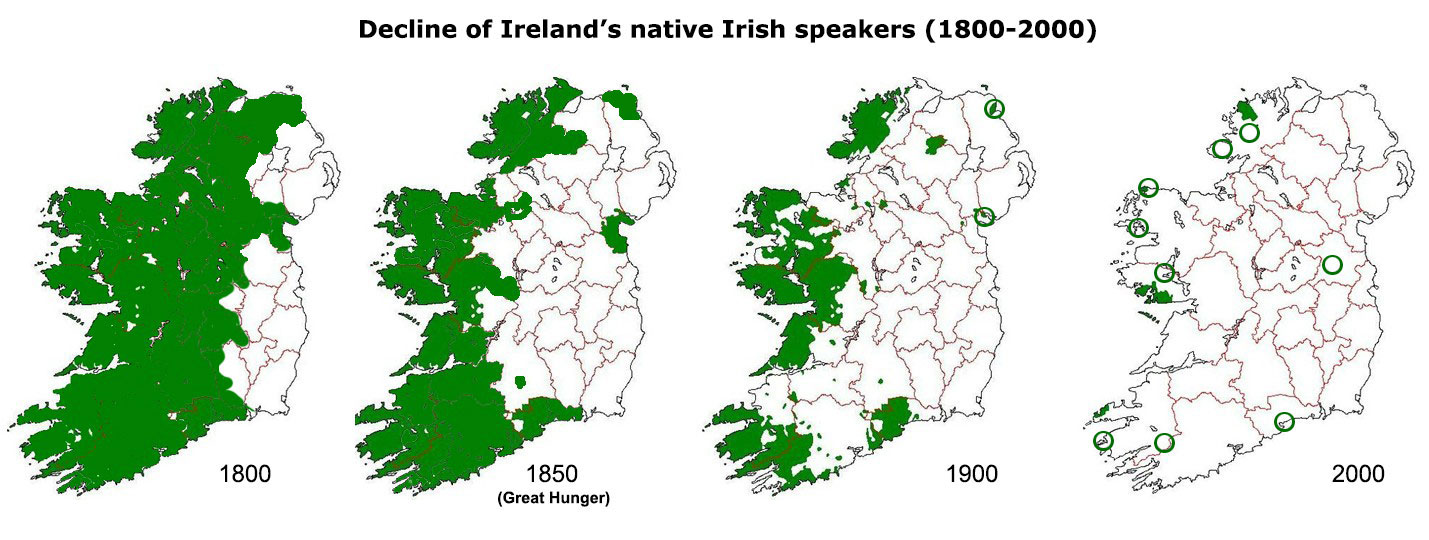
Though the Great Hunger caused he most impressive loss of Irish-speaking modern Ireland on the map, the percentage lost by the Irish state is greater. (Image source: Internet)
Throughout Fianna Fáil and Fine Gael governments, the Gaeltacht – the Irish-speaking areas – continued to suffer deprivation of resources. Even by the early 1960s, many homes in those areas did not have electricity, running water or sewage drains. Primary schools typically had a headmaster and female teacher to administer and teach all subjects at all levels. Deprivation led to massive emigration, not only to the metropolis but also to the USA and to Britain. Today, the Gaeltacht is 9.1% the size of what it was when the Irish State was created or, in other words, the State has presided over a Gaeltacht decline of over 90%17 — as a friend commented: “Not even Cromwell or the Great Hunger wreaked such linguistic devastation”.
In the 1960s, no matter what party was in government or in local authority, Irish-language campaigners had to fight for minimal funding for land allocation, schools and broadcasting in Irish. People went to jail for civil disobedience and were fined for refusing to pay for their TV and radio licences and, briefly, a pirate Gaeltacht radio station was in operation.
The Labour Party and Sinn Féin
The Labour Party, whether to the right or left, has never shown itself to be a friend of the Irish language.
Sinn Fein (Provisional) would nominally be expected to be supportive of the Irish language but the real test is in its campaigning and practice within its own party. Its public and internal meetings are held in English (as with other Republican parties) and throughout the three decades of the war in the Six Counties it did not organise or mobilise the Gaeltacht people to improve their position and defend their communities from emigration and the penetration and eventual supremacy of the English language.
In conclusion, to associate the Irish language or culture with any of the political parties or any administration of the State is fundamentally incorrect from a historical point of view.
FOCAL SCOIR ORIN CONCLUSION
Would those who sneer when they say “Gaelic Ireland” do likewise at the mention of “French France”, “Spanish Spain”18, “Italian Italy”, “German Germany” or “Polish Poland”? I think not. No, national cultures are not sneered at by the Right or the Left in Ireland – only Irish culture and, particularly, the language.
John Kells Ingram19, an academic, mathematician and writer of planter descent from southeast Donegal (and probably bilingual), in 1843 wrote the lyrics “In Memory of the Dead” (better known as “Who Fears to Speak of ’98”). He was decrying the distancing by Daniel O’Connell and his Catholic movement from the deeds and principles of the United Irish Men in 1798. If I may paraphrase him a little to refer to the kind of Irish person today who says “Gaelic Ireland” with a sneer: “He’s all a knave or half a slave, who slights his people’s culture thus”.
3The North American republicans did not admit the Indigenous People as citizens and many set out to exterminate them. Many also condoned slavery and some owned slaves. The Latin American republicans also mostly sought the expropriation of Indigenous people and also organised massacres but, for the most part, abandoned slavery earlier than the USA.
4Cork poet and strong Republican Mícheál Óg Ó Longáin (1766/-1837) is usually credited with writing Buachaillí Loch Garman and Sliabh na mBan (although one source, probably mistaken, credits his son Peadar with the latter two). Mícheál’s work as a scribe, scholar and teacher was a useful cover for acting as a United Irishmen courier.
5There are a few songs from Mayo too, by unknown authors.
6Douglas Hyde (Dubhghlas De hÍde) was elected first Uachtarán na hÉireann (President of the Irish state) from 1938-1945.
10Peadar Kearney was a member of the Irish Volunteers and IRB, fought in 1916 and was interned; he became a prolific writer of nationalist ballads — but also of “Labour’s Call”, a song with very socialist lyrics – and is the co-author with Patrick Heeney of “The Soldiers’ Song”, the national anthem of the Irish state.
11Sean O’Casey (1880-1964) was born in Dublin into a lower middle-class family in straitened circumstances.
12Máirtín Ó Cadhain (1906-1970); interned by the Irish State during the 2nd World War years and later activist for the Gaeltacht which led to the founding of the Rath Cairn Gaeltacht in Co. Meath. Ó Cadhain’s most famous written work, the novel “Cré na Cille” (1949) was later translated into many languages. Ó Cadhain was also a founder and leading activist of the original Irish-language civil rights campaign Misneach which engaged in agitation and civil disobedience (another campaign by the same name now exists) in Dublin and other places.
13Hence the jibe about the mere “cúpla focal” of Irish of politicians and civil servants.
15Advisory Planning Committee of Bord na Gaeilge, The Irish Language in a Changing Society: Shaping The Future, p.41. Criterion, 1986 (quoted in Wikipedia – see Sources).
16Both had called for the punishment by the British of the 1916 Rising leaders but the Independent had actually called for the executions of Connolly and Mac Diarmada.
18In fact, there are ground for objecting to the terminology of “French France” and “Spanish Spain” but only because those two states do not value and even suppress the other national languages within their state boundaries, e.g Euskera, Catalan, Occitan, Corse, Asturian, Galician ….
20Franz Omar Fanon (1925-1961) was born and raised in Martinique; qualifying as an MD and psychiatrist, practised in Algeria during the war of liberation against the French, where he was a covert member of the resistance. Fanon was a politically radical intellectual, Pan-Africanist and Marxist humanist whose written work is very influential in particular in “post-colonial studies”. He described the psychopathology of colonisation in quite accessible writing, showing how – among other things – the colonised internalise the image of themselves projected by the coloniser and aspire to the “sophistication” of the latter and his culture (see two of his works listed in the Sources & References section.