THE SCENT OF SEX — but not for you

  • Diarmuid Breatnach

You sniff the scent of blooms in the air and it pleases you. But that’s not what it’s for – the scent was not manufactured to please you. Scents derived from plants are used by humans to add to their sexual allure and plants also have a sexual function in producing them — but it is not humans the plants are trying to attract.

The scents are there to attract pollinators, insects, mammals or birds that will go to them to collect pollen and/ or nectar, in the course of which they will spread pollen from plant to plant and bring about fertilisation.

There are huge numbers of different chemicals producing scents and combinations of scents and, as the plants have developed them, their pollinators have also developed the ability to distinguish between them and to home in on the appropriate ones. It is likely that inside the pollinators some kind of receptor is created which is keyed into the specific scent, in much the same way as sexual pheromones are keyed into receptors inside so many species, including humans.

Irish Hawthorn (Sceach Gheal) bush or shrub in bloom. Its blooms produce a scent more pleasant to humans at a distance than very close up.  (Source photo: AP.Pfeiffer)

Irish Gorse (or Furze) (Aiteann) in bloom. The scent often reminds humans of coconut.
(Source: Environmental Protection Agency)

These pollinators then, quite unintentionally, dive into another bloom somewhere and like some kind of romantic couriers, deliver the pollen to the eager recipient. But unromantic really, to receive fertilisation from an unknown lover, unseen and barely felt. Yet it works, as around 400,000 flowering plants testify (though not all flowers use scent — colour and form suffice for some). And it will continue to work, as long as there are pollinators around (which is turning out to be a problem with large-scale deaths of bees, by far the most active of pollinators). But the animal kingdom? With some exceptions, its members need the presence of both sexual actors or more and stimuli to engage in sexual activity that will lead to procreation: temperature, light, foods, natural odours, shape, touch, erotic imagining, poetry, music, clothing, colour …. and yes, applied plant and artificial fragrances.

Irish Honeysuckle (Féithleann) in bloom; a climbing plant, its flowers produce a scent pleasing to most humans. (Photo source: Internet)

The scent of flowers is composed of a variety of VOCs (volatile organic compounds), most plant scents being composed of many compounds and some of up to several hundred. Collecting, isolating and analysing these compounds present great challenges to scientists but even small insects know what they mean, like an olfactory equivalent of a neon sign: NECTAR AND POLLEN HERE!.

Some plants emit scent throughout daylight and some at specific times of day only. And some not until after the sun has set. At night of course the plants do not have much competition but which pollinators will be active at night? Moths are the big group here but there are others, such as some bats.

There’s a night-scented shrub near my home that made me want to look into this subject and write about it a little. This time of year at night it is producing a strong sweet scent (with, to my nose, just a touch of urine smell in there too). You won’t find moths flying around at this time of year in Ireland and it’s not attracting bats so I guessed that it’s a foreigner and, where it comes from, that this time of year would be perfect. The shrub in question is the “Sweet Box” (Sarcoccoca confusa) and I was not surprised to find that its “native heath” is in eastern and southeastern Asia and the Himalayas.

The Sweet Box ( Sarcoccoca confusa), non-native, emits its scent at night (Photo: D.Breatnach)

People like the scent but it’s kind of sad when one thinks more about it, what it’s trying to do, like posting a message of sexual availability and procreation-wish on to a dating page and …. no-one replies.

Blooms and other parts of plants also produce scents which do not appear to have any role in attracting pollinators and scientists believe that these are defensive scents to ward off herbivores. In this case the olfactory sign is saying: “HORRIBLE TASTE! REMEMBER?” Not only that but plants can increase the production of such scents as parts of them are being eaten, to the extent that their attacker feels obliged to desist1. And some scientists also speculate that scents for pollinators developed first as scents to discourage herbivores.

Hemlock (Moing Mhear), a very poisonous native plant that looks like cow parsley. It has an aroma unpleasant to humans and probably to herbivores.

Given that some animal appropriators of plant products have learned to home in on the repellent scents of some plants this seems quite likely. Imagine a plant exuding a smell to ward off a herbivore and imagine an insect learning that where that particular smell is to be found, so is food such as nectar or pollen. The sign now says: HORRIBLE-TASTING TO HERBIVORES AND PARASITES but is accompanied by another sign that declares: FREE DELICIOUS FOOD FOR OTHERS! And the plants that most reach and “please” the accidental pollinators will naturally be more successful, be visited more often and spread their genes wider. Unless yet other animals learn to follow that scent in order to consume the plant, or lay their eggs on it for the larvae to feed on the plant. Cabbages and carrots for example, both of which have an odour we can identify, have eggs laid on them respectively by the cabbage butterfly and the carrot fly, which are then fed upon by the larvae as they hatch. And the butterfly and carrot fly find the plants by smell.

It is a difficult balance, to attract pollinators and yet repel herbivores and parasites and no doubt the balance is constantly being adjusted through the evolutionary processes of plants, herbivores, pollinators and parasites, in a kind of dance of love and death.

Cut red roses, often purchased from a florist — but do they have a scent?
(Source photo: Internet)

Those volatile compounds to be found in the scents of flowers almost certainly also make them difficult to keep fresh. The cut flowers business is a billion-euro one and growers have now produced blooms that last longer after cutting than they used to – sometimes for weeks. But scent?One of the most delightful scents to the human nose is that of the rose, about which songs have been sung and poems composed. Go into a florist, go to a bunch of roses and try and smell them — the chances are you won’t be able to.

The real thing, form, colour and scent — a pink rose.
(Source photo: Internet)

Shakespeare’s Juliet, who said that “a rose by any other name would smell as sweet”2 might say today that “A rose without a scent is but half a rose”. When you do find a rose or another flower that is sweetly scented, breathe deep and enjoy the scent … but remember it’s not made for you. It’s for another flower, through the agency of a courier, a messenger.

It’s all about sex. And it’s a jungle out there.

End.

Sources and further information:

Flower fragrance:

https://en.wikipedia.org/wiki/Floral_scent

https://www.scientificamerican.com/article/why-do-flowers-have-scent/

https://www.smithsonianmag.com/smart-news/why-do-flowers-smell-good-349826/

https://www.theflowerexpert.com/content/giftflowers/flowersandfragrances/specific-flower-fragrances

http://www.wildflowersofireland.net/plant_detail.php?id_flower=366

https://phys.org/news/2010-09-species.html

Night-scented shrub near me:

https://www.rhs.org.uk/Plants/16452/Sarcococca-confusa/Details

https://en.wikipedia.org/wiki/Sarcococca

Cut flower industry:

http://www.hortibiz.com/item/news/top-10-cut-flower-exporters-in-the-world/

https://www.ft.com/content/becc846e-3595-11e7-99bd-13beb0903fa3


FOOTNOTES

1Some plants can do this with poisons too

2Romeo and Juliet by William Shakespeare

GEORGE GALLOWAY ADDRESSES ANTI-IMPERIALIST MARCH IN DUBLIN

Clive Sulish

A crowd gathered at the Dublin and Monaghan Bombing Monument in Talbot Street this evening for a short ceremony and the start of a march to rally at the General Post Office building in Dublin city’s main street. The event was organised by Anti-Imperialist Action Ireland “to highlight imperialist war-crimes around the world, from Ireland to Yemen and Syria.”

View of section of crowd before start of event with the Memorial in the background (Photo: D.Breatnach)

View of section of crowd near the Memorial before start of event
(Photo: D.Breatnach)
View of section of crowd near the Memorial before start of event
(Photo: D.Breatnach)
View of section of crowd near the Memorial before start of event
(Photo: D.Breatnach)

As people assembled, a crowd of European youngsters was noted passing by, no doubt part of some scheme to learn English and something of the culture outside their own country. Sadly their teacher passed by the Monument without calling their attention to it.

The bombings on 17 May 1974, killing 33 civilians and a full-term unborn child and injuring almost 300, claimed the highest toll of any event during the 30 Years War and was the deadliest attack in the history of the Irish State. The bombings were organised by British Intelligence agents with Loyalist participation and not one person was ever charged.

It was not a good day for the march and participants came prepared for the worst but the rain stopped just before the event and held off, apart from an occasional drizzle, until after the event, when it fairly lashed down.

George Galloway approaching the Monument to lay a floral (Photo: D.Breatnach)
George Galloway after laying wreath, hat removed for a moment in respect. (Photo: D.Breatnach)

Pádraig Ó Fearghaill spoke first in Irish welcoming all who had attended, outlined the order of events and then called on George Galloway, famous British anti-imperialist politician, writer and broadcaster, to lay a floral wreath at the monument, which he did. Ó Fearghaill then called on Diarmuid Breatnach to sing the Woody Guthrie song about the massacre of mineworkers in Colorado, USA, by capitalists including the imperialist John D.Rockefeller. Breatnach sang “The Ludlow Massacre”.

The march then formed up and, led by a floral wreath-holder and black flags, proceeded up Talbot Street, into North Earl Street and up to the GPO. Along the way they chanted “From Ireland to Palestine- Occupation is a Crime” and “Donald Trump/Theresa May- How many kids did you kill today?” The demonstration received a lot of support from passers by along the way and drivers of cars and buses who beeped to show support. The marchers, some of who were carrying candles or light up boards made there way to the GPO where a further crowd had already gathered.

Section of crowd at GPO (Photo: D.Breatnach)

From well-known activists participating and banners carried it was clear that the march had attracted wide support across sections of the Republican movement in parties and campaigns, with participation of independent activists of republican, anarchist and socialist background.

Section of crowd at GPO (Photo: D.Breatnach)

Outside the GPO building, Ó Fearghaill called on Máire Uí Mhaoileoin to lay a wreath in memory of those who have lost their lives as a result of imperialist war-crimes and then introduced George Galloway, who remarked that he was proud to speak outside the building that had played such a part in the first blow against the British Empire of the last century. Galloway went on to refer to continuing British occupation of the Six Counties of Ireland and imperialist interference in the Middle East and the occupation of some countries. In the latter category he praised the Palestinian Ehed Tamimi, whose 17th birthday was just that day and called her “a leader of the resistance for the whole Middle East”.

Section of crowd at GPO (Photo: D.Breatnach)

Reminding the attendance of the ongoing crime of internment, Ó Fearghaill announced a representative of a campaign around Tony Taylor, who announced he was reading a statement from Lorraine Taylor, Tony’s wife. Taylor, a Derry Republican, was detained in March 2016 and has been in jail since, without trial or even charge.

Section of crowd at GPO (Photo: D.Breatnach)

Presenting Diarmuid Breatnach again to sing the famous Eric Bogle anti-war song “The Band Played Waltzing Matilda” referencing the bush-ballad of “Waltzing Matilda”, the Australian unofficial national anthem. However, following

Section of crowd at GPO (Photo: D.Breatnach)

a suggestion from a participant, Breatnach led the crowd in singing “Happy Birthday” in English and in Irish to Palestinian child-prisoner Ehed Tamimi. After Breatnach’s rendition of Bogle’s song, Ó Fearghaill thanked all the the participants and promised that Anti-Imperialist Ireland would continue to build up resistance against imperialism in Ireland and in the world beyond.

End

Section of crowd at GPO (Photo: D.Breatnach)

“Back Home in Derry” with new air

Bobby Sands, who was the first of the ten hunger strikers to die in 1981, had written a number of articles, songs and poems.  One of the latter was arranged for song by Christy Moore, calling it “Back Home In Derry” to the air of “The Wreck of the Edmund Fitzgerald” (by Canadian singer Gordon Lightfoot).

The rendition here by Diarmuid Breatnach is to a new air composed also by Breatnach.  Although he has been singing it for some years in song sessions, this is the first time it has been posted as a video.

“I thought that the lyrics and the original author deserved a new air”, said Breatnach, a Dublin singer.  “Christy Moore did a great job arranging the lyrics for song.  I hope the new air becomes at least as popular as Gordon Lightfoot’s.”

https://www.dropbox.com/s/dosrz71cmcw1s3p/Song%20Video%20edit%20%202%20made%20jan%202018.mp4?dl=0


“Be Moderate” (or “We Only Want the Earth”) by James Connolly

The lyrics were written by James Connolly and published in his songbook Songs of Freedom in New York in 1907.  Diarmuid replaced the words “labour” with “workers” and “true men” with “true hearts”.  There was no indication of to what air the song should be sung (quite common, the expectation being that being would use a popular air at the time) and it has been put to at least three airs.

Diarmuid Breatnach here sings it to the air of A Nation Once Again (by Thomas Davis, ‘Young Irelander’) which is the air he heard it sung by Cornelius Cardew, an English communist composer.  This air suits it and the arrangement provides a chorus in which people can join.

The recording was done at the weekly Save Moore Street From Demolition campaign table (Saturdays 11.30am-1.30pm) with Bart Hoppenbrouwers videoing.

James Connolly was one of around 350 men and women who occupied the Moore Street area during the 1916 Rising after the evacuation of the burning GPO, which had been the HQ of the Rising.  Connolly was one of five signatories of the Proclamation who spent their last hours of freedom in those houses and one of six of the fourteen executed after they surrendered in Moore Street.

The Irish Government, property speculators and the Planning Dept. of Dublin City Council are all pushing that only four buildings in that battleground be saved and a huge supermarket be built over the whole area but the SMSFD campaign wants the whole quarter saved and sensitively developed.

end.

https://www.facebook.com/save.moore.st.from.demolition/

ISRAEL: FREE ALL THE CHILDREN!

Diarmuid Breatnach


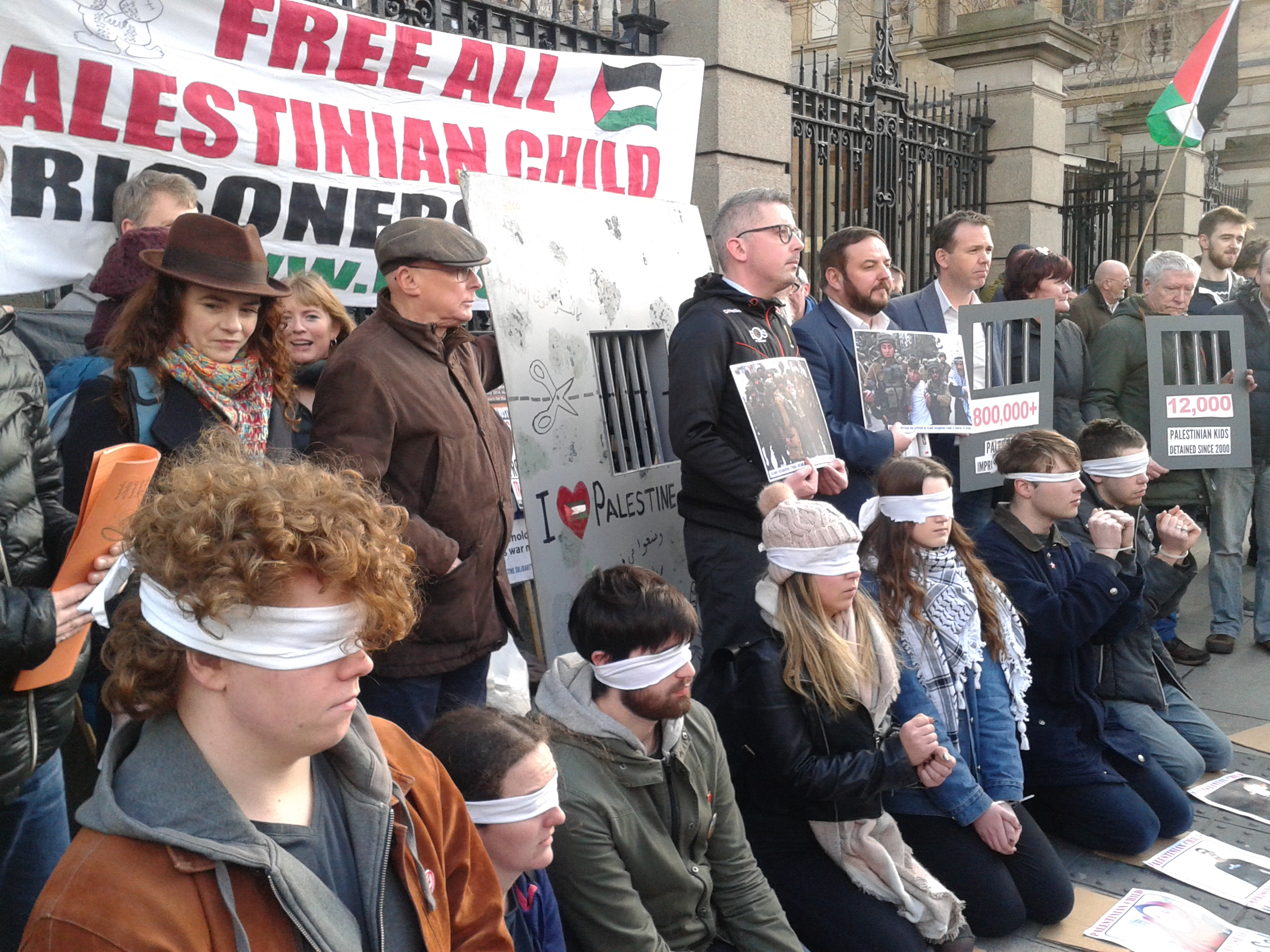
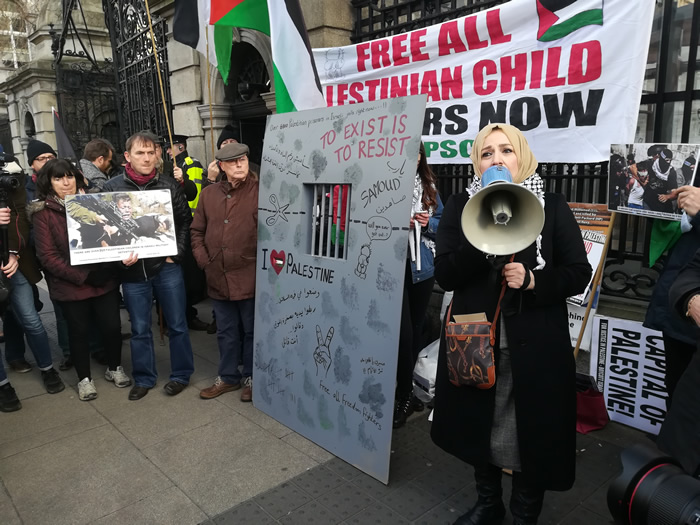
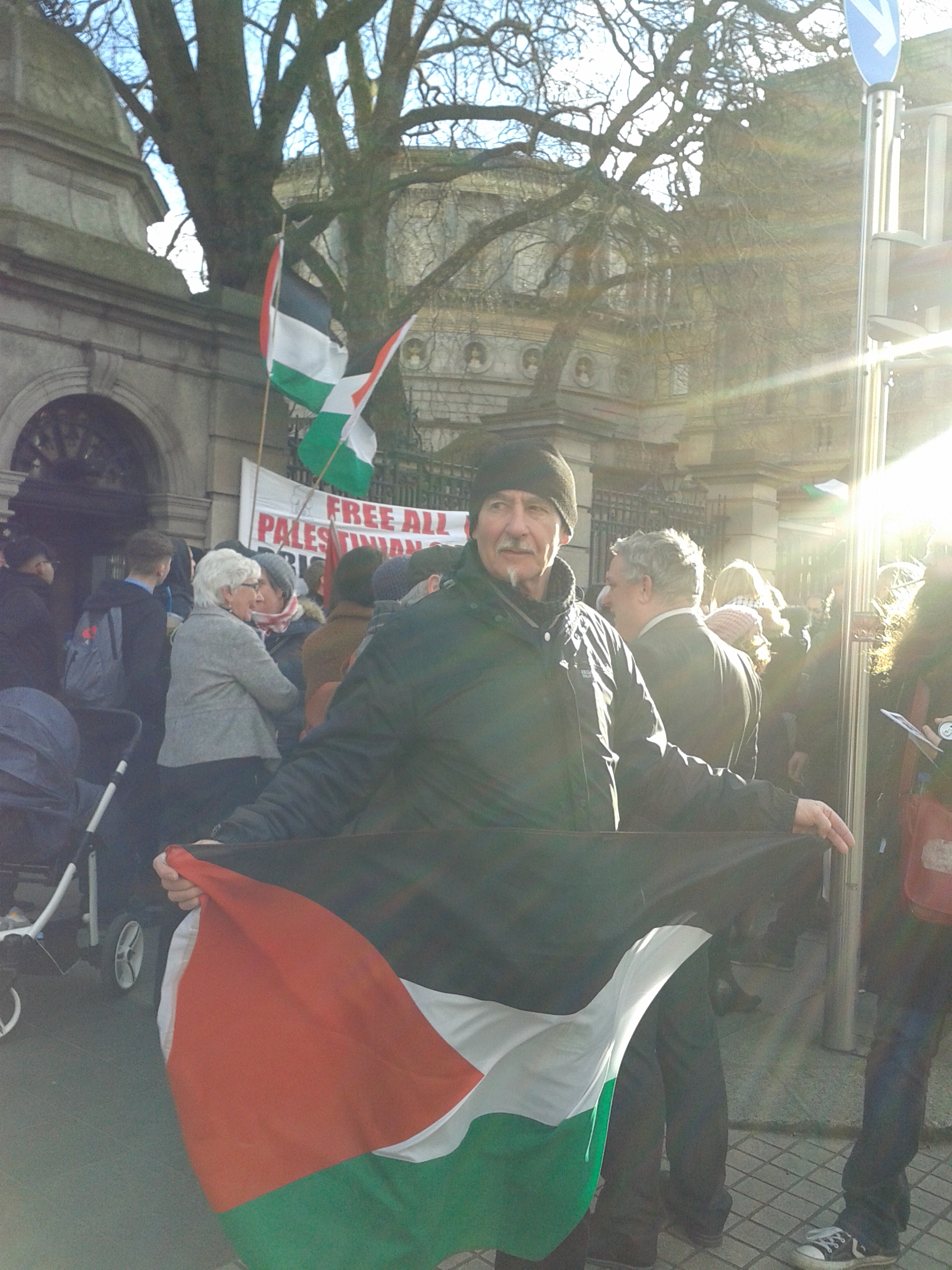
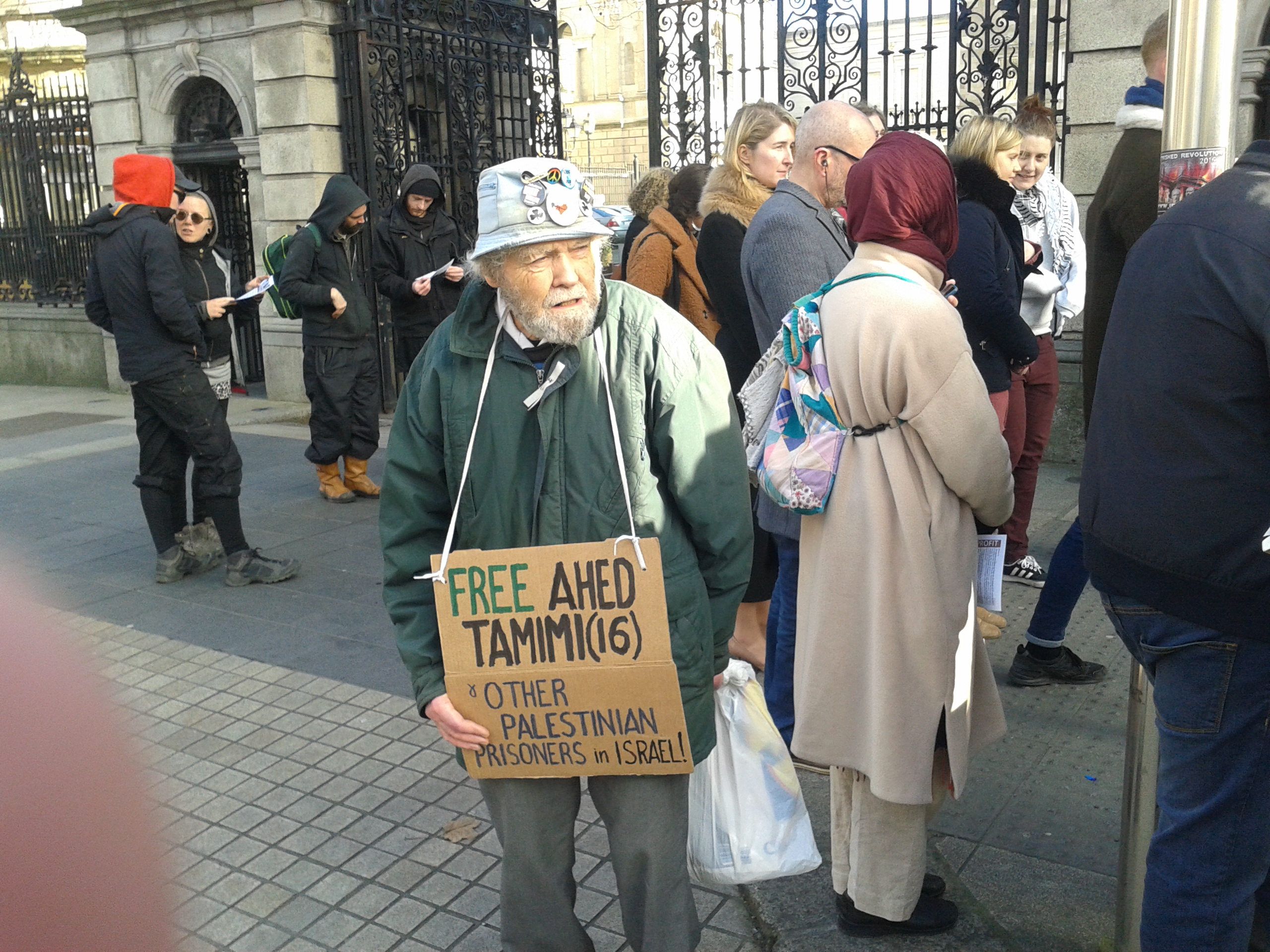
A dense crowd gathered outside Leinster House, home of the Dáil (Irish Parliament), at lunchtime today. Palestinian flags were in evidence as was a banner denouncing the jailing of Palestinian children by the Israeli authorities. Some passing drivers tooted their horns in solidarity.

View of section of crowd outside the Dáil
(Photo: D.Breatnach)

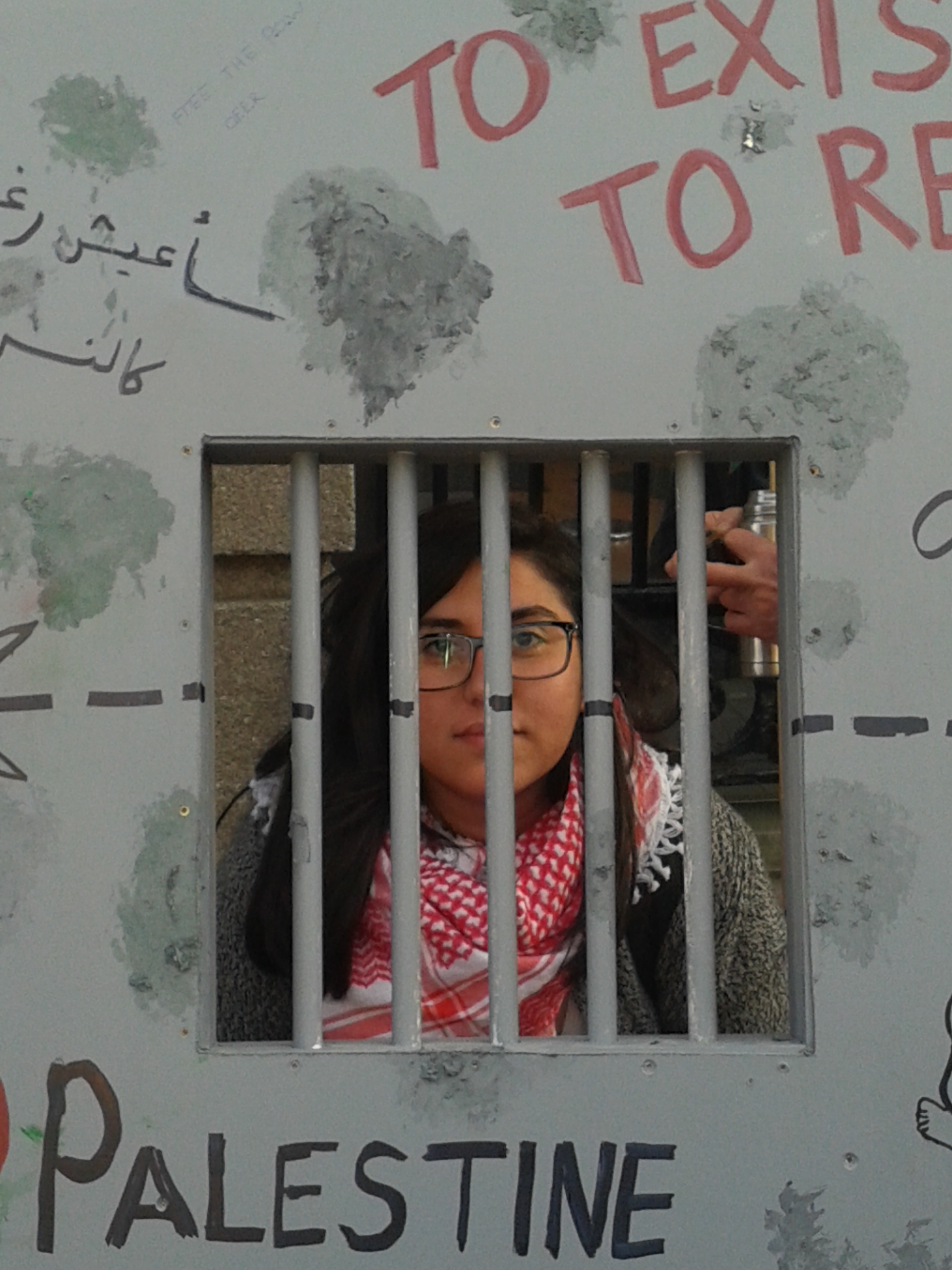
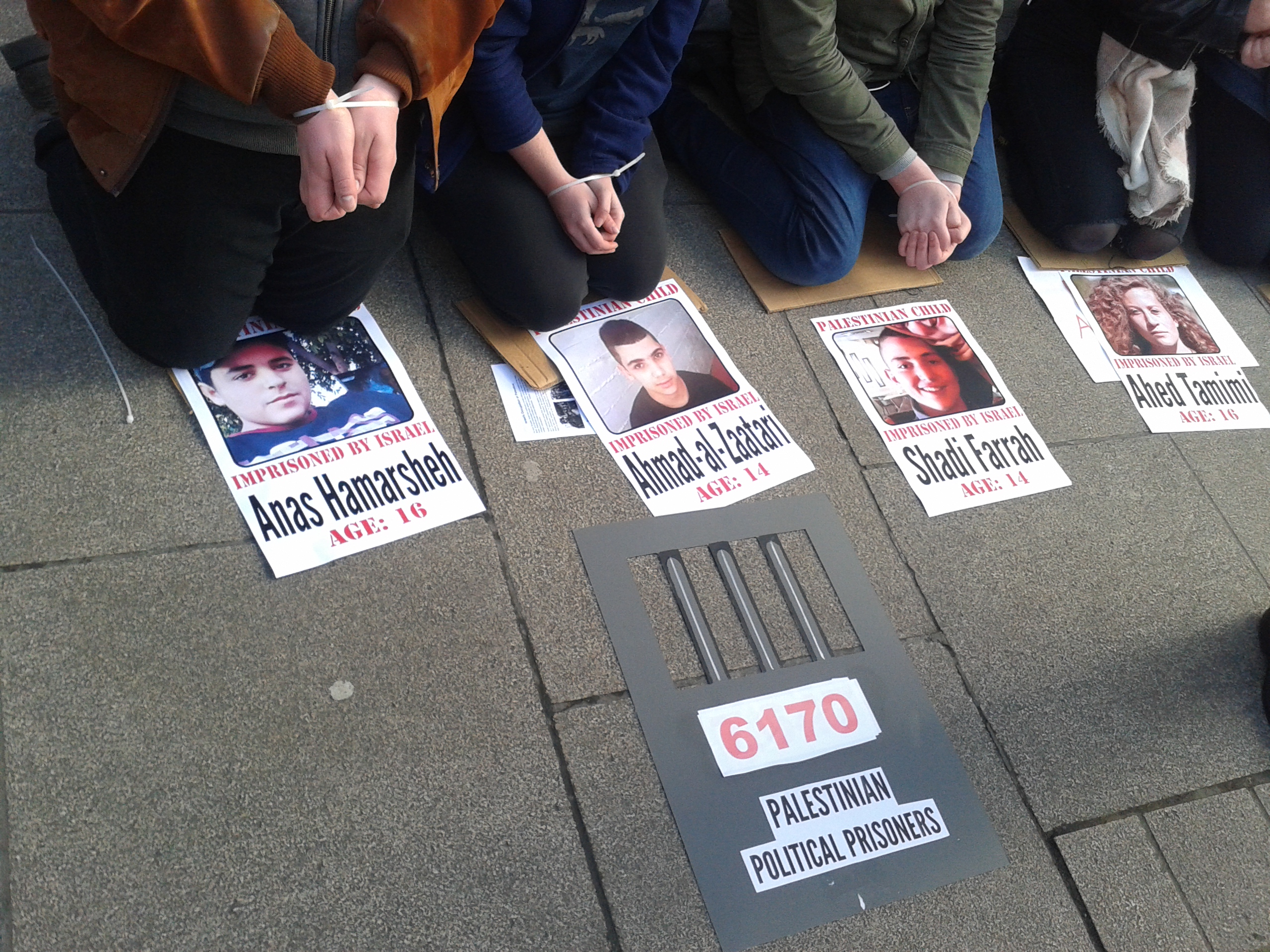
A hollow space existed inside the crowd where young people knelt, blindfolded and with hands bound, to represent children taken prisoner by the Israeli state. According to the Ireland Palestine Solidarity Campaign, which organised the solidarity protest, between 500 and 700 children are detained every year by the Israeli military, i.e up to an average of two a day.

Young people acting as Palestinian children arrested by Israeli military (Photo: D.Breatnach)

The protest was attended by many TDs (members of the Irish Parliament) and Senators comprising a broad representation of political parties and independents. Ibrahim Halawa, the Irish citizen who was arrested by Egyptian police while still a minor of 17 years of age, subsequently to spend four years in jail without trial, also attended.

Young woman representing Palestinian children jailed by the Israeli authorities
(Photo: D.Breatnach)

IPSC Chairperson Fatin Al Tamimi addressed the gathering and referred to “Israel’s apartheid prison system where torture and ill treatment during arrest and detention are routine, including horrendous abuses against children.” Tamimi went on to say, to loud applause: “Apartheid Israel must be held to account for its outrageous treatment of Palestinian children which violates the right of the child.”

After the protest a letter was handed in to the Irish Minister for Foreign Affairs calling on the “the Irish Government to do all it possibly can to end these abuses of Palestinian children by Apartheid Israel. More than just condemnation, action is needed to bring pressure to bear of Israel to end these attacks on children, children who have known nothing but occupation and systemic violence their whole lives. Palestinians, not least Palestinian children, deserve freedom, justice and equality.”

The Irish Government action required was not specified but over the years demands have been made to call the Israeli Ambassador in for censure or even to expel him but no such action has taken place. As a participant on the demonstration said: “When the Irish Government did not even take serious action at the use of forged Irish passports by Mossad assassination squads, you know that they are not going to do anything about Palestinian children being jailed and ill-treated.” (The Irish Government expelled one minor diplomat only over that revelation in 2010 and even then the Ambassador stated that he could not guarantee that such faked passports would not be used again).

Photos of a small sample of detained children
(Photo: D.Breatnach)
Photos of another small sample of Palestinian children detained by Israeli Occupation Force
(Photo: D.Breatnach)

WIDESCALE VIOLATION OF THE RIGHTS OF THE CHILD

According to the UN Convention on the Rights of the Child, apart from rights to survival (violated by Israel in its 2014 bombardment of Gaza, for example, when it killed 504 children and made thousands homeless), and adequate living standards (also violated by Israel in Gaza with damaged sewage treatment plants and water, power and fuel restrictions), children also have

  1. Development rights: include the right to education, play, leisure, cultural activities, access to information, and freedom of thought, conscience and religion.
  2. Protection rights: ensure children are safeguarded against all forms of abuse, neglect and exploitation, including special care for refugee children; safeguards for children in the criminal justice system; protection for children in employment; protection and rehabilitation for children who have suffered exploitation or abuse of any kind.
  3. Participation rights: encompass children’s freedom to express opinions, to have a say in matters affecting their own lives, to join associations and to assemble peacefully. As their capacities develop, children should have increasing opportunity to participate in the activities of society, in preparation for adulthood.

By jailing children, Israel is violating the rights of the child in each of these three broad categories above. Yet, according to UNICEF, only two states have currently failed to ratify the Convention after signing: the USA and Somalia. In other words, Israel has signed it but clearly is violating it as a matter of course.

Trials of Palestinian children have a 99.74% conviction rate, and “do not meet international standards for fair trial” according to Amnesty International. According to the IPSC, many more children are temporarily detained, sometimes taken by soldiers raiding homes in the dead of night, and later released after severe interrogation periods without prosecution. Defence for Children International Palestine states that some two-thirds of all children detained will face some sort of physical or mental abuses, including torture and sexual threats, during this process. UNICEF says that “Ill-treatment of Palestinian children in the Israeli military detention system appears to be widespread, systematic and institutionalised”.

According to the IPSC, “over 12,000 Palestinian children have gone through the Israeli prison system since 2000, while nearly 2,500 have been killed and countless thousands wounded. In Gaza alone, where children have borne the brunt of three vicious Israeli assaults over the past decade, UNRWA estimates that “more than 300,000 children are in need of psycho-social support”.”

(Photo: D.Breatnach)


LINKS, SOURCES:

http://www.ipsc.ie/child-prisoners/pictures-solidarity-ahed-tamimi-palestinian-child-prisoners
https://www.unicef.org/crc/index_30229.html


DUBLIN PICKET DENOUNCES UNDEMOCRATIC AND REPRESSIVE COURTS: ABOLISH THE SPECIAL COURTS!

Clive Sulish


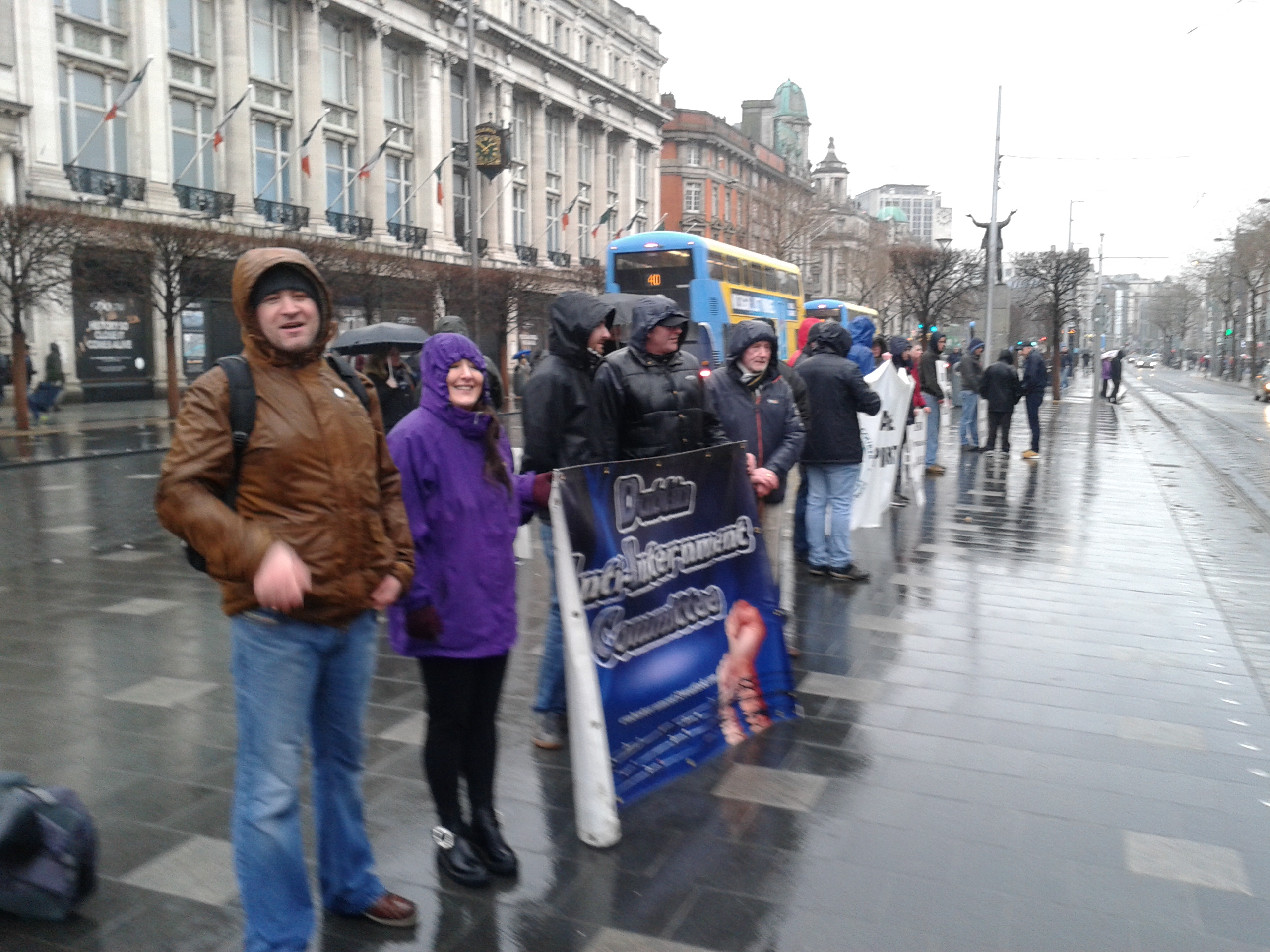
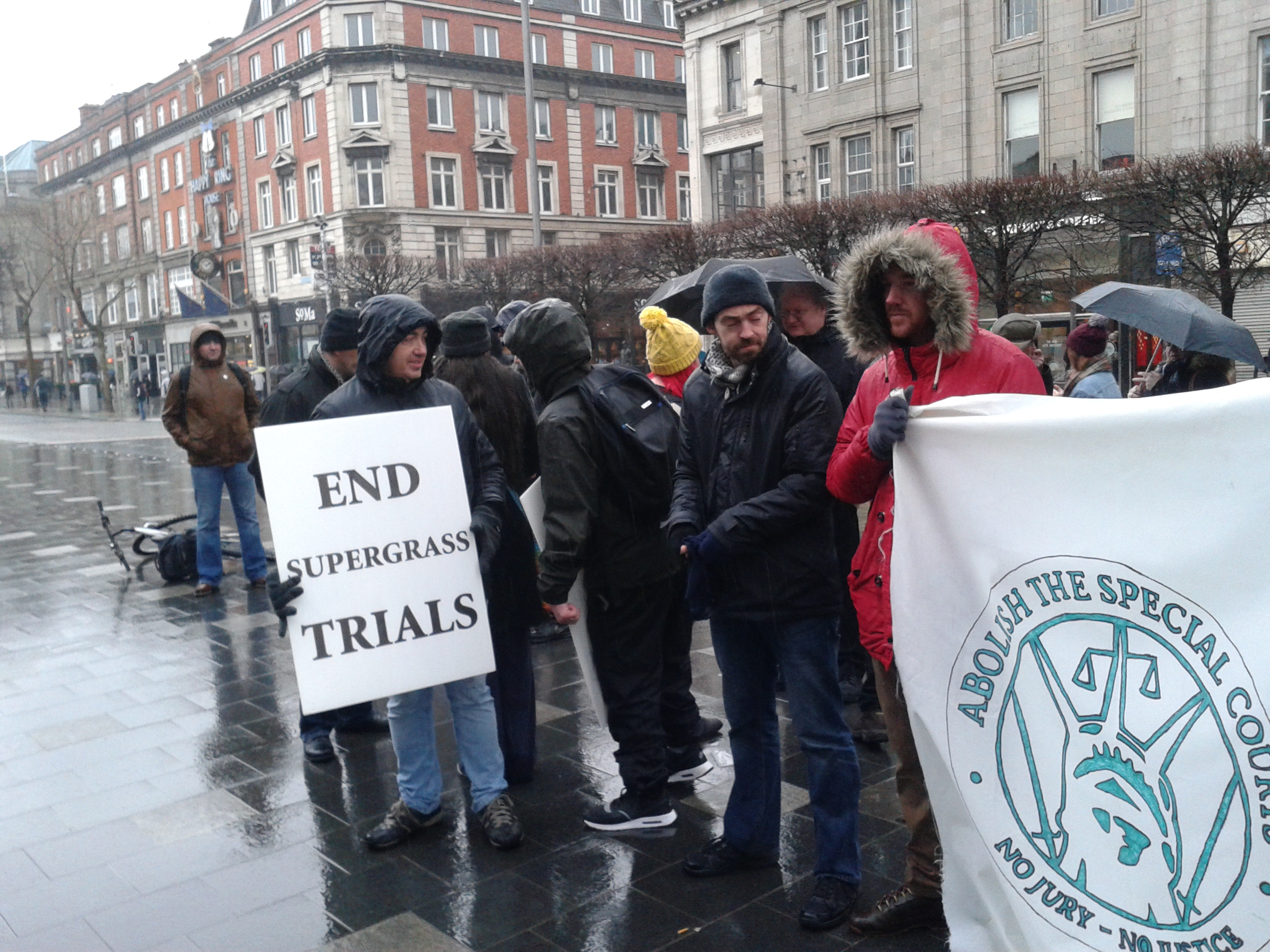
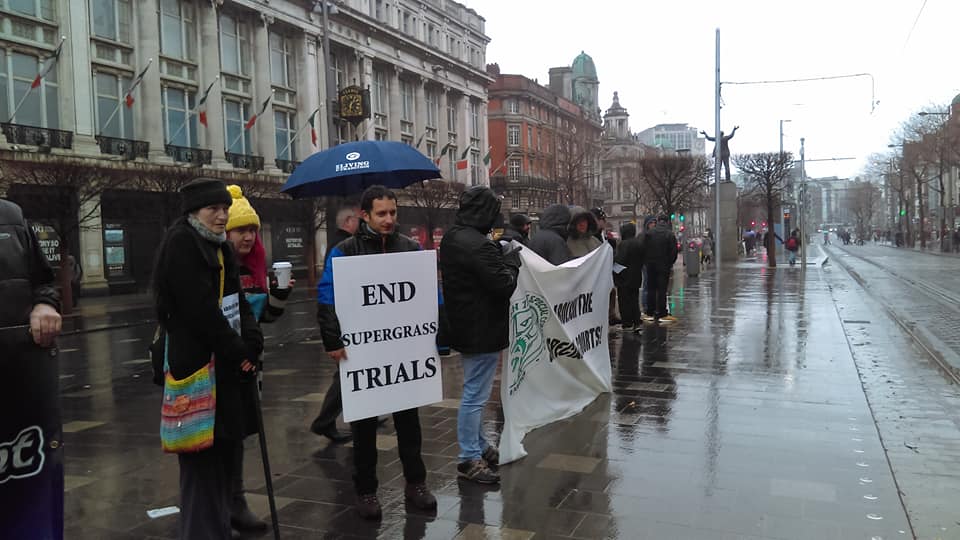
On a wet and cold Saturday, up to two score protesters gathered on the pedestrian reservation in O’Connell Street to denounce the Special Criminal Courts and their operation.

A section of the picket line in O’Connell Street – the Clery’s building is in the background with the Jim Larkin monument in the distance. (Photo: D.Breatnach)

They lined up opposite the iconic General Post Office, site of the HQ of the Easter Rising in 1916 and still bearing the marks of British Army bullet and shrapnel strikes. As traffic and shoppers hurried by or stopped to stare, the protesters were observed by members of the Garda Special Branch, the political section of the police force of the Irish state, one of whom ducked behind one of the GPO’s columns as someone pointed a camera in his direction (to cause some mirth among the picketers).

(Photo: D.Breatnach)

Among the picketers on the 20th January 2017 were members of different Irish Republican groups and campaigns as well as a number of independent activists of Republican, Socialist and Anarchist backgrounds.

After standing for a while displaying placards and banners, the protesters gathered around to hear Sean Doyle, who had been presented as the campaign’s spokesperson.

A section of the picketers (Photo: D.Breatnach)

Remarking that the Special Courts are “a travesty in law”, Doyle added that one should “never equate law with justice.” Doyle accused the Courts of being “a political tool to deny due process”. He encouraged those present to ask themselves whether Maurice McCabe or John Wilso (both Gardaí who fell foul of the force) would nowadays trust uncontested evidence. Doyle went on to say, in reference to administrations both sides of the Border, that “Political special courts are structured to deny your civil and human rights and must be abolished.”

Special courts of the Israeli Zionist regime, or US military-occupied areas were also condemned by the speaker, who called for “cooperation and sharing of information across the world” because “injustice knows no borders.”

Sean Doyle speaking (Photo: D.Breatnach)

After Doyle’s short speech had been applauded, Ger Devereaux thanked everyone for attending and informed them that the campaign against the Special Courts would continue with pickets and meetings and asked people to spread the word to help the campaign to grow and to achieve success.

Ger Devereaux addressing the crowd
(Photo: D.Breatnach)

HISTORY AND COMMENT

The operation of the law in what are called “democratic” societies is supposed to be that a person suspected of committing a crime is accused and brought to trial, where the evidence is presented against him and should he choose to do so, he or his representation defend him. A jury drawn at random then considers the evidence, decides the verdict and, should that be of “guilty”, the judge pronounces sentence, within the parameters of the maximum and minimum set by law. That’s the theory, anyway.

We all know that there are flaws in that system, even without considering the laws under which the operate and the real power and wealth in society, as well as the power of the media, prejudices among jury members, lying witnesses, faulty expert testimony, etc. Nevertheless, the system is an advance on what existed before and provides some protection to the accused. At times the jury arrives at a verdict which is manifestly contrary to that desired by the forces of the State, i.e on the side of democracy and justice and against repression. A quite recent example was the finding of “not guilty” for the Jobstown protesters last year after a politically-orchestrated attempt by State, politicans and media to find them “guilty”. Another example, further back, was the exoneration of the five anti-war activists in 2006 for their actions against US warplanes in “neutral” Shannon airport.

The State has decided upon a way to overcome this problem, which is to do away with juries completely and, with the Special Courts, it has achieved this: these courts have no juries and, furthermore, a majority verdict of two out of three judges is sufficient for conviction. This would be of concern enough were it not for the fact that the Government appoints all of those judges.

A view of the GPO building across the road from the picket. The leg of a Special Branch officer may be seen as he ducks behind a column on the right.

The first of these courts was set up in 1939 under De Valera, as part of the Offences Against the State Act but fell into general disuse after the 2nd World War, to be briefly brought back during the IRA’s Border Campaign of the 1950s, when hundreds were interned. The Special Court was resuscitated in 1972 (as was the Amendment to the Offences Against the State Act – more about this below), again by a Fianna Fáil government under Jack Lynch.

A second Special Court was created by Minister for Justice Frances Fitzgerald, in the FG-Labour coalition Government, ironically on the centenary year and month of the Easter Rising. The justification was quite baldly that it was difficult for the State to achieve verdicts of guilty in some cases through the use of a jury. Of course the State declares that the difficulty arises in that the members of a jury may be intimidated by criminals or “terrorists”. But might it not equally be that the accused are not guilty at all? Or that the State has not bothered with the niceties of the democratic system and carried out its investigation? And if the jury system is to be judged ineffective in one kind of case, why not in others?

Originally, the target of the Special Courts was clearly political activists. When the atmosphere allowing political persecution by the State dissipated somewhat, it was claimed that the target was gangsters. However, for long years the victims continued to be political activists – exclusively of the Irish Republican brand. With an occasional suspect of the gangster type occasionally brought before the Special Courts however a stream of Irish Republicans find themselves facing them.

FAMOUS CASES

Among the famous convictions of the Special Courts were the sentencing to death in 1976 of the Anarchist couple Noel and Marie Murray for alleged murder of a Garda, the sentences being quashed on appeal after a campaign and reduced to life instead.

In 1978, then IRSP members Osgur Breatnach, Brian McNally and Nicky Kelly were all sentenced to long terms in jail. Their sentences were overturned in 1980 (and 1984 for Kelly) and years later they received compensation, reportedly in six figures.

Nicky Kelly & Osgur Breatnach at press conference after their convictions in the Special Criminal Court had been overturned (Photo: An Phoblacht)

A few more big convictions of political activists followed which were not overturned on appeal until in 2001, Colm Murphy was convicted of conspiracy to cause the Omagh bombing but in 2005 his conviction was quashed after revelations that the judges had acted improperly and that Garda witnesses for the Prosecution had falsified their notes. He was finally cleared by the SCC in 2010.

In 2003, Michael McKevitt was convicted by the Special Court of allegedly “directing terrorism” and “membership of ….. the Real IRA” in a judgement which has been criticised by a number of people unconnected to him.

There were no ‘gangland’ cases before the SCC until 1977/’78 and the Guerin murder trials, when one man was convicted on the evidence of a gang member turned State’s witnesses, a case about which many questions remain today. A big gap followed in ‘gangland’ cases until the years 2013, 2014 and 2016, with one case in each of those years..

Throughout all these years a steady stream of convictions and jailing of Irish Republicans for the lesser charges of “membership of an illegal organisation” have been processed through the Special Courts.

BRITISH TERRORISM

The same year that the Special Criminal Courts were introduced, i.e 1972, was when the Amendment to the Offences Against the State Act was brought into law. This provision permits conviction with the only evidence being the word of a Garda officer of the rank of Chief Superintendent or higher. Although historically judges have been reluctant to convict on this alone the quality of what other evidence they require has been slipping lower in recent years. Irish Republicans are now being convicted, for example of membership of an illegal organisation, on the word of a senior Garda who says that he has reason to believe that they are such, supported by spurious “evidence”. In one case this “evidence” consisted of a piece of paper allegedly from a prisoner the man had been visiting which discussed some recent events and in another, that Gardaí had “seen him turn down a dark lane”.

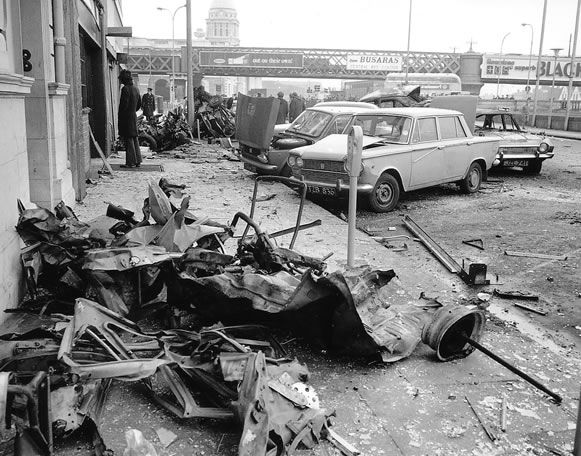
The irony is that the resuscitation of the Special Courts and the introduction of the Amendment to the OAS Act were voted in after a terrorist bomb planted by British agents. The Jack Lynch Fianna Fáil Government seemed to be heading for a defeat in the Dáil on their proposal, with Fine Gael. Labour TDs and others set to vote against. During the debate, on 1st December 1972, two car bombs exploded in Dublin, one Eden Quay and another on Burgh Quay, killing two CIE workers and wounding 131. In the succeeding panic, the opposition to the measure collapsed and it was was passed. Wikipedia: “It is believed that the 26 November and 1 December bombings were executed to influence the outcome of the voting.”

One of two Dublin bombs by British agents in December 1972 which helped introduce additional anti-Republican legislation
(Photo source: Indymedia)

Both sides of the Border, Irish Republicans are now being convicted and sent to jail by non-jury courts, by the Diplock Courts of the Six Counties colonial administration one side and by the Special Courts of the Irish State on the other. Ironically, in Britain itself there are no non-jury criminal courts.


WHO PROTESTS?

Given the patently undemocratic nature of the courts and the clearly political use by the State, what has the reaction of the civil and human rights sector been? In earlier days, it has been criticised by the Irish Council for Civil Liberties, Amnesty International and the UN Commission on Human Rights. In recent years, these critics, especially the Irish ones, have tended towards silence on the matter. The non-Republican Irish organised Left has likewise remained silent, as it tends to do with all persecution of Irish Republicans.

However, history has shown us that once the State succeeds in repression against one sector, it moves on to another it finds threatening or an inconvenience. It is therefore in the interests of all democratic and Left sections of society to unite against these undemocratic and repressive courts and to campaign for their total abolition.

End.

LINKS:

https://en.wikipedia.org/wiki/Special_Criminal_Court

https://en.wikipedia.org/wiki/1972_and_1973_Dublin_bombings

https://en.wikipedia.org/wiki/Offences_against_the_State_Acts_1939%E2%80%931998

http://www.irishstatutebook.ie/eli/1972/act/26/enacted/en/html


CATALAN FLAG FLIES OVER DUBLIN CITY HALL

Clive Sulish


After the Spanish police attack on voters in a referendum on independence in Catalunya1 on October 1st, People Before Profit2 Councillor Tina McVeigh put forward a motion condemning the attack and calling for the Catalan Flag to be flown over Dublin City Hall as a mark of solidarity with the Catalan people and their right to determine their future.

Front view of Dublin City Hall showing the Ensaya flying next to the Irish Tricolour (Photo: Casal Catala Irlanda)


This was not such a wild step for the Council to take as it may seem: the Palestinian flag had been flown from City Hall in May, to the delight of most Dubliners but to the disgust of the Israeli Ambassador and to Zionist sympathiser and former Government Minister Alan Shatter. And Dublin city has been ‘twinned’ with Barcelona since 1998.

Nevertheless, in November the Protocol Committee agreed to recommend flying it by majority only, seven votes for and five against. It still had to be voted on by the whole Council and so went forward on to the agenda for the monthly meeting in December. Councillors began receiving emails from Spanish unionists asking them to vote against, which at first substantially outnumbered those in favour. As the first Monday in December drew nearer, the correspondence equalised between those in favour and those against. But the meeting ran over time before the motion was reached on the agenda and another date was set to discuss it. When the councillors reconvened, the motion was proposed, discussed and voted on. Unlike the decision on the Palestinian flag earlier this year, the vote was very close but the motion passed by three votes.

Section of the attendance at the event
(Photo: D.Breatnach)

In January this year the Catalan flag was hoisted – the regional ensaya and not either of the independence esteladas3 – on top of City Hall, where it will fly for a month. City Hall is itself a historic site, having been part of a battleground during the 1916 Rising.  On January 6th, Catalans and some supporters gathered outside City Hall to celebrate the show of solidarity in the flying of the Catalan flag.

Joan Pau of Casal Catala of Ireland4 welcomed the attendance and thanked the Councillors for flying the flag and introduced the Lord Mayor, Mícheál Mac Donncha, telling those present how he had approached the Catalans to help them. Mac Donncha (SF)5 thanked the Catalans for the invitation to attend and said that he was proud of the Council for the decision they had taken. He remarked also that in the past Ireland had political prisoners just like those now in Spanish jails for supporting the Catalan referendum and deplored elected officials of Catalunya being jailed for following the mandate of the people. He spoke also about Ireland’s fight for freedom and how in the 1916 Rising, Volunteers had taken over City Hall itself.

Another view of a section of the attendance Front view of Dublin City Hall showing the Ensaya flying next to the Irish Tricolour (Photo: Casal Catala Irlanda)


Joan Pau then expressed his regret that Cnclr. Tina McVeigh could not be present due to a family bereavement, since she had been very active in solidarity with the Catalan people. He introduced Cnclr. John Lyons (also PBP) who also expressed his pride on the result of the vote, as well as his condemnation of the Spanish Government, as distinct from the Spanish people, for their undemocratic and violent behaviour in the October 1st attacks and subsequently in the jailing of Catalan public representatives. He also condemned the Irish Government for not supporting the right of the Catalan people to self-determination.

Front view of Dublin City Hall showing the Ensaya flying next to the Irish Tricolour
(Photo: D.Breatnach)

Although a Spanish unionist had contacted the Council to threaten a counter-demonstration, there was no sign of any such presence throughout the ceremony. A number of passing tourists took photos (some even having themselves photographed with the group) and a number of passing motorists tooted their horns in solidarity.

Section of the attendance with flags (including the “Sí” ones used campaigning for the referendum) & placards calling for the release of the political prisoners.
(Photo: D.Breatnach)

After the formal part of the meeting was over, Dublin walking history tour guide Diarmuid Breatnach invited Catalans to gather around DCC’s plaque to the garrison of City Hall and surrounding buildings in 1916. The guide explained the origin of the Irish Citizen Army in the Dublin Lockout of 1913 as a workers’ defence militia against brutal attacks by the Dublin Metropolitan Police Force. It has been called “the first workers’ army” Breatnach told them and drew attention also to it being the only one of the various organisations taking part in the Rising that formally gave equal status to men and women. There were women officers in the ICA and after the killing of the commandant of this garrison Seán Connolly, it was a woman who took over as commandant. The fighting here had been fierce as Dublin Castle is just next door and that had been the HQ of the British Occupation of Ireland since 1169.

Plaque (located to the right side of the front of City Hall) listing the names of men and women of the Irish Citizen Army who fought at that location in 1916. Four ICA Volunteers died there.

After receiving answers to a few questions, many of those present retired to a local pub to warm up and to carry on conversation on a number of topics, in the best Irish – and Catalan – manner. Up above, the Catalan flag on the east side of City Hall’s roof waved in the breeze, with the Irish tricolour next to it, in the centre, waving too.

End.

FOOTNOTES:

1Catalunya is considered part of wider nation called Paisos Catalans (Catalan Countries) which includes Valencia, the Balearic Islands and parts of Aragon and Murcia; most of it lies within the current territory of the Spanish state, with a small part within the French state. Catalunya (capital Barcelona) is one of the regions within the Spanish state with limited autonomy and it is there that the referendum was held, the result mandating its Parlament to create and independent republic. The Spanish Government and Constitutional Court ruled the referendum illegal, confiscated ballot boxes, assaulted hundreds of voters, declared the referendum result non-valid, jailed a number of elected members and activists, threatened others with jail, ruled Catalunya directly Spain and called for new elections, which confirmed the situation more or less as before. The struggle is ongoing.

2People Before Profit was launched as a broad front by the Trotskyist organisation the Socialist Workers’ Party Ireland, formerly the Socialist Workers’ Movement, founded in 1971 and close to the SWP of Britain.

3There are two Catalan independence flags or estelladas: the Republican one with red stripes on a yellow background, with a small blue triangle to the left, containing a white star; the Socialist (or Communist) one, also with red stripes on a yellow background but with a red star to the left and no triangle. The regional ensaya, without any star, was proposed as the one least likely to cause division.

4Casal Catala are Catalan cultural associations that have been founded in a number of countries outside Catalunya.

5SF or Sinn Féin – the party is represented on Dublin City Council and tradition has it that the Lord Mayor is elected yearly in rotation from among the elected representatives; this Council year it was SF’s turn again.


REFLECTIONS ON THE IRISH LANGUAGE 1 b) FOR ADULT LEARNERS

I B

Diarmuid Breatnach

Among the many spurious difficulties about learning Irish quoted by people there are some genuine ones.

A PRONOUNCEMENT

A problem with learning Irish, according to some people, is the spelling of Irish words. When this difficulty is expressed by English-speakers, I am tempted to ask them to pronounce the English word “Ghoti”. It was a word invented by George Bernard Shaw and unless they are familiar with it, they will be unable to pronounce it correctly. Shaw took the “f”-sound from “gh” in words like “enough”; the “i” sound from the “o” in “women” and the “sh” sound from the “ti” in words like “mention” — hence the correct pronunciation is “fish”. Shaw invented the word to illustrate how illogical – or at least unpredictable – is the pronunciation of many English words. Perhaps he was replying to someone who was accusing the Irish language, an Ghaeilge, of having a similar problem; I don’t know but would like to think so.

In fact, the vowel sounds in Irish can be entirely predicted from the written word with the exception of the “A”, which has something of a narrow range of possible pronunciations and some vowel combinations. In English, combinations of vowels produce different sounds to that of each individual letter also and with a greater variety and less predictability than is the case in Irish: take the different pronunciations of the ‘a’ in ‘cat’, in ‘day’, ‘rain’, ‘contraindicated’ (true, the latter is a compound word).

Where a long vowel is indicated in Irish by an accent, the “síne fada” (“sign of length”, unlike in Castilian, for example, where the accent indicates only where the stress falls in the word), the sound to make when reading it is unmistakeable.

To illustrate, the á will produce a sound like “aw” in English (as in “law”); the ó a sound like “oe” in “toe”; ú like “oo” in “loot”; í like “ee” as in “fee” and é like “ay” as in “bay”. These will not vary, no matter where they appear in the word.

“But hang on”, the observant complainer may protest, “you mean to tell me that é is pronounced “ay”, like the letter “A” in English? And that í is pronounced “ee”, like the letter “E” in English also? Why is Irish so contrary?”

“Well,” I may reply, “I’m very glad you asked me that. Because in many other languages, the letter “I” is also pronounced like “ee” in English and the letter “A” — which in English is pronounced “ay” as you pointed out — in many other languages, probably most, is pronounced “ah”. In this case, my friend, it is the English language which is being contrary!

Furthermore, English has made a broad vowel into a slender one.”

“Huh?”

Yes, they don’t commonly teach about broad and slender vowels in the schools now, yet the difference between them affects not just Irish pronunciation but also English, Castilian, Italian and other languages. Why is it, for example, that the “G” in “Gerry” is pronounced differently from the same letter in “Gary”? Why is that the “C” in “Cede” and “Citrus” is pronounced differently from the same letter in “Cat, Cot” and “Cut”? The answer has everything to do with broad and slender vowels.

In Irish, a, o and u are broad vowels and i and e are slender (the same in English except that y can also be a slender vowel, e.g in words like ‘only, why‘ etc). The most notable effect of the different pronunciations effected in Irish by whether a vowel is slender or not is with the letter ‘S‘, viz: Sorcha, Saidhbhín, Súil but Sinéad, Seán.

Now, the problem with the pronunciation of the name of the vowel “a” in English is that “ay” is a slender vowel sound while the letter itself is a broad vowel. In Irish that letter is pronounced “ah” as it is in many other languages around the world (perhaps all). When we speak the vowels, our mouths make a horizontal shape for slender vowels and tend towards a vertical one for broad (try it and see). Which shape does “ay” make? Yes, horizontal, the shape of a slender vowel!

“Ok,” says the complainer, “but what about the consonants? You can’t tell me that reading them and pronouncing them is not complicated!”

Actually, the complainer here does have a point. It is over-emphasised, perhaps, but the point does have some validity.

The pronunciation of the consonants in Irish is pretty straight-forward, with the variations in the “S” according to slender or broad vowels either side (discussed above) and to some extent the same effect on the “D” and “T”. And the double “L” and “N” in Irish followed by a slender vowel have the same pronunciation as the “ll” and the “ň” in Castilian respectively, which is to say they are like “n’y” and “l’y”, for example “bainne” (“milk”) is pronounced “ban-yeh” and “sailleach” (“fatty”) is pronounced “sal-yach”.

A learner can soon get used to these peculiarities in Irish or in other languages. But what about all the consonants followed by a “h”?

Irish does not have all the consonant letters that English has – we don’t have the J, K, Q, V, W, X Y or Z. We don’t really have a H either, come to that, as we’ll see in a moment. The sound of Q in English can be reproduced in Irish as “cua” or “cui” in Irish and we can make the sounds of some of those ‘missing’ letters by employing an effect on consonants called lenition, in Irish “séimhiú” (softening). During the last two centuries, this was shown by a dot on top of the consonant to be lenited but is now indicated by a H after the consonant in question. All the other ‘missing’ consonant sounds with the exception of the Z are available in this way – not only those but in fact another two not available in English: the Irish “ch” and “gh”.

Lenited consonant at the beginning of a word

Consonant sound equivalent in English

B

Bh + i, e

V

Bh + a,o,u

W

C

Ch

Ch as in “loch”

D

Dh + i, e

Y (not as a vowel)

Dh + a,o,u

Gh (sound not available in English)

F

Fh

Mute (no sound)

G

Gh

Gh (sound not available in English)

L

Cannot be lenited

M

Mh + i, e

V

Mh + a,o,u

W*

N

Cannot be lenited

P

Ph

F

R

Cannot be lenited

S

Sh

H

T

Th

H

* In some Irish dialects the Mh will be pronounced as “V” whether followed by a slender or broad vowel.

Ok, so the lenited consonants do introduce some complication to reading-pronunciation but hardly an insuperable one. To balance that, we have the more reasonable vowel letter A pronunciation than does English (i.e as a broad vowel instead of a slender one) and the ability to read the pronunciation of vowels off a text. Also, to compare with English, some sounds in English are shown by combining consonants, such as ‘tch in ‘catch’, ‘ph’ as in ‘pharmacy’, ‘sh’ in ‘shake’ and ‘th’ in ‘think’.

And what about the ‘ch’ combination in English – it’s not pronounced the same in the words ‘chant’ and ‘character’ or ‘chaos’. Add to that the ‘h’ in ‘rhetoric’ or ‘rhythm’ seems to have no role in pronunciation at all and that the ‘w’ will be heard at the beginning of a word and may or not be heard in the middle (compare ‘award’ with ‘lower’). The ‘w’ will not be heard at all at the end of a word but instead governs the pronunciation of the vowel before it (‘raw’, ‘row’, ‘few’)!

This governing of the pronunciation of the vowel before it also happens with ‘gh’ in ‘dough’ or ‘rough’ – but note that in each of those cases the pronunciations of the ‘gh’ are completely different! In order to indicate the sound of the Irish ‘ch’ in loan words, English uses “gh” yet again, as in ‘lough’ and ‘bragh’ (in “Erin (sic) go bragh”) and “Drogheda”. Confusing, isn’t it?

Although pleading the feature of the pronunciation of consonants as a difficulty in learning the Irish language does have some validity it is overdone – particularly when the complainant is an English-speaker. It seems to me that the difficulty is magnified by those who do not wish to go to the trouble of learning the language but want to have a good excuse for not doing so.

A chríoch

Reflections on the Irish Language I a) – for adult learners

REFLECTIONS ON THE IRISH LANGUAGE

I

Diarmuid Breatnach

A) FOR ADULT LEARNERS

Among the many spurious difficulties about learning Irish quoted by people there are some genuine ones.

TO BE OR …. SOMETHING ELSE

Much of what happens in English requires the use of the verb “to be”, which is a highly irregular verb so that the past tense singular was and plural were do not resemble each other much and resemble the infinitive to be or present tense for different persons (am, is, are) not at all. However the child learning to speak English as a mother or environmental tongue, i.e the language spoken around her outside the home, will in time get over the difficulty.

But when the adult English-speaker comes to learn Gaeilge (Irish), she will encounter in that language no equivalent usage to that of the verb “to be” in English. Instead, she will find the verbs “Tá” and “Is”. Furthermore, the verb “tá” will have other uses too.

Stock adult education class photo (Source: Internet)

For example, “I am a man” will be “Is fear mé” but “I am tired” will be “Tá mé tuirseach”. And “Tá”, with a set of prepositional pronouns, is used also to correspond to the verb “Have” in English: for example “Tá rothar agam” = “I have a bike”. And furthermore, when feelings are conveyed, “Tá” is used too but with another set of prepositional pronouns: “Tá fearg orm” = “I am angry” (lit. “I have anger on me”). Physical feelings too, eg: “I am thirsty” will be “Tá tart orm” (literally, “I have a thirst on me”, a phrase that appears in English spoken in Ireland even by people who have not spoken Irish in generations).

Now, before the complainer about Gaeilge can throw up his or hands in exasperation and exclaim “You see?”, let us examine another European language.

Castilian (Spanish) has exactly the same division between the verbs estar and ser: Estoy cansado (“I am tired”) but soy un hombre (“I am a man”). And furthermore, the use of another verb, tener (“to have”), to correspond to the use of the verb “to be” in English. As an example of the latter, tengo sed (literally “I have thirst”) = “I am thirsty”.  Further, the verb “to make” in Castilian, hacer, will be used to describe the weather, as in “Hace frio” (lit. “It makes cold”) = “It is cold”.

Castilian is I believe the mostly widely-spoken European language after English but also the language with the most speakers in the world after Mandarin Chinese. Well over 400 million people speak Castilian as their first language and it has official status in 21 states spanning three continents.1

Not many people are going around whining about Castilian/ Spanish being difficult to learn (or if there are, they’re being ignored) so clearly, this problem of the different verbs in use in one language to an equivalent use of only one verb in English is not such a big problem at all.

So, if some people don’t want to learn Gaeilge, they need to find a different excuse; otherwise, as they say in coarse English (but not i nGaeilge or in Castellano) – suck it up!