The text on my mobile gave me a little jolt. Treating a gentle query from a friend as a summons, I headed off to the Song Central session in Chaplin’s bar, just across from the Pearse Street Garda station (outside which on some on some occasions I’ve protested until they released some person or persons they had arrested on a demonstration on which I have been – and on one memorable occasion, even on a walking history tour I was conducting as part of an anti-G8 Dublin program).
So, get ready, jump on the bike — it’ll be maybe a quarter of an hour? Intention to stay in for the night blown away, I head for the shower and shave, then reheat and consume most of the Dublin coddle.
Wheeling the bike out into the hall, I hear a squelching kind of sound. Oh no! But yes – flat tire (and of course, the rear one, with the gears on the wheel)! Fair enough, it’s bus or walk.
So where’s the snow from this “Code Orange” weather warning? And how could you trust anything from the colour orange anyway? Walking across from Liberty Hall to Butt Bridge, I do actually see some snow, slabs of it apparently having fallen off the roof of a car from some snowy region out of town. Young people pounce on it delightedly and, normally, I’d be in there myself, snowball fighting given half a chance. But the session ….
It’s a long time since I’ve attended the monthly Song Central, as I was reminded by people I had not seen in quite a while. This session was started by Alan Stout around seven years ago, in a kind of split from the Bray monthly session a number of years ago (but a friendly split and the Bray parent is still going strong). As in the Bray session, you may play an instrument but only as accompaniment to a song. And it’s still popular – sometimes it’s a job to get a seat.
It’s a kind of Republic of Song with a wide allegiance: religious-type Christmas songs partnered Christmas social comment in which Jesus is a revolutionary; comic songs balance the serious, Irish trad and folk meet pop and Blues, new and self-composed songs intersperse those made familiar by well-known singers and bands. Most singing is unaccompanied and in English but a couple were sung i nGaeilge.
Remembering Christmas I abandoned my plan to sing The Glencoe Massacre (“Cruel is the snow that blows round Glencoe” — a nod to the much-heralded no-show snow) and opted instead for Arthur McBride, which is actually set in Christmas Day. Later I sang They’re Stealing Our Water, which I had debuted in that session maybe two years earlier and for which one of the participants had given me a better line than I had originally composed. The song goes to the air of The Sea Around Us by Dominic Behan and the chorus is the same, except for the last lines: “But we’ve still got our Gombeens and a bank guarantee and they’re trying to steal our own water!”
It’s always a risk to slip a different line into a well-known chorus because the crowd are likely to sing the one they know and not the one you’ve composed. Which did happen a bit but eventually they got it.
I heard some really good singing and some fair singing, as well as a couple of songs I’d not heard before. The session was due to finish earlier than usual in consideration of adverse weather warning (those Orangeys again!) but there were still some people there as I left. It is always a joy to attend so why don’t I do it more often? The answer is that I don’t know but in a month’s time, although I don’t plan to, it may be that once again I will give it a miss.
So on my way to the bus stop of course I pass Bowes’ pub in Fleet Street (Sráid na Toinne!) and I drop in there for a half or a pint and to listen to some trad from the Sunday night session. But what’s this? No musicians! Apparently they play 7-10pm now (but later on bank holidays) and are off playing for some more hours of the night at “the Apollo Sessions”, the barman tells me. But where would that be? Hardly in Apollo House, no longer occupied to highlight homelessness and guarded by a security firm.
Elucidation unforthcoming, it’s onward to the bus stop in Westmoreland Street where I am fortunate to get a bus almost straight away. On the top deck, a chat in Castillian (Spanish) with a Filipino woman, her Spanish partner and a lively and chatty child. And so, home … to reheat and finish the remains of that coddle.
ln the Six Counties, the British colony in Ireland, the sectarian lines are drawn. The Good Friday Agreement did nothing to eliminate them, contrary to the praises of many and perhaps even the wishes of some who supported it. The majority section of the population has a badge of professed faith to identify it, Protestantism, while the other has its own badge, Catholicism. But each section also has other symbols of its own.
Politically, each section has a number of divisions within it but each has its majority representation: the Democratic Unionist Party for the Protestants and Sinn Féin for the Catholics. Both of these parties have overcome others to rise to prominence over their respective sections – the DUP deposed the Ulster Unionist Party and Sinn Féin overtook the Social Democratic and Labour Party. Both Sinn Féin and the DUP display the symbols of their respective sections and employ them to sectarian electoral advantage.
Apart from professed religion as a signifier, each section also has its own visible symbols: the Tricolour and Harp for the Catholics, the Union Jack and Crown for the Protestants. And to this has now been added language: Irish for the Catholics and Ulster Scots/ English for the Protestants.
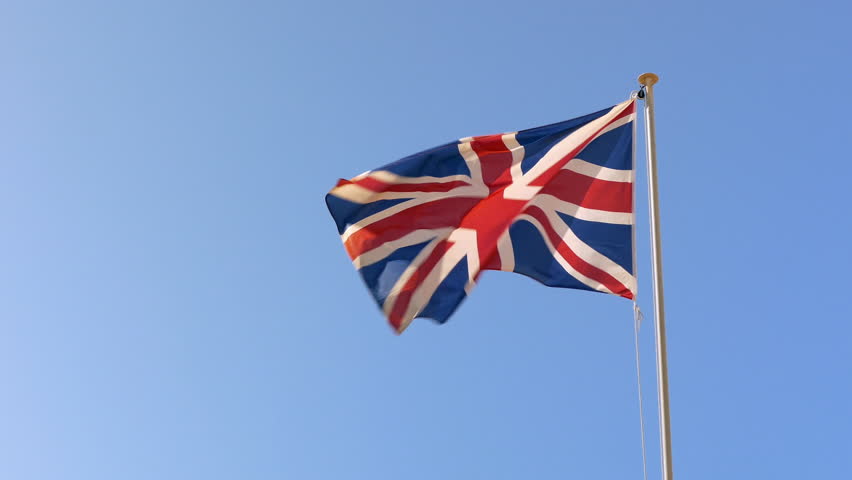
The Irish Tricolour, a flag of the Irish Republican movement and official flag of the Irish State. (Image sourced on Internet)Flag of the United Kingdom, colloquially known as the “Union Jack” (it has other less neutral names too). (Image sourced on Internet)
There are other symbols too but they are of minor importance, for example for the Catholics flying the Palestinian flag in solidarity with Palestinians and, just because they must oppose anything the Fenians do, the Israeli flag for the Protestants. Soon we may see the Catholics adopt the Catalan Estelada flags and the Protestants, the flag of the Spanish State. But would Unionist Protestants fly the flag of a Catholic country? Yes, it’s quite possible – they already fly one of a Jewish state.
Coat Arms UK (black & white), itself a symbol of UK authority and power, displaying a number of other symbols within it, including the Irish Harp within the shield. Note the symbolic Crown above all. (Image sourced on Internet)United Irishmen Harp Motif (Image sourced on Internet)
The opposing sections are in this discussion described as “Catholic” and “Protestant”, as though religion were really the issue – however it is not. Some commentators like to speak in term of “nationalists and unionists”, with the more extreme wing of the latter described as “Loyalists”. That particular sub-group of Unionism is more likely to refer to Catholics as “Taigues” or “Fenians”.
There are religious differences in doctrine and in temporal supremacy between both religions: Catholics believe in the immaculate conception of Mary, the mother of the Christ figure and Protestants do not, though she is seen as a saint in their churches also. Perhaps more relevantly, for Catholics the Pope is, notionally at least, the supreme temporal religious authority while for Anglican Protestants, it is the ruling British Monarch (other British-based Protestant sects acknowledge only their own vicars, their reading of the Christian Bible or their own consciences). Currently, that monarch is Queen Elizabeth II Windsor and lest she be considered just some kind of figurehead, albeit with untold (literally!) riches quite apart from public funds allocation and properties, it is well to remember that she is also Commander-in-Chief of the British Armed Forces.
Back in the day, the Pontiff (the Pope) also controlled a fair share of armed force and also brokered deals between the monarchs of different kingdoms. And in that respect, we’ll shortly come to some great ironies with regards to the Six Counties but first there are other matters to deal with.
RELIGION AS A QUESTION OF STATE POWER
Henry VIII of England disestablished the power of the Pontiff in English-ruled domains and made himself head of the Church, which of course required a split in the Christian Church, and the whole process has since become known as the English Reformation. That happened in the 16th Century; Henry’s daughter Elizabeth I continued this policy in the 17th Century and also extended the power of England and the territories under its domain. Of course, none of this was done by those monarchs alone; powerful feudal and commercial interests were involved also. Being Head of the Church of England allowed Henry to dissolve monasteries and confiscate their lands, filling the coffers of the Crown and of the faithful – faithful to the Crown.
Unfortunately for Ireland, a large part of the country was in the possession of England at this time, though not without resistance. And the original “English” colonists, the Gall-Ghael (“foreign Gael” in Irish), the Normans who had invaded from a colonised Wales with their mercenaries, wanted to stick to their earlier religion, continuing to acknowledge the Pontiff as their spiritual leader. They held their lands through conquest of arms under English monarchs (though the first had been a French Norman) but their loyalty to the British Crown was somewhat shaky. In 1366, nearly two centuries after their conquest of the Irish lands they held, the English Normans called them “the degenerate English” and accused them of having become “more Irish than the Irish themselves”.1
And what of “the Irish themselves”? They too were of the old faith, although their earlier Celtic Christian Church had been more than a little lax in its application of Roman doctrine, especially in laws and mores around marriage, justice and the status of women. The Roman Church was feudal and Irish society still ran along clan lines.
An uneasy alliance was formed between the Gael and the Gall-Ghael which emerged first for the English king Charles I against Cromwell, in the middle of the 17th Century and later again near the end of that century for King James II against King William III (of Orange). On each occasion the Irish alliance lost.
BATTLE, SECTARIAN LINES AND IRONIES
And here we come to ironies. William of Orange was a Protestant and the victory of his forces at the Battle of the Boyne is considered by Unionists a victory of Protestant forces over Catholic. Actually, there were some Catholics among William’s force and some Protestants among the opposing James II forces but that is not the irony. Nor is the fact that William of Orange was a homosexual and that Rev. Ian Paisley, who founded the Democratic Unionist Party and led it until his death in 2014, led a campaign against decriminalisation of homosexuality under the slogan “Save Ulster from Sodomy!”
No, the irony is even greater than those two facts and it is this: William’s armed forces were part-financed by the Vatican, in other words through the Pontiff himself. Although in Ireland the conflict took on the shape of Catholics fighting for freedom to practice their religion (and even Gael and Gall-Ghael holding on to their respective powers), against Protestants forcing their religion and colonial power on others, it was part of a European-wide conflict known to historians as The Nine-Years War. A coalition of forces composed of Austria, the Holy Roman Empire, the Dutch Republic, Spain, England and Savoy, styling itself the League of Augsburg, drew up to oppose Louis XIV of France. And James found himself on the side of France and against his own Parliament.
The Pontiff, as leader of the Holy Roman Empire, was very much a member of the League of Habsburg as was the Kingdom of Spain and Savoy – all under Catholic rule. When news of William’s defeat of James’ forces at the Battle of the Boyne on 1st July 1690 reached the Vatican, a Te Deum mass of praise was celebrated there and similar demonstrations of praise were practiced in the Spanish Kingdom also. That war in Ireland had fundamentally little to do with religion in reality but everything to do with English state and colonial power and European power struggles.
And of course this is not only an irony for the Protestants, who annually celebrate the Boyne victory on the 12th of July in their most sectarian and anti-Catholic manner, but for the Catholics too, who see James as defending their Catholic faith, of which the Pope was the spiritual leader. Nor is that the only irony in connection with Ireland and the Vatican: it was a Pope, Adrian IV, who issued a Papal Bull (something like a warrant) in 1155 legitimising invasion and conquest of Ireland by Henry II of England. Pope Adrian IV, aka Nicholas Breakspear, was the only English Pontiff ever, true but he was a Pope and he must have had substantial support in Rome to issue such a document.
RELIGION
One of the characteristics of republicanism in the late 18th Century, apart from the abolition of the monarchy, was the separation of Church and State. Freedom of conscience and worship were important principles in the French and American revolutions. The United Irishmen also adhered to those principles with an even greater motivation, which was that the majority of the Irish population was excluded from participation in government, military and civil profession by a religious bar.
The Unitedmen were defeated, crushed. Their Protestant (Anglican) and Dissenter (Presbyterian) leaders and supporters were executed or exiled2 and the remnants for the most part became dominated by sectarian anti-Catholicism. And Irish nationalism, including republicanism, came to contain a strong Catholic bias (notwithstanding the continuing presence of Protestants and true Republicans in the movement).
Despite the fact that the Irish (and English) Catholic Church hierarchy has been publicly and energetically hostile to Irish Republicanism from the 1780s onwards, the majority of the Irish Republican movement of the early 20th Century observed the practices of the Catholic faith and never broke from its religious allegiance nor sought to overcome the dominance of the Church in society. As a result the Republican movement was unable, had it wanted to, to tackle many of the social injustices in the Irish State’s education, health, intellectual, literary, art, gender and sexuality policies and legislation, where the Church held sway.
Liberty of conscience and worship remains an important civil right, a democratic demand. People are entitled to practice their concept of religion or to abstain from it and their choices in this regard should not influence people’s participation in society as a whole. The Catholic Church is losing its power in the Twenty-Six Counties and that is reflected too in the Six. The Presbyterian churches are likewise losing influence. However, faith congregation membership continues to be a communal marker and to be used by the DUP and SF to hold their respective voting blocs together.
If separation of Church and State is an important principle of Republicanism then Republicans should actively campaign for that end. No school that bases its intake of pupils on the practice or belief of any religion should receive State support. But in the unlikely event that Sinn Féin should embark on a campaign to apply that principle, they would find themselves losing their voting block, for that is how their block is identified in the Six Counties: as Catholics, baptised in Catholic church, attending Catholic services to some degree or other and being educated in Catholic Schools.
The Unionists are of course just as careful to look after their own sectarian voting block and at least as sectarian. But they don’t claim to be Republicans.
THE ESSENCE OF THE SYMBOLS
Symbols of course do not merely stand for what they are themselves but, in being a symbol, for something else also. A sculpture or drawing of a lion may represent the animal but when used as a symbol, frequently stands for monarchy and power: for examples, the lion on the coat of arms of the United Kingdom and the lions at base of Nelson’s Column in Trafalgar Square, London. And symbols can also change their symbolic meaning and come to mean something else than was originally intended. The cross symbolised martyrdom for early Christians, later came to symbolise Christianity itself, later still the Holy Roman Empire and the Crusades, the Spanish Inquisition …. For the Ku Klux Klan in the southern states of the USA, the burning cross symbolises the power of their organisation and white anglo-saxon ethnic supremacy.
The Irish Tricolour flag was presented to Thomas Francis Meagher of the Young Irelanders by women revolutionaries in Paris in 1848, the Year of Revolutions in Europe (but not really in Ireland, where the fight had been knocked out of the remaining survivors of the Great Hunger 1845-1849). Reputedly the flag’s colours signified peace (White) between the traditions of the Gael (Green) and the descendants of those who had fought for William (Orange). The Unionists see it, however, firstly as a symbol of rebellion against the Crown (not without reason, given its historical use) and secondly as a flag of a Catholic Ireland.
The Harp is an Irish symbol of some antiquity and was reputedly flown on standards in ancient medieval times in Ireland. The Norman and English invaders appropriated it firstly as symbol of a conqueredIreland and incorporated it into their colonial standards and flags. Revolutionary republican grandchildren and great-grandchildren of Cromwellian settlers then appropriated the harp as the symbol of the republican United Irishmen, with the motto “It is newly strung and shall be heard”. After the defeat of the Unitedmen (whose leaders were nearly all Protestant), the Harp became a rather suspect symbol for Unionists, mostly Protestants and besides, it is the official symbol of the Irish State (the only state in the world with a musical instrument as its national symbol). However, it remains within the arms of the United Kingdom, representing the Six Counties colony still in British/ English possession.
“Easter Lilly” design, traditionally produced as a paper ‘flag’ and worn pinned to clothing with a straight pin. More recently also produced in enameled metal. (Image sourced on Internet)
The “Easter Lilly” emblem is a symbolic representation of a white lilly with an orange centre, with a green leaf as a background. It was developed by Irish women Republicans in the second decade of the 20th Century to commemorate those who died fighting for Irish national freedom, in particular during the 1916 Easter Rising. For decades it was produced as a simple paper representation for the Irish Republican movement and sold on streets or pubs in the lead-up to Easter Monday, when the Rising would be commemorated. In more recent times it has been worn for up to a week each side of Easter Monday and it has also been produced as a metal badge or pin, which some Republicans wear all year around.
The flag of the United Kingdom, commonly known as the “Union Jack”, embodying a design composed of the symbols of the Crosses of Saints George, Andrew and Patrick, represents the union of the nations through their respective patron saints3: Scotland and Ireland under the rule of England and its Royal Family. It was a forced, not a voluntary union and is therefore a reactionary symbol but Unionists in the Six Counties view it as a symbol of the union with England which they wish to maintain.
Paper “Remembrance Poppy” produced for the British Royal Legion (Image sourced on Internet)
The Crown represents the English Royal Family and UK State power. Since it is the same State that imposes its rule on the other nations of Ireland and the British Isles, it is fundamentally a reactionary symbol, also representing the reactionary institution of monarchy.
The Poppy, a cloth representation of the red flower, is worn by many British people in the lead up to Armistice Day, November 11th and sometimes for days afterwards. Many British people apparently believe that the purpose of this symbol is to commemorate the dead in wars or to support veterans and their families. In fact as research has shown, the primary purpose of commemorating ‘Remembrance Day’ and the Poppy is to gather public support behind the Armed Forces of the UK. Unionists seemingly see wearing it as proof of their political allegiance to Britain, England or the Crown – or all three.4
In the most recent history of the Six Counties, the symbols listed above have been those of the respective communities, with the added fact that Crown and Union Jack have also been symbols of the colonial statelet itself.
Recently two other symbols have been promoted, also with sectarian allegiances: Irish and Ulster Scots. Neither of these two languages is spoken by the majority of either community, for whom English (with some words specific to Ulster) is the majority language.
THE IRISH, ENGLISHAND ULSTER SCOTS LANGUAGES
Irish or an Ghaeilge, one of the languages of the Goidelic branch of the Celtic languages group, was the language of the people living in Ireland before it was invaded by England and remained the majority language in Ireland until the end of the19th Century. It continues as a community language5 in all provinces of Ireland including Ulster but there in parts of Co. Donegal, the northernmost county of Ireland (and not part of the Six Counties despite the statelet being called “Northern Ireland”).
Irish died out as a community language in the Six Counties from its last refuge, the Sperrin Mountains, sometime in the early decades of the 20th Century (the 1911 Census recorded a majority of Irish speakers in that region but also, interestingly, in the Protestant Sandy Row area of Belfast City). However, some Irish speakers survived and others learned the language so that it continued to exist in the colony after the partition of Ireland in 1921. During the recent 30 years’ war, Irish enjoyed a resurgence and to some extent became a badge of resistance to colonial rule.
English is, more than most, a language composed of a number of different languages. Given that it sounds like and is classified as a Germanic language, it is surprising that its major component is of French language origin with the minor component based on Saxon German. English developed in what became England over a period including the defeat of the Romanised Celtic tribes of the area by the Saxons and Angles and the subsequent conquering of the Saxons themselves by the French-speaking Normans.
A century after their victorious invasion of England, the Normans invaded Ireland. In most of the area they conquered in Ireland, the Normans soon came to adopt many local customs, including the speaking of Irish so that less than two centuries later, their England-based colleagues referred to them as “the degenerate English” who had become “more Irish than the Irish themselves.”6
Although the invaders failed to enforce the Statutes of Kilkenny, over the following centuries they managed through eviction of natives and plantation of colonists, as well as the exclusively official use of English and legal repression of the Irish language, to make Irish a minority language and to reduce it, as a community language, to a number of reservations in certain parts of the country.
Ulster Scots is a dialect of Scots, in turn a dialect of German spoken by Saxon colonisers of the Scottish Lowlands (the reason the dialect became known as “Lallands”). The Scottish colonists of Irish lands given to them by James I, Oliver Cromwell and English bankers brought the language into Ulster where it developed into “Ulster Scots”. That too gave way to English over time except in some pockets, without any serious effort to revive its fortunes. Until, that is, agitation began in recent times for rights for Irish speakers and for the teaching of Irish, when some Unionists, seeking an “Ulster”7 “Protestant” equivalent with which to oppose any benefits for Irish, began agitation for the preservation and teaching of Ulster Scots.
However, the real competitor with Irish for dominance in the Six Counties (as also in the Twenty-Six, the Irish State) is of course English.
“PARITY OF ESTEEM”
“Parity of esteem” is a concept that was put forward by Sinn Féin within the atmosphere of the Good Friday Agreement.
To many people at the time, including myself, it seemed like something between “soft” Republicanism and a token demand, something to represent to the party’s following that it was doing something for them in the Six Counties. Sinn Féin would have claimed it was much more than that – and it was.
When some critics of SF or of the Peace (sic) Process claimed that sectarianism was being institutionalised, was being “copper-fastened”, I wondered how that was. Obviously, people in Catholic areas would vote Sinn Féin but how was that any different other than how they would have voted previously, viz. Nationalist or SDLP?
But in the past, except for the brief “power-sharing” agreement8 which the Loyalists had so effectively sunk, no political representative on a Catholic voting base had even come close to carving up the Six Counties on a community proportional basis. Now Sinn Féin have done so – not just in local authorities but in the government of the statelet itself (present difficulties excepted). That is what SF has achieved, after some years of civil rights agitation, Catholic communal resistance to repression and nearly three decades of armed struggle – a sharing out of the spoils of office. Power-sharing. Parity of esteem. A sectarian carving out of areas of influence.
And every power-base must have its symbols. Recently the Irish Language has become one such. Obviously the Irish language is entitled to support and its speakers have civil language rights. Clearly the sectarian opposition of Unionist politicians to concessions in this direction is fundamentally wrong. Of course a Language Act is needed so that Irish speakers can use it to push for their rights where the institutions oppose and block them. But that is not why SF has come so late into this struggle. It’s another symbol of their ethnic power-base and another stick with which to beat the Unionists.
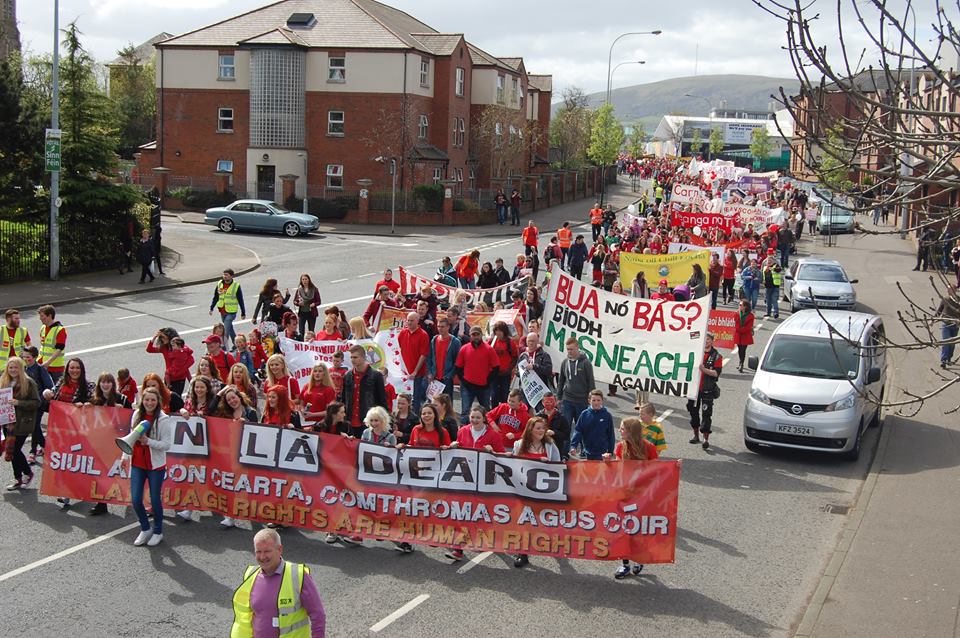
A view of a section of the “Dearg le Fearg” protest demonstration in Belfast in 2014, demanding State recognition of and facilities for the conservation and dissemination of the Irish language. (Image sourced on Internet)
And of course there are Irish language speakers and campaigners who are Sinn Féin members. They made clear you knew that during the huge demonstration in favour of Irish language rights, the Dearg le Fearg9 demonstration of 2014 in Belfast, when they were the only political party displaying a banner in violation of an understanding that no political party would do so.
But what does Sinn Féin do in order to forward the language among its own members and activists? Are its public speakers obliged to be competent Irish speakers? Are its Ard-Choiste (Executive Committee) meetings conducted through Irish? Its cumann (branch) meetings? Its Ard Fheis (annual congress)?10 No, none of those. Is the party even running an Irish language instruction program to overcome this deficit at some point in the future? No.
Apart from some enthusiasts among its activists and a vague nationalist emotional attachment, Sinn Féin as a party is not really interested in the language. In the Six Counties, it is interested in a sectarian carve-up which will keep it at the power table and the Irish language has now become useful for that. Just as, in the Twenty-Six Counties state, it is interested in coming to power in a different kind of power-sharing.
THE EASTER LILLY AND THE “REMEMBRANCE” POPPY
And the latest symbol to be sullied by joining this war of symbols is the Easter Lilly. In times past the Easter Lilly, commemorating in particular the dead who fell fighting for freedom in the 1916 Rising, was worn by many in the Twenty-Six Counties state who were not Republicans. In the latter decades of the last century, few wore it apart from Republicans and, in the Six Counties, it was asking for trouble from the colonial police or Loyalists (often the same thing) to display it. The Flags and Emblems (Display) Act (1954-1987) there empowered any police officer to decide it was likely to lead to “a breach of the peace” and to remove it by force; conviction of a breach of the Act was punishable by a fine of up to £500 (sum equal to about £15,300 in 2017) or up to five years in prison.11
The Act, the repeal of which was one of the demands of the Civil Rights movement of the late 1960s, was finally repealed in 1987 but of course, any signifier identifying a person as a Republican or even a Catholic in the Six Counties is at the very least an invitation to less favourable treatment by the authorities and at worse to harassment and assault by Loyalists or colonial armed forces personnel.
It is of course right that people should have the right to wear the Easter Lilly but to pose it as an equal right to wearing the Remembrance (sic) Poppy is to devalue the Lilly, to putting an anti-imperialist and Irish Republican history emblem on the same level as an imperialist military-glorifying one. But that is exactly what Sinn Féin is now doing12. And Leo Varadkar, Taoiseach (Prime Minister) of the Irish state, recently publicly agreed with that notion.13
And is that not the same project as those of the “Museum of Free Derry”14 and of the Glasnevin Cemetery Trust15, one on each side of the Border, commemorating dead British colonial force members side-by-side with their victims and those who fought against them? As though they are of the same worth to commemorate? As though the objectives of each were (are) of equal value?
What more effective way to undermine the power of an anti-imperialist and anti-colonialist symbol than to equate it with its opposite?
THE IMPORTANCE OF SYMBOLS
I once heard an organiser of a British-based left-wing party, himself of Irish parents, declaim against Irish political commemorations in London as “only of symbolic importance”. How little he understood of human beings to say that! Outside of urgent situations, natural surroundings and chemical reactions, symbols are the only things that convey meaning to human beings.
This page is covered in printed symbols, which we have learned to decipher into words which, in turn are symbols to convey meaning by association. If I write the letters h,o,u,s,e joined together, or say “house”, a symbol in sound, the listeners construct the shape of a house inside their heads, based on the culture and structures to which they have been exposed in their lives, to understand what I mean. If I write or say instead “tent”, they will visualise something else. If I write or say “party” the listener may struggle between visualising a festive occasion or a political party but should I have preceded that word with another, “house”, confusion disappears and the only question is whether the listener’s experience or understanding of a “house party” is the same as mine.
A nod of the head is a symbolic gesture which in most cultures signifies some level of agreement, a shake of the head its opposite. We understand symbolic hand gestures, shrugs, grimaces, smiles, winks, the lift of an eyebrow, bodily posture. Shapes of body or posture can convey sexual availability and induce arousal, or convey threat and give rise to fear. Symbols haunt our dreams, according to Jung and Freud, communications from our subconscious. Symbols are crucial to conveying and understanding meaning.
WHAT IS RIGHT AND WHAT IS NOT
It is right and proper that people should uphold the symbols of anti-imperialist and anti-colonial historical resistance, including the Irish Tricolour (although more appropriate to my thinking is the Starry Plough of the Irish Citizen Army16). Another symbol of that resistance, the Easter Lilly, is equally valid. It is right and proper that people should
“The Starry Plough”, design of the flag of the Irish Citizen Army, first produced 1914. (Image sourced on Internet)
value the cultural and political history embodied in the symbol of the Irish Harp. It is a matter of great cultural world importance that the Irish language survive and flourish. These are important symbols and, in the case of the language, an important thing in itself. These are not things to be equated with symbols of oppression, colonialism and imperialism.
The Union Jack, the Crown and the Poppy deserve to be shunned by all progressive people, because of the values they symbolise and the continuing effect of those things today. The English language, on the other hand, is worthy of a place in a bilingual Irish society.
Let Republicans and others promote the wearing of the Easter Lilly and the display of flags of historic Republican resistance. Let them never place them in the same context or on equal status with the symbols of imperialism and colonialism. Let many promote the use of the Irish language and rights for its speakers but let it not be used as a crude political weapon, much less to further the prospects of a party which actively colludes with and shares in colonial rule by an invader and has done nothing in reality to promote the language even among its own ranks.
End.
FOOTNOTES
1The Statutes of Kilkenny sought to halt this “degeneracy” with 35 Actsforbidding the “intermarriage between the native Irish and the native English, the English fostering of Irish children, the English adoption of Irish children and use of Irish names and dress.[7] Those English colonists who did not know how to speak English were required to learn the language (on pain of losing their land and belongings), along with many other English customs. The Irish pastimes of “hockie” and “coiting” were to be dropped and pursuits such as archery and lancing to be taken up, so that the English colonists would be more able to defend against Irish aggression, using English military tactics.[8]
“Other statutes required that the English in Ireland be governed by English common law, instead of the Irish March law or Brehon law[9] and ensured the separation of the Irish and English churches by requiring that “no Irishman of the nations of the Irish be admitted into any cathedral or collegiate church … amongst the English of the land”.[10]
“………. Statute XV, which forbade Irish minstrels or storytellers to come to English areas, guarding against “the Irish agents who come amongst the English, spy out the secrets, plans, and policies of the English, whereby great evils have often resulted”.[11]https://en.wikipedia.org/wiki/Statutes_of_Kilkenny
2 e.g William Orr, Edward Crosbie, Wolfe Tone, Edward Fitzgerald, Edward Hayes, Henry Joy McCracken, Henry Munroe, William Aylmer, Thomas Addis Emmet, Bagenal Harvey, Joseph Holt, Napper Tandy, Robert Emmet ….
3 Ireland has in fact three patron Christian saints: Patrick, Bridget and Columcille.
5 By use of the term “community language” here I mean a language used by a community settled on an area, as distinct from say a community of people separated by distance but united by use of a language, or a language used by a few families separated from one another by a majority not speaking that language.
7 A misnomer constantly repeated not only by Unionists but also by British public commentators: the province of Ulster has nine counties, of which three are in the Irish state and six in the British statelet.
8 The Sunningdale Agreement of 1973, which proposed power-sharing between Protestant and Catholic communities in the shape of the Northern Ireland Assembly and Executive, was overthrown by the Loyalist action of the Ulster Workers’ Council (and Ulster Army Council) strike of 1974, including armed intimidation of Catholic areas, with British Army troops and RUC police standing by (or in the latter case openly colluding) .
9 Literally “Red with Anger”, a campaign of demonstrations organised both sides of the Border, against administrations of both states, by Irish language campaigners and speakers. Connradh na Gaeilge (the Gaelic League, an organisation part-funded by the Irish state) took part in organising this but it was only one of many much more grass-roots organisations across the country involved. It had been agreed that political party representatives would not be speakers (this was violated in some instances) and that political party banners would not be displayed (violated by Sinn Féin on the Belfast demonstration).
10 This is very different from comparable movements for national independence in Catalunya and the Basque Country, where their own national languages dominate their political discourse, despite repression (until the 1980s) and lack of state support.
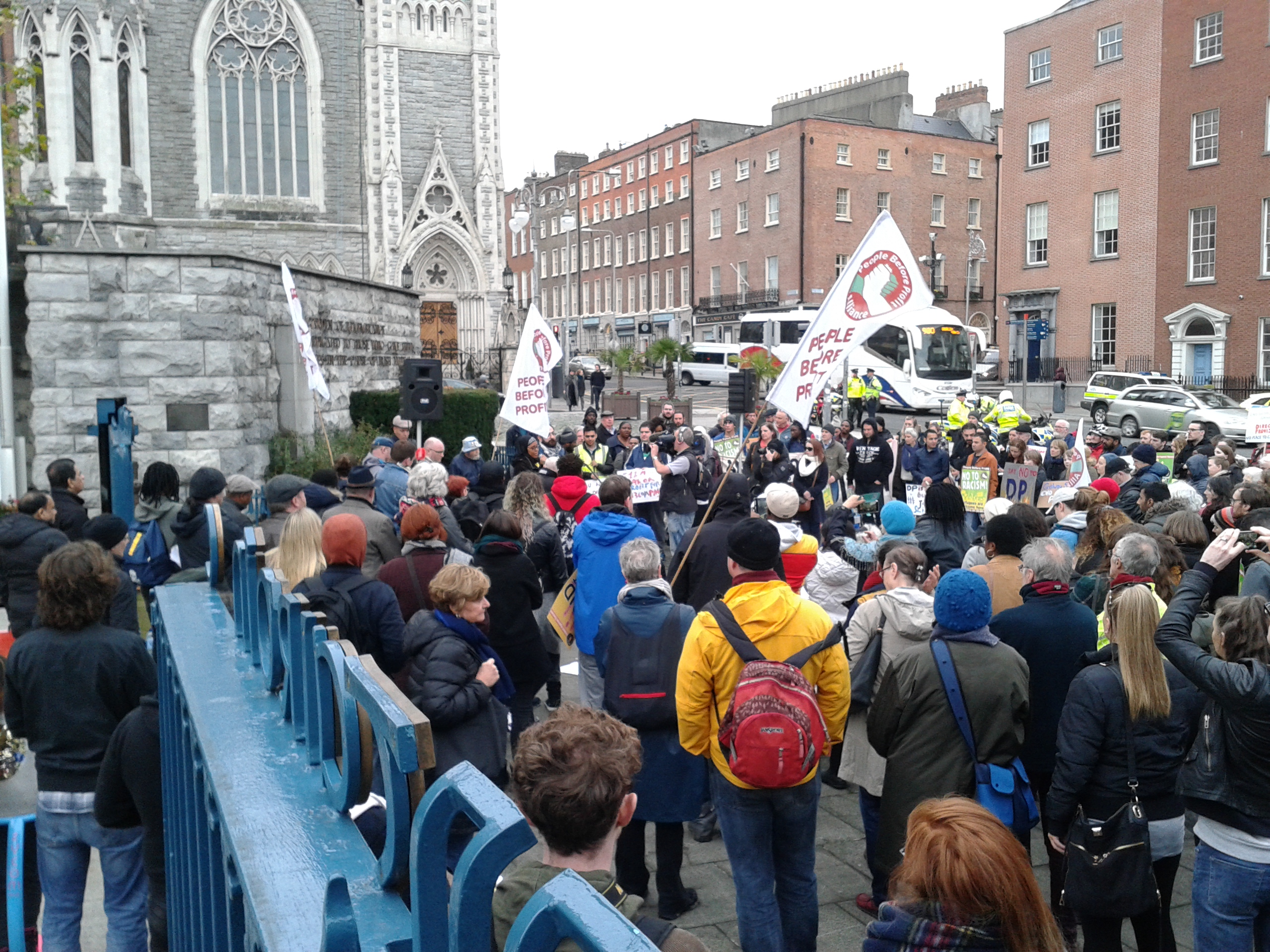
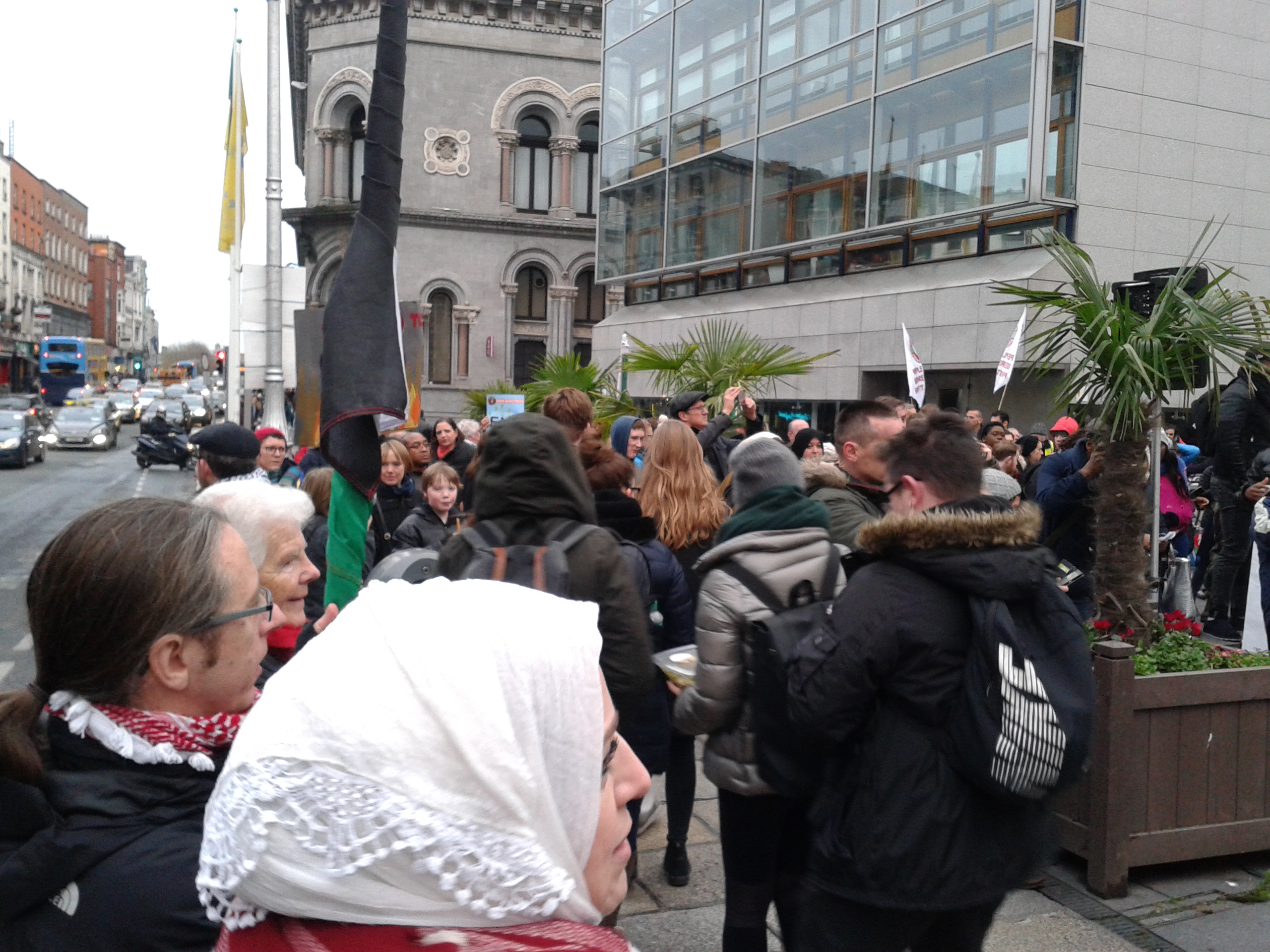
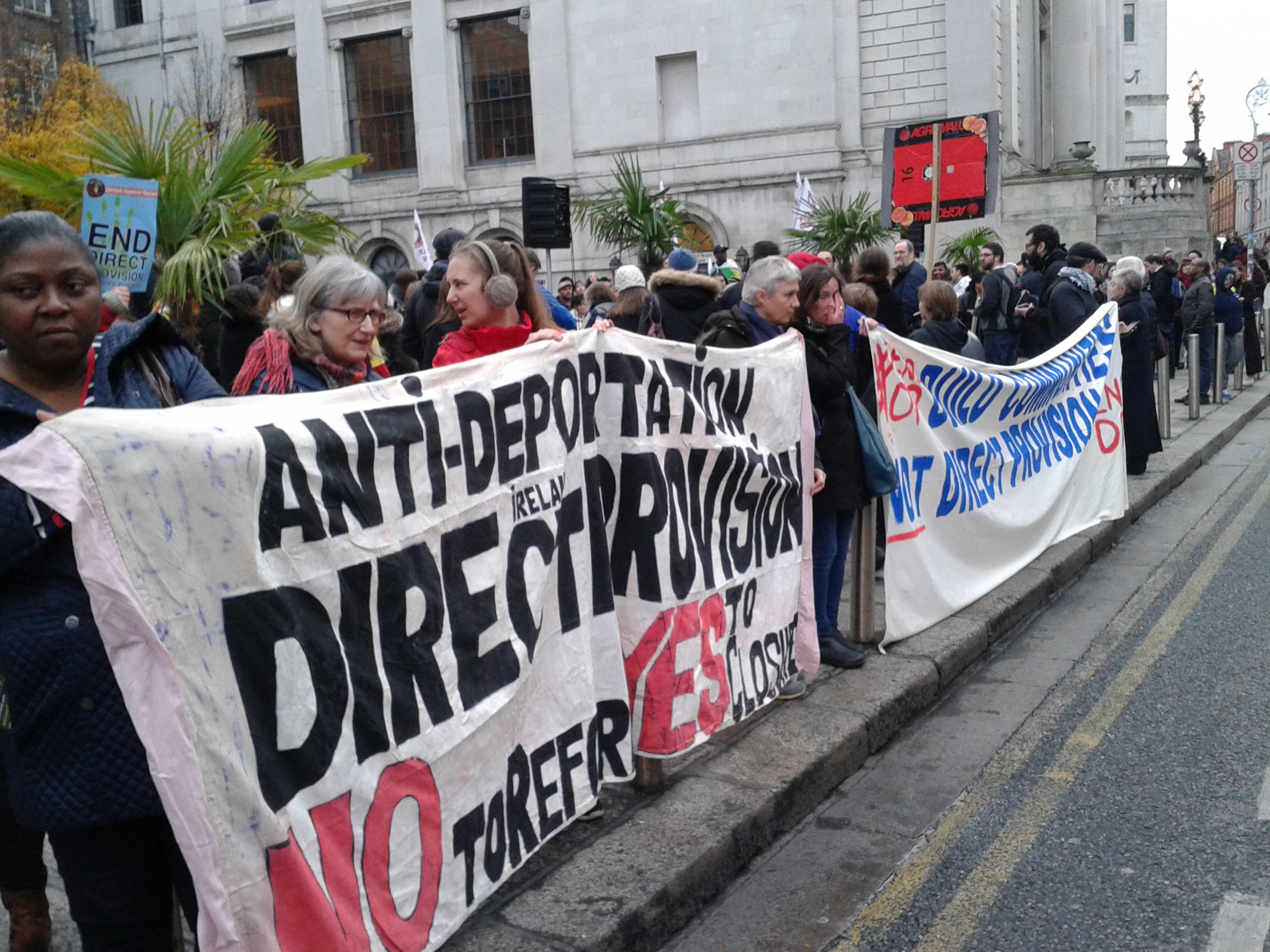
A lively demonstration was held in Dublin on Saturday 18th November against the Irish Government’s policy towards asylum seekers. A coalition including United Against Racism organised the demonstration, seeking the right to work for asylum seekers and the end of Direct Provision.
Children’s placard photographed at end rally in Dame Street. END DIRECT PROVISION!
Direct Provision was introduced as a “temporary measure” in 200 but is still being used approaching two decades later. In the Irish state asylum seekers, i.e those who seek to live here to escape persecution or danger to their lives in their homelands, are obliged to live in centres while waiting years for their applications to be processed. In the meantime they are not permitted to seek employment, receive €21.60 a week and may not even prepare food to cook food in the centres where they have to live.
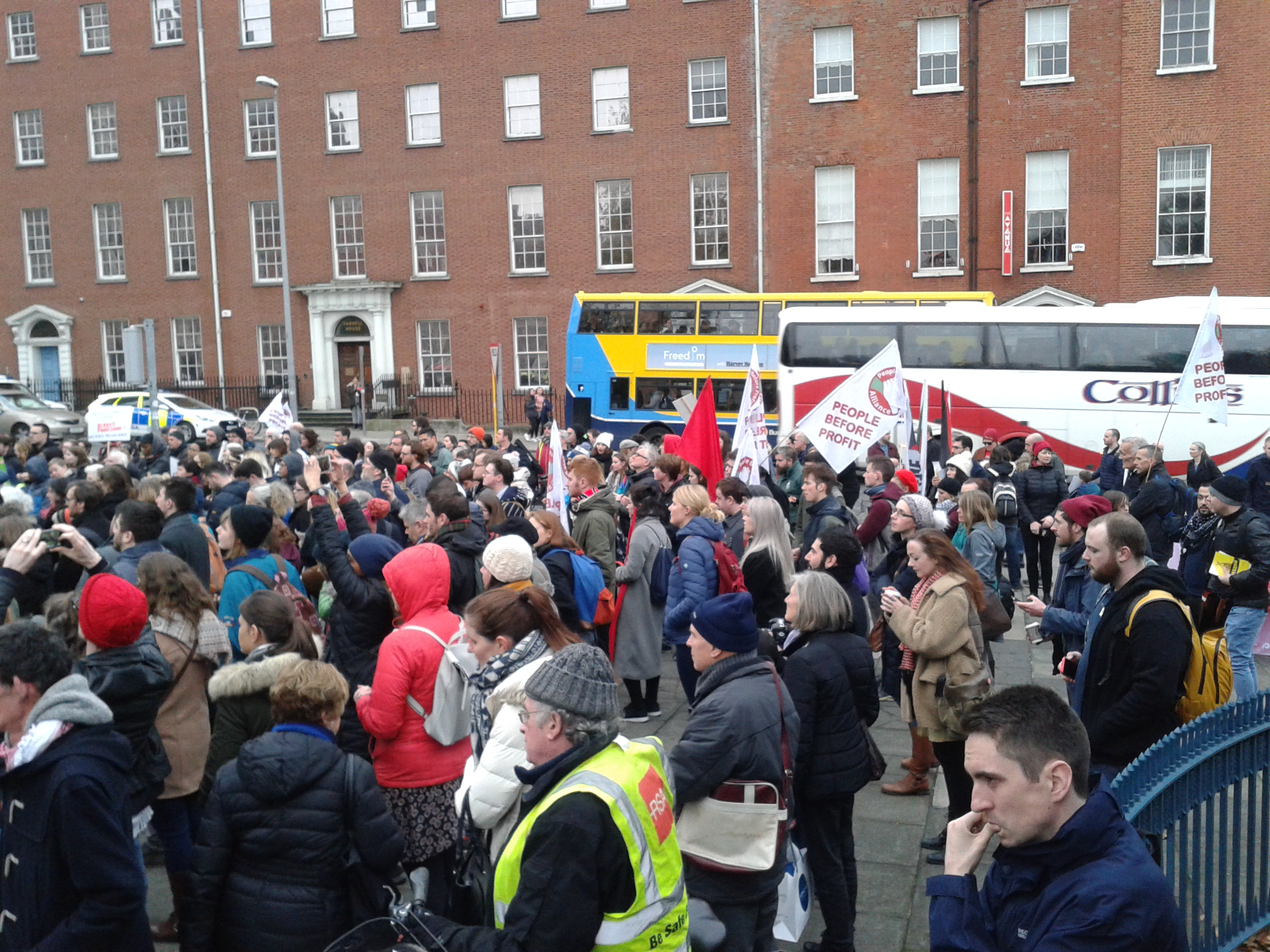
A view of the rally outside the Garden of Remembrance before marching (Photo: D.Breatnach)
Children of asylum seekers are obliged to live in these conditions and, when they reach 18 years of age, are denied access to third-level education.
Another section of the rally before commencement of the march. (Photo: D.Breatnach)
The protest march started at Dublin’s Garden of Rembrance and proceeded down O’Connell Street, heading along Dame Street towards the plaza by the side of City Hall and in front of Dublin Castle, where speakers addressed the crowd. Along the way some drums were beaten and they shouted slogans including “One Race – the Human Race!” “We want the right to work!” “End deportations!”
Another slogan was the call of “Amandla” (“Power”, in Zulu and Xhosa), responded to by “Owetu!” (“to us”); this call-and-response was well-known in the struggle against the apartheid regime in South Africa.
The crowd comes on to the street to march. (Photo: D.Breatnach)
In the last ten years, according to a media report in July of this year, 44 people have died in direct provision, at least two of them confirmed as suicides. However, the causes of death of fifteen of those were listed as “unknown”, according to The Catholic newspaper, which obtained the figures under a Freedom of Information application to the Reception and Integration Agency, which runs the centres. At the time, the Department of Justice, under which the RIA operates, pointed out that most of the deaths occurred outside the centres but avoided clarifying that in effect this means that they die in hospital.
Veteran anti-war campaigner Margaretta D’Arcy was on the march, seen here in Dame Street. (Photo: D.Breatnach)
Also in July, a report into what children in Direct Provision Centres think of their accommodation was published. The Child Law Clinic at University College Cork carried out the research, speaking to children in the direct provision system aged between 8-17 years of age. Many complained of the food and some also complained that they did not use the communal relaxation areas as young male refugee and asylum seekers congregated there – apparently there are no children-safe areas available.
Justice Minister Charlie Flanagan (who had but recently taken over from Frances Fitzgerald) welcomed the report but Tanya Ward of the Children’s Rights Alliance said that it is of “deep concern” that some children feel unsafe in direct provision centres.
Some Ireland Palestine Solidarity Campaigners seen at the concluding rally. (Photo: D.Breatnach)
At the end of the march, Dame Street, by the side of City Hall and in front of Dublin Castle. (Photo: D.Breatnach)
We knew about gays but we didn’t call them that. That was in our primary school days. Our mammies or das or others had warned us boys about them. We were never to accept sweets from strangers. They were men, older, probably shabby, hanging around in public toilets (when we had public toilets in streets). They would try to see your mickey, try to touch it (they were only interested in boys, which went to show how totally deviant they were). They’d give you sweets or even money. Just for that? It was enough! We thought no further but when we had to use those public urinals, kept as far away as we could from any men (a habit we continued into adulthood) and tried to cover our mickies with our hands and sometimes got some of the urine on them as a result.
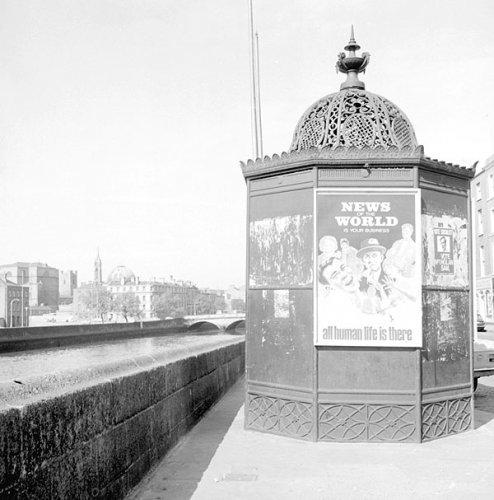
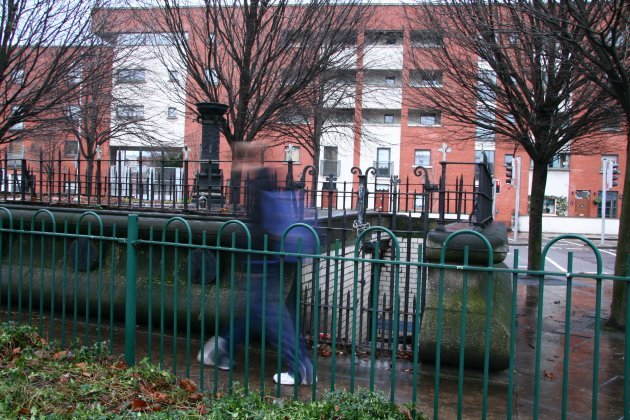
Old-style urinal formerly on Ormonde Quay, Dublin, photographed in 1969. One of the types of places where the “Brownies” supposedly lurked. (Image source: Internet)Locked underground toilet in Kevin Street, Dublin, one of many such now all closed or demolished. (Image source: Aoife Barry, the Journal)
We didn’t call them “gays” then but there were other names in our vernacular dictionaries: brownies, dirty men, homos ….. They were always predators and always male. Girls didn’t have to worry, apparently – those dirty men would not be tempted at all. It was the normal men girls had to worry about.
Was there such a thing as female homos? But if they wanted to play with your mickies that would be normal wouldn’t it? And nice even if sinful. Ah, chance would be a fine thing! But girls or women doing it with one another? How? And sure, what for?
Did we know any homos? Well, we were kind of getting to hear about poor Oscar Wilde. He would have been our fifth national Nobel prizewinner for literature and the fourth from our capital city. If not for …. well …. Poor man, he was misguided. And duped. But a lovely writer.
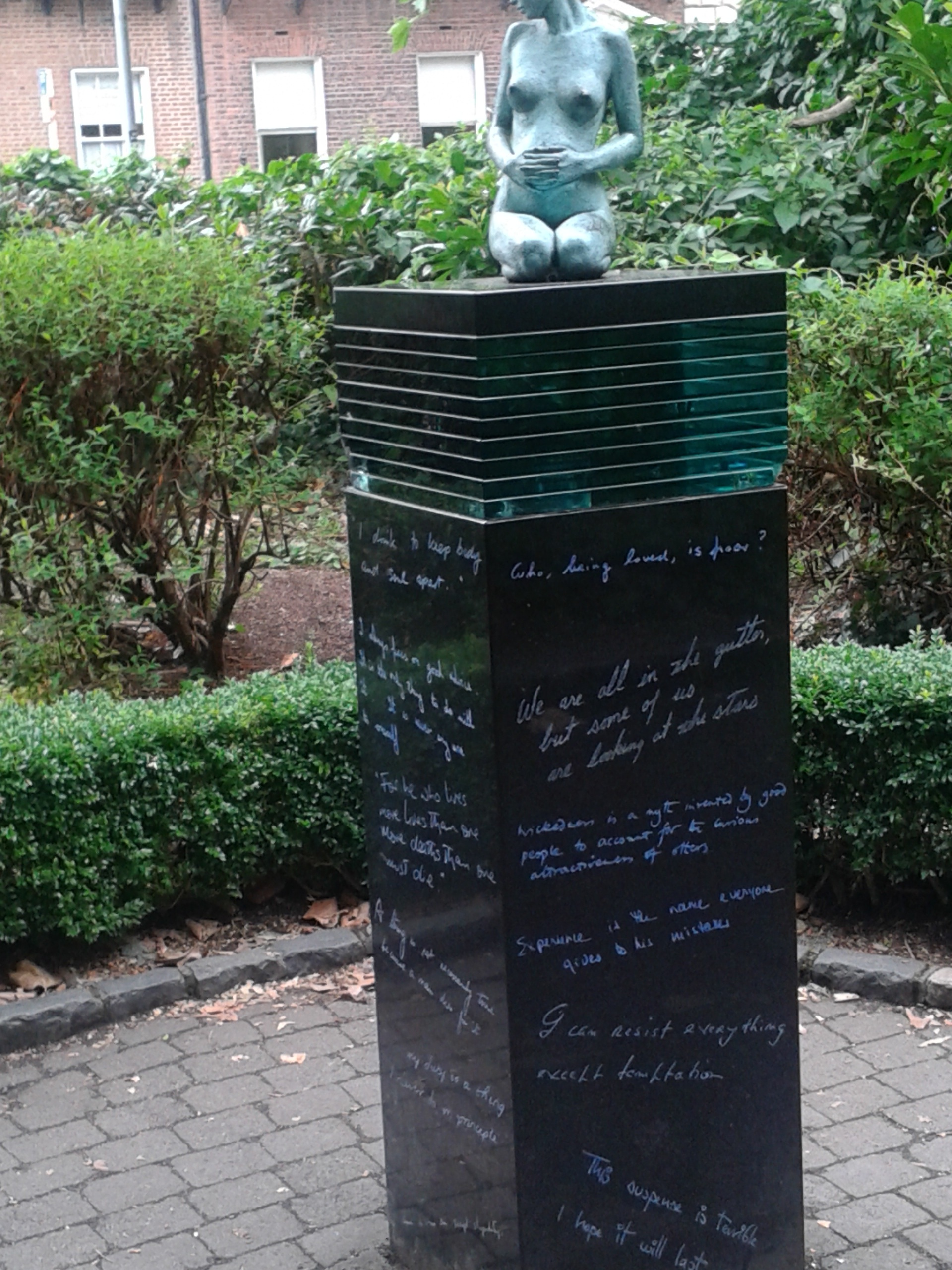
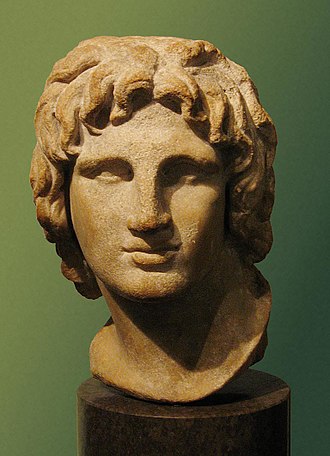
Oscar Wilde quotations, part of his monument in Merrion Square, Dublin. (Image source: D.Breatnach)Head sculpture of a youthful Alexander the Great, from the Hellenistic period. (Image source: Internet)
Our elders, well a great many of them, knew that many famous men had been homosexual – but they didn’t tell us. We knew quite a bit about the military exploits of Alexander, the Macedonian but nobody told us he was homosexual. If we’d known, we’d have asked ourselves whether he went to conquer the world in order to hang around public toilets in foreign lands, waiting to touch boy’s mickies. William of Orange was a homo too but then we had enough reason to hate him already. Wait – William …. Willy …. willies ….. nah, coincidence!
There was another William they might have known about,King William Rufus (1087 – 1110), son of William the Conqueror, openly homosexual. And probably assassinated by order of his brother, King Henry II, not for being gay but to get the kingdom. Well, what would you expect of the English! OK, Norman-English. Whatever.
Mícheál Mac Liamóir as Iago in Orson Well’s production of Shakespeare’s “Othello”. (Image source: Internet)
They surely knew, educated adults and anyone around the theatre, that Mícheál Mac Liamóir was “a practicing homosexual”. An Englishman who became Irish, including a fluent speaker and writer in the Irish language, he lived with his lover Hilton Edwards in Harcourt Terrace. Edwards was another Englishman converted to Ireland. But sure they were English, so our elders only sniffed and turned a blind eye, grateful for the culture of the Abbey and Gate theatres, the formation of An Taidhbhearc and fame on English language stage and screen.
We knew Roger Casement could not be homosexual (even though he was a Protestant) because he was an Irish patriot. The English would do anything to tarnish his reputation and they had forged “the black diaries” to say disgusting things about him1, before they hanged him, not for homosexuality but for “treason” to the Crown. That’s the English Crown, of course. The one on top of the Arms of the Union, with the Lion and the Unicorn below, and below them the shield bearing the Thistle of Scotland, the Rose of England and the Harp of Ireland. You can see the design on the front page of the London Times, or on the roofs of the Bank of Ireland and Customs House buildings in Dublin.
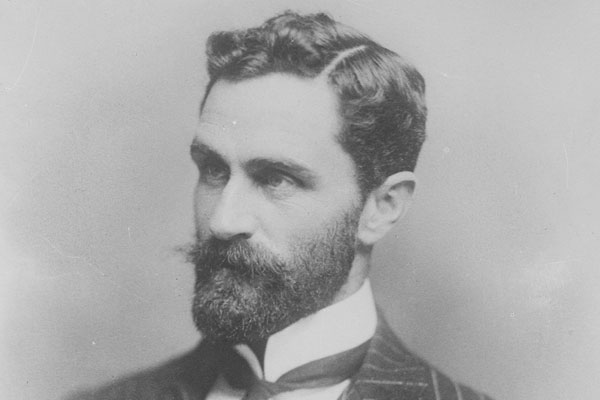
Roger Casement, projected by British espionage service as a homosexual in order to undermine the campaign for clemency on charge of treason. (Image sourced: Internet)
But did we know any homosexuals personally? Perhaps some did. There was a lad at school who liked to knit and listen to opera and whose manner was quite feminine. Probably he was/ is, we thought years later but at the time he was just a boy who was like a girl. There was another one, son of a famous actor, a bit of a bully with a gang around him. He turned out to be gay but I at least never suspected. Then there was a certain barber who seemed quite effeminate but would do his best to cut your hair to any fashionable style which you required.
As we came into our teens, our vision broadened a little and we came upon more sinister knowledge. There were now rumours of homosexual Christian Brothers and priests. Seeing as these two groups, along with the Jesuits, directly controlled most of secondary education in the Irish state, nearly all of us Catholics were going to pass into their hands at some point. Hopefully their educational hands only. They didn’t have to hang around public toilets. They’d have us for six or seven hours a day, five days a week. Not to speak of the residential schools (too many people didn’t).
We knew in general and we knew of specific instances, by rumour or by experience. We resolved not to be victims ourselves and the strong succeeded. The weak? Well ….. Sauve qu’il peut, as they say (or I think they do) in France.
And we didn’t talk of it to our elders. Why? Well ….. hard to say. Would they have believed us? Did we have proof? Would it only have showed how dirty our minds were?
In my teens, a youth selling newspapers in Dún Laoghaire told me of a brawny sailor who one evening wanted to entice him into an alley away from company in order “not to embarrass the girls”. So, homosexuality was not confined to the creepy men hanging around toilets, or to the effeminate and arty, or to the clergy and Catholic brotherhoods. Burly sailors? Dear God!
And now a disturbing but exciting knowledge also came to us. We learned that there were indeed homosexual women – they were called ‘Lesbians’. And almost unbelievably, if you managed to get hold of a copy of the Kinsey Reports (or reviews of them), lesbianism appeared to be even more common than male homosexuality! Disturbing in a number of ways …. women preferring to have sex with women than with men? For some of us, it was difficult enough already to get physically intimate with a girl without some of them preferring other women! Then, a second thought, disturbing in a different way: imagine seeing them together … doing it! Double female nakedness!
As we grew older, we came to know gay men personally. Of course we did. Some of us, the better ones, acknowledged them our equals, did not avoid the subject nor deny them our company. Some of us, while accepting their company, avoided any mention of their preferences; we treated them as heterosexuals, knowing they were not. And some of us avoided them or worse, inflicted violence on them. We found out that some indeed did hang out around toilets but not to feel the mickies of little boys but to make assignations with adult males. Where else could they meet? It was illegal and religiously prohibited too.
Then came gay liberation agitation in the 1970s. Decriminalisation in 1993. And finally, equal rights to wed in 2015. Incredibly almost, that same Ireland of our childhood voted by majority in every county but one in the Irish State of the Twenty-Six Counties, that gays should have the right to marry people of their own gender. In May 2015, Ireland became the first state to legalise on a national level same-sex marriage by popular vote. The New York Times hailed the victory as putting Ireland at “the vanguard of social change”.
A badge in the Irish language calling for a vote in favour of the right to same-sex marriage in the Irish state referendum of 2015. (Image source: D.Breatnach)
We have come a long way, in that respect at least. But oh, the victims of intolerance strewn along each side of the route of our progress!
Generations in Ireland will grow now, hopefully, without the spectre of the Brownie.
End
Footnotes:
1 Roger Casement (1864-1916) was an Irish patriot and Protestant, also a poet and an enthusiast for Irish culture. In 1916, in preparation for the Easter Rising in Ireland, he came in a German submarine to assist in the unloading of German armament, including 20,000 rifles. The German boat, disguised as a Norwegian, was discovered and its captain scuttled it outside of Cork. The IRA Volunteers who went to meet the boat and Casement at its rearranged landing place, of which they had just learned, drowned as their car went off the road into the sea.
Casement was apprehended after landing. He was tried for treason in wartime and a substantial campaign arose to save his life. He had earned fame and a knighthood (CMG) a decade earlier through exposing ill-treatment of indigenous people in the African Congo under Belgian Royal control and in Putamayo in Perú by rubber-exploitation commercial interests.
Extracts from the “Black Diaries” were circulated by the British espionage service to undermine popular support for clemency for Casement. Those Diaries (as opposed to his other diaries of his travels abroad)gave details of his allegedlysexual interludes with men abroad and the extracts circulated substantially undermined the campaign for clemency. Casement was hanged in Pentonville Prison on 3rd August 1916, the last of the 1916 executions, the only one not by firing squad or to take place in Ireland.
The authenticity of the “Black Diaries” continues to be the subject of controversy. Although Wikipedia notes that a handwriting expert concluded by comparison with his other diaries that the entries were genuinely Casement’s, he is the only handwriting expert to have been permitted to examine the original, nor have samples been subjected to modern forensic testing. And the British espionage service did have a reputation for forging documents.
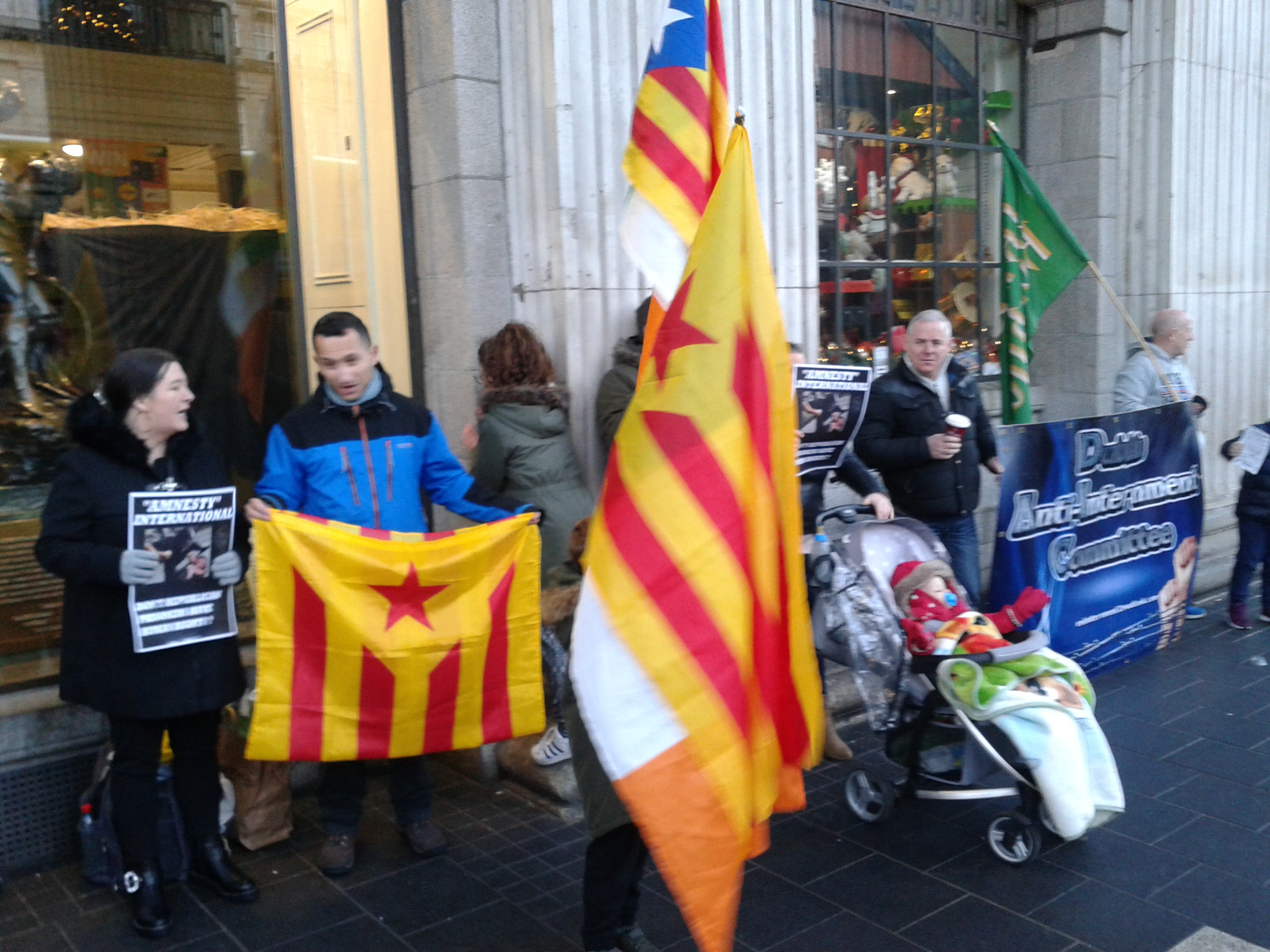
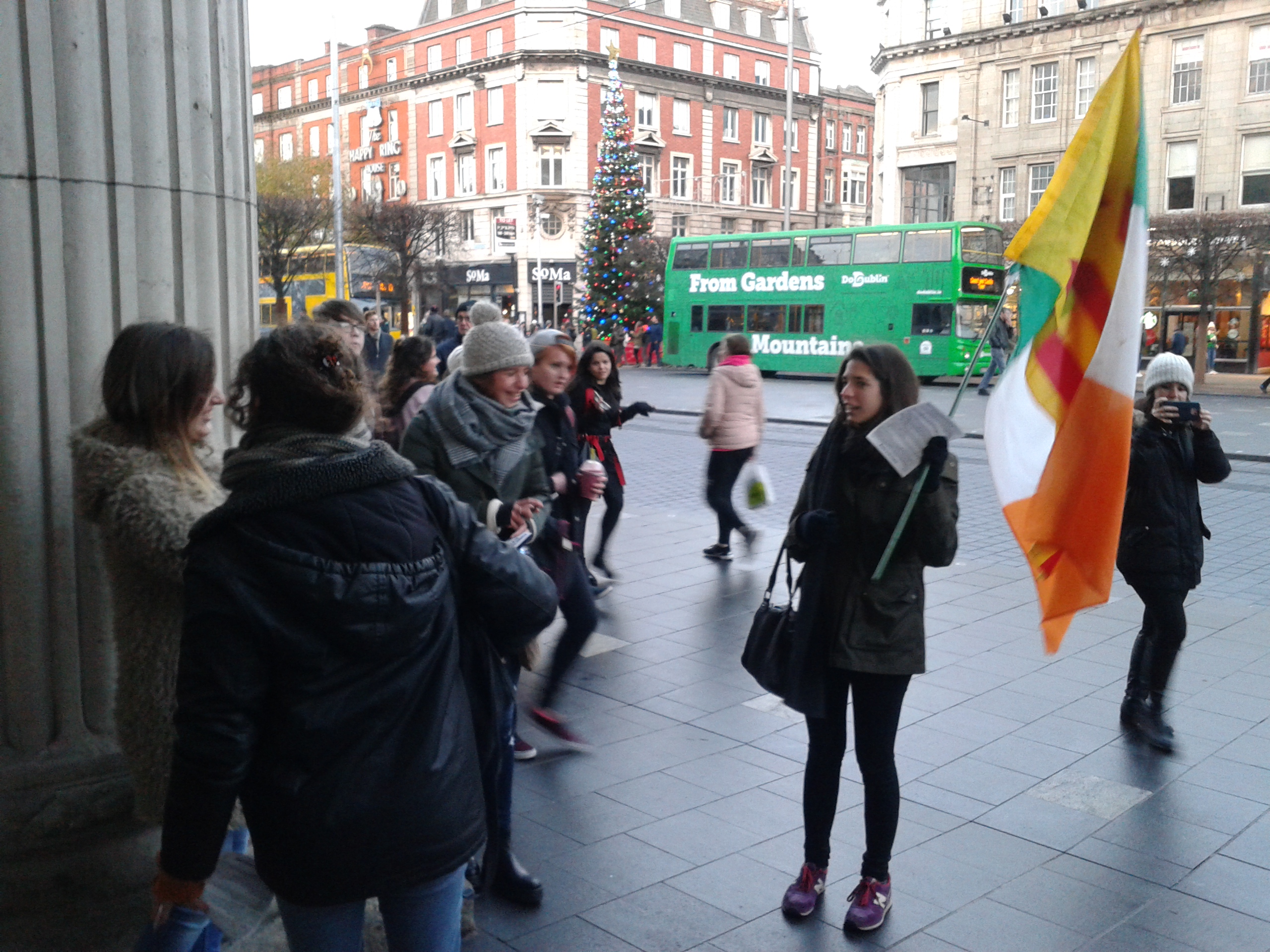
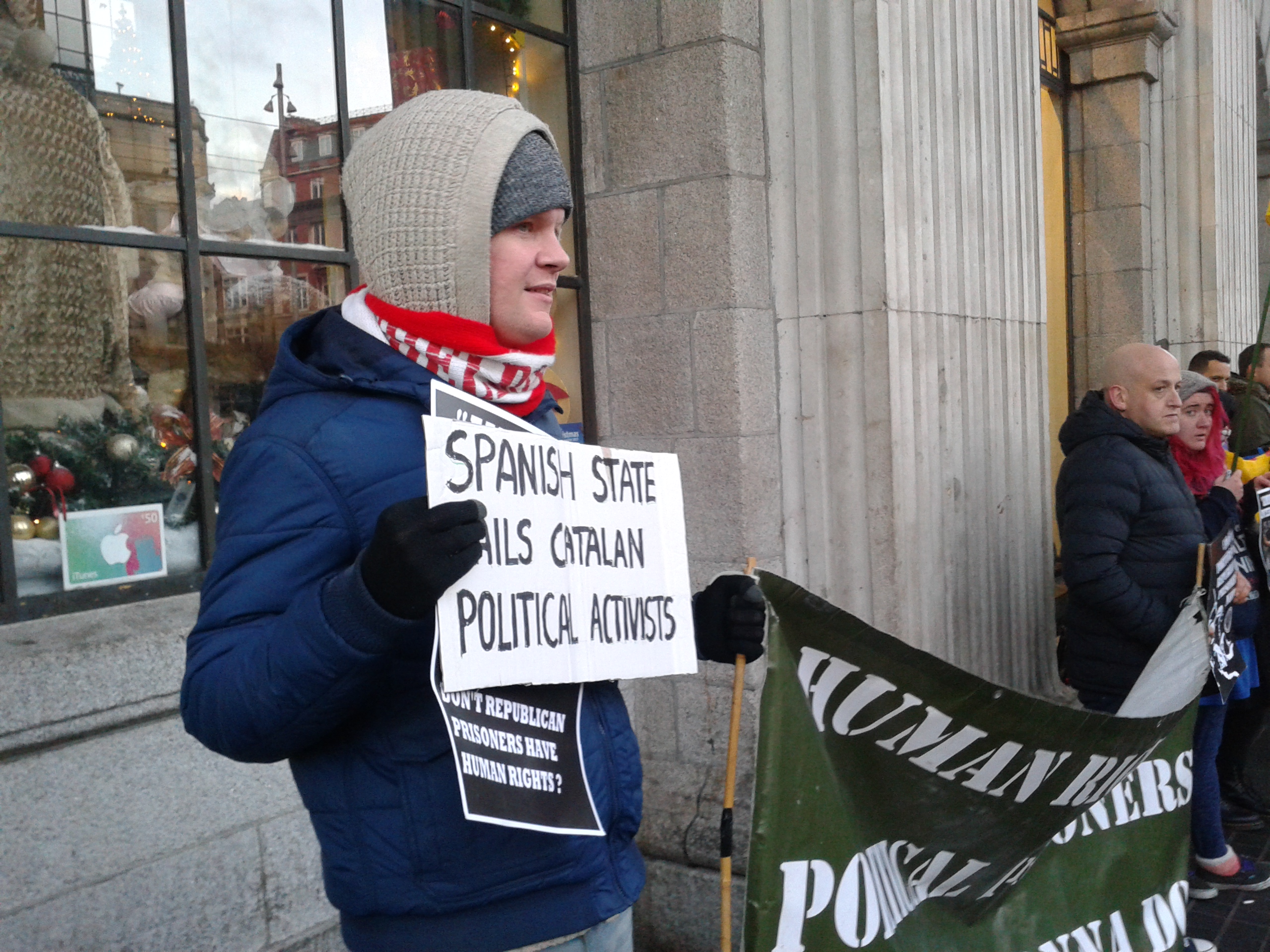
Catalan Esteladas flew next to Irish Tricolours at the GPO in Dublin on Saturday afternoon (25 November 2017). The occasion was a picket organised by the Dublin Anti-Internment Committee to protest the internment without trial of Irish Republicans and also of Catalan political activists for independence. Placards raised the issue of internment of Irish Republicans and their treatment once in jail, as well as criticising the lack of action of Amnesty International on this question. Some placards also declared that the “Spanish State jails Catalan political activists”.
Mix of Irish and Catalan flags outside the GPO building, O’Connell Street, Dublin (Photo: D.Breatnach)
Despite the seriousness of the issue and the bitter cold, the mood was upbeat, assisted by a music player broadcasting a range of songs, from Sifre’s “Something Inside So Strong”, through Warshaw’s “The Cry of the Morning” (sung by Christy Moore) to “Els Segadors”. Some protesters sang along to the songs and passers-by could be heard joining in too.
Many leaflets were distributed. A number of Catalan young women passers-by were excited to see the Estelada flags and were ecstatic when “Els Segadors” (“The Reapers”), the Catalan national anthem, was played.
Catalan and other young women passers-by reacting to the protest excitedly borrowed some joint flags to take photos of one another. (Photo: D.Breatnach)
Some people passing occasionally shouted “Viva Espaňa!” in hostility which gave rise to the response of “Viva la democracía! Viva la libertad!” On the other hand, other visitors passing by were very supportive, for example a young woman from Asturias (northern Spanish state) and an older man from Andalusia (southern Spanish state).
A spokesperson for the Committee briefly addressed the attendance at the end of the event, thanking them for attending to support Irish and Catalan political activists being jailed without trial. Referring to the few passers-by who shouted “Viva Espaňa!”, the spokesperson said that there is nothing wrong with pride in one’s country but queried why the sight of a Catalan flag brought that response and why the definition of Spanish nationhood for these people is bound up with the denial of the rights of another nation to determine its own future. The spokesperson declared that every nation has a right to determine its own future and to do so without threats and repression, pointing out that the Spanish State is attempting to jail the whole Catalan Government for carrying out their election promises and has jailed the leaders of two independence organisations without trial.
The spokesperson thanking the attendance once more, the event came to a close, flags were furled, banners rolled and placards put away for another occasion.
The Dublin Anti-Internment Committee was launched in 2013 and is independent of all political parties and organisations, holds regular pickets and people who support the civil and human rights of Irish Republican prisoners are welcome to attend.
They are all around us; they live but they are not animals. Nor are they micro-organisms – we see them clearly all in many places. They can grow on organic and none-organic surfaces. We might think they are plants – algae, moss or fungus but they are none of those — they are lichens. There are about 20,000 known species1 and they cover an estimated 6% of the Earth’s surface, able to exist in environments as different as beneath Artic snow, on salt spray-showered seashores and windswept mountain rocks and in tropical rainforest. An estimated 6% of the Earth’s land surface is covered by lichen species.2 Some are long-lived and include the longest-living things on Earth. There are species that require nothing to cling to while others can live inside rock, in the spaces between grains.3In Ireland, 1,134 separate species of lichen have been recognised, according to the National Biodiversity Data Centre – i.e over 5% of Earth’s estimated total species right here on this little island.4
When we look at some growing on tree bark or rock, we are tempted to think of them as fungus, algae or even moss. Mosses are ancient enough life-forms and are plants, which algae are too and almost certainly much older. Fungi used to be considered plants but are so no longer and in their structure and digestion and also genes, are more akin and more closely related to animals. This will not be good news to vegetarians or vegans but the evidence is difficult to deny.5 Indeed there are some feoilséantóirí (word in Irish for a vegetarian and more apt in the context of this sentence) who already dislike eating many fungi because the texture reminds them of meat.
But lichens are neitherfungi nor plants.
White and Map Lichen on rock, Old Kenmare: Killarney Rd Kerry. (Photo source: WikiIreland)
Lobaria Pulmonoria lichen, a leafy type, Killarney National Park (photo sourced from Internet)
So if lichens are not plant or fungus, what are they? Another kind of life-form? Well yes … and no. They are a combination of both, fungus and plant. At some point in the evolution of life on earth, logically after plants and after fungi had evolved, somehow some species of fungi combined with some species of alga and/or cyanobacteria6 and produced a symbiont or biont: lichen. Scientists maintain that the 20,000 estimated species did not evolve from one common ancestor but that different species appeared separately at different times during the history of the Earth.
Teloschistes chrysophthalmus on branches (image sourced from Internet)Another map algae (Geographicus) on rock, a species that in a test has survived exposure to space vacuum and radiation, apparently unharmed. (Image sourced Internet)
Plants draw their nutrients from sun and elements in the soil (or in some cases, in the water). Fungi, like animals, cannot get their nutrients straight from sun or soil and need to break down their alimentation materials, whether flesh or plant, in order to feed on them. In doing so, fungi are important decomposing agents – in fact, the principal ones.
Vascular plants need roots not just to cling to soil but even more importantly, to draw up water and nutrients but algae don’t; when they have any kind of roots, it is to cling to a surface and that is exactly what the lichen needs too. Fungi extend and feed through root-like growths usually under the surface of what they are feeding upon, extending from the tips; they are not roots, however and break off easily.What we see of fungi is usually the spore-bearing parts above the surface, often much the smaller part of the organism.
Plants seem to grow above ground also by elongating their tips but in fact are extending from further back, adding cells to cells to lengthen the body. All plants need a constant supply of water (cacti and succulents store water but still need to draw on the supply to live). Fungi need damp conditions. But when combined into lichens, the new species can live without water for a considerable time. So, a marriage, as they say, “made in Heaven” … or perhaps in a Hell, an environment of very dry and hot conditions alternating with the very wet and cold , where the newly-wedded ancient algae and fungi set out to build their homes.
Some lichens contain not only algae combined with a fungus but also a cyanobacterium; this partner is capable of fixing nitrogen extracted from the air and is a valuable addition to the menage-a-trois.
It has been remarked by some that the marriage of plant and fungus is not an equal one, is not true symbiosis, since the fungal partner or symbiote benefits more than does the algal. The algal symbiote produces sugar through photosynthesis and the fungus only chitin, or ‘hard‘ structure, it is argued. However, if both partners (or three) are content with the arrangement, is that not a happy marriage? More seriously, the fungal partner may contribute other factors to the symbiosis of which scientists are only just becoming aware – for example, chemicals to repel organisms attempting to graze on them and protection from the sun.
And scientists do not treat them equally either, since the species of lichen is always determined and named by them according to the species of fungus, not of the alga or bacterium.
COLOURS IN THE RAIN
Xantheria parietina (image sourced on Internet)
So, if the claim is that we see them all around us, where are they? They may be seen on slate roof-tops, in patches of roughly circular white (not to be confused with pigeon or seagull excrement, which may also be in evidence). Yellow or orange patches are typically seen on stone, as is a black or dark brown one by the seaside. A bright yellow-green one may be seen on fallen twigs or on tree-bark, as may also a tufted-form green one growing on rock or tree.
Alga and lichen on plane tree during rain, Drumcondra, Dublin. (Photo: D.Breatnach)
The colours tend to be particularly vivid during or soon after rain when the cortex becomes translucent and, if there were no other reason to be grateful for the precipitation levels usual in Ireland, that would be reason enough, perhaps, should we take the time to admire the little things of beauty. Of course there are other reasons and as a Basque once said to me about the green of his native country and could perhaps even more accurately said about colour associated with the “Emerald Isle” — “It’s not green because we paint it.”
Some of the bright colours in lichens, produced by the fungus, are thought to be of use in protection from the rays of the sun and become more vivid after rain due to rapid absorption of water by the chlorophyl-holding part of the symbiont (or biont).
PIONEERS AND SURVIVORS
Lichina pygmaea – a black marine littoral species, this one photographed near the high-water mark. (Image sourced on Internet)
Lichens are considered “pioneer organisms” by botanists and geologists, i.e organisms that set out to colonise new territories. These maybe new territories in the sense that a geological change has exposed them to air, e.g from the seabed or from under ice, or from inside the earth by volcanic action or by tectonic plate collision.
Pioneer organisms need to be tough and adaptable and they often create footholds for other species, not quite so tough or adaptable, to follow after. However, given that logic dictates that algae and fungi existed before some of them combined to form lichens, the latter could not have been among the earliest colonisers of the Earth’s crust. On Earth then, they are later pioneers of newly-created inhospitable terrain.
May they be used to help create habitable environments elsewhere? It’s perhaps worth quoting these two paragraphs from Wikipedia in their entirety:
In tests, lichen survived and showed remarkable results on the adaptation capacity of photosynthetic activity with the simulation time of 34 days under Martian conditions in the Mars Simulation Laboratory (MSL) maintained by the German Aerospace Center (DLR).
The European Space Agency has discovered that lichens can survive unprotected in space. In an experiment led by Leopoldo Sancho from the Complutense University of Madrid, two species of lichen — Rhizocarpon geographicum7 and Xanthoria elegans — were sealed in a capsule and launched on a Russian Soyuz rocket 31 May 2005. Once in orbit, the capsules were opened and the lichens were directly exposed to the vacuum of space with its widely fluctuating temperatures and cosmic radiation. After 15 days, the lichens were brought back to earth and were found to be in full health with no discernible damage from their time in orbit.
Hieroglyphics lichen (Graphis scripta) on rock, Castle Coole, Enniskillen, County Fermanagh, Northern Ireland, OctoberCladonia coccifera and Cladonia diversa or Pyxidata on branch in Ireland (also known as Pixy Cup and Devi’s Matchstick but “Pixy” sounds unlikely for a name in Ireland, more likely from Cornwall or elsewhere in south-west Britain).
In some areas, soil lichens help to bind the sand-crust or soil-crust together but lichens have also been shown to chemically attack stone, thereby helping to create soil. Lichens can also help create little environments where soil may be retained and seeds of plants germinate. However, like all species, lichens are out to help themselves and some produce chemicals to restrict the march of mosses (another pioneer species but more water-reliant), with which lichens would have to compete in many areas).
When growing on tree bark, lichens do not parasitise on the tree nor harm it in any way, merely using it as a secure base. Older trees are often covered with lichen and dead trees or branches more so, associating in some people’s minds the ill-health in a tree with the growth of lichen upon it. Circumstantial evidence may suggest the guilt of the lichen but it is completely a case of coincidence: lichen is slow-growing and the older the tree, the more time lichen has had to grow and extend upon it; the tree dies because it grows old.
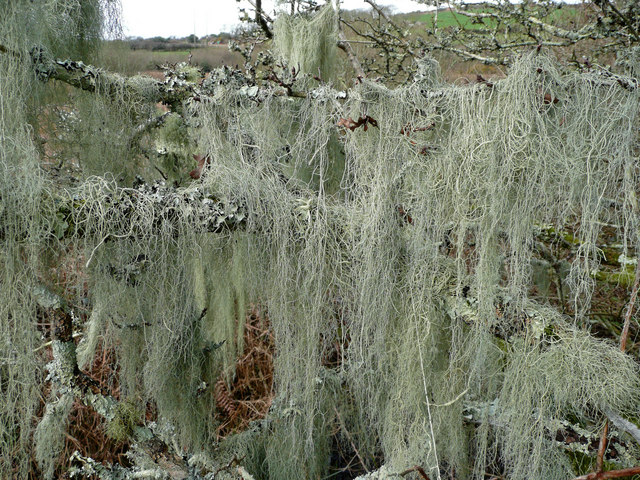
Green Beard lichen, Usnea species, Cornwall (photographer: Jonathan Billingsworth). Usnea is very vulnerable to polution, particularly sulphur dioxide and will only grow like this when well away from such pollutants.Lichen-covered apple tree (sourced: Irish Image Collection)
The lichen will survive the dead tree for a period but it is not the killer. Now come decomposers: insects, snails, slugs and especially, distant relatives of the lichens: fungi. Without concern for their relatives, the fungi, along with the other decomposers, will reduce the tree to soil ingredients and thereby deprive the lichens of their base but, in time, providing more soil for more trees to grow and for new generation of lichens to attach themselves to the bark.
The fungus is not too discriminating and a particular species may combine with different algae species; the resultant lichens may appear to be different species but (since 2014) will be classified as the same lichen species, i.e containing the samespecies of fungus.8
The alga can also exist independently in nature but the fungi cannot. Two species in two genera of green algae are found in over 35% of all lichens, but can only rarely be found living on their own outside of a lichen.9
A green frond-lichen, Evernia prunastri (Image sourced at Internet)
Sex and Reproduction
It is only the fungal part of the symbiote that reproduces sexually. When doing so, it produces spores (as do ferns and mosses) which must find a compatible alga in order to produce a new lichen, a symbiote of the fungus of the parent fungus and a new alga.
Some lichens reproduce or extend asexually, advancing across a surface and merging with another of the same species.
Uses of lichens:
When we discuss “the use” of some thing we generally mean its use for humans; lichens no doubt have many uses for other organisms, whether as food for reindeer during non-growing seasons or as micro-environments for tiny creatures. But for humans, the uses are mostly in the areas of
dyes
drugs
environmental indicators
geological age indicators
Dyes and Pigments:
Dyes were made from the orange Xanthoria Parietina and the grey-green branched Parmelia Saxitillis to dye wools used in traditional tweed (Harris) weaving in the Scottish Highlands10and I myself have had the second of the two pointed out to me by an Aran Islander woman as the source for the rarely-used green wool knitted into a geansaí (pullover or jumper). Material for other natural dyes exist for example in Ireland but the issues are how easily they are obtained, how true they dye and how long they remain the desired colour and shade.
“There are reports dating almost 2000 years old of lichens being used to make purple and red dyes. Of great historical and commercial significance are lichens belonging to the family Roccellaceae, commonly called “orchella weed” or “orchil”. Orcein and other lichen dyes have largely been replaced by synthetic versions.”11
We know that red and purple dyes were much sought after and in some medieval civilisations the wearing of those colours was restricted to certain social classes and even to one individual (e.g the purple for the Emperor). Once Europeans had gained familiarity with indigenous civilisations of Central and South America, the red dye obtained from the parasitic cochineal insect Dactylopius coccusbecame an important export product to Europe until the late 19th Century, when synthetic pigments and dyes were invented. Despite this development, traditional hand-made textile producers, for example in regions of Mexico, continued to use cochineal dyeing. However, health concerns associated with some or all of those synthetic colourings in food have once again created a demand for cochineal and cultivation of the insect is once again economically viable, with Peru being currently the main exporter.12
Drugs and Medicine:
There is reason to believe that metabolites produced by lichens may have antibiotic effects and usnic acid, the most commonly-studied metabolite produced by lichens, is being investigated as a possible bactericide, in particular against Staphylococcus and E.coli.13
Lichens were also used in European traditional medicine, in particular based on the theory that plants that resembled human organs would be efficacious in treatment of illness of those organs. Some American Indigenous people also used them in traditional medicine treatment.
Lichens as Indicators of Geological Age and of Pollution Levels:
The science of lichenometry is a relatively new one in which measuring the type and size of lichen is used to indicate the age of exposed rock. It takes the known slow growth-rate of different lichens to arrive at an estimate of how long the rock in question has been exposed. This can be used on rock formations, landslides, stone buildings and statuary.
The tolerance (or lack of tolerance) of different species of lichen to certain types of air and rain pollutant can be used as bio-indicators. In general the “frond” or “bushy” types are less resistant to some air pollutants and the flat or “crusty” types more so. Lichens take their water from the surfaces to which they are attached and from the air and are therefore quickly affected by the water quality in rain and air.
In Conclusion:
Readers may find it worthwhile to take some time to examine the lichens growing around us, to think about their unusual ‘domestic arrangements’ and their pioneering habits. Or to inventory them as indicators of the level and content of pollution in a specific area.
And in particular, to put on rainproof or resistant clothing and to view lichens during rainfall or at least very soon afterwards.
This Autumn I made myself available to give talks in the southern Basque Country (i.e. in the Spanish state) on the situation of Irish political prisoners and a series was arranged for mid-October for nearly two weeks.
As well as having private conversations, I gave a total of five public talks to audiences ranging in size from ten to over forty. The composition of the audiences varied from youths to older middle-aged; in some places the latter predominated and in some, the former.
All the meetings I spoke at were arranged by an organisation called Amnistia Ta Askatasuna which calls for total amnesty for Basque political prisoners. This was also a demand of the whole movement and of the leadership of the Abertzale Left until fairly recently and the Gestoras pro-Amnistia organisation had been created under the Abertzale Left umbrella but then banned by the Spanish State. But the Abertzale Left’s leadership have now dropped this demand from public discourse, saying the conditions are not ripe for it and concentrating instead on the end of the dispersal. (More about this and the Basque prisoner situation later).
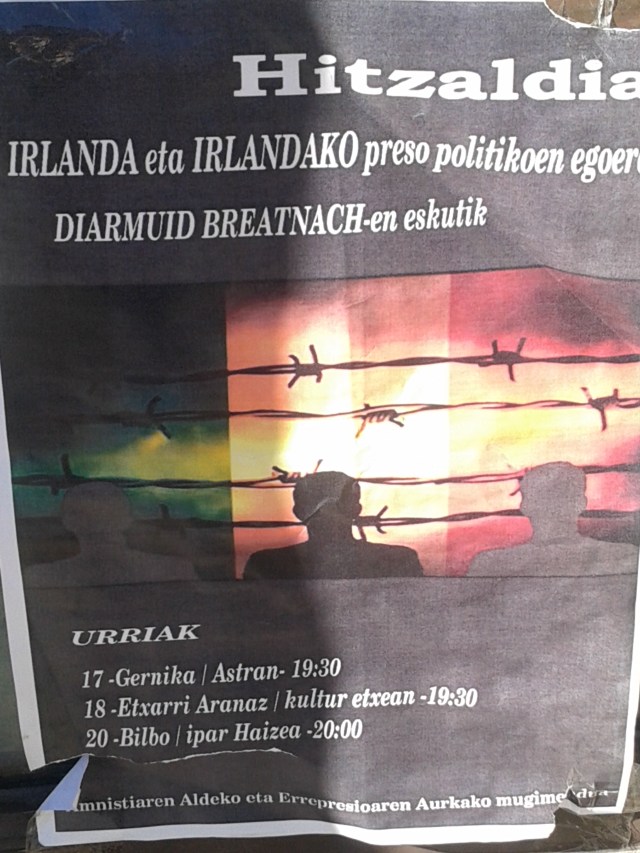
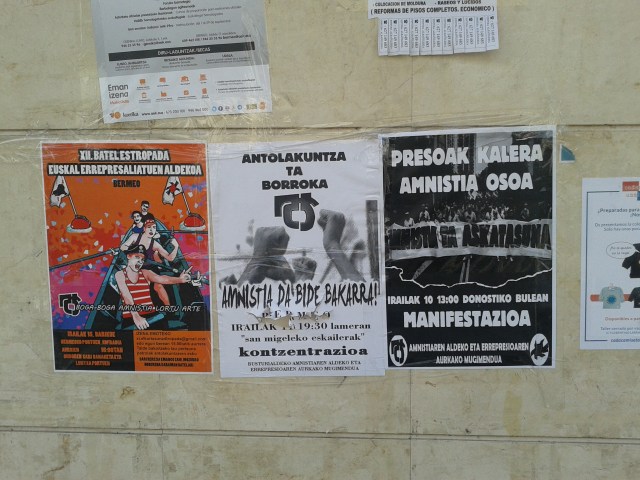
Poster on a wall advertising three talks in the southern Basque Country before the remaining two were confirmed. October 2017. (Photo: D.Breatnach)
I had not intended to confine my talks to those organised by ATA but it was they who organised the talks on dates that were offered, with the exception of one from an independent source that unfortunately clashed with one I had already accepted elsewhere.
ATA posters share with other advertising on a wall in the southern Basque Country, October 2017 (Photo: D.Breatnach)
THE TALKS
The types of venues for the talks were community cultural centres (two), occupied buildings (two) and one local (a space for which the users’ association paid rent and used for their activities). Geographically, the talks were held in Gernika and two in Bilbao (Bizkaia province), Etxarri (Nafarroa) and Ibarra (Guipuzkoa province). There were none in Alava province (although earlier this year I gave interviews to Hala Bedi pirate radio there, in Gastheiz/ Vitoria). On this occasion also I gave a video interview to a rapper who also makes videos for Hala Bedi, though he is located in Bizkaia.
From conversations and discussion it became clear that all the older people in the audiences were veterans of the Basque struggle over decades and a number were ex-prisoners. Some had relatives in jail. The youths had come to political activity or thinking in recent years.
Talk in cultural centre in Ibarra, Guipuzkoa, southern Basque Country, October 2017. (Photo: ATA)
For the content of the talks I briefly reviewed the more distant history of political prisoners in Ireland, moving on then to the Good Friday Agreement and the release of
Torn poster advertising the talk in Ibarra, Guipuzkoa province, southern Basque Country, October 2017. (Photo: D.Breatnach)
most Irish Republican prisoners in the Six Counties under its terms. The re-arrest and jailing without charge of a number of these ex-prisoners was part of the talk, in which the specific examples given were of Marian Price, Martin Corey and Tony Taylor. I also dealt with the procedure of arrest on ridiculous charges and refusal of bail, or granting it under undemocratic and restrictive conditions, for which I used Stephen Murney as an example. These were all members of different organisations or none. Conviction on charges which the evidence does not support is also a category I mentioned, giving the Craigavon Two as an example there. Arrest on possession of arms charges is also a feature on both sides of the Border.
With regard to the 26 Counties, i.e the Irish state, I discussed the Special Court, Membership-of-an-illegal-organisation charges and charges of obtaining arms or having assisted terrorism. I mentioned the planned second Special Court in particular in the context of the State’s failure to convict most of the Jobstown protesters on charges that included “false imprisonment” (i.e kidnapping).
While noting that splits had occurred before in the Republican movement – the Provisionals themselves having emerged from such a split in 1970 – I noted that since the GFA, splits had multiplied and listed a number of the resulting organisations, including those that had existed already at that time.
Listing the number of Irish political prisoners (at the latest count then 79) and reminding the audience that the Irish had extended solidarity to Basque political prisoners, I asked the Basques for solidarity towards our political prisoners too. And I did so not only as a moral issue of internationalist solidarity but also in recognition that internationalist solidarity is one of the first casualties (i.e aspects to drop or weaken) by those who are seeking to surrender the struggle or even to become collaborators.
Talk in cultural centre in Etxarri, Nafarroa province, southern Basque Country, October 2017. (Photo: ATA)
QUESTIONS
I timed the talks to give sufficient space for – and encouraged — questions and comments, even critical ones.
It was interesting that the same questions tended to come up again and again:
Did the different Republican organisations cooperate with one another inside and outside the jails?
What were the conditions in the prisons like for the prisoners?
How are political prisoners in ill-health being treated?
Is there a dispersal issue with regard to political prisoners?
Did the population support the prisoners?
What were the conditions for their release under the Good Friday Agreement?
Did INLA prisoners sign the GFA release agreement?
Are there armed actions continuing in Ireland?
Are the youth involved in solidarity actions and campaigns?
What was the attitude of Sinn Féin towards the political prisoners?
Are prisoners “on the run” still in danger of arrest and imprisonment?
In one meeting, one of the smaller audiences and containing only youth, I was asked about the role of women in the national liberation struggle in Ireland today.
Talk in the occupied former Astra factory building, Gernika, Bizkaia province, southern Basque Country, October 2017. (Photo: ATA)
Some of the questions asked reflect the situation of the Basque political prisoners and also of the censored and inaccurate information about Ireland that reaches them, including through the Abertzale Left‘s (the “official” umbrella organisation) daily newspaper, GARA. At a number of times in the past spokespersons of the Abertzale Left’s organisations had claimed that there were no longer Irish political prisoners, a claim repeated in GARA. More recently, the tendency is to ignore their existence or to represent them as very few, without a program other than return to armed struggle and without a support base (i.e Sinn Féin’s line).
The new direction of the Abertzale Left’s leadership, which included a “permanent truce” and disarmament of their armed organisation ETA (formally declared in January 2011) was said at the time to have been agreed by the Basque political prisoners in their organisation EPPK. There have been persistent claims by friends and relatives of some prisoners and by some prisoners released in the last couple of years that they had not even been consulted.
A number of people to whom I spoke claimed that the prisoners’ collective no longer really exists, with prisoners left to act individually; some others said this was true to an extent but not completely. Certainly one feels a general air of disillusionment and uncertainty – and also of anger. And it is true that a small number of prisoners have formally denounced the leadership and left the collective.
Grafitti in Ondarroa, Bizkaia province, southern Basque Country, October 2017. (Photo: D.Breatnach)
From figures collected in 2003, up to 30,000 Basque activists out of a total population of less than three million) had been arrested, 8,170 were accused of being members of ETA and roughly half of those convicted and imprisoned. The prisoners’ relatives and friends’ organisation Etxerat (also under the Abertzale Left’s umbrella) in its July-September report of this year (2017) recognises 315 Basque political prisoners, of which 310 are dispersed through 61 prisons, with only two in 2 prisons in the Basque Country.
In 39 prisons in the Spanish state, 239 Basque political prisoners are being kept and 68 in twenty prisons of the French state. There are 212 (68.85%) Basque political prisoners in prisons at distances of between 600 and 1,100 km of the Basque Country; from a distance of 400 to 590 km from their country there are 67 (21.75 %) and between 100 and 390 km of home another 29 (9.40 %).
The strain on relatives and friends is considerable, road accidents are frequenton their journeys to visit prisonersand a number have been killed.
Twenty-one prisoners (21) are diagnosed as being seriously or terminally ill and according to the states’ own penal codes should have been released on parole to home or hospital but instead of reducing the number of sick prisoners the total is climbing (almost doubled in recent years). I accompanied ATA comrades to the port town of Ondarroa to participate in a demonstration organised by a broad platform calling for the release of terminally-ill Basque political prisoner Ibon Iparragirre.
Section of rally after demonstration in Ondarroa, Bizkaia, in solidarity with local seriously-ill prisoner Ibon Iparragirre, October 2017. (Photo: D.Breatnach)Stage of the rally after demonstration in Ondarroa, Bizkaia, in solidarity with local seriously-ill prisoner Ibon Iparragirre, October 2017. (Photo: D.Breatnach)
The Spanish state has rejected all the “peace process” (sic) overtures of the Abertzale Left leadership and says that ETA should just disappear and prisoners wishing to be pardoned and released must repent their previous actions, apologise to their “victims” and give information on their previous activities and comrades. It also says that all still at liberty and wanted for past illegal activities will continue to be pursued.
COMMENTS AND CONTRIBUTIONS
These too tended to be of a kind to come up again and again throughout the tour:
The situation in Ireland with regard to the liberation movement and prisoners is like that in the Basque Country or that which the latter will face as time goes on
The prisoners’ cause is being deserted by the Abertzale Left leadership
Their media and leadership had lied to the movement about the situation in Ireland
The leadership is only interested in penetrating the institutions and is neglecting the politics of the street
Otaegi and Adams are alike and McGuinness was a traitor when he asked people to inform on paramilitaries
The Abertzale Left did not of course comment on the talks – why would they? However, in Ibarra, I saw posters for the meeting torn down in areas where other political ones remained and according to my hosts, this was the work of the “oficialistas” (i.e followers of the leadership’s line) in the town. It was notable too that with a few exceptions, a number of people within the Abertzale Left but whom I know to be very critical of the change of direction, did not attend the talks held in their areas. Since some had previously attended a meeting at which I spoke a year ago and engaged in discussion critical of the Abertzale leadership, I took it that these either disapproved of the ATA organisers or did not wish, for whatever reason, to be seen attending a meeting held by the organisation.
At all the talks I was received with friendliness and courtesy and after some I had a meal in company in a txoko (Basque building — or part of one — owned or rented by a gastronomic association) or the home of my hosts for the evening. Although I invited criticisms with genuine interest in hearing them, none were voiced publicly, whether of the content of my talk or of the Irish people generally — although there were some questions as to why the people “in the south” had not supported more widely the “struggle in the north”. I explained that what they call “the north” is one-fifth or the country and also divided in its population; in addition the Republican movement had left the social and economic concerns of the people in the other four-fifths largely unaddressed and in fact had opposed some social reforms in earlier times. People in the 26 Counties had given a lot of support but without mobilising them on their own concerns and specific conditions this was likely to be a minority activity and to decline over time.
CATALUNYA: SOUTHERN BASQUE ATTITUDE TO THE STRUGGLE THERE
Inevitably, the struggle in Catalunya came into the discourse at some point – after all, I had arrived in Euskal Herria just under two weeks after the Referendum.
The Catalan national flags, the esteladas (both versions) were in evidence across the Basque Country as were some solidarity banners and posters. The two solidarity demonstrations I witnessed (and in which I participated but for a while – each having been called for the same evening as my talk locally) in Nafarroa and in Bizkaia appeared to have been called by the “official” movement and were fairly small and quiet. The largest, of over fifty people, did not even have a flag, placard or banner, which was puzzling.
Large image on the wall of the youth local in Errekalde, Bilbao, where they hosted one of the talks, October 2017. (Photo: D.Breatnach)
It was reported to me that some time back, the Abertzale Left had been close to the militant CUP (Catalan left-wing and independist popular movement) but now were moving closer to the Eskerra Republicana, often perceived as being less militant and closer to the Catalan bourgeoisie. Among the critics of the Abertzale Left leadership and others there seemed to be a doubt that the Catalan leadership was serious; however, both the “officials” and the “dissidents” had sent people to help the Catalans in their referendum.
After the Spanish police violence on October 1st there was a feeling that the Catalans were enduring what the Basques had endured for decades so why the great shock now? When two leaders of the Catalan movement were arrested and jailed without bail and called “political prisoners”, of course the Basques pointed to their own hundreds of political prisoners (and also to two Catalans who were ETA prisoners). The failure to declare a Republic on the promised day seemed to bear out those with a more cynical view but actions since then and the application of the repressive Article 155 of the Spanish Constitution are bound to raise feelings of respect and solidarity across the Basque national liberation movement, whether “official” or “dissident”.
IN CONCLUSION
It is clear that there is interest in the Irish situation and of that of the prisoners in at least some sections of the broad Basque national liberation movement. It is also clear that there is a substantial discomfort with the direction of the Abertzale Left’s leadership since 2011 (and for some since even earlier). Frustration is also evident as is a great concern for the political prisoners and a worry that they are being left without leadership, to come to their own arrangements with the Spanish state or to endure many more years in jail or die there (as Kepa De Hoyo did in August and as Ibon Iparragirre faces now).
This level of concern, disquiet and even distrust is not currently reflected in great numbers attending pickets or demonstrations organised by ATA, as numbers attending the talks showed in some areas but as the talks also showed, there is a network of support for ATA across the southern Basque Country. It was clear that a greater lead-up would have resulted in talks being hosted in further areas, including the province of Alava which was not included on this occasion. The general composition of the movement represented by ATA is healthy in its spread across generations, comprised of veterans (including ex-prisoners) and youth new to the struggle.
The pedestrian bridge at Ondarroa, scene of one of the “human walls” organised some years ago by Basque youth in resistance to the arrests of activists. Supporters placed the activist whom police were seeking in the middle and then packed the bridge with supporters, causing the police hours of work to carry out the arrest. I was told that the official leadership had ordered the cessation of these events. October 2017. (Photo: D.Breatnach)
From a personal point of view it was an interesting if somewhat hectic and stressful period but also one that increased my understanding of the reality.
From a political perspective I hope it helped build some links for solidarity between the struggles in each of the two nations and an awareness that pacification processes are not an alternative but only another face of repression. For the struggles in which so many have sacrificed so much to succeed, we need to raise our awareness of these processes. In these processes political prisoners, often seen by their populations as heroes and people to be cherished, are used by the repressive power as hostages and often too as bargaining counters, the temptation always there for some of those in struggle to use them in kind.
From Axpe de Busturia train station, Bizkaia, October 2017. (Photo: D.Breatnach)Morning view of misty mountains from a host’s house in Etxarri, Nafarroa province, October 2017. (Photo: D.Breatnach)Bermeo Harbour and some of the town from heights above, October 2017. Near the big building at 9 o’clock on the photo was the location of a Franco prison for Resistance women — I was told that Basque nuns locally brought food to the jail for them every day. (Photo: D.Breatnach)Part of the Bay of Bizkaia (Biscay), October 2017, from the site of a Basque Gudari artillery battery during the Anti-Fascist War. (Photo: D.Breatnach)
When the Irish financial bubble, expanded far beyond capacity, finally burst and the private banks that had caused the crisis were bailed out with public money, the Irish people did not immediately rise up. The big trade unions made some noises, called hundreds of thousands to march, then collapsed. The smaller unions, for the most part, caved in afterwards.
It was not long before the Irish people began to be jeered and insulted – and for the most part, by some people who were themselves Irish. They seemed unaware of a thousand years of militant resistance to foreign occupation and many workers’ battles over decades. The frustration, if that was the cause of their insults (not to say contempt), was understandable. Less so, I pointed out at the time, was their dismissal of the only force that could possibly save us – the Irish people.
“The people?” they jeered. “You mean the SHEEPLE!”
They pointed to massive demonstrations and riots in Greece and in France and to none in Ireland. I commented that all their insults could possibly achieve would be to discourage the Irish people further. The limitations under which the Irish people laboured needed to be understood. There was no large revolutionary party in Ireland to provide leadership. There was not even a militant radical social-democratic party or reformist Communist Party. There were no militant trade unions to provide organisation. These things existed in Greece and in France.
Our trade unions had twenty years of “social partnership” – i.e they had during that time negotiated agreements nearly always without industrial action in joint committees where the unions, the employers and the State each had representatives. Their fighting muscle had atrophied to the extent it no longer existed. Notwithstanding all their faults, the Greek and French unions had not similarly wasted away their muscle. Our trade union leaderships had settled for a comfortable life, highly paid, building up their memberships and safeguarding their officers and structures, or trying to, neglecting the purpose for which those unions had been created. They were captains of ships in dry dock, shining and varnished, but riddled with worm holes and sails safely furled – they would never take to sea and be tested in any storm.
As time went by, we saw no significant reforms in the French situation as austerity bit there. There was much excitement in Left social-democratic and Trotskyist quarters as the Greeks elected a social-democratic party with a radical program of resistance to austerity measures. The Greeks had been driven to a much worse economic situation than had the Irish – during the winter, many schools had to close as heating could not be supplied. But then the radical Greek party and new Government collapsed under pressure from the EU’s financial commissars.
The people in the Spanish state were marching in their hundreds of thousands under a new party that was not really a party, they said. But it turned out if one did some digging, that it was not such a new party/ non-party after all, as its leadership came from the old reformist Communist Party-Trotskyist alliance, Izquierda Unida. But still …. huge marches and then huge electoral gains (for what was now without question a political party – Podemos).
But the Spanish ruling class, although unable to receive a governing mandate for a single political party, carried on with its austerity program. Evictions continued as did a great many suicides of those evicted or about to be evicted.
IRELAND (THE 26 COUNTIES)
Meanwhile, what about the “Irish Sheeple”? What were they doing?
They too began to march, in small numbers at first, then larger until they choked the capital city’s centre. The media under-reported them, lied about numbers, stopped doing aerial photos that would show the full extent of the masses in protest.
First in line of the resistance movement was the Household Charge. The campaign slogan proposed by independent protesters and small parties and political organisations was “Don’t register, don’t pay.” Despite that tactic, the most effective to defeat the Charge, not being supported by the alternative party with the highest number of elected representatives in the Dáil (Irish Parliament), i.e Sinn Féin and despite no trade union mobilising against it, the ruling class had to concede defeat. But they changed the tax to the Household Charge and made it collectable from people’s salaries at source, changing the law in order to do so.
A section of a Water Charge protest march on the south quays of the Liffey while another section marches on the north quays in August 2015 (Photo: D.Breatnach)
The Water Charge was next. The people already paid for water supply maintenance through ordinary taxation and, it later emerged, through the diversion of Motor Tax to pay for the water! Nevertheless, a new charge was levied and again, the campaigners asked the people: “Don’t register, don’t pay!” Again, this tactic was not supported by the same alternative political party or the unions, although they all declared that they were, of course, against the Water Charge.
Despite police harassment, violence and arrests, people in local areas began to block the work-gangs installing the water meters. Some arrested activists refused to obey a court injunction intended to paralyse their activities and were sent to jail. A large protest demonstration marched to their jail and they were released. Many trials collapsed and activists, though hampered by many court attendances, walked free. Some others paid their fines and continued their resistance.
March against the Water Charge finishing for rally at Dublin’s Stephens Green in September 2016 (Photo: D.Breatnach)
Police attacks on water charge and anti-austerity protesters multiplied and pickets, particularly of women, protested outside Garda stations.
Hundreds of people began to march, then thousands. As the numbers grew, the reformists of political party and trade union climbed on board and the numbers continued to rise to hundreds of thousands. The media were exposed as they grossly underplayed the numbers.
MOORE STREET
Meanwhile, another struggle had been shaping up, between heritage conservationists campaigning to save a valuable piece of the City Centre of huge historical importance from property speculators. Firstly the State was obliged to declare four houses in Moore Street as of historical preservation status (while however the Planning Department of the local authority gave planning permission for a huge “shopping mall” of a number of acres around those houses). Subsequently campaigners prevented the Planning Department from carrying out a land-swap of Council land to facilitate the Speculator.
Then the State had to buy four houses in the historic terrace; at the same time their plans to demolish three other houses in the same terrace were prevented by their occupation by protesters for five days and a subsequent blockade of demolition workers of almost six weeks.
The blockade ended when a case taken by a concerned individual to the High Court resulted in a judgement that the whole quarter is a historical 1916 monument (against which judgement the Minister of Heritage is currently appealing, scheduled for hearing December 2017).
Moore St. historical conservation campaigners in the street itself celebrate High Court judgement shortly after receiving the news on March 18th 2016 after which they ceased the blockade. (Photo: J.Betson)
During the 1916 State commemorations, the Minister of Heritage’s hypocritical laying of a wreath in Moore Street was met with vociferous denunciation by campaigners on the spot, without any of the protesters being arrested.
JOBSTOWN
Two years before that Moore Street event, a mass protest for had prevented two hoursthe Minister for Social Protection’s car from leaving a working class area where she had gone to attend a ceremony.
Some supporters of those charged for protesting in Jobstown in show of solidarity outside the Court where they were being tried in March this year. (Photo: D.Breatnach)
“Enough!” cried the ruling class and they argued about what to do, their more revanchist section winning the argument. They were going for maximum legal attack, to teach those protesters a lesson and frighten all others in future.
The offensive against the resistance was planned. Early morning raids, to increase disruption and fear. Mass arrests, including of a juvenile. This latter might have looked like a mistake, as it was obvious he’d attract sympathy — but actually it was cleverly thought out. They put his trial on first – in the Juvenile Court where the judge can get away with more, where access to media was restricted to one representative each of print and audio media and where no members of the public were permitted entry. And they found him guilty, of course they did. They avoided much of sympathy outcry by giving the youth a non-custodial sentence but – and this was the crucial thing – they had found him guilty of “false imprisonment”. They now had a precedent for the eighteen or so awaiting trial in the adult court.
The media mostly colluded, of course in their news coverage of events, trial and in comment.
The trial process began with an attempt to eliminate from the jury those who disagreed with the Water Charge (i.e most ordinary people) and people from the area where the incident had taken place. Then the Minister herself, in the witness box for four days, regularly failing to answer the questions of the Defence lawyers but using the opportunity instead to attack the defendants, without attempt by the Judge to direct her to answer the question and confine herself to doing so. After all, it’s the Prosecution lawyers’ job to draw out the unfavourable comments.
That was followed by two similar days with the Minister’s secretary, who had been in the car with her at Jobstown.
Then police officers, lying through their teeth. This is of course a regular occurrence in the courts but unfortunately for them, they were contradicted by video and audio recording. Somehow, not only one but several Gardaí heard one of the defendants say something which the recording showed he had not.
Finally, all were found not guilty. The next group were to be tried similarly on charges of false imprisonment but also with use of violence. But how could the State find them guilty of kidnapping on the same evidence that a jury had rejected in the case of the first group? Would even the violence charges stick? The ruling class took a decision to cut their losses, avoid a possible second defeat and decided to drop the charges against them too and against another group scheduled for later still.
POLICE CORRUPTION AND COVER-UPS
Meanwhile, independently of all but perhaps distantly affected by the people’s resistance and the anger at the behaviour of the police, two whistle-blowers emerged from among the Gardaí to accuse them of allowing powerful people to escape drunk-driving charges. Then it emerged that people charged with driving offences had been automatically convicted without the option to defend themselves in court. That was followed by revelations that the Gardaí had claimed to have stopped hundreds of drivers for drink-driving tests which they had not in fact done – and the false numbers grew to thousands. And then Gardaí senior officers tried to discredit one of the whistle-blowers by implying he was a paedophile and even enlisting the involvement of a child-protection agency.
Before the conclusion of the Jobstown trials, general elections had been held. The ruling class in the Irish State has not managed to have an overall majority for a single one of its political parties since 1981 — and this election was no exception. However, one of the parties of the ruling class (its favourite actually, since shortly after the creation of the State) now felt the pressure of the people and made non-implementation of the Water Charge a condition of not bringing the minority Government down, to which the parties in governing coalition were obliged to agree.
THREE FORCED TO RESIGN: Alan Shatter, then Minister for Justice, congratulating Nóirín O’Sullivan on her appointment as Deputy Garda Commissioner while Commissioner Martin Callinan looks on. As a result of exposure of alleged attempts to silence Garda whistleblowers and alleged covering up Garda corruption and misdeeds, Shatter and Callinan had to resign in 2014 and O’Sullivan recently. (PIC: MAXWELLS NO REPRO FEE)
As a result of all this (and a number of other less-highly publicised corruption and wrongdoing by Gardaí cases), eventually Allan Shatter, Minister for Justice and Garda Commissioner Martin Callinan, the highest-ranking officer in the Gardaí had to resign. Less than three years later, the new Commissioner, similarly implicated but now also in a scandal regarding officers’ financial corruption, had to resign as well.
SHEEPLE?
In this period, during which Irish people had been compared to sheep, cursed and denounced by some from the “Left” and compared unfavourably with protesters in Greece, France and Spain (despite the people of those three states having failed to succeed to any significant degree), the Irish people have
Totally defeated the Household Tax and obliged the ruling class to change the law and substitute another Tax collectable from income
Paralysed the Water Tax (Charge)
Exposed the mass media
Halted the Government and Dublin City Council’s Planning Department plans to give a historical memory area in the City Centre, prime “development” land, to speculators
Prevented the Government demolition of historic buildings in that area by campaigning, occupation of buildings and a blockade, without a single protester being arrested
Helped obtain a historic judgement from the High Court that the whole quarter is a historical 1916 Monument
Vociferously denounced the Minister of Heritage while she was laying a 1916 wreath at Easter in Moore Street, without a single protester being arrested or prevented from the denunciation
Held up the Minister of Social Protection’s car in mass protest for two hours
Exposed the police in violence and in corruption
Defeated plansto deal a major blow to the right to protest by conviction on kidnapping charges
Caused the resignation of a Minister of Justice and two Garda Commissioners inside a period of three years
And all this was achieved by the Irish people without the organisation or leadership of a mass revolutionary or radical political party or a mass militant trade union.
I got a phone call today – my drum has been found. I was astonished.
Three or four years ago, my drum went into hiding. No, I don’t mean “I went into hiding in my drum” – I’m not talking Cockney rhyming slang or Romany. I mean a real drum, a music-rhythm drum. It’s a dholak — looks like a smallish bongo in shape but both ends are played and it is South Asian in origin. It was bought for me many years ago from a London charity shop.
Why did my dholak go into hiding? I am not sure. Drums are sensitive; sensitive to vibrations. Yes of course, they are about vibration, that’s how they are made to produce sound. But more than that – they also pick up vibration. The skin or membrane, stretched tight, can pick up vibrations of machines, wind or even speech, which resonate inside the hollow instrument. Perhaps I was giving off bad vibrations. Or more likely not supplying enough vibrations at all.
A dholak, very similar to mine. (Photo source: Internet)
It is true that I had stopped playing her and taking her to music session. I knew I wasn’t a great player but I thought I was OK – most of the time. Percussion gave me something to do at a session, to be part of it when I wasn’t singing. Then something happened that shattered the veneer of confidence. And there was a session I used to go to where I played it but I stopped going there; I can’t even remember why now.
The percussion illness began years ago in London. It was an infection that spread from my tapping feet to my tapping fingers and to rapping on wooden tables; there were nights I got carried away and came home with sore and skinned knuckles.
The infection spread and I took to playing the violin cases of tolerant musicians at London sessions. Or occasionally an accordion case. And then the dholak arrived. I played her indoors for months before I dared bring her to a session.
Musicians’ eyes widened when they saw me bring out a drum more than two feet high from a sports bag. They were apprehensive, for sure. Musicians playing Irish music (not all of them are Irish) have learned – or been taught – to be wary of percussionists. Percussion usually descends on an Irish session in the shape of a bodhrán (from the Irish, literally “a deafener”) and though the instrument can be played very well and sensitively, too often it is not. When played badly it is out of time with the music or a monotonous boom-boom-boom trying to kill the music … and nearly always too loudly.
There is a joke about the banjo which can be even more easily applied to the bodhrán: “You can tell from a fair distance when a man with banjo is approaching – but there is f.a. you can do about it.”
Even the bodhrán has a dubious history in traditional Irish music and it was really a classically-trained Irish musician, the great Seán Ó Riada, who gained the instrument popularity by working it into his suites — his compositions and arrangements. Norman observers in the 12th Century, describing Irish music, mentioned only a kind of drum, some kind of whistle (flute) and the harp (of which there were two, the small and the large). Not even the uileann pipes were mentioned! Over the years, the wooden whistle came in or was developed domestically (replaced for a while by the metal one, mass-produced in Manchester!), also the concert flute from Europe, the violin from Austria-Hungary perhaps, the accordion from Germany and Italy, the banjo from African slaves and their descendants in the USA, the mandolin from Italy, the bouzouki introduced from Greece in the 1960s, the guitar originally from Iberia but probably through English and US folk music, also in the 1960s.
The uileann pipes, despite the Norman observers, have been around for a while too but difficult to say when exactly it came in, some sources say not till the 1700s – certainly later than the marching war pipe depicted in Elizabethan-period drawings and woodcuts.
Instruments in Irish traditional music — a panel carving in St. Michan’s Church, Dublin. (Photo source: Internet)
In Irish music, it is normally the guitarist who plays rhythm and many musicians think that with a guitarist, you don’t need a percussionist. If indeed you ever do – Séamus Ennis, once asked what was the best way to play the bodhrán, famously (or infamously) replied: “With a penknife”.
Whatever else could be said about my playing of the dholak, good or bad, at least I never played it too loudly.
Traditional Irish music sessions in London, at least in those years, tended to be more tolerant and inclusive than I experienced in Ireland on visits home or since. So they let me get on with it and we got on ok – me, the dholak and the musicians. And the ‘audience’ seemed ok with us all too.
When I came home to Dublin, to work and to live, after decades in London, she came with me. There was a session in Rathmines I attended regularly and I took the drum there, played it some to accompany the trad music instruments and sang a few songs. At that particular session one heard a variety of types of song and could sometimes see dancing: set-dancing, freestyle sean-nós and there was an elderly couple who did what I took to be a schottische. There was a bodhrán player or two there most times and when they were, I mostly laid off the dholak until they took a break, went to the toilet or out for a smoke.
Usually, the session would start around 9.30pm and go on till 1.00am or even later. Many a time on my way home from that session, a song or a tune would be running through my head, non-stop. Sometimes I even composed a tune, or thought I did — but had forgotten it by next day.
Walking the 4.5 km.s after a session to catch the night bus from D’Olier Street (and a half-hour wait if I missed one) grew tiresome, which might have been the reason I stopped going. Maybe my bike wasn’t working at that time. The truth is, I don’t know why but I did stop going. There was a Sunday session I was going to for a while but I dropped out of that too, for other reasons. The result was that I stopped playing the dholak, even at home.
Maybe she missed the tapping of my fingers on her skin. Perhaps she missed the vibrations of Irish traditional music. And grew to resent the silence. Maybe she planned to leave me.
If so, the occasion came when a large group of Basque musicians were visiting Dublin and I had organised a musical pub-crawl for them (kantu-poteo), as well as a concert for them to perform. I brought the dholak in case there should be an informal session at the end of the evening but there wasn’t and, in amongst all the leave-taking and so on, I forgot about her.
A few days later I looked for the dholak at home and realised I must have left it behind. To the management of the hall I went rushing — but it could not be found. So, someone had stolen her. Or she had gone off with someone she thought would appreciate her more than I had.
I was upset – of course I was – but there was nothing to be done about it. Of course, if I ever should see someone with her, while on my travels ….!
The years went by and I reconciled myself to my loss. I had already mostly stopped going to traditional sessions and was concentrating on singing. For a while I was singing at a different gathering as often as twice a week. Then that too tailed off. Some sessions were a distance away around Dublin bay and finished after public transport did. One was on a Sunday and I was often tired. But the truth is, although I always enjoyed a singing session, I was losing some of the drive, the urge that had me attending regularly.
And then, this morning, from the manager of the hall where I had lost the dholak about four years ago, I got a phone call. She had been found!
Overjoyed as I am, I can’t help wondering what it means, that she turns up now. Of course, it could mean nothing. Just a lucky happenstance that it turned up, was found among stuff stored away, probably by someone searching for something else or having a clear-out.
The cops and private detectives with starring roles in the novels I sometimes read don’t believe in coincidence and happenstance. Much as I hate to take part of my world view from cops, nor do I.
(A few days ago Nóirín O’Sullivan, Gárda Commissioner — the most senior position in the police force of the Irish state, gave six hours’ notice of resignation from her post. She took over from Martin Callinan, who had also resigned his post in the midst of controversy over widespread false reporting of drink-driving stop-and-test by Gardaí; also the attempt to silence, discredit and smear as a paedophile Garda McCabe who exposed the frauds. Another Garda officer who whistleblew was also hounded. Subsequently, the scandal of the holding of bank accounts in individual officer’s names in which government police funds were being kept also erupted.)