Reprinted with permission from Dublin Committee, Anti-Internment Committee, Ireland (posted on their FB page 9th September 2017.
DUBLIN COMMITTEE HOLDS PICKET TO HIGHLIGHT ONGOING INTERNMENT OF REPUBLICAN ACTIVISTS 9th September 2017.
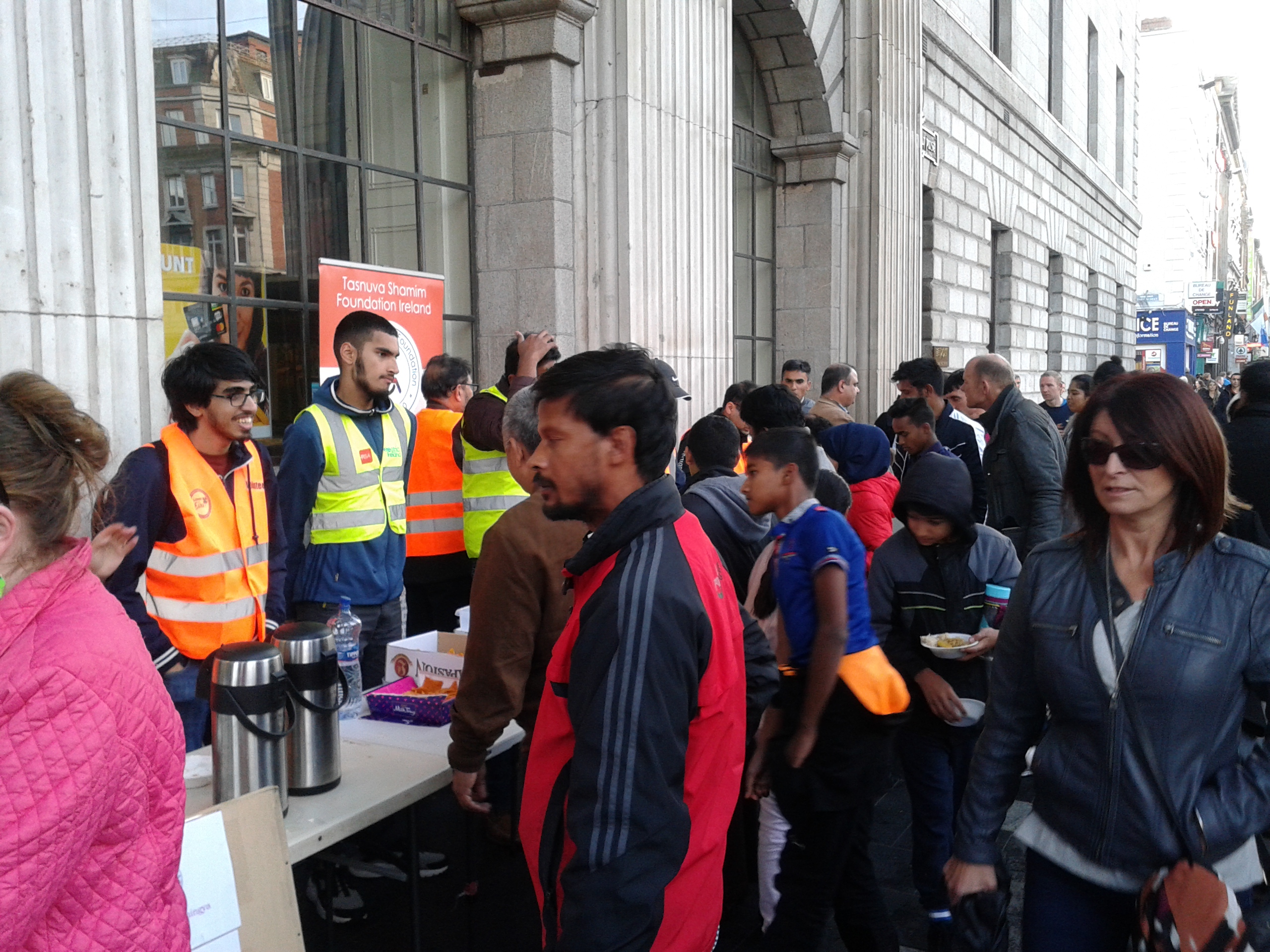
On a Saturday afternoon alternating between showers and sunshine, the Dublin Anti-Internment Committee held their awareness-raising picket at the busy junction of Thomas Street and Meath Street.
Some of the picketers with banner
They erected banners at the junction and distributed leaflets, including some about the Craigavon Two.
Tourists(on their way to and from the Guinness brewery museum) and local people passing took leaflets with interest and good humour.
Dublin Commitee AIGI activist distributing leaflets in Meath Street to passers-by. (Photo source: AIGI)
Less welcome was the Special Branch Garda (police force of the Irish state) who wanted the picketers to give him their names and addresses. Several refused to do so. The Garda went away to his car, drove back heading west, halting in the middle of the road in order to photograph the picketers and blocking the traffic coming out of Meath Street as he did so. (There was no need, Garda, we’re posting our photographs on here ).
Left of photo: Special Branch (plainclothes political police) asking a protester his name and address. (Photo source: AIGI)
The Garda then carried out an illegal and somewhat dangerous U-turn, briefly turning on his blue light and drove eastwards at speed.
The Committee refuses to be intimidated, holding regular peaceful pickets in different parts of Dublin and will be holding another one soon.
(Photo source: AIGI)
A HISTORIC AREA
The Thomas Street area, bordering on the Liberties, has a long history and is represented “in song and story”. The United Irishmen at the end of the 18th Century enjoyed much support here.
Not ten minutes walk away eastward from where the picket took place today is Taylor’s Hall, the site of the “Back Lane Parliament” and down by the Liffey, in Bridge Street, is the site of Oliver Bond’s house, where most of the Leinster Executive of the United Irish were arrested in 1798.
In hiding, Edward Fitzgerald, one of the main leaders of the United Irishmen, was moved between houses in the area, one of them being No.158 Thomas Street, where on 19th May he was located by Major Sirr through paid informers. Fitzgerald was ill but grabbed a knife and jumped out of bed, wounding Captain Ryan and Major Swan, the latter mortally. Major Sirr (who, according to folklore, was wearing a steel vest) then came in with more soldiers and shot Fitzgerald in the shoulder which facilitated his overpowering and arrest. Fitzgerald died of his wound some weeks later (4th June 1798).
A little to the east along Thomas Street is where most of the fighting in the brief and aborted Emmet uprising took place in 1803. Lord Kilawarden was heading into town for his safety but ran into the insurgency, was dragged from his coach and piked. He was found later it is believed in Vicar Street, still alive but died soon afterwards.
Further west along the street is St. Catherine’s Church, outside which the scaffold was erected in 1803 and Robert Emmet was hung in public, his head being then struck off. It is said in Dublin folklore that his relations attended the execution and shed not one tear in public, determined not to give the Crown and its followers the satisfaction of witnessing their grief.
(Photo source: AIGI)Spotted by the picketers as they were leaving: Dublin City Council motto with appropriate comment by some passing citizen. (Photo source: AIGI)
I came upon this demonstration on Sunday by chance, shortly before it ended; a protest composed almost entirely of people of south Asian appearance.
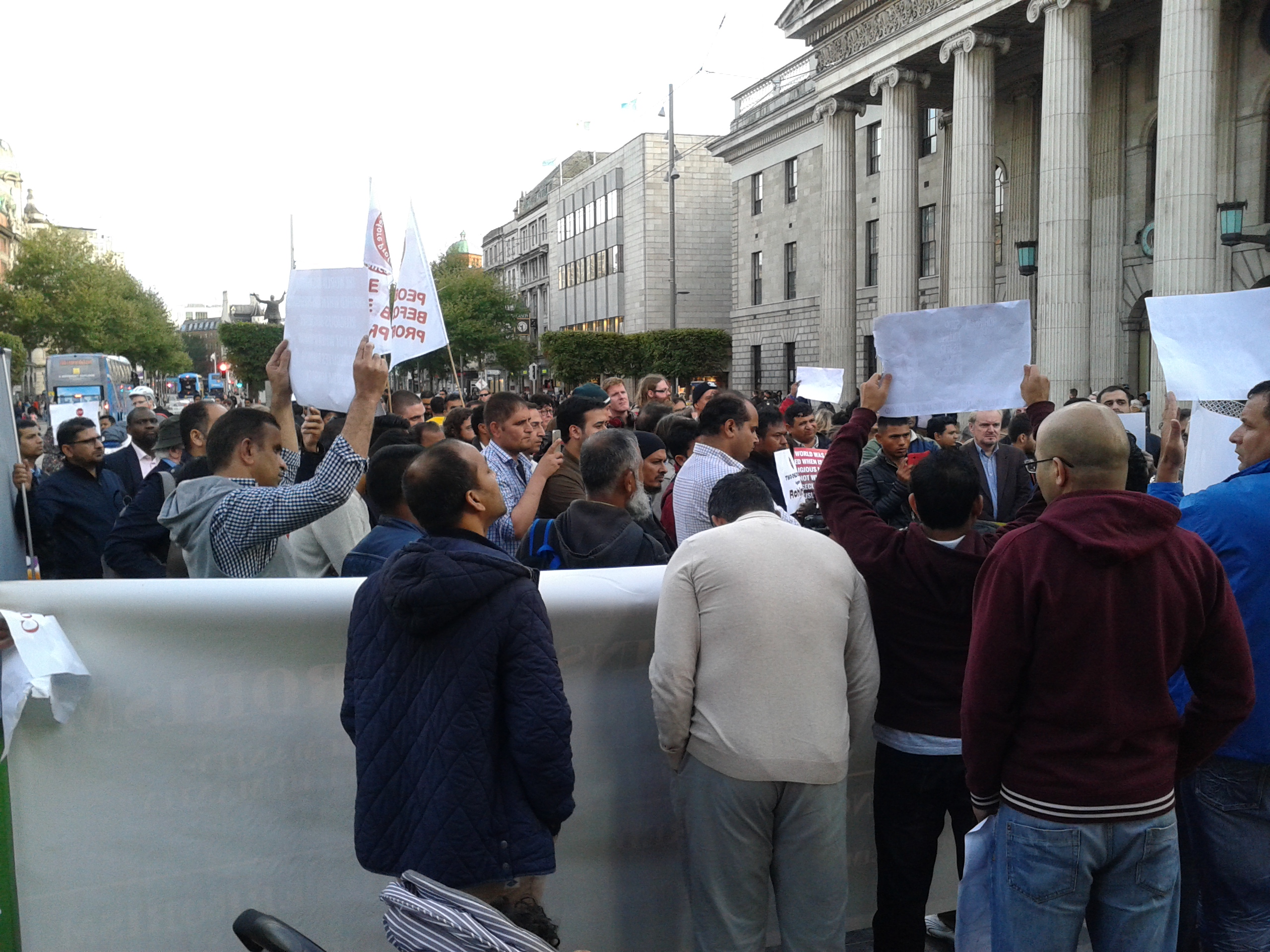
Rohingya solidarity demonstration on central reservation O’Connell Street, Dublin, Friday 8th September. (Photo D.Breatnach)
The Royhinga people are in crisis in Burma, abused by the State army, which is using the excuse of rooting out insurgents. About one thousand have been killed by the Burmese Army, according to a UN Special Rapporteur and according to Al Jazeera 164,000 have crossed the border to escape. Villages have been burned and there are also allegations of rape and of ethnic cleansing.
The Army’s recruits are of mainly Buddhist background, while the Rohingya people are mostly Muslim. The state refuses to grant them citizenship, considering them illegal immigrants from Bangladesh. Reactionary opinion, for example among some extremist Buddhist monks, considers Burma to be a Buddhist country and other religions not welcome. The Army accuses the Royhingians of burning their own villages.
The State Cunsellor (position equivalent to Prime Minister or Head of Government), Ms. Aung San Suu Kyi, in a recent statement talked about the attack two weeks after the crisis began. In this statement she avoided taking responsibility for the events, talking about “an iceberg of misinformation” and a problem that has years of heritage “even pre-colonial.” She has not gone there herself.
Aung San Suu Kyi, State Counsillor (Head of government) of Burma and Nobel Peace Prize Laureate. (Photo source: Internet)
Aung San Suu Kyi was generally supported by the West and lauded as a human rights campaigner through years of struggle against the previous regime. As a result she was awarded the Nobel Peace Priize in 1991.
Now, it seems the West is critical of the State Counsellor’s response to the crisis in the UN and in the media.
DUBLIN PROTEST TODAY
Both women and men were active in the protest today, ages mainly from late teens to young adulthood. There were some children too, cheerful and assertive. Some of the protesters apparently had come up from Carlow.
(Photo: D.Breatnach)Crowd shot near speaker addressing the rally; the General Post Office building to the right in Dublin’s main street, O’Connell Street. (Photo: D.Breatnach)
Reprinted with permission from the Facebook site of Dublin Political History Tours
ON THE 25th OF AUGUST 1922, THREE IRISH REPUBLICANS WERE ABDUCTED IN DUBLIN CITY BY IRISH FREE STATE FORCES AND MURDERED. AT LEAST ONE OF THEM WAS A TEENAGER.
EN EL 25 DE AGOSTO 1922, TRES REPUBLICANOS FUERON SECUESTRADOS EN LA CIUDAD DE DUBLIN POR FUERZAS DEL NUEVO “FREE STATE” Y ASESINADOS. (miren de bajo para traducción del artículo al castellano)
The signing of the Treaty offered by the British in 1921 after three years of Irish guerrilla war and civil disobedience against British repression and its terror campaign, not only partitioned the country but split the alliance of forces that had constituted the Republican movement until that point (quite a few were, in truth, more nationalist than Republican).
A majority of the elected parliamentary representatives voted to accept the Treaty terms. However a majority of the male fighters rejected it, as did almost unanimously the Republican women’s auxiliary organisation Cumann na mBan and the Republican youth organisation, na Fianna Éireann. The remnants of the Irish Citizen Army, male and female, were likewise mostly opposed to it.
In 1922 civil war broke out after the IRA firstly occupied and fortified the Four Courts buildings and secondly after Michael Collins ordered the artillery bombardment of those and other buildings in the Dublin city centre occupied by the Republicans.
Oriel House (photo taken in the past), HQ of the Free State police and of the CID; torture was carried out here and murder gangs went from here to executed Republicans.
Both sides of course shot soldiers on the other side but the Free State Forces soon became known for atrocities, including the shooting of unarmed prisoners and instituting a reign of terror in some areas under their control. The State also carried out martial law executions of captured Volunteers (83 over less than 12 months). Free State forces, in particular the Criminal Investigations Department of the police force and some Army units also became known for abductions of people and their subsequent torture and murder. The activities of the CID based in Oriel House in Westland Row soon made the building a feared one.
Bodies of the murdered Fianna Éireann officers, laid out for honouring prior to funeral. (Source: Internet)
THE THREE MURDERS
On the 25thAugust Alfie (Leo) Colley (19 or 21 according to different reports), Parnell Street, and Sean Cole (17 or 18 according to different reports), Buckingham Street, two streets in the north Dublin city centre, were picked up at Newcomen Bridge(one report has Annesley Bridge), North Strand on their way home from a meeting of officers at Marino. Colley was a tinsmith and Cole was an electrician and they were also two of the most senior officers in the Dublin Brigade of Na Fianna Éireann.
According to a statement by an eyewitness, their abductors were wearing trench coats over Free State Army officers’ uniforms (this was reproduced in a cartoon drawn by Constance Markievicz and widely distributed). Other witnesses saw them being shot dead at ‘The Thatch’, Puck’s Lane, (now Yellow Road), Whitehall, Dublin. The Irish Independent reported the murders but mentioned only the trench coats, without reference to Free State Army uniforms under them, which could leave readers to form the impression that the killers were IRA.
Apparently it was an opinion of many at the time was that their killing were a reprisal for the killing of Michael Collins earlier that week in Cork (despite General Mulcahy’s call for no acts of revenge to be taken).
Cartoon by Constance Markievicz depicting the State murder gang of Volunteers Cole and Colley. (Source: Come Here To Me blog)
On the same day,Volunteer Bernard Daly, a lieutenant in the IRA and commanding officer of Z Company, Dublin Brigade,was taken by armed men in plain clothes from Hogan’s pub (now O’Neill’s), where he was employed at Suffolk Streetin the south city centre. His body was found later that day in a ditch on the Malahide Road, Belcamp with three bullet wounds to the chest and two the head. The Independent reported that the men coming for him told another barman that they had a warrant for Daly’s arrest, pointed a gun at him and threatened to shoot him if he obstructed them in any way. They took Daly to the cellar, searched him and then forced him to their car across the road.
The Independent also reported that Daly was a native of Old Hill, Drogheda; although he had relatives there and was engaged to be married to local girl there too, it seems he actually came from Carrikaldrene, Mullaghbawn, Co. Armagh. He had been active in the War of Independence, had been captured, tortured and jailed for over a year by the British – but it was the Irish Free State that murdered him.
Links for sources and more information/ enlaces para mas información:
La firma del Tratado ofrecido por los británicos en el 1921 después de tres años de guerra guerrillera irlandesa y desobediencia civil contra la represión británica y su campaña de terror, no sólo dividió el país, sino que dividió la alianza de fuerzas que había constituido el movimiento republicano hasta ese momento. (Bastantes fueron, en verdad, más nacionalistas que republicanos).
La mayoría de los representantes parlamentarios electos votaron a favor de aceptar los términos del Tratado. Sin embargo, la mayoría de los combatientes hombres la rechazaron, al igual que casi unánimemente la organización de mujeres auxiliares republicanas Cumann na mBan y la organización republicana de la juventud, na Fianna Éireann. Los restos del Ejército Ciudadano Irlandes, entre hombres y mujeres, también se oponían en su mayor parte.
En 1922 la guerra civil estalló después de que el IRA primero ocupó y fortificó los edificios de los Cuatro Tribunales en Dublín y en segundo lugar cuando Michael Collins ordenó el bombardeo por artillería de ésos y de otros edificios ocupados por los republicanos en el centro de la ciudad.
Ambos bandos, por supuesto, dispararon contra soldados en el otro lado, pero las Fuerzas del Estado Libre pronto se hicieron conocidas por atrocidades, incluyendo el tiroteo de prisioneros desarmados e instituyendo un reinado de terror en algunas áreas bajo su control. También llevaron a cabo ejecuciones de la ley marcial de Voluntarios capturados (83 en menos de 12 meses). Las fuerzas del Estado Libre, en particular el Departamento de Investigaciones Criminales de la policía y algunas unidades del Ejército también se conocieron por secuestros de personas y su posterior tortura y asesinato. Las actividades de la CID con sede en Oriel House en Westland Row pronto hizo el edificio uno para dar temor.
LOS TRES ASESINATOS
El 25 de agosto fueron recogidos Alfie (Leo) Colley (19 o 21 anos de acuerdo a informes diferentes), de Parnell Street, y Sean Cole (17 o 18 según informes diferentes), de Buckingham Street, dos calles en el centro norte de la ciudad de Dublín, en Newcomen Bridge (un informe tiene Annesley Bridge), North Strand en su camino a casa de una reunión de oficiales en Marino. Colley era un hojalatero y Cole era electricista y también eran dos de los oficiales más altos de la Brigada de Dublín de Na Fianna Éireann.
Según una declaración de un testigo ocular, sus secuestradores llevaban abrigos sobre los uniformes de oficiales del Ejército del Estado Libre (esto fue reproducido en un dibujo hecho por Constance Markievicz y ampliamente distribuido). Otros testigos vieron que fueron muertos a tiros cerca de la taberna “The Thatch“, Puck’s Lane, (ahora Yellow Road), Whitehall, Dublín. El periódico Irish Independent informó de los asesinatos y sobre los abrigos de trinchera, lo que podría dejar a los lectores a dar la impresión de que los asesinos eran del IRA, pero no mencionó los uniformes del Ejército del Estado Libre de bajo de los abrigos.
Aparentemente, la opinión de muchos era que sus asesinatos eran una represalia por la muerte de Michael Collins a principios de esa semana en Cork (a pesar del pedido del General Mulcahy de que no se tomaran actos de venganza). Pero los secuestros y asesinatos continuaron, incluso para unos meses después del fin de la Guerra.
El mismo día del secuestro de los voluntarios Cole y Colley, el voluntario Bernard Daly, un teniente en el IRA y comandante de la Compañía Z, Brigada de Dublín, fue llevado por hombres armados vestidos de paisano de Hogan’s pub (ahora O’Neill’s), donde trabajaba en Suffolk Street en el centro sur de la ciudad. Su cuerpo fue encontrado más tarde ese día en una zanja en el Malahide Road, Belcamp con tres heridas de bala en el pecho y dos en la cabeza. El periódico The Irish Independent informó que los hombres que iban a por él le dijeron a otro asistente del bar que tenían una orden de arresto de Daly, le apuntaron con una pistola y amenazaron con dispararle si lo obstruía de alguna manera. Llevaron a Daly al sótano, lo registraron y lo obligaron a ir a su auto al otro lado de la carretera.
El Independent también informó que Daly era un nativo de Old Hill, Drogheda, pero aunque tenía parientes allí y estaba comprometido para casarse con una chica local allí también, parece que realmente vino de Carrikaldrene, Mullaghbawn, Co. Armagh. Había sido activo en la Guerra de la Independencia, había sido capturado, torturado y encarcelado por más de un año por los británicos, pero fue el Estado Libre Irlandés quien lo asesinó.
An old, old debate or discussion has broken out of late. It has been inspired or regenerated by the inability of the main political parties of the ruling class to achieve a ruling majority in the Dáil, even in coalition. Another factor has been the growth of Sinn Féin seats to a number sufficient to attract another party into getting them into a coalition government. And another General Election cannot be far off.
The debate or discussion is sparked by questions something like this:
Should a coalition of revolutionary socialists and radical social-democrats put together a joint slate to present themselves and agreed policies to the electorate?
And a different question (but not completely different in the minds of some of that potential slate above, I suspect):
Should a party that presents itself to some supporters as revolutionary, to some others as radical, participate in a coalition with one of the traditional ruling class parties to form a government?
Against either of those possibilities, groups of anarchists and non-Sinn Féin Republicans, in rare agreement, declare that no such initiatives should be supported; the anarchists, because they do not believe in bourgeois elections or parliaments and the republicans, because this is not a Republic which they can legitimise by taking part in their state elections. Some revolutionary socialists and others of varying hues argue that the system will corrupt those who take part in their institutions and provide a long list of those to whom that has happened historically (and both anarchists and republicans can nod their heads in agreement at the list).
Social democrats and some others argue that an election provides an opportunity to put in to power a different administration, one which has the actual power to change things. They argue that it is their duty to take advantage of that opportunity and accept its challenges; they charge their critics with being dreamers who prefer to hold on to their ideological purity for some distant day rather than to address the real situation in the here and now.
TAKE PART IN GOVERNMENT?
There is room for some fruitful debate and discussion around some of these positions but one thing seems clear to me: it can never be permissible for revolutionaries, under any excuse whatsoever, to be part of a government to run the country for the capitalist ruling class. The capitalist ruling class is our enemy and we are irreconcilably hostile to it and must remain so. We work for the day when we can overthrow that class and put the workers in charge and no honeyed words of exception or self-deception can change that fact.
Undermine it from within? Use their institutions against them from the inside? Throughout history, all those who have attempted that (or who pretended to for their own careerism) have shown that far from subverting the system, it was they who were or became subverted.
Yes, it is a philosophical truth that just because something happened before is no guarantee that it will happen again. Even if it happened every time in the past. Although jumping from the tenth floor of a building on to hard ground has killed hundreds over time, it is philosophically possible that someone could survive it now – even unharmed. But it is not a scientific nor a historical probability. One is entitled to try it with one’s own life but not with the lives of others.
Those who formed Fianna Fáil crossed over that line not long after they split from Sinn Féin: not only that but the party soon became, despite its Republican and nationalist roots and rhetoric of being for a 32-County Republic, the preferredpolitical party of the Irish foreign-dependent capitalist class in the 26 Counties and virtually unknown in the Six.
A Fianna Fáil election poster, possibly 1950s or ’60s. Source: irishelectionliterature.com
The Sinn Féin we know today (Provisional Sinn Féin, as they no longer like to be called), the largest survivor of a number of large and smaller organisational splits since the days of the creation of Fianna Fáil, also crossed over that line. In a sense, they did so in an even worse (or more obvious) way than had Fianna Fáil – Sinn Féin participated in a colonial government, the administration of an armed foreign aggressor.
Old FF election poste: “There’s a better way” (source: internet)
That party is heading for entry into a capitalist coalition government in the 26 Counties, if only it can find a partner willing to accept it for the dance. Based on its history in government in the Six Counties and some other measures, the SF party leadership strives to prove to the Irish capitalist class that it can be trusted to manage the system, alone or in partnership with one of the main capitalist parties.
There’s a better way with SF too, apparently. A much more recent Sinn Féin election poster. (source: internet)
The President of the party has said that “Sinn Féin doesn’t have a problem with capitalism”. The party’s leadership refused to support the “Don’t register, don’t pay” slogan of the early campaigns against the Household Tax and later against the Water Charge (the first was defeated by popular resistance following those slogans and the second is on hold, due to a number of factors ultimately arising out of popular resistance). Dublin local authority councillors of the party voted to hand over public land on a prime Dublin site to private property speculators. The party’s leadership has shown itself publicly welcoming to every imperialist or zionist representative to visit them, including the mass-murdering political leadership of the USA and the British monarch and Commander of the Armed Forces which is enforcing the occupation of one fifth of the country.
But it is not only necessary for SF’s leadership to convince the Irish ruling class (and its foreign partners) – in order to get elected, it has to also convince its own following and thousands outside of that. So some anti-imperialist and left posturing is necessary. Of course it is opposed to the Water Charge and was also opposed to the Household Tax, it tells people – it was just that it couldn’t ask people to risk going to jail and losing their homes by taking part in civil disobedience. And it does put some of its followers out on the street in demonstrations against the Water Charge.
In defence of the vote of Dublin City councillors, it declares that through the deal, it got funding for a percentage of public housing on the site – wasn’t that good? Perhaps, but better than a 100% public building program of its own on its own land, using the many construction workers currently idle? Hardly. And once public land is gone, it is gone for ever (well, forever short of the kind of revolution that SF declares to be unrealistic).
So Left words for its potential voting public, soothing words to its long-suffering membership and acts of collaboration and collusion (and signals of more of the same) to the ruling class. And for the collaborationist careerists jumping into the party.
A SLATE OF REVOLUTIONARY AND RADICAL LEFT CANDIDATES
A revolutionary coalition with SF, even if it were to agree to such a thing, would be for any movement of resistance to cut its own throat. But what of the other parties, groupings and independent political activists?
In my opinion, it might well be worth supporting an attempt to create such a coalition, presenting a list of revolutionary or even radically progressive demands.
“But isn’t that reformist and in contradiction to the revolutionary vision?” If it were reformist, i.e with only the intention of reforming, I would say yes, it is in clear contradiction to our vision. If it were to suspend popular organisation and mobilisation and to put its faith in the outcome of the elections, I would be against it.
Workers’ and soldiers’ barricade, Paris Commune 1871. Revolutionaries took part in elections prior to the establishment under arms of the Commune, the first time in history a city was taken and put under workers’ rule. (Photo source: internet)
But the intention here should be to form a revolutionary and/or radical ParliamentaryOpposition, putting forward radical reforms which would, if achieved, make living conditions and resistance much easier for the working people and extortion and repression much more difficult for the ruling class. And meanwhile revolutionaries should never cease in their revolutionary propaganda that only the overthrow of the ruling class can bring about deep and permanent changes for the benefit of the working class.
Tom Stokes, a commentator on political affairs and media reporting for many years, in August 2015 published a list of policies or demands upon which such a slate could be based, upon which they could campaign (https://theirishrepublic.wordpress.com/2015/08/22/broad-left-policy-platform-essential-now/). Although the manifesto did not gather much publicly-expressed support at the time, it seemed to me then and seems still to be a worthwhile initiative and one to consider for any builders of a putative Left electoral slate.
A POSSIBLE LEFT SLATE MANIFESTO
This is the list which Stokes published, without any claim to it being definitive. However, a list of demands for a Slate of candidates to agree to cannot be exhaustive – there will have to give and take, as he acknowledged. The important thing from a revolutionary point of view should be that it points the way forward to resolving the economic problems facing the working class and the majority of the people in general and to the radical improvement of their rights. Further on, I give my own thoughts on this manifesto. 1 Adequate, affordable, secure housing as a right, where necessary through public provision.
2 A single-tier publicly funded, secular and excellent education system with no provision from the exchequer for private fee-paying schools with exclusive enrollment policies. Religious instruction outside school-hours. Ending the university-controlled points system for third-level entry. Free third-level or vocational education/training subject to contractual obligation to work within the state for any three of first five years post-graduation with debt-related penalties for non-compliance.
3 The right of all children to adequate housing, nourishment and provision of health and care according to need, guaranteed by the state.
4 The right of workers to employment, or to further education or training as required, including those who wish re-enter the labour ‘market’.
5 A living wage, the ending of oppressive zero-hour contracts, workers’ right-to-organise and right-to-negotiate guaranteed by the state.
6 Full equality for women including pay-rates, personal autonomy and dignity including reproductive rights. Repeal of the Eighth Amendment. Provision of supports for mothers and carers commensurate with their contribution to society for that work.
7 State ownership of essential services, natural resources & physical infrastructure. Constitutional provision for public ownership of water and protection of Mother Earth.
8 Empowerment of communities, starting with disadvantaged communities – rural and urban. State support for community initiatives to achieve personal and community empowerment.
9 Strong laws against public and private corruption with strict sanctions. Ending political appointments to judiciary. Curbing legal costs for citizens. Equal access to civil courts regardless of means. Refocusing criminal justice system and penal system. Taking politics out of policing in favour of civic obligations.
10 Realigning taxation system to shift burden towards wealthiest. Ending tax-exile status, tax loopholes and tax-havens. Enforcing Corporation Tax.
11 Properly codifying the state’s position on neutrality, opposition to war, concentration on international and intra-national conflict-resolution and peace-keeping. Adherence to international codes on prevention of torture, refugees, humanitarian obligations, etc.
12 Proper commitment to reunify the people of the island through concerted, direct, rational dialogue with the objective of creating a fully representative all-Ireland parliament based on equality, respect and civil and religious freedoms.
13 Greater local and regional democratic control as appropriate. Making government fully accountable to parliament and the people. Creation of a democratically elected upper house to speed legislation and as a counter to excessive power of parliament. Installing a publicly accessible online register of lobbyists and a publicly accessible tendering system for state acquisitions, both updated daily.
14 Regulation of media in terms of ownership and the public’s right to essential information, fairly and accurately delivered. Active fostering of ideological diversity in media in the public interest. Insistence on journalistic ethics in the public interest. Higher values of Public Service Broadcasting a requirement for state media.
15 A commitment to expedite a widespread public consultation process towards creating a new constitution for a genuine republic.
Let us examine these demands now.
1. Decent, affordable housing is an obvious necessity so as not to have people sleeping on the streets, families in unsuitable accommodation, people at the mercy of landlords and others slaving to pay the monthly rent or mortgage. And public provision is the obvious way to provide this.
2. The right to secular education as a norm is a basic democratic right and should have been a Republican demand from the outset. No church should be permitted to exercise any control over admission to — or content of — education; any religious group that wishes its children to be instructed in its religion should pay for that themselves and provide it outside of school hours. And unless we have free third-level education only those already more privileged will be able to avail of it or will plunge themselves into debt in order to do so.
(I am unsure about the inflicting penalties for not working within the State after graduation – if we provide a decent economic and social environment it seems to me that most people would want to stay or to return after they had left and we should avoid coercion where possible).
3. Children are our future and must be accorded full legal and social protection – the contrary to what our State has done for decades. How can we disagree with that?
4 &5. It seems to me that we can combine these under the right of workers to employment and training and organisation. Further, workers must be permitted to exercise their latent power in order to ensure those things are provided. We need the acknowledgement and legalisation not only of the right to strike in defence of the demands of one’s own workplace but in support of others. This would remove a gag and chain on the working class at present which prevents trade unionists, at threat of the sequestration of all or part of their funds, from supporting action by workers who are in weaker positions. If the Left Slate were to achieve this alone, even though it could all be nullified later, it would be a great step forward. Were they not to succeed in achieving it, their raising it as an objective on their platform would be a strong indication of the direction for workers to take.
6. Full equality for women under the law must be a central demand of any democratic platform. The right to abortion is a recognised right in all liberal and socialist societies with the exception of Muslim states, the USA and the 26 Counties. I myself am in support of that right but it remains a divisive issue among the largest alternative movement in this state, the Republican movement and is opposed by many others. This issue should be discussed in any Left electoral slate. Nevertheless, Amendment 8 to the Constitution has no right there and should be removed.
7. One would think that demanding State ownership of all Ireland’s natural resources would be unopposed within a Left Coalition slate. I am not convinced that would be so. And since I do not expect socialism to arrive through a parliamentary majority, I would settle for some specified areas: oil, gas, water infrastructure, sea, rivers and lakes. And public transport, water infrastructure, roads and telecommunications infrastructure.
The abolition of the Water Charge would be popular and is obviously a necessity on a number of levels, not least the democratic one that maintenance of a drinkable water supply has already been paid for in two different taxes. A change in the Constitution that would put our water services beyond privatisation would also be a great relief and a step forward.
8. No-one considering a Left Electoral Slate organisation is going to argue with “empowerment ….. of disadvantaged communities” — the difficulties will arise over how to interpret that demand, what will be the specific targets and timeframes, the amount of financial investment.
9. This is an extremely wide-ranging point. Clearly the judiciary should be separate from other forms of administration or political interests. Clearly too, those who hold posts of public responsibility should suffer strong sanctions should they behave corruptly while in office. And obviously, given a democratic society’s reliance on law to manage their affairs, taking cases should not be the prerogative of the rich, which means reducing the cost of such procedures drastically, including appeals. And it seems to me that most people would support such changes, though they would be frantically opposed by special interest groups.
10. Realigning the tax burden to fall upon the rich and closing tax loopholes (more like tax flood gates!) for the rich, ending exile tax status etc all seem commendable and fair to the people, the majority of the population, who bear the actual burden of a number of taxes. And the Left Slate could push those objectives on to whatever government gets elected, as popular demands which the bourgeois parties (and their compromisers) could not concede. But careful! The revolutionaries inside the Left Slate should make it clear that they are not for fairer taxes on the rich and working people, but instead for the expropriation of the rich, whose stolen wealth is to returned to the working class. We do not intend to become part of any government inside a capitalist society, for reasons I shall go into a little further on.
11. There is no question but that the position of the Left Slate should be for a real neutrality on the part of the State, making it increasingly difficult for the ruling class to indulge any dreams of returning to a British Commonwealth or to joining NATO. Such alliances have dire consequences not only for millions of people abroad but also ultimately at home – one consequence alone would be to facilitate foreign military intervention in the 26-County state in the event of an insurrection or even the election of a Left-leaning government. Alliances of that sort always include a “mutual assistance” clause and we can be sure that the “mutual assistance” envisaged is one between the capitalist ruling classes of the various states.
Prevention of torture should be a human rights requirement of every nation and state but, on the contrary, it is ensured in practice by none. Those who complain of their followers being tortured have been shown time and time again to be willing to inflict it themselves – always for the “highest” of reasons. There is no reason to believe therefore that no participants among the Left Slate will at some point, finding conditions favouring such a practice, indulge in it themselves. But the Slate should in any case incorporate it into its program. And thereby also, it might be said, strive to build some protection for its own members and supporters from such practices by the Gardaí and prison guards.
In the field of human rights and under the principles of internationalist solidarity, it is clear too that a Left Slate should advocate and push for a humane regime for the processing of refugees and migrant workers and their integration into the population.
12. This seems like a progressive demand but actually I do not support it. This is something perhaps for a revolutionary government and such can only come about after the overthrow of capitalism.
But I do think that the Left Slate should advocate the reunification of the island and religious freedom. Understanding the composition of the Irish Left, inclusion of reunification in the Manifesto is bound to run into difficulties from some quarters – revolutionaries, not just Republicans, will have to consider whether to compromise to some extent on this demand for an agreed Left Slate manifesto (while retaining their own political demands outside of that) and, if so, how to do so.
13. The creation of a register of political lobbyists is not actually a revolutionary demand but I think revolutionaries should support it. Such a register will help to expose the lines of communication and mutual assistance of capitalist political parties and the capitalists themselves. The same goes for tendering for State and local authority projects. But I do not support the rest of those demands. They seem to me to envisage a Left Government, trying to make the system better and, at the same time, stabilising it. This is not what revolutionaries are about. Besides which it seems to me that the creation of another parliamentary tier is counter-democratic and would tend to increased bureaucracy.
14. I understand the motivation for this but find it difficult to envisage how it might be achieves. Anti-monopoly legislation might for a while hamper media monopolisation but the experience of other countries shows that ultimately, it will not be successful. Enforcing a system of right of reply (as distinct from a voluntary one adopted by the media) for those who feel they have been misrepresented in the media is one possibility. Another might be enforcing the right of publication of a counter-report when substantiation can be provided on, for example, the numbers reported as attending a demonstration or the events during a confrontation between police and demonstrators.
But definitely, the Left Slate should push for the lifting of State restrictions on community radio and television, with the aim of facilitating a diversity of such broadcasting, including news reporting, political commentary, cultural performance and discussion, etc.
15. I do not oppose this point nor do I endorse it. A new Constitution worth having, in my view, is a revolutionary one and as such, can only be properly conceived of by a population that has passed through a revolutionary process and been, in the course of that, revolutionised and empowered.
SHOULD REVOLUTIONARIES SUPPORT THE FORMATION OF A LEFT SLATE?
“OK, so let us imagine that a credible Left Slate is agreed and presents itself for election. Should revolutionaries ask people to vote for it?”
I think so. But it should also be clear that organisation and mobilisation in struggle and resistance should not diminish one iota but, on the contrary, intensify. And revolutionaries should clearly tell the public that only the complete overthrow of the ruling class can usher in lasting change – and that the working class should prepare themselves for that struggle. But also that, whatever members of that coalition slate may say or do, the revolutionaries will never participate in any administration of the old system, i.e no national government prior to the overthrow of the capitalist system and the expropriation of the capitalist class.
“Perhaps revolutionaries should then just ignore the Left slate and concentrate exclusively on revolutionary work – organising and supporting campaigns of resistance, ideological and historical education?”
I strongly disagree. Campaigning for such a slate would bring revolutionary ideology to thousands of working people who are currently unreachable by the revolutionaries. And many people will want to know what revolutionaries think of the Left Slate and of its policies.
And anyway, just because we are revolutionaries, does that mean we are against reforms? Not at all – in our history as revolutionaries, we have been some of the most resolute campaigners for reforms and defenders of them when they have been won! However we are not reformists – the kind of people who believe in a radical or steady improvement in life by reforms but leaving the capitalist system in place.
But we are for reforms that strengthen the working class, the movement of resistance. For examples: the right of workers to combine and strike; the shorter working week and safety legislation; the abolition of child labour; universal education; the right to vote for all adults regardless of gender or property; equal rights regardless of sexuality; abolition of slavery; abolition of racist laws and regulations; the right to oppose invasion; separation of Church and State; the right to protest and campaign politically; the right to freedom of speech and of the press; universal free health care; free or cheap childcare; low-rental housing. These were all rights that we fought for and many were hard-won.
“OK, so revolutionaries could organise electoral support work for the Left Slate – but surely not participate in the actual Slate? Revolutionaries should not present any candidates, of course.”
But why not? We are not against elections in all cases. We elect people to responsible positions in our organisations, decide policies by vote at congresses, decide tactical and strategic aims by voting too. What we are against is not voting but bourgeois elections, where no real change is offered, where we are encouraged to put our faith in some representatives of the existing system and to leave things in their hands for a number of years with little control over what they say or do. Revolutionaries can make it clear that is not what we are about as well as making it clear what we are about, what we intend to do if elected – and if elected, stick to that.
Revolutionary representatives within the Dáil (the Irish Parliament), elected as part of a Left Slate, can work among the other successful candidates of the Slate to strengthen adherence to the list of demands and to combat drift away from them or towards other concessions to the ruling class.
And if we are part of the discussion on the Manifesto and the Slate, we can also participate in the fight to agree that Manifesto in the first place because it is certain that will not be an easy struggle. But let us never forget that the role of the Left in any Parliament should be to support the struggles of the working people outside – not the other way around.
NO TO A LEFT GOVERNMENT
As revolutionaries, we are for the overthrow of the system, the expropriation of the rich, the empowerment of the working people. There will be arguments and discussions about how best to achieve those aims and that’s fine. Let the people, participating in those discussions, decide, experiment, make mistakes, revise. But that can only really take place in practice when the people hold revolutionary power, i.e after the overthrow of the capitalist system.
(Photo source: internet)
Should a situation exist where a Left Government be elected, or looks likely to be elected, the social democracts and liberals will quickly call for slowing down, for less struggle, to let them get under way. At this point the capitalist class must be weak, perhaps divided among themselves on how to respond, perhaps unsure of the reliability of their repressive forces, the police and army. Or perhaps, though weakened, the ruling class is merely biding its time, organising a coup or some other event. Or, very likely, instead or in addition to the above, they are working with elements inside the Left Government or Party to seduce them, to arrange compromises, etc.
This is the point at which revolutionaries, far from resting and wait-and-see, far from facilitating a Government that is trying to stabilise the system in its hour of difficulty, should instead intensify their mobilisations, their actions, and organise the people more militantly and more daringly, pushing for more rapid enactments of popular demands. Should the ruling class be paralysed or indecisive, they should be shocked further and further, exactly as their disaster capitalists have done to national systems, as described by Naomi Klein in Shock Doctrine (2007).
We can hardly be free do all that from inside a Left Government.
Of course those in the Left Government will plead with us and with the people to give them more time; they will tell the people their great plans, perhaps plead their difficulties. They will accuse the revolutionaries of being disrupters, wreckers, saboteurs …. They may send their police to arrest us.
It will not be the first time in our history to be accused of such things. And in a sense, they will be right — we do intend to wreck the system and we do intend to wreck their project of stabilising it. We intend to overthrow it all and to bring in socialism, the organisation of society and its productive forces and resources by and for the benefit of the people. And that’s the wheel we’ll keep pushing and rolling.
End
Iinks:
Old election posters: https://irishelectionliterature.com/tag/old-fianna-fail-election-poster/
On the 22nd of August 1798, almost 1,100 troops under the command of General Humbert landedat Cill Chuimín Strand, Bádh Cill Ala (Killala Bay), Co. Mayo.
Painting said to be depicting French landing at Kilalla
The events are covered in six songs that I know of: Na Franncaigh Bhána; An Spailpín Fánach (Mayo version); Mise ‘gus Tusa agus Hielan Aindí; The West’s Awake by Thomas Davis; Men of the West and its Irish translation, Fir an Iarthair.
Some of the songs, especially the traditional ones from this area, are in Irish, which was the commonly-spoken language of the area (unlike parts of Dublin, Wexford and Antrim, where most of the songs from the period were in English).
The French troops on this occasion — unlike the numbers sent by Napoleon in 1796 but which failed to land at Bantry Bay due to stormy conditions — were insufficient to change the overall insurrectionary situation and though they and the Irish fought bravely, the Rising in the West failed. Most of the French who surrendered were treated as prisoners of war but the Irish who rose were butchered or taken prisoner and hanged. Matthew Tone and Bartholomew Teeling, both Irish but holding commissions as officers in the French Army, were taken to Dublin, tried and hung. Their bodies are reputed to lie in Croppies’ Acre.
Portrait of General Jean Joseph Amable Humbert
Nevertheless the Rising is remembered with pride and General Humbert’s memory held in affection. Sixteen years later he fought the English again at the Battle of New Orleans, taking place between December 14, 1814 and January 18, 1815, this time as a private soldier in the American Army — and successfully. He had settled in New Orleans already and remained there after the war, working as a schoolteacher until his final days.
There is a French military former officer character in Mel Gibson’s film The Patriot (2000), Major Jean Villeneuve (played by Tcheky Karyo). A film commentary on line says his character was suggested by the Marquis de Lafayette, of the French military and Baron Von Steubon, a Prussian mercenary (http://www.patriotresource.com/thepatriot/characters/villeneuve.html.).
But might the character not have been suggested by Humbert? Anyone who knew his story would be eager to put him in the film, one would think. In the film, he fights in his French officer’s uniform at the final battle (unnamed but probably based that on at Cowpens); Humbert, though he fought at the rank of private, also fought in his Napoleonic Officer’s Army uniform at the Battle of New Orleans.
Still photo from the film, with Tchéky Karyo to the right in the role of the French Major Villeneuve. His character could have been based in part on that of Jean Joseph Amable Humbert.
Robert Roda of New Hampshire is listed as the writer of the screenplay. New Hampshire is not known as an Irish-American stronghold and Roda does not sound like an Irish name. But then, it is not only Irish and French people who are interested in Irish and French history.
I agree with you that a General Election is close, likely this Autumn or next Spring. Like you, I believe the Irish electorate is unlikely to give any one political party an overall majority, in which case a coalition government is inevitable.
I agree with you too that our party, Fianna Fáil is the natural coalition partner for yours, sharing not a little of common history (after all, our party’s founders were members of your party before they left it. Our principal founder had been President of your party!).
However, there are a number of factors operating against such a partnership, not least is which we have to remain top dogs in any coalition and some of our people are not sure that you wouldn’t be nibbling at our heels, trying to get into the top position for yourselves. I am only telling you what some people think, you understand.
Then there’s the spoils of power. Again, we have powerful supporters who are not happy to share the loot, if I can put in those terms, just as a joke, ha, ha, ha. And they say that some of your people are hungry.
So, for the moment, Gerry a chara, the answer has to be no, go raibh maith agat. But in future, who knows? A week is a long time in politics, they say – but months?
You will understand I’m sure why this letter is in printed text and why I cannot sign it.
All the best for now.
2)
Dear Gerry,
Thank you for your recent letter.
I agree with you that a General Election is close. Like you, I also believe the bloody Irish electorate is once again (!) unlikely to give any one political party an overall majority — so a coalition government is inevitable.
Despite our historical difference I agree with you too that Fine Gael is the natural coalition partner for yours, sharing not a little of history (leaving aside that little misunderstanding 1922-1923).
However, I can foresee a number of difficulties in contemplating such a partnership. Some of your people hate our party and the feeling is reciprocated from within our party too, by some at least. But in the end we understand real politics. Haven’t we teamed up with Labour a couple of times? Hasn’t yours with the Unionists?
To be honest, Gerry, and I’m only telling you what some have been saying, joining up with your party would be easier if you were not the President of it. Painful as it is to tell you, they’d be a lot happier with Mary Lou, who has not a whiff of gunpowder around her, if you know what I mean.
So, for the moment, Gerry a chara, the answer has to be at most “maybe”, thanks. But as time goes on, who knows?
I regret but am sure you will understand why this letter is printed text and why I cannot sign it.
All the best for now.
3)
Dear Gerry,
I trust this letter finds you well.
It seems that a General Election is close, likely this Autumn or next Spring. The likely outcome will be that no one political party gets an overall majority, in which case a coalition government is inevitable.
I want to take you back to your suggestion in the past that your party should team up with Labour and some independents to form a Government. At the time I thought the idea interesting but I knew my colleagues would not go for it. They have a history of hating your party for all kinds of reasons, mostly to do with the IRA.
But now that you’ve disbanded that bunch they hate you even more for trying to move into our patch – social democracy. I know, there’s no pleasing some people, is there? As you know yourself. And anyway, as I tell them, your party has no real feet in the trade unions, does it? So social democracy as a political project remains safely with us (except to an extent in Dublin, where FF have a foothold in that section of the people, God knows why).
Anyway now that our party faces an almost total Dáil wipeout in the next election, even those hard-liners in our party might be willing to consider an alliance for government. Twenty-three Dáil seats is a respectable number to bring to the table and you might even gain a couple more in the election.
You might be saying to yourselves that your party has nothing to gain from an alliance with ours, with our parliamentary representation so reduced and other factors (electorate resentment about things we did and didn’t do while in government, etc.). But we bring respectability to your party and we wouldn’t be pressurising you to step aside for Mary Lou.
Most crucially perhaps, we have trade union support to offer. Let’s face it, there are some hard times ahead and having union leaders on your side (or at least under control) could be a very important factor for success.
And whereas our party can rise and fail and rise and fail again, it might be that yours has only one crack at power before the electorate decide to go back to established parties. In Northern Ireland, for decades now you only really had the Unionists as opposition, and most of your support base would never vote for them. But here, in the Republic (if you don’t mind my using the term, ha, ha), you’d be up against parties that your kind of people have voted in for generations, or at least from time to time.
I know an astute manoeuverer such as yourself will understand what I am saying.
At least think about it.
I mean no disrespect but this letter in printed text has to remain unsigned — I’m sure you understand why.
All the best for now.
4)
A Chara,
As we expected, your floating the notion that we might be willing to go into coalition government as the minority partner (despite our previous statements that we would not) raised some condemnations from inside and outside the Party, along with some stirrings of unease among a number of our supporters.
On the debit side, it seems we are going to lose a handful of long-term members but these have been critical for some time and we’re better off without them. As to the critics outside, many of them former members, they condemn virtually anything we do and we only need worry about what they say to the extent that it might concern our members. But look how many things our members have accepted already, despite the critics! No, I think we’re safe on this one.
On the plus side, the media mostly absorbed the interview with interest and, on the whole, neutral comment. And it must have set Fianna Fáil and Fine Gael thinking (and even Labour, though you’d wonder why they think we’d want to join with a bunch of losers like them).
As to the bulk of our members, it seems some were still reeling from our expressed interest in a coalition government with the Blueshirts (must get out of the habit of calling them that, lol) and perhaps a little shell-shocked so that this latest suggested change has aroused little emotion.
As we discussed, playing it as a thought of yours only that would still have to be discussed in the Party and ultimately decided democratically at the Ard-Fheis was the right way to go about it and when it comes to the AF we should have little difficulty in getting it through. Yes, the ‘suggestion’ might expose you to criticism from what’s left of the left-wingers in the Party but, on the other hand, it makes you more acceptable to the media and less vulnerable to being asked to move aside in favour of you-know-who (and that rhymes with her name, ha, ha). We still need to keep an eye on that one; it would be dangerous to underestimate her, as poor Pearse found out when she shot down his rising star. Still, that did us a favour too didn’t it? He was aiming a bit too high for his own good (and for ours).
With regard to the main points of our election platform you listed in the interview, the Water Charge referendum and improving the Health Service are of course very popular points and we could hardly have gone ahead without them. Of course the reality is that the Health Service is beyond fixing without the kind of change brought about by a revolution and we’re not in that game at all. But we’ll do something with it if we get in – we’ll be looking for a second term in coalition, after all.
The Water Charge referendum will be a difficult one but we might well get the EEC to declare it illegal. We don’t want our hands tied in future on a useful money-raising resource. Anyway, we’ll cross that bridge when we come to it.
As to Brexit, it seems most of the electorate here in the 26 Counties doesn’t care about it. Still, we’ll plough ahead with it and at least it’s not attracting any criticism.
We could have put forward a radical housing program, which would have been really popular but no coalition partner would go for it and worse, the property developers would hate us. And we need them as friends.
As agreed, no names so no signature either, a chara.
I am so shocked at that verdict. What a travesty! That’s the trouble with the jury system, I often thought – it doesn’t always do what’s right. A pity you couldn’t have brought them to the Special Criminal Court, where there’s no jury at all. I bet you regret you and the Party voting against the Special Criminal Court in 2009. The judge did her best but what can you do with the likes of them – who knows where they dragged that jury up from! ‘Not Guilty’ indeed!
I attended court while you were giving evidence and I thought you were magnificent. Four days in the witness box and you managed to answer hardly any question put to you by the Defence lawyers. And in the course of it, still managing to get digs in at the Defendants — those Communist and Republican agitators! It was a most impressive performance!
Of course, in another court, on another day, you might not have got away with it so much but all due credit for playing the field and taking full advantage of the referee you had!
I have to say, your assistant Karen O’Connell was quite good too, even if she only played half the time you did – two days, wasn’t it? I had to get back to our business by then – have to keep an eye on the staff — but I read about it.
Joan Burton, Irish Labour Party (Image source: Internet)
A pity about her slip at Jobstown, however, calling them “dregs” …. But they ARE the dregs aren’t they? Unemployed and probably all on drugs, probably unmarried, letting their kids run around and who knows what, not that I’m prejudiced but just calling it like it is. But Karen should have remembered it’s the votes of the dregs you and your party need too. Not that I’m political, really – I just want the country managed so that we can run our businesses without having disruption, or having to look over our shoulder ….
It was clever how you all tried to get over that slip, by her saying that what she meant by “dregs” was “the remainder, like what’s left in a cup of tea” … but I don’t think most people believed it. Your request to be allowed to view the video footage on your own first because you were becoming emotional was brilliant, though! Those who know you in the Dáil wouldn’t fall for you being that soft for one minute but it was a really good one to play on the jury.
How outrageous that the Defence were able to use your own Ipad conversations against you! That really shouldn’t be allowed. Doesn’t it come under an “invasion of privacy” or something? How disgusting to know their slimy hands were on recordings of your voices and of the Gardaí – makes me shudder just to think about it!
And you were right, years ago, to complain about these protesters having Ipads, just for videoing at protests. There they were, contradicting Garda evidence with their video footage! Someone should have a word with the Gardaí, though. I understand that if you want to convict someone, you need to have a number of witnesses saying he did or said something wrong. But all agreeing on one sentence which the video proves he didn’t say? That’s just embarrassing our police force! They need some kind of training – a friend called it “stitchup workshops” but funny though that was, of course you’d have to call it something else.
You warned the country about protesters having Ipads but did they listen? No, of course not – in fact some of them mocked you. They should introduce a licencing sytem for Ipads, like for guns …. and none of those yobbos would get a license.
I have to commend the fighting spirit of your daughter, Aoife. I heard she took up an extra seating spot beside her with her bag in the public gallery so none of that scum could sit beside her and, when one of them tried to, said that the area was reserved for “victims”! Brilliant! With an attitude like that, I can see her in government some day! You must be really proud of her.
What a shame the court usher wouldn’t support her, making her pick up her bag and allow one of the crowd to sit next to her. Where did they all come from? The courtroom was packed every day and hardly a one from your own Party!
The Jobstown Seven (Image source: Internet)
That other chap, the younger yobbo, the one who got convicted of kidnapping, Jay something …. Jay Walker? No … that’s one of the characters in Star Wars, isn’t it? Anyway, HE wasn’t allowed to bring his protesting entourage into the Juvenile Court in Smithfield. That’s a much better way to manage things.
I told you two years ago, when I heard about what they did to you at Jobstown, how outraged I was and how much I felt for you (why is it called Jobstown anyway? There’s hardly a single job out there!). I don’t know why you can’t have an armed escort when you visit wild places – imagine Hillary Clinton going to visit Iraq or Afghanistan without travelling in an armoured vehicle with an Army escort!
Or maybe you could go in and out of an area like that in a helicopter, like the Army did in South Armagh. They’d have to build helipads on top of buildings ….. wait a minute, think of the extra employment! Fianna Fáil would be glad to get in on the contracts for that, I’m sure.
What I’m worried about now is …. what most people are worried about ….. well, most people who count ….. is: will the courts be able to get convictions now against those who are coming up in the next couple of Jobstown trials?
Republished with kind permission from the Irish Dissent blog https://irishdissent.wordpress.com/
In the second such attack to have occurred in Derry within the past two months, a teenage boy was beaten up last week in the city by a gang of masked men armed with iron bars and a gun (in the previous one, a teenager suffered two broken legs and a broken arm).
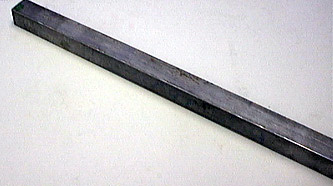
One of the instruments of the “secret police” — an iron bar
Nobody knows who did this, or why these two attacks took place, of course. That’s because this is how secret policing works – it occurs very discreetly, almost invisibly, insidiously reminding us that, below the surface of society and always after night falls, a secret police force is active. Violent secret policing can be so clandestine that, when it does take place, it can feel at first almost as if it hasn’t happened, unless, of course, you are one of the people on the receiving end of it. Although it feels unreal to many among the wider community, its repeated occurrence burrows into the public mind where its corruption, though often overlooked, is impossible to conceal.
This secret police force is so obscure that nobody knows who or what is behind it, other than someone’s profound desire to control people. In the absence of identifiable organisational responsibility (those involved are so secretive that nobody knows who they are) we could also describe this very Secret Police Force as Sinn Féin Mark 2. Indeed, they resemble Sinn Féin’s party militia so much that the people of Derry could be forgiven for thinking that those who are behind these attacks might have been, at some stage, apostates who were driven from that organisation. In any case, the new Secret Police have assumed all the characteristics of their old role models.
Old Tactics in New Clothing
Derry’s secret policing structures aren’t new or unique. They have been seen before, and resemble very closely what might be termed “the McGuinness pattern”. Organised and directed by people who want to establish themselves as unofficial figures of authority in the city, they operate according to a very familiar design. This has always served those who believe that they should be revered but ultimately feared by their own as far, at least, as limb-smashing can be interpreted as the good work of defending the community from its wayward youth. So, once again, we are being confronted with the work of false radicals and mock liberators. They know that beating people up with iron bars appeals to a very special kind of imagination, and this is where the secrecy of Derry’s Secret Police might be of benefit to everyone. Who would want to know whether a friend, neighbour or even a relative was involved in this kind of policing? This type of best-kept secret is best kept, well… very secret, indeed.
Another of the instruments of the “secret police” — a pickaxe handle
Despite what the Secret Police want you to think, they are not a manifestation of what happens “in the absence of acceptable policing” because that lazy, self-serving cliché died of exhaustion a very long time ago when it was last uttered by Sinn Féin. Anyone capable of independent thought knows that there are always alternatives to battering young people with iron bars unless, that is, they are the very rare kind of person who is addicted to doing, ordering or beholding it (a dependency for which all kinds of medical and psychiatric treatments are available). The simple fact is that broken teenage limbs are not the organic products of a supposedly measured or reasonable process that concludes with community-sanctioned violence. This brutality, along with the desire for authority and validation that it represents, is an artificial imposition that follows a logic that is as brutal for the entire community as it is for the young person who has been accused of, somehow, “offending”. The entire process is deliberately engineered to appear vague and its indeterminate quality is intended to cultivate a collective response along the lines of “Well, he must have done something”.
The Silent Terror
We can assume that an allegation of some kind of offence has been levelled by the Secret Police during its thoroughly concealed process of judgment – even secret tribunals, after all, have to justify their existences to themselves. The accusation circulates only within this bubble, away from public scrutiny where, undisclosed, the infraction is proven by faceless judges before a Secret Police squad is mobilised, armed, and then deployed. The “offending” young person is beaten up and in the subsequent public discussion about the mystery (“What did he get it for, anyway?”) the perceived problem evaporates, like reason under a dictatorship. Nobody says anything; everybody moves along like they’re told to and supposed to because there’s nothing to see here, nothing at all. So, the reality principle sinks while the self-perpetuating myth of the enforcer, so reliant upon the damnation and isolation of broken-limbed teenagers, endures.
With its methodically-planned politics of erasure and dedicated to the erosion of truth, this organised and highly structured violence is reinforced by the ripple-effect that it causes across the wider community. All of this benefits those who direct it and carry it out in a number of ways. Firstly, it reinforces the perception that those in command of the Derry Secret Police have of themselves as a source of authority: “people will fear us now”, they think, “we’ll have more respect”, “all we’ll ever have to do is glare at somebody and they’ll get the message”, and so on. Secondly, the people who carry these attacks out on their behalf have, in their own turn, become blooded. Assimilated within the circuitry of this local, unofficial and unspoken power and embedded in it, they now have status, belonging, a role and a meaning greater than anything that they have ever experienced or amounted to before. In their own eyes and, they believe, in the view of the broader community, they will finally matter. Imbued with this new sense of purpose and superiority, they’ll genuinely feel important and, from this moment onward, they’ll exist under the impression that they, too, are now to be feared.
Political Fear and the Closure of Consciousness
No group has claimed these attacks, and none will, because silence is the currency of terror. Fear travels along the ruined and collapsed channels of reason because it depends upon the closure of imagination. Once thinking is checked, it transmits rapidly from one consciousness to the next via these now-quiet paths. In doing so, it seals mouths and closes minds, extinguishes thought and tightens its grip over the popular imagination where it is internalised, amplified and projected further inward with ever greater intensity following each attack. In this way, fear reproduces itself, by generating wider acceptance of organised thuggery and condemns entire communities to long-running cycles of quiet, uncommunicated dread. At the back of the mind of every parent will be the final, awful question: “Could this happen to my child?”
Questions now need to be asked about those who benefit from secret policing, and answers should be demanded as to which local hierarchies and dynasties are being served and facilitated by the Secret Police. The people of Derry have a right to demand what qualifies someone for a role in this clandestine force, to know who gets to make secret policing decisions and on what authority these decisions are being taken. Given that this organisation operates according to a programme of its own, people also have the right to know who writes the rules of secret policing and why. We have the right to know what gets said when secret policing matters are discussed: who, for example, discusses whom during these meetings? We have the right to know what qualifies anything or anyone for inclusion in these secret discussions, and we have the right to know what will happen if the Secret Police come up with more secret “offenses” that they believe will need to be policed with even more severity.
The deepest wounds caused by secret policing and its unofficial violence are always inflicted on the psyche of a people. The worst damage of all is caused by the silences that inhibit thought, restrict free speech and threaten to crush open criticism. If allowed to take hold, these restrictions will dominate the material, political and cultural prospects of the people of Derry, along with their psychological wellbeing. If they are not resisted another generation will be forced to endure the authority of cabals and militias, while the prospects of young people will be permanently hindered by the shadow of this unofficial violence.
A DEBATE to discuss the above question at the Teachers’ Club, Dublin, was organised by the United Ireland Association with Tommy McKearney and Clare Daly being the debaters on June 16th.
Tommy McKearney (Photo: Wikipedia)
Tommy McKearney is a long-time Republican, formerly of the Provisional IRA, 1980
Clare Daly (Photo source: Internet)
Hunger-Striker and ex-Republican prisoner. He was, along with Anthony McIntyre, a founder of the Republican Writers’ Group which, while not advocating armed struggle, was critical of the Good Friday Agreement, of Provisional IRA and in particular of Sinn Féin. He is currently an Organiser for the Independent Workers’ Union.
Clare Daly is a long-time Socialist, a former trade union shop stewart and has been a Teachta Dála (member of the Irish parliament) since 2011, formerly as a member of the Socialist Party and now a Left Alliance TD. She has visited Republican prisoners and raised issues about their treatment in court and in jail. Daly was also arrested for trespass at Shannon Airport, along with fellow-TD and partner Mick Wallace, protesting against the use of the airport by US military flights and for transporting of political prisoners of the US military to jails in various parts of the world.
TOMMY MC KEARNEY
Tommy McKearney spoke first and stated that there was an issue of defining Republicanism and that sometimes what was meant was the anti-monarchic Republicanism of France or the United Stated but he was going to discuss it in terms of a specific Irish-based ideology, i.e Irish Republicanism.
Mentioning a number of Left-Irish Republicans such as Fintan Lawlor and Wolfe Tone’s famous quotation about relying on the “men of no property”, Tommy developed a line of reasoning that sought to say that there was not a huge difference between Irish Republicanism and socialism and drew attention to the fact that James Connolly had founded a party by the title of the Irish Socialist Republican Party.
Going on to talk about the objective of Irish Republicans, Tommy stated that not only is a republic desirable for Ireland – it is necessary. Only a Republic that is based upon socialist principles can resolve the economic and political problems facing Ireland today on both sides of the colonial Border.
Referring to the British election results in the Six Counties, Tommy commented on the 238,915 votes and seven seats for Sinn Féin – an increase of 14,670 votes – and the rise of almost 67,000 votes for the DUP with their ten seats. Sinn Féin had been pushing a peace process which was not about peace but about normalisation; their claim to intend to bridge the sectarian divide was empty and the voting lines were drawn up along sectarian lines at least as deeply as before.
Tommy also speculated that the amount of votes cast for Sinn Féin, on a platform of refusing to take their seats in Westminster showed, among other things, the amount of people in the Six Counties who did not care to be represented in a British Parliament and presumably would want representation in a united Irish Republic. He called for an alliance of Left Republicans and Irish socialists and recalled that James Connolly had founded, as well as the Labour Party, the Irish Socialist Republican Party.
CLARE DALY
Clare was next and she in turn highlighted the difficult issue of defining the Left – did it mean the parties that defined themselves as Left, did it include the Labour Party – some would say yes, others no. For Clare it is not issue of the names we give parties or activists but of what we stand for. Clare said she stands for a socialist country and in that sense for a Republic.
Addressing the question for debate, Clare owned that maybe socialists had neglected the national question — maybe they had been put off by images of balaclavas and guns — but it could equally be said that Republicans had for decades neglected social questions such as women’s reproductive rights, women’s rights in general, gay rights …. However, in more recent times, Republicans were seen actively supporting those rights.
Over recent years, Clare said, we had seen the gains our parents fought for in terms of trade union rights and local authority and state services lost or undermined.
Clare said she saw herself as a citizen of the world but as she lived in Ireland that she stood for a Republic that was organised along socialist lines and gave equal rights to all. The real question, Clare stated, is how we are to achieve that and pointed to the swing to the Left in Britain with Jeremy Corbyn’s party receiving a big increase in votes, despite media hostility and predictions of failure. The Conservative Party could only rule now with the support of the DUP’s 10 Mps. Clare said that opportunities of a Left Front existed in Ireland too as was seen by the Right to Water mass marches with broad political party and some major trade union support.
CONTRIBUTIONS FROM THE AUDIENCE, RESPONSES FROM THE PANEL
Included in contributions from the audience were the following:
Sinn Féin had seven MPs to the DUP’s 10 and should consider abandoning their abstentionism and go to Westminster to assist Corbyn in voting legislation
While the Labour Party in Britain had moved to the Left, Sinn Féin in Ireland had moved to the right
Good debate from two good speakers but also two who had put themselves out there for what they believed – Tommy McKearney in armed struggle in the past and hard prison struggle and Clare Daly in protesting US military use of Shannon Airport and also visiting Republican prisoners in jail, along with a few other Tds.
We need more debates like these and also to focus on Republicans with regard to where they stood with regard to socialism.
The Irish Left as a whole has divorced itself from Irish Republicanism, probably in fear of being associated with nationalism and/ or armed struggle. In doing so, it has walked away from continual violation of human rights, e.g of Republican prisoners in the jails and of civil rights, the right to political dissent of Republican activists on both sides of the Border.
The Irish Left has neglected to confront British Imperialism and left the Republicans to confront the various visits of the British Queen and the recent one of Prince Philip, when major roads were shut and even civilians impeded in going about their business or even going to their local shops or to visit their relatives’ graves in Glasnevin and a megaphone wrested by an undercover policeman backed up by a riot squad from the hands of a person about to speak to a protest demonstration.
Republicans are socialists and to pose the two as different categories was ridiculous.
There should be a broad Left front in Ireland including the trade unions and Sinn Féin.
Among the responses from the panel were that people were hung up on condemning Sinn Féin and should welcome them into a broad Left mass movement on the model of the Right to Water and Right to change campaigns (this from Tommy McKearney)
The socialists might not have done very well opposing British imperialism but had opposed US imperialism, which is one of the imperialist powers in operation in Ireland (this from Clare Daly) and a major one in the world.
COMMENT
The contributor who said that “Republicans are socialists” seemed unaware that historically at least this certainly was not so. Seán Mac Diarmada, the Irish Republican executed on the same day as the socialist James Connolly, had been on record as saying that no-one should support socialism. During the War of Independence, some IRA units took actions to support landless labourers and poor farmers but others took action to repress these in favour of big farmers.
The IRA had a ban on Communists through the 1930s probably up to the 1960s. Sean South, prominent Limerick IRA Volunteer killed in the Bessborough RUC Barracks attack in 1957, was a conservative Catholic, anti-Communist member of the Knights of Columbanus and of An Réalt (Irish-speaking section of the Legion of Mary).
The broad Left front being advocated by a number of people seems to be a reformist social-democratic one and, while there is nothing necessarily counter-revolutionary about fighting for reforms, clarity is needed about whether what they are advocating is a social-democratic program or fighting for some reforms while at the same time openly organising with a revolution in mind.
Clare Daly has certainly fought hard against US Imperialism but others on the Left much less so. The mobilisation against Hillary Clinton’s visit to Dublin was not great and gave up in the face of police opposition before they even reached City Hall and there was no mobilisation at all against Obama’s visit to Dublin in May 2011 and it remains to be seen how much there will be if he comes this year, as he has reportedly promised to do. But the question of oppposing British imperialism is a crucial one since a) it is the main imperialist-colonial power at work in Ireland and b) because it is the main prop of US Imperialism in Europe and in the UN.
There would seem to be fertile ground for debate on the historical and current differences between Irish Socialists and Irish Republicans, as well as for discussing possible joint action and one hopes for many more debates and discussions of this nature with a broad attendance.
It has been said by some people prominent in the broad Moore Street campaign that the Minister for Heritage has declared her support for the Report of her Consultative Group on Moore Street and its recommendations. A number of other campaigners have said this is not so and I am one of those (NB: there are a number of campaign groups in this struggle).
For saying that, I have been criticised as “rocking the boat” and “spreading inaccuracies” or even “generating conspiracy theories” and also personally verbally attacked in public and on social media by name and by inference. The reputation for integrity of a political and social activist is very important to her or to him and so these allegations are of course hurtful. But there is much more at stake than my feelings or even my reputation or that of a few other activists – there is indeed the struggle for the Moore Street historical quarter itself. For a successful conclusion of this long struggle, the direction taken is crucially important.
(For those who may be unfamiliar with the background or have lost track of some of the major developments, a very brief background is given in an Appendix below).
THE MINISTER’S CONSULTATIVE GROUP AND ITS REPORT
In June 2016, the Minister set up her Consultative Group on Moore Street to which she invited a range of political party representatives (and one Independent) elected to the Dáil, a number of Dublin City councillors and representatives of two campaigning groups. The list excluded the first campaign group to raise the Moore Street conservation issue along with the most active campaign groups of recent years and also included no historians.
Though it did not publicly call for them, the Consultative Group accepted submissions in writing and a number of campaigns and individuals made presentations in person (the 35 submissions are available on the Department’s website under Minister’s Consultative Group on Moore Street – see link at end).
Two members of SMSFD campaign presenting petition sheets with around 70,000 signatures to some members of the Minister’s Consultative Group at City Hall in March 2017.
On the 29th of March, the report of the Consultative Group was launched.
Should the Minister accept the Recommendations of the Report in full, then there are a number of recommendations which we should celebrate (and indeed some of us proposed many of them in submissions to the Consultative Group itself) and for which we should seek implementation. But there arealso some very harmful ones which we should repudiate.
However, if the Minister has not accepted the Recommendations, then nothing has been won by the Consultative Group, even on paper, despite the many submissions and delegations it has received and the meetings and discussions of its members. This would obviously be a distressing revelation to some of those who were part of that Group. And we can expect even less from the next one the Minister has set up, the Advisory Group.
But, let us return to the question: Did the Minister or did she not accept the Recommendations of the Report? Let us examine the available evidence.
THE MINISTER’S ACTUAL WORDS
On the 29th of March 2017, the following statement was issued by the Department of Arts, Heritage, Regional, Rural and Gaeltacht affairs:
‘The Moore Street Report – Securing History’ is presented to Minister Humphreys by the Moore Street Consultative Group
The Minister for Arts, Heritage, Regional, Rural and Gaeltacht Affairs, Heather Humphreys TD, has today (Wednesday) received a copy of the report compiled by the Moore Consultative Group, which she established last year. The Minister announced the establishment of the group in June 2016, as a means to make positive progress in relation to the future of Moore Street.
“I set up the Moore Street Consultative Group, which includes political representatives, relatives and other stakeholders, in a bid to bring together the range of views on Moore Street and seek a positive way forward. Since then, the Group, chaired by Gerry Kearney, has carried out a body of work which has resulted in the report they are publishing today.
“I want to take this opportunity to thank all of the members of the Group for their dedication and commitment in completing this work in such a short timeframe. The time and effort which went into this report is greatly appreciated.
“I welcome the fact that the report is seeking a way forward based on consensus. I believe that the recommendations in the Report can help find a way to breathe new life into the Moore Street area, while at the same time retaining its sense of history and enhancing its traditional street market.
“The Report signals the potential of a negotiated outcome, balancing the perspectives of the key stakeholders. I am fully supportive of this constructive approach and I want to see the work of the Group being built upon, so we can progress to the next stage. I will therefore be recommending to Government the establishment of a new Advisory Group as recommended in the Report to advance that process.”
(end quotation)
A little over a month later, on the 2nd May 2017, Éamonn Ó Cuív (Fianna Fáil) asked a question of the Minister in the Dáil and followed with a supplementary one:
National Monuments
43.Deputy Éamon Ó Cuív asked the Minister for Arts, Heritage, Regional, Rural and Gaeltacht Affairs if she has considered the report of a group (details supplied) issued in March 2017; her plans to implement the recommendations in the report; the progress made to date in doing so; and if she will make a statement on the matter. [20440/17]
Deputy Éamon Ó Cuív: As the Minister knows, the Moore Street report was published in March and a timeline was set out with the hope that a decision would be recommended in six weeks, as the matter has dragged on for years. Has the Minister brought this to the Cabinet and have we a decision? Will she set up the advisory group that has been recommended in the report so we can move to the next phase? I am afraid we will lose the good momentum built up in the past six months towards progressing the Moore Street project to a suitable resolution.
Deputy Heather Humphreys: I agree with the Deputy that good momentum has been built up and I put on record my sincere appreciation to the members of the group referred to by the Deputy for the report they recently presented to me. The group, which was independently chaired by a former departmental Secretary General, included local and Oireachtas political representatives, 1916 relatives, street traders and other stakeholders. It was set up in a bid to bring together the full range of views on the matter and it held its inaugural meeting in September 2016. In the mean time, it has reviewed numerous presentations and submissions from a range of interests, looked at a variety of official and other reports, interviewed relevant public officials and other experts and examined a large body of work from within its own membership, as the Deputy knows. This extensive programme of work has culminated in the series of recommendations contained in the report that was presented to me in the last few weeks and that is now being examined in my Department.
I welcome the fact the report is seeking a way forward based on consensus. Its recommendations can help breathe new life into the area while retaining its sense of history and tradition. In addition to its particular association with the 1916 Rising, there are other relevant aspects of the street and surrounding area that also need to be taken into account, including the range of State, public and private property holdings and ownership and, of course, the presence of the street traders themselves, who do so much to give the area its unique ambience and place in the life of our capital city. The report has looked carefully at all these elements and I am delighted that it signals the potential for a mutually successful outcome to be agreed between the relevant parties, balancing the perspectives of all the key stakeholders. I am fully supportive of this collaborative approach and I want to see the work already done being continued so we can progress to the next stage and see tangible results on the ground. Critical to this will be the establishment of the new advisory group that the report itself identifies as the most effective way to move forward with its recommendations. I will be proceeding with the setting up of this group as quickly as possible to build on the positive and constructive foundations set out in this report.
Deputy Éamon Ó Cuív: As happens so often, the Minister gave me much information that I already have, as I was part of all those discussions and on the forum referred to. As she pointed out, we had a very experienced chairman and in his work he was very diligent in advising us against things that could not be done. However, the report very clearly states that the establishment of the advisory oversight group should happen within six weeks. As the Minister knows, this was because a consensus was built through a huge amount of work. People believed they had put together a map to bring us forward. There are two questions that still have not been answered. When will the advisory group be set up or will it be set up? Has the Government considered this report and made any decision on the recommendations of the report? All of them must be implemented but some need very urgent attention, including, for example, those relating to street traders.
Deputy Heather Humphreys: The appointment of a chairman for the new advisory group is the next step in the process and I hope to see that person appointed, with the group beginning its work, as soon as possible. I am very much aware the chairman of the previous consultative group worked in a particularly effective way with all the parties and his efforts were key to the achievement of the agreed outcome to the group’s deliberations as set out in the report. The next stage is equally crucial and the new chairman will have just as vital a role to play. I am looking at possible candidates and hope to make the appointment as soon as possible. The report envisaged this process taking six weeks and we are still well within that timeframe. The new advisory group will be drawn from among the existing membership of the outgoing Moore Street consultative group. I understand it had 27 members and it is envisaged that the new body, while being equally representative across the same spectrum of interests, will be somewhat smaller.
THE REALITY
People reading the text of the Minister’s statements and replies will search in vain for anywhere she says that she actually accepts the Report and its Recommendations. In fact, one can see that while in politician-speak she talks around it, she studiously avoids saying that, confining herself to praise for the Group and its Chair and to the spirit of consensus. And well she might praise the consensus, because despite the public positions of many of the Consultative Group prior to their being chosen by the Minister and which some may still hold, and despite the calls from a number of campaigners and other stakeholders in their submissions, the Group did not call on the Minister to abandon her appeal against the High Court judgement (i.e that the Moore Street historic quarter is “a National 1916 Historical Monument” — more on this below).
Also, the Minister and the Report both accept the speculators as “stakeholders” and the Report calls for the future to be decided in negotiations between those “stakeholders” and the two elements who have all along been facilitating them: Dublin City Council’s Planning Department and the Department of Heritage!
Those who have been repeating the erroneous line that “the Minister has accepted the Report” argue that a) she set up the Group and/or b) she has proceeded to the second stage, setting up the Advisory Group and therefore must accept its Report. Or b) even that an Irish Times news report carried a headline saying that she supported it and that the Minister did not deny the headline!
The best that can be said for that reasoning is that those are their interpretations but her statements quoted above do not support those interpretations. Nor do they refute them, it is true. But surely if the Minister did actually support the Recommendations, she would have unequivocally and specifically said so?
DANGEROUS RECOMMENDATIONS AMID WELCOME ONES
As noted earlier, the Recommendations contain some positive elements, including keeping the “footprint” of the main remaining Moore Street 1916 quarter intact, i.e the block enclosed by Henry Place, Moore Street, O’Rahilly Parade and Moore Lane, along with the lanes themselves and the street. They also include a number of recommendations for long-overdue improvements to the hard lot of the Moore Street street traders (but not the small business shops), both in terms of provision of facilities and in terms of their trading license restrictions.
But to leave the future of the historic quarter to negotiations between the three historic villains of the saga, the property speculators, the Planning Department and the Department of Heritage, as laid out in the Main Recommendations, 7, 8, 9 and 12 (pp. 6-7)) and in Chapter 10, Conclusions and Recommendations (pp.36-37) 10.3 and 10.4 is surely not what we should be doing.
A number of times in the Report the State is claimed to be “the ultimate custodian of our history, culture and heritage”. Whatever one might think of the desirability of such a state of affairs, such an evaluation of the role of the State is patently untrue as even a glance over the history of this state will demonstrate. It is untrue about historical and archaeological sites, the Irish language, Irish traditional music, Irish dance and Gaelic games.
The State has failed to defend a great many sites of historical, archaeological and architectural importance from property speculators and other financial interests, was about to demolish houses in Moore Street and one of its Government Ministers is currently appealing a judgement that the whole Quarter is a “National Historical Monument”. The main Irish-language promotional and defence organisations were set up as voluntary bodies — though some now receive some low State funding — and most of the activity is by unpaid activists. Neither the Minister of the responsible department nor her Ministerial appointments to the Gaeltacht desk have been competent Irish speakers and some years ago the Ombudsman for the Irish Language resigned in protest at inaction and obstruction from within the state apparatus. The national Irish-language TV channel (TG4) and radio station (Radió na Gaeltachta) were won by people campaigning against the State, in which activists were fined and threatened with jail (one campaigner did go to jail to defend his right to motor insurance documentation in Irish). Likewise bodies promoting Irish traditional music and song were voluntary to begin with and although Comhaltas Ceoltóirí Éireann now receives State funding, most enthusiasts and practitioners, whether within or without Comhaltas, are doing so either in a voluntary or private professional capacity. That is also true of Irish traditional dancing, both social and performance. Gaelic Games are also largely a voluntary activity with minimal state support overall.
The “ultimate custodians of our history, culture and heritage” are the PEOPLE! And it is to the people that we should look to defend these aspects of our identity. It is they who must be represented in the decision-making and stewardship of this national historical monument, and all other bodies subservient to them. Setting up such a representative, inclusive and transparent management committee for the project will not be easy but is surely worth the effort, rather than handing it over to the main villains, whom campaigners have been fighting – on this site alone – for a decade-and-a-half!
THE MINISTER, THE LITIGANT AND COURT CASES
Without going into too much detail, an individual by the name of Colm Moore in 2015 initiated a High Court case against the Minister of Heritage on a number of issues, all to do with her plans and actions with regard to the Moore Street quarter. In January 2016, during an occupation by protesters of the site to prevent the Minister’s contractors from demolishing three houses in the terrace, Colm Moore obtained a temporary injunction against any demolition until judgement had been reached in his case.
The property speculator involved attached himself to the case as a respondent (i.e as a “defendant”). The Minister’s legal team and her Department’s officers defended all her actions, denied that the site was a battlefield (“all Dublin was a battlefield”) and denied the importance of any buildings except Nos.14-17 Moore Street (even of No.10, which was the site of the first transferred HQ of the GPO Garrison and of the 1916 Rising and of the emergency insurgent hospital dealing with nearly a score of wounded — including a rescued British soldier).
On March 18th 2016, the High Court Judge found against the Minister and speculator on all grounds and ruled that the whole quarter is a 1916 battlefield and a historic national monument. The Minister said that she was considering appealing, asked for more time, then more time again and finally confirmed that she would indeed appeal the judgement, with the support of the full Cabinet. Contrary to interpretations of her reasoning and to a reply Enda Kenny gave on her behalf to Gerry Adams TD (Sinn Féin) last year, she has entered an appeal against all parts of the judgement, 250 pages – far from the “clarification on some points of law” reason for the appeal which some people have claimed (and which a speaker was still claiming at a public meeting as recently as 22nd of May this year).
Some people have said that the Consultative Group’s Report, while nowhere suggesting the Minister should drop her appeal of the historic judgement, instead suggests the litigant, Colm Moore, should drop his defence of the case. I am one of those people. We have been called liars, troublemakers, conspiracy theorists and accused of making inaccurate statements.
Again, let us examine the actual text (extract from 10.1 New Beginnings (p.34):
In the event of consensus being secured on an agreed way forward for the development through dialogue by the Advisory/Oversight Group with the developer, and agreed to by the Applicant and the State, the Group is strongly of the view that payment of legal costs, incurred by the Applicant’s legal team, by the State is warranted and appropriate. The Group has reached this conclusion after considerable reflection and having regard to the widely acknowledged public interest which informed the taking of the case and the savings which would accrue to the State by settlement through such a process. (end quotation)
I agree that the section does not actually say Mr. Moore should drop the appeal but I do think that it is a nuanced call for him to do so and offers an inducement to him and more particularly to his legal team. To me, the subtext to this reads something like this:
“Listen lads, we know you put a lot of work into this and the legal team in particular have had to turn away some lucrative work while they concentrated on this case. And we know they haven’t yet received a penny for doing so. So, you settle the case on terms the State can agree with and we guarantee the legal team get paid and your litigant can walk away. Millions in the legal team’s bank accounts now or years in court with no guaranteed win – which is to be, lads?”
It is not only an inducement to settle but a possible seeking to cause a split between the litigant and his team. The litigant is taking the case presumably because of historical and possibly political (in the broad sense) motivation but one cannot expect that motivation of the legal team.
The latest news on the legal case is that Minister asked for time to consider skipping over the Appeal Court and taking it straight to the Supreme Court. Normally such an extension is for six weeks but the Minister has exceeded that and no limit was set – although clearly she will have to declare definitely at some point to which court she is taking her appeal. In the event of it being the Supreme Court, my information is that we could well see the end of 2019 before it reaches there. And meanwhile the buildings and laneways deteriorate and no substantial work of a construction nature can be undertaken to improve facilities for the market traders.
ROCKING THE BOAT
(Source image: Internet)
When a boat is being steered in a bad direction it is perfectly justifiable for those crew who become aware of this to rock the boat, to bring their concern home to the other members of the crew. Should this fail to yield a change of direction, it becomes time to inform the passengers. If danger appears, it is not a time for discreet nudges and whispers but for speaking clearly and loudly, that all may have an opportunity to bring the boat back on a safe and productive course.
End item
APPENDIX
VERY BRIEF BACKGROUND IN BULLET POINTS
Moore Street is the last remaining street of a centuries-old street market quarter (the rest is buried under the ILAC shopping centre).
On Friday of Easter week 1916, with the GPO in flames, the insurgent garrison evacuated, most of it through Henry Place eventually to Moore Street, some participants being killed along the way. On reaching Moore Street, they occupied a number of houses and in particular No.10, then tunneling through the walls throughout the night, to occupy the whole 16 houses of the terrace by Saturday.
On the Saturday, the decision was taken to surrender and instructions to that effect were sent out to the other garrisons. Among the 14 taken prisoner and later shot by firing squad in Dublin, six were from the Moore St/ GPO garrison, including five of the seven signatories of the 1916 Proclamation.
In 1966, the 50th anniversary of the Rising, the National Graves Association, a voluntary non-state-funded organisation, placed a plaque on No.16, the first formal mark of recognition of the events there.
Around 2001 a campaign was started to have a building in Moore Street as a national monument; this later expanded to cover the whole terrace Nos.10-25, back yards, and surrounding street and laneways.
In 2007 the State decreed Nos.14-17 to be of historical importance and in need of preservation; the Planning Department and Government between them approved the speculator’s plan for a huge shopping centre with the four buildings being a tiny museum inside the shopping mall campaigners; the 1916 Relatives campaign on Moore Street split, one James Connolly relative favouring the speculator’s plan and another against; the State offered the speculator €5 million for renovation work on the buildings.
In September 2014 the speculator proposed to hand over the four buildings to Dublin City Council in exchange for two the Council owns at the end of the terrace, which would have enabled him to demolish half the buildings in the terrace. The Save Moore Street From Demolition campaign group was formed specifically to defeat the land swap proposal (which had the support of the Chief and Deputy Chief Executives of Dublin City Council) and began a petition on Moore Street every Saturday. The proposal was defeated by majority vote of councillors in November 2014.
In July 2015 the State purchased Nos.14-17 from the speculator at a total price of €4 million. An individual, Colm Moore, took three cases against the Minister of Heritage with regard to Moore Street.
In January 2016 the State was about to demolish three buildings in the terrace. The SMSFD group convened two emergency demonstrations in the street. The site was occupied by protesters for five days and subsequently blockaded for five weeks by a new group that grew out of the occupation, the Save Moore Street 2016 campaign group.
On March 18th the High Court Judge ruled against the Minister and the speculator and ruled that the whole quarter, including streets and laneways, is a historic 1916 National Monument.
In July 2016, after much delay, the Minister put in an appeal against the High Court judgement – the appeal has still to be heard.


 ).
).