On 13th September 1845 the widely-read British weekly publication The Gardener’s Chronicle apprehensively reported the appearance of the blight on potatoes in Ireland but doubtful if the full extent of the holocaust to follow was expected.
(Sourced: Internet)
True, no other national population in any other known part of the world was as heavily dependent on the potato as was Ireland’s. Other crops were grown but were mostly destined as feed for domestic animals1 or for export directly or indirectly as in the case of alcoholic drinks.2
A national diet is that of the mass of the population, which in Ireland was the peasantry. On the potato and a little milk the Irish peasantry grew strong enough to be recognised in Britain as healthy able workers, seasonally in agriculture or longer-term in manufacturing and construction.
They were reputed to be the tallest and most fecund in Europe, according to Frederick Engels writing in Britain a year before the piece in the Chronicle.3 In Ireland the peasantry were for the most part tenants-at-will or landless labourers for the settler big landowners and descendants.
The original Irish had been expropriated by sword, fire and pen (legal decrees) and their expropriators lived on the rents they extracted from their tenants in a mixture of crops, animals, cash and labour. After the abolition of the Irish Parliament,4 most big landowners found no reason to even live in Ireland.
The estates of the absentee landlords were then managed by agents, middlemen who forwarded the extracted wealth to their masters in Britain, or perhaps travelling ‘on the Continent’, or trying their hand in the American colony, minus the agents’ commission, of course.
As people went hungry, meat, dairy and grain continued to be exported.
The dependency of the Irish mass on the potato was known of course and even mocked in some ruling British quarters at times. But so were the Irish landlord aristocracy who seemed to have no interest in developing industry.
But could anyone predict that the blight would intensify each year and that the Government of the UK would tolerate such devastation in one of its parts? By the time it had run its course six years later, Ireland had lost at least 2.5 million of its original over eight million5 and more were emigrating.
Memorial to the Great Starvation on Dublin’s north side quays. (Sourced: Internet)
And both the Irish planter aristocracy and the cotter class of Irish peasantry had been wiped out, leaving the field to the Gombeen6 class of money-lenders and bigger farmers, the latter now expanding their holdings and who would farm meat instead of agricultural produce.
When the overall national population stabilised again it did so at five million,7 at which level, despite a high birth and survival rate, it remained until the early 1990s. The magic trick was achieved by constant annual emigration, giving the Irish one of the largest diasporas in the world.8
The Gardener’s Chronicle’s writer noting the arrival of Phytophthora infestans could not have imagined the extent of its devastation. But if he knew the history of Ireland as well as that of the blight, he would have concluded that it was not the worst blight upon the Irish nation.
No, that was the arrival of the Anglo-Normans in 1169, with the second-worst blight being the growth of the Gombeen class.
end.
Note: If you found this article of interest, why not register with Rebel Breeze for free, so that you will be notified by email of subsequent articles. You can de-register any time you wish.
FOOTNOTES
1Grazing animals live on forage in Ireland but in winter or if overgrazed must be given additional food, while draught animals need cereal feed, typically oats. Pigs and domestic fowl were fed on mixtures of potato, beet, pulses and domestic leftovers.
2Typically eorna (barley) for beer brewing and whiskey distilling. These products continued to be produced and exported during the years of famine. Hops are also used for brewing but much was imported from southern England where climatic conditions are more favourable.
3The Condition of the Working Class in England (1844).
41799, followed immediately in 1801by Ireland becoming part of the United Kingdom and Irish MPs being required to attend the Westminster Parliament.
5A historical and statistical riposte to the anti-immigration claim that today “Ireland is full”.
6Originally from the Irish word Gaimbín and applied to moneylenders and land speculators during and following the holocaust period it, came to be applied by many to the Irish neo-colonial national bourgeoisie.
7Of the whole nation, with over 3 million in the Irish state and under two million in the British colony, the Six Counties.
8The bleeding through emigration was constant but fluctuated in degree, with a high point in the 1950s when it amounted to 15% of the Irish state (i.e. of the 26 Counties) and another in the 1980s.
I wish to briefly clear up what I believe to be some confusion about the terminology in the title, basing not so much on opinion but relying in the main on fact as illustrated by history.
I will attempt to show thereby that Republicanism and Irish Republicanism are different things ideologically and that socialism is different from both of them.
Republicanism entered the world as a political aspiration and, after revolutions in Britain, France and the USA, practised as a system of Government. It proclaimed electoral democracy for its citizens (at first men but later women) – but quite clearly the bourgeois class ruled society.
George Washington, Republican, being presented with the flag of the early American Republic. (Image sourced: Internet)
It was a democratic bourgeois (essentially capitalist) ideology characterised by individual choice,1 opposition to feudalism and monarchy and separation of church and state. It was not essentially socialist nor even anti-colonial, as we can clearly see from its early examples.2
Republican government was overthrown in Britain (English and Scottish administrations), the monarchy restored and in time a kind of compromise monarchy-democratic system evolved. The republican system in France and the USA remained and is with us to this day.
Painting of Oliver Cromwell, an English Republican whose name became part of a curse in Ireland (including for Irish Republicans!). (Image sourced: Internet)
Irish Republicanism also developed as a bourgeois ideology (drawing on English, French and US Republican thinking)3 but it was clearly also in favour of Irish sovereignty and therefore against the colonialisation of Ireland.4 Once measures of reform were blocked it became revolutionary.
This gave rise to the revolutionary organisations of the United Irishmen of the 1790s and early 1800s and the Young Irelanders of the middle of the 19th Century; also of the Irish Republican Brotherhood of the later 19th.
The IRB or Fenians however had a strong working class character and were admitted to the First International Workingmen’s Association, the first international socialist organisation. However, Irish Republicanism remained a bourgeois ideology albeit democratic and revolutionary.
Karl Marx and Frederick Engels, founders of scientific socialism. (Image sourced: Internet)
Socialism
The ideology of socialism has a long pedigree but was made more concrete under and in opposition to capitalist society. It found development on a scientific ideological and organisational basis particularly with the work of two German migrants to Britain, Karl Marx and Frederick Engels.
This ideology emphasises communal over individual ownership of the means of production, distribution and use/ consumption and sees the socialist state as a stage on the way to communist society. Its mantra is: From each according to their ability, to each according to their contribution.5
In terms of implementation the Paris Commune of 1871 was the first socialist capture of a city and the October Socialist Revolution of 19176 in Russia the first time a country was taken by socialists.7
Irish Republican ideology continued into the early decades of the 20th Century with its military organisation first the Irish Volunteers of the 1916 Rising and later, the Irish Republican Army of the War of Independence, whose leadership split over the English offer of autonomy with partition.
Ireland had been kept under-industrialised by colonialism but socialist political organisation was developing slowly in some urban areas. In 1896 Connolly and others founded the Irish Socialist Republican Party in Dublin and in 1912 he and Larkin also the Irish Labour Party.
In 1911 Larkin had founded the Irish Transport and General Workers Union.
The employers strove to break the ITGWU and implemented a Lockout of union members or supporters in 1913; attacks on the workers by the Dublin Metropolitan Police led to the defensive creation of the Irish Citizen Army – the first workers’ army in the world.8
Some Irish Republican leaders and followers sympathised with the strikers and some did not but the Republican movement did not mobilise in their support with the exception of a number of members of Iníní9 na hÉireann, which would later split between the ICA and Cumann na mBan.
In 1916 the IRB organised an insurrection with the participation of its Irish Republican military forces of the Irish Volunteers, Cumann na mBan and Na Fianna Éireann united with the Socialist force of the Irish Citizen Army (including women members).10
The War of Independence 1919-1921 was led by the Irish Republican movement with some support, particularly in intelligence and arms smuggling, by the Irish Citizen Army.
The Civil War 1922-2311 followed the British offer of autonomy with partition, as the leadership of the Irish Republican movement, including a section of the IRA split. The ICA had lost its leadership but did not join the neo-colonial side and in subsequent years faded organisationally.
The main opposition leadership to the State returned to being nationalist in the shape of Sinn Féin and the Anti-Treaty IRA, both of which split again with a substantial number joining the De Valera-led Fianna Fáil, which would soon show itself to be also neo-colonial in outlook and practice.
In this period a Socialist current grew within the Irish Republican movement, responding to international and domestic events including the growth of fascism. The short-lived Republican Congress attempted to combine the Socialist and Irish Republican currents in one broad front.
The Irish Republican movement leadership and substantial sections of its membership was however socially conservative and largely dominated by Catholic Church influence. The IRA responded to the Republican Congress with a new anti-communist rule and the expulsion of Congress members.
Frank Ryan, IRA and International Brigades, Socialist (Image sourced: Internet)
This sad part of the history of the Irish Republican movement illustrates very clearly the separate nature of Irish Republican and Socialist organisation. The IRA of the 1930s were Irish Republicans but anti-socialist and those who joined Congress had begun as Republicans but were now socialists.
Or Socialist Republicans perhaps but with the emphasis on socialism. Henceforth other variants would exist, of Republicans who were socially conservative, or liberal, or socialist-influenced … but Irish Republicans first and foremost.
Such an ideology would allow them later to unite to focus on a war against the colonial occupation of one-sixth of the nation but to largely neglect the social, economic and cultural issues arising from a socially conservative neo-colonial regime affecting the majority of the Irish population.12
There may be a tragic illustration of the difference between revolutionary Irish Socialism and revolutionary Irish Republicanism in the last of the Dublin 1916 executions, on 12th May, of the socialist James Connolly and of the Irish Republican Brotherhood organiser Seán Mac Diarmada.
Connolly was one of the leaders of the ITGWU and its Irish Citizen Army which had fought the bitter eight months against the Lockout to smash the union. Mac Diarmada is reported opposing the workers’ action, believing that Irish manufacture and trade would lose out to English competition.13
CONCLUSION
There are Irish Republicans who are revolutionary socialists and Irish Republicans who are not. There are also some revolutionary Irish socialists who are not strictly speaking Irish Republicans. All can and should join in the struggle against British colonialism and other imperialism.
A sovereign Irish Republic on a united 32 Counties would be a great progressive step, for democracy and against imperialism and colonialism. It would not, however, be socialist just because it was Irish Republican, even if it adopted some socialist measures.
A socialist Ireland would be one in which the working class ruled and its measures would include socialisation of all productive enterprises including factories, agricultural and construction enterprises and distribution centres, i.e any which employed workers not of the owner’s family.
And socialisation of all transport and communication networks and social and health services in addition to financial services.14
If it did all the above the regime in Ireland would be socialist and would not even need to call itself ‘Republican’.15 If it were not socialist then it would be capitalist and the struggle for socialism would need to confront the Irish state which would in turn seek to repress the socialist struggle.
Republicanism and Irish Republicanism are different things and socialism is different from both of them.
If people wish a socialist society they should not expect Irish Republicans to present them with that but will instead need to educate, organise and lead their own revolutionary socialist forces while simultaneously participating in the broad anti-colonial and anti-imperialist struggles.
2English Republicanism did not in general envisage the right of Ireland to self-determination, nor France agree with the national rights of the Breton and Basque nations, nor of the colonies abroad for independence; nor the USA of the rights of the Indigenous not to have European settlers occupy their land.
3Largely adopted by sections of business and professional classes of the Occupation, i.e settlers and descendants of settlers.
4Many Irish Republicans were historically able to collude in English settler colonialism in Australia and early colonial occupation of America, as well as later USA settler colonialism into lands still held by the Indigenous Americans.
5However, in communist society, it was understood that the second half of that slogan would be ‘to each according to their needs.’
6The earlier February Revolution had been a workers’ strike and bourgeois uprising against war and the absolutist power of the Tsar. Incidentally it had been only the second revolution against world war, as the 1916 Rising in Ireland had been the first.
7I am not discussing its development or degeneration here, which would take us away from the central topic of discussion.
8Most armies chiefly recruit from the working class but the ICA was specifically for as well as of the workers.
10That they were distinct forces is clear in their development and leadership but in the membership the differences would not always be so clear-cut. The Constitution of the ICA was Irish nationalist but required all members to be trade union members and people chose an organisation to join on the basis of family and social circle loyalties.
The Oasis rock band are performing on 16 and 17 August in Croke Park, the Gaelic sports stadium in Dublin, to a sold out capacity of 82,300. Brothers Liam and Noel Gallagher are the two leading members of the band.
Oasis-marked t-shirts and caps are being sold from stalls in the city and posters announcing the forthcoming concerts adorned shop windows and lampposts but how many fans know the Gallaghers’ background?
Liam and Noel Gallagher of Oasis (Source imag: Internet)
Liam and Noel were born in Manchester to Irish migrant parents but their mother Peggy split from her abusive husband and moved elsewhere in Manchester, taking the kids with her. Liam dedicated Stand by Me to her on Saturday night and gave a shout-out to her her birthplace in Co. Mayo.1
Ireland fed the British ‘industrial revolution’ and the Irish have a long association with Manchester. In 1845 the city’s factories were already attracting Irish workers and its farms probably also agricultural workers to replace English labourers deserting the farms for the factories.
Friedrich Engels wrote The Condition of the Working Class in England,2 published in 1845 (the first year of the Great Hunger) and mentioned the Irish migrants not too favourably. He was writing mostly about Salford, the subject of Ewan McColl’s Dirty Old Town,3 just outside the city then.
By the time Engels’ book was published, the Great Starvation was gearing up. Uncomplimentary references to the Jews can also be found in that work but whatever about that ethnic minority,4 Engels changed his mind radically about the Irish in Britain and came to admire them greatly.
Instrumental in learning about the Irish for Engels were two Irish sisters living in Manchester, Lizzie and Mary Burns, illiterate but intelligent and militant mill workers. Mary and Friedrich became life partners and, after her death, Friedrich became Lizzie’s partner thereafter.
The Irish, as the natives and diaspora of what is often referred to as “England’s first colony” were of considerable interest to the revolutionary partnership of Engels and Karl Marx and more so still as the Fenian movement, the Irish Republican Brotherhood, spread throughout Britain.5
Karl Marx and Frederick Engels, leading theoreticians and activists of the revolutionary socialist movement. (Source: Workers Liberty)
A largely proletarian movement, the Fenians were admitted to the First International Workingmen’s Association6; no doubt the Irish struggle against British domination greatly influenced the political opinions of Marx and Engels in relation to nations under colonialist rule by capitalist states.
The struggle spilled over from Ireland into the Irish diaspora, particularly that in North America, Australia and Britain. In Australia the Fenians’ role seems to have been mostly in facilitating and escaping British jails there7 while in America, they invaded the British colony of Canada.8
The charge of the Fenians (wearing green uniforms) under Colonel John O’Neill at the Battle of Ridgeway, near Niagara, Canada West, on June 2, 1866. In reality, the Fenians had their own green flags but wore a very mixed bag of Union and Confederate uniforms (if they still had them, or parts of them left over from the Civil War), or civilian garb, with strips of green as arm or hat bands to distinguish themselves. (library and archives canada, c-18737)
In Britain itself, the Fenians went to war against the ruling class with dynamite. To spy on them, Scotland Yard created the Irish Special Branch which evolved into the Special Branch, the political police in Britain and in any colony the British had since then.9
The activities of the US Fenians intersected with those of Britain-based Fenians when two of the former, Thomas J. Kelly and Timothy Deasy, American Civil War veterans, were arrested in England. On their prison van’s journey to jail it was ambushed10 and both officers spirited away.
Artists’ impression of the rescue of the Fenian prisoners. (Image source: Internet)
Unfortunately and entirely unintentionally, Constable Brett was killed during the breakout. Refusing to hand over the keys from inside the wagon, he was bending to look through the keyhole when in order to release the prisoners one of the Fenians fired at the lock, the bullet entering Brett’s brain.11
The British police swept vengefully through the Irish quarters of Manchester and Salford arresting at least 28 people but eventually sending five for trial on ‘murder’ charges. Three were hanged, all innocent of intentional killing and at least two probably not even present at the scene.
As sentence of death was passed upon them, all five cried “God save Ireland!” Although the sentences on two were commuted, Timothy Sullivan used those words for his ballad about The Manchester Martyrs, as the executed three became known among the Irish at home and abroad.
The song travelled quickly and became an unofficial national anthem of Ireland and the Irish until it was decisively supplantedafter the 1916 Rising by Peadar Kearney’s The Soldiers Song (latertranslated: Amhrán na bhFiann).12 A memorial to the three was erected in Mostyn Cemetery.
Artist’s impression of the trial of the five convicted including the three Manchester Martyrs. (Image source: Internet)
Manchester continued to be a destination for Irish migrants, for factories still, including motor car production but also post-WW2 reconstruction and motorway building.
Manchester United FC, along with a number of other British soccer teams, recruited Irish players and Irishman Liam Whelan was one of the eight players killed in the Munich air crash of 1958. Another 30 Irish have played for the club at one time or another, some quite famous.13
The city is one of a number of British cities that has a name in the Irish language; Mancunians would probably be delighted to know that their city’s name in Irish is Manchuin.
From the late 1960s to late 1990s the city was host to an active branch of the Troops Out Movement in solidarity with Ireland, also from 1980s to an active branch of the Irish in Britain Representation Group; the Special Branch was active in monitoring and, from time to time, harassing their activists.
The Provisional IRA bombed the city in 1996 as part of its campaign against the British State and — despite a 90-minute warning — 212 were injured.
Today Manchester, alongside South Asian ethnic influences, continues its Irish ethnic presence with Irish traditional cultural activities14 and no doubt the sons and daughters of Manchester’s Irish diaspora will continue to contribute to other sport and artistic culture in Britain and in the world.
8https://www.irishcentral.com/roots/history/irish-fenian-invasion-canada Unlike many other accounts easily available this one gives a reasonable assessment of the rationale for the invasion, including its potential and the reasons of its ultimate failure, the interests of the ruling class of the USA, which the Irish Republican movement should have learned from forever afterwards – but failed to do.
9Often referred to simply as ‘the Branch’ or ‘Branchmen’ (though the organisation of course also recruits women).
10The location, by an arch under a railway bridge, is still unofficially known as “Fenian Arch.”
14Manchester has a Comhaltas Ceoltóirí Éireann club (for Irish traditional music) and informal music sessions, also an Irish dancing school https://www.facebook.com/profile.php; Gaelic Athletic Association clubs including St Brendan’s, St Peter’s, Oisín, and St. Lawrence’s.
How does a rat-ridden eyesore become a charming garden? And how does a sheet-metal fabricator-welder who knew nothing about gardening become its creator? The answers are: slowly, learning as he goes along and with support in the community.
In a little housing cul-de-sac or ‘turning’ as we used to call them, in a Dublin inner-city southside dockland, there was a disused area overgrown with brambles harbouring rats. Its only attractive feature was a big beech tree (Feá) left there when the area was cleared for housing construction.
But Jimmy saw something else there. In the eye of his mind, he saw a garden, a place of calm and beauty. The vision nagged at him until he began to clear the brambles and other undergrowth. And then to plug the rat-runs inside the brick back wall.
Though he was no stranger to the area, living as he does in the Markievicz flats, the neighbours might have been wary at first of what he was doing. But before long, they were bringing him cups of tea and biscuits, commenting approvingly on progress.
Flower bed in the garden (Photo: D.Breatnach)“… in vacant or in pensive mood, they flash upon that inward eye which is the bliss of solitude …“ Jimmy Browne, creator of the garden, caught in a moment of reflection. (Photo: D.Breatnach)
NOW AND FUTURE
Trees are valuable oxygenators and carbon-sequestrators, absorbing CO2 in the environment, as well as attractive but the big beech tree was shading the whole garden, restricting many other plants from growing. Sadly it had to go and two of its sections provide nice features in the garden.
Flowering shrubs and perennial flowers now grow in borders around an attractive brick floor. To those Jimmy has added other features of stone, metal posts and a garden bench.
Among the many that Jimmy acknowledges helping him is Shane Daly of the Windjammer, Leo for garden bench donation and Christy Barry who transported materials Jimmy collected to the garden.
Younger Rowan trees in the garden. (Photo: D.Breatnach)
The beech has been replaced by some Rowan trees, also known as Mountain Ash (Caorthainn), some in full berry flush when I visited the garden with local man Christian, who introduced me to Jimmy. I hoped Jimmy would install a pond that frogs or newts might breed in, attracting also damselflies.
The garden is attractive now and safe for children to visit but Jimmy has plans for a rockery, a fountain, a small shelter from rain showers over a seat and bird nest boxes, for tits for example. The Blackbird and robin are sure to nest in trees there in time, sending their songs into the area.
Section of beech trunk, now the stand for a table. (Photo: D.Breatnach)
FROM DERRY TO DUBLIN
Jimmy Browne is from Derry and came to Dublin in the 1970s, “on the hop” he says and indeed there were many from the Catholic areas that did the same in those years, whether temporarily or permanently. Coincidentally, the area around the garden has a strong political history too.
Around the corner, next to the Windjammer pub, is a plaque commemorating the founding of the Irish Republican Brotherhood in a wood yard there on St. Patrick’s Day, 1858, its counterpart in the USA being formed on the same day, soon to be known as “Fenians” which was adopted here too.
(Photo: D.Breatnach)
Almost facing the open end of Lombard Close is a little park with a monument, both dedicated to Elizabeth O’Farrell, of the 1916 Rising GPO Garrison, who took part in the occupation of Moore Street, where she had the dangerous responsibility of negotiating the surrender.
She grew up in that area as did nearby also her childhood friend, comrade and later lifelong house partner Julia Grennan, who also fought in the Rising and was there in Moore Street at the end also.
By strange coincidence, both Jimmy’s employers in Dublin, before he set up his own fabrication/ welding shop, had his own family name: Browne’s Foundry and Brownes Brothers.
Older Rowan trees in the garden (Photo: D.Breatnach)
Contrary to the drive for profits that dominates our society, a great many people contribute their physical and mental energy not only to their immediate family and friends but to the community at large. The garden is a benefit to the 19 homes in the Close and 40 others in attached streets.
Jimmy is not being paid to do this work. But he is being rewarded and not only by cups of tea and biscuits. He enjoys the feeling of creation, of making things from his mind come to life, of keeping busy in retirement, of feeling contentment. And of knowing his work is appreciated in the area.
End.
View of the garden from the outside: (Photo: D.Breatnach)Plaque to the birth-place of the Ireland section of the Fenians in Lombard Street, Dublin. (Photo sourced: eadingthesigns.weebly.comblog).(Photo: D.Breatnach)Garden bench – suigh síos and relax (Photo: D.Breatnach)
In recent days we have seen the far-Right mobilise people to allegedly defend the GPO and protest homelessness, not against its causes but instead against migrants. In defence of ‘Irishness’ they also menaced an annual religious Muslim procession.
Participants in these and similar events wave the Irish Tricolour and Irish Republic flags and claim to be ‘Irish patriots’ standing up for ‘the Irish nation.’ However, it’s far from that they are in reality as we can see.
They
disgrace the Proclamation
The far-Right claim to honour our national history of resistance to colonialism and occupation and even display copies of the 1916 Proclamation of Independence.1
Yet they are often also seen and heard denouncing Muslims, in direct contravention of the Proclamation’s words: “The Republic guarantees religious and civil liberty … to all”; similarly they held protests when use of Croke Park was hired to celebrants of the Eid festival.
disgrace the GPO as HQ of the 1916 Rising
They have and do disgrace the very symbolic building they claim to be trying to protect.
They have often held racist gatherings outside it; one of their organisers2 (e.g. of weekly protests during the Covid crisis) leading a chant of support for British fascist Tommy Robinson, who defended the Paratroopers who carried out the 1972 Bloody Sunday massacre in Derry.
Their recent protest at the GPO featured as speaker a man known for his active membership of the sectarian UVF murder gang, who admitted working for British Intelligence and who called for the strengthening of the colonial British Border – and was cheered for saying so.
Cartoon by D.Breatnach
disgrace the flags
The far-Right disgrace and misuse the very flags they wave so keenly.
The Tricolour was presented to the revolutionary Young Irelander republicans3 by French revolutionary republican women in 1848. It signified peace and unity between the descendants of settlers and the indigenous Irish in revolutionary struggle against the British colonial occupation.
The flag with the words “Irish Republic” painted in white and gold on a green background was made on domestic material of socialist Republican Constance Markievicz (see next section) in her house and delivered by her to the GPO.
It was installed and flown on the roof at the Princes St. corner by Eamon Bulfin4 (see next section), a migrant from Argentina.
disown but also misappropriate real patriots
In dishonest manipulation, the far-Right claim to honour our patriots and even invoke them in their campaigns. In their agitation against migrants they hide the fact that Constance Markievicz, Thomas Clarke and James Connolly were all migrants (Connolly and Clarke no less than three times).5
Also a migrant was Eamon Bulfin (see previous section) along with many others who fought for Irish freedom and even sacrificed their lives (including Erskine Childers)6.
Placards on an anti-racist rally on Custom House Quay some years ago. The text placard quotes the 1916 Proclamation: “The Republic guarantees religious and civil liberty to all”. (Photo: D.Breatnach)
Of the Seven Signatories of the 1916 Proclamation (see earlier section), two – Pearse and McDonagh7 – were children of migrants and two were themselves migrants (Connolly and Clarke).
Among many such examples, the father of Young Irelander Republican patriot Thomas Davis (author of the song A Nation Once Again) was a migrant.
join with Loyalists and British fascists
A far-Right organiser calling for three cheers for British fascist Tommy Robinson was not the only such example and outside the GPO this week far-Right elements welcomed as speaker Mark Sinclair, a member of the UVF, a British colonial sectarian murder and terrorist squad.8
Prominent Irish leaders of fascist organisations have also shared a platform with Scottish fascist and Loyalist Jim Dowson.9 And of course how can we forget the desecration of the Tricolour unfurled among Union Jack and Loyalist flags in Belfast by some Dublin far-Right activists!10
Admitted UVF/ MI5 Sectarian Loyalist UVF murder gang member Mark Sinclair. (Photo sourced: Internet)
don’t act against British occupation
With all that background, it’s hardly surprising that the far-Right “patriots” don’t organise against the British occupation of the Six Counties or in support of Irish Republican political prisoners in jails on either side of the British Border.
burn buildings
Apart from misleading people and distracting them from the real sources of problems to Irish working people and seeking to intimidate refugees, what do the far-Right actually do? Ah, yes, they burn buildings that might be used as accommodation. A great help to the homeless indeed!
attack homeless refugee and migrant tents
But no, that’s not all. No, the brave ‘patriots’ slash tents and threaten migrants and refugees who are sleeping on the streets. They don’t take on the big landlords, bankers, property speculators and vulture funds – no, they strike down at people poorer and in worse conditions than themselves.
cover for the property speculators and vulture funds, big landlords, bankers
So with all this whipping up fear and hatred of migrants, the far-Right obscure the actual cause of the problems, which is not only Irish capitalism but its total subjection to foreign capitalism. The only ones to benefit from this activity are those who are the real causes of the problems.
are not patriots, nor nationalists
Despite their claims and flag-waving, the far-Right in Ireland are neither patriots nor true nationalists. They do not organise in defence of Irish sovereignty and against British occupation nor against foreign capitalist exploitation of Irish natural resources, labour or infrastructures.
Or the contrary, they work to distract attention away from these centrally-important issues for the Irish nation and raise false issues to divide the people. And usually their concept of ‘Ireland’ ends at the British border which the recent far-Right rally at the GPO called for strengthening!
are a sub-class of deprived individuals allowing themselves to be manipulated by fascists, MI5 and NATO
Many of those being mobilised against migrants come from parts of the cities neglected for generations, often associated with low educational level, substance misuse, unemployment and unresolved mental health issues.
The ideological fascists will recruit those elements to fight, not against the cause of their deprivation, the neo-colonial ruling class or the flooding of foreign capitalist companies into Ireland, assisted by banks and political decisions -but instead against migrant workers and refugees.
are filling a vacuum left by the Republican and Socialist movement
WILL WE LEARN FROM OUR FAILURES?
Many of those participating, while some are also unfortunate victims of Irish capitalism, will be recruited as the boot boys of fascism.
While it is true that historically capitalism in crisis turns to fostering fascism and that capitalism, including the neo-colonial variant in the Irish state is running out of other options, we must evaluate our own role in this development, examine our own failures, learn from and remedy them.
The ground was largely ceded to the Far-Right in the period of their initial growth during the Covid crisis. The socialist Left and Republican movement, in particular its organisations, had little response to the early FR mobilisations or to responding creatively to state-imposed restrictions.
Throughout that period and subsequently the socialist Left sector, despite its protestations of anti-imperialism and anti-colonialism, completely ceded the ground of Irish national sovereignty and its symbols to anyone who wished to occupy it.
They did not, for the most part, protest the use of State repression against Irish Republicans both sides of the British Border, whether through police harassment, special legislation and special no-jury courts, nor stand up for the human and civil rights of Republicans, including political prisoners.
Their distaste for the very issue of national sovereignty was reflected in their refusal to fly the Irish Tricolour, which, although now also the official flag of the Irish State, is originally and remains still a potent symbol of Irish Republican anti-colonial struggle over 170 years.
They might argue that they wished to be identified with the struggle of the working class rather than a nationalist one but they also chose not to fly the flag of the insurrectionary Irish working class, the Starry Plough, in among their internationally-recognised red flags.
The Irish Republican organisations in their fragmented movement, on the national question, failed to sustain unity even around opposition to repression of the states or even around solidarity with the movement’s political prisoners.
They also failed and, to an even greater extent, in fighting for universal affordable housing in a crisis which seems to offer no end and is seized upon by the Far-Right to target refugees and economic migrants, who of course have no responsibility whatsoever for the crisis.
This area too has been a notable failure of the socialist Left organisations which, although marching often enough in public demonstrations and participating in a couple of media-orientated occupations,11 failed to organise and lead a state-wide campaign of empty building occupations.
And so, here we are today, when the FR are able to bring Tricolour and Irish Republic flag-waving crowds on to the streets in false claims of patriotism, dividing and seeking to intimidate migrant workers and anti-racists, burning buildings and insisting on their definition of ‘Irish’ being correct.
Our omissions and failures, if we recognise and act to remedy them, also point the way forward.
End.
1In a travesty of frequent Irish Republican ceremonial occasions, it was even read out at the recent Far-Right gathering outside the GPO which was addressed by a known member of the UVF sectarian murder gang.
2Under the name Dee Wall (real name Dolores Webster).
3Including to Thomas Meagher ‘of the Sword’ who later recruited for, joined and fought in the Union Army in the US Civil War against slavery. Meagher unfurled the flag first in Wexford and later in Dublin, both acts in 1848.
4Bulfin came to Ireland around the age of ten with his family and later joined the IRB and the Irish Volunteers. After the surrender in Moore Street he was sentenced to death, later commuted to life sentence, then from Frongoch prison camp deported to Argentina from where he was the Latin American representative for the Movement.
5Clarke and Markievicz were both born in England. Clarke was first a migrant to Ireland, later to the US, then back again. Connolly was born in Edinburgh and a migrant to Ireland, then to England, then to the USA before his return to Ireland.
6Childers was born in England. He captained the yacht that brought the Mauser rifles and ammunition to Howth. Later he joined the IRA, took the anti-Treaty side and was executed by the Free State during the Civil War.
7The father of the Pearse brothers was English, as was McDonagh’s mother.
8During his trial for bank robbery for the UVF in Glasgow, Sinclair declared he had been working for MI5 which was well known to be steering Loyalist organisations. The UVF and British Intelligence bombed Dublin and Monaghan in 1974, causing the deaths of 34 people and a full-term baby, the highest death toll of one day during the recent 30 Years War.
9Rowan Croft, Herman Kelly (Irish Freedom Party) and Niall McConnell (Síol na hÉireann).
10A prominent group among the Dublin far-Right calling themselves Coolock Says No.
12For example, the 27-day occupation of Apollo House, Dublin, from 15 December 2016 by housing activists and homeless people, with speeches and performances by prominent musicians.
For many years the Starry Plough flag in Ireland, associated with socialist Irish Republicanism, was the form of the Ursa Mayor1 constellation in white or silver stars on a blue background, from the time of the Republican Congress (1934-’36).
Somewhat later a different design including an actual plough following the stars and shape of Ursa Mayor on a green background began to be seen. But which was the original? And how, when and why did the other version come into existence?
It is not disputed that the Starry Plough was designed for the Irish Citizen Army, nor that it came to be designed in 1914, as the ICA was reorganising following the defeat of the Dublin workers in the 1913 Lockout. Whatever its colour, that was clearly the original.
It is beyond dispute that the Starry Plough was raised above Clery’s building, across the road from the GPO, during the 1916 Rising. It survived the burning of the building even though one witness spoke of a melted glass stream from its windows running across O’Connell (then Sackville) Street.
The flag disappeared thereafter. A British officer claimed to have taken it as a trophy. If there was more than one copy of that flag at the time, no-one has spoken of it.
When the Republican Congress was founded in 1934 the need for its own flag was felt. The Starry Plough of the ICA seemed appropriate and former members of the ICA were consulted as to the original design and colour and it appears that memories diverged on that issue.
Some remembered the background colour as green, some as blue. Prominent in the latter group was playwright Sean O’Casey, who had been Secretary of the ICA for a brief period in 1914 and presumably was present when the flag design was approved.
Whether or not, between April 1914 and April 1916, surely the flag had been paraded through the Dublin streets on a number of occasions and in any case it had flown over Clery’s in O’Connell Street for five or six days.
Nevertheless when the former members of the ICA were consulted in the 1930s there appeared to be uncertainty about the background colour – was it green or blue? Possibly the majority remembered it as blue or perhaps the opinion of O’Casey, who insisted on blue, was taken as the most valid.
In May 2022 former IRSP comrades of former leading IRSP activist Mick Plunkett stretch the blue Starry Plough version over the coffin containing the remains of the latter. During the 1970s-to the 2000 the blue version of the flag had been particularly associated with the IRSP.(Source photo: Seamus Costello Memorial Committee FB page).
So the flag of the Republican Congress was made a plain blue background with the shape of Ursa Mayor outlined in white or silver stars (and no actual plough design). That design was flown in Irish Republican colour parties from the 1960s at least and adopted too by the Irish Labour Party.2
A problem for the claim that the original was blue arose in the 1950s when an ex-British Army officer offered the Irish National Museum what he claimed to have been the Starry Plough which he said he had removed from the ruin of Clery’s. The background colour was green.
O’Casey was contacted by the NMI and insisted it could not be the original, maintaining that had been blue. To bear this out, he submitted a watercolour of what he claimed was Megahey’s (original artist) design work, in which the background was blue but did include a plough.3
The watercolour submitted by O’Casey which he claimed was the original design of the man who designed the flag, William Magahey. (Copied from article about the conservation of the original flag in History Ireland).
There was no way to prove the provenance of the watercolour. Nor was it impossible that a change of mind had led from a blue background on a design artwork to green on the produced flag. But O’Casey insisted that not only the artwork but the finished product had been blue.
Well then, why not investigate the artefact, the one claimed to be that which had been taken back to England by the British officer?
The original flag in the possession of the NMI back to front prior to conservation work. (Copied from article about the conservation of the original flag in History Ireland).
The NMI curator invited former members of the ICA only4 to view the artefact and although distressed at the state in which they saw it they confirmed that it matched their recollection. For the curator it seems that was the clincher and he then authorised its purchase in 1956.5
Around 2012 (the article does not give a date) an NMI curator charged with preserving the artefact set out to carry out modern method analysis of the material and its construction, paint and the more than 50 holes in it corresponding to .303 machine gun bullet impacts.6
The original Starry Plough flag in correct orientation (Photo sourced: NMI on line)
Former ICA members had remembered a golden edging on the flag, traces of which were indeed found on the green specimen. It all checked out. A clever hoax? Possibly, but for an eventual price of £150, a relatively small amount even back in 1954?
The ICA members viewing the artefact believed it was the original, the British Officer testified as to his having taken it and also produced an Irish Times account by himself dated 11 May 1916.7 The NMI tests all pointed to the conclusion that it was the original flag – and the background was green.
But O’Casey was adamant that it had been blue. And what about the blue watercolour, allegedly the artist’s design?
It’s possible that between the design outline and manufacture, a change in the desired background colour had taken place. But not only colour – the plough design on the watercolour is very different from that on what we must now conclude was the original flag.
We have no evidence to verify that the watercolour was the original designer’s. O’Casey might have painted it himself, from his mistaken memory, for example. Or is it possible that he falsified its origin in order to convince the NMI that the flag had been blue and not green?
Any such effort would not have been about an aesthetical judgement in favour of one colour over another but rather about removing the colour associated with nationalism.
O’Casey resigned from the ICA in a dispute8 about allying with nationalism but more tellingly, he disagreed after the fact with Connolly throwing himself and his forces into an uprising against colonialism9 – a nationalist rather than socialist uprising, as O’Casey would have seen it.
Connolly’s thesis was that the advance towards socialism was not possible in a colony such as Ireland without allying the socialist forces with the most progressive and revolutionary national bourgeois forces, i.e the IRB and the Irish Volunteers.10 O’Casey could not agree with that.
In Innisfallen Fare Thee Well (1949)11 he wrote: “The Easter Rising had pulled down a dark curtain of eternal separation between him and his best friends: and the few that had remained alive and delightful, now lay deep, with convivial virtues, under the smoking rubblement of the Civil War.”
The symbolism of the original green, the colour of Irish Republicanism since the United Irishmen of the late 18th Century would have been anathema to the later O’Casey. Was he indulging in revisionist wishful thinking?
Or perhaps trying to ensure that in any future conflicts, the Irish Republican and Socialist trends would be kept firmly separate?
Two green Starry Ploughs on view among other flags carried by a section of marchers at the Bloody Sunday massacre commemoration March for Justice in Derry in January 2025. The one in centre of photo is a mass-produced reproduction whereas to the left one can see part of a quilted sewn individual one. (Photo: D.Breatnach)
There are others who strive to ensure the exact opposite, who as Connolly did, see in the combination of those two strands Ireland’s only chance for freedom from colonialism, neo-colonialism and an advance towards a socialist society.
For them, the original design and colours of the Starry Plough is their flag and its entire symbolism points the way forward.
End.
FOOTNOTES
1In the USA this constellation is commonly referred to as “the Big Dipper”.
2Rarely used by the Irish Labour Party nowadays. It was popular with the Irish Republican Socialist Party for decades but nowadays a version in white stars on a black panel on a red flag is flown by the organisation.
7‘The rebels, on taking possession of the Imperial Hotel in Sackville Street, hoisted their flag over the building, and there it remained intact on one of the ridges of the front wall while the entire contents of the premises were being consumed by fire. At great personal risk the flag was eventually brought down by second Lieutenant T.A. Williams of the 9th Reserve Cavalry, Kildare Barracks, assisted by Inspector Barrett, Dublin Metropolitan Police.’https://historyireland.com/citizen-armys-starry-plough-flag/
8https://www.dib.ie/biography/ocasey-sean-a6553 O’Casey objected to the enrolment of Constance Markievicz in the Irish Citizen Army because she was also a member of Cumann na mBan, which had been set up as a female auxiliary organisation to the Irish Volunteers. O’Casey proposed that membership of the ICA precluded joint membership with any Irish nationalist organisation. Having had his motion defeated, O’Casey resigned from the ICA in July 2014.
9‘[Connolly’s] speeches and his writings had long indicated his new trend of thought, and his actions now proclaimed trumpet-tongued that the appeal of Caitlin Ní hUllacháin—“If anyone would give me help, he must give me himself, he must give me all”—was in his ears a louder cry than the appeal of the Internationale, which years of contemplative thought had almost written in letters of fire upon his broad and noble soul. Liberty Hall was now no longer the headquarters of the Irish Labour movement, but the centre of Irish National disaffection.’ https://historyireland.com/sean-ocaseys-battle-of-words-with-the-volunteers/
An Irish Republican Easter Rising commemoration conducted on Sunday 20th April followed tradition in some aspects but departed in others. The event in Glasnevin Cemetery was organised by the Anti-Imperialist Action group.
As the 1916 Rising commenced on Easter Monday it is traditionally commemorated on various days around the Easter weekend. The actual date however was 24th April which a now-deceased socialist Republican activist publicly celebrated every year as Republic Day in front of the GPO.1
Taken from near rear of the marching columns approaching Cross Guns Bridge. (Photo: R.Breeze)
Among the commemorations organised by Irish Republicans around the past weekend was that by the AIA group on Sunday, rallying by the Phibsboro shopping parade for 1pm, before marching out to Glasnevin cemetry along the Phibsboro Road in two parallel separate lines.
This gathering in the past has been marred by the Special Branch, the political plainclothes police, harassing and attempting to intimidate those present, demanding their names and addresses under anti-terrorist (sic) special legislation. This time they were there but did not approach.2
Just after passing Crossguns Bridge over the Royal Canal, a flare was lit and the march stopped in the street.3
After a short pause the march resumed, led by the colour party,4 six men and women, each carrying a different flag with the Tricolour and Starry Plough in the lead, all dressed in black trousers, white shirts, black berets, sunglasses and lower face masked.
The images of each of the Seven Signatories of the 1916 Proclamation, all shot by British firing squads were on large placards were carried among the marchers: Tom Clarke, James Connolly, Patrick Pearse, Seán Mac Diarmada, Joseph Plunkett, Thomas McDonagh, Eamonn Ceannt.
(Photo: R.Breeze)
A variety of flags were also flown among the marchers, including the green and gold Starry Plough,5 Palestinian flag, Basque Ikurrina and red flags (with gold hammer and sickle emblem on at least one).6 The AIA banner carried at the front bore a quotation from Bobby Sands in Irish.
The march soon passed the main gates of Glasnevin Cemetery to their right but continued before turning leftward to then cross over the pedestrian railway bridge to the newer part of Glasnevin Cemetery and up to the monument to the Six armed struggles referred to in the Proclamation.7
Formed in two lines the attendance was welcomed in Irish and English by the event’s MC, calling also for the reading of the Proclamation of Independence, which a man stepped forward to do. The MC recommended a careful reading of the still-relevant document to attendees from abroad.
Section on the left of the attendance at the commemoration rally with another section to the right out of shot. (Photo: R.Breeze)
Following the reading, the MC commented on the important role of culture in the 1916 Rising8and called on an activist who he said has done much to promote traditional and folk Irish song, who proceed to sing Patrick Galvin’s Where Oh Where Is Our James Connolly? “with some changes”.
Next the call was given for those who wished to lay floral tributes while the colour party lowered their flags in homage to the fallen to commands in Irish, then slowly raised them again before responding to the command in Irish to stand ‘at ease’.
(Photo: R.Breeze)
Another activist was called to read the 1915 statement on the Irish Citizen Army by James Connolly in which the revolutionary leader outlined the police violence during the 1913 Lockout that created the need for the ICA and how it had gone beyond defence in assertiveness.
The statement declared its class allegiance and origins “Hitherto the workers of Ireland have fought as parts of the armies led by their masters, never as members of an army officered, trained, and inspired by men of their own class.”
Reading Connolly’s “To the Irish Citizen Army” (Photo: R.Breeze)
The PA amplification failed on the reader but she carried on in a strong voice reading Connolly’s words that the ICA sought alliance with all progressive forces but remained independent, not to be bound by the limits others set themselves and going further on their own if necessary.9
Another singer was called to perform Erin Go Bragh10 specifically about the 1916 Rising (by Dominic Behan, originally called A Row in the Town).
Singing Erin Go Bragh at the Monument (Photo: R.Breeze)
It is traditional for organisations to deliver a keynote message or statement of aims at 1916 commemorations and a statement was read on behalf of the Irish Socialist Republican Movement (of which the AIA is a part) restating the objectives of national independence and socialism.
In that context the struggles against the Irish ruling class putting the State into imperialist alliance and against the British occupation of the nation, also a NATO member, were greatly important and the Gardaí had broken a comrade’s foot in that struggle.
(Photo: R.Breeze)
Referring to the international context of the 1916 Rising and the international connections of the revolutionary movement in 1916, the MC read out a fraternal message to AIA from the People’s Front for the Liberation of Palestine,11 declaring that the struggles of both peoples are one.
The event concluded at around 2.45pm with a singer performing Amhrán na bhFiann12 (first verse and chorus) followed by an announcement or reminder of a public meeting organised by the AIA titled Rebuilding the Republic to take place at 4pm at a venue not very far distant.
End. Footnotes
1Easter is a religious festival and its date varies from year to year according to computations based on the lunar and solar calendars and cannot fall on the same date annually in the Gregorian calendar (or the Julian one). After the insurrectionary forces had taken possession of the building, Patrick Pearse with James Connolly by his side read the Proclamation outside the General Post Office (GPO) building on the first day of the Rising (after its rescheduling from the previous day, Sunday): 24 April 1916. Tom Stokes tried for years to have the date adopted as Republic Day and annually organised an event outside the GPO on that date. After his death others carried on commemorating the date but rather than outside the GPO, at Arbour Hill. The Republican movement continues to hold its 1916 commemoration events over the Easter weekend.
2Possibly because the dust has not yet settled on the Gardaí’s recent violent arrests on 23 peaceful activists in three different events over four days (See Rebel Breeze’s IrishState Ramps Up Repression) recently.
3This spot has a 1916 history: A group of Irish Volunteers walked from Maynooth on Easter Monday along the banks of the Royal Canal, meeting two Irish Volunteers guarding the bridge and that night slept in Glasnevin Cemetery. The following morning they continued their journey to the city centre. Later, as the Rising was being suppressed, the British soldiers placed a barrier on the Bridge and prevented most people from passing through. A local man who had been deaf from birth failed to heed the soldiers’ challenge and they shot him dead.
4The ‘colour party’ carries the ‘colours’, i.e the flags and usually marches at the front. The number and type of flags varies but Irish Republican colour parties always carry the Tricolour among them, usually followed by the Starry Plough of which for many years the white stars on a blue background version was the most common. Often a flag of each of the four provinces would also carried and the Gal Gréine (or Sunburst) of the Fianna and of the Fenians would be carried too. The Harp on a Green background was another flag that was often carried by Colour Parties.
5The original design of the flag of the first workers’ army in the world, the Irish Citizen Army, created in 1914. It is a plough following the form of the Ursa Mayor constellation with a sword replacing the ploughshare.
6This is usually considered a symbol inherited from the Bolsheviks, the sickle representing the agricultural workers and the hammer, the industrial workers, their conjunction symbolising unity of peasants and industrial proletariat.
71798 and 1803 (United Irishmen), 1848 (Young Irelanders), 1867 (Fenians), 1882 (Invincibles group within the Fenians), 1916 (IRB, Irish Volunteers, Irish Citizen Army, Cumann na mBan, Fianna Éireann)
8Irish language revival, national theatre groups, national sports, poetry, music and song all contributed to an atmosphere conducive to resistance and uprising.
9However it may be for others, for us of the Citizen Army there is but one ideal – an Ireland ruled, and owned, by Irish men and women, sovereign and independent from the centre to the sea, and flying its own flag outward over all the oceans. We cannot be swerved from our course by honeyed words, lulled into carelessness by freedom to parade and strut in uniforms, nor betrayed by high-sounding phrases.
The Irish Citizen Army will only co-operate in a forward movement. The moment that forward movement ceases it reserves to itself the right to step out of the alignment, and advance by itself if needs be, in an effort to plant the banner of freedom one reach further towards its goal. https://www.marxists.org/archive/connolly/1915/10/forca.htm
10The slogan Éirinn (or Éire) go brách (“Ireland for ever”) was rendered in English spelling as Erin go bragh.
11 A socialist and secular resistance Palestinian resistance organisation; its armed wing is Brigades of the Martyr Abu Ali Mustafa which has been part of the armed resistance throughout the period, often in coordination with other groups.
12In a reversal of the usual sequence, the lyrics of this song by Peadar Kearney and Patrick Heeney were first composed in English but later translated to Irish, that being the most popular version of the chorus today.
Both Sinn Féin party leaders, Michelle O’Neill (First Minister of the British colony) and Mary-Lou Mac Donald, TD and party President, have publicly declared that they will not attend the White House on St. Patrick’s Day this year.
What made Michelle O’Neill decide not to to go to the White House shamrock fest, she tells us, were President Trump’s words about turning Gaza into a desirable beach-front property development once the Palestinians had been removed. This, she told us, was a question of principle.
“The decision not to travel to the White House has not been taken lightly, but it is taken conscious of the responsibility each of us as individuals have to call out injustice. We are all heartbroken as we witness the suffering of the Palestinian people and the recent comments of the US President around the mass expulsion of the Palestinian people from Gaza, something I cannot ignore.1
“… At moments like this, whenever our grandchildren ask us what do we do, whenever the Palestinian people were suffering in the way in which they are, I want to be able to say that I stood on the side of humanity so this decision for me is very much the position of principle and I think it’s the right thing to do.”2
In January, Trump made those statements about the intention of ethnically cleansing Gaza of its population and the relocation of Gazans to Jordan and Egypt (the regimes of both have clearly stated their opposition to such plans) for the creation of “a Middle Eastern Riviera”.3
Prior to that, Joe Biden’s US Presidency was not only backing Israel’s accelerated genocide for 15 months financially and politically but supplying the IOF with the very weapons to carry out that genocide. Without SF feeling the need to break with him. But a few words from Trump …!
According to Brown University’s “Costs of War” project, the U.S. has spent at least 17.9 billion dollars in military assistance to Israel since October 7 2023, which is more than U.S. military assistance to Israel in any year since the U.S. began to assist Israel militarily. 4
And it vetoed a ceasefire resolution three times at the UN Security Council, against the will of a majority of member states. 5
In mid-March 2023 when O’Neill and MacDonald attended the White House shamrock fest, in spite of many calls not to go, including that of the Ireland Palestine Solidarity Campaign, Biden had been feeding the IOF’s accelerated genocide for over five months.
O’Neill’s reason for her intention not to attend this year (if indeed she were invited)6 clearly had nothing to do with opposition to genocide, solidarity with the Palestinian people, common humanity nor anything of the sort and we must look elsewhere to explore her possible motivation.
Mary-Lou Mac Donald also indicated she wouldn’t be going to browse the blood-soaked shamrock, including an acknowledgement of the degree of US imperialist penetration of the Irish state’s economy:
“I have followed with growing concern what is happening on the ground in Gaza and the West Bank and like many other Irish people have listened in horror to calls from the President of the United States for the mass expulsion of the Palestinian people from their homes and the permanent seizure of Palestinian land. Such an approach is a fundamental breach of international law, is deeply destabilising in the Middle East and a dangerous departure from the UN position of peace and security for Palestine and Israel and the right of Palestinians to self determination.
“… The US is a valued friend to Ireland. Their work in helping to achieve the Good Friday Agreement stands as a clear example of successful U.S. foreign policy. They are an important partner for peace and play a strong role in Ireland’s economy.7
For genuine anti-imperialists, Irish Republicans and socialists, the correct attitude is clear. Indeed it should be so for any democratic people or even for people just opposed to genocide.
‘Israel’ is only able to commit genocide through the assistance of US Imperialism and therefore we should endeavour to isolate any of its governmental expressions and most of all any that lay claim to our special support, on one of our national days and with one of our national symbols.
The kind of action in the USA real Palestine supporters should be backing instead of backing the ruling class support for the Zionist genocide: Palestine Action activists taking action against Elbit arms manufacturer in Cambridge, Massachusetts USA. (Photo sourced: Internet)
“CAN’T WIN”?
There may well be a ‘damned if we do, damned if we don’t’ response from the SF faithful to the type of criticism in this article. They won’t actually analyse the reasons upon which the criticisms are based – no, of course not.
This party likes to claim credit for events that seem favourable, dodge criticism over errors or just nasty actions while at the same time whingeing that they can never win, that they will be criticised whatever they do, an eternal victim attitude from a party aspiring to government rule.
So, could SF have done anything in this regard of which their critics would have approved? Yes, they could. They could have admitted their error of last year, apologised for it and called for a St. Patrick’s Day White House boycott at least until the USA stops supporting genocide.
No need to worry about my sanity, they won’t, of course nor did I imagine for one minute that they would.
IMPERIALISM AND SF SUPPORT
The USA is a world imperialist power and still the one dominating the world, though it is under serious challenge and its days appear numbered. The ruling class of the USA, a European settler state, practised genocide and exploitation on the indigenous people and on imported slaves.
It also ruthlessly exploited the immigrant working class and its descendants, along with the emancipated slaves. It fought attempts to organise labour and legal trade unions with billy clubs, pistols, machine guns, arson, laws and regulations, jail and the hangman’s noose.
The fact that a section of the immigrant Irish in the US support Sinn Féin is in part due to the socially conservative background of both groups of people and also to SF’s never seriously challenging the imperialist nature of the USA.
And how does this obeisance supposedly benefit Ireland? Will the US support an Irish revolution against British colonial occupation? It refused to do so even at the time of its greatest hostility with the British, when the latter actively supported the Confederate states in the Civil War.8
No, for the major imperialists of the US, the lesser imperialists of the UK are occasional competition but much more fundamentally, allies and it is not going to undermine its fundamental external power base.
Mary-Lou Mac Donald stated very clearly that Mícheál Martin should attend the shamrock fest. What was that about? Possibly she was indicating to Ireland’s Tánaiste (Prime Minister), that she would not be taking political advantage of his attendance at the White House to denounce him.
But she was also clearly indicating that the Sinn Féin leadership are ‘responsible’ potential representatives of an imperialist-dependent Gombeen ruling class, who understand how there are times to put aside any principle in order to attend at the Court of King US Imperialism.9
Through her statement Mary-Lou MacDonald represented her party as a safe pair of hands to run the State for the Gombeen class in the future.
Should the current representatives of the Irish neo-colonial ruling class be invited, they will of course attend, bearing the shamrock tribute, knowing that they are safe at least from the criticism of SF, the largest opposition party in Leinster House (the parliament of the Irish State).
US and Zionist military flights can continue to stop over at Shannon and otherwise fly through Irish airspace. On the international stage, the Irish State will continue to align itself with the western imperialist bloc and continue to open its markets, resources and networks to imperialist plunder.
If O’Neill does indeed say what she claimed she would to her grandchildren about her reasons for not going, she will be lying to them. But then, at least the grandchildren will come to know they were not alone – the party’s supporters and the whole country were being lied to also.
If there was anything other than rank opportunism behind the statements of the SF (Stoop Further) party leaders, such as solidarity, it certainly wasn’t with the Palestinians; solidarity with EU imperialist elites and with the genocidal Democratic Party elite, perhaps.
6There is every likelihood that she would not have been; SF is in government only in a colony of the UK and furthermore in the USA is strongly connected to Trump’s political rivals, the Democratic Party – and he is not known for kindness towards his political enemies.
8The USA under General Ulysses Grant, who was of part Irish descent, arrested Fenians and in 1866 prevented the support forces from crossing the St. Lawrence River to support the advance invasion forces which had emerged victorious from two engagements against British forces in Canada.
9And O’Neill displayed her responsible credentials in managing the colonial occupation also, stating that she would not criticise the colony’s Second Minister, Unionist Emma Little-Pengelly, if she were to attend.
There were also others: the Guildford Four, Maguire Seven and Judith Ward, all innocent and all convicted in separate cases, mostly in 1974, in the same year that the Prevention of Terrorism Act was passed to silence the Irish community.
Yet others continue being framed, including the Craigavon Two.
There were also others: the Guildford Four, Maguire Seven and Judith Ward, all innocent and all convicted in separate cases, mostly in 1974, in the same year that the Prevention of Terrorism Act was passed to silence the Irish community.
Paddy Hill in 2017 outside the Dublin court where the Jobstown case was being tried (Photo sourced: Internet)
The agitation for civil rights for the community of Catholic background in the British colony of the Six Counties in Ireland began in the last years of the 1960s and very soon people in Britain were marching in solidarity with those facing violent colonial repression in the Six Counties.
The Irish were the most numerous and longest-established migrant community in Britain and had become active in many social, trade union and political circles with the potential to educate and strongly affect the host community.1 This was a problem for the British ruling class.
The jailing of so many people, in many cases obviously innocent, hundreds of arrests, thousands of detentions and interrogations with desertion by much of the British liberal and Left sector terrorised the Irish community so that many stepped away from solidarity campaigning.
That repression muted the Irish community’s solidarity actions until the 1981 Hunger Strikes brought them out again in thousands.
After his release in March 1991 Paddy Hill founded Mojo to campaign for framed innocent people and supported the campaign to free the Graigavon Two, another case that bears many of the hallmarks of a frame-up for political reasons, as famous barrister Michael Mansfield2 commented:
“There is nothing more particular about it (the Craigavon Two case) than in all the other miscarriages and the same features appear in all these things.”3
PSNI Constable Steven Carroll was shot dead by an AK47 bullet on 9th March 2009 in Craigavon, Armagh while responding to a fake crime call, the “dissident” group the Continuity IRA claiming responsibility.4 The arrests of John Paul Wooton and Brendan McConville followed.
Political cases in the Six Counties almost invariably are tried by the no-jury Diplock Court and the judge there refused both men bail. This might seem normal except that they did not go to trial until three years later – and kept in jail throughout the period.
Shortly before the eventual trial a man approached the PSNI saying he had seen McConville near the scene and on the evening of the killing of the Constable. This man was the only witness for the PSNI Prosecution but his partner, with him on the evening in question, refused to confirm his tale.
The night was raining and dark and the eyesight of the alleged witness was exposed as weak by the Defence. The coat he alleged McConville to be wearing was a different type, length and colour to that which the Prosecution was alleging McConville had been wearing on the night in question.
This ‘witness’ was also described by his father as having ‘a Walter Mitty character’ and the PSNI admitted paying him as an informant. An AK47 was recovered near the scene of the killing and the one fingerprint recovered from it did not match those of either Wooton or McConville.
Craigavon Two
Brendan McConville and Paul Wooton, taken in 2017. (Photo sourced: Petition for the release of the Craigavon Two)
There was no evidence against either man of having even handled the weapon never mind fired it, no evidence placing either at the scene apart from the dubious testimony placing one of them nearby. Incredibly, it might seem, nevertheless they were found guilty on 12th May 2012.
McConville was sentenced to 25 years and Wooton to ten. Their appeal two years after conviction in May 2014 was unsuccessful and in fact the Prosecution used it to add another four years to Wooton’s sentence.
Paddy Hill of the Birmgham Six and Gerry Conlon of the Guildford Four, both sadly deceased, both innocent but served long years in jail, both supported the campaign of the Craigavon Two. (Photo sourced: Internet)
Paddy Hill was not the only former framed prisoner to support the campaign to free the Craigavon Two. Gerry Conlon was asked to examine the case and became a convinced and dedicated campaigner for the men, speaking out about it as late as a week before his untimely death.5
Paddy Hill and the rest of the Birmingham Six were framed by the British system and served 18 years in jail. In May this year McConville and Wooton will have reached their 16th in jail. For how much longer will they and their close ones be tortured?
End.
Footnotes
1The Irish diaspora in Britain had provided the British working class with its anthem (The Red Flag), its classic novel (The Ragged-Trousered Philanthropists) and two leaders of its first mass movement, the Chartists (Fergus O’ Connor and Bronterre O’Brien) and had also formed a strng section of the First International Workingmen’s Association led by Marx and Engels. In 1974 people of Irish background were estimated to form up to 10% of the population of some British cities.
2Mansfield led the appeal cases of the Birmingham Six and of the Guildford Four.
Large numbers attending a rally Sunday afternoon were addressed by a number of speakers from a platform in the centre of the 1916 Terrace organised by the Moore Street Preservation Trust on part of the very site they wished to preserve.
Fintan Warfield, a Sinn Féin Senator (and cousin of Derek and Brian Warfield of the Wolfe Tones) came on stage to perform Come Out Yez Black ‘n Tans followed by Grace, about Grace Gifford’s wedding to Vol. Joseph Plunkett hours before his execution by British firing squad.
Fintan Warfield performing at the event, behind him the portraits of two of the Moore Street Garrison in 1916 may be seen. (Photo: R. Breeze)
Warfield performed in front of a number of large board posters bearing the images of a number of leaders of the 1916 Rising who had occupied Moore Street in 1916 and Vols. Elizabeth O’Farrell and Winifred Carney, two of the three women Volunteers who had been part of the garrison.
The start of the rally however was delayed, apparently awaiting the arrival of Mary Lou Mac Donald, billed as the principal speaker on the Moore Street Preservation Trust’s pre-rally publicity.
Eventually Mícheál Mac Donncha, Secretary of the Trust and a Sinn Féin Dublin City councillor came on the stage to promote some MSPT merchandise (some of it for free) and to introduce the MC for the event, Christina McLoughlin, a relative of Comdt. Seán McLoughlin.
Christina McLoughline, MC of the event. (Photo: R. Breeze)
Vol. Seán McLoughlin had been appointed Dublin Commandant General by James Connolly during the GPO evacuation and was about to lead a charge on the British Army barricade in Parnell Street when the decision was taken to cancel after which he organised the surrender.
He later became a communist and was never acknowledged at Commandant level by the War Pensions Dept. of the State under De Valera, despite his rank in Moore Street and later also in the Civil War in Cork.
Sean’s relative Christina McLoughlin welcomed Mary Lou Mac Donald on to the stage.
Mac Donald’s appearance on the stage received strong applause. In fairness, many present, if not most, were of the party faithful. Despite the presence of some younger people, the general age profile was decidedly from the 40s upwards, indeed many being clearly in the later third.
Mary Lou Mac Donald, President of the Sinn Fein party, speaking at the event. (Photo: R. Breeze)
Mac Donald, who is not an Irish speaker, read the beginning of the address well in Irish before going on to talk in English about the importance of Moore Street site in the history of the 1916 Rising and in Irish history generally and how her party in government would save it.
After the applause for Mac Donald, the MC called Proinnsias Ó Rathaille, a relative of Vol. Michael The O’Rahilly, who was mortally wounded leading a charge up Moore Street against a British Army barricade in Parnell Street and who died in the nearby lane that now bears his name.
Ó Rathaille’s address was heavy in the promotion of the Sinn Féin party and, in truth rather wandering so that he had to return to the microphone after he’d concluded, to announce Evelyn Campell to perform a song she had composed: The O’Rahilly Parade (the lane where he died).
Evelyn Campbell performing her composition O’Rahilly’s Parade at the event. (Photo: R. Breeze)
Campell is a singer-songwriter and has performed in Moore Street on previous occasions, the first being at the invitation of the Save Moore Street From Demolition group who were the only group to campaign to have the O’Rahilly monument finally signposted by Dublin City Council.
McLoughlin announced Deputy Mayor Donna Cooney to speak, a relative of Vol. Elizabeth O’Farrell, one of the three women who were part of the insurrectionary forces occupying Moore Street. Cooney is a Green Party Councillor and a long-standing campaigner for the conservation of Moore Street.
Deputy Dublin Lord Mayor and Green Party councillor Donna Cooney speaking at the event. (Photo: R. Breeze)
While speaking about the importance of Moore Street conservation for its history and street market, Cooney also alluded to its deserving UNESCO World Heritage status, adding that the approval of the Hammerson plan for the street was in violation of actual planning regulations.
Next to speak was Diarmuid Breatnach, also a long-time campaigner, representing the Save Moore Street From Demolition campaign group which, as he pointed out has been on the street every Saturday for over a ten years and is independent of any political party or organisation.
Diarmuid Breatnach speaking at event on behalf of the independent Save Moore Street From Demolition campaign group. (Photo: R. Breeze)
Breatnach also raised the UNESCO world heritage importance, as the SMSFD group were first to point out and have been doing for some years, based on a number of historical “firsts” in world history, including the 1916 Rising having been the first anti-colonial uprising of that century.
The Rising was also the first ever against world war, Breatnach said. He told his audience that the Irish State has applied for UNESCO heritage status for Dublin City, but only because of its Victorian architecture and that it had once been considered “the second city of the British Empire”.
Stephen Troy, a traditional family butcher on the street, was next to speak. He described the no-notice-for-termination arrangements which many phone shops in the street had from their landlord and how Dublin City Planning Department had ignored the many sub-divisions of those shops.
Stephen Troy, owner of family butcher shop on the street and campaigner, speaking at the rally. (Photo: R. Breeze)
Troy’s speech was probably the longest of all as he covered official attempts to bribe the street traders to vote in favour of the Hammerson plan and what he alleged was the subversion of the Moore Street Advisory Group which had been set up by the Minister for Heritage.
It began to rain as Troy was drawing to a close but fortunately did not last long.
Jim Connolly Heron, a descendant of James Connolly and also a long-time campaigner for Moore Street preservation was then called. Speaking on behalf of the Trust, Connolly began by reading out a list of people who had supported the conservation but had died along the way.
Connolly Heron went on to promote the Trust’s Plan for the street which had been promoted by a number of speakers and to announce the intention of the Trust to take a case to the High Court for a review of the process of An Bord Pleanála’s rejection of appeals against planning permission.
Jim Connolly Heron, great-grandson of James Connolly and prominent member of the Moore Street Preservation Trust, speaking at the event. (Photo: R. Breeze)
The MC acknowledged the presence in the crowd of SF Councillor Janice Boylan, with relatives among the street traders and standing for election as TD and Clare Daly, also standing for election but as an Independent TD in the Dublin Central electoral area.
MOORE STREET, PAST AND PRESENT
Moore Street is older than O’Connell Street and the market is the oldest open-air street market in Ireland (perhaps in Europe). It became a battleground in 1916 as the GPO Garrison occupied a 16-house terrace in the street after evacuating the burning General Post Office.
At one time there were around 70 street stalls in the Moore Street area selling fresh fruit, vegetables and fish and there were always butchers’ shops there too. But clothes, shoes, furniture, crockery and vinyl discs were sold there too, among pubs, bakeries and cafés.
Dublin City Planning Department permitted the development of the ILAC shopping centre on the western side of the street centre and the Lidl supermarket at the north-east end of the street, along with a Dealz as the ILAC extended to take over the space on its eastern side.
While many Irish families turned to supermarkets, people with backgrounds in other countries kept the remaining street traders in business; but the property speculators ran down the street in terms of closing down restaurants and neglecting the upkeep of buildings.
The authorities seem to have colluded in this as antisocial behaviour that would not be tolerated for a minute in nearby Henry Street is frequently seen in Moore Street.
The new craft and hot food stalls Monday-Saturday run counter to this but are managed by the private Temple Bar company which can pull out in a minute. On Sunday, the street is empty of stalls and hot food or drinks are only available in places that are part of the ILAC shopping centre.
The O’Reilly plan was for a giant ‘shopping mall’ extending to O’Connell Street and was paralysed by an objectors’ occupation of a week followed by a six-week blockade of the site, after which a High Court judgment in 2016 declared the whole area to be a National Historical Monument.
A judge’s power to make such a determination was successfully challenged by then-Minister of Heritage Heather Humphries in February of 2017. NAMA permitted O’Reilly to transfer his assets to Hammerson who abandoned the ‘shopping mall’ plan as not profitable enough.
The Hammerson plan, approved by DCC and by ABP is for a shopping district no doubt of chain stores like Henry Street or Grafton Street, also an hotel and a number of new streets, including one cutting through the 1916 central terrace out to O’Connell Street from the ILAC.
In the past dramatist Frank Allen organised human chains in at least three ‘Arms Around Moore Street’ events and the Save Moore Street 2016 coalition organised demonstrations, re-enactments, pickets and mock funerals of Irish history (i.e under Minister Humphries).
The preservation campaigning bodies still remaining in the field are the SF-backed Moore St. Preservation Trust and the independent Save Moore St. From Demolition group. The former is only a couple of years in existence and the latter longer than ten years.
However, both groups contain individuals who have been campaigning for years before that. The MSPT tends to hold large events sporadically; the SMSFD group has a campaign stall on the street every Saturday from 11.30am-1.30pm. Both have social media pages.
Fully in view, four prominent members of the Moore Street Garrison (L-R): Patrick Pearse, Commander-in-Chief; Vol. Elizabth O’Farrell, of Cumann na mBan; Vol. Joseph Plunkett, one of the planners of the insurrection; Vol. Willie Pearse, Adjutant to his brother Patrick. All but O’Farrell were tried by British court martial, sentenced to death and shot by British firing squad in Kilmainham Jail. (Photo: R. Breeze)
LEGISLATION & COURT CASES
2007 Nos. 14-17 Moore Street declared a National Historical Monument (but still owned by property developer Joe O’Reilly of Chartered Land)
2015 Darragh O’Brian TD (FF) – Bill Moore Street Area Development and Renewal Bill – Passed First Reading but failed Second in Seanad on 10th June 2015 by 22 votes against 16.
2015 – Colm Moore application — 18th March 2016: High Court judgement that the whole of the Moore Street area is a national historical monument.
2017 – February – Minister of Heritage application to Court of Appeal – judgement that High Court Judge cannot decide what is a national monument.
2021 — Aengus Ó Snodaigh TD (SF) – 1916 Cultural Quarter Bill – reached 3rd Stage of process; Government did not timetable its progress to Committee Stage and therefore no progress.
2024 – Property Developer Hammerson application to High Court Vs. Dublin City Council in objection to decision of elected Councillors that five buildings in the Moore Street area should receive Protected Structure status as of National Historical Heritage. Hammerson states that the decision is interfering with their Planning Permission. Case awaits hearing.
Five prominent members of the Moore Street Garrison (L-R): Vol. Winifred Carney of Irish Citizen Army and Cumann na mBan; Vol. Sean Mac Diarmada, one of the planners of the insurrection; Vol. Tom Clarke, one of the insurrection’s planners; revolutionary socialist James Connolly, Irish Citzen Army and Commandant General of the Rising (especially of Dublin); Patrick Pearse, Commander-in-Chie. All but Carney were tried by British court martial, sentenced to death and shot by British firing squad in Kilmainham Jail. (Photo: R. Breeze)
POSTSCRIPT
Someone commented later that in general the rally, from the content of most of the speeches, had been at least as much (if not more) of a Sinn Féin election rally as one for the conservation of Moore Street.
That should have been no surprise to anyone who knows that any position taken by Sinn Féin activists tends to be for the party first, second and third. And with the Irish general elections only weeks away, well …
And while Mac Donald spoke in Dublin of the importance of Ireland’s insurrectionary history and the need to conserve such sites, her second-in-command Michelle O’Neil was laying a wreath in Belfast in commemoration of the British who were killed in the First imperialist World War.


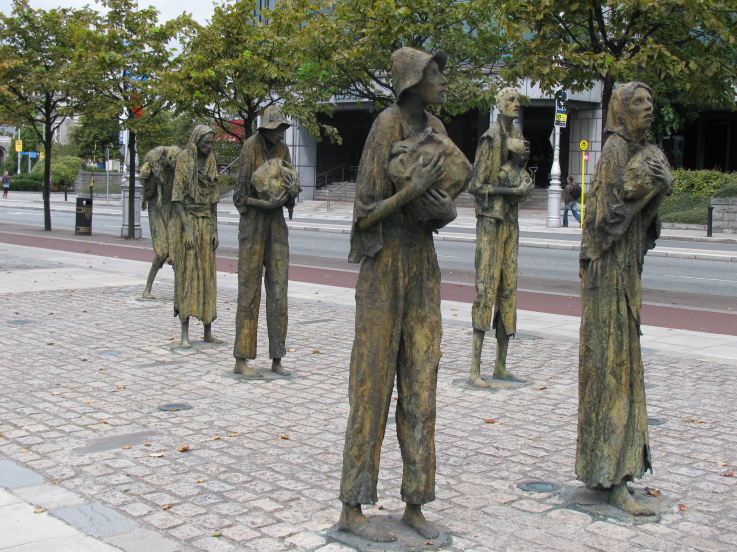

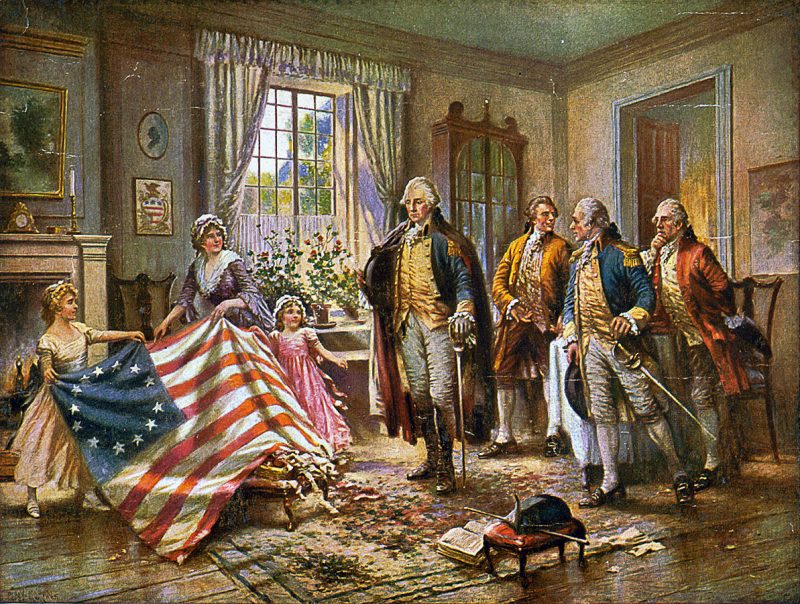
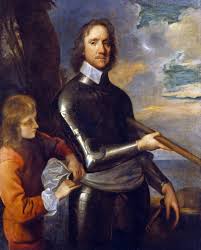

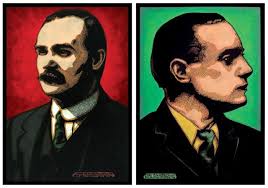
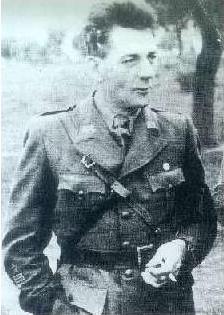

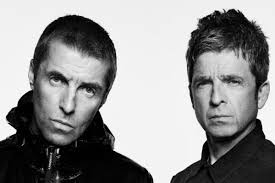
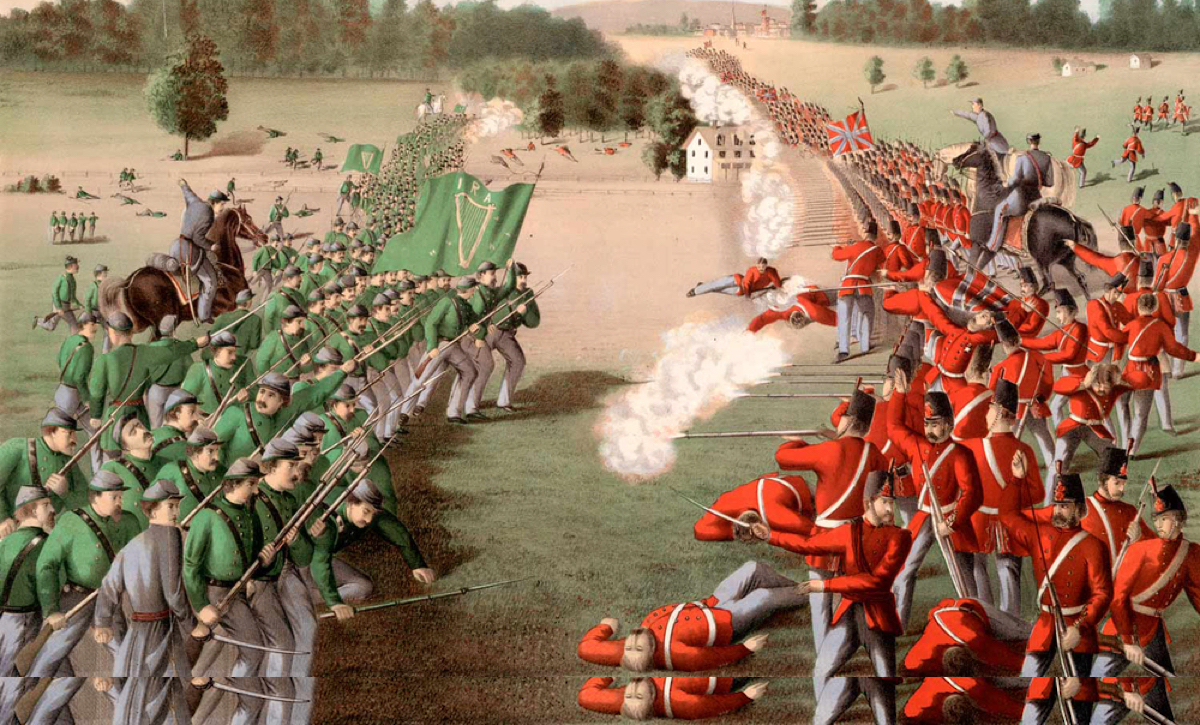


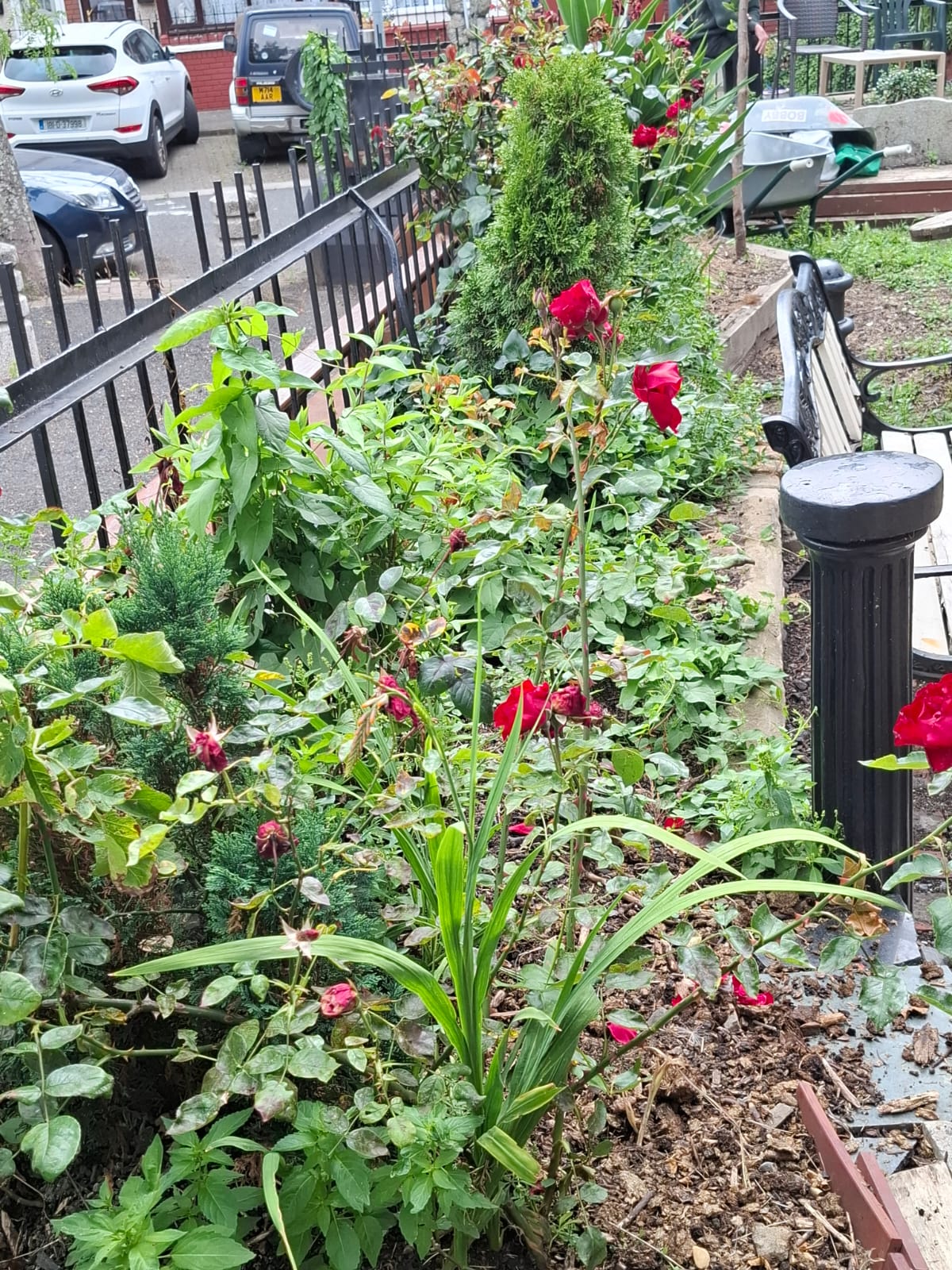


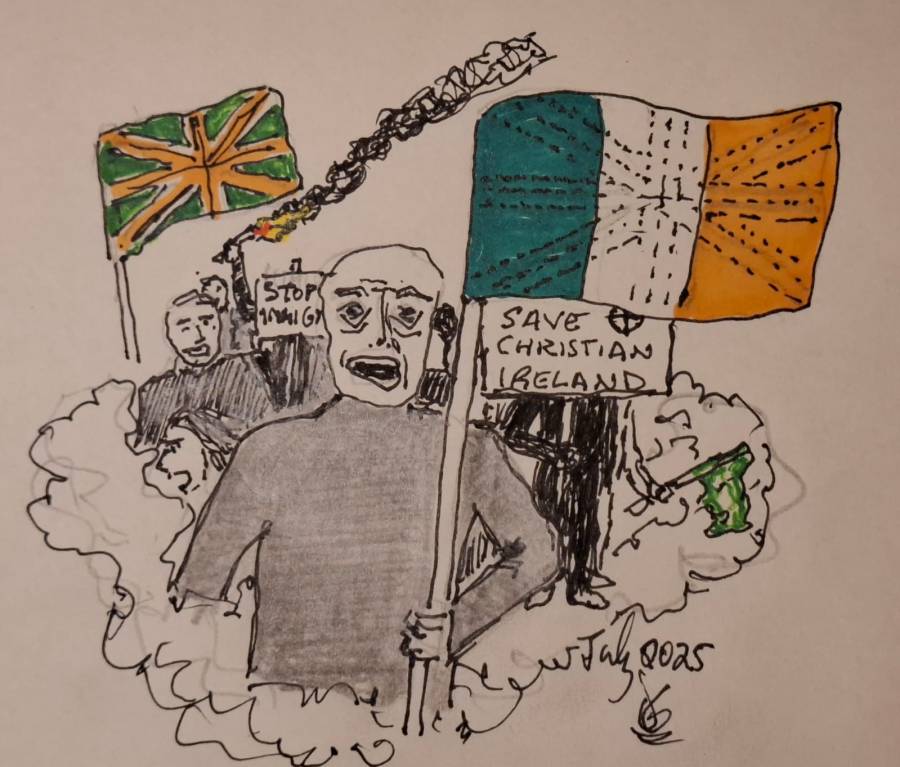


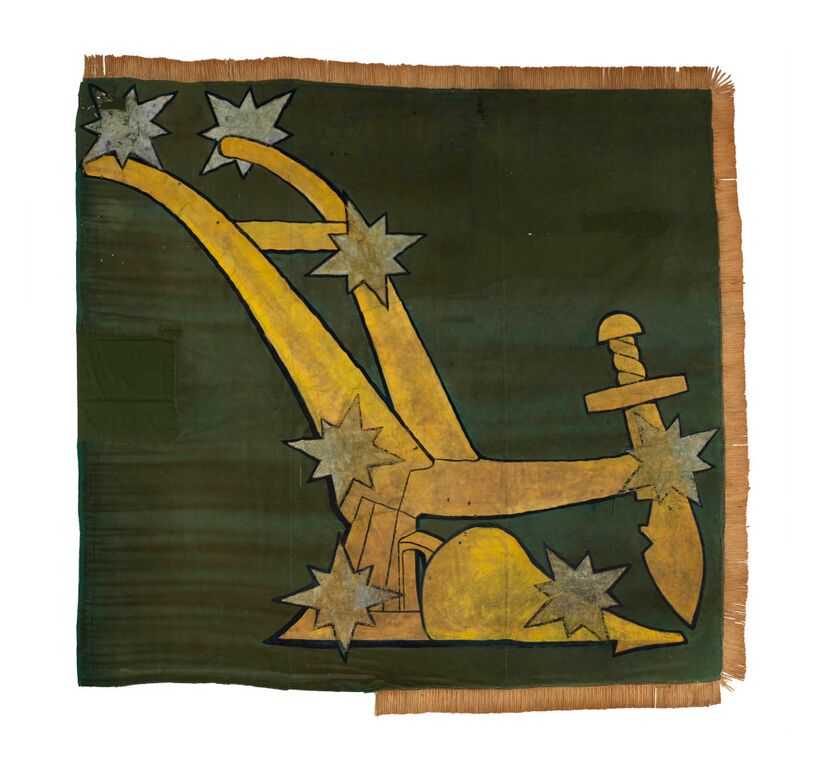

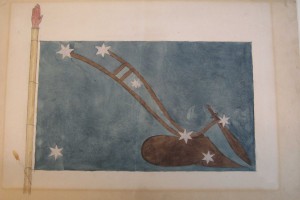


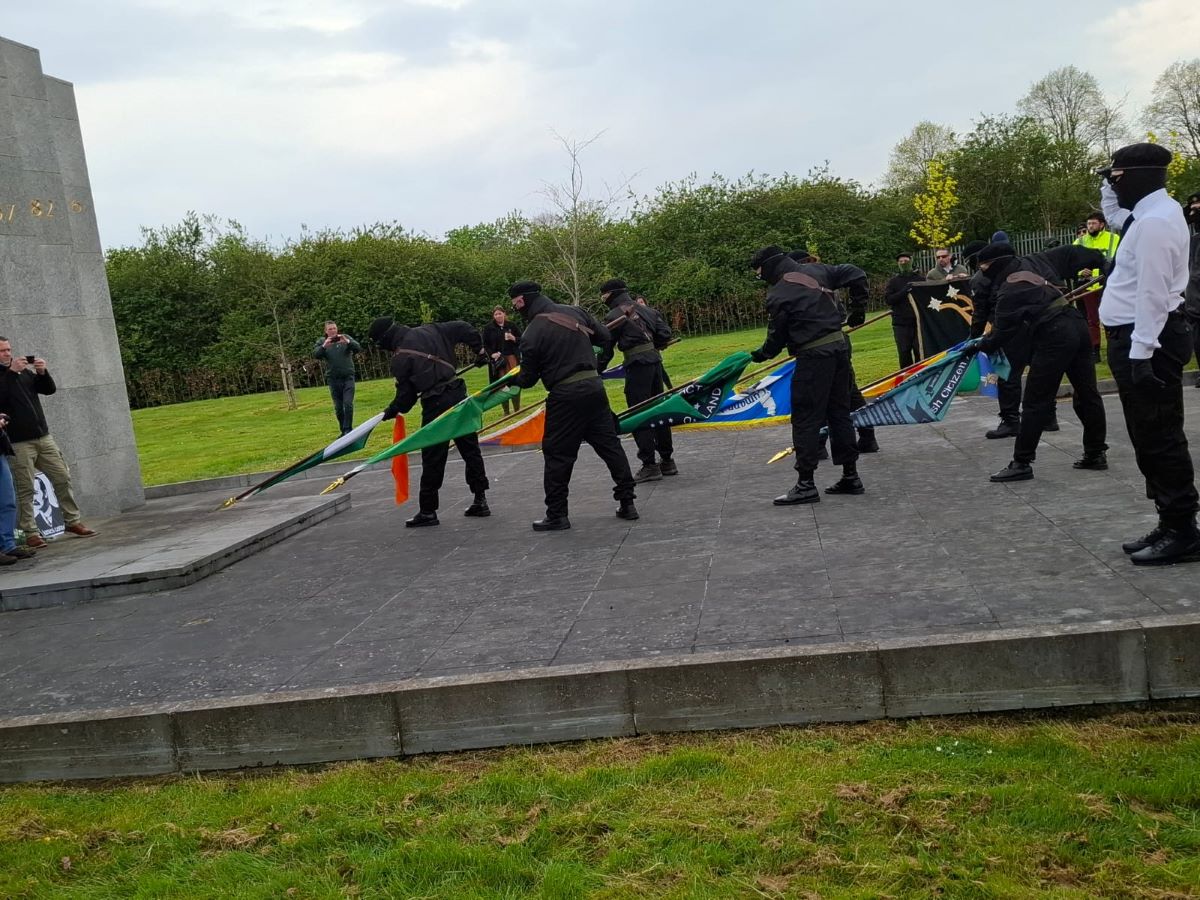
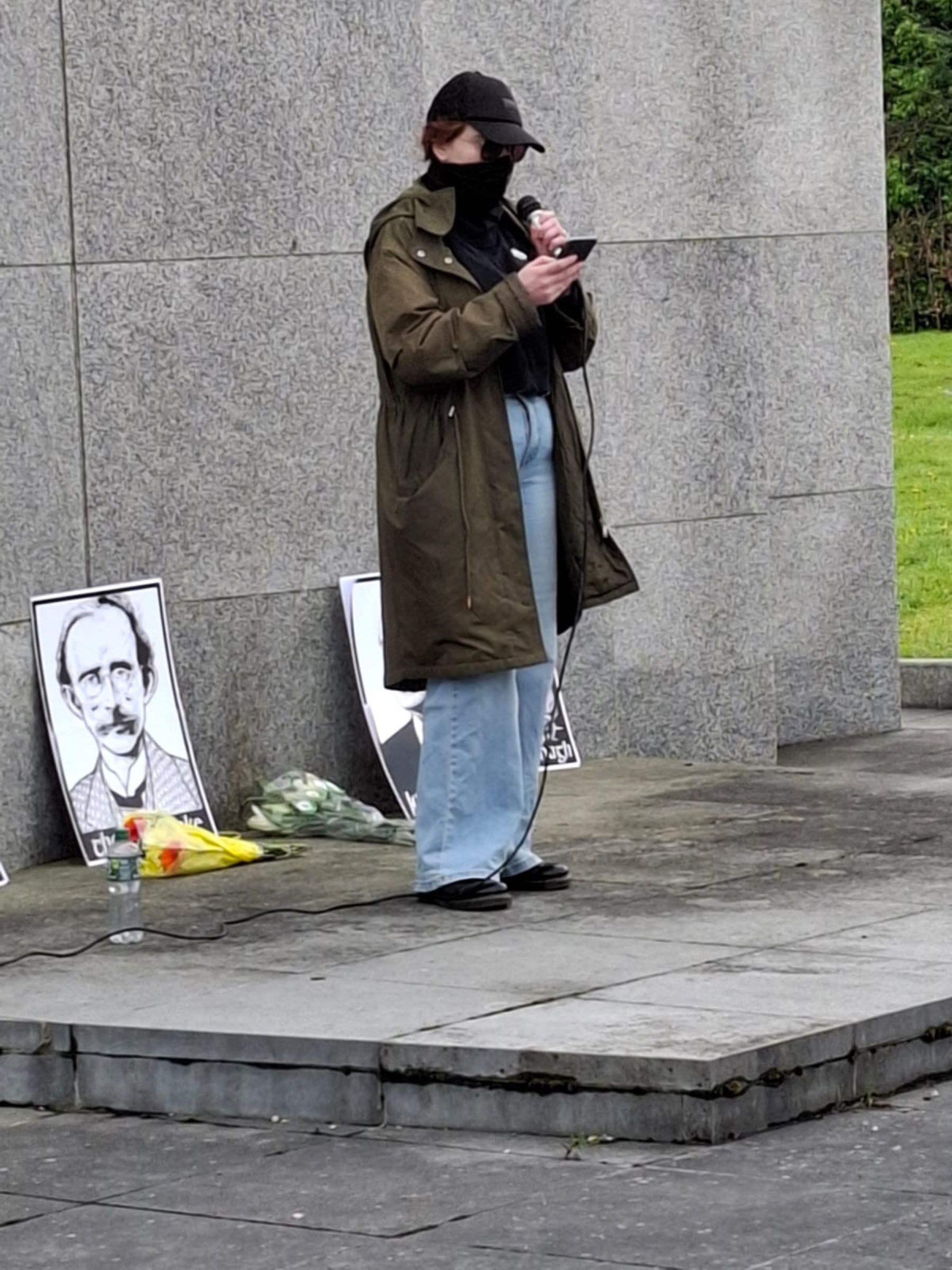
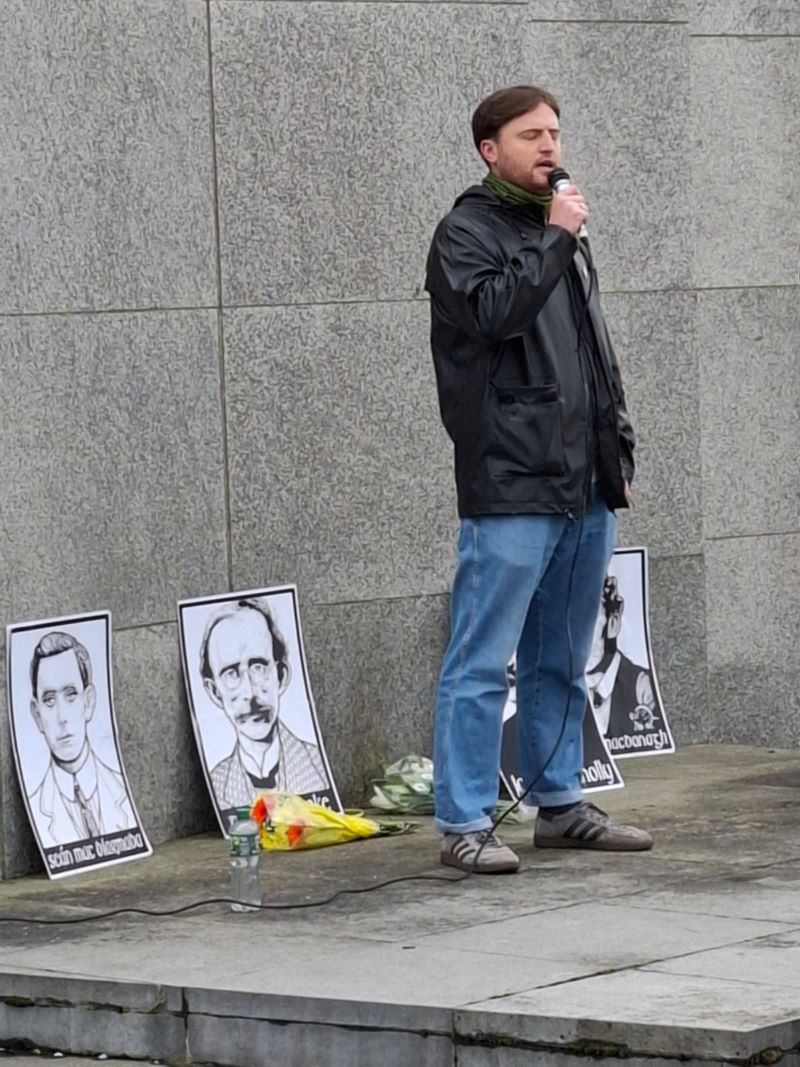




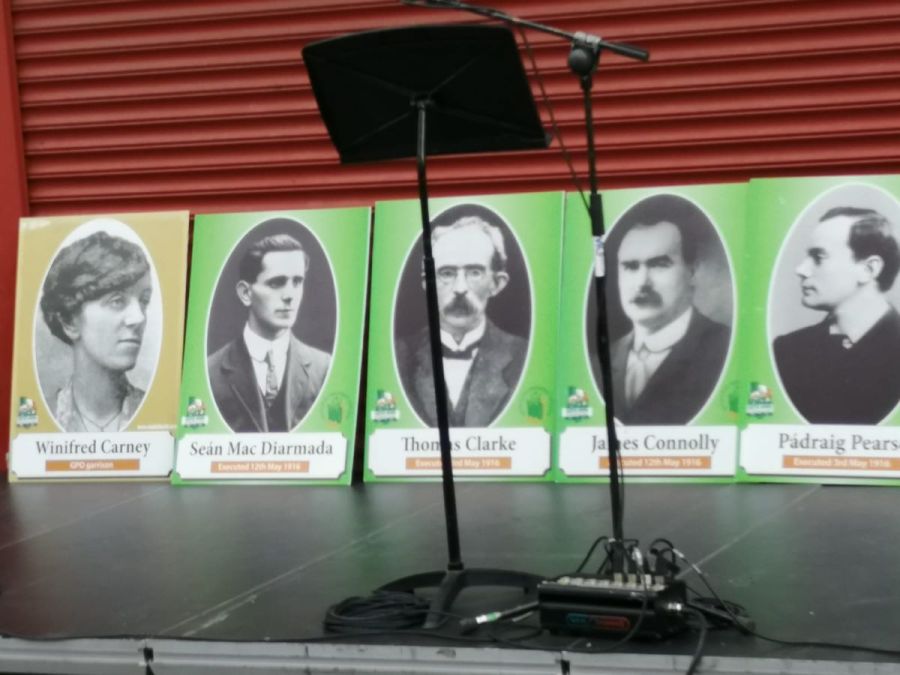


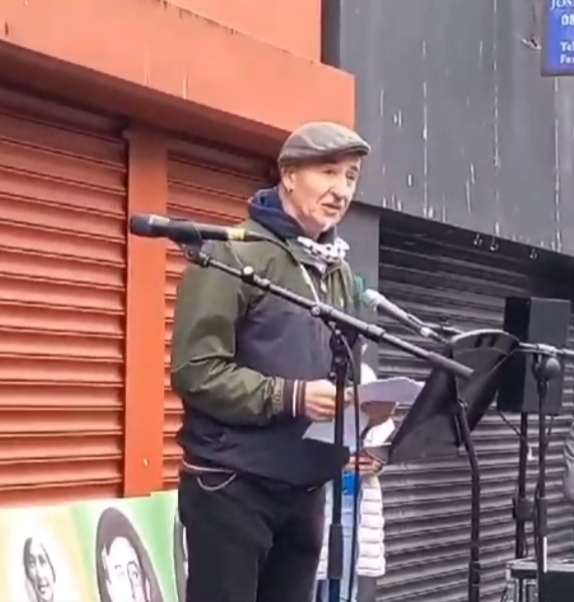


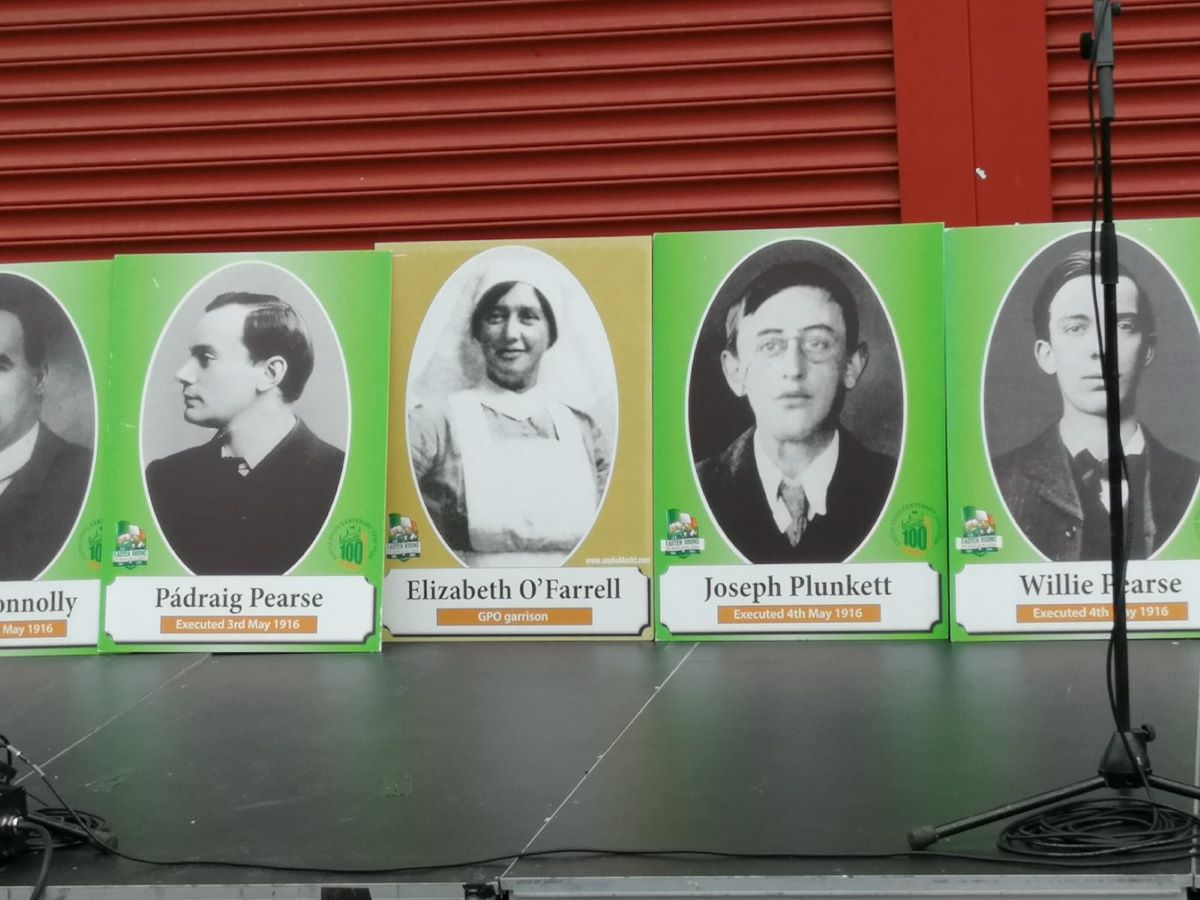

 rebelbreeze