“GAELIC IRELAND” WITH A SNEER

Diarmuid Breatnach


When one hears or reads the words “Gaelic Ireland”, the reference usually takes one of four forms:

  1. Historical

  2. Geographical-cultural

  3. Nostalgical

  4. Sneering

Historically

“Gaelic Ireland”, when used in a historical sense, is a reference to either a time when the majority of Irish people spoke the Irish language (up to 1800 CE many scholars agree) or to a time when the Gaelic order of society was dominant or when the Gaelic Order survived in some part of Ireland (for example up to the Flight of the Earls in 1607) .

Geographically-Culturally

Perhaps used to describe those shrinking parts of Ireland where Irish remains the mother tongue, more normally called the “Gaeltacht” or “Gaeltachtaí”.

Nostalgically

This is a usage which corresponds somewhat to the historical sense above but is also imbued with nostalgia, a regret for what passed then and perhaps a wish to restore it. Despite the accusations of many of those hostile to the Irish language, relatively few people — including among Irish speakers, have any wish to return to that historical period.

Sneeringly

When referred to in this way, it is to link Irish-speaking with out-of-date things, some kind of anachronism, a backward thing, not suitable for our modern society; frequently linked also to Irish nationalism and De Valera’s concept of the desirable kind of society for Ireland and the 1937 Constitution, therefore linked also to the social and political dominance of the Catholic Church. Such a disdainful attitude is often connected to the disparaging way in which a person may speak about a “Gaeilgeoir” — it is as though the person referring to the Gaeilgeoir, which originally meant only “Irish language speaker”, has in mind a devout Catholic wearing an Aran jumper and generally unfashionable clothes and hairstyle, with a gold “fáinne” (a ring-shaped pin awarded for proficiency in Irish) in his or her jacket (probably Irish tweed).

I fear that this type of attitude is present in most enunciations of “Gaelic Ireland” — certainly outside those of the historical sense.

Although by no means associating the writer of a recent article with this contemptuous opinion of Irish speakers, there was more than a hint of a disparaging attitude expressed, in my opinion, in an article much-praised by many Republicans and some socialists, commenting on the racist expressions of some people after the recent lethal incident in Drogheda recently. Dieter Reinisch, whom I understand to be a left-wing Irish Republican, wrote to separate Irish racist commentators on the recent fatal incident in Drogheda from Irish Republicanism.

The article had a progressive intent and made some valuable points but it also linked this Irish racism with “Gaelic Ireland nationalism”1. Although the article does this through reference to individuals it smears “Gaelic Ireland” through doing so. I would doubt that those Irish racists were even Irish speakers, never mind campaigners for the retention of the language.

IRISH NATIONALISM AND REPUBLICANISM

Reinisch is of course correct historically to say that Irish Republicanism is not fundamentally linked to “Gaelic Ireland” but what is the point he is making? Irish nationalism as a force, in the sense of wanting and acting to achieve an Ireland under its own cultural-social order and not under the economic, social and political rule of a foreign power, can be traced as far back as the time of the O’Neill and O’Donnell partnership, who tried to unite the clans of the native people, the Gael, to oust English occupation from Ireland. They came close to succeeding but in the end, failed and with their exile and that of other Irish clan chiefs the Gaelic Order of society collapsed. The Gaelic Order by the way was in many ways socially superior to that of the feudal Norman invaders, which is one reason why most of the invaders adopted so much of it that, less than two centuries after the start of their invasion of Ireland, their England-based relatives called them “the degenerate English” and passed laws to forbid their adoption of Irish custom and law and end their integration into Gaelic Ireland.2

Irish nationalism continued to try to assert itself, finding large-scale expression at two particular moments in the 17th Century – firstly against Cromwell and secondly against William of Orange. Irish nationalism at that point fought in alliance with the Gall-Ghael, the Irish-speaking or bilingual descendants of the Norman invaders (“the degenerate English”, according to their England-based relatives in 1366), who were mostly concerned with preserving and defending their religion against the imposition of the English Reformation.

A kind of Irish nationalism later began to develop among the colonial settlers, a similar type to that expatriate or colonist nationalism developing among the colonists of Northern America and of what is now called Latin America. Since what made them Irish rather than English, Welsh or Scots was that they lived in Ireland (and for many, had been there for a few generations), they looked through the history of Gaelic Ireland to establish a historical background. They organised the Granard Harp Festival in 1786 and the Belfast Harp Festival in 1792. Edward Bunting noted down the airs played at the latter and published a collection in 1796 (and twice again over following decades).

The colonists of North and Latin America did not, for the most part, incorporate the original natives into their new nationalism3. They did not incorporate them in Ireland either but the United Irishmen did have that as their program and they did try to make it a reality. When Grattan’s attempt to open the Anglican-sectarian Irish Parliament to Presbyterians and Catholics failed through bribery and fear of Anglicans being outvoted, of planters losing the lands their ancestors had grabbed, the United Men became convinced that only armed insurrection could bring about a majority (male) democracy and Irish control of Irish affairs. And the symbol on their flag was that of Gaelic Ireland: the Harp. Underneath it, they had the words: “It is new-strung and shall be heard”.

United Irishmen Harp Motif
(Image sourced on Internet)

Reinisch in his article quotes approvingly on three separate occasions from the writings and speeches of Seán Ó Brádaigh. It might surprise some readers to know that this same Ó Brádaigh and his brother the late Ruairí, were Irish-speakers and writers and promoted the speaking of the language. They were for a Gaelic Ireland, albeit a Republican one. They and the organisation they helped create, Provisional Sinn Féin and Provisional IRA, unfortunately in many ways bowed to the influence of the Catholic Church, even though the hierarchy and many clergy denounced them continuously. Mac Stiofáin, who also gets a mention in Reinisch’s article, told me once that although he believed Church and State should be separated, in true republican fashion, also maintained that there should be no freedom to propagandise against religion!

Could Irish Republicanism in the 1700s not have adopted the language of the majority of the people? Some did indeed learn Irish and probably most Ulster Presbyterians, at least outside Belfast city, were at least competent in the basics up to 1798 and many probably fluent. It is hard to imagine that anyone living in Mayo in that year, whether planter or native, was not conversant with the Irish language and certainly it would have been the language of the vast majority there and in the surrounding counties. Wexford is generally agreed an exception by historians, in having been the most Anglicised of Irish counties in 1798.

English was the dominant language of the State and of the colonist administration. But also of the United Irishmen leaders, we can assume – certainly it was the dominant language of their political discourse as recorded in both their own publications and in the reports of the Crown spies and witnesses. Radical and revolutionary ideas were coming in from Revolutionary France and from the revolutionaries of the United States, as Reinisch relates but also very importantly from England – for example Tom Paine’s “The Rights of Man”. The native Irish were either totally excluded from the strata of society where – and the language in which — these ideas were being discussed or they occupied a much more insecure position in which they tried to improve their situation through English without calling down disfavour or even repression upon themselves. There was probably a strata which tried to advance itself under colonial rule and considered that Irish would ‘hold them back’.

There is very little contemporary folk record in existence in Irish of the United Irishmen and one must go to Mícheál Óg Ó Longáin4, Irish language scholar, poet and Unitedman who was “out” or “up” that fateful year, to find his “Buachaillí Loch Garman” (“the Boys of Wexford”) and lyrics of “Sliabh na mBan” to the song’s wonderful air …. and probably “Maidin Luan Chincíse” too.5

The Rising of 1798 failed as did Emmet’s attempt in 1803. Irish Republicanism and Irish nationalism continued to exist and were partly asserted by O’Connell’s campaigns for Catholic civil rights and repeal of the Union as well as by trends such as those of Mitchell and the “Young Irelanders”, most of the latter being Protestants and often hostile to what they saw as O’Connell’s linking Irish nationalism to Catholicism. Mitchell was not a democratic republican but other Young Irelanders were.

Here again, the creation (or renewal) of an Irish nationalism did not incorporate the Irish language although there were nods in its direction. Again, most of its leaders were Protestants but they looked back, as others of colonist background had before, to a Gaelic Ireland. Take Thomas Davis’ celebration of the 1798 uprising in Mayo:

That chainless wave and lovely land 
Freedom and nationhood demand; 
Be sure the great God never planned 
For slumb’ring slaves a home so grand. 
And long a brave and haughty race 
Honoured and sentinelled the place. 
Sing, Oh! not even their sons’ disgrace 
Can quite destroy their glory’s trace. 

For often, in O’Connor’s van, 
To triumph dashed each Connacht clan. 
And fleet as deer the Normans ran 
Thro’ Corrsliabh Pass and Ardrahan; 
And later times saw deeds as brave, 
And glory guards Clanricard’s grave, 
Sing, Oh! they died their land to save 
At Aughrim’s slopes and Shannon’s wave. 

Davis here looks to the history of the Gaelic clans of Connacht resisting foreign invasion, incorporating also the mostly Gaelicised Norman-Irish clan of Clanricarde, the Mac Williams who became Burkes or De Búrca.

It is well to remember, particularly for those who link “Gaelic Ireland” with Irish Catholic nationalism, that many of those prominent in the latter category had no time for the Irish language – in fact, on that issue at least, they would have seemed very at home among those today who say the words “Gaelic Ireland” with a sneer. Daniel O’Connell, who was a native Irish speaker and apparently spoke only Irish until five years of age, stated that he was “sufficiently utilitarian not to regret ….. the gradual abandonment” (of the Irish language) – and this at a time when probably 40% of the country’s population were Irish-speaking.
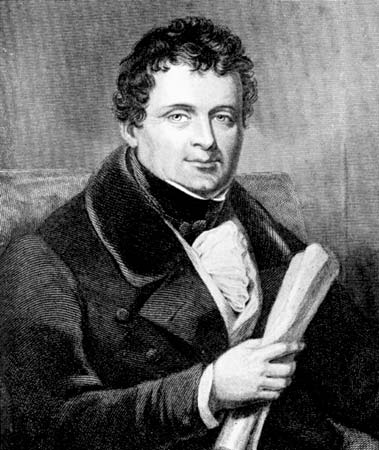
Portrait of Daniel O’Connell, campaigner for Catholic rights and the repeal of the Union — but no lover of the Irish language
(Image source: Internet)

Irish nationalism and republicanism continued as a strong thread through Irish history, peaking again in the late 19th Century with the Fenians. The Irish Republican Brotherhood or ‘Fenians’ as we know them in that period today contained many Irish-speakers including the famous O’Donabháin Rosa, who wrote his biography in Irish but the Irish language was still not their main language of political literature.

Some of the IRB were deeply working class and they were accepted into the First International Working Men’s Association in England, championed by Marx and Engels (the latter was learning Irish with the intention of writing a history of Ireland which sadly he did not bring to fruition). In the USA also most of the Fenians would have been working class although they included some of the upper middle class among the Irish diaspora. The Fenian conspiracy in Ireland was discovered and plans for insurrection largely upset, leaders and journalists arrested and the military units considered at risk sent away out of Ireland.

IRISH LANGUAGE REVIVAL

Another kind of Irish nationalism saw a resurgence in the later years of the 20th Century and, again, it was the Anglo-Irish, descendants of planters and mostly Protestant, who were the intelligentsia leading it. A kind of antiquarian and romantic interest in the Irish language and culture was followed by a more practical and restorative one and the Gaelic League (now Connradh na Gaeilge) was founded in 1893 by a group led by Douglas Hyde (Dubhghlas de hÍde)6, an Anglican and son of Anglican clergy, who became fluent in the language. This was followed in 1898 with the founding of the Irish Texts Society, a publishing initiative with Hyde as one of the founders and its publication of Dineen’s thick dictionary, Foclóir Gaedhilge agus Béarla, which was first published in 1904 (and still a wonderful source of words and phrases).

The Gaelic League promoted Irish dance, games and culture in addition to the language. Although Hyde’s passion for an Ghaeilge originated in his childhood and early adolescence in Co. Roscommon, he graduated in 1884 as a Moderator in Modern Literature from Trinity College, Dublin, where he had became fluent in French, Latin, German, Greek and Hebrew.

The League/ Connradh grew fast, branches and courses attracting not only the Anglo-Irish aristocracy and upper middle classes but also other social strata. In fact it became a mass movement, with 600 branches in 1903 and through its influence the language was introduced to 1,300 national schools.7

A year later, Conradh na Gaeilge’s membership extended to some 50,000 members in 600 branches8, probably assisted by rising nationalist feeling but in turn it certainly fed that outlook. As a mass movement, it took in professionals and others of middle-class background, as well as labourers and tradesmen.

Among the many prominent Irish nationalists and Republicans (called “progressive nationalists” at the time) of those years was Patrick Pearse/ Pádraig Mac Piarais and Reinisch reminds us that his father was not Irish. Son of a Cornishman and Unitarian who formally converted to Catholicism, Pearse soon gained prominence as a writer and speaker in both English and the Irish language and also founded a school to teach through the medium of the Irish language.

Like many other active Republicans of his day, Pearse was recruited into the IRB and chosen to give the seminal oration at the interment of repatriated Fenian O’Donobháin Rosa’s body in 1915. As related earlier, O’Donobháin Rosa was an Irish speaker and when Pearse spoke at his grave, first in Irish which is rarely quoted, in the rest of his speech in English he said: “The clear true eyes of this man almost alone in his day visioned Ireland as we of to-day would surely have her: not free merely, but Gaelic as well; not Gaelic merely, but free as well.”

Pearse was chosen again as Commander-in-Chief of the insurrectionary forces in the 1916 Rising. Pearse’s memory is often attacked by ‘revisionist’ historians and some of the “Gaelic Ireland with a sneer” crowd – accusations of a repressed homosexual identity, of ‘green nationalism’, of blood-thirst etc. However, a fair assessment of his life would reveal a political activist who sympathised with the workers fighting the Lockout in 1913 and objected to Redmond’s refusal to allow women to speak at a meeting on Home Rule; would find also an individual generous with his time and energy, a talented writer who sought the creation of a modern literature in Irish on a par with those of England, France and Germany, as well as being an educator and proponent of progressive youth educational theory that stands well the test of time.

Pearse was among the people that Hyde accused of politicising the language, which Hyde gave as his reason for resignation of the Presidency of Connradh na Gaeilge. Looking back now, we might well ask how could it have been otherwise? Everything cultural of a national aspect was becoming politicised in those years: sport, song, drama, literature, journalism, oratory, lectures, representational art – even cooperatives, trade unions and some commercial ventures – why expect language to be any different? In fact, surely instead expect politicisation there first of all!

The other Irish nationalists of the time, the Irish Parliamentary Party led by John Redmond, ‘constitutionalist’, Catholic and socially conservative, expressed no great interest in the Irish language. Another branch of Irish constitutional nationalism, represented by William Martin Murphy, was no friend of the Irish language either and ran the most vicious campaigns against the Irish Republicans.

Of the Seven Signatories of the 1916 Proclamation of Independence, four (Ceannt, MacDiarmada, Mac Donagh and Patrick Pearse) were members of the Connradh. The remaining three were at least neutral or approving of the movement. Of the fifteen executions by British firing squads and one by hanging following the Rising, at least six were members of the Gaelic League. Large numbers of activists and leaders in the Republican movement from 1916 to 1922 were Irish speakers, either fluent or at least competent and christening records of the period show increasing numbers of Irish language names (or Irish versions of names from abroad) given to children. This period was the last great flowering of the Irish language as a mass movement in modern history.9

What of the Left in Ireland? A house painter by trade, Peadar Kearney (Peadar Ó Cearnaigh)10 of Catholic background joined the Gaelic League and at some point attendees at Irish classes he taught included the socialist writer and founder of the Irish Citizen Army, Sean O’Casey11 (Seán Ó Cathasaigh), of Anglican background. Irish was taught in Liberty Hall, HQ of the Irish Transport & General Workers’ Union.

Later, native Irish speaker Peadar O’Donnell, republican fighter, socialist activist and writer, was employed for a while teaching in Aranmore, Co. Donegal, an Irish-speaking area, where he apparently adopted socialism and joined the IT&GWU, for which he also became an organiser. In later years he founded the ill-fated Republican Congress, fought against Franco and founded The Bell literary journal. O’Donnell seems to have written little in Irish but in his acclaimed “Islanders”, the construction of dialogue is clearly derived from the Irish language. Later still, Brendan Behan (Breandán Ó Beacháin), a socialist Republican, wrote in Irish and in English and a Republican who became a Marxist, Connemara man Máirtín Ó Cadhain12, wrote in Irish and campaigned on the rights of Irish speakers and of people living in the Gaeltacht.

In and around those names there would have been many others, Left activists and supporters, unknown now but native speakers or those who learned the language, thought it important and spoke it.

Many socialists seem sometimes to think that the “unity of the working class” is best achieved by doing away with different cultures. They seem to forget that though there is one working class, there are a great many national cultures — and what a poor world it would be if those cultures disappeared.

THE STATE AND POLITICAL PARTIES

Some of the attacks on “Gaelic Ireland” seek to tie it first of all to the right-wing neo-colonial state set up in 1921, or the form it took after 1922, or as mentioned earlier, the De Valera/ Fianna Fáil state from the mid-1930s.

The New State

When the Irish Free State was set up as a compromise with British imperialism and colonialism, backed by a section of the nationalist-Republican movement and in alliance with Irish gombeen capitalism and the Catholic Church, it was actually a very insecure and uncertain endeavour. This perhaps explains the ferocity of the State in the Civil War and afterwards, with large-scale repression, 83 official executions and around a 120 assassinations of Republicans – in less than a 12-month period. Two years later, in 1924 the State faced an attempted Army mutiny and possible coup d’etat, led by Major-General Liam Tobin, with a number of prominent right-wing nationalist politicians in support.

The new owners of the State tried to ensure that nationalist symbols were not left unclaimed to be appropriated by Irish Republicans and so appropriated them themselves: the Tricolour, the Soldiers’ Song and the Irish language. However, this was no foregone conclusion nor an easy process. They had to bear in mind also the British, who had merely stepped off stage into the wings, who were also on stage in the Six Counties, as well as the large constituency of Unionists on both sides of the Border.

For example, God Save the King was played and sung at some State and many other formal occasions, though The Soldiers’ Song was sung by many Republicans. Let Erin Remember was the song favoured by some in the State and it was the air played for the Irish State at the 1924 Paris Olympics. After a struggle, The Soldiers’ Song was finally agreed as the National Anthem in 1926.

Far from being enthusiasts for any kind of “Gaelic Ireland”, the new State continued to use English as the language of administration, even in areas where 80% of the population were Irish-speaking.

A qualification in Irish was required to apply for state jobs but a high level of fluency was not needed13, “and few public employees were ever required to use Irish in the course of their work. On the other hand, state employees had to have perfect command of English and had to use it constantly. Because most public employees had a poor command of Irish, it was impossible to deal with them in Irish. If an Irish speaker wanted to apply for a grant, obtain electricity, or complain about being over-taxed, they would typically have had to do so in English.”14 As late as 1986, a Bord na Gaeilge report noted “…the administrative agencies of the state have been among the strongest forces for Anglicisation in Gaeltacht areas”15

The two main daily newspapers at the time in Ireland were the right-wing nationalist Irish Independent and the Unionist-minded Anglophile Irish Times16 and neither promoted the Irish language nor even covered Gaelic games, although they reported on rugby and cricket matches.

Fianna Fáil and the Blueshirts

Fianna Fail was created early in 1926 and in 1932, only six years later it was in government of the State. One year later, the right-wing Army Comrades Association adopted the uniform which included the blue shirt and by that time had over 30,000 members and battles were taking place between them and the IRA and other Republicans. Eoin O’Duffy had been an IRA guerrilla leader in the Irish War of Independence, a general in the Free State Army in the Civil War and Commissioner of the state’s police force, the Garda Síochána from 1922 to 1933. After Fianna Fáil’s easy re-election in February 1933, De Valera dismissed O’Duffy as Commissioner and a few months later O’Duffy took leadership of the ACA and renamed it the National Guard, adopting the straight-arm Roman salute favoured by the fascists.

That same year the Blueshirts planned a march on Dublin, believed my many historians to be a prelude to a coup d’etat; certainly De Valera thought so and, unsure of the Army’s loyalty, banned the march and subsequently outlawed the organisation. That year also Fine Gael was formed, incorporating the Blueshirts, Cumann na nGaedhal and the National Centre Party, with O’Duffy as its President.

De Valera founded the daily newspaper Irish Press in 1931 which had an alternative version of its title in Irish – Scéala Éireann – and as well as covering the GAA games, had sections in Irish. However the position of the Irish language in the affairs of the State did not change.
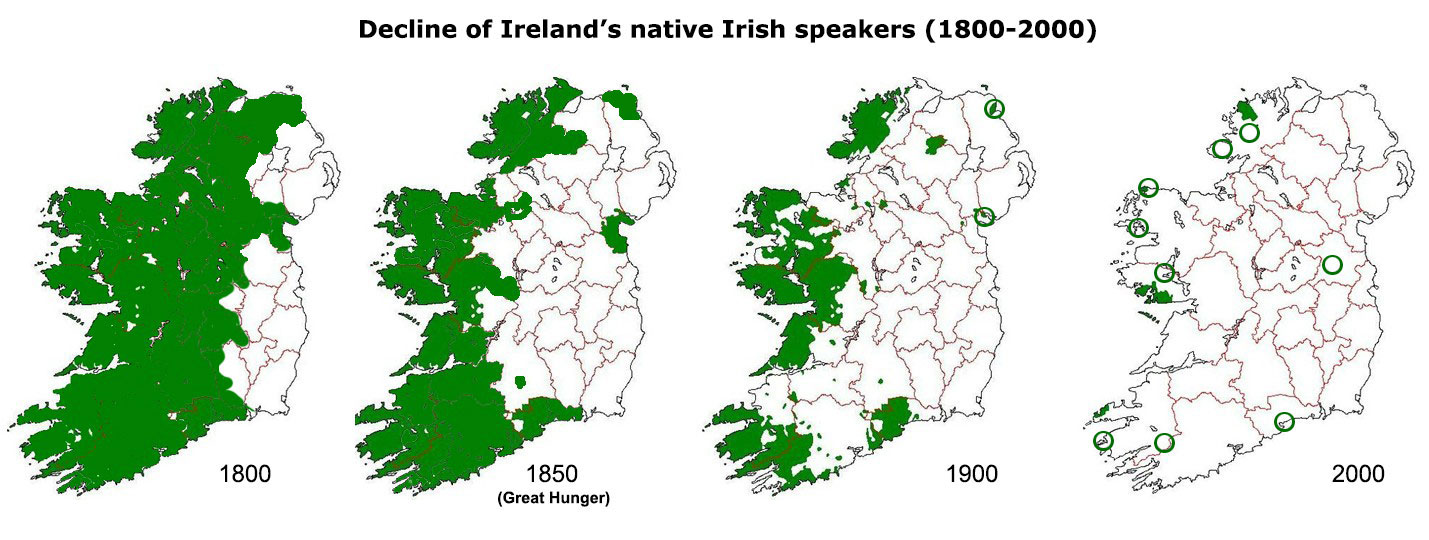
Though the Great Hunger caused he most impressive loss of Irish-speaking modern Ireland on the map, the percentage lost by the Irish state is greater.
(Image source: Internet)

Throughout Fianna Fáil and Fine Gael governments, the Gaeltacht – the Irish-speaking areas – continued to suffer deprivation of resources. Even by the early 1960s, many homes in those areas did not have electricity, running water or sewage drains. Primary schools typically had a headmaster and female teacher to administer and teach all subjects at all levels. Deprivation led to massive emigration, not only to the metropolis but also to the USA and to Britain. Today, the Gaeltacht is 9.1% the size of what it was when the Irish State was created or, in other words, the State has presided over a Gaeltacht decline of over 90%17 — as a friend commented: “Not even Cromwell or the Great Hunger wreaked such linguistic devastation”.

In the 1960s, no matter what party was in government or in local authority, Irish-language campaigners had to fight for minimal funding for land allocation, schools and broadcasting in Irish. People went to jail for civil disobedience and were fined for refusing to pay for their TV and radio licences and, briefly, a pirate Gaeltacht radio station was in operation.

The Labour Party and Sinn Féin

The Labour Party, whether to the right or left, has never shown itself to be a friend of the Irish language.

Sinn Fein (Provisional) would nominally be expected to be supportive of the Irish language but the real test is in its campaigning and practice within its own party. Its public and internal meetings are held in English (as with other Republican parties) and throughout the three decades of the war in the Six Counties it did not organise or mobilise the Gaeltacht people to improve their position and defend their communities from emigration and the penetration and eventual supremacy of the English language.

In conclusion, to associate the Irish language or culture with any of the political parties or any administration of the State is fundamentally incorrect from a historical point of view.

FOCAL SCOIR OR IN CONCLUSION

Would those who sneer when they say “Gaelic Ireland” do likewise at the mention of “French France”, “Spanish Spain”18, “Italian Italy”, “German Germany” or “Polish Poland”? I think not. No, national cultures are not sneered at by the Right or the Left in Ireland – only Irish culture and, particularly, the language.

John Kells Ingram19, an academic, mathematician and writer of planter descent from southeast Donegal (and probably bilingual), in 1843 wrote the lyrics “In Memory of the Dead” (better known as “Who Fears to Speak of ’98”). He was decrying the distancing by Daniel O’Connell and his Catholic movement from the deeds and principles of the United Irish Men in 1798. If I may paraphrase him a little to refer to the kind of Irish person today who says “Gaelic Ireland” with a sneer: “He’s all a knave or half a slave, who slights his people’s culture thus”.

Fanon20 would agree, I’m sure.

A chríoch.

SOME SOURCES AND REFERENCES:

https://me.eui.eu/dieter-reinisch/blog/dundalk-racism-republicanism/

https://en.wikipedia.org/wiki/Amhr%C3%A1n_na_bhFiann#Official_adoption

https://en.wikipedia.org/wiki/Irish_Army_Mutiny

https://en.wikipedia.org/wiki/Blueshirts

https://en.wikipedia.org/wiki/History_of_the_Irish_language#Independent_Ireland_and_the_language

Black Skin, White Masks (1952), (1967 translation by Charles Lam Markmann: New York: Grove Press)

The Wretched of the Earth (1961), (1963 translation by Constance Farrington: New York: Grove Weidenfeld)

1 “……. individual Republican activists use Gaelic Nationalism to justify their anti-migrant and racist parochialism”

3The North American republicans did not admit the Indigenous People as citizens and many set out to exterminate them. Many also condoned slavery and some owned slaves. The Latin American republicans also mostly sought the expropriation of Indigenous people and also organised massacres but, for the most part, abandoned slavery earlier than the USA.

4Cork poet and strong Republican Mícheál Óg Ó Longáin (1766/-1837) is usually credited with writing Buachaillí Loch Garman and Sliabh na mBan (although one source, probably mistaken, credits his son Peadar with the latter two). Mícheál’s work as a scribe, scholar and teacher was a useful cover for acting as a United Irishmen courier.

5There are a few songs from Mayo too, by unknown authors.

6Douglas Hyde (Dubhghlas De hÍde) was elected first Uachtarán na hÉireann (President of the Irish state) from 1938-1945.

9The last to date but hopefully not the last.

10Peadar Kearney was a member of the Irish Volunteers and IRB, fought in 1916 and was interned; he became a prolific writer of nationalist ballads — but also of “Labour’s Call”, a song with very socialist lyrics – and is the co-author with Patrick Heeney of “The Soldiers’ Song”, the national anthem of the Irish state.

11Sean O’Casey (1880-1964) was born in Dublin into a lower middle-class family in straitened circumstances.

12Máirtín Ó Cadhain (1906-1970); interned by the Irish State during the 2nd World War years and later activist for the Gaeltacht which led to the founding of the Rath Cairn Gaeltacht in Co. Meath. Ó Cadhain’s most famous written work, the novel “Cré na Cille” (1949) was later translated into many languages. Ó Cadhain was also a founder and leading activist of the original Irish-language civil rights campaign Misneach which engaged in agitation and civil disobedience (another campaign by the same name now exists) in Dublin and other places.

13Hence the jibe about the mere “cúpla focal” of Irish of politicians and civil servants.

14See Wikipedia in Sources

15 Advisory Planning Committee of Bord na Gaeilge, The Irish Language in a Changing Society: Shaping The Future, p.41. Criterion, 1986 (quoted in Wikipedia – see Sources).

16Both had called for the punishment by the British of the 1916 Rising leaders but the Independent had actually called for the executions of Connolly and Mac Diarmada.

17Extrapolation from the Census statistics of the years 1926, when there were 246,811 Irish speakers in the Gaeltacht and the 2016 Census when 20,586 remained, which is 8.34% of the 1926 number or a reduction of 91%. http://www.cso.ie/en/media/csoie/census/census1926results/volume8/C_1926_VOL_8_T8,9,10.pdf

18In fact, there are ground for objecting to the terminology of “French France” and “Spanish Spain” but only because those two states do not value and even suppress the other national languages within their state boundaries, e.g Euskera, Catalan, Occitan, Corse, Asturian, Galician ….

19John Kells Ingram (1823-1907)

20Franz Omar Fanon (1925-1961) was born and raised in Martinique; qualifying as an MD and psychiatrist, practised in Algeria during the war of liberation against the French, where he was a covert member of the resistance. Fanon was a politically radical intellectual, Pan-Africanist and Marxist humanist whose written work is very influential in particular in “post-colonial studies”. He described the psychopathology of colonisation in quite accessible writing, showing how – among other things – the colonised internalise the image of themselves projected by the coloniser and aspire to the “sophistication” of the latter and his culture (see two of his works listed in the Sources & References section.

GEORGE GALLOWAY ADDRESSES ANTI-IMPERIALIST MARCH IN DUBLIN

Clive Sulish

A crowd gathered at the Dublin and Monaghan Bombing Monument in Talbot Street this evening for a short ceremony and the start of a march to rally at the General Post Office building in Dublin city’s main street. The event was organised by Anti-Imperialist Action Ireland “to highlight imperialist war-crimes around the world, from Ireland to Yemen and Syria.”

View of section of crowd before start of event with the Memorial in the background (Photo: D.Breatnach)

View of section of crowd near the Memorial before start of event
(Photo: D.Breatnach)
View of section of crowd near the Memorial before start of event
(Photo: D.Breatnach)
View of section of crowd near the Memorial before start of event
(Photo: D.Breatnach)

As people assembled, a crowd of European youngsters was noted passing by, no doubt part of some scheme to learn English and something of the culture outside their own country. Sadly their teacher passed by the Monument without calling their attention to it.

The bombings on 17 May 1974, killing 33 civilians and a full-term unborn child and injuring almost 300, claimed the highest toll of any event during the 30 Years War and was the deadliest attack in the history of the Irish State. The bombings were organised by British Intelligence agents with Loyalist participation and not one person was ever charged.

It was not a good day for the march and participants came prepared for the worst but the rain stopped just before the event and held off, apart from an occasional drizzle, until after the event, when it fairly lashed down.

George Galloway approaching the Monument to lay a floral (Photo: D.Breatnach)
George Galloway after laying wreath, hat removed for a moment in respect. (Photo: D.Breatnach)

Pádraig Ó Fearghaill spoke first in Irish welcoming all who had attended, outlined the order of events and then called on George Galloway, famous British anti-imperialist politician, writer and broadcaster, to lay a floral wreath at the monument, which he did. Ó Fearghaill then called on Diarmuid Breatnach to sing the Woody Guthrie song about the massacre of mineworkers in Colorado, USA, by capitalists including the imperialist John D.Rockefeller. Breatnach sang “The Ludlow Massacre”.

The march then formed up and, led by a floral wreath-holder and black flags, proceeded up Talbot Street, into North Earl Street and up to the GPO. Along the way they chanted “From Ireland to Palestine- Occupation is a Crime” and “Donald Trump/Theresa May- How many kids did you kill today?” The demonstration received a lot of support from passers by along the way and drivers of cars and buses who beeped to show support. The marchers, some of who were carrying candles or light up boards made there way to the GPO where a further crowd had already gathered.

Section of crowd at GPO (Photo: D.Breatnach)

From well-known activists participating and banners carried it was clear that the march had attracted wide support across sections of the Republican movement in parties and campaigns, with participation of independent activists of republican, anarchist and socialist background.

Section of crowd at GPO (Photo: D.Breatnach)

Outside the GPO building, Ó Fearghaill called on Máire Uí Mhaoileoin to lay a wreath in memory of those who have lost their lives as a result of imperialist war-crimes and then introduced George Galloway, who remarked that he was proud to speak outside the building that had played such a part in the first blow against the British Empire of the last century. Galloway went on to refer to continuing British occupation of the Six Counties of Ireland and imperialist interference in the Middle East and the occupation of some countries. In the latter category he praised the Palestinian Ehed Tamimi, whose 17th birthday was just that day and called her “a leader of the resistance for the whole Middle East”.

Section of crowd at GPO (Photo: D.Breatnach)

Reminding the attendance of the ongoing crime of internment, Ó Fearghaill announced a representative of a campaign around Tony Taylor, who announced he was reading a statement from Lorraine Taylor, Tony’s wife. Taylor, a Derry Republican, was detained in March 2016 and has been in jail since, without trial or even charge.

Section of crowd at GPO (Photo: D.Breatnach)

Presenting Diarmuid Breatnach again to sing the famous Eric Bogle anti-war song “The Band Played Waltzing Matilda” referencing the bush-ballad of “Waltzing Matilda”, the Australian unofficial national anthem. However, following

Section of crowd at GPO (Photo: D.Breatnach)

a suggestion from a participant, Breatnach led the crowd in singing “Happy Birthday” in English and in Irish to Palestinian child-prisoner Ehed Tamimi. After Breatnach’s rendition of Bogle’s song, Ó Fearghaill thanked all the the participants and promised that Anti-Imperialist Ireland would continue to build up resistance against imperialism in Ireland and in the world beyond.

End

Section of crowd at GPO (Photo: D.Breatnach)

“Be Moderate” (or “We Only Want the Earth”) by James Connolly

The lyrics were written by James Connolly and published in his songbook Songs of Freedom in New York in 1907.  Diarmuid replaced the words “labour” with “workers” and “true men” with “true hearts”.  There was no indication of to what air the song should be sung (quite common, the expectation being that being would use a popular air at the time) and it has been put to at least three airs.

Diarmuid Breatnach here sings it to the air of A Nation Once Again (by Thomas Davis, ‘Young Irelander’) which is the air he heard it sung by Cornelius Cardew, an English communist composer.  This air suits it and the arrangement provides a chorus in which people can join.

The recording was done at the weekly Save Moore Street From Demolition campaign table (Saturdays 11.30am-1.30pm) with Bart Hoppenbrouwers videoing.

James Connolly was one of around 350 men and women who occupied the Moore Street area during the 1916 Rising after the evacuation of the burning GPO, which had been the HQ of the Rising.  Connolly was one of five signatories of the Proclamation who spent their last hours of freedom in those houses and one of six of the fourteen executed after they surrendered in Moore Street.

The Irish Government, property speculators and the Planning Dept. of Dublin City Council are all pushing that only four buildings in that battleground be saved and a huge supermarket be built over the whole area but the SMSFD campaign wants the whole quarter saved and sensitively developed.

end.

https://www.facebook.com/save.moore.st.from.demolition/

CATALAN FLAG FLIES OVER DUBLIN CITY HALL

Clive Sulish


After the Spanish police attack on voters in a referendum on independence in Catalunya1 on October 1st, People Before Profit2 Councillor Tina McVeigh put forward a motion condemning the attack and calling for the Catalan Flag to be flown over Dublin City Hall as a mark of solidarity with the Catalan people and their right to determine their future.

Front view of Dublin City Hall showing the Ensaya flying next to the Irish Tricolour (Photo: Casal Catala Irlanda)


This was not such a wild step for the Council to take as it may seem: the Palestinian flag had been flown from City Hall in May, to the delight of most Dubliners but to the disgust of the Israeli Ambassador and to Zionist sympathiser and former Government Minister Alan Shatter. And Dublin city has been ‘twinned’ with Barcelona since 1998.

Nevertheless, in November the Protocol Committee agreed to recommend flying it by majority only, seven votes for and five against. It still had to be voted on by the whole Council and so went forward on to the agenda for the monthly meeting in December. Councillors began receiving emails from Spanish unionists asking them to vote against, which at first substantially outnumbered those in favour. As the first Monday in December drew nearer, the correspondence equalised between those in favour and those against. But the meeting ran over time before the motion was reached on the agenda and another date was set to discuss it. When the councillors reconvened, the motion was proposed, discussed and voted on. Unlike the decision on the Palestinian flag earlier this year, the vote was very close but the motion passed by three votes.

Section of the attendance at the event
(Photo: D.Breatnach)

In January this year the Catalan flag was hoisted – the regional ensaya and not either of the independence esteladas3 – on top of City Hall, where it will fly for a month. City Hall is itself a historic site, having been part of a battleground during the 1916 Rising.  On January 6th, Catalans and some supporters gathered outside City Hall to celebrate the show of solidarity in the flying of the Catalan flag.

Joan Pau of Casal Catala of Ireland4 welcomed the attendance and thanked the Councillors for flying the flag and introduced the Lord Mayor, Mícheál Mac Donncha, telling those present how he had approached the Catalans to help them. Mac Donncha (SF)5 thanked the Catalans for the invitation to attend and said that he was proud of the Council for the decision they had taken. He remarked also that in the past Ireland had political prisoners just like those now in Spanish jails for supporting the Catalan referendum and deplored elected officials of Catalunya being jailed for following the mandate of the people. He spoke also about Ireland’s fight for freedom and how in the 1916 Rising, Volunteers had taken over City Hall itself.

Another view of a section of the attendance Front view of Dublin City Hall showing the Ensaya flying next to the Irish Tricolour (Photo: Casal Catala Irlanda)


Joan Pau then expressed his regret that Cnclr. Tina McVeigh could not be present due to a family bereavement, since she had been very active in solidarity with the Catalan people. He introduced Cnclr. John Lyons (also PBP) who also expressed his pride on the result of the vote, as well as his condemnation of the Spanish Government, as distinct from the Spanish people, for their undemocratic and violent behaviour in the October 1st attacks and subsequently in the jailing of Catalan public representatives. He also condemned the Irish Government for not supporting the right of the Catalan people to self-determination.

Front view of Dublin City Hall showing the Ensaya flying next to the Irish Tricolour
(Photo: D.Breatnach)

Although a Spanish unionist had contacted the Council to threaten a counter-demonstration, there was no sign of any such presence throughout the ceremony. A number of passing tourists took photos (some even having themselves photographed with the group) and a number of passing motorists tooted their horns in solidarity.

Section of the attendance with flags (including the “Sí” ones used campaigning for the referendum) & placards calling for the release of the political prisoners.
(Photo: D.Breatnach)

After the formal part of the meeting was over, Dublin walking history tour guide Diarmuid Breatnach invited Catalans to gather around DCC’s plaque to the garrison of City Hall and surrounding buildings in 1916. The guide explained the origin of the Irish Citizen Army in the Dublin Lockout of 1913 as a workers’ defence militia against brutal attacks by the Dublin Metropolitan Police Force. It has been called “the first workers’ army” Breatnach told them and drew attention also to it being the only one of the various organisations taking part in the Rising that formally gave equal status to men and women. There were women officers in the ICA and after the killing of the commandant of this garrison Seán Connolly, it was a woman who took over as commandant. The fighting here had been fierce as Dublin Castle is just next door and that had been the HQ of the British Occupation of Ireland since 1169.

Plaque (located to the right side of the front of City Hall) listing the names of men and women of the Irish Citizen Army who fought at that location in 1916. Four ICA Volunteers died there.

After receiving answers to a few questions, many of those present retired to a local pub to warm up and to carry on conversation on a number of topics, in the best Irish – and Catalan – manner. Up above, the Catalan flag on the east side of City Hall’s roof waved in the breeze, with the Irish tricolour next to it, in the centre, waving too.

End.

FOOTNOTES:

1Catalunya is considered part of wider nation called Paisos Catalans (Catalan Countries) which includes Valencia, the Balearic Islands and parts of Aragon and Murcia; most of it lies within the current territory of the Spanish state, with a small part within the French state. Catalunya (capital Barcelona) is one of the regions within the Spanish state with limited autonomy and it is there that the referendum was held, the result mandating its Parlament to create and independent republic. The Spanish Government and Constitutional Court ruled the referendum illegal, confiscated ballot boxes, assaulted hundreds of voters, declared the referendum result non-valid, jailed a number of elected members and activists, threatened others with jail, ruled Catalunya directly Spain and called for new elections, which confirmed the situation more or less as before. The struggle is ongoing.

2People Before Profit was launched as a broad front by the Trotskyist organisation the Socialist Workers’ Party Ireland, formerly the Socialist Workers’ Movement, founded in 1971 and close to the SWP of Britain.

3There are two Catalan independence flags or estelladas: the Republican one with red stripes on a yellow background, with a small blue triangle to the left, containing a white star; the Socialist (or Communist) one, also with red stripes on a yellow background but with a red star to the left and no triangle. The regional ensaya, without any star, was proposed as the one least likely to cause division.

4Casal Catala are Catalan cultural associations that have been founded in a number of countries outside Catalunya.

5SF or Sinn Féin – the party is represented on Dublin City Council and tradition has it that the Lord Mayor is elected yearly in rotation from among the elected representatives; this Council year it was SF’s turn again.


Dublin Solidarity with Jailed Palestinian Teenager

Clive Sulish

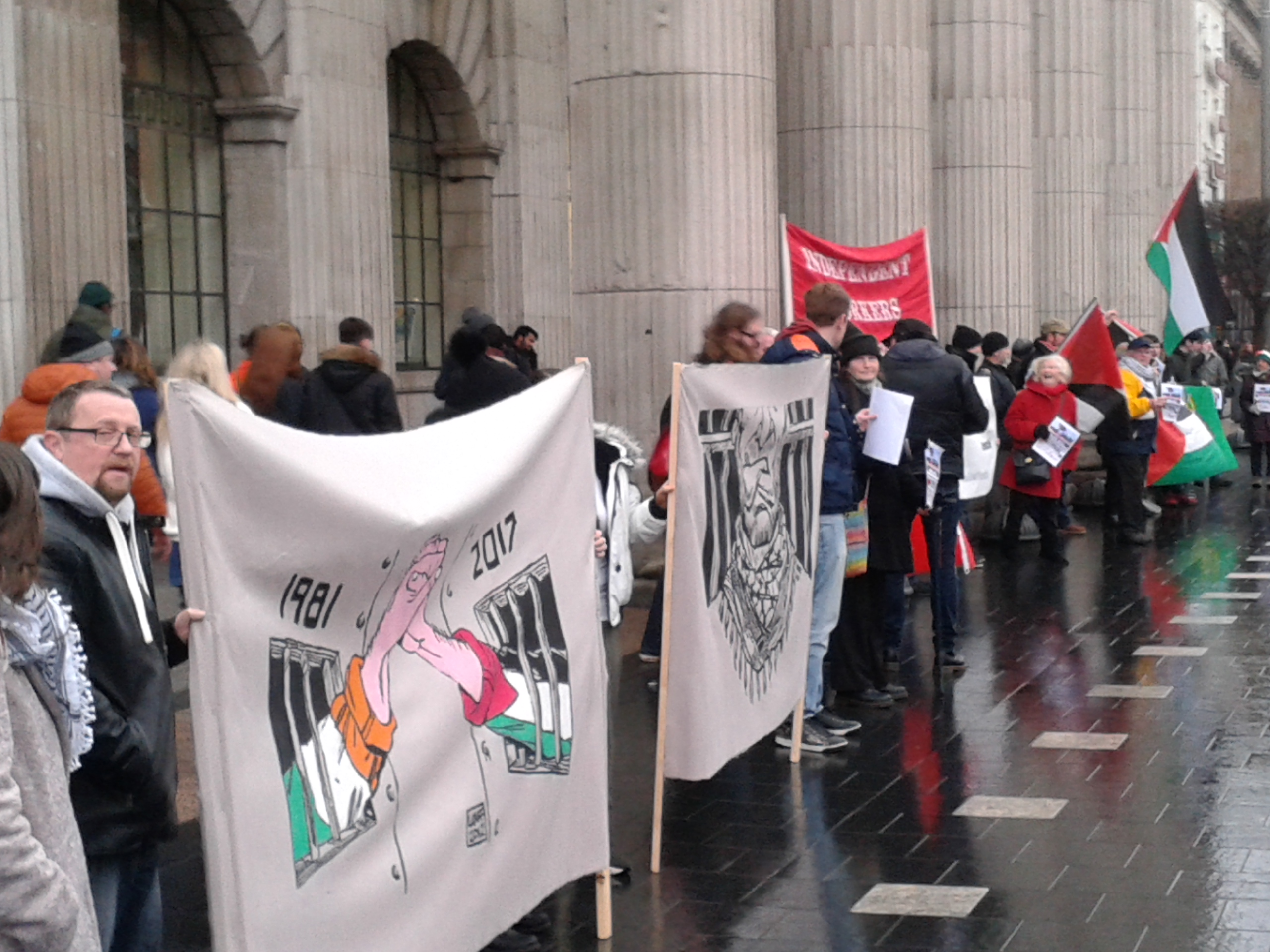
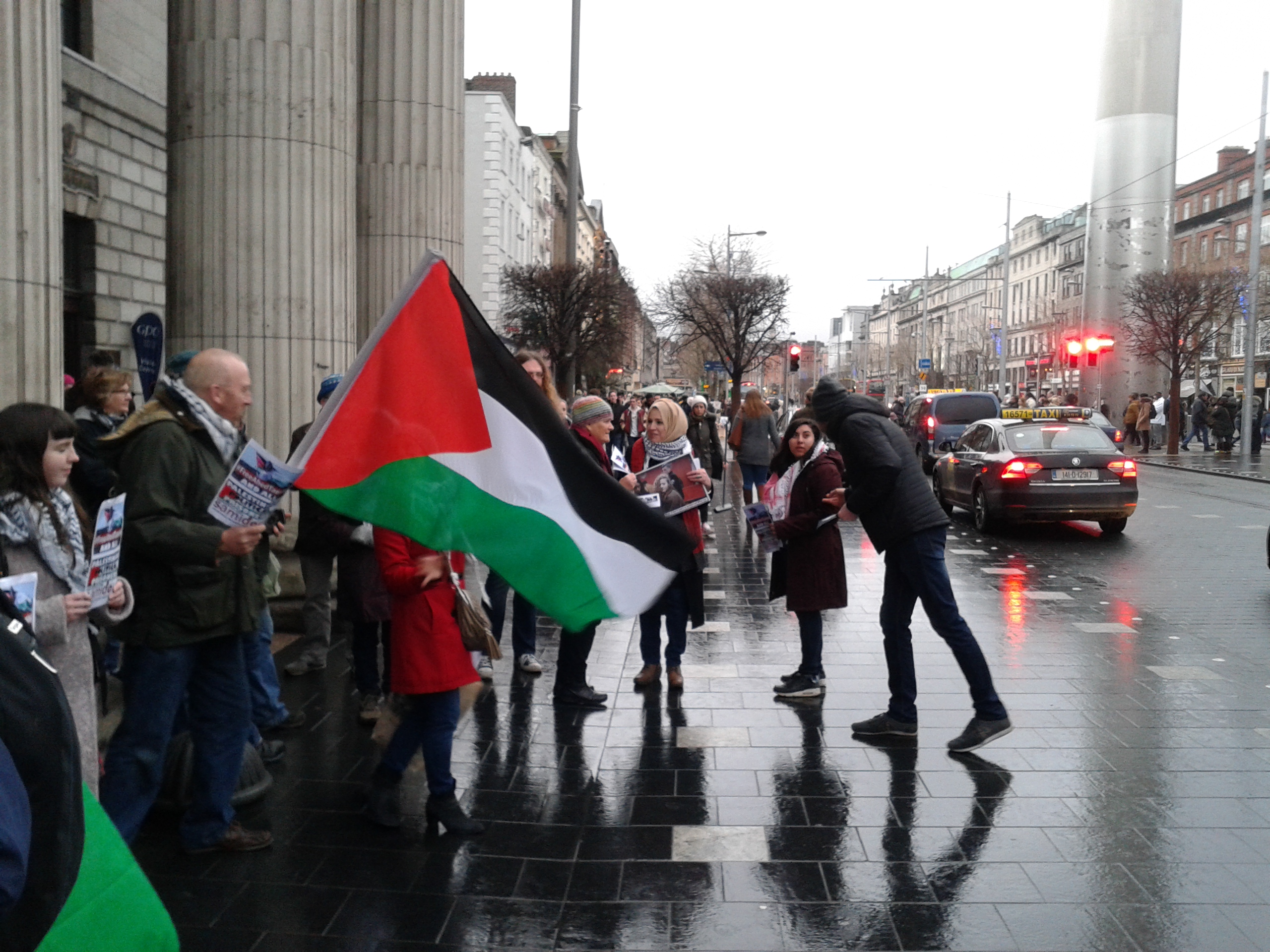
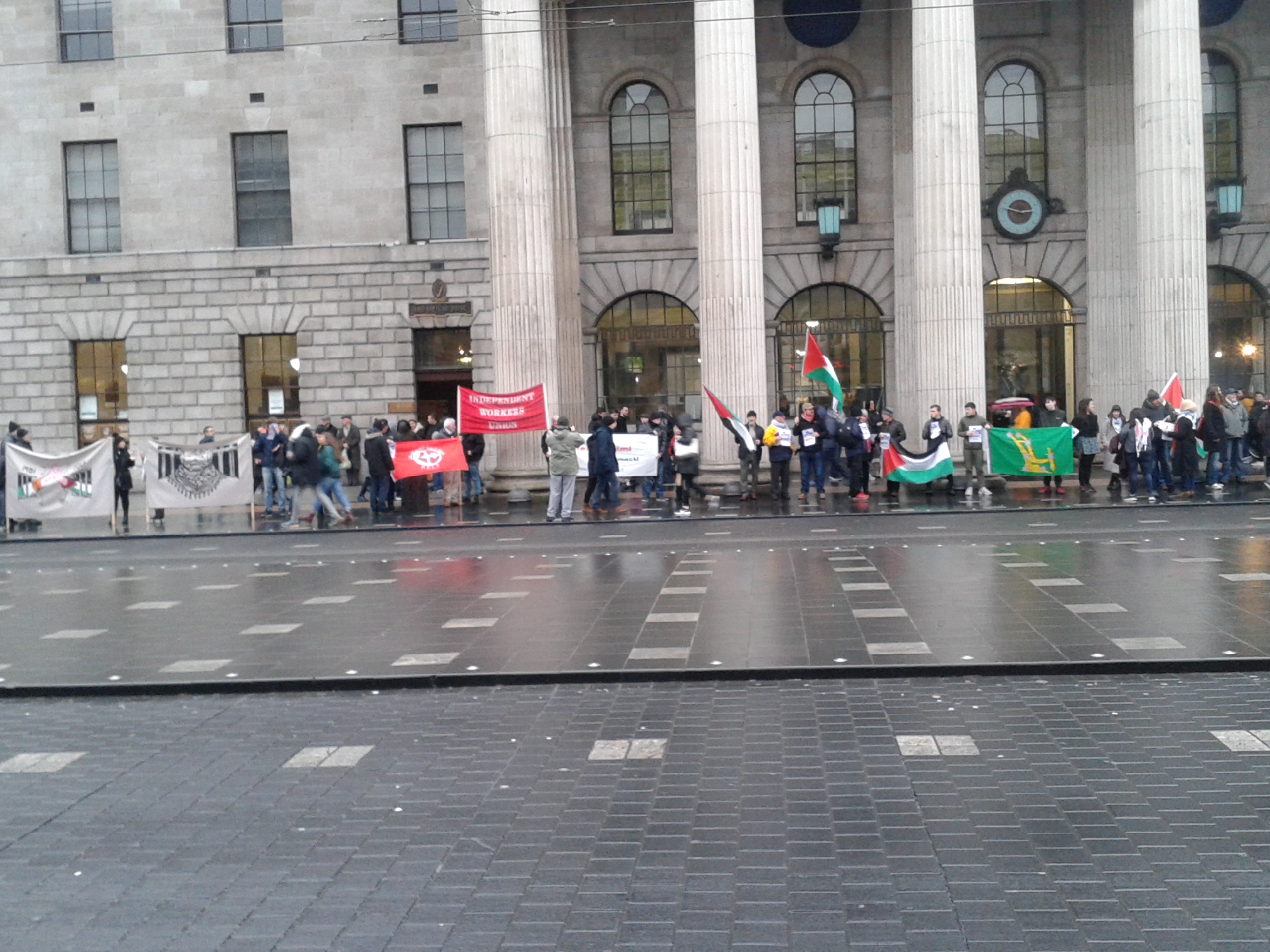
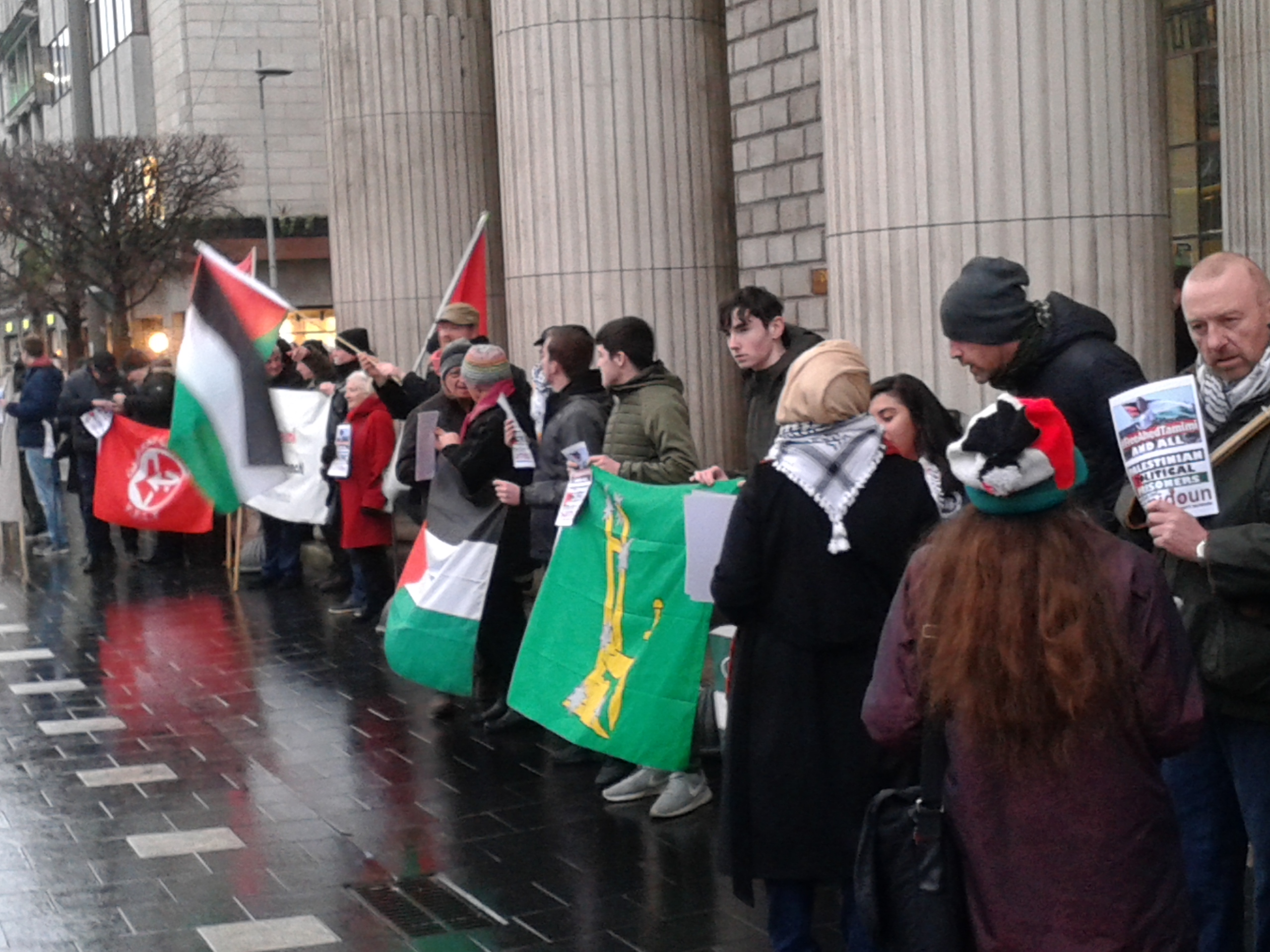
A wet Saturday afternoon saw a large crowd attend a protest picket organised by the Anti-Imperialist Action organisation; it was in specific solidarity with Palestinian Teenager Ehed Tamimi, jailed in December last year by the Israeli Zionist occupation — but also with all Palestinian political prisoners.

Ehed Tamimi solidarity protesters outside the GPO building, Dublin city centre (Photo: D.Breatnach)

Ehed Tamimi lives in Nabi Saleh, a West Bank village approximately 20 kilometres northwest from Ramallah.  A December protest against further expansion of illegal Zionist settlement near Ehed’s home village attracted the Israeli Army who seriously injured a Palestinian, Ehed’s cousin Fadl al-Tamimi, by firing a rubber-coated steel bullet at close range into his face.  Three female members of the Tamimi family, including Ehed, though unarmed, attacked the soldiers.  After video of the incident circulated widely, the Israeli occupation force raided the Tamimi household and arrested Ehed. She was held without charge for thirteen days and then charged, along with her mother, with assault, incitement to violence and throwing stones.  She remains in custody awaiting trial.

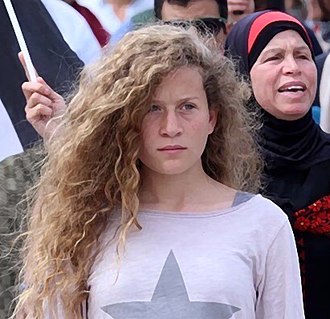
Photo of Ehed Tamimi taken on demonstration in 2016. (Source: Wikipedia)

The detention of Ehed, a minor in law, by the Israeli state violates a number of articles of the UN Convention on the Rights of the Child, including the right to remain with her family.

In past protests at her village, half the number of residents had been injured over a number of years and two killed by Israeli soldiers, including a member of the extended Tamimi family.

Photo of section of solidarity protest showing (centre photo, background) Fatin Tamimi, relative of Ehed and Chairperson of the IPSC. (Photo: D.Breatnach)

Born into an activist family, Ehed Tamimi is 17 years of age and has been in struggle against the Israeli Occupation Force more or less since she was she was able to walk.  According to the British newspaper The Guardian, Ahed’s siblings—Waed, Mohammed, and Salem—and parents “have known only a life of checkpoints, identity papers, detentions, house demolitions, intimidation, humiliation and violence; she is part of the second generation of Palestinians to live under the occupation.”

Ahed gained international fame through being photographed or filmed confronting Israeli soldiers, her courage remarkable and pale features and long blond hair making her stand out among protesters.  The first of these occasions to reach an international audience was when she was 11 years of age, in August of 2012 as she tried to prevent the arrest of her mother and later that year, waving her fist at an Israeli soldier twice her size as he arrested her older brother.

Photo from east side of O’Connell St. (Photo: D.Breatnach)

WIDE SUPPORT FOR PICKET

The Dublin picket on Saturday attracted the support of a wide section of the Republican and Socialist Left: the Independent Workers’ Union banner was in evidence as were a number of painted banners previously seen on pickets by the Dublin Anti-Internment Committee, along with independent Irish Republican activists.  Fatin al-Tamimi, Chairperson of the Ireland Palestine Solidarity Committee and a number of that organisation’s activists were also present, some distributing IPSC leaflets, as were a number of activists associated with campaigns against the Water Charge, against the demolition of Moore Street and in support of ending homelessness.  Fatin al-Tamimi, who although bearing the same family name is not related to Ehed’s family, will not in future be permitted by the Israeli state to visit her relatives (see item on Israel’s public blacklist below).

Section of protest (Fatin Tamimi, Chairperson of IPSC, can be seen centre right of photo with back to photographer. (Photo: D.Breatnach)

Among the passing shoppers and tourists a number indicated their support for the picket, many taking photos and some asking to be photographed among the protesters.  Drivers of a number of passing vehicles also tooted their horns in support.

RELATED: ISRAEL PUBLISHES BLACKLIST OF PALESTINIAN SOLIDARITY ACTIVISTS ABROAD

The Israeli Government consolidated its secret blacklist of people to be barred from entry to territory controlled by the State into list of organisations which it made public on 6th January 2018.  The Ireland Palestine Solidarity Committee was named as one of the 20 organisations, the leaders and activists of which will not be permitted entry to Israeli-controlled territory.  The move was widely interpreted as a reaction to the increasing effectiveness of the Boycott, Divestment and Sanctions movement against the State and its anti-Palestinian policies.  The publication was also seen by many as marking its further alienation from much of the rest of the world even as the USA, in President Trump’s order to relocate the US Embassy to the city, publicly endorsed the previous Israeli completion of its seizure of Jerusalem in June 1967 and its ongoing Israelisation and de-Palestination of the city.

Most of the organisations on the blacklist are European but a number are US-based.   “The American Friends Service Committee, a Quaker organization honored with the 1947 Nobel Peace Prize for assisting and rescuing victims of the Nazis, is among the list of groups whose activists Israel has announced it will bar from entering the Jewish State. On Saturday it was revealed that the left-wing organization Jewish Voice for Peace was on the list.”  Also on the list is the BDS South Africa organisation.

REFERENCES

Ehed Tamimi: https://en.wikipedia.org/wiki/Ahed_Tamimi

Israeli blacklist of organisations: https://www.haaretz.com/israel-news/1.833502

Summary of UN Convention on the Rights of the Child: (https://www.childrensrights.ie/sites/default/files/information_sheets/files/SummaryUNCRC.pdf)


LIVELY PICKET IN DUBLIN AGAINST INTERNMENT OF IRISH AND CATALAN POLITICAL ACTIVISTS

Clive Sulish


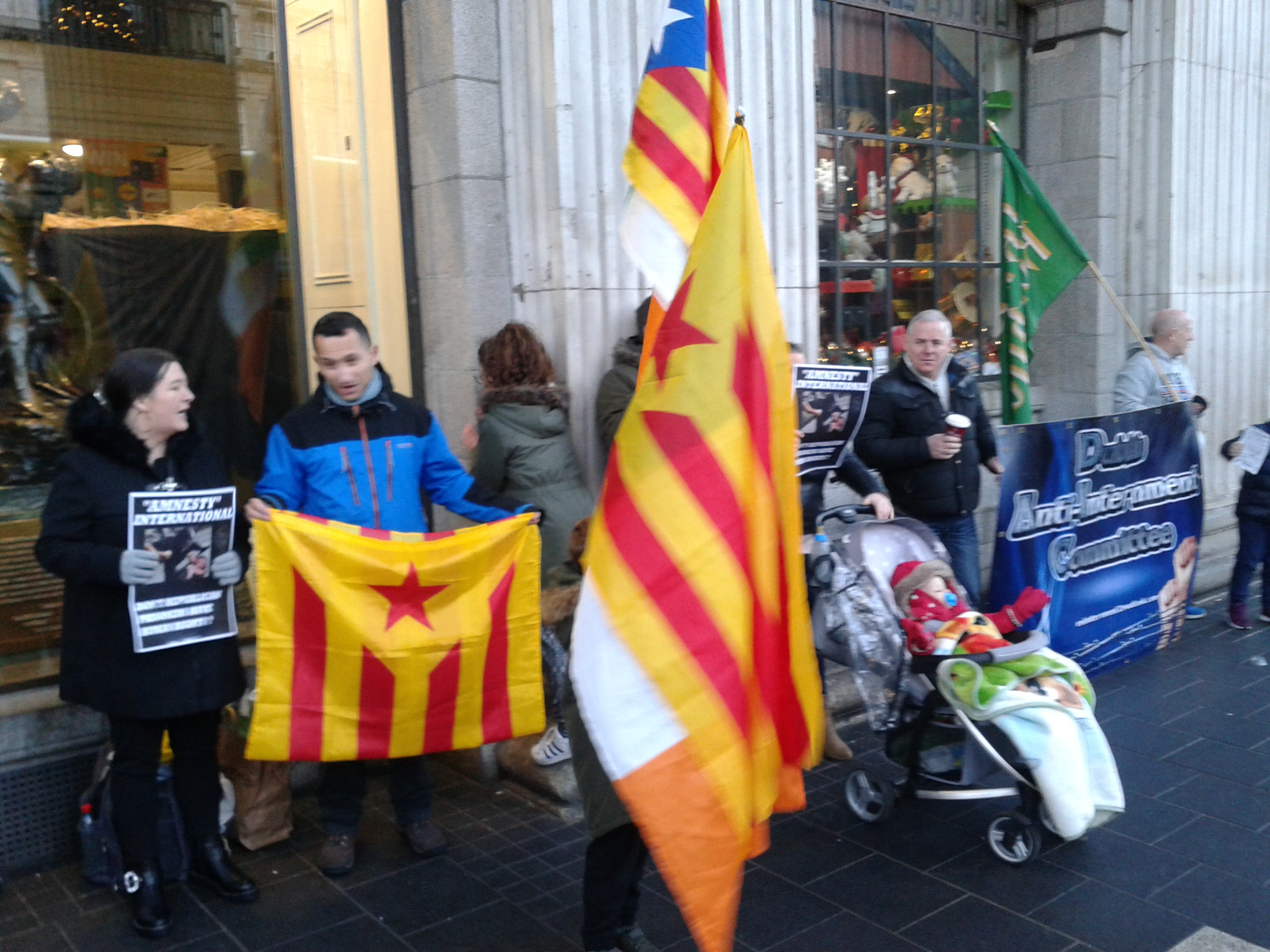
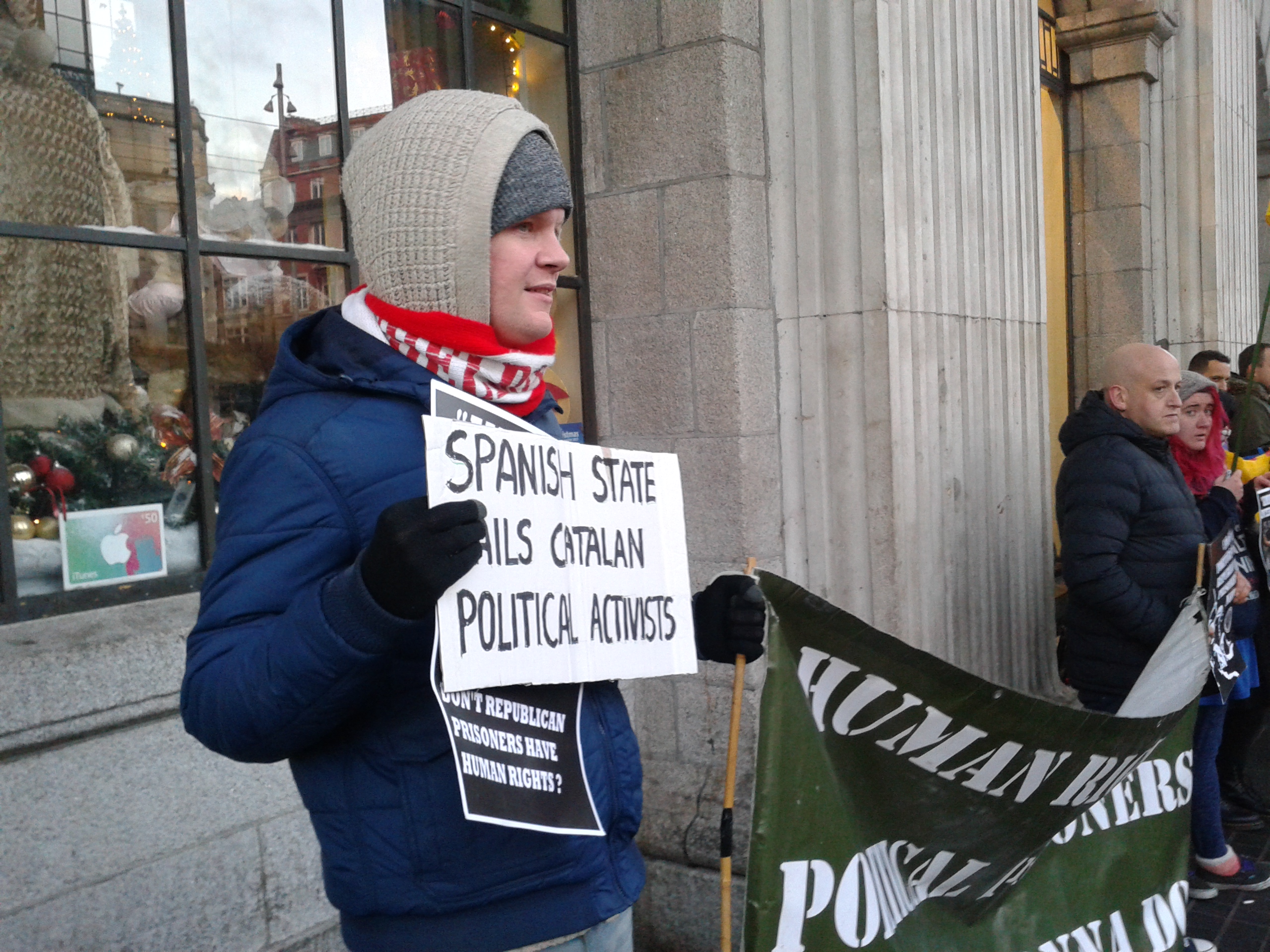
             Catalan Esteladas flew next to Irish Tricolours at the GPO in Dublin on Saturday afternoon (25 November 2017). The occasion was a picket organised by the Dublin Anti-Internment Committee to protest the internment without trial of Irish Republicans and also of Catalan political activists for independence. Placards raised the issue of internment of Irish Republicans and their treatment once in jail, as well as criticising the lack of action of Amnesty International on this question. Some placards also declared that the “Spanish State jails Catalan political activists”.

Mix of Irish and Catalan flags outside the GPO building, O’Connell Street, Dublin
(Photo: D.Breatnach)

Despite the seriousness of the issue and the bitter cold, the mood was upbeat, assisted by a music player broadcasting a range of songs, from Sifre’s “Something Inside So Strong”, through Warshaw’s “The Cry of the Morning” (sung by Christy Moore) to “Els Segadors”. Some protesters sang along to the songs and passers-by could be heard joining in too.

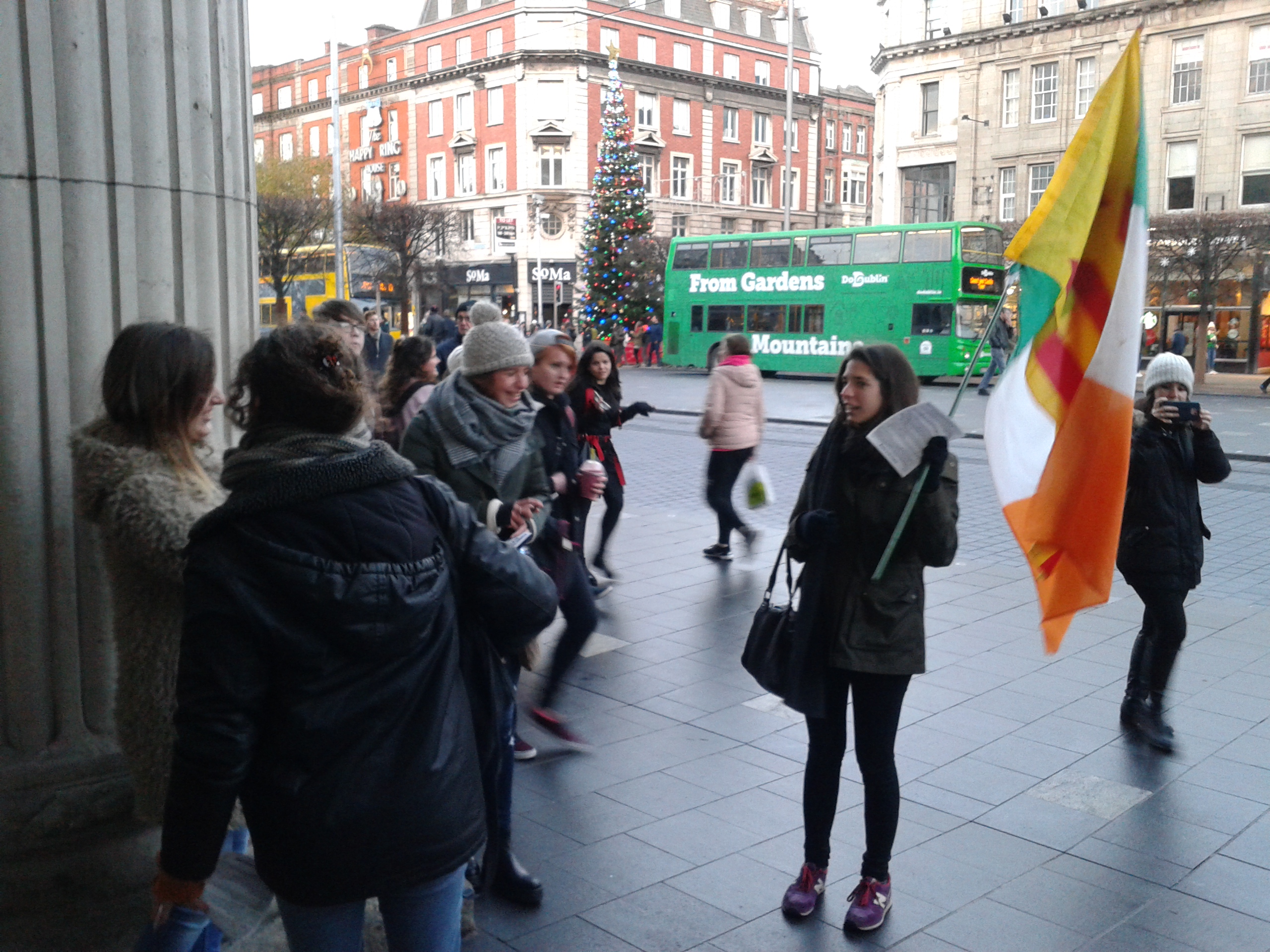
Many leaflets were distributed. A number of Catalan young women passers-by were excited to see the Estelada flags and were ecstatic when “Els Segadors” (“The Reapers”), the Catalan national anthem, was played.

Catalan and other young women passers-by reacting to the protest excitedly borrowed some joint flags to take photos of one another.
(Photo: D.Breatnach)

Some people passing occasionally shouted “Viva Espaňa!” in hostility which gave rise to the response of “Viva la democracía! Viva la libertad!” On the other hand, other visitors passing by were very supportive, for example a young woman from Asturias (northern Spanish state) and an older man from Andalusia (southern Spanish state).

A spokesperson for the Committee briefly addressed the attendance at the end of the event, thanking them for attending to support Irish and Catalan political activists being jailed without trial. Referring to the few passers-by who shouted “Viva Espaňa!”, the spokesperson said that there is nothing wrong with pride in one’s country but queried why the sight of a Catalan flag brought that response and why the definition of Spanish nationhood for these people is bound up with the denial of the rights of another nation to determine its own future. The spokesperson declared that every nation has a right to determine its own future and to do so without threats and repression, pointing out that the Spanish State is attempting to jail the whole Catalan Government for carrying out their election promises and has jailed the leaders of two independence organisations without trial.

Anti-internment protesters outside the GPO building, O’Connell St, Dublin.
(Photo: D.Breatnach)

The spokesperson thanking the attendance once more, the event came to a close, flags were furled, banners rolled and placards put away for another occasion.

The Dublin Anti-Internment Committee was launched in 2013 and is independent of all political parties and organisations, holds regular pickets and people who support the civil and human rights of Irish Republican prisoners are welcome to attend.

End.

Link:

The Anti-Internment Committee of Ireland: https://www.facebook.com/End-Internment-581232915354743/

Short video of event and short clip of Dublin Anti-Internment Committee representative at conclusion of event:

Labi Siffre’s “Something Inside So Strong” performed by Siffre himself:  https://www.youtube.com/watch?v=otuwNwsqHmQ

Jack Warshaw’s “No Time for Love” sung by Christy Moore with the Moving Hearts band (no longer in existence)

Els Segadors (The Reapers): https://archive.org/details/ElSegadors

PUBLIC HOUSING FOR ALL — CAMPAIGN LAUNCHED IN DUBLIN

Diarmuid Breatnach

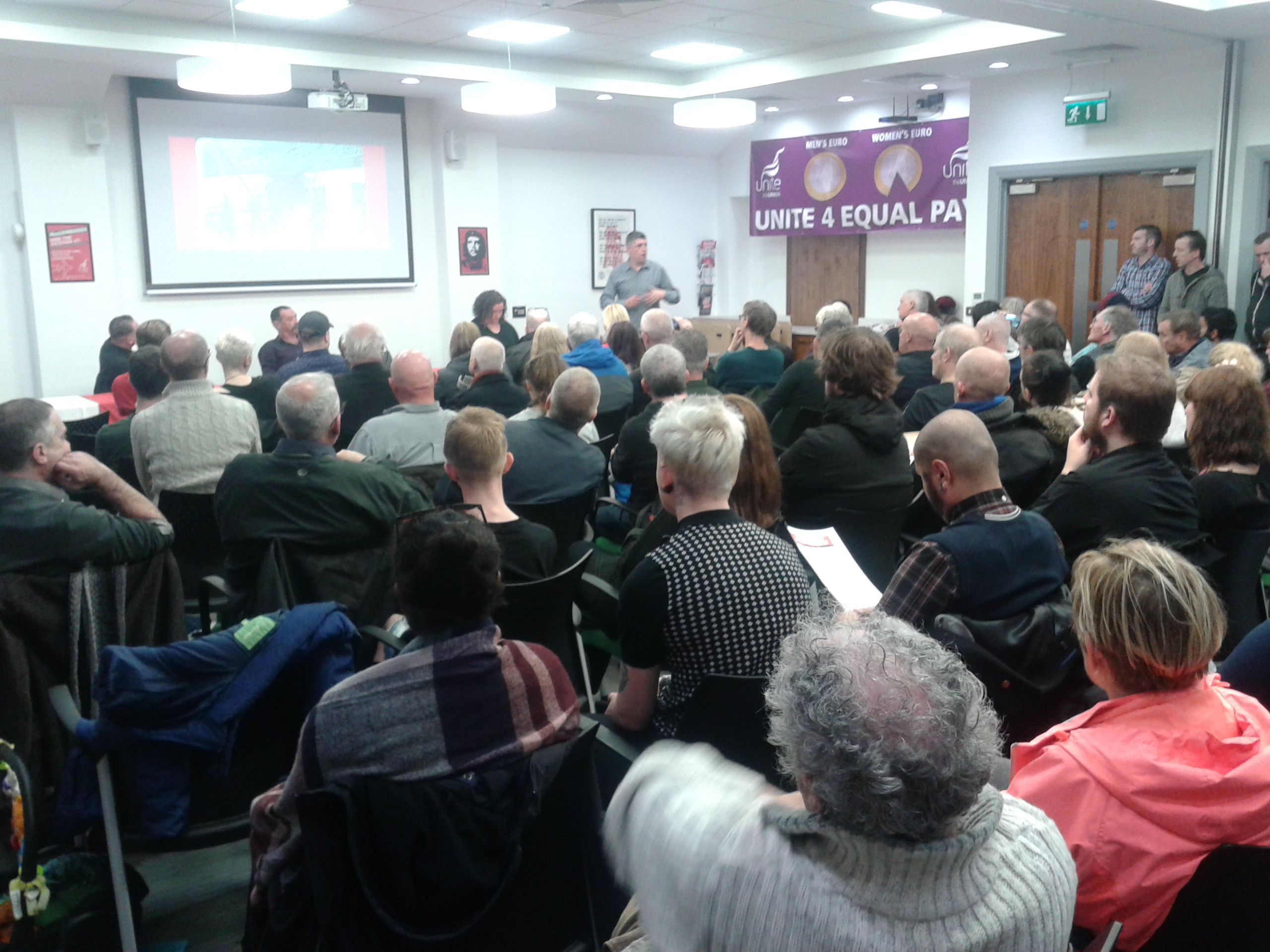
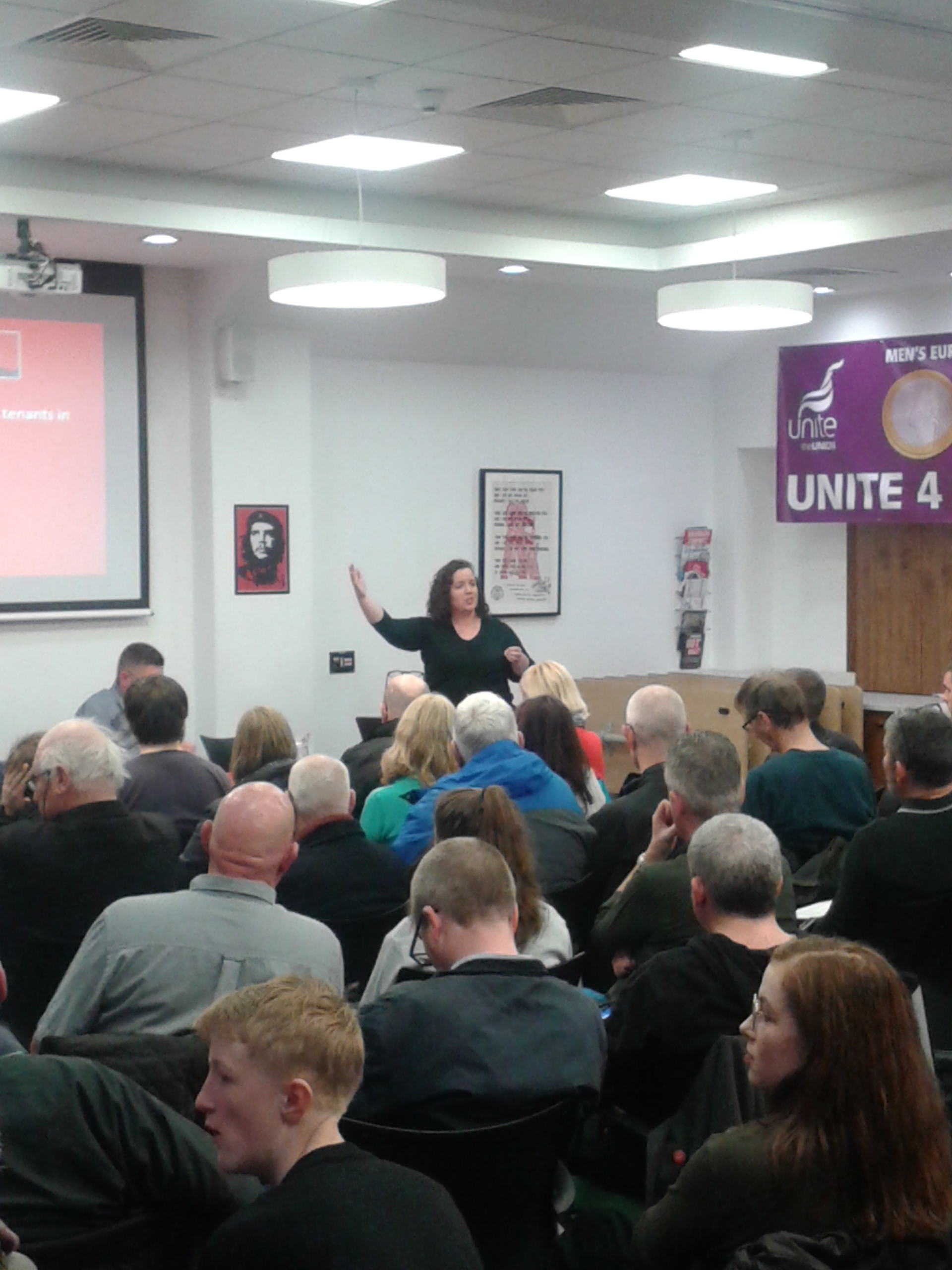
The Campaign for Public Housing was launched Saturday (28th October) at a large packed meeting room in the Unite trade union building in Dublin.

Section of crowded room at campaign launch meeting in Unite trade union hall.
(Photo: D.Breatnach)

The demands of the campaign were announced as both long-term (in the form of a new system of universal public housing) and short-term (in dealing with the reality of the current housing crisis), as follows:

  • A new system of Universally Accessible Public Housing, based upon a cost rental model where the collective rent of tenants would fund the construction and procurement of large volumes of new public housing.

  • A tenants Bill of Rights to protect tenants in the private rental sector. This bill would control rents and provide real security of tenure.

  • A complete Ban on Economic Evictions by banks and private landlords.

  • A referendum to insert an unambiguous and legally enforceable Right to Public Housing into the constitution.

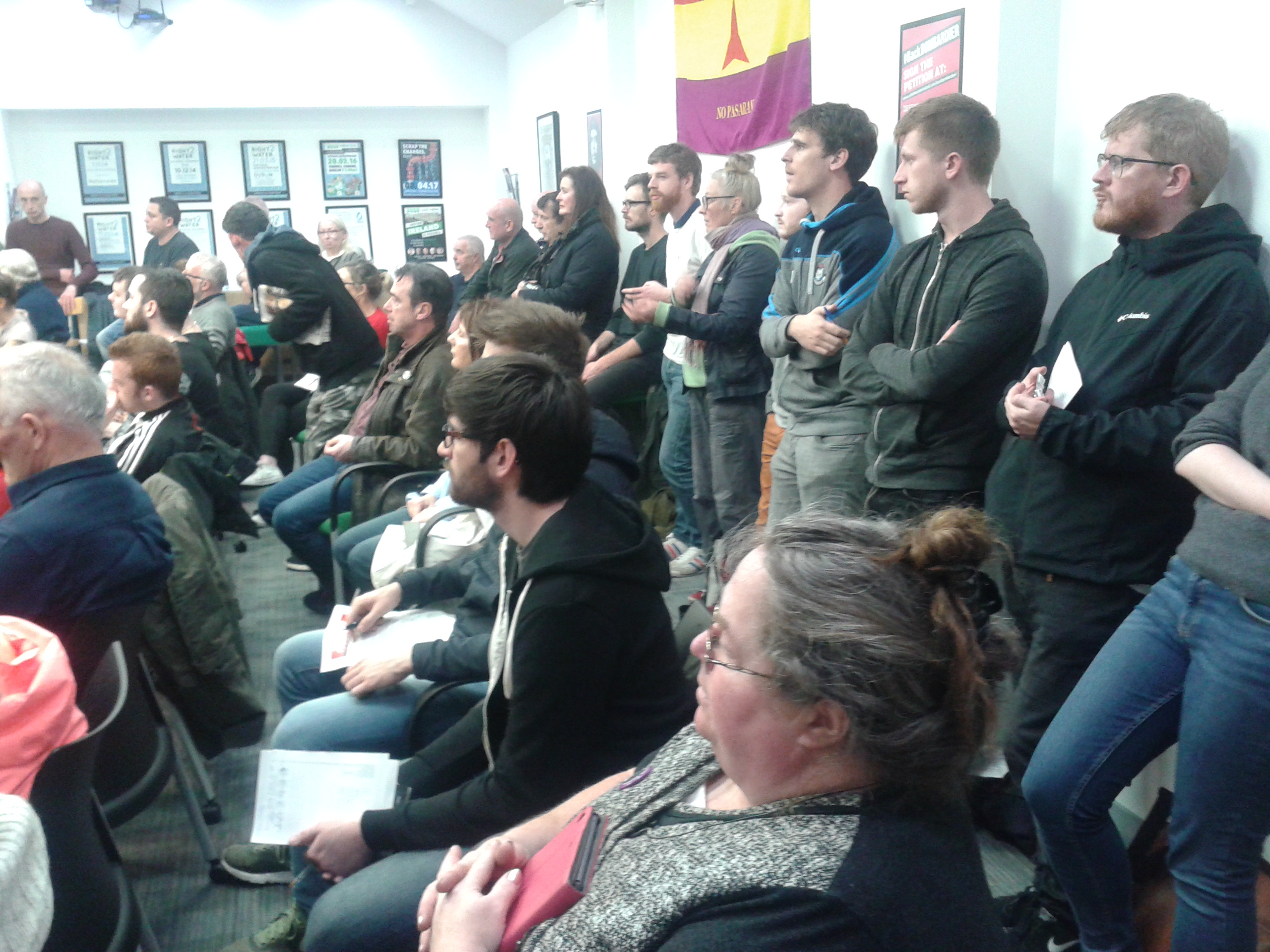
Standing room only remaining at campaign launch meeting in Unite trade union hall.
(Photo: D.Breatnach)

The political forces represented at the public meeting table were Éirigí (Brian Leeson), the Workers’ Party (Éilís Ryan), the Communist Party (chairing the meeting) and an individual who might be described as an independent left Republican activist (Cieran Perry). Both Perry and Ryan serve as elected councillors on Dublin City Council.

The Éirigí organisation is considerably reduced from the numbers of activists it had when it was first formed, largely by “dissidents” who left the Sinn Féin party soon after the Good Friday Agreement. The Workers’ Party is very small, having arrived at its current space through a series of splits from the original Sinn Féin (which became Official Sinn Féin after their dissidents formed the Provisionals back in 1970). The Communist Party of Ireland is also very small but owns a Dublin bookshop which also operates as a small theatre and meeting place for broader left anti-imperialist events.

At first glance, the political composition of the table may strike the observer as unimpressive in representation of numbers. However, such active forces have impacted significantly on the Irish political scene over the years and these in particular bring a wealth of political experience to the table. In addition, the audience contained a broad spectrum of left trade union and community activists, republicans, anarchists, socialists and participants who became active in recent campaigns.

According to a press statement released by the Campaign for Public Housing on 26th October, its supporters includes:
Peter McVerry (in a personal capacity, it was said at the launch)
Inner City Helping Homeless
Éirigí
The Workers’ Party
The Communist Party of Ireland
North Dublin Bay Housing Crisis Community
Cllr. Cieran Perry
D8HAC Altogether Now
Dundrum Housing Action
1916 Societies
Catherine Connolly TD
Clare Daly TD
Mick Wallace TD
(and Joan Collins TD, it was announced at the campaign launch).

THE STATE FUNDING SPECULATORS TO BUY MORE PROPERTY

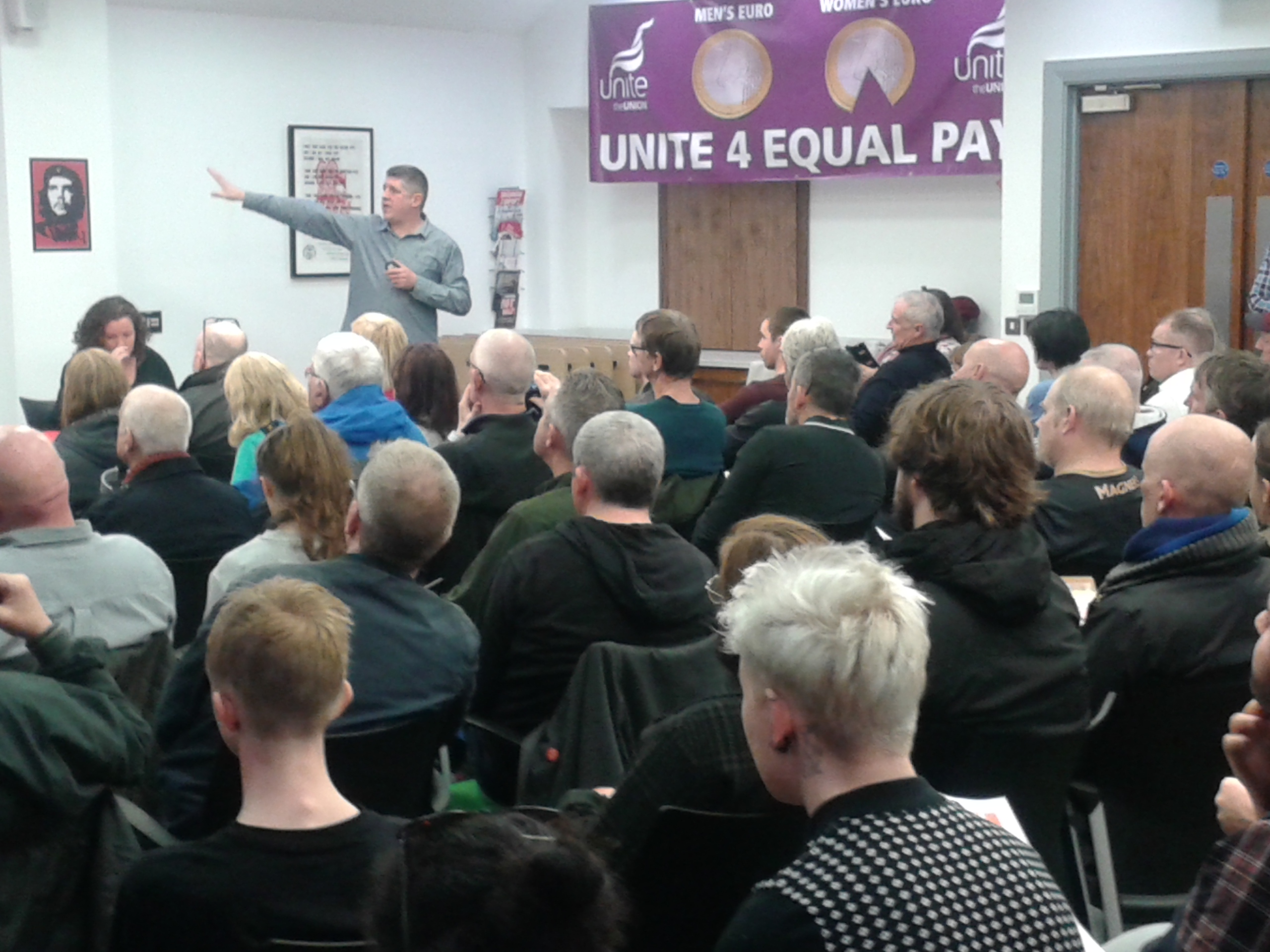
Speaking while using an electronic visual presentation on a large screen at the campaign public launch meeting, Leeson presented figures drawn from statistics produced by property and housing agencies and government departments to illustrate a history of public housing in the Irish State since its creation. Though hardly impressive in the numbers of public dwellings built, the figures showed a significant initiative in that direction under the early Fianna Fáil government years, when De Valera was at its head.

Brian Leeson during his presentation,
(Photo: D.Breatnach)

Throughout the 1950s and 1960s the ratio of public housing to private housing built was around one to one. In those years, private landlords notwithstanding, private housing was usually occupied by the owner. From the 1980s onwards, the ratio shifted to 10-1 in favour of private dwellings and huge numbers of these were no longer lived in by their owners and the ratio is much higher now. In effect, dwellings had become a commodity in which large-scale speculation was taking place, driving the rents and mortgages higher and higher, forcing people into debt for life or evictions and also into high-rent and unsuitable accommodation.

The figures also showed a state funding of the private property sector to the tune of eight billions (€8,000,000,000) – funds which the banks and other property speculators used to purchase more land and property, intensifying the housing crisis.

PUBLIC — NOT SOCIAL — HOUSING

Ryan concentrated her presentation on the need to call for public housing as a rational and necessary response, as one might consider for example public education or health service. Only public housing can solve the housing crisis, she maintained and so it is not only of moral importance but of urgent practical need. Turning to the cost of house building, Ryan pointed to the industry’s figures seen in the earlier presentation, showing that good-quality houses can be built much cheaper even under existing conditions. She was at pains to outline the differences between social and public housing: social housing is often aimed at low-income families and may be provided through a range of private or semi-private schemes. Public housing is state-funded with the rents going back to the state to reinvest in further housing provision and should be mixed in order to avoid ghettoisation.

Éilis Ryan during her presentation. (Photo: D.Breatnach)

Referring to the importance that Irish people tend to give to the state’s Constitution, Ryan stated that part of the objectives of the campaign was to insert a clause that guaranteed every person a good quality, affordable-according-to-income housing unit for life.

STOP THE SALE OF PUBLIC LAND!

“We have very little power as Councillors,” said Perry “but one thing we do have power on is the veto on selling public land.” He went on to speak of how Dublin City Council had sold Council land to private developers despite his and some other Councillors’ efforts. However, social and political pressure had forced the ratio of public housing on the Devanney Gardens site up to 30% despite the wishes of some political parties but that still meant that 70% went to private speculators.

Cieran Perry during his presentation.
(Photo: D.Breatnach)

Perry called for support for a demonstration outside City Hall on Monday November 6th at 5.30 pm in support of a motion put forward by himself and some other councillors to prevent the sale of any Council land.

Currently Dublin City Council own 120 hectares of land – enough to build 12,000 good quality homes. “There are 20,000 people on Dublin’s housing waiting lists, and many more average income households who will never be able to afford private rent or mortgage. So why are we allowing private developers to make money off our land?”

Turning to the question of the campaign itself, Perry promised it would be democratic, transparent and not become dominated by any political party or personality and urged all to become involved, to leave their contact details on the clipboard sheets at the door and to encourage others to come on board.

QUESTIONS

The questions and contributions were overwhelmingly of an intelligent kind and included areas such as hidden homelessness by emigration, housing waiting lists and disqualification; the privatisation of education and health services despite their public appearance; the need for the campaign to include direct action; the relationship between this campaign and other housing campaigns in Ireland; the need for quality monitoring by other than the contractor if the Council is to be the builder; the shortage of building workers at the moment; changes in the court systems to facilitate evictions; the involvement in a number of evictions of a firm led by an ex-British soldier using Loyalist ex-paramilitaries; the expected opposition from the EU to bans on the sale of public land; the hidden homelessness of one partner in a relationship breakup, etc.

Those leaving the meeting seemed fairly happy with the launch though inevitably some discussion took place on what tactics the campaign might employ and whether the organisation would degenerate into electoralism, or whether it would be manipulated for politically sectional interest. Political and community activists in Dublin have a long history and such discussion would be normal among all but the most naive. But the overall mood perceived by this reporter was decidedly positive.

End

LINKS:

Contact campaign: https://www.facebook.com/CampaignForPublicHousing/

campaign4publichousing@gmail.com

Picket City Hall to demand no selling of public land: https://www.facebook.com/events/2562340743904927/?acontext=%7B%22ref%22%3A%223%22%2C%22ref_newsfeed_story_type%22%3A%22regular%22%2C%22action_history%22%3A%22null%22%7D

THE “IRISH SHEEPLE”

Diarmuid Breatnach

When the Irish financial bubble, expanded far beyond capacity, finally burst and the private banks that had caused the crisis were bailed out with public money, the Irish people did not immediately rise up. The big trade unions made some noises, called hundreds of thousands to march, then collapsed. The smaller unions, for the most part, caved in afterwards.

It was not long before the Irish people began to be jeered and insulted – and for the most part, by some people who were themselves Irish. They seemed unaware of a thousand years of militant resistance to foreign occupation and many workers’ battles over decades. The frustration, if that was the cause of their insults (not to say contempt), was understandable. Less so, I pointed out at the time, was their dismissal of the only force that could possibly save us – the Irish people.

“The people?” they jeered. “You mean the SHEEPLE!”

They pointed to massive demonstrations and riots in Greece and in France and to none in Ireland. I commented that all their insults could possibly achieve would be to discourage the Irish people further. The limitations under which the Irish people laboured needed to be understood. There was no large revolutionary party in Ireland to provide leadership. There was not even a militant radical social-democratic party or reformist Communist Party. There were no militant trade unions to provide organisation.  These things existed in Greece and in France.

Our trade unions had twenty years of “social partnership” – i.e they had during that time negotiated agreements nearly always without industrial action in joint committees where the unions, the employers and the State each had representatives. Their fighting muscle had atrophied to the extent it no longer existed. Notwithstanding all their faults, the Greek and French unions had not similarly wasted away their muscle. Our trade union leaderships had settled for a comfortable life, highly paid, building up their memberships and safeguarding their officers and structures, or trying to, neglecting the purpose for which those unions had been created. They were captains of ships in dry dock, shining and varnished, but riddled with worm holes and sails safely furled – they would never take to sea and be tested in any storm.

As time went by, we saw no significant reforms in the French situation as austerity bit there. There was much excitement in Left social-democratic and Trotskyist quarters as the Greeks elected a social-democratic party with a radical program of resistance to austerity measures. The Greeks had been driven to a much worse economic situation than had the Irish – during the winter, many schools had to close as heating could not be supplied. But then the radical Greek party and new Government collapsed under pressure from the EU’s financial commissars.

The people in the Spanish state were marching in their hundreds of thousands under a new party that was not really a party, they said. But it turned out if one did some digging, that it was not such a new party/ non-party after all, as its leadership came from the old reformist Communist Party-Trotskyist alliance, Izquierda Unida. But still …. huge marches and then huge electoral gains (for what was now without question a political party – Podemos).

But the Spanish ruling class, although unable to receive a governing mandate for a single political party, carried on with its austerity program. Evictions continued as did a great many suicides of those evicted or about to be evicted.

IRELAND (THE 26 COUNTIES)

Meanwhile, what about the “Irish Sheeple”? What were they doing?

They too began to march, in small numbers at first, then larger until they choked the capital city’s centre. The media under-reported them, lied about numbers, stopped doing aerial photos that would show the full extent of the masses in protest.

First in line of the resistance movement was the Household Charge. The campaign slogan proposed by independent protesters and small parties and political organisations was “Don’t register, don’t pay.” Despite that tactic, the most effective to defeat the Charge, not being supported by the alternative party with the highest number of elected representatives in the Dáil (Irish Parliament), i.e Sinn Féin and despite no trade union mobilising against it, the ruling class had to concede defeat. But they changed the tax to the Household Charge and made it collectable from people’s salaries at source, changing the law in order to do so.

A section of a Water Charge protest march on the south quays of the Liffey while another section marches on the north quays in August 2015 (Photo: D.Breatnach)

The Water Charge was next. The people already paid for water supply maintenance through ordinary taxation and, it later emerged, through the diversion of Motor Tax to pay for the water! Nevertheless, a new charge was levied and again, the campaigners asked the people: “Don’t register, don’t pay!” Again, this tactic was not supported by the same alternative political party or the unions, although they all declared that they were, of course, against the Water Charge.

Despite police harassment, violence and arrests, people in local areas began to block the work-gangs installing the water meters. Some arrested activists refused to obey a court injunction intended to paralyse their activities and were sent to jail. A large protest demonstration marched to their jail and they were released. Many trials collapsed and activists, though hampered by many court attendances, walked free. Some others paid their fines and continued their resistance.

March against the Water Charge finishing for rally at Dublin’s Stephens Green in September 2016 (Photo: D.Breatnach)

Police attacks on water charge and anti-austerity protesters multiplied and pickets, particularly of women, protested outside Garda stations.

Hundreds of people began to march, then thousands. As the numbers grew, the reformists of political party and trade union climbed on board and the numbers continued to rise to hundreds of thousands. The media were exposed as they grossly underplayed the numbers.

MOORE STREET

Meanwhile, another struggle had been shaping up, between heritage conservationists campaigning to save a valuable piece of the City Centre of huge historical importance from property speculators. Firstly the State was obliged to declare four houses in Moore Street as of historical preservation status (while however the Planning Department of the local authority gave planning permission for a huge “shopping mall” of a number of acres around those houses). Subsequently campaigners prevented the Planning Department from carrying out a land-swap of Council land to facilitate the Speculator.

Then the State had to buy four houses in the historic terrace; at the same time their plans to demolish three other houses in the same terrace were prevented by their occupation by protesters for five days and a subsequent blockade of demolition workers of almost six weeks.

The blockade ended when a case taken by a concerned individual to the High Court resulted in a judgement that the whole quarter is a historical 1916 monument (against which judgement the Minister of Heritage is currently appealing, scheduled for hearing December 2017).

Moore St. historical conservation campaigners in the street itself celebrate High Court judgement shortly after receiving the news on March 18th 2016 after which they ceased the blockade.
(Photo: J.Betson)

During the 1916 State commemorations, the Minister of Heritage’s hypocritical laying of a wreath in Moore Street was met with vociferous denunciation by campaigners on the spot, without any of the protesters being arrested.

JOBSTOWN

Two years before that Moore Street event, a mass protest for had prevented two hours the Minister for Social Protection’s car from leaving a working class area where she had gone to attend a ceremony.

Some supporters of those charged for protesting in Jobstown in show of solidarity outside the Court where they were being tried in March this year.
(Photo: D.Breatnach)

“Enough!” cried the ruling class and they argued about what to do, their more revanchist section winning the argument. They were going for maximum legal attack, to teach those protesters a lesson and frighten all others in future.

The offensive against the resistance was planned. Early morning raids, to increase disruption and fear. Mass arrests, including of a juvenile. This latter might have looked like a mistake, as it was obvious he’d attract sympathy — but actually it was cleverly thought out. They put his trial on first – in the Juvenile Court where the judge can get away with more, where access to media was restricted to one representative each of print and audio media and where no members of the public were permitted entry. And they found him guilty, of course they did. They avoided much of sympathy outcry by giving the youth a non-custodial sentence but – and this was the crucial thing – they had found him guilty of “false imprisonment”. They now had a precedent for the eighteen or so awaiting trial in the adult court.

The media mostly colluded, of course in their news coverage of events, trial and in comment.

The trial process began with an attempt to eliminate from the jury those who disagreed with the Water Charge (i.e most ordinary people) and people from the area where the incident had taken place. Then the Minister herself, in the witness box for four days, regularly failing to answer the questions of the Defence lawyers but using the opportunity instead to attack the defendants, without attempt by the Judge to direct her to answer the question and confine herself to doing so. After all, it’s the Prosecution lawyers’ job to draw out the unfavourable comments.

That was followed by two similar days with the Minister’s secretary, who had been in the car with her at Jobstown.

Then police officers, lying through their teeth. This is of course a regular occurrence in the courts but unfortunately for them, they were contradicted by video and audio recording. Somehow, not only one but several Gardaí heard one of the defendants say something which the recording showed he had not.

Finally, all were found not guilty. The next group were to be tried similarly on charges of false imprisonment but also with use of violence. But how could the State find them guilty of kidnapping on the same evidence that a jury had rejected in the case of the first group? Would even the violence charges stick? The ruling class took a decision to cut their losses, avoid a possible second defeat and decided to drop the charges against them too and against another group scheduled for later still.

POLICE CORRUPTION AND COVER-UPS

Meanwhile, independently of all but perhaps distantly affected by the people’s resistance and the anger at the behaviour of the police, two whistle-blowers emerged from among the Gardaí to accuse them of allowing powerful people to escape drunk-driving charges. Then it emerged that people charged with driving offences had been automatically convicted without the option to defend themselves in court. That was followed by revelations that the Gardaí had claimed to have stopped hundreds of drivers for drink-driving tests which they had not in fact done – and the false numbers grew to thousands. And then Gardaí senior officers tried to discredit one of the whistle-blowers by implying he was a paedophile and even enlisting the involvement of a child-protection agency.

Before the conclusion of the Jobstown trials, general elections had been held. The ruling class in the Irish State has not managed to have an overall majority for a single one of its political parties since 1981 — and this election was no exception. However, one of the parties of the ruling class (its favourite actually, since shortly after the creation of the State) now felt the pressure of the people and made non-implementation of the Water Charge a condition of not bringing the minority Government down, to which the parties in governing coalition were obliged to agree.

THREE FORCED TO RESIGN: Alan Shatter, then Minister for Justice, congratulating Nóirín O’Sullivan on her appointment as Deputy Garda Commissioner while Commissioner Martin Callinan looks on. As a result of exposure of alleged attempts to silence Garda whistleblowers and alleged covering up Garda corruption and misdeeds, Shatter and Callinan had to resign in 2014 and O’Sullivan recently. (PIC: MAXWELLS NO REPRO FEE)

As a result of all this (and a number of other less-highly publicised corruption and wrongdoing by Gardaí cases), eventually Allan Shatter, Minister for Justice and Garda Commissioner Martin Callinan, the highest-ranking officer in the Gardaí had to resign. Less than three years later, the new Commissioner, similarly implicated but now also in a scandal regarding officers’ financial corruption, had to resign as well.


SHEEPLE?

In this period, during which Irish people had been compared to sheep, cursed and denounced by some from the “Left” and compared unfavourably with protesters in Greece, France and Spain (despite the people of those three states having failed to succeed to any significant degree), the Irish people have

  • Totally defeated the Household Tax and obliged the ruling class to change the law and substitute another Tax collectable from income

  • Paralysed the Water Tax (Charge)

  • Exposed the mass media

  • Halted the Government and Dublin City Council’s Planning Department plans to give a historical memory area in the City Centre, prime “development” land, to speculators

  • Prevented the Government demolition of historic buildings in that area by campaigning, occupation of buildings and a blockade, without a single protester being arrested

  • Helped obtain a historic judgement from the High Court that the whole quarter is a historical 1916 Monument

  • Vociferously denounced the Minister of Heritage while she was laying a 1916 wreath at Easter in Moore Street, without a single protester being arrested or prevented from the denunciation

  • Held up the Minister of Social Protection’s car in mass protest for two hours

  • Exposed the police in violence and in corruption

  • Defeated plans to deal a major blow to the right to protest by conviction on kidnapping charges

  • Caused the resignation of a Minister of Justice and two Garda Commissioners inside a period of three years

And all this was achieved by the Irish people without the organisation or leadership of a mass revolutionary or radical political party or a mass militant trade union.

THREE CHEERS FOR THE IRISH SHEEPLE!

Coalition: Opposition and Revolution versus Collusion and Cooption

Diarmuid Breatnach


An old, old debate or discussion has broken out of late. It has been inspired or regenerated by the inability of the main political parties of the ruling class to achieve a ruling majority in the Dáil, even in coalition. Another factor has been the growth of Sinn Féin seats to a number sufficient to attract another party into getting them into a coalition government. And another General Election cannot be far off.

The debate or discussion is sparked by questions something like this:

Should a coalition of revolutionary socialists and radical social-democrats put together a joint slate to present themselves and agreed policies to the electorate?

And a different question (but not completely different in the minds of some of that potential slate above, I suspect):

Should a party that presents itself to some supporters as revolutionary, to some others as radical, participate in a coalition with one of the traditional ruling class parties to form a government?

Against either of those possibilities, groups of anarchists and non-Sinn Féin Republicans, in rare agreement, declare that no such initiatives should be supported; the anarchists, because they do not believe in bourgeois elections or parliaments and the republicans, because this is not a Republic which they can legitimise by taking part in their state elections. Some revolutionary socialists and others of varying hues argue that the system will corrupt those who take part in their institutions and provide a long list of those to whom that has happened historically (and both anarchists and republicans can nod their heads in agreement at the list).

Social democrats and some others argue that an election provides an opportunity to put in to power a different administration, one which has the actual power to change things. They argue that it is their duty to take advantage of that opportunity and accept its challenges; they charge their critics with being dreamers who prefer to hold on to their ideological purity for some distant day rather than to address the real situation in the here and now.

TAKE PART IN GOVERNMENT?

There is room for some fruitful debate and discussion around some of these positions but one thing seems clear to me: it can never be permissible for revolutionaries, under any excuse whatsoever, to be part of a government to run the country for the capitalist ruling class. The capitalist ruling class is our enemy and we are irreconcilably hostile to it and must remain so. We work for the day when we can overthrow that class and put the workers in charge and no honeyed words of exception or self-deception can change that fact.

Undermine it from within? Use their institutions against them from the inside? Throughout history, all those who have attempted that (or who pretended to for their own careerism) have shown that far from subverting the system, it was they who were or became subverted.

Yes, it is a philosophical truth that just because something happened before is no guarantee that it will happen again. Even if it happened every time in the past. Although jumping from the tenth floor of a building on to hard ground has killed hundreds over time, it is philosophically possible that someone could survive it now – even unharmed. But it is not a scientific nor a historical probability. One is entitled to try it with one’s own life but not with the lives of others.

Those who formed Fianna Fáil crossed over that line not long after they split from Sinn Féin: not only that but the party soon became, despite its Republican and nationalist roots and rhetoric of being for a 32-County Republic, the preferred political party of the Irish foreign-dependent capitalist class in the 26 Counties and virtually unknown in the Six.

A Fianna Fáil election poster, possibly 1950s or ’60s.
Source: irishelectionliterature.com

The Sinn Féin we know today (Provisional Sinn Féin, as they no longer like to be called), the largest survivor of a number of large and smaller organisational splits since the days of the creation of Fianna Fáil, also crossed over that line. In a sense, they did so in an even worse (or more obvious) way than had Fianna Fáil – Sinn Féin participated in a colonial government, the administration of an armed foreign aggressor.

Old FF election poste: “There’s a better way” (source: internet)

That party is heading for entry into a capitalist coalition government in the 26 Counties, if only it can find a partner willing to accept it for the dance. Based on its history in government in the Six Counties and some other measures, the SF party leadership strives to prove to the Irish capitalist class that it can be trusted to manage the system, alone or in partnership with one of the main capitalist parties.

There’s a better way with SF too, apparently. A much more recent Sinn Féin election poster. (source: internet)

The President of the party has said that “Sinn Féin doesn’t have a problem with capitalism”. The party’s leadership refused to support the “Don’t register, don’t pay” slogan of the early campaigns against the Household Tax and later against the Water Charge (the first was defeated by popular resistance following those slogans and the second is on hold, due to a number of factors ultimately arising out of popular resistance). Dublin local authority councillors of the party voted to hand over public land on a prime Dublin site to private property speculators. The party’s leadership has shown itself publicly welcoming to every imperialist or zionist representative to visit them, including the mass-murdering political leadership of the USA and the British monarch and Commander of the Armed Forces which is enforcing the occupation of one fifth of the country.

But it is not only necessary for SF’s leadership to convince the Irish ruling class (and its foreign partners) – in order to get elected, it has to also convince its own following and thousands outside of that. So some anti-imperialist and left posturing is necessary. Of course it is opposed to the Water Charge and was also opposed to the Household Tax, it tells people – it was just that it couldn’t ask people to risk going to jail and losing their homes by taking part in civil disobedience. And it does put some of its followers out on the street in demonstrations against the Water Charge.

In defence of the vote of Dublin City councillors, it declares that through the deal, it got funding for a percentage of public housing on the site – wasn’t that good? Perhaps, but better than a 100% public building program of its own on its own land, using the many construction workers currently idle? Hardly. And once public land is gone, it is gone for ever (well, forever short of the kind of revolution that SF declares to be unrealistic).

So Left words for its potential voting public, soothing words to its long-suffering membership and acts of collaboration and collusion (and signals of more of the same) to the ruling class. And for the collaborationist careerists jumping into the party.

A SLATE OF REVOLUTIONARY AND RADICAL LEFT CANDIDATES

A revolutionary coalition with SF, even if it were to agree to such a thing, would be for any movement of resistance to cut its own throat. But what of the other parties, groupings and independent political activists?

In my opinion, it might well be worth supporting an attempt to create such a coalition, presenting a list of revolutionary or even radically progressive demands.

“But isn’t that reformist and in contradiction to the revolutionary vision?” If it were reformist, i.e with only the intention of reforming, I would say yes, it is in clear contradiction to our vision. If it were to suspend popular organisation and mobilisation and to put its faith in the outcome of the elections, I would be against it.

Workers’ and soldiers’ barricade, Paris Commune 1871. Revolutionaries took part in elections prior to the establishment under arms of the Commune, the first time in history a city was taken and put under workers’ rule.
(Photo source: internet)

But the intention here should be to form a revolutionary and/or radical Parliamentary Opposition, putting forward radical reforms which would, if achieved, make living conditions and resistance much easier for the working people and extortion and repression much more difficult for the ruling class. And meanwhile revolutionaries should never cease in their revolutionary propaganda that only the overthrow of the ruling class can bring about deep and permanent changes for the benefit of the working class.

Tom Stokes, a commentator on political affairs and media reporting for many years, in August 2015 published a list of policies or demands upon which such a slate could be based, upon which they could campaign (https://theirishrepublic.wordpress.com/2015/08/22/broad-left-policy-platform-essential-now/). Although the manifesto did not gather much publicly-expressed support at the time, it seemed to me then and seems still to be a worthwhile initiative and one to consider for any builders of a putative Left electoral slate.

A POSSIBLE LEFT SLATE MANIFESTO

This is the list which Stokes published, without any claim to it being definitive. However, a list of demands for a Slate of candidates to agree to cannot be exhaustive – there will have to give and take, as he acknowledged. The important thing from a revolutionary point of view should be that it points the way forward to resolving the economic problems facing the working class and the majority of the people in general and to the radical improvement of their rights. Further on, I give my own thoughts on this manifesto.
1 Adequate, affordable, secure housing as a right, where necessary through public provision.

2 A single-tier publicly funded, secular and excellent education system with no provision from the exchequer for private fee-paying schools with exclusive enrollment policies. Religious instruction outside school-hours. Ending the university-controlled points system for third-level entry. Free third-level or vocational education/training subject to contractual obligation to work within the state for any three of first five years post-graduation with debt-related penalties for non-compliance.

3 The right of all children to adequate housing, nourishment and provision of health and care according to need, guaranteed by the state.

4 The right of workers to employment, or to further education or training as required, including those who wish re-enter the labour ‘market’.

5 A living wage, the ending of oppressive zero-hour contracts, workers’ right-to-organise and right-to-negotiate guaranteed by the state.

6 Full equality for women including pay-rates, personal autonomy and dignity including reproductive rights. Repeal of the Eighth Amendment. Provision of supports for mothers and carers commensurate with their contribution to society for that work.

7 State ownership of essential services, natural resources & physical infrastructure. Constitutional provision for public ownership of water and protection of Mother Earth.

8 Empowerment of communities, starting with disadvantaged communities – rural and urban. State support for community initiatives to achieve personal and community empowerment.

9 Strong laws against public and private corruption with strict sanctions. Ending political appointments to judiciary. Curbing legal costs for citizens. Equal access to civil courts regardless of means. Refocusing criminal justice system and penal system. Taking politics out of policing in favour of civic obligations.

10 Realigning taxation system to shift burden towards wealthiest. Ending tax-exile status, tax loopholes and tax-havens. Enforcing Corporation Tax.

11 Properly codifying the state’s position on neutrality, opposition to war, concentration on international and intra-national conflict-resolution and peace-keeping. Adherence to international codes on prevention of torture, refugees, humanitarian obligations, etc.

12 Proper commitment to reunify the people of the island through concerted, direct, rational dialogue with the objective of creating a fully representative all-Ireland parliament based on equality, respect and civil and religious freedoms.

13 Greater local and regional democratic control as appropriate. Making government fully accountable to parliament and the people. Creation of a democratically elected upper house to speed legislation and as a counter to excessive power of parliament. Installing a publicly accessible online register of lobbyists and a publicly accessible tendering system for state acquisitions, both updated daily.

14 Regulation of media in terms of ownership and the public’s right to essential information, fairly and accurately delivered. Active fostering of ideological diversity in media in the public interest. Insistence on journalistic ethics in the public interest. Higher values of Public Service Broadcasting a requirement for state media.

15 A commitment to expedite a widespread public consultation process towards creating a new constitution for a genuine republic.

Let us examine these demands now.

1. Decent, affordable housing is an obvious necessity so as not to have people sleeping on the streets, families in unsuitable accommodation, people at the mercy of landlords and others slaving to pay the monthly rent or mortgage. And public provision is the obvious way to provide this.

2. The right to secular education as a norm is a basic democratic right and should have been a Republican demand from the outset. No church should be permitted to exercise any control over admission to — or content of — education; any religious group that wishes its children to be instructed in its religion should pay for that themselves and provide it outside of school hours. And unless we have free third-level education only those already more privileged will be able to avail of it or will plunge themselves into debt in order to do so.

(I am unsure about the inflicting penalties for not working within the State after graduation – if we provide a decent economic and social environment it seems to me that most people would want to stay or to return after they had left and we should avoid coercion where possible).

3. Children are our future and must be accorded full legal and social protection – the contrary to what our State has done for decades. How can we disagree with that?

4 &5. It seems to me that we can combine these under the right of workers to employment and training and organisation. Further, workers must be permitted to exercise their latent power in order to ensure those things are provided. We need the acknowledgement and legalisation not only of the right to strike in defence of the demands of one’s own workplace but in support of others. This would remove a gag and chain on the working class at present which prevents trade unionists, at threat of the sequestration of all or part of their funds, from supporting action by workers who are in weaker positions. If the Left Slate were to achieve this alone, even though it could all be nullified later, it would be a great step forward. Were they not to succeed in achieving it, their raising it as an objective on their platform would be a strong indication of the direction for workers to take.

6. Full equality for women under the law must be a central demand of any democratic platform. The right to abortion is a recognised right in all liberal and socialist societies with the exception of Muslim states, the USA and the 26 Counties. I myself am in support of that right but it remains a divisive issue among the largest alternative movement in this state, the Republican movement and is opposed by many others. This issue should be discussed in any Left electoral slate. Nevertheless, Amendment 8 to the Constitution has no right there and should be removed.

7. One would think that demanding State ownership of all Ireland’s natural resources would be unopposed within a Left Coalition slate. I am not convinced that would be so. And since I do not expect socialism to arrive through a parliamentary majority, I would settle for some specified areas: oil, gas, water infrastructure, sea, rivers and lakes. And public transport, water infrastructure, roads and telecommunications infrastructure.

The abolition of the Water Charge would be popular and is obviously a necessity on a number of levels, not least the democratic one that maintenance of a drinkable water supply has already been paid for in two different taxes. A change in the Constitution that would put our water services beyond privatisation would also be a great relief and a step forward.

8. No-one considering a Left Electoral Slate organisation is going to argue with “empowerment ….. of disadvantaged communities” — the difficulties will arise over how to interpret that demand, what will be the specific targets and timeframes, the amount of financial investment.

9. This is an extremely wide-ranging point. Clearly the judiciary should be separate from other forms of administration or political interests. Clearly too, those who hold posts of public responsibility should suffer strong sanctions should they behave corruptly while in office. And obviously, given a democratic society’s reliance on law to manage their affairs, taking cases should not be the prerogative of the rich, which means reducing the cost of such procedures drastically, including appeals. And it seems to me that most people would support such changes, though they would be frantically opposed by special interest groups.

10. Realigning the tax burden to fall upon the rich and closing tax loopholes (more like tax flood gates!) for the rich, ending exile tax status etc all seem commendable and fair to the people, the majority of the population, who bear the actual burden of a number of taxes. And the Left Slate could push those objectives on to whatever government gets elected, as popular demands which the bourgeois parties (and their compromisers) could not concede. But careful! The revolutionaries inside the Left Slate should make it clear that they are not for fairer taxes on the rich and working people, but instead for the expropriation of the rich, whose stolen wealth is to returned to the working class. We do not intend to become part of any government inside a capitalist society, for reasons I shall go into a little further on.

11. There is no question but that the position of the Left Slate should be for a real neutrality on the part of the State, making it increasingly difficult for the ruling class to indulge any dreams of returning to a British Commonwealth or to joining NATO. Such alliances have dire consequences not only for millions of people abroad but also ultimately at home – one consequence alone would be to facilitate foreign military intervention in the 26-County state in the event of an insurrection or even the election of a Left-leaning government. Alliances of that sort always include a “mutual assistance” clause and we can be sure that the “mutual assistance” envisaged is one between the capitalist ruling classes of the various states.

Prevention of torture should be a human rights requirement of every nation and state but, on the contrary, it is ensured in practice by none. Those who complain of their followers being tortured have been shown time and time again to be willing to inflict it themselves – always for the “highest” of reasons. There is no reason to believe therefore that no participants among the Left Slate will at some point, finding conditions favouring such a practice, indulge in it themselves. But the Slate should in any case incorporate it into its program. And thereby also, it might be said, strive to build some protection for its own members and supporters from such practices by the Gardaí and prison guards.

In the field of human rights and under the principles of internationalist solidarity, it is clear too that a Left Slate should advocate and push for a humane regime for the processing of refugees and migrant workers and their integration into the population.

12. This seems like a progressive demand but actually I do not support it. This is something perhaps for a revolutionary government and such can only come about after the overthrow of capitalism.

But I do think that the Left Slate should advocate the reunification of the island and religious freedom. Understanding the composition of the Irish Left, inclusion of reunification in the Manifesto is bound to run into difficulties from some quarters – revolutionaries, not just Republicans, will have to consider whether to compromise to some extent on this demand for an agreed Left Slate manifesto (while retaining their own political demands outside of that) and, if so, how to do so.

13. The creation of a register of political lobbyists is not actually a revolutionary demand but I think revolutionaries should support it. Such a register will help to expose the lines of communication and mutual assistance of capitalist political parties and the capitalists themselves. The same goes for tendering for State and local authority projects. But I do not support the rest of those demands. They seem to me to envisage a Left Government, trying to make the system better and, at the same time, stabilising it. This is not what revolutionaries are about. Besides which it seems to me that the creation of another parliamentary tier is counter-democratic and would tend to increased bureaucracy.

14. I understand the motivation for this but find it difficult to envisage how it might be achieves. Anti-monopoly legislation might for a while hamper media monopolisation but the experience of other countries shows that ultimately, it will not be successful. Enforcing a system of right of reply (as distinct from a voluntary one adopted by the media) for those who feel they have been misrepresented in the media is one possibility. Another might be enforcing the right of publication of a counter-report when substantiation can be provided on, for example, the numbers reported as attending a demonstration or the events during a confrontation between police and demonstrators.

But definitely, the Left Slate should push for the lifting of State restrictions on community radio and television, with the aim of facilitating a diversity of such broadcasting, including news reporting, political commentary, cultural performance and discussion, etc.

15. I do not oppose this point nor do I endorse it. A new Constitution worth having, in my view, is a revolutionary one and as such, can only be properly conceived of by a population that has passed through a revolutionary process and been, in the course of that, revolutionised and empowered.

SHOULD REVOLUTIONARIES SUPPORT THE FORMATION OF A LEFT SLATE?

“OK, so let us imagine that a credible Left Slate is agreed and presents itself for election. Should revolutionaries ask people to vote for it?”
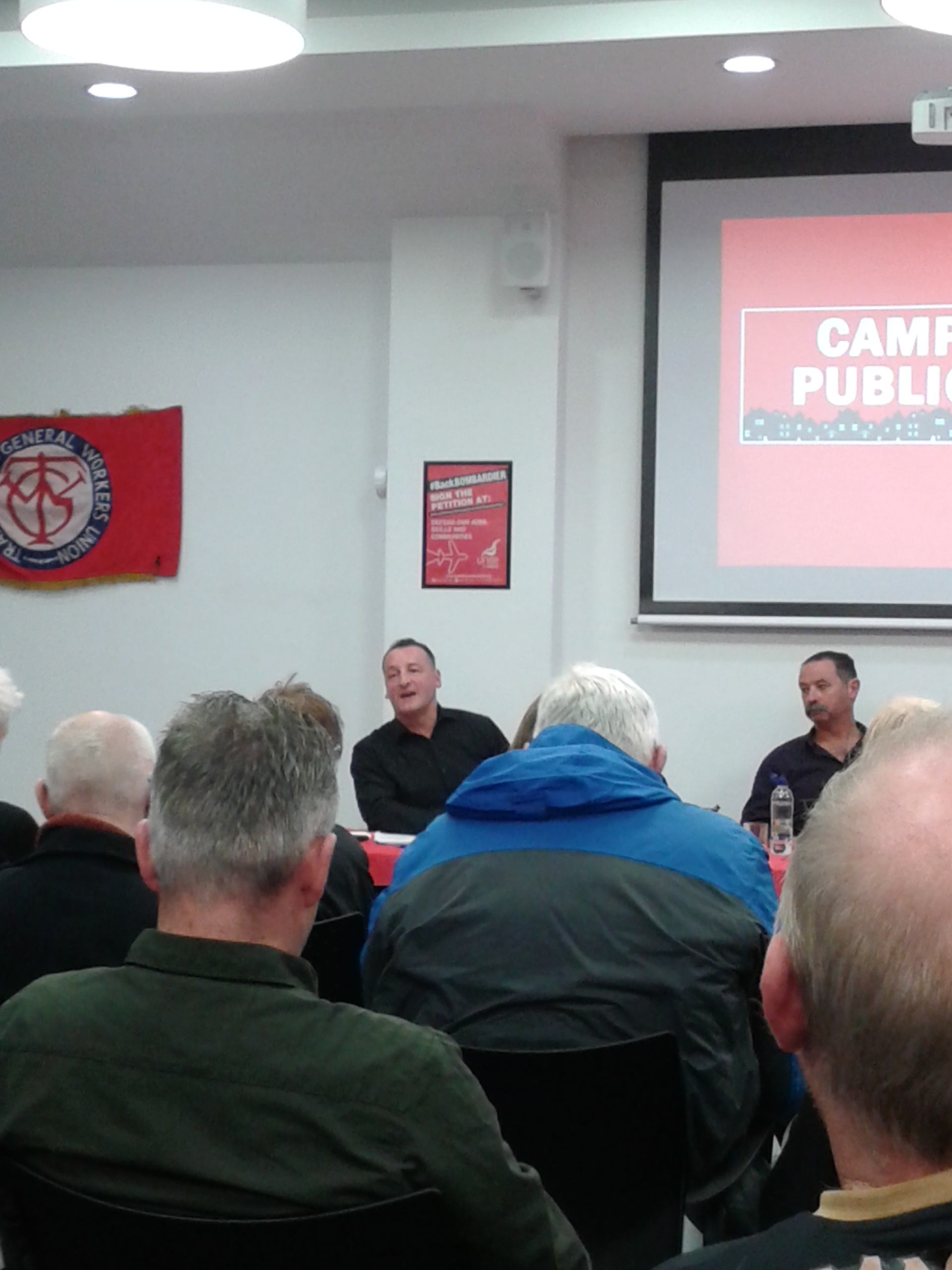
I think so. But it should also be clear that organisation and mobilisation in struggle and resistance should not diminish one iota but, on the contrary, intensify. And revolutionaries should clearly tell the public that only the complete overthrow of the ruling class can usher in lasting change – and that the working class should prepare themselves for that struggle. But also that, whatever members of that coalition slate may say or do, the revolutionaries will never participate in any administration of the old system, i.e no national government prior to the overthrow of the capitalist system and the expropriation of the capitalist class.

“Perhaps revolutionaries should then just ignore the Left slate and concentrate exclusively on revolutionary work – organising and supporting campaigns of resistance, ideological and historical education?”

I strongly disagree. Campaigning for such a slate would bring revolutionary ideology to thousands of working people who are currently unreachable by the revolutionaries. And many people will want to know what revolutionaries think of the Left Slate and of its policies.

And anyway, just because we are revolutionaries, does that mean we are against reforms? Not at all – in our history as revolutionaries, we have been some of the most resolute campaigners for reforms and defenders of them when they have been won! However we are not reformists – the kind of people who believe in a radical or steady improvement in life by reforms but leaving the capitalist system in place.

But we are for reforms that strengthen the working class, the movement of resistance. For examples: the right of workers to combine and strike; the shorter working week and safety legislation; the abolition of child labour; universal education; the right to vote for all adults regardless of gender or property; equal rights regardless of sexuality; abolition of slavery; abolition of racist laws and regulations; the right to oppose invasion; separation of Church and State; the right to protest and campaign politically; the right to freedom of speech and of the press; universal free health care; free or cheap childcare; low-rental housing. These were all rights that we fought for and many were hard-won.

“OK, so revolutionaries could organise electoral support work for the Left Slate – but surely not participate in the actual Slate? Revolutionaries should not present any candidates, of course.”

But why not? We are not against elections in all cases. We elect people to responsible positions in our organisations, decide policies by vote at congresses, decide tactical and strategic aims by voting too. What we are against is not voting but bourgeois elections, where no real change is offered, where we are encouraged to put our faith in some representatives of the existing system and to leave things in their hands for a number of years with little control over what they say or do. Revolutionaries can make it clear that is not what we are about as well as making it clear what we are about, what we intend to do if elected – and if elected, stick to that.

Revolutionary representatives within the Dáil (the Irish Parliament), elected as part of a Left Slate, can work among the other successful candidates of the Slate to strengthen adherence to the list of demands and to combat drift away from them or towards other concessions to the ruling class.

And if we are part of the discussion on the Manifesto and the Slate, we can also participate in the fight to agree that Manifesto in the first place because it is certain that will not be an easy struggle. But let us never forget that the role of the Left in any Parliament should be to support the struggles of the working people outside – not the other way around.

NO TO A LEFT GOVERNMENT

As revolutionaries, we are for the overthrow of the system, the expropriation of the rich, the empowerment of the working people. There will be arguments and discussions about how best to achieve those aims and that’s fine. Let the people, participating in those discussions, decide, experiment, make mistakes, revise. But that can only really take place in practice when the people hold revolutionary power, i.e after the overthrow of the capitalist system.

(Photo source: internet)

Should a situation exist where a Left Government be elected, or looks likely to be elected, the social democracts and liberals will quickly call for slowing down, for less struggle, to let them get under way. At this point the capitalist class must be weak, perhaps divided among themselves on how to respond, perhaps unsure of the reliability of their repressive forces, the police and army. Or perhaps, though weakened, the ruling class is merely biding its time, organising a coup or some other event. Or, very likely, instead or in addition to the above, they are working with elements inside the Left Government or Party to seduce them, to arrange compromises, etc.

This is the point at which revolutionaries, far from resting and wait-and-see, far from facilitating a Government that is trying to stabilise the system in its hour of difficulty, should instead intensify their mobilisations, their actions, and organise the people more militantly and more daringly, pushing for more rapid enactments of popular demands. Should the ruling class be paralysed or indecisive, they should be shocked further and further, exactly as their disaster capitalists have done to national systems, as described by Naomi Klein in Shock Doctrine (2007).

We can hardly be free do all that from inside a Left Government.

Of course those in the Left Government will plead with us and with the people to give them more time; they will tell the people their great plans, perhaps plead their difficulties. They will accuse the revolutionaries of being disrupters, wreckers, saboteurs …. They may send their police to arrest us.

It will not be the first time in our history to be accused of such things. And in a sense, they will be right — we do intend to wreck the system and we do intend to wreck their project of stabilising it. We intend to overthrow it all and to bring in socialism, the organisation of society and its productive forces and resources by and for the benefit of the people. And that’s the wheel we’ll keep pushing and rolling.

End


Iinks:

Old election posters: https://irishelectionliterature.com/tag/old-fianna-fail-election-poster/