Two very interesting talks were given last night as part of a series of history talks at the Sean O’Casey Community Centre in East Wall, Dublin. The theme was black civil rights in the USA and Catholic civil rights in the Six Counties of Ireland (‘Northern Ireland’ according to some).
Joe Mooney of the East Wall History Society introduced the speakers and chaired the question-and-answer session afterwards.
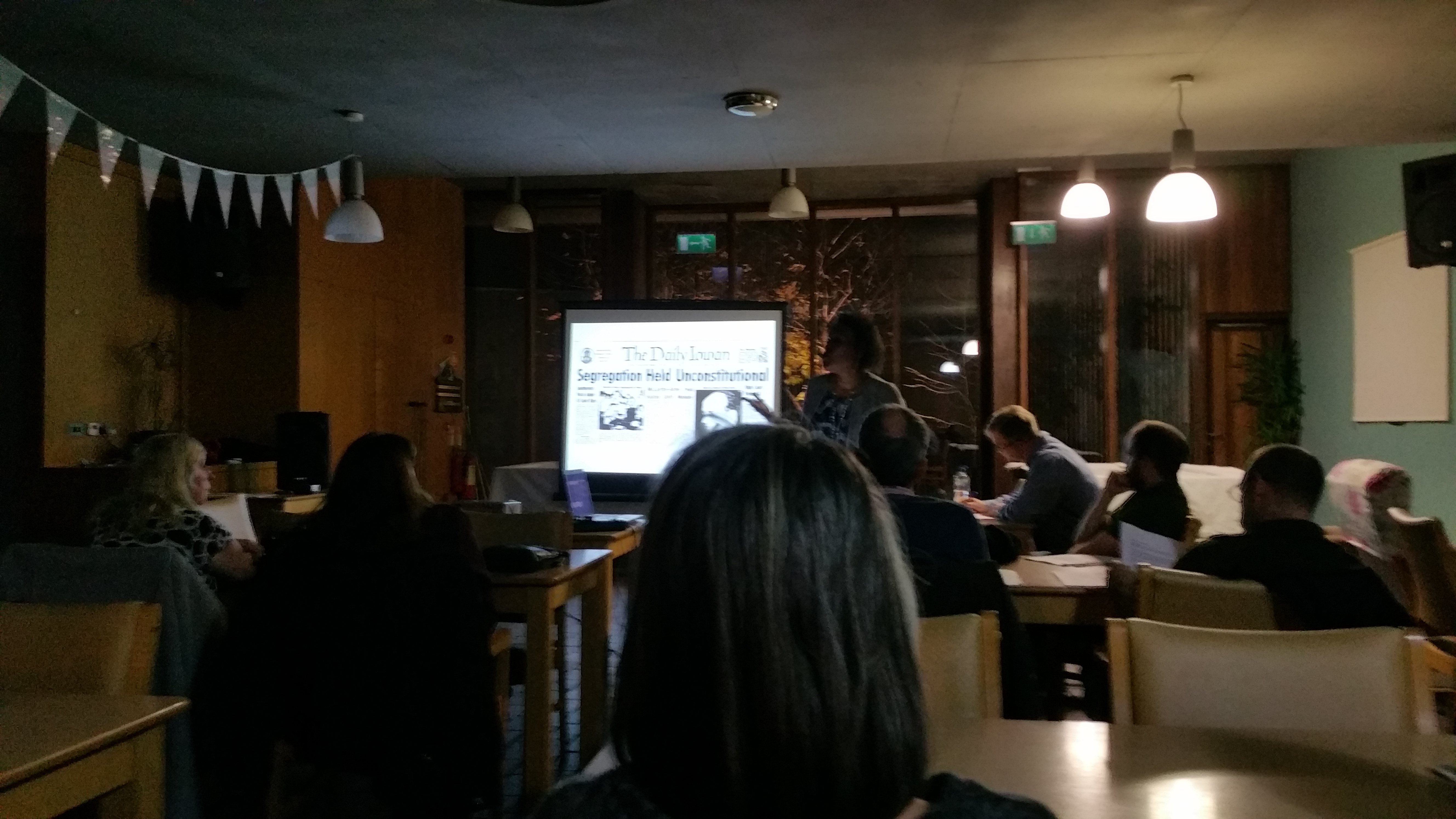
The session opened at 8pm and Cecilia Hartsell had a lot of ground to cover. She spoke on the history of the Civil Rights movement of blacks in the USA, going through the history of seminal events, illustrated with Powerpoint slides and recordings of two White House phone calls between President JF Kennedy and Ross Barnett, Governor of Mississippi and key figure trying to prevent the historic enrollment of James Meredith, a black man, into the University of Mississippi.
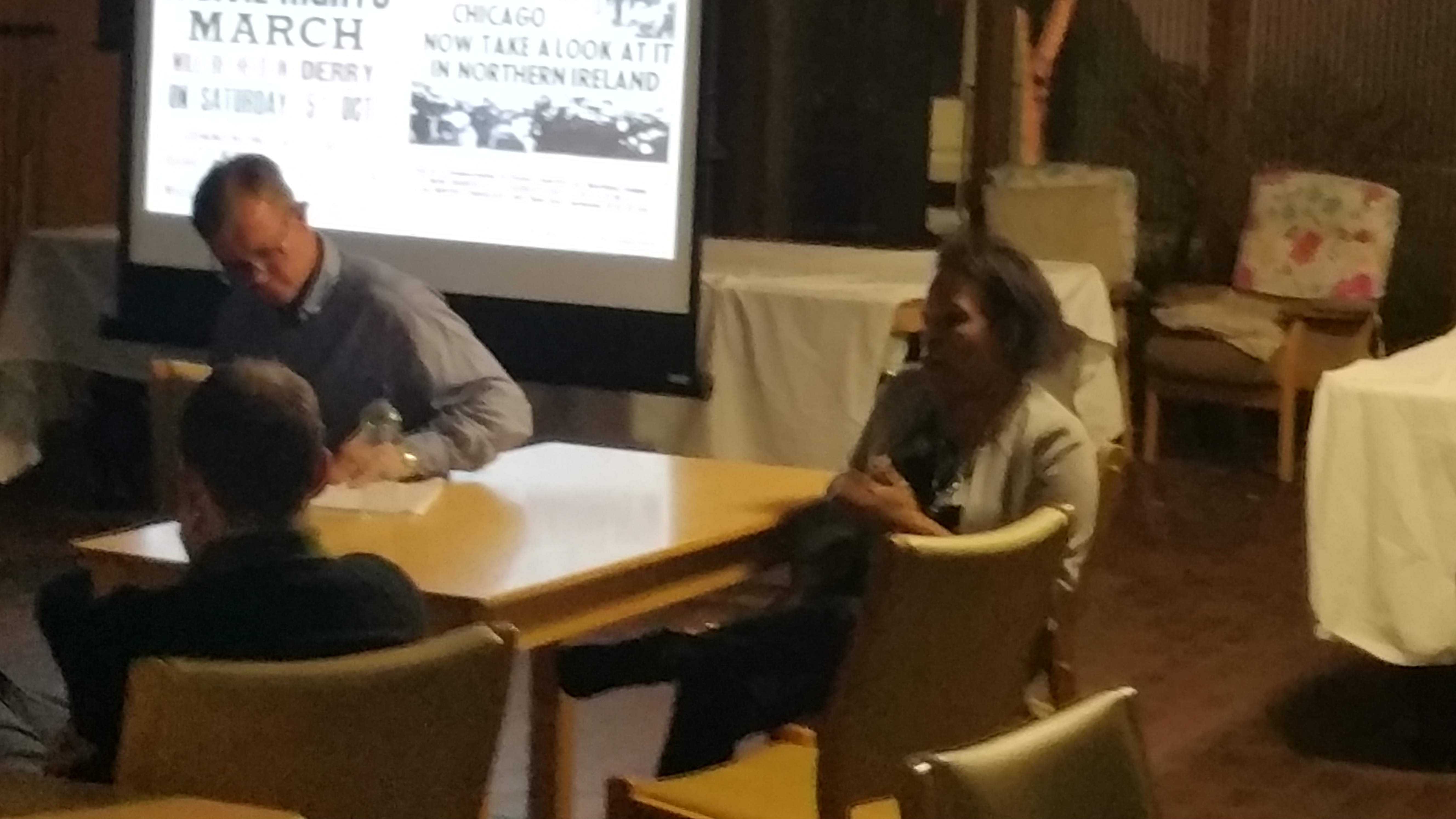
Cecilia Hartsell delivering her talk on the black civil rights movement in the USA
Recalling that in the first two years of his term, JF Kennedy had little to say about black civil rights but was focusing on other issues,Cecilia Hartsell somewhat undermined the (incorrect) image we tend to have in Ireland of Kennedy as an ardent civil rights fighter. In fact he was enforcing Federal legislation on equality and trying to go slowly, while the black campaigners were pushing the agenda along and white racist reaction was holding the USA up to international ridicule and opprobrium during the Cold War with the Soviet Union.
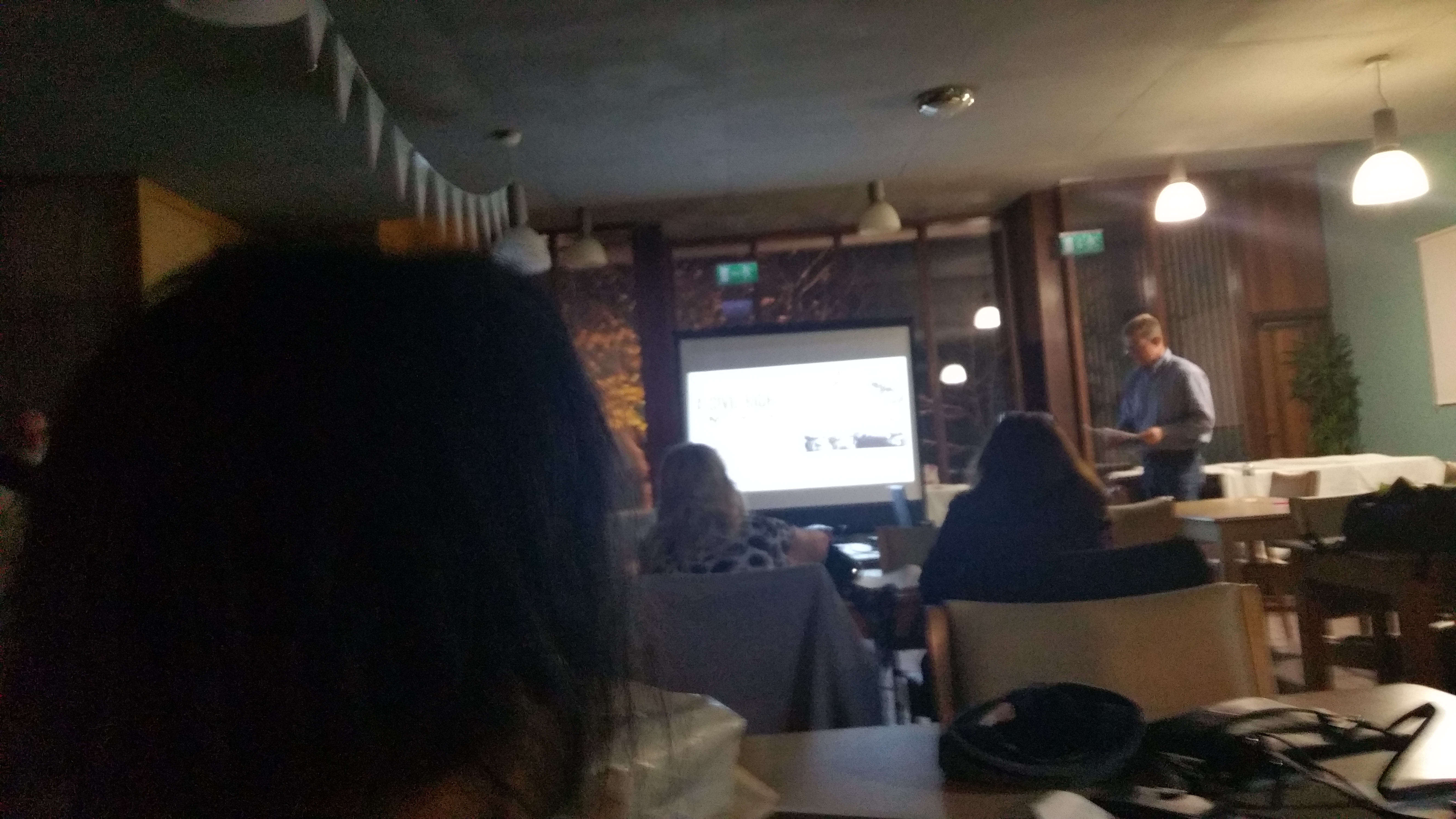
When Brian Hanley took the floor for his talk he fairly zipped along, which he does very well. Hanley undermined some myths or wrong impressions too. Early organisers of the civil rights marches and other events such as the Dungannon house occupation were Irish Republicans; Loyalists had killed four people before the first Civil Rights march. The rhetoric of SDLP and Labour Party notables was much more militant in the early years and Fine Gael was agitating more about issues of discrimination in the Six Counties than was Fianna Fáil, the party in government. And FF had been pushing a referendum to do away with the proportional representation electoral system at the same time that the PR system was among the demands of civil rights campaigners in the Six Counties.
Brian Hanley delivering his talk on the civil rights movement in the Six Counties.
In the session for questions, answers and contributions later, Hanley pointed out that the Southern Democratic Party was the pro-slavery party historically and, after the Civil War, anti-integration and civil rights, whereas the Republican Party was anti-slavery (debunking another false image we tend to have in Ireland).
Both historians made the point that a hundred years is not as long as some might think (this is especially true in ‘historical memory’). The 1940s, when some historians would say, as Hartsell told us, is the date from which to date the renewed fight for black equality in the USA, as surviving black soldiers returned from WWII, was only 80 years from when Federal troops were withdrawn from the former Confederate states. The partitioning of Ireland had been carried out less than 50 years before the Civil Rights protests broke out in the Six Counties, Hanley reminded his audience and many Catholics still lived who remembered vividly the fierce repression that had accompanied it.
It also emerged that albeit there were many similarities, there were also profound differences between the two movements. The black campaigners in the USA were saying that they were citizens of the USA State and demanding the same rights as other citizens, they often marched with the Stars and Stripes flag and even called for the intervention of US troops to defend their rights. The Catholics marching for civil rights in the Six Counties mostly saw themselves as Irish citizens and would never march with the Union Jack. Some did call for the intervention of British troops but many did not; it was mostly Irish troops they hoped would intervene.
The importance of the presence of news photographers at events and their covering in newspaper reports and on television broadcasts was an important factor in both struggles.
USA soldiers facing unarmed marchers for black civil rights. (Source: Internet).
Cecilia Hartsell did not feel that the Black Power movement could have survived Southern racist repression in the 1940s, ’50s and early ’60s and most of the big gains on desegregation of education, public transport, eateries and voter registration and effective right to vote in the Southern States were won during those years with peaceful marches and pickets and legislation (which however were met by much racist violence, including a number of murders). By the time the Black Power movement was coming on to the political stage, so was the Vietnam War and huge changes were taking place in the US, including many mass violent struggles on race and other issues.
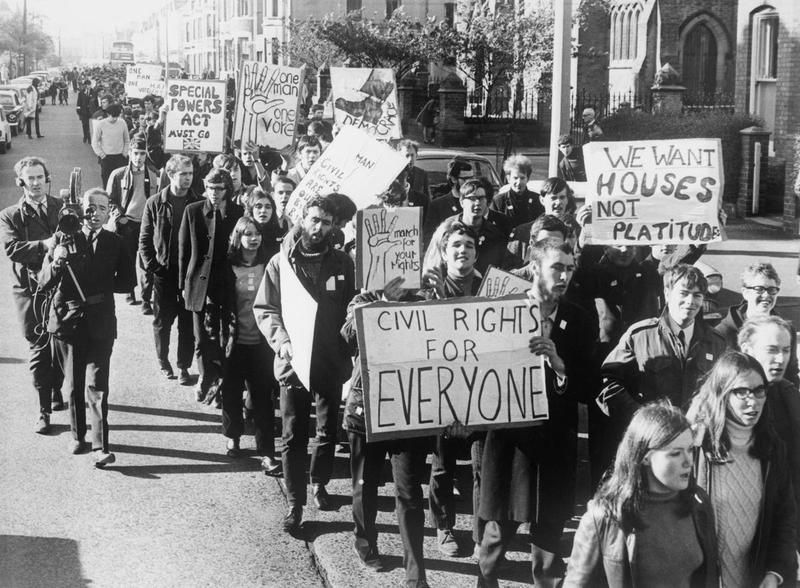
Section of march for civil rights in the Six Counties (Source: Internet).
TERMINOLOGY AND DEEPER MEANING
Wikipedia: “Though often used in history books to refer to the seven states that originally formed the Confederacy, the term “Deep South” did not come into general usage until long after the Civil War ended. Up until that time, “Lower South” was the primary designation for those states. When “Deep South” first began to gain mainstream currency in print in the middle of the 20th century, it applied to the states and areas of Georgia, southern Alabama, Florida, Mississippi, north Louisiana, and East Texas, all historic areas of cotton plantations and slavery. This was the part of the South many considered the “most Southern”.”
“Later, the general definition expanded to include all of South Carolina, Georgia, Alabama, Mississippi, and Louisiana, and often taking in bordering areas of East Texas and North Florida. In its broadest application today, the Deep South is considered to be “an area roughly coextensive with the old cotton belt from eastern North Carolina through South Carolina west into East Texas, with extensions north and south along the Mississippi”.
“Lower South” probably originally referred to its location on the typical north-orientated map of the USA. But I speculate that “Deep” has another meaning – a deeper psychological one, in fact. It suggests that this is a place difficult to understand for people not from there, which means most people. Different rules apply there, we might believe.
I speculate further that after the initial first years of the Civil Rights movement in the Six Counties, that area and the people living in it came to be seen as “different” too. Of course, it was different in that it was a colony (as had the whole country been only 50 years earlier) and that it was run along blatantly sectarian lines, the Catholics a minority there, unlike in the rest of Ireland. And of course, people in a different environment respond differently. But they were still people and the substantial Catholic minority were so clearly oppressed in a statelet into which the Irish ruling class had delivered them. For many people in the 26 Counties it became easier to think of them as somehow foreign in a foreign kind of land, hence my description as “Deep North”.
Cecilia Hartsell and Brian Hanley during the question-and-answer session.
THE SPEAKERS (as posted by EWHG)
Cecelia Hartsell is a researcher of American history. She has been a contributor to the RTE History Show and Radio Kerry on topics in U.S. history and frequently gives U.S. history talks for the Dublin Festival of History and in the Dublin Public Libraries. Cecelia has a Masters degree in U.S. history from Fordham University and a Masters degree in History from UCD.
Brian Hanley is an historian and author. He is currently a Research Fellow at the School of Classics, History and Archaeology, University of Edinburgh . He has lectured at a number of major Irish universities and was Historian in Residence at Dublin City Library and Archives . His books include “A Documentary History of the IRA, 1916-2005” (Dublin, Gill and MacMillan, 2010) with his most recent being “The impact of the Troubles on the Republic of Ireland, 1968-79: boiling volcano?” (Manchester University Press, 2018).
NEXT HISTORY TALK
There will be another talk in the series next week when Dr. Mary Muldowney will present a talk on “The 1918 Election – the Woman Who Stood for a Worker’s Republic.”
From Eoin O’Donnel’s filming and editing via Joe Mooney of East Wall History Group, a recording of Diarmuid Breatnach singing Christy Moore’s wonderful song Viva La Quinze Brigada (also known as Viva la Quinta Brigada which, however, is also the title of another song from the same conflict but in Castillian or Spanish language). The Fifteenth Brigade of the Spanish Republican Army was also the Fifth International Brigade, the mostly English-speaking one. It contained volunteers from English-speaking USA, Canada, Australia, Scotland, Wales, England and ireland but due to high Irish emigration, all those countries also contained Irish diaspora and they were to be found in the contingents from those countries.
The video also contains photos of the commemoration of Jack Nalty, resident of East Wall’s, the last Irishman to die in action during the Iberian Anti-Fascist War (usually known as the “Spanish Civil War”). The day-long event on 28th September (anniversary of his death) included songs and poems, a march led by a lone piper, unveiling of a plaque, booklet launch and showing of two films. It was a celebration in particular of Jack Nalty’s life but more generally of the Irish who, against the position of their Government, the Church of the majority, the dominant media and even, for those in the IRA, against their own organisation’s orders, went to fight against a fascist military uprising against the elected Republican Government of the Spanish state.
It was also a celebration of antifascist resistance around the world and of the principle and practice of internationalist solidarity.
A plaque to the fallen of the Irish volunteers of the International Brigade (containing many names but by no means all of the Irish who fell there). The plaque is on the wall of the Theatre side of Liberty Hall, HQ of SIPTU, Dublin. (Photo D.Breatnach).
Liam Herrick, Executive Director of the Irish Council for Civil Liberties and Mallachy Steenson, Irish Republican and practicing lawyer, on Friday 7th June addressed a Dublin meeting on The Right to Protest, convened by the Dublin Anti-Internment Committee.
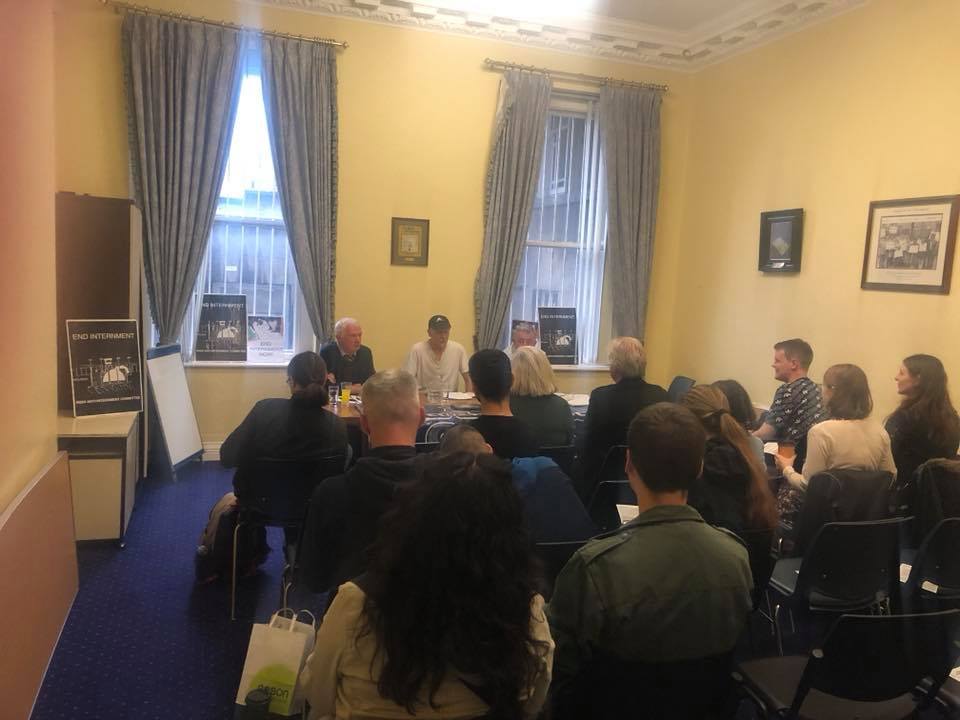
Section of audience and panel at Right to Protest meeting (Photo source: Dublin Anti-Internment Committee)
CHAIR’S INTRODUCTION:
The origins of the Anti-Internment Committee and the Right to Protest
Opening the meeting and speaking for the organisers, the Dublin Anti-Internment Committee, Diarmuid Breatnach welcomed the attendance, introduced the Committee and related how it had grown out of a previous committee, to have Marion Prices released from prison, which had been partially successful (she was released pending trial but her health was destroyed). She and a number of other former Republican prisoners who had been released under license under the Good Friday Agreement, such as Martin Corey and more recently Tony Taylor, had their licenses revoked and were brought to jail without a trial or the right to challenge whatever evidence the Secretary of State for Northern Ireland claimed to have against them. Some considered this a form of internment by some and the Anti-Internment Committee had been set up in June 2013.
Breatnach emphasised that the Dublin Committee had always been and remained — attempts at takeover and accusation notwithstanding — independent of any other organisation and committed to reaching decisions in a democratic manner and conducting themselves in a principled manner towards other organisations. The Committee organises the annual Anti-Internment rally in Newry and holds more-or-less monthly pickets in different parts of Dublin, which anyone is welcome to support, he told the audience.
Chair of meeting Diarmuid Breatnach speaking at Right to Protest meeting (Photo source: Dublin Anti-Internment Committee)
Although the Dublin Anti-Internment Committee updates a list of Republican prisoners in jail and also raises issues about the human rights of Republican prisoners such as right to education and art work, appropriate medical treatment, release from solitary confinement and on occasion about miscarriages of justice such as the Craigavon Two, nine years in jail now – nevertheless the true focus of the Committee is on issues of internment.
Introducing other areas of repression by the states on both sides of the Border which the Committee considers to be types of internment, Breatnach outlined the practice of refusing bail to the accused or of making bail conditional on the individuals removing themselves from all political activity. When the accused justifiably refused to accept these conditions, they were jailed, only perhaps to be found not guilty two or three years later, as had been the case with Stephen Murney. But still having effectively served a jail sentence.
“The right to protest is everywhere under attack” stated Breatnach and declared that maintaining that right was necessary for the winning and maintaining of a wide group of basic social and political rights, from practicing one’s sexuality or religion, or indeed criticising the Church, to forming a trade union, going on strike and marching against unjust laws or measures. Breatnach bemoaned the apparent inability of a number of Republican groups to unite in defence of this right and of Socialists in uniting with them even on this most basic of levels. “We can either stand together or fall separately” he said.
Internment is used by states against political opponents, said Breatnach, recalling that the British had used it in Ireland after the 1916 Rising, the new Irish state had used it during the Civil War and again during WWII under De Valera; the British in the Six Counties between 1971 and 1975.
Internment is a means of “removing unwanted members of the public”, Breatnach said, quoting the words of anti-insurgency specialist Brigadier Frank Kitson, who had been present during the repression of the Malayan resistance and also an operational Commander in Ireland from 1970-1972, years which Breatnach reminded his listeners were those covering the introduction of internment and the massacres of civilians in Ballymurphy and Derry.
Referring to the infamous “Heavy Gang” of the Gárda Síochána whose brutal methods had extracted false confessions on the Sallins Mail Train robbery from socialist republicans in the 1970s and from the family in the Kerry Babies case, Breatnach recalled the formation of the Irish Council for Civil Liberties at that time and that it had been a campaiging organisation unafraid to challenge the State on its repressive actions. Sadly over the years the organisation had fallen away from that path, he said and he was particularly glad to welcome Liam Herrick of the ICCL to speak at the meeting and in the hope that the organisation was returning to its roots.
LIAM HERRICK, ICCL: The Right to Protest and the work of the ICCL.
Liam Herrick, Executive Officer of the ICCL, speaking
After the applause, Liam Herrick thanked the Committee for having invited him to speak. He wished to list some of the efforts in which the Irish Council of Liberties was engaged and also to hear from the audience some of the problems they were encountering.
Briefly covering the early years of his organisation, Herrick related that it had been formed as a response to police repression, mostly of Republicans but also of some Socialists, and in particular due to the activities of the Gárda unit known as the “Heavy Gang”, by academics, activists and lawyers. It had taken up early cases of the ill-treatment of detainees, the use of the Offences Against the State Act, repression of protesters of the Ronald Reagan visit including the case of Petra Breatnach in 1984 and Water protests in the mid-1990s, also in the street-traders’ protests in which Tony Gregory was prominent.
The issue of the right to protest and State repression had come up again a number of times including in 2002 against the Anti-War Movement with the use of the OAS Act and in particular with the Reclaim the Streets protest in 2002, in which video recording of police actions had revealed the extent of police brutality without any arrests. Similar problems had been encountered by protesters at the 2004 EU Council meeting in Dublin, and water canons had even been imported by the State from the UK and widescale repression and had come up again at the Corrib Shell protests.
The ICCL had in 2014 published “Know Your Rights” booklet. And had called for a root and branch review of procedures for dealing with protests, noting that there existed a major gap in rights and policing process and has published a publication by the title of “Take Back the Streets” and has made submissions to the EU and the UN on how states should not just tolerate but manage and create conditions to facilitate the right to protest. The ICCL is part of a network which includes the ACLU in the US.
“If Notifications to the authorities are required should be minimal and reasonable”, Herrick said and gave the contrary example of African Jews who wished to protest against Israeli measures but were charged a 25,000 dollars as a cost of the application for permission.
Police should have a chain of command to deal with protests and be trained not only in weapons and control movements as they are at present but also in de-escalation, in engagement with protesters. Their internal Garda policies should be available to public access but are not.
Herrick said journalists should be facilitated in having access and only just employees of big media organisations but alternative media and individual bloggers whose coverage is often essential to understanding the incidents at an event (in the Reclaim the Streets event such sources were the only source on the Garda violence). There should be restrictions on the use of force as is law and police in Northern Ireland, whatever people might think about practice on the ground, Liam Herrick said. The PSNI every 6 months have to submit a report to the Policing Board which details incidents o the use of force. In the Irish state Gárdaí don’t have to make any report on the use of force which is remarkable in the European context – the use of pepper-spray would seem to be increasing here but no records are available..
Surveillance is an issue and of course can intimidate and have “a chilling effect on protest”, Herrick said. In England face recognition technology is being used which apart from questions about its accuracy, is intrusive. Also trapping of mobile phone activity in the vicinity of a protest. Data collection is an issue and there should be no database on protesters maintained; covert agents have been used and in some cases become personally involved with those they were surveilling – a recording procedure is needed. There needs to be an independent complaint process as the existing process in Ireland has been shown to be inadequate.
At the moment the ICCL is involved in discussions on Gárda reform and the following Friday would be producing a document on Human Rights Policing which people are welcome to read. The international perception is that the law and policy of the PSNI is good, without making any comment on their practice on the ground. The Gardaí should publish a report on their handling of protests every year including statistics (despite the problems on drink-driving statistics) on arrests and the use of non-lethal weapons.
The Gardaí in Ireland have a national security function and there needs to be a discussion on this – in many other countries a separate body is responsible for this. But no legal body is overseeing the operation of the Gardaí on national security or the powers they exercise.
Liam Herrick concluded to applause and Breatnach told the audience that questions could be asked of him and of the next speaker after the conclusion of the latter, then introducing Mallachy Steenson to welcoming applause.
MALLACHY STEENSON: Republicans and the Right to Protest
Mallachy Steenson speaking Section of audience and panel at Right to Protest meeting (Photo source: Dublin Anti-Internment Committee)
Mallachy quoted the right to protest under Article 41 of the Constitution of the State under which document however Republicans would not support.
Moving on to suppression of protests Steenson referred to the most frequently used being the Public Order Act, justification which depends on the subjective view of a cop and is therefore virtually unchallengeable. The result is usually a fine but the use of the Offences Against the State Act is much more serious. In the 1950s there were many arrests of Republicans under the section which prohibits a demonstration within a certain distance of the Dáil and Section 30 was widely used.
Steenson pointed out that almost any gathering of Republicans consitutes some kind of protest due to the basic opposition to the State of Republicans. Funerals are usually protests too, partly in solidarity with the family, partly with movement but also of making a stand and, in the case of the ten dead 1981 Hunger Strikers, in solidarity with their Five Demands.
Steenson believes that most of the protests that occur in the state will be allowed because the they don’t threaten the state from the “trendy liberal side”. For example the housing protests including activist occupations are permitted but when a house was occupied in Charlemont Street and in preparation for moving in a family three years earlier, armed police removed the occupiers.
“The State takes a different view of Republicans” Steenson declared. Referring to the 2016 Sinn Féin Easter 1916 commemorations, Steenson wondered whether they remember their history because the 76th anniversary of the Rising commemoration (1992) was banned and people on the platform arrested. The 66th anniversary commemoration had been beaten off the street in Dublin and people arrested for “membership”, including his own father and others.
“What we have is mostly controlled dissent”, Steenson said. “People remember the Birmingham Six” but are not aware that their campaigners here had their homes raided by police, their jobs visited by the Special Branch, threatened and often lost their jobs.
“What has happened in Ireland is a privatisation of dissent,” Steenson said. “They are funded by the State and he who pays the piper calls the tune.”
The only ones who could really carry out a successful protest in Ireland were the farmers who here, as in France, had no hesitation to block roads and motorways and dump slurry at the Dáil, Steenson declared. The only other really effective protest that hurts the State is the withdrawal of labour as in a general strike – which should have happened when the banks were bailed out — but the trade union movement in Ireland works hand in glove with the State.
“Republicans are well-used to surveillance” Steenson went on to say with a reference to “the new MI5 Garda Commissioner” who declared upon coming into office that the biggest threat to the State is the armed ‘dissident’ Republicans, which Steenson commented were no real threat to anyone except themselves.
“The State is built on the defeat of the Republic,” said Steenson and therefore naturally Republicans are its enemy. Referring to the water protests and their suggested victory, Steenson opined that the success was only due to Fianna Fáil changing sides and he believed that the USC (Universal Social Charge) should be the main object of protest which takes much more out of people’s pockets.
In 1972 the British Embassy in Dublin had been burned in protest at the Bloody Sunday massacre in Derry. Steenson declared that too was managed by the State, having a national Day of Mourning, allowing people to blow off their anger at the sacrifice of a building and listed other protests he believed had been managed or controlled by the State, including the medical cards for the elderly.
People should be able to go to protest without asking the State, Mallachy believed and asked what is a valid protest, referring to gathering protest against the expected visit of Trump while that of Clinton in Dublin passed quietly by without protest. “What is it about Trump?” asked Steenson. “If it’s about killing people, Clinton killed many more. If it’s about treatment of women, well we all know Clinton’s record on that.”
The real problem impacting on most working people is drugs, Steenson said, and the gangs involved in it. Families Against Drugs had been a big campaign but some of the activists were in it to get funding. “People should separate their political activism and their job,” Steenson declared. “We need to move away from having paid groups organise protests”, Mallachy said. “Most protests now are during the week,” he added, “because activists don’t want to interfere with their weekends.”
“We need to look at what is an issue and what is effective”, he said and talked about empty houses and the way housing protesters in the 1960s and ’70s not only occupied them but moved homeless families into them.
“During WWII we didn’t intern Germans or English here”, Steenson commented, “we interned Republicans.”
“Protests will be allowed as long as they don’t threaten the State”, Steenson said, coming to a conclusion and the only ones organising protests that threaten the State are Republicans. He posed the question whether democracy is any use to working people, because it had not brought them much.complained too about police being masked and said that in a normal society you would not have that, nor armed police everyday on the streets. He commented also on the degree of video surveillance used by the State which could track people from leaving the door of the building all the way home.
“Gardaí are there to protect the State, not to protect the citizen, whatever combination of political parties are in government,” he told his audience. “To them and to the State, Republicans are the enemy. That’s just the way it is.”
CONTRIBUTIONS AND QUESTIONS FROM THE AUDIENCE
After the applause following Steenson’s talk, Breatnach opened up the meeting to contribution or questions from the audience, asking them to keep them brief and telling them he was going to take questions in groups and the speakers could choose to which to reply.
Side view of section of the audience (Photo source: Dublin Anti-Internment Committee)
An audience members spoke about the level of repression from Lurgan RUC/PSNI and how eight people had been charged and their bail conditions were not to associate with one another but two of them live near one another.
A contribution declared that Drew Harris being appointed as Garda Commissioner was equivalent to a railroad to jail and related a case of an elderly woman being persecuted in Rossport.
Another directed a question specifically at Liam Herricks about treatment of people in some of the rural courts where protesters were being very badly treated.
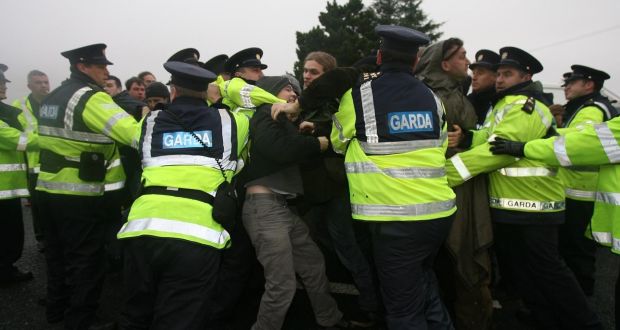
Gardaí attacking protesters
An Ireland Palestine Solidarity Committee activist said that usually they don’t get much trouble from the Gárdaí but more often from the private sectors, from private security personnel when they protest at a business as part of the solidarity campaign. And the Bank of Ireland had closed their account, which caused the organisation considerable difficulty. He wondered whether this was the State’s influence under pressure from the Israelis or others, or instead the banking company under pressure from the same sources or from financial sources. Or whether it was part of the general “de-risking” measures people talked about. The Cuba support group had suffered a similar problem.
Relating his contribution to issues of surveillance, one person described a car journey from an event for about two hours across Dublin, after which he stopped at a fast food takeaway facility. He had felt followed earlier on and when the Garda came in behind him in the takeaway with the usual harassment, he confronted the officer and asked him how had followed him all that way. The Gárda pointed to cameras above on street poles and said: “We don’t have to follow you, they do.”
Another person related how “membership of an illegal organisation” is being frequently used to jail Republicans under the OAS on the word, without the need to display any proof, of a Gárda senior officer.
He thought he had heard of one case where it had been used against a gang member and wanted to know were there any others that the speakers knew of?
Neither had heard of any and Mallachy commented that next year the OAS will be 40 years old. Liam Herrick referred to a piece of research carried out by Nuala Ní Fhaoláin at the UN.
A Polish and a Catalan separately expressed their solidarity with Irish people struggling against repression, briefly alluding to their own struggles and the Polish person mentioning the recent arrest and jailing of a comrade of his in Turkey.
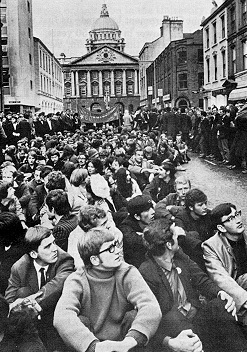
Queens University Belfast students sit-down protest when prevented from marching, 1968.
As there were no further questions or contributions, Breatnach thanked people for their attendance, the speakers for the talks and audience members for their contribution and asked for contribution towards the rent of the room. “This is not the beginning of a broad campaign to defend human rights or if it leads to it, it will not by our Committee leading it,” said Breatnach, adding that no doubt they would be happy to contribute to such a campaign. Urging people present to keep in touch with internment issues through the End Internment Facebook page he stressed once again the need to unite across ideological divisions against State repression.
End.
POSTSCRIPT:
A number of public meetings in Dublin about similar issues followed the one above in quick succession, no doubt coincidentally:
A meeting as part of the Anarchist Bookfair on Saturday 15th September on “State Violence and Cover-ups: Community Responses” heard from a speaker on police infiltration of campaigning groups; from Anne Cadwaller of the Pat Finucane Centre (also author of the “Lethal Allies” exposure) about colonial police and British Army collusion with Loyalist murder gangs; and from Hilary Darcy about what might be considered legitimate reforms to be pursued by revolutionaries.
A public meeting in Abolishthe Special Criminal Courts campaign was held on 17th September and heard from international and Irish speakers.
The Justice Delayed Is Justice Denied group held a public meeting on 19th September, raising issues pertaining to the Ballymurphy and Derry Massacres, the Miami Showband Massacre and the Stardust Fire (report: https://rebelbreeze.wordpress.com/2018/09/24/justice-delayed/ )
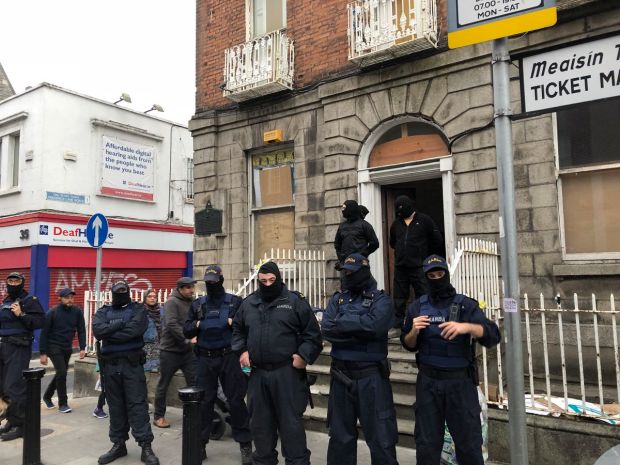
Masked Police, Police with machine guns.
In addition five days after the Right to Protest meeting, masked Gardaí brandishing batons and pepper-spray cannisters assisted a masked “security team” in evicting housing campaigners carrying out a symbolic occupation of an empty building, drawing protest statements from Liam Herrick on behalf of the ICCL to be followed, most unusually, by Colm O’Gorman on behalf of Amnesty International. Five or six housing protesters were detained and at least one was injured..
A few days after that, Gardaí turned up with machine guns and a battering ram to a house where a couple were in dispute with their landlord, leaving when supporters of the couple arrived.
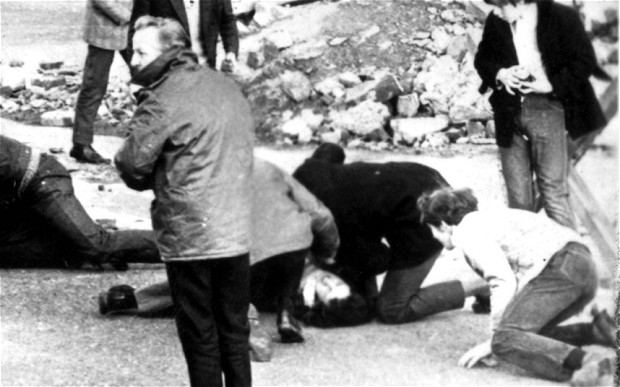
Masked Gardaí and masked “security guards” at eviction of peaceful housing protesters soon after the Right to Protest meeting. (Photo source: Irish Times)1963 Alabama, 17-year-old black civil rights protester attacked by police and police dog. (Photo source: Internet)1972, Derry, part of Bloody Sunday Massacre (Photo source: Internet)Lone man confronting Chines Army tanks on their way to suppress protest in Tienamen Square, 1989Massed Marikana Strikers at Lonmin Mine, South Africa, 2012– 40 were shot dead by police. (Photo source: Internet)
On the 80th Anniversary of his death in the Anti-Fascist War in ‘Spain’, the East Wall History Group organised a remembrance of a local man from that dockland Irish area who was the last Irishman to die fighting in the war against Franco and Spanish Fascism. The event was attended by relatives of that Irish antifascist fighter and of another, by a cross-section of Left and Irish Republicans, including historians and by a number of elected representatives from the Dublin City Council and the Dáil (Irish Parliament).
Crowd assembling outside school before event. (Photo: D.Breatnach)
Jack Naltywas the last Irish and one of the last International Brigaders to fight and die in that war. The rest of the Brigaders, those not held as prisoners by Franco’s forces, were withdrawn soon afterwards as the indigenous anti-fascist forces fought on, losing against the Spanish military coupists with their German Nazi and Italian fascist allies.
Those commemorating Jack Nalty met at the St. Joseph’s Co-Educational School on the East Wall Road at 1pm on Sunday (23rd September) and included a cross-section of members of organisations and independent activists, socialists, republicans, communists and anarchists and other members of the local community. At the front entrance of the School a number of relatives of Jack Nalty held a banner along with a son of an Irish International Brigader and the crowd was addressed by Joe Mooney, of the East Wall History Group.
Joe Mooney speaking at start of event, relatives of International Brigaders beside him holding the banner in the colours of the Spanish Republic (Photo: D.Breatnach)
Mooney told the crowd that John Nalty came to the area at the age of six from Galway and on 31st August 1908 entered the East Wall National School on the Wharf Road. Just over thirty years later, 23rd September 1938, he would die on a Spanish battlefield, shot down in a hail of fascist bullets as he engaged in one last heroic act.
“A member of the IRA during the War of Independence, Jack was a Republican, Socialist and trade unionist”, Mooney said, “representing 600 oil workers in Dublin Port. But in 1936 when the Spanish Civil War — or Anti-Fascist War as it should more accurately be called1 – began, he volunteered for the International Brigades to join the fight against European fascism. He was badly wounded and came back to Ireland, but would again go into action and was killed at the Battle of the Ebro. Having being among the first Irish volunteers to travel to Spain, he would die on their last day as they were preparing to withdraw from combat.
Nalty’s unit had been called to retreat when it was realisted that two machine-gunners had been left behind and he went back to collect them. On their retreat they were fired at and Jack Nalty was killed.
Section of crowd lined up in front of house where Jack Nalty had lived (Photo: D.Breatnach)
Mooney also asked those present to remember not only Jack Nalty but the ‘comradeship of heroes’ from Dublin’s Docklands and North Inner City – Dinny Coady, Tommy Wood and others.
The crowd then set off in a march led by a piper to East Road to unveil a memorial plaque. Across the road from Jack Nalty’s former house, the crowd paused to hear Diarmuid Breatnach sing a few verses of Christy Moore’s tribute to the Irish “Brigadistas”: “Viva La Quinze Brigada”.2
UNVEILING THE PLAQUE
Joe Mooney unveiling the plaque not far from Jack Nalty’s former house (Photo: D.Breatnach)The plaque (text difficult to read in photograph) (Photo: D.Breatnach)
The plaque could not be attached to Jack Nalty’s house and was affixed a little further down the road. Joe Mooney siad a few words there and introduced James Nugent who gave a speech he had prepared and the plaque was unveiled. Nugent concluded by saying that “the history of the past helps us to understand the present and to create the future.”
Kate Nugent read a message from the daughters of Steve Nugent (sadly died 2017) who researched the story of his uncle Jack and Mary Murphy read a short post from Vicky Booth (granddaughter of Syd Booth, who was with Jack when he died).
(Photo: D.Breatnach)Piper plays lament by plaque (Photo: D.Breatnach)
Harry Owens gave a short tribute speech on behalf of Friends of the International Brigades and Manus O’Riordan, son of Irish communist and International Brigade Volunteer, sang the chorus ofAmhrán na bhFiann (“The Soldiers’ Song”, Irish national anthem) and the Internationale.
Section of crowd a location of the plaque (Photo: D.Breatnach)At the unveiling ceremony (Photo: D.Breatnach)Also at the unveiling ceremony (Photo: D.Breatnach)
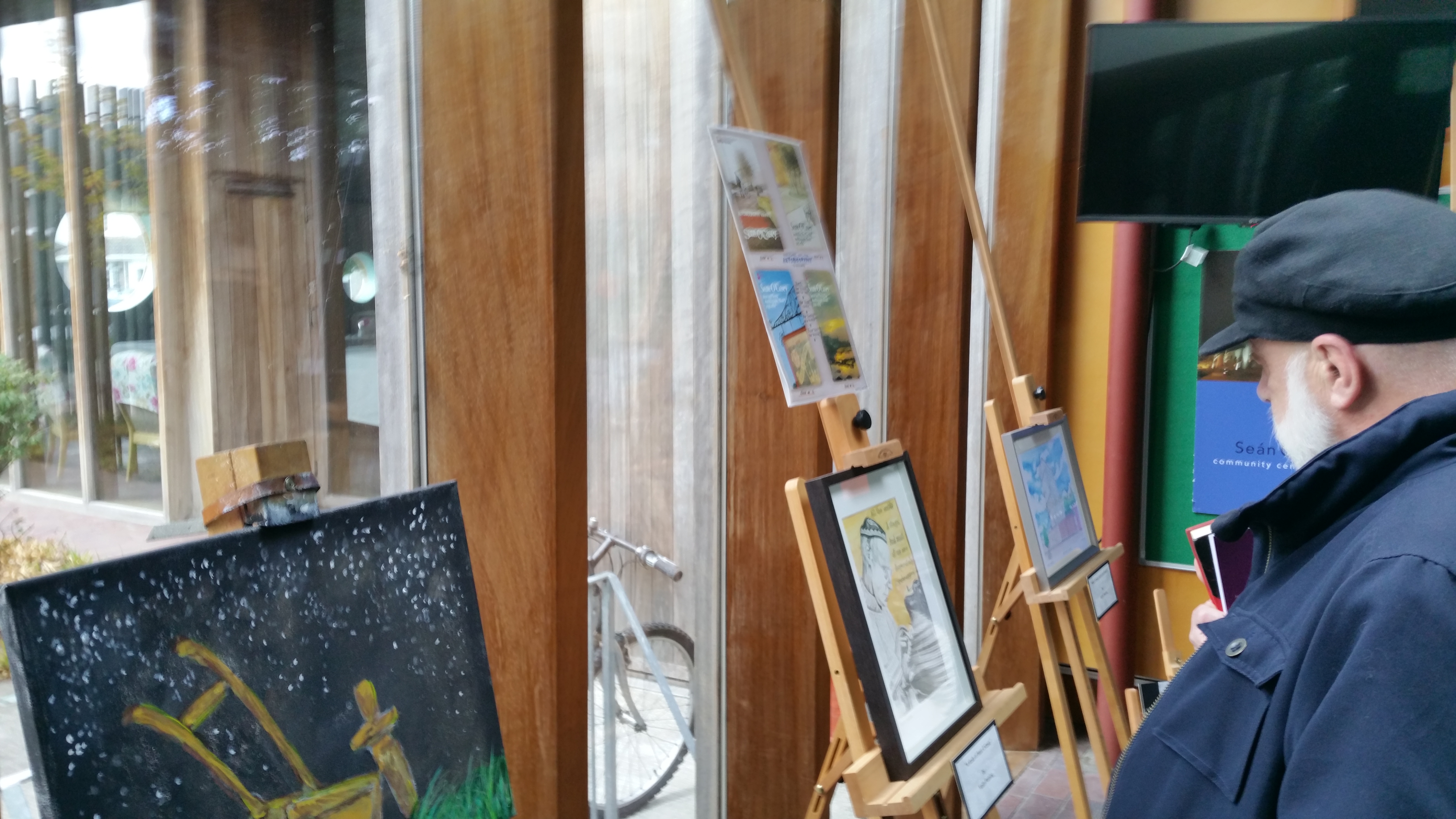
Joe Mooney acknowledged the presence of elected representatives Mary Lou McDonald, Sean Crowe and Cieran Perry and asked people to march to the nearby Sean O’Casey Centre to see the art exhibition and see two short films.
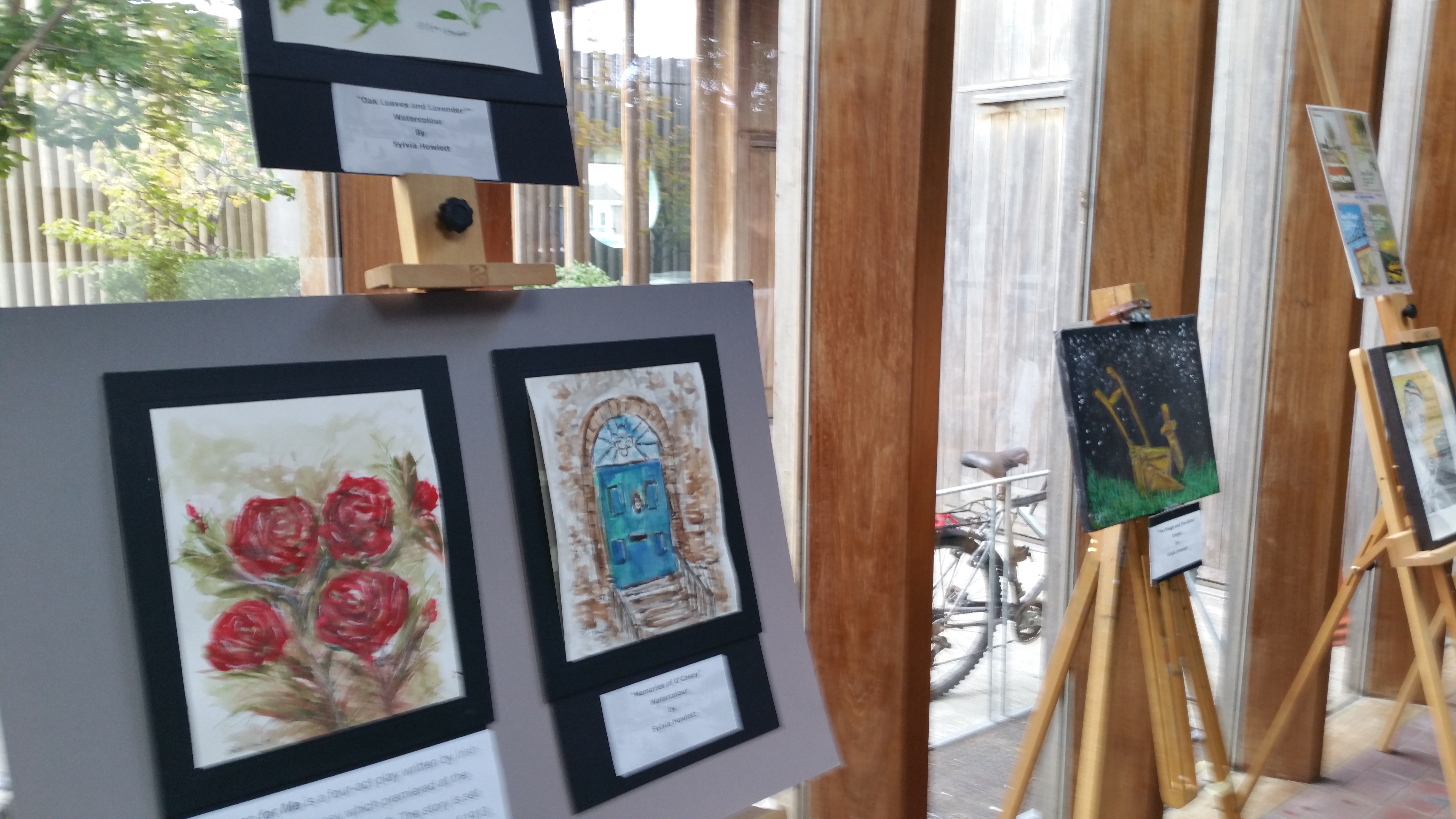
Marching from the plaque site, heading for the SO’C Centre (Photo: D.Breatnach)(Photo: D.Breatnach)Section of the attendance relaxing at the Sean O’Casey Centre between the plaque event and the films to be shown, also examining the art exhibition [see photos at end of post]
Back at the Sean O’Casey Community Centre, two short films were shown. One was a school project film in which a descendant of Jack Nalty interviews the latter’s nephew about his famous uncle. The second was dramatic film in which a Spanish trumpet player joins the fight against the fascist military uprising by Franco and other generals and features also actors playing two Irish International Brigaders, O’Connor and Charlie Donnelly3. When the former trumpet player is shot he sees into the future ….
Eddie O’Neill talked about the pulling out of the International Brigades in October 1938 in a bid to have the “non-interventionist” Western democracies put pressure on Nazi Germany and Fascist Italy to have them withdraw too, which did not happen. They marched through Barcelona on 17th October and were addressed in an emotional rally by La Pasionara4 and Eddie asked Nerea Fernández Cordero to read an English translation.
Nerea on stage just after reading translation of La Pasionara’s farewell to the Brigaders (Photo: D.Breatnach)Eddie O’Neill at the SO’C Centre with concluding speech: “We can’t afford to forget.” (Photo: D.Breatnach)
Nerea told the audience that she is from Extremadura (a province of the Spanish state next to the Border with Portugal) and her grandfather, Antonio Fernández had fought against Franco, been captured, escaped to the mountains but was in time recaptured. Upon his release he had married Nerea’s grandmother and lived a peaceful life. Nerea said that she was proud of her grandfather and those who fought Franco and that “ we know La Pasionara’s speech in Spanish by memory.”
Reading of translation of La Pasionara’s speech to English from Youtube:
At the event the newly published pamphlet “In Pursuit of an Ideal – from East Wall to the Ebro” about Jack Nalty wasmade available for the first time and copies are available from the organisers.
Eddie O’Neill recalled being in the Spanish state with a group from Friends of the International Brigades to commemorate those who fought against Franco during that war and afterwards searching for an appropriate pub in which to socialise. They found a pub with a Guinness sign and went there which however turned out to be one of the most fascist pubs in the area but undeterred, they continued to celebrate the memory of the antifascist fighters there. A lone man in suit and tie asked people as they passed him to use the toilet why they were commemorating people who had died so long ago but when they explained he said he could not understand English.
“We can’t afford to forget,” O’Neill told his audience, “least of all when the forces of fascism are gathering again.”
To conclude the event O’Neill called on Diarmuid Breatnach who sang the whole of Christy Moore’s “Viva La Quinze Brigada”, calling on the audience to join him in the chorus, remembering those who fought and gave their lives in the struggle against fascism.
Eddie O’Neill close at right of photo at unveiling ceremony (Photo: D.Breatnach)
AN ANNUAL EVENT?
The organisers are reputedly considering making this an annual event – it is to be hoped that they do so.
Another section of the crowd at the plaque unveiling. (Photo: D.Breatnach)Also at the plaque unveiling ceremony (Photo: D.Breatnach)
POSTCRIPT: JACK NALTY – ATHLETE COMPETING FOR IRELAND
In publicity prior to the event, the East Wall History group posted the following:
“In addition to his political and trade union activity, Jack Nalty was also a busy athlete, a regular competitor and medal winner with the Dublin Harriers. In 1931 he represented his country at the International Cross Country Championship, held at Baldoyle. Fellow competitor Tim Smyth became the first Irishman to win this competition.
“(The full Irish Group for the event held on 22nd March 1931 is listed as: Frank Mills, J. Behan, John Nalty, J.C. McIntyre, John Timmins, T. King, T. O’Reilly, Thomas Kinsella, Tim Smythe).
“This British Pathe footage shows the runners in action. Somewhere in the group is John (Jack) Nalty, East Wall resident, Republican and hero of the International Brigades. (The Pathe footage is viewable on post on the East Wall History Group event — CS)
“Ironically, the same year as the competition the future leader of Irish Fascism, General Eoin O’Duffy had become the President of the National Athletic and Cycling Association (NACA) , and apparently was an admirer of Jack Nalty as an athlete!”
(Photo: D.Breatnach)
FOOTNOTES
1Basques in the provinces of Bizkaia, Guipuzkoa and Alava say it was not a civil war there, i.e between different sections of Basque society — the fascist forces came from outside. In the fourth southern Basque province of Nafarroa, where the Carlists took control, they wiped out around 2,000 antifascists but it was hardly a war. The Catalans also say that the fascist forces invaded them and that it was not a civil war but an antifascist one. In some other places in the Spanish state many also say that the presence of Nazi German and Fascist Italian military in such numbers invalidated the term “civil war”.
2Also known as “Viva La Quinta Brigada”, which is however also the title of a different song from the Anti-Fascist War. Both titles are correct for this song since the Irish were in the Fifth of the International Brigades but when added to the ten indigenous Brigades (Spanish, Basque, Catalan etc), that became the Fifteenth. Wikipedia quotes authors to report an estimate that “during the entire war, between 32,000 and 35,000 members served in the International Brigades, including 15,000 who died in combat; however, there were never more than 20,000 brigade members present on the front line at one time.”
3Charlie Donnelly was a poet and member of the Republican Congress. He went to Spain to fight against Franco, where he died in February of 1937 at the Battle of Jarama. He is also one of those 19 names mentioned in Christy Moore’s song (“Viva La Quinta Brigada” or “Viva La Quinze Brigada”).
4Isidora Dolores Ibárruri Gómez(9 December 1895 – 12 November 1989), born and brought up in the Basque Country to a Basque mother and Spanish father, founder-member of the Spanish Communist Party and known for her political writing and speeches. She wrote an article when quite young under the pen-name “La Pasionara” (the Passion Flower) and was known by that nickname throughout her life.
Dublin City Councillors at their meeting on Thursday (13th September) voted by huge majority not to sell the former Magdalene Laundry building in Seán McDermott Street in the city centre. Deputy City Manager Brendan Kenny had earlier announced the possibility of the Council selling the building at an expected price of €14.5 million to a Japanese company that planned and hotel and supermarket on the site.
A campaign group called Separate Church & State had lobbied for the building to become a memorial to the suffering of the inmates of the Magdalene Laundries. The group called people to support an event outside City Hall to coincide with a motion being put forward to prevent the sale of the building. A range of people attended, seeming mostly Left social and political activists independent of any party and a sprinkling of People Before Profit activists.
The motion was propose by Gary Gannon, a Councilor of a very small political party (with only one member on the Council), the Social Democrats. However the motion was supported by the overwhelming majority of a Independent councillors (i.e of no party) and those belonging to a number of other parties and was passed with 37 voting in favour, eight against and two abstentions.
Campaigners and supporters in front of Dublin City Hall from across the street (Photo: D.Breatnach)
The successful motion called on the Council not to sell the building and land and that instead those who suffered abuse there should be commemorated with a memorial. Other than preventing the sale, exactly how the memorialising might be put into effect remains to be outlined and agreed. There is talk of the State taking it over but whether by donation of the Council or sale has not been clarified. There are very few memorials to the Magdalene Laundry victims and all but one of them are small.
The Sean McDermott building appears to have been the last of the Magdalene Laundries in Ireland and was closed in 1996. It is also the last of those buildings in the possession of Dublin City Council.
(Photo: D.Breatnach)
The significance of the victory is greater than that of elected representatives versus unelected City Managers, the former being more responsive to public pressure than to the demands of high-ranking officials who seem happy to hand over much of the city centre to property speculators, shopping centres, hotels and large student accommodation complexes.
The terms in which the issue was raised are an attack on the legacy of the Catholic Church’s grip on secular society and its relationship with the State. The campaigners clearly see the Council vote as a victory, though a moral one, against that legacy. And they are planning to press ahead with the offensive in the terms indicated by the title of their campaign, indicating further targets such as the national health and education services, along with legislation to follow on the national referendum’s rejection of Amendment 8 of the Constitution outlawing abortion.
The Magdalene Laundries – some brief background
The Magdalene Laundries were a major institution of the Irish Catholic Church from the 18th to the late 20th Century. There were some Protestant parallels too in the Six Counties (“Northern Ireland”) run by the Anglican and Presbyterian churches but the vast majority of the Irish population were of the Catholic faith. The Laundries took in and accommodated women who were considered “fallen women” which at first meant sex workers but later included unmarried women who had a child or children or even women whose behaviour was considered immoral or flirtatious (or even whose beauty attracted male attention) and they were put to work in the laundries for no pay. Ostensibly at first a charitable initiative, their title drew on the New Testament story of Mary Magdalene who, from being a “morally loose” woman, after meeting him became one of the most ardent supporters of Testament’s Jesus.
But if the name was associated with the alleged mercy and lack of judgementalism of the Christ, it also implied moral sin and judgement. In the extremely conservative Catholic Church that it became after the Great Hunger, the main element was likely to be punishment and, when allied to an also socially reactionary political class, the Laundries became an institution of social control of the Catholic Church in Ireland and of the new Irish State.
The Magdalene laundries soon became known to their inmates as places of hard work and ill-treatment, mostly of a psychological nature but also physical. If women left them without permission, they were pursued by the police and brought back. Continuous escapes could lead to jail sentences.
(Photo: D.Breatnach)
During their time in operation an estimated 30,000 Irish women were kept in these institutions in Ireland, approximately 11,000 after the State was created in 1922.
The horrors of these “charitable institutions” began to be revealed to the public during the last decade of the 20th Century, notably in 1993 after a mass grave of 155 corpses was uncovered in the north Dublin convent grounds which housed one of the laundries and the last Laundry was finally closed down in 1996. The Church never accepted any financial responsibility for reparations.
The Irish State set aside a sum of up to €58 million (about half of which has been paid out – see Links) but the religious institutes concerned, the Sisters of Mercy, Sisters of Our Lady of Charity of the Good Shepherd and Sisters of Charity refused demands from the Irish Government, the UN Committee on the Rights of the Child and the UN Committee against Torture, along with other groups in Irish society, to contribute to the compensation fund for the the surviving victims, an estimated 600 of whom were still alive in March 2014 (see Wikipedia in Links).
(Photo: D.Breatnach)
The Taoiseach (Prime Minister) of the Irish State apologised publicly and emotionally in the Dáil (Parliament) in February 2013 but the State never accepted any legal responsibility, its representatives saying that they did not control the Church. When they were reminded that the victims had washed not only clothes and vestments of priests and nuns but had also done laundry service for such state institutions as Aer Lingus, the Irish Army, the Gárdai, the State’s representatives declared that the Laundries were like any other contractor in that regard and that the State could could not accept responsibility for how contractors treated their “employees”. But it is known that State courts sent a number of women to the Magdalene Laundries. And it was the State that allowed the Catholic Church to dominate social care, health care and education, areas which are usually considered the responsibility of the State.
The general story of the Laundries is fairly well-known in Ireland now through media coverage and the testimonies of victims and even abroad in some countries through the 1992 Peter Mullan film Magdalene Sisters (see Links) and a number of documentaries for TV. Mary Coughlan sang a fierce attack on them too the same year as the film, composed by J.Mulhern (see Links for a Youtube video).
View of the protesters outside the meeting (some were inside) looking eastward. (Photo: D.Breatnach)
There are very few monuments to the suffering of the victims of the Magdalene Laundries and they are all of a small size except the statue in Ennis which aroused some local controversy.
The monument at Forster Street, Ennis, Co. Clare, dedicated to the Magdalen women and a subject of some controversy. (Photo: Mike Shaughnessy)
Despite the duration of their existence and numbers involved and the international coverage, the Pope claimed when tackled by some survivors on his recent visit to Dublin that he had no knowledge of the existence of the institutions.
Sale of Council buildings and land – the legal position and some background
Due to a legislative change some years ago, Dublin Council Executives such as the City Manager and Senior Planning Officer can make major decisions without consulting elected Councillors and even against their expressed wishes. In this way, for example, the planning permission for the Shopping Centre Plan over the Moore Street Battleground and Market quarter was firstly agreed and secondly, even after the High Court judgement that it is a national monument, was renewed in 2016 by the Chief Planning officer of the time, Jim Keogan.
Many feel and have felt since such decisions that this is an unhealthy state of affairs, with no democratic controls and leaving key officials open to suspicion of bribery from developers influencing their decisions.
Fortunately however when it comes to the disposal of Council assets, the Councillors must agree by majority. This prevented the “land swap” proposed in 2014 by Joe O’Reilly of buildings in Moore Street, which if successful would have enabled his company to demolish half the 1916 Terrace: responding to campaigners and interested elected Councillors, the Council voted the proposal down against senior officials’ recommendations in November of that year.
On the 5th August 1914 the Supreme Council of the IRB, one months after the British had declared war on Germany, decided in principle to instigate a rising for Irish independence.
On 5th August 1914, one month after the British had declared war, the Supreme Council of the Irish Republican Brotherhood decided in principle to lead a Rising. They envisaged, as many observers did too, that the War would not last long and arming and preparing for an insurrection would be difficult within that timeframe. The war continuing well beyond the at most expected period of a year, provided the IRB with the space to organise, plan, prepare – and also with an ally to arm them: Germany.
The split in the Irish Volunteers caused by Redmond’s speech at Woodenbridge, offering the Volunteers to British Imperialism for the war against German Imperialism and Turkey, left the secret Irish Republican Brotherhood in a position to take control of the remainder, those who declined to fight for Britain and determined instead to fight for Ireland’s independence.
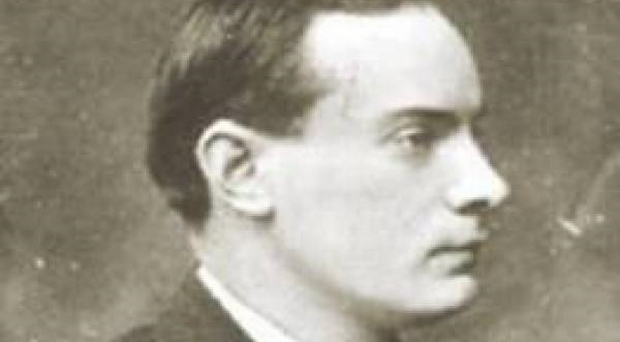
Over a number of months Patrick Pearse became Director of Military Organisation, Bulmer Hobson Quartermaster General, Joseph Plunkett became Director of Military Operations, Éamonn Ceannt, Director of Communications, while Thomas MacDonagh became Director of Training.
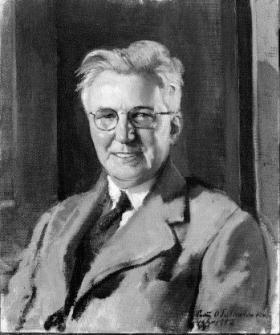
The Gaelic scholar Eoin Mac Neill, titular head of the Irish Volunteers prior to and after the 1914 split. He would later be disgraced in the eyes of many for his public cancellation of the 1916 Rising which went ahead without him but much diminished in numbers. (Image sourced: Internet)Bulmer Hobson in later years. By 1916 be had separated from the IRB he had helped reorganise and was even put under armed detention for a period by the IRB. (Image sourced: Internet)Patrick Pearse (Image sourced: Internet)
The titular head of the Volunteers, the Gaelic scholar Eoin Mac Neil, and such founding figures as The O’Rahilly, while in prominent positions and refusing to follow Redmond, did not embody the same coherence and determination for insurrection as was embodied in the IRB.
That list above contains four of the later signatories of the 1916 Proclamation. Seán Mac Diarmada and Thomas Clarke are missing but, though central figures in the reorganisation of the IRB over preceding years, that is not surprising: the older Fenian, veteran of 15 years in British jail in conditions which, it is said, sent one third of his comrades insane and another third to early graves, preferred to work in the shadows. No doubt he had instructed his student and energetic organiser, Mac Diarmada, to do likewise in so far as possible. However, they too joined the expanded Military Council in late 1915.
Thomas Clarke, ex-Fenian prisoner and the real head of the IRB in Ireland. (Image sourced: Internet)Seán Mac Diarmada, recruited into the IRB by Hobson but became a close supporter of Clarke’s. (Image sourced: Internet)
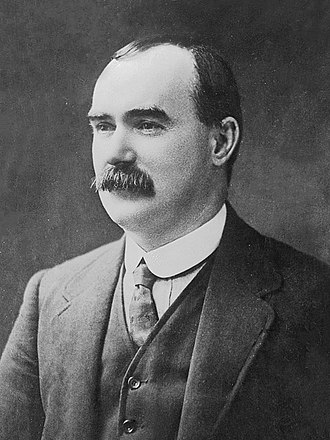
The fifth of the Proclamation Signatories missing is James Connolly, who in August 1914 was recovering and rebuilding the Irish Transport & General Workers union,months after the end of their exhausting 8-month struggle against the Dublin employers. But he was horrified by the imperialist war and the pitting of workers against one another, divided by the ruling classes of their respective locations, uniforms of different colours concealing their common interests. Connolly wanted a rising – not just for independence but also against the coming butchery of War. The reorganisation of the Irish Citizen Army, the worker’s defence militia, began to engage Connolly’s energies but he was only sworn into the IRB in January 1916, three months before the Rising.
James Connolly, photographed in 1900. (Image sourced: Internet)
So many different threads in Irish life – cultural, political, class and nation – had been coming together, to weave a tapestry that would be read in different ways over decades but would still have powerful images, colours and words to move women and men over a century later.
Most people here in Ireland and probably in large parts of the world, don’t believe in revolution, i.e in the act of overthrowing the social class in control. It’s not so much that they are against it, although a minority might fear the consequences or others might think that whatever gains they’d make would be transitory; it’s that they don’t believe it’s possible. Or they think it might be but in some distant future.
This is not surprising because if they did, if the mass of ‘ordinary’ people believed that a revolution was not only necessary but possible, it would already be occurring or at least well on the way.
What is surprising is that so many revolutionaries, or individuals, parties and organisations who think of themselves as revolutionary, or who would, if pressed, claim that they were – they don’t believe in it either!
By that I mean that they don’t see revolution as somewhere down the road, within sight if not necessarily close now, something to be moving towards that could well be reachable within their lifetimes. They might argue that it is not so, that they study revolutionary theory, try to conduct themselves according to revolutionary principles, study revolutionary struggles in history, organise, propagate revolutionary ideas ….. In general, I would not refute those claims but I would still say: They don’t believe in revolution.
And what’s more, that applies equally but in different ways to Irish socialists and to Irish Republicans.
I remember attending a small discussion group once organised by one of the small Irish socialist parties (small are the only kind we have in Ireland) at which the topic being discussed was the H-Blocks campaign. At one point, a prominent member of the organisation declared that the Republicans believe in armed struggle and that their party did not believe in that. Of course I pointed out Lenin’s position on this and the person backtracked but still …..
That was but a small indication of the general malaise but significant all the same. Both socialists and Republicans declare that they are not merely for reform but for the overthrow of the Irish native and colonial ruling classes. Objectively they would acknowledge that this endeavour would require an enormous effort and sacrifice. They would also concede that the ruling classes would not go quietly and, if pressed, would admit (some more readily than others), that the ruling class would resort to imprisonment, repressive legislation and, ultimately, armed power in order to prevent their overthrow.
If they believed the above and also believed a revolution was not only necessary but possible, they’d be preparing for that – but they are not.
Clearly an understanding of the theory of class, history, economics, culture etc. are all necessary. Principles of personal conduct and of organisation are very important too. But the application of principles of revolutionary organisation, the organisational preparedness for conflict and repression, the bringing of the objective into view as attainable – where is that? In the socialist camp, it is generally nowhere to be seen. In the Republican camp, it is visible only in very limited and restricted forms.
ORGANISATION
Socialists accept on a theoretical level that the revolutionary organisation of at least a large section of the working class is necessary in order to achieve a socialist revolution. Many Republicans would probably agree. But the overall practice of both camps is in clear contradiction to that principle.
We can see that clearly if we investigate a little how the working class needs to be organised as a fighting movement in which a large section can become revolutionised, conscious of itself as the leading class of the revolution and not only preparing for but engaging in struggle to that end.
Clearly, an actual mass workers’ organisation is required, a mass organisation based on workplaces, industries, communities where workers live. For the moment, I don’t wish to discuss whether that mass organisation be a party, a movement, a trade union, or a federation of collectives — nor do I think it necessary to specify type in order to develop the point I am making.
OK, so what are the Republicans or socialists doing to achieve that mass organisation of the working class?
In Ireland the most readily-understood and ready-to-hand mass organisations for workers are the trade unions. They are led for the most part by bureaucrats from the top down to shop steward and often even there, the dominant societal ideology is some level of reformist social democracy, the higher leadership is dominated by careerists and opportunists, often linked to a political party of the capitalist system and, as if that weren’t enough, all those tendencies brought them into two decades of formal social partnership (sic) with State and Employers which totally atrophied whatever fighting muscle they may once have had.
Yes, all that. And even so, it is the place to begin.
On the whole, except for some exceptional individuals and perhaps some very short historical periods, Irish Republicans have not bothered with trade unions. Certainly, the Republican movement as a whole has not considered it an important area of struggle for the movement.
Socialists, on the other hand, have generally rated the importance of struggle in the trade union movement very highly. They have participated in elections to become shop stewards, organised industrial resistance action, at times combined to try to elect more militant higher officials, produced leaflets for and about workers’ struggles, sold papers on picket lines and brought speakers from strikes to speak at public meetings. But all those efforts have not produced a revolutionary or even a militant workers’ movement.
A shop steward represents the members who elected her and, her personality apart, they will have a range of views about her political ideology. A more militant trade union higher official may push for more militant action with more or less success – or may increasingly become part of the problem. Some workers may find an interest in some of the ideas expressed in newspapers of the Left and may or may not join this or that party. None of that is organising a worker’s mass movement.
How about then, organising a broad worker’s movement, across many different workplaces?
Now, that has actually been done. Such organisations have been given titles like “Broad Left” or “Grassroots”. And in terms of building a workers’ organisation, they were a colossal failure, the experience of them probably enough to put most workers off socialist politics for a long time, if not forever. The main reason for their failure is that various socialist organisations or parties used them as forums to fight for the dominance within the broader organisation of their party, their organisation, over others.
In one kind of work or large organisation, one of those parties became dominant while another party claimed dominance in another. Sometimes control of one “grassroots” union organisation shifted backwards and forwards, year after year, between different political Left parties as the latter’s fortunes waxed and waned, as they suffered splits, as they formed different alliances.
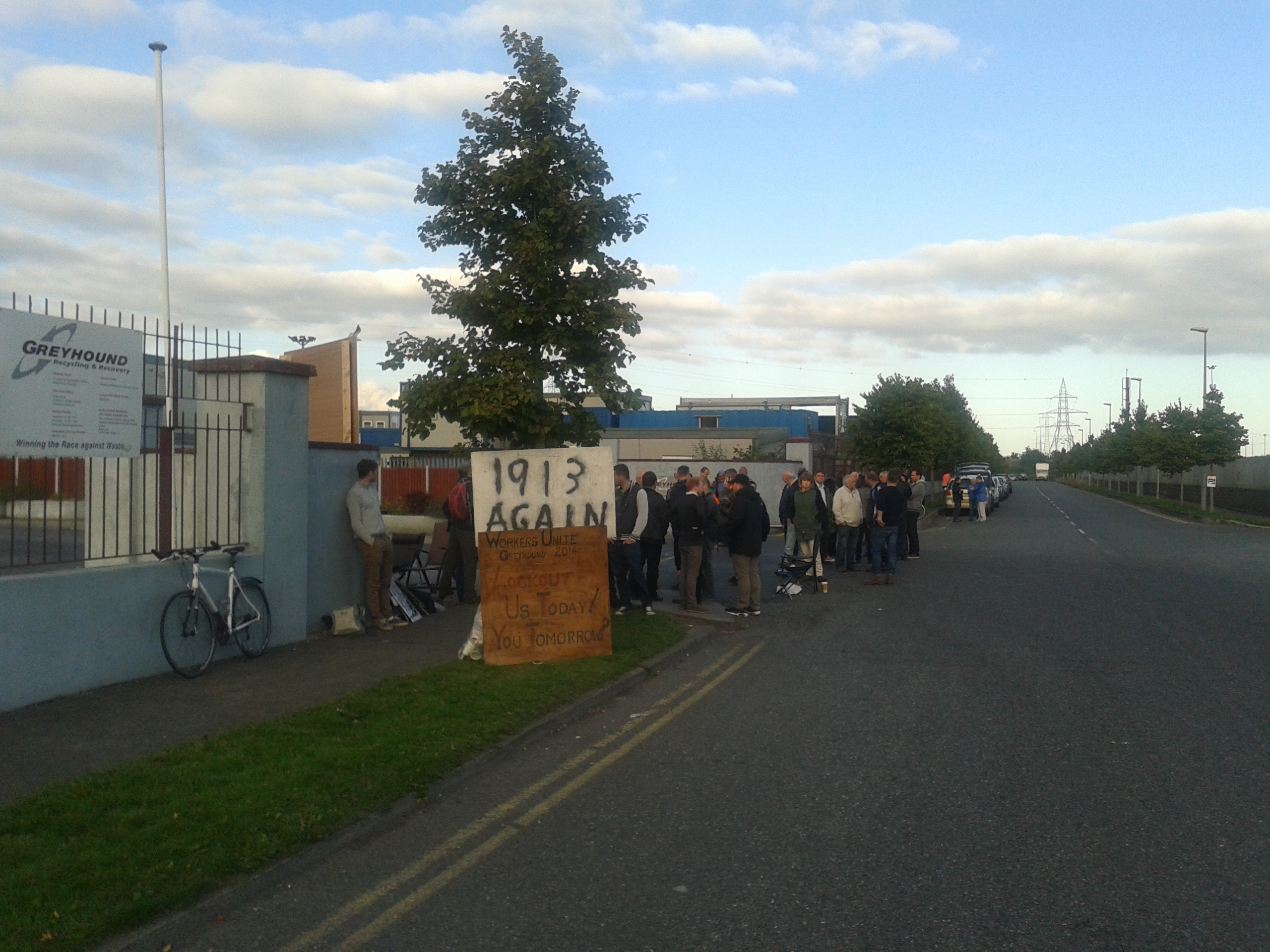
Pickets outside the Dublin depot of the Greyhound waste collection company in a 14-week dispute in 2014. Community and political activists organised support but there was no workers’ grassroots movement do the same. (Photo: D.Breatnach)
Still, it does seem to me, as one who has been a worker in both the manual and what might be called the clerical types of work, as a revolutionary and active trade unionist, that the grassroots model is the one to follow, in order to create the nucleus for the mass workers’ movement. It needs to be based not in one union, not organised around electing different officials (though it may do that from time), certainly not around parliamentary electoral politics in general and not to be the fief or plaything of any political party or parties of the Left. It needs to be based in general on active resistance, on struggle, on solidarity across unions, across workplaces and across industries. It can develop participative democratic forms of membership and representation, its own mass media and in time, cultural and education groups, mutual aid etc, extending into the whole life of the working class.
But who is undertaking that work? Nobody.
REPRESSION & UPRISING
Moving on to another area of preparation for revolution, if we accept that the revolutionary path necessarily incurs repression from the class (or classes) that we seek to overthrow, then we’d need to know something about street fighting, about being interrogated in detention, and prison life, right? At least here we find quite a few Republicans nodding in agreement. But the socialists? Blank looks from them.
Deviating from the rich literature on the Irish Republican jail experience, this is about the prison struggles of John Barker, an English political prisoner jailed with social criminals in British jails in the 1970s. (Image source: Internet).
However, not all is well here among the Republicans, either. Not all will be having any kind of training in resisting interrogation and hardly any at all in discussion of theory and practice in street fighting. Due to traditions in particular from the 1970s onwards, prison for Republicans in Ireland usually means segregation from people convicted of social crimes and segregation from other Republicans too, according to organisational membership or alliance. Still, a lot of experience has been accumulated in that kind of environment and extensively written and talked about in the Republican movement. But next to nothing about street fighting, unless we include in that the use of firearms or at least the construction of a Molotov cocktail. The engagements envisaged in that respect are of a hit-and-run nature, skirmishes and small battles ….. and not at all a popular uprising in which extended conflicts will become the rule, at least until revolution occurs or the ruling class, at least temporarily, gains the upper hand.
Two sides of street fighting — the people and the forces of repression — the Battle of the Bogside, Derry 1969. (Image sourced: Internet)
CONCLUSION
If the areas I have pointed out are crucial areas of revolutionary preparation, we can perhaps agree on some principles: A revolution in a developed capitalist society is not possible without a mass, militant and socially-politicised workers’ movement.
A revolutionary struggle entails physical confrontation, including large-scale street fighting and must expect repression; therefore revolutionary preparation must include training revolutionaries in conducting the first and resisting the second.
Those who are not undertaking work around those principles above, or at least considering how to do so, no matter how energetic or militant they may be, cannot be said to really believe in revolution; at most they can only see it as some distant thing, which perhaps another generation will undertake, some kind of life after their death.
And if they don’t believe in it, how can they expect others to believe?
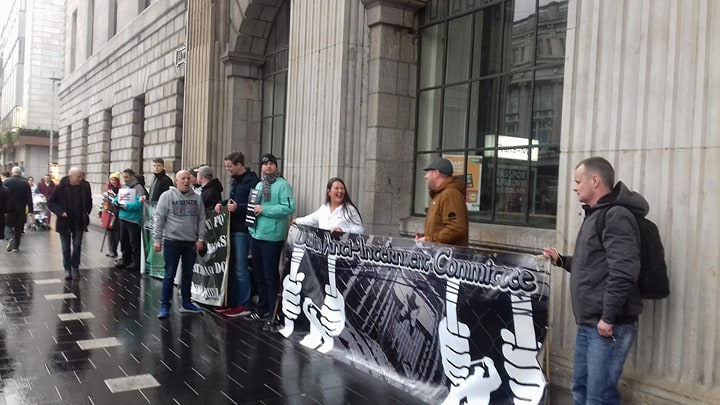
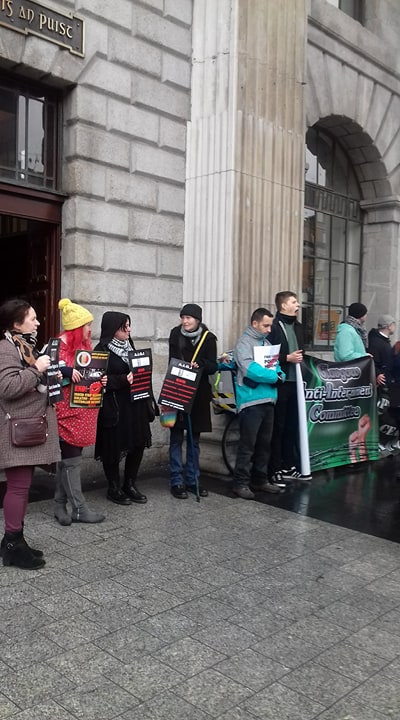
Glasgow and Dublin Anti-Internment Committees joined forces on 18th February in a protest against continuing internment without trial in Ireland. Around two score protesters gathered outside the iconic General Post Office building in Dublin city centre’s main thoroughfare, O’Connell Street. They displayed the anti-internment banners of the Dublin and Glasgow committees and placards against internment, including one against the jailing of Catalan political activists by the Spanish state (also refused bail).
Section of protesters outside the GPO building, O’Connell Street, Dublin (Photo source: End Internment FB page)(Photo source: End Internment FB page)
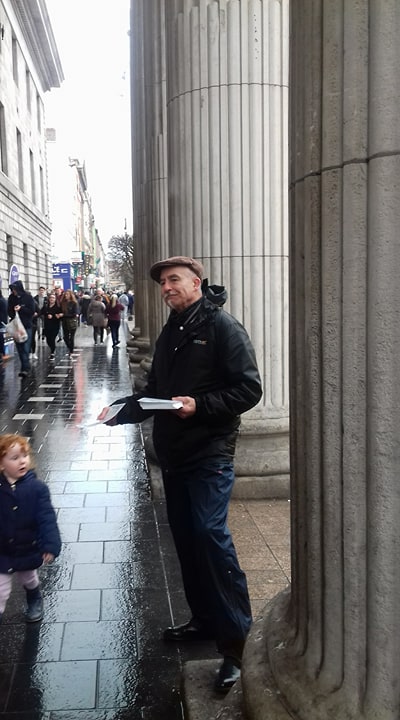
Leaflets of the Anti-Internment Group of Ireland were distributed to shoppers and visitors passing by, along with others about the conviction of Brendan McConville and John Paul Wooton (the Craigavon Two), framed and jailed in 2009 and still in jail, serving life sentences. Songs about internment and political prisoners were played on a sound system, as well as Labi Siffre’s Something Inside So Strong and Christy Moore’s Viva La Quinze Brigada.
Young passer-by accepts leaflet from Dublin Committee leafleter (Photo source: End Internment FB page)
Despite the official end of internment by the British in 19751and by the Irish state in 19572, Republican activists continue to be jailed without trial in a number of ways: Licence revoked and bail refused or revoked.
(Photo source: End Internment FB page)
When a Republican leaves jail under license, she or he can be returned there without any court hearing or the presentation of any evidence against them; this is what has happened to Tony Taylor and Gerry Mackle, for example. Refusing bail for accused Republicans has become almost standard, despite the fact that this is supposed to be a last resort, for example when there is a serious risk of the accused fleeing the administration, or interfering with witnesses – which has rarely applied to Republicans refused bail. The real reason has usually been revealed when they have been granted bail: they are required not to attend protests, meetings or to associate with other active Republicans. In other words, they are being prevented from exercising their civil rights to express their opinions and to organise politically.
Welcoming the participation of the Glasgow Committee in Dublin, a spokesperson for the Dublin Committee stated that “members of the Dublin Committee have been proud to attend anti-internment protests in Glasgow in the past” and went on to say that “we look forward to future cooperation with the Irish diaspora and internationally against political repression, particularly of jailing without trial of political activists.”
Another Dublin Committee leafleter. (Photo source: End Internment FB page)
The Dublin Anti-Internment Committee is entirely independent of any political party or organisation and holds regular awareness-raising protests at different locations. The Committee welcomes the participation of other organisations or individuals in their protests but asks them not to bring political party material etc to the anti-internment protests.
On its FB page the Committee also maintains a list of Republican prisoners in jails on both sides of the British Border, updating it from time to time.
FOOTNOTES
1By then more than 1,900 people – only around 100 of them Loyalists – had been interned, many of them tortured; it was during protests against it in 1971 in Ballymurphy and 1972 in Derry that the Parachute Regiment killed 25 unarmed people.
2Introduced by De Valera’s government in July 1957 during the “Border Campaign” of the IRA.
(Photo source: End Internment FB page)(Photo source: End Internment FB page)
When one hears or reads the words “Gaelic Ireland”, the reference usually takes one of four forms:
Historical
Geographical-cultural
Nostalgical
Sneering
Historically
“Gaelic Ireland”, when used in a historical sense, is a reference to either a time when the majority of Irish people spoke the Irish language (up to 1800 CE many scholars agree) or to a time when the Gaelic order of society was dominant or when the Gaelic Order survived in some part of Ireland (for example up to the Flight of the Earls in 1607) .
Geographically-Culturally
Perhaps used to describe those shrinking parts of Ireland where Irish remains the mother tongue, more normally called the “Gaeltacht” or “Gaeltachtaí”.
Nostalgically
This is a usage which corresponds somewhat to the historical sense above but is also imbued with nostalgia, a regret for what passed then and perhaps a wish to restore it. Despite the accusations of many of those hostile to the Irish language, relatively few people — including among Irish speakers, have any wish to return to that historical period.
Sneeringly
When referred to in this way, it is to link Irish-speaking with out-of-date things, some kind of anachronism, a backward thing, not suitable for our modern society; frequently linked also to Irish nationalism and De Valera’s concept of the desirable kind of society for Ireland and the 1937 Constitution, therefore linked also to the social and political dominance of the Catholic Church. Such a disdainful attitude is often connected to the disparaging way in which a person may speak about a “Gaeilgeoir” — it is as though the person referring to the Gaeilgeoir, which originally meant only “Irish language speaker”, has in mind a devout Catholic wearing an Aran jumper and generally unfashionable clothes and hairstyle, with a gold “fáinne” (a ring-shaped pin awarded for proficiency in Irish) in his or her jacket (probably Irish tweed).
I fear that this type of attitude is present in most enunciations of “Gaelic Ireland” — certainly outside those of the historical sense.
Although by no means associating the writer of a recent article with this contemptuous opinion of Irish speakers, there was more than a hint of a disparaging attitude expressed, in my opinion, in an article much-praised by many Republicans and some socialists, commenting on the racist expressions of some people after the recent lethal incident in Drogheda recently. Dieter Reinisch, whom I understand to be a left-wing Irish Republican, wrote to separate Irish racist commentators on the recent fatal incident in Drogheda from Irish Republicanism.
The article had a progressive intent and made some valuable points but it also linked this Irish racism with “Gaelic Ireland nationalism”1. Although the article does this through reference to individuals it smears “Gaelic Ireland” through doing so. I would doubt that those Irish racists were even Irish speakers, never mind campaigners for the retention of the language.
IRISH NATIONALISM AND REPUBLICANISM
Reinisch is of course correct historically to say that Irish Republicanism is not fundamentally linked to “Gaelic Ireland” but what is the point he is making? Irish nationalism as a force, in the sense of wanting and acting to achieve an Ireland under its own cultural-social order and not under the economic, social and political rule of a foreign power, can be traced as far back as the time of the O’Neill and O’Donnell partnership, who tried to unite the clans of the native people, the Gael, to oust English occupation from Ireland. They came close to succeeding but in the end, failed and with their exile and that of other Irish clan chiefs the Gaelic Order of society collapsed. The Gaelic Order by the way was in many ways socially superior to that of the feudal Norman invaders, which is one reason why most of the invaders adopted so much of it that, less than two centuries after the start of their invasion of Ireland, their England-based relatives called them “the degenerate English” and passed laws to forbid their adoption of Irish custom and law and end their integration into Gaelic Ireland.2
Irish nationalism continued to try to assert itself, finding large-scale expression at two particular moments in the 17th Century – firstly against Cromwell and secondly against William of Orange. Irish nationalism at that point fought in alliance with the Gall-Ghael, the Irish-speaking or bilingual descendants of the Norman invaders (“the degenerate English”, according to their England-based relatives in 1366), who were mostly concerned with preserving and defending their religion against the imposition of the English Reformation.
A kind of Irish nationalism later began to develop among the colonial settlers, a similar type to that expatriate or colonist nationalism developing among the colonists of Northern America and of what is now called Latin America. Since what made them Irish rather than English, Welsh or Scots was that they lived in Ireland (and for many, had been there for a few generations), they looked through the history of Gaelic Ireland to establish a historical background. They organised the Granard Harp Festival in 1786 and the Belfast Harp Festival in 1792. Edward Bunting noted down the airs played at the latter and published a collection in 1796 (and twice again over following decades).
The colonists of North and Latin America did not, for the most part, incorporate the original natives into their new nationalism3. They did not incorporate them in Ireland either but the United Irishmen did have that as their program and they did try to make it a reality. When Grattan’s attempt to open the Anglican-sectarian Irish Parliament to Presbyterians and Catholics failed through bribery and fear of Anglicans being outvoted, of planters losing the lands their ancestors had grabbed, the United Men became convinced that only armed insurrection could bring about a majority (male) democracy and Irish control of Irish affairs. And the symbol on their flag was that of Gaelic Ireland: the Harp. Underneath it, they had the words: “It is new-strung and shall be heard”.
United Irishmen Harp Motif (Image sourced on Internet)
Reinisch in his article quotes approvingly on three separate occasions from the writings and speeches of Seán Ó Brádaigh. It might surprise some readers to know that this same Ó Brádaigh and his brother the late Ruairí, were Irish-speakers and writers and promoted the speaking of the language.They were for a Gaelic Ireland, albeit a Republican one. They and the organisation they helped create, Provisional Sinn Féin and Provisional IRA, unfortunately in many ways bowed to the influence of the Catholic Church, even thoughthe hierarchy and many clergy denounced them continuously. Mac Stiofáin, who also gets a mention in Reinisch’s article, told me once that although he believed Church and State should be separated, in true republican fashion, also maintained that there should be no freedom to propagandise against religion!
Could Irish Republicanism in the 1700s not have adopted the language of the majority of the people? Some did indeed learn Irish and probably most Ulster Presbyterians, at least outside Belfast city, were at least competent in the basics up to 1798 and many probably fluent. It is hard to imagine that anyone living in Mayo in that year, whether planter or native, was not conversant with the Irish language and certainly it would have been the language of the vast majority there and in the surrounding counties. Wexford is generally agreed an exception by historians, in having been the most Anglicised of Irish counties in 1798.
English was the dominant language of the State and of the colonist administration. But also of the United Irishmen leaders, we can assume – certainly it was the dominant language of their political discourse as recorded in both their own publications and in the reports of the Crown spies and witnesses. Radical and revolutionary ideas were coming in from Revolutionary France and from the revolutionaries of the United States, as Reinisch relates but also very importantly from England – for example Tom Paine’s “The Rights of Man”. The native Irish were either totally excluded from the strata of society where – and the language in which — these ideas were being discussed or they occupied a much more insecure position in which they tried to improve their situation through English without calling down disfavour or even repression upon themselves. There was probably a strata which tried to advance itself under colonial rule and considered that Irish would ‘hold them back’.
There is very little contemporary folk record in existence in Irish of the United Irishmen and one must go to Mícheál Óg Ó Longáin4, Irish language scholar, poet and Unitedman who was “out” or “up” that fateful year, to find his “Buachaillí Loch Garman” (“the Boys of Wexford”) and lyrics of “Sliabh na mBan” to the song’s wonderful air …. and probably “Maidin Luan Chincíse” too.5
The Rising of 1798 failed as did Emmet’s attempt in 1803. Irish Republicanism and Irish nationalism continued to exist and were partly asserted by O’Connell’s campaigns for Catholic civil rights and repeal of the Union as well as by trends such as those of Mitchell and the “Young Irelanders”, most of the latter being Protestants and often hostile to what they saw as O’Connell’s linking Irish nationalism to Catholicism. Mitchell was not a democratic republican but other Young Irelanders were.
Here again, the creation (or renewal) of an Irish nationalism did not incorporate the Irish language although there were nods in its direction. Again, most of its leaders were Protestants but they looked back, as others of colonist background had before, to a Gaelic Ireland. Take Thomas Davis’ celebration of the 1798 uprising in Mayo:
That chainless wave and lovely land Freedom and nationhood demand; Be sure the great God never planned For slumb’ring slaves a home so grand. And long a brave and haughty race Honoured and sentinelled the place. Sing, Oh! not even their sons’ disgrace Can quite destroy their glory’s trace.
For often, in O’Connor’s van, To triumph dashed each Connacht clan. And fleet as deer the Normans ran Thro’ Corrsliabh Pass and Ardrahan; And later times saw deeds as brave, And glory guards Clanricard’s grave, Sing, Oh! they died their land to save At Aughrim’s slopes and Shannon’s wave.
Davis here looks to the history of the Gaelic clans of Connacht resisting foreign invasion, incorporating also the mostly Gaelicised Norman-Irish clan of Clanricarde, the Mac Williams who became Burkes or De Búrca.
It is well to remember, particularly for those who link “Gaelic Ireland” with Irish Catholic nationalism, that many of those prominent in the latter category had no time for the Irish language – in fact, on that issue at least, they would have seemed very at home among those today who say the words “Gaelic Ireland” with a sneer. Daniel O’Connell, who was a native Irish speaker and apparently spoke only Irish until five years of age, stated that he was “sufficiently utilitarian not to regret ….. the gradual abandonment” (of the Irish language) – and this at a time when probably 40% of the country’s population were Irish-speaking.
Portrait of Daniel O’Connell, campaigner for Catholic rights and the repeal of the Union — but no lover of the Irish language (Image source: Internet)
Irish nationalism and republicanism continued as a strong thread through Irish history, peaking again in the late 19th Century with the Fenians. The Irish Republican Brotherhood or ‘Fenians’ as we know them in that period today contained many Irish-speakers including the famous O’Donabháin Rosa, who wrote his biography in Irish but the Irish language was still not their main language of political literature.
Some of the IRB were deeply working class and they were accepted into the First International Working Men’s Association in England, championed by Marx and Engels (the latter was learning Irish with the intention of writing a history of Ireland which sadly he did not bring to fruition). In the USA also most of the Fenians would have been working class although they included some of the upper middle class among the Irish diaspora. The Fenian conspiracy in Ireland was discovered and plans for insurrection largely upset, leaders and journalists arrested and the military units considered at risk sent away out of Ireland.
IRISH LANGUAGE REVIVAL
Another kind of Irish nationalism saw a resurgence in the later years of the 20th Century and, again, it was the Anglo-Irish, descendants of planters and mostly Protestant, who were the intelligentsia leading it. A kind of antiquarian and romantic interest in the Irish language and culture was followed by a more practical and restorative one and the Gaelic League (now Connradh na Gaeilge) was founded in 1893 by a group led by Douglas Hyde (Dubhghlas de hÍde)6, an Anglican and son of Anglican clergy, who became fluent in the language. This was followed in 1898 with the founding of the Irish Texts Society, a publishing initiative with Hyde as one of the founders and its publication of Dineen’s thick dictionary, Foclóir Gaedhilge agus Béarla, which was first published in 1904 (and still a wonderful source of words and phrases).
The Gaelic League promoted Irish dance, games and culture in addition to the language. Although Hyde’s passion for an Ghaeilge originated in his childhood and early adolescence in Co. Roscommon, he graduated in 1884 as a Moderator in Modern Literature from Trinity College, Dublin, where he had became fluent in French, Latin, German, Greek and Hebrew.
The League/ Connradh grew fast, branches and courses attracting not only the Anglo-Irish aristocracy and upper middle classes but also other social strata. In fact it became a mass movement, with 600 branches in 1903 and through its influence the language was introduced to 1,300 national schools.7
A year later, Conradh na Gaeilge’s membership extended to some 50,000 members in 600 branches8, probably assisted by rising nationalist feeling but in turn it certainly fed that outlook. As a mass movement, it took in professionals and others of middle-class background, as well as labourers and tradesmen.
Among the many prominent Irish nationalists and Republicans (called “progressive nationalists” at the time) of those years was Patrick Pearse/ Pádraig Mac Piarais and Reinisch reminds us that his father was not Irish. Son of a Cornishman and Unitarian who formally converted to Catholicism, Pearse soon gained prominence as a writer and speaker in both English and the Irish language and also founded a school to teach through the medium of the Irish language.
Like many other active Republicans of his day, Pearse was recruited into the IRB and chosen to give the seminal oration at the interment of repatriated Fenian O’Donobháin Rosa’s body in 1915. As related earlier, O’Donobháin Rosa was an Irish speaker and when Pearse spoke at his grave, first in Irish which is rarely quoted, in the rest of his speech in English he said: “The clear true eyes of this man almost alone in his day visioned Ireland as we of to-day would surely have her: not free merely, but Gaelic as well; not Gaelic merely, but free as well.”
Pearse was chosen again as Commander-in-Chief of the insurrectionary forces in the 1916 Rising. Pearse’s memory is often attacked by ‘revisionist’ historians and some of the “Gaelic Ireland with a sneer” crowd – accusations of a repressed homosexual identity, of ‘green nationalism’, of blood-thirst etc. However, a fair assessment of his life would reveal a political activist who sympathised with the workers fighting the Lockout in 1913 and objected to Redmond’s refusal to allow women to speak at a meeting on Home Rule; would find also an individual generous with his time and energy, a talented writer who sought the creation of a modern literature in Irish on a par with those of England, France and Germany, as well as being an educator and proponent of progressive youth educational theory that stands well the test of time.
Pearse was among the people that Hyde accused of politicising the language, which Hyde gave as his reason for resignation of the Presidency of Connradh na Gaeilge. Looking back now, we might well ask how could it have been otherwise? Everything cultural of a national aspect was becoming politicised in those years: sport, song, drama, literature, journalism, oratory, lectures, representational art – even cooperatives, trade unions and some commercial ventures – why expect language to be any different? In fact, surely instead expect politicisation there first of all!
The other Irish nationalists of the time, the Irish Parliamentary Party led by John Redmond, ‘constitutionalist’, Catholic and socially conservative, expressed no great interest in the Irish language. Another branch of Irish constitutional nationalism, represented by William Martin Murphy, was no friend of the Irish language either and ran the most vicious campaigns against the Irish Republicans.
Of the Seven Signatories of the 1916 Proclamation of Independence, four (Ceannt, MacDiarmada, Mac Donagh and Patrick Pearse) were members of the Connradh. The remaining three were at least neutral or approving of the movement. Of the fifteen executions by British firing squads and one by hanging following the Rising, at least six were members of the Gaelic League. Large numbers of activists and leaders in the Republican movement from 1916 to 1922 were Irish speakers, either fluent or at least competent and christening records of the period show increasing numbers of Irish language names (or Irish versions of names from abroad) given to children. This period was the last great flowering of the Irish language as a mass movement in modern history.9
What of the Left in Ireland? A house painter by trade, Peadar Kearney (Peadar Ó Cearnaigh)10 of Catholic background joined the Gaelic League and at some point attendees at Irish classes he taught included the socialist writer and founder of the Irish Citizen Army, Sean O’Casey11 (Seán Ó Cathasaigh), of Anglican background. Irish was taught in Liberty Hall, HQ of the Irish Transport & General Workers’ Union.
Later, native Irish speaker Peadar O’Donnell, republican fighter, socialist activist and writer, was employed for a while teaching in Aranmore, Co. Donegal, an Irish-speaking area, where he apparently adopted socialism and joined the IT&GWU, for which he also became an organiser. In later years he founded the ill-fated Republican Congress, fought against Franco and founded The Bell literary journal. O’Donnell seems to have written little in Irish but in his acclaimed “Islanders”, the construction of dialogue is clearly derived from the Irish language. Later still, Brendan Behan (Breandán Ó Beacháin), a socialist Republican, wrote in Irish and in English and a Republican who became a Marxist, Connemara man Máirtín Ó Cadhain12, wrote in Irish and campaigned on the rights of Irish speakers and of people living in the Gaeltacht.
In and around those names there would have been many others, Left activists and supporters, unknown now but native speakers or those who learned the language, thought it important and spoke it.
Many socialists seem sometimes to think that the “unity of the working class” is best achieved by doing away with different cultures. They seem to forget that though there is one working class, there are a great many national cultures — and what a poor world it would be if those cultures disappeared.
THE STATE AND POLITICAL PARTIES
Some of the attacks on “Gaelic Ireland” seek to tie it first of all to the right-wing neo-colonial state set up in 1921, or the form it took after 1922, or as mentioned earlier, the De Valera/ Fianna Fáil state from the mid-1930s.
The New State
When the Irish Free State was set up as a compromise with British imperialism and colonialism, backed by a section of the nationalist-Republican movement and in alliance with Irish gombeen capitalism and the Catholic Church, it was actually a very insecure and uncertain endeavour. This perhaps explains the ferocity of the State in the Civil War and afterwards, with large-scale repression, 83 official executions and around a 120 assassinations of Republicans – in less than a 12-month period. Two years later, in 1924 the State faced an attempted Army mutiny and possible coup d’etat, led by Major-General Liam Tobin, with a number of prominent right-wing nationalist politicians in support.
The new owners of the State tried to ensure that nationalist symbols were not left unclaimed to be appropriated by Irish Republicans and so appropriated them themselves: the Tricolour, the Soldiers’ Song and the Irish language. However, this was no foregone conclusion nor an easy process. They had to bear in mind also the British, who had merely stepped off stage into the wings, who were also on stage in the Six Counties, as well as the large constituency of Unionists on both sides of the Border.
For example, God Save the King was played and sung at some State and many other formal occasions, though The Soldiers’ Song was sung by many Republicans. Let Erin Remember was the song favoured by some in the State and it was the air played for the Irish State at the 1924 Paris Olympics. After a struggle, The Soldiers’ Song was finally agreed as the National Anthem in 1926.
Far from being enthusiasts for any kind of “Gaelic Ireland”, the new State continued to use English as the language of administration, even in areas where 80% of the population were Irish-speaking.
A qualification in Irish was required to apply for state jobs but a high level of fluency was not needed13, “and few public employees were ever required to use Irish in the course of their work. On the other hand, state employees had to have perfect command of English and had to use it constantly. Because most public employees had a poor command of Irish, it was impossible to deal with them in Irish. If an Irish speaker wanted to apply for a grant, obtain electricity, or complain about being over-taxed, they would typically have had to do so in English.”14 As late as 1986, a Bord na Gaeilge report noted “…the administrative agencies of the state have been among the strongest forces for Anglicisation in Gaeltacht areas”15
The two main daily newspapers at the time in Ireland were the right-wing nationalist Irish Independent and the Unionist-minded Anglophile Irish Times16 and neither promoted the Irish language nor even covered Gaelic games, although they reported on rugby and cricket matches.
Fianna Fáil and the Blueshirts
Fianna Fail was created early in 1926 and in 1932, only six years later it was in government of the State. One year later, the right-wing Army Comrades Association adopted the uniform which included the blue shirt and by that time had over 30,000 members and battles were taking place between them and the IRA and other Republicans. Eoin O’Duffy had been an IRA guerrilla leader in the Irish War of Independence, a general in the Free State Army in the Civil War and Commissioner of the state’s police force, the Garda Síochána from 1922 to 1933. After Fianna Fáil’s easy re-election in February 1933, De Valera dismissed O’Duffy as Commissioner and a few months later O’Duffy took leadership of the ACA and renamed it the National Guard, adopting the straight-arm Roman salute favoured by the fascists.
That same year the Blueshirts planned a march on Dublin, believed my many historians to be a prelude to a coup d’etat; certainly De Valera thought so and, unsure of the Army’s loyalty, banned the march and subsequently outlawed the organisation. That year also Fine Gael was formed, incorporating the Blueshirts, Cumann na nGaedhal and the National Centre Party, with O’Duffy as its President.
De Valera founded the daily newspaper Irish Press in 1931 which had an alternative version of its title in Irish – Scéala Éireann – and as well as covering the GAA games, had sections in Irish. However the position of the Irish language in the affairs of the State did not change.
Though the Great Hunger caused he most impressive loss of Irish-speaking modern Ireland on the map, the percentage lost by the Irish state is greater. (Image source: Internet)
Throughout Fianna Fáil and Fine Gael governments, the Gaeltacht – the Irish-speaking areas – continued to suffer deprivation of resources. Even by the early 1960s, many homes in those areas did not have electricity, running water or sewage drains. Primary schools typically had a headmaster and female teacher to administer and teach all subjects at all levels. Deprivation led to massive emigration, not only to the metropolis but also to the USA and to Britain. Today, the Gaeltacht is 9.1% the size of what it was when the Irish State was created or, in other words, the State has presided over a Gaeltacht decline of over 90%17 — as a friend commented: “Not even Cromwell or the Great Hunger wreaked such linguistic devastation”.
In the 1960s, no matter what party was in government or in local authority, Irish-language campaigners had to fight for minimal funding for land allocation, schools and broadcasting in Irish. People went to jail for civil disobedience and were fined for refusing to pay for their TV and radio licences and, briefly, a pirate Gaeltacht radio station was in operation.
The Labour Party and Sinn Féin
The Labour Party, whether to the right or left, has never shown itself to be a friend of the Irish language.
Sinn Fein (Provisional) would nominally be expected to be supportive of the Irish language but the real test is in its campaigning and practice within its own party. Its public and internal meetings are held in English (as with other Republican parties) and throughout the three decades of the war in the Six Counties it did not organise or mobilise the Gaeltacht people to improve their position and defend their communities from emigration and the penetration and eventual supremacy of the English language.
In conclusion, to associate the Irish language or culture with any of the political parties or any administration of the State is fundamentally incorrect from a historical point of view.
FOCAL SCOIR ORIN CONCLUSION
Would those who sneer when they say “Gaelic Ireland” do likewise at the mention of “French France”, “Spanish Spain”18, “Italian Italy”, “German Germany” or “Polish Poland”? I think not. No, national cultures are not sneered at by the Right or the Left in Ireland – only Irish culture and, particularly, the language.
John Kells Ingram19, an academic, mathematician and writer of planter descent from southeast Donegal (and probably bilingual), in 1843 wrote the lyrics “In Memory of the Dead” (better known as “Who Fears to Speak of ’98”). He was decrying the distancing by Daniel O’Connell and his Catholic movement from the deeds and principles of the United Irish Men in 1798. If I may paraphrase him a little to refer to the kind of Irish person today who says “Gaelic Ireland” with a sneer: “He’s all a knave or half a slave, who slights his people’s culture thus”.
3The North American republicans did not admit the Indigenous People as citizens and many set out to exterminate them. Many also condoned slavery and some owned slaves. The Latin American republicans also mostly sought the expropriation of Indigenous people and also organised massacres but, for the most part, abandoned slavery earlier than the USA.
4Cork poet and strong Republican Mícheál Óg Ó Longáin (1766/-1837) is usually credited with writing Buachaillí Loch Garman and Sliabh na mBan (although one source, probably mistaken, credits his son Peadar with the latter two). Mícheál’s work as a scribe, scholar and teacher was a useful cover for acting as a United Irishmen courier.
5There are a few songs from Mayo too, by unknown authors.
6Douglas Hyde (Dubhghlas De hÍde) was elected first Uachtarán na hÉireann (President of the Irish state) from 1938-1945.
10Peadar Kearney was a member of the Irish Volunteers and IRB, fought in 1916 and was interned; he became a prolific writer of nationalist ballads — but also of “Labour’s Call”, a song with very socialist lyrics – and is the co-author with Patrick Heeney of “The Soldiers’ Song”, the national anthem of the Irish state.
11Sean O’Casey (1880-1964) was born in Dublin into a lower middle-class family in straitened circumstances.
12Máirtín Ó Cadhain (1906-1970); interned by the Irish State during the 2nd World War years and later activist for the Gaeltacht which led to the founding of the Rath Cairn Gaeltacht in Co. Meath. Ó Cadhain’s most famous written work, the novel “Cré na Cille” (1949) was later translated into many languages. Ó Cadhain was also a founder and leading activist of the original Irish-language civil rights campaign Misneach which engaged in agitation and civil disobedience (another campaign by the same name now exists) in Dublin and other places.
13Hence the jibe about the mere “cúpla focal” of Irish of politicians and civil servants.
15Advisory Planning Committee of Bord na Gaeilge, The Irish Language in a Changing Society: Shaping The Future, p.41. Criterion, 1986 (quoted in Wikipedia – see Sources).
16Both had called for the punishment by the British of the 1916 Rising leaders but the Independent had actually called for the executions of Connolly and Mac Diarmada.
18In fact, there are ground for objecting to the terminology of “French France” and “Spanish Spain” but only because those two states do not value and even suppress the other national languages within their state boundaries, e.g Euskera, Catalan, Occitan, Corse, Asturian, Galician ….
20Franz Omar Fanon (1925-1961) was born and raised in Martinique; qualifying as an MD and psychiatrist, practised in Algeria during the war of liberation against the French, where he was a covert member of the resistance. Fanon was a politically radical intellectual, Pan-Africanist and Marxist humanist whose written work is very influential in particular in “post-colonial studies”. He described the psychopathology of colonisation in quite accessible writing, showing how – among other things – the colonised internalise the image of themselves projected by the coloniser and aspire to the “sophistication” of the latter and his culture (see two of his works listed in the Sources & References section.
A crowd gathered at the Dublin and Monaghan Bombing Monument in Talbot Street this evening for a short ceremony and the start of a march to rally at the General Post Office building in Dublin city’s main street. The event was organised by Anti-Imperialist Action Ireland “to highlight imperialist war-crimes around the world, from Ireland to Yemen and Syria.”
View of section of crowd before start of event with the Memorial in the background (Photo: D.Breatnach)
View of section of crowd near the Memorial before start of event (Photo: D.Breatnach)View of section of crowd near the Memorial before start of event (Photo: D.Breatnach)View of section of crowd near the Memorial before start of event (Photo: D.Breatnach)
As people assembled, a crowd of European youngsters was noted passing by, no doubt part of some scheme to learn English and something of the culture outside their own country. Sadly their teacher passed by the Monument without calling their attention to it.
The bombings on 17 May 1974, killing 33 civilians and a full-term unborn child and injuring almost 300, claimed the highest toll of any event during the 30 Years War and was the deadliest attack in the history of the Irish State. The bombings were organised by British Intelligence agents with Loyalist participation and not one person was ever charged.
It was not a good day for the march and participants came prepared for the worst but the rain stopped just before the event and held off, apart from an occasional drizzle, until after the event, when it fairly lashed down.
George Galloway approaching the Monument to lay a floral (Photo: D.Breatnach)George Galloway after laying wreath, hat removed for a moment in respect. (Photo: D.Breatnach)
Pádraig Ó Fearghaill spoke first in Irish welcoming all who had attended, outlined the order of events and then called on George Galloway, famous British anti-imperialist politician, writer and broadcaster, to lay a floral wreath at the monument, which he did. Ó Fearghaill then called on Diarmuid Breatnach to sing the Woody Guthrie song about the massacre of mineworkers in Colorado, USA, by capitalists including the imperialist John D.Rockefeller. Breatnach sang “The Ludlow Massacre”.
The march then formed up and, led by a floral wreath-holder and black flags, proceeded up Talbot Street, into North Earl Street and up to the GPO. Along the way they chanted“From Ireland to Palestine- Occupation is a Crime” and “Donald Trump/Theresa May- How many kids did you kill today?” The demonstration received a lot of support from passers by along the way and drivers of cars and buses who beeped to show support. The marchers, some of who were carrying candles or light up boards made there way to the GPO where a further crowd had already gathered.
Section of crowd at GPO (Photo: D.Breatnach)
From well-known activists participating and banners carried it was clear that the march had attracted wide support across sections of the Republican movement in parties and campaigns, with participation of independent activists of republican, anarchist and socialist background.
Section of crowd at GPO (Photo: D.Breatnach)
Outside the GPO building, Ó Fearghaill called on Máire Uí Mhaoileoin to lay a wreath in memory of those who have lost their lives as a result of imperialist war-crimes and then introduced George Galloway, who remarked that he was proud to speak outside the building that had played such a part in the first blow against the British Empire of the last century. Galloway went on to refer to continuing British occupation of the Six Counties of Ireland and imperialist interference in the Middle East and the occupation of some countries. In the latter category he praised the Palestinian Ehed Tamimi, whose 17th birthday was just that day and called her “a leader of the resistance for the whole Middle East”.
Section of crowd at GPO (Photo: D.Breatnach)
Reminding the attendance of the ongoing crime of internment, Ó Fearghaill announced a representative of a campaign around Tony Taylor, who announced he was reading a statement from Lorraine Taylor, Tony’s wife. Taylor, a Derry Republican, was detained in March 2016 and has been in jail since, without trial or even charge.
Section of crowd at GPO (Photo: D.Breatnach)
Presenting Diarmuid Breatnach again to sing the famous Eric Bogle anti-war song “The Band Played Waltzing Matilda”referencing the bush-ballad of “Waltzing Matilda”, the Australian unofficial national anthem. However, following
Section of crowd at GPO (Photo: D.Breatnach)
a suggestion from a participant, Breatnach led the crowd in singing “Happy Birthday” in English and in Irish to Palestinian child-prisoner Ehed Tamimi. After Breatnach’s rendition of Bogle’s song, Ó Fearghaill thanked all the the participants and promised that Anti-Imperialist Ireland would continue to build up resistance against imperialism in Ireland and in the world beyond.
End
Section of crowd at GPO (Photo: D.Breatnach)Section of crowd at GPO (Photo: D.Breatnach)