“Building resistance through culture”: successful Solidarity Sessions launch in Dublin

Clive Sulish

(Reading time: 3 mins.)

Around 80 people attended a concert in the back room of Dublin’s Cobblestone pub launching an initiative to “build a community of solidarity and resistance through culture”. Flags of Irish and other struggles around the world decorated the venue.

The evening’s entertainment consisted of five musical acts and one of poetry. The MC for the evening, Diarmuid Breatnach, told the audience that Irish struggles had always found an expression in culture and that culture itself encouraged further resistance.

He gave the example of Thomas Davis who founded with others the patriotic newspaper The Nation in the mid-1800s, publishing contributed songs and poems and his own, including The West’s Awake and A Nation Once Again, songs still sung in Ireland nearly two centuries later.

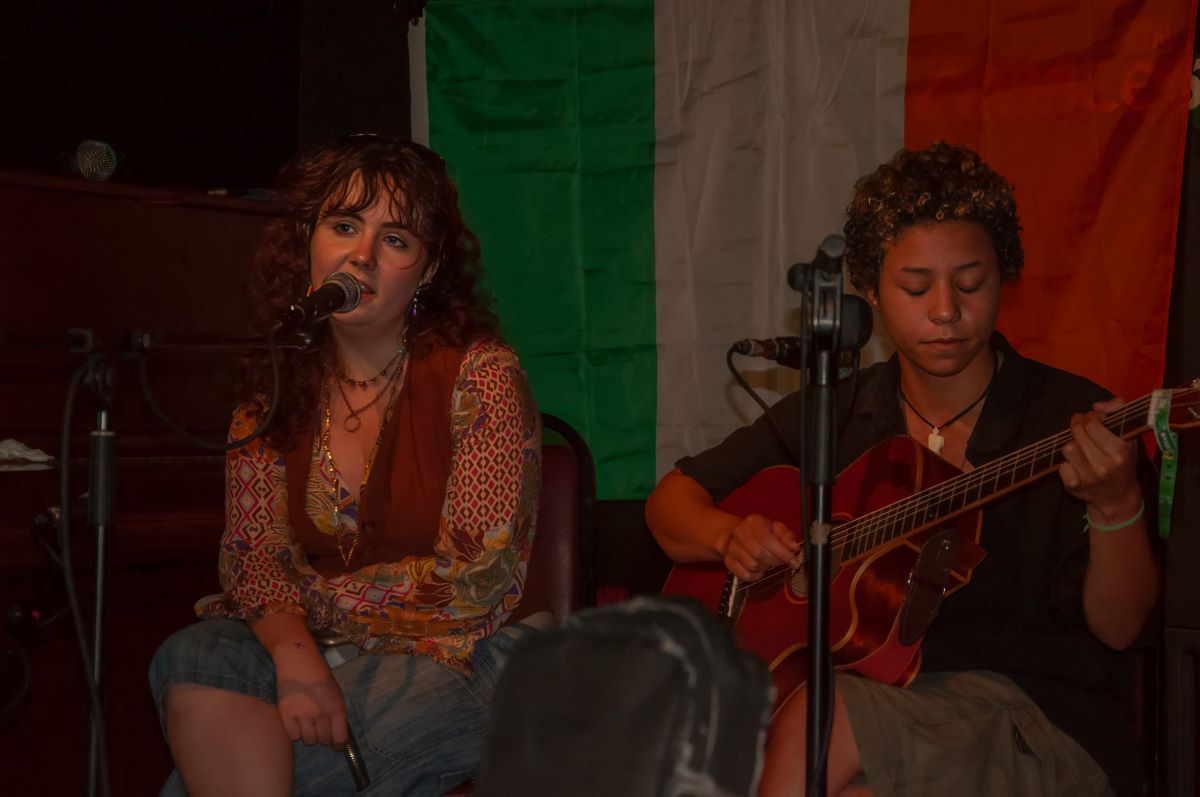
The first act of the evening was the folk duo The Yearners, specialising in harmonies around renditions of song covers and their own song about the Mary of the New Testament, as a woman pressured to bear a child because “How can you say no to God?

The audience joining in on Pearse’s Gráinne Mhaol was followed by some songs with hard satirical edges like the Kinky Boots song from the Irish Republican repertoire and their own Save A Landlord.

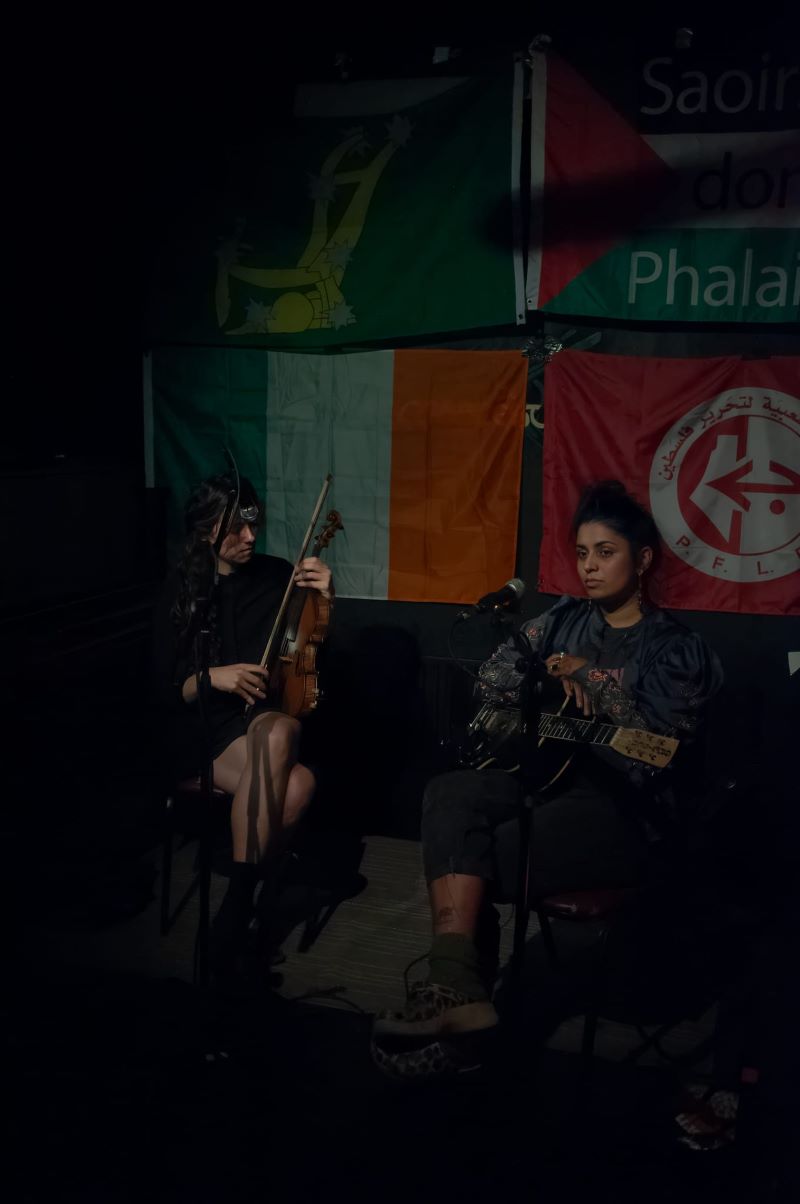
The Yearners during their performance. (Photo credit with thanks: Dermo Photography)
Dúlamban during their performance. (Photo credit with thanks: Dermo Photography)

The MC introduced another all-female duo, Dúlamban, recently formed from two individual singer-musicians. Among their material, Sinéad on violin played two compositions of her own while Aisling sang her adaptation and translation of the Rising of the Moon: Ar Éirí na Geallaigh.

The one poet of the evening, Barry Currivan, performed a number of shorter and longer pieces of his repertoire. He was particularly applauded for his “anti-othering” piece Those People and his humorous concluding piece comparing himself to a good cup of tea or coffee.

After the break, the MC spent a few minutes outlining the Solidarity Sessions collective’s project and encouraging the audience to take part in it by spreading word of its events and supporting them in person, in addition to stepping forward to assist in organisation and in poster design.

Barry Currivan during his poetry performance at the Solidarity Sessions launch. (Photo credit with thanks: Dermo Photography)
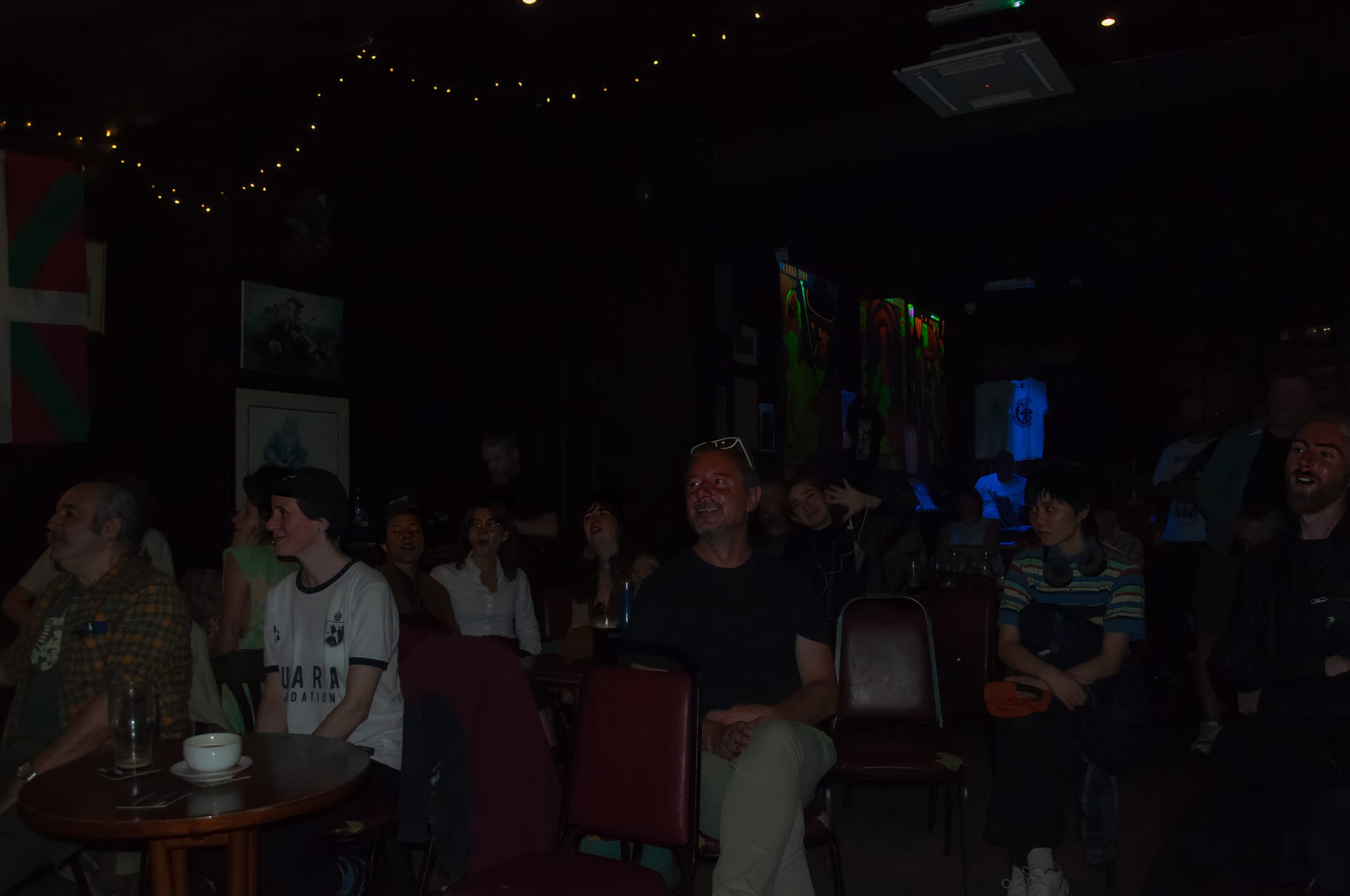
Section of the audience presumably during Currivan’s performance. (Photo credit with thanks: Dermo Photography)

Another female duo took the stage, Sage Against the Machine on guitar accompanied by Ríona on violin, performing a number of love pop covers and SAM’s own song against patriarchy.

Some remarks about Bob Dylan’s Zionism followed in Sage’s introduction of the former’s Masters of War which she performed with great feeling and followed with El Gallo Rojo, an anti-fascist song from the Spanish ‘Civil War’.

Sage Against the Marchine (right) and Ríona during their performance. (Photo credit with thanks: Dermo Photography)
Jimi Cullen during his performance at the Solidarity Sessions launch. (Photo credit with thanks: Dermo Photography)

Breatnach then introduced Jimi Cullen who he said has been hosting a weekly musical protest picket for an hour on Wednesdays (2-3 pm) outside the US Embassy for a great many weeks, in which the MC had sometimes accompanied him amidst the solidarity beeping of passing traffic.

Jimi accompanied himself singing his Housing for All and Guthrie’s You Fascists Bound to Lose, then commenting on Bob Marley’s Zionism while introducing the latter’s One Love song, saying that love above all is what binds humanity together, a theme also of his We Are All Palestinians.

His monologue The Genocide Will Be Televised was much sharper and renewed an earlier Death, death to the IDF!1 chant from the audience.

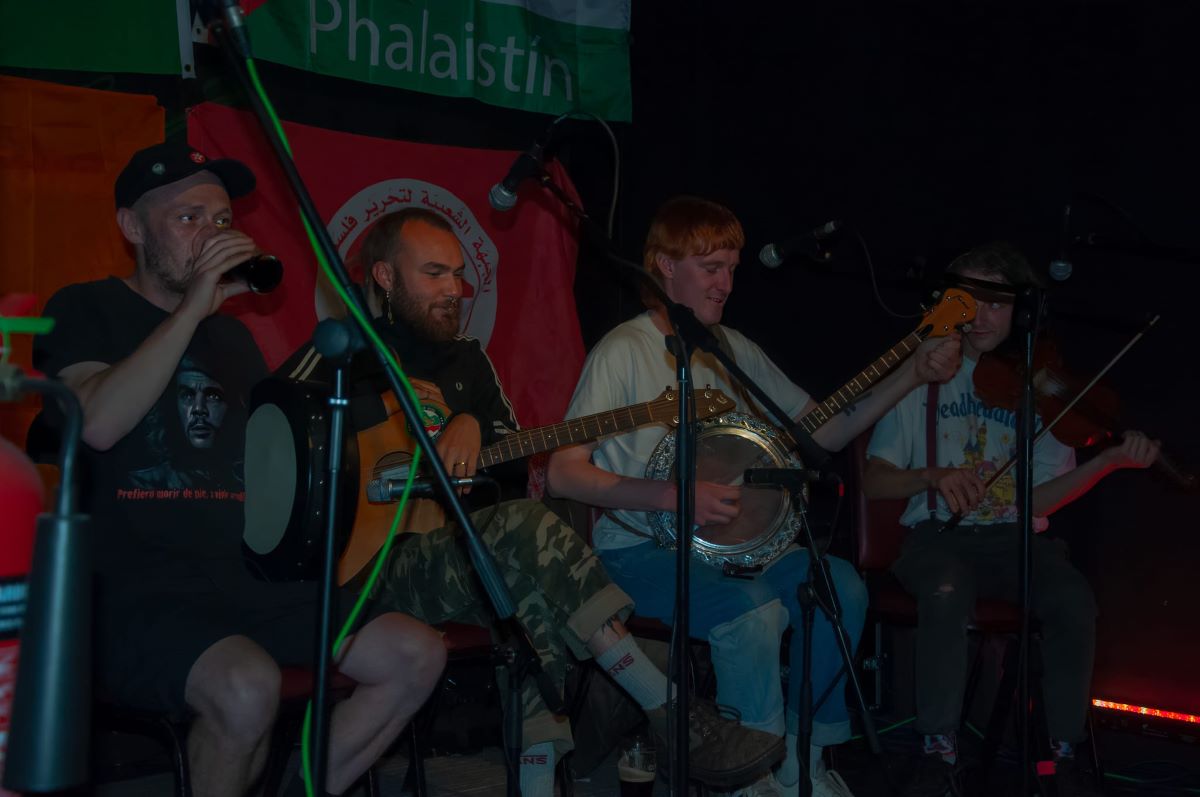
Trad Sabbath during their performance. (Photo credit with thanks: Dermo Photography)

There was much irreverent comment about the name of the band to conclude the evening, Trad Sabbath, a four-piece band of guitars, banjo, bodhrán and fiddle, apparently in the context of the very recent death of the Black Sabbath band’s lead vocalist, Ozzie Osbourne.

Sardonic cries about “his poor widow”, Sharon Osbourne2 were also heard, a Zionist personality star in a ‘reality’ TV show about the late Ozzie’s family. To fill in the delay in their setting up with the sound engineer, Breatnach sang Kearney’s Down by the Glenside ballad.

The band concluded the evening with traditional melodies and some songs from Eoghan and Hat with others backing on choruses.

Poster advertising the event (Design: Ríona and D.Breatnach)

The MC thanked all for their attendance, performances and technical support before reiterating the Solidarity Sessions’ objective and encouraging participation. His comment that “Repression is here and more is coming down the road” was underlined by the presence there of a prominent victim.

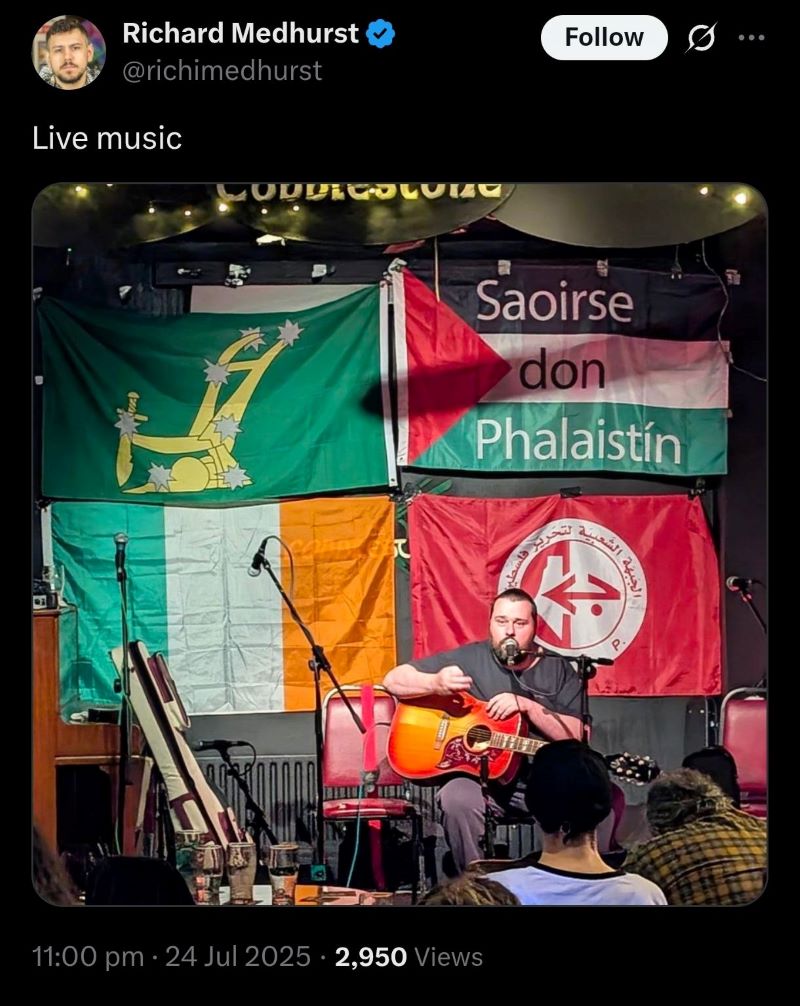
In the audience was Richard Medhurst, the Britain-based journalist specialising in Middle Eastern coverage who was recently detained under anti-terror (sic) legislation and charged by British police as he returned from abroad and again later detained though not actually charged by Austrian police.

Richard Medhurst’s tweet during the evening at the event.

End.

FOOTNOTES

1Made famous by the Bob Vylan duo at Glastonbuy getting the audience chanting the slogan. The IDF is what the Israeli Occupation Forces call themselves.

2Who had called for the banning of the the Irish rap group Kneecap.

“70,000” IN DUBLIN MARCH DEMAND GOVERNMENT ACTION AGAINST GENOCIDE

Diarmuid Breatnach

(Reading time main text: 4 mins.)

The fact that the Irish Times reported ‘tens of thousands’ on Saturday’s march in Dublin was telling, avoiding their usual euphemism of ‘thousands’ or even ‘hundreds’ for a demonstration’s great multitude.1

Even so, it was much larger, the organisers claiming 70,000 participants.

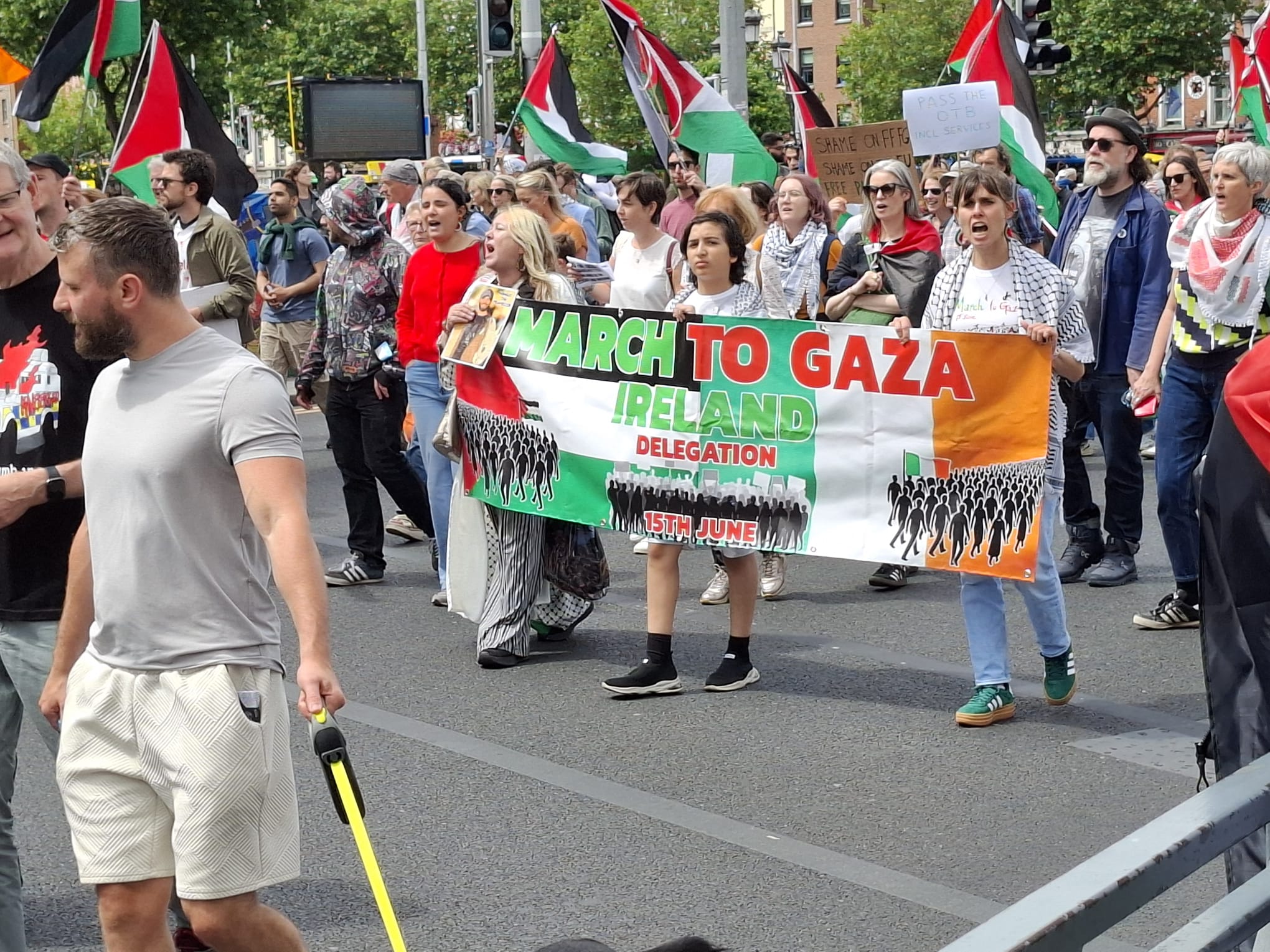
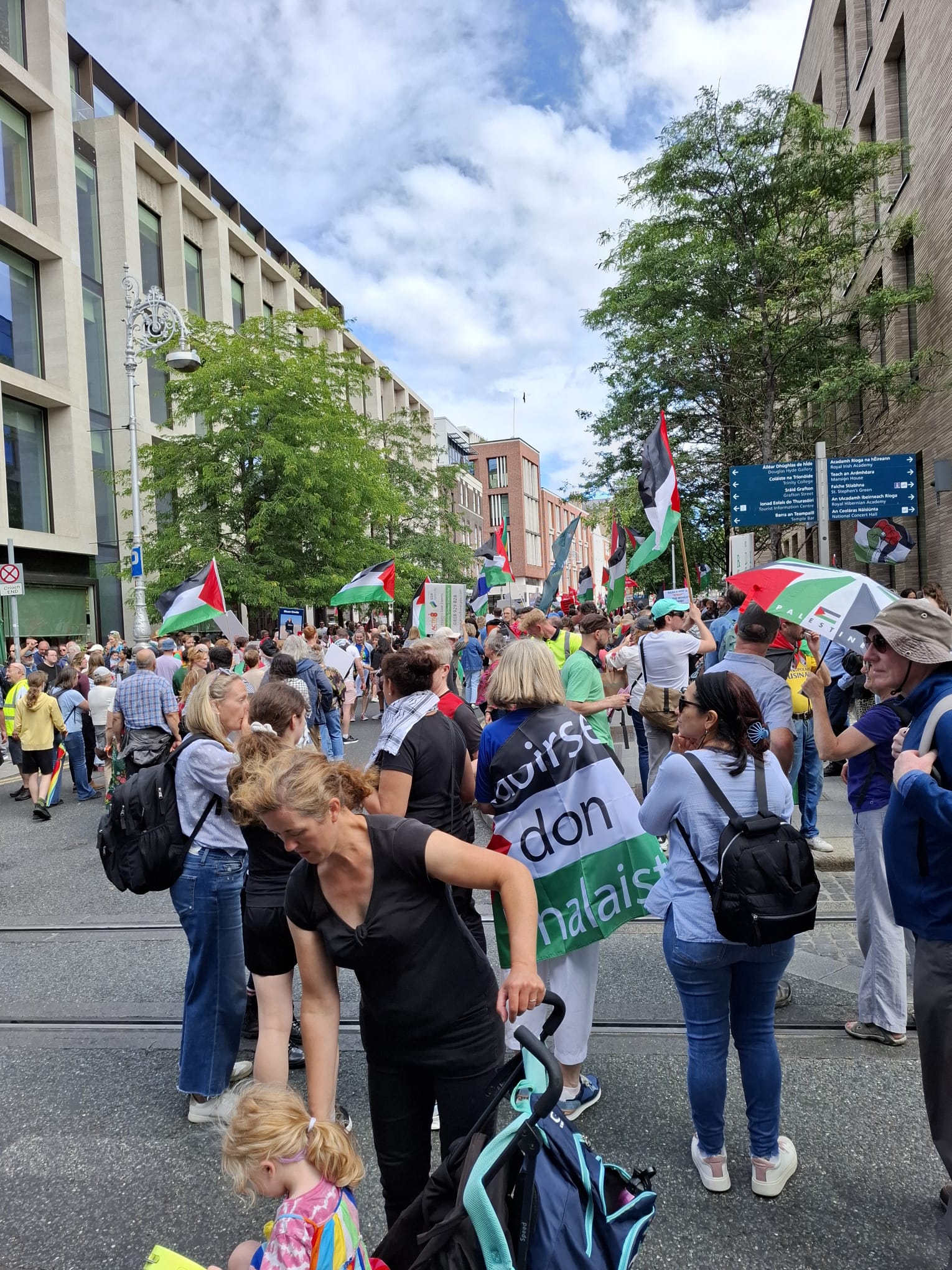
It was huge, without a doubt. From the D’Olier Street northern corner, the front of the march organised by the Ireland Palestine Solidarity Campaign had gone to the gates of Trinity College while the rest of it could be seen northwards the length of O’Connell Street and possibly beyond.

In the distance marchers may be seen along the length of O’Connell Street. Behind the photographer, a section of the march is proceeding while the front has reached the Trinity College gates. (Photo: D.Breatnach)

This was the 16th national mobilisation in Palestine solidarity since October 2023 organised to take place in Dublin, while many smaller marches, pickets, vigils, public meetings, talks, film shows and other solidarity events have been held weekly across the nation.

BANNERS, FlAGS & PLACARDS

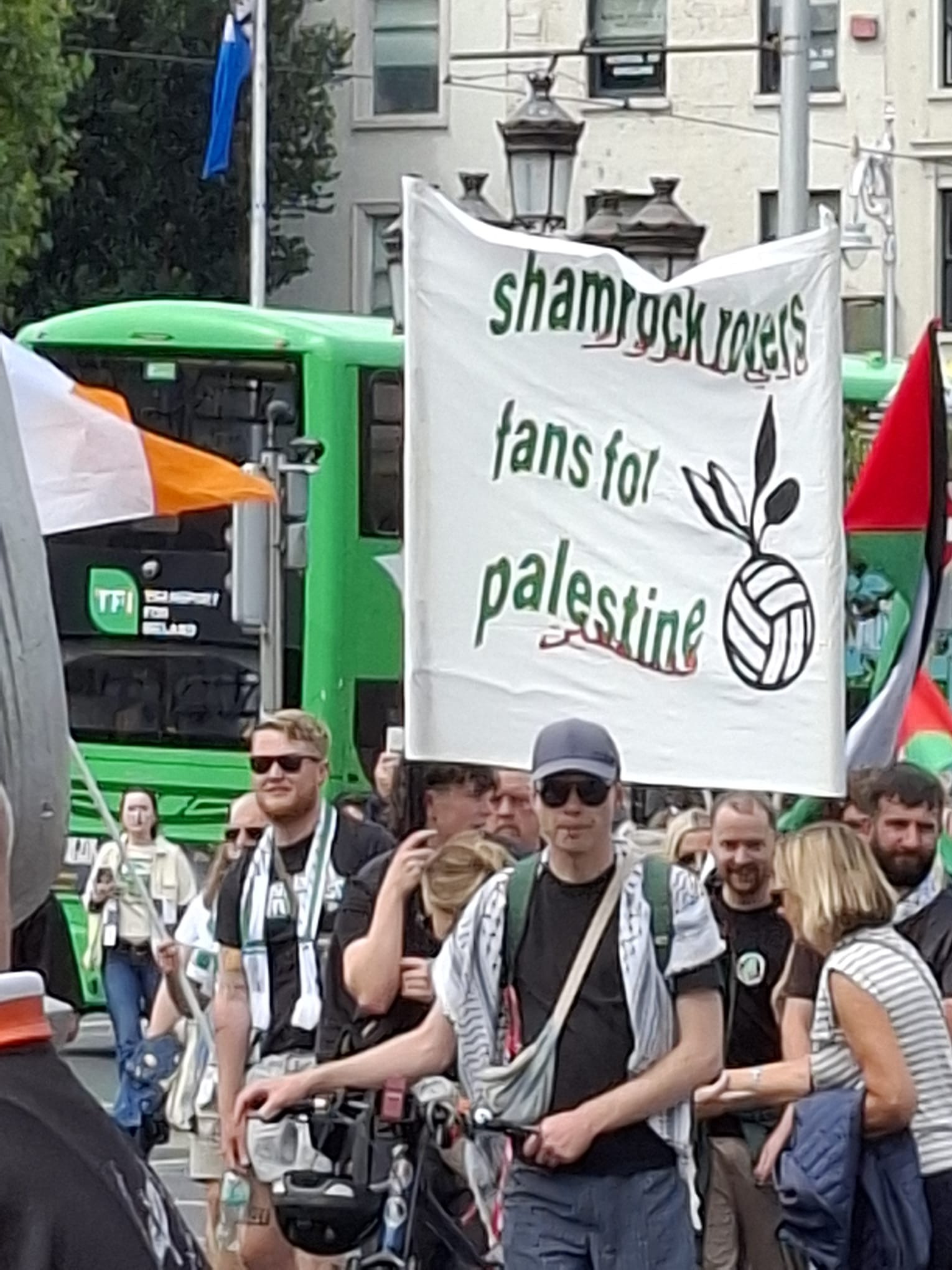
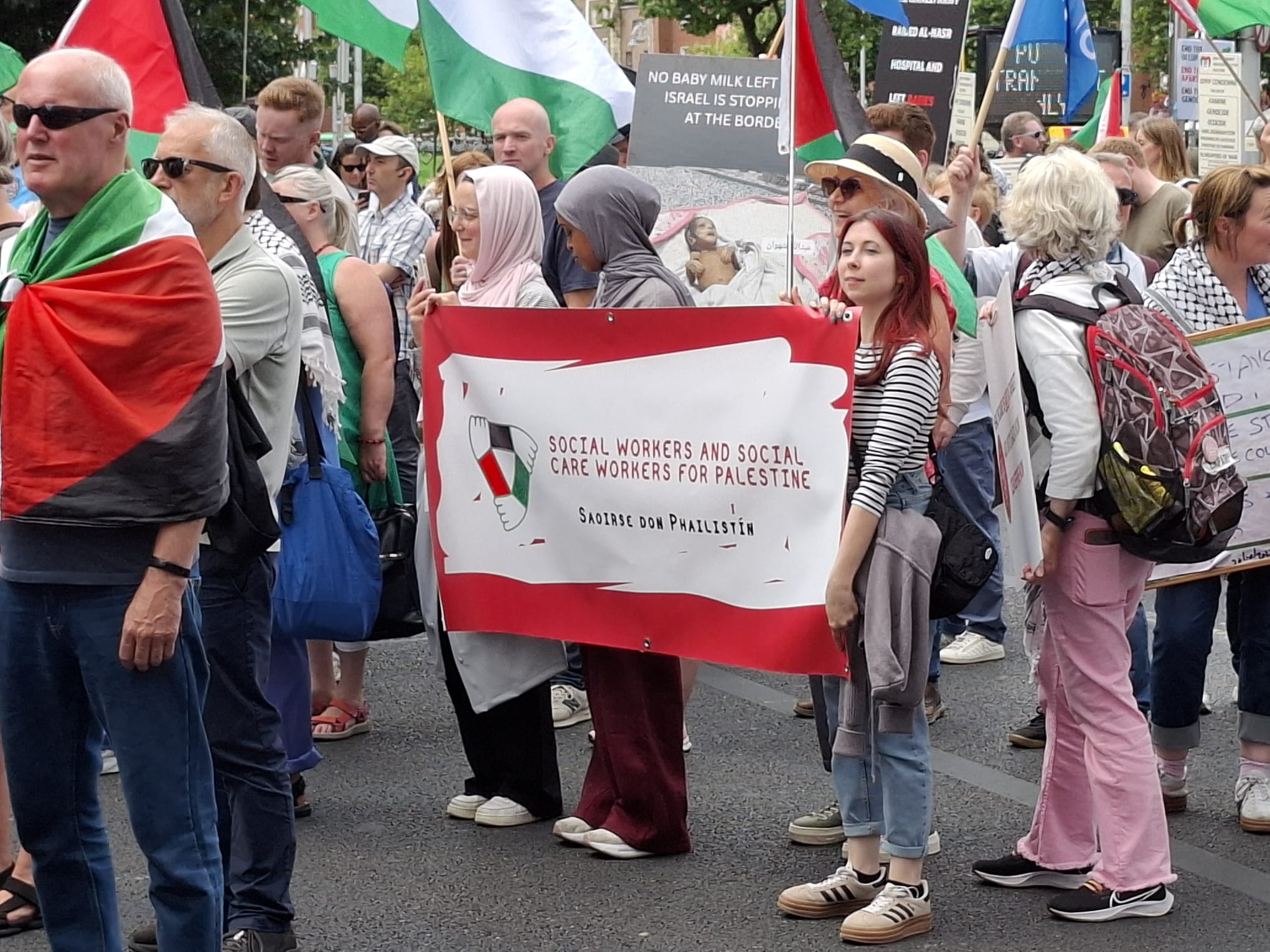
In addition to local branches of the IPSC, banners on the march also proclaimed party, trade union and professional body allegiance, along with specific declarations and calls for actions.

Placards included the professionally-printed but also a wide range of the ‘home-made’ examples and these can be of particular interest, such as the one that declared that “Blaming Hamas for firing rockets at Israel is like blaming a woman for punching her rapist.” Indeed.

“Gaza is a death camp”. (Photo: D.Breatnach)

As the marchers passed the iconic General Post Office a small group organised by socialist Irish Republican organisation Éirigí held up giant letters spelling SAVE THE GPO.2 A group wearing blue tops with PRESS on the back marched and held up photos of individual journalists in Gaza.3

The PBP-Solidarity contingent carried a banner calling for the enacting of the Occupied Territories Bill which seemed a rather tame demand of the Irish State from an organisation claiming to be revolutionary socialist (see Irish State Options section).

A bagpiper playing amongst the marchers. (Photo: D.Breatnach)

The most popular non-party flag on the march was of course the Palestinian one but the Irish Tricolour has been making a greater appearance on these marches of late and not before time.4 I noted only one Starry Plough, in green with the Plough design in gold and white stars.

DESTINATIONS AND ROUTES

The IPSC marches tend to begin at the Garden of Remembrance and end near Leinster House,5 seat of the Irish State’s parliament, or occasionally at the Department of Foreign Affairs. Saturday’s march also went to Molesworth Street but through a longer circular route.

This route saw the march take in part of Dame Street, then the whole of South George’s St. and Aungier Street, turn left towards Stephens Green and proceed along the Green’s west side, then along part of its southern side before turning down Dawson Street.

(Photo: D.Breatnach)

Molesworth Street was full of marchers already but IPSC stewards hustled marchers off Dawson Street, eventually giving up their usual endeavour to push the crowd past the Schoolhouse Lane junction so the Gardaí could erect barriers across that section to enclose the marchers.

The unusual route on this occasion avoided the temptation to march up the pedestrianised shopping area of Grafton Street, which the Gardaí do not like and at which there was a confrontation during the previous IPSC march when a number of protesters tried to take that route.

One of the supporters of the march. (Photo: D.Breatnach)

Despite the crucial role of the USA as chief supplier of arms, funding and political cover for the genocidal Zionists of the ‘Israeli’ state, since 2023 the IPSC have approached Dublin’s US Embassy only twice, no doubt respecting the Gardaí wish not to have the main road outside blocked.

On those two occasions the IPSC halted the march in a street behind the Embassy and away from one of the main roads into Dublin from the south (and along which the ill-fated Northumberland Fusiliers marched in April 1916). Marches to the Israeli Embassy were rare during the period too.6

(Photo: D.Breatnach)

IRISH STATE & OPTIONS

Both leaders of the Irish Coalition Government7 have built up some kudos with many anti-genocide people around the world for publicly stating that Israel is committing genocide – the first leaders of an EU or indeed Western state to say so.

In addition, the Irish Government joined with those of the Spanish and Norwegian states in a failed attempt last week to have the EU remove ‘Israel’ from its preferential trade agreement for violation of the human rights conditions of the Agreement.8

(Photo: D.Breatnach)

However, as a number of speakers at the IPSC rally and some marchers’ placards declared, the Irish State is in fact complicit in genocide by allowing military equipment for ‘Israel’ to fly through Irish airspace and by not enforcing its neutrality on US military transit through Shannon Airport.

And in allowing the Central Bank of Ireland to process ‘Israeli’ war bonds, which was the target of a number of representations including its huge logo on the march and a speech by Gary Gannon, DCC Councillor of the Social Democrats party.

(Photo: D.Breatnach)

The glacial progress of the moderate Occupied Territories Bill,9 delayed and then attempted weakening of it by removing services from the ban,10 is another hallmark of the Irish Government’s collusion (notwithstanding expressed Zionist rage and bullying by some US Congressmen).

Next to the USA, the Irish state is the biggest importer of ‘Israeli’ goods and a ban on these would greatly affect the genocidal state not only morally but also practically. In the absence of government action, the trade unions could impose a ban on their members handling those goods.

The contradiction is that the Western state most overwhelmingly pro-Palestinian is the biggest importer of ‘Israeli’ products and having hardly any practical effect towards preventing the genocide against the Palestinians, contrary to what the majority in Ireland actually want.

End.
Note: For the photos in this report I concentrated on the more unusual of those participating.

(Photo: D.Breatnach)
Molesworth Street, the destination, is full from one end to the other. (Photo: D.Breatnach)

FOOTNOTES

IRISH MEDIA REPORTING

Irish Times: https://www.irishtimes.com/ireland/2025/07/19/this-war-took-my-entire-life-from-me-thousands-attend-pro-palestine-march-in-dublin

RTÉ: Thousands take part in march for Palestine in Dublin

1https://www.irishtimes.com/ireland/2025/07/19/this-war-took-my-entire-life-from-me-thousands-attend-pro-palestine-march-in-dublin Nevertheless, that was the national broadcaster RTÉ’s approach.

2https://www.businesspost.ie/politics/plan-for-gpo-to-house-offices-and-retail-to-be-signed-off-by-government/

3https://en.wikipedia.org/wiki/Killing_of_journalists_in_the_Gaza_war

4The Irish far-Right of fake patriots has been permitted illegitimately to almost monopolise the Irish Tricolour.

5‘Near’ rather than at Leinster House, because the Gardaí set up a crowd barricade at the end of Molesworth Street across the street from the House and that is as far as the march goes and also where the speakers’ platform is set up.

6This was so even before the Israeli Ambassador abandoned her Dublin post in disgust at popular Irish hostility to genocide and prior to the reputed closure of the Embassy (despite which the site has a 24-hour Garda guard).

7Taoiseach (Prime Minister equivalent) Mícheál Martin of the Fianna Fáil party and Tánaiste (Deputy PM equivalent), also Minister of Defence Simon Harris of the Fine Gael party. The Green Party is also a member of the Coalition.

8The European Union as a body and economic area is the largest consumer of Israeli exports https://www.aljazeera.com/news/2025/5/22/which-countries-trade-the-most-with-israel-and-what-do-they-buy-and-sell

9https://en.wikipedia.org/wiki/Occupied_Territories_Bill

10https://www.trocaire.org/news/what-you-need-to-know-about-the-occupied-territories-bill/

FAKE PATRIOTS MISUSE IRISH HISTORY AND THE HOMELESS CRISIS

Diarmuid Breatnach

(Reading time: 6 mins.)

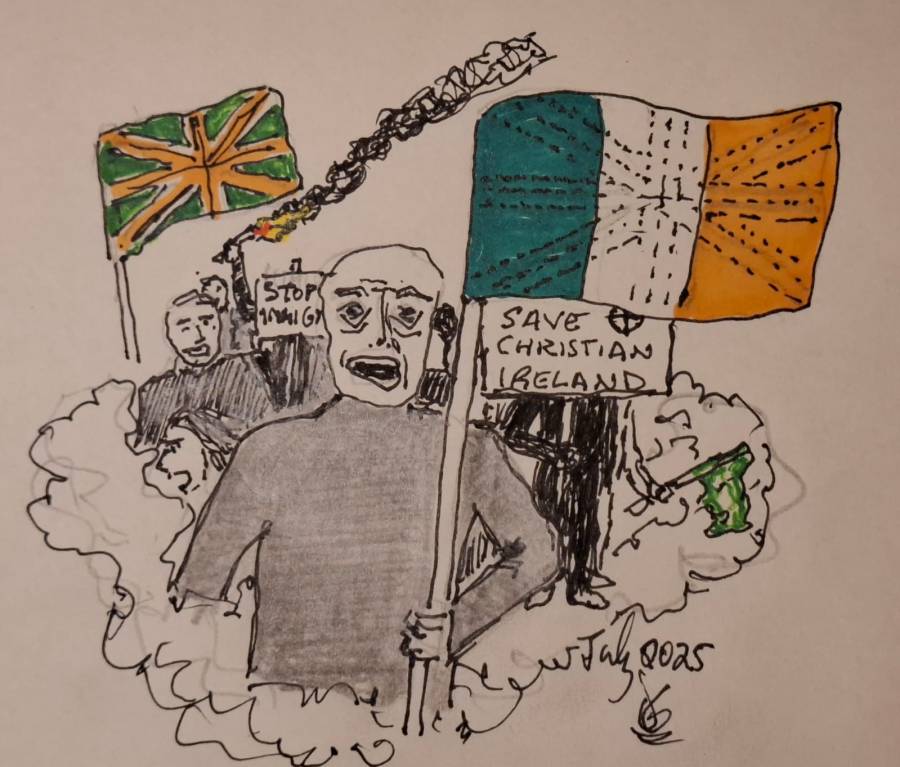
In recent days we have seen the far-Right mobilise people to allegedly defend the GPO and protest homelessness, not against its causes but instead against migrants. In defence of ‘Irishness’ they also menaced an annual religious Muslim procession.

Participants in these and similar events wave the Irish Tricolour and Irish Republic flags and claim to be ‘Irish patriots’ standing up for ‘the Irish nation.’ However, it’s far from that they are in reality as we can see.

They

  • disgrace the Proclamation

The far-Right claim to honour our national history of resistance to colonialism and occupation and even display copies of the 1916 Proclamation of Independence.1

Yet they are often also seen and heard denouncing Muslims, in direct contravention of the Proclamation’s words: “The Republic guarantees religious and civil liberty … to all”; similarly they held protests when use of Croke Park was hired to celebrants of the Eid festival.

  • disgrace the GPO as HQ of the 1916 Rising

They have and do disgrace the very symbolic building they claim to be trying to protect.

They have often held racist gatherings outside it; one of their organisers2 (e.g. of weekly protests during the Covid crisis) leading a chant of support for British fascist Tommy Robinson, who defended the Paratroopers who carried out the 1972 Bloody Sunday massacre in Derry.

Their recent protest at the GPO featured as speaker a man known for his active membership of the sectarian UVF murder gang, who admitted working for British Intelligence and who called for the strengthening of the colonial British Border – and was cheered for saying so.

Cartoon by D.Breatnach
  • disgrace the flags

The far-Right disgrace and misuse the very flags they wave so keenly.

The Tricolour was presented to the revolutionary Young Irelander republicans3 by French revolutionary republican women in 1848. It signified peace and unity between the descendants of settlers and the indigenous Irish in revolutionary struggle against the British colonial occupation.

The flag with the words “Irish Republic” painted in white and gold on a green background was made on domestic material of socialist Republican Constance Markievicz (see next section) in her house and delivered by her to the GPO.

It was installed and flown on the roof at the Princes St. corner by Eamon Bulfin4 (see next section), a migrant from Argentina.

  • disown but also misappropriate real patriots

In dishonest manipulation, the far-Right claim to honour our patriots and even invoke them in their campaigns. In their agitation against migrants they hide the fact that Constance Markievicz, Thomas Clarke and James Connolly were all migrants (Connolly and Clarke no less than three times).5

Also a migrant was Eamon Bulfin (see previous section) along with many others who fought for Irish freedom and even sacrificed their lives (including Erskine Childers)6.

Placards on an anti-racist rally on Custom House Quay some years ago. The text placard quotes the 1916 Proclamation: “The Republic guarantees religious and civil liberty to all”. (Photo: D.Breatnach)

Of the Seven Signatories of the 1916 Proclamation (see earlier section), two – Pearse and McDonagh7 – were children of migrants and two were themselves migrants (Connolly and Clarke).

Among many such examples, the father of Young Irelander Republican patriot Thomas Davis (author of the song A Nation Once Again) was a migrant.

  • join with Loyalists and British fascists

A far-Right organiser calling for three cheers for British fascist Tommy Robinson was not the only such example and outside the GPO this week far-Right elements welcomed as speaker Mark Sinclair, a member of the UVF, a British colonial sectarian murder and terrorist squad.8

Prominent Irish leaders of fascist organisations have also shared a platform with Scottish fascist and Loyalist Jim Dowson.9 And of course how can we forget the desecration of the Tricolour unfurled among Union Jack and Loyalist flags in Belfast by some Dublin far-Right activists!10

Admitted UVF/ MI5 Sectarian Loyalist UVF murder gang member Mark Sinclair. (Photo sourced: Internet)
  • don’t act against British occupation

With all that background, it’s hardly surprising that the far-Right “patriots” don’t organise against the British occupation of the Six Counties or in support of Irish Republican political prisoners in jails on either side of the British Border.

  • burn buildings

Apart from misleading people and distracting them from the real sources of problems to Irish working people and seeking to intimidate refugees, what do the far-Right actually do? Ah, yes, they burn buildings that might be used as accommodation. A great help to the homeless indeed!

  • attack homeless refugee and migrant tents

But no, that’s not all. No, the brave ‘patriots’ slash tents and threaten migrants and refugees who are sleeping on the streets. They don’t take on the big landlords, bankers, property speculators and vulture funds – no, they strike down at people poorer and in worse conditions than themselves.

  • cover for the property speculators and vulture funds, big landlords, bankers

So with all this whipping up fear and hatred of migrants, the far-Right obscure the actual cause of the problems, which is not only Irish capitalism but its total subjection to foreign capitalism. The only ones to benefit from this activity are those who are the real causes of the problems.

  • are not patriots, nor nationalists

Despite their claims and flag-waving, the far-Right in Ireland are neither patriots nor true nationalists. They do not organise in defence of Irish sovereignty and against British occupation nor against foreign capitalist exploitation of Irish natural resources, labour or infrastructures.

Or the contrary, they work to distract attention away from these centrally-important issues for the Irish nation and raise false issues to divide the people. And usually their concept of ‘Ireland’ ends at the British border which the recent far-Right rally at the GPO called for strengthening!

  • are a sub-class of deprived individuals allowing themselves to be manipulated by fascists, MI5 and NATO

Many of those being mobilised against migrants come from parts of the cities neglected for generations, often associated with low educational level, substance misuse, unemployment and unresolved mental health issues.

The ideological fascists will recruit those elements to fight, not against the cause of their deprivation, the neo-colonial ruling class or the flooding of foreign capitalist companies into Ireland, assisted by banks and political decisions -but instead against migrant workers and refugees.

  • are filling a vacuum left by the Republican and Socialist movement

WILL WE LEARN FROM OUR FAILURES?

Many of those participating, while some are also unfortunate victims of Irish capitalism, will be recruited as the boot boys of fascism.

While it is true that historically capitalism in crisis turns to fostering fascism and that capitalism, including the neo-colonial variant in the Irish state is running out of other options, we must evaluate our own role in this development, examine our own failures, learn from and remedy them.

The ground was largely ceded to the Far-Right in the period of their initial growth during the Covid crisis. The socialist Left and Republican movement, in particular its organisations, had little response to the early FR mobilisations or to responding creatively to state-imposed restrictions.

Throughout that period and subsequently the socialist Left sector, despite its protestations of anti-imperialism and anti-colonialism, completely ceded the ground of Irish national sovereignty and its symbols to anyone who wished to occupy it.

They did not, for the most part, protest the use of State repression against Irish Republicans both sides of the British Border, whether through police harassment, special legislation and special no-jury courts, nor stand up for the human and civil rights of Republicans, including political prisoners.

Their distaste for the very issue of national sovereignty was reflected in their refusal to fly the Irish Tricolour, which, although now also the official flag of the Irish State, is originally and remains still a potent symbol of Irish Republican anti-colonial struggle over 170 years.

They might argue that they wished to be identified with the struggle of the working class rather than a nationalist one but they also chose not to fly the flag of the insurrectionary Irish working class, the Starry Plough, in among their internationally-recognised red flags.

The Irish Republican organisations in their fragmented movement, on the national question, failed to sustain unity even around opposition to repression of the states or even around solidarity with the movement’s political prisoners.

They also failed and, to an even greater extent, in fighting for universal affordable housing in a crisis which seems to offer no end and is seized upon by the Far-Right to target refugees and economic migrants, who of course have no responsibility whatsoever for the crisis.

This area too has been a notable failure of the socialist Left organisations which, although marching often enough in public demonstrations and participating in a couple of media-orientated occupations,11 failed to organise and lead a state-wide campaign of empty building occupations.

And so, here we are today, when the FR are able to bring Tricolour and Irish Republic flag-waving crowds on to the streets in false claims of patriotism, dividing and seeking to intimidate migrant workers and anti-racists, burning buildings and insisting on their definition of ‘Irish’ being correct.

Our omissions and failures, if we recognise and act to remedy them, also point the way forward.

End.

1In a travesty of frequent Irish Republican ceremonial occasions, it was even read out at the recent Far-Right gathering outside the GPO which was addressed by a known member of the UVF sectarian murder gang.

2Under the name Dee Wall (real name Dolores Webster).

3Including to Thomas Meagher ‘of the Sword’ who later recruited for, joined and fought in the Union Army in the US Civil War against slavery. Meagher unfurled the flag first in Wexford and later in Dublin, both acts in 1848.

4Bulfin came to Ireland around the age of ten with his family and later joined the IRB and the Irish Volunteers. After the surrender in Moore Street he was sentenced to death, later commuted to life sentence, then from Frongoch prison camp deported to Argentina from where he was the Latin American representative for the Movement.

5Clarke and Markievicz were both born in England. Clarke was first a migrant to Ireland, later to the US, then back again. Connolly was born in Edinburgh and a migrant to Ireland, then to England, then to the USA before his return to Ireland.

6Childers was born in England. He captained the yacht that brought the Mauser rifles and ammunition to Howth. Later he joined the IRA, took the anti-Treaty side and was executed by the Free State during the Civil War.

7The father of the Pearse brothers was English, as was McDonagh’s mother.

8During his trial for bank robbery for the UVF in Glasgow, Sinclair declared he had been working for MI5 which was well known to be steering Loyalist organisations. The UVF and British Intelligence bombed Dublin and Monaghan in 1974, causing the deaths of 34 people and a full-term baby, the highest death toll of one day during the recent 30 Years War.

9Rowan Croft, Herman Kelly (Irish Freedom Party) and Niall McConnell (Síol na hÉireann).

10A prominent group among the Dublin far-Right calling themselves Coolock Says No.

11https://www.irishtimes.com/ireland/2025/07/09/former-loyalist-uvf-prisoner-addressed-anti-immigration-protest-at-dublins-gpo/

12For example, the 27-day occupation of Apollo House, Dublin, from 15 December 2016 by housing activists and homeless people, with speeches and performances by prominent musicians.

Don’t Change the System – Just the Parties in Government

Diarmuid Breatnach

(Reading time: 2 mins.)

I was relieved by my attendance at the Raise the Roof housing demonstration in Molesworth Street in Dublin City Centre. That was because I learned from speakers that just by voting in ‘a Left Government’ we could receive the housing we need.

Raise the Roof is a coalition of trade unions with its address at the Labour Party-orientated ICTU and a number of housing NGOs. The coalition also contains political parties: Sinn Féin; Labour Party; People Before Profit/ Solidarity; Social Democrats; Independents4Change.1

A view of the protest in Molesworth St. Leinster House is in the background across Kildare Street with access prevented by police barriers at the end of Molesworth St with a special gate to allow entry and exit for customers of the hotel on the corner. (Photo: D.Breatnach)

Previously I’d thought that either we’d need a revolution or a country-wide campaign of direct action occupying empty properties. This is because the housing crisis is deliberately constructed for the benefit of profits for big landlords, vulture funds and the banks that finance them.

And since they keep making massive profits out of the situation, they won’t want it to change as it would if, for example, were the State to seize empty properties2 for conversion to housing along with a massive public housing for rent construction campaign.

And if the profiteers don’t want that, naturally their (sorry, ‘our’) government will make sure not to do anything of the sort.

So it was great to learn that we won’t have to really fight and break the law, going to jail and all that. Phew! Just change the parties in the Government at the next election! Elect a Left Government!

Visual accidental irony comment in the same street. (Photo: D.Breatnach)

But… lately I have to admit I’ve been having doubts about this solution. First of all, there’s the question of numbers of TDs available to form this aspired-to government. There are overall 174 TDs in Leinster House (the Parliament of the Irish State) and a fragile majority requires 88.

The Sinn Féin party has 39 TDs and People Before Profit/ Rise/ Solidarity five in total, a combination of 44 still needing another 44 to reach the 88 minimum. FG and FF, formerly opposition parties but now in government have 86 votes between them and needed some extras to run the Government.

But I’ve got a much bigger doubt really, and that’s whether SF will stand up to the bankers and property magnates.

SF has for decades being setting out its stall that it is safe pair of hands to run the system, in other words that the profiteers have nothing to worry about. And to tell the truth, I believe them. Though some of their followers think SF is fooling the system, I think it’s the followers being fooled.

View of the Raise the Roof protest in Molesworth street. (Photo: D.Breatnach)

So … after further consideration, it really does look like a revolution will be required to end the housing crisis — or at least something so near as to make the managers of the system believe that unless they resolve the housing crisis, there will be a revolution. So I’m worried again.

Anyway, it was interesting seeing the amount of Tricolours in what was predominantly a left-wing rally of hundreds (despite a small contingent holding an Aontú banner) and there was some nice music with singers including Lisa O’Neill and Jimi Cullen (with his Homes for All composition).

I still left early, however.

End.

Footnotes

1https://www.raisetheroof.ie/about-raise-the-roof

2https://www.socialjustice.ie/article/vacancy-and-dereliction-ireland

“FIX OUR HOMES!” – DUBLIN COUNCIL TENANTS DEMONSTRATE AT CITY HALL

Diarmuid Breatnach

(Reading time main text:5 mins.)

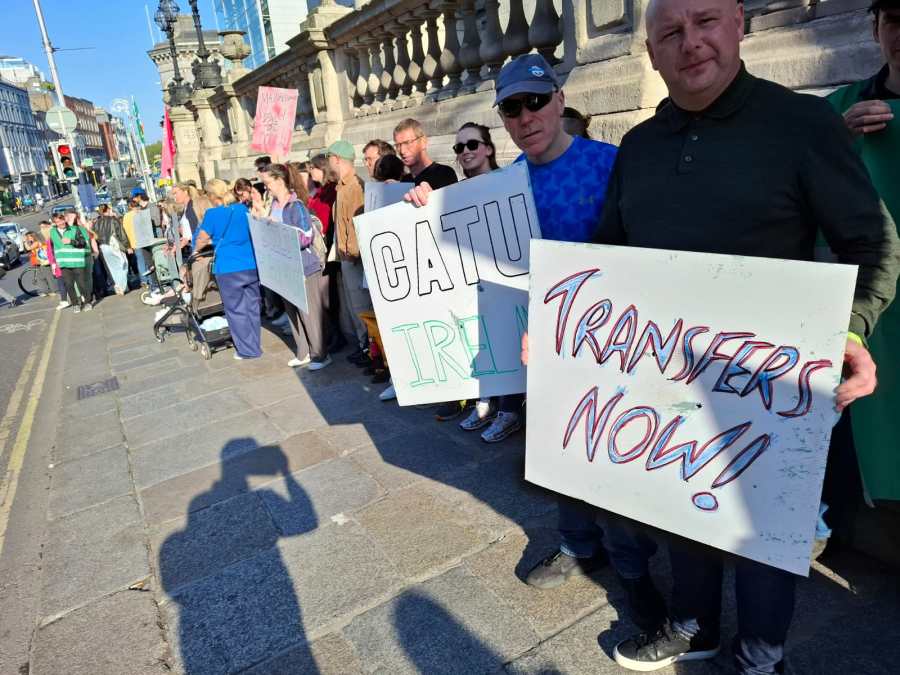
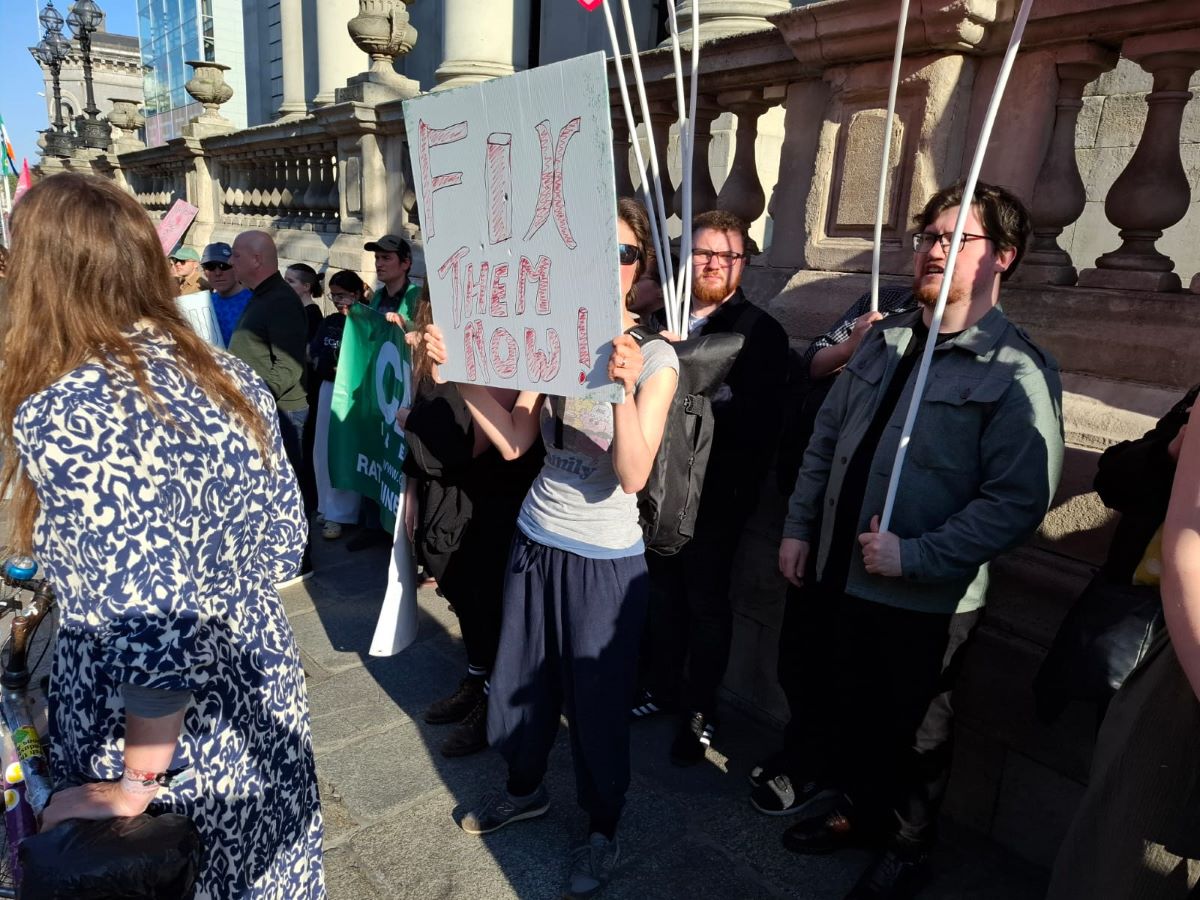
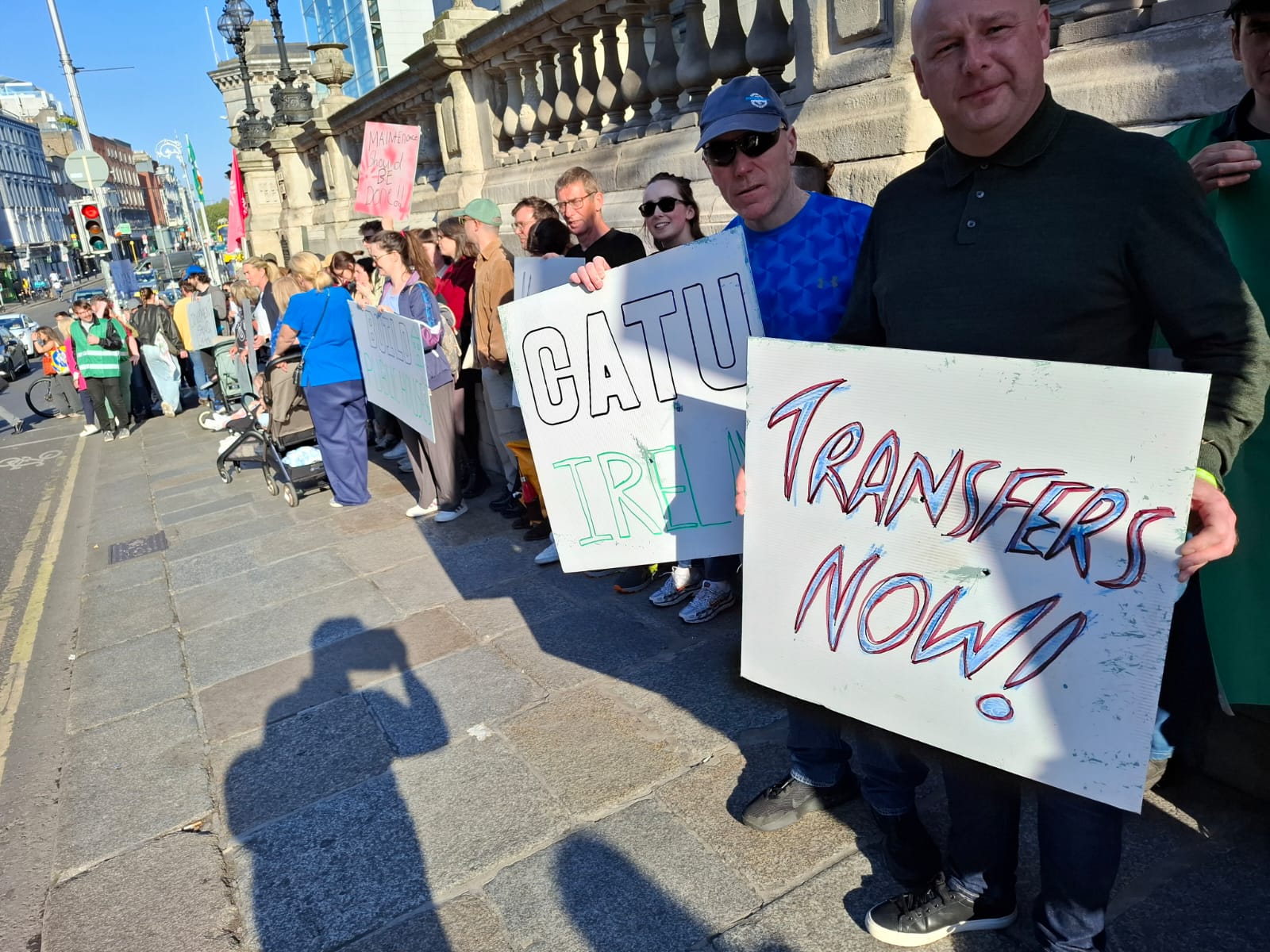
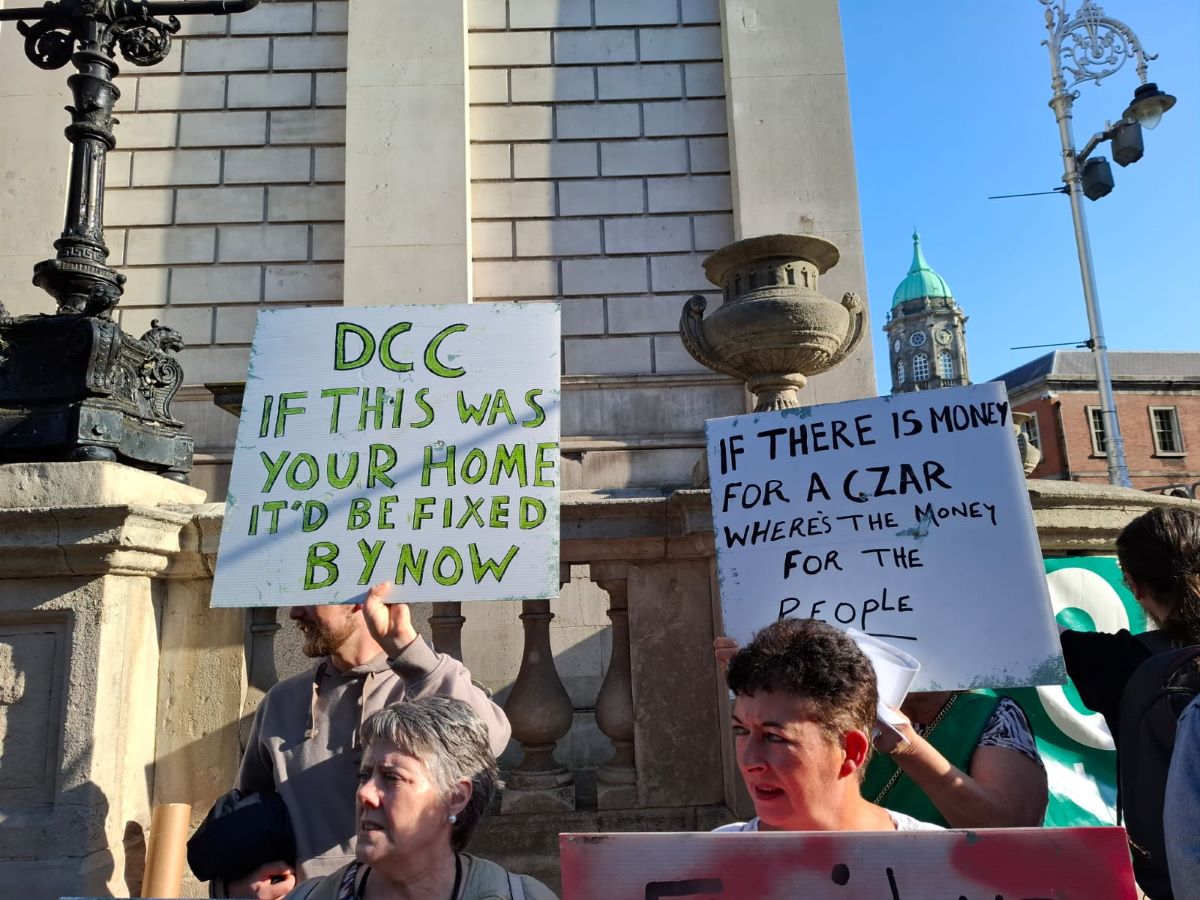
A large number of tenants organised by the Community Action Tenants’ Union (CATU) from a number of Dublin City Council housing estates gathered outside City Hall on Monday 12th May evening to lobby the monthly elected Councillor’s meeting.

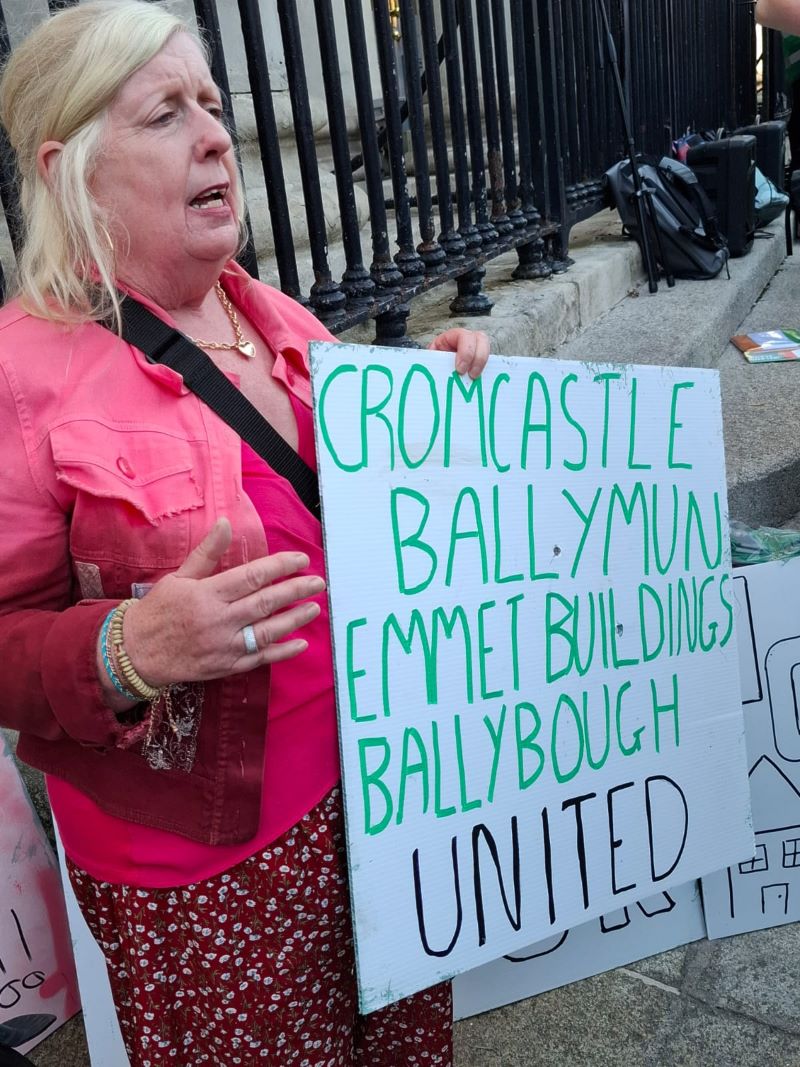
Those attending for the most part came from public housing blocks and estates from Ballymun to the Liberties and Coolock to Pearse Street. They carried placards and demanded that Dublin City Council negotiate with them.

A section of the lobby outside City Hall facing Parliament Street (note on top extreme left of photo plaque commemorating two leaders of the Irish Citizen Army shot dead in 1916). (Photo: D.Breatnach)

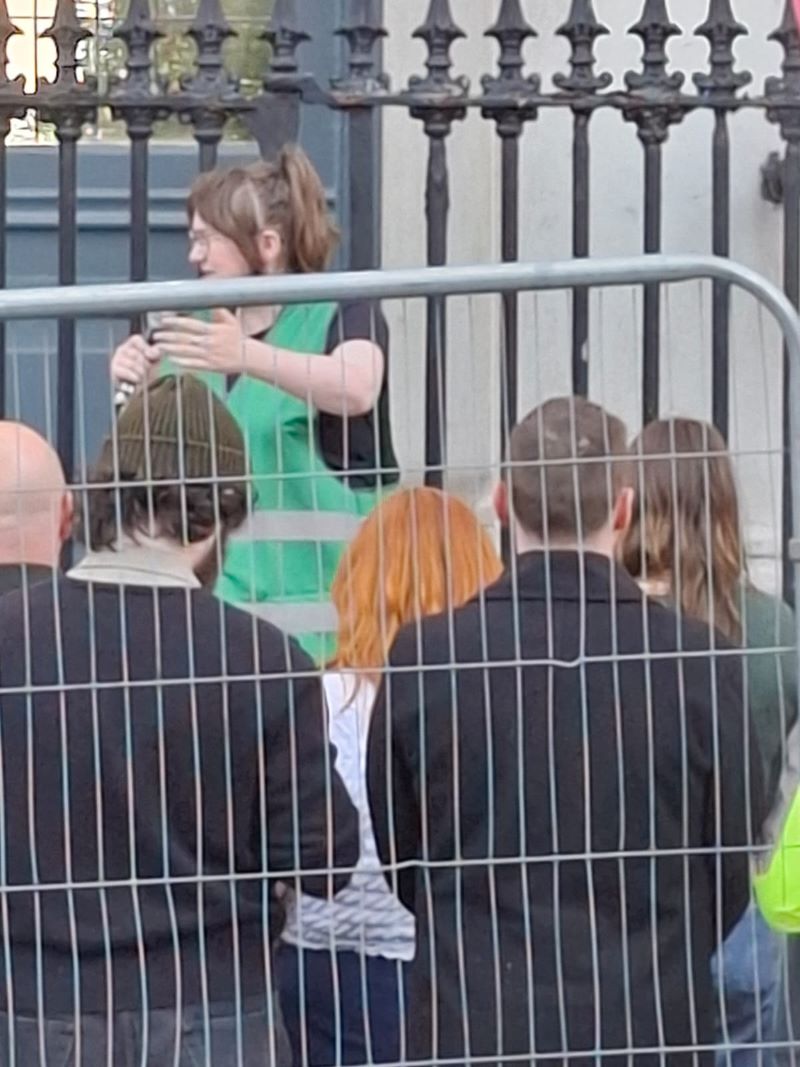
The recently-appointed Assistant Chief Executive over housing and community came out to receive the Union’s demands and petitions from tenants organising within their complexes and areas and the lobbyists also forced the issues onto the agenda of the council meeting that night.

The protest was organised by the Dublin city CATU branch with wide support from community organisers and was attended by a number of elected councillors from some political parties and independents.

(Photo: D.Breatnach)

The problems CATU representatives listed verbally and in writing included a general low level of maintenance and upkeep of their estates and blocs, of the actual dwellings, communal areas, playgrounds and rubbish chutes. Rat infestations were a problem in some.

Damp leading to mould, rainwater penetration, inadequate proofing, badly fitting windows and doors were also listed at a number of sites, as were inadequate insulation leading to high heating costs and a need for overhaul of the heating system itself.

Among the slogans chanted was: Dublin City Council – Negotiate!

(Photo: D.Breatnach)

Included in their demands was that DCC officials recognise the right of their tenants to be represented by CATU as their union, which they stated was not always respected and they sought formal meetings with named officials responsible for the areas in question within one month’s time.

Although apparently currently not members of CATU, the organisation had invited the Pearse House Residents’ Committee to attend and speak at the lobby. Their chairperson Neil Maloney did so, addressing the issue of the long overdue regeneration of their housing bloc.

(Photo: D.Breatnach)

Maloney described the “blow to the community” when funding for stage two of the regeneration project to eliminate overcrowding was withdrawn, after their hopes had been raised by presentation of a regeneration timescale and a physical design in August of the previous year.

Ironically, the housing crisis was implicated in the Government’s reason for refusing to support the regeneration going ahead, in that the increase in inner space of the dwellings would reduce the number of actual housing units.

(Photo: D.Breatnach)

The Pearse House chairperson commented that “the current bedsits are illegal” and that their homes currently don’t meet European standards, going on to state “a real need for bigger homes to address overcrowding and family needs.”

“This was always going to be a challenge for this protected structure, but in phases 2 and 3 of the regeneration plan, there would be 2 additional blocks built. The additionality that the Government is seeking would be gained through the social homes gained during the decanting process.”

Pearse House residents attended CATU’s protest “to highlight our anger and what we see as another block on this project,” Maloney said. And note that although DCC has committed to redesigning the project for submission to the Government there is no guarantee this will be successful either.

(Photo: D.Breatnach)

“Ireland is still in breach of the European Charter for social housing and our human rights. Our community has seen the redevelopment and construction of new buildings, offices etc. and Pearse House is the eyesore in the middle of our community.”

“We were the community before all this redevelopment, and we will be the community when it’s all over,” concluded Maloney, voicing a common complaint along the south Dublin dockside. 1

A section of the lobby outside City Hall viewed looking down Dame Street. (Neil Maloney is pictured after his speech). (Photo: D.Breatnach)

Public Housing Background

There was little public housing in Dublin under British rule and the big town houses of the rich had been sold and sub-divided for rent by private landlords (including some who were elected councillors (or aldermen).

The new State built “2,000 local authority homes by 1924, a feat all the more remarkable in the context of a shortage of State funds, and the need to rebuild much of the infrastructure damaged in the War of Independence.”2

But of course it was not keeping up with the existing need or population growth and 40% of the population were forced to emigrate in the first 50 years of the Irish State.3

However 1924 too was the introduction of legislation facilitating state money subsidising the building of private housing.4 “In the decade after 1932 some 82,000 homes were built, the vast majority (public and private) with State subsidies.”5

Prof. Kenna relates that by 1940, some 41% of the Irish housing stock had been built by local authorities, far higher than that in England and Wales (25%) and also comments on the effect this had on subsidiary employment not only in construction but in sourcing and supply of materials.6

Although by 1964, a further 74,000 private and 63,000 local authority homes were built with State support and that between the 1950s and 1960s a million people had left the country, there was still a housing shortage and rents on private properties dug deep into workers’ incomes.7

Prof. Kenna comments that little attention was paid to the need for housing estate management, amenities, shops and the social, educational or other needs of the new community established there. That this should coincide with a boom time for property developers should not surprise us.

(Photo: D.Breatnach)

Government schemes to facilitate the purchase of their local authority accommodation from the 1950s resulted in the disappearance of much public housing stock into the private sector.8 Theoretically they would be replaced by new public housing builds but that didn’t happen.

Public land and land held by NAMA9 has been increasingly sold or even given away to private developers on promises of provision of a low percentage of public housing and often those individuals or consortiums do not even keep their earlier promises.

The Report of the Commission on the Relief of the Sick and Destitute Poor in 1927, Prof. Kenna reminds us, found 3,257 homeless people including 901 children, while in January 2021 there were 5,987 homeless adults and 2,326 homeless children in Ireland.

The Far-Right has jumped on the opportunity of the current housing crisis to blame it – not upon lack of public housing construction, big landlords, property speculators and vulture funds – but on migrants.
The Left in Ireland has until now in practical terms left this ground for exploitation of racists.

One of a number of speakers, photographed from across the street as too crowded there. (Photo: D.Breatnach)

GOING FORWARD

CATU seemed pleased with the lobby turnout and announced their intention to organise a housing protest march on Saturday July 5th. In the meantime they will no doubt be following up on the meetings they requested with area housing managers and agreeing objectives and deadlines.

Hopefully, seeing the initial results in the attention of DCC housing and amenity officials, and reflecting on their numbers when they take joint action, tenants of DCC will take heart and grow in confidence in their ability to ensure provision of decent housing and services for their needs.

Of course, the Far-Right won’t like that as it distracts from their targets – but the extension of this campaign does provide some hope of something like a solution to the current terrible grinding crisis of both housed and homeless.

End.

One of a number of speakers, photographed from across the street as too crowded there. (Photo: D.Breatnach)

APPENDIX: I916 Battleground

It might or might not have been mentioned (I couldn’t hear much of the speeches) that City Hall, outside of which CATU were protesting, had been a 1916 resistance centre, occupied by a small force of the Irish Citizen Army, known in some circles as the first workers army in the world.

Unaware of the extremely low British garrison on the Castle that day, the ICA had failed to take the complex and retreated to City Hall and some outposts in Dame Street and Parliament Street where they resisted until overwhelmed by British Army reinforcements.

The symbolism of the Castle, the administrative seat of the British occupation in insurgent hands, resulted in a ferocious assault on the ICA garrison and it fell on the Monday/ Tuesday of that week. One of the statues inside bears what appears to be a bullet hole to this day.

A steel plaque on the right of the outside front of the building lists the names of the ICA garrison of the area, around 50% of which were women. An older cast plaque at the east corner lists the names of two of the five who were killed there, Sean Connolly (OC) and Sean O’Reilly (2i/c).

The 1916 Rising was followed by the election of the First Dáil in 1919 with its Democratic Program affirming that all right to private property must be subordinated to the public right and welfare, and that no child should suffer hunger or cold from lack of food, clothing, or shelter.10

That was followed by the War of Independence and the Anglo-Irish Agreement; and the new State that came into being had no intention of fulfilling the promise of the Democratic Program but rather a determination to suppress any who tried for that fulfilment.

Footnotes

1For example the construction plans for the Irish Bottle Glass site (sold by Nama to the Ronan consortium) contain no components of public housing and units at expected prices will not be affordable by most local people.

2Prof. Padraic Kenna https://www.jcfj.ie/article/100-years-of-irish-housing/

3Ibid.

4Ibid.

5Ibid.

6Prof. Padraic Kenna https://www.jcfj.ie/article/100-years-of-irish-housing/

7References in Prof. Padraic Kenna https://www.jcfj.ie/article/100-years-of-irish-housing/

8https://www.dublininquirer.com/a-new-book-weighs-up-the-history-and-impact-of-selling-off-irelands-social-homes-to-tenants/#:~:text=In%20the%201950s%2C%20the%20first,than%20we%20could%20have%20had.%E2%80%9D

9https://www.irishtimes.com/ireland/housing-planning/2025/05/11/no-deal-on-affordable-housing-at-glass-bottle-site/

10https://www.nootherlaw.com/archive/democratic-programme.html

Useful Links

CATU: https://catuireland.org/

A Hundred Years of Irish Housing by Professor Padraic Kenna: https://www.jcfj.ie/article/100-years-of-irish-housing/

The Democratic Program of the First Dáil: https://www.nootherlaw.com/archive/democratic-programme.html

Housing: https://www.irishtimes.com/ireland/housing-planning/2025/05/11/no-deal-on-affordable-housing-at-glass-bottle-site/

Lack of consultation on traffic management?: https://m.independent.ie/regionals/dublin/dublin-news/local-residents-complain-of-absolute-mayhem-following-new-pearse-street-traffic-restrictions/a240993177.html

CHANGING THE STARRY PLOUGH COLOUR AND SEAN O’CASEY

Diarmuid Breatnach

(Reading time: 5 mins.)

For many years the Starry Plough flag in Ireland, associated with socialist Irish Republicanism, was the form of the Ursa Mayor1 constellation in white or silver stars on a blue background, from the time of the Republican Congress (1934-’36).

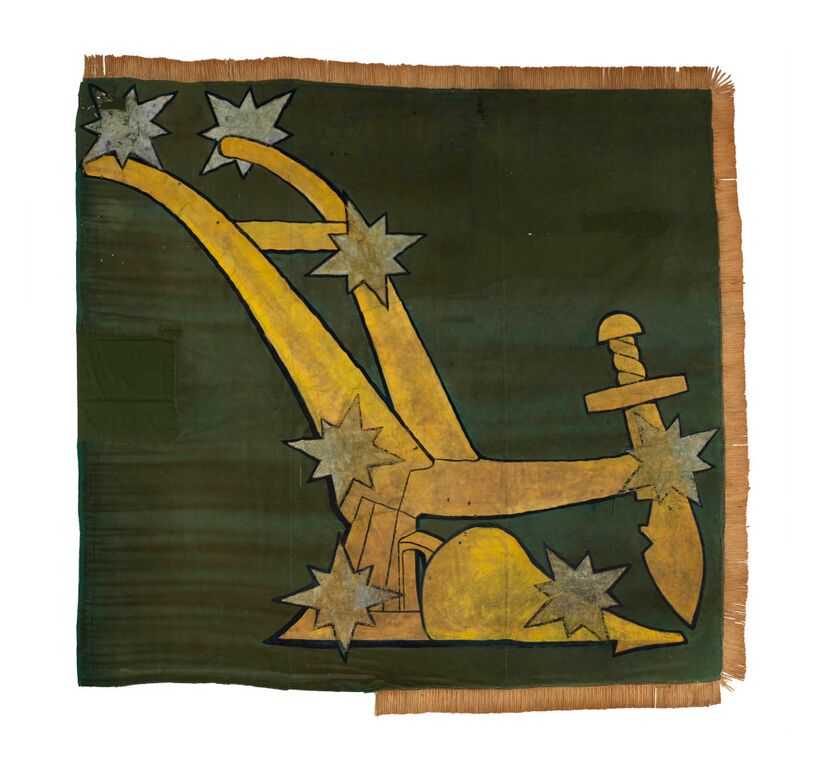
Somewhat later a different design including an actual plough following the stars and shape of Ursa Mayor on a green background began to be seen. But which was the original? And how, when and why did the other version come into existence?

It is not disputed that the Starry Plough was designed for the Irish Citizen Army, nor that it came to be designed in 1914, as the ICA was reorganising following the defeat of the Dublin workers in the 1913 Lockout. Whatever its colour, that was clearly the original.

It is beyond dispute that the Starry Plough was raised above Clery’s building, across the road from the GPO, during the 1916 Rising. It survived the burning of the building even though one witness spoke of a melted glass stream from its windows running across O’Connell (then Sackville) Street.

The flag disappeared thereafter. A British officer claimed to have taken it as a trophy. If there was more than one copy of that flag at the time, no-one has spoken of it.

When the Republican Congress was founded in 1934 the need for its own flag was felt. The Starry Plough of the ICA seemed appropriate and former members of the ICA were consulted as to the original design and colour and it appears that memories diverged on that issue.

Some remembered the background colour as green, some as blue. Prominent in the latter group was playwright Sean O’Casey, who had been Secretary of the ICA for a brief period in 1914 and presumably was present when the flag design was approved.

Whether or not, between April 1914 and April 1916, surely the flag had been paraded through the Dublin streets on a number of occasions and in any case it had flown over Clery’s in O’Connell Street for five or six days.

Nevertheless when the former members of the ICA were consulted in the 1930s there appeared to be uncertainty about the background colour – was it green or blue? Possibly the majority remembered it as blue or perhaps the opinion of O’Casey, who insisted on blue, was taken as the most valid.

In May 2022 former IRSP comrades of former leading IRSP activist Mick Plunkett stretch the blue Starry Plough version over the coffin containing the remains of the latter. During the 1970s-to the 2000 the blue version of the flag had been particularly associated with the IRSP.(Source photo: Seamus Costello Memorial Committee FB page).

So the flag of the Republican Congress was made a plain blue background with the shape of Ursa Mayor outlined in white or silver stars (and no actual plough design). That design was flown in Irish Republican colour parties from the 1960s at least and adopted too by the Irish Labour Party.2

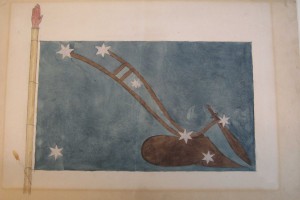
A problem for the claim that the original was blue arose in the 1950s when an ex-British Army officer offered the Irish National Museum what he claimed to have been the Starry Plough which he said he had removed from the ruin of Clery’s. The background colour was green.

O’Casey was contacted by the NMI and insisted it could not be the original, maintaining that had been blue. To bear this out, he submitted a watercolour of what he claimed was Megahey’s (original artist) design work, in which the background was blue but did include a plough.3

The watercolour submitted by O’Casey which he claimed was the original design of the man who designed the flag, William Magahey. (Copied from article about the conservation of the original flag in History Ireland).

There was no way to prove the provenance of the watercolour. Nor was it impossible that a change of mind had led from a blue background on a design artwork to green on the produced flag. But O’Casey insisted that not only the artwork but the finished product had been blue.

Well then, why not investigate the artefact, the one claimed to be that which had been taken back to England by the British officer?

The original flag in the possession of the NMI back to front prior to conservation work. (Copied from article about the conservation of the original flag in History Ireland).

The NMI curator invited former members of the ICA only4 to view the artefact and although distressed at the state in which they saw it they confirmed that it matched their recollection. For the curator it seems that was the clincher and he then authorised its purchase in 1956.5

Around 2012 (the article does not give a date) an NMI curator charged with preserving the artefact set out to carry out modern method analysis of the material and its construction, paint and the more than 50 holes in it corresponding to .303 machine gun bullet impacts.6

The original Starry Plough flag in correct orientation (Photo sourced: NMI on line)

Former ICA members had remembered a golden edging on the flag, traces of which were indeed found on the green specimen. It all checked out. A clever hoax? Possibly, but for an eventual price of £150, a relatively small amount even back in 1954?

The ICA members viewing the artefact believed it was the original, the British Officer testified as to his having taken it and also produced an Irish Times account by himself dated 11 May 1916.7 The NMI tests all pointed to the conclusion that it was the original flag – and the background was green.

But O’Casey was adamant that it had been blue. And what about the blue watercolour, allegedly the artist’s design?

It’s possible that between the design outline and manufacture, a change in the desired background colour had taken place. But not only colour – the plough design on the watercolour is very different from that on what we must now conclude was the original flag.

We have no evidence to verify that the watercolour was the original designer’s. O’Casey might have painted it himself, from his mistaken memory, for example. Or is it possible that he falsified its origin in order to convince the NMI that the flag had been blue and not green?

Any such effort would not have been about an aesthetical judgement in favour of one colour over another but rather about removing the colour associated with nationalism.

O’Casey resigned from the ICA in a dispute8 about allying with nationalism but more tellingly, he disagreed after the fact with Connolly throwing himself and his forces into an uprising against colonialism9 – a nationalist rather than socialist uprising, as O’Casey would have seen it.

Connolly’s thesis was that the advance towards socialism was not possible in a colony such as Ireland without allying the socialist forces with the most progressive and revolutionary national bourgeois forces, i.e the IRB and the Irish Volunteers.10 O’Casey could not agree with that.

In Innisfallen Fare Thee Well (1949)11 he wrote: “The Easter Rising had pulled down a dark curtain of eternal separation between him and his best friends: and the few that had remained  alive and delightful, now lay deep, with convivial virtues, under the smoking rubblement of the Civil War.”

The symbolism of the original green, the colour of Irish Republicanism since the United Irishmen of the late 18th Century would have been anathema to the later O’Casey. Was he indulging in revisionist wishful thinking?

Or perhaps trying to ensure that in any future conflicts, the Irish Republican and Socialist trends would be kept firmly separate?

Two green Starry Ploughs on view among other flags carried by a section of marchers at the Bloody Sunday massacre commemoration March for Justice in Derry in January 2025. The one in centre of photo is a mass-produced reproduction whereas to the left one can see part of a quilted sewn individual one. (Photo: D.Breatnach)

There are others who strive to ensure the exact opposite, who as Connolly did, see in the combination of those two strands Ireland’s only chance for freedom from colonialism, neo-colonialism and an advance towards a socialist society.

For them, the original design and colours of the Starry Plough is their flag and its entire symbolism points the way forward.

End.

FOOTNOTES

1In the USA this constellation is commonly referred to as “the Big Dipper”.

2Rarely used by the Irish Labour Party nowadays. It was popular with the Irish Republican Socialist Party for decades but nowadays a version in white stars on a black panel on a red flag is flown by the organisation.

3https://historyireland.com/citizen-armys-starry-plough-flag/

4Ibid: O’Casey appears not to have been invited, which suggests that the accuracy of his stated recollection was doubted.

5Ibid.

6Ibid.

7The rebels, on taking possession of the Imperial Hotel in Sackville Street, hoisted their flag over the building, and there it remained intact on one of the ridges of the front wall while the entire contents of the premises were being consumed by fire. At great personal risk the flag was eventually brought down by second Lieutenant T.A. Williams of the 9th Reserve Cavalry, Kildare Barracks, assisted by Inspector Barrett, Dublin Metropolitan Police.’ https://historyireland.com/citizen-armys-starry-plough-flag/

8https://www.dib.ie/biography/ocasey-sean-a6553 O’Casey objected to the enrolment of Constance Markievicz in the Irish Citizen Army because she was also a member of Cumann na mBan, which had been set up as a female auxiliary organisation to the Irish Volunteers. O’Casey proposed that membership of the ICA precluded joint membership with any Irish nationalist organisation. Having had his motion defeated, O’Casey resigned from the ICA in July 2014.

9‘[Connolly’s] speeches and his writings had long indicated his new trend of thought, and his actions now proclaimed trumpet-tongued that the appeal of Caitlin Ní hUllacháin—“If anyone would give me help, he must give me himself, he must give me all”—was in his ears a louder cry than the appeal of the Internationale, which years of contemplative thought had almost written in letters of fire upon his broad and noble soul. Liberty Hall was now no longer the headquarters of the Irish Labour movement, but the centre of Irish National disaffection.’ https://historyireland.com/sean-ocaseys-battle-of-words-with-the-volunteers/

10And of course Cumann na mBan.

11The third volume of O’Casey’s autobiography, published in 1949.

SOURCES

Blue or Green?

https://siptu.medium.com/unfurling-of-the-starry-plough-61ef310f8afa

National Museum curator on provenance and tests: https://historyireland.com/citizen-armys-starry-plough-flag/

O’Casey’s separation from Connolly: https://historyireland.com/sean-ocaseys-battle-of-words-with-the-volunteers/

NO SHOW OF FAR-RIGHT AND FASCIST RALLY TO CLOSE DOWN DUBLIN SOCIALIST REPUBLICAN PUB

Clive Sulish

(Reading time: 3 mins.)

Far from the declared aim to “close down this kip” in an online call for a rally against Peadar Brown’s pub in Dublin, not a single far-Right supporter of the call made even a token appearance at the appointed hour Saturday afternoon.

This was no huge surprise; these elements tend mostly to attack small groups of people or torch empty building and surely quickly came to the conclusion that neither of those things would they be facing in the case of Peadar Browne’s. No indeed. A full building of many people.

The on-line event poster for the far-Right rally was followed by a number of posts and comments vilifying the pub’s management for allegedly banning a customer over his racist remarks but went further to attack the pub’s history and general political ambience too.

Recently-elected fascist member of Dublin City Council Gavin Pepper had himself videoed outside the pub on Friday night after it was closed, issuing veiled threats.

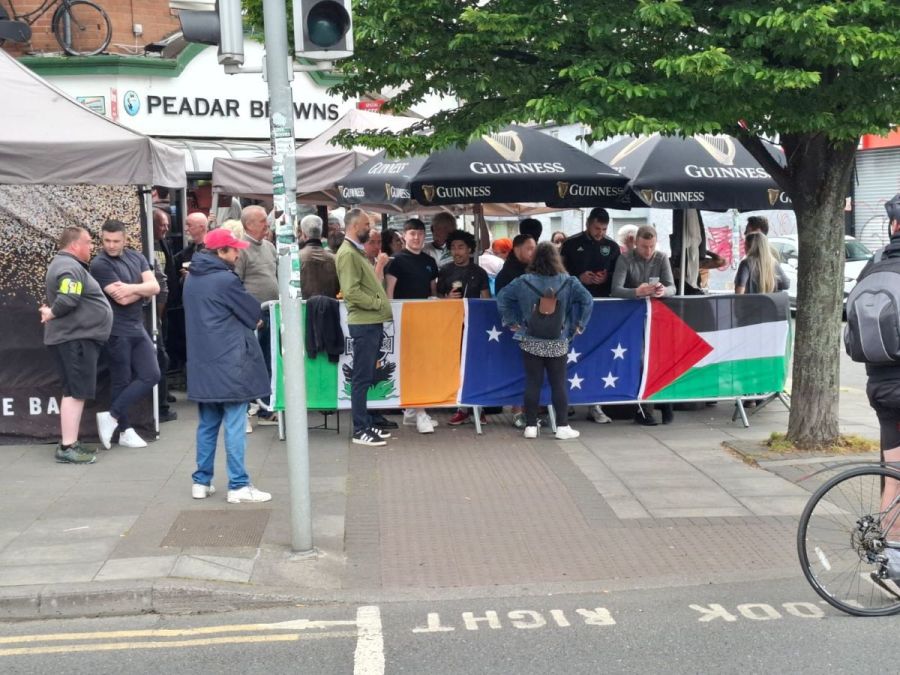
Closer view of section of the crowd last Saturday outside the front of the pub. (Photo: R.Breeze)

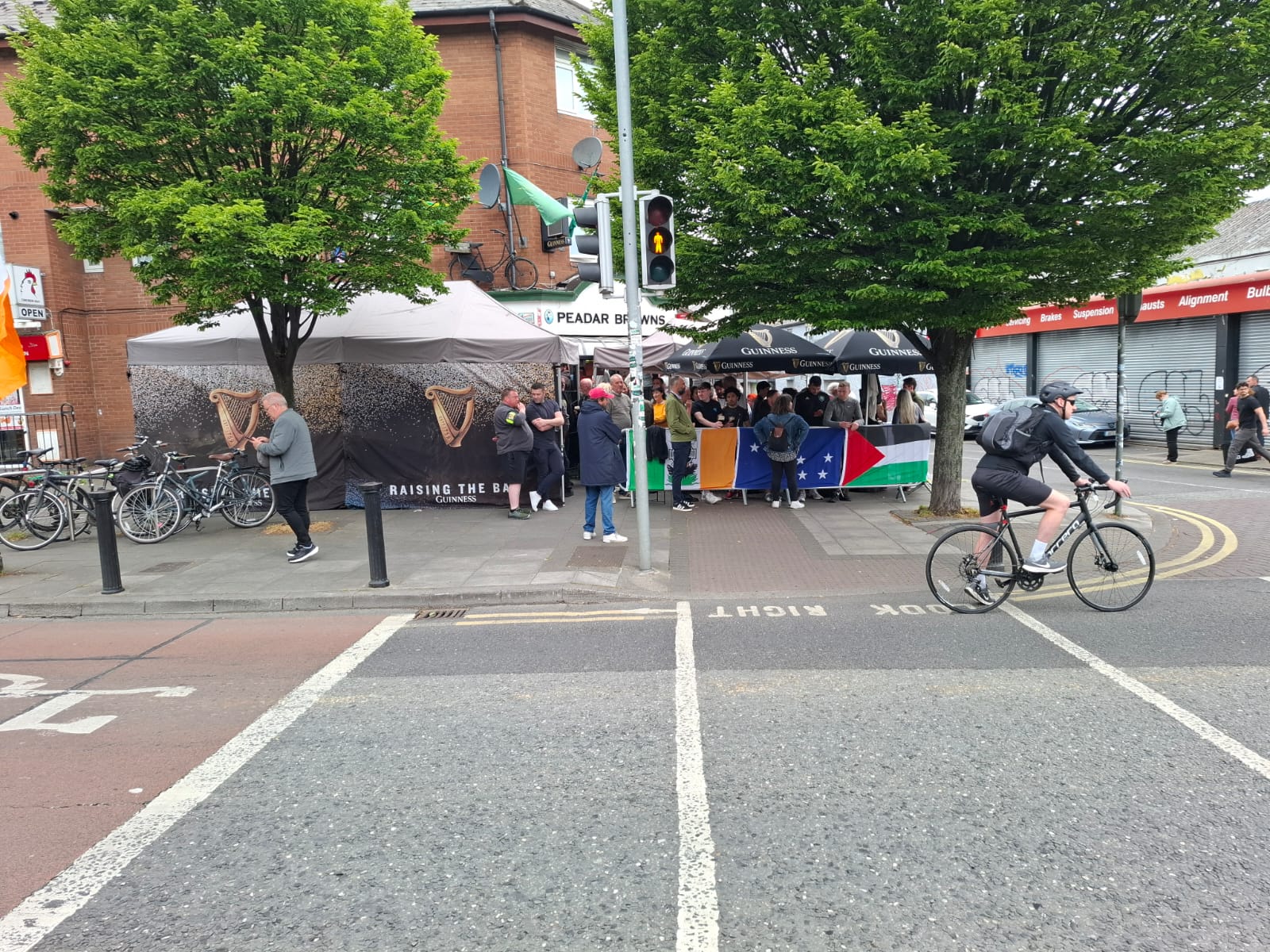
Peadar Browne’s pub has built up a reputation over years as one of socialist Irish Republican outlook, with both external appearance in flags and mural along with the interior decorations unashamedly declaring the broad sympathies of both owners and clientele.

The venue has seen a number of events in keeping with that perspective held there, ranging from concerts to fund-raising events of various kinds, in addition to public and private meetings. The large mural of a Palestinian flag on the pub’s side also declares their internationalist sympathies.

Section of last Saturday’s crowd outside Peadar Brown’s, this one at the side of the pub. (Photo: R.Breeze)

For some time Saturday before the 3pm appointed for the rally, defenders were arriving, including Irish Republicans and Irish socialists of various organisations and none, Palestine supporters Irish and other, along with activists more specifically antifascist.

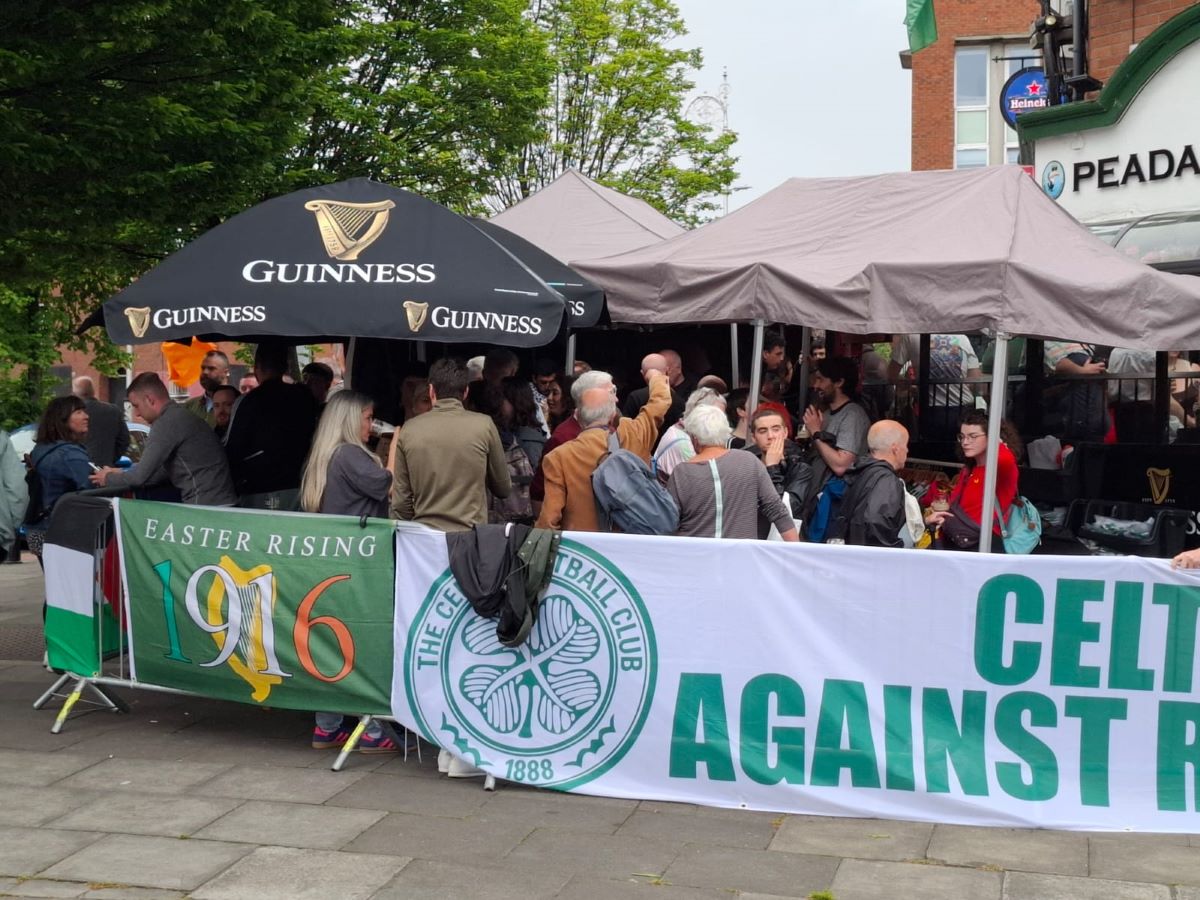
Soon both the inside and external areas of the pub were full, with extra banners and flags lining the external area facing the road. Occasionally the driver of a passing vehicle tooted its horn in solidarity, sometimes with extended clenched fist and encouraging roar from the passenger’s side.

Section of last Saturday’s crowd outside Peadar Brown’s, viewed from the middle of the road outside. (Photo: R.Breeze)

Near to the rally’s appointed hour it began to rain and continued for a while but the pub’s external area had been canopied over so few had to move – unless it were to use the toilet or refresh their glasses.

Conversations slowed on occasion as people checked their timepieces, looked outwards, shrugged and resumed talking. By 4pm most of those who hadn’t left decided they’d be staying, already in their evening weekend socialising venue, or at least for the first stage of the evening.

Section of last Saturday’s crowd outside Peadar Brown’s, this one at the top side of the pub. (Photo: R.Breeze)

In fairness, the absence of any uniformed Gardaí on the ground to protect the far-Right had been an indication that they were not expected to appear.

In Conclusion, drawing up The Balance:

The pub had one of its fullest Saturday afternoons and boosted its reputation among many who knew of it only vaguely, while online calls for a boycott were taken by many as recommendations for “a pub with no racists”. Fascists and racists in turn suffered a hit to their morale.

Some of the defenders on Saturday at the lower side with the mural behind them. (Photo: R.Breeze)

Socialists, communists, Irish Republicans and independent antifascists stood together in defence of a pub with an Irish Republican socialist ambience and strong pro-Palestine presence against a threat from far-Right and fascist elements.

Liberals, social democrats and former Republicans, usually prominent on anti-racist marches? Not so much.

End.

1916 Rising Commemoration in Glasnevin: James Connolly, the Citizen Army and Palestinian Resistance

Clive Sulish

(Reading time: 4 mins.)

An Irish Republican Easter Rising commemoration conducted on Sunday 20th April followed tradition in some aspects but departed in others. The event in Glasnevin Cemetery was organised by the Anti-Imperialist Action group.

As the 1916 Rising commenced on Easter Monday it is traditionally commemorated on various days around the Easter weekend. The actual date however was 24th April which a now-deceased socialist Republican activist publicly celebrated every year as Republic Day in front of the GPO.1

Taken from near rear of the marching columns approaching Cross Guns Bridge. (Photo: R.Breeze)

Among the commemorations organised by Irish Republicans around the past weekend was that by the AIA group on Sunday, rallying by the Phibsboro shopping parade for 1pm, before marching out to Glasnevin cemetry along the Phibsboro Road in two parallel separate lines.

This gathering in the past has been marred by the Special Branch, the political plainclothes police, harassing and attempting to intimidate those present, demanding their names and addresses under anti-terrorist (sic) special legislation. This time they were there but did not approach.2

Just after passing Crossguns Bridge over the Royal Canal, a flare was lit and the march stopped in the street.3

After a short pause the march resumed, led by the colour party,4 six men and women, each carrying a different flag with the Tricolour and Starry Plough in the lead, all dressed in black trousers, white shirts, black berets, sunglasses and lower face masked.

The images of each of the Seven Signatories of the 1916 Proclamation, all shot by British firing squads were on large placards were carried among the marchers: Tom Clarke, James Connolly, Patrick Pearse, Seán Mac Diarmada, Joseph Plunkett, Thomas McDonagh, Eamonn Ceannt.

(Photo: R.Breeze)

A variety of flags were also flown among the marchers, including the green and gold Starry Plough,5 Palestinian flag, Basque Ikurrina and red flags (with gold hammer and sickle emblem on at least one).6 The AIA banner carried at the front bore a quotation from Bobby Sands in Irish.

The march soon passed the main gates of Glasnevin Cemetery to their right but continued before turning leftward to then cross over the pedestrian railway bridge to the newer part of Glasnevin Cemetery and up to the monument to the Six armed struggles referred to in the Proclamation.7

Formed in two lines the attendance was welcomed in Irish and English by the event’s MC, calling also for the reading of the Proclamation of Independence, which a man stepped forward to do. The MC recommended a careful reading of the still-relevant document to attendees from abroad.

Section on the left of the attendance at the commemoration rally with another section to the right out of shot. (Photo: R.Breeze)

Following the reading, the MC commented on the important role of culture in the 1916 Rising8and called on an activist who he said has done much to promote traditional and folk Irish song, who proceed to sing Patrick Galvin’s Where Oh Where Is Our James Connolly? “with some changes”.

Next the call was given for those who wished to lay floral tributes while the colour party lowered their flags in homage to the fallen to commands in Irish, then slowly raised them again before responding to the command in Irish to stand ‘at ease’.

(Photo: R.Breeze)

Another activist was called to read the 1915 statement on the Irish Citizen Army by James Connolly in which the revolutionary leader outlined the police violence during the 1913 Lockout that created the need for the ICA and how it had gone beyond defence in assertiveness.

The statement declared its class allegiance and origins “Hitherto the workers of Ireland have fought as parts of the armies led by their masters, never as members of an army officered, trained, and inspired by men of their own class.”

Reading Connolly’s “To the Irish Citizen Army” (Photo: R.Breeze)

The PA amplification failed on the reader but she carried on in a strong voice reading Connolly’s words that the ICA sought alliance with all progressive forces but remained independent, not to be bound by the limits others set themselves and going further on their own if necessary.9

Another singer was called to perform Erin Go Bragh10 specifically about the 1916 Rising (by Dominic Behan, originally called A Row in the Town).

Singing Erin Go Bragh at the Monument (Photo: R.Breeze)

It is traditional for organisations to deliver a keynote message or statement of aims at 1916 commemorations and a statement was read on behalf of the Irish Socialist Republican Movement (of which the AIA is a part) restating the objectives of national independence and socialism.

In that context the struggles against the Irish ruling class putting the State into imperialist alliance and against the British occupation of the nation, also a NATO member, were greatly important and the Gardaí had broken a comrade’s foot in that struggle.

(Photo: R.Breeze)

Referring to the international context of the 1916 Rising and the international connections of the revolutionary movement in 1916, the MC read out a fraternal message to AIA from the People’s Front for the Liberation of Palestine,11 declaring that the struggles of both peoples are one.

The event concluded at around 2.45pm with a singer performing Amhrán na bhFiann12 (first verse and chorus) followed by an announcement or reminder of a public meeting organised by the AIA titled Rebuilding the Republic to take place at 4pm at a venue not very far distant.

End.
Footnotes

1Easter is a religious festival and its date varies from year to year according to computations based on the lunar and solar calendars and cannot fall on the same date annually in the Gregorian calendar (or the Julian one). After the insurrectionary forces had taken possession of the building, Patrick Pearse with James Connolly by his side read the Proclamation outside the General Post Office (GPO) building on the first day of the Rising (after its rescheduling from the previous day, Sunday): 24 April 1916. Tom Stokes tried for years to have the date adopted as Republic Day and annually organised an event outside the GPO on that date. After his death others carried on commemorating the date but rather than outside the GPO, at Arbour Hill. The Republican movement continues to hold its 1916 commemoration events over the Easter weekend.

2Possibly because the dust has not yet settled on the Gardaí’s recent violent arrests on 23 peaceful activists in three different events over four days (See Rebel Breeze’s Irish State Ramps Up Repression) recently.

3This spot has a 1916 history: A group of Irish Volunteers walked from Maynooth on Easter Monday along the banks of the Royal Canal, meeting two Irish Volunteers guarding the bridge and that night slept in Glasnevin Cemetery. The following morning they continued their journey to the city centre. Later, as the Rising was being suppressed, the British soldiers placed a barrier on the Bridge and prevented most people from passing through. A local man who had been deaf from birth failed to heed the soldiers’ challenge and they shot him dead.

4The ‘colour party’ carries the ‘colours’, i.e the flags and usually marches at the front. The number and type of flags varies but Irish Republican colour parties always carry the Tricolour among them, usually followed by the Starry Plough of which for many years the white stars on a blue background version was the most common. Often a flag of each of the four provinces would also carried and the Gal Gréine (or Sunburst) of the Fianna and of the Fenians would be carried too. The Harp on a Green background was another flag that was often carried by Colour Parties.

5The original design of the flag of the first workers’ army in the world, the Irish Citizen Army, created in 1914. It is a plough following the form of the Ursa Mayor constellation with a sword replacing the ploughshare.

6This is usually considered a symbol inherited from the Bolsheviks, the sickle representing the agricultural workers and the hammer, the industrial workers, their conjunction symbolising unity of peasants and industrial proletariat.

71798 and 1803 (United Irishmen), 1848 (Young Irelanders), 1867 (Fenians), 1882 (Invincibles group within the Fenians), 1916 (IRB, Irish Volunteers, Irish Citizen Army, Cumann na mBan, Fianna Éireann)

8Irish language revival, national theatre groups, national sports, poetry, music and song all contributed to an atmosphere conducive to resistance and uprising.

9However it may be for others, for us of the Citizen Army there is but one ideal – an Ireland ruled, and owned, by Irish men and women, sovereign and independent from the centre to the sea, and flying its own flag outward over all the oceans. We cannot be swerved from our course by honeyed words, lulled into carelessness by freedom to parade and strut in uniforms, nor betrayed by high-sounding phrases.

The Irish Citizen Army will only co-operate in a forward movement. The moment that forward movement ceases it reserves to itself the right to step out of the alignment, and advance by itself if needs be, in an effort to plant the banner of freedom one reach further towards its goal. https://www.marxists.org/archive/connolly/1915/10/forca.htm

10The slogan Éirinn (or Éire) go brách (“Ireland for ever”) was rendered in English spelling as Erin go bragh.

11 A socialist and secular resistance Palestinian resistance organisation; its armed wing is Brigades of the Martyr Abu Ali Mustafa which has been part of the armed resistance throughout the period, often in coordination with other groups.

12In a reversal of the usual sequence, the lyrics of this song by Peadar Kearney and Patrick Heeney were first composed in English but later translated to Irish, that being the most popular version of the chorus today.

Further information

https://www.marxists.org/archive/connolly/1915/10/forca.htm

isrmedia@protonmail.com

PALESTINIAN POLITICAL PRISONERS’ DAY IN DUBLIN

Diarmuid Breatnach

(Reading time: 4 mins.)

April 17th is the annual Palestinian political Prisoners’ Day and it was marked in O’Connell Street, the main street of Dublin’s city centre, by an event with speeches, banners and chants organised by the Ireland Palestine Solidarity Campaign.

Palestine national flags fluttered about the crowd being addressed by a number of speakers with occasional toots of solidarity from passing traffic – a common occurrence at Palestine solidarity events in most of Ireland.

View of eastward of section of the crowd at the event (Photo sourced: IPSC)

Dáithí Doolan was one of the speakers and though saying some progressive things about solidarity with Palestine and the terrible situation in which the occupiers have them, soon revealed the political poverty and lack of solidarity with resistance of his Sinn Féin party.

Doolan reminded his audience of when there were political prisoners in Ireland, as though this was no longer the case, presumably because the prisoners now are not of his party. Nor did he mention the current attempts to extradite Irish Republicans to British administrations.

The SF speaker went on to extol the South African process, perhaps not caring about the betrayal of the struggle and sacrifice of the masses there, the deepening grip of imperialism on the rich natural resources, the corruption and repression of the ANC regime and the massacre at Marikana.1

If Doolan thought about it he must have hoped that his audience did not remember that the South African process had a twin, the Palestinian one at Oslo which sabotaged the Palestinian struggle and brought into being the corrupt Palestinian Authority2, the Israeli proxy in the West Bank.

Sinn Féin has achieved a somewhat similar position in the Six Counties colony and has been working hard to reach a corresponding role in the Irish state. And why not, when it endorses the “Two State solution” giving the Palestinians 20% of their land under Zionist eyes and guns.

The very least, Doolan said, that the Irish Government could do to help the Palestinians, would be to enact the Occupied Territories Bill but he proposed nothing further, not even the ban on US military flights through Shannon Airport or on Israeli arms flights through Irish airspace.

Darragh Adelaide from the People Before Profit party spoke too about Palestine and solidarity but also about the Palestine refugees that have had to sleep in tents on Irish streets and the attacks on them both by the authorities and by fascists and other racists.

Palestinian prisoner conditions

A woman gave a detailed list of statistics relating to Palestinian political prisoners but also went through the tortures and terrible conditions in which they are kept. She concluded reminding her audience that each prisoner is a human being, a parent, a child, a sibling and not a number.

View of the crowd southward from behind a speaker (Photo sourced: IPSC)

In a year and a half, more than 15,800 Palestinians have been arrested, including 500 women, 1200 children, and thousands of detainees who were placed under arbitrary administrative detention.  64 Palestinians have died in prison since October 2024, including a child.3

The prison administration’s special units have carried out violent raids on prisoners’ cells, administering severe beatings, torture, and ill-treatment.4

Prisoners have suffered power and water cuts, and all of their belongings—including clothes, electrical appliances, and hygiene items—have been confiscated.5

They have been placed under complete isolation, family visits have been completely banned, and the International Committee of the Red Cross has been prevented from visiting them inside prisons. 

Additionally, a policy of starvation has been implemented against thousands of prisoners, who are being provided with only two extremely poor-quality and quantity meals a day.6

The MC of the event led chants in which he called out Palestinian political prisoners! and the audience responded with Free them all! Similarly with Free the children prisoners — Free them all! and Free the women prisoners! — Free them all!

Symbolising the Palestinian political prisoners (Photo sourced: IPSC)

He also referred to the woman arrested outside the Irish Embassy in Berlin for speaking in Irish and, in defiance, led the audience in a chant in Irish expressing solidarity with the Palestinian people: Saoirse don Phalaistín! (Freedom for Palestine!)7

What was notable in its total absence from all the speeches was any call to step beyond the marches and similar measures which have been supported by thousands in Ireland over more than 18 months but which have not succeeded in moving the Government even to enforcing its formal neutrality.

This is replicated in most solidarity events across the state, leaving those few who take action to increase greater pressure on the ruling class to face the repression of the Irish State, as with 23 men and women in three different events over a four-day period in Dublin recently.8

Political prisoners from the armed resistance

The Joe McDonnell Ballad9 would have been most appropriately performed at this event, in particular the chorus line: You dare to call me a terrorist, while you look down your guns … But the IPSC would hardly endorse the singing of that song nor wish to be associated with it in public.

There were two large prisoners’ solidarity banners of the IPSC at this event but it is remarkable how rarely one sees them on the IPSC’s national marches. The problem with the prisoners for liberal organisations is that some of them, at least, have been armed fighters of the Resistance.

This, combined with ignorance perhaps, accounts for the comparatively low numbers at this event. However, it has to be said that known revolutionary organisations were also visibly absent.

View south-westwards with the iconic GPO (General Post Office) building in the background. (Photo sourced: IPSC)

Doolan’s party was a problem for liberals when many of the political prisoners here had been armed Irish Republican resistance fighters; it’s still a problem for them today — but also for Doolan and his party now that the current Irish political prisoners are no longer associated with them.

If solidarity does not embrace resistance then it’s charity, not solidarity. And if resistance is to be embraced then it should be so for all its expressions, artistic, cultural, mass mobilisations, strikes, boycotts … and armed. Including solidarity with those who, because of resistance, end up in jails.

Free them all!

End.

NOTES

1Culminating on 16th August 2012 (while Mandela still lived) the police of the ANC Government carried out a massacre of over 40 striking miners over a period of three days. The massacre was to suppress a strike in a platinum mine of the Canadian Lonmin company, repressing also a breakaway union from theANC-allied National Union of Mineworkers. The massacre is widely believed to have been organised by Cyril Ramaphosa, then a millionaire and vice-President of the ANC Government and recent leader of the NUM, now President of South Africa.

2Which also beats and incarcerates Palestinians resisting the Occupation (exact figures are difficult to obtain) and has murdered some.

3https://www.addameer.org/news/5549

4Ibid.

5Ibid.

6Ibid.

7This slogan has now become well known in Ireland in voice but also in writing, appearing on flags, banners and placards. It represents a partial success for those of us who have tried to insert a measure of the Irish language into Palestine solidarity, in the belief that it is important for the Irish language to be present in progressive movements.

8See https://rebelbreeze.com/2025/04/06/irish-state-ramps-up-repression/

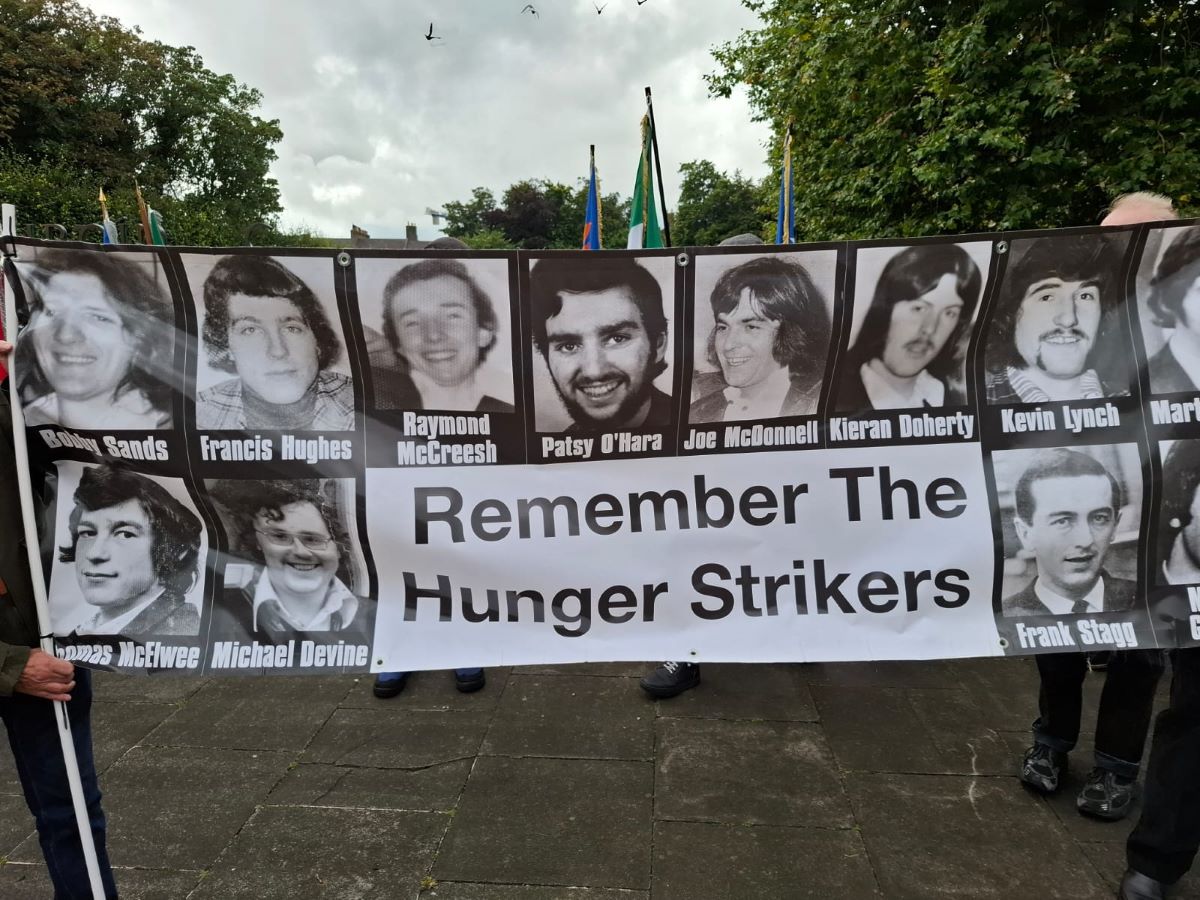
9By Brian Warfield of the Wolfe Tones band in honour of Volunteer Joe McDonnell of the Provisional IRA who died on hunger strike in 1981; the song also names other hunger strike martyrs of the Provisionals Vols. Bobby Sands, Francis Hughes, McCreesh but adds Vol. Patsy O’Hara of the Irish National Liberation Army. In total, seven of the Provisionals and three of INLA died on hunger strike in 1981.

USEFUL LINKS

IPSC:https://www.ipsc.ie

Adameer – Prisoner Support and Human Rights Organisation: https://www.addameer.org/

Adameer Statement on Prisoners’ Day: https://www.addameer.org/news/5549

RALLY AND MARCH AGAINST GARDA REPRESSION IN DUBLIN

Diarmuid Breatnach

(Reading time: 6 mins.)

Hundreds gathered Wednesday night near the rear entrance of Leinster House, home of the parliament of the Irish state, in a demonstration organised by Mothers Against Genocide to protest the police attacks on demonstrators of the previous week.

Background

Over four days the previous week the Gardaí, police force of the Irish State, had attacked demonstrators in a number of different locations in Dublin. On Monday the MAGS group at the front entrance of Leinster House was attacked as they neared the end of their overnight vigil there.

The women were calling for Government action to match the will of the Irish population by preventing military supplies sent to Israel through Irish airspace and airports, to end processing Israeli bonds through Irish banks and to institute sanctions against the Zionist Occupation.

MAGS banner in Grafton Street later in the evening. (Source: Participant)

Eleven women and three men were arrested and taken to different Garda stations where a number of women were strip-searched, including one in an apparent cavity search; three men were charged under the Public Order Act and women pressured to accept an official caution.

Two days later, at a protest organised by the Boycott, Divestment and Sanctions (BDS) Society of the Dublin City University against the official opening visit of the Taoiseach (‘Prime Minister’) to a University building, Gardaí arrested a student for knocking on the window of the building.

On Friday, Gardaí attacked six protesters engaged in a protest at the front entrance to the Belgian Embassy in Dublin, where NATO is represented. The Anti-Imperialist Action protest was against the Irish elite’s attempt to slide the State into membership of the military alliance.

Those protesters were pepper-sprayed into their eyes, forced to the ground, handcuffed and treated so violently that the ankle of one man was broken; the breast of one woman was also grabbed. Two more picketing outside were also arrested, all again distributed around different police stations.

On public order charges, six also on trespass, all eight were brought to a special late court sitting that early evening where a crowd of supporters gathered.

All were bailed on a range of bizarre bail conditions including banned from protesting at Government buildings and a requirement to give 12 hours notice to the Gardaí with details before attending an embassy protest.

Wednesday night’s Leinster House protest

The mood of the crowd of over 500 last night in Merrion Street was militant, being addressed by a woman on behalf of the Mothers group. The crowd was joined by a group flying Starry Plough1 and Palestinian flags, bearing a banner of the AIA and a hand-painted one against NATO.

View of the rally in Merrion Street before the march. (Source: AIA)

The speaker introduced Aileen Malone, mother of Dara Quigley, a well-known blogger some years ago who appeared naked in public while suffering a mental ill health episode. One of the Gardaí dealing with the incident took a video of her and circulated it widely on social media.

Following that public shaming, Dara had taken her own life. Her mother pointed out that the offending Garda, instead of being dismissed, had been allowed to resign and keep his pension. She also condemned the Garda treatment of the women while extolling their courage in resistance.

Another speaker, introduced as representing Jews for Palestine Ireland spoke against the Irish State adopting the IHRA’s definition of antisemitism, the function of which, he stated is to protect the state of Israel against any criticism including regarding its genocide against Palestinians.2

He regretted the diversion from Palestine solidarity entailed in this focus, pointing out that genuine anti-Semitism is to be found among the far-Right while anti-racists and anti-fascists in Palestine solidarity, far from being anti-Semitic are on the contrary active against that variant of racism.

One of the banners at the rally in Merrion Street. (Source: Participant)

A woman from Mothers Against Genocide in Belfast spoke about the history of Irish resistance to colonialism and solidarity with Palestine which had no relation to the Irish Government, vehemently insisting also that being anti-genocide and for human rights is far from anti-Semitism.

Ruth Coppinger, Socialist Party TD, had signalled she wished to speak and was invited to so. She commented on Wednesday’s session in Leinster House when the Garda attack was defended by Mícheál Martin in respect of the right of access to Leinster House.3

A member of the Mothers in Dublin read a solidarity poem she had written and introduced the Resistance Choir, who sang Gonna Let No-one Turn Me Around, a lively song from the US Civil Rights4 movement of the 1960s, followed by slower lament about the Zionist slaughter in Gaza.

The energy in the crowd was dissipating by this point, almost an hour having elapsed and at last the direction to march was given. But where to? It was unclear. Earlier indications had been that one of the Garda stations would be the destination but now the Dept. of Justice was being mentioned.

The slogans shouted were those usually heard at Palestine solidarity events, with calls supporting the Intifada increasingly popular, and even one to Globalise the Intifada! US Warplanes out of Shannon! was another and NATO out of Ireland! was also heard.

Very appropriately also: One, we are the people! Two, We won’t be silenced! Three, Stop the bombing now, now, now, now!

Some banners during the march, seen here on the east side of Stephens Green. (Source: AIA)

The march proceeded, chanting, up Merrion Street, then into Merrion Row, turning left at the Huguenot Cemetery, then along the east side of Stephen’s Green, stopping briefly at the Dept. of Foreign Affairs building, then along the south side to the Dept. of Justice building.

But soon it was on the march again, perhaps heading for the Kevin Street Garda station … But no, along the west side of the Green now, past the Unitarian church where Edward Fitzgerald was married to his French revolutionary wife and then on again down through Grafton Street.

A meeting here was addressed mainly by one speaker, for some reason the crowd repeating his sentences. Not one speaker had yet referred to the attack on the anti-NATO protesters on Friday, much less their bizarre and repressive bail conditions. But perhaps we were heading for the GPO?

No, left and into Dawson Street, up to the Green again, then down Kildare Street to the front of Leinster House. There at last the crowd was addressed on behalf of the Anti-Imperialist Action group regarding the Garda attack on the anti-NATO protesters at the Belgian Embassy.

His talk was interrupted by cries of ‘Shame’ directed at the Gardaí and State. The speaker continued, referencing the resistance history of Irish Republicans and concluded by calling for unity of the Left against repression of any aspect of the Resistance, a call vigorously applauded.

To conclude the evening’s events a display concerning victims of Garda violence was presented, this including the case of Terence Wheelock, a working-class youth who died in Store Street Garda Station as a result of their violence, a crime then covered up by the State.

In Retrospect

It was important and a good act of resistance to organise an emergency protest5 this week and the eventual attendance of around 700 at such short notice was excellent. It is essential to meet repression of resistance with more resistance.

It was noticeable how low the numbers of Gardaí were and although uniformed and a number of plainclothes Special Detective Unit members followed the marchers, at no point did they attempt to stop the marchers or even to line up in numbers to protect the Government offices.

Most of the speakers at the commencing, intermediate and final rallies were clear that the Irish State had made a conscious decision to crack down on solidarity actions the previous week, using physical and sexual violence against activists, and of the need to continue solidarity and resistance.

The commencing rally was however too long and dissipated some of the energy. The lament as the last song just before that march, though no doubt appropriate in some contexts, continued that dissipation.

Coppinger, as a leading member of the Socialist Party was inappropriate as a speaker at the event. The party in the past has opposed boycotts against Israel and South Africa on the spurious grounds that it harms the oppressed people and works against solidarity between progressive settlers.

The Socialist Party also supports the Two-State proposal which would concede 80% of Palestine to the Zionist settlers. Coppinger personally and her party have also publicly condemned the Palestinian Resistance breakout operation of 7th October 2023.

The marching seemingly for ever, at times to symbolic but empty Government buildings was not helpful and most of the people already detest the Government. A good destination would have been at least one of the Garda stations where activists had been held the previous week.

Marching from and to an essentially closed Leinster House and Government buildings runs the risk of replicating the routine marches every month or so of the Ireland Palestine Solidarity Campaign.

The value of the Mothers has been their departure from that increasingly sterile practice and continuing in that vein would be a useful contribution to the solidarity movement and resistance in general.

Unity against repression is a historically-proven necessity and, as called for at the final rally last night, increasing unity between newer and longer-lived elements of the Resistance is also needed.

End.

An excellent riposte in the poster slogan/ meeting title. The design is based on the poster against strip-searching Republican women in the 1970s, design by Oisín Breatnach. (Source: Mid-Ulster IPSC)

Footnotes

Sources and further information

https://www.irishtimes.com/opinion/2025/02/05/ireland-is-signing-up-to-a-definition-of-anti-semitism-that-has-been-used-against-irish-politicians/

https://www.independent.ie/regionals/wexford/wexford-district/demonstration-at-wexford-garda-station-over-alleged-strip-searching-of-mothers-against-genocide-protestors-in-dublin/

1Flag of the Irish Citizen Army, first produced in 1914, the design is based on the Ursa Mayor constellation, including a plough in gold colour, with a sword instead of the ploughshare, all on a green background. A later version of the Republican Congress represents only the stars of the constellation in white on a blue background. The green and gold version was the one flown by the AIA.

2https://www.irishtimes.com/opinion/2025/02/05/ireland-is-signing-up-to-a-definition-of-anti-semitism-that-has-been-used-against-irish-politicians/

3This was a spurious defence by the Taoiseach: a) It was before 7am and the Mothers were leaving at 7.30am; b) the pedestrian entrance was not blocked; c) the gates at the rear of the building were not blocked.

4But, like many of those songs, based on an earlier Christian song.

5There had also been an emergency protest outside Leinster House on last week’s Wednesday morning, Kildare Street being blocked for an hour without Garda action.