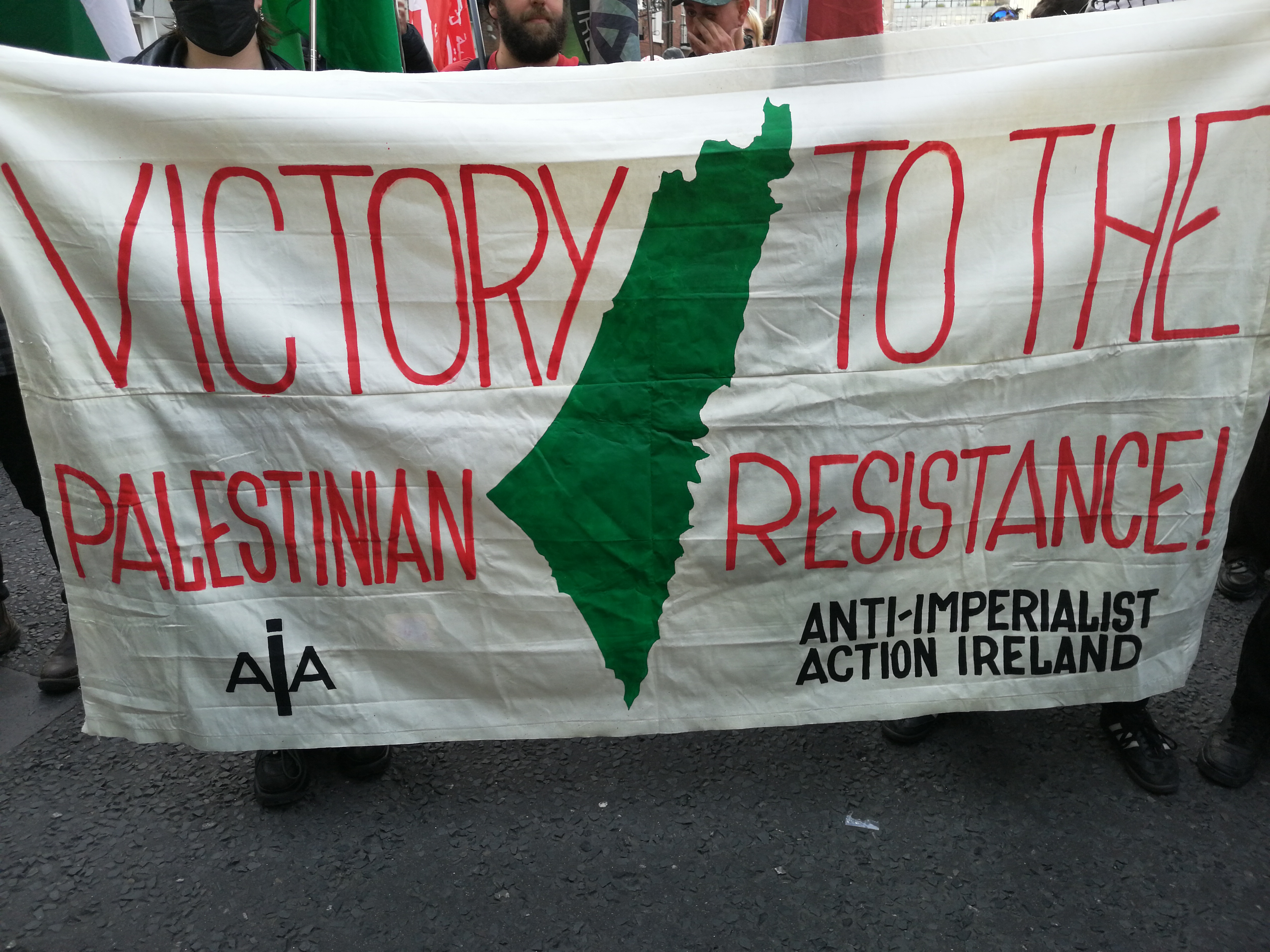
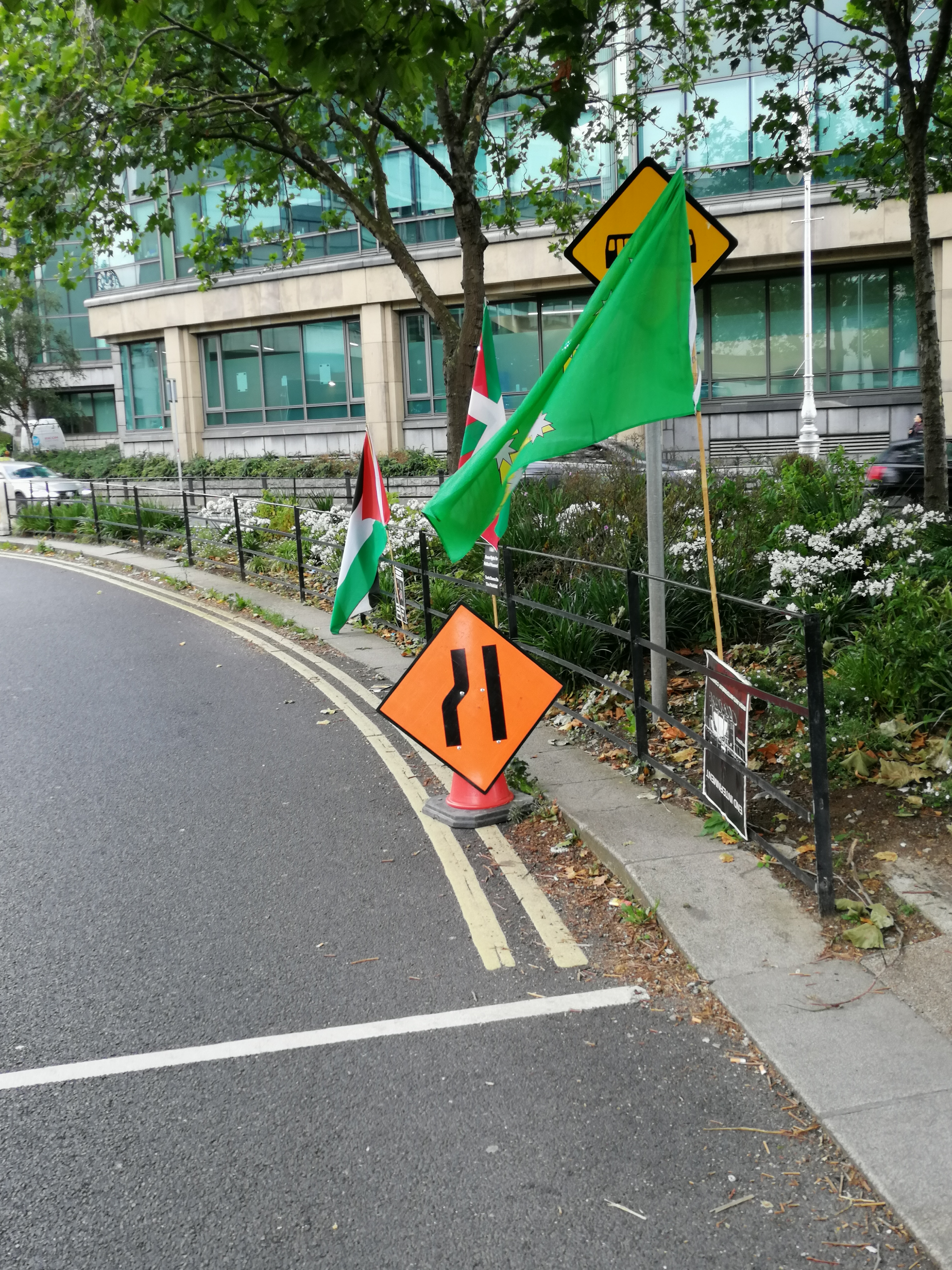
Among Christmas shopping crowds in Dublin’s city centre, the calls for freedom of political prisoners rang out, while the Irish, Palestinian and Basque flags fluttered in the wind among festive lights and projected light-show.
The Ireland Anti-Internment Campaign was holding its annual political prisoner solidarity picket in the busy O’Connell street, supported by socialist Republican groups and independent activists.
View of picket line looking southward. (Photo: Rebel Breeze)
December is a traditional month in Ireland for focus on Republican prisoners. However, the IAIC campaign has always made a point of remembering political prisoners elsewhere too, with Palestinian and Basque flags erected on its regular pickets.
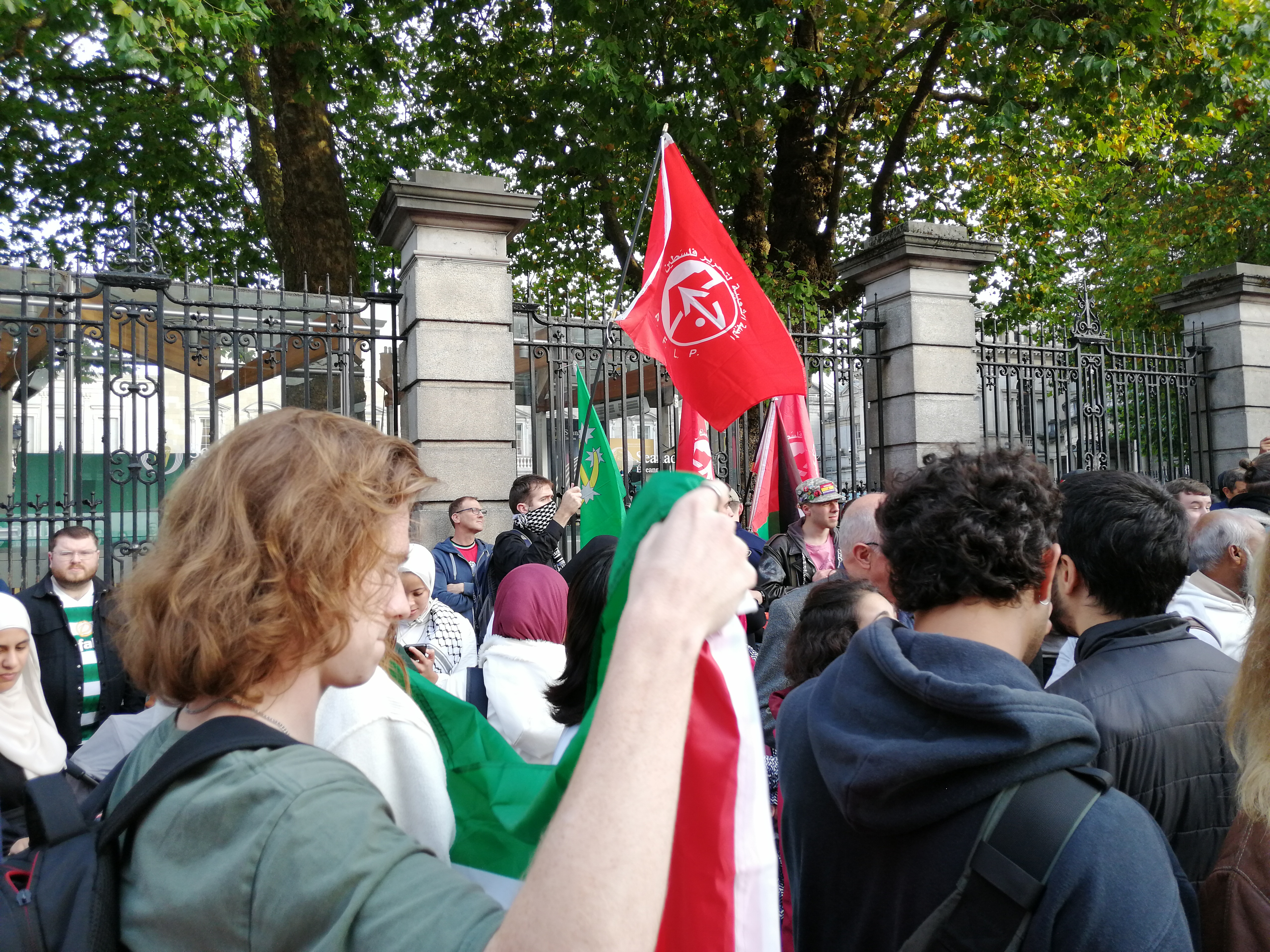
This year the Campaign had especially requested Palestinian flags and these were present, both the national flag and that of the Peoples Front for the Liberation Palestine, fluttering alongside Basque flags and the green-and-gold Starry Plough.1
In addition, one of the IAIC’s banner displayed a large copy of an image depicting a Palestinian’s arm extended through prison bars to grasp the hand of an Irish Republican prisoner’s hand also from nearby bars, from the original by political cartoonist Carlos Latuf,.
A black banner had been rigged with lights to spell “Saoirse”, the Irish word for “freedom” and the picketers set up in a line with other banners and flags facing the GPO building.2
Political prisoners sometimes have their family visits cancelled as a punishment and during the Covid pandemic prevention period it was used as an excuse to prevent Republican prisoners’ family visits. (Photo: Rebel Breeze)
SHOUTS
A speaker using a megaphone informed passers-by that internment without trial had not ceased in Ireland and that Republicans were being charged and then refused bail by non-jury courts on both sides of the British Border, spending two years in jail regardless of their trials’ outcomes.
All the Republican prisoners, the IAIC speaker said, had been convicted in non-jury special courts. Palestinians were also being convicted in special courts, he said, military courts and many were in jail – in “administrative detention”, i.e interned without ever having been convicted or tried.
Over 3,000 had been arrested in Israeli Army raids since October 7th,3 the speaker said through the megaphone, bringing the overall number of Palestinians in jail to over 7,000.4
(Photo: Rebel Breeze)
The recent exchange of prisoners between the Zionist state and the Palestinian resistance had resulted in liberty for 240 Palestinians, of which 1075 were children and 68 women.
There was regular chanting from the picket line including: “From Ireland to Palestine – Free all political prisoners!” “When there is occupation – Resistance is an obligation!” and “Free political prisoners – Free them now!”
At one point some kind of religious procession was briefly enacted in front of the GPO building and an elderly woman in apparent religious garb approached the picketers shouting something at them which they largely ignored, maintaining their solidarity slogans.
(Photo: Rebel Breeze)
In addition to interested people taking photos or filming video of the protest on their devices, some approached the participants to ask questions and to receive a leaflet, after which a number actually joined the protest line for a while (some until the end).
Occasional passing traffic also sounded their horns in solidarity.
The pavement in front of the GPO showing shoppers and people queuing for food distribution. (Photo: Rebel Breeze)
STATEMENT
As the end of the event’s allocated period approached, a representative of the IAIC asked the participants to gather around and spoke about how resistance brings repression and oppression brings resistance, resistance being the “crime” for which political activists are jailed.
The participants were thanked for their support, whether independents or activists of Ireland Anti-Imperialist Action and Saoirse Don Phalaistín organisations.
The event ended with the acapella singing of “The H-Block Song” by Diarmuid Breatnach, in an adaptation of the original air to the lyrics of what is “still a good song” he said, composed by a man who, along with his party, “no longer supported Republican prisoners”.6
(Photo: Rebel Breeze)
The lyrics recall the struggle of Republican prisoners in the late 1970s against the removal of their ‘Special Category’ political status, which began with refusal to wear prisoner uniform. The struggle escalated to the “no-wash protests” and to hunger strikes in 1980 with ten martyrs in 1981.
As the protesters collected their flags and wrapped up their banners, the nature of current Irish society was underlined by the queues forming up across the road for free food being distributed by charitable organisations.
Early view of picketers, looking northward. (Photo: Rebel Breeze)
INDEPENDENT AND OPEN DEMOCRATIC ORGANISATION
The IAIC is “an independent organisation and open democratic organisation” of ten years’ existence and although it has held events for specific cases such as the framed Craigavon Two,7 its main activity has been regular public pickets in Dublin to highlight ongoing internment in Ireland.
The Campaign group encourages participation by democratic people in its regular pickets, regardless of political organisation affiliation or none and, according to one of the organisers, expects to hold its next one in Dublin in January or February.
The IAIC expects also to take part again in the annual Bloody Sunday Commemoration march in Derry on Sunday 29th January 2024.
end.
Unintentionally impressionistic image, photo taken from the east side of O’Connell Street (Photo: Rebel Breeze)
APPENDIX: ANNIVERSARY OF HANGING OF IRISH REPUBLICAN
Though not mentioned in the discourse, the above event took place within days of the anniversary of the British colonial execution of an Irishman in revenge for his killing of an ex-Republican who had turned informer.
James Carey, in the midst of a ‘witness protection program’ provided as a reward for his betrayal of his comrades in giving evidence in court to ensure the jailing of some and hanging of five others, was killed in a gunfight with Pat O’Donnell.
Carey had been a leading member of the National Invincibles’ (a split from the Fenians) cell in Dublin, and had given the signal for the fatal stabbing of British Under-Secretary Burke and Chief Secretary Lord Frederick Cavendish in Phoenix Park on 6th May 1882.
However, Carey turned “Queen’s Evidence” to testify ensuring the conviction of his former colleagues and even gloated in court at their fate. His reward, but for O’Donnell, would have been a new life with pension under an assumed name with wife and children in the South African colony.
O’Donnell was an independent Republican from the Irish-speaking Gweedore area in Donegal but had been to the USA, where he had cousins who were prominent in the “Molly Maguires”, an Irish-led resistance organisation among miners in the USA.
O’Donnell was hanged on 17th December 1883 but is commemorated in the satirical song “Monto” and also in the serious “Ballad of Pat O’Donnell”. His home town of Gweedore also holds a monument in his honour.
end.
FOOTNOTES
1Flag of the Irish Citizen Army, the first workers’ army in the world, founded to protect workers from the police during the Dublin Lockout/ Strike of 1913.
2The General Post Office, iconic building on Dublin’s O’Connell Street, which was the HQ of the leadership of the 1916 Rising, left a shell by fire from British artillery bombardment but rebuilt later.
6Francis Brolly (1938-1920) of Provisional Sinn Féin, composed the song which was released in 1976. PSF abandoned the struggle in the imperialist-promoted pacification process towards the end of the last century and most of their prisoners were released under licence. However those who made public their disagreement with the colonial occupation and the pacification process were on occasion returned to jail while new “dissidents” were charged and refused bail in special no-jury courts, with tacit support of the PSF.
Israel uses white phosphorus munitions in Gaza during Operation Cast Lead.
Norman Finkelstein published a book a number of years ago entitled Gaza: An Inquest Into Its Martyrdom.
In it he looked at various major episodes in the long bloody onslaught on the people of Gaza, amongst them Operation Cast Lead and also the attack on the boat Mavi Marmara and the Goldstone Report, amongst other issues.
He could have written it yesterday about the current genocidal plans of the Israeli state.
The current Israeli offensive is just one more in a long line of massacres. This is not a review of Finkelstein’s book, though any book by him is worth reading and should be read. Rather I just want to use the book to show that what is happening now is not new, it is just more intense.
Israel has murdered before, it has lied, it has committed war crimes and it has always received the support of western states.
Above all we should be clear that we are where we are partly due to the Oslo Accord and also the role played by the Palestinian Authority and the PLO. They cannot wash their hands of the affair.
“One of the meanings of Oslo,” former Israeli foreign minister Shlomo Ben-Ami observed, “was that the PLO was . . . Israel’s collaborator in the task of stifling the intifada and cutting short . . . an authentically democratic struggle for Palestinian independence.”
Rabin (left) and Arafat shake hands on the Oslo Accords under the management of then US President Clinton. (Photo sourced: Internet)
In particular, Israel contrived to reassign to Palestinian surrogates the sordid tasks of occupation. “The idea of Oslo,” former Israeli minister Natan Sharansky acknowledged, “was to find a strong dictator to . . . keep the Palestinians under control.”
“The Palestinians will be better at establishing internal security than we were,” Israeli prime minister Yitzhak Rabin told skeptics in his ranks, “because they will not allow appeals to the Supreme Court and will prevent the Association for Civil Rights in Israel from criticizing the conditions there. . .
They will rule by their own methods, freeing, and this is most important, the Israeli soldiers from having to do what they will do.”(1)
In other words, Gaza has bled under the passive gaze of the bureaucrats of the Palestinian authorities and of course of the reactionary Arab regimes that have never lifted a finger to help their Palestinian brothers and sisters.
They have not even threatened to cut off the supply of oil to the West, something they could do right now, but won’t. It has also happened under the gaze of those on the Left who run around shouting Implement Oslo! Two State Solution!
They ignore the fact that Oslo represented an ideological, political and military defeat for the Palestinians. The PLO accepted its role as puppet, administrator of a small urban city-like council and as chief repressor of those who continued to fight for Palestinian freedom.
A look at the Oslo II Accord, signed in September 1995 and spelling out in detail the mutual rights and duties of the contracting parties to the 1993 agreement, suggests what loomed largest in the minds of Palestinian negotiators.
Whereas four full pages are devoted to “Passage of [Palestinian] VIPs” (the section is subdivided into “Category 1 VIPs,” “Category 2 VIPs,” “Category 3 VIPs,” and “Secondary VIPs”), less than one page—the very last—is devoted to “Release of Palestinian Prisoners and Detainees,” who numbered in the many thousands…
The barely disguised purpose of Oslo’s protracted interim period was not confidence building to facilitate an Israeli-Palestinian peace but collaboration building to facilitate a burden-free Israeli occupation.(2)
However, Israel is now militarily weak. Finkelstein points to a number of attacks where it has shown its weakness. Its predilection is for attacks on the civilian population that can’t fight back.
In 2006, it opted to bomb civilians in Lebanon rather than engage in a proper fight with Hezbollah “terrorizing Lebanese civilians appeared to be a low-cost method of “education.”(3)
In Gaza in Operation Cast Lead in 2008/9, it followed a similar path of aerial bombardments of civilians rather than land invasions, that would see its troops face the wrath of Hamas and other armed organisations. So first they relentlessly bombed Gaza before any troops went in.
When the troops went in, the civilian population was their preferred target then as it is now. The murder of civilians is not new. It is part of an Israeli strategy of claiming easy victories.
An Israelicombatant remembered a meeting with his brigade commander and others where the “rules of engagement” were “essentially” conveyed as, “if you see any signs of movement at all you shoot.”
Other soldiers recalled, “If the deputyBattalionCommander thought a house looked suspect, we’d blow it away. If the infantrymen didn’t like the looks of that house—we’d shoot” (unidentified soldier); “If you face an area that is hidden by a building—you take down the building.”
Questions such as ‘who lives in that building[?]’ are not asked” (soldier recalling hisBrigadeCommander’s order);
“As for rules of engagement, the army’s working assumption was that the whole area would be devoid of civilians … Anyone there, as far as the army was concerned, was to be killed” (unidentified soldier);
“We were told: ‘any sign of danger, open up with massive fire” (member of a reconnaissance company); “We shot at anything that moved” (Golani Brigade fighter); “Despite the fact that no one fired on us, the firing and demolitions continued incessantly” (gunner in a tank crew).
“Essentially, a person only need[ed] to be in a ‘problematic’ location,” a Haaretz reporter found, “in circumstances that can broadly be seen as suspicious, for him to be ‘incriminated’ and in effect sentenced to death.”(4)
In all around 1,400 Palestinians were murdered in Operation Cast Lead, with 80% of them being civilians including 350 children. Israeli casualties were risible in comparison, just 10 combatants were killed, four of whom were killed by friendly fire.(5)
Then as now, Israel wheeled out the old trope of “human shields”. Amnesty International found no evidence of that,(6) in fact, it found evidence of Israel using children as human shields.(7)
It also found that Israel used then, as it does now, white phosphorous against schools, hospitals and even the UNRWA.(8) Furthermore, 99% of the air attacks were accurate.(9) If they murdered civilians, it is because the civilians were the target.
Following the operation, the Goldstone Report was published. It surprised no-one when it found evidence of Israeli war crimes and to a lesser extent of Hamas. It is a salutary lesson for those who now place their confidence in the International Criminal Court (ICC).
Goldstone made various recommendations.
Individual states in the international community were exhorted to “start criminal investigations in national courts, using universal jurisdiction, where there is sufficient evidence of the commission of grave breaches of the Geneva Conventions of 1949.
“Where so warranted following investigation, alleged perpetrators should be arrested and prosecuted in accordance with internationally recognized standards of justice.”(10)
We know that nothing of the sort happened. In fact, the western governments paid little heed to the report. Goldstone was forced to recant on the conclusions to his report.
Netanyahu for his part announced that he wanted to amend the rules of war leading to Israeli historian Zeev Sternhell asking “What is it that Israel wants … Permission to fearlessly attack defenseless population centers with planes, tanks and artillery?”(11)
Exactly.
And here we are today, with Israel unilaterally amending the rules of war, with the green light from the EU and the USA, amongst others. They murder civilians and no one proposes doing anything.
In Operation Cast Lead, the harshest sentence emitted by an Israeli court was seven and a half months to a soldier who had stolen a credit card!(12) Minor financial crimes are of greater concern than war crimes or crimes against humanity.
After this genocide in Gaza, we can’t expect much from the ICC.
Throughout its history the ICC has opened just 31 cases, including one for genocide. All of them against African leaders. This does not mean that those leaders did not deserve to be judged for their crimes, but that the ICC is just the legal arm of imperialism.
It has never attempted to put on trial the powerful in the West and despite everything even less so Israel. This year it issued a communiqué announcing that it would issue an arrest warrant for Vladimir Putin for war crimes and did so on its own initiative.(13)
In the case of Gaza, it will do nothing of the sort. Those who place their trust in the ICC or in the Palestinian Authority are fooling themselves. This situation is the result of turning a blind eye to Israel for many years whilst it commits all sorts of crimes.
It didn’t act before and it won’t do so now. Neither will the Arab regimes do much, unless their own populations force them. They fear the Palestinians and their own people as they know that the struggle against Zionism is also a struggle against them.
The more revolutionary Palestinian groups used to say that the path to Jerusalem went through Amman and Damascus. They were right, it does pass through those capital cities and also Beirut, Riyadh, Cairo and all the others and not through the ICC.
In fact, one day the judges and prosecutors of that body should be put on trial for their complicity in Israel’s war crimes and crimes against humanity through their inaction and omission.
It is beyond the scope of this article to deal with the role of Amnesty International in its own reports on Palestine.
They are what Finkelstein refers “as far from being the exception that proved the rule, Amnesty actually constituted a variant of the rule: instead of falling silent on Israeli crimes during Protective Edge, Amnesty whitewashed them.”(14)
I will leave it to the reader to look at the book for more information on that particular betrayal. Suffice to say, we can expect little from such organisations. At best they gather data we can sometimes use.
Notes
(1) Finkelstein, N. G. (2018) Gaza: An Inquest Into Its Martyrdom. California. California University Press. pp 6 & 7
The following is a compilation by Rebel Breeze of recent short communiqués from Anti-Imperialist Action on the confrontation with a British warship in Dublin and the raids on activists’ homes and arrests under the Gombeen State’s “terrorist” legislation (Offences Against the State Act).
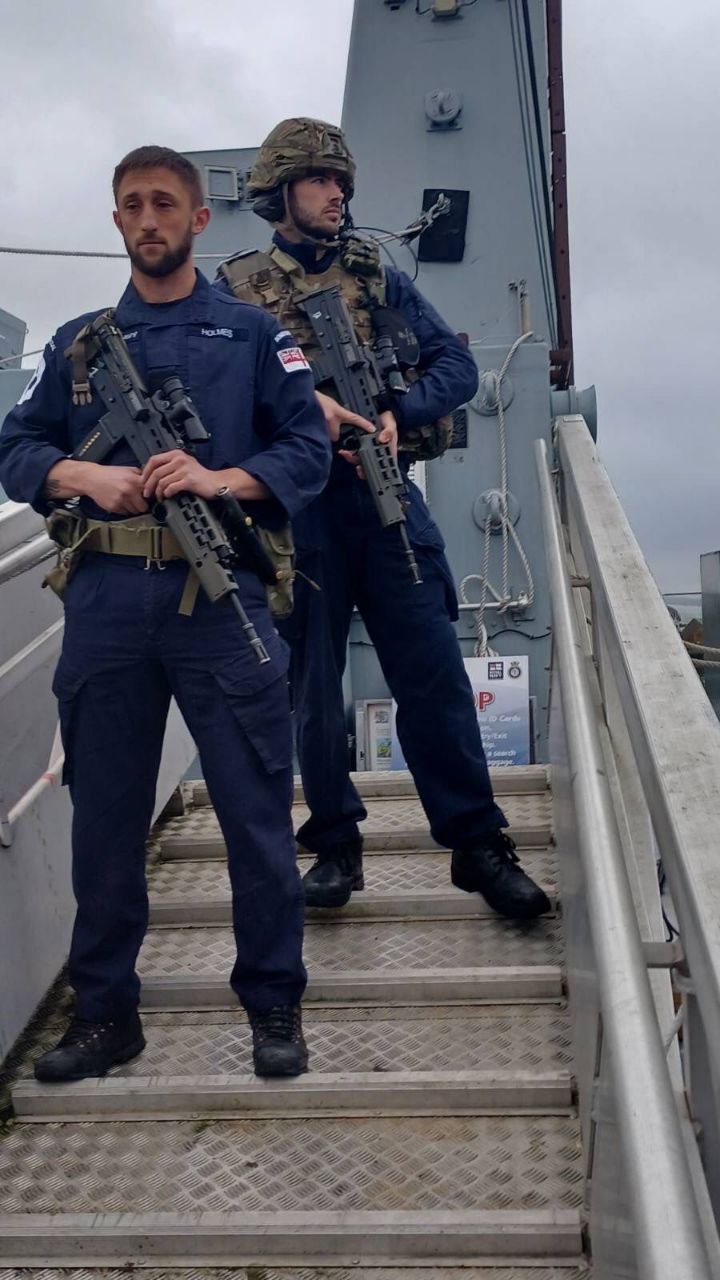
Armed British Terrorists Confronted in Dublin.
On Sunday afternoon, members of Anti-Imperialist Action Ireland along with members of Saoirse Don Phalaistín, carried out a direct action against a British warship in Dublin port.
The protest was called to highlight the ongoing British Occupation of Ireland and to make clear the complicity of British Imperialism in the ongoing Zionist Occupation and Genocide in Palestine. The protest made clear the links between the National Liberation Struggles in Ireland and Palestine.
British Military confronting protesters in Dublin (Image sourced: AIA)
In a militant protest, the activists, chanted ‘From Ireland to Palestine, occupation is crime’ and Britain Out of Ireland and Palestine.’
During the course of the protest, the Republican Activists present confronted Armed British soldiers who appeared on the deck of the ship and a stand off ensued on the gangway.
End the occupation! End the genocide!
Free Palestine!
Free Ireland!
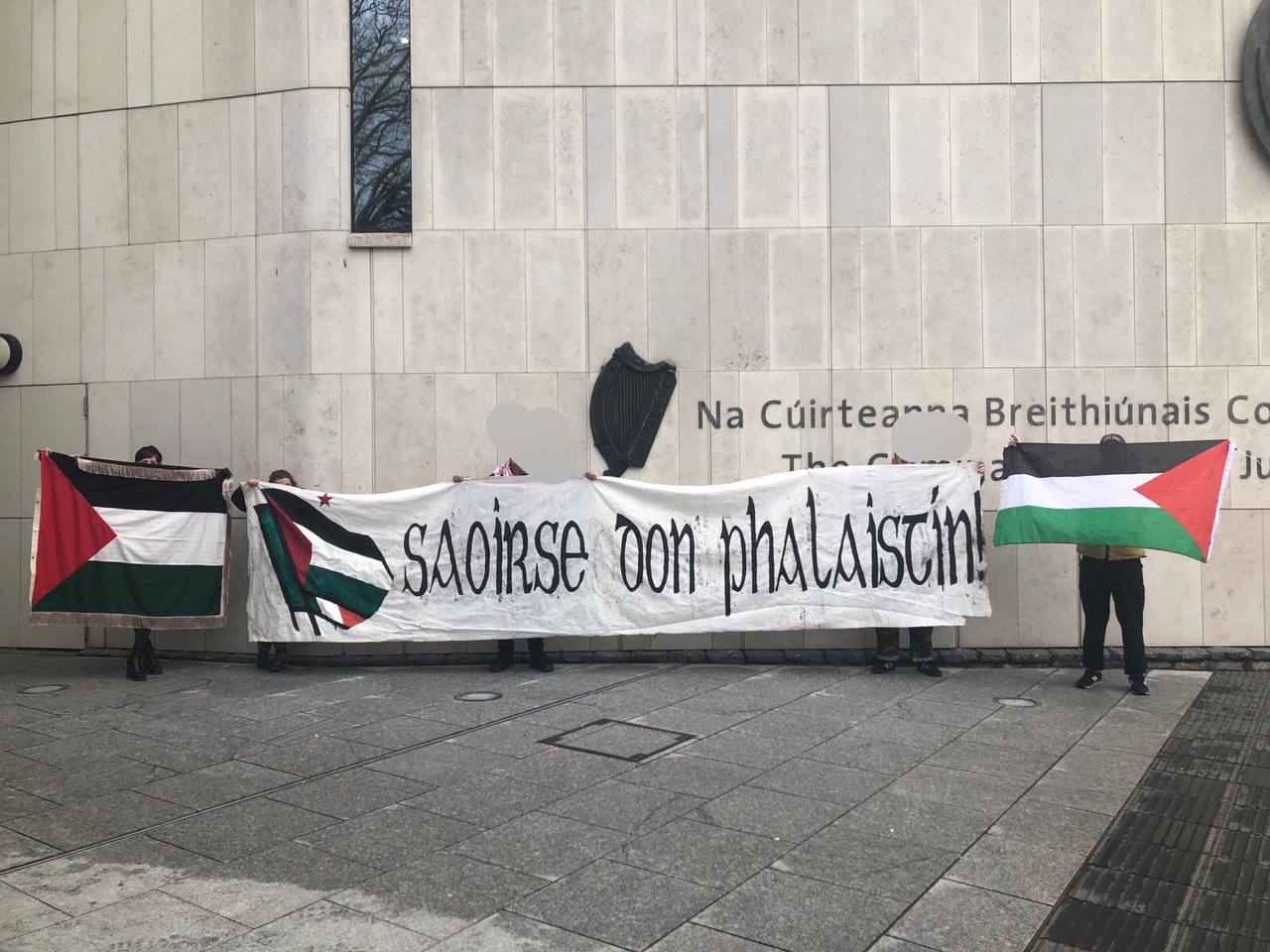
Solidarity picket outside the Dublin courts (Image sourced: AIA)
In a series of coordinated raids in Dublin this morning, a number of Republican Activists have been arrested and detained under section 30 of the Free States “Offenses against the state act”.
These arrests come as the state is increasingly fearful of the growth in Revolutionary Irish Socialist Republicanism and of Anti Imperialist Action Ireland in particular.
The arrests are timed to coincide with the leading role AIA has been playing in support of the Palestinian People and Resistance across the 32 counties and at a time when our members continue to confront and resist Imperialism across Ireland.
(Image sourced: AIA)
AIA condemn the raids and arrests by the Drew Harassers on Republican Community Activists and we call for these activists to be released back to their families and communities immediately.
Harassment, Raids, or Arrests will not stop AIA and Republican Activists from our work to rebuild the struggle for National Liberation and Socialist Revolution, resisting Imperialism or from taking a stand for Palestine.
The Republican Community Activists raided and arrested in Dublin yesterday have been released without charge.
The operation by the Drew Harassers, no doubt at significant cost, was designed to intimidate the growing membership and support base of AIA across Ireland, but it has failed, as all such operations will fail.
AIA welcome home these activists to their families and communities, where they belong. Republicans are not criminals. We will continue to promote the legitimate demand of rebuilding the Republic of 1916 at every opportunity. We will not be deterred and ultimately we will win.
Yesterday’s arrests are only further proof that the Free State fears the message of Revolutionary Socialist Republicanism, fears the growth and levels of support for AIA, fears our support for the Palestinian Resistance and fears our continued legitimate direct actions to confront and resist British, North American, European and Zionist Imperialism in Ireland.
We won’t be going away!
Free Ireland!
Free Palestine!
Also on Saturday, after the giant Palestine solidarity march in Dublin, according to another communiqué, members of AIA, Saoirse Don Phalaistín and Palestinian Solidarity Activists picketed the Leonardo Hotel on Parnell St.
The Leonardo Hotels are owned by Fatell Hotels the largest hotel group in ‘Israel’ and strong supporters of Zionist terrorism and genocide.
In response to the picket, the hotel has decided to enter lockdown, refusing to open the doors for guests.
In their shameful votes last night, the Irish Government Coalition parties nevertheless taught people of social-democratic or liberal persuasion a valuable lesson. They won’t learn it of course, since it violates their world-view – but we should.
Social democrats in general, beyond the Irish political party of that name, essentially believe, despite all lessons of history, that capitalist society can be reformed through pressure of the organised labour movement and by appealing to the capitalists’ “better sense”.
Liberals believe something similar, without the trade union movement being essential. Their mantras echo through our political and philosophical culture: “Everything can be resolved through talking”, “Force solves nothing” and “The rule of law is paramount’.1
Despite the genocidal attacks continuing and even intensifying, despite the Gombeen class’ view that the ferocious bombing would have long-term adverse effects on the Middle East and perhaps on the world, the Government parties declined to break with the imperialist bloc.
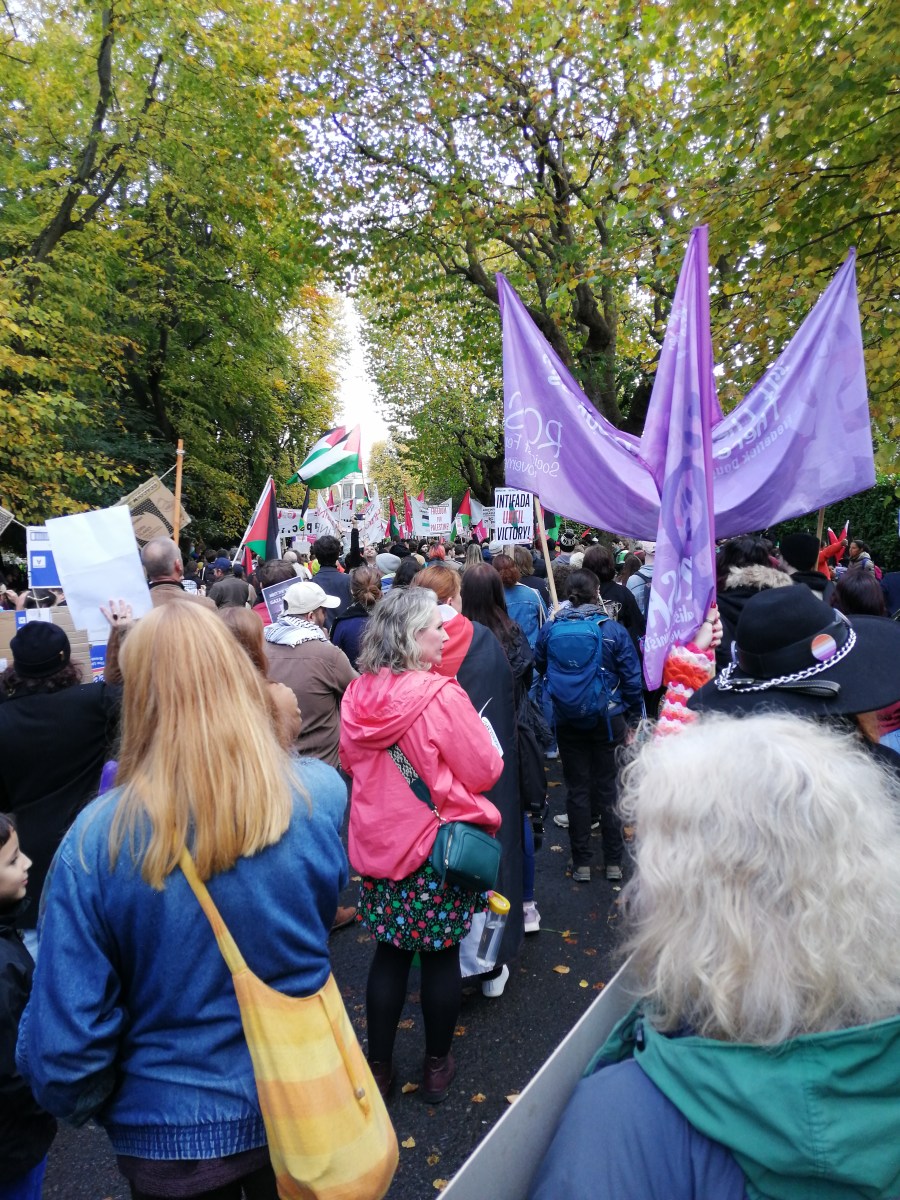
Section of crowd, perhaps half-way, facing westward, away from Leinster House (Photo: D.Breatnach)
And why should we have expected anything different from them and the class they represent? This is not even an independent class but rather a native capitalist class that grew up under foreign occupation and never resolved to overthrow its masters.2
Rendering each Caesar his due, in turn and all together, this class has kissed the feet of British colonialism and imperialism, then US imperialism and finally EU imperialism. Whatever their own view of what the wise moves might be, they always obey their masters’ wishes.
And any party that enters government here as currently constituted will act likewise to get there and even more so after arriving there.
ROAR OF SOLIDARITY OUTSIDE LEINSTER HOUSE
Knowing that a vote was imminent on motions critical of Israel, including one for the expulsion of the Israeli Ambassador, thousands gathered last night in Molesworth Street, opposite the metal-barricaded Leinster House, home of the parliament of the Irish State.
Packed tightly together outside Leinster House, the crowd replied with a roar to slogans led by callers: From the river to the sea – Palestine will be free! In our thousands and our millions – We are all Palestinians! Free, free – Palestine! And, yes, Israeli Ambassador – Out, out, out!
The rally had been organised by the Ireland Palestine Solidarity Campaign, the main organisation for decades engaged in Ireland in Palestine solidarity campaigning. Yet, calling for the expulsion of the Zionist State’s representative had, until now, been strangely absent from its discourse.
Not always in the past, true but so it had been until now during these five weeks of genocidal bombing by the Zionist state. In fact, it seems they had previously even asked speakers not to make that call from their platform. They were however clearly making it now and rightly so.3
And clearly, so were the speakers lined up on the IPSC platform.
Independent Sen. Frances Black whose motion on the bill to ban products from the Israeli later settlements4 has been held up for two years by the Government, spoke also and challenged the Government TDs to make the right choice between party and principle, to “have the balls” to vote for justice.
Matt Carthy TD, Shadow Foreign Affairs spokesperson for the Sinn Féin party, was introduced from the IPSC platform to muted applause (perhaps because of the party leaders’ earlier refusal to call for the expulsion of the Ambassador.
Carthy addressed the crowd in Molesworth Street and apart from denouncing the ongoing Israeli genocide in Gaza, concentrated on his party’s motion for Israel’s referral to the International Criminal Court and disputed the Government’s view that additional referrals5 were unnecessary.
While there may be some propaganda value in such a referral, a quick check will establish the following about this institution:
The ICC has never tried a state, only individuals
The ICC has never tried a main actor or close friend of western imperialism, regardless of obvious war crimes (e.g. the USA, UK in Iraq and Afghanistan)
In its 11 years of existence, the ICC has had only 30 cases before it of which ten resulted in convictions and four in acquittals.6
However, the SF party spokesperson was now also calling for the expulsion of the Ambassador, since the recent turnaround of the party’s leaders on the question when Mary Lou MacDonald found her position untenable in the face of the party’s own voters and closer supporters.
Richard Boyd Barrett TD spoke as usual at such events for the People Before Profit party7 and excoriated the Government for their failure to apply sanctions against Israel, exclaiming: “My God, they were quick enough to do it against Russia, weren’t they?”8
Boyd Barrett said that if the Government won’t take the sanctions then the people must do so, the closest he came to listing how they might do so was in mentioning “occupations”, a number of which have taken place recently without any PBP involvement whatsoever.
The PBP speaker also denied that a state such as Israel, based on occupation, racism and genocide, has any right to self-defence but insisted that the targets of its attacks, the Palestinians, had every right to defence and resistance.
Holly Cairns TD, leader of the Social Democrats political party,9 proposer of the parliamentary motion to expel the Ambassador spoke clearly and convincingly, her speech more militant and direct than the that of the speaker from the former revolutionary Republican party.
I believe it was Cairns who asked the pointed questions with regard to taking strong sanctions against Israel with the current death toll and list of atrocities: If not now – when?
(Photo: D.Breatnach)
In reply to fears that the expulsion measure would make the Irish State an “outlier” in the EU, she commented to media that she would have no regrets at being “an outlier” of the current EU consensus.
Ruth Coppinger for the Socialist Party10 began by addressing the meaning of “the international community”, identifying not with the imperialist states but with solidarity demonstrations around the world including trade union blockades against shipments to Israel.
She called for such actions in Ireland today but also criticised the Palestinian assault through the apartheid Wall on October 7th. I think it was she who called for a national walkout on World Palestinian Solidarity Day, 29th of November.11
Given the supine state and collusion of the Irish trade union movement, which neither the SP nor the PBP party have made serious efforts to challenge, a union-led walkout is unlikely and, though people may do so anyway this is likely to be difficult without organisation and leadership.
All of the speakers congratulated those in attendance and asked them to continue their solidarity actions. Many (notably not the SF speaker) also criticised the USA in general and its President, Joe Biden, in particular. The USA is the chief and financial backer of the Israeli State.
One of the Irish language placards at the rally: “Joe of the Slaughter.” (Photo: D.Breatnach)
Although there were a number of Irish-language placards and one banner in evidence, I recall hearing not one word of Irish from the platform.
IN PALESTINE TODAY
The Israeli siege and genocidal bombing continues as the Zionist state tries to sap the resistance of the Palestinians people, destroying even their medical facilities and endeavouring to starve and terrorise them into submission.
By yesterday the death toll from Israeli airstrikes on the Gaza Strip since Oct. 7 had risen to 11,500, including 4,710 children and 3,160 women. Israel has also killed 22 civil defence and 200 medical personnel and 51 journalists.12
The number of injured people has reached 29,800, with about 70% of them children and women.13
Wednesday’s statement from the Gaza Health Ministry said that 95 government buildings and 255 schools have been destroyed. Some 74 mosques were completely destroyed and 162 were partially damaged, in addition to three churches.14
‘It said that the Israeli army targeted 52 health centers and 55 ambulances, while 25 hospitals have run out of service.15
‘ “Israeli soldiers attacked many patients, wounded individuals, and displaced people, as well as several medical and nursing staff inside Al-Shifa Medical Complex, forcing them to undress and subjecting them to insults,” the statement added.’16
The Palestinian guerrilla movement organisations have struck back in Gaza and the West Bank and Hizbollah has entered the struggle to an extent from Lebanon. The collaborationist Arab states have become worried about their own populations, a worry shared by their imperialist masters.
But the rabid dog is loose and refuses to be restrained. What to do? Call it to heel now, or let it have its head to glut itself on blood? Difficult for the imperialist classes of the world to be certain which way to go and the divisions among them are becoming clear.
Both France and Germany EU states have banned Palestinian solidarity marches but while Germany refuses to call for any end to the bombing, President of France Macron in exclusive interview this week has called on Israel to stop killing Palestinian women and children.17
View perhaps half-way in crowd facing Leinster House in the far distance. (Photo: D.Breatnach)
Across the world, the imperialist-aligned ruling classes are in disarray. Eight states in Latin America, Middle East and Africa have now fractured diplomatic ties with Israel.
The British Labour party saw four party shadow spokespersons resign and 56 of its MPs break party discipline to vote with the Scottish National Party motion calling for an immediate ceasefire.18
The other “international community”, the one to which Coppinger referred, has been on the streets in their millions in cities across the world, on every continent, including in those of the partner states of the genocidal Israeli state.
THE GOVERNMENT AND THE PEOPLE
Mícheál Martin had visited Palestine before in 201019 as Minister for Foreign Affairs in the then Fianna Fáil government and was visibly affected by what he had seen. But a Minister serves the Government which in turn serves the ruling class, which in the end calls the tune.
Today Mr. Martin, as Tánaiste20 of the gombeen Coalition Government, is in ‘Israel’ accompanied by the very Zionist Ambassador which last night his party and coalition party representatives had stoutly defended and who had attended by invitation his own party’s annual congress.21
Mícheál Martin in ‘Israel’ today with the zionist state’s Ambassador to Ireland (centre, partially obscured) (Photo sourced: Internet)
With no illusions in the parliamentary road or perhaps less of them now, we are thrown back on what was always our only realistic resources – our own mobilisations, our own actions.
Short of a revolution, to be effective we can only continue to make life as uncomfortable as possible for the Zionist state and for its collaborators, native and foreign.
Above all and indeed as some of the speakers last night emphasised, we must not be discouraged and have to continue; we owe it not only to the Palestinians but also to ourselves, to our history and our future. Beidh lá eile ag an bPaorach – there will be another day.
(Photo: D.Breatnach)
End.
FOOTNOTES
1Of course the fact that laws are written (and changed) to suit the ruling class (or at least not threaten it) and backed up by a whole violent repressive state structure of police, courts, jails and armed forces is conveniently ignored.
2Indeed, it waged war on those who were determined to fight for independence.
3Nor did its FB page share occupation protets such as those carried out by the Anti-Imperialist Action or Saoirse Don Phalaistín groups, though today they shared a post on the occupation of the Dept. of Foreign Affairs by the Ireland for Gaza group.
7Formerly the Socialist Worker’s Movement, an Irish iteration of the (Trotskyist) Socialist Workers’ Party in Britain, much diminished from it days of greater glory but currently the largest Left party in Britain.
8Yes and Boyd Barrett was part of the condemnation of Russia and support of the Ukrainian state at the time.
9The party centre-left social democratic party was launched on 15 July 2015 by three independent TDs (members of parliament) and promotes the Nordic model and pro-European views.
10An Irish iteration of the Socialist Party in Britain, a Trotskyist party once very large there, with the Militant Tendency its entryist organisation in the UK’s Labour Party, from which it was expelled. The Irish party has had a number of members of the Irish parliament but all those still in such roles have either left to become Independents or joined the PBP-Solidarity coalition group.
20Equivalent to Deputy Prime Minister; he is also leader of the Fianna Fáil political party, the one with most elected members in the Coalition Government with Fine Gael and the Green Party.
Bill O’Brien, text of speech delivered at Athens conference in 2014; first published in The Pensive Quill blog and sent to Rebel Breeze.
(Reading time main text:4 mins.)
In May 2014, the week following the Odessa massacre, a small group of mostly non-aligned antifascists in Ireland organized through word of mouth and through social media a successful demonstration in Dublin.
We rallied against the fascist atrocity and described it as part of an imperialist anti-Russian agenda in the EU and we called for support in Ireland for the struggle against the Ukrainian army in Donbas.
There was very little reporting on the atrocity in the mainstream media.
Unfortunately, it was complemented by virtual silence from nominally anti-imperialist, socialist organizations in the country, despite the fact that a massacre had occurred the day after Mayday, the historical day of workers’ solidarity and that it was committed by openly fascist groups inside a trade union hall.
Fascists and far-right Ukrainian nationalists besieged anti-fascists in Odessa trade union building on May 2nd 2014 and set fire to the building. Nearly 40 were confirmed killed, often by the mob as they jumped to escape the flames and a great many were injured. (Photo cred: Reuters)
What seemed surprising to us at the time was the fact that the Irish trade unions had issued no statements at all on the tragic event of May 2nd.
There were no messages sympathising with the loss of life or condolences to grieving families sent by the union hierarchy, no expression of solidarity as one would have expected.
There was no condemnation, or even any acknowledgement from the trades union movement that a horrendous crime had been committed against young anti-fascists who had sought refuge from an armed fascist mob in the Odessa House of Trade Unions.
When we raised the question of this silence with members of groups associated with the Left in Ireland, we found that most were hardly interested in addressing a threat that even some right-wing commentators had been drawing attention to – i.e. the re-appearance of Nazism and the support fascism was receiving from the Ukraine government – in a part of Europe that was aspiring to join the EU.
To the extent that these leftists mentioned Odesa at all, they argued that the massacre took place in the context of a war in Ukraine between forces aligned with two equally regressive imperialist regimes.
That is between supporters of the EU / NATO on the one hand and supporters of a paramilitary Russian nationalism aligned to Russian “imperialism”, which was attempting to redraw the Ukrainian borders.
Those who died or suffered injury in the Odessa massacre were portrayed, when they were mentioned at all, as unfortunate victims of inter-imperialist rivalry.
The successful resistance and defeat of fascist brigades in Donbas earlier this year – by “tractor drivers and miners” as Putin put it – halted a march to the right that was taking place across the whole of Europe. That defence gave the world time to face reality.
Social media and non-Western media sources have allowed us the space to counter much of the propaganda. We have received support from trades unionists as well as from those political groups that are not tied to the pro-UK line followed by most of the official Irish media.
But we have found that attempts to oppose a pro-imperialist narrative are too often treated as affronts to the unity of the Left political project in Ireland. Political discourse of the sort that insists on a precise understanding of the meaning of words is too often dismissed as sectarian or divisive.
In the lexicon of much of the Left, the concretely understood word “imperialism” has been replaced by words taken from the language of “humanitarian” intervention that has been promoted by groups such as Amnesty.
When we say that Russia is not an imperialist country for instance we get accused of introducing what are termed “sectarian ideological squabblings.” Bono’s latest political musings seem to outdate Lenin’s formulation on any matter!
According to the humanitarian Left words like ” imperialism” get in the way of a united strategy that should be aimed at electing progressive left-wing representatives to the Irish parliament institution that is largely powerless in the face of austerity measures dictated by international finance.
Left unity that is based on the abandonment of principles can only weaken the fight against imperialism. This has been demonstrated in the Irish “humanitarian” Left’s responses to the present conflict in Syria and the current refugee crisis.
The influential Washington-based Foreign Policy magazine wrote correctly this month about how Russian involvement in Syria is inextricably linked to the ongoing conflict in Ukraine.
Such links have to be understood and taken fully into account in the building of a genuine internationalist movement against imperialism.
The Odessa massacre, as we know, occurred on May 2, 2014. Sightly over a month later, the Zionist onslaught against Gaza began – on 7 July 2014.
The responses in Ireland to the two events were totally different – almost as if two tragedies were simultaneously taking place on different stages on different planets.
In response to Gaza, a pro-Palestine demonstration was called in Ireland’s capital city, Dublin, for Gaza; it was attended by something in the order of 10,000 people. Those ordinary citizens at the march had undoubtedly been moved by an act of incredible brutality by a Western-backed regime on a defenceless Palestinian people.
Those speaking on the Save Gaza platform did not ever mention the Ukraine bombardment of civilian areas – supported by the US and its allies – that was taking place in Donbas at exactly the same time as the Israeli military strikes on Gaza were occurring.
The same people had supported the Maidan coup. The bombardment of Donbas was also supported by the US and its allies so wouldn’t it have been sensible for the Gaza rally organizers to mention Donbas?
At exactly the same time as Gaza and East Ukraine were under attack, the US and its allies were organizing proxy “rebel” forces in Syria aimed at the destruction of the nation’s secular state and its replacement by a pliant regime.
The Syrian crisis did not get mentioned at the Gaza rally either on account of the opportunist alliances between leftists who dominate the anti-war movement in Ireland and the Muslim Brotherhood.
We have been working since 2014 with members of the Ukraine and Russian communities in Ireland and called demos in support of Donbas.
We visited trades union headquarters in Ireland and helped Russian and Ukrainian leftists in Ireland bring the Odesa massacre photo exhibition to the country’s major cities – Dublin, Cork and Belfast.
We have held events to coincide with the showing of the photos, which have been attended by sympathetic trades union leaders, members of the Russian and Ukrainian communities and Irish republicans and socialists.
We were very pleased that our limited endeavours in Ireland have been well-matched across Europe and beyond and we draw strength from this international solidarity.
End.
Rebel Breeze COMMENT:
The events in Ukraine were well known at the time, following a US-instigated coup in 2014 (the true date of the start of the armed conflict, not February 2022).
The USA wanted Ukraine to join NATO, its bloc against Russia but the Ukraine government was more interested in staying connected to the East and in particular to Russia, having lots of linguistic and other cultural connections there.
The coup launched not only a change of government but a wide-scale attack on supporters of the previous government and on Russian-speaking communities across Ukraine, particularly in Eastern Ukraine (Donbas and Crimea).
Monuments of the War Against Fascism were torn down wherever the fascists got control.
Communities in most of the threatened areas mobilised to defend themselves against the armed attacks of the Right Sektor and the Azov Battalion (now incorporated into the Ukraine’s National Army), some with more success than others .
Mariupol fell to fascist forces but was retaken by Russian forces last year.
Anti-fascist mobilisation in Eastern Ukraine, 2014 (Image sourced: Internet)
Crimea defended itself successfully, called an early referendum and as a result joined Russia. Other areas that were not overrun remained in defensive fighting for the next eight years, mostly with no running water or electricity, under artillery bombardment until the Russian invasion.
The demonstrations, public meetings and exhibitions to raise awareness in Ireland of the Ukrainian fascist attacks in 2014 were successful to a degree but not enough to move the major part of the Irish Left, in particular the PBP and the SP – or the trade union leaderships.
Their inability to see the true nature of events there has intensified since the Russian invasion.
A national hero of the Ukrainian state now, which Right Sektor and Azov were promoting even before 2014 is not one of the Ukrainian partisans who fought the Nazi invasion and occupation.
No, it is Stepan Bandera, not only an anti-semitic anti-gypsy fascist but a Nazi collaborator during WW2, an allied organisation of his responsible for massacres which peaked in July and August 1943.
“The massacres were exceptionally brutal and affected primarily women and children.[7][2] The UPA’s actions resulted in up to 100,000 deaths.[8][9][1]
“Other victims of the massacres included several hundred Armenians, Jews, Russians, Czechs, Georgians, and Ukrainians who were part of Polish families or opposed the UPA and sabotaged the massacres by hiding Polish escapees.” (Wikipedia).
The following reference is posted to show that the attacks and their fascist connections were well known across the West but also to show how the report twists what happened to make the victims appear as the causes of the attacks.
As the sixth march or rally in Dublin in three weeks concludes, with a large one also in Armagh and others take place around the world but Israel’s genocide intensifies, we need to reflect on what is our impact with these.
We are not stopping the genocide or even slowing it down, nor are we really hurting the Israeli state, nor even stopping their Dublin Embassy churning out lies, twice criticising the President of the state for relatively mild statements and accusing Ireland of helping Hamas build tunnels.1
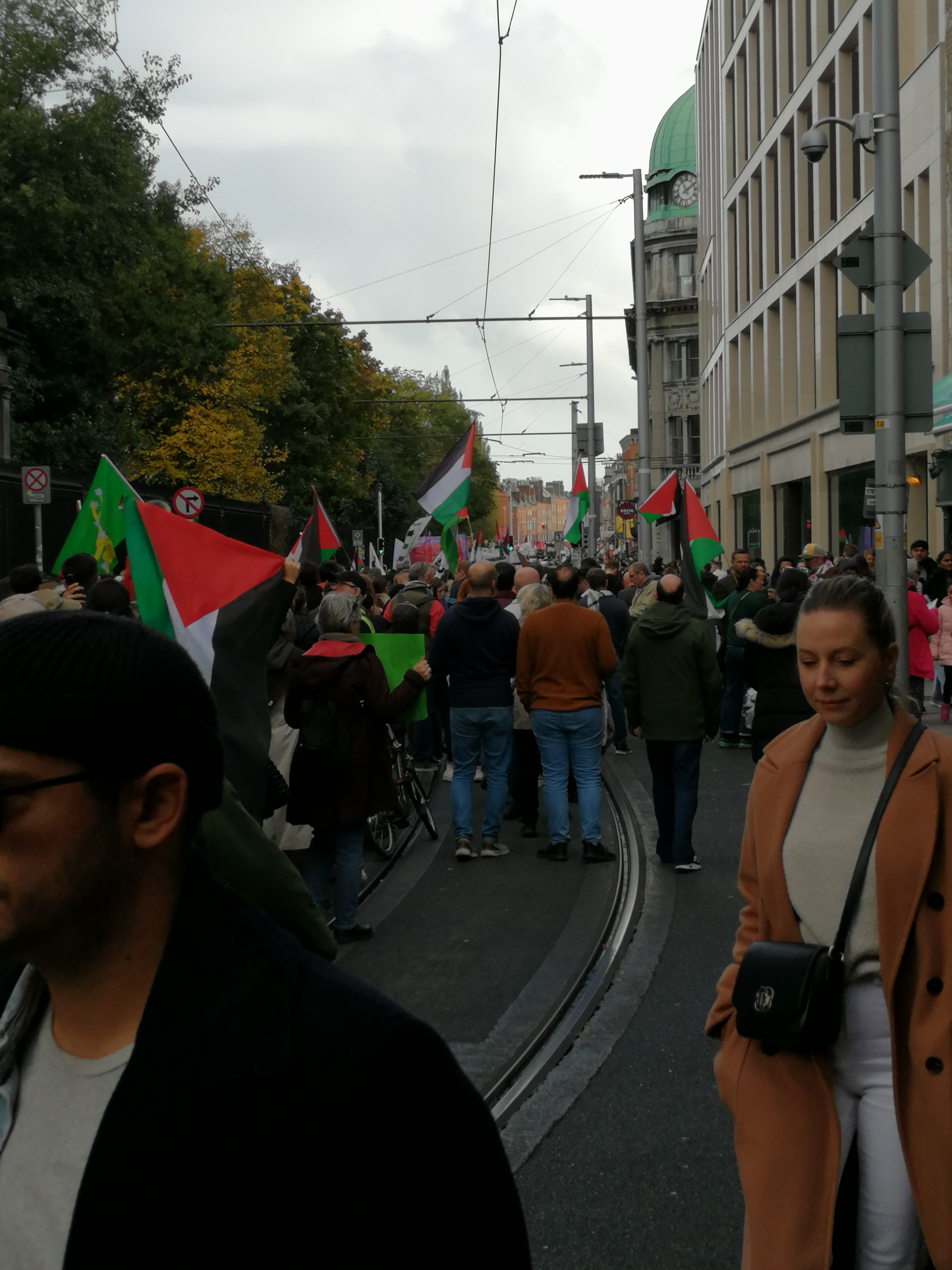
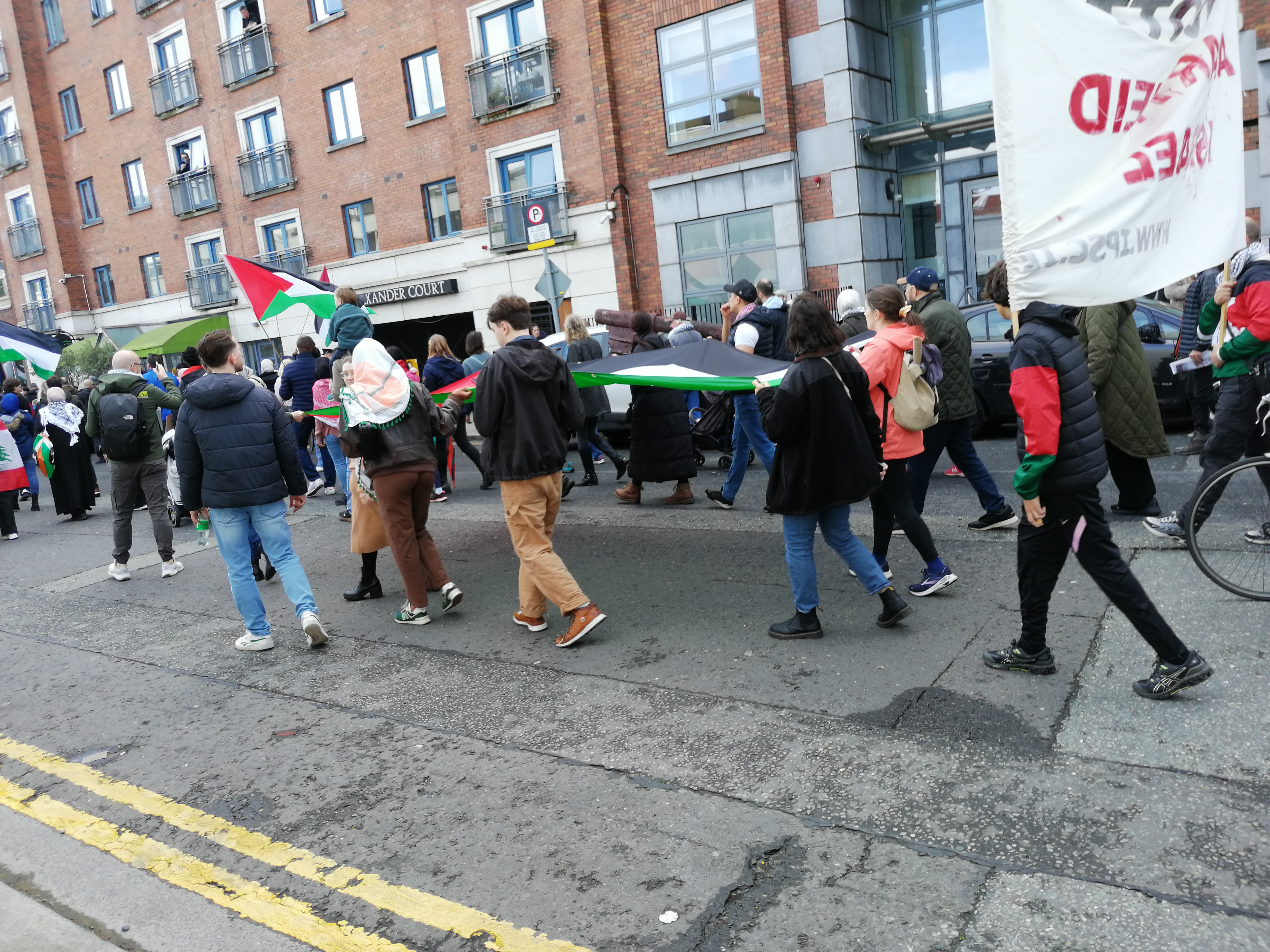
Long view section of Saturday’s march ahead along Nassau Street, Dublin (Photo: D.Breatnach)View of tail end section of Saturday’s march as the rest stretched along Nassau Street, Dublinand further (Photo: D.Breatnach)
This failure is not the fault of the people in what is probably the most pro-Palestinian state in Europe or indeed in the Western world. There are limited options here – but are we exploring them all?
The Irish Government, given its limitations as a neo-colonial Gombeen administration, cannot be expected to do more than flog the false and failed two-state solution and push for an immediate ceasefire, in which – though ineffective — it is going further than many another EU state.
It could send a clear message, if not of Palestinian solidarity, at least of condemnation of the genocide being carried out during these last three weeks. That might start something going around the world but this Government would have to answer for it to the British, the USA and the EU.
(Photo: D.Breatnach)
No, not going to happen, not from a neo-colonial ruling class. But what if the pressure to expel the Israeli Ambassador were huge? Then they could at least whine to their masters about how difficult it had become for them to hold the line – so maybe Israel should ease off the genocide?
But no, they are not under so great a pressure there either. And why is that?
On the march on Saturday, whenever the call went out to expel the Israeli Ambassador, it was enthusiastically supported. But in most places along the march, that call could not be heard, nor was it given any space in many sections.
And a major reason is that the organisation which called that demonstration and most of the demonstrations and rallies over these three weeks, not only in Dublin but in a number of other towns and cities across Ireland, is refraining from calling for the Ambassador’s expulsion.
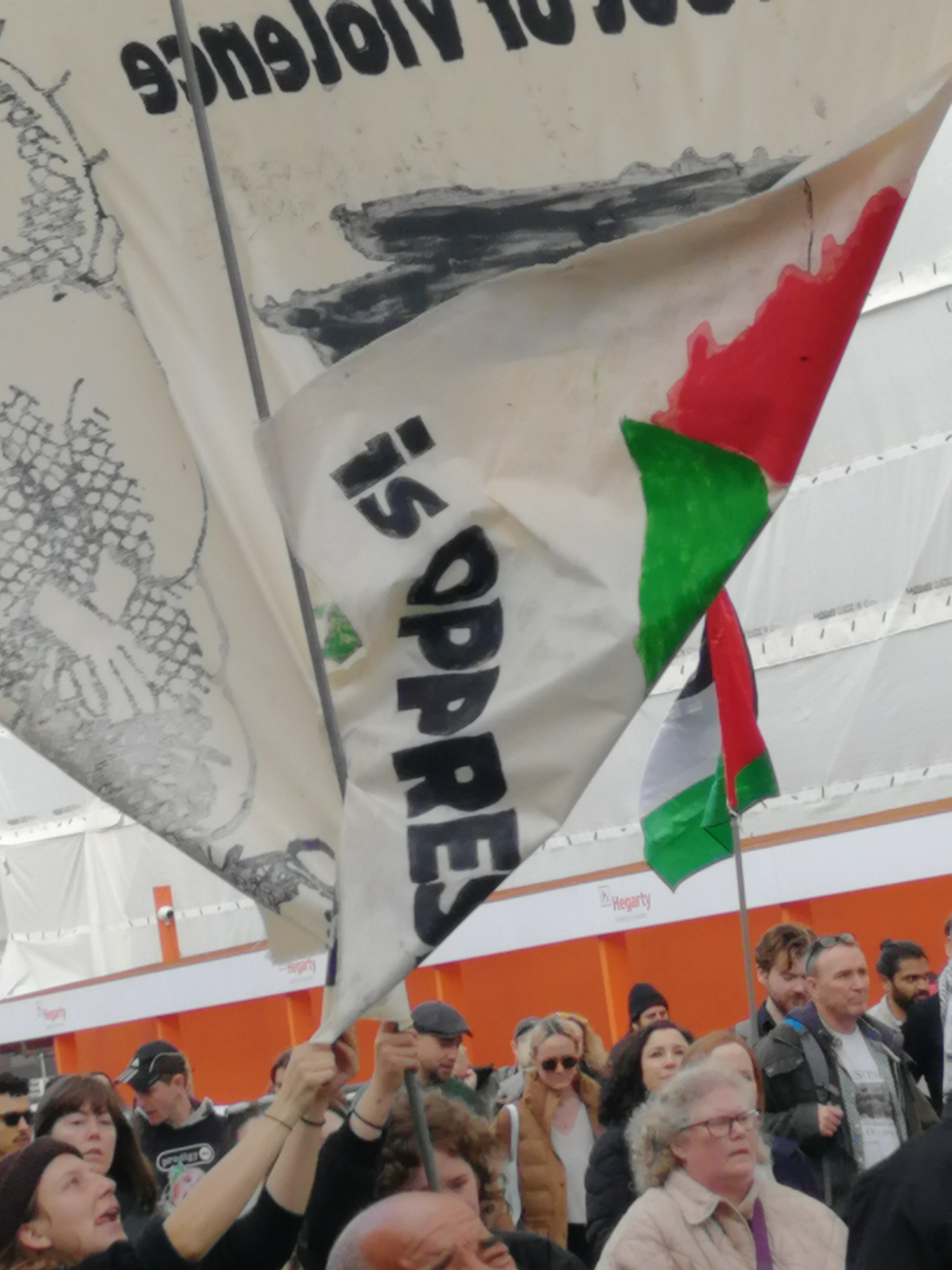
Giant banner carried alternately by two young women bearing the legend: “The root of violence is oppression”. (Photo: D.Breatnach)
That organisation is the Ireland Palestine Solidarity Campaign (IPSC) which has been the main organisation for many years organising Palestine solidarity marches, rallies, pickets, public meetings, leafleting, information tables, film showings, quizzes, postering and lobbying.
Why is the IPSC not calling for the expulsion of the Zionist Ambassador? It can hardly be for any reason of liking her or what she stands for! Nor can it be for anything like bribery or fear. And in fact we know that at least some of the leadership do want the Ambassador expelled.
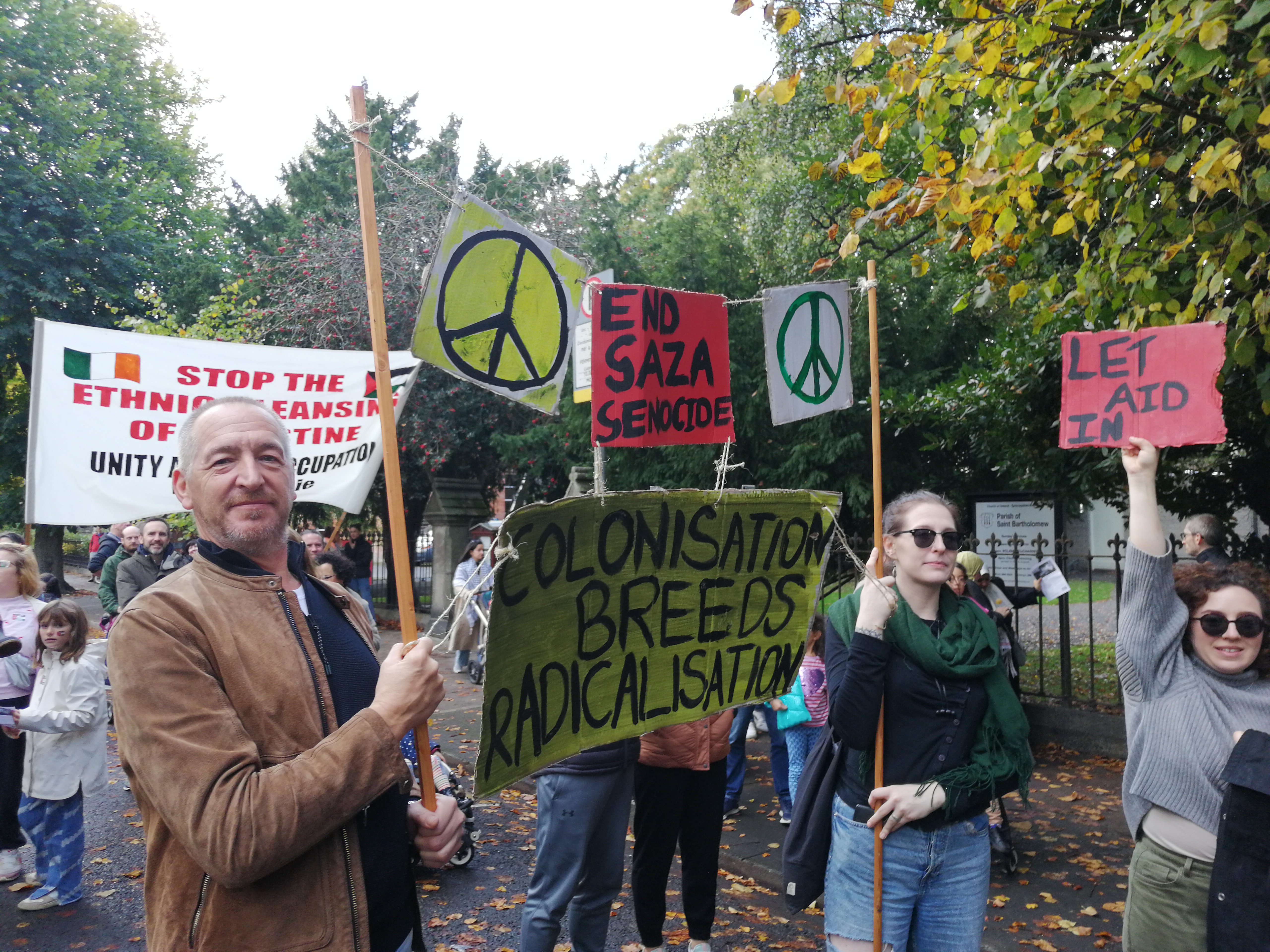
Collection of placards and a banner seen near the back of the rally near the US Embassy on Saturday. (Photo: D.Breatnach)
The reason for holding back on that demand is, sad to say, political opportunism of the social-democratic, reformist kind. To maintain a broad front and not scare off the allies. And what allies might they be so worried about losing or scaring off? Sinn Féin, it seems.
What — Sinn Féin? — one may ask with disbelief. Sure didn’t they themselves call for the expulsion of the Israeli Ambassador? Yes, 10 years ago, Gerry Adams called for that and probably since then a couple of times party spokespersons have done so. But that was then and this is now.
The “now” that is relevant to this is that the party has been remodelling itself to fit into the governing circles of this Gombeen neo-colony and demonstrating again and again that Sinn Féin is a safe pair of hands in which to leave the management of the Irish State.
(Photo: D.Breatnach)
In two municipal meetings very recently, Sinn Féin councillors abstained from voting on a motion calling for an immediate ceasefire and the expulsion of the Israeli Ambassador.
In Derry, the motion was passed despite that abstention but according to reports SF councillors abstained also on a similar motion in Mid Ulster District Council on Thursday which failed to pass.2
In the Leinster House debate this week, SF put some amendments forward but none called for the expulsion of the Ambassador and they didn’t support the PBP amendment that did; in the end SF voted for the Government motion (not even abstaining).3
The IPSC leaders probably expect, as seems very likely, that Sinn Féin will be part of the next government and don’t want to embarrass them before that, in the mistaken belief that the party will then deliver all – or at least much – of what is needed when they are in that government.
(Photo: D.Breatnach)
But the leaders of the IPSC should be doing the exact opposite – they should be putting SF and its presence in the next government under pressure now and afterwards, calling all the time for the expulsion of that representative of genocide, racism, apartheid and colonisation.
But not only is the leadership of the IPSC (despite their own feelings no doubt) not calling publicly for the expulsion of the Ambassador, it seems that they are actually now also asking featured speakers not to voice that call!
It is bad enough that SF has changed from being an anti-imperialist revolutionary organisation to being a party of colonial collusion (in the 6 Counties) and neo-colonial (in the Irish state) – but now other organisations feel the need to reduce their own demands in concert!
The intelligent tactic, contrary to watering down the demands is to put those in power under greater pressure to deliver gains. That happens to be the revolutionary path also.
Solidarity demonstrator carries a giant key mock-up, signifying the right of return of Palestinian refugees to their homeland. Somewhat ironically, Sephardic Jews also have this symbolism in respect of their expulsion, along with Moorish Muslims, from the Spanish Kingdom at the end of the 15th Century. (Photo: D.Breatnach)
Speaking at Saturday’s rally near the US Embassy, Bríd Smith4 of the People Before Profit party did indeed call for the expulsion of the Israeli Ambassador and also denounced the ruling class and government drift towards NATO and PESCO (the EU’s military intervention force).
Smith said, in reference to Ireland’s struggle for independence – and well might she speak of it, coming as she does from a Republican family – that “we are standing on the shoulders of giants … who fought for our independence.”
A long and wide Palestinian flag carried by solidarity marchers (Photo: D.Breatnach)
Sadly she spoiled that by also claiming that they won independence for us.5 Hopefully that was an unfortunate slip of the tongue but one could not be certain of that. Over the years it has been far from clear that the PBP (SWM previously) and the SP support Irish national liberation.
At least Bríd Smith and other PBP speakers have publicly stated that Palestinians have the right to resist and this presumably means armed resistance, as explicitly stated by the Socialist Party in their leaflet distributed on the march6 and that is the position of the electoral left.
As for the rest of the Left, the International Marxist Tendency was also calling for “intifada revolution” on the march, as were the Anti-Imperialist Action organisation (AIA) on last week’s demonstration.
(Photo: D.Breatnach)
Presumably that is the position also of other Republican organisations7 but difficult to confirm as their participation as groups in these demonstrations is minimal, despite their long traditions of Palestinian solidarity.
The question of the right to resist and to do so in arms is a sharp dividing line between revolutionary internationalist solidarity on the one hand and liberal/ social-democratic solidarity, on the other, which seeks ‘peace’ (i.e return to status quo) rather than victory for the oppressed.
(Photo: D.Breatnach)
However, stating the right to resist in arms is not always what it seems; for example the SP’s leaflet condemns Hamas but does not propose any alternative armed resistance group to support, unlike the AIA for example, which clearly promotes the PFLP8 and without condemning any other group.
THE MARCH
On Saturday’s demonstration, thousands marched from the Spire in O’Connell Street across O’Connell Bridge and around Trinity College, along Nassau Street and then South Merrion Square. The march was heading for the US Embassy but along as many minor roads as possible.
The usual Palestinian solidarity slogans were being shouted but less of the Irish language was to be heard than was the case last week and certainly many less placards in Irish were to be seen.
(Photo: D.Breatnach)
“Israeli Ambassador – Out, out, out!” was audible in some sections and got good support in those but it was missing from most of the march (and no room given for it some sections), although when the demand was voiced by Bríd Smith speaking at the rally, it gathered a roar of approval.
Throughout these weeks the horrific genocidal bombing of Gaza by Israel has continued, along with a blockade of food, water, electric power and medicine.
Three days ago the number of Palestinian dead to the Israeli bombing since October 7th passed 7,000 of which nearly half were children. That does not included those killed since then, nor Palestinians killed in the West Bank, nor bodies still to be found under rubble.9
(Photo: D.Breatnach)
The latest attack has been the imposed social media, news and electronic communication blackout as Israeli troops tested the ground for their attempt to wipe out Gazan resistance.
This is not just a blanket drawn over the abattoir which Netanyahu’s butchers have made of Gaza but also a massive interference with calls to emergency services – yet another war crime — and also for people to speak with their distraught relatives outside Gaza.
In our weak position with limited capabilities, putting pressure on all concerned to demand the expulsion of the Zionist Ambassador is one of the most effective things we can do and we should insist on support for that demand from all who claim to support the Palestinians.
End.
The crowd at the rally at end of the march. The stage is in the distance near the US Embassy, which is cordoned off by the Gardaí from demonstrators (Photo: D.Breatnach)
FOOTNOTES
1https://www.irishexaminer.com/news/politics/arid-41253880.html Also since the Zionist Ambassador’s initial criticism of the President’s description of what her state was doing as war crimes, she returned to criticise him on public media yet again. In a number of countries around the world, recently for example in Spain and in Colombia, this has been the arrogant behaviour of Israeli Ambassadors, unused to having their dominant discourse challenged.
2I heard about this from two different sources but failed to get any information by a news search or by using Mid-Ulster District Council’s own website.
4Bríd Smith is a TD (member of the Irish parliament) but reportedly not going to stand in the next general elections.
5Apart from the Irish state being a neo-colonial one, i.e nominally independent but actually a client of foreign imperialism, one-sixth of Ireland’s territory is under armed occupation by the EU.
6I did not see a PBP leaflet distributed on the march.
7In which, as a result of fundamental changes from Republican positions of the party in recent years, I am clearly not including Sinn Féin.
8Popular Front for the Liberation of Palestine, a secular revolutionary Palestinian Marxist-Leninist organization founded in 1967
Dublin city centre saw the second rally in one week in solidarity with Palestine on Wednesday evening. Unlike Monday’s outside Leinster House, this one was on the central pedestrian reservation on Dublin’s main O’Connell Street.
Thursday’s was organised by the Ireland Palestine Solidarity Campaign whereas Monday’s, outside the home of the Irish State’s parliament, had been organised by the Irish Anti-War Movement (more or less really the People Before Profit party).1
(Photo: D.Breatnach)
After Monday’s rally, a substantial number had spontaneously marched to the Israeli Embassy where an Anti-Imperialist Action supporter had painted their door in red to symbolise blood before Gardaí knocked him to the ground and kept him lying handcuffed before arresting him.
The crowd had objected to this treatment whereupon the Garda attacked and arrested more demonstrators. The AIA supporter was later charged with “criminal damage” which is ironic considering the criminal and murderous damage by Zionist bombs and missiles on Gaza.
A rather blurry view of section of the rally from the west side. (Photo: D.Breatnach)
BOMBING GAZA
For the sixth consecutive day Israeli air strikes are pounding the Gaza Strip, Israel on Thursday boasting it has dropped 6,000 bombs weighing 4,000 tonnes on Gaza during the period, according to Palestinian sources killing more than 1,400 people and destroying huge amounts of housing.
At least 140 of those Palestinians killed are children.
There’s nowhere safe in Gaza (Photo cred: Edel Hana/ AP)
This is the fifth siege and bombing of Gaza by Israel in the last 15years, each time destroying what the Palestinians rebuild or patch and repair, such as their sewage treatment plant. Palestinian casualties overall during the period have been 6,407 Palestinians as against 308 Israelis.2
One siege lasted 51 days! Factories and apartment blocks, flower and vegetable production glasshouses and sewage treatment plants have all been destroyed and the coastal waters are polluted, while the Israeli Navy attacks fishing boats that dare go further out to sea.
Gaza was already a severely-deprived area occupied by 2.2 millions with 59% below the poverty level, 46% unemployment but youth unemployment at 63%. Since Hamas won the elections the Israeli state permits no-one to leave or enter Gaza except by special arrangement.
One of the most advanced military states in the world is attacking a people that has no navy, no airforce, no anti-aircraft defences and no standing army. The Zionists say they will soon send in a ground attack also, tanks grinding over the rubble to kill and maim more Palestinians.
Imagine you went into Sousi Mosque to pray for your family and neighbours to be kept safe, or just because the Israelis wouldn’t bomb it, would they? This is what’s left of it now. (Photo cred: Mahmoud Hams/ AFP)
Meanwhile the Zionist state is permitting no water, electricity, fuel, food, medicine, building materials or equipment to enter Gaza through the gate they control and, shamefully, the Egyptian regime in step with the Zionists is doing the same at the other gate, which the Arab state controls.
War crimes? We hear a lot about them in the war in Ukraine, right? The Israeli state is committing them daily now and has been doing so yearly, often monthly since 1948. But the USA backs Israel and so the western states do so too, supporting the war criminals and complicit in their crimes.
The IPSC rally was advertised for 5.30pm but people had begun to gather a half hour earlier, with more continuing to arrive until after 6pm. From physical appearance it seemed that people from the Middle East, presumably Palestinian, at least equalled those Irish present.
Rally supporters very tightly packed and before Gardaí move patrol cars in keeping them hemmed in (Photo: D.Breatnach)Gardaí beginning to move patrol cars in to keep rally packed in the central reservation (Palestine supporters also visible to left of photo, i.e on eastern pavement. (Photo: D.Breatnach)Gardaí place patrol car to keep the Palestine supporters (or this particular section?) off the road. (Photo: D.Breatnach)
The chanting of solidarity slogans was almost continuous, with short breaks for speakers, most of whom were introduced as Palestinians. These were the usual chants but often led in non-Irish as well as native accents: From the river to the sea – Palestine will be free!
Also: In our hundreds, in our millions – we are all Palestinians! One, two, three, four – occupation no more! Five, six, seven, eight – Israel is a terrorist state! But there were also new ones from a section: Long live the Resistance! And: Only one solution – intifada revolution!
(Photo: D.Breatnach)
That was taken up by many whereas Saoirse don Phailistín! And: You’ve got tanks, we’ve got hang-gliders – glory to the freedom fighters! were chanted by a small section. Four Palestinians were briefly heard trying without success to get the Alah’ akbar!3 chant going.
From Irish backgrounds, Senator Frances Black, Richard Boyd Barret TD, Chris Andrews TD and Cnlr. Daithí Doolan spoke. Senator Black sponsored the Occupied Territories Bill4 which was approved by all sides of the Oireachtas but held back by the Government from becoming law.
Richard Boyd Barret of PBP spoke with passion as he usually does and was applauded. Some of his observations, though more liberal than socialist, unequivocally however put the blame on the Israeli state and castigated also the western states’ support of the Zionists.
(Photo: D.Breatnach)
Many of the Palestinian speakers were very complimentary to the Irish people present at the rally but also to the Irish population overall for their generally supportive attitude towards the Palestinians and their struggle.
Andrews and Doolan are both prominent members of the Sinn Féin party and, as a result of their President’s recent condemnation of Hamas (a change in position for the party), came in for some heckling.
They may be genuinely supportive of the Palestinian resistance as individuals but if they tolerate their party’s leader lining up with the Zionists and imperialists in condemnation of the resistance of the oppressed, they must accept the criticism thrown at them.
(Photo: D.Breatnach)
THEY SAID
The leaders of Sinn Féin and of the DUP both separately and recently claimed that the pacification negotiations in Ireland can be used to assist in resolving the conflict in Palestine.5
Really? It was precisely following a similar road that led to the corruption and fall from position of Palestinian leadership of Al Fatah and Yasser Arafat, eruption of the Second Intifada and the generally secular-voting Palestinians electing Muslim fundamentalist Hamas in 2007.
(Photo: D.Breatnach)
On Thursday the Prime Minister of the Irish State said that Israel was inflicting collective punishment on Gaza by cutting off water and electricity but no mention of the bombing, which he seemed to endorse.
Collective punishment is a war crime in international law so what is Varadkar saying the Irish Government will do? Demand action by the EU and UN? Expel the Israeli Ambassador? Demand sanctions against Israel? No – request a humanitarian corridor for food and medicine.
Photo taken from west side, with LUAS tram rails showing and northward bus stopped at traffic lights. (Photo: D.Breatnach)
At the rally there was generally little denunciation of the Irish Government.
From Palestinians possibly because they felt they were guests in the country but one would have expected much harder criticism by the native speakers of the Government’s condemnation of the Palestinian resistance.
View of section from western side (Photo: D.Breatnach)
INTO THE STREET, ON TO THE BRIDGE
Over a thousand Palestine supporters were mostly crammed into a short section of the central pedestrian reservation on O’Connell Street, boxed in by police vehicles and the northward and southward traffic lanes on one side and the LUAS tram line on the other.
Rally participants have taken the initiative to relieve the crush in the central section by moving on to the road (Photo: D.Breatnach)
There was also an overspill on to the western and eastern pavements but at an initiative from within the crowd, demonstrators spilled from the east pavement and the central reservation on to the southward traffic lane, bringing traffic to a halt there.
After some time, one of the IPSC’s leaders approached the demonstrators in the road and asked them to allow the trapped cars and buses to continue southward, with which request the demonstrators complied – but the police had made this a dangerous exercise.
With the rally supporters now in the road, southbound traffic is unable to go forward and also unable to turn back. Senior IPSC activist (in green T-shirt) may be contemplating how he get the traffic through for awhile. (Photo: D.Breatnach)
A Garda patrol car was parked in the road next to the central reservation, obliging buses moving southward to manoeuvre around it, bringing them very close to the thickly-crowded eastern pavement. Some shouts of “Move the cop car!” were ignored by the Gardaí.
When the trapped vehicles worked their way past the rally, the supporters returned to the road, remaining there until the conclusion of the rally. Clearly the road should have been closed earlier and traffic diverted but the authorities prefer to have people complain about protesters.
With the road temporarily cleared willingly by Palestine supporters, the trapped traffic can move forward. But the placing of the Garda patrol car obliges the driver to swing over to their left bringing the bus dangerously close to the crowded eastern pavement, instead of staying in the middle of the street. (Photo: D.Breatnach)
Subsequently that evening, by which time the rally had been continuing for getting near to three hours, many of the attendance followed a banner of the Anti-Imperialist Action group to occupy O’Connell Bridge for a period and light flares there, after which they dispersed.
This is the southbound lane, so no traffic will approaching the rally on the road from this side. So why all those Gardaí there? Perhaps intending to prevent an impromptu southward march, perhaps to the Israeli Embassy (as occurred on Monday). In any case, they did not managed a march to O’Connell Bridge to occupy that traffic junction for a while. (Photo: D.Breatnach)
Rallies in solidarity with Palestine have been held and new ones are being organised across Ireland, including Belfast, Cork, Derry, Galway, Limerick, Naas, Sligo and the IPSC has called another one for this Saturday for Dublin 1pm in O’Connell Street.
The people in Ireland will continue to express their solidarity with Palestine but the main political parties and Government …!
End.
“The root of violence is oppression”. (Photo: D.Breatnach)
4 The bill would ban any goods or services produced, even partially, in the territories occupied by Israel after 1967 and ruled ‘illegal’ by the UN —including the Golan Heights.
5Presumably she means the process that her party embraced which entailed colluding with a colonial occupying power, a sectarian armed colonial gendarmerie and aspiring to manage a neo-colonial, neo-liberal state.
As smoke rose over the homes and shops of Gaza, an unseasonal October brought sunshine on to the streets of Dublin city centre and the crowds with Palestinian flags outside Leinster House, the home of the parliament of the Irish State.
As the sound of explosions, wailing of ambulances and of people rang around the streets of Gaza, the call-and-answer of solidarity rang out in Kildare Street: In our hundreds, in our millions – We are all Palestinians! From the river to the sea – Palestine will be free!
The Dublin rally was one of a number of Palestine solidarity events organised in Ireland after the unprecedented attack on Israel by Hamas’ military wing, the Al Qassam Brigades on Saturday and the Zionist State’s bombardment of civilian structures and people in Gaza.
Small section of the rally (Photo: D.Breatnach)
The Zionist State, which also controls Palestine’s water supply to Gaza, as well as exit from and entry to the enclave, has cut off water and electrical power as well as barred entry to everything including food, medicine and heating gas.
The Dublin rally was called at very short notice by the Irish Anti-War Movement (IAWM), a broad front organisation formed by the People Before Profit party around 2003 to oppose the imperialist war against Iraq waged by the Coalition of states led by the USA.1
Section of the solidarity rally earlier (Photo: D.Breatnach)
A branch of the Student’s Union of Ireland also supported the rally, which had a high percentage of Middle Eastern people present, presumably mostly Palestinians. The flags in evidence were mostly national Palestinian, some of the PFLP,2 a couple of Starry Ploughs and one Tricolour.3
Speakers from the Palestinian community, IAWM and PBP condemned the decades of attacks by the Israeli state on the Palestinians in general and on those in the Gaza enclave in particular, going back to the expulsion of 700,000 Palestinians4 as the Zionist state was founded in 1948.
Starry Plough flag can be seen centre distance next to some PLPF flags (Photo: D.Breatnach)
Richard Boyd-Barret TD (PBP) spoke as did also Ibrahim Halawa from Dublin, who was a prisoner of the Egyptian regime for four years without trial. Halawa said that awareness-raising and education served the ignorant but that action is required from those who know the real situation.
Some of the orators spoke about the right to resistance of the Palestinians, some about being against killing and war (but blaming the Zionist state for causing it), some about the plight of the Palestinian civilians, particularly in Gaza and one referred to the thousands of political prisoners.
Woman carries home-made giant placard spray-painted “Victory to the Palestinians!” (Photo: D.Breatnach)
MIND THE LANGUAGE!
A number of speakers referred to the “International Community” and when one listens to them in context it becomes clear that this imagined “community” is one of capitalism and imperialism.
It is not the community of workers, much less the community of people struggling for freedom. In Ireland, the overwhelming majority of people have over decades seen through the Zionist propaganda and switched from being pro-Israeli State to being pro-Palestinian.
We should take more care with the words we use lest we reinforce capitalist-imperialist dominance in the world of concepts in addition to their dominance over the physical world. Another trap is the term “illegal” and Boyd-Barret used it in reference to Russia’s invasion of eastern Ukraine.
Banner seen at the rally (Photo: D.Breatnach)
Who makes the international laws by which something is ‘legal’ or ‘illegal’? It is of course the imperialists who do so on the international scale while the capitalists define legality within their states; by their standards the actions of Israeli Zionism are lawful but of Palestinians, illegal.
All the speeches and all the slogans chanted were in English, as were the words on banners. I participated in some Irish conversation near where I was standing but saw only one placard in Irish. The fact that this is normal is part of the problem in this neo-colonial state.
A lone placard in the Irish language seeks “Freedom for Gaza” (Photo: D.Breatnach)
Eoghan Ó Ceannabháin, from an Irish speaking-family from Connemara and himself an Irish speaker, also spoke in English as he introduced the song he was about to sing, in the same language as the lyrics of Patrick Galvin’s Where Is Our James Connolly?
Eoghan is a PBP supporter and a fine singer, particularly in sean-nós5 style and has an amazing range. It was good to hear references to James Connolly at such a rally, something that all too rarely happens, nor is the flag of his Irish Citizen’s Army often seen at internationalist events either.6
CONDEMNATION IN COLLUSION, CONFUSION AND ILLUSION
The imperialist states that united in condemnation of the attack by the Izz ad-Din al-Qassam Brigades, Hamas’ military wing, were joined by leaders of neo-colonial states such as the Irish one. Naturally also by parties competing to lead the neo-colonial Executive, such as Sinn Féin.
Media reports noted Mary Lou Mac Donald’s condemnation of Hamas as a change in Sinn Féin policy7. Indeed it is such a change but is generally in line also with the party’s trajectory of presenting itself as a safe pair of hands for management of the neo-colonial state.
Sinn Fein President Mary Lou McDonald and Micheál Martin, leader of Fianna Fáil and currently Tánaiste. (Images sourced: Internet)
Mícheál Martin, Tánaiste (Vice-Premier), who earlier had condemned Hamas, stated that the Government’s position is to support the “two state solution”, more correctly “the two-state illusion” and this, if not already SF’s position on Palestine will no doubt soon be so.
This is the position of all the imperialist and capitalist states, also of social-democratic and liberal groups. It is worth taking a minute to look at this “solution” which in the first place was totally undesirable and which since conceived has been undermined by the Zionists themselves by their colonial expansion.
If it could even be implemented now it would leave the Palestinians with in reality a colonial-type Bantustan-status client of the Israeli Zionist state8, owning less than 40% of their land area and most of their good land and water taken by Zionist settlers.
In addition, their territory would be fragmented, linked by “corridors” through areas of Israeli dominance. In any case, as of 2021, in a poll by the Palestinian Centre for Policy and Survey Research most Palestinians were against the two-state solution.9
Since this is not in the least a practicable solution, why does Mícheál Martin and Joe Biden, among many others10 keep saying it’s their preferred solution?
Biden, because it allows US imperialism to pretend that it supports some kind of solution other than total Zionist appropriation and expansion. Mr. Martin? For the same reason or just because his Gombeen class follows the world imperialism leader’s lead.
The only real solution, i.e the only one both just and capable of bringing peace, is the one that we hardly ever see or hear even mentioned: a secular republic with equal citizenship for all, return of refugees and reparations to the dispossessed Palestinians.
(Photo: D.Breatnach)
The Zionists will not accept the loss of their Zionist empire; US imperialism (and other imperialisms) won’t accept the loss of their only safe strategic foothold in the Middle East – free from the dangers of either Islamic fundamentalist or national liberationist revolution.
US imperialism, now sending an aircraft carrier against the Palestinian people who have neither air force nor navy, is the main financial and political prop supporting the Zionist state. But whatever they thought, I heard no speaker in Dublin call for the necessary defeat of US imperialism.
end.
Scene earlier of the rally as people keep arriving (Photo: D.Breatnach)
FOOTNOTES
1The IAWM seems to have no permanent existence but can be revived in order to organise events such as today’s from time to time. There is nothing wrong with a party creating a broad front on a specific issue but when it is a front of the Party rather than a people’s front, it will of course suffer when the party’s activists, limited in number, are organising on other issues and cannot keep the ‘broad front’ going, much less expand it.
2The Popular Front for the Liberation of Palestine, a secular socialist organisation fighting for Palestinian national liberation; it has consistently been the 2nd-largest of the groups comprising the Palestine Liberation Organisation.
3The Starry Plough was the flag of the Irish Citizen Army, the first workers’ army in the world and usually signifies socialist Irish republicanism. The Plough painted in gold follows the shape of the Ursa Mayor constellation on a green background, the seven stars in white or silver. Another version appeared in the 1930s, the Ursa Mayor shape in white stars on a light blue background.
Obviously people carry Palestinian flags to show solidarity with Palestine but would it not be useful to carry Irish flags at such an event to demonstrate the solidarity of the Irish movements for national liberation and social progress with the corresponding movements in Palestine?
4That figure represented over half the pre-WWII Arab population (Muslim and Christian) of Palestine.
5Literally “old-style”, a traditional style of singing with ornamentation having a number of regional variations, nearly always unaccompanied and solo-voiced.
6James Connolly was a Scottish-Irish socialist revolutionary, writer, journalist, trade union organiser and historian, one of the Seven Signatories of the 1916 Proclamation, Dublin Commandant in the 1916 Rising, one of the 16 executed by British firing squads. He was a co-founder of the Irish Citizen Army to defend the strikers and locked-out workers in 1913 from vicious police attacks, the first workers’ army in the world, which also recruited women, some of whom were officers. The ICA fought alongside other progressive organisations in the Rising.
7And one which cut across the quoted posts of a number of the party’s TDs, including those of Chris Andrews (see Irish Times report in Sources).
8A real irony since Israel is a kind of colony, a state founded by Zionist settlers with imperial support.
“Six innocent men” … “Garda oppression and perjury’ … “Longest case in the history of the State”
Four leading human rights organisations this week delivered a petition to the Irish Government asking the Minister for Justice to establish an inquiry into the abuse suffered by six innocent men in the Sallins case almost half a century ago.
Not to do hold such an inquiry, maintained Liam Herrick of the Irish Council for Civil Liberties at a press conference on Tuesday, is to continue the abuse of the victims’ human rights and to fail to prevent such an abuse in the future.
Osgur Breatnach, Liam Herrick and Nicky Kelly at the petition launch press conference (Photo: Rebel Breeze)
Apart from the ICCL, the other three organisations pushing the petition are the Committee for the Administration of Justice (CAJ), the Pat Finucane Centre (PFC) and Fair Trials; the first three are Ireland-based organisations and Fair Trials is a global criminal justice watchdog.
The six innocent men were named as Osgur Breatnach, Michael Barrett, John Fitzpatrick, Nicky Kelly, Brian McNally and Michael Plunkett (deceased1).
At the time in 1976 all were members of a legal political party (the Irish Republican Socialist Party) but were tortured and some jailed in the Irish state.
In the longest series of trials in the history of the State, three of the men were sentenced at the end of 1978 to prison terms of between nine and twelve years each on the basis of no ‘evidence’ but their confessions obtained by torture and which in court they completely retracted.
Michael Plunkett, who had signed no confession walked free while Nicky Kelly absconded the day before the sentence, eventually reaching the USA where he remained until a strong campaign saw Breatnach and McNally freed, whereupon Kelly returned to Ireland and was immediately jailed.
Although the nature of the ‘evidence’ against Kelly was of the same kind as that which had been declared ‘unsafe’ for Breatnach and McNally, Kelly remained in jail forfour-and-a-half years, despite another strong campaign2 and was only freed eventually on ‘humanitarian grounds’3.
PRESS CONFERENCE
ICCL’s Liam Herrick chaired the conference in Buswell’s Hotel4 flanked by survivors Osgur Breatnach and Nicky Kelly, while Chris Stanley of KRW Law sat nearby, all facing the audience which included Sinn Féin’s Pa Daly TD5 and Fionna Crowley of Amnesty International.
Opening the proceedings, Herrick listed the four organisations backing the call for an inquiry and pointed out the present-day relevance of that call, both in terms of the survivors and their families and in terms of wider society.
Not to have that inquiry would be an ongoing violation of human rights, Herrick maintained and pointed out that the ICCL was founded arising out of concerns regarding the post-Sallins robbery arrests and the activities of the Garda CID unit colloquially known as the “Heavy Gang”.
The ICCL Director stated that they could not rest until the demand for an inquiry was met and referenced also “crucial legislation before the Oireachtas”6 and recognition of past injustices in a series of TV documentaries linking the cases, in particular through actual Garda individuals.
Introducing Osgur Breatnach, Herrick acknowledged the leading role he had played in keeping the demand for the inquiry going over the years.
Breatnach read from a prepared statement that there had been cases of torture, perjury and framing innocent people in England, Northern Ireland and the Republic.
It was wrong and hypocritical of the State raising concerns about cases elsewhere not to hold an inquiry into the Sallins case, of which there had been five trials, one the longest in the history of the State.
Breatnach said he went through the process expecting to be jailed but to expose the political nature of their persecution; his and McNally’s convictions were overturned, the ‘confessions’ having been obtained by oppression but despite that none were indicted for that oppression.
Breatnach concluded saying that the State’s refusal to hold an inquiry amounted to cruel and inhuman treatment of the victims and their families and that without the investigation of an inquiry a similar scenario could be repeated at some point ahead.
Nicky Kelly, introduced by Herrick thanked the ICCL for organising the events that day. Speaking apparently ex-tempore with perhaps reference to some bullet-points, he expressed the opinion that the State wanted the victims to die so that they had no need to hold an inquiry.
“Ireland has an impeccable reputation with regard to foreign relations,” Kelly said, but not so within the state. He believed that the Sallins case is “too big in its implications for politicians, judiciary and police force” and all attempts to investigate were obstructed by successive governments.
Liberal politicians in government have been “no different from the rest”, the Wicklow man said and referred to his own personal battle even to get out of jail after the ‘evidence’ to convict him had been discredited and how he had been obliged to undertake a hunger strike to be freed.
Now, rather than hold the inquiry into what went on, they were waiting for him “to be over and done with” Kelly said in conclusion.
Herrick introduced Chris Stanleyof KRW Law who said that cases such as the Birmingham pub bombings and the Dublin and Monaghan bombings, like the Sallins one, all related to the recent conflict and required investigation for the sake of the victims.
Chris Stanley of KRW Law speaking at the petition launch press conference (Photo: Rebel Breeze)
Stanley commented that perhaps the State had been too reliant on the Good Friday Agreement for resolution of these matters.
Commenting on the UK’s new legislation blocking much resolution of historic cases, all but become law, the solicitor regretted the UK had chosen to disengage from Europe but remarked that that they remained signed up to the European Commission of Human Rights.
From among the seated audience, Fionna Crowley of Amnesty International spoke to underline the importance of having an inquiry into the case and that her organisation had been in support of the victims’ campaigns and was fully in support of the current petition for an inquiry.
Breatnach acknowledged that within one week of the arrests, Amnesty had raised public concerns about them.
DELIVERY OF PETITION TO DEPARTMENT OF JUSTICE
After the conclusion of the press conference with Herrick’s summing-up and thanks to those in attendance, Herrick and ICCL staff along with Chris Stanley, Breatnach, Kelly and a couple of others walked to the Dept. of Justice’s offices on the south side of Stephens Green.
Delivering the petition to the Department of Justice: (from bottom up) Nicky Kelly, Osgur Breatnach, Chris Stanley, Liam Herrick. (Photo: Rebel Breeze)
Pausing for some photos to be taken, a delegation entered the building and presented the petition. Then some more photos were taken outside and Breatnach was interviewed by a TG4 reporter in Irish and Nicky Kelly in English while a light rain began to fall.
TG4 (Caoimhe Ní Laighin) interviews Osgur Breatnach outside the Department of Justice in Stephen’s Green (Diarmuid, brother of Osgur is centre photo and Nicky Kelly to the right). (Photo: Rebel Breeze)
The group split up into smaller groups then, the ICCL staff returning to their office to issue a press statement and others to hope, perhaps with further pushing, for positive developments further – but not too far – down the road. For all and for some much more than others, it’s been a long haul.
End.
Outside the Department of Justice with copies of the four-agency petition (right to left): Liam Herrick of ICCL, Chris Stanley of KRW Law, victims/ campaigners Osgur Breatnach and Nicky Kelly (Photo: Rebel Breeze)
APPENDIX (A): BACKGROUND
The IRSP was the result of a split from what had remained in Sinn Féin after an earlier split in 1969, the group leaving the party then calling themselves ‘Provisional Sinn Féin’.
Not all who had become unhappy with the direction of Sinn Féin departed into Provisional Sinn Féin because they perceived the new group as being much more nationalist than socialist and being also socially conservative.
After some internal struggle that section remaining within what became known as “Official Sinn Féin” left in 1974 under the leadership of Séamus Costello to form the IRSP.
The armed wing of the Republican movement had split along the same lines into Provisional IRA, Official IRA and the Irish National Liberation Army, the latter loyal to the perspective of the IRSP.7
Bernadette Devlin (now McAlliskey) and Tony Gregory (now deceased) were on the IRSP’s Executive but however departed soon afterwards from the party on what they perceived as the dominant relationship of the armed group INLA to the political party.
It appears that the Irish State at that time viewed the IRSP as more dangerous than the two Sinn Féin parties and determined to ensure its demise, framing them for the Sallins Mail Train Robbery in March 1976.8 And framing, rather than mistaking, it was.
The 40 arrested included IRSP members who, tortured by the SDU Garda unit known colloquially as the “Heavy Gang”, confessed to participating in the robbery but who could not possibly have been there. The State decided to put on trial those whose only alibis were with family.
The court chosen was the Special Criminal Court, set up under the Offences Against the State Act in the panic of the 1974 Loyalist and British Intelligence Bombing of Dublin and Monaghan which somehow got blamed on Irish Republicans. The SCC has three judges and no jury.
Until the SCC moved to the court building near the main gate to Phoenix Park, it was located in Green Street, in the very same building where Robert Emmet was tried in 1803 and sentenced to death, his sentence carried out in public in Thomas Street, in the Dublin Liberties area.
The Four IRSP eventually selected for the second of what became four trials included senior member of the party’s Executive and the Editor of its newspaper, The Starry Plough, Osgur Breatnach.9
In the second trial, one of the three judges hearing the case was regularly seen to be sleeping. Only after the judge died suddenly was there another retrial ordered.
In the fourth trial, Kelly being tried in his absence, the judges accepted as fact10 the Prosecution case that the injuries of the accused were due to beating one another up (in Breatnach’s case, that he’d beaten himself up) and that their withdrawn confessions were true.
Mick Plunkett, in the absence of a ‘confession’, was found not guilty but the other three were sentenced to 12 years in jail. In May 1980 Breatnach and McNally were freed by the Appeal Court on grounds that they had suffered ‘oppression’ and that their confessions could not be relied upon.
No investigation took place into who had carried out the ‘oppression’ or how the judiciary had jailed the victims purely on withdrawn confessions and Garda perjury or which political decisions by whom were behind it.
Nicky Kelly returned to Ireland in 1980 — but to jail.
He was only freed by a Minister of Justice on ‘humanitarian’ grounds after four-and-a-half years in jail, a strong campaign seeking his release and finally a hunger strike of 38 days which pushed the European Court of Human Rights to agree to hear his case.
He received a presidential pardon in 1992 from Mary Robinson and in 1993 Breatnach, McNally and Kelly were awarded compensation, allegedly a six-figure amount. But to get that, they had to forgo any litigation on torture or police brutality.
No official inquiry has ever been carried out in the whole set of State actions and in fact some of the Heavy Gang went on to force false confessions from others, most notably the Joanna Hayes and relatives case.11
APPENDIX (B): SUPPORTING STATEMENTS FROM OTHER ORGANISATIONS
Also speaking elsewhere on the day, Director Daniel Holder of the Campaign for the Administration of Justicesaid they support this call and that
“an inquiry into the case of the Sallins Men is long overdue.”
He went on to say that “Over the last few years inquests and other legacy mechanisms in the north have been finally delivering like never before for families who have had to wait decades.
“They are providing important historical clarification for victims and accountability for past human rights violations but now face being shut down by the notorious UK Legacy Bill.”
Pat Finucane Centre (PFC) Director Paul O’Connor said that
“PFC welcomes this demand to the Irish Government for a human rights compliant investigation into the miscarriage of justice that followed the Sallins Trains Robbery 1976.
For too long human rights violations that occurred in the Republic of Ireland during the Conflict have been at best marginalised or at worst ignored.
Successive Irish governments have either relied upon the British to address the investigatory deficit of the Conflict or deflected it as an inconvenient non-issue.
“Now the human rights deficit created by those successive Irish governments is clear – and will be clearer when the legislative effect of the British Legacy Act starts to bite.
The Irish Government was right to challenge the British about the use of torture suffered by the Hooded Men; now it must look to its own police and criminal justice system and acknowledge the torture suffered by the Sallins Men.”
Verónica Hinestroza, Senior Legal Advisor at Fair Trials said:
“According to international standards, States must investigate complaints and reports of torture or ill-treatment.
We call on the Minister for Justice to ensure that a prompt, impartial and independent investigation is conducted into the allegations made by Mr Osgur Breatnach, Mr Michael Barrett, Mr John Fitzpatrick, Mr Nicky Kelly, Mr Brian McNally and Mr Michael Plunkett (deceased), considering that torture and ill-treatment violations are not to be subject to any statutes of limitation.”
2 The campaign PRO was CaoilteBreatnach, a brother of Osgur’s and was supported by many people in the fields of politics and culture, including the band Moving Hearts who performed Christy Moore’s song about the Nicky Kelly case, The Wicklow Boy.
3 By Minister of Justice Michael Noonan after Kelly’s hunger strike of 36 days. According to law, Kelly had exceeded the time period after conviction permitted for registering an appeal and it was claimed that only a ‘pardon’ could set him free.
4 Buswell’s is across the road from Leinster House, the Irish Parliament building and is frequently host to political meetings and press conferences.
5 Recently appointed to Sinn Féin’s front bench as spokesperson on Justice, he is by profession a solicitor.
7 The history of the IRSP is a separate and contentious story but suffice it to say that of the ten hunger strike martyrs in 1981, three were INLA; at one point a number of INLA factions were feuding within it leading to a number of fraternal murders. After the Provisional prisoners embraced the Good Friday Agreement and left the jails renouncing armed resistance, the much smaller contingent of INLA prisoners did the same. The IRSP remains a legal though much reduced political party.
8 The robbery was carried out by a unit of the Provisional IRA which however did not acknowledge operations carried out within the Irish State, to which ion 27th April 1980 they made an exception in a public statement taking responsibility for the robbery. The Irish State chose to ignore their statement as had the British State when the Balcolme Street group ibn 1977 admitted in court their responsibility forthe Guildford Pub Bombingsfor which the UK had jailed the innocent Guildford Four and Maguire Seven.
9 Apart from anything else, the notion that prominent Executive members under constant police surveillance, including one regularly working on the newspaper in the Dublin office (in the days before this could be done from anywhere else), could carry out such an operation, was clearly ridiculous.
10 According to the Court of Criminal Appeal in the “Madden” Case in November 1976, Appeal Courts should usually accept as a finding of fact anything decided by the Special Criminal Court (SCC) to be a fact. Therefore although a court verdict of guilt or innocence can be overturned on appeal, a decision as to fact made in the non-jury Special Court cannot be overturned in any appeal court.
11 Three separate cases of false confessions obtained by Gardaí, including the Sallins and Joanna Hayes cases, were covered in the three-part documentary series Crimes and Confessions by the Irish TV channel RTÉ July 2022- January 2023: https://www.rte.ie/player/series/crimes-and-confessions/SI0000012595?
Socialist republicans and communists gathered on a traffic island in Dublin’s city centre to mark the International Day of the Prisoner. They flew flags to represent prisoners in Ireland (‘Starry Plough’), the Basque Country and Palestine.
They also displayed a number of placards.
(Photo: IAIC).
The choice of location, apart from being passed by road traffic in three directions, was because of the presence there of the Universal Links on Human Rights memorial sculpture with an eternal flame, commissioned by the Amnesty International organisation.
A plaque near the sculpture bears the following words: “The candle burns not for us but for all those whom we failed to rescue from prison. Who were tortured. Who were kidnapped. Who disappeared. That is what the candle is for.”
Plaque in the ground on the approach to the sculpture. (Photo: IAIC).
Somewhat ironically, one of the placards carried the words: “Amnesty International, do Irish Republican prisoners not have human rights too?” Irish Republicans have long complained that the organisation in question does not raise any issues with regard to Irish political prisoners.
Some have indicated as a possible reason or part-reason the location of the head office of Amnesty International being based in London, capital city of the occupying power. Its interventions on Ireland even during three decades of war in the colony have been very few indeed.
Other placards displayed referred to political prisoners from the liberation wars in India and in the Philippines, the innocent Craigavon Two still in jail and ongoing internment through refusal of bail to Republicansappearing before the no-jury special courts in both administrations.
Some leaflets were distributed about ongoing internment in Ireland through long remands in custody of Republican activists. Between convicted and awaiting trial there are close to 50 political prisoners in jails in Ireland between both administrations.
The Universal Links sculpture by Tony O’Malley (welding by Jim O’Connor) commissioned by Amnesty International. (Photo: IAIC)
The Zionist Israeli state holds 5,000 political prisoners (almost all Palestinian), of which over 1,132 are not even charged (‘administrative detention’). There are 33 female Palestinian political prisoners and 160 child prisoners. Philippines has 803 political prisoners.
The Spanish and French states hold between them around 170 Basque political prisoners.
The event to mark International Day of the Prisoner was organised by the Ireland Anti-Internment Campaign and a spokesperson gave a short explanation on video of the reason for the event with the human rights sculpture in the background.
End.
Some of the flags displayed (Photo: IAIC).Passer-by in conversation with a leafleter. (Photo: IAIC). (Photo: IAIC).