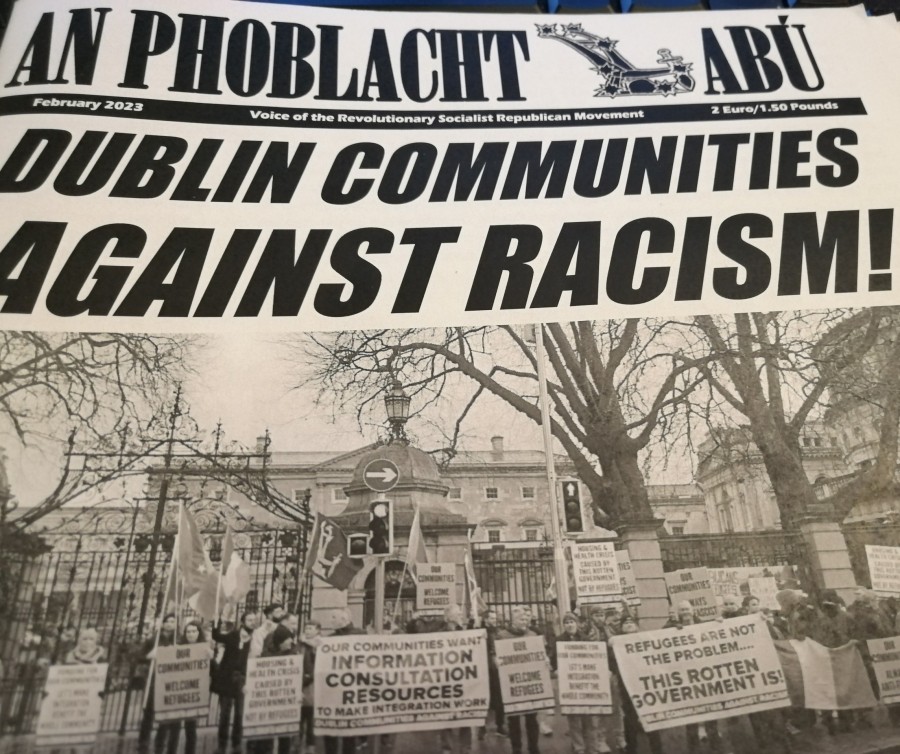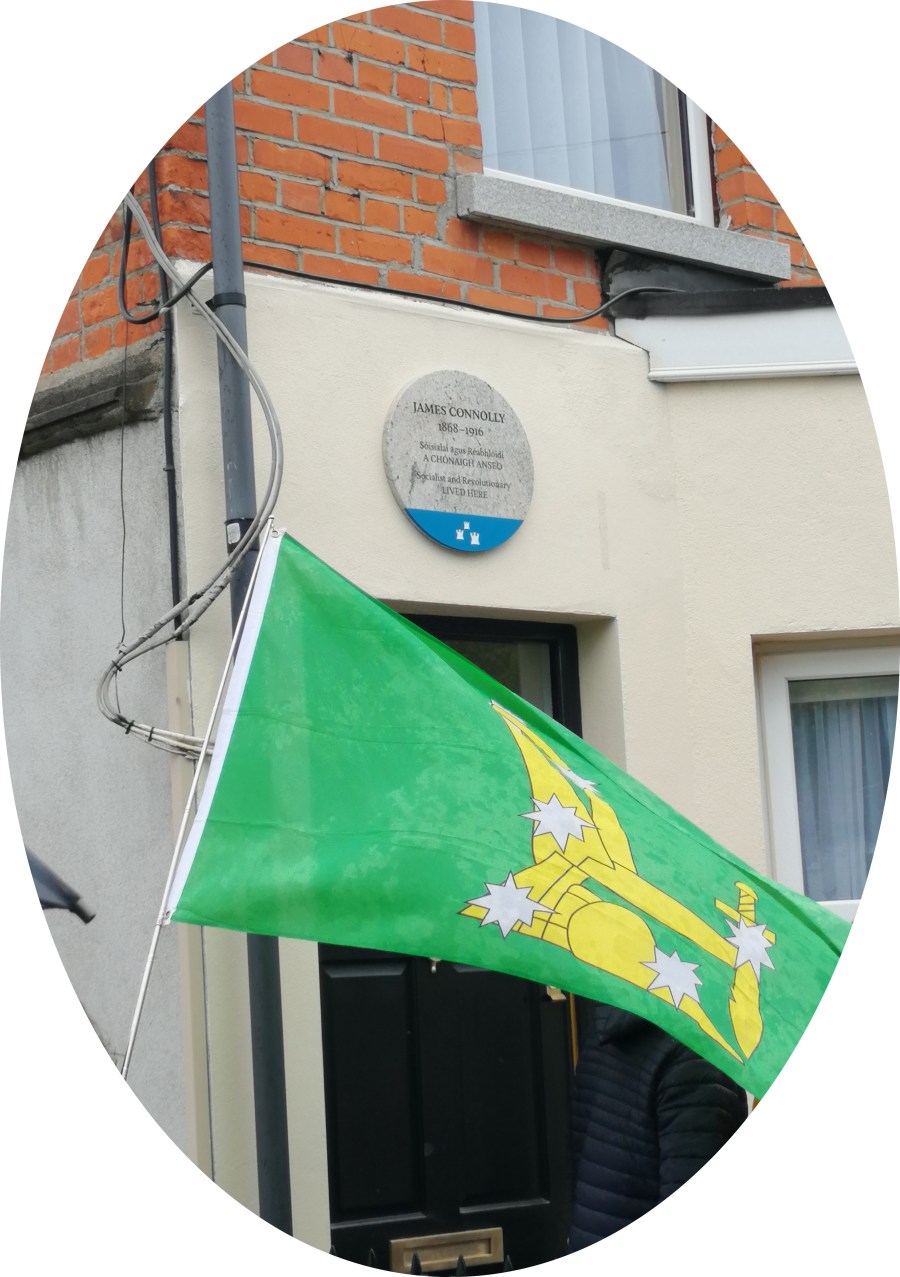
The May issue of this newspaper has been out for some weeks and the organisers did well to manage that in the midst of disruptive arrests of their housing activists and raids and arrests following their Easter Rising Commemoration1.
As before, this issue consists of sixteen A4 sides, therefore easy enough to handle and contains what seems the right mixture between short event reports and news items, along with a couple of analytical pieces, one on ‘workerism’ and a thought-provoking other on peat-cutting and energy.
A two-page spread on James Connolly and the Irish Republic quotes extensively from Connolly but without giving any references. This can be an issue since a number of statements commonly attributed to both Connolly and Lenin are lacking in substantial (or even any) verification2.
This edition discusses issues and events in Ireland but also internationally. Reports from the agrarian revolutionary movements in parts of India and in the Phillipines are featured – a list of attacks and casualties inflicted upon the oppressors’ forces.
Another piece marks the death of Palestinian activist Adnan Khader on the 76th day of his hunger strike protest against Israeli ‘administrative detention’ – internment in fact. The mass struggles in France against the raising of the retirement age are also featured.
For Ireland there are reports on the housing struggle, against police repression in the Six Counties, historical commemorations, poster and graffiti campaigns, a sectarian attack in Lurgan and another article deals with mental health issues and the shortage of services in Tipperary.
As commented in an earlier review of this newspaper, the Irish revolutionary movement has long needed a hard-copy revolutionary newspaper. As Lenin commented3, the revolutionary newspaper is an organiser as it requires production and distribution.
Of course, distribution networks for a newspaper can become action-organising networks also but in any case meeting a person to give them a newspaper is a personal contact, when questions and criticisms can be discussed and other information from the community collected to act upon.
This form of contact for the individual is superior to those available on the Internet and also less easy for the State to monitor. A newspaper can also go from hand to hand in a way that only short pieces or videos can compare with in electronic distribution.
Though of course, the latter also has its strengths.
Future editions of APA are to be welcomed and in the fullness of time perhaps we can even graduate to a weekly revolutionary Irish socialist newspaper, not seen here for decades.
End.
An Phoblacht Abú is available from personal contact with AIA or by post from Isrmedia@protonmail.com
FOOTNOTES:
1. See https://rebelbreeze.com/2023/05/07/gardai-arrest-republican-denouncing-the-monarchy-british-occupation/ Although the raid may well have been intended to disrupt plans for protests against US Imperialism’s chief, Joe Biden’s visit to Ireland, a socialist Republican still faces concocted charges relating to membership of an imaginary “illegal organisation”. Under special repressive legislation such a charge without credible evidence has been sufficient, in the no-jury Special Criminal Courts, to jail Republicans for two years.
2 For example, I have searched diligently for the description of the Irish Citizen Army attributed to Lenin, viz. “the first Red Army in Europe” but have thus far failed to find verification.
An organisation by the name of Anti-Imperialist Action yesterday held an anti-monarchist march and rally in Dublin, including a mock execution of royalty, where their speaker was arrested by Gardaí.
The protesters met first at the James Connolly monument in Beresford Place and after some words marched up Abbey Street to Dublin’s main street and to the General Post Office building to hold their anti-monarchy rally.
Royalty and guillotine beside James Connolly monument at start of event (Photo: AIA)
At the GPO the gathering of socialist republicans, socialists and anarchists had grown. As the mock-up guillotine carried out mock execution of the dummy representing royalty, a large force of Gardaí arrested the speaker. Participants then went to Store Street Garda station to demand his release.
At Store Street the protesters were met by a line of Gardaí1 drawn up in front of the entrance to the police station. In speeches and slogans, the protestors denounced the police for the arrest of the speaker at the GPO, also denouncing the monarchy and the State.
Line of Gardaí barring entrance to Store Street Garda Station (Photo:Rebel Breeze)View of protesters outside Store Street Garda Station (Photo: Rebel Breeze)
Some speakers criticised also the national broadcaster RTÉ which was devoting four hours to the coronation.
The most frequent chants were: When Republicans are under attack – stand up, fight back!2 One, Two, Three, Four – Occupation no more; Five, Six, Seven Eight – Smash the Free State!3 Brit King – Guillotine! No democracy – under a monarchy! No democracy – in the Free State4!
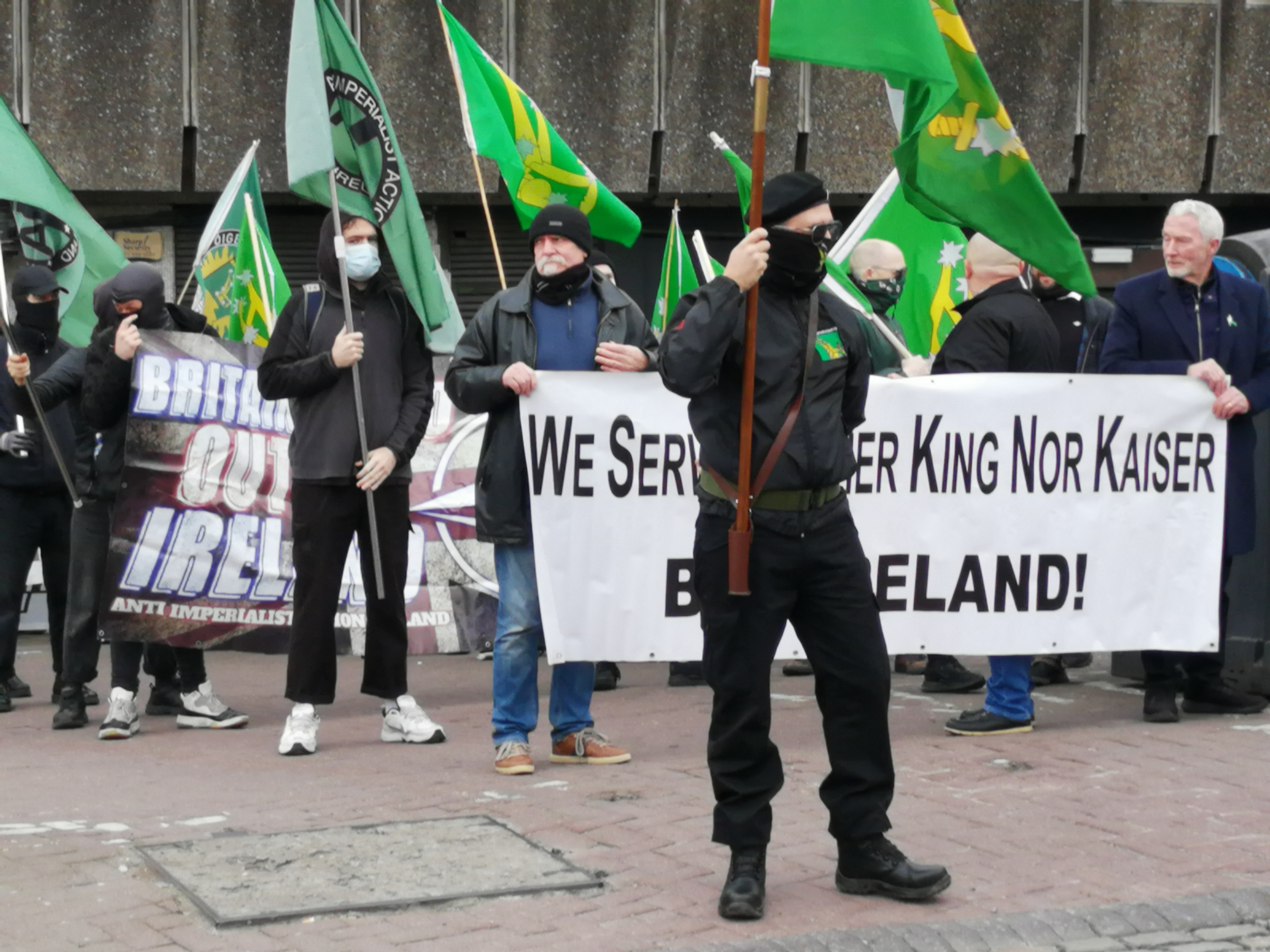
One of the protesters, accompanying himself on guitar, sang the Republican ballad popularly known as “Come Out Yez Black ‘n Tans”, the attendance joining in on the chorus. They displayed a banner with a slogan from Liberty Hall5 in WW1: We serve neither King nor Kaiser but Ireland.
Using a loudhailer, another protester read out James Connolly’s6 1911 denunciation of the monarchy. Yet another speaker quoted Garda Commissioner Drew Harris’ recent words saying the Gardaí were the “biggest gang”, the protester calling them “an MI5-directed gang”.
Eventually news of the release of the arrested man reached the protestors and they marched up Talbot Street with Starry Plough7 flags and a Basque Ikurrina flying, back to the GPO, outside of which they held an impromptu rally.
Along with portraits of Irish hunger-strike martyrs of 1981 there was a portrait of Palestinian martyr Khader Adnan carried also in recognition of the international role of British imperialism and its Head of State.
Many looked on in interest while some applauded them, both in Talbot Street, where a taxi driver enquired the reason for the protest and wished them well and also outside the GPO. Gardaí arrived and stood across from the building to watch the protesters but in smaller numbers than before.
The protestors return to the GPO for an impromptu rally in place of the planned one interrupted by the Garda attack and arrest of speaker (Photo: Rebel Breeze)
Another speaker said the protesters were “health workers, working to rid Ireland of a dangerous disease affecting politicians, media and State forces, a disease that makes them go to their knees in front of royalty and a foreign state, extending their tongues to lick a certain part of the anatomy.”
Interest from the pedestrian reservation in O’Connell Street across from the GPO, including much smaller number of uniformed Gardaí (Photo: Rebel Breeze)
The speaker said they were working “to rid Ireland of this dangerous disease, to enable the people to stand up straight once more, to claim their Republic, celebrate their history and speak out against foreign domination and monarchy”.
He drew attention also to arrest of a Republican speaker outside the iconic GPO, headquarters of the 1916 Rising8 and which still bears the scars of British bullets9.
Reference was also made a number of times by protesters to the arrests of English Republicans in London who were prevented by from holding a protest against the monarchy.
The victim of the police attack returned from police custody and briefly spoke thanking those who had demanded his release; people who had stopped to listen applauded and the group dispersed without further arrest.
End.
Photo taken at GPO before police attack (Photo: AIA)
2This seems adapted from a slogan often chanted by Irish socialist groups.
3This too seems an adaptation but from the Palestine solidarity movement.
4The new state of 26 Counties (missing six, which are in the British colony) and which fought a Civil War against the Republicans was called “the Free State” and though the name was changed (and to a ‘republic’) Irish Republicans and many nationalists in the British colony call it the “Free State” in irony and in negation of its legitimacy.
5Liberty Hall is a very tall building housing SIPTU but the trade union’s ancestor, the ITGWU had purchased the previous building on the same site which was destroyed by the British during the 1916 Rising. The slogan “We serve neither …” etc had been displayed across the front earlier during WWI.
6Revolutionary socialist leader, trade union organiser, writer and historian who brought the Irish Citizen Army to participate in the Rising, during which he was made Dublin Commandant, afterwards being shot by British firing squad.
7Originally flag of the Irish Citizen Army, the first workers’ Army in the world, formed to defend the workers in 1913 Lockout against police attacks and which also took part in the 1916 Rising.
8The rising 24-29 April 1916 was the first against world war and contained many other ‘firsts’ – six different organisations played a prominent part in it, including women. The Rising is regarded as leading to the War of Independence 1919-1922.
9One of many buildings in Dublin that bear the scars of conflict, this one is an imposing building in the city’s main thoroughfare, O’Connell Street. With the building in flames from British artillery on Easter Friday, the garrison, including five of the Seven Signatories of the Proclamation of Independence (which was read out at the start of the Rising) relocated to nearby Moore Street, where the decision was taken to surrender.
Useful link and Reference:
"We confess to having more respect and honour for the raggedest child of the poorest labourer in Ireland today than for any, even the most virtuous, descendant of the long array of murderers, adulterers and madmen who have sat upon the throne of England." – James Connolly pic.twitter.com/o8inKRr5Fi
— Anti Imperialist Action Ireland (@AIAIreland) May 6, 2023
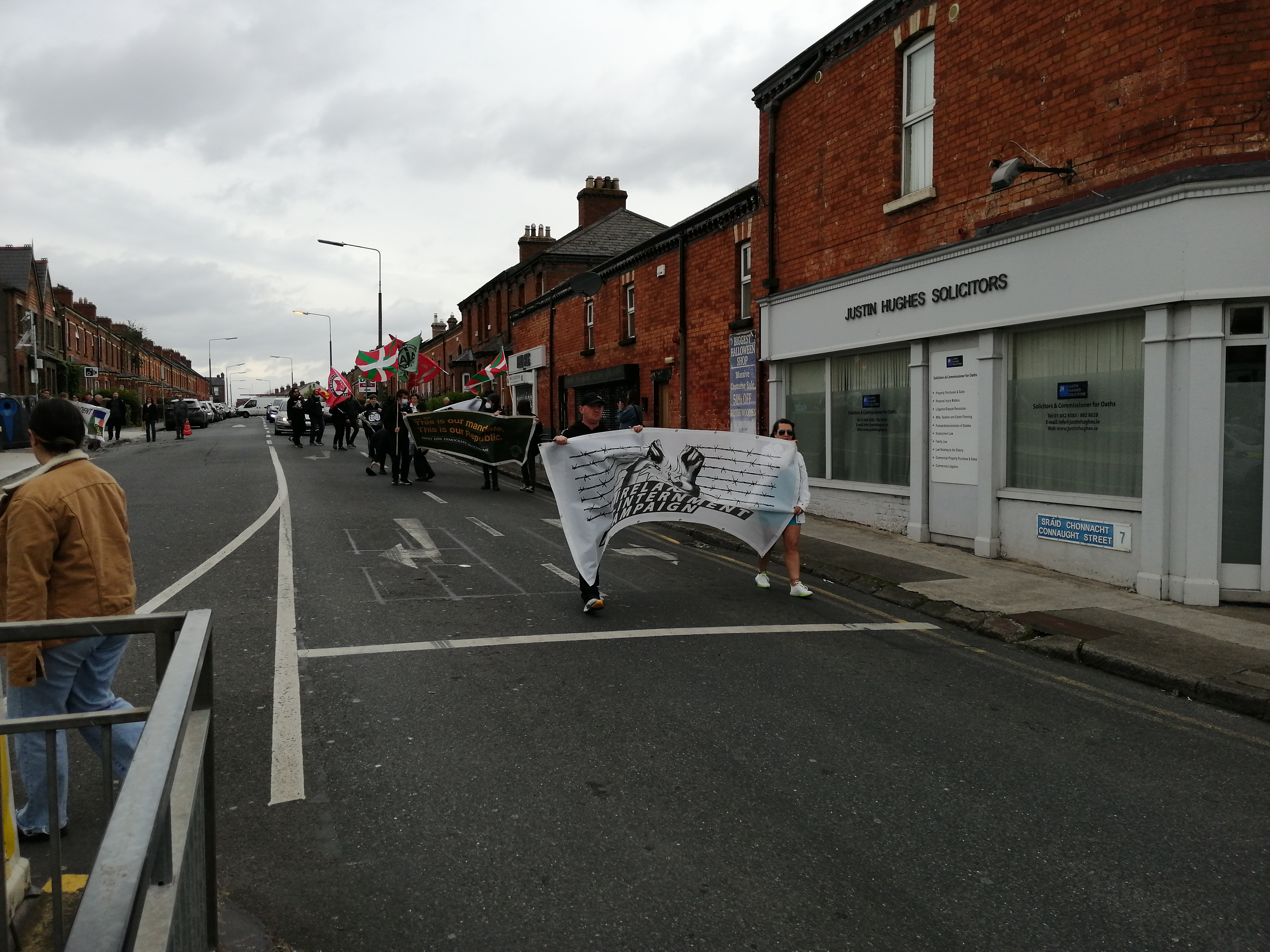
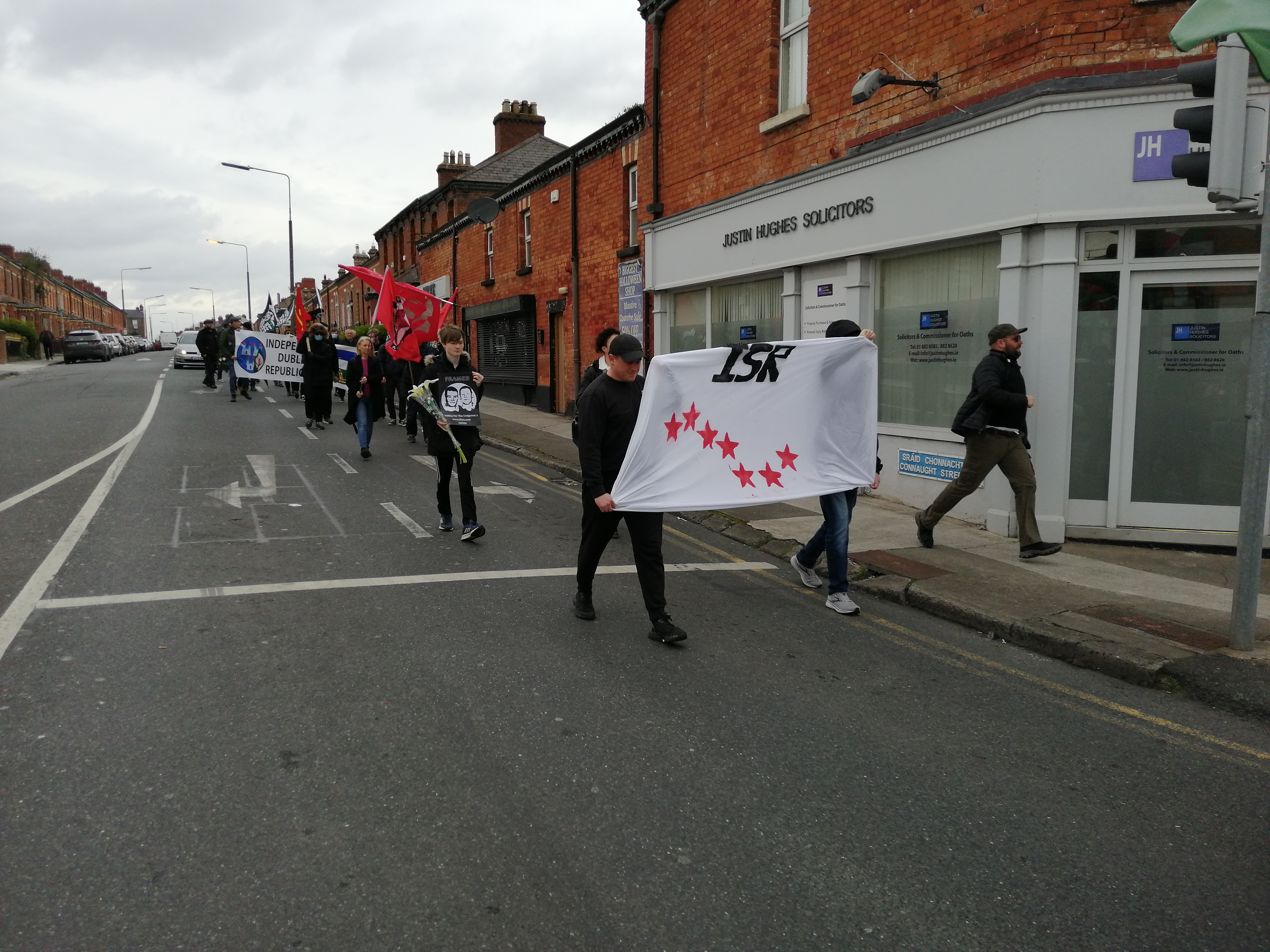
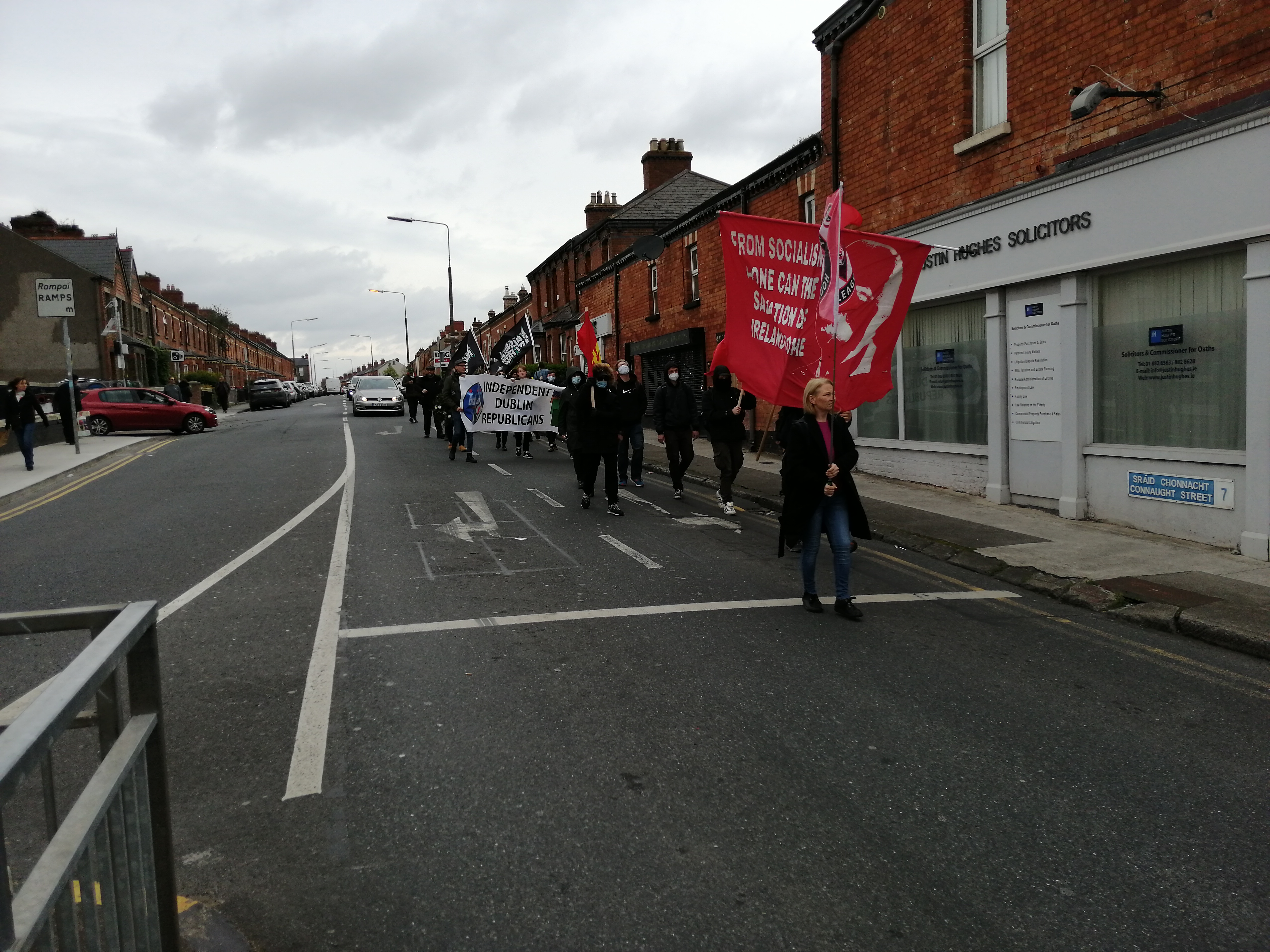
On Sunday participants in a 1916 Rising Commemoration organised by the Irish organisation Anti-Imperialist Action were harassed by police as they gathered to march to the Irish Citizen Army Republican plot in Glasnevin Cemetery.
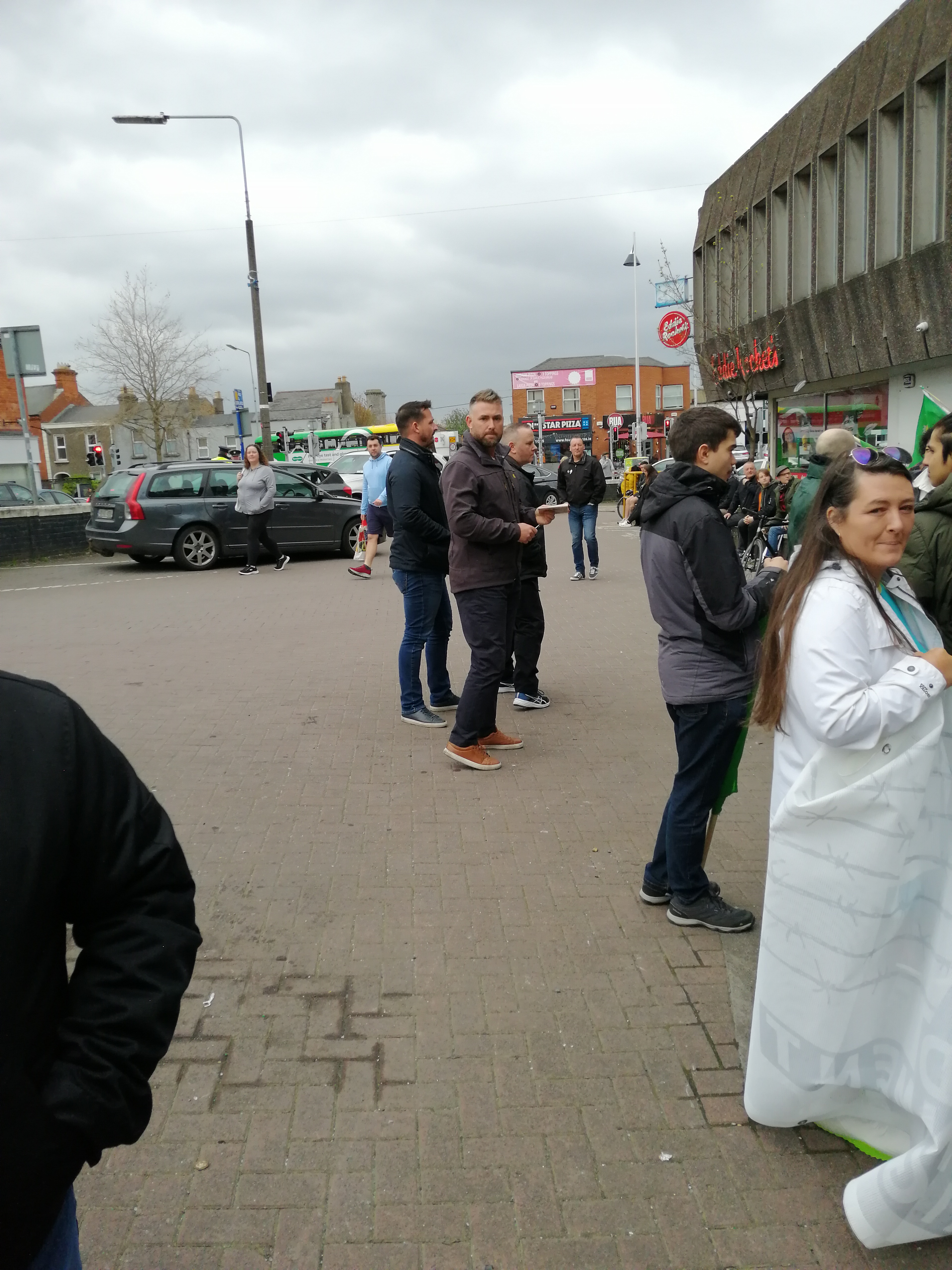
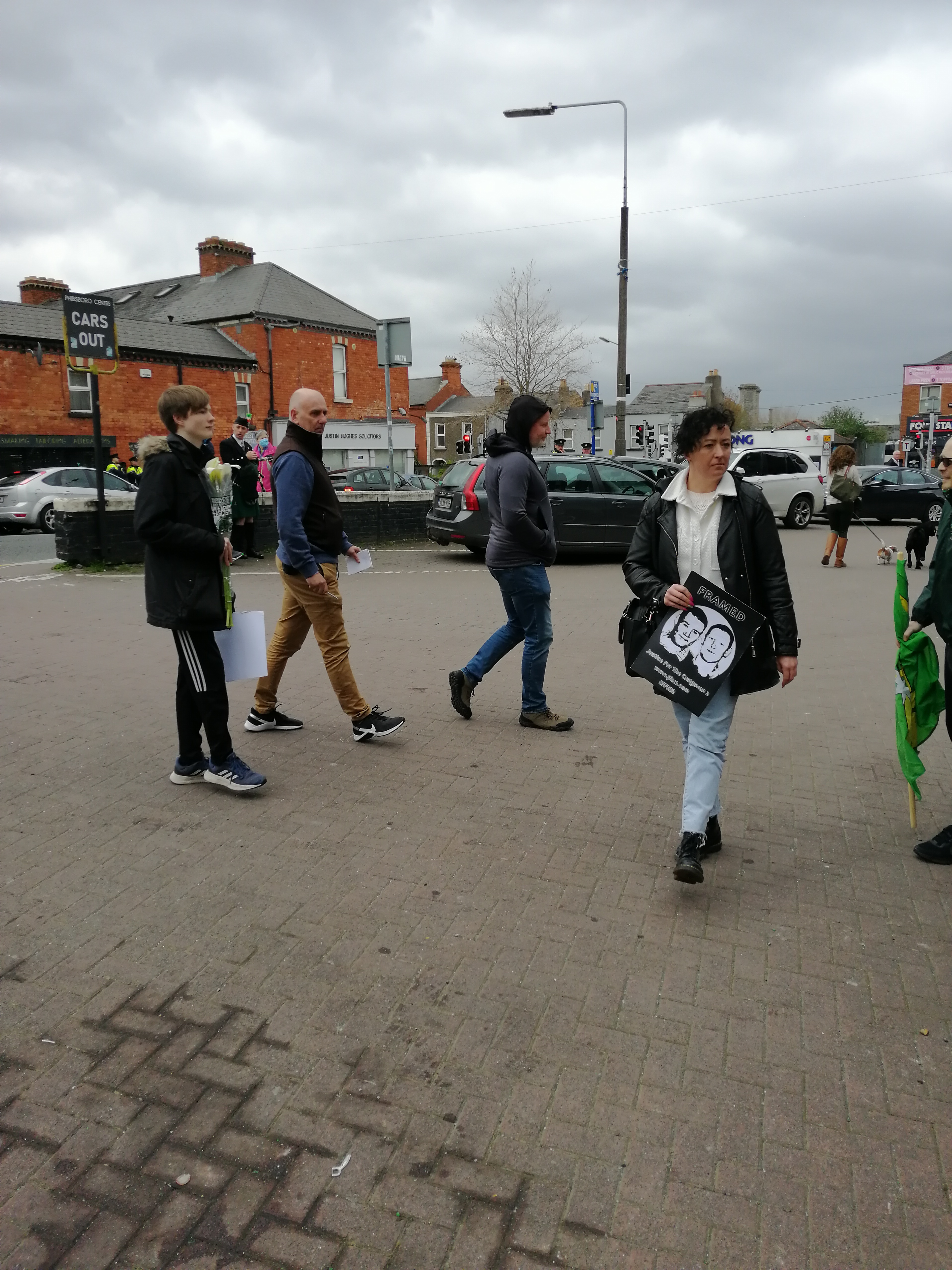
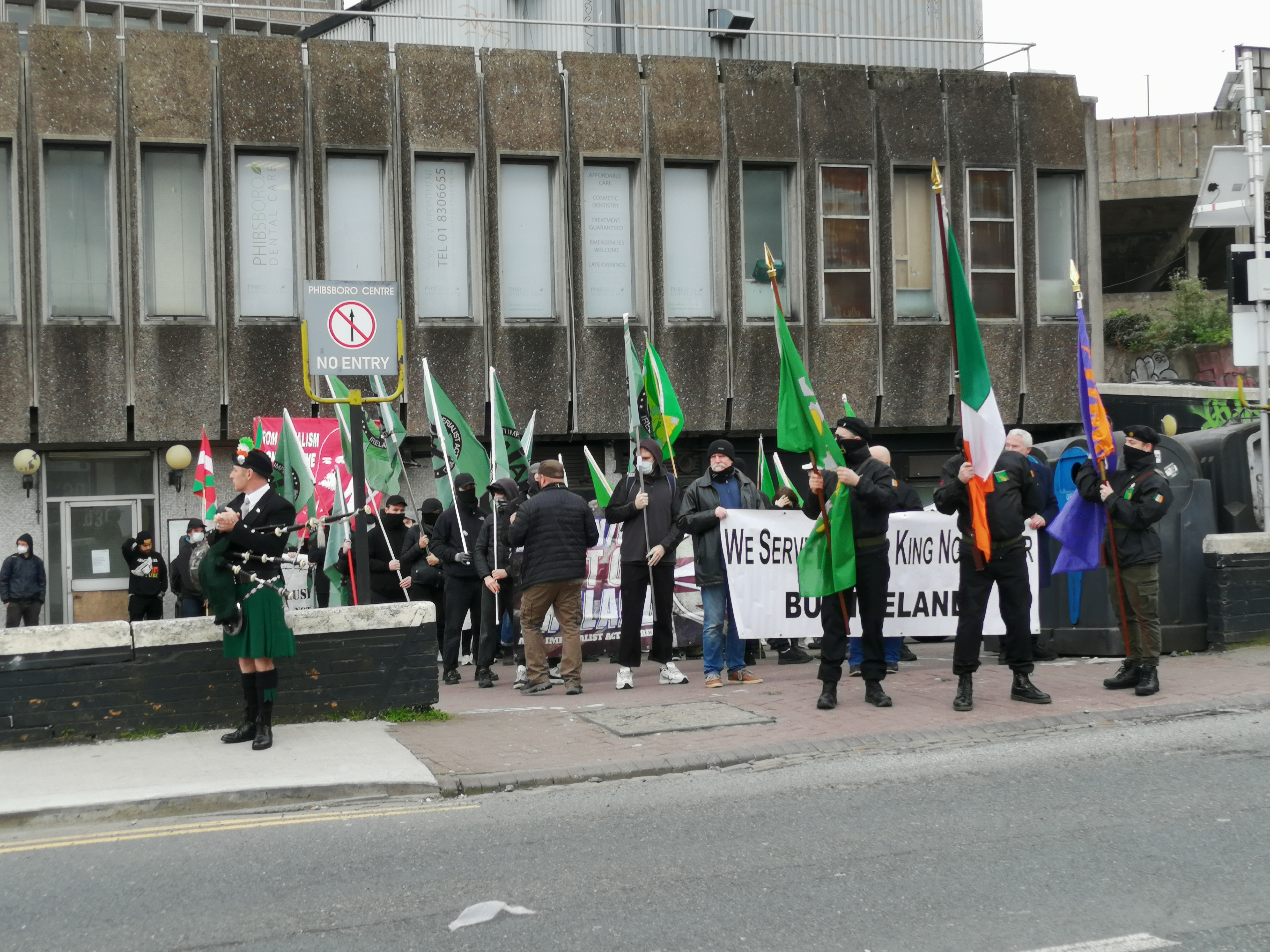
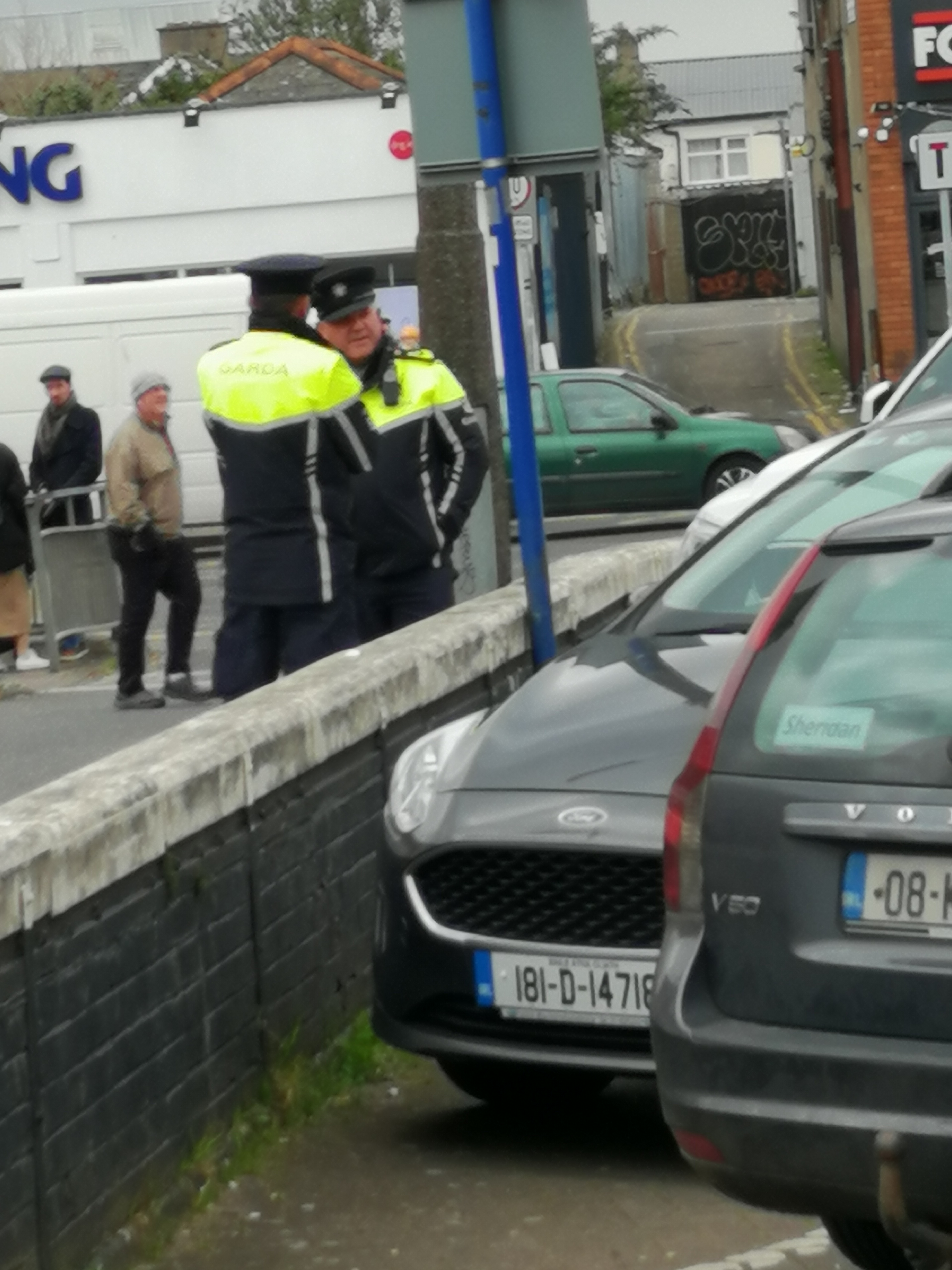
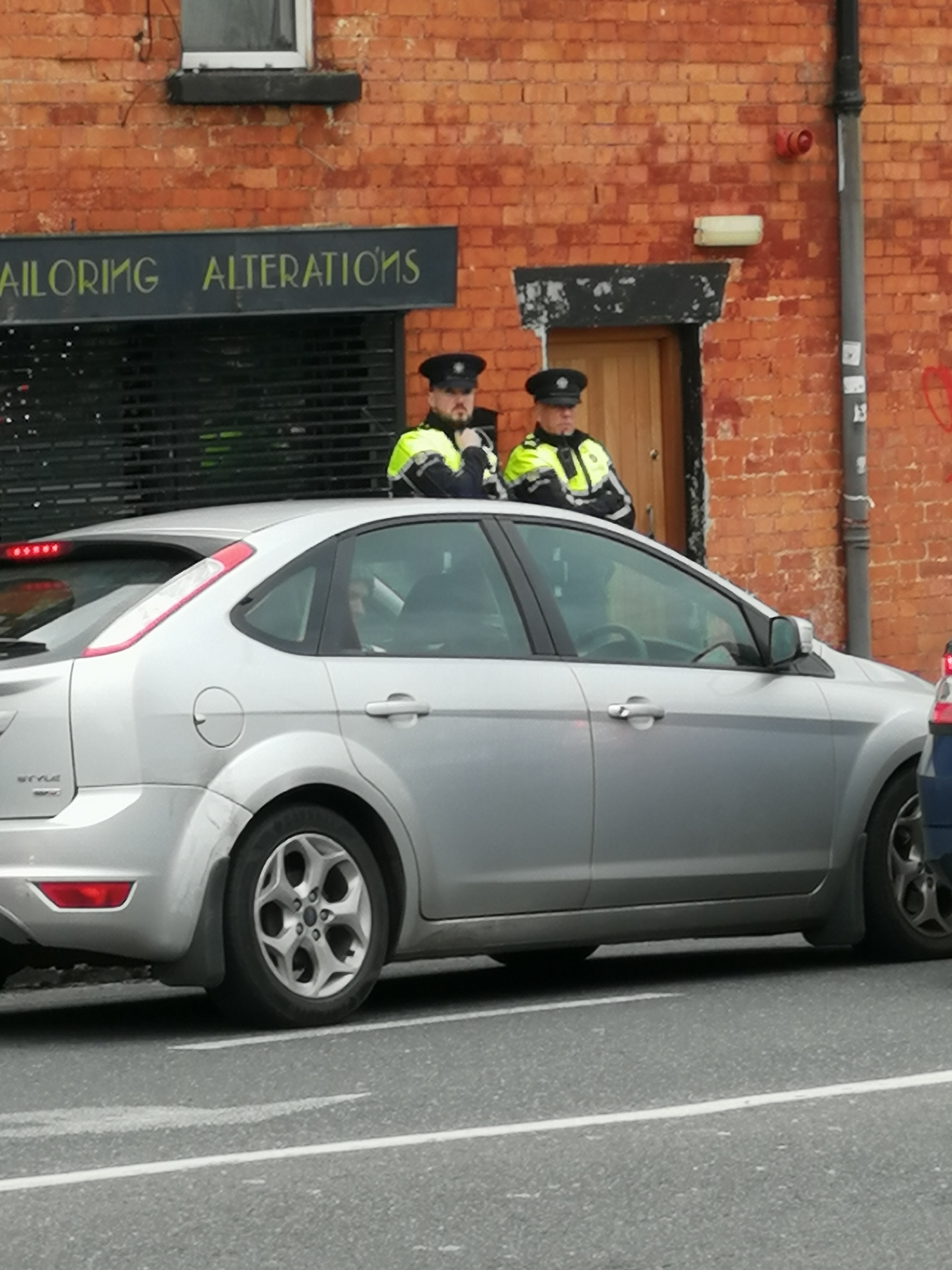
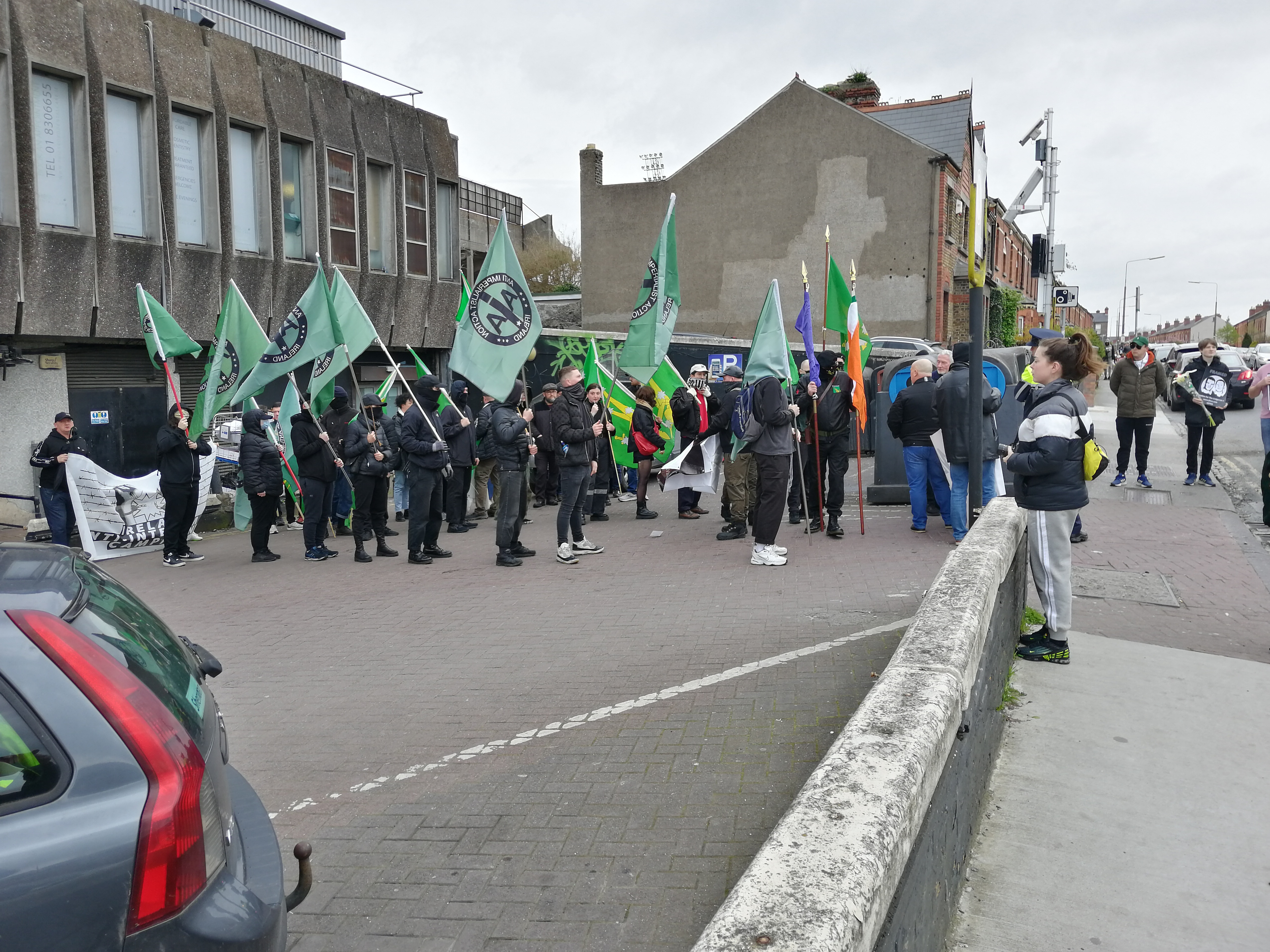
Six political police in plain clothes walked among those gathered beside Phibsborough shops demanding names and addresses of the participants, most of whom were fairly young. Four uniformed Gardaí also stood nearby and a Public Order Unit van parked at the cemetery entrance.
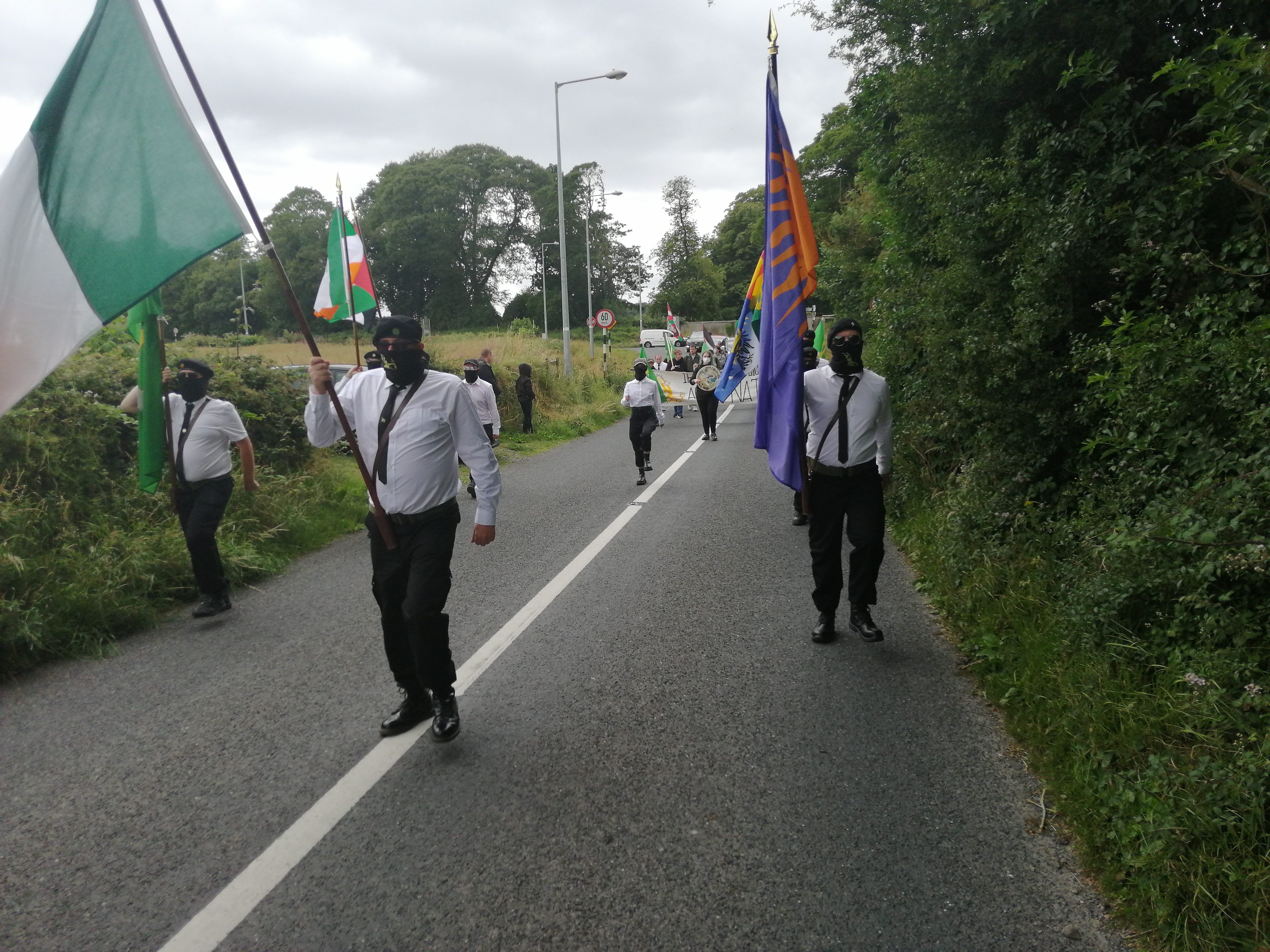
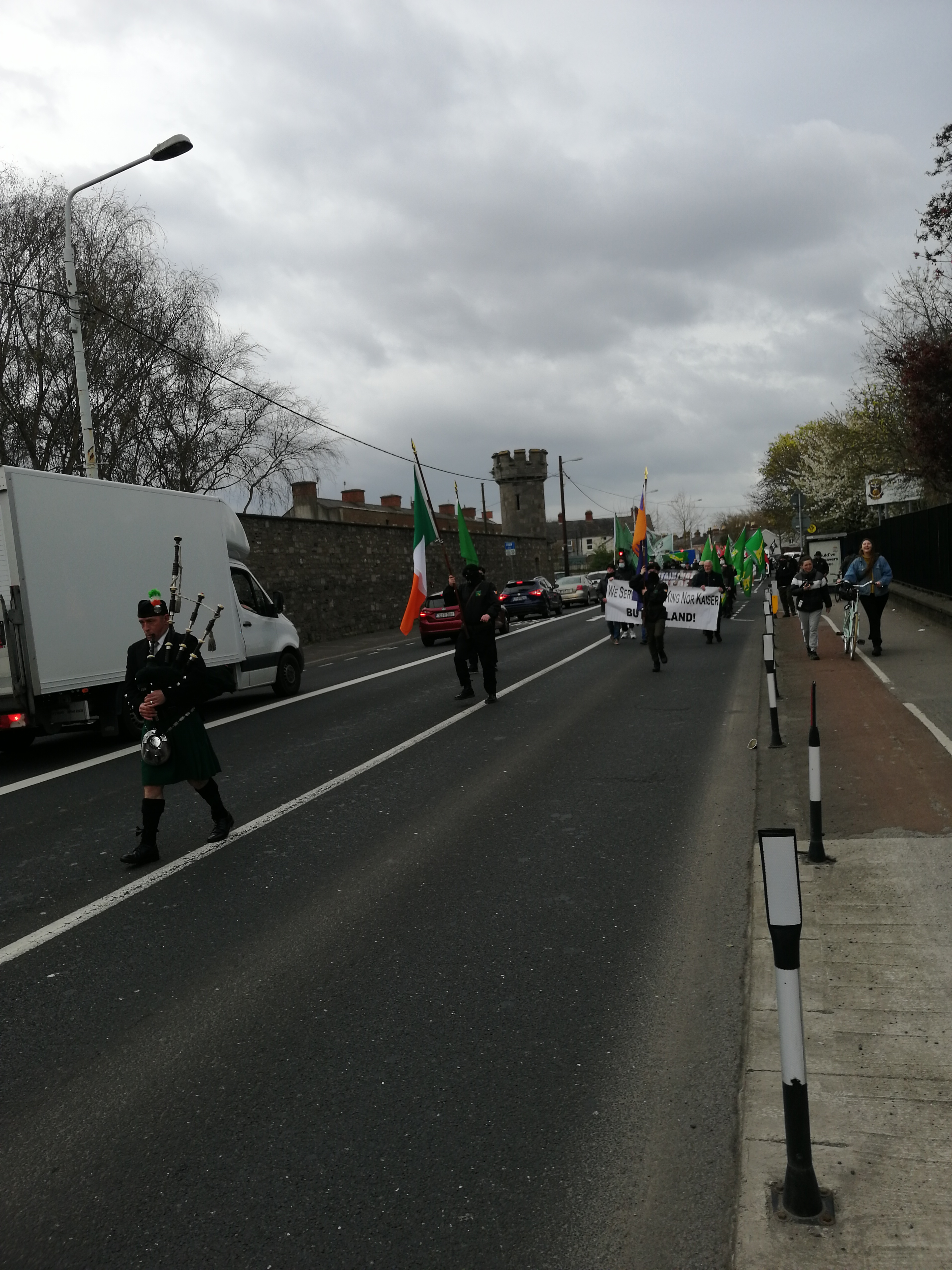
The participants declined to be intimidated and set off on their march, led by a lone piper playing Irish marching airs, followed by a colour party with different banners interspersed among the marchers, among which fluttered many flags.
Organisers had learned that the coach carrying members of the Republican Flute Band from Scotland that was to lead the parade had been prevented by police there from taking the ferry to Ireland.
Centre photo: Four of the six plainclothes political police violating the civil rights of the peaceful people commemorating the Easter Rising. (Photo: D.Breatnach)Centre photo, another two plainclothes political police. The bald man joked while he harassed people. (Photo: D.Breatnach) (Photo: D.Breatnach)
Historical background
In 1916 a broad alliance the Irish Volunteers, Irish Citizen Army, Cumann na mBan, na Fianna Éireann and Hibernian Rifles1 took part in a Rising organised by the Irish Republican Brotherhood against British rule in Ireland and against world war.
Due to a number of unfortunate circumstances, the leader of the Volunteers cancelled the Rising which however went ahead a day later than planned and was for the most part confined to Dublin, where a third of the numbers in the original plan took part and fought for a week.
The occupying British Army shelled the city centre from a gunship in the river Liffey and also from artillery on land. Explosions and resulting fires destroyed much of the city centre including the General Post Office in the main street, which had been the headquarters of the insurrection.2
After a week with the city centre including the GPO in flames, the rebel garrison evacuated to Moore Street where the following day, surrounded and vastly outnumbered, the decision was taken to surrender.3 A British military court passed death sentences on nearly a hundred prisoners.
All but fifteen of those sentences were commuted to long jail periods but the seven Signatories of the 1916 Proclamation4 and another seven were shot by British firing squad in Dublin, a fifteenth in Cork and after trial months later a sixteenth was hanged in Pentonville Jail, London.
At Easter 1917 Irish Republican and Socialist women commemorated the 1916 Rising; ever since then Irish Republicans and sometimes Socialists in Ireland and in many parts of the diaspora have commemorated the Rising, whether legally5 or otherwise, in jail or at liberty.
The War of Independence began in 1919 with many of the Rising’s survivors participating6.
(Photo: D.Breatnach)
The Parade on Sunday – local and national historical memory marked
At Cross Guns Bridge over the Royal Canal the parade halted and flares were lit in memory of events there in 1916.
Marching along the Cabra Road, the wall and a watchtower of the north side of Glasnevin Cemetery on the left of photo. (Photo: D.Breatnach)
On Easter Monday 1916 a small group of Irish Volunteers had marched from Maynooth along the canal bank to join the Rising in Dublin and found guarding the bridge two Irish Volunteers who advised them to wait until the following day to go into the city centre.
The Maynooth group spent the night in Glasnevin and the following day marched into the GPO, passing an empty Cross Guns Bridge on the way. Back towards Phibsborough, British artillery had blown a barricade and killed Seán Healy, a Fianna member at the Nth. Circular Road crossroads.
Later, the Dublin Fusiliers unit of the British Army blockaded the bridge, preventing people from crossing it in either direction. They shot dead a deaf local man who failed to heed their challenge because he did not hear it.
We Serve Neither King nor Kaiser but Ireland declared one banner carried last Sunday, Britain/NATO Out of Ireland another, This Is Our Mandate7, Our Republic and Collusion Is No Illusion, It Is State-Sponsored Murder were another two.
A large banner also declared alongside the image of James Connolly that Only Socialism Can Be the Solution for Ireland. Some organisations also carried their own banners, such as those of Dublin Independent Republicans, Ireland Anti-Internment Campaign and Irish Socialist Republicans.
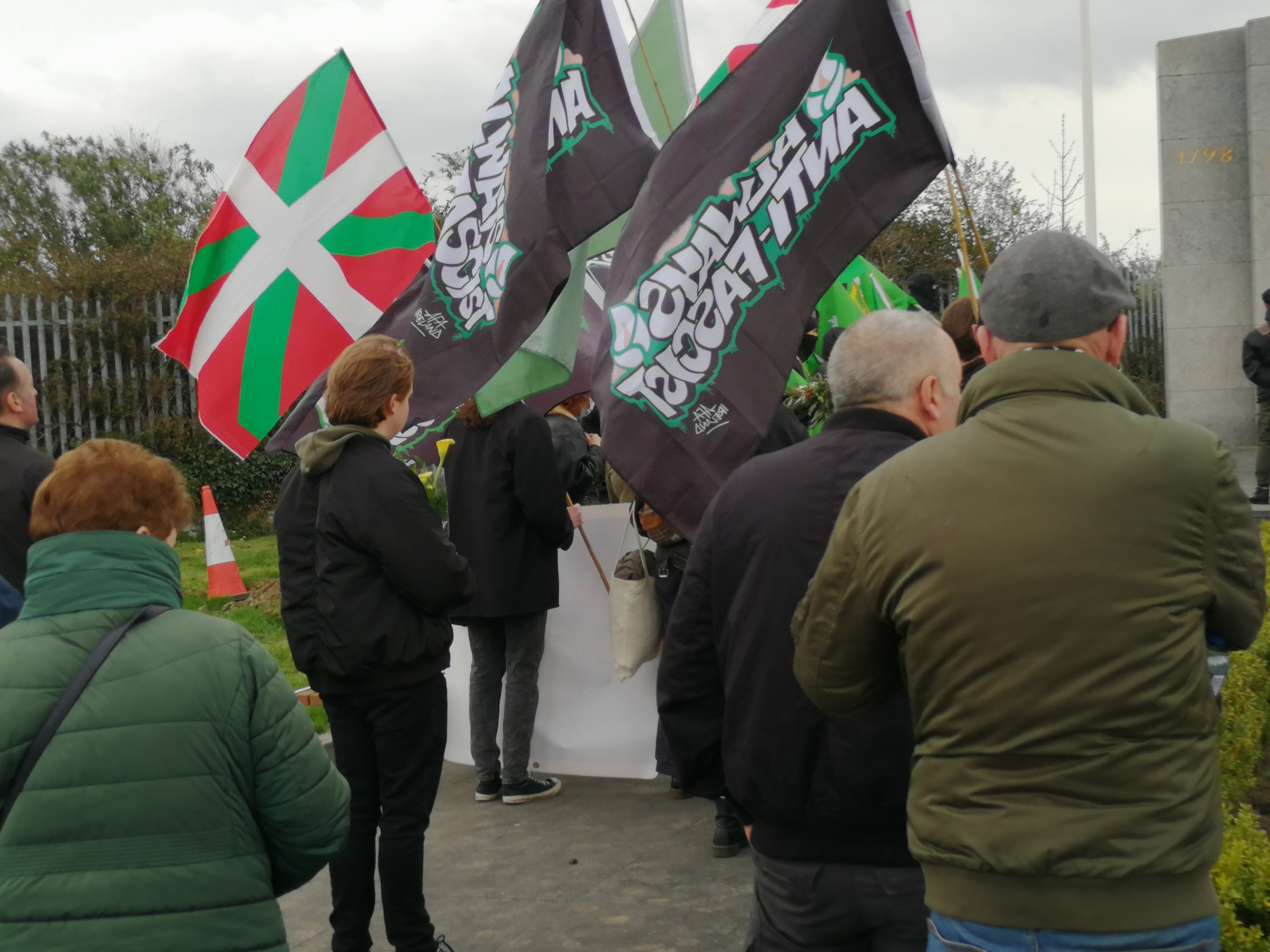
Flags fluttering included those bearing the logo of the organising group Anti-Imperialist Action and others bearing the slogan “Always Anti-Fascist”, green-and-gold Starry Ploughs, a couple of Ikurrinak (Basque flags) and another two of Red with Hammer & Sickle in yellow.
Basque and antifascist flags (Photo: D.Breatnach)
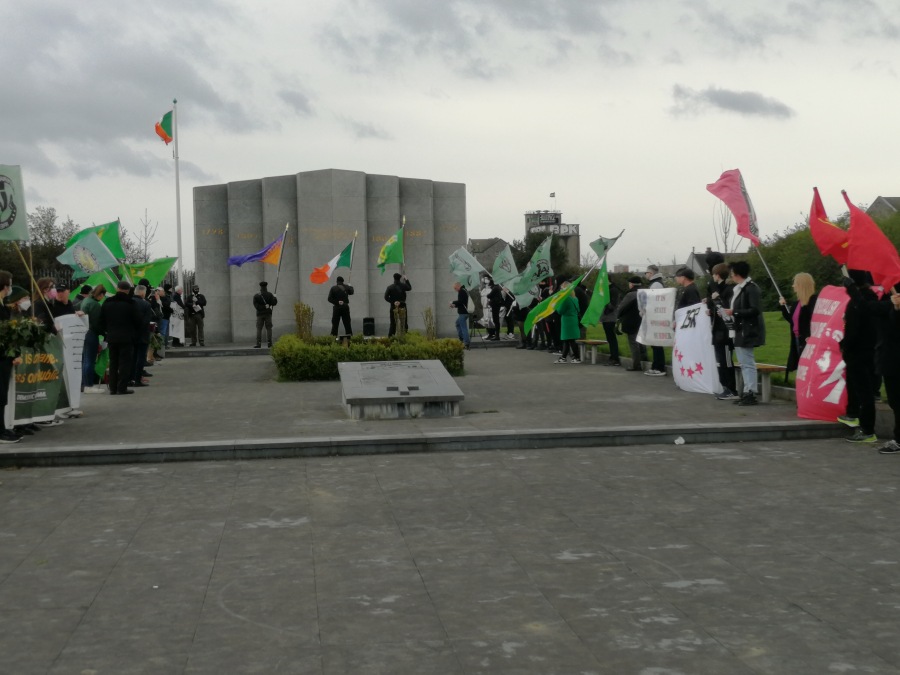
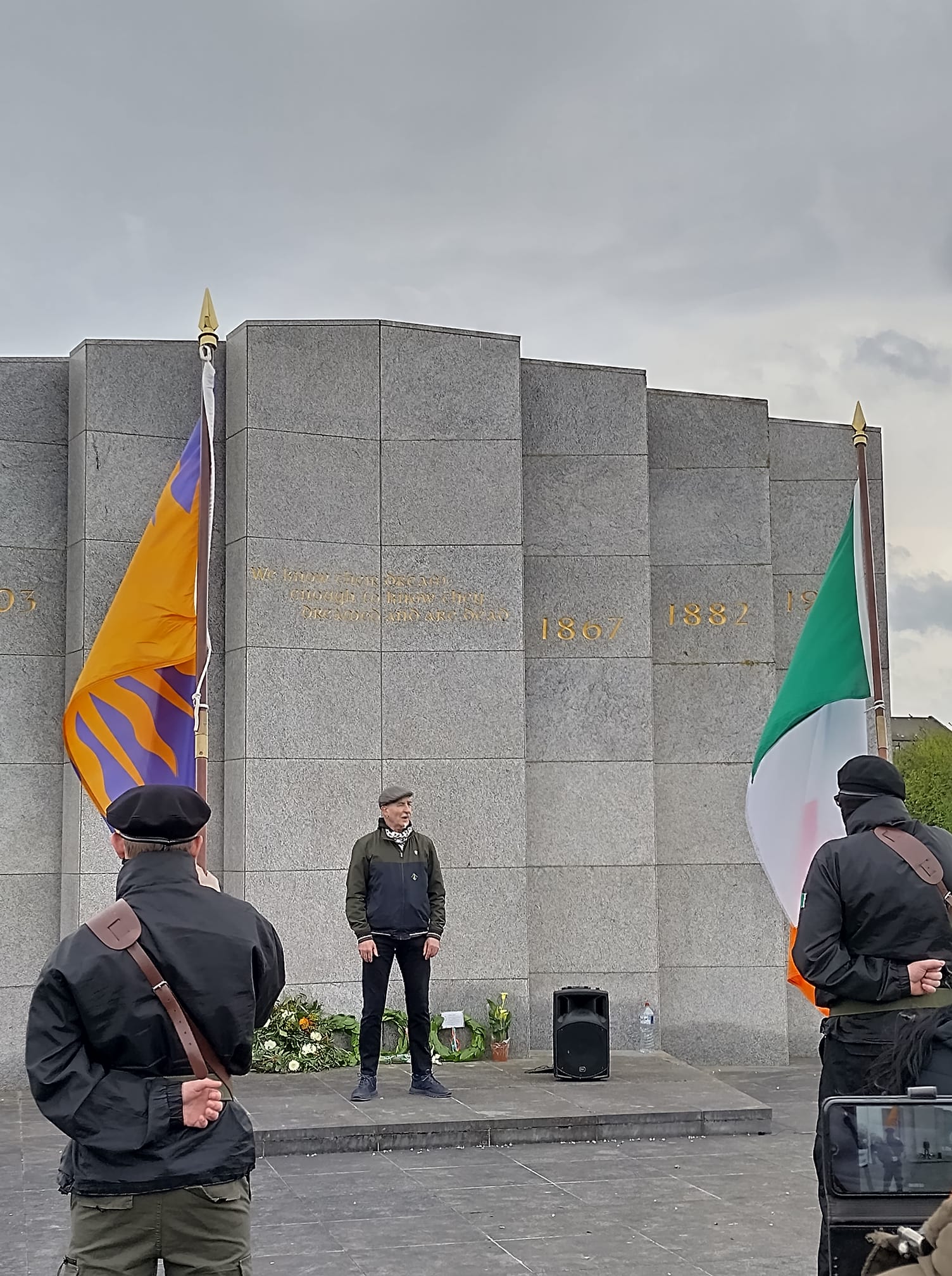
At the Monument: speeches and songs
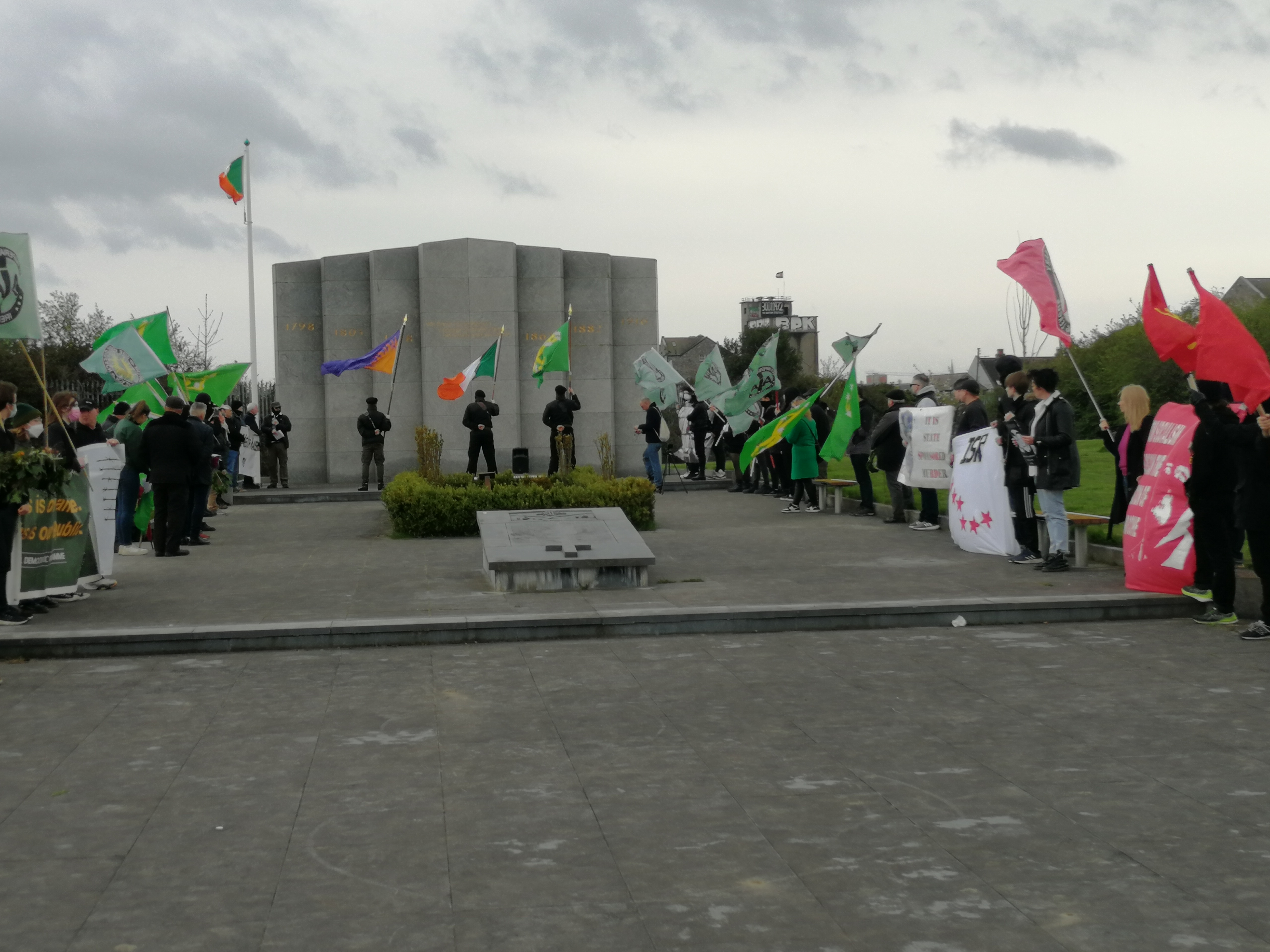
At the monument (Photo: D.Breatnach)
Glasnevin Cemetery (ReiligGhlas Naíonn) covers over 120 acres in North Dublin city and is in two parts, each with Republican Plots separated by the Cabra Road and contains the graves of both famous and ordinary people.
On the north side there is also access to the Botanic Gardens, both on the south banks of the Tolka river. The imposing Monument to numerous Republican uprisings and the Irish Citizen Army Republican plot is on the south side, across the pedestrian bridge over the railway line.
(Photo: D.Breatnach)
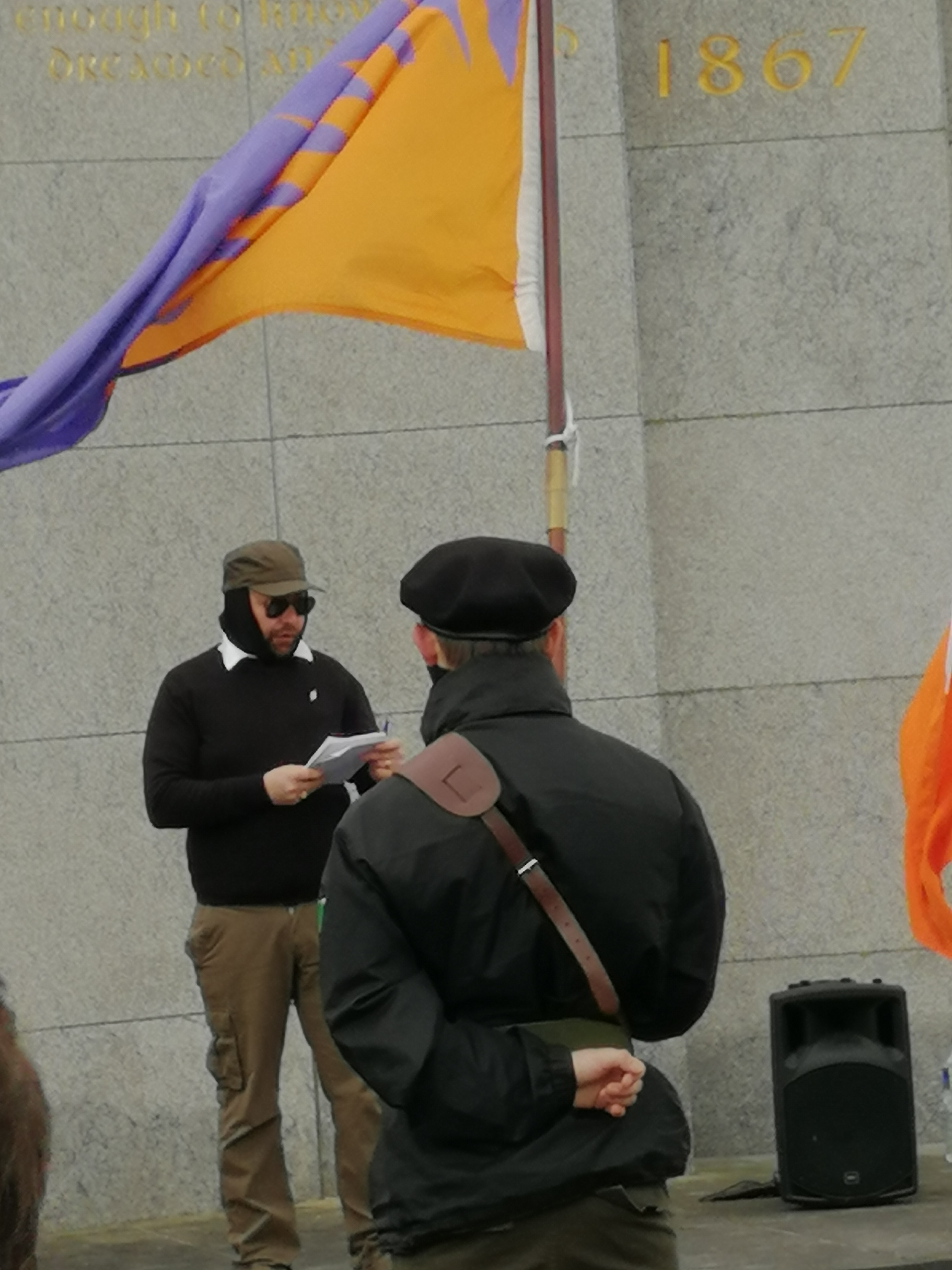
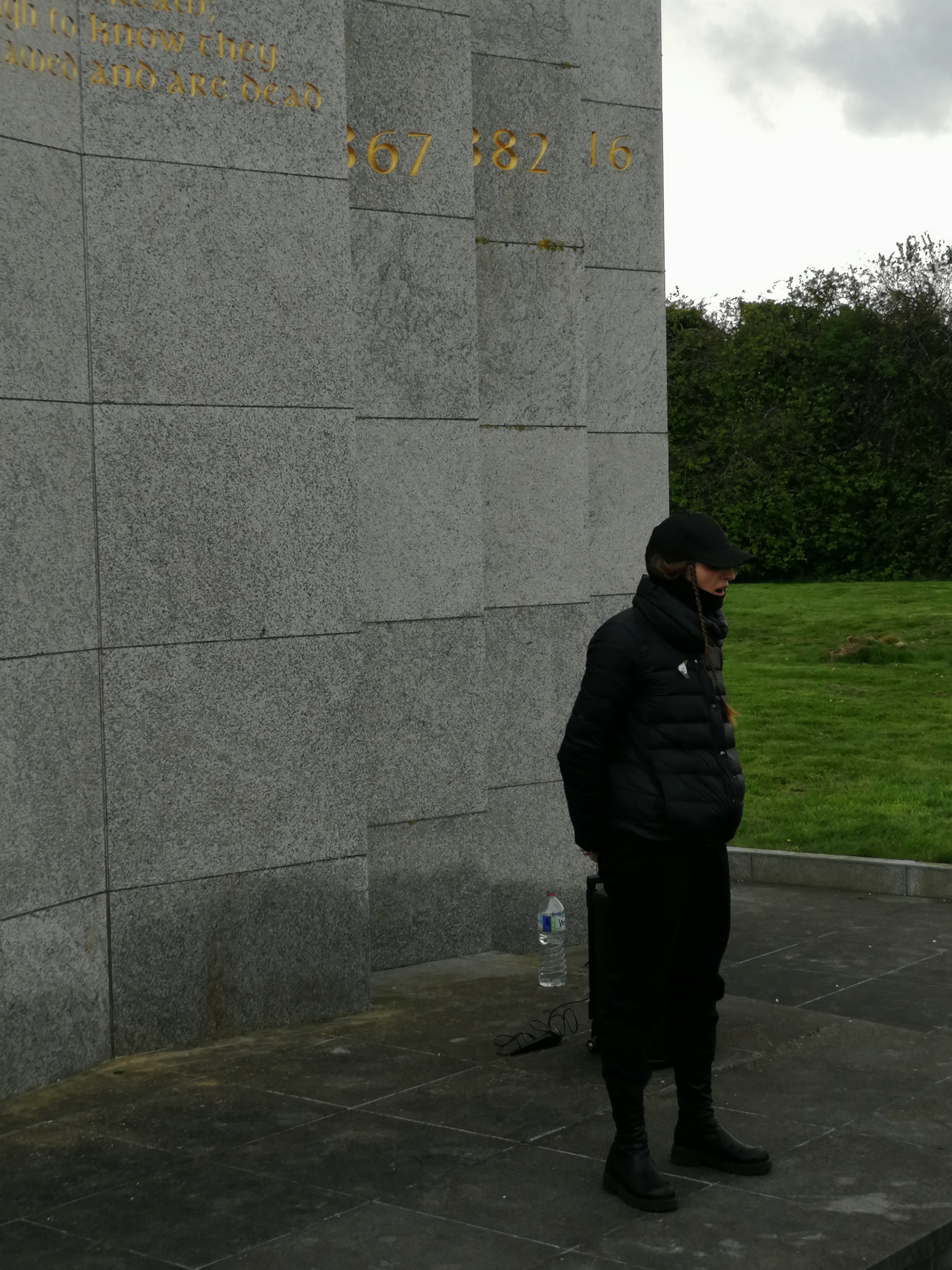
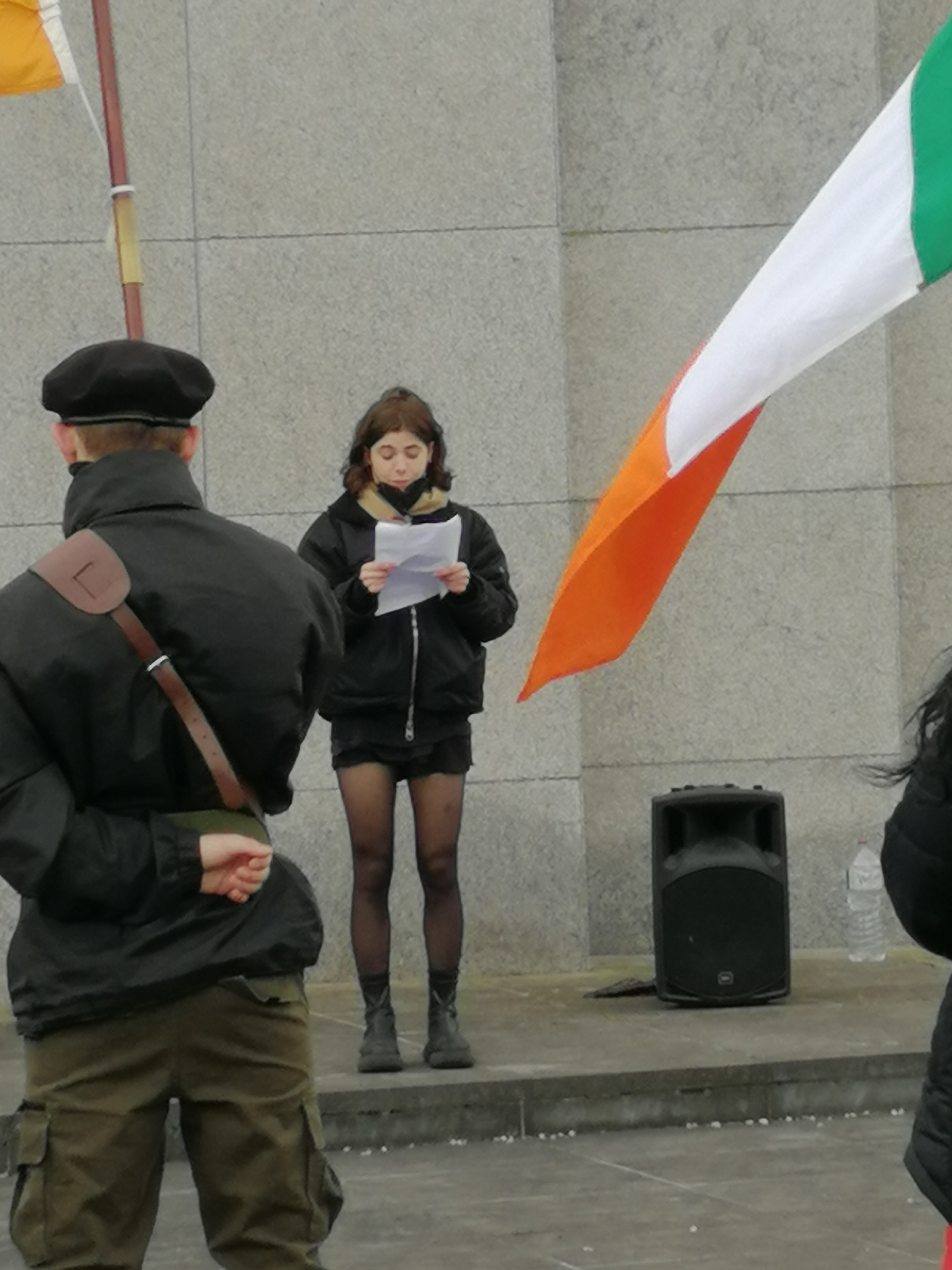
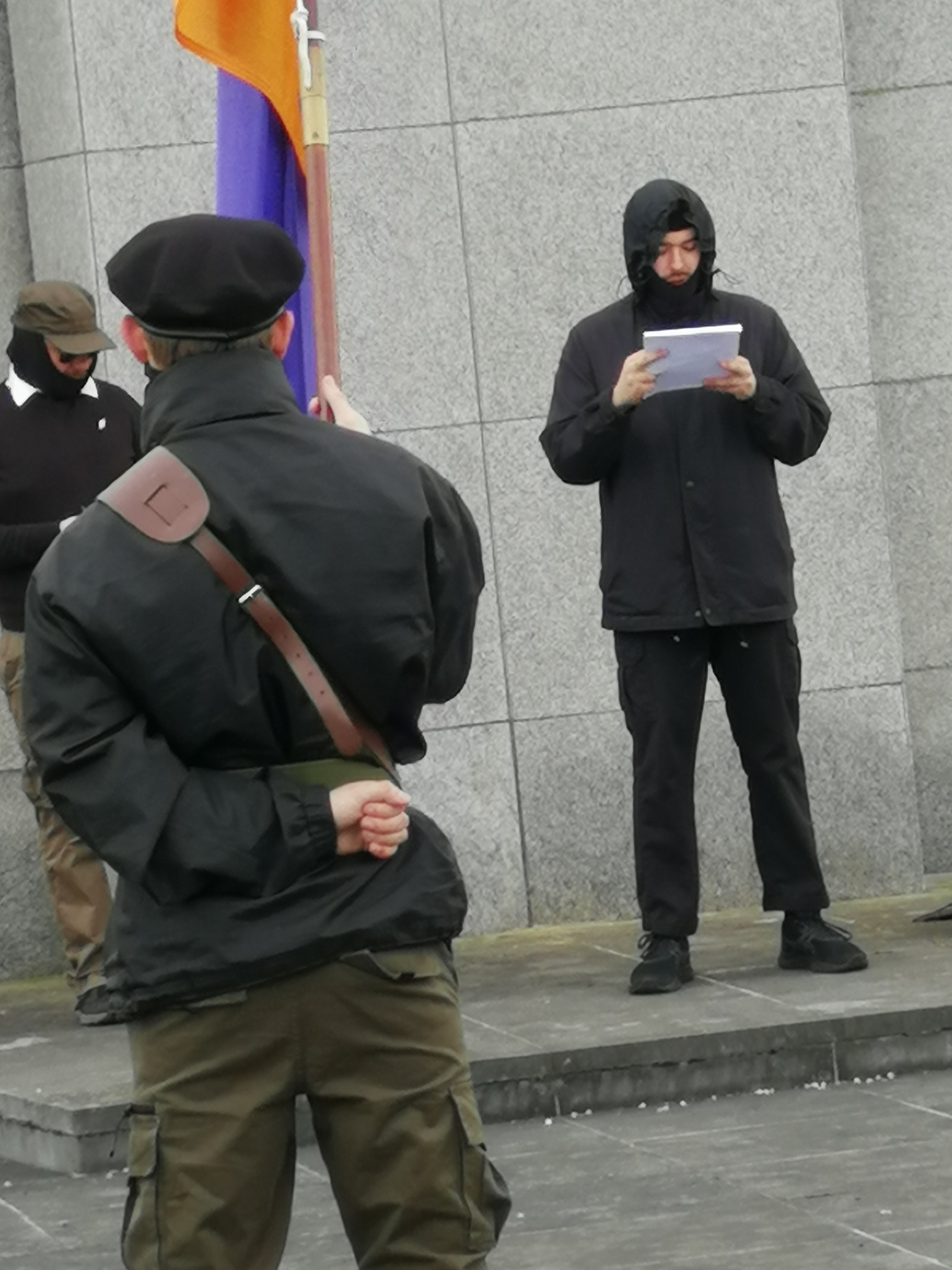
A man chaired the event for Anti-Imperialist Action and spoke briefly, introducing people for readings (all of which were from James Connolly) and for orations. The presentations of these were evenly divided between men and women, three of those being of young people.
Three songs were sung: a woman sang The Foggy Dew (by Charles O’Neill) and Erin Go Bragh (by Peadar Kearney), while a man sang Patrick Galvin’s Where Is Our James Connolly? Two women read out pieces by James Connolly and another read out the 1916 Proclamation.
Person chairing the event (Photo: D.Breatnach)
The words of the chairperson and of those giving orations were different but there were common themes: upholding the historic Irish spirit of resistance, the importance of the working class in history and the objective of a socialist Republic encompassing the whole of the Irish nation.
These words were balanced by denunciation of US and British imperialism and the colonial/ NATO occupation of the Six Counties by the latter; the Irish client regime; the special no-jury courts8 of both administrations in Ireland and repression by police forces and occupation army.
One of the singers (Photo: D.Breatnach)
One of the readers (Photo: D.Breatnach)
Also denounced were those political parties that had abandoned the struggle for the Republic and instead had become part of the colonial and neo-colonial administrations or, in the latter case, were on their way to becoming so.9
Floral tributes were laid by representatives of a number of announced organisations and then others came forward to lay floral tributes also. The colour party lowered flags for a minute’s silence in homage and salute before slowly raising them again and the piper played Amhrán na bhFiann.
The other singer Lowering of the colour party flags in homage to the fallen in the struggle (Photo: D.Breatnach)Colour party raises flags again in symbolism of the struggle continuing (Photo: D.Breatnach)
The chairperson thanked all for attendance, listing organisations by name and cautioning all to stay close together as they left, due to the threatening presence of Gardaí and in particular the Public Order Unit. In the event, the celebrants exited the cemetery and dispersed without incident.
1A small unit, an armed wing of a split from the more socially conservative USA version of the Ancient Order of Hibernians, their participation in the Rising was notable.
2Photos of much of the destruction are available on the Internet and accessible by search browser.
3The terrace they occupied still stands and is the object of a historical memory and conservation struggle against property speculator plans approved by the municipal city managers and Government political parties (see smsfd.ie).
4A remarkable document, the text of which is available from many postings on the Internet.
5Irish women commemorated it in public in contravention of British WWI martial legislation in 1917 and 1918 and for decades the public commemoration of the 1916 Rising (and even the flying of the Irish Tricolour) was forbidden in the British colony of the Six Counties with attendant colonial police attacks on any attempt to do so.
6Sometimes inaccurately called “the Tan War” (reference to a special colonial police auxiliary force that became known as the “Black n’ Tans”), the war saw the birth of the IRA and lasted from 1919-1921. A British “peace” proposal opened deep divisions in the nationalist coalition and was followed by a Civil War 1922-1923, in which the pro-Treaty government and armed forces were armed and supplied by the British to defeat the Republicans in a campaign of repression and jailing, military actions, kidnapping and torture, murder of prisoners, assassinations and over 80 formal executions.
7Also displaying text referring to the First Dáil’s Democratic Program of 1919.
8The Diplock court in the colony and the Special Criminal Courts in the Irish State, political special courts in all but name, with low proof bar and abnormally high conviction rate and refusal of bail while awaiting trial.
9References to 1) the 1930s split from the Sinn Féin party, the Fianna Fáil political party that became a preferred Government party of the foreign-dependent Irish ruling bourgeoisie and 2) to the Provisional Sinn Féin party who endorsed the British pacification plan in 1998 and embarked on the road to becoming a party of reformist nationalism in the colony and is heading for neo-colonial (and neo liberal capitalist) coalition government at the moment.
An event was held on a busy Saturday afternoon in Dublin’s city centre to commemorate IRA volunteer Patrick O’Brien, killed by soldiers of the Irish State.
The event included bagpipe airs, a colour party, speeches and a resistance song.
A colour party with Irish Tricolour and the flags of the four provinces, led by a lone piper marched into and a short distance westward up Talbot Street towards where a crowd waited beside a memorial sign that had been erected shortly earlier. The colour party took up station on the opposite side of the road.
Led by a piper playing Irish airs, the colour party (i.e carrying the flags – the Irish Tricolour and those of the four provinces of Ireland) approaches as the start of the commemoration. (Photo: D.Breatnach)
Among the airs being played on the short march were Thomas Moore’s Let Erin Remember and The Wearing of the Green or The Rising of the Moon, the same traditional air to both different songs referring to the 1798 Rising.
THE SHORT LIFE OF A LOYAL REPUBLICAN
Framed portrait photo of Vol. Patrick O’Brien on display at the commemoration (Photo: D.Breatnach)
Gina Nicoletti, chairing the event, recounted to the crowd a short history of Volunteer Patrick O’Brien who was born on 17 August 1898 in the townland of Woodlands near Castledermot in County Kildare to a local agricultural working couple.
The O’Brien family had 16 children, all of whom survived and ten of whom lived with Patrick and his parents in a three-room house at the time of the 1911 Census.
An obituary published in a Republican newspaper on the anniversary of his death suggests that Patrick moved to Dublin in 1915, joining the Irish Volunteers in December of that year aged 17. He took part in the 1916 Easter Rising under the command of Edward Daly.
Evading capture in 1916 and returning home, O’Brien joined the local Irish Volunteers company in Castledermot but returned to Dublin in May 1917 and became attached to E Company, 3 Battalion, Dublin Brigade, Irish Volunteers, which was based on the south side of the city.
Sean Óg sings The Foggy Dew while accompanying himself on guitar and centre of photo is Gina Nicoletti, who chaired the event. (Photo: D.Breatnach)
An active IRA member during the War of Independence, Vol. O’Brien took the anti-Treaty side in the IRA split in March 1922.
In a response to a renewal of executions of IRA men by the Free State government, Liam Lynch (IRA Chief of Staff) issued the ‘Amusements Order’ on 13 March 1923 banning all cinema, theatre and sports events “at a time of national mourning” with action threatened against non-compliance.
At midnight on 23 March 1923, Patrick took part in an operation to blow up the Carleton Picture House, O’Connell Street (then near the Parnell Monument opposite the Savoy Cinema). The cinema had closed an hour before a landmine at the front entrance shattered the glass of several windows.
There were no injuries but newspaper articles reported that the sound of the explosion was heard several miles away. Accounts of what happened afterwards were gathered from one of the IRA unit, Volunteer Joseph Doody in his pension application.
The unit unexpectedly encountered Free State soldiers coming from the Parnell Monument who opened fire on them and another patrol was approaching from the southern end of O’Connell Street and the unit retreated through Findlater Place and out to Marlborough Street.
In the running firefight in Talbot Street, O’Brien was hit by at least four bullets (three in his left leg and one in his right leg). He fell wounded on the pavement between Speidel’s pork butchers and the Masterpiece Picture Palace at 99 Talbot Street and died about 30 minutes after arrival at hospital.
The colour party lowers the flags in honour of a martyr as the piper plays a lament (Photo: D.Breatnach)
Patrick O’Brien was 24 and his death certificate listed his occupation as an employee of a railway company. His address was 28 Cadogan Road, Fairview which is a cul de sac of Victorian redbrick houses close to Annesley Bridge and opposite the Sean Russell statue.
Only three weeks before Patrick’s death, the Free State CID1 had raided no. 43 Cadogan Road and captured the press used to print the Sinn Féin2 paper An Phoblacht along with eight people who were on site. A number of prominent IRA families lived in the vicinity, including the Brughas.
Patrick O’Brien was buried in the Republican Plot, Glasnevin Cemetery and a volley was fired over his grave, presumably following the funeral in the cover of darkness as the IRA could not have risked such a public display during the burial, in a time of martial law.
The colour party raise the flags again in symbolism of the struggle carrying on after honouring a martyr (Photo: D.Breatnach)
Despite the hard repression by the Irish State on combatants, their relatives and friends, O’Brien’s family were proud of Patrick as displayed in an anniversary notice placed in The Nationalist & Leinster Times.
The Irish Independent reported on 27 March 1923 that at the inquest of Patrick’s death, his brother James told those present:
“[My brother] … belonged to the IRA since 1915 being then about 15 years of age. He had never changed his principles since then. He always intended to die as he did … rather than change his principles as he swore allegiance to the Republic in 1916.”
FLORAL WREATH, SONG AND SPEECH
A representative of Anti-Imperialist Action was called upon and stepped forward to attach a green, white and orange floral wreath to the pole beneath the commemorative sign.
The plaque/ placard commemorating Vol. Patrick O’Brien attached in Talbot Street by Independent Republicans with the floral wreath from Anti-Imperialist Action attached below it (Photo: D.Breatnach)
Seán Óg accompanied himself on guitar singing The Foggy Dew, a popular Republican ballad about the 1916 Rising composed by Fr. Charles O’Neill.
Dublin City Councillor Cieran Perry gave a fairly short speech stressing the importance of these acts of remembrance upholding traditions of resistance in the Dublin working class, also denouncing the fake patriots who stir up racist divisions and hostility in the community.
Perry’s speech also listed some of the crimes of the Irish state, facts underlined when Joe Mooney read out the list of 70 IRA Volunteers formally executed by the Irish state along with those killed in battle or after they surrendered, or were abducted, tortured and murdered in Dublin 1922-’23.
Cnclr. Cieran Perry speaking at the commemoration. (Photo: D.Breatnach)
TRAFFIC AND PEOPLE
Traffic was light along the narrow Talbot Street during the event and slowed down to ease past the crowd that had spilled from the pedestrian pavement into the street. A few minutes’ eastward of the spot is the plaque commemorating the killing of Sean Treacy by the British in November 1920.
There was a substantial number of people in support of the event on both pavements of the one-way street but others gathered too, whether out of curiosity or in sympathy. Some of those present consisted of visitors from other countries, whether as students, tourists or workers.
The crowd grew and spilled on to Talbot Street. [The plaque to Vol. Sean Treacy killed by British soldiers in 1920 is high on the front of a building just beyond the tree on the right of photo] (Photo: D.Breatnach).
Not for the first time I thought that having leaflets to distribute summarising the event and the reason for it would be useful. I spent a little time explaining some aspects of the event and its history to a couple of visitors from Sweden who seemed very interested.
The uniformed Gardaí kept away from the event, though no doubt the plain-clothed political Special Branch had a few of their own in the vicinity to collect faces and try to match names.
THE ORGANISERS: INDEPENDENT REPUBLICANS
The commemorative event was organised by a group by the name Independent Republicans which has been doing great work in conserving and promoting historical memory associated with events such as the 1916 Rising, the War of Independence and the Civil War.
The Irish Free State came to power as an instrument of British imperialism which clothed, armed and otherwise supplied the state’s National (sic) Army. Independent Republicans have collected the names of 70 Irish Republicans killed in Dublin by that Army.
The group has also devoted time and effort to researching the backgrounds and circumstances of death of many on that list, a substantial undertaking for which we owe them a great debt. Their erection of ‘plaque’ signs around the city at the spot where the fighters fell is also great work.
The commemorative plaque/ placard to Vol. Patrick O’Brien’s memory being erected shortly before the start of the event (Photo: D.Breatnach)
On Easter Saturday (8 April) Independent Republicans will be holding a 1916 Rising commemoration in Dublin city centre, details below.
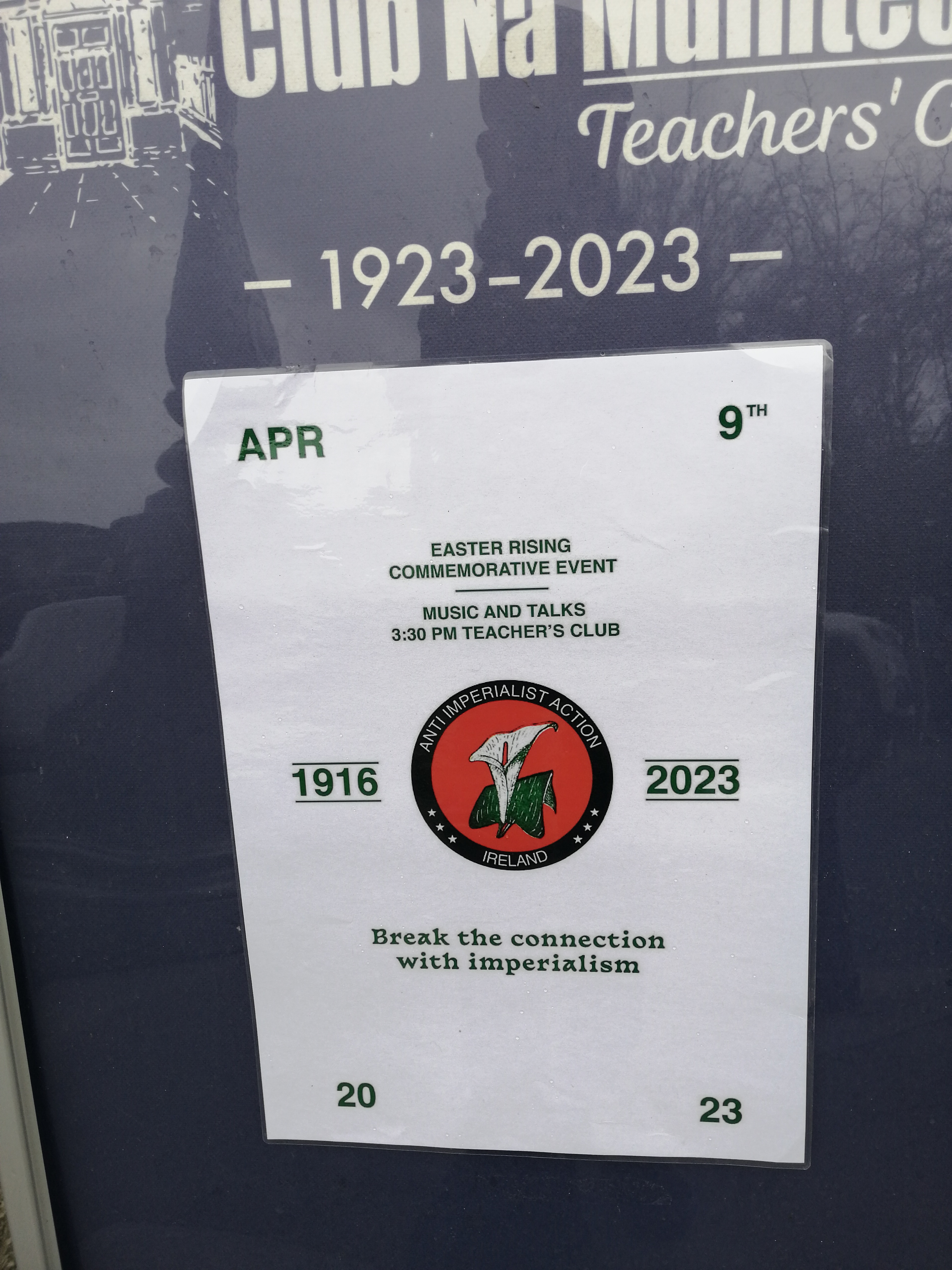
Anti-Imperialist Action will be holding theirs on Easter Sunday (9 April), details below.
End.
FOOTNOTES:
1Criminal Investigation Department, based at Oriel House, where police detectives and some soldiers of the Free State organised operations against Republicans including raids, assassinations, abductions and torture.
2This is not the party of the same name today. Sinn Féin began as a dual-monarchy Irish nationalist party, adopting Republicanism later in 1918. Those who later supported the anti-Republican status of the country and partition by England left the party and another large number left to join the Fianna Fáil party upon the latter’s founding. Briefly in the 1960s the party espoused socialism but split at the end of the decade and Sinn Féin under the Provisionals briefly adopted socialism again during the 1970s. The party of that name today is neither socialist nor even Republican.
A picket outside the Italian Embassy in Dublin on Thursday (23rd) was part of a day of action across Europe in solidarity with an Anarchist prisoner on hunger strike since October in a struggle for more humane prison conditions.
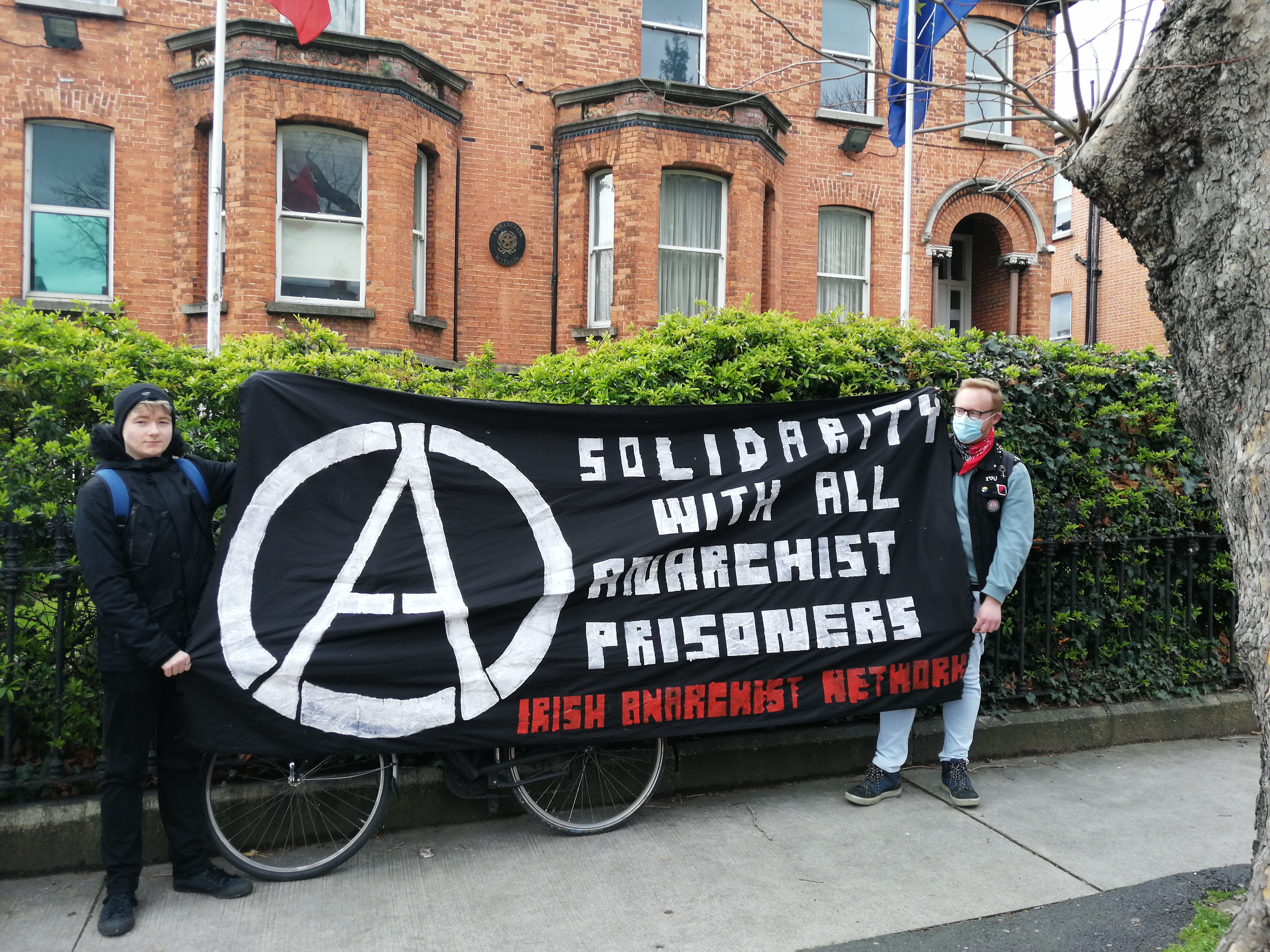
The picket, organised at short notice, included Irish Republicans, Anarchists and revolutionary Socialists. Banners and placards indicated the presence of Saoradh, Irish Anarchist Network and Ireland Anti-Internment Campaign.
At one point five uniformed Gardaí stood near the Embassy’s gate while three plain-clothes Special Branch (i.e. political police) watched from a car across the road. The police numbers may have been due to a request from the Embassy in the midst of attacks on some Italian Embassies in Europe.
Despite the presence of Gardaí, Embassy staff appeared nervous, meeting one visitor at the gate to check her reason for attendance after speaking to her on her mobile phone, rather than first allowing her to enter the garden and approach the main entrance.
Some of the uniformed Gardaí attending the solidarity picket and some of the protesters. (Photo: IAIC)
Three Special Branch Gardaí (political police) parked across from the picketers, surveilling them (Photo: IAIC)
THE HARSHEST ITALIAN PRISON CONDITIONS
Alfredo Cospito is an Italian political prisoner kept under the harshest Italian prison conditions, “41-bis”, which include solitary confinement for most of the day, family visit once a month through glass, no reading matter sent from outside and no phone calls in either direction or lawyer privacy.
According to information on the Internet, these inhumane conditions were developed for Mafiosa leaders, in order to prevent them running their organisations from inside jail and also to pressure them into breaking ranks and informing on their colleagues.
Whatever we may say about that, what can be the intention of subjecting a political prisoner to those conditions, except to break him or to destabilise him mentally? EU recommended rules on prisoner management don’t recommend more than three weeks in solitary confinement.
Lawyers for political prisoner Nadia Lioce, who has been living under the 41-bis regime for two decades, have said due to limited hours permitted contact, she has effectively only interacted with people for a total of 15 hours in the space of a year.
Italian media reported Lioce’s lawyers as saying she is now so “psychologically isolated” that, when her mother and sister visit, she is unable to speak to them for more than a few minutes.
Some of the picketers, the Italian Embassy in the background (Photo: IAIC)
Amnesty International and the European Court of Human Rights have both criticised several aspects of the 41-bis, and in 2007 a US court refused to extradite a convicted Mafia drug trafficker on the grounds that the 41-bis regime he would face in Italy would have “constituted torture”.
The Anti-Imperialist Front gave a call for an international solidarity day of action which found an active response in many countries.
Alfredo Cospito’s case is up for review by the Italian prison system this month and pickets and other actions have been organised around Europe to exert pressure on the Italian penal authorities to release Cospito into house arrest in his sister’s home.
The picket displayed not only internationalist solidarity but exemplary broad unity of disparate political forces in solidarity with an Anarchist political prisoner. Hopefully this unity will continue to be built upon as time goes on, for the unfolding struggles of class and nation demand it.
Hopefully the international actions will cause the Italian authorities to relax the inhumane conditions of Alfredo Cospito’s incarceration but now Italian authorities are claiming that Cospito is somehow coordinating violent actions from within his extreme isolation.
Another two of the picketers (Photo: IAIC)
A side trip into history
The Italian Embassy is in Northumberland Road, on the south side of the Grand Canal (near the Israeli and US Embassies).
As they were leaving, some of the picketers took time to look at a plaque and monument to the Mount Street Bridge Battle between Irish Volunteers and British soldiers in 1916. Four Volunteers were killed and between 26 and 30 Sherwood Foresters, with 134 more wounded.
Mount Street Battle Monument, on the Bridge over the Grand Canal itself. The English explanation is on the reverse. (Photo: IAIC)
A number of Volunteers were captured but a number got away also. Two of the buildings from which the Volunteers fought remain, bearing the marks of bullet strikes. The third, Clanwilliam House was set on fire by the British and was replaced by a 1960s-type office building later.
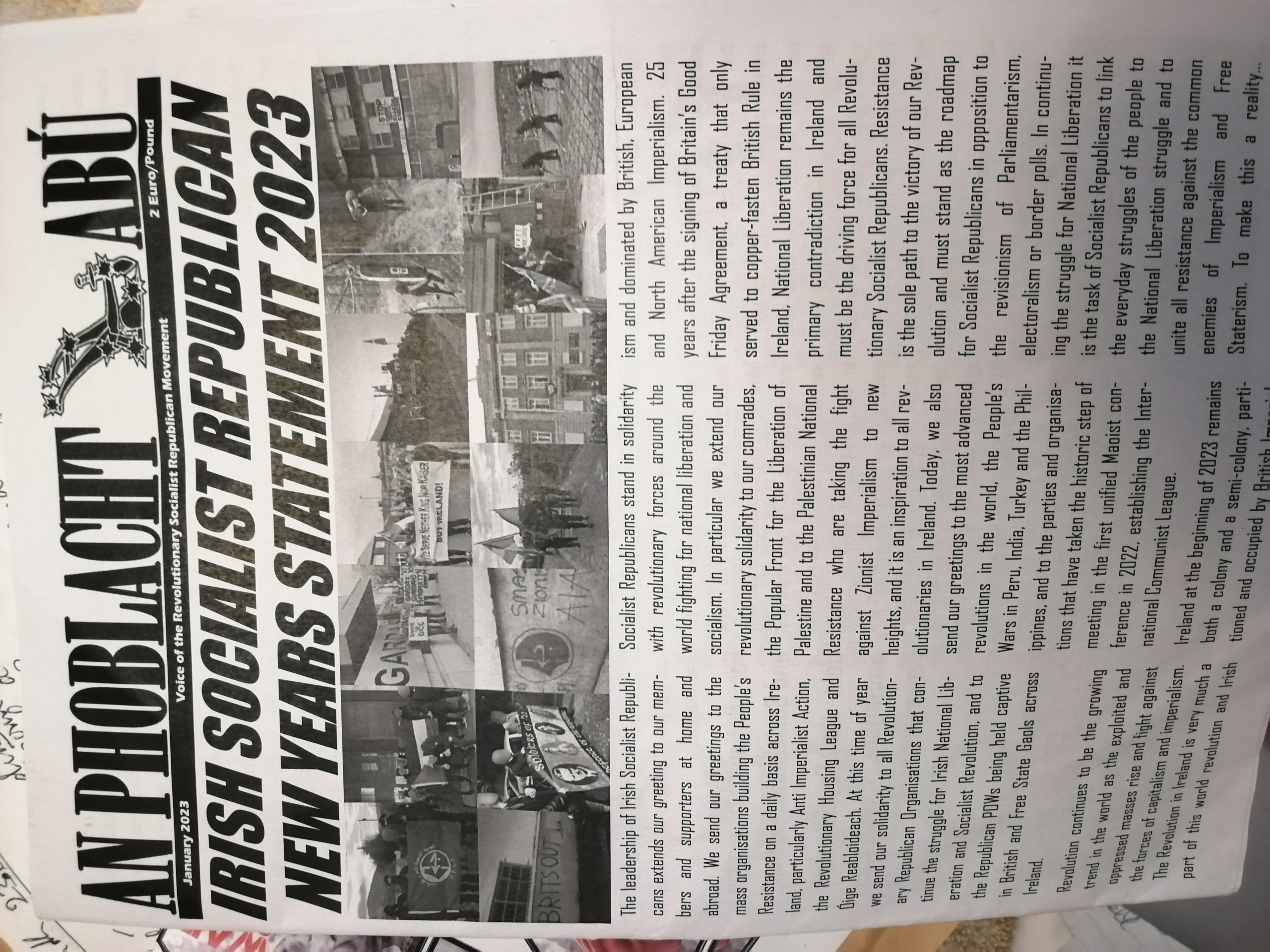
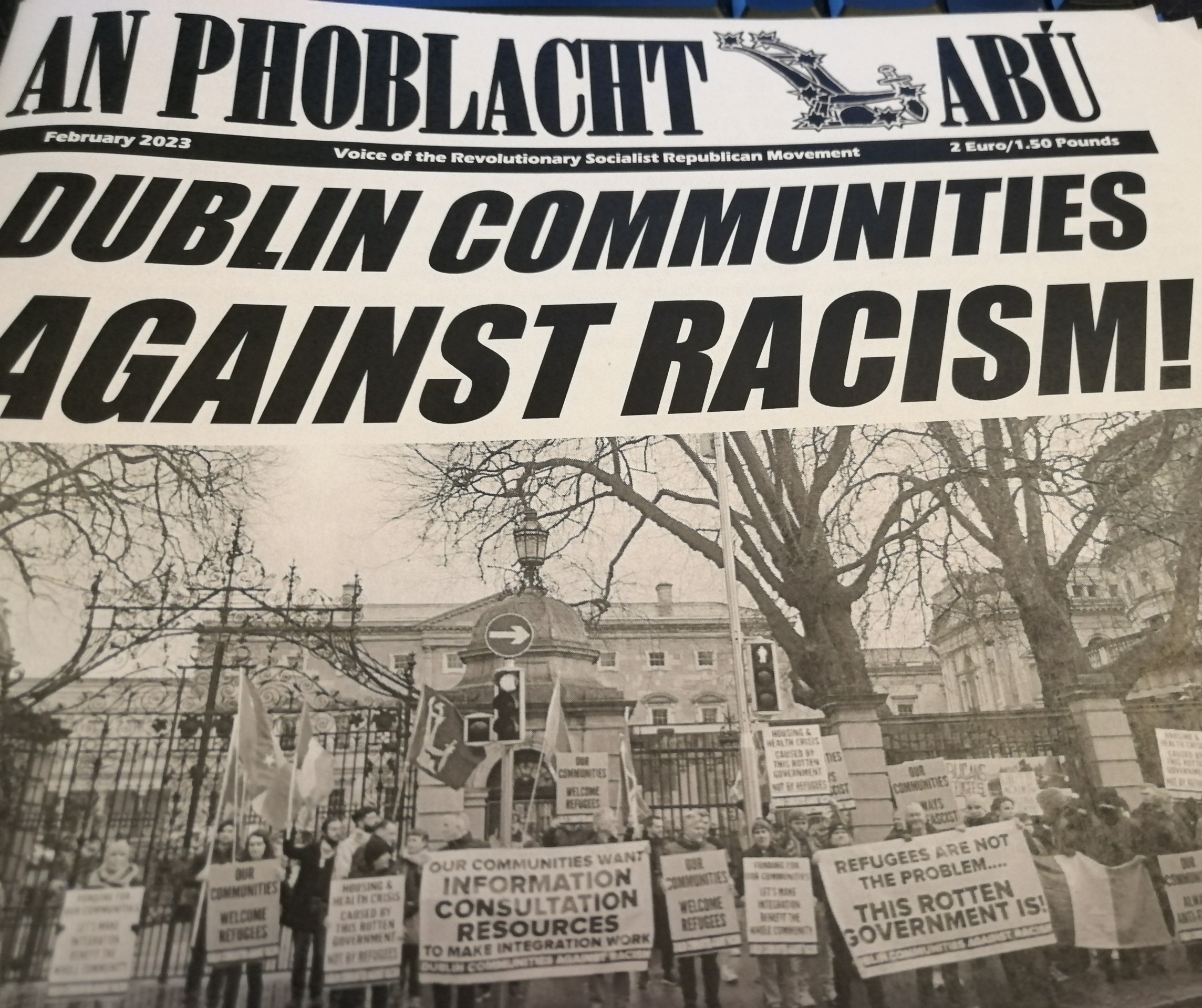
A new socialist Irish Republican hardcopy newspaper has appeared in Ireland in recent months. January and February 2023’s editions, believed to be nos. 3 & 4 are reviewed here.
HARD-COPY NEWSPAPERS
While today, at least in the developed world, the production of Internet media is of great importance for the revolutionary movement as much as it is for the capitalist system, the hard-copy newspaper disseminated by hand still has an important role.
Hardcopy newspaper distribution entails contact in the real world with real people, answers given to questions asked and challenges made, contacts made between the potential organisers and potential activist supporters, can go from hand to hand and be left for a random reader.
Online media has no equivalent to this.
Lenin observed that the revolutionary newspaper is an organiser, not only in its calls to action but in the necessary tasks of production and distribution. Ireland has very few revolutionary newspapers and not even one weekly one, to say nothing of daily editions.
An Phoblacht Abú is produced and distributed by Irish Republican Socialists, whose activist manifestations have been seen in the Revolutionary Housing League’s occupation of empty buildings and its calls for a general emulation of such actions.
Another manifestation has been the activities of Anti-Imperialist Action, notably in protest pickets against imperialism and neo-colonialism, antifascist actions and anti-spiking campaigns, also in commemorations of Republican martyrs, often supported by sticker and leaflet campaigns.
An Phoblacht Abú Front January 2023, front page.
CONTENT, FORM AND PRICE
Both issues reviewed contained 16 sides of A4 pages, composed of two A3 sheets folded in half, one inside the other. They sold at 2 euros per issue – less than one-third the price of most pints in Dublin and much longer to consume!
In general the articles are well-written and with few typographical errors. The editions reviewed here covered national and international news and the overall line in the content is of revolutionary overthrow of the ruling class and eschewing electoralism.
With regard to coverage of national issues, anti-fascism, anti-racism, building a broad front, opposition to NATO and the British occupation of the Six Counties and the neo-colonial and neo-liberal ruling class of the Twenty-Six Counties have figured prominently.
Apart from such regular themes, January’s issue documented the struggle against student fees and treachery of the student union executive in Maynooth and reported a joint Republican Prisoners’ solidarity picket in Dublin along with the release of a known Loyalist sectarian murderer.
Commemorations of Irish Republicans murdered by the Free State during the Irish Civil War/ Counter Revolution (1922-1923) figured in both issues.
In foreign news coverage, actions of peoples’ guerrilla forces in the Philippines and India, for which one would search the main dailies in vain, are covered in both issues and, in January’s, Scottish independence and John McLean and Israeli expulsion of Palestinian campaigner Salah Hamouri.
The environmental struggle in Germany figured in February’s issue.
Regarding economic questions, the rise in “cost of living” and housing crisis attacks on working people were addressed in short articles. Wider pieces on action were included on class struggle and community representation and action in the February edition.
LOOKING AHEAD
The appearance of An Phoblacht Abú is welcome and it is hoped can be sustained. Hopefully further issues will deal with questions of culture and the Irish language, the war in Ukraine (on which the Left seems deeply divided), historical-cultural conservation, trade union organisation and education of the people.
AVAILABLEat 2 euro per copy (back issues sometimes free) from sellers and supporters or from irsmedia@protonmail.com
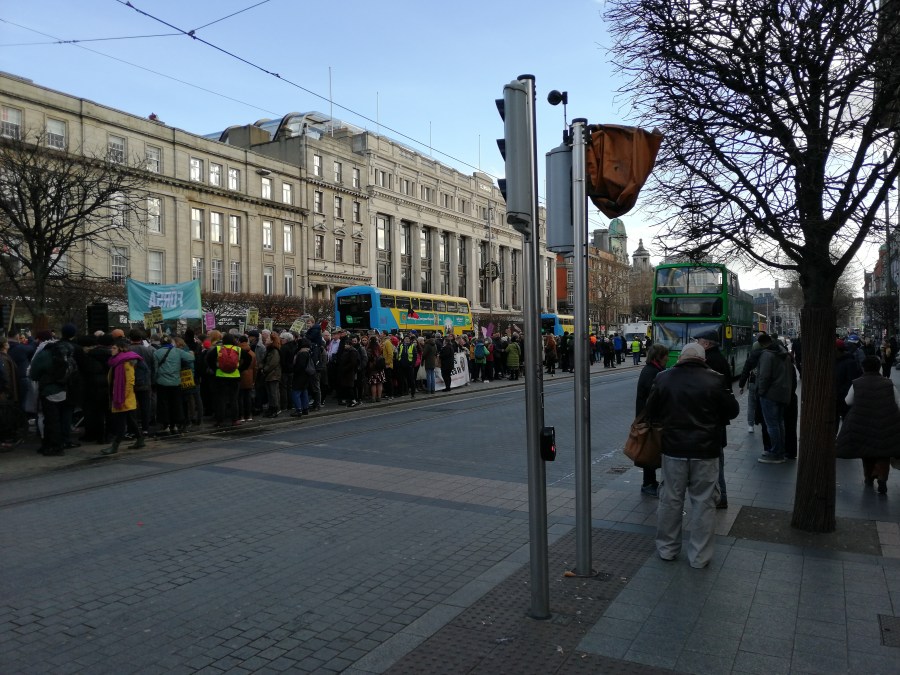
Monday was a new bank holiday in Ireland and two demonstrations of about equal size took place at the same time in Dublin that afternoon, one anti-racist and welcoming refugees, the other anti-refugee and with substantial racist and even fascist elements.
The pro-refugee event gathered on the central pedestrian strip on Dublin City centre’s main street, O’Connell Street, across the road from the iconic General Post Office, the building which served as the HQ of the 1916 Rising. Numerous placards and banners could be seen there.
Section of the Le Chéile pro-refugee demonstration in O’Connell Street (Photo: D.Breatnach)
The tightly-packed crowd stretched from the Spire southward almost to the Jim Larkin monument and were addressed by speakers. I knew the event had been organised by Le Chéile, a broad anti-fascist coalition of essentially pacifist nature with regard to fascism.
Closer view of section of the Le Chéile pro-refugee demonstration in O’Connell Street (Photo: D.Breatnach)
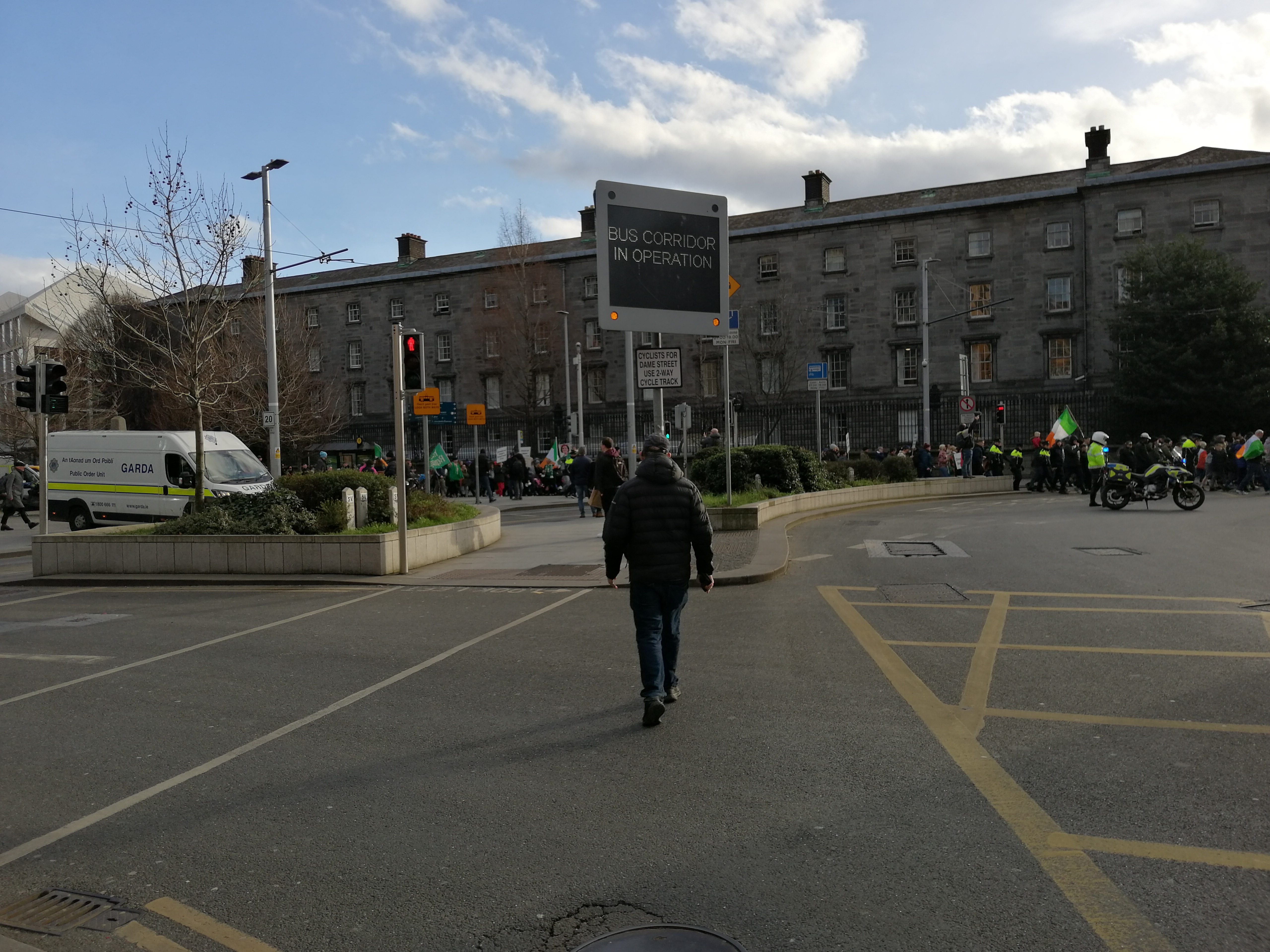
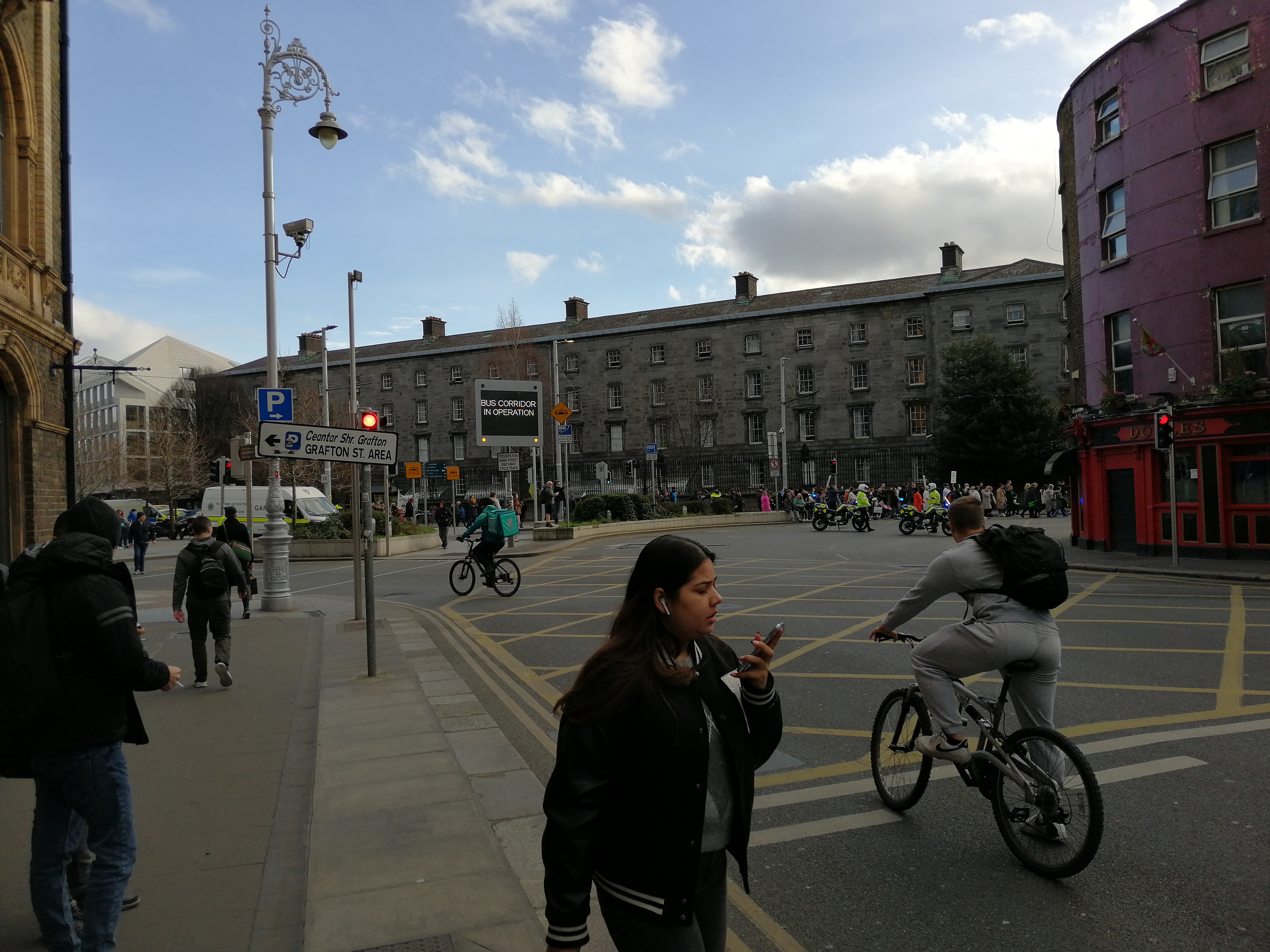
I passed them by in a hurry on my way to attend to a family commitment. While waiting to catch a bus in D’Olier Street, a number of Garda vans and motorcycles drawing up attracted my attention and soon afterwards the anti-refugee demonstration came from Pearse Street.
Cops arriving at Pearse Street/ D’Olier Street intersection just prior to arrival of the anti-refugee march. (Photo: D.Breatnach)
They passed along by Trinity College’s wall and soon after they had gone from my view, my bus arrived. I surmised the anti-refugee march had gone to demonstrate in front of Leinster House, the building that holds the parliament of the Irish State.
Front of the anti-refugee demonstration marching through the intersection (Photo: D.Breatnach)
As I was in a hurry and one group was tightly-packed and the other in extended line walking, it was difficult to compare the numbers but I made them both to be somewhat the same — between 500 and 700 each.
end.
Middle of the anti-refugee demonstration marching through the intersection (Photo: D.Breatnach)End of the anti-refugee demonstration marching through the intersection (Photo: D.Breatnach)Longer view of the Le Chéile-organised pro-refugee demonstration on O’Connell Street (Photo: D.Breatnach)
Eamon McGrath (31 October 1955 – 11 January 1923) singer and song lyrics-writer, activist in areas of housing, water and national sovereignty, historical memory and anti-fascism.
He was getting buried on Saturday and I wasn’t able to be at the service nor at the celebration of his life with comrades afterwards.
I hope this eulogy, if that’s the right word for this, will make up for my absence to his family, comrades and friends and, of course, to me.
Eamon came into my life through the Moore Street occupation in January of 2016. The property speculator Joe O’Reilly (Chartered Land) and the State were about to collude in the demolition of three buildings in the 1916 Terrace.
The State had declared only four buildings in the 16-building terrace, after a long struggle, to be a historical monument and even later, purchased – but around 300 men and women hadn’t occupied just four buildings in 1916.
The Save Moore Street From Demolition campaign group had called emergency demonstrations on to the street following which the buildings had been occupied by protesting conservationists.
The weather was bitterly cold but the occupiers held firm for a week until a stay of demolition had been imposed by the High Court. Despite his health status and challenged mobility, Eamon was there throughout, with humour and song.
Eamon McGrath to far right of photo while Dave Swift (centre) in Irish Volunteer uniform reads a historical document April 2017 in Moore Street, during historical commemoration event (the hoarding behind is covering the extension of the ILAC further into Moore Street, killing the market appearance for that side of the street for the block).
Subsequently, to prevent internal damage by contractors, a six-weeks’ blockade was imposed on the building by conservationists from 6.30am to 4.30pm each weekday. Eamon was very much a part of that too, driving himself and his close comrade Sean Doyle up from Wicklow every day.
Eamon was intensely loyal to close friends and comrades. On occasion I found him prickly or grumpy (especially at 6.30 am) but throughout any disagreements he never lost sight of who were his comrades and other people he respected.
Though a proud man, when he recognised himself in error, he didn’t hesitate to apologise.
A new broader group came out of the occupation and blockade, called Save Moore Street 2016 and Eamon attended and contributed to internal organising meetings and events we called on to the street – re-enactments, fake funerals of history, pickets, demonstrations and rallies.
As others drifted or were called away from the group by other commitments, Eamon remained with the active core.
(L-R) Paddy Reilly and Eamon McGrath in period costumes having a conversation during a history education event and anniversary commemoration of the founding of the Save Moore Street From Demolition campaign group. (Photo from Save Moore Street From Demolition FB page)
Of course, Eamon had been active before 2016: certainly very much so in the general awareness-raising and mass campaign against planned privatisation of our water and the installation of water meters.
He was to continue that activism, which resulted in assaults by a water contractor on him and Seán Doyle, court appearances for both and in May 2016 both of them went to jail for a period but remained unbowed.
Eamon was one of the original occupiers of Apollo House in December 2016 in protest against homelessness and as a co-founder of the Anti Eviction Flying Column, Eamon was to the fore in resisting evictions across the country and also a co-founder of the Bring It to Their Doors campaign.
The State authorities were making things awkward for Eamon by then, both in terms of working as a taxi driver and claiming benefit when he was not. His ability to reach events in Dublin declined but he still got there often enough on public transport, while remaining active nearer to home.
As his physical mobility declined further, comrades in Carlow started an on-line collection to buy him an electric wheelchair. Even as I made enquiries to contribute, the fund had already reached its target, so quickly did people support it.
Later still, his family installed a new chairlift for his home so he could access the room where he recorded his songs with lyrics commenting on the ongoing political struggles, adapted to popular airs.
Though our voices didn’t go well together, we sang together a couple of times – outside the GPO and outside Dublin City Hall.
Eamon McGrath, centre right after April 2016 event in Moore Street after which we brought it to in front of the General Post Office in Moore Street for awhile. Myself near centre, Glenda further to the left of photo, Sean Doyle nearly out of shot.
He remained active on social media but in particular in keeping an eye on the activities of right-wing people, covid-deniers, racists, fascists …. Eamon was a handy source for a quick update on the status of many of them.
Eamon arranged an interview for us both with the Dublin Near FM radio station, the interviewer being then a former drug addict who sadly returned later to his addiction and died on the street. It was on the way back from the interview that Eamon told me a little about his earlier years.
He had a difficult time in his childhood, including institutional confinement and his formal education suffered as a result. However, he educated himself about many things by reading, listening, discussing and viewing on line.
I think the last time I saw Eamon was at a commemoration at the Peter Daly monument in Wexford inSeptember 2022, in his electric wheelchair and attached oxygen cylinder for his lung condition and all in good cheer, asking me for Moore Street campaign updates in detail.
Eamon McGrath, centre in wheelchair, at Peter Daly commemoration in Wexford, September 2022 (Photo from Peter Daly FB page)
His comrades in Anti-Imperialist Action Ireland, which he had joined at its foundation in 2017 correctly called him “one ot the most dedicated political activists of the last decade” and no-one who knew him could argue with that.
I knew little of Eamon’s family life but he often emphasised how important family was, not just to him but in general. Though I do not know them tá mé i gcomhbhrón leo, offering them my condolences along with the many they have received and are no doubt still arriving.
A partner, father, grandfather, great-grandfather, extended family member and friend to many.
Eamon McGrath of Kenmare Heights, Greystones & formerly Wolfe Tone Square, Bray, Co. Wicklow, was buried in Radford Cemetery, Greystones Saturday after a service in the Holy Rosary Church, Bray, attended by family, comrades and friends.
Working people have experienced many betrayals in history and the struggle for self-determination of the Irish nation has been – and is being – betrayed also.
When such betrayals occur, a range of common reactions is evoked; thinking about those responses may help the betrayed at least to moderate the harm and turn the experience to some benefit.
Equally, some ways of handling the experience can magnify and deepen the harm already caused.
Betrayal is a difficult experience for the betrayed certainly but not without some cost to the betrayer too and each has a number of common responses. This applies to the personal as well as to the political but there are some differences.
The betrayers have their followers to different degrees and these too have psychological reactions to the betrayal — and to criticism of the betrayal. We can observe these reactions in a number of recent historical cases of high levels of resistance subsequently betrayed.
The most recent phase of high degree resistance in Ireland took place largely in the British colony of the Six Counties, beginning with mass struggles for civil rights before passing through protracted guerrilla war and intense struggles of political prisoners in the jails.
In the Basque Country, the corresponding phase began with ideological-cultural struggle and mass industrial actions against the Franco dictatorship, quickly developing into a guerrilla campaign combined with street battles, resistance to conscription and struggles around prisoners in the jails.
The leadership of the Irish struggle came to political agreement with the colonial occupier, disbanded and decommissioned its guerrilla forces and acceding to its right of conquest, joined the occupier’s colonial administration, concentrating thereafter on building up its electoral base.
A similar process took place in the Basque Country but with important differences: the imprisoned activists were not released and the movement’s political leadership was not even admitted into joint management of the colonial administration.
Each nation witnessed splits, recrimination, dissidence, repression on groups continuing resistance but also a range of psychological responses which at best did not assist recuperation and in fact often deepened the harm of betrayal by the leadership.
STANDARD RESPONSES BY THE BETRAYED
DISMAY is a common reaction: How could he/ she/ they? I never thought they would. We’re finished now.
BLAME is another also common response: It was that leader’s or leadership’s fault. We didn’t fight hard enough. Those comrades criticised too much.
SELF-CENSORSHIP And EXCESSIVE CAUTION: We can see the harm in some of the leadership’s actions but we must be careful not to step too far out of the movement, where we will be marginalised and unable to have an effect1.
DESPAIR: That’s the end of everything. There’s no way out of this. It was all for nothing – all those sacrifices, all that pain.I’ll never trust people or get involved again.
APATHY: So I/ we might as well forget about it all. Just think about ourselves/ myself/ family. Drop out. Drink. Take drugs.
DENIAL: We’ve not really been betrayed. It’s just another way to go for the same thing. This is the only reasonable choice. We couldn’t keep on that way any longer, this is just a change of method. We’re just having a pause. The leadership is clever and has tricks up their sleeves. This is just to fool the authorities. It’s just going to take a little longer to win than we thought.
Those are defensive constructions in emotion and, in so far as that takes place, in thinking. But defensiveness can turn to aggression – and frequently does. The betrayers – and often the duped also – resent being reminded of what and where they are. It makes them uncomfortable.
HOSTILITY: How dare those people criticise us/ the leadership? They don’t understand and just want continual conflict. They’re endangering our secret plan. Who do they think they are? They’re just wrecking everything, undermining our new plans. They need to be taught a lesson.
PERSONAL ATTACKS: That critic is no great activist. S/he hasn’t suffered as some of us have. They were always troublemakers. Jealous, that’s what they are. They’re not very bright; no idea about real politics. They are in fact traitors, helping our enemies.
MARGINALISATION: We are not going to listen to those critics. We will not allow them space on our media. We’ll try to make sure they don’t get venues in which to spread their poison. If people are friends with them they can’t be our friends too. Such people will not enjoy our hospitality or invitations to our events. People should not even talk to them. If the authorities attack those dissidents, we are not going to trouble ourselves about them – it’s their own look out.
MANAGING THE BETRAYAL
PROMOTING LEADER ADULATION is a useful tool in shutting down the opportunities for criticism and in repressing them when they arise. “Who are we to criticise this great comrade’s thinking or actions?” becomes an implicit question, clearing the way for betrayal.
Leaders who have surrendered or compromised the struggle, L-R: Gerry Adams and Martin McGuinness of the Provisionals, Arnaldo Otegi of the Basque Patriotic Left, Abdullah Ocalan of the PKK and Yasser Arafat of Al Fatah. The latter seemed to be attempting to to turn back from the path of betrayal when he became very ill (quite probably poisoned) and died.
SEEKING COUNTER-REVOLUTIONARY ALLIANCES is engaged upon so as to appear to its members to make the organisation’s influence greater, or to outflank and isolate more revolutionary tendencies and often ultimately to make the leadership acceptable to the ruling circles.
BEGGING FOR CONCESSIONS when the revolutionary path has been abandoned can often be observed, as in “we’ve abandoned our militant struggle, please stop repressing us”, for example, a frequent response to repression of the Basque leadership once it abandoned the revolutionary path.
COLLUDING WITH THE OCCUPIER becomes a new second nature to a leadership abandoning revolution, not only in abandoning armed struggle, for example but in destroying weapons and suppressing elements still in resistance.
PROVING THEIR READINESS TO COLLUDE FURTHER, revolutionaries turned collaborators denounce continued resistance, try to convince revolutionaries to desist (or threaten or physically attack them), promote the repressive arms of the State such as the police and so on.
INTOLERANCE OF CRITICISM becomes default position; such criticism tends to expose the contradiction between the original purpose of the organisation and its concrete actions in the present. Censorship, expulsion and misrepresentation become common.
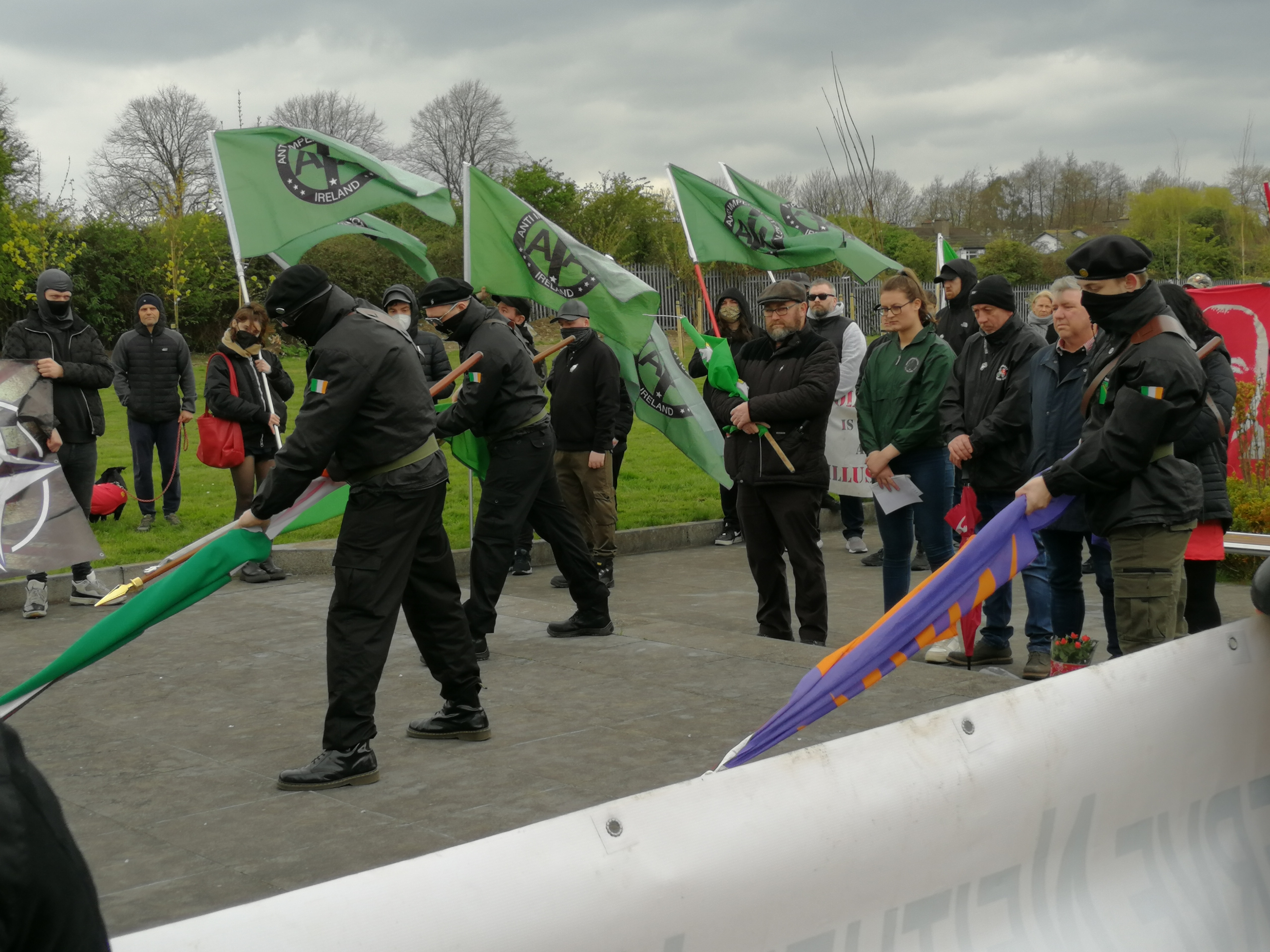
MARGINALISATION OF CRITICS follows from intolerance of criticism – the individuals or groups must be made pariahs so as to nullify or at least reduce their influence. Association with them, socially or politically – even in agitating around civil rights – must be discouraged.
REPRESSION OF DISSIDENTS finally becomes necessary, whether by threats or by actual violence or, when admitted to governing circles, by use of repressive state machinery.
DEALING WITH BETRAYAL RATIONALLY
The first necessary step is to analyse how the betrayal came about: how was it organised? What were the conditions that made it possible? What were the early signs?
Then, proceed to: what could we have done differently? What WILL we do differently in future?
Electoral work
One common assumption here in Ireland, especially in Irish Republican circles, is that the rot began with standing in elections. This is not logical and it is in effect making a negative fetish of electoral work, a taboo to be avoided.
It is often useful to the revolution in many ways to have representation in the parliament and local authorities, for example in promoting or blocking practical or legislative measures, getting media air time, visiting prisons — all without ever promoting reformism as a way forward.
Certainly the prioritisation of electoral work over other aspects is a sign that something has gone wrong: the strength of the popular revolutionary movement is on the street, in workplaces, communities, places of education, rather than in parliaments and local authorities.
The drive towards electoral representation can encourage bland slogans of the soap powder kind (“new improved” or “washes even better”) rather than those with revolutionary content and also the promotion of more bourgeois individuals in preference to grass-roots organisers.
Anodyne election slogan in both languages for Sinn Féin.
But none of that means that representation in those bodies cannot be used to further the popular struggles or that such aberrations cannot be avoided. And in fact, the concentration on criticism on the electoral factor served to distract from a more fundamental error.
Of course, electoral work should never, for revolutionaries, be about entering government under the current socio-economic system, i.e sharing in the administration of the State.
Leader adulation & intolerance of criticism
If criticism is not tolerated when errors are committed, they can hardly be corrected. Again and again it has been observed that the party/ organisation faithful refuse to accept external criticism from non-enemies. Internally the leadership inhibits criticism by the members.
The cult of the leader also inhibits criticism and therefore correction of errors. And behind this image others can hide and also commit errors. Problematic as dead icons may be, living ones are many times more dangerous – deceased ones at least do not change their trajectories.
Such created living icons have been Mandela in South Africa, Yasser Arafat among Palestinians, Gerry Adams and Martin McGuinness in Ireland, Arnaldo Otegi in the Basque Country and Abdullah Ocalan among Kurds (particularly in the Turkish and Syrian states).
Nobody knows everything or is always right. Bothersome as being criticised may be, its total absence is worse, allowing us no opportunity to question ourselves as activists and in particular as revolutionary organisations.
The revolutionary leadership, party or organisation is not the people
The revolutionary leadership, party or organisation does not have all the answers and is not the people. This might seem obvious but from the behaviour of such leaderships and their followers in the past it is clear that the opposite philosophy has been dominant.
Confusing the organisation with the people or with revolution itself, we assume that what is good for the organisation is also good for the people and the revolution. This however is not always so and leads to placing the perceived well-being of the organisation above the needs of the revolution.
Indulging this confusion leads to political opportunism and sectarianism, bad relations with other revolutionaries, ignoring all external criticism and placing the needs of the leadership higher than those of the membership and of the membership higher than those of the mass movement.
Internationalist solidarity
In internationalist solidarity work we build the unity of the people across borders and against the same or different enemies than those against which we are struggling.
One feature observed in a number of organisations where the leadership is moving towards betrayal is a reduction or elimination of such work.
To those in our ranks seeking an accommodation with imperialism and capitalism, those internationalist solidarity alliances are either a) unimportant or b) a hindrance to the alternative reactionary alliances to which they aspire.
The latter was very much the case with the Provisionals’ attitude to US imperialism. For decades, their leadership maintained apparently mutually-contradictory positions on what is the biggest imperialist superpower in the world.
On the one hand, for example, there could be involvement in solidarity with Cuba against the US economic blockade and, in the past, against US sabotage and terrorism against the Sandinista regime in Nicaragua.
On the other hand, the leadership sought the support of the US elite against British colonialism, which is occupying a part of Ireland and against which the movement was waging, in that colony, an armed and popular struggle.
Seeking support from the US imperialist elite entailed distancing from left-wing Irish USA and dropping support for even long-term inmates of US jails, such as American Indian Leonard Peltier and Black American Mumia Abu Jamal, arising out of popular struggles inside the US.2
Leonard Peltier, Native American convicted in 1977 in deeply flawed trial for murder of two FBI agents in 1975 shootout on Pine Ridge Reservation. Nearly 80 years of age now and with multiple health issues, even release on clemency grounds is constantly blocked. His is one of many campaigns in the USA which SF cannot support as they seek to remain friends with the Democratic Party elite there.
Black American journalist and activist, framed for the murder of a corrupt Philadelphia policeman in 1981 and sentenced to death in 1982, sentence commuted to imprisonment for life without parole in 2011. Mumia is nearly 70 years of age now with a number of health issues. Another of the type of injustice in the USA about which SF cannot campaign as they seek to stay close to the Democratic Party elite. Anecdotally, a SF Councillor who was regularly writing to him was obliged to desist on instruction from her party leadership.
Unprincipled alliances
Another warning sign is the founding of unprincipled alliances with other organisations in struggle. For example, although it is correct to have a position of support for the Palestinian people, that should not necessarily bind us to exclusively support the fighters of one organisation only.
The Provisionals made their alliance with the Al Fatah organisation to the exclusion of all others in Palestine but worse was to come, for Al Fatah shoved aside the idea of a free Palestine and the right of return in exchange for administrative partial autonomy and funding.3
From there, Al Fatah became so corrupt that the Palestinian people, that had long supported a secular leadership, voted overwhelmingly for an islamic fundamentalist party, Hamas4. The unprincipled alliance with Al Fatah and the ANC was used to ‘sell’ the GFA to Irish Republicans.5
In the Basque Country, the mass movement’s leadership developed close links with the leadership of the Provisionals and refused links with Irish Republican organisations that dissented from the Provisionals’ position or with Republican prisoners after the Good Friday Agreement.
That should have sounded alarm trumpets in the Basque movement but if it did, it remained largely without practical effect. Askapena, the Basque internationalist solidarity organisation did split from the main movement but did not go so far as to support ‘dissident’ Irish Republican prisoners.
LESSONS
On the basis of the preceding I think we can draw a number of primary lessons.
LESSON ONE: ANALYSE THE MISTAKES OF THE PAST AND SEEK TO AVOID REPLICATING THEM
The type of struggle, location, timing, peripheral situation, long, medium and short-term objectives, experience and expertise of personnel, resources … all need to be analysed, in conjunction with the strengths and weaknesses of the enemy.
In carrying out this kind of analysis on the Irish struggle, we see that we faced one of the military superpowers, also well linked into the western imperialist world. The Republican movement’s battle area was in total one-sixth of the nation’s territory and the location deeply divided.
The rest of the nation was ruled by a weak foreign-dependent ruling class.
Map of Ireland showing the British colony of the Six Counties. The Provisionals took on the British state, mostly confining their struggle in that deeply divided politically and culturally region shown in yellow.
A movement cannot choose when it has to step forward in defence but it can choose how it develops the struggle afterwards. It seems obvious that in order to be victorious, at the very least the struggle would have to be spread throughout the nation.
That in turn would entail putting forward social and economic objectives to attract wider support which, in turn, would mean taking on the Catholic Church hierarchy.
In addition, the question of effective external allies was relevant here but even more so in the Basque Country, located across the borders of two powerful European states.
The total population of the portion of the Basque nation within the Spanish state is far short of three million, that of the rest of the state over 44 million.
Clearly allies external to the Basque nation would be essential for victory and these would have to come from across most of the Spanish state at least.
Map showing the ‘autonomous’ regions of the Spanish State; the southern Basque Country is shown in pink at the top, including ‘Navarre’ shown in yellow next to it. Essentially, the Basque Patriotic Left without allies confronted the Spanish state from there.
Such an assumption would entail, in turn, outlining objectives to attract considerable numbers from across the Spanish state which in turn would mean creating alliances with revolutionary and other progressive forces across the state.
LESSON TWO: REFRAIN FROM PERSONALISING THE ISSUES
When criticism of the counter-revolutionary line put forward by individual leaders becomes personalised, the political essence of the criticism becomes lost or at least obscured. It can seem as though the critics have personal reasons for their hostility or even jealousy of the individuals.
Much of what one sees publicly posted by opponents of pacification programs in Ireland and the Basque Country often seems more about hostility to the personalities of MaryLou MacDonald, Gerry Adams, Martin McGuinness or Arnaldo Otegi than about specific policies and actions.6
Crucially, focusing criticism on individual leaders serves to conceal other underlying causes of failure and betrayal that are usually more fundamental: problems in objectives, errors of strategy, in particular and also of tactics along with unhealthy organisational dynamics.
LESSON THREE: DEVELOP INTERNATIONALISM AND AVOID UNPRINCIPLED ALLIANCES
In the face of imperialist and other reactionary alliances, revolutionaries need internationalist solidarity, the basis for which should be revolutionary positions and action. Exclusive alliances are generally to be avoided as is uncritical support or unquestioning approval of all actions.
LESSON FOUR: CONTRIBUTE TO BROAD FRONTS WITHOUT SURRENDERING THE REVOLUTIONARY LINE
A broad front is essential not only for successful revolution but also often for defence against repression. Such fronts should be built on a principled basis with respect for the participating groups and individuals but without surrendering the revolutionary line.
At the same time, the possibility of betrayal, opportunism or sabotage and marginalisation by partners in broad fronts need to be guarded against and, if occurring, to be responded to in a principled and measured manner.
Broad fronts not only increase the numbers in resistance in a unified manner but also expose the activities of the constituent groups to the members of other parts of the broad front. Activists can then evaluate organisations and one another on the basis of experience rather than of reputation.
The revolutionary line should not be abandoned or concealed when in a broad front with organisations and individuals who have varying lines. At the same time, it is not necessary to be pushing the revolutionary line every minute.
LESSON FIVE: DON’T GIVE UNCONDITIONAL TRUST TO LEADERS
Of course, our leaders and activists must be trusted – but always in the knowledge that no-one is perfect or above the possibility of error. The shutting down of opportunity to voice criticism should sound alarm bells in any revolutionary movement.
There are of course “time and place” considerations in criticism; for example, the capitalist mass media, police interrogation or trial in court are hardly appropriate places to criticise a revolutionary movement’s leadership.
LESSON SIX: TOLERATE INTERNAL CRITICISM AND CAUCUSES IN BALANCE WITH COLLECTIVE RESPONSIBILITY
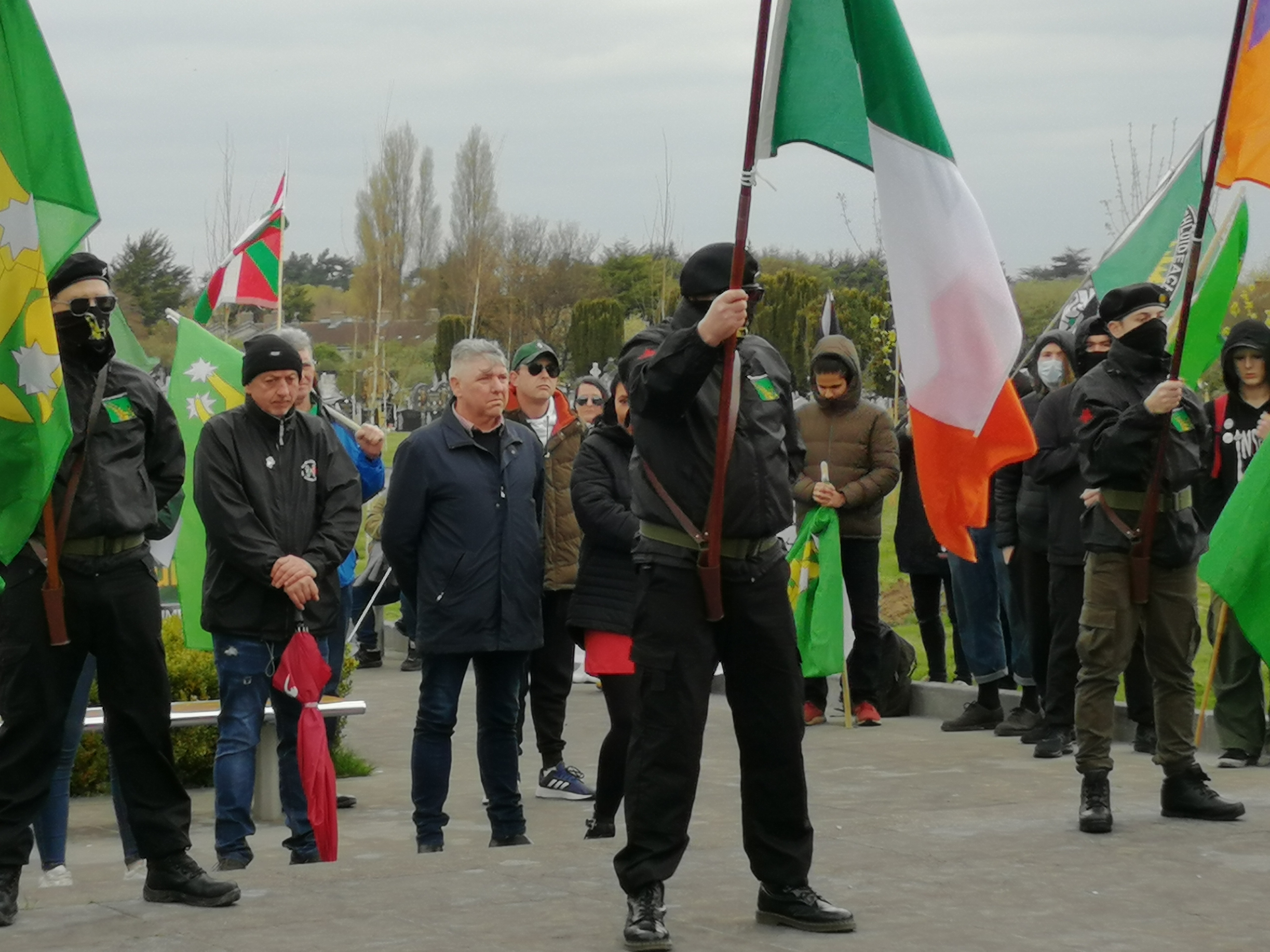
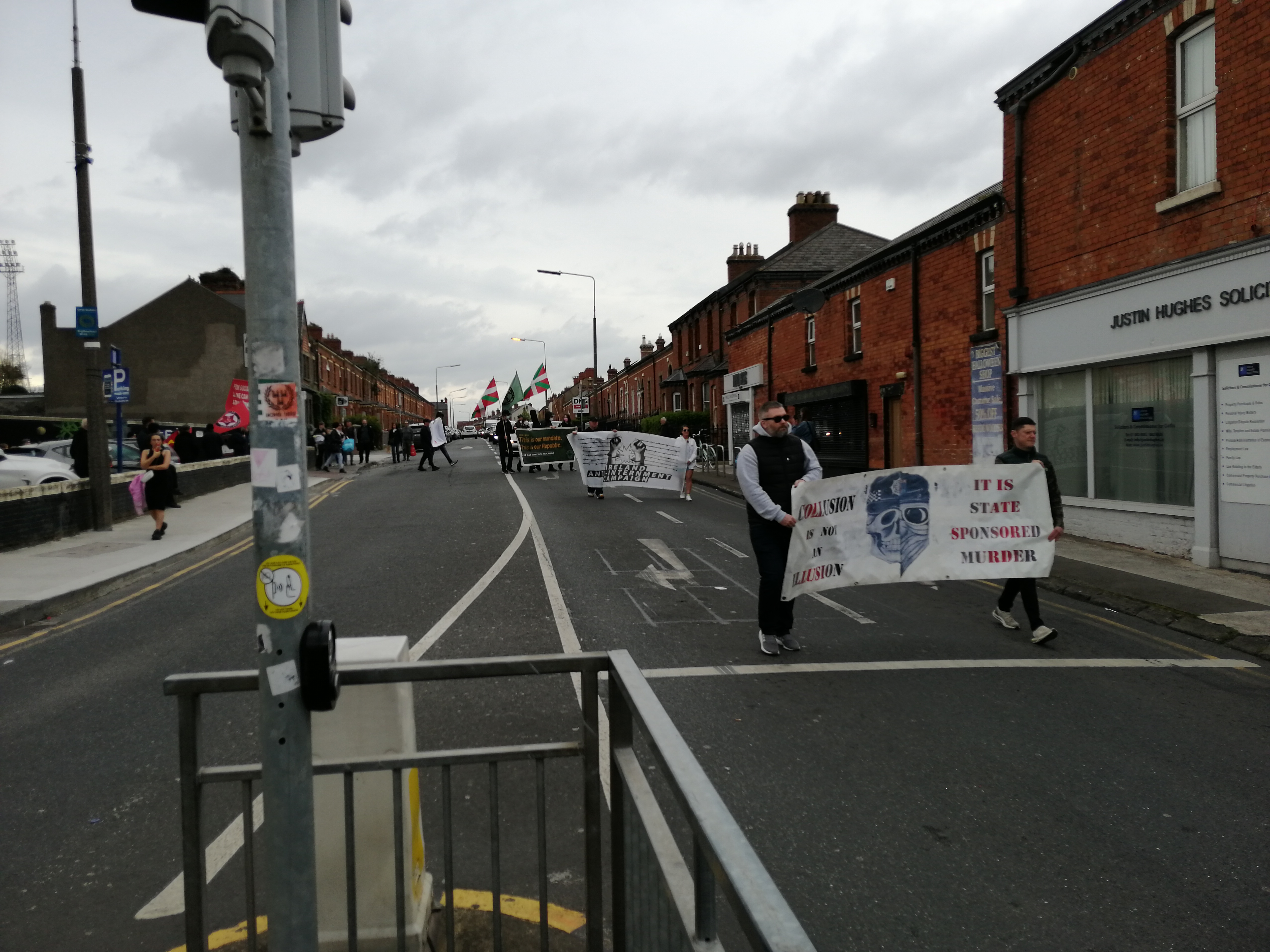
The above touches upon this area too. People who follow us without question may equally do so with another.
The right to caucus, i.e to collect around a particular revolutionary trend or focus needs to be acknowledged and formalised. Like-minded people will naturally associate and it is far healthier to have this occur in the open rather than in secret.
At the same time, when a discussion reaches democratic decision, the minority whose positions were rejected need to present a common front with the rest of the organisation or movement.
Similarly, political and organisation criticism needs to be welcomed or at least tolerated within the organisation or movement because it may be correct and point an alternative way forward and even if it isn’t, the discussion around the criticism will help to clarify matters.
Such openess to criticism and discussion encourages a conscious and thinking membership which by that measure alone and organisationally makes it more difficult for some individual or clique to manipulate the membership.
1“Outside the broad movement it is very cold”, said a Basque to me once. He was a member of a small Left group critical of the leadership’s approach but unwilling to completely rupture with them.
3With the Camp David (1978) and Oslo Accords (1993 & 1995).
4In 2006 (the most recent) Palestinian parliamentary elections, Change and Reform (Hamas) won 74 seats and Al Fatah 45. In Gaza Al Fatah rejected the result and tried to seize power but were defeated in a short battle, though Hamas did not battle their assumption of power in the West Bank. All dates for elections to Palestinian Parliament since have passed without polling.
5And since then, unprincipled alliances with Provisional Sinn Féin have been used by the main Basque organisation leadership and ditto with Colombia to ‘sell’ pacification processes in those countries (which have been even worse for them than has the GFA been in Ireland).
6As a historical note, it is said that some of the delegates who voted for the Anglo-Irish Treaty in January 1922 were moved to do so by the nature of the attacks of Cathal Brugha, for the anti-Treaty side on Michael Collins, leader of those for the Treaty. The majority of delegates voting in favour was only seven.
Christmas shoppers on Saturday 17th in Dublin’s O’Connell Street, the city’s main boulevard, were interested to see a long picket line displaying banners, flags and placards.
The event was a jointly-organised public reminder of the continuing existence of political prisoners in Ireland and as a gesture of solidarity to the prisoners too.
The joint organisers were the Ireland Anti-Internment Campaign, the Irish Republican Prisoners Welfare Association and the Anti-Imperialism Action organisation. The attendance were mostly Irish Republicans but there were also some from the socialist/ anarchist traditions present.
Long line looking southward of joint Republican prisoners’ solidarity event (Photo: Rebel Breeze)
There are currently 40 Irish Republican prisoners in jails in Ireland, on both sides of the British Border. As a speaker noted at the end, all had been sentenced or refused bail by no-jury special courts of the Irish and British states.
The Irish Tricolour and the Starry Plough were displayed of course but also a Palestinian flag and two Basque ones; the latter attracted the attention of a number of young people from the Spanish state who were pleased and approached the picketers for discussion.
Section of the joint Republican prisoners’ solidarity event showing the Latuff cartoon on a banner (Photo: Rebel Breeze)Section of the joint Republican prisoners’ solidarity event showing couple of Basque flags and Palestinian one in the middle distance (Photo: Rebel Breeze)
Two banners called for and end to the extradition of Irish Republicans and one figured cartoonist Carlos Latuff’s illustration of solidarity between Irish and Palestinian political prisoners.
Leaflets of the IRPWA and of the IAIC were distributed to passers-by.
Section of the joint Republican prisoners’ solidarity event (Photo: Rebel Breeze)
As the event came to an end a representative of each organising group read out a short statement; both the IAIC and the AIA emphasised the need for unity in resisting repression and each along with the IRPWA called for support for Irish Republican prisoners.
End.
Section of the joint Republican prisoners’ solidarity event (Photo: Rebel Breeze)Section of the joint Republican prisoners’ solidarity event (Photo: Rebel Breeze)