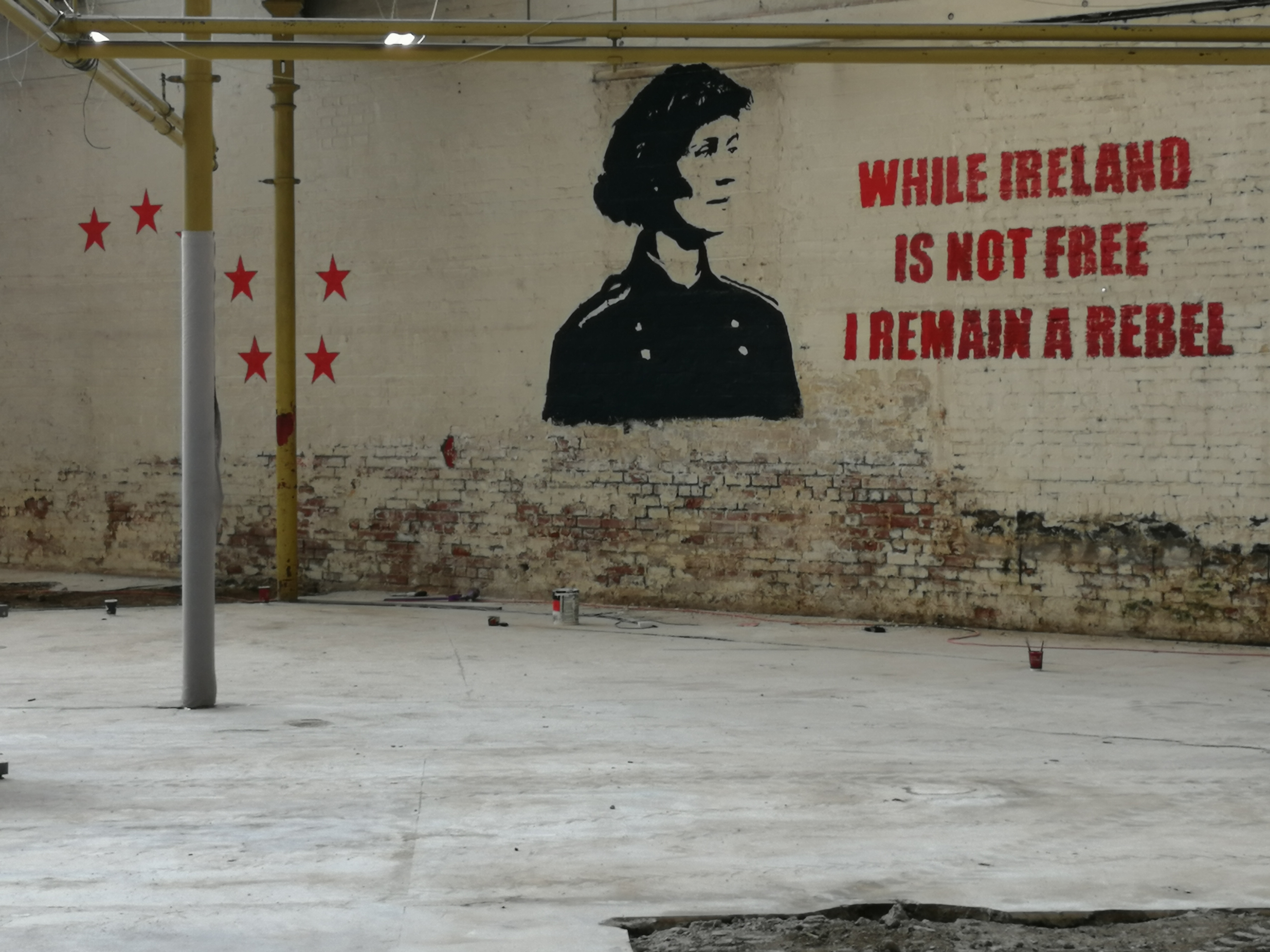
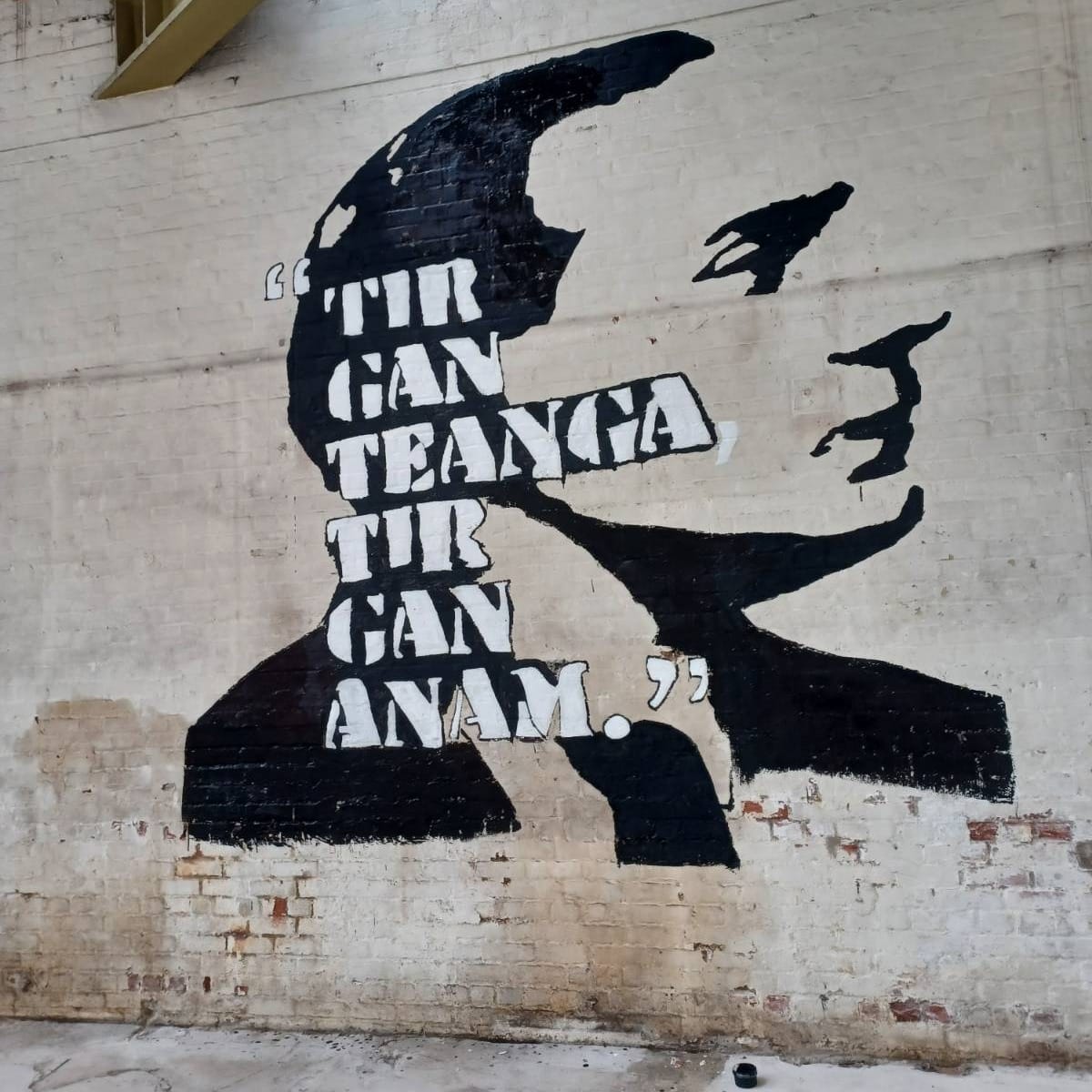
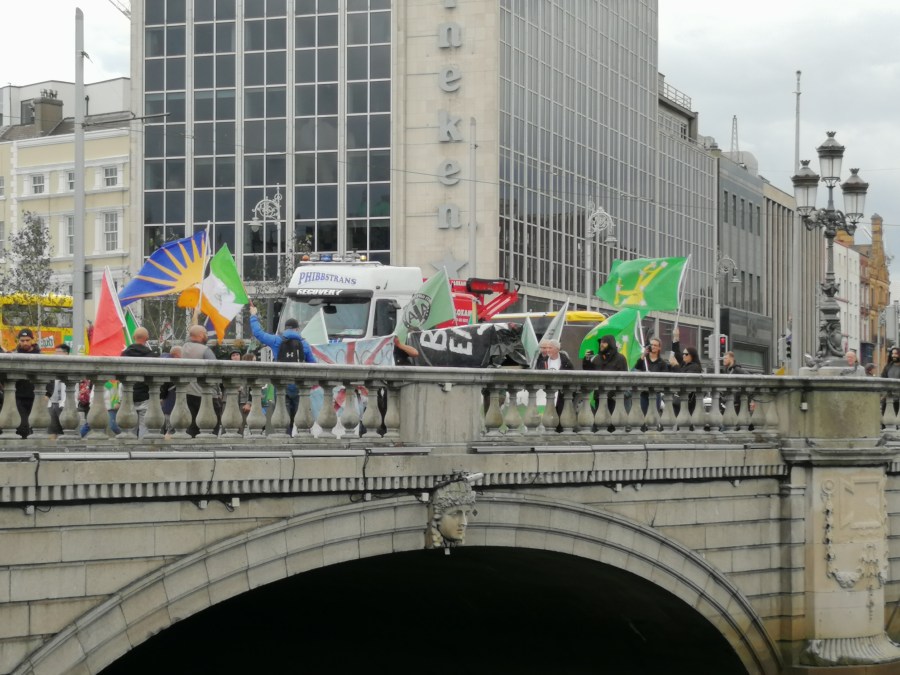
Eamon McGrath (31 October 1955 – 11 January 1923) singer and song lyrics-writer, activist in areas of housing, water and national sovereignty, historical memory and anti-fascism.
He was getting buried on Saturday and I wasn’t able to be at the service nor at the celebration of his life with comrades afterwards.
I hope this eulogy, if that’s the right word for this, will make up for my absence to his family, comrades and friends and, of course, to me.
Eamon came into my life through the Moore Street occupation in January of 2016. The property speculator Joe O’Reilly (Chartered Land) and the State were about to collude in the demolition of three buildings in the 1916 Terrace.
The State had declared only four buildings in the 16-building terrace, after a long struggle, to be a historical monument and even later, purchased – but around 300 men and women hadn’t occupied just four buildings in 1916.
The Save Moore Street From Demolition campaign group had called emergency demonstrations on to the street following which the buildings had been occupied by protesting conservationists.
The weather was bitterly cold but the occupiers held firm for a week until a stay of demolition had been imposed by the High Court. Despite his health status and challenged mobility, Eamon was there throughout, with humour and song.
Eamon McGrath to far right of photo while Dave Swift (centre) in Irish Volunteer uniform reads a historical document April 2017 in Moore Street, during historical commemoration event (the hoarding behind is covering the extension of the ILAC further into Moore Street, killing the market appearance for that side of the street for the block).
Subsequently, to prevent internal damage by contractors, a six-weeks’ blockade was imposed on the building by conservationists from 6.30am to 4.30pm each weekday. Eamon was very much a part of that too, driving himself and his close comrade Sean Doyle up from Wicklow every day.
Eamon was intensely loyal to close friends and comrades. On occasion I found him prickly or grumpy (especially at 6.30 am) but throughout any disagreements he never lost sight of who were his comrades and other people he respected.
Though a proud man, when he recognised himself in error, he didn’t hesitate to apologise.
A new broader group came out of the occupation and blockade, called Save Moore Street 2016 and Eamon attended and contributed to internal organising meetings and events we called on to the street – re-enactments, fake funerals of history, pickets, demonstrations and rallies.
As others drifted or were called away from the group by other commitments, Eamon remained with the active core.
(L-R) Paddy Reilly and Eamon McGrath in period costumes having a conversation during a history education event and anniversary commemoration of the founding of the Save Moore Street From Demolition campaign group. (Photo from Save Moore Street From Demolition FB page)
Of course, Eamon had been active before 2016: certainly very much so in the general awareness-raising and mass campaign against planned privatisation of our water and the installation of water meters.
He was to continue that activism, which resulted in assaults by a water contractor on him and Seán Doyle, court appearances for both and in May 2016 both of them went to jail for a period but remained unbowed.
Eamon was one of the original occupiers of Apollo House in December 2016 in protest against homelessness and as a co-founder of the Anti Eviction Flying Column, Eamon was to the fore in resisting evictions across the country and also a co-founder of the Bring It to Their Doors campaign.
The State authorities were making things awkward for Eamon by then, both in terms of working as a taxi driver and claiming benefit when he was not. His ability to reach events in Dublin declined but he still got there often enough on public transport, while remaining active nearer to home.
As his physical mobility declined further, comrades in Carlow started an on-line collection to buy him an electric wheelchair. Even as I made enquiries to contribute, the fund had already reached its target, so quickly did people support it.
Later still, his family installed a new chairlift for his home so he could access the room where he recorded his songs with lyrics commenting on the ongoing political struggles, adapted to popular airs.
Though our voices didn’t go well together, we sang together a couple of times – outside the GPO and outside Dublin City Hall.
Eamon McGrath, centre right after April 2016 event in Moore Street after which we brought it to in front of the General Post Office in Moore Street for awhile. Myself near centre, Glenda further to the left of photo, Sean Doyle nearly out of shot.
He remained active on social media but in particular in keeping an eye on the activities of right-wing people, covid-deniers, racists, fascists …. Eamon was a handy source for a quick update on the status of many of them.
Eamon arranged an interview for us both with the Dublin Near FM radio station, the interviewer being then a former drug addict who sadly returned later to his addiction and died on the street. It was on the way back from the interview that Eamon told me a little about his earlier years.
He had a difficult time in his childhood, including institutional confinement and his formal education suffered as a result. However, he educated himself about many things by reading, listening, discussing and viewing on line.
I think the last time I saw Eamon was at a commemoration at the Peter Daly monument in Wexford inSeptember 2022, in his electric wheelchair and attached oxygen cylinder for his lung condition and all in good cheer, asking me for Moore Street campaign updates in detail.
Eamon McGrath, centre in wheelchair, at Peter Daly commemoration in Wexford, September 2022 (Photo from Peter Daly FB page)
His comrades in Anti-Imperialist Action Ireland, which he had joined at its foundation in 2017 correctly called him “one ot the most dedicated political activists of the last decade” and no-one who knew him could argue with that.
I knew little of Eamon’s family life but he often emphasised how important family was, not just to him but in general. Though I do not know them tá mé i gcomhbhrón leo, offering them my condolences along with the many they have received and are no doubt still arriving.
A partner, father, grandfather, great-grandfather, extended family member and friend to many.
Eamon McGrath of Kenmare Heights, Greystones & formerly Wolfe Tone Square, Bray, Co. Wicklow, was buried in Radford Cemetery, Greystones Saturday after a service in the Holy Rosary Church, Bray, attended by family, comrades and friends.
Working people have experienced many betrayals in history and the struggle for self-determination of the Irish nation has been – and is being – betrayed also.
When such betrayals occur, a range of common reactions is evoked; thinking about those responses may help the betrayed at least to moderate the harm and turn the experience to some benefit.
Equally, some ways of handling the experience can magnify and deepen the harm already caused.
Betrayal is a difficult experience for the betrayed certainly but not without some cost to the betrayer too and each has a number of common responses. This applies to the personal as well as to the political but there are some differences.
The betrayers have their followers to different degrees and these too have psychological reactions to the betrayal — and to criticism of the betrayal. We can observe these reactions in a number of recent historical cases of high levels of resistance subsequently betrayed.
The most recent phase of high degree resistance in Ireland took place largely in the British colony of the Six Counties, beginning with mass struggles for civil rights before passing through protracted guerrilla war and intense struggles of political prisoners in the jails.
In the Basque Country, the corresponding phase began with ideological-cultural struggle and mass industrial actions against the Franco dictatorship, quickly developing into a guerrilla campaign combined with street battles, resistance to conscription and struggles around prisoners in the jails.
The leadership of the Irish struggle came to political agreement with the colonial occupier, disbanded and decommissioned its guerrilla forces and acceding to its right of conquest, joined the occupier’s colonial administration, concentrating thereafter on building up its electoral base.
A similar process took place in the Basque Country but with important differences: the imprisoned activists were not released and the movement’s political leadership was not even admitted into joint management of the colonial administration.
Each nation witnessed splits, recrimination, dissidence, repression on groups continuing resistance but also a range of psychological responses which at best did not assist recuperation and in fact often deepened the harm of betrayal by the leadership.
STANDARD RESPONSES BY THE BETRAYED
DISMAY is a common reaction: How could he/ she/ they? I never thought they would. We’re finished now.
BLAME is another also common response: It was that leader’s or leadership’s fault. We didn’t fight hard enough. Those comrades criticised too much.
SELF-CENSORSHIP And EXCESSIVE CAUTION: We can see the harm in some of the leadership’s actions but we must be careful not to step too far out of the movement, where we will be marginalised and unable to have an effect1.
DESPAIR: That’s the end of everything. There’s no way out of this. It was all for nothing – all those sacrifices, all that pain.I’ll never trust people or get involved again.
APATHY: So I/ we might as well forget about it all. Just think about ourselves/ myself/ family. Drop out. Drink. Take drugs.
DENIAL: We’ve not really been betrayed. It’s just another way to go for the same thing. This is the only reasonable choice. We couldn’t keep on that way any longer, this is just a change of method. We’re just having a pause. The leadership is clever and has tricks up their sleeves. This is just to fool the authorities. It’s just going to take a little longer to win than we thought.
Those are defensive constructions in emotion and, in so far as that takes place, in thinking. But defensiveness can turn to aggression – and frequently does. The betrayers – and often the duped also – resent being reminded of what and where they are. It makes them uncomfortable.
HOSTILITY: How dare those people criticise us/ the leadership? They don’t understand and just want continual conflict. They’re endangering our secret plan. Who do they think they are? They’re just wrecking everything, undermining our new plans. They need to be taught a lesson.
PERSONAL ATTACKS: That critic is no great activist. S/he hasn’t suffered as some of us have. They were always troublemakers. Jealous, that’s what they are. They’re not very bright; no idea about real politics. They are in fact traitors, helping our enemies.
MARGINALISATION: We are not going to listen to those critics. We will not allow them space on our media. We’ll try to make sure they don’t get venues in which to spread their poison. If people are friends with them they can’t be our friends too. Such people will not enjoy our hospitality or invitations to our events. People should not even talk to them. If the authorities attack those dissidents, we are not going to trouble ourselves about them – it’s their own look out.
MANAGING THE BETRAYAL
PROMOTING LEADER ADULATION is a useful tool in shutting down the opportunities for criticism and in repressing them when they arise. “Who are we to criticise this great comrade’s thinking or actions?” becomes an implicit question, clearing the way for betrayal.
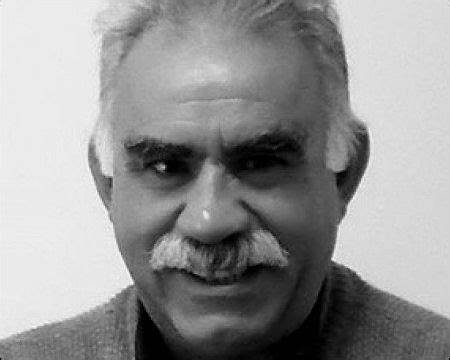
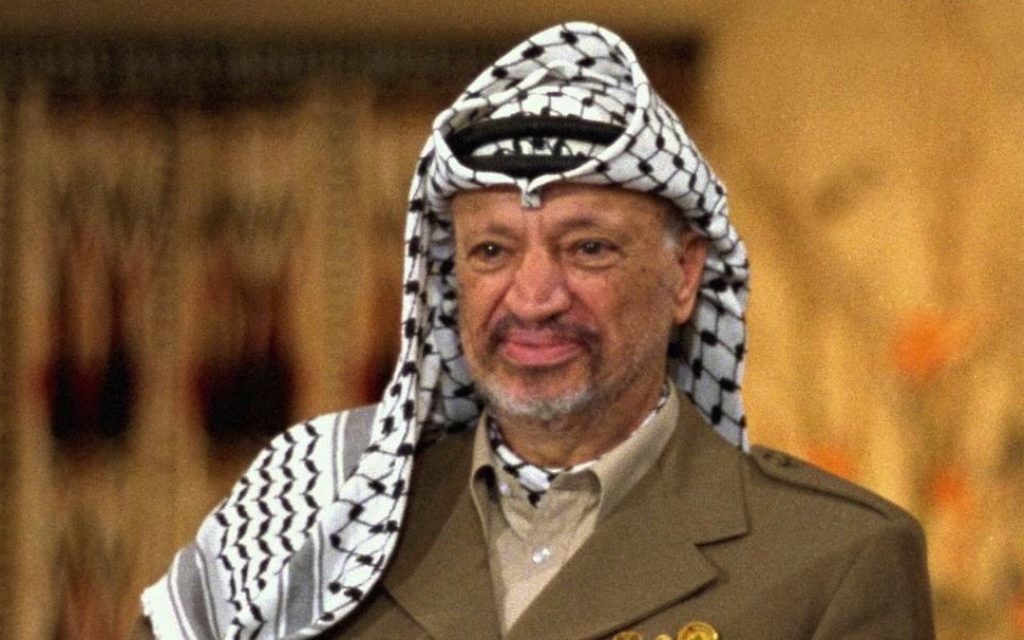
Leaders who have surrendered or compromised the struggle, L-R: Gerry Adams and Martin McGuinness of the Provisionals, Arnaldo Otegi of the Basque Patriotic Left, Abdullah Ocalan of the PKK and Yasser Arafat of Al Fatah. The latter seemed to be attempting to to turn back from the path of betrayal when he became very ill (quite probably poisoned) and died.
SEEKING COUNTER-REVOLUTIONARY ALLIANCES is engaged upon so as to appear to its members to make the organisation’s influence greater, or to outflank and isolate more revolutionary tendencies and often ultimately to make the leadership acceptable to the ruling circles.
BEGGING FOR CONCESSIONS when the revolutionary path has been abandoned can often be observed, as in “we’ve abandoned our militant struggle, please stop repressing us”, for example, a frequent response to repression of the Basque leadership once it abandoned the revolutionary path.
COLLUDING WITH THE OCCUPIER becomes a new second nature to a leadership abandoning revolution, not only in abandoning armed struggle, for example but in destroying weapons and suppressing elements still in resistance.
PROVING THEIR READINESS TO COLLUDE FURTHER, revolutionaries turned collaborators denounce continued resistance, try to convince revolutionaries to desist (or threaten or physically attack them), promote the repressive arms of the State such as the police and so on.
INTOLERANCE OF CRITICISM becomes default position; such criticism tends to expose the contradiction between the original purpose of the organisation and its concrete actions in the present. Censorship, expulsion and misrepresentation become common.
MARGINALISATION OF CRITICS follows from intolerance of criticism – the individuals or groups must be made pariahs so as to nullify or at least reduce their influence. Association with them, socially or politically – even in agitating around civil rights – must be discouraged.
REPRESSION OF DISSIDENTS finally becomes necessary, whether by threats or by actual violence or, when admitted to governing circles, by use of repressive state machinery.
DEALING WITH BETRAYAL RATIONALLY
The first necessary step is to analyse how the betrayal came about: how was it organised? What were the conditions that made it possible? What were the early signs?
Then, proceed to: what could we have done differently? What WILL we do differently in future?
Electoral work
One common assumption here in Ireland, especially in Irish Republican circles, is that the rot began with standing in elections. This is not logical and it is in effect making a negative fetish of electoral work, a taboo to be avoided.
It is often useful to the revolution in many ways to have representation in the parliament and local authorities, for example in promoting or blocking practical or legislative measures, getting media air time, visiting prisons — all without ever promoting reformism as a way forward.
Certainly the prioritisation of electoral work over other aspects is a sign that something has gone wrong: the strength of the popular revolutionary movement is on the street, in workplaces, communities, places of education, rather than in parliaments and local authorities.
The drive towards electoral representation can encourage bland slogans of the soap powder kind (“new improved” or “washes even better”) rather than those with revolutionary content and also the promotion of more bourgeois individuals in preference to grass-roots organisers.
Anodyne election slogan in both languages for Sinn Féin.
But none of that means that representation in those bodies cannot be used to further the popular struggles or that such aberrations cannot be avoided. And in fact, the concentration on criticism on the electoral factor served to distract from a more fundamental error.
Of course, electoral work should never, for revolutionaries, be about entering government under the current socio-economic system, i.e sharing in the administration of the State.
Leader adulation & intolerance of criticism
If criticism is not tolerated when errors are committed, they can hardly be corrected. Again and again it has been observed that the party/ organisation faithful refuse to accept external criticism from non-enemies. Internally the leadership inhibits criticism by the members.
The cult of the leader also inhibits criticism and therefore correction of errors. And behind this image others can hide and also commit errors. Problematic as dead icons may be, living ones are many times more dangerous – deceased ones at least do not change their trajectories.
Such created living icons have been Mandela in South Africa, Yasser Arafat among Palestinians, Gerry Adams and Martin McGuinness in Ireland, Arnaldo Otegi in the Basque Country and Abdullah Ocalan among Kurds (particularly in the Turkish and Syrian states).
Nobody knows everything or is always right. Bothersome as being criticised may be, its total absence is worse, allowing us no opportunity to question ourselves as activists and in particular as revolutionary organisations.
The revolutionary leadership, party or organisation is not the people
The revolutionary leadership, party or organisation does not have all the answers and is not the people. This might seem obvious but from the behaviour of such leaderships and their followers in the past it is clear that the opposite philosophy has been dominant.
Confusing the organisation with the people or with revolution itself, we assume that what is good for the organisation is also good for the people and the revolution. This however is not always so and leads to placing the perceived well-being of the organisation above the needs of the revolution.
Indulging this confusion leads to political opportunism and sectarianism, bad relations with other revolutionaries, ignoring all external criticism and placing the needs of the leadership higher than those of the membership and of the membership higher than those of the mass movement.
Internationalist solidarity
In internationalist solidarity work we build the unity of the people across borders and against the same or different enemies than those against which we are struggling.
One feature observed in a number of organisations where the leadership is moving towards betrayal is a reduction or elimination of such work.
To those in our ranks seeking an accommodation with imperialism and capitalism, those internationalist solidarity alliances are either a) unimportant or b) a hindrance to the alternative reactionary alliances to which they aspire.
The latter was very much the case with the Provisionals’ attitude to US imperialism. For decades, their leadership maintained apparently mutually-contradictory positions on what is the biggest imperialist superpower in the world.
On the one hand, for example, there could be involvement in solidarity with Cuba against the US economic blockade and, in the past, against US sabotage and terrorism against the Sandinista regime in Nicaragua.
On the other hand, the leadership sought the support of the US elite against British colonialism, which is occupying a part of Ireland and against which the movement was waging, in that colony, an armed and popular struggle.
Seeking support from the US imperialist elite entailed distancing from left-wing Irish USA and dropping support for even long-term inmates of US jails, such as American Indian Leonard Peltier and Black American Mumia Abu Jamal, arising out of popular struggles inside the US.2
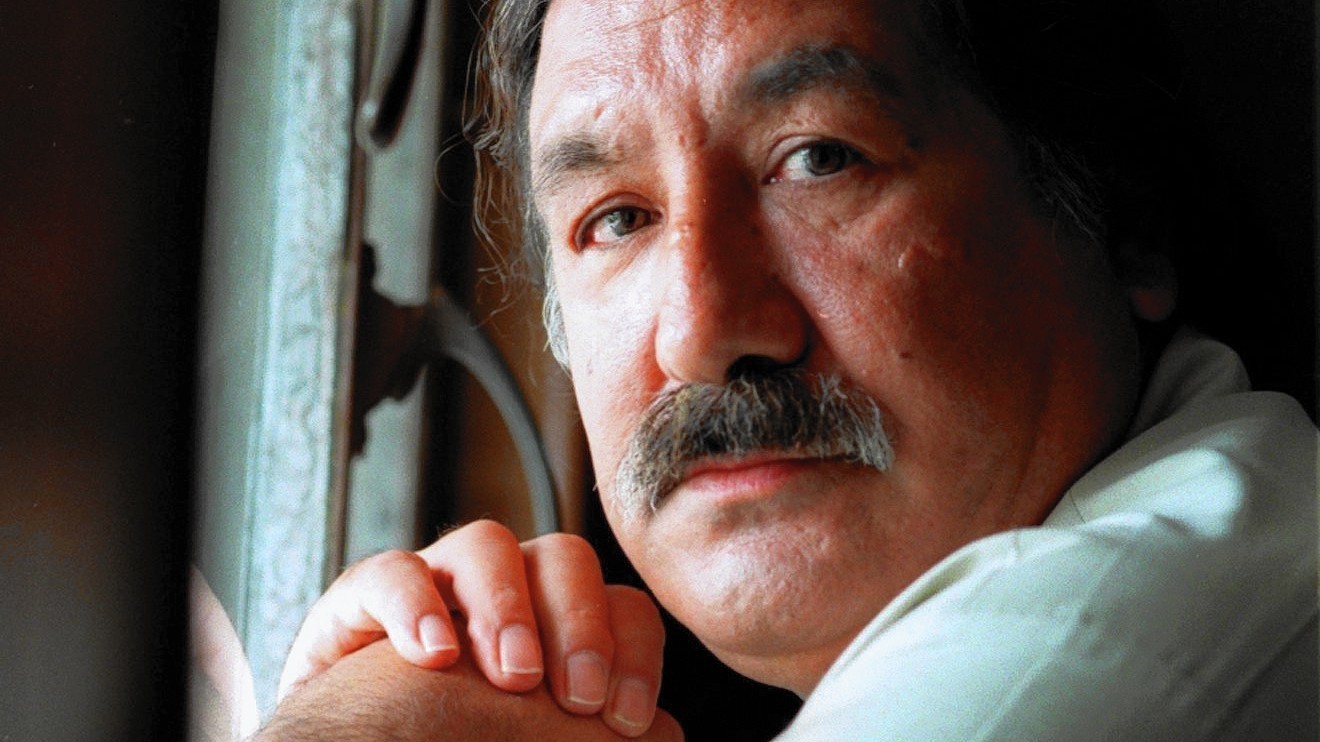
Leonard Peltier, Native American convicted in 1977 in deeply flawed trial for murder of two FBI agents in 1975 shootout on Pine Ridge Reservation. Nearly 80 years of age now and with multiple health issues, even release on clemency grounds is constantly blocked. His is one of many campaigns in the USA which SF cannot support as they seek to remain friends with the Democratic Party elite there.
Black American journalist and activist, framed for the murder of a corrupt Philadelphia policeman in 1981 and sentenced to death in 1982, sentence commuted to imprisonment for life without parole in 2011. Mumia is nearly 70 years of age now with a number of health issues. Another of the type of injustice in the USA about which SF cannot campaign as they seek to stay close to the Democratic Party elite. Anecdotally, a SF Councillor who was regularly writing to him was obliged to desist on instruction from her party leadership.
Unprincipled alliances
Another warning sign is the founding of unprincipled alliances with other organisations in struggle. For example, although it is correct to have a position of support for the Palestinian people, that should not necessarily bind us to exclusively support the fighters of one organisation only.
The Provisionals made their alliance with the Al Fatah organisation to the exclusion of all others in Palestine but worse was to come, for Al Fatah shoved aside the idea of a free Palestine and the right of return in exchange for administrative partial autonomy and funding.3
From there, Al Fatah became so corrupt that the Palestinian people, that had long supported a secular leadership, voted overwhelmingly for an islamic fundamentalist party, Hamas4. The unprincipled alliance with Al Fatah and the ANC was used to ‘sell’ the GFA to Irish Republicans.5
In the Basque Country, the mass movement’s leadership developed close links with the leadership of the Provisionals and refused links with Irish Republican organisations that dissented from the Provisionals’ position or with Republican prisoners after the Good Friday Agreement.
That should have sounded alarm trumpets in the Basque movement but if it did, it remained largely without practical effect. Askapena, the Basque internationalist solidarity organisation did split from the main movement but did not go so far as to support ‘dissident’ Irish Republican prisoners.
LESSONS
On the basis of the preceding I think we can draw a number of primary lessons.
LESSON ONE: ANALYSE THE MISTAKES OF THE PAST AND SEEK TO AVOID REPLICATING THEM
The type of struggle, location, timing, peripheral situation, long, medium and short-term objectives, experience and expertise of personnel, resources … all need to be analysed, in conjunction with the strengths and weaknesses of the enemy.
In carrying out this kind of analysis on the Irish struggle, we see that we faced one of the military superpowers, also well linked into the western imperialist world. The Republican movement’s battle area was in total one-sixth of the nation’s territory and the location deeply divided.
The rest of the nation was ruled by a weak foreign-dependent ruling class.
Map of Ireland showing the British colony of the Six Counties. The Provisionals took on the British state, mostly confining their struggle in that deeply divided politically and culturally region shown in yellow.
A movement cannot choose when it has to step forward in defence but it can choose how it develops the struggle afterwards. It seems obvious that in order to be victorious, at the very least the struggle would have to be spread throughout the nation.
That in turn would entail putting forward social and economic objectives to attract wider support which, in turn, would mean taking on the Catholic Church hierarchy.
In addition, the question of effective external allies was relevant here but even more so in the Basque Country, located across the borders of two powerful European states.
The total population of the portion of the Basque nation within the Spanish state is far short of three million, that of the rest of the state over 44 million.
Clearly allies external to the Basque nation would be essential for victory and these would have to come from across most of the Spanish state at least.
Map showing the ‘autonomous’ regions of the Spanish State; the southern Basque Country is shown in pink at the top, including ‘Navarre’ shown in yellow next to it. Essentially, the Basque Patriotic Left without allies confronted the Spanish state from there.
Such an assumption would entail, in turn, outlining objectives to attract considerable numbers from across the Spanish state which in turn would mean creating alliances with revolutionary and other progressive forces across the state.
LESSON TWO: REFRAIN FROM PERSONALISING THE ISSUES
When criticism of the counter-revolutionary line put forward by individual leaders becomes personalised, the political essence of the criticism becomes lost or at least obscured. It can seem as though the critics have personal reasons for their hostility or even jealousy of the individuals.
Much of what one sees publicly posted by opponents of pacification programs in Ireland and the Basque Country often seems more about hostility to the personalities of MaryLou MacDonald, Gerry Adams, Martin McGuinness or Arnaldo Otegi than about specific policies and actions.6
Crucially, focusing criticism on individual leaders serves to conceal other underlying causes of failure and betrayal that are usually more fundamental: problems in objectives, errors of strategy, in particular and also of tactics along with unhealthy organisational dynamics.
LESSON THREE: DEVELOP INTERNATIONALISM AND AVOID UNPRINCIPLED ALLIANCES
In the face of imperialist and other reactionary alliances, revolutionaries need internationalist solidarity, the basis for which should be revolutionary positions and action. Exclusive alliances are generally to be avoided as is uncritical support or unquestioning approval of all actions.
LESSON FOUR: CONTRIBUTE TO BROAD FRONTS WITHOUT SURRENDERING THE REVOLUTIONARY LINE
A broad front is essential not only for successful revolution but also often for defence against repression. Such fronts should be built on a principled basis with respect for the participating groups and individuals but without surrendering the revolutionary line.
At the same time, the possibility of betrayal, opportunism or sabotage and marginalisation by partners in broad fronts need to be guarded against and, if occurring, to be responded to in a principled and measured manner.
Broad fronts not only increase the numbers in resistance in a unified manner but also expose the activities of the constituent groups to the members of other parts of the broad front. Activists can then evaluate organisations and one another on the basis of experience rather than of reputation.
The revolutionary line should not be abandoned or concealed when in a broad front with organisations and individuals who have varying lines. At the same time, it is not necessary to be pushing the revolutionary line every minute.
LESSON FIVE: DON’T GIVE UNCONDITIONAL TRUST TO LEADERS
Of course, our leaders and activists must be trusted – but always in the knowledge that no-one is perfect or above the possibility of error. The shutting down of opportunity to voice criticism should sound alarm bells in any revolutionary movement.
There are of course “time and place” considerations in criticism; for example, the capitalist mass media, police interrogation or trial in court are hardly appropriate places to criticise a revolutionary movement’s leadership.
LESSON SIX: TOLERATE INTERNAL CRITICISM AND CAUCUSES IN BALANCE WITH COLLECTIVE RESPONSIBILITY
The above touches upon this area too. People who follow us without question may equally do so with another.
The right to caucus, i.e to collect around a particular revolutionary trend or focus needs to be acknowledged and formalised. Like-minded people will naturally associate and it is far healthier to have this occur in the open rather than in secret.
At the same time, when a discussion reaches democratic decision, the minority whose positions were rejected need to present a common front with the rest of the organisation or movement.
Similarly, political and organisation criticism needs to be welcomed or at least tolerated within the organisation or movement because it may be correct and point an alternative way forward and even if it isn’t, the discussion around the criticism will help to clarify matters.
Such openess to criticism and discussion encourages a conscious and thinking membership which by that measure alone and organisationally makes it more difficult for some individual or clique to manipulate the membership.
1“Outside the broad movement it is very cold”, said a Basque to me once. He was a member of a small Left group critical of the leadership’s approach but unwilling to completely rupture with them.
3With the Camp David (1978) and Oslo Accords (1993 & 1995).
4In 2006 (the most recent) Palestinian parliamentary elections, Change and Reform (Hamas) won 74 seats and Al Fatah 45. In Gaza Al Fatah rejected the result and tried to seize power but were defeated in a short battle, though Hamas did not battle their assumption of power in the West Bank. All dates for elections to Palestinian Parliament since have passed without polling.
5And since then, unprincipled alliances with Provisional Sinn Féin have been used by the main Basque organisation leadership and ditto with Colombia to ‘sell’ pacification processes in those countries (which have been even worse for them than has the GFA been in Ireland).
6As a historical note, it is said that some of the delegates who voted for the Anglo-Irish Treaty in January 1922 were moved to do so by the nature of the attacks of Cathal Brugha, for the anti-Treaty side on Michael Collins, leader of those for the Treaty. The majority of delegates voting in favour was only seven.
Christmas shoppers on Saturday 17th in Dublin’s O’Connell Street, the city’s main boulevard, were interested to see a long picket line displaying banners, flags and placards.
The event was a jointly-organised public reminder of the continuing existence of political prisoners in Ireland and as a gesture of solidarity to the prisoners too.
The joint organisers were the Ireland Anti-Internment Campaign, the Irish Republican Prisoners Welfare Association and the Anti-Imperialism Action organisation. The attendance were mostly Irish Republicans but there were also some from the socialist/ anarchist traditions present.
Long line looking southward of joint Republican prisoners’ solidarity event (Photo: Rebel Breeze)
There are currently 40 Irish Republican prisoners in jails in Ireland, on both sides of the British Border. As a speaker noted at the end, all had been sentenced or refused bail by no-jury special courts of the Irish and British states.
The Irish Tricolour and the Starry Plough were displayed of course but also a Palestinian flag and two Basque ones; the latter attracted the attention of a number of young people from the Spanish state who were pleased and approached the picketers for discussion.
Section of the joint Republican prisoners’ solidarity event showing the Latuff cartoon on a banner (Photo: Rebel Breeze)Section of the joint Republican prisoners’ solidarity event showing couple of Basque flags and Palestinian one in the middle distance (Photo: Rebel Breeze)
Two banners called for and end to the extradition of Irish Republicans and one figured cartoonist Carlos Latuff’s illustration of solidarity between Irish and Palestinian political prisoners.
Leaflets of the IRPWA and of the IAIC were distributed to passers-by.
Section of the joint Republican prisoners’ solidarity event (Photo: Rebel Breeze)
As the event came to an end a representative of each organising group read out a short statement; both the IAIC and the AIA emphasised the need for unity in resisting repression and each along with the IRPWA called for support for Irish Republican prisoners.
End.
Section of the joint Republican prisoners’ solidarity event (Photo: Rebel Breeze)Section of the joint Republican prisoners’ solidarity event (Photo: Rebel Breeze)
We see and often hear “viva la Quinta Brigada” but this is usually a mistake – the reference is not to the Fifth but to the 15th International Brigade. The word for fifteen in Spanish is “quince”1 whereas “quinta” means “fifth”. The brigade being referred to, the Fifteenth International Brigade, was one formed at the instigation of the Communist International (Comintern) in 1936 from volunteers from more than 55 countries2.
The estimates of numbers of participants in the International Brigades range from 40,000 to 59,000 with a death toll of around 10,0003 and of course many more injured.
Not all the Irish-born and Irish diaspora antifascists who fought4 in what is called the Spanish Antifascist (or Civil) War fought in the 15th Brigade5 but most of them did, whether in the British, Commonwealth or US Battalions (“Abraham Lincoln” and “Washington”, later combined), chiefly because these were the English-speaking battalions of the 15th International Brigade, which also included specific battalions for French, German, Italian, Spanish (from Mexico, Caribbean and Latin America) Czechoslovak, Hungarian and Polish languages6.
International Brigaders crossing the Ebro for the battle. The one in the bows of the boat appears to be Irish communist Michael O’Riordan, carrying the Senyera, the recognised Catalan flag of its time (red and yellow stripes without a star). O’Riordan survived the Civil War and returned to Ireland to lead the Communist Party of Ireland. (Image sourced: Internet)
The familiar songs in English were always about the 15th International Brigade, no other. So why and how has this mistake arisen of referring to the 5th?
The chief transmission of this error in recent time has been through that song with the wonderful lyrics and air created by the Irish balladeer and most famous folk performer, Christy Moore.
And he called his song “Viva La Quinta Brigada”. Recorded and performed under that title, with numerous videos repeating the error, even though he has himself corrected the reference in later performances.7 And in fact there are a number of Quinta Brigada versions of the Ay Carmela song on Youtube. So we can hardly blame all those people who are now singing the incorrect version, can we?
But before we arraign Comrade Christy Moore before a People’s Tribunal, it’s worth looking at the longer process of the error’s transmission. In fact, the incorrect wording was around long before Christy composed his song and it almost certainly informed his lyrics.
TRACING THE ERROR: THE AY CARMELA SONG AND SPIN-OFF
I remember thinking one time, when I became aware of the error in the title and refrain, that Christy should have consulted some Spanish-speaking people in Ireland. But I and my siblings are all Spanish-speaking and I recall even some of us singing a different song with a repeated line: Viva la Quinta Brigada, rumba la rumba la rumba la.
We were Spanish-speaking, yes and very sympathetic to the Republican side in that war — but at that time clearly not clued enough historically to detect the error,
That Rumba la rumba etc was a song in Spanish from the Republican side in the Civil/ Antifascist War, itself a spin-off or readaptation of a Spanish folk song about the crossing of the Ebro against Napoleonic troops in the 1800s. In this case the adaptation was fashioned to record the Republican forces’ crossing of the same river in attack on the advancing military-fascist forces in 1938.
The Battle of the Ebro was the largest ever fought on Spanish soil and lasted from 25th July to 16th November. The International Brigade song to the same air is generally known as Ay Manuela! and clearly refers to the International Brigade, not only by the lyrics in the final verse but by its alternative title, Viva La Quince Brigada!
Somewhere along the line someone made the error of replacing the Quince with Quinta. And so when Christy came to write his wonderful tribute to the Irish who went to the Spanish territory to fight against the fascist-military coup, the mistaken name had already been current for decades.
Re-enactment with partipants playing the parts of soldiers of the Spanish Republic advancing in the Battle of the Ebro. (Image sourced: Internet)
CORRECTING IT NOW
So no-one to blame for repeating the error and whoever caused it originally is long in the past. But we are here now and we know – so we have a responsibility not to perpetuate the error. We can do this quite simply in three ways:
Call the song “Viva la Quince8 Brigada” on all occasions
If we sing it, replace Quinta with Quince in the lyrics
Inform others about the correct version
End.
FOOTNOTES
1Fifteenth is “decimoquinta” in Castillian (Spanish) but, that being five syllables and therefore three too long for the song, “quince” (fifteen) must be sung instead.
2One of the many sources gives the figure of “55 Countries” but that probably means “55 states” and a number of states such as the UK, France, Belgium and Russia in Europe contain other nations, as do China, states in the Middle East, etc. In addition, many Jews also fought, one estimate putting them at one-quarter of the total of the “Brigadistas”.
3The very high casualty rate had a number of contributory factors but chief among them was the superiority of war-machines on the fascist-military side, in particular of aircraft, most of which were supplied, with pilots, by fascist Italy and Nazi Germany, while Britain and France blockaded Spain.
5Some fought as part of the POUM, largely Trotskyist antifascist organisation or may have fought in anarchist militia and one that we know of fought alongside the Basques (and gave his life there).
6There were other language groups but their numbers did not usually rate a whole battalion and they were integrated into battalions primarily of some other language.
7And even later still, amended the historically incorrect “the bishops blessed the Blueshirts in Dun Laoghaire
8Pronunciation guide for Quince: keen-the or keen-se.
9I’ve translated Ay! as Oh! but it’s more like Alas!, only hard to see that in the song’s context perhaps.
10I’ve translated Ay as Oh but it’s more like Alas, only hard to see that in the song’s context perhaps.
11The “Moors” were native North African troops raised by Spain’s Foreign Legion. Franco had been sent there by the Republican Government probably to get him out of the way after his ferocious suppression of the Asturias miners’ revolt. From there Franco’s troops were airlifted to the Canary Islands and from there to Andalucia in southern Spain, carving their way in the blood of mostly unarmed civilians.
El Ejército del Ebro, Rumba la rumba la rumba la. El Ejército del Ebro, Rumba la rumba la rumba la Una noche el río pasó, ¡Ay Carmela! ¡Ay Carmela! Una noche el río pasó, ¡Ay Carmela! ¡Ay Carmela!
The Army of the Ebro, rumba la rumba la, rumba la etc One night crossed the river, Oh9 Carmela, Oh Carmela!
Y a las tropas invasoras, Rumba la rumba la rumba la. Y a las tropas invasoras, Rumba la rumba la rumba la Buena paliza les dio, ¡Ay Carmela! ¡Ay Carmela! Buena paliza les dio, ¡Ay Carmela! ¡Ay Carmela!
And to the invading troops rumba la rumba la, rumba la etc Gave a good beating, Oh Carmela, Oh Carmela!
El furor de los traidores, Rumba la rumba la rumba la. El furor de los traidores, Rumba la rumba la rumba la Lo descarga su aviaciónes, ¡Ay Carmela! ¡Ay Carmela! Lo descarga su aviaciónes, ¡Ay Carmela! ¡Ay Carmela!
The fury of the traitors, rumba la rumba la, rumba la etc Is dropped from their ‘planes, Oh Carmela, Oh Carmela!
Pero nada pueden bombas, Rumba la rumba la rumba la. Pero nada pueden bombas, Rumba la rumba la rumba la Donde sobra corazón, ¡Ay Carmela! ¡Ay Carmela! Donde sobra corazón, ¡Ay Carmela! ¡Ay Carmela!
But bombs have no power, rumba la rumba la, rumba la etc Where exists excess of heart, Oh Carmela, Oh Carmela!
Contraataques muy rabiosos, Rumba la rumba la rumba la. Contraataques muy rabiosos, Rumba la rumba la rumba la Deberemos resistir, ¡Ay Carmela! ¡Ay Carmela! Deberemos resistir, ¡Ay Carmela! ¡Ay Carmela!
Ferocious counterattacks, rumba la rumba la, rumba la etc We must resist, Oh Carmela, Oh Carmela!
Pero igual que combatimos, Rumba la rumba la rumba la. Pero igual que combatimos, Rumba la rumba la rumba la Prometemos resistir, ¡Ay Carmela! ¡Ay Carmela! Prometemos resistir, ¡Ay Carmela! ¡Ay Carmela!
But as we fight, rumba la rumba la, rumba la etc We promise to resist, Oh10 Carmela, Oh Carmela!
Ay Manuela!/ Viva La Quince Brigada – International Brigades version in Spanish
Viva la quince brigada, -Rumba, la rumba, la rumba, la-, Viva la quince brigada, -Rumba, la rumba, la rumba, la-, Que sea cubierta de gloria Ay Manuela, ay Manuela! Que sea cubierta de gloria Ay Manuela, ay Manuela!
Long live the fifteen(th) Brigade -Rumba, la rumba, la rumba, la etc May it be covered in glory, -Rumba, la rumba, la rumba, la etc.
Luchamos contra los moros -Rumba, la rumba, la rumba, la-, Luchamos contra los moros -Rumba, la rumba, la rumba, la-, Mercenarios y fascistas Ay Manuela, ay Manuela Mercenarios y fascistas Ay Manuela, ay Manuela
We fight against the Moors11 -Rumba, la rumba, la rumba, la etc Mercenaries and fascists. -Rumba, la rumba, la rumba, la etc,
En el frente de Jarama -Rumba, la rumba, la rumba, la-, En el frente de Jarama -Rumba, la rumba, la rumba, la-, No tenemos ni aviones Ni tanques ni camiones Ay Manuela! No tenemos ni aviones Ni tanques ni camiones Ay Manuela!
On the Jarama front -Rumba, la rumba, la rumba, la etc We have neither planes, tanks or lorries, -Rumba, la rumba, la rumba, la etc
Ya salimos de España -Rumba, la rumba, la rumba, la-, Ya salimos de España -Rumba, la rumba, la rumba, la-, Pa luchar en otros frentes Ay Manuela ay manuela Pa luchar en otros frentes Ay Manuela ay manuela.
Now we are leaving Spain -Rumba, la rumba, la rumba, la etc To fight on other fronts -Rumba, la rumba, la rumba, la etc
Viva la quince brigada, -Rumba, la rumba, la rumba, la-, Viva la quince brigada, -Rumba, la rumba, la rumba, la-, Que sea cubierta de gloria Ay Manuela, ay Manuela Que sea cubierta de gloria Ay Manuela, ay Manuela.
Long live the fifteen(th) Brigade -Rumba, la rumba, la rumba, la etc May it be covered in glory, Oh Manuela, Oh Manuela! etc
Viva La Quince Brigada! Lyrics and musical arrangement by Christy Moore.
Ten years before I saw the light of morning A comradeship of heroes was laid: From every corner of the world came sailing The Fifteenth International Brigade.
They came to stand beside the Spanish people To try and stem the rising fascist tide; Franco’s allies were the powerful and wealthy – Frank Ryan’s men came from the other side.
Even the olives were bleeding As the battle for Madrid it thundered on, Truth and love against the force of evil Brotherhood against the fascist clan.
(Chorus) Viva la Quince Brigada! “No Pasarán“, the pledge that made them fight “Adelante!” is the cry around the hillside Let us all remember them tonight.
Bob Hilliard was a Church of Ireland pastor, From Killarney across the Pyrenees he came; From Derry came a brave young Christian Brother, Side by side they fought and died in Spain. Tommy Woods, age seventeen died in Cordoba, With Na Fianna he learned to hold his gun, From Dublin to the Villa del Rio, Where he fought and died beneath the blazing sun.
(Chorus) Viva la Quince Brigada! “No Pasarán“, the pledge that made them fight “Adelante!” is the cry around the hillside Let us all remember them tonight.
Many Irishmen heard the call of Franco, Joined Hitler and Mussolini too; Propaganda from the pulpit and newspapers Helped O’Duffy to enlist his crew. The word came from Maynooth, “support the Nazis” – The men of cloth failed again, When the Bishops blessed the Blueshirts down in Galway As they sailed beneath the swastika to Spain.
(Chorus) Viva la Quince Brigada! “No Pasarán“, the pledge that made them fight “Adelante!” is the cry around the hillside Let us all remember them tonight.
This song is a tribute to Frank Ryan Kit Conway and Dinny Coady too Peter Daly, Charlie Regan and Hugh Bonar, Though many died I can but name a few: Danny Boyle, Blaser-Brown and Charlie Donnelly, Liam Tumilson and Jim Straney from the Falls, Jack Nalty, Tommy Patton and Frank Conroy, Jim Foley, Tony Fox and Dick O’Neill.
(Chorus) Viva la Quince Brigada! “No Pasarán“, the pledge that made them fight “Adelante!” is the cry around the hillside Let us all remember them tonight.
The intensively mediated death of Elizabeth Windsor, accompanied by the relentlessly maudlin and invasive coverage of official mourning and her funeral, had an intensity that can only be described as imperial. Forced as it was into every corner of public discourse, this coercive atmosphere of state sorrow had a distinctly colonising thrust and meaning. Unleashed during a moment of total class warfare within her very disunited kingdom, it also marked an endpoint in the trajectory of her most obedient servants: the formerly Irish but now thoroughly British political party, Sinn Féin. During Windsor’s reign colonial chickens came home to roost as the woman who presided over British forces while they rampaged across the six counties of British-occupied Ireland then became over the past decade and a half the queen of foodbanks in her own country. (1) Her reign spanned a long period during which overt political violence in Ireland was…
Donal O Ceallaigh walked free on Wednesday to congratulations of his supporters after four years under the threat of a ten-year jail sentence and/ or unlimited fine. He had been charged with “violent disorder” arising out events in February 2016.
The charging of antifascists with “violent disorder” was a first use by the State against political activists of this vicious piece of legislation with such a heavy penalty and for which the burden of proof seems very slight.
All that seems required is for the State to prove that a situation of violence occurred or was threatened in which the accused were present (minimum of three) and “that would cause a person of reasonable firmness present at that place to fear for his or another person’s safety.”1
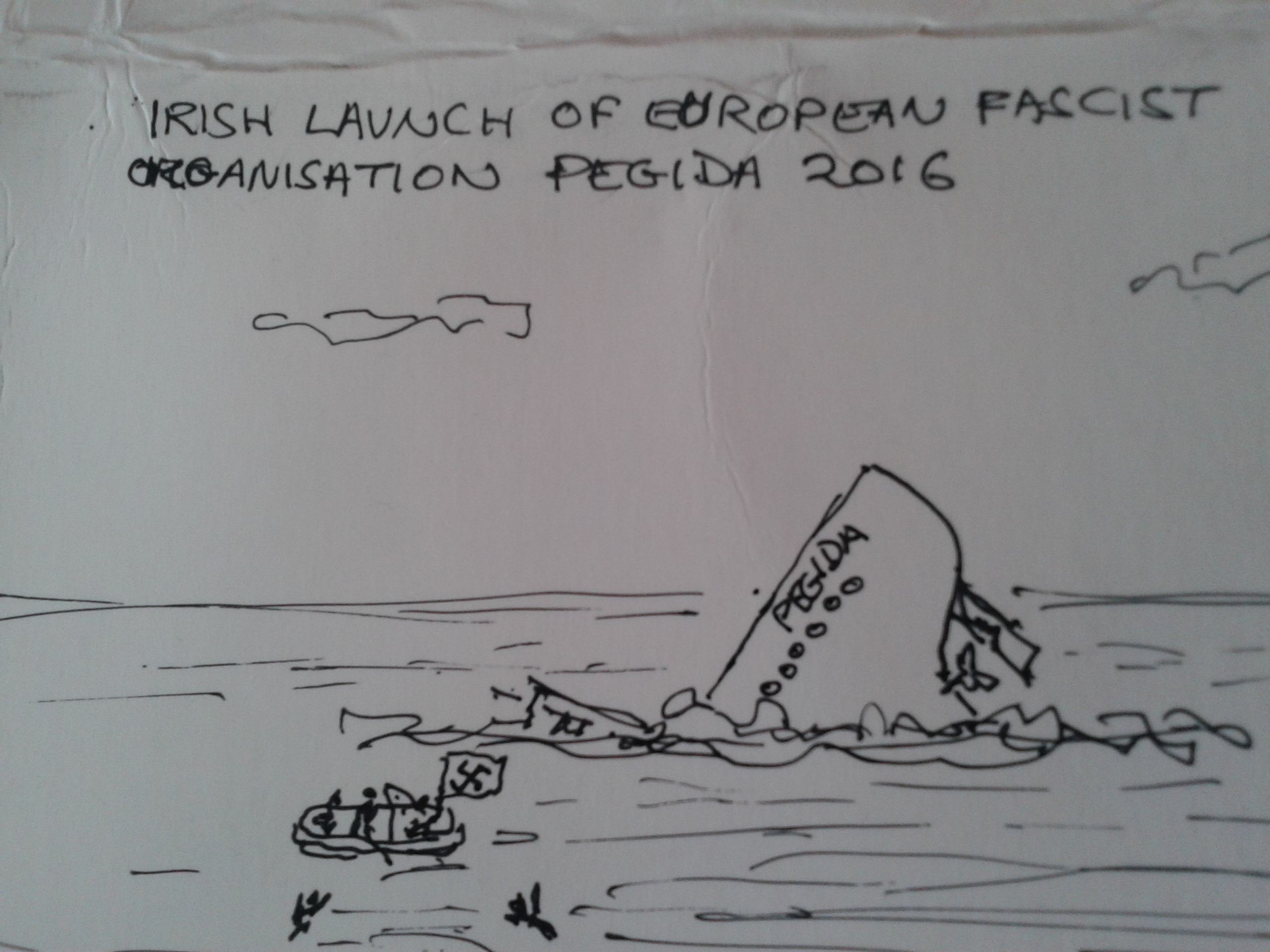
The background to the charges was the boast of fascist islamophobic organisation Pegida in 2016 that it would organise a public rally – and founding meeting – in every capital city in Europe and the rally they planned to take place outside the GPO on 6th February 2016.
In response, antifascists mobilised in Dublin with the intention of preventing Pegida’s launch.
IRELAND’S ANTIFASCIST RESPONSE
The mobilisation took a number of forms:
1) a large diverse group gathered outside the GPO, occupying the space well before the advertised time. A large proportion of these included religious and liberal organisations and individuals.
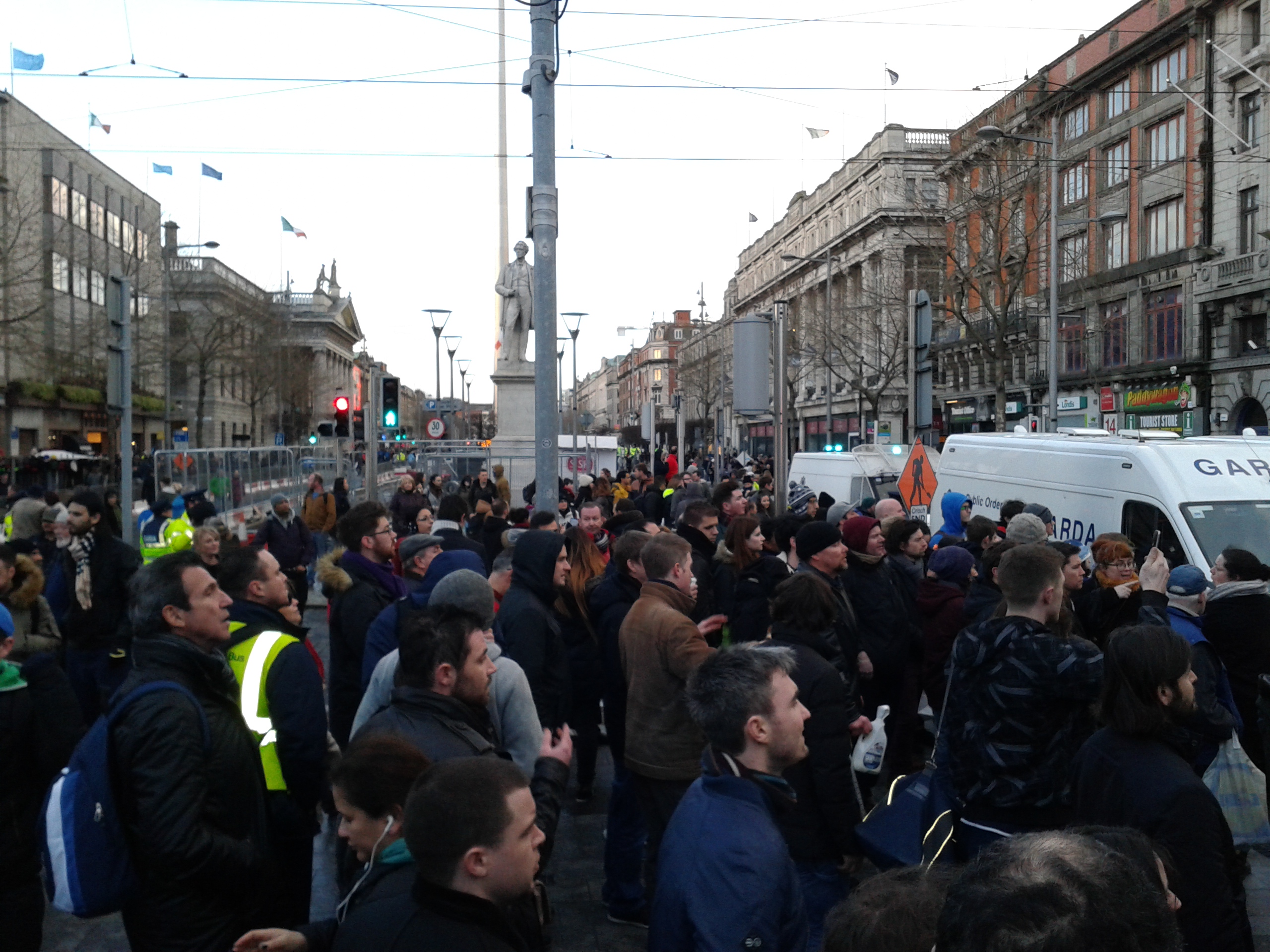
2) Another large group, of Republicans and Socialists of different organisations — and none — gathered in O’Connell Street, on the central pedestrian reservation and on the east side of the street.
3) Irish fascists arriving by Luas (tram system) were met on the tram itself by young antifascists.2
It appears that there were no confrontations between the GPO group and fascists which was fortunate, since some of the participants had publicly advocated non-violence and even encouraged bringing children to the event,3 no doubt in order to emphasise their pacifist nature.
The handful of known fascists of Irish background, whose intended movements were known in advance, apparently noticed or guessed the sympathies of some of the antifascist youth travelling in the Luas, addressed some unkind words to them and violence quickly resulted4.
The fascists concerned apparently abandoned their plan to attend the rally and some reportedly felt the necessity to attend A&E department in hospital instead.
There is no doubt that the longest-running conflict with the most people involved on both sides occurred around the east side of O’Connell Street and streets running off it, in particular North Earl Street and Cathedral Street.
The fascists who were involved there appeared to be all of East European origin. It seemed that they had not been spotted until some of them began to insult some women and when filmed, to make a negative comment along the lines of “your f..king communist filming”.
Once having identified themselves, a crowd of antifascists gathered around them and the situation developed quickly. The fascists were soon running, in the course of which one ran into a Euro-shop in North Earl Street with a number of anti-fascists behind.5
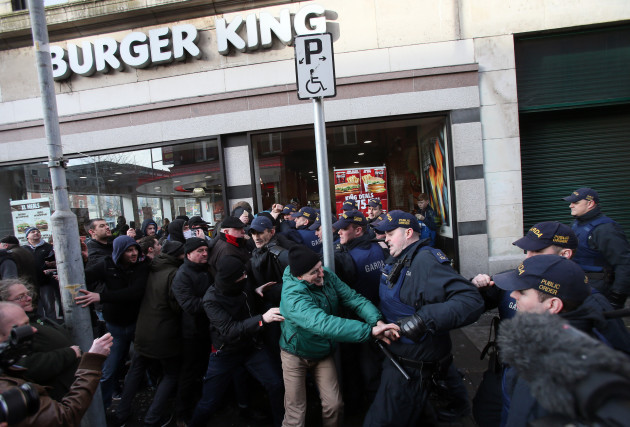
Some Gardaí lashed out with batons at people leaving the shop (which could clearly be seen on the police compilation of video footage shown in court), including an RTÉ cameraman.6
At least three of those fascists ran eastward down Talbot Street, which is a continuation of the short North Earl Street; two large white police vans appeared at the intersection with Marlsborough Street and the “robocops”, the Public Order Unit emerged.
The POU deployed with dogs in North Earl Street, clearing it and menacing both antifascists and shoppers.7
Shortly afterwards, word spread among the antifascists that some of the fascists were in a pub in the parallel Cathedral Street and had exchanged words with some antifascists who also happened to be in there;8 a crowd of antifascists flocked to the area concerned.
This area saw one of the sharpest confrontation between the Garda Public Order Unit and antifascists, with the former lashing out with drawn batons on largely unprotected hands and heads.
The Gardaí rescued the fascists from the pub and loaded them into one of their vans before driving off. A decoy Garda van was blocked in O’Connel Street by protestors and interested youth for a period but the fascists were spirited away to safety in another van.
Pegida had been prevented from holding their rally so the antifascists emerged victorious. The State actors sat down to decide how they would respond in the aftermath.
THE IRISH STATE SHARPENS ITS KNIVES
The first to be targeted by arrests were the antifascists in the confrontation on the LUAS tram. Visible in recordings of the CCTV camera which had remained uncovered throughout, they were identified, charged, convicted and heavily fined — as a deterrent, the judge made clear.
Next the Gardaí set about identifying antifascists active in the North Earl Street conflict and selected two Republicans from different organisations which, along with an independent antifascist from the pub in Cathedral Street, they charged with the serious offence of “violent disorder”.
This led to alarm in antifascist circles since, as outlined earlier the potential penalties with this charge are very high and it had never been used by the State before with regards to a situation of a political nature – in fact, it had hardly been used at all.
Two years after the events, one week to the day after he had been found “not guilty” on another political charge, Donal Ó Ceallaigh was charged with “violent disorder” in connection with the anti-Pegida protest too.
Through the intervening months and years, two of those charged with “violent disorder” separately agreed a deal to plead “guilty” to a lesser charge and avoid the danger of a ten-year sentence and this week at the commencement of the remaining two’s trial, another one did so.
Ó Ceallaigh then remained the only one of the original four on trial for “violent disorder”. His trial began on Monday 24th in Criminal Court No.7,9 six years after the events and four years after he was charged, with some supporters and his wife present in the public area.
TRIAL OF O’CEALLAIGH
Shortly after Ó Ceallaigh’s trial commenced, his defence counsel, Brian Gageby BL engaged by Sheehan & Partners, asked for a discussion in court in the absence of the jury and took the State’s witnesses through their process of protecting the chain of video evidence and identification of Ó Ceallaigh himself.
A compilation of six video clips was shown from: (1) the Euro Shop CCTV, (2) Garda cameras, the (1) TV cameraman’s footage (obtained by warrant) and (1) video taken by the shop’s security guard on his phone.
It emerged that 500 Gardaí have viewed the footage on an internal Garda system without identifying anyone on it.
The Garda officer responsible for ensuring identification then gave a convoluted account of how he had ended up going through associates of another activist to contacting another officer who had arrested Ó Ceallaigh in relation to water protests, who obligingly identified the activist.
That Garda said that he knew the defendant from a previous arrest and that it was he in a number of the videos, wearing a green hooded jacket and red scarf around his neck and that he has a tattoo there,10although only a very small portion of the man’s face is visible.
Another Garda who oversaw the identification claimed to have made his own statement a long time afterwards from memory alone but somehow included the exact times, in minutes and seconds on the video where the other’s statement had identified Ó Ceallaigh!
Defence counsel put it to him he could only have that precision from having written his statement to coincide with the other Garda’s, which he denied having done — of course that would have looked very much like conspiring to, as they say, “fit up” the defendant with regards to identification!
As Tuesday’s jury-less court session drew to a close, Defence counsel made two submissions to the Judge objecting to the challenged video identification evidence going to the jury, which Prosecution counsel defended and the judge retired to consider the arguments.
At resumption of the trial on Wednesday morning, the Judge announced her decision not to permit the challenged video evidence to go before the jury and the Prosecution counsel admitted that without that, effectively they had no evidence to place the activist at the scene.
The jury was then called in and the Judge directed them to return a verdict of “Not guilty”. Ó Ceallaigh was free to go and receive the embrace of his wife and congratulations of his supporters (and from some interested members of the public).
Though appearing glad he seemed to take it all quite calmly but admitted to the author that it had been “a bit of a strain”.
SUMMARY
As a result of the mobilisation and struggles on the day, Pegida was prevented from launching in Ireland, perhaps the only European country in which they failed to do so. This would have been important in any case but became especially so with the struggles around Covid to come.
The State had failed to protect the fascists’ “right” to hold their founding rally in Ireland and no doubt the Gardaí felt humiliated. They determined to recover ground and the State made a political decision of charging demonstrators with a very serious charge: “violent disorder”.
In that, the State hoped to establish a legal precedent with a view to its use against demonstrators in other situations in future. It did in fact establish the precedent in using the charge (and without an outcry from liberals and social democrats).
The State may have felt enough was gained for the moment in offering to accept a “guilty” plea to a lesser charge but when Ó Ceallaigh declined to accept the deal, they tried for a conviction, which would have given them the precedent they originally sought – but they failed.
However, many antifascist activists were punished and according to information received, 15,000 Euro in punitive fines was collected, not to speak of the worry and years spent in the shadow of the hanging sword.
Antifascists have hopefully learned the importance of going masked in similar situations and awareness of the role of CCTV cameras which are ubiquitous in the Dublin city area. The charge of “violent disorder” remains as a threat and punishment for demonstrators in future11.
The wording of the charge ensures that no actual violence need be used and the “fear” surrounding a situation remains open to subjective interpretation and even manipulation of witnesses by police.
The RTÉ’s camera footage – ironically in view of the fact of his assault by a Garda – was obtained by warrant which raises issues of concern with regard to press freedom and safety. If verified media’s film is to be used by the State, how then is the media to claim independence?
And if demonstrators know or believe that media footage of them is likely to be used by the State, are they likely to tolerate the presence of such camera operators? Will we not all be the poorer if the media cannot produce film and photos of events of a similar nature?
This is surely an issue on which the press, along with the respective trade unions should take a stand, if they truly believe in their independence and freedom and think it worth defending.
While there is no current evidence of a resurgent attempt to found Pegida in Ireland,12 a number of small fascist organisations have been founded in recent years, including Identity Ireland, the National Party, Irish Freedom Party and Síol na hÉireann.
History has shown that when the ruling capitalist class is in crisis, it suits it to use fascists as part of the repression of the people’s resistance struggles. Certainly there is something of a crisis in the capitalist system world-wide at the moment and repression is very much on the agenda.
Pegida does exist in Europe and as late as the 22nd, the Saturday before the trial in Dublin, planned to publicly burn the Koran in Rotterdam, Holland,13 to which the State there responded by arresting their leader and accusing Pegida of disseminating “hate speech”.14
End.
FOOTNOTES
1 The 1994 Public Order Act (see Sources) and this section at least uses even the same wording as the 1986 Public Order Act of the UK (see Sources).
2 That group was of Identity Ireland, led by Peter O’Loughlin, a long-time Irish fascist who apparently planned to be chairman of the Irish branch of Pegida. According to recollections of antifascists to the author, there were also much smaller groups of anti-fascists roaming the south city centre attempting to coordinate and collate information while searching for groups of fascists.
3 Pacifism in the face of potential fascist violence seems dangerously stupid to me but that pales into insignificance when compared to the criminal irresponsibility of putting children in danger of such attack.
4 This was one of the areas which the Gardaí used to bring charges against anti-fascists and footage from the LUAS CCTV was used against individuals. The antifascists involved seem to have been from Dublin soccer club supporters’ associations and those identified were fined within a relatively short period of time.
5 This site was one of those used by the Gardaí to charge a number of antifascists and footage from the security CCTV were used in evidence against the latter.
6 The management of the TV channel complained as did the cameraman. Quite some time later the Garda in question was found guilty of assault and, despite the viciousness of the assault on a clearly unthreatening person and his lack of remorse, was given a suspended sentence but remained in the police force without facing a disciplinary hearing.
7 “I was coming back from reconnoitring around the Connolly Monument in Beresford Place, in case fascists had gathered there. Cycling westward along Talbot St. I saw three young men running west; they appeared East European to me and had hair cropped very short. I assumed they were fascists but there appeared to be no-one in pursuit and three was too many for me so I passed them and at North Earl St. junction found a large crowd with Public Order Unit with barking dogs and batons drawn preventing people from entering the area. The crowd was of mixed shoppers, passers-by and anti-fascist demonstrations.” (Recollection of antifascist to author.)
8 This site too became one to attract police charges against at least one antifascist.
9 On Tuesday it was moved to No.12 instead, right next door, coincidentally, to the Special Criminal Courtroom where a trial is currently underway. The SCC was from its inception a no-jury political court for decades but recently began to try some high-profile criminal trials.
10 He does in fact but you’d need x-ray vision to see it through a scarf! There had been a mass campaign against the proposed additional water charges and the belief that the public water supply system in the Irish state was about to be privatised. Protesting in the context that water charges were already being paid through two different public taxes, hundreds of thousands marched and smaller groups mobilised to disrupt the installation of water meters outside people’s houses (the locations of those unused meters may still be seen around Dublin city in particular). Most arrests took place in this latter part of the struggle, though a number of defendants fought a successful battle to prevent the State convicting them of “kidnapping” a Government Minister while protesting against her ministerial visit to a school in Jobstown. The additional taxation and privatisation plan was abandoned in 2015 – at least for the moment.
11 Note that there have been many situations of actual violence by fascists wielding clubs in Ireland in recent years in which the State chose not to charge any of the perpetrators with “violent disorder” and in fact only with great reluctance charged one individual, Michael Quinn of the National Party with assault after widely-circulated video evidence refuted Garda public statements that no violence had occurred.
12 According to Anti-Fascist Action Ireland from people viewing the fascist communication traffic, the Eastern European fascists who participated on the day denounced the Irish fascists of Identity Ireland as cowards and declared they would never work with them again.
13 Religious book of greatest importance to Muslims, equivalent to the Bible for Christian and the Talmud for Jews.
Many thousands marched through Dublin’s city centre yesterday in protest against the soaring cost of living, pushed in particular by rising energy costs. Most mass media avoided estimating numbers except the ridiculous ‘estimate’ of 3,000 by the Irish Times daily1.
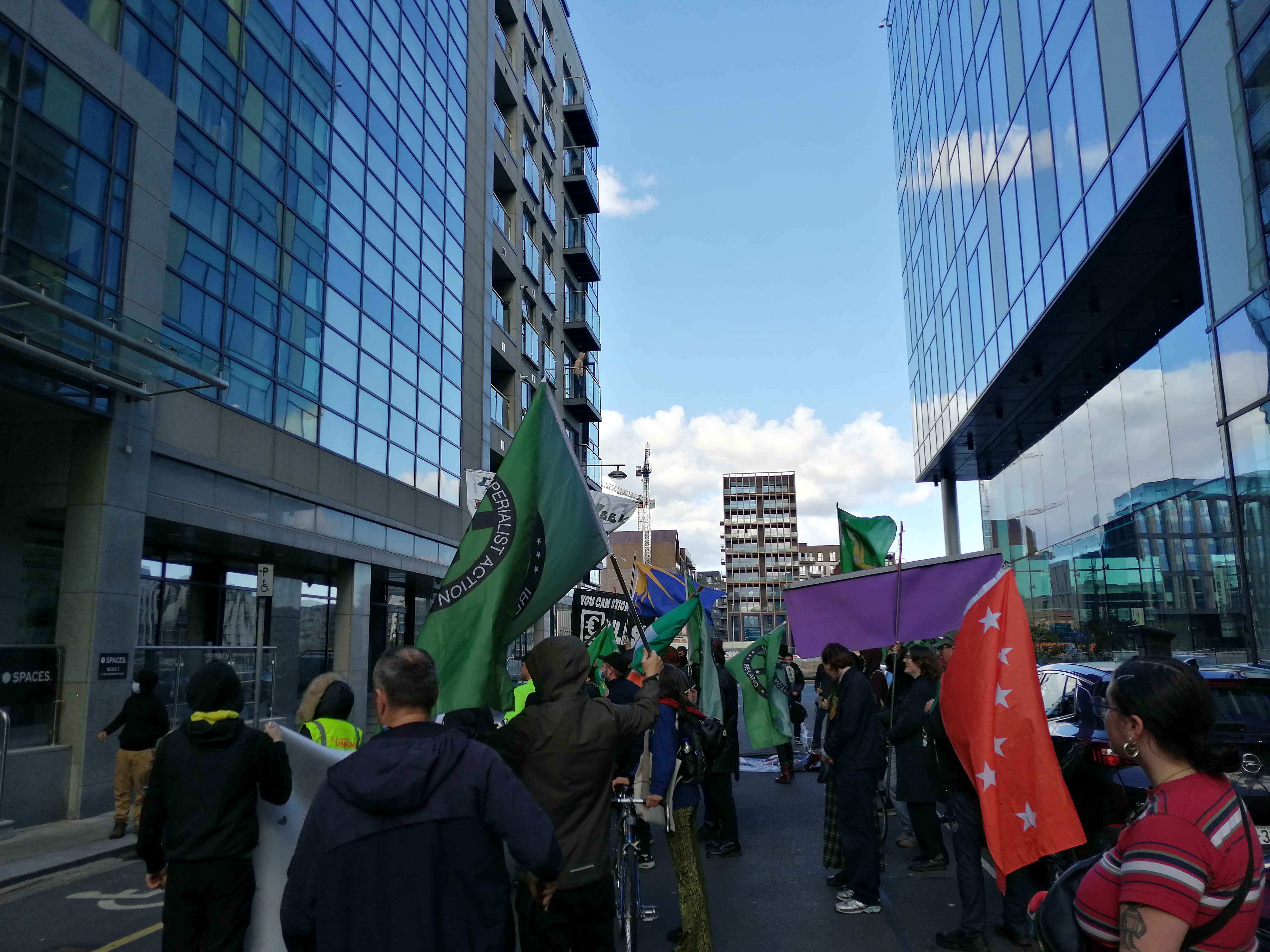
As the Cost of Living Coalition convened a mass protest demonstration in Dublin, the Anti-Imperialist Action organisation called for a Revolutionary Bloc to meet at the James Connolly monument2 in Beresford Place.
In mid-July, statistics published showed the average cost of living had risen above 9%. The average figure conceals the higher percentage rise in daily consumables such as food and drink that will rise higher still with price hikes by energy supply companies.
Companies are raising their prices steeply across at least the western world in a trend that began, despite much media discourse, prior to the Russian invasion of the Ukraine. But Ireland emerges as the most expensive country in the EU with Dublin the most expensive city there by far3.
(Photo:Rebel Breeze)
SPEECHES FOR REVOLUTION & AGAINST REPRESSION
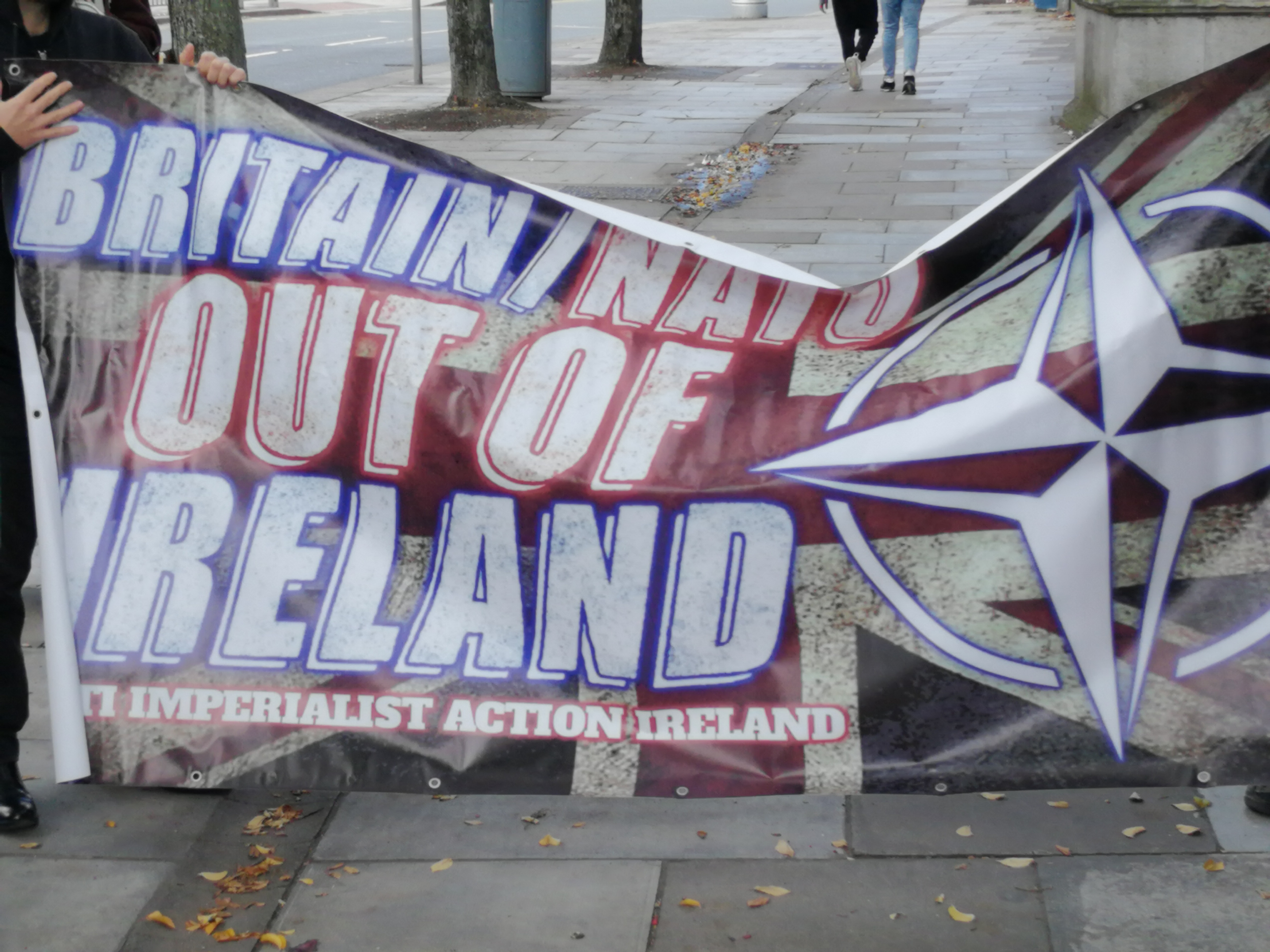
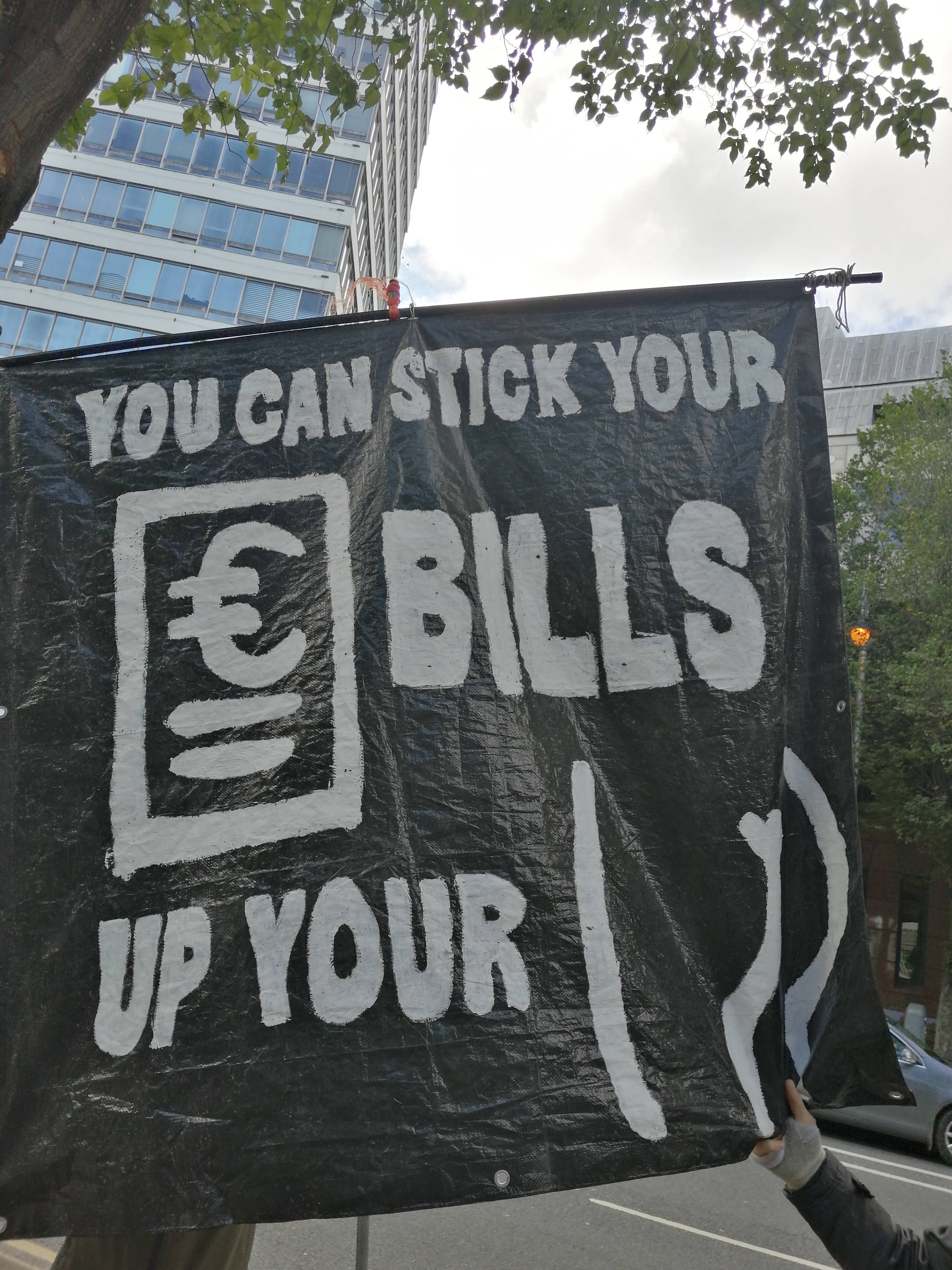
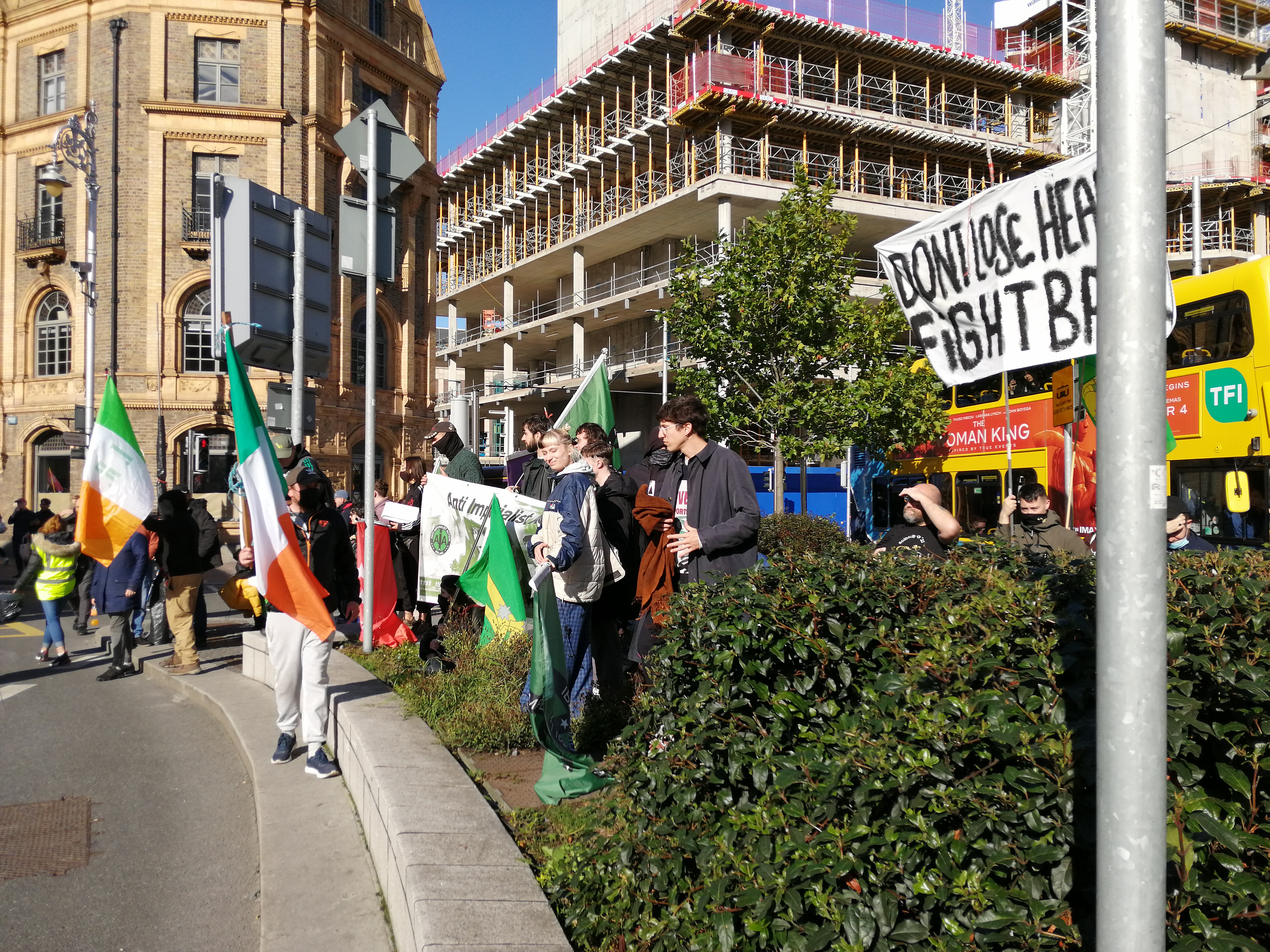
At the Connolly monument, people gathered with banners about the housing struggle and against NATO, along with placards and flags, of which latter the most common was the green-and-gold version of the “Starry Plough”, flag of the Irish Citizen Army4.
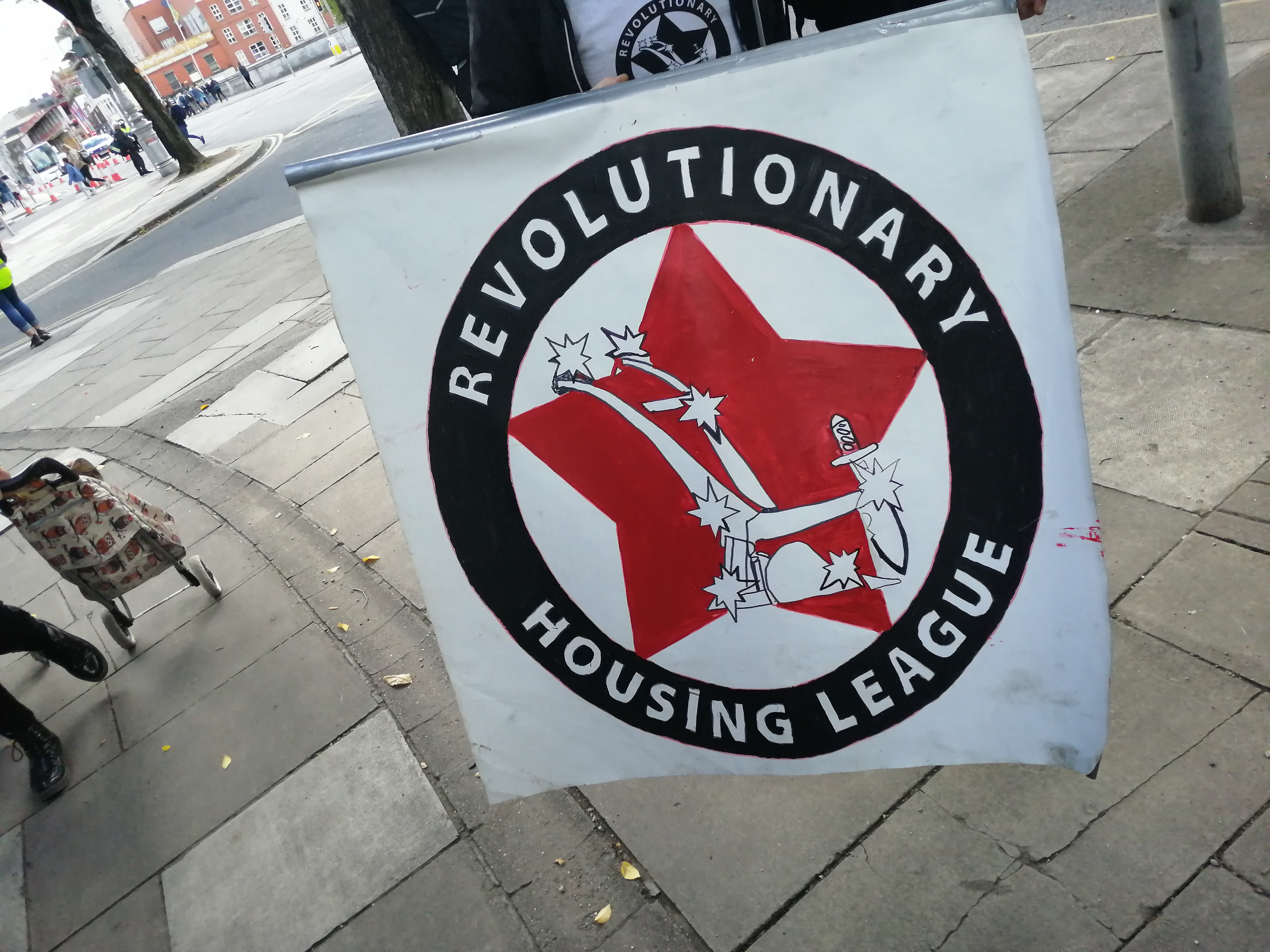
The cathaoirleach (chairperson) welcomed people, introduced the purpose of the meeting as being to protest the soaring cost of living and introduced the first speaker, from the Revolutionary Housing League. The RHL speaker outlined their program of direct action.
(Photo:Rebel Breeze)
“What can be more direct than to occupy empty buildings?” he asked those assembled. He recounted some of the recent actions of the RHL and said that they are attracting attention and support, ending by calling on others to get involved5.
The second speaker, introduced as a revolutionary socialist anti-imperialist, went through a list of ills brought by the capitalist system, including lack of housing, selling off our resources and infrastructure, disregard for our language, environmental destruction and danger of nuclear war.
For all said the speaker, the Irish national bourgeoisie are guilty, “the Gombeens, a class unable even to free their own country”. “We need broad fronts to fight all these attacks of class war”, he said “but they must be directed openly against capitalism and imperialism.”
(Photo:Rebel Breeze)
The final speaker, a socialist Republican, represented the newly-formed End State Repression campaign group. Those wanting to oppose rising prices, he emphasised, could not share their struggle with those intending to enter a coalition with Fiann Fáil or Fine Gael.
He also recalled how when protests against the bank bailouts and student fee hikes were getting going in 2010, they were met with state violence through the Gardaí. As the resistance builds, it will get attacked, he said but “we can’t allow them to drive us off the streets again.”
(Photo:Rebel Breeze)
Many drivers passing the rally in vehicles, private and of work – including public transport — sounded their horns in solidarity, giving rise to cheers from the protesters.
MARCH TO BLACKWATER
The assembled then set off in two lines along Custom House Quay, across Talbot Memorial Bridge and then eastward along the quays. On the way they shouted slogans including “One, two, three, four – Housing crisis no more!” and “Only solution: Revolution!”
Other slogans include “Whose streets? Our streets!” “Whose Republic? Our Republic!” and “High rent, high taxes – fight back!”
The marchers stopped upon reaching the offices Blackwater Asset Management Company which boasts its background in “coming from the following sectors, Police Force, Legal Profession, Defence Forces, Financial Services & Private Security sectors”.
(Photo:Rebel Breeze)
(Photo:Rebel Breeze)
The crowd expressed its disapproval of the actions of this company. A speaker assured all that any attack on housing activists will be met with resistance. Two songs were sung there too, including Connolly’s Be Moderate/ We Only Want the Earth.6
THE BLOC MEETS THE MAIN MARCH
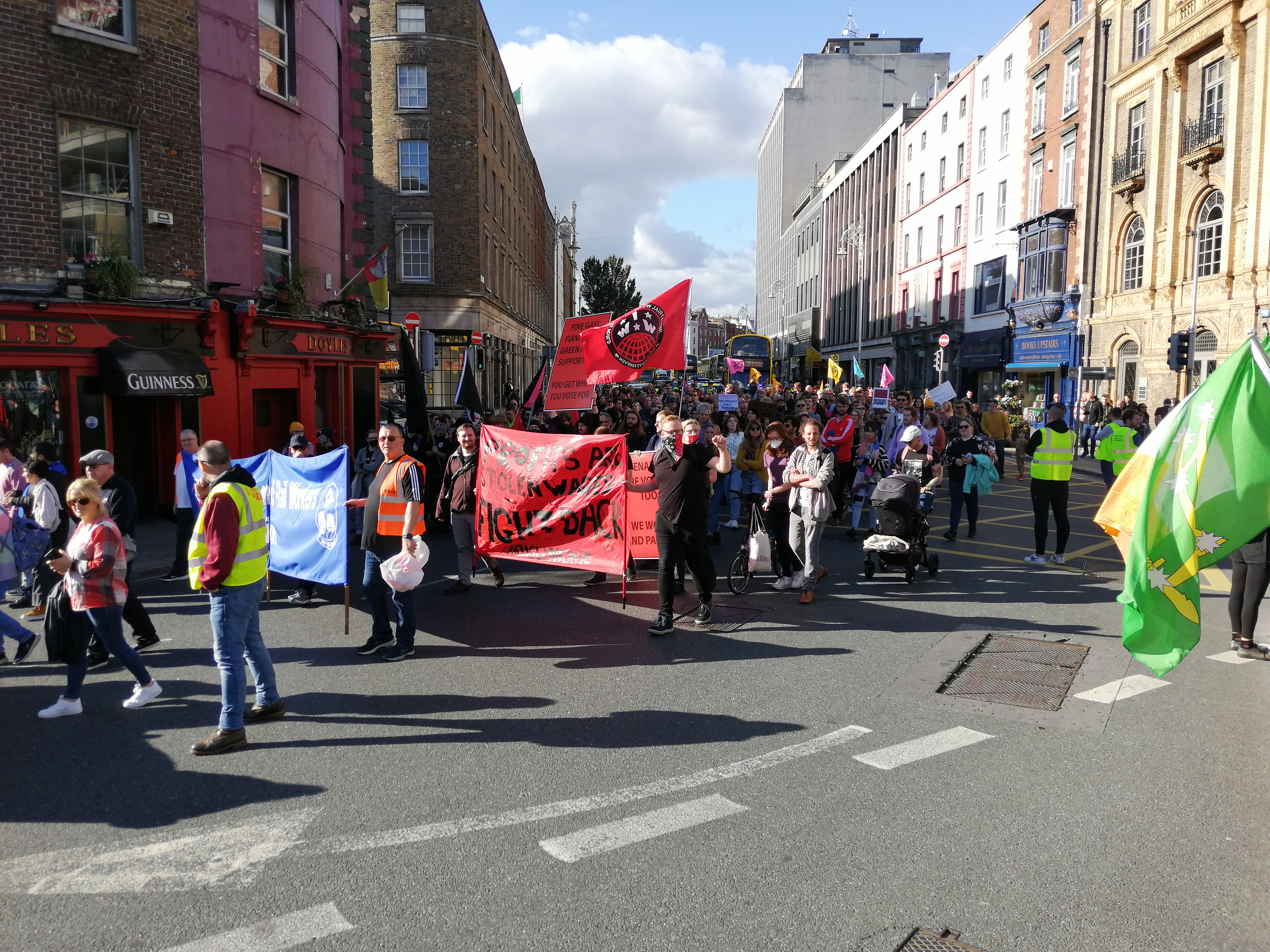
The Bloc marchers passed through the high-rise apartment blocs in the area before going on to Pearse Street and marching to the junction with D’Olier Street, where they met the main march of many thousands7 rounding Trinity College and still coming down from O’Connell Street.
Here the revolutionary bloc displayed their banners and placards and chanted some slogans. Many in the crowd marching past gave signs of appreciation and people in an anarchist bloc shouted “Solidarity”, raising clenched fists, giving rise to equal response from the Bloc8.
Section of the main cost of living protest march in D’Olier Street and rounding junction with Pearse Street. (Photo:Rebel Breeze)
The large Sinn Féin9 section aroused shouts of “No Collusion! One Solution! Revolution!” from the Bloc. The earlier slogan of “1,2,3,4 – Housing crisis no more!” segued for awhile into “5,6,7,8 – Smash the Free State!”
The main Dublin march was organised by the Cost of Living Coalition of 30 organisations, including People Before Profit but also Sinn Féin, which is on a clear trajectory to enter Government in the near future but in coalition with traditional neo-liberal capitalist political parties.
Revolutionary Bloc meets main march at junction Pearse Street and D’Olier Street. (Photo:Rebel Breeze)
The CLC also includes trade unions which many accused of not mobilising for the protest.
Derry city saw a small protest against the rising cost of living also.
A far-Right march in Cork which was addressed by a representative of the fascist National Party attracted little more than 150. Ostensibly against the housing crisis, speakers of course attacked immigration despite it having no connection to the State failure to build affordable public housing.
A marcher in Dublin carrying a placard calling for an end to immigration until the housing crisis were solved gave rise to a chorus of “Home for All!” from the Revolutionary Bloc, calls echoed by some among the passing marchers.
Anarchist section in the main march indicating solidarity with the Revolutionary Bloc. (Photo:Rebel Breeze)
Gardaí on foot and in patrol cars tailing the main march were greeted, as they passed the Revolutionary Bloc, with shouts linking Drew Harris10, Commissioner of the police force of the Irish State, to the British Intelligence Service MI5.
A notable feature of both marches was the patience with the interruption to their journeys of private and public transport drivers and, indeed, the signs of support from many, including beeping of horns and hand signals such as the ‘thumbs-up’ and even the occasional clenched fist.
end.
(Photo:Rebel Breeze)
FOOTNOTES
1The Irish Times has a track record of drastically reducing the estimated numbers in reports of anti-government demonstrations, demonstrated most strikingly during the giant water protest marches. It gave the figure 3,000 in leading paragraph to its original twitter report but more recently amended that on line to “several thousand”. The Sunday Mirror reported 20,000 and supporters estimated between 15,000 and 20,000.
2The monument includes a representation in bronze of the Scottish-Irish revolutionary James Connolly, across the road from where he had his office in Liberty Hall (the two-storey building was destroyed by British shelling in 1916 and has since been replaced by a tall man-storey building, HQ of the SIPTU union. Connolly was one of 16 executed by the British in 1916 after the Rising that year.
4The ICA was formed to defend striking workers from police attacks during the 1913 Lockout in Dublin. It was based on trade union membership and took a prominent role in the 1916 Rising, with a much-reduced one in the War of Independence (1919-1921) and the ensuing Civil War (1922-1923). The ICA recruited women as well as men and some of the women held officer positions, possibly the first revolutionary organisation, certainly the first socialist-based one to do so.
6The lyrics were composed by James Connolly and published in hist Songs of Freedom in New York in 1907. The title was the ironic “Be Moderate” but has come to be known from the refrain as “We Only Want the Earth”. Furthermore, arranged to the air of “A Nation Once Again”, it provides a chorus of “We Only Want the Earth!”
7Most media would only state “thousands” or “many thousands”, but the Irish Times had the audacity to claim the ridiculously low number of 3,000! Estimates by participants varied from 10,000 to 20,000 (latter also figure of the Sunday Mirror).
8It seemed likely that had the Revolutionary Bloc been widely publicised earlier that it would have been supported by many individuals and at some other organisations.
9The former revolutionary republican party rarely mobilises its large membership for street protests as these days it is more concerned with votes in elections. However, SF is part of the Cost of Living Coalitionand SF’s President, Mary Lou MacDonald, was one of the scheduled speakers at the main march rally.
10Immediately prior to his current appointment, Drew Harris was Deputy Chief Constable of the sectarian British colonial gendarmerie, the Police Force of Northern Ireland which, until 2001, was the Royal Ulster Constabulary.
For a group that first came into public view on May 1st with an occupation of a building empty for two years, the Revolutionary Housing League has certainly been busy. At least two further acquisitions1 have followed since.
In addition, a hundred police with vehicles and helicopter have been videoed in one eviction of two activists; four activists have appeared defiantly in court in different cases and the High Court has granted injunction to companies against activists.
As I write this another eviction is being planned, resistance is being organised and further repression through courts and jail seem certain. The RHL are fighting the system, fighting a fundamental social wrong acknowledged by almost everyone.
SHORT HISTORY OF THE REVOLUTIONARY HOUSING LEAGUE
In 1st May 2022 activists acquired Lefroy House on Dublin’s Eden Quay, formerly used by the religious-based NGO, the Salvation Army to provide night-beds for young homeless people but empty for two years. The activists renamed the building Connolly2 House.
A decorated tile at the door of Connolly House in May/June 2022 (Photo: D.Breatnach)
At that time the occupiers were calling themselves the Revolutionary Workers’ Union though their council subsequently formed the Revolutionary Housing League.
The Salvation Army took the occupants to court, claiming the SA had been renovating the house in order to accommodate Ukrainian refugees. Despite the absence of evidence of any renovation work and the presence of a leaky roof (fixed by the activists!), the court granted the injunction.
The occupiers called for a rally against eviction on 2nd June and a large crowd of people of various political backgrounds, organisations and independents, arrived to support but of course, the eviction forces could wait and choose their time.
Musician performing and section of crowd at rally against eviction outside Connolly House (Photo: D.Breatnach)
On June 9th at 5.45 a.m early passers-by were amazed to see 100 Gardaí3 with a number of vehicles, supported by a helicopter, including armed police4, assault the building to take possession of it for the SA and to arrest two activist occupants. A video of the event taken by a passer-by went viral.
Both activists were later released on their own surety bail to await court process and the building was fortified against being retaken. To this date it remains empty.
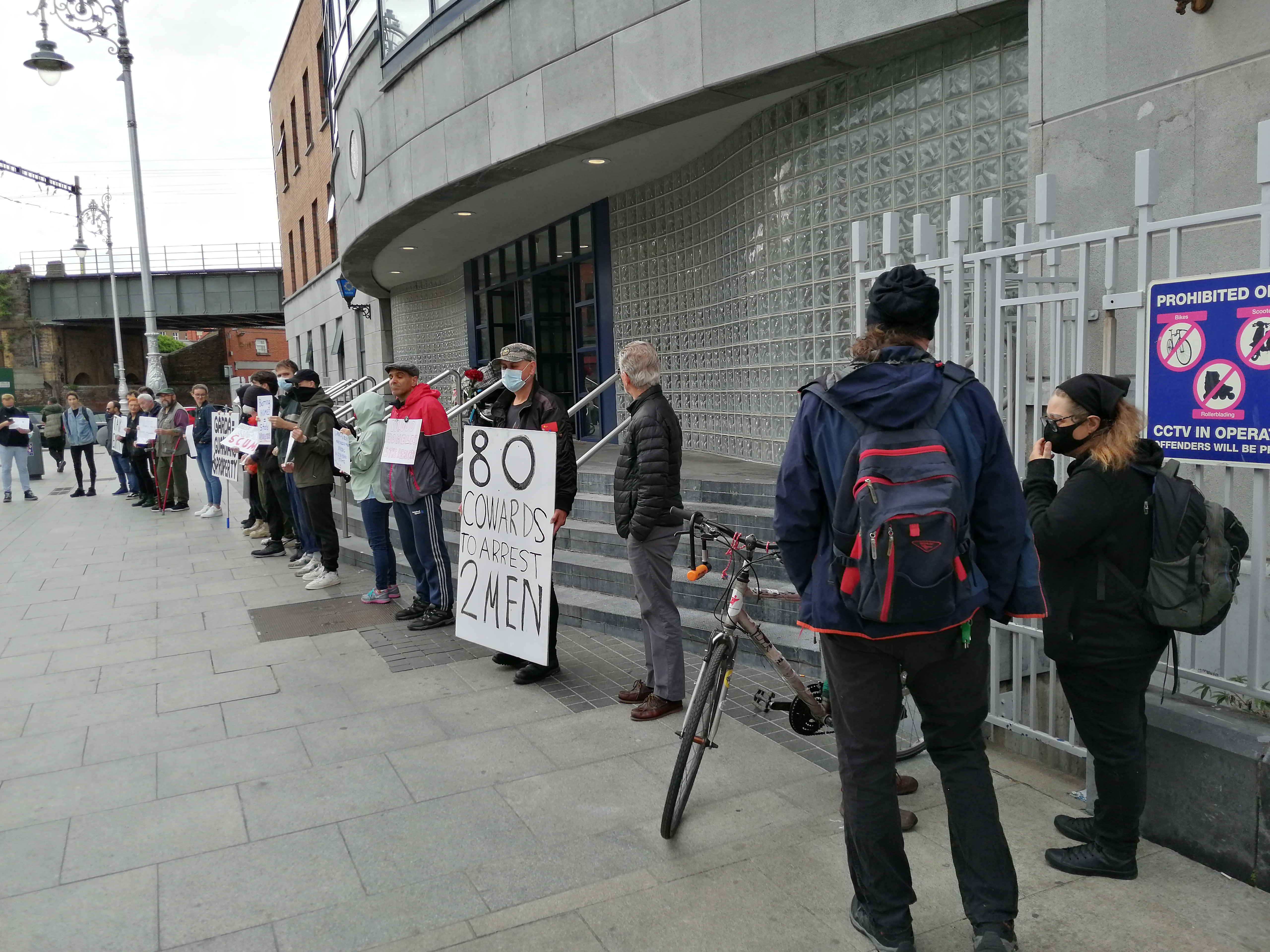
On 13th June, the housing activists convened a protest picket outside Store Street Garda station.
Picket on Store Street Garda Station following eviction of James Connolly House (Photo: D.Breatnach)
The RHL had acquired another site5, this one having been a building for homeless people of the municipality, Dublin City Council, but also empty for a long period. On June 10th Gardaí arrested two activists near the building and they too are being processed by the courts.
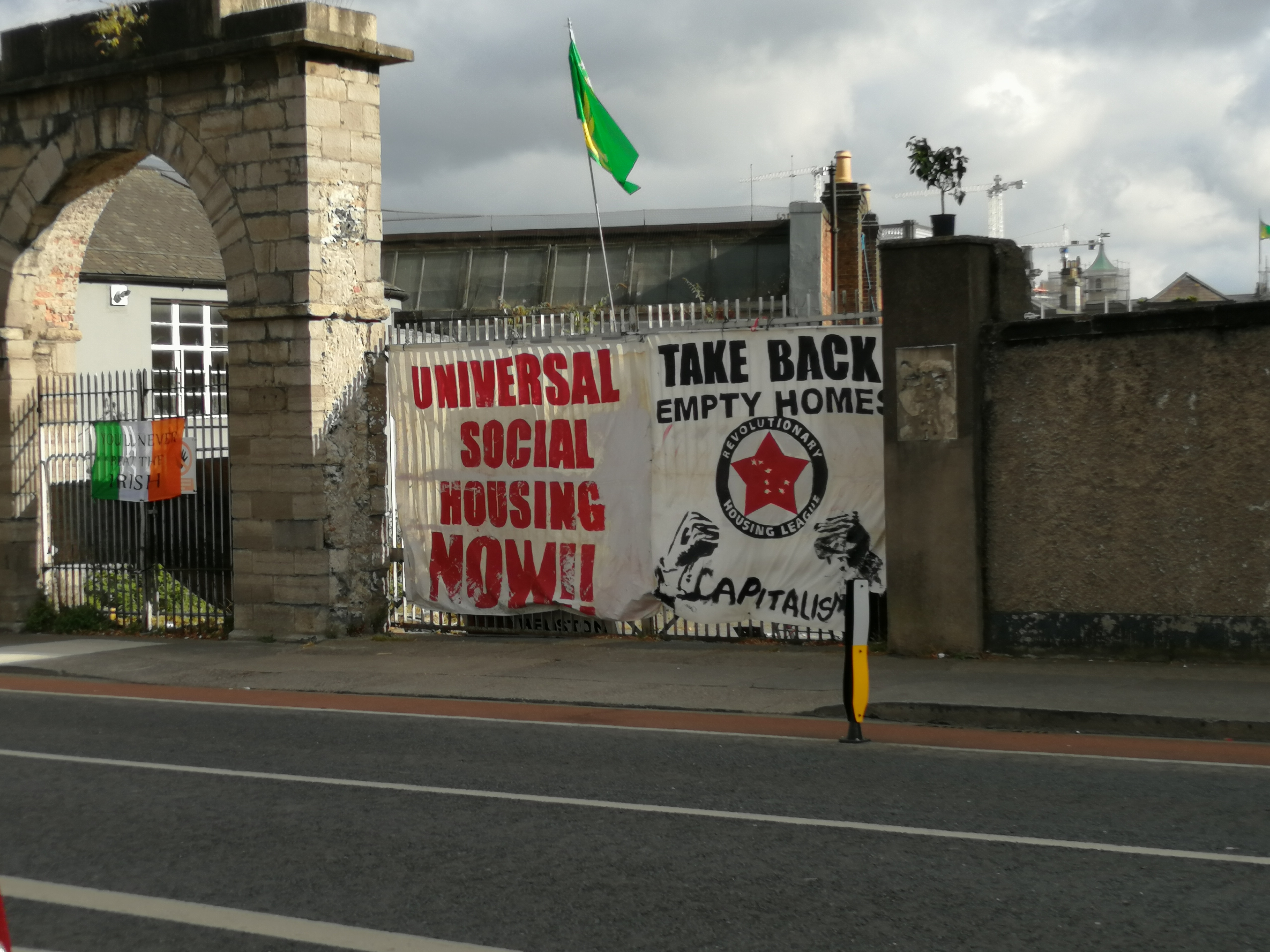
After that, the RHL occupied a large warehouse-type building on the very north bank of the Liffey by Sean Heuston Bridge which they named, naturally enough, Ionad6 Seán Heuston. They opened it as emergency accommodation and held talks and discussions within it.
Parkgate Street front of Ionad Seán Heuston in early September 2022 (Photo: D.Breatnach)
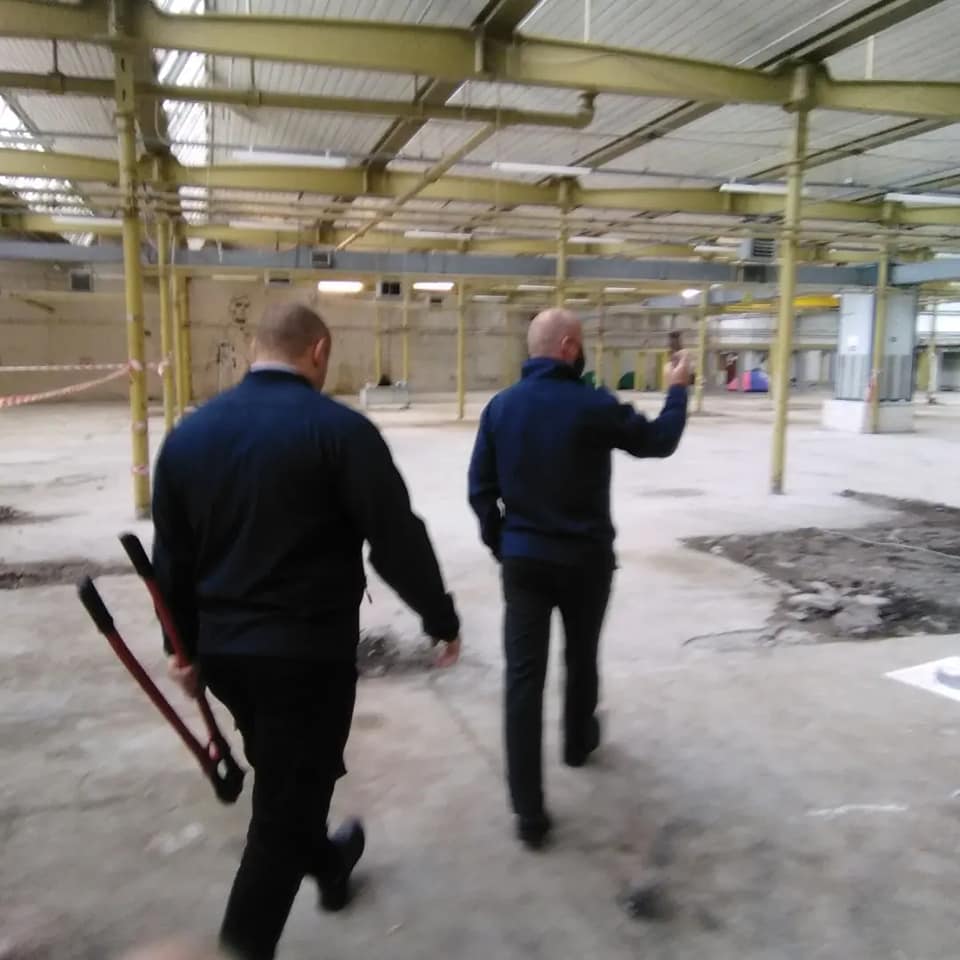
Employees of Pinnacle Security company with bolt-cutters entered the site on 3rd September but failed to evict residents and on the 5th September RHL activists picketed the company which, as a consequence, withdrew from acting as security for Chartered Land, owners of the site.
Pinnacle Security staff, one armed with bolt-cutters, entered Ionad Seán Heuston on 3rd September but failed to intimidate the residents into leaving. Two days later, RHL picketed their HQ and were given a written undertaking that the company would no longer carry out security for Chartered Land on the site. (Photo: Revolutionary Housing League)
The building owner’s interests are managed by Davy Platform ICAV, acting on behalf of its sub-fund the Phoenix Sub-fund but ultimately, the owner is Chartered Land which intends to build high-rental apartments on the site.
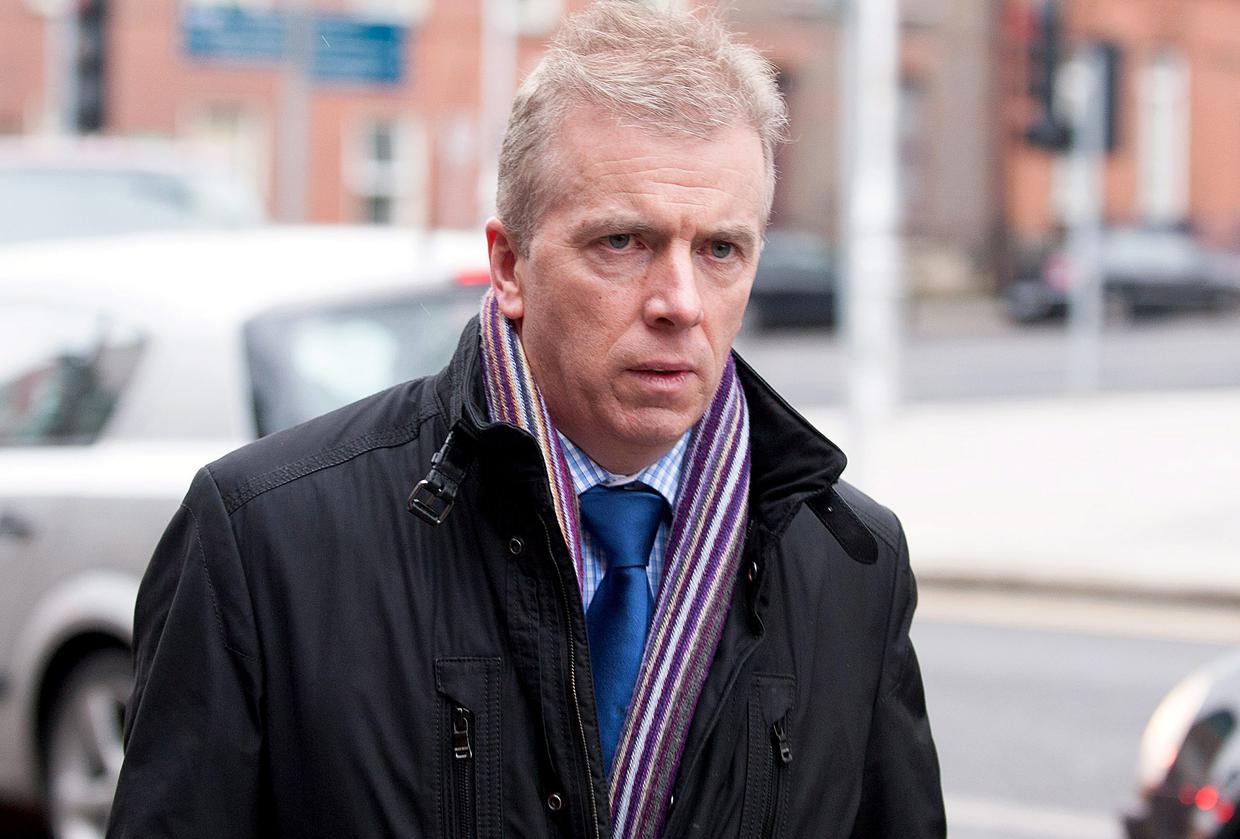
Joe O’Reilly is the property speculator tycoon behind Chartered Land, once the biggest debtor to NAMA whose responsible officer Conor Owens permitted O’Reilly to transfer his Moore Street, ILAC and Dundrum Shopping Centre holdings to Hammerson, a British-based property company.
Joe O’Reilly after appearing as a witness in criminal court in 2015 (Photo: Irish Independent)
That transfer gave Hammerson control of properties O’Reilly’s planning permission from Dublin City Council for a giant “shopping mall” there which they have now changed but again approved by DCC’s Planning Officer and which is under appeal to An Bord Pleanála.
Conor Owens is now Ireland Director for Hammerson.
Lawyers for O’Reilly named a number of individuals as being in occupation of the property, at least two of them apparently on the basis of photographs of the interior shared by the them on social media. Last Thursday a number appeared in court on applications for injunctions against them.
One who had not been named, a homeless individual, made an emotional appeal for he and his partner to be allowed to stay and the occupants to provide services to more homeless people. Another denied he had been an occupant but had merely shared photos on social media.
That latter individual had the injunction against him removed but was asked to sign an undertaking he would not enter the building, which he declined to do, remarking that he should not even have had to attend the High Court in the first place.
Sean Doyle of the RHL declared that the action they were taking was necessary and quoted James Connolly: We believe in constitutional action in normal times; we believe in revolutionary action in exceptional times. “These are certainly exceptional times”, Doyle remarked.
The judge went ahead and granted the injunction and required all occupants to evacuate building by Wednesday 21st (i.e as this piece was being concluded).
The RHL organised a picket and temporary protest occupation of Davy stockbrokers, who were handling procedures for Joe O’Reilly, the property tycoon owner of the site of Ionad Seán Heuston.
RHL picket and temporary occupation of Davy stockbrokers (Photo: Revolutionary Housing League)
Last weekend the RHL organised a solidarity concert at Ionad Seán Heuston with somewhere between 150 to 200 in attendance and with at least two bands posting on social media their delight at having performed there.
O’Reilly’s legal team claimed “a flagrant breach of the court order”.
The RHL have called a solidarity rally against the eviction at the site for tomorrow at 10am.
Band performing to crowd at Ionad Seán Heuston — “a flagrant breach of court order” according to property tycoon’s lawyers. (Photo: Revolutionary Housing League)
THE FUTURE
Whatever the outcome of the eviction intended for this particular building or the eventual result of court cases, it seems clear that the RHL are on a collision course with the State and its protection of landlords and property speculators.
While some may look askance at such a contest, one may ask legitimately what other course of action is effective and viable?
Marches and short-term symbolic occupations of individual buildings, including the high-profile Apollo House one supported by prominent individuals in December 2016, though possibly raising awareness, have not made a single dent in the homeless crisis.
Section of the crowd at rally outside Apollo House 11 January 2016. Events such as these mobilised opinion but did not change the situation as indeed it worsened (Photo: D.Breatnach)
Indeed, the situation seems to have got steadily worse – at least for those seeking accommodation; while on the other hand clearly landlords, letting agencies, property speculators, vulture funds and the very banks are raking in their profits.
OVER 10,000 HOMELESS INCLUDING 2,503 CHILDREN
Earlier this year the State admitted that homeless figures had passed ten thousand, for the first time since the covid pandemic7, a statistic that includes the shocking figure of 2,503 children.8
And a recent report states that the levels of homelessness are under-estimated because of the accounting system used by the State, which focuses on rough sleepers and those accessing emergency accommodation9.
Mural representing revolutionary Irish socialist Republican Constance Markievicz and the outline in red stars of “the Starry Plough” (Ursa mayor), one of the impressive murals inside Ionad Seán Heuston (Photo: Rebel Breeze).
Sofa-surfing, rotating between friends and family, precarious rental arrangements all figure in homelessness but are not measured or accounted for by the State. Indeed these features of homelessness have been known for decades.
Clearly too, the obvious solution, the release of substantial funds by the State to local authorities to build public housing for affordable rent, is not favoured by any of the Government political parties.10
Apart from the general inclination of the ‘political class’ to serve big business many have direct interests in the housing situation, as an audit of TDs (member of the Irish Parliament) found over 80, i.e more than half, are landlords or own property – or both.11
Faced with such a situation it is clear that only a very substantial shock to the political system has any hope of having a serious impact on the housing crisis. Though the solution need not be revolutionary, all the evidence is that the methods do indeed have to be so12.
An interesting side-aspect of the RHL’s occupation has been the use of innovative and highly-effective art in banners and murals. Also the holding of a concert and some trad music sessions in acquired buildings, along with educational talks, discussions and Irish language classes.
Another of the murals in Ionad Seán Heuston, a representation of the profile of Pádraig Mac Piarais/ Patrick Pearse, revolutionary Irish Republican, writer, educator, executed by British firing squad in 1916. His slogan translates as: “A country with out its language (is) a country without a soul”. (Photo: Revolutionary Housing League)
The RHL is a small organisation fighting the State Goliath which is representing the Philistines of property speculators, vulture funds and banks. They deserve our support in whatever measure we are able to give, in attending events and spreading the word.
Indeed, they have called for wider action – the RHL has on a number of occasions called on people to do what they are doing, to occupy the thousands of empty buildings which, if people did, would transform this struggle into a mass movement.
With no other viable solution in sight, surely we should support the RHL? Do we not owe it to those on the street or struggling to pay mortgages or high rents? Do we not owe to the children now, the future generation that will be blighted unless we act?
End.
The Starry Plough flag of the Irish Citizen Army in the early decades of the 20th Century flies above Ionad Seán Heuston (Photo credit Revolutionary Housing League, taken from Seán Heuston Bridge)
FOOTNOTES
1The RHL call their taking of empty properties “acquisitions” in the name of the people.
2After notable socialist revolutionary, trade union organiser, journalist, historian and writer James Connolly, executed by British firing squad in 1916.
3The police force of the Irish State is called An Garda Síochána and the plural of its members, “Gardaí”, singular “Garda”.
4The Garda Síochána is essentially an unarmed police force with an armed response section, the latter which however seems to be growing and more in evidence in different situations.
5They named that one Liam Mellows House in honour of socialist Irish Republican and former member of the Irish parliament, the Dáil, executed during the Civil War by the Irish State in retaliation on 8th December 1922.
6Ionad in Irish means “place/ location/situation”.
10Sinn Féin’s latest housing policy indicates a crash building program for “affordable homes” but unclear whether to rent or own. Election promises tend to be taken with a pinch of salt by commentators; SF Councillors on Dublin City Council voted public land sold to developers. In addition, a future government including SF would almost certainly include a former government party in the coalition.
12The State has the power to put empty properties to use to eliminate all homelessness immediately and the Government can divert funds towards starting a big housing construction program which would give everyone good quality affordable homes in a couple of years. It does not do so because that would upset the profits of the property speculators, property management companies and the banks, their lenders.
On Monday, as the remains of Queen Elizabeth II were being conducted in State funeral in London, Socialist Republicans rallied against monarchy in front of the James Connolly1 monument in Dublin.
They displayed flags and placards, heard speeches and burned the flag of the UK.
They then marched to O’Connell Bridge carrying a “coffin” bearing the words “British Empire RIP”, dumped it into the Liffey and marched on to the General Post Office building, where a large force of Irish state police prevented their entry.
Bob Marley’s lyrics applied to the situation on a home-made placard at the event (Photo: Rebel Breeze)
The actions occurred as the royal funeral was taking place in London. In a move that drew public criticism from presenter of independent program Newstalk, national broadcaster RTÉ sent a crew to cover the funeral in London to film it in realtime for Irish national television.
Taoiseach (equivalent of Prime Minister) Mícheál Martin and President Michael D. Higgins in persons represented the Irish State at the British royal funeral.
Many Irish politicians (including leaders of the Sinn Féin political party) and public figures had sent fulsome messages of condolence and praise of the late British Queen.
“DOWN WITH THE MONARCHY!”
The chairperson of the event and speakers lambasted the “sycophancy” of Irish Government figures and other politicians and public figures. They drew attention of the past record of British Royalty and to the ongoing British occupation of Ireland.
The “RIP British Empire” ‘coffin’ parked temporarily next to James Connolly Monument (Photo: Rebel Breeze)
The event had been publicised on social media under the slogan of “Down with the Monarchy!” and that was very much the tone of the event as occupants in a police van watched from across the street.
The chairperson opened proceedings by reminding the attendance of Connolly’s slogan at the outbreak of WWI that “We serve neither King nor Kaiser but Ireland.” Passing vehicles occasionally tooted their horns in approval.
Police van surveilling events across street at James Connolly Monument (Photo: Rebel Breeze)
A young socialist Republican read out Connolly’s article in The Workers’ Republic of March 1902 on the occasion of the coronation of Edward VIII.
Connolly stated that to Socialists the replacement of one exploiter by another hardly mattered and would excite little comment.
“But although we would rather treat the matter thus philosophically, we find that the machinations of those in power do not leave us that possibility; with them, and because of them, the festivities attending the Coronation have taken on the aspect not merely of a huge parade of pomp and magnificence – cloaking the festering sores of that slave society on which it is built – but have also become an elaborately contrived and astutely worked piece of Royalist and Capitalist propaganda, designed to captivate the imagination of the unthinking multitude, and thus lead them to look askance upon every movement which would set up as an ideal to work for something less gorgeously spectacular, even if more solidly real.
The evil effects of private ownership of industries is thus illustrated once more in a manner that ought to appeal to those patriots in our midst who still dread the innovating effects of Socialism on the National spirit of the Irish people2.”
A home-made banner carried by participants at the event (Photo: Rebel Breeze)
DIVINE RIGHT AND WORKERS’ RIGHT
Diarmuid Breatnach quoted John Ball, a leader of the English Peasant’s Revolt of 1381 who, addressing the crowd in reference to the Christian Bible story of Adam and Eve, enquired: “When Adam delved (dug) and Eve span, who then was the gentleman?”
For that challenge to divine right to rule or right by birth, Breatnach related, King Richard II had John Ball hanged, drawn and quartered, his head stuck on a pike on London Bridge and a quarter of his body displayed at each of four different towns in England.
Breatnach contrasted this to the right of workers, who he said produce all things, to the ownership of all things and called on working people to take their place in history as conscious beings.
(Photo: Rebel Breeze)
Another speaker, on behalf of Spirit of Irish Freedom Republican Society and the Michael Fagan Fenian Society based in Westmeath also spoke and included the Sinn Féin leadership in his denunciation of Irish politicians who had accepted and praised British Royalty.
Seán Doyle spoke about the attitude of servility which works its way into many different aspects of life, for example into accepting the laws of the capitalist system and the housing crisis.
Doyle likened the acceptance of this right of capitalism to acceptance of the divine right to rule and stated that workers had to break from this acceptance, which is what the Revolutionary Housing League was advocating and practicing in action.
UNION JACK IN FLAMES AND COFFIN INTO THE RIVER
After the speeches a copy of the “Union Jack” flag was set on fire to symbolise the future of the forced union of nations — including a part of Ireland — under England rule.
(Photo: Rebel Breeze)
(Photo: Rebel Breeze)
Participants formed up into two columns flying flags, headed by four persons carrying a large pseudo-coffin. Taking to the road, they crossed Butt Bridge, turned right along the quay until they reached O’Connell Bridge.
There Gardaí and three Public Order Vehicles awaited them. Undeterred, the marchers cheered a short speech and chanted some slogans. Then at the count of “a h-aon, a dó, a trí” the “coffin” was heaved over the parapet into the Liffey river.
Marchers led by four carrying the “British Empire” ‘coffin’ crossing Butt Bridge (Photo: Rebel Breeze)
This action emulated a similar one carried out by James Connolly and revolutionary socialists in 1897 during Queen Victoria’s visit to Dublin.
It is worth recording too that Queen Victoria visited again in 1900 to affirm Ireland as part of the UK and to help recruit more Irish to go and fight the Boers in South Africa.
In response to that occasion, Iníní na hÉireann (Daughters of Ireland) led over 50 women in organising a Children’s Patriotic Party on the Sunday after the Wolf Tone Commemoration in July of that year.
Over 30,000 children had paraded from Beresford Place to Clonturk Park in north Dublin where they were served picnic lunches and listened to anti-recruitment speeches.
The marchers on O’Connell Bridge just before the “British Empire” ‘coffin’ is thrown into the Liffey (Photo: Rebel Breeze)
After disposing of the “coffin” of the “British Empire” on Monday, the marchers proceeded to the General Post Office where the building had been closed and a strong force of Gardaí also prevented access.
The GPO was the HQ of the insurrectionary forces during the 1916 Rising and many considered it insulting to their memory that the Irish tricolour above the building was lowered to half-mast in respect for the British monarchy.
March concluding at the GPO in Dublin’s main street — the police are blocking the doorway to the left of photo (Photo: Rebel Breeze)
The event concluded with cheers from passers-by and without any arrests.
End.
“British Empire RIP” ‘coffin’ immediately after being thrown over the bridge into the Liffey. (Photo: Rebel Breeze) The ‘coffin’ emerging on the east side of the Bridge on its journey seaward. (Photo: Rebel Breeze)
FOOTNOTES
1The James Connolly monument in Dublin is located in Beresford Place, across the street from what was the old Liberty Hall, the HQ of the Irish Transport and General Workers’ union (now replaced by SIPTU).
2See Sources & Further Information for a link to the full text.
Irish newscaster slams Irish broadcasting team sent to cover royal funeral: teahttps://economictimes.indiatimes.com/news/international/uk/elizabeth-is-not-our-queen-irish-presenter-slams-tv-coverage-of-monarchs-funeral/articleshow/94281107.cms