THE PRINCIPLES AND PRICE OF UNITY

Diarmuid Breatnach

(Reading time: 5 mins.)

We often hear people talk of the need for unity in progressive and revolutionary movements, which is understandable since the movements are often weakened by divisions – in other words, by disunity.

We may often hear the plaintive cry from someone that “we all want the same thing so why don’t we all just unite”? Clearly the issue is more complicated than it seems at first glance; there are factors working in favour of disunity also.

It is clear that calls for unity alone have not achieved it and much less often do we hear any serious attempt to define the conditions for unity, its principles and the obstacles to overcome, nor at times, the pitfalls in unity for the revolutionary movement, for there are those too. 1

And it does not necessarily mean that if our organisations call for the same thing that what all actually want is the same. We know from experience the widely different meanings that are routinely understood by “democracy”, for example – or even “republic”.

(Image sourced: Internet)

Starting with practice

It has long seemed to me that not only the real test of unity but also its best starting point is in action. That can be in a joint decision to take some specific action (such as a picket or an occupation) or a range of actions but also in joining in an action or actions organised by others.

Not only is action the real test of the expressed desire for action but in the course of action unexpected problems and opportunities arise, posing further questions at the time and for discussion and reflection afterwards.

Practice shines a light on both the conscious intentions and the unconscious reactions to events of activists and organisations.

It is sometimes suggested that what we need is a conference of all those who are in struggle for an objective (or range of objectives), where we can hammer out an agreed statement of aims. I believe that stage should arise after those interested have taken joint action, not before.

For one thing, those who are not really interested in action can attend such a conference and play a disruptive or distracting role in the proceedings. Secondly, those who make great statements of desire for commitment to unity can only be tested in practice, so why not begin with that?

(Image sourced: Internet)

Practical rules

There are certain rules in united action that hardly need discussion but should be understood.

Each component organisation should promote the action either publicly or within close circles as agreed and maintain the agreed confidentiality both before and after the agreed action.

  1. Arrival and departure should be at place and time as agreed.
  2. No distracting event should be planned by any of the component organisations to take place in the vicinity or near the date of the agreed joint action.
  3. The choice of speakers should be agreed beforehand and adhered to.
  4. It is good practice for the action to be reviewed afterwards not only internally but jointly by the participants also, as far as is practicable, to agree on the lessons to be drawn and to be applied.
  5. Publicity before and reports afterwards should list the participating organisations and also mention the presence of independent activists.
  6. Criticism of participating organisations or of individual comrades of such should be taken up with the responsible organisations concerned through private channels before any response is publicised and careful thought given to alternatives and possible consequences of criticism in public.
  7. Revolutionaries should remember and constantly remind themselves that no matter how militant and ideologically correct an organisation may be thought to be, it is not infallible. Furthermore, it does not come at a value above that of the revolutionary and progressive movement.
  8. Consequently, it is not necessarily or always true that what benefits the party or organisation benefits the movement, nor will the reverse always be the case.

Explanation of or expansion on the above:

  1. Late arrival may disrupt the action planned or leave those who arrive on time unnecessarily exposed. On the other hand arrival too early so as to appear in photos or video to be the only ones participating is disrespectful and harmful to unity.
  2. It is not unknown for an organisation to plan its own publicised activity to take place a day or two before that agreed jointly with another organisation, thereby weakening the joint action, a shortsighted promotion of an organisation above the cause of revolutionary unity.
  3. This is often a difficult area in planning joint events as each organisation often wants its own representative speaking or an organisation may want an independent speaker or indeed may have reasons against a nominated speaker. 2
  4. If we do not review the action afterwards we are removing the possibility of learning positive and negative lessons from it.3 On the other hand, if we do not review jointly, we may draw different and even contradictory lessons from the experience.
  5. Listing the participating organisations and the presence of independent activists shares credit, which is good for unity.
  6. Premature publication of criticism will be poison to a united front.
  7. When an organisation takes an incorrect position as is practically unavoidable at some point, or fails to take a correct position that the situation calls for, the existence of those who can criticise it internally and externally is essential for the progress of the revolutionary movement.
  8. However, taking the party or organisation’s health as a measure of that of the movement overall is more likely to benefit the organisation’s leaders than that of the movement, something demonstrated time and again in history.

Possible negative aspects of united fronts

We can take it as read that the courses considered have not only possible positive outcomes (which is why we take them) but also possible negative ones, of which we should be aware and take into consideration, for example with a “Plan B” or with flexibility to adapt to the emerging situation.

  1. A partner organisation may fail to uphold its agreed contribution
  2. Having to consult others outside after internal discussion may delay intended actions
  3. Our plans may be intentionally or unintentionally (through bad security measures) betrayed
  4. An action or statement of a partner organisation may cause us embarrassment
  5. We may be exposed to greater attack by actions not agreed upon taken by a partner organisation or by lack of those upon which we agreed
  6. A part of the united front may attack us publicly or even physically, as has occurred a number of times in history.4
The start of the Irish Civil War/ Counterrevolution: Free State soldiers bombarding Republican stronghold in the Four Courts with British cannon under the orders of Michael Collins, 1922. The Republicans refused unity with the Free State government of a divided country under British dominion. (Image source: Internet)

In Conclusion

The enemies of the people, capitalism, colonialism and imperialism being everywhere strong,5 we need united fronts in order to succeed in overthrowing them. It is important for us to be aware that broad fronts are temporary and that unity is relative, so that we are prepared for eventualities.

For the creation of a broad front there needs to be agreement not only on objectives but also on the practical components, the principles and rules of operation. There may be an overall revolutionary united front but also smaller united fronts on disparate issues.6

Participation in a broad front does not necessarily entail agreement with all the people who are part of that front. We may join in a broad front (for example anti-imperialism) with one organisation that we may not find in another broad front (for example in demand of public housing).

Each component organisation or independent activist of the broad front needs to be able and permitted to retain a certain independence as a matter of democracy but also of diversity of experience in struggle from which we can all learn.

End.

FOOTNOTE

1All trends of the radical and revolutionary Left and a number of Irish Republican sources have written on the question of the formation of the broad front but I have refrained from quoting or listing them since, apart from difficulties of selection, I do not think it appropriate to do so in an article aimed at all elements that may combine in broad fronts. I would advise the reader to do their own research and not to rely on one source or even one tendency.

2The latter was the case for example with Hunger Strike commemorations in London when some political trends wanted a speaker from the Provisionals, which refused to speak at the event if the IRSP also had a speaker scheduled. More than one big planned event collapsed or was not repeated on that issue. Also an independent speaker may outline a position publicly to which a participating organisation may take severe exception.

3This is one of the purposes of exercises, not just the familiarisation of personnel with the practice. In a team in which I worked, the introduction of unannounced fire drills, particularly with an observer following the staff and noting factors, revealed unforeseen serious problems which we were then able to plan to overcome.

4The Communist Party of China had an alliance with the Chinese national movement which broke down twice, the first time resulting in the Shanghai Massacre of between 5,000-10,000 communists and leftists on 12th April 1927. In 1921, after two years of the War of Independence, the alliance of various forces in the Irish national liberation movement fractured and the national bourgeoisie and Catholic Church hierarchy opted for neo-colonial government and partition of Ireland, which in turn in 1922 led to civil war between the new State, supported by the UK, and the Republican forces, which ended in defeat for the latter in 1923.

5Relatively speaking, of course and only so long as they do not face the mobilised masses, resolutely led.

6In Ireland for example these might be for public housing, national independence, against military blocs, for revolutionary history commemoration, promotion of the language, against LGBT discrimination, for trade union democracy and against State restrictions, for urban or rural community planning needs, internationalist solidarity (at the moment particularly with the Palestinians), etc.

SOURCES & FURTHER READING

Breakdown of broad fronts between the Chinese nationalists of the Kuomintang and the Chinese Communist Party: https://www.khanacademy.org/humanities/whp-1750/xcabef9ed3fc7da7b:unit-8-end-of-empire-and-cold-war/xcabef9ed3fc7da7b:8-2-end-of-empire/a/chinese-communist-revolution-beta:

https://en.wikipedia.org/wiki/Shanghai_massacre:

.

CHRISTMAS LIGHTS AND POLITICAL PRISONER SOLIDARITY

Clive Sulish

(Reading time: 4 mins.)

Among Christmas shopping crowds in Dublin’s city centre, the calls for freedom of political prisoners rang out, while the Irish, Palestinian and Basque flags fluttered in the wind among festive lights and projected light-show.
The Ireland Anti-Internment Campaign was holding its annual political prisoner solidarity picket in the busy O’Connell street, supported by socialist Republican groups and independent activists.

View of picket line looking southward. (Photo: Rebel Breeze)

December is a traditional month in Ireland for focus on Republican prisoners. However, the IAIC campaign has always made a point of remembering political prisoners elsewhere too, with Palestinian and Basque flags erected on its regular pickets.

This year the Campaign had especially requested Palestinian flags and these were present, both the national flag and that of the Peoples Front for the Liberation Palestine, fluttering alongside Basque flags and the green-and-gold Starry Plough.1

In addition, one of the IAIC’s banner displayed a large copy of an image depicting a Palestinian’s arm extended through prison bars to grasp the hand of an Irish Republican prisoner’s hand also from nearby bars, from the original by political cartoonist Carlos Latuf,.

A black banner had been rigged with lights to spell “Saoirse”, the Irish word for “freedom” and the picketers set up in a line with other banners and flags facing the GPO building.2

Political prisoners sometimes have their family visits cancelled as a punishment and during the Covid pandemic prevention period it was used as an excuse to prevent Republican prisoners’ family visits. (Photo: Rebel Breeze)

SHOUTS

A speaker using a megaphone informed passers-by that internment without trial had not ceased in Ireland and that Republicans were being charged and then refused bail by non-jury courts on both sides of the British Border, spending two years in jail regardless of their trials’ outcomes.

All the Republican prisoners, the IAIC speaker said, had been convicted in non-jury special courts. Palestinians were also being convicted in special courts, he said, military courts and many were in jail – in “administrative detention”, i.e interned without ever having been convicted or tried.

Over 3,000 had been arrested in Israeli Army raids since October 7th,3 the speaker said through the megaphone, bringing the overall number of Palestinians in jail to over 7,000.4

(Photo: Rebel Breeze)

The recent exchange of prisoners between the Zionist state and the Palestinian resistance had resulted in liberty for 240 Palestinians, of which 1075 were children and 68 women.

There was regular chanting from the picket line including: “From Ireland to Palestine – Free all political prisoners!” “When there is occupation – Resistance is an obligation!” and “Free political prisoners – Free them now!”

At one point some kind of religious procession was briefly enacted in front of the GPO building and an elderly woman in apparent religious garb approached the picketers shouting something at them which they largely ignored, maintaining their solidarity slogans.

(Photo: Rebel Breeze)

In addition to interested people taking photos or filming video of the protest on their devices, some approached the participants to ask questions and to receive a leaflet, after which a number actually joined the protest line for a while (some until the end).

Occasional passing traffic also sounded their horns in solidarity.

The pavement in front of the GPO showing shoppers and people queuing for food distribution. (Photo: Rebel Breeze)

STATEMENT

As the end of the event’s allocated period approached, a representative of the IAIC asked the participants to gather around and spoke about how resistance brings repression and oppression brings resistance, resistance being the “crime” for which political activists are jailed.

The participants were thanked for their support, whether independents or activists of Ireland Anti-Imperialist Action and Saoirse Don Phalaistín organisations.

The event ended with the acapella singing of “The H-Block Song” by Diarmuid Breatnach, in an adaptation of the original air to the lyrics of what is “still a good song” he said, composed by a man who, along with his party, “no longer supported Republican prisoners”.6

(Photo: Rebel Breeze)

The lyrics recall the struggle of Republican prisoners in the late 1970s against the removal of their ‘Special Category’ political status, which began with refusal to wear prisoner uniform. The struggle escalated to the “no-wash protests” and to hunger strikes in 1980 with ten martyrs in 1981.

As the protesters collected their flags and wrapped up their banners, the nature of current Irish society was underlined by the queues forming up across the road for free food being distributed by charitable organisations.

Early view of picketers, looking northward. (Photo: Rebel Breeze)

INDEPENDENT AND OPEN DEMOCRATIC ORGANISATION

The IAIC is “an independent organisation and open democratic organisation” of ten years’ existence and although it has held events for specific cases such as the framed Craigavon Two,7 its main activity has been regular public pickets in Dublin to highlight ongoing internment in Ireland.

The Campaign group encourages participation by democratic people in its regular pickets, regardless of political organisation affiliation or none and, according to one of the organisers, expects to hold its next one in Dublin in January or February.

The IAIC expects also to take part again in the annual Bloody Sunday Commemoration march in Derry on Sunday 29th January 2024.

end.

Unintentionally impressionistic image, photo taken from the east side of O’Connell Street (Photo: Rebel Breeze)

APPENDIX: ANNIVERSARY OF HANGING OF IRISH REPUBLICAN

Though not mentioned in the discourse, the above event took place within days of the anniversary of the British colonial execution of an Irishman in revenge for his killing of an ex-Republican who had turned informer.

James Carey, in the midst of a ‘witness protection program’ provided as a reward for his betrayal of his comrades in giving evidence in court to ensure the jailing of some and hanging of five others, was killed in a gunfight with Pat O’Donnell.

Carey had been a leading member of the National Invincibles’ (a split from the Fenians) cell in Dublin, and had given the signal for the fatal stabbing of British Under-Secretary Burke and Chief Secretary Lord Frederick Cavendish in Phoenix Park on 6th May 1882.

However, Carey turned “Queen’s Evidence” to testify ensuring the conviction of his former colleagues and even gloated in court at their fate. His reward, but for O’Donnell, would have been a new life with pension under an assumed name with wife and children in the South African colony.

O’Donnell was an independent Republican from the Irish-speaking Gweedore area in Donegal but had been to the USA, where he had cousins who were prominent in the “Molly Maguires”, an Irish-led resistance organisation among miners in the USA.

O’Donnell was hanged on 17th December 1883 but is commemorated in the satirical song “Monto” and also in the serious “Ballad of Pat O’Donnell”. His home town of Gweedore also holds a monument in his honour.

end.

FOOTNOTES

1Flag of the Irish Citizen Army, the first workers’ army in the world, founded to protect workers from the police during the Dublin Lockout/ Strike of 1913.

2The General Post Office, iconic building on Dublin’s O’Connell Street, which was the HQ of the leadership of the 1916 Rising, left a shell by fire from British artillery bombardment but rebuilt later.

3https://en.wikipedia.org/wiki/Mass_detentions_in_the_2023_Israel%E2%80%93Hamas_war

4https://www.hrw.org/news/2023/11/29/why-does-israel-have-so-many-palestinians-detention-and-available-swap

575% had not been convicted of any crime https://en.wikipedia.org/wiki/2023_exchange_of_Israeli_hostages_for_Palestinian_prisoners

6Francis Brolly (1938-1920) of Provisional Sinn Féin, composed the song which was released in 1976. PSF abandoned the struggle in the imperialist-promoted pacification process towards the end of the last century and most of their prisoners were released under licence. However those who made public their disagreement with the colonial occupation and the pacification process were on occasion returned to jail while new “dissidents” were charged and refused bail in special no-jury courts, with tacit support of the PSF.

7Quoted from the FB page at https://www.facebook.com/profile.php?id=100063166633467

BRITISH NAVY CONFRONTATION IN DUBLIN – GOMBEEN STATE RAIDS ON ACTIVISTS’ HOMES

The following is a compilation by Rebel Breeze of recent short communiqués from Anti-Imperialist Action on the confrontation with a British warship in Dublin and the raids on activists’ homes and arrests under the Gombeen State’s “terrorist” legislation (Offences Against the State Act).

Armed British Terrorists Confronted in Dublin.

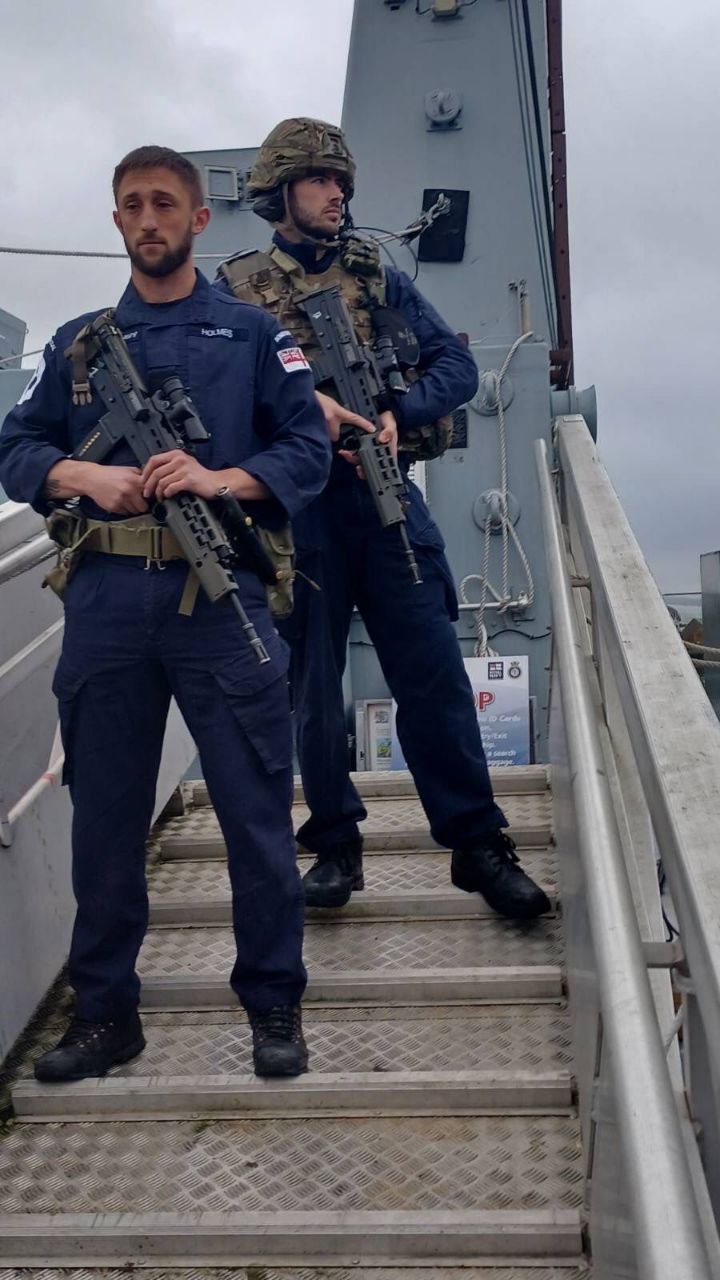
On Sunday afternoon, members of Anti-Imperialist Action Ireland along with members of Saoirse Don Phalaistín, carried out a direct action against a British warship in Dublin port.

The protest was called to highlight the ongoing British Occupation of Ireland and to make clear the complicity of British Imperialism in the ongoing Zionist Occupation and Genocide in Palestine. The protest made clear the links between the National Liberation Struggles in Ireland and Palestine.

British Military confronting protesters in Dublin (Image sourced: AIA)

In a militant protest, the activists, chanted ‘From Ireland to Palestine, occupation is crime’ and Britain Out of Ireland and Palestine.’

During the course of the protest, the Republican Activists present confronted Armed British soldiers who appeared on the deck of the ship and a stand off ensued on the gangway.

End the occupation! End the genocide!

Free Palestine!

Free Ireland!

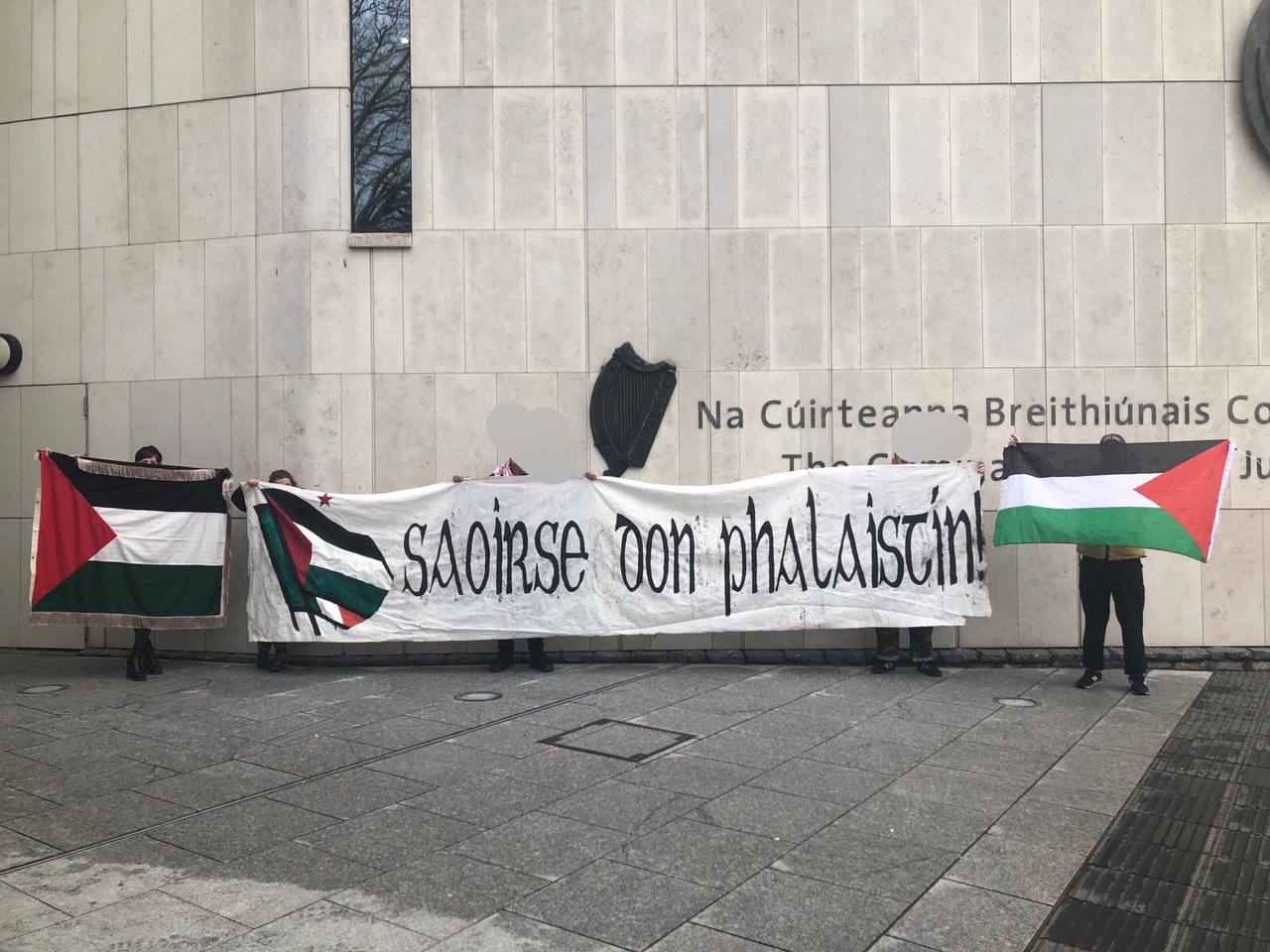
Solidarity picket outside the Dublin courts (Image sourced: AIA)

In a series of coordinated raids in Dublin this morning, a number of Republican Activists have been arrested and detained under section 30 of the Free States “Offenses against the state act”.

These arrests come as the state is increasingly fearful of the growth in Revolutionary Irish Socialist Republicanism and of Anti Imperialist Action Ireland in particular.

The arrests are timed to coincide with the leading role AIA has been playing in support of the Palestinian People and Resistance across the 32 counties and at a time when our members continue to confront and resist Imperialism across Ireland.

(Image sourced: AIA)

AIA condemn the raids and arrests by the Drew Harassers on Republican Community Activists and we call for these activists to be released back to their families and communities immediately.

Harassment, Raids, or Arrests will not stop AIA and Republican Activists from our work to rebuild the struggle for National Liberation and Socialist Revolution, resisting Imperialism or from taking a stand for Palestine.

The Republican Community Activists raided and arrested in Dublin yesterday have been released without charge.

The operation by the Drew Harassers, no doubt at significant cost, was designed to intimidate the growing membership and support base of AIA across Ireland, but it has failed, as all such operations will fail.

AIA welcome home these activists to their families and communities, where they belong. Republicans are not criminals. We will continue to promote the legitimate demand of rebuilding the Republic of 1916 at every opportunity. We will not be deterred and ultimately we will win.

Yesterday’s arrests are only further proof that the Free State fears the message of Revolutionary Socialist Republicanism, fears the growth and levels of support for AIA, fears our support for the Palestinian Resistance and fears our continued legitimate direct actions to confront and resist British, North American, European and Zionist Imperialism in Ireland.

We won’t be going away!

Free Ireland!

Free Palestine!

Also on Saturday, after the giant Palestine solidarity march in Dublin, according to another communiqué, members of AIA, Saoirse Don Phalaistín and Palestinian Solidarity Activists picketed the Leonardo Hotel on Parnell St.

The Leonardo Hotels are owned by Fatell Hotels the largest hotel group in ‘Israel’ and strong supporters of Zionist terrorism and genocide.

In response to the picket, the hotel has decided to enter lockdown, refusing to open the doors for guests.

End items.

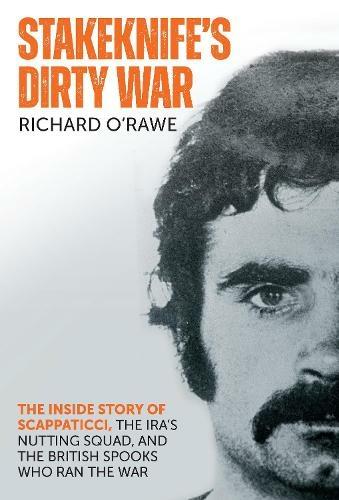
Book Review: Stakeknife’s Dirty War by Richard O’ Rawe, Merrion Press, 2023

Gearóid Ó Loingsigh 02 November 2023

Richard O’ Rawe’s Stakeknife’s Dirty War is a timely book, coming as it does after the death, or supposed death of Stakeknife in England and what looks like a thwarting of the intent and findings of Boutcher’s Kenova Inquiry into the affair.

It is now accepted by all that IRA Volunteer Scappaticci was also the British agent known as Stakeknife.

O’Rawe had access to IRA volunteers and former intelligence operatives and weaves together aspects of Scappaticci’s life and role into a narrative that is convincing and despite the nature of the subject matter, torture, murder and betrayal it is an easy read.

O’Rawe also introduces us to Scappaticci the person. The person however, isn’t any more likeable than the British agent, torturer and murderer. In fact, it would seem they are flip sides of the same coin. Scappaticci was an industrious character, always on the make, running private tax scams.

He was used to money long before he became a paid British agent. His fortune earned from murders on behalf of the British and the IRA, though the IRA weren’t giving him anything like the sum the British did, is estimated to be in the region of a million pounds in pay-outs.

He also had various properties. Scappaticci was also a lowlife thug long before the British and the IRA gave him carte blanche to murder and torture his way through republican ranks. Some of things he did, had he not been in the IRA would have led to him being kneecapped by the IRA.

A man called Collins made the mistake of publicly calling the area in Twinbrook in which Scappaticci lived ‘Provie Corner’. Scappaticci did not like that and decided that Collins had to pay for his transgression.

He knocked on Collins’ door and, when it was answered, the informer battered the older man multiple times over the head with a sock containing a brick. Only when Collins collapsed did Scappaticci walk away.

This is the type of low life thuggish behaviour that the IRA was willing to tolerate and perhaps even encourage from people like Scappaticci. In a genuinely political movement, a thug like Scappaticci would have been out on his ear. But not in the IRA nor in Sinn Féin.

He was, to paraphrase the Yanks when talking about the Nicaraguan dictator Somoza, “he may be a son of a bitch, but he is our son of a bitch”, though in this case it would seem that not only was he theirs he had just the qualities that both the IRA and the British valued, ruthless thuggish qualities.

Scappaticci the person and agent are intimately related it would seem though O’Rawe doesn’t explicitly say so. He does however, give us ample material with which to draw that conclusion.

One of the issues never dealt with it in the press and not really fully covered here is what type of organisation recruits, tolerates and promotes such people. He was a reprobate who should never have graced the ranks of the IRA. That he did so, is down to Adams and co.

That is also clear from the book. It is not an aspersion on Adams or on McGuinness either to question their role.

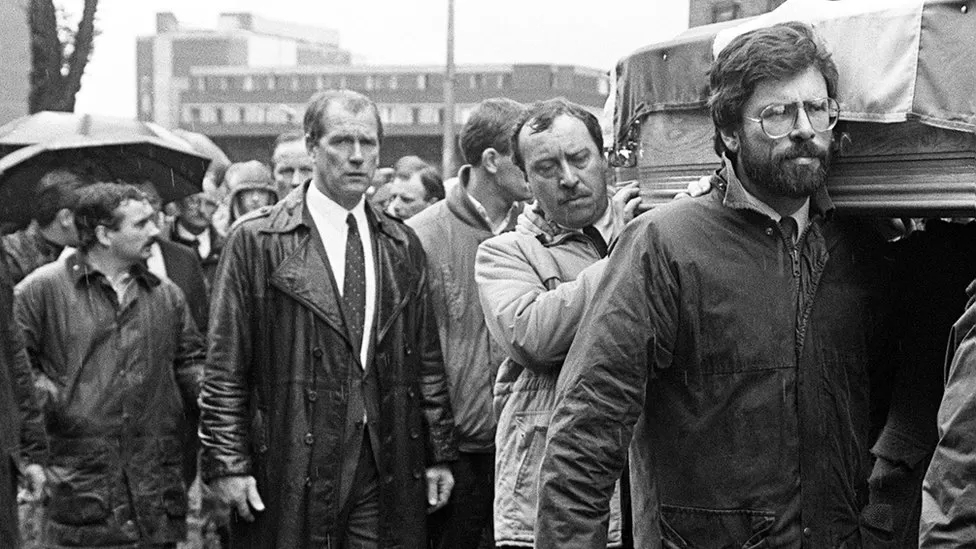
Republican funeral, Scappaticci on left photo, Adams on right (Photo cred: Pacemakers)

The latter of the two comes in for some questioning in the book regarding his role and O’Rawe goes into some detail and also explains in the epilogue that before beginning his research he was unaware of the level of unease amongst republicans about McGuinness’ trustworthiness.

Though he does point out earlier that if McGuinness was a tout, why was it necessary for the British to have a spy such as Willie Carlin get close to him. The same could also be said of Adams.

The British had an agent, Denis Donaldson, whispering sweet nothings in Adam’s ear over many years, shaping Adam’s view of the world and reporting back to the British how successful he had been in his endeavours.

The Peace Process, in that regard, was partially the result of what ideas the British planted in Adam’s and McGuinness’ minds through their various agents. However, it does seem unlikely either of them were touts in the classical sense of the word.

They didn’t need to be, they were at a different level. They were both on the same side as Scappaticci in winding down the war, they just had different methods of going about it.

It is possible that at some stage they had dealings with the British security services in pursuit of common aims. O’ Rawe is not the first to question McGuinness either.

Ed Moloney has put forward the idea that the reprehensible proxy bombs that provoked so much revulsion were signed off on, precisely because they would strengthen the hands of those who sought to wind up the war.

O’Rawe gives many examples of what Scappaticci and the other British agents in the Internal Security Unit did. It wasn’t limited to executing alleged informers or those the British thought should be removed for various reasons under the guise of them being informers.

They were also in a position to give information on operations which led to the British either arresting or killing the Volunteers involved.  The book opens with an account of one such operation, where fortunately they were able to pull back from it without the planned British ambush going ahead.

There were of course other incidents, one of them being Loughall where the British ambushed an entire unit of the IRA. Scappaticci and his ilk did great harm to the IRA, but they were not the reason the IRA lost the war, and O’Rawe doesn’t argue it was either.

However, others have made this point. But the IRA was never going to win the war, they weren’t going to outgun the Brits ever.

Another part of the problem of course, is related to Scappaticci. A movement so highly infiltrated would always have problems, but it is telling of the political weakness of the IRA and Sinn Féin that a thug like Scappaticci could rise through the ranks and remain at the top for so long.

That says more about their weaknesses, than anything else.

That Denis Donaldson, a British agent was the chief advisor to the IRA and Sinn Féin on strategy, for so long, shaping policy, whilst Scappaticci weeded out of the ranks anyone who would oppose it, says more about the weakness of republican politics than whether operations went ahead or not.

O’Rawe, however, is more interested in what happened and who bears responsibility for it.

He is quite clear that the IRA are to blame and is equally clear that those in the intelligence services who allowed Scappaticci and other British agents in the ISU to murder their way through republican ranks are also to blame.

He is not wrong in that, Danny Morrison described Scappaticci as Number 10’s murderer(1) and that he was, he was also the IRA and Sinn Féin’s murderer.

Adam’s infamously justified in a blasé fashion the IRA murder of alleged informer Charles McIlmurray in 1987 when he said that “like anyone else living in West Belfast [he] knows the consequence for informing is death.”(2)

Neither the British, the IRA, Sinn Féin and Gerry Adams in particular, get to wash their hands of the affair.

This book is an important contribution to uncovering the truth of Troubles, one which will neither please Sinn Féin nor the British and Irish governments written from the perspective of a former IRA volunteer.

It deserves to be read and kept on the book shelf as the issue is not going away any time soon.

end.

Notes

(1) Morrison, D. (30/01/2016) No 10’s Murderer – Scap https://www.dannymorrison.com/the-times-of-no-10s-main-murderer/

(2)  See https://www.youtube.com/watch?v=8Kwrj6Ku9ZU


AS DUBLIN MARCHES AGAIN FOR PALESTINE – WHERE ARE THE PROTESTS GOING?

Diarmuid Breatnach

(Reading time: 6 mins.)

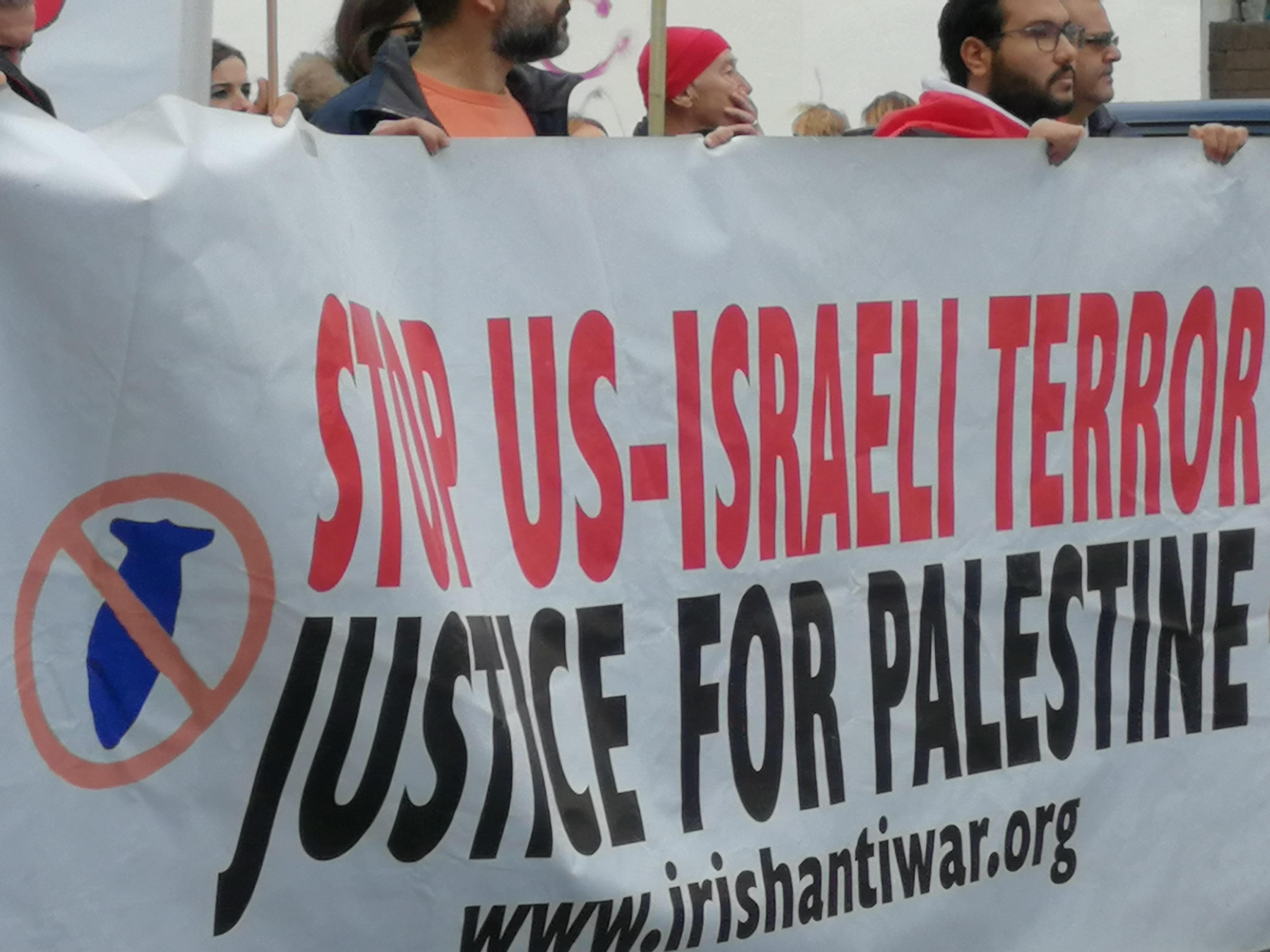
As the sixth march or rally in Dublin in three weeks concludes, with a large one also in Armagh and others take place around the world but Israel’s genocide intensifies, we need to reflect on what is our impact with these.

We are not stopping the genocide or even slowing it down, nor are we really hurting the Israeli state, nor even stopping their Dublin Embassy churning out lies, twice criticising the President of the state for relatively mild statements and accusing Ireland of helping Hamas build tunnels.1

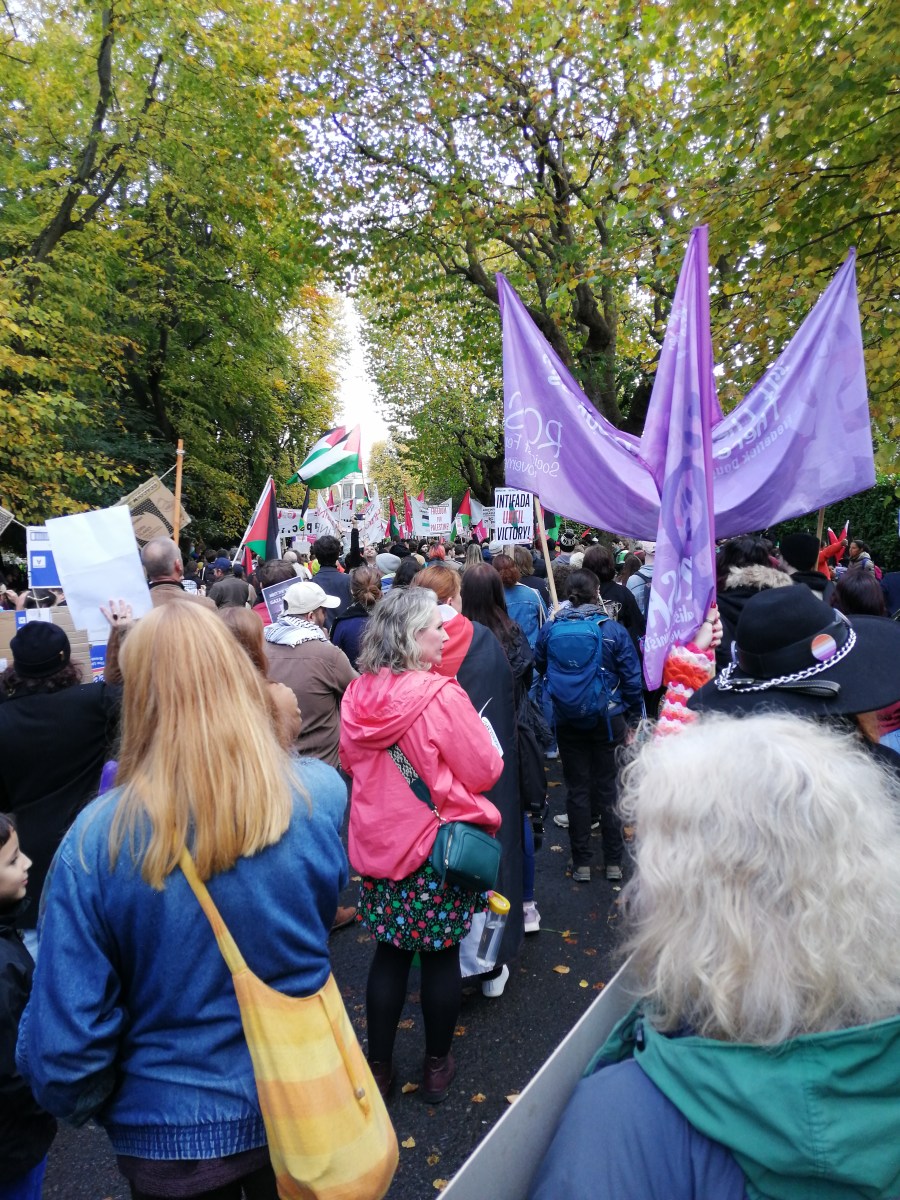
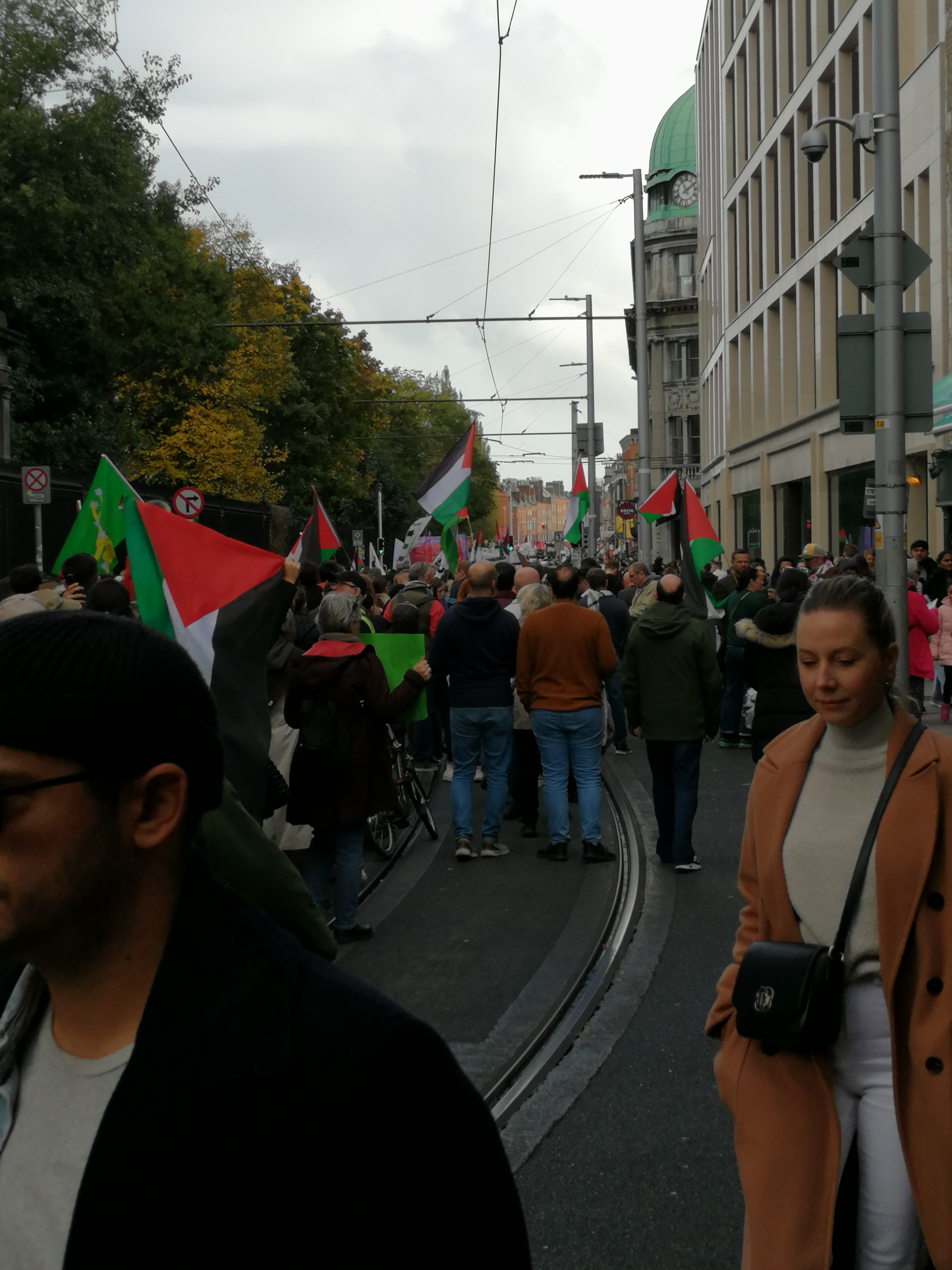
Long view section of Saturday’s march ahead along Nassau Street, Dublin (Photo: D.Breatnach)
View of tail end section of Saturday’s march as the rest stretched along Nassau Street, Dublin and further (Photo: D.Breatnach)

This failure is not the fault of the people in what is probably the most pro-Palestinian state in Europe or indeed in the Western world. There are limited options here – but are we exploring them all?

The Irish Government, given its limitations as a neo-colonial Gombeen administration, cannot be expected to do more than flog the false and failed two-state solution and push for an immediate ceasefire, in which – though ineffective — it is going further than many another EU state.

It could send a clear message, if not of Palestinian solidarity, at least of condemnation of the genocide being carried out during these last three weeks. That might start something going around the world but this Government would have to answer for it to the British, the USA and the EU.

(Photo: D.Breatnach)

No, not going to happen, not from a neo-colonial ruling class. But what if the pressure to expel the Israeli Ambassador were huge? Then they could at least whine to their masters about how difficult it had become for them to hold the line – so maybe Israel should ease off the genocide?

But no, they are not under so great a pressure there either. And why is that?

On the march on Saturday, whenever the call went out to expel the Israeli Ambassador, it was enthusiastically supported. But in most places along the march, that call could not be heard, nor was it given any space in many sections.

And a major reason is that the organisation which called that demonstration and most of the demonstrations and rallies over these three weeks, not only in Dublin but in a number of other towns and cities across Ireland, is refraining from calling for the Ambassador’s expulsion.

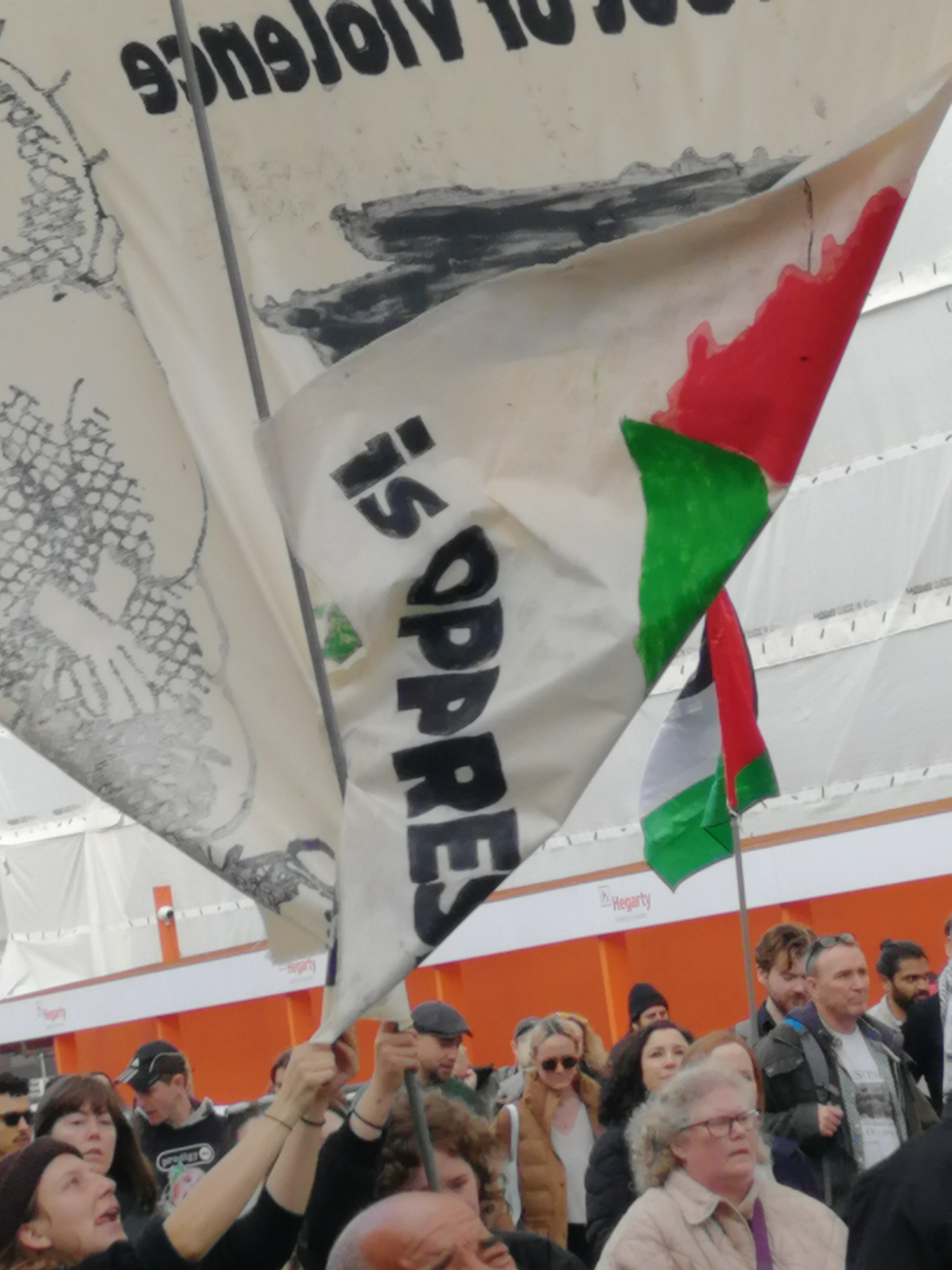
Giant banner carried alternately by two young women bearing the legend: “The root of violence is oppression”. (Photo: D.Breatnach)

That organisation is the Ireland Palestine Solidarity Campaign (IPSC) which has been the main organisation for many years organising Palestine solidarity marches, rallies, pickets, public meetings, leafleting, information tables, film showings, quizzes, postering and lobbying.

Why is the IPSC not calling for the expulsion of the Zionist Ambassador? It can hardly be for any reason of liking her or what she stands for! Nor can it be for anything like bribery or fear. And in fact we know that at least some of the leadership do want the Ambassador expelled.

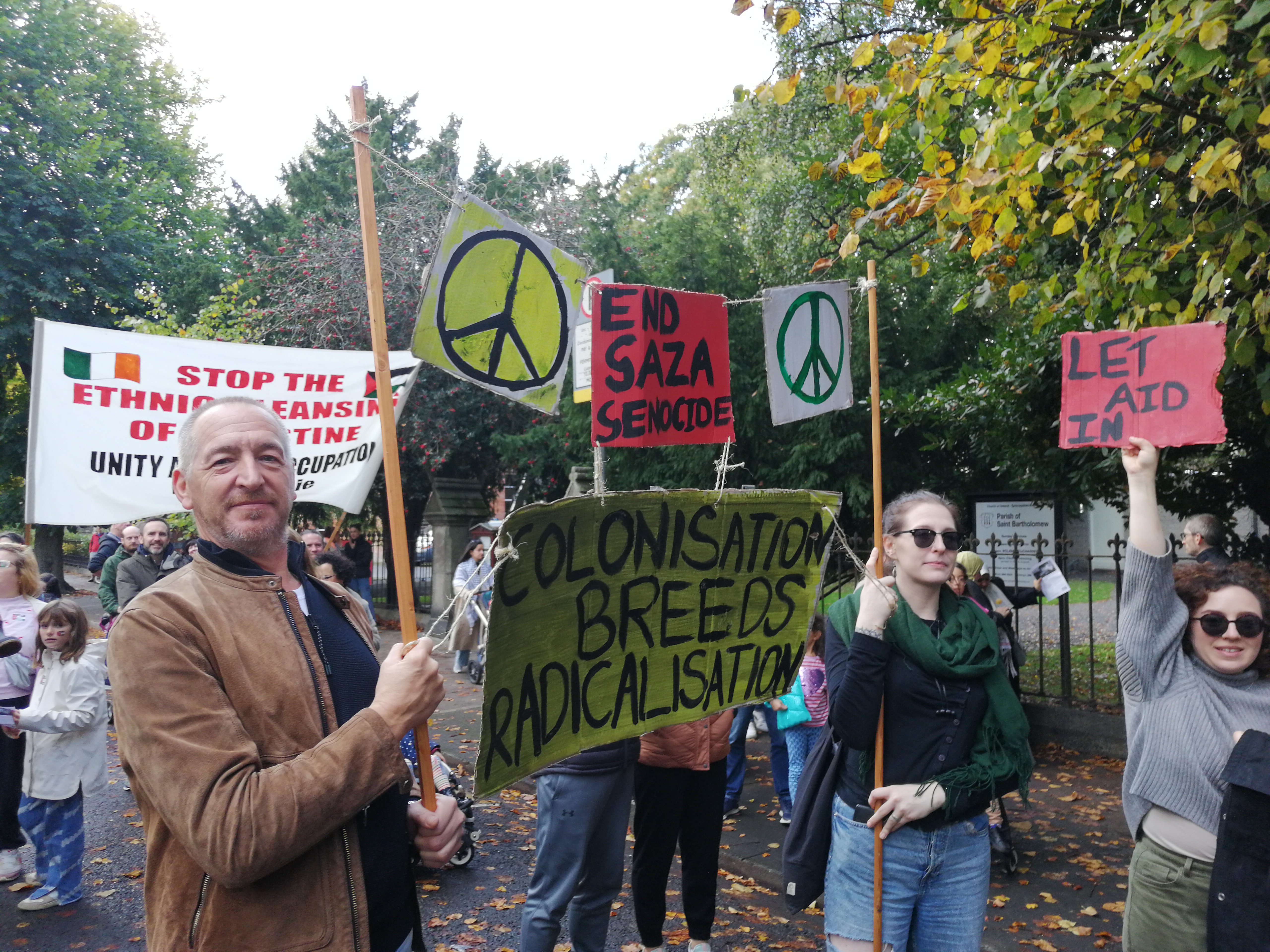
Collection of placards and a banner seen near the back of the rally near the US Embassy on Saturday. (Photo: D.Breatnach)

The reason for holding back on that demand is, sad to say, political opportunism of the social-democratic, reformist kind. To maintain a broad front and not scare off the allies. And what allies might they be so worried about losing or scaring off? Sinn Féin, it seems.

What — Sinn Féin? — one may ask with disbelief. Sure didn’t they themselves call for the expulsion of the Israeli Ambassador? Yes, 10 years ago, Gerry Adams called for that and probably since then a couple of times party spokespersons have done so. But that was then and this is now.

The “now” that is relevant to this is that the party has been remodelling itself to fit into the governing circles of this Gombeen neo-colony and demonstrating again and again that Sinn Féin is a safe pair of hands in which to leave the management of the Irish State.

(Photo: D.Breatnach)

In two municipal meetings very recently, Sinn Féin councillors abstained from voting on a motion calling for an immediate ceasefire and the expulsion of the Israeli Ambassador.

In Derry, the motion was passed despite that abstention but according to reports SF councillors abstained also on a similar motion in Mid Ulster District Council on Thursday which failed to pass.2

In the Leinster House debate this week, SF put some amendments forward but none called for the expulsion of the Ambassador and they didn’t support the PBP amendment that did; in the end SF voted for the Government motion (not even abstaining).3

The IPSC leaders probably expect, as seems very likely, that Sinn Féin will be part of the next government and don’t want to embarrass them before that, in the mistaken belief that the party will then deliver all – or at least much – of what is needed when they are in that government.

(Photo: D.Breatnach)

But the leaders of the IPSC should be doing the exact opposite – they should be putting SF and its presence in the next government under pressure now and afterwards, calling all the time for the expulsion of that representative of genocide, racism, apartheid and colonisation.

But not only is the leadership of the IPSC (despite their own feelings no doubt) not calling publicly for the expulsion of the Ambassador, it seems that they are actually now also asking featured speakers not to voice that call!

It is bad enough that SF has changed from being an anti-imperialist revolutionary organisation to being a party of colonial collusion (in the 6 Counties) and neo-colonial (in the Irish state) – but now other organisations feel the need to reduce their own demands in concert!

The intelligent tactic, contrary to watering down the demands is to put those in power under greater pressure to deliver gains. That happens to be the revolutionary path also.

Solidarity demonstrator carries a giant key mock-up, signifying the right of return of Palestinian refugees to their homeland. Somewhat ironically, Sephardic Jews also have this symbolism in respect of their expulsion, along with Moorish Muslims, from the Spanish Kingdom at the end of the 15th Century. (Photo: D.Breatnach)

Speaking at Saturday’s rally near the US Embassy, Bríd Smith4 of the People Before Profit party did indeed call for the expulsion of the Israeli Ambassador and also denounced the ruling class and government drift towards NATO and PESCO (the EU’s military intervention force).

Smith said, in reference to Ireland’s struggle for independence – and well might she speak of it, coming as she does from a Republican family – that “we are standing on the shoulders of giants … who fought for our independence.”

A long and wide Palestinian flag carried by solidarity marchers (Photo: D.Breatnach)

Sadly she spoiled that by also claiming that they won independence for us.5 Hopefully that was an unfortunate slip of the tongue but one could not be certain of that. Over the years it has been far from clear that the PBP (SWM previously) and the SP support Irish national liberation.

At least Bríd Smith and other PBP speakers have publicly stated that Palestinians have the right to resist and this presumably means armed resistance, as explicitly stated by the Socialist Party in their leaflet distributed on the march6 and that is the position of the electoral left.

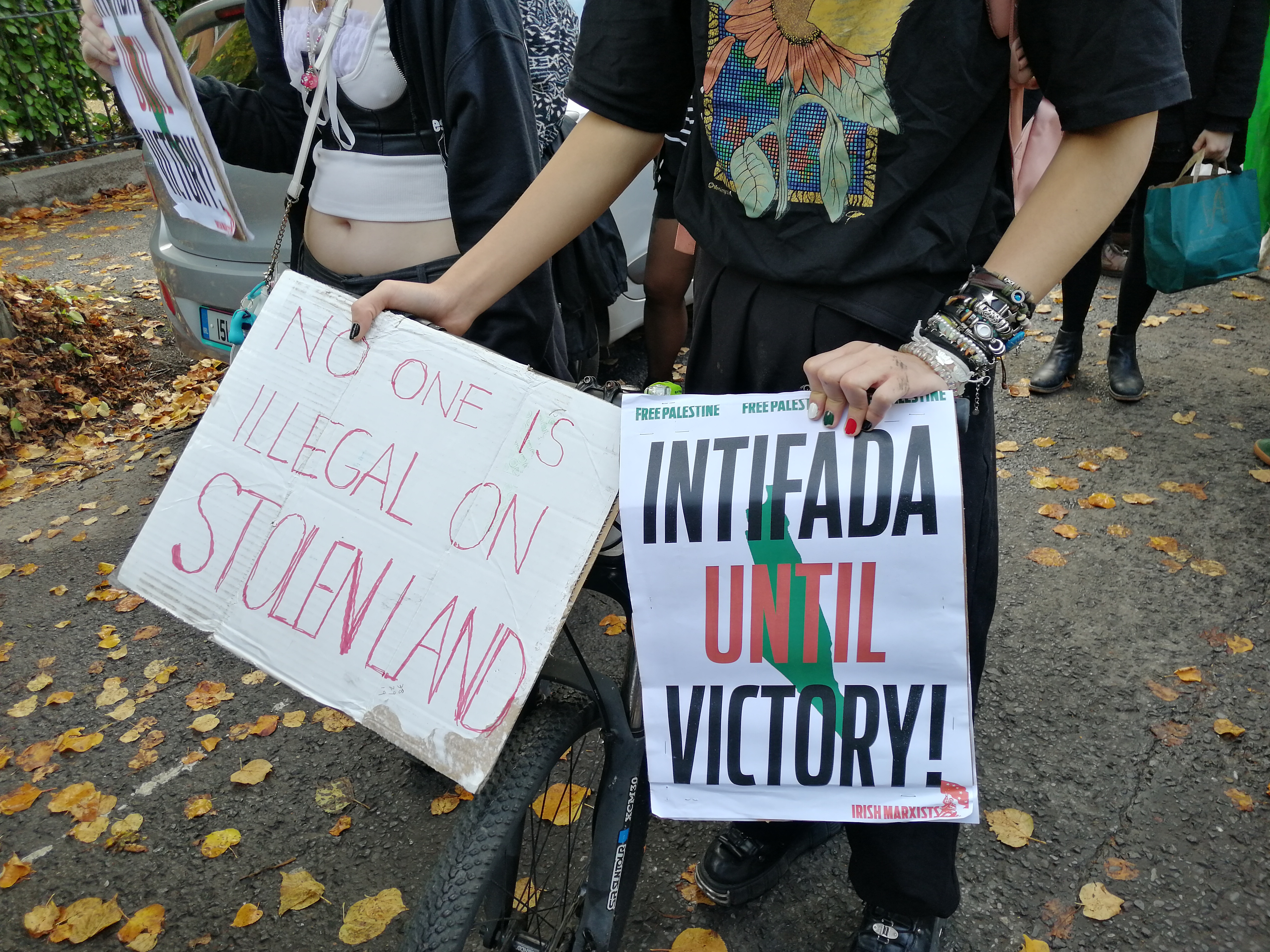
As for the rest of the Left, the International Marxist Tendency was also calling for “intifada revolution” on the march, as were the Anti-Imperialist Action organisation (AIA) on last week’s demonstration.

(Photo: D.Breatnach)

Presumably that is the position also of other Republican organisations7 but difficult to confirm as their participation as groups in these demonstrations is minimal, despite their long traditions of Palestinian solidarity.

The question of the right to resist and to do so in arms is a sharp dividing line between revolutionary internationalist solidarity on the one hand and liberal/ social-democratic solidarity, on the other, which seeks ‘peace’ (i.e return to status quo) rather than victory for the oppressed.

(Photo: D.Breatnach)

However, stating the right to resist in arms is not always what it seems; for example the SP’s leaflet condemns Hamas but does not propose any alternative armed resistance group to support, unlike the AIA for example, which clearly promotes the PFLP8 and without condemning any other group.

THE MARCH

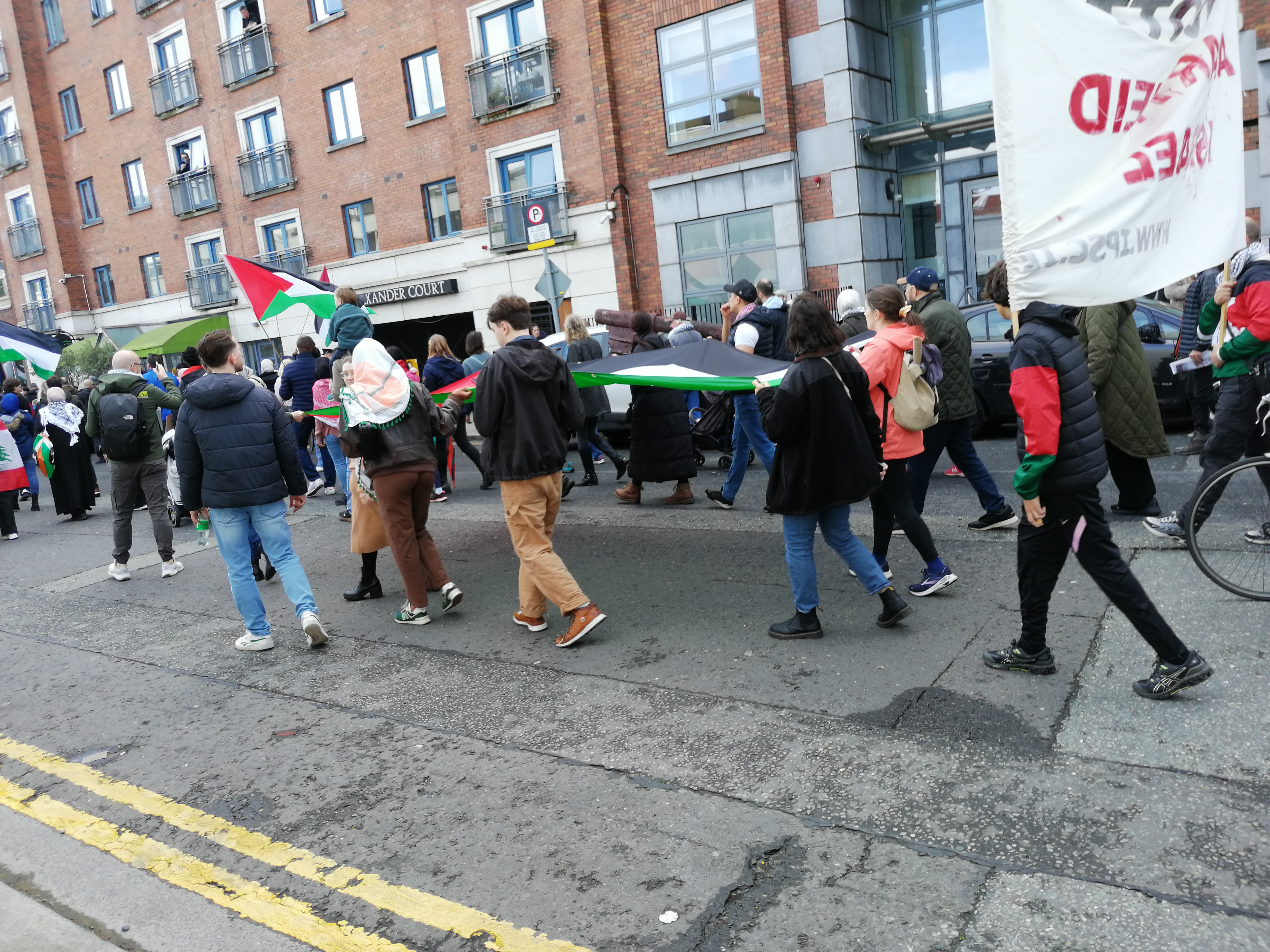
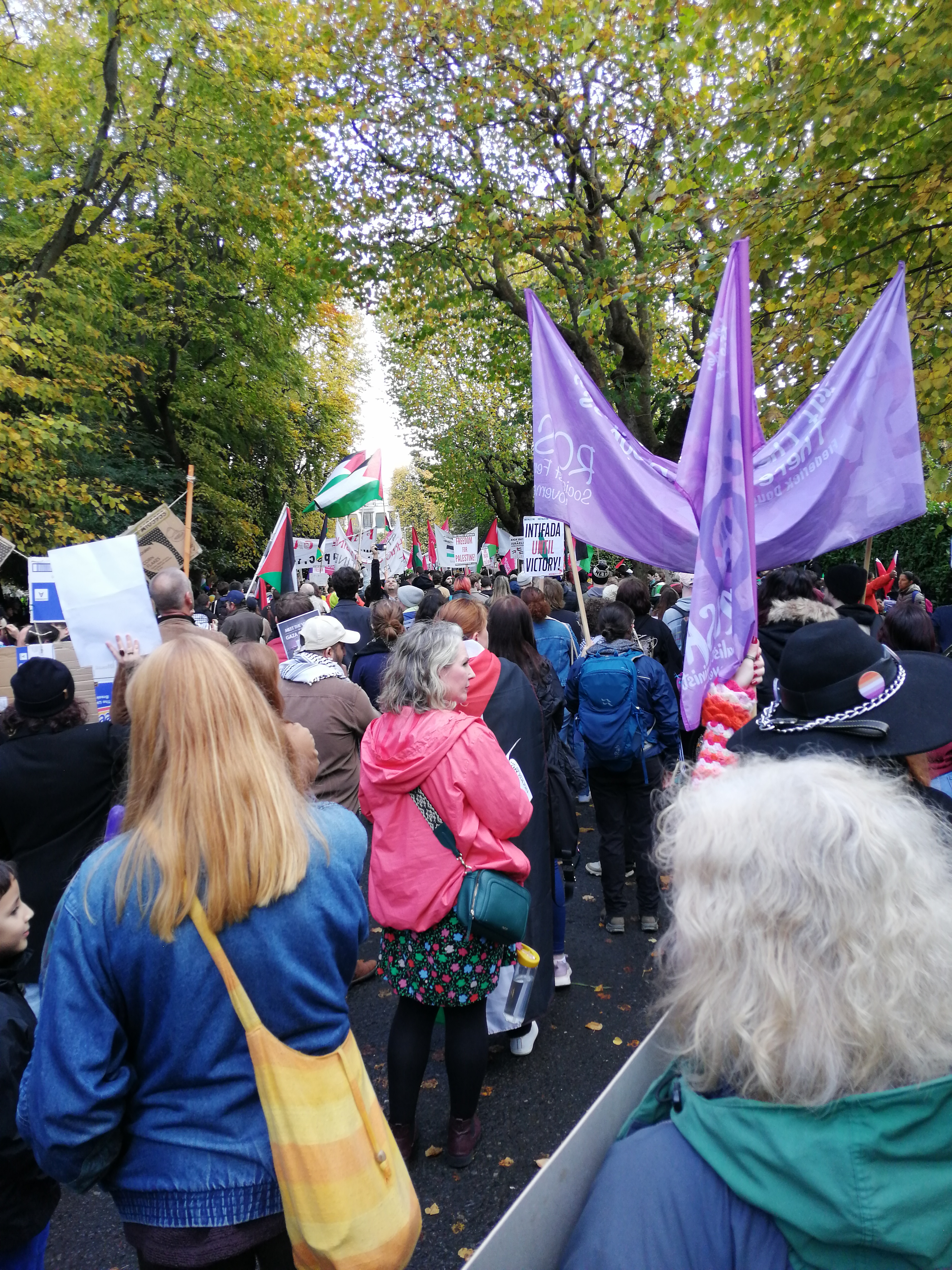
On Saturday’s demonstration, thousands marched from the Spire in O’Connell Street across O’Connell Bridge and around Trinity College, along Nassau Street and then South Merrion Square. The march was heading for the US Embassy but along as many minor roads as possible.

The usual Palestinian solidarity slogans were being shouted but less of the Irish language was to be heard than was the case last week and certainly many less placards in Irish were to be seen.

(Photo: D.Breatnach)

“Israeli Ambassador – Out, out, out!” was audible in some sections and got good support in those but it was missing from most of the march (and no room given for it some sections), although when the demand was voiced by Bríd Smith speaking at the rally, it gathered a roar of approval.

Throughout these weeks the horrific genocidal bombing of Gaza by Israel has continued, along with a blockade of food, water, electric power and medicine.

Three days ago the number of Palestinian dead to the Israeli bombing since October 7th passed 7,000 of which nearly half were children. That does not included those killed since then, nor Palestinians killed in the West Bank, nor bodies still to be found under rubble.9

(Photo: D.Breatnach)

The latest attack has been the imposed social media, news and electronic communication blackout as Israeli troops tested the ground for their attempt to wipe out Gazan resistance.

This is not just a blanket drawn over the abattoir which Netanyahu’s butchers have made of Gaza but also a massive interference with calls to emergency services – yet another war crime — and also for people to speak with their distraught relatives outside Gaza.

In our weak position with limited capabilities, putting pressure on all concerned to demand the expulsion of the Zionist Ambassador is one of the most effective things we can do and we should insist on support for that demand from all who claim to support the Palestinians.

End.

The crowd at the rally at end of the march. The stage is in the distance near the US Embassy, which is cordoned off by the Gardaí from demonstrators (Photo: D.Breatnach)

FOOTNOTES

1https://www.irishexaminer.com/news/politics/arid-41253880.html Also since the Zionist Ambassador’s initial criticism of the President’s description of what her state was doing as war crimes, she returned to criticise him on public media yet again. In a number of countries around the world, recently for example in Spain and in Colombia, this has been the arrogant behaviour of Israeli Ambassadors, unused to having their dominant discourse challenged.

2I heard about this from two different sources but failed to get any information by a news search or by using Mid-Ulster District Council’s own website.

3See Sources.

4Bríd Smith is a TD (member of the Irish parliament) but reportedly not going to stand in the next general elections.

5Apart from the Irish state being a neo-colonial one, i.e nominally independent but actually a client of foreign imperialism, one-sixth of Ireland’s territory is under armed occupation by the EU.

6I did not see a PBP leaflet distributed on the march.

7In which, as a result of fundamental changes from Republican positions of the party in recent years, I am clearly not including Sinn Féin.

8Popular Front for the Liberation of Palestine, a secular revolutionary Palestinian Marxist-Leninist organization founded in 1967

9https://edition.cnn.com/2023/10/27/middleeast/gaza-death-toll-report-intl/index.html

SOURCES

Israeli Embassy:https://www.irishexaminer.com/news/politics/arid-41253880.html

SF recent position on Palestine and Israel:

https://www.derrynow.com/news/home/1332621/derry-sinn-fein-councillors-join-unionists-in-refusing-to-support-gaza-motion.html

https://www.oireachtas.ie/en/debates/debate/dail/2023-10-18/18/

https://www.rte.ie/news/analysis-and-comment/2023/1015/1410920-sinn-fein-hamas/

50 YEARS OF DAMAGE – VICTIMS SEEK INDEPENDENT STATUTORY INQUIRY

Clive Sulish

(Reading time main report: 6 mins.)

“Six innocent men” … “Garda oppression and perjury’ … “Longest case in the history of the State”

Four leading human rights organisations this week delivered a petition to the Irish Government asking the Minister for Justice to establish an inquiry into the abuse suffered by six innocent men in the Sallins case almost half a century ago.

Not to do hold such an inquiry, maintained Liam Herrick of the Irish Council for Civil Liberties at a press conference on Tuesday, is to continue the abuse of the victims’ human rights and to fail to prevent such an abuse in the future.

Osgur Breatnach, Liam Herrick and Nicky Kelly at the petition launch press conference (Photo: Rebel Breeze)

Apart from the ICCL, the other three organisations pushing the petition are the Committee for the Administration of Justice (CAJ), the Pat Finucane Centre (PFC) and Fair Trials; the first three are Ireland-based organisations and Fair Trials is a global criminal justice watchdog.

The six innocent men were named as Osgur Breatnach, Michael Barrett, John Fitzpatrick, Nicky Kelly, Brian McNally and Michael Plunkett (deceased1).

At the time in 1976 all were members of a legal political party (the Irish Republican Socialist Party) but were tortured and some jailed in the Irish state.

In the longest series of trials in the history of the State, three of the men were sentenced at the end of 1978 to prison terms of between nine and twelve years each on the basis of no ‘evidence’ but their confessions obtained by torture and which in court they completely retracted.

Michael Plunkett, who had signed no confession walked free while Nicky Kelly absconded the day before the sentence, eventually reaching the USA where he remained until a strong campaign saw Breatnach and McNally freed, whereupon Kelly returned to Ireland and was immediately jailed.

Although the nature of the ‘evidence’ against Kelly was of the same kind as that which had been declared ‘unsafe’ for Breatnach and McNally, Kelly remained in jail forfour-and-a-half years, despite another strong campaign2 and was only freed eventually on ‘humanitarian grounds’3.

PRESS CONFERENCE

ICCL’s Liam Herrick chaired the conference in Buswell’s Hotel4 flanked by survivors Osgur Breatnach and Nicky Kelly, while Chris Stanley of KRW Law sat nearby, all facing the audience which included Sinn Féin’s Pa Daly TD5 and Fionna Crowley of Amnesty International.

Opening the proceedings, Herrick listed the four organisations backing the call for an inquiry and pointed out the present-day relevance of that call, both in terms of the survivors and their families and in terms of wider society.

Not to have that inquiry would be an ongoing violation of human rights, Herrick maintained and pointed out that the ICCL was founded arising out of concerns regarding the post-Sallins robbery arrests and the activities of the Garda CID unit colloquially known as the “Heavy Gang”.

The ICCL Director stated that they could not rest until the demand for an inquiry was met and referenced also “crucial legislation before the Oireachtas”6 and recognition of past injustices in a series of TV documentaries linking the cases, in particular through actual Garda individuals.

Introducing Osgur Breatnach, Herrick acknowledged the leading role he had played in keeping the demand for the inquiry going over the years.

Breatnach read from a prepared statement that there had been cases of torture, perjury and framing innocent people in England, Northern Ireland and the Republic.

It was wrong and hypocritical of the State raising concerns about cases elsewhere not to hold an inquiry into the Sallins case, of which there had been five trials, one the longest in the history of the State.

Breatnach said he went through the process expecting to be jailed but to expose the political nature of their persecution; his and McNally’s convictions were overturned, the ‘confessions’ having been obtained by oppression but despite that none were indicted for that oppression.

Breatnach concluded saying that the State’s refusal to hold an inquiry amounted to cruel and inhuman treatment of the victims and their families and that without the investigation of an inquiry a similar scenario could be repeated at some point ahead.

Nicky Kelly, introduced by Herrick thanked the ICCL for organising the events that day. Speaking apparently ex-tempore with perhaps reference to some bullet-points, he expressed the opinion that the State wanted the victims to die so that they had no need to hold an inquiry.

“Ireland has an impeccable reputation with regard to foreign relations,” Kelly said, but not so within the state. He believed that the Sallins case is “too big in its implications for politicians, judiciary and police force” and all attempts to investigate were obstructed by successive governments.

Liberal politicians in government have been “no different from the rest”, the Wicklow man said and referred to his own personal battle even to get out of jail after the ‘evidence’ to convict him had been discredited and how he had been obliged to undertake a hunger strike to be freed.

Now, rather than hold the inquiry into what went on, they were waiting for him “to be over and done with” Kelly said in conclusion.

Herrick introduced Chris Stanley of KRW Law who said that cases such as the Birmingham pub bombings and the Dublin and Monaghan bombings, like the Sallins one, all related to the recent conflict and required investigation for the sake of the victims.

Chris Stanley of KRW Law speaking at the petition launch press conference (Photo: Rebel Breeze)

Stanley commented that perhaps the State had been too reliant on the Good Friday Agreement for resolution of these matters.

Commenting on the UK’s new legislation blocking much resolution of historic cases, all but become law, the solicitor regretted the UK had chosen to disengage from Europe but remarked that that they remained signed up to the European Commission of Human Rights.

From among the seated audience, Fionna Crowley of Amnesty International spoke to underline the importance of having an inquiry into the case and that her organisation had been in support of the victims’ campaigns and was fully in support of the current petition for an inquiry.

Breatnach acknowledged that within one week of the arrests, Amnesty had raised public concerns about them.

DELIVERY OF PETITION TO DEPARTMENT OF JUSTICE

After the conclusion of the press conference with Herrick’s summing-up and thanks to those in attendance, Herrick and ICCL staff along with Chris Stanley, Breatnach, Kelly and a couple of others walked to the Dept. of Justice’s offices on the south side of Stephens Green.

Delivering the petition to the Department of Justice: (from bottom up) Nicky Kelly, Osgur Breatnach, Chris Stanley, Liam Herrick. (Photo: Rebel Breeze)

Pausing for some photos to be taken, a delegation entered the building and presented the petition. Then some more photos were taken outside and Breatnach was interviewed by a TG4 reporter in Irish and Nicky Kelly in English while a light rain began to fall.

TG4 (Caoimhe Ní Laighin) interviews Osgur Breatnach outside the Department of Justice in Stephen’s Green (Diarmuid, brother of Osgur is centre photo and Nicky Kelly to the right). (Photo: Rebel Breeze)

The group split up into smaller groups then, the ICCL staff returning to their office to issue a press statement and others to hope, perhaps with further pushing, for positive developments further – but not too far – down the road. For all and for some much more than others, it’s been a long haul.

End.

Outside the Department of Justice with copies of the four-agency petition (right to left): Liam Herrick of ICCL, Chris Stanley of KRW Law, victims/ campaigners Osgur Breatnach and Nicky Kelly (Photo: Rebel Breeze)

APPENDIX (A): BACKGROUND

The IRSP was the result of a split from what had remained in Sinn Féin after an earlier split in 1969, the group leaving the party then calling themselves ‘Provisional Sinn Féin’.

Not all who had become unhappy with the direction of Sinn Féin departed into Provisional Sinn Féin because they perceived the new group as being much more nationalist than socialist and being also socially conservative.

After some internal struggle that section remaining within what became known as “Official Sinn Féin” left in 1974 under the leadership of Séamus Costello to form the IRSP.

The armed wing of the Republican movement had split along the same lines into Provisional IRA, Official IRA and the Irish National Liberation Army, the latter loyal to the perspective of the IRSP.7

Bernadette Devlin (now McAlliskey) and Tony Gregory (now deceased) were on the IRSP’s Executive but however departed soon afterwards from the party on what they perceived as the dominant relationship of the armed group INLA to the political party.

It appears that the Irish State at that time viewed the IRSP as more dangerous than the two Sinn Féin parties and determined to ensure its demise, framing them for the Sallins Mail Train Robbery in March 1976.8 And framing, rather than mistaking, it was.

The 40 arrested included IRSP members who, tortured by the SDU Garda unit known colloquially as the “Heavy Gang”, confessed to participating in the robbery but who could not possibly have been there. The State decided to put on trial those whose only alibis were with family.

The court chosen was the Special Criminal Court, set up under the Offences Against the State Act in the panic of the 1974 Loyalist and British Intelligence Bombing of Dublin and Monaghan which somehow got blamed on Irish Republicans. The SCC has three judges and no jury.

Until the SCC moved to the court building near the main gate to Phoenix Park, it was located in Green Street, in the very same building where Robert Emmet was tried in 1803 and sentenced to death, his sentence carried out in public in Thomas Street, in the Dublin Liberties area.

The Four IRSP eventually selected for the second of what became four trials included senior member of the party’s Executive and the Editor of its newspaper, The Starry Plough, Osgur Breatnach.9

In the second trial, one of the three judges hearing the case was regularly seen to be sleeping. Only after the judge died suddenly was there another retrial ordered.

In the fourth trial, Kelly being tried in his absence, the judges accepted as fact10 the Prosecution case that the injuries of the accused were due to beating one another up (in Breatnach’s case, that he’d beaten himself up) and that their withdrawn confessions were true.

Mick Plunkett, in the absence of a ‘confession’, was found not guilty but the other three were sentenced to 12 years in jail. In May 1980 Breatnach and McNally were freed by the Appeal Court on grounds that they had suffered ‘oppression’ and that their confessions could not be relied upon.

No investigation took place into who had carried out the ‘oppression’ or how the judiciary had jailed the victims purely on withdrawn confessions and Garda perjury or which political decisions by whom were behind it.

Nicky Kelly returned to Ireland in 1980 — but to jail.

He was only freed by a Minister of Justice on ‘humanitarian’ grounds after four-and-a-half years in jail, a strong campaign seeking his release and finally a hunger strike of 38 days which pushed the European Court of Human Rights to agree to hear his case.

He received a presidential pardon in 1992 from Mary Robinson and in 1993 Breatnach, McNally and Kelly were awarded compensation, allegedly a six-figure amount. But to get that, they had to forgo any litigation on torture or police brutality.

No official inquiry has ever been carried out in the whole set of State actions and in fact some of the Heavy Gang went on to force false confessions from others, most notably the Joanna Hayes and relatives case.11

APPENDIX (B): SUPPORTING STATEMENTS FROM OTHER ORGANISATIONS

Also speaking elsewhere on the day, Director Daniel Holder of the Campaign for the Administration of Justice said they support this call and that

an inquiry into the case of the Sallins Men is long overdue.”

He went on to say that “Over the last few years inquests and other legacy mechanisms in the north have been finally delivering like never before for families who have had to wait decades.

They are providing important historical clarification for victims and accountability for past human rights violations but now face being shut down by the notorious UK Legacy Bill.”

Pat Finucane Centre (PFC) Director Paul O’Connor said that

PFC welcomes this demand to the Irish Government for a human rights compliant investigation into the miscarriage of justice that followed the Sallins Trains Robbery 1976.

For too long human rights violations that occurred in the Republic of Ireland during the Conflict have been at best marginalised or at worst ignored.

Successive Irish governments have either relied upon the British to address the investigatory deficit of the Conflict or deflected it as an inconvenient non-issue.

“Now the human rights deficit created by those successive Irish governments is clear – and will be clearer when the legislative effect of the British Legacy Act starts to bite.

The Irish Government was right to challenge the British about the use of torture suffered by the Hooded Men; now it must look to its own police and criminal justice system and acknowledge the torture suffered by the Sallins Men.”

Verónica Hinestroza, Senior Legal Advisor at Fair Trials said:

According to international standards, States must investigate complaints and reports of torture or ill-treatment.

We call on the Minister for Justice to ensure that a prompt, impartial and independent investigation is conducted into the allegations made by Mr Osgur Breatnach, Mr Michael Barrett, Mr John Fitzpatrick, Mr Nicky Kelly, Mr Brian McNally and Mr Michael Plunkett (deceased), considering that torture and ill-treatment violations are not to be subject to any statutes of limitation.”

FOOTNOTES

1 Michael Plunkett died last year; his memorial services were reported on in Rebel Breeze: https://rebelbreeze.com/2022/05/04/death-of-a-retired-warrior/

2 The campaign PRO was CaoilteBreatnach, a brother of Osgur’s and was supported by many people in the fields of politics and culture, including the band Moving Hearts who performed Christy Moore’s song about the Nicky Kelly case, The Wicklow Boy.

3 By Minister of Justice Michael Noonan after Kelly’s hunger strike of 36 days. According to law, Kelly had exceeded the time period after conviction permitted for registering an appeal and it was claimed that only a ‘pardon’ could set him free.

4 Buswell’s is across the road from Leinster House, the Irish Parliament building and is frequently host to political meetings and press conferences.

5 Recently appointed to Sinn Féin’s front bench as spokesperson on Justice, he is by profession a solicitor.

6 The title of the parliament of the Irish state.

7 The history of the IRSP is a separate and contentious story but suffice it to say that of the ten hunger strike martyrs in 1981, three were INLA; at one point a number of INLA factions were feuding within it leading to a number of fraternal murders. After the Provisional prisoners embraced the Good Friday Agreement and left the jails renouncing armed resistance, the much smaller contingent of INLA prisoners did the same. The IRSP remains a legal though much reduced political party.

8 The robbery was carried out by a unit of the Provisional IRA which however did not acknowledge operations carried out within the Irish State, to which ion 27th April 1980 they made an exception in a public statement taking responsibility for the robbery. The Irish State chose to ignore their statement as had the British State when the Balcolme Street group ibn 1977 admitted in court their responsibility forthe Guildford Pub Bombingsfor which the UK had jailed the innocent Guildford Four and Maguire Seven.

9 Apart from anything else, the notion that prominent Executive members under constant police surveillance, including one regularly working on the newspaper in the Dublin office (in the days before this could be done from anywhere else), could carry out such an operation, was clearly ridiculous.

10 According to the Court of Criminal Appeal in the “Madden” Case in November 1976, Appeal Courts should usually accept as a finding of fact anything decided by the Special Criminal Court (SCC) to be a fact. Therefore although a court verdict of guilt or innocence can be overturned on appeal, a decision as to fact made in the non-jury Special Court cannot be overturned in any appeal court.

11 Three separate cases of false confessions obtained by Gardaí, including the Sallins and Joanna Hayes cases, were covered in the three-part documentary series Crimes and Confessions by the Irish TV channel RTÉ July 2022- January 2023: https://www.rte.ie/player/series/crimes-and-confessions/SI0000012595?

SOURCES & USEFUL LINKS

https://www.irishtimes.com/ireland/social-affairs/2023/09/19/human-rights-groups-call-for-inquiry-into-sallins-train-robbery-trial-in-the-1970s/

https://www.irishlegal.com/articles/irish-government-urged-to-establish-inquiry-into-sallins-train-robbery

TV & Radio:

https://x.com/nuachttg4/status/1704558300228980980?s=48

https://www.rte.ie/news/nuacht/2023/0919/1406193-imscrudu-reachtuil-faoi-iomrall-ceartais-cailiuil-a-eileamh/

https://www.rte.ie/radio/radio1/drivetime/programmes/2023/0919/1406233-drivetime-tuesday-19-september-2023/ (from 1.39 minutes)

The Campaign site: https://sallinsinquirynow.ie/

Timeline of events: https://sallinsinquirynow.ie/timeline/

Cormac Breatnach’s multimedia production about the case: https://www.thewhistleblower.ie/

CONCESSIONS TO COLONIAL LOYALISM

News & Views No.8Diarmuid Breatnach
(Reading time: 2 mins.)

According to media reports, Taoiseach Leo Varadkar said he expects to see a united Ireland in his lifetime. I think he’s wrong but he’s entitled to his opinion. However, some of his following remarks are objectionable and need to be challenged.

Varadkar claimed that in a united Ireland “there will be roughly a million people who are British.” That is false. There may – or may not – be a million IRISH PEOPLE who consider themselves British in a united Ireland, we’ll see. But they will be IRISH CITIZENS.

And they should have equal rights with all other citizens. They should have an equal right to vote, to housing, to their language, without any special restrictions, not to mention pogroms – in other words, nothing like the way their statelet treated its large Catholic minority.

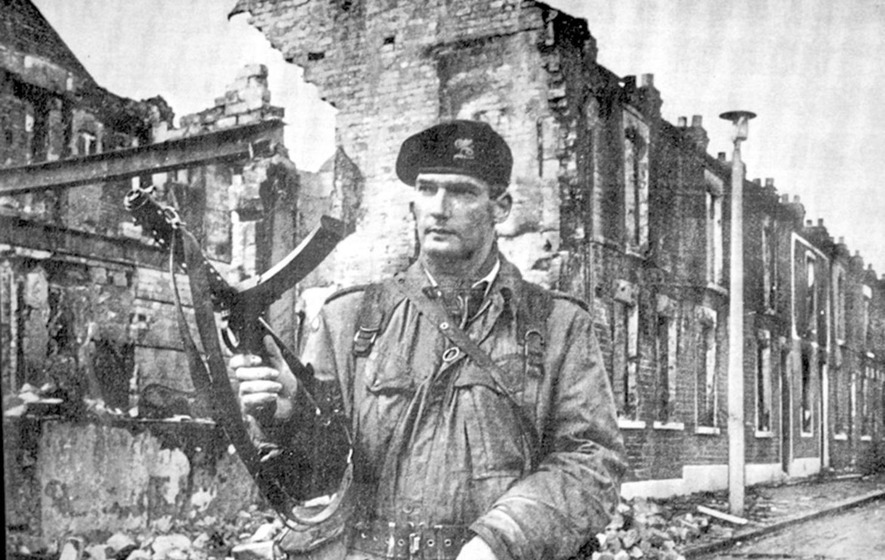
A British soldier stands in front of a section of the burned out houses of Catholics in Bombay Street, Belfast in 1969 (which the Army did not try to prevent Loyalists burning). The arson was the Loyalist response to demands of Catholics for civil rights (while the colonial police response was batons, bullets and gas). (Photo source: Clonard Residents’ Association)

I agree with Varadkar that the quality of a country should be judged “by the way it treats its minorities.” So Varadkar, how did and does your Gombeen State treat its probably oldest ethnic minority? You know, the Irish Travellers?

It is true that “a Republican ballad, a nice song to sing, easy words to learn for some people can be deeply offensive to some people.” Presumably he means to Unionists and Loyalists. Yes, and antifascist and anti-racist songs can be deeply offensive to fascists and racists.

It is also true that some people in the Southern States sing songs about the Confederacy and Robert E. Lee and call it their culture. And the comparison fits – but not with Republicans but with Loyalists!

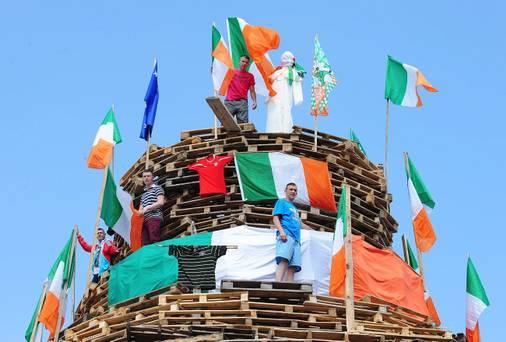
One of the charming annual expressions of Loyalist culture: a huge bonfire to burn Irish Tricolours and representations of Catholicism. Palestinian flags and representations of Celtic FC are frequently burned too. Slogans such as KAT (‘Kill All Teagues [i.e Catholics]) are often displayed also. (Photo source: Wikipedia)

It’s not Irish Republicans who spread racism and sectarianism: the Republican creed came into existence precisely against sectarianism. And we know Varadkar actually knows that because not long ago he made some remarks about the wide embrace of the Irish Tricolour.

The Irish Tricolour: a flag presented to revolutionary Irish Republicans by revolutionary French Republican women in Paris in 1848. Not a flag of monarchism, sectarianism or collusion with imperialism or colonialism.

While we uphold Republican principles we don’t have to apologise to anyone, least of all in our own country, Varadkar. It’s you and your party (and the rest of them serving the Gombeen class who threw away independence and slaughtered Irish Republicans) who need to be ashamed.

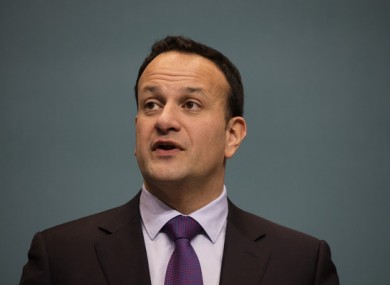
Leo Varadkar, Taoiseach (Prime Minister) of the current Coalition Government, who made the remarks this week. (Photo sourced: Internet)

People living in Ireland can think and feel what they like, good or bad. But in public, we will celebrate the valuable things in our history and culture. And we’ll do so proudly without apology to anyone.

On the other hand, public displays of Orange sectarianism, racism, homophobia, fascism and anti-LGBT targeting won’t be tolerated in an independent, reunited Ireland. Not for one minute.

End.

SOURCES:

https://www.breakingnews.ie/ireland/taoiseach-believes-there-will-be-a-united-ireland-in-his-lifetime-1524031.html

INTERNATIONAL DAY OF THE PRISONER – DUBLIN

Clive Sulish

(Reading time: mins.)

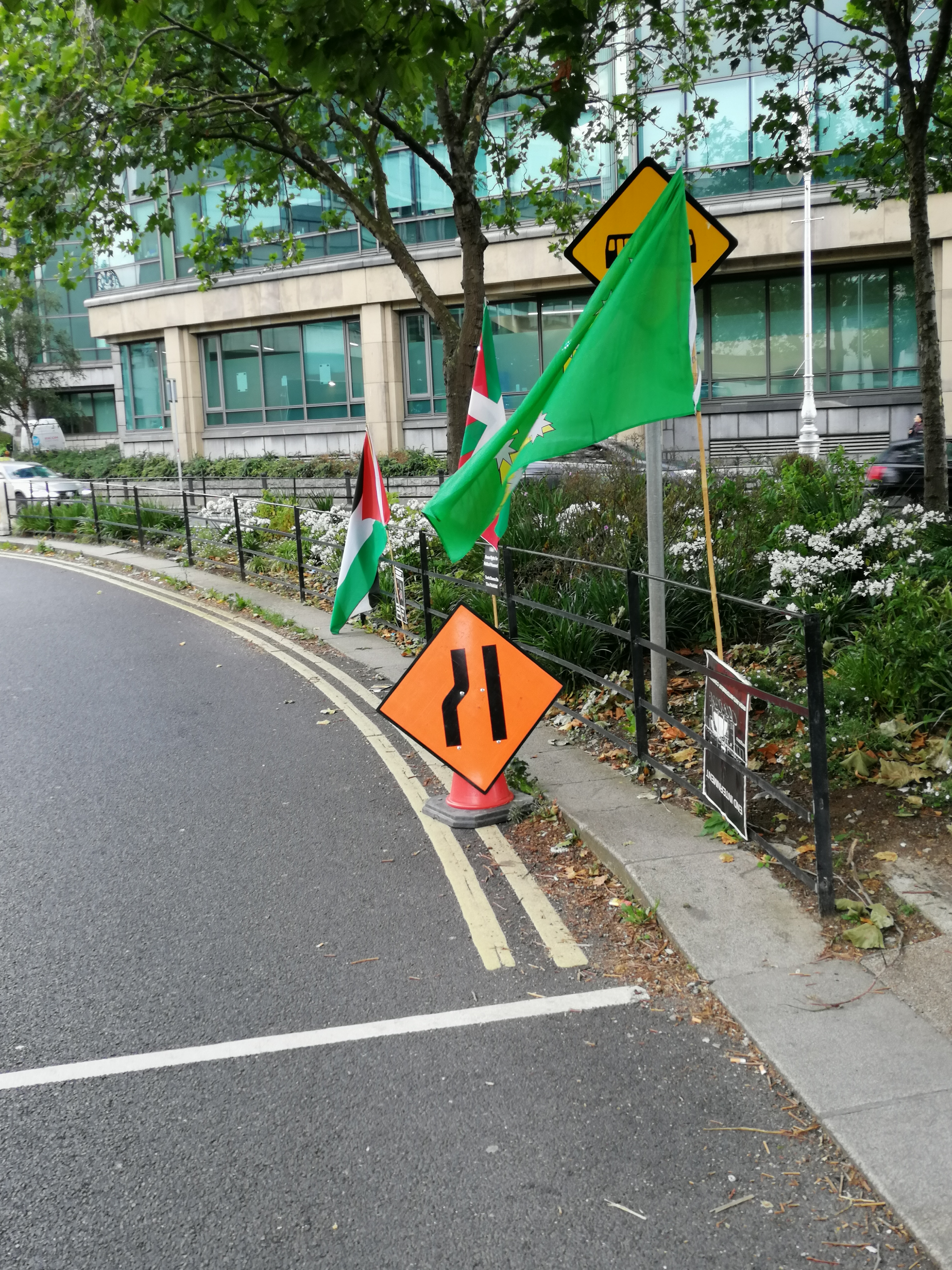
Socialist republicans and communists gathered on a traffic island in Dublin’s city centre to mark the International Day of the Prisoner. They flew flags to represent prisoners in Ireland (‘Starry Plough’), the Basque Country and Palestine.

They also displayed a number of placards.

(Photo: IAIC).

The choice of location, apart from being passed by road traffic in three directions, was because of the presence there of the Universal Links on Human Rights memorial sculpture with an eternal flame, commissioned by the Amnesty International organisation.

A plaque near the sculpture bears the following words: “The candle burns not for us but for all those whom we failed to rescue from prison. Who were tortured. Who were kidnapped. Who disappeared. That is what the candle is for.”

Plaque in the ground on the approach to the sculpture. (Photo: IAIC).

Somewhat ironically, one of the placards carried the words: “Amnesty International, do Irish Republican prisoners not have human rights too?” Irish Republicans have long complained that the organisation in question does not raise any issues with regard to Irish political prisoners.

Some have indicated as a possible reason or part-reason the location of the head office of Amnesty International being based in London, capital city of the occupying power. Its interventions on Ireland even during three decades of war in the colony have been very few indeed.

Other placards displayed referred to political prisoners from the liberation wars in India and in the Philippines, the innocent Craigavon Two still in jail and ongoing internment through refusal of bail to Republicansappearing before the no-jury special courts in both administrations.

Some leaflets were distributed about ongoing internment in Ireland through long remands in custody of Republican activists. Between convicted and awaiting trial there are close to 50 political prisoners in jails in Ireland between both administrations.

The Universal Links sculpture by Tony O’Malley (welding by Jim O’Connor) commissioned by Amnesty International. (Photo: IAIC)

The Zionist Israeli state holds 5,000 political prisoners (almost all Palestinian), of which over 1,132 are not even charged (‘administrative detention’). There are 33 female Palestinian political prisoners and 160 child prisoners. Philippines has 803 political prisoners.

The Spanish and French states hold between them around 170 Basque political prisoners.

The event to mark International Day of the Prisoner was organised by the Ireland Anti-Internment Campaign and a spokesperson gave a short explanation on video of the reason for the event with the human rights sculpture in the background.

End.

Some of the flags displayed (Photo: IAIC).
Passer-by in conversation with a leafleter. (Photo: IAIC).
(Photo: IAIC).

PLAQUE UNVEILED ON DUBLIN HOME OF JAMES CONNOLY

Diarmuid Breatnach

(Reading time: 5 mins.)

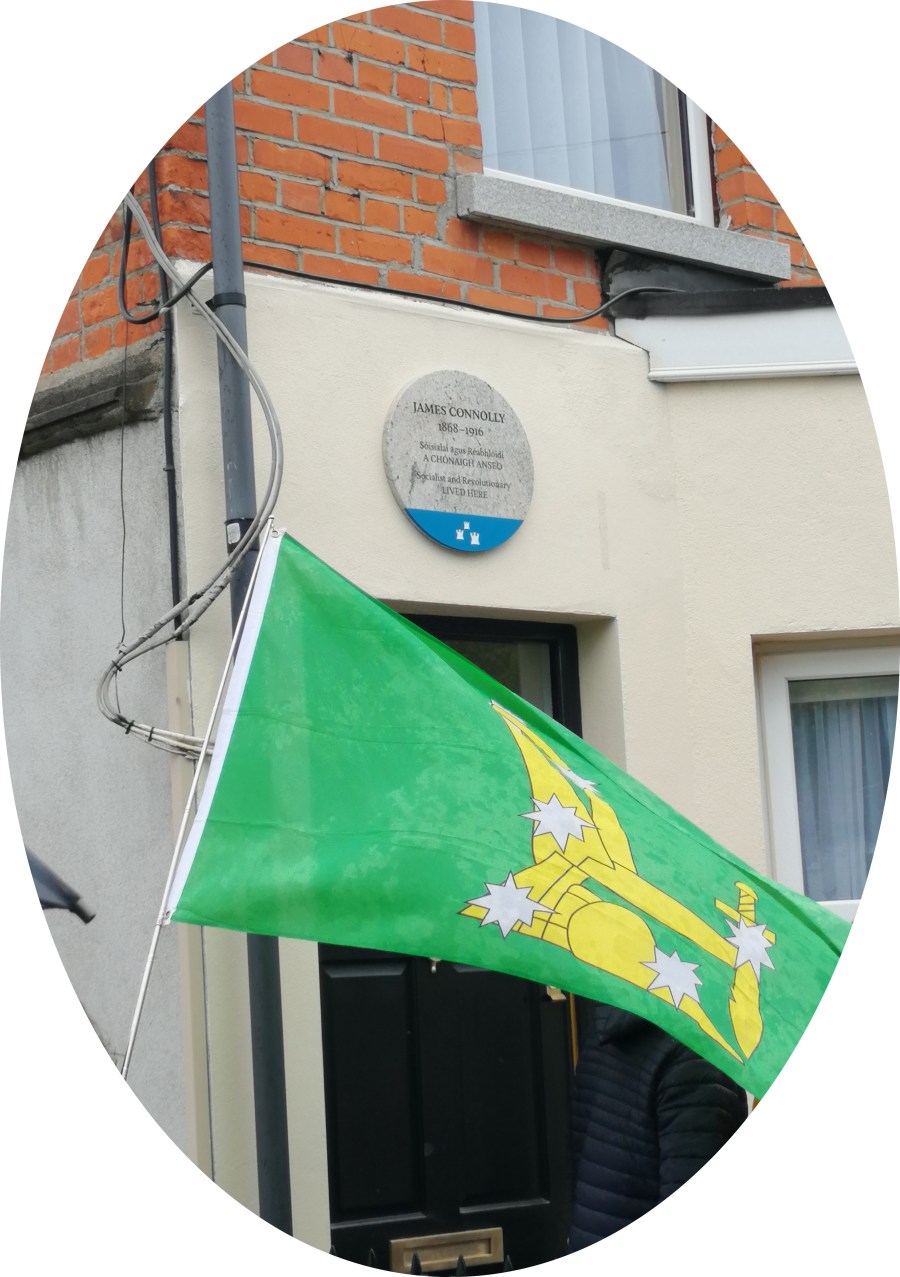
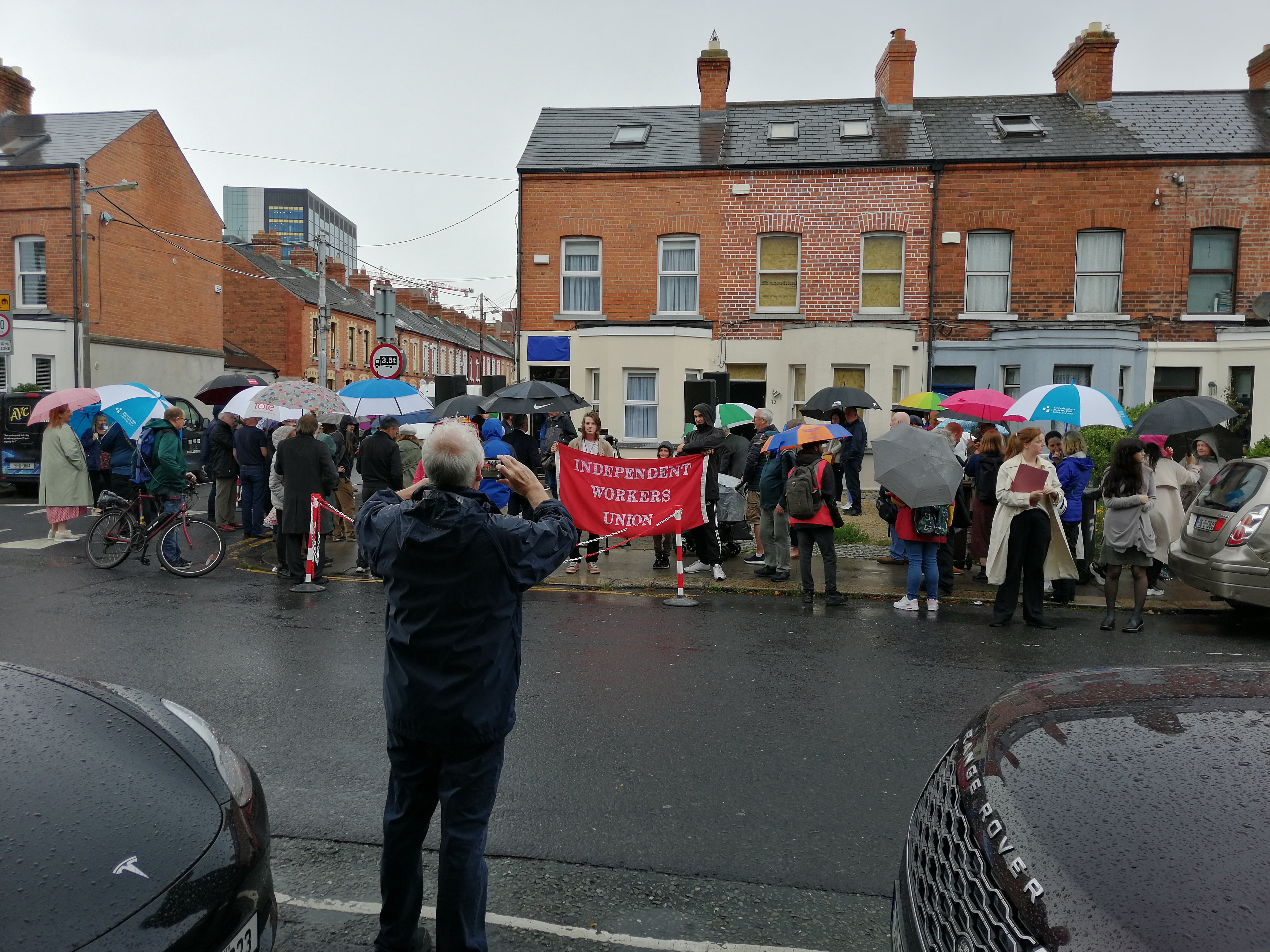
A new plaque commemorating James Connolly was unveiled on the morning of 31st July on 70 South Lotts, the house to which he returned from New York with his wife Lillie and children in 1910 and lived there until May 1911.

(Photo: D.Breatnach)

Connolly was born and reared in Edinburgh, left school at 10 and worked with his older brother John for the local authority as a carter, lied about his age and name to join the British Army, in which he first saw Ireland and where he met Lillie Reynolds; they were married soon afterwards.

Like his brother, Connolly became a militant socialist and trade unionist and returned to Ireland at the request of socialists to form the Irish Socialist Republican Party, the first socialist party in Ireland but left for the USA when the party failed to recruit significant numbers.

The ISRP’s office was in Middle Abbey Street, across the road from the premises of the Irish Independent, owned by Irish nationalist William Martin Murphy who was to become an arch-enemy from the Lockout and strikes of 1913 onwards1.

Connolly was a historian and journalist as well as a socialist, trade union organiser and a revolutionary. A report in Breaking News on the unveiling infers that he reluctantly committed to the Rising with the Volunteers; in fact, he had been pushing them to rise for months!

Unveiling speeches

The event started late and in rain. Dáithí De Róiste2, Dublin’s current Lord Mayor, opened the proceedings and commented that the plaque on the house was a reminder that Connolly lived a life in some ways like many ordinary Dubliners, living in a Dublin house and walking city streets.

Dublin Mayor Dáithí De Róiste speaking at the event. (Photo: D.Breatnach)
Historian Conor McCabe, who did the research for the plaque, speaking outside No.70. (Photo: D.Breatnach)

Historian Dr Conor McCabe, of Queen’s University Belfast, proposed the plaque as his research established the background that Connolly was living at the address around the time that his most famous work, Labour In Irish History, was first published in book form.

In deference to those in attendance standing in the persistent rain, Conor McCabe kept his speech very short. This was not the case with every speaker.

Joe Cunningham, General Secretary of Siptu3, an amalgamation with other unions of Jim Larkin’s ITGWU which Connolly had led for six years, commented in his speech that it was Connolly who ensured that the interests of working people were incorporated in the 1916 Proclamation4.

Also that, at the ceremony of raising an Irish flag over Liberty Hall5 in April 1916, had declared that “The cause of labour is the cause of Ireland, the cause of Ireland is the cause of labour.”6

Section of crowd in front of No.70 waiting for event to begin. (Photo: D.Breatnach)

Dublin City Council Commemorations & Naming Committee was responsible for the placing of the plaque, in consultation with the house occupants and its chairman, Councillor Mícheál Mac Donncha7 welcomed suggestions from the public for commemoration of people and events.

Sinn Féin Councillor Mac Donncha also commented that James Connolly was a personal hero of his.

Jim Connolly Heron, great-grandson of James Connolly, was called to say a few words and invited family members present to join him in front of the house while he spoke and commented also on the importance of commemorative plaques in protecting historical sites.

He did so in reference to the plaque on a house in Moore Street that had disappeared and come to light in a property developer’s office, raising concerns that had led to the long Moore Street conservation struggle.8

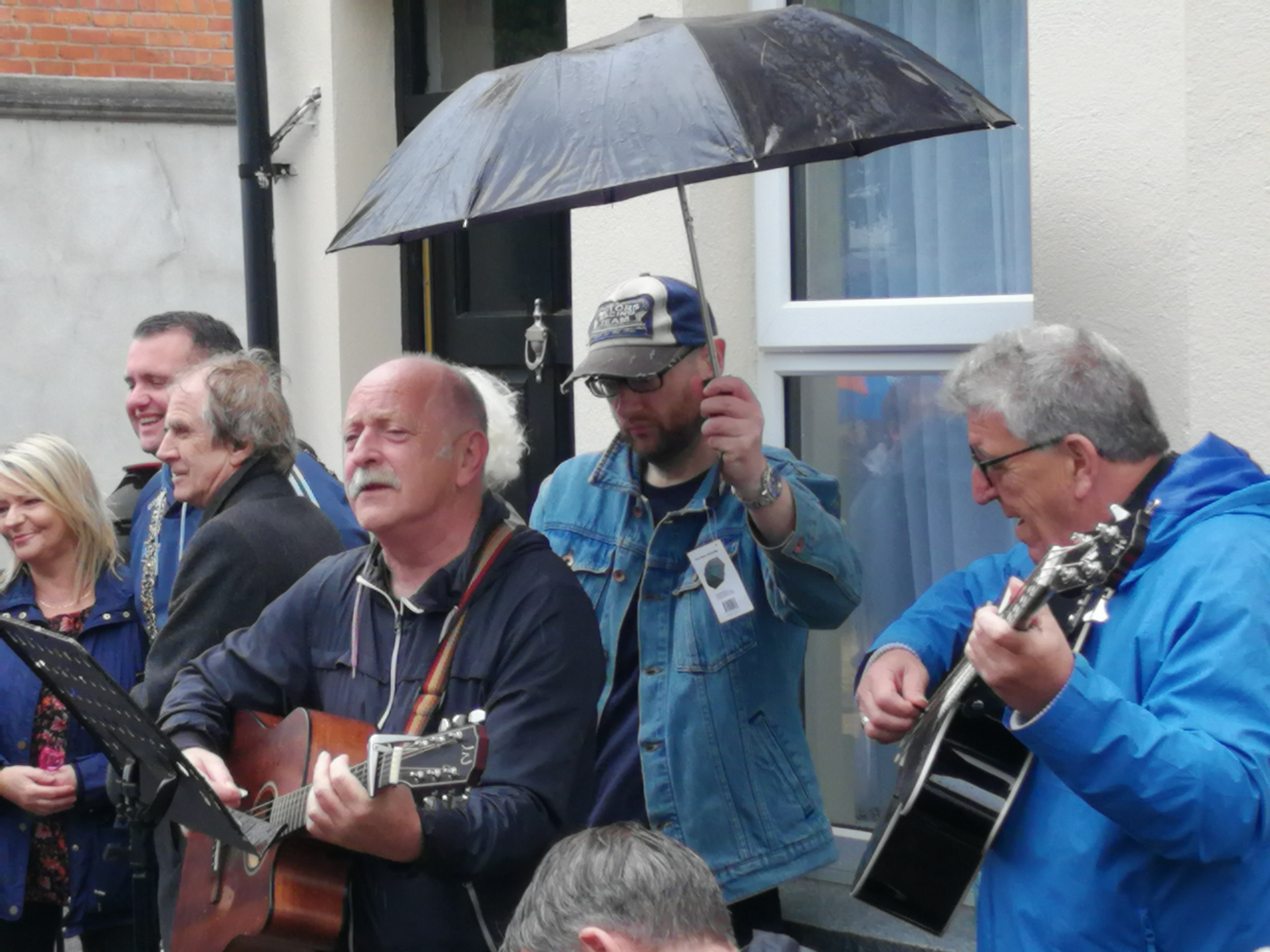
Music and song for the event was performed by The Pullovers ballad group but the amplification system had been removed by then which was a pity as it was needed for the music.

Ballads were performed at the event by The Pullovers band. (Photo: D.Breatnach)

The 1913 Lockout

James Connolly and family returned to Dublin when Jim Larkin9 offered Connolly a post in the young breakaway Irish Transport and General Workers’ Trade Union, which he took up in 1910. Three years later the union was in a fight for its life.

It is sometimes wrongly claimed that the 1913 Lockout was an attempt by employers in Dublin to prevent workers from joining a trade union but there were other unions operating in Dublin during the period and they were accepted by most of the employers.

Apart from the ITGWU recruiting large numbers of ‘unskilled’10 manual workers, it pursued its objectives militantly, using sympathetic solidarity action by other workers to increase the effectiveness of the workers who were in industrial dispute with their employer.

In August 1913 a combination of around 200 employers presented their workforce with a declaration to sign which committed them to having nothing to do with the ITGWU. En masse, the workers refused to sign, were locked out while others struck work and were locked out too.

Right from the beginning the Dublin Metropolitan Police11 attacked the workers on behalf of the employers and in a baton charge on Eden Quay on 30th August fatally wounded two workers, also beating strikers and onlookers the following day in O’Connell Street (‘Bloody Sunday 1913’)12.

As a direct response, Connolly and Larkin set up the Irish Citizen Army as militant response to police attacks, dedicated also to Irish independence and their flag was the gold Starry Plough on a green background,13 which they flew over the Clery’s building in 1916.14

The only Starry Plough flag unfurled at the event, brought by a member of the attendance. (Photo: D.Breatnach)

Comment

The only Starry Plough to be seen at the event was one unfurled during the event independently of the organisers and speakers.

Many who claim to admire Connolly or even to follow his teachings do so on occasion in words but never in action and if Connolly were alive and acting as he did when he was, most of the speakers at the unveiling event would call, if not for his shooting, certainly for his jailing.

SIPTU is much larger than the ITGWU was but it and other unions are much less effective; as a result of the lack of active resistance by the leadership, union membership in Ireland is at an all-time low in modern times. Nor would Connolly have ever agreed to the partition of Ireland.

The Irish Labour Party, which Connolly and Larkin formed in order to give the working class a voice in municipal affairs, has been in coalition government a few times, always capitalist and most often with the right-wing Fine Gael, when they have joined in attacks on the working class.

Joan Burton, while Tánaiste15 of the Labour-Fine Gael coalition government in 2014, complained about working class people being able to afford video-phones and tried to get people jailed for organising an effective protest against her in Jobstown.16 She too attended the unveiling today.

Joan Burton, who attended the event. (Photo: D.Breatnach)

Fianna Fáil is a party of the Gombeen client class and has been in government more often than any other, whereas Sinn Féin in its current incarnation is seeking to replace it with more of the same.

It is a tribute to the memory of James Connolly held so dearly among the working people that these types, so far from Connolly in their reality, are obliged to pay public homage to the man and to his principles while their daily practice is in opposition to all that he stood for.

End.

FOOTNOTES

1An editorial in his newspaper, The Irish Independent (still one of two main newspapers of the state), after a number of British executions of a number of 1916 leaders, called for continued executions of leaders prior to the execution of Connolly and Mac Diarmada, the last of the 14 to be executed in Dublin (Kent was shot in Cork and Casement hanged in London).

2Fianna Fáil elected councilor.

3The largest union in Ireland, owner of the current Liberty Hall which stands on the ground of the original union building.

4There is no record that this is the case but it is a natural and widely-held assumption. It is a fact that the Proclamation was printed in Liberty Hall.

5Cunningham said it was “the Irish flag” which most would think a reference to the Tricolour. However that flag had not yet been accepted by the majority as the primary flag of the nation, which really occurred after the 1916 Rising. The flag raised instead by teenager Molly O’Reilly at Connolly’s request had the golden harp on a green background, the essential flag of Irish Republicans from the 1790s until the 1916 Rising.

6This was not a random statement by Connolly but rather a strategic one; on an earlier occasion he had observed that of all social classes in Ireland, the working class remained “the incorruptible inheritors of the fight for Irish freedom”. Connolly wrote that in his foreword to his work Labour in Irish History, clearly indicating that only the working class could be trusted to lead the national struggle through to successful conclusion.

7A prominent member of one of the groups campaigning for Moore Street Battlefield conservation, the Save Moore Street Trust, of which Mac Donncha is Secretary.

8That occurred at the beginning of this century and the struggle has been ongoing since.

9Like Connolly, also a migrant and member of the Irish diaspora but from Liverpool. He founded the Irish Transport & General Workers’ Union after his departure from the British-based National Union of Dock Labourers, for which for a time he had been chief organiser in Ireland. Most of the NUDL’s members in Ireland left to join the ITGWU but in Belfast there was a division along sectarian lines.

10This is the general appelation for work not requiring long periods of training. However, anybody who has been employed in work of this category soon learns that such work requires skill to achieve the objectives set, to pace oneself and to guard against injury. This is the reason those recruiting for such ‘unskilled’ work prefer ‘experienced workers’, a code for ‘skilled’.

11A police force of the period for Dublin City, most of its members being without firearms, unlike the armed all-Ireland colonial gendarmerie of the Royal Irish Constabulary (of which the Police Service of Northern Ireland is a descendant body). DMP minimum height requirements were 5ft 9” in a city where many working people were of low stature; this disparity gave substantial momentum to the swing of a truncheon.

12The event wrongly named as leading to the death of two workers, whose deaths were caused by the previous day’s police attack on Eden Quay, just by Liberty Hall. However, a previously healthy Fianna Éireann boy, Patsy O’Connor, who was clubbed in the O’Connell Street police riot while he administered first aid to a victim, suffered frequent headaches thereafter and died in 1915 at the age of 18.

13The design has seven stars in the Ursa Mayor configuration, with the design of a plough following the stars and a sword as the ploughshare. There is also a plainer version flown by the Republican Congress of the 1930s, the outline of the Ursa Mayor constellation in white or silver stars alone on a blue background.

14The flag survived the shell explosions and raging fires along the southern half of O’Connell Street and is currently in the Military History Museum, Collins Barracks, Dublin, along with a number of other flags flown by the insurgents during the Rising.

15Title of the Deputy Prime Minister in the Irish government.

16A number of activists from different organisations, including Paul Murphy TD (member of the Irish parliament) were arrested in raids some time later and among the charges was “kidnapping” Burton. The untruthfulness of a number of witnesses for the Prosecution including a senior Garda officer were exposed (ironically by video taken by protesters) and the jury acquitted all the defendants of all charges.

end.

REFERENCE

https://www.breakingnews.ie/ireland/plaque-unveiled-at-james-connollys-former-home-in-east-dublin-1509431.html

Monument for National Army soldiers killed in Civil War unveiled in Dublin

News & Views No. 6 (Reading time: 4 mins.)

Original Breaking News article: DAVID YOUNG, PA (with commentary in italics by Diarmuid Breatnach)

The rededication of a memorial to the National Army soldiers killed in the Civil War enables their memory to be rehabilitated, a ceremony in Dublin has heard.

Defence Forces Chief of Staff Lieutenant General Sean Clancy paid tribute to the some 810 soldiers killed serving on the Free State side in the 1922-2023 conflict as he addressed the event at Glasnevin Cemetery on Sunday.

Descendants of some of those who died, representative of all four provinces, were invited guests at the ceremony, among them relatives of Michael Collins, the commander in chief of the National Army who under direction by Churchill, gave the orders that began the Irish Civil War and who was killed in 1922.

Taoiseach Leo Varadkar and Tánaiste Micheál Martin, the leaders of Fine Gael and Fianna Fáil, the two main parties forged from the divisions of the Civil War, also attended the rededication of the National Army Monument.

Sinn Féin TD Matt Carthy also attended the military commemoration, as did Dublin Lord Mayor Daithí de Róiste.

This neatly brought together political parties of the neo-colonial and neo-liberal Irish State with opposing histories: Varadkar to represent the pro-British and fascist neo-colonial origins of Fine Gael; Mícheál Martin and De Róiste representing Fianna Fáil, the allegedly Republican but in reality Irish Gombeen split from the previous iteration of Sinn Féin; Carthy for the current neo-colonial, neo-liberal and colonial servant Sinn Féin.

Taoiseach Varadkar (Fine Gael) and Tánaiste Martin (Fianna Fáil) unveiling monument to soldiers of the ‘Free State’ killed in the Civil War 1922-1923. (Photo cred: Brian Lawless/ PA)
Matt Carthy TD, who represented his party Sinn Féin at the unveiling and dedication of the monument to soldiers of the Free State killed in the Civil War 1922-1923. (Photo sourced: Internet)

Prior to the ceremony, there was no monument in the country specifically dedicated to the soldiers of the National Army who fought against the anti-Treaty side in the Civil War.

Weeks after the war ended, on August 3rd, 1923, the Oireachtas passed legislation that led to the creation of the modern-day Defence Forces, Óglaigh na hÉireann. That is, the defence forces of the neo-colonial ruling class who created the Irish state.

The rededication event for the forgotten fallen of the National Army, which had already robbed the Irish language version name of the IRA, adopted the name Óglaigh na hÉireann during the Civil War, took place on the Sunday prior to the centenary of that date.

“It is appropriate then, in the spirit of real inclusiveness, of ethical remembering, and with a full desire to deal with some of the more uncomfortable aspects of our shared history, that we remember some of 810 uniformed members of Óglaigh na hÉireann who gave their lives in the service of the State during the tragic and critical period at the foundation of our democracy,” Lt Gen Clancy told the ceremony.

It is necessary, in order to bury any idea of achieving the Republic declared at the start of the 1916 Rising, that we honour some of the 810 men we recruited to bury that Republic in 1922, kitted out in uniforms, armed and transported by our ancient enemy. We wish to pass over quickly over not only the kidnappings, torture, murders, killing of disarmed prisoners and even sexual assaults by this fine body of men – the precursors to the current army of the Irish State – but also their terrorising of major part of the country with raids on homes and internment of men and women. Although this fine body of men were fighting to establish a neo-colony not even covering the whole of Ireland, we make no apology for calling them what they clearly were not, Óglaigh na hÉireann, i.e “Warriors of Ireland”.

The monument in Glasnevin to soldiers of the Free State killed during the Civil Warapart from the Free State Army having appropriated the name in Irish of the IRA, the legend claims they “died for their country”, a clearly inaccurate statement since at best they were fighting for the government and state of the 26 Counties, which excludes the UK colony of the Six Counties (‘Northern Ireland’ sic). (Photo cred: PA)

“For far too long there has been no memorial of any kind, nor any complete listing of the National Army war dead.” Understandably.

“Indeed, this year represents perhaps the last real opportunity to rectify that.”

As we prepare to commit this armed force to NATO at some point in the future and to PESCO in the nearer future, it is important to take a further step in legitimising this armed force of the neo-colonial state.

The remains of some 180 of the 810 soldiers who died serving in the National Army are buried at the plot in Glasnevin Cemetery. Uncomfortably close to graves of many of their victims.

“Sources at the archives show that the average soldier buried here was in his early 20s, was unmarried and from a working-class background,” said Lt Gen Clancy. In other words, the typical recruitment profile of lower-rank soldiers in capitalist and imperialist armies.

“Many had previously served in the IRA during the War of Independence, some even in the 1916 rising, many others had served in the British Army, underlying yet again how complex is the weave of Irish history.”

Actually, “many” is a questionable though vague estimate of the numbers who had “served in the IRA during the War of Independence”, though some had, including some of the most vicious, such as Major-General Paddy Daly, torturer and murderer.

The chief of staff highlighted the “poignant example” of two young Belfast-born Dublin-raised brothers – Frederick (18) and Gerald McKenna (16) – who were buried in Glasnevin after being killed together in action in Cork in August 1922 only a month after joining the National Army.

Aye, two men born in Belfast, a city which the Free State was fighting to ensure remained a direct colony of the United Kingdom.

“Whatever the often very legitimate reasons our forebears may have had for forgetting in the intervening 100 years, I think it’s appropriate now that I as the 32nd Chief of Staff of Oglaigh na h Eireann should finally take this opportunity to rehabilitate their memory,” said Lt Gen Clancy.

Especially as I try to establish a legitimate background to the armed force of an illegitimate State preparing to enter foreign imperialist wars and suppression of legitimate uprisings.

After all, we have great experience in all that, as the history behind this monument shows.

End.

Source: https://www.breakingnews.ie/ireland/memory-of-fallen-national-army-soldiers-rehabilitated-as-monument-unveiled-1508928.html