CATALAN INDEPENDENCE PARTIES AGREE TO FORM GOVERNMENT

(Translation D.Breatnach from Publico report 12 May 2021)


ERC, JxCat and the CUP parties reached a “minimum” agreement this Wednesday to unravel the investiture negotiations to avoid an electoral repetition after the results of the elections on February 14th in Catalonia. The deadline for investing the President of the Generalitat is May 26 (after that new elections would need to be called — DB).

After two hours of meeting in the Parliament, the three organisations issued a joint statement that to promote an “overall National Agreement for Self-determination” and a “space for the debate on the independence strategy beyond governance.”

After the meeting, the Deputy General Secretary and ERC spokesperson, Marta Vilalta, the JxCat Deputy Francesc Dalmases and the leading spokesperson of the CUP in the Catalan Chamber, Eulàlia Reguant, came out together.

In the lobby of the Catalan Parlament after agreement was reached, front row L-R: Eulàlia Reguant, leading parliamentary spokesperson of the CUP; Deputy General Secretary and ERC spokesperson, Marta Vilalta; the JxCat Deputy Francesc Dalmases (Photo credit: Toni Albin, EFE)

Formation of a new Government

The act of separating the debate on the independence strategy from the formation of a new Government was one of the obstacles that prevented the agreement, JxCat until now requiring ERC to link both items.

Although the wording of the statement is ambiguous on this point, it already aims to unlink the creation of a unitary strategic direction of independence from the negotiation for governance, which was threatened recently by the disagreements between ERC and JxCat.

Relations were very strained last Saturday, when the ERC candidate for the investiture, Pere Aragonès, announced that he would no longer continue negotiating a coalition government with JxCat, which he accusef of delaying the negotiation, and that from now on only he would contemplate ruling alone.

In the joint communiqué, entitled “Commitment to a National Agreement for Self-determination”, the three formations emphasize that the results of the 14 February elections “offer the independence movement the possibility of opening a new cycle for national liberation.”

Four “minimum points”

The negotiators have agreed on four “minimum points” based on a proposal that the CUP, convener of the summit in Parliament, had put on the table, in which it has become a mediator to facilitate a rapprochement of positions between ERC and JxCat.

In the first point, they undertake to “provide a response to the social and economic crisis” that Catalonia is experiencing, while in the second they commit to “build a wall to defend fundamental and basic rights that have broad support from Catalan society and which do not fit within the framework of the State “.

Third, they commit to convening a first working meeting to configure “an Overall National Agreement for Self-determination, to go beyond political parties and to bring together the broad social majority of the country in favour” of a referendum.

“With the unequivocal commitment that through dialogue and democratic struggle in the (Spanish) State the exercise of self-determination and amnesty can be achieved during the next legislature,” they added.

Finally, they are committed to “reaching a space for the debate on the independence strategy beyond the framework of governance.” This last paragraph modifies – and adds ambiguity – the fourth point proposed by the draft of the CUP, which suggested “placing the debate on the independence strategy outside the framework of the government pact.”

Unraveling the negotiations

Sources with inside knowledge of the meeting indicated to Efe (news agency) that the meeting was positive in moving forward, although it is too early to say if it will be enough for ERC and JxCat to get back on track to an agreement that in recent days had been difficult.

For his part, the leader of the PSC in Parliament, Salvador Illa, asked ERC to “lift the cordon sanitaire” that he raised against the social democrats before the 14 February elections and to facilitate a left-wing majority led by the PSC. “I challenge them: with the failed independence path not working, at least let a left-wing government be constructed and lift the cordon sanitaire that they signed against the PSC,he said on a visit to Mataró (Barcelona).

The leader of En Comú Podem in Parliament, Jéssica Albiach, insisted in TV3 that for them “they continue to” attempt to form a Government with ERC, although she also declared the possibility of facilitating Esquerra to govern alone.

The president of Citizens in Parliament, Carlos Carrizosa, rejected the idea of ​​new elections if the Government is not formed because he believes that it would reflect a “lack of respect” for citizens.

For her part, the president of the Catalan National Assembly, Elisenda Paluzie, demanded an agreement from ERC, JxCat and the CUP to form the Government and called a demonstration for this Sunday in Plaça Sant Jaume in Barcelona to demand a pact between them.

Map of Catalunya including the part inside the French state (in dark olive green) and showing position within the Spanish state and comparing size with other countries including Ireland. (Source: Wikipedia)

COMMENT

Diarmuid Breatnach

THE PARTICIPANTS

ERC (Esquerra Republicana de Catalunya – Republican Left of Catalonia), republican party of a left outlook varying from radical to social-democratic. Its leader, MEP Oriol Junqueras, is in jail arising out the Spanish State’s opposition to the holding of the Referendum of October 2017. The party has 32 seats in the Parlament.

JuntsXCat (Junts per Catalunya – Together for Catalunya), a coalition of forces originally brought together by liberal conservatives but pushing hard for independence and more lately adopting many socially progressive policies. It leader, MEP Carles Puigdemont, is en exile in Brussels to avoid Spanish jail, along with others. The party has 33 seats in the Parlament.

CUP (Canditatura d’Unitad Popular – People’s United Candidature) is a more radically left-wing coalition of groups that until recently focused on local democracy than on national politics but is completely in favour of independence from the Spanish State. One of its leading activists, Anna Gabriel, is also in exile to avoid Spanish jail. CUP now has nine seats in the Parlament

ERC and JuntsXCat have 65 seats between them which give them a comfortable enough parliamentary working majority in the 135-seat Parlament and with CUP’s nine seats, could defeat a vote of no confidence even if the social-democratic (but unionist) PCE (33) and Comu Podems (8 — a local version of Podemos) supported a vote of no confidence by the right-wing parties of Ciutadans (6), Vox (11) and PP (3).

ANC (Asamblea Nacional de Catalunya – National Assembly of Catalonia) is a huge grass-roots pro-independence organisation which pushed for the Referendum in the 2017, organised massive demonstrations for independence and participated in organising a number of one-day general strikes of protest in and since 2017. Its former leader Jordi Sanchez is an MP but is also in jail along with another grass-roots movement leader, Jordi Cuixart of Omnium Cultural.

DIFFERENCES

What is at stake here is not merely a power struggle between one independentist political party and its leader and another party and its leader, but also a division over tactics and perhaps even strategy. Puigdemont of JuntsXCat led all the independentist parties and, in a sense, the whole united t movement through the Referendum, Spanish police invasion and violence and as far as declaring a republic – but then blinked and a few minutes later suspended that declaration.

Apparently he had been promised by ‘friends’ in the EU that if he suspended the declaration, they would come in and put pressure on the Spanish State. Predictably, I would say, they didn’t come through on that, Spanish State repression followed and Puigdemont went into exile.

Since the repression, ERC has been insisting they need to sit down and talk with the Spanish Government, which is a coalition of the social democratic PSOE and the radical social-democratic and trotskyist alliance of Unidas Podemos. However, the Prime Minister, Pedro Sanchez, has stated unequivocally that although he wants to talk, he will not be discussing holding a government-authorised referendum on independence for Catalonia nor the freeing of the political prisoners arising out of the last Referendum. They also voted in the Spanish Parliament to support the Government getting its budget approved, thereby helping to keep it in power.

Naturally enough, much of this has raised suspicions that ERC was preparing a sellout and even those who did not necessarily suspect that were exclaiming, since independence referendum and prisoner freedom is ruled out: “Talks with the Spanish Government about what?”

Despite Puigdemont’s faulty judgement at the time of declaring the Republic, he continues to have a lot of support in the independentist movement. However his insistence and therefore that of JuntsXCat that the forum for discussing and deciding independence strategy has to be the Consell per la República (Council for tge Republic) has caused a lot of trouble within the movement for Catalan independence. The Consell was formed as a private organisation by Puigdemont in Barcelona and in Brussels and, while in the latter sense it is out of the reach of the Spanish State, it is also out of any democratic control from within Catalonia, which ERC has pointed out as its reason for not agreeing to that measure.

The current agreement has bridged the gap temporarily and avoided the parties having to go into other elections for the second time this year, purely for the reason that the two main parties of the movement cannot agree with one another on the way forward. And momentum, the loss of which can be fatal for revolutionary movements, can hopefully start gathering force again. But there are likely to be further disagreements ahead. Which must be pretty depressing for the ordinary activists and supporters in a movement that has come so far so quickly and then stalled, while a number of people went to jail and over 700 town mayors are awaiting processing by the Spanish courts.

On the other hand, the role of mediator played by the CUP has no doubt enhanced their standing in the eyes of pro-independence Catalonia.

https://mail.google.com/mail/u/0/?pli=1#inbox/FMfcgxwLtszrnTpPXbWkgvGlTDthntTh

PRE-DEATH WISHES OF BOBBY SANDS NOT FOLLOWED

Comment by Anthony McIntyre

He also asked not to be wrapped in a shroud but a blanket. The idea of a shroud he found humiliating.
His remains being wrapped in a blanket was not a shock. The blanket had defined the prison protest and he identified as a blanketman, even telling British secretary of state Roy Mason “bury me in my blanket.” 

https://www.thepensivequill.com/2021/05/just-full-uncensored-words-of-bobby.html?

IN DUBLIN HONOURING THE SIXTEEN MARTYRS

Clive Sulish

(Reading time: 5 mins)

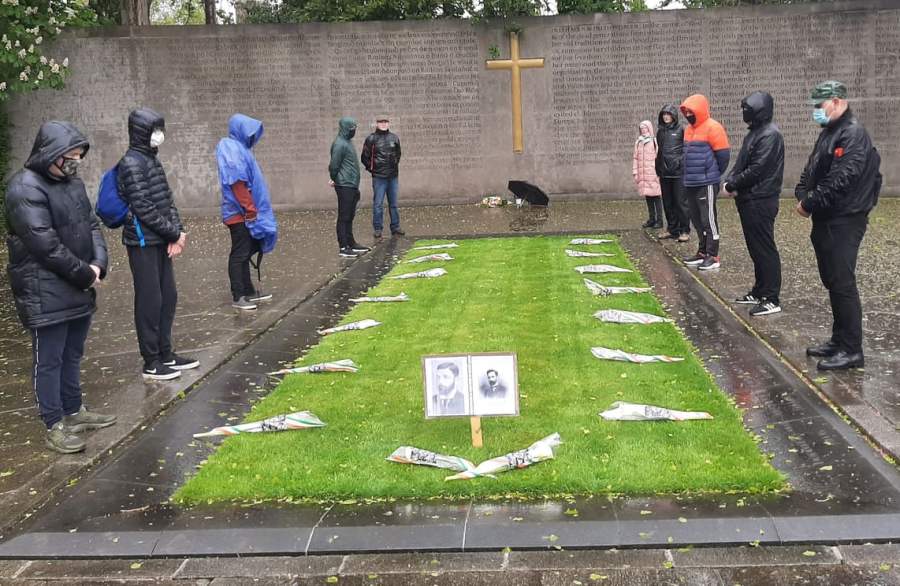
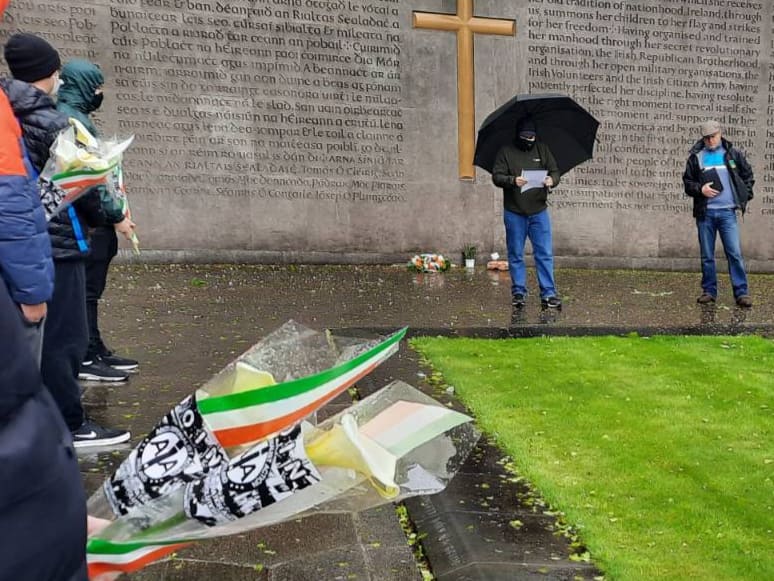
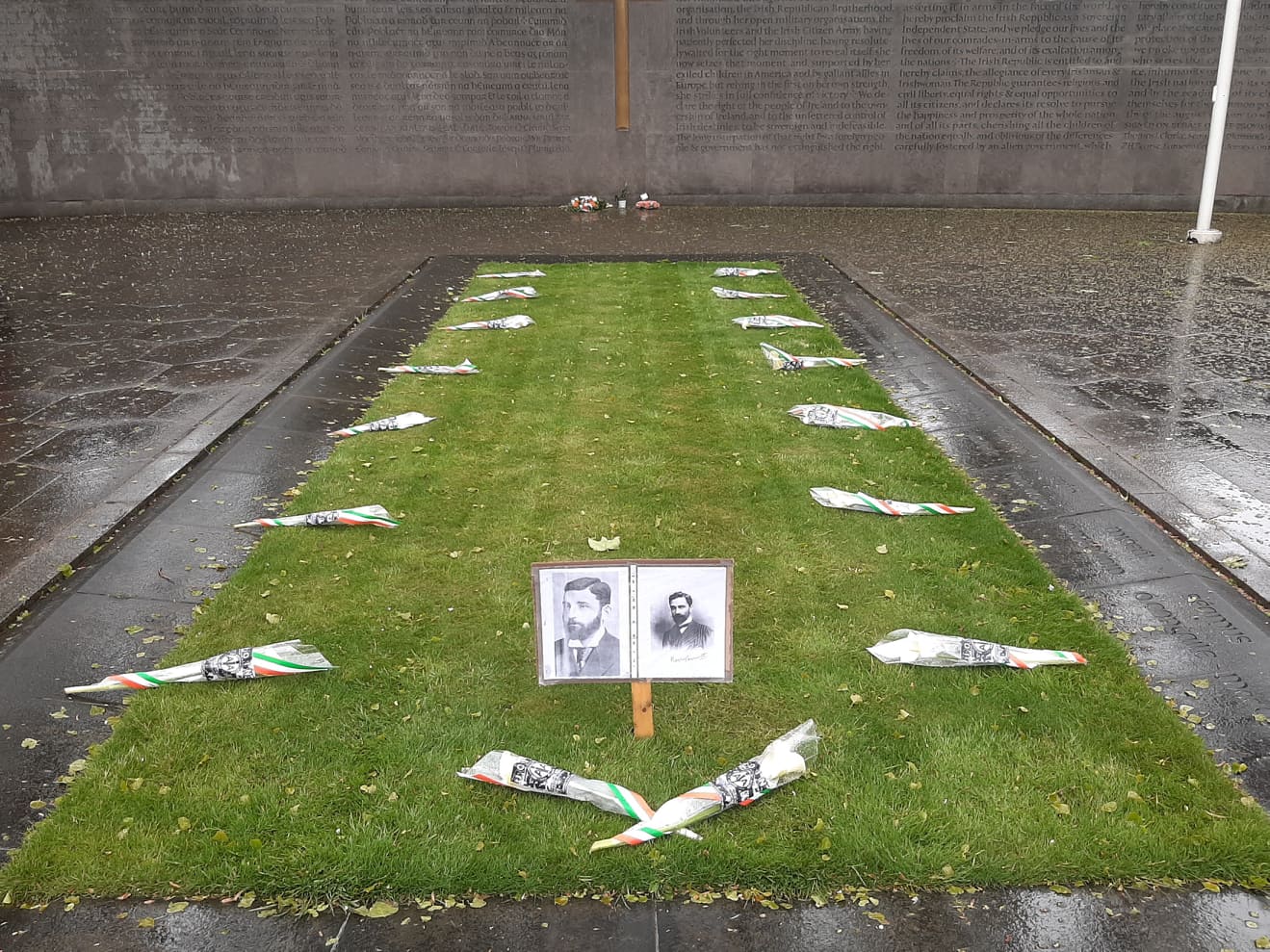
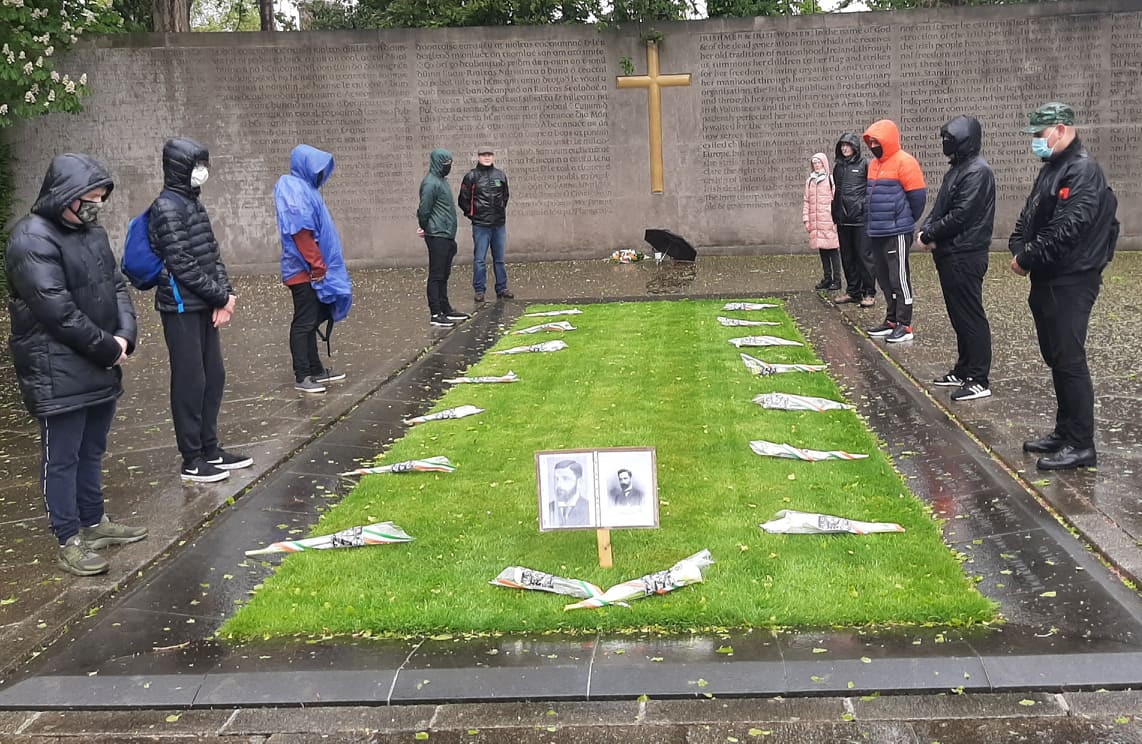
On a gloomy wet and windy day today, Republicans and other anti-imperialists held a commemoration in Dublin’s Arbour Hill of the 14 executed martyrs in Dublin and the remaining two: Thomas Kent shot in Cork and Roger Casement hanged in Pentonville Jail, London. A heavy downpour interrupted the speaker but the event resumed after the cloudburst eased off though it was still raining. Sixteen lilies were laid on the grave patch and a song was sung that named seven of the martyrs, the signatories of the Proclamation.

The event was organised by Irish Socialist Republicans and Anti-Imperialist Action Ireland. In addressing the attendance Pádraig Drummond, chairing the event, pointed out that they were commemorating the Sixteen executed Martyrs of the 1916 Rising but that 15 of them had been murdered. Those had been tried by military court and even the British reviewing the actions later had agreed that the executions had been illegal; therefore Drummond said those 15 had been murdered and General Maxwell1 was a war criminal.

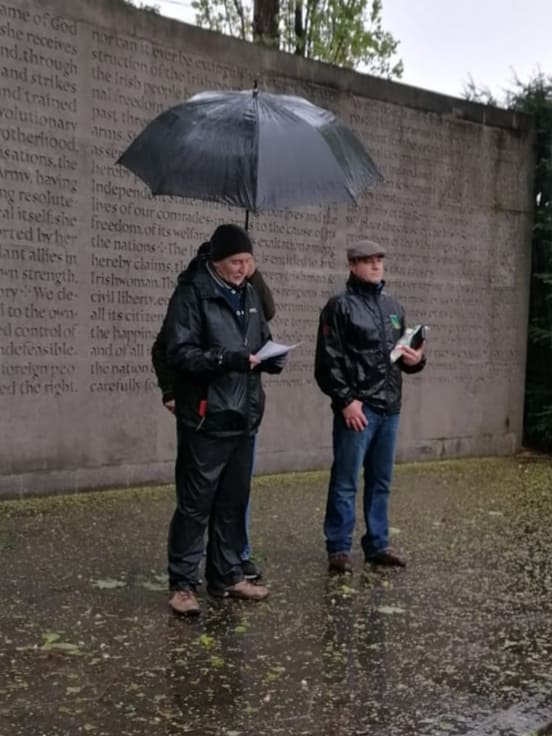
The 1916 Proclamation being read in Arbour Hill, 3rd May 2021. (Photos from AIA with thanks)

In addition, the chairperson continued, Maxwell had refused the relatives access to the bodies and had them buried without coffins in a quicklime pit in order to prevent their graves becoming martyrs’ shrines2.

When it came to the executions, Drummond said, Maxwell gave firing party duties to soldiers of the Sherwood Foresters, who had been decimated by Irish Volunteers at the battle of Mount Street Bridge on 26th April, seemingly to encourage them to avenge themselves for their regiment’s dead on unarmed prisoners condemned to die.

Pádraig Drummond called on one of the attendance to read out the Proclamation and, after he had done so, sixteen single Cala Lillies were laid on the plot above the quicklime pit.

Single lillies for each of the 14 martyrs buried here in Arbour Hill, 3rd May 2021. And two beneath the photos of the other two 1916 executed martyrs, Thomas Kent, shot by British firing squad in Cork and Roger Casement, sentenced to hang by British judge with sentence carried out by British hangman in Pentonville Jail. (Photos from AIA with thanks)

Diarmuid Breatnach was then called forward to address the attendance; speaking first in Irish and then in English, Breatnach said that he had been asked to make some remarks on the history of Irish uprisings in relation to assistance given from abroad but in doing so, he was not laying down any dictates or anything of the sort, only some reflections. “We should learn from our successes,” Breatnach said but also from our failures and perhaps to focus even more closely on the latter.

Breatnach had not been speaking long when the rainfall intensified. He was protected by umbrella but others in attendance were not; he faltered and looked for guidance to the chairperson of the event when the heavens seemed to burst open and with a nod, the whole ensemble headed for the shelter of a nearby horse-chestnut tree.

ALLIES

When the rain had eased off somewhat Breatnach returned to his theme, recounting how (Hugh) Aodh Ó Néill and Aodh Rua Ó Domhnaill (Hugh Roe O’Donnell) had waged a guerrilla campaign in Ulster but relied on help from imperial Spain to free the whole country from England. Later the Irish resistance had sided with English monarchs against the English Parliament in the mid and late 17th Century, when they believed the monarchs would give them religious freedom and perhaps some of their lands back. The Papacy had supported the Irish in opposition to Cromwell and Imperial France gave military assistance against William of Orange later in the same century.

Diarmuid Breatnach addressing the gathering in Arbour Hill, 3rd May 2021; Pádraig Drummond, who chaired the event, standing to his left. (Photo from AIA with thanks)

The United Irishmen in the 1790s had looked for help to Republican France, Breatnach recalled but the flotilla under Hoche failed to land in 1796 and after the Rising was provoked prematurely by the British, by the time General Humbert landed in Mayo with not enough troops, the rising was nearly finished. In 1803, Emmet’s rising took place without the expectation of foreign assistance but was quickly over.

The Young Irelanders apparently believed in 1848, the Year of Revolutions all over Europe that an insurrectionary mobilisation could be achieved peacefully in Ireland and did not look for help from abroad — but were quickly suppressed, the speaker said.

On St. Patrick’s Day 1858 the Irish Republican Brotherhood was founded simultaneously in Ireland and in the United States. In 1866 the Fenians invaded Canada and in 1867 carried out a campaign in Britain, then had a brief unsuccessful rising in Ireland. They had not asked for troops from outside but in their Provisional Proclamation called on the English working class to rise against their exploiters.

The IRB was reformed and re-energised at the beginning of the last century and intended to lead a rising when England was in a war, which was expected soon. WW1 began in 1914 and in 1916 the Irish rose expecting help from Imperial Germany (which they received in armaments but nothing else) and from the USA in political support of which they received little.

The speaker remarked that looking back on all these instances in Irish history, those risings which had not had help from abroad, as with Emmet’s and the Young Irelanders, had lasted the least time.

It would be unrealistic, Breatnach continued, to expect to defeat a powerful enemy such as the UK with its army, navy and air force, without help from an external force. Unless of course the rulers of the UK were struggling with insurrectionary struggles from their own working class.

SOLIDARITY

Looking ahead, the closest areas from which help could come to an Irish insurrection are Britain and the European mainland. In looking for allies it would be necessary to evaluate the benefits and costs of particular alliances. Breatnach felt that when a part of the Irish leadership accepted the deal they were offered in 1921, they had an alternative option of linking with the struggles of the working class in Britain. In 1926 there was a general strike throughout Britain and earlier, in 1921 there had been strike struggles including one in Glasgow, where the local military unit was under lock and key by their own officers in fear that they would join the resistance. Large numbers of British soldiers who wanted to be demobbed after the War were being held back because their rulers knew they would need them to suppress liberation struggles throughout the world. These soldiers were rioting in some areas in Britain. Breatnach remarked that it is difficult to be certain but that if the Irish resistance had combined with the British workers in that period our whole history might have turned out very differently.

Some of the attendance in Arbour Hill, 3rd May 2021, standing in homage to the 16 executed 1916 Martyrs, 14 of whose bodies were buried in a quicklime pit (located underneath the green stretch. (Photo from AIA with thanks)

In conclusion Breatnach went on to talk briefly about internationalist solidarity, which can be a different issue than alliances; solidarity can be a moral issue but it can also be a practical one, as it is workers that would be required to produce material and load ships being sent against us. He had also noted, he remarked, that often internationalist solidarity would be the first thing dropped by those intending to abandon the revolutionary path; Breatnach exhorted the attendance to treat internationalist solidarity as a duty, a pleasure and a practical help.

Pádraig Drummond thanked Breatnach for his remarks and asked him to sing the Larkin Ballad as a conclusion to the event, which Diarmuid did.

In Dublin City in 1913,

The boss was rich and the poor were slaves ….”

The lyrics were written by Donagh Mac Donagh, orphan son of one of the executed Signatories of the Proclamation. The narrative begins with the union militancy under Larkin’s leadership, followed by the Dublin Lockout of 1913 and ends with the execution of the Signatories. The participation in the Rising of the workers’ defence militia, the Irish Citizen Army, along with James Connolly being one of the Seven Signatories of the Proclamation, provided an organic link between the Lockout and the Rising.

After the event people took photos and socialised briefly before heading for their homes through persistent rain.

FOOTNOTES

1. General John Maxwell, a veteran of colonial wars, was the officer charged with the suppression of the Rising; he set up the martial tribunals that handed down nearly 100 death sentence to participants, of which 15 leading revolutionaries were actually put to death, the others having their death sentences commuted to prison sentences.

Wikipedia: “Maxwell arrived in Ireland on Friday 28 April as “military governor” with “plenary powers” under Martial law, replacing Lovick Friend as the primary British military commander in Ireland. He set about dealing with the rebellion under his understanding of Martial law. During the week of 2–9 May, Maxwell was in sole charge of trials and sentences by “field general court martial”, in which trials were conducted in camera, without defence counsel or jury. He had 3,400 people arrested and 183 civilians tried, 90 of whom were sentenced to death. Fifteen were shot between 3rd and 12th May. H.H Asquith and his government became concerned with the speed and secrecy of events, and intervened in order to stop more executions. In particular, there was concern that DORA (Defence of the Realm Act, wartime legislation –CS) regulations for general courts martial were not being applied. These regulations called for a full court of thirteen members, a professional judge, a legal advocate, and for the proceedings to be held in public, provisions which could have prevented some of the executions. Maxwell admitted in a report to Asquith in June that the impression that the leaders were killed in cold blood and without a trial had resulted in a “revulsion of feeling” that had emerged in favour of the rebels, and was the result of the confusion between applying DORA as opposed to Martial law (which Maxwell had actually pressed for from the beginning). As a result, Maxwell had the remaining death sentences commuted to penal servitude. Although Asquith had promised to publish the court martial proceedings, the transcripts were not made public until 1999.”


However, it is known that Maxwell insisted on executing two more after Asquith’s caution and these were Sean Mac Diarmada (McDermot) and James Connolly, to which Asquith agreed.

2 In that, Maxwell was signally unsuccessful and between 1955 and 1966 the Arbour Hill site was developed as an important Irish historical monument and at this time of year will be visited by organisations and individuals, precisely in commemoration of the 1916 Rising.

FAKE PATRIOTS DON’T WANT A UNITED IRELAND

Diarmuid Breatnach

(Reading time main text: 5 mins.)

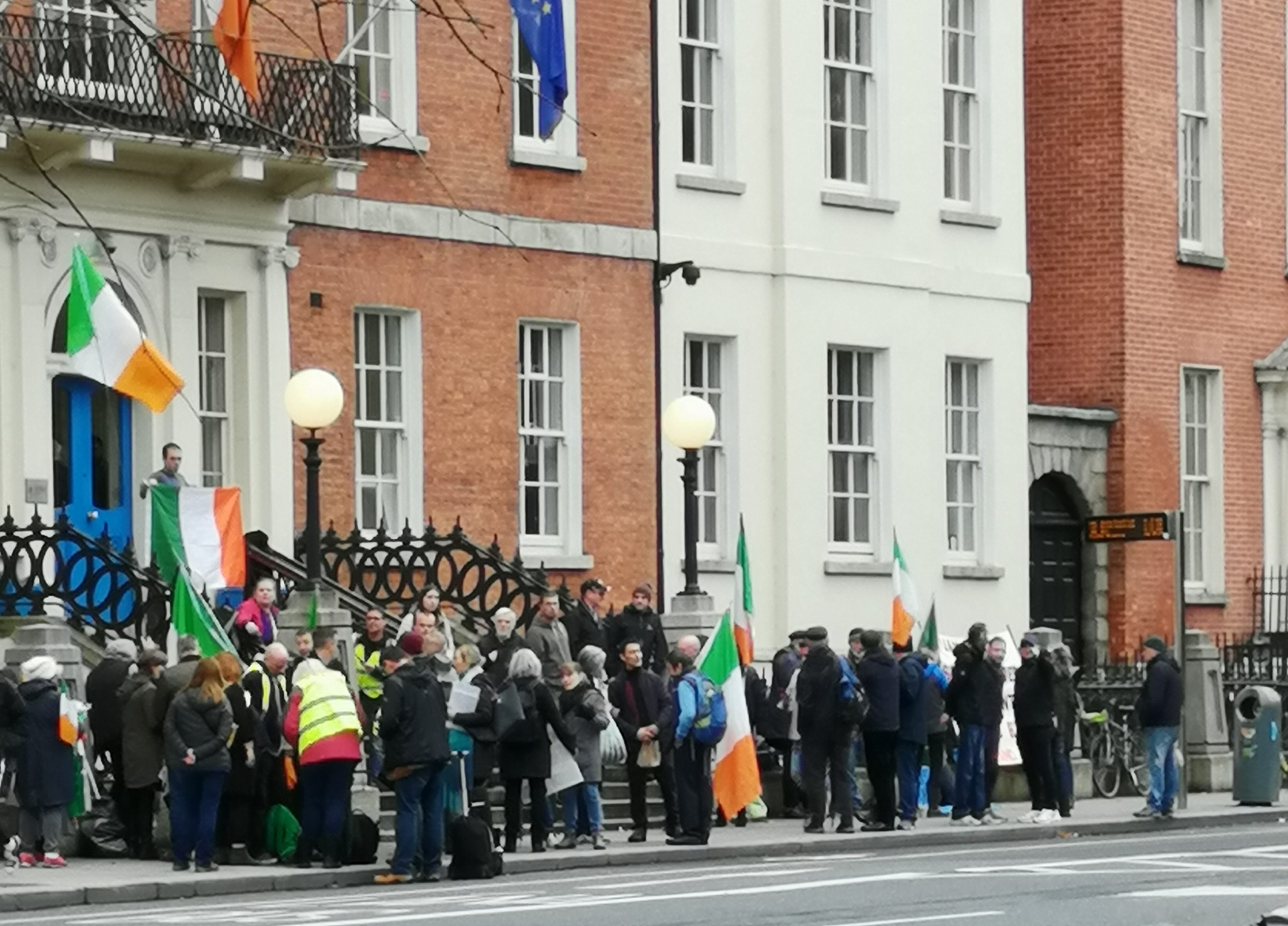
The anti-maskers, racists and outright fascists strutting around under the Irish Tricolour or the “Irish Republic” flag habitually claim not only to be patriots but to be more patriotic than anyone else – in fact the only true patriots. They refer to Ireland’s past struggles against the British colonialists (up to 19211, not after!) and to Irish patriotic martyrs, totally ignoring or even denying the kind of democratic and inclusive Republic for which those people fought. As all that were not bad enough, they display no interest in the Six Counties nor in what is going on there and that was demonstrated again during the past week when there was hardly a word of comment on their social media about events there.

Fascist group shot: Irish Freedom Party faithful, 2nd from right founder Herman Kelly with Croft to his right again (behind them the 1916 Proclamation, the actual words of which they work against). (Photo sourced: Internet)
The Far-Right like to portray themselves as patriots and usually a number of tricolours will be in evidence, as in this Gemma O’Doherty solidarity protest in Stephen’s Green, Dublin, November 2019 (Photo D.Breatnach)

BELFAST RIOTS: REASONS, FAKE AND REAL

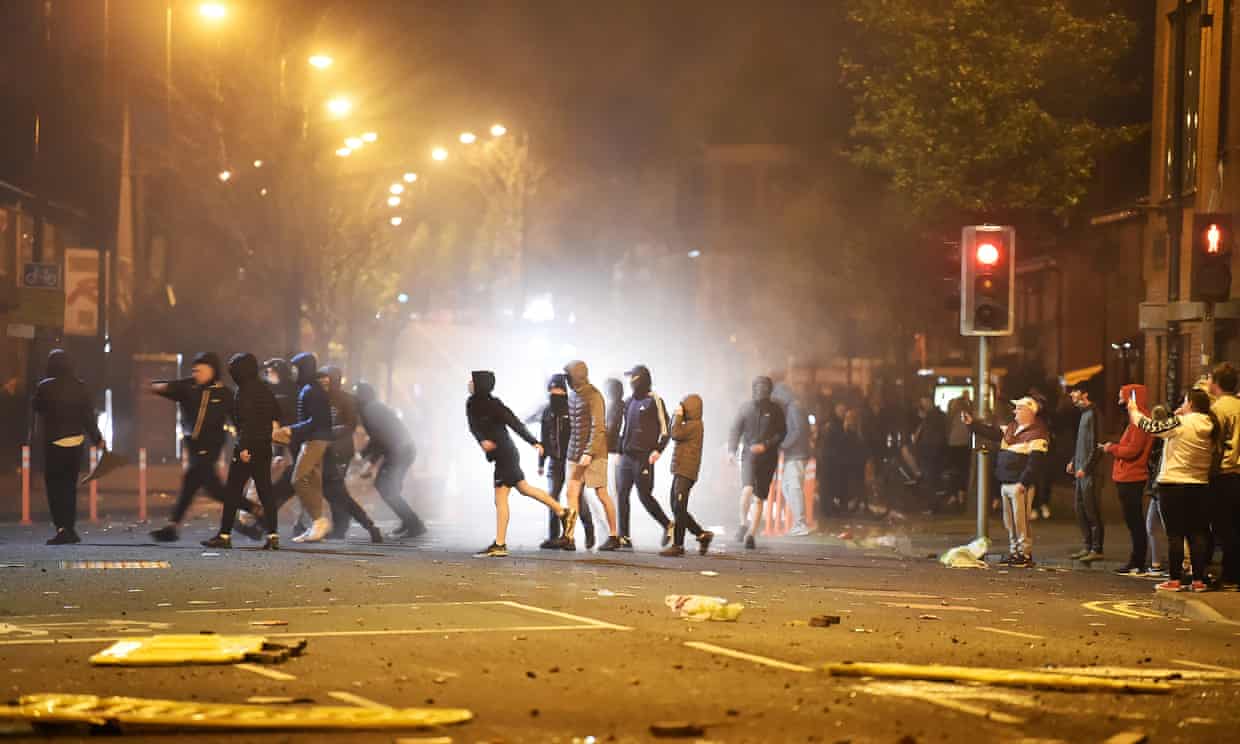
Riots broke out in Belfast last week and have been ongoing, firstly by Loyalists against the colonial police, then by ‘Nationalists’ against the police and Loyalists trying to attack their area. Since Brexit, Unionists have been unhappy with the decision of their masters in England to pull out of the EU and complain that they are being left with obstructions to trade as a result. Whatever their own wishes, they are bound by the decisions taken at Westminster and they have been complaining of those. Of course the whole situation has exposed the unnatural existence of the colony, the Six Counties, since most of Ireland continues to be a member of the EU.

Rioters on the (Loyalist) Sandy Row on 9th April (Photo sourced: Internet)

Next, Sinn Féin carried out a massive public funeral in Belfast for a prominent Republican veteran, Bobby Storey, in which large crowds of mourners and viewers could be seen flouting the pandemic restrictions and Michelle O’Neill, Vice-President of SF and Deputy Prime Minister of the colony’s government, was present. This was apparently intended in part as a demonstration of the strength of the party’s hegemony of ‘Nationalist’2 voters in Belfast.

Although unrelated to the Unionists’ problems with their over the sea masters and Brexit, the Unionists pounced on this violation of pandemic regulations to attack SF. When it emerged that the colonial police had held some discussions with SF prior to the funeral and that no-one had been arrested, the Loyalists, the more extreme wing of the Unionists3, jumped on the issue.

Coincidentally, the colonial police had very recently seized yet another consignment of drugs bound for a Loyalist gang, the South East Antrim UDA4 who then got youth to riot against the police pretending it was about the latter’s alleged deal with SF around the funeral event. Unionist politicians opportunistically stoked the whole event up as a distraction from their own helplessness over Brexit and possibly as an attempt to pressurise the British Government (to give them what it has no power to do, to effectively remain inside the EU market).

Loyalists would also be aware of the recent hyping of the question of a “Border Poll” and the possibility of a united Ireland in the near future – “hyping” because there seems little likelihood of such a poll, not to speak of a such a result, anytime soon. Such talk would increase their paranoia and anxiety and the usual result of that would be riots and attacks on Catholics.

Whenever the Loyalists feel unhappy with how they perceive themselves treated by the British or Unionist leaders, not long afterwards they will attack the “Taigues” or “Fenians”, i.e the large ‘Catholic’ or ‘Nationalist’ minority and at the weekend that is what happened. Loyalists stole a car and rammed it against a gate in a wall separating the two communities in Belfast and also gathered at the Springfield Road interface with the ‘Nationalist’ area of the Falls Road.

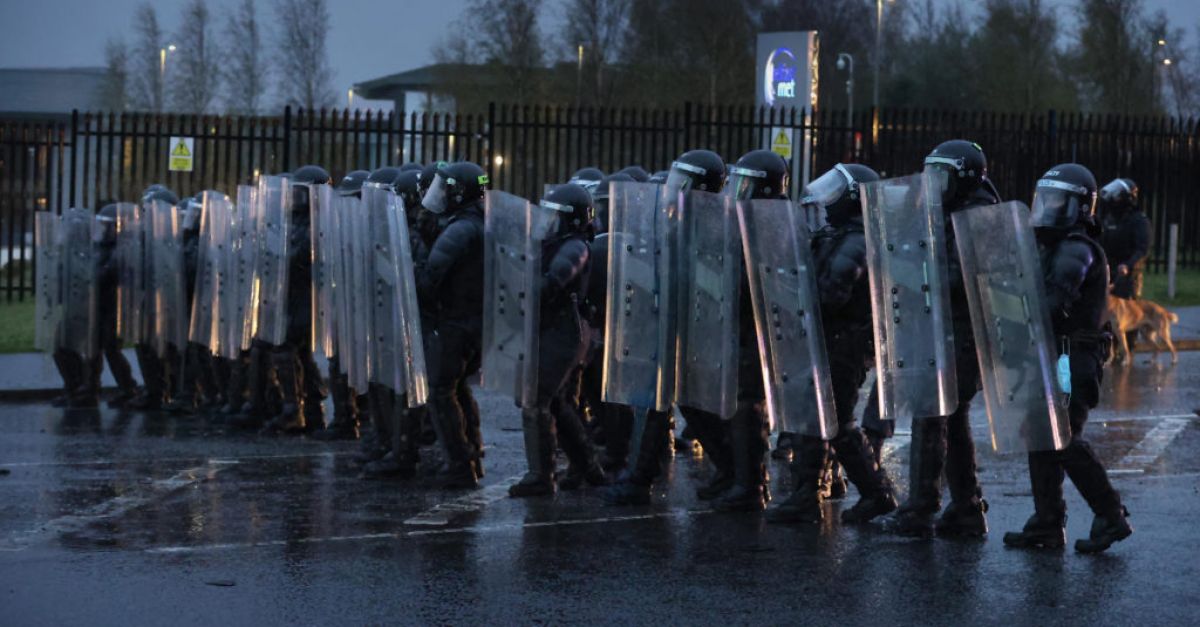
The youth and some older residents of the ‘Nationalist’ area naturally assembled at the Springfield Road junction to defend their area and naturally also the colonial police, the PSNI, appeared too. But these were not facing the invading Loyalists or trying to drive them back – instead, in riot gear, they faced the defending residents. The latter, having long experience with the sectarian and brutal colonial police saw this as a provocation and responded forcefully and so there was now a ‘nationalist’ riot against the colonial police who through the rest of the week had been attacked by the Loyalists, the latter now cheering on the police attacking the ‘Nationalist’ youth.

Colonial riot police on the Springfield Road 10th April, facing not the invading Loyalist mob but the ‘nationalist’ youth defending their area (Photo sourced: Internet)

FAKE PATRIOTS AND THE SIX COUNTIES

All of this was a prominent issue in the news in Ireland (though the drugs find issue quickly faded to be replaced by a solely sectarian narrative), clearly of relevance to the nation but somehow escaped any degree of discussion among the fake patriots who make up the ranks of organised fascists, racists, and anti-maskers.

Of course, if this Far-Right rag-bag were to evince an interest in the Six Counties, what could they say? They could not ally with Republicans, whom they sometimes call “terrorists” and who they know are antifascist. One might think the Far-Right would support the ‘Catholic’ minority, since most of those Far-Rightists are militant Catholics of one kind or another and all the fascist parties say they want a Catholic state. However, supporting ‘nationalist’ resistance rather than their usual nonsense about opposing masks and vaccinations could bring them up against both states in a real way. But it’s even worse than that, because fascists Rowan Croft (aka Gran Torino) and Herman Kelly of the Irish Freedom Party are recorded on a video sharing a platform in friendly discussion with Loyalist and British Fascist (formerly BNP and Britain First parties) Jim Dowson (who also posted a comment congratulating the National Party on their armed attack on unarmed counter-protestors in August last year in Dublin).

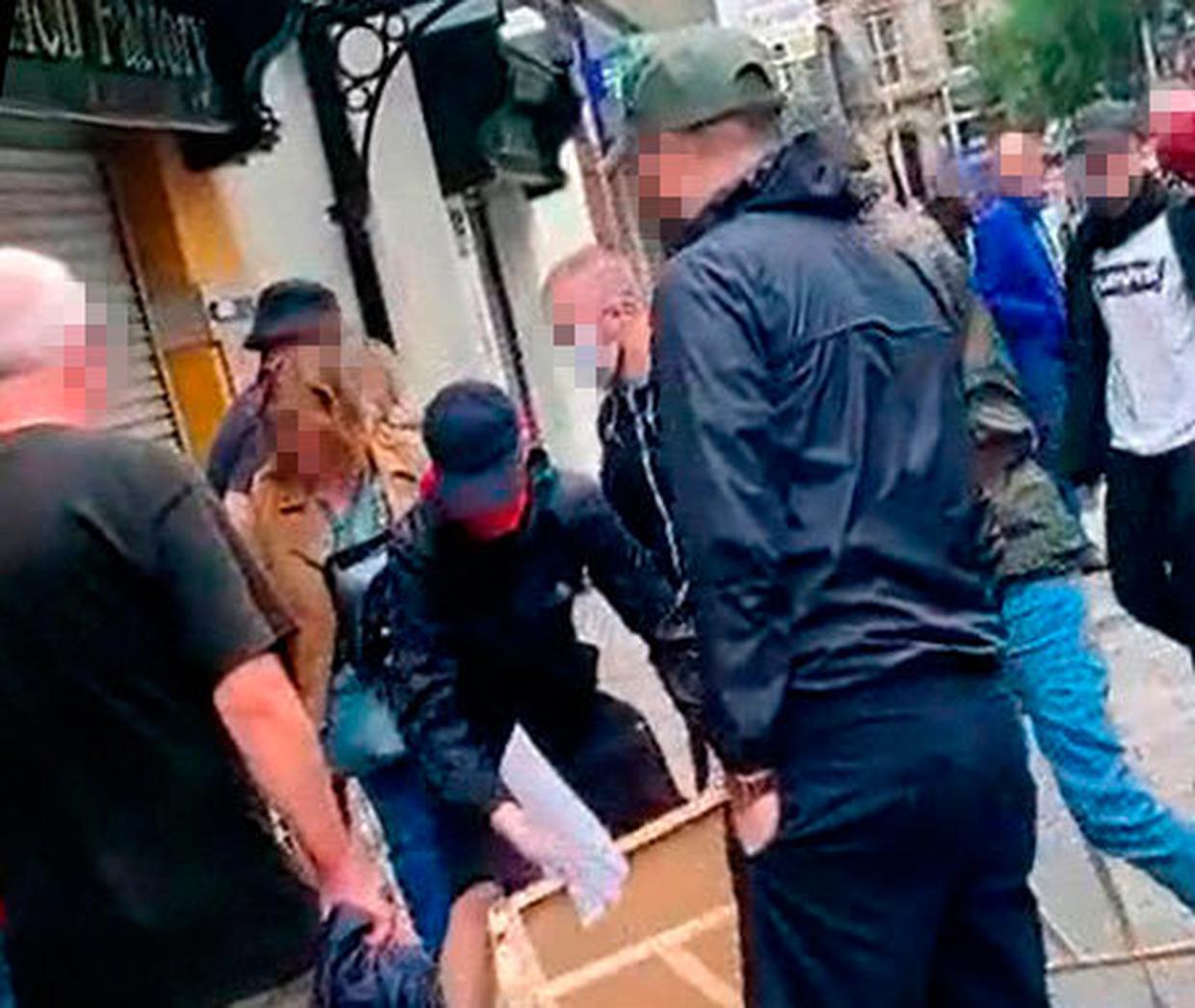
A patriot is a person who loves their country and its people and the Irish far-Right are constantly telling us how patriotic they are. But their patriotism, fake though it is for the rest of Ireland, stops completely at the British Border. Only the fascist Irish Freedom Party (under the cover of Irish Yellow Vests) has tried to set up in the Six Counties, where it has been resolutely opposed by Irish Republicans, after which it enlisted the help of the colonial police for protection.

Irish Freedom Party stall being disassembled by Republicans in Belfast July 2020. The next time the IFP set up they did so with colonial police protection. (Photo sourced: Belfast Telegraph)

The fake patriots will not be found supporting Republican prisoners nor protesting about the prisoners’ treatment under administrations both sides of the British Border, nor confronting the colonial police to oppose harassment on the streets nor their raids on the homes of Irish Republicans. The Irish fascists who hide among the anti-maskers, anti-lockdown protesters and flaunt their alleged “patriotism” represent nothing but a more repressive and vicious version of more of the same: capitalist neo-colonialism in the 26 Counties and capitalist British colonialism in the Six Counties. And should they get into power we’d hear a lot less about “freedom of speech and of movement” and a lot more about the need for “strong government” and “law and and order”.

End.

FOOTNOTES

1i.e the point at which the British divided Ireland; those subsequently fighting for Irish freedom were being hunted down by the new Irish State and, in the Six Counties, by the colonial authorities.

2Alternatively described as ‘Catholic’ or ‘Nationalist, the large minority within the British colony has been subjected to sectarian discrimination, cultural oppression and physical repression since the inception of the colony and before. The majority faith was Catholic and the majority political aspirations for a united and independent Ireland but it is not fundamentally a religious issue, nor is every resident in those areas a Catholic in religious faith or even necessarily a nationalist.

3The Loyalists as a sector tend to be working or lower middle-class while the Unionists tend to be upper middle-class or top of the pile and to manage the system, using the generally right-wing and virulently sectarian Loyalists in a similar way to that in which the racist Southern USA authorities used the Klan in the past – to repress the minority in ways which would look bad for the Unionists were they to do so. However, there are ups and downs and the Democratic Unionist Party, currently in power representing the Unionists, is a former Loyalist party that, under the leadership of Ian Paisley, overtook the Official Unionist Party decades ago.

4A “dissident” group within the Loyalist ‘family’; the Ulster Defence Association is a sectarian paramilitary association with connections to State’s repressive forces and controls the drugs traffic in Belfast; Antrim is the county in the NE of Ireland in which Belfast is located.

SOURCES & FURTHER READING:

Loyalist gang’s drug consignment seized: https://news.sky.com/story/criminal-gangs-encouraging-children-into-violence-on-northern-irelands-streets-say-police-12267276

and: https://www.belfasttelegraph.co.uk/news/northern-ireland/police-seize-12-million-worth-of-suspected-class-a-and-b-drugs-40262655.html

Other recent Loyalist drug losses:

Cocaine for Loyalists 18 March 2021: https://www.irishmirror.ie/news/irish-news/crime/dumb-criminals-lose-28-million-23748676

Three drugs shipments due for 6 Counties seized: https://www.irishexaminer.com/news/courtandcrime/arid-40192683.html

Irish Freedom Party chased in Belfast: https://www.belfasttelegraph.co.uk/news/northern-ireland/activists-evict-far-right-irish-party-as-it-sets-up-stall-in-centre-of-belfast-39398940.html

Michelle, you are a disgrace

Dear Michelle O’Neill, Deputy Prime Minister of the British Colony in Ireland, I write to tell you that you are a disgrace. In many ways and for many reasons but on this occasion in particular for your message to the Chief of the Royal Parasites, Monarch of the Occupying Power and Commander in Chief of the Colonial & Imperial Armed Forces by which power her State currently occupies six counties of our land.

Michelle O’Neill, Deputy First Minister Six County Colony and Vice-President Sinn Féin party. (Photo sourced: Internet)

“I wish to extend my sincere condolences to Queen Elizabeth and her family on the death of her husband Prince Phillip.
“Over the past two decades there have been significant interventions by the British Royal family to assist in the building of relationships between Britain and Ireland.
“It is appropriate that this contribution to the advancement of peace and reconciliation is rightly recognised.
“To all those of a unionist tradition and of British identity – those who value and cherish the Royal family – I wish to acknowledge the sense of loss felt.”

Had you confined yourself to a note expressing sympathy for the sorrow of another human being, even that one, that might have been forgivable. But you went further and made it political. “The building of relationships between Britain and Ireland” indeed! We’ve been having a relationship with the rulers of Britain for more than eight and a half centuries — a relationship of conquest, oppression and repression on their side and resistance on ours.

“Contribution to peace and reconciliation” indeed! The best contribution they could make to that — and probably the only one of any significance — would be to pull their forces and administration out of our country.

As for “those of …. British identity”, outside of the unionist sector in our country, most them had no great love for this racist and arrogant parasite whose exposure in the British media on a number of occasions has caused him to be given strong advice within the imperial administration to keep his mouth shut unless he is speaking off a script.

What does it matter what I think about the message you have sent? Not much to anyone except myself, one would assume. But Michelle, most self-respecting socialists, republicans or democrats will be thinking along similar lines. There must be hundreds of close supporters of your own party who are squirming in shame right now, trying to ignore your words or fumbling for rationalisations.

Michelle O’Neill last year taking part in recruitment for the sectarian colonial armed police. (Photo sourced: Internet)


I am not a supporter of your party and I do not approve, of course, of your participation in the administration of the occupiers’ colony, so I shouldn’t care perhaps. It’s strange though because in some way I feel you have tainted and diminished me.

Are these words going to make any difference? Not at all — except to make me feel a little better. To endure injury without protest is perhaps a worse option.

I would cry “for shame!” if it were not clear for some time now that you are completely shameless.

Diarmuid Breatnach

https://www.bbc.com/news/uk-northern-ireland-56689411BBC.COMNorthern Ireland pays tribute to Prince PhilipTributes are paid to the Duke of Edinburgh following his death at the age of 99.

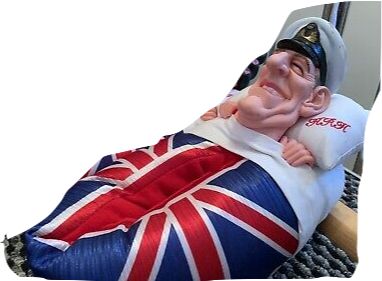
Prince Phillip lying in state (Photo sourced: Internet)

SWORD, PIKE, GUN – STRUGGLE FOR IRISH INDEPENDENCE

Diarmuid Breatnach

(Reading time: 8 mins.)

A debate is currently taking place about whether armed struggle is appropriate in the context of achieving national liberation in Ireland. The debate is hardly new — traditionally some sections of the polity have opposed armed struggle and some have advocated, even embraced it. However tiresome it may be for some, revolutionaries need to address questions as they emerge and re-emerge but there is another reason to enter this debate, which is that in my opinion both sections in the main are basing themselves on a false premise.

The composition of the sections opposed to or in favour of armed struggle has varied but in general and hardly surprisingly, the social democratic and liberal sections have opposed its use, while the revolutionary Republicans have defended it. But sections of the Republican movement at various times have also moved out of the armed struggle camp and into the ‘constitutionalist’ quarter. As to the revolutionary Left (or that claiming to be revolutionary), the main parties1 have opposed it not only in terms of Irish national liberation (with which they hardly concern themselves as a rule2) but also in the class struggle, while smaller parties and groups have at different times endorsed it as a legitimate or even necessary mode of struggle.

Before going deeper into this question it would be as well to look at the current situation in general and also to review the usual relevant scientific rules, which is to say those tested in the laboratory of Irish and world history.

OVERVIEW OF IRISH ANTI-COLONIAL HISTORY

Ireland is a small country in size and population but historically has had an effect on the history of large parts of the world out of all proportion to its size. Currently this is not the case which is perhaps not surprising since it is partitioned with one-sixth of its land mass under British colonial rule and the rest ruled by a neo-colonial capitalist class that came from under direct colonial domination a little over a century ago. The process of that colonial domination began eight and a half centuries ago3 and the decades and centuries since that time have seen Ireland colonised, most of its land appropriated, cultural, economic and political domination, famines and mass emigration, all of which the Irish have resisted and against which they and sections of the settler population have risen time and time again. The resistance has taken many forms but in general has always included armed struggle: sword, pike or gun.

Monument in Dublin to the 1798 Rising but equally so to the repression suffered before, after and during it — the site is Croppies’ Acre, the location of a mass grave of insurgents. The grey stone buildings in the background are part of the former British Army barracks in Dublin, subsequently barracks of the army of the Irish State, now a military history and clothing state museum. (Photo: D.Breatnach)

The phase of the national liberation struggle in the early decades of the last century resulted in the granting of nominal independence to five-sixths of the country and the retention of the remaining portion as a direct British colony, formally part of the United Kingdom but with a number of administrative and legislative elements peculiar to itself4. This was followed almost immediately by a civil war in which the Republican movement was defeated and all governments of the Irish state since then, regardless of their political party composition, have been of the “Gombeen” neo-colonialist class.

Elements of the Irish Republican movement have never reconciled themselves to this situation and surges of armed struggle took place in the 1930s and 1940s, after that usually restricted to the Six County colony in the mid 1950s to early 1960s and again from the beginning of the 1970s to the end of the 1990s, since when there have been what could best be described as sporadic armed incidents.

During the course of those years sections of the Irish Republican movement have abandoned armed struggle for national liberation, denouncing their erstwhile comrades and even participating in repression against them, whilst those who continue to support armed struggle accuse those who have left the fold of treason.

HISTORICAL EXPERIENCE

The history of Irish resistance to colonial domination and expropriation has been replete with armed instances which should surprise no-one, since that colonial domination was achieved in the first place by force of arms, a force employed again and again in repression also. Whenever other means of repressing Irish resistance were employed, e.g by legislation or cultural imposition, the arms of the conqueror were never far from view. “Dieu et mon droit” is the historical motto of the English monarch5, meaning “God and my right”; however “my right” in English at least has the other meaning of “my right hand”, which can also be understood as the hand used to strike a blow, whether as a fist or holding a weapon. And neither monarchs, feudal or capitalist classes of England have been historically reticent in employing force, including armed violence, in pursuit of their “right” to rule – their own country or others’.

Some of the damage to Dublin city centre from British artillery and subsequent fires in order to suppress the 1916 Rising. The shell to the right of photo is that of the GPO which was the HQ of the insurgents. To the left is the corner of Moore Street, an old market street still in existence today, to which most of the GPO garrison relocated. Centre background is “Nelson’s Pillar” which survived the Rising almost intact but was later demolished by dissident Republican explosion. (Photo source: Internet)

Indeed, it took an armed rising in 1916 followed by three years of guerrilla war (1919-1921) to convince the rulers of Britain that they should grant even limited autonomy to Ireland, albeit with partition as part of the deal. The intervening peaceful gain of 73 out a total of 105 Irish seats in the 1918 British General Election, every seat won on a public commitment to Irish independence and a rejection of the British Parliament, did not at all sway the British ruling class.

Furthermore, around the world the history of nations that have liberated themselves from colonial occupation or incorporation has been, almost without exception, that of armed repression overcome eventually by armed resistance.

AGAINST ARMED STRUGGLE IN IRELAND

Those who oppose the right and indeed necessity to resist armed occupation with armed resistance are opposing a law of history. Granted that in theory, Ireland may be an exception or that the historical rule may no longer apply in this historical period and if that is the claim, then it is incumbent on those who oppose armed struggle to explain why they believe one of those to be the case.

In general, they do not even try to do so but rely instead on emotional appeal and moral argument. These are irrelevant in this context: yes, people get killed and otherwise suffer in armed struggle but the deaths and suffering imposed by imperialism and colonialism world-wide are hundreds of times greater. If we want to apply emotional and moral rules to the question then logically we should support the most widescale and energetic struggle everywhere to overthrow imperialism in the shortest possible time.

Those who argue that the current historical situation provides an exception to the general rule of history usually rely on two issues:

1) The gaining of the most seats in the parliament of the Irish state by the Sinn Féin political party in the 2020 General Election6 and 2) the discussion current in society about the holding of a “Border poll” at some point in the near future.

Neither of these is valid for positing that Ireland is currently — or about to enter – a historical phase that will nullify the general historical rule.

1) The Sinn Féin political party has done much more than abandon armed struggle – it has accepted the partition of the country and joined the administration of the British colony, accepting its legal system and repressive apparatus, in particular its police force. Its party within the Irish state is striving to become the dominant party of the Gombeen capitalist class, as first step towards which it seeks to join a coalition government of one or more of the parties of that class, manoeuvring to appeal to the Gombeen class while at the same time keeping its popular base. Nor is this the first time this has happened in Ireland, for what became the foremost party of the Gombeen class, Fianna Fáil, followed that trajectory after splitting from Sinn Féin in 1926.

2) The question of a “Border poll” does not change the historical rule because it is not the expression of the desire of the colonised that governs the decisions of the coloniser, as evidenced from 1918 to 1921 in Ireland for example. Indeed, even during the most recent war in Ireland, opinion polls repeatedly showed a majority of the British population wishing to have their governments pull out of the colony, those wishes never acted upon or even tested in referendum. On a purely legalistic level, even if (and it is by no means certain) a majority of the population of the colony should favour formal unification with the rest of Ireland, the question of how large that majority should be remains uncertain, as does whether – despite the words of some politicians of the British State – the wishes of such a majority would find a majority in the British Parliament and, in the final analysis, the endorsement of the British monarch.

Nor is there any guarantee that such a poll would even be held. And in the final analysis the right to self-determination of a nation in its entirety is not to be decided by a minority made into an artificial majority by colonialism and backed up by its repressive apparatus.

THOSE IN FAVOUR OF ARMED STRUGGLE

The section of our polity supporting the right to armed struggle therefore has a well-established international historical rule and the nation’s historical experience to vindicate its position. But neither factor necessarily dictates the form or the timing for such struggle. And our history has had many occasions when armed struggle was not the most appropriate form of resistance, either because the subjective or objective conditions did not favour it or because we had suffered a recent crushing defeat in arms.

Taking up the option of armed struggle usually occurs in a revolutionary situation but can also be in others, for example against a fascist takeover or other repression, or in defence of some gains (both were present in the case of the Popular Front Government of Spain in 1936 and the second in the case of the Civil War in Ireland). It does not seem to me that any of the periods of armed struggle in Ireland since 1922 fit into any of those categories except perhaps in the recent war in the Six Counties which in part might be categorised as defensive armed struggle against repression.

To wage war against a superior armed and experienced enemy is a serious undertaking. To do so with the struggle largely confined to one-sixth of one’s country and in a part in which almost two-thirds of the population is ideologically opposed to one’s forces has to be considered madness. Extremely courageous but madness nevertheless. How could those leading that armed struggle ever expect to win? Only by basing themselves on a flawed analysis or a reformist one – never on a revolutionary one.

The flawed analysis was that the British ruling class had no great interest in holding on to the colony and could therefore be encouraged to leave if only they could be made to suffer enough. The theory that the British ruling class places no great importance in maintaining its grip on the Six Counties has been amply debunked by its actions since 1921 and even more so since 1968. Of course, that does not prevent liberals, social democrats, unionists and other defenders of British imperialism from peddling that theory but revolutionaries at the very least should be able to see through it.

The reformist analysis was that if only the struggle became serious enough then sections of the Irish capitalist class would oppose British colonial rule in Ireland and move towards the reunification of the country. This analysis is deeply mistaken in that it fails to take account of the nature of the native Irish capitalist class, which is weak and foreign-dependent and has never been anything else. The last time the Irish capitalist class or a substantial section of it was revolutionary was in the time of the United Irishmen and they were led and in some areas largely constituted by descendants of planters and settlers. The development of the native Irish capitalist class under British colonialism was hampered by Penal anti-Catholic laws, destruction of native industry and the influence of a large section of its intelligencia, viz. the conservative Catholic Church hierarchy and much of the priesthood. In 1921, this native capitalist class, raised in huckstering, clientism and corruption, preferred to murder and jail its own national fighters than to carry the struggle for independence through to the end. Since then it has largely allowed foreign capitalists to exploit its labour force and other natural resources on land and sea, along with large parts of its infrastructure. It was never going to take a serious stand for independence and national reunification.

Irish Free State Army firing cannon loaned by the British at Republican resistance centre in the Four Courts, SW Dublin city centre. This action was the beginning of the Civil War (1922-1923). (Photo source: Internet)

If both those analyses are mistaken, what other rational basis can there be for waging an armed struggle confined to the Six Counties? And if there be no such rational basis, how can the sacrificing of idealistic and courageous young people to years of prison and negligible employment prospects be justified, to say nothing of loss of life and serious injury?

IN CONCLUSION: THE URGENT TASKS OF REVOLUTIONARY STRUGGLE

If an armed struggle confined to the Six Counties is unwinnable, it does not follow that the time is therefore right for armed struggle across the whole of Ireland.

The task for revolutionaries in Ireland, i.e people who are determined to work for a revolution, is to analyse objective and subjective conditions and work in accordance with them in order to advance the struggle to the point of insurrection, at which point there will be no choice but to take up arms, since foreign imperialism and native capitalism will both send their armed forces against us. While it is true that an effective resistance to armed attack requires certain preparations in advance of that crisis, concentration on armed struggle at this stage will not bring us to that point. The mass of the population, including our potential mass base, does not require armed struggle at this point and therefore would not support it. In these conditions and at this time, different forms of struggle are called for.

Nevertheless there are many struggles which working people undertake now and will do in future and revolutionaries need to participate in them and also to use them to help the working people to see their potential. If people must go to jail — and historical experience tells us that they must — would it not be better for them and even more so for the overall struggle, if they did so for taking part in a social or economic struggle of wide sympathy, for example around housing, rather than for “membership of an illegal organisation” or possession of firearms? This would be so even if the immediate objective were the reformist one of forcing the Irish Government to release funds to the local authorities for a construction program of public housing for rent.7

While at times we fight for reforms, we should not advocate any faith in a reform of the system, nor in organisations or leaders who advocate such faith but we rather use the struggles to educate the working people in struggle, showing their strengths and of what they are capable but also the need to go further, to take power into their own hands. It also means that we have to organise against oppression and repression in all their forms – political, economic, religious/cultural, sexual, intellectual ….. And that we have to find ways to participate in all those struggles, putting forward a revolutionary analysis.

This approach calls for both temporary and long-term alliances, both of which have to be managed with care and never by surrendering our revolutionary direction.

We need to build fighting organisations and revolutionary media. We lack broad fighting organisations of any size on any one of the fronts on which we have to fight, including (crucially) fighting trade unions or grassroots trade union organisations. We do not even have a mass revolutionary weekly newspaper.8 Nor a wide political education program. Without those things, it does not seem a realistic proposition to overthrow the ruling classes in Ireland. Towards the building of those elements is where the energies of revolutionaries in Ireland should be directed, whether they be Irish Republicans, Socialists, Communists, Anarchists (or any combination of the above).

In the face of such tasks, does it really matter much why at this time this or that individual speaks out for or against armed actions by relatively small organisations?

End

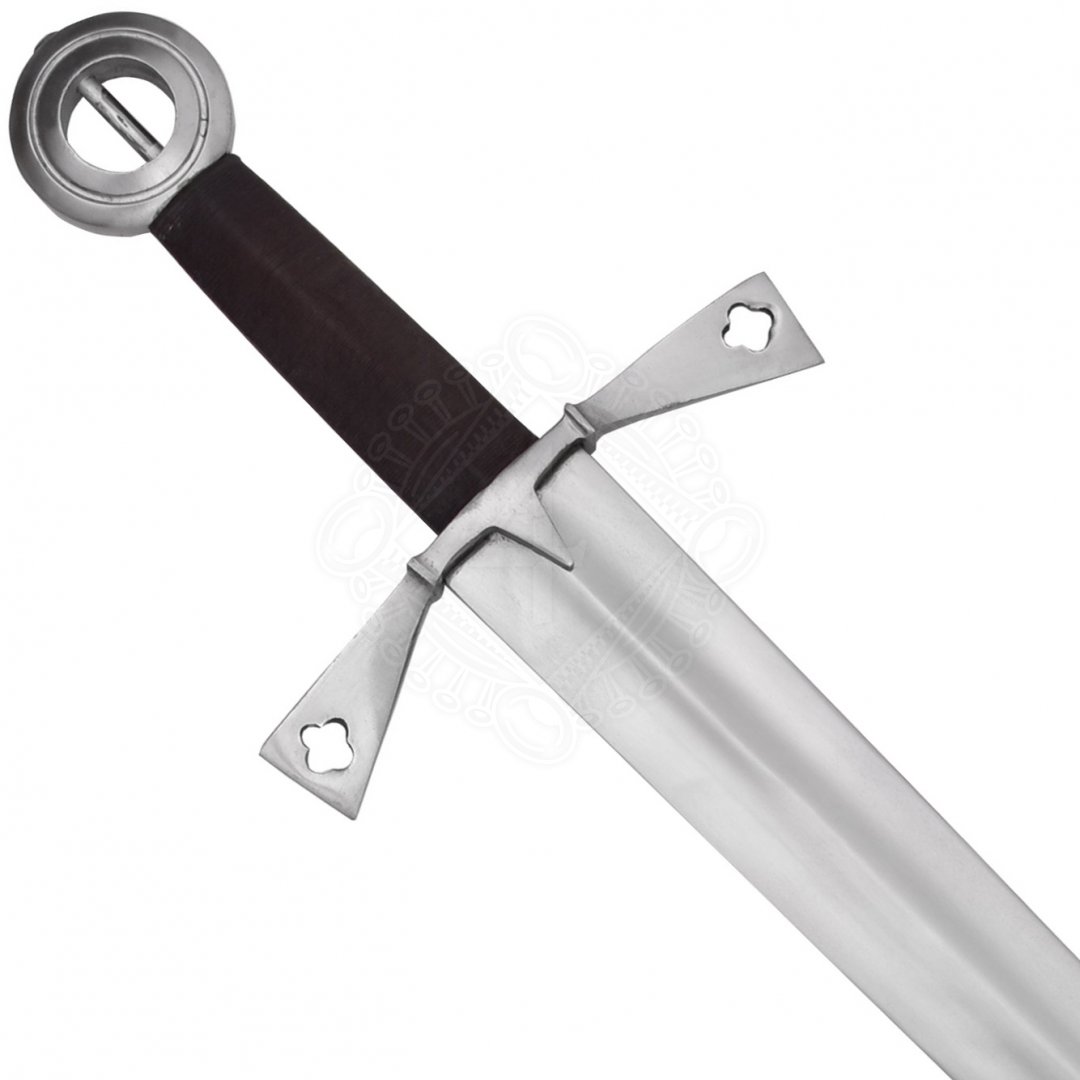
Gaelic society pattern sword with ring pommel of a type wielded against the Norman invaders of the 12th Century and later (Photo source: Internet)
Typical pike head with hook, popular in the 1798 United Irish uprising in Wexford (Photo source: Internet)
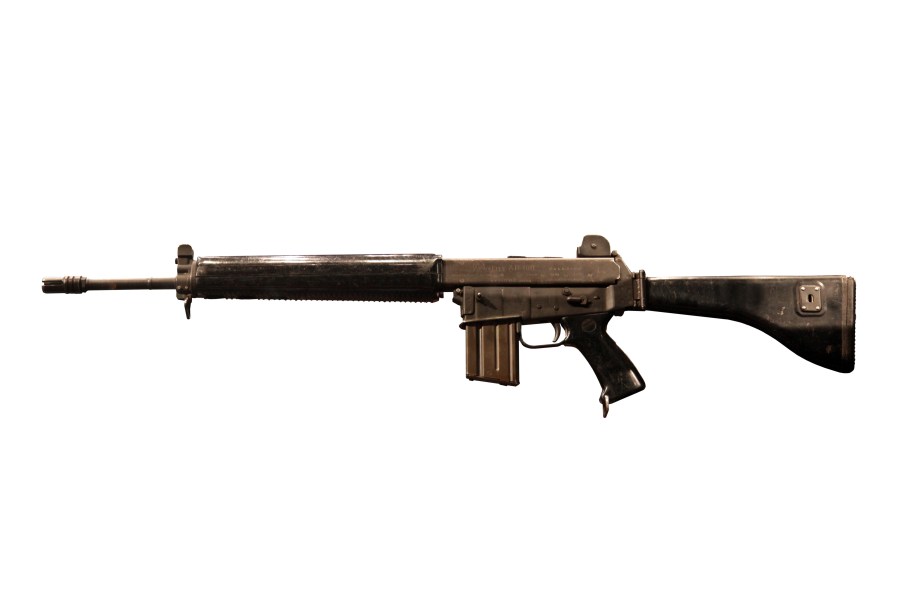
Armalite semi-automatic rifle popular with the IRA in the war in the Six Counties 1970s to 1990s. (Photo source: Internet)

FOOTNOTES

1These are two, both of Trotskyist ideology: the Socialist Party and the Socialist Workers Party (both now part of the Anti-Austerity Alliance — People Before Profit parliamentary coalition).

2While usually supporting it in areas of the underdeveloped world.

3The British occupation of Ireland is normally dated from 1169.

4These included permanent emergency repressive powers and a number of blatantly sectarian discriminatory provisions.

5It is also displayed on the coat of arms above and behind judges in British courts, which should alert people to the nature of the justice dispensed there.

6However they fell short of the absolute majority required to form a government and would have needed others to form a coalition government which instead, was formed by parties (of previous governments) that had won less support: Fianna Fáil, Fine Gael and the Green Party.

7The housing crisis within the territory of the Irish State is acute but no local authority is building housing for rent — they do not have the funds to do so. Successive governments are starving local authorities of that funding in order to benefit the property speculators and private landlords, which in turn the State funds through a number of measures including social welfare payment for the homeless converted to rent. Funding construction of public housing could also be used to expand public employment and training in construction, thereby pulling away from neo-liberal domination of the capitalist economy and strengthening workers’ rights. Meanwhile some fascists are using the housing need to push their “house the Irish first” propaganda against migrants and asylum-seekers.

8Ireland has two ruling classes: the native Irish neo-colonial one and the colonial unionist class ruling in the colony.

BERNADETTE TAKES ON THREE AND WINS

Introduction by Diarmuid Breatnach

The right-wing patrician UStater William F Buckley (despite the Irish surname) and two dogs, one of them the imminently slappable racist Tory Roger Evans, take Bernadette Devlin (now Devlin-McAlliskey) on and she wipes the floor with them. She was a month short of 25 years of age when she sat this interview in late March 1972, without any notes to hand, keeping up with the arguments, never losing her temper, reeling off historical facts and financial figures. It was a stellar performance.

Even more remarkable, not two months had passed since the Paras had shot 26 unarmed marchers in Derry, murdering 14 men at a march she had herself attended and, though then an MP, she had been refused permission to speak on it in the House of Commons, while lies were being stated by people who had not been there. Also, her interview took place only a month after the travesty of an inquiry into the murder by Lord Widgery who completely exonerated the gunmen and their officers, maintaining they were acting in self-defence against all evidence except the soldiers’ and Widgery even claimed a march of at least 30,000 was at most around 3,000! It seems that there must’ve been an agreement not to mention Bloody Sunday, perhaps as a condition for the interview, otherwise what else can explain its omission?

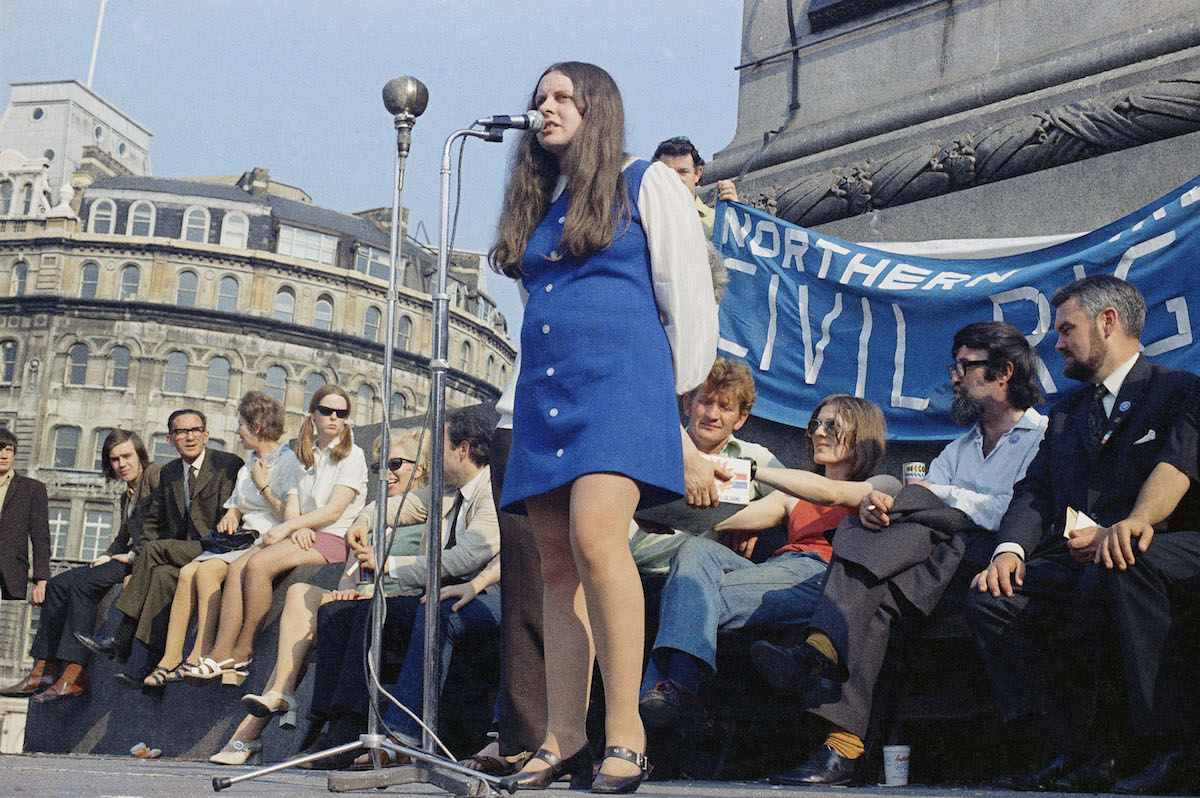
Bernadette Devlin, Member of Parliament for Mid-Ulster, speaking at a rally in Trafalgar Square, London, on June 1, 1971. (AP Photo) (Note: Trafalgar Square was later banned to Irish solidarity demonstrations for decades).

Bernadette came out against the Good Friday Agreement when it was born, not pushing armed struggle as an alternative but stating that the GFA institutionalised sectarianism and because she accused the Provos of seeking alliances with the Right and capitalism rather than with the Left and the working class. She would have been a powerful voice against the GFA and could not be accused of being in a ‘dissident’ armed group but the British State held her daughter Roisin, who was pregnant, hostage and Bernadette stepped back from that issue. She was marginalised by the Republican movement in the 1970s and 80s, along with being shot 14 times in front of her children (her husband shot too) in 1981 and lost to us as a national leader again in the first decade of the GFA.

Watching this discussion brings back to mind all the economic and political issues that were around at the time, especially as Bernadette reels them off, many of them largely forgotten. All the fudges and lies of British governments avoiding doing anything fundamental to improve things even within an illegitimate colonial context.

End.

Bernadette Devlin McAliskey Versus William F. Buckley Jr

APRIL 2nd – ANNIVERSARY FOUNDING OF CUMANN NA MBAN

Diarmuid Breatnach

(Reading time: 4 mins.)

Cumann na mBan (“Women’s Association”), a female military auxiliary and counterpart to the Irish Volunteers, was founded on this day in 1914, one hundred and seven years ago. Its members took part in the 1916 Rising and perhaps even more importantly in keeping up the momentum of the militant movement for independence during martial law after the defeat of the Rising and for years afterwards. They were part of the War of Independence and the Civil War in military and political activities. Many were jailed. The Easter Lily emblem, which many will wear to commemorate the Rising, is their invention. The role of Cumann na mBan, along with that of other women in Irish history, is to this day still not sufficiently highlighted or valued.

Wynne’s Hotel, Lwr. Abbey Street, viewed almost from the junction with O’Connell Street, looking eastward. (Photo sourced: Internet)

Cumann na mBan was formed as a female counterpart and auxiliary to the Irish Volunteers, which had been formed the previous year (as had, separately, the Irish Citizen Army). The inaugural public meeting was held in Wynn’s Hotel, Thursday, 2 April 1914. It was presided over by Agnes O’Farrelly, who was elected President. The provisional executive unveiled at the meeting included Jennie Wyse Power, Nancy O’Rahilly, Agnes MacNeill, Margaret Dobbs, Mary Colum, Nurse McCoy, Louise Gavan Duffy and Elizabeth Bloxham. A constitution was adopted which stated that Cumann na mBan aimed: 1. To advance the cause of Irish liberty 2. To organise Irishwomen in the furtherance of this object 3. To assist in arming and equipping a body of Irishmen for the defence of Ireland 4. To form a fund for these purposes to be called the ‘Defence of Ireland Fund’.

Plaque constructed to be located in Wynne’s Hotel on the centenary of the founding of Cumann na mBan (Photo sourced: Internet)

It was not the first organisation of women to stand for Irish independence that century – Inghinidhe na hÉireann had been formed in 1900 as a cultural organisation and had developed a militant Irish independentist political outlook along with a suffragettist one. Inghinidhe formally dissolved itself and joined Cumann na mBan in 1914 but in effect formed one of its branches and continued to represent a trend for greater activism and female independence within Cumann.

Unlike the Volunteers, membership of the socialist Irish Citizen Army, founded in 1913, was open to both genders and the women who joined that tended to disdain the membership of Cumann na mBan because not only did they not have a social program but were, at that time, under the overall authority of the all-male Irish Volunteers.

Prior to 1916, Cumann na mBan took part in agitation and publicity actions, a number of which they organised themselves. Their marching in the procession to the grave of O’Donavan Rosa’s grave in 1915 was apparently what most impressed other women, in particular young women; they had never witnessed a self-organised women’s organisation on the streets before and the Cumann’s membership swelled thereafter. When Redmond promised Irish men to the rulers of Britain to fight in WW1 the minority part of the movement but the most active split in order to fight for independence from the UK. Cumann na mBan split also but in their case, the majority went for fighting against Britain.

The flag of Cumann na mBan, flying in Dublin (Photo sourced: Internet)

In preparation for the 1916 Rising all members of the main female organisation learned First Aid and prepared field dressings for wounds, which perhaps brought them to face the physical dangers of insurrection more than did the training schedules of the Volunteers. They also engaged in anti-British Army recruitment activities which, after Britain declared War in 1914, increasingly meant being assaulted and arrested by the Dublin Metropolitan Police and the Royal Irish Constabulary. Many also transported secret messages and weapons, often storing the latter. In an informal way, they also provided intelligence they were able to gather. Through their cultural and social activities they provided diversion for male activists as well as a cover for clandestine meetings and other activities. During the Rising, Cumann na mBan members helped deliver arms, ammunition and equipment, construct barricades, set up field hospitals, provided food and water/ tea to combatants, acted as messengers. ICA women did most of that but a number of them were snipers also and one of those, Vol. Margaret Skinnider was gunshot-wounded three times while sniping and in other military activity in the Stephen’s Green/ College of Surgeons garrison area. Most of the Dublin garrisons had Cumann na mBan in them and those in the GPO garrison were asked to leave with some wounded when the building was in danger of collapse. Three women refused to leave with them and were there at the final surrender in Moore Street: Vols. Elizabeth O’Farrell, Winifred Carney and Julia Grenan.
Around 300 women are known to have taken part in the Rising and from the relative numbers of women in CnmB and the ICA, most of those had to be Cumann members; only 157 womens’ names appear on the Roll of Honour for the Rising.

Cumann na mBan was the first organisation of its kind in the world, a point that is often lost sight of: an insurrectionary female military organisation with its own uniform and officers.

Highly decorative and artistic logo of Cumann na mBan — note the rifle fitted into the acronym in the centre. (Photo sourced: Internet)

The greater role of the women in general and in particular of members of Cumann na mBan however was after the Rising when, even under martial law, they organised fund-raising for relief for families who had lost a breadwinner to death or prison; organised also public commemorations, defying arrest to keep the flame and memories alive, helping to create the sea-change in attitude to the Rising and giving a fertile ground for them to plant the seeds of resistance, along with the male and female prisoners released under amnesty.

In 1918 members of the Cumann worked to help the landslide victory for Sinn Féin in the British General Election in Ireland and then helped in the War of Independence, this time greatly organised into intelligence work but also as before as couriers, carrying and hiding weapons, caring for the wounded, running safe houses and other actions, as well as in public demonstrations and pickets, for example outside prisons. They were assaulted on occasion and jailed, sometimes replying with a hunger strike. They could not easily go “on the run” and were subjected by British Army and colonial Police to invasions of their homes and ill-treatment which included shearing their hair.

In 1921, Cumann na mBan again split over the Treaty but once more with the majority against it and in 1922 took the Republican side in the Civil War, for which they suffered repression, home invasions and imprisonment anew, this time by the forces of the Free State.

In 1926 Cumann na mBan invented the Easter Lily emblem in order to raise funds for the dependents of prisoners and killed in action fighters, in addition to those officially and unofficially executed, abducted an murdered. It is purely as a result of their efforts at this time that the emblem is so widely worn and appreciated in the wide Irish Republican movement, especially around this time of year.

Easter lily emblems printed on paper, attached with a pin. (Photo credit: Bryan O’Brien, Irish Times)
Two Cumann na mBan members as part of a Republican commemoration in 1944 (Photo sourced: Internet)

Cumann na mBan ceased to exist soon after the split between the “Officials” and “Provisionals” in 1969 but women continued to be active in the political organisations and also to be recruited into the various military ones.

End.

REFERENCES & FURTHER INFORMATION

https://www.rte.ie/news/2014/0328/605079-cumann-na-mban-centenary/

https://www.rte.ie/history/the-ban/2020/0109/1105376-cumann-na-mban/

(note the omission of the Moore Street battlefield at the end, with a Winifred Carney, Elizabeth O’Farrell and Julia Grenan noted as staying on in the GPO but omitting to mention where they went soon afterwards, or Farrell’s important roles thereafter): https://www.richmondbarracks.ie/women-1916/cumann-na-mban/

https://www.irishtimes.com/culture/heritage/women-of-1916-1.2535291

157 women who took part in the Rising: https://microsites.museum.ie/rollofhonour1916/roleofwomen.aspx

The creation and popularisation of the Easter Lily by Cumann na mBan: https://rebelbreeze.com/2018/04/20/a-resistance-symbol-sown-and-grown-by-irish-republican-women/

A BLIND EYE TO OPPRESSION IN IRELAND

Diarmuid Breatnach

(Reading time text: 8 mins.)

There is a blind eye being turned to oppression in Ireland – and I use the expression in its usual meaning of “deliberately not seeing”. And it is not the Irish ruling circles I am accusing of that deliberate act, for one could hardly expect anything else of them. No, it is the Irish socialist and liberal sectors I am accusing, along with a section of the Republican movement.

All of these are in Ireland; each of these sectors either knows of this oppression or has chosen not to know. In that respect, in so far as they cry out about injustice or inequality in other areas, they are being hypocritical. And in how much hypocritical activity can one indulge and how long, before one is really and totally a hypocrite, not to be trusted on anything they say they believe?

For years, before the Good Friday Agreement, wide areas in the Six Counties suffered oppression from the colonial statelet, its police force and the imperial armed forces. Those were the working and lower middle-class “nationalist/ Catholic” areas. Prior to the signing of the Good Friday Agreement, sections of the Irish Left and liberal consensus were actively ignoring this oppression and in that respect, nothing has changed. But what has happened since is that while smaller areas, neighbourhoods, are continuing to be oppressed, sections of the Republican movement have joined in that blindness and resultant silence.

Raid by armd British colonial police Belfast and arrest of two Republicans, including pregnant woman, 4th March 2021. (Photo sourced: Republic Media)
British Colonial Police invading the Bone area, Belfast, 4th March (Photo sourced: Republic Media)


HOUSE RAIDS, HUMILIATION, HOSPITALISATION & DEATH THREATS


From Republic Media: A statement released by the Republican party Saoradh quoted Cliodhna McCool, daughter of Kieran McCool who was arrested last week in Derry following a heavy house raid, reading a statement on behalf of the McCool family. Describing the ongoing and escalated harassment she said:

“As a family who hold strong traditional Republican views we have become accustomed to many forms of harassment and intimidation, in fact we have almost come to expect it. However, in recent months the occupiers have escalated this harassment by constantly following every member of our family during almost every aspect of our lives. Something that is somewhat creepy and very distressing is the fact they seem to have prior knowledge of where we are going to or coming from and will be there to mete out their harassment. “

Detailing incidents over the last year she continued: “In the last year alone we have been attacked resulting in my mother, father and younger brother being hospitalised and we have received death threats from British soldiers dressed in Crown Force uniforms.”

Describing the events of last week she said: “Once my father was removed from the house, what can only be described as a nightmare for our family began. My family were shouted at aggressively, verbally abused and threatened with arrest by masked gunmen.”

“My younger brother Fionn, who is autistic, was again manhandled and removed from his bed, searched and evicted from his home; as was my mother and other brother.”

Giving the public details of some of the more grim details of what a search entails for Republicans she explained: “While they were forced to leave our house they were refused access to a toilet, food or water. My mother was also denied her medication. My entire family was searched in an intimate manner of which I prefer not to go into detail; I will let you use your own imagination“

Concluding the family statement she said: “No matter what you think of our family’s politics, no family should ever be treated like this. If it was wrong in the 1970’s, 1980’s and 1990’s then it’s wrong now. Our family have feelings too and refuse to be treated as lesser human beings because politicians say it’s acceptable. It’s not!”

Cliodhna McCool’s statement was read out at a protest press conference of which the purpose was, according to Saoradh “to highlight the continued profiling and targeting of Creggan residents, community activists and those who hold traditional Republican beliefs.”

British colonial police raid and arrest Ardoyne, Belfast, 9th March 2021 (Photo sourced: Republic Media)

“THUGS IN UNIFORM CLIMBING OVER EACH OTHER TO GET TO ME”

Pete Cavanagh, who suffered injuries during the raid, spoke next, describing sectarian jibes and threats handed out to residents. “It was here they began to trade in sectarian and snide remarks, calling Creggan and the people in it ‘dirty and unwashed.’ Some of them began mentioning personal details of individuals gathered there. Some raised and showed off their weapons in an attempt to intimidate us. Many of the cops gathered there were very shaky and nervous. “

Describing his attack by armed police he explained:

“After trying to push us further down the street, these thugs in uniform drew their batons and launched what can only be described as a frenzied attack. It is here I was beat between two cars with my head busted open by a British baton. So reckless was this attack that these thugs in uniform were fighting with each other to get at me. They were climbing over each other to get at me again as I lay on the ground busted open. The cop who hit me called me a “Fenian prick.”

Pete also told how the police lied about how he received the injuries: “When I was in the back of an armoured car I seen and heard the inspector who attacked me tell his superior that I had fell and busted by head. But when asked at the hospital the doctor said there is no way I could have sustained this injury by either falling backwards or forwards given the severity and location of the strike. I received eight stitches.”

Despite Pete being on the receiving end of the physical attacks from Crown forces, he and another member of Saoradh were detained overnight and given bail with restrictive and oppressive measures.

A local resident Clare Friel also gave testimony at the conference:

“The actions and behaviour of the PSNI witnessed on Thursday 18th March were reminiscent of our past. These attacks, as described by our neighbours and community activists, were supposed to be of a bygone era, again that is not the case.

“What happened to the McCool family, residents of Ballymagowan and the wider Creggan community along with political and community activists has only served in raising further tensions between our young people, residents and the police.

“Our young people are sick and tired of being targeted by police; they are sick and tired of watching community and political activist being stopped and searched; they are sick and tired of seeing their school friends being stopped and searched while attempting to get an education; they are sick and tired of the fake community policing being rolled out in Creggan as the PSNI cycle around streets with armoured jeeps on every entry and exit of the estate. This behaviour can’t continue without our youth saying enough is enough! Is it any wonder they react!”

Saoradh National executive member Stephen Murney wrapped up proceedings by giving Saoradh’s analysis of recent events and in reference to other world events he said:

“Whilst this raid was taking place two women were forced to the ground outside and knelt on by several members of the British Forces. This bears all the hallmarks of George Floyd and the recent disturbing images in England. Are all members of the British Forces trained in how to attack women?

Criticising P Sinn Féin’s false promises, Murney pointed out that after such incidents the party regularly promises to complain to the authorities and have the attacks stopped which, however, continue and that the SF party’s support for “the oppressing force” is “unwavering”1.

Continuing, Murney asserted:

“On the other hand the Republican position is clear as day. These raids and attacks are the outworking of British occupation, they were wrong and unjust in previous years and decades and are wrong today. The Crown forces responsible are not welcome or wanted in Creggan, or indeed in any Republican community in the Six Counties.”

Murney called on people to support those being subjected to this harassment and violence and pledged his party to do so too.

HARASSMENT AND INTIMIDATION OF COMMUNITIES AFTER THE GOOD FRIDAY AGREEMENT

This harassment of activists and oppression of neighbourhoods has been ongoing since the signing of the Good Friday Agreement but has intensified in recent years. The colonial statelet wishes to normalise its situation, which means gaining acceptance of the population. But colonial status is not a natural or even desirable state of affairs and human history, in particular perhaps its Irish component, demonstrates that it will always be resisted. When that is so, the State moves in to harass, provoke, disrupt and intimidate the sectors that continue to resist.

Those who expect the resistance to die down and wish for acceptance of the Good Friday Agreement are being unrealistic and flying in the face of human and in particular Irish history. Whatever their wishes, when they turn a blind eye to the continuing oppression of sections of the Irish nation, they are helping it to continue. And when, instead, they support the oppressors or condemn those who continue to resist, they are in active collusion with the oppressor, the colonial invader and occupier. From a different but similar historical experience, history has given a name for such collaborators: Quisling.

One needs to ask what can account for this willful ‘blindness’ and resultant silence? Since those afflicted with the condition do not usually explain it, one must speculate and it seems to me that the following are the likely reasons:

For the socialists:

  • they do not wish to even seem to be endorsing armed resistance to the statelet
  • they wish to give no assistance to what is their biggest competition in the opposition to the status quo, along with the one with the largest working class base: the Republican movement,

For a section of the Republicans:

  • They do not wish to give any support to their competition inside the Republican movement

The Left and Liberals never had any difficulty in supporting the ANC despite the fact that had an armed wing, membership of which was the main charge of which Mandela was convicted. Or if they did, they kept quiet about them. They kept quiet too about the horrific practice of “Pirelli-necklacing”, when alleged informers or spies had tyres doused in petrol placed around their necks which were then set on fire.

And in a sense, that was mostly right, because the main target had to be the South African racist white minority regime and its foreign imperialist backers. Similar positions were taken with regard to the Vietnamese liberation forces and to the Palestinian resistance.

“YOU DON’T HAVE TO BE A REPUBLICAN TO KNOW THAT THIS IS WRONG”

But even if one did not agree with the objectives of the ANC, the NLF in southern Vietnam and NVA, the PLO etc, that should not prevent one from speaking out against oppression of the people. Pastor Niedermeyer put it well in his famous quotation about the oppression of different groups under the Nazis. Anti-Imperialist Action Ireland put it well too when their post stated:

“Last week following a violent attack by a British Police force on women in London there was international media coverage, justified anger and protests in a number of countries including Ireland, as people rightly expressed their outrage at such disgraceful events.

“This week, as Britain’s Colonial militia in Ireland once again attacks women in Derry, some of those same Irish voices so loudly speaking out against police violence in London have said absolutely nothing. These voices remain silent because to speak out would be to raise and condemn Britain’s ongoing illegal occupation of Ireland, something they are ideologically opposed to doing. Are the women of the Creggan to be left fighting alone?

“Police violence is wrong against women in London and it is wrong in Derry. The RUC/PSNI are attempting to provoke the community in Creggan and are invading homes and attacking women and children with impunity.

“It is not acceptable for so called Socialist and progressive forces to stay silent on this. It’s not acceptable to look the other way. You don’t have to be a Republican to know that this is wrong.

“Anyone who is really an advocate for women’s liberation would be calling British Imperialism out for the violence its imperialist militia regularly perpetuates against Republican women in occupied Ireland.

“Ní Saoirse go Saoirse na mBan.”

The point about provocation is well made. It was during one such raid in Creggan on 18th April in advance of a planned Republican commemoration of the 1916 Easter Rising that a Republican youth fired at the colonial police, a bullet of which tragically killed Lyra McKee, a journalist who was standing near an armoured police Land Rover2.

Those who are afflicted with the blind eye need to turn the other eye on the situation in the Six Counties and speak out. Or give up forever any credibility when speaking about injustice towards anyone.

End.

British Colonial police raiding Republicans August 2020 (Photo sourced: Saoradh)

FOOTNOTES:

1The Sinn Féin leadership has formerly accepted the colonial police force in the Six Counties, doing so publicly a number of times.

2Numerous politicians, State figures and mass and social media at the time called her killing “murder”, a clearly inaccurate statement and prejudicial to the trial outcome of anyone who might be charged as a result of her killing.

REFERENCES & FURTHER INFORMATION:

https://www.facebook.com/RepublicMediaIreland – post 24th March at 11.49

Anti-Imperialist Action post: https://fb.watch/4u6dE50hg6/

Video of part of the raid and colonial police assaults referred to: https://www.facebook.com/AIAIRELAND32/videos/773656903266947

REPUBLICAN INDEPENDENTIST PARTIES WIN MAJORITY IN CATALAN REGIONAL GOVERNMENT

Diarmuid Breatnach

(Reading time text: 12 mins)

DESPITE LOW TURNOUT DUE TO PANDEMIC FEARS, THE THREE CATALAN INDEPENDENTIST PARTIES TOGETHER HAVE A COMFORTABLE ABSOLUTE MAJORITY

Despite the Covid19 pandemic and bad weather causing a low turnout for the elections to the Government (Govern) of the Catalan Autonomous Region, elected representatives of political parties for Catalan independence won a comfortable absolute majority of their Parlament and, for the first time in recent history, won more than 50% of the total votes cast.

It is worth noting that although most of the Spanish and much of the European media (including shamefully the Irish) is referring to the victors in this election as “separatists” this is not the correct term and implies or at least leaves open to interpretation that there is some basis for their campaign other than a historic nation seeking independence. The Irish over centuries were not “separatists” with regard to England and the United Kingdom, they were independentists. And those Irish parties that wanted to remain with the UK were — and are – unionists, with a parallel too in the elections in Catalonia.

In a Parlament of 135 seats (absolute majority 68 minimum), the results are:

INDEPENDENTISTS

Total seats: 74

ERC (Esquerra Republicana de Catalunya, traditional left-republican party of various trends)

33 seats (up one) 21.4% votes cast

JxCat (Junsts per Catalunya, independentist party consisting of various trends with origins in alliance with right-wing Catalan nationalist party PdeCat but split from them last year)

32 seats (up 12) 20.0% votes cast

CUP (Convergencia Unida Popular, a confederation of left-wing groups mostly active on a community and municipal level)

9 seats (up 5) 6.67% votes cast

UNIONISTS

Total seats: 53

PSC (Catalan branch of the Partido Socialista Obrero de Espana, social-democratic main government party in the Spanish State)

33seats (up 16) 13.9 % of votes cast

PP (Partido Popular, formed by Franco supporters after the Dictator’s death, main government party in the Spanish State after PSOE)

3 seats (down one) 3.8 % of votes cast

Cs (Ciutadans, Spanish unionist party formed by split from the PP)

6 seats (down 30) 5.6 % of votes cast

Vox (Spanish fascist and unionist party formed by split from PP and Ciutadans)

11 seats, 7.7 % of votes cast

OTHER

Total seats: 8 seats (no change) 6.87 % of votes cast

ECP (En Comú Podem [“Communs”], coalition of Podemos, Izquierda Unida etc, left-social democrats and trotskyists, in theory supporting the right to independence but in practice rarely supporting the independentists).

Results of February 2021 elections to the Catalonian Parliament. (Source image: Internet)

CONTEXT

Most of Catalonia is currently part of the Spanish state, with a small part around Pau, in the southern French state. Catalonia has its own political history and national language, Catalan but its autonomy was ended in conquest by the Bourbons of the Spanish Kingdom in 1741 and its language discriminated against. In 1936 the workers of Barcelona, the capital city, rose and defeated the forces of the Spanish military-fascist coup against the elected Popular Front Government of Spain. But after the victory of the military-fascist forces in 1939 in the Spanish Antifascist War, Catalonia, which had sided with the Government on a promise of autonomy, suffered repression, its leaders and supporters executed and language banned.

Map showing Catalonia in the iberian peninsula and part of southern France (without Pau picked out)

Catalonia is also considered by many to be part of the Paisos Catalans (Catalan Countries), which include the regions such of Valencia and the Balearic islands, where dialects of Catalan are spoken.

Although a small part of the Spanish State in terms of land and population, Catalonia is one of the most economically successful regions of the Spanish State. A wish for national independence gained renewed political support during the recent decade, growing apace when the Spanish State greatly reduced Catalan autonomy in a reinterpretation of the Statute of Autonomy in respect of Catalonia. Grassroots movements in favour of independence grew hugely, in particular the ANC and Omnium; they organised a referendum on independence to take place on 1st October 2017. The Spanish State sent its militarised police to seize ballot boxes and attack voters and protesters. Subsequently the Spanish State jailed the leaders of the Independentist party ERC, the grassroots organisations ANC and Omnium, along with politicians. It issued arrest warrants for a number of others, including the President of the Government and leader of JuntsXCat party and a leading activist of CUP, all of whom are currently in exile. 700 Town Mayors are under investigation for their role in the referendum and activists are in jail or on trial for their activities in protests and one-day general strikes (of which there have been three since 2017).

Man and woman celebrating and displaying the Vermelha, the socialist version of the Catalan independentist flag. (Source image: Internet)

ELECTION TIMING AND RESULTS

Quim Torra, Puigdemont’s replacement, who had been stripped of his position as President of the Catalan Parliament by a Spanish Court for displaying a banner in support of the political prisoners on a Government building during Catalan municipal elections, had threatened to call snap regional elections; these were expected around October last year but the Covid19 pandemic prevented that plan going ahead.

However, when the Catalan Govern because of the pandemic decided to postpone their elections until this summer,, it was forced by a Spanish State court (at the behest of unionists) to call them for 14th February. That of course led to a low turnout, which usually favours the Right and Unionists, thus making the results even more remarkable.

Catalans queuing to vote in the rain in the midst of a pandemic; the Spanish State did not permit them to postpone for couple of months. (Source image: Internet)

With the independentist parties achieving more than 50% of the vote for the first time and an overall majority in the Parlament, Catalans favouring independence regard the election results as positive overall. But their pleasure is tempered by the unwelcome gains of the Spanish social democrats of the PSC and the ten seats won for the first time in Catalonia by the fascist Vox party.

The PSC is the Catalan branch of the PSOE, the Spanish social-democratic party currently in government in coalition with Podemos-Izquierda Unida, the latter a kind of trotskyist coalition (of which the Catalan version is “En Comú Podems”) and both parties are essentially Spanish unionist, the PSOE bluntly so and the junior partner in practice.

Although the PSC were no doubt aided by having as a candidate Salvador Illa, the former Minister for Health of the current Government of the Spanish State, it seems that some of the votes to elect the PSC came from pro-Spanish unionist Catalans on the Right, deserting their more natural allegiances in order to achieve a strong unionist and Spanish government presence in the Catalan Parlament. The Catalan traditional unionist Right wing took a hammering, losing 31 seats as the PP went down from four to three seats and their upcoming replacement Ciutadants from 36 to just six. But newcomers and more clearly fascist Vox gained eleven seats. In terms of seats alone, as a crude measure, the PSC and Vox gained seats totalled 44, while PP and Cs together lost 31. Looked at that way, it seems clear that the increase of seats for the social-democratic PSC and the fascist Vox came from right-wing unionists, with a gain of another 13 seats unexplained.

The PSC and Vox successes have been of concern to many Catalan independentists. However those parties reflect existing realities in Catalonia with which the independentist republicans will need to grapple. The vote for Vox illustrates quite starkly that much of the base of the allegedly democratic right-wing conservative Ciutadans was in fact fascist, as suspected by more than a few and it is as well to be aware of it and to have that exposed.

The support for the PSC is a wider problem and, while some of it will remain irreconcilably Spanish Unionist for the foreseeable future, there are probably elements among its voters that are capable of being won over to the independentist position.

GOING FORWARD

As noted earlier, the three republican independentist parties have won a comfortable overall majority, in that they have 74 seats between them, six more than the 68 needed for an absolute majority in the 135-seat Parlament. Even if all the Spanish unionist parties vote together, social democrats voting with Right and Far-Right, they can only outvote the Catalan independentists, in the normal course of events, should one of the latter parties join their vote or abstain, which is hard to imagine occurring.

In the last Parlament, the CUP became a left-opposition to the coalition Govern of ERC and JxCat but never joined the unionist parties in voting against the Govern.

Immediately following the announcement of the results, the Communs leader in effect admitted she would try and split the independentist alliance by asking ERC to join with them and with PSC to form “a left-wing government” which is a shameful use of words since the independentist alliance has put forward more proposals of a socialist nature for Catalonia than have been presented by the PSOE in the state, most of them blocked by the Spanish Constitutional Court and the PSOE is in fact now about to renege on the rent controls it had agreed with its coalition partner. However neither its supporters nor the electorate would be likely to forgive ERC’s leadership should they take such a step and whether tempted or not, they will not go there.

Of course, the Spanish State could reduce the Independentist majority by finding some pretext to jail some of their elected members and such a scenario is far from inconceivable, given the nature of the Spanish State and its recent history in Catalunya. But that would be a very high-risk avenue, even for the Spanish State.

The very likely development is for ERC and JxCat to join in a coalition government, with or without CUP (who might choose to remain in opposition but in “confidence and supply” with the Govern, meaning that they would vote for them if necessary to defeat a vote of the unionist opposition). ERC and JxCat are quite deeply divided on how to proceed in relation to the Spanish State. Although ERC has a longer history of Republican opposition and even some armed struggle through the Terra Lliure resistance, and thinks of itself as “Left”, it is JxCat that has been most resolute in its attitude to the Spanish State. ERC wanted to sit down for talks with Sanchez, Prime Minister and leader of the PSOE, even though Sanchez has stated categorically that independence is not up for negotiation; JvCat ridiculed the very idea. When Sanchez needed other party votes to get his Government’s budget through the Cortes (the Spanish Parliament), ERC gave their votes along with the PNV, the Basque Nationalist Party. And now ERC has asked the Spanish Government to authorise a referendum on Catalan independence which, on past performance, can only be denied. In the absence of getting something substantial in return, JxCat refused to give their votes to support the Spanish Government’s budget (as did the Basque independentist members).

Going into the mid-term future, not only will Catalan independence be forbidden by the Spanish ruling class through its State but many of the measures the Catalan Government has agreed to take around social justice, for equality, against bullfighting and so on, will be frustrated by the Spanish State through its upper courts, as before.

There seems no way forward for the Catalan independentists other than at the very least a sustained campaign of civil disobedience to make Catalonia ungovernable by the Spanish State. In such a situation, it is difficult to imagine the Spanish State not sending its military to occupy the nation and repress the resistance. With whatever response that would arouse among Catalans.

End.

POSTSCRIPT:

Clerk in court, Pablo Hasél trial: “Do you swear to tell the whole truth?” Hasél: “I am here because of telling the whole truth.”

The jailing by the Spanish State of Catalan revolutionary socialist poet-rapper Pablo Hasél on 16th February has led to demonstrations and rioting in Barcelona in which both the Guardia Civil of the Spanish State and the Catalunya police, the Mossos d’Escuadra, have been engaged. The Spanish police have fired rubber bullets which are banned in Catalunya while the Mossos have baton-charged ferociously and, firing foam projectiles, took the eye of a 19-year-old woman. The protests are ongoing.

Over 400 visual artists, also of words and music, have signed a demand for the release of Hasél whose jailing has also been condemned by Amnesty International. Pickets in his support have been organised across the southern Basque Country and Navarran regional police, the Forales, fired rubber bullets at a march in Hasél’s support in Iruna (Pamplona). Other places including Madrid have also seen demonstrations protesting the jailing of the rapper.

Riot police and people protesting jailing of Pablo Hasél. (Source image: Internet)