The May issue of this newspaper has been out for some weeks and the organisers did well to manage that in the midst of disruptive arrests of their housing activists and raids and arrests following their Easter Rising Commemoration1.
As before, this issue consists of sixteen A4 sides, therefore easy enough to handle and contains what seems the right mixture between short event reports and news items, along with a couple of analytical pieces, one on ‘workerism’ and a thought-provoking other on peat-cutting and energy.
A two-page spread on James Connolly and the Irish Republic quotes extensively from Connolly but without giving any references. This can be an issue since a number of statements commonly attributed to both Connolly and Lenin are lacking in substantial (or even any) verification2.
This edition discusses issues and events in Ireland but also internationally. Reports from the agrarian revolutionary movements in parts of India and in the Phillipines are featured – a list of attacks and casualties inflicted upon the oppressors’ forces.
Another piece marks the death of Palestinian activist Adnan Khader on the 76th day of his hunger strike protest against Israeli ‘administrative detention’ – internment in fact. The mass struggles in France against the raising of the retirement age are also featured.
For Ireland there are reports on the housing struggle, against police repression in the Six Counties, historical commemorations, poster and graffiti campaigns, a sectarian attack in Lurgan and another article deals with mental health issues and the shortage of services in Tipperary.
As commented in an earlier review of this newspaper, the Irish revolutionary movement has long needed a hard-copy revolutionary newspaper. As Lenin commented3, the revolutionary newspaper is an organiser as it requires production and distribution.
Of course, distribution networks for a newspaper can become action-organising networks also but in any case meeting a person to give them a newspaper is a personal contact, when questions and criticisms can be discussed and other information from the community collected to act upon.
This form of contact for the individual is superior to those available on the Internet and also less easy for the State to monitor. A newspaper can also go from hand to hand in a way that only short pieces or videos can compare with in electronic distribution.
Though of course, the latter also has its strengths.
Future editions of APA are to be welcomed and in the fullness of time perhaps we can even graduate to a weekly revolutionary Irish socialist newspaper, not seen here for decades.
End.
An Phoblacht Abú is available from personal contact with AIA or by post from Isrmedia@protonmail.com
FOOTNOTES:
1. See https://rebelbreeze.com/2023/05/07/gardai-arrest-republican-denouncing-the-monarchy-british-occupation/ Although the raid may well have been intended to disrupt plans for protests against US Imperialism’s chief, Joe Biden’s visit to Ireland, a socialist Republican still faces concocted charges relating to membership of an imaginary “illegal organisation”. Under special repressive legislation such a charge without credible evidence has been sufficient, in the no-jury Special Criminal Courts, to jail Republicans for two years.
2 For example, I have searched diligently for the description of the Irish Citizen Army attributed to Lenin, viz. “the first Red Army in Europe” but have thus far failed to find verification.
While the Gardaí face accusations of treating far-Right violence too lightly, the State plans to increase the maximum sentence for assault on members of the force to 12 years in jail, nearly double the current maximum of seven years.1
Minister for Justice Simon Harris was seeking approval today for the increase as amendments to the Criminal Justice (Miscelaneous Provisions) Bill which has passed all stages in the Irish Parliament and is now going through the Seanad.
Irish Government Minister for Justice, Simon Harris (Photo sourced: Internet)
The increase in maximum sentence lumps emergency services such as paramedics and firefighters with State repressive forces of police, prison officers and armed forces.
This is a disguising measure since forces of repression are not the same as those of emergency services, even if in the event of a disaster all may be employed together. The State expects increased resistance from working people and therefore feels a need for increased repression.
According to some media reports there have been complaints that the Gardaí have been failing to respond adequately to crimes committed by fascists and other far-Rightists, including threatening behaviour and arson.2
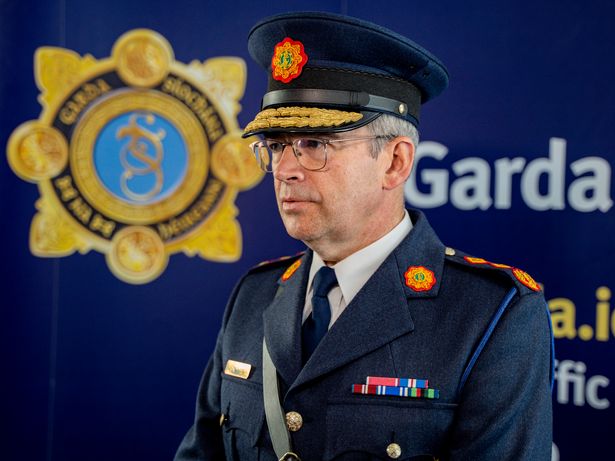
Garda Commissioner Drew Harris, former British colonial police (PSNI) Assistant Commissioner3 responded that getting tough with the far-Right would be playing into their hands and that the Garda response is measured appropriately.
One must wonder how permitting threats of violence, acts of assault and arson against refugees and their supporters can be considered appropriately measured from any viewpoint other than that of the perpetrators.
Much harder Garda responses have been seen through the years to striking workers, water-meter and housing protesters, Irish Republican events and – yes – antifascist counter-protests against fascists and other far-Rightists.
Not giving the fascists the confrontation they’re allegedly looking for might disappoint some of them but on the other hand many will be encouraged and get to feel that they can do more or less what they like without repercussions from the Gardaí.
According to Saturday’s Irish Times, some of the criticism of Garda tolerance of far-Right crimes comes from confidential sources within the force itself.
The discourse that policing these protests is ‘complex’ is a distraction from the fact that vulnerable people who are harming no-one are entitled to live without fear of violence to their person or to their meagre belongings, about which there is nothing ‘complex’ at all.
Having to live on the street due to the failings of the State is bad enough without being subjected to additional threats.
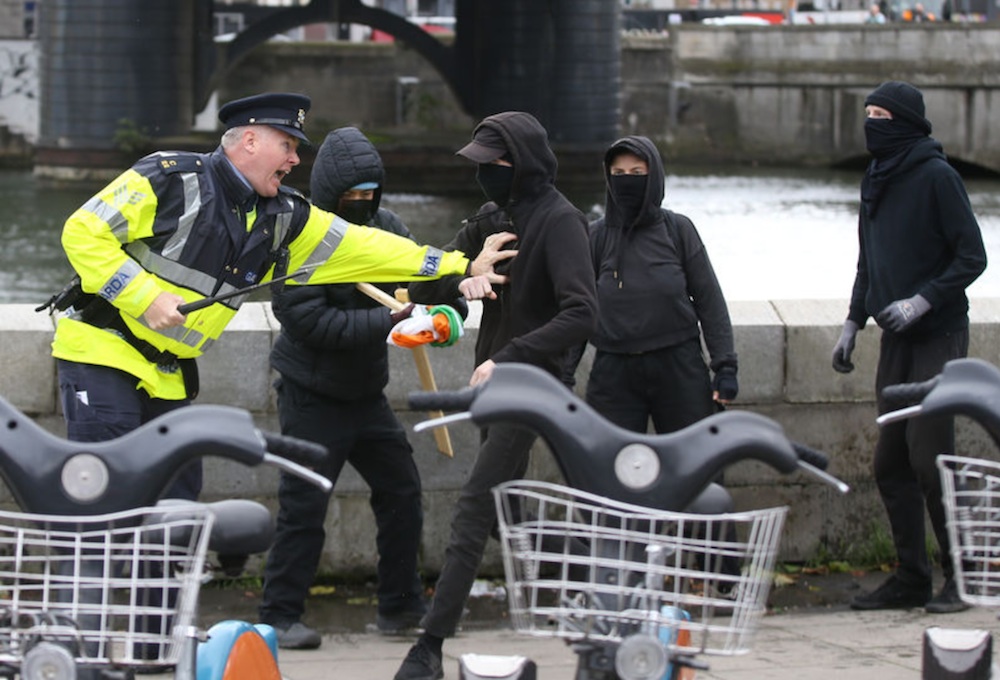
On a number of occasions Gardaí have attacked and threatened antifascists confronting the far-Right, revealing where the general sympathies of the State lie, despite condemnations of the far-Right by Government Ministers, politicians and the Garda Commissioner.
Garda not going lightly here but then it’s directed at ANTI-fascists counter-protesting Irish Yellow Vests on Custom House Quay, after they were attacked by fascists armed with metal and wooden clubs, many disguised as flags (note the captured Tricolour) 22 August 2020.(Photo: Rebel Breeze)Garda Commissioner Drew Harris (Photo sourced: Internet)
Historically, capitalism has turned to fascism to suppress the resistance of the working class to being made to pay for crises in the system. And fascists have often enough been found within the police force themselves.
Indeed, in Ireland it was the ex-Commissioner of the police, Eoin O’Duffy, who led the fascist Blueshirts, while the religous sectarian, racist and murderous nature of the colonial police in the Six Counties is a long established fact.
The police are the first physical force agency of the State and the armed forces its second. Increasing the penalty for assaults on these means the State is anticipating an increase of assault charges in days to come, quite probably as people defend themselves from police attack.
In fact, it is well known that if the police assault people, they regularly charge their victims with assault, so that the police can explain the injuries of their victims as inflicted in ‘self-defence’ or in measures taken against a person ‘resisting arrest’.
End.
FOOTNOTES
1Sentences for assaults on gardaí to rise, Irish Times, 23 May 2023.
I have been sent this article from The Morning Star, newspaper of the Communist Party of Great Britain, a reprint from The People’s World, like-minded newspaper from the USA.
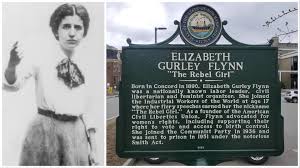
The article is about the removal by right-wingers in the USA of a marker commemorating worker organiser, women’s suffrage campaigner, anti-racist and anti-fascist Elizabeth Gurley Flynn in her home town of Concord, Massachusetts, USA.
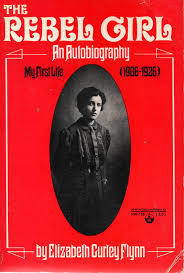
An omission in the article, which the Morning Star chose not to correct, is the Irish background of the article’s subject, class fighter Elizabeth Gurley Flynn. Is this important? It certainly was to the subject herself who, in her biography, emphasised her Irish background.
Cover of her biography (Source photo: Internet)
She wrote of the importance to her of claiming both Irish family names in her ancestry and always used them both: Gurley and Flynn. But in particular for the CPGB, operating in a state that is oppressing Ireland, it should be of importance how Irish people are represented.
Especially in a culture with a deep and long streak of anti-Irish racism.
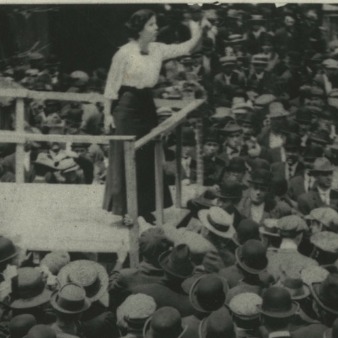
Elizabeth Gurley Flynn speaking at a mass meeting in the USA (Source photo: Internet)
The CPGB never supported the armed struggle by Irish people against its masters nor stood up for the defence of the Irish diaspora in Britain, subject to racism in the media, to police persecution and to judicial and legal racism in the 1970s, ’80s and ’90s.
This is despite the enormous contribution of the Irish diaspora to the trade union and socialist movement in Britain in shop stewards, activists and leaders.
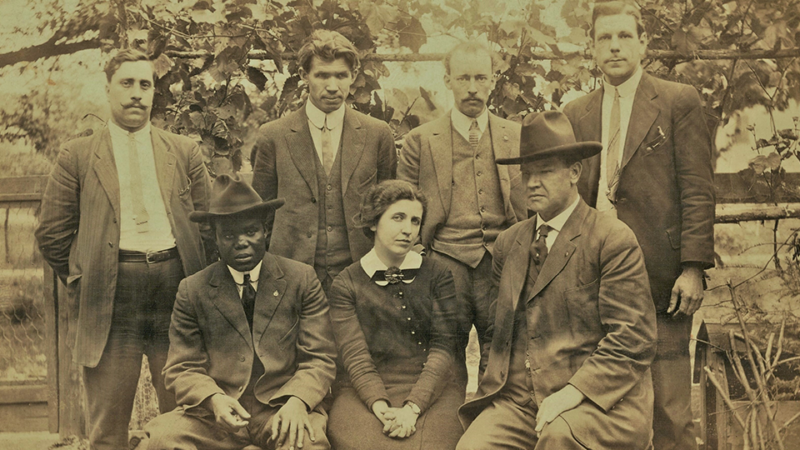
International Workers of the World (‘Wobblies) organisers: Elizabeth Gurley Flynn (centre) next to Big Bill Haywood (right). (Source photo: Internet)
With Bronterre O’Brien and Fergus O’Connor, the Irish diaspora gave the British working class two leaders of the first mass movement of workers in Britain, the Chartists. The anthem of the class, The Red Flag, was composed by Jim Connell from Co. Meath (though they used the wrong air).
And the classic novel of the class, The Ragged-Trousered Philanthropists, was penned by Robert Tressel, pen-name of Robert Noonan, born and reared in Dublin.
The CPGB in fact has a long association with British colonialism and its very title is an indication of that.
End.
Left: Famous photo of Gurley Flynn as a public speaker. Right: The marker in her hometown now removed by right-wingers there. (Photo sourced: Internet)
Norman Finkelstein has published a new book on cancel culture. It comes from a man who as he points out became a high-profile victim of one of the more modern iterations of cancel culture, that of Zionism.
The latter was unashamedly right wing and did not dress itself up in liberal or even bastardised Marxist tropes, peddled by people who should know better.
He is perhaps, one of those with a vantage point on the issue, who deserves to be listened to.
He opens the book with an epigraph from Bertrand Russell: “I feel a real and solid pleasure when anybody points out a fallacy in any of my views, because I care much less about my opinions than about their being true.”
A statement that should be basis of all discussion is now frowned upon in a world of unassailable truths, wicked witches who should be burned at the stake, dogmas that once enunciated can never be challenged.
And whether the statement is true, matters not as it is more important how many semi-literate university graduates are offended by it that counts. Of his own cancellation and the hypocrisy of some of those who signed the Harper’s Letter decrying cancellation he is not bothered.
This is because he contends that “Hypocrisy was rife, for sure. But the irrefragable fact remains that “woke” politics are intellectually vacuous and politically pernicious.” He forewarns us that the book is laced with vitriol… because so much of “woke” culture deserves contempt.”
But that “a large amount of space is devoted to dissecting this nonsense… because it’s not immediately obvious why it’s nonsense.” This Foreword alone entices the reader to delve deeper into its pages and the plea from Tariq Ali for him not to throw a tantrum makes it all the better.
Cancel culture as Finkelstein points out is not new.
He gives a short list of some of his heroes who were cancelled at one point or another, Pete Seeger, Paul Robeson, Lee Hayes and even Malcolm X and Martin Luther King and even Chomsky were cancelled and reviled in their day.
Pete Seeger, veteran folk singer, folk song collector and political activist, was among victims of cancel culture in his day. (Photo sourced: Internet)
Yes and by the same newspapers, journals and political quarters that are now to the fore in cancelling one and all and in some cases, those involved in the cancelling now decry the cancel culture that affects them.
He divides the book into two parts, one dealing with woke politics and the other with academic freedom, though they are not separate and there is some overlap, even in the book.
In the first part he looks at some of the figures of woke politics, those who make the case for identity politics in particular. Some of the people he looks at, such as Ta-Nehisi Coates and Ibram X Kendi, are well known in the US but not so much outside of it.
He eviscerates them rather well describing Kendi’s writing as being “as supple as a calcified femur and as subtle as an oversized mallet”. Obama is of course, well known, though his politics are modern in how they are sold.
Obama is all about style over substance, partly because the substance is not new, he represented no great change in US society, though that is not the image he sought to portray. His message was vacuous, Yes we can, and Finkelstein asks the question, can what?
And gives the very direct and truthful answer “Yes we can, elect me”. Obama is shredded in the book, his famed oratory derided for what it is, speeches that were written by an all-white team of writers, despite Obama’s identitarian claims.
A parsing of Obama’s public addresses reveals a relentless concatenation of the most vapid, sententious, shoeworn, fatuous, hollow, saccharine clichés—a cornucopia of the commonplace—without a single clever phrase, metaphor or aperçu to redeem or relieve them, interlarded with oleaginous homilies to humility before God.
That does not mean that his speeches and politics are devoid of consequences. Obama epitomises the reality of identity politics. It is another con job. For all his blackness Obama did very little for blacks in terms of socio-economic advancement.
Not even in terms of a relatively simple issue, police violence against blacks. In one of the first rows in his presidency on the issue, he backed down and instead of taking action invited the policeman and his victim for a beer.
Identity politics is waived about, not to solve any problems but to divide. Finkelstein asks whether it advances causes or provokes their retreat.
The objective of politics, Mao Tse-Tung famously exhorted, was to “unite the many to defeat the few.” Whereas, identity politics divides the many so as to, designedly or not, enable the few.
It conjures a hierarchy of oppressions, in which each group vies with the others for the position of most oppressed— Kimberlé Crenshaw says Black women are most oppressed, Angela Davis says it’s transgender people, Ibram X. Kendi says it’s poor transgender Black women.
The victors in this inverted Oppression Sweepstakes, where you win by being the biggest loser, get to leap to the head of the queue as most worthy of preferential treatment, while, simultaneously, fomenting new resentments among those shoved further and further behind…
This, in effect, performance politics has spawned a disgusting den of thieves who brand themselves with radical-sounding hashtags, churn out radical-sounding tweets, and insinuate themselves into positions of prominence, as they rake in corporate donations and cash corporate paychecks.
Theyhang out at the watering holes of the rich and famous, and thence can be safely relied upon not to bite the hand that feeds them. In a word, identity politics is a business—in the case of Black Lives Matter “leaders,” a most lucrative and dirty business.
Cancel culture is about silencing voices other than those sticking their snout in the trough and their grubby hands in the greasy till, a point he is right about, not just in the US but around the world.
Finkelstein found himself cancelled, though not silenced, as he points out, because his views go beyond the grimy quest for self-aggrandisement and enrichment. Identity politics is utterly reactionary.
He contrasts the fumbling for pennies and the endless categories of oppressions with an historical figure that our perpetually offended money grabbers in search of the latest shakedown could never match: Rosa Luxemburg.
My mind drifts back further still to Rosa Luxemburq, this exotic creation of a lost epoch: Polish, Jewish, bourgeois, handicapped, female—
Rosa didn’t wallow in or capitalize on her “intersectionality” but, on the contrary, triumphed over it as she became the brilliant, impassioned (and then martyred) revolutionary leader of the German workinq class;
A class which—be it noted as a robust class rejoinder to claustrophobic identity politics —fervently embraced this Polish-Jewish-bourgeois handicapped-female as one of their own.
And that is exactly the point. Luxemburg is a real hero, many of the heroes of the woke do not measure up to their own standards, not even Frederick Douglass, who had a very poor opinion of native Americans, a fact overlooked by modern day identitarians.
Though many don’t have a positive opinion of native American themselves. Douglass however, is despite this a towering admirable figure in history, not one that should be cancelled, a hobby now of every spoilt ignorant brat that mammy and daddy got into an overrated expensive university.
And though it is only a matter of time before some hippy in Berlin decides to reinvent Luxemburg as intersectional, she was not and had no time for the woke equivalents of the day.
Academic freedom is the other area of concern for Finkelstein, conformity, banal ideas and salivating over money is not limited to our woke warriors in the press, NGOs and politics but in academia. It is not new, but is more pronounced now than before.
Bertrand Russell summed it up nicely and Finkelstein agrees that “As a rule, by the time a man becomes a professor, he has been tamed, and has learnt the advantages of submission” the advantage being measured now in euros, dollars, yen and shekels, though many would deny this.
Again as he points out “For self-deception, you can hardly beat academics,”. There are of course exceptions, but in the current atmosphere, the younger new academics are bowed and beaten by those who went before them.
Given his own personal experience, he is obviously in favour of academic freedom which he describes as not just the freedom to teach but to enquire and travel the road less travelled.
He points out that in the US the idea went through various stages, freedom from churches, then from corporations and later the state (MacCarthy). Nowadays, all three encroach upon it, sometimes in unison and to the same end.
He goes again into some detail on the issue and chooses the thorny ground of Holocaust denial.
He is Jewish, so he is clearly not advocating that the Holocaust did not happen, but rather how it is dealt with on campus and links it up to other issues, giving examples when he himself has been uncomfortable teaching and the examples he relies on.
He makes an argument for challenging ideas. This section, like the Obama part is overly long and could also have done with a bit of editing. But he clearly comes out against censorship and new morality police that abound everywhere.
It’s easier to fight against codified speech restrictions than against “enlightened” campus opinion, which, in the name of its “special duty,” insinuates itself in campus life and throttles free speech with its asphyxiating pieties.
The situation now is that debate is being stifled on a whole range of issues, beyond the obvious ones and the high profile debates on Men’s Rights i.e. the right to id your way into women’s spaces. Due to his own experience, he does seem to think that it is more the case when an academic goes off campus that the trouble arises.
But actually, the baying mob throttling free speech are doing so on campus now to people who have never ventured off it, or at least have never been given much opportunity to do so. He cites a very interesting case, that of Bertrand Russell when he was appointed to City University.
His morals, his sex life and general outlook were brandished about as reasons for not hiring him. Russell defended himself, saying they were irrelevant, he was appointed as a lecturer in “modern concepts of logic,” “foundations of mathematics,” and “relations of pure to applied science.”
In the modern cancel culture that wouldn’t stand. People are sacked precisely because of their private lives or their opinions on matters wholly unrelated to the area in which they teach.
It didn’t stand back then either, Russell lost the case precisely because he argued in favour of homosexuality and premarital cohabitation, amongst other things. Our woke liberals on campus, those who hounded Kathleen Stock out of her job are as reactionary as the judge in the case.
He goes on to look at other cases before finishing off with the details of his own case and his unemployment and unemployability in academia.
The book is interesting, though far too long with too much detail about some cases and aspects which makes it difficult to see the wood from the trees at times. But it does offer arguments on issues that are current with reference to historical precedents and also to philosophy.
It is worth reading, as he is a rather high-profile victim of cancel culture. His book the Holocaust Industry was thrashed by the New York Times, which had positively reviewed the Bell Curve and even gave a better review of Mein Kampf than Finkelstein’s book.
They probably keep quiet about that aspect.
Cancel culture, identitarianism, intersectionalism are amongst the biggest intellectual challenges to the left.
They deny class and reduce politics to the acceptance of pre-ordained dogmas, that are espoused by the US Democratic Party, Facebook, Google and many major multinationals i.e. from the right of the political spectrum.
They are the wolf in sheep’s clothing, though the sheep is clearly showing the fangs for anyone who wants to see. History is unlikely to be kind to them.
Whilst Finkelstein has some illusions of his own in some liberals like Bernie Sanders, his point about freedom of speech, the search for the truth, discussion and debate are his main point in the book.
A point that cannot be overemphasised in its importance, nor of the need to persevere through the current darkness. As Finkelstein says.
Many of the heroes of my youth had been blacklisted, but also had, despite all, stayed true to their youthful convictions; not dogmatically, as almost all of them had left the Communist Party, but still unreconciled to the capitalist system, and committed, at any rate in theory, to its overthrow.
A picture of Robeson sits on my bookshelf beside a picture of Marxist economist Paul Sweezy.
The cancel culture advocates and wokerati have, unlike Finkelstein, reconciled themselves to fumbling in the till and harassing those who might speak out against the system in any meaningful way.
Gearóid Ó Loingsigh 12 April 2023 (first published in Socialist Democracy)
(Reading time: 5 mins.)
The president of Colombia, Gustavo Petro, announced in a National Peace, Reconciliation and Harmony Council (CNPRC) meeting that the state didn’t have sufficient funds to fulfil the Havana Accord signed with the FARC.(1)
The situation seems to be so serious that according to the President it will take 125 years to fulfil it. There are some points in which he is right, but only if we ignore the most obvious things: the nature of the Accord itself.
He alludes to this and asks some rhetorical questions, ones which he should really ask as proper questions, not as some gesture in his oratory, but rather as questions to the FARC, Santos and all those who promoted the Accord nationally and internationally.
Among guarantors of the Colombian conflict pacification deal signed by, at the time, Colombian President Juan Manuel Santos, left, and leader of the Revolutionary Armed Forces of Colombia (FARC) Timoleón Jiménez, known as “Timochenko,” during a news conference announcing an agreement between the two parts in Havana on Sept. 23, 2015. Among those applauding, Cuban President Raul Castro at far right of picture. (Source photo: Internet)
Petro asks “was that Accord signed with the aim of applying it, or with the aim of disarming the FARC and later, Colombian style reworking everything?(2)
Well of course it was sonny boy. That much was clear. At the time you were told so and those of us who criticised the Accord were accused of wanting more war, ignoring that many of us had never participated in or supported the war. It was a debate they didn’t want to have.
During the not very open process negotiated behind closed doors, it was said, in the midst of the euphoria of the signing and the parties in public squares with huge screens in the streets so one would miss it, that criticisms were not welcome.
They were, as an old friend used to say, as welcome as a fart in a space suit.
Petro continued and stated something he certainly believes is very important.
I want to implement the Peace Accord, but it costs 30.5 billion Euros. If the Santos government signed this in the name of the state and society is represented in this, then, tell me where am I to get this 30.5 billion?(3)
There is an easy answer to that question. The money can be got from the same place that they, and in that I include Petro, thought it was when they signed the Accord in 2016. Don’t ask where they are going to get the money, but rather tell us where you expected to get it in 2016.
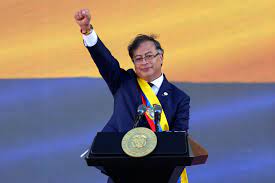
Petros giving a clenched fist salute after his inauguration as President of Colombia. (Source photo: Internet)
Senators such as Iván Cepeda who played an important role in the process can point to where. The cost of the Accord was obvious from day one, this problem is not new and it is just not credible thatPetro and his Congress benches have just realized how much money was needed.
But the truth is Petro, Cepeda wanted to bring the FARC to an end and rework things later. All of them without exceptions. Of if this is not the case, maybe they can tell us where they thought they would get the money.
The former FARC commander, Timochenko said that war against the FARC (he excludes all of the other guerrilla groups that have existed) cost 83.7 billion Euros and the 30.5 of Petro is a minimal cost for the chance of a country in peace.
He is partially right, except that the problem is not about money or amounts, but rather the Accord itself and their perspective that what is needed is money and not political changes. The Havana Accord reads like shopping list, like a list of demands and a not very precise list at that.
A Land Bank would be set up with three million hectares, but it doesn’t say where and left it to the whim of whichever government.
So Petro announced that he would fulfil that part by buying land off cattle ranchers. The same ranchers whose spokesperson José Felix Lafaurie accepted that Fedegan’s affiliates, rice growers and various multinationals financed the right-wing paramilitaries.(4)
Nothing happened to him, nor to the 10,000 cattle ranchers who had signed an open letter where they acknowledged their crime.(5) At the time it was argued that the Prosecutor was not in a position to process that many people.
It wasn’t true, the crime had been publicly vindicated and they also said that there was nowhere to put 10,000 criminals. This wasn’t true either.
According to the prison service’s own figures and the calculations of the Corporación Excelencia en Justicia, in 2006 the Colombian prison system had a capacity for 52,414 prisoners with 60,021 actually held in them.
In 2011, that figure had risen to a capacity of 75,260 with 100,451 people in them i.e. they managed to put 40,000 poor prisoners in overcrowded conditions, but they had no room for 10,000 paramilitaries and their lackies.
In 2006 there were 19,353 prisoners on remand.(6) A little bit of creativity with the judicial abuse of remand and they could have put the paramilitary funders in jail without any problems.
The prison population eventually reached the figure of 125,000 prisoners in overcrowded conditions whilst others rambled around their lands despite having acknowledged their crime.
What was missing was the will. But instead of spending money buying land from paramilitaries and their backers, Petro could confiscate the land of those 10,000, amongst others. It wouldn’t cost that much.
There are other measures he could take with a view to peace, justice and truth. Petro could ask for the extradition of the Board of Chiquita who paid a 25 million dollar fine in the US having accepted their responsibility in the crime of financing paramilitary groups.
It wouldn’t cost more than the price of posting the request. There are other measures that have some bureaucratic costs, like forcing public bodies to comply with land restitution findings, something which does not happen. It also only requires the will to do so.
Petro’s focus is the same one as the FARC and the Santos’ government and other peaceniks, who are now Congress reps: it is a question of money. But this is not the case. It is a question of returning stolen land, reviving organisations, guaranteeing the right to exercise one’s rights.
It is also the disbandment of the specialised riot squad, ESMAD. It is more expensive to change its name and give it a makeover, as Petro proposes, than abolishing it.
He wanted to buy fighter jets at a cost of 3,150 million dollars. Due to public reaction, he backtracked but he did buy the Barak MX air defence system from Israel at a cost of 131.2 million dollars.(7) He also bought 18 Howitzers from Israel at a cost of 101.7 million dollars.(8)
Such systems are for conventional wars between countries, they are of no use against insurgents, i.e. they are toys for the military. Maybe they will be used in the Coup that Petro’s followers announce all the time. It is what happened in Chile.
So, is there any money or not? And what will be done with the things that don’t cost much? Why don’t they reduce the extravagant salaries of the magistrates in the Special Jurisdiction for Peace who to date have produced little?
But then, at least he partly accepts what was always the case, that the peace process and the Havana Accord were a mockery of the victims of the Colombian conflict. Their only purpose was to remove the FARC from the field, particularly in areas with oil and other natural resources.
No one sought to solve any deep-seated problems in the country and here we are with the tale that there is a lack of money, when really what was lacking throughout the entire process were clear political positions.
(3) Ibíd., Euro figures were calculated at 4906 pesos to the Euro and the original figure of 150 billion in the article was taken using the Spanish definition of billion, which is a million, million.
(4) El Cambio No 704 diciembre 2006/enero 2007 Diez Preguntas (Entrevista con José Félix Lafaurie p. 48)
(5) El Espectador (17/12/2006) La hora de los ganaderos, p. 2A
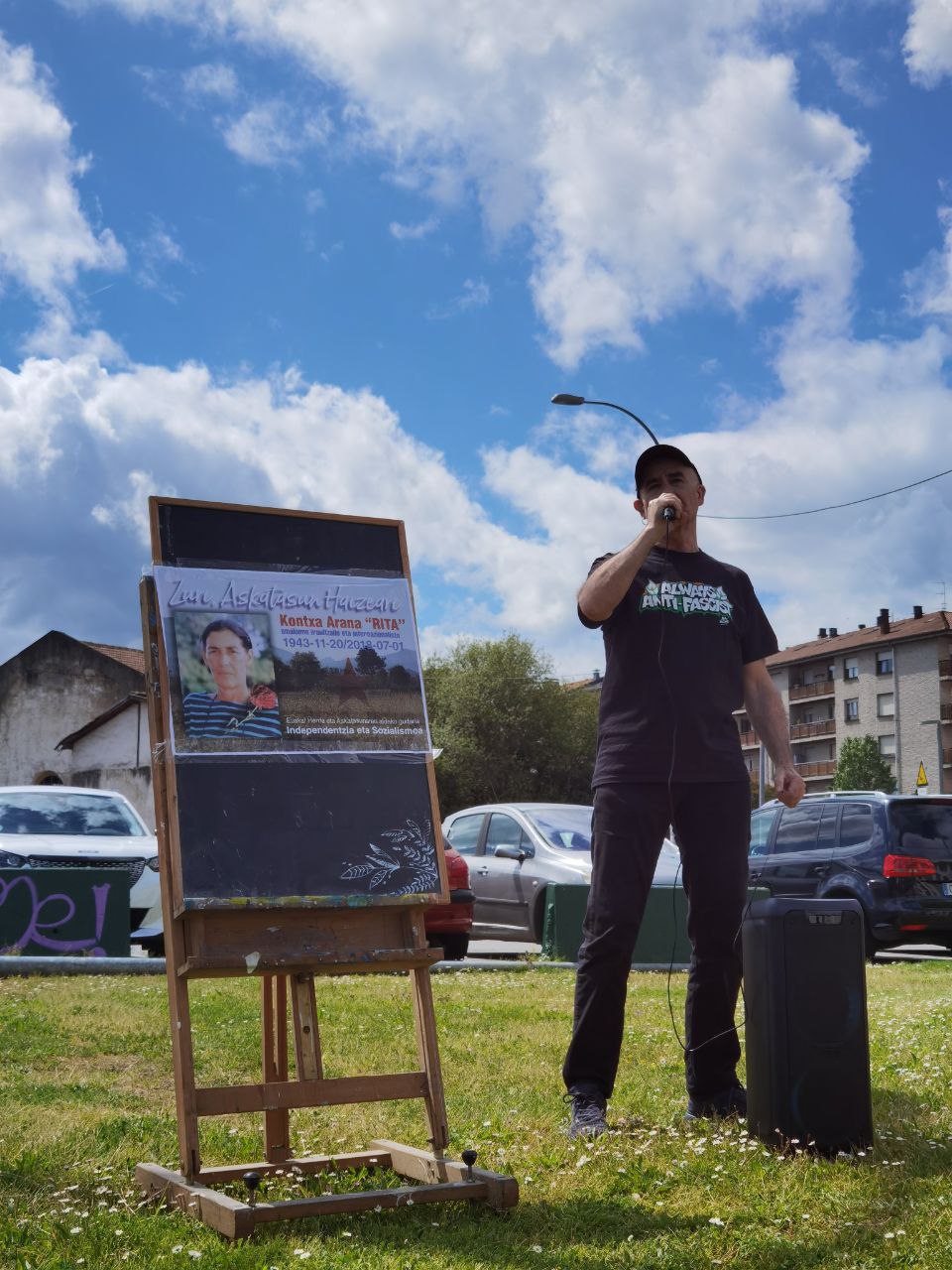
Kontxi Arana, code name “Rita”, was a fighter of the Basque armed organisation ETA and also of the Sandinista movement. A ceremony of homage to her memory on 22nd April was also the occasion of an antifascist conference with representatives from a number of European countries.
The event took place in Gernika, the SW Basque town infamously bombed by German and Italian Nazi and Fascist squadrons during the Spanish Civil/ Ant-Fascist War, the act which inspired the Catalan painter Picasso´s famous piece on the event (which he called by its Spanish name, “Guernica” (sic)). The venue was the disused Astra factory, formerly manufacturer of handguns.
The Origins and Nature of Fascism
The day-long anti-fascist conference began with a talk on the origins and basic nature of fascism by Iñaki Gil de San Vincente, Marxist theoretician and veteran of the Basque Left Patriotic Movement from which leadership of however he has broken for a number of years.
Speaking in Castillian, he declared the essential nature of fascism to be authoritarianism, deriving from the development of the bourgeois family. The central authority figure in that family, later reproduced in other social classes including the working class is the Father, represented in capitalist society by the employer and the Church.
It is an authority to which all are required to submit: patriarchical, homophobic and intolerant of criticism or deviation.
De San Vincente spoke at length about this development and about early descriptions of fascism, for example by Clara Zetkin and Lukacs and described it as a production of capitalism and imperialism and therefore represented today most clearly in the actions of US Imperialism and the NATO over which it exercises hegemony.
The speaker also highlighted the development of NATO and its recruitment of Nazis as well as the development of its Vatican route for Nazis to leave Europe and enter Latin American countries where they would form fascist centres.
This talk was followed by a representative of Ezkerraldea Antifaxistako (Antifascist Left) who, speaking mostly in Castilian, outlined the history of the development of fascism in the Spanish state following the military-fascist uprising and the four decades of dictatorship, and how the organisation he represented responded to that.
The final speaker of the morning session was from Mugimendu Socialistako (the Socialist Movement – organisation with a large membership, according to a participant) who spoke entirely in Euskera (Basque language). Although simultaneous translation was provided into Castilian (Spanish), the volume of such was too low to be understood by many.
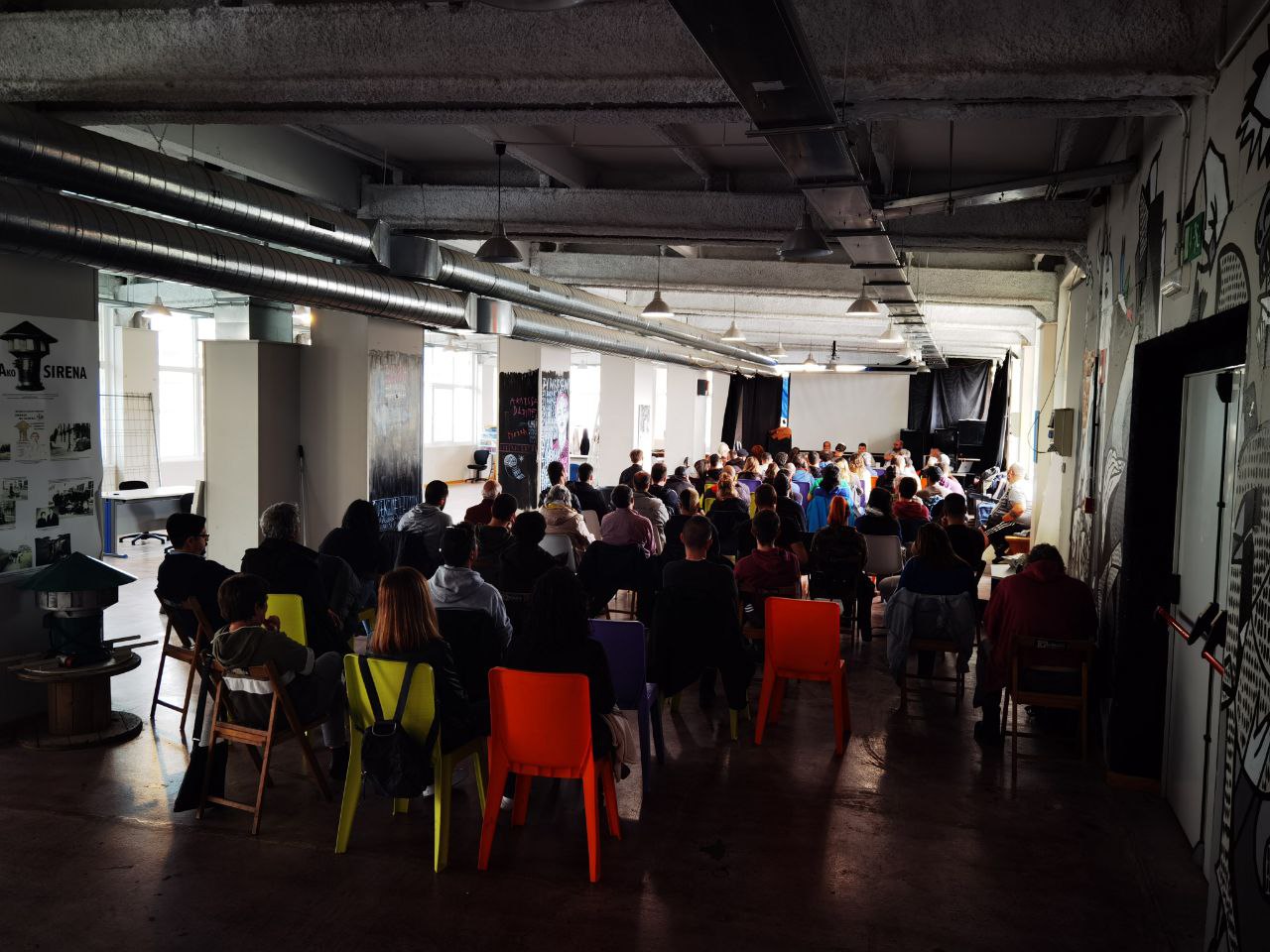
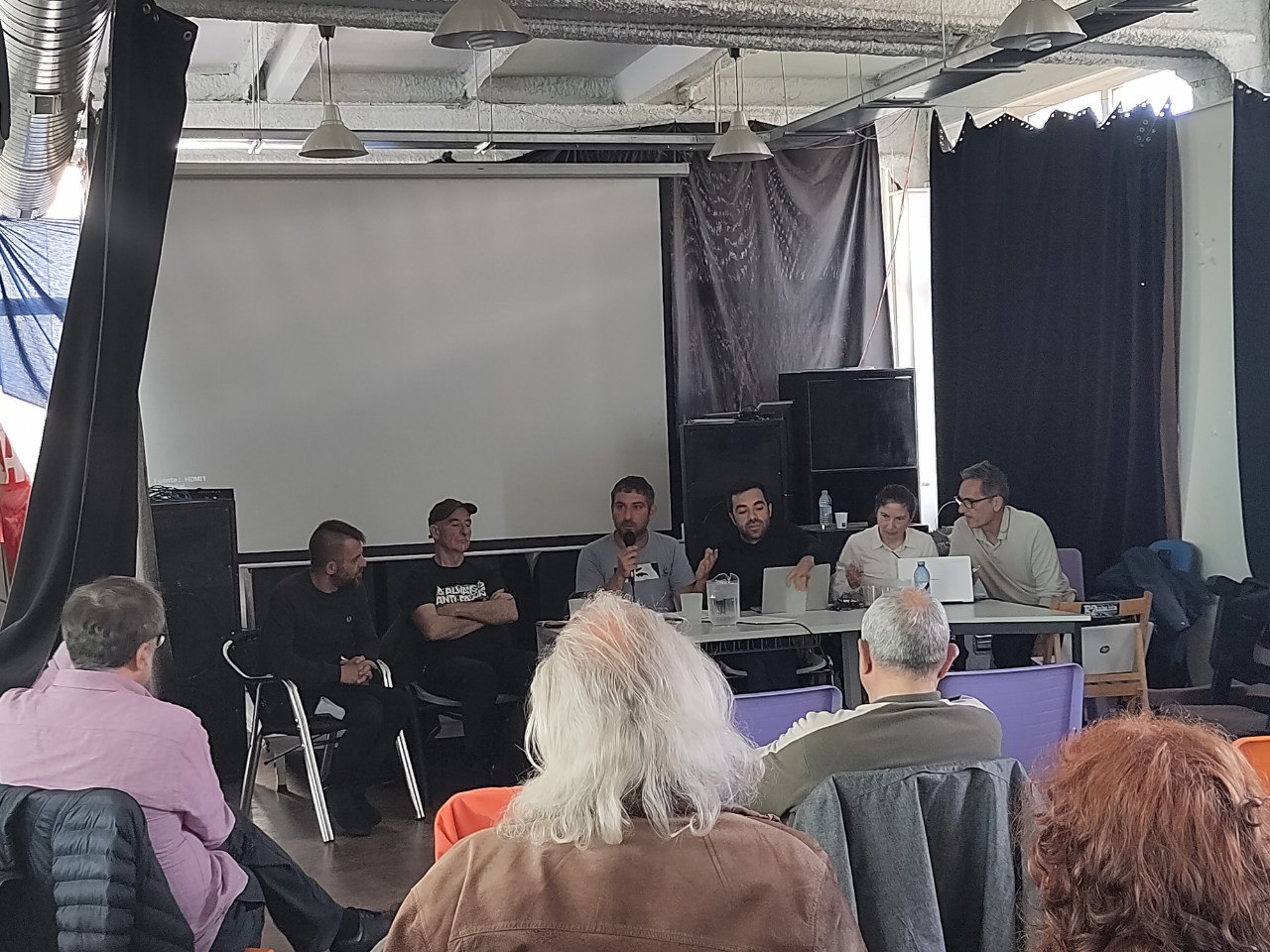
Morning session of the anti-fascist conference in Gernika (Photo: DRAF)
According to a participant, the content of that speaker´s contribution was similar to that of the previous speaker, although he mentioned the existence of Frente Obrero (Workers´Front), a Basque organisation which, despite its name, is a fascist organisation. The existence of that latter group appeared to be news to many present.
These talks were followed by a break and, upon resumption, there were some contributions from the floor and some responses from the panel, after which all repaired to the green outside the Astra building to where the ceremony of respect to the memory of Kontxi “Rita” Arana was to take place.
Kontxi Arana: A leading Basque liberation fighter who also joined the Sandinistas in the liberation struggle of Nicaragua
A Basque woman of the independent Patriotic Left movement blew the traditional cow or bull horn to summon attention, while the speaker in the Basque language introduced the program and speakers along with a short history of this internationalist anti-imperialist and anti-fascist fighter.
Kontxi Arana was an active member of the Basque armed liberation organisation ETA who avoided capture while on operations in the Spanish State but was arrested in the French state and exiled to an island, from which she and others escaped. Sometime later she surfaced in Nicaragua, where she had joined the Sandinista armed liberation movement.
Around the end of the 1990s, the leadership of the Basque Patriotic Left asked some exiles to return to the Basque Country to help push the pacification process and release of prisoners but the Spanish State refused to play, though they did not arrest Kontxi (however according to reports arrangements were not well organised to support her).
Most of the crowd present at the Gernika commemoration and homage to Kontxi “Rita” Arana, with the Astra building in the background and the railway line fence just visible in the left background.
The homage to her memory
A man formerly of the official patriotic Left movement spoke in Spanish about the need for internationalist solidarity, through which however mistakes can be made (e.g. in supporting corrupt leadership) which however does not alter the importance of such solidarity, without which the revolution cannot advance.
This was followed by a man from Dublin Republicans Against Fascism who briefy explained in Castilian (Spanish) the history behind Christy Moore´s “Viva La Quince Brigada“, which the Dubliner then sang in its original English.
Dublin Republicans Against Fascism representative singing Christy Moore’s Viva La Quinze Brigada.
The homage event concluded with red carnations being laid by members of the audience in front of a portrait of Kontxi “Rita” Arana. Two ex-political prisoners played the ´txistu´ (Basque three-hole flute), one of them also beating a rhythm on a small drum (´tamborina´). A young woman stepped forward and danced the ´aurresku´, a traditional honour dance.
Crowd queuing to lay red carnations in front of a portrait of Kontxi Arana
This dance was traditionally danced by a male, then by male dancers, then by male and female dancers until today, when it may be performed by any of those combinations or by a lone female, as in this case, and often enough in ordinary clothing as was the case on this occasion, though she did wear dancing shoes laced to the ankles.
The young woman performing the honour Aurresku dance in one of the high kicks of the dance with, to the far right, the ex-political prisoner txistulari (players of the Basque flute). In the immediate background, participants and organisers. (Photo: DRAF)
The musicians then played the air of The Internationale, which most could be heard singing in Euskera, followed by Eusko Gudariak (“Basque Soldiers”), the Basque national resistance song, similar to the Soldiers’ Song/ Amhrán na bhFiann of Ireland in content. Many had raised clenched fists as the songs were sung.
Suddenly, a wild high-pitched yodelling cry rang out from a female throat, the Irrintzi, traditional Basque battle-cry which probably echoed around the mountains in olden days.
All the audience then repaired to the Astra building where a hot meal was served to all on long tables with a bottle of wine to share among each group of several people (those present had purchased tickets to the event either in advance or upon attendance).
Afternoon session: Presentations from Turkish, Irish and Catalan antifascists.
The afternoon session started a little late as people straggled in. The chairperson, speaking in Euskera, introduced the theme of the session which was for antifascists from Turkey, Ireland and Catalonia to describe the situation with regard to fascism in their countries and how it was being confronted.
Turkey
Two people from the Turkish-based revolutionary organisation Anti-Imperialist Front presented their contribution while using a video of images, some subtitled in Castilian but where not, spoken by the woman in English while her comrade translated simultaneously into Castilian.
Overall, the presentation was about the development of state fascism in Turkey and the failed military coup of 2016. The DHKP/C organisation had resisted this on the streets but a major struggle with the Erdogan government took place in trials and in the jails.
Through hunger strikes and physical resistance in the jails, hundreds of martyrs had lost their lives, said the speaker but had remained undefeated. Also martyred had been members of the Group Yorum music group which has played revolutionary songs heard by millions.
Another struggle was carried out through public hunger strikes by elderly relatives seeking the uncovering of mass graves in the bodies of fighters, their sons, had been thrown by the Turkish military.
As a result two mass graves had been eventually disinterred, permitting the remains of fighters of the DHKP/C and of the PKK (Kurdish patriotic socialist organisation) to be returned to their families for respectful re-burial.
The Turkish speakers concluded by stating the necessity for anti-fascism to be anti-imperialist and calling for internationalist solidarity and victory to peoples’ struggles.
Section of audience at afternoon session of the anti-fascist conference in Gernika, Basque Country.
Ireland
The next speaker was from Dublin Republicans Against Fascism, explaining that eight centuries of occupation of his country by England has ensured that the dominant struggle had been one of national liberation and that all armed struggles since 1798 had been led by Republicans of various kinds: 1801, 1848, 1867, 1882 and 1916.
The Irish State that came into being after the War of Independence in 1921 had been a client of the UK, conceding over one-fifth of its national territory as a direct colony. The armed forces of the State had formally executed over 80 of the IRA and instituted a wave of repression including kidnappings, torture, murders including of prisoners.
In keeping with the rise of fascism across 1930s Europe, Ireland saw the Blueshirt movement, led by former police chief Eoin O’Duffy. The Republican movement and socialists fought these on the streets, the speaker said.
The Dubliner recounted briefly the history of Irish Republicans and socialists going to fight Franco in the Spanish state and the Irish diaspora fighting the British fascists, the Blackshirts, in British cities and in defence of Eastern European Jews in famous Battle of Capel Street in the East End of London against over 7,000 police.
He went on to recount some more recent successful physical attacks by joint Republican groups against fascist organisations, the Pegida group in 2016 and even more recently the National Party. Recently too, Republican ex-prisoners had released a video stating the opposition of Republicanism to fascism with a growing list of signatures.
In conclusion, the speaker said that Ireland’s history made it difficult for fascism to advance in Ireland (except in the Loyalist areas) but as long as capitalism exists so too does the danger of fascism, particularly if the progressive forces do not fight effectively against the attacks of Capital on working people.
Catalonia
The representative of the Anti-Repression Platform of Catalonia, speaking in Castilian (Spanish), explained their organisation had come into existence after the repression of the Independence Referendum in 2017 and the subsequent frame-ups and allegations of terrorism against the Committees for the Defence of the Republic.
The speaker alluded to the jailing of the revolutionary socialist rapper Pablo Hasel and comrades who were charged with terrorism merely for expressing and organising solidarity for those being repressed.
“Don’t try to frighten us with threats of a fascist party getting into government”, he said in a reference to the growth of the Spanish fascist party Vox, because we have had a fascist government in the Spanish state since 1939!” (The year that the military-fascist forces defeated the Second Republic and founded four decades of dictatorship).
The Catalan went on to denounce the social-democratic party PSOE (currently in coalition government with Podemos Unitas), pointing out that it has had more political prisoners in jail and fatal victims than any other party in Spanish government (he was probably including the sponsoring the GAL terrorists of the 1980s).
“There has not been a year in which there were no political prisoners in the Spanish state”, he went on to say but also denounced the current Catalan Government, led by the allegedly pro-independence and leftist ERC party and its repression of socialists and independence activists.
He pointed out that fascists would make no distinction between communists and anarchists and asked “so then why should we?” He declared that all who resist repression now, regardless of before, are welcome to take part in their organisation.
The panel at the afternoon session: from left to right: speakers from Catalonia and Ireland, Basque chairperson, Turkish speakers and translator.
Prisoners on hunger-strike
The chairperson of the panel thanked the speakers and drew together elements from each of their presentations.
He went on to announce the declared intention of a small group of Basque political prisoners to embark on a hunger strike and to outline solidarity events being organised. The prisoners concerned are in the non-compliance minority of Basque political prisoners with a regime that forbids them referring to themselves as political prisoners.
The prison authorities intended to make the prisoners share a cell with other political prisoners who are however in compliance, intending to undermine the resistance of the small group and also posing the danger of conflicts within the cell. (A few days later news came that the hunger-striking prisoners had won their demands).
Amnistia organisation solidarity poster announcing forthcoming hunger-strike of political prisoners, now over because they won their demand.
Summary
The conference in its organisation and content of contributions drew anti-fascism together with imperialism and internationalist solidarity, all from an anti-capitalist perspective. It also drew connections between solidarity with political prisoners and resistance to repression.
All of the Basque organisations represented are in opposition to the trajectory of the leadership of what had been the Basque Left Patriotic movement, now represented by the EH Bildu party led by Otegi (with daily newspaper GARA, its trade union organisation LAB) and many of the older people were ex-supporters of that leadership.
That included some prominent ones such as Inaki Gil de San Vincente and the speakers and organisers of the conference and of the homage to the memory of Kontxi “Rita” Arana. The younger participants might have included ex-members or had come into political consciousness in opposition to that leadership.
Taken together, they are what many call ‘dissidents’ though some reject that term, saying that they are in fact sticking to the original line of independence and socialism and that it is the official leadership and their followers who have deviated. Their numbers are comparatively small at the moment but they are growing.
Currently the International Court of Justice1 has accused Premier Vladimir Putin and the Russian Commissioner for Children’s Rights of responsibility for the “forced abduction” of Ukrainian children and their adoption by Russian couples.
The charge implies ethnic cleansing and forced assimilation taking place during war and therefore would be classed a war crime. The Russian side denies the charge saying that instead what has taken place has been voluntary evacuation of families and evacuation of children from orphanages.
The western mass media (wsm) confines itself to repeating the charge and accusatory statements from western politicians, mostly from countries that are part of the NATO military alliance and briefly stating that the Russian leadership denies the charge. Is anyone actually investigating?
Well, Associated Press, a western media agency, says it has and that Russia is guilty. In that case, let’s see the evidence. And we’d have to wonder why a spokesperson for United Nations Childrens Fund (UNICEF) states that it has seen no evidence of Russian abduction of children.
The wsm has only informed us of UNICEF’s position recently in the course of reporting an informal UN Security Council meeting where Maria Lvova-Belova not only denied the charges of abduction but gave actual hard figures on whole family and orphanage children evacuation2.
Ms Lvova-Belova, said that since February 24th, 2022, Russia has taken in more than five million Ukrainians, including 700,000 children — all with parents, relatives or legal guardians except for 2,000 from orphanages in the eastern Donbas.3
To date, she said, about 1,300 children have been returned to their orphanages, 400 were sent to Russian orphanages and 358 were placed in foster homes4.
Lvova-Belova speaking at the informal UN Security Council meeting (Photo sourced: Internet)
Ms Lvova-Belova said her office has met with representatives of UNICEF, Refugees International and the International Committee of the Red Cross and “provide all available information about the situation of children” and are “coordinating with the Red Cross on reunification,” she said.5
The NATO countries declined to send their ambassadors to the meeting while chief NATO state representatives present, e.g. of the USA and UK, walked out of the meeting without listening, accusing Russia of using the situation for propaganda purposes.
Well maybe, UK and USA representatives, but everyone has been issuing propaganda in this war! Anyway why not answer the Russian case with your own counter-evidence? If you actually have a viable case that stands up to scrutiny?
Some war-time children’s evacuation examples
The war damage inflicted in the Donbas region by both sides in this war since 2022 — and by the Ukrainian state alone since 2014 – would make concern for children’s lives a natural motivation for relatives anxious to get their children to somewhere safe.
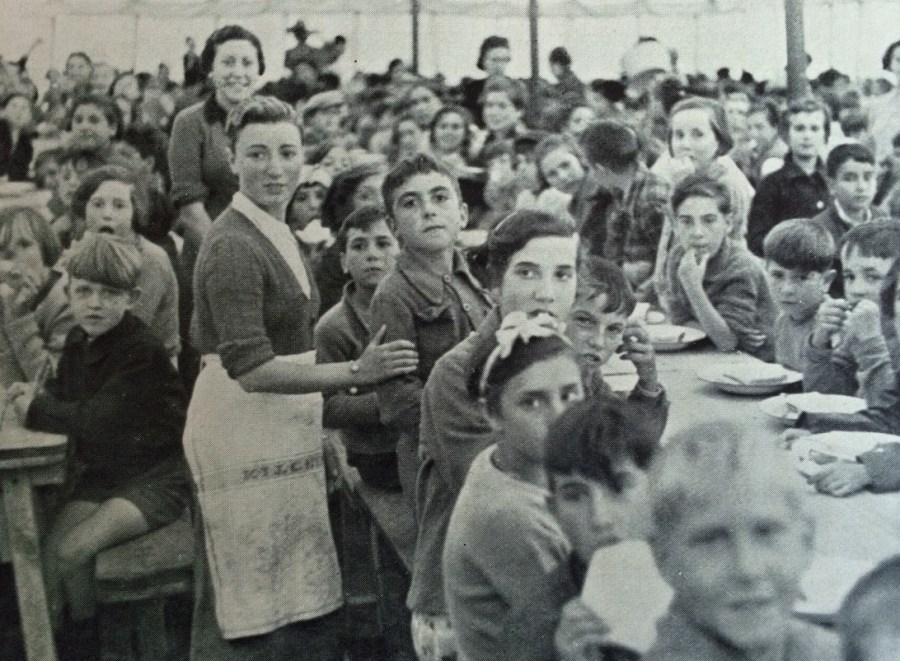
During the anti-fascist war in Spain, sympathetic families in Britain took in children from the Republican side for their safety from the advancing Spanish military-fascist forces and allied German Nazi and Italian Fascist military.
Later, as defeat loomed for the Spanish Republic, families with children fled to many countries (a few even to Ireland) and yes, to the Soviet Union. In fact a Basque descendant of that evacuation has passed a year in Polish jail accused of spying for Russia without presentation of any evidence.6
Basque and Spanish children, refugees from Spanish Anti-Fascist War (Photo sourced: Internet)
During WW2, children from British cities were sent to homes in rural areas for their safety. Whatever the issues around how they were treated in their new or temporary homes, nobody speaks of “abduction” of Basque, Spanish or British children7.
Well, actually, some children were abducted in Spain, from their murdered Republican parents or from working class women who were told their baby had died in childbirth. The fascist State and the Catholic church presented these children for adoption to rich and loyal childless couples.8
One of the reasons for abduction of children in those cases was to satisfy the needs of childless couples loyal to the regime and required the massive collusion of a number of health and social care agencies, all of which were exposed later. Does this seem a likely risk for Russia to take?
Ukrainian families with children evacuating to Russia (Photo crdt: Wall Street Journal)
Well what about the other objective, social engineering, of creating fascist children, or for example “Germanisation” but in this case “Russification”?
Hardly, the children are from the Donbas region, an area already largely Russian in language and culture and, since attacks of the Ukrainian forces on it since 2014, already hostile to the Kyiv regime and mostly sympathetic to Russia.
The Ukrainian State leadership, one of the main accusers of Russia’s alleged abduction of children, frequently issues population figures of towns and cities in the Ukraine War zone, comparing pre-war with current figures, showing a huge drop between both sets.
Presumably the fall in numbers of inhabitants in towns under their control could not have been carried out by Russia. So are we to accuse the Kiyv regime of the “abduction” an “ethnic cleansing” of thousands of Ukrainians, its own citizens? Or more reasonably, of their evacuation?
Returning to the question of actual evidence, an issue of apparent little importance to the wsm and NATO country states, surely an international agency responsible for children would be expected to have a reasonable handle on this?
Or is UNICEF to come under the accusation regularly thrown at those of us who don’t swallow everything NATO says, i.e. of being “putinistas?
The Target of the Propaganda
It’s worth considering who the targets in this propaganda war might be and the reasons therein. The state intelligence agencies of NATO countries presumably have a fair idea of which are truths and which are lies. So the target is not the heads of states.
THE MAIN TARGET OF THE PROPAGANDA IS US, i.e. the ordinary people in the western world, whether in NATO (which most are) or not. The objective being that we should support our governments in backing US/NATO’s confrontation with Russia.
And that if it should come to world war, which seems increasingly likely, that we support our governments and suffer the consequences, including dying in millions to support their objectives. Without rebelling.
End.
FOOTNOTES
1The western mass media makes a point of telling us that Russia does not recognise the authority of the ICC but rarely adds that nor does the Ukrainian regime. And nor does the USA!
2An interesting exercise to evaluate wsm bias is to put “Russia denies abduction of children” in a mainstream search engine and see how many hits one gets for UNICEF’s statement.
6Pablo Gonzalez, a journalist working for Spanish media, was born in Russia, grandson of such a refugee. He was covering the Ukraine war when detained by their state intelligence service and advised to leave the country; meanwhile Spanish state security visited and interviewed his family, his mother and friends. He left Ukraine but went to Poland and was arrested by their state intelligence service as he was accompanying other journalists crossing back into Ukraine. To this date well over a year later Gonzalez has had no evidence of spying presented against him. Unlike a journalist detained in Russia whose case elicited public concern from western politicians within days, none of them have mentioned the case of Pablo Gonzalez.
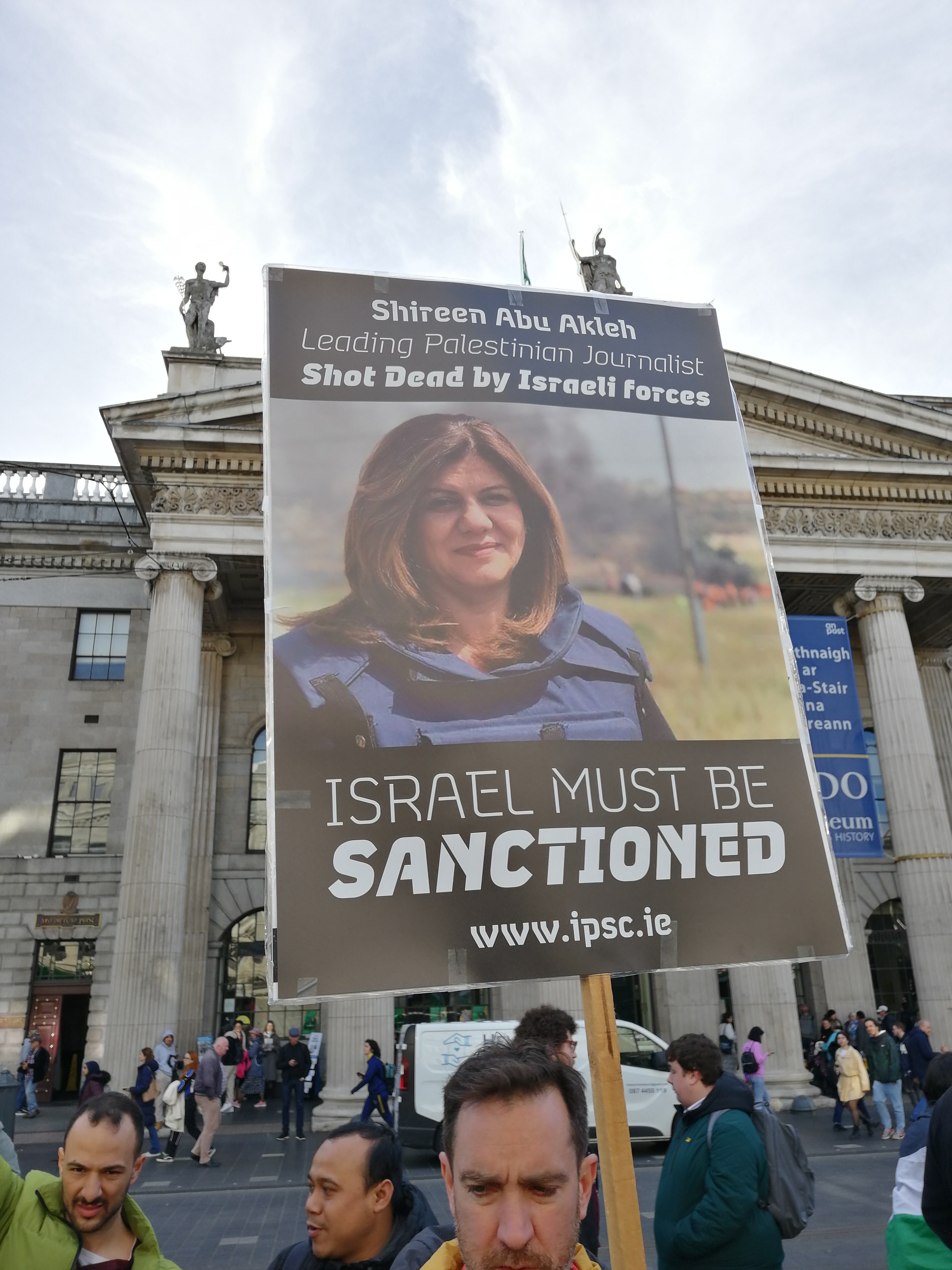
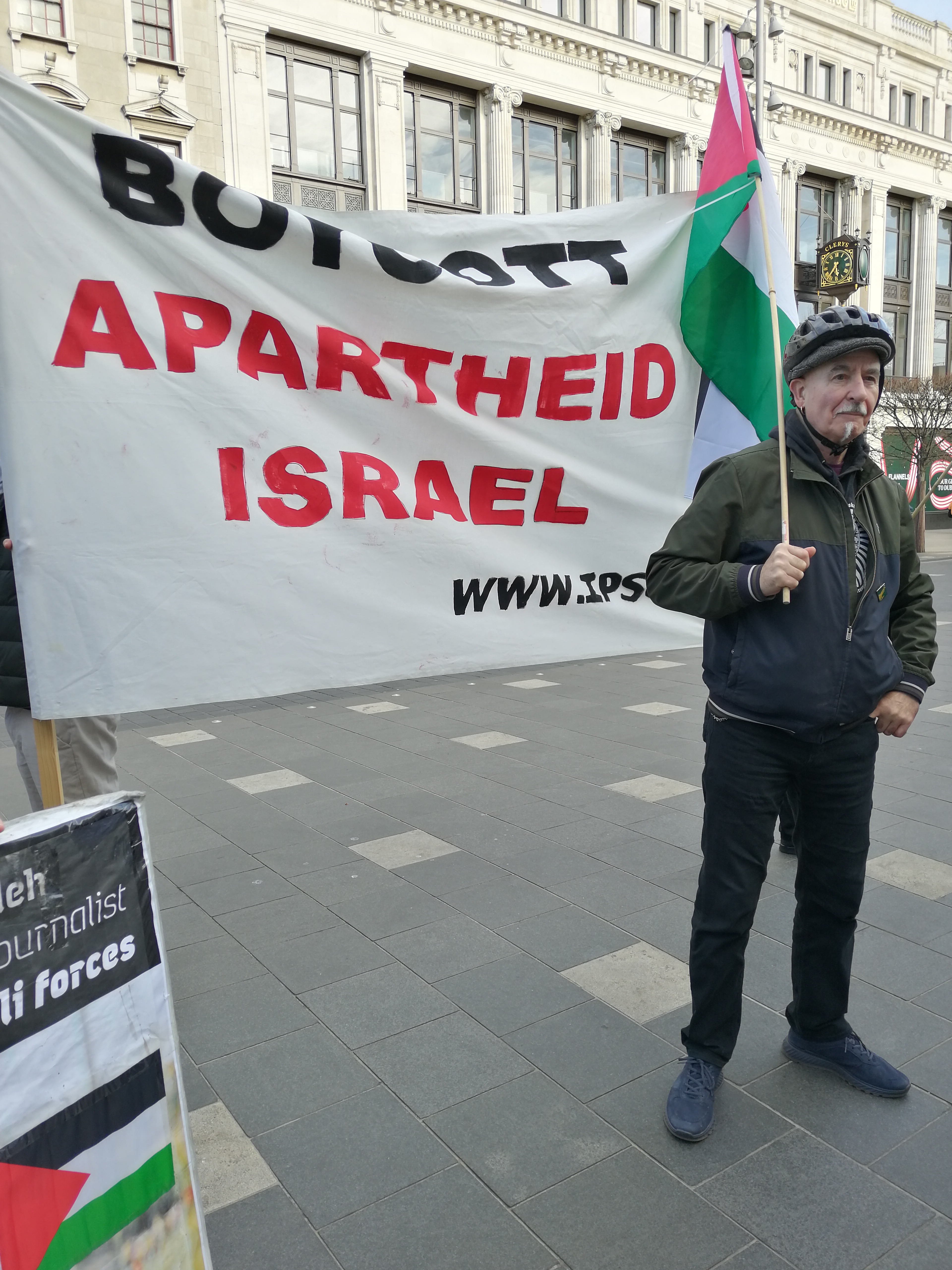
Palestinian flags waved as people gathered on the pedestrian reservation in Dublin’s main thoroughfare, O’Connell Street, to mark Palestinian Land Day March 30th, anniversary of the 1976 confiscation of Palestinian land by the Israeli Zionist State.
Naturally, the event also addresses the continual threat to additional Palestinian land by Zionist settler occupation, Israeli judicial and army demolition of Palestinian housing and intimidation, harassment and terrorism against Palestinians in Jerusalem.
Palestine supporters gathering for Land Day (Photo: D.Breatnach)
The Dublin event was organised by the Ireland Palestine Solidarity Campaign, a broad organisation that receives broad support not only across the Irish Left and Republican spectrum but also from a great many non-aligned Irish people and even many among voters for mainstream political parties.
This support was emphasised by frequent drivers in passing traffic, both public, taxis and entirely private, blowing their horns in approval of the rally. The population of the Irish state has gone from being in general support of the Israeli State to being generally hostile to its behaviour.1
Zionists tend to depict anti-Israeli Zionism as being anti-Jewish and therefore, according to them, “anti-semitic”2. Quite apart from the wide inapplicability of the term and some isolated historical examples dredged up3, it fails to account for the change in public attitudes over recent decades.
The iconic GPO in the background (Photo: D.Breatnach)
It has been years of viewing even media-sanitised coverage of massacres of Palestinians by the Israeli armed forces with international impunity that has radically altered the opinion of the public in Ireland, in all probability drawing on their own historical experience of foreign occupation.
An elderly Irishman voicing anti-Jewish views did in fact approach the rally but was confronted by other Irish people who emphasised that they were against the Zionist state and not against Jews, soon causing the first man to depart unhappily.
The continual occupation of Palestinian land by Zionist settlers has invalidated even the “two-state solution” (sic) beloved of liberals, making it a practical impossibility, undermining the main ‘concession’ of the supposed solution of the USA-mediated “Palestinian peace process” of 1991.
(Photo: D.Breatnach)
The refusal of the Israeli authorities to permit the return of Palestinian exiles while welcoming Jewish settlers, most of whom had no even ancestral connection to Palestine, means that the future for Palestinians in the Israeli state can be at best as an oppressed minority.4
(Photo: D.Breatnach)
Other Palestine news
Even as preparations for the Dublin rally took place, Israeli police shot dead a Palestinian they claimed had tried to wrest a gun from them at the Al Haq Mosque but whom Palestinian eye-witnesses said had merely been protesting the police harassment of a woman.
Since the rally, another two Palestinians have been killed in an by Israeli armed forces raid on Nablus. This brings the total number of Palestinians killed by Israeli forces this year alone to over 90, with a high proportion of them children.
Mass protests and even mini-riots by Israeli Jews are currently expressing opposition to the current government’s plans to ‘reform’ the judiciary, to bring it under the greater control of the Executive.
While Israeli Jews are deeply divided on this question the vast majority are agreed on the need to suppress Palestinians, to enforce apartheid and to keep the State as ‘Jewish’ one.
Meanwhile an April 1st Fool’s Day hoax depicting an executive of the sports shoe manufacturer company Puma declaring a boycott of the Zionist state was widely shared on the Twitter social media to overwhelmingly welcoming comment.
Exposure of the hoax received mixed responses, with wide condemnation from pro-Israeli and even some pro-Palestinian sources but others claiming it helped to widely publicise the manufacturer Puma’s close links to the Zionist State and that would enhance its boycott by many.
End.
(Image accessed: Internet)
Footnotes
1Dublin City has had Jewish municipal Councillors and the sixth President of Israel, Chaim Herzog (Hebrew: חיים הרצוג; 17 September 1918 – 17 April 1997) was an Irish-born Israeli politician, general, lawyer and author who served as the 6th President of Israel between 1983 and 1993. He was born in Belfast and raised primarily in Dublin; his father was Ireland’s Chief rabbi Yitzhak HaLevi Herzog, who immigrated to the British protectorate of Palestine in 1935 and served in the Haganah Zionist paramilitary group, later the Israeli Army where he reached the rank of Major-General. As recently as 1967 the prevailing Irish public opinion seemed sympathetic to the Israeli State and the fictional propaganda and wildly inaccurate historical Hollywood films Exodus (1960) and Cast a Giant Shadow (1966) were widely viewed sympathetically in Ireland.
2The term originally included hatred or fear of all Semitic people, including Arabs and Jews but has come to be understood as exclusively meaning a racist attitudes towards Jews. By no means all Jews are Zionist though Zionists have worked long and hard to make both descriptions interchangeable with a great deal of success among the world Jewish population with possible unfortunate consequences for Jewish populations outside Israel. However many Jews have criticised the behaviour of the Zionist State towards Palestinians, earning the hatred of the Zionists, who cannot label them as anti-semitic and therefore call them “self-hating Jews”.
Many people know that March 17th is St. Patrick’s Day, a national holiday in Ireland and a public holiday in some other places in the world where the Irish diaspora has had an impact1. But why? And why the shamrock and the colour green?
The Christian Saint Patrick, an escaped Welsh slave of the Irish returned as Christian missionary to Ireland is credited with the main role in the conversion of the Irish from their pagan religions to Christianity. As such, he is revered by the Catholic and many Protestant churches.
Unlike many places in Europe, the conversion seems to have been largely peaceful with no evidence of the fire and sword by which it was imposed on many other lands. Perhaps because of this, Irish monks recorded much of the rich mythology and legends of pagan Ireland.
But there is absolutely no historical reason to associate Patrick with the shamrock. The claim that he used it to demonstrate the three-in-one of the Christian Trinity is a fable and copies of his Confessio, widely accepted as Patrick’s authentic autobiography, do not mention it.
Reference to this fable is not recorded until centuries later but a much more convincing argument against its veracity is that pagans had many deistic trinities and the Irish were no exception, among which the Mór-Righean goddess2 in the Táin saga3 is the best remembered.
In fact, there seems little reason to believe that the druids favoured the shamrock either and searching the internet years ago threw up no references at all until more recently one reference only surfaced that gave no source for its claim.
So, no authentic reason for the shamrock – but what about the colour green? It turns out that the association of the Irish with the colour green is historically recent also, with blue having an earlier association. Even today only one of the four provinces, Leinster, has green on its flag.
A similar flag to the Leinster one, a golden harp on a green background was first flown and introduced by Eoghan Rua Ó Néill to the Catholic Confederacy, the Irish and Norman settler alliance against Cromwell and the English Parliament in 1642.
A number of versions of Harp and Crown on flags followed but the first mass Irish Republican organisation, the United Irishmen brought the Harp without the Crown back on to a green background for their flag, with the motto “it is newly strung and shall be heard” next to the harp.
The United Irish emblem; the harp was reproduced in gold on a green background for the flag. (Image sourced: Internet)
John Sheils, a Drogheda Presbyterian and United Irishman, in his aisling-style song The Rights of Man composed sometime before the 1798 Rising, brought the icons of a female Ireland, the Harp, colour Green, St. Patrick and the shamrock together in his call for unity against England.
Alluding to “the three-leaved plant” Sheils has St.Patrick declaim that “it is three in one, to prove its unity in that community that holds with impunity to the Rights of Man.”
The “three in one” is an obvious reference to the unity of “Catholic, Protestant and Dissenter4” sought by the United Irishmen and vocalised by Wolfe Tone among other leaders. However, there is no evidence of wide-scale use by the Unitedmen of the shamrock to signify that unity.
And the green may have been inspired by the colour which Camille Desmoulins called on Parisians to wear in their hats as a sign of revolution two days before the storming of the Bastille in 17895, though they soon chose blue in emulation of the American Revolution.
The failure of the United Irish risings in 1798 and 1803 was followed by severe repression, reflecting the fear of the Crown and its loyal settlers of losing its Irish colony. The weak Irish Parliament was abolished by bribery and Ireland became a formal part of the United Kingdom.
The Wearing of the Green
As a Christian festival, St. Patrick’s Day might have seemed an innocuous feast day, acceptable to ruler and ruled, therefore safe to celebrate and wearing the shamrock as something innocuous.
It seems likely to me that in an atmosphere of wide-scale repression, people of Irish Republican sympathies might well choose to wear green in public at least one day a year, that being in the form of the shamrock on “St. Patrick’s Day.”
The song The Wearing of the Green references the repression following the United Irish uprising of 1798 with the lyrics “they’re hanging men and women for the wearing of the green” and “the shamrock is by law forbade to grow on Irish ground.”6
The Irish Republican Brotherhood, formed on St. Patrick’s Day 1856 simultaneously in New York, USA and in Dublin, Ireland, adopted the golden Harp on a Green background for their flag, though they also used the Sunburst, believed symbol of the legendary Fianna warriors.
(Image sourced: History Ireland)
The formation of the IRB, or “the Fenians” as they became known by both friend and foe, occurred in a time of huge Irish emigration, then overwhelmingly Catholic in religion and surpassing by far that of the mostly Protestant and Dissenters of the late 18th Century to the USA and Canada.
Waves of Irish emigrants followed those who managed to leave Ireland during the Great Hunger of 1845-1848. Whenever they went to an English-speaking country or colony, the Catholic Irish suffered discrimination from the White Anglo-Saxon Protestants settled there before them.
The Irish who formed a battalion to fight the USA’s second expansionist war against Mexico (1846-48) may have flown the green flag and harp; certainly they named their unit the St. Patrick’s Battalion and were known by Latin Americans as “Los San Patricios“.
St. Patrick’s Day in Exile
St. Patrick’s Day became one of celebrating Irish identity, more ethnic than religious, a way even of flaunting that identity in the face of their detractors and persecutors. The Irish fighting in huge numbers in the Union Army celebrated it during the actual American Civil War (1861-65).
In their first invasion of Canada in 1866, American Civil War veterans organised by a branch of the Fenians flew a green flag with a harp and, it is said, with the letters “IRA” on it, the first such use of the acronym in history.
Painting depicting the Battle of Ridgeway, Fenian invasion of Canada, 1866 – note the Irish flag (Image sourced: Internet).
After the War, the Irish in the US celebrated St. Patrick’s Day in mass parades with their Union Army veterans in their regimental uniforms, flinging their identity and their contribution to the USA in the face of their persecutors, not only the highbrow WASPs but the nativist “Know Nothings”.7
Irish convicts in Australia celebrated the feast day in 17958 and, since sentenced 1798 and 1803 United Irish were sent there in chains, likely celebrated often afterwards by them, as well as by subsequent political prisoners, Young Irelanders in 1848 and Fenians in 1867.
The Irish diaspora in Australia, who were maligned due to the opposition of many to fighting for the British Empire in WW19, marched in parade on St. Patrick’s Day in 1921 with WW1 veterans in uniform at the front,10 calling for self-determination for Ireland.
As an Irish community activist in Britain, there was never any question as to where I would be on March 17th – I’d be celebrating the feast day with the community in the event we’d organised, whether a parade or a reception.
During a time of IRA bombings and widespread repression of the Irish community11 in Britain there were some calls to abandon St. Patrick’s parades but I and others felt it more important than ever to hold them in public at a time when the community was under attack and we did so.
James Connolly must have experienced celebrating St. Patrick’s Day in his Irish diaspora community in Edinburgh, later as an immigrant to Ireland, again as an immigrant to New York and back again as an immigrant once more to Ireland.
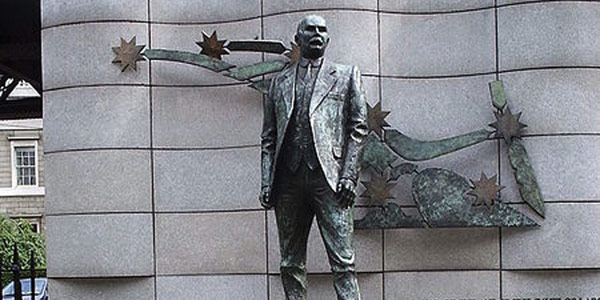
James Connolly Monument, Beresford Place, Dublin. (Photo sourced: Internet)
In March 1916, a month before his joint leadership of the Rising for which he would be shot by British firing squad, Connolly wrote supporting the celebration by the Irish of St. Patrick’s Day.
“ … the Irish mind, unable because of the serfdom or bondage of the Irish race to give body and material existence to its noblest thoughts, creates an emblem to typify that spiritual conception for which the Irish race laboured in vain.
“If that spiritual conception of religion, of freedom, of nationality exists or existed nowhere save in the Irish mind, it is nevertheless as much a great historical reality as if it were embodied in a statute book, or had a material existence vouched for by all the pages of history.”
“Therefore we honour St. Patrick’s Day (and its allied legend of the shamrock) because in it we see the spiritual conception of the separate identity of the Irish race – an ideal of unity in diversity, of diversity not conflicting with unity.12”
He did not call for – and would have certainly repudiated — the celebrating of the feast day by a British Army unit wearing sprigs of shamrock or by Irish Gombeen politicians celebrating it with leaders of US imperialism.
Commenting on the reverse journey of that kind when President Reagan came to Ireland (amidst widescale Irish State repression of opposition) in 1984, Irish bard of folksong Christy Moore sang in Hey Ronnie Regan:
You’ll be wearing the greeen Down in Ballyporeen The ‘town of the little potato’; Put your arms around Garrett And dangle your carrot But you’ll never get me to join NATO.
The Anglo-Irish poet and Nobel Literature Laureate WB Yeats wrote about the colour green in reflection on the 1916 Rising: Now and in time to be, Wherever green is worn, Are changed, changed utterly: A terrible beauty is born.
It should be “terrible” only to the enemies of Irish freedom and self-determination, to imperialists, colonisers and their fascist and racist supporters but truly beautiful to all others.
In parting, let us come again to John Sheils’ 1790s words which he put in Ireland’s, Gráinne’s mouth:
Let each community detest disunity; in love and unity walk hand in hand; And believe old Gráinne That proud Britannia No more shall rob ye of the Rights of Man.
End.
Trifolium dubium, the Lesser or Yellow Clover, an Seamair Bhuí, top of the candidate list for the “shamrock” title. (Photo sourced: Internet)
Footnotes:
1Newfoundland in Canada and the Caribbean island of Monserrat. It is also the most widely-celebrated of all national feast days across the world.
2Usually rendered in English as “the Morrigan”, a trinity composed of three sisters, sometimes Badb, Macha (number of places named after her, including Ard Mhacha [Armagh]) and Nemain, at other times as Badb, Macha and Anand. They were sometimes represented as sisters of another triad, Banba, Éiriu (from which the name of the country Éire is derived) and Fódla. The triads may be three aspects of the one Goddess in each case.
3Táin Bó Cuailgne/ The Cattle Raid of Cooley, a part of the Ulster Cycle of stories, featuring the legendary warrior Sétanta or Cú Chulainn.
4Catholic (the vast majority of the Irish), Anglican (the tiny minority but reigning religious group) and the other protestant sects, in particular the Presbyterians, which had a much larger following than the Anglicans.
5The Unitedmen were greatly influenced by the French Revolution, of course.
6 The best-known version is by dramatist Dion Boucicault, adapted for his 1864 play Arragh na Pogue, or the Wicklow Wedding, set in Co. Wicklow during the 1798 rebellion (Wikipedia)
7‘Nativist’ gangs of earlier USA settlers that mobilised violently against the Irish and African Americans; when tried in court they claimed to ‘know nothing’.
9Such was the popular opposition that the British feared to impose conscription and instead held a referendum which voted not to have conscription. A second referendum failed again though by a smaller majority. Nevertheless many Australian volunteers were killed fighting for the British Empire.
10Of course such identification with the ‘new country’ of settlement may in itself be problematic, particularly should that country be or become imperialist, as has indeed been the case with the USA and with Australia (in subservient partnership with the UK and with the USA).
11Particularly from 1974 onwards until the community’s resurgence in support of the Hunger Strikers in 1981.
12Underlining mine, surely an appropriate message for these times.
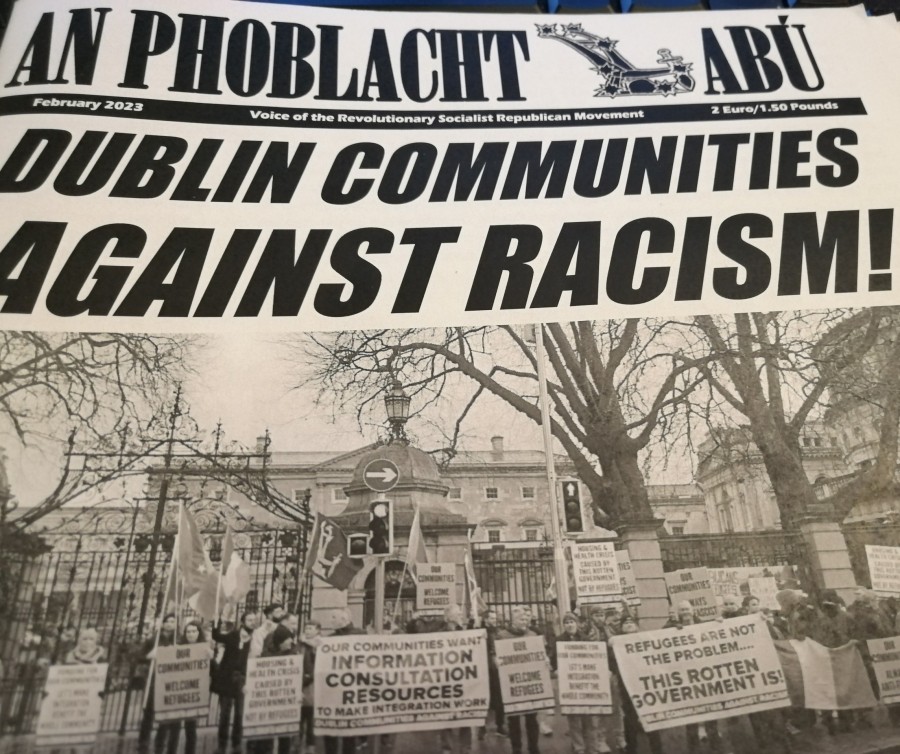
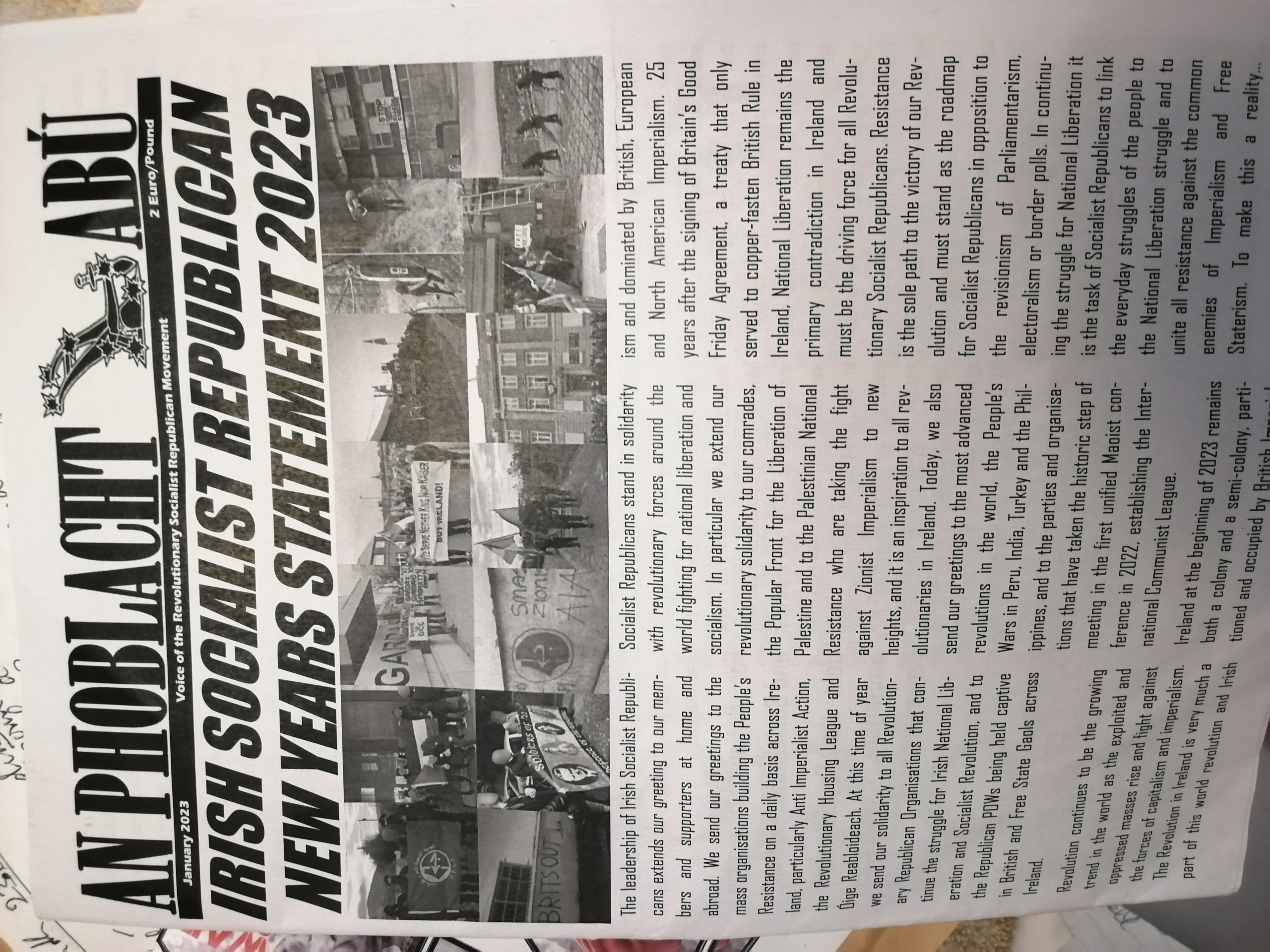
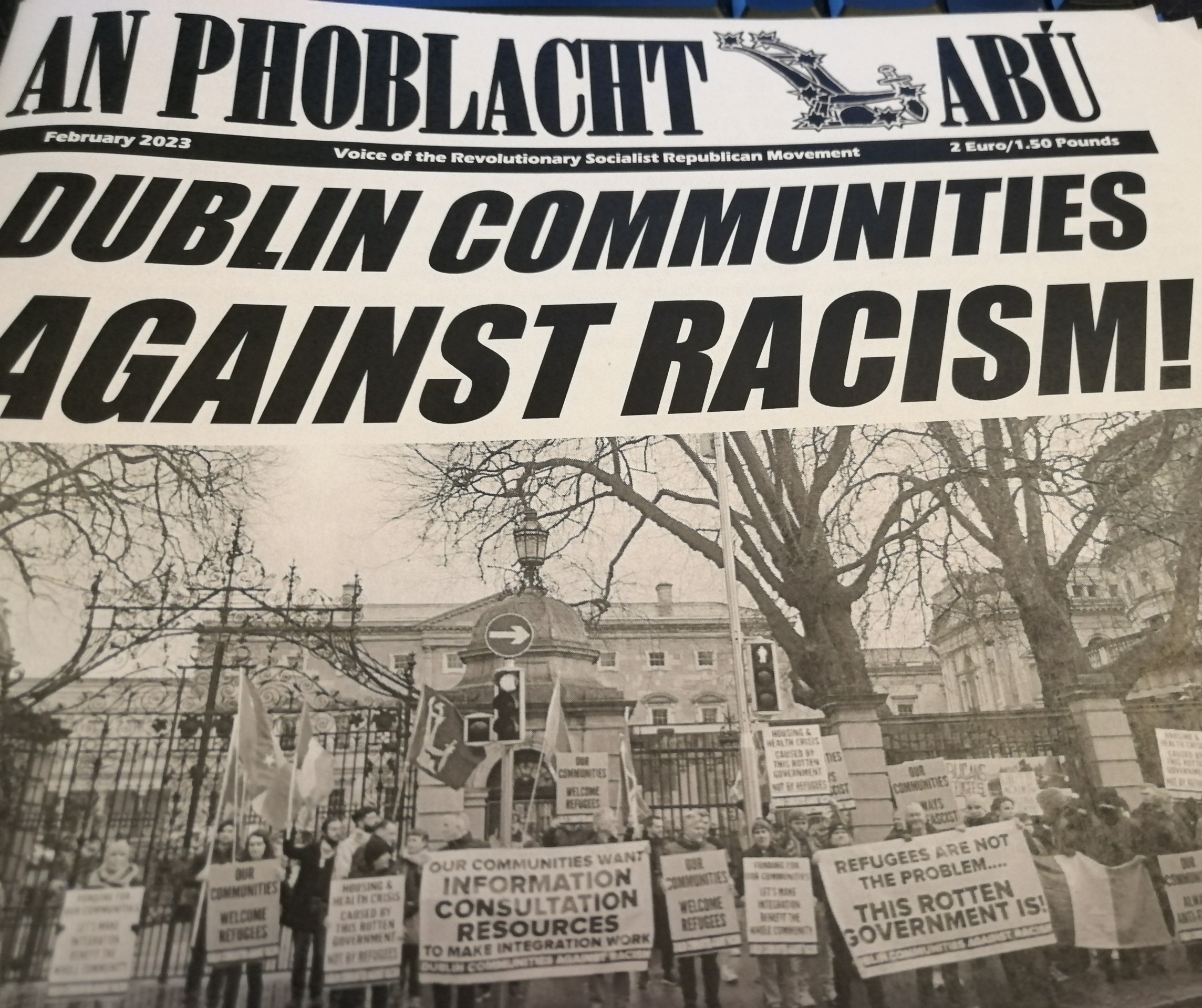
A new socialist Irish Republican hardcopy newspaper has appeared in Ireland in recent months. January and February 2023’s editions, believed to be nos. 3 & 4 are reviewed here.
HARD-COPY NEWSPAPERS
While today, at least in the developed world, the production of Internet media is of great importance for the revolutionary movement as much as it is for the capitalist system, the hard-copy newspaper disseminated by hand still has an important role.
Hardcopy newspaper distribution entails contact in the real world with real people, answers given to questions asked and challenges made, contacts made between the potential organisers and potential activist supporters, can go from hand to hand and be left for a random reader.
Online media has no equivalent to this.
Lenin observed that the revolutionary newspaper is an organiser, not only in its calls to action but in the necessary tasks of production and distribution. Ireland has very few revolutionary newspapers and not even one weekly one, to say nothing of daily editions.
An Phoblacht Abú is produced and distributed by Irish Republican Socialists, whose activist manifestations have been seen in the Revolutionary Housing League’s occupation of empty buildings and its calls for a general emulation of such actions.
Another manifestation has been the activities of Anti-Imperialist Action, notably in protest pickets against imperialism and neo-colonialism, antifascist actions and anti-spiking campaigns, also in commemorations of Republican martyrs, often supported by sticker and leaflet campaigns.
An Phoblacht Abú Front January 2023, front page.
CONTENT, FORM AND PRICE
Both issues reviewed contained 16 sides of A4 pages, composed of two A3 sheets folded in half, one inside the other. They sold at 2 euros per issue – less than one-third the price of most pints in Dublin and much longer to consume!
In general the articles are well-written and with few typographical errors. The editions reviewed here covered national and international news and the overall line in the content is of revolutionary overthrow of the ruling class and eschewing electoralism.
With regard to coverage of national issues, anti-fascism, anti-racism, building a broad front, opposition to NATO and the British occupation of the Six Counties and the neo-colonial and neo-liberal ruling class of the Twenty-Six Counties have figured prominently.
Apart from such regular themes, January’s issue documented the struggle against student fees and treachery of the student union executive in Maynooth and reported a joint Republican Prisoners’ solidarity picket in Dublin along with the release of a known Loyalist sectarian murderer.
Commemorations of Irish Republicans murdered by the Free State during the Irish Civil War/ Counter Revolution (1922-1923) figured in both issues.
In foreign news coverage, actions of peoples’ guerrilla forces in the Philippines and India, for which one would search the main dailies in vain, are covered in both issues and, in January’s, Scottish independence and John McLean and Israeli expulsion of Palestinian campaigner Salah Hamouri.
The environmental struggle in Germany figured in February’s issue.
Regarding economic questions, the rise in “cost of living” and housing crisis attacks on working people were addressed in short articles. Wider pieces on action were included on class struggle and community representation and action in the February edition.
LOOKING AHEAD
The appearance of An Phoblacht Abú is welcome and it is hoped can be sustained. Hopefully further issues will deal with questions of culture and the Irish language, the war in Ukraine (on which the Left seems deeply divided), historical-cultural conservation, trade union organisation and education of the people.
AVAILABLEat 2 euro per copy (back issues sometimes free) from sellers and supporters or from irsmedia@protonmail.com


















 rebelbreeze