REVOLUTIONARY BLOC AS PART OF HUGE COST OF LIVING PROTEST

Clive Sulish

(Reading time: 4mins.)

Many thousands marched through Dublin’s city centre yesterday in protest against the soaring cost of living, pushed in particular by rising energy costs. Most mass media avoided estimating numbers except the ridiculous ‘estimate’ of 3,000 by the Irish Times daily1.

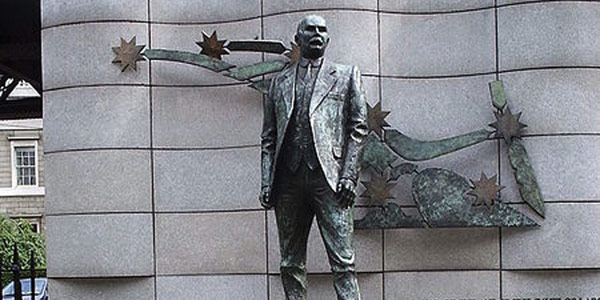
As the Cost of Living Coalition convened a mass protest demonstration in Dublin, the Anti-Imperialist Action organisation called for a Revolutionary Bloc to meet at the James Connolly monument2 in Beresford Place.

In mid-July, statistics published showed the average cost of living had risen above 9%. The average figure conceals the higher percentage rise in daily consumables such as food and drink that will rise higher still with price hikes by energy supply companies.

Companies are raising their prices steeply across at least the western world in a trend that began, despite much media discourse, prior to the Russian invasion of the Ukraine. But Ireland emerges as the most expensive country in the EU with Dublin the most expensive city there by far3.

(Photo: Rebel Breeze)

SPEECHES FOR REVOLUTION & AGAINST REPRESSION

At the Connolly monument, people gathered with banners about the housing struggle and against NATO, along with placards and flags, of which latter the most common was the green-and-gold version of the “Starry Plough”, flag of the Irish Citizen Army4.

The cathaoirleach (chairperson) welcomed people, introduced the purpose of the meeting as being to protest the soaring cost of living and introduced the first speaker, from the Revolutionary Housing League. The RHL speaker outlined their program of direct action.

(Photo: Rebel Breeze)

“What can be more direct than to occupy empty buildings?” he asked those assembled. He recounted some of the recent actions of the RHL and said that they are attracting attention and support, ending by calling on others to get involved5.

The second speaker, introduced as a revolutionary socialist anti-imperialist, went through a list of ills brought by the capitalist system, including lack of housing, selling off our resources and infrastructure, disregard for our language, environmental destruction and danger of nuclear war.

For all said the speaker, the Irish national bourgeoisie are guilty, “the Gombeens, a class unable even to free their own country”. “We need broad fronts to fight all these attacks of class war”, he said “but they must be directed openly against capitalism and imperialism.”

(Photo: Rebel Breeze)

The final speaker, a socialist Republican, represented the newly-formed End State Repression campaign group. Those wanting to oppose rising prices, he emphasised, could not share their struggle with those intending to enter a coalition with Fiann Fáil or Fine Gael.

He also recalled how when protests against the bank bailouts and student fee hikes were getting going in 2010, they were met with state violence through the Gardaí. As the resistance builds, it will get attacked, he said but “we can’t allow them to drive us off the streets again.”

(Photo: Rebel Breeze)

Many drivers passing the rally in vehicles, private and of work – including public transport — sounded their horns in solidarity, giving rise to cheers from the protesters.

MARCH TO BLACKWATER

The assembled then set off in two lines along Custom House Quay, across Talbot Memorial Bridge and then eastward along the quays. On the way they shouted slogans including “One, two, three, four – Housing crisis no more!” and “Only solution: Revolution!”

Revolutionary Bloc outside Blackwater’s offices (Photo: Rebel Breeze)

Other slogans include “Whose streets? Our streets!” “Whose Republic? Our Republic!” and “High rent, high taxes – fight back!”

The marchers stopped upon reaching the offices Blackwater Asset Management Company which boasts its background in “coming from the following sectors, Police Force, Legal Profession, Defence Forces, Financial Services & Private Security sectors”.

(Photo: Rebel Breeze)

The crowd expressed its disapproval of the actions of this company. A speaker assured all that any attack on housing activists will be met with resistance. Two songs were sung there too, including Connolly’s Be Moderate/ We Only Want the Earth.6

THE BLOC MEETS THE MAIN MARCH

The Bloc marchers passed through the high-rise apartment blocs in the area before going on to Pearse Street and marching to the junction with D’Olier Street, where they met the main march of many thousands7 rounding Trinity College and still coming down from O’Connell Street.

Here the revolutionary bloc displayed their banners and placards and chanted some slogans. Many in the crowd marching past gave signs of appreciation and people in an anarchist bloc shouted “Solidarity”, raising clenched fists, giving rise to equal response from the Bloc8.

Section of the main cost of living protest march in D’Olier Street and rounding junction with Pearse Street. (Photo: Rebel Breeze)

The large Sinn Féin9 section aroused shouts of “No Collusion! One Solution! Revolution!” from the Bloc. The earlier slogan of “1,2,3,4 – Housing crisis no more!” segued for awhile into “5,6,7,8 – Smash the Free State!”

The main Dublin march was organised by the Cost of Living Coalition of 30 organisations, including People Before Profit but also Sinn Féin, which is on a clear trajectory to enter Government in the near future but in coalition with traditional neo-liberal capitalist political parties.

Revolutionary Bloc meets main march at junction Pearse Street and D’Olier Street. (Photo: Rebel Breeze)

The CLC also includes trade unions which many accused of not mobilising for the protest.

Derry city saw a small protest against the rising cost of living also.

A far-Right march in Cork which was addressed by a representative of the fascist National Party attracted little more than 150. Ostensibly against the housing crisis, speakers of course attacked immigration despite it having no connection to the State failure to build affordable public housing.

FB speeded up video of entire main march (recommend mute the sound): https://www.facebook.com/michael.caul.56/videos/3279662202295870

A marcher in Dublin carrying a placard calling for an end to immigration until the housing crisis were solved gave rise to a chorus of “Home for All!” from the Revolutionary Bloc, calls echoed by some among the passing marchers.

Anarchist section in the main march indicating solidarity with the Revolutionary Bloc. (Photo: Rebel Breeze)

Gardaí on foot and in patrol cars tailing the main march were greeted, as they passed the Revolutionary Bloc, with shouts linking Drew Harris10, Commissioner of the police force of the Irish State, to the British Intelligence Service MI5.

A notable feature of both marches was the patience with the interruption to their journeys of private and public transport drivers and, indeed, the signs of support from many, including beeping of horns and hand signals such as the ‘thumbs-up’ and even the occasional clenched fist.

end.

(Photo: Rebel Breeze)

FOOTNOTES

1The Irish Times has a track record of drastically reducing the estimated numbers in reports of anti-government demonstrations, demonstrated most strikingly during the giant water protest marches. It gave the figure 3,000 in leading paragraph to its original twitter report but more recently amended that on line to “several thousand”. The Sunday Mirror reported 20,000 and supporters estimated between 15,000 and 20,000.

2The monument includes a representation in bronze of the Scottish-Irish revolutionary James Connolly, across the road from where he had his office in Liberty Hall (the two-storey building was destroyed by British shelling in 1916 and has since been replaced by a tall man-storey building, HQ of the SIPTU union. Connolly was one of 16 executed by the British in 1916 after the Rising that year.

3See statistics in Useful Links, including https://www.independent.ie/business/personal-finance/irelands-cost-of-living-soars-above-eu-average-as-new-report-reveals-just-how-much-prices-are-rising-41774596.html

4The ICA was formed to defend striking workers from police attacks during the 1913 Lockout in Dublin. It was based on trade union membership and took a prominent role in the 1916 Rising, with a much-reduced one in the War of Independence (1919-1921) and the ensuing Civil War (1922-1923). The ICA recruited women as well as men and some of the women held officer positions, possibly the first revolutionary organisation, certainly the first socialist-based one to do so.

5See https://rebelbreeze.com/2022/09/22/concert-in-occupied-building-murals-pickets-and-court-cases-the-revolutionary-housing-league-spreads-the-fight/

6The lyrics were composed by James Connolly and published in hist Songs of Freedom in New York in 1907. The title was the ironic “Be Moderate” but has come to be known from the refrain as “We Only Want the Earth”. Furthermore, arranged to the air of “A Nation Once Again”, it provides a chorus of “We Only Want the Earth!”

7Most media would only state “thousands” or “many thousands”, but the Irish Times had the audacity to claim the ridiculously low number of 3,000! Estimates by participants varied from 10,000 to 20,000 (latter also figure of the Sunday Mirror).

8It seemed likely that had the Revolutionary Bloc been widely publicised earlier that it would have been supported by many individuals and at some other organisations.

9The former revolutionary republican party rarely mobilises its large membership for street protests as these days it is more concerned with votes in elections. However, SF is part of the Cost of Living Coalitionand SF’s President, Mary Lou MacDonald, was one of the scheduled speakers at the main march rally.

10Immediately prior to his current appointment, Drew Harris was Deputy Chief Constable of the sectarian British colonial gendarmerie, the Police Force of Northern Ireland which, until 2001, was the Royal Ulster Constabulary.

USEFUL LINKS

Anti-Imperialist Action:

End State Repression campaign:

Mass media march reports: https://www.irishmirror.ie/news/irish-news/cost-living-protest-live-updates-28070843

https://www.sundayworld.com/news/irish-news/crowd-of-20000-march-through-dublin-city-centre-in-massive-protest-over-cost-of-living-crisis/1154985225.html

Other reports: https://www.facebook.com/michael.caul.56/videos/3279662202295870

Cost of living statistics: https://www.expatistan.com/cost-of-living/country/ireland

https://www.independent.ie/business/personal-finance/irelands-cost-of-living-soars-above-eu-average-as-new-report-reveals-just-how-much-prices-are-rising-41774596.html

https://www.irishtimes.com/business/economy/2022/07/14/inflation-hits-38-year-peak-of-91-as-cost-of-living-crisis-worsens/

THE REVOLUTIONARY HOUSING LEAGUE SPREADS THE FIGHT — concert in occupied building, murals, pickets and court appearances

Diarmuid Breatnach

(Reading time: 6 mins.)

For a group that first came into public view on May 1st with an occupation of a building empty for two years, the Revolutionary Housing League has certainly been busy. At least two further acquisitions1 have followed since.

In addition, a hundred police with vehicles and helicopter have been videoed in one eviction of two activists; four activists have appeared defiantly in court in different cases and the High Court has granted injunction to companies against activists.

As I write this another eviction is being planned, resistance is being organised and further repression through courts and jail seem certain. The RHL are fighting the system, fighting a fundamental social wrong acknowledged by almost everyone.

SHORT HISTORY OF THE REVOLUTIONARY HOUSING LEAGUE

In 1st May 2022 activists acquired Lefroy House on Dublin’s Eden Quay, formerly used by the religious-based NGO, the Salvation Army to provide night-beds for young homeless people but empty for two years. The activists renamed the building Connolly2 House.

A decorated tile at the door of Connolly House in May/June 2022 (Photo: D.Breatnach)

At that time the occupiers were calling themselves the Revolutionary Workers’ Union though their council subsequently formed the Revolutionary Housing League.

The Salvation Army took the occupants to court, claiming the SA had been renovating the house in order to accommodate Ukrainian refugees. Despite the absence of evidence of any renovation work and the presence of a leaky roof (fixed by the activists!), the court granted the injunction.

The occupiers called for a rally against eviction on 2nd June and a large crowd of people of various political backgrounds, organisations and independents, arrived to support but of course, the eviction forces could wait and choose their time.

Musician performing and section of crowd at rally against eviction outside Connolly House (Photo: D.Breatnach)

On June 9th at 5.45 a.m early passers-by were amazed to see 100 Gardaí3 with a number of vehicles, supported by a helicopter, including armed police4, assault the building to take possession of it for the SA and to arrest two activist occupants. A video of the event taken by a passer-by went viral.

Eviction video: https://www.facebook.com/JamesConnollyHouse/videos/2172514896242639

Both activists were later released on their own surety bail to await court process and the building was fortified against being retaken. To this date it remains empty.

On 13th June, the housing activists convened a protest picket outside Store Street Garda station.

Picket on Store Street Garda Station following eviction of James Connolly House (Photo: D.Breatnach)

Story of Connolly House: https://www.youtube.com/watch?v=rSL453gVHAg

The RHL had acquired another site5, this one having been a building for homeless people of the municipality, Dublin City Council, but also empty for a long period. On June 10th Gardaí arrested two activists near the building and they too are being processed by the courts.

After that, the RHL occupied a large warehouse-type building on the very north bank of the Liffey by Sean Heuston Bridge which they named, naturally enough, Ionad6 Seán Heuston. They opened it as emergency accommodation and held talks and discussions within it.

Parkgate Street front of Ionad Seán Heuston in early September 2022 (Photo: D.Breatnach)

Employees of Pinnacle Security company with bolt-cutters entered the site on 3rd September but failed to evict residents and on the 5th September RHL activists picketed the company which, as a consequence, withdrew from acting as security for Chartered Land, owners of the site.

Pinnacle Security staff, one armed with bolt-cutters, entered Ionad Seán Heuston on 3rd September but failed to intimidate the residents into leaving. Two days later, RHL picketed their HQ and were given a written undertaking that the company would no longer carry out security for Chartered Land on the site. (Photo: Revolutionary Housing League)

The building owner’s interests are managed by Davy Platform ICAV, acting on behalf of its sub-fund the Phoenix Sub-fund but ultimately, the owner is Chartered Land which intends to build high-rental apartments on the site.

Joe O’Reilly is the property speculator tycoon behind Chartered Land, once the biggest debtor to NAMA whose responsible officer Conor Owens permitted O’Reilly to transfer his Moore Street, ILAC and Dundrum Shopping Centre holdings to Hammerson, a British-based property company.

Plan of Joe O’Reilly’s mansion while he owed NAMA €3 Billion which paid him a salary of €200,000 to ‘order his affairs’ (Image source:https://www.dailymail.co.uk/news/article-2063815/3bn-debtor-living-life-OReilly-Developer-sprawling-Dublin-mansion.html)
Joe O’Reilly after appearing as a witness in criminal court in 2015 (Photo: Irish Independent)

That transfer gave Hammerson control of properties O’Reilly’s planning permission from Dublin City Council for a giant “shopping mall” there which they have now changed but again approved by DCC’s Planning Officer and which is under appeal to An Bord Pleanála.

Conor Owens is now Ireland Director for Hammerson.

Lawyers for O’Reilly named a number of individuals as being in occupation of the property, at least two of them apparently on the basis of photographs of the interior shared by the them on social media. Last Thursday a number appeared in court on applications for injunctions against them.

One who had not been named, a homeless individual, made an emotional appeal for he and his partner to be allowed to stay and the occupants to provide services to more homeless people. Another denied he had been an occupant but had merely shared photos on social media.

That latter individual had the injunction against him removed but was asked to sign an undertaking he would not enter the building, which he declined to do, remarking that he should not even have had to attend the High Court in the first place.

Sean Doyle of the RHL declared that the action they were taking was necessary and quoted James Connolly: We believe in constitutional action in normal times; we believe in revolutionary action in exceptional times. “These are certainly exceptional times”, Doyle remarked.

The judge went ahead and granted the injunction and required all occupants to evacuate building by Wednesday 21st (i.e as this piece was being concluded).

The RHL organised a picket and temporary protest occupation of Davy stockbrokers, who were handling procedures for Joe O’Reilly, the property tycoon owner of the site of Ionad Seán Heuston.

RHL picket and temporary occupation of Davy stockbrokers (Photo: Revolutionary Housing League)

Last weekend the RHL organised a solidarity concert at Ionad Seán Heuston with somewhere between 150 to 200 in attendance and with at least two bands posting on social media their delight at having performed there.

O’Reilly’s legal team claimed “a flagrant breach of the court order”.

The RHL have called a solidarity rally against the eviction at the site for tomorrow at 10am.

Band performing to crowd at Ionad Seán Heuston — “a flagrant breach of court order” according to property tycoon’s lawyers. (Photo: Revolutionary Housing League)

THE FUTURE

Whatever the outcome of the eviction intended for this particular building or the eventual result of court cases, it seems clear that the RHL are on a collision course with the State and its protection of landlords and property speculators.

While some may look askance at such a contest, one may ask legitimately what other course of action is effective and viable?

Marches and short-term symbolic occupations of individual buildings, including the high-profile Apollo House one supported by prominent individuals in December 2016, though possibly raising awareness, have not made a single dent in the homeless crisis.

Section of the crowd at rally outside Apollo House 11 January 2016. Events such as these mobilised opinion but did not change the situation as indeed it worsened (Photo: D.Breatnach)

Indeed, the situation seems to have got steadily worse – at least for those seeking accommodation; while on the other hand clearly landlords, letting agencies, property speculators, vulture funds and the very banks are raking in their profits.

OVER 10,000 HOMELESS INCLUDING 2,503 CHILDREN

Earlier this year the State admitted that homeless figures had passed ten thousand, for the first time since the covid pandemic7, a statistic that includes the shocking figure of 2,503 children.8

And a recent report states that the levels of homelessness are under-estimated because of the accounting system used by the State, which focuses on rough sleepers and those accessing emergency accommodation9.

Mural representing revolutionary Irish socialist Republican Constance Markievicz and the outline in red stars of “the Starry Plough” (Ursa mayor), one of the impressive murals inside Ionad Seán Heuston (Photo: Rebel Breeze).

Sofa-surfing, rotating between friends and family, precarious rental arrangements all figure in homelessness but are not measured or accounted for by the State. Indeed these features of homelessness have been known for decades.

Clearly too, the obvious solution, the release of substantial funds by the State to local authorities to build public housing for affordable rent, is not favoured by any of the Government political parties.10

Apart from the general inclination of the ‘political class’ to serve big business many have direct interests in the housing situation, as an audit of TDs (member of the Irish Parliament) found over 80, i.e more than half, are landlords or own property – or both.11

Faced with such a situation it is clear that only a very substantial shock to the political system has any hope of having a serious impact on the housing crisis. Though the solution need not be revolutionary, all the evidence is that the methods do indeed have to be so12.

An interesting side-aspect of the RHL’s occupation has been the use of innovative and highly-effective art in banners and murals. Also the holding of a concert and some trad music sessions in acquired buildings, along with educational talks, discussions and Irish language classes.

Another of the murals in Ionad Seán Heuston, a representation of the profile of Pádraig Mac Piarais/ Patrick Pearse, revolutionary Irish Republican, writer, educator, executed by British firing squad in 1916. His slogan translates as: “A country with out its language (is) a country without a soul”. (Photo: Revolutionary Housing League)

The RHL is a small organisation fighting the State Goliath which is representing the Philistines of property speculators, vulture funds and banks. They deserve our support in whatever measure we are able to give, in attending events and spreading the word.

Indeed, they have called for wider action – the RHL has on a number of occasions called on people to do what they are doing, to occupy the thousands of empty buildings which, if people did, would transform this struggle into a mass movement.

With no other viable solution in sight, surely we should support the RHL? Do we not owe it to those on the street or struggling to pay mortgages or high rents? Do we not owe to the children now, the future generation that will be blighted unless we act?

End.

The Starry Plough flag of the Irish Citizen Army in the early decades of the 20th Century flies above Ionad Seán Heuston (Photo credit Revolutionary Housing League, taken from Seán Heuston Bridge)

FOOTNOTES

1The RHL call their taking of empty properties “acquisitions” in the name of the people.

2After notable socialist revolutionary, trade union organiser, journalist, historian and writer James Connolly, executed by British firing squad in 1916.

3The police force of the Irish State is called An Garda Síochána and the plural of its members, “Gardaí”, singular “Garda”.

4The Garda Síochána is essentially an unarmed police force with an armed response section, the latter which however seems to be growing and more in evidence in different situations.

5They named that one Liam Mellows House in honour of socialist Irish Republican and former member of the Irish parliament, the Dáil, executed during the Civil War by the Irish State in retaliation on 8th December 1922.

6Ionad in Irish means “place/ location/situation”.

7https://www.breakingnews.ie/ireland/over-10000-people-homeless-in-ireland-for-first-time-since-pandemic-1311934.html

8https://www.independent.ie/news/homeless-figures-rise-to-10325-including-3028-children-41787023.html

9https://www.breakingnews.ie/ireland/narrow-definition-of-homelessness-failing-to-respond-to-true-nature-of-crisis-1365817.html

10Sinn Féin’s latest housing policy indicates a crash building program for “affordable homes” but unclear whether to rent or own. Election promises tend to be taken with a pinch of salt by commentators; SF Councillors on Dublin City Council voted public land sold to developers. In addition, a future government including SF would almost certainly include a former government party in the coalition.

11https://www.irishtimes.com/politics/2022/08/24/almost-80-tds-and-senators-are-landlords-property-owners-or-both/

12The State has the power to put empty properties to use to eliminate all homelessness immediately and the Government can divert funds towards starting a big housing construction program which would give everyone good quality affordable homes in a couple of years. It does not do so because that would upset the profits of the property speculators, property management companies and the banks, their lenders.

SOURCES & FURTHER INFORMATION

Revolutionary Housing League: https://www.facebook.com/JamesConnollyHouse

on Twitter: https://twitter.com/rhlireland/status/1562495657814138880

Video interview as RHL awaits eviction force: https://www.facebook.com/JamesConnollyHouse/videos/435978475290460

Official homeless figures: https://www.breakingnews.ie/ireland/over-10000-people-homeless-in-ireland-for-first-time-since-pandemic-1311934.html

https://www.independent.ie/news/homeless-figures-rise-to-10325-including-3028-children-41787023.html

A total of 115 homeless people died in Dublin 2021, more than double the number who died in 2019: https://www.irishexaminer.com/news/arid-40853996.html

Discussion of number of empty buildings per homeless people: https://www.thejournal.ie/factcheck-16-vacant-homes-per-homeless-person-ireland-5801978-Jul2022/

https://www.thejournal.ie/200-asylum-seekers-without-accommodation-ireland-5862168-Sep2022/?

Narrow definition of homelessness by Irish State: https://www.breakingnews.ie/ireland/narrow-definition-of-homelessness-failing-to-respond-to-true-nature-of-crisis-1365817.html

RWG/ RHL acquisition of Connolly House: https://www.irishtimes.com/news/social-affairs/workers-group-occupying-eden-quay-property-to-defy-court-order-1.488610

Property speculator seeks eviction of occupants Seán Heuston House: https://www.breakingnews.ie/ireland/high-court-injunction-sought-for-alleged-illegal-occupation-of-dublin-building-1361850.html

Joe O’Reilly (Chartered Land): https://www.dailymail.co.uk/news/article-2063815/3bn-debtor-living-life-OReilly-Developer-sprawling-Dublin-mansion.html

Property Speculator seeks further legal action agains RHL: https://www.thejournal.ie/high-court-revolutionary-housing-league-parkgate-house-5871136-Sep2022/

Concert a “flagrant breach of court order”: https://www.msn.com/en-ie/news/newsireland/concert-held-in-property-occupied-by-homeless-campaigners-a-flagrant-breach-of-court-order/ar-AA122xZA?li=BBr5KbJ

Ex-NAMA senior officer now Director of Hammerson Ireland: https://europe-re.com/hammerson-appoints-connor-owens-as-director-of-ireland/68421#:~:text=Hammerson%20has%20appointed%20Connor%20Owens,ILAC%20Centre%2C%20and%20Swords%20Pavilions.

Previous high-profile housing activist occupations:

Apollo House December 2016: https://www.thejournal.ie/apollo-house-glen-hansard-hozier-performance-homeless-3151048-Dec2016/

Frederick Street: https://www.irishtimes.com/news/social-affairs/what-happened-who-is-involved-and-why-are-activists-occupying-vacant-properties-1.3627980

“Almost 80 TDs are landlords, landowners or both”: https://www.facebook.com/JamesConnollyHouse/photos/a.104667018908396/149716974403400/

https://www.irishtimes.com/politics/2022/08/24/almost-80-tds-and-senators-are-landlords-property-owners-or-both/

SINN FÉIN: BECOMING WHAT THEY IMITATE

Diarmuid Breatnach

(Reading time: 5 mins.)

Quite a few animals have developed a skill to imitate something else in order to extend their life and procreation options. However, they remain in essence what they are, just disguised or camouflaged.

Human beings and their political parties, on the other hand, are quite capable of becoming what they imitate and thus transforming themselves, as we can see with Sinn Féin, for example.

In fact, when humans imitate something different to what they are, they often can’t help the process of becoming what they mimicked, even should they want to. This is often not understood by the party’s followers, who think the act’s only a temporary tactic.

One of the many species of Hover Fly in Ireland, mimicking a wasp but harmless to humans. (Image sourced: Internet)

Hovering over shrubbery or flowers at this time of year, we might see a small fly, its black-banded yellow body evoking the bee or wasp. The hover-fly however has no sting at all, having developed the “keep away, I’m dangerous” colours for its protection.

The stick insect imitates stems of foliage not only in colour but in shape, in order to hide itself from predators. The praying mantis also imitates foliage but mainly in order to remain concealed in ambush before grabbing its prey.

Stick insect (Image sourced: Internet)

There’s a spider that imitates an ant, holding two of its eight legs over its head to resemble the antennae of the six-legged insect and has been known even to imitate the ant’s halting scurrying gait. A stonefish imitates a stone on the sea bed while it lies in wait for its prey.

But for all their amazing expertise, they have not – nor can they – become the actual thing they imitate. The stick insect remains an insect, a mantis a mantid, the spider an arachnid, the stonefish a fish.

On the other hand, Sinn Féin, which some years ago began to imitate a political party of the neo-liberal, neo-colonial Irish ruling class, the Gombeens, is becoming what it imitated, transcending what it was into what it wants to be.

People who say that the SF party doesn’t stand for or believe in anything, do it an injustice. The party leaders do indeed stand for something – they stand for getting into government. And they believe in that very strongly indeed, dropping more and more of their old form to do so.

But what do they want to get into government for? Well, just to be the governmentthat’s it. And if not the current government at any point in time, to be in the wings to replace it soon afterwards.

This, of course, entails adopting the dominant colouration and shape of the Irish ruling class environment: neo-liberal capitalist and neo-colonial, i.e foreign-dependent.

FROM NATIONAL LIBERATION TO GOMBEEN PARTY

If we were able to look back through the evolutionary history of animal mimics, we might be able to see stages, a time for example when the mantis and stick insects were beginning to be green and brown but didn’t quite look the part yet.

Dead Leaf Mantis (Image sourced: Internet)

Perhaps the stonefish, though it had not quite got there yet, was beginning to look kind of lumpy. The hover-fly might have been developing dark bands but was not yet showing bright yellow in between them.

With Sinn Féin we can however look back over its evolution from a national liberation organisation to an aspiring gombeen party. I would disagree with those who pinpoint the start of the change with the party deciding in 1986 to stand candidates in Irish state parliamentary elections.

Whether to stand in bourgeois parliamentary elections or not isn’t, in my opinion, a question of principle but rather of tactics. The important issues are the reasons for doing so, the hoped-for objectives and how one goes about the election campaign and after election, if successful.

Certainly however taking part in a government, i.e the executive or management board of the ruling class, is a different question completely.

And when that government is a colonial one, the party cannot even claim to be of a nationalist bourgeois type – it is managing the colony for the colonialist, the highest political level of collusion.

That then for me was the defining shift in Sinn Féin. To be sure, there were many signs along the journey to that point, but that was a step about which there could be no equivocation. And from which there could be no turning back.

One of number of species of Stone Fish (Image sourced: Internet)

A JOURNEY OF MANY SIGNIFICANT STEPS

That step was followed by many others: first calling on people not to oppose and then actually welcoming to both administrations of Ireland the British Queen, the commander-in-chief of the occupying forces; then also supporting recruitment to the colonial gendarmerie.

Abandoning the annual Bloody Sunday commemoration in Derry was an earlier stage, when Martin McGuinness claimed that the results of the Saville Inquiry, establishing that the victims were unarmed (a fact already known to all of Ireland and probably most of the world) were sufficient.1

Refusing to preclude going in to coalition government with gombeen parties was another step on that journey, as was abandoning its annual opposition to the no-jury Special Criminal Courts2 in the Irish state – whether because it wants to show its loyalty to the Gombeens or plans to use it against its dissidents in future is not clear.

Another step was the honouring in Belfast of those who were killed in the British armed forces in WWI, a straightforward imperialist war during which the Provos’ political ancestors, far from supporting the British State, rose up in arms against it in 1916.

The stand taken by the SF leadership towards the British Monarch and Royal Family is another significant change of the party’s position and was marked publicly by statements of sympathy for the death of the Royal Consort, Prince Phillip last year.

At the same time, the leadership apologised for the assassination in 1979 of leading member of the Royal Family and life-long colonialist and imperialist, Lord Mountbatten.

Just recently, another step was taken when condolences were sent to England on the death of the Monarch, Elizabeth Windsor, and Irish people were instructed to be “respectful” to the institution while the media was awash with monarchist propaganda and servile nonsense.

One might wonder why an erstwhile Irish Republican party would seek to accommodate itself with another state’s Royal Family, never mind one which also includes the head of the State which is in armed occupation of a sixth of Irish territory. But SF’s purpose is entirely logical.

In this, the SF party leadership is adapting itself to the nature of the class it seeks to join and represent. The Irish bourgeoisie has been foreign-dependent since its independent nationalist aspirations were smashed in 1798 and 1803.

The Irish capitalist class confirmed its client nature in the process of the creation of the Irish State through 1921 to 1922, in its civil war 1922-1923, armed by the colonial power against the forces for independence ….. and forever since.

The foreign master was first British capitalism and colonialism, later US imperialism and more recently EU capitalism and imperialism. That is the loyal club that SF is preparing to join by imitating its existing members.

End.

Sinn Féin party leadership photographed at funeral in Belfast of ex-IRA political prisoner Bobby Storey in 2020 (Photo sourced: Internet)

FOOTNOTES

1The Bloody Sunday Massacre, one of a series of British Army massacres in the Six Counties (Ballymurphy, Springhill and Derry), was always claimed as the result of a battle with armed insurgents. The timing of the Saville Inquiry (established in 1998) suggests that it was a part of the Good Friday Agreement (also 1988) deal with the Provos: in exchange for their giving up armed struggle, their members in the jails would be released and, for the wider nationalist population of the Six Counties, the British would end up admitting the Derry victims were unarmed. Provisional SF abandoned the annual march on the strength of that verdict but no-one was ever prosecuted for the murders, even when Lord Saville stated that some of the soldiers had lied in their evidence.

2The special political trial courts in both administrations have no juries; in the Six Counties the Diplock Court and in the Irish State, the Special Criminal Courts.

SOURCES

Mimicry: https://www.sciencedirect.com/topics/earth-and-planetary-sciences/mimicry#:~:text=Mimicry%20occurs%20when%20one%20species,otherwise%20capture%20and%20eat%20it.
https://a-z-animals.com/blog/10-animals-that-use-mimicry-to-survive/

Stonefish: https://en.wikipedia.org/wiki/Synanceia

Spider mimicking ant: https://en.wikipedia.org/wiki/Ant_mimicry
https://www.antwiki.org/wiki/Ant-Mimicking_Spiders

SF welcoming British Queen to Ireland: https://www.bbc.com/news/uk-northern-ireland-59489930
https://www.irishtimes.com/news/politics/sinn-fein-and-a-tale-of-two-state-visits-1.1599356

SF supporting recruitment to colonial police force: https://www.irishtimes.com/news/crime-and-law/sinn-fein-presence-at-psni-recruitment-event-seismic-and-historic-1.4161267

SF condolences on death of Royal Constort, Prince Phillip: https://www.newsletter.co.uk/news/politics/top-sinn-fein-figures-lead-effusive-tributes-to-prince-philip-praising-his-public-service-and-support-for-the-queen-3198149
https://www.independent.ie/news/sinn-fein-leader-mary-lou-mcdonald-has-written-to-queen-elizabeth-to-formally-express-condolences-over-death-ofprince-philip-40336994.html

SF no longer opposing the the no-jury Special Criminal Court: https://www.thejournal.ie/special-criminal-court-review-2-5803404-Jun2022/
https://www.irishtimes.com/news/politics/sinn-fein-drops-opposition-to-special-criminal-court-1.4715275

SF on British Army dead of WWI: https://www.bbc.com/news/uk-northern-ireland-62008152

SF on death of British Queen: https://www.sinnfein.ie/contents/64262

A RELEVANT BLAST FROM THE PAST – WAR PROPAGANDA IN IRELAND 1918

Diarmuid Breatnach

(Reading time main text: 6 mins.)

Propaganda is employed in wars and finds its most widescale application through the mass media. The belligerents want their own populations to support their war effort and to have other states support them.

IRISH REPORTING ON THE SPANISH CIVIL WAR

The hierarchy of the Catholic Church infamously mirrored the propaganda of their corresponding religious officials in the Spanish State in backing the fascist-military uprising against the elected Popular Front Government in 1936.

Irish newspapers and radio reporting on the whole followed the line of the Church hierarchy. The resulting conflict gave the Spanish state the greatest number of known mass graves in Europe and anywhere in the world, in fact, outside of Cambodia.

Clipping from Irish Press, not a fascist sympathising editorial line, November 1936 (Image sourced: Irish Newspaper Archives, Irish Press)

The Catholic hierarchy declared the fascist-military to be fighting a religious crusade against “Godless communism”, repeated propaganda of the fascist side, denounced real and imagined crimes of the Republican side.

They denied or ignored news of crimes of the fascists, which occurred from the first days and for years after Franco’s victory, in the course of which they denounced even priests who spoke out about the fascist crimes.

Whether the Spanish Republican Government had its own propaganda (I’m sure it did) or whether all its supporters were squeaky clean or not is besides the point. The overwhelmingly pro-fascist forces propaganda affected us in Ireland and most of it was fallacious.

Even the Irish Press, paper of De Valera who had banned the Blueshirts earlier: …. “These idealistic young men also saw their participation in the Spanish Civil War as helping to solve political divisions in Ireland and ultimately Irish unity. Interviewed in Dublin prior to his departure for Spain, Capt. P. Quinn from county Kilkenny, made the following statement: I believe that if an Irish Brigade succeed in reaching Spain, and there fights against Communism and all its terrors ….”

This had a practical effect in Ireland at the time and later, assisting religious and other fascists to attack socialists, communists and other progressives.

It helped create the atmosphere in which alternative writers were censored and hounded and the Irish State could actually expel an Irish citizen – Jimmy Grailton – for the crime of being a socialist community activist.

In turn, this anti-socialist, anti-communist atmosphere created a poisonous environment for social progress, whether championed by revolutionaries or social democrats.

It also helped create a wall shielding the ongoing endemic mental and physical – including sexual — abuse of women and children which seemed impermeable to control or even criticism for decades.

BRITISH WWI PROPAGANDA

The British imperial cant of “defence of small nations” or of “defending civilisation” in its war against Germany during WW1 while simultaneously suppressing the 1916 Rising and repressing many peoples around the world is well known.

The media related invented German atrocities, gave one-sided reporting, censored or demonised alternative views (I know, beginning to sound familiar).

That is the general, well-established picture. However, I’d like to focus on a specific incident and how it was treated: the sinking by German submarine (U-Boat) of the Howth fishing trawlers St. Michan and Geraldine on 31st of March 1918, with the loss of five Irish lives.

A Howth fishing vessel in past years
(Photo sourced: Internet)

No question of who’s in the wrong there, you’d think. The Irish unionist media (admittedly under war powers control) jumped to accuse the German Uboat crew of a “Howth atrocity”, an “Act of Murder” and that they “Shelled without warning”1.

I am grateful to Phillip O’Connor for his exploration of the incident) in his Road to Independence (2016) [Howth Free Press] on the involvement of Howth, Sutton and Baldoyle communities in the struggle for independence and social progress (and his source on the incident, Seán T. Rickard’s MA).

WAR CONTEXT OF INCIDENT

WWI was fought on land, air (even then) and sea. The British Navy was the most powerful in the world and imposed a naval blockade on Germany, bottling up the latter’s navy but also preventing supplies of any kind entering by sea. Unusually, the blockade included foods.

Germany took the position that Britain was trying to starve the German population and responded with its submarines attacking UK shipping which at the time included Ireland’s.

The British responded by concealing guns on merchant ships so that a German submarine surfacing and demanding surrender could in turn by sunk by the merchant ship in question. Indeed the British used fishing boats as mine-sweepers and even armed some too.

This had the effect of encouraging German Uboat captains on occasion to sink merchant ships without warning rather than run the risk of being sunk themselves.

However the U90, the submarine in question concerning the Irish trawlers in March 1918, appeared not to have been doing that and O’Connor quotes the case of the Greek ship SS Salaminia, of which the entire crew had been given time to get into lifeboats before being sunk.

Indeed, the eight captain and crew of the Michan all got into their “punt” and were picked up alive by a British Navy patrol. Tragically, the Geraldine had no additional boat, having set some of its crew ashore on Lambay Island to gather whelk for long-line hook-baiting.

Whether Captain Jess of the U90 believed the Geraldine was being defiant, playing for time or anything else is not known but his Uboat sank the vessel and there were no survivors.

The dominant newspapers in Ireland at the time condemned the German Uboat along the lines outlined above but also went further to make political capital out of it against the Republican movement.

They – and politicians they quoted – used the incident to attack Irish Republicanism, one going so far as to refer sarcastically to the Republicans’ “gallant allies”, lifting the quotation from the 1916 Proclamation of Independence.

There were rules of war agreed at the Hague Convention of 1907. Attacks on civilians are ruled as a war crime by the Geneva Convention but that was not composed and agreed until 1949.

However, its applicability to all the situations of conflict at sea were not codified until much later and, even then, are not binding on the signatories2.

It needs also to be noted that violations of humanitarian regulations and laws by most states have been documented during their wars with other states and in suppressing uprisings. The British did arm merchant ships during WW1 and also used them in a mine-sweeping capacity.

Looks like a drawing of the sinking RMS Leinster produced for a newspaper of the time (image sourced: https://www.postalmuseum.org/blog/the-centenary-of-the-sinking-of-rms-leinster/)

Also the Leinster, for example, sunk by German Uboat torpedoes on 10th October the same year as the Howth fishing boats, was carrying military personnel and armament and therefore in war terms a legitimate target.3

However, it is difficult to see how the fishing boats could be suspected of being armed merchantmen or even as ships supplying Britain and therefore equal to any ships attacked for breaching the Royal Navy blockade of Germany.

I am grateful to O’Connor for supplying me with the reference4 to the UK’s war-time restrictions obliging fishermen to ply their trade at 15 miles or further from its main ports, which included Dún Laoghaire and Dublin and therefore affected the Howth fishing fleet.

The U90’s captain may have suspected the British were using them as “spotters” for submarines in the area but even so, it is difficult to justify sinking without verifying radio equipment on board and especially without a dinghy to take the crew to safety ….!

German UC-1 class submarine surfaced with crew (Photo sourced: Internet)

In that respect it seems the U90 might have been in violation of agreed measures for the protection of civilians at sea in time of war by destroying civilian fishing vessels.

On the question of warning, although there were no survivors of the Geraldine, the available evidence is that the Captain of the U90 did warn before sinking shipping and had done so in a number of cases including another fishing boat on the same day.

But all was grist to the British war propaganda media and even, especially in the case of Ireland, to its colonial purposes in attacking its main anti-colonial opponents of the time, Irish Republicans.

Of course too, left unmentioned was the fact that the UK was attacking German civilians through blockading food imports5 and threatening and impounding any blockade-breaking ships (except those of the USA6).

Blockades and sanctions have cost many lives over the years – the UK blockaded the Spanish Republic during the Anti-Fascist War which did not impede Nazi Germany and Fascist Italy hugely supplying arms, aircraft and men to the military-fascist troops.

The USA imposed sanctions on Cuba for decades and Iraq for some years; in the latter case, by 1996 an estimated half million children had died as a result, a figure justified by Madeleine Albright, then USA Ambassador to the UN7.

Israel is permanently blockading Gaza in Palestine by land, air and sea – Egypt is participating too with its control over one gate. NATO sanctioned Russia which is now retaliating with some measures also.

Interestingly, O’Connor records that British war propaganda had little effect in 1918 on majority Irish opinion and even the Howth fishermen’s representative condemned the UK Admiralty for the mortal danger in obliging fishermen to ply their trade beyond 15 miles from shore8.

The UK General Election results in Ireland six weeks later would be a convincing illustration of how the vast majority of the population was thinking.

End.

FOOTNOTES

1It would be interesting to know whether it entered the heads of any editors that the British military had bombarded the city centre of Dublin with a number of land and sea-born artillery pieces just two years earlier, without any attempt of warning to the civilian population whatsoever.

2https://casebook.icrc.org/law/naval-warfare

3The Wikipedia entry on the sinking of the the Leinster, while acknowledging the nearly 500 military personnel on board, does not common on this negation of the ship’s civilian status. It does not mention the gun mounted on it either, which is noted in this record https://www.rmsleinster.com/sinking/sinking.htm

4See Appendix for details on this (thanks to Phillip O’Connor).

5The 1994 San Remo Manual states:

102. The declaration or establishment of a blockade is prohibited if:
a) it has the sole purpose of starving the civilian population or denying it other objects essential for its survival.

103. If the civilian population of the blockaded territory is inadequately provided with food and other objects essential for its survival, the blockading party must provide for free passage of such foodstuffs and other essential supplies.

6Vide O’Connor The Road to Independence (2016) [Howth Free Press]

7https://www.newsweek.com/watch-madeleine-albright-saying-iraqi-kids-deaths-worth-it-resurfaces-1691193

8The Road to Independence (2016) [Howth Free Press], p.52.

SOURCES

The Road to Independence (2016) [Howth Free Press]

British naval blockade of Germany: https://en.wikipedia.org/wiki/Blockade_of_Germany#:~:text=The%20British%2C%20with%20their%20overwhelming,to%20be%20a%20war%20zone%2C

https://en.wikipedia.org/wiki/Geneva_Conventions

Merchant shipping in wartime: https://casebook.icrc.org/glossary/merchant-shipping

https://casebook.icrc.org/law/naval-warfare

Sinking of the Leinster: https://en.wikipedia.org/wiki/RMS_Leinster
https://www.rmsleinster.com/sinking/sinking.htm

APPENDIX

   To regulate the security risk of fishing around Ireland during the war the Admiralty thought it necessary to divide the coasts into security zones. These zones had various levels of regulation and protection. Areas were either licensed by special permit, which allowed fishermen to fish these areas under restriction or were simply designated as areas where fishing was prohibited. Orders directly issued by the Admiralty were passed on to the fishermen through the D.A.T.I. via Notices to Mariners (NA G/12 (1917) & G/20/5 (1918). 

Fishing was generally prohibited several miles from headlands, as it was a favourite spot for lurking U-boats. It was also prohibited around minefields, which were used to protect the coast and divert traffic into safer zones for escorts. It was also prohibited around naval bases and near convoy meeting points. And traditionally it was always prohibited in sea-lanes where there was heavy sea traffic. It was prohibited in many areas between sunset and sunrise, (a term still used in modern Rules Of the Road) and also known as “dark hours”. If any security measure presented itself, fishing could also be prohibited at short notice for whatever reason by word of mouth on the local naval authority shoreside or naval authority at sea. The Admiralty also had the right to commandeer vessels and/or cargo space also at short notice. The Admiralty later ordered that if the fishermen sighted enemy submarines they were to stop their fishing activity and go immediately to inform the closest naval authority whether at sea or ashore. This made fishing more difficult, costly and dangerous and particularly annoying to Irish fishermen with national sentiments.

The Admiralty even warned that a failure to comply might lead them to be fired on by naval vessels. Immediately affecting Howth fishermen was the prohibition of fishing within fifteen miles of Kingstown. This area roughly to the NW of Kingstown and roughly a few miles off Howth Head was a favourite bait procurement ground for Howth fishermen but also fell within range of most of their local fishing grounds.

     In March 1917 the following rules affected fishermen fishing the East coast of Ireland but in particular Howth fishermen were as follows:

All decked and motorboats fishing anywhere between Ballywalter, Co. Down, and Howth, or anywhere between Wicklow Head and Loop Head, must carry official permits to fish. Between Ballywalter, the Isle of Man, and Howth, such boats may fish by day and by night at any distance from land within the limits of their permits.

They are forbidden to be stopped in or to pass during dark hours through waters where no fishing is allowed.

Moored nets may be left out at night, provided that the head ropes are kept five feet or more below the surface.

(Department of Agriculture and Technical Instruction for Ireland. Notice to Fishermen. Effective 1 March 1917. Wt.-865. 250. 2/17)

     Later rules came into effect in 1918 for the locality, one of which was fishing could only be conducted within daylight hours in this area.

WHO IS RISKING A NUCLEAR CATASTROPHE FOR WAR GAINS?

Diarmuid Breatnach

(Reading time: 5 mins.)

According to the media, the nuclear power plant in Ukraine is controlled by the Russian military and being bombed by artillery.

The Ukrainian state spokespersons accuse the Russians of bombing it themselves while the Russian state spokespersons blame the Ukrainian military. Both warn of the danger of a nuclear disaster.

Amidst the trading accusations, about what can we all be sure?

Well, really only of a few things about which there is (or seems to be) agreement:

  • The Zaporizhzhia Nuclear Power Plant, although it is being maintained in operation by the Ukrainian State’s employees is within the area occupied by the Russian military very soon after the Russian invasion.
  • The plant is being bombed by someone.
  • Due to the bombing, there is a danger of nuclear disaster, initially in the Donbas region where the plant is located but quickly affecting large areas of at least the Ukrainian and of the Russian states and ultimately affecting other areas of Europe1.
  • The bombing of the plant should stop immediately and all possible efforts should be expended in that direction.

To go beyond that and arrive at a reasonably safe conclusion about who is doing the bombing, we need to employ critical deductive analysis and to set aside as far as we can our prejudices. We can’t help but have those but we can set them aside for a moment.

Using critical deductive analysis means looking at aspects like what is logical, who benefits from what, what other evidence is available ….

Russian or Donbas military Guard Outside Zaporizhzhia Nuclear Power Plant, Russian-controlled Enerhodar City Zaporizhzhia Region, Ukraine August 4, 2022. REUTERS/Alexander Ermochenko/File Photo

CRITICAL DEDUCTIVE ANALYSIS

Who could benefit from the bombing? In theory, either.

The Ukrainian authorities say the Russian do because they wish to blame their opponents.

Since the Ukrainians have demanded the Russians – apart from withdrawing their military entirely – remove themselves from the area of the nuclear plant, presumably the Ukrainians would benefit from blame attaching to the Russians.

Interestingly, “The US, United Nations and Ukraine have called for a withdrawal of military equipment and personnel from the nuclear complex, Europe’s largest, to ensure it is not a target.”2

The Ukrainian state already has US/NATO and the western mass media on its side but a threatened nuclear disaster would inject much greater urgency into the Ukrainian State’s regular calls for more and greater weapons.

Presumably the Russian state, if they were seen to be innocent of this bombing, could use the danger of nuclear disaster to rally greater support within its state and among its allies too.

Who faces the greatest risk in the continued bombing?

Both face a risk of a nuclear disaster, initially and later from fallout. However, initially at least, it is the Russian military in the immediate area, along with the Ukrainian staff of the plant at greatest risk.

But very close behind that in high risk come the civilian population of the Donbas, from which Luhansk militia are drawn – in other words, friends, families, relations, lovers of the Luhansk militia.

Who knows the truth?

Undoubtedly, in the immediate first instance, the Ukrainian military, the Russian military, the people of the locality including the Luhansk militia and, presumably, the staff of the nuclear plant. But also the intelligence services of US/NATO.

The mainstream western media is not publishing interviews with the people of the locality and have slanted their general reporting against Russia, which leaves the Ukrainian State side with the most impact3 in the controversy.

And the intelligence services of US/NATO, who have kept quiet on this issue.

Another accusation which the Ukrainian authorities have made against the Russian side is that they have installed artillery around the nuclear plant from which they have been firing at the Ukrainian military.

This would be against rules of conflict that military should avoid installing their personnel, weapons or material in or around civilian facilities.4

Accusing the Russian military of installing artillery around the site would also seem to provide the Ukrainian military with a reason for shelling the area themselves.

There is a strong inconsistency in the Ukrainian accusation, ignored by the media. We are asked to believe that the Russian military is shelling the facility but also firing from next to it?

One of a number of aerial photos published after missile strike very near the nuclear power plant, the largest in Europe (Image sourced: Internet)

Is it possible? Fire from the position, move all the weapons and personnel out, then bomb it themselves, repeat the whole operation and repeat again? Hardly.

And such movements would surely show up in intelligence reports of US/NATO but they are not confirming it. In fact, the Russian side showed their satellite photos of the site in which no artillery could be seen and also pointed out that the US had their own satellite images but was saying nothing.

Satellite imagery was published recently showing smoke from artillery strikes on the site and would surely be available to show alleged Russian artillery installations there and, in fact, their firing from there5.

And very clear satellite imagery was readily available and published in the media to support the Ukrainian authorities’ claim that Russian planes in the Saky airbase in the Crimea had been destroyed on 9th August.6

Aerial Photos Crimean Airbase Before & After Ukrainian Missile Strikes Ukraine War August 9 2022

Another inconsistency of the allegation that the Russians are risking a nuclear disaster is in reconciling it with Russian state war aims.

The Russians say they invaded to prevent the Ukrainian state from becoming an outpost of the US/NATO offensive military alliance along their border and b) to protect the largely Russian-speaking population of the Donbas area from attacks by the Ukrainian fascists and military.

The Ukrainian State, backed up by US/NATO and the media7 say that all of it is to do with Russian imperialism and land-grabbing.

In either case, is it likely that the Russians would risk nuclear contamination of the whole area they wish to occupy or to defend? And is it likely that the Luhansk militia, drawn from the people of the area, would permit their homes and family to be put in such a terrible risk?

CONCLUSION:

Having employed critical deductive analysis of the available evidence, the logical conclusion must be that

  • The nuclear facility is being bombed by the Ukrainian military
  • They are bombing it hoping to force the Russian military evacuation out of the area and/or to accuse the Russian military of doing the bombing and to employ it in propaganda against the invading Russian military
  • and to create a sense of environmental danger from the latter
  • in which they are accustomed to expect uncritical cooperation from the mainstream western media and from US/NATO
  • to assist in having states within NATO send them more and more weapons

WHAT SHOULD HAPPEN?

  • Clearly, the Ukrainian military should cease bombarding the nuclear installation immediately
  • and to assist in that, the western media should make clear who is responsible.
  • And the International Atomic Energy Agency should send as neutral a team as possible (including perhaps officials and experts from China, Iran and India) to inspect the site and publish their results8.
  • The USA/ NATO should break their silence on their satellite surveillance and photos of the site.

This process and conclusion will be difficult for a number of key players and for many commentators. The process will expose the Ukrainian military as having been engaged in activity with potential to cause an environmental disaster.

It will expose their political leadership as having lied while trying to blame their opponents. The US/NATO block and their allies will be put in an awkward position for having supported the Ukrainian authorities while they were engaged in that activity.

The whole affair may switch – or at least weaken — wide western public sympathy away from the Ukrainian state. Many people may have to reappraise their positions in part or even completely.

Difficult, yes – but is that any justification for collusion in the possibility of a nuclear disaster?

End.

IAEA Mission Setting Out for Nuclear Power Plant Ukraine 29 August 2022 (Source image: IAEA’s website)

FOOTNOTES:

1Although assessments of the likely affected range of the disaster differ strongly (see Sources)

2https://www.rte.ie/news/ukraine/2022/0829/1319298-ukraine-russia/ (emphasis in bold is mine)

3At least in the Western world

4Both sides have been accused of violating those rules but in terms of hard evidence, mostly the Ukrainian military, as was revealed in the recent report of the more usually pro-western Amnesty International.

5See image with https://www.breakingnews.ie/world/russia-and-ukraine-trade-claims-of-nuclear-plant-attacks-1356286.html

6Not only that but before and after the explosion images https://www.theguardian.com/world/2022/aug/11/russian-warplanes-destroyed-in-crimea-saky-airbase-attack-satellite-images-show

7And large sections of Western liberal and Left opinion.

8As I write this I read that a IAEA team has begun their journey there but without information about its composition https://www.iaea.org/newscenter/news/iaea-support-and-assistance-mission-sets-out-to-zaporizhzhya-nuclear-power-plant-in-ukraine

SOURCES:

A recent media report which on this subject is unusually even-handed: https://www.breakingnews.ie/world/russia-and-ukraine-trade-claims-of-nuclear-plant-attacks-1356286.html

Satellite imagery of and report on strikes against Russian airbase in the Crimea: https://www.theguardian.com/world/2022/aug/11/russian-warplanes-destroyed-in-crimea-saky-airbase-attack-satellite-images-show

Extremely biased report on degree of danger of and from nuclear fallout, emphasing the danger to the local area: https://www.politico.eu/article/how-real-is-the-danger-from-ukraines-zaporizhzhia-nuclear-power-plant/

Also biased report but claiming much greater danger: https://www.greenpeace.org/international/press-release/52459/nuclear-hazards-zaporizhzhia-plant-ukraine-military-invasion/

IAIA team departs for inspection of the plant: https://www.iaea.org/newscenter/news/iaea-support-and-assistance-mission-sets-out-to-zaporizhzhya-nuclear-power-plant-in-ukraine
https://www.rte.ie/news/ukraine/2022/0829/1319298-ukraine-russia/

Wikipedia entry on the IAIA: https://en.wikipedia.org/wiki/International_Atomic_Energy_Agency#Criticism

Colombia: Paramilitaries, Businesses and the “Truth”

Text by Gearóid Ó Loingsigh (images and video chosen by Rebel Breeze)

29 July 2022 (first published in English in Socialist Democracy)

The Colombian Truth Commission’s (CEV) report Findings and Recommendations aims to be a text that reveals a truth, that up to now was hidden or partially hidden from Colombian society.

It is true that in Colombia, after decades of a conflict that began before many of those actually alive were born, along with propaganda from the media, the churches and political parties, there are many aspects that are not well known to everyone.

That is not to say that it is a document that reveals or uncovers these truths. If we look at the issue of paramilitaries and how the CEV treats it, various problems with this commission are evident.

It comes out with some truths about the paramilitaries that initially give one hope about the content of the Report.

Paramilitarism is not just an armed actor – understood as private armies with terror strategies aimed at the civilian population – but rather a network of interests and alliances also associated with economic, social and political projects that managed to impose an armed territorial control through terror and violence and also through mechanisms to legitimate it, the establishment of rules and norms.(1)

It is true that the paramilitaries are about more than just massacres, but the CEV not only fails to explain what the interests at stake are, but it gets it back to front about who is in charge and who serves.

It inverts the roles many times and though it acknowledges the role the State played, or still plays, the State is presented almost as just another victim of the paramilitaries.

The CEV accepts that the USA played a role in the 1960s.

The recommendations of US missions that visited the country during the administration of Alberto Lleras Camargo (1958-1962) led to Decree 1381 of 1963, Decree 3398 of 1965 and National Defence Law 48 of 1968, through which the involvement of civilians in the armed conflict was institutionalised.(2)

But it doesn’t explore this role that much further, it would seem as if various north American governments played no further role than that, that they have not been the one constant factor in the history of the conflict, as if their support to all the Colombian governments, the training of the Colombian military in the School of the Americas did not count for anything, and of course there is Plan Colombia which is dealt with by the report.

Neither do they explore the role of the state that passed those laws. It would seem as if the laws appeared through magic. They accept that paramilitaries enjoyed legal status for a long time, but they put no names to the matter, nor who benefitted from those laws or what were the interests of the presidents and congresspeople involved in passing those laws and decrees.

We are told of how Virgilio Barco suspended the legality of the paramilitaries in 1989, but according to the CEV it was revived in practice through the rural security cooperatives known as the Convivir.(3)

It is dubious to say that the Convivir were the paramilitaries in practice and not paramilitaries de jure, as it is not the case that these cooperatives were corrupted.

It was always the intention to legalise the paramilitaries through this figure and in that, President Cesar Gaviria and his Minister for Defence, Rafael Pardo both of whom signed the degree that brought them to life, played an important role as did President Samper who implemented the decree during his government.

These people are not spoken of as promotors of paramilitaries.

To the CEV the paramilitaries are a type of loose cannon, independent of the State, with a life of their own. The ills of the country are the result of the actions of this loose cannon and how it infiltrates the state, the institutions, including the military and how it co-opts spaces.(4)

Thus, the institutionalisation – through various governments – of armed groups legally at the service of private interests, as well as their legitimation from the 1960s show not only the tolerance but also the promotion by state of the outsourcing of public security (bold not in the original). The legal cover and political legitimation have allowed for the maintenance and expansion of the paramilitaries, structures that were co-opted by paramilitary bosses.(5)

To the CEV, the paramilitaries were an outsourcing of security to private bodies that went wrong. Dr. Frankenstein thought he was creating life and his creation turned into a monster despite his wishes.

Paramilitaries are referred to in this manner throughout the document, they exist and act with the approval of named sectors, but the responsibility does not lie with any known person. They are incapable of saying that Samper and Gaviria legalised the paramilitaries.

Samper was fully aware of what the Convivir were and defended them tooth and nail during his government, and lashed out at those who denounced the Convivir as paramilitary structures.

Ernesto Samper, President of Colombia from 1994 to 1998, representing the Liberal Party. Secretary General of the Union of South American Nations (UNASUR) 2014-2017. He defended the Convivir and later pretended the paramilitary terrorism had been done behind his back. (Photo sourced: Internet)

Samper never put an end to the Convivir, rather it was the Constitutional Court that declared that they couldn’t use arms reserved for the State’s military, so the paramilitaries had no need to use this cover any more if they couldn’t obtain arms legally.

The paramilitaries were a state policy as can be seen from the laws and decrees enacted, in the promotions of military officers involved in massacres and also in the persecution of social actors, human rights organisations and in a number of cases the systematic murder of witnesses.

The CEV talks about these things but does not connect them together as a state policy. It shamelessly accepts the excuses of Uribe that everyone lied to him, the face Santos put on of it wasn’t me, or the “it was all done behind my back” of Samper.

A real truth commission would try to tell us not only what happened but who did it (with full names) and also why.

The same complacent attitude it takes with the State is extended to the business people. It talks of interests but does not put a name to them. But thanks to the decades long work of social organisations we can put a name to many of the cases.

The CEV doesn’t do that and goes on with its tale of some sectors. But these same sectors have been more honest than the CEV. The CEV names the cattle rancher’s association in Puerto Boyacá, Acdegam, as a key player in the founding of the paramilitary groups.(6)

But it does not mention the role played by Texaco. Carlos Medina Gallego in his book Autodefensas, Paramilitares y Narcotráfico in Colombia describes the birth of this group.

The USA-based petroleum company was present in the meeting that set up the paramilitary murder group. (Image sourced: Internet)

The process in the region began with the creation of a private army or paramilitary group alongside the army to jointly combat the subversives.

This group was set up during the military mayorship of Captain Oscar Echandía, in a meeting which, in addition to the Mayor, was attended by representatives of the Texas Petroleum Company, members of the Cattle Ranchers Committee, political leaders, the Civil Defence, members of the armed forces and other special guests.(7)

Neither does it mention the National Federation of Cattle Ranchers, Fedegan. The president of Fedegan, however did acknowledge the role they played. In 2006, in an interview given to Cambio magazine, he said that they had paid paramilitaries, as had others such as flower and rice growers amongst others.(8)

National Federation of Cattle Ranchers in Colombia — part of the group that set up the paramilitary murder group — their president admitted in 2006 that they had paid paramilitaries, as had some large agricultural interests. (Image sourced: Internet)

Around the same time, 10,000 cattle ranchers, traders and industrialists signed a letter acknowledging and justifying their financing of the paramilitaries.(9)

The CEV describes paramilitarism as something unstable and changeable in nature and that “it has had diverse actors, motives and modus operandi, which leads to difficulties when it comes to trying to come up with a static definition.”(10)

Yes, it is true that the paramilitaries have changed over time, as has the army, the state, the political parties, the guerrillas and even society. Nothing stands still, but that doesn’t mean we can’t come up with an approximation of what it is, taking into account the variables.

That is what the study of history, politics and also any branch of knowledge is about. So, the CEV doesn’t describe the paramilitaries as a state policy, not because it is a changing phenomenon, but rather because it doesn’t want to.

It deals with various paramilitary forms and leaves out one very clear telling example: the AAA (American Anti-Communist Alliance).

One of the founders of the Triple A (American Anti-communist Alliance) paramilitary terrorists, at the time Lt-Col. Harold Bedoya of the Charry Solano Battalion, later Commander of the Colombian Armed Forces. (Photo sourced: Internet)

The AAA was a paramilitary structure founded by the commanders of the Charry Solano Battalion, amongst them Lieutenant Colonel Harold Bedoya, who would later become the Commander of the armed forces.

The existence of such a paramilitary structure operating within the battalion was public knowledge as five soldiers reported it to the presidency, the Procurator, the Organisation of American States and the news was even published in the Mexican press. This structure is not mentioned in the CEV report.

Another paramilitary structure that is dealt with partially in the Report is the 07 Naval Intelligence Network. However, it does not delve into the reality of the Network and the significance of its activity as a state policy.

2017 video

The case of the 07 Naval Intelligence Network based in Barrancabermeja that operated in part of Bolívar and Cesar stands out due to the seriousness of it. According to the ordinary criminal justice system, the network functioned as a powerful “death squad” with logistical means, personnel trained to kill and was responsible for dozens of murders, forced disappearances and massacres whose victims were mainly trade unionists, politicians, community leaders and activists.  The network financed paramilitaries using secret funds.(11)

But the network was the paramilitary structure par excellence. Despite the CEV’s quote, they do not go into great detail as the issue cannot be dealt with and conclude that it was just some functionaries and not the military unit as such.

The Network murdered at least 68 people, though some estimates put the figure of 430. The soldiers implicated were exonerated by the commander in chief of the official armed forces of the state, General Fernando Tapias. To the CEV this is just another case of rotten apples.

But, can 60 years of violence be explained as the result of the actions of some soldiers, some politicians, some business people? We are talking about tens of thousands of dead, tortured, disappeared and the outcome follows from the actions of some… and not from a state policy?

the paramilitary phenomenon has maintained a role in components of the state such as the armed forces, security and intelligence agencies, collegiate state bodies (Congress, assemblies and councils), judicial institutions and oversight bodies, as well as economic sectors such agri-industrial, extractive industries, public servants and candidates in elections. It has also permeated sectors of the church and the media. Without the close link between this body of sectors and the armed paramilitaries, this phenomenon would not have unleashed the deep wounds that it inflicted nor would it have lasted as long.(12)

Colombian paramilitaries working with the army and paid by big growers, these in “the Banana Bloc” in Colombia (Photo: Huffington Post)

There are no policies here, no state-backed dirty war but rather a compendium of massacres carried out by blood thirsty types that co-opted everyone else, i.e. Colombia is an open-air lunatic asylum.

Politicians and functionaries were another sector that was widely implicated in the paramilitary plan to “penetrate all political power: mayors, councillors, deputies, governors, congress people from the zones that we managed […] ultimately, regional powers that together guaranteed a national power for the self defence groups”. The relationship between politics and paramilitaries went in both directions as many politicians and functionaries in turn sought out the commanders of the paramilitary groups to benefit from their armed power.(13)

In this repugnant discourse, the paramilitaries are the ones who penetrate the state and some politicians seek them out, the paramilitaries are not a counter-insurgency strategy of the state nor a policy to implement “development” projects they want, but rather the excuse is “the paramilitaries made us do it”.

It comes across like crying children trying to blame the other for breaking the window, but they are not broken windows, rather tens of thousands of broken bodies. And the CEV does not want to blame who it should. It accepts that the State played a role, but limits it to individual behaviour and private interests but not part of a strategy.

Not even the genocide committed against the Patriotic Union (UP) is seen as a state policy, once again the State is a victim of the paramilitaries. The CEV describes it in the following terms.

It was during the attempts at a democratic aperture and the peace policies of the government of Belisario Betancur (1982-1986). It is in this context the paramilitary network from Puerto Boyacá sought to contain the democratic and peace initiatives through systematic violence (persecution, extermination and displacement) against members of left wing political groups such as the Patriotic Union and the Communist Party, trade unionists and social leaders.(14)

The reality is that no one expected the UP to be successful and the oligarchy took fright and responded as it always does: with violence. The extermination of the UP was not an attempt to contain supposed democratic measures from President Betancur, but rather an attempt to suppress a left-wing political group.

The CEV forgets that Betancur allowed the military to attack and burn the Palace of Justice in 1985, which was only a few metres from the Presidential Palace. He was not a just man whose peace initiatives were undermined by the unjust.

Lastly, we should look at how they describe the business people.

The economic agents were a key part of the paramilitary web. Some national and international business people, local and regional economic powers and productive sectors supported them in different ways because they had interests in the war.(15)

We shouldn’t be surprised that the CEV, led by the favourite child of the bourgeoisie reaches such conclusions. De Roux wrote an executive summary of the report before he even formally took up the job of President of the CEV.

In March 2017, shortly before he began working for the CEV he wrote a column in the El Tiempo newspaper with a simple headline I ask for forgiveness.(16) The column makes various assertions, amongst which the following stand out:

I incur in a generalisation when I write that the paramilitaries were financed by businesspeople. When, in truth, some paramilitary groups were financed by businesses, whilst the majority of women and men to whom we owe the production of goods and services in this country did not finance the paramilitaries.(17)

That is to say, as the CEV report does, that it was only some of them.  He continues with another assertion that some of them did it as a response to guerrilla violence, repeating one of the great lies of the business associations and the State about the nature of paramilitarism.

Gustavo Petro, newly-elected President of Colombia (R) shaking hands with Francisco de Roux (L), who outlined the executive summary of the Truth Commission’s Report in his column before the latter was even published. (Image sourced: Internet)

Others out of rage, following the kidnapping and payment of the ransom, supported the AUC to attack the kidnappers. Others did so because they didn’t trust the state’s security forces.(18)

And lastly, this little gem which reduces the dirty war to the behaviour of just some.

I must also acknowledge that I have been unfair when I have generalised about soldiers and police officers in Colombia. I admit that I have an intellectual and emotive abhorrence of weapons on all sides. I am a follower of Jesus who once and for all separated God from all wars and preached efficient non-violence. But I know there have been many and increasing numbers of men and women in the Armed Forces who see service to the homeland as a service to the dignity and rights of every human being and the collective good of peace.(19)

A question arises. Given that De Roux through his column outlined an executive summary of the future report of the CEV, why did he not save us time, money and the effort by writing, on his own, a report 100% to his liking? It would have had the advantage of not selling false hopes to the victims of the conflict.

End.

Notes

(1) CEV (2022) Hallazgos y Propuestas. CEV p.296

(2) Ibíd., p.303

(3) Ibíd., pp 304 y 305

(4) Ibíd., p.299

(5) Ibíd., p.305

(6) Ibíd., p.310

(7) Medina Gallego, C. (1990) Autodefensas, Paramilitares y Narcotráfico en Colombia. Editorial Documentos Periodisticos. Bogotá p.173

(8) El Cambio No 704 diciembre 2006/enero 2007 Diez Preguntas (Entrevista con José Félix Lafaurie) p.48

(9) El Espectador (17/12/2006) La hora de los ganaderos, p. 2A

(10) CEV (2022) Op. Cit. P.296

(11) Ibíd., p.502

(12) Ibíd., p.299

(13) Ibíd., pp. 345 & 346

(14) Ibíd., p.310

(15) Ibíd., p. 350

(16) Francisco de Roux (01/03/2017) Pido perdón https://www.eltiempo.com/archivo/documento/CMS-16832051

(17) Ibíd.,

(18) Ibíd.,

(19) Ibíd.,

THE COLONIES STRIKE BACK – IN FILM

Diarmuid Breatnach

(Reading time: 5 mins.)

The colonies have been striking back at the Empire in film for some time and why not? Sure the Empire’s been colonising them all over again for decades, also through film.

But for a long time the liberal anti-colonial script-writers couldn’t bring themselves to make the main heroes of the film the indigenous colonised in Africa, America, Asia or Oceania – or else the finance backers doubted they’d recover their investment.

So the situation of the colonised had to be seen through the eyes of a liberal hero of European background or ancestry1 — someone with which, as they thought the the white European audience could identify2.

Stories figuring the Europeans colonised by England, i.e the Irish and the Scots, many who were in turn used by the Empire to colonise the lands of others — gets the film-makers over that difficulty.

Script-writers and casting directors in that ex-colony-now-superpower have been getting back at the English for years, of course, in historical drama3 but also portraying their villains with English accents4. Posh accents at first and then regional and London-Cockney5.

But rarely against the Irish, being often heroes in US films, providing they are Irish-Americans, which is to say Irish UStaters.

Two productions I’ve watched recently had as heroes people exported by the Empire from their own conquered homelands to other conquered colonies, in each case forming alliances with indigenous people.

Billy (Baykali Ganambarr) and Clare (Aisling Franciosi) in a scene from the Nightingale film (Image sourced: Internet)

Both productions have also given coverage to native languages of the indigenous people and, in one of them, also to a fair bit of the Irish language, spoken and sung.

THE NIGHTINGALE IN TASMANIA

The Nightingale (2018) is set in the British colony of Tasmania in 1825. In that period, which is not the main story, the Black War took place, in which an estimated 600-900 indigenous Tasmanians were killed, nearly wiping out their entire population. The killers were British colonial armed forces and settlers.

Political or social prisoners in the UK6 of the period were often transported to serve their time in penal colonies where, if they survived, they could be freed upon completion of their sentences or even earlier by agreement but to return was impossible unless they could purchase passage home.

Clare — “The Nightingale”, so nicknamed for her singing voice — is one such social prisoner, an Irish woman convicted of stealing and transported to Van Diemen’s land to serve her time.

She is part of the household staff of a British officer stationed there but is permitted to marry a free Irishman, Aidan; they live together in a hut and have a child together. The officer desires Clare and acts violently upon that desire, giving rise to a chain of tragic events.

Clare sets out to track the officer down and wreak revenge upon him but, needing a tracker-guide, employs an indigenous Tasmanian for that purpose. The story then is not only about her journey but about the uneasy relationship between these two victims of colonialism and occasional glimpses of other aspects of colonial rule, particularly in Tasmania.

IRISH, SCOTS AND INDIGENOUS

Frontier (2016) was originally a series for Television and, like The Nightingale, found a home later on Netflix. It features Irish and Scots heroes against the British Authorities and military.

It is set in British Canada in a historical struggle for control of the fur trade between the Hudson Bay Trading Company, a monopoly jealously protected by the UK, and a consortium of trappers striving for independence in trade.

Tavern owner Kate Emberly (Zoe Boyle) being meneaced by Captain Chesterfield (Evan Jonikeit) in the Frontier series (Image sourced: Internet)

The indigenous people are represented too, with a female warrior and communities, speaking Cree and a number of other Indigenous languages, including Inuit, with subtitles providing a translation.

The main hero is Declan Harp (now there’s names with an Irish connection!) who is half-Cree and half-Irish; after his parents were killed, he is adopted by Benton, the British administrator of the area but Harp later grows to hate Benton, who had his wife and child murdered.

A lesser male hero and ally is Michael, totally Irish but with a shaky moral compass. The main female heroes are a Cree warrior/ hunter and a Scottish woman, owner-manager of a tavern.

A female sort of anti-hero is a wealthy English woman of aristocratic type and there’s an Irish woman of humble background, being schooled to be “a lady”. There are a number of male Scottish anti-heroes too and there’s a Metis (of mixed Indigenous and French [or Breton or Basque?] parentage) helper, trapper and guide.

The Frontier has a couple of villains of US-origin but that’s allowed, this is Canada after all, its domination taken over by the USA from England. Otherwise nearly all the bad characters, the “black hats”, are English and so too with The Nightingale.

The British soldiers in both stories have regional English accents but so do some of their lower-ranking officers. Most of them are brutal and drunkards, some also murderers and rapists. Anti-English propaganda? No doubt but from what we know of history and even of more contemporary colonialism, very likely true enough.

Reviews have praised Jason Momoa’s portrayal of Declan Harp in The Frontier and certainly his physical size and appearance (long tangled locks, one eye clouded, looking out under lowered eyebrows) does focus one’s attention.

Jason Momoa as Declan Harp and Jessica Matten as Sokanon in a scene from the Frontier series (Image sourced: Internet)

Personally I found the number of times he survives torture, serious beatings and wounds straining credulity and, in a way, tending towards boring, as though the Director or screenplay writer thought: Let’s get Declan to have another massive bloody fight here, we haven’t had one of those in a couple of episodes now.

However, even with at times difficult-to-believe plot turns, there are some excellent performances, chiefly perhaps and not surprisingly Alun Armstrong as Lord Benton and Shawn Doyle as the ruthless smoothly urbane but underneath volcanic Samuel Grant

Greg Bryk as Grant’s smooth and sinister manservant-lover Cobbs Pond puts in effective performances too. Evan Jonigkeit as Captain Chesterfield, is also good, particularly in his anguished frustrated desire for the tavern owner Grace Emberly (Zoe Boyle), and his burning desire to rise above his social station.

Jessica Matten is believable as the Cree warrior-hunter Sokanon, despite her gender being unlikely in that role, but her frowning expression grows repetitious after a while.

Katie McGrath played the plotting and provocative English aristocrat Mrs. Carruthers well in her unfortunately short run as a character (but Wardrobe and Sequence, would she wear the same lace-sleeved undergarment so many day in a row?).

Katie McGrath as Lady Carruthers in Frontier. (Image sourced: Internet)

The female who develops something of a penchant for killing violent dominating males and disposing of their bodies is an interesting character creation though her appearances in that role are few.

When Declan Harp commandeers a ship to take him and McTaggart (Jamie Sives) to Scotland to rescue Grace and avenge himself on Lord Benton, we are introduced to a Portuguese ship captain and a Polynesian mariner, the latter also singing and praying in his native language.

In Scotland, Harp recruits local toughs to attack the English Castle Benton where Lord Benton has taken residence and they kill many redcoats.

STEREO OR TRUE-TYPES

The main characters in The Nightingale are of course the vengeful woman Clare (Aisling Franciosi), her aboriginal guide and companion ‘Billy’ (Baykali Ganambarr), along with the British Lieutenant Hawkins (Sam Claffin) and Sergeant Ruse (Damon Herriman) she pursues.

All are believable characters with strong performances by the actors. England is an evil bastard in this story, represented by the officer Hawkins and sergeant Ruse but some decent English individuals make their appearance on occasion too.

The dialogue is mostly English but the Tasmanian language spoken and sung in the film is Palawa Kani. Some Irish is spoken between Aidan and Clare, the latter singing mainly English folk songs but to her child sings the Irish language lyrics of Cailín Álainn to the Scottish air of the Mingalay Boat Song7.

Speaking their own language makes the subjects their own people; speaking English, usually badly or with heavy un-English accents, though making them more intelligible to English fluents also presents them to the English-speaker as lesser-English, lesser-UStater, lesser-Canadian — in total: lesser human.

End.

FOOTNOTES

1 For example the plight of the Cheyenne in 1864 was represented in Soldier Blue through the eyes of the European woman Cresta Lee (Candice Bergin); it’s the liberal newspaper editor Donald Woods (Kevin Kline) who we accompany as we follow the story of the hero Biko in Cry Freedom, murdered by the South African white minority regime. Even in the British colony in Ireland, where the natives are white, the heroes may be English (Brian Cox playing an honest English cop in Hidden Agenda, Emma Thompson as the lawyer in Name of the Father).

2 When the promoters and financiers finally realised that a large part of their paying audiences were not in fact white European is when one started to see heroes of other backgrounds and ‘blacksploitation’ films.

3 Mel Gibson’s The Patriot and Bravehart, for example but going much further back, Disney’s The Fighting Prince of Donegal (1966).

4 For examples Grand Moff Tarkin in original Starwars trilogy (1977-1983), Steven Berkoff in Beverly Hills Cop (1994), Scar in The Lion King (1994), arguably Anthony Hopkins [though Welsh and playing a Lithuanian] in Silence of the Lambs (1991), Sher Khan in The Jungle Book (1996) and sequel.

5 Tim Roth in Pulp Fiction (1994).

6 Not just the British – the French had their penal colonies abroad, for example in Guyana and the Spanish state sent prisoners to Ceuta, in North Africa even in modern times.

7 An anachronism, since the composer of the Irish lyrics of An Cailín Álainn is Tomás ‘Jimmy’ Mac Eoin from An Bóthar Buí in An Cheathrú Rua, Conamara, Galway, Ireland – and he was only born in 1937. The lyrics of the Mingalay Boat Song are also apparently sung to a much older air and one supposes the original lyrics would have been in Gaedhlig.

SOURCES

https://en.wikipedia.org/wiki/The_Nightingale_(2018_film)

https://en.wikipedia.org/wiki/Frontier_(2016_TV_series)

REPORTING & COMMENTING GUIDELINES FOR WAR IN UKRAINE

By Sharoos Iroewin

(Reading time: 3 mins.)

Conflict reporting requires special skills, especially when doing so far from the the actual battleground (as is often the case and usually with western media reporting on the conflict in the Ukraine). Also journalists naturally want to eat, pay their mortgages and university fees for their children etc so it is important to write what is likely to get published which, in the last analysis and usually the first, will be decided by the editors of the news media paying them.

I’ve put together some dos and don’ts to help with that from my experience. Social media also plays an increasingly important role in public opinion and I’ve also provided some brief guidelines for interaction there.

MEDIA REPORTING

  1. DO NOT give any credence to constant reports of Ukrainian military using Ukrainian civilians as human shields. Now that Amnesty International has verified that pattern, publicise all the politicians and military criticising that report.
  2. LOOK FOR and repeat quotes of politicians accusing the Rusians of “targeting civilians”, practicing “terrorism” or even “genocide”.
  3. Any DAMAGE TO CIVILIAN HOMES or other buildings by artillery must always be by the Russian military to the Ukrainian state side of the conflict, never to the other side by Ukrainian artillery. Your editors do not want to read or hear about damage to the other side’s homes or civilian buildings.
  4. However, IT IS GREAT TO REPORT damage to Russian military or Donetsk People’s Militia and Luhansk People’s Militia, because it makes the Ukrainian state forces (and NATO weapons) look good.
  5. DAMAGE TO UKRAINIAN ARMED FORCES claimed by the Russians may be reported but always as an unverifiable claim, unless confirmed by Ukrainian state sources.
  6. DAMAGE TO RUSSIAN ARMED FORCES claimed by Ukrainian state sources should always be reported in as fact-seeming a manner as possible (though from time to time some agencies will insert the caveat of being “unable to verify the claims of either side at this time”).
  7. HUMAN INTEREST and emotional stories should always be from the Ukrainian state side. Dog-saving stories did very well but might have been overdone. Refugee or otherwise victim children, old people and women tend to make sympathetic subjects. Your editors are not interested in dogs, children, old people or women from the other side; they will only confuse the picture for readers.
  8. ALWAYS REPORT HUMANITARIAN SUPPLY OR EVACUATION corridors as at Ukrainian or external initiative and if failing, should always be reported as with Russian culpability.
  9. ALWAYS refer to the Donetsk People’s Militia and Luhansk People’s Militia as “pro-Russian” forces and never as defensive in origin.
  10. ALWAYS reference the conflict as beginning in 2022 with the Russian invasion.
  11. IF USING AN EARLIER TIME reference, write that it began with the “annexation of Crimea by Russia” in 2014
  12. NEVER refer to the Russian-speakers in the Donbas region being attacked in 2014 by Ukrainian fascists and military and in some areas successfully defending themselves.
  13. NEVER refer to the Russian-speakers in the Crimea holding a referendum in which a huge majority voted to ask to become part of Russia.
  14. AVOID REFERRING to political parties banned in Ukrainian state territory, reporters arrested or threatened, news media censored or closed and films and books banned. The same can however be freely reported when the Russian state is the one doing it.
  15. ALWAYS refer to the Ukrainian state as a democracy and the 2014 riots and abrupt change of government as a democratic one, never as a coup nor with reference to attacks on LGBT people, Roma, Left-wingers, Russian-speakers or any other group. Do not under any circumstances mention the burning alive of 42 people in a trade union hall by Ukrainian fascists.
  16. ALWAYS precede any reports on Russian military advances as being a response to “setbacks” or “failure” in a supposed “attempt to capture Kyiv”. Never give any credence to claims that the Russian military advance on Kyiv was in order to limit the Ukraine state’s ability to direct, supply and support Ukrainian state military elsewhere in the region. Or that Russia had nowhere enough troops there to try to take Kyiv.
  17. AVOID mentioning the Azov Regiment when possible (this was not possible when reporting on Mariupol, of course, since they were the core of the Ukrainian state forces there) but if doing so, NEVER call them “fascists” or “fascist-led”. It is of course permissible to refer to them as “nationalist” and sometimes as “having some far-Right members”.
  18. ALWAYS refer to Ukrainian state military fighting as “heroic” and any defeats due merely to Russian military equipment superiority. NEVER mention that the Russian invading force were outnumbered by Ukrainian military by four to one OR that the Russian military were not battle-hardened while the Ukrainian military had been fighting the defensive Russian-speaking areas’ militia for eight years.
  19. OCCASIONALLY refer to “demoralisation” or “war-weariness” among the Russian military (NEVER among the Ukrainian armed forces, least of all about their desertions).
  20. FREQUENTLY quote Premier Zelenski at length and Putin, if unavoidable, in brief.
  21. FREQUENTLY quote heads of state and prominent public figures etc of NATO countries, especially its leader, the USA in support of the Ukrainian state and against Russia.
  22. NEVER QUOTE public figures of those same states in criticising NATO or the Ukrainian state – doing so will only confuse people.
  23. ALWAYS present NATO as “a defensive military alliance which is no threat to anyone”.

SOCIAL MEDIA COMMENTING GUIDELINES ON THE WAR IN UKRAINE

ANY TIME someone posts an item which shows the Ukrainian regime in a nasty light, respond by posting comments

  • attacking them personally as “Putinistas” or “Putin whores”
  • as pro-Russian imperialism or as “Russian shils”
  • or attack their sources as of “Kremlin origin”, “Russian-funded”, etc
  • or post links to articles attacking Russia’s conduct in the Ukraine conflict as a reply.

RIDICULE any consideration of Russian claims that NATO has been steadily circling Russia ever-closer (despite the maps appearing to show this is what has been happening). Respond to the person making those claims

  • attacking them personally as “Putinistas” or “Putin whores” or as “Russian shils”
  • as pro-Russian imperialism
  • or post links to articles attacking Russia’s conduct in the Ukraine conflict as a reply.

ATTACK any reference to fascist forces such as the Azov by claiming

  • that they are just “nationalist” or
  • they have been broken up and spread through the rest of the forces (not to “infect” the rest, of course not)
  • accuse the commentators of being “Putinistas” or “Putin whores”
  • and pro-Russian imperialism or as “Russian shils”
  • or counter with reference to Russian use of the Wagner group
  • or post links to articles attacking Russia’s conduct in the Ukraine conflict as a reply.

JUSTIFY BANNING AND CENSORSHIP of journalists and media platforms

  • by saying they are “Russian shils”
  • or liars
  • “not real journalists”
  • or “because there’s a war on”

TURKEY’S PAYOFF FROM NATO LOOKS BAD FOR ROJAVA

Diarmuid Breatnach

(Reading time: 8 mins.)

Against the bigger war going on in the Ukraine, a smaller one hotting up has been getting little attention. Turkey started shelling a region in Syria which the inhabitants call Rojava and killed some of those inhabitants, including military leaders, who have had mass funeral protests.

Salwa Yusuk, a deputy commander of the US-backed Syrian Democratic Forces, was killed in a Turkish drone attack in Syria on Friday. Also killed in the same vehicle were Joana Hisso, 30, also known as Roj Khabur, and Ruha Bashar, 19, also known as Barin Botan. (Image sourced: Internet)

The Kurds’ representatives were blaming the USA and Russia but most of all the former, saying it’s part of a deal for Turkey to lift its objections to Sweden and Finland for membership of Nato.

The official quid pro quo was for those countries to repress their Kurdish diaspora and to remain silent on repression in Turkey. But it seems an unofficial part of the deal was to let Turkey set its military loose on Rojava, the inhabitants of which are now living in fear of a full Turkish invasion.

Far indeed do the consequences of the war in the Ukraine reach around the world – Rojava is over 2,000 km from the Donbas region (and they will reach much further than this before it’s over)!

The Kurdish-led Rojava sector fought ISIS from 2014 to March 2019, at first without any external help and later assisted by NATO bombing runs.

The USA’s earlier policy had been to boost Islamic jihadism as a counter to left-wing nationalism and Russian influence (for example in Afghanistan) – until jihadism threatened western interests also. Then it waged war to eradicate it and, in the course of that, supported the Kurds in Rojava.

But US/NATO wants a solid block facing (not to say encircling) Russia – so now previous bets are off and the Rojava region can be thrown to the wolves – or to Turkey; first by Trump to screams of outrage from US Democrats but now by Biden, to probable silence.

BACKGROUND

But why does the Turkish military want to shell Syria? Why specifically shelling the Rojava region? If you know, you know but if you don’t, a little background might help.

The Kurds are the largest ethnic minority in Turkey, comprising around 18% of Turkey’s population; the largest concentration (2 million) of which lives in Istanbul. The majority of Kurds are Sunni Muslim, with Alevi Shi’a Muslim, Christian, Jewish, and Yezidi communities.

Together with Kurdish populations in Iraq, Syria, Iran and Armenia (all “Kurdistan”) the Kurds number between 25 and 35 million in the Middle East (with a very large diaspora in Europe, the USA and other areas).

The area occupied by Kurds in the Middle East is of huge strategic and resources importance and none of the major states in the area have agreed to their having a state.

After World War One and the defeat of the Ottoman Empire, the victorious Western allies made provision for a Kurdish state in the 1920 Treaty of Sevres.

However the new leader of Turkey, Kemal Attaturk, the “father of modern Turkey” rejected a reduction in the size of the state and the subsequent imperialist Treaty of Lausanne set the boundaries of modern Turkey without any reference to the Kurds (“mountain Turks”, according to Attaturk).

Also in 1920, the Royal Air Force of the UK bombed the Kurds with chemical weapons and machine-gunned them during the Iraqi (then Mesopotamia) uprising,

In 1946 the USSR supported a Kurdish state in a part of what is Iran today but in the face of the western powers’ opposition and support for the state of Persia’s (then a client state of the West) claim to the territory, the USSR withdrew its support and the Kurdish state was suppressed.

Every attempt to set up a Kurdish state since then has been violently suppressed and, in Turkey, even an autonomous Kurdish region was beyond contemplation by the authorities, who suppress even Kurdish language and music.

THE KURDS IN SYRIA

In 2013 an uprising began against the Assad regime which, though it had some popular elements quickly became dominated by Jihadists and NATO proxies. The Syrian part of the Kurdish liberation movement saw an advantage for itself here and set up its own liberated areas.

Also in 2013 the fundamentalist islamist group ISIS burst on to the scene and, taking advantage of the Assad regime’s beleaguered situation, attacked large areas of Syria, to overthrow the regime but also to subjugate all peoples in the region, including the Kurds and Arabs of any kind.

The Kurds of Rojava fought to protect their areas from ISIS but also carried out a heroic rescue action to save Yazidis, opening and defending a corridor for Yazidi refugees to reach safety in the Kurdish liberated area where they built a cross-community alliance with Yazidis, Turkmen and Arabs, in which they state that all its citizens have equal rights.

Whether this is as true as they (and as their supporters in parts of the European Left) say or not, certainly women have a formally equal status and women are elected – and also appointed — to positions of high administrative and military responsibility.

Demonstrators in Stockholm against the NATO deal with Turkey and in solidarity with the Kurds (whose flags are also visible (Image sourced: Internet)

The Turkish regime has been at war with the Kurds within the state’s territory led by the PKK since 1974 and viewed the setting up of an independent republic under Kurdish leadership across the border in Syria with great alarm.

In 2014 Turkey began attacking support and supply lines from Kurds in Turkey to Rojava, which caused outrage among the extended Kurdish diaspora and other opponents of ISIS in the West.

London rally November 2014 in solidarity with Kurds in Syria and condemning Turkish attacks. (Photo: D.Breatnach)

And in fact, although Turkey is an important member of NATO, Turkish military attacked the enclave a number of times, both directly and through the use of muslim fundamentalist jihadists.

Nevertheless, NATO’s concentration on wiping out the ISIS threat in the area had to have a restraining effect on Turkey. And then there was Russia too, also supplying air cover — but to the Syrian regime.

MY ENEMY’S ENEMY IS ….” — an understandable but dangerous philosophy

At first in 2013 it seemed that the Kurds around Rojava were merely taking advantage of the Syrian regime’s trouble to go for establishing their own republic, in addition to fighting the dire threat of ISIS.

In the latter struggle, they would of course gladly accept NATO bombing of ISIS and liaise with NATO commanders on where ISIS forces were gathering – for the Kurd’s own safety and for destruction of a dangerous enemy.

However some years ago an interview with the Kurdish commander of the Rojava military forces was published in which he said that the intentions of the Rojava military went further and involved overthrowing the Assad regime, an objective that they shared with NATO.

At a meeting organised by socialist Irish Republicans about five years ago, while expressing admiration for the Kurd’s struggle for self-determination in general and specifically against ISIS, I questioned from the audience a Kurdish speaker from London.

When I commented on what seemed a clear alliance with western imperialism and in particular the USA, the biggest imperialist power in the world, the speaker replied that they were merely accepting necessary aid for their defence against ISIS.

But when I pointed him towards the Kurdish military commander’s interview on the regime change objectives of his forces and of NATO, all he had to say was that I should visit Rojava.

Mass funerals (despite fear of further Turkish drone strikes) of three fighters of the Women’s Protection Unit (YPJ) killed recently (Image sourced: ANHA)

CONCLUSION

This situation and its history once again highlights the dangers of revolutionaries doing any deal with imperialism, most of all one where the long-term survival of one’s people depends on the continued support of an imperialist power.

It also raises the question of whether it is justifiable or at least wise in the longer term to use a major world power’s assistance in order to remove a smaller power.

The main Kurdish liberation movement of the PKK fought a heroic struggle for decades, in particular against the ferocious Turkish regime, with many martyrs and political prisoners.

One of its weaknesses was the almost deification of their leader Oçalan and the way his attempted embracing of the proposed “peace process” undermined the movement, as similar processes have done wherever they have been introduced.

Of course, as with the Spanish state, another fascist but supposedly democratic regime, the Turkish regime is not interested in any “peace process”, a slow sapping of the resistance movement. For its ruling elite, crudely crushing the resistance with brute force is the only way .

The Kurdish movement in Syria was seen as a spinoff from the PKK which supported it in its struggle against the Syrian regime but in particular in its heroic struggle against the Islamic State/ ISIS/ Deish.

However the Turkish state would view any independent Kurdish area, let alone one in nearby Syria as encouragement to Kurds within its territory. The ISIS movement threatened some Western interests and so NATO went to war with it, the Syrian Kurds linked themselves with NATO not only to defeat ISIS but also to overthrow the Assad regime.

US-led NATO wanted to overthrow the Assad regime but as part of its Middle Eastern encirclement of Russia (which is why Russia came to the aid of Assad against ISIS). Iraq and Libya had fallen already and, after Syria, Iran would be next on the list.

Thousands of people joined a demonstration in Tel Rifaat town of the Shehba Canton on Sunday 10th Nov 2019 in protest at the Turkish state’s invasion and genocidal practices in northern Syria. 40% of the population of Efrin (Afrin) having to survive in a semi no-man’s land, defended by the multi-ethnic SDF of AANES, after expulsion by the Turkish invasion, plantation and Turkification of their homes and properties.

But as the ISIS threat and the likelihood of deposing Assad faded, NATO support for the Rojava fighters declined. In October 2019 the SDF had to conclude an agreement with the Syrian regime to have it move into their area to end five days of attacks by Turkey.

When their protection from Turkey could be dropped in exchange for a US/NATO advantage in Eastern Europe, nothing stood against a Turkish all-out attack on Rojava. Nothing, that is, except the Russian airforce.

If Turkey is to attack Rojava with ground troops it will need to use air cover both in manned and unmanned vehicles, which would require Russia not policing the no-fly zone in Syria near the Turkish border.

In February 2021, a Russia-brokered agreement between the SDF and the Syrian regime to lift the SDF’s siege of regime-held towns showed strains. But last month, at a summit in Tehran between leaders of Iran, Russia and Turkey, the other two warned the latter not to attack the Kurds in Syria.

However, despite Turkey’s NATO membership, Russia does get along with the state’s rulers from time to time and the recent discussions between the ruling elites of Russia and Ukraine on unblocking the flow of grain and fertiliser out of the war zone were held in Turkey.

The Syrian regime does not want an autonomous area within the territory of its state and Russia’s leaders will be anxious to keep on good terms with its ally – but it will also wish to wean Turkey away from NATO.

The Rojava enclave, though never as wonderful as it was proclaimed to be from a socialist point of view, is nevertheless an interesting experiment in federalism and multi-ethnic administration.

It will be sad if Rojava falls to Turkish aggression and a mean repayment for their heroic struggle to rescue the Yazidis and to hold off the advance of ISIS which cost them 10,000 dead fighters. It may also be yet another disastrous byproduct of the proxy war NATO is waging in the Ukraine.

End.

SOURCES & FURTHER READING:

Turkish military attacks on Rojava: https://thefreeonline.com/2022/07/12/mass-funerals-as-terrorist-turkey-shells-towns-and-refugees-before-new-rojava-invasion/
https://thefreeonline.com/2022/07/23/sdf-says-two-of-its-female-commanders-one-fighter-were-murdered-in-turkish-drone-strike-video/

NATO dumps the Kurds: https://www.lemonde.fr/en/international/article/2022/06/28/nato-says-turkey-has-agreed-to-support-finland-and-sweden-joining-alliance_5988282_4.html

Trump dumps the Syrian Kurds: https://progressive.org/latest/foreign-correspondent-trump-kurds-empire-crumbles-erlich-101918/

Russia blocks Turkey’s plans to attack Rojava: https://www.irishtimes.com/world/middle-east/2022/07/20/iran-and-russia-warn-turkey-against-military-offensive-against-syrian-kurdish-forces-in-syria/
https://thefreeonline.com/2022/07/26/turkish-invasion-cancelled-did-putin-just-save-rojava/

Syrian Democratic Forces, the Kurdish-led Rojava alliance: https://en.wikipedia.org/wiki/Syrian_Democratic_Forces

Long history Turkish State conflict with Kurds: https://www.cfr.org/global-conflict-tracker/conflict/conflict-between-turkey-and-armed-kurdish-groups

A modern history of the Kurds: https://www.bbc.com/news/world-middle-east-29702440

HARRY BOLAND COMMEMORATED OVER THE ANNIVERSARY WEEKEND OF HIS KILLING

Diarmuid Breatnach

(Reading time main text: 7 mins.)

Harry Boland, shot in the stomach by a Free State soldier, died of blood-loss and shock on 1st August 1922, one of the early victims of the Irish Civil War. Many more would die later.

He came from a Fenian family, his father was a trade union activist and Harry was a member of the IRB, also a founder member of the Irish Volunteers, prominent in the Gaelic League, a keen hurler and later active in administration of the GAA1.

Harry Boland portrait (Photo accessed: Internet)

Harry Boland was also an elected national politician, USA liaison/ organiser of De Valera’s fund-raising tour there, anti-Treaty, attempted conciliator, anti-capitulation and soon made a martyr.

Relatives organised commemorative events for him throughout the bank holiday weekend: Saturday in Skerries, Sunday at the Faughs2 GAA Club (team Harry played for) and Monday at the Republican Plot in Glasnevin Cemetery, where Boland is buried.

Colour party provided colourful homage to the memory of Harry Boland (Diarmuid Ó Loing is standing, first man beyond the far left flag (Photo: D. Breatnach)
Peggy Galligan reading Soldiers of ’22 (Photo: D. Breatnach)

EVENT AT GLASNEVIN CEMETERY

Tadhg Crowley chaired the crowded event in Glasnevin at Harry Boland’s graveside and Gearóid Ó Beoláin read the Irish language version of the Proclamation of Independence.

Both are cousins of Bróna Uí Loing, for ten years a weekly campaigner to Save Moore Street From Demolition whose two sons had prominent roles in the weekend, Diarmuid Ó Loing with the Faughs GAA Club on Sunday and Donncha DeLong3 on Monday.

Gearóid Ó Beoláin reading the 1916 Proclamation (Forógra na Cásca) in Irish at the graveside (Photo: D. Breatnach)

Orla O’Donovan (another cousin) spoke and asked Cathal Brugha (relation of another famous Civil War martyr of the same name) to lay a wreath at the graveside (as Boland lay dying, he had asked to be buried next to Brugha, who in early July had also been fatally shot by Free State soldiers).

The speakers included Éamonn Ó Cuív, TD (grandson of former President De Valera) and Cathal Brugha also spoke.

Orla O’Donovan speaking at the event (her cousin Bróna Uí Loing is seated on the lower right of the photo). (Photo: D. Breatnach)

The main oration was given by historian Gary Shannon who zipped through his interesting speech at good speed but intelligibly. Peggy Galligan of the NGA4 read Ó h-Uigín’s song “Soldiers of ‘22” as a poem. A piper played laments with homage displays by the colour party.

Gary Shannon giving the main oration (Photo: D. Breatnach)

A wreath was laid and the Soldier’s Song5 was played by the piper, many in the crowd singing along the Irish6 language lyrics version.

The Glasnevin event had begun at 12 noon, concluding about 2.00pm with the podcast panel discussion scheduled for 3pm, which gave time to get some refreshments (though the queues in the café tend to be slow-moving), chat or wander around looking at some graves.

Piper playing at the Harry Boland commemoration, while foreground shows a stone marker recording the tragic death of Muriel Gifford McDonagh, who survived the British execution of her husband Thomas McDonagh by little over a year. (Photo: D. Breatnach)

The grave I wanted to find was Anne Devlin’s, whom the late and lamented Mícheál Ó Doibhlin did so much to drag out of relative obscurity and into the light of history. I was saddened to see the inscription referring to her as “a faithful servant” of Emmet’s, rather than as his comrade.

Anne Devlin’s grave marker in Glasnevin Cemetery; she was a comrade of Robert Emmet and of other United Irish but is described as a “faithful servant” to Emmet (serving girl was her cover in Emmet’s house). (Photo: D. Breatnach)

THE PANEL DISCUSSION

The podcast discussion hosted by the Hedge School was held in a function room in the Museum building and soon there was standing room only, which of course was too much for some who had already been standing for two hours around the grave-side.

The panel consisted of Éamonn Ó Cuív TD, historian Liz Gillis, Boland family historian Donncha De Long and Tim Crowley, from the Michael Collins Centre in Clonakilty, Co. Cork with History Ireland Editor, Tommy Graham as chairperson and interviewer.

Four of the Hedge School discussion panel, L-R: Éamonn Ó Cuív, Liz Gillis, Tommy Graham and Donncha DeLong. (Photo: D. Breatnach)
The fifth member of the discussion panel, Tim Crowley.

Many aspects of Harry Boland and his times were discussed with many interesting points brought out and, at times, debated. It was never boring, not for one minute. A contribution from the floor presented convincing evidence that it was the old IRB that had founded the GAA.

Donncha DeLong pointed out that in writing Irish women out of history, Hannah Sheehy Skeffington’s contacts with US anarchists, including Emma Goldman, had been overlooked. It was as a result of those that Soviet delegates loaned Irish Republicans the Tsar’s crown jewels.

Liz Gillis speaking during the Hedge School discussion, Tommy Graham mostly in the shot also. (Photo: D. Breatnach)

Was Boland sent to the US to get him out of the way during the Treaty negotiations, was one question. In reply it was pointed out that he was an obvious choice to go as Boland was the head of the IRB in Ireland and had strong connections with the IRB in the USA.

On the other hand, replied another, Harry Boland’s USA trip obligated him to step down from that position, which opened it to Collins. Subsequently the IRB in Ireland was mostly pro-Treaty.

Why had Harry Boland conciliated and worked to set up a framework to avoid Civil War but had not conceded on the Treaty? It would have gone against his honesty, was one reply and another that conciliation was one thing and capitulation quite another.

Could the conflict have been avoided? No, “the unseen hand” of Churchill was there all the time, ensuring that the two sides would not come together.

Boland’s brother had not been permitted from jail to attend Harry’s funeral funeral, which seemed nothing short of vindictiveness.

Donncha DeLong (right) answers a question put to him by Tommy Grahan (right). (Photo: D. Breatnach)

COMMENT

The whole three-day weekend of events and their variety of aspects and locations was a wonderful tribute to Harry Boland and great organisational achievement by his family.

As a historical discussion event, there was no reason that Ó Cuív should not be present on the podcast panel; his grandfather De Valera was a close comrade of Boland’s and they spent a long time together on the former’s speaking tour in the USA.

Ó Cuív was able, from his family’s lore and his visit to Lincoln Jail to add much to the discussion and in particular to the detail of the famous escape of De Valera, Milroy and Seán McGarry and of the series of taxis used and false trails laid.

As Michael Collins had been a former close comrade of Boland’s and also of De Valera and had issued the arrest warrant for Boland, it was also entirely understandable to have a Director of the Michael Collins Centre participating in the discussion.

Many interesting points were made and debated; I was very interested to learn that Harry’s father had been an active trade unionist; that background might have helped Harry get Labour to abstain from contesting the 1918 elections, giving Sinn Féin a clear run against Redmond’s party7.

On the events in Skerries where Boland received his stomach wound, the point was made that he might have survived were it not for the eight hours’ delay in getting him to a hospital, in a journey first to an army barracks (which actually passed a hospital) before final delivery to St. Vincent’s.

As, to my surprise, no-one had done so, I felt I had to ask the opinion of the panel regarding Boland’s alleged words that Collins would not let him live as Boland knew too much. The opinion of two panelists was that if Collins wanted him dead, he’d have had him shot in the head.

And also not brought to hospital but dumped on the roadside, as had been done to many others later. It was also said that Collins would not have left a former friend to die slowly in pain. I didn’t argue but felt these answers largely unconvincing.

The Free State pattern of “shoot in the head and dump by the roadside” was largely a feature after Collin’s death (three weeks exactly after Boland’s). The soldier who fired the shot may have been trying to shoot Boland but he made a grab for the gun, which had him shot in the stomach.

Another shot afterwards would have made everyone think of an execution rather than a scuffle during arrest. That would account for the long delay in getting him to hospital. Of course, it could also have been unauthorised action by his captors, of the ilk of Paddy Daly8 later.

Section of the Hedge School discussion audience to the left of the room. (Photo: D. Breatnach)

The commemorative event at the graveside was in my opinion a different matter and there should have been no confusion about what it was that Boland stood for and which not only Collins but later De Valera had worked against – the Republic proclaimed by document and deed in 1916.

I felt the presence of prominent Fianna Fáil speakers and even a speculation as to what the future might have held were Collins not killed in IRA ambush, muddied that which Boland had stood for and which had cost him his life.

Families are not monoliths and even in strongly nationalist or republican families, there can be many strong differences of opinion, as I know from my experience of my own background. It may be that the speaker list was everyone’s choice or it may have been a compromise.

Cathal Brugha, of the same name as his famous grandfather, said some things with which I disagree but in conclusion, some things I strongly endorse, viz that commemorations are about the present and the future and that we should strive to bring about that Republic for which Boland strove.

(Photo: D. Breatnach)

ANOTHER TYPE OF COMMEMORATION

During the panel discussion, loud motorbike engines could be heard from the road outside. Leaving the cemetery, I found another type of commemoration in full flow further south. Young motorcyclists were roaring up and down the road, doing ‘wheelies’ while crowds of youths watched.

Youth gathered on the Finglas Road outside Glasnevin Cemetery on the first anniversary of the death in a traffic accident of Calvin Gilchrist of East Wall. (Photo: D. Breatnach)

(Photo: D. Breatnach)

It was a commemorative event in honour of a young East Wall motorcyclist, Calvin Gilchrist, killed last year in a crash between two motorbikes and a car. I am not aware if the circumstances have been entirely clarified. Many floral wreaths were laid out near the scene of his death.

In Ireland, fatal traffic accidents, along with substance overdose and suicide, are the major cause of young people’s deaths and serious injury.

End.

View of section of the attendance at the Harry Boland commemoration, taken from the side and rear. (Photo: D. Breatnach)

FOOTNOTES

1Gaelic Athletic Association/ Cumann Lúthchleas Gael, primary national association of Gaelic sports in Ireland, including football and hurling. It is non-professional and the largest dommunity sporting association in Ireland and probably in Europe. The final competitions are played annually in its stadium in Dublin, one of the five largest-capacity stadia in Europe.

2From “Faugh a Ballagh” (/ˌfɔːx ə ˈbæləx/ FAWKH ə BAL-əkh; also written Faugh an Beallach), a battle-cry of Irish origin, meaning “clear the way”. The spelling is an 18th-century anglicization of the Irish language phrase “Fág an Bealach” [ˈfˠaːɡ ə ˈbʲalˠəx], also written “Fág a’ Bealach”.

3Ó or Ui/ Ní (according to gender) Loing and DeLong are both variations of the Long family name, while Ó/ Uí/Ní Beolláin is the Irish version of the Boland family name.

4National Graves Association, primary organisation caring for Irish patriot graves and erection of memorial plaques, totally independent of any political party and of the State.

5Composed by Peadar Kearney and Patrick Heeney, also called Amhrán na bhFiann, the bars of the chorus of which constituted the Irish National Anthem.

6The Irish language lyrics were composed by Liam Ó Rinn and is the version most commonly sung today.

7A clear but unnecessary run because an election pact would have returned many Labour and Sinn Féin candidates, the defeat of the Parliamentary Party would have been just as absolute and the resulting Dáil might have been less likely by majority to accept the Treaty.

8Paddy Daly was a member of the IRA and of the assassination “Squad” put together by Collins. Like most of the Squad but unlike most of the IRA, Cumann na mBan, Fianna and ICA, Daly took the Treaty side and was made a Major-General in the “National” (sic) Army, where he and men under his command displayed a vicious attitude towards even surrendered IRA and their active supporters.

USEFUL LINKS

https://www.independent.ie/regionals/dublin/fingal/leading-revolutionary-figure-harry-boland-will-be-remembered-100-years-after-his-fatal-shooting-in-skerries-41856898.html

Faughs GAA Club: https://www.sportsjoe.ie/gaa/the-people-of-faughs-gaa-club-205038

History Ireland Hedge Schools podcasts: https://www.historyireland.com/hedge-schools/

National Graves Association: http://www.nga.ie/
https://www.facebook.com/NationalGravesAssociation/

Michael Collins Centre: https://michaelcollinscentre.com/

The motorcyclist’s death:
https://www.dublinlive.ie/news/dublin-crash-glasnevin-motorbike-car-21196963

https://www.thejournal.ie/glasnevin-motorcycle-crash-5512072-Aug2021/